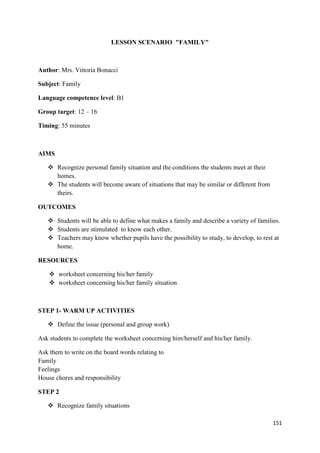
The Portfolio Kit
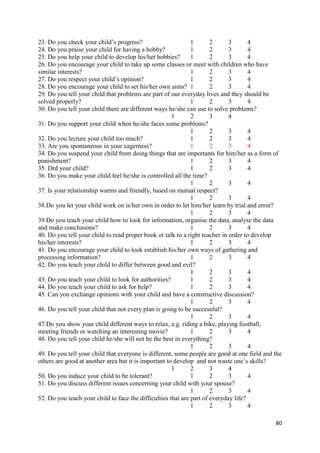
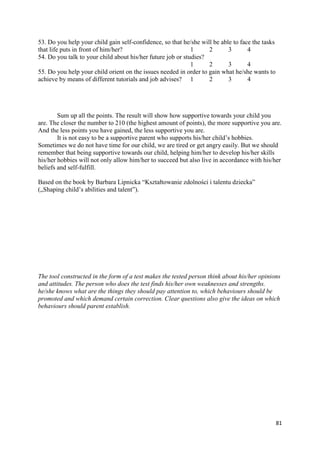
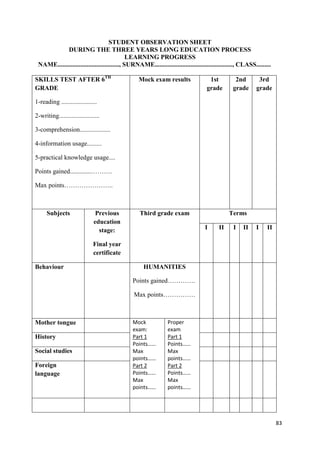
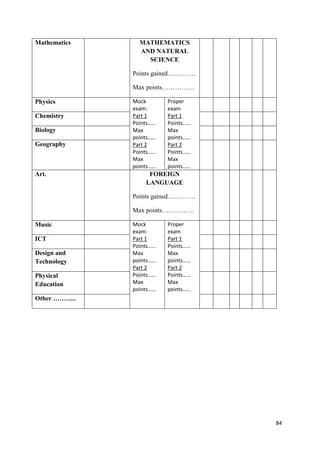
for Teachers
Multidisciplinary Flipped Learning with ICT
The Portfolio Kit
for Teachers
Multidisciplinary Flipped Learning with ICT
Erasmus Plus KA2 project
The Portfolio Kit
for Teachers
Multidisciplinary Flipped Learning with ICT
Erasmus Plus KA2 project 2015 - 2017
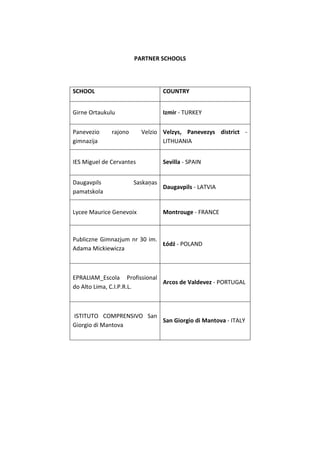
PARTNER SCHOOLS
SCHOOL COUNTRY
Girne Ortaukulu Izmir - TURKEY
Panevezio rajono Velzio
gimnazija
Velzys, Panevezys district -
LITHUANIA
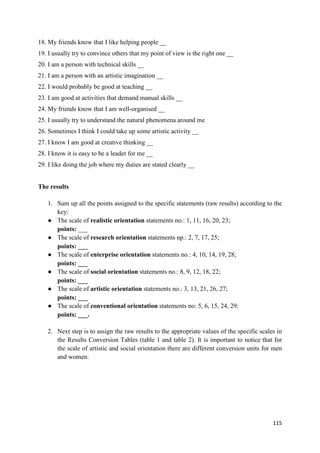
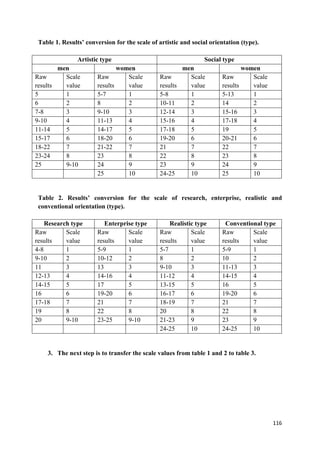
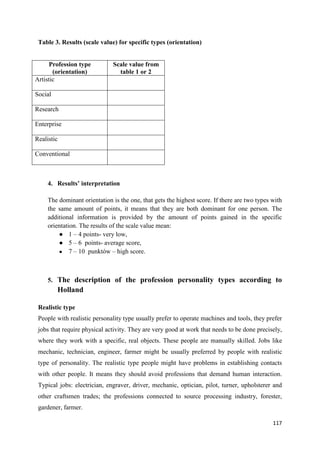
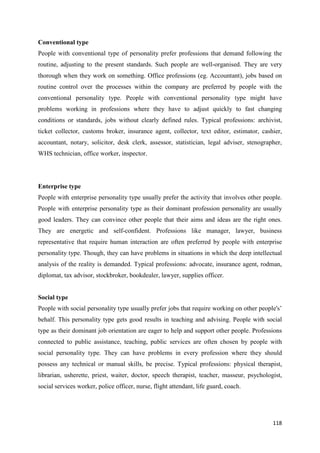
IES Miguel de Cervantes Sevilla - SPAIN
Daugavpils Saskaņas
pamatskola
Daugavpils - LATVIA
Lycee Maurice Genevoix Montrouge - FRANCE
Publiczne Gimnazjum nr 30 im.
Adama Mickiewicza
Łódź - POLAND
EPRALIAM_Escola Profissional
do Alto Lima, C.I.P.R.L.
Arcos de Valdevez - PORTUGAL
ISTITUTO COMPRENSIVO San
Giorgio di Mantova
San Giorgio di Mantova - ITALY
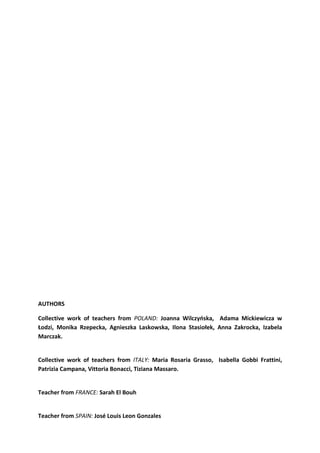
AUTHORS
Collective work of teachers from POLAND: Joanna Wilczyńska, Adama Mickiewicza w
Łodzi, Monika Rzepecka, Agnieszka Laskowska, Ilona Stasiołek, Anna Zakrocka, Izabela
Marczak.
Collective work of teachers from ITALY: Maria Rosaria Grasso, Isabella Gobbi Frattini,
Patrizia Campana, Vittoria Bonacci, Tiziana Massaro.
Teacher from FRANCE: Sarah El Bouh
Teacher from SPAIN: José Louis Leon Gonzales
"The European Commission support for the production of this publication does not constitute
an endorsement of the contents which reflects the views only of the authors, and the
Commission cannot be held responsible for any use which may be made of the information
contained therein."
1
„We can gain knowledge from others,
But wisdom, we must learn on our own”
Adam Mickiewicz
PORTFOLIO KIT
FOR TEACHERS
Property:
…………………………………………………….
School year:
……………………………………………………
Your Logo
2
Preface
We wish to invite you to try out a novelty publication that is the result of a long lasting work of
teachers from Poland, Italy, France and Spain. The following collection has been designed for all the
teachers who wish to know their students better and make their teaching more effective and
satisfying. We know that teaching and learning is a process and so is this work. Some of the
questionnaires and proposed solutions are still undergoing modifications to make it more useful and
clearer in reception. If there are any flaws or inconsistencies, please forgive us and let us know at
flippedlearning2015@yahoo.com We will be happy to answer all your questions and learn about
your opinions. We wish you a pleasant lecture.
What is the „Portfolio Kit for Teachers”?
“The Portfolio Kit for Teachers” contains materials allowing to diagnose accurately each of our
students systematically and analyze their individual development in each of the spheres.
It also serves to help choose the forms, methods and ways of working accurately and adequately to
meet students’ needs so that they can achieve success in the future and become independent and
fully satisfied adults.
Bulk sheets (questionnaires, student cards, passport, student evaluation of the effectiveness,
observation sheets, etc.), which are materials included as points in the table of contents, are going to
be our main aids to systematize information about a student.
The annexes are teaching aids and materials (such as surveys, questionnaires, tests), which constitute
the main source of information about a student.
After examining all these sources, we obtain the necessary information which we will keep in folders
devoted to individual students.
We will address the situation of the group or class, any problems affecting them, their values and
priorities, we will know who our students are.
Due to the provided tools (Attachments) – we will diagnose effectively the current and long-term
needs and abilities of each child.
Thus, we will obtain accurate guidance to work with a group, or tips what to focus or work on.
Through systematic conduct and appropriate surveys, we will specify aptly and accurately the
individual development of each of our children. We will define their strengths and weaknesses.
Each survey completed by a student, shows us his/her image. The quality and breadth of expression
defines his/her intellectual capabilities, which brings us closer to our student. We can see what this
particular student is interested in, how he/she perceives the world, how he/she changes their views,
what progress he/she is making in each sphere.
3
By using these materials (selected whole surveys or their fragments), us, teachers receive a guidance
for individual work with a child and/or their parents, to work with a group. Once the survey reveals
something disturbing, we are able to react adequately. In the case of an individual student, we are
even obliged to direct him to consult with a specialist.
Getting to know each of our students - individually, their functioning in a group, in the family, his/her
intellectual capacity, functioning in each sphere – will certainly contribute to the improvement of the
quality of our education. We will always be able to support a child adequately, and thus help him/her
in their development. In addition, we will support them more accurately in the selection of further
career paths, which will result in successes achieved by each of our students in the future.
Moreover, touching upon even uncomfortable or controversial topics in anonymous surveys, will
help us get a general idea in the situation and outlook in the trends of young people, and can be the
basis for forum discussions with the young, or the topic of one of our lessons.
4
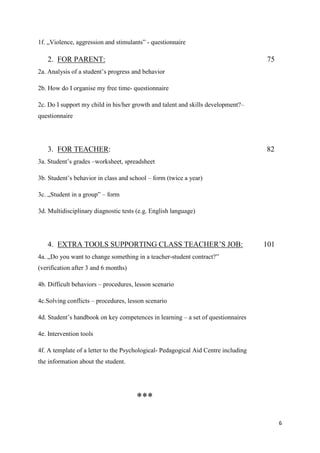
CONTENTS:
PART I: GETTING TO KNOW MY STUDENT 9
1. Initial diagnosis sheet
2. Individual work plan with a student taking into account their
individual needs and capabilities in respect with psychological
and pedagogical support as well as actions boosting student’s
interests and talents
3. Individual student’s card
Attachments:
1. FOR STUDENT: 17
1a. „For a starter” - questionnaire
1b. Form on situation within a family and living conditions
1c. My strong and weak points - worksheet
1d. Form on student’s interests and expectations towards school
1e. My goals and planned achievements - worksheet
1f. “Am I tolerant towards others?” - questionnaire
2. FOR PARENT: 27
2a. Questionnaire on family situation
2b. „Do you know your child?” - questionnaire
2c. Expectations towards school – questionnaire (cyclic research once a year
minimum)
2d. Am I tolerant towards others? - questionnaire
3. FOR TEACHER: 33
3a. Initial skills diagnosis(multidisciplinary tests, e.g. English aptitude tests,
entrance tests)
5
3b. Forms addressing student’s learning skills, styles and preferences
3c. Interview with a student
4. EXTRA TOOLS SUPPORTING CLASS TEACHER’S JOB 41
4a.Template of a contract between a class teacher and his/her class
4b. Template of a letter to parents informing about designed forms, methods and ways to
support
their child’s development
4c. Template of a student’s exemption from lessons
4d. Template of a student’s absence excuse
4e. Template of a contract obliging parents to systematic cooperation with school
***
PART II: I SYSTEMATICALLY MONITOR THE
PROGRESS OF MY STUDENT’S PERFORMANCE
(KNOWLEDGE, DEVELOPMENT, BEHAVIOR) 48
1. Observation sheet (monthly, periodic)
2. Multispecialty grade of a student’s performance
Attachments:
1. FOR STUDENT: 53
1a. „Me in class” – questionnaire, worksheet
1b. „Me in school” – questionnaire
1c. Strong and weak points versus student’s own motivation for learning – lesson
scenario
1d. My progress in learning and development of interests versus school
1e. „How do I organize my free time?” - questionnaire
6
1f. „Violence, aggression and stimulants” - questionnaire
2. FOR PARENT: 75
2a. Analysis of a student’s progress and behavior
2b. How do I organise my free time- questionnaire
2c. Do I support my child in his/her growth and talent and skills development?–
questionnaire
3. FOR TEACHER: 82
3a. Student’s grades –worksheet, spreadsheet
3b. Student’s behavior in class and school – form (twice a year)
3c. „Student in a group” – form
3d. Multidisciplinary diagnostic tests (e.g. English language)
4. EXTRA TOOLS SUPPORTING CLASS TEACHER’S JOB: 101
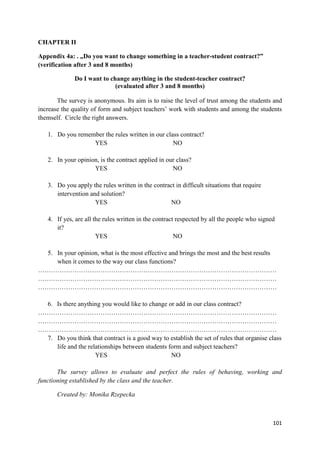
4a. „Do you want to change something in a teacher-student contract?”
(verification after 3 and 6 months)
4b. Difficult behaviors – procedures, lesson scenario
4c.Solving conflicts – procedures, lesson scenario
4d. Student’s handbook on key competences in learning – a set of questionnaires
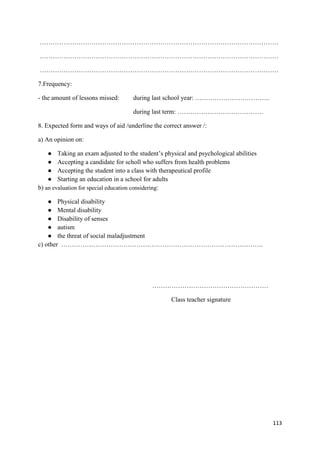
4e. Intervention tools
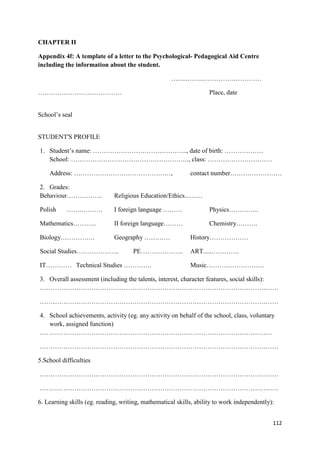
4f. A template of a letter to the Psychological- Pedagogical Aid Centre including
the information about the student.
***
7
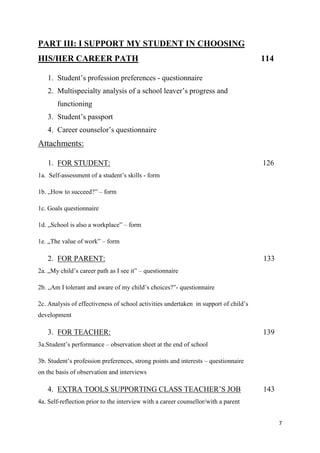
PART III: I SUPPORT MY STUDENT IN CHOOSING
HIS/HER CAREER PATH 114
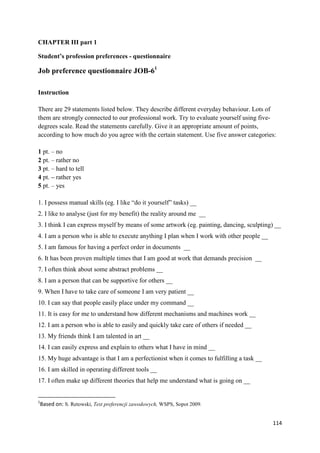
1. Student’s profession preferences - questionnaire
2. Multispecialty analysis of a school leaver’s progress and
functioning
3. Student’s passport
4. Career counselor’s questionnaire
Attachments:
1. FOR STUDENT: 126
1a. Self-assessment of a student’s skills - form
1b. „How to succeed?” – form
1c. Goals questionnaire
1d. „School is also a workplace” – form
1e. „The value of work” – form
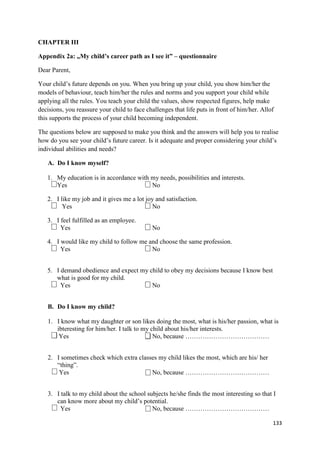
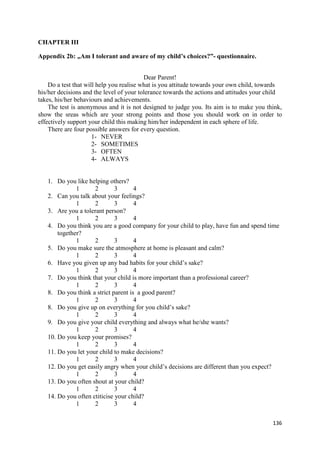
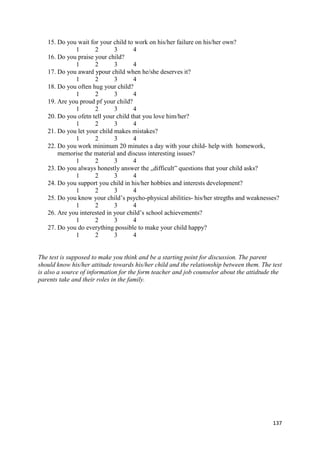
2. FOR PARENT: 133
2a. „My child’s career path as I see it” – questionnaire
2b. „Am I tolerant and aware of my child’s choices?”- questionnaire
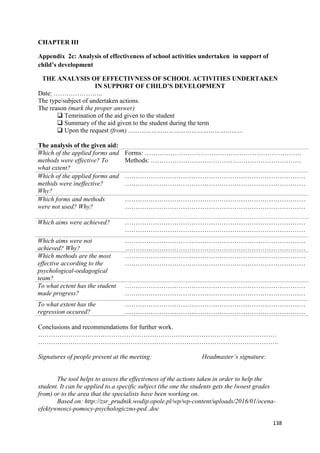
2c. Analysis of effectiveness of school activities undertaken in support of child’s
development
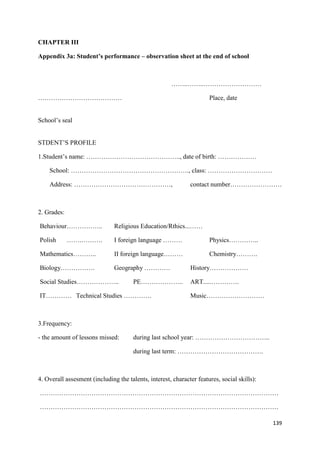
3. FOR TEACHER: 139
3a.Student’s performance – observation sheet at the end of school
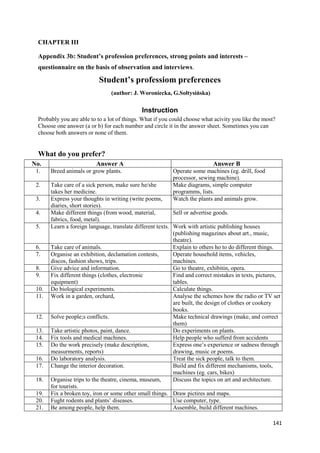
3b. Student’s profession preferences, strong points and interests – questionnaire
on the basis of observation and interviews
4. EXTRA TOOLS SUPPORTING CLASS TEACHER’S JOB 143
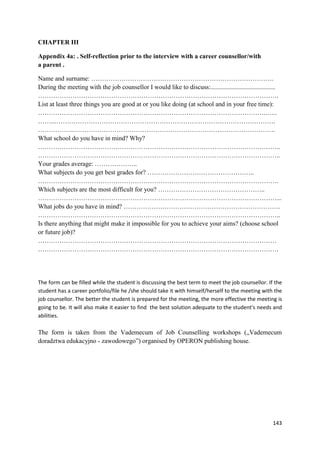
4a. Self-reflection prior to the interview with a career counsellor/with a parent
8
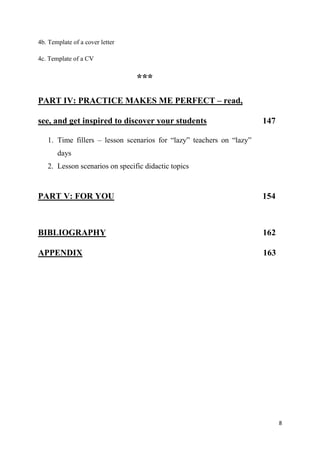
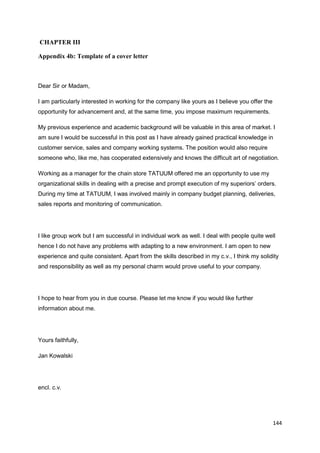
4b. Template of a cover letter
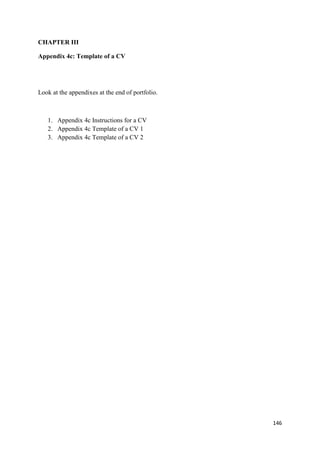
4c. Template of a CV
***
PART IV: PRACTICE MAKES ME PERFECT – read,
see, and get inspired to discover your students 147
1. Time fillers – lesson scenarios for “lazy” teachers on “lazy”
days
2. Lesson scenarios on specific didactic topics
PART V: FOR YOU 154
BIBLIOGRAPHY 162
APPENDIX 163
9
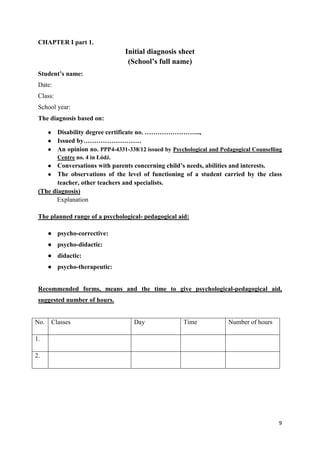
CHAPTER I part 1.
Initial diagnosis sheet
(School’s full name)
Student’s name:
Date:
Class:
School year:
The diagnosis based on:
● Disability degree certificate no. ……………………..,
● Issued by………………………
● An opinion no. PPP4-4331-338/12 issued by Psychological and Pedagogical Counselling
Centre no. 4 in Łódź.
● Conversations with parents concerning child’s needs, abilities and interests.
● The observations of the level of functioning of a student carried by the class
teacher, other teachers and specialists.
(The diagnosis)
Explanation
The planned range of a psychological- pedagogical aid:
● psycho-corrective:
● psycho-didactic:
● didactic:
● psycho-therapeutic:
Recommended forms, means and the time to give psychological-pedagogical aid,
suggested number of hours.
No. Classes Day Time Number of hours
1.
2.
10
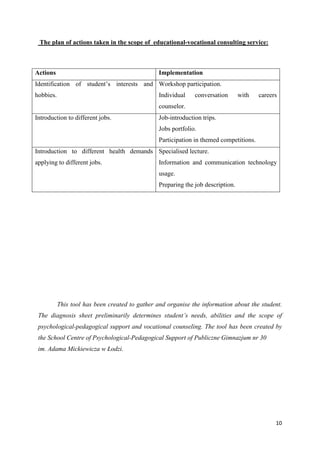
The plan of actions taken in the scope of educational-vocational consulting service:
Actions Implementation
Identification of student’s interests and
hobbies.
Workshop participation.
Individual conversation with careers
counselor.
Introduction to different jobs. Job-introduction trips.
Jobs portfolio.
Participation in themed competitions.
Introduction to different health demands
applying to different jobs.
Specialised lecture.
Information and communication technology
usage.
Preparing the job description.
This tool has been created to gather and organise the information about the student.
The diagnosis sheet preliminarily determines student’s needs, abilities and the scope of
psychological-pedagogical support and vocational counseling. The tool has been created by
the School Centre of Psychological-Pedagogical Support of Publiczne Gimnazjum nr 30
im. Adama Mickiewicza w Łodzi.
11
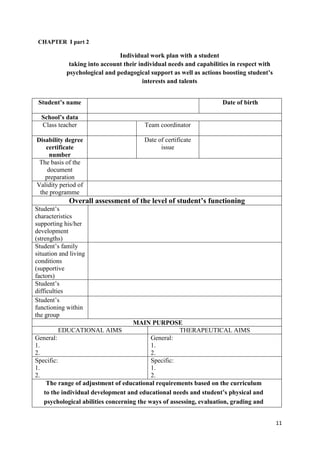
CHAPTER I part 2
Individual work plan with a student
taking into account their individual needs and capabilities in respect with
psychological and pedagogical support as well as actions boosting student’s
interests and talents
Student’s name Date of birth
School’s data
Class teacher Team coordinator
Disability degree
certificate
number
Date of certificate
issue
The basis of the
document
preparation
Validity period of
the programme
Overall assessment of the level of student’s functioning
Student’s
characteristics
supporting his/her
development
(strengths)
Student’s family
situation and living
conditions
(supportive
factors)
Student’s
difficulties
Student’s
functioning within
the group
MAIN PURPOSE
EDUCATIONAL AIMS THERAPEUTICAL AIMS
General:
1.
2.
General:
1.
2.
Specific:
1.
2.
Specific:
1.
2.
The range of adjustment of educational requirements based on the curriculum
to the individual development and educational needs and student’s physical and
psychological abilities concerning the ways of assessing, evaluation, grading and
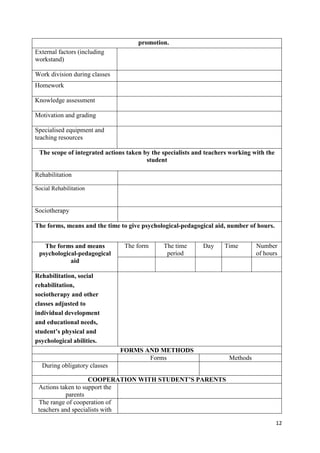
12
promotion.
External factors (including
workstand)
Work division during classes
Homework
Knowledge assessment
Motivation and grading
Specialised equipment and
teaching resources
The scope of integrated actions taken by the specialists and teachers working with the
student
Rehabilitation
Social Rehabilitation
Sociotherapy
The forms, means and the time to give psychological-pedagogical aid, number of hours.
The forms and means
psychological-pedagogical
aid
The form The time
period
Day Time Number
of hours
Rehabilitation, social
rehabilitation,
sociotherapy and other
classes adjusted to
individual development
and educational needs,
student’s physical and
psychological abilities.
FORMS AND METHODS
Forms Methods
During obligatory classes
COOPERATION WITH STUDENT’S PARENTS
Actions taken to support the
parents
The range of cooperation of
teachers and specialists with
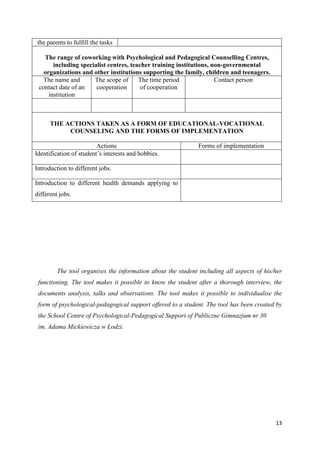
13
the parents to fulfill the tasks
The range of coworking with Psychological and Pedagogical Counselling Centres,
including specialist centres, teacher training institutions, non-governmental
organizations and other institutions supporting the family, children and teenagers.
The name and
contact date of an
institution
The scope of
cooperation
The time period
of cooperation
Contact person
THE ACTIONS TAKEN AS A FORM OF EDUCATIONAL-VOCATIONAL
COUNSELING AND THE FORMS OF IMPLEMENTATION
Actions Forms of implementation
Identification of student’s interests and hobbies.
Introduction to different jobs.
Introduction to different health demands applying to
different jobs.
The tool organises the information about the student including all aspects of his/her
functioning. The tool makes it possible to know the student after a thorough interview, the
documents analysis, talks and observations. The tool makes it possible to individualise the
form of psychological-pedagogical support offered to a student. The tool has been created by
the School Centre of Psychological-Pedagogical Support of Publiczne Gimnazjum nr 30
im. Adama Mickiewicza w Łodzi.
14
CHAPTER 1 part 3
…………………………………………..
School’s seal …………………………………
…………………………………
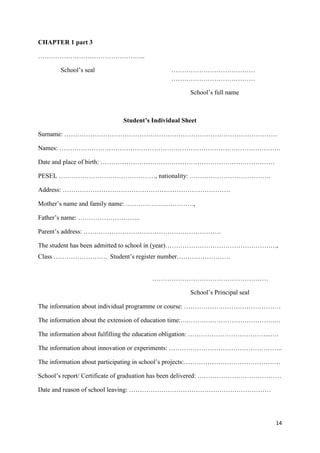
School’s full name
Student’s Individual Sheet
Surname: ………………………………………………………………………………………
Names: ………………………………………………………………………………………….
Date and place of birth: ………………………………………………………………………
PESEL ………………………………………, nationality: .……………………………….
Address: ……………………………………………………………………
Mother’s name and family name: ……………….………….,
Father’s name: ………………………..
Parent’s address: ……………………………………………………….
The student has been admitted to school in (year)…………………………………………….,
Class ……………………. Student’s register number…………………….
………………………………………………
School’s Principal seal
The information about individual programme or course: ………………………………………
The information about the extension of education time:….………………………………….…
The information about fulfilling the education obligation: ………………………………...….
The information about innovation or experiments: ……………………………………………..
The information about participating in school’s projects:………………………………………
School’s report/ Certificate of graduation has been delivered: …………………………………
Date and reason of school leaving: …………………………………………………………
15
No. School year
Class (in words)
Number in class register
The results at the end
of the school year
The results at
the end of
educational
stage
1. Behaviour
2. Religious education/ Ethics
Compulsory subjects
3. Language………
4. Language………
5. Language……….
6. History
7. Social studies
8. Geography
9. Biology
10. Physics
11. Chemistry
12. Mathematics
13. Information Technology
14. Physical Education
15. Music
16. Art
17. Design Technology/
Practical classes
18. Art classes
19.
20.
Extracurricular classes
23.
24.
25.
26. Achievements
27. The number of lessons
missed
All together
Absence without leave
28. Information about:
exams:
repeat exams
b) end of term/ year
(qualifying) exam
testing the abilities and
knowledge (classes, grade
and date)
16
29. The date of Teacher’s board
resolution:
promoted to the next higher
grade (with distinction)
not promoted
graduated (with distinction)
have not graduated
30. Date and signature of a
person filling the school
report
31. The results of the final exam.
Date and signature of a
person filling the school
report.
Vocational practice
School
year,
Term
The name and address of an
institution that conducts
internship
Type of classes Number of
classes
Grade
Date and
signature of a
person filling
the school
report.
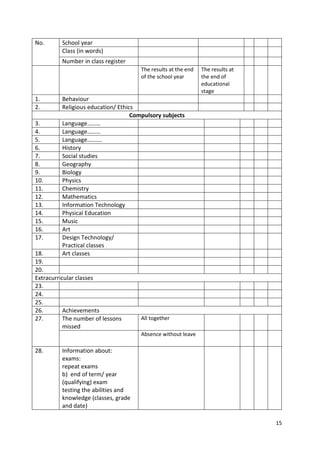
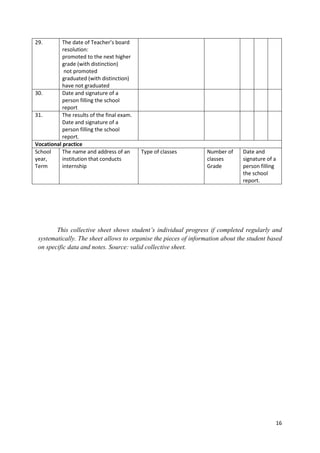
This collective sheet shows student’s individual progress if completed regularly and
systematically. The sheet allows to organise the pieces of information about the student based
on specific data and notes. Source: valid collective sheet.
17
CHAPTER 1
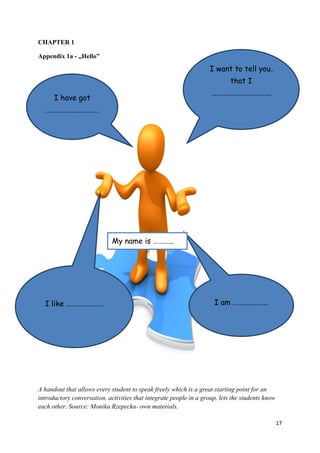
Appendix 1a - „Hello”
A handout that allows every student to speak freely which is a great starting point for an
introductory conversation, activities that integrate people in a group, lets the students know
each other. Source: Monika Rzepecka- own materials.
I want to tell you,
that I
……………………………..
I have got
………………………….
I am …………………I like ………………….
My name is ………...
18
CHAPTER 1
Appendix 1b. Student’s worksheet concerning his family.
STUDENT’S WORKSHEET
Topic: "My family"
1. Write down the words that come to your mind when you think about a family. Then
establish the definition of „family”.
FAMILY
A family is: ................................................................................................................................
.......................................................................................................................................................
.............................................................................................................................................
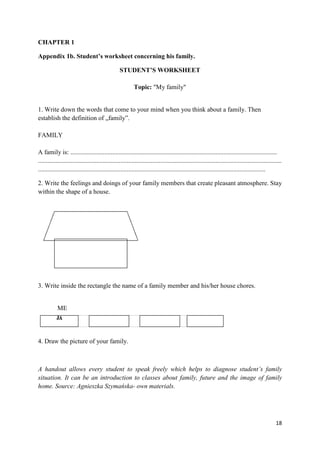
2. Write the feelings and doings of your family members that create pleasant atmosphere. Stay
within the shape of a house.
3. Write inside the rectangle the name of a family member and his/her house chores.
ME
4. Draw the picture of your family.
A handout allows every student to speak freely which helps to diagnose student’s family
situation. It can be an introduction to classes about family, future and the image of family
home. Source: Agnieszka Szymańska- own materials.
19
CHAPTER I
Appendix 1b: Form on situation within a family and living conditions
A survey about your family situation: Who are you?- let’s get to know each other. (author
Ms. Agnieszka Laskowska)
Read the survey and write your answers in the intended place or mark the answer by
writing „x” in a correct space. Thank you.
1. My name is ……………………………………………………………………………..
2. I was born on: day…….. month …….. year ….., in (birthplace)…………………………..
3. I live in …………………………, Street ……………………………………….
Me, my family, my home (mark the answers with X)
1. Do you have any siblings?
yes no
2. If you have any siblings, how many are there?
1 2 3 4 5
3. Do you have your own room?
yes no
4. If you marked „no” in question no 3, say who do you share the room with.
my siblings my parents my grandparents other relative
5. I live with:
mom and dad just mom just dad grandparents
my mom and her boyfriend dad and his girlfriend in a school dormitory
other, …………………………………………………………………………….
6. If I have some free time, just for me at home, I have homework to do or I just want to rest I
have a place at home where I can be alone, it is ……………………
don’t have a place where I can be alone at home
7. Mark the answer you agree with:
I like my home and my family I don’t like my home and my family
I would like some things could change at my home and in my family
20
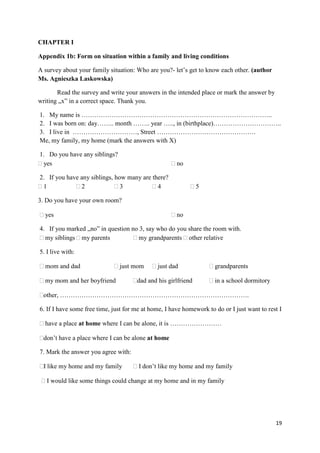
The above survey is meant to recognise the family situation and the conditions the students
meet at their homes. The answers given by the students will make it possible to asses whether
the pupils have the possibility to study, to develop and to rest at home.
If the student answers „other” to question no. 5 or „I don’t like my home and my family” to
question 7, the teacher should talk to the pupil individually to recognise his/her family
situation. It is also advised to talk to the parents as well.
21
CHAPTER I
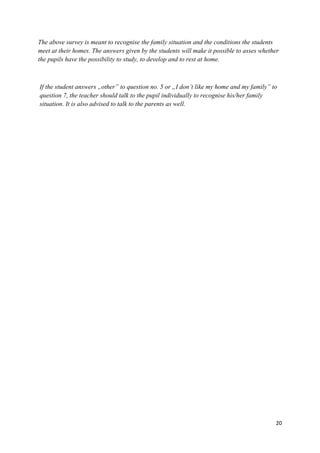
Appendix 1c. My strong and weak points – worksheet.
The balance of your strengths and weaknesses will make it possible for you to assess your
abilities, dispositions and interests. In the future it will help you to prepare a good CV, a cover
letter or present yourself during a job interview.
A handout aims at defining each student’s individual abilities. It can be a starting
point to classes about self-assurance, self-esteem, role in a group. The handout can inspire
students to make decisions about their education path and self-fulfillment. It can also give
students important information in terms of the choice of future job.
22
CHAPTER 1
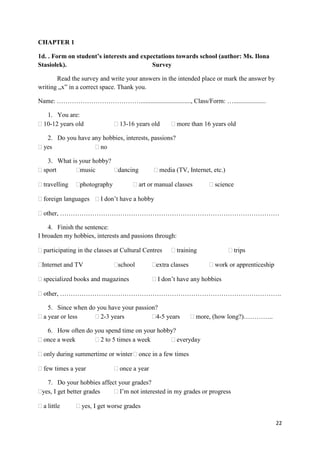
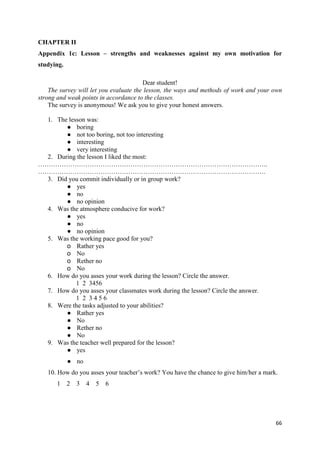
1d. . Form on student’s interests and expectations towards school (author: Ms. Ilona
Stasiołek). Survey
Read the survey and write your answers in the intended place or mark the answer by
writing „x” in a correct space. Thank you.
Name: …………………………………..............................., Class/Form: …....................
1. You are:
10-12 years old 13-16 years old more than 16 years old
2. Do you have any hobbies, interests, passions?
yes no
3. What is your hobby?
sport music dancing media (TV, Internet, etc.)
travelling photography art or manual classes science
foreign languages I don’t have a hobby
other, …………………………………………………………………………………………
4. Finish the sentence:
I broaden my hobbies, interests and passions through:
participating in the classes at Cultural Centres training trips
Internet and TV school extra classes work or apprenticeship
specialized books and magazines I don’t have any hobbies
other, ………………………………………………………………………………………….
5. Since when do you have your passion?
a year or less 2-3 years 4-5 years more, (how long?)…………..
6. How often do you spend time on your hobby?
once a week 2 to 5 times a week everyday
only during summertime or winter once in a few times
few times a year once a year
7. Do your hobbies affect your grades?
yes, I get better grades I’m not interested in my grades or progress
a little yes, I get worse grades
23
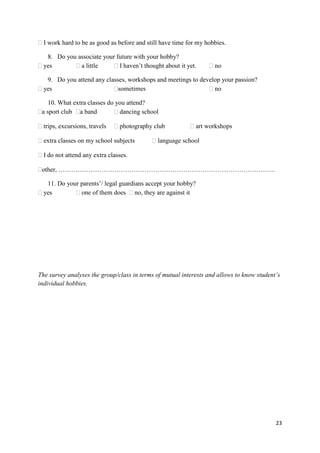
I work hard to be as good as before and still have time for my hobbies.
8. Do you associate your future with your hobby?
yes a little I haven’t thought about it yet. no
9. Do you attend any classes, workshops and meetings to develop your passion?
yes sometimes no
10. What extra classes do you attend?
a sport club a band dancing school
trips, excursions, travels photography club art workshops
extra classes on my school subjects language school
I do not attend any extra classes.
other, ………………………………………………………………………………………..
11. Do your parents’/ legal guardians accept your hobby?
yes one of them does no, they are against it
The survey analyses the group/class in terms of mutual interests and allows to know student’s
individual hobbies.
24
CHAPTER 1
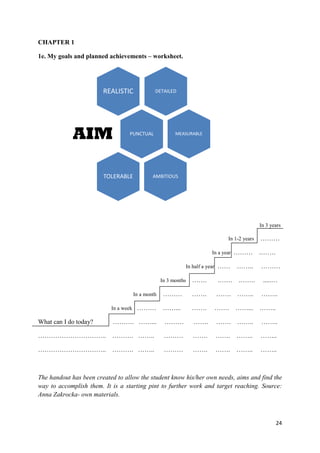
1e. My goals and planned achievements – worksheet.
In 3 years
In 1-2 years ………
In a year ……… .…….
In half a year …… …….. ………
In 3 months ……. .…… .……. .....…
In a month ……… ……. ……. …….. ……..
In a week ……… ……... ……. ……. ……... ……..
What can I do today? ………. ……... ……… ……. ……. …….. ……..
………………………….. ………. …….. ……… ……. ……. …….. ……..
………………………….. ………. …….. ……… ……. ……. …….. ……..
The handout has been created to allow the student know his/her own needs, aims and find the
way to accomplish them. It is a starting pint to further work and target reaching. Source:
Anna Zakrocka- own materials.
DETAILEDREALISTIC
PUNCTUAL
AIM MEASURABLE
AMBITIOUSTOLERABLE
25
CHAPTER 1
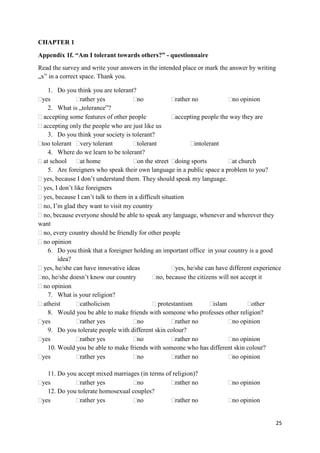
Appendix 1f. “Am I tolerant towards others?” - questionnaire
Read the survey and write your answers in the intended place or mark the answer by writing
„x” in a correct space. Thank you.
1. Do you think you are tolerant?
yes rather yes no rather no no opinion
2. What is „tolerance”?
accepting some features of other people accepting people the way they are
accepting only the people who are just like us
3. Do you think your society is tolerant?
too tolerant very tolerant tolerant intolerant
4. Where do we learn to be tolerant?
at school at home on the street doing sports at church
5. Are foreigners who speak their own language in a public space a problem to you?
yes, because I don’t understand them. They should speak my language.
yes, I don’t like foreigners
yes, because I can’t talk to them in a difficult situation
no, I’m glad they want to visit my country
no, because everyone should be able to speak any language, whenever and wherever they
want
no, every country should be friendly for other people
no opinion
6. Do you think that a foreigner holding an important office in your country is a good
idea?
yes, he/she can have innovative ideas yes, he/she can have different experience
no, he/she doesn’t know our country no, because the citizens will not accept it
no opinion
7. What is your religion?
atheist catholicism protestantism islam other
8. Would you be able to make friends with someone who professes other religion?
yes rather yes no rather no no opinion
9. Do you tolerate people with different skin colour?
yes rather yes no rather no no opinion
10. Would you be able to make friends with someone who has different skin colour?
yes rather yes no rather no no opinion
11. Do you accept mixed marriages (in terms of religion)?
yes rather yes no rather no no opinion
12. Do you tolerate homosexual couples?
yes rather yes no rather no no opinion
26
13. Should homosexual couples have the possibility to legalize their relationship?
yes rather yes no rather no no opinion
14. Should homosexual couples have the possibility to adopt children?
yes rather yes no rather no no opinion
15. Do you sometimes criticise other people?
yes sometimes no
16. What in your opinion makes it difficult to be tolerant?
race religion language culture social status
education age other, ………………………………….
The survey is about a level of tolerance of every student. It can be used during the
classes about tolerance, consciousness, awareness and shaping the point of view. The survey
allows to know the students and organise one’s own beliefs. It can be an inspiration to a
discussion on a topic of tolerance and an attitude towards being different. The survey was
prepared by Monika Rzepecka on the basis of the gathered sources.
27
CHAPTER I
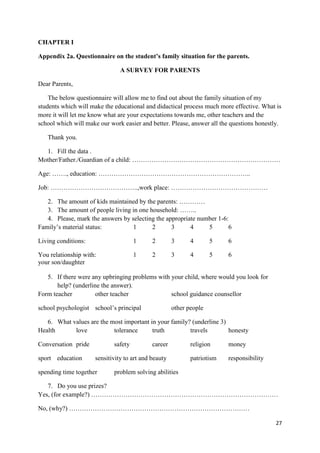
Appendix 2a. Questionnaire on the student’s family situation for the parents.
A SURVEY FOR PARENTS
Dear Parents,
The below questionnaire will allow me to find out about the family situation of my
students which will make the educational and didactical process much more effective. What is
more it will let me know what are your expectations towards me, other teachers and the
school which will make our work easier and better. Please, answer all the questions honestly.
Thank you.
1. Fill the data .
Mother/Father./Guardian of a child: ……………………………………………………………
Age: ……., education: ……………………………………………………………..
Job: …………………………………..,work place: ………………………………………
2. The amount of kids maintained by the parents: …………
3. The amount of people living in one household: ……..
4. Please, mark the answers by selecting the appropriate number 1-6:
Family’s material status: 1 2 3 4 5 6
Living conditions: 1 2 3 4 5 6
You relationship with: 1 2 3 4 5 6
your son/daughter
5. If there were any upbringing problems with your child, where would you look for
help? (underline the answer).
Form teacher other teacher school guidance counsellor
school psychologist school’s principal other people
6. What values are the most important in your family? (underline 3)
Health love tolerance truth travels honesty
Conversation pride safety career religion money
sport education sensitivity to art and beauty patriotism responsibility
spending time together problem solving abilities
7. Do you use prizes?
Yes, (for example?) ……………………………………………………………………………
No, (why?) …………………………………………………………………………
28
8. Do you use punishment?
Yes, (for example?………………………………………………………………………………
No, (why?) …………………………………………………………………………
9. How do you spend your free time?
Shop together watch TV go for walks together
Talk to other members of the family go to the cinema, etc. travel
we don’t spend free time together do sport
other, (for example? )………………………………………….
10. What forms of working with the teachers do you usually use?
Meetings with form teacher meetings with other teachers open days
House visits phone conversation mail
11. What day of the week and what hour are the most convenient for you to meet the
teacher?
……………………………………………………………………………………………
12. In what situation do you expect the school to help you?
……………………………………………………………………………………………
The aim of the survey is to know the student’s family situation. The form of the survey makes
it easy for the parents to be honest. The results are a valuable source of information for the
form teacher who should be open to help and support the families who are in need.
29
CHAPTER 1
Appendix 2b. „Do you know your child?” – a test for the parents.
1. Do you know what your child does in his/her free time? Do you know his/her hobbies
and interests?
2. Do you know your child’s friends and classmates?
3. Is there anything you and your child do together?
4. Do you know what your child wants to do in the future?
5. Can you name, without thinking, five features of your child?
6. Do you talk to your child about difficult matters (eg. death, emotions, sex). Is it easy
for you?
7. Are there clear rules set in your family (eg. chores division)?
8. Do you know whether your child is easily influenced by others, falls for media
manipulation?
9. Has your child recently acted the unusual way (hasn’t he/she changed his/her habits,
acted the odd way)?
10. Do you know current grades and school achievements of your child?
Dear Mother or Father,
If your answer is „yes” to the majority of the above questions, it only means that your
knowledge and bond with your child is really special and admirable. Look after them
carefully. Good luck!
If your answer is „no” to at least half of the questions, you should know that your relationship
with your child requires improvement by talking more often, playing, taking up some
activities and spending more time together. Good luck!
The test makes the parents think how much they know their child. It can be an inspiration for
the parents to start a conversation with their children, encourage to spend time together and
talk. The test has been created on the basis of gathered tests.
30
CHAPTER I
Appendix 2c. . Expectations towards school – questionnaire
Read the survey and write your answers in the intended place or mark the answer by writing
„x” in a correct space. Thank you.
1. Do you know the working strategy used by our school? Do you accept it?
I know the strategy and I accept it I know the strategy but I don't accept it
I don't know the strategy.
2. Are parents informed about the mentioned strategy by the school?
definitely yes rather yes rather no no
3. Does the school have clear and accepted objectives and aims?
definitely yes rather yes rather no no
4. Does the school fulfill the educational needs of your child?
definitely yes rather yes rather no no
5. Would you recommend our school to your friends who are looking for a place for their
child?
yes, because ……………………………………………………………….
no, because ……………………………………………………………….
6. Does the school help to develop and fulfill your child's interests, hobbies and
ambitions?
definitely yes rather yes rather no no
7. In your opinion, is the school timetable set in the way that supports learning?
definitely yes rather yes rather no no
8. Is your child well-motivated to studying by the teachers?
definitely yes rather yes rather no no
9. Does the school have the facilities and equipment suitable for a proper implementation
of the process of teaching, education and care?
definitely yes rather yes rather no no
10. Does the school provide healthy, safe and suitable conditions of work and staying?
definitely yes rather yes rather no no
11. Does the school cooperate with the parents using the rules of partnership and
encourage them to an active participation in school life?
definitely yes rather yes rather no no
12. Is the educational programme realized in the cooperation and coworking with the
parents accounting their opinion?
definitely yes rather yes rather no no
The tool allows to find out what are parent’s opinions about the school, methods, forms and
ways of work with their child. It helps to verify, perfect the work of school but also
individualize the educational- didactical process. It can be used during the meetings with
parents. Source: Ilona Stasiołek
31
CHAPTER I
Appendix 2d: „Are you tolerant? – a survey.
Read the survey and write your answers in the intended place or mark the answer by writing
„x” in a correct space. Thank you.
1. Do you think you are tolerant?
yes rather yes no rather no no opinion
2. What is „tolerance”?
accepting some features of other people accepting people the way they are
accepting only the people who are just like us
3. Do you think your society is tolerant?
too tolerant very tolerant tolerant intolerant
4. Where do we learn to be tolerant?
at school at home on the street doing sports at church
5. Are foreigners who speak their own language in a public space a problem to you?
yes, because I don’t understand them. They should speak my language.
yes, I don’t like foreigners
yes, because I can’t talk to them in a difficult situation
no, I’m glad they want to visit my country
no, because everyone should be able to speak any language, whenever and wherever they
want
no, etery country should be friendly for other people
no opinion
6. Do you think that a foreigner holding an important office in your country is a good
idea?
yes, he/she can have innovative ideas yes, he/she can have different experience
no, he/she doesn’t know our country no, because the citizens will not accept it,
no opinion
7. What is your religion?
atheist catholicism protestantism islam other
8. Would you be able to make friends with someone who professes other religion?
yes rather yes no rather no no opinion
9. Do you tolerate people with different skin colour?
yes rather yes no rather no no opinion
10. Would you be able to make friends with someone who has different skin colour?
yes rather yes no rather no no opinion
11. Do you accept mixed marriages (in terms of religion)?
yes rather yes no rather no no opinion
12. Do you tolerate homosexual couples?
yes rather yes no rather no no opinion
32
13. Should homosexual couples have the possibility to legalize their relationship?
yes rather yes no rather no no opinion
14. Should homosexual couples have the possibility to adopt children?
yes rather yes no rather no no opinion
15. Do you sometimes criticise other people?
yes sometimes no
16. What in your opinion makes it difficult to be tolerant?
race religion language culture social status
education age other, ………………………………….
Thank you very much for your honest answers.
The aim of the survey is to identify the way the student’s family sees tolerance. It can be used
during the meeting with parents. It can be used as a starting point to a discussion about
tolerance towards otherness and unique personalities of other students. The results are a
valuable source of information for teachers and they can be an inspiration for further work
on the topic of tolerance.
33
CHAPTER I
Appendix 3a. Initial skills diagnosis(multidisciplinary tests, e.g. English aptitude tests,
entrance tests)
(based on OKE Kraków)
Dear First Year Students!
The survey is not anonymous but the results will not influence your grades. We would
like to ask you to answer all the questions honestly. Thanks to your answers we will know
you, your abilities and your motivation towards studying.
Thank you.
Name and surname:……………………….……………………………..
1. Which document proves your achievements at school better?
A School report.
B Final exams certificate.
C They are both accurate.
2. The school you go to is:
A in a town/city where you live or live nearby
B in a different town/ city and you have to get to school everyday (eg. by bus)
3. Your results at school are:
A not too important for your parents (guardians)
B important for your parents (guardians)
C very important for your parents (guardians)
4. Name two main activities you do after school.
A I read books.
B I help my parents.
C I surf the Internet.
D I listen to music.
E I watch movies.
F I do homework and study.
G I play sport.
H I meet my friends.
I I play computer games.
J I go to extra classes (for example?) ................................................
K Other (for example?) ...........................................................................................
5. Mark school subjects (max three) that are especially difficult for you.
A Mathematics.
B Language (your mother tongue)
C Physics.
D Chemistry.
E Biology.
F History.
G Geography.
H Other (jaki?) ........................................
34
6. Which subject is the most interesting for you? (Mark max three subjects).
A Mathematics.
B Language (your mother tongue)
C Physics.
D Chemistry.
E Biology.
F History.
G Geography.
H Other (jaki?) ........................................
7.What do you think of yourself?
A I’m as important as the others.
B I’m proud of myself.
C I’m good at some things only.
D Sometimes I think I’m useless.
E I’m good for nothing.
8. Mark to what extend you are talented (according to yourself) in each field. 1 means no
talent and 6 means very talented.
a. Music talent 1 2 3 4 5 6
b. Art talent 1 2 3 4 5 6
c. Mathematical skills 1 2 3 4 5 6
d. Humanistic skills 1 2 3 4 5 6
e. Organisational skills 1 2 3 4 5 6
f. Language skills 1 2 3 4 5 6
g. Manual skills 1 2 3 4 5 6
h. Acting skills 1 2 3 4 5 6
i. Sport skills 1 2 3 4 5 6
9. Tell us what you think of your health.
a. It doesn’t interrupt your education
b. It makes you absent very often
c. It makes your studying impossible.
10. You think that:
a. it is important to study hard because this is the best way to succeed in the future.
b. everyone should learn as much and as long as it’s possible
c. only being promoted to a higher level is important
d. there are a lot more interesting things to do than studying.
e. the success doesn’t depend too much on the grades during education at school.
35
11. Does learning make you happy?
a. yes, very much
b. rather yes
c. I study because I have to.
d. rather not
e. definitely no.
12. How many years after graduating the secondary school do you plan to
study?...........................
13. What job do you plan to do after you finish your education?.................................................
14. What foreign languages have you studied before you came to this school? Mark the
languages you studied and write how many years you have been learning.
a. English ………………….
b. French ………………….
c. German ………………….
d. Russian ………………….
e. Other (what language?) ……………………………. ……………………
15. Did you participate in any subject competitions?
a. Yes, I was a prizewinner of a voivodeship stage of more than one subject
competition............................................................... .
b. Yes, I was a prizewinner of a voivodeship stage of one subject
competition................................................................
c. Yes, of .........................................., but I ended it on regional stages
d. Yes, of ........................................, but I ended on a school stage
e. No, I haven’t participated in any competitions.
The given answers will allow us to determine the skills, abilities, motivation and
conditions to study of every child. What is more, they will show us a subjective way each
student sees himself/herself.
A thorough and detailed analysis of students’ knowledge and skills in specific fields
should be done by the teachers who teach particular subjects by the means of subject entry
tests.
36
A test to find out what is your learning style
1. When you meet someone new, what are the first things you pay attention to?
a) the appearance and the way the person is dressed
b) what the person says, in what manner, what is his/her voice like
c) how you feel about that person
d) how does he/she behave, what he/se does
2. What do you remember the most after few days after you meet someone new?
a) the person's face
b) the person’s name,
c) your emotions, what you felt in the presence of the person even if you don’t remember
his/her face or name
3. When you enter a place that you do not know, what are the first things you pay attention to?
a) its appearance
b) the sounds and conversations inside
c) how well you feel inside (both emotionally and physically)
d) what is going on inside and what you can do inside
4. When you learn something new what is the most pleasant way for you?
a) when the teacher gives you something new to read (on paper or a blackboard), shows you
the book, pictures, charts, maps, etc. And you do not have to write or say anything
b) when the teacher explains everything in a form of a lecture and allows you to discuss
different things and ask questions and you do not have to read anything, look at anything or
write anything down.
c) when the teacher allows you to make notes or draw pictures, touch the things, write down
and do something manually
d) when the teacher allows you to do projects, simulations, experiments, roleplay or take part
in other activities involving movement.
5. When you teach others, what do you usually do?
a) you give them something to see, for example, some object, illustration, a diagram and you
only give them a short verbal explanation or you don’t give the explanation at all, allowing (or
not) a short discussion
b) you explain everything verbally without showing anything,
c) you draw, write something or use your hands to explain,
d) you demonstrate something or you tell your students to do it with you.
6. What kind of books do you read most often?
a) the books that include a lot of description that helps to understand the plot
b) the books that include historical facts, a lot of information and description
c) the books about the characters' feelings and emotions
d) short action- packed books or the books that help you develop your skills, talents and
hobbies
37
7. Which of the below actions do you do most often in your free time?
a) read a book or a magazine,
b) listen to an audiobook, radio, listen to music or make music on your own,
c) write, draw, type or do something with your hands in general,
d) you do sport, build something or play some game that requires movement.
8. Which of the statements characterizes best the way you learn or read?
a) you are able to learn when you hear some sounds, noises, people talking or music
b) you are not able to study when you hear some sounds, noises, people talking or music
c) you need to feel comfortable, relaxed; you are able to learn both in silence and surrounded
by sounds (eg.music) but you get distracted by negative feelings of other people
d) you need to feel comfortable, relaxed; you are able to learn both in silence and surrounded
by sounds (eg.music) but you get distracted by the movement of other people who are in the
same room
9. When you talk to someone where do you look? (To answer this question you can ask
someone to watch you while having a conversation).
a) you look at the face of a person you are talking to and you want this person to look at you
too
b) you only look from time to time at the person you are talking to and then your sight goes o
right and left,
c) you look for a short time at the person you are talking to and then your sight goes down or
to the side.
d) you rarely look at the person you are talking to, you usually look down or to the side but if
any movement or action happens you immediately look that way.
10. Which of the statements describes you best?
a) you pay attention to shapes, colours, patterns and designs that are present in the places
where you stay
b) you hate silence and if you are somewhere where it is too quiet you either hum, sing or
listen to music
c) you are sensitive to different feeling- yours and the people who surround you. You can not
focus when someone does not like you. You need to be popular and liked by others to
function well.
d) it is difficult for you to sit still in one place for a longer period of time. You need to move a
lot. But if you are sitting you usually hunch, you fidget, clutter at the floor.
11. Which of the sentences describes you best?
a) you pay attention to the n want to way the person looks- the mismatched clothes or the fact
that the person’s hair isn’t in order and you often wato fix it,
b) you get anxious when someone can not speak clearly, you are sensitive to a sound of a
leaking tap or the sounds made by the household appliances.
c) you cry during touching scenes at the cinema or when you read a moving book
d) you get anxious and you don’t feel bad when you have to sit straight, without any
movement, you can’t stay in one place for too long.
38
12. What makes you anxious?
a) a messy chaotic place
b) a silent place
c) a place where you do not feel comfortable (both physically and mentally)
d) a place where you can not do anything and there is no space to move around
13. What do you dislike the most when somebody teaches you?
a) listening to a lecture without any pictures
b) reading in silence without any instructions or discussion
c) impossibility to draw, doodle, touching things or making notes
d) looking and listening while sitting still, motionless
14. Try to remember some happy moment that happened in your life. Try to remember as
many details as possible. What memories are stuck in your head?
a) what you saw, eg. the people and their appearance
b) what you hears, eg. conversations, sounds and noises around you
c) what you felt with your touch and your comfort and mood
d) what you did, the movements of your body, your actions
15. Imagine that you have to stay in one of those places where you will do different things.
Where would you feel the most comfortable?
a) a place where you can read, look at pictures, work of arts, maps, diagrams, photos, where
you can solve visual puzzles like finding the way in a labyrinth, searching for a missing part
of a picture, play word games like scrabble, design the interior or try on clothes.
b) a place where you can listen to recorded stories, music, radio or TV talk shows and news;
play an instrument or sing, give speeches, play word games loudly, read books, poetry or
short stories out loud, give speeches from theatrical plays or movies.
c) a place where you can draw, paint, make sculptures or do crafting, where you can create
something, write or type on computer: do some things manually, play an instrument, play
board games like chess or checkers, build mock-ups.
d) a place where you can do sport, play football or games that engage your body, play roles in
theatrical plays; move and experiment while doing a project, examine and discover new
things, build or assemble mechanical elements; compete with others.
10. If you were to remember some word you would do it by:
a) seeing/ picturing it
b) hearing it
c) writing it down
d) reproducing the word in your head or manually
39
Count all the „A” answers - ……..
Count all the „B” answers - ……..
Count all the „C” answers - ……..
Count all the „D” answers - ……..
if the majority of your answers is „A” you are a VISUAL learner
if the majority of your answers is „B” you are a AUDITORY learner
if the majority of your answers is „C” you are a TACTILE learner
if the majority of your answers is „D” you are a KINESTHETIC learner
Remember also which learning styles are on the second, third and fourth place. (Some people
have established few or even all of the learning styles. It also happens that two, three or four
styles are connected).
VISUAL learners:
- acquire information through sight,
- are sensitive to visual elements of the surroundings
- while reading they have breaks and „look in far distance”
- keep an eye contact with the person they are talking to
- have good memory for faces.
KINESTHETIC learners
- they learn through the movement of their muscles,
- like to move a lot,
- get nervous when they cannot move.
AUDITORY learners
- communicate with, the world through words
- learn while listening,
- like music, they hate silence.
40
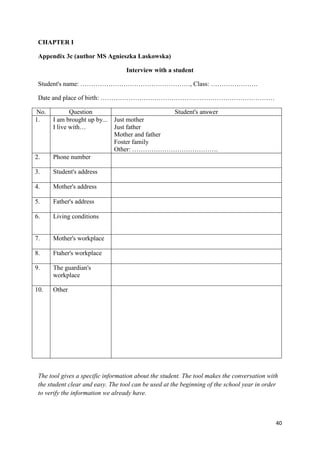
CHAPTER I
Appendix 3c (author MS Agnieszka Laskowska)
Interview with a student
Student's name: ……………………………………………, Class: ………………….
Date and place of birth: ………………………………………………………………………
No. Question Student's answer
1. I am brought up by...
I live with…
Just mother
Just father
Mother and father
Foster family
Other: ………………………………….
2. Phone number
3. Student's address
4. Mother's address
5. Father's address
6. Living conditions
7. Mother's workplace
8. Ftaher's workplace
9. The guardian's
workplace
10. Other
The tool gives a specific information about the student. The tool makes the conversation with
the student clear and easy. The tool can be used at the beginning of the school year in order
to verify the information we already have.
41
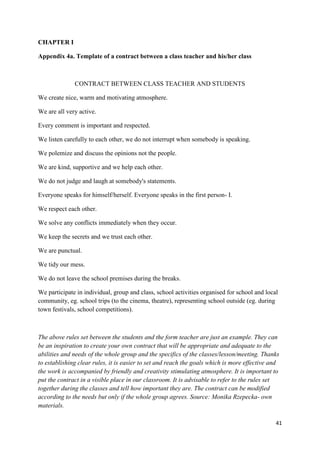
CHAPTER I
Appendix 4a. Template of a contract between a class teacher and his/her class
CONTRACT BETWEEN CLASS TEACHER AND STUDENTS
We create nice, warm and motivating atmosphere.
We are all very active.
Every comment is important and respected.
We listen carefully to each other, we do not interrupt when somebody is speaking.
We polemize and discuss the opinions not the people.
We are kind, supportive and we help each other.
We do not judge and laugh at somebody's statements.
Everyone speaks for himself/herself. Everyone speaks in the first person- I.
We respect each other.
We solve any conflicts immediately when they occur.
We keep the secrets and we trust each other.
We are punctual.
We tidy our mess.
We do not leave the school premises during the breaks.
We participate in individual, group and class, school activities organised for school and local
community, eg. school trips (to the cinema, theatre), representing school outside (eg. during
town festivals, school competitions).
The above rules set between the students and the form teacher are just an example. They can
be an inspiration to create your own contract that will be appropriate and adequate to the
abilities and needs of the whole group and the specifics of the classes/lesson/meeting. Thanks
to establishing clear rules, it is easier to set and reach the goals which is more effective and
the work is accompanied by friendly and creativity stimulating atmosphere. It is important to
put the contract in a visible place in our classroom. It is advisable to refer to the rules set
together during the classes and tell how important they are. The contract can be modified
according to the needs but only if the whole group agrees. Source: Monika Rzepecka- own
materials.
42
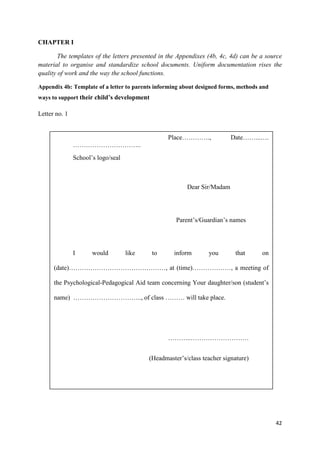
CHAPTER I
The templates of the letters presented in the Appendixes (4b, 4c, 4d) can be a source
material to organise and standardize school documents. Uniform documentation rises the
quality of work and the way the school functions.
Appendix 4b: Template of a letter to parents informing about designed forms, methods and
ways to support their child’s development
Letter no. 1
Place…………., Date……...….
…………………………..
School’s logo/seal
Dear Sir/Madam
Parent’s/Guardian’s names
I would like to inform you that on
(date)………………………………………, at (time)………………, a meeting of
the Psychological-Pedagogical Aid team concerning Your daughter/son (student’s
name) ………………………….., of class ……… will take place.
………..………………………
(Headmaster’s/class teacher signature)
43
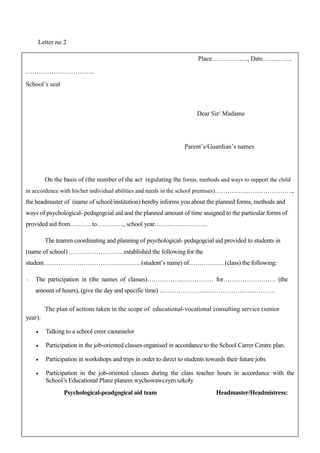
Letter no 2
Place……….……., Date…………..
…………………………..
School’s seal
Dear Sir/ Madame
Parent’s/Guardian’s names
On the basis of (the number of the act regulating the forms, methods and ways to support the child
in accordence with his/her individual abilities and needs in the school premises)……………………………….,
the headmaster of (name of school/institution) hereby informs you about the planned forms, methods and
ways of psychological- pedagogcial aid and the planned amount of time assigned to the particular forms of
provided aid from………. to…………., school year…………………….
The teamm coordinating and planning of psychological- pedagogcial aid provided to students in
(name of school) …………………….. established the following for the
student………………………………………. (student’s name) of…………….. (class) the following:
− The participation in (the names of classes)……………..…………… for……………………. (the
amount of hours), (give the day and specific time) ……………………………………………….
The plan of actions taken in the scope of educational-vocational consulting service (senior
year):
• Talking to a school creer caounselor
• Participation in the job-oriented classes organised in accordance to the School Carrer Centre plan.
• Participation in workshops and trips in order to direct to students towards their future jobs
• Participation in the job-oriented classes during the class teacher hours in accordance with the
School’s Educational Planz planem wychowawczym szkoły
Psychological-peadgogical aid team Headmaster/Headmistress:
44
CHAPTER I
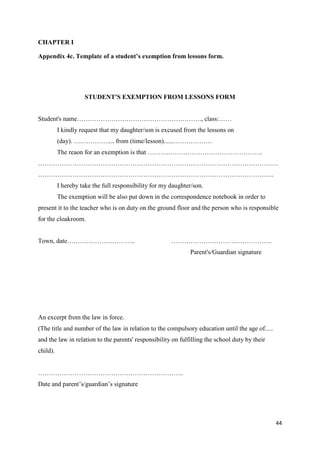
Appendix 4c. Template of a student’s exemption from lessons form.
STUDENT'S EXEMPTION FROM LESSONS FORM
Student's name…………………………………………………., class:……
I kindly request that my daughter/son is excused from the lessons on
(day). ….………….... from (time/lesson)......………………
The reaon for an exemption is that ………..…………………………………….
……………………………………………………………………………………………….…
………………………………………………………………………………………………..
I hereby take the full responsibility for my daughter/son.
The exemption will be also put down in the correspondence notebook in order to
present it to the teacher who is on duty on the ground floor and the person who is responsible
for the cloakroom.
Town, date………………………….. ………………………………………..
Parent's/Guardian signature
An excerpt from the law in force.
(The title and number of the law in relation to the compulsory education until the age of.....
and the law in relation to the parents' responsibility on fulfilling the school duty by their
child).
…………………………………………………………..
Date and parent’s/guardian’s signature
45
CHAPTER I
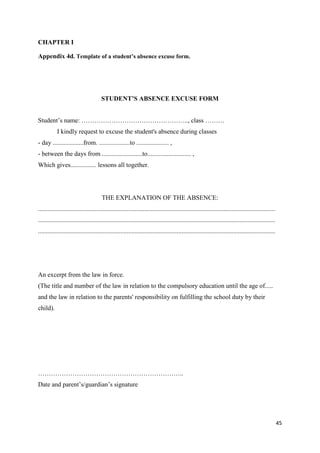
Appendix 4d. Template of a student’s absence excuse form.
STUDENT’S ABSENCE EXCUSE FORM
Student’s name: ………………………………………….., class ………
I kindly request to excuse the student's absence during classes
- day ...................from. ...................to .................... ,
- between the days from .........................to........................... ,
Which gives................ lessons all together.
THE EXPLANATION OF THE ABSENCE:
...................................................................................................................................................
...................................................................................................................................................
...................................................................................................................................................
An excerpt from the law in force.
(The title and number of the law in relation to the compulsory education until the age of.....
and the law in relation to the parents' responsibility on fulfilling the school duty by their
child).
…………………………………………………………..
Date and parent’s/guardian’s signature
46
CHAPTER I
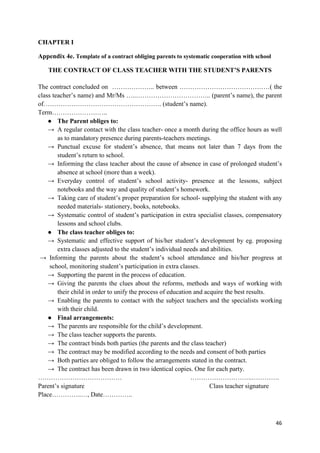
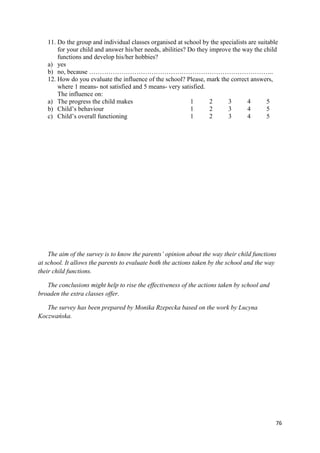
Appendix 4e. Template of a contract obliging parents to systematic cooperation with school
THE CONTRACT OF CLASS TEACHER WITH THE STUDENT’S PARENTS
The contract concluded on ……………….. between ……………………………………( the
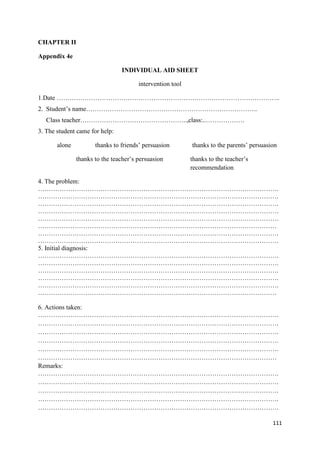
class teacher’s name) and Mr/Ms …..…………………………….. (parent’s name), the parent
of………………………………………………. (student’s name).
Term……………………..
● The Parent obliges to:
→ A regular contact with the class teacher- once a month during the office hours as well
as to mandatory presence during parents-teachers meetings.
→ Punctual excuse for student’s absence, that means not later than 7 days from the
student’s return to school.
→ Informing the class teacher about the cause of absence in case of prolonged student’s
absence at school (more than a week).
→ Everyday control of student’s school activity- presence at the lessons, subject
notebooks and the way and quality of student’s homework.
→ Taking care of student’s proper preparation for school- supplying the student with any
needed materials- stationery, books, notebooks.
→ Systematic control of student’s participation in extra specialist classes, compensatory
lessons and school clubs.
● The class teacher obliges to:
→ Systematic and effective support of his/her student’s development by eg. proposing
extra classes adjusted to the student’s individual needs and abilities.
→ Informing the parents about the student’s school attendance and his/her progress at
school, monitoring student’s participation in extra classes.
→ Supporting the parent in the process of education.
→ Giving the parents the clues about the reforms, methods and ways of working with
their child in order to unify the process of education and acquire the best results.
→ Enabling the parents to contact with the subject teachers and the specialists working
with their child.
● Final arrangements:
→ The parents are responsible for the child’s development.
→ The class teacher supports the parents.
→ The contract binds both parties (the parents and the class teacher)
→ The contract may be modified according to the needs and consent of both parties
→ Both parties are obliged to follow the arrangements stated in the contract.
→ The contract has been drawn in two identical copies. One for each party.
………………………………… ………………………..………….
Parent’s signature Class teacher signature
Place…………..…, Date…………..
47
A tool in the form of contract allows the cooperation between the school and the family to be
effective. The contract is signed by all the sides interested in cooperation and obliges them to
follow the rules. It also obliges the parents to cooperate with the school. The contract is the
base to take actions concerning the student both by the parents and teachers. Source: Monika
Rzepecka- own materials.
48
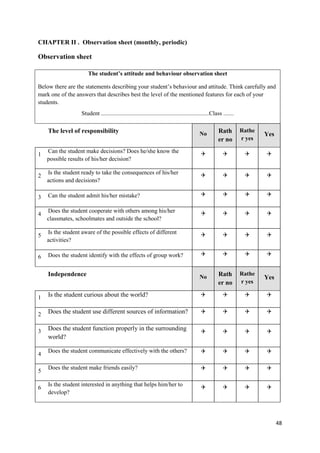
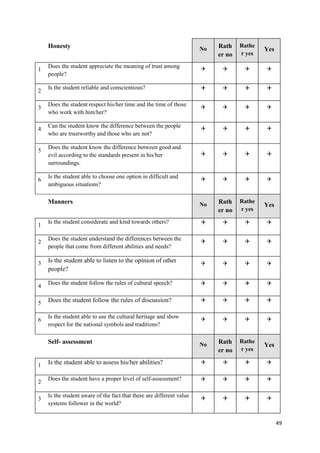
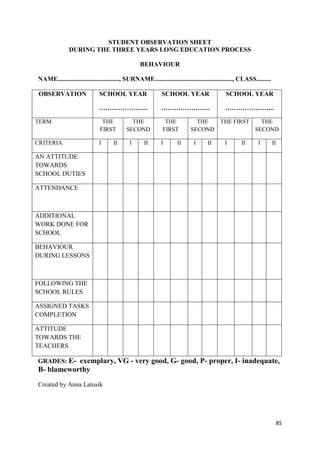
CHAPTER II . Observation sheet (monthly, periodic)
Observation sheet
The student’s attitude and behaviour observation sheet
Below there are the statements describing your student’s behaviour and attitude. Think carefully and
mark one of the answers that describes best the level of the mentioned features for each of your
students.
Student .........................................................................Class .......
The level of responsibility No Rath
er no
Rathe
r yes
Yes
1
Can the student make decisions? Does he/she know the
possible results of his/her decision?
2
Is the student ready to take the consequences of his/her
actions and decisions?
3 Can the student admit his/her mistake?
4
Does the student cooperate with others among his/her
classmates, schoolmates and outside the school?
5
Is the student aware of the possible effects of different
activities?
6 Does the student identify with the effects of group work?
Independence No Rath
er no
Rathe
r yes
Yes
1 Is the student curious about the world?
2 Does the student use different sources of information?
3 Does the student function properly in the surrounding
world?
4
Does the student communicate effectively with the others?
5
Does the student make friends easily?
6
Is the student interested in anything that helps him/her to
develop?
49
Honesty No Rath
er no
Rathe
r yes
Yes
1
Does the student appreciate the meaning of trust among
people?
2
Is the student reliable and conscientious?
3
Does the student respect his/her time and the time of those
who work with him/her?
4
Can the student know the difference between the people
who are trustworthy and those who are not?
5
Does the student know the difference between good and
evil according to the standards present in his/her
surroundings.
6
Is the student able to choose one option in difficult and
ambiguous situations?
Manners No Rath
er no
Rathe
r yes
Yes
1
Is the student considerate and kind towards others?
2
Does the student understand the differences between the
people that come from different abilities and needs?
3 Is the student able to listen to the opinion of other
people?
4
Does the student follow the rules of cultural speech?
5 Does the student follow the rules of discussion?
6
Is the student able to use the cultural heritage and show
respect for the national symbols and traditions?
Self- assessment No Rath
er no
Rathe
r yes
Yes
1 Is the student able to assess his/her abilities?
2
Does the student have a proper level of self-assessment?
3
Is the student aware of the fact that there are different value
systems follower in the world?
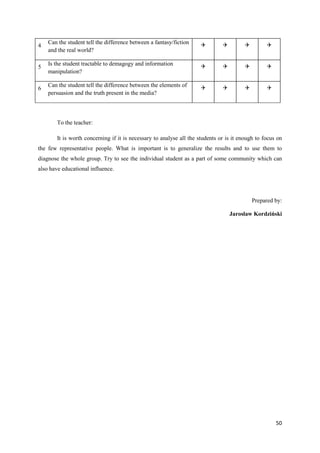
50
4
Can the student tell the difference between a fantasy/fiction
and the real world?
5
Is the student tractable to demagogy and information
manipulation?
6
Can the student tell the difference between the elements of
persuasion and the truth present in the media?
To the teacher:
It is worth concerning if it is necessary to analyse all the students or is it enough to focus on
the few representative people. What is important is to generalize the results and to use them to
diagnose the whole group. Try to see the individual student as a part of some community which can
also have educational influence.
Prepared by:
Jarosław Kordziński
51
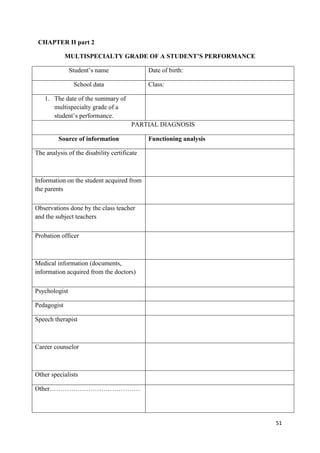
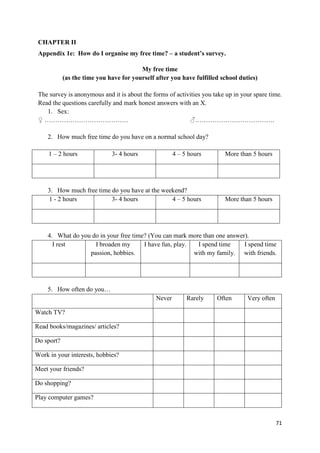
CHAPTER II part 2
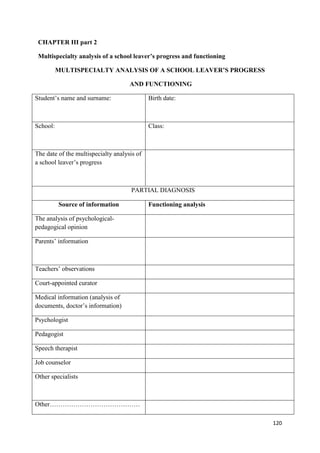
MULTISPECIALTY GRADE OF A STUDENT’S PERFORMANCE
Student’s name Date of birth:
School data Class:
1. The date of the summary of
multispecialty grade of a
student’s performance.
PARTIAL DIAGNOSIS
Source of information Functioning analysis
The analysis of the disability certificate
Information on the student acquired from
the parents
Observations done by the class teacher
and the subject teachers
Probation officer
Medical information (documents,
information acquired from the doctors)
Psychologist
Pedagogist
Speech therapist
Career counselor
Other specialists
Other……………………………………
52
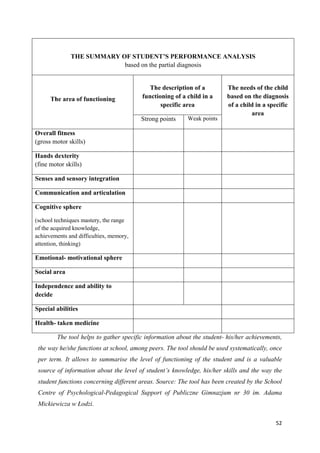
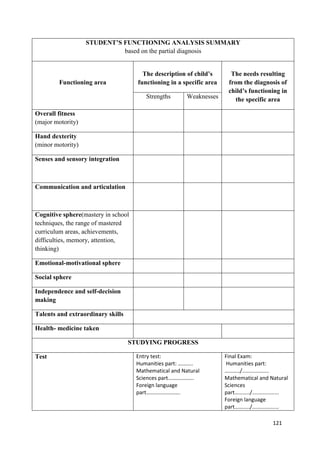
THE SUMMARY OF STUDENT’S PERFORMANCE ANALYSIS
based on the partial diagnosis
The area of functioning
The description of a
functioning of a child in a
specific area
The needs of the child
based on the diagnosis
of a child in a specific
area
Strong points Weak points
Overall fitness
(gross motor skills)
Hands dexterity
(fine motor skills)
Senses and sensory integration
Communication and articulation
Cognitive sphere
(school techniques mastery, the range
of the acquired knowledge,
achievements and difficulties, memory,
attention, thinking)
Emotional- motivational sphere
Social area
Independence and ability to
decide
Special abilities
Health- taken medicine
The tool helps to gather specific information about the student- his/her achievements,
the way he/she functions at school, among peers. The tool should be used systematically, once
per term. It allows to summarise the level of functioning of the student and is a valuable
source of information about the level of student’s knowledge, his/her skills and the way the
student functions concerning different areas. Source: The tool has been created by the School
Centre of Psychological-Pedagogical Support of Publiczne Gimnazjum nr 30 im. Adama
Mickiewicza w Łodzi.
53
CHAPTER II
The below appendixes will allow the teacher to see the whole picture of the class. They
can be used during the lessons with the form teacher. The way the students perceive
themselves individually, their classmates and their role in the group will be a valuable source
of information for the form teacher. The results will allow to see the problems that might
occur in a specific age group and they will be a great source of knowledge in terms of
necessary information about the problem solving methods that can be used. The below tools
will inspire the students to further play. Source: Agnieszka Szymańska, Ilona Stasiołek.
Appendix 1a, „Me in the class”
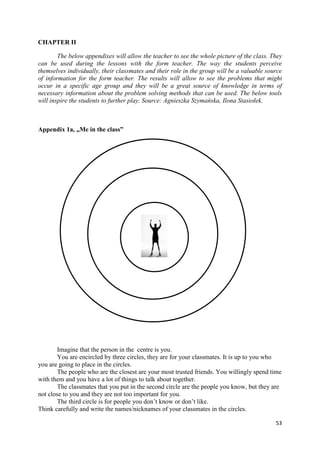
Imagine that the person in the centre is you.
You are encircled by three circles, they are for your classmates. It is up to you who
you are going to place in the circles.
The people who are the closest are your most trusted friends. You willingly spend time
with them and you have a lot of things to talk about together.
The classmates that you put in the second circle are the people you know, but they are
not close to you and they are not too important for you.
The third circle is for people you don’t know or don’t like.
Think carefully and write the names/nicknames of your classmates in the circles.
54
Appendix 1a: „Me in the class”
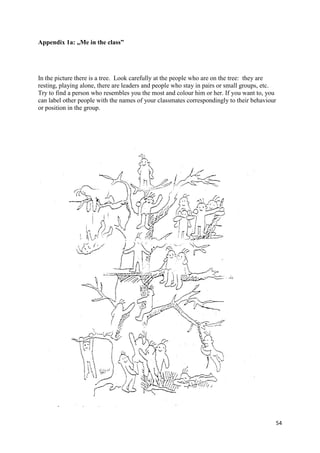
In the picture there is a tree. Look carefully at the people who are on the tree: they are
resting, playing alone, there are leaders and people who stay in pairs or small groups, etc.
Try to find a person who resembles you the most and colour him or her. If you want to, you
can label other people with the names of your classmates correspondingly to their behaviour
or position in the group.
55
Appendix 1a: „My class”
THE PICTURE OF OUR CLASS
1. Choose and mark with an X one of the mentioned below statements that describes your
position in your class, take notice of your relationship and contact you have with your
classmates.
I trust my classmates, I’m a reliable person as well and my friends know it.
Almost everyone is good-natured. I often talk to them about my problems and successes.
There are people in my class that I trust and I can talk to them about things that are
important to me.
There are only a few people I can talk to but I don’t trust them completely. They have let
me down before.
The people are reserved. I don’t trust other (I’m not talking about myself only. Other
people do not trust the class as well).
2. Read carefully the statements mentioned below. Choose and mark with an X the one that
describes the situation in your class (think about the bonds among your classmates).
The people get on well and they stick together.
The class is divided into two groups. Sometimes they like each other, sometimes they don’t.
Everyone is in some group and they stay in touch only with the people from that specific
group. The subgroups like/don’t like each other
„Everyone on his/her own…”– There is no long-lasting friendship in our class, only the
short-term relationships occur. Everyone can rely on himself/ herself only.
One person is out of our group. He or she is a leader, a top student or someone disliked by
others- he or she is always alone.
56
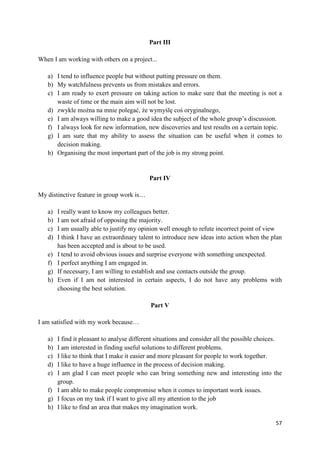
Appendix: A questionnaire: „My role in a group” by M. Belbin.
Fill the below questionnaire the following way:
1) You have 10 points for each part out of seven parts of the questionnaire. You can
assign them to only one statement that describes your behaviour in a group or divide
the points into few of them.
2) Write your answers on the answer sheet.
Part 1
I think that in a group:
a) I quickly spot new possibilities and I know how to use them,
b) I can work very well with different people,
c) „producing” ideas is my natural ability,
d) my strength is about the ability to get what is the best out of the people and make them
work to fulfil the group’s aims and tasks
e) my main ability is about finishing what I have started and is connected to effectiveness
f) I’m able to accept the fact of not being popular for a while if it leads to valuable
outcomes,
g) I can usually sense what is realistic and possible in terms of achieving success,
h) I am usually able to propose an alternative solution without any prejudice.
Part II
If there are any faults in a group, it is because:
a) I cannot calm down unless the meeting is well- organised, controlled and properly led.
b) I tend to be generous for people whose brilliant ideas were not thought well enough.
c) I tend to talk too much when the groups is working on new ideas.
d) My dry critique makes it difficult for me to join my colleagues in their eagerness and
enthusiasm.
e) Sometimes I am perceived as too bossy and authoritarian when something needs to be
done.
f) It is difficult for me to be a „first line” leader as I feel too responsible for the
atmosphere among the group.
g) I tend to think about the things that come to my mind at the exact moment and I forget
what is going on.
h) My colleagues perceive me as the one who worries too much about the details and the
possibility of failure.
57
Part III
When I am working with others on a project...
a) I tend to influence people but without putting pressure on them.
b) My watchfulness prevents us from mistakes and errors.
c) I am ready to exert pressure on taking action to make sure that the meeting is not a
waste of time or the main aim will not be lost.
d) zwykle można na mnie polegać, że wymyślę coś oryginalnego,
e) I am always willing to make a good idea the subject of the whole group’s discussion.
f) I always look for new information, new discoveries and test results on a certain topic.
g) I am sure that my ability to assess the situation can be useful when it comes to
decision making.
h) Organising the most important part of the job is my strong point.
Part IV
My distinctive feature in group work is…
a) I really want to know my colleagues better.
b) I am not afraid of opposing the majority.
c) I am usually able to justify my opinion well enough to refute incorrect point of view
d) I think I have an extraordinary talent to introduce new ideas into action when the plan
has been accepted and is about to be used.
e) I tend to avoid obvious issues and surprise everyone with something unexpected.
f) I perfect anything I am engaged in.
g) If necessary, I am willing to establish and use contacts outside the group.
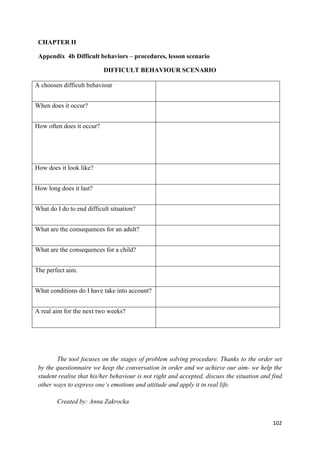
h) Even if I am not interested in certain aspects, I do not have any problems with
choosing the best solution.
Part V
I am satisfied with my work because…
a) I find it pleasant to analyse different situations and consider all the possible choices.
b) I am interested in finding useful solutions to different problems.
c) I like to think that I make it easier and more pleasant for people to work together.
d) I like to have a huge influence in the process of decision making.
e) I am glad I can meet people who can bring something new and interesting into the
group.
f) I am able to make people compromise when it comes to important work issues.
g) I focus on my task if I want to give all my attention to the job
h) I like to find an area that makes my imagination work.
58
Part VI
If I suddenly receive a difficult task that must be completed in a short period of time and in
accompany of people I do not know…
a) I want to hide and look for solution how to cope with the situation.
b) I would be able to work with a person who has the most positive attitude.
c) I would find a way to decrease the amount of work by dividing it among different
people.
d) My natural ability to see the most urgent aspects will allow us to work according to
the plan.
e) I am sure I will stay calm and keep my ability to assess the situation.
f) Despite the pressure I will see the aims of the work.
g) I would be ready to overtake a constructive leadership if I saw the group did not make
any progress.
h) I would start a discussion in order to stimulate new ideas and solutions.
Part VII
When it comes to the problems that I am responsible for...
a) I tend to show that I am dissatisfied with the people who interrupt the progress of the
whole group.
b) Others might criticise me for being too analytical and I do not rely on my intuition.
c) Sometimes I might delay the progress as I want the work to be done properly and
thoroughly.
d) I tend to get bored easily and I expect others to stimulate and „spark me off.”
e) I find it difficult to get started if the aims are not clear enough for me.
f) Sometimes I am not as effective as I would like to be when it comes to explaining
difficult issues I have to face.
g) I am aware of the fact that I demand others to do things I can not do myself.
h) I wonder whether I should press my point of view if I meet with a strong opposition.
The abbreviations used in the answer interpretation key table
PO – practical organizer CM – contact man
NL – natural leader JU - JUDGE
AM – action man GR
M
- group man
SOW - sower (idea man) PER - perfectionist
59
The results table
Write the points you have given to each answer into the table below.
Answer/
Part
a b c d e f g h
1.
2.
3.
4.
5.
6.
7.
The answer interpretation key table
Transfer the results you put in the Results table into The answer interpretation key table. Sum up the points in
each column in order to count the amount of points assigned to each group role.
Typ/
część
PO NL AM SOW CM JU GRM PER
1. g d f c a h b e
2. a b e g c d f h
3. h a c d f g e b
4. d h b e g c a f
5. b f d h e a c g
6, f c g a h e b d
7. e g a f d b h c
Total
The results interpretation
The highest result in each column shows the CONSTRUCTIVE GROUP ROLE that you most often adopt. The
second biggest result shows the role that you usually take when, for some reason, there is minor or no demand
for your usual pose. The two lowest results denote the areas that are probably your weaknesses and you should
work on them. However, it might be better to look for people who will fill these gaps in the group instead of
working on them unwillingly.
Role/
Results
Low Average High Very High
PO 0 – 6 7 – 11 12 – 16 17 – 23
NL 0 – 6 7 – 10 11 – 13 14 – 23
AM 0 – 8 9 – 13 14 – 17 18 – 36
SOW 0 – 4 5 – 8 9 – 12 13 – 29
CM 0 – 6 7 – 9 10 – 11 12 – 21
JU 0 – 5 6 – 9 10 – 12 13 – 19
GRM 0 – 8 9 – 12 13 – 16 17 – 25
PER 0 - 3 4 - 6 7 - 9 10 - 17
60
Roles functioning within a good team.
Natural leader– natural leader is in charge of the way the group works in order to
achieve the aims. He or she can use the resources the group holds in an effective way. The
natural leader is able to see the group’s strengths and weaknesses; he or she is able to use
individual potential of every worker.
Features: well-balanced, dominant, extravert. Natural leader relies more on common
sense, rather than intellectual deliberations. As a leader he or she is not aggressive.
Action man – action man forms the way the group efforts will be used; he or she
focuses directly on establishing the aims and priorities; action man wants to influence the
shape and model of group discussion.
Features: anxious, dominant, extraverted, impulsive, gets easily irritated. He or she
wants to see the results quickly. Action man is competitive and sometimes arrogant but thanks
to him/her everything is moving on.
Practical organizer – practical organizer changes the conceptions and plans into
action and implements the ideas in systematic and effective way.
Features: well-balanced and disciplined. He or she wants hard facts and doesn’t like
when the plans are changed.
Sower (idea man) – sower gives new ideas and strategies which include most
important problems and issues. He or she tries to push his/her ideas by means of
confrontation.
Features: dominant, intelligent, introvert. He or she might not see the details and make
mistakes or criticise the ideas of other group members. The bigger the problem, the bigger the
challenge to solve it. He or she believes that all good ideas seem „strange” in the beginning;
makes an impression of being a „genius”.
Contact man– contact man examines, analyse and brings up the information on
different ideas, knowledge and actions taken outside the group; he or she establishes contacts
and connections that might be useful for the whole group. Contact man is able to lead the
necessary negotiations.
Features: well-balanced, dominant, extravert. He or she supports innovation and is a
good improviser. Contact man might be a little cynical when looking for profits for the group;
he or she often says „new opportunities rise from the mistakes of others”.
Judge – judge analyses the problem, assesses ideas and suggestions which is good for
the group as it can start working well-prepared for decision making.
Features: intelligent, well-balanced, introvert. He or she is the most objective, neutral
and emotionally indifferent member of the group. He or she likes to take his/her time to think,
lacks enthusiasm but his/her calmness makes it easier to make good decisions.
Group man – group man supports other group members, lifts up team’s spirit if there
are any problems; he or she is able to prevent conflicts, strengthens cooperation and
communication, is loyal to the group.
Features: extravert, well-balanced, non-dominant and non-competitive, empathic, does
not like conflicts. Group’s man work might not be too visible but his/her loyalty is invaluable.
61
Perfectionist– perfectionist is focused on an actual effect- he or she wants the task to
be completed on time and be as good as possible; the perfectionist can be difficult to work
with as he or she does not like coincidence and often focuses on the details that are not the
most necessary to complete the task. The perfectionist is always aware of the aim of the work.
Features: anxious, tense, introvert, disciplined.
The specialist’s role
In her latest works, Meredith Belbin has proposed one more constructive group role to
consider- the role of Specialist. If your test results show that you do not take one specific
group role, you should do another, additional test. Read the following statements and think to
what extent they are true for you. Count the points you give to each answer.
a) Very high- 5 points
b) High- 4 points
c) Average/ medium- 3 points
d) Little- 2 points
e) Very little- 1 point
1. I never stop learning when I work
2. I believe that a promotion to a managing post makes the workers lose the pleasure of
working as a specialist who knows his/her subject area best.
3. Sometimes I think that group work can be done by one person.
4. I think it os better to know everything about one thing than to know a little about a lot
of things.
5. My work is fascinating for me.
6. I am eager to sacrifice my free time in order to develop at work.
7. I believe I chose the job I love and I forget about the whole world when I am working.
If you get more than 28 points, it means you take the role of the Specialist when it comes to
working in the group.
Specialist- the specialist often takes care on a small part of work. He or she focuses on
technical details. The specialist is very devoted to the task completion. He or she is focused
on the aim, committed, self-propelling. The specialist holds the knowledge and skills that
might be rare and very valuable. He or she might not see the whole picture and focus just on a
narrow range of his/her own actions. The specialist might feel he is a consultant responsible
for a specific area.
62
CHAPTER II
The tool is a great source of information about the way each student sees
himself/herself at school. It can be an inspiration and the basis to a discussion on the topic of
the way the students function at school and the way they perceive the school.
Appendix 1b:
„Me at school”
Dear student!
The questionnaire is anonymous and its purpose is to acquire an information on how you feel
in your school.
Class: ………………………. Sex : boy girl
1. Do you like going to your school?
Yes No Sometimes
2. My school is a place which is: (you can choose more than one answer)
Nice Cheerful Calm Safe Sad
Stressful Unpleasant Menacing Dangerous
3. What do you like the most in our school? Mark all the answers you agree with.
there are teachers who lead the lessons in interesting way
the majority of teachers is nice and kind towards students
the majority of teachers gives fair grades to the students
I have good friends at school
I feel comfortable with my classmates
The school organizes interesting events and classes
My class teacher is nice
The atmosphere is nice, I like coming to my school
There are a lot of interesting events organised
We get all the information that is important
The school is calm and safe
My school has other advantages, eg.…………………………………………………………
4. What do you dislike the most in our school? Mark all the answers you agree with.
There are too many prohibitions.
The teachers are in hurry, they do not have time to listen to the students.
We sometimes do not get the information that we need
63
the noise
The teachers are too stiff towards the students
The majority of teachers is usually in bad mood
there are too little events organised
nothing, everything is fine
other: ………………………………………………………………
5. What changes would you make at your school to feel better. Name at least 3.
1. …………………………………………………………………………………………..
2. …………………………………………………………………………………………..
3. …………………………………………………………………………………………..
6. How do you assess the contact you have with your schoolmates? Mark one answer.
very well well correct inappropriate
7. Would you change anything in your relationship with your schoolmates?
Yes No
1. If your answer to the question no 7 is YES, what would you change in your
relationship with your schoolmates? Name at least 3 changes.
…………………………………………………………………………………………..
2. …………………………………………………………………………………………..
3. …………………………………………………………………………………………..
8. What are you like in your class? Mark max 3 answers.
quiet/ inconspicuous
the life and soul of the class
liked, but not by everyone
I have only few friends (up to 3)
disliked
Class top student
I’m an example for everyone
the class ‘clown’
I belong to the VIPs of our class
My classmates think I am an informer.
My classmates dislike me without any real reason.
64
CHAPTER II
Appendix 1b: „My school” – a survey
1. Are you happy about the school you attend? Circle one answer on the scale from 1-6,
where 1 means that you don’t like your school very much, and 6 means that you are
really happy about your school.
1 – 2 – 3 – 4 – 5 – 6
2. How do you asses the opinions about your school mentioned below? Mark a correct
answer with an X.
Rather yes Yes Rather no No
1. The atmosphere is nice and like coming
here.
2. The school cares about my intellectual
development and appropriate level of
education.
3. The school helps me develop my skills and
interests
4. There are a lot of interesting events
5. The school cares about a positive opinion
in the local community
6. The headmaster and teachers cooperate
with the students to fulfill all the tasks.
7. The headmaster and teacher motivate and
encourage students to take actions and
being active
8. The school is well equipped what provides
an appropriate level of education
9. The school prepares me well for the
external exams
10. The school recognizes student’s hobbies
and interests
11. The school offers a lot of interesting extra
classes, school cubs
12. I feel safe at school
13. The school promotes healthy lifestyle and
life without any addictions
14. The school teaches patriotism, self
confidence and respect towards other
people.
65
The answers given in the questionnaire will be the source of important information
about the way the students perceive the school, the atmosphere and mission. They will show a
lot of important issues- both positive and negative which can be an inspiration to work on the
school’s image and the quality of work. The results can also be an evidence of the school’s
success and can be used to promote the school. Source: Ilona Stasiołek.
66
CHAPTER II
Appendix 1c: Lesson – strengths and weaknesses against my own motivation for
studying.
Dear student!
The survey will let you evaluate the lesson, the ways and methods of work and your own
strong and weak points in accordance to the classes.
The survey is anonymous! We ask you to give your honest answers.
1. The lesson was:
● boring
● not too boring, not too interesting
● interesting
● very interesting
2. During the lesson I liked the most:
……………………………………………………………………………………………..
…………………………………………………………………………………………….
3. Did you commit individually or in group work?
● yes
● no
● no opinion
4. Was the atmosphere conducive for work?
● yes
● no
● no opinion
5. Was the working pace good for you?
o Rather yes
o No
o Rether no
o No
6. How do you asses your work during the lesson? Circle the answer.
1 2 3456
7. How do you asses your classmates work during the lesson? Circle the answer.
1 2 3 4 5 6
8. Were the tasks adjusted to your abilities?
● Rather yes
● No
● Rether no
● No
9. Was the teacher well prepared for the lesson?
● yes
● no
10. How do you asses your teacher’s work? You have the chance to give him/her a mark.
1 2 3 4 5 6
67
The analysis of the results of the survey will allow us to evaluate the actions taken by the
teacher in order to explain the specific topic. They will suggest what methods and forms are
most effective. What is more, the results will allow to measure the level of student’s
motivation to be active during the lesson. The teacher who lets his/her students to evaluate his
methods and forms of work becomes more self-conscious, aware of his/her own abilities and
skills. The conclusions can be the basis and give the teacher clues how to organise his/her
work, broaden his knowledge and what is his/ her attitude towards students.
68
CHAPTER II
Appendix 1d: My progress and development of my hobbies against the school.
Dear student!
The survey is anonymous! We ask you to give your honest answers. Circle the answers (may
be more than one) or write down your own.
1. You go to school everyday:
a) Because you want to continue your education to higher levels
b) Eagerly because you like studying and spending time with your peers.
c) Because it is your duty and you do not have any deeper thoughts about that.
d) Reluctantly because you feel underestimated by the teachers and mocked by your
classmates
e) Your own answer: ………………………………………………………………..
2. How do you acquire your knowledge during the lessons?
a) On the basis of teacher’s lecture
b) By working with the book
c) Working with other educational aids
d) other ……………………………………………………………………….
3. During the lesson:
a) You listen carefully to the teacher and follow his commands
b) You are very active because you understand what is going on during the lesson
c) You ask questions that are beyond the obligatory curriculum
d) You wait impatiently for the break because the lessons are too long and boring
e) You do something else
f) Your own answer: ………………………………………………………………..
4. Does doing homework require you to use sources other than the school book?
a) Very often
b) Sometimes
c) Never
d) Only in some subjects (name them) ………………………………….
5. Do you usually understand the knowledge taught by the teachers?
a) Yes
b) No
6. If not who do you ask for help?
a) The teacher, I ask him/her for one more explanation.
b) Classmates
c) Parents
d) Noone, you are afraid of mocking or hearing „no”
e) Your answer: …………………………………………………………………..
69
7. In your free time you:
a) Prepare for the next day at school (revise, do homework)
b) Attend extra classes (at school and outside)
c) Spend time on your hobby
d) Meet your friends
e) Your answer: ……………………………………………………………………
8. The biggest problem at school for you is:
a) Your relationship with your classmates/schoolmates
b) Your relationship with the teachers
c) High educational standards
d) Discipline
e) You answer: ……………………………………………………………………
9. Are the ways of evaluating you work by the teachers fair?
a) Yes
b) No, because they do not take the amount of time and effort put in the task into
consideration
c) Only in some subjects (name them) ……………………………….
d) You answer: …………………………………………………………………..
10. Are there any subjects you really like and enjoy learning?
a) No
b) Yes (name them): ………………………………………………………………………
11. Which of the mentioned ways to motivate the students are used by your teachers?
a) Creating a pleasant atmosphere in the classroom
b) Maintaining the appropriate level of interest by using different didactic means
c) Inducing students’ interest by referring to their knowledge and experience, using
appropriate didactic means
d) Evaluating the students immediately about their progress
e) Helping the student to overcome their weaknesses and obstacle
f) Threatening with failing, giving low marks
g) Calling in the parents
h) Comparing and mocking the student
i) None of the mentioned above
j) Your answer: …………………………………………………………………….
12. Do you know the role of the Student Council at your school?
a) No
b) Describe it briefly: …………………………………………………………………….
13. Did you participate in any activities organised by the Student Council?
a) No
b) Yes (name them):……………………………………………………………………….
70
13. Have you ever:
Mark the answer with an X
Nerver Once A lot of times Almost
everyday
Played truant
Smoked
cigarettes
Drunk alcohol
Taken some
drugs
Acted violently
Stolen or extorted
anything
14.Your school results are:
a) Very good
b) Good
c) Average
d) Less than average
15. What would you like to change at school?
a) Evaluating system
b) The ways of teaching
c) Your relationship with the teachers
d) Your relationship with your classmates/schoolmates
e) The equipment (didactical means)
f) Nothing
g) Your answer: …………………………………………………………………….
The survey gives information about the way each student sees himself/herself at school. It
gives the greater picture of the school, it’s conditions, the level of motivation and the
influence it has on the individual. The survey shows how and to what extend the school shapes
the student’s results and progres. Some of the answers might be disturbing (eg. no 14) and
will require further, deeper analysis, conversation and maybe intervention.
71
CHAPTER II
Appendix 1e: How do I organise my free time? – a student’s survey.
My free time
(as the time you have for yourself after you have fulfilled school duties)
The survey is anonymous and it is about the forms of activities you take up in your spare time.
Read the questions carefully and mark honest answers with an X.
1. Sex:
♀ ………………………………… ♂……………………………….
2. How much free time do you have on a normal school day?
1 – 2 hours 3- 4 hours 4 – 5 hours More than 5 hours
3. How much free time do you have at the weekend?
1 - 2 hours 3- 4 hours 4 – 5 hours More than 5 hours
4. What do you do in your free time? (You can mark more than one answer).
I rest I broaden my
passion, hobbies.
I have fun, play. I spend time
with my family.
I spend time
with friends.
5. How often do you…
Never Rarely Often Very often
Watch TV?
Read books/magazines/ articles?
Do sport?
Work in your interests, hobbies?
Meet your friends?
Do shopping?
Play computer games?
72
Surf the Internet?
Go to the ciemna?
Go to the theatre?
Go for a walk?
I don’t know how to spend my free time.
6. Who do you usually spend your free time with?
With my family With my
schoolmates
With my siblings With my
neighbours
Alone
7. How often do you travel with your parents? (summer holidays, weekends, holidays,
winter break).
One a year 2-3 times a year 4 – 6 times a year I don’t travel with
my parents.
8. Would you like to spend more time with your parents?
Yes No Hard to say.
Thank you.
The tool is a great source of information on the ways the students spend their free time. It will
give the teacher the information about the students’ hobbies and might be helpful in
organising the educational-didactical process. Source: the tool has been created by
Agnieszka Laskowska.
73
CHAPTER II
Appendix 1f: „Violence, aggression and stimulants” - questionnaire
The survey is anonymous! We ask you to give your honest answers. Mark the answers
or write down your own.
● Is there any need to organise the workshops about the dangers around us? YES
NO
● Do you know what violence and aggression are? YES NO
● Do you know how to avoid conflicts? YES NO
● Do you know how to solve a conflict between you and your friends? YES NO
1. Have you ever encountered any form of bullying or extortion ate school?
YES NO
2. If yes what was the form of it?
a) Threatening with the beating up
b) Extortion of money
c) Other ………………………………………………………………..
3. If you were bullied, when was it?
a) On your way to school
b) Before or after the lessons
c) Other……………………………………………………..
4. Do you feel threatened at school?
YES NO
5. If yes, who do you fear the most?
a) Your peers
b) Older schoolmates
c) Teachers
d) Other…………………………………………………………….
6. Do you feel threatened at school?
YES NO
7. If yes, what do you fear the most?
a) Beating up
b) Threatening
c) Other……………………………………………………..
8. Do you know anyone who is bullied at school?
YES NO
9. Do you know anyone who is threatened at home?
YES NO
10. Have you ever met with violence in your housing estate?
YES NO
74
Although, the questions are about difficult and very often hidden issues, the form of an
anonymous survey is appealing for students. It makes students more eager to answer the
questions honestly. The answers are a great source of information about the dangers
occurring at school or around it. Thanks to the analysis of the survey we get the idea how the
school is perceived. The disturbing answers will require thorough analysis and intervention
in the cases of a visible danger. Source: the tool has been created by Monika Rzepecka.
75
CHAPTER II
Appendix 2a: „My child at school”- analysis of a student’s progress and behavior.
A survey for parents.
1. What does your child go to school? What is the aim?
a) Gaining knowledge
b) Graduating and getting the certificate
c) Spending the time
d) other, example ………………………………………………………………………..
2. Does your child feel safe at our school and goes eagerly to school?
a) yes
b) no, because ………………………………………………………………………….
3. According to you, what are the reasons for failures at school that your child
experience?
a) Little motivation for intellectual effort
b) Lack of interest in learning
c) Difficulties in acquiring knowledge
d) Laziness
e) stress
f) other, for example……………………………………………………………………..
4. Are the forms, methods and ways applied by the teachers easy to understand for the
child?
a) yes
b) no, because………………………………………………………………………
5. According to you, does your child get satisfying and and appropriate according to
his/her abilities and needs?
a) yes
b) no, because …………………………………………………………………………
6. Is the knowledge about the progress your child makes given by the teachers
systematically and in the right way?
a) yes
b) no, because…………………………………………………………………………
7. Do the teachers help your child when he/she faces some difficulties or do they help
broaden his/her hobbies by proposing extra classes?
a) yes
b) no
8. Do you like the didactic methods applied by the teachers?
a) yes
b) no, because ………………………………………………………………………….
9. According to you, what is the role of the form teacher?
a) A friend
b) A partner
c) An enemy
d) I don’t know
e) Someone else, …………………………………………………………………......
10. Are you informed systematically by the teachers, specialists who work at school about
your child’s behaviour at school?
a) Yes b) no, because………………………………………….
76
11. Do the group and individual classes organised at school by the specialists are suitable
for your child and answer his/her needs, abilities? Do they improve the way the child
functions and develop his/her hobbies?
a) yes
b) no, because …………………………………………………………………………..
12. How do you evaluate the influence of the school? Please, mark the correct answers,
where 1 means- not satisfied and 5 means- very satisfied.
The influence on:
a) The progress the child makes 1 2 3 4 5
b) Child’s behaviour 1 2 3 4 5
c) Child’s overall functioning 1 2 3 4 5
The aim of the survey is to know the parents’ opinion about the way their child functions
at school. It allows the parents to evaluate both the actions taken by the school and the way
their child functions.
The conclusions might help to rise the effectiveness of the actions taken by school and
broaden the extra classes offer.
The survey has been prepared by Monika Rzepecka based on the work by Lucyna
Koczwańska.
77
CHAPTER II
Appendix 2b. How do I organise my free time?- questionnaire
MY FREE TIME
(as the time I have for myself after completing the duties)
Dear Parent. The survey is anonymous and it is about the way you spend your free time. Mark
the the answers with an X.
1. Sex
♀ ………………………………… ♂……………………………….
2. How much free time do you have during the week? (without weekends and holidays)
1 - 2 godziny 3- 4 godziny 4 – 5 godzin Powyżej 5 godzin
1. How much free time do you have at the weekend?
1 - 2 hours 3- 4 hours 4 – 5 hours More than 5 hours
2. What do you do in your free time? (You can mark more than one answer).
I rest I broaden my
passion, hobbies.
I have fun, play. I spend time
with my family.
I spend time
with my
friends.
3. How often do you…
Never Rarely Often Very often
Watch TV?
Read books/magazines/ articles?
Do sport?
Work in your interests, hobbies?
Meet your friends?
Do shopping?
Play computer games?
78
Surf the Internet?
Go to the ciemna?
Go to the theatre?
Go for a walk?
I don’t know how to spend my free time.
4. Who do you usually spend your free time with?
My family My friends My siblings My neighbours Alone
5. How often do you go for holiday with your children? (summer holidays, weekends,
festivals, winter break?
Once a year 2 – 3 times a year 4 – 6 times a year I do not travel
6. Would you like to spend more time with your child/children?
Yes No Hard to say
Thank you.
The tool aims at giving the information about the parents’ attitude towards the way
their children spend their spare time. The results show the specifics, interests and intentions
and willingness to spend free time together. They can give a piece of information for the
teacher to organise the leisure time for his/her students and be a good reason to include
parents into the activities done on the behalf of the whole class- for example trips ,
excursions.
The tool has been based on other materials created by the teachers.
79
CHAPTER II
Załącznik 2c: Do I support my child in his/her growth and talent and skills
development? - questionnaire
A test for the Parents
Do I support my child in his/her personal improvement,
talent and skills development?
Answer the question. Use the answer pattern from 1 to 4 where 1 means never, 2-
sometimes, 3- often 4- always.
Read the questions and mark the answer which is the most accurate for you.
1. Can you express your satisfaction even if your child makes the smallest progress?
1 2 3 4
2. Can you show your feelings to your child? 1 2 3 4
3. Can you laugh with your child on funny and interesting stories you see when you watch tv
or read comic books together? 1 2 3 4
4. Do you tell and read stories to your child? 1 2 3 4
5. Do you have time to play with your child?? 1 2 3 4
6. Can you listen to your child? 1 2 3 4
7. Do you ask your child about his/her day? 1 2 3 4
8. Do you give satisfying answers to your child’s questions?
1 2 3 4
9. Do you organize out of town trips, to ZOO or exhibitions?
1 2 3 4
10. Do you give interesting books to your child when it has learned to read?
1 2 3 4
11. Do you remember to prevent your child from boredom?1 2 3 4
12. Does your child have its own place at home which he or she is responsible for?
1 2 3 4
13. Do you praise your child when he or she is able to tidy his/her room or dress on his/her
own? 1 2 3 4
14. Are you happy for you child when he/she succeeds in sport, some competition, games and
plays? 1 2 3 4
15. Do you sometimes compare your child’s achievements with other children’s successes?
1 2 3 4
16. Do you sometimes demand too much from your child? 1 2 3 4
17. Do you teach your child everyday responsibilities- for example feeding a pet, collecting
the toys? 1 2 3 4
18. Are you interested in your child’s studying? 1 2 3 4
19. Do you talk to the teachers about your child’s problems or hobbies?
1 2 3 4
20. Do you let your child to speak about different subjects?
1 2 3 4
21. Are you interested in you child’s works which he/she brings home from school or
kindergarten? 1 2 3 4
22. Do you help your child when he/she has problems with some task?
1 2 3 4
80
23. Do you check your child’s progress? 1 2 3 4
24. Do you praise your child for having a hobby? 1 2 3 4
25. Do you help your child to develop his/her hobbies? 1 2 3 4
26. Do you encourage your child to take up some classes or meet with children who have
similar interests? 1 2 3 4
27. Do you respect your child’s opinion? 1 2 3 4
28. Do you encourage your child to set his/her own aims? 1 2 3 4
29. Do you tell your child that problems are part of our everyday lives and they should be
solved properly? 1 2 3 4
30. Do you tell your child there are different ways he/she can use to solve problems?
1 2 3 4
31. Do you support your child when he/she faces some problems?
1 2 3 4
32. Do you lecture your child too much? 1 2 3 4
33. Are you spontaneous in your eagerness? 1 2 3 4
34. Do you suspend your child from doing things that are importants for him/her as a form of
punishment? 1 2 3 4
35. Drd your child? 1 2 3 4
36. Do you make your child feel he/she is controlled all the time?
1 2 3 4
37. Is your relationship warms and friendly, based on mutual respect?
1 2 3 4
38.Do you let your child work on is/her own in order to let him/her learn by trial and error?
1 2 3 4
39.Do you teach your child how to look for information, organise the data, analyse the data
and make conclusions? 1 2 3 4
40. Do you tell your child to read proper book or talk to a right teacher in order to develop
his/her interests? 1 2 3 4
41. Do you encourage your child to look establish his/her own ways of gathering and
processing information? 1 2 3 4
42. Do you teach your child to differ between good and evil?
1 2 3 4
43. Do you teach your child to look for authorities? 1 2 3 4
44. Do you teach your child to ask for help? 1 2 3 4
45. Can you exchange opinions with your child and have a constructive discussion?
1 2 3 4
46. Do you tell your child that not every plan is going to be successful?
1 2 3 4
47.Do you show your child different ways to relax, e.g. riding a bike, playing football,
meeting friends or watching an interesting movie? 1 2 3 4
48. Do you tell your child he/she will not be the best in everything?
1 2 3 4
49. Do you tell your child that everyone is different, some people are good at one field and the
others are good at another area but it is important to develop and not waste one’s skills?
1 2 3 4
50. Do you induce your child to be tolerant? 1 2 3 4
51. Do you discuss different issues concerning your child with your spouse?
1 2 3 4
52. Do you teach your child to face the difficulties that are part of everyday life?
1 2 3 4
81
53. Do you help your child gain self-confidence, so that he/she will be able to face the tasks
that life puts in front of him/her? 1 2 3 4
54. Do you talk to your child about his/her future job or studies?
1 2 3 4
55. Do you help your child orient on the issues needed in order to gain what he/she wants to
achieve by means of different tutorials and job advises? 1 2 3 4
Sum up all the points. The result will show how supportive towards your child you
are. The closer the number to 210 (the highest amount of points), the more supportive you are.
And the less points you have gained, the less supportive you are.
It is not easy to be a supportive parent who supports his/her child’s hobbies.
Sometimes we do not have time for our child, we are tired or get angry easily. But we should
remember that being supportive towards our child, helping him/her to develop his/her skills
his/her hobbies will not only allow him/her to succeed but also live in accordance with his/her
beliefs and self-fulfill.
Based on the book by Barbara Lipnicka “Kształtowanie zdolności i talentu dziecka”
(„Shaping child’s abilities and talent”).
The tool constructed in the form of a test makes the tested person think about his/her opinions
and attitudes. The person who does the test finds his/her own weaknesses and strengths.
he/she knows what are the things they should pay attention to, which behaviours should be
promoted and which demand certain correction. Clear questions also give the ideas on which
behaviours should parent establish.
82
CHAPTER II
Appendix 3a: Student’s grades –worksheet, spreadsheet
Our task, as teachers, is to observe the knowledge and skills our students gain and
acquire. we should also stimulate the growth . of our student’s knowledge and abilities. we
should individualise the work of our students according to their possibilities and abilities, we
should know which areas our students have mastered and which they still should work on. this
is why we need to thoroughly observe our students.
The below tools are created to observe one and each student in terms of his/her
performance at school, his behaviour and the results he/she gets from each subjects. the
observation sheets are created for three years-long education stage based on the educational
system in Poland [3 years of elementary education (grades from 1-3 of primary school), 3
years of primary school (grades 4-6 of primary school), 3 years- lower secondary school and
3 years- secondary school]. the tool is only an inspiration to create our own observation
tools.
Student observation sheet during the three years long education process.
Learning progress. - this observation sheet includes the student’s final grades from the sixth
grade of primary school, primary school final exams results and the behaviour grade (we
collect the data from the primary school final certificate). it also includes the first and second
terms and final grades the student got during the three years long education stage at lower
secondary school. This observation sheet presentes whether the student improved his
knowledge and skills and to what extent.
Student observation sheet during the three years long education process.
Behaviour. This sheet is used to evaluate student’s behaviour twice a term (in accordance to
the Schools Inner Grading System).
Student observation sheet during the three years long education process. Subject.
- this observation sheet includes the skills, additional work, lesson activity and the amount of
absences during the classes.
83
STUDENT OBSERVATION SHEET
DURING THE THREE YEARS LONG EDUCATION PROCESS
LEARNING PROGRESS
NAME......................................, SURNAME................................................, CLASS.........
SKILLS TEST AFTER 6TH
GRADE
1-reading ......................
2-writing.........................
3-comprehension...................
4-information usage.........
5-practical knowledge usage....
Points gained.............……….
Max points…………………..
Mock exam results 1st
grade
2nd
grade
3rd
grade
Subjects Previous
education
stage:
Final year
certificate
Third grade exam Terms
I II I II I II
Behaviour HUMANITIES
Points gained………….
Max points……………
Mother tongue Mock
exam:
Part 1
Points……
Max
points……
Part 2
Points……
Max
points……
Proper
exam
Part 1
Points……
Max
points……
Part 2
Points……
Max
points……
History
Social studies
Foreign
language
84
Mathematics MATHEMATICS
AND NATURAL
SCIENCE
Points gained………….
Max points……………
Physics Mock
exam:
Part 1
Points……
Max
points……
Part 2
Points……
Max
points……
Proper
exam
Part 1
Points……
Max
points……
Part 2
Points……
Max
points……
Chemistry
Biology
Geography
Art. FOREIGN
LANGUAGE
Points gained………….
Max points……………
Music Mock
exam:
Part 1
Points……
Max
points……
Part 2
Points……
Max
points……
Proper
exam
Part 1
Points……
Max
points……
Part 2
Points……
Max
points……
ICT
Design and
Technology
Physical
Education
Other ………..
85
STUDENT OBSERVATION SHEET
DURING THE THREE YEARS LONG EDUCATION PROCESS
BEHAVIOUR
NAME......................................, SURNAME................................................, CLASS.........
OBSERVATION SCHOOL YEAR
…………………..
SCHOOL YEAR
…………………..
SCHOOL YEAR
…………………..
TERM THE
FIRST
THE
SECOND
THE
FIRST
THE
SECOND
THE FIRST THE
SECOND
CRITERIA I II I II I II I II I II I II
AN ATTITUDE
TOWARDS
SCHOOL DUTIES
ATTENDANCE
ADDITIONAL
WORK DONE FOR
SCHOOL
BEHAVIOUR
DURING LESSONS
FOLLOWING THE
SCHOOL RULES
ASSIGNED TASKS
COMPLETION
ATTITUDE
TOWARDS THE
TEACHERS
GRADES: E- exemplary, VG - very good, G- good, P- proper, I- inadequate,
B- blameworthy
Created by Anna Latusik
86
STUDENT OBSERVATION SHEET
DURING THE THREE YEARS LONG EDUCATION PROCESS
SUBJECT........................................................................
NAME......................................, SURNAME................................................, CLASS.........
OBSERVATION SCHOOL YEAR
…………………..
SCHOOL YEAR
…………………..
SCHOOL YEAR
…………………..
TERM THE
FIRST
THE
SECOND
THE
FIRST
TERM THE
FIRST
THE
SECOND
CRITERIA I II I CRITERIA I II I CRITERIA I II I CRITERIA
KNOWLEDGE ON
DISCUSSED
TOPICS
PRACTICAL
USAGE OF
LEARNT
INFORMATION
LESSON
ACTIVITY
ADDITIONAL
WORK
(PROJECTS)
READING
LISTENING
WRITING
READINESS FOR
THE LESSON
HOMEWORK
UNJUSTIFIED
ABSENCE
87
GRADES:
1- Does not meet the criteria;
2- Meets the criteria only to a minimum standard;
3- Satisfactory achievements (though makes a lot of mistakes);
4- Above average, reliable (makes some mistakes);
5- Is usually good (a lot more than average);
6- Gains results a lot above the standards (high skills, initiative).
Created by mgr Anna Latusik
88
CHAPTER II
Appendix 3b : Student’s behavior in class and school – form (twice a year)
STUDENT’S BEHAVIOUR IN CLASS AND SCHOOL FORM
Assess the frequency of the below behaviours. Use the scale from 1 to 6 where 6 means-
“always” and 1 means- “never”.
BEHAVIOUR- the student: SCALE 1 - 6
Is punctual. 1 2 3 4 5 6
Justifies any absence. 1 2 3 4 5 6
Is always prepared for the classes. 1 2 3 4 5 6
Does everything as instructed by teachers or other people
working at school.
1 2 3 4 5 6
Has school accessories and other needed materials. 1 2 3 4 5 6
Changes his/her shoes. 1 2 3 4 5 6
Is friendly. 1 2 3 4 5 6
Helps other people. 1 2 3 4 5 6
Is tolerant towards other people. 1 2 3 4 5 6
Respects other students’ possessions. 1 2 3 4 5 6
Takes care of the school equipment. 1 2 3 4 5 6
Takes part (if he/she can) in everyday class activities 1 2 3 4 5 6
Takes part (if he/she can) in everyday school activities 1 2 3 4 5 6
Takes part in extra-classes. 1 2 3 4 5 6
Takes part in competitions, subject contests, sport
competitions (according to his/her skills and abilities).
1 2 3 4 5 6
Takes part in any activities promoting the school. 1 2 3 4 5 6
Wears a proper outfit to school ceremonies. 1 2 3 4 5 6
Uses proper language, phrases adequate to the situation. 1 2 3 4 5 6
Takes part in any class activities/celebrations. 1 2 3 4 5 6
Takes care of the way he/she speaks. 1 2 3 4 5 6
Is not verbally aggressive (does not use swear words, does 1 2 3 4 5 6
89
not verbally abuse or gossip about others, etc.)
Knows and follows the rules of safe traffic. 1 2 3 4 5 6
Gives signals when any danger occurs. 1 2 3 4 5 6
Follows the rules of games. 1 2 3 4 5 6
Behaves appropriately during the breaks (according to the
school rules).
1 2 3 4 5 6
Behaves properly during the lessons. 1 2 3 4 5 6
Takes care of his/her hygiene. 1 2 3 4 5 6
Does not use any psychoactive substances (eg. cigarettes,
alcohol, drugs)
1 2 3 4 5 6
Does not behave in a dangerous way towards others
(hitting, blackmailing, extortion).
1 2 3 4 5 6
Is honest, truth-telling. 1 2 3 4 5 6
Uses proper, polite forms of addressing peers and adults. 1 2 3 4 5 6
Keeps his/her work place tidy and clean. 1 2 3 4 5 6
Takes care of his/her appearance (has proper hairstyle,
wears neat, modest clothes, does not wear make up, nail
polish or a lot of jewellery).
1 2 3 4 5 6
Fulfills all his/her duties. 1 2 3 4 5 6
Takes care of other people’s needs. 1 2 3 4 5 6
Uses proper body language. 1 2 3 4 5 6
Greets other people. 1 2 3 4 5 6
Takes others’ opinions into account. 1 2 3 4 5 6
His/her behaviour is respectful towards other people. 1 2 3 4 5 6
Respects other people’s opinions and points of view. 1 2 3 4 5 6
SUM
90
SUM UP ALL THE POINTS YOU GOT AND DIVIDE THE RESULT BY THE
AMOUNT OF THE CRITERIA (40). THE AVERAGE NUMBER YOU GET SHOULD BE
INTERPRETED AS FOLLOWS:
The average: 5, 6 – 6 exemplary
4,6 – 5,5 very good
3,6 – 4,6 good
2,6 – 3,5 proper
1,6 – 2,5 inadequate
1 - 1,5 blameworthy
EXAMPLE: if you get the result of e.g.156 marks., divide it by 40 (the number of criteria).
The result is 3,9 – good.
Maximum amount of points – 240
Minimum amount of points– 40
The presented observation sheet and grades include the description of a certain behaviours
thus making it easier for the form teacher and the students to assess their behaviour. It can be
a source of information for the students which behaviours, attitudes that they present are
appreciated and which demand correction. The teacher on the other hand is able to evaluate
every student’s behaviour and give an appropriate grade.
Source: www.sp111.edu.lodz.pl/zachowa.doc
91
CHAPTER II
Appendix 3c : „Student in a group” – form
Student's name and surname: ………………………………………………………………….
Class: …………….......………………., date: ……………………………………………….....
Student: Never Sometimes Often Always
Engages in
proposed
activities
Fulfills assigned
tasks
Asks questions,
analyses the
topics
Motivates the
rest of the group
Analyses
additional
sources of
information
Takes care of an
appropriate
communication
within the group
Shows respect
towards other
members of the
group and their
ideas.
The observation sheet is legible and it is easy to fill it- putting an X in an appropriate space.
It is a good tool that shows the attitude the students in a group have. If the observation sheet
is filled systematically, in all subjects during different activities, it allows to find the strengths
and weaknesses of ur students, thus enabling us to make conclusions and evaluate our work.
Source: Publiczne Gimnazjum nr 30 im. Adama Mickiewicza w Łodzi
92
CHAPTER II
Appendix 3d: Multidisciplinary diagnostic tests (e.g. English language)
MULTIDISCIPLINARY DIAGNOSTIC TEST
ENGLISH
LOWER SECONDARY FIRST GRADE
NAME: ______________________
SCORE: ______ / 52 TOTAL
1. Put „is” or „has got” in the below sentences. [10 marks]:
a. He …………… a beard.
b. He …………… a moustache.
c. He …………… bald.
d. He …………… curly hair.
e. He …………… good-lookin.
f. She …………… glasses.
g. She …………… long blond hair.
h. She …………… short.
i. She ……………. a tattoo.
j. She …………… a slim brother.
2. Find one mistake in each sentence. [7 marks]:
1. Monica has sixteen years old.
2. Your parents are Polish?
3. John often is noisy.
4. They hasn’t got any friends.
5. Are you Polish? Yes, we’re.
6. There is a cassette on the desk?
7. He is confident?
3. Write an adjective with the opposite meaning. [8 marks]:
confident - _____________ quiet - _______________
friendly - ______________ big - ______________
short - _______________ old - ________________
slim - _______________ sad - _______________
93
4. Write correct responses to the questions. [6 marks]:
- What’s your surname (last name)? _________________________
- How are you? _________________________
- What music do you listen to? _________________________
- Can you drive a car? _________________________
- Have you got a pencil? _________________________
- Can you open the door, please? _________________________
5. Put the correct form of there is, there are, there isn’t, there aren’t in the sentences. [6 marks].
a. __________ a small doll here.
b. __________ any food left in the fridge.
c. __________ five little cucumbers on the table.
d. __________ some milk in the cupboard.
e. __________ any chairs in the room.
f. __________ any juice in the bag.
6. Put an apostrophe (‘) where needed. [7 marks]:
1. He's got Martha's books.
2. Look at these dogs legs! One dog has got its legs very long.
3. Its Daniel and Sabrina's notebooks.
4. Shes her parents daughter
7. Circle the right answer. [8 marks]
1. My mother’s mother is my … sister aunt grandmother wife
2. My sister’s mother is my … sister mother aunt daughter
3. My uncle’s son is my … cousin grandfather uncle grandson
4. My mother’s husband is my … uncle father-in-law father brother
5. My mother’s son is my … cousin father brother nephew
6. My grandfather’s son is my … father son uncle grandson
7. My mother’s sister is my … aunt niece wife sister
8. My father’s brother is my … nephew grandfather half-brother uncle
THANK YOU
94
MULTIDISCIPLINARY DIAGNOSTIC TEST
ENGLISH
LOWER SECONDARY SECOND GRADE
NAME: ______________________
SCORE: ______ / 44 TOTAL
1. Choose the correct answer to fill the gaps. [14 marks].
1. What__________________?
a)are doing the students b)are the students doing c)the students are doing
2. ____________ at a bank?
a)Does work Jim b)Do Jim works c)Does Jim work
3. We__________________every weekend in the mountains.
a)are spend b)are spending c)spend
4. The Johnsons ________________ a colour TV.
a)don't have got b)haven't got c)doesn't have
5. My little sister can’t write but she ________________ very well.
a)can reads b)cans read c)can read
6. They don't want________________to the cinema.
a)going b)to go c)go
7. What____________ your trainers?
a)colour have b)colour are c)is the colour
8. Those trousers are old, but ______________ are new.
a)this one b)these ones c)this ones
9. ________________today.
a)It's cold b)Is cold c)There's cold
10. Please________________ open the window!
a)don't b)no c)not
11. Hurry up! The train________________wait for us!
a)not is going to b)is not going to c)is going to not
12. John________________yesterday.
a)is coming b)comes c)came
13. ____________________wear uniforms?
a)Do you have to b)Mustn't you c)Can't you
14. My brother __________________
a)very likes fish b)likes fish very c)likes fish very much
95
2. Give short answers to the questions. [5 marks].
1.Do you speak English? Yes,___________________________________
2.Is Tom listening? No,________________________________________
3.Can you swim? Yes,_________________________________________
4.Did you see him yesterday? Yes,______________________________
5. Have you got a pencil? No, _________________________________
3. Write plural forms. [5 marks].
1.child-_____________________________________
2.person-_____________________________________
3.woman-_____________________________________
4.dress-_____________________________________
5.foot - _______________________________________
4. Put am/is/are lub do/don't/does/doesn't into the sentences. [7 marks].
1. Excuse me, ______________ you speak English?
2. What______________ your brother do?
3. She ______________ a teacher
4. I ________________ like bananas.
5. She ______________live in London.
6. I ______________ thirteen years old.
7. What ____________you looking at?
5. Fill the gaps with the correct form of „be going to”. [4 marks].
a. Tom …………………………….……. swim during the summer.
b. Ela and Pamela …………………………… visit their grandmother in Jamestown.
c. I ………………………………. to study at a university in New York.
d. Aneta ……………………………. to become a famous actress.
96
6. Write in/on/at to fill the gaps. [4 marks].
1.Kate's birthday is __________________ 22nd July.
2.We've got biology _________________ Monday.
3.School starts ________________ 8.30.
4.We want to go to England ______________ the summer.
7. Finish the sentences. [5 marks].
a. I like __________________________________________________________
b. My best friend __________________________________________________
c. I never ________________________________________________________
d. Last year, I _____________________________________________________
e. My favourite school subject is ______________________________________
THANK YOU!
97
MULTIDISCIPLINARY DIAGNOSTIC TEST
ENGLISH
LOWER SECONDARY THIRD GRADE
NAME: ______________________
SCORE: ______ / 52 TOTAL
I. Read the text carefully and mark the statements TRUE (T) or FALSE (F). (5 marks)
Peter, 12, talks about his school.
‘I like my school. Well, I sometimes like it. That’s the place where I can meet my friends,
especially Frankie and Sean. We do lots of things together. The teachers don’t always like
what we do but we are still kids, aren’t we? Our favourite teacher is Mr Biggs. He teaches
History in our school. We often ‘travel in time’ as he says. He takes us to museums and
sometimes other towns where we visit interesting, old places. Last week we went to London
for the day. It was great fun. I enjoyed visiting the Tower most because it is so old and
terrible. Before the end of year Mr Biggs is going to take us to Stonehenge. I’m really looking
forward to going there.’
Are these sentences True or False?
1.
Peter hasn’t got any friends at school.
2.
He doesn’t always do what the teachers say.
3.
Mr Biggs has got a time machine.
4.
They went to London two weeks ago.
5.
Peter wants to see Stonehenge very much.
98
II. Fill the gaps with the words from the table. (7points)
was didn't were
doesn't don't is are
1. I (1)________________ know this boy. He is a stranger to me.
2. My mum (2) ______________ born in France.
3. My brother (3) _______________ go to school. He has got a job in a bank.
4. Mark and Sheila (4) _______________ go to school yesterday. They stayed at home because they
(5) _________________ ill.
5. Be quiet boys! Dad (6) ______________ working at the moment.
6. (7) ______________ you going to play football today?
III. Choose the correct answer to fill the gaps. (10 points).
1. Help me! I ____________ swim!
A won't B can’t C mustn’t
2. How ________ boys are there in your class?
A much B old C many
3. I’ve known my neighbours __________ 3 years.
A for B from C since
4. I think football is more interesting ___________ table tennis.
A from B as C than
5. __________ open the window, please. It’s cold in here.
A Not B Don’t C No
6. Remember everyone! You ___________ be back here before 6 p.m!
A can B must C have
7. Let’s meet outside the cinema _________ quarter to seven.
A for B at C in
8. This new girl is strange. She ______________ to us at school.
9. __________ 20 desks in our classroom.
10. I __________ Harry Potter books very much.
A talk never B don’t talk C never talks
A There are B They are C It is
A likes B doesn’t like C like
99
IV. Match the questions with the answers. (7 points)
1. Excuse me, can I ask you a few questions? a) Yes, and I’m in a hurry. Sorry and
bye!
2. What do you do? b) I play the cello at the opera.
3. Where do you work? c) Sometimes, but my boss doesn’t like
it.
4. How do you usually get to work? d) Yes, of course.
5. How long does it take? e) I’m a musician.
6. Are you ever late for work? f) By underground.
7. Are you going to work now? g) About 20 minutes.
V. Find sixteen adjectives in the word snake. The last letter of the word is also the first letter of
the next word. (8 points) .
1. ................................
.
5. ................................
.
9. ................................
.
13. ................................
.
2. ................................
.
6. ................................
.
10. ................................
.
14. ................................
.
3. ................................
.
7. ................................
.
11. ................................
.
15. ................................
.
4. ................................
.
8. ................................
.
12. ................................
.
16. ................................
.
bigreathinastyellowarm
a
a
ce
gi
ni
col
ke
dar
e
syoungoodullazy
100
VI. Circle the odd word out. There is one odd word in every line. (10 points)
1. bread meat knife cheese butter
2. aunt grandson wife neighbour uncle
3. chair couch desk bed wall
4. passenger farmer engineer writer nurse
5. passport age name address nationality
6. river map lake hill forest
7. bank bridge museum cinema hospital
8. chess volleyball basketball rugby stamps
9. Maths medicine Biology Arts English
10. wallet comb clock purse watch
VII. Translate the sentences. (5 points).
1. jeździć na rowerze – ___________________________
2. iść na zakupy – ___________________________
3. sprzątać dom – ___________________________
4. grać na fortepianie – ___________________________
5. czytać czasopismo – ___________________________
THANK YOU!
101
CHAPTER II
Appendix 4a: . „Do you want to change something in a teacher-student contract?”
(verification after 3 and 8 months)
Do I want to change anything in the student-teacher contract?
(evaluated after 3 and 8 months)
The survey is anonymous. Its aim is to raise the level of trust among the students and
increase the quality of form and subject teachers’ work with students and among the students
themself. Circle the right answers.
1. Do you remember the rules written in our class contract?
YES NO
2. In your opinion, is the contract applied in our class?
YES NO
3. Do you apply the rules written in the contract in difficult situations that require
intervention and solution?
YES NO
4. If yes, are all the rules written in the contract respected by all the people who signed
it?
YES NO
5. In your opinion, what is the most effective and brings the most and the best results
when it comes to the way our class functions?
…………………………………………………………………………………………………
…………………………………………………………………………………………………
…………………………………………………………………………………………………
6. Is there anything you would like to change or add in our class contract?
…………………………………………………………………………………………………
…………………………………………………………………………………………………
…………………………………………………………………………………………………
7. Do you think that contract is a good way to establish the set of rules that organise class
life and the relationships between students form and subject teachers?
YES NO
The survey allows to evaluate and perfect the rules of behaving, working and
functioning established by the class and the teacher.
Created by: Monika Rzepecka
102
CHAPTER II
Appendix 4b Difficult behaviors – procedures, lesson scenario
DIFFICULT BEHAVIOUR SCENARIO
A choosen difficult behaviour
When does it occur?
How often does it occur?
How does it look like?
How long does it last?
What do I do to end difficult situation?
What are the consequences for an adult?
What are the consequences for a child?
The perfect aim.
What conditions do I have take into account?
A real aim for the next two weeks?
The tool focuses on the stages of problem solving procedure. Thanks to the order set
by the questionnaire we keep the conversation in order and we achieve our aim- we help the
student realise that his/her behaviour is not right and accepted, discuss the situation and find
other ways to express one’s emotions and attitude and apply it in real life.
Created by: Anna Zakrocka
103
CHAPTER II
Appendix 4c: Solving conflicts – procedures, lesson scenario
No. The stages of
problem solving.
Supplementary questions.
1. Define the
problem.
How do you define the
problem? What behaviours
are the reason for the
problem and which
behaviours are the
demonstration of the
problem?
How does the other person
involved defines the
problem?
To what extent do you
both provoke and incite
the conflict?
What is a common and
short definition of your
conflict?
What do you disagree
about? What makes you
differ and separated?
What do you agree about?
2. Define the
reasons
(behaviours,
attitudes and
situations that
cause conflicts)
What events caused the
conflict?
What behaviours caused
the conflict?
3. Find solution
(involved people)
What do you have to do to
solve the conflict?
What does the other have
to do to solve the conflict?
What are the common
aims worth problem to be
104
solved?
4. Evaluate the ideas
and choose one of
them.
What are your ideas to
solve the problem and
what do they give you?
What solution will engage
both sides of the conflict
and be the most effective?
5. Apply the chosen solution.
6. Evaluate the effectiveness of the chosen solution.
(if you fail at choosing the right method to solve the problem, it is advised to repeat
the whole scenario).
The tool supports the discussion with both sides of the conflict, makes it organised.
Before you confront the people involved in the conflict, you can prepare each of them by
talking to them about the whole situation. Following the stages of the discussion leads to
achieving the aim- solving the problem.
Created by Anna Zakrocka
105
CHAPTER II
Appendix 4d Student’s handbook on key competences in learning – a set of
questionnaires
Temper
The features of your temper:
Try to asses your temper buy putting an X for the YES answer if you agree or NO answer if
you do not agree. Count one point for every answer.
1. STRENGTHS
YES NO
1. I don’t take any breaks while doing homework
2. I regenerate my power quickly
3. I speak loudly
4. I can concentrate on one task for a long time
5. The failures motivate me
6. I don’t get nervous about the tests
7. I like to get really exhausted from time to time.
8. I’m not bothered by the noises, conversations around me
9. I prefer to talk to write
10. I don’t mind if someone looks at me when I do something
Points:
2. MOBILITY
YES NO
1. My reflex is quick
2. I often change my position during the lesson
3. It is easy for me to go from happiness to sadness
4. I don’t like eating slowly
5. My movements are lively and definite
106
6. I like doing different things
7. I don’t like wasting my time for preparation, I prefer to act
immediately
8. I easily come back to an interrupted task
9. I like when there is a lot going on around me
10. I like adventure movies
Points:
3. BALANCE
YES NO
1. I calmly revise for the tests
2. I concentrate easily
3. I can control my mimics and gestures
4. It is easy for me to relax even if the conditions are not in favour
5. I can keep calm when something happens
6. I can be tolerant
7. I am not bad-tempered, it is difficult to make me angry and out
of control
8. I like working according to a plan and think carefully about
everything
9. I like the activity that require self-control
10. I eagerly accept responsible tasks. I am reliable
Points:
Instruction to results interpretation.
Minimum amount of points– 0, what means a weak presence of a certain feature.
Maximum amount of point – 10, what means a strong presence of a certain feature.
Average amount of points: 4-6, means a average presence of a certain feature.
107
The student with a strong temper will not have any problems doing a job that requires
physical and mental activity. The student whose temper is not very strong will prefer the jobs
that are not too demanding mentally or physically (precise and economic jobs).
If the student finds his physical mobility at low level, it means he or she like silence,
quietness and peaceful environment; he or she is thorough and calm. Such student will prefer
the job of a laboratory worker, draftsman. He or she should avoid the nerve-racking jobs
(working with people, especially sick people). If the student’s mobility is at a high level it
means he or she likes meeting people, changes, activity and he/she will choose the job of a
nurse, teacher or journalist.
A strong balance is required in the jobs that demand responsibility, e.g. doctor,
teacher, shop assistant.
108
The evaluation of one’s attitude towards work (studying) at
school and at home
Instruction
Read every question carefully. Mark your answer in the answer sheet by putting an X in the correct
box.
- The letter Y if you want to say YES (agree),
- The letter N if you want to say NO (disagree),
- „?” mark if you are not sure which answer you should choose.
Mark the answers carefully so that the answer matches the question. Try to give honest answers, do
not think to much.
The survey evaluating one’s attitude towards work (studying) at school and at home.
1. Are your notebooks clean and neat?
2. Do you always try to finish the task even if you face some difficulties?
3. Do you like difficult tasks that require a lot of thinking?
4. Do you do your homework in the time assigned for it?
5. Do you sometimes give up on something (something pleasant for you) because you have not
done your homework or other task that you had planned?
6. Do you sometimes sit up late at your homework before the test- if you want to get better
mark?
7. Do you study systematically?
8. Do you often forget to do your homework because you have not written down what is the
assignment?
9. Do you try to work the best you can?
10. Do you read the assigned books before you discuss them at school?
11. Do you happen to not do the assigned work before the deadline?
12. Do you often use dictionaries, encyclopaedias etc, when you do your homework even if the
teacher did not tell you to do so?
13. Are your things in order? Does every item has its own place?
14. If you do not manage to do your homework in the time destined to do so, do you do it late at
night or early in the morning before you go to school?
15. Do you like to do additional things? (board bulletin, paper on certain topic, etc.)
16. Are you able to focus on one thing for a long period of time?
17. Do you happen not to do your homework?
18. Do you prefer simple, easy tasks that do not require too much thinking?
19. Do you get easily discouraged if the task is too monotonous?
20. Were you late for school more than three times without any real reason?
21. Do you easily get disheartened if you meet some difficulties and obstacles?
22. Are you able to work, study for a longer period of time, without any breaks?
23. Do you sometimes revise the material even if you know that there are no tests the next day?
24. Do you like learning new things?
25. Do you like precise tasks that require a lot of patience?
26. Do you sometimes forget to take your notebooks or other school things?
27. Do you sometimes do some tasks few times in order to get better results?
28. Do you easily get distracted while you do your homework?
29. Do you come to school even if you do not feel well if you know that there is a test?
30. Do you ask for help of other people (classmate, parent, tutor) when you do your homework?
109
Answer sheet to The survey evaluating one’s attitude towards work
(studying) at school and at home
1 Y ? N 2 Y ? N 3 Y ? N
4 Y ? N 5 Y ? N 6 Y ? N
7 Y ? N 8 Y ? N 9 Y ? N
10 Y ? N 11 Y ? N 12 Y ? N
13 Y ? N 14 Y ? N 15 Y ? N
16 Y ? N 17 Y ? N 18 Y ? N
19 Y ? N 20 Y ? N 21 Y ? N
22 Y ? N 23 Y ? N 24 Y ? N
25 Y ? N 26 Y ? N 27 Y ? N
28 Y ? N 29 Y ? N 30 Y ? N
All together
according
to the key ………………… ………………………….. ……………………………
The key to the answers
„The survey evaluating one’s attitude towards work (studying) at school and at home”:
Systematic, dutiful ambitious
thorough, determined responsible
1. yes 2. yes 3. yes
4. yes 5. yes 6. yes
7. yes 8. no 9. yes
10. yes 11.no 12. yes
13. yes 14. yes 15. yes
16. yes 17. no 18. no
19. no 20. no 21. no
22. yes 23. yes 24. yes
25. yes 26. no 27. no
28. no 29. yes 30. no
If your answer is the same as in the key give yourself 2 points.
If your answer is „can’t decide” give yourself 1 point.
If you answer is different than the key you do not gain any points (0).
Mark the points on the answer sheet, sum up the point and red what they mean.
110
CHAPTER II
Appendix 4e Intervention tools
TEACHER/PARENT COOPERATION SHEET
intervention tool
1.Date …………………………………………………………………………………………..
2. Student’s name……………………………………………………………………..
Parent/Guardian…………………………………………………………………
Class teacher…………………………………………..,class:..………………
3. The problem:
………………………………………………………………………………………………….
………………………………………………………………………………………………….
………………………………………………………………………………………………….
………………………………………………………………………………………………….
………………………………………………………………………………………………….
…………………………………………………………………………………………………
………………………………………………………………………………………………….
………………………………………………………………………………………………….
4.Proposed actions:
………………………………………………………………………………………………….
………………………………………………………………………………………………….
………………………………………………………………………………………………….
…………………………………………………………………………………………………
………………………………………………………………………………………………….
………………………………………………………………………………………………….
Parent’s/Guardian’s signature:
……………………………………………………………………………..
If the problems escalate or it is impossible to find the solution it is advised to use the
intervention tools. The tools support the actions taken in order to prevent the problems, they
oblige the parties to respect and follow the established rules and they prevent further
conflicts.
Created by Agnieszka Laskowska
111
CHAPTER II
Appendix 4e
INDIVIDUAL AID SHEET
intervention tool
1.Date …………………………………………………………………………………………..
2. Student’s name……………………………………………………………………..
Class teacher…………………………………………..,class:..………………
3. The student came for help:
alone thanks to friends’ persuasion thanks to the parents’ persuasion
thanks to the teacher’s persuasion thanks to the teacher’s
recommendation
4. The problem:
………………………………………………………………………………………………….
………………………………………………………………………………………………….
………………………………………………………………………………………………….
………………………………………………………………………………………………….
………………………………………………………………………………………………….
…………………………………………………………………………………………………
………………………………………………………………………………………………….
………………………………………………………………………………………………….
5. Initial diagnosis:
………………………………………………………………………………………………….
………………………………………………………………………………………………….
………………………………………………………………………………………………….
………………………………………………………………………………………………….
………………………………………………………………………………………………….
…………………………………………………………………………………………………
6. Actions taken:
………………………………………………………………………………………………….
………………………………………………………………………………………………….
………………………………………………………………………………………………….
………………………………………………………………………………………………….
………………………………………………………………………………………………….
…………………………………………………………………………………………………
Remarks:
………………………………………………………………………………………………….
………………………………………………………………………………………………….
………………………………………………………………………………………………….
………………………………………………………………………………………………….
………………………………………………………………………………………………….
112
CHAPTER II
Appendix 4f: A template of a letter to the Psychological- Pedagogical Aid Centre
including the information about the student.
……..……..………………………
………………………………… Place, date
School’s seal
STUDENT'S PROFILE
1. Student’s name: …………………………………….., date of birth: ………………
School: ………………………………………………., class: …………………………
Address: ………………………………………, contact number……………………
2. Grades:
Behaviour…………….. Religious Education/Ethics...……
Polish …….………. I foreign language ……… Physics…………..
Mathematics……….. II foreign language……… Chemistry……….
Biology……………. Geography ………… History………………
Social Studies……………….. PE……………….. ART.....………….
IT………… Technical Studies …………. Music………………………
3. Overall assessment (including the talents, interest, character features, social skills):
…………………………………………………………………………………………………
…………………………………………………………………………………………………
4. School achievements, activity (eg. any activity on behalf of the school, class, voluntary
work, assigned function)
………………………………………………………………………………………………
…………………………………………………………………………………………………
5.School difficulties
…………………………………………………………………………………………………
…………………………………………………………………………………………………
6. Learning skills (eg. reading, writing, mathematical skills, ability to work independently):
113
…………………………………………………………………………………………………
…………………………………………………………………………………………………
…………………………………………………………………………………………………
7.Frequency:
- the amount of lessons missed: during last school year: ……………………………..
during last term: ………………………………….
8. Expected form and ways of aid /underline the correct answer /:
a) An opinion on:
● Taking an exam adjusted to the student’s physical and psychological abilities
● Accepting a candidate for scholl who suffers from health problems
● Accepting the student into a class with therapeutical profile
● Starting an education in a school for adults
b) an evaluation for special education considering:
● Physical disability
● Mental disability
● Disability of senses
● autism
● the threat of social maladjustment
c) other ………………………………………………………………………………….
………………………………………………
Class teacher signature
114
CHAPTER III part 1
Student’s profession preferences - questionnaire
Job preference questionnaire JOB-61
Instruction
There are 29 statements listed below. They describe different everyday behaviour. Lots of
them are strongly connected to our professional work. Try to evaluate yourself using five-
degrees scale. Read the statements carefully. Give it an appropriate amount of points,
according to how much do you agree with the certain statement. Use five answer categories:
1 pt. – no
2 pt. – rather no
3 pt. – hard to tell
4 pt. – rather yes
5 pt. – yes
1. I possess manual skills (eg. I like “do it yourself” tasks) __
2. I like to analyse (just for my benefit) the reality around me __
3. I think I can express myself by means of some artwork (eg. painting, dancing, sculpting) __
4. I am a person who is able to execute anything I plan when I work with other people __
5. I am famous for having a perfect order in documents __
6. It has been proven multiple times that I am good at work that demands precision __
7. I often think about some abstract problems __
8. I am a person that can be supportive for others __
9. When I have to take care of someone I am very patient __
10. I can say that people easily place under my command __
11. It is easy for me to understand how different mechanisms and machines work __
12. I am a person who is able to easily and quickly take care of others if needed __
13. My friends think I am talented in art __
14. I can easily express and explain to others what I have in mind __
15. My huge advantage is that I am a perfectionist when it comes to fulfilling a task __
16. I am skilled in operating different tools __
17. I often make up different theories that help me understand what is going on __
1
Based on: S. Retowski, Test preferencji zawodowych, WSPS, Sopot 2009.
115
18. My friends know that I like helping people __
19. I usually try to convince others that my point of view is the right one __
20. I am a person with technical skills __
21. I am a person with an artistic imagination __
22. I would probably be good at teaching __
23. I am good at activities that demand manual skills __
24. My friends know that I am well-organised __
25. I usually try to understand the natural phenomena around me
26. Sometimes I think I could take up some artistic activity __
27. I know I am good at creative thinking __
28. I know it is easy to be a leader for me __
29. I like doing the job where my duties are stated clearly __
The results
1. Sum up all the points assigned to the specific statements (raw results) according to the
key:
● The scale of realistic orientation statements no.: 1, 11, 16, 20, 23;
points: ___
● The scale of research orientation statements np.: 2, 7, 17, 25;
points: ___
● The scale of enterprise orientation statements no.: 4, 10, 14, 19, 28;
points: ___
● The scale of social orientation statements no.: 8, 9, 12, 18, 22;
points: ___
● The scale of artistic orientation statements no.: 3, 13, 21, 26, 27;
points: ___
● The scale of conventional orientation statements no: 5, 6, 15, 24, 29:
points: ___.
2. Next step is to assign the raw results to the appropriate values of the specific scales in
the Results Conversion Tables (table 1 and table 2). It is important to notice that for
the scale of artistic and social orientation there are different conversion units for men
and women.
116
Table 1. Results’ conversion for the scale of artistic and social orientation (type).
Artistic type Social type
men women men women
Raw
results
Scale
value
Raw
results
Scale
value
Raw
results
Scale
value
Raw
results
Scale
value
5 1 5-7 1 5-8 1 5-13 1
6 2 8 2 10-11 2 14 2
7-8 3 9-10 3 12-14 3 15-16 3
9-10 4 11-13 4 15-16 4 17-18 4
11-14 5 14-17 5 17-18 5 19 5
15-17 6 18-20 6 19-20 6 20-21 6
18-22 7 21-22 7 21 7 22 7
23-24 8 23 8 22 8 23 8
25 9-10 24 9 23 9 24 9
25 10 24-25 10 25 10
Table 2. Results’ conversion for the scale of research, enterprise, realistic and
conventional orientation (type).
Research type Enterprise type Realistic type Conventional type
Raw
results
Scale
value
Raw
results
Scale
value
Raw
results
Scale
value
Raw
results
Scale
value
4-8 1 5-9 1 5-7 1 5-9 1
9-10 2 10-12 2 8 2 10 2
11 3 13 3 9-10 3 11-13 3
12-13 4 14-16 4 11-12 4 14-15 4
14-15 5 17 5 13-15 5 16 5
16 6 19-20 6 16-17 6 19-20 6
17-18 7 21 7 18-19 7 21 7
19 8 22 8 20 8 22 8
20 9-10 23-25 9-10 21-23 9 23 9
24-25 10 24-25 10
3. The next step is to transfer the scale values from table 1 and 2 to table 3.
117
Table 3. Results (scale value) for specific types (orientation)
Profession type
(orientation)
Scale value from
table 1 or 2
Artistic
Social
Research
Enterprise
Realistic
Conventional
4. Results’ interpretation
The dominant orientation is the one, that gets the highest score. If there are two types with
the same amount of points, it means that they are both dominant for one person. The
additional information is provided by the amount of points gained in the specific
orientation. The results of the scale value mean:
● 1 – 4 points- very low,
● 5 – 6 points- average score,
● 7 – 10 punktów – high score.
5. The description of the profession personality types according to
Holland
Realistic type
People with realistic personality type usually prefer to operate machines and tools, they prefer
jobs that require physical activity. They are very good at work that needs to be done precisely,
where they work with a specific, real objects. These people are manually skilled. Jobs like
mechanic, technician, engineer, farmer might be usually preferred by people with realistic
type of personality. The realistic type people might have problems in establishing contacts
with other people. It means they should avoid professions that demand human interaction.
Typical jobs: electrician, engraver, driver, mechanic, optician, pilot, turner, upholsterer and
other craftsmen trades; the professions connected to source processing industry, forester,
gardener, farmer.
118
Conventional type
People with conventional type of personality prefer professions that demand following the
routine, adjusting to the present standards. Such people are well-organised. They are very
thorough when they work on something. Office professions (eg. Accountant), jobs based on
routine control over the processes within the company are preferred by people with the
conventional personality type. People with conventional personality type might have
problems working in professions where they have to adjust quickly to fast changing
conditions or standards, jobs without clearly defined rules. Typical professions: archivist,
ticket collector, customs broker, insurance agent, collector, text editor, estimator, cashier,
accountant, notary, solicitor, desk clerk, assessor, statistician, legal adviser, stenographer,
WHS technician, office worker, inspector.
Enterprise type
People with enterprise personality type usually prefer the activity that involves other people.
People with enterprise personality type as their dominant profession personality are usually
good leaders. They can convince other people that their aims and ideas are the right ones.
They are energetic and self-confident. Professions like manager, lawyer, business
representative that require human interaction are often preferred by people with enterprise
personality type. Though, they can have problems in situations in which the deep intellectual
analysis of the reality is demanded. Typical professions: advocate, insurance agent, rodman,
diplomat, tax advisor, stockbroker, bookdealer, lawyer, supplies officer.
Social type
People with social personality type usually prefer jobs that require working on other people's’
behalf. This personality type gets good results in teaching and advising. People with social
type as their dominant job orientation are eager to help and support other people. Professions
connected to public assistance, teaching, public services are often chosen by people with
social personality type. They can have problems in every profession where they should
possess any technical or manual skills, be precise. Typical professions: physical therapist,
librarian, usherette, priest, waiter, doctor, speech therapist, teacher, masseur, psychologist,
social services worker, police officer, nurse, flight attendant, life guard, coach.
119
Artistic type
People with artistic personality type prefer the activities that require creativity. Of course,
there are a lot of possibilities to be creative in terms of job activity but this type will usually
gain good results in the activities that demand unconventional methods of expressing. The
methods might be different as they can be based on the people (eg. film director), words (eg.
writer) or substantive sources (eg. graphics designer). People with artistic personality type
might have problems working in professions that demand routine actions and following the
set rules. Typical professions: actor, architect, composer, photographer, illustrator, painter,
musician, writer, fashion designer, conductor, film director, sculptor, dancer, interior
decorator, image creator.
Research type
People with research personality type prefer the activities which demand understanding and
explanation of certain phenomena. They gain good results in professions which demand
exploration and research into things that have not been fully explained. They prefer
professions which are connected to scientific research and they might have problems when it
comes influencing other people. They should avoid professions connected to managing.
Typical professions: anthropologist, astronomer, archaeologist, biologist, chemist, geologist,
geographer, physicist, pharmacist, mathematician, historian, meteorologist, computer
programmer, political scientist, statistician, sociologist.
120
CHAPTER III part 2
Multispecialty analysis of a school leaver’s progress and functioning
MULTISPECIALTY ANALYSIS OF A SCHOOL LEAVER’S PROGRESS
AND FUNCTIONING
Student’s name and surname: Birth date:
School: Class:
The date of the multispecialty analysis of
a school leaver’s progress
PARTIAL DIAGNOSIS
Source of information Functioning analysis
The analysis of psychological-
pedagogical opinion
Parents’ information
Teachers’ observations
Court-appointed curator
Medical information (analysis of
documents, doctor’s information)
Psychologist
Pedagogist
Speech therapist
Job counselor
Other specialists
Other……………………………………
121
STUDENT’S FUNCTIONING ANALYSIS SUMMARY
based on the partial diagnosis
Functioning area
The description of child’s
functioning in a specific area
The needs resulting
from the diagnosis of
child’s functioning in
the specific areaStrengths Weaknesses
Overall fitness
(major motority)
Hand dexterity
(minor motority)
Senses and sensory integration
Communication and articulation
Cognitive sphere(mastery in school
techniques, the range of mastered
curriculum areas, achievements,
difficulties, memory, attention,
thinking)
Emotional-motivational sphere
Social sphere
Independence and self-decision
making
Talents and extraordinary skills
Health- medicine taken
STUDYING PROGRESS
Test Entry test:
Humanities part: ………..
Mathematical and Natural
Sciences part……………….
Foreign language
part…………………….
Final Exam:
Humanities part:
………../..................
Mathematical and Natural
Sciences
part………../..................
Foreign language
part………../..................
122
Achievements and awards
Participation in competitions
Voluntary work
The tool includes and organises the information of the concret student- his/her school
progress, emerging problems, interviews with the specialists, the way the student functions at
school. What is more, it includes the information on the psychological-pedagogical aid given
to the student, if needed.
Created by: School Psychological-Pedagogical Aid Centre of Gimnazjum nr 30 im. Adama
Mickiewicza w Łodzi.
123
CHAPTER III part 3
Student’s passport
Look at the appendixes at the end of portfolio.
1. Part III.1. Student's Language Passport – example.
2. Part III.2. Europass Mobility - example
124
CHAPTER III part 4
Career counselor’s questionnaire
STUDENT’S PROFILE
Name: ………………………………………………………...,class: …..
1. Educational progress:
(Student’s results. The subjects the student is good, those he/she fails and thos he/she finds
interesting).
………………………………………………………………………………………
2. Competition, olympiads.
(Participation in competitions and olympiads, results, the reasons for taking part).
…………………………………………………………………………………….
3. Extracurricular activity
(Participation in extra classes, hobby clubs, musical bands, different organizations.. Revealed
preferences).
…………………………………………………………………………………….
4. Hobbies, interests (school, extracurricular)
(Interests and means to develop them. Ways of spending the free time).
…………………………………………………………………………………….
5. Strengths and weaknesses.
(Student’s strong and weak points. His/her skills).
.………………………………………………………………………………….
6. Further education.
(The decisions and reasons applying to the student’s choice of school).
……………………………………………………………………………………
7. Job interests.
…………………………………………………………………………………
8. Areas that require completion
(The level of acquired knowledge, the awareness of having one’s scarcities and ways to level
up by the student in order to fulfil one's’ vocational needs).
……………………………………………………………………………………
125
9. Areas the require development
(The areas of education that require being developed and broadened).
……………………………………………………………………………………
Results from tests, other tools, exercises.
……………………………………………………………………………………
Additional remarks.
……………………………………………………………………………………
The questionnaire orders the information about the student. It is concerned about the
student’s future career choice. It can be a starting point for the meetings with job counselor.
The questionnaire can also be a tool for the form teacher, who finds out about his/her
students’ job preferences. Thanks to the tool, the teacher is able to help and support the
students’ development. The questionnaire also gives information on student’s strengths and
weaknesses and the areas that he/she should work on.
126
CHAPTER III
Appendix 1a: Self-assessment of a student’s skills - form
Part 1. Skills analysis
Name: ………………………………………………,class: …………………
1. The skills area
…………………………………………………………………………………………..
Exemplary skills: …………………………………………………………….
2. Describe a person who has the above mentioned skills. What are the characteristic
feature of that person?
………………………………………………………………………………………….
………………………………………………………………………………………….
3. In what jobs and situations are those skills usually used? How can you develop those
skills?
…………………………………………………………………………………………..
…………………………………………………………………………………………..
Part 2. Fill the chart.
My features
.......................
My hobbies
.........................
My skills
............................
My qualities
..........................
Exemplary jobs
..............................................................
127
CHAPTER III
Appendix 1b: „How to succeed?” – form
What is success to you? What would you have to acquire to call yourself „a man of success”?
………………………………………………………………………………………….
Can anyone be „a man of success”?
………………………………………………………………………………………….
Who do you consider to be „a man of success”? Give examples and justify your choice.
………………………………………………………………………………………….
Do you think your parents are „the men of success”? Why?
…………………………………………………………………………………………
And you yourself: are you „a man of success”?
…………………………………………………………………………………………
Success is an activity on highest level of one’s abilities and skills that aims at fulfilling one’s
dreams and desires, keeping the balance among all the areas of life.
128
CHAPTER III
Appendix 1c: Goals questionnaire
Part 1. Aim setting
Appropriately set aim should be SMART.
S – specific, M – measurable, A – achievable, R –relevant, T – time-bound
1. Long-term aims
Today Aim – date
2. Short-term aims:
I.
Action Date Means
Possible threats:
How am I going to cope with difficulties:
II.
Action Date Means
Possible threats:
How am I going to cope with difficulties:
129
Part 2. Aims’ form
Next week I want:
1. ……………………………………….
2. ………………………………………
3. ………………………………………
Next month I want:
1. ……………………………………….
2. ………………………………………
3. ………………………………………
Next year I want:
1. ……………………………………….
2. ………………………………………
3. ………………………………………
In next few years I want:
1. ……………………………………….
2. ………………………………………
3. ………………………………………
In ten years I want:
1. ……………………………………….
2. ………………………………………
3. ………………………………………
130
CHAPTER III
Appendix 1d: „School is also a workplace” – form
Skill How is the skill used at
school?
How can the skill be used
at work?
Meeting the deadline
Expressing one’s thoughts and
opinions
Keeping one’s word
Remembering
Writing reports, documents
Listening
Making notes
Individual work
Looking for solutions
Organizational skills
Decision making
Problem solving
Team work
Negotiating
Being motivated
Punctuality
Foreign language fluency
Responsibility
Conscientiousness
131
CHAPTER III
Appendix: 1e: „The value of work” – form
How important at work are this qualities to you? Circle one answer on the scale from 1 to five
where 1 means the least important and 5- the most.
AUTONOMY
The ability to choose the areas connected to your interests. Possibility to plan your work and
the way you are going to do certain things on your own.
1 2 3 4 5
SAFETY
The lack of physical danher. Clear future, steady and detailed career path and clear rules of
rewarding and punishment, steady job.
1 2 3 4 5
CONTACT WITH OTHER PEOPLE
Team work. Personal, warm-hearted reationships with the coworkers. Meeting people often.
1 2 3 4 5
GOOD FINANCIAL CONDITIONS
High salary and money bonus.
1 2 3 4 5
DIVERSITY
Diverse tasks. Often changes of work or the way of completeing the tasks.
1 2 3 4 5
RECOGNITION
High status, the work prestige. Being respected by the others.
1 2 3 4 5
CREATIVITY
The work that demands creativity, original ideas. Non-standard, innovative tasks.
1 2 3 4 5
PRODUCTIVITY
High standards, factual outcomes. Short-term aims.
1 2 3 4 5
LEADERSHIP
An influence on the behaviour of other people and their results. Taking responsibility for
others. Controlling and assesing the work of other people.
1 2 3 4 5
132
CLARITY
Well defined roles and operating procedures. Clear aims and tasks. Precision and clarity in the
assement of final outcomes.
1 2 3 4 5
JOB SPECIALISATION
Possibilty to show one’s skills connected to a certain job specialisation.
1 2 3 4 5
PROMOTION
Possibility to be promoted, open way to higher levels of responsibility.
1 2 3 4 5
OTHER ……………………………………………………………………………………
1 2 3 4 5
From the above mentioned qualities choose three that are the most desired by you.
1. …………………………………………………………………………………..
2. ………………………………………………………………………………….
3. …..........................................................................................................................
From the above mentioned qualities choose three that are the least desired by you.
4. …………………………………………………………………………………..
5. ………………………………………………………………………………….
6. …..........................................................................................................................
133
CHAPTER III
Appendix 2a: „My child’s career path as I see it” – questionnaire
Dear Parent,
Your child’s future depends on you. When you bring up your child, you show him/her the
models of behaviour, teach him/her the rules and norms and you support your child while
applying all the rules. You teach your child the values, show respected figures, help make
decisions, you reassure your child to face challenges that life puts in front of him/her. Allof
this supports the process of your child becoming independent.
The questions below are supposed to make you think and the answers will help you to realise
how do you see your child’s future career. Is it adequate and proper considering your child’s
individual abilities and needs?
A. Do I know myself?
1. My education is in accordance with my needs, possibilities and interests.
Yes No
2. I like my job and it gives me a lot joy and satisfaction.
Yes No
3. I feel fulfilled as an employee.
Yes No
4. I would like my child to follow me and choose the same profession.
Yes No
5. I demand obedience and expect my child to obey my decisions because I know best
what is good for my child.
Yes No
B. Do I know my child?
1. I know what my daughter or son likes doing the most, what is his/her passion, what is
ibteresting for him/her. I talk to my child about his/her interests.
Yes No, because …………………………………
2. I sometimes check which extra classes my child likes the most, which are his/ her
“thing”.
Yes No, because …………………………………
3. I talk to my child about the school subjects he/she finds the most interesting so that I
can know more about my child’s potential.
Yes No, because …………………………………
134
4. I know, how my child learns.
Yes No, because …………………………………
5. I know his/her grades.
Yes No, because …………………………………
6. I am aware of my child’s knowledge and skills.
Yes No, because……………………………
7. I systematically engage my child into everyday chores. I support my child when
he/she changes from childhood dreams (“I’m going to be famous singer”), through the
stage of hobbies and interests (“It’s great when we have two Maths at school... but not
two History lessons”) to the concrete ideas concerning future job (“I’m interested in
cars. I’ll choose some vocational school and becaome a car mechanic”).
Yes No, because …………………………………
C. Do I help and support my child in his/her choice of future job and future
shaping?
1. I ask him/her a question: “What do you want to do in the future?” and listen
carefully to the answer.
Yes No, because …………………………………
2. I think I am the most important reference point for my child when it comes to
understanding the world- including job and studying.
Yes No, because …………………………………
3. I systematically give information to my child about jobs, vocational schools and
work.
Yes No, because …………………………………
4. I share my knowldge and job experience to my child.
Yes No, because …………………………………
5. I think together with my child about all the conditions that might be key factors when
it comes to choosing future job.
Yes No, because …………………………………
6. I help my child to make a list o possible solutions.
Yes No, because …………………………………
135
7. I encourage my child to list and analyse all the “pros” and “cons” of every solution in
order to help him/her choose the best one.
Yes No, because …………………………………
8. Systematically and adequately to the situation I praise my child, support, accept and
just be with him/her.
Yes No, because …………………………………
The survey focuses on the issues concerning the attitude the parents adapt towards to their
child’s choices. It helps the parents to realise their own strengths and weaknesses and see the
ireas that require more work.
The questionaire is also a source of information for the teacher. It gives the information on
the parents’ attitude, family relationships and makes it possible to assess the situation, find out
what support can the child, the teacher and job counselor get from the parents
Source: Monika Rzepecka
136
CHAPTER III
Appendix 2b: „Am I tolerant and aware of my child’s choices?”- questionnaire.
Dear Parent!
Do a test that will help you realise what is you attitude towards your own child, towards
his/her decisions and the level of your tolerance towards the actions and attitudes your child
takes, his/her behaviours and achievements.
The test is anonymous and it is not designed to judge you. Its aim is to make you think,
show the sreas which are your strong points and those you should work on in order to
effectively support your child this making him/her independent in each sphere of life.
There are four possible answers for every question.
1- NEVER
2- SOMETIMES
3- OFTEN
4- ALWAYS
1. Do you like helping others?
1 2 3 4
2. Can you talk about your feelings?
1 2 3 4
3. Are you a tolerant person?
1 2 3 4
4. Do you think you are a good company for your child to play, have fun and spend time
together?
1 2 3 4
5. Do you make sure the atmosphere at home is pleasant and calm?
1 2 3 4
6. Have you given up any bad habits for your child’s sake?
1 2 3 4
7. Do you think that your child is more important than a professional career?
1 2 3 4
8. Do you think a strict parent is a good parent?
1 2 3 4
8. Do you give up on everything for you child’s sake?
1 2 3 4
9. Do you give your child everything and always what he/she wants?
1 2 3 4
10. Do you keep your promises?
1 2 3 4
11. Do you let your child to make decisions?
1 2 3 4
12. Do you get easily angry when your child’s decisions are different than you expect?
1 2 3 4
13. Do you often shout at your child?
1 2 3 4
14. Do you often ctiticise your child?
1 2 3 4
137
15. Do you wait for your child to work on his/her failure on his/her own?
1 2 3 4
16. Do you praise your child?
1 2 3 4
17. Do you award ypour child when he/she deserves it?
1 2 3 4
18. Do you often hug your child?
1 2 3 4
19. Are you proud pf your child?
1 2 3 4
20. Do you ofetn tell your child that you love him/her?
1 2 3 4
21. Do you let your child makes mistakes?
1 2 3 4
22. Do you work minimum 20 minutes a day with your child- help with homework,
memorise the material and discuss interesting issues?
1 2 3 4
23. Do you always honestly answer the „difficult” questions that your child asks?
1 2 3 4
24. Do you support you child in his/her hobbies and interests development?
1 2 3 4
25. Do you know your child’s psycho-physical abilities- his/her stregths and weaknesses?
1 2 3 4
26. Are you interested in your child’s school achievements?
1 2 3 4
27. Do you do everything possible to make your child happy?
1 2 3 4
The test is supposed to make you think and be a starting point for discussion. The parent
should know his/her attitude towards his/her child and the relationship between them. The test
is also a source of information for the form teacher and job counselor about the attidtude the
parents take and their roles in the family.
138
CHAPTER III
Appendix 2c: Analysis of effectiveness of school activities undertaken in support of
child’s development
THE ANALYSIS OF EFFECTIVNESS OF SCHOOL ACTIVITIES UNDERTAKEN
IN SUPPORT OF CHILD’S DEVELOPMENT
Date: …………………..
The type/subject of undertaken actions.
The reason (mark the proper answer)
Temrination of the aid given to the student
Summary of the aid given to the student during the term
Upon the request (from) ……………………………………………………
The analysis of the given aid:
Which of the applied forms and
methods were effective? To
what extent?
Forms: ……………………………………………………………….
Methods: …………………………………………………………….
Which of the applied forms and
methids were ineffective?
Why?
…………………………………………………………………………
…………………………………………………………………………
Which forms and methods
were not used? Why?
…………………………………………………………………………
…………………………………………………………………………
Which aims were achieved? …………………………………………………………………………
…………………………………………………………………………
Which aims were not
achieved? Why?
…………………………………………………………………………
…………………………………………………………………………
Which methods are the most
effective according to the
psychological-oedagogical
team?
…………………………………………………………………………
…………………………………………………………………………
To what ectent has the student
made progress?
…………………………………………………………………………
…………………………………………………………………………
To what extent has the
regression occured?
…………………………………………………………………………
…………………………………………………………………………
Conclusions and recommendations for further work.
…………………………………………………………………………………………………
………………………………………………………………………………………………….
Signatures of people present at the meeting: Headmaster’s signature:
The tool helps to assess the effectivness of the actions taken in order to help the
student. It can be applied to a specific subject (the one the students gets the lwoest grades
from) or to the area that the specialists have been working on.
Based on: http://zsr_prudnik.wodip.opole.pl/wp/wp-content/uploads/2016/01/ocena-
efektywnosci-pomocy-psychologiczno-ped..doc
139
CHAPTER III
Appendix 3a: Student’s performance – observation sheet at the end of school
……..……..………………………
………………………………… Place, date
School’s seal
STDENT’S PROFILE
1.Student’s name: …………………………………….., date of birth: ………………
School: ………………………………………………., class: …………………………
Address: ………………………………………, contact number……………………
2. Grades:
Behaviour…………….. Religious Education/Rthics...……
Polish …….………. I foreign language ……… Physics…………..
Mathematics……….. II foreign language……… Chemistry……….
Biology……………. Geography ………… History………………
Social Studies……………….. PE……………….. ART.....………….
IT………… Technical Studies …………. Music………………………
3.Frequency:
- the amount of lessons missed: during last school year: ……………………………..
during last term: ………………………………….
4. Overall assesment (including the talents, interest, character features, social skills):
…………………………………………………………………………………………………
…………………………………………………………………………………………………
140
5. School achievements, activity (eg. any activity on behalf of the school, class, voluntary
work, assigned function)
………………………………………………………………………………………………
…………………………………………………………………………………………………
6.School difficulties
…………………………………………………………………………………………………
…………………………………………………………………………………………………
7. Learning skills (eg. reading, writing, mathematical skills, ability to work independtently):
…………………………………………………………………………………………………
…………………………………………………………………………………………………
…………………………………………………………………………………………………
8.Extraordinary predisposition.
………………………………………………………………………………………………….
9. The preferences and career plans revealed by the student.
………………………………………………………………………………………………….
………………………………………………
Class teacher signature
141
CHAPTER III
Appendix 3b: Student’s profession preferences, strong points and interests –
questionnaire on the basis of observation and interviews.
Student’s professiom preferences
(author: J. Woroniecka, G.Sołtysińska)
Instruction
Probably you are able to to a lot of things. What if you could choose what acivity you like the most?
Choose one answer (a or b) for each number and circle it in the answer sheet. Sometimes you can
choose both answers or none of them.
What do you prefer?
No. Answer A Answer B
1. Breed animals or grow plants. Operate some machines (eg. drill, food
processor, sewing machine).
2. Take care of a sick person, make sure he/she
takes her medicine.
Make diagrams, simple computer
programms, lists.
3. Express your thoughts in writing (write poems,
diaries, short stories).
Watch the plants and animals grow.
4. Make different things (from wood, material,
fabrics, food, metal).
Sell or advertise goods.
5. Learn a foreign language, translate different texts. Work with artistic publishing houses
(publishing magazines about art., music,
theatre).
6. Take care of animals. Explain to others ho to do different things.
7. Organise an exhibition, declamation contests,
discos, fashion shows, trips.
Operate household items, vehicles,
machines.
8. Give advice and information. Go to theatre, exhibitin, opera.
9. Fix different things (clothes, electronic
equipment)
Find and correct mistakes in texts, pictures,
tables.
10. Do biological experiments. Calculate things.
11. Work in a garden, orchard, Analyse the schemes how the radio or TV set
are built, the design of clothes or cookery
books.
12. Solve people;s conflicts. Make technical drawings (make, and correct
them)
13. Take artistic photos, paint, dance. Do experiments on plants.
14. Fix tools and medical machines. Help people who sufferd from accidents
15. Do the work precisely (make description,
measurments, reports)
Express one’s experience or sadness through
drawing, music or poems.
16. Do laboratory analysis. Treat the sick people, talk to them.
17. Change the interior decoration. Build and fix different mechanisms, tools,
machines (eg. cars, bikes)
18. Organise trips to the theatre, cinema, museum,
for tourists.
Discuss the topics on art and architecture.
19. Fix a broken toy, iron or some other small things. Draw pictires and maps.
20. Fught rodents and plants’ diseases. Use computer, type.
21. Be among people, help them. Assemble, build different machines.
142
22. Plan the expenses, make the cost balance. Spend time in the country and participate in
different farm activities.
23. Work with clay or playdough. Hike and watch nature.
24. Organise notes, documents and bills. Read magazines about technical things.
25. Meet new people. Paint, pay and instrument, declaim poems.
Answer sheet to Student’s professiom preferences analysis
Name and surname ………………………………………………………………………..
I II III IV V
1a
3b
6a
-
-
10a
11a
13b
16a
-
-
20a
-
-
22b
23b
-
1b
4a
-
7b
9a
-
11b
14a
-
17b
19a
-
-
21a
-
-
24b
2a
4b
6b
8a
-
-
12a
14b
16b
18a
-
-
21a
-
-
-
25a
2b
5a
-
-
9b
10b
12b
15a
-
-
19b
20b
-
22a
-
24a
-
3a
5b
7a
8b
-
-
13a
15b
17a
18b
-
-
-
-
23a
-
25b
P ……….. T……………… C………….. D………….. A………….TOTAL
143
CHAPTER III
Appendix 4a: . Self-reflection prior to the interview with a career counsellor/with
a parent .
Name and surname: ………………………………………………………………………….
During the meeting with the job counsellor I would like to discuss:........................................
………………………………………………………………………………………………….
List at least three things you are good at or you like doing (at school and in your free time):
……………………………………………………………………………………………..…..
……..………………………………………………………………………………………….
……………..………………………………………………………………………………….
What school do you have in mind? Why?
…………………………………………………………………………………………………..
…………………………………………………………………………………………………..
Your grades average: ………………..
What subjects do you get best grades for? …………………………………………..
………………………………………………………………………………………………….
Which subjects are the most difficult for you? …………………………………………..
…………………………………………………………………………………………………...
What jobs do you have in mind? ……………………………………………………………….
…………………………………………………………………………………………………..
Is there anything that might make it impossible for you to achieve your aims? (choose school
or future job)?
…………………………………………………………………………………………………
………………………………………………………………………………………………….
The form can be filled while the student is discussing the best term to meet the job counsellor. If the
student has a career portfolio/file he /she should take it with himself/herself to the meeting with the
job counsellor. The better the student is prepared for the meeting, the more effective the meeting is
going to be. It will also make it easier to find the best solution adequate to the student's needs and
abilities.
The form is taken from the Vademecum of Job Counselling workshops („Vademecum
doradztwa edukacyjno - zawodowego”) organised by OPERON publishing house.
144
CHAPTER III
Appendix 4b: Template of a cover letter
Dear Sir or Madam,
I am particularly interested in working for the company like yours as I believe you offer the
opportunity for advancement and, at the same time, you impose maximum requirements.
My previous experience and academic background will be valuable in this area of market. I
am sure I would be successful in this post as I have already gained practical knowledge in
customer service, sales and company working systems. The position would also require
someone who, like me, has cooperated extensively and knows the difficult art of negotiation.
Working as a manager for the chain store TATUUM offered me an opportunity to use my
organizational skills in dealing with a precise and prompt execution of my superiors’ orders.
During my time at TATUUM, I was involved mainly in company budget planning, deliveries,
sales reports and monitoring of communication.
I like group work but I am successful in individual work as well. I deal with people quite well
hence I do not have any problems with adapting to a new environment. I am open to new
experience and quite consistent. Apart from the skills described in my c.v., I think my solidity
and responsibility as well as my personal charm would prove useful to your company.
I hope to hear from you in due course. Please let me know if you would like further
information about me.
Yours faithfully,
Jan Kowalski
encl. c.v.
145
Useful vocab:
The Technical University of Łódź [Politechnika Łódzka]
the Faculty of Organization and Management [full-time]
Master of Science degree in the field of Management and Marketing
Bachelor of Science degree in the field of Management and Marketing
the chain of shops/chain store in Poland and central Europe
customer service according to the standards of TATUUM
precise= exact and accurate preparation and distribution
handling of cash
preparation of offers
placing orders
planning costs of purchase
dealing with complaints
involvement in running a busy office
latest designs/models
achieving market targets
146
CHAPTER III
Appendix 4c: Template of a CV
Look at the appendixes at the end of portfolio.
1. Appendix 4c Instructions for a CV
2. Appendix 4c Template of a CV 1
3. Appendix 4c Template of a CV 2
147
PART IV: PRACTICE MAKES ME PERFECT read, see, and get inspired to discover your
students
Appendix 1: Time fillers – lesson scenarios for “lazy” teachers on “lazy” days
LESSON SCENARIO: “ BE TOLERANT”
material for teachers
Group target: 14-16 years old
Timing: 55 minutes
Justification:
In a diverse, multicultural and multi-ethnic society, tolerance is key for coexistence, peace
and the development of people as individuals.
Aims:
To encourage adolescent attitudes of tolerance and respect for people who have ideas or
behaviors different from theirs.
LESSON PLAN
Warming up:
Previous knowledge
Test about tolerance: How tolerant we are?
Students will write an initial self-assesment test about tolerant to know their tolerance level.
The students will comment the results and compare it with their initial opinion (in
groupwork).
Mainbody
• Definition of tolerance:
Watching a video about tolerance.
• Identification of tolerante and intolerante situations and their effects.
Using different simulated situations students must detect tolerant and intolerant
situations, explaining the negative or positive effects caused (in smallgroup).
148
• Sharing the knowledge (Pooling)
Finally, students will show the conclusions to the other partners in the big group.
Homework
Students have to write down a tolerant and an intolerant situation in their background. They
have also to identify the causes and effects and get a conclusion.
They will present their outcomes to the class.
Materials:
1. Test: How tolerant are you?
2. Worksheet: Tolerant and intolerant situations.
3. Video about tolerance.
Resources :
• https://www.youtube.com/watch?v=QS-rJcm7jyQ: All About Tolerance - Mr.
Stanley tells stories about accepting others -
• https://www.youtube.com/watch?v=oHf-jMBU4As: International Day for
Tolerance
• http://www.ncpc.org/topics/hate-crime/tolerance
• http://www.learningtogive.org/resources/teaching-tolerance
• http://www.tolerance.org/lesson/teen-rights
149
LESSON SCENARIO “ BULLYING ”
Author: Mrs Patrizia Campana
Subject: Bullying
Language competence level: B1
Group target: 12 – 16
Timing: 55 minutes
AIMS
Promote wide awareness of bullying issues,
Lead students to take a stand for respect and inclusion (“We are all equal and all
different”) in order to ensure safety and well-being (“Every student must feel free and
happy at school”).
OUTCOMES
Students will become aware of the physical, psychological/emotional and verbal
damages bullying involves,
Students are being asked to examine statistics, tests, videos on bullying to think out a
collective anti-bullying consciousness.
E-RESOURCES
http://www.stopbullying.gov/what-is-bullying/definition/
http://www.stopabully.ca/bullying-statistics.html
http://nobullying.com/types-of-bullying/
http://nobullying.com/resources/
https://www.youtube.com/watch?v=PjKgEoOYWW4
https://www.youtube.com/watch?v=ky_N9ZO5vaY
http://www.stopbullying.gov/videos/2013/04/break-the-chain.html
STEP 1 - WARM UP ACTIVITIES
Define the issue (group work)
Ask Students to define bullying writing definitions or words on the board addressing to the
different kinds of bullying. Compare definitions with the ones available at
http://nobullying.com/resources/ and at http://nobullying.com/types-of-bullying/. Give
students the official definition (http://www.stopbullying.gov/what-is-bullying/definition/)
STEP 2
Engage students’ to build their attitude towards bullying
• Focus students’ attention on the data of a statistics on bullying
150
http://www.stopabully.ca/bullying-statistics.html. Make sure every student understands
each item. Students will be asked to dig deeply into the data to make out the overall of
the problem.
• Show students some creative resources speaking out against bullying
https://www.youtube.com/watch?v=PjKgEoOYWW4
https://www.youtube.com/watch?v=ky_N9ZO5vaY
http://www.stopbullying.gov/videos/2013/04/break-the-chain.html
STEP 3 – oral assessment
Check students’ awareness and understanding of how to manage bullying setting up mock
situations.
STEP 4 – homework (group work)
Students’ task is to build up works about bullying. Ask them just to be creative in carrying
out their homework. The outcomes will be presented to the class.
VIDEOLESSON: https://spark.adobe.com/video/jGdmJ
151
LESSON SCENARIO "FAMILY"
Author: Mrs. Vittoria Bonacci
Subject: Family
Language competence level: B1
Group target: 12 – 16
Timing: 55 minutes
AIMS
Recognize personal family situation and the conditions the students meet at their
homes.
The students will become aware of situations that may be similar or different from
theirs.
OUTCOMES
Students will be able to define what makes a family and describe a variety of families.
Students are stimulated to know each other.
Teachers may know whether pupils have the possibility to study, to develop, to rest at
home.
RESOURCES
worksheet concerning his/her family
worksheet concerning his/her family situation
STEP 1- WARM UP ACTIVITIES
Define the issue (personal and group work)
Ask students to complete the worksheet concerning him/herself and his/her family.
Ask them to write on the board words relating to
Family
Feelings
House chores and responsibility
STEP 2
Recognize family situations
152
• Ask students to fill in a questionnaire about family situation
• Ask students to brainstorm and discuss family structure, different family models and
share information from their own experiences (example: extended families,
grandparents, parents, stepparents, single parents etc.) and the role of the family
members.
STEP 3 oral assessment
Check students' awareness of what is important in all families, what makes a family and that
all families are similar in some ways.
STEP 4 homework (group work)
Students will build up works about theyr ideas of family or models of family, producing
videos or slides or drawings. The outcomes will be presented to the class.
VIDEOLESSON: https://youtu.be/NKlYvvF7l
153
Appendix 2: Lesson scenarios on specific didactic topics
Look at the appendixes at the end of the portfolio.
A. Part IVa. ENGLISH LESSON SCENARIO BY Joanna Wilczyńska-lesson plan
B. Part IVb. ENGLISH LESSON SCENARIO BY Joanna Wilczyńska-materials for
students
C. Part IVc. ENGLISH LESSON SCENARIO BY Joanna Wilczyńska-materials for
teachers
154
PART V
FOR
YOU
155
156
Race against time
To complete this task you need to have a sheet of paper and a pen.
You have max 3 minutes to complete the below mentioned tasks!
GOOD LUCK!!!
1. Read all the commands carefully before you do anything.
2. Write your name and surname in the right upper corner of the paper.
3. Draw four squares in the left upper corner of the paper.
4. Write an X inside every square.
5. Draw a circle around each and every square.
6. Underline the first command.
7. Divide 50 by 12.50 on the back of the sheet of paper and write the quotient in the left
bottom corner.
8. If you completed all the tasks shout: „I did it!”
9. On the back of the paper draw, quickly, what does a bike seen from above look like.
10. Look carefully at your picture and mark it from 1 to 5.
11. On the back of the sheet of paper sum up the numbers 167 and 273
12. Check the time on your watch and write it in the left bottom corner (next to the quotient).
13. Underline all the even numbers that appear in this game.
14. If you have reached this point shout „I’m the best!”
15. Write the whole alphabet on the back.
16. What’s the 15th letter of the alphabet?
17. Write today’s date in the right upper corner.
18. Add up all the numbers from the date and write the sum next to this question.
19. Shout loudly „Almost done!”.
20. When you have finished reading all the commands, do only the tasks no 1 and 2.
157
„Everything we do or take up, every thought and every talent in us are like bricks– it
is up to us whether we use them to build walls that will separate us from other people and
from love or to build bridges that will make it possible to go and to find people, to cross a
rapid river and to enable other people to come to us…”
„A story about hope” Agnieszka Kozak
RELAX AND COLOUR
158
159
When you are bored…
(based on the idea of Joanna Liszewska „A notebook of games for everyone”, Grupa
Wydawnicza Foksal sp. z o.o.)
TIC-TAC-TOE
The sign of one player is a cross, the sign of the other is a circle. The players alternately put
crosses and circles in one of the compartments of a square grid of nince spaces. The winner is
the player who fills three spots in a row with his/her sign (verticaly, horizontaly or
diagonally). The players try to make it difficultfor each other to fill the row.
BATTLESHIP
Every player has a small fleet that consists of:
One mast means one small square on a sheet of paper.
1 four-master with four masts
2 threemaster with three masts
3 twomasters with two masts
4 catboats with one mast
The rules: you have to sink the ships of your opponent. In one part of the board the player
puts his/her own ships the way that is the most difficult to solve. The ships cannot touch
eachother. The second part of the board is used to mark the hits at the opponents board. If you
it the right spot and get the ship you mark it with an X. if it is wrong you use a dot ‘.’
The player who starts the game gives the coordinates (for example A7- the letter and the
number). If it’s the ship the other olayer says „hit” or „sunken” if it was the last mast (or a
catboat). The game lasts until one of the players sinks all the opponent’s ships.
A B C D E F G H I J A B C D E F G H I J
1. 1.
2. 2.
3. 3.
4. 4.
5. 5.
6. 6.
7. 7.
8. 8.
9. 9.
10. 10.
160
x4 x3 x2 x1
COUNTRIES-CITIES (also INTELLIGENCE)
One of the players says the alphabet (in his/her mind). When somebody else says STOP
he/she has to say the letter that he/she thought about when he/she stopped. Each player fills
the table as quickly as possible with the words starting with a given letter and according to the
categories. The first person to fill the table stops the others from writing. The players count
the points gathered in each round.
15 points – the player who is the only person to have the correct category gets 15 points
10 points –the players who have different answers than the others get 10 points
5 points– the players who have the same word in the category get 5 points
0 points- no answer
The players decide when to end the game. The winner is the person who gets the biggest
amount of points. You can add new categories, any that come to your mind.
Country City Name Thing Animal Plant Points
SUDOKU
To play sudoku you need a 9x9 squares board divided into smaller 3x3 parts. In the beginning
of the game some of the squares are filled with numbers. Your aim is to fill the rest of the
squares with numbers from 1 to 9 according to the rules. Eac number can appera only once in
each line, column and 3x3 part. (the example comes from: www.online.sudoku.pl)
161
162
BIBLIOGRAPHY
163
APPENDIX
Language Passport
Steve Andrew
Mother tongue(s) Other language(s)
English French, Spanish
French
Self-assessment of language skills
Understanding Speaking Writing
Listening Reading Spoken interaction Spoken production Writing
C1
Proficient user
A2
Basic User
B2
Independent user
B2
Independent user
C1
Proficient user
Certificates and diplomas
Title Awarding body Date Level*
DELF, Unités 1-4 Institut Français, London 1996 –
GCSE-level, Grade B Alliance française, Birmingham 1998 –
Linguistic and intercultural experience
Description Duration
Using languages at work: Temporary work as hotel receptionist in London with frequent French-
speaking guests.
1997–2000
Using languages while living or travelling abroad: Holiday jobs as camp leader in French-speaking
Switzerland.
1995–1997
Spanish
Self-assessment of language skills
Understanding Speaking Writing
* Indicate level of the Common European Framework of Reference (CEFR) if specified on certificate or diploma.
The Europass Language Passport is part of the European Language Portfolio developed by the Council of Europe
(www.coe.int/portfolio).
© European Union and Council of Europe, 2004-2013 | http://europass.cedefop.europa.eu 9.1.14 Page 1 / 3
Language Passport
Steve Andrew
Listening Reading Spoken interaction Spoken production Writing
B2
Independent user
C1
Proficient user
B1
Independent user
B1
Independent user
B2
Independent user
Linguistic and intercultural experience
Description Duration
Using languages while living or travelling abroad: School exchange programme in Bilbao: one month
living with a Spanish-speaking family.
01 June 1990–30 June 1990
* Indicate level of the Common European Framework of Reference (CEFR) if specified on certificate or diploma.
The Europass Language Passport is part of the European Language Portfolio developed by the Council of Europe
(www.coe.int/portfolio).
© European Union and Council of Europe, 2004-2013 | http://europass.cedefop.europa.eu 9.1.14 Page 2 / 3
Common European Framework of Reference for Languages - Self-assessment grid
A1
Basic User
A2
Basic User
B1
Independent user
B2
Independent user
C1
Proficient user
C2
Proficient user
Understanding
Listening
I can understand familiar words and
very basic phrases concerning myself,
my family and immediate concrete
surroundings when people speak
slowly and clearly.
I can understand phrases and the
highest frequency vocabulary related
to areas of most immediate personal
relevance (e.g. very basic personal
and family information, shopping,
local area, employment). I can catch
the main point in short, clear, simple
messages and announcements.
I can understand the main points of clear
standard speech on familiar matters
regularly encountered in work, school,
leisure, etc. I can understand the main
point of many radio or TV programmes
on current affairs or topics of personal or
professional interest when the delivery is
relatively slow and clear.
I can understand extended speech and
lectures and follow even complex lines
of argument provided the topic is
reasonably familiar. I can understand
most TV news and current affairs
programmes. I can understand the
majority of films in standard dialect.
I can understand extended speech
even when it is not clearly structured
and when relationships are only
implied and not signalled explicitly. I
can understand television
programmes and films without too
much effort.
I have no difficulty in understanding any
kind of spoken language, whether live
or broadcast, even when delivered at
fast native speed, provided I have some
time to get familiar with the accent.
Reading
I can understand familiar names, words
and very simple sentences, for
example on notices and posters or in
catalogues.
I can read very short, simple texts. I
can find specific, predictable
information in simple everyday
material such as advertisements,
prospectuses, menus and timetables
and I can understand short simple
personal letters.
I can understand texts that consist
mainly of high frequency everyday or job-
related language. I can understand the
description of events, feelings and
wishes in personal letters.
I can read articles and reports
concerned with contemporary
problems in which the writers adopt
particular attitudes or viewpoints. I can
understand contemporary literary
prose.
I can understand long and complex
factual and literary texts, appreciating
distinctions of style. I can understand
specialised articles and longer
technical instructions, even when they
do not relate to my field.
I can read with ease virtually all forms of
the written language, including abstract,
structurally or linguistically complex
texts such as manuals, specialised
articles and literary works.
Speaking
Spoken
interaction
I can interact in a simple way provided
the other person is prepared to repeat
or rephrase things at a slower rate of
speech and help me formulate what I'm
trying to say. I can ask and answer
simple questions in areas of immediate
need or on very familiar topics.
I can communicate in simple and
routine tasks requiring a simple and
direct exchange of information on
familiar topics and activities. I can
handle very short social exchanges,
even though I can't usually
understand enough to keep the
conversation going myself.
I can deal with most situations likely to
arise whilst travelling in an area where
the language is spoken. I can enter
unprepared into conversation on topics
that are familiar, of personal interest or
pertinent to everyday life (e.g. family,
hobbies, work, travel and current
events).
I can interact with a degree of fluency
and spontaneity that makes regular
interaction with native speakers quite
possible. I can take an active part in
discussion in familiar contexts,
accounting for and sustaining my
views.
I can express myself fluently and
spontaneously without much obvious
searching for expressions. I can use
language flexibly and effectively for
social and professional purposes. I
can formulate ideas and opinions with
precision and relate my contribution
skilfully to those of other speakers.
I can take part effortlessly in any
conversation or discussion and have a
good familiarity with idiomatic
expressions and colloquialisms. I can
express myself fluently and convey finer
shades of meaning precisely. If I do
have a problem I can backtrack and
restructure around the difficulty so
smoothly that other people are hardly
aware of it.
Spoken
production
I can use simple phrases and
sentences to describe where I live and
people I know.
I can use a series of phrases and
sentences to describe in simple
terms my family and other people,
living conditions, my educational
background and my present or most
recent job.
I can connect phrases in a simple way in
order to describe experiences and
events, my dreams, hopes and
ambitions. I can briefly give reasons and
explanations for opinions and plans. I
can narrate a story or relate the plot of a
book or film and describe my reactions.
I can present clear, detailed
descriptions on a wide range of
subjects related to my field of interest. I
can explain a viewpoint on a topical
issue giving the advantages and
disadvantages of various options.
I can present clear, detailed
descriptions of complex subjects
integrating sub-themes, developing
particular points and rounding off with
an appropriate conclusion.
I can present a clear, smoothly-flowing
description or argument in a style
appropriate to the context and with an
effective logical structure which helps
the recipient to notice and remember
significant points.
Writing
Writing
I can write a short, simple postcard, for
example sending holiday greetings. I
can fill in forms with personal details,
for example entering my name,
nationality and address on a hotel
registration form.
I can write short, simple notes and
messages. I can write a very simple
personal letter, for example thanking
someone for something.
I can write simple connected text on
topics which are familiar or of personal
interest. I can write personal letters
describing experiences and impressions.
I can write clear, detailed text on a wide
range of subjects related to my
interests. I can write an essay or
report, passing on information or giving
reasons in support of or against a
particular point of view. I can write
letters highlighting the personal
significance of events and experiences.
I can express myself in clear, well-
structured text, expressing points of
view at some length. I can write about
complex subjects in a letter, an essay
or a report, underlining what I consider
to be the salient issues. I can select a
style appropriate to the reader in mind.
I can write clear, smoothly-flowing text
in an appropriate style. I can write
complex letters, reports or articles
which present a case with an effective
logical structure which helps the
recipient to notice and remember
significant points. I can write summaries
and reviews of professional or literary
works.
Common European Framework of Reference for Languages (CEF): © Council of Europe
© European Union and Council of Europe, 2004-2013 | http://europass.cedefop.europa.eu Page 3 / 3
EUROPASS MOBILITY
1. THIS EUROPASS MOBILITY DOCUMENT IS AWARDED TO
Surname(s) First name(s) Photograph
(1)(*)
DUPONT (2)(*)
Stephan (4)
Address (house number, street name, postcode, city, country)
(3) Kavala str. 52,
GR-54248 Thessaloniki
Date of birth Nationality Signature of the holder
(5) 21 05 1972
dd mm yyyy
(6) Irish (7)
NB : Headings marked with an asterisk are mandatory.
2. THIS EUROPASS MOBILITY DOCUMENT IS ISSUED BY
Name of the issuing organisation
(8)(*)
Vocational College of Greenfield
Europass Mobility number Issuing date
(9)(*)
Europass Mobility No UK-123546i (10)(*)
23 21 2004
dd mm yyyy
NB : Headings marked with an asterisk are mandatory.
Explanatory note
Europass Mobility is a standard European document, which records details of the contents and the results - in terms of skills and competences or of
academic achievements - of a period that a person of whatever age, educational level and occupational status has spent in another European country
(UE/EFTA/EEA and candidate countries) for learning purposes.
The Europass Mobility was established by the decision No 2241/2004/EC of the European Parliament and of the Council of 15 December 2004 on a
single Community framework for the transparency of qualifications and competences (Europass).
For more information on Europass, including on the Europass curriculum vitae and the Europass language Passport: http://europass.cedefop.europa.eu
© European Communities 2004
Europass Mobility - © European Communities 2004 Page
1
3. THE PARTNER ORGANISATIONS OF THE EUROPASS MOBILITY EXPERIENCE (No ) ARE
SENDING PARTNER (organisation initiating the mobility experience in the country of origin)
Name, type (if relevant faculty/department) and address Stamp and/or signature
(11)(*)
Vocational College of Greenfields
Dept of Biomechanics
213 Bell Str.
123546 Sheffield
United Kingdom
(12)(*)
[ Stamp ][ Stamp ]
Surname(s) and first name(s) of reference person/mentor
(if relevant of ECTS departmental coordinator) Title/position
(13) OWARDS Jules (14) Senior teacher
Telephone E-mail
(15) (44-113) 343 12 34 (16) juoh@bla.uk
HOST PARTNER (organisation receiving the holder of the Europass Mobility document in the host country)
Name, type (if relevant faculty/department) and address Stamp and/or signature
(17)(*)
Palermo Multimedia Ltd
213 Via Giovanni
I-123546 Palermo
(18)(*)
[ Stamp ][ Stamp ]
Surname(s) and first name(s) of reference person/mentor
(if relevant of ECTS departmental coordinator) Title/position
(19) (*)
GIULIANO Marco (20) Head of technical development
Telephone E-mail
(21) 39 (91) 12 34 56 (22) mguiliano@bravo.it
NB : This table is not valid without the stamps of the two partner organisations and/or the signatures of the two reference persons/mentors.
Headings marked with an asterisk are mandatory.
4. DESCRIPTION OF THE EUROPASS MOBILITY EXPERIENCE (No )
Objective of the Europass Mobility experience
(23) To acquire a first work experience in an international environment
Initiative during which the Europass Mobility experience is completed, if applicable
(24) Upper secondary vocational qualification - Electrician (mandatory placement)
Qualification (certificate, diploma or degree) to which the education or training leads, if any
(25) National Craft Certificate: Electrician
Community or mobility programme involved, if any
(26)
Duration of the Europass Mobility experience
(27)(*)
From 01 09 1004 (28)(*)
To 31 11 2004
dd mm yyyy dd mm yyyy
NB : Headings marked with an asterisk are mandatory.
Europass Mobility - © European Communities 2004 Page
2
5.a DESCRIPTION OF SKILLS AND COMPETENCES ACQUIRED DURING THE EUROPASS MOBILITY EXPERIENCE (No )
Activities/tasks carried out
(29a)(*)
- Install and test switch gear and distribution boards
Locate and rectify faults in wiring systems
- Locate and rectify faults in electrical equipment
- Install, test, commission and maintain lighting fittings and controls
Job-related skills and competences acquired
(30a) Managing a domestic electric installation (three weeks):
- plan the resources needed
- order the material required
- interpret schematic diagrams and flow charts
- install and test wiring systems for lighting and power distribution
- complete job-related documentation
Language skills and competences acquired (if not included under 'Job-related skills and competences')
(31a) - Communicating with Italian contractors; clear improvement of level of Italian language:
- At the end of placement, excellent level of communication; processing of orders from Italian-speaking customers.
Computer skills and competences acquired (if not included under 'Job-related skills and competences')
(32a) Using MSOfficeTM
tools for processing documents:
- record and manage electronic documents;
Organisational skills and competences acquired (if not included under 'Job-related skills and competences')
(33a) Good capacity in organising the tasks carried out during the placement:
- identify priorities;
- manage efficiently relations with other members of the team.
Social skills and competences acquired (if not included under 'Job-related skills and competences')
(34a) Excellent communication skills in daily contact with customers;
- good knowledge of corporate practices for dealing with customers' requests;
- fits in well with members of the team.
Other skills and competences acquired
(35a) In the framework of extra-curricular activities: basic first aid training (15 hours) organised by the Red Cross.
Certificate of competence obtained at the end of the training
Date Signature of the reference person/mentor Signature of the holder
(36a)(*)
21 12 2004
dd mm yyyy
(37a)
(*) [ Signature ][ Signature ]
(38a)
(*) [ Signature ][ Signature ]
NB : This table is not valid without the signatures of the mentor and of the holder of the Europass Mobility.
Headings marked with an asterisk are mandatory.
Europass Mobility - © European Communities 2004 Page
3
Instructions for filling in the Europass CV
Instructions for filling in the Europass CV - heuropass.cedefop.europa.eu - © European Union, 2002-2015 Page 1 / 5
Before you start: Five basic principles for a good CV
1. Concentrate on the essentials
• Employers generally spend less than one minute reading a CV before deciding to reject it, or to shortlist it
for detailed consideration. If you fail to make the right impact, you missed your chance.
• If applying for an advertised vacancy, always ensure that you comply with any application process entirely.
The vacancy notice might specify: how to apply (CV, application form, online application), the length and/or
format of the CV, whether a covering letter is required, etc.
• Be brief: two A4 pages are usually more than enough, irrespective of your education or experience. Do not
exceed three pages. If you hold a degree, include your secondary school qualifications only if relevant to
the job in question.
• Is your work experience limited? Describe your education and training first; highlight volunteering activities
and placements or traineeships.
2. Be clear and concise
• Use short sentences. Avoid clichés. Concentrate on the relevant aspects of your training and work
experience.
• Give specific examples. Quantify your achievements.
• Update your CV as your experience develops. Don’t hesitate to remove old information if it does not add
value for the position.
3. Always adapt your CV to suit the post you are applying for
• Highlight your strengths according to the needs of the employer and focus on the skills that match the job.
• Do not include work experience or training which is not relevant to the application.
• Explain any breaks in your studies or career giving examples of any transferable skills you might have
learned during your break.
• Before sending your CV to an employer, check again that it corresponds to the required profile.
• Do not artificially inflate your CV; if you do, you are likely to be found out at the interview.
4. Pay attention to the presentation of your CV
• Present your skills and competences clearly and logically, so that your advantages stand out.
• Put the most relevant information first.
• Pay attention to spelling and punctuation.
• Print your CV on white paper (unless you are asked to send it electronically).
• Retain the suggested font and layout.
5. Check your CV once you have filled it in
• Correct any spelling mistakes, and ensure the layout is clear and logical.
• Have someone else re-read your CV so that you are sure the content is clear and easy to understand.
• Do not forget to write a cover letter.
Instructions for filling in the Europass CV
Instructions for filling in the Europass CV - europass.cedefop.europa.eu - © European Union, 2002-2015 Page 2 / 5
All CV headings/fields are optional. Remove any fields left empty.
PERSONAL INFORMATION Replace with First name(s) Surname(s)
If you have more than one first name, start with the one you usually use. Example:
John Smith
Insert picture only if required.
Replace with house number, street name, city, postcode, country.
Choose the postal address at which you can be contacted quickly. Example:
32 Reading Rd., Birmingham B26 3QJ, United Kingdom
Replace with telephone number. Replace with mobile number.
Choose the number at which you can be contacted quickly, most likely your mobile phone.
Example:
+44 7871 330 1234
Separate groups of digits in accordance to national convention, to ensure your telephone number
is easy to read. Example: +<CountryCode> <AreaCode> <LocalNumber>
State e-mail address
Choose the e-mail address at which you can be contacted quickly, preferably your personal
e-mail address. Avoid fancy or silly addresses. Example:
John.smith@hotmail.com
State personal website(s)
Be sure it is relevant to the position and it does not hinder your application. Example:
www.sample.com
Replace with type of IM service / Replace with messaging account(s).
Be sure it is relevant to the position and it does not hinder your application. Example:
AOL Instant Messenger (AIM) john.smith
Sex Enter sex | Date of birth dd/mm/yyyy | Nationality Enter nationality/-ies
Complete only if required. Check local legal provisions regarding data such as sex, age, nationality,
etc. on a CV. Example:
Sex Male | Date of birth 01/04/1973 | Nationality Spanish
JOB APPLIED FOR
POSITION
PREFERRED JOB
STUDIESAPPLIED FOR
PERSONAL STATEMENT
Delete non relevant headings.
Select from list: Job applied for / Position / Preferred job / Studies applied
for / Personal statement
This heading gives an immediate overview of the purpose of your application. Delete non relevant
headings in the left column. Examples:
JOB APPLIED FOR
Human Resources Assistant (ref. 562/2013)
POSITION
Car painter
PREFERRED JOB
Customer Service Representative or Clerical Support
STUDIESAPPLIED FOR
Postgraduate Applied Economics
PERSONAL STATEMENT
A graduate with strong communication and organisational skills gained in
nursing, now seeking to move into HR as a trainee manager
Use ‘Personal statement’ only if you have a clear idea of what job you wish to apply for. Focus on your
core strengths and achievements related to the job, rather than past duties. A few sentences are
enough (max. 50 words). Avoid generic statements such as ‘Looking for a challenging opportunity’,
etc.
Instructions for filling in the Europass CV
Instructions for filling in the Europass CV - heuropass.cedefop.europa.eu - © European Union, 2002-2015 Page 3 / 5
WORK EXPERIENCE
• Focus on the work experience that gives added weight to your application.
• Add separate entries for each experience. Start with the most recent.
• If your work experience is limited:
o describe your education and training first;
o mention volunteering or (paid/unpaid) work placements which provide evidence of work
experience.
• If you are applying for a position you have no prior experience of, underline skills gained from
previous jobs relevant for the position. For example if you apply for a managerial position but have
never worked as manager, emphasise that your previous position involved significant
responsibility and decision-making duties (delegation, coordination, training staff, etc.)
EDUCATIONAND TRAINING
Add separate entries for each course. Start from the most recent.
PERSONAL SKILLS
Replace with dates (from - to)
Example:
September 2007 - Present
Replace with occupation or position held.
Examples:
Maintenance technician / Receptionist / Ice Hockey Volunteer Coach
Replace with employer’s name and locality (if relevant, full address and website).
Example:
Anderson and Dobbs Ltd., 12 Highland Road, Edinburgh EH3 4AB, United Kingdom
Indicate telephone, fax, e-mail or Internet address only if required. Example:
Tel.: (44-31) 123 45 67 - Fax (44-31) 123 45 68 - E-mail: J.Robinson@andes.co.uk
http://www.anderdobbs.co.uk
Replace with main activities and responsibilities.
Examples:
▪ maintenance of computers
▪ relations with suppliers
▪ coaching a junior Ice Hockey team (10 hours/week)
If necessary, quantify your responsibilities (percentage of working time, length of time spent on each
occupation, etc.).
Business or sector Replace with type of business or sector.
Use only if required. Examples:
Business or sector Transport and logistics / Auditing / Manufacturer of motor vehicle parts
Replace with dates (from - to)
Example:
September 2004 - June 2007
Replace with qualification awarded.
Example:
National Vocational Qualification (NVQ) Level 2: Bakery Service
Avoid using abbreviations on their own (e.g. NVQ).
Replace with EQF
level if relevant
Example:
EQF level 3
Replace with name and locality of education or training organisation (if relevant, country).
Example:
South Wales Technical College, Cardiff
Replace with a list of principal subjects covered or skills acquired.
Examples:
General
▪ English, Welsh, Mathematics, Spanish
▪ physical education
Occupational
▪ occupational techniques (making of standard breads, fancy breads, cakes and pastries)
▪ science applied to food and equipment (microbiology, biochemistry, hygiene)
▪ occupational technology (basic principles, hygiene and safety)
▪ knowledge of business and its economic, legal and social context.
Focus on the occupational skills which would be an asset if you were appointed.
Instructions for filling in the Europass CV
Instructions for filling in the Europass CV - europass.cedefop.europa.eu - © European Union, 2002-2015 Page 4 / 5
Remove any fields left empty.
Mother tongue(s) Replace with mother tongue(s).
Example:
English
Do not overestimate your level, which may be checked if you are interviewed!
Other language(s) UNDERSTANDING SPEAKING WRITING
Listening Reading Spoken interaction Spoken production
Replace with language.
Example:
Spanish
Example:
C1
Example:
C1
Example:
B2
Example:
B2
Example:
B1
Replace with name of language certificate. Enter level if known.
Example:
Certificado de Español: Lengua y Uso
Replace with language.
Example:
French
Example:
B2
Example:
B2
Example:
B1
Example:
B1
Example:
A2
Replace with name of language certificate. Enter level if known.
Example:
Diplôme d'études en langue française (DELF) B1
Levels: A1/2: Basic user - B1/2: Independent user - C1/2 Proficient user
Common European Framework of Reference for Languages
Communication skills
When describing your personal skills:
• Use simple words and clear, unambiguous language.
• Avoid jargon and clichés (e.g. I am a team player) without context-based evidence of skills.
• Be succinct: take time to understand what skills are important for the position you are applying for.
• Specify in what context they were acquired (through training, work, seminars, voluntary or leisure
activities, etc.).
Replace with your communication skills. Specify in what context they were acquired.
Examples:
▪ good communication skills gained through my experience as sales manager
▪ excellent contact skills with children gained through my experience as ice hockey volunteer coach
Organisational / managerial skills Replace with your organisational / managerial skills. Specify in what context they were acquired.
Examples:
▪ leadership (currently responsible for a team of 10 people)
▪ good organisational skills gained as secretary of the History Society, responsible for booking
speakers and promoting events
▪ good team-leading skills gained as ice hockey volunteer coach
Job-related skills Replace with any job-related skills not listed elsewhere. Specify in what context they were acquired.
Examples:
▪ good command of quality control processes (currently responsible for quality audit)
▪ mentoring skills (as senior nurse, I was responsible for the training and induction of new nursing staff)
Instructions for filling in the Europass CV
Instructions for filling in the Europass CV - heuropass.cedefop.europa.eu - © European Union, 2002-2015 Page 5 / 5
ADDITIONAL INFORMATION
ANNEXES
Digital competence SELF-ASSESSMENT
Information
processing
Communication
Content
creation
Safety
Problem
solving
Example:
Basic user
Example:
Independent user
Example:
Independent user
Example:
Proficient user
Example:
Proficient user
Levels: Basic user - Independent user - Proficient user
Digital competences - Self-assessment grid
Replace with name of ICT-certificate(s)
Example:
State certificate: office suite - Independent user
Replace with your other computer skills. Specify in what context they were acquired.
Examples:
▪ good command of office suite (word processor, spread sheet, presentation software)
▪ good command of photo editing software gained as an amateur photographer
Other skills Replace with other relevant skills.
Use only if these bring added value to your application and have not been already mentioned. Specify
in what context they were acquired. Example:
▪ first aid: certified in providing first aid, as part of my scuba diving training
Just mentioning personal interests such as reading, walking, cinema, etc. does not bring any added
value. On the contrary, giving examples of activities undertaken would suggest an outgoing, proactive
individual who likes to help others. Examples:
▪ reading: passionate reader, I help younger pupils with reading difficulties twice a week
▪ mountaineering: experienced climber, active member of the local Hiking and Climbing club
Driving licence Replace with driving licence category/-ies.
Example:
B
Publications
Presentations
Projects
Conferences
Seminars
Honours and awards
Memberships
References
Citations
Courses
Certifications
Replace with relevant publications, presentations, projects, conferences, seminars, honours and
awards, memberships, references and citations.
Remove headings not relevant in the left column. Examples:
Publication
▪ How to write a successful CV, NewAssociated Publishers, London, 2002.
Where appropriate, provide a brief description; specify the type of document (article, report,
presentation, etc.).
Project
▪ Devon new public library. Principal architect in charge of design, production, bidding and construction
supervision (2008-2012).
Membership
▪ Member of the University’s Film-Making Society
References
Unless the vacancy specifically requests referees, write "References are available on request."
Replace with list of documents annexed to your CV (copies of degrees and qualifications, testimonial
of employment or work placement, publications or research).
Examples:
▪ copy of degree in engineering
▪ Europass Language Passport
▪ testimonial of employment (Anderson and Dobbs)
Attach only documents relevant to the position. Do not attach long documents such as publications;
better list them under ‘Additional information’ with a hyperlink if relevant.
Curriculum Vitae
PERSONAL INFORMATION Betty Smith
32 Reading rd,Birmingham B26 3QJ United Kingdom
+44 2012345679 +44 7123456789
smith@kotmail.com
AOL Instant Messenger (AIM) betty.smith
Sex Female | Date of birth 01 March 1975
JOB APPLIED FOR European project manager
WORK EXPERIENCE
August 2002 – Present Independent consultant
British Council
123, Bd Ney, 75023 Paris (France)
Evaluation of European Commission youth training support measures for youth national
agencies and young people
March 2002 – July 2002 Internship
European Commission, Youth Unit, DG Education and Culture
200, Rue de la Loi, 1049 Brussels (Belgium)
- evaluating youth training programmes for SALTO UK and the partnership between the
Council of Europe and European Commission
- organizing and running a 2 day workshop on non-formal education for Action 5 large scale projects
focusing on quality, assessment and recognition
- contributing to the steering sroup on training and developing action plans on training for
the next 3 years. Working on the Users Guide for training and the support measures
Business or sector European institution
October 2001 – February 2002 Researcher / Independent Consultant
Council of Europe, Budapest (Hungary)
Working in a research team carrying out in-depth qualitative evaluation of the 2 year Advanced
Training of Trainers in Europe using participant observations, in-depth interviews and focus groups.
Work carried out in training courses in Strasbourg, Slovenia and Budapest.
EDUCATION AND TRAINING
1997 – 2001 PhD - Thesis Title: 'Young People in the Construction of the Virtual
University’, Empirical research on e-learning
Brunel University, London United Kingdom
1993 – 1997 Bachelor of Science in Sociology and Psychology
Brunel University, London United Kingdom
- sociology of risk
- sociology of scientific knowledge / information society
- anthropology
E-learning and Psychology
- research methods
© European Union, 2002-2013 | http://europass.cedefop.europa.eu Page 1 / 2
Curriculum Vitae Betty Smith
PERSONAL SKILLS
Mother tongue(s) English
Other language(s) UNDERSTANDING SPEAKING WRITING
Listening Reading Spoken interaction Spoken production
French C1 C2 B2 C1 C2
German A2 A2 A2 A2 A2
Levels:A1/A2: Basic user - B1/B2: Independent user - C1/C2: Proficient user
Common European Framework of Reference for Languages
Communication skills - team work: I have worked in various types of teams from research teams to national league hockey.
For 2 years I coached my university hockey team
- mediating skills: I work on the borders between young people, youth trainers, youth policy and
researchers, for example running a 3 day workshop at CoE Symposium ‘Youth Actor of Social
Change’, and my continued work on youth training programmes
- intercultural skills: I am experienced at working in a European dimension such as being a rapporteur
at the CoE Budapest ‘youth against violence seminar’ and working with refugees.
Organisational / managerial skills - whilst working for a Brussels based refugee NGO ‘Convivial’ I organized a ‘Civil Dialogue’
between refugees and civil servants at the European Commission 20th June 2002
- during my PhD I organised a seminar series on research methods
Computer skills - competent with most Microsoft Office programmes
- experience with HTML
Other skills Creating pieces of Art and visiting Modern Art galleries. Enjoy all sports particularly hockey, football
and running. Love to travel and experience different cultures.
Driving licence A, B
ADDITIONAL INFORMATION
Publications ‘How to do Observations: Borrowing techniques from the Social Sciences to help Participants do
Observations in Simulation Exercises’ Coyote EU/CoE Partnership Publication, (2002).
© European Union, 2002-2013 | http://europass.cedefop.europa.eu Page 2 / 2
Curriculum Vitae
PERSONAL INFORMATION Ann Other
1 The Street,London AB12 3CD United Kingdom
+44 1234567890 +44 0987654321
ann.other@address.com
JOB APPLIED FOR Underwriter
WORK EXPERIENCE
July 2009 – Present Underwriter
Brown and Williams Insurers, London (United Kingdom)
Manager of underwriting team at local branch of leading insurance company, responsibilities include:
- Managing staff in the underwriting team.
- Analysing application forms to establish credit worthiness of clients.
- Allocating applications appropriately within the underwriting team and process insurance applications
in complex cases.
- Ensuring compliance with relevant company policy, regulations and/or legislation.
- Providing relevant training to junior underwriters.
March 2007 – June 2009 Junior Underwriter
Clarke and Philips Insurance, London (United Kingdom)
As a junior underwriter at this large insurance firm, main duties included:
- Assisting senior underwriters to evaluate application forms from individuals based on standard
underwriting strategies and policies
- Calculating risk in accordance with company policies.
- Communicating with other staff within the company and explaining the reasons for decision reached
on applications.
Related document(s): reference skills passport.pdf
September 2004 – June 2005 Year in industry
B. S., Munich (Germany)
During a year in industry as part of BSc studies, worked at investment bank and securities firm. Duties
included:
- General administration in various departments.
- Shadowing underwriters and other staff within the insurance section.
- Telephone work, and responding to client questions via telephone and email.
Related document(s): EM Skills Passport.PDF
EDUCATION AND TRAINING
September 2001 – June 2006 Bachelor of Science in Mathematics
Bournemouth University, Bournemouth (United Kingdom)
Subjects Included:
Pure Maths, Statistics, Queueing Theory, Applied Maths
Related document(s): DS Label Holder Example.pdf
© European Union, 2002-2013 | http://europass.cedefop.europa.eu Page 1 / 10
Curriculum Vitae Ann Other
September 1999 – June 2001 A-levels
Awarding Body, London (United Kingdom)
Mathematics - Grade A
Physics - Grade B
Economics - Grade A
General Certificate of Secondary Education (GCSE)
Awarding Body, London (United Kingdom)
Biology - Grade A
Chemistry - Grade B
Economics - Grade A*
English Language - Grade A*
English Literature - Grade A*
Further Mathematics - Grade A*
French - Grade B
Geography - Grade B
German - Grade A
History - Grade B
Mathematics - Grade A*
Physics - Grade A*
PERSONAL SKILLS
Mother tongue(s) English
Other language(s) UNDERSTANDING SPEAKING WRITING
Listening Reading Spoken interaction Spoken production
German B1 B2 B1 B1 B2
GCSE German
French B1 B1 B2 B2 B1
GCSE French
Levels:A1/A2: Basic user - B1/B2: Independent user - C1/C2: Proficient user
Common European Framework of Reference for Languages
Communication skills Excellent verbal and written communication skills both in an office environment and with external
stakeholders.
Experienced at giving presentations to large audiences.
Good telephone manner
Organisational / managerial skills Excellent organisational and prioritisation skills.
Computer skills Proficient with Microsoft Office programmes, Outlook, Internet Explorer and Project.
Also competent with sector specific software packages.
ANNEXES
▪ DS Label Holder Example.pdf
▪ EM Skills Passport.PDF
▪ reference skills passport.pdf
© European Union, 2002-2013 | http://europass.cedefop.europa.eu Page 2 / 10
European Skills Passport
Ann Other
DS Label Holder Example.pdf
© European Union, 2002-2013 | http://europass.cedefop.europa.eu Page 3 / 10
9991111 ANNE OTHER BSBAX Produced on 18 December 2008
Bournemouth University
Diploma Supplement
This Diploma Supplement follows the model developed by the European Commission, Council of Europe and UNESCO/CEPES. The purpose of the supplement is to provide sufficient
independent data to improve the international 'transparency' and fair academic and professional recognition of qualifications (diplomas, degrees, certificates etc.). It is designed to provide a
description of the nature, level, context, content and status of the studies that were pursued and successfully completed by the individual named on the original qualification to which this
supplement is appended. It should be free from any value judgements, equivalence statements or suggestions about recognition. Information in all eight sections should be provided. Where
information is not provided, an explanation should give the reason why.
4 INFORMATION ON THE CONTENTS AND RESULTS
GAINED
1 INFORMATION IDENTIFYING THE HOLDER OF THE
QUALIFICATION
1.1 Family Name(s) / Surname(s):
1.2 Given Name(s) / First Names (s):
1.3 Date of Birth (day/month/year):
1.4 Student identification number or code (if available):
2 INFORMATION IDENTIFYING THE QUALIFICATION
2.1 Name of qualification and (if appplicable) title conferred:
2.2 Main fields(s) of study for the qualification:
2.3 Name and status of awarding institution (in original
language):
2.4 Name and status of institution (if different from 2.3)
administering studies (in original language):
2.5 Language of instruction/examination:
3 INFORMATION ON THE LEVEL OF THE
QUALIFICATION
3.1 Level of qualification:
3.2 Official length of programme:
4.1 Mode of study:
4.2 Programme requirements:
4.3 Please see next page for programme details:
4.4 Grading scheme and, if available, grade distribution
guidance:
4.5 Overall classification of the qualification (in original
language):
5 INFORMATION ON THE FUNCTION OF THE
QUALIFICATION
5.1 Access to further study:
5.2 Professional status (if applicable):
6 ADDITIONAL INFORMATION
6.1 Additional Information:
6.2 Further information sources:
For further information please refe to the University website.r
www.bournemouth.ac.uk/bologna
Undergraduate - The minimum requirement for entry is evidence of
achievement to Level 3 of the National Qualifications Framework
3.3 Access requirement(s):
OTHER
ANNE
01/01/1980
9991111
Bachelor of Science
Mathematics
Bournemouth University
as section 2.3
English
Bachelors Degree with Second Class Honours (Lower Division)
BEAR STEARNS
Year in Industry carried out at:
4 Years
Level 6 of the National Qualifications Framework
Full-Time with a year in Industry
The specific programme requirements are detailed in the relevant Programme
Specification. The Programme Specification will provide information on the
length of the programme, credit structure, required units of study, intermediate
awards, progression requirements, admission regulations and assessment
regulations. Programme specifications are available via the University website.
www.bournemouth.ac.uk/bologna
This programme does not confer any right to practise or professional status
T
F
his qualification may lead to study at Level 7 of the National Qualifications
ramework
The grading scheme used by the University is based on percentages. Units are
given a mark between 0-100% with a minimum pass mark of 40% for
undergraduate programmes and 50% for Postgraduate programmes. The
overall classification of the qualification is based upon the final credit-weighted
aggregate mark. Bachelors degrees are classified as 'First Class' for 70% or
more, Second Class, Upper Division' for 60-69, 'Second Class, Lower Division'
for 50-59 and 'Third Class' for 40-49%. All other qualifications (except
Doctorates) are classified as 'Merit' for 60-69% and 'Distinction' for 70% or
more.
European Skills Passport
Ann Other
© European Union, 2002-2013 | http://europass.cedefop.europa.eu Page 4 / 10
9991111 ANNE OTHER BSBAX Produced on 18 December 2008
4.3 Programme details:(e.g. modules or units studied), and the individual grades/marks/credits obtained:
*Marks out of 100% or C - competent, NT - Not Taken or OO - Opt Out
Commencement of Study: 01 October 2001
ECTS
CREDITUNIT REF STAGEUNIT NAME CREDITMARKS*
PURE MATHS 64.80A1 C 20 10.0
STATISTICS 62.00A2 C 20 10.0
QUEUEING THEORY 72.50A3 C 20 10.0
DATABASE SYSTEMS 85.00A4 C 20 10.0
APPLIED MATHS 58.60A5 C 20 10.0
ACTUARIAL MATHEMATICS 71.25A6 C 20 10.0
BSBAX/C Version 1.2 - Level 4 of the National Qualifications Framework Complete 120 Credits Gained - 69.03 %
57.40B1 ISTATISTICAL ANALYSIS 20 10.0
ADVANCED PURE MATHEMATICS 56.60B2 I 20 10.0
60.00B3 IADVANCED STATISTICS 10 5.0
INDUSTRIAL MATHEMATICS 50.10B4 I 20 10.0
BUSINESS MATHS 58.40B5 I 20 10.0
DISCRETE MATHEMATICS 47.00B6 I 10 5.0
MATHEMATICS AND EDUCATION STUDIES 57.30B7 I 20 10.0
BSBAX/I Version 1.2 - Level 5 of the National Qualifications Framework Complete 120 Credits Gained - 55.55 %
PMY18 INDUSTRIAL PLACEMENT (BSBITS)
BSBAX/P Version 1.2 - Placement Year Complete
PASSP
RESEARCH METHODS 70.00C1 H 40 20.0
KNOTS 59.30C2 H 20 10.0
SECONDARY MATHEMATICS 43.90C3 H 20 10.0
43.60C4 HPHILOSOPHY OF MATHS 20 10.0
MATHEMATICAL SCIENCE 58.50C5 H 20 10.0
BSBAX/H Version 1.2 - Level 6 of the National Qualifications Framework Complete 120 Credits Gained - 57.55 %
Conferment of Study: 26 June 2006
Overall Award Average = 56.96 %Bachelor of Science in Applied Mathematics
7 CERTIFICATION OF THE SUPPLEMENT
Contact Details:
Bournemouth University
Registry
1-3 Oxford Road
Bournemouth
Dorset
BH8 8ES
Tel: +44(0)1202 961060
web: www.bournemouth.ac.uk
Secretary & Registrar
26 June 2006
European Skills Passport
Ann Other
© European Union, 2002-2013 | http://europass.cedefop.europa.eu Page 5 / 10
8 INFORMATION ON THE NATIONAL HIGHER EDUCATION SYSTEM
Description of Higher Education in England, Wales and Northern Ireland
In England, Wales and Northern Ireland1, higher education
institutions are independent, self-governing bodies active in
teaching, research and scholarship. They are established by Royal
Charter or legislation and most are part-funded by government.
Higher education (HE) is provided by many different types of
institution. In addition to universities and university colleges, whose
charters and statutes are made through the Privy Council which
advises the Queen on the granting of Royal Charters and
incorporation of universities, there are a number of publicly-
designated and autonomous institutions within the higher education
sector. Publicly funded higher education provision is available in
some colleges of further education by the authority of another duly
empowered institution. Teaching to prepare students for the award
of higher education qualifications can be conducted in any higher
education institution and in some further education colleges.
Degree awarding powers and the title ‘university’
All universities and many higher education colleges have the legal
power to develop their own courses and award their own degrees,
as well as determine the conditions on which they are awarded.
Some HE colleges and specialist institutions without these powers
offer programmes, with varying extents of devolved authority,
leading to the degrees of an institution which does have them. All
universities in existence before 2005 have the power to award
degrees on the basis of completion of taught courses and the
power to award research degrees. From 2005, institutions in
England and Wales that award only taught degrees (‘first’ and
‘second cycle’) and which meet certain numerical criteria, may also
be permitted to use the title ‘university’. Higher education
institutions that award only taught degrees but which do not meet
the numerical criteria may apply to use the title ‘university college’,
although not all choose to do so.
All of these institutions are subject to the same regulatory quality
assurance and funding requirements as universities; and all
institutions decide for themselves which students to admit and
which staff to appoint.
Degrees and other higher education qualifications are legally
owned by the awarding institution, not by the state.
The names of institutions with their own degree awarding powers
(“Recognised Bodies”) are available for download at:
http://www.dcsf.gov.uk/recognisedukdegrees/index.cfm?fuseaction
=institutes.list&InstituteCategoryID=1
Higher education institutions, further education colleges and other
organisations able to offer courses leading to a degree of a
Recognised Body are listed by the English, Welsh and Northern
Irish authorities, and are known as “Listed Bodies”. View the list at:
http://www.dcsf.gov.uk/recognisedukdegrees/index.cfm?fuseaction
=institutes.list&InstituteCategoryID=2
Qualifications
The types of qualifications awarded by higher education institutions
at sub-degree and undergraduate (first cycle) and postgraduate
level (second and third cycles) are described in the Framework for
Higher Education Qualifications in England, Wales and Northern
Ireland (FHEQ). This also includes qualification descriptors that
were developed with the HE sector by the Quality Assurance
Agency for Higher Education (QAA - established in 1997 as an
independent UK-wide body to monitor the standard of higher
education provision - www.qaa.ac.uk). The FHEQ was self-certified
as compatible with the Framework for Qualifications of the
European Higher Education Area, the qualifications framework
1 The UK has a system of devolved government, including for higher education,
to Scotland, to Wales and to Northern Ireland. This description is approved by
the High Level Policy Forum which includes representatives of the Department
for Business, Innovation and Skills, the Scottish Government, the Welsh
Assembly Government, the Higher Education Funding Councils for England,
Scotland and Wales, the Quality Assurance Agency (QAA), Universities UK
(UUK), GuildHE and the National Recognition Information Centre for the UK (UK
NARIC).
adopted as part of the Bologna Process, in February 2009.
Foundation degrees, designed to create intermediate awards
strongly oriented towards specific employment opportunities, were
introduced in 2001. In terms of the European Higher Education
Area they are “short cycle” qualifications within the first cycle. The
FHEQ is one component of the Credit and Qualifications
Framework for Wales (CQFW). The Qualifications and Curriculum
Authority (QCA), the Department for Children, Education, Lifelong
Learning and Skills, Wales (DCELLS) and the Council for
Curriculum Examination and Assessment, Northern Ireland (CCEA)
have established the Qualifications and Credit Framework (to
replace, in time, the National Qualifications Framework (NQF)).
These authorities regulate a number of professional, statutory and
other awarding bodies which control VET and general qualifications
at all levels. The QCF is also incorporated into the CQFW. There is
a close association between the levels of the FHEQ and the NQF
(as shown overleaf), and other frameworks of the UK and Ireland
(see ‘Qualifications can cross Boundaries’
http://www.qaa.ac.uk/standardsandquality/otherrefpoints/Qualsbou
ndaries09.pdf)
Quality Assurance
Academic standards are established and maintained by higher
education institutions themselves using an extensive and
sophisticated range of shared quality assurance approaches and
structures. Standards and quality in institutions are underpinned by
the universal use of external examiners, a standard set of
indicators and other reports, by the activities of the QAA, and in
professional areas by relevant professional, statutory and
regulatory bodies. This ensures that institutions meet national
expectations described in the FHEQ: subject benchmark
statements, the Code of Practice and programme specifications.
QAA conducts peer-review based audits and reviews of higher
education institutions with the opportunity for subject-based review
as the need arises. The accuracy and adequacy of quality-related
information published by the higher education institutions is also
reviewed. QAA also reviews publicly funded higher education
provision in further education colleges.
Credit Systems
Most higher education institutions in England and Northern Ireland
belong to one of several credit consortia and some operate local
credit accumulation and transfer systems for students moving
between programmes and/or institutions. A framework of national
guidelines, the Higher Education Credit Framework for England,
was launched in 2008. Credit is also an integral part of the CQFW
and the QCF. It may be possible for credit awarded in one
framework to be recognised by education providers whose
qualifications sit within a different framework. HE credit systems in
use in England, Wales and Northern Ireland are compatible with
the European Credit Transfer System (ECTS) for accumulation and
transfers within the European Higher Education Area, and are used
to recognise learning gained by students in institutions elsewhere
in Europe.
Admission
The most common qualification for entry to higher education is the
General Certificate of Education at ‘Advanced’ (A) level. Other
appropriate NQF level 3 qualifications and the kite-marked Access
to HE Diploma may also provide entry to HE. Level 3 qualifications
in the CQFW, including the Welsh Baccalaureate, also provide
entry, as do Scottish Highers, Advanced Highers or qualifications
at the same levels of the Scottish Credit and Qualifications
Framework. Part-time and mature students may enter HE with
these qualifications or alternatives with evidenced equivalent prior
formal and/or experiential learning. Institutions will admit students
whom they believe to have the potential to complete their
programmes successfully.
Source: http://www.europeunit.ac.uk/resources/EWNI.pdf, released 1st July 2009 [accessed 8th September 2009]
European Skills Passport
Ann Other
© European Union, 2002-2013 | http://europass.cedefop.europa.eu Page 6 / 10
FrameworkforHigherEducationQualifications(FHEQ)5Credit
TypicalQualificationsLevel
FQ-
EHEA
cycleTypicalUKTypicalECTS
creditranges3
Progressionforselectionofstudents
(FHEQlevels)
DoctoralDegrees(egPhD,DPhil,EdD)83rd
cycle
Typicallynot
creditrated1
Typicallynot
creditrated
MastersDegrees
IntegratedMastersDegrees
PostgraduateDiplomas
PostgraduateCertificateofEducation
PostgraduateCertificates
72nd
cycle
18060-1202
BachelorsDegreeswithHonours
BachelorsDegrees
ProfessionalGraduateCertificateinEducation
GraduateDiplomas
GraduateCertificates
61st
cycle
360180-240
FoundationDegrees
DiplomasofHigherEducation
HigherNationalDiplomas
5Short
cycle
240120
HigherNationalCertificates
CertificatesofHigherEducation
4120
EntrytoHEviaequivalentexperientialorpriorlearning
NationalQualificationsFrameworkforEngland,Walesand
NorthernIreland6
TypicalQualificationsLevel
VocationalQualificationsLevel88
Fellowships
NVQLevel5
VocationalQualificationsLevel7
7
VocationalQualificationsLevel66
NVQLevel4
HigherNationalDiplomas(HND)
HigherNationalCertificates(HNC)
VocationalQualificationsLevel5
5
VocationalQualificationsLevel44
NationalVocationalQualification(NVQ)
Level3
VocationalQualificationsLevel3
GCEASandALevel
AdvancedDiploma
WelshBaccalaureateAdvanced4
3
8
7
6
5
4
1PhDandDPhilqualificationsaretypicallynotcredit-rated.Newerdoctoraldegrees,suchasthe
ProfessionalDoctorate,aresometimescreditrated,typically540UKcredits.
2Arangeof90-120ECTSistypicalofmostawards
31ECTScreditistypicallyworth2UKcredits
4TheWelshBaccalaureateQualificationispartoftheCreditandQualificationsFrameworkforWales
(CQFW)
5Forstudentswiththenecessaryprerequisites,entrytoeachFHEQ
levelispossiblefromthenextlowerlevelintheNQForFramework
forHigherEducationQualifications.
6TheselevelswillalsoapplytotheQualificationsandCredit
Framework(QCF).TheQCFwilleventuallyreplacetheNational
QualificationsFramework(NQF)
Section3.2furtherinformation
Qualification
FullTime
Maximum(years)
Full-Time
Sandwich
Maximum(years)
PartTime
Maximum(years)Qualification
FullTime
Maximum(years)
Full-Time
Sandwich
Maximum(years)
PartTime
Maximum(years)
MastersDegree3N/A5AdvancedDiploma5N/AN/A
PostgraduateDiploma2N/A3DiplomaofHigherEducation446
PostgraduateCertificate1N/A2DiplomainProfessionalStudies4N/A6
GraduateDiploma2N/A3CertificateofHigherEducation224
GraduateCertificate1N/A2FoundationDegree4N/A6
BachelorDegree568HigherNationalDiploma4N/A6
BachelorDegree(Top-Up)224HigherNationalCertificate2N/A4
Source:http://www.europeunit.ac.uk/resources/EWNITable.pdf,released1stJuly2009[accessed8thSeptember2009]
DiagramofHigherEducationQualificationLevelsinEngland,WalesandNorthernIreland
Levels2,1
andentry
European Skills Passport
Ann Other
EM Skills Passport.PDF
© European Union, 2002-2013 | http://europass.cedefop.europa.eu Page 7 / 10
European Skills Passport
Ann Other
© European Union, 2002-2013 | http://europass.cedefop.europa.eu Page 8 / 10
European Skills Passport
Ann Other
© European Union, 2002-2013 | http://europass.cedefop.europa.eu Page 9 / 10
European Skills Passport
Ann Other
reference skills passport.pdf
© European Union, 2002-2013 | http://europass.cedefop.europa.eu Page 10 / 10
1 The Street, London, AB12 3CD 01234 567890
22nd
April 2013
To whom it may concern
EMPLOYER REFERENCE: ANN OTHER
Ann Other was employed by us between March 2007 and June 2009 as a Junior Underwriter.
Having started in a graduate role, Ann quickly demonstrated her competence and was
promoted to Junior Underwriter after 6 months.
Ann always demonstrated commitment and enthusiasm during her time at the company,
and her technical competence has always been evident. Ann also demonstrated that she is
self-motivated, but also able to work as part of a team.
Ann demonstrated excellent organisation and prioritisation skills.
I would happily recommend her for any future role.
Yours faithfully
Clarke and Philips Insurance.
1
A SAMPLE ENGLISH LESSON SCENARIO
-materials for the teachers
Author: Joanna Wilczyńska
Theme: Health & Nutrition
Subject: Healthy food
Language Competence Level: B1/B2
Group target: 16-17-year-olds
Time: 45 minutes
Objectives:
Listening: - SS will be able to focus on pronunciation, stress and intonation
- SS will be able to find out the flow of events and important details in a simple story
Speaking:
- SS will be able to use body language while speaking
- SS will be able to express their own opinions and suggestions
- SS will be able to make suggestions in necessary situations
Reading: - SS will be able to guess the meaning of new words by using their existing vocabulary/knowledge
- SS will be able to find out the similarities and differences between their opinions and the
opinions in the text
Writing: - SS will be able to use the words appropriately and meaningfully
- SS will be able to express their opinions and give advice concerning the situation
Materials: handouts with authentic texts and tasks, dictionaries, CD or mp3 recordings
References:
1. http://www.breakingnewsenglish.com/0703/070330-pizza.html
2. http://www.teachervision.fen.com/health/teacher-resources/43745.html
3. http://www.fotosearch.com/photos-images/pizza.html
2
LESSON PLAN:
T- teacher
SS- students
LESSON PART
STUDENTS’ ACTIVITIES TEACHER’S
ACTIVITIES
METHODS
FORMS OF
WORK
TARGET TASKS
LEAD-IN SS will learn the
aims of the
lesson.
SS will revise
some names of
fast food, fruit
and vegetables.
SS will practice
good stress and
pronunciation of
words from the
text.
SS prepare
themselves for
the lesson, take
certain seats in
the classroom,
listen to T’s
instructions. SS
write the topic in
their notebooks.
SS write the
names fast food
as many as they
can remember.
SS answer T’s
questions.
SS learn if they
were right.
SS discuss which
ingredients are
healthy. They
choose pizza
toppings.
SS listen and
repeat words
from the text they
T asks students to
take their seats,
organizes the
lesson, writes the
topic on the
board and asks SS
to follow
instructions.
T asks SS to write
names of fast
food 1 minute.
T elicits the
names of fast
food from each
group and praises
the best group.
T asks SS
questions basing
on the pictures of
sample pizzas.
T asks SS about
healthy
ingredients,
elicits correct
answers, checks
SS preferences
about different
kinds of pizza.
T plays a
recording or
reads out words
from the text,
cognitive
task-based
whole group
work
individual
work
group work
3
are going to read. drills the words,
corrects if
necessary.
MAIN BODY SS will learn
vocabulary from
the text.
SS will practice
deductive skills,
reading and
listening skills.
SS match words
with definitions.
SS guess if
sentences are
true or false
deducing from the
article’s headline.
SS find out the
correct answers
from T.
SS answer
questions while
reading/listening
to the article.
Chose SS answer
the questions to
the article.
Chosen SS read
the text.
SS fill gaps in the
text basing on
T tells SS to
match new words
to correct
definitions. Then,
after a few
minutes, elicits
the correct
answers.
T gives the task. T
gets feedback
from SS.
T asks students to
listen to the text
and either reads
or plays a
recording to
listen to [twice if
necessary].
T gets feedback
from SS.
T asks certain SS
to read the
article. Corrects
pronunciation
and sentence
stress if
necessary.
T sets the task,
practical
Practical
practical/
communicative
Practical
group work
individual/
whole group
work
individual
4
what they have
remembered.
SS in pairs ask
each other
questions about
the text.
SS find 5 words
and write what
speech parts they
are. They use
dictionaries. SS
ask other groups
about words they
chose.
SS write 5 wh-
questions to the
text and ask these
questions to other
groups.
monitors SS, gets
the feedback
after a few
minutes.
T asks SS to work
in pairs and ask
questions about
the text.
T sets the task
and distributes
dictionaries. T
monitors the
task. T gets
feedback.
Monitors the
right tempo and
corrects the
mistakes.
T sets a task
dealing with
questions basing
on the text. T
monitor the task
and corrects the
mistakes.
communicative
practical/
communicative
practical/
communicative
pair work
group work
group work
SUMMARY SS will undergo
self-evaluation.
Students cover
the text and work
on the
vocabulary. They
find the best
suitable word to
fill in the gaps.
SS find out if they
have learned well.
SS learn about the
homework
connected with
the subject of the
lesson. SS note
down the
T sets the cloze-
test task. T gets
the feedback
from SS.
T explains what
they have learned
today. T praises
active SS.
T assigns
homework.
T explains what
SS will be doing
practical/cognitive whole group
5
homework
assignment.
during a follow-
up lesson.
Homework assignment:
1. Compulsory:
Individually. Choose several of the words from the text. Make a crossword with definitions. Present
the crossword to your classmates. Your classmates will solve the puzzle.
2. Extra:
Individually. Choose several of the words from the text. Use a dictionary or Google’s search field
(or another search engine) to build up more associations / collocations of each word.
Possible problems: SS may feel stressed due to the observers and it may trigger their activity;
Some students may have a difficulty in concentrating due to the late hours of the
lesson.
Some SS may write/read too slowly, which may affect the tempo of the lesson.
1
A SAMPLE ENGLISH LESSON
-materials for the students
Author: Joanna Wilczyńska
WARM-UP
1. Individually. Answer the questions:
Do you often eat fast food? What types of fast food can you name in 1 minute?
_________________________________________________________________
Which is your favourite one? Which kind of pizza do you prefer? Can you name
the ingredients of your favourite pizza?
_________________________________________________________________
Have a look at pictures of sample pizzas. Can you find the names of the
ingredients shown in the pictures?
2
3
2. In pairs:
a) Discuss what ingredients are healthy? Which ingredients should a
healthy pizza have to be called ‘healthy’? Do you think it is possible to
invent a ‘healthy pizza’?
4
b) Talk about each of these pizza toppings. Would you choose to have
them on your pizza?
 mashed potato
 pineapple
 corn
 chocolate
 French fries
 seaweed
 curry sauce
 apple and raisins
3. Whole group. Listen and repeat these words:
scientists / dieticians / pizza / being overweight / baking / cancer
/ heat / pizza sales / experts / fruit & vegetables / pizza toppings
/ cheese / cola
BEFORE READING
1. In groups of four. Find the definitions. Use a dictionary to check your
answers.
a. dietician fat, obese, plump
b. welcome supporter, enthusiast
c. overweight pastry, a base for pizza
d. dough selected food that we consume
e. furthermore writer, composer, creator
f. diet nutritionist, somebody who designs a
diet
g. choose conclusions, results of research
h. author also, in addition, moreover
i. findings good, accepted
j. fan select, pick from a set of things
5
2. In groups of four. Look at the article’s headline and guess whether these
sentences are true (T) or false (F):
a. Scientists have discovered a pizza that helps you lose weight. T / F
b. The secret to the new pizza is in how to bake the base. T / F
c. Antioxidants in food help fight some life-threatening diseases. T / F
d. Cooking the pizza at a low temperature means it is healthier. T / F
e. Diet experts said the new pizza is healthier than eating fruit. T / F
f. Another expert said people should choose their toppings carefully. T / F
g. The expert said this research teaches us about healthy eating. T / F
h. This study is good news for deep-pan pizza lovers. T / F
WHILE READING/LISTENING
1. Whole group. Listen and read the article. Answer these questions:
a) What did American researchers discover that makes pizza healthier?
b) Why are antioxidants so important to stay healthy?
c) What did the experiment with the different cooking temperatures
show?
d) Why should we be careful about the latest discoveries of the US
scientists?
6
Scientists discover healthier pizza
Food scientists and dieticians have found new
ways to make pizza that is good for you. This is
very welcome news for overweight pizza lovers
and those who worry about their weight.
Researchers in the USA looked at different ways of
baking the pizza base. The team from Maryland
University discovered that leaving pizza dough in
the oven for a longer time made it healthier to
eat. They said that doubling the amount of baking
time increased the levels of antioxidants in the
mix by up to 100 percent. Antioxidants help fight
cancer and heart disease and are found in most
healthy food. Furthermore, the team
experimented with different cooking
temperatures. Their results showed a higher heat
also made the dough healthier to eat.
This new research may help pizza sales around
the world. However, some diet experts warned
that even though this research looks good, it is
still better to eat fruit and vegetables. In addition,
pizza that is baked longer may not be so healthy if
people choose unhealthy toppings. Jacqui Lowdon,
a British diet expert, warned that although the
pizza base might be good for you, people might be
“more likely to choose extra cheese”. She added:
"This isn't teaching people about healthy eating."
Nevertheless, the study’s author, Jeffrey Moore,
said his findings were good for people who like
deep-pan pizzas. Meanwhile, outside London’s
Pizza Hut today, pizza fan Jo Lambert said: "This
new pizza sounds healthy, although not if we have
too much or have cola and fries with it.”
7
WHILE LISTENING
1. Individually. Cover the text and listen again. Fill in the missing parts.
Scientists discover healthier pizza
Food scientists and dieticians have
__________________ make pizza that is good for you.
This is very welcome news for overweight pizza lovers
and those who __________________. Researchers in
the USA looked at different ways of baking the pizza
base. The team from Maryland University discovered that
leaving pizza dough in the oven __________________
made it healthier to eat. They said that
__________________ of baking tim increased the levels
of antioxidants in the mix by up to 100 percent.
Antioxidants __________________ heart disease and
are found in most healthy food. Furthermore, the team
experimented with different cooking temperatures. Their
results showed __________________ made the dough
healthier to eat.
This new research may __________________ the world.
However, some diet experts warned that even though
this research looks good, it is still better to eat fruit and
vegetables. In addition, pizza that is
__________________ so healthy if people choose
unhealthy toppings. Jacqui Lowdon, a British diet expert,
_______________________ pizza base might be good
for you, people might be “________________________
cheese”. She added: "This isn't teaching people about
healthy eating." Nevertheless, the study’s author,
Jeffrey Moore, said his findings
_______________________ like deep-pan pizzas.
Meanwhile, outside London’s Pizza Hut today, pizza fan
Jo Lambert said: "This new pizza sounds healthy,
although ______________________ or have cola and
fries with it.”
8
AFTER READING/LISTENING
1. In pairs. Ask each other questions:
a) What have you learned about the new discovery?
b) What surprises you most?
c) Do you think pizza sales around the world will increase?
d) Was there something you totally disagreed with?
2. In groups of four. Find five words in the article. Write what part of
speech they are and their definition. Use your dictionary to help you. Ask
another group about these words and elicit correct answers. Answer
similar questions of another group.
3. In groups of four. Write 5 wh- questions to the text.
4. Individually. Cover the text. Put the correct words from a–d below in the
article. Check your guesses with the students in your group.
Scientists discover healthier pizza
Food scientists and dieticians have found new (1) ____ to make pizza that is
good for you. This is very (2) ____ news for overweight pizza lovers and those
who worry about their weight. Researchers in the USA looked at different ways
of baking the pizza base. The team from Maryland University discovered that
(3) ____ pizza dough in the oven for a longer time made it healthier to eat.
They said that (4) ____ the amount of baking time increased the levels of
antioxidants in the mix by (5) ____ to 100 percent. Antioxidants help fight
cancer and heart disease and are found in most healthy food. Furthermore, the
team experimented with different cooking temperatures. Their results showed
a higher (6) ____ also made the dough healthier to eat.
This new research may (7) ____ pizza sales around the world. However, some
diet experts warned that even (8) ____ this research looks good, it is still better
to eat fruit and vegetables. In addition, pizza that is baked (9) ____ may not be
so healthy if people choose unhealthy toppings. Jacqui Lowdon, a British diet
expert, warned that although the pizza base might be good for you, people
might be “more (10) ____ to choose extra cheese”. She added: "This isn't
teaching people about healthy eating." (11) ____, the study’s author, Jeffrey
Moore, said his findings were good for people who like deep-pan pizzas.
Meanwhile, outside London’s Pizza Hut today, pizza fan Jo Lambert said: "This
new pizza sounds healthy, although not if we have too much or have cola and
fries with (12) ____.”
9
1. (a) waits (b) weighs (c) way (d) ways
2. (a) welcome (b) welcomed (c) welcomes (d) well
3. (a) leasing (b) lifting (c) leaving (d) leading
4. (a) two times (b) doubling (c) twice (d) twofold
5. (a) in (b) up (c) down (d) out
6. (a) heated (b) warm (c) heat (d) fire
7. (a) help (b) helps (c) helpful (d) helper
8. (a) thru (b) thought (c) through (d) though
9. (a) longer (b) length (c) long (d) longest
10. (a) liken (b) likelihood (c) likely (d) likeness
11. (a) Lesser (b) Nevertheless(c) Additionally (d) Never
12. (a) without (b) all (c) them (d) it
HOMEWORK ASSIGNMENT:
1. Compulsory:
Individually. Choose several of the words from the text. Make a
crossword with definitions. Present the crossword to your classmates.
Your classmates will solve the puzzle.
2. Extra:
Individually. Choose several of the words from the text. Use a dictionary
or Google’s search field (or another search engine) to build up more
associations / collocations of each word.
FOLLOW-UP LESSON – project work:
1. In groups of four. Make a poster about the different types
of pizza around the world – especially those in Italy. Include
pizza made in your country. Use a dictionary to help you.
Show your poster to your class. Vote on the best one(s).
2. In pairs. Write a magazine article about the new healthy
wonder pizza. Write about how it might change all fast food
and that one day, burgers might be health food. Use a
dictionary to help you. Read what you wrote to your
classmates. Which article was best and why?
3. Individually. Write a letter to the researchers of the new
pizza baking method. Give them three pieces of advice about
10
pizza. Include three questions. Your classmates will answer
these questions. Use a dictionary to help you. Read your
letter to others in the class.
1
A SAMPLE ENGLISH LESSON
-materials for teachers
Author: Joanna Wilczyńska
WARM-UP
1. Individually. Answer the questions:
Do you often eat fast food? What types of fast food can you name in 1 minute?
HAMBURGERS
CHICKEN NUGGETS
HOT-DOGS
SPAGHETTI
FRIED CHICKEN
KEBAP
PIZZA
NOODLES
CHEESEBURGERS
CHIPS/FRENCH FRIES
Which is your favourite one? Which kind of pizza do you prefer? Can you name
the ingredients of your favourite pizza?
Pineapple, pepperoni, mozzarella cheese, olives, onions, peppers, bacon,
chicken, etc.
Have a look at pictures of sample pizzas. Can you find the names of the
ingredients shown in the pictures?
2
3
4
2. In pairs:
a) Discuss what ingredients are healthy? Which ingredients should a
healthy pizza have to be called ‘healthy’? Do you think it is possible to
invent a ‘healthy pizza’?
b) Talk about each of these pizza toppings. Would you choose to have
them on your pizza?
 mashed potato
 pineapple
 corn
 chocolate
 French fries
 seaweed
 curry sauce
 apple and raisins
3. Whole group. Listen and repeat these words:
scientists / dieticians / pizza / being overweight / baking / cancer
/ heat / pizza sales / experts / fruit & vegetables / pizza toppings
/ cheese / cola
BEFORE READING
1. In groups of four. Find the definitions. Use a dictionary to check your
answers.
a. dietician fat, obese, plump
b. welcome supporter, enthusiast
c. overweight pastry, a base for pizza
d. dough selected food that we consume
e. furthermore writer, composer, creator
f. diet nutritionist, somebody who designs a
diet
g. choose conclusions, results of research
h. author also, in addition, moreover
i. findings good, accepted
j. fan select, pick from a set of things
5
ANSWERS:
a. dietician nutritionist
b. welcome good
c. overweight fat
d. dough pastry
e. furthermore also
f. diet food
g. choose select
h. author writer
i. findings conclusions
j. fan enthusiast
2. In groups of four. Look at the article’s headline and guess whether these
sentences are true (T) or false (F):
a. Scientists have discovered a pizza that helps you lose weight. T / F
b. The secret to the new pizza is in how to bake the base. T / F
c. Antioxidants in food help fight some life-threatening diseases. T / F
d. Cooking the pizza at a low temperature means it is healthier. T / F
e. Diet experts said the new pizza is healthier than eating fruit. T / F
f. Another expert said people should choose their toppings carefully. T / F
g. The expert said this research teaches us about healthy eating. T / F
h. This study is good news for deep-pan pizza lovers. T / F
ANSWERS:
a. F b. T c. T d. F e. F f. T g. F h. T
WHILE READING/LISTENING
1. Individually. Listen and read the article. Answer these questions:
a) What did American researchers discover that makes pizza healthier?
b) Why are antioxidants so important to stay healthy?
c) What did the experiment with the different cooking temperatures
show?
d) Why should we be careful about the latest discoveries of the US
scientists?
6
Scientists discover healthier pizza
Food scientists and dieticians have found new
ways to make pizza that is good for you. This is
very welcome news for overweight pizza lovers
and those who worry about their weight.
Researchers in the USA looked at different ways of
baking the pizza base. The team from Maryland
University discovered that leaving pizza dough in
the oven for a longer time made it healthier to
eat. They said that doubling the amount of baking
time increased the levels of antioxidants in the
mix by up to 100 percent. Antioxidants help fight
cancer and heart disease and are found in most
healthy food. Furthermore, the team
experimented with different cooking
temperatures. Their results showed a higher heat
also made the dough healthier to eat.
This new research may help pizza sales around
the world. However, some diet experts warned
that even though this research looks good, it is
still better to eat fruit and vegetables. In addition,
pizza that is baked longer may not be so healthy if
people choose unhealthy toppings. Jacqui Lowdon,
a British diet expert, warned that although the
pizza base might be good for you, people might be
“more likely to choose extra cheese”. She added:
"This isn't teaching people about healthy eating."
Nevertheless, the study’s author, Jeffrey Moore,
said his findings were good for people who like
deep-pan pizzas. Meanwhile, outside London’s
Pizza Hut today, pizza fan Jo Lambert said: "This
new pizza sounds healthy, although not if we have
too much or have cola and fries with it.”
7
WHILE LISTENING
1. Individually. Cover the text and listen again. Fill in the missing parts.
Scientists discover healthier pizza
Food scientists and dieticians have __________________
make pizza that is good for you. This is very welcome news for
overweight pizza lovers and those who __________________.
Researchers in the USA looked at different ways of baking the
pizza base. The team from Maryland University discovered that
leaving pizza dough in the oven __________________ made it
healthier to eat. They said that __________________ of
baking time increased the levels of antioxidants in the mix by
up to 100 percent. Antioxidants __________________ heart
disease and are found in most healthy food. Furthermore, the
team experimented with different cooking temperatures. Their
results showed __________________ made the dough
healthier to eat.
This new research may __________________ the world.
However, some diet experts warned that even though this
research looks good, it is still better to eat fruit and vegetables.
In addition, pizza that is __________________ so healthy if
people choose unhealthy toppings. Jacqui Lowdon, a British
diet expert, _______________________ pizza base might be
good for you, people might be “________________________
cheese”. She added: "This isn't teaching people about healthy
eating." Nevertheless, the study’s author, Jeffrey Moore, said
his findings _______________________ like deep-pan pizzas.
Meanwhile, outside London’s Pizza Hut today, pizza fan Jo
Lambert said: "This new pizza sounds healthy, although
______________________ or have cola and fries with it.”
ANSWERS:
Scientists discover healthier pizza
Food scientists and dieticians have found new ways to make pizza that is good for you. This is
very welcomenews for overweight pizza lovers and those who worry about their weight. Researchers in the
USA looked at different ways of baking the pizza base. The team from Maryland University discovered
that leaving pizza dough in the oven for a longer time made it healthier to eat. They said that doubling
the amount of baking time increased the levels of antioxidants in the mix by up to 100 percent. Antioxidants
help fight cancer and heart disease and are found in most healthy food. Furthermore, the team experimented
with different cooking temperatures. Their results showed a higher heat also made the dough healthier to eat.
8
This new research may help pizza sales around the world. However, some diet experts warned that even
though this research looks good, it is still better to eat fruit and vegetables. In addition, pizza that is baked
longer may not be so healthy if people choose unhealthy toppings. Jacqui Lowdon, a British diet expert,
warned that although the pizza base might be good for you, people might be “more likely to choose extra
cheese”. She added: "This isn't teaching people about healthy eating." Nevertheless, the study’s author, Jeffrey
Moore, said his findings were good for people who like deep-pan pizzas. Meanwhile, outside London’s Pizza
Hut today, pizza fan Jo Lambert said: "This new pizza sounds healthy, although not if we have too much or have
cola and fries with it.”
AFTER READING/LISTENING
SPEAKING/WRITING
1. In pairs. Ask each other questions:
a) What have you learned about the new discovery?
b) What surprises you most?
c) Do you think pizza sales around the world will increase?
d) Was there something you totally disagreed with?
2. In groups of four. Find five words in the article. Write what part of
speech they are and their definition. Use your dictionary to help you. Ask
another group about these words and elicit correct answers. Answer
similar questions of another group.
3. In groups of four. Write 5 wh- questions to the text. Ask these questions
to other groups. Students chosen by you or the teacher will answer the
questions.
4. Individually. Cover the text. Put the correct words from a–d below in the
article. Check your guesses with the students in your group.
Scientists discover healthier pizza
Food scientists and dieticians have found new (1) ____ to make pizza that is
good for you. This is very (2) ____ news for overweight pizza lovers and those
who worry about their weight. Researchers in the USA looked at different ways
of baking the pizza base. The team from Maryland University discovered that
(3) ____ pizza dough in the oven for a longer time made it healthier to eat.
They said that (4) ____ the amount of baking time increased the levels of
antioxidants in the mix by (5) ____ to 100 percent. Antioxidants help fight
cancer and heart disease and are found in most healthy food. Furthermore, the
9
team experimented with different cooking temperatures. Their results showed
a higher (6) ____ also made the dough healthier to eat.
This new research may (7) ____ pizza sales around the world. However, some
diet experts warned that even (8) ____ this research looks good, it is still better
to eat fruit and vegetables. In addition, pizza that is baked (9) ____ may not be
so healthy if people choose unhealthy toppings. Jacqui Lowdon, a British diet
expert, warned that although the pizza base might be good for you, people
might be “more (10) ____ to choose extra cheese”. She added: "This isn't
teaching people about healthy eating." (11) ____, the study’s author, Jeffrey
Moore, said his findings were good for people who like deep-pan pizzas.
Meanwhile, outside London’s Pizza Hut today, pizza fan Jo Lambert said: "This
new pizza sounds healthy, although not if we have too much or have cola and
fries with (12) ____.”
1. (a) waits (b) weighs (c) way (d) ways
2. (a) welcome (b) welcomed (c) welcomes (d) well
3. (a) leasing (b) lifting (c) leaving (d) leading
4. (a) two times (b) doubling (c) twice (d) twofold
5. (a) in (b) up (c) down (d) out
6. (a) heated (b) warm (c) heat (d) fire
7. (a) help (b) helps (c) helpful (d) helper
8. (a) thru (b) thought (c) through (d) though
9. (a) longer (b) length (c) long (d) longest
10. (a) liken (b) likelihood (c) likely (d) likeness
11. (a) Lesser (b) Nevertheless(c) Additionally (d) Never
12. (a) without (b) all (c) them (d) it
ANSWERS:
1 - d 2 - a 3 - c 4 -b 5 - b 6 -c 7 - a 8 -d 9 -a 10 - c 11 -b 12 - d
WRITING
HOMEWORK ASSIGNMENT:
1. Compulsory:
Individually. Choose several of the words from the text. Make a
crossword with definitions. Present the crossword to your classmates.
Your classmates will solve the puzzle.
10
2. Extra:
Individually. Choose several of the words from the text. Use a dictionary
or Google’s search field (or another search engine) to build up more
associations / collocations of each word.
FOLLOW-UP LESSON – project work:
1. In groups of four. Make a poster about the different types
of pizza around the world – especially those in Italy. Include
pizza made in your country. Use a dictionary to help you.
Show your poster to your class. Vote on the best one(s).
2. In pairs. Write a magazine article about the new healthy
wonder pizza. Write about how it might change all fast food
and that one day, burgers might be health food. Use a
dictionary to help you. Read what you wrote to your
classmates. Which article was best and why?
3. Individually. Write a letter to the researchers of the new
pizza baking method. Give them three pieces of advice about
pizza. Include three questions. Your classmates will answer
these questions. Use a dictionary to help you. Read your
letter to others in the class.
A sample TECHNOLOGY LESSON SCENARIO:
Material for teachers
Theme:Electricity
Subject: Electric circuit: Elements
Group target: 12-13 years old
Timing: 55 minutes
Objetives:
- Identify the principal elements of a simple circuit and distinguish the function of each
one.
- Understand how electric works in practice
- Express and communicate ideas and technical solutions related to electricity using
appropriate symbols and vocabulary.
- Set up simple electric circuits.
Competences:
1.- Competence in knowledge and interaction with the physical
Be familiar with electric elements and understand the electric processes.
2.- Mathematical competence
Use appropriate mathematical tools for measuring and calculating electric parameters.
3.-Processing information and digital competence.
Set up simple electric circuits and analyzing the results using specific simulation
software.
4.- Linguistic competence
Speak, listen and participate in dialogue and debate in an organized and clear manner.
Use specific vocabulary from electricity to enrich their language.
Materials:
Computer for simulations, handouts with texts and worksheet with tasks.
References:
http://dcaclab.com/en/home. Electric simulator
http://www.bbc.co.uk/schools/scienceclips/ages/10_11/changing_circuits_whatnext.shtml.
Quiz
http://www.petervaldivia.com/electricity/
http://www.bbc.co.uk/bitesize/ks2/science/physical_processes/electrical_circuits/read/1/
http://www.allaboutcircuits.com/textbook/direct-current/chpt-1/electric-circuits/
LESSON PLAN AIMS DEVELOPMENT OF THE LESSON METHOD
Introduction and
motivation.
Motivating
Introducing aims of the
lesson.
Analyzingpreviousknowledge.
• Teacher introduces “how important
is the electricity for us” using a short
video: “The big back-out”
• Students write down in their
notebooks information about topic
and aims.
• Teacher shows different electrical
elements connected with wires and
students (in pair) have to explain if
they work or not.
Then they share their results with
the other students.
• Explanation
• Investigation in pair
• Comunication to thewholegroup
Development Investigating about the
elements of a circuit and
their functions.
• Teacher gives information about
electric circuits.
• And students, in pair, have to
investigate about the function of the
different types of elements in a
circuit.
• Students will show the information
to the whole group.
• Explanation
• Investigation in pair
• Communication to the whole
group
Symbols and
implementations of circuits
• Teacher gives a table of symbols of a
circuit.
• Students have to identify real
electrical circuit from a circuit
• Practice
diagram and viceversa.
• Then students will implement an
electric circuit in a simulator
following an electric diagram
Summarize and
Evaluation • A student with help of the whole
group write a small outline with the
main ideas of the lesson on the
board and the other write it down in
their notebooks.
• Communication to the whole
group
Homework Consolidation • To consolidate the aims of the
lesson, students will have a
compulsory homework:
o Drawing circuit diagram
from real circuits.
o Comparing the elements
and functions of a hydraulic
and an electric circuit.
• Individualpractice
FINDING A JOB
Final task Passer un entretien d’embauche pour un emploi aux USA.
Field Etudier et travailler (monde professionnel).
Objective B1
Use of language Expression, interaction
Linguistic skills Job vocabulary
http://lingolex.com/jobfr.htm
http://www.vocabulary.cl/Basic/Professions.htm
Real English 24a -
What's your job What do you do For Intermediate students - With Subtitles.mp4
Use questionnaires, prepare questionnaires
Review questions
Fun English Lesson
35 - Job Interview.mp4
Use simple present, past
Pragmatic skills
Communication about a topic ( job, dream job, interview..)
Real English 24 b -
DreamJob with subtitles.m
Writing C.V. , cover letter
Cultural aspects Industry, business and services.
A2
-Can perform and respond to basic language functions, such as information
exchange and requests and express opinions and attitudes in a simple way.
Can socialise simply but effectively using the simplest common
expressions and following basic routines.
-Has a repertoire of basic language which enables him/her to deal with
everyday situations with predictable content, though he/she will generally
have to compromise the message and search for words.
Tasks
Read and understand a job advertising
Write a cover letter and C.V.
Send a job application by email attaching the cover letter and C.V.
Get ready for a job interview.
Materials
Job ads from the internet (monster.com) or newspapers
Europass CV.
Video
Fun English Lesson
35 - Job Interview.mp4
Evaluations Cover letter and C.V.
Oral interaction
Procedure :
1) Brainstorming : ask the students what their parents do ?
( give them the vocabulary)
2) Give the list of job vocabulary
3) Check the questions, drill some questions ‘’ what do your parents do’’
4) Show the video : what do you do for a living ?
5) The students take down questions and answers, practice the pronunciation of the
jobs names
6) Questionnaire : your tastes and qualities
We can provide a list of skills
Ex : I am serious
/I love animals/ I am keen on surfing the net/ I love constructions/ I like to use draw/
….
I will provide a worksheet
7) Ask the students which job they may choose , they must say why ?
8) They can also speak about the favourite job and the least attractive/ in groups
they can have a quick discussion
9) They have to make a research on the job they have picked
they have to give as many details as possible about : the job/ qualifications/ studies/
salary/ challenges…
10)They write a resumé, and search the adds
11)They prepare a cover letter
12)Make a quick research about the company ( potential job interview)
13)Show them the video : a job interview
14)Prepare a presentation about themselves ( what they have to tell the interviewer
about themselves)
15)Split the class into groups
Each group can stage a job interview : the students must be ready to be in turn : a
job applicant and HR director
What could be great is that the role play includes the selection of the applications (
going through the cover letters and resumé) to pick one candidate ( they have to
justify why
Bringing eSafety into eTwinning projects – eSafety lesson scenario (A. Wilk)
Lessonscenario „Respectcopyright”.
Year group: 10- 15
Timing: 45 minutes
Aims:
 to become familiar with the definition of copyright,
 to make students aware of the eventual consequences of copyright infringement,
 to teach students the ways of using copyright protected items in a legal way (on the example
of Creative Commons licences).
Outcomes:
 students will become aware of the eventual legal consequences that can be drawn in case of
copyright infringement,
 students will study different Creative Commons licences in order to get to know how to reuse
other people’s creativity in a legal way.
Resources:
 the handbook “The Web We Want” (Part 6.1 called “What is copyright?”);
Warm up:
Start the lesson with a brainstorm activity. Divide students into groups of 3-4 (you can use Team up
application: http://teamup.aalto.fi/ to form groups). Ask your students to describe in their own words
the definition of copyright. Write the ideas of each group on the board. After completing this task
familiarise students with the definition of copyright. Check together with students to which extent
their descriptions of copyright is similar to the definition that has been presented to them.
Further work:
 Present students different kinds of Creative Commons licences and make them aware of the
conditions that must be respected when reusing other people’s creations like: images, videos
or music.
 Inform students where they can find content based on Creative Commons licences (enter the
CC search available at: http://search.creativecommons.org/?lang=en) and help them to
understand the separate licenses conditions (http://creativecommons.org/licenses/?lang=en)
by presenting them examples of content published under CC licences.
 In order to teach students how to look for images that can be legally implemented in their
piece of work, open CC search : http://search.creativecommons.org/?lang=en, choose the
category of searching (for example “etwinning”) and choose “search using” service (in this
scenario I propose to choose Flickr service).
Bringing eSafety into eTwinning projects – eSafety lesson scenario (A. Wilk)
 Show students some examples of images. Make them aware of where they can find the
category of licence under which the image was published (when searching for images in Flickr
the licence can be found under the image), remind them what they have to bring in mind in
case of reusing someone’s images (check the conditions of a licence and respect its rules).
Assessment:
 Check students’ practical knowledge concerning the copyright-protected items (use a
questionnaire from the handbook “The Web We Want”, part 6.1 called “What is copyright?”
(p.43)http://www.webwewant.eu/documents/10180/18685/Handbook_for_web+lght.pdf/1
1922503-f1c3-45a4-817d-0795cff0b199).
Homework:
Students’ task is to find a content under a Creative Commons licence that they would like to
implement in their own piece of work. Ask them to present the content to the class and explain the
conditions that should be met in order to reuse the presented content in a legal way.
Here is a place where you
have to write the category
of searching, for example
“nature”, “etwinning”, etc.

Portfolio Kit for Teachers

  • 1.
    The Portfolio Kit forTeachers Multidisciplinary Flipped Learning with ICT The Portfolio Kit for Teachers Multidisciplinary Flipped Learning with ICT Erasmus Plus KA2 project The Portfolio Kit for Teachers Multidisciplinary Flipped Learning with ICT Erasmus Plus KA2 project 2015 - 2017
  • 2.
    PARTNER SCHOOLS SCHOOL COUNTRY GirneOrtaukulu Izmir - TURKEY Panevezio rajono Velzio gimnazija Velzys, Panevezys district - LITHUANIA IES Miguel de Cervantes Sevilla - SPAIN Daugavpils Saskaņas pamatskola Daugavpils - LATVIA Lycee Maurice Genevoix Montrouge - FRANCE Publiczne Gimnazjum nr 30 im. Adama Mickiewicza Łódź - POLAND EPRALIAM_Escola Profissional do Alto Lima, C.I.P.R.L. Arcos de Valdevez - PORTUGAL ISTITUTO COMPRENSIVO San Giorgio di Mantova San Giorgio di Mantova - ITALY
  • 3.
    AUTHORS Collective work ofteachers from POLAND: Joanna Wilczyńska, Adama Mickiewicza w Łodzi, Monika Rzepecka, Agnieszka Laskowska, Ilona Stasiołek, Anna Zakrocka, Izabela Marczak. Collective work of teachers from ITALY: Maria Rosaria Grasso, Isabella Gobbi Frattini, Patrizia Campana, Vittoria Bonacci, Tiziana Massaro. Teacher from FRANCE: Sarah El Bouh Teacher from SPAIN: José Louis Leon Gonzales
  • 4.
    "The European Commissionsupport for the production of this publication does not constitute an endorsement of the contents which reflects the views only of the authors, and the Commission cannot be held responsible for any use which may be made of the information contained therein."
  • 5.
    1 „We can gainknowledge from others, But wisdom, we must learn on our own” Adam Mickiewicz PORTFOLIO KIT FOR TEACHERS Property: ……………………………………………………. School year: …………………………………………………… Your Logo
  • 6.
    2 Preface We wish toinvite you to try out a novelty publication that is the result of a long lasting work of teachers from Poland, Italy, France and Spain. The following collection has been designed for all the teachers who wish to know their students better and make their teaching more effective and satisfying. We know that teaching and learning is a process and so is this work. Some of the questionnaires and proposed solutions are still undergoing modifications to make it more useful and clearer in reception. If there are any flaws or inconsistencies, please forgive us and let us know at flippedlearning2015@yahoo.com We will be happy to answer all your questions and learn about your opinions. We wish you a pleasant lecture. What is the „Portfolio Kit for Teachers”? “The Portfolio Kit for Teachers” contains materials allowing to diagnose accurately each of our students systematically and analyze their individual development in each of the spheres. It also serves to help choose the forms, methods and ways of working accurately and adequately to meet students’ needs so that they can achieve success in the future and become independent and fully satisfied adults. Bulk sheets (questionnaires, student cards, passport, student evaluation of the effectiveness, observation sheets, etc.), which are materials included as points in the table of contents, are going to be our main aids to systematize information about a student. The annexes are teaching aids and materials (such as surveys, questionnaires, tests), which constitute the main source of information about a student. After examining all these sources, we obtain the necessary information which we will keep in folders devoted to individual students. We will address the situation of the group or class, any problems affecting them, their values and priorities, we will know who our students are. Due to the provided tools (Attachments) – we will diagnose effectively the current and long-term needs and abilities of each child. Thus, we will obtain accurate guidance to work with a group, or tips what to focus or work on. Through systematic conduct and appropriate surveys, we will specify aptly and accurately the individual development of each of our children. We will define their strengths and weaknesses. Each survey completed by a student, shows us his/her image. The quality and breadth of expression defines his/her intellectual capabilities, which brings us closer to our student. We can see what this particular student is interested in, how he/she perceives the world, how he/she changes their views, what progress he/she is making in each sphere.
  • 7.
    3 By using thesematerials (selected whole surveys or their fragments), us, teachers receive a guidance for individual work with a child and/or their parents, to work with a group. Once the survey reveals something disturbing, we are able to react adequately. In the case of an individual student, we are even obliged to direct him to consult with a specialist. Getting to know each of our students - individually, their functioning in a group, in the family, his/her intellectual capacity, functioning in each sphere – will certainly contribute to the improvement of the quality of our education. We will always be able to support a child adequately, and thus help him/her in their development. In addition, we will support them more accurately in the selection of further career paths, which will result in successes achieved by each of our students in the future. Moreover, touching upon even uncomfortable or controversial topics in anonymous surveys, will help us get a general idea in the situation and outlook in the trends of young people, and can be the basis for forum discussions with the young, or the topic of one of our lessons.
  • 8.
    4 CONTENTS: PART I: GETTINGTO KNOW MY STUDENT 9 1. Initial diagnosis sheet 2. Individual work plan with a student taking into account their individual needs and capabilities in respect with psychological and pedagogical support as well as actions boosting student’s interests and talents 3. Individual student’s card Attachments: 1. FOR STUDENT: 17 1a. „For a starter” - questionnaire 1b. Form on situation within a family and living conditions 1c. My strong and weak points - worksheet 1d. Form on student’s interests and expectations towards school 1e. My goals and planned achievements - worksheet 1f. “Am I tolerant towards others?” - questionnaire 2. FOR PARENT: 27 2a. Questionnaire on family situation 2b. „Do you know your child?” - questionnaire 2c. Expectations towards school – questionnaire (cyclic research once a year minimum) 2d. Am I tolerant towards others? - questionnaire 3. FOR TEACHER: 33 3a. Initial skills diagnosis(multidisciplinary tests, e.g. English aptitude tests, entrance tests)
  • 9.
    5 3b. Forms addressingstudent’s learning skills, styles and preferences 3c. Interview with a student 4. EXTRA TOOLS SUPPORTING CLASS TEACHER’S JOB 41 4a.Template of a contract between a class teacher and his/her class 4b. Template of a letter to parents informing about designed forms, methods and ways to support their child’s development 4c. Template of a student’s exemption from lessons 4d. Template of a student’s absence excuse 4e. Template of a contract obliging parents to systematic cooperation with school *** PART II: I SYSTEMATICALLY MONITOR THE PROGRESS OF MY STUDENT’S PERFORMANCE (KNOWLEDGE, DEVELOPMENT, BEHAVIOR) 48 1. Observation sheet (monthly, periodic) 2. Multispecialty grade of a student’s performance Attachments: 1. FOR STUDENT: 53 1a. „Me in class” – questionnaire, worksheet 1b. „Me in school” – questionnaire 1c. Strong and weak points versus student’s own motivation for learning – lesson scenario 1d. My progress in learning and development of interests versus school 1e. „How do I organize my free time?” - questionnaire
  • 10.
    6 1f. „Violence, aggressionand stimulants” - questionnaire 2. FOR PARENT: 75 2a. Analysis of a student’s progress and behavior 2b. How do I organise my free time- questionnaire 2c. Do I support my child in his/her growth and talent and skills development?– questionnaire 3. FOR TEACHER: 82 3a. Student’s grades –worksheet, spreadsheet 3b. Student’s behavior in class and school – form (twice a year) 3c. „Student in a group” – form 3d. Multidisciplinary diagnostic tests (e.g. English language) 4. EXTRA TOOLS SUPPORTING CLASS TEACHER’S JOB: 101 4a. „Do you want to change something in a teacher-student contract?” (verification after 3 and 6 months) 4b. Difficult behaviors – procedures, lesson scenario 4c.Solving conflicts – procedures, lesson scenario 4d. Student’s handbook on key competences in learning – a set of questionnaires 4e. Intervention tools 4f. A template of a letter to the Psychological- Pedagogical Aid Centre including the information about the student. ***
  • 11.
    7 PART III: ISUPPORT MY STUDENT IN CHOOSING HIS/HER CAREER PATH 114 1. Student’s profession preferences - questionnaire 2. Multispecialty analysis of a school leaver’s progress and functioning 3. Student’s passport 4. Career counselor’s questionnaire Attachments: 1. FOR STUDENT: 126 1a. Self-assessment of a student’s skills - form 1b. „How to succeed?” – form 1c. Goals questionnaire 1d. „School is also a workplace” – form 1e. „The value of work” – form 2. FOR PARENT: 133 2a. „My child’s career path as I see it” – questionnaire 2b. „Am I tolerant and aware of my child’s choices?”- questionnaire 2c. Analysis of effectiveness of school activities undertaken in support of child’s development 3. FOR TEACHER: 139 3a.Student’s performance – observation sheet at the end of school 3b. Student’s profession preferences, strong points and interests – questionnaire on the basis of observation and interviews 4. EXTRA TOOLS SUPPORTING CLASS TEACHER’S JOB 143 4a. Self-reflection prior to the interview with a career counsellor/with a parent
  • 12.
    8 4b. Template ofa cover letter 4c. Template of a CV *** PART IV: PRACTICE MAKES ME PERFECT – read, see, and get inspired to discover your students 147 1. Time fillers – lesson scenarios for “lazy” teachers on “lazy” days 2. Lesson scenarios on specific didactic topics PART V: FOR YOU 154 BIBLIOGRAPHY 162 APPENDIX 163
  • 13.
    9 CHAPTER I part1. Initial diagnosis sheet (School’s full name) Student’s name: Date: Class: School year: The diagnosis based on: ● Disability degree certificate no. …………………….., ● Issued by……………………… ● An opinion no. PPP4-4331-338/12 issued by Psychological and Pedagogical Counselling Centre no. 4 in Łódź. ● Conversations with parents concerning child’s needs, abilities and interests. ● The observations of the level of functioning of a student carried by the class teacher, other teachers and specialists. (The diagnosis) Explanation The planned range of a psychological- pedagogical aid: ● psycho-corrective: ● psycho-didactic: ● didactic: ● psycho-therapeutic: Recommended forms, means and the time to give psychological-pedagogical aid, suggested number of hours. No. Classes Day Time Number of hours 1. 2.
  • 14.
    10 The plan ofactions taken in the scope of educational-vocational consulting service: Actions Implementation Identification of student’s interests and hobbies. Workshop participation. Individual conversation with careers counselor. Introduction to different jobs. Job-introduction trips. Jobs portfolio. Participation in themed competitions. Introduction to different health demands applying to different jobs. Specialised lecture. Information and communication technology usage. Preparing the job description. This tool has been created to gather and organise the information about the student. The diagnosis sheet preliminarily determines student’s needs, abilities and the scope of psychological-pedagogical support and vocational counseling. The tool has been created by the School Centre of Psychological-Pedagogical Support of Publiczne Gimnazjum nr 30 im. Adama Mickiewicza w Łodzi.
  • 15.
    11 CHAPTER I part2 Individual work plan with a student taking into account their individual needs and capabilities in respect with psychological and pedagogical support as well as actions boosting student’s interests and talents Student’s name Date of birth School’s data Class teacher Team coordinator Disability degree certificate number Date of certificate issue The basis of the document preparation Validity period of the programme Overall assessment of the level of student’s functioning Student’s characteristics supporting his/her development (strengths) Student’s family situation and living conditions (supportive factors) Student’s difficulties Student’s functioning within the group MAIN PURPOSE EDUCATIONAL AIMS THERAPEUTICAL AIMS General: 1. 2. General: 1. 2. Specific: 1. 2. Specific: 1. 2. The range of adjustment of educational requirements based on the curriculum to the individual development and educational needs and student’s physical and psychological abilities concerning the ways of assessing, evaluation, grading and
  • 16.
    12 promotion. External factors (including workstand) Workdivision during classes Homework Knowledge assessment Motivation and grading Specialised equipment and teaching resources The scope of integrated actions taken by the specialists and teachers working with the student Rehabilitation Social Rehabilitation Sociotherapy The forms, means and the time to give psychological-pedagogical aid, number of hours. The forms and means psychological-pedagogical aid The form The time period Day Time Number of hours Rehabilitation, social rehabilitation, sociotherapy and other classes adjusted to individual development and educational needs, student’s physical and psychological abilities. FORMS AND METHODS Forms Methods During obligatory classes COOPERATION WITH STUDENT’S PARENTS Actions taken to support the parents The range of cooperation of teachers and specialists with
  • 17.
    13 the parents tofulfill the tasks The range of coworking with Psychological and Pedagogical Counselling Centres, including specialist centres, teacher training institutions, non-governmental organizations and other institutions supporting the family, children and teenagers. The name and contact date of an institution The scope of cooperation The time period of cooperation Contact person THE ACTIONS TAKEN AS A FORM OF EDUCATIONAL-VOCATIONAL COUNSELING AND THE FORMS OF IMPLEMENTATION Actions Forms of implementation Identification of student’s interests and hobbies. Introduction to different jobs. Introduction to different health demands applying to different jobs. The tool organises the information about the student including all aspects of his/her functioning. The tool makes it possible to know the student after a thorough interview, the documents analysis, talks and observations. The tool makes it possible to individualise the form of psychological-pedagogical support offered to a student. The tool has been created by the School Centre of Psychological-Pedagogical Support of Publiczne Gimnazjum nr 30 im. Adama Mickiewicza w Łodzi.
  • 18.
    14 CHAPTER 1 part3 ………………………………………….. School’s seal ………………………………… ………………………………… School’s full name Student’s Individual Sheet Surname: ……………………………………………………………………………………… Names: …………………………………………………………………………………………. Date and place of birth: ……………………………………………………………………… PESEL ………………………………………, nationality: .………………………………. Address: …………………………………………………………………… Mother’s name and family name: ……………….…………., Father’s name: ……………………….. Parent’s address: ………………………………………………………. The student has been admitted to school in (year)……………………………………………., Class ……………………. Student’s register number……………………. ……………………………………………… School’s Principal seal The information about individual programme or course: ……………………………………… The information about the extension of education time:….………………………………….… The information about fulfilling the education obligation: ………………………………...…. The information about innovation or experiments: …………………………………………….. The information about participating in school’s projects:……………………………………… School’s report/ Certificate of graduation has been delivered: ………………………………… Date and reason of school leaving: …………………………………………………………
  • 19.
    15 No. School year Class(in words) Number in class register The results at the end of the school year The results at the end of educational stage 1. Behaviour 2. Religious education/ Ethics Compulsory subjects 3. Language……… 4. Language……… 5. Language………. 6. History 7. Social studies 8. Geography 9. Biology 10. Physics 11. Chemistry 12. Mathematics 13. Information Technology 14. Physical Education 15. Music 16. Art 17. Design Technology/ Practical classes 18. Art classes 19. 20. Extracurricular classes 23. 24. 25. 26. Achievements 27. The number of lessons missed All together Absence without leave 28. Information about: exams: repeat exams b) end of term/ year (qualifying) exam testing the abilities and knowledge (classes, grade and date)
  • 20.
    16 29. The dateof Teacher’s board resolution: promoted to the next higher grade (with distinction) not promoted graduated (with distinction) have not graduated 30. Date and signature of a person filling the school report 31. The results of the final exam. Date and signature of a person filling the school report. Vocational practice School year, Term The name and address of an institution that conducts internship Type of classes Number of classes Grade Date and signature of a person filling the school report. This collective sheet shows student’s individual progress if completed regularly and systematically. The sheet allows to organise the pieces of information about the student based on specific data and notes. Source: valid collective sheet.
  • 21.
    17 CHAPTER 1 Appendix 1a- „Hello” A handout that allows every student to speak freely which is a great starting point for an introductory conversation, activities that integrate people in a group, lets the students know each other. Source: Monika Rzepecka- own materials. I want to tell you, that I …………………………….. I have got …………………………. I am …………………I like …………………. My name is ………...
  • 22.
    18 CHAPTER 1 Appendix 1b.Student’s worksheet concerning his family. STUDENT’S WORKSHEET Topic: "My family" 1. Write down the words that come to your mind when you think about a family. Then establish the definition of „family”. FAMILY A family is: ................................................................................................................................ ....................................................................................................................................................... ............................................................................................................................................. 2. Write the feelings and doings of your family members that create pleasant atmosphere. Stay within the shape of a house. 3. Write inside the rectangle the name of a family member and his/her house chores. ME 4. Draw the picture of your family. A handout allows every student to speak freely which helps to diagnose student’s family situation. It can be an introduction to classes about family, future and the image of family home. Source: Agnieszka Szymańska- own materials.
  • 23.
    19 CHAPTER I Appendix 1b:Form on situation within a family and living conditions A survey about your family situation: Who are you?- let’s get to know each other. (author Ms. Agnieszka Laskowska) Read the survey and write your answers in the intended place or mark the answer by writing „x” in a correct space. Thank you. 1. My name is …………………………………………………………………………….. 2. I was born on: day…….. month …….. year ….., in (birthplace)………………………….. 3. I live in …………………………, Street ………………………………………. Me, my family, my home (mark the answers with X) 1. Do you have any siblings? yes no 2. If you have any siblings, how many are there? 1 2 3 4 5 3. Do you have your own room? yes no 4. If you marked „no” in question no 3, say who do you share the room with. my siblings my parents my grandparents other relative 5. I live with: mom and dad just mom just dad grandparents my mom and her boyfriend dad and his girlfriend in a school dormitory other, ……………………………………………………………………………. 6. If I have some free time, just for me at home, I have homework to do or I just want to rest I have a place at home where I can be alone, it is …………………… don’t have a place where I can be alone at home 7. Mark the answer you agree with: I like my home and my family I don’t like my home and my family I would like some things could change at my home and in my family
  • 24.
    20 The above surveyis meant to recognise the family situation and the conditions the students meet at their homes. The answers given by the students will make it possible to asses whether the pupils have the possibility to study, to develop and to rest at home. If the student answers „other” to question no. 5 or „I don’t like my home and my family” to question 7, the teacher should talk to the pupil individually to recognise his/her family situation. It is also advised to talk to the parents as well.
  • 25.
    21 CHAPTER I Appendix 1c.My strong and weak points – worksheet. The balance of your strengths and weaknesses will make it possible for you to assess your abilities, dispositions and interests. In the future it will help you to prepare a good CV, a cover letter or present yourself during a job interview. A handout aims at defining each student’s individual abilities. It can be a starting point to classes about self-assurance, self-esteem, role in a group. The handout can inspire students to make decisions about their education path and self-fulfillment. It can also give students important information in terms of the choice of future job.
  • 26.
    22 CHAPTER 1 1d. .Form on student’s interests and expectations towards school (author: Ms. Ilona Stasiołek). Survey Read the survey and write your answers in the intended place or mark the answer by writing „x” in a correct space. Thank you. Name: …………………………………..............................., Class/Form: ….................... 1. You are: 10-12 years old 13-16 years old more than 16 years old 2. Do you have any hobbies, interests, passions? yes no 3. What is your hobby? sport music dancing media (TV, Internet, etc.) travelling photography art or manual classes science foreign languages I don’t have a hobby other, ………………………………………………………………………………………… 4. Finish the sentence: I broaden my hobbies, interests and passions through: participating in the classes at Cultural Centres training trips Internet and TV school extra classes work or apprenticeship specialized books and magazines I don’t have any hobbies other, …………………………………………………………………………………………. 5. Since when do you have your passion? a year or less 2-3 years 4-5 years more, (how long?)………….. 6. How often do you spend time on your hobby? once a week 2 to 5 times a week everyday only during summertime or winter once in a few times few times a year once a year 7. Do your hobbies affect your grades? yes, I get better grades I’m not interested in my grades or progress a little yes, I get worse grades
  • 27.
    23 I work hardto be as good as before and still have time for my hobbies. 8. Do you associate your future with your hobby? yes a little I haven’t thought about it yet. no 9. Do you attend any classes, workshops and meetings to develop your passion? yes sometimes no 10. What extra classes do you attend? a sport club a band dancing school trips, excursions, travels photography club art workshops extra classes on my school subjects language school I do not attend any extra classes. other, ……………………………………………………………………………………….. 11. Do your parents’/ legal guardians accept your hobby? yes one of them does no, they are against it The survey analyses the group/class in terms of mutual interests and allows to know student’s individual hobbies.
  • 28.
    24 CHAPTER 1 1e. Mygoals and planned achievements – worksheet. In 3 years In 1-2 years ……… In a year ……… .……. In half a year …… …….. ……… In 3 months ……. .…… .……. .....… In a month ……… ……. ……. …….. …….. In a week ……… ……... ……. ……. ……... …….. What can I do today? ………. ……... ……… ……. ……. …….. …….. ………………………….. ………. …….. ……… ……. ……. …….. …….. ………………………….. ………. …….. ……… ……. ……. …….. …….. The handout has been created to allow the student know his/her own needs, aims and find the way to accomplish them. It is a starting pint to further work and target reaching. Source: Anna Zakrocka- own materials. DETAILEDREALISTIC PUNCTUAL AIM MEASURABLE AMBITIOUSTOLERABLE
  • 29.
    25 CHAPTER 1 Appendix 1f.“Am I tolerant towards others?” - questionnaire Read the survey and write your answers in the intended place or mark the answer by writing „x” in a correct space. Thank you. 1. Do you think you are tolerant? yes rather yes no rather no no opinion 2. What is „tolerance”? accepting some features of other people accepting people the way they are accepting only the people who are just like us 3. Do you think your society is tolerant? too tolerant very tolerant tolerant intolerant 4. Where do we learn to be tolerant? at school at home on the street doing sports at church 5. Are foreigners who speak their own language in a public space a problem to you? yes, because I don’t understand them. They should speak my language. yes, I don’t like foreigners yes, because I can’t talk to them in a difficult situation no, I’m glad they want to visit my country no, because everyone should be able to speak any language, whenever and wherever they want no, every country should be friendly for other people no opinion 6. Do you think that a foreigner holding an important office in your country is a good idea? yes, he/she can have innovative ideas yes, he/she can have different experience no, he/she doesn’t know our country no, because the citizens will not accept it no opinion 7. What is your religion? atheist catholicism protestantism islam other 8. Would you be able to make friends with someone who professes other religion? yes rather yes no rather no no opinion 9. Do you tolerate people with different skin colour? yes rather yes no rather no no opinion 10. Would you be able to make friends with someone who has different skin colour? yes rather yes no rather no no opinion 11. Do you accept mixed marriages (in terms of religion)? yes rather yes no rather no no opinion 12. Do you tolerate homosexual couples? yes rather yes no rather no no opinion
  • 30.
    26 13. Should homosexualcouples have the possibility to legalize their relationship? yes rather yes no rather no no opinion 14. Should homosexual couples have the possibility to adopt children? yes rather yes no rather no no opinion 15. Do you sometimes criticise other people? yes sometimes no 16. What in your opinion makes it difficult to be tolerant? race religion language culture social status education age other, …………………………………. The survey is about a level of tolerance of every student. It can be used during the classes about tolerance, consciousness, awareness and shaping the point of view. The survey allows to know the students and organise one’s own beliefs. It can be an inspiration to a discussion on a topic of tolerance and an attitude towards being different. The survey was prepared by Monika Rzepecka on the basis of the gathered sources.
  • 31.
    27 CHAPTER I Appendix 2a.Questionnaire on the student’s family situation for the parents. A SURVEY FOR PARENTS Dear Parents, The below questionnaire will allow me to find out about the family situation of my students which will make the educational and didactical process much more effective. What is more it will let me know what are your expectations towards me, other teachers and the school which will make our work easier and better. Please, answer all the questions honestly. Thank you. 1. Fill the data . Mother/Father./Guardian of a child: …………………………………………………………… Age: ……., education: …………………………………………………………….. Job: …………………………………..,work place: ……………………………………… 2. The amount of kids maintained by the parents: ………… 3. The amount of people living in one household: …….. 4. Please, mark the answers by selecting the appropriate number 1-6: Family’s material status: 1 2 3 4 5 6 Living conditions: 1 2 3 4 5 6 You relationship with: 1 2 3 4 5 6 your son/daughter 5. If there were any upbringing problems with your child, where would you look for help? (underline the answer). Form teacher other teacher school guidance counsellor school psychologist school’s principal other people 6. What values are the most important in your family? (underline 3) Health love tolerance truth travels honesty Conversation pride safety career religion money sport education sensitivity to art and beauty patriotism responsibility spending time together problem solving abilities 7. Do you use prizes? Yes, (for example?) …………………………………………………………………………… No, (why?) …………………………………………………………………………
  • 32.
    28 8. Do youuse punishment? Yes, (for example?……………………………………………………………………………… No, (why?) ………………………………………………………………………… 9. How do you spend your free time? Shop together watch TV go for walks together Talk to other members of the family go to the cinema, etc. travel we don’t spend free time together do sport other, (for example? )…………………………………………. 10. What forms of working with the teachers do you usually use? Meetings with form teacher meetings with other teachers open days House visits phone conversation mail 11. What day of the week and what hour are the most convenient for you to meet the teacher? …………………………………………………………………………………………… 12. In what situation do you expect the school to help you? …………………………………………………………………………………………… The aim of the survey is to know the student’s family situation. The form of the survey makes it easy for the parents to be honest. The results are a valuable source of information for the form teacher who should be open to help and support the families who are in need.
  • 33.
    29 CHAPTER 1 Appendix 2b.„Do you know your child?” – a test for the parents. 1. Do you know what your child does in his/her free time? Do you know his/her hobbies and interests? 2. Do you know your child’s friends and classmates? 3. Is there anything you and your child do together? 4. Do you know what your child wants to do in the future? 5. Can you name, without thinking, five features of your child? 6. Do you talk to your child about difficult matters (eg. death, emotions, sex). Is it easy for you? 7. Are there clear rules set in your family (eg. chores division)? 8. Do you know whether your child is easily influenced by others, falls for media manipulation? 9. Has your child recently acted the unusual way (hasn’t he/she changed his/her habits, acted the odd way)? 10. Do you know current grades and school achievements of your child? Dear Mother or Father, If your answer is „yes” to the majority of the above questions, it only means that your knowledge and bond with your child is really special and admirable. Look after them carefully. Good luck! If your answer is „no” to at least half of the questions, you should know that your relationship with your child requires improvement by talking more often, playing, taking up some activities and spending more time together. Good luck! The test makes the parents think how much they know their child. It can be an inspiration for the parents to start a conversation with their children, encourage to spend time together and talk. The test has been created on the basis of gathered tests.
  • 34.
    30 CHAPTER I Appendix 2c.. Expectations towards school – questionnaire Read the survey and write your answers in the intended place or mark the answer by writing „x” in a correct space. Thank you. 1. Do you know the working strategy used by our school? Do you accept it? I know the strategy and I accept it I know the strategy but I don't accept it I don't know the strategy. 2. Are parents informed about the mentioned strategy by the school? definitely yes rather yes rather no no 3. Does the school have clear and accepted objectives and aims? definitely yes rather yes rather no no 4. Does the school fulfill the educational needs of your child? definitely yes rather yes rather no no 5. Would you recommend our school to your friends who are looking for a place for their child? yes, because ………………………………………………………………. no, because ………………………………………………………………. 6. Does the school help to develop and fulfill your child's interests, hobbies and ambitions? definitely yes rather yes rather no no 7. In your opinion, is the school timetable set in the way that supports learning? definitely yes rather yes rather no no 8. Is your child well-motivated to studying by the teachers? definitely yes rather yes rather no no 9. Does the school have the facilities and equipment suitable for a proper implementation of the process of teaching, education and care? definitely yes rather yes rather no no 10. Does the school provide healthy, safe and suitable conditions of work and staying? definitely yes rather yes rather no no 11. Does the school cooperate with the parents using the rules of partnership and encourage them to an active participation in school life? definitely yes rather yes rather no no 12. Is the educational programme realized in the cooperation and coworking with the parents accounting their opinion? definitely yes rather yes rather no no The tool allows to find out what are parent’s opinions about the school, methods, forms and ways of work with their child. It helps to verify, perfect the work of school but also individualize the educational- didactical process. It can be used during the meetings with parents. Source: Ilona Stasiołek
  • 35.
    31 CHAPTER I Appendix 2d:„Are you tolerant? – a survey. Read the survey and write your answers in the intended place or mark the answer by writing „x” in a correct space. Thank you. 1. Do you think you are tolerant? yes rather yes no rather no no opinion 2. What is „tolerance”? accepting some features of other people accepting people the way they are accepting only the people who are just like us 3. Do you think your society is tolerant? too tolerant very tolerant tolerant intolerant 4. Where do we learn to be tolerant? at school at home on the street doing sports at church 5. Are foreigners who speak their own language in a public space a problem to you? yes, because I don’t understand them. They should speak my language. yes, I don’t like foreigners yes, because I can’t talk to them in a difficult situation no, I’m glad they want to visit my country no, because everyone should be able to speak any language, whenever and wherever they want no, etery country should be friendly for other people no opinion 6. Do you think that a foreigner holding an important office in your country is a good idea? yes, he/she can have innovative ideas yes, he/she can have different experience no, he/she doesn’t know our country no, because the citizens will not accept it, no opinion 7. What is your religion? atheist catholicism protestantism islam other 8. Would you be able to make friends with someone who professes other religion? yes rather yes no rather no no opinion 9. Do you tolerate people with different skin colour? yes rather yes no rather no no opinion 10. Would you be able to make friends with someone who has different skin colour? yes rather yes no rather no no opinion 11. Do you accept mixed marriages (in terms of religion)? yes rather yes no rather no no opinion 12. Do you tolerate homosexual couples? yes rather yes no rather no no opinion
  • 36.
    32 13. Should homosexualcouples have the possibility to legalize their relationship? yes rather yes no rather no no opinion 14. Should homosexual couples have the possibility to adopt children? yes rather yes no rather no no opinion 15. Do you sometimes criticise other people? yes sometimes no 16. What in your opinion makes it difficult to be tolerant? race religion language culture social status education age other, …………………………………. Thank you very much for your honest answers. The aim of the survey is to identify the way the student’s family sees tolerance. It can be used during the meeting with parents. It can be used as a starting point to a discussion about tolerance towards otherness and unique personalities of other students. The results are a valuable source of information for teachers and they can be an inspiration for further work on the topic of tolerance.
  • 37.
    33 CHAPTER I Appendix 3a.Initial skills diagnosis(multidisciplinary tests, e.g. English aptitude tests, entrance tests) (based on OKE Kraków) Dear First Year Students! The survey is not anonymous but the results will not influence your grades. We would like to ask you to answer all the questions honestly. Thanks to your answers we will know you, your abilities and your motivation towards studying. Thank you. Name and surname:……………………….…………………………….. 1. Which document proves your achievements at school better? A School report. B Final exams certificate. C They are both accurate. 2. The school you go to is: A in a town/city where you live or live nearby B in a different town/ city and you have to get to school everyday (eg. by bus) 3. Your results at school are: A not too important for your parents (guardians) B important for your parents (guardians) C very important for your parents (guardians) 4. Name two main activities you do after school. A I read books. B I help my parents. C I surf the Internet. D I listen to music. E I watch movies. F I do homework and study. G I play sport. H I meet my friends. I I play computer games. J I go to extra classes (for example?) ................................................ K Other (for example?) ........................................................................................... 5. Mark school subjects (max three) that are especially difficult for you. A Mathematics. B Language (your mother tongue) C Physics. D Chemistry. E Biology. F History. G Geography. H Other (jaki?) ........................................
  • 38.
    34 6. Which subjectis the most interesting for you? (Mark max three subjects). A Mathematics. B Language (your mother tongue) C Physics. D Chemistry. E Biology. F History. G Geography. H Other (jaki?) ........................................ 7.What do you think of yourself? A I’m as important as the others. B I’m proud of myself. C I’m good at some things only. D Sometimes I think I’m useless. E I’m good for nothing. 8. Mark to what extend you are talented (according to yourself) in each field. 1 means no talent and 6 means very talented. a. Music talent 1 2 3 4 5 6 b. Art talent 1 2 3 4 5 6 c. Mathematical skills 1 2 3 4 5 6 d. Humanistic skills 1 2 3 4 5 6 e. Organisational skills 1 2 3 4 5 6 f. Language skills 1 2 3 4 5 6 g. Manual skills 1 2 3 4 5 6 h. Acting skills 1 2 3 4 5 6 i. Sport skills 1 2 3 4 5 6 9. Tell us what you think of your health. a. It doesn’t interrupt your education b. It makes you absent very often c. It makes your studying impossible. 10. You think that: a. it is important to study hard because this is the best way to succeed in the future. b. everyone should learn as much and as long as it’s possible c. only being promoted to a higher level is important d. there are a lot more interesting things to do than studying. e. the success doesn’t depend too much on the grades during education at school.
  • 39.
    35 11. Does learningmake you happy? a. yes, very much b. rather yes c. I study because I have to. d. rather not e. definitely no. 12. How many years after graduating the secondary school do you plan to study?........................... 13. What job do you plan to do after you finish your education?................................................. 14. What foreign languages have you studied before you came to this school? Mark the languages you studied and write how many years you have been learning. a. English …………………. b. French …………………. c. German …………………. d. Russian …………………. e. Other (what language?) ……………………………. …………………… 15. Did you participate in any subject competitions? a. Yes, I was a prizewinner of a voivodeship stage of more than one subject competition............................................................... . b. Yes, I was a prizewinner of a voivodeship stage of one subject competition................................................................ c. Yes, of .........................................., but I ended it on regional stages d. Yes, of ........................................, but I ended on a school stage e. No, I haven’t participated in any competitions. The given answers will allow us to determine the skills, abilities, motivation and conditions to study of every child. What is more, they will show us a subjective way each student sees himself/herself. A thorough and detailed analysis of students’ knowledge and skills in specific fields should be done by the teachers who teach particular subjects by the means of subject entry tests.
  • 40.
    36 A test tofind out what is your learning style 1. When you meet someone new, what are the first things you pay attention to? a) the appearance and the way the person is dressed b) what the person says, in what manner, what is his/her voice like c) how you feel about that person d) how does he/she behave, what he/se does 2. What do you remember the most after few days after you meet someone new? a) the person's face b) the person’s name, c) your emotions, what you felt in the presence of the person even if you don’t remember his/her face or name 3. When you enter a place that you do not know, what are the first things you pay attention to? a) its appearance b) the sounds and conversations inside c) how well you feel inside (both emotionally and physically) d) what is going on inside and what you can do inside 4. When you learn something new what is the most pleasant way for you? a) when the teacher gives you something new to read (on paper or a blackboard), shows you the book, pictures, charts, maps, etc. And you do not have to write or say anything b) when the teacher explains everything in a form of a lecture and allows you to discuss different things and ask questions and you do not have to read anything, look at anything or write anything down. c) when the teacher allows you to make notes or draw pictures, touch the things, write down and do something manually d) when the teacher allows you to do projects, simulations, experiments, roleplay or take part in other activities involving movement. 5. When you teach others, what do you usually do? a) you give them something to see, for example, some object, illustration, a diagram and you only give them a short verbal explanation or you don’t give the explanation at all, allowing (or not) a short discussion b) you explain everything verbally without showing anything, c) you draw, write something or use your hands to explain, d) you demonstrate something or you tell your students to do it with you. 6. What kind of books do you read most often? a) the books that include a lot of description that helps to understand the plot b) the books that include historical facts, a lot of information and description c) the books about the characters' feelings and emotions d) short action- packed books or the books that help you develop your skills, talents and hobbies
  • 41.
    37 7. Which ofthe below actions do you do most often in your free time? a) read a book or a magazine, b) listen to an audiobook, radio, listen to music or make music on your own, c) write, draw, type or do something with your hands in general, d) you do sport, build something or play some game that requires movement. 8. Which of the statements characterizes best the way you learn or read? a) you are able to learn when you hear some sounds, noises, people talking or music b) you are not able to study when you hear some sounds, noises, people talking or music c) you need to feel comfortable, relaxed; you are able to learn both in silence and surrounded by sounds (eg.music) but you get distracted by negative feelings of other people d) you need to feel comfortable, relaxed; you are able to learn both in silence and surrounded by sounds (eg.music) but you get distracted by the movement of other people who are in the same room 9. When you talk to someone where do you look? (To answer this question you can ask someone to watch you while having a conversation). a) you look at the face of a person you are talking to and you want this person to look at you too b) you only look from time to time at the person you are talking to and then your sight goes o right and left, c) you look for a short time at the person you are talking to and then your sight goes down or to the side. d) you rarely look at the person you are talking to, you usually look down or to the side but if any movement or action happens you immediately look that way. 10. Which of the statements describes you best? a) you pay attention to shapes, colours, patterns and designs that are present in the places where you stay b) you hate silence and if you are somewhere where it is too quiet you either hum, sing or listen to music c) you are sensitive to different feeling- yours and the people who surround you. You can not focus when someone does not like you. You need to be popular and liked by others to function well. d) it is difficult for you to sit still in one place for a longer period of time. You need to move a lot. But if you are sitting you usually hunch, you fidget, clutter at the floor. 11. Which of the sentences describes you best? a) you pay attention to the n want to way the person looks- the mismatched clothes or the fact that the person’s hair isn’t in order and you often wato fix it, b) you get anxious when someone can not speak clearly, you are sensitive to a sound of a leaking tap or the sounds made by the household appliances. c) you cry during touching scenes at the cinema or when you read a moving book d) you get anxious and you don’t feel bad when you have to sit straight, without any movement, you can’t stay in one place for too long.
  • 42.
    38 12. What makesyou anxious? a) a messy chaotic place b) a silent place c) a place where you do not feel comfortable (both physically and mentally) d) a place where you can not do anything and there is no space to move around 13. What do you dislike the most when somebody teaches you? a) listening to a lecture without any pictures b) reading in silence without any instructions or discussion c) impossibility to draw, doodle, touching things or making notes d) looking and listening while sitting still, motionless 14. Try to remember some happy moment that happened in your life. Try to remember as many details as possible. What memories are stuck in your head? a) what you saw, eg. the people and their appearance b) what you hears, eg. conversations, sounds and noises around you c) what you felt with your touch and your comfort and mood d) what you did, the movements of your body, your actions 15. Imagine that you have to stay in one of those places where you will do different things. Where would you feel the most comfortable? a) a place where you can read, look at pictures, work of arts, maps, diagrams, photos, where you can solve visual puzzles like finding the way in a labyrinth, searching for a missing part of a picture, play word games like scrabble, design the interior or try on clothes. b) a place where you can listen to recorded stories, music, radio or TV talk shows and news; play an instrument or sing, give speeches, play word games loudly, read books, poetry or short stories out loud, give speeches from theatrical plays or movies. c) a place where you can draw, paint, make sculptures or do crafting, where you can create something, write or type on computer: do some things manually, play an instrument, play board games like chess or checkers, build mock-ups. d) a place where you can do sport, play football or games that engage your body, play roles in theatrical plays; move and experiment while doing a project, examine and discover new things, build or assemble mechanical elements; compete with others. 10. If you were to remember some word you would do it by: a) seeing/ picturing it b) hearing it c) writing it down d) reproducing the word in your head or manually
  • 43.
    39 Count all the„A” answers - …….. Count all the „B” answers - …….. Count all the „C” answers - …….. Count all the „D” answers - …….. if the majority of your answers is „A” you are a VISUAL learner if the majority of your answers is „B” you are a AUDITORY learner if the majority of your answers is „C” you are a TACTILE learner if the majority of your answers is „D” you are a KINESTHETIC learner Remember also which learning styles are on the second, third and fourth place. (Some people have established few or even all of the learning styles. It also happens that two, three or four styles are connected). VISUAL learners: - acquire information through sight, - are sensitive to visual elements of the surroundings - while reading they have breaks and „look in far distance” - keep an eye contact with the person they are talking to - have good memory for faces. KINESTHETIC learners - they learn through the movement of their muscles, - like to move a lot, - get nervous when they cannot move. AUDITORY learners - communicate with, the world through words - learn while listening, - like music, they hate silence.
  • 44.
    40 CHAPTER I Appendix 3c(author MS Agnieszka Laskowska) Interview with a student Student's name: ……………………………………………, Class: …………………. Date and place of birth: ……………………………………………………………………… No. Question Student's answer 1. I am brought up by... I live with… Just mother Just father Mother and father Foster family Other: …………………………………. 2. Phone number 3. Student's address 4. Mother's address 5. Father's address 6. Living conditions 7. Mother's workplace 8. Ftaher's workplace 9. The guardian's workplace 10. Other The tool gives a specific information about the student. The tool makes the conversation with the student clear and easy. The tool can be used at the beginning of the school year in order to verify the information we already have.
  • 45.
    41 CHAPTER I Appendix 4a.Template of a contract between a class teacher and his/her class CONTRACT BETWEEN CLASS TEACHER AND STUDENTS We create nice, warm and motivating atmosphere. We are all very active. Every comment is important and respected. We listen carefully to each other, we do not interrupt when somebody is speaking. We polemize and discuss the opinions not the people. We are kind, supportive and we help each other. We do not judge and laugh at somebody's statements. Everyone speaks for himself/herself. Everyone speaks in the first person- I. We respect each other. We solve any conflicts immediately when they occur. We keep the secrets and we trust each other. We are punctual. We tidy our mess. We do not leave the school premises during the breaks. We participate in individual, group and class, school activities organised for school and local community, eg. school trips (to the cinema, theatre), representing school outside (eg. during town festivals, school competitions). The above rules set between the students and the form teacher are just an example. They can be an inspiration to create your own contract that will be appropriate and adequate to the abilities and needs of the whole group and the specifics of the classes/lesson/meeting. Thanks to establishing clear rules, it is easier to set and reach the goals which is more effective and the work is accompanied by friendly and creativity stimulating atmosphere. It is important to put the contract in a visible place in our classroom. It is advisable to refer to the rules set together during the classes and tell how important they are. The contract can be modified according to the needs but only if the whole group agrees. Source: Monika Rzepecka- own materials.
  • 46.
    42 CHAPTER I The templatesof the letters presented in the Appendixes (4b, 4c, 4d) can be a source material to organise and standardize school documents. Uniform documentation rises the quality of work and the way the school functions. Appendix 4b: Template of a letter to parents informing about designed forms, methods and ways to support their child’s development Letter no. 1 Place…………., Date……...…. ………………………….. School’s logo/seal Dear Sir/Madam Parent’s/Guardian’s names I would like to inform you that on (date)………………………………………, at (time)………………, a meeting of the Psychological-Pedagogical Aid team concerning Your daughter/son (student’s name) ………………………….., of class ……… will take place. ………..……………………… (Headmaster’s/class teacher signature)
  • 47.
    43 Letter no 2 Place……….…….,Date………….. ………………………….. School’s seal Dear Sir/ Madame Parent’s/Guardian’s names On the basis of (the number of the act regulating the forms, methods and ways to support the child in accordence with his/her individual abilities and needs in the school premises)………………………………., the headmaster of (name of school/institution) hereby informs you about the planned forms, methods and ways of psychological- pedagogcial aid and the planned amount of time assigned to the particular forms of provided aid from………. to…………., school year……………………. The teamm coordinating and planning of psychological- pedagogcial aid provided to students in (name of school) …………………….. established the following for the student………………………………………. (student’s name) of…………….. (class) the following: − The participation in (the names of classes)……………..…………… for……………………. (the amount of hours), (give the day and specific time) ………………………………………………. The plan of actions taken in the scope of educational-vocational consulting service (senior year): • Talking to a school creer caounselor • Participation in the job-oriented classes organised in accordance to the School Carrer Centre plan. • Participation in workshops and trips in order to direct to students towards their future jobs • Participation in the job-oriented classes during the class teacher hours in accordance with the School’s Educational Planz planem wychowawczym szkoły Psychological-peadgogical aid team Headmaster/Headmistress:
  • 48.
    44 CHAPTER I Appendix 4c.Template of a student’s exemption from lessons form. STUDENT'S EXEMPTION FROM LESSONS FORM Student's name…………………………………………………., class:…… I kindly request that my daughter/son is excused from the lessons on (day). ….………….... from (time/lesson)......……………… The reaon for an exemption is that ………..……………………………………. ……………………………………………………………………………………………….… ……………………………………………………………………………………………….. I hereby take the full responsibility for my daughter/son. The exemption will be also put down in the correspondence notebook in order to present it to the teacher who is on duty on the ground floor and the person who is responsible for the cloakroom. Town, date………………………….. ……………………………………….. Parent's/Guardian signature An excerpt from the law in force. (The title and number of the law in relation to the compulsory education until the age of..... and the law in relation to the parents' responsibility on fulfilling the school duty by their child). ………………………………………………………….. Date and parent’s/guardian’s signature
  • 49.
    45 CHAPTER I Appendix 4d.Template of a student’s absence excuse form. STUDENT’S ABSENCE EXCUSE FORM Student’s name: ………………………………………….., class ……… I kindly request to excuse the student's absence during classes - day ...................from. ...................to .................... , - between the days from .........................to........................... , Which gives................ lessons all together. THE EXPLANATION OF THE ABSENCE: ................................................................................................................................................... ................................................................................................................................................... ................................................................................................................................................... An excerpt from the law in force. (The title and number of the law in relation to the compulsory education until the age of..... and the law in relation to the parents' responsibility on fulfilling the school duty by their child). ………………………………………………………….. Date and parent’s/guardian’s signature
  • 50.
    46 CHAPTER I Appendix 4e.Template of a contract obliging parents to systematic cooperation with school THE CONTRACT OF CLASS TEACHER WITH THE STUDENT’S PARENTS The contract concluded on ……………….. between ……………………………………( the class teacher’s name) and Mr/Ms …..…………………………….. (parent’s name), the parent of………………………………………………. (student’s name). Term…………………….. ● The Parent obliges to: → A regular contact with the class teacher- once a month during the office hours as well as to mandatory presence during parents-teachers meetings. → Punctual excuse for student’s absence, that means not later than 7 days from the student’s return to school. → Informing the class teacher about the cause of absence in case of prolonged student’s absence at school (more than a week). → Everyday control of student’s school activity- presence at the lessons, subject notebooks and the way and quality of student’s homework. → Taking care of student’s proper preparation for school- supplying the student with any needed materials- stationery, books, notebooks. → Systematic control of student’s participation in extra specialist classes, compensatory lessons and school clubs. ● The class teacher obliges to: → Systematic and effective support of his/her student’s development by eg. proposing extra classes adjusted to the student’s individual needs and abilities. → Informing the parents about the student’s school attendance and his/her progress at school, monitoring student’s participation in extra classes. → Supporting the parent in the process of education. → Giving the parents the clues about the reforms, methods and ways of working with their child in order to unify the process of education and acquire the best results. → Enabling the parents to contact with the subject teachers and the specialists working with their child. ● Final arrangements: → The parents are responsible for the child’s development. → The class teacher supports the parents. → The contract binds both parties (the parents and the class teacher) → The contract may be modified according to the needs and consent of both parties → Both parties are obliged to follow the arrangements stated in the contract. → The contract has been drawn in two identical copies. One for each party. ………………………………… ………………………..…………. Parent’s signature Class teacher signature Place…………..…, Date…………..
  • 51.
    47 A tool inthe form of contract allows the cooperation between the school and the family to be effective. The contract is signed by all the sides interested in cooperation and obliges them to follow the rules. It also obliges the parents to cooperate with the school. The contract is the base to take actions concerning the student both by the parents and teachers. Source: Monika Rzepecka- own materials.
  • 52.
    48 CHAPTER II .Observation sheet (monthly, periodic) Observation sheet The student’s attitude and behaviour observation sheet Below there are the statements describing your student’s behaviour and attitude. Think carefully and mark one of the answers that describes best the level of the mentioned features for each of your students. Student .........................................................................Class ....... The level of responsibility No Rath er no Rathe r yes Yes 1 Can the student make decisions? Does he/she know the possible results of his/her decision? 2 Is the student ready to take the consequences of his/her actions and decisions? 3 Can the student admit his/her mistake? 4 Does the student cooperate with others among his/her classmates, schoolmates and outside the school? 5 Is the student aware of the possible effects of different activities? 6 Does the student identify with the effects of group work? Independence No Rath er no Rathe r yes Yes 1 Is the student curious about the world? 2 Does the student use different sources of information? 3 Does the student function properly in the surrounding world? 4 Does the student communicate effectively with the others? 5 Does the student make friends easily? 6 Is the student interested in anything that helps him/her to develop?
  • 53.
    49 Honesty No Rath erno Rathe r yes Yes 1 Does the student appreciate the meaning of trust among people? 2 Is the student reliable and conscientious? 3 Does the student respect his/her time and the time of those who work with him/her? 4 Can the student know the difference between the people who are trustworthy and those who are not? 5 Does the student know the difference between good and evil according to the standards present in his/her surroundings. 6 Is the student able to choose one option in difficult and ambiguous situations? Manners No Rath er no Rathe r yes Yes 1 Is the student considerate and kind towards others? 2 Does the student understand the differences between the people that come from different abilities and needs? 3 Is the student able to listen to the opinion of other people? 4 Does the student follow the rules of cultural speech? 5 Does the student follow the rules of discussion? 6 Is the student able to use the cultural heritage and show respect for the national symbols and traditions? Self- assessment No Rath er no Rathe r yes Yes 1 Is the student able to assess his/her abilities? 2 Does the student have a proper level of self-assessment? 3 Is the student aware of the fact that there are different value systems follower in the world?
  • 54.
    50 4 Can the studenttell the difference between a fantasy/fiction and the real world? 5 Is the student tractable to demagogy and information manipulation? 6 Can the student tell the difference between the elements of persuasion and the truth present in the media? To the teacher: It is worth concerning if it is necessary to analyse all the students or is it enough to focus on the few representative people. What is important is to generalize the results and to use them to diagnose the whole group. Try to see the individual student as a part of some community which can also have educational influence. Prepared by: Jarosław Kordziński
  • 55.
    51 CHAPTER II part2 MULTISPECIALTY GRADE OF A STUDENT’S PERFORMANCE Student’s name Date of birth: School data Class: 1. The date of the summary of multispecialty grade of a student’s performance. PARTIAL DIAGNOSIS Source of information Functioning analysis The analysis of the disability certificate Information on the student acquired from the parents Observations done by the class teacher and the subject teachers Probation officer Medical information (documents, information acquired from the doctors) Psychologist Pedagogist Speech therapist Career counselor Other specialists Other……………………………………
  • 56.
    52 THE SUMMARY OFSTUDENT’S PERFORMANCE ANALYSIS based on the partial diagnosis The area of functioning The description of a functioning of a child in a specific area The needs of the child based on the diagnosis of a child in a specific area Strong points Weak points Overall fitness (gross motor skills) Hands dexterity (fine motor skills) Senses and sensory integration Communication and articulation Cognitive sphere (school techniques mastery, the range of the acquired knowledge, achievements and difficulties, memory, attention, thinking) Emotional- motivational sphere Social area Independence and ability to decide Special abilities Health- taken medicine The tool helps to gather specific information about the student- his/her achievements, the way he/she functions at school, among peers. The tool should be used systematically, once per term. It allows to summarise the level of functioning of the student and is a valuable source of information about the level of student’s knowledge, his/her skills and the way the student functions concerning different areas. Source: The tool has been created by the School Centre of Psychological-Pedagogical Support of Publiczne Gimnazjum nr 30 im. Adama Mickiewicza w Łodzi.
  • 57.
    53 CHAPTER II The belowappendixes will allow the teacher to see the whole picture of the class. They can be used during the lessons with the form teacher. The way the students perceive themselves individually, their classmates and their role in the group will be a valuable source of information for the form teacher. The results will allow to see the problems that might occur in a specific age group and they will be a great source of knowledge in terms of necessary information about the problem solving methods that can be used. The below tools will inspire the students to further play. Source: Agnieszka Szymańska, Ilona Stasiołek. Appendix 1a, „Me in the class” Imagine that the person in the centre is you. You are encircled by three circles, they are for your classmates. It is up to you who you are going to place in the circles. The people who are the closest are your most trusted friends. You willingly spend time with them and you have a lot of things to talk about together. The classmates that you put in the second circle are the people you know, but they are not close to you and they are not too important for you. The third circle is for people you don’t know or don’t like. Think carefully and write the names/nicknames of your classmates in the circles.
  • 58.
    54 Appendix 1a: „Mein the class” In the picture there is a tree. Look carefully at the people who are on the tree: they are resting, playing alone, there are leaders and people who stay in pairs or small groups, etc. Try to find a person who resembles you the most and colour him or her. If you want to, you can label other people with the names of your classmates correspondingly to their behaviour or position in the group.
  • 59.
    55 Appendix 1a: „Myclass” THE PICTURE OF OUR CLASS 1. Choose and mark with an X one of the mentioned below statements that describes your position in your class, take notice of your relationship and contact you have with your classmates. I trust my classmates, I’m a reliable person as well and my friends know it. Almost everyone is good-natured. I often talk to them about my problems and successes. There are people in my class that I trust and I can talk to them about things that are important to me. There are only a few people I can talk to but I don’t trust them completely. They have let me down before. The people are reserved. I don’t trust other (I’m not talking about myself only. Other people do not trust the class as well). 2. Read carefully the statements mentioned below. Choose and mark with an X the one that describes the situation in your class (think about the bonds among your classmates). The people get on well and they stick together. The class is divided into two groups. Sometimes they like each other, sometimes they don’t. Everyone is in some group and they stay in touch only with the people from that specific group. The subgroups like/don’t like each other „Everyone on his/her own…”– There is no long-lasting friendship in our class, only the short-term relationships occur. Everyone can rely on himself/ herself only. One person is out of our group. He or she is a leader, a top student or someone disliked by others- he or she is always alone.
  • 60.
    56 Appendix: A questionnaire:„My role in a group” by M. Belbin. Fill the below questionnaire the following way: 1) You have 10 points for each part out of seven parts of the questionnaire. You can assign them to only one statement that describes your behaviour in a group or divide the points into few of them. 2) Write your answers on the answer sheet. Part 1 I think that in a group: a) I quickly spot new possibilities and I know how to use them, b) I can work very well with different people, c) „producing” ideas is my natural ability, d) my strength is about the ability to get what is the best out of the people and make them work to fulfil the group’s aims and tasks e) my main ability is about finishing what I have started and is connected to effectiveness f) I’m able to accept the fact of not being popular for a while if it leads to valuable outcomes, g) I can usually sense what is realistic and possible in terms of achieving success, h) I am usually able to propose an alternative solution without any prejudice. Part II If there are any faults in a group, it is because: a) I cannot calm down unless the meeting is well- organised, controlled and properly led. b) I tend to be generous for people whose brilliant ideas were not thought well enough. c) I tend to talk too much when the groups is working on new ideas. d) My dry critique makes it difficult for me to join my colleagues in their eagerness and enthusiasm. e) Sometimes I am perceived as too bossy and authoritarian when something needs to be done. f) It is difficult for me to be a „first line” leader as I feel too responsible for the atmosphere among the group. g) I tend to think about the things that come to my mind at the exact moment and I forget what is going on. h) My colleagues perceive me as the one who worries too much about the details and the possibility of failure.
  • 61.
    57 Part III When Iam working with others on a project... a) I tend to influence people but without putting pressure on them. b) My watchfulness prevents us from mistakes and errors. c) I am ready to exert pressure on taking action to make sure that the meeting is not a waste of time or the main aim will not be lost. d) zwykle można na mnie polegać, że wymyślę coś oryginalnego, e) I am always willing to make a good idea the subject of the whole group’s discussion. f) I always look for new information, new discoveries and test results on a certain topic. g) I am sure that my ability to assess the situation can be useful when it comes to decision making. h) Organising the most important part of the job is my strong point. Part IV My distinctive feature in group work is… a) I really want to know my colleagues better. b) I am not afraid of opposing the majority. c) I am usually able to justify my opinion well enough to refute incorrect point of view d) I think I have an extraordinary talent to introduce new ideas into action when the plan has been accepted and is about to be used. e) I tend to avoid obvious issues and surprise everyone with something unexpected. f) I perfect anything I am engaged in. g) If necessary, I am willing to establish and use contacts outside the group. h) Even if I am not interested in certain aspects, I do not have any problems with choosing the best solution. Part V I am satisfied with my work because… a) I find it pleasant to analyse different situations and consider all the possible choices. b) I am interested in finding useful solutions to different problems. c) I like to think that I make it easier and more pleasant for people to work together. d) I like to have a huge influence in the process of decision making. e) I am glad I can meet people who can bring something new and interesting into the group. f) I am able to make people compromise when it comes to important work issues. g) I focus on my task if I want to give all my attention to the job h) I like to find an area that makes my imagination work.
  • 62.
    58 Part VI If Isuddenly receive a difficult task that must be completed in a short period of time and in accompany of people I do not know… a) I want to hide and look for solution how to cope with the situation. b) I would be able to work with a person who has the most positive attitude. c) I would find a way to decrease the amount of work by dividing it among different people. d) My natural ability to see the most urgent aspects will allow us to work according to the plan. e) I am sure I will stay calm and keep my ability to assess the situation. f) Despite the pressure I will see the aims of the work. g) I would be ready to overtake a constructive leadership if I saw the group did not make any progress. h) I would start a discussion in order to stimulate new ideas and solutions. Part VII When it comes to the problems that I am responsible for... a) I tend to show that I am dissatisfied with the people who interrupt the progress of the whole group. b) Others might criticise me for being too analytical and I do not rely on my intuition. c) Sometimes I might delay the progress as I want the work to be done properly and thoroughly. d) I tend to get bored easily and I expect others to stimulate and „spark me off.” e) I find it difficult to get started if the aims are not clear enough for me. f) Sometimes I am not as effective as I would like to be when it comes to explaining difficult issues I have to face. g) I am aware of the fact that I demand others to do things I can not do myself. h) I wonder whether I should press my point of view if I meet with a strong opposition. The abbreviations used in the answer interpretation key table PO – practical organizer CM – contact man NL – natural leader JU - JUDGE AM – action man GR M - group man SOW - sower (idea man) PER - perfectionist
  • 63.
    59 The results table Writethe points you have given to each answer into the table below. Answer/ Part a b c d e f g h 1. 2. 3. 4. 5. 6. 7. The answer interpretation key table Transfer the results you put in the Results table into The answer interpretation key table. Sum up the points in each column in order to count the amount of points assigned to each group role. Typ/ część PO NL AM SOW CM JU GRM PER 1. g d f c a h b e 2. a b e g c d f h 3. h a c d f g e b 4. d h b e g c a f 5. b f d h e a c g 6, f c g a h e b d 7. e g a f d b h c Total The results interpretation The highest result in each column shows the CONSTRUCTIVE GROUP ROLE that you most often adopt. The second biggest result shows the role that you usually take when, for some reason, there is minor or no demand for your usual pose. The two lowest results denote the areas that are probably your weaknesses and you should work on them. However, it might be better to look for people who will fill these gaps in the group instead of working on them unwillingly. Role/ Results Low Average High Very High PO 0 – 6 7 – 11 12 – 16 17 – 23 NL 0 – 6 7 – 10 11 – 13 14 – 23 AM 0 – 8 9 – 13 14 – 17 18 – 36 SOW 0 – 4 5 – 8 9 – 12 13 – 29 CM 0 – 6 7 – 9 10 – 11 12 – 21 JU 0 – 5 6 – 9 10 – 12 13 – 19 GRM 0 – 8 9 – 12 13 – 16 17 – 25 PER 0 - 3 4 - 6 7 - 9 10 - 17
  • 64.
    60 Roles functioning withina good team. Natural leader– natural leader is in charge of the way the group works in order to achieve the aims. He or she can use the resources the group holds in an effective way. The natural leader is able to see the group’s strengths and weaknesses; he or she is able to use individual potential of every worker. Features: well-balanced, dominant, extravert. Natural leader relies more on common sense, rather than intellectual deliberations. As a leader he or she is not aggressive. Action man – action man forms the way the group efforts will be used; he or she focuses directly on establishing the aims and priorities; action man wants to influence the shape and model of group discussion. Features: anxious, dominant, extraverted, impulsive, gets easily irritated. He or she wants to see the results quickly. Action man is competitive and sometimes arrogant but thanks to him/her everything is moving on. Practical organizer – practical organizer changes the conceptions and plans into action and implements the ideas in systematic and effective way. Features: well-balanced and disciplined. He or she wants hard facts and doesn’t like when the plans are changed. Sower (idea man) – sower gives new ideas and strategies which include most important problems and issues. He or she tries to push his/her ideas by means of confrontation. Features: dominant, intelligent, introvert. He or she might not see the details and make mistakes or criticise the ideas of other group members. The bigger the problem, the bigger the challenge to solve it. He or she believes that all good ideas seem „strange” in the beginning; makes an impression of being a „genius”. Contact man– contact man examines, analyse and brings up the information on different ideas, knowledge and actions taken outside the group; he or she establishes contacts and connections that might be useful for the whole group. Contact man is able to lead the necessary negotiations. Features: well-balanced, dominant, extravert. He or she supports innovation and is a good improviser. Contact man might be a little cynical when looking for profits for the group; he or she often says „new opportunities rise from the mistakes of others”. Judge – judge analyses the problem, assesses ideas and suggestions which is good for the group as it can start working well-prepared for decision making. Features: intelligent, well-balanced, introvert. He or she is the most objective, neutral and emotionally indifferent member of the group. He or she likes to take his/her time to think, lacks enthusiasm but his/her calmness makes it easier to make good decisions. Group man – group man supports other group members, lifts up team’s spirit if there are any problems; he or she is able to prevent conflicts, strengthens cooperation and communication, is loyal to the group. Features: extravert, well-balanced, non-dominant and non-competitive, empathic, does not like conflicts. Group’s man work might not be too visible but his/her loyalty is invaluable.
  • 65.
    61 Perfectionist– perfectionist isfocused on an actual effect- he or she wants the task to be completed on time and be as good as possible; the perfectionist can be difficult to work with as he or she does not like coincidence and often focuses on the details that are not the most necessary to complete the task. The perfectionist is always aware of the aim of the work. Features: anxious, tense, introvert, disciplined. The specialist’s role In her latest works, Meredith Belbin has proposed one more constructive group role to consider- the role of Specialist. If your test results show that you do not take one specific group role, you should do another, additional test. Read the following statements and think to what extent they are true for you. Count the points you give to each answer. a) Very high- 5 points b) High- 4 points c) Average/ medium- 3 points d) Little- 2 points e) Very little- 1 point 1. I never stop learning when I work 2. I believe that a promotion to a managing post makes the workers lose the pleasure of working as a specialist who knows his/her subject area best. 3. Sometimes I think that group work can be done by one person. 4. I think it os better to know everything about one thing than to know a little about a lot of things. 5. My work is fascinating for me. 6. I am eager to sacrifice my free time in order to develop at work. 7. I believe I chose the job I love and I forget about the whole world when I am working. If you get more than 28 points, it means you take the role of the Specialist when it comes to working in the group. Specialist- the specialist often takes care on a small part of work. He or she focuses on technical details. The specialist is very devoted to the task completion. He or she is focused on the aim, committed, self-propelling. The specialist holds the knowledge and skills that might be rare and very valuable. He or she might not see the whole picture and focus just on a narrow range of his/her own actions. The specialist might feel he is a consultant responsible for a specific area.
  • 66.
    62 CHAPTER II The toolis a great source of information about the way each student sees himself/herself at school. It can be an inspiration and the basis to a discussion on the topic of the way the students function at school and the way they perceive the school. Appendix 1b: „Me at school” Dear student! The questionnaire is anonymous and its purpose is to acquire an information on how you feel in your school. Class: ………………………. Sex : boy girl 1. Do you like going to your school? Yes No Sometimes 2. My school is a place which is: (you can choose more than one answer) Nice Cheerful Calm Safe Sad Stressful Unpleasant Menacing Dangerous 3. What do you like the most in our school? Mark all the answers you agree with. there are teachers who lead the lessons in interesting way the majority of teachers is nice and kind towards students the majority of teachers gives fair grades to the students I have good friends at school I feel comfortable with my classmates The school organizes interesting events and classes My class teacher is nice The atmosphere is nice, I like coming to my school There are a lot of interesting events organised We get all the information that is important The school is calm and safe My school has other advantages, eg.………………………………………………………… 4. What do you dislike the most in our school? Mark all the answers you agree with. There are too many prohibitions. The teachers are in hurry, they do not have time to listen to the students. We sometimes do not get the information that we need
  • 67.
    63 the noise The teachersare too stiff towards the students The majority of teachers is usually in bad mood there are too little events organised nothing, everything is fine other: ……………………………………………………………… 5. What changes would you make at your school to feel better. Name at least 3. 1. ………………………………………………………………………………………….. 2. ………………………………………………………………………………………….. 3. ………………………………………………………………………………………….. 6. How do you assess the contact you have with your schoolmates? Mark one answer. very well well correct inappropriate 7. Would you change anything in your relationship with your schoolmates? Yes No 1. If your answer to the question no 7 is YES, what would you change in your relationship with your schoolmates? Name at least 3 changes. ………………………………………………………………………………………….. 2. ………………………………………………………………………………………….. 3. ………………………………………………………………………………………….. 8. What are you like in your class? Mark max 3 answers. quiet/ inconspicuous the life and soul of the class liked, but not by everyone I have only few friends (up to 3) disliked Class top student I’m an example for everyone the class ‘clown’ I belong to the VIPs of our class My classmates think I am an informer. My classmates dislike me without any real reason.
  • 68.
    64 CHAPTER II Appendix 1b:„My school” – a survey 1. Are you happy about the school you attend? Circle one answer on the scale from 1-6, where 1 means that you don’t like your school very much, and 6 means that you are really happy about your school. 1 – 2 – 3 – 4 – 5 – 6 2. How do you asses the opinions about your school mentioned below? Mark a correct answer with an X. Rather yes Yes Rather no No 1. The atmosphere is nice and like coming here. 2. The school cares about my intellectual development and appropriate level of education. 3. The school helps me develop my skills and interests 4. There are a lot of interesting events 5. The school cares about a positive opinion in the local community 6. The headmaster and teachers cooperate with the students to fulfill all the tasks. 7. The headmaster and teacher motivate and encourage students to take actions and being active 8. The school is well equipped what provides an appropriate level of education 9. The school prepares me well for the external exams 10. The school recognizes student’s hobbies and interests 11. The school offers a lot of interesting extra classes, school cubs 12. I feel safe at school 13. The school promotes healthy lifestyle and life without any addictions 14. The school teaches patriotism, self confidence and respect towards other people.
  • 69.
    65 The answers givenin the questionnaire will be the source of important information about the way the students perceive the school, the atmosphere and mission. They will show a lot of important issues- both positive and negative which can be an inspiration to work on the school’s image and the quality of work. The results can also be an evidence of the school’s success and can be used to promote the school. Source: Ilona Stasiołek.
  • 70.
    66 CHAPTER II Appendix 1c:Lesson – strengths and weaknesses against my own motivation for studying. Dear student! The survey will let you evaluate the lesson, the ways and methods of work and your own strong and weak points in accordance to the classes. The survey is anonymous! We ask you to give your honest answers. 1. The lesson was: ● boring ● not too boring, not too interesting ● interesting ● very interesting 2. During the lesson I liked the most: …………………………………………………………………………………………….. ……………………………………………………………………………………………. 3. Did you commit individually or in group work? ● yes ● no ● no opinion 4. Was the atmosphere conducive for work? ● yes ● no ● no opinion 5. Was the working pace good for you? o Rather yes o No o Rether no o No 6. How do you asses your work during the lesson? Circle the answer. 1 2 3456 7. How do you asses your classmates work during the lesson? Circle the answer. 1 2 3 4 5 6 8. Were the tasks adjusted to your abilities? ● Rather yes ● No ● Rether no ● No 9. Was the teacher well prepared for the lesson? ● yes ● no 10. How do you asses your teacher’s work? You have the chance to give him/her a mark. 1 2 3 4 5 6
  • 71.
    67 The analysis ofthe results of the survey will allow us to evaluate the actions taken by the teacher in order to explain the specific topic. They will suggest what methods and forms are most effective. What is more, the results will allow to measure the level of student’s motivation to be active during the lesson. The teacher who lets his/her students to evaluate his methods and forms of work becomes more self-conscious, aware of his/her own abilities and skills. The conclusions can be the basis and give the teacher clues how to organise his/her work, broaden his knowledge and what is his/ her attitude towards students.
  • 72.
    68 CHAPTER II Appendix 1d:My progress and development of my hobbies against the school. Dear student! The survey is anonymous! We ask you to give your honest answers. Circle the answers (may be more than one) or write down your own. 1. You go to school everyday: a) Because you want to continue your education to higher levels b) Eagerly because you like studying and spending time with your peers. c) Because it is your duty and you do not have any deeper thoughts about that. d) Reluctantly because you feel underestimated by the teachers and mocked by your classmates e) Your own answer: ……………………………………………………………….. 2. How do you acquire your knowledge during the lessons? a) On the basis of teacher’s lecture b) By working with the book c) Working with other educational aids d) other ………………………………………………………………………. 3. During the lesson: a) You listen carefully to the teacher and follow his commands b) You are very active because you understand what is going on during the lesson c) You ask questions that are beyond the obligatory curriculum d) You wait impatiently for the break because the lessons are too long and boring e) You do something else f) Your own answer: ……………………………………………………………….. 4. Does doing homework require you to use sources other than the school book? a) Very often b) Sometimes c) Never d) Only in some subjects (name them) …………………………………. 5. Do you usually understand the knowledge taught by the teachers? a) Yes b) No 6. If not who do you ask for help? a) The teacher, I ask him/her for one more explanation. b) Classmates c) Parents d) Noone, you are afraid of mocking or hearing „no” e) Your answer: …………………………………………………………………..
  • 73.
    69 7. In yourfree time you: a) Prepare for the next day at school (revise, do homework) b) Attend extra classes (at school and outside) c) Spend time on your hobby d) Meet your friends e) Your answer: …………………………………………………………………… 8. The biggest problem at school for you is: a) Your relationship with your classmates/schoolmates b) Your relationship with the teachers c) High educational standards d) Discipline e) You answer: …………………………………………………………………… 9. Are the ways of evaluating you work by the teachers fair? a) Yes b) No, because they do not take the amount of time and effort put in the task into consideration c) Only in some subjects (name them) ………………………………. d) You answer: ………………………………………………………………….. 10. Are there any subjects you really like and enjoy learning? a) No b) Yes (name them): ……………………………………………………………………… 11. Which of the mentioned ways to motivate the students are used by your teachers? a) Creating a pleasant atmosphere in the classroom b) Maintaining the appropriate level of interest by using different didactic means c) Inducing students’ interest by referring to their knowledge and experience, using appropriate didactic means d) Evaluating the students immediately about their progress e) Helping the student to overcome their weaknesses and obstacle f) Threatening with failing, giving low marks g) Calling in the parents h) Comparing and mocking the student i) None of the mentioned above j) Your answer: ……………………………………………………………………. 12. Do you know the role of the Student Council at your school? a) No b) Describe it briefly: ……………………………………………………………………. 13. Did you participate in any activities organised by the Student Council? a) No b) Yes (name them):……………………………………………………………………….
  • 74.
    70 13. Have youever: Mark the answer with an X Nerver Once A lot of times Almost everyday Played truant Smoked cigarettes Drunk alcohol Taken some drugs Acted violently Stolen or extorted anything 14.Your school results are: a) Very good b) Good c) Average d) Less than average 15. What would you like to change at school? a) Evaluating system b) The ways of teaching c) Your relationship with the teachers d) Your relationship with your classmates/schoolmates e) The equipment (didactical means) f) Nothing g) Your answer: ……………………………………………………………………. The survey gives information about the way each student sees himself/herself at school. It gives the greater picture of the school, it’s conditions, the level of motivation and the influence it has on the individual. The survey shows how and to what extend the school shapes the student’s results and progres. Some of the answers might be disturbing (eg. no 14) and will require further, deeper analysis, conversation and maybe intervention.
  • 75.
    71 CHAPTER II Appendix 1e:How do I organise my free time? – a student’s survey. My free time (as the time you have for yourself after you have fulfilled school duties) The survey is anonymous and it is about the forms of activities you take up in your spare time. Read the questions carefully and mark honest answers with an X. 1. Sex: ♀ ………………………………… ♂………………………………. 2. How much free time do you have on a normal school day? 1 – 2 hours 3- 4 hours 4 – 5 hours More than 5 hours 3. How much free time do you have at the weekend? 1 - 2 hours 3- 4 hours 4 – 5 hours More than 5 hours 4. What do you do in your free time? (You can mark more than one answer). I rest I broaden my passion, hobbies. I have fun, play. I spend time with my family. I spend time with friends. 5. How often do you… Never Rarely Often Very often Watch TV? Read books/magazines/ articles? Do sport? Work in your interests, hobbies? Meet your friends? Do shopping? Play computer games?
  • 76.
    72 Surf the Internet? Goto the ciemna? Go to the theatre? Go for a walk? I don’t know how to spend my free time. 6. Who do you usually spend your free time with? With my family With my schoolmates With my siblings With my neighbours Alone 7. How often do you travel with your parents? (summer holidays, weekends, holidays, winter break). One a year 2-3 times a year 4 – 6 times a year I don’t travel with my parents. 8. Would you like to spend more time with your parents? Yes No Hard to say. Thank you. The tool is a great source of information on the ways the students spend their free time. It will give the teacher the information about the students’ hobbies and might be helpful in organising the educational-didactical process. Source: the tool has been created by Agnieszka Laskowska.
  • 77.
    73 CHAPTER II Appendix 1f:„Violence, aggression and stimulants” - questionnaire The survey is anonymous! We ask you to give your honest answers. Mark the answers or write down your own. ● Is there any need to organise the workshops about the dangers around us? YES NO ● Do you know what violence and aggression are? YES NO ● Do you know how to avoid conflicts? YES NO ● Do you know how to solve a conflict between you and your friends? YES NO 1. Have you ever encountered any form of bullying or extortion ate school? YES NO 2. If yes what was the form of it? a) Threatening with the beating up b) Extortion of money c) Other ……………………………………………………………….. 3. If you were bullied, when was it? a) On your way to school b) Before or after the lessons c) Other…………………………………………………….. 4. Do you feel threatened at school? YES NO 5. If yes, who do you fear the most? a) Your peers b) Older schoolmates c) Teachers d) Other……………………………………………………………. 6. Do you feel threatened at school? YES NO 7. If yes, what do you fear the most? a) Beating up b) Threatening c) Other…………………………………………………….. 8. Do you know anyone who is bullied at school? YES NO 9. Do you know anyone who is threatened at home? YES NO 10. Have you ever met with violence in your housing estate? YES NO
  • 78.
    74 Although, the questionsare about difficult and very often hidden issues, the form of an anonymous survey is appealing for students. It makes students more eager to answer the questions honestly. The answers are a great source of information about the dangers occurring at school or around it. Thanks to the analysis of the survey we get the idea how the school is perceived. The disturbing answers will require thorough analysis and intervention in the cases of a visible danger. Source: the tool has been created by Monika Rzepecka.
  • 79.
    75 CHAPTER II Appendix 2a:„My child at school”- analysis of a student’s progress and behavior. A survey for parents. 1. What does your child go to school? What is the aim? a) Gaining knowledge b) Graduating and getting the certificate c) Spending the time d) other, example ……………………………………………………………………….. 2. Does your child feel safe at our school and goes eagerly to school? a) yes b) no, because …………………………………………………………………………. 3. According to you, what are the reasons for failures at school that your child experience? a) Little motivation for intellectual effort b) Lack of interest in learning c) Difficulties in acquiring knowledge d) Laziness e) stress f) other, for example…………………………………………………………………….. 4. Are the forms, methods and ways applied by the teachers easy to understand for the child? a) yes b) no, because……………………………………………………………………… 5. According to you, does your child get satisfying and and appropriate according to his/her abilities and needs? a) yes b) no, because ………………………………………………………………………… 6. Is the knowledge about the progress your child makes given by the teachers systematically and in the right way? a) yes b) no, because………………………………………………………………………… 7. Do the teachers help your child when he/she faces some difficulties or do they help broaden his/her hobbies by proposing extra classes? a) yes b) no 8. Do you like the didactic methods applied by the teachers? a) yes b) no, because …………………………………………………………………………. 9. According to you, what is the role of the form teacher? a) A friend b) A partner c) An enemy d) I don’t know e) Someone else, …………………………………………………………………...... 10. Are you informed systematically by the teachers, specialists who work at school about your child’s behaviour at school? a) Yes b) no, because………………………………………….
  • 80.
    76 11. Do thegroup and individual classes organised at school by the specialists are suitable for your child and answer his/her needs, abilities? Do they improve the way the child functions and develop his/her hobbies? a) yes b) no, because ………………………………………………………………………….. 12. How do you evaluate the influence of the school? Please, mark the correct answers, where 1 means- not satisfied and 5 means- very satisfied. The influence on: a) The progress the child makes 1 2 3 4 5 b) Child’s behaviour 1 2 3 4 5 c) Child’s overall functioning 1 2 3 4 5 The aim of the survey is to know the parents’ opinion about the way their child functions at school. It allows the parents to evaluate both the actions taken by the school and the way their child functions. The conclusions might help to rise the effectiveness of the actions taken by school and broaden the extra classes offer. The survey has been prepared by Monika Rzepecka based on the work by Lucyna Koczwańska.
  • 81.
    77 CHAPTER II Appendix 2b.How do I organise my free time?- questionnaire MY FREE TIME (as the time I have for myself after completing the duties) Dear Parent. The survey is anonymous and it is about the way you spend your free time. Mark the the answers with an X. 1. Sex ♀ ………………………………… ♂………………………………. 2. How much free time do you have during the week? (without weekends and holidays) 1 - 2 godziny 3- 4 godziny 4 – 5 godzin Powyżej 5 godzin 1. How much free time do you have at the weekend? 1 - 2 hours 3- 4 hours 4 – 5 hours More than 5 hours 2. What do you do in your free time? (You can mark more than one answer). I rest I broaden my passion, hobbies. I have fun, play. I spend time with my family. I spend time with my friends. 3. How often do you… Never Rarely Often Very often Watch TV? Read books/magazines/ articles? Do sport? Work in your interests, hobbies? Meet your friends? Do shopping? Play computer games?
  • 82.
    78 Surf the Internet? Goto the ciemna? Go to the theatre? Go for a walk? I don’t know how to spend my free time. 4. Who do you usually spend your free time with? My family My friends My siblings My neighbours Alone 5. How often do you go for holiday with your children? (summer holidays, weekends, festivals, winter break? Once a year 2 – 3 times a year 4 – 6 times a year I do not travel 6. Would you like to spend more time with your child/children? Yes No Hard to say Thank you. The tool aims at giving the information about the parents’ attitude towards the way their children spend their spare time. The results show the specifics, interests and intentions and willingness to spend free time together. They can give a piece of information for the teacher to organise the leisure time for his/her students and be a good reason to include parents into the activities done on the behalf of the whole class- for example trips , excursions. The tool has been based on other materials created by the teachers.
  • 83.
    79 CHAPTER II Załącznik 2c:Do I support my child in his/her growth and talent and skills development? - questionnaire A test for the Parents Do I support my child in his/her personal improvement, talent and skills development? Answer the question. Use the answer pattern from 1 to 4 where 1 means never, 2- sometimes, 3- often 4- always. Read the questions and mark the answer which is the most accurate for you. 1. Can you express your satisfaction even if your child makes the smallest progress? 1 2 3 4 2. Can you show your feelings to your child? 1 2 3 4 3. Can you laugh with your child on funny and interesting stories you see when you watch tv or read comic books together? 1 2 3 4 4. Do you tell and read stories to your child? 1 2 3 4 5. Do you have time to play with your child?? 1 2 3 4 6. Can you listen to your child? 1 2 3 4 7. Do you ask your child about his/her day? 1 2 3 4 8. Do you give satisfying answers to your child’s questions? 1 2 3 4 9. Do you organize out of town trips, to ZOO or exhibitions? 1 2 3 4 10. Do you give interesting books to your child when it has learned to read? 1 2 3 4 11. Do you remember to prevent your child from boredom?1 2 3 4 12. Does your child have its own place at home which he or she is responsible for? 1 2 3 4 13. Do you praise your child when he or she is able to tidy his/her room or dress on his/her own? 1 2 3 4 14. Are you happy for you child when he/she succeeds in sport, some competition, games and plays? 1 2 3 4 15. Do you sometimes compare your child’s achievements with other children’s successes? 1 2 3 4 16. Do you sometimes demand too much from your child? 1 2 3 4 17. Do you teach your child everyday responsibilities- for example feeding a pet, collecting the toys? 1 2 3 4 18. Are you interested in your child’s studying? 1 2 3 4 19. Do you talk to the teachers about your child’s problems or hobbies? 1 2 3 4 20. Do you let your child to speak about different subjects? 1 2 3 4 21. Are you interested in you child’s works which he/she brings home from school or kindergarten? 1 2 3 4 22. Do you help your child when he/she has problems with some task? 1 2 3 4
  • 84.
    80 23. Do youcheck your child’s progress? 1 2 3 4 24. Do you praise your child for having a hobby? 1 2 3 4 25. Do you help your child to develop his/her hobbies? 1 2 3 4 26. Do you encourage your child to take up some classes or meet with children who have similar interests? 1 2 3 4 27. Do you respect your child’s opinion? 1 2 3 4 28. Do you encourage your child to set his/her own aims? 1 2 3 4 29. Do you tell your child that problems are part of our everyday lives and they should be solved properly? 1 2 3 4 30. Do you tell your child there are different ways he/she can use to solve problems? 1 2 3 4 31. Do you support your child when he/she faces some problems? 1 2 3 4 32. Do you lecture your child too much? 1 2 3 4 33. Are you spontaneous in your eagerness? 1 2 3 4 34. Do you suspend your child from doing things that are importants for him/her as a form of punishment? 1 2 3 4 35. Drd your child? 1 2 3 4 36. Do you make your child feel he/she is controlled all the time? 1 2 3 4 37. Is your relationship warms and friendly, based on mutual respect? 1 2 3 4 38.Do you let your child work on is/her own in order to let him/her learn by trial and error? 1 2 3 4 39.Do you teach your child how to look for information, organise the data, analyse the data and make conclusions? 1 2 3 4 40. Do you tell your child to read proper book or talk to a right teacher in order to develop his/her interests? 1 2 3 4 41. Do you encourage your child to look establish his/her own ways of gathering and processing information? 1 2 3 4 42. Do you teach your child to differ between good and evil? 1 2 3 4 43. Do you teach your child to look for authorities? 1 2 3 4 44. Do you teach your child to ask for help? 1 2 3 4 45. Can you exchange opinions with your child and have a constructive discussion? 1 2 3 4 46. Do you tell your child that not every plan is going to be successful? 1 2 3 4 47.Do you show your child different ways to relax, e.g. riding a bike, playing football, meeting friends or watching an interesting movie? 1 2 3 4 48. Do you tell your child he/she will not be the best in everything? 1 2 3 4 49. Do you tell your child that everyone is different, some people are good at one field and the others are good at another area but it is important to develop and not waste one’s skills? 1 2 3 4 50. Do you induce your child to be tolerant? 1 2 3 4 51. Do you discuss different issues concerning your child with your spouse? 1 2 3 4 52. Do you teach your child to face the difficulties that are part of everyday life? 1 2 3 4
  • 85.
    81 53. Do youhelp your child gain self-confidence, so that he/she will be able to face the tasks that life puts in front of him/her? 1 2 3 4 54. Do you talk to your child about his/her future job or studies? 1 2 3 4 55. Do you help your child orient on the issues needed in order to gain what he/she wants to achieve by means of different tutorials and job advises? 1 2 3 4 Sum up all the points. The result will show how supportive towards your child you are. The closer the number to 210 (the highest amount of points), the more supportive you are. And the less points you have gained, the less supportive you are. It is not easy to be a supportive parent who supports his/her child’s hobbies. Sometimes we do not have time for our child, we are tired or get angry easily. But we should remember that being supportive towards our child, helping him/her to develop his/her skills his/her hobbies will not only allow him/her to succeed but also live in accordance with his/her beliefs and self-fulfill. Based on the book by Barbara Lipnicka “Kształtowanie zdolności i talentu dziecka” („Shaping child’s abilities and talent”). The tool constructed in the form of a test makes the tested person think about his/her opinions and attitudes. The person who does the test finds his/her own weaknesses and strengths. he/she knows what are the things they should pay attention to, which behaviours should be promoted and which demand certain correction. Clear questions also give the ideas on which behaviours should parent establish.
  • 86.
    82 CHAPTER II Appendix 3a:Student’s grades –worksheet, spreadsheet Our task, as teachers, is to observe the knowledge and skills our students gain and acquire. we should also stimulate the growth . of our student’s knowledge and abilities. we should individualise the work of our students according to their possibilities and abilities, we should know which areas our students have mastered and which they still should work on. this is why we need to thoroughly observe our students. The below tools are created to observe one and each student in terms of his/her performance at school, his behaviour and the results he/she gets from each subjects. the observation sheets are created for three years-long education stage based on the educational system in Poland [3 years of elementary education (grades from 1-3 of primary school), 3 years of primary school (grades 4-6 of primary school), 3 years- lower secondary school and 3 years- secondary school]. the tool is only an inspiration to create our own observation tools. Student observation sheet during the three years long education process. Learning progress. - this observation sheet includes the student’s final grades from the sixth grade of primary school, primary school final exams results and the behaviour grade (we collect the data from the primary school final certificate). it also includes the first and second terms and final grades the student got during the three years long education stage at lower secondary school. This observation sheet presentes whether the student improved his knowledge and skills and to what extent. Student observation sheet during the three years long education process. Behaviour. This sheet is used to evaluate student’s behaviour twice a term (in accordance to the Schools Inner Grading System). Student observation sheet during the three years long education process. Subject. - this observation sheet includes the skills, additional work, lesson activity and the amount of absences during the classes.
  • 87.
    83 STUDENT OBSERVATION SHEET DURINGTHE THREE YEARS LONG EDUCATION PROCESS LEARNING PROGRESS NAME......................................, SURNAME................................................, CLASS......... SKILLS TEST AFTER 6TH GRADE 1-reading ...................... 2-writing......................... 3-comprehension................... 4-information usage......... 5-practical knowledge usage.... Points gained.............………. Max points………………….. Mock exam results 1st grade 2nd grade 3rd grade Subjects Previous education stage: Final year certificate Third grade exam Terms I II I II I II Behaviour HUMANITIES Points gained…………. Max points…………… Mother tongue Mock exam: Part 1 Points…… Max points…… Part 2 Points…… Max points…… Proper exam Part 1 Points…… Max points…… Part 2 Points…… Max points…… History Social studies Foreign language
  • 88.
    84 Mathematics MATHEMATICS AND NATURAL SCIENCE Pointsgained…………. Max points…………… Physics Mock exam: Part 1 Points…… Max points…… Part 2 Points…… Max points…… Proper exam Part 1 Points…… Max points…… Part 2 Points…… Max points…… Chemistry Biology Geography Art. FOREIGN LANGUAGE Points gained…………. Max points…………… Music Mock exam: Part 1 Points…… Max points…… Part 2 Points…… Max points…… Proper exam Part 1 Points…… Max points…… Part 2 Points…… Max points…… ICT Design and Technology Physical Education Other ………..
  • 89.
    85 STUDENT OBSERVATION SHEET DURINGTHE THREE YEARS LONG EDUCATION PROCESS BEHAVIOUR NAME......................................, SURNAME................................................, CLASS......... OBSERVATION SCHOOL YEAR ………………….. SCHOOL YEAR ………………….. SCHOOL YEAR ………………….. TERM THE FIRST THE SECOND THE FIRST THE SECOND THE FIRST THE SECOND CRITERIA I II I II I II I II I II I II AN ATTITUDE TOWARDS SCHOOL DUTIES ATTENDANCE ADDITIONAL WORK DONE FOR SCHOOL BEHAVIOUR DURING LESSONS FOLLOWING THE SCHOOL RULES ASSIGNED TASKS COMPLETION ATTITUDE TOWARDS THE TEACHERS GRADES: E- exemplary, VG - very good, G- good, P- proper, I- inadequate, B- blameworthy Created by Anna Latusik
  • 90.
    86 STUDENT OBSERVATION SHEET DURINGTHE THREE YEARS LONG EDUCATION PROCESS SUBJECT........................................................................ NAME......................................, SURNAME................................................, CLASS......... OBSERVATION SCHOOL YEAR ………………….. SCHOOL YEAR ………………….. SCHOOL YEAR ………………….. TERM THE FIRST THE SECOND THE FIRST TERM THE FIRST THE SECOND CRITERIA I II I CRITERIA I II I CRITERIA I II I CRITERIA KNOWLEDGE ON DISCUSSED TOPICS PRACTICAL USAGE OF LEARNT INFORMATION LESSON ACTIVITY ADDITIONAL WORK (PROJECTS) READING LISTENING WRITING READINESS FOR THE LESSON HOMEWORK UNJUSTIFIED ABSENCE
  • 91.
    87 GRADES: 1- Does notmeet the criteria; 2- Meets the criteria only to a minimum standard; 3- Satisfactory achievements (though makes a lot of mistakes); 4- Above average, reliable (makes some mistakes); 5- Is usually good (a lot more than average); 6- Gains results a lot above the standards (high skills, initiative). Created by mgr Anna Latusik
  • 92.
    88 CHAPTER II Appendix 3b: Student’s behavior in class and school – form (twice a year) STUDENT’S BEHAVIOUR IN CLASS AND SCHOOL FORM Assess the frequency of the below behaviours. Use the scale from 1 to 6 where 6 means- “always” and 1 means- “never”. BEHAVIOUR- the student: SCALE 1 - 6 Is punctual. 1 2 3 4 5 6 Justifies any absence. 1 2 3 4 5 6 Is always prepared for the classes. 1 2 3 4 5 6 Does everything as instructed by teachers or other people working at school. 1 2 3 4 5 6 Has school accessories and other needed materials. 1 2 3 4 5 6 Changes his/her shoes. 1 2 3 4 5 6 Is friendly. 1 2 3 4 5 6 Helps other people. 1 2 3 4 5 6 Is tolerant towards other people. 1 2 3 4 5 6 Respects other students’ possessions. 1 2 3 4 5 6 Takes care of the school equipment. 1 2 3 4 5 6 Takes part (if he/she can) in everyday class activities 1 2 3 4 5 6 Takes part (if he/she can) in everyday school activities 1 2 3 4 5 6 Takes part in extra-classes. 1 2 3 4 5 6 Takes part in competitions, subject contests, sport competitions (according to his/her skills and abilities). 1 2 3 4 5 6 Takes part in any activities promoting the school. 1 2 3 4 5 6 Wears a proper outfit to school ceremonies. 1 2 3 4 5 6 Uses proper language, phrases adequate to the situation. 1 2 3 4 5 6 Takes part in any class activities/celebrations. 1 2 3 4 5 6 Takes care of the way he/she speaks. 1 2 3 4 5 6 Is not verbally aggressive (does not use swear words, does 1 2 3 4 5 6
  • 93.
    89 not verbally abuseor gossip about others, etc.) Knows and follows the rules of safe traffic. 1 2 3 4 5 6 Gives signals when any danger occurs. 1 2 3 4 5 6 Follows the rules of games. 1 2 3 4 5 6 Behaves appropriately during the breaks (according to the school rules). 1 2 3 4 5 6 Behaves properly during the lessons. 1 2 3 4 5 6 Takes care of his/her hygiene. 1 2 3 4 5 6 Does not use any psychoactive substances (eg. cigarettes, alcohol, drugs) 1 2 3 4 5 6 Does not behave in a dangerous way towards others (hitting, blackmailing, extortion). 1 2 3 4 5 6 Is honest, truth-telling. 1 2 3 4 5 6 Uses proper, polite forms of addressing peers and adults. 1 2 3 4 5 6 Keeps his/her work place tidy and clean. 1 2 3 4 5 6 Takes care of his/her appearance (has proper hairstyle, wears neat, modest clothes, does not wear make up, nail polish or a lot of jewellery). 1 2 3 4 5 6 Fulfills all his/her duties. 1 2 3 4 5 6 Takes care of other people’s needs. 1 2 3 4 5 6 Uses proper body language. 1 2 3 4 5 6 Greets other people. 1 2 3 4 5 6 Takes others’ opinions into account. 1 2 3 4 5 6 His/her behaviour is respectful towards other people. 1 2 3 4 5 6 Respects other people’s opinions and points of view. 1 2 3 4 5 6 SUM
  • 94.
    90 SUM UP ALLTHE POINTS YOU GOT AND DIVIDE THE RESULT BY THE AMOUNT OF THE CRITERIA (40). THE AVERAGE NUMBER YOU GET SHOULD BE INTERPRETED AS FOLLOWS: The average: 5, 6 – 6 exemplary 4,6 – 5,5 very good 3,6 – 4,6 good 2,6 – 3,5 proper 1,6 – 2,5 inadequate 1 - 1,5 blameworthy EXAMPLE: if you get the result of e.g.156 marks., divide it by 40 (the number of criteria). The result is 3,9 – good. Maximum amount of points – 240 Minimum amount of points– 40 The presented observation sheet and grades include the description of a certain behaviours thus making it easier for the form teacher and the students to assess their behaviour. It can be a source of information for the students which behaviours, attitudes that they present are appreciated and which demand correction. The teacher on the other hand is able to evaluate every student’s behaviour and give an appropriate grade. Source: www.sp111.edu.lodz.pl/zachowa.doc
  • 95.
    91 CHAPTER II Appendix 3c: „Student in a group” – form Student's name and surname: …………………………………………………………………. Class: …………….......………………., date: ………………………………………………..... Student: Never Sometimes Often Always Engages in proposed activities Fulfills assigned tasks Asks questions, analyses the topics Motivates the rest of the group Analyses additional sources of information Takes care of an appropriate communication within the group Shows respect towards other members of the group and their ideas. The observation sheet is legible and it is easy to fill it- putting an X in an appropriate space. It is a good tool that shows the attitude the students in a group have. If the observation sheet is filled systematically, in all subjects during different activities, it allows to find the strengths and weaknesses of ur students, thus enabling us to make conclusions and evaluate our work. Source: Publiczne Gimnazjum nr 30 im. Adama Mickiewicza w Łodzi
  • 96.
    92 CHAPTER II Appendix 3d:Multidisciplinary diagnostic tests (e.g. English language) MULTIDISCIPLINARY DIAGNOSTIC TEST ENGLISH LOWER SECONDARY FIRST GRADE NAME: ______________________ SCORE: ______ / 52 TOTAL 1. Put „is” or „has got” in the below sentences. [10 marks]: a. He …………… a beard. b. He …………… a moustache. c. He …………… bald. d. He …………… curly hair. e. He …………… good-lookin. f. She …………… glasses. g. She …………… long blond hair. h. She …………… short. i. She ……………. a tattoo. j. She …………… a slim brother. 2. Find one mistake in each sentence. [7 marks]: 1. Monica has sixteen years old. 2. Your parents are Polish? 3. John often is noisy. 4. They hasn’t got any friends. 5. Are you Polish? Yes, we’re. 6. There is a cassette on the desk? 7. He is confident? 3. Write an adjective with the opposite meaning. [8 marks]: confident - _____________ quiet - _______________ friendly - ______________ big - ______________ short - _______________ old - ________________ slim - _______________ sad - _______________
  • 97.
    93 4. Write correctresponses to the questions. [6 marks]: - What’s your surname (last name)? _________________________ - How are you? _________________________ - What music do you listen to? _________________________ - Can you drive a car? _________________________ - Have you got a pencil? _________________________ - Can you open the door, please? _________________________ 5. Put the correct form of there is, there are, there isn’t, there aren’t in the sentences. [6 marks]. a. __________ a small doll here. b. __________ any food left in the fridge. c. __________ five little cucumbers on the table. d. __________ some milk in the cupboard. e. __________ any chairs in the room. f. __________ any juice in the bag. 6. Put an apostrophe (‘) where needed. [7 marks]: 1. He's got Martha's books. 2. Look at these dogs legs! One dog has got its legs very long. 3. Its Daniel and Sabrina's notebooks. 4. Shes her parents daughter 7. Circle the right answer. [8 marks] 1. My mother’s mother is my … sister aunt grandmother wife 2. My sister’s mother is my … sister mother aunt daughter 3. My uncle’s son is my … cousin grandfather uncle grandson 4. My mother’s husband is my … uncle father-in-law father brother 5. My mother’s son is my … cousin father brother nephew 6. My grandfather’s son is my … father son uncle grandson 7. My mother’s sister is my … aunt niece wife sister 8. My father’s brother is my … nephew grandfather half-brother uncle THANK YOU
  • 98.
    94 MULTIDISCIPLINARY DIAGNOSTIC TEST ENGLISH LOWERSECONDARY SECOND GRADE NAME: ______________________ SCORE: ______ / 44 TOTAL 1. Choose the correct answer to fill the gaps. [14 marks]. 1. What__________________? a)are doing the students b)are the students doing c)the students are doing 2. ____________ at a bank? a)Does work Jim b)Do Jim works c)Does Jim work 3. We__________________every weekend in the mountains. a)are spend b)are spending c)spend 4. The Johnsons ________________ a colour TV. a)don't have got b)haven't got c)doesn't have 5. My little sister can’t write but she ________________ very well. a)can reads b)cans read c)can read 6. They don't want________________to the cinema. a)going b)to go c)go 7. What____________ your trainers? a)colour have b)colour are c)is the colour 8. Those trousers are old, but ______________ are new. a)this one b)these ones c)this ones 9. ________________today. a)It's cold b)Is cold c)There's cold 10. Please________________ open the window! a)don't b)no c)not 11. Hurry up! The train________________wait for us! a)not is going to b)is not going to c)is going to not 12. John________________yesterday. a)is coming b)comes c)came 13. ____________________wear uniforms? a)Do you have to b)Mustn't you c)Can't you 14. My brother __________________ a)very likes fish b)likes fish very c)likes fish very much
  • 99.
    95 2. Give shortanswers to the questions. [5 marks]. 1.Do you speak English? Yes,___________________________________ 2.Is Tom listening? No,________________________________________ 3.Can you swim? Yes,_________________________________________ 4.Did you see him yesterday? Yes,______________________________ 5. Have you got a pencil? No, _________________________________ 3. Write plural forms. [5 marks]. 1.child-_____________________________________ 2.person-_____________________________________ 3.woman-_____________________________________ 4.dress-_____________________________________ 5.foot - _______________________________________ 4. Put am/is/are lub do/don't/does/doesn't into the sentences. [7 marks]. 1. Excuse me, ______________ you speak English? 2. What______________ your brother do? 3. She ______________ a teacher 4. I ________________ like bananas. 5. She ______________live in London. 6. I ______________ thirteen years old. 7. What ____________you looking at? 5. Fill the gaps with the correct form of „be going to”. [4 marks]. a. Tom …………………………….……. swim during the summer. b. Ela and Pamela …………………………… visit their grandmother in Jamestown. c. I ………………………………. to study at a university in New York. d. Aneta ……………………………. to become a famous actress.
  • 100.
    96 6. Write in/on/atto fill the gaps. [4 marks]. 1.Kate's birthday is __________________ 22nd July. 2.We've got biology _________________ Monday. 3.School starts ________________ 8.30. 4.We want to go to England ______________ the summer. 7. Finish the sentences. [5 marks]. a. I like __________________________________________________________ b. My best friend __________________________________________________ c. I never ________________________________________________________ d. Last year, I _____________________________________________________ e. My favourite school subject is ______________________________________ THANK YOU!
  • 101.
    97 MULTIDISCIPLINARY DIAGNOSTIC TEST ENGLISH LOWERSECONDARY THIRD GRADE NAME: ______________________ SCORE: ______ / 52 TOTAL I. Read the text carefully and mark the statements TRUE (T) or FALSE (F). (5 marks) Peter, 12, talks about his school. ‘I like my school. Well, I sometimes like it. That’s the place where I can meet my friends, especially Frankie and Sean. We do lots of things together. The teachers don’t always like what we do but we are still kids, aren’t we? Our favourite teacher is Mr Biggs. He teaches History in our school. We often ‘travel in time’ as he says. He takes us to museums and sometimes other towns where we visit interesting, old places. Last week we went to London for the day. It was great fun. I enjoyed visiting the Tower most because it is so old and terrible. Before the end of year Mr Biggs is going to take us to Stonehenge. I’m really looking forward to going there.’ Are these sentences True or False? 1. Peter hasn’t got any friends at school. 2. He doesn’t always do what the teachers say. 3. Mr Biggs has got a time machine. 4. They went to London two weeks ago. 5. Peter wants to see Stonehenge very much.
  • 102.
    98 II. Fill thegaps with the words from the table. (7points) was didn't were doesn't don't is are 1. I (1)________________ know this boy. He is a stranger to me. 2. My mum (2) ______________ born in France. 3. My brother (3) _______________ go to school. He has got a job in a bank. 4. Mark and Sheila (4) _______________ go to school yesterday. They stayed at home because they (5) _________________ ill. 5. Be quiet boys! Dad (6) ______________ working at the moment. 6. (7) ______________ you going to play football today? III. Choose the correct answer to fill the gaps. (10 points). 1. Help me! I ____________ swim! A won't B can’t C mustn’t 2. How ________ boys are there in your class? A much B old C many 3. I’ve known my neighbours __________ 3 years. A for B from C since 4. I think football is more interesting ___________ table tennis. A from B as C than 5. __________ open the window, please. It’s cold in here. A Not B Don’t C No 6. Remember everyone! You ___________ be back here before 6 p.m! A can B must C have 7. Let’s meet outside the cinema _________ quarter to seven. A for B at C in 8. This new girl is strange. She ______________ to us at school. 9. __________ 20 desks in our classroom. 10. I __________ Harry Potter books very much. A talk never B don’t talk C never talks A There are B They are C It is A likes B doesn’t like C like
  • 103.
    99 IV. Match thequestions with the answers. (7 points) 1. Excuse me, can I ask you a few questions? a) Yes, and I’m in a hurry. Sorry and bye! 2. What do you do? b) I play the cello at the opera. 3. Where do you work? c) Sometimes, but my boss doesn’t like it. 4. How do you usually get to work? d) Yes, of course. 5. How long does it take? e) I’m a musician. 6. Are you ever late for work? f) By underground. 7. Are you going to work now? g) About 20 minutes. V. Find sixteen adjectives in the word snake. The last letter of the word is also the first letter of the next word. (8 points) . 1. ................................ . 5. ................................ . 9. ................................ . 13. ................................ . 2. ................................ . 6. ................................ . 10. ................................ . 14. ................................ . 3. ................................ . 7. ................................ . 11. ................................ . 15. ................................ . 4. ................................ . 8. ................................ . 12. ................................ . 16. ................................ . bigreathinastyellowarm a a ce gi ni col ke dar e syoungoodullazy
  • 104.
    100 VI. Circle theodd word out. There is one odd word in every line. (10 points) 1. bread meat knife cheese butter 2. aunt grandson wife neighbour uncle 3. chair couch desk bed wall 4. passenger farmer engineer writer nurse 5. passport age name address nationality 6. river map lake hill forest 7. bank bridge museum cinema hospital 8. chess volleyball basketball rugby stamps 9. Maths medicine Biology Arts English 10. wallet comb clock purse watch VII. Translate the sentences. (5 points). 1. jeździć na rowerze – ___________________________ 2. iść na zakupy – ___________________________ 3. sprzątać dom – ___________________________ 4. grać na fortepianie – ___________________________ 5. czytać czasopismo – ___________________________ THANK YOU!
  • 105.
    101 CHAPTER II Appendix 4a:. „Do you want to change something in a teacher-student contract?” (verification after 3 and 8 months) Do I want to change anything in the student-teacher contract? (evaluated after 3 and 8 months) The survey is anonymous. Its aim is to raise the level of trust among the students and increase the quality of form and subject teachers’ work with students and among the students themself. Circle the right answers. 1. Do you remember the rules written in our class contract? YES NO 2. In your opinion, is the contract applied in our class? YES NO 3. Do you apply the rules written in the contract in difficult situations that require intervention and solution? YES NO 4. If yes, are all the rules written in the contract respected by all the people who signed it? YES NO 5. In your opinion, what is the most effective and brings the most and the best results when it comes to the way our class functions? ………………………………………………………………………………………………… ………………………………………………………………………………………………… ………………………………………………………………………………………………… 6. Is there anything you would like to change or add in our class contract? ………………………………………………………………………………………………… ………………………………………………………………………………………………… ………………………………………………………………………………………………… 7. Do you think that contract is a good way to establish the set of rules that organise class life and the relationships between students form and subject teachers? YES NO The survey allows to evaluate and perfect the rules of behaving, working and functioning established by the class and the teacher. Created by: Monika Rzepecka
  • 106.
    102 CHAPTER II Appendix 4bDifficult behaviors – procedures, lesson scenario DIFFICULT BEHAVIOUR SCENARIO A choosen difficult behaviour When does it occur? How often does it occur? How does it look like? How long does it last? What do I do to end difficult situation? What are the consequences for an adult? What are the consequences for a child? The perfect aim. What conditions do I have take into account? A real aim for the next two weeks? The tool focuses on the stages of problem solving procedure. Thanks to the order set by the questionnaire we keep the conversation in order and we achieve our aim- we help the student realise that his/her behaviour is not right and accepted, discuss the situation and find other ways to express one’s emotions and attitude and apply it in real life. Created by: Anna Zakrocka
  • 107.
    103 CHAPTER II Appendix 4c:Solving conflicts – procedures, lesson scenario No. The stages of problem solving. Supplementary questions. 1. Define the problem. How do you define the problem? What behaviours are the reason for the problem and which behaviours are the demonstration of the problem? How does the other person involved defines the problem? To what extent do you both provoke and incite the conflict? What is a common and short definition of your conflict? What do you disagree about? What makes you differ and separated? What do you agree about? 2. Define the reasons (behaviours, attitudes and situations that cause conflicts) What events caused the conflict? What behaviours caused the conflict? 3. Find solution (involved people) What do you have to do to solve the conflict? What does the other have to do to solve the conflict? What are the common aims worth problem to be
  • 108.
    104 solved? 4. Evaluate theideas and choose one of them. What are your ideas to solve the problem and what do they give you? What solution will engage both sides of the conflict and be the most effective? 5. Apply the chosen solution. 6. Evaluate the effectiveness of the chosen solution. (if you fail at choosing the right method to solve the problem, it is advised to repeat the whole scenario). The tool supports the discussion with both sides of the conflict, makes it organised. Before you confront the people involved in the conflict, you can prepare each of them by talking to them about the whole situation. Following the stages of the discussion leads to achieving the aim- solving the problem. Created by Anna Zakrocka
  • 109.
    105 CHAPTER II Appendix 4dStudent’s handbook on key competences in learning – a set of questionnaires Temper The features of your temper: Try to asses your temper buy putting an X for the YES answer if you agree or NO answer if you do not agree. Count one point for every answer. 1. STRENGTHS YES NO 1. I don’t take any breaks while doing homework 2. I regenerate my power quickly 3. I speak loudly 4. I can concentrate on one task for a long time 5. The failures motivate me 6. I don’t get nervous about the tests 7. I like to get really exhausted from time to time. 8. I’m not bothered by the noises, conversations around me 9. I prefer to talk to write 10. I don’t mind if someone looks at me when I do something Points: 2. MOBILITY YES NO 1. My reflex is quick 2. I often change my position during the lesson 3. It is easy for me to go from happiness to sadness 4. I don’t like eating slowly 5. My movements are lively and definite
  • 110.
    106 6. I likedoing different things 7. I don’t like wasting my time for preparation, I prefer to act immediately 8. I easily come back to an interrupted task 9. I like when there is a lot going on around me 10. I like adventure movies Points: 3. BALANCE YES NO 1. I calmly revise for the tests 2. I concentrate easily 3. I can control my mimics and gestures 4. It is easy for me to relax even if the conditions are not in favour 5. I can keep calm when something happens 6. I can be tolerant 7. I am not bad-tempered, it is difficult to make me angry and out of control 8. I like working according to a plan and think carefully about everything 9. I like the activity that require self-control 10. I eagerly accept responsible tasks. I am reliable Points: Instruction to results interpretation. Minimum amount of points– 0, what means a weak presence of a certain feature. Maximum amount of point – 10, what means a strong presence of a certain feature. Average amount of points: 4-6, means a average presence of a certain feature.
  • 111.
    107 The student witha strong temper will not have any problems doing a job that requires physical and mental activity. The student whose temper is not very strong will prefer the jobs that are not too demanding mentally or physically (precise and economic jobs). If the student finds his physical mobility at low level, it means he or she like silence, quietness and peaceful environment; he or she is thorough and calm. Such student will prefer the job of a laboratory worker, draftsman. He or she should avoid the nerve-racking jobs (working with people, especially sick people). If the student’s mobility is at a high level it means he or she likes meeting people, changes, activity and he/she will choose the job of a nurse, teacher or journalist. A strong balance is required in the jobs that demand responsibility, e.g. doctor, teacher, shop assistant.
  • 112.
    108 The evaluation ofone’s attitude towards work (studying) at school and at home Instruction Read every question carefully. Mark your answer in the answer sheet by putting an X in the correct box. - The letter Y if you want to say YES (agree), - The letter N if you want to say NO (disagree), - „?” mark if you are not sure which answer you should choose. Mark the answers carefully so that the answer matches the question. Try to give honest answers, do not think to much. The survey evaluating one’s attitude towards work (studying) at school and at home. 1. Are your notebooks clean and neat? 2. Do you always try to finish the task even if you face some difficulties? 3. Do you like difficult tasks that require a lot of thinking? 4. Do you do your homework in the time assigned for it? 5. Do you sometimes give up on something (something pleasant for you) because you have not done your homework or other task that you had planned? 6. Do you sometimes sit up late at your homework before the test- if you want to get better mark? 7. Do you study systematically? 8. Do you often forget to do your homework because you have not written down what is the assignment? 9. Do you try to work the best you can? 10. Do you read the assigned books before you discuss them at school? 11. Do you happen to not do the assigned work before the deadline? 12. Do you often use dictionaries, encyclopaedias etc, when you do your homework even if the teacher did not tell you to do so? 13. Are your things in order? Does every item has its own place? 14. If you do not manage to do your homework in the time destined to do so, do you do it late at night or early in the morning before you go to school? 15. Do you like to do additional things? (board bulletin, paper on certain topic, etc.) 16. Are you able to focus on one thing for a long period of time? 17. Do you happen not to do your homework? 18. Do you prefer simple, easy tasks that do not require too much thinking? 19. Do you get easily discouraged if the task is too monotonous? 20. Were you late for school more than three times without any real reason? 21. Do you easily get disheartened if you meet some difficulties and obstacles? 22. Are you able to work, study for a longer period of time, without any breaks? 23. Do you sometimes revise the material even if you know that there are no tests the next day? 24. Do you like learning new things? 25. Do you like precise tasks that require a lot of patience? 26. Do you sometimes forget to take your notebooks or other school things? 27. Do you sometimes do some tasks few times in order to get better results? 28. Do you easily get distracted while you do your homework? 29. Do you come to school even if you do not feel well if you know that there is a test? 30. Do you ask for help of other people (classmate, parent, tutor) when you do your homework?
  • 113.
    109 Answer sheet toThe survey evaluating one’s attitude towards work (studying) at school and at home 1 Y ? N 2 Y ? N 3 Y ? N 4 Y ? N 5 Y ? N 6 Y ? N 7 Y ? N 8 Y ? N 9 Y ? N 10 Y ? N 11 Y ? N 12 Y ? N 13 Y ? N 14 Y ? N 15 Y ? N 16 Y ? N 17 Y ? N 18 Y ? N 19 Y ? N 20 Y ? N 21 Y ? N 22 Y ? N 23 Y ? N 24 Y ? N 25 Y ? N 26 Y ? N 27 Y ? N 28 Y ? N 29 Y ? N 30 Y ? N All together according to the key ………………… ………………………….. …………………………… The key to the answers „The survey evaluating one’s attitude towards work (studying) at school and at home”: Systematic, dutiful ambitious thorough, determined responsible 1. yes 2. yes 3. yes 4. yes 5. yes 6. yes 7. yes 8. no 9. yes 10. yes 11.no 12. yes 13. yes 14. yes 15. yes 16. yes 17. no 18. no 19. no 20. no 21. no 22. yes 23. yes 24. yes 25. yes 26. no 27. no 28. no 29. yes 30. no If your answer is the same as in the key give yourself 2 points. If your answer is „can’t decide” give yourself 1 point. If you answer is different than the key you do not gain any points (0). Mark the points on the answer sheet, sum up the point and red what they mean.
  • 114.
    110 CHAPTER II Appendix 4eIntervention tools TEACHER/PARENT COOPERATION SHEET intervention tool 1.Date ………………………………………………………………………………………….. 2. Student’s name…………………………………………………………………….. Parent/Guardian………………………………………………………………… Class teacher…………………………………………..,class:..……………… 3. The problem: …………………………………………………………………………………………………. …………………………………………………………………………………………………. …………………………………………………………………………………………………. …………………………………………………………………………………………………. …………………………………………………………………………………………………. ………………………………………………………………………………………………… …………………………………………………………………………………………………. …………………………………………………………………………………………………. 4.Proposed actions: …………………………………………………………………………………………………. …………………………………………………………………………………………………. …………………………………………………………………………………………………. ………………………………………………………………………………………………… …………………………………………………………………………………………………. …………………………………………………………………………………………………. Parent’s/Guardian’s signature: …………………………………………………………………………….. If the problems escalate or it is impossible to find the solution it is advised to use the intervention tools. The tools support the actions taken in order to prevent the problems, they oblige the parties to respect and follow the established rules and they prevent further conflicts. Created by Agnieszka Laskowska
  • 115.
    111 CHAPTER II Appendix 4e INDIVIDUALAID SHEET intervention tool 1.Date ………………………………………………………………………………………….. 2. Student’s name…………………………………………………………………….. Class teacher…………………………………………..,class:..……………… 3. The student came for help: alone thanks to friends’ persuasion thanks to the parents’ persuasion thanks to the teacher’s persuasion thanks to the teacher’s recommendation 4. The problem: …………………………………………………………………………………………………. …………………………………………………………………………………………………. …………………………………………………………………………………………………. …………………………………………………………………………………………………. …………………………………………………………………………………………………. ………………………………………………………………………………………………… …………………………………………………………………………………………………. …………………………………………………………………………………………………. 5. Initial diagnosis: …………………………………………………………………………………………………. …………………………………………………………………………………………………. …………………………………………………………………………………………………. …………………………………………………………………………………………………. …………………………………………………………………………………………………. ………………………………………………………………………………………………… 6. Actions taken: …………………………………………………………………………………………………. …………………………………………………………………………………………………. …………………………………………………………………………………………………. …………………………………………………………………………………………………. …………………………………………………………………………………………………. ………………………………………………………………………………………………… Remarks: …………………………………………………………………………………………………. …………………………………………………………………………………………………. …………………………………………………………………………………………………. …………………………………………………………………………………………………. ………………………………………………………………………………………………….
  • 116.
    112 CHAPTER II Appendix 4f:A template of a letter to the Psychological- Pedagogical Aid Centre including the information about the student. ……..……..……………………… ………………………………… Place, date School’s seal STUDENT'S PROFILE 1. Student’s name: …………………………………….., date of birth: ……………… School: ………………………………………………., class: ………………………… Address: ………………………………………, contact number…………………… 2. Grades: Behaviour…………….. Religious Education/Ethics...…… Polish …….………. I foreign language ……… Physics………….. Mathematics……….. II foreign language……… Chemistry………. Biology……………. Geography ………… History……………… Social Studies……………….. PE……………….. ART.....…………. IT………… Technical Studies …………. Music……………………… 3. Overall assessment (including the talents, interest, character features, social skills): ………………………………………………………………………………………………… ………………………………………………………………………………………………… 4. School achievements, activity (eg. any activity on behalf of the school, class, voluntary work, assigned function) ……………………………………………………………………………………………… ………………………………………………………………………………………………… 5.School difficulties ………………………………………………………………………………………………… ………………………………………………………………………………………………… 6. Learning skills (eg. reading, writing, mathematical skills, ability to work independently):
  • 117.
    113 ………………………………………………………………………………………………… ………………………………………………………………………………………………… ………………………………………………………………………………………………… 7.Frequency: - the amountof lessons missed: during last school year: …………………………….. during last term: …………………………………. 8. Expected form and ways of aid /underline the correct answer /: a) An opinion on: ● Taking an exam adjusted to the student’s physical and psychological abilities ● Accepting a candidate for scholl who suffers from health problems ● Accepting the student into a class with therapeutical profile ● Starting an education in a school for adults b) an evaluation for special education considering: ● Physical disability ● Mental disability ● Disability of senses ● autism ● the threat of social maladjustment c) other …………………………………………………………………………………. ……………………………………………… Class teacher signature
  • 118.
    114 CHAPTER III part1 Student’s profession preferences - questionnaire Job preference questionnaire JOB-61 Instruction There are 29 statements listed below. They describe different everyday behaviour. Lots of them are strongly connected to our professional work. Try to evaluate yourself using five- degrees scale. Read the statements carefully. Give it an appropriate amount of points, according to how much do you agree with the certain statement. Use five answer categories: 1 pt. – no 2 pt. – rather no 3 pt. – hard to tell 4 pt. – rather yes 5 pt. – yes 1. I possess manual skills (eg. I like “do it yourself” tasks) __ 2. I like to analyse (just for my benefit) the reality around me __ 3. I think I can express myself by means of some artwork (eg. painting, dancing, sculpting) __ 4. I am a person who is able to execute anything I plan when I work with other people __ 5. I am famous for having a perfect order in documents __ 6. It has been proven multiple times that I am good at work that demands precision __ 7. I often think about some abstract problems __ 8. I am a person that can be supportive for others __ 9. When I have to take care of someone I am very patient __ 10. I can say that people easily place under my command __ 11. It is easy for me to understand how different mechanisms and machines work __ 12. I am a person who is able to easily and quickly take care of others if needed __ 13. My friends think I am talented in art __ 14. I can easily express and explain to others what I have in mind __ 15. My huge advantage is that I am a perfectionist when it comes to fulfilling a task __ 16. I am skilled in operating different tools __ 17. I often make up different theories that help me understand what is going on __ 1 Based on: S. Retowski, Test preferencji zawodowych, WSPS, Sopot 2009.
  • 119.
    115 18. My friendsknow that I like helping people __ 19. I usually try to convince others that my point of view is the right one __ 20. I am a person with technical skills __ 21. I am a person with an artistic imagination __ 22. I would probably be good at teaching __ 23. I am good at activities that demand manual skills __ 24. My friends know that I am well-organised __ 25. I usually try to understand the natural phenomena around me 26. Sometimes I think I could take up some artistic activity __ 27. I know I am good at creative thinking __ 28. I know it is easy to be a leader for me __ 29. I like doing the job where my duties are stated clearly __ The results 1. Sum up all the points assigned to the specific statements (raw results) according to the key: ● The scale of realistic orientation statements no.: 1, 11, 16, 20, 23; points: ___ ● The scale of research orientation statements np.: 2, 7, 17, 25; points: ___ ● The scale of enterprise orientation statements no.: 4, 10, 14, 19, 28; points: ___ ● The scale of social orientation statements no.: 8, 9, 12, 18, 22; points: ___ ● The scale of artistic orientation statements no.: 3, 13, 21, 26, 27; points: ___ ● The scale of conventional orientation statements no: 5, 6, 15, 24, 29: points: ___. 2. Next step is to assign the raw results to the appropriate values of the specific scales in the Results Conversion Tables (table 1 and table 2). It is important to notice that for the scale of artistic and social orientation there are different conversion units for men and women.
  • 120.
    116 Table 1. Results’conversion for the scale of artistic and social orientation (type). Artistic type Social type men women men women Raw results Scale value Raw results Scale value Raw results Scale value Raw results Scale value 5 1 5-7 1 5-8 1 5-13 1 6 2 8 2 10-11 2 14 2 7-8 3 9-10 3 12-14 3 15-16 3 9-10 4 11-13 4 15-16 4 17-18 4 11-14 5 14-17 5 17-18 5 19 5 15-17 6 18-20 6 19-20 6 20-21 6 18-22 7 21-22 7 21 7 22 7 23-24 8 23 8 22 8 23 8 25 9-10 24 9 23 9 24 9 25 10 24-25 10 25 10 Table 2. Results’ conversion for the scale of research, enterprise, realistic and conventional orientation (type). Research type Enterprise type Realistic type Conventional type Raw results Scale value Raw results Scale value Raw results Scale value Raw results Scale value 4-8 1 5-9 1 5-7 1 5-9 1 9-10 2 10-12 2 8 2 10 2 11 3 13 3 9-10 3 11-13 3 12-13 4 14-16 4 11-12 4 14-15 4 14-15 5 17 5 13-15 5 16 5 16 6 19-20 6 16-17 6 19-20 6 17-18 7 21 7 18-19 7 21 7 19 8 22 8 20 8 22 8 20 9-10 23-25 9-10 21-23 9 23 9 24-25 10 24-25 10 3. The next step is to transfer the scale values from table 1 and 2 to table 3.
  • 121.
    117 Table 3. Results(scale value) for specific types (orientation) Profession type (orientation) Scale value from table 1 or 2 Artistic Social Research Enterprise Realistic Conventional 4. Results’ interpretation The dominant orientation is the one, that gets the highest score. If there are two types with the same amount of points, it means that they are both dominant for one person. The additional information is provided by the amount of points gained in the specific orientation. The results of the scale value mean: ● 1 – 4 points- very low, ● 5 – 6 points- average score, ● 7 – 10 punktów – high score. 5. The description of the profession personality types according to Holland Realistic type People with realistic personality type usually prefer to operate machines and tools, they prefer jobs that require physical activity. They are very good at work that needs to be done precisely, where they work with a specific, real objects. These people are manually skilled. Jobs like mechanic, technician, engineer, farmer might be usually preferred by people with realistic type of personality. The realistic type people might have problems in establishing contacts with other people. It means they should avoid professions that demand human interaction. Typical jobs: electrician, engraver, driver, mechanic, optician, pilot, turner, upholsterer and other craftsmen trades; the professions connected to source processing industry, forester, gardener, farmer.
  • 122.
    118 Conventional type People withconventional type of personality prefer professions that demand following the routine, adjusting to the present standards. Such people are well-organised. They are very thorough when they work on something. Office professions (eg. Accountant), jobs based on routine control over the processes within the company are preferred by people with the conventional personality type. People with conventional personality type might have problems working in professions where they have to adjust quickly to fast changing conditions or standards, jobs without clearly defined rules. Typical professions: archivist, ticket collector, customs broker, insurance agent, collector, text editor, estimator, cashier, accountant, notary, solicitor, desk clerk, assessor, statistician, legal adviser, stenographer, WHS technician, office worker, inspector. Enterprise type People with enterprise personality type usually prefer the activity that involves other people. People with enterprise personality type as their dominant profession personality are usually good leaders. They can convince other people that their aims and ideas are the right ones. They are energetic and self-confident. Professions like manager, lawyer, business representative that require human interaction are often preferred by people with enterprise personality type. Though, they can have problems in situations in which the deep intellectual analysis of the reality is demanded. Typical professions: advocate, insurance agent, rodman, diplomat, tax advisor, stockbroker, bookdealer, lawyer, supplies officer. Social type People with social personality type usually prefer jobs that require working on other people's’ behalf. This personality type gets good results in teaching and advising. People with social type as their dominant job orientation are eager to help and support other people. Professions connected to public assistance, teaching, public services are often chosen by people with social personality type. They can have problems in every profession where they should possess any technical or manual skills, be precise. Typical professions: physical therapist, librarian, usherette, priest, waiter, doctor, speech therapist, teacher, masseur, psychologist, social services worker, police officer, nurse, flight attendant, life guard, coach.
  • 123.
    119 Artistic type People withartistic personality type prefer the activities that require creativity. Of course, there are a lot of possibilities to be creative in terms of job activity but this type will usually gain good results in the activities that demand unconventional methods of expressing. The methods might be different as they can be based on the people (eg. film director), words (eg. writer) or substantive sources (eg. graphics designer). People with artistic personality type might have problems working in professions that demand routine actions and following the set rules. Typical professions: actor, architect, composer, photographer, illustrator, painter, musician, writer, fashion designer, conductor, film director, sculptor, dancer, interior decorator, image creator. Research type People with research personality type prefer the activities which demand understanding and explanation of certain phenomena. They gain good results in professions which demand exploration and research into things that have not been fully explained. They prefer professions which are connected to scientific research and they might have problems when it comes influencing other people. They should avoid professions connected to managing. Typical professions: anthropologist, astronomer, archaeologist, biologist, chemist, geologist, geographer, physicist, pharmacist, mathematician, historian, meteorologist, computer programmer, political scientist, statistician, sociologist.
  • 124.
    120 CHAPTER III part2 Multispecialty analysis of a school leaver’s progress and functioning MULTISPECIALTY ANALYSIS OF A SCHOOL LEAVER’S PROGRESS AND FUNCTIONING Student’s name and surname: Birth date: School: Class: The date of the multispecialty analysis of a school leaver’s progress PARTIAL DIAGNOSIS Source of information Functioning analysis The analysis of psychological- pedagogical opinion Parents’ information Teachers’ observations Court-appointed curator Medical information (analysis of documents, doctor’s information) Psychologist Pedagogist Speech therapist Job counselor Other specialists Other……………………………………
  • 125.
    121 STUDENT’S FUNCTIONING ANALYSISSUMMARY based on the partial diagnosis Functioning area The description of child’s functioning in a specific area The needs resulting from the diagnosis of child’s functioning in the specific areaStrengths Weaknesses Overall fitness (major motority) Hand dexterity (minor motority) Senses and sensory integration Communication and articulation Cognitive sphere(mastery in school techniques, the range of mastered curriculum areas, achievements, difficulties, memory, attention, thinking) Emotional-motivational sphere Social sphere Independence and self-decision making Talents and extraordinary skills Health- medicine taken STUDYING PROGRESS Test Entry test: Humanities part: ……….. Mathematical and Natural Sciences part………………. Foreign language part……………………. Final Exam: Humanities part: ………../.................. Mathematical and Natural Sciences part………../.................. Foreign language part………../..................
  • 126.
    122 Achievements and awards Participationin competitions Voluntary work The tool includes and organises the information of the concret student- his/her school progress, emerging problems, interviews with the specialists, the way the student functions at school. What is more, it includes the information on the psychological-pedagogical aid given to the student, if needed. Created by: School Psychological-Pedagogical Aid Centre of Gimnazjum nr 30 im. Adama Mickiewicza w Łodzi.
  • 127.
    123 CHAPTER III part3 Student’s passport Look at the appendixes at the end of portfolio. 1. Part III.1. Student's Language Passport – example. 2. Part III.2. Europass Mobility - example
  • 128.
    124 CHAPTER III part4 Career counselor’s questionnaire STUDENT’S PROFILE Name: ………………………………………………………...,class: ….. 1. Educational progress: (Student’s results. The subjects the student is good, those he/she fails and thos he/she finds interesting). ……………………………………………………………………………………… 2. Competition, olympiads. (Participation in competitions and olympiads, results, the reasons for taking part). ……………………………………………………………………………………. 3. Extracurricular activity (Participation in extra classes, hobby clubs, musical bands, different organizations.. Revealed preferences). ……………………………………………………………………………………. 4. Hobbies, interests (school, extracurricular) (Interests and means to develop them. Ways of spending the free time). ……………………………………………………………………………………. 5. Strengths and weaknesses. (Student’s strong and weak points. His/her skills). .…………………………………………………………………………………. 6. Further education. (The decisions and reasons applying to the student’s choice of school). …………………………………………………………………………………… 7. Job interests. ………………………………………………………………………………… 8. Areas that require completion (The level of acquired knowledge, the awareness of having one’s scarcities and ways to level up by the student in order to fulfil one's’ vocational needs). ……………………………………………………………………………………
  • 129.
    125 9. Areas therequire development (The areas of education that require being developed and broadened). …………………………………………………………………………………… Results from tests, other tools, exercises. …………………………………………………………………………………… Additional remarks. …………………………………………………………………………………… The questionnaire orders the information about the student. It is concerned about the student’s future career choice. It can be a starting point for the meetings with job counselor. The questionnaire can also be a tool for the form teacher, who finds out about his/her students’ job preferences. Thanks to the tool, the teacher is able to help and support the students’ development. The questionnaire also gives information on student’s strengths and weaknesses and the areas that he/she should work on.
  • 130.
    126 CHAPTER III Appendix 1a:Self-assessment of a student’s skills - form Part 1. Skills analysis Name: ………………………………………………,class: ………………… 1. The skills area ………………………………………………………………………………………….. Exemplary skills: ……………………………………………………………. 2. Describe a person who has the above mentioned skills. What are the characteristic feature of that person? …………………………………………………………………………………………. …………………………………………………………………………………………. 3. In what jobs and situations are those skills usually used? How can you develop those skills? ………………………………………………………………………………………….. ………………………………………………………………………………………….. Part 2. Fill the chart. My features ....................... My hobbies ......................... My skills ............................ My qualities .......................... Exemplary jobs ..............................................................
  • 131.
    127 CHAPTER III Appendix 1b:„How to succeed?” – form What is success to you? What would you have to acquire to call yourself „a man of success”? …………………………………………………………………………………………. Can anyone be „a man of success”? …………………………………………………………………………………………. Who do you consider to be „a man of success”? Give examples and justify your choice. …………………………………………………………………………………………. Do you think your parents are „the men of success”? Why? ………………………………………………………………………………………… And you yourself: are you „a man of success”? ………………………………………………………………………………………… Success is an activity on highest level of one’s abilities and skills that aims at fulfilling one’s dreams and desires, keeping the balance among all the areas of life.
  • 132.
    128 CHAPTER III Appendix 1c:Goals questionnaire Part 1. Aim setting Appropriately set aim should be SMART. S – specific, M – measurable, A – achievable, R –relevant, T – time-bound 1. Long-term aims Today Aim – date 2. Short-term aims: I. Action Date Means Possible threats: How am I going to cope with difficulties: II. Action Date Means Possible threats: How am I going to cope with difficulties:
  • 133.
    129 Part 2. Aims’form Next week I want: 1. ………………………………………. 2. ……………………………………… 3. ……………………………………… Next month I want: 1. ………………………………………. 2. ……………………………………… 3. ……………………………………… Next year I want: 1. ………………………………………. 2. ……………………………………… 3. ……………………………………… In next few years I want: 1. ………………………………………. 2. ……………………………………… 3. ……………………………………… In ten years I want: 1. ………………………………………. 2. ……………………………………… 3. ………………………………………
  • 134.
    130 CHAPTER III Appendix 1d:„School is also a workplace” – form Skill How is the skill used at school? How can the skill be used at work? Meeting the deadline Expressing one’s thoughts and opinions Keeping one’s word Remembering Writing reports, documents Listening Making notes Individual work Looking for solutions Organizational skills Decision making Problem solving Team work Negotiating Being motivated Punctuality Foreign language fluency Responsibility Conscientiousness
  • 135.
    131 CHAPTER III Appendix: 1e:„The value of work” – form How important at work are this qualities to you? Circle one answer on the scale from 1 to five where 1 means the least important and 5- the most. AUTONOMY The ability to choose the areas connected to your interests. Possibility to plan your work and the way you are going to do certain things on your own. 1 2 3 4 5 SAFETY The lack of physical danher. Clear future, steady and detailed career path and clear rules of rewarding and punishment, steady job. 1 2 3 4 5 CONTACT WITH OTHER PEOPLE Team work. Personal, warm-hearted reationships with the coworkers. Meeting people often. 1 2 3 4 5 GOOD FINANCIAL CONDITIONS High salary and money bonus. 1 2 3 4 5 DIVERSITY Diverse tasks. Often changes of work or the way of completeing the tasks. 1 2 3 4 5 RECOGNITION High status, the work prestige. Being respected by the others. 1 2 3 4 5 CREATIVITY The work that demands creativity, original ideas. Non-standard, innovative tasks. 1 2 3 4 5 PRODUCTIVITY High standards, factual outcomes. Short-term aims. 1 2 3 4 5 LEADERSHIP An influence on the behaviour of other people and their results. Taking responsibility for others. Controlling and assesing the work of other people. 1 2 3 4 5
  • 136.
    132 CLARITY Well defined rolesand operating procedures. Clear aims and tasks. Precision and clarity in the assement of final outcomes. 1 2 3 4 5 JOB SPECIALISATION Possibilty to show one’s skills connected to a certain job specialisation. 1 2 3 4 5 PROMOTION Possibility to be promoted, open way to higher levels of responsibility. 1 2 3 4 5 OTHER …………………………………………………………………………………… 1 2 3 4 5 From the above mentioned qualities choose three that are the most desired by you. 1. ………………………………………………………………………………….. 2. …………………………………………………………………………………. 3. ….......................................................................................................................... From the above mentioned qualities choose three that are the least desired by you. 4. ………………………………………………………………………………….. 5. …………………………………………………………………………………. 6. …..........................................................................................................................
  • 137.
    133 CHAPTER III Appendix 2a:„My child’s career path as I see it” – questionnaire Dear Parent, Your child’s future depends on you. When you bring up your child, you show him/her the models of behaviour, teach him/her the rules and norms and you support your child while applying all the rules. You teach your child the values, show respected figures, help make decisions, you reassure your child to face challenges that life puts in front of him/her. Allof this supports the process of your child becoming independent. The questions below are supposed to make you think and the answers will help you to realise how do you see your child’s future career. Is it adequate and proper considering your child’s individual abilities and needs? A. Do I know myself? 1. My education is in accordance with my needs, possibilities and interests. Yes No 2. I like my job and it gives me a lot joy and satisfaction. Yes No 3. I feel fulfilled as an employee. Yes No 4. I would like my child to follow me and choose the same profession. Yes No 5. I demand obedience and expect my child to obey my decisions because I know best what is good for my child. Yes No B. Do I know my child? 1. I know what my daughter or son likes doing the most, what is his/her passion, what is ibteresting for him/her. I talk to my child about his/her interests. Yes No, because ………………………………… 2. I sometimes check which extra classes my child likes the most, which are his/ her “thing”. Yes No, because ………………………………… 3. I talk to my child about the school subjects he/she finds the most interesting so that I can know more about my child’s potential. Yes No, because …………………………………
  • 138.
    134 4. I know,how my child learns. Yes No, because ………………………………… 5. I know his/her grades. Yes No, because ………………………………… 6. I am aware of my child’s knowledge and skills. Yes No, because…………………………… 7. I systematically engage my child into everyday chores. I support my child when he/she changes from childhood dreams (“I’m going to be famous singer”), through the stage of hobbies and interests (“It’s great when we have two Maths at school... but not two History lessons”) to the concrete ideas concerning future job (“I’m interested in cars. I’ll choose some vocational school and becaome a car mechanic”). Yes No, because ………………………………… C. Do I help and support my child in his/her choice of future job and future shaping? 1. I ask him/her a question: “What do you want to do in the future?” and listen carefully to the answer. Yes No, because ………………………………… 2. I think I am the most important reference point for my child when it comes to understanding the world- including job and studying. Yes No, because ………………………………… 3. I systematically give information to my child about jobs, vocational schools and work. Yes No, because ………………………………… 4. I share my knowldge and job experience to my child. Yes No, because ………………………………… 5. I think together with my child about all the conditions that might be key factors when it comes to choosing future job. Yes No, because ………………………………… 6. I help my child to make a list o possible solutions. Yes No, because …………………………………
  • 139.
    135 7. I encouragemy child to list and analyse all the “pros” and “cons” of every solution in order to help him/her choose the best one. Yes No, because ………………………………… 8. Systematically and adequately to the situation I praise my child, support, accept and just be with him/her. Yes No, because ………………………………… The survey focuses on the issues concerning the attitude the parents adapt towards to their child’s choices. It helps the parents to realise their own strengths and weaknesses and see the ireas that require more work. The questionaire is also a source of information for the teacher. It gives the information on the parents’ attitude, family relationships and makes it possible to assess the situation, find out what support can the child, the teacher and job counselor get from the parents Source: Monika Rzepecka
  • 140.
    136 CHAPTER III Appendix 2b:„Am I tolerant and aware of my child’s choices?”- questionnaire. Dear Parent! Do a test that will help you realise what is you attitude towards your own child, towards his/her decisions and the level of your tolerance towards the actions and attitudes your child takes, his/her behaviours and achievements. The test is anonymous and it is not designed to judge you. Its aim is to make you think, show the sreas which are your strong points and those you should work on in order to effectively support your child this making him/her independent in each sphere of life. There are four possible answers for every question. 1- NEVER 2- SOMETIMES 3- OFTEN 4- ALWAYS 1. Do you like helping others? 1 2 3 4 2. Can you talk about your feelings? 1 2 3 4 3. Are you a tolerant person? 1 2 3 4 4. Do you think you are a good company for your child to play, have fun and spend time together? 1 2 3 4 5. Do you make sure the atmosphere at home is pleasant and calm? 1 2 3 4 6. Have you given up any bad habits for your child’s sake? 1 2 3 4 7. Do you think that your child is more important than a professional career? 1 2 3 4 8. Do you think a strict parent is a good parent? 1 2 3 4 8. Do you give up on everything for you child’s sake? 1 2 3 4 9. Do you give your child everything and always what he/she wants? 1 2 3 4 10. Do you keep your promises? 1 2 3 4 11. Do you let your child to make decisions? 1 2 3 4 12. Do you get easily angry when your child’s decisions are different than you expect? 1 2 3 4 13. Do you often shout at your child? 1 2 3 4 14. Do you often ctiticise your child? 1 2 3 4
  • 141.
    137 15. Do youwait for your child to work on his/her failure on his/her own? 1 2 3 4 16. Do you praise your child? 1 2 3 4 17. Do you award ypour child when he/she deserves it? 1 2 3 4 18. Do you often hug your child? 1 2 3 4 19. Are you proud pf your child? 1 2 3 4 20. Do you ofetn tell your child that you love him/her? 1 2 3 4 21. Do you let your child makes mistakes? 1 2 3 4 22. Do you work minimum 20 minutes a day with your child- help with homework, memorise the material and discuss interesting issues? 1 2 3 4 23. Do you always honestly answer the „difficult” questions that your child asks? 1 2 3 4 24. Do you support you child in his/her hobbies and interests development? 1 2 3 4 25. Do you know your child’s psycho-physical abilities- his/her stregths and weaknesses? 1 2 3 4 26. Are you interested in your child’s school achievements? 1 2 3 4 27. Do you do everything possible to make your child happy? 1 2 3 4 The test is supposed to make you think and be a starting point for discussion. The parent should know his/her attitude towards his/her child and the relationship between them. The test is also a source of information for the form teacher and job counselor about the attidtude the parents take and their roles in the family.
  • 142.
    138 CHAPTER III Appendix 2c:Analysis of effectiveness of school activities undertaken in support of child’s development THE ANALYSIS OF EFFECTIVNESS OF SCHOOL ACTIVITIES UNDERTAKEN IN SUPPORT OF CHILD’S DEVELOPMENT Date: ………………….. The type/subject of undertaken actions. The reason (mark the proper answer) Temrination of the aid given to the student Summary of the aid given to the student during the term Upon the request (from) …………………………………………………… The analysis of the given aid: Which of the applied forms and methods were effective? To what extent? Forms: ………………………………………………………………. Methods: ……………………………………………………………. Which of the applied forms and methids were ineffective? Why? ………………………………………………………………………… ………………………………………………………………………… Which forms and methods were not used? Why? ………………………………………………………………………… ………………………………………………………………………… Which aims were achieved? ………………………………………………………………………… ………………………………………………………………………… Which aims were not achieved? Why? ………………………………………………………………………… ………………………………………………………………………… Which methods are the most effective according to the psychological-oedagogical team? ………………………………………………………………………… ………………………………………………………………………… To what ectent has the student made progress? ………………………………………………………………………… ………………………………………………………………………… To what extent has the regression occured? ………………………………………………………………………… ………………………………………………………………………… Conclusions and recommendations for further work. ………………………………………………………………………………………………… …………………………………………………………………………………………………. Signatures of people present at the meeting: Headmaster’s signature: The tool helps to assess the effectivness of the actions taken in order to help the student. It can be applied to a specific subject (the one the students gets the lwoest grades from) or to the area that the specialists have been working on. Based on: http://zsr_prudnik.wodip.opole.pl/wp/wp-content/uploads/2016/01/ocena- efektywnosci-pomocy-psychologiczno-ped..doc
  • 143.
    139 CHAPTER III Appendix 3a:Student’s performance – observation sheet at the end of school ……..……..……………………… ………………………………… Place, date School’s seal STDENT’S PROFILE 1.Student’s name: …………………………………….., date of birth: ……………… School: ………………………………………………., class: ………………………… Address: ………………………………………, contact number…………………… 2. Grades: Behaviour…………….. Religious Education/Rthics...…… Polish …….………. I foreign language ……… Physics………….. Mathematics……….. II foreign language……… Chemistry………. Biology……………. Geography ………… History……………… Social Studies……………….. PE……………….. ART.....…………. IT………… Technical Studies …………. Music……………………… 3.Frequency: - the amount of lessons missed: during last school year: …………………………….. during last term: …………………………………. 4. Overall assesment (including the talents, interest, character features, social skills): ………………………………………………………………………………………………… …………………………………………………………………………………………………
  • 144.
    140 5. School achievements,activity (eg. any activity on behalf of the school, class, voluntary work, assigned function) ……………………………………………………………………………………………… ………………………………………………………………………………………………… 6.School difficulties ………………………………………………………………………………………………… ………………………………………………………………………………………………… 7. Learning skills (eg. reading, writing, mathematical skills, ability to work independtently): ………………………………………………………………………………………………… ………………………………………………………………………………………………… ………………………………………………………………………………………………… 8.Extraordinary predisposition. …………………………………………………………………………………………………. 9. The preferences and career plans revealed by the student. …………………………………………………………………………………………………. ……………………………………………… Class teacher signature
  • 145.
    141 CHAPTER III Appendix 3b:Student’s profession preferences, strong points and interests – questionnaire on the basis of observation and interviews. Student’s professiom preferences (author: J. Woroniecka, G.Sołtysińska) Instruction Probably you are able to to a lot of things. What if you could choose what acivity you like the most? Choose one answer (a or b) for each number and circle it in the answer sheet. Sometimes you can choose both answers or none of them. What do you prefer? No. Answer A Answer B 1. Breed animals or grow plants. Operate some machines (eg. drill, food processor, sewing machine). 2. Take care of a sick person, make sure he/she takes her medicine. Make diagrams, simple computer programms, lists. 3. Express your thoughts in writing (write poems, diaries, short stories). Watch the plants and animals grow. 4. Make different things (from wood, material, fabrics, food, metal). Sell or advertise goods. 5. Learn a foreign language, translate different texts. Work with artistic publishing houses (publishing magazines about art., music, theatre). 6. Take care of animals. Explain to others ho to do different things. 7. Organise an exhibition, declamation contests, discos, fashion shows, trips. Operate household items, vehicles, machines. 8. Give advice and information. Go to theatre, exhibitin, opera. 9. Fix different things (clothes, electronic equipment) Find and correct mistakes in texts, pictures, tables. 10. Do biological experiments. Calculate things. 11. Work in a garden, orchard, Analyse the schemes how the radio or TV set are built, the design of clothes or cookery books. 12. Solve people;s conflicts. Make technical drawings (make, and correct them) 13. Take artistic photos, paint, dance. Do experiments on plants. 14. Fix tools and medical machines. Help people who sufferd from accidents 15. Do the work precisely (make description, measurments, reports) Express one’s experience or sadness through drawing, music or poems. 16. Do laboratory analysis. Treat the sick people, talk to them. 17. Change the interior decoration. Build and fix different mechanisms, tools, machines (eg. cars, bikes) 18. Organise trips to the theatre, cinema, museum, for tourists. Discuss the topics on art and architecture. 19. Fix a broken toy, iron or some other small things. Draw pictires and maps. 20. Fught rodents and plants’ diseases. Use computer, type. 21. Be among people, help them. Assemble, build different machines.
  • 146.
    142 22. Plan theexpenses, make the cost balance. Spend time in the country and participate in different farm activities. 23. Work with clay or playdough. Hike and watch nature. 24. Organise notes, documents and bills. Read magazines about technical things. 25. Meet new people. Paint, pay and instrument, declaim poems. Answer sheet to Student’s professiom preferences analysis Name and surname ……………………………………………………………………….. I II III IV V 1a 3b 6a - - 10a 11a 13b 16a - - 20a - - 22b 23b - 1b 4a - 7b 9a - 11b 14a - 17b 19a - - 21a - - 24b 2a 4b 6b 8a - - 12a 14b 16b 18a - - 21a - - - 25a 2b 5a - - 9b 10b 12b 15a - - 19b 20b - 22a - 24a - 3a 5b 7a 8b - - 13a 15b 17a 18b - - - - 23a - 25b P ……….. T……………… C………….. D………….. A………….TOTAL
  • 147.
    143 CHAPTER III Appendix 4a:. Self-reflection prior to the interview with a career counsellor/with a parent . Name and surname: …………………………………………………………………………. During the meeting with the job counsellor I would like to discuss:........................................ …………………………………………………………………………………………………. List at least three things you are good at or you like doing (at school and in your free time): ……………………………………………………………………………………………..….. ……..…………………………………………………………………………………………. ……………..…………………………………………………………………………………. What school do you have in mind? Why? ………………………………………………………………………………………………….. ………………………………………………………………………………………………….. Your grades average: ……………….. What subjects do you get best grades for? ………………………………………….. …………………………………………………………………………………………………. Which subjects are the most difficult for you? ………………………………………….. …………………………………………………………………………………………………... What jobs do you have in mind? ………………………………………………………………. ………………………………………………………………………………………………….. Is there anything that might make it impossible for you to achieve your aims? (choose school or future job)? ………………………………………………………………………………………………… …………………………………………………………………………………………………. The form can be filled while the student is discussing the best term to meet the job counsellor. If the student has a career portfolio/file he /she should take it with himself/herself to the meeting with the job counsellor. The better the student is prepared for the meeting, the more effective the meeting is going to be. It will also make it easier to find the best solution adequate to the student's needs and abilities. The form is taken from the Vademecum of Job Counselling workshops („Vademecum doradztwa edukacyjno - zawodowego”) organised by OPERON publishing house.
  • 148.
    144 CHAPTER III Appendix 4b:Template of a cover letter Dear Sir or Madam, I am particularly interested in working for the company like yours as I believe you offer the opportunity for advancement and, at the same time, you impose maximum requirements. My previous experience and academic background will be valuable in this area of market. I am sure I would be successful in this post as I have already gained practical knowledge in customer service, sales and company working systems. The position would also require someone who, like me, has cooperated extensively and knows the difficult art of negotiation. Working as a manager for the chain store TATUUM offered me an opportunity to use my organizational skills in dealing with a precise and prompt execution of my superiors’ orders. During my time at TATUUM, I was involved mainly in company budget planning, deliveries, sales reports and monitoring of communication. I like group work but I am successful in individual work as well. I deal with people quite well hence I do not have any problems with adapting to a new environment. I am open to new experience and quite consistent. Apart from the skills described in my c.v., I think my solidity and responsibility as well as my personal charm would prove useful to your company. I hope to hear from you in due course. Please let me know if you would like further information about me. Yours faithfully, Jan Kowalski encl. c.v.
  • 149.
    145 Useful vocab: The TechnicalUniversity of Łódź [Politechnika Łódzka] the Faculty of Organization and Management [full-time] Master of Science degree in the field of Management and Marketing Bachelor of Science degree in the field of Management and Marketing the chain of shops/chain store in Poland and central Europe customer service according to the standards of TATUUM precise= exact and accurate preparation and distribution handling of cash preparation of offers placing orders planning costs of purchase dealing with complaints involvement in running a busy office latest designs/models achieving market targets
  • 150.
    146 CHAPTER III Appendix 4c:Template of a CV Look at the appendixes at the end of portfolio. 1. Appendix 4c Instructions for a CV 2. Appendix 4c Template of a CV 1 3. Appendix 4c Template of a CV 2
  • 151.
    147 PART IV: PRACTICEMAKES ME PERFECT read, see, and get inspired to discover your students Appendix 1: Time fillers – lesson scenarios for “lazy” teachers on “lazy” days LESSON SCENARIO: “ BE TOLERANT” material for teachers Group target: 14-16 years old Timing: 55 minutes Justification: In a diverse, multicultural and multi-ethnic society, tolerance is key for coexistence, peace and the development of people as individuals. Aims: To encourage adolescent attitudes of tolerance and respect for people who have ideas or behaviors different from theirs. LESSON PLAN Warming up: Previous knowledge Test about tolerance: How tolerant we are? Students will write an initial self-assesment test about tolerant to know their tolerance level. The students will comment the results and compare it with their initial opinion (in groupwork). Mainbody • Definition of tolerance: Watching a video about tolerance. • Identification of tolerante and intolerante situations and their effects. Using different simulated situations students must detect tolerant and intolerant situations, explaining the negative or positive effects caused (in smallgroup).
  • 152.
    148 • Sharing theknowledge (Pooling) Finally, students will show the conclusions to the other partners in the big group. Homework Students have to write down a tolerant and an intolerant situation in their background. They have also to identify the causes and effects and get a conclusion. They will present their outcomes to the class. Materials: 1. Test: How tolerant are you? 2. Worksheet: Tolerant and intolerant situations. 3. Video about tolerance. Resources : • https://www.youtube.com/watch?v=QS-rJcm7jyQ: All About Tolerance - Mr. Stanley tells stories about accepting others - • https://www.youtube.com/watch?v=oHf-jMBU4As: International Day for Tolerance • http://www.ncpc.org/topics/hate-crime/tolerance • http://www.learningtogive.org/resources/teaching-tolerance • http://www.tolerance.org/lesson/teen-rights
  • 153.
    149 LESSON SCENARIO “BULLYING ” Author: Mrs Patrizia Campana Subject: Bullying Language competence level: B1 Group target: 12 – 16 Timing: 55 minutes AIMS Promote wide awareness of bullying issues, Lead students to take a stand for respect and inclusion (“We are all equal and all different”) in order to ensure safety and well-being (“Every student must feel free and happy at school”). OUTCOMES Students will become aware of the physical, psychological/emotional and verbal damages bullying involves, Students are being asked to examine statistics, tests, videos on bullying to think out a collective anti-bullying consciousness. E-RESOURCES http://www.stopbullying.gov/what-is-bullying/definition/ http://www.stopabully.ca/bullying-statistics.html http://nobullying.com/types-of-bullying/ http://nobullying.com/resources/ https://www.youtube.com/watch?v=PjKgEoOYWW4 https://www.youtube.com/watch?v=ky_N9ZO5vaY http://www.stopbullying.gov/videos/2013/04/break-the-chain.html STEP 1 - WARM UP ACTIVITIES Define the issue (group work) Ask Students to define bullying writing definitions or words on the board addressing to the different kinds of bullying. Compare definitions with the ones available at http://nobullying.com/resources/ and at http://nobullying.com/types-of-bullying/. Give students the official definition (http://www.stopbullying.gov/what-is-bullying/definition/) STEP 2 Engage students’ to build their attitude towards bullying • Focus students’ attention on the data of a statistics on bullying
  • 154.
    150 http://www.stopabully.ca/bullying-statistics.html. Make sureevery student understands each item. Students will be asked to dig deeply into the data to make out the overall of the problem. • Show students some creative resources speaking out against bullying https://www.youtube.com/watch?v=PjKgEoOYWW4 https://www.youtube.com/watch?v=ky_N9ZO5vaY http://www.stopbullying.gov/videos/2013/04/break-the-chain.html STEP 3 – oral assessment Check students’ awareness and understanding of how to manage bullying setting up mock situations. STEP 4 – homework (group work) Students’ task is to build up works about bullying. Ask them just to be creative in carrying out their homework. The outcomes will be presented to the class. VIDEOLESSON: https://spark.adobe.com/video/jGdmJ
  • 155.
    151 LESSON SCENARIO "FAMILY" Author:Mrs. Vittoria Bonacci Subject: Family Language competence level: B1 Group target: 12 – 16 Timing: 55 minutes AIMS Recognize personal family situation and the conditions the students meet at their homes. The students will become aware of situations that may be similar or different from theirs. OUTCOMES Students will be able to define what makes a family and describe a variety of families. Students are stimulated to know each other. Teachers may know whether pupils have the possibility to study, to develop, to rest at home. RESOURCES worksheet concerning his/her family worksheet concerning his/her family situation STEP 1- WARM UP ACTIVITIES Define the issue (personal and group work) Ask students to complete the worksheet concerning him/herself and his/her family. Ask them to write on the board words relating to Family Feelings House chores and responsibility STEP 2 Recognize family situations
  • 156.
    152 • Ask studentsto fill in a questionnaire about family situation • Ask students to brainstorm and discuss family structure, different family models and share information from their own experiences (example: extended families, grandparents, parents, stepparents, single parents etc.) and the role of the family members. STEP 3 oral assessment Check students' awareness of what is important in all families, what makes a family and that all families are similar in some ways. STEP 4 homework (group work) Students will build up works about theyr ideas of family or models of family, producing videos or slides or drawings. The outcomes will be presented to the class. VIDEOLESSON: https://youtu.be/NKlYvvF7l
  • 157.
    153 Appendix 2: Lessonscenarios on specific didactic topics Look at the appendixes at the end of the portfolio. A. Part IVa. ENGLISH LESSON SCENARIO BY Joanna Wilczyńska-lesson plan B. Part IVb. ENGLISH LESSON SCENARIO BY Joanna Wilczyńska-materials for students C. Part IVc. ENGLISH LESSON SCENARIO BY Joanna Wilczyńska-materials for teachers
  • 158.
  • 159.
  • 160.
    156 Race against time Tocomplete this task you need to have a sheet of paper and a pen. You have max 3 minutes to complete the below mentioned tasks! GOOD LUCK!!! 1. Read all the commands carefully before you do anything. 2. Write your name and surname in the right upper corner of the paper. 3. Draw four squares in the left upper corner of the paper. 4. Write an X inside every square. 5. Draw a circle around each and every square. 6. Underline the first command. 7. Divide 50 by 12.50 on the back of the sheet of paper and write the quotient in the left bottom corner. 8. If you completed all the tasks shout: „I did it!” 9. On the back of the paper draw, quickly, what does a bike seen from above look like. 10. Look carefully at your picture and mark it from 1 to 5. 11. On the back of the sheet of paper sum up the numbers 167 and 273 12. Check the time on your watch and write it in the left bottom corner (next to the quotient). 13. Underline all the even numbers that appear in this game. 14. If you have reached this point shout „I’m the best!” 15. Write the whole alphabet on the back. 16. What’s the 15th letter of the alphabet? 17. Write today’s date in the right upper corner. 18. Add up all the numbers from the date and write the sum next to this question. 19. Shout loudly „Almost done!”. 20. When you have finished reading all the commands, do only the tasks no 1 and 2.
  • 161.
    157 „Everything we door take up, every thought and every talent in us are like bricks– it is up to us whether we use them to build walls that will separate us from other people and from love or to build bridges that will make it possible to go and to find people, to cross a rapid river and to enable other people to come to us…” „A story about hope” Agnieszka Kozak RELAX AND COLOUR
  • 162.
  • 163.
    159 When you arebored… (based on the idea of Joanna Liszewska „A notebook of games for everyone”, Grupa Wydawnicza Foksal sp. z o.o.) TIC-TAC-TOE The sign of one player is a cross, the sign of the other is a circle. The players alternately put crosses and circles in one of the compartments of a square grid of nince spaces. The winner is the player who fills three spots in a row with his/her sign (verticaly, horizontaly or diagonally). The players try to make it difficultfor each other to fill the row. BATTLESHIP Every player has a small fleet that consists of: One mast means one small square on a sheet of paper. 1 four-master with four masts 2 threemaster with three masts 3 twomasters with two masts 4 catboats with one mast The rules: you have to sink the ships of your opponent. In one part of the board the player puts his/her own ships the way that is the most difficult to solve. The ships cannot touch eachother. The second part of the board is used to mark the hits at the opponents board. If you it the right spot and get the ship you mark it with an X. if it is wrong you use a dot ‘.’ The player who starts the game gives the coordinates (for example A7- the letter and the number). If it’s the ship the other olayer says „hit” or „sunken” if it was the last mast (or a catboat). The game lasts until one of the players sinks all the opponent’s ships. A B C D E F G H I J A B C D E F G H I J 1. 1. 2. 2. 3. 3. 4. 4. 5. 5. 6. 6. 7. 7. 8. 8. 9. 9. 10. 10.
  • 164.
    160 x4 x3 x2x1 COUNTRIES-CITIES (also INTELLIGENCE) One of the players says the alphabet (in his/her mind). When somebody else says STOP he/she has to say the letter that he/she thought about when he/she stopped. Each player fills the table as quickly as possible with the words starting with a given letter and according to the categories. The first person to fill the table stops the others from writing. The players count the points gathered in each round. 15 points – the player who is the only person to have the correct category gets 15 points 10 points –the players who have different answers than the others get 10 points 5 points– the players who have the same word in the category get 5 points 0 points- no answer The players decide when to end the game. The winner is the person who gets the biggest amount of points. You can add new categories, any that come to your mind. Country City Name Thing Animal Plant Points SUDOKU To play sudoku you need a 9x9 squares board divided into smaller 3x3 parts. In the beginning of the game some of the squares are filled with numbers. Your aim is to fill the rest of the squares with numbers from 1 to 9 according to the rules. Eac number can appera only once in each line, column and 3x3 part. (the example comes from: www.online.sudoku.pl)
  • 165.
  • 166.
  • 167.
  • 168.
    Language Passport Steve Andrew Mothertongue(s) Other language(s) English French, Spanish French Self-assessment of language skills Understanding Speaking Writing Listening Reading Spoken interaction Spoken production Writing C1 Proficient user A2 Basic User B2 Independent user B2 Independent user C1 Proficient user Certificates and diplomas Title Awarding body Date Level* DELF, Unités 1-4 Institut Français, London 1996 – GCSE-level, Grade B Alliance française, Birmingham 1998 – Linguistic and intercultural experience Description Duration Using languages at work: Temporary work as hotel receptionist in London with frequent French- speaking guests. 1997–2000 Using languages while living or travelling abroad: Holiday jobs as camp leader in French-speaking Switzerland. 1995–1997 Spanish Self-assessment of language skills Understanding Speaking Writing * Indicate level of the Common European Framework of Reference (CEFR) if specified on certificate or diploma. The Europass Language Passport is part of the European Language Portfolio developed by the Council of Europe (www.coe.int/portfolio). © European Union and Council of Europe, 2004-2013 | http://europass.cedefop.europa.eu 9.1.14 Page 1 / 3
  • 169.
    Language Passport Steve Andrew ListeningReading Spoken interaction Spoken production Writing B2 Independent user C1 Proficient user B1 Independent user B1 Independent user B2 Independent user Linguistic and intercultural experience Description Duration Using languages while living or travelling abroad: School exchange programme in Bilbao: one month living with a Spanish-speaking family. 01 June 1990–30 June 1990 * Indicate level of the Common European Framework of Reference (CEFR) if specified on certificate or diploma. The Europass Language Passport is part of the European Language Portfolio developed by the Council of Europe (www.coe.int/portfolio). © European Union and Council of Europe, 2004-2013 | http://europass.cedefop.europa.eu 9.1.14 Page 2 / 3
  • 170.
    Common European Frameworkof Reference for Languages - Self-assessment grid A1 Basic User A2 Basic User B1 Independent user B2 Independent user C1 Proficient user C2 Proficient user Understanding Listening I can understand familiar words and very basic phrases concerning myself, my family and immediate concrete surroundings when people speak slowly and clearly. I can understand phrases and the highest frequency vocabulary related to areas of most immediate personal relevance (e.g. very basic personal and family information, shopping, local area, employment). I can catch the main point in short, clear, simple messages and announcements. I can understand the main points of clear standard speech on familiar matters regularly encountered in work, school, leisure, etc. I can understand the main point of many radio or TV programmes on current affairs or topics of personal or professional interest when the delivery is relatively slow and clear. I can understand extended speech and lectures and follow even complex lines of argument provided the topic is reasonably familiar. I can understand most TV news and current affairs programmes. I can understand the majority of films in standard dialect. I can understand extended speech even when it is not clearly structured and when relationships are only implied and not signalled explicitly. I can understand television programmes and films without too much effort. I have no difficulty in understanding any kind of spoken language, whether live or broadcast, even when delivered at fast native speed, provided I have some time to get familiar with the accent. Reading I can understand familiar names, words and very simple sentences, for example on notices and posters or in catalogues. I can read very short, simple texts. I can find specific, predictable information in simple everyday material such as advertisements, prospectuses, menus and timetables and I can understand short simple personal letters. I can understand texts that consist mainly of high frequency everyday or job- related language. I can understand the description of events, feelings and wishes in personal letters. I can read articles and reports concerned with contemporary problems in which the writers adopt particular attitudes or viewpoints. I can understand contemporary literary prose. I can understand long and complex factual and literary texts, appreciating distinctions of style. I can understand specialised articles and longer technical instructions, even when they do not relate to my field. I can read with ease virtually all forms of the written language, including abstract, structurally or linguistically complex texts such as manuals, specialised articles and literary works. Speaking Spoken interaction I can interact in a simple way provided the other person is prepared to repeat or rephrase things at a slower rate of speech and help me formulate what I'm trying to say. I can ask and answer simple questions in areas of immediate need or on very familiar topics. I can communicate in simple and routine tasks requiring a simple and direct exchange of information on familiar topics and activities. I can handle very short social exchanges, even though I can't usually understand enough to keep the conversation going myself. I can deal with most situations likely to arise whilst travelling in an area where the language is spoken. I can enter unprepared into conversation on topics that are familiar, of personal interest or pertinent to everyday life (e.g. family, hobbies, work, travel and current events). I can interact with a degree of fluency and spontaneity that makes regular interaction with native speakers quite possible. I can take an active part in discussion in familiar contexts, accounting for and sustaining my views. I can express myself fluently and spontaneously without much obvious searching for expressions. I can use language flexibly and effectively for social and professional purposes. I can formulate ideas and opinions with precision and relate my contribution skilfully to those of other speakers. I can take part effortlessly in any conversation or discussion and have a good familiarity with idiomatic expressions and colloquialisms. I can express myself fluently and convey finer shades of meaning precisely. If I do have a problem I can backtrack and restructure around the difficulty so smoothly that other people are hardly aware of it. Spoken production I can use simple phrases and sentences to describe where I live and people I know. I can use a series of phrases and sentences to describe in simple terms my family and other people, living conditions, my educational background and my present or most recent job. I can connect phrases in a simple way in order to describe experiences and events, my dreams, hopes and ambitions. I can briefly give reasons and explanations for opinions and plans. I can narrate a story or relate the plot of a book or film and describe my reactions. I can present clear, detailed descriptions on a wide range of subjects related to my field of interest. I can explain a viewpoint on a topical issue giving the advantages and disadvantages of various options. I can present clear, detailed descriptions of complex subjects integrating sub-themes, developing particular points and rounding off with an appropriate conclusion. I can present a clear, smoothly-flowing description or argument in a style appropriate to the context and with an effective logical structure which helps the recipient to notice and remember significant points. Writing Writing I can write a short, simple postcard, for example sending holiday greetings. I can fill in forms with personal details, for example entering my name, nationality and address on a hotel registration form. I can write short, simple notes and messages. I can write a very simple personal letter, for example thanking someone for something. I can write simple connected text on topics which are familiar or of personal interest. I can write personal letters describing experiences and impressions. I can write clear, detailed text on a wide range of subjects related to my interests. I can write an essay or report, passing on information or giving reasons in support of or against a particular point of view. I can write letters highlighting the personal significance of events and experiences. I can express myself in clear, well- structured text, expressing points of view at some length. I can write about complex subjects in a letter, an essay or a report, underlining what I consider to be the salient issues. I can select a style appropriate to the reader in mind. I can write clear, smoothly-flowing text in an appropriate style. I can write complex letters, reports or articles which present a case with an effective logical structure which helps the recipient to notice and remember significant points. I can write summaries and reviews of professional or literary works. Common European Framework of Reference for Languages (CEF): © Council of Europe © European Union and Council of Europe, 2004-2013 | http://europass.cedefop.europa.eu Page 3 / 3
  • 171.
    EUROPASS MOBILITY 1. THISEUROPASS MOBILITY DOCUMENT IS AWARDED TO Surname(s) First name(s) Photograph (1)(*) DUPONT (2)(*) Stephan (4) Address (house number, street name, postcode, city, country) (3) Kavala str. 52, GR-54248 Thessaloniki Date of birth Nationality Signature of the holder (5) 21 05 1972 dd mm yyyy (6) Irish (7) NB : Headings marked with an asterisk are mandatory. 2. THIS EUROPASS MOBILITY DOCUMENT IS ISSUED BY Name of the issuing organisation (8)(*) Vocational College of Greenfield Europass Mobility number Issuing date (9)(*) Europass Mobility No UK-123546i (10)(*) 23 21 2004 dd mm yyyy NB : Headings marked with an asterisk are mandatory. Explanatory note Europass Mobility is a standard European document, which records details of the contents and the results - in terms of skills and competences or of academic achievements - of a period that a person of whatever age, educational level and occupational status has spent in another European country (UE/EFTA/EEA and candidate countries) for learning purposes. The Europass Mobility was established by the decision No 2241/2004/EC of the European Parliament and of the Council of 15 December 2004 on a single Community framework for the transparency of qualifications and competences (Europass). For more information on Europass, including on the Europass curriculum vitae and the Europass language Passport: http://europass.cedefop.europa.eu © European Communities 2004 Europass Mobility - © European Communities 2004 Page 1
  • 172.
    3. THE PARTNERORGANISATIONS OF THE EUROPASS MOBILITY EXPERIENCE (No ) ARE SENDING PARTNER (organisation initiating the mobility experience in the country of origin) Name, type (if relevant faculty/department) and address Stamp and/or signature (11)(*) Vocational College of Greenfields Dept of Biomechanics 213 Bell Str. 123546 Sheffield United Kingdom (12)(*) [ Stamp ][ Stamp ] Surname(s) and first name(s) of reference person/mentor (if relevant of ECTS departmental coordinator) Title/position (13) OWARDS Jules (14) Senior teacher Telephone E-mail (15) (44-113) 343 12 34 (16) juoh@bla.uk HOST PARTNER (organisation receiving the holder of the Europass Mobility document in the host country) Name, type (if relevant faculty/department) and address Stamp and/or signature (17)(*) Palermo Multimedia Ltd 213 Via Giovanni I-123546 Palermo (18)(*) [ Stamp ][ Stamp ] Surname(s) and first name(s) of reference person/mentor (if relevant of ECTS departmental coordinator) Title/position (19) (*) GIULIANO Marco (20) Head of technical development Telephone E-mail (21) 39 (91) 12 34 56 (22) mguiliano@bravo.it NB : This table is not valid without the stamps of the two partner organisations and/or the signatures of the two reference persons/mentors. Headings marked with an asterisk are mandatory. 4. DESCRIPTION OF THE EUROPASS MOBILITY EXPERIENCE (No ) Objective of the Europass Mobility experience (23) To acquire a first work experience in an international environment Initiative during which the Europass Mobility experience is completed, if applicable (24) Upper secondary vocational qualification - Electrician (mandatory placement) Qualification (certificate, diploma or degree) to which the education or training leads, if any (25) National Craft Certificate: Electrician Community or mobility programme involved, if any (26) Duration of the Europass Mobility experience (27)(*) From 01 09 1004 (28)(*) To 31 11 2004 dd mm yyyy dd mm yyyy NB : Headings marked with an asterisk are mandatory. Europass Mobility - © European Communities 2004 Page 2
  • 173.
    5.a DESCRIPTION OFSKILLS AND COMPETENCES ACQUIRED DURING THE EUROPASS MOBILITY EXPERIENCE (No ) Activities/tasks carried out (29a)(*) - Install and test switch gear and distribution boards Locate and rectify faults in wiring systems - Locate and rectify faults in electrical equipment - Install, test, commission and maintain lighting fittings and controls Job-related skills and competences acquired (30a) Managing a domestic electric installation (three weeks): - plan the resources needed - order the material required - interpret schematic diagrams and flow charts - install and test wiring systems for lighting and power distribution - complete job-related documentation Language skills and competences acquired (if not included under 'Job-related skills and competences') (31a) - Communicating with Italian contractors; clear improvement of level of Italian language: - At the end of placement, excellent level of communication; processing of orders from Italian-speaking customers. Computer skills and competences acquired (if not included under 'Job-related skills and competences') (32a) Using MSOfficeTM tools for processing documents: - record and manage electronic documents; Organisational skills and competences acquired (if not included under 'Job-related skills and competences') (33a) Good capacity in organising the tasks carried out during the placement: - identify priorities; - manage efficiently relations with other members of the team. Social skills and competences acquired (if not included under 'Job-related skills and competences') (34a) Excellent communication skills in daily contact with customers; - good knowledge of corporate practices for dealing with customers' requests; - fits in well with members of the team. Other skills and competences acquired (35a) In the framework of extra-curricular activities: basic first aid training (15 hours) organised by the Red Cross. Certificate of competence obtained at the end of the training Date Signature of the reference person/mentor Signature of the holder (36a)(*) 21 12 2004 dd mm yyyy (37a) (*) [ Signature ][ Signature ] (38a) (*) [ Signature ][ Signature ] NB : This table is not valid without the signatures of the mentor and of the holder of the Europass Mobility. Headings marked with an asterisk are mandatory. Europass Mobility - © European Communities 2004 Page 3
  • 174.
    Instructions for fillingin the Europass CV Instructions for filling in the Europass CV - heuropass.cedefop.europa.eu - © European Union, 2002-2015 Page 1 / 5 Before you start: Five basic principles for a good CV 1. Concentrate on the essentials • Employers generally spend less than one minute reading a CV before deciding to reject it, or to shortlist it for detailed consideration. If you fail to make the right impact, you missed your chance. • If applying for an advertised vacancy, always ensure that you comply with any application process entirely. The vacancy notice might specify: how to apply (CV, application form, online application), the length and/or format of the CV, whether a covering letter is required, etc. • Be brief: two A4 pages are usually more than enough, irrespective of your education or experience. Do not exceed three pages. If you hold a degree, include your secondary school qualifications only if relevant to the job in question. • Is your work experience limited? Describe your education and training first; highlight volunteering activities and placements or traineeships. 2. Be clear and concise • Use short sentences. Avoid clichés. Concentrate on the relevant aspects of your training and work experience. • Give specific examples. Quantify your achievements. • Update your CV as your experience develops. Don’t hesitate to remove old information if it does not add value for the position. 3. Always adapt your CV to suit the post you are applying for • Highlight your strengths according to the needs of the employer and focus on the skills that match the job. • Do not include work experience or training which is not relevant to the application. • Explain any breaks in your studies or career giving examples of any transferable skills you might have learned during your break. • Before sending your CV to an employer, check again that it corresponds to the required profile. • Do not artificially inflate your CV; if you do, you are likely to be found out at the interview. 4. Pay attention to the presentation of your CV • Present your skills and competences clearly and logically, so that your advantages stand out. • Put the most relevant information first. • Pay attention to spelling and punctuation. • Print your CV on white paper (unless you are asked to send it electronically). • Retain the suggested font and layout. 5. Check your CV once you have filled it in • Correct any spelling mistakes, and ensure the layout is clear and logical. • Have someone else re-read your CV so that you are sure the content is clear and easy to understand. • Do not forget to write a cover letter.
  • 175.
    Instructions for fillingin the Europass CV Instructions for filling in the Europass CV - europass.cedefop.europa.eu - © European Union, 2002-2015 Page 2 / 5 All CV headings/fields are optional. Remove any fields left empty. PERSONAL INFORMATION Replace with First name(s) Surname(s) If you have more than one first name, start with the one you usually use. Example: John Smith Insert picture only if required. Replace with house number, street name, city, postcode, country. Choose the postal address at which you can be contacted quickly. Example: 32 Reading Rd., Birmingham B26 3QJ, United Kingdom Replace with telephone number. Replace with mobile number. Choose the number at which you can be contacted quickly, most likely your mobile phone. Example: +44 7871 330 1234 Separate groups of digits in accordance to national convention, to ensure your telephone number is easy to read. Example: +<CountryCode> <AreaCode> <LocalNumber> State e-mail address Choose the e-mail address at which you can be contacted quickly, preferably your personal e-mail address. Avoid fancy or silly addresses. Example: John.smith@hotmail.com State personal website(s) Be sure it is relevant to the position and it does not hinder your application. Example: www.sample.com Replace with type of IM service / Replace with messaging account(s). Be sure it is relevant to the position and it does not hinder your application. Example: AOL Instant Messenger (AIM) john.smith Sex Enter sex | Date of birth dd/mm/yyyy | Nationality Enter nationality/-ies Complete only if required. Check local legal provisions regarding data such as sex, age, nationality, etc. on a CV. Example: Sex Male | Date of birth 01/04/1973 | Nationality Spanish JOB APPLIED FOR POSITION PREFERRED JOB STUDIESAPPLIED FOR PERSONAL STATEMENT Delete non relevant headings. Select from list: Job applied for / Position / Preferred job / Studies applied for / Personal statement This heading gives an immediate overview of the purpose of your application. Delete non relevant headings in the left column. Examples: JOB APPLIED FOR Human Resources Assistant (ref. 562/2013) POSITION Car painter PREFERRED JOB Customer Service Representative or Clerical Support STUDIESAPPLIED FOR Postgraduate Applied Economics PERSONAL STATEMENT A graduate with strong communication and organisational skills gained in nursing, now seeking to move into HR as a trainee manager Use ‘Personal statement’ only if you have a clear idea of what job you wish to apply for. Focus on your core strengths and achievements related to the job, rather than past duties. A few sentences are enough (max. 50 words). Avoid generic statements such as ‘Looking for a challenging opportunity’, etc.
  • 176.
    Instructions for fillingin the Europass CV Instructions for filling in the Europass CV - heuropass.cedefop.europa.eu - © European Union, 2002-2015 Page 3 / 5 WORK EXPERIENCE • Focus on the work experience that gives added weight to your application. • Add separate entries for each experience. Start with the most recent. • If your work experience is limited: o describe your education and training first; o mention volunteering or (paid/unpaid) work placements which provide evidence of work experience. • If you are applying for a position you have no prior experience of, underline skills gained from previous jobs relevant for the position. For example if you apply for a managerial position but have never worked as manager, emphasise that your previous position involved significant responsibility and decision-making duties (delegation, coordination, training staff, etc.) EDUCATIONAND TRAINING Add separate entries for each course. Start from the most recent. PERSONAL SKILLS Replace with dates (from - to) Example: September 2007 - Present Replace with occupation or position held. Examples: Maintenance technician / Receptionist / Ice Hockey Volunteer Coach Replace with employer’s name and locality (if relevant, full address and website). Example: Anderson and Dobbs Ltd., 12 Highland Road, Edinburgh EH3 4AB, United Kingdom Indicate telephone, fax, e-mail or Internet address only if required. Example: Tel.: (44-31) 123 45 67 - Fax (44-31) 123 45 68 - E-mail: J.Robinson@andes.co.uk http://www.anderdobbs.co.uk Replace with main activities and responsibilities. Examples: ▪ maintenance of computers ▪ relations with suppliers ▪ coaching a junior Ice Hockey team (10 hours/week) If necessary, quantify your responsibilities (percentage of working time, length of time spent on each occupation, etc.). Business or sector Replace with type of business or sector. Use only if required. Examples: Business or sector Transport and logistics / Auditing / Manufacturer of motor vehicle parts Replace with dates (from - to) Example: September 2004 - June 2007 Replace with qualification awarded. Example: National Vocational Qualification (NVQ) Level 2: Bakery Service Avoid using abbreviations on their own (e.g. NVQ). Replace with EQF level if relevant Example: EQF level 3 Replace with name and locality of education or training organisation (if relevant, country). Example: South Wales Technical College, Cardiff Replace with a list of principal subjects covered or skills acquired. Examples: General ▪ English, Welsh, Mathematics, Spanish ▪ physical education Occupational ▪ occupational techniques (making of standard breads, fancy breads, cakes and pastries) ▪ science applied to food and equipment (microbiology, biochemistry, hygiene) ▪ occupational technology (basic principles, hygiene and safety) ▪ knowledge of business and its economic, legal and social context. Focus on the occupational skills which would be an asset if you were appointed.
  • 177.
    Instructions for fillingin the Europass CV Instructions for filling in the Europass CV - europass.cedefop.europa.eu - © European Union, 2002-2015 Page 4 / 5 Remove any fields left empty. Mother tongue(s) Replace with mother tongue(s). Example: English Do not overestimate your level, which may be checked if you are interviewed! Other language(s) UNDERSTANDING SPEAKING WRITING Listening Reading Spoken interaction Spoken production Replace with language. Example: Spanish Example: C1 Example: C1 Example: B2 Example: B2 Example: B1 Replace with name of language certificate. Enter level if known. Example: Certificado de Español: Lengua y Uso Replace with language. Example: French Example: B2 Example: B2 Example: B1 Example: B1 Example: A2 Replace with name of language certificate. Enter level if known. Example: Diplôme d'études en langue française (DELF) B1 Levels: A1/2: Basic user - B1/2: Independent user - C1/2 Proficient user Common European Framework of Reference for Languages Communication skills When describing your personal skills: • Use simple words and clear, unambiguous language. • Avoid jargon and clichés (e.g. I am a team player) without context-based evidence of skills. • Be succinct: take time to understand what skills are important for the position you are applying for. • Specify in what context they were acquired (through training, work, seminars, voluntary or leisure activities, etc.). Replace with your communication skills. Specify in what context they were acquired. Examples: ▪ good communication skills gained through my experience as sales manager ▪ excellent contact skills with children gained through my experience as ice hockey volunteer coach Organisational / managerial skills Replace with your organisational / managerial skills. Specify in what context they were acquired. Examples: ▪ leadership (currently responsible for a team of 10 people) ▪ good organisational skills gained as secretary of the History Society, responsible for booking speakers and promoting events ▪ good team-leading skills gained as ice hockey volunteer coach Job-related skills Replace with any job-related skills not listed elsewhere. Specify in what context they were acquired. Examples: ▪ good command of quality control processes (currently responsible for quality audit) ▪ mentoring skills (as senior nurse, I was responsible for the training and induction of new nursing staff)
  • 178.
    Instructions for fillingin the Europass CV Instructions for filling in the Europass CV - heuropass.cedefop.europa.eu - © European Union, 2002-2015 Page 5 / 5 ADDITIONAL INFORMATION ANNEXES Digital competence SELF-ASSESSMENT Information processing Communication Content creation Safety Problem solving Example: Basic user Example: Independent user Example: Independent user Example: Proficient user Example: Proficient user Levels: Basic user - Independent user - Proficient user Digital competences - Self-assessment grid Replace with name of ICT-certificate(s) Example: State certificate: office suite - Independent user Replace with your other computer skills. Specify in what context they were acquired. Examples: ▪ good command of office suite (word processor, spread sheet, presentation software) ▪ good command of photo editing software gained as an amateur photographer Other skills Replace with other relevant skills. Use only if these bring added value to your application and have not been already mentioned. Specify in what context they were acquired. Example: ▪ first aid: certified in providing first aid, as part of my scuba diving training Just mentioning personal interests such as reading, walking, cinema, etc. does not bring any added value. On the contrary, giving examples of activities undertaken would suggest an outgoing, proactive individual who likes to help others. Examples: ▪ reading: passionate reader, I help younger pupils with reading difficulties twice a week ▪ mountaineering: experienced climber, active member of the local Hiking and Climbing club Driving licence Replace with driving licence category/-ies. Example: B Publications Presentations Projects Conferences Seminars Honours and awards Memberships References Citations Courses Certifications Replace with relevant publications, presentations, projects, conferences, seminars, honours and awards, memberships, references and citations. Remove headings not relevant in the left column. Examples: Publication ▪ How to write a successful CV, NewAssociated Publishers, London, 2002. Where appropriate, provide a brief description; specify the type of document (article, report, presentation, etc.). Project ▪ Devon new public library. Principal architect in charge of design, production, bidding and construction supervision (2008-2012). Membership ▪ Member of the University’s Film-Making Society References Unless the vacancy specifically requests referees, write "References are available on request." Replace with list of documents annexed to your CV (copies of degrees and qualifications, testimonial of employment or work placement, publications or research). Examples: ▪ copy of degree in engineering ▪ Europass Language Passport ▪ testimonial of employment (Anderson and Dobbs) Attach only documents relevant to the position. Do not attach long documents such as publications; better list them under ‘Additional information’ with a hyperlink if relevant.
  • 179.
    Curriculum Vitae PERSONAL INFORMATIONBetty Smith 32 Reading rd,Birmingham B26 3QJ United Kingdom +44 2012345679 +44 7123456789 smith@kotmail.com AOL Instant Messenger (AIM) betty.smith Sex Female | Date of birth 01 March 1975 JOB APPLIED FOR European project manager WORK EXPERIENCE August 2002 – Present Independent consultant British Council 123, Bd Ney, 75023 Paris (France) Evaluation of European Commission youth training support measures for youth national agencies and young people March 2002 – July 2002 Internship European Commission, Youth Unit, DG Education and Culture 200, Rue de la Loi, 1049 Brussels (Belgium) - evaluating youth training programmes for SALTO UK and the partnership between the Council of Europe and European Commission - organizing and running a 2 day workshop on non-formal education for Action 5 large scale projects focusing on quality, assessment and recognition - contributing to the steering sroup on training and developing action plans on training for the next 3 years. Working on the Users Guide for training and the support measures Business or sector European institution October 2001 – February 2002 Researcher / Independent Consultant Council of Europe, Budapest (Hungary) Working in a research team carrying out in-depth qualitative evaluation of the 2 year Advanced Training of Trainers in Europe using participant observations, in-depth interviews and focus groups. Work carried out in training courses in Strasbourg, Slovenia and Budapest. EDUCATION AND TRAINING 1997 – 2001 PhD - Thesis Title: 'Young People in the Construction of the Virtual University’, Empirical research on e-learning Brunel University, London United Kingdom 1993 – 1997 Bachelor of Science in Sociology and Psychology Brunel University, London United Kingdom - sociology of risk - sociology of scientific knowledge / information society - anthropology E-learning and Psychology - research methods © European Union, 2002-2013 | http://europass.cedefop.europa.eu Page 1 / 2
  • 180.
    Curriculum Vitae BettySmith PERSONAL SKILLS Mother tongue(s) English Other language(s) UNDERSTANDING SPEAKING WRITING Listening Reading Spoken interaction Spoken production French C1 C2 B2 C1 C2 German A2 A2 A2 A2 A2 Levels:A1/A2: Basic user - B1/B2: Independent user - C1/C2: Proficient user Common European Framework of Reference for Languages Communication skills - team work: I have worked in various types of teams from research teams to national league hockey. For 2 years I coached my university hockey team - mediating skills: I work on the borders between young people, youth trainers, youth policy and researchers, for example running a 3 day workshop at CoE Symposium ‘Youth Actor of Social Change’, and my continued work on youth training programmes - intercultural skills: I am experienced at working in a European dimension such as being a rapporteur at the CoE Budapest ‘youth against violence seminar’ and working with refugees. Organisational / managerial skills - whilst working for a Brussels based refugee NGO ‘Convivial’ I organized a ‘Civil Dialogue’ between refugees and civil servants at the European Commission 20th June 2002 - during my PhD I organised a seminar series on research methods Computer skills - competent with most Microsoft Office programmes - experience with HTML Other skills Creating pieces of Art and visiting Modern Art galleries. Enjoy all sports particularly hockey, football and running. Love to travel and experience different cultures. Driving licence A, B ADDITIONAL INFORMATION Publications ‘How to do Observations: Borrowing techniques from the Social Sciences to help Participants do Observations in Simulation Exercises’ Coyote EU/CoE Partnership Publication, (2002). © European Union, 2002-2013 | http://europass.cedefop.europa.eu Page 2 / 2
  • 181.
    Curriculum Vitae PERSONAL INFORMATIONAnn Other 1 The Street,London AB12 3CD United Kingdom +44 1234567890 +44 0987654321 ann.other@address.com JOB APPLIED FOR Underwriter WORK EXPERIENCE July 2009 – Present Underwriter Brown and Williams Insurers, London (United Kingdom) Manager of underwriting team at local branch of leading insurance company, responsibilities include: - Managing staff in the underwriting team. - Analysing application forms to establish credit worthiness of clients. - Allocating applications appropriately within the underwriting team and process insurance applications in complex cases. - Ensuring compliance with relevant company policy, regulations and/or legislation. - Providing relevant training to junior underwriters. March 2007 – June 2009 Junior Underwriter Clarke and Philips Insurance, London (United Kingdom) As a junior underwriter at this large insurance firm, main duties included: - Assisting senior underwriters to evaluate application forms from individuals based on standard underwriting strategies and policies - Calculating risk in accordance with company policies. - Communicating with other staff within the company and explaining the reasons for decision reached on applications. Related document(s): reference skills passport.pdf September 2004 – June 2005 Year in industry B. S., Munich (Germany) During a year in industry as part of BSc studies, worked at investment bank and securities firm. Duties included: - General administration in various departments. - Shadowing underwriters and other staff within the insurance section. - Telephone work, and responding to client questions via telephone and email. Related document(s): EM Skills Passport.PDF EDUCATION AND TRAINING September 2001 – June 2006 Bachelor of Science in Mathematics Bournemouth University, Bournemouth (United Kingdom) Subjects Included: Pure Maths, Statistics, Queueing Theory, Applied Maths Related document(s): DS Label Holder Example.pdf © European Union, 2002-2013 | http://europass.cedefop.europa.eu Page 1 / 10
  • 182.
    Curriculum Vitae AnnOther September 1999 – June 2001 A-levels Awarding Body, London (United Kingdom) Mathematics - Grade A Physics - Grade B Economics - Grade A General Certificate of Secondary Education (GCSE) Awarding Body, London (United Kingdom) Biology - Grade A Chemistry - Grade B Economics - Grade A* English Language - Grade A* English Literature - Grade A* Further Mathematics - Grade A* French - Grade B Geography - Grade B German - Grade A History - Grade B Mathematics - Grade A* Physics - Grade A* PERSONAL SKILLS Mother tongue(s) English Other language(s) UNDERSTANDING SPEAKING WRITING Listening Reading Spoken interaction Spoken production German B1 B2 B1 B1 B2 GCSE German French B1 B1 B2 B2 B1 GCSE French Levels:A1/A2: Basic user - B1/B2: Independent user - C1/C2: Proficient user Common European Framework of Reference for Languages Communication skills Excellent verbal and written communication skills both in an office environment and with external stakeholders. Experienced at giving presentations to large audiences. Good telephone manner Organisational / managerial skills Excellent organisational and prioritisation skills. Computer skills Proficient with Microsoft Office programmes, Outlook, Internet Explorer and Project. Also competent with sector specific software packages. ANNEXES ▪ DS Label Holder Example.pdf ▪ EM Skills Passport.PDF ▪ reference skills passport.pdf © European Union, 2002-2013 | http://europass.cedefop.europa.eu Page 2 / 10
  • 183.
    European Skills Passport AnnOther DS Label Holder Example.pdf © European Union, 2002-2013 | http://europass.cedefop.europa.eu Page 3 / 10 9991111 ANNE OTHER BSBAX Produced on 18 December 2008 Bournemouth University Diploma Supplement This Diploma Supplement follows the model developed by the European Commission, Council of Europe and UNESCO/CEPES. The purpose of the supplement is to provide sufficient independent data to improve the international 'transparency' and fair academic and professional recognition of qualifications (diplomas, degrees, certificates etc.). It is designed to provide a description of the nature, level, context, content and status of the studies that were pursued and successfully completed by the individual named on the original qualification to which this supplement is appended. It should be free from any value judgements, equivalence statements or suggestions about recognition. Information in all eight sections should be provided. Where information is not provided, an explanation should give the reason why. 4 INFORMATION ON THE CONTENTS AND RESULTS GAINED 1 INFORMATION IDENTIFYING THE HOLDER OF THE QUALIFICATION 1.1 Family Name(s) / Surname(s): 1.2 Given Name(s) / First Names (s): 1.3 Date of Birth (day/month/year): 1.4 Student identification number or code (if available): 2 INFORMATION IDENTIFYING THE QUALIFICATION 2.1 Name of qualification and (if appplicable) title conferred: 2.2 Main fields(s) of study for the qualification: 2.3 Name and status of awarding institution (in original language): 2.4 Name and status of institution (if different from 2.3) administering studies (in original language): 2.5 Language of instruction/examination: 3 INFORMATION ON THE LEVEL OF THE QUALIFICATION 3.1 Level of qualification: 3.2 Official length of programme: 4.1 Mode of study: 4.2 Programme requirements: 4.3 Please see next page for programme details: 4.4 Grading scheme and, if available, grade distribution guidance: 4.5 Overall classification of the qualification (in original language): 5 INFORMATION ON THE FUNCTION OF THE QUALIFICATION 5.1 Access to further study: 5.2 Professional status (if applicable): 6 ADDITIONAL INFORMATION 6.1 Additional Information: 6.2 Further information sources: For further information please refe to the University website.r www.bournemouth.ac.uk/bologna Undergraduate - The minimum requirement for entry is evidence of achievement to Level 3 of the National Qualifications Framework 3.3 Access requirement(s): OTHER ANNE 01/01/1980 9991111 Bachelor of Science Mathematics Bournemouth University as section 2.3 English Bachelors Degree with Second Class Honours (Lower Division) BEAR STEARNS Year in Industry carried out at: 4 Years Level 6 of the National Qualifications Framework Full-Time with a year in Industry The specific programme requirements are detailed in the relevant Programme Specification. The Programme Specification will provide information on the length of the programme, credit structure, required units of study, intermediate awards, progression requirements, admission regulations and assessment regulations. Programme specifications are available via the University website. www.bournemouth.ac.uk/bologna This programme does not confer any right to practise or professional status T F his qualification may lead to study at Level 7 of the National Qualifications ramework The grading scheme used by the University is based on percentages. Units are given a mark between 0-100% with a minimum pass mark of 40% for undergraduate programmes and 50% for Postgraduate programmes. The overall classification of the qualification is based upon the final credit-weighted aggregate mark. Bachelors degrees are classified as 'First Class' for 70% or more, Second Class, Upper Division' for 60-69, 'Second Class, Lower Division' for 50-59 and 'Third Class' for 40-49%. All other qualifications (except Doctorates) are classified as 'Merit' for 60-69% and 'Distinction' for 70% or more.
  • 184.
    European Skills Passport AnnOther © European Union, 2002-2013 | http://europass.cedefop.europa.eu Page 4 / 10 9991111 ANNE OTHER BSBAX Produced on 18 December 2008 4.3 Programme details:(e.g. modules or units studied), and the individual grades/marks/credits obtained: *Marks out of 100% or C - competent, NT - Not Taken or OO - Opt Out Commencement of Study: 01 October 2001 ECTS CREDITUNIT REF STAGEUNIT NAME CREDITMARKS* PURE MATHS 64.80A1 C 20 10.0 STATISTICS 62.00A2 C 20 10.0 QUEUEING THEORY 72.50A3 C 20 10.0 DATABASE SYSTEMS 85.00A4 C 20 10.0 APPLIED MATHS 58.60A5 C 20 10.0 ACTUARIAL MATHEMATICS 71.25A6 C 20 10.0 BSBAX/C Version 1.2 - Level 4 of the National Qualifications Framework Complete 120 Credits Gained - 69.03 % 57.40B1 ISTATISTICAL ANALYSIS 20 10.0 ADVANCED PURE MATHEMATICS 56.60B2 I 20 10.0 60.00B3 IADVANCED STATISTICS 10 5.0 INDUSTRIAL MATHEMATICS 50.10B4 I 20 10.0 BUSINESS MATHS 58.40B5 I 20 10.0 DISCRETE MATHEMATICS 47.00B6 I 10 5.0 MATHEMATICS AND EDUCATION STUDIES 57.30B7 I 20 10.0 BSBAX/I Version 1.2 - Level 5 of the National Qualifications Framework Complete 120 Credits Gained - 55.55 % PMY18 INDUSTRIAL PLACEMENT (BSBITS) BSBAX/P Version 1.2 - Placement Year Complete PASSP RESEARCH METHODS 70.00C1 H 40 20.0 KNOTS 59.30C2 H 20 10.0 SECONDARY MATHEMATICS 43.90C3 H 20 10.0 43.60C4 HPHILOSOPHY OF MATHS 20 10.0 MATHEMATICAL SCIENCE 58.50C5 H 20 10.0 BSBAX/H Version 1.2 - Level 6 of the National Qualifications Framework Complete 120 Credits Gained - 57.55 % Conferment of Study: 26 June 2006 Overall Award Average = 56.96 %Bachelor of Science in Applied Mathematics 7 CERTIFICATION OF THE SUPPLEMENT Contact Details: Bournemouth University Registry 1-3 Oxford Road Bournemouth Dorset BH8 8ES Tel: +44(0)1202 961060 web: www.bournemouth.ac.uk Secretary & Registrar 26 June 2006
  • 185.
    European Skills Passport AnnOther © European Union, 2002-2013 | http://europass.cedefop.europa.eu Page 5 / 10 8 INFORMATION ON THE NATIONAL HIGHER EDUCATION SYSTEM Description of Higher Education in England, Wales and Northern Ireland In England, Wales and Northern Ireland1, higher education institutions are independent, self-governing bodies active in teaching, research and scholarship. They are established by Royal Charter or legislation and most are part-funded by government. Higher education (HE) is provided by many different types of institution. In addition to universities and university colleges, whose charters and statutes are made through the Privy Council which advises the Queen on the granting of Royal Charters and incorporation of universities, there are a number of publicly- designated and autonomous institutions within the higher education sector. Publicly funded higher education provision is available in some colleges of further education by the authority of another duly empowered institution. Teaching to prepare students for the award of higher education qualifications can be conducted in any higher education institution and in some further education colleges. Degree awarding powers and the title ‘university’ All universities and many higher education colleges have the legal power to develop their own courses and award their own degrees, as well as determine the conditions on which they are awarded. Some HE colleges and specialist institutions without these powers offer programmes, with varying extents of devolved authority, leading to the degrees of an institution which does have them. All universities in existence before 2005 have the power to award degrees on the basis of completion of taught courses and the power to award research degrees. From 2005, institutions in England and Wales that award only taught degrees (‘first’ and ‘second cycle’) and which meet certain numerical criteria, may also be permitted to use the title ‘university’. Higher education institutions that award only taught degrees but which do not meet the numerical criteria may apply to use the title ‘university college’, although not all choose to do so. All of these institutions are subject to the same regulatory quality assurance and funding requirements as universities; and all institutions decide for themselves which students to admit and which staff to appoint. Degrees and other higher education qualifications are legally owned by the awarding institution, not by the state. The names of institutions with their own degree awarding powers (“Recognised Bodies”) are available for download at: http://www.dcsf.gov.uk/recognisedukdegrees/index.cfm?fuseaction =institutes.list&InstituteCategoryID=1 Higher education institutions, further education colleges and other organisations able to offer courses leading to a degree of a Recognised Body are listed by the English, Welsh and Northern Irish authorities, and are known as “Listed Bodies”. View the list at: http://www.dcsf.gov.uk/recognisedukdegrees/index.cfm?fuseaction =institutes.list&InstituteCategoryID=2 Qualifications The types of qualifications awarded by higher education institutions at sub-degree and undergraduate (first cycle) and postgraduate level (second and third cycles) are described in the Framework for Higher Education Qualifications in England, Wales and Northern Ireland (FHEQ). This also includes qualification descriptors that were developed with the HE sector by the Quality Assurance Agency for Higher Education (QAA - established in 1997 as an independent UK-wide body to monitor the standard of higher education provision - www.qaa.ac.uk). The FHEQ was self-certified as compatible with the Framework for Qualifications of the European Higher Education Area, the qualifications framework 1 The UK has a system of devolved government, including for higher education, to Scotland, to Wales and to Northern Ireland. This description is approved by the High Level Policy Forum which includes representatives of the Department for Business, Innovation and Skills, the Scottish Government, the Welsh Assembly Government, the Higher Education Funding Councils for England, Scotland and Wales, the Quality Assurance Agency (QAA), Universities UK (UUK), GuildHE and the National Recognition Information Centre for the UK (UK NARIC). adopted as part of the Bologna Process, in February 2009. Foundation degrees, designed to create intermediate awards strongly oriented towards specific employment opportunities, were introduced in 2001. In terms of the European Higher Education Area they are “short cycle” qualifications within the first cycle. The FHEQ is one component of the Credit and Qualifications Framework for Wales (CQFW). The Qualifications and Curriculum Authority (QCA), the Department for Children, Education, Lifelong Learning and Skills, Wales (DCELLS) and the Council for Curriculum Examination and Assessment, Northern Ireland (CCEA) have established the Qualifications and Credit Framework (to replace, in time, the National Qualifications Framework (NQF)). These authorities regulate a number of professional, statutory and other awarding bodies which control VET and general qualifications at all levels. The QCF is also incorporated into the CQFW. There is a close association between the levels of the FHEQ and the NQF (as shown overleaf), and other frameworks of the UK and Ireland (see ‘Qualifications can cross Boundaries’ http://www.qaa.ac.uk/standardsandquality/otherrefpoints/Qualsbou ndaries09.pdf) Quality Assurance Academic standards are established and maintained by higher education institutions themselves using an extensive and sophisticated range of shared quality assurance approaches and structures. Standards and quality in institutions are underpinned by the universal use of external examiners, a standard set of indicators and other reports, by the activities of the QAA, and in professional areas by relevant professional, statutory and regulatory bodies. This ensures that institutions meet national expectations described in the FHEQ: subject benchmark statements, the Code of Practice and programme specifications. QAA conducts peer-review based audits and reviews of higher education institutions with the opportunity for subject-based review as the need arises. The accuracy and adequacy of quality-related information published by the higher education institutions is also reviewed. QAA also reviews publicly funded higher education provision in further education colleges. Credit Systems Most higher education institutions in England and Northern Ireland belong to one of several credit consortia and some operate local credit accumulation and transfer systems for students moving between programmes and/or institutions. A framework of national guidelines, the Higher Education Credit Framework for England, was launched in 2008. Credit is also an integral part of the CQFW and the QCF. It may be possible for credit awarded in one framework to be recognised by education providers whose qualifications sit within a different framework. HE credit systems in use in England, Wales and Northern Ireland are compatible with the European Credit Transfer System (ECTS) for accumulation and transfers within the European Higher Education Area, and are used to recognise learning gained by students in institutions elsewhere in Europe. Admission The most common qualification for entry to higher education is the General Certificate of Education at ‘Advanced’ (A) level. Other appropriate NQF level 3 qualifications and the kite-marked Access to HE Diploma may also provide entry to HE. Level 3 qualifications in the CQFW, including the Welsh Baccalaureate, also provide entry, as do Scottish Highers, Advanced Highers or qualifications at the same levels of the Scottish Credit and Qualifications Framework. Part-time and mature students may enter HE with these qualifications or alternatives with evidenced equivalent prior formal and/or experiential learning. Institutions will admit students whom they believe to have the potential to complete their programmes successfully. Source: http://www.europeunit.ac.uk/resources/EWNI.pdf, released 1st July 2009 [accessed 8th September 2009]
  • 186.
    European Skills Passport AnnOther © European Union, 2002-2013 | http://europass.cedefop.europa.eu Page 6 / 10 FrameworkforHigherEducationQualifications(FHEQ)5Credit TypicalQualificationsLevel FQ- EHEA cycleTypicalUKTypicalECTS creditranges3 Progressionforselectionofstudents (FHEQlevels) DoctoralDegrees(egPhD,DPhil,EdD)83rd cycle Typicallynot creditrated1 Typicallynot creditrated MastersDegrees IntegratedMastersDegrees PostgraduateDiplomas PostgraduateCertificateofEducation PostgraduateCertificates 72nd cycle 18060-1202 BachelorsDegreeswithHonours BachelorsDegrees ProfessionalGraduateCertificateinEducation GraduateDiplomas GraduateCertificates 61st cycle 360180-240 FoundationDegrees DiplomasofHigherEducation HigherNationalDiplomas 5Short cycle 240120 HigherNationalCertificates CertificatesofHigherEducation 4120 EntrytoHEviaequivalentexperientialorpriorlearning NationalQualificationsFrameworkforEngland,Walesand NorthernIreland6 TypicalQualificationsLevel VocationalQualificationsLevel88 Fellowships NVQLevel5 VocationalQualificationsLevel7 7 VocationalQualificationsLevel66 NVQLevel4 HigherNationalDiplomas(HND) HigherNationalCertificates(HNC) VocationalQualificationsLevel5 5 VocationalQualificationsLevel44 NationalVocationalQualification(NVQ) Level3 VocationalQualificationsLevel3 GCEASandALevel AdvancedDiploma WelshBaccalaureateAdvanced4 3 8 7 6 5 4 1PhDandDPhilqualificationsaretypicallynotcredit-rated.Newerdoctoraldegrees,suchasthe ProfessionalDoctorate,aresometimescreditrated,typically540UKcredits. 2Arangeof90-120ECTSistypicalofmostawards 31ECTScreditistypicallyworth2UKcredits 4TheWelshBaccalaureateQualificationispartoftheCreditandQualificationsFrameworkforWales (CQFW) 5Forstudentswiththenecessaryprerequisites,entrytoeachFHEQ levelispossiblefromthenextlowerlevelintheNQForFramework forHigherEducationQualifications. 6TheselevelswillalsoapplytotheQualificationsandCredit Framework(QCF).TheQCFwilleventuallyreplacetheNational QualificationsFramework(NQF) Section3.2furtherinformation Qualification FullTime Maximum(years) Full-Time Sandwich Maximum(years) PartTime Maximum(years)Qualification FullTime Maximum(years) Full-Time Sandwich Maximum(years) PartTime Maximum(years) MastersDegree3N/A5AdvancedDiploma5N/AN/A PostgraduateDiploma2N/A3DiplomaofHigherEducation446 PostgraduateCertificate1N/A2DiplomainProfessionalStudies4N/A6 GraduateDiploma2N/A3CertificateofHigherEducation224 GraduateCertificate1N/A2FoundationDegree4N/A6 BachelorDegree568HigherNationalDiploma4N/A6 BachelorDegree(Top-Up)224HigherNationalCertificate2N/A4 Source:http://www.europeunit.ac.uk/resources/EWNITable.pdf,released1stJuly2009[accessed8thSeptember2009] DiagramofHigherEducationQualificationLevelsinEngland,WalesandNorthernIreland Levels2,1 andentry
  • 187.
    European Skills Passport AnnOther EM Skills Passport.PDF © European Union, 2002-2013 | http://europass.cedefop.europa.eu Page 7 / 10
  • 188.
    European Skills Passport AnnOther © European Union, 2002-2013 | http://europass.cedefop.europa.eu Page 8 / 10
  • 189.
    European Skills Passport AnnOther © European Union, 2002-2013 | http://europass.cedefop.europa.eu Page 9 / 10
  • 190.
    European Skills Passport AnnOther reference skills passport.pdf © European Union, 2002-2013 | http://europass.cedefop.europa.eu Page 10 / 10 1 The Street, London, AB12 3CD 01234 567890 22nd April 2013 To whom it may concern EMPLOYER REFERENCE: ANN OTHER Ann Other was employed by us between March 2007 and June 2009 as a Junior Underwriter. Having started in a graduate role, Ann quickly demonstrated her competence and was promoted to Junior Underwriter after 6 months. Ann always demonstrated commitment and enthusiasm during her time at the company, and her technical competence has always been evident. Ann also demonstrated that she is self-motivated, but also able to work as part of a team. Ann demonstrated excellent organisation and prioritisation skills. I would happily recommend her for any future role. Yours faithfully Clarke and Philips Insurance.
  • 191.
    1 A SAMPLE ENGLISHLESSON SCENARIO -materials for the teachers Author: Joanna Wilczyńska Theme: Health & Nutrition Subject: Healthy food Language Competence Level: B1/B2 Group target: 16-17-year-olds Time: 45 minutes Objectives: Listening: - SS will be able to focus on pronunciation, stress and intonation - SS will be able to find out the flow of events and important details in a simple story Speaking: - SS will be able to use body language while speaking - SS will be able to express their own opinions and suggestions - SS will be able to make suggestions in necessary situations Reading: - SS will be able to guess the meaning of new words by using their existing vocabulary/knowledge - SS will be able to find out the similarities and differences between their opinions and the opinions in the text Writing: - SS will be able to use the words appropriately and meaningfully - SS will be able to express their opinions and give advice concerning the situation Materials: handouts with authentic texts and tasks, dictionaries, CD or mp3 recordings References: 1. http://www.breakingnewsenglish.com/0703/070330-pizza.html 2. http://www.teachervision.fen.com/health/teacher-resources/43745.html 3. http://www.fotosearch.com/photos-images/pizza.html
  • 192.
    2 LESSON PLAN: T- teacher SS-students LESSON PART STUDENTS’ ACTIVITIES TEACHER’S ACTIVITIES METHODS FORMS OF WORK TARGET TASKS LEAD-IN SS will learn the aims of the lesson. SS will revise some names of fast food, fruit and vegetables. SS will practice good stress and pronunciation of words from the text. SS prepare themselves for the lesson, take certain seats in the classroom, listen to T’s instructions. SS write the topic in their notebooks. SS write the names fast food as many as they can remember. SS answer T’s questions. SS learn if they were right. SS discuss which ingredients are healthy. They choose pizza toppings. SS listen and repeat words from the text they T asks students to take their seats, organizes the lesson, writes the topic on the board and asks SS to follow instructions. T asks SS to write names of fast food 1 minute. T elicits the names of fast food from each group and praises the best group. T asks SS questions basing on the pictures of sample pizzas. T asks SS about healthy ingredients, elicits correct answers, checks SS preferences about different kinds of pizza. T plays a recording or reads out words from the text, cognitive task-based whole group work individual work group work
  • 193.
    3 are going toread. drills the words, corrects if necessary. MAIN BODY SS will learn vocabulary from the text. SS will practice deductive skills, reading and listening skills. SS match words with definitions. SS guess if sentences are true or false deducing from the article’s headline. SS find out the correct answers from T. SS answer questions while reading/listening to the article. Chose SS answer the questions to the article. Chosen SS read the text. SS fill gaps in the text basing on T tells SS to match new words to correct definitions. Then, after a few minutes, elicits the correct answers. T gives the task. T gets feedback from SS. T asks students to listen to the text and either reads or plays a recording to listen to [twice if necessary]. T gets feedback from SS. T asks certain SS to read the article. Corrects pronunciation and sentence stress if necessary. T sets the task, practical Practical practical/ communicative Practical group work individual/ whole group work individual
  • 194.
    4 what they have remembered. SSin pairs ask each other questions about the text. SS find 5 words and write what speech parts they are. They use dictionaries. SS ask other groups about words they chose. SS write 5 wh- questions to the text and ask these questions to other groups. monitors SS, gets the feedback after a few minutes. T asks SS to work in pairs and ask questions about the text. T sets the task and distributes dictionaries. T monitors the task. T gets feedback. Monitors the right tempo and corrects the mistakes. T sets a task dealing with questions basing on the text. T monitor the task and corrects the mistakes. communicative practical/ communicative practical/ communicative pair work group work group work SUMMARY SS will undergo self-evaluation. Students cover the text and work on the vocabulary. They find the best suitable word to fill in the gaps. SS find out if they have learned well. SS learn about the homework connected with the subject of the lesson. SS note down the T sets the cloze- test task. T gets the feedback from SS. T explains what they have learned today. T praises active SS. T assigns homework. T explains what SS will be doing practical/cognitive whole group
  • 195.
    5 homework assignment. during a follow- uplesson. Homework assignment: 1. Compulsory: Individually. Choose several of the words from the text. Make a crossword with definitions. Present the crossword to your classmates. Your classmates will solve the puzzle. 2. Extra: Individually. Choose several of the words from the text. Use a dictionary or Google’s search field (or another search engine) to build up more associations / collocations of each word. Possible problems: SS may feel stressed due to the observers and it may trigger their activity; Some students may have a difficulty in concentrating due to the late hours of the lesson. Some SS may write/read too slowly, which may affect the tempo of the lesson.
  • 196.
    1 A SAMPLE ENGLISHLESSON -materials for the students Author: Joanna Wilczyńska WARM-UP 1. Individually. Answer the questions: Do you often eat fast food? What types of fast food can you name in 1 minute? _________________________________________________________________ Which is your favourite one? Which kind of pizza do you prefer? Can you name the ingredients of your favourite pizza? _________________________________________________________________ Have a look at pictures of sample pizzas. Can you find the names of the ingredients shown in the pictures?
  • 197.
  • 198.
    3 2. In pairs: a)Discuss what ingredients are healthy? Which ingredients should a healthy pizza have to be called ‘healthy’? Do you think it is possible to invent a ‘healthy pizza’?
  • 199.
    4 b) Talk abouteach of these pizza toppings. Would you choose to have them on your pizza?  mashed potato  pineapple  corn  chocolate  French fries  seaweed  curry sauce  apple and raisins 3. Whole group. Listen and repeat these words: scientists / dieticians / pizza / being overweight / baking / cancer / heat / pizza sales / experts / fruit & vegetables / pizza toppings / cheese / cola BEFORE READING 1. In groups of four. Find the definitions. Use a dictionary to check your answers. a. dietician fat, obese, plump b. welcome supporter, enthusiast c. overweight pastry, a base for pizza d. dough selected food that we consume e. furthermore writer, composer, creator f. diet nutritionist, somebody who designs a diet g. choose conclusions, results of research h. author also, in addition, moreover i. findings good, accepted j. fan select, pick from a set of things
  • 200.
    5 2. In groupsof four. Look at the article’s headline and guess whether these sentences are true (T) or false (F): a. Scientists have discovered a pizza that helps you lose weight. T / F b. The secret to the new pizza is in how to bake the base. T / F c. Antioxidants in food help fight some life-threatening diseases. T / F d. Cooking the pizza at a low temperature means it is healthier. T / F e. Diet experts said the new pizza is healthier than eating fruit. T / F f. Another expert said people should choose their toppings carefully. T / F g. The expert said this research teaches us about healthy eating. T / F h. This study is good news for deep-pan pizza lovers. T / F WHILE READING/LISTENING 1. Whole group. Listen and read the article. Answer these questions: a) What did American researchers discover that makes pizza healthier? b) Why are antioxidants so important to stay healthy? c) What did the experiment with the different cooking temperatures show? d) Why should we be careful about the latest discoveries of the US scientists?
  • 201.
    6 Scientists discover healthierpizza Food scientists and dieticians have found new ways to make pizza that is good for you. This is very welcome news for overweight pizza lovers and those who worry about their weight. Researchers in the USA looked at different ways of baking the pizza base. The team from Maryland University discovered that leaving pizza dough in the oven for a longer time made it healthier to eat. They said that doubling the amount of baking time increased the levels of antioxidants in the mix by up to 100 percent. Antioxidants help fight cancer and heart disease and are found in most healthy food. Furthermore, the team experimented with different cooking temperatures. Their results showed a higher heat also made the dough healthier to eat. This new research may help pizza sales around the world. However, some diet experts warned that even though this research looks good, it is still better to eat fruit and vegetables. In addition, pizza that is baked longer may not be so healthy if people choose unhealthy toppings. Jacqui Lowdon, a British diet expert, warned that although the pizza base might be good for you, people might be “more likely to choose extra cheese”. She added: "This isn't teaching people about healthy eating." Nevertheless, the study’s author, Jeffrey Moore, said his findings were good for people who like deep-pan pizzas. Meanwhile, outside London’s Pizza Hut today, pizza fan Jo Lambert said: "This new pizza sounds healthy, although not if we have too much or have cola and fries with it.”
  • 202.
    7 WHILE LISTENING 1. Individually.Cover the text and listen again. Fill in the missing parts. Scientists discover healthier pizza Food scientists and dieticians have __________________ make pizza that is good for you. This is very welcome news for overweight pizza lovers and those who __________________. Researchers in the USA looked at different ways of baking the pizza base. The team from Maryland University discovered that leaving pizza dough in the oven __________________ made it healthier to eat. They said that __________________ of baking tim increased the levels of antioxidants in the mix by up to 100 percent. Antioxidants __________________ heart disease and are found in most healthy food. Furthermore, the team experimented with different cooking temperatures. Their results showed __________________ made the dough healthier to eat. This new research may __________________ the world. However, some diet experts warned that even though this research looks good, it is still better to eat fruit and vegetables. In addition, pizza that is __________________ so healthy if people choose unhealthy toppings. Jacqui Lowdon, a British diet expert, _______________________ pizza base might be good for you, people might be “________________________ cheese”. She added: "This isn't teaching people about healthy eating." Nevertheless, the study’s author, Jeffrey Moore, said his findings _______________________ like deep-pan pizzas. Meanwhile, outside London’s Pizza Hut today, pizza fan Jo Lambert said: "This new pizza sounds healthy, although ______________________ or have cola and fries with it.”
  • 203.
    8 AFTER READING/LISTENING 1. Inpairs. Ask each other questions: a) What have you learned about the new discovery? b) What surprises you most? c) Do you think pizza sales around the world will increase? d) Was there something you totally disagreed with? 2. In groups of four. Find five words in the article. Write what part of speech they are and their definition. Use your dictionary to help you. Ask another group about these words and elicit correct answers. Answer similar questions of another group. 3. In groups of four. Write 5 wh- questions to the text. 4. Individually. Cover the text. Put the correct words from a–d below in the article. Check your guesses with the students in your group. Scientists discover healthier pizza Food scientists and dieticians have found new (1) ____ to make pizza that is good for you. This is very (2) ____ news for overweight pizza lovers and those who worry about their weight. Researchers in the USA looked at different ways of baking the pizza base. The team from Maryland University discovered that (3) ____ pizza dough in the oven for a longer time made it healthier to eat. They said that (4) ____ the amount of baking time increased the levels of antioxidants in the mix by (5) ____ to 100 percent. Antioxidants help fight cancer and heart disease and are found in most healthy food. Furthermore, the team experimented with different cooking temperatures. Their results showed a higher (6) ____ also made the dough healthier to eat. This new research may (7) ____ pizza sales around the world. However, some diet experts warned that even (8) ____ this research looks good, it is still better to eat fruit and vegetables. In addition, pizza that is baked (9) ____ may not be so healthy if people choose unhealthy toppings. Jacqui Lowdon, a British diet expert, warned that although the pizza base might be good for you, people might be “more (10) ____ to choose extra cheese”. She added: "This isn't teaching people about healthy eating." (11) ____, the study’s author, Jeffrey Moore, said his findings were good for people who like deep-pan pizzas. Meanwhile, outside London’s Pizza Hut today, pizza fan Jo Lambert said: "This new pizza sounds healthy, although not if we have too much or have cola and fries with (12) ____.”
  • 204.
    9 1. (a) waits(b) weighs (c) way (d) ways 2. (a) welcome (b) welcomed (c) welcomes (d) well 3. (a) leasing (b) lifting (c) leaving (d) leading 4. (a) two times (b) doubling (c) twice (d) twofold 5. (a) in (b) up (c) down (d) out 6. (a) heated (b) warm (c) heat (d) fire 7. (a) help (b) helps (c) helpful (d) helper 8. (a) thru (b) thought (c) through (d) though 9. (a) longer (b) length (c) long (d) longest 10. (a) liken (b) likelihood (c) likely (d) likeness 11. (a) Lesser (b) Nevertheless(c) Additionally (d) Never 12. (a) without (b) all (c) them (d) it HOMEWORK ASSIGNMENT: 1. Compulsory: Individually. Choose several of the words from the text. Make a crossword with definitions. Present the crossword to your classmates. Your classmates will solve the puzzle. 2. Extra: Individually. Choose several of the words from the text. Use a dictionary or Google’s search field (or another search engine) to build up more associations / collocations of each word. FOLLOW-UP LESSON – project work: 1. In groups of four. Make a poster about the different types of pizza around the world – especially those in Italy. Include pizza made in your country. Use a dictionary to help you. Show your poster to your class. Vote on the best one(s). 2. In pairs. Write a magazine article about the new healthy wonder pizza. Write about how it might change all fast food and that one day, burgers might be health food. Use a dictionary to help you. Read what you wrote to your classmates. Which article was best and why? 3. Individually. Write a letter to the researchers of the new pizza baking method. Give them three pieces of advice about
  • 205.
    10 pizza. Include threequestions. Your classmates will answer these questions. Use a dictionary to help you. Read your letter to others in the class.
  • 206.
    1 A SAMPLE ENGLISHLESSON -materials for teachers Author: Joanna Wilczyńska WARM-UP 1. Individually. Answer the questions: Do you often eat fast food? What types of fast food can you name in 1 minute? HAMBURGERS CHICKEN NUGGETS HOT-DOGS SPAGHETTI FRIED CHICKEN KEBAP PIZZA NOODLES CHEESEBURGERS CHIPS/FRENCH FRIES Which is your favourite one? Which kind of pizza do you prefer? Can you name the ingredients of your favourite pizza? Pineapple, pepperoni, mozzarella cheese, olives, onions, peppers, bacon, chicken, etc. Have a look at pictures of sample pizzas. Can you find the names of the ingredients shown in the pictures?
  • 207.
  • 208.
  • 209.
    4 2. In pairs: a)Discuss what ingredients are healthy? Which ingredients should a healthy pizza have to be called ‘healthy’? Do you think it is possible to invent a ‘healthy pizza’? b) Talk about each of these pizza toppings. Would you choose to have them on your pizza?  mashed potato  pineapple  corn  chocolate  French fries  seaweed  curry sauce  apple and raisins 3. Whole group. Listen and repeat these words: scientists / dieticians / pizza / being overweight / baking / cancer / heat / pizza sales / experts / fruit & vegetables / pizza toppings / cheese / cola BEFORE READING 1. In groups of four. Find the definitions. Use a dictionary to check your answers. a. dietician fat, obese, plump b. welcome supporter, enthusiast c. overweight pastry, a base for pizza d. dough selected food that we consume e. furthermore writer, composer, creator f. diet nutritionist, somebody who designs a diet g. choose conclusions, results of research h. author also, in addition, moreover i. findings good, accepted j. fan select, pick from a set of things
  • 210.
    5 ANSWERS: a. dietician nutritionist b.welcome good c. overweight fat d. dough pastry e. furthermore also f. diet food g. choose select h. author writer i. findings conclusions j. fan enthusiast 2. In groups of four. Look at the article’s headline and guess whether these sentences are true (T) or false (F): a. Scientists have discovered a pizza that helps you lose weight. T / F b. The secret to the new pizza is in how to bake the base. T / F c. Antioxidants in food help fight some life-threatening diseases. T / F d. Cooking the pizza at a low temperature means it is healthier. T / F e. Diet experts said the new pizza is healthier than eating fruit. T / F f. Another expert said people should choose their toppings carefully. T / F g. The expert said this research teaches us about healthy eating. T / F h. This study is good news for deep-pan pizza lovers. T / F ANSWERS: a. F b. T c. T d. F e. F f. T g. F h. T WHILE READING/LISTENING 1. Individually. Listen and read the article. Answer these questions: a) What did American researchers discover that makes pizza healthier? b) Why are antioxidants so important to stay healthy? c) What did the experiment with the different cooking temperatures show? d) Why should we be careful about the latest discoveries of the US scientists?
  • 211.
    6 Scientists discover healthierpizza Food scientists and dieticians have found new ways to make pizza that is good for you. This is very welcome news for overweight pizza lovers and those who worry about their weight. Researchers in the USA looked at different ways of baking the pizza base. The team from Maryland University discovered that leaving pizza dough in the oven for a longer time made it healthier to eat. They said that doubling the amount of baking time increased the levels of antioxidants in the mix by up to 100 percent. Antioxidants help fight cancer and heart disease and are found in most healthy food. Furthermore, the team experimented with different cooking temperatures. Their results showed a higher heat also made the dough healthier to eat. This new research may help pizza sales around the world. However, some diet experts warned that even though this research looks good, it is still better to eat fruit and vegetables. In addition, pizza that is baked longer may not be so healthy if people choose unhealthy toppings. Jacqui Lowdon, a British diet expert, warned that although the pizza base might be good for you, people might be “more likely to choose extra cheese”. She added: "This isn't teaching people about healthy eating." Nevertheless, the study’s author, Jeffrey Moore, said his findings were good for people who like deep-pan pizzas. Meanwhile, outside London’s Pizza Hut today, pizza fan Jo Lambert said: "This new pizza sounds healthy, although not if we have too much or have cola and fries with it.”
  • 212.
    7 WHILE LISTENING 1. Individually.Cover the text and listen again. Fill in the missing parts. Scientists discover healthier pizza Food scientists and dieticians have __________________ make pizza that is good for you. This is very welcome news for overweight pizza lovers and those who __________________. Researchers in the USA looked at different ways of baking the pizza base. The team from Maryland University discovered that leaving pizza dough in the oven __________________ made it healthier to eat. They said that __________________ of baking time increased the levels of antioxidants in the mix by up to 100 percent. Antioxidants __________________ heart disease and are found in most healthy food. Furthermore, the team experimented with different cooking temperatures. Their results showed __________________ made the dough healthier to eat. This new research may __________________ the world. However, some diet experts warned that even though this research looks good, it is still better to eat fruit and vegetables. In addition, pizza that is __________________ so healthy if people choose unhealthy toppings. Jacqui Lowdon, a British diet expert, _______________________ pizza base might be good for you, people might be “________________________ cheese”. She added: "This isn't teaching people about healthy eating." Nevertheless, the study’s author, Jeffrey Moore, said his findings _______________________ like deep-pan pizzas. Meanwhile, outside London’s Pizza Hut today, pizza fan Jo Lambert said: "This new pizza sounds healthy, although ______________________ or have cola and fries with it.” ANSWERS: Scientists discover healthier pizza Food scientists and dieticians have found new ways to make pizza that is good for you. This is very welcomenews for overweight pizza lovers and those who worry about their weight. Researchers in the USA looked at different ways of baking the pizza base. The team from Maryland University discovered that leaving pizza dough in the oven for a longer time made it healthier to eat. They said that doubling the amount of baking time increased the levels of antioxidants in the mix by up to 100 percent. Antioxidants help fight cancer and heart disease and are found in most healthy food. Furthermore, the team experimented with different cooking temperatures. Their results showed a higher heat also made the dough healthier to eat.
  • 213.
    8 This new researchmay help pizza sales around the world. However, some diet experts warned that even though this research looks good, it is still better to eat fruit and vegetables. In addition, pizza that is baked longer may not be so healthy if people choose unhealthy toppings. Jacqui Lowdon, a British diet expert, warned that although the pizza base might be good for you, people might be “more likely to choose extra cheese”. She added: "This isn't teaching people about healthy eating." Nevertheless, the study’s author, Jeffrey Moore, said his findings were good for people who like deep-pan pizzas. Meanwhile, outside London’s Pizza Hut today, pizza fan Jo Lambert said: "This new pizza sounds healthy, although not if we have too much or have cola and fries with it.” AFTER READING/LISTENING SPEAKING/WRITING 1. In pairs. Ask each other questions: a) What have you learned about the new discovery? b) What surprises you most? c) Do you think pizza sales around the world will increase? d) Was there something you totally disagreed with? 2. In groups of four. Find five words in the article. Write what part of speech they are and their definition. Use your dictionary to help you. Ask another group about these words and elicit correct answers. Answer similar questions of another group. 3. In groups of four. Write 5 wh- questions to the text. Ask these questions to other groups. Students chosen by you or the teacher will answer the questions. 4. Individually. Cover the text. Put the correct words from a–d below in the article. Check your guesses with the students in your group. Scientists discover healthier pizza Food scientists and dieticians have found new (1) ____ to make pizza that is good for you. This is very (2) ____ news for overweight pizza lovers and those who worry about their weight. Researchers in the USA looked at different ways of baking the pizza base. The team from Maryland University discovered that (3) ____ pizza dough in the oven for a longer time made it healthier to eat. They said that (4) ____ the amount of baking time increased the levels of antioxidants in the mix by (5) ____ to 100 percent. Antioxidants help fight cancer and heart disease and are found in most healthy food. Furthermore, the
  • 214.
    9 team experimented withdifferent cooking temperatures. Their results showed a higher (6) ____ also made the dough healthier to eat. This new research may (7) ____ pizza sales around the world. However, some diet experts warned that even (8) ____ this research looks good, it is still better to eat fruit and vegetables. In addition, pizza that is baked (9) ____ may not be so healthy if people choose unhealthy toppings. Jacqui Lowdon, a British diet expert, warned that although the pizza base might be good for you, people might be “more (10) ____ to choose extra cheese”. She added: "This isn't teaching people about healthy eating." (11) ____, the study’s author, Jeffrey Moore, said his findings were good for people who like deep-pan pizzas. Meanwhile, outside London’s Pizza Hut today, pizza fan Jo Lambert said: "This new pizza sounds healthy, although not if we have too much or have cola and fries with (12) ____.” 1. (a) waits (b) weighs (c) way (d) ways 2. (a) welcome (b) welcomed (c) welcomes (d) well 3. (a) leasing (b) lifting (c) leaving (d) leading 4. (a) two times (b) doubling (c) twice (d) twofold 5. (a) in (b) up (c) down (d) out 6. (a) heated (b) warm (c) heat (d) fire 7. (a) help (b) helps (c) helpful (d) helper 8. (a) thru (b) thought (c) through (d) though 9. (a) longer (b) length (c) long (d) longest 10. (a) liken (b) likelihood (c) likely (d) likeness 11. (a) Lesser (b) Nevertheless(c) Additionally (d) Never 12. (a) without (b) all (c) them (d) it ANSWERS: 1 - d 2 - a 3 - c 4 -b 5 - b 6 -c 7 - a 8 -d 9 -a 10 - c 11 -b 12 - d WRITING HOMEWORK ASSIGNMENT: 1. Compulsory: Individually. Choose several of the words from the text. Make a crossword with definitions. Present the crossword to your classmates. Your classmates will solve the puzzle.
  • 215.
    10 2. Extra: Individually. Chooseseveral of the words from the text. Use a dictionary or Google’s search field (or another search engine) to build up more associations / collocations of each word. FOLLOW-UP LESSON – project work: 1. In groups of four. Make a poster about the different types of pizza around the world – especially those in Italy. Include pizza made in your country. Use a dictionary to help you. Show your poster to your class. Vote on the best one(s). 2. In pairs. Write a magazine article about the new healthy wonder pizza. Write about how it might change all fast food and that one day, burgers might be health food. Use a dictionary to help you. Read what you wrote to your classmates. Which article was best and why? 3. Individually. Write a letter to the researchers of the new pizza baking method. Give them three pieces of advice about pizza. Include three questions. Your classmates will answer these questions. Use a dictionary to help you. Read your letter to others in the class.
  • 216.
    A sample TECHNOLOGYLESSON SCENARIO: Material for teachers Theme:Electricity Subject: Electric circuit: Elements Group target: 12-13 years old Timing: 55 minutes Objetives: - Identify the principal elements of a simple circuit and distinguish the function of each one. - Understand how electric works in practice - Express and communicate ideas and technical solutions related to electricity using appropriate symbols and vocabulary. - Set up simple electric circuits. Competences: 1.- Competence in knowledge and interaction with the physical Be familiar with electric elements and understand the electric processes. 2.- Mathematical competence Use appropriate mathematical tools for measuring and calculating electric parameters. 3.-Processing information and digital competence. Set up simple electric circuits and analyzing the results using specific simulation software. 4.- Linguistic competence Speak, listen and participate in dialogue and debate in an organized and clear manner. Use specific vocabulary from electricity to enrich their language. Materials: Computer for simulations, handouts with texts and worksheet with tasks. References: http://dcaclab.com/en/home. Electric simulator
  • 217.
  • 218.
    LESSON PLAN AIMSDEVELOPMENT OF THE LESSON METHOD Introduction and motivation. Motivating Introducing aims of the lesson. Analyzingpreviousknowledge. • Teacher introduces “how important is the electricity for us” using a short video: “The big back-out” • Students write down in their notebooks information about topic and aims. • Teacher shows different electrical elements connected with wires and students (in pair) have to explain if they work or not. Then they share their results with the other students. • Explanation • Investigation in pair • Comunication to thewholegroup Development Investigating about the elements of a circuit and their functions. • Teacher gives information about electric circuits. • And students, in pair, have to investigate about the function of the different types of elements in a circuit. • Students will show the information to the whole group. • Explanation • Investigation in pair • Communication to the whole group Symbols and implementations of circuits • Teacher gives a table of symbols of a circuit. • Students have to identify real electrical circuit from a circuit • Practice
  • 219.
    diagram and viceversa. •Then students will implement an electric circuit in a simulator following an electric diagram Summarize and Evaluation • A student with help of the whole group write a small outline with the main ideas of the lesson on the board and the other write it down in their notebooks. • Communication to the whole group Homework Consolidation • To consolidate the aims of the lesson, students will have a compulsory homework: o Drawing circuit diagram from real circuits. o Comparing the elements and functions of a hydraulic and an electric circuit. • Individualpractice
  • 220.
    FINDING A JOB Finaltask Passer un entretien d’embauche pour un emploi aux USA. Field Etudier et travailler (monde professionnel). Objective B1 Use of language Expression, interaction Linguistic skills Job vocabulary http://lingolex.com/jobfr.htm http://www.vocabulary.cl/Basic/Professions.htm Real English 24a - What's your job What do you do For Intermediate students - With Subtitles.mp4 Use questionnaires, prepare questionnaires Review questions Fun English Lesson 35 - Job Interview.mp4 Use simple present, past Pragmatic skills Communication about a topic ( job, dream job, interview..) Real English 24 b - DreamJob with subtitles.m Writing C.V. , cover letter Cultural aspects Industry, business and services. A2 -Can perform and respond to basic language functions, such as information exchange and requests and express opinions and attitudes in a simple way. Can socialise simply but effectively using the simplest common expressions and following basic routines. -Has a repertoire of basic language which enables him/her to deal with
  • 221.
    everyday situations withpredictable content, though he/she will generally have to compromise the message and search for words. Tasks Read and understand a job advertising Write a cover letter and C.V. Send a job application by email attaching the cover letter and C.V. Get ready for a job interview. Materials Job ads from the internet (monster.com) or newspapers Europass CV. Video Fun English Lesson 35 - Job Interview.mp4 Evaluations Cover letter and C.V. Oral interaction Procedure : 1) Brainstorming : ask the students what their parents do ? ( give them the vocabulary) 2) Give the list of job vocabulary 3) Check the questions, drill some questions ‘’ what do your parents do’’ 4) Show the video : what do you do for a living ? 5) The students take down questions and answers, practice the pronunciation of the jobs names 6) Questionnaire : your tastes and qualities We can provide a list of skills Ex : I am serious /I love animals/ I am keen on surfing the net/ I love constructions/ I like to use draw/ …. I will provide a worksheet 7) Ask the students which job they may choose , they must say why ? 8) They can also speak about the favourite job and the least attractive/ in groups they can have a quick discussion 9) They have to make a research on the job they have picked they have to give as many details as possible about : the job/ qualifications/ studies/ salary/ challenges… 10)They write a resumé, and search the adds 11)They prepare a cover letter 12)Make a quick research about the company ( potential job interview)
  • 222.
    13)Show them thevideo : a job interview 14)Prepare a presentation about themselves ( what they have to tell the interviewer about themselves) 15)Split the class into groups Each group can stage a job interview : the students must be ready to be in turn : a job applicant and HR director What could be great is that the role play includes the selection of the applications ( going through the cover letters and resumé) to pick one candidate ( they have to justify why
  • 223.
    Bringing eSafety intoeTwinning projects – eSafety lesson scenario (A. Wilk) Lessonscenario „Respectcopyright”. Year group: 10- 15 Timing: 45 minutes Aims:  to become familiar with the definition of copyright,  to make students aware of the eventual consequences of copyright infringement,  to teach students the ways of using copyright protected items in a legal way (on the example of Creative Commons licences). Outcomes:  students will become aware of the eventual legal consequences that can be drawn in case of copyright infringement,  students will study different Creative Commons licences in order to get to know how to reuse other people’s creativity in a legal way. Resources:  the handbook “The Web We Want” (Part 6.1 called “What is copyright?”); Warm up: Start the lesson with a brainstorm activity. Divide students into groups of 3-4 (you can use Team up application: http://teamup.aalto.fi/ to form groups). Ask your students to describe in their own words the definition of copyright. Write the ideas of each group on the board. After completing this task familiarise students with the definition of copyright. Check together with students to which extent their descriptions of copyright is similar to the definition that has been presented to them. Further work:  Present students different kinds of Creative Commons licences and make them aware of the conditions that must be respected when reusing other people’s creations like: images, videos or music.  Inform students where they can find content based on Creative Commons licences (enter the CC search available at: http://search.creativecommons.org/?lang=en) and help them to understand the separate licenses conditions (http://creativecommons.org/licenses/?lang=en) by presenting them examples of content published under CC licences.  In order to teach students how to look for images that can be legally implemented in their piece of work, open CC search : http://search.creativecommons.org/?lang=en, choose the category of searching (for example “etwinning”) and choose “search using” service (in this scenario I propose to choose Flickr service).
  • 224.
    Bringing eSafety intoeTwinning projects – eSafety lesson scenario (A. Wilk)  Show students some examples of images. Make them aware of where they can find the category of licence under which the image was published (when searching for images in Flickr the licence can be found under the image), remind them what they have to bring in mind in case of reusing someone’s images (check the conditions of a licence and respect its rules). Assessment:  Check students’ practical knowledge concerning the copyright-protected items (use a questionnaire from the handbook “The Web We Want”, part 6.1 called “What is copyright?” (p.43)http://www.webwewant.eu/documents/10180/18685/Handbook_for_web+lght.pdf/1 1922503-f1c3-45a4-817d-0795cff0b199). Homework: Students’ task is to find a content under a Creative Commons licence that they would like to implement in their own piece of work. Ask them to present the content to the class and explain the conditions that should be met in order to reuse the presented content in a legal way. Here is a place where you have to write the category of searching, for example “nature”, “etwinning”, etc.