Portfolio Management
Portfolio analysis is concerned with finding the most
desirable group of securities to hold, given the
properties of each of the securities.
A Portfolio Perspective on Investing
• One of the biggest challenges faced by individuals and institutions is to decide how to invest
for future needs.
• For individuals, the goal might be to fund retirement needs. For such institutions as insurance companies,
the goal is to fund future liabilities in the form of insurance claims, whereas endowments seek to provide
income to meet the ongoing needs of such institutions as universities.
• Regardless of the ultimate goal, all face the same set of challenges that extend beyond just
the choice of what asset classes to invest in.
• One important question is: Should we invest in individual securities, evaluating each in
isolation, or should we take a portfolio approach?
• By “portfolio approach,” we mean evaluating individual securities in relation to their
contribution to the investment characteristics of the whole portfolio.
Portfolio Diversification: Avoiding Disaster
• Portfolio diversification helps investors avoid disastrous investment outcomes. This benefit is most convincingly
illustrated by examining what may happen when individuals have not diversified.
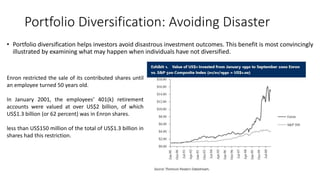
Enron restricted the sale of its contributed shares until
an employee turned 50 years old.
In January 2001, the employees’ 401(k) retirement
accounts were valued at over US$2 billion, of which
US$1.3 billion (or 62 percent) was in Enron shares.
less than US$150 million of the total of US$1.3 billion in
shares had this restriction.
Portfolio Diversification: Avoiding Disaster
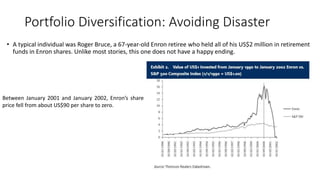
• A typical individual was Roger Bruce, a 67-year-old Enron retiree who held all of his US$2 million in retirement
funds in Enron shares. Unlike most stories, this one does not have a happy ending.
Between January 2001 and January 2002, Enron’s share
price fell from about US$90 per share to zero.
Portfolio Diversification: Avoiding Disaster
• Thus, by taking a diversified portfolio approach, investors can spread
away some of the risk.
• All rational investors are concerned about the risk–return trade-off of
their investments.
• The portfolio approach provides investors with a way to reduce the
risk associated with their wealth without necessarily decreasing their
expected rate of return.
Portfolios: Reduce Risk
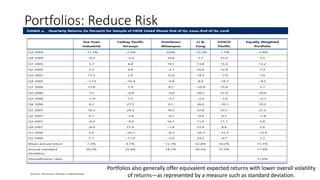
Portfolios also generally offer equivalent expected returns with lower overall volatility
of returns—as represented by a measure such as standard deviation.
Portfolios: Reduce Risk
• When we randomly selected one security each quarter, we found an average annualized return of 15.1 percent
and an average annualized standard deviation of 24.9 percent, which would now become your expected return
and standard deviation, respectively.
• Alternatively, you could invest in an equally weighted portfolio of the five shares, which means that you would
invest the same dollar amount in each security for each quarter.
• The equally weighted portfolio has an average return of 15.1 percent and a standard deviation of 17.9 percent.
• Note: The standard deviation of an equally weighted portfolio is not simply the average of the standard deviations of the individual
shares.
• Because the mean return is the same, a simple measure of the value of diversification is calculated as the ratio
of the standard deviation of the equally weighted portfolio to the standard deviation of the randomly selected
security.
• This ratio may be referred to as the diversification ratio.
• The diversification ratio of the portfolio’s standard deviation to the individual asset’s standard deviation
measures the risk reduction benefits of a simple portfolio construction method, equal weighting
Portfolios: Composition Matters for the Risk–
Return Trade-off
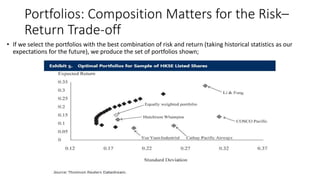
• If we select the portfolios with the best combination of risk and return (taking historical statistics as our
expectations for the future), we produce the set of portfolios shown;
Portfolios: Not Necessarily Downside
Protection
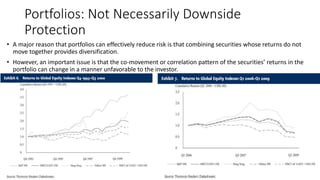
• A major reason that portfolios can effectively reduce risk is that combining securities whose returns do not
move together provides diversification.
• However, an important issue is that the co-movement or correlation pattern of the securities’ returns in the
portfolio can change in a manner unfavorable to the investor.
Portfolios: Not Necessarily Downside
Protection
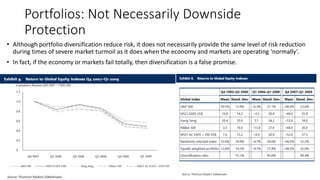
• Although portfolio diversification reduce risk, it does not necessarily provide the same level of risk reduction
during times of severe market turmoil as it does when the economy and markets are operating ‘normally’.
• In fact, if the economy or markets fail totally, then diversification is a false promise.
Portfolios: The Emergence of Modern
Portfolio Theory
• The actual theory underlying diversification and its application to investments only emerged in 1952 with the
publication of Harry Markowitz’s classic article on portfolio selection.
• The article provided the foundation for what is now known as modern portfolio theory (MPT).
• The main conclusion of MPT is that investors should not only hold portfolios but should also focus on how
individual securities in the portfolios are related to one another.
• In addition to the diversification benefits of portfolios to investors, the work of William Sharpe (1964), John
Lintner (1965), and Jack Treynor (1961) demonstrated the role that portfolios play in determining the
appropriate individual asset risk premium.
• According to capital market theory, the priced risk of an individual security is affected by holding it in a well-
diversified portfolio.
• An asset’s risk should be measured in relation to the remaining systematic or non-diversifiable risk, which
should be the only risk that affects the asset’s price.
• This view of risk is the basis of the capital asset pricing model, or CAPM.
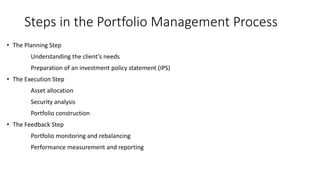
Steps in the Portfolio Management Process
• The Planning Step
Understanding the client’s needs
Preparation of an investment policy statement (IPS)
• The Execution Step
Asset allocation
Security analysis
Portfolio construction
• The Feedback Step
Portfolio monitoring and rebalancing
Performance measurement and reporting
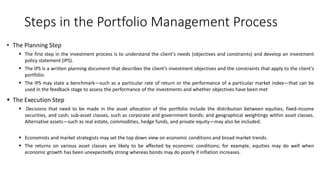
Steps in the Portfolio Management Process
• The Planning Step
 The first step in the investment process is to understand the client’s needs (objectives and constraints) and develop an investment
policy statement (IPS).
 The IPS is a written planning document that describes the client’s investment objectives and the constraints that apply to the client’s
portfolio.
 The IPS may state a benchmark—such as a particular rate of return or the performance of a particular market index—that can be
used in the feedback stage to assess the performance of the investments and whether objectives have been met
 The Execution Step
 Decisions that need to be made in the asset allocation of the portfolio include the distribution between equities, fixed-income
securities, and cash; sub-asset classes, such as corporate and government bonds; and geographical weightings within asset classes.
Alternative assets—such as real estate, commodities, hedge funds, and private equity—may also be included.
 Economists and market strategists may set the top down view on economic conditions and broad market trends.
 The returns on various asset classes are likely to be affected by economic conditions; for example, equities may do well when
economic growth has been unexpectedly strong whereas bonds may do poorly if inflation increases.
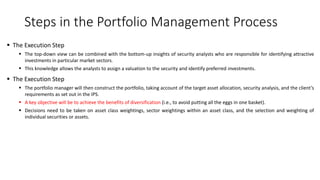
Steps in the Portfolio Management Process
 The Execution Step
 The top-down view can be combined with the bottom-up insights of security analysts who are responsible for identifying attractive
investments in particular market sectors.
 This knowledge allows the analysts to assign a valuation to the security and identify preferred investments.
 The Execution Step
 The portfolio manager will then construct the portfolio, taking account of the target asset allocation, security analysis, and the client’s
requirements as set out in the IPS.
 A key objective will be to achieve the benefits of diversification (i.e., to avoid putting all the eggs in one basket).
 Decisions need to be taken on asset class weightings, sector weightings within an asset class, and the selection and weighting of
individual securities or assets.
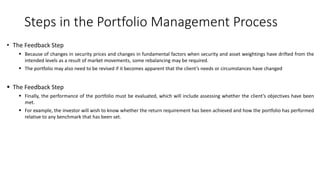
Steps in the Portfolio Management Process
• The Feedback Step
 Because of changes in security prices and changes in fundamental factors when security and asset weightings have drifted from the
intended levels as a result of market movements, some rebalancing may be required.
 The portfolio may also need to be revised if it becomes apparent that the client’s needs or circumstances have changed
 The Feedback Step
 Finally, the performance of the portfolio must be evaluated, which will include assessing whether the client’s objectives have been
met.
 For example, the investor will wish to know whether the return requirement has been achieved and how the portfolio has performed
relative to any benchmark that has been set.
Summary of Portfolio Management
• Introduction to Portfolio Management
• Definition of Portfolio Management
• Purpose of Portfolio Management
• Key Considerations for Portfolio Management
• Steps in Portfolio Management
• Define Investment Objectives
• Assess Risk Tolerance
• Determine Asset Allocation
• Select Investments
• Monitor and Review
• Asset Allocation
• Importance of Asset Allocation
• Different Asset Classes (e.g. stocks, bonds, real estate)
• Determining the Right Mix of Assets
• Selecting Investments
• Considerations for Investment Selection
• Diversification Strategies
• Active vs. Passive Investing
• Monitoring and Reviewing Portfolio
• Importance of Regular Portfolio Review
• Evaluating Portfolio Performance
• Making Adjustments as Needed
The Economic Theory Of Choice: An Illustration
Under Certainty
• Any problem involves the delineation of alternatives, the selection of criteria for choosing among those
alternatives, and, finally, the solution of the problem.
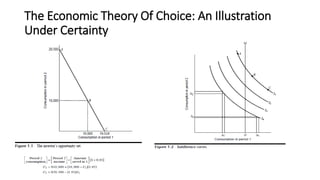
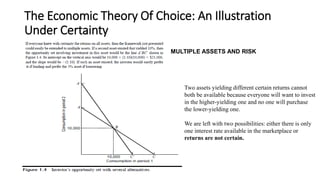
• Consider an investor who will receive with certainty an income of $10,000 in each of two years. Assume that the
only investment available is a savings account yielding 5% per year. In addition, the investor can borrow money at a
5% rate.
• How much should the investor save and how much should he or she consume each year?
• The economic theory of choice proposes to solve this problem by splitting the analysis into two parts: first, specify
those options that are available to the investor; second, specify how to choose among these options.
The Economic Theory Of Choice: An Illustration
Under Certainty
The Economic Theory Of Choice: An Illustration
Under Certainty
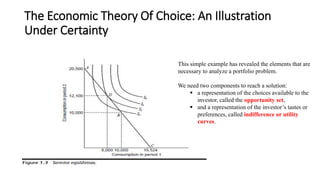
This simple example has revealed the elements that are
necessary to analyze a portfolio problem.
We need two components to reach a solution:
 a representation of the choices available to the
investor, called the opportunity set,
 and a representation of the investor’s tastes or
preferences, called indifference or utility
curves.
The Economic Theory Of Choice: An Illustration
Under Certainty
Two assets yielding different certain returns cannot
both be available because everyone will want to invest
in the higher-yielding one and no one will purchase
the lower-yielding one.
We are left with two possibilities: either there is only
one interest rate available in the marketplace or
returns are not certain.
MULTIPLE ASSETS AND RISK

Lecture 01 F-409 Portfolio.pptx

  • 1.
  • 3.
    Portfolio analysis isconcerned with finding the most desirable group of securities to hold, given the properties of each of the securities.
  • 4.
    A Portfolio Perspectiveon Investing • One of the biggest challenges faced by individuals and institutions is to decide how to invest for future needs. • For individuals, the goal might be to fund retirement needs. For such institutions as insurance companies, the goal is to fund future liabilities in the form of insurance claims, whereas endowments seek to provide income to meet the ongoing needs of such institutions as universities. • Regardless of the ultimate goal, all face the same set of challenges that extend beyond just the choice of what asset classes to invest in. • One important question is: Should we invest in individual securities, evaluating each in isolation, or should we take a portfolio approach? • By “portfolio approach,” we mean evaluating individual securities in relation to their contribution to the investment characteristics of the whole portfolio.
  • 5.
    Portfolio Diversification: AvoidingDisaster • Portfolio diversification helps investors avoid disastrous investment outcomes. This benefit is most convincingly illustrated by examining what may happen when individuals have not diversified. Enron restricted the sale of its contributed shares until an employee turned 50 years old. In January 2001, the employees’ 401(k) retirement accounts were valued at over US$2 billion, of which US$1.3 billion (or 62 percent) was in Enron shares. less than US$150 million of the total of US$1.3 billion in shares had this restriction.
  • 6.
    Portfolio Diversification: AvoidingDisaster • A typical individual was Roger Bruce, a 67-year-old Enron retiree who held all of his US$2 million in retirement funds in Enron shares. Unlike most stories, this one does not have a happy ending. Between January 2001 and January 2002, Enron’s share price fell from about US$90 per share to zero.
  • 7.
    Portfolio Diversification: AvoidingDisaster • Thus, by taking a diversified portfolio approach, investors can spread away some of the risk. • All rational investors are concerned about the risk–return trade-off of their investments. • The portfolio approach provides investors with a way to reduce the risk associated with their wealth without necessarily decreasing their expected rate of return.
  • 8.
    Portfolios: Reduce Risk Portfoliosalso generally offer equivalent expected returns with lower overall volatility of returns—as represented by a measure such as standard deviation.
  • 9.
    Portfolios: Reduce Risk •When we randomly selected one security each quarter, we found an average annualized return of 15.1 percent and an average annualized standard deviation of 24.9 percent, which would now become your expected return and standard deviation, respectively. • Alternatively, you could invest in an equally weighted portfolio of the five shares, which means that you would invest the same dollar amount in each security for each quarter. • The equally weighted portfolio has an average return of 15.1 percent and a standard deviation of 17.9 percent. • Note: The standard deviation of an equally weighted portfolio is not simply the average of the standard deviations of the individual shares. • Because the mean return is the same, a simple measure of the value of diversification is calculated as the ratio of the standard deviation of the equally weighted portfolio to the standard deviation of the randomly selected security. • This ratio may be referred to as the diversification ratio. • The diversification ratio of the portfolio’s standard deviation to the individual asset’s standard deviation measures the risk reduction benefits of a simple portfolio construction method, equal weighting
  • 10.
    Portfolios: Composition Mattersfor the Risk– Return Trade-off • If we select the portfolios with the best combination of risk and return (taking historical statistics as our expectations for the future), we produce the set of portfolios shown;
  • 11.
    Portfolios: Not NecessarilyDownside Protection • A major reason that portfolios can effectively reduce risk is that combining securities whose returns do not move together provides diversification. • However, an important issue is that the co-movement or correlation pattern of the securities’ returns in the portfolio can change in a manner unfavorable to the investor.
  • 12.
    Portfolios: Not NecessarilyDownside Protection • Although portfolio diversification reduce risk, it does not necessarily provide the same level of risk reduction during times of severe market turmoil as it does when the economy and markets are operating ‘normally’. • In fact, if the economy or markets fail totally, then diversification is a false promise.
  • 13.
    Portfolios: The Emergenceof Modern Portfolio Theory • The actual theory underlying diversification and its application to investments only emerged in 1952 with the publication of Harry Markowitz’s classic article on portfolio selection. • The article provided the foundation for what is now known as modern portfolio theory (MPT). • The main conclusion of MPT is that investors should not only hold portfolios but should also focus on how individual securities in the portfolios are related to one another. • In addition to the diversification benefits of portfolios to investors, the work of William Sharpe (1964), John Lintner (1965), and Jack Treynor (1961) demonstrated the role that portfolios play in determining the appropriate individual asset risk premium. • According to capital market theory, the priced risk of an individual security is affected by holding it in a well- diversified portfolio. • An asset’s risk should be measured in relation to the remaining systematic or non-diversifiable risk, which should be the only risk that affects the asset’s price. • This view of risk is the basis of the capital asset pricing model, or CAPM.
  • 14.
    Steps in thePortfolio Management Process • The Planning Step Understanding the client’s needs Preparation of an investment policy statement (IPS) • The Execution Step Asset allocation Security analysis Portfolio construction • The Feedback Step Portfolio monitoring and rebalancing Performance measurement and reporting
  • 15.
    Steps in thePortfolio Management Process • The Planning Step  The first step in the investment process is to understand the client’s needs (objectives and constraints) and develop an investment policy statement (IPS).  The IPS is a written planning document that describes the client’s investment objectives and the constraints that apply to the client’s portfolio.  The IPS may state a benchmark—such as a particular rate of return or the performance of a particular market index—that can be used in the feedback stage to assess the performance of the investments and whether objectives have been met  The Execution Step  Decisions that need to be made in the asset allocation of the portfolio include the distribution between equities, fixed-income securities, and cash; sub-asset classes, such as corporate and government bonds; and geographical weightings within asset classes. Alternative assets—such as real estate, commodities, hedge funds, and private equity—may also be included.  Economists and market strategists may set the top down view on economic conditions and broad market trends.  The returns on various asset classes are likely to be affected by economic conditions; for example, equities may do well when economic growth has been unexpectedly strong whereas bonds may do poorly if inflation increases.
  • 16.
    Steps in thePortfolio Management Process  The Execution Step  The top-down view can be combined with the bottom-up insights of security analysts who are responsible for identifying attractive investments in particular market sectors.  This knowledge allows the analysts to assign a valuation to the security and identify preferred investments.  The Execution Step  The portfolio manager will then construct the portfolio, taking account of the target asset allocation, security analysis, and the client’s requirements as set out in the IPS.  A key objective will be to achieve the benefits of diversification (i.e., to avoid putting all the eggs in one basket).  Decisions need to be taken on asset class weightings, sector weightings within an asset class, and the selection and weighting of individual securities or assets.
  • 17.
    Steps in thePortfolio Management Process • The Feedback Step  Because of changes in security prices and changes in fundamental factors when security and asset weightings have drifted from the intended levels as a result of market movements, some rebalancing may be required.  The portfolio may also need to be revised if it becomes apparent that the client’s needs or circumstances have changed  The Feedback Step  Finally, the performance of the portfolio must be evaluated, which will include assessing whether the client’s objectives have been met.  For example, the investor will wish to know whether the return requirement has been achieved and how the portfolio has performed relative to any benchmark that has been set.
  • 18.
    Summary of PortfolioManagement • Introduction to Portfolio Management • Definition of Portfolio Management • Purpose of Portfolio Management • Key Considerations for Portfolio Management • Steps in Portfolio Management • Define Investment Objectives • Assess Risk Tolerance • Determine Asset Allocation • Select Investments • Monitor and Review • Asset Allocation • Importance of Asset Allocation • Different Asset Classes (e.g. stocks, bonds, real estate) • Determining the Right Mix of Assets • Selecting Investments • Considerations for Investment Selection • Diversification Strategies • Active vs. Passive Investing • Monitoring and Reviewing Portfolio • Importance of Regular Portfolio Review • Evaluating Portfolio Performance • Making Adjustments as Needed
  • 19.
    The Economic TheoryOf Choice: An Illustration Under Certainty • Any problem involves the delineation of alternatives, the selection of criteria for choosing among those alternatives, and, finally, the solution of the problem. • Consider an investor who will receive with certainty an income of $10,000 in each of two years. Assume that the only investment available is a savings account yielding 5% per year. In addition, the investor can borrow money at a 5% rate. • How much should the investor save and how much should he or she consume each year? • The economic theory of choice proposes to solve this problem by splitting the analysis into two parts: first, specify those options that are available to the investor; second, specify how to choose among these options.
  • 20.
    The Economic TheoryOf Choice: An Illustration Under Certainty
  • 21.
    The Economic TheoryOf Choice: An Illustration Under Certainty This simple example has revealed the elements that are necessary to analyze a portfolio problem. We need two components to reach a solution:  a representation of the choices available to the investor, called the opportunity set,  and a representation of the investor’s tastes or preferences, called indifference or utility curves.
  • 22.
    The Economic TheoryOf Choice: An Illustration Under Certainty Two assets yielding different certain returns cannot both be available because everyone will want to invest in the higher-yielding one and no one will purchase the lower-yielding one. We are left with two possibilities: either there is only one interest rate available in the marketplace or returns are not certain. MULTIPLE ASSETS AND RISK