Introduction to Investment Management
Presentation OutlineOverview & IntroductionInvestment Management ProcessCreating Investment Policy StatementSelecting a Portfolio StrategySelecting the AssetsMeasuring Performance by Portfolio Evaluation
Terms & DefinitionsInvestment Management / InvestmentCombining securities of investment in a portfolio tailored to the investors preference and needs, monitoring and evaluating its performanceJob planning, implementing and overseeing the funds/ money of an individual or an institution;Commitment of current funds in anticipation of receiving a larger flow of funds in the future;PortfolioA collection of various investmentsAsset AllocationDivision of assets among different classes of investments;E.g. real estate, stocks, etc.
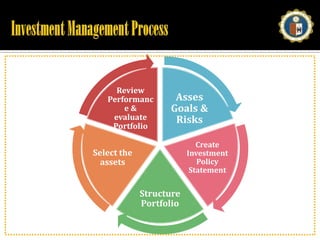
Investment Management Process
Investment PolicyDefinition: It is a formal description of an investment philosophy that may be utilized for any given fund, retirement plan or other investments the investor may want.
How to create an investment policy statement?Purpose: What is the money intended for? Retirement? New house fund? Children’s education? Investment time horizon: When will the money be needed? Asset allocation: Will the portfolio be all stocks or all certificates of deposits or some combination? Rebalancing: How often will you rebalance?
How to create an investment policy statement?Return expectation: This section is optional but if you have an idea of what kind of return you are expecting then write it down. Investments: This section should outline what type of investments are eligible for your portfolio – i.e. large cap stocks on the S&P 500, index funds, and so on.Benchmarks: Another optional section – If you are an active investor then you might choose to measure your portfolio against an appropriate set of stock and bond indexes.
It can be difficult to stick to your original strategy for several reasonsMemory - it’s not easy to remember a strategy that you came up with several months or years ago. Greed and Temptation – if you have a conservative strategy and the market is going straight up then it can be difficult to stay with the original strategy. Losses – tough markets make for tough investing. It’s easy to forget or dismiss your original plan when the going gets rough.
Type of Investor
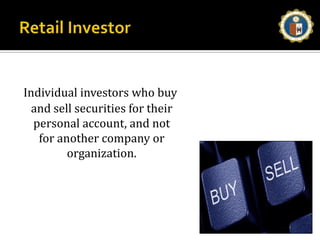
Retail InvestorIndividual investors who buy and sell securities for their personal account, and not for another company or organization.
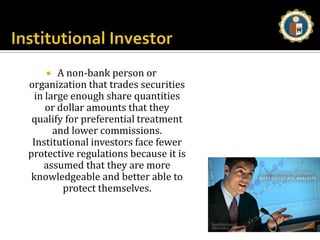
Institutional InvestorA non-bank person or organization that trades securities in large enough share quantities or dollar amounts that they qualify for preferential treatment and lower commissions. Institutional investors face fewer protective regulations because it is assumed that they are more knowledgeable and better able to protect themselves.
Retail Investor VS Institutional Investor Investment FundsLogistic thinkingProfession expertiseTargets
General Portfolio StrategyPassive Portfolio Strategy:A strategy that involves minimal expectation input, and instead relies on diversification to match the performance of some market index. A passive strategy assumes that the marketplace will reflect all available information in the price paid for securities.Active Portfolio Strategy:A strategy that uses available information and forecasting techniques to seek a better performance than a portfolio that is simply diversified broadly.
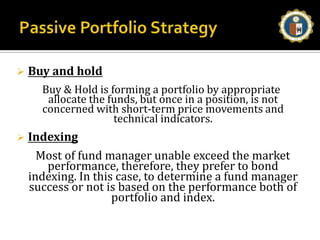
Passive Portfolio StrategyBuy and hold    Buy & Hold is forming a portfolio by appropriate allocate the funds, but once in a position, is not concerned with short-term price movements and technical indicators.Indexing     Most of fund manager unable exceed the market performance, therefore, they prefer to bond indexing. In this case, to determine a fund manager success or not is based on the performance both of portfolio and index.
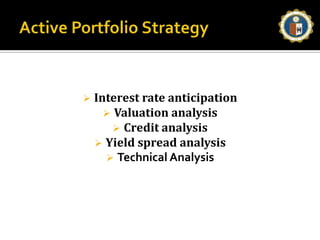
Active Portfolio StrategyInterest rate anticipation
Valuation analysis
Credit analysis
Yield spread analysis
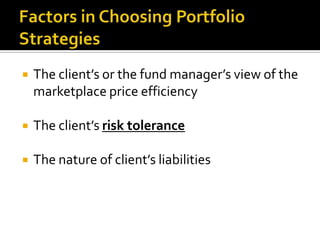
Technical Analysis Factors in Choosing Portfolio StrategiesThe client’s or the fund manager’s view of the marketplace price efficiencyThe client’s risk toleranceThe nature of client’s liabilities
Selecting the Assets
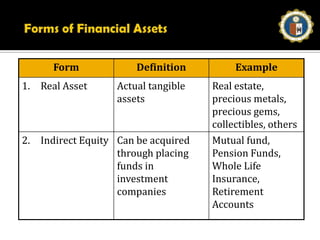
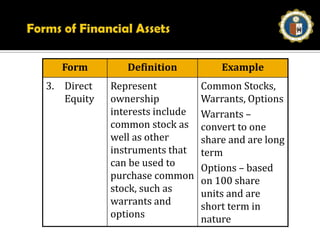
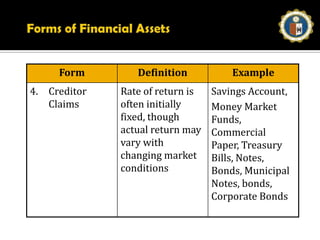
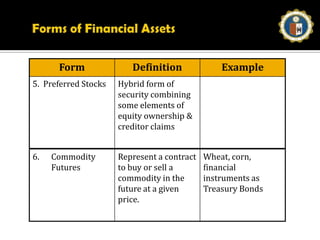
Forms of Financial Assets
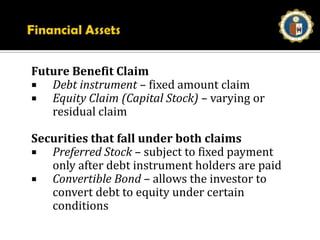
Financial AssetsFuture Benefit ClaimDebt instrument – fixed amount claimEquity Claim (Capital Stock) – varying or residual claimSecurities that fall under both claimsPreferred Stock – subject to fixed payment only after debt instrument holders are paid Convertible Bond – allows the investor to convert debt to equity under certain conditions
Financial marketsTypes of Financial MarketsBy type of claimBy issuance of claimBy maturity of claimClassification of Financial MarketsShort-term – maturity of one year or lessLong-term
Functions of Financial MarketsEconomic Functions of Financial MarketsPrice Discovery Process	- market determines the prices of the assetsLiquidity	- market provides venue to convert assets into cashTransaction Cost Reduction	- refers to buyer & seller search costs, information collection to assess investment merits
Globalization of Financial MarketsGlobalization – refers to integration of financial markets throughout the worldFactors that lead to globalization:Deregulation or LiberalizationTechnological Advancements- monitoring world markets, executing orders, analyzing financial opportunitiesIncreased Institutionalization of financial markets	- no longer dominated by retail or individual investors
Relevant Terms in the World Financial MarketsEmerging Equity	- stock market in rapidly growing marketsEuroequity Issues	- securities initially sold to investors simultaneous in several national markets by an international syndicateEuroband	- bond that is underwritten by an international syndicate, offered at issuance simultaneous to investors in a number of countries, and issues outside the jurisdiction of any single country.
Relevant Terms in the World Financial MarketsTranche	- refers to one of several securities offered at the same time of ownership of the underlying stock of a foreign corporation that the band holds in trustMortgage-Backed Securities	- securities that are backed by a pool of mortgage loans. Mortgage loans that are pooled and used as collateral for as security is said to be securitizedAsset-Backed Securities	- securities that are backed by assets that are not traditional mortgage loans
Futures and Options MarketContracts that specify transactions to be completed at a later date are for derivative markets. 	- financial assets, commodities, precious metalsTypes of Derivative Contracts:Option Contract	- Gives the contract owner the right but not the obligation to buy (or sell) a financial asset at a specified price from (or to) another partyFutures Contract	- An agreement whereby two parties agree to transact a financial asset at a predetermined price at a specified future date
PORTFOLIO EVALUATION
Portfolio EvaluationPortfolio evaluating refers to the evaluation of the performance of the portfolio. It is essentially the process of comparing the return earned on a portfolio with the return earned on one or more other portfolio or on a benchmark portfolio.
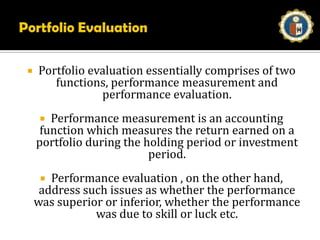
Portfolio EvaluationPortfolio evaluation essentially comprises of two functions, performance measurement and performance evaluation. Performance measurement is an accounting function which measures the return earned on a portfolio during the holding period or investment period. Performance evaluation , on the other hand, address such issues as whether the performance was superior or inferior, whether the performance was due to skill or luck etc.
Portfolio EvaluationThe ability of the investor depends upon the absorption of latest developments which occurred in the market. The ability of expectations if any, we must able to cope up with the wind immediately.
Portfolio EvaluationInvestment analysts continuously monitor and evaluate the result of the portfolio performance. The expert portfolio constructer shall show superior performance over the market and other factors. The performance also depends upon the timing of investments and superior investment analysts capabilities for selection.
Portfolio EvaluationThe evaluation of portfolio is always followed by revision and reconstruction. The investor will have to assess the extent to which the objectives are achieved. For evaluation of portfolio, the investor shall keep in mind the secured average returns, average or below average as compared to the market situation.
Portfolio EvaluationSelection of proper securities is the first requirement. The evaluation of a portfolio performance can be made based on the following methods:a)    Sharpe’s Measureb)    Treynor’s Measurec)    Jensen’s Measure
Portfolio EvaluationThe objective of modern portfolio theory is maximization of return or minimization of risk. In this context the research studies have tried to evolve a composite index to measure risk based return.
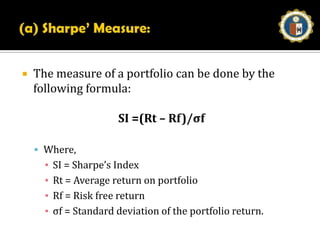
(a) Sharpe’ Measure:Sharpe measures total risk by calculating standard deviation. The method adopted by Sharpe is to rank all portfolios on the basis of evaluation measure.Reward is in the numerator as risk premium. Total risk is in the denominator as standard deviation of its return. We will get a measure of portfolio’s total risk and variability of return in relation to the risk premium.
The measure of a portfolio can be done by the following formula:SI =(Rt – Rf)/σfWhere,SI = Sharpe’s IndexRt = Average return on portfolioRf = Risk free returnσf = Standard deviation of the portfolio return.(a) Sharpe’ Measure:
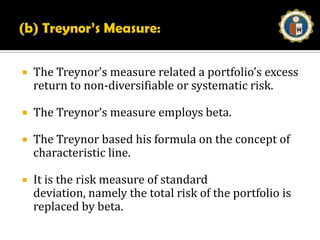
(b) Treynor’s Measure:The Treynor’s measure related a portfolio’s excess return to non-diversifiable or systematic risk. The Treynor’s measure employs beta. The Treynor based his formula on the concept of characteristic line. It is the risk measure of standard deviation, namely the total risk of the portfolio is replaced by beta.
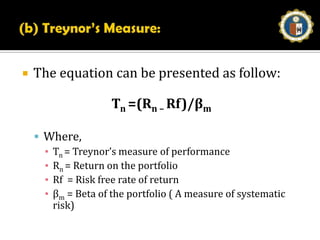
The equation can be presented as follow:Tn =(Rn – Rf)/βmWhere,  Tn = Treynor’s measure of performanceRn = Return on the portfolioRf  = Risk free rate of returnβm = Beta of the portfolio ( A measure of systematic risk)(b) Treynor’s Measure:
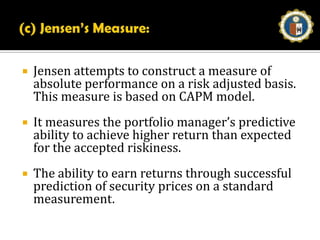
(c) Jensen’s Measure:Jensen attempts to construct a measure of absolute performance on a risk adjusted basis. This measure is based on CAPM model. It measures the portfolio manager’s predictive ability to achieve higher return than expected for the accepted riskiness. The ability to earn returns through successful prediction of security prices on a standard measurement.
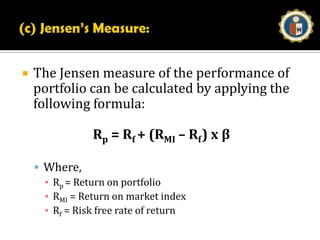
The Jensen measure of the performance of portfolio can be calculated by applying the following formula:Rp = Rf + (RMI – Rf) x βWhere,Rp = Return on portfolioRMI = Return on market indexRf = Risk free rate of return(c) Jensen’s Measure:
Types of BenchmarksMarket indices are equity indexes	Ex: Dow Jones Industrial Average, Standard & Poor’s 500 Composite, NASDAQ Composite Index, New York Stock Exchange Composite Index, etcGeneric-Investment-Style Indices – developed by various consulting firms to measures various investment styles	Ex: Frank Russell, Wilshire Associate Prudential Securities, etc

Invema group1

  • 1.
  • 2.
    Presentation OutlineOverview &IntroductionInvestment Management ProcessCreating Investment Policy StatementSelecting a Portfolio StrategySelecting the AssetsMeasuring Performance by Portfolio Evaluation
  • 3.
    Terms & DefinitionsInvestmentManagement / InvestmentCombining securities of investment in a portfolio tailored to the investors preference and needs, monitoring and evaluating its performanceJob planning, implementing and overseeing the funds/ money of an individual or an institution;Commitment of current funds in anticipation of receiving a larger flow of funds in the future;PortfolioA collection of various investmentsAsset AllocationDivision of assets among different classes of investments;E.g. real estate, stocks, etc.
  • 4.
  • 5.
    Investment PolicyDefinition: Itis a formal description of an investment philosophy that may be utilized for any given fund, retirement plan or other investments the investor may want.
  • 6.
    How to createan investment policy statement?Purpose: What is the money intended for? Retirement? New house fund? Children’s education? Investment time horizon: When will the money be needed? Asset allocation: Will the portfolio be all stocks or all certificates of deposits or some combination? Rebalancing: How often will you rebalance?
  • 7.
    How to createan investment policy statement?Return expectation: This section is optional but if you have an idea of what kind of return you are expecting then write it down. Investments: This section should outline what type of investments are eligible for your portfolio – i.e. large cap stocks on the S&P 500, index funds, and so on.Benchmarks: Another optional section – If you are an active investor then you might choose to measure your portfolio against an appropriate set of stock and bond indexes.
  • 8.
    It can bedifficult to stick to your original strategy for several reasonsMemory - it’s not easy to remember a strategy that you came up with several months or years ago. Greed and Temptation – if you have a conservative strategy and the market is going straight up then it can be difficult to stay with the original strategy. Losses – tough markets make for tough investing. It’s easy to forget or dismiss your original plan when the going gets rough.
  • 9.
  • 10.
    Retail InvestorIndividual investorswho buy and sell securities for their personal account, and not for another company or organization.
  • 11.
    Institutional InvestorA non-bankperson or organization that trades securities in large enough share quantities or dollar amounts that they qualify for preferential treatment and lower commissions. Institutional investors face fewer protective regulations because it is assumed that they are more knowledgeable and better able to protect themselves.
  • 12.
    Retail Investor VSInstitutional Investor Investment FundsLogistic thinkingProfession expertiseTargets
  • 13.
    General Portfolio StrategyPassivePortfolio Strategy:A strategy that involves minimal expectation input, and instead relies on diversification to match the performance of some market index. A passive strategy assumes that the marketplace will reflect all available information in the price paid for securities.Active Portfolio Strategy:A strategy that uses available information and forecasting techniques to seek a better performance than a portfolio that is simply diversified broadly.
  • 14.
    Passive Portfolio StrategyBuyand hold Buy & Hold is forming a portfolio by appropriate allocate the funds, but once in a position, is not concerned with short-term price movements and technical indicators.Indexing Most of fund manager unable exceed the market performance, therefore, they prefer to bond indexing. In this case, to determine a fund manager success or not is based on the performance both of portfolio and index.
  • 15.
  • 16.
  • 17.
  • 18.
  • 19.
    Technical Analysis Factorsin Choosing Portfolio StrategiesThe client’s or the fund manager’s view of the marketplace price efficiencyThe client’s risk toleranceThe nature of client’s liabilities
  • 20.
  • 21.
  • 22.
  • 23.
  • 24.
  • 25.
    Financial AssetsFuture BenefitClaimDebt instrument – fixed amount claimEquity Claim (Capital Stock) – varying or residual claimSecurities that fall under both claimsPreferred Stock – subject to fixed payment only after debt instrument holders are paid Convertible Bond – allows the investor to convert debt to equity under certain conditions
  • 26.
    Financial marketsTypes ofFinancial MarketsBy type of claimBy issuance of claimBy maturity of claimClassification of Financial MarketsShort-term – maturity of one year or lessLong-term
  • 27.
    Functions of FinancialMarketsEconomic Functions of Financial MarketsPrice Discovery Process - market determines the prices of the assetsLiquidity - market provides venue to convert assets into cashTransaction Cost Reduction - refers to buyer & seller search costs, information collection to assess investment merits
  • 28.
    Globalization of FinancialMarketsGlobalization – refers to integration of financial markets throughout the worldFactors that lead to globalization:Deregulation or LiberalizationTechnological Advancements- monitoring world markets, executing orders, analyzing financial opportunitiesIncreased Institutionalization of financial markets - no longer dominated by retail or individual investors
  • 29.
    Relevant Terms inthe World Financial MarketsEmerging Equity - stock market in rapidly growing marketsEuroequity Issues - securities initially sold to investors simultaneous in several national markets by an international syndicateEuroband - bond that is underwritten by an international syndicate, offered at issuance simultaneous to investors in a number of countries, and issues outside the jurisdiction of any single country.
  • 30.
    Relevant Terms inthe World Financial MarketsTranche - refers to one of several securities offered at the same time of ownership of the underlying stock of a foreign corporation that the band holds in trustMortgage-Backed Securities - securities that are backed by a pool of mortgage loans. Mortgage loans that are pooled and used as collateral for as security is said to be securitizedAsset-Backed Securities - securities that are backed by assets that are not traditional mortgage loans
  • 31.
    Futures and OptionsMarketContracts that specify transactions to be completed at a later date are for derivative markets. - financial assets, commodities, precious metalsTypes of Derivative Contracts:Option Contract - Gives the contract owner the right but not the obligation to buy (or sell) a financial asset at a specified price from (or to) another partyFutures Contract - An agreement whereby two parties agree to transact a financial asset at a predetermined price at a specified future date
  • 32.
  • 33.
    Portfolio EvaluationPortfolio evaluatingrefers to the evaluation of the performance of the portfolio. It is essentially the process of comparing the return earned on a portfolio with the return earned on one or more other portfolio or on a benchmark portfolio.
  • 34.
    Portfolio EvaluationPortfolio evaluatingrefers to the evaluation of the performance of the portfolio. It is essentially the process of comparing the return earned on a portfolio with the return earned on one or more other portfolio or on a benchmark portfolio.
  • 35.
    Portfolio EvaluationPortfolio evaluationessentially comprises of two functions, performance measurement and performance evaluation. Performance measurement is an accounting function which measures the return earned on a portfolio during the holding period or investment period. Performance evaluation , on the other hand, address such issues as whether the performance was superior or inferior, whether the performance was due to skill or luck etc.
  • 36.
    Portfolio EvaluationThe abilityof the investor depends upon the absorption of latest developments which occurred in the market. The ability of expectations if any, we must able to cope up with the wind immediately.
  • 37.
    Portfolio EvaluationInvestment analystscontinuously monitor and evaluate the result of the portfolio performance. The expert portfolio constructer shall show superior performance over the market and other factors. The performance also depends upon the timing of investments and superior investment analysts capabilities for selection.
  • 38.
    Portfolio EvaluationThe evaluationof portfolio is always followed by revision and reconstruction. The investor will have to assess the extent to which the objectives are achieved. For evaluation of portfolio, the investor shall keep in mind the secured average returns, average or below average as compared to the market situation.
  • 39.
    Portfolio EvaluationSelection ofproper securities is the first requirement. The evaluation of a portfolio performance can be made based on the following methods:a)    Sharpe’s Measureb)    Treynor’s Measurec)    Jensen’s Measure
  • 40.
    Portfolio EvaluationThe objectiveof modern portfolio theory is maximization of return or minimization of risk. In this context the research studies have tried to evolve a composite index to measure risk based return.
  • 41.
    (a) Sharpe’ Measure:Sharpemeasures total risk by calculating standard deviation. The method adopted by Sharpe is to rank all portfolios on the basis of evaluation measure.Reward is in the numerator as risk premium. Total risk is in the denominator as standard deviation of its return. We will get a measure of portfolio’s total risk and variability of return in relation to the risk premium.
  • 42.
    The measure ofa portfolio can be done by the following formula:SI =(Rt – Rf)/σfWhere,SI = Sharpe’s IndexRt = Average return on portfolioRf = Risk free returnσf = Standard deviation of the portfolio return.(a) Sharpe’ Measure:
  • 43.
    (b) Treynor’s Measure:TheTreynor’s measure related a portfolio’s excess return to non-diversifiable or systematic risk. The Treynor’s measure employs beta. The Treynor based his formula on the concept of characteristic line. It is the risk measure of standard deviation, namely the total risk of the portfolio is replaced by beta.
  • 44.
    The equation canbe presented as follow:Tn =(Rn – Rf)/βmWhere,  Tn = Treynor’s measure of performanceRn = Return on the portfolioRf  = Risk free rate of returnβm = Beta of the portfolio ( A measure of systematic risk)(b) Treynor’s Measure:
  • 45.
    (c) Jensen’s Measure:Jensenattempts to construct a measure of absolute performance on a risk adjusted basis. This measure is based on CAPM model. It measures the portfolio manager’s predictive ability to achieve higher return than expected for the accepted riskiness. The ability to earn returns through successful prediction of security prices on a standard measurement.
  • 46.
    The Jensen measureof the performance of portfolio can be calculated by applying the following formula:Rp = Rf + (RMI – Rf) x βWhere,Rp = Return on portfolioRMI = Return on market indexRf = Risk free rate of return(c) Jensen’s Measure:
  • 47.
    Types of BenchmarksMarketindices are equity indexes Ex: Dow Jones Industrial Average, Standard & Poor’s 500 Composite, NASDAQ Composite Index, New York Stock Exchange Composite Index, etcGeneric-Investment-Style Indices – developed by various consulting firms to measures various investment styles Ex: Frank Russell, Wilshire Associate Prudential Securities, etc