1
EXCELLENCE
IN
MANUFACTURING
THROUGH
AUTOMATION
BY H.K. CHATTERJEE
Works Director
Raymond Ltd. Vapi Unit
2
In today’s Global Scenario manufacturing
Efficiency and Agility is not an option , but it
is a strategic requirement
Metrics, including
RETURN ON NET ASSETS
(RONA),
are increasingly scrutinized.
3
In today’s scenario production cost is increasing
rapidly. The labour cost, raw material cost, power
cost, etc. are not in our control. Hence to increase the
productivity and reduce the production cost we can
only have controls on:
 Manpower cost – by reducing manpower
 Utility cost – by power saving
 Quality improvement – Through good control
 High production – Through state of art machine
 Keeping proper record – Through systems
All these can be possible only by implementing
Automation
4
What is Automation?
Monitoring and controlling of any process
with the help of latest technologies like
software, ladder and logic controls,
Robotics, ERP system and incorporating
central computer is called Automation.
5
WHY AUTOMATION
Achieve more with less.
Elimination of human error
Cleaner Technology
Consistency of product
Minimize Energy consumption
Easy diagnosis of fault
6
Reduction in Resources
(Chemicals ,water , energy etc.)
Reduce manpower.
Data collection and consolidation.
Effective application for Complex tasks
Trending and Report generation.
WHY AUTOMATION
7
Reduction of Peak Loads
Reduction in Effluent
 Environment Protection.
Improve Safety and Health.
Reduce Maintenance.
WHY AUTOMATION
8
Automation effects the productivity in following
aspects
a) Increasing production by avoiding manual
delays.
b) Improving productivity by achieving the optimum
efficiency of the machine.
c) Avoiding reprocessing and improving the
productivity.
EFFECT ON PRODUCTIVITY
9
d) Automation improves the power saving
possibilities and hence the cost of product goes
down.
e) By avoiding manual error it improves the quality
of product and hence productivity.
f) Automation can give useful data of the machines
which increases the possibility of analyzing the
cause of low or poor productivity.
EFFECT ON PRODUCTIVITY
10
Most of the textile plant in India are still having old
technologies and running their plants in very low
efficiency.
Automation can improve the productivity of even old
machinery and enhance the quality of the product. For
example-
a) Ring frame automation can improve the doffing time,
reduce unnecessary breakdowns because of power
fluctuation and record the exact running procedure by
avoiding manual interference. It can reduce the
production cost by reducing manpower.
SCENARIO OF INDIAN TEXTILE
INDUSTRY
11
b) Automation of weaving machineries can improve to analyze the
reason of breakdowns, improves the life of the machine by controlling
all critical mechanical settings and provide accurate data of the
machine.
c) The very important area for Automation is the dyeing process,
because it involves lot of minute parameters which are very critical.
Even in milligrams variation of recipe can change the shade of the
fabric. All the parameters for dyeing like temperature, pressure,
water level, water flow, circulation and time of treatment are most
important.
Automation of the dyeing process can improve the productivity by
controlling the above parameters very accurately.
SCENARIO OF INDIAN TEXTILE
INDUSTRY
12
d) The finishing process is very critical and all the
parameters of the machine needs to control
preciously. Chemical dozing should also needs
accurate measurement. Automation helps to
improve all these parameters and improves the
productivity and quality in a great extent.
e) Even the folding and warehouse operation can
improve by Automation of the process.
SCENARIO OF INDIAN TEXTILE
INDUSTRY
13
Do you know where you are?
Do you know where you want to be one
years from Now?
Do you know where you want to be five
years from Now?
How to proceed for
automation
14
How do we start
It is very important to identify the need and
the feasibility of the system to be automated
The production cost, the complicity of the
machines, the utility requirement of the
machines, quality parameters of the
products are most important factors to
consider while planning for Automation.
15
Select The System which has
Flexibility
 Ease of Programming
 Adaptability to change
 Expandability
 Enhancibility of function.
 Ruggedness in system.
 Service Back up.
16
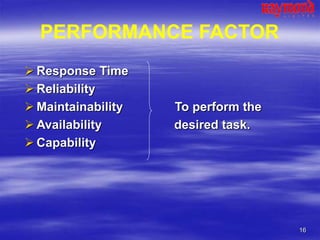
PERFORMANCE FACTOR
 Response Time
 Reliability
 Maintainability To perform the
 Availability desired task.
 Capability
17
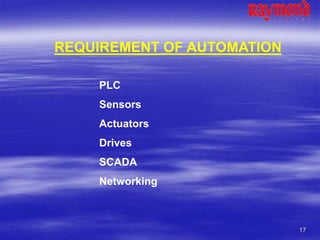
REQUIREMENT OF AUTOMATION
PLC
Sensors
Actuators
Drives
SCADA
Networking
18
Automation In Textile Industry
The textile manufacturers were having problems with the
controls on Textile Machinery as they were having proprietary
communication and programming standards. Therefore the
American Textile Manufacturing Institution along with the
Computer Instruments Manufacturing sub-committee have
designed a open communication standard. Use of this will
help significantly in implementing Integration and Automation
strategies.
19
The open definable standards for communications and
programmability will give textile manufacturers the
ability to implement plant wide strategies, without
asking the OEM for source code and expensive
reprogramming.
20
Case Studies
I will show you some case studies where
Raymond Limited has improved their
productivity in a great extend by Automate
their existing machines and process.
21
ROPE SCOURING
AUTOMATION
APPLICATION
We have Rope Scouring m/c for secondary
washing & softening of fabric. The fabric
gets stiffed after the process of singeing and
heat setting. This fabric is treated with
chemical in the rope scouring machine to
remove stiffness as well as stains.
22
NEED
Earlier Operation of machine was manual. There were lot
of problems/negligence during operation of the machine
and it is not traceable easily. The whole system was
studied by group of engineers. The study reveled that the
inconsistency in fabric was due to the following points
 Cycle Time.
 Quantity of chemical added
 Quantity of water taken.
 Speed of machine.
 Temperature of m/c.
23
SOLUTION
 To automate the m/c it was decided to use distributed
control system, and then all the m/c were connected to
central SCADA system. Individual m/c is automated and
connected through Ethernet link. For automation the
hardware used were DP transmitter, Temperature sensor
and transmitter, Level switch etc. The electrical panel for
this automation was Designed and built In house.
 Total 50 nos of programs are made to fulfill the requirement
of process according to quality of fabric. According to lot
data and program number the m/c runs in auto mode and
the chemical request is send to dispenser accordingly.
24
ADVANTAGES
 Consistent quality is maintained.
 The water consumption is reduced by 2 lacs lit/day.
 Manpower is reduced by 27 workmen out of 38 workmen
 Chemical saving is achieved up to 12%.
 The track of process and record keeping is easier.
 The energy consumption is reduced.
 The fault finding is easier due to which less downtime is
observed.
 The manual error is avoided.
25
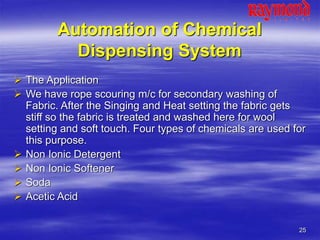
Automation of Chemical
Dispensing System
 The Application
 We have rope scouring m/c for secondary washing of
Fabric. After the Singing and Heat setting the fabric gets
stiff so the fabric is treated and washed here for wool
setting and soft touch. Four types of chemicals are used for
this purpose.
 Non Ionic Detergent
 Non Ionic Softener
 Soda
 Acetic Acid
26
The Need
Previously the m/ c were running in manual mode and
the c hemical were added through Jars and Buckets .
Chemicals were added according to slab of 50 kg
lot. This was crude method. Due to this there was lot
of variation in Quality of fabric.
Also there was very
high potential of
saving the chemicals.
So to optimize the
resources Automatic
Dispensing System
was a good option.
27
The Solution
A team of engineering comprising of
Mechanical ,Electrical, Instrumentation as
well as Process engineer studied together
and came out with a solution which was very
accurate and user Friendly.
The system is divided into 2 Parts.
Chemical Preparation and Loading
Dispensing system
28
Loading Station
The Quantity of chemical to be loaded in Storage tanks is
entered into the Computer and automatically the water
to be loaded is calculated . The chemical and water
loading is done through constant flow gear pump. The
magnetic flow meter is installed in delivery of gear pump
which measures the quantity to be loaded accurately.
29
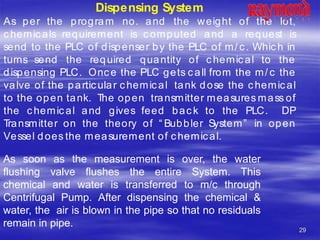
Dispensing System
As per the program no. and the weight of the lot,
chemicals requirement is computed and a request is
send to the PLC of dispenser by the PLC of m/ c. Which in
turns send the required quantity of chemical to the
dispensing PLC. Once the PLC gets call from the m/ c the
valve of the particular chemical tank dose the chemical
to the open tank. The open transmitter measures mass of
the chemical and gives feed back to the PLC. DP
Transmitter on the theory of “ Bubbler System” in open
Vessel does the measurement of c hemical.
As soon as the measurement is over, the water
flushing valve flushes the entire System. This
chemical and water is transferred to m/c through
Centrifugal Pump. After dispensing the chemical &
water, the air is blown in the pipe so that no residuals
remain in pipe.
30
AIR WASHER TOWER
AUTOMATION
CONCEPT of automation was to centralize the
monitoring and control of all the towers from one
place and keeping in view of the Energy
conservation aspect. All the systems, available in the
market at present use the custom built controller.
Energy conservation aspect is also not considered
whereas in our system, we have used PLC and the
software logic with a view to conserve energy
without compromising the departmental requirement
for Relative Humidity and temperature.
31
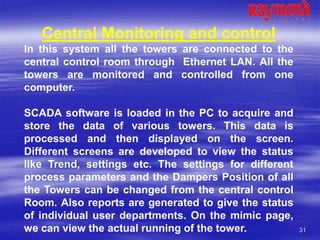
Central Monitoring and control
In this system all the towers are connected to the
central control room through Ethernet LAN. All the
towers are monitored and controlled from one
computer.
SCADA software is loaded in the PC to acquire and
store the data of various towers. This data is
processed and then displayed on the screen.
Different screens are developed to view the status
like Trend, settings etc. The settings for different
process parameters and the Dampers Position of all
the Towers can be changed from the central control
Room. Also reports are generated to give the status
of individual user departments. On the mimic page,
we can view the actual running of the tower.
32
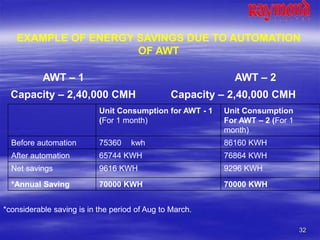
EXAMPLE OF ENERGY SAVINGS DUE TO AUTOMATION
OF AWT
AWT – 1 AWT – 2
Capacity – 2,40,000 CMH Capacity – 2,40,000 CMH
Unit Consumption for AWT - 1
(For 1 month)
Unit Consumption
For AWT – 2 (For 1
month)
Before automation 75360 kwh 86160 KWH
After automation 65744 KWH 76864 KWH
Net savings 9616 KWH 9296 KWH
*Annual Saving 70000 KWH 70000 KWH
*considerable saving is in the period of Aug to March.
33
AUTOMATION OF DYEING PROCESS
Dyeing process whether it is piece dyeing, top
dyeing or cheese dyeing the time factor, the
cooling - heating cycle and correct quantity of
chemicals and dyes is very important. Dyeing
process consists of many different steps. The
process also differs from lot to lot. As the
system was totally manual the rate of human
error and wastage is very high leading to
variation in shed.
34
To avoid these all it is decided to have
automatic color and chemical dispensing
system. In the first phase all the machines
were automated in-house by
multiprogramming. For the automation, we
have changed the internal piping system and
the safety requirement. The complete
process is studied for the programming.
35
After completion of all machine automation,
the color service system is installed. Color
Service system handles the chemical & dyes
and dispenses as per the exact requirement of
machine. All the machines were connected
with color service through pipe line
36
ADVANTAGES
 Reduction in water consumption.
 Consistency in quality.
 Saving in chemical & dyes
consumption.
 Manpower reduction.
 Elimination of reprocessing.
 Recording is easier.
37
NEED OF THE DAY
 Automation is a need for today’s
competitive market where quality, cost and
availability is playing major role.
 Through Automation only we can achieve
these parameters and compete in the
market.

Textile - Excellence in Mfg. Through Automation.ppt

  • 1.
  • 2.
    2 In today’s GlobalScenario manufacturing Efficiency and Agility is not an option , but it is a strategic requirement Metrics, including RETURN ON NET ASSETS (RONA), are increasingly scrutinized.
  • 3.
    3 In today’s scenarioproduction cost is increasing rapidly. The labour cost, raw material cost, power cost, etc. are not in our control. Hence to increase the productivity and reduce the production cost we can only have controls on:  Manpower cost – by reducing manpower  Utility cost – by power saving  Quality improvement – Through good control  High production – Through state of art machine  Keeping proper record – Through systems All these can be possible only by implementing Automation
  • 4.
    4 What is Automation? Monitoringand controlling of any process with the help of latest technologies like software, ladder and logic controls, Robotics, ERP system and incorporating central computer is called Automation.
  • 5.
    5 WHY AUTOMATION Achieve morewith less. Elimination of human error Cleaner Technology Consistency of product Minimize Energy consumption Easy diagnosis of fault
  • 6.
    6 Reduction in Resources (Chemicals,water , energy etc.) Reduce manpower. Data collection and consolidation. Effective application for Complex tasks Trending and Report generation. WHY AUTOMATION
  • 7.
    7 Reduction of PeakLoads Reduction in Effluent  Environment Protection. Improve Safety and Health. Reduce Maintenance. WHY AUTOMATION
  • 8.
    8 Automation effects theproductivity in following aspects a) Increasing production by avoiding manual delays. b) Improving productivity by achieving the optimum efficiency of the machine. c) Avoiding reprocessing and improving the productivity. EFFECT ON PRODUCTIVITY
  • 9.
    9 d) Automation improvesthe power saving possibilities and hence the cost of product goes down. e) By avoiding manual error it improves the quality of product and hence productivity. f) Automation can give useful data of the machines which increases the possibility of analyzing the cause of low or poor productivity. EFFECT ON PRODUCTIVITY
  • 10.
    10 Most of thetextile plant in India are still having old technologies and running their plants in very low efficiency. Automation can improve the productivity of even old machinery and enhance the quality of the product. For example- a) Ring frame automation can improve the doffing time, reduce unnecessary breakdowns because of power fluctuation and record the exact running procedure by avoiding manual interference. It can reduce the production cost by reducing manpower. SCENARIO OF INDIAN TEXTILE INDUSTRY
  • 11.
    11 b) Automation ofweaving machineries can improve to analyze the reason of breakdowns, improves the life of the machine by controlling all critical mechanical settings and provide accurate data of the machine. c) The very important area for Automation is the dyeing process, because it involves lot of minute parameters which are very critical. Even in milligrams variation of recipe can change the shade of the fabric. All the parameters for dyeing like temperature, pressure, water level, water flow, circulation and time of treatment are most important. Automation of the dyeing process can improve the productivity by controlling the above parameters very accurately. SCENARIO OF INDIAN TEXTILE INDUSTRY

  • 12.
    12 d) The finishingprocess is very critical and all the parameters of the machine needs to control preciously. Chemical dozing should also needs accurate measurement. Automation helps to improve all these parameters and improves the productivity and quality in a great extent. e) Even the folding and warehouse operation can improve by Automation of the process. SCENARIO OF INDIAN TEXTILE INDUSTRY
  • 13.
    13 Do you knowwhere you are? Do you know where you want to be one years from Now? Do you know where you want to be five years from Now? How to proceed for automation
  • 14.
    14 How do westart It is very important to identify the need and the feasibility of the system to be automated The production cost, the complicity of the machines, the utility requirement of the machines, quality parameters of the products are most important factors to consider while planning for Automation.
  • 15.
    15 Select The Systemwhich has Flexibility  Ease of Programming  Adaptability to change  Expandability  Enhancibility of function.  Ruggedness in system.  Service Back up.
  • 16.
    16 PERFORMANCE FACTOR  ResponseTime  Reliability  Maintainability To perform the  Availability desired task.  Capability
  • 17.
  • 18.
    18 Automation In TextileIndustry The textile manufacturers were having problems with the controls on Textile Machinery as they were having proprietary communication and programming standards. Therefore the American Textile Manufacturing Institution along with the Computer Instruments Manufacturing sub-committee have designed a open communication standard. Use of this will help significantly in implementing Integration and Automation strategies.
  • 19.
    19 The open definablestandards for communications and programmability will give textile manufacturers the ability to implement plant wide strategies, without asking the OEM for source code and expensive reprogramming.
  • 20.
    20 Case Studies I willshow you some case studies where Raymond Limited has improved their productivity in a great extend by Automate their existing machines and process.
  • 21.
    21 ROPE SCOURING AUTOMATION APPLICATION We haveRope Scouring m/c for secondary washing & softening of fabric. The fabric gets stiffed after the process of singeing and heat setting. This fabric is treated with chemical in the rope scouring machine to remove stiffness as well as stains.
  • 22.
    22 NEED Earlier Operation ofmachine was manual. There were lot of problems/negligence during operation of the machine and it is not traceable easily. The whole system was studied by group of engineers. The study reveled that the inconsistency in fabric was due to the following points  Cycle Time.  Quantity of chemical added  Quantity of water taken.  Speed of machine.  Temperature of m/c.
  • 23.
    23 SOLUTION  To automatethe m/c it was decided to use distributed control system, and then all the m/c were connected to central SCADA system. Individual m/c is automated and connected through Ethernet link. For automation the hardware used were DP transmitter, Temperature sensor and transmitter, Level switch etc. The electrical panel for this automation was Designed and built In house.  Total 50 nos of programs are made to fulfill the requirement of process according to quality of fabric. According to lot data and program number the m/c runs in auto mode and the chemical request is send to dispenser accordingly.
  • 24.
    24 ADVANTAGES  Consistent qualityis maintained.  The water consumption is reduced by 2 lacs lit/day.  Manpower is reduced by 27 workmen out of 38 workmen  Chemical saving is achieved up to 12%.  The track of process and record keeping is easier.  The energy consumption is reduced.  The fault finding is easier due to which less downtime is observed.  The manual error is avoided.
  • 25.
    25 Automation of Chemical DispensingSystem  The Application  We have rope scouring m/c for secondary washing of Fabric. After the Singing and Heat setting the fabric gets stiff so the fabric is treated and washed here for wool setting and soft touch. Four types of chemicals are used for this purpose.  Non Ionic Detergent  Non Ionic Softener  Soda  Acetic Acid
  • 26.
    26 The Need Previously them/ c were running in manual mode and the c hemical were added through Jars and Buckets . Chemicals were added according to slab of 50 kg lot. This was crude method. Due to this there was lot of variation in Quality of fabric. Also there was very high potential of saving the chemicals. So to optimize the resources Automatic Dispensing System was a good option.
  • 27.
    27 The Solution A teamof engineering comprising of Mechanical ,Electrical, Instrumentation as well as Process engineer studied together and came out with a solution which was very accurate and user Friendly. The system is divided into 2 Parts. Chemical Preparation and Loading Dispensing system
  • 28.
    28 Loading Station The Quantityof chemical to be loaded in Storage tanks is entered into the Computer and automatically the water to be loaded is calculated . The chemical and water loading is done through constant flow gear pump. The magnetic flow meter is installed in delivery of gear pump which measures the quantity to be loaded accurately.
  • 29.
    29 Dispensing System As perthe program no. and the weight of the lot, chemicals requirement is computed and a request is send to the PLC of dispenser by the PLC of m/ c. Which in turns send the required quantity of chemical to the dispensing PLC. Once the PLC gets call from the m/ c the valve of the particular chemical tank dose the chemical to the open tank. The open transmitter measures mass of the chemical and gives feed back to the PLC. DP Transmitter on the theory of “ Bubbler System” in open Vessel does the measurement of c hemical. As soon as the measurement is over, the water flushing valve flushes the entire System. This chemical and water is transferred to m/c through Centrifugal Pump. After dispensing the chemical & water, the air is blown in the pipe so that no residuals remain in pipe.
  • 30.
    30 AIR WASHER TOWER AUTOMATION CONCEPTof automation was to centralize the monitoring and control of all the towers from one place and keeping in view of the Energy conservation aspect. All the systems, available in the market at present use the custom built controller. Energy conservation aspect is also not considered whereas in our system, we have used PLC and the software logic with a view to conserve energy without compromising the departmental requirement for Relative Humidity and temperature.
  • 31.
    31 Central Monitoring andcontrol In this system all the towers are connected to the central control room through Ethernet LAN. All the towers are monitored and controlled from one computer. SCADA software is loaded in the PC to acquire and store the data of various towers. This data is processed and then displayed on the screen. Different screens are developed to view the status like Trend, settings etc. The settings for different process parameters and the Dampers Position of all the Towers can be changed from the central control Room. Also reports are generated to give the status of individual user departments. On the mimic page, we can view the actual running of the tower.
  • 32.
    32 EXAMPLE OF ENERGYSAVINGS DUE TO AUTOMATION OF AWT AWT – 1 AWT – 2 Capacity – 2,40,000 CMH Capacity – 2,40,000 CMH Unit Consumption for AWT - 1 (For 1 month) Unit Consumption For AWT – 2 (For 1 month) Before automation 75360 kwh 86160 KWH After automation 65744 KWH 76864 KWH Net savings 9616 KWH 9296 KWH *Annual Saving 70000 KWH 70000 KWH *considerable saving is in the period of Aug to March.
  • 33.
    33 AUTOMATION OF DYEINGPROCESS Dyeing process whether it is piece dyeing, top dyeing or cheese dyeing the time factor, the cooling - heating cycle and correct quantity of chemicals and dyes is very important. Dyeing process consists of many different steps. The process also differs from lot to lot. As the system was totally manual the rate of human error and wastage is very high leading to variation in shed.
  • 34.
    34 To avoid theseall it is decided to have automatic color and chemical dispensing system. In the first phase all the machines were automated in-house by multiprogramming. For the automation, we have changed the internal piping system and the safety requirement. The complete process is studied for the programming.
  • 35.
    35 After completion ofall machine automation, the color service system is installed. Color Service system handles the chemical & dyes and dispenses as per the exact requirement of machine. All the machines were connected with color service through pipe line
  • 36.
    36 ADVANTAGES  Reduction inwater consumption.  Consistency in quality.  Saving in chemical & dyes consumption.  Manpower reduction.  Elimination of reprocessing.  Recording is easier.
  • 37.
    37 NEED OF THEDAY  Automation is a need for today’s competitive market where quality, cost and availability is playing major role.  Through Automation only we can achieve these parameters and compete in the market.