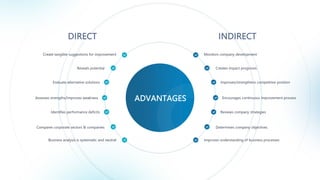
ADVANTAGES
Create tangible suggestions for improvement
Reveals potential
Evaluate alternative solutions
Assesses strengths/improves weakness
Identifies performance deficits
Compares corporate sectors & companies
Business analysis is systematic and neutral
Monitors company development
Creates impact prognosis
Improves/strengthens competitive position
Encourages continuous improvement process
Reviews company strategies
Determines company objectives
Improves understanding of business processes
DIRECT INDIRECT
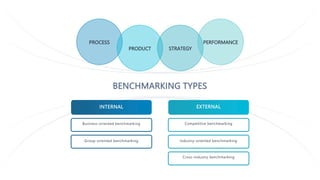
BENCHMARKING TYPES
PROCESS
PRODUCT STRATEGY
PERFORMANCE
INTERNAL EXTERNAL
Business-oriented benchmarking
Group-oriented benchmarking
Competitive benchmarking
Industry-oriented benchmarking
Cross-industry benchmarking
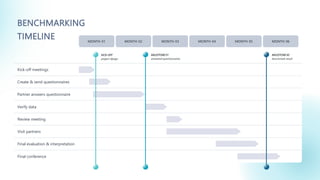
BENCHMARKING
TIMELINE
Kick-off meetings
Create & send questionnaires
Partner answers questionnaire
Verify data
Review meeting
Visit partners
Final evaluation & interpretation
Final conference
MONTH 01 MONTH 02 MONTH 03 MONTH 04 MONTH 05 MONTH 06
KICK-OFF
project design
MILESTONE 01
answered questionnaires
MILESTONE 02
benchmark result
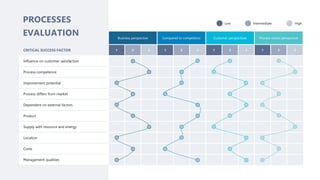
Business perspective Compared to competitors Customer perspectives Process owner perspective
CRITICAL SUCCESS FACTOR 1 2 3 1 2 3 1 2 3 1 2 3
Influence on customer satisfaction
Process competence
Improvement potential
Process differs from market
Dependent on external factors
Product
Supply with resource and energy
Location
Costs
Management qualities
PROCESSES
EVALUATION
Low Intermediate High
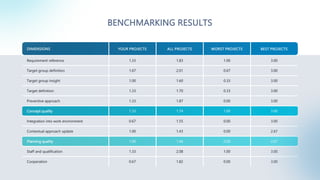
BENCHMARKING RESULTS
DIMENSIONS YOUR PROJECTS ALL PROJECTS WORST PROJECTS BEST PROJECTS
Requirement reference 1.33 1.83 1.00 3.00
Target group definition 1.67 2.01 0.67 3.00
Target group insight 1.00 1.60 0.33 3.00
Target definition 1.33 1.70 0.33 3.00
Preventive approach 1.33 1.87 0.00 3.00
Concept quality 1.33 1.74 1.00 3.00
Integration into work environment 0.67 1.55 0.00 3.00
Contextual approach update 1.00 1.43 0.00 2.67
Planning quality 1.00 1.46 0.00 2.67
Staff and qualification 1.33 2.08 1.00 3.00
Cooperation 0.67 1.82 0.00 3.00

Template - Business Benchmarking.pptx

  • 1.
    ADVANTAGES Create tangible suggestionsfor improvement Reveals potential Evaluate alternative solutions Assesses strengths/improves weakness Identifies performance deficits Compares corporate sectors & companies Business analysis is systematic and neutral Monitors company development Creates impact prognosis Improves/strengthens competitive position Encourages continuous improvement process Reviews company strategies Determines company objectives Improves understanding of business processes DIRECT INDIRECT
  • 2.
    BENCHMARKING TYPES PROCESS PRODUCT STRATEGY PERFORMANCE INTERNALEXTERNAL Business-oriented benchmarking Group-oriented benchmarking Competitive benchmarking Industry-oriented benchmarking Cross-industry benchmarking
  • 3.
    BENCHMARKING TIMELINE Kick-off meetings Create &send questionnaires Partner answers questionnaire Verify data Review meeting Visit partners Final evaluation & interpretation Final conference MONTH 01 MONTH 02 MONTH 03 MONTH 04 MONTH 05 MONTH 06 KICK-OFF project design MILESTONE 01 answered questionnaires MILESTONE 02 benchmark result
  • 4.
    Business perspective Comparedto competitors Customer perspectives Process owner perspective CRITICAL SUCCESS FACTOR 1 2 3 1 2 3 1 2 3 1 2 3 Influence on customer satisfaction Process competence Improvement potential Process differs from market Dependent on external factors Product Supply with resource and energy Location Costs Management qualities PROCESSES EVALUATION Low Intermediate High
  • 5.
    BENCHMARKING RESULTS DIMENSIONS YOURPROJECTS ALL PROJECTS WORST PROJECTS BEST PROJECTS Requirement reference 1.33 1.83 1.00 3.00 Target group definition 1.67 2.01 0.67 3.00 Target group insight 1.00 1.60 0.33 3.00 Target definition 1.33 1.70 0.33 3.00 Preventive approach 1.33 1.87 0.00 3.00 Concept quality 1.33 1.74 1.00 3.00 Integration into work environment 0.67 1.55 0.00 3.00 Contextual approach update 1.00 1.43 0.00 2.67 Planning quality 1.00 1.46 0.00 2.67 Staff and qualification 1.33 2.08 1.00 3.00 Cooperation 0.67 1.82 0.00 3.00