Portal Framed
Construction
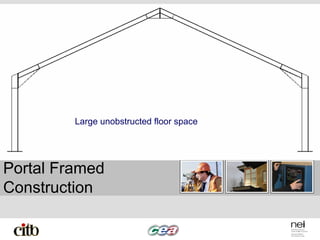
Large unobstructed floor space
Portal frames are made in a variety of shapes and sizes.
They are usually made from steel, but can also be made from
concrete or timber. The portal structure is designed in such a
way that it has no intermediate columns, as a result large
open areas can easily be created within the structure.
Portal Frames are generally used for single storey
construction which require a large unobstructed floor space ie
Factories
Shopping Centres
Warehouses
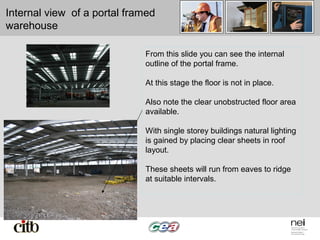
Internal view of a portal framed
warehouse
From this slide you can see the internal
outline of the portal frame.
At this stage the floor is not in place.
Also note the clear unobstructed floor area
available.
With single storey buildings natural lighting
is gained by placing clear sheets in roof
layout.
These sheets will run from eaves to ridge
at suitable intervals.
Advantages and disadvantages of steel
Portal Frames
Advantages
• Speed and ease of erection
• Building can be quickly closed in and made water tight.
• Framework prefabricated in a workshop and not affected by weather.
• Site works such as drainage, roads etc can be carried out until
framework is ready for erection.
• No weather hold up during erecting the framework.
• Connected together in factories by welding and site connections should
be bolted.
Disadvantages
• Although steel is incombustible it has a poor resistance to fire as it
bends easily when hot.
• Subject to corrosion
Portal Frame
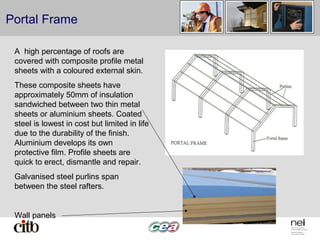
A high percentage of roofs are
covered with composite profile metal
sheets with a coloured external skin.
These composite sheets have
approximately 50mm of insulation
sandwiched between two thin metal
sheets or aluminium sheets. Coated
steel is lowest in cost but limited in life
due to the durability of the finish.
Aluminium develops its own
protective film. Profile sheets are
quick to erect, dismantle and repair.
Galvanised steel purlins span
between the steel rafters.
Wall panels
Base joint for Portal Frame
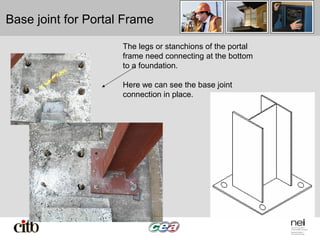
The legs or stanchions of the portal
frame need connecting at the bottom
to a foundation.
Here we can see the base joint
connection in place.
Ridge joint for Portal Frame
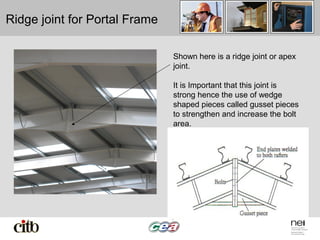
Shown here is a ridge joint or apex
joint.
It is Important that this joint is
strong hence the use of wedge
shaped pieces called gusset pieces
to strengthen and increase the bolt
area.
Knee joint for Portal Frame
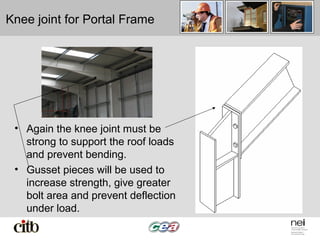
• Again the knee joint must be
strong to support the roof loads
and prevent bending.
• Gusset pieces will be used to
increase strength, give greater
bolt area and prevent deflection
under load.
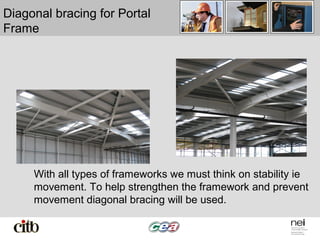
Diagonal bracing for Portal
Frame
With all types of frameworks we must think on stability ie
movement. To help strengthen the framework and prevent
movement diagonal bracing will be used.
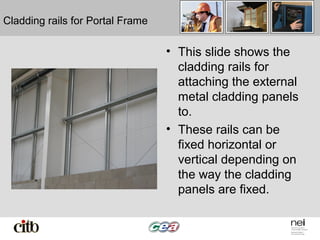
Cladding rails for Portal Frame
• This slide shows the
cladding rails for
attaching the external
metal cladding panels
to.
• These rails can be
fixed horizontal or
vertical depending on
the way the cladding
panels are fixed.
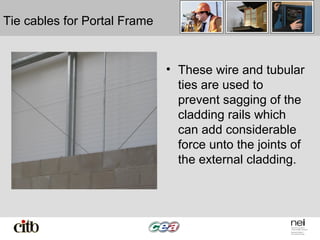
Tie cables for Portal Frame
• These wire and tubular
ties are used to
prevent sagging of the
cladding rails which
can add considerable
force unto the joints of
the external cladding.
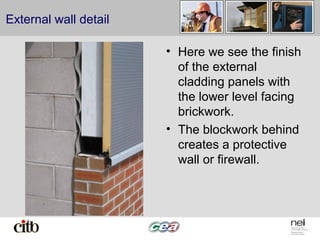
External wall detail
• Here we see the finish
of the external
cladding panels with
the lower level facing
brickwork.
• The blockwork behind
creates a protective
wall or firewall.

Portal framed construction

  • 1.
  • 2.
    Portal frames aremade in a variety of shapes and sizes. They are usually made from steel, but can also be made from concrete or timber. The portal structure is designed in such a way that it has no intermediate columns, as a result large open areas can easily be created within the structure. Portal Frames are generally used for single storey construction which require a large unobstructed floor space ie Factories Shopping Centres Warehouses
  • 3.
    Internal view ofa portal framed warehouse From this slide you can see the internal outline of the portal frame. At this stage the floor is not in place. Also note the clear unobstructed floor area available. With single storey buildings natural lighting is gained by placing clear sheets in roof layout. These sheets will run from eaves to ridge at suitable intervals.
  • 4.
    Advantages and disadvantagesof steel Portal Frames Advantages • Speed and ease of erection • Building can be quickly closed in and made water tight. • Framework prefabricated in a workshop and not affected by weather. • Site works such as drainage, roads etc can be carried out until framework is ready for erection. • No weather hold up during erecting the framework. • Connected together in factories by welding and site connections should be bolted. Disadvantages • Although steel is incombustible it has a poor resistance to fire as it bends easily when hot. • Subject to corrosion
  • 5.
    Portal Frame A highpercentage of roofs are covered with composite profile metal sheets with a coloured external skin. These composite sheets have approximately 50mm of insulation sandwiched between two thin metal sheets or aluminium sheets. Coated steel is lowest in cost but limited in life due to the durability of the finish. Aluminium develops its own protective film. Profile sheets are quick to erect, dismantle and repair. Galvanised steel purlins span between the steel rafters. Wall panels
  • 6.
    Base joint forPortal Frame The legs or stanchions of the portal frame need connecting at the bottom to a foundation. Here we can see the base joint connection in place.
  • 7.
    Ridge joint forPortal Frame Shown here is a ridge joint or apex joint. It is Important that this joint is strong hence the use of wedge shaped pieces called gusset pieces to strengthen and increase the bolt area.
  • 8.
    Knee joint forPortal Frame • Again the knee joint must be strong to support the roof loads and prevent bending. • Gusset pieces will be used to increase strength, give greater bolt area and prevent deflection under load.
  • 9.
    Diagonal bracing forPortal Frame With all types of frameworks we must think on stability ie movement. To help strengthen the framework and prevent movement diagonal bracing will be used.
  • 10.
    Cladding rails forPortal Frame • This slide shows the cladding rails for attaching the external metal cladding panels to. • These rails can be fixed horizontal or vertical depending on the way the cladding panels are fixed.
  • 11.
    Tie cables forPortal Frame • These wire and tubular ties are used to prevent sagging of the cladding rails which can add considerable force unto the joints of the external cladding.
  • 12.
    External wall detail •Here we see the finish of the external cladding panels with the lower level facing brickwork. • The blockwork behind creates a protective wall or firewall.