Geography grade 10:
What is population movement?
Kinds of population movement:
• Immigration is the movement of people into a country.
• Emigration is the movement of people out of a country.
• International migration is controlled by governments. They may
encourage or. Illegal migrants will be returned to their country of
origin (deported).
Factors causing people to migrate:
• Social factors – the desire to live a better life, housing,
environment, improved living.
• Conditions, improved services, facilities, activities, relationships.
• Political factors – people move because they are unhappy with
the political system.
• Economic factors – seeking a better job from business or
industry.
Continuous….
• Religious factors – people may move to avoid
being persecuted because of their religion.
• People move to places where they can
practise their religious beliefs.
• Physical factors – people may move to avoid
physical dangers, a harsh climate or infertile
soil.
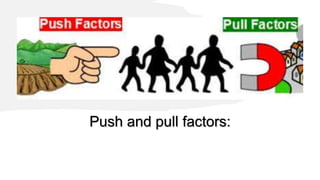
Push and pull factors:
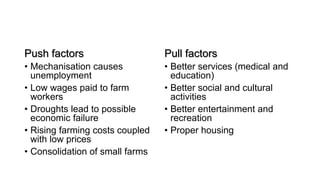
Push factors
• Mechanisation causes
unemployment
• Low wages paid to farm
workers
• Droughts lead to possible
economic failure
• Rising farming costs coupled
with low prices
• Consolidation of small farms
Pull factors
• Better services (medical and
education)
• Better social and cultural
activities
• Better entertainment and
recreation
• Proper housing
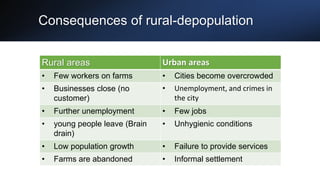
Consequences of rural-depopulation
Rural areas Urban areas
• Few workers on farms • Cities become overcrowded
• Businesses close (no
customer)
• Unemployment, and crimes in
the city
• Further unemployment • Few jobs
• young people leave (Brain
drain)
• Unhygienic conditions
• Low population growth • Failure to provide services
• Farms are abandoned • Informal settlement
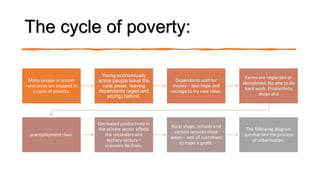
The cycle of poverty:
Many people in poorer
rural areas are trapped in
a cycle of poverty.
Young economically
active people leave the
rural areas, leaving
dependants (aged and
young) behind.
Dependants wait for
money – lose hope and
courage to try new ideas.
Farms are neglected or
abandoned. No one to do
hard work. Productivity
drops and
unemployment rises.
Decreased productivity in
the private sector affects
the secondary and
tertiary sectors –
economy declines.
Rural shops, schools and
certain services close
down – lack of customers
to make a profit.
The following diagram
summarises the process
of urbanisation.
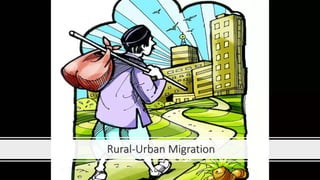
Rural-Urban Migration
• https://www.youtube.com/watch?v=4hgtkLphzzk&pp=ygUVcnVyYWw
gdXJiYW4gbWlncmF0aW9u
Rural-urban
migration
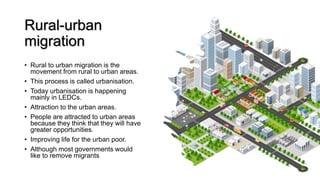
• Rural to urban migration is the
movement from rural to urban areas.
• This process is called urbanisation.
• Today urbanisation is happening
mainly in LEDCs.
• Attraction to the urban areas.
• People are attracted to urban areas
because they think that they will have
greater opportunities.
• Improving life for the urban poor.
• Although most governments would
like to remove migrants
4 types of population
movement:
1. Seasonal movements
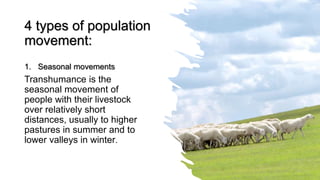
Transhumance is the
seasonal movement of
people with their livestock
over relatively short
distances, usually to higher
pastures in summer and to
lower valleys in winter.
2. Daily movement
From home to work
3. Temporary movements
People stay in a place temporarily – for a short time only. Migrant
labourers move to another area temporarily to seek employment.
4. Permanent movements
People who move to a place and decide to stay permanently –
no plans to leave.
What are refugees?
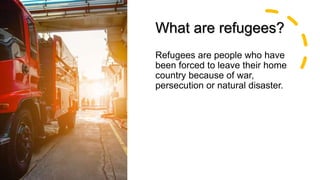
Refugees are people who have
been forced to leave their home
country because of war,
persecution or natural disaster.
Attitudes
towards
refugees and
immigrants
• Perceptions people have of immigrants taking away jobs that only
citizens are entitled to, especially where jobs are in short supply.
• Foreign traditions and practices that are different from those of local
people.
• Fear or hatred for foreigners – local people attack immigrants.
• Pressure on existing services (water, electricity, housing, food).
Population Movement.pptx

Population Movement.pptx

  • 1.
    Geography grade 10: Whatis population movement?
  • 2.
    Kinds of populationmovement: • Immigration is the movement of people into a country. • Emigration is the movement of people out of a country. • International migration is controlled by governments. They may encourage or. Illegal migrants will be returned to their country of origin (deported).
  • 3.
    Factors causing peopleto migrate: • Social factors – the desire to live a better life, housing, environment, improved living. • Conditions, improved services, facilities, activities, relationships. • Political factors – people move because they are unhappy with the political system. • Economic factors – seeking a better job from business or industry.
  • 4.
    Continuous…. • Religious factors– people may move to avoid being persecuted because of their religion. • People move to places where they can practise their religious beliefs. • Physical factors – people may move to avoid physical dangers, a harsh climate or infertile soil.
  • 5.
    Push and pullfactors:
  • 6.
    Push factors • Mechanisationcauses unemployment • Low wages paid to farm workers • Droughts lead to possible economic failure • Rising farming costs coupled with low prices • Consolidation of small farms Pull factors • Better services (medical and education) • Better social and cultural activities • Better entertainment and recreation • Proper housing
  • 7.
    Consequences of rural-depopulation Ruralareas Urban areas • Few workers on farms • Cities become overcrowded • Businesses close (no customer) • Unemployment, and crimes in the city • Further unemployment • Few jobs • young people leave (Brain drain) • Unhygienic conditions • Low population growth • Failure to provide services • Farms are abandoned • Informal settlement
  • 8.
    The cycle ofpoverty: Many people in poorer rural areas are trapped in a cycle of poverty. Young economically active people leave the rural areas, leaving dependants (aged and young) behind. Dependants wait for money – lose hope and courage to try new ideas. Farms are neglected or abandoned. No one to do hard work. Productivity drops and unemployment rises. Decreased productivity in the private sector affects the secondary and tertiary sectors – economy declines. Rural shops, schools and certain services close down – lack of customers to make a profit. The following diagram summarises the process of urbanisation.
  • 9.
  • 10.
  • 11.
    Rural-urban migration • Rural tourban migration is the movement from rural to urban areas. • This process is called urbanisation. • Today urbanisation is happening mainly in LEDCs. • Attraction to the urban areas. • People are attracted to urban areas because they think that they will have greater opportunities. • Improving life for the urban poor. • Although most governments would like to remove migrants
  • 12.
    4 types ofpopulation movement: 1. Seasonal movements Transhumance is the seasonal movement of people with their livestock over relatively short distances, usually to higher pastures in summer and to lower valleys in winter.
  • 13.
    2. Daily movement Fromhome to work 3. Temporary movements People stay in a place temporarily – for a short time only. Migrant labourers move to another area temporarily to seek employment. 4. Permanent movements People who move to a place and decide to stay permanently – no plans to leave.
  • 14.
    What are refugees? Refugeesare people who have been forced to leave their home country because of war, persecution or natural disaster.
  • 15.
  • 16.
    • Perceptions peoplehave of immigrants taking away jobs that only citizens are entitled to, especially where jobs are in short supply. • Foreign traditions and practices that are different from those of local people. • Fear or hatred for foreigners – local people attack immigrants. • Pressure on existing services (water, electricity, housing, food).