BACKGROUND OF ELECTRONICS….
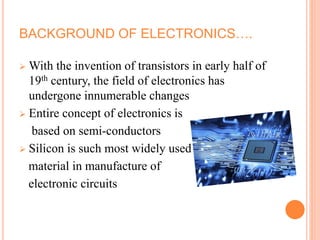
 With the invention of transistors in early half of
19th century, the field of electronics has
undergone innumerable changes
 Entire concept of electronics is
based on semi-conductors
 Silicon is such most widely used
material in manufacture of
electronic circuits
DISADVANTAGES BY USAGE OF SILICON….
 Production of silicon embedded circuits involves
a huge investment
 These circuits also consume more power
 Silicon chips are not flexible
 Products made by use of silicon
are not portable
 This has led to the emergence
of “Polytronics”
WHAT IS POLYTRONICS ….??
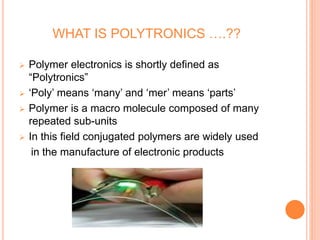
 Polymer electronics is shortly defined as
“Polytronics”
 ‘Poly’ means ‘many’ and ‘mer’ means ‘parts’
 Polymer is a macro molecule composed of many
repeated sub-units
 In this field conjugated polymers are widely used
in the manufacture of electronic products
HOW DOES A POLYMER CONDUCTS ..?
 By obeying Ohm’s law
 Ohm’s law defines conductivity in polymers as flow
of electrons or ions
 The steps involved in conduction are
a) Doping
b) Mobility of electrons
c) Conductivity
ADVANTAGES…..
 Freedom in design
 Cost effective
 Environment friendly
 Compact portable products
 Consumes less power
 Increased picture quality in display devices
 Recycled and reused
 Light in weight and small
APPLICATIONS….
 Ink-Jet printing technology
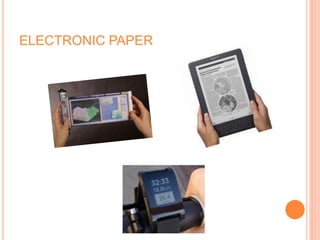
 Electronic paper
 Plastic batteries
 Oled(organic led)
INK-JET PRINTING TECHNOLOGY
ELECTRONIC PAPER
PLASTIC BATTERIES
OLED(ORGANIC LED)
Polytronics
Polytronics
Polytronics

Polytronics

  • 2.
    BACKGROUND OF ELECTRONICS…. With the invention of transistors in early half of 19th century, the field of electronics has undergone innumerable changes  Entire concept of electronics is based on semi-conductors  Silicon is such most widely used material in manufacture of electronic circuits
  • 3.
    DISADVANTAGES BY USAGEOF SILICON….  Production of silicon embedded circuits involves a huge investment  These circuits also consume more power  Silicon chips are not flexible  Products made by use of silicon are not portable  This has led to the emergence of “Polytronics”
  • 4.
    WHAT IS POLYTRONICS….??  Polymer electronics is shortly defined as “Polytronics”  ‘Poly’ means ‘many’ and ‘mer’ means ‘parts’  Polymer is a macro molecule composed of many repeated sub-units  In this field conjugated polymers are widely used in the manufacture of electronic products
  • 5.
    HOW DOES APOLYMER CONDUCTS ..?  By obeying Ohm’s law  Ohm’s law defines conductivity in polymers as flow of electrons or ions  The steps involved in conduction are a) Doping b) Mobility of electrons c) Conductivity
  • 6.
    ADVANTAGES…..  Freedom indesign  Cost effective  Environment friendly  Compact portable products  Consumes less power  Increased picture quality in display devices  Recycled and reused  Light in weight and small
  • 7.
    APPLICATIONS….  Ink-Jet printingtechnology  Electronic paper  Plastic batteries  Oled(organic led)
  • 8.
  • 9.
  • 10.
  • 11.