a) Introduction
b) Classification
c) Types of Polymerizations
d) Characteristics
e) Applications
A word Polymer is a combination of two Greek
words “Poly” means Many and “Meros” means
Parts or units .
Many of natural and synthetic compounds
of usually high molecular weight consisting upto
millions of repeated units , each a relatively light
and simple molecule is known as a Polymer .
The following are the some common
classification of Polymers :
1. By source
2. by structure
3. By composition
4. By mode of polymerization
5. By molecular force
6. By backbone of the chain
1) Natural Polymers : They are found in plants
and animals ( example Protein ,
cellulose,stach,resins and rubber)
2) Semi-synthetic Polymers : Cellulose
derivatives are cellulose acetate (rayon)
3) Synthetic Polymers : Such as plastic
(polythene), synthetic fibers (nylon 6,6), and
synthetic rubbers (Buna-S) are examples of
man-made polymers .
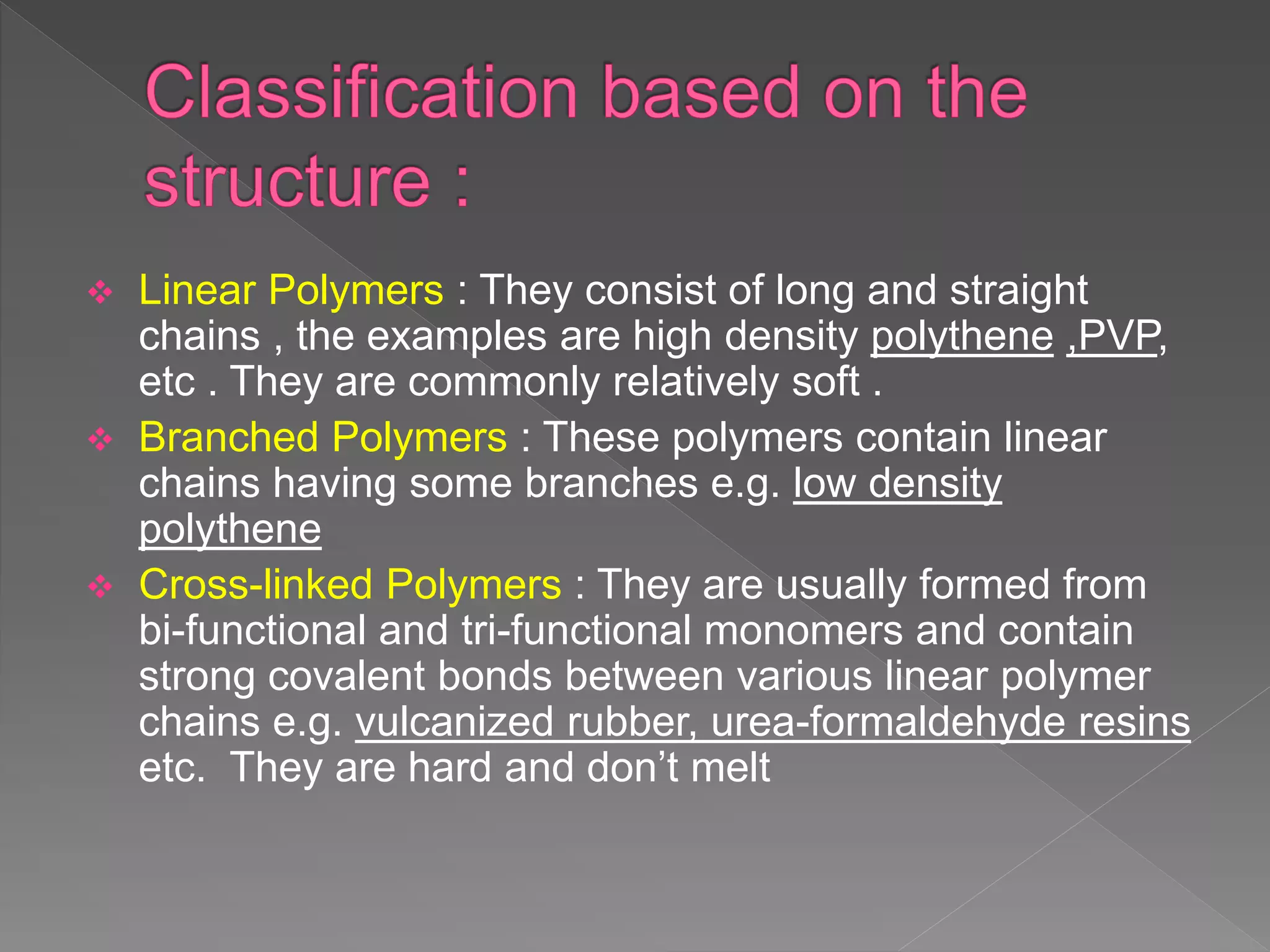
 Linear Polymers : They consist of long and straight
chains , the examples are high density polythene ,PVP,
etc . They are commonly relatively soft .
 Branched Polymers : These polymers contain linear
chains having some branches e.g. low density
polythene
 Cross-linked Polymers : They are usually formed from
bi-functional and tri-functional monomers and contain
strong covalent bonds between various linear polymer
chains e.g. vulcanized rubber, urea-formaldehyde resins
etc. They are hard and don’t melt
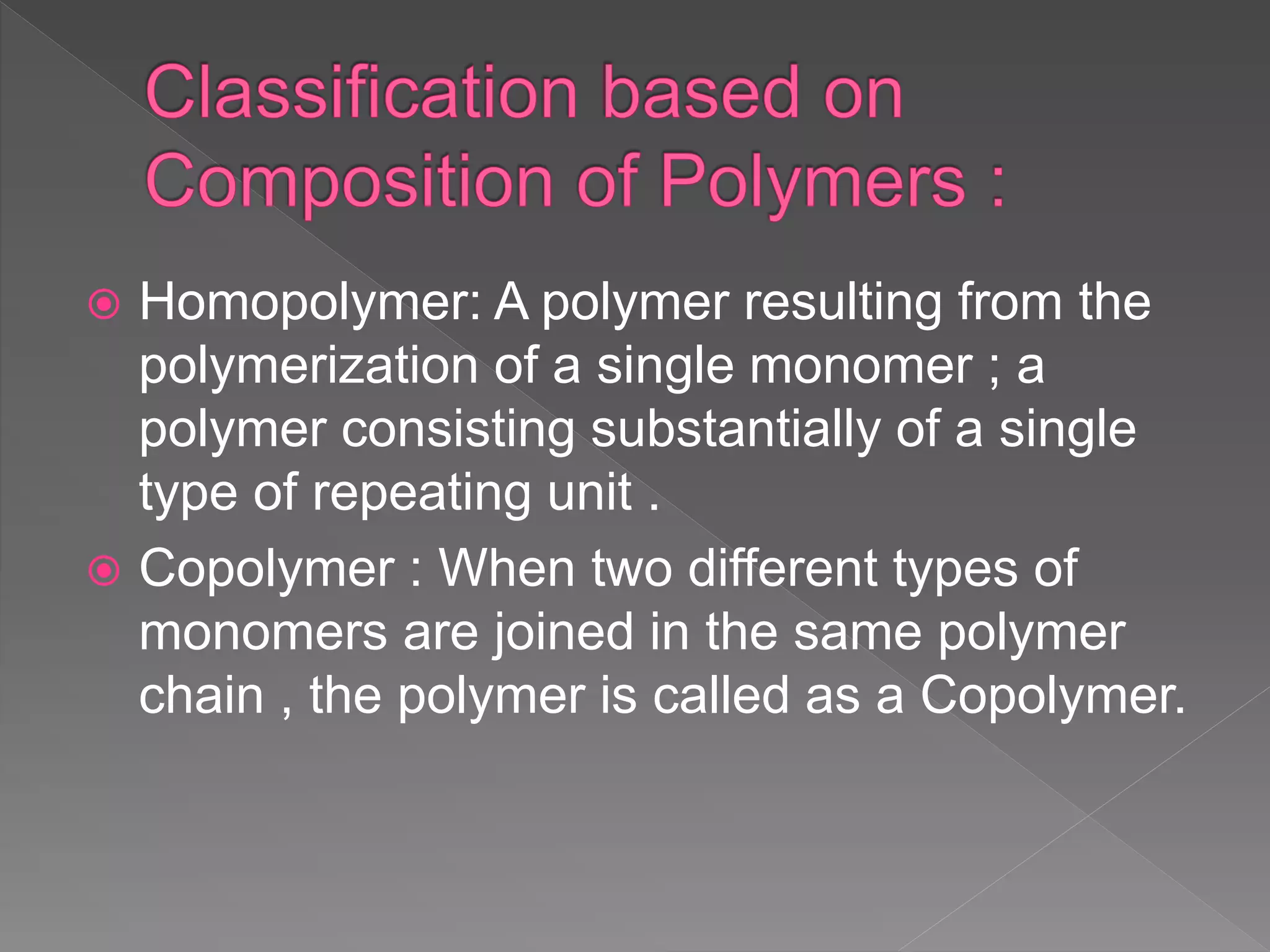
 Homopolymer: A polymer resulting from the
polymerization of a single monomer ; a
polymer consisting substantially of a single
type of repeating unit .
 Copolymer : When two different types of
monomers are joined in the same polymer
chain , the polymer is called as a Copolymer.
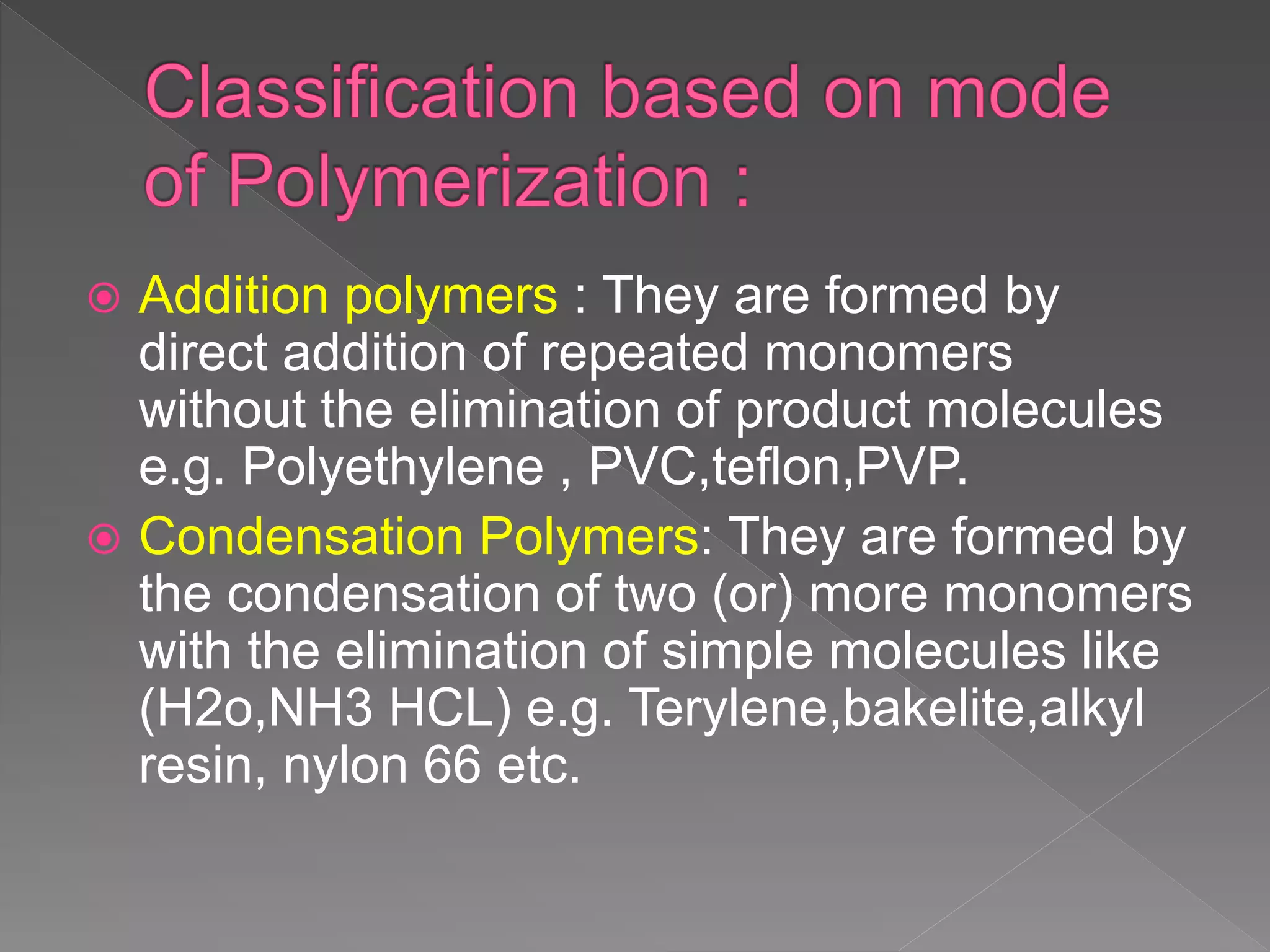
 Addition polymers : They are formed by
direct addition of repeated monomers
without the elimination of product molecules
e.g. Polyethylene , PVC,teflon,PVP.
 Condensation Polymers: They are formed by
the condensation of two (or) more monomers
with the elimination of simple molecules like
(H2o,NH3 HCL) e.g. Terylene,bakelite,alkyl
resin, nylon 66 etc.
 Thermoplastic: They are soften on heating and
harden on cooling reversibly e.g.
polyethylene,PVC,teflon
 Thermosetting: They undergo permanent
change on heating e.g. Bakelite,Polyester
 Elastomers: They are amorphous with a high
degree of elasticity e.g. Natural rubber
 Fibers: They have quite strong interparticle
force such as H-bond with high tensile strength
and high modulus e.g. Nylon and
polyacrylontrile.
1)Addition Polymerization:
a) Initiation reaction.
B) Propagation reaction .
c) Termination reaction .
2) Condensation Polymerization .
LOW DENSITY.
LOW COEFFICIENT OF FRICTION.
GOOD CORROSION RESISTANCE.
GOOD MOULD ABILITY.
EXCELLENT SURFACE FINISH CAN BE OBTAINED.
CAN BE PRODUCED WITH CLOSE DIMENSIONAL
TOLERANCES.
ECONOMICAL.
POOR TENSILE STRENGTH.
LOW MECHANICAL PROPERTIES.
POOR TEMPERATURE RESISTANCE.
CAN BE PRODUCED TRANSPARENT OR IN DIFFERENT
COLOURS
 Medicine
 Consumer science
 Industry
 Sport
Presentation on polymers

Presentation on polymers

  • 2.
    a) Introduction b) Classification c)Types of Polymerizations d) Characteristics e) Applications
  • 3.
    A word Polymeris a combination of two Greek words “Poly” means Many and “Meros” means Parts or units . Many of natural and synthetic compounds of usually high molecular weight consisting upto millions of repeated units , each a relatively light and simple molecule is known as a Polymer .
  • 4.
    The following arethe some common classification of Polymers : 1. By source 2. by structure 3. By composition 4. By mode of polymerization 5. By molecular force 6. By backbone of the chain
  • 5.
    1) Natural Polymers: They are found in plants and animals ( example Protein , cellulose,stach,resins and rubber) 2) Semi-synthetic Polymers : Cellulose derivatives are cellulose acetate (rayon) 3) Synthetic Polymers : Such as plastic (polythene), synthetic fibers (nylon 6,6), and synthetic rubbers (Buna-S) are examples of man-made polymers .
  • 6.
     Linear Polymers: They consist of long and straight chains , the examples are high density polythene ,PVP, etc . They are commonly relatively soft .  Branched Polymers : These polymers contain linear chains having some branches e.g. low density polythene  Cross-linked Polymers : They are usually formed from bi-functional and tri-functional monomers and contain strong covalent bonds between various linear polymer chains e.g. vulcanized rubber, urea-formaldehyde resins etc. They are hard and don’t melt
  • 7.
     Homopolymer: Apolymer resulting from the polymerization of a single monomer ; a polymer consisting substantially of a single type of repeating unit .  Copolymer : When two different types of monomers are joined in the same polymer chain , the polymer is called as a Copolymer.
  • 8.
     Addition polymers: They are formed by direct addition of repeated monomers without the elimination of product molecules e.g. Polyethylene , PVC,teflon,PVP.  Condensation Polymers: They are formed by the condensation of two (or) more monomers with the elimination of simple molecules like (H2o,NH3 HCL) e.g. Terylene,bakelite,alkyl resin, nylon 66 etc.
  • 9.
     Thermoplastic: Theyare soften on heating and harden on cooling reversibly e.g. polyethylene,PVC,teflon  Thermosetting: They undergo permanent change on heating e.g. Bakelite,Polyester  Elastomers: They are amorphous with a high degree of elasticity e.g. Natural rubber  Fibers: They have quite strong interparticle force such as H-bond with high tensile strength and high modulus e.g. Nylon and polyacrylontrile.
  • 10.
    1)Addition Polymerization: a) Initiationreaction. B) Propagation reaction . c) Termination reaction . 2) Condensation Polymerization .
  • 11.
    LOW DENSITY. LOW COEFFICIENTOF FRICTION. GOOD CORROSION RESISTANCE. GOOD MOULD ABILITY. EXCELLENT SURFACE FINISH CAN BE OBTAINED. CAN BE PRODUCED WITH CLOSE DIMENSIONAL TOLERANCES. ECONOMICAL. POOR TENSILE STRENGTH. LOW MECHANICAL PROPERTIES. POOR TEMPERATURE RESISTANCE. CAN BE PRODUCED TRANSPARENT OR IN DIFFERENT COLOURS
  • 12.
     Medicine  Consumerscience  Industry  Sport