Mechanical Engineering Dept. HITEC 1
Mechanical Engineering Dept. HITEC 2
Presented By
Shan Ali 18-MS-ME-012
Advanced Materials Sciences & Engineering
Mechanical Engineering Dept. HITEC 3
INTRODUCTION
Polymers
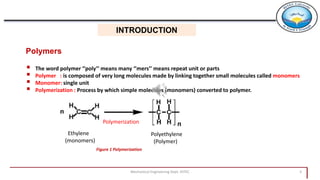
 The word polymer ‘’poly’’ means many ‘’mers’’ means repeat unit or parts
 Polymer : is composed of very long molecules made by linking together small molecules called monomers
 Monomer: single unit
 Polymerization : Process by which simple molecules (monomers) converted to polymer.
Ethylene
(monomers)
Polymerization
Polyethylene
(Polymer)
Figure 1 Polymerization
Mechanical Engineering Dept. HITEC 4
Homopolymers and Co-polymer
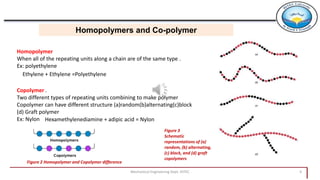
Homopolymer
When all of the repeating units along a chain are of the same type .
Ex: polyethylene
Ethylene + Ethylene =Polyethylene
Copolymer .
Two different types of repeating units combining to make polymer
Copolymer can have different structure (a)random(b)alternating(c)block
(d) Graft polymer
Ex: Nylon Hexamethylenediamine + adipic acid = Nylon
Figure 2 Homopolymer and Copolymer difference
Figure 3
Schematic
representations of (a)
random, (b) alternating,
(c) block, and (d) graft
copolymers
Mechanical Engineering Dept. HITEC 5
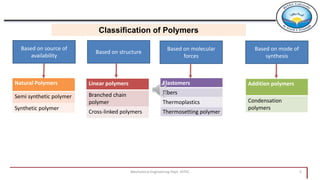
Classification of Polymers
Based on source of
availability
Based on structure
Based on molecular
forces
Based on mode of
synthesis
Natural Polymers
Semi synthetic polymer
Synthetic polymer
Linear polymers
Branched chain
polymer
Cross-linked polymers
Elastomers
Fibers
Thermoplastics
Thermosetting polymer
Addition polymers
Condensation
polymers
Mechanical Engineering Dept. HITEC 6
Based on source of availability (origin)
Natural Polymers
Naturally occurring polymers those derived from plants and animals.
Ex: wood, rubber, cotton, wool, leather, silk etc.
Semi-Synthetic Polymers
Synthetic Polymers
These polymers are derived from naturally occurring polymers by chemical modifications
Ex: Cellulose diacetate polymer , Vulcanized rubber etc.
The polymers which are prepared in laboratories are called synthetic polymer.
Ex : Polyethylene , PVC , Nylon , Teflon, Bake lite etc.
Classification of Polymers
Mechanical Engineering Dept. HITEC 7
Based on Polymers based on structures
Linear Polymers
These are polymers in which monomeric units are linked together to form long linear chains
Ex : High density polyethylene PVC , Nylons , Polyesters etc.
Properties : High densities , high tensile strength , High melting points.
Branched chain Polymers
These are polymers in which monomers are joined to form long chains with side chains or branches of different
lengths.
Ex: Low density polyethylene , Starch etc.
Properties : low densities , low tensile strength , low melting points.
Cross-linked Polymers
In crosslinked polymers interconnections between chains are joined one to another at various positions .
Ex: Rubber etc.
Classification of Polymers
Mechanical Engineering Dept. HITEC 8
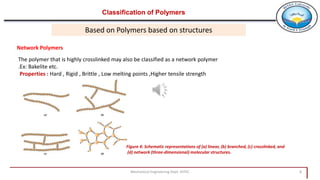
Network Polymers
Based on Polymers based on structures
The polymer that is highly crosslinked may also be classified as a network polymer
.Ex: Bakelite etc.
Properties : Hard , Rigid , Brittle , Low melting points ,Higher tensile strength
Figure 4: Schematic representations of (a) linear, (b) branched, (c) crosslinked, and
(d) network (three-dimensional) molecular structures.
Classification of Polymers
Mechanical Engineering Dept. HITEC 9
Classification of Polymers
Based on molecular forces
Elastomers
Elastomers is a type of polymer having specific characteristics feature of elastic deformation of greater than (200) %
Ex: Natural Rubber ,Buna S , Neoprene etc.
Properties : Flexibility , Strength , Impermeability to water, High resistance to abrasion
Fibers
These are polymers which have strong intermolecular forces between chain.
Ex: Nylon , Dacron , silk etc.
Properties : high tensile strength , sharp melting points , thin thread like structure etc.
Thermoplastics
These are polymers softened repeatedly when heating and hardened when cooled with a bit change in properties.
Ex: Polythene , Polystyrene ,PVC ,Teflon etc.
Properties: Intermediate between elastomers and fibers, linear structure.etc.
Mechanical Engineering Dept. HITEC 10
Based on molecular forces
Thermosetting polymer
These are polymers become hard and get permanent deformation when heated .
Ex : Urea-formaldehyde resins , Bakelite etc.
Properties: Brittle ,insoluble in organic solvent, rigid etc.
Classification of Polymers
Mechanical Engineering Dept. HITEC 11
Classification of Polymers
Based on mode of synthesis
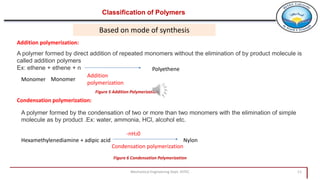
Addition polymerization:
A polymer formed by direct addition of repeated monomers without the elimination of by product molecule is
called addition polymers
Ex: ethene + ethene + n
Monomer Monomer
Addition
polymerization
Polyethene
Condensation polymerization:
A polymer formed by the condensation of two or more than two monomers with the elimination of simple
molecule as by product .Ex: water, ammonia, HCl, alcohol etc.
Hexamethylenediamine + adipic acid Nylon
Condensation polymerization
-nH20
Figure 5 Addition Polymerization
Figure 6 Condensation Polymerization
Mechanical Engineering Dept. HITEC 12
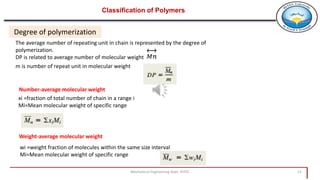
Degree of polymerization
The average number of repeating unit in chain is represented by the degree of
polymerization.
DP is related to average number of molecular weight
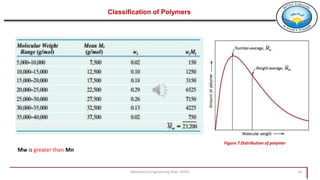
Number-average molecular weight
xi =fraction of total number of chain in a range i
Mi=Mean molecular weight of specific range
Weight-average molecular weight
wi =weight fraction of molecules within the same size interval
Mi=Mean molecular weight of specific range
Classification of Polymers
𝑀𝑛
m is number of repeat unit in molecular weight
Mechanical Engineering Dept. HITEC 13
Classification of Polymers
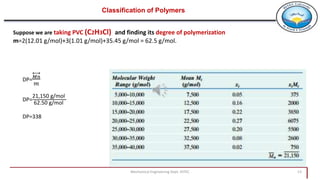
Suppose we are taking PVC (C2H3Cl) and finding its degree of polymerization
m=2(12.01 g/mol)+3(1.01 g/mol)+35.45 g/mol = 62.5 g/mol.
DP=
𝑀𝑛
𝑚
DP=
21,150 g/mol
62.50 g/mol
DP=338
Mechanical Engineering Dept. HITEC 14
Classification of Polymers
Mw is greater than Mn
Figure 7 Distribution of polymer
Mechanical Engineering Dept. HITEC 15
Mechanical Behavior of Polymers
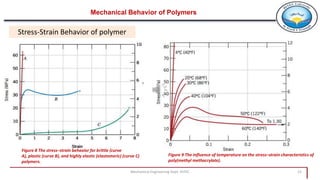
Stress-Strain Behavior of polymer
Figure 8 The stress–strain behavior for brittle (curve
A), plastic (curve B), and highly elastic (elastomeric) (curve C)
polymers.
Figure 9 The influence of temperature on the stress–strain characteristics of
poly(methyl methacrylate).
16
Mechanical Behavior of Polymers
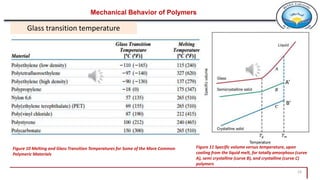
Figure 11 Specific volume versus temperature, upon
cooling from the liquid melt, for totally amorphous (curve
A), semi crystalline (curve B), and crystalline (curve C)
polymers
Figure 10 Melting and Glass Transition Temperatures for Some of the More Common
Polymeric Materials
A’
B’
Glass transition temperature
Mechanical Engineering Dept. HITEC 17
Mechanical Behavior of PolymersModulusE(Mpa)
ModulusE(Psi)
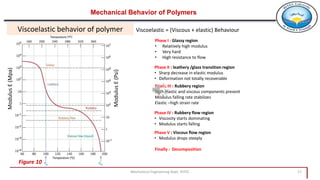
Viscoelastic behavior of polymer Viscoelastic = (Viscous + elastic) Behaviour
Phase I : Glassy region
• Relatively high modulus
• Very hard
• High resistance to flow
Phase II : leathery /glass transition region
• Sharp decrease in elastic modulus
• Deformation not totally recoverable
Phase III : Rubbery region
Both elastic and viscous components present
Modulus falling rate stabilizes
Elastic –high strain rate
Phase IV : Rubbery flow region
• Viscosity starts dominating
• Modulus starts falling
Phase V : Viscous flow region
• Modulus drops steeply
Finally : Decomposition
Figure 10
Mechanical Engineering Dept. HITEC 18
Polymer processing
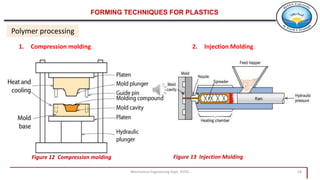
1. Compression molding
FORMING TECHNIQUES FOR PLASTICS
Figure 12 Compression molding
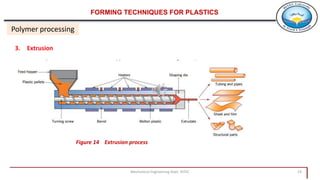
2. Injection Molding
Figure 13 Injection Molding
Mechanical Engineering Dept. HITEC 19
Polymer processing
FORMING TECHNIQUES FOR PLASTICS
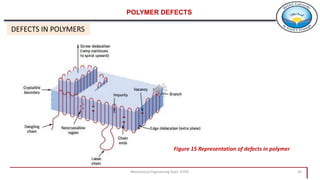
3. Extrusion
Figure 14 Extrusion process
Mechanical Engineering Dept. HITEC 20
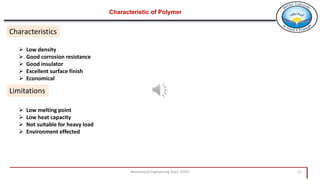
DEFECTS IN POLYMERS
POLYMER DEFECTS
Figure 15 Representation of defects in polymer
Mechanical Engineering Dept. HITEC 21
Characteristic of Polymer
Characteristics
 Low density
 Good corrosion resistance
 Good insulator
 Excellent surface finish
 Economical
Limitations
 Low melting point
 Low heat capacity
 Not suitable for heavy load
 Environment effected
Mechanical Engineering Dept. HITEC 22
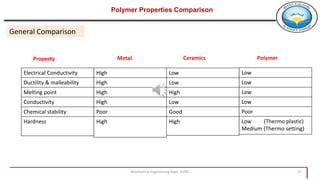
Polymer Properties Comparison
Electrical Conductivity
Ductility & malleability
Melting point
Conductivity
Chemical stability
Hardness
High
High
High
High
Poor
High
Low
Low
Low
Low
Poor
Low (Thermo plastic)
Medium (Thermo setting)
Low
Low
High
Low
Good
High
Property Metal Ceramics Polymer
General Comparison
Mechanical Engineering Dept. HITEC 23
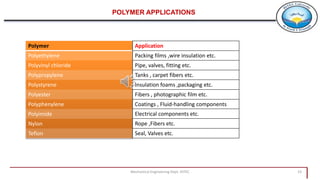
Polymer
Polyethylene
Polyvinyl chloride
Polypropylene
Polystyrene
Polyester
Polyphenylene
Polyimide
Nylon
Teflon
Application
Packing films ,wire insulation etc.
Pipe, valves, fitting etc.
Tanks , carpet fibers etc.
Insulation foams ,packaging etc.
Fibers , photographic film etc.
Coatings , Fluid-handling components
Electrical components etc.
Rope ,Fibers etc.
Seal, Valves etc.
POLYMER APPLICATIONS
Mechanical Engineering Dept. HITEC 24
The End

Polymer

  • 1.
  • 2.
    Mechanical Engineering Dept.HITEC 2 Presented By Shan Ali 18-MS-ME-012 Advanced Materials Sciences & Engineering
  • 3.
    Mechanical Engineering Dept.HITEC 3 INTRODUCTION Polymers  The word polymer ‘’poly’’ means many ‘’mers’’ means repeat unit or parts  Polymer : is composed of very long molecules made by linking together small molecules called monomers  Monomer: single unit  Polymerization : Process by which simple molecules (monomers) converted to polymer. Ethylene (monomers) Polymerization Polyethylene (Polymer) Figure 1 Polymerization
  • 4.
    Mechanical Engineering Dept.HITEC 4 Homopolymers and Co-polymer Homopolymer When all of the repeating units along a chain are of the same type . Ex: polyethylene Ethylene + Ethylene =Polyethylene Copolymer . Two different types of repeating units combining to make polymer Copolymer can have different structure (a)random(b)alternating(c)block (d) Graft polymer Ex: Nylon Hexamethylenediamine + adipic acid = Nylon Figure 2 Homopolymer and Copolymer difference Figure 3 Schematic representations of (a) random, (b) alternating, (c) block, and (d) graft copolymers
  • 5.
    Mechanical Engineering Dept.HITEC 5 Classification of Polymers Based on source of availability Based on structure Based on molecular forces Based on mode of synthesis Natural Polymers Semi synthetic polymer Synthetic polymer Linear polymers Branched chain polymer Cross-linked polymers Elastomers Fibers Thermoplastics Thermosetting polymer Addition polymers Condensation polymers
  • 6.
    Mechanical Engineering Dept.HITEC 6 Based on source of availability (origin) Natural Polymers Naturally occurring polymers those derived from plants and animals. Ex: wood, rubber, cotton, wool, leather, silk etc. Semi-Synthetic Polymers Synthetic Polymers These polymers are derived from naturally occurring polymers by chemical modifications Ex: Cellulose diacetate polymer , Vulcanized rubber etc. The polymers which are prepared in laboratories are called synthetic polymer. Ex : Polyethylene , PVC , Nylon , Teflon, Bake lite etc. Classification of Polymers
  • 7.
    Mechanical Engineering Dept.HITEC 7 Based on Polymers based on structures Linear Polymers These are polymers in which monomeric units are linked together to form long linear chains Ex : High density polyethylene PVC , Nylons , Polyesters etc. Properties : High densities , high tensile strength , High melting points. Branched chain Polymers These are polymers in which monomers are joined to form long chains with side chains or branches of different lengths. Ex: Low density polyethylene , Starch etc. Properties : low densities , low tensile strength , low melting points. Cross-linked Polymers In crosslinked polymers interconnections between chains are joined one to another at various positions . Ex: Rubber etc. Classification of Polymers
  • 8.
    Mechanical Engineering Dept.HITEC 8 Network Polymers Based on Polymers based on structures The polymer that is highly crosslinked may also be classified as a network polymer .Ex: Bakelite etc. Properties : Hard , Rigid , Brittle , Low melting points ,Higher tensile strength Figure 4: Schematic representations of (a) linear, (b) branched, (c) crosslinked, and (d) network (three-dimensional) molecular structures. Classification of Polymers
  • 9.
    Mechanical Engineering Dept.HITEC 9 Classification of Polymers Based on molecular forces Elastomers Elastomers is a type of polymer having specific characteristics feature of elastic deformation of greater than (200) % Ex: Natural Rubber ,Buna S , Neoprene etc. Properties : Flexibility , Strength , Impermeability to water, High resistance to abrasion Fibers These are polymers which have strong intermolecular forces between chain. Ex: Nylon , Dacron , silk etc. Properties : high tensile strength , sharp melting points , thin thread like structure etc. Thermoplastics These are polymers softened repeatedly when heating and hardened when cooled with a bit change in properties. Ex: Polythene , Polystyrene ,PVC ,Teflon etc. Properties: Intermediate between elastomers and fibers, linear structure.etc.
  • 10.
    Mechanical Engineering Dept.HITEC 10 Based on molecular forces Thermosetting polymer These are polymers become hard and get permanent deformation when heated . Ex : Urea-formaldehyde resins , Bakelite etc. Properties: Brittle ,insoluble in organic solvent, rigid etc. Classification of Polymers
  • 11.
    Mechanical Engineering Dept.HITEC 11 Classification of Polymers Based on mode of synthesis Addition polymerization: A polymer formed by direct addition of repeated monomers without the elimination of by product molecule is called addition polymers Ex: ethene + ethene + n Monomer Monomer Addition polymerization Polyethene Condensation polymerization: A polymer formed by the condensation of two or more than two monomers with the elimination of simple molecule as by product .Ex: water, ammonia, HCl, alcohol etc. Hexamethylenediamine + adipic acid Nylon Condensation polymerization -nH20 Figure 5 Addition Polymerization Figure 6 Condensation Polymerization
  • 12.
    Mechanical Engineering Dept.HITEC 12 Degree of polymerization The average number of repeating unit in chain is represented by the degree of polymerization. DP is related to average number of molecular weight Number-average molecular weight xi =fraction of total number of chain in a range i Mi=Mean molecular weight of specific range Weight-average molecular weight wi =weight fraction of molecules within the same size interval Mi=Mean molecular weight of specific range Classification of Polymers 𝑀𝑛 m is number of repeat unit in molecular weight
  • 13.
    Mechanical Engineering Dept.HITEC 13 Classification of Polymers Suppose we are taking PVC (C2H3Cl) and finding its degree of polymerization m=2(12.01 g/mol)+3(1.01 g/mol)+35.45 g/mol = 62.5 g/mol. DP= 𝑀𝑛 𝑚 DP= 21,150 g/mol 62.50 g/mol DP=338
  • 14.
    Mechanical Engineering Dept.HITEC 14 Classification of Polymers Mw is greater than Mn Figure 7 Distribution of polymer
  • 15.
    Mechanical Engineering Dept.HITEC 15 Mechanical Behavior of Polymers Stress-Strain Behavior of polymer Figure 8 The stress–strain behavior for brittle (curve A), plastic (curve B), and highly elastic (elastomeric) (curve C) polymers. Figure 9 The influence of temperature on the stress–strain characteristics of poly(methyl methacrylate).
  • 16.
    16 Mechanical Behavior ofPolymers Figure 11 Specific volume versus temperature, upon cooling from the liquid melt, for totally amorphous (curve A), semi crystalline (curve B), and crystalline (curve C) polymers Figure 10 Melting and Glass Transition Temperatures for Some of the More Common Polymeric Materials A’ B’ Glass transition temperature
  • 17.
    Mechanical Engineering Dept.HITEC 17 Mechanical Behavior of PolymersModulusE(Mpa) ModulusE(Psi) Viscoelastic behavior of polymer Viscoelastic = (Viscous + elastic) Behaviour Phase I : Glassy region • Relatively high modulus • Very hard • High resistance to flow Phase II : leathery /glass transition region • Sharp decrease in elastic modulus • Deformation not totally recoverable Phase III : Rubbery region Both elastic and viscous components present Modulus falling rate stabilizes Elastic –high strain rate Phase IV : Rubbery flow region • Viscosity starts dominating • Modulus starts falling Phase V : Viscous flow region • Modulus drops steeply Finally : Decomposition Figure 10
  • 18.
    Mechanical Engineering Dept.HITEC 18 Polymer processing 1. Compression molding FORMING TECHNIQUES FOR PLASTICS Figure 12 Compression molding 2. Injection Molding Figure 13 Injection Molding
  • 19.
    Mechanical Engineering Dept.HITEC 19 Polymer processing FORMING TECHNIQUES FOR PLASTICS 3. Extrusion Figure 14 Extrusion process
  • 20.
    Mechanical Engineering Dept.HITEC 20 DEFECTS IN POLYMERS POLYMER DEFECTS Figure 15 Representation of defects in polymer
  • 21.
    Mechanical Engineering Dept.HITEC 21 Characteristic of Polymer Characteristics  Low density  Good corrosion resistance  Good insulator  Excellent surface finish  Economical Limitations  Low melting point  Low heat capacity  Not suitable for heavy load  Environment effected
  • 22.
    Mechanical Engineering Dept.HITEC 22 Polymer Properties Comparison Electrical Conductivity Ductility & malleability Melting point Conductivity Chemical stability Hardness High High High High Poor High Low Low Low Low Poor Low (Thermo plastic) Medium (Thermo setting) Low Low High Low Good High Property Metal Ceramics Polymer General Comparison
  • 23.
    Mechanical Engineering Dept.HITEC 23 Polymer Polyethylene Polyvinyl chloride Polypropylene Polystyrene Polyester Polyphenylene Polyimide Nylon Teflon Application Packing films ,wire insulation etc. Pipe, valves, fitting etc. Tanks , carpet fibers etc. Insulation foams ,packaging etc. Fibers , photographic film etc. Coatings , Fluid-handling components Electrical components etc. Rope ,Fibers etc. Seal, Valves etc. POLYMER APPLICATIONS
  • 24.