Chapter/ Module 1: Learning History
LEARNING OBJECTIVES
 To understand the meaning of history as an academic discipline and
to be familiar with the underlying philosophy and methodology of
the discipline.
 To examine and assess critically the value of historical evidences
and sources.
 To appreciate the importance of history in the social and national
life of the Philippines.
Lesson 1: Meanings and Relevance of History
To make sense of history, it is necessary to first understand what it is
all about. Many people think that history is merely lists of names, dates,
places, and “important” events. However, History or the study of history is
more than just knowing and memorizing facts.
It is a historian’s duty to draw insights from the ideas and realities
that have shaped the lives of men and women and the society. And in
understanding these ideas, a historian (or, in fact, a student of history) can
comprehend how situations happened, identify their elements, and think of
how these situations can solve today’s predicaments, and help them plan for
the future.
The study of history, therefore, is the study of the beliefs and desires,
practices, and institutions of human beings.
WHY STUDY HISTORY?
An examination of the past can tell us a great deal about how we came
to be who we are. It means looking at the roots of modern institutions, ideas,
values, and problems.
Looking at the past teaches us to see the world through different eyes-
appreciating the diversity of human perceptions, beliefs, and cultures.
Different and/or new perspectives will enable us to analyze critically the
present contexts of our society and beings.
THE DEFINITION AND SUBJECT MATTER
History was derived from the Greek word historia which means
“knowledge acquired through inquiry or investigation”. History as a
disciplined existed for around 2, 400 years and is as old as mathematics and
philosophy. This term was then adapted to classical Latin where it acquired
a new definition. Historia became known as the account of the past of a
person or a group of people through written documents and historical
evidences. That meaning stuck until the early parts of the twentieth century.
History became an important discipline. It became the historian’s duty to
Pag
e 1
of 92
Pag
e 2
of 92
write about the lives of important individuals like monarchs, heroes, saints,
and nobilities. History was also focused on writing wars, revolutions, and
other important breakthroughs. It is thus important to ask: What counts as
history? Traditional historians lived with the mantra “no document, no
history”. It means that unless a written document can prove a certain
historical event, then it cannot be considered as a historical fact.
But as any other academic disciplines, history progressed and opened
up to the possibility of valid historical sources, which were not limited to
written documents, like government records, chroniclers’ accounts, or
personal letters. Giving premium to written documents essentially
invalidates the history of other civilizations that do not keep written records.
Some were keener on passing their history by word of mouth. Others got
their historical documents burned or destroyed in the events of war or
colonization. Restricting historical evidence as exclusively written is also
discrimination against other social classes who were not recorded in paper.
Nobilities, monarchs, the elite, and even the middle class would have their
birth, education, marriage, and death as matters of government and
historical record. But what of peasant families or indigenous groups who
were not given much thought about being registered to government records?
Does the absence of written documents about them mean they were people
of no history or past? Did they even exist?
This loophole was recognized by historians who started using other
kinds of historical sources, which may not be in written form but were just
as valid. A few examples are oral traditions in forms of epics and songs,
artifacts, architecture, and memory. History thus became more inclusive and
started collaborating with other disciplines as its auxiliary disciplines.
Other Definitions of History:
 History is defined as a documented record of man and his society.
(Gray, 1956, pp.1-3).
 As a field of study, history is a study of man and his achievements
from the beginning of written records to the present.
 As a literary form of history is an effective presentation of the
unfolding events. But as a type of literature history falls under non-
fiction work.
 History comes from social history which defines it as a record of
events showing the evolution of man and his society from the earliest
and from the age of barbarism to what he is today.
Understanding History
Why don’t we learn from history? (An excerpt from Lidell Hart, 1971)
What is the objective of history? One would simply answer, quite
simply - “truth”. It is a word and an idea that has gone out of fashion.
The object might be more cautiously expressed thus: to find out what
happened while trying to find out why it happened. It seeks the casual
relations between events.
History has limitations as a guiding signpost; although it can show us
the right direction, it does not give detailed information about the road
conditions. But its negative value as a warning sign is more definite. History
can show us what to avoid, even if it does not teach us what to do - by
showing the most common mistakes that mankind is apt to make and to
repeat.
A second object lies in the practical value of history. The knowledge
gained from the study of true history is the best of all education for practical
life. The study of history embraces every aspect of life. It lays the foundation
of education by showing how mankind repeats its errors and what those
errors are.
Importance and Uses of History
Given are the uses of history as summarized by Foray and Salevouris
(1988). Some of these are interestingly explained by B.H. Lidedell Hart
(1971).
A. History provides a source of personal and social identity.
B. History helps us understand the problems of the present.
C. History – good history – corrects misleading analogies and “lessons”
of the past.
D. History can help one develop tolerance and open-mindedness.
E. History helps us better understand all human behaviors and all
aspects of the human condition.
F. History provides the basic background for many disciplines.
G. History can be a source of entertainment.
H. History, when studied, can teach many critical skills.
SELF ASSESSMENT 1
Below is a definition of history by Zeus A. Salazar (1999). Examine it
carefully then answer the questions following the definition.
“Ang KASAYSAYAN ay SALAYSAY hinggil sa nakaraan o nakalipas
na may SAYSAY – kahulugan, katuturan, at kabuluhan – sa SARILING
LIPUNAN at KULTURA o kabuuang kinabibilangan. Ito ay iniuulat gamit ang
mga konsepto at kategorya ng sariling kultura.”
A. What does the author mean or imply by “Ang kasaysayan ay
salaysay… na may saysay sa sariling lipunan at kultura”?
B. The statement. “Ito (referring to kasaysayan) ay iniuulat gamit ang
mga konsepto at kategorya ng sariling kultura, implies who should
write a people’s history. What issues would emerge from (1) a history
of people written and interpreted by an “outsider” (a foreign
Pag
e 3
of 92
historian); and, (2) a history of people analyzed and presented by an
“insider” (a local historian)?
B.1 History written by an outsider
B.2 History written by an insider
SELF ASSESSMENT 2
As a student of history, reading a historical account is not simply like
reading novel or a comic book. A learner should also know how to distinguish
which of those sentences or paragraphs that make up the narrative are facts
or opinions. Although a historian attempts to present a history free from
biases, it cannot be avoided the personal opinions or interpretations of
people, places, or events are integrated in a particular historical account.
Below are excerpts from books and newspapers. Label each passage
either as FACT (F) or OPINION (O). If a passage combines fact and
opinion, write (FO) and underline that part of the passage that you think is
an opinion or judgement.
1. “His” [Apolinario Mabini] writings, his behavior throughout his
life, short as it was, demonstrated extraordinary moral integrity, intense and
uncompromising patriotism.” – Roxas-Lim (200)
2. “Swimmer Miguel Molina finished fourth in the 400 – meter
individual medley…, while the men’s trap shooters missed the bronze by
seven birds…” – Tempo Sports News, Bancod, December 4, 2006
3. “President Marcos, an unscrupulous politician, craftily planned
KBL strategy before, during, and after the elections, if need be to steal the
results in his favor. No effort was spared in the use of “guns, goons, and
gold” to intimidate or entice voters to support the Marcos-Tolentino ticket.’
– Zaide (1999)
4. “anyone who has visited Jolo can immediately see that beyond
the town looms a dominating peak, Mt. Tumatangis, a place held sacred by
the Tausugs as the burial grounds of its sultans. The busy pier is called the
“Chinese Pier”,” obviously used in the early times by Chinese trading
vessels.” – Patanne (1996)
Pag
e 4
of 92
Pag
e 5
of 92
5. “Yay Panlilio [was] a pre-war newspaperwoman. As early as April
1942, she began serving as G-2 agent in Manila for the USAFFE
headquarters. [A military citation to her credit reads]: “Through her untiring
efforts and selflessness…in supplying…information concerning Japanese…
activities… many American lives were saved.” – Baclagon (1968)
Lesson 2: Historical Sources
With the past as history's subject matter, the historian's most
important research tools are historical sources. In general, historical sources
can be classified between primary and secondary sources. The classification
of sources between these two categories depends on the historical subject
being studied. Primary sources are those sources produced at the same time
as the event, period, or subject being studied. For example, if a historian
wishes to study the Commonwealth Constitution Convention of 1935, his
primary sources can include the minutes of the convention, newspaper
clippings Philippine Commission reports of the U.S. Commissioners, records
of the convention, the draft of the Constitution, and even photographs of the
event. Eyewitness accounts of convention delegates and their memoirs can
also be used as primary sources. The same goes with other subjects of
historical study. Archival documents, artifacts, memorabilia, letters, census,
and government records, among others are the most common examples of
primary sources.
On the other hand, secondary sources are those sources, which were
produced by an author who used primary sources to produce the material.
In other words, secondary sources are historical sources, which studied a
certain historical subject. For example, on the subject of the Philippine
Revolution of 1896, students can read Teodoro Agoncillo's Revolt of the
Masses: The Story of Bonifacio and the Katipunan published originally in
1956. The Philippine Revolution happened in the last years of the nineteenth
century while Agoncillo published his work in 1956, which makes the Revolt
of the Masses a secondary source. More than this, in writing the book,
Agoncillo used primary sources with his research like documents of the
Katipunan, interview with the veterans of the Revolution, and
correspondence between and among Katipuneros.
However, a student should not be confused about what counts as a
primary or a secondary source. As mentioned above, the classification of
sources between primary and secondary depends not on the period when
the source was produced or the type of the source but on the subject of the
historical research. For example, a textbook is usually classified as a
secondary source, a tertiary source even. However, this classification is
usual but not automatic. If a historian chooses to write the history of
education in the 1980s, he can utilize textbooks used in that period as a
primary source. If a historian wishes to study the historiography of the
Filipino-American War for example, he can use works of different authors on
the topic as his primary source as well.
Both primary and secondary sources are useful in writing and learning
history. However, historians and students of history need to thoroughly
Pag
e 6
of 92
scrutinize these historical sources to avoid deception and to come up with
the historical truth. The historian should be able to conduct an external and
internal criticism of the source, especially primary sources which can age in
centuries. External criticism is the practice of verifying the authenticity of
evidence by examining its physical characteristics; consistency with the
historical characteristic of the time when it was produced; and the materials
used for the evidence. Examples of the things that will be examined when
conducting external criticism of a document include the quality of the paper,
the type of the ink, and the language and words used in the material, among
others.
Internal criticism, on the other hand, is the examination of the
truthfulness of the evidence. It looks at the content of the source and
examines the circumstance of its production. Internal criticism looks at the
truthfulness and factuality of the evidence by looking at the author of the
source, its context, the agenda behind its creation, the knowledge which
informed it, and its intended purpose, among others. For example, Japanese
reports and declarations during the period of the war should not be taken as
a historical fact hastily. Internal criticism entails that the historian
acknowledge and analyze how such reports can be manipulated to be used
war propaganda. Validating historical sources is important because the use
of unverified, falsified, and untruthful historical sources can lead to equally
false conclusions. Without thorough criticisms of historical evidences;
historical deceptions and lies will be highly probable.
One of the most scandalous cases of deception in Phiippine history is
the hoax Code of Kalantiaw. The code was a set of rules contained in an
epic, Maragtas, which was allegedly written by a certain Datu Kalantiaw. The
document was sold to the National Library and was regarded as an important
precolonial document until 1968, when American historian William Henry
Scott debunked the authenticity of the code due to anachronism and lack of
evidence to prove that the code existed in the precolonial Philippine society
Ferdinand Marcos also claimed that he was a decorated World War II soldier
who led a guerilla unit called Ang Maharlika. This was widely believed by
students of history and Marcos had war medals to show. This claim,
however, was disproven when historians counterchecked Marcos's claims
with the war records of the United States. These cases prove how deceptions
can propagate without rigorous historical research.
The task of the historian is to look at the available historical sources
and select the most relevant and meaningful for history and for the subject
matter that he is studying. History, like other academic discipline, has come
a long way but still has a lot of remaining tasks to do. It does not claim to
render absolute and exact judgment because as long as questions are
continuously asked, and as long as time unfolds, the study of history can
never be complete. The task of the historian is to organize the past that is
being created so that it can offer lessons for nations, societies, and
civilization. It is the historian's job to seek for the meaning of recovering the
past to let the people see the continuing relevance of provenance, memory,
Pag
e 7
of 92
remembering, and historical understanding for both the present and the
future.
Philippine historiography underwent several changes since the
precolonial period until the present. Ancient Filipinos narrated their history
through communal songs and epics that they passed orally from a
generation to another. When the Spaniards came, their chroniclers started
recording their observations through written accounts. The perspective of
historical writing and inquiry also shifted. The Spanish colonizers narrated
the. history of their colony in a bipartite view They saw the age before
colonization as a dark period in the history of the islands, until they brought
light through Western thought and Christianity. Early nationalists refuted
this perspective and argued the tripartite view. They saw the precolonial
society as a luminous age that ended with darkness when the colonizers
captured their freedom. They believed that the light would come agan once
the colonizers were evicted from the Philippines. Filipino historian Zeus
Salazar introduced the new guiding philosophy for writing and teaching
history: pantayong pananaw (for us-trom us perspective). This perspective
highlights the importance of facilitating an internal conversation and
discourse among Filipinos about our own history, using the language that is
understood by everyone.
SELF ASSESSMENT 3. Write true if the statement is true. Otherwise,
write false in the space provided.
1. History is the study of the past.
2. Historical sources that were not written should not be used
in writing history.
3. The subject of historiography is history itself.
4. History has no use for the present, thus, the saying “past
is past” is true.
5. History is limited to the story of a hero versus a vilain.
6. Only primary sources may be used in writing history.
7. There are three types of sources: primary, secondary, and
tertiary sources.
8. External criticisms is done by examining the physical
characteristics of a source.
9. Internal criticisms is done by looking at a source’s quality
of paper and type of ink, among others.
10. The historians are the only source of history.
TO DO!
Assignment 1: Make two Venn diagrams about external and internal
criticism and primary and secondary resources. See your course guide for
deadline, instructions, and rubric for scoring.
Below is the format of a venn diagram.
REFERENCES
Candelaria, J. L., & Alphora, V. C. (2018). Readings in Philippine History.
Quezon City: Rex Printing Company, inc.
Torres, J. V. (2018). BATIS Sources in Philippine History. Quezon City: C &
E Publishing, Inc.
Christopher F. B., Raymond E. B, Julie C. L., Fatima F. R., Tecah C. S. (2006)
Philippine History Coursebook, Trinitas Publishing. INC.
Primary
sources
Secondary
Sources
External
Criticism
Internal
Criticism
Pag
e 8
of 92
CHAPTER/ MODULE 2: CONTENT AND CONTEXTUAL
ANALYSIS OF SELECTED PRIMARY SOURCES IN
PHILIPPINE HISTORY
LEARNING OBJECTIVES
 To familiarize oneself with the primary documents in different
historical periods of the Philippines.
 To learn history through primary sources.
 To properly interpret primary sources through examining the
content and context of the document
 To understand the context behind each selected document.
 To interpret historical events using primary sources.
 To recognize the multiplicity of interpretation than can be read
from a historical text.
 To identify the advantages and disadvantages of employing
critical tools in interpreting historical events through primary
sources.
 To demonstrate ability to argue for or against a particular issue
using primary sources.
In the preceding chapter, we have discussed the importance of
familiarizing oneself about the different kinds of historical sources. The
historian's primary tool of understanding and interpreting the past is
the historical sources. Historical sources ascertain historical facts.
Such facts are then analyzed and interpreted by the historian to weave
historical narrative. Specifically, historians who study certain historical
subjects and events need to make use of various prumary sources in
order to weave the narrative. Primary sources, as discussed in the
preceding chapter, consist or documents, memoir, accounts, and
other materials that were produced at the period of the event or
subject being studied.
Using primary sources in historical research entails two kinds of
criticism. The first one is the external criticism, and the second one is
the internal criticism. External criticism examines the authenticity of
the document or the evidence being used. This is important in
ensuring that the primary source is not fabricated. On the other hand,
internal criticism examines the truthfulness of the content of the
evidence. However, this criticism requires not just the act establishing
Pag
e 9
of 92
Pag
e 10
of 92
truthfulness and/or accuracy but also the examination of the primary
sources in terms of the context of its production. For example, a
historian would have to situate the document in the period of its
production, or in the background of its authors. In other words, it
should be recognized that facts are neither existing in a vacuum nor
produced from a blank slate. These are products of the time and of
the people.
In this chapter, we are going to look at a number of primary
sources from different historical periods and evaluate these
documents content in terms of historical value, and examine the
context of their production. The primary sources that we are going to
examine is Emilio Jacinto's "Kartilya ng Katipunan and afterwards you
will be examining selected primary sources; these are: Manunggul Jar,
Dasalan at Tocsohan, and Ang Dapat Mabatid ng mga Pilipino.
Needless to say, different types of sources necessitate different
kinds of analysis and contain different levels of importance. You are
going to explore that in this chapter.
Lesson 1 The KKK and the Kartilya ng Katipunan
The Kataastaasan, Kagalanggalangang Katipunan ng mga Anak
ng Bayan (KAK) or Katipunan is arguably the most important
organization formed n the Philippine history. While anti-colonial
movements, efforts, and organizations had already been established
centuries prior to the foundation of the katipunan, it was only this
organization that envisioned
1)a united Filipino nation that would revolt against the
Spaniards for
(2)the total independence of the country from Spain.
Previous armed revolts had alreaay occurred before the foundation of
the Katipunan, but none of them envisioned a unified Filipino nation
revolting against the colonizers. For example, Diego Silang was known
as an llocano who took up his arms and led one of the longest running
revolts in the country. Silang. however, was mainly concerned about
his locality and referred to himself as El Rey de Ilocos (The King of
locos). The imagination of the nation was largely absent in the
aspirations of the local revolts before Katipunan. On the other hand,
the propaganda movements led by the ilustrados like Marcelo H. del
Pilar, Graciano Lopez Jaena, and Jose Rizal did not envision a total
separation of the Philippines from Spain, but only demanded equal
rights, representation and protection from the abuses of the friars.
Pag
e 11
of 92
In the conduct of their struggle, Katipunan created a complex
structure and a defined value system that would guide the
organization as a collective aspiring for a single goal. One of the most
important Katipunan documents was the Kartilya ng Katipunan. The
original title of the document was "Manga [sic] Aral Nang [sic]
Katipunan ng mga A.N.B." or "Lessons of the Organization of the Sons
of Country" The document was written by Emilio Jacinto in the 1896.
Jacinto was only 18 years old when he joined the movement. He was
a law student at the Universidad de Santo Tomas. Despite his youth,
Bonifacio recognized the value and intellect of Jacinto that upon seeing
that Jacinto's Kartilya was much better than the Decalogue he wrote,
he willingly favored that the Kartilya be distributed to their fellow
Katipuneros. Jacinto became the secretary of the organization and
took charge of the short-lived printing press of the Katipunan On 15
April 189 Bonifacio appointed Jacinto as a commander of the
Katipunan in Northern Luzon. Jacinto was 22 years old. He died of
Malaria at a young age ot 24 in the town ot Magdalena, Laguna.
The Kartilya can be treated as the Katipunan's code of conduct.
It contains fourteen rules that instruct the way a Katipunero should
behave, and which specific values should he uphold. Generally, the
rules stated in the Kartilya can be classified into two. The first group
contains the rules that will make the member an upright individual
and the second group contains the rules that will gulde the way he
treats his tellow men.
Below is the translated version of the rules in Kartilya:
I.The life that is not consecrated to a lofty and reasonable purpose is a
tree without a shade, if not a poisonous weed.
II.To do good for personal gain and not for its own sake is not a
virtue.
III.It is rational to be charitable and love one's fellow creature, and
to adjust one's conduct, acts and words to what is in itself reasonable.
IV.Whether our skin be black or white, we are all born equal:
Superiority in knowledge, wealth and beauty are to be understood,
but not superiority by nature.
V.The honorable man preters honor to personal gain; the scoundrel,
gain to honor.
VI. To the honorable man, his word is sacred.
VII.Do not waste thy time: wealth can be recovered but not time
lost.
Pag
e 12
of 92
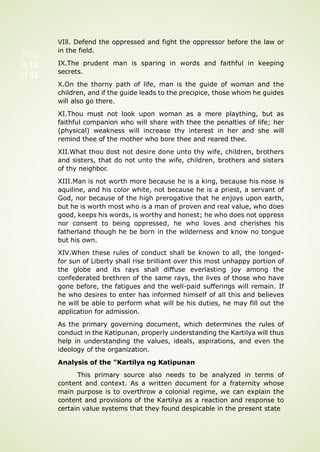
VIll. Defend the oppressed and fight the oppressor before the law or
in the field.
IX.The prudent man is sparing in words and faithful in keeping
secrets.
X.On the thorny path of life, man is the guide of woman and the
children, and if the guide leads to the precipice, those whom he guides
will also go there.
XI.Thou must not look upon woman as a mere plaything, but as
faithful companion who will share with thee the penalties of life; her
(physical) weakness will increase thy interest in her and she will
remind thee of the mother who bore thee and reared thee.
XII.What thou dost not desire done unto thy wife, children, brothers
and sisters, that do not unto the wife, children, brothers and sisters
of thy neighbor.
XIII.Man is not worth more because he is a king, because his nose is
aquiline, and his color white, not because he is a priest, a servant of
God, nor because of the high prerogative that he enjoys upon earth,
but he is worth most who is a man of proven and real value, who does
good, keeps his words, is worthy and honest; he who does not oppress
nor consent to being oppressed, he who loves and cherishes his
fatherland though he be born in the wilderness and know no tongue
but his own.
XIV.When these rules of conduct shall be known to all, the longed-
for sun of Liberty shall rise brilliant over this most unhappy portion of
the globe and its rays shall diffuse everlasting joy among the
confederated brethren of the same rays, the lives of those who have
gone before, the fatigues and the well-paid sufferings will remain. If
he who desires to enter has informed himself of all this and believes
he will be able to perform what will be his duties, he may fill out the
application for admission.
As the primary governing document, which determines the rules of
conduct in the Katipunan, properly understanding the Kartilya will thus
help in understanding the values, ideals, aspirations, and even the
ideology of the organization.
Analysis of the "Kartilya ng Katipunan
This primary source also needs to be analyzed in terms of
content and context. As a written document for a fraternity whose
main purpose is to overthrow a colonial regime, we can explain the
content and provisions of the Kartilya as a reaction and response to
certain value systems that they found despicable in the present state
Pag
e 13
of 92
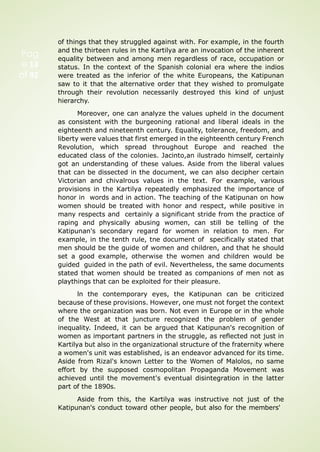
of things that they struggled against with. For example, in the fourth
and the thirteen rules in the Kartilya are an invocation of the inherent
equality between and among men regardless of race, occupation or
status. In the context of the Spanish colonial era where the indios
were treated as the inferior of the white Europeans, the Katipunan
saw to it that the alternative order that they wished to promulgate
through their revolution necessarily destroyed this kind of unjust
hierarchy.
Moreover, one can analyze the values upheld in the document
as consistent with the burgeoning rational and liberal ideals in the
eighteenth and nineteenth century. Equality, tolerance, freedom, and
liberty were values that first emerged in the eighteenth century French
Revolution, which spread throughout Europe and reached the
educated class of the colonies. Jacinto,an ilustrado himself, certainly
got an understanding of these values. Aside from the liberal values
that can be dissected in the document, we can also decipher certain
Victorian and chivalrous values in the text. For example, various
provisions in the Kartilya repeatedly emphasized the importance of
honor in words and in action. The teaching of the Katipunan on how
women should be treated with honor and respect, while positive in
many respects and certainly a significant stride from the practice of
raping and physically abusing women, can still be telling of the
Katipunan's secondary regard for women in relation to men. For
example, in the tenth rule, tne document of specifically stated that
men should be the guide of women and children, and that he should
set a good example, otherwise the women and children would be
guided guided in the path of evil. Nevertheless, the same documents
stated that women should be treated as companions of men not as
playthings that can be exploited for their pleasure.
ln the contemporary eyes, the Katipunan can be criticized
because of these provisions. However, one must not forget the context
where the organization was born. Not even in Europe or in the whole
of the West at that juncture recognized the problem of gender
inequality. Indeed, it can be argued that Katipunan's recognition of
women as important partners in the struggle, as reflected not just in
Kartilya but also in the organizational structure of the fraternity where
a women's unit was established, is an endeavor advanced for its time.
Aside from Rizal's known Letter to the Women of Malolos, no same
effort by the supposed cosmopolitan Propaganda Movement was
achieved until the movement's eventual disintegration in the latter
part of the 1890s.
Aside from this, the Kartilya was instructive not just of the
Katipunan's conduct toward other people, but also for the members'
development as individuals in their own rights. Generally speaking,
the rules in the Kartilya can be classified as either directed to how one
should treat his neighbor or to how one should develop and conduct
one's self, Both are essential to the success and fulfillment of the
Katipunan's ideals. For example, the Kartilya's teachings on honoring
one's word and not wasting time are teachings directed toward self-
development, while the rules on treating the neighbor's wife, children,
and brothers the way that you want yours to be treated
instruction on how Katipuneros should treat and regard
neighbors.
All in all, proper reading of the Kartilya will reveal a
is an
their
more
thorough understanding of the Katipunan and the significant role that
it played in the revolution and in the unfolding of the Philippine history,
as we know it.
To Do!
Now, you will be examining the three primary sources entitled:
a.)The Manunggul Jar as a Vessel of History
b.)Dasalan at Tocsohan
c.) Ang Dapat Mabatid ng mga Pilipino
These primary sources were filed on your flashdrive. Be
guided with your course guide!
After reading the primary sources, proceed now in answering the
prepared self-assessment tasks below.
Self-assessment Task 1
Try to complete the information below using the set of words
provided in the box.
The Mununggul Jar was discovered in the early 1960’s
in _, Palawan. This burial jar features
designs and is painted with and _ . The lid of the
jar features two human figures with arms crossed on the chest
representing the traditional practice of the corps riding a boat. This
artifact signifies the belief of the early Filipinos in the .
The Mununggul Jar is a _ of the Philippines. The jar
was found in the chamber of the _, one of the
Mununggul caves in Palawan. The jar is found from about
years before the present. It was found by and
.
Pag
e 14
of 92
Self-assessment 2
Using the table below compare and contrast the idea of the
Marcelo H.
Cathechism
only.
del Pilar’s Dasalan at tocsohan to the real
of the Catholic church. Use keyphrases/words
Conclusion:
Self-assessment 3
Pag
e 15
of 92
a. National Treasure b. Afterlife
c. Tabon Cave d. 2800
e. curvilinear f. Manunggul cave
g. Hematite h. Robert Fox
i. Iron j. Miguel Santiago
Dasalan at Tocsohan Cathechism
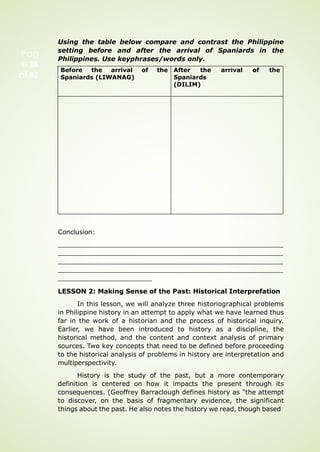
Using the table below compare and contrast the Philippine
setting before and after the arrival of Spaniards in the
Philippines. Use keyphrases/words only.
Conclusion:
LESSON 2: Making Sense of the Past: Historical Interprefation
In this lesson, we will analyze three historiographical problems
in Philippine history in an attempt to apply what we have learned thus
far in the work of a historian and the process of historical inquiry.
Earlier, we have been introduced to history as a discipline, the
historical method, and the content and context analysis of primary
sources. Two key concepts that need to be defined before proceeding
to the historical analysis of problems in history are interpretation and
multiperspectivity.
History is the study of the past, but a more contemporary
definition is centered on how it impacts the present through its
consequences. (Geoffrey Barraclough defines history as "the attempt
to discover, on the basis of fragmentary evidence, the significant
things about the past. He also notes the history we read, though based
Pag
e 16
of 92
Before the arrival of the
Spaniards (LIWANAG)
After the arrival of the
Spaniards
(DILIM)
on facts, is strictiy speaking, not factual at all, but a series of accepted
judgments. Such judgments of historians on how the past should be
seen make the foundation of historical interpretation.
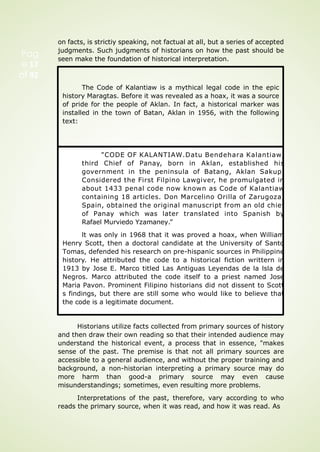
"CODE OF KALANTIAW.Datu Bendehara Kalantiaw,
third Chief of Panay, born in Aklan, established his
government in the peninsula of Batang, Aklan Sakup.
Considered the First Filpino Lawgiver, he promulgated in
about 1433 penal code now known as Code of Kalantiaw
containing 18 articles. Don Marcelino Orilla of Zarugoza,
Spain, obtained the original manuscript from an old chief
of Panay which was later translated into Spanish by
Rafael Murviedo Yzamaney.”
lt was only in 1968 that it was proved a hoax, when William
Henry Scott, then a doctoral candidate at the University of Santo
Tomas, defended his research on pre-hispanic sources in Philippine
history. He attributed the code to a historical fiction writtern in
1913 by Jose E. Marco titled Las Antiguas Leyendas de la lsla de
Negros. Marco attributed the code itself to a priest named Jose
Maria Pavon. Prominent Filipino historians did not dissent to Scott
s findings, but there are still some who would like to believe that
the code is a legitimate document.
Historians utilize facts collected from primary sources of history
and then draw their own reading so that their intended audience may
understand the historical event, a process that in essence, "makes
sense of the past. The premise is that not all primary sources are
accessible to a general audience, and without the proper training and
background, a non-historian interpreting a primary source may do
more harm than good-a primary source may even cause
misunderstandings; sometimes, even resulting more problems.
Interpretations of the past, therefore, vary according to who
reads the primary source, when it was read, and how it was read. As
Pag
e 17
of 92
The Code of Kalantiaw is a mythical legal code in the epic
history Maragtas. Before it was revealed as a hoax, it was a source
of pride for the people of Aklan. In fact, a historical marker was
installed in the town of Batan, Aklan in 1956, with the following
text:
students of history, we must be well equipped to recognize different
types of interpretatons why these may differ from each other, and
how to criticaly sift these interpretations through historical evaluation.
Interpretations of historical events change over time; thus, it is an
important skill for a student of history to track these changes in an
attempt to understand the past.
Many of the things we accept as "true about the past might not
be the case anymore, just because these were taught o us as facts
when we were younger does not mean that it is set in stone-history
is, after all, a construct. And as a construct, it is open for
interpretation. There might be conflicting and competing accounts ot
Sa “Aking Mga Kabata" is a poem purportedly written by
Jose Rizal when he was eight years old and is probably one of
Rizal's most prominent works. There is no evidence to support the
claim that this poem, with the now immortalized lines "Ang hindi
magmahal sa kanyang salita/mahigit sa hayop at malansang isda
was written by Rizal, and worse, the evidence against Rizals
authorship of the poem seems all unassailable.
There exists no manuscript of the poem handwritten by
Rizal. The poem was first putblished in 1906, in a book by
Hermenegildo Cruz.
Cruz said he received the poem from Gabriel Beato Francisco, who
claimed to have received it in 1884 tirom Rizal's close friend,
Saturnino Raselis. Rizal never mentioned wrting this poem
anywhere in his writings, and more importanty, he never mentioned
of having a close triend by the person of Raselis.
Further criticism of the poem reveals more about the wrongful
attribution of the poem to Rizal. The poem was written in Tagalog
and reterred to the word "kalayaan. But it was documented in
Rizal's letters that he first encountered the word through a Marcelo
H. del Pilar's translation of Rizal's essay El Amor Patrio, where it
was spelled as kalayahan.
While Rizal's native tongue was Tagalog. he was educated in
panish, starting from his mother, Teodora Alonso. Later on, he
would express disappointment in his difficulty in expressing himself
in his native tongue.
The poem's spelling is also suspect-the use of letters "k and
"w" to replaced c and u, respectively was suggested by Rizal as an
adult. If the poem was indeed written during his time, it should use
the original Spanish orthography that was prevalent in his time.
Pag
e 18
of 92
Pag
e 19
of 92
the past that need one's attention, and can impact the way we view
our country's history and identity. It is important, therefore, to subject
to evaluation not only the primary source, but also the historical
interpretation of the same, to ensure that the current interpretation is
reliable to support our acceptance of events of the past.
Multiperspectivity
With several possibilities of interpreting the past, another
important concept that we must note is multiperspectivity. This can
be defined as a way of looking at historical events, personalities,
developments, cultures, and societies from ditferent perspectives.
This means that there is a multitude of ways by which we can view
the world, and each could be equally valid, and at the same time,
equally partial as well. Historical writing is, by definition, biased,
partial, and contains preconceptions. The historian decides on what
sources to use, what interpretation to make more apparent,
depending on what his end is. Historians may misinterpret evidence,
attending to those that suggest that a certain event happened, and
then ignore the rest that goes against the evidence. Historians may
omit significant facts about their subject which makes the
interpretation unbalanced. Historians may impose a certain ideology
to their subject, which may not be appropriate the period the subject
was from. Historians may also provide a single cause for an event
without considering other possible causal explanations of said event.
These are just many of the ways a historian may fail in his historical
inference, description, and interpretation. With multiperspectivity as
an approach in history, we must understand that historical
interpretations contan diserepancies, contradictions, ambiguities, and
are often the focus of dissernt.
Exploring multiple perspectives in history requires incorporating
source materials that reflect different views of an event in history,
because singular historical narratives do not provide for space to
inquire and investigate. Different sources that counter each other may
create space for more investigation and research, while providing
more evidence for those truths that these sources agree on.
Different kinds of sources also provide different historical truths
-an official document may note different aspects of the past than, say,
a memoir an ordinary person on the same event. Different historical
agents create different historical truths, and while this may be a
burdensome work for the historian, it also renders more validity to the
historical scholarship. Taking these in close regard in the reading of
historical interpretations it provides for the audience a more complex,
but also a more complete and richer understanding of the past.
Pag
e 20
of 92
Case Study 1: Where Did the First Catholic Mass Take Place in
the Philippines?
The popularity of knowing where the "firsts" happened in history
has been an easy way to trivialize history, but this case study will not
focus on the significance (or lack thereof) of the site of the First
Catholie Mass in the Philippines, but rather, use it as a
historiographical exercise in the utlization of evidence and
interpretation in reading historical events.
Butuan has long been believed as the site of the first Mass. In
fact,this has been the case for three centuries, culminating in the
erection of a monument in 1872 near Agusan River, which
commemorates the expedition's arrival and celebration of Mass on 8
April 1521. The Butuan claim has been based on a rather elementary
reading of primary sources trom the event.
Toward the end of the nineteenth century and the start of the
twentieth century, together with the increasing scholarship on the
history of the Philippines, a more nuanced reading of the available
evidence was made, which brought to light more considerations in
gong aganst the more accepted interpretation ot the first Mass in the
Philhppines, made both by Spanish and Filipino scholars.
It must be noted that there are only two primary sources that
historians refer to in identifying the site of the first Mass. One is the
log kept by Francisco Albo, a pilot of one of Magellan's ship, Trinidad.
He was one of the 18 survivors who returned with Sebastian Elcano
on the ship Victoria after they cireumnavigated the world. The other,
and the more complete, was the account by Antonio Pigafetta, Primo
Uaggio intorno al mondo (First Voyage Around the World). Pigafetta,
like Albo, was a member of the Magellanexpedition and an eyewitness
of the events, particularly, of the first Mass.
Primary Source: Albo's Log
Source:Diario o derotero del viage de Magallanes desde el cabo se S.
Agustin en el Brazil hasta el regreso a Espana de la nao Victoria,
escrito por Frandsco Albo," Document no. xxii in Colleción de viages
descubrinmientos que hicieron por mar los Españoles desde fines del
siglo XV, Ed. Martin Fernandez de Navarrete (reprinted Buenos Aires
1945, 0 Vols) IV, 191-225. As cited in Miguel A. Bernad "Butuan or
Limasawa The Site of the First Mass in the Philippines: A
Reexamination of Evidence 1981, Künaadman: A Journal of Southern
Philippines, Vol. 111, 1-35.
1. On the 16th of March (1521) as they sailed in a westerly course
from Ladrones, they saw land towards the northwest; but owing to
Pag
e 21
of 92
many shallow places they did not approach it. T'hey found later that
its name was Yunagan.
2.They went instead that same day southwards to another small
island named Suluan, and there they anchored. There they saw some
canoes but these fled at the Spaniards' approach. This island was at
9 and two-thirds degrees North latitude.
3.Departing from those two islands, they sailed westward to an
uninhabited island of Gada" where they took in a supply of wood and
water. The sea around that island was free from shallows. (Albo does
not give the latitude of this island, but from Pigatetta's testimony, this
seems to be the "Acquada or Homonhon, at 10 degrees
latitude.)
4. From that island they sailed westwards towards a large
names Seilani that was inhabited and was known to
North
island
have
gold.(Seilani- or, as Pigafetta calls it, "Ceylon-was the island of Leyte.)
5.Sailing southwards along the coast of that large island of Seilani,
they turned southwest to a small island called "Mazava." That island
is also at a latitude of 9 and two-thirds degrees North.
6.The people of that island of Mazava were very good. There the
Spaniards planted a cross upon a mountain-top, and from there they
were shown three islands to the west and southwest, where they were
told there was much gold. "They showed us how the gold was
gathered, which came in small pieces like peas and lentils.
7.From Mazava they sailed northwards again towards Seilani. Tney
followed the coast of Seilani in a northwesterly direction, ascending
up to 10 degrees of latitude where they saw three small islands.
8.From there they sailed westwards some ten leagues, and there they
saw three islets, where they dropped anchor for the night. In the
morning they sailed southwest some 12 leagues, down to a latitude
of l0 and one-third degree. There they entered a channel between two
islands, one of which was called "Matan" and the other "Subu."
9.They sailed down that channel and then turned westward and
anchored at the town (la villa) of Subu where they stayed many days
and obtained provisions and entered into a peace-pact with the local
king.
10.The town of Subu was on an east-west direction with the islands
of Suluan and Mazava. But between Mazava and Subu, there were so
many shallows that the boats could not go westward directly but has
to go (as they did) in a round-about way.
Pag
e 22
of 92
It must be noted that in Albo's account, the location of Mazava fits the
location of the island of Limasawa, at the southern tip of Leyte, 9°54N.
Also, Albo does not mention the first Mass, but only the planting of
the cross upon a mountain-top from which could be seen three islands
to the west and southwest, which also fits the southern end of
Limasawa.
Primary Source: Pigafetta's Testimony on the Route of
Magellan's Expedition
Source: Emma Blair and James Alexander Robertson, The Philippine
Islands, Vols. 33 and 34, as cited in Miguel A. Bernad, "Butuan or
Limasawa? The Site of the First Mass in the Philippines: A
Reexamination of Evidence" 1981, Kinaadman: A Journal of Southern
Philippines, Vol. III, 1-35.
1. Saturday, 16 March 1521- Magellan's expedition sighted a "high
land" named "Zamal" which was some 300 leagues westward of
Ladrones (now the Marianas) Islands.
2 Sunday, March 17 "The following day" after sighting Zamal Island,
they landed on "another island which was uninhabited" and which lay
"to the right" of the above-mentioned island of "Zamal." (To the "righť
here would mean on their starboard going south or southwest.) There
they set up two tents for the sick members of the crew and had a sow
killed for them. The name of this island was Humunu (Homonhon).
This island was located at 10 degrees North latitude.
3.On that same day (Sunday, March 17), Magellan named the enure
archipelago the "Islands of Saint Lazarus," the reason being that it
was Sunday in the Lenten season when the Gospel assigned for the
Mass and the liturgical Office was the eleventh chapter of St. John,
which tells of the raising of Lazarus trom the dead.
4.Monday, March 18- In the afternoon of their second day on that
island, they saw a boat coming towards them with nine men in it. An
exchange of gifts was effected. Magellan asked for food supplies, and
the men went away, promising to bring rice and other supplies in "four
days.
5.There were two springs of water on that island of Homonhon. Also
they saw there some indications that there was gold in these islands.
Consequently Magellan renamed the island and called it the "Watering
Place of Good Omen" (Acquada la di bouni segniali).
6.Friday, March 22-At noon the natives returned. This time they were
in two boats, and they brought food suppies.
Pag
e 23
of 92
7.Magellan's expedition stayed eight days at Homonhon: from
Sunday, March 17, to the Monday of the following week, March 25.
8.Monday, March 25 In the afternoon, the expedition weighed anchor
and left the island of Homonhon.In the ecclesiastical calendar, this day
(March 25) was the feast-day of the lncarnation, also called the feast
of the Annunciation and therefore "Our Lady's Day. On this day, as
they were about to weigh anchor, an accident happened to Pigafëtta:
he fell into the water but was rescued. He attributed his narrow escape
from death as grace obtained through the intercession of the Blessed
Virgin Mary on her feast-day.
9.The route taken by the expedition after leaving Homonhon was
"toward the west southwest, between four islands: namely, Cenalo,
Hiunanghan, Ibusson and Albarien." Very probably "Cenalo is a
misspelling in the Italian manuscript for what Pigafetta in his map calls
"Ceilon and Albo calls "Seilani: namely the island of Leyte.
Hiunanghan" (a misspelling of Hinunangan) seemed to Pigafetta to be
a separate island, but is actually on the mainland of Leyte G.e.,
"Ceylon'"). On the other hand, Hibuson (Pigafetta's Ibusson) is an
island east of Leyte's southern tip.
Thus, it is easy to see what Pigafetta meant by sailing toward
the west southwest" past those islands. They left Homonhon sailing
westward towards Leyte, then followed the Leyte coast southward,
passing between the island of Hibuson on their portside and
unangan Bay on their starboard, and then continued southward, then
turning westward to "Mazaua.
10.Thursday, March 28 In the morning of Holy Thursday, March 6,
they anchored off an island where the previous night they hadseen a
light or a bonfire. That island "lies in a latitude of nine and two-thirds
towards the Arctic Pole (i.e., North) and in a longitude of one hundred
and sixty-two degrees from the line of demarcation. lt is twenty-five
leagues from the Acquada, and is called Mazaua.
11. They remained seven days on Mazaua lsland.
12.Thursday, April 4-They left Mazaua, bound for Cebu. They were
guided thither by the king of Mazaua who sailed in his own boat. Their
route took them past five "islands" namely: "Ceylon, Bohol, Canighan,
Baibai, and Gatighan."
13.At Gatighan, they sailed westward to the three islands of the
Camotes Group, namely, Poro, Pasihan and Ponson. Here the Spanish
ships stopped to allow the king of Mazaua to catch up with them, since
Pag
e 24
of 92
the Spanish ships were much faster than the native balangha-a thing
that excited the admiration of the king of Mazaua.
14.From the Camotes Islands they sailed southwards towards "Zubu.
15.Sunday, April 7 - At noon they entered the harbor of "Zubu (Cebu).
It had taken them three days to negotiate the journey from Mazaua
northwards to the Camotes Islands and then southwards to Cebu.
It must be pointed out that both Albo and Pigafetta's testimonies
coincide and corroborate each other. Pigafetta gave more details on
what they did during their weeklong stay at Mazaua.
Primary Source: Pigafetta and Seven Days in Mazaua
Source: Emma Blair and James Alexander Robertson, The Philippine
Islands, Vols. 33 and 34, as cited in Miguel A. Bernad, "Butuan or
Limasawa? The Site of the First Mass in the Philippines: A
Reexamination of Evidence" 1981, Kinaadman: A Journal of Southern
Philippines, Vol. III, 1-35.
1.Thursday, March 28-In the morning they anchored near an island
where they had seen a light the night before a small boat (boloto)
came with eight natives, to whom Magellan threw some trinkets as
presents. The natives paddled away, but two hours later two larger
boats (balanghai) came, in one of which the native king sat under an
awning of mats. At Magellan's invitation some of the natives went up
the Spanish ship, but the native king remained seated in his boat. An
exchange of gifts was effected. In the afternoon that day, the Spanish
ships weighed anchor and came closer to shore, anchoring near the
native kings village. This Thursday, March 28, was Thursday in Holy
Week, i.e., Holy Thursday.
2.Friday, March 29-"Next day. Holy Friday, Magellan sent his slave
interpreter ashore in a small boat to ask the king if he could provide
the expedition with food supplies, and to say that they had come as
friends and not as enemies. In reply the king himself came in a boat
with six or eight men, and this time went up Magellan's ship and the
two men embraced. Another exchange of gifts was made. The native
king and his companions returned ashore, bringing with them two
members of Magellan's expedition as guests for the night. One of the
two was Pigafetta.
3.Saturday, March 30 Pigafetta and his companion had spent the
previous evening teasting and drinking with the native king and his
son. Pigafetta deplored the fact that, although it was Good Friday,
they had to eat meat. The following morning (Saturday) Pigafetta and
his companion took leave of their hosts and returned to the ships.
Pag
e 25
of 92
4.Sunday, March 31-"Early in the morning of Sunday, the last of
March and Easter day," Magellan sent the priest ashore with some
men to prepare for the Mass. Later in the morning Magellan landed
with some fifty men and Mass was celebrated, after which a cross was
venerated. Magellan and the Spaniards returned to the ship for the
noon-day meal, but in the afternoon they returned ashore to plant the
cross on the summit of the highest hill. In attendance both at the Mass
and at the planting of the cross were the king of Mazaua and the king
of Butuan.
5.Sunday, March 31-On that same afternoon, while on the summit of
the highest hill, Magellan asked the two kings which ports he should
go to in order to obtain more abundant supplies of food than were
available in that island. They replied that there were three to choose
from: Ceylon, Zubu, and Calagan. Of the three, Zubu was the port
with the most trade. Magellan then said that he wished to go to Zubu
and to depart the following morning. He asked for someone to guide
him thither. The kings replied that the pilots would be available "any
time. But later that evening the King of Mazaua changed his mind and
said that he would himself conduct Magellan to Zubu but that he would
first have to bring the harvest in. He asked Magellan to send him men
to help with the harvest.
6.Monday, April 1 - Magellan sent men ashore to help with the
harvest, but no work was done that day because the two kings were
sleeping off their drinking bout the night before.
7.Tuesday, April 2 and Wednesday, April3- Work on the harvest
during the "next to days, 1.e., Tuesday and Wednesday, the 2nd and
3rd of April.
8. Thursday, April 4-They leave Mazaua, bound for Cebu.
Using the primary sources avallable, Jesuit priest Miguel A.
Bernad in his work Butuan or Limasauwa: The Site of the First Mass
in the Philippines: A Reexamination of Euidence (1981) lays down the
argument that in the Pigafetta account, a crucial aspect of Butuan was
not mentioned-the river. Butuan is a riverine settlement, situated on
the Agusan River. The beach off Masno is in the delta of said river. It
18 a curious omission in the account of the river, which makes part of
a distinct characteristic of Butuan's geography that seemed to be too
important to be missed.
Pag
e 26
of 92
Case Study 2: What Happened in the Cavite Mutiny?
The year 1872 is a historic year of two events: the Cavite Mutiny
and the martyrdom of the three priests: Mariano Gomez, Jose Burgos,
and Jacinto Zamora, later on immortalized as GOMBURZA. These
events are very important milestones in Philippine history and have
caused ripples throughout time, directly influencing the decisive
events of the Philhppine Revolution toward the end of the century.
While the significance is unquestioned, what made this year
controversial are the ditferent sides to the story, a battle of
perspectives supported by primary sources. ln this case study, we
zoom in to the events of the Cavite Mutiny, a major factor in the
awakening of nationalism among the Filipinos of that time.
Spanish Accounts of the Cavite Mutiny
The documentation of Spanish historian Jose Montero y Vidal
centered on how the event was an attempt in overthrowing the
Spanish government in the Philippines. Although regarded as a
historian, his account of the mutiny was criticized as woefully biased
and rabid for a scholar. Another account from the official report written
by then Governor General Rafael Izquierdo implicated the native
The Age of Exploration is a period of competition among
European rulers to conquer and colonize lands outside their
original domaims. Initialy, the goal was to find alternative routes
by sea to get to Asia, the main source of spices and other
commodities. Existing routes to Asia were mainly by land and cost
very expensive. A sea route to Asia means that Europeans could
access the spice trade directly, greatly reducing costs for traders.
Spain's major foray into the exploration was through Christopher
Columbus, who proposed to sail westward to find a shorteut to
Asia. He was able to reach the Americas, which was then cut-off
from the rest of the known world.
Spain colonized parts of North America, Mexico, and South
America in the sixteenth century. They were also able to reach the
Philippines and claim it for the Spanish crown. Later on, other
European rulers would compete with the activities of exploring and
conquering lands.
It must also be pointed out that later on, after Magellan s
death, the survivors of his expedition went to Mindanao, and
seemingiy went to Butuan. In this instance, Pigafetta vividly
describes a trip in a river. But note that this account already
happened after Magellan's death.
Pag
e 27
of 92
clergy, who were then, active in the movement toward secularization
of parishes. These two accounts corroborated each other.
Primary Source: Excerpts from Montero's Account of the Cavity
Mutiny
Source: Jose Monteroy Vidal, "Spanish Version of the Cavite Mutiny of
1872," in Gregorio Zaide and Sonia Zaide, Documentary Sources of
Philippine History, Volume 7 (Manila: National Book Store, 1990),
269- 273.
The abolition of privileges enjoyed by the laborers of the Cavite
arsenal of exemption from the tribute was, according to some, the
cause of the insurrection. There were, however, other causes. The
Spanish revolution which overthrew a secular throne, the propaganda
carried on by an unbridled press against monarchical principles,
attentatory [sic] of the most sacred respects towards the dethroned
majesty; the democratic and republican books and pamphlets; the
speeches and preachings of the apostles of these new ideas in Spain;
the outbursts of the American publicists and the eriminal policy ot the
senseless Governor whom the Revolutionary government sent to
govern the Philippines, and who put into practice these ideas were the
determining circumstances which gave rise, among certain Filipinos,
to the idea of attaining their independence. It was towards this goal
that they started to work, with the powerful assistance of a certain
section of the native clergy, who out of spite toward friars, made
common cause with the enemies of the mother country.
At various times but especlally in the beginning of year 1872,
the authorities received anonymous communications with the
information that a great uprising would break out against the
Spaniards, the minute the fleet at Cavite left for the South, and that
all would be assassinated, including the friars. But nobody gave
importance to these notices. The conspiracy had been going on Since
the days of La Torre with utmost secrecy. At times, the principal
leaders met either in the house of Filipino Spaniard, D. Joaquin Pardo
de Tavera, or in that of the native priest, Jacinto Zamora, and these
meetings were usually attended by the curate of Bacoor, the soul of
the movement, whose energetic character and immense wealth
enabled him to exerc1se a strong infuence.
Primary Source: Excerpts from the Official Report of Governor
Izquierdo on the Cavite Mutiny of 1872
Source: Rafael Izquierdo, "Official Report on the Cavite Mutiny," in
Gregorio Zaide and Sonia Zaide, Documentary Sources of Philippine
History, Volume 7 (Manila: National Book Store, 1990), 281-286.
Pag
e 28
of 92
...It seems definite that the insurrection was motivated and prepared
by the native clergy, by the mestizos and native lawyers, and by those
known here as abogadillos..
The instigators, to carry out their criminal project, protested
against the injustice of the government in not paying the provinces
for their tobacco crop, and against the usury that some practice in
documents that the Finance department gives crop owners who have
to sell them at a loss. They encouraged the rebellion by protesting
what they called the injustice of having obliged the workers in the
Cavite arsenal to pay tribute starting January 1 and to render personal
service, from which they were formerly exempted..
Up to now it has not been clearly determined if they planned to
establish a monarchy or a republic, because the Indios have no word
in their language to describe this different form of government, Whose
head in Filipino would be called hari; but it turns out that they would
place at the head of the government a priest.. that the head selected
would be D. Jose Burgos, or D. Jacinto ZamOrä. Such is... the plan of
the rebels, those who guided them, and the means they counted upon
for its realization.
It is apparent that the accounts underscore the reason for the
"revolution": the abolition of privileges enjoyed by the workers of the
Cavite arsenal such as exemption trom payment of tribute and being
employed in polos y servicios, or force labor. They also identified other
reasons which seemingly made the issue a lot more serious, which
included the presence of the native clergy, who, out of spite aganst
the Spanish friars, "conspired and supported the rebels. Izquierdo, in
an obviously biased report, highlighted that attempt to overthrow the
Spanish government in the Philippines to install a new "hari in the
persons of Fathers Burgos and Zamora. According to him, native
clergy attracted supporters by giving them charismatic assurance that
their fight would not fail because they had God's support, aside from
promises of lofty rewards such as employment, wealth, and ranks in
the army.
In the Spaniard's accounts, the event of 1872 was
premeditated, and was part of a big conspiracy among the educated
leaders, mestizos, lawyers, and residents of Manila and Cavite. They
allegedly plan to liquidate high ranking Spanish officers, then kill the
friars. The signal they identified among these conspirators of Manila
and Cavite was the rockets fired from Intramuros.
The accounts detail that on 20 January 1872, the district of
Sampaloc celebrated the feast of the Virgin of Loreto, and came with
it were some fireworks display. The Caviteños allegedly mistook this
Pag
e 29
of 92
as the signal to commence with the attack. The 200-men contingent
led by Sergeant Lamadrid attacked Spanish officers at sight and seized
the arsenal. Izquierdo, upon learning of the attack, ordered the
reinforcement of the Spanish forces in Cavite to quell the revolt. The
"revolution was easily crushed, when the Manileños who were
expected to aid the Caviteños did not arrive. Leaders of the plot were
killed in the resulting skirmish, while Fathers Gomez, Burgos, and
Zamora were tried by a court-martial and sentenced to be executed.
Others wno were implicated such as Joaquin Pardo de Tavera, Antonio
Ma.Regidor, Jose and Pio Basa, and other Filipino lawyers were
suspended from the practice of law, arrested, and sentenced to life
imprisonment at the Marianas Island. Izquierdo dissolved the native
regiments of artillery and ordered the creation of an artillery force
composed exclusively by Peninsulares.
On 17 February 1872, the GOMBURZA were executed to serve
as a threat to Filipinos never to attempt to fight the Spaniards again.
Differing Accounts of the Events of 1872
Two other primary accounts exist that seem to counter the
accounts of Izquierdo and Montero. First, the account of Dr. Trinidad
Hermenegildo Pardo de Tavera, a Pilipino scholar and researcher, who
wrote a Filipino version of the bloody incident in Cavite.
Primary Source: Excerpts from Pardo de Tavera's Account of
the Cavite Mutiny
Source: Trinidad Pardo de Tavera, "Filipino Version of the Cavity
Mutiny," in Gregorio Zaide and Sonia Zaide, Documentary Sources of
Philippine History, Volume 7 (Manila: National Book Store, 1990), 274
280.
This uprising among the soldiers in Cavite was used as s
powerful level by the Spanish residents and by the friars. the Central
Government in Madrid had announced its intention to deprive the
friars in these islands of powers of intervention in matters of civil
government and of the direction and management of the university ..
it was due to these facts and promises that the Filipinos had great
hopes of an improvement in the affairs of their country, while the
friars, on the other hand, feared that their power in the colony would
soon be complete a thing of the past.
...Up to that time there had been no intention of secession from Spain,
and the only aspiration of the people was. to secure the material and
education advancement of the country...
Pag
e 30
of 92
According to this account, the incident was merely a mutiny by
Filipino soldiers and laborers of the Cavite rsenal to the dissatisfaction
arising from the draconian policies of Izquierdo, such as the abolition
of privileges and the prohibition of the founding of the school of arts
and trades tor Filpinos, which the General saw as a smokescreen to
creating a political club.
Tavera is of the opinion that the Spanish friars and Izquierdo
used the Cavite Mutiny as a way to address other issues by blowing
out oE proportion the isolated mutiny attempt. During this time, the
Central Government in Madrid was planning to deprive the friars of all
the powers ot lntervention in matters of civil government and direction
and management ot educational institutions. The friars needed
something to justity their continuing dominance in the country, and
the mutiny provided such opportunity.
However, the Central Spanish Government introduced an
educational decree fusing sectarian schools run by the friars into a
school called the Philippine Institute. The decree aimed to improve the
standard of education in the Phiippines by requiring teaching positions
in these schools to be filled by competitive examinations, an
improvement welcomed by most Filipinos.
Another account, this time by French writer Edmund Plauchut,
complemented Tavera's account and analyzed the motivations of the
1872 Cavite Mutiny.
Primary Source: Excerpts from Plauchut's
Cavite Mutiny
Source: Edmund Plauchut, The Cavite Mutiny
Martyrdom of Gom-Bur-Za," in Gregorio Zaide
Account of the
of 1872 and the
and Sonia Zaide,
Documentary Souroces of Philippine History, Volume 7 (Manila:
National Book Store, 1990), 251-268.
General La Torre.. created a junta composed of high officials...
including some friars and six Spanish officials.... At the same time
there was created by the government in Madrid a committee to
investigate the same problems submitted to the Manila committee.
When the two finished work, it was found that they came to the same
conclusions. Here is the summary of the reforms they considered
necessary to introduce:
1.Changes in tariff rates at customs, and the methods of collection.
2.Removal of surcharges on foreign importations.
3.Reduction of export fees
Pag
e 31
of 92
4.Permission for foreigners to reside in the Philippines, buy real
estate, enjoy freedom of worship, and operate commercial transports
fiying the Spanish fiag.
5.Establishment of an advisory council to inform the Mnister of
Overseas Affairs in Madrid on the necessary retorms to be
implemented.
6. Changes in primary and secondary education.
7.Establishment of an Institute of Civil Administration in the
Philippines, rendering unnecessary the sending home of short-term
civil officials every time there is a change of ministry.
8. Study of direct-tax system.
9. Abolition of the tobacco monopoly.
...The arrival in Manila of General Izquierdo... put a sudden end to all
dreams of reforms... the prosecutions instituted by the new Governor
General were probably expected as a result of the bitter disputes
between the Filipino clerics and the triars. Such a policy must really
end in a strong desire on the part ot the other to repress cruelly.
In regard to schools, it was previously decreed that there should
be in Manila a Society of Arts and Trades to be opened in March of
1871... to repress the growth of liberal teachings, General Izquierdo
suspended the opening of the school... the day previous to the
scheduled inauguration..
The Filipinos had a duty to render service on public roads
construction and pay taxes every year. But those who were employed
at the maestranza ot the artillery, in the engineering shops and
arsenal of Cavite, were exempted trom this obligation from time
immemorial... Without preliminaries of any kind, a decree by the
Governor withdrew from such old employees their retirement
privileges and declassified them into the ranks ot those who worked
on public roads.
The friars used the incident as a part ot a larger conspiracy to
cement their dominance, which had started to show cracks because
of the discontent of the Filipinos. They showcased the mutiny as part
of a greater conspiracy in the Philippines by Fipinos to overthrow the
Spanish Government. Unintentionally, and more so, propheticaly, the
Cavite Mutiny of 1872 resulted in the martyrdom ot GOMBURZA, and
paved the way to the revolution culminating in 1898.
The GOMBURZA is the collective name of the three martyred
priests Mariano Gomez, Jose Burgos, and Jacinto Zamora, Who
were tagged as the masterminds of the Cavite Mutiny. They were
prominent Filipino priests charged with treason and sedition. It is
believed that the Spanish clergy connected the priests to the
mutiny as part or a conspiracy to stifle the movement of secular
priests who desired to have their own parishes instead of being
merely assistants to the regular friars. The GOMBURZA were
executed by garrote in public, a scene purportedly witnessed by a
young Jose Rizal.
Their martyrdom is widely accepted as the dawn of Philippine
nationalism in the nineteenth century, with Rizal dedicating his
second novel, El Filibusterismo, to their memory:
“The Government, by enshrouding your trial in
mystery and pardoning your co-accused, has suggested
that some mistake was committed when your fate was
decided; and the whole of the Philippines, in paying
homage to your memory and calling you martyrs, totally
rejects your guilt. The Church, by refusing to degrade
you, has put in doubt the crime charged against you.
Case Study 3: Where Did the Cry of Rebellion Happen?
Momentous events swept the Spanish colonies in the late
nineteenth century, including the Philippines. Journalists of the time
referred to the phrase El Grito de Rebelion" or "Cry of Rebellion" to
mark the start of these revolutionary events, identifying the places
where it happened. In the Philippines, this happened in August 1896,
northeast of Manila, where they declared rebellion against the Spanish
colonial government. These events are important markers in the
history of colonies that struggled for their independence against their
colonizers.
The controversy regarding this event stems from the
identification of the date and place where the Cry happened.
Prominent Filipino historian Teodoro Agoncillo emphasizes the event
when Bonifacio tore the cedula or tax receipt before the Katipuneros
who also did the same. Some writers identified the first military event
with the Spaniards as the moment of the Cry, for which, Emilio
Aguinaldo commissioned an "Himno de Balintawak to inspire the
renewed struggle after the Pact of the Biak-na-Bato failed. A
monument to the Heroes of 1896 was erected in what is now the
Pag
e 32
of 92
Pag
e 33
of 92
intersection of Epifanio de los Santos (EDSA) Avenue and Andres
Bonifacio Drive-North Diversion road, and from then on until 1962,
the Cry of Balintawak was celebrated every 26th of August. The site
of the monument was cho8en for an unknown reason.
Different Dates and Places of the Cry
Various accounts of the Cry give different dates and places. A
guardia civil, Lt. Olegario Diaz, identified the Cry to have happened in
Balintawak on 25 August 1896. Teodoro Kalaw, Filipino historian,
marks the place to be in Kangkong, Balintawak, on the last week of
August 1896. Santiago Alvarez, a Katipunero and son of Mariano
Alvarez, leader of the Magdiwang faction in Cavite, put the Cry in
Bahay Toro in Quezon City on 24 August 1896. Pio Valenzuela, known
Katipunero and privy to many events concerning the Katipunan stated
that the Cry happened in Pugad Lawin on 23 August 1896. Historian
Gregorio Zaide identified the Cry to have happened in Balintawak on
26 August 1896, while Teodoro Agoncillo put it at Pugad Lawin on 23
August 1896, according to statements by Pio Valenzuela. Research by
historians Milagros Guerrero, Emmanuel Encarnacion, and Ramon
Villegas claimed that the event took place in Tandang Sora's barn in
Gulod, Barangay Banlat, Quezon City, on 24 August 1896.
Primary Source: Accounts of the Cry
Guillermo Masangkay
Source: Guillermo Masangkay, "Cry of Balintawak" in Gregorio Zaide
and Sonia Zaide, Documentary Sources of Philippine History, Volume
8 (Manila: National Book Store, 1990), 307-309.
On August 26th, a big meeting was held in Balintawak, at the
house of Apolonio Samson, then cabeza of that barrio of Caloocan.
Among those who attended, I remember, were Bonifacio, Emilio
Jacinto, Aguedo del Rosario, Tomas Remigio, Briccio Pantas, Teodoro
Plata, Pio Valenzuela, Enrique Pacheco, and Francisco Carreon. They
were all leaders of the Katipunan and composed the board of directors
of the organization. Delegates from Bulacan, Cabanatuan, Cavite, and
Morong were also present.
At about nine o'clock in the morning of August 26, the meeting
was opened with Andres Bonifacio presiding and Bmilio Jacinto acting
as secretary. The purpose was to discuss when the uprising was to
take place. Teodoro Plata, Briccio Pantas, and Pio Valenzuela were all
opposed to starting the revolution too early... Andres Bonifacio,
sensing that he would lose in the discussion then, left the session hall
and talked to the people, who were waiting outside for the result of
the meeting of the leaders. He told the people that the leaders were
Pag
e 34
of 92
arguing against starting the revolution early, and appealed to them in
a fiery speech in which he said: "You remember the tate of our
countrymen who were shot in Bagumbayan. Should we return now to
the towns, the Spaniards will only shoot us. Our organization has been
discovered and we are all marked men. If we don't start the uprising,
the Spaniards will get us anyway. What then, do you say?
"Revolt!" the people shouted as one.
Bonifacio then asked the people to give a pledge that they were
to revolt. He told them that the sign of slavery of the Filipinos were
(Sic) the cedula tax charged each citizen. "If it is true that you are
ready to revolt... I want to see you destroy your cedulas. It will be a
sign that all of us have declared our severance from the Spaniards.
Pio Valenzuela
Source: Pio Valenzuela, "Cry of Pugad Lawin," in Gregorio Zaide and
Sonia Zaide, Documentary Sources of Philippine History, Volume 8
(Manila: National Book Store, 1990), 301-302.
The first place of refuge of Andres Bonifacio, Emilio Jacinto,
Procopio Bonifacio, Teodoro Plata, Aguedo del Rosario, and myself was
Balintawak, the first five arriving there on August 19, and I, on August
20, 1896. The first place where some 500 members of the Katipunan
met on August 22, 1896, was the house and yard of Apolonio Samson
at Kangkong. Aside from the persons mentioned above, among those
who were there were Briccio Pantas, Alejandro Santiago, Kamon
Bernardo, Apolonio Samson, and others. Here, views were only
exchanged, and no resolution was debated or adopted. It was at
Pugad lawin, the house store-house, and yard of Juan Ramos, son of
Melchora Aquino, where over 1,000 members of the Katipunan met
and carried out considerable debate and discussion on August 23,
1896. The discussion was on whether or not the revolution against the
Spanish government should be started on August 29, 1896... After
the tumultuous meeting, many of those present tore their cedula
certificates and shouted "Long live the Philippines! Long live the
Philippines!
From the eyewitness accounts presented, there is indeed
marked disagreement among historical witnesses as to the place and
time of the occurrence of the Cry. Using primary and secondary
sources, tour places have been identified: Balintawak, Kangkong,
Pugad Lawin, and Bahay Toro, while the dates vary: 23, 24, 25, or 26
August 1896.
Valenzuela's account should be read with caution: He once told
a Spanish investigator that the "Cry happened in Balintawak on
Pag
e 35
of 92
Wednesday, 26 August 1896. Much later, he wrote in his Memoirs of
the Revolution that it happened at Pugad Lawin on 23 August 1896.
Such inconsistencies in accounts should always be seen as a red fiag
when dealing with primary sources.
According to Guerrero, Encarnacion, and Villegas, all these
places are in Balintawak, then part of Caloocan, now, in Quezon City.
As for the dates, Bonifacio and his troops may have been moving from
one place to another to avoid being located by the Spanish
government, which could explain why there are several accounts of
the Cry.
Self-assessment 4
True or False. Write true if the statement is true. Otherwise, write
false in the space provided.
1. Historical interpretation is based on the historian’s
judgment on how the past should be seen.
2. We make sense of the past through historical interpretation.
3. Multiperspectivity is a quality of historical writing attributed
to a variety of lenses that may be used to view the past.
4. There is only one account of the first Catholic Mass in the
Philippines.
5. The significance of the martyrdom of the GOMBURZA is
questioned by historians.
6. The Cavite Mutiny is an event that led to the extinction of
the GOMBURZA.
_7. The Cry of the Rebellion happened in present-day Quezon
City.
8. The site of the monument to the Heroes of 1896 was chosen
because this is the actual place where the Cry of the Rebellion
happened.
TO DO!
Assignment 2
Critical essay about a primary source; students are to discuss the
importance of the text, the authors background, the context of the
document, and its contribution in understanding Philippine History.
Topics will be distributed to you in your group chat. Format and Rubric
Pag
e 36
of 92
are indicated in the course requirements and Deadlines in your course
guide.
REFERENCES
Candelaria, J. L., & Alphora, V. C. (2018). Readings in Philippine History.
Quezon City: Rex Printing Company, inc.
Torres, J. V. (2018). BATIS Sources in Philippine History. Quezon City: C &
E Publishing, Inc.
Christopher F. B., Raymond E. B, Julie C. L., Fatima F. R., Tecah C. S. (2006)
Philippine History Coursebook, Trinitas Publishing. INC.
Chapter/ Module 3: Occupations in the Philippines
LEARNING OBJECTIVES
 Describe and analyze the reaction of the early Filipinos to
Spanish Occupation
 Analyze the different economic policies of the Americans in the
Philippines that made impact to the society during and after
the American rule
 Effectively communicate and articulate the historical analysis
of a particular evemt or issue that could help other people
understand and manage present dat issues and concerns.
Lesson 1. Spanish Occupation in The Philippines
Lesson 1.1: Spanish Colonial Way of Life
a. Spanish Colonial Experience
The Spanish Expansion is a result of various forces. Aside from
the Philippines, the Spaniards have already colonized parts of South,
North, and Central America. The inclusion of the Philippines resulted
out of the attempts of Spaniards to control the spice trade in the
Moluccas islands. Aside from the interests in spices, Spain had been
motivated by its mercantilist nature or accumulation wealth in the
form of gold. This was simultaneous with the invention of new
technologies needed for exploration like the compass and sextant.
Maps were also refined at this time that greatly aided the explorers.
Before Spain actually decided to occupy the Philippines, two
noted voyages already reached the Philippines. This was Magellan
voyage in 1521 and the Villalobos voyage in 1543. These did not start
Spanish colonialism although they provide information and fed the
interest of the Spanish government to finally take the islands. In 1565,
Legaspi carried the Spanish flag and set up in the Philippine islands
another colony for Spain. This commenced the Spanish colonial rule
in the Philippines.
Exploration and colonization during this time were realized
through contractual agreements between the Crown and the
Conquistadores. In essence, the Consquistadores conquered for Spain
but they shall share in the riches of the new territories they
conquered. Thus, conquistadores like Legaspi instituted measures
both for the pacification of the people and the satisfaction of their
private goals. It is within this frame that we understand that the
pacification efforts of the colonizers were also coupled with
exploitation.
Pag
e 37
of 92
Pag
e 38
of 92
b. Instruments of Pacification and Exploitation
Encomienda. A system of organizing territories to be under the
care of an Encomendero. It was an administrative unit for the purpose
of exacting tributes from the natives. The Encomendero unit for the
purpose of extracting tributes from the natives. The Encomendero had
the power to collect tributes and to use the personal services of the
inhabitants of the encomienda. The Encomienda shall take care of the
welfare of the natives.
1. Protect natives by maintaining peace and order
2. Support missionaries in conversion to Catholicism
3. Help in defense of country.
The services are compensated from the shares an Encomendero
can get from the tributes and the services of the natives. So, while
the system was meant to facilitate the organization and administration
of the colony, the Encomendero gave a negative image to it. This
system was characterized by greed and cruelty. It was an opportunity
for one to enrich oneself primarily by collection of tribute or unlawful
exaction of numerous services.
a. Tributor. This is levying of tax to all Filipinos aged 19-60
except government employees, soldiers with distinguished services,
decendants of Lakandula and some few native chieftains, choir
members, sacristans, porters of the church, and government
witnesses. The alcalde mayors, encomendero, gobernadorcillo, and
the cabezas acted as tribute collectors.
The Spanish form of “taxation” was by itself heavy for the
native. But this was aggravated by the force and abuses that
accompanied its implementation. Soldiers were used to escort tax
collectors to force collection and these often resulted to violence.
Worst, of course, is the act of collecting much more than what the law
required by the tax collectors.
The abusive nature of this policy is evidenced by the fact that
Filipinos who joined the revolts later on cite the exploitative nature of
tribute collection as a chief cause. In Apayao, for example, they
constructed tribute as a monster that could kill people. The
understanding is borne by the fact that the Ilokanos who entered the
Apayao territory related that they were scared of the tribute that has
killed several of them.
b. Polo Y Servicio. This is another colonial policy that obliged
male natives aged 16-60 except chieftains and their eldest son to
serve 40 days each year in labor pools. The labor pools refer to the
site of labor that were mostly of construction kind. The natives were
Pag
e 39
of 92
asked to build buildings both for the church and the government. They
were also made to make roads and build ships.
This policy was meant to help set up of government
infrastructure and the laborers were even given ration of rice and paid
minimal amounts. There were other regulations to ensure the
protection of the workers. In practice though, all these regulations
were violated. Laborers were not paid and were not given any rice
ration. The policy became insensitive to the need of the communities
so that it was still enforced in time of planting or harvest seasons.
In the end, polo y servicio became a forced labot that
contributed to famine experiences and the destruction of
communities.
c. Bandala. This is another policy meant to augment the finances
of the colonial government. It required the compulsory sale of
products to the government. Communities were given quotas to
produce and sold only to the government. The prices set by the
government were lower than the prevailing prices of these products
but were sold back to the people for a high price. This practice formed
natives to be indebted to the chieftain entrenching the socio-economic
position of the chief. In worst cases, which was usually the case,
farmers were not paid at all of their produce and were given
promissory notes. In effect, this policy became a virtual confiscation
of natives’ products.
Divide and Rule: This is a military strategy utilized by the
Spaniards against the natives. In this method, native mercenaries
were used against other groups to beef op limited military contingency
of the Spaniards. Ny its very nature, it was exploitative as the inter-
village warfare tradition of the early Filipinos was reinforced to serve
the interests of the colonizers.
The policies provide clear examples as to how the colonial
policies impacted on the native Filipinos. For them, the policies were
exploitative even if these were just part of the pacification process of
the Spaniards.
These difficulties were compounded by the constant war Spain
was into against the Dutch and Portuguese.
In all the abusive policies, the traditional head of barangay as
the Maginoo and Datu became intermediaries. They were converted
into willing allies of the Colonizers and their powers and authority were
complicated by the colonizers. As traditional barangay authority, they
were used as intermadiaries between the natives and the Spaniards.
Political privilege was also granted by Spaniards as tribute collectors,
gobernadorcillos and thus helped in mobilizing labor for government
construction of projects. Economically, the Chiefs were given the
opportunity and took advantage of the concept of private property of
land. In the end, the traditional chiefs were transformed into a willing
ally and were called principals. One can see the prestige of principalia
in the social hierarchy of the period. Of the native Filipinos, they were
ranked higher next to the Spaniards.
Self-assessment Task 1
Compare and contrast the administration of the local government
units during the Spanish period with those of the present.
Conclusion:
Pag
e 40
of 92
Spanish Period Present
Pag
e 41
of 92
Lesson 1.2: Filipino Nationalism
a. Early Revolts and Resistance
Given the exploitive nature of Spanish colonialism, early
Filipinos chose to revolt against the regime. Among the earliest revolts
were those by Lakandula in Manila. Revolts became an indispensable
response of early Filipinos to Spanish Rule. Revolts became an
indispensable response of early Filipinos to Spanish rule. In the 1600’s
nativistic revolts characterized the reactions of the people towards the
Spanish rule. More complicated revolts continued up to the 1700’s.
the earlier revolts could be generalized as revolts from ordinary
natives. These revolts could be generalized as revolts from ordinary
natives. These revolts include Tamblot, Bankaw, Tapar, Dagohoy,
Sumuroy, Dabao, and others. Since many of the leaders of these
revolts were babaylanes, or traditional priests, one of important
underlying objective was to go back to old native religion (nativistic).
As such leaders emerge as self-proclaimed messiahs saving the
people from evil effects of colonization.
The second group of revolts were those initiated by local chiefs,
or the princiipales, whose type of leadership are already complicated
by Spanish ways. This type of revolt manifested class interest where
the mass revolts were taken advantage of in the desire to seize power
for themselves. This is why many of these were open to compromises.
Examples of this type of revolt are the revolts of Maniago, Malong,
Gumapos, Palaris, Silang, and others.
Both types of revolts, however, contained the desire to improve
the hardship brought about by the colonial rule. Economic grievance
remained the primary reason why people supported groups and
leaders versus Spaniards.
b. The Igorot Resistance to Spanish Interests and the Price
of Igorot Independence
The Igorots, together with the Muslims in Mindanao were the
two biggest groups that were not colonized by the Spaniards. During
the entire 300 plus years of Spanish rule, these groups remained
independent. This work shall consider only the Igorot resistance.
A note on the word Igorot should be made. Historically speaking,
the groups that were referred by Spanish documents as Igorots were
the inhabitants of Benguet and Bontoc. Other groups in the Cordillera
region were called distint names such as Mandayas for the Apayao,
Itneg for the upper Abra area, Ifugao for Ifugaos. This would explain
Pag
e 42
of 92
the reluctance of many people outside Benguet and Bontoc to be
considered as Igorots. Etymologically, Igorot was coined with the use
pf two old Austronesian words as “gorot”, meaning mountain, and “I”
referring to the source/place or from where one belongs. It is
etymological sense that this work adopts the word Igorot to refer to
all people in the Cordillera as Igorots or “from the mountains.”
The Spaniards entered the Cordillera for many reasons but gold
was initially the primary aim. As soon as the colonizers learned of
Igorot gold in the region, expeditions were immediately sent to secure
it. In the 1600, several attempts like those of Aldana, Carino, and
Quirante. They have taken samples of ores and were brought to Manila
for tests. The attempt at reducing the Igorots to Christianity was
another motivation for the Spaniards. The Augustinians entered the
mountain from the Ilocos areas while the Dominicans penetrated
Ifugao in the east. Another reason for Spanish intrusion into the
Cordillera was simply to extend the conquered territories or to protect
the conquered areas of the lowlands.
Still another motivations was the punitive expeditions, which
were meant to punish the Igorots for the resistance they have been
showing. However, it was the sabotage of the tobacco monopoly that
really angered the Spaniards to sponsor succeeding punitive
expeditions against the Igorots. The most successful of these
expeditions was the Galvey expedition. Guillermo Galvey led a 10-
year campaign against the Igorots from 1829-1839, burning tobacco
plantations and communities, and crushing Igorot opposition. It was
the Galvey expeditions that finally opened the region to Spanish
conquest. By the later part of 1840’s up to the 1950’s, the Spaniards
were able to set up military posts in key areas in the Cordillera. These
posts were called Commandancia Politico-Militares, which were
manned by military people and intended for collection of taxes.
Confronted by the instrusions, the Igorots responded in different
ways but almost always resisting all the plans of the intruders. In
many instances, Igorots simply abandoned their communities when
they learn of Spanish arrival. They would retreat into deeper parts of
the mountain and wait until the Spaniards are gone. If the Igorots
were ready, though, they would engage the Spanish troops with their
traditional weapons as spears, head axes, and bolos. Although the
Igorot weapons were of inferior kind, they relied heavily on ambushes
utilizing the mountainous landscape to their advantages. In some
recorded instances, the Igorots used the weaknesses of the Spanish
weapons they came to learn and won over the more supposedly
superior weapons.
Pag
e 43
of 92
In the Christianization efforts, the Spaniards were able to
convert some Igorots into Christianity. Most of these converts have
been relocated in the lowland areas of Ilocos, La Union and Nueva
Viscaya. Overall through, the Igorots remained pagans.
Whereabout of their gold have also been denied to Spaniards
and other foreigners.
These responses have been largely successful so that at the end
of the Spanish colonial rule, the Igorots remained independent.
A discussion of the Igorot resistance is incomplete without
considering the price that the Igorots had to pay for their freedom.
One is the periodic destruction of homes. Most often than not,
the Spaniards burned villages along their route. These were
reconstructed by the Igorots only to be destructed with the next
Spanish expedition.
Another is the estrangement between the lowlanders and the
Igorots. Before Spanish colonization, it has been the case that the two
were partners in trade. The lowlanders brought up salt, animals,
threads, and fish to the highlands. Igorots brought down gold,
beeswax, and other forest products. With the colonization of the
lowlands and the resistance of Igorots, the friendly relation soured.
This is basically because lowlanders were colonized while the Igorots
remained independent. Specifically, the lowlanders were used by the
Spaniards in their attempts at subjugating the Igorots. The lowlanders
usually accompanied the colonizers as guides and soldiers. One can
add the long period of time that the Spaniards have portrayed
negative images of Igorots to lowlanders painting them as
“headhunters”, “pagans”, and “savages”.
After the period of colonization, it became ironic that the
Filipinos who resisted colonialism were indifferently treated by later
Philippine government. They have often been understood as the
others or the “minority”. As minority, the state has ignored them for
a long time and has used their territories only as sources of raw
materials. In the 1970’s the Marcos government ignored the please of
Igorot of Bontoc and Kalinga not to build the dams along the Chico
River. It was only stopped when resistance included international
groups and the local resistance became violent
c. Campaign for Reforms
The unjust execution of the three Filipino priests Mariano
Gomez, Jose Burgos, and Jacinto Zamora was a turning point in
Philippine history, for it ushered in a new era – the reform movement.
Pag
e 44
of 92
Realizing the danger of fighting for their cause on the home front, the
sons of the wealthy and the well-to-do Filipino families migrated to
Europe to breath the free atmosphere of the Old World. There they
initiated a sustained campaign for reforms in the Spanish
administration of the Philippines. In the homeland, meanwhile, the
Filipino intellectuals secretly collaborated with those in Spain and
founded nationalistic societies.
The dissatisfaction of the Filipino men of wealth and intellect
was centered on the abuses of the Spanish authorities, civil as well as
clerical. The middle class denounced Spanish abuses and asked Spain
to make the Philippines one of its provinces. There was no clamor for
independence, for the reformists believed that the Filipinos would be
better off if they were to become Spanish citizens, enjoying the rights
and privileges of the latter. Such a program constituted what has been
known as assimilation.
For more than a decade the Filipino propagandists waged their
war against the Spanish authorities and friars, but they failed to
awaken the Government of the Peninsula to the demoralizing realities
of colonial administration. The reform movement was a failure for it
did not achieve its goals. In another sense, however, it was a success,
for its failure led to the founding of the Katipunan with separatist aims
(Agoncillo, 1990).
d. The Katipunan
The Kataastaasan Kagalanggalangang Katipunan ng mga Anak
ng Bayn, otherwise known as KKK or simply Katipunan, was a secret
society that was established by Andres Bonifacio and some of his
comrades on July 7, 1892. This was a significant event for the Filipinos
because it marked the end of the peaceful campaign for reforms and
the beginning of a movement which aimed to end Spanish oppression
by uniting the Filipinos and achieve independence by means of a
revolution.
To increase the number of members of the organization, and to
stop suspicion on the part of the family members, the Katipunan
accepted women members. The women were least suspected by the
Spanish authorities, so they were able to keep important documents
of the society. They also served as messengers and front for the secret
meetings of the organization (Vivar et al., 1999)
The Katipunan became especially popular in the suburbs of
Manila and in the provinces of Central Luzon. But as the number of its
affiliates increased, the Spanish authorities began to suspect its
underground character. The friars began to denounce the nightly
meeting held by Katipuneros and on August 19, 1896, a certain
Patino, a Katipunan member, exposed the society to Fr. Mariano Gil.
With the discovery of the Katipunan, Bonifacio had no alternative than
to take the fieldand on August 23, at pugadlawin, he and his men
declared their intention to fight to the bitter end. The revolution
spread to the other provinces. In cavite, meanwhile, the two factions
of the society were at loggerheads and Bonifacio was invited to
mediate between them. At Tejeros, it was agreed to change the
society with a government responsive to the demands of the times,
and in the election that followed, Bonifacio was chosen Director of the
Interior. Unfortunately, his election was questioned by Daniel irona.
Bonifacio hurt by insult, declared the results of the lection null and
void. In April, he was ordered arrested, tried and executed. The
Filipinos were at that time losing battle after battle. Aguinaldo
retreated to Baiak-na-Bato, where the Republic was founded. Later in,
December, the Truce of Biak-na-Bato was concluded between the
rebels and the Spanish Government. The truce, however, was a failure
(Agoncillo, 1990).
Self-assessment Task 2
1. Discuss the teachings of the KKK. Point out some teachings that
you find useful and helpful in your daily life.
2. Make a chart comparing the Reform Movement and the
Katipunan.
Pag
e 45
of 92
Reform Movement Katipunan Movement
Nature
Aims
Methods
Result
Conclusion:
Lesson 2: Philippines under the American Regime – Self-
government and developments in the Philippines Under
American Colonial Rule
Lesson 2.1 Self-government and developments in the
Philippines Under American Colonial Rule
a. American Government in The Philippines
a. America’s Policy of Occupation
America’s successful suppression of revolutionary resistance
against their colonial rule forced the Filipino elite to shift to an
alternative of peaceful struggle for independence. Using an altruistic
policy for the Philippines, the United States, under President Willliam
Mckinley, enticed the Filipino elites into a compromise with American
Colonialism. Many of the Filipino elite Leaders especially the
“Illustrados,” began to adhere to the well-stated US Policy of President
Mckinley in his message to the US Congress stressing that the
Philippines is theirs not to exploit but to develop, to civilize, to
educate, and to train in the science of self-government. In reality,
behind this policy declaration was America’s other colonial objectives,
as follows:
1. To pursue a “manifest destiny” for America as a world
power
2. To use the Philippines as a source of raw materials for
US industries and as market for US manufactured
surplus products
3. To use the Philippines as a military and naval base to
balance the power in Asia
4. To have a refueling port for American ships servicing
their interest in Chine
These ulterior motives of America’s colonial rule later became a
reality when the US government gained complete control of the
Philippine archipelago politically. Finding no other way to repel
Pag
e 46
of 92
Pag
e 47
of 92
American motives, the Filipinos painfully succumbed to compromising
their sovereignty to colonialism by way of serving under American
military and civilian rule in the Philippines.
a. Filipino involvement in American Government in the Philippines
(1899-1913)
In preparation for the foundation of a civilian government in the
Philippines, the three successive terms of American military
governors, namely General Wesley Merrit (August 16, 1898), General
Elwell S. Otis (1898-1900), and General Arthur McArthur (1900-
1901), focused on pacifications of campaigns. To win the support of
Filipino Elites, the Americans used a subtle strategy of conquest by
introducing the American school system to civilize and educate
Filipinos to embrace democracy. They organized civil courts and
appointed Filipino jurists. They established towns and provinces and
installed pro-American
governmental affairs as
governance.
To train Filipinos to
local leaders to participate in local
apprentices of the American system of
govern their constituencies in the way
Americans want them to towards achieveing their unterior motives,
the first election was held by Gen. Henry W. Lawton in Baliwag,
Bulacan. These patterns of pacification campaign which were
employed successfully in Luzon, Visayas, and Mindanao resulted in
readiness of Filipino elite leaders to collaborate with the US
government in the Philippines.
In the central American government, those Filipino elites who
believed in the sovereighnty of the US over the Philippines were
appointed to top executive, legislative, and judicial positions by being
members of the First Philippine Commission, otherwise known as the
Schurman Comission (1899), and the Second Philippine Commission
(1900) also known as the “Taft Commission.”. there were three
reasons why Filipino elite leaders opted to collaborate with the
American authorities. The first reason was to preserve the security of
their privileges as there was a growing demand from the masses for
the redistribution of economic benefits and resources. The second
reason was the elite class, distrust of the masses, nothing that some
of them were branded as bandits or trouble makers, ignorant people
who possess questionable moral conduct. Thirdly, the elite could not
entrust their interests and future to the masses, thus, by co-opting
with the Americans, they were assured of the protection of their
wealth, power, and prestige. To the Americans, the pro-American
attitude of the Filipino elites was advantageous to their colonial
purposes and economic interests in the Philippines.
Pag
e 48
of 92
Collaborative participation of cultural communities in Luzon,
Visayas, and Mindanao was gained through the efforts of American
teachers and missionaries who played their roles in domestication the
tribal leaders. Datus and sultans in Mindanao were used as key
persons in their strategy for collaboration, giving them roles as
promoters of social services to effect social re-orientation favorable to
American interests.
In the Cordilleras, the Americans used a strategy to win the
Ifugaos, and Kalingas to cooperate and accept American rule. The
head-hunting skirmishes between and among the Cordillera tribes, as
weel as the disputes over territorial boundaries and hostilities, were
stopped either with the use of firepower for pacification or with a
compromise settlement. When firepower was not too effective, the
Americans shifted to benevolent treatment of the natives to impress
on them their image as benefactors. Establishment of American local
governments in the Cordillera proved successful after Cordillera
natives were appointed as mayors or cabecillos. Ifugaos who did not
make it to political positions were recruited into the American
Constabulary as regular soldiers who were paid generously.
In Southern Mindanao, the American approach to establish
collaboration was a political co-existence characterized by mutual
respect for personal property and political rights. The sultanate form
of govenmnet of the datus and sultans was a formidable block to
improve American political presence in Mindanao. Sa as not to agitate
the Sultans and datus from usurping their authorities as leaders of the
sultanate government, American authorities negotiated and concluded
treaties with Muslim leaders such as the Bates Treaty (1899) and
later, the Carpenter-Kiriam Agreement (1905). Consequently, these
treaties with the Muslims led to the erosion of power of the sultanate
and paved the way for the total imposition of American sovereighnty
in all territories of the sultanate.
b. The Filipinization of American Government in the Philippines
In 1913, Frances Burton Harrison became th e first Democratic
Governor General of the Philippines. His appointment saw the full
implementation of American policies and substancial participation of
Filipinos in government. As his colonial policy, rapid Filipinization of
government in the Philippines gained momentum then he involved
Filipinos in the various levels of the bureaucracy. Unfortunately,
Filipinization in government was only confined to the Filipino elites
who were actually landlords and capitalists and government
employees during the Spanish period, including those who could read
and write.
Pag
e 49
of 92
Filipinization in government involving the participation of Filipino
elites was suitable to the Americans since it was an aid rather than a
hindrance to colonialism. In the purview of the Americans, keeping
the elite involved in government would be beneficial to American
economic interests in the Philippines, because it warranted economic
partnership between Americans and Filipino landlords and capitalists.
This partnership eventually led to a special relationship between
the American and Filipino land owners and capitalists as manifested in
the so-called “free-trade” which was provided for in the Payne-Aldrich
Tariff of 1909 during the Harrison Era, consequently making the
Philppines a US market of surplus goods in Asia. The American
capitalists enjoyed the lion’s share in the benefits from the free trade
policy. This lopsided effect of free trade policy permeated further not
only in the economic aspect of Filipino life, but also in the political,
social and cultural fields.
c. The Socio-Cultural Effects of Filipinization in Government during
the American Period
The American democratic political structure in the Philippines
which was largely manned by Filipino elites who were trained under
American tutelage in governance improved modern ways of
American democracy. The pro-American Filipino elites were
referred to outsiders as “little brown American.” They insisted that
Filipino traditional ways should be abandoned if not substituted
totally with modern bureaucracy. A new brand of democracy known
as ‘democracy-Filipino style’ emerged. This style as a trend of
Filipinization gave rise to a new breed of Filipinos who were
involved in the introduction of popular American activities in
cultural fields such as sports, entertainment, education, religion,
and the arts.
Despite the fact that American democratic styles have found a
distinct place in Filipino life, Filipino values which were anchored on
Filipino tradition were not abandoned by those who co-opted with the
Americans. Large majority of Filipinos saw no contradictions between
the American values and Filipino tradition. This perception of many
Filipinos was contributory to the Americanization of Filipino lifestyle.
d. The American Policy on Philippine Independence
When Filipino nationalists began their advocacy movements for
autonomy and independence, the American authorities in the
Philippines had no effective response. They viewed nationalist efforts
as mere agitations of the leaders of insular politics. As a palliative
measure to downplay the clamor for self-government and
Pag
e 50
of 92
independence, the American colonial authorities promised
independence as soon as a stable form of government could be
established by them. This was affirmed by the passage of the Jones
Law in 1916 by the US Congress which required the establishment of
a stable government first before independence would be granted.
In 1918, just after the World War 1 ended, the Filipinos began
to agitate for the fulfillment of America’s promise of independence to
the Philippines. They were inspired by their belief that political
pressures and consistent campaign efforts could force the US o comply
with its promise. After 1918. Through the leadership of Manual L.
Quezon, a more sustained effort to end American rule and the granting
of independence to the Philippines was directed to the legislators in
Washington, the US seat of government.
Self-assessment 3
Construct a data chart showing the nature, extent, and implications
of Filipino participation in American colonialism in the Philippines.
Filipino Groups Nature of
Participation
in American
Colonialism
Extent of
Participation
in American
Colonialism
Implications
(Effects or
Consequences)
1. The Elite
Filipinos
2. Cultural
Communities
(Indigenous
groups in
Mindanao
and
Cordillera)
Conclusion:
b. The Commonwealth Government
The Commonwealth Government was inaugurated on November
15, 1935, witnessed by a crowd of more or less 300,000 Filipinos.
President-elect Manuel L. Quezon delivered his inaugural address
stressing his historic statement which goes, “I would rather have a
government run like hell by Filipinos rather than a government run
like heaven by the Americans.”
The Commonwealth Government of the Philippines, which
became the realization of the real desire of Filipinos for independence,
was able to accomplish the following achievement.
1. Reorganization of the government by creating new offices,
including the Department of National Defense, the Institute
of National Language, the National Council of Education, the
Filipinization of the Judiciary from the supreme Court down
to the municipal courts, the Court of Appeals, and the Court
of Industrial Relations.
2. Granting of women suffrage, after a special national
plebiscite in which 447, 725 women voted in favor of women
suffrage and 44,397 against it.
3. Creation of new chartered cities, namely: Cebu, Iloilo,
Bacolod, Davao, Zamboanga, San Pablo, Quezon City,
Cavite, and Tagaytay.
4. The adoption of Tagalog as the national language.
5. Promotion of social justice (Eight-hour Labor Act) and the
appointment of public defenders to defend the rights of the
poor laborers in the courts.
6. Compulsory military training of able-bodied Filipino youths,
under the supervision of General Douglas MacArthur.
7. Taking of the 1939 official census of the Philippines.
8. Improvement of the Philippine economy as revealed by the
growth of agriculture, commerce, and industries.
Pag
e 51
of 92
Pag
e 52
of 92
9. Creation of the Joint Preparatory Committee Philippine Affairs
(JPCPA), which recommend the following, (1) granting of
Philippine Independence on July 4, 1946 and (2) extension
of Philippine-American Preferential trade to December 31,
1960.
10.Passage of three amendments to the 1935 Philippine
Constitution which were ratified by the national plebiscite on
June 18, 1940.
These amendments were as follows:
a. Tenure of office of the President and Vice-President to was
four years with re-election for another term.
b. Establishment of a bicameral Congress of the Philippines,
with the Senate as Upper House and the House of
Representatives as Lower House.
c. Creation of an Independent Commission on Election
composed of three members to supervise all elections.
Self-assessment 4
a. Tabulate the achievements of the Philippine Commonwealth
according to aspects of Filipino life as follows: social, cultural,
economic and political.
Aspects of Filipino Life Accomplishment of the Philippine
Commonwealth
Social
Cultural
Economic
Political
b. Based on the table above, which aspect(s) of Filipino life was
greatly advanced by the Philippine Commonwealth? Justify.
Lesson 2.2 Development and Progress Under American Rule
a. Economic and Social Progress under American Rule
Given an era of cooperation and good relations between
American authorities and Filipino leaders, development in the
Philippines took great leaps and bounds. Rapid development in
agriculture, commerce, ang trade soared high. Transportation and
communications were modernized. Banking systems were established
and manufacturing industries grew in big proportions. All of these
were generated as a result of the favorable political and socio-cultural
climate in the Philippines. American businessmen, capitalists, and
industrialists flocked to Philippine soil to establish their enterprises
using local talents and labors.
The economic progress under America did not pass without a
great price on the part of the Filipinos. Local production and business
gave way to accommodate American Products and industries. In terms
of who benefited most in terms of economic progress, the Filipinos got
the least, while American capitalists got the most profit using Filipino
skills and labor.
b. Growth of Agriculture in the Philippines
Agricultural Progress in the Philippines during the American
regime was remarkable for it changed the deplorable state of
Philippine agriculture into a scientifically advanced and modernized
one. The introduction of experimental model farms and livestock
production technology introduced by Americans gradually empowered
Filipino farmers with scientific methods of cultivation. New breeds of
livestock increased production outputs. Modern post-harvest facilities
like warehouses and farm machineries like thresher and rice hullers
were introduced. Irrigation systems and dams were built. Sugar
plantations were established and packaging of farm products was
taught. All of these and other introductions and innovations spurred
the growth of agricultural production in the Philippines. Unfortunately,
majority of Filipino farmers were not favored much by agricultural
developments for reasons that they remained tillers of the lands of
landlords and capitalists.
c. Flourishing of Trade and Commerce
The free trade relations between the US and the
Philippines fostered a giant leap for trade and commerce in the
Philippines. Import and export trade which became a full free trade in
Pag
e 53
of 92
Pag
e 54
of 92
1913 by virtue of the Underwood-Simons Tariff Act of the US Congress
facilitated the opening of ports all over the country.
However, the trade agreement seemed not to favor the Filipino
much because of the fact that Philippine export products were free to
enter American ports within quota limits while American products
could enter Philippine ports without paying duty taxes to the
Philippines and without quota limits. The crux of inequality was the
fact that there were more imports from America than the export
products of the Filipinos entering the US. THE American capitalists got
greater profits that their Filipino counterparts.
d. Industrial Development
The American period facilitated the Industrial Age in the
Philippines. Factories sprang up in towns and cities, producing
commodities such as cigars, coconut oil, sugar, textile, and cordage
using local resources. Mining industries boomed into huge
international industries. The Philippines became known as a gold
producer and supplier of other minerals such as chromate,
manganese, copper, iron, silver and others. Fishing and fish canning
became major industries, placing the Philippines in the limelight of the
international market as a rich ground for deep-sea fishing.
e. Improvement of Transportation and Communication
The American period affected the modernization of
transportation facilities in the Philippines. Roads and bridges were
constructed, which facilitated transport of products from farms to
ports and markets with ease and convenience. By 1935, there were
already 20,826 kilometers of roads and 8,100 bridges built by
American road builders.
In 1905, telephone system was introduced in Manila. Radio-
telephone services were installed in 1933. Towns and provincial
capitols were inter-connected by radio, telegraph lines, and
telephones. By 1935, more than a thousand mail offices all over the
Philippines were established, facilitating communications though
ordinary mails, telegrams, money orders, packages, and air mail
letters.
These material progress in the Philippines that were achieved
during the American colonial period had an impact on the economic
condition of the Philippines. However, form the perception of Filipino
nationalists, America’s regime in the Philippines transformed the
Philippines into a market of surplus products of the US and a gold
mine of economic resources at the expense of the greater majority of
Pag
e 55
of 92
Filipinos, who gave so much of the expense of the resources, time,
and talents but received the least of benefits.
f. Social Progress under America
The impact of American public education I the Philippines was a
key factor in the improvement of peace and order conditions in the
country. Democracy as an ideology was emphasized in all schools.
Filipinos became conscious of basic freedoms. Political writers began
to express their views with greater impetus and political
consciousness grew among Filipinos in government. Partisan politics
was allowed, enabling Filipinos to form independent political parties
wherein a great majority of Filipino elites agitated for political
independence.
Filipino cultural life changed dramatically as the English
language became an official medium, not only in schools, but also in
private and public offices. The influx of ideas from the progressive
West acquired through the knowledge and proficiency in English
helped enrich the English language, which was patrionized by
Filipinos, proved itself as the potent force which changed Filipino
cultural life and gave importance to a Western-oriented cultural
environment,
Self-assessment 5
Construct a data chart. List down the developments or results
of American occupation in the Philippines under each aspect of Filipino
life and indicate their positive and negative implications
(consequences or effects). Determine which sector(s) of Filipino
society were benefited most and which the least.
Aspect of
Filipino
Developments
(Results of
American
Occupation)
Implications
(Consequences
or Effects)
Most
Benefited
Sector(s)
Least
Benefited
Sector(s)
Social
Cultural
Pag
e 56
of 92
LESSON 3: The Philippines Under Japanese Rule
Japanese Invasion
During the 10-year period of the Commonwealth government,
Japan arose as Asia’s strongest military power. The Japanese
government, which was controlled by an elite class of military
warriors, embarked on an ambitious scheme to build an economic
empire by uniting all Asian nations against the colonial clutches of
Western imperialist nations. She embarked on a conquest of
expansionism through military invasions over weak countries in Asia.
Her conquests were greatly motivated by her need for territories to
accommodate her excess population and also to have markets for her
surplus manufactured goods.
Establishment of Japanese Military Administration
On January 02, 1942, after the relatively bloodless occupation
of Manila, General Homma, Commander-in-Chief of the Japanese
Imperial Forces in the Philippines, declared the establishment of the
Japanese military administration with the intention of putting under
complete control political, economic, and socio-cultural affairs in
Manila and consequently the whole Philippines. He further declared
the end of American occupation and Placed the country under martial
law, and ordered the confiscation of firearms, ammunitions, and other
war materials. He declared punishment by death for anyone who did
not hostile act against the Japanese army. He placed under Japanese
control all industries, factories, banks, schools, churches, printing
presses, and centers of recreations. He issues a proclamation
prohibiting circulation of American dollars and introduced Japanese
war notes which replaced Philippine currency. He ordered arrests and
punishment to those who caught singing the American National
anthem and any American song. Books, magazines, and newspaper in
English were confiscated and burned. Only Japanese propaganda
newspapers written in Tagalog were allowed for circulation.
Economic
Political
Pag
e 57
of 92
The Socio-Cultural Situation under Japanese Occupation
Although there was a Japanese-sponsored republic in existence,
the Filipinos had to contend with five mortal dangers: the guerillas,
hunger, Japanese-paid Filipino spies, lack of medicine, and diseases.
The Japanese military police or “KEMPETAI” had wanton
disregard for human lives. They sowed fear and terror in communities
by raiding houses of occupants with unregistered radios. All those
arrested suspects were severely tortured or executed publicly by
hanging or by firing squad. Oftentimes, torture by water cure,
punching bad or “red-hot iron” or “electric wire” were made public to
warn people not to collaborate in any way or by any means with
Japanese enemies. Worst were public executions by beheading with
samurai. Such did not effectively sow fear but sowed instead hatred
for Japanese soldiers. Spies were also a menace in the social life of
Filipinos. Many Filipino spies who were paid by the Japanese just
pointed to anyone whom they falsely suspected to be pro-American
and anti-Japanese. More often than not, the victims of Japanese-paid
spies were unjustly accused, tortured, and eventually executed.
Guerillas, on the other hand, were also a threat for they quickly
liquidated Filipinos who were suspected to be Japanese collaborators
without due process.
Social evils such as poverty and pretty crimes were rampantly
prevalent. Crimes against property increased for the sake of survival.
Stealing was a usual crime as it was a desperate means to survive
attributed to scarcity of food and hopelessness due to the acute state
of poverty. Scavengers roamed the streets and the public markets
scrounging for food in garbage drums. Some women grave in
desperation had to sustain their family by employing themselves as
comfort women for Japanese soldiers and sex attendants to the
bourgeoisie and plutocrats.
In the cultural context, the Filipinos were forcibly induced for
educational re-orientation. Military Order no.2, the Japanese policy on
education, was issued on February 2, 1942 to inculcate Japanese
culture; promote the dissemination of the principle of Greater East
Asia Co-Prosperity Sphere, spiritual rejuvenation. And the teaching of
Nippongo language; further vocational and elementary education; and
promote the love of labor. The main goal of this Japanese educational
policy was to erase Western cultural influences and to create an
atmosphere of friendship to push through Japanese intentions and war
aims. Schools were re-opened and were forced to strictly observe
Japanese educational policies.
Pag
e 58
of 92
In the field of arts expression, strict prohibitions were enforced
by Japanese authorities. Performers in theatres were not allowed to
present entertainment that were Western-oriented and injurious to
Japanese sensibilities. Writers did not enjoy freedom to expression.
Only a few print media were allowed for circulation with strict
censorship. While encouraging Filipino culture, the Japanese imposed
restrictions so as to ensure that they do not impair Japanese aims of
war.
The Economic Situation in the Philippine under the Japanese
Occupation
Economic activities in the Philippines during the Japanese
occupation were limited since most of the economic resources were
under Japanese control. Production practically stopped due to the war
and fear of Japanese atrocities. Agriculture production was at its
lowest ebb. This predicament prevailed because work animals
decreased and farms and plantations had been abandoned. The
Japanese military confiscated trucks, cars, rice harvests, and even
required farmers and laborers to serve for the soldiers. Philippine
currency was not in circulation for the banks were controlled by the
Japanese. During the Period of Japanese Rule, Japanese money, called
“Micky Mouse Money” by the Americans and “Yap-yap” by the
Filipinos, was the currency which became a worthless legal tender
towards the end of the Second World War.
The Liberation Period in the Philippines
The Liberation period was one of the most thrilling episodes of
the struggles of Filipinos to restore and preserve their sovereignty.
War historians claim that the two years from 1944-1946 were the
most dramatic part in Philippine history. It was the period when
Filipinos showed their determination to take back their independence
which had they lost, by sheer gallantry and courage through the
guerilla warfare that they waged.
The final phase of the war in the Philippines during World War 2
involved a series of events in which leaders and personalities who
were Either Filipinos or Americans had put their lives at stake or had
somehow perished, all for the sake of a noble cause – freedom from
the clutches of the Japanese hawks of military expansionism.
Self-assessment 6
A. Tabulate the conditions of the Philippines during the Japanese
rule in its social, economic, cultural, and political aspects
B. What would you conclude as the most adversely affected aspect
of Filipino life during the period of the Japanese occupation in
the Philippines? Why?
TO DO!
Assignment 3
Create a Creative Timeline. You will narrate the important dates and
events through creative timeline from Spanish occupation to Japanese
occupation. Be guided by your course guides. Rubric and format is
included there.
Pag
e 59
of 92
Aspects of Filipino
Life
Facts (Conditions, Prevailing Problems)
Social
Economic
Political
Cultural
Pag
e 60
of 92
TO DO!
Assignment 4
Write a Critical Essay about readings in different occupations in the
Philippines that you have chosen. Thre readings are:
a. The house where the Philippines forgotten ‘comfort women’
were held
b. Comfort Women an unfinished or deal Report of a Mission:
Statements of Victims in the Philippines
Be guided with the rubric and the format of your outputs. See your
course guide!
REFERENCES
Christopher F. B., Raymond E. B, Julie C. L., Fatima F. R., Tecah C. S. (2006)
Philippine History Coursebook, Trinitas Publishing. INC.
Chapter/ Module 4: Social, Political, and Cultural
Issues in Philippine History
LEARNING OBJECTIVES
 To analyze social, political, economic, and cultural issues in the
Philippines using the lens of history.
 To recognize that the problems of today are consequences of
decisions and events that happened in the past.
 To understand several enduring issues in Philippine society
through history
 To propose recommendations or solutions to present-day
problems based on the understanding ot the past and
anticipation of the future through the study of history.
This chapter is dedicated to enduring issues in Philippine society,
which history could lend a hand in understanding. and hopefully,
proposing solutions. These topics include the mandated discussion on
the Philippine constitution and policies on agrarian reform. It is hoped
that these discussions will help us propose recommendations or
solutions to present-day problem based on our understananding of
root causes and how we anticipate future scenarios in the Philippine
setting
Lesson 1 Evolution of the Philippine Constitution
The constitution is defined as a set of fundamental principles or
established precedents according to which a state or other
organization is governed, thus, the word itself means to be a part of
a whole, the coming together of distinct entities into one group, with
the same prineiples and ideals. These principles define the nature and
extent of government.
The Constitution of the Philippines, the supreme law of the
Republic of the Phiippines, has been in effect since 1987. There were
only three other constitutions that have effectively governed the
country: the 1935 Commonwealth Constitution, the 1973
Constitution, and the 1986 Freedom Constitution. However, there
were earlier constitutions attempted by Filipinos in the struggle to
break free from the colonial yoke.
1897: Constitution of Biak-na-Bato
Pag
e 61
of 92
Pag
e 62
of 92
The Constitution of Biak-na-Bato was the provisionary
Constitution of the Philippine Republic during the Philippine
Revolution, and was promulgated by the Philippine Revolutionary
Government on 1 November,1897. The constitution, borrowed from
Cuba, was written by Isabelo Artacho and Félix Ferrer in Spanish, and
later on, translated into Tagalog.
The organs of the government under the Constitution were: (1)
the Supreme Council, which was vested with the power of the
Republic, headed by the president and four department secretaries:
the interior, foreign affairs, treasury, and war; (2) the Consejo
Supremo de Gracia Y Justicia (Supreme Council of Grace and Justice),
which was given the authority to make decisions and affirm or
disprove the sentences rendered by other courts and to dictate rules
for the administration of justice; and (3) the Asamblea de
Representantes (Assembly of Representatives), which was to be
convened after the revolution to create a new Constitution and to elect
a new Council of Government and Representatives of the people.
The Constitution of Biak-na-Bato was never fully implemented,
since a truce, the Pact of Biak-na-Bato, was signed between the
Spanish and the Philippine Revolutionary Army.
Primary Source: Preamble of the Biak-na-Bato Constitution
The separation of the Philippines from the Spanish monarchy
and their formation into an independent state with its own
government called the Philippine Republic has been the end sought by
the Revolution in the existing war, begun on the 24th of August, 1896;
and, therefore, in its name and by the power delegated by the Filipino
people, interpreting faithfully their desires and ambitions, we the
representatives of the Revolution, in a meeting at Biak-na-bato,
November 1, 1897, unanimously adopted the following articles for the
constitution of the State.
1899: Malolos Constitution
After the signing of the truce, the Filipino revolutionary leaders
accepted a payment from Spain and went to exile in Hong Kong. Upon
the defeat of the Spanish to the Americans in the Battle of Manila Bay
on 1 May 1898, the United States Navy transported Aguinaldo back to
the Philippines. The newly reformed Philippine revolutionary forces
reverted to the control of Aguinaldo, and the Philippine Declaration of
Independence was issued on 12 June 1898, together with several
decrees that formed the First Philippine Republic. The Malolos
Congress was elected, which selected a commission to draw up a draft
Pag
e 63
of 92
constitution on 17 September 1898, which was composed of wealthy
and educated men.
The document they came up with, approved by the Congress on
29 November 1898, and promulgated by Aguinaldo on 21 January
1899, was titled "The Political Constitution of 1899 and written in
Spanish. The constitution has 39 articles divided into 14 titles, with
eight articles of transitory provisions, and a final additional article. The
document was patterned after the Spanish Constitution of 1812, with
infuences from the charters of Belgium, Mexico, Brazil, Nicaragua,
Costa Rica, and Guatemala, and the French Constitution of 1793.
According to Felipe Calderon, main author of the constitution, these
countries were studied because they shared Similar social, political,
ethnological, and gOvernance conditions with the Philippines. Prior
constitutional projects in the Philippines also influenced the Malolos
Constitution, namely, the Kartilya and the Sanggunian Hukuman, the
charter of laws and morals of the Katipunan written by Emilio Jacinto
in 1896; the Biak-na-Bato Constitution of 1897 planned by Isabelo
Artacho; Mabini's Constitutional Program of the Philippine Republic of
1898; the provisional constitution ot Mariano Ponce in 1898 that
followed the Spanish constitutions; and the autonomy projects of
Paterno in 1898.
Primary Source: Preambie ot the Folitical Constitution of 1899
We, the Representatives ot the Pilipno People, lawfully
convened, in order to establish justice, provIde for common defense,
promote the general welfare and insure the benefits of liberty,
imploring the aid of the Sovereign Legislator of the Universe for the
attainment of these ends, have voted, decreed, and sanctioned the
following political constitution.
As a direct challenge to colonial authorities of the Spanish
empire, the sovereignty was retroverted to the people, a legal
principle underlying the Philippine Revolution. The people delegated
governmental functions to civil servants while they retained actual
sovereignty. The 27 articles of Title IV detail the natural rights and
popular sovereignty of Filipinos, the enumeration of which does not
imply the prohibition of any other rights not expressly stated. Title III,
Article V also declares that the State recognizes the freedom and
equality of all beliefs, as well as the separation of Church and State.
These are direct reactions to features of the Spanish government in
the Philippines, where the firiars were dominant agents of the state.
The form of government, according to Title II, Article 4 is to be
popular, representative, alternative, and responsible, and shall
exercise three distinct powers-legislative, executive, and judicial. The
Pag
e 64
of 92
legislative power was vested in a a unicameral body called the
Assembly of Representatives, members of which are elected for terms
of four years. Secretaries of the government were given seats in the
assembly, which meet annually for a period of at least three months.
Bills could be introduced either by the president or by a member of
the assembly. Some powers not legislative in nature were also given
to the body, such as the right to select its own officers, right of censure
and interpellation, and the right of impeaching the president, cabinet
members, the chief justice of the Supreme Court, and the solicitor-
general. A permanent commission of seven, elected by the assembly,
and granted specific powers by the constitution, was to sit during the
intervals between sessions ot the assembly.
Executive power was vested in the president, and elected by a
constituent assembly of the Assembly of Representatives and special
representatives. The president will serve a term ot four years without
re-election. There was no vice president, and in case of a vacancy, a
president was to be selected by the constituent assembly.
The 1899 Malolos Constitution was never enforced due to the
ongoing war. The Philippines was effectively a territory of the United
States upon the signing of the Treaty of Paris between Spain and the
United States, transterring sovereignty of the Philippines on 10
December 1898.
1935: The Commonwealth Constitution
It is worth mentioning that after the Treaty of Paris, the
Philippines was subject to the power of the United States of America,
effectively the new colonizers of the country. From 1898 to 1901, the
Phiippines would be placed under a military government until a civil
government would be put into place.
Two acts of the United States Congress were passed that may
be considered to have qualities of constitutionality. First was the
Philippine Organic Act of 1902, the first organic law for the Philippine
Islands that provided for the creation of a popularly elected Philippine
Assembly. The act specified that legislative power would be vested in
a bicameral legislature composed of the Philippine Commission as the
upper house and the Philippine Assembly as lower house. Key
provisions of the act included a bill of rights for Filipinos and the
appointment of two non-voting Filipino President Commissioners of
the Philippines as representative to the United States House of
Representatives. The second act that functioned as a constitution was
the Philippine Autonomy Act of 1916, commonly referred to as "Jones
Law," which modified the structure of the Philippine government
Pag
e 65
of 92
through the removal of the Philippine Commission, replacing it with a
Senate that served as the upper house and its members elected by
the Filipino voters, the first truly elected national legislature. It was
also this Act that explicitly declared the purpose of the United States
to end their sovereignty over the Philippines and recognize Philippine
independence as soon as a stable government can be established.
In 1932, with the efforts of the Filipino independence mission
led by Sergio Osmeña and Manuel Roxas, the United States Congress
passed the Hare-Hawes-Cutting Act with the promise of granting
Filipinos independence. The bill was opposed by then Senate President
Manuel L. Quezon and consequently, rejected by the Philippine Senate
By 1934, another law, the Tydings-McDuffie Act, also known as
the Philippine Independence Act, was passed by the United States
Congress that provided authority and defined mechanisms for the
establishment of a formal constitution by a constitutional convention.
The members of the convention were elected and held their first
meeting on 30 July 1934, with Claro M. Kecto unanimously elected as
president.
The constitution was erafted to meet the approval of the United
States government, and to ensure that the United States would live
up to its promise to grant independence to the Philippines.
Primary Source: Preamble of the 1935 Commonwealth
The Filipino people, imploring the aid of Divine Providence, in
order to establish a government that shall embody their ideals,
conserve and develop the patrimony of the nation, promote the
general welfare, and secure to themselves and their posterity the
blessings of independence under a regime of justice, liberty, and
democracy, do ordain and promulgate this constitution.
The constitution created the Commonwealth of the Philippines,
an administrative body that governed the Philippines from 1935 to
1946. It is a transitional administration to prepare the country toward
its full achievement of independence. It originally provided for a
unicameral National Assembly with a president and vice president
elected to a six year term without re-election. It was amended in 1940
to have a bicameral Congress composed of a Senate and a House of
Representatives, as well as the creation of an independent electoral
commission, and limited the term or office of the president and vice
president to four years, with one re-election. Rights to sufirage were
originally afforded to male citizens of the Philippines who are twenty-
one years of age or over and are able to read and write; this was later
Pag
e 66
of 92
on extended to women within two years after the adoption of the
constitution.
While the dominant influence in the constitution was American,
it also bears traces of the Malolos Constitution, the German, spanish,
and Mexican constitutions, constitutions of several South American
countries, and the unwritten English Constitution.
The draft of the constitution was approved by the constitutional
convention on 8 February 1935, and ratified by then U.S. President
Franklin B. Roosevelt on 25 March 1985. Elections were held in
September 1935 and Manuel L. Quezon was elected President of the
Commonwealth.
The Commonwealth was briefly interrupted by the events of the
World War II, with the Japanese occupying the Philippines. Afterward,
upon liberation, the Phiippines was declared an independent republic
on 4 July 1946
1973: Constitutional Authoritarian
In 1965, Ferdinand E. Marcos was elected president, and in
1967 Phillppine Congress passed a resolution calling for a
constitutional convention to change the 1985 Constitution. Marcos
won the re-election " 1969, in a bid boosted by campaign
overspending and use of government funds. Elections of the delegates
to the constitutional convention were held on 20 November 1970, and
the convention began formally on l June 1971, with former President
Carlos P. Garcia being elected as convention president. Unfortunately,
he died, and was succeeded by another former president, Diosdado
Macapagal.
Before the convention finished its work, Martial Law was
declared. Marcos cited a growing communist insurgency as reason for
the Martial Law, which was provided for in the 1935 Constitution.
Some delegates of the ongoing constitutional convention were placed
behind bars and others went into hiding or were voluntary exiled. With
Marcos as dictator, the direction of the convention turned, with
accounts that the president himself dictated some provisions of the
constitution, manipulating the document to be able to hold on to
power for as long as he could. On 29 November 1972, the convention
approved its proposed constitution.
The constitution was supposed to introduce a parliamentary-
style government, where legislative power was vested in a unicameral
National Assembly, with members being elected to a six-year term.
The president was to be elected as the symbolic and ceremonial head
of state chosen from the members of the National Assembly. The
Pag
e 67
of 92
president would serve a six-year term and could be re-elected to an
unlimited number of terms. Executive
power was relegated to the Prime Minister, who was also the head of
government and Commander-in-Chief of the Armed Forces who was
also to be elected from the National Assembly.
President Marcos issued Presidential Decree No. 73 setting the
date of the plebiscite to ratify or reject the proposed constitution on
30 November 1973. This plebiscite was postponed later on since
Marcos feared that the public might vote to reject the constitution.
Instead of a plebiscite, Citizen Assemblies were held, from 10-15
January 1973, where the citizens coming together and voting by hand,
decided on whether to ratify the constitution, suspend the convening
of the Interim National Assembly, continue Martial Law, or place a
moratorium on elections for a period of at least several years. The
President, on 17 January 1973, issued a proclamation announcing that
the proposed constitution had been ratified by an overwhelming vote
of the members of the highly irregular Citizen Assemblies.
The constitution was amended several times. In 1976, Citizen
Asemblies, once again, decided to allow the continuation of Martial
Law, well as approved the amendments: an lnterim Batasang
Pambansa to substitute for the Interim National Assembly, the
president to also become the Prime Minister and continue to exercise
legislative powers until Martial Law was lifted and authorized the
President to legislate on his own on an emergeney basis. An
overwhelming majority would ratify further amendments
succeedingly. In 1980, the retirement age of members of the judiciary
was extended to 70 years. In 1981, the parliamentary system was
formally modified to a French-style, semi-presidential system where
executive power was restored to the president, who was, once again,
to be directly elected; an Executive Committee was to be created,
composed of the Prime Minister and 14 others, that served as the
president's Cabinet; and some electoral reforms were instituted. In
1984, the Executive Committee was abolished and the position of the
vice president was restored.
After all the amendments introduced, the 1973 Constitution was
merely a way for the President to keep exeeutive powers, abolish the
Senate, and by any means, never acted as a parliamentary system,
instead functioned as an authoritarian presidential system, with all the
real power concentrated in the hands of the president, with the
backing of the constitution.
The situation in the 1980s had been very turbulent. As Marcos
amassed power, discontent has also been burgeoning. The tide turned
Pag
e 68
of 92
swiftly when in August 1983, Benigno Aquino Jr., opposition leader
and regarded as the most credible alternative to President Marcos,
was assassinated while under military escort immediately after his
return from exile in the United
States. There was widespread suspicion that the orders to assassinate
Aquino came from the top levels of the governmment and the military.
This event caused the coming together of the non-violent opposition
against the Marcos authoritarian regime. Marcos was then forced to
hold "snap' elections a year early, and said elections were marred by
widespread fraud Marcos declared himself winner despite international
condemnation and nationwide protests. A small group of military
rebels attempted to stage a coup, but failed; however, this triggered
what came to be known as the EDSA People Power Revolution of 1986,
as people from all walks of life spilled onto the streets. Under pressure
from the United States of America, who used to support Marcos and
his Martial Law, the Marcos family fled into exile His opponent in the
snap elections, Benigno Aquino Jr.s widow, Corazon Aquino, was
installed as president on 25 February 1986.
1987: Constitution After Martial Law
President Corazon Aquino's government had three options
regarding the constitution: revert to the 1935 Constitution, retain the
1973 Constitution and be granted the power to make reforms, or start
anew and break from the "vestiges of a disgraced dictatorship." They
decided to make a new constitution that, acording to the president
herself, should be "truiy reflective of the aspirations and ideals of the
Filipino people.
In March 1986, President Aquino proclaimed a transitional
constitution to last for a year while a Constitutional Commission
drafted a permanent constitution. This transitional constitution, called
the Freedom Constitution, maintained many provisions of the old one,
including in rewritten form the presidential right to rule by decree. In
1986, a constitutional convention was created, composed of 48
members appointed by President Aquino from varied backgrounds and
representations. The convention drew up a permanent constitution,
largely restoring the setup abolished by Marcos in 1972, but with new
ways to keep the president in check, a reaction to the experience of
Marcos's rule. The new constitution
February 1987.
The Constitution begins with a
contained articles. It established the
was officially adopted on 2
preamble and eighteen self-
Philippines as a "democratic
republican State" where "sovereignty resides in the people and all
government authority emanates from them. It allocates governmental
Pag
e 69
of 92
powers among the executive, legislative, and judicial branches of the
government.
The Executive branch is headed by the president and his he
appoints. The president is the head of the state and the chief
executive, but his power 1s limited by significant checks from the two
other co-equal branches of government, especially during times of
emergency. This is put in place to safeguard the country from the
experience of martial law despotism during the presidency of Marcos.
In cases of national emergency, the president may still declare martial
law, but not longer than a period of sixty days. Congress, through a
majority vote, can revoke this decision, or extend it for a period that
they determine. The Supreme Court may also review the declaration
of martial law and decide if there were sufficient justifying facts for
the act. The president and the vice president are elected at large by a
direct vote, serving a single six-year term.
The legislative power resides in a Congress divided into two
Houses: the Senate and the House of Representatives. The 24
senators are elected at large by popular vote, and can serve no more
than two consecutive six year terms. The House is composed of district
representatives representing a particular geographic area and makes
up around 80% of the total number representatives. There are 234
legislative districts in the Philippines that elect their representatives
to serve three-year terms, The 1987 Constitution created a party-list
system to provide spaces for the participation of under-represented
community sectors or groups. Party-list representauves may fil up not
more than 20% of the seats in the House.
Aside from the exclusive power of legislation, Congress may also
declare war, through a two-thirds vote in both upper and lower
nouses, the power of legislation, however, is also subject to an
executive check, as the president retains the power to veto or stop a
bill from becoming a law. Congress may only override this power with
a two-thirds vote in both houses.
The Philippine Court system is vested with the power of the
judiciary, and is composed of a Supreme Court and lower courts as
created by law. The Supreme Court 1s a 15-member court appointed
by the president w1thout the need to be confirmed by Congress. The
appointment the president makes, however, is limited to a list of
nominees provided by a constitutionally specified Judicial and Bar
Council. The Supreme Court Justices may hear, on appeal, any cases
dealing with the constitutionality of any law, treaty, or decree of the
government, cases where questions of jurisdiction or judicial error are
concerned, or cases where the penalty is sufficiently grave. It may
Page 70 of 92
also exercise original jurisdiction over cases involving government or
international officials. The Supreme ourt is also in charge of
overseeing the functioning and administration ot the lower courts and
their personnel.
The Constitution also established three independent
Constitutional Commissions, namely, the Civil Service Commission, a
central agency in charge of government personnel; the Commission
on Elections, mandated to enforce and administer all election laws and
regulations; and the Commission on Audit, which examines all funds,
transactions, and property accounts of the government and its
agencies.
To further promote the ethical and lawful conduct of the
government, the Office of the Ombudsman was created to investigate
complaints that pertain to public corruption, unlawful behavior of
public officials, and other public misconduct. The Ombudsman can
charge public officials before the Sandiganbayan, a special court
created for this purpose.
Changing the Constitution is a perennial issue that erops up, and
terms such as "Cha-Cha," "Con-Ass," and "Con-Con'" are regularly
thrown around. Article XVII of the 1987 Constitution provides for three
ways by which the Constitution can be changed. Congress (House of
Representatives and the Senate) may convene as a Constituent
Assembly (or Con-Ass) to propose amendments to the Constitution. It is
not clear, however, if Congress is to vote as a single body or separately.
How the Congress convenes as a Con-Ass is also no provided for in the
Constitution.
Another method is through the Constitutional Convention (or Con-
Con), where Congress, upon a vote of two-thirds of all its members, calls
for a constitutional convention. They may also submit to the electorate
the question of calling a convention through a majority vote of all its
members. In a Con-Con, delegates will propose amendments or revisions
to the constitution, not Congress. The 1987 Constitution does not provide
for a method by which delegates to the Con-Con are chosen.
The third method is called the "People's Initiative" (or P). In this
method, amendments to the Constitution may be proposed by the people
upon a petition of at least 12% of the total number of registered voters.
All legislative districts must be represented by at least 12% of the
registered votes therein. No amendment is allowed more than once every
five years since a successful PL. The 1987 Constitution directs the
Congress to enact a law to implement provisions of the PI, which has not
yet materialized.
Amendments or revision to the constitution shall be valid only
when ratified by a majority of the votes cast in a national referendum.
Pag
e 71
of 92
Only the House of Representatives can initiate the impeachment
of the president, members of the Supreme Court, and other
constitutionally protected public ofhicials such as the Ombudsman.
The Senate will then try the impeachment case. This is another
safeguard to promote moral and ethical conduct in the government.
Attempts to Amend or Change the 1987 Constitution
The 1987 Constitution provided for three methods by which the
Constitution can be amended, all requiring ratification by a majority
vote in a national referendum. These methods were Constituent
Assembly, Constitutional Convention, and People's Initiative. Using
these modes, there were efforts to amend or change the 1987
Constitution, starting with the presideney of Fidel V. Ramos who
succeeded Corazon Aquino. The first attempt was in 1995, when then
Secretary of National Security Council Jose Almonte drafted a
constitution, but it was exposed to the media and it never prospered.
The second effort happened in 1997, when a group called PIRMA
hoped to gather signatures from voters to change the constitution
through people's initiative. Many were against this, including then
Senator Miriam Detensor-Santiago, who brought the issue to court
ana won-with thes upreme Court judging that a people's initiative
cannot pusn through without an enabling law.
The succeeding president, Joseph Ejercito Estrada, formed a
study Commission to investigate the issues surrounding charter
change focusing on the economic and judiciary provisions of the
constitution. This effort was also blocked by different entities. After
President Estrada was replaced
succeeded by his Vice President,
House Speaker Jose de Venecia
by another People Power and
Gloria Macapagal- Arroyo, then
endorsed constitutional change
through a Constituent Assembly, which entails a two-thirds vote of the
House to propose amendments or revision to the Constitution. This
initiative was also not successful since the term of President Arroyo
was mired in controversy and scandal, including the possibility of
Arroyo extending her term as president, which the Constitution does
not allow.
The administration of the suceeding President Benigno Aquino
Ill had no marked interest in charter change, except those emanating
from different members of Congress, inciuaing the speaker of the
House, Feliciano Belmonte Jr., who attempted to muroauce
amendments to the Constitution that concern economic provisions
that aim toward liberalization. This effort did not see the light of day.
Federalism in the Philippines was supported by President Duterte in the
2016 presidential elections, saying that it will evenly distribute wealth in
the Philippines instead of concentrating it in Manila, the capital of the
country. As a form of government, a central governing authority and
constituent political units constitutionally share sovereignty. Applied to the
Philippines, the country will be broken into autonomous regions. Each
region will be further divided into local government units. The regions will
have the primary responsibility of industry development, public safety and
instruction, education, healthcare, transportation, and many more. Each
region will also take charge of their own finances, plans for development,
and laws exclusive to ther area. The national government, on the other
hand, Will only handle matters of national interest such as foreign policy
and defense, among others. In this system, it is possible for the central
government and the regions to share certain powers.
Our current system is that ot a unitary form, where administrative powers
and resources are concentrated in the national government. Mayors and
governors would have to rely on allocations provided to them through a
proposed budget that is also approved by the nation government, a system
prone to abuse.
There are many pros to a federal form of government. Each region may
custom fit solutions to problems brought about by their distinct
geographic, cultural, social, and economic contexts. Regions also have
more power over their finances, since they handle majority ot their income
and only contributes to a small portion to the national government.
Pag
e 72
of 92
They can choose to directly fund their own development projects without
asking for the national government's go signal. A federal system could
alsso promote specialization, since the national govermment could focus
on nationwide concerns while regional governments can take care of
administrative issues.
A federal form of government could also solve a lot of decade-old problems
of the country. It may be a solution to the conffict in Mindanao, Since a
separate Bangsamoro region could be established for Muslim Mindanao. It
could address the inequality in wealth distribution and lessen the
dependence to Metro Manila, since regions can proceed with what they
have to do without needing to consider the situation in the capital.
There are also cons to federalism. While it creates competition among
regions, it could also be a challenge to achieving unity in the country.
There might be regions which are not ready to govern themselves, or have
lesser resources, which couid mire them deeper in poverty and make
development uneven in the country.
Pag
e 73
of 92
In an upsurge of populism, President Rodrigo Duterte won the
2016 presidential elections in a campaign centering on law and order,
proposing to reduce crime by killing tens of thousands of criminals.
He is also a known advocate of federalism, a compound mode ot
government combining a central or federal government with regional
governments in a single political system. This advocacy is in part an
influence of his background, being a local leader in Mindanao that has
been mired in poverty and violence for decades. On 7 December 2016,
President Duterte signed an executive order creating a consultative
committee to review the 1987 Constitution.
Lesson 2 Policies on Agrarian Retorm
Agrarian reform is essentially the rectification of the whole
system of agriculture, an important aspect of the Philippine economy
because nearly half of the population is employed in the agricultural
sector, and most citizens live in rural areas. Agrarian reform is
centered on the relationship between production and the distribution
of land among farmers. It is also focused on the political and economic
class character of the relations of production and distribution in
farming and related enterprises, and how these connect to the wider
class structure. Through genuine and comprehensive agrarian reform,
the Philippines would be able to gain more from its agricultural
potential and uplift the Filipinos in the agricultural sector, who have
been, for the longest time, suffering in poverty and discontent.
In our attempt to understand the development ot agrarian
reform in the Philippines, we turn our attention to Our counuy s
history, especially our colonial past, where we could find the root or
the agrarian woes the country has experienced up to this very day.
There could be issues regarding overlaps in jurisdiction, since
ambiguities may arise where national ends and regional begins, or
vice versa. As a proposed solution to the conflict in Mindanao, we
must also remember that the Autonomous Region in Muslim
Mindanao (ARMM) has already been created, and the conflict still
continues. Federalism may not be enough for those who clamor
separation.
Any effort to shift the system of government also entails costs, and
it would not be cheap. It would cost billions to dismantle the current
system and would take a long time belore the system normalizes
and irons out its kinks.
Pag
e 74
of 92
Landownership in the Philippines under Spain
When the Spaniards colonized the country, they brought with
them a system of pueblo agriculture, where rural communities, often
dispersed and scattered in nature, were organized into apueblo and
given land to cultivate.
Families were not allowed to own their land-the King of Spain
owned the land, and Filipinos were assigned to these lands to cultivate
them, and they paid their colonial tributes to the Spanish authorities
in the form of agricultural products.
Later on, through the Law of the Indies, the Spanish crown
awarded tracts of land to (1) religious orders; 2) repartamientos for
Spanish military as reward for their service; and (3) Spanish
encomenderos, those mandated to manage the encomienda or the
lands given to them, where Filipinos worked and paid their tributes to
the encomendero. Filipinos were not given the right to own land, and
only worked in them so that they might have a share of the crops and
pay tribute. The encomienda system was an unfair and abusive
system as "compras y vandalas" became the norm for the Filipino
farmers working the land-they were made to sell their products at
very low price or surrender their products to the encomenderos, who
resold this as a profit. Filipinos in the encomienda were also required
to render services to the encomenderos that were unrelated to
farming.
From this encomienda system, the hacienda system developed
in the beginning or the nineteenth century as the Spanish government
implemented policies that would fast track the entry of the colony into
the capitalist world. The economy was tied to the world market as the
Philippines became an exporter of raw materials and importer of
goods. Agricultural exports were demanded and the hacienda system
was developed as a new form of ownership. In the 1860s, Spain
enacted a law ordering landholders to register their landholdings, and
only those who knew benefitted from this. lands were claimed and
registered in other people's names, and many peasant families who
were "assigned" to the land in the earlier days of colonization were
driven out or forced to come under the power of these people who
claimed rights to the land because they held a title.
This is the primary reason why revolts in the Phihppines were
often agrarian in nature. Before the colonization, Filipinos had
communal ownership of land. The system introduced by the Spaniards
became a bitter source of hatred and discontent for the Filipinos.
Religious orders, the biggest landowners in the Philippines, also
Pag
e 75
of 92
became a main source of abuse and exploitation for the Filipinos,
increasing the rent paid by the Filipinos on a whim.
Filipinos fought the Philippine Revolution in a confluence of
motivations, but the greatest desire for freedom would be the
necessity of owning land. Upon the end of the Philippine Revolution,
the revolutionary government would declare all large landed estates,
especially the confiscated friar lands as government property.
However, the first Philippine republic was short-lived. The entrance of
the Americans would signal a new era of colonialism and imperialism
in the Philippines.
Landownership in the Philippines under the Americans
The Americans were aware that the main cause of social unrest
in the Philippines was landlessness, and they attempted to put an end
to the deplorable conditions of the tenant farmers by passing several
land policies to increase the small landholders and distribute
ownership to a bigger number of Filipino tenants and farmers. The
Philippne Bill of 1902 provided regulations on the disposal of public
lands. A private individual may own 16 hectares of land while
corporate landholders may have 1,024 hectares. Americans were also
given rights to own agricultural lands in the country. The Philippine
Commission also enacted Act No. 496 or the Land Registration Act,
which introduced the Torrens system to address the absence of earlier
records of issued land titles and conduct accurate land surveys. In
1903, the homestead program was introduced, allowing a tenant to
enter into an agricultural business by acquiring a tarm of at least 16
hectares. This program, however, was limited to areas in Northern
Luzon and Mindanao, where colonial penetration had been difficult for
Americans, a problem they inherited from the Spaniards.
Landownership did not improve during the American period; in
fact, it even worsened, because there was no limit to the size of
landholdings people could possess and the accessibility of possession
was limited to those who could afford to buy, register, and acquire
fixed property titles. Not all friar lands acquired by the Americans were
given to landless peasant farmers. Some lands were sold or leased to
American and Filipino business interest. This early land retorm
program was also implemented without support mechanisms-if a
landless peasant 1armer received land, he only received land, nothing
more. Many were torced to return to tenancy and wealthy Filipino
hacienderos purchased or forcerully took over lands from farmers
who could not afford to pay their debts. The system introduced by the
Americans enabled more lands to be placed under tenancy, which:
widespread peasant uprisings, ,such as the Colorum and Sakdal
Pag
e 76
of 92
Uprising in Luzon. Peasants and workers found refuge trom
millenarian movements that gave them hope that change could still
happen through militancy.
During the years of
situation further worsened
landlord-tenant relationship
the Commonwealth government, the
as peasant uprisings increased and
became more and more disparate.
President Quezon laid down a social justice program tocused on the
purchase of haciendas, which were to be divided and sold to tenants.
His administration also created the National Rice and Corn Corporation
(NARIC) to assign public defenders to assist peasants in court battles
for ther rights to the land, and the Court of Industrial Relations to
exercise jurisdiction over disagreements arising from landowner-
tenant relationship. The homestead program also continued through
the National Land Settlement Administration (NLSA). Efforts toward
agrarian retorm by the Commonwealth failed because of any problems
such as budget allocation tor the settlement program and widespread
peasant uprisings. World War II put a halt to all interventions to solve
these problems as the Japanese occupied the country.
The Sakdal (or Sakdalista) Uprising was a peasant rebellion in
Central Luzon that lasted for two days, May 2-3, 1935. It was easily
crushed by government forces then, but this historical event tells
of the social inequality brought about by issues in land ownership
and tenancy in the country.
The Filipino word sakdal means "to accuse, which is the title of the
newspaper helmed by Benigno Ramos. He rallied support from
Manila and nearby provinces through the publication, which led to
the establishment of the Partido Sakdalista in 1933. They
demanded reforms from the government, sueh as the abolition of
taxes and "equal or comon ownership of land, among others. They
also opposed the dominant Nacionalista Party's acceptance of
gradual independence from the United States, and instead
demanded immediate severance ot ties with America.
For a new party with a small clout, they did well in the 1934 general
elections, scoring three seats in the House of Representatives and
several local posts. This encouraged them to attempt an uprising in
1936. Upon being crushed, Ramos fled to Tokyo and the Partido
Sakdalista collapsed.
Pag
e 77
of 92
Post-War Interventions Toward Agrarian Reform
Rehabilitation and rebuilding after the war were focused on
providing solutions to the problems of the past. The administration of
President Roxas passed Republic Act No. 34 to establish a 70-30
sharing arrangement between tenant and landlord, respectively,
which reduced the interest of landowners loans to tenants at six
percent or less. The government also attempted to redistribute
hacienda lands, falling prey to the woes of similar attempts since no
support was given to small farmers who were given lands.
Under the term of President Elpidio Quirino, the Land Settlement
Development Corporation (LASEDECO) was established to accelerate
and the resettlement program for peasants. This agency later on
became the National Resettlement and Rehabilitation Administration
(NARRA) under the administration of President Ramon Magsaysay.
Magsaysay saw the importance of pursuing genuine land reform
program and convinced the Congress, majority of which were landed
elites, to pass legislation to improve the land reform situation.
Republic Act No. 1199 or the Agricultural Tenancy Act was passed to
govern the relationship between landholders and tenant farmers,
protecting the tenurial rights of tenants and enforced tenancy
practices. Through this law, the Court of Agricultural Relations was
created in 1955 to improve tenancy security, fix land rentals of
tenanted farms, and resolve land disputes filed by the landowners and
peasant organizations. The Agricultural Tenancy Commission was also
established to administer problems created by tenancy. The
Agricultural Credit and Cooperative Financing Administration (ACCFA)
was also created mainly to provide warehouse facilities and assist
farmers in marketing their products. The administration spearheaded
the establishment of the Agricultural and Industrial Bank to provide
easier terms in applying for homestead and other farmlands.
NARRA accelerated the government's resettlement program and
distribution of agricultural lands to landless tenants and farmers. It
also aimed to convince members of the Huks, a movement of rebels
in Central Luzon, to resettle in areas where they could restart their
lives as peaceful citizens.
Despite a move vigorous effort toward agrarian reform, the
situation for the farmers remained dire since the government lacked
funds and provided inadequate support services for the programs. The
landed elite did not fully cooperate and they criticized the programs.
Pag
e 78
of 92
A major stride in land reform arrived during the term of
President Diosdado Macapagal through the Agricultural Land Reform
Code (Republic Act No. 3844)
Primary Source: Declaration of Policy under RA No. 3844 or
Agricultural Land Reform Code
Source: Section 2. Declaration of Policy--It is the poliey of the State:
(1)To establish owner-cultivatorship and the economic family-size
farm as the basis of Philippine agriculture & , as a consequence, divert
landlord capital in agriculture to industrial development;
(2)To achieve a dignified existence for the small farmers free from
pernicious institutional restraints and practices;
(3)To create a truly viable social and economic structure in agriculture
conducive to greater productivity and higher farm incomes
(4)To apply all labor laws equally and without discrimination to both
industrial and agricultural wage earners,
(5)To provide more vigorous and systematic land resettlement
program and public land distribution; and
(6)To make the small farmers more independent, self-reliant and
responsible citizens, and a source of genuine strength in our
democratic society.
This Code abolished share tenancy in the Philippines and
prescribed a program to convert tenant-farmers to lessees and later
on owner-cultivators. It also aimed to free tenants from tenancy and
emphasize owner cultivatorship and farmer independence, equity,
productivity improvement, and public land distribution. Despite being
one of the most comprehensive pieces of land reform legislation ever
passed in the Philippines, Congress did not make any effort to come
up with a separate bill to fund its implementation, despite the fact that
it proved beneficial in the provinces where it was pilot tested.
Agrarian Reform Efforts under Marcos
President Marcos declared Martial Law in 1972, enabling him to
essentially wipe out the landlord-dominated Congress. Through his
"technocrats," he was able to expand executive power to start a
"fundamental restructuring" of government, including its efforts in
solving the deep structural problems of the countryside. Presidential
Decree No. 27 or the Code of Agrarian Reform of the Philippines
became the core of agrarian reform during Marcos regime.
Primary Source: Presidential Decree No. 27, 21 October 1972
Pag
e 79
of 92
This shall apply to tenant farmers of private agricultural lands
primarily devoted to rice and corn under a system of sharecrop or
lease-tenancy, whether classified as landed estate or not;
The tenant farmer, whether in land classified as landed estate
or not, shall be deemed owner of a portion constituting a family-size
farm of (5) hectares it not irrigated and three (3) hectares if irrigated:
In all cases the landowner may retain an area of not more than
seven (7) hectares if such landowner is cultivating such area or will
now cultivate it; For the purpose of determining the cost of the land
to be transferred to the tenant-farmer pursuant to this Decree, the
value of the land shall be equivalent to two and one-half (2 1/2) times
the average harvest of three normal crop years immediately preceding
the promulgation of this Decree;
The total cost of the land, including interest at the rate of six (6) per
centum per annum, shall be paid by the tenant in fifteen (15) years
of fifteen (15) equal annual amortizations;
In case of default, the amortization due shall be paid by the farmers'
cooperative in which the defaulting tenant-farmer 18 a member, with
the cooperative having a right of recourse against him;
The government shall guaranty such amortizations with shares of
stock in government-owned and government-controlled corporations;
No title to the land owned by the tenant-farmers under this Decree
shall be actually issued to a tenant-farmer unless and until the tenant-
farmer has become a full-fledged member of a duly recognized
farmer's cooperative; Title to land acquired pursuant to this Decree or
the Land Reform Program of the Government shall not be transferable
except by hereditary succession or to the government in accordance
with the provisions of this Decree, the code of Agrarian telorms and
other existing laws and regulations;
The Department of Agrarian Reform through its Secretary is hereby
empowered to promulgate rules and regulations for the
implementation of this Decree.
"Operation Land Transfer" on lands occupied by tenants of.
more than seven hectares on rice and corn lands commenced, and
through legal compulsion and an improved delivery of support services
to small farmers, agrarian reform seemed to be finally achievable.
Under the rice self-sufficiency program "Masagana '99, farmers were
able to borrow from banks and purchase three-hectare plots of lands
and agricultural inputs However, the landlord class still found ways to
circumvent the law. Because only rice lands were the focus of agrarian
Pag
e 80
of 92
reform, some landlords only needed to change crops to be exempted
from the program, such as coconut and sugar lands. Lands worked by
wage labor were also exempt from the program, so the landed elite
only had to evict their tenants and hired workers instead.
Landlessness increased, which made it all the more difficult for the
program to succeed because landless peasants were excluded from
the program. Many other methods were employed by the elite to find
a way to maintain their power and dominance, which were worsened
by the corruption of Marcos and his cronies who were also involved in
the agricultural sector.
Post-1986 Agrarian Reform
The overthrow of Marcos and the 1987 Constitution resulted in
a renewed interest and attention to agrarian reform as President
Corazon Aquino envisioned agrarian reform to be the centerpiece of
her administration's social legislation, which proved difficult because
her background betrayed her -she came from a family of a wealthy
and landed clan that owned the Hacienda Luisita.
On 22 July 1987, Aquino issued Presidential Proclamation 131
and Executive Order 229, which outlined her land reform program. In
1988, the Congress passed Republic Act No. 6657 or the
Comprehensive Agrarian Reform Law (CARD), which introduced the
program with the same name (Comprehensive Agrarian Reform
Program or (CARP). It enabled the redistribution of agricultural lands
to tenant-farmers from landowners, who were paid in exchange by
the government through just compensation and allowed them to
retain not more than have hectares. Corporate landowners were,
however, allowed under law to voluntarily divest a proportion of their
capital stock, equity, or participation in favor of their workers or other
qualified beneficiaries instead of turning over their land to the
government.
CARP was limited because it accomplished very little during the
administration of Aquino. It only accomplished 22.5% of land
distribution in six years owing to the fact that Congress, dominated
by the landed elite, was unwilling to fund the high compensation costs
of the program. It was also mired in controversy, since Aquino
seemingly bowed down to the pressure of her relatives by allowing
the stock redistribution option. Hacienda Luisita reorganized itself into
a corporation and distributed stocks to farmers.
Under the term of President Ramos, CARP implementation was
speeded in order to meet the ten-year time frame, despite limitations
and constraints in funding, logistics, and participation of involved
sectors. By 1996, the Department of Agrarian Reform (DAR)
Pag
e 81
of 92
distributed only 58.25% of the total area target to be covered by the
program. To address the lacking funding and the dwindling time for
the implementation of CARP, Ramos signed Republic Act No. 8532 in
1998 to amend CARL and extend the program to another ten years.
CARPER and the Future of Agrarian Reform in the Philippines
The new deadline of CARP expired in 2008, leaving 1.2 million farmer
beneficiaries and 1.6 million hectares of agricultural land to be
distributed to farmers. In 2009, President Arroyo signed Republic Act
No. 9700 or the Comprehensive Agrarian Reform Program Extension
with Reforms (CARPER), the amendatory law that extended the
deadline to five more years. Section 30 of the law also mandates that
any case and/or proceedings involving the implementation of the
provisions of CARP, as amended, which may remain pending on 30
June 2014 shall be allowed to proceed to its finality and executed even
beyond such date.
From 2009 to 2014, CARPER has distributed a total of 1 million
hectares of land to 900,000 farmer beneficiaries. After 27 years of
land reform and two Aquino administrations,
lands remain undistributed. The DAR and
Environment and Natural Resources (DENR)
500,000 hectares of
the Department of
are the government
agencies mandated to fulfill CARP and CARPER, but even the combined
effort and resources of the two agencies have proved incapable of fully
achieving the goal of agrarian reform in the Philippines. The same
problems have plagued its implementation: the powerful landed elite
and the ineffectual bureaucracy of the Philippine government. Until
these two challenges are surmounted, genuine agrarian reform in the
Philippines remains but a dream to Filipino farmers who have been
fighting for their right to landownership for centuries.
Self-assessment 1
True or False. Write true if the statement is true. Otherwise, wrote
false in the space provided.
1. The 1935 Commonwealth Constitution was a result of the
passage in the United States Congress of the Hare-Hawes
Cutting Act.
2. The Philippine Commonwealth was interrupted by the Cold
War.
3. Before 1973, the constitution in effect in the Philippines was
the 1935 Constitution.
4. Landownership in the Philippines during the Spanish colonial
period was a great source of hatred and resentment among
the Filipinos.
5. The American period ushered in a great improvement in
landownership in the country.
6. Agrarian reform under the dictator Ferdinand Marcos was a
failure.
Self-assessment 2
Answer the following questions on the spaces provided.
1. Why is a constitution considered as the “highest expression of
the law”?
2. How important is the Malolos Republic Constitution with regard
to the ideas and provisions that it introduced?
_
3. the drafting of the Malolos Republic Constitution. In your
opinion, why was this issue controversial at that time?
TO DO!
Assignment 5
Watch the documentary video about hacienda Luisita placed on your
flash drive. Folder: Documentary Video; File: Hacienda Luisita. Then,
write a reaction paper about the video. Handwritten will do. Part 1 is
the summary of the work, Part 2 is your reaction to the work, and it
Pag
e 82
of 92
Pag
e 83
of 92
must contain a concluding paragraph. For guiding you on how to
write a reaction paper, visit
http://www.hunter.cuny.edu/rwc/handouts/the-writing-process-
I/invention/Writing-a-Response-or-Reaction-Paper
Be guided on the format and rubric on your course guide.
TO DO!
Assignment 6
Compare and contrast Philippine Constitutions and the Proposed
Federal Constitution. Follow the format and be guided on the rubric
on your course guide.
Lesson 3: Biography of a Prominent Filipino
Biography of Macli-ing Dulag
Macliing Dulag also spelt Macli-ing, Macli'ing; c. 1930 – 24 April
1980) was a Kalinga leader of the Butbut tribe in the Cordillera
Administrative Region on the island of Luzon in the Philippines, who
was assassinated for his opposition to the Chico River Dam Project.
Form of
Government
Ratifying/
Promulgating
Body
Length of
Effectivity
Distinctive
Features
Biak-na
Bato
Constitution
Malolos
Republic
Constitution
1935
Constitution
1973
Constitution
1987
Constitution
Proposed
Federal
Constitution
Dulag was a chieftain in the highland village of Bugnay,
Tinglayan, Kalinga-Apayao. A farmer by profession, Dulag was also a
road maintenance worker for the Department of Public Works and
Highways. He staunchly opposed construction of the Chico Dam, a
hydroelectric project along the Chico River proposed by President
Ferdinand E. Marcos' government and was to be funded by the World
Bank.
Indigenous peoples in the area, including the Kalinga and the Bontoc,
resisted the project for three decades as the proposed dam's reservoir
threatened to drown 1,400 square-kilometres of traditional highland
villages and ancestral domains in the modern-day provinces of
Mountain Province, Kalinga and Apayao.
On 24 April 1980, elements from 4th Infantry Division of the
Philippine Army opened fire on Dulag at his home, killing him and
wounding a companion. His murder unified the various peoples of the
Cordillera Mountains against the proposed dam, causing both the
the
to
the
World Bank and
Marcos
eventually
regime
abandon
project a few years after.
Commemoration
The date of Dulag's
death is unofficially
observed as "Cordillera
Day" annually by
indigenous communities
along the Chico River.
Dulag's name is also
inscribed in the Bantayog
ng mga Bayani (Monument of the Heroes) in Quezon City, Metro
Manila, which is dedicated to victims of extrajudicial killings since the
Martial Law era.
Macli-ing as the Cordilleran Defender
To the Marcos dictatorship, the indigenous communities of the
Cordillera mountain range in the north of Luzon could easily be dealt
with as it proceeded with its plan to build a huge dam on the Chico
River.
But the Kalinga and Bontok peoples knew that the project
would flood their ricefields and their homes, communal forests and
sacred burial grounds. It would destroy their lives by changing their
environment forever.
Pag
e 84
of 92
Pag
e 85
of 92
Macliing Dulag was a respected elder of the Butbut tribe in the
tiny mountain village of Bugnay in the 1960s. He was a pangat, one
of those listened to by the community because of their wisdom and
courage. He was also the elected barrio captain of Bugnay, serving
out three terms since 1966. Ordinarily, he tended his rice fields and
worked as a laborer on road maintenance projects (earning P405 a
month).
In 1974, the regime tried to implement a 1,000-megawatt
hydroelectric power project, to be funded by the World Bank, along
the Chico River. The plan called for the construction of four dams that
would have put many villages under water, covering an area of around
1,400 square kilometers of rice terraces (payew), orchards, and
graveyards. As many as 100,000 people living along the river,
including Macliing’s Bugnay village, would have lost their homes.
Macliing became a strong and articulate figure in this struggle which
pitted small nearly powerless communities in the Cordilleras against
the full powers of the martial law regime. Kalinga and Bontok leaders
were offered bribes, harassed by soldiers and government
mercenaries, even imprisoned. But the anti-dam leaders, including
Macliing, stayed firm in their opposition to the project. They argued
that development should not be achieved at such extreme sacrifice.
“If you destroy life in your search for what you say is the good
life, we question it,” Macliing said”. Those who need electric lights are
not thinking of us who are bound to be destroyed. Should the need
for electric power be a reason for our death?”
Macliing expressed the people’s reverence for the land, affirming
their right to stay: “Such arrogance to say that you own the land,
when you are owned by it! How can you own that which outlives you?
Only the people own the land because only the people live forever. To
claim a place is the birthright of everyone. Even the lowly animals
have their own place…how much more when we talk of human
beings?”
Resistance to the dam project unified the Cordillera region.
Macliing and other Cordillera leaders initiated a series of tribal pacts
(bodong or vochong), which helped cement this unity and create a
very broad alliance of the communities and their supporters. They
recognized the leader of the Butbut as their spokesperson, for
although Macliing had had no formal education, he always found the
right words for what they needed to say.
Macliing was murdered by government soldiers on April 24,
1980. They surrounded his house one night and sprayed it with
bullets. His assassination merely solidified opposition to the dam and
won it sympathizers from all over the country and even abroad. Even
the World Bank, which would have funded the dam construction,
withdrew from the project, finally forcing the martial law government
to cancel its plans.
Four of Macliing’s killers were charged and in 1983 tried before
a military tribunal. An army lieutenant and a sergeant were
subsequently found guilty of murder and frustrated murder. The
lieutenant was later reinstated in the army, rose to become a major,
and then himself was killed in 2000 by the New People’s Army.
Self-assessment Task 3
Answer the following questions below.
1. Despite not having formal education, Macli-ing was considered
as one of the most influential people in the Cordillera. What are
the lessons that the Great Macli-ing left to the Cordilleran
Generation?
2. What are the political/social/environmental issues today that
are comparable to the story of Macli-ing Dulag and the
government?
3. What is the importance of land and heritage to the Cordilleran
people?
TO DO!
Assignment 7
Pag
e 86
of 92
Pag
e 87
of 92
Create a poster showcasing your pride of Cordilleran culture and
historical heritage inspired by the biography of Macling Dulag on ½
Cartolina. Be creative! Color your output. Place your name on Right
top of your output outside the margin.
Be guided with the format and the rubric on your course guide.
Lesson 4: Philippine Modern Issues
COVID 19
In December 2019, reports emerged that a coronavirus that
specialists had never before seen in humans had begun to spread
among the population of Wuhan, a large city in the Chinese province
of Hubei.
Since then, the virus has spread to other countries, inside and outside
of Asia, leading the World Health Organization (WHO) to declare this
as a pandemic.
To date, the novel coronavirus — called severe acute respiratory
syndrome coronavirus 2 (SARS-CoV-2) — has been responsible
for millions of infections globally, causing hundreds of thousands of
deaths. The highest number of deaths has occurred in the United
States.
What do we really know about this virus? To what extent is it likely to
affect the global population?
Medical News Today have contacted the WHO, collected information
from public health organizations, and looked into the newest studies
in peer reviewed journals to answer these and other questions from
our readers.
As of today (August 10, 2020) the World Health Organization has a
total record of 20,026,161 cases around the world, 734,020 deaths
and 12,900, 625 recoveries.
Pag
e 88
of 92
In the Philippines, the Department of health has recorded a total of
129,913 Covid-19 cases, 2,270 death and 67, 637 total recoveries.
Self-assessment Task 4
Make a data chart on the impact of Covid-19, a worldwide pandemic
on the different aspect of human around the globe.
Life aspect Impact of Covid-19
Social
Political
Environmental
Economy
Conclusion:
TO DO!
Assignment 8
Watch the documentary by Atom Araullo entitled The Atom Araullo
Specials: Covid -19: Nang Tumigil Ang Mundo in You Tube or in your
flashdrive. File Folder: Supplemental Videos; File Name: Atom Arullo
Then, write a reaction paper about the video. Handwritten will do. Part
1 is the summary of the work, Part 2 is your reaction to the work, and
it must contain a concluding paragraph. In order to guide you on how
to write a reaction paper,
http://www.hunter.cuny.edu/rwc/handouts/the-writing-process-
I/invention/Writing-a-Response-or-Reaction-Paper
visit
REFERENCES
Candelaria, J. L., & Alphora, V. C. (2018). Readings in Philippine History.
Quezon City: Rex Printing Company, inc.
Torres, J. V. (2018). BATIS Sources in Philippine History. Quezon City: C &
E Publishing, Inc.
Christopher F. B., Raymond E. B, Julie C. L., Fatima F. R., Tecah C. S. (2006)
Philippine History Coursebook, Trinitas Publishing. INC.
Pag
e 89
of 92
Pag
e 90
of 92
Annalyn Salvador Amores, Honoring Mac-liing Dulag, defender of the
Cordillera (2015) https://newsinfo.inquirer.net/686979/honoring-
macli-ing-dulag-defender-of-the-cordillera
Biography:http://www.bantayog.org/dulag-macli-ing/
https://peoplepill.com/people/macliing-dulag/
Medical News Today. Novel corona virus: your questions answered
today https://www.medicalnewstoday.com/articles/novel-
coronavirus-your-questions-answered
https://www.worldometers.info/coronavirus/?
https://www.worldometers.info/coronavirus/country/philippines/
Pag
e 91
of 92
APPENDICES
Appendix A ASQs
Module 1: Self-assessment Task 3
1. true
2. false
3. true
4. false
5. false
6. false
7. true
8. true
9. false
10. false
Module 2: Self-assessment Task 4
1. true
2.true
3. true
4. false
5.true
6.true
7.true
8. false
Module 4: Self-assessment Task 1
1.false
2. false
3. true
4.true
5.false
6. true
Pag
e 92
of 92
REFERENCES
Candelaria, J. L., & Alphora, V. C. (2018). Readings in Philippine History.
Quezon City: Rex Printing Company, inc.
Torres, J. V. (2018). BATIS Sources in Philippine History. Quezon City: C &
E Publishing, Inc.
Christopher F. B., Raymond E. B, Julie C. L., Fatima F. R., Tecah C. S. (2006)
Philippine History Coursebook, Trinitas Publishing. INC.
Annalyn Salvador Amores, Honoring Mac-liing Dulag, defender of the
Cordillera (2015) https://newsinfo.inquirer.net/686979/honoring-
macli-ing-dulag-defender-of-the-cordillera
Biography:http://www.bantayog.org/dulag-macli-ing/
https://peoplepill.com/people/macliing-dulag/
Medical News Today. Novel corona virus: your questions answered
today https://www.medicalnewstoday.com/articles/novel-
coronavirus-your-questions-answered
https://www.worldometers.info/coronavirus/?
https://www.worldometers.info/coronavirus/country/philippines/

RiPH Module for students.pdf

  • 1.
    Chapter/ Module 1:Learning History LEARNING OBJECTIVES  To understand the meaning of history as an academic discipline and to be familiar with the underlying philosophy and methodology of the discipline.  To examine and assess critically the value of historical evidences and sources.  To appreciate the importance of history in the social and national life of the Philippines. Lesson 1: Meanings and Relevance of History To make sense of history, it is necessary to first understand what it is all about. Many people think that history is merely lists of names, dates, places, and “important” events. However, History or the study of history is more than just knowing and memorizing facts. It is a historian’s duty to draw insights from the ideas and realities that have shaped the lives of men and women and the society. And in understanding these ideas, a historian (or, in fact, a student of history) can comprehend how situations happened, identify their elements, and think of how these situations can solve today’s predicaments, and help them plan for the future. The study of history, therefore, is the study of the beliefs and desires, practices, and institutions of human beings. WHY STUDY HISTORY? An examination of the past can tell us a great deal about how we came to be who we are. It means looking at the roots of modern institutions, ideas, values, and problems. Looking at the past teaches us to see the world through different eyes- appreciating the diversity of human perceptions, beliefs, and cultures. Different and/or new perspectives will enable us to analyze critically the present contexts of our society and beings. THE DEFINITION AND SUBJECT MATTER History was derived from the Greek word historia which means “knowledge acquired through inquiry or investigation”. History as a disciplined existed for around 2, 400 years and is as old as mathematics and philosophy. This term was then adapted to classical Latin where it acquired a new definition. Historia became known as the account of the past of a person or a group of people through written documents and historical evidences. That meaning stuck until the early parts of the twentieth century. History became an important discipline. It became the historian’s duty to Pag e 1 of 92
  • 2.
    Pag e 2 of 92 writeabout the lives of important individuals like monarchs, heroes, saints, and nobilities. History was also focused on writing wars, revolutions, and other important breakthroughs. It is thus important to ask: What counts as history? Traditional historians lived with the mantra “no document, no history”. It means that unless a written document can prove a certain historical event, then it cannot be considered as a historical fact. But as any other academic disciplines, history progressed and opened up to the possibility of valid historical sources, which were not limited to written documents, like government records, chroniclers’ accounts, or personal letters. Giving premium to written documents essentially invalidates the history of other civilizations that do not keep written records. Some were keener on passing their history by word of mouth. Others got their historical documents burned or destroyed in the events of war or colonization. Restricting historical evidence as exclusively written is also discrimination against other social classes who were not recorded in paper. Nobilities, monarchs, the elite, and even the middle class would have their birth, education, marriage, and death as matters of government and historical record. But what of peasant families or indigenous groups who were not given much thought about being registered to government records? Does the absence of written documents about them mean they were people of no history or past? Did they even exist? This loophole was recognized by historians who started using other kinds of historical sources, which may not be in written form but were just as valid. A few examples are oral traditions in forms of epics and songs, artifacts, architecture, and memory. History thus became more inclusive and started collaborating with other disciplines as its auxiliary disciplines. Other Definitions of History:  History is defined as a documented record of man and his society. (Gray, 1956, pp.1-3).  As a field of study, history is a study of man and his achievements from the beginning of written records to the present.  As a literary form of history is an effective presentation of the unfolding events. But as a type of literature history falls under non- fiction work.  History comes from social history which defines it as a record of events showing the evolution of man and his society from the earliest and from the age of barbarism to what he is today. Understanding History Why don’t we learn from history? (An excerpt from Lidell Hart, 1971) What is the objective of history? One would simply answer, quite simply - “truth”. It is a word and an idea that has gone out of fashion. The object might be more cautiously expressed thus: to find out what happened while trying to find out why it happened. It seeks the casual relations between events.
  • 3.
    History has limitationsas a guiding signpost; although it can show us the right direction, it does not give detailed information about the road conditions. But its negative value as a warning sign is more definite. History can show us what to avoid, even if it does not teach us what to do - by showing the most common mistakes that mankind is apt to make and to repeat. A second object lies in the practical value of history. The knowledge gained from the study of true history is the best of all education for practical life. The study of history embraces every aspect of life. It lays the foundation of education by showing how mankind repeats its errors and what those errors are. Importance and Uses of History Given are the uses of history as summarized by Foray and Salevouris (1988). Some of these are interestingly explained by B.H. Lidedell Hart (1971). A. History provides a source of personal and social identity. B. History helps us understand the problems of the present. C. History – good history – corrects misleading analogies and “lessons” of the past. D. History can help one develop tolerance and open-mindedness. E. History helps us better understand all human behaviors and all aspects of the human condition. F. History provides the basic background for many disciplines. G. History can be a source of entertainment. H. History, when studied, can teach many critical skills. SELF ASSESSMENT 1 Below is a definition of history by Zeus A. Salazar (1999). Examine it carefully then answer the questions following the definition. “Ang KASAYSAYAN ay SALAYSAY hinggil sa nakaraan o nakalipas na may SAYSAY – kahulugan, katuturan, at kabuluhan – sa SARILING LIPUNAN at KULTURA o kabuuang kinabibilangan. Ito ay iniuulat gamit ang mga konsepto at kategorya ng sariling kultura.” A. What does the author mean or imply by “Ang kasaysayan ay salaysay… na may saysay sa sariling lipunan at kultura”? B. The statement. “Ito (referring to kasaysayan) ay iniuulat gamit ang mga konsepto at kategorya ng sariling kultura, implies who should write a people’s history. What issues would emerge from (1) a history of people written and interpreted by an “outsider” (a foreign Pag e 3 of 92
  • 4.
    historian); and, (2)a history of people analyzed and presented by an “insider” (a local historian)? B.1 History written by an outsider B.2 History written by an insider SELF ASSESSMENT 2 As a student of history, reading a historical account is not simply like reading novel or a comic book. A learner should also know how to distinguish which of those sentences or paragraphs that make up the narrative are facts or opinions. Although a historian attempts to present a history free from biases, it cannot be avoided the personal opinions or interpretations of people, places, or events are integrated in a particular historical account. Below are excerpts from books and newspapers. Label each passage either as FACT (F) or OPINION (O). If a passage combines fact and opinion, write (FO) and underline that part of the passage that you think is an opinion or judgement. 1. “His” [Apolinario Mabini] writings, his behavior throughout his life, short as it was, demonstrated extraordinary moral integrity, intense and uncompromising patriotism.” – Roxas-Lim (200) 2. “Swimmer Miguel Molina finished fourth in the 400 – meter individual medley…, while the men’s trap shooters missed the bronze by seven birds…” – Tempo Sports News, Bancod, December 4, 2006 3. “President Marcos, an unscrupulous politician, craftily planned KBL strategy before, during, and after the elections, if need be to steal the results in his favor. No effort was spared in the use of “guns, goons, and gold” to intimidate or entice voters to support the Marcos-Tolentino ticket.’ – Zaide (1999) 4. “anyone who has visited Jolo can immediately see that beyond the town looms a dominating peak, Mt. Tumatangis, a place held sacred by the Tausugs as the burial grounds of its sultans. The busy pier is called the “Chinese Pier”,” obviously used in the early times by Chinese trading vessels.” – Patanne (1996) Pag e 4 of 92
  • 5.
    Pag e 5 of 92 5.“Yay Panlilio [was] a pre-war newspaperwoman. As early as April 1942, she began serving as G-2 agent in Manila for the USAFFE headquarters. [A military citation to her credit reads]: “Through her untiring efforts and selflessness…in supplying…information concerning Japanese… activities… many American lives were saved.” – Baclagon (1968) Lesson 2: Historical Sources With the past as history's subject matter, the historian's most important research tools are historical sources. In general, historical sources can be classified between primary and secondary sources. The classification of sources between these two categories depends on the historical subject being studied. Primary sources are those sources produced at the same time as the event, period, or subject being studied. For example, if a historian wishes to study the Commonwealth Constitution Convention of 1935, his primary sources can include the minutes of the convention, newspaper clippings Philippine Commission reports of the U.S. Commissioners, records of the convention, the draft of the Constitution, and even photographs of the event. Eyewitness accounts of convention delegates and their memoirs can also be used as primary sources. The same goes with other subjects of historical study. Archival documents, artifacts, memorabilia, letters, census, and government records, among others are the most common examples of primary sources. On the other hand, secondary sources are those sources, which were produced by an author who used primary sources to produce the material. In other words, secondary sources are historical sources, which studied a certain historical subject. For example, on the subject of the Philippine Revolution of 1896, students can read Teodoro Agoncillo's Revolt of the Masses: The Story of Bonifacio and the Katipunan published originally in 1956. The Philippine Revolution happened in the last years of the nineteenth century while Agoncillo published his work in 1956, which makes the Revolt of the Masses a secondary source. More than this, in writing the book, Agoncillo used primary sources with his research like documents of the Katipunan, interview with the veterans of the Revolution, and correspondence between and among Katipuneros. However, a student should not be confused about what counts as a primary or a secondary source. As mentioned above, the classification of sources between primary and secondary depends not on the period when the source was produced or the type of the source but on the subject of the historical research. For example, a textbook is usually classified as a secondary source, a tertiary source even. However, this classification is usual but not automatic. If a historian chooses to write the history of education in the 1980s, he can utilize textbooks used in that period as a primary source. If a historian wishes to study the historiography of the Filipino-American War for example, he can use works of different authors on the topic as his primary source as well. Both primary and secondary sources are useful in writing and learning history. However, historians and students of history need to thoroughly
  • 6.
    Pag e 6 of 92 scrutinizethese historical sources to avoid deception and to come up with the historical truth. The historian should be able to conduct an external and internal criticism of the source, especially primary sources which can age in centuries. External criticism is the practice of verifying the authenticity of evidence by examining its physical characteristics; consistency with the historical characteristic of the time when it was produced; and the materials used for the evidence. Examples of the things that will be examined when conducting external criticism of a document include the quality of the paper, the type of the ink, and the language and words used in the material, among others. Internal criticism, on the other hand, is the examination of the truthfulness of the evidence. It looks at the content of the source and examines the circumstance of its production. Internal criticism looks at the truthfulness and factuality of the evidence by looking at the author of the source, its context, the agenda behind its creation, the knowledge which informed it, and its intended purpose, among others. For example, Japanese reports and declarations during the period of the war should not be taken as a historical fact hastily. Internal criticism entails that the historian acknowledge and analyze how such reports can be manipulated to be used war propaganda. Validating historical sources is important because the use of unverified, falsified, and untruthful historical sources can lead to equally false conclusions. Without thorough criticisms of historical evidences; historical deceptions and lies will be highly probable. One of the most scandalous cases of deception in Phiippine history is the hoax Code of Kalantiaw. The code was a set of rules contained in an epic, Maragtas, which was allegedly written by a certain Datu Kalantiaw. The document was sold to the National Library and was regarded as an important precolonial document until 1968, when American historian William Henry Scott debunked the authenticity of the code due to anachronism and lack of evidence to prove that the code existed in the precolonial Philippine society Ferdinand Marcos also claimed that he was a decorated World War II soldier who led a guerilla unit called Ang Maharlika. This was widely believed by students of history and Marcos had war medals to show. This claim, however, was disproven when historians counterchecked Marcos's claims with the war records of the United States. These cases prove how deceptions can propagate without rigorous historical research. The task of the historian is to look at the available historical sources and select the most relevant and meaningful for history and for the subject matter that he is studying. History, like other academic discipline, has come a long way but still has a lot of remaining tasks to do. It does not claim to render absolute and exact judgment because as long as questions are continuously asked, and as long as time unfolds, the study of history can never be complete. The task of the historian is to organize the past that is being created so that it can offer lessons for nations, societies, and civilization. It is the historian's job to seek for the meaning of recovering the past to let the people see the continuing relevance of provenance, memory,
  • 7.
    Pag e 7 of 92 remembering,and historical understanding for both the present and the future. Philippine historiography underwent several changes since the precolonial period until the present. Ancient Filipinos narrated their history through communal songs and epics that they passed orally from a generation to another. When the Spaniards came, their chroniclers started recording their observations through written accounts. The perspective of historical writing and inquiry also shifted. The Spanish colonizers narrated the. history of their colony in a bipartite view They saw the age before colonization as a dark period in the history of the islands, until they brought light through Western thought and Christianity. Early nationalists refuted this perspective and argued the tripartite view. They saw the precolonial society as a luminous age that ended with darkness when the colonizers captured their freedom. They believed that the light would come agan once the colonizers were evicted from the Philippines. Filipino historian Zeus Salazar introduced the new guiding philosophy for writing and teaching history: pantayong pananaw (for us-trom us perspective). This perspective highlights the importance of facilitating an internal conversation and discourse among Filipinos about our own history, using the language that is understood by everyone. SELF ASSESSMENT 3. Write true if the statement is true. Otherwise, write false in the space provided. 1. History is the study of the past. 2. Historical sources that were not written should not be used in writing history. 3. The subject of historiography is history itself. 4. History has no use for the present, thus, the saying “past is past” is true. 5. History is limited to the story of a hero versus a vilain. 6. Only primary sources may be used in writing history. 7. There are three types of sources: primary, secondary, and tertiary sources. 8. External criticisms is done by examining the physical characteristics of a source. 9. Internal criticisms is done by looking at a source’s quality of paper and type of ink, among others. 10. The historians are the only source of history.
  • 8.
    TO DO! Assignment 1:Make two Venn diagrams about external and internal criticism and primary and secondary resources. See your course guide for deadline, instructions, and rubric for scoring. Below is the format of a venn diagram. REFERENCES Candelaria, J. L., & Alphora, V. C. (2018). Readings in Philippine History. Quezon City: Rex Printing Company, inc. Torres, J. V. (2018). BATIS Sources in Philippine History. Quezon City: C & E Publishing, Inc. Christopher F. B., Raymond E. B, Julie C. L., Fatima F. R., Tecah C. S. (2006) Philippine History Coursebook, Trinitas Publishing. INC. Primary sources Secondary Sources External Criticism Internal Criticism Pag e 8 of 92
  • 9.
    CHAPTER/ MODULE 2:CONTENT AND CONTEXTUAL ANALYSIS OF SELECTED PRIMARY SOURCES IN PHILIPPINE HISTORY LEARNING OBJECTIVES  To familiarize oneself with the primary documents in different historical periods of the Philippines.  To learn history through primary sources.  To properly interpret primary sources through examining the content and context of the document  To understand the context behind each selected document.  To interpret historical events using primary sources.  To recognize the multiplicity of interpretation than can be read from a historical text.  To identify the advantages and disadvantages of employing critical tools in interpreting historical events through primary sources.  To demonstrate ability to argue for or against a particular issue using primary sources. In the preceding chapter, we have discussed the importance of familiarizing oneself about the different kinds of historical sources. The historian's primary tool of understanding and interpreting the past is the historical sources. Historical sources ascertain historical facts. Such facts are then analyzed and interpreted by the historian to weave historical narrative. Specifically, historians who study certain historical subjects and events need to make use of various prumary sources in order to weave the narrative. Primary sources, as discussed in the preceding chapter, consist or documents, memoir, accounts, and other materials that were produced at the period of the event or subject being studied. Using primary sources in historical research entails two kinds of criticism. The first one is the external criticism, and the second one is the internal criticism. External criticism examines the authenticity of the document or the evidence being used. This is important in ensuring that the primary source is not fabricated. On the other hand, internal criticism examines the truthfulness of the content of the evidence. However, this criticism requires not just the act establishing Pag e 9 of 92
  • 10.
    Pag e 10 of 92 truthfulnessand/or accuracy but also the examination of the primary sources in terms of the context of its production. For example, a historian would have to situate the document in the period of its production, or in the background of its authors. In other words, it should be recognized that facts are neither existing in a vacuum nor produced from a blank slate. These are products of the time and of the people. In this chapter, we are going to look at a number of primary sources from different historical periods and evaluate these documents content in terms of historical value, and examine the context of their production. The primary sources that we are going to examine is Emilio Jacinto's "Kartilya ng Katipunan and afterwards you will be examining selected primary sources; these are: Manunggul Jar, Dasalan at Tocsohan, and Ang Dapat Mabatid ng mga Pilipino. Needless to say, different types of sources necessitate different kinds of analysis and contain different levels of importance. You are going to explore that in this chapter. Lesson 1 The KKK and the Kartilya ng Katipunan The Kataastaasan, Kagalanggalangang Katipunan ng mga Anak ng Bayan (KAK) or Katipunan is arguably the most important organization formed n the Philippine history. While anti-colonial movements, efforts, and organizations had already been established centuries prior to the foundation of the katipunan, it was only this organization that envisioned 1)a united Filipino nation that would revolt against the Spaniards for (2)the total independence of the country from Spain. Previous armed revolts had alreaay occurred before the foundation of the Katipunan, but none of them envisioned a unified Filipino nation revolting against the colonizers. For example, Diego Silang was known as an llocano who took up his arms and led one of the longest running revolts in the country. Silang. however, was mainly concerned about his locality and referred to himself as El Rey de Ilocos (The King of locos). The imagination of the nation was largely absent in the aspirations of the local revolts before Katipunan. On the other hand, the propaganda movements led by the ilustrados like Marcelo H. del Pilar, Graciano Lopez Jaena, and Jose Rizal did not envision a total separation of the Philippines from Spain, but only demanded equal rights, representation and protection from the abuses of the friars.
  • 11.
    Pag e 11 of 92 Inthe conduct of their struggle, Katipunan created a complex structure and a defined value system that would guide the organization as a collective aspiring for a single goal. One of the most important Katipunan documents was the Kartilya ng Katipunan. The original title of the document was "Manga [sic] Aral Nang [sic] Katipunan ng mga A.N.B." or "Lessons of the Organization of the Sons of Country" The document was written by Emilio Jacinto in the 1896. Jacinto was only 18 years old when he joined the movement. He was a law student at the Universidad de Santo Tomas. Despite his youth, Bonifacio recognized the value and intellect of Jacinto that upon seeing that Jacinto's Kartilya was much better than the Decalogue he wrote, he willingly favored that the Kartilya be distributed to their fellow Katipuneros. Jacinto became the secretary of the organization and took charge of the short-lived printing press of the Katipunan On 15 April 189 Bonifacio appointed Jacinto as a commander of the Katipunan in Northern Luzon. Jacinto was 22 years old. He died of Malaria at a young age ot 24 in the town ot Magdalena, Laguna. The Kartilya can be treated as the Katipunan's code of conduct. It contains fourteen rules that instruct the way a Katipunero should behave, and which specific values should he uphold. Generally, the rules stated in the Kartilya can be classified into two. The first group contains the rules that will make the member an upright individual and the second group contains the rules that will gulde the way he treats his tellow men. Below is the translated version of the rules in Kartilya: I.The life that is not consecrated to a lofty and reasonable purpose is a tree without a shade, if not a poisonous weed. II.To do good for personal gain and not for its own sake is not a virtue. III.It is rational to be charitable and love one's fellow creature, and to adjust one's conduct, acts and words to what is in itself reasonable. IV.Whether our skin be black or white, we are all born equal: Superiority in knowledge, wealth and beauty are to be understood, but not superiority by nature. V.The honorable man preters honor to personal gain; the scoundrel, gain to honor. VI. To the honorable man, his word is sacred. VII.Do not waste thy time: wealth can be recovered but not time lost.
  • 12.
    Pag e 12 of 92 VIll.Defend the oppressed and fight the oppressor before the law or in the field. IX.The prudent man is sparing in words and faithful in keeping secrets. X.On the thorny path of life, man is the guide of woman and the children, and if the guide leads to the precipice, those whom he guides will also go there. XI.Thou must not look upon woman as a mere plaything, but as faithful companion who will share with thee the penalties of life; her (physical) weakness will increase thy interest in her and she will remind thee of the mother who bore thee and reared thee. XII.What thou dost not desire done unto thy wife, children, brothers and sisters, that do not unto the wife, children, brothers and sisters of thy neighbor. XIII.Man is not worth more because he is a king, because his nose is aquiline, and his color white, not because he is a priest, a servant of God, nor because of the high prerogative that he enjoys upon earth, but he is worth most who is a man of proven and real value, who does good, keeps his words, is worthy and honest; he who does not oppress nor consent to being oppressed, he who loves and cherishes his fatherland though he be born in the wilderness and know no tongue but his own. XIV.When these rules of conduct shall be known to all, the longed- for sun of Liberty shall rise brilliant over this most unhappy portion of the globe and its rays shall diffuse everlasting joy among the confederated brethren of the same rays, the lives of those who have gone before, the fatigues and the well-paid sufferings will remain. If he who desires to enter has informed himself of all this and believes he will be able to perform what will be his duties, he may fill out the application for admission. As the primary governing document, which determines the rules of conduct in the Katipunan, properly understanding the Kartilya will thus help in understanding the values, ideals, aspirations, and even the ideology of the organization. Analysis of the "Kartilya ng Katipunan This primary source also needs to be analyzed in terms of content and context. As a written document for a fraternity whose main purpose is to overthrow a colonial regime, we can explain the content and provisions of the Kartilya as a reaction and response to certain value systems that they found despicable in the present state
  • 13.
    Pag e 13 of 92 ofthings that they struggled against with. For example, in the fourth and the thirteen rules in the Kartilya are an invocation of the inherent equality between and among men regardless of race, occupation or status. In the context of the Spanish colonial era where the indios were treated as the inferior of the white Europeans, the Katipunan saw to it that the alternative order that they wished to promulgate through their revolution necessarily destroyed this kind of unjust hierarchy. Moreover, one can analyze the values upheld in the document as consistent with the burgeoning rational and liberal ideals in the eighteenth and nineteenth century. Equality, tolerance, freedom, and liberty were values that first emerged in the eighteenth century French Revolution, which spread throughout Europe and reached the educated class of the colonies. Jacinto,an ilustrado himself, certainly got an understanding of these values. Aside from the liberal values that can be dissected in the document, we can also decipher certain Victorian and chivalrous values in the text. For example, various provisions in the Kartilya repeatedly emphasized the importance of honor in words and in action. The teaching of the Katipunan on how women should be treated with honor and respect, while positive in many respects and certainly a significant stride from the practice of raping and physically abusing women, can still be telling of the Katipunan's secondary regard for women in relation to men. For example, in the tenth rule, tne document of specifically stated that men should be the guide of women and children, and that he should set a good example, otherwise the women and children would be guided guided in the path of evil. Nevertheless, the same documents stated that women should be treated as companions of men not as playthings that can be exploited for their pleasure. ln the contemporary eyes, the Katipunan can be criticized because of these provisions. However, one must not forget the context where the organization was born. Not even in Europe or in the whole of the West at that juncture recognized the problem of gender inequality. Indeed, it can be argued that Katipunan's recognition of women as important partners in the struggle, as reflected not just in Kartilya but also in the organizational structure of the fraternity where a women's unit was established, is an endeavor advanced for its time. Aside from Rizal's known Letter to the Women of Malolos, no same effort by the supposed cosmopolitan Propaganda Movement was achieved until the movement's eventual disintegration in the latter part of the 1890s. Aside from this, the Kartilya was instructive not just of the Katipunan's conduct toward other people, but also for the members'
  • 14.
    development as individualsin their own rights. Generally speaking, the rules in the Kartilya can be classified as either directed to how one should treat his neighbor or to how one should develop and conduct one's self, Both are essential to the success and fulfillment of the Katipunan's ideals. For example, the Kartilya's teachings on honoring one's word and not wasting time are teachings directed toward self- development, while the rules on treating the neighbor's wife, children, and brothers the way that you want yours to be treated instruction on how Katipuneros should treat and regard neighbors. All in all, proper reading of the Kartilya will reveal a is an their more thorough understanding of the Katipunan and the significant role that it played in the revolution and in the unfolding of the Philippine history, as we know it. To Do! Now, you will be examining the three primary sources entitled: a.)The Manunggul Jar as a Vessel of History b.)Dasalan at Tocsohan c.) Ang Dapat Mabatid ng mga Pilipino These primary sources were filed on your flashdrive. Be guided with your course guide! After reading the primary sources, proceed now in answering the prepared self-assessment tasks below. Self-assessment Task 1 Try to complete the information below using the set of words provided in the box. The Mununggul Jar was discovered in the early 1960’s in _, Palawan. This burial jar features designs and is painted with and _ . The lid of the jar features two human figures with arms crossed on the chest representing the traditional practice of the corps riding a boat. This artifact signifies the belief of the early Filipinos in the . The Mununggul Jar is a _ of the Philippines. The jar was found in the chamber of the _, one of the Mununggul caves in Palawan. The jar is found from about years before the present. It was found by and . Pag e 14 of 92
  • 15.
    Self-assessment 2 Using thetable below compare and contrast the idea of the Marcelo H. Cathechism only. del Pilar’s Dasalan at tocsohan to the real of the Catholic church. Use keyphrases/words Conclusion: Self-assessment 3 Pag e 15 of 92 a. National Treasure b. Afterlife c. Tabon Cave d. 2800 e. curvilinear f. Manunggul cave g. Hematite h. Robert Fox i. Iron j. Miguel Santiago Dasalan at Tocsohan Cathechism
  • 16.
    Using the tablebelow compare and contrast the Philippine setting before and after the arrival of Spaniards in the Philippines. Use keyphrases/words only. Conclusion: LESSON 2: Making Sense of the Past: Historical Interprefation In this lesson, we will analyze three historiographical problems in Philippine history in an attempt to apply what we have learned thus far in the work of a historian and the process of historical inquiry. Earlier, we have been introduced to history as a discipline, the historical method, and the content and context analysis of primary sources. Two key concepts that need to be defined before proceeding to the historical analysis of problems in history are interpretation and multiperspectivity. History is the study of the past, but a more contemporary definition is centered on how it impacts the present through its consequences. (Geoffrey Barraclough defines history as "the attempt to discover, on the basis of fragmentary evidence, the significant things about the past. He also notes the history we read, though based Pag e 16 of 92 Before the arrival of the Spaniards (LIWANAG) After the arrival of the Spaniards (DILIM)
  • 17.
    on facts, isstrictiy speaking, not factual at all, but a series of accepted judgments. Such judgments of historians on how the past should be seen make the foundation of historical interpretation. "CODE OF KALANTIAW.Datu Bendehara Kalantiaw, third Chief of Panay, born in Aklan, established his government in the peninsula of Batang, Aklan Sakup. Considered the First Filpino Lawgiver, he promulgated in about 1433 penal code now known as Code of Kalantiaw containing 18 articles. Don Marcelino Orilla of Zarugoza, Spain, obtained the original manuscript from an old chief of Panay which was later translated into Spanish by Rafael Murviedo Yzamaney.” lt was only in 1968 that it was proved a hoax, when William Henry Scott, then a doctoral candidate at the University of Santo Tomas, defended his research on pre-hispanic sources in Philippine history. He attributed the code to a historical fiction writtern in 1913 by Jose E. Marco titled Las Antiguas Leyendas de la lsla de Negros. Marco attributed the code itself to a priest named Jose Maria Pavon. Prominent Filipino historians did not dissent to Scott s findings, but there are still some who would like to believe that the code is a legitimate document. Historians utilize facts collected from primary sources of history and then draw their own reading so that their intended audience may understand the historical event, a process that in essence, "makes sense of the past. The premise is that not all primary sources are accessible to a general audience, and without the proper training and background, a non-historian interpreting a primary source may do more harm than good-a primary source may even cause misunderstandings; sometimes, even resulting more problems. Interpretations of the past, therefore, vary according to who reads the primary source, when it was read, and how it was read. As Pag e 17 of 92 The Code of Kalantiaw is a mythical legal code in the epic history Maragtas. Before it was revealed as a hoax, it was a source of pride for the people of Aklan. In fact, a historical marker was installed in the town of Batan, Aklan in 1956, with the following text:
  • 18.
    students of history,we must be well equipped to recognize different types of interpretatons why these may differ from each other, and how to criticaly sift these interpretations through historical evaluation. Interpretations of historical events change over time; thus, it is an important skill for a student of history to track these changes in an attempt to understand the past. Many of the things we accept as "true about the past might not be the case anymore, just because these were taught o us as facts when we were younger does not mean that it is set in stone-history is, after all, a construct. And as a construct, it is open for interpretation. There might be conflicting and competing accounts ot Sa “Aking Mga Kabata" is a poem purportedly written by Jose Rizal when he was eight years old and is probably one of Rizal's most prominent works. There is no evidence to support the claim that this poem, with the now immortalized lines "Ang hindi magmahal sa kanyang salita/mahigit sa hayop at malansang isda was written by Rizal, and worse, the evidence against Rizals authorship of the poem seems all unassailable. There exists no manuscript of the poem handwritten by Rizal. The poem was first putblished in 1906, in a book by Hermenegildo Cruz. Cruz said he received the poem from Gabriel Beato Francisco, who claimed to have received it in 1884 tirom Rizal's close friend, Saturnino Raselis. Rizal never mentioned wrting this poem anywhere in his writings, and more importanty, he never mentioned of having a close triend by the person of Raselis. Further criticism of the poem reveals more about the wrongful attribution of the poem to Rizal. The poem was written in Tagalog and reterred to the word "kalayaan. But it was documented in Rizal's letters that he first encountered the word through a Marcelo H. del Pilar's translation of Rizal's essay El Amor Patrio, where it was spelled as kalayahan. While Rizal's native tongue was Tagalog. he was educated in panish, starting from his mother, Teodora Alonso. Later on, he would express disappointment in his difficulty in expressing himself in his native tongue. The poem's spelling is also suspect-the use of letters "k and "w" to replaced c and u, respectively was suggested by Rizal as an adult. If the poem was indeed written during his time, it should use the original Spanish orthography that was prevalent in his time. Pag e 18 of 92
  • 19.
    Pag e 19 of 92 thepast that need one's attention, and can impact the way we view our country's history and identity. It is important, therefore, to subject to evaluation not only the primary source, but also the historical interpretation of the same, to ensure that the current interpretation is reliable to support our acceptance of events of the past. Multiperspectivity With several possibilities of interpreting the past, another important concept that we must note is multiperspectivity. This can be defined as a way of looking at historical events, personalities, developments, cultures, and societies from ditferent perspectives. This means that there is a multitude of ways by which we can view the world, and each could be equally valid, and at the same time, equally partial as well. Historical writing is, by definition, biased, partial, and contains preconceptions. The historian decides on what sources to use, what interpretation to make more apparent, depending on what his end is. Historians may misinterpret evidence, attending to those that suggest that a certain event happened, and then ignore the rest that goes against the evidence. Historians may omit significant facts about their subject which makes the interpretation unbalanced. Historians may impose a certain ideology to their subject, which may not be appropriate the period the subject was from. Historians may also provide a single cause for an event without considering other possible causal explanations of said event. These are just many of the ways a historian may fail in his historical inference, description, and interpretation. With multiperspectivity as an approach in history, we must understand that historical interpretations contan diserepancies, contradictions, ambiguities, and are often the focus of dissernt. Exploring multiple perspectives in history requires incorporating source materials that reflect different views of an event in history, because singular historical narratives do not provide for space to inquire and investigate. Different sources that counter each other may create space for more investigation and research, while providing more evidence for those truths that these sources agree on. Different kinds of sources also provide different historical truths -an official document may note different aspects of the past than, say, a memoir an ordinary person on the same event. Different historical agents create different historical truths, and while this may be a burdensome work for the historian, it also renders more validity to the historical scholarship. Taking these in close regard in the reading of historical interpretations it provides for the audience a more complex, but also a more complete and richer understanding of the past.
  • 20.
    Pag e 20 of 92 CaseStudy 1: Where Did the First Catholic Mass Take Place in the Philippines? The popularity of knowing where the "firsts" happened in history has been an easy way to trivialize history, but this case study will not focus on the significance (or lack thereof) of the site of the First Catholie Mass in the Philippines, but rather, use it as a historiographical exercise in the utlization of evidence and interpretation in reading historical events. Butuan has long been believed as the site of the first Mass. In fact,this has been the case for three centuries, culminating in the erection of a monument in 1872 near Agusan River, which commemorates the expedition's arrival and celebration of Mass on 8 April 1521. The Butuan claim has been based on a rather elementary reading of primary sources trom the event. Toward the end of the nineteenth century and the start of the twentieth century, together with the increasing scholarship on the history of the Philippines, a more nuanced reading of the available evidence was made, which brought to light more considerations in gong aganst the more accepted interpretation ot the first Mass in the Philhppines, made both by Spanish and Filipino scholars. It must be noted that there are only two primary sources that historians refer to in identifying the site of the first Mass. One is the log kept by Francisco Albo, a pilot of one of Magellan's ship, Trinidad. He was one of the 18 survivors who returned with Sebastian Elcano on the ship Victoria after they cireumnavigated the world. The other, and the more complete, was the account by Antonio Pigafetta, Primo Uaggio intorno al mondo (First Voyage Around the World). Pigafetta, like Albo, was a member of the Magellanexpedition and an eyewitness of the events, particularly, of the first Mass. Primary Source: Albo's Log Source:Diario o derotero del viage de Magallanes desde el cabo se S. Agustin en el Brazil hasta el regreso a Espana de la nao Victoria, escrito por Frandsco Albo," Document no. xxii in Colleción de viages descubrinmientos que hicieron por mar los Españoles desde fines del siglo XV, Ed. Martin Fernandez de Navarrete (reprinted Buenos Aires 1945, 0 Vols) IV, 191-225. As cited in Miguel A. Bernad "Butuan or Limasawa The Site of the First Mass in the Philippines: A Reexamination of Evidence 1981, Künaadman: A Journal of Southern Philippines, Vol. 111, 1-35. 1. On the 16th of March (1521) as they sailed in a westerly course from Ladrones, they saw land towards the northwest; but owing to
  • 21.
    Pag e 21 of 92 manyshallow places they did not approach it. T'hey found later that its name was Yunagan. 2.They went instead that same day southwards to another small island named Suluan, and there they anchored. There they saw some canoes but these fled at the Spaniards' approach. This island was at 9 and two-thirds degrees North latitude. 3.Departing from those two islands, they sailed westward to an uninhabited island of Gada" where they took in a supply of wood and water. The sea around that island was free from shallows. (Albo does not give the latitude of this island, but from Pigatetta's testimony, this seems to be the "Acquada or Homonhon, at 10 degrees latitude.) 4. From that island they sailed westwards towards a large names Seilani that was inhabited and was known to North island have gold.(Seilani- or, as Pigafetta calls it, "Ceylon-was the island of Leyte.) 5.Sailing southwards along the coast of that large island of Seilani, they turned southwest to a small island called "Mazava." That island is also at a latitude of 9 and two-thirds degrees North. 6.The people of that island of Mazava were very good. There the Spaniards planted a cross upon a mountain-top, and from there they were shown three islands to the west and southwest, where they were told there was much gold. "They showed us how the gold was gathered, which came in small pieces like peas and lentils. 7.From Mazava they sailed northwards again towards Seilani. Tney followed the coast of Seilani in a northwesterly direction, ascending up to 10 degrees of latitude where they saw three small islands. 8.From there they sailed westwards some ten leagues, and there they saw three islets, where they dropped anchor for the night. In the morning they sailed southwest some 12 leagues, down to a latitude of l0 and one-third degree. There they entered a channel between two islands, one of which was called "Matan" and the other "Subu." 9.They sailed down that channel and then turned westward and anchored at the town (la villa) of Subu where they stayed many days and obtained provisions and entered into a peace-pact with the local king. 10.The town of Subu was on an east-west direction with the islands of Suluan and Mazava. But between Mazava and Subu, there were so many shallows that the boats could not go westward directly but has to go (as they did) in a round-about way.
  • 22.
    Pag e 22 of 92 Itmust be noted that in Albo's account, the location of Mazava fits the location of the island of Limasawa, at the southern tip of Leyte, 9°54N. Also, Albo does not mention the first Mass, but only the planting of the cross upon a mountain-top from which could be seen three islands to the west and southwest, which also fits the southern end of Limasawa. Primary Source: Pigafetta's Testimony on the Route of Magellan's Expedition Source: Emma Blair and James Alexander Robertson, The Philippine Islands, Vols. 33 and 34, as cited in Miguel A. Bernad, "Butuan or Limasawa? The Site of the First Mass in the Philippines: A Reexamination of Evidence" 1981, Kinaadman: A Journal of Southern Philippines, Vol. III, 1-35. 1. Saturday, 16 March 1521- Magellan's expedition sighted a "high land" named "Zamal" which was some 300 leagues westward of Ladrones (now the Marianas) Islands. 2 Sunday, March 17 "The following day" after sighting Zamal Island, they landed on "another island which was uninhabited" and which lay "to the right" of the above-mentioned island of "Zamal." (To the "righť here would mean on their starboard going south or southwest.) There they set up two tents for the sick members of the crew and had a sow killed for them. The name of this island was Humunu (Homonhon). This island was located at 10 degrees North latitude. 3.On that same day (Sunday, March 17), Magellan named the enure archipelago the "Islands of Saint Lazarus," the reason being that it was Sunday in the Lenten season when the Gospel assigned for the Mass and the liturgical Office was the eleventh chapter of St. John, which tells of the raising of Lazarus trom the dead. 4.Monday, March 18- In the afternoon of their second day on that island, they saw a boat coming towards them with nine men in it. An exchange of gifts was effected. Magellan asked for food supplies, and the men went away, promising to bring rice and other supplies in "four days. 5.There were two springs of water on that island of Homonhon. Also they saw there some indications that there was gold in these islands. Consequently Magellan renamed the island and called it the "Watering Place of Good Omen" (Acquada la di bouni segniali). 6.Friday, March 22-At noon the natives returned. This time they were in two boats, and they brought food suppies.
  • 23.
    Pag e 23 of 92 7.Magellan'sexpedition stayed eight days at Homonhon: from Sunday, March 17, to the Monday of the following week, March 25. 8.Monday, March 25 In the afternoon, the expedition weighed anchor and left the island of Homonhon.In the ecclesiastical calendar, this day (March 25) was the feast-day of the lncarnation, also called the feast of the Annunciation and therefore "Our Lady's Day. On this day, as they were about to weigh anchor, an accident happened to Pigafëtta: he fell into the water but was rescued. He attributed his narrow escape from death as grace obtained through the intercession of the Blessed Virgin Mary on her feast-day. 9.The route taken by the expedition after leaving Homonhon was "toward the west southwest, between four islands: namely, Cenalo, Hiunanghan, Ibusson and Albarien." Very probably "Cenalo is a misspelling in the Italian manuscript for what Pigafetta in his map calls "Ceilon and Albo calls "Seilani: namely the island of Leyte. Hiunanghan" (a misspelling of Hinunangan) seemed to Pigafetta to be a separate island, but is actually on the mainland of Leyte G.e., "Ceylon'"). On the other hand, Hibuson (Pigafetta's Ibusson) is an island east of Leyte's southern tip. Thus, it is easy to see what Pigafetta meant by sailing toward the west southwest" past those islands. They left Homonhon sailing westward towards Leyte, then followed the Leyte coast southward, passing between the island of Hibuson on their portside and unangan Bay on their starboard, and then continued southward, then turning westward to "Mazaua. 10.Thursday, March 28 In the morning of Holy Thursday, March 6, they anchored off an island where the previous night they hadseen a light or a bonfire. That island "lies in a latitude of nine and two-thirds towards the Arctic Pole (i.e., North) and in a longitude of one hundred and sixty-two degrees from the line of demarcation. lt is twenty-five leagues from the Acquada, and is called Mazaua. 11. They remained seven days on Mazaua lsland. 12.Thursday, April 4-They left Mazaua, bound for Cebu. They were guided thither by the king of Mazaua who sailed in his own boat. Their route took them past five "islands" namely: "Ceylon, Bohol, Canighan, Baibai, and Gatighan." 13.At Gatighan, they sailed westward to the three islands of the Camotes Group, namely, Poro, Pasihan and Ponson. Here the Spanish ships stopped to allow the king of Mazaua to catch up with them, since
  • 24.
    Pag e 24 of 92 theSpanish ships were much faster than the native balangha-a thing that excited the admiration of the king of Mazaua. 14.From the Camotes Islands they sailed southwards towards "Zubu. 15.Sunday, April 7 - At noon they entered the harbor of "Zubu (Cebu). It had taken them three days to negotiate the journey from Mazaua northwards to the Camotes Islands and then southwards to Cebu. It must be pointed out that both Albo and Pigafetta's testimonies coincide and corroborate each other. Pigafetta gave more details on what they did during their weeklong stay at Mazaua. Primary Source: Pigafetta and Seven Days in Mazaua Source: Emma Blair and James Alexander Robertson, The Philippine Islands, Vols. 33 and 34, as cited in Miguel A. Bernad, "Butuan or Limasawa? The Site of the First Mass in the Philippines: A Reexamination of Evidence" 1981, Kinaadman: A Journal of Southern Philippines, Vol. III, 1-35. 1.Thursday, March 28-In the morning they anchored near an island where they had seen a light the night before a small boat (boloto) came with eight natives, to whom Magellan threw some trinkets as presents. The natives paddled away, but two hours later two larger boats (balanghai) came, in one of which the native king sat under an awning of mats. At Magellan's invitation some of the natives went up the Spanish ship, but the native king remained seated in his boat. An exchange of gifts was effected. In the afternoon that day, the Spanish ships weighed anchor and came closer to shore, anchoring near the native kings village. This Thursday, March 28, was Thursday in Holy Week, i.e., Holy Thursday. 2.Friday, March 29-"Next day. Holy Friday, Magellan sent his slave interpreter ashore in a small boat to ask the king if he could provide the expedition with food supplies, and to say that they had come as friends and not as enemies. In reply the king himself came in a boat with six or eight men, and this time went up Magellan's ship and the two men embraced. Another exchange of gifts was made. The native king and his companions returned ashore, bringing with them two members of Magellan's expedition as guests for the night. One of the two was Pigafetta. 3.Saturday, March 30 Pigafetta and his companion had spent the previous evening teasting and drinking with the native king and his son. Pigafetta deplored the fact that, although it was Good Friday, they had to eat meat. The following morning (Saturday) Pigafetta and his companion took leave of their hosts and returned to the ships.
  • 25.
    Pag e 25 of 92 4.Sunday,March 31-"Early in the morning of Sunday, the last of March and Easter day," Magellan sent the priest ashore with some men to prepare for the Mass. Later in the morning Magellan landed with some fifty men and Mass was celebrated, after which a cross was venerated. Magellan and the Spaniards returned to the ship for the noon-day meal, but in the afternoon they returned ashore to plant the cross on the summit of the highest hill. In attendance both at the Mass and at the planting of the cross were the king of Mazaua and the king of Butuan. 5.Sunday, March 31-On that same afternoon, while on the summit of the highest hill, Magellan asked the two kings which ports he should go to in order to obtain more abundant supplies of food than were available in that island. They replied that there were three to choose from: Ceylon, Zubu, and Calagan. Of the three, Zubu was the port with the most trade. Magellan then said that he wished to go to Zubu and to depart the following morning. He asked for someone to guide him thither. The kings replied that the pilots would be available "any time. But later that evening the King of Mazaua changed his mind and said that he would himself conduct Magellan to Zubu but that he would first have to bring the harvest in. He asked Magellan to send him men to help with the harvest. 6.Monday, April 1 - Magellan sent men ashore to help with the harvest, but no work was done that day because the two kings were sleeping off their drinking bout the night before. 7.Tuesday, April 2 and Wednesday, April3- Work on the harvest during the "next to days, 1.e., Tuesday and Wednesday, the 2nd and 3rd of April. 8. Thursday, April 4-They leave Mazaua, bound for Cebu. Using the primary sources avallable, Jesuit priest Miguel A. Bernad in his work Butuan or Limasauwa: The Site of the First Mass in the Philippines: A Reexamination of Euidence (1981) lays down the argument that in the Pigafetta account, a crucial aspect of Butuan was not mentioned-the river. Butuan is a riverine settlement, situated on the Agusan River. The beach off Masno is in the delta of said river. It 18 a curious omission in the account of the river, which makes part of a distinct characteristic of Butuan's geography that seemed to be too important to be missed.
  • 26.
    Pag e 26 of 92 CaseStudy 2: What Happened in the Cavite Mutiny? The year 1872 is a historic year of two events: the Cavite Mutiny and the martyrdom of the three priests: Mariano Gomez, Jose Burgos, and Jacinto Zamora, later on immortalized as GOMBURZA. These events are very important milestones in Philippine history and have caused ripples throughout time, directly influencing the decisive events of the Philhppine Revolution toward the end of the century. While the significance is unquestioned, what made this year controversial are the ditferent sides to the story, a battle of perspectives supported by primary sources. ln this case study, we zoom in to the events of the Cavite Mutiny, a major factor in the awakening of nationalism among the Filipinos of that time. Spanish Accounts of the Cavite Mutiny The documentation of Spanish historian Jose Montero y Vidal centered on how the event was an attempt in overthrowing the Spanish government in the Philippines. Although regarded as a historian, his account of the mutiny was criticized as woefully biased and rabid for a scholar. Another account from the official report written by then Governor General Rafael Izquierdo implicated the native The Age of Exploration is a period of competition among European rulers to conquer and colonize lands outside their original domaims. Initialy, the goal was to find alternative routes by sea to get to Asia, the main source of spices and other commodities. Existing routes to Asia were mainly by land and cost very expensive. A sea route to Asia means that Europeans could access the spice trade directly, greatly reducing costs for traders. Spain's major foray into the exploration was through Christopher Columbus, who proposed to sail westward to find a shorteut to Asia. He was able to reach the Americas, which was then cut-off from the rest of the known world. Spain colonized parts of North America, Mexico, and South America in the sixteenth century. They were also able to reach the Philippines and claim it for the Spanish crown. Later on, other European rulers would compete with the activities of exploring and conquering lands. It must also be pointed out that later on, after Magellan s death, the survivors of his expedition went to Mindanao, and seemingiy went to Butuan. In this instance, Pigafetta vividly describes a trip in a river. But note that this account already happened after Magellan's death.
  • 27.
    Pag e 27 of 92 clergy,who were then, active in the movement toward secularization of parishes. These two accounts corroborated each other. Primary Source: Excerpts from Montero's Account of the Cavity Mutiny Source: Jose Monteroy Vidal, "Spanish Version of the Cavite Mutiny of 1872," in Gregorio Zaide and Sonia Zaide, Documentary Sources of Philippine History, Volume 7 (Manila: National Book Store, 1990), 269- 273. The abolition of privileges enjoyed by the laborers of the Cavite arsenal of exemption from the tribute was, according to some, the cause of the insurrection. There were, however, other causes. The Spanish revolution which overthrew a secular throne, the propaganda carried on by an unbridled press against monarchical principles, attentatory [sic] of the most sacred respects towards the dethroned majesty; the democratic and republican books and pamphlets; the speeches and preachings of the apostles of these new ideas in Spain; the outbursts of the American publicists and the eriminal policy ot the senseless Governor whom the Revolutionary government sent to govern the Philippines, and who put into practice these ideas were the determining circumstances which gave rise, among certain Filipinos, to the idea of attaining their independence. It was towards this goal that they started to work, with the powerful assistance of a certain section of the native clergy, who out of spite toward friars, made common cause with the enemies of the mother country. At various times but especlally in the beginning of year 1872, the authorities received anonymous communications with the information that a great uprising would break out against the Spaniards, the minute the fleet at Cavite left for the South, and that all would be assassinated, including the friars. But nobody gave importance to these notices. The conspiracy had been going on Since the days of La Torre with utmost secrecy. At times, the principal leaders met either in the house of Filipino Spaniard, D. Joaquin Pardo de Tavera, or in that of the native priest, Jacinto Zamora, and these meetings were usually attended by the curate of Bacoor, the soul of the movement, whose energetic character and immense wealth enabled him to exerc1se a strong infuence. Primary Source: Excerpts from the Official Report of Governor Izquierdo on the Cavite Mutiny of 1872 Source: Rafael Izquierdo, "Official Report on the Cavite Mutiny," in Gregorio Zaide and Sonia Zaide, Documentary Sources of Philippine History, Volume 7 (Manila: National Book Store, 1990), 281-286.
  • 28.
    Pag e 28 of 92 ...Itseems definite that the insurrection was motivated and prepared by the native clergy, by the mestizos and native lawyers, and by those known here as abogadillos.. The instigators, to carry out their criminal project, protested against the injustice of the government in not paying the provinces for their tobacco crop, and against the usury that some practice in documents that the Finance department gives crop owners who have to sell them at a loss. They encouraged the rebellion by protesting what they called the injustice of having obliged the workers in the Cavite arsenal to pay tribute starting January 1 and to render personal service, from which they were formerly exempted.. Up to now it has not been clearly determined if they planned to establish a monarchy or a republic, because the Indios have no word in their language to describe this different form of government, Whose head in Filipino would be called hari; but it turns out that they would place at the head of the government a priest.. that the head selected would be D. Jose Burgos, or D. Jacinto ZamOrä. Such is... the plan of the rebels, those who guided them, and the means they counted upon for its realization. It is apparent that the accounts underscore the reason for the "revolution": the abolition of privileges enjoyed by the workers of the Cavite arsenal such as exemption trom payment of tribute and being employed in polos y servicios, or force labor. They also identified other reasons which seemingly made the issue a lot more serious, which included the presence of the native clergy, who, out of spite aganst the Spanish friars, "conspired and supported the rebels. Izquierdo, in an obviously biased report, highlighted that attempt to overthrow the Spanish government in the Philippines to install a new "hari in the persons of Fathers Burgos and Zamora. According to him, native clergy attracted supporters by giving them charismatic assurance that their fight would not fail because they had God's support, aside from promises of lofty rewards such as employment, wealth, and ranks in the army. In the Spaniard's accounts, the event of 1872 was premeditated, and was part of a big conspiracy among the educated leaders, mestizos, lawyers, and residents of Manila and Cavite. They allegedly plan to liquidate high ranking Spanish officers, then kill the friars. The signal they identified among these conspirators of Manila and Cavite was the rockets fired from Intramuros. The accounts detail that on 20 January 1872, the district of Sampaloc celebrated the feast of the Virgin of Loreto, and came with it were some fireworks display. The Caviteños allegedly mistook this
  • 29.
    Pag e 29 of 92 asthe signal to commence with the attack. The 200-men contingent led by Sergeant Lamadrid attacked Spanish officers at sight and seized the arsenal. Izquierdo, upon learning of the attack, ordered the reinforcement of the Spanish forces in Cavite to quell the revolt. The "revolution was easily crushed, when the Manileños who were expected to aid the Caviteños did not arrive. Leaders of the plot were killed in the resulting skirmish, while Fathers Gomez, Burgos, and Zamora were tried by a court-martial and sentenced to be executed. Others wno were implicated such as Joaquin Pardo de Tavera, Antonio Ma.Regidor, Jose and Pio Basa, and other Filipino lawyers were suspended from the practice of law, arrested, and sentenced to life imprisonment at the Marianas Island. Izquierdo dissolved the native regiments of artillery and ordered the creation of an artillery force composed exclusively by Peninsulares. On 17 February 1872, the GOMBURZA were executed to serve as a threat to Filipinos never to attempt to fight the Spaniards again. Differing Accounts of the Events of 1872 Two other primary accounts exist that seem to counter the accounts of Izquierdo and Montero. First, the account of Dr. Trinidad Hermenegildo Pardo de Tavera, a Pilipino scholar and researcher, who wrote a Filipino version of the bloody incident in Cavite. Primary Source: Excerpts from Pardo de Tavera's Account of the Cavite Mutiny Source: Trinidad Pardo de Tavera, "Filipino Version of the Cavity Mutiny," in Gregorio Zaide and Sonia Zaide, Documentary Sources of Philippine History, Volume 7 (Manila: National Book Store, 1990), 274 280. This uprising among the soldiers in Cavite was used as s powerful level by the Spanish residents and by the friars. the Central Government in Madrid had announced its intention to deprive the friars in these islands of powers of intervention in matters of civil government and of the direction and management of the university .. it was due to these facts and promises that the Filipinos had great hopes of an improvement in the affairs of their country, while the friars, on the other hand, feared that their power in the colony would soon be complete a thing of the past. ...Up to that time there had been no intention of secession from Spain, and the only aspiration of the people was. to secure the material and education advancement of the country...
  • 30.
    Pag e 30 of 92 Accordingto this account, the incident was merely a mutiny by Filipino soldiers and laborers of the Cavite rsenal to the dissatisfaction arising from the draconian policies of Izquierdo, such as the abolition of privileges and the prohibition of the founding of the school of arts and trades tor Filpinos, which the General saw as a smokescreen to creating a political club. Tavera is of the opinion that the Spanish friars and Izquierdo used the Cavite Mutiny as a way to address other issues by blowing out oE proportion the isolated mutiny attempt. During this time, the Central Government in Madrid was planning to deprive the friars of all the powers ot lntervention in matters of civil government and direction and management ot educational institutions. The friars needed something to justity their continuing dominance in the country, and the mutiny provided such opportunity. However, the Central Spanish Government introduced an educational decree fusing sectarian schools run by the friars into a school called the Philippine Institute. The decree aimed to improve the standard of education in the Phiippines by requiring teaching positions in these schools to be filled by competitive examinations, an improvement welcomed by most Filipinos. Another account, this time by French writer Edmund Plauchut, complemented Tavera's account and analyzed the motivations of the 1872 Cavite Mutiny. Primary Source: Excerpts from Plauchut's Cavite Mutiny Source: Edmund Plauchut, The Cavite Mutiny Martyrdom of Gom-Bur-Za," in Gregorio Zaide Account of the of 1872 and the and Sonia Zaide, Documentary Souroces of Philippine History, Volume 7 (Manila: National Book Store, 1990), 251-268. General La Torre.. created a junta composed of high officials... including some friars and six Spanish officials.... At the same time there was created by the government in Madrid a committee to investigate the same problems submitted to the Manila committee. When the two finished work, it was found that they came to the same conclusions. Here is the summary of the reforms they considered necessary to introduce: 1.Changes in tariff rates at customs, and the methods of collection. 2.Removal of surcharges on foreign importations. 3.Reduction of export fees
  • 31.
    Pag e 31 of 92 4.Permissionfor foreigners to reside in the Philippines, buy real estate, enjoy freedom of worship, and operate commercial transports fiying the Spanish fiag. 5.Establishment of an advisory council to inform the Mnister of Overseas Affairs in Madrid on the necessary retorms to be implemented. 6. Changes in primary and secondary education. 7.Establishment of an Institute of Civil Administration in the Philippines, rendering unnecessary the sending home of short-term civil officials every time there is a change of ministry. 8. Study of direct-tax system. 9. Abolition of the tobacco monopoly. ...The arrival in Manila of General Izquierdo... put a sudden end to all dreams of reforms... the prosecutions instituted by the new Governor General were probably expected as a result of the bitter disputes between the Filipino clerics and the triars. Such a policy must really end in a strong desire on the part ot the other to repress cruelly. In regard to schools, it was previously decreed that there should be in Manila a Society of Arts and Trades to be opened in March of 1871... to repress the growth of liberal teachings, General Izquierdo suspended the opening of the school... the day previous to the scheduled inauguration.. The Filipinos had a duty to render service on public roads construction and pay taxes every year. But those who were employed at the maestranza ot the artillery, in the engineering shops and arsenal of Cavite, were exempted trom this obligation from time immemorial... Without preliminaries of any kind, a decree by the Governor withdrew from such old employees their retirement privileges and declassified them into the ranks ot those who worked on public roads. The friars used the incident as a part ot a larger conspiracy to cement their dominance, which had started to show cracks because of the discontent of the Filipinos. They showcased the mutiny as part of a greater conspiracy in the Philippines by Fipinos to overthrow the Spanish Government. Unintentionally, and more so, propheticaly, the Cavite Mutiny of 1872 resulted in the martyrdom ot GOMBURZA, and paved the way to the revolution culminating in 1898.
  • 32.
    The GOMBURZA isthe collective name of the three martyred priests Mariano Gomez, Jose Burgos, and Jacinto Zamora, Who were tagged as the masterminds of the Cavite Mutiny. They were prominent Filipino priests charged with treason and sedition. It is believed that the Spanish clergy connected the priests to the mutiny as part or a conspiracy to stifle the movement of secular priests who desired to have their own parishes instead of being merely assistants to the regular friars. The GOMBURZA were executed by garrote in public, a scene purportedly witnessed by a young Jose Rizal. Their martyrdom is widely accepted as the dawn of Philippine nationalism in the nineteenth century, with Rizal dedicating his second novel, El Filibusterismo, to their memory: “The Government, by enshrouding your trial in mystery and pardoning your co-accused, has suggested that some mistake was committed when your fate was decided; and the whole of the Philippines, in paying homage to your memory and calling you martyrs, totally rejects your guilt. The Church, by refusing to degrade you, has put in doubt the crime charged against you. Case Study 3: Where Did the Cry of Rebellion Happen? Momentous events swept the Spanish colonies in the late nineteenth century, including the Philippines. Journalists of the time referred to the phrase El Grito de Rebelion" or "Cry of Rebellion" to mark the start of these revolutionary events, identifying the places where it happened. In the Philippines, this happened in August 1896, northeast of Manila, where they declared rebellion against the Spanish colonial government. These events are important markers in the history of colonies that struggled for their independence against their colonizers. The controversy regarding this event stems from the identification of the date and place where the Cry happened. Prominent Filipino historian Teodoro Agoncillo emphasizes the event when Bonifacio tore the cedula or tax receipt before the Katipuneros who also did the same. Some writers identified the first military event with the Spaniards as the moment of the Cry, for which, Emilio Aguinaldo commissioned an "Himno de Balintawak to inspire the renewed struggle after the Pact of the Biak-na-Bato failed. A monument to the Heroes of 1896 was erected in what is now the Pag e 32 of 92
  • 33.
    Pag e 33 of 92 intersectionof Epifanio de los Santos (EDSA) Avenue and Andres Bonifacio Drive-North Diversion road, and from then on until 1962, the Cry of Balintawak was celebrated every 26th of August. The site of the monument was cho8en for an unknown reason. Different Dates and Places of the Cry Various accounts of the Cry give different dates and places. A guardia civil, Lt. Olegario Diaz, identified the Cry to have happened in Balintawak on 25 August 1896. Teodoro Kalaw, Filipino historian, marks the place to be in Kangkong, Balintawak, on the last week of August 1896. Santiago Alvarez, a Katipunero and son of Mariano Alvarez, leader of the Magdiwang faction in Cavite, put the Cry in Bahay Toro in Quezon City on 24 August 1896. Pio Valenzuela, known Katipunero and privy to many events concerning the Katipunan stated that the Cry happened in Pugad Lawin on 23 August 1896. Historian Gregorio Zaide identified the Cry to have happened in Balintawak on 26 August 1896, while Teodoro Agoncillo put it at Pugad Lawin on 23 August 1896, according to statements by Pio Valenzuela. Research by historians Milagros Guerrero, Emmanuel Encarnacion, and Ramon Villegas claimed that the event took place in Tandang Sora's barn in Gulod, Barangay Banlat, Quezon City, on 24 August 1896. Primary Source: Accounts of the Cry Guillermo Masangkay Source: Guillermo Masangkay, "Cry of Balintawak" in Gregorio Zaide and Sonia Zaide, Documentary Sources of Philippine History, Volume 8 (Manila: National Book Store, 1990), 307-309. On August 26th, a big meeting was held in Balintawak, at the house of Apolonio Samson, then cabeza of that barrio of Caloocan. Among those who attended, I remember, were Bonifacio, Emilio Jacinto, Aguedo del Rosario, Tomas Remigio, Briccio Pantas, Teodoro Plata, Pio Valenzuela, Enrique Pacheco, and Francisco Carreon. They were all leaders of the Katipunan and composed the board of directors of the organization. Delegates from Bulacan, Cabanatuan, Cavite, and Morong were also present. At about nine o'clock in the morning of August 26, the meeting was opened with Andres Bonifacio presiding and Bmilio Jacinto acting as secretary. The purpose was to discuss when the uprising was to take place. Teodoro Plata, Briccio Pantas, and Pio Valenzuela were all opposed to starting the revolution too early... Andres Bonifacio, sensing that he would lose in the discussion then, left the session hall and talked to the people, who were waiting outside for the result of the meeting of the leaders. He told the people that the leaders were
  • 34.
    Pag e 34 of 92 arguingagainst starting the revolution early, and appealed to them in a fiery speech in which he said: "You remember the tate of our countrymen who were shot in Bagumbayan. Should we return now to the towns, the Spaniards will only shoot us. Our organization has been discovered and we are all marked men. If we don't start the uprising, the Spaniards will get us anyway. What then, do you say? "Revolt!" the people shouted as one. Bonifacio then asked the people to give a pledge that they were to revolt. He told them that the sign of slavery of the Filipinos were (Sic) the cedula tax charged each citizen. "If it is true that you are ready to revolt... I want to see you destroy your cedulas. It will be a sign that all of us have declared our severance from the Spaniards. Pio Valenzuela Source: Pio Valenzuela, "Cry of Pugad Lawin," in Gregorio Zaide and Sonia Zaide, Documentary Sources of Philippine History, Volume 8 (Manila: National Book Store, 1990), 301-302. The first place of refuge of Andres Bonifacio, Emilio Jacinto, Procopio Bonifacio, Teodoro Plata, Aguedo del Rosario, and myself was Balintawak, the first five arriving there on August 19, and I, on August 20, 1896. The first place where some 500 members of the Katipunan met on August 22, 1896, was the house and yard of Apolonio Samson at Kangkong. Aside from the persons mentioned above, among those who were there were Briccio Pantas, Alejandro Santiago, Kamon Bernardo, Apolonio Samson, and others. Here, views were only exchanged, and no resolution was debated or adopted. It was at Pugad lawin, the house store-house, and yard of Juan Ramos, son of Melchora Aquino, where over 1,000 members of the Katipunan met and carried out considerable debate and discussion on August 23, 1896. The discussion was on whether or not the revolution against the Spanish government should be started on August 29, 1896... After the tumultuous meeting, many of those present tore their cedula certificates and shouted "Long live the Philippines! Long live the Philippines! From the eyewitness accounts presented, there is indeed marked disagreement among historical witnesses as to the place and time of the occurrence of the Cry. Using primary and secondary sources, tour places have been identified: Balintawak, Kangkong, Pugad Lawin, and Bahay Toro, while the dates vary: 23, 24, 25, or 26 August 1896. Valenzuela's account should be read with caution: He once told a Spanish investigator that the "Cry happened in Balintawak on
  • 35.
    Pag e 35 of 92 Wednesday,26 August 1896. Much later, he wrote in his Memoirs of the Revolution that it happened at Pugad Lawin on 23 August 1896. Such inconsistencies in accounts should always be seen as a red fiag when dealing with primary sources. According to Guerrero, Encarnacion, and Villegas, all these places are in Balintawak, then part of Caloocan, now, in Quezon City. As for the dates, Bonifacio and his troops may have been moving from one place to another to avoid being located by the Spanish government, which could explain why there are several accounts of the Cry. Self-assessment 4 True or False. Write true if the statement is true. Otherwise, write false in the space provided. 1. Historical interpretation is based on the historian’s judgment on how the past should be seen. 2. We make sense of the past through historical interpretation. 3. Multiperspectivity is a quality of historical writing attributed to a variety of lenses that may be used to view the past. 4. There is only one account of the first Catholic Mass in the Philippines. 5. The significance of the martyrdom of the GOMBURZA is questioned by historians. 6. The Cavite Mutiny is an event that led to the extinction of the GOMBURZA. _7. The Cry of the Rebellion happened in present-day Quezon City. 8. The site of the monument to the Heroes of 1896 was chosen because this is the actual place where the Cry of the Rebellion happened. TO DO! Assignment 2 Critical essay about a primary source; students are to discuss the importance of the text, the authors background, the context of the document, and its contribution in understanding Philippine History. Topics will be distributed to you in your group chat. Format and Rubric
  • 36.
    Pag e 36 of 92 areindicated in the course requirements and Deadlines in your course guide. REFERENCES Candelaria, J. L., & Alphora, V. C. (2018). Readings in Philippine History. Quezon City: Rex Printing Company, inc. Torres, J. V. (2018). BATIS Sources in Philippine History. Quezon City: C & E Publishing, Inc. Christopher F. B., Raymond E. B, Julie C. L., Fatima F. R., Tecah C. S. (2006) Philippine History Coursebook, Trinitas Publishing. INC.
  • 37.
    Chapter/ Module 3:Occupations in the Philippines LEARNING OBJECTIVES  Describe and analyze the reaction of the early Filipinos to Spanish Occupation  Analyze the different economic policies of the Americans in the Philippines that made impact to the society during and after the American rule  Effectively communicate and articulate the historical analysis of a particular evemt or issue that could help other people understand and manage present dat issues and concerns. Lesson 1. Spanish Occupation in The Philippines Lesson 1.1: Spanish Colonial Way of Life a. Spanish Colonial Experience The Spanish Expansion is a result of various forces. Aside from the Philippines, the Spaniards have already colonized parts of South, North, and Central America. The inclusion of the Philippines resulted out of the attempts of Spaniards to control the spice trade in the Moluccas islands. Aside from the interests in spices, Spain had been motivated by its mercantilist nature or accumulation wealth in the form of gold. This was simultaneous with the invention of new technologies needed for exploration like the compass and sextant. Maps were also refined at this time that greatly aided the explorers. Before Spain actually decided to occupy the Philippines, two noted voyages already reached the Philippines. This was Magellan voyage in 1521 and the Villalobos voyage in 1543. These did not start Spanish colonialism although they provide information and fed the interest of the Spanish government to finally take the islands. In 1565, Legaspi carried the Spanish flag and set up in the Philippine islands another colony for Spain. This commenced the Spanish colonial rule in the Philippines. Exploration and colonization during this time were realized through contractual agreements between the Crown and the Conquistadores. In essence, the Consquistadores conquered for Spain but they shall share in the riches of the new territories they conquered. Thus, conquistadores like Legaspi instituted measures both for the pacification of the people and the satisfaction of their private goals. It is within this frame that we understand that the pacification efforts of the colonizers were also coupled with exploitation. Pag e 37 of 92
  • 38.
    Pag e 38 of 92 b.Instruments of Pacification and Exploitation Encomienda. A system of organizing territories to be under the care of an Encomendero. It was an administrative unit for the purpose of exacting tributes from the natives. The Encomendero unit for the purpose of extracting tributes from the natives. The Encomendero had the power to collect tributes and to use the personal services of the inhabitants of the encomienda. The Encomienda shall take care of the welfare of the natives. 1. Protect natives by maintaining peace and order 2. Support missionaries in conversion to Catholicism 3. Help in defense of country. The services are compensated from the shares an Encomendero can get from the tributes and the services of the natives. So, while the system was meant to facilitate the organization and administration of the colony, the Encomendero gave a negative image to it. This system was characterized by greed and cruelty. It was an opportunity for one to enrich oneself primarily by collection of tribute or unlawful exaction of numerous services. a. Tributor. This is levying of tax to all Filipinos aged 19-60 except government employees, soldiers with distinguished services, decendants of Lakandula and some few native chieftains, choir members, sacristans, porters of the church, and government witnesses. The alcalde mayors, encomendero, gobernadorcillo, and the cabezas acted as tribute collectors. The Spanish form of “taxation” was by itself heavy for the native. But this was aggravated by the force and abuses that accompanied its implementation. Soldiers were used to escort tax collectors to force collection and these often resulted to violence. Worst, of course, is the act of collecting much more than what the law required by the tax collectors. The abusive nature of this policy is evidenced by the fact that Filipinos who joined the revolts later on cite the exploitative nature of tribute collection as a chief cause. In Apayao, for example, they constructed tribute as a monster that could kill people. The understanding is borne by the fact that the Ilokanos who entered the Apayao territory related that they were scared of the tribute that has killed several of them. b. Polo Y Servicio. This is another colonial policy that obliged male natives aged 16-60 except chieftains and their eldest son to serve 40 days each year in labor pools. The labor pools refer to the site of labor that were mostly of construction kind. The natives were
  • 39.
    Pag e 39 of 92 askedto build buildings both for the church and the government. They were also made to make roads and build ships. This policy was meant to help set up of government infrastructure and the laborers were even given ration of rice and paid minimal amounts. There were other regulations to ensure the protection of the workers. In practice though, all these regulations were violated. Laborers were not paid and were not given any rice ration. The policy became insensitive to the need of the communities so that it was still enforced in time of planting or harvest seasons. In the end, polo y servicio became a forced labot that contributed to famine experiences and the destruction of communities. c. Bandala. This is another policy meant to augment the finances of the colonial government. It required the compulsory sale of products to the government. Communities were given quotas to produce and sold only to the government. The prices set by the government were lower than the prevailing prices of these products but were sold back to the people for a high price. This practice formed natives to be indebted to the chieftain entrenching the socio-economic position of the chief. In worst cases, which was usually the case, farmers were not paid at all of their produce and were given promissory notes. In effect, this policy became a virtual confiscation of natives’ products. Divide and Rule: This is a military strategy utilized by the Spaniards against the natives. In this method, native mercenaries were used against other groups to beef op limited military contingency of the Spaniards. Ny its very nature, it was exploitative as the inter- village warfare tradition of the early Filipinos was reinforced to serve the interests of the colonizers. The policies provide clear examples as to how the colonial policies impacted on the native Filipinos. For them, the policies were exploitative even if these were just part of the pacification process of the Spaniards. These difficulties were compounded by the constant war Spain was into against the Dutch and Portuguese. In all the abusive policies, the traditional head of barangay as the Maginoo and Datu became intermediaries. They were converted into willing allies of the Colonizers and their powers and authority were complicated by the colonizers. As traditional barangay authority, they were used as intermadiaries between the natives and the Spaniards. Political privilege was also granted by Spaniards as tribute collectors,
  • 40.
    gobernadorcillos and thushelped in mobilizing labor for government construction of projects. Economically, the Chiefs were given the opportunity and took advantage of the concept of private property of land. In the end, the traditional chiefs were transformed into a willing ally and were called principals. One can see the prestige of principalia in the social hierarchy of the period. Of the native Filipinos, they were ranked higher next to the Spaniards. Self-assessment Task 1 Compare and contrast the administration of the local government units during the Spanish period with those of the present. Conclusion: Pag e 40 of 92 Spanish Period Present
  • 41.
    Pag e 41 of 92 Lesson1.2: Filipino Nationalism a. Early Revolts and Resistance Given the exploitive nature of Spanish colonialism, early Filipinos chose to revolt against the regime. Among the earliest revolts were those by Lakandula in Manila. Revolts became an indispensable response of early Filipinos to Spanish Rule. Revolts became an indispensable response of early Filipinos to Spanish rule. In the 1600’s nativistic revolts characterized the reactions of the people towards the Spanish rule. More complicated revolts continued up to the 1700’s. the earlier revolts could be generalized as revolts from ordinary natives. These revolts could be generalized as revolts from ordinary natives. These revolts include Tamblot, Bankaw, Tapar, Dagohoy, Sumuroy, Dabao, and others. Since many of the leaders of these revolts were babaylanes, or traditional priests, one of important underlying objective was to go back to old native religion (nativistic). As such leaders emerge as self-proclaimed messiahs saving the people from evil effects of colonization. The second group of revolts were those initiated by local chiefs, or the princiipales, whose type of leadership are already complicated by Spanish ways. This type of revolt manifested class interest where the mass revolts were taken advantage of in the desire to seize power for themselves. This is why many of these were open to compromises. Examples of this type of revolt are the revolts of Maniago, Malong, Gumapos, Palaris, Silang, and others. Both types of revolts, however, contained the desire to improve the hardship brought about by the colonial rule. Economic grievance remained the primary reason why people supported groups and leaders versus Spaniards. b. The Igorot Resistance to Spanish Interests and the Price of Igorot Independence The Igorots, together with the Muslims in Mindanao were the two biggest groups that were not colonized by the Spaniards. During the entire 300 plus years of Spanish rule, these groups remained independent. This work shall consider only the Igorot resistance. A note on the word Igorot should be made. Historically speaking, the groups that were referred by Spanish documents as Igorots were the inhabitants of Benguet and Bontoc. Other groups in the Cordillera region were called distint names such as Mandayas for the Apayao, Itneg for the upper Abra area, Ifugao for Ifugaos. This would explain
  • 42.
    Pag e 42 of 92 thereluctance of many people outside Benguet and Bontoc to be considered as Igorots. Etymologically, Igorot was coined with the use pf two old Austronesian words as “gorot”, meaning mountain, and “I” referring to the source/place or from where one belongs. It is etymological sense that this work adopts the word Igorot to refer to all people in the Cordillera as Igorots or “from the mountains.” The Spaniards entered the Cordillera for many reasons but gold was initially the primary aim. As soon as the colonizers learned of Igorot gold in the region, expeditions were immediately sent to secure it. In the 1600, several attempts like those of Aldana, Carino, and Quirante. They have taken samples of ores and were brought to Manila for tests. The attempt at reducing the Igorots to Christianity was another motivation for the Spaniards. The Augustinians entered the mountain from the Ilocos areas while the Dominicans penetrated Ifugao in the east. Another reason for Spanish intrusion into the Cordillera was simply to extend the conquered territories or to protect the conquered areas of the lowlands. Still another motivations was the punitive expeditions, which were meant to punish the Igorots for the resistance they have been showing. However, it was the sabotage of the tobacco monopoly that really angered the Spaniards to sponsor succeeding punitive expeditions against the Igorots. The most successful of these expeditions was the Galvey expedition. Guillermo Galvey led a 10- year campaign against the Igorots from 1829-1839, burning tobacco plantations and communities, and crushing Igorot opposition. It was the Galvey expeditions that finally opened the region to Spanish conquest. By the later part of 1840’s up to the 1950’s, the Spaniards were able to set up military posts in key areas in the Cordillera. These posts were called Commandancia Politico-Militares, which were manned by military people and intended for collection of taxes. Confronted by the instrusions, the Igorots responded in different ways but almost always resisting all the plans of the intruders. In many instances, Igorots simply abandoned their communities when they learn of Spanish arrival. They would retreat into deeper parts of the mountain and wait until the Spaniards are gone. If the Igorots were ready, though, they would engage the Spanish troops with their traditional weapons as spears, head axes, and bolos. Although the Igorot weapons were of inferior kind, they relied heavily on ambushes utilizing the mountainous landscape to their advantages. In some recorded instances, the Igorots used the weaknesses of the Spanish weapons they came to learn and won over the more supposedly superior weapons.
  • 43.
    Pag e 43 of 92 Inthe Christianization efforts, the Spaniards were able to convert some Igorots into Christianity. Most of these converts have been relocated in the lowland areas of Ilocos, La Union and Nueva Viscaya. Overall through, the Igorots remained pagans. Whereabout of their gold have also been denied to Spaniards and other foreigners. These responses have been largely successful so that at the end of the Spanish colonial rule, the Igorots remained independent. A discussion of the Igorot resistance is incomplete without considering the price that the Igorots had to pay for their freedom. One is the periodic destruction of homes. Most often than not, the Spaniards burned villages along their route. These were reconstructed by the Igorots only to be destructed with the next Spanish expedition. Another is the estrangement between the lowlanders and the Igorots. Before Spanish colonization, it has been the case that the two were partners in trade. The lowlanders brought up salt, animals, threads, and fish to the highlands. Igorots brought down gold, beeswax, and other forest products. With the colonization of the lowlands and the resistance of Igorots, the friendly relation soured. This is basically because lowlanders were colonized while the Igorots remained independent. Specifically, the lowlanders were used by the Spaniards in their attempts at subjugating the Igorots. The lowlanders usually accompanied the colonizers as guides and soldiers. One can add the long period of time that the Spaniards have portrayed negative images of Igorots to lowlanders painting them as “headhunters”, “pagans”, and “savages”. After the period of colonization, it became ironic that the Filipinos who resisted colonialism were indifferently treated by later Philippine government. They have often been understood as the others or the “minority”. As minority, the state has ignored them for a long time and has used their territories only as sources of raw materials. In the 1970’s the Marcos government ignored the please of Igorot of Bontoc and Kalinga not to build the dams along the Chico River. It was only stopped when resistance included international groups and the local resistance became violent c. Campaign for Reforms The unjust execution of the three Filipino priests Mariano Gomez, Jose Burgos, and Jacinto Zamora was a turning point in Philippine history, for it ushered in a new era – the reform movement.
  • 44.
    Pag e 44 of 92 Realizingthe danger of fighting for their cause on the home front, the sons of the wealthy and the well-to-do Filipino families migrated to Europe to breath the free atmosphere of the Old World. There they initiated a sustained campaign for reforms in the Spanish administration of the Philippines. In the homeland, meanwhile, the Filipino intellectuals secretly collaborated with those in Spain and founded nationalistic societies. The dissatisfaction of the Filipino men of wealth and intellect was centered on the abuses of the Spanish authorities, civil as well as clerical. The middle class denounced Spanish abuses and asked Spain to make the Philippines one of its provinces. There was no clamor for independence, for the reformists believed that the Filipinos would be better off if they were to become Spanish citizens, enjoying the rights and privileges of the latter. Such a program constituted what has been known as assimilation. For more than a decade the Filipino propagandists waged their war against the Spanish authorities and friars, but they failed to awaken the Government of the Peninsula to the demoralizing realities of colonial administration. The reform movement was a failure for it did not achieve its goals. In another sense, however, it was a success, for its failure led to the founding of the Katipunan with separatist aims (Agoncillo, 1990). d. The Katipunan The Kataastaasan Kagalanggalangang Katipunan ng mga Anak ng Bayn, otherwise known as KKK or simply Katipunan, was a secret society that was established by Andres Bonifacio and some of his comrades on July 7, 1892. This was a significant event for the Filipinos because it marked the end of the peaceful campaign for reforms and the beginning of a movement which aimed to end Spanish oppression by uniting the Filipinos and achieve independence by means of a revolution. To increase the number of members of the organization, and to stop suspicion on the part of the family members, the Katipunan accepted women members. The women were least suspected by the Spanish authorities, so they were able to keep important documents of the society. They also served as messengers and front for the secret meetings of the organization (Vivar et al., 1999) The Katipunan became especially popular in the suburbs of Manila and in the provinces of Central Luzon. But as the number of its affiliates increased, the Spanish authorities began to suspect its underground character. The friars began to denounce the nightly
  • 45.
    meeting held byKatipuneros and on August 19, 1896, a certain Patino, a Katipunan member, exposed the society to Fr. Mariano Gil. With the discovery of the Katipunan, Bonifacio had no alternative than to take the fieldand on August 23, at pugadlawin, he and his men declared their intention to fight to the bitter end. The revolution spread to the other provinces. In cavite, meanwhile, the two factions of the society were at loggerheads and Bonifacio was invited to mediate between them. At Tejeros, it was agreed to change the society with a government responsive to the demands of the times, and in the election that followed, Bonifacio was chosen Director of the Interior. Unfortunately, his election was questioned by Daniel irona. Bonifacio hurt by insult, declared the results of the lection null and void. In April, he was ordered arrested, tried and executed. The Filipinos were at that time losing battle after battle. Aguinaldo retreated to Baiak-na-Bato, where the Republic was founded. Later in, December, the Truce of Biak-na-Bato was concluded between the rebels and the Spanish Government. The truce, however, was a failure (Agoncillo, 1990). Self-assessment Task 2 1. Discuss the teachings of the KKK. Point out some teachings that you find useful and helpful in your daily life. 2. Make a chart comparing the Reform Movement and the Katipunan. Pag e 45 of 92 Reform Movement Katipunan Movement Nature Aims Methods Result
  • 46.
    Conclusion: Lesson 2: Philippinesunder the American Regime – Self- government and developments in the Philippines Under American Colonial Rule Lesson 2.1 Self-government and developments in the Philippines Under American Colonial Rule a. American Government in The Philippines a. America’s Policy of Occupation America’s successful suppression of revolutionary resistance against their colonial rule forced the Filipino elite to shift to an alternative of peaceful struggle for independence. Using an altruistic policy for the Philippines, the United States, under President Willliam Mckinley, enticed the Filipino elites into a compromise with American Colonialism. Many of the Filipino elite Leaders especially the “Illustrados,” began to adhere to the well-stated US Policy of President Mckinley in his message to the US Congress stressing that the Philippines is theirs not to exploit but to develop, to civilize, to educate, and to train in the science of self-government. In reality, behind this policy declaration was America’s other colonial objectives, as follows: 1. To pursue a “manifest destiny” for America as a world power 2. To use the Philippines as a source of raw materials for US industries and as market for US manufactured surplus products 3. To use the Philippines as a military and naval base to balance the power in Asia 4. To have a refueling port for American ships servicing their interest in Chine These ulterior motives of America’s colonial rule later became a reality when the US government gained complete control of the Philippine archipelago politically. Finding no other way to repel Pag e 46 of 92
  • 47.
    Pag e 47 of 92 Americanmotives, the Filipinos painfully succumbed to compromising their sovereignty to colonialism by way of serving under American military and civilian rule in the Philippines. a. Filipino involvement in American Government in the Philippines (1899-1913) In preparation for the foundation of a civilian government in the Philippines, the three successive terms of American military governors, namely General Wesley Merrit (August 16, 1898), General Elwell S. Otis (1898-1900), and General Arthur McArthur (1900- 1901), focused on pacifications of campaigns. To win the support of Filipino Elites, the Americans used a subtle strategy of conquest by introducing the American school system to civilize and educate Filipinos to embrace democracy. They organized civil courts and appointed Filipino jurists. They established towns and provinces and installed pro-American governmental affairs as governance. To train Filipinos to local leaders to participate in local apprentices of the American system of govern their constituencies in the way Americans want them to towards achieveing their unterior motives, the first election was held by Gen. Henry W. Lawton in Baliwag, Bulacan. These patterns of pacification campaign which were employed successfully in Luzon, Visayas, and Mindanao resulted in readiness of Filipino elite leaders to collaborate with the US government in the Philippines. In the central American government, those Filipino elites who believed in the sovereighnty of the US over the Philippines were appointed to top executive, legislative, and judicial positions by being members of the First Philippine Commission, otherwise known as the Schurman Comission (1899), and the Second Philippine Commission (1900) also known as the “Taft Commission.”. there were three reasons why Filipino elite leaders opted to collaborate with the American authorities. The first reason was to preserve the security of their privileges as there was a growing demand from the masses for the redistribution of economic benefits and resources. The second reason was the elite class, distrust of the masses, nothing that some of them were branded as bandits or trouble makers, ignorant people who possess questionable moral conduct. Thirdly, the elite could not entrust their interests and future to the masses, thus, by co-opting with the Americans, they were assured of the protection of their wealth, power, and prestige. To the Americans, the pro-American attitude of the Filipino elites was advantageous to their colonial purposes and economic interests in the Philippines.
  • 48.
    Pag e 48 of 92 Collaborativeparticipation of cultural communities in Luzon, Visayas, and Mindanao was gained through the efforts of American teachers and missionaries who played their roles in domestication the tribal leaders. Datus and sultans in Mindanao were used as key persons in their strategy for collaboration, giving them roles as promoters of social services to effect social re-orientation favorable to American interests. In the Cordilleras, the Americans used a strategy to win the Ifugaos, and Kalingas to cooperate and accept American rule. The head-hunting skirmishes between and among the Cordillera tribes, as weel as the disputes over territorial boundaries and hostilities, were stopped either with the use of firepower for pacification or with a compromise settlement. When firepower was not too effective, the Americans shifted to benevolent treatment of the natives to impress on them their image as benefactors. Establishment of American local governments in the Cordillera proved successful after Cordillera natives were appointed as mayors or cabecillos. Ifugaos who did not make it to political positions were recruited into the American Constabulary as regular soldiers who were paid generously. In Southern Mindanao, the American approach to establish collaboration was a political co-existence characterized by mutual respect for personal property and political rights. The sultanate form of govenmnet of the datus and sultans was a formidable block to improve American political presence in Mindanao. Sa as not to agitate the Sultans and datus from usurping their authorities as leaders of the sultanate government, American authorities negotiated and concluded treaties with Muslim leaders such as the Bates Treaty (1899) and later, the Carpenter-Kiriam Agreement (1905). Consequently, these treaties with the Muslims led to the erosion of power of the sultanate and paved the way for the total imposition of American sovereighnty in all territories of the sultanate. b. The Filipinization of American Government in the Philippines In 1913, Frances Burton Harrison became th e first Democratic Governor General of the Philippines. His appointment saw the full implementation of American policies and substancial participation of Filipinos in government. As his colonial policy, rapid Filipinization of government in the Philippines gained momentum then he involved Filipinos in the various levels of the bureaucracy. Unfortunately, Filipinization in government was only confined to the Filipino elites who were actually landlords and capitalists and government employees during the Spanish period, including those who could read and write.
  • 49.
    Pag e 49 of 92 Filipinizationin government involving the participation of Filipino elites was suitable to the Americans since it was an aid rather than a hindrance to colonialism. In the purview of the Americans, keeping the elite involved in government would be beneficial to American economic interests in the Philippines, because it warranted economic partnership between Americans and Filipino landlords and capitalists. This partnership eventually led to a special relationship between the American and Filipino land owners and capitalists as manifested in the so-called “free-trade” which was provided for in the Payne-Aldrich Tariff of 1909 during the Harrison Era, consequently making the Philppines a US market of surplus goods in Asia. The American capitalists enjoyed the lion’s share in the benefits from the free trade policy. This lopsided effect of free trade policy permeated further not only in the economic aspect of Filipino life, but also in the political, social and cultural fields. c. The Socio-Cultural Effects of Filipinization in Government during the American Period The American democratic political structure in the Philippines which was largely manned by Filipino elites who were trained under American tutelage in governance improved modern ways of American democracy. The pro-American Filipino elites were referred to outsiders as “little brown American.” They insisted that Filipino traditional ways should be abandoned if not substituted totally with modern bureaucracy. A new brand of democracy known as ‘democracy-Filipino style’ emerged. This style as a trend of Filipinization gave rise to a new breed of Filipinos who were involved in the introduction of popular American activities in cultural fields such as sports, entertainment, education, religion, and the arts. Despite the fact that American democratic styles have found a distinct place in Filipino life, Filipino values which were anchored on Filipino tradition were not abandoned by those who co-opted with the Americans. Large majority of Filipinos saw no contradictions between the American values and Filipino tradition. This perception of many Filipinos was contributory to the Americanization of Filipino lifestyle. d. The American Policy on Philippine Independence When Filipino nationalists began their advocacy movements for autonomy and independence, the American authorities in the Philippines had no effective response. They viewed nationalist efforts as mere agitations of the leaders of insular politics. As a palliative measure to downplay the clamor for self-government and
  • 50.
    Pag e 50 of 92 independence,the American colonial authorities promised independence as soon as a stable form of government could be established by them. This was affirmed by the passage of the Jones Law in 1916 by the US Congress which required the establishment of a stable government first before independence would be granted. In 1918, just after the World War 1 ended, the Filipinos began to agitate for the fulfillment of America’s promise of independence to the Philippines. They were inspired by their belief that political pressures and consistent campaign efforts could force the US o comply with its promise. After 1918. Through the leadership of Manual L. Quezon, a more sustained effort to end American rule and the granting of independence to the Philippines was directed to the legislators in Washington, the US seat of government. Self-assessment 3 Construct a data chart showing the nature, extent, and implications of Filipino participation in American colonialism in the Philippines. Filipino Groups Nature of Participation in American Colonialism Extent of Participation in American Colonialism Implications (Effects or Consequences) 1. The Elite Filipinos 2. Cultural Communities (Indigenous groups in Mindanao and Cordillera)
  • 51.
    Conclusion: b. The CommonwealthGovernment The Commonwealth Government was inaugurated on November 15, 1935, witnessed by a crowd of more or less 300,000 Filipinos. President-elect Manuel L. Quezon delivered his inaugural address stressing his historic statement which goes, “I would rather have a government run like hell by Filipinos rather than a government run like heaven by the Americans.” The Commonwealth Government of the Philippines, which became the realization of the real desire of Filipinos for independence, was able to accomplish the following achievement. 1. Reorganization of the government by creating new offices, including the Department of National Defense, the Institute of National Language, the National Council of Education, the Filipinization of the Judiciary from the supreme Court down to the municipal courts, the Court of Appeals, and the Court of Industrial Relations. 2. Granting of women suffrage, after a special national plebiscite in which 447, 725 women voted in favor of women suffrage and 44,397 against it. 3. Creation of new chartered cities, namely: Cebu, Iloilo, Bacolod, Davao, Zamboanga, San Pablo, Quezon City, Cavite, and Tagaytay. 4. The adoption of Tagalog as the national language. 5. Promotion of social justice (Eight-hour Labor Act) and the appointment of public defenders to defend the rights of the poor laborers in the courts. 6. Compulsory military training of able-bodied Filipino youths, under the supervision of General Douglas MacArthur. 7. Taking of the 1939 official census of the Philippines. 8. Improvement of the Philippine economy as revealed by the growth of agriculture, commerce, and industries. Pag e 51 of 92
  • 52.
    Pag e 52 of 92 9.Creation of the Joint Preparatory Committee Philippine Affairs (JPCPA), which recommend the following, (1) granting of Philippine Independence on July 4, 1946 and (2) extension of Philippine-American Preferential trade to December 31, 1960. 10.Passage of three amendments to the 1935 Philippine Constitution which were ratified by the national plebiscite on June 18, 1940. These amendments were as follows: a. Tenure of office of the President and Vice-President to was four years with re-election for another term. b. Establishment of a bicameral Congress of the Philippines, with the Senate as Upper House and the House of Representatives as Lower House. c. Creation of an Independent Commission on Election composed of three members to supervise all elections. Self-assessment 4 a. Tabulate the achievements of the Philippine Commonwealth according to aspects of Filipino life as follows: social, cultural, economic and political. Aspects of Filipino Life Accomplishment of the Philippine Commonwealth Social Cultural Economic Political
  • 53.
    b. Based onthe table above, which aspect(s) of Filipino life was greatly advanced by the Philippine Commonwealth? Justify. Lesson 2.2 Development and Progress Under American Rule a. Economic and Social Progress under American Rule Given an era of cooperation and good relations between American authorities and Filipino leaders, development in the Philippines took great leaps and bounds. Rapid development in agriculture, commerce, ang trade soared high. Transportation and communications were modernized. Banking systems were established and manufacturing industries grew in big proportions. All of these were generated as a result of the favorable political and socio-cultural climate in the Philippines. American businessmen, capitalists, and industrialists flocked to Philippine soil to establish their enterprises using local talents and labors. The economic progress under America did not pass without a great price on the part of the Filipinos. Local production and business gave way to accommodate American Products and industries. In terms of who benefited most in terms of economic progress, the Filipinos got the least, while American capitalists got the most profit using Filipino skills and labor. b. Growth of Agriculture in the Philippines Agricultural Progress in the Philippines during the American regime was remarkable for it changed the deplorable state of Philippine agriculture into a scientifically advanced and modernized one. The introduction of experimental model farms and livestock production technology introduced by Americans gradually empowered Filipino farmers with scientific methods of cultivation. New breeds of livestock increased production outputs. Modern post-harvest facilities like warehouses and farm machineries like thresher and rice hullers were introduced. Irrigation systems and dams were built. Sugar plantations were established and packaging of farm products was taught. All of these and other introductions and innovations spurred the growth of agricultural production in the Philippines. Unfortunately, majority of Filipino farmers were not favored much by agricultural developments for reasons that they remained tillers of the lands of landlords and capitalists. c. Flourishing of Trade and Commerce The free trade relations between the US and the Philippines fostered a giant leap for trade and commerce in the Philippines. Import and export trade which became a full free trade in Pag e 53 of 92
  • 54.
    Pag e 54 of 92 1913by virtue of the Underwood-Simons Tariff Act of the US Congress facilitated the opening of ports all over the country. However, the trade agreement seemed not to favor the Filipino much because of the fact that Philippine export products were free to enter American ports within quota limits while American products could enter Philippine ports without paying duty taxes to the Philippines and without quota limits. The crux of inequality was the fact that there were more imports from America than the export products of the Filipinos entering the US. THE American capitalists got greater profits that their Filipino counterparts. d. Industrial Development The American period facilitated the Industrial Age in the Philippines. Factories sprang up in towns and cities, producing commodities such as cigars, coconut oil, sugar, textile, and cordage using local resources. Mining industries boomed into huge international industries. The Philippines became known as a gold producer and supplier of other minerals such as chromate, manganese, copper, iron, silver and others. Fishing and fish canning became major industries, placing the Philippines in the limelight of the international market as a rich ground for deep-sea fishing. e. Improvement of Transportation and Communication The American period affected the modernization of transportation facilities in the Philippines. Roads and bridges were constructed, which facilitated transport of products from farms to ports and markets with ease and convenience. By 1935, there were already 20,826 kilometers of roads and 8,100 bridges built by American road builders. In 1905, telephone system was introduced in Manila. Radio- telephone services were installed in 1933. Towns and provincial capitols were inter-connected by radio, telegraph lines, and telephones. By 1935, more than a thousand mail offices all over the Philippines were established, facilitating communications though ordinary mails, telegrams, money orders, packages, and air mail letters. These material progress in the Philippines that were achieved during the American colonial period had an impact on the economic condition of the Philippines. However, form the perception of Filipino nationalists, America’s regime in the Philippines transformed the Philippines into a market of surplus products of the US and a gold mine of economic resources at the expense of the greater majority of
  • 55.
    Pag e 55 of 92 Filipinos,who gave so much of the expense of the resources, time, and talents but received the least of benefits. f. Social Progress under America The impact of American public education I the Philippines was a key factor in the improvement of peace and order conditions in the country. Democracy as an ideology was emphasized in all schools. Filipinos became conscious of basic freedoms. Political writers began to express their views with greater impetus and political consciousness grew among Filipinos in government. Partisan politics was allowed, enabling Filipinos to form independent political parties wherein a great majority of Filipino elites agitated for political independence. Filipino cultural life changed dramatically as the English language became an official medium, not only in schools, but also in private and public offices. The influx of ideas from the progressive West acquired through the knowledge and proficiency in English helped enrich the English language, which was patrionized by Filipinos, proved itself as the potent force which changed Filipino cultural life and gave importance to a Western-oriented cultural environment, Self-assessment 5 Construct a data chart. List down the developments or results of American occupation in the Philippines under each aspect of Filipino life and indicate their positive and negative implications (consequences or effects). Determine which sector(s) of Filipino society were benefited most and which the least. Aspect of Filipino Developments (Results of American Occupation) Implications (Consequences or Effects) Most Benefited Sector(s) Least Benefited Sector(s) Social Cultural
  • 56.
    Pag e 56 of 92 LESSON3: The Philippines Under Japanese Rule Japanese Invasion During the 10-year period of the Commonwealth government, Japan arose as Asia’s strongest military power. The Japanese government, which was controlled by an elite class of military warriors, embarked on an ambitious scheme to build an economic empire by uniting all Asian nations against the colonial clutches of Western imperialist nations. She embarked on a conquest of expansionism through military invasions over weak countries in Asia. Her conquests were greatly motivated by her need for territories to accommodate her excess population and also to have markets for her surplus manufactured goods. Establishment of Japanese Military Administration On January 02, 1942, after the relatively bloodless occupation of Manila, General Homma, Commander-in-Chief of the Japanese Imperial Forces in the Philippines, declared the establishment of the Japanese military administration with the intention of putting under complete control political, economic, and socio-cultural affairs in Manila and consequently the whole Philippines. He further declared the end of American occupation and Placed the country under martial law, and ordered the confiscation of firearms, ammunitions, and other war materials. He declared punishment by death for anyone who did not hostile act against the Japanese army. He placed under Japanese control all industries, factories, banks, schools, churches, printing presses, and centers of recreations. He issues a proclamation prohibiting circulation of American dollars and introduced Japanese war notes which replaced Philippine currency. He ordered arrests and punishment to those who caught singing the American National anthem and any American song. Books, magazines, and newspaper in English were confiscated and burned. Only Japanese propaganda newspapers written in Tagalog were allowed for circulation. Economic Political
  • 57.
    Pag e 57 of 92 TheSocio-Cultural Situation under Japanese Occupation Although there was a Japanese-sponsored republic in existence, the Filipinos had to contend with five mortal dangers: the guerillas, hunger, Japanese-paid Filipino spies, lack of medicine, and diseases. The Japanese military police or “KEMPETAI” had wanton disregard for human lives. They sowed fear and terror in communities by raiding houses of occupants with unregistered radios. All those arrested suspects were severely tortured or executed publicly by hanging or by firing squad. Oftentimes, torture by water cure, punching bad or “red-hot iron” or “electric wire” were made public to warn people not to collaborate in any way or by any means with Japanese enemies. Worst were public executions by beheading with samurai. Such did not effectively sow fear but sowed instead hatred for Japanese soldiers. Spies were also a menace in the social life of Filipinos. Many Filipino spies who were paid by the Japanese just pointed to anyone whom they falsely suspected to be pro-American and anti-Japanese. More often than not, the victims of Japanese-paid spies were unjustly accused, tortured, and eventually executed. Guerillas, on the other hand, were also a threat for they quickly liquidated Filipinos who were suspected to be Japanese collaborators without due process. Social evils such as poverty and pretty crimes were rampantly prevalent. Crimes against property increased for the sake of survival. Stealing was a usual crime as it was a desperate means to survive attributed to scarcity of food and hopelessness due to the acute state of poverty. Scavengers roamed the streets and the public markets scrounging for food in garbage drums. Some women grave in desperation had to sustain their family by employing themselves as comfort women for Japanese soldiers and sex attendants to the bourgeoisie and plutocrats. In the cultural context, the Filipinos were forcibly induced for educational re-orientation. Military Order no.2, the Japanese policy on education, was issued on February 2, 1942 to inculcate Japanese culture; promote the dissemination of the principle of Greater East Asia Co-Prosperity Sphere, spiritual rejuvenation. And the teaching of Nippongo language; further vocational and elementary education; and promote the love of labor. The main goal of this Japanese educational policy was to erase Western cultural influences and to create an atmosphere of friendship to push through Japanese intentions and war aims. Schools were re-opened and were forced to strictly observe Japanese educational policies.
  • 58.
    Pag e 58 of 92 Inthe field of arts expression, strict prohibitions were enforced by Japanese authorities. Performers in theatres were not allowed to present entertainment that were Western-oriented and injurious to Japanese sensibilities. Writers did not enjoy freedom to expression. Only a few print media were allowed for circulation with strict censorship. While encouraging Filipino culture, the Japanese imposed restrictions so as to ensure that they do not impair Japanese aims of war. The Economic Situation in the Philippine under the Japanese Occupation Economic activities in the Philippines during the Japanese occupation were limited since most of the economic resources were under Japanese control. Production practically stopped due to the war and fear of Japanese atrocities. Agriculture production was at its lowest ebb. This predicament prevailed because work animals decreased and farms and plantations had been abandoned. The Japanese military confiscated trucks, cars, rice harvests, and even required farmers and laborers to serve for the soldiers. Philippine currency was not in circulation for the banks were controlled by the Japanese. During the Period of Japanese Rule, Japanese money, called “Micky Mouse Money” by the Americans and “Yap-yap” by the Filipinos, was the currency which became a worthless legal tender towards the end of the Second World War. The Liberation Period in the Philippines The Liberation period was one of the most thrilling episodes of the struggles of Filipinos to restore and preserve their sovereignty. War historians claim that the two years from 1944-1946 were the most dramatic part in Philippine history. It was the period when Filipinos showed their determination to take back their independence which had they lost, by sheer gallantry and courage through the guerilla warfare that they waged. The final phase of the war in the Philippines during World War 2 involved a series of events in which leaders and personalities who were Either Filipinos or Americans had put their lives at stake or had somehow perished, all for the sake of a noble cause – freedom from the clutches of the Japanese hawks of military expansionism. Self-assessment 6 A. Tabulate the conditions of the Philippines during the Japanese rule in its social, economic, cultural, and political aspects
  • 59.
    B. What wouldyou conclude as the most adversely affected aspect of Filipino life during the period of the Japanese occupation in the Philippines? Why? TO DO! Assignment 3 Create a Creative Timeline. You will narrate the important dates and events through creative timeline from Spanish occupation to Japanese occupation. Be guided by your course guides. Rubric and format is included there. Pag e 59 of 92 Aspects of Filipino Life Facts (Conditions, Prevailing Problems) Social Economic Political Cultural
  • 60.
    Pag e 60 of 92 TODO! Assignment 4 Write a Critical Essay about readings in different occupations in the Philippines that you have chosen. Thre readings are: a. The house where the Philippines forgotten ‘comfort women’ were held b. Comfort Women an unfinished or deal Report of a Mission: Statements of Victims in the Philippines Be guided with the rubric and the format of your outputs. See your course guide! REFERENCES Christopher F. B., Raymond E. B, Julie C. L., Fatima F. R., Tecah C. S. (2006) Philippine History Coursebook, Trinitas Publishing. INC.
  • 61.
    Chapter/ Module 4:Social, Political, and Cultural Issues in Philippine History LEARNING OBJECTIVES  To analyze social, political, economic, and cultural issues in the Philippines using the lens of history.  To recognize that the problems of today are consequences of decisions and events that happened in the past.  To understand several enduring issues in Philippine society through history  To propose recommendations or solutions to present-day problems based on the understanding ot the past and anticipation of the future through the study of history. This chapter is dedicated to enduring issues in Philippine society, which history could lend a hand in understanding. and hopefully, proposing solutions. These topics include the mandated discussion on the Philippine constitution and policies on agrarian reform. It is hoped that these discussions will help us propose recommendations or solutions to present-day problem based on our understananding of root causes and how we anticipate future scenarios in the Philippine setting Lesson 1 Evolution of the Philippine Constitution The constitution is defined as a set of fundamental principles or established precedents according to which a state or other organization is governed, thus, the word itself means to be a part of a whole, the coming together of distinct entities into one group, with the same prineiples and ideals. These principles define the nature and extent of government. The Constitution of the Philippines, the supreme law of the Republic of the Phiippines, has been in effect since 1987. There were only three other constitutions that have effectively governed the country: the 1935 Commonwealth Constitution, the 1973 Constitution, and the 1986 Freedom Constitution. However, there were earlier constitutions attempted by Filipinos in the struggle to break free from the colonial yoke. 1897: Constitution of Biak-na-Bato Pag e 61 of 92
  • 62.
    Pag e 62 of 92 TheConstitution of Biak-na-Bato was the provisionary Constitution of the Philippine Republic during the Philippine Revolution, and was promulgated by the Philippine Revolutionary Government on 1 November,1897. The constitution, borrowed from Cuba, was written by Isabelo Artacho and Félix Ferrer in Spanish, and later on, translated into Tagalog. The organs of the government under the Constitution were: (1) the Supreme Council, which was vested with the power of the Republic, headed by the president and four department secretaries: the interior, foreign affairs, treasury, and war; (2) the Consejo Supremo de Gracia Y Justicia (Supreme Council of Grace and Justice), which was given the authority to make decisions and affirm or disprove the sentences rendered by other courts and to dictate rules for the administration of justice; and (3) the Asamblea de Representantes (Assembly of Representatives), which was to be convened after the revolution to create a new Constitution and to elect a new Council of Government and Representatives of the people. The Constitution of Biak-na-Bato was never fully implemented, since a truce, the Pact of Biak-na-Bato, was signed between the Spanish and the Philippine Revolutionary Army. Primary Source: Preamble of the Biak-na-Bato Constitution The separation of the Philippines from the Spanish monarchy and their formation into an independent state with its own government called the Philippine Republic has been the end sought by the Revolution in the existing war, begun on the 24th of August, 1896; and, therefore, in its name and by the power delegated by the Filipino people, interpreting faithfully their desires and ambitions, we the representatives of the Revolution, in a meeting at Biak-na-bato, November 1, 1897, unanimously adopted the following articles for the constitution of the State. 1899: Malolos Constitution After the signing of the truce, the Filipino revolutionary leaders accepted a payment from Spain and went to exile in Hong Kong. Upon the defeat of the Spanish to the Americans in the Battle of Manila Bay on 1 May 1898, the United States Navy transported Aguinaldo back to the Philippines. The newly reformed Philippine revolutionary forces reverted to the control of Aguinaldo, and the Philippine Declaration of Independence was issued on 12 June 1898, together with several decrees that formed the First Philippine Republic. The Malolos Congress was elected, which selected a commission to draw up a draft
  • 63.
    Pag e 63 of 92 constitutionon 17 September 1898, which was composed of wealthy and educated men. The document they came up with, approved by the Congress on 29 November 1898, and promulgated by Aguinaldo on 21 January 1899, was titled "The Political Constitution of 1899 and written in Spanish. The constitution has 39 articles divided into 14 titles, with eight articles of transitory provisions, and a final additional article. The document was patterned after the Spanish Constitution of 1812, with infuences from the charters of Belgium, Mexico, Brazil, Nicaragua, Costa Rica, and Guatemala, and the French Constitution of 1793. According to Felipe Calderon, main author of the constitution, these countries were studied because they shared Similar social, political, ethnological, and gOvernance conditions with the Philippines. Prior constitutional projects in the Philippines also influenced the Malolos Constitution, namely, the Kartilya and the Sanggunian Hukuman, the charter of laws and morals of the Katipunan written by Emilio Jacinto in 1896; the Biak-na-Bato Constitution of 1897 planned by Isabelo Artacho; Mabini's Constitutional Program of the Philippine Republic of 1898; the provisional constitution ot Mariano Ponce in 1898 that followed the Spanish constitutions; and the autonomy projects of Paterno in 1898. Primary Source: Preambie ot the Folitical Constitution of 1899 We, the Representatives ot the Pilipno People, lawfully convened, in order to establish justice, provIde for common defense, promote the general welfare and insure the benefits of liberty, imploring the aid of the Sovereign Legislator of the Universe for the attainment of these ends, have voted, decreed, and sanctioned the following political constitution. As a direct challenge to colonial authorities of the Spanish empire, the sovereignty was retroverted to the people, a legal principle underlying the Philippine Revolution. The people delegated governmental functions to civil servants while they retained actual sovereignty. The 27 articles of Title IV detail the natural rights and popular sovereignty of Filipinos, the enumeration of which does not imply the prohibition of any other rights not expressly stated. Title III, Article V also declares that the State recognizes the freedom and equality of all beliefs, as well as the separation of Church and State. These are direct reactions to features of the Spanish government in the Philippines, where the firiars were dominant agents of the state. The form of government, according to Title II, Article 4 is to be popular, representative, alternative, and responsible, and shall exercise three distinct powers-legislative, executive, and judicial. The
  • 64.
    Pag e 64 of 92 legislativepower was vested in a a unicameral body called the Assembly of Representatives, members of which are elected for terms of four years. Secretaries of the government were given seats in the assembly, which meet annually for a period of at least three months. Bills could be introduced either by the president or by a member of the assembly. Some powers not legislative in nature were also given to the body, such as the right to select its own officers, right of censure and interpellation, and the right of impeaching the president, cabinet members, the chief justice of the Supreme Court, and the solicitor- general. A permanent commission of seven, elected by the assembly, and granted specific powers by the constitution, was to sit during the intervals between sessions ot the assembly. Executive power was vested in the president, and elected by a constituent assembly of the Assembly of Representatives and special representatives. The president will serve a term ot four years without re-election. There was no vice president, and in case of a vacancy, a president was to be selected by the constituent assembly. The 1899 Malolos Constitution was never enforced due to the ongoing war. The Philippines was effectively a territory of the United States upon the signing of the Treaty of Paris between Spain and the United States, transterring sovereignty of the Philippines on 10 December 1898. 1935: The Commonwealth Constitution It is worth mentioning that after the Treaty of Paris, the Philippines was subject to the power of the United States of America, effectively the new colonizers of the country. From 1898 to 1901, the Phiippines would be placed under a military government until a civil government would be put into place. Two acts of the United States Congress were passed that may be considered to have qualities of constitutionality. First was the Philippine Organic Act of 1902, the first organic law for the Philippine Islands that provided for the creation of a popularly elected Philippine Assembly. The act specified that legislative power would be vested in a bicameral legislature composed of the Philippine Commission as the upper house and the Philippine Assembly as lower house. Key provisions of the act included a bill of rights for Filipinos and the appointment of two non-voting Filipino President Commissioners of the Philippines as representative to the United States House of Representatives. The second act that functioned as a constitution was the Philippine Autonomy Act of 1916, commonly referred to as "Jones Law," which modified the structure of the Philippine government
  • 65.
    Pag e 65 of 92 throughthe removal of the Philippine Commission, replacing it with a Senate that served as the upper house and its members elected by the Filipino voters, the first truly elected national legislature. It was also this Act that explicitly declared the purpose of the United States to end their sovereignty over the Philippines and recognize Philippine independence as soon as a stable government can be established. In 1932, with the efforts of the Filipino independence mission led by Sergio Osmeña and Manuel Roxas, the United States Congress passed the Hare-Hawes-Cutting Act with the promise of granting Filipinos independence. The bill was opposed by then Senate President Manuel L. Quezon and consequently, rejected by the Philippine Senate By 1934, another law, the Tydings-McDuffie Act, also known as the Philippine Independence Act, was passed by the United States Congress that provided authority and defined mechanisms for the establishment of a formal constitution by a constitutional convention. The members of the convention were elected and held their first meeting on 30 July 1934, with Claro M. Kecto unanimously elected as president. The constitution was erafted to meet the approval of the United States government, and to ensure that the United States would live up to its promise to grant independence to the Philippines. Primary Source: Preamble of the 1935 Commonwealth The Filipino people, imploring the aid of Divine Providence, in order to establish a government that shall embody their ideals, conserve and develop the patrimony of the nation, promote the general welfare, and secure to themselves and their posterity the blessings of independence under a regime of justice, liberty, and democracy, do ordain and promulgate this constitution. The constitution created the Commonwealth of the Philippines, an administrative body that governed the Philippines from 1935 to 1946. It is a transitional administration to prepare the country toward its full achievement of independence. It originally provided for a unicameral National Assembly with a president and vice president elected to a six year term without re-election. It was amended in 1940 to have a bicameral Congress composed of a Senate and a House of Representatives, as well as the creation of an independent electoral commission, and limited the term or office of the president and vice president to four years, with one re-election. Rights to sufirage were originally afforded to male citizens of the Philippines who are twenty- one years of age or over and are able to read and write; this was later
  • 66.
    Pag e 66 of 92 onextended to women within two years after the adoption of the constitution. While the dominant influence in the constitution was American, it also bears traces of the Malolos Constitution, the German, spanish, and Mexican constitutions, constitutions of several South American countries, and the unwritten English Constitution. The draft of the constitution was approved by the constitutional convention on 8 February 1935, and ratified by then U.S. President Franklin B. Roosevelt on 25 March 1985. Elections were held in September 1935 and Manuel L. Quezon was elected President of the Commonwealth. The Commonwealth was briefly interrupted by the events of the World War II, with the Japanese occupying the Philippines. Afterward, upon liberation, the Phiippines was declared an independent republic on 4 July 1946 1973: Constitutional Authoritarian In 1965, Ferdinand E. Marcos was elected president, and in 1967 Phillppine Congress passed a resolution calling for a constitutional convention to change the 1985 Constitution. Marcos won the re-election " 1969, in a bid boosted by campaign overspending and use of government funds. Elections of the delegates to the constitutional convention were held on 20 November 1970, and the convention began formally on l June 1971, with former President Carlos P. Garcia being elected as convention president. Unfortunately, he died, and was succeeded by another former president, Diosdado Macapagal. Before the convention finished its work, Martial Law was declared. Marcos cited a growing communist insurgency as reason for the Martial Law, which was provided for in the 1935 Constitution. Some delegates of the ongoing constitutional convention were placed behind bars and others went into hiding or were voluntary exiled. With Marcos as dictator, the direction of the convention turned, with accounts that the president himself dictated some provisions of the constitution, manipulating the document to be able to hold on to power for as long as he could. On 29 November 1972, the convention approved its proposed constitution. The constitution was supposed to introduce a parliamentary- style government, where legislative power was vested in a unicameral National Assembly, with members being elected to a six-year term. The president was to be elected as the symbolic and ceremonial head of state chosen from the members of the National Assembly. The
  • 67.
    Pag e 67 of 92 presidentwould serve a six-year term and could be re-elected to an unlimited number of terms. Executive power was relegated to the Prime Minister, who was also the head of government and Commander-in-Chief of the Armed Forces who was also to be elected from the National Assembly. President Marcos issued Presidential Decree No. 73 setting the date of the plebiscite to ratify or reject the proposed constitution on 30 November 1973. This plebiscite was postponed later on since Marcos feared that the public might vote to reject the constitution. Instead of a plebiscite, Citizen Assemblies were held, from 10-15 January 1973, where the citizens coming together and voting by hand, decided on whether to ratify the constitution, suspend the convening of the Interim National Assembly, continue Martial Law, or place a moratorium on elections for a period of at least several years. The President, on 17 January 1973, issued a proclamation announcing that the proposed constitution had been ratified by an overwhelming vote of the members of the highly irregular Citizen Assemblies. The constitution was amended several times. In 1976, Citizen Asemblies, once again, decided to allow the continuation of Martial Law, well as approved the amendments: an lnterim Batasang Pambansa to substitute for the Interim National Assembly, the president to also become the Prime Minister and continue to exercise legislative powers until Martial Law was lifted and authorized the President to legislate on his own on an emergeney basis. An overwhelming majority would ratify further amendments succeedingly. In 1980, the retirement age of members of the judiciary was extended to 70 years. In 1981, the parliamentary system was formally modified to a French-style, semi-presidential system where executive power was restored to the president, who was, once again, to be directly elected; an Executive Committee was to be created, composed of the Prime Minister and 14 others, that served as the president's Cabinet; and some electoral reforms were instituted. In 1984, the Executive Committee was abolished and the position of the vice president was restored. After all the amendments introduced, the 1973 Constitution was merely a way for the President to keep exeeutive powers, abolish the Senate, and by any means, never acted as a parliamentary system, instead functioned as an authoritarian presidential system, with all the real power concentrated in the hands of the president, with the backing of the constitution. The situation in the 1980s had been very turbulent. As Marcos amassed power, discontent has also been burgeoning. The tide turned
  • 68.
    Pag e 68 of 92 swiftlywhen in August 1983, Benigno Aquino Jr., opposition leader and regarded as the most credible alternative to President Marcos, was assassinated while under military escort immediately after his return from exile in the United States. There was widespread suspicion that the orders to assassinate Aquino came from the top levels of the governmment and the military. This event caused the coming together of the non-violent opposition against the Marcos authoritarian regime. Marcos was then forced to hold "snap' elections a year early, and said elections were marred by widespread fraud Marcos declared himself winner despite international condemnation and nationwide protests. A small group of military rebels attempted to stage a coup, but failed; however, this triggered what came to be known as the EDSA People Power Revolution of 1986, as people from all walks of life spilled onto the streets. Under pressure from the United States of America, who used to support Marcos and his Martial Law, the Marcos family fled into exile His opponent in the snap elections, Benigno Aquino Jr.s widow, Corazon Aquino, was installed as president on 25 February 1986. 1987: Constitution After Martial Law President Corazon Aquino's government had three options regarding the constitution: revert to the 1935 Constitution, retain the 1973 Constitution and be granted the power to make reforms, or start anew and break from the "vestiges of a disgraced dictatorship." They decided to make a new constitution that, acording to the president herself, should be "truiy reflective of the aspirations and ideals of the Filipino people. In March 1986, President Aquino proclaimed a transitional constitution to last for a year while a Constitutional Commission drafted a permanent constitution. This transitional constitution, called the Freedom Constitution, maintained many provisions of the old one, including in rewritten form the presidential right to rule by decree. In 1986, a constitutional convention was created, composed of 48 members appointed by President Aquino from varied backgrounds and representations. The convention drew up a permanent constitution, largely restoring the setup abolished by Marcos in 1972, but with new ways to keep the president in check, a reaction to the experience of Marcos's rule. The new constitution February 1987. The Constitution begins with a contained articles. It established the was officially adopted on 2 preamble and eighteen self- Philippines as a "democratic republican State" where "sovereignty resides in the people and all government authority emanates from them. It allocates governmental
  • 69.
    Pag e 69 of 92 powersamong the executive, legislative, and judicial branches of the government. The Executive branch is headed by the president and his he appoints. The president is the head of the state and the chief executive, but his power 1s limited by significant checks from the two other co-equal branches of government, especially during times of emergency. This is put in place to safeguard the country from the experience of martial law despotism during the presidency of Marcos. In cases of national emergency, the president may still declare martial law, but not longer than a period of sixty days. Congress, through a majority vote, can revoke this decision, or extend it for a period that they determine. The Supreme Court may also review the declaration of martial law and decide if there were sufficient justifying facts for the act. The president and the vice president are elected at large by a direct vote, serving a single six-year term. The legislative power resides in a Congress divided into two Houses: the Senate and the House of Representatives. The 24 senators are elected at large by popular vote, and can serve no more than two consecutive six year terms. The House is composed of district representatives representing a particular geographic area and makes up around 80% of the total number representatives. There are 234 legislative districts in the Philippines that elect their representatives to serve three-year terms, The 1987 Constitution created a party-list system to provide spaces for the participation of under-represented community sectors or groups. Party-list representauves may fil up not more than 20% of the seats in the House. Aside from the exclusive power of legislation, Congress may also declare war, through a two-thirds vote in both upper and lower nouses, the power of legislation, however, is also subject to an executive check, as the president retains the power to veto or stop a bill from becoming a law. Congress may only override this power with a two-thirds vote in both houses. The Philippine Court system is vested with the power of the judiciary, and is composed of a Supreme Court and lower courts as created by law. The Supreme Court 1s a 15-member court appointed by the president w1thout the need to be confirmed by Congress. The appointment the president makes, however, is limited to a list of nominees provided by a constitutionally specified Judicial and Bar Council. The Supreme Court Justices may hear, on appeal, any cases dealing with the constitutionality of any law, treaty, or decree of the government, cases where questions of jurisdiction or judicial error are concerned, or cases where the penalty is sufficiently grave. It may
  • 70.
    Page 70 of92 also exercise original jurisdiction over cases involving government or international officials. The Supreme ourt is also in charge of overseeing the functioning and administration ot the lower courts and their personnel. The Constitution also established three independent Constitutional Commissions, namely, the Civil Service Commission, a central agency in charge of government personnel; the Commission on Elections, mandated to enforce and administer all election laws and regulations; and the Commission on Audit, which examines all funds, transactions, and property accounts of the government and its agencies. To further promote the ethical and lawful conduct of the government, the Office of the Ombudsman was created to investigate complaints that pertain to public corruption, unlawful behavior of public officials, and other public misconduct. The Ombudsman can charge public officials before the Sandiganbayan, a special court created for this purpose. Changing the Constitution is a perennial issue that erops up, and terms such as "Cha-Cha," "Con-Ass," and "Con-Con'" are regularly thrown around. Article XVII of the 1987 Constitution provides for three ways by which the Constitution can be changed. Congress (House of Representatives and the Senate) may convene as a Constituent Assembly (or Con-Ass) to propose amendments to the Constitution. It is not clear, however, if Congress is to vote as a single body or separately. How the Congress convenes as a Con-Ass is also no provided for in the Constitution. Another method is through the Constitutional Convention (or Con- Con), where Congress, upon a vote of two-thirds of all its members, calls for a constitutional convention. They may also submit to the electorate the question of calling a convention through a majority vote of all its members. In a Con-Con, delegates will propose amendments or revisions to the constitution, not Congress. The 1987 Constitution does not provide for a method by which delegates to the Con-Con are chosen. The third method is called the "People's Initiative" (or P). In this method, amendments to the Constitution may be proposed by the people upon a petition of at least 12% of the total number of registered voters. All legislative districts must be represented by at least 12% of the registered votes therein. No amendment is allowed more than once every five years since a successful PL. The 1987 Constitution directs the Congress to enact a law to implement provisions of the PI, which has not yet materialized. Amendments or revision to the constitution shall be valid only when ratified by a majority of the votes cast in a national referendum.
  • 71.
    Pag e 71 of 92 Onlythe House of Representatives can initiate the impeachment of the president, members of the Supreme Court, and other constitutionally protected public ofhicials such as the Ombudsman. The Senate will then try the impeachment case. This is another safeguard to promote moral and ethical conduct in the government. Attempts to Amend or Change the 1987 Constitution The 1987 Constitution provided for three methods by which the Constitution can be amended, all requiring ratification by a majority vote in a national referendum. These methods were Constituent Assembly, Constitutional Convention, and People's Initiative. Using these modes, there were efforts to amend or change the 1987 Constitution, starting with the presideney of Fidel V. Ramos who succeeded Corazon Aquino. The first attempt was in 1995, when then Secretary of National Security Council Jose Almonte drafted a constitution, but it was exposed to the media and it never prospered. The second effort happened in 1997, when a group called PIRMA hoped to gather signatures from voters to change the constitution through people's initiative. Many were against this, including then Senator Miriam Detensor-Santiago, who brought the issue to court ana won-with thes upreme Court judging that a people's initiative cannot pusn through without an enabling law. The succeeding president, Joseph Ejercito Estrada, formed a study Commission to investigate the issues surrounding charter change focusing on the economic and judiciary provisions of the constitution. This effort was also blocked by different entities. After President Estrada was replaced succeeded by his Vice President, House Speaker Jose de Venecia by another People Power and Gloria Macapagal- Arroyo, then endorsed constitutional change through a Constituent Assembly, which entails a two-thirds vote of the House to propose amendments or revision to the Constitution. This initiative was also not successful since the term of President Arroyo was mired in controversy and scandal, including the possibility of Arroyo extending her term as president, which the Constitution does not allow. The administration of the suceeding President Benigno Aquino Ill had no marked interest in charter change, except those emanating from different members of Congress, inciuaing the speaker of the House, Feliciano Belmonte Jr., who attempted to muroauce amendments to the Constitution that concern economic provisions that aim toward liberalization. This effort did not see the light of day.
  • 72.
    Federalism in thePhilippines was supported by President Duterte in the 2016 presidential elections, saying that it will evenly distribute wealth in the Philippines instead of concentrating it in Manila, the capital of the country. As a form of government, a central governing authority and constituent political units constitutionally share sovereignty. Applied to the Philippines, the country will be broken into autonomous regions. Each region will be further divided into local government units. The regions will have the primary responsibility of industry development, public safety and instruction, education, healthcare, transportation, and many more. Each region will also take charge of their own finances, plans for development, and laws exclusive to ther area. The national government, on the other hand, Will only handle matters of national interest such as foreign policy and defense, among others. In this system, it is possible for the central government and the regions to share certain powers. Our current system is that ot a unitary form, where administrative powers and resources are concentrated in the national government. Mayors and governors would have to rely on allocations provided to them through a proposed budget that is also approved by the nation government, a system prone to abuse. There are many pros to a federal form of government. Each region may custom fit solutions to problems brought about by their distinct geographic, cultural, social, and economic contexts. Regions also have more power over their finances, since they handle majority ot their income and only contributes to a small portion to the national government. Pag e 72 of 92 They can choose to directly fund their own development projects without asking for the national government's go signal. A federal system could alsso promote specialization, since the national govermment could focus on nationwide concerns while regional governments can take care of administrative issues. A federal form of government could also solve a lot of decade-old problems of the country. It may be a solution to the conffict in Mindanao, Since a separate Bangsamoro region could be established for Muslim Mindanao. It could address the inequality in wealth distribution and lessen the dependence to Metro Manila, since regions can proceed with what they have to do without needing to consider the situation in the capital. There are also cons to federalism. While it creates competition among regions, it could also be a challenge to achieving unity in the country. There might be regions which are not ready to govern themselves, or have lesser resources, which couid mire them deeper in poverty and make development uneven in the country.
  • 73.
    Pag e 73 of 92 Inan upsurge of populism, President Rodrigo Duterte won the 2016 presidential elections in a campaign centering on law and order, proposing to reduce crime by killing tens of thousands of criminals. He is also a known advocate of federalism, a compound mode ot government combining a central or federal government with regional governments in a single political system. This advocacy is in part an influence of his background, being a local leader in Mindanao that has been mired in poverty and violence for decades. On 7 December 2016, President Duterte signed an executive order creating a consultative committee to review the 1987 Constitution. Lesson 2 Policies on Agrarian Retorm Agrarian reform is essentially the rectification of the whole system of agriculture, an important aspect of the Philippine economy because nearly half of the population is employed in the agricultural sector, and most citizens live in rural areas. Agrarian reform is centered on the relationship between production and the distribution of land among farmers. It is also focused on the political and economic class character of the relations of production and distribution in farming and related enterprises, and how these connect to the wider class structure. Through genuine and comprehensive agrarian reform, the Philippines would be able to gain more from its agricultural potential and uplift the Filipinos in the agricultural sector, who have been, for the longest time, suffering in poverty and discontent. In our attempt to understand the development ot agrarian reform in the Philippines, we turn our attention to Our counuy s history, especially our colonial past, where we could find the root or the agrarian woes the country has experienced up to this very day. There could be issues regarding overlaps in jurisdiction, since ambiguities may arise where national ends and regional begins, or vice versa. As a proposed solution to the conflict in Mindanao, we must also remember that the Autonomous Region in Muslim Mindanao (ARMM) has already been created, and the conflict still continues. Federalism may not be enough for those who clamor separation. Any effort to shift the system of government also entails costs, and it would not be cheap. It would cost billions to dismantle the current system and would take a long time belore the system normalizes and irons out its kinks.
  • 74.
    Pag e 74 of 92 Landownershipin the Philippines under Spain When the Spaniards colonized the country, they brought with them a system of pueblo agriculture, where rural communities, often dispersed and scattered in nature, were organized into apueblo and given land to cultivate. Families were not allowed to own their land-the King of Spain owned the land, and Filipinos were assigned to these lands to cultivate them, and they paid their colonial tributes to the Spanish authorities in the form of agricultural products. Later on, through the Law of the Indies, the Spanish crown awarded tracts of land to (1) religious orders; 2) repartamientos for Spanish military as reward for their service; and (3) Spanish encomenderos, those mandated to manage the encomienda or the lands given to them, where Filipinos worked and paid their tributes to the encomendero. Filipinos were not given the right to own land, and only worked in them so that they might have a share of the crops and pay tribute. The encomienda system was an unfair and abusive system as "compras y vandalas" became the norm for the Filipino farmers working the land-they were made to sell their products at very low price or surrender their products to the encomenderos, who resold this as a profit. Filipinos in the encomienda were also required to render services to the encomenderos that were unrelated to farming. From this encomienda system, the hacienda system developed in the beginning or the nineteenth century as the Spanish government implemented policies that would fast track the entry of the colony into the capitalist world. The economy was tied to the world market as the Philippines became an exporter of raw materials and importer of goods. Agricultural exports were demanded and the hacienda system was developed as a new form of ownership. In the 1860s, Spain enacted a law ordering landholders to register their landholdings, and only those who knew benefitted from this. lands were claimed and registered in other people's names, and many peasant families who were "assigned" to the land in the earlier days of colonization were driven out or forced to come under the power of these people who claimed rights to the land because they held a title. This is the primary reason why revolts in the Phihppines were often agrarian in nature. Before the colonization, Filipinos had communal ownership of land. The system introduced by the Spaniards became a bitter source of hatred and discontent for the Filipinos. Religious orders, the biggest landowners in the Philippines, also
  • 75.
    Pag e 75 of 92 becamea main source of abuse and exploitation for the Filipinos, increasing the rent paid by the Filipinos on a whim. Filipinos fought the Philippine Revolution in a confluence of motivations, but the greatest desire for freedom would be the necessity of owning land. Upon the end of the Philippine Revolution, the revolutionary government would declare all large landed estates, especially the confiscated friar lands as government property. However, the first Philippine republic was short-lived. The entrance of the Americans would signal a new era of colonialism and imperialism in the Philippines. Landownership in the Philippines under the Americans The Americans were aware that the main cause of social unrest in the Philippines was landlessness, and they attempted to put an end to the deplorable conditions of the tenant farmers by passing several land policies to increase the small landholders and distribute ownership to a bigger number of Filipino tenants and farmers. The Philippne Bill of 1902 provided regulations on the disposal of public lands. A private individual may own 16 hectares of land while corporate landholders may have 1,024 hectares. Americans were also given rights to own agricultural lands in the country. The Philippine Commission also enacted Act No. 496 or the Land Registration Act, which introduced the Torrens system to address the absence of earlier records of issued land titles and conduct accurate land surveys. In 1903, the homestead program was introduced, allowing a tenant to enter into an agricultural business by acquiring a tarm of at least 16 hectares. This program, however, was limited to areas in Northern Luzon and Mindanao, where colonial penetration had been difficult for Americans, a problem they inherited from the Spaniards. Landownership did not improve during the American period; in fact, it even worsened, because there was no limit to the size of landholdings people could possess and the accessibility of possession was limited to those who could afford to buy, register, and acquire fixed property titles. Not all friar lands acquired by the Americans were given to landless peasant farmers. Some lands were sold or leased to American and Filipino business interest. This early land retorm program was also implemented without support mechanisms-if a landless peasant 1armer received land, he only received land, nothing more. Many were torced to return to tenancy and wealthy Filipino hacienderos purchased or forcerully took over lands from farmers who could not afford to pay their debts. The system introduced by the Americans enabled more lands to be placed under tenancy, which: widespread peasant uprisings, ,such as the Colorum and Sakdal
  • 76.
    Pag e 76 of 92 Uprisingin Luzon. Peasants and workers found refuge trom millenarian movements that gave them hope that change could still happen through militancy. During the years of situation further worsened landlord-tenant relationship the Commonwealth government, the as peasant uprisings increased and became more and more disparate. President Quezon laid down a social justice program tocused on the purchase of haciendas, which were to be divided and sold to tenants. His administration also created the National Rice and Corn Corporation (NARIC) to assign public defenders to assist peasants in court battles for ther rights to the land, and the Court of Industrial Relations to exercise jurisdiction over disagreements arising from landowner- tenant relationship. The homestead program also continued through the National Land Settlement Administration (NLSA). Efforts toward agrarian retorm by the Commonwealth failed because of any problems such as budget allocation tor the settlement program and widespread peasant uprisings. World War II put a halt to all interventions to solve these problems as the Japanese occupied the country. The Sakdal (or Sakdalista) Uprising was a peasant rebellion in Central Luzon that lasted for two days, May 2-3, 1935. It was easily crushed by government forces then, but this historical event tells of the social inequality brought about by issues in land ownership and tenancy in the country. The Filipino word sakdal means "to accuse, which is the title of the newspaper helmed by Benigno Ramos. He rallied support from Manila and nearby provinces through the publication, which led to the establishment of the Partido Sakdalista in 1933. They demanded reforms from the government, sueh as the abolition of taxes and "equal or comon ownership of land, among others. They also opposed the dominant Nacionalista Party's acceptance of gradual independence from the United States, and instead demanded immediate severance ot ties with America. For a new party with a small clout, they did well in the 1934 general elections, scoring three seats in the House of Representatives and several local posts. This encouraged them to attempt an uprising in 1936. Upon being crushed, Ramos fled to Tokyo and the Partido Sakdalista collapsed.
  • 77.
    Pag e 77 of 92 Post-WarInterventions Toward Agrarian Reform Rehabilitation and rebuilding after the war were focused on providing solutions to the problems of the past. The administration of President Roxas passed Republic Act No. 34 to establish a 70-30 sharing arrangement between tenant and landlord, respectively, which reduced the interest of landowners loans to tenants at six percent or less. The government also attempted to redistribute hacienda lands, falling prey to the woes of similar attempts since no support was given to small farmers who were given lands. Under the term of President Elpidio Quirino, the Land Settlement Development Corporation (LASEDECO) was established to accelerate and the resettlement program for peasants. This agency later on became the National Resettlement and Rehabilitation Administration (NARRA) under the administration of President Ramon Magsaysay. Magsaysay saw the importance of pursuing genuine land reform program and convinced the Congress, majority of which were landed elites, to pass legislation to improve the land reform situation. Republic Act No. 1199 or the Agricultural Tenancy Act was passed to govern the relationship between landholders and tenant farmers, protecting the tenurial rights of tenants and enforced tenancy practices. Through this law, the Court of Agricultural Relations was created in 1955 to improve tenancy security, fix land rentals of tenanted farms, and resolve land disputes filed by the landowners and peasant organizations. The Agricultural Tenancy Commission was also established to administer problems created by tenancy. The Agricultural Credit and Cooperative Financing Administration (ACCFA) was also created mainly to provide warehouse facilities and assist farmers in marketing their products. The administration spearheaded the establishment of the Agricultural and Industrial Bank to provide easier terms in applying for homestead and other farmlands. NARRA accelerated the government's resettlement program and distribution of agricultural lands to landless tenants and farmers. It also aimed to convince members of the Huks, a movement of rebels in Central Luzon, to resettle in areas where they could restart their lives as peaceful citizens. Despite a move vigorous effort toward agrarian reform, the situation for the farmers remained dire since the government lacked funds and provided inadequate support services for the programs. The landed elite did not fully cooperate and they criticized the programs.
  • 78.
    Pag e 78 of 92 Amajor stride in land reform arrived during the term of President Diosdado Macapagal through the Agricultural Land Reform Code (Republic Act No. 3844) Primary Source: Declaration of Policy under RA No. 3844 or Agricultural Land Reform Code Source: Section 2. Declaration of Policy--It is the poliey of the State: (1)To establish owner-cultivatorship and the economic family-size farm as the basis of Philippine agriculture & , as a consequence, divert landlord capital in agriculture to industrial development; (2)To achieve a dignified existence for the small farmers free from pernicious institutional restraints and practices; (3)To create a truly viable social and economic structure in agriculture conducive to greater productivity and higher farm incomes (4)To apply all labor laws equally and without discrimination to both industrial and agricultural wage earners, (5)To provide more vigorous and systematic land resettlement program and public land distribution; and (6)To make the small farmers more independent, self-reliant and responsible citizens, and a source of genuine strength in our democratic society. This Code abolished share tenancy in the Philippines and prescribed a program to convert tenant-farmers to lessees and later on owner-cultivators. It also aimed to free tenants from tenancy and emphasize owner cultivatorship and farmer independence, equity, productivity improvement, and public land distribution. Despite being one of the most comprehensive pieces of land reform legislation ever passed in the Philippines, Congress did not make any effort to come up with a separate bill to fund its implementation, despite the fact that it proved beneficial in the provinces where it was pilot tested. Agrarian Reform Efforts under Marcos President Marcos declared Martial Law in 1972, enabling him to essentially wipe out the landlord-dominated Congress. Through his "technocrats," he was able to expand executive power to start a "fundamental restructuring" of government, including its efforts in solving the deep structural problems of the countryside. Presidential Decree No. 27 or the Code of Agrarian Reform of the Philippines became the core of agrarian reform during Marcos regime. Primary Source: Presidential Decree No. 27, 21 October 1972
  • 79.
    Pag e 79 of 92 Thisshall apply to tenant farmers of private agricultural lands primarily devoted to rice and corn under a system of sharecrop or lease-tenancy, whether classified as landed estate or not; The tenant farmer, whether in land classified as landed estate or not, shall be deemed owner of a portion constituting a family-size farm of (5) hectares it not irrigated and three (3) hectares if irrigated: In all cases the landowner may retain an area of not more than seven (7) hectares if such landowner is cultivating such area or will now cultivate it; For the purpose of determining the cost of the land to be transferred to the tenant-farmer pursuant to this Decree, the value of the land shall be equivalent to two and one-half (2 1/2) times the average harvest of three normal crop years immediately preceding the promulgation of this Decree; The total cost of the land, including interest at the rate of six (6) per centum per annum, shall be paid by the tenant in fifteen (15) years of fifteen (15) equal annual amortizations; In case of default, the amortization due shall be paid by the farmers' cooperative in which the defaulting tenant-farmer 18 a member, with the cooperative having a right of recourse against him; The government shall guaranty such amortizations with shares of stock in government-owned and government-controlled corporations; No title to the land owned by the tenant-farmers under this Decree shall be actually issued to a tenant-farmer unless and until the tenant- farmer has become a full-fledged member of a duly recognized farmer's cooperative; Title to land acquired pursuant to this Decree or the Land Reform Program of the Government shall not be transferable except by hereditary succession or to the government in accordance with the provisions of this Decree, the code of Agrarian telorms and other existing laws and regulations; The Department of Agrarian Reform through its Secretary is hereby empowered to promulgate rules and regulations for the implementation of this Decree. "Operation Land Transfer" on lands occupied by tenants of. more than seven hectares on rice and corn lands commenced, and through legal compulsion and an improved delivery of support services to small farmers, agrarian reform seemed to be finally achievable. Under the rice self-sufficiency program "Masagana '99, farmers were able to borrow from banks and purchase three-hectare plots of lands and agricultural inputs However, the landlord class still found ways to circumvent the law. Because only rice lands were the focus of agrarian
  • 80.
    Pag e 80 of 92 reform,some landlords only needed to change crops to be exempted from the program, such as coconut and sugar lands. Lands worked by wage labor were also exempt from the program, so the landed elite only had to evict their tenants and hired workers instead. Landlessness increased, which made it all the more difficult for the program to succeed because landless peasants were excluded from the program. Many other methods were employed by the elite to find a way to maintain their power and dominance, which were worsened by the corruption of Marcos and his cronies who were also involved in the agricultural sector. Post-1986 Agrarian Reform The overthrow of Marcos and the 1987 Constitution resulted in a renewed interest and attention to agrarian reform as President Corazon Aquino envisioned agrarian reform to be the centerpiece of her administration's social legislation, which proved difficult because her background betrayed her -she came from a family of a wealthy and landed clan that owned the Hacienda Luisita. On 22 July 1987, Aquino issued Presidential Proclamation 131 and Executive Order 229, which outlined her land reform program. In 1988, the Congress passed Republic Act No. 6657 or the Comprehensive Agrarian Reform Law (CARD), which introduced the program with the same name (Comprehensive Agrarian Reform Program or (CARP). It enabled the redistribution of agricultural lands to tenant-farmers from landowners, who were paid in exchange by the government through just compensation and allowed them to retain not more than have hectares. Corporate landowners were, however, allowed under law to voluntarily divest a proportion of their capital stock, equity, or participation in favor of their workers or other qualified beneficiaries instead of turning over their land to the government. CARP was limited because it accomplished very little during the administration of Aquino. It only accomplished 22.5% of land distribution in six years owing to the fact that Congress, dominated by the landed elite, was unwilling to fund the high compensation costs of the program. It was also mired in controversy, since Aquino seemingly bowed down to the pressure of her relatives by allowing the stock redistribution option. Hacienda Luisita reorganized itself into a corporation and distributed stocks to farmers. Under the term of President Ramos, CARP implementation was speeded in order to meet the ten-year time frame, despite limitations and constraints in funding, logistics, and participation of involved sectors. By 1996, the Department of Agrarian Reform (DAR)
  • 81.
    Pag e 81 of 92 distributedonly 58.25% of the total area target to be covered by the program. To address the lacking funding and the dwindling time for the implementation of CARP, Ramos signed Republic Act No. 8532 in 1998 to amend CARL and extend the program to another ten years. CARPER and the Future of Agrarian Reform in the Philippines The new deadline of CARP expired in 2008, leaving 1.2 million farmer beneficiaries and 1.6 million hectares of agricultural land to be distributed to farmers. In 2009, President Arroyo signed Republic Act No. 9700 or the Comprehensive Agrarian Reform Program Extension with Reforms (CARPER), the amendatory law that extended the deadline to five more years. Section 30 of the law also mandates that any case and/or proceedings involving the implementation of the provisions of CARP, as amended, which may remain pending on 30 June 2014 shall be allowed to proceed to its finality and executed even beyond such date. From 2009 to 2014, CARPER has distributed a total of 1 million hectares of land to 900,000 farmer beneficiaries. After 27 years of land reform and two Aquino administrations, lands remain undistributed. The DAR and Environment and Natural Resources (DENR) 500,000 hectares of the Department of are the government agencies mandated to fulfill CARP and CARPER, but even the combined effort and resources of the two agencies have proved incapable of fully achieving the goal of agrarian reform in the Philippines. The same problems have plagued its implementation: the powerful landed elite and the ineffectual bureaucracy of the Philippine government. Until these two challenges are surmounted, genuine agrarian reform in the Philippines remains but a dream to Filipino farmers who have been fighting for their right to landownership for centuries. Self-assessment 1 True or False. Write true if the statement is true. Otherwise, wrote false in the space provided. 1. The 1935 Commonwealth Constitution was a result of the passage in the United States Congress of the Hare-Hawes Cutting Act. 2. The Philippine Commonwealth was interrupted by the Cold War. 3. Before 1973, the constitution in effect in the Philippines was the 1935 Constitution. 4. Landownership in the Philippines during the Spanish colonial
  • 82.
    period was agreat source of hatred and resentment among the Filipinos. 5. The American period ushered in a great improvement in landownership in the country. 6. Agrarian reform under the dictator Ferdinand Marcos was a failure. Self-assessment 2 Answer the following questions on the spaces provided. 1. Why is a constitution considered as the “highest expression of the law”? 2. How important is the Malolos Republic Constitution with regard to the ideas and provisions that it introduced? _ 3. the drafting of the Malolos Republic Constitution. In your opinion, why was this issue controversial at that time? TO DO! Assignment 5 Watch the documentary video about hacienda Luisita placed on your flash drive. Folder: Documentary Video; File: Hacienda Luisita. Then, write a reaction paper about the video. Handwritten will do. Part 1 is the summary of the work, Part 2 is your reaction to the work, and it Pag e 82 of 92
  • 83.
    Pag e 83 of 92 mustcontain a concluding paragraph. For guiding you on how to write a reaction paper, visit http://www.hunter.cuny.edu/rwc/handouts/the-writing-process- I/invention/Writing-a-Response-or-Reaction-Paper Be guided on the format and rubric on your course guide. TO DO! Assignment 6 Compare and contrast Philippine Constitutions and the Proposed Federal Constitution. Follow the format and be guided on the rubric on your course guide. Lesson 3: Biography of a Prominent Filipino Biography of Macli-ing Dulag Macliing Dulag also spelt Macli-ing, Macli'ing; c. 1930 – 24 April 1980) was a Kalinga leader of the Butbut tribe in the Cordillera Administrative Region on the island of Luzon in the Philippines, who was assassinated for his opposition to the Chico River Dam Project. Form of Government Ratifying/ Promulgating Body Length of Effectivity Distinctive Features Biak-na Bato Constitution Malolos Republic Constitution 1935 Constitution 1973 Constitution 1987 Constitution Proposed Federal Constitution
  • 84.
    Dulag was achieftain in the highland village of Bugnay, Tinglayan, Kalinga-Apayao. A farmer by profession, Dulag was also a road maintenance worker for the Department of Public Works and Highways. He staunchly opposed construction of the Chico Dam, a hydroelectric project along the Chico River proposed by President Ferdinand E. Marcos' government and was to be funded by the World Bank. Indigenous peoples in the area, including the Kalinga and the Bontoc, resisted the project for three decades as the proposed dam's reservoir threatened to drown 1,400 square-kilometres of traditional highland villages and ancestral domains in the modern-day provinces of Mountain Province, Kalinga and Apayao. On 24 April 1980, elements from 4th Infantry Division of the Philippine Army opened fire on Dulag at his home, killing him and wounding a companion. His murder unified the various peoples of the Cordillera Mountains against the proposed dam, causing both the the to the World Bank and Marcos eventually regime abandon project a few years after. Commemoration The date of Dulag's death is unofficially observed as "Cordillera Day" annually by indigenous communities along the Chico River. Dulag's name is also inscribed in the Bantayog ng mga Bayani (Monument of the Heroes) in Quezon City, Metro Manila, which is dedicated to victims of extrajudicial killings since the Martial Law era. Macli-ing as the Cordilleran Defender To the Marcos dictatorship, the indigenous communities of the Cordillera mountain range in the north of Luzon could easily be dealt with as it proceeded with its plan to build a huge dam on the Chico River. But the Kalinga and Bontok peoples knew that the project would flood their ricefields and their homes, communal forests and sacred burial grounds. It would destroy their lives by changing their environment forever. Pag e 84 of 92
  • 85.
    Pag e 85 of 92 MacliingDulag was a respected elder of the Butbut tribe in the tiny mountain village of Bugnay in the 1960s. He was a pangat, one of those listened to by the community because of their wisdom and courage. He was also the elected barrio captain of Bugnay, serving out three terms since 1966. Ordinarily, he tended his rice fields and worked as a laborer on road maintenance projects (earning P405 a month). In 1974, the regime tried to implement a 1,000-megawatt hydroelectric power project, to be funded by the World Bank, along the Chico River. The plan called for the construction of four dams that would have put many villages under water, covering an area of around 1,400 square kilometers of rice terraces (payew), orchards, and graveyards. As many as 100,000 people living along the river, including Macliing’s Bugnay village, would have lost their homes. Macliing became a strong and articulate figure in this struggle which pitted small nearly powerless communities in the Cordilleras against the full powers of the martial law regime. Kalinga and Bontok leaders were offered bribes, harassed by soldiers and government mercenaries, even imprisoned. But the anti-dam leaders, including Macliing, stayed firm in their opposition to the project. They argued that development should not be achieved at such extreme sacrifice. “If you destroy life in your search for what you say is the good life, we question it,” Macliing said”. Those who need electric lights are not thinking of us who are bound to be destroyed. Should the need for electric power be a reason for our death?” Macliing expressed the people’s reverence for the land, affirming their right to stay: “Such arrogance to say that you own the land, when you are owned by it! How can you own that which outlives you? Only the people own the land because only the people live forever. To claim a place is the birthright of everyone. Even the lowly animals have their own place…how much more when we talk of human beings?” Resistance to the dam project unified the Cordillera region. Macliing and other Cordillera leaders initiated a series of tribal pacts (bodong or vochong), which helped cement this unity and create a very broad alliance of the communities and their supporters. They recognized the leader of the Butbut as their spokesperson, for although Macliing had had no formal education, he always found the right words for what they needed to say. Macliing was murdered by government soldiers on April 24, 1980. They surrounded his house one night and sprayed it with bullets. His assassination merely solidified opposition to the dam and won it sympathizers from all over the country and even abroad. Even the World Bank, which would have funded the dam construction,
  • 86.
    withdrew from theproject, finally forcing the martial law government to cancel its plans. Four of Macliing’s killers were charged and in 1983 tried before a military tribunal. An army lieutenant and a sergeant were subsequently found guilty of murder and frustrated murder. The lieutenant was later reinstated in the army, rose to become a major, and then himself was killed in 2000 by the New People’s Army. Self-assessment Task 3 Answer the following questions below. 1. Despite not having formal education, Macli-ing was considered as one of the most influential people in the Cordillera. What are the lessons that the Great Macli-ing left to the Cordilleran Generation? 2. What are the political/social/environmental issues today that are comparable to the story of Macli-ing Dulag and the government? 3. What is the importance of land and heritage to the Cordilleran people? TO DO! Assignment 7 Pag e 86 of 92
  • 87.
    Pag e 87 of 92 Createa poster showcasing your pride of Cordilleran culture and historical heritage inspired by the biography of Macling Dulag on ½ Cartolina. Be creative! Color your output. Place your name on Right top of your output outside the margin. Be guided with the format and the rubric on your course guide. Lesson 4: Philippine Modern Issues COVID 19 In December 2019, reports emerged that a coronavirus that specialists had never before seen in humans had begun to spread among the population of Wuhan, a large city in the Chinese province of Hubei. Since then, the virus has spread to other countries, inside and outside of Asia, leading the World Health Organization (WHO) to declare this as a pandemic. To date, the novel coronavirus — called severe acute respiratory syndrome coronavirus 2 (SARS-CoV-2) — has been responsible for millions of infections globally, causing hundreds of thousands of deaths. The highest number of deaths has occurred in the United States. What do we really know about this virus? To what extent is it likely to affect the global population? Medical News Today have contacted the WHO, collected information from public health organizations, and looked into the newest studies in peer reviewed journals to answer these and other questions from our readers. As of today (August 10, 2020) the World Health Organization has a total record of 20,026,161 cases around the world, 734,020 deaths and 12,900, 625 recoveries.
  • 88.
    Pag e 88 of 92 Inthe Philippines, the Department of health has recorded a total of 129,913 Covid-19 cases, 2,270 death and 67, 637 total recoveries. Self-assessment Task 4 Make a data chart on the impact of Covid-19, a worldwide pandemic on the different aspect of human around the globe. Life aspect Impact of Covid-19 Social Political Environmental Economy
  • 89.
    Conclusion: TO DO! Assignment 8 Watchthe documentary by Atom Araullo entitled The Atom Araullo Specials: Covid -19: Nang Tumigil Ang Mundo in You Tube or in your flashdrive. File Folder: Supplemental Videos; File Name: Atom Arullo Then, write a reaction paper about the video. Handwritten will do. Part 1 is the summary of the work, Part 2 is your reaction to the work, and it must contain a concluding paragraph. In order to guide you on how to write a reaction paper, http://www.hunter.cuny.edu/rwc/handouts/the-writing-process- I/invention/Writing-a-Response-or-Reaction-Paper visit REFERENCES Candelaria, J. L., & Alphora, V. C. (2018). Readings in Philippine History. Quezon City: Rex Printing Company, inc. Torres, J. V. (2018). BATIS Sources in Philippine History. Quezon City: C & E Publishing, Inc. Christopher F. B., Raymond E. B, Julie C. L., Fatima F. R., Tecah C. S. (2006) Philippine History Coursebook, Trinitas Publishing. INC. Pag e 89 of 92
  • 90.
    Pag e 90 of 92 AnnalynSalvador Amores, Honoring Mac-liing Dulag, defender of the Cordillera (2015) https://newsinfo.inquirer.net/686979/honoring- macli-ing-dulag-defender-of-the-cordillera Biography:http://www.bantayog.org/dulag-macli-ing/ https://peoplepill.com/people/macliing-dulag/ Medical News Today. Novel corona virus: your questions answered today https://www.medicalnewstoday.com/articles/novel- coronavirus-your-questions-answered https://www.worldometers.info/coronavirus/? https://www.worldometers.info/coronavirus/country/philippines/
  • 91.
    Pag e 91 of 92 APPENDICES AppendixA ASQs Module 1: Self-assessment Task 3 1. true 2. false 3. true 4. false 5. false 6. false 7. true 8. true 9. false 10. false Module 2: Self-assessment Task 4 1. true 2.true 3. true 4. false 5.true 6.true 7.true 8. false Module 4: Self-assessment Task 1 1.false 2. false 3. true 4.true 5.false 6. true
  • 92.
    Pag e 92 of 92 REFERENCES Candelaria,J. L., & Alphora, V. C. (2018). Readings in Philippine History. Quezon City: Rex Printing Company, inc. Torres, J. V. (2018). BATIS Sources in Philippine History. Quezon City: C & E Publishing, Inc. Christopher F. B., Raymond E. B, Julie C. L., Fatima F. R., Tecah C. S. (2006) Philippine History Coursebook, Trinitas Publishing. INC. Annalyn Salvador Amores, Honoring Mac-liing Dulag, defender of the Cordillera (2015) https://newsinfo.inquirer.net/686979/honoring- macli-ing-dulag-defender-of-the-cordillera Biography:http://www.bantayog.org/dulag-macli-ing/ https://peoplepill.com/people/macliing-dulag/ Medical News Today. Novel corona virus: your questions answered today https://www.medicalnewstoday.com/articles/novel- coronavirus-your-questions-answered https://www.worldometers.info/coronavirus/? https://www.worldometers.info/coronavirus/country/philippines/