'Trends and challenges for
 research, technology and
     innovation policy'


              JVI-Seminar
Public Governance and Structural Reforms
               3. May 2011


                    Wolfgang Polt
              Joanneum Research Ltd. -
POLICIES – Centre for Economic and Innovation Research
             wolfgang.polt@joanneum.at
Reseach, Technology and Innovation:
Some Basic Concepts and Definitions
Definition of Research, Technology and
Innovation Policy

 Innovation Policy: “… all public measures that
 attempt to influence actors (enterprises,
 public institutions, households) to develop new
 knowledge and technologies (invention), to
 commercialise these new technologies
 (innovation) or to use them (diffusion)”.

 Research (or Science) policy: aimed at
 promoting research and the production of
 fundamentally new knowledge.

 (see Gassler/Polt/Rammer 2007)
Rationale(s) for Research and Innovation
Policies (1) – Effects on Economic Growth

    Innovation is the mayor driver of
     productivity and economic growth
    Increasing share (though not and never
     ALL) of innovation is based on
     research and development (R&D)
    Structural change is going into the
     direction of more ‚knowledge/skill/R&D
     intensive„ sectors
    Competitiveness increasingly relies on
     mastering these knowledge intensive
     sectors
Rationale(s) for Research and Innovation
Policies (2) – Effects on Societal Well-Being

    R&D and Innovation contribute to
     coping with societal challenges:
        Health
        Environment
        Security
        Nutrition
        Mobility
        ….
Rationale(s) for Research and Innovation
Policies (3) – market and systems failures
     Public good characteristics of
      information and knowledge (spill-
      overs, externalities, non-rival
      consumption)
     Indivisibilities, critical mass and
      network externalities
     Risk aversion of private actors
      and capital markets
     Coordination failures (market- and
      non-market incentives co-exist)
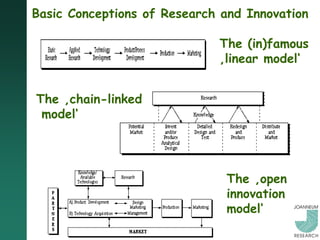
Basic Conceptions of Research and Innovation

                             The (in)famous
                             ‚linear model‘


The ‚chain-linked
 model‘


                               The ‚open
                               innovation
                               model‘
Basic Instruments of Science and Innovation Policy


     ‚Base„ or ‚core„ or ‚institutional‘
      funding of research institutions
      (universities, public research labs
      etc.)
     Public funding of private R&D
         Direct funding (subsidies)
         Indirect funding (R&D tax
          credits)
     Intellectual Property rights (e.g.
      patents, trademarks as incentives
      for innovation)
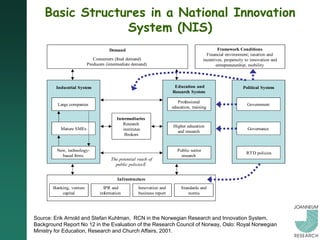
Basic Structures in a National Innovation
                 System (NIS)
                                     Demand                                                     Framework Conditions
                                                                                          Financial environment; taxation and
                             Consumers (final demand)                                   incentives; propensity to innovation and
                          Producers (intermediate demand)                                      entrepreneurship; mobility


         Industrial System                                             Education and                         Political System
                                                                      Research System

                                                                         Professional
         Large companies                                                                                       Government
                                                                      education, training

                                         Intermediaries
                                            Research
                                                                      Higher education
           Mature SMEs                      institutes                                                          Governance
                                                                        and research
                                             Brokers


         New, technology-                                               Public sector
                                                                                                               RTD policies
           based firms                                                    research
                                      The potential reach of
                                        public policiesÉ


                                         Infrastructure
       Banking, venture           IPR and           Innovation and        Standards and
           capital              information         business report           norms


Source: Erik Arnold and Stefan Kuhlman, RCN in the Norwegian Research and Innovation System,
Background Report No 12 in the Evaluation of the Research Council of Norway, Oslo: Royal Norwegian
Ministry for Education, Research and Church Affairs, 2001.
Developments of Instruments of Science and
Innovation Policy in a systemic perspective


     Fostering ‚Industry-Science –
      Relations‘ (ISR)
     Creating Public-Private
      Partnerships (PPPs)
     (Again) addressing ‘Grand
      (societal) Challenges‘ (Mission-
      oriented Research)
Recent trends and good practice in Research and
Innovation Policy
    RTP has become a major policy area in many
     OECD countries
    Increasingly to be seen: formulation of explicit
     RTP strategies
        Setting quantitative targets
        Explicit ‚policy learning„ (‚open method of co-ordination„)
    Setting targets and identifying priorities
        Thematic
        Functional
    Refining funding instruments
        Increasingly ‚Competitive„ / Programme funding -
         Increasing the leverage effects of direct funding of
         private R&D
        Increases in ‚indirect„ support to R&D via R&D tax
         credits
Recent trends and good practice in Research and
Innovation Policy
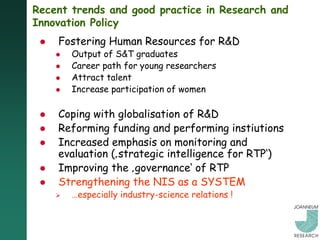
    Fostering Human Resources for R&D
        Output of S&T graduates
        Career path for young researchers
        Attract talent
        Increase participation of women

    Coping with globalisation of R&D
    Reforming funding and performing instiutions
    Increased emphasis on monitoring and
     evaluation (‚strategic intelligence for RTP„)
    Improving the ‚governance„ of RTP
    Strengthening the NIS as a SYSTEM
        …especially industry-science relations !
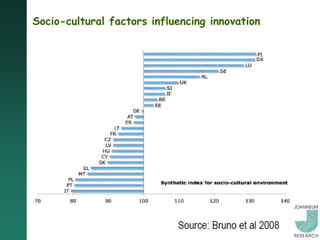
Socio-cultural factors influencing innovation
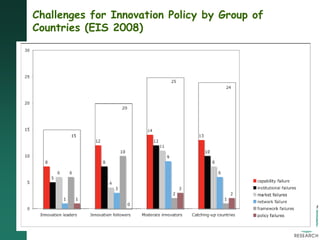
Challenges for Innovation Policy by Group of
Countries (EIS 2008)
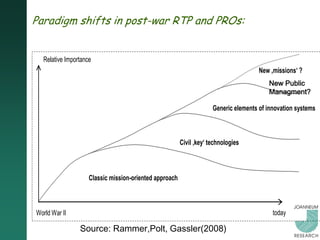
Paradigm shifts in post-war RTP and PROs:


  Relative Importance
                                                                                      New ‚missions‘ ?
                                                                                         New Public
                                                                                         Managment?

                                                                     Generic elements of innovation systems


                                                        Civil ‚key‘ technologies


                    Classic mission-oriented approach


World War II                                                                               today

                Source: Rammer,Polt, Gassler(2008)
Global Trends in R&D and R&I Policies
Some basic trends in R&D

    General increases in the knowledge intensity
     of production of goods and services
    Share of business sector increases with level
     of development
    Share of service sector in R&D and in
     innovation increases
    New ‚mode of production of knowledge„:
     INTERACTION !
    Specialisation patterns between countries
     differ … and will continue to do so (industrial
     history, public priority setting…)
    Increasing globalisation (also of R&D) … in
     various channels (international mobility,
     international cooperation, inward/outward FDI)
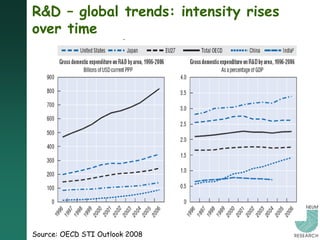
R&D – global trends: intensity rises
over time


Source: OECD STI Outlook 2008
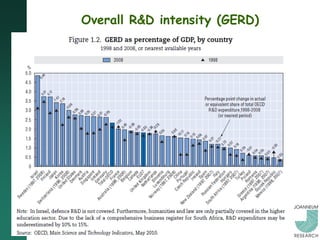
Overall R&D intensity (GERD)
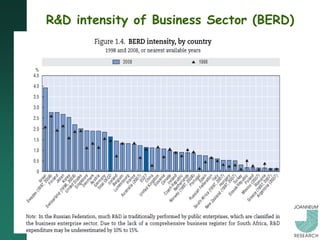
R&D intensity of Business Sector (BERD)
Source: OECD STI Outlook 2010
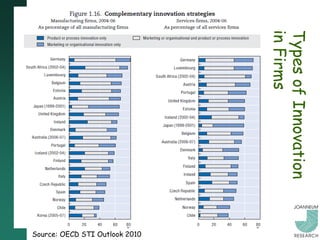
in Firms
                                Types of Innovation
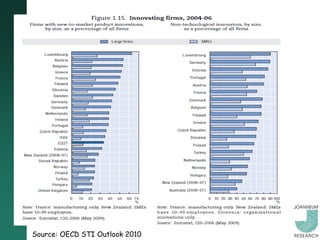
Source: OECD STI Outlook 2010
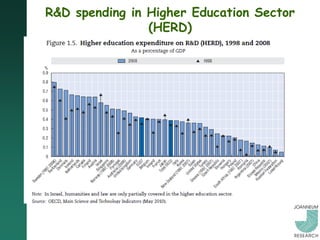
R&D spending in Higher Education Sector
                (HERD)
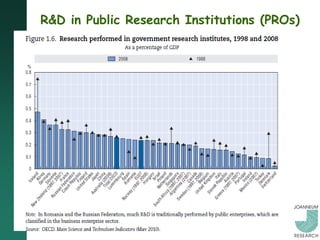
R&D in Public Research Institutions (PROs)
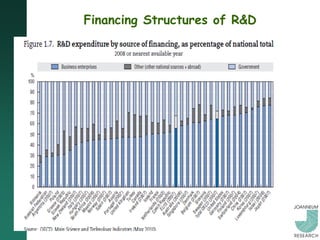
Financing Structures of R&D
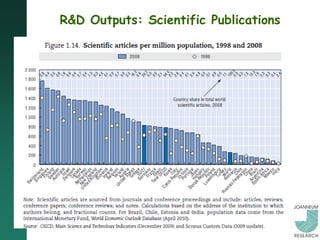
R&D Outputs: Scientific Publications
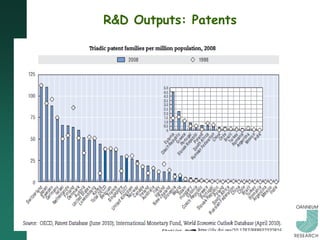
R&D Outputs: Patents
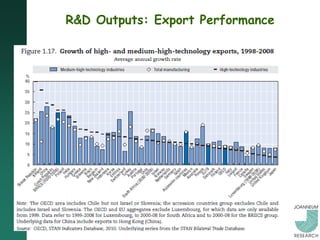
R&D Outputs: Export Performance
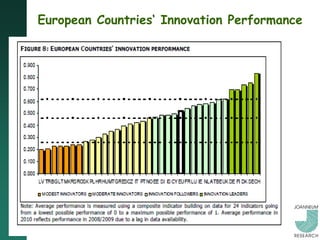
European Countries‘ Innovation Performance
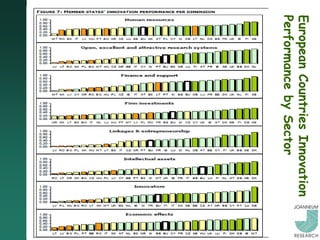
European Countries Innovation
Performance by Sector
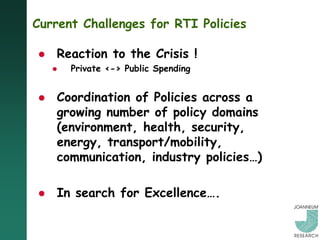
Current Challenges for RTI Policies

   Reaction to the Crisis !
       Private <-> Public Spending


   Coordination of Policies across a
    growing number of policy domains
    (environment, health, security,
    energy, transport/mobility,
    communication, industry policies…)

   In search for Excellence….
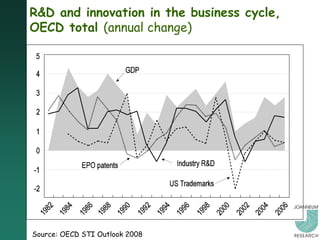
R&D and innovation in the business cycle,
OECD total (annual change)


Source: OECD STI Outlook 2008
Characteristics of CEEC innovation systems

   Low overall R&D intensity,
   CEEC have – in contrast to other
    countries – considerably decreased
    R&D spending post 1990 !
   Private sector R&D is still considerably
    lower than in more advanced countries
   Large share of R&D in the Government
    Sector  Academies of Sciences;
    Institutes in Energy and Defense R&D
Characteristics of CEEC innovation systems

   With the break-down of old structures
    industry science link almost collapsed
   Problems in Human Ressources and
    Quality of Education
   Clear divide between the EU members
    of CEEC and the non-EU members
       High FDI inflows,
       considerable share of high/medium-high
        tech industries characterize the former
       much stronger focus of process innovation
        than elsewhere
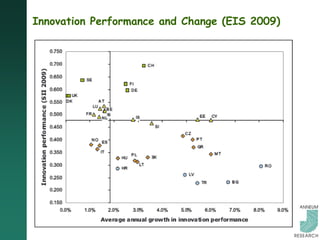
Innovation Performance and Change (EIS 2009)
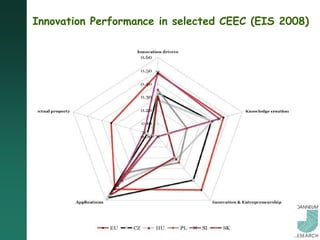
Innovation Performance in selected CEEC (EIS 2008)
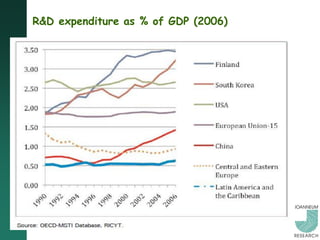
R&D expenditure as % of GDP (2006)
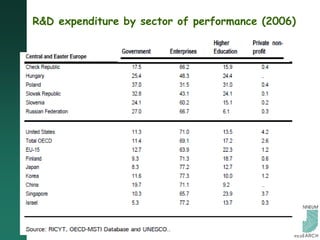
R&D expenditure by sector of performance (2006)
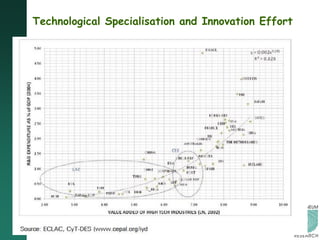
Technological Specialisation and Innovation Effort
Characteristics of CEEC‘s research and
innovation policies
Characteristics of CEEC‘s R&I policies

   STI policies were not given much
    attention in the post-1990 period,
    focus was rather on ‚macroeconomic
    stability‘ (‚Washington consensus‘)
   ‚Stop and Go‘ approach to STI policies
   Pressure to build up own STI
    capacities is rising, competitive
    advantage of cheap, skilled labour +
    low business taxation/regulation is
    eroding
Characteristics of CEEC R&I policies

   EU plays considerable role for STI poliy
    formulation and governance
   … but the creation of institutions (e.g.
    implementing agencies) and orientation towards
    EU STI policy setting (Framework Programme,
    Structural Funds) is not generally favourable !
   Lack of priority setting (mechanisms)
   „…CEE innovation policies tend to solve
    problems not existing in the respective
    economies“ (KATTEL & PRIMI 2010) – e.g.
    PPPs and TT
Main sources and suggested further reading:
     OECD: Science,Technology and Innovation Outlook
      2010. Paris
     EU: Innovation Union Scoreboard 2010. Brussels
     Austrian Report on Research and Development 2010.
      Vienna
     Helmut GASSLER, Wolfgang POLT, Christian RAMMER:
      Setting priorites in Science and Technology Policy. In:
      Claire Nauwelaires: Innovation Policy in Europe. Edward
      Elgar. 2008
     Rainer KATTEL, Annalisa PRIMI: The periphery
      paradox in innovation policy: Latin America and Eastern
      Europe compared. March 2010
     Alasdair REID: EU Innovation Policy: Towards a
      differentiated approach across countries. January
      2009
Thank you for your attention !

Polt Jvi Lecture 03 05 2011

  • 1.
    'Trends and challengesfor research, technology and innovation policy' JVI-Seminar Public Governance and Structural Reforms 3. May 2011 Wolfgang Polt Joanneum Research Ltd. - POLICIES – Centre for Economic and Innovation Research wolfgang.polt@joanneum.at
  • 2.
    Reseach, Technology andInnovation: Some Basic Concepts and Definitions
  • 3.
    Definition of Research,Technology and Innovation Policy Innovation Policy: “… all public measures that attempt to influence actors (enterprises, public institutions, households) to develop new knowledge and technologies (invention), to commercialise these new technologies (innovation) or to use them (diffusion)”. Research (or Science) policy: aimed at promoting research and the production of fundamentally new knowledge. (see Gassler/Polt/Rammer 2007)
  • 4.
    Rationale(s) for Researchand Innovation Policies (1) – Effects on Economic Growth  Innovation is the mayor driver of productivity and economic growth  Increasing share (though not and never ALL) of innovation is based on research and development (R&D)  Structural change is going into the direction of more ‚knowledge/skill/R&D intensive„ sectors  Competitiveness increasingly relies on mastering these knowledge intensive sectors
  • 5.
    Rationale(s) for Researchand Innovation Policies (2) – Effects on Societal Well-Being  R&D and Innovation contribute to coping with societal challenges:  Health  Environment  Security  Nutrition  Mobility  ….
  • 6.
    Rationale(s) for Researchand Innovation Policies (3) – market and systems failures  Public good characteristics of information and knowledge (spill- overs, externalities, non-rival consumption)  Indivisibilities, critical mass and network externalities  Risk aversion of private actors and capital markets  Coordination failures (market- and non-market incentives co-exist)
  • 7.
    Basic Conceptions ofResearch and Innovation The (in)famous ‚linear model‘ The ‚chain-linked model‘ The ‚open innovation model‘
  • 8.
    Basic Instruments ofScience and Innovation Policy  ‚Base„ or ‚core„ or ‚institutional‘ funding of research institutions (universities, public research labs etc.)  Public funding of private R&D Direct funding (subsidies) Indirect funding (R&D tax credits)  Intellectual Property rights (e.g. patents, trademarks as incentives for innovation)
  • 9.
    Basic Structures ina National Innovation System (NIS) Demand Framework Conditions Financial environment; taxation and Consumers (final demand) incentives; propensity to innovation and Producers (intermediate demand) entrepreneurship; mobility Industrial System Education and Political System Research System Professional Large companies Government education, training Intermediaries Research Higher education Mature SMEs institutes Governance and research Brokers New, technology- Public sector RTD policies based firms research The potential reach of public policiesÉ Infrastructure Banking, venture IPR and Innovation and Standards and capital information business report norms Source: Erik Arnold and Stefan Kuhlman, RCN in the Norwegian Research and Innovation System, Background Report No 12 in the Evaluation of the Research Council of Norway, Oslo: Royal Norwegian Ministry for Education, Research and Church Affairs, 2001.
  • 10.
    Developments of Instrumentsof Science and Innovation Policy in a systemic perspective  Fostering ‚Industry-Science – Relations‘ (ISR)  Creating Public-Private Partnerships (PPPs)  (Again) addressing ‘Grand (societal) Challenges‘ (Mission- oriented Research)
  • 11.
    Recent trends andgood practice in Research and Innovation Policy  RTP has become a major policy area in many OECD countries  Increasingly to be seen: formulation of explicit RTP strategies  Setting quantitative targets  Explicit ‚policy learning„ (‚open method of co-ordination„)  Setting targets and identifying priorities  Thematic  Functional  Refining funding instruments  Increasingly ‚Competitive„ / Programme funding - Increasing the leverage effects of direct funding of private R&D  Increases in ‚indirect„ support to R&D via R&D tax credits
  • 12.
    Recent trends andgood practice in Research and Innovation Policy  Fostering Human Resources for R&D  Output of S&T graduates  Career path for young researchers  Attract talent  Increase participation of women  Coping with globalisation of R&D  Reforming funding and performing instiutions  Increased emphasis on monitoring and evaluation (‚strategic intelligence for RTP„)  Improving the ‚governance„ of RTP  Strengthening the NIS as a SYSTEM  …especially industry-science relations !
  • 13.
  • 14.
    Challenges for InnovationPolicy by Group of Countries (EIS 2008)
  • 15.
    Paradigm shifts inpost-war RTP and PROs: Relative Importance New ‚missions‘ ? New Public Managment? Generic elements of innovation systems Civil ‚key‘ technologies Classic mission-oriented approach World War II today Source: Rammer,Polt, Gassler(2008)
  • 16.
    Global Trends inR&D and R&I Policies
  • 17.
    Some basic trendsin R&D  General increases in the knowledge intensity of production of goods and services  Share of business sector increases with level of development  Share of service sector in R&D and in innovation increases  New ‚mode of production of knowledge„: INTERACTION !  Specialisation patterns between countries differ … and will continue to do so (industrial history, public priority setting…)  Increasing globalisation (also of R&D) … in various channels (international mobility, international cooperation, inward/outward FDI)
  • 18.
    R&D – globaltrends: intensity rises over time Source: OECD STI Outlook 2008
  • 19.
  • 20.
    R&D intensity ofBusiness Sector (BERD)
  • 21.
    Source: OECD STIOutlook 2010
  • 22.
    in Firms Types of Innovation Source: OECD STI Outlook 2010
  • 23.
    R&D spending inHigher Education Sector (HERD)
  • 24.
    R&D in PublicResearch Institutions (PROs)
  • 25.
  • 26.
  • 27.
  • 28.
  • 29.
  • 30.
  • 31.
    Current Challenges forRTI Policies  Reaction to the Crisis !  Private <-> Public Spending  Coordination of Policies across a growing number of policy domains (environment, health, security, energy, transport/mobility, communication, industry policies…)  In search for Excellence….
  • 32.
    R&D and innovationin the business cycle, OECD total (annual change) Source: OECD STI Outlook 2008
  • 33.
    Characteristics of CEECinnovation systems
  • 34.
    Characteristics of CEECinnovation systems  Low overall R&D intensity,  CEEC have – in contrast to other countries – considerably decreased R&D spending post 1990 !  Private sector R&D is still considerably lower than in more advanced countries  Large share of R&D in the Government Sector  Academies of Sciences; Institutes in Energy and Defense R&D
  • 35.
    Characteristics of CEECinnovation systems  With the break-down of old structures industry science link almost collapsed  Problems in Human Ressources and Quality of Education  Clear divide between the EU members of CEEC and the non-EU members  High FDI inflows,  considerable share of high/medium-high tech industries characterize the former  much stronger focus of process innovation than elsewhere
  • 36.
    Innovation Performance andChange (EIS 2009)
  • 37.
    Innovation Performance inselected CEEC (EIS 2008)
  • 38.
    R&D expenditure as% of GDP (2006)
  • 39.
    R&D expenditure bysector of performance (2006)
  • 40.
  • 41.
    Characteristics of CEEC‘sresearch and innovation policies
  • 42.
    Characteristics of CEEC‘sR&I policies  STI policies were not given much attention in the post-1990 period, focus was rather on ‚macroeconomic stability‘ (‚Washington consensus‘)  ‚Stop and Go‘ approach to STI policies  Pressure to build up own STI capacities is rising, competitive advantage of cheap, skilled labour + low business taxation/regulation is eroding
  • 43.
    Characteristics of CEECR&I policies  EU plays considerable role for STI poliy formulation and governance  … but the creation of institutions (e.g. implementing agencies) and orientation towards EU STI policy setting (Framework Programme, Structural Funds) is not generally favourable !  Lack of priority setting (mechanisms)  „…CEE innovation policies tend to solve problems not existing in the respective economies“ (KATTEL & PRIMI 2010) – e.g. PPPs and TT
  • 44.
    Main sources andsuggested further reading:  OECD: Science,Technology and Innovation Outlook 2010. Paris  EU: Innovation Union Scoreboard 2010. Brussels  Austrian Report on Research and Development 2010. Vienna  Helmut GASSLER, Wolfgang POLT, Christian RAMMER: Setting priorites in Science and Technology Policy. In: Claire Nauwelaires: Innovation Policy in Europe. Edward Elgar. 2008  Rainer KATTEL, Annalisa PRIMI: The periphery paradox in innovation policy: Latin America and Eastern Europe compared. March 2010  Alasdair REID: EU Innovation Policy: Towards a differentiated approach across countries. January 2009
  • 45.
    Thank you foryour attention !