Innovability
- Turning Innovation Policy into Practise -


Gerd Meier zu Köcker
iit – Institute for Innovation and Technology
The Morocco Case
- Dream or Nightmare for Policy Makers -


Governmental task:

Improve national competitiveness in Solar Energy

Funds available: EUR 10 Mio

Measurable impact: 3 – 5 years


                                                   2
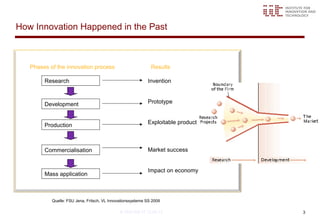
How Innovation Happened in the Past


   Phases of the innovation process                           Results

        Research                                            Invention


        Development                                         Prototype


                                                            Exploitable product
        Production


        Commercialisation                                   Market success


                                                            Impact on economy
        Mass application


           Quelle: FSU Jena, Fritsch, VL Innovationssysteme SS 2009

                                              © VDI/VDE-IT 12.04.13               3
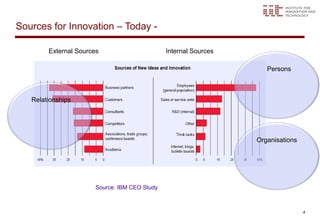
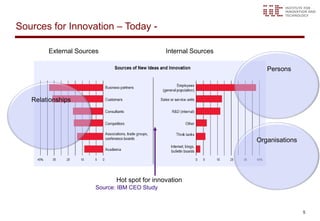
Sources for Innovation – Today -

        External Sources                       Internal Sources

                                                                     Persons


   Relationships


                                                                  Organisations


                       Source: IBM CEO Study


                                                                                  4
Sources for Innovation – Today -

        External Sources                       Internal Sources

                                                                     Persons


   Relationships


                                                                  Organisations


                              Hot spot for innovation
                       Source: IBM CEO Study


                                                                                  5
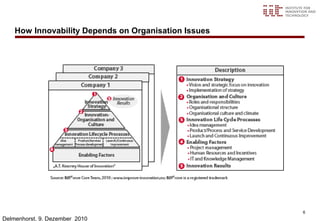
How Innovability Depends on Organisation Issues


                                                      6
Delmenhorst, 9. Dezember 2010
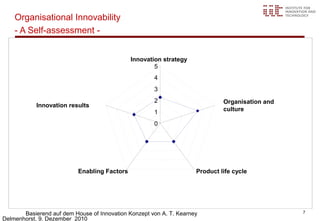
Organisational Innovability
    - A Self-assessment -


                                              Innovation strategy
                                                      5
                                                      4
                                                      3
                                                      2                       Organisation and
            Innovation results
                                                      1                       culture

                                                      0


                           Enabling Factors                          Product life cycle


       Basierend auf dem House of Innovation Konzept von A. T. Kearney                           7
Delmenhorst, 9. Dezember 2010
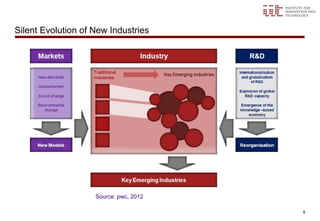
Silent Evolution of New Industries


                    Source: pwc, 2012

                                        8
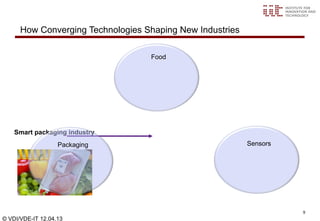
How Converging Technologies Shaping New Industries

                                   Food


    Smart packaging industry
                   Packaging                               Sensors


                                                                     9
© VDI/VDE-IT 12.04.13
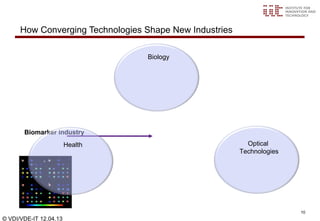
How Converging Technologies Shape New Industries

                                  Biology


       Biomarker industry
                        Health                             Optical
                                                         Technologies


                                                                        10
© VDI/VDE-IT 12.04.13
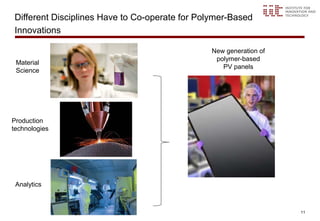
Different Disciplines Have to Co-operate for Polymer-Based
Innovations

                                                New generation of
                                                 polymer-based
 Material
                                                   PV panels
 Science


Production
technologies


 Analytics


                                                                    11
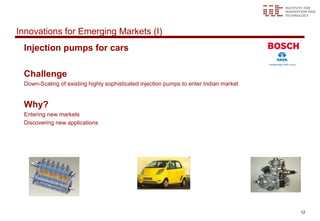
Innovations for Emerging Markets (I)
 Injection pumps for cars

 Challenge
 Down-Scaling of existing highly sophisticated injection pumps to enter Indian market


 Why?
 Entering new markets
 Discovering new applications


                                                                                        12
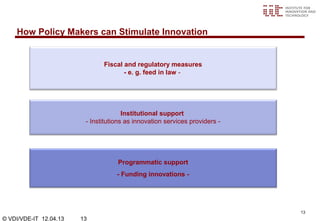
How Policy Makers can Stimulate Innovation


                               Fiscal and regulatory measures
                                      - e. g. feed in law -


                                       Institutional support
                         - Institutions as innovation services providers -


                                    Programmatic support
                                    - Funding innovations -


                                                                             13
© VDI/VDE-IT 12.04.13   13
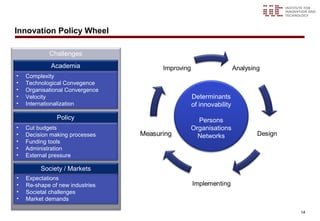
Innovation Policy Wheel

            Challenges
             Academia
•   Complexity
•   Technological Convegence
•   Organisational Convergence
•   Velocity                     Determinants
•   Internationalization         of innovability
               Policy              Persons
•   Cut budgets                  Organisations
•   Decision making processes      Networks
•   Funding tools
•   Administration
•   External pressure

         Society / Markets
•   Expectations
•   Re-shape of new industries
•   Societal challenges
•   Market demands

                                                   14
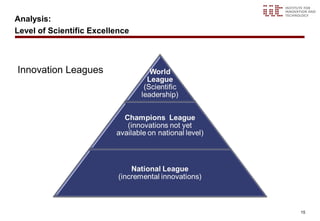
Analysis:
Level of Scientific Excellence


Innovation Leagues


                                 15
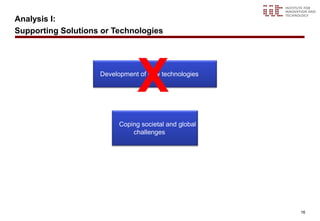
Analysis I:
Supporting Solutions or Technologies


                               X
                    Development of new technologies


                         Coping societal and global
                             challenges


                                                      16
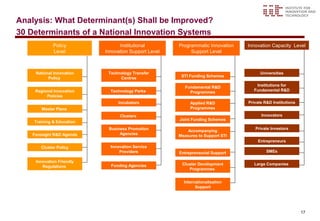
Analysis: What Determinant(s) Shall be Improved?
30 Determinants of a National Innovation Systems
             Policy              Institutional        Programmatic Innovation   Innovation Capacity Level
             Level         Innovation Support Level        Support Level


    National Innovation     Technology Transfer                                       Universities
                                                       STI Funding Schemes
          Policy                 Centres

                                                         Fundamental R&D           Institutions for
    Regional Innovation      Technology Parks              Programmes             Fundamental R&D
         Policies
                                Incubators                 Applied R&D          Private R&D Institutions
       Master Plans                                        Programmes
                                 Clusters                                             Innovators
                                                      Joint Funding Schemes
    Training & Education
                            Business Promotion                                     Private Investors
                                                          Accompanying
   Foresight R&D Agenda          Agencies             Measures to Support STI
                                                                                    Entrepreneurs
       Cluster Policy        Innovation Service
                                 Providers            Entrepreneurial Support            SMEs

    Innovation Friendly
                             Funding Agencies          Cluster Development        Large Companies
       Regulations
                                                          Programmes


                                                        Internationalisation
                                                              Support


                                                                                                           17
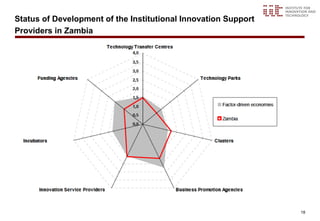
Status of Development of the Institutional Innovation Support
Providers in Zambia


                                                                18
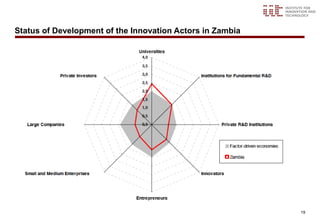
Status of Development of the Innovation Actors in Zambia


                                                           19
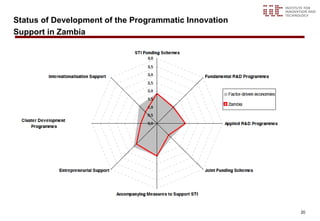
Status of Development of the Programmatic Innovation
Support in Zambia


                                                       20
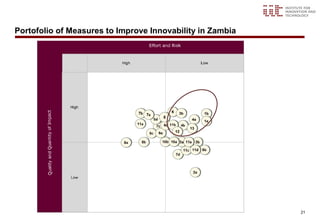
Portofolio of Measures to Improve Innovability in Zambia


                                                           21
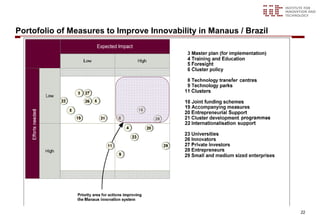
Portofolio of Measures to Improve Innovability in Manaus / Brazil


                                                                    22
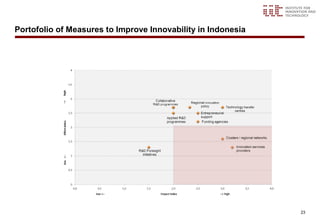
Portofolio of Measures to Improve Innovability in Indonesia


                                                              23
Design:
New Role of Academia Due to the New Nature of Innovation


                 Key programme design figures


                                                           24
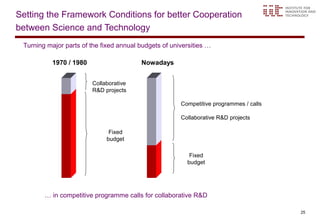
Setting the Framework Conditions for better Cooperation
between Science and Technology
 Turning major parts of the fixed annual budgets of universities …

           1970 / 1980                   Nowadays


                         Collaborative
                         R&D projects

                                                       Competitive programmes / calls

                                                       Collaborative R&D projects

                               Fixed
                              budget

                                                          Fixed
                                                         budget


        … in competitive programme calls for collaborative R&D

                                                                                        25
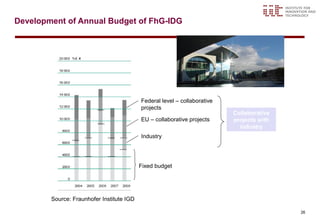
Development of Annual Budget of FhG-IDG


                                           Federal level – collaborative
                                           projects
                                                                           Collaborative
                                           EU – collaborative projects     projects with
                                                                             industry
                                           Industry


                                           Fixed budget


        Source: Fraunhofer Institute IGD

                                                                                           26
Design:
Key Outline of Programme Design Features


                       ….how to do it ?
                   … what has to be funded ?
                   ….who has to be funded ?
                     … which instruments


                                               27
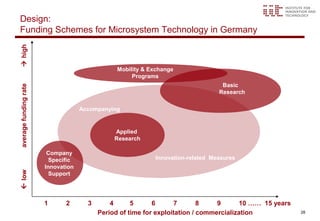
Design:
Funding Schemes for Microsystem Technology in Germany
 high


                                                Mobility & Exchange
                                                     Programs
                                                                                  Basic
average funding rate


                                                                                 Research

                                    Accompanying


                                               Applied
                                               Research

                        Company
                         Specific                           Innovation-related Measures
                       Innovation
 low


                         Support


                       1      2       3       4      5      6      7        8    9       10 …… 15 years
                                          Period of time for exploitation / commercialization             28
Design:
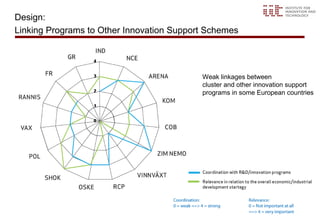
Linking Programs to Other Innovation Support Schemes


                                           Weak linkages between
                                           cluster and other innovation support
                                           programs in some European countries


                                                                          29
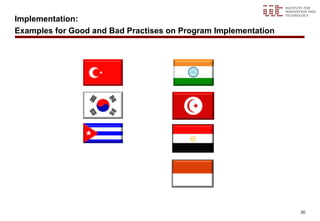
Implementation:
Examples for Good and Bad Practises on Program Implementation


                                                                30
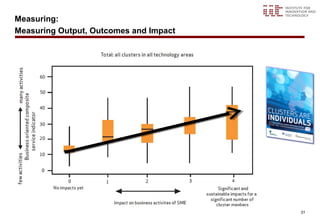
Measuring:
Measuring Output, Outcomes and Impact


                                        31
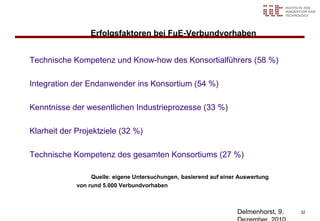
Erfolgsfaktoren bei FuE-Verbundvorhaben


Technische Kompetenz und Know-how des Konsortialführers (58 %)

Integration der Endanwender ins Konsortium (54 %)

Kenntnisse der wesentlichen Industrieprozesse (33 %)

Klarheit der Projektziele (32 %)

Technische Kompetenz des gesamten Konsortiums (27 %)

                  Quelle: eigene Untersuchungen, basierend auf einer Auswertung
             von rund 5.000 Verbundvorhaben


                                                                    Delmenhorst, 9.   32
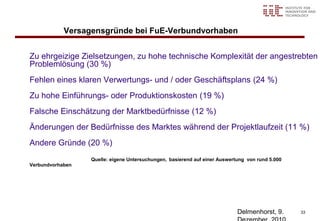
Versagensgründe bei FuE-Verbundvorhaben


Zu ehrgeizige Zielsetzungen, zu hohe technische Komplexität der angestrebten
Problemlösung (30 %)
Fehlen eines klaren Verwertungs- und / oder Geschäftsplans (24 %)
Zu hohe Einführungs- oder Produktionskosten (19 %)
Falsche Einschätzung der Marktbedürfnisse (12 %)
Änderungen der Bedürfnisse des Marktes während der Projektlaufzeit (11 %)
Andere Gründe (20 %)
                  Quelle: eigene Untersuchungen, basierend auf einer Auswertung von rund 5.000
Verbundvorhaben


                                                                            Delmenhorst, 9.      33
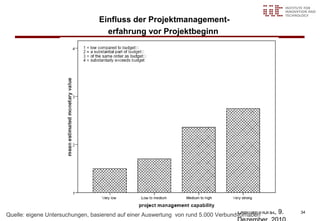
Einfluss der Projektmanagement-
                                   erfahrung vor Projektbeginn


                                                                                    Delmenhorst, 9.
Quelle: eigene Untersuchungen, basierend auf einer Auswertung von rund 5.000 Verbundvorhaben
                                                                                                      34
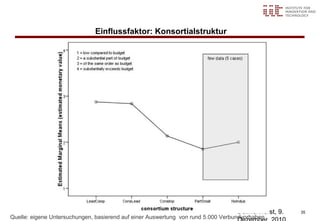
Einflussfaktor: Konsortialstruktur


                                                                                  Delmenhorst, 9.   35
Quelle: eigene Untersuchungen, basierend auf einer Auswertung von rund 5.000 Verbundvorhaben
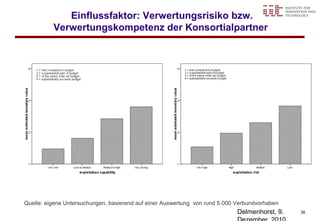
Einflussfaktor: Verwertungsrisiko bzw.
          Verwertungskompetenz der Konsortialpartner


Quelle: eigene Untersuchungen, basierend auf einer Auswertung von rund 5.000 Verbundvorhaben
                                                                             Delmenhorst, 9.   36
Erfolgsfaktoren bei FuE-Verbundvorhaben


Technische Kompetenz und Know-how des Konsortialführers (58 %)

Integration der Endanwender ins Konsortium (54 %)

Kenntnisse der wesentlichen Industrieprozesse (33 %)

Klarheit der Projektziele (32 %)

Technische Kompetenz des gesamten Konsortiums (27 %)

                  Quelle: eigene Untersuchungen, basierend auf einer Auswertung
             von rund 5.000 Verbundvorhaben


                                                                    Delmenhorst, 9.   37
Versagensgründe bei FuE-Verbundvorhaben


Zu ehrgeizige Zielsetzungen, zu hohe technische Komplexität der angestrebten
Problemlösung (30 %)
Fehlen eines klaren Verwertungs- und / oder Geschäftsplans (24 %)
Zu hohe Einführungs- oder Produktionskosten (19 %)
Falsche Einschätzung der Marktbedürfnisse (12 %)
Änderungen der Bedürfnisse des Marktes während der Projektlaufzeit (11 %)
Andere Gründe (20 %)
                  Quelle: eigene Untersuchungen, basierend auf einer Auswertung von rund 5.000
Verbundvorhaben


                                                                            Delmenhorst, 9.      38
Thank you very much for your attention


       Dr. Gerd Meier zu Köcker

        Chairman of the Board

Institute for Innovation and Technology

              Steinplatz 1
              10623 Berlin
      Tel.: +49 (0) 30 310078-118
      Fax: +49 (0) 30 310078-222
       E-Mail: mzk@iit-berlin.de
            www.iit-berlin.de


                                          39
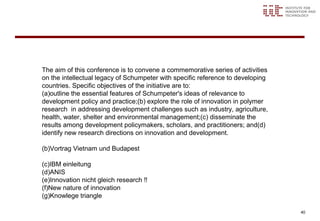
The aim of this conference is to convene a commemorative series of activities
on the intellectual legacy of Schumpeter with specific reference to developing
countries. Specific objectives of the initiative are to:
(a)outline the essential features of Schumpeter's ideas of relevance to
development policy and practice;
(b) explore the role of innovation in polymer
research in addressing development challenges such as industry, agriculture,
health, water, shelter and environmental management;
(c) disseminate the
results among development policymakers, scholars, and practitioners;
 and(d)
identify new research directions on innovation and development.

(b)Vortrag Vietnam und Budapest

(c)IBM einleitung
(d)ANIS
(e)Innovation nicht gleich research !!
(f)New nature of innovation
(g)Knowlege triangle

                                                                                 40
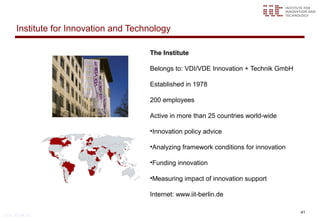
Institute for Innovation and Technology

                                       The Institute

                                       Belongs to: VDI/VDE Innovation + Technik GmbH

                                       Established in 1978

                                       200 employees

                                       Active in more than 25 countries world-wide

                                       •Innovation policy advice

                                       •Analyzing framework conditions for innovation

                                       •Funding innovation

                                       •Measuring impact of innovation support

                                       Internet: www.iit-berlin.de

                                                                                        41
© iit, 12.04.13
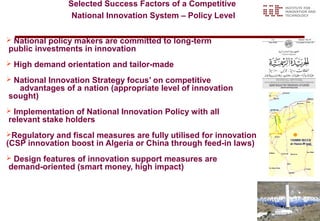
Selected Success Factors of a Competitive
                  National Innovation System – Policy Level

National policy makers are committed to long-term
public investments in innovation
   High demand orientation and tailor-made
National Innovation Strategy focus’ on competitive
  advantages of a nation (appropriate level of innovation
sought)
Implementation of National Innovation Policy with all
relevant stake holders
Regulatory and fiscal measures are fully utilised for innovation
(CSP innovation boost in Algeria or China through feed-in laws)
Design features of innovation support measures are
demand-oriented (smart money, high impact)


                                                                    42
Selected Success Factors of a Competitive
                             National Innovation System – Meso Level

          Many different actors of a national innovation system
          are available
          know and fulfil their tasks and duties
          are fully operational (staff, budget, equipment, etc.)
          operate in an innovation friendly surrounding
        Funding agencies are responsible for the design and management
       of public funding measures (on behalf of Ministries, low
       administration)
        Close co-operation and communication between industry and

       science (e. g. stimulated by public funding)
       Innovation actors on meso-level are be open for transnational co-

       operation
       Innovation friendly surrounding (e. g. Public Understanding of Science)


                                                                             43
Berlin, January 6 ,l 2009
                 th
Selected Success Factors of a Competitive
                             National Innovation System – Micro Level

      Sufficient educational and vocational training system into force

      Low barriers towards funding and financing R&D, even for SME

    Public innovation actors can operate in a flexible and customer
    oriented way

    Close co-operation between industry & science (stimulated by public
    funding)

    Universities, public R&D-institutions and innovation agencies do not
    have a fixed budget

   Incentives        for exploitation and commercialisation of R&D results are given

                                                                                   44
Berlin, January 6 ,l 2009
                 th
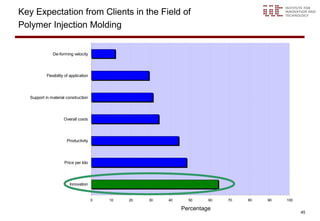
Key Expectation from Clients in the Field of
Polymer Injection Molding


               De-forming velocity


            Flexibility of application


   Support in material construction


                      Overall costs


                        Productivity


                       Price per kilo


                          Innovation


                                         0   10   20   30   40     50     60   70   80   90   100

                                                                 Percentage
                                                                                                    45

Turning Innovation Policy into Practice

  • 1.
    Innovability - Turning InnovationPolicy into Practise - Gerd Meier zu Köcker iit – Institute for Innovation and Technology
  • 2.
    The Morocco Case -Dream or Nightmare for Policy Makers - Governmental task: Improve national competitiveness in Solar Energy Funds available: EUR 10 Mio Measurable impact: 3 – 5 years 2
  • 3.
    How Innovation Happenedin the Past Phases of the innovation process Results Research Invention Development Prototype Exploitable product Production Commercialisation Market success Impact on economy Mass application Quelle: FSU Jena, Fritsch, VL Innovationssysteme SS 2009 © VDI/VDE-IT 12.04.13 3
  • 4.
    Sources for Innovation– Today - External Sources Internal Sources Persons Relationships Organisations Source: IBM CEO Study 4
  • 5.
    Sources for Innovation– Today - External Sources Internal Sources Persons Relationships Organisations Hot spot for innovation Source: IBM CEO Study 5
  • 6.
    How Innovability Dependson Organisation Issues 6 Delmenhorst, 9. Dezember 2010
  • 7.
    Organisational Innovability - A Self-assessment - Innovation strategy 5 4 3 2 Organisation and Innovation results 1 culture 0 Enabling Factors Product life cycle Basierend auf dem House of Innovation Konzept von A. T. Kearney 7 Delmenhorst, 9. Dezember 2010
  • 8.
    Silent Evolution ofNew Industries Source: pwc, 2012 8
  • 9.
    How Converging TechnologiesShaping New Industries Food Smart packaging industry Packaging Sensors 9 © VDI/VDE-IT 12.04.13
  • 10.
    How Converging TechnologiesShape New Industries Biology Biomarker industry Health Optical Technologies 10 © VDI/VDE-IT 12.04.13
  • 11.
    Different Disciplines Haveto Co-operate for Polymer-Based Innovations New generation of polymer-based Material PV panels Science Production technologies Analytics 11
  • 12.
    Innovations for EmergingMarkets (I) Injection pumps for cars Challenge Down-Scaling of existing highly sophisticated injection pumps to enter Indian market Why? Entering new markets Discovering new applications 12
  • 13.
    How Policy Makerscan Stimulate Innovation Fiscal and regulatory measures - e. g. feed in law - Institutional support - Institutions as innovation services providers - Programmatic support - Funding innovations - 13 © VDI/VDE-IT 12.04.13 13
  • 14.
    Innovation Policy Wheel Challenges Academia • Complexity • Technological Convegence • Organisational Convergence • Velocity Determinants • Internationalization of innovability Policy Persons • Cut budgets Organisations • Decision making processes Networks • Funding tools • Administration • External pressure Society / Markets • Expectations • Re-shape of new industries • Societal challenges • Market demands 14
  • 15.
    Analysis: Level of ScientificExcellence Innovation Leagues 15
  • 16.
    Analysis I: Supporting Solutionsor Technologies X Development of new technologies Coping societal and global challenges 16
  • 17.
    Analysis: What Determinant(s)Shall be Improved? 30 Determinants of a National Innovation Systems Policy Institutional Programmatic Innovation Innovation Capacity Level Level Innovation Support Level Support Level National Innovation Technology Transfer Universities STI Funding Schemes Policy Centres Fundamental R&D Institutions for Regional Innovation Technology Parks Programmes Fundamental R&D Policies Incubators Applied R&D Private R&D Institutions Master Plans Programmes Clusters Innovators Joint Funding Schemes Training & Education Business Promotion Private Investors Accompanying Foresight R&D Agenda Agencies Measures to Support STI Entrepreneurs Cluster Policy Innovation Service Providers Entrepreneurial Support SMEs Innovation Friendly Funding Agencies Cluster Development Large Companies Regulations Programmes Internationalisation Support 17
  • 18.
    Status of Developmentof the Institutional Innovation Support Providers in Zambia 18
  • 19.
    Status of Developmentof the Innovation Actors in Zambia 19
  • 20.
    Status of Developmentof the Programmatic Innovation Support in Zambia 20
  • 21.
    Portofolio of Measuresto Improve Innovability in Zambia 21
  • 22.
    Portofolio of Measuresto Improve Innovability in Manaus / Brazil 22
  • 23.
    Portofolio of Measuresto Improve Innovability in Indonesia 23
  • 24.
    Design: New Role ofAcademia Due to the New Nature of Innovation Key programme design figures 24
  • 25.
    Setting the FrameworkConditions for better Cooperation between Science and Technology Turning major parts of the fixed annual budgets of universities … 1970 / 1980 Nowadays Collaborative R&D projects Competitive programmes / calls Collaborative R&D projects Fixed budget Fixed budget … in competitive programme calls for collaborative R&D 25
  • 26.
    Development of AnnualBudget of FhG-IDG Federal level – collaborative projects Collaborative EU – collaborative projects projects with industry Industry Fixed budget Source: Fraunhofer Institute IGD 26
  • 27.
    Design: Key Outline ofProgramme Design Features ….how to do it ? … what has to be funded ? ….who has to be funded ? … which instruments 27

  • 28.
    Design: Funding Schemes forMicrosystem Technology in Germany  high Mobility & Exchange Programs Basic average funding rate Research Accompanying Applied Research Company Specific Innovation-related Measures Innovation  low Support 1 2 3 4 5 6 7 8 9 10 …… 15 years Period of time for exploitation / commercialization 28
  • 29.
    Design: Linking Programs toOther Innovation Support Schemes Weak linkages between cluster and other innovation support programs in some European countries 29
  • 30.
    Implementation: Examples for Goodand Bad Practises on Program Implementation 30
  • 31.
  • 32.
    Erfolgsfaktoren bei FuE-Verbundvorhaben TechnischeKompetenz und Know-how des Konsortialführers (58 %) Integration der Endanwender ins Konsortium (54 %) Kenntnisse der wesentlichen Industrieprozesse (33 %) Klarheit der Projektziele (32 %) Technische Kompetenz des gesamten Konsortiums (27 %) Quelle: eigene Untersuchungen, basierend auf einer Auswertung von rund 5.000 Verbundvorhaben Delmenhorst, 9. 32
  • 33.
    Versagensgründe bei FuE-Verbundvorhaben Zuehrgeizige Zielsetzungen, zu hohe technische Komplexität der angestrebten Problemlösung (30 %) Fehlen eines klaren Verwertungs- und / oder Geschäftsplans (24 %) Zu hohe Einführungs- oder Produktionskosten (19 %) Falsche Einschätzung der Marktbedürfnisse (12 %) Änderungen der Bedürfnisse des Marktes während der Projektlaufzeit (11 %) Andere Gründe (20 %) Quelle: eigene Untersuchungen, basierend auf einer Auswertung von rund 5.000 Verbundvorhaben Delmenhorst, 9. 33
  • 34.
    Einfluss der Projektmanagement- erfahrung vor Projektbeginn Delmenhorst, 9. Quelle: eigene Untersuchungen, basierend auf einer Auswertung von rund 5.000 Verbundvorhaben 34
  • 35.
    Einflussfaktor: Konsortialstruktur Delmenhorst, 9. 35 Quelle: eigene Untersuchungen, basierend auf einer Auswertung von rund 5.000 Verbundvorhaben
  • 36.
    Einflussfaktor: Verwertungsrisiko bzw. Verwertungskompetenz der Konsortialpartner Quelle: eigene Untersuchungen, basierend auf einer Auswertung von rund 5.000 Verbundvorhaben Delmenhorst, 9. 36
  • 37.
    Erfolgsfaktoren bei FuE-Verbundvorhaben TechnischeKompetenz und Know-how des Konsortialführers (58 %) Integration der Endanwender ins Konsortium (54 %) Kenntnisse der wesentlichen Industrieprozesse (33 %) Klarheit der Projektziele (32 %) Technische Kompetenz des gesamten Konsortiums (27 %) Quelle: eigene Untersuchungen, basierend auf einer Auswertung von rund 5.000 Verbundvorhaben Delmenhorst, 9. 37
  • 38.
    Versagensgründe bei FuE-Verbundvorhaben Zuehrgeizige Zielsetzungen, zu hohe technische Komplexität der angestrebten Problemlösung (30 %) Fehlen eines klaren Verwertungs- und / oder Geschäftsplans (24 %) Zu hohe Einführungs- oder Produktionskosten (19 %) Falsche Einschätzung der Marktbedürfnisse (12 %) Änderungen der Bedürfnisse des Marktes während der Projektlaufzeit (11 %) Andere Gründe (20 %) Quelle: eigene Untersuchungen, basierend auf einer Auswertung von rund 5.000 Verbundvorhaben Delmenhorst, 9. 38
  • 39.
    Thank you verymuch for your attention Dr. Gerd Meier zu Köcker Chairman of the Board Institute for Innovation and Technology Steinplatz 1 10623 Berlin Tel.: +49 (0) 30 310078-118 Fax: +49 (0) 30 310078-222 E-Mail: mzk@iit-berlin.de www.iit-berlin.de 39
  • 40.
    The aim ofthis conference is to convene a commemorative series of activities on the intellectual legacy of Schumpeter with specific reference to developing countries. Specific objectives of the initiative are to: (a)outline the essential features of Schumpeter's ideas of relevance to development policy and practice;
(b) explore the role of innovation in polymer research in addressing development challenges such as industry, agriculture, health, water, shelter and environmental management;
(c) disseminate the results among development policymakers, scholars, and practitioners;
 and(d) identify new research directions on innovation and development. (b)Vortrag Vietnam und Budapest (c)IBM einleitung (d)ANIS (e)Innovation nicht gleich research !! (f)New nature of innovation (g)Knowlege triangle 40
  • 41.
    Institute for Innovationand Technology The Institute Belongs to: VDI/VDE Innovation + Technik GmbH Established in 1978 200 employees Active in more than 25 countries world-wide •Innovation policy advice •Analyzing framework conditions for innovation •Funding innovation •Measuring impact of innovation support Internet: www.iit-berlin.de 41 © iit, 12.04.13
  • 42.
    Selected Success Factorsof a Competitive National Innovation System – Policy Level National policy makers are committed to long-term public investments in innovation  High demand orientation and tailor-made National Innovation Strategy focus’ on competitive advantages of a nation (appropriate level of innovation sought) Implementation of National Innovation Policy with all relevant stake holders Regulatory and fiscal measures are fully utilised for innovation (CSP innovation boost in Algeria or China through feed-in laws) Design features of innovation support measures are demand-oriented (smart money, high impact) 42
  • 43.
    Selected Success Factorsof a Competitive National Innovation System – Meso Level  Many different actors of a national innovation system  are available  know and fulfil their tasks and duties  are fully operational (staff, budget, equipment, etc.)  operate in an innovation friendly surrounding  Funding agencies are responsible for the design and management of public funding measures (on behalf of Ministries, low administration)  Close co-operation and communication between industry and science (e. g. stimulated by public funding) Innovation actors on meso-level are be open for transnational co- operation Innovation friendly surrounding (e. g. Public Understanding of Science) 43 Berlin, January 6 ,l 2009 th
  • 44.
    Selected Success Factorsof a Competitive National Innovation System – Micro Level  Sufficient educational and vocational training system into force  Low barriers towards funding and financing R&D, even for SME  Public innovation actors can operate in a flexible and customer oriented way  Close co-operation between industry & science (stimulated by public funding)  Universities, public R&D-institutions and innovation agencies do not have a fixed budget Incentives for exploitation and commercialisation of R&D results are given 44 Berlin, January 6 ,l 2009 th
  • 45.
    Key Expectation fromClients in the Field of Polymer Injection Molding De-forming velocity Flexibility of application Support in material construction Overall costs Productivity Price per kilo Innovation 0 10 20 30 40 50 60 70 80 90 100 Percentage 45

Editor's Notes

  • #4 Innovationsprozess früher
  • #26 Mare R&D means innovation Universicties are drivers for innovation Isolated entrepreneurial support
  • #43 Dies sind einige Erfolgsfaktoren für NIS-Politik