Public Sector Innovation Management
Dr. Enrico Ferro
www.enricoferro.com
Technology Intelligence for Government, Business & Society
Setting the Stage for Successful Learning
• Let’s not take language for granted
• Getting the fundamentals right
• Starting from the same page: shared definitions
• Your input is vital
2Technology Intelligence for Government, Business & Society
3Technology Intelligence for Government, Business & Society
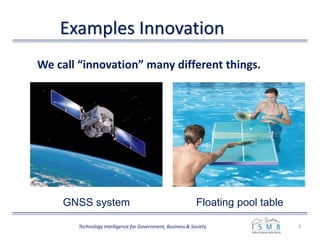
Examples Innovation
We call “innovation” many different things.
Floating pool tableGNSS system
How to Define Innovation?
Innovation is a new way of doing things that is
commercialized. The process of innovation cannot be
separated from a firm’s strategic and competitive context.
Michael Eugene Porter
4Technology Intelligence for Government, Business & Society
Two Aspects to Keep in Mind
What is a technological trajectory?
– The path a technology follows through time is termed its
technological trajectory. Many consistent patterns have
been observed in technological trajectories, helping to
understand how technologies improve and diffuse.
Not only one type of innovation
– Several dimensions are used to categorize innovations.
These dimensions help clarify how diverse innovations
offer different opportunities (and pose different
requirements) on producers, users, and regulators.
5Technology Intelligence for Government, Business & Society
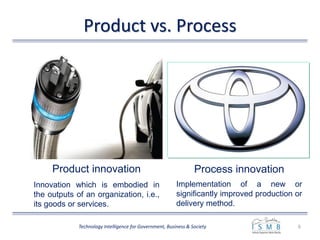
Product vs. Process
6Technology Intelligence for Government, Business & Society
Process innovationProduct innovation
Innovation which is embodied in
the outputs of an organization, i.e.,
its goods or services.
Implementation of a new or
significantly improved production or
delivery method.
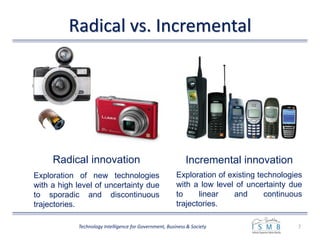
Radical vs. Incremental
7Technology Intelligence for Government, Business & Society
Incremental innovationRadical innovation
Exploration of new technologies
with a high level of uncertainty due
to sporadic and discontinuous
trajectories.
Exploration of existing technologies
with a low level of uncertainty due
to linear and continuous
trajectories.
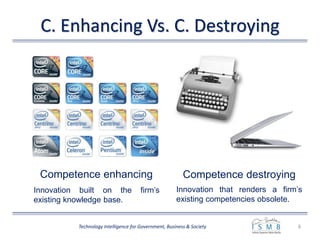
C. Enhancing Vs. C. Destroying
8Technology Intelligence for Government, Business & Society
Competence destroyingCompetence enhancing
Innovation built on the firm’s
existing knowledge base.
Innovation that renders a firm’s
existing competencies obsolete.
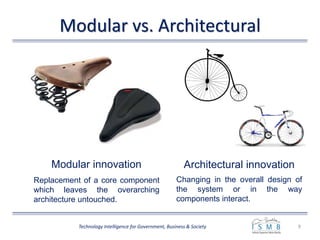
Modular vs. Architectural
9Technology Intelligence for Government, Business & Society
Architectural innovationModular innovation
Replacement of a core component
which leaves the overarching
architecture untouched.
Changing in the overall design of
the system or in the way
components interact.
Dimensions of Innovation
How to categorize innovation?
– Modality of change (product vs. process)
– Extent of change (radical vs. incremental)
– Relationship among capabilities and innovation
(competence enhancing vs. competence destroying)
– Innovation impact on the system (modular vs.
architectural)
10Technology Intelligence for Government, Business & Society
Is this Enough?
Does innovation always
focus on hard aspects?
11Technology Intelligence for Government, Business & Society
The Soft Side of Innovation
12Technology Intelligence for Government, Business & Society
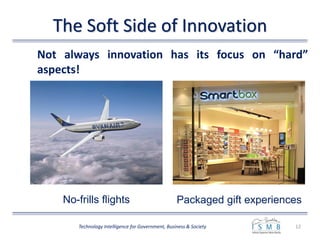
Not always innovation has its focus on “hard”
aspects!
Packaged gift experiencesNo-frills flights
The Soft Side of Innovation II
13Technology Intelligence for Government, Business & Society
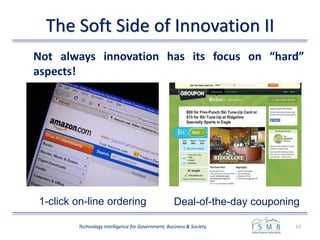
Not always innovation has its focus on “hard”
aspects!
Deal-of-the-day couponing1-click on-line ordering
The Soft Side of Innovation
14Technology Intelligence for Government, Business & Society
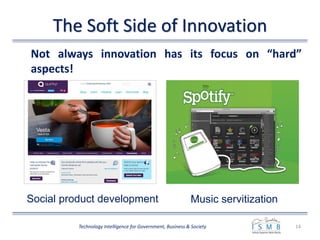
Not always innovation has its focus on “hard”
aspects!
Music servitizationSocial product development
To Sum up
15Technology Intelligence for Government, Business & Society
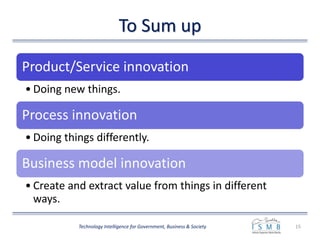
Product/Service innovation
• Doing new things.
Process innovation
• Doing things differently.
Business model innovation
• Create and extract value from things in different
ways.
What about the Public Sector?
Successful innovation is the creation and implementation
of new processes, products, services and methods of
delivery which result in significant improvements in
outcomes efficiency, effectiveness or quality.
Mulgan & Albury (2003)
16Technology Intelligence for Government, Business & Society
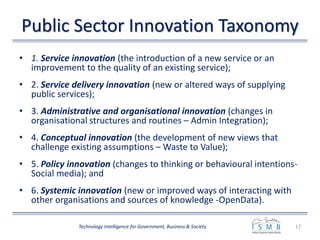
Public Sector Innovation Taxonomy
• 1. Service innovation (the introduction of a new service or an
improvement to the quality of an existing service);
• 2. Service delivery innovation (new or altered ways of supplying
public services);
• 3. Administrative and organisational innovation (changes in
organisational structures and routines – Admin Integration);
• 4. Conceptual innovation (the development of new views that
challenge existing assumptions – Waste to Value);
• 5. Policy innovation (changes to thinking or behavioural intentions-
Social media); and
• 6. Systemic innovation (new or improved ways of interacting with
other organisations and sources of knowledge -OpenData).
17Technology Intelligence for Government, Business & Society
Some Aspects to Keep in Mind
• Administartive fulfillment vs. value orientation
• Internal vs. external orientation
• A semantic pitfall:
– Digialization vs. innovation of public services
18Technology Intelligence for Government, Business & Society
Prominent Hurdles
• Delivery pressure & administrative burden
• Short-term budgets & planning horizons
• Poor rewards & incentives
• Culture of risk aversion
• Poor skills in active risk or change management
• Reluctance to close down failing programs or
organisations
19Technology Intelligence for Government, Business & Society
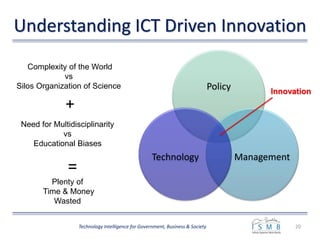
Understanding ICT Driven Innovation
Policy
ManagementTechnology
20Technology Intelligence for Government, Business & Society
Complexity of the World
vs
Silos Organization of Science
Need for Multidisciplinarity
vs
Educational Biases
Plenty of
Time & Money
Wasted
+
=
Innovation
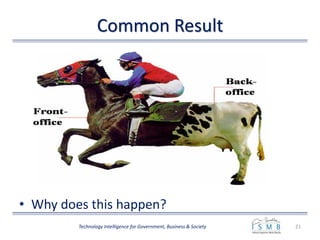
Common Result
• Why does this happen?
21Technology Intelligence for Government, Business & Society
er.reichstaedter@cio.gv.at / Christian.Rupp@bka.gv.at
agoza - 30.08.2004
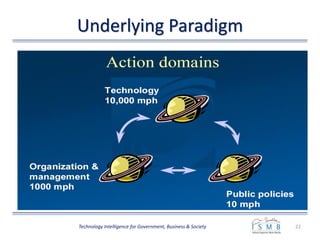
Underlying Paradigm
22Technology Intelligence for Government, Business & Society
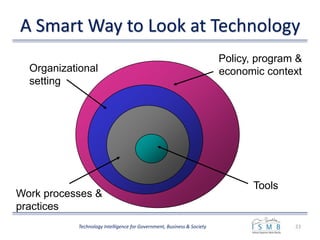
A Smart Way to Look at Technology
23Technology Intelligence for Government, Business & Society
Policy, program &
economic contextOrganizational
setting
Tools
Work processes &
practices
What about Evolution?
• So far we presented a static view of the
relationship between IT and Organizations
• What do you think may happen when we
consider time?
31Technology Intelligence for Government, Business & Society
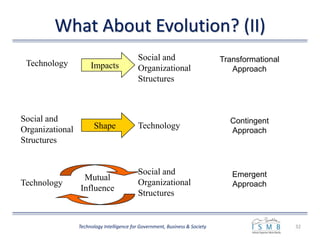
What About Evolution? (II)
32Technology Intelligence for Government, Business & Society
Technology
Social and
Organizational
Structures
Social and
Organizational
Structures
Technology
Technology
Impacts
Shape
Mutual
Influence
Social and
Organizational
Structures
Transformational
Approach
Contingent
Approach
Emergent
Approach
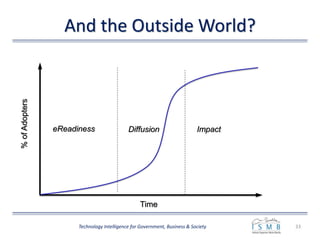
And the Outside World?
33Technology Intelligence for Government, Business & Society
%ofAdopters
Time
eReadiness Diffusion Impact
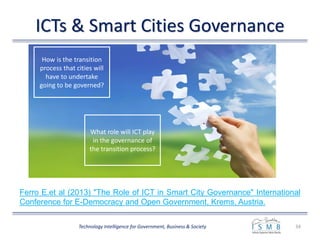
ICTs & Smart Cities Governance
34Technology Intelligence for Government, Business & Society
How is the transition
process that cities will
have to undertake
going to be governed?
What role will ICT play
in the governance of
the transition process?
Research QuestionsFerro E.et al (2013) "The Role of ICT in Smart City Governance" International
Conference for E-Democracy and Open Government, Krems, Austria.
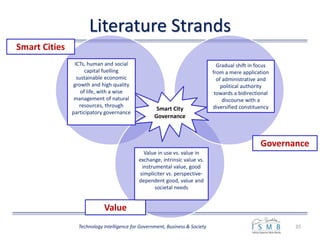
Literature Strands
35Technology Intelligence for Government, Business & Society
Smart Cities
Governance
Value
Smart City
Governance
ICTs, human and social
capital fuelling
sustainable economic
growth and high quality
of life, with a wise
management of natural
resources, through
participatory governance
Gradual shift in focus
from a mere application
of administrative and
political authority
towards a bidirectional
discourse with a
diversified constituency
Value in use vs. value in
exchange, intrinsic value vs.
instrumental value, good
simpliciter vs. perspective-
dependent good, value and
societal needs
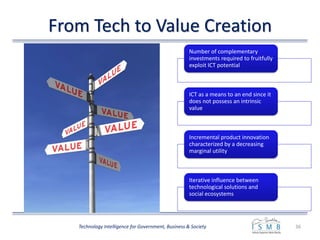
From Tech to Value Creation
36Technology Intelligence for Government, Business & Society
Number of complementary
investments required to fruitfully
exploit ICT potential
ICT as a means to an end since it
does not possess an intrinsic
value
Incremental product innovation
characterized by a decreasing
marginal utility
Iterative influence between
technological solutions and
social ecosystems
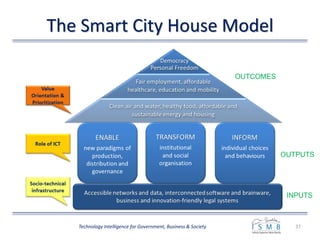
The Smart City House Model
37Technology Intelligence for Government, Business & Society
INPUTS
OUTPUTS
OUTCOMES
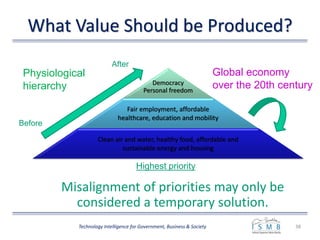
What Value Should be Produced?
38Technology Intelligence for Government, Business & Society
Democracy
Personal freedom
Fair employment, affordable
healthcare, education and mobility
Clean air and water, healthy food, affordable and
sustainable energy and housing
Misalignment of priorities may only be
considered a temporary solution.
Global economy
over the 20th century
Physiological
hierarchy
Highest priority
Before
After
Looking at the Future
39Technology Intelligence for Government, Business & Society
The real smart city will have to learn how to
reconcile individual aspirations and collective needs.
Thank You
40Technology Intelligence for Government, Business & Society
Enrico Ferro
Head of Innovation Development Dept.
ferro@ismb.it
@egferro
www.enricoferro.com
CONTACTS

Public Sector Innovation Management

  • 1.
    Public Sector InnovationManagement Dr. Enrico Ferro www.enricoferro.com Technology Intelligence for Government, Business & Society
  • 2.
    Setting the Stagefor Successful Learning • Let’s not take language for granted • Getting the fundamentals right • Starting from the same page: shared definitions • Your input is vital 2Technology Intelligence for Government, Business & Society
  • 3.
    3Technology Intelligence forGovernment, Business & Society Examples Innovation We call “innovation” many different things. Floating pool tableGNSS system
  • 4.
    How to DefineInnovation? Innovation is a new way of doing things that is commercialized. The process of innovation cannot be separated from a firm’s strategic and competitive context. Michael Eugene Porter 4Technology Intelligence for Government, Business & Society
  • 5.
    Two Aspects toKeep in Mind What is a technological trajectory? – The path a technology follows through time is termed its technological trajectory. Many consistent patterns have been observed in technological trajectories, helping to understand how technologies improve and diffuse. Not only one type of innovation – Several dimensions are used to categorize innovations. These dimensions help clarify how diverse innovations offer different opportunities (and pose different requirements) on producers, users, and regulators. 5Technology Intelligence for Government, Business & Society
  • 6.
    Product vs. Process 6TechnologyIntelligence for Government, Business & Society Process innovationProduct innovation Innovation which is embodied in the outputs of an organization, i.e., its goods or services. Implementation of a new or significantly improved production or delivery method.
  • 7.
    Radical vs. Incremental 7TechnologyIntelligence for Government, Business & Society Incremental innovationRadical innovation Exploration of new technologies with a high level of uncertainty due to sporadic and discontinuous trajectories. Exploration of existing technologies with a low level of uncertainty due to linear and continuous trajectories.
  • 8.
    C. Enhancing Vs.C. Destroying 8Technology Intelligence for Government, Business & Society Competence destroyingCompetence enhancing Innovation built on the firm’s existing knowledge base. Innovation that renders a firm’s existing competencies obsolete.
  • 9.
    Modular vs. Architectural 9TechnologyIntelligence for Government, Business & Society Architectural innovationModular innovation Replacement of a core component which leaves the overarching architecture untouched. Changing in the overall design of the system or in the way components interact.
  • 10.
    Dimensions of Innovation Howto categorize innovation? – Modality of change (product vs. process) – Extent of change (radical vs. incremental) – Relationship among capabilities and innovation (competence enhancing vs. competence destroying) – Innovation impact on the system (modular vs. architectural) 10Technology Intelligence for Government, Business & Society
  • 11.
    Is this Enough? Doesinnovation always focus on hard aspects? 11Technology Intelligence for Government, Business & Society
  • 12.
    The Soft Sideof Innovation 12Technology Intelligence for Government, Business & Society Not always innovation has its focus on “hard” aspects! Packaged gift experiencesNo-frills flights
  • 13.
    The Soft Sideof Innovation II 13Technology Intelligence for Government, Business & Society Not always innovation has its focus on “hard” aspects! Deal-of-the-day couponing1-click on-line ordering
  • 14.
    The Soft Sideof Innovation 14Technology Intelligence for Government, Business & Society Not always innovation has its focus on “hard” aspects! Music servitizationSocial product development
  • 15.
    To Sum up 15TechnologyIntelligence for Government, Business & Society Product/Service innovation • Doing new things. Process innovation • Doing things differently. Business model innovation • Create and extract value from things in different ways.
  • 16.
    What about thePublic Sector? Successful innovation is the creation and implementation of new processes, products, services and methods of delivery which result in significant improvements in outcomes efficiency, effectiveness or quality. Mulgan & Albury (2003) 16Technology Intelligence for Government, Business & Society
  • 17.
    Public Sector InnovationTaxonomy • 1. Service innovation (the introduction of a new service or an improvement to the quality of an existing service); • 2. Service delivery innovation (new or altered ways of supplying public services); • 3. Administrative and organisational innovation (changes in organisational structures and routines – Admin Integration); • 4. Conceptual innovation (the development of new views that challenge existing assumptions – Waste to Value); • 5. Policy innovation (changes to thinking or behavioural intentions- Social media); and • 6. Systemic innovation (new or improved ways of interacting with other organisations and sources of knowledge -OpenData). 17Technology Intelligence for Government, Business & Society
  • 18.
    Some Aspects toKeep in Mind • Administartive fulfillment vs. value orientation • Internal vs. external orientation • A semantic pitfall: – Digialization vs. innovation of public services 18Technology Intelligence for Government, Business & Society
  • 19.
    Prominent Hurdles • Deliverypressure & administrative burden • Short-term budgets & planning horizons • Poor rewards & incentives • Culture of risk aversion • Poor skills in active risk or change management • Reluctance to close down failing programs or organisations 19Technology Intelligence for Government, Business & Society
  • 20.
    Understanding ICT DrivenInnovation Policy ManagementTechnology 20Technology Intelligence for Government, Business & Society Complexity of the World vs Silos Organization of Science Need for Multidisciplinarity vs Educational Biases Plenty of Time & Money Wasted + = Innovation
  • 21.
    Common Result • Whydoes this happen? 21Technology Intelligence for Government, Business & Society er.reichstaedter@cio.gv.at / Christian.Rupp@bka.gv.at agoza - 30.08.2004
  • 22.
    Underlying Paradigm 22Technology Intelligencefor Government, Business & Society
  • 23.
    A Smart Wayto Look at Technology 23Technology Intelligence for Government, Business & Society Policy, program & economic contextOrganizational setting Tools Work processes & practices
  • 24.
    What about Evolution? •So far we presented a static view of the relationship between IT and Organizations • What do you think may happen when we consider time? 31Technology Intelligence for Government, Business & Society
  • 25.
    What About Evolution?(II) 32Technology Intelligence for Government, Business & Society Technology Social and Organizational Structures Social and Organizational Structures Technology Technology Impacts Shape Mutual Influence Social and Organizational Structures Transformational Approach Contingent Approach Emergent Approach
  • 26.
    And the OutsideWorld? 33Technology Intelligence for Government, Business & Society %ofAdopters Time eReadiness Diffusion Impact
  • 27.
    ICTs & SmartCities Governance 34Technology Intelligence for Government, Business & Society How is the transition process that cities will have to undertake going to be governed? What role will ICT play in the governance of the transition process? Research QuestionsFerro E.et al (2013) "The Role of ICT in Smart City Governance" International Conference for E-Democracy and Open Government, Krems, Austria.
  • 28.
    Literature Strands 35Technology Intelligencefor Government, Business & Society Smart Cities Governance Value Smart City Governance ICTs, human and social capital fuelling sustainable economic growth and high quality of life, with a wise management of natural resources, through participatory governance Gradual shift in focus from a mere application of administrative and political authority towards a bidirectional discourse with a diversified constituency Value in use vs. value in exchange, intrinsic value vs. instrumental value, good simpliciter vs. perspective- dependent good, value and societal needs
  • 29.
    From Tech toValue Creation 36Technology Intelligence for Government, Business & Society Number of complementary investments required to fruitfully exploit ICT potential ICT as a means to an end since it does not possess an intrinsic value Incremental product innovation characterized by a decreasing marginal utility Iterative influence between technological solutions and social ecosystems
  • 30.
    The Smart CityHouse Model 37Technology Intelligence for Government, Business & Society INPUTS OUTPUTS OUTCOMES
  • 31.
    What Value Shouldbe Produced? 38Technology Intelligence for Government, Business & Society Democracy Personal freedom Fair employment, affordable healthcare, education and mobility Clean air and water, healthy food, affordable and sustainable energy and housing Misalignment of priorities may only be considered a temporary solution. Global economy over the 20th century Physiological hierarchy Highest priority Before After
  • 32.
    Looking at theFuture 39Technology Intelligence for Government, Business & Society The real smart city will have to learn how to reconcile individual aspirations and collective needs.
  • 33.
    Thank You 40Technology Intelligencefor Government, Business & Society Enrico Ferro Head of Innovation Development Dept. ferro@ismb.it @egferro www.enricoferro.com CONTACTS