The Changing Face of Innovation in South Africa Prof. Michael Kahn  Research and Innovation Associates and IERI, Tshwane University of Technology  Innovation Festival 2010  Spier Estate, Lynedoch, Cape 8 March, 2010
The Big Picture  1989: The fall of the Wall: ICT revolution opens the world 1990s … innovation the key driver of economic  growth 2008: The fall of Wall Street  Linked crises : econo-technic and enviro-technic How to link innovation and development? UN Millennium Project (2005) Paris Statement on Innovation for Development (2007) OECD Innovation Strategy (2010) Sussex Manifesto 2 (gestating) The rise of the BRICs or BRICSA? Scramble for Africa II
Technological innovation is critical to long-term economic growth. Most technological innovation consists of incremental change in  existing industries . …. Sustained growth can occur only with the continuous introduction of truly new goods and services—radical technological innovations that disrupt markets and create new industries. The  capacity to turn science-based inventions into commercially viable innovations  is critical to radical technological innovation.’ (Branscomb and Auerswald, 2002) The quest ….
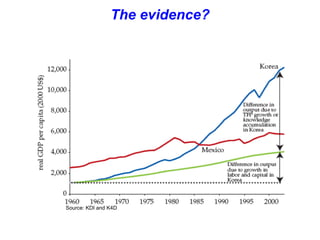
The evidence? Source: KDI and K4D
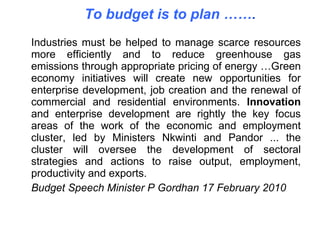
Industries must be helped to manage scarce resources more efficiently and to reduce greenhouse gas emissions through appropriate pricing of energy …Green economy initiatives will create new opportunities for enterprise development, job creation and the renewal of commercial and residential environments.  Innovation  and enterprise development are rightly the key focus areas of the work of the economic and employment cluster, led by Ministers Nkwinti and Pandor ... the cluster will oversee the development of sectoral strategies and actions to raise output, employment, productivity and exports.  Budget Speech Minister P Gordhan 17 February 2010 To budget is to plan …… .
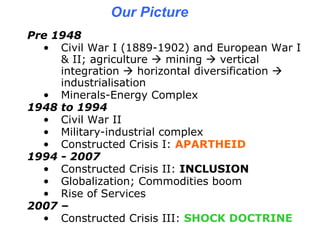
Pre 1948 Civil War I (1889-1902) and European War I & II; agriculture    mining    vertical integration    horizontal diversification    industrialisation Minerals-Energy Complex 1948 to 1994 Civil War II Military-industrial complex  Constructed Crisis I:  APARTHEID 1994 - 2007 Constructed Crisis II:  INCLUSION Globalization; Commodities boom  Rise of Services 2007 – Constructed Crisis III:  SHOCK DOCTRINE Our Picture
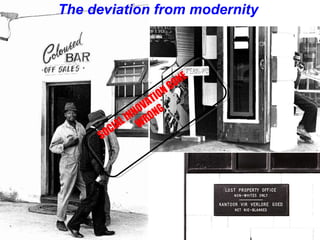
The deviation from modernity SOCIAL INNOVATION GONE WRONG
Open economy with convertible currency  Limited inward FDI Legislation for Human Rights & Dignity Rudiments of a Welfare State Rising intra-group inequality Inadequate and ageing infrastructure  Persistently high unemployment High burden of infectious disease High levels of contact crime Dysfunctional schooling Overburdened higher education High level skills deficit  Ongoing intermediate and capital goods gap It’s a long walk to freedom
African middle class emerged under apartheid;  technical and entrepreneurial class throttled  High levels of industrial concentration  Conglomerates do what makes sense to them Adjust to the realities of the labour and consumer market Mineral exports underwrite import of intermediates in boom times; symptoms of Dutch Disease The power of organized labour Hiring and firing;  Wage levels A welfare state subscribing to fiscal discipline? Industrial policy or interest group policy? Paradoxes and contradictions Where is our innovation space?
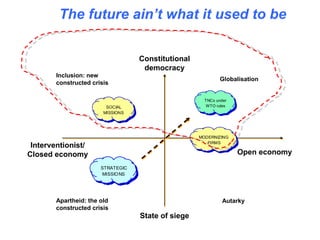
The future ain’t what it used to be
Innovation  is the dissemination of a new good or service in an organization or market.  New to the firm (or org), new to the market, new to the world. A new firm is an innovation.  Innovation comprises many activities Knowledge generation  Knowledge transfer – codified and tacit Knowledge measurement R&D important but not necessary … comprises creative work undertaken on a systematic basis in order to increase the stock and use of knowledge; “Business” main performer  High level skills are necessary to innovate and conduct R&D and speak to the ability to absorb and generate new knowledge Engineers and technicians Designers and creative thinkers Entrepreneurs, both economic and social Framework conditions  must support innovation Investment conditions Contract and intellectual property law
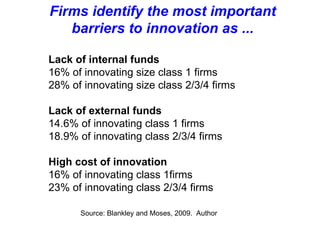
Lack of internal funds 16% of innovating size class 1 firms  28% of innovating size class 2/3/4 firms  Lack of external funds 14.6% of innovating class 1 firms  18.9% of innovating class 2/3/4 firms High cost of innovation 16% of innovating class 1firms  23% of innovating class 2/3/4 firms Firms identify the most important barriers to innovation as ... Source: Blankley and Moses, 2009.  Author
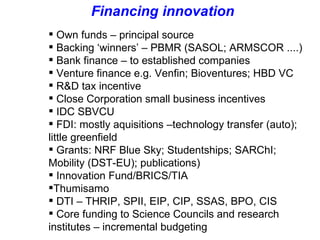
Own funds – principal source Backing ‘winners’ – PBMR (SASOL; ARMSCOR ....) Bank finance – to established companies Venture finance e.g. Venfin; Bioventures; HBD VC R&D tax incentive Close Corporation small business incentives IDC SBVCU FDI: mostly aquisitions –technology transfer (auto); little greenfield Grants: NRF Blue Sky; Studentships; SARChI; Mobility (DST-EU); publications) Innovation Fund/BRICS/TIA Thumisamo  DTI – THRIP, SPII, EIP, CIP, SSAS, BPO, CIS Core funding to Science Councils and research institutes – incremental budgeting Financing innovation
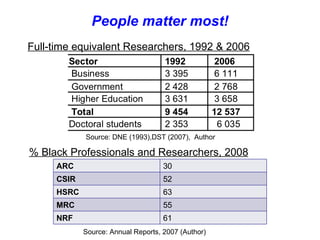
People matter most! Source: Annual Reports, 2007 (Author) Source: DNE (1993),DST (2007),  Author Full-time equivalent Researchers, 1992 & 2006 % Black Professionals and Researchers, 2008 ARC 30 CSIR 52 HSRC 63 MRC 55 NRF 61
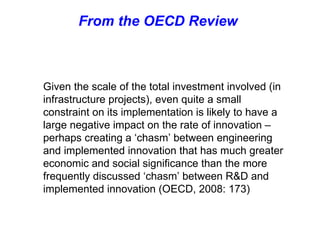
From the OECD Review  Given the scale of the total investment involved (in infrastructure projects), even quite a small constraint on its implementation is likely to have a large negative impact on the rate of innovation – perhaps creating a ‘chasm’ between engineering and implemented innovation that has much greater economic and social significance than the more frequently discussed ‘chasm’ between R&D and implemented innovation (OECD, 2008: 173)
Agents and linkages, local & global 100s NGOs POLITICAL LEGAL ENVIRONMENTAL CULTURAL STANDARDS ASSOCIATONS LINKAGES I.P. RIGHTS UNIVERSITIES 9 SCIENCE  COUNCILS BUSINESS 55 GOVT. DEPTS INSTITUTES & MUSEUMS S&T SERVICES UTILITIES INFORMAL SECTOR
The national system of innovation (NSI) must be prepared to meet the requirements of innovation: Intervention of the State through public policy;  Understand how enterprises design their strategies of research and development (R&D); Impact of education on the formation of human resources and training of technicians, researchers and other workers, and the social innovations related to such formation of human resources;  Role of industrial structure Freeman (1987) Pilot the system of innovation? Biotech Strategy, R&D Strategy, TYIP, TIA, IP Act ….
 
 
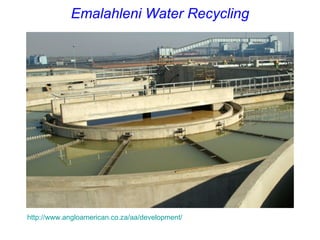
Emalahleni Water Recycling http://www.angloamerican.co.za/aa/development/
Maponya Mall, Soweto
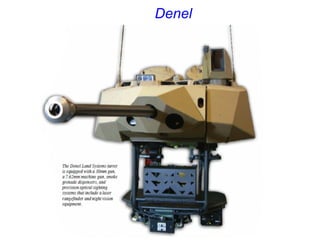
Denel
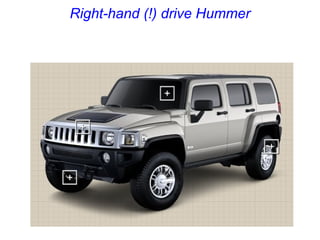
Right-hand (!) drive Hummer
Altech Netstar pioneered the stolen vehicle tracking and recovery industry in SA in 1994, and is the market leader in terms of size, product range, and an unsurpassed private recovery infrastructure … employs over 500 people … 10,000 Altech Netstar tracking systems installed per month … operations in Zambia, Namibia, Swaziland, Botswana and Malaysia. Altech Netstar is able to recover vehicles in an average time of less than an hour.  Accepted by insurers and motor manufacturers alike … locally designed and manufactured systems … include the Early Warning System with panic button, Vigil with full GPS/GPRS functionality, Cyber-Sleuth, the ever popular Sleuth, and Guardian. http://www.netstar.co.za/Content/About/background.aspx
See you at the World Cup
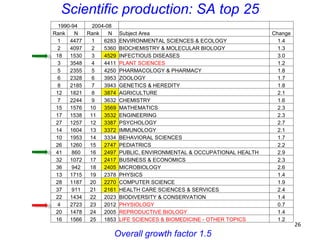
Scientific production: SA top 25 Overall growth factor 1.5 1990-94 2004-08     Rank N Rank N Subject Area Change 1 4477 1 6283 ENVIRONMENTAL SCIENCES & ECOLOGY 1.4 2 4097 2 5360 BIOCHEMISTRY & MOLECULAR BIOLOGY 1.3 18 1530 3 4529 INFECTIOUS DISEASES 3.0 3 3548 4 4411 PLANT SCIENCES 1.2 5 2355 5 4250 PHARMACOLOGY & PHARMACY 1.8 6 2328 6 3953 ZOOLOGY 1.7 8 2185 7 3943 GENETICS & HEREDITY 1.8 12 1821 8 3874 AGRICULTURE 2.1 7 2244 9 3632 CHEMISTRY 1.6 15 1576 10 3569 MATHEMATICS 2.3 17 1538 11 3532 ENGINEERING 2.3 27 1257 12 3387 PSYCHOLOGY 2.7 14 1604 13 3372 IMMUNOLOGY 2.1 10 1953 14 3334 BEHAVIORAL SCIENCES 1.7 26 1260 15 2747 PEDIATRICS 2.2 41 860 16 2497 PUBLIC, ENVIRONMENTAL & OCCUPATIONAL HEALTH 2.9 32 1072 17 2417 BUSINESS & ECONOMICS 2.3 36 942 18 2405 MICROBIOLOGY 2.6 13 1715 19 2378 PHYSICS 1.4 28 1187 20 2270 COMPUTER SCIENCE 1.9 37 911 21 2161 HEALTH CARE SCIENCES & SERVICES 2.4 22 1434 22 2023 BIODIVERSITY & CONSERVATION 1.4 4 2723 23 2012 PHYSIOLOGY 0.7 20 1478 24 2005 REPRODUCTIVE BIOLOGY 1.4 16 1566 25 1853 LIFE SCIENCES & BIOMEDICINE - OTHER TOPICS 1.2
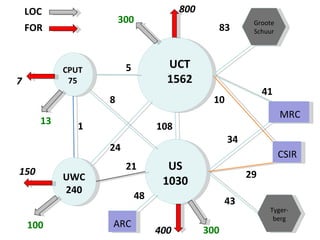
CPUT 75 UCT 1562 UWC 240 US 1030 MRC ARC CSIR Groote Schuur Tyger- berg 8 24 5 1 21 108 43 83 41 34 300 800 100 150 300 400 48 29 10 13 7 FOR LOC
…  technologies in some industries are close to science, while in others there is little in the way of scientific foundations. In some connections with universities are important, while in others there is little interaction. Patents are important in some industries but not in others. To be effective policies aimed to help industries develop must understand and respect these differences. (Rosenberg, 2009) Directions for policy? (The linear) model implies that there should be a link between HERD and BERD (but) there is no credible evidence for this. On the contrary, as in the South African innovation survey, countless surveys of OECD firms show that their main sources of technology are internal knowledge and other firms. Public sector research in general, and higher education research in particular, accounts for a small share of their total knowledge inputs to innovation (OECD, 2008: 186)
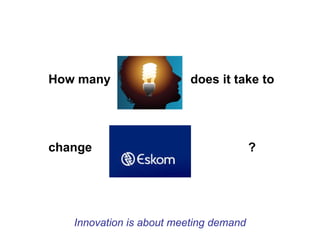
<2006 reliable and very cheap electricity for industry. Massive environmental cost  “ The perfect storm” : ageing infrastructure, loss of skills , inadequate coal supply, ‘unexpected’ demand, and bad luck     brownouts and blackouts.  GEAR was a ‘third way,’ the electricity catastrophe is Naomi Klein’s ‘shock doctrine.’  Import-parity-pricing eliminates comparative advantage of commodities inc coal.  Electricity costs set to double (triple) – mineral export pricing set externally; higher electricity input costs reduceds profit, not volumes? A spur to innovation driven by (unintended consequences of) structural adjustment. Private gain vs socialized risk  Energy Constructed Crisis
How many  does it take to  change  ?  Innovation is about meeting demand

Changing Face V4

  • 1.
    The Changing Faceof Innovation in South Africa Prof. Michael Kahn Research and Innovation Associates and IERI, Tshwane University of Technology Innovation Festival 2010 Spier Estate, Lynedoch, Cape 8 March, 2010
  • 2.
    The Big Picture 1989: The fall of the Wall: ICT revolution opens the world 1990s … innovation the key driver of economic growth 2008: The fall of Wall Street Linked crises : econo-technic and enviro-technic How to link innovation and development? UN Millennium Project (2005) Paris Statement on Innovation for Development (2007) OECD Innovation Strategy (2010) Sussex Manifesto 2 (gestating) The rise of the BRICs or BRICSA? Scramble for Africa II
  • 3.
    Technological innovation iscritical to long-term economic growth. Most technological innovation consists of incremental change in existing industries . …. Sustained growth can occur only with the continuous introduction of truly new goods and services—radical technological innovations that disrupt markets and create new industries. The capacity to turn science-based inventions into commercially viable innovations is critical to radical technological innovation.’ (Branscomb and Auerswald, 2002) The quest ….
  • 4.
  • 5.
    Industries must behelped to manage scarce resources more efficiently and to reduce greenhouse gas emissions through appropriate pricing of energy …Green economy initiatives will create new opportunities for enterprise development, job creation and the renewal of commercial and residential environments. Innovation and enterprise development are rightly the key focus areas of the work of the economic and employment cluster, led by Ministers Nkwinti and Pandor ... the cluster will oversee the development of sectoral strategies and actions to raise output, employment, productivity and exports. Budget Speech Minister P Gordhan 17 February 2010 To budget is to plan …… .
  • 6.
    Pre 1948 CivilWar I (1889-1902) and European War I & II; agriculture  mining  vertical integration  horizontal diversification  industrialisation Minerals-Energy Complex 1948 to 1994 Civil War II Military-industrial complex Constructed Crisis I: APARTHEID 1994 - 2007 Constructed Crisis II: INCLUSION Globalization; Commodities boom Rise of Services 2007 – Constructed Crisis III: SHOCK DOCTRINE Our Picture
  • 7.
    The deviation frommodernity SOCIAL INNOVATION GONE WRONG
  • 8.
    Open economy withconvertible currency Limited inward FDI Legislation for Human Rights & Dignity Rudiments of a Welfare State Rising intra-group inequality Inadequate and ageing infrastructure Persistently high unemployment High burden of infectious disease High levels of contact crime Dysfunctional schooling Overburdened higher education High level skills deficit Ongoing intermediate and capital goods gap It’s a long walk to freedom
  • 9.
    African middle classemerged under apartheid; technical and entrepreneurial class throttled High levels of industrial concentration Conglomerates do what makes sense to them Adjust to the realities of the labour and consumer market Mineral exports underwrite import of intermediates in boom times; symptoms of Dutch Disease The power of organized labour Hiring and firing; Wage levels A welfare state subscribing to fiscal discipline? Industrial policy or interest group policy? Paradoxes and contradictions Where is our innovation space?
  • 10.
    The future ain’twhat it used to be
  • 11.
    Innovation isthe dissemination of a new good or service in an organization or market. New to the firm (or org), new to the market, new to the world. A new firm is an innovation. Innovation comprises many activities Knowledge generation Knowledge transfer – codified and tacit Knowledge measurement R&D important but not necessary … comprises creative work undertaken on a systematic basis in order to increase the stock and use of knowledge; “Business” main performer High level skills are necessary to innovate and conduct R&D and speak to the ability to absorb and generate new knowledge Engineers and technicians Designers and creative thinkers Entrepreneurs, both economic and social Framework conditions must support innovation Investment conditions Contract and intellectual property law
  • 12.
    Lack of internalfunds 16% of innovating size class 1 firms 28% of innovating size class 2/3/4 firms Lack of external funds 14.6% of innovating class 1 firms 18.9% of innovating class 2/3/4 firms High cost of innovation 16% of innovating class 1firms 23% of innovating class 2/3/4 firms Firms identify the most important barriers to innovation as ... Source: Blankley and Moses, 2009. Author
  • 13.
    Own funds –principal source Backing ‘winners’ – PBMR (SASOL; ARMSCOR ....) Bank finance – to established companies Venture finance e.g. Venfin; Bioventures; HBD VC R&D tax incentive Close Corporation small business incentives IDC SBVCU FDI: mostly aquisitions –technology transfer (auto); little greenfield Grants: NRF Blue Sky; Studentships; SARChI; Mobility (DST-EU); publications) Innovation Fund/BRICS/TIA Thumisamo DTI – THRIP, SPII, EIP, CIP, SSAS, BPO, CIS Core funding to Science Councils and research institutes – incremental budgeting Financing innovation
  • 14.
    People matter most!Source: Annual Reports, 2007 (Author) Source: DNE (1993),DST (2007), Author Full-time equivalent Researchers, 1992 & 2006 % Black Professionals and Researchers, 2008 ARC 30 CSIR 52 HSRC 63 MRC 55 NRF 61
  • 15.
    From the OECDReview Given the scale of the total investment involved (in infrastructure projects), even quite a small constraint on its implementation is likely to have a large negative impact on the rate of innovation – perhaps creating a ‘chasm’ between engineering and implemented innovation that has much greater economic and social significance than the more frequently discussed ‘chasm’ between R&D and implemented innovation (OECD, 2008: 173)
  • 16.
    Agents and linkages,local & global 100s NGOs POLITICAL LEGAL ENVIRONMENTAL CULTURAL STANDARDS ASSOCIATONS LINKAGES I.P. RIGHTS UNIVERSITIES 9 SCIENCE COUNCILS BUSINESS 55 GOVT. DEPTS INSTITUTES & MUSEUMS S&T SERVICES UTILITIES INFORMAL SECTOR
  • 17.
    The national systemof innovation (NSI) must be prepared to meet the requirements of innovation: Intervention of the State through public policy; Understand how enterprises design their strategies of research and development (R&D); Impact of education on the formation of human resources and training of technicians, researchers and other workers, and the social innovations related to such formation of human resources; Role of industrial structure Freeman (1987) Pilot the system of innovation? Biotech Strategy, R&D Strategy, TYIP, TIA, IP Act ….
  • 18.
  • 19.
  • 20.
    Emalahleni Water Recyclinghttp://www.angloamerican.co.za/aa/development/
  • 21.
  • 22.
  • 23.
  • 24.
    Altech Netstar pioneeredthe stolen vehicle tracking and recovery industry in SA in 1994, and is the market leader in terms of size, product range, and an unsurpassed private recovery infrastructure … employs over 500 people … 10,000 Altech Netstar tracking systems installed per month … operations in Zambia, Namibia, Swaziland, Botswana and Malaysia. Altech Netstar is able to recover vehicles in an average time of less than an hour. Accepted by insurers and motor manufacturers alike … locally designed and manufactured systems … include the Early Warning System with panic button, Vigil with full GPS/GPRS functionality, Cyber-Sleuth, the ever popular Sleuth, and Guardian. http://www.netstar.co.za/Content/About/background.aspx
  • 25.
    See you atthe World Cup
  • 26.
    Scientific production: SAtop 25 Overall growth factor 1.5 1990-94 2004-08     Rank N Rank N Subject Area Change 1 4477 1 6283 ENVIRONMENTAL SCIENCES & ECOLOGY 1.4 2 4097 2 5360 BIOCHEMISTRY & MOLECULAR BIOLOGY 1.3 18 1530 3 4529 INFECTIOUS DISEASES 3.0 3 3548 4 4411 PLANT SCIENCES 1.2 5 2355 5 4250 PHARMACOLOGY & PHARMACY 1.8 6 2328 6 3953 ZOOLOGY 1.7 8 2185 7 3943 GENETICS & HEREDITY 1.8 12 1821 8 3874 AGRICULTURE 2.1 7 2244 9 3632 CHEMISTRY 1.6 15 1576 10 3569 MATHEMATICS 2.3 17 1538 11 3532 ENGINEERING 2.3 27 1257 12 3387 PSYCHOLOGY 2.7 14 1604 13 3372 IMMUNOLOGY 2.1 10 1953 14 3334 BEHAVIORAL SCIENCES 1.7 26 1260 15 2747 PEDIATRICS 2.2 41 860 16 2497 PUBLIC, ENVIRONMENTAL & OCCUPATIONAL HEALTH 2.9 32 1072 17 2417 BUSINESS & ECONOMICS 2.3 36 942 18 2405 MICROBIOLOGY 2.6 13 1715 19 2378 PHYSICS 1.4 28 1187 20 2270 COMPUTER SCIENCE 1.9 37 911 21 2161 HEALTH CARE SCIENCES & SERVICES 2.4 22 1434 22 2023 BIODIVERSITY & CONSERVATION 1.4 4 2723 23 2012 PHYSIOLOGY 0.7 20 1478 24 2005 REPRODUCTIVE BIOLOGY 1.4 16 1566 25 1853 LIFE SCIENCES & BIOMEDICINE - OTHER TOPICS 1.2
  • 27.
    CPUT 75 UCT1562 UWC 240 US 1030 MRC ARC CSIR Groote Schuur Tyger- berg 8 24 5 1 21 108 43 83 41 34 300 800 100 150 300 400 48 29 10 13 7 FOR LOC
  • 28.
    … technologiesin some industries are close to science, while in others there is little in the way of scientific foundations. In some connections with universities are important, while in others there is little interaction. Patents are important in some industries but not in others. To be effective policies aimed to help industries develop must understand and respect these differences. (Rosenberg, 2009) Directions for policy? (The linear) model implies that there should be a link between HERD and BERD (but) there is no credible evidence for this. On the contrary, as in the South African innovation survey, countless surveys of OECD firms show that their main sources of technology are internal knowledge and other firms. Public sector research in general, and higher education research in particular, accounts for a small share of their total knowledge inputs to innovation (OECD, 2008: 186)
  • 29.
    <2006 reliable andvery cheap electricity for industry. Massive environmental cost “ The perfect storm” : ageing infrastructure, loss of skills , inadequate coal supply, ‘unexpected’ demand, and bad luck  brownouts and blackouts. GEAR was a ‘third way,’ the electricity catastrophe is Naomi Klein’s ‘shock doctrine.’ Import-parity-pricing eliminates comparative advantage of commodities inc coal. Electricity costs set to double (triple) – mineral export pricing set externally; higher electricity input costs reduceds profit, not volumes? A spur to innovation driven by (unintended consequences of) structural adjustment. Private gain vs socialized risk Energy Constructed Crisis
  • 30.
    How many does it take to change ? Innovation is about meeting demand