How much innovation can you
get out of R&D programmes?
 Wolfgang Polt               Nicholas S. Vonortas
 Joanneum Research       George Washington University
                         & Athens University of Economics
                         and Business


           “Turning Knowledge Into Practice”
              Berlin, October 23-24 2007
Identifying Innovation Impact of R&D
• Prime concern for RTDI policy makers around the world,
  but especially in Europe in view of the ‘European Paradox’
  (good in research, lagging in innovation)
• This concern has influenced RTDI policy for the last 10-15
  years and has resulted among others in
   – Increasing emphasis on collaborative programmes (mainly
     fostering industry-science relations)
   – Asking for more innovation output from R&D programmes
• This trend can be observed both on the EU level as well as
  in Member States
Identifying Innovation Impact of R&D Programmes
 The INNOVATION IMPACT & IMPLORE Projects

• INNOVATION IMPACT and IMPLORE are two projects
  launched by DG Enterprise to improve the understanding of the
  innovation impacts of R&D programmes
   – INNOVATION IMPACT tries to identify innovation impacts of the
     largest collaborative R&D programme in Europe – the EU’s FP for RTDI
   – IMPLORE looks into the R&D programmes of individual countries to
     identify programme characteristics that are most conducive for
     innovation impact

• Surveyed extensively FP5/6 projects, programme managers and
  policy makers, programme participants and experts
Main findings from
        INNOVATION IMPACT & IMPLORE

•   Overall impact of the programmes on innovation
•   Types of innovation triggered by the programmes
•   ‘Additionality’ of the innovation
•   Factors influencing innovation impact (on the
    project and on the programme level)
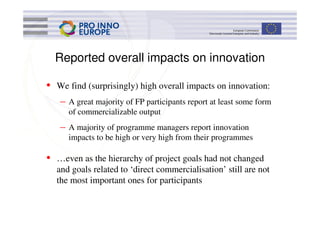
Reported overall impacts on innovation

• We find (surprisingly) high overall impacts on innovation:
   –   A great majority of FP participants report at least some form
       of commercializable output
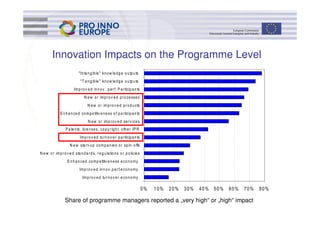
   –   A majority of programme managers report innovation
       impacts to be high or very high from their programmes

• …even as the hierarchy of project goals had not changed
  and goals related to ‘direct commercialisation’ still are not
  the most important ones for participants
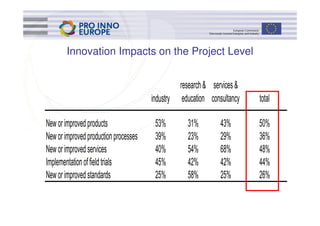
Innovation Impacts on the Project Level


                                                  research & services &
                                       industry    education consultancy   total

New or improved products                53%         31%         43%        50%
New or improved production processes    39%         23%         29%        36%
New or improved services                40%         54%         68%        48%
Implementation of field trials          45%         42%         42%        44%
New or improved standards               25%         58%         25%        26%
Innovation Impacts on the Programme Level
                             " In ta n g ib le " kn o w le d g e o u tp u ts
                              " T a n g ib le " kn o w le d g e o u tp u ts
                         Im p r o v e d in n o v . p e r f. P a r ticip a n ts
                                 N e w o r im p r o v e d p r o ce sse s
                                    N e w o r im p r o v e d p r o d u cts
               E n h a n ce d co m p e titiv e n e ss o f p a r ticip a n ts
                                    N e w o r im p r o v e d se r v ice s
                   P a te n ts, lice n se s, co p y r ig h t, o th e r IP R
                              Im p r o v e d tu r n o v e r p a r ticip a n ts
                      N e w sta r t- u p co m p a n ie s o r sp in - o ffs
N e w o r im p r o v e d sta n d a r d s, r e g u la tio n s o r p o licie s
                    E n h a n ce d co m p e titiv e n e ss e co n o m y
                              Im p r o v e d in n o v .p e r f.e co n o m y
                                Im p r o v e d tu r n o v e r e co n o m y

                                                                                 0%   10%   20%   30%   40% 50%   60%   70%   80%

                  Share of programme managers reported a „very high“ or „high“ impact
Types of Innovation (I)

• Firms do not consider the FP primarily as a channel for
  developing outputs that could be immediately
  commercializable. The dominant objectives for
  participation were reported to be
   – “access to complementary knowledge and skills”
   – “keeping up with state-of-the-art technological development”
   – “explore different technological opportunities”

• FP projects tend to be viewed by participating
  organizations as vehicles for exploring new areas. In
  contrast, self-funded cooperative R&D projects which are
  primarily used by the respondents for technology
  exploitation (closer to the market).
Types of Innovation (II)

•   Compared to cooperative R&D projects funded exclusively with own
    internal funds, FP projects were reported, on average, to be
    characterised by:
        - longer term R&D horizon
        - greater interest in peripheral (read new area) technologies
        - more explorative nature
        - lower degree of flexibility and higher administrative burden

•   Compared to the average R&D project, FP projects were reported, on
    average, as:
       - more complex
       - more long-term oriented
       - riskier from a scientific and technical point of view
       - similar in terms of commercial risk
Additionality
•   Substantial input additionality – but only among smaller
    firms. Participation in FP4 and/or FP5 was associated with a
    significant jump in R&D intensity between 2000 and 2004
    among firms of up to 100 employees.
•   Higher Risk (Sci/Tech, commercial), novelty of technology
    area, and new combination of partners (newcomers) increase
    the chance of output additionality
•   Reported output additionality is not different between FPs and
    not markedly different between instruments.
    Differences reported between thematic areas in terms of
    output additionality. Higher in new areas (e.g. NANO)
Policy insights (I)
• Directly commercialisable output is not a core objective of
  the Framework Programme. Yet we find significant impact
  on innovation. Caution should be exercised in extensively
  modifying the Programme to further enhance direct
  innovation impact.

• Keep funding instruments simple. Maintain instrument
  continuity. Deep changes increase costs of Programme
  administration without demonstrably significant benefits.
Policy insights (II)
• Rather than focusing too much on differences among
  instruments applied horizontally across all thematic areas, pay
  closer attention to the needs of the broad thematic areas and
  associated markets, and the needs of participating
  organizations.
• The individual FP R&D project is a single research instance
  among many for participating organizations. Do not expect
  huge (additional) impacts either on innovation or on the
  ‘behaviour’ of large participating organizations.
• Promote projects that are risky, technically complex, and in
  new areas.

Wp Polt + Vonortas Berlin 23 24 Oct

  • 1.
    How much innovationcan you get out of R&D programmes? Wolfgang Polt Nicholas S. Vonortas Joanneum Research George Washington University & Athens University of Economics and Business “Turning Knowledge Into Practice” Berlin, October 23-24 2007
  • 2.
    Identifying Innovation Impactof R&D • Prime concern for RTDI policy makers around the world, but especially in Europe in view of the ‘European Paradox’ (good in research, lagging in innovation) • This concern has influenced RTDI policy for the last 10-15 years and has resulted among others in – Increasing emphasis on collaborative programmes (mainly fostering industry-science relations) – Asking for more innovation output from R&D programmes • This trend can be observed both on the EU level as well as in Member States
  • 3.
    Identifying Innovation Impactof R&D Programmes The INNOVATION IMPACT & IMPLORE Projects • INNOVATION IMPACT and IMPLORE are two projects launched by DG Enterprise to improve the understanding of the innovation impacts of R&D programmes – INNOVATION IMPACT tries to identify innovation impacts of the largest collaborative R&D programme in Europe – the EU’s FP for RTDI – IMPLORE looks into the R&D programmes of individual countries to identify programme characteristics that are most conducive for innovation impact • Surveyed extensively FP5/6 projects, programme managers and policy makers, programme participants and experts
  • 4.
    Main findings from INNOVATION IMPACT & IMPLORE • Overall impact of the programmes on innovation • Types of innovation triggered by the programmes • ‘Additionality’ of the innovation • Factors influencing innovation impact (on the project and on the programme level)
  • 5.
    Reported overall impactson innovation • We find (surprisingly) high overall impacts on innovation: – A great majority of FP participants report at least some form of commercializable output – A majority of programme managers report innovation impacts to be high or very high from their programmes • …even as the hierarchy of project goals had not changed and goals related to ‘direct commercialisation’ still are not the most important ones for participants
  • 6.
    Innovation Impacts onthe Project Level research & services & industry education consultancy total New or improved products 53% 31% 43% 50% New or improved production processes 39% 23% 29% 36% New or improved services 40% 54% 68% 48% Implementation of field trials 45% 42% 42% 44% New or improved standards 25% 58% 25% 26%
  • 7.
    Innovation Impacts onthe Programme Level " In ta n g ib le " kn o w le d g e o u tp u ts " T a n g ib le " kn o w le d g e o u tp u ts Im p r o v e d in n o v . p e r f. P a r ticip a n ts N e w o r im p r o v e d p r o ce sse s N e w o r im p r o v e d p r o d u cts E n h a n ce d co m p e titiv e n e ss o f p a r ticip a n ts N e w o r im p r o v e d se r v ice s P a te n ts, lice n se s, co p y r ig h t, o th e r IP R Im p r o v e d tu r n o v e r p a r ticip a n ts N e w sta r t- u p co m p a n ie s o r sp in - o ffs N e w o r im p r o v e d sta n d a r d s, r e g u la tio n s o r p o licie s E n h a n ce d co m p e titiv e n e ss e co n o m y Im p r o v e d in n o v .p e r f.e co n o m y Im p r o v e d tu r n o v e r e co n o m y 0% 10% 20% 30% 40% 50% 60% 70% 80% Share of programme managers reported a „very high“ or „high“ impact
  • 8.
    Types of Innovation(I) • Firms do not consider the FP primarily as a channel for developing outputs that could be immediately commercializable. The dominant objectives for participation were reported to be – “access to complementary knowledge and skills” – “keeping up with state-of-the-art technological development” – “explore different technological opportunities” • FP projects tend to be viewed by participating organizations as vehicles for exploring new areas. In contrast, self-funded cooperative R&D projects which are primarily used by the respondents for technology exploitation (closer to the market).
  • 9.
    Types of Innovation(II) • Compared to cooperative R&D projects funded exclusively with own internal funds, FP projects were reported, on average, to be characterised by: - longer term R&D horizon - greater interest in peripheral (read new area) technologies - more explorative nature - lower degree of flexibility and higher administrative burden • Compared to the average R&D project, FP projects were reported, on average, as: - more complex - more long-term oriented - riskier from a scientific and technical point of view - similar in terms of commercial risk
  • 10.
    Additionality • Substantial input additionality – but only among smaller firms. Participation in FP4 and/or FP5 was associated with a significant jump in R&D intensity between 2000 and 2004 among firms of up to 100 employees. • Higher Risk (Sci/Tech, commercial), novelty of technology area, and new combination of partners (newcomers) increase the chance of output additionality • Reported output additionality is not different between FPs and not markedly different between instruments. Differences reported between thematic areas in terms of output additionality. Higher in new areas (e.g. NANO)
  • 11.
    Policy insights (I) •Directly commercialisable output is not a core objective of the Framework Programme. Yet we find significant impact on innovation. Caution should be exercised in extensively modifying the Programme to further enhance direct innovation impact. • Keep funding instruments simple. Maintain instrument continuity. Deep changes increase costs of Programme administration without demonstrably significant benefits.
  • 12.
    Policy insights (II) •Rather than focusing too much on differences among instruments applied horizontally across all thematic areas, pay closer attention to the needs of the broad thematic areas and associated markets, and the needs of participating organizations. • The individual FP R&D project is a single research instance among many for participating organizations. Do not expect huge (additional) impacts either on innovation or on the ‘behaviour’ of large participating organizations. • Promote projects that are risky, technically complex, and in new areas.