Reproductive phase
(Pollination, Fruit set, fruit
development, fruit drop, fruit
maturity and unfruitfulness)
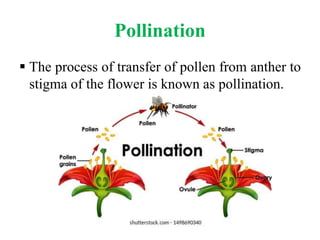
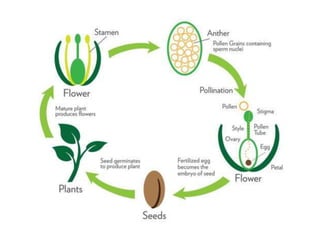
Pollination
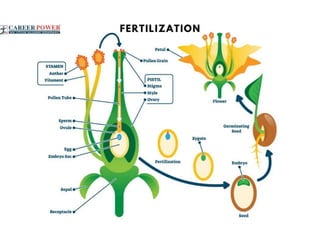
 The process of transfer of pollen from anther to
stigma of the flower is known as pollination.
Video on Types of pollination
Fertilization
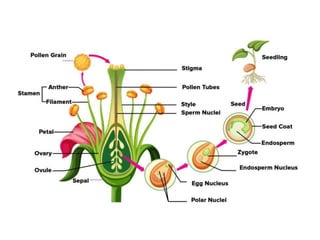
• Fertilization can be defined as the fusion of the male
gametes (pollen) with the female gametes (ovum) to
form a diploid zygote.
Double fertilization:
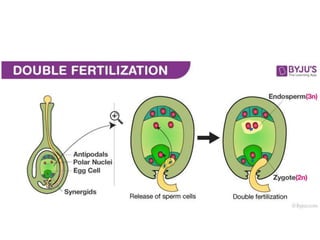
• Double fertilization is a complex process where out of
two sperm cells, one fuses with the egg cell and the
other fuses with two polar nuclei which result in a
diploid (2n) zygote (Syngamy) and a triploid (3n)
primary endosperm nucleus (Triple fusion)
respectively.
• Double fertilization= Syngamy+Triple fusion
Triple Fusion (Vegetative fertilization):
• The fusion of the sperm cell with the two polar nuclei
during double fertilization which results in the
production of the endosperm is called triple fusion.
Video on Pollination and Fertilization
Fertilization
• Fruit setting
–Not all flowers develop into fruit
–Certain plant hormones involved
–Optimum level of fruit setting
• Remove excess by hand, machine, or
chemical
• Some species self-thinning; Washington
Navel Orange
–Temperature strongly influences fruit set.
Video on Types of fruit
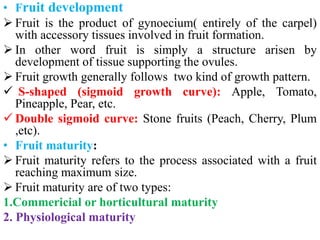
• Fruit development
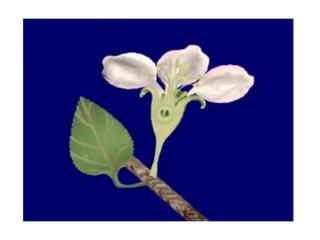
 Fruit is the product of gynoecium( entirely of the carpel)
with accessory tissues involved in fruit formation.
 In other word fruit is simply a structure arisen by
development of tissue supporting the ovules.
 Fruit growth generally follows two kind of growth pattern.
 S-shaped (sigmoid growth curve): Apple, Tomato,
Pineapple, Pear, etc.
 Double sigmoid curve: Stone fruits (Peach, Cherry, Plum
,etc).
• Fruit maturity:
 Fruit maturity refers to the process associated with a fruit
reaching maximum size.
 Fruit maturity are of two types:
1.Commericial or horticultural maturity
2. Physiological maturity
• Unfruitfulness
Unfruitfulness is a major problem in many fruit crops
and their varieties result in huge loss to growers and
make fruit cultivation less profitable.
Unfruitfulness in fruit crops refers to the state where
the plants not capable of flowering and bearing fruit.
• Causes of unfruitfulness
A. Environmental causes:
1) Some varieties of a fruit crop don‘t flower in a
locality owing to undetermined environmental
factors eg. several varieties of mango have not
flowered in Nepal.
• This can be remedied by top working with other
varieties.
2) Unfavourable temperature may cause failure of any
flowering as in the case of apples due to lack of sufficient
winter chilling.
• It has been remedied to certain extent by oil emulsion
sprays and DNOC (Di-nitro-ortho cresol).
3) In tropics, plants flowering in summer may experience
retarded pollen germination due to high temperatures
and low humidity. The provision of windbreaks, close
planting and cover cropping help in improving the
situation.
4) Reduced illumination due to close planting ,over
crowding of branches or shade will often reduced
flowering Thinning out some trees to increase
spacing,pruning trees to reduce over crowding and
removal of shade can meet the situation.
5) Late rains may prolong the vegetative growth
and delay or reduce flowering in mango. It can be
remedied by drying out the soil by deep ploughing and
probably by artificial inhibition of growth by growth
regulators.
6) Heavy rains may restrict pollinator activity, wash
away pollen and prevent pollen germination. Choice
of varieties which don‘t flower at such periods of the
year is the best way out. In crops like grapes, the
pruning time may be altered to avoid the onset of
flowering during the period of the rainy season crop
may altogether be avoided by hard pruning.
B. Nutritional Causes:
1)Heavy nitrogenous manuring at the time of flower
bud initiation often reduces flowering by promoting
vegetative differentiation. The practice should be
given up. Root pruning and restricted irrigation may
be helpful in reducing vegetative vigour and inducing
formation of male flowers.
2)Over bearing in the previous season exhausts the
tree and reduces subsequent flowering as in mango
and most biennial bearing trees.
• A complete manure mixture applied at the growth
flush following the harvest will be helpful (June
manuring in mango).
3)Lack of nutrition as in weak shoots causes fall
of flowers before and after fruit set.
• A spray of urea after fruit set will help the
development of fruits.
4)Lack of sufficient reserves of carbohydrates in
shoots may cause sparse flowering and poor set
(shoot bunches of grapes).
• Ringing and girdling may help.
• But it should not be continued as a regular
orchard practice.
5)Adverse growth features like water suckers will
result in a drain on the tree and reduce flowering not
only on themselves but also on other branches of the
tree.
• Such shoots arise when big branches are pruned.
Then it is necessary to cut big limbs, they should
always be set to a strong lateral but not stimulate a
dormant bud.
• Late irrigation following a long drought may cause
the production of water shoots .
• The first irrigation after a drought should always be
sparing later ones being more liberal.
• When water suckers are formed due what ever
reason, they should be promptly removed..
6)Deficiencies of elements are sure cause of reduced
flowering as well as set.
• A composite mineral spray at flush time will
usually be very helpful.
• If deficiency is due to alkalinity of the soil,
suitable reclamation measures should be adopted.
7)Heavy manuring and severe pruning during the
pre-bearing period will prolong it.
• Pruning should be done while branches are young,
preferably by rubbing of axillary buds themselves
by frequent observation of the plants
• Seedlings and some species of plants have a long pre-
bearing period during which no undue anxiety should
be felt for hastening flowering. Old trees suffer from
inadequate nutrition especially when they are neglected.
The short extension of shoots, small leaves showing
various deficiencies, scanty leaves and die back of
shoots indicate approaching death.
• Such trees may be given one chance to bear by
(1) Manuring them heavily with a complete mixture of
nutrients
(2) Pruning hard up to 3-4 year old wood and
(3) Spraying a composite mineral mixture on young flush.
Irrigate frequently and protect them from pests and
diseases. This may rejuvenate the tree for a few years.
C. Inherent Causes:
1)Low proportion of female or perfect flowers as in
some varieties of often is the cause for a poor crop.
There appears to be no remedy for this defect.
2)Structural features like heterostyly and habits like
dicho-gamy some times restrict the availability of
pollen and pollination. The presence of sufficient
population of the tress and pollinators ordinarily
ensures good pollination and set.
3)Inadequate quantities of pollen appear to reduce
fruit set in some varieties of strawberry and some
varieties of grape. Use of suitable growth regulators to
get fruit setting will circumvent the difficulty.
4)Many varieties of Japanese plums and apples are self
sterile. Many other fruits also partially self sterile .
• So planting varieties which make them fertile with their
pollen will solve the problem.
5)When inter sterility is the cause for low fruit set
compatible pollinizers have to be provided. Mixed pollen
sprays and use of synthetic growth regulators may also be
helpful.
6)Triploidy and distant cross are often reasons for low
fruit set. Chemical aids can get over the problem.
7)Defects of ovule development, embryo abortion etc.
are observed in dropped flowers. These largely seem to be
varietal characteristics and cannot largely be altered.
4.Bio-logical causes:
1)Absence of pollinating agents can be a reason for
low fruit set in several fruits.
• Rearing bee colonies in orchards, besides being a
subsidiary source of income greatly helps fruit set.
2)Pests like the mango hopper which directly attacks
the flowers obviously reduce the fruit set. Others
which feed on leaves reduce the photosynthetic
surface impair production of carbohydrates and thus
reduce flowering. Several fungal diseases do the
same thing; Suitable remedial measures should
betaken to protect the trees.
5.Cultural causes:
1)The commonest cause of poor flowering in house gardens is
excessive irrigation which restricts aeration of roots and causes
sickly symptoms. Increase of intervals of irrigation and
provision of drainage are the remedies.
2)Weeds and inter crops may compete with the main crop for
nutrition and water in low rainfall areas .Removal of weeds and
adequate manuring to meet the demands of both the fruit crop as
well as the inter crops are helpful. Inter crops which clash with
the irrigational and manurial requirements of fruit crops both in
respect of quality and time of application should be avoided.
3)Ploughing or deep cultivation at flowering time will result
in drop of flowers and should be avoided.
4)Severe pruning of large limbs which encourages production
of water shoots which should be avoided. If it is absolutely
essential, the branches may be cut to a strong lateral. Wrong
pruning techniques may also cause reduction of flowering.
Measures to overcome unfruitfulness
1. Balancing vegetative and reproductive growth with proper
pruning and thinning
 The use of dwarfing rootstocks, compact, short-internode scions.
 Training and pruning system which give horizontal or wide-angled
branches.
 The influence of pruning varies with the amount, season and kind
of pruning. Judicious and proper pruning is needed to improve the
fruit set and fruit retention on the trees
 Also on the removal of dead results in loss of carbohydrates
reserves along with pruned wood.
 Also, severe pruning promotes too much vegetative growth and
hence reduce the productivity
2. Control of pollination/ Proper use of pollinzers
 Introduction of pollinators like honeybees
 One of the basic requirements for setting fruit is an adequate
requirement of compatible pollen.
 The need for cross pollination is recognized.
 Pollinating insects are necessary for fruit set -most cultivars will
benefit from cross pollination.
 Under general conditions, the closer a tree is to a pollinizer, the
better fruit set will be. Cross pollination necessitates the availability
of sufficient quantity of compatible pollen
 Suitable agent for the successful and effective transfer of pollen.
Therefore, suitable pollinizer cultivars must be inter-planted at the
time of orchard layout.
Desirable characteristics of pollinizers
1) The pollen -ability to fertilize
2) Its flowering time should coincide.
3) It must come into flower with the same age.
4) It should possibly be a commercial variety.
5) It should also be suitable for place and micro climate.
6) It should also be a long flowering season
 Pollinizers trees may be interplant in the orchard/in suitable
numbers in different pockets. 10% of male plants of
papaya is required for fruit set.
 Some varieties are sterile, self-unfruitful cross sterile, in
such cases block of other varieties which provide
compatible pollens should be established.
3. Control of frost damage
 In early stages, a temperature of about -15°C kills
50% of the bud, but at full bloom, the temperature
of -3 to -4°C can have similar effect.
 This is due to increasing water content and
decrease in their ability to supercool.
 Exposure to low temperature and dry conditions
prior to the incidence of frost induces a degree of
hardening and resistance to frost.
 Reduced by delaying bud break and blossoming.
 Repeated sprays of Paclobutrazol.
4. Proper nutrition
 Balanced supply of nutrients is always desirable for
realizing optimum fruit production.
 Generally, it is advocated that for application of
fertilizers, a few days before emergence of
blossoms is generally believed to favour flowering
and fruit set.
Balanced nitrogen fertilization, Proper spray of
micronutrients like Boron and Zinc
Eg. Nitrogen application after terminal bud
formation led to the development of flower with
enhanced embryo sac longevity (Jackson, 2003).
5. Application of plant growth regulators
 The unfruitful behavior of several fruit plants can be
overcome by the use of PGR which may be due to
decreased fruit set and abscission at various developmental
stages.
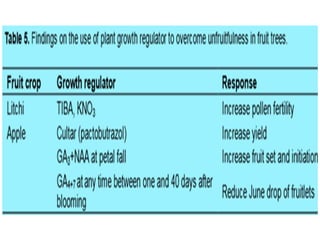
 Some of the recent findings on the use of plant growth
regulator to overcome unfruitfulness .
 E.g. Litchi application of TIBA and KNO3, Increase pollen
fertility (Sanyal et al., 1996).
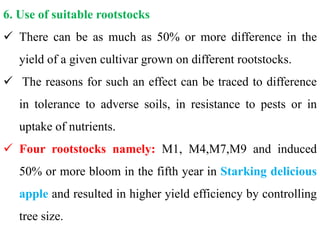
6. Use of suitable rootstocks
 There can be as much as 50% or more difference in the
yield of a given cultivar grown on different rootstocks.
 The reasons for such an effect can be traced to difference
in tolerance to adverse soils, in resistance to pests or in
uptake of nutrients.
 Four rootstocks namely: M1, M4,M7,M9 and induced
50% or more bloom in the fifth year in Starking delicious
apple and resulted in higher yield efficiency by controlling
tree size.
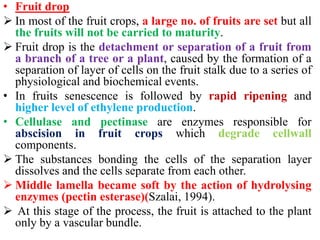
• Fruit drop
 In most of the fruit crops, a large no. of fruits are set but all
the fruits will not be carried to maturity.
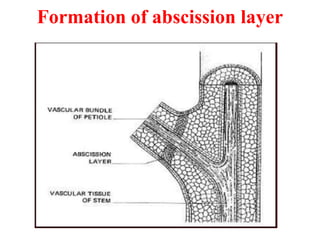
 Fruit drop is the detachment or separation of a fruit from
a branch of a tree or a plant, caused by the formation of a
separation of layer of cells on the fruit stalk due to a series of
physiological and biochemical events.
• In fruits senescence is followed by rapid ripening and
higher level of ethylene production.
• Cellulase and pectinase are enzymes responsible for
abscision in fruit crops which degrade cellwall
components.
 The substances bonding the cells of the separation layer
dissolves and the cells separate from each other.
 Middle lamella became soft by the action of hydrolysing
enzymes (pectin esterase)(Szalai, 1994).
 At this stage of the process, the fruit is attached to the plant
only by a vascular bundle.
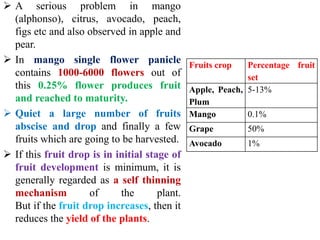
 A serious problem in mango
(alphonso), citrus, avocado, peach,
figs etc and also observed in apple and
pear.
 In mango single flower panicle
contains 1000-6000 flowers out of
this 0.25% flower produces fruit
and reached to maturity.
 Quiet a large number of fruits
abscise and drop and finally a few
fruits which are going to be harvested.
 If this fruit drop is in initial stage of
fruit development is minimum, it is
generally regarded as a self thinning
mechanism of the plant.
But if the fruit drop increases, then it
reduces the yield of the plants.
Fruits crop Percentage fruit
set
Apple, Peach,
Plum
5-13%
Mango 0.1%
Grape 50%
Avocado 1%
Formation of abscission layer
• It is the world wide spread horticultural problem.
• This is due to abscission, which may occur shortly
after pollination and fruit set or even at the time of
normal fruit ripening
• In Macademia nut, more than 90% of young fruits
may shed during fruit growth.
This may be due to various factors like
temperature, nutrient supply, growth substances
or hormones, pest and diseases.
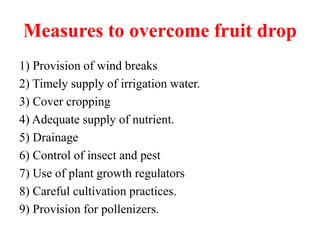
Measures to overcome fruit drop
1) Provision of wind breaks
2) Timely supply of irrigation water.
3) Cover cropping
4) Adequate supply of nutrient.
5) Drainage
6) Control of insect and pest
7) Use of plant growth regulators
8) Careful cultivation practices.
9) Provision for pollenizers.
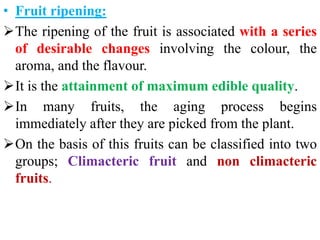
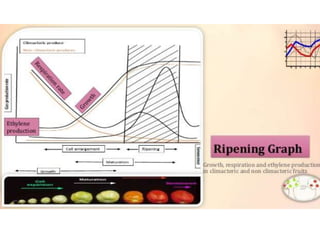
• Fruit ripening:
The ripening of the fruit is associated with a series
of desirable changes involving the colour, the
aroma, and the flavour.
It is the attainment of maximum edible quality.
In many fruits, the aging process begins
immediately after they are picked from the plant.
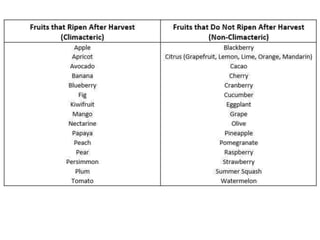
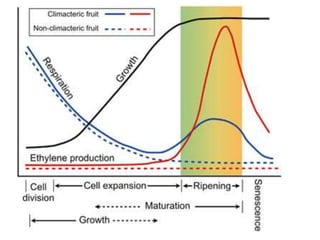
On the basis of this fruits can be classified into two
groups; Climacteric fruit and non climacteric
fruits.
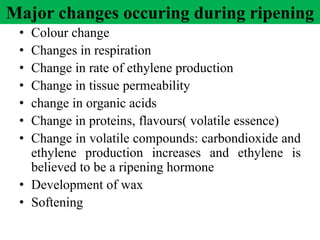
Major changes occuring during ripening
• Colour change
• Changes in respiration
• Change in rate of ethylene production
• Change in tissue permeability
• change in organic acids
• Change in proteins, flavours( volatile essence)
• Change in volatile compounds: carbondioxide and
ethylene production increases and ethylene is
believed to be a ripening hormone
• Development of wax
• Softening
47

12. Pollination, fertilization ,Fruit set and fruit development.pptx

  • 2.
    Reproductive phase (Pollination, Fruitset, fruit development, fruit drop, fruit maturity and unfruitfulness)
  • 3.
    Pollination  The processof transfer of pollen from anther to stigma of the flower is known as pollination.
  • 5.
    Video on Typesof pollination
  • 6.
    Fertilization • Fertilization canbe defined as the fusion of the male gametes (pollen) with the female gametes (ovum) to form a diploid zygote. Double fertilization: • Double fertilization is a complex process where out of two sperm cells, one fuses with the egg cell and the other fuses with two polar nuclei which result in a diploid (2n) zygote (Syngamy) and a triploid (3n) primary endosperm nucleus (Triple fusion) respectively. • Double fertilization= Syngamy+Triple fusion Triple Fusion (Vegetative fertilization): • The fusion of the sperm cell with the two polar nuclei during double fertilization which results in the production of the endosperm is called triple fusion.
  • 7.
    Video on Pollinationand Fertilization
  • 11.
  • 13.
    • Fruit setting –Notall flowers develop into fruit –Certain plant hormones involved –Optimum level of fruit setting • Remove excess by hand, machine, or chemical • Some species self-thinning; Washington Navel Orange –Temperature strongly influences fruit set.
  • 14.
  • 15.
    • Fruit development Fruit is the product of gynoecium( entirely of the carpel) with accessory tissues involved in fruit formation.  In other word fruit is simply a structure arisen by development of tissue supporting the ovules.  Fruit growth generally follows two kind of growth pattern.  S-shaped (sigmoid growth curve): Apple, Tomato, Pineapple, Pear, etc.  Double sigmoid curve: Stone fruits (Peach, Cherry, Plum ,etc). • Fruit maturity:  Fruit maturity refers to the process associated with a fruit reaching maximum size.  Fruit maturity are of two types: 1.Commericial or horticultural maturity 2. Physiological maturity
  • 17.
    • Unfruitfulness Unfruitfulness isa major problem in many fruit crops and their varieties result in huge loss to growers and make fruit cultivation less profitable. Unfruitfulness in fruit crops refers to the state where the plants not capable of flowering and bearing fruit. • Causes of unfruitfulness A. Environmental causes: 1) Some varieties of a fruit crop don‘t flower in a locality owing to undetermined environmental factors eg. several varieties of mango have not flowered in Nepal. • This can be remedied by top working with other varieties.
  • 18.
    2) Unfavourable temperaturemay cause failure of any flowering as in the case of apples due to lack of sufficient winter chilling. • It has been remedied to certain extent by oil emulsion sprays and DNOC (Di-nitro-ortho cresol). 3) In tropics, plants flowering in summer may experience retarded pollen germination due to high temperatures and low humidity. The provision of windbreaks, close planting and cover cropping help in improving the situation. 4) Reduced illumination due to close planting ,over crowding of branches or shade will often reduced flowering Thinning out some trees to increase spacing,pruning trees to reduce over crowding and removal of shade can meet the situation.
  • 19.
    5) Late rainsmay prolong the vegetative growth and delay or reduce flowering in mango. It can be remedied by drying out the soil by deep ploughing and probably by artificial inhibition of growth by growth regulators. 6) Heavy rains may restrict pollinator activity, wash away pollen and prevent pollen germination. Choice of varieties which don‘t flower at such periods of the year is the best way out. In crops like grapes, the pruning time may be altered to avoid the onset of flowering during the period of the rainy season crop may altogether be avoided by hard pruning.
  • 20.
    B. Nutritional Causes: 1)Heavynitrogenous manuring at the time of flower bud initiation often reduces flowering by promoting vegetative differentiation. The practice should be given up. Root pruning and restricted irrigation may be helpful in reducing vegetative vigour and inducing formation of male flowers. 2)Over bearing in the previous season exhausts the tree and reduces subsequent flowering as in mango and most biennial bearing trees. • A complete manure mixture applied at the growth flush following the harvest will be helpful (June manuring in mango).
  • 21.
    3)Lack of nutritionas in weak shoots causes fall of flowers before and after fruit set. • A spray of urea after fruit set will help the development of fruits. 4)Lack of sufficient reserves of carbohydrates in shoots may cause sparse flowering and poor set (shoot bunches of grapes). • Ringing and girdling may help. • But it should not be continued as a regular orchard practice.
  • 22.
    5)Adverse growth featureslike water suckers will result in a drain on the tree and reduce flowering not only on themselves but also on other branches of the tree. • Such shoots arise when big branches are pruned. Then it is necessary to cut big limbs, they should always be set to a strong lateral but not stimulate a dormant bud. • Late irrigation following a long drought may cause the production of water shoots . • The first irrigation after a drought should always be sparing later ones being more liberal. • When water suckers are formed due what ever reason, they should be promptly removed..
  • 23.
    6)Deficiencies of elementsare sure cause of reduced flowering as well as set. • A composite mineral spray at flush time will usually be very helpful. • If deficiency is due to alkalinity of the soil, suitable reclamation measures should be adopted. 7)Heavy manuring and severe pruning during the pre-bearing period will prolong it. • Pruning should be done while branches are young, preferably by rubbing of axillary buds themselves by frequent observation of the plants
  • 24.
    • Seedlings andsome species of plants have a long pre- bearing period during which no undue anxiety should be felt for hastening flowering. Old trees suffer from inadequate nutrition especially when they are neglected. The short extension of shoots, small leaves showing various deficiencies, scanty leaves and die back of shoots indicate approaching death. • Such trees may be given one chance to bear by (1) Manuring them heavily with a complete mixture of nutrients (2) Pruning hard up to 3-4 year old wood and (3) Spraying a composite mineral mixture on young flush. Irrigate frequently and protect them from pests and diseases. This may rejuvenate the tree for a few years.
  • 25.
    C. Inherent Causes: 1)Lowproportion of female or perfect flowers as in some varieties of often is the cause for a poor crop. There appears to be no remedy for this defect. 2)Structural features like heterostyly and habits like dicho-gamy some times restrict the availability of pollen and pollination. The presence of sufficient population of the tress and pollinators ordinarily ensures good pollination and set. 3)Inadequate quantities of pollen appear to reduce fruit set in some varieties of strawberry and some varieties of grape. Use of suitable growth regulators to get fruit setting will circumvent the difficulty.
  • 26.
    4)Many varieties ofJapanese plums and apples are self sterile. Many other fruits also partially self sterile . • So planting varieties which make them fertile with their pollen will solve the problem. 5)When inter sterility is the cause for low fruit set compatible pollinizers have to be provided. Mixed pollen sprays and use of synthetic growth regulators may also be helpful. 6)Triploidy and distant cross are often reasons for low fruit set. Chemical aids can get over the problem. 7)Defects of ovule development, embryo abortion etc. are observed in dropped flowers. These largely seem to be varietal characteristics and cannot largely be altered.
  • 27.
    4.Bio-logical causes: 1)Absence ofpollinating agents can be a reason for low fruit set in several fruits. • Rearing bee colonies in orchards, besides being a subsidiary source of income greatly helps fruit set. 2)Pests like the mango hopper which directly attacks the flowers obviously reduce the fruit set. Others which feed on leaves reduce the photosynthetic surface impair production of carbohydrates and thus reduce flowering. Several fungal diseases do the same thing; Suitable remedial measures should betaken to protect the trees.
  • 28.
    5.Cultural causes: 1)The commonestcause of poor flowering in house gardens is excessive irrigation which restricts aeration of roots and causes sickly symptoms. Increase of intervals of irrigation and provision of drainage are the remedies. 2)Weeds and inter crops may compete with the main crop for nutrition and water in low rainfall areas .Removal of weeds and adequate manuring to meet the demands of both the fruit crop as well as the inter crops are helpful. Inter crops which clash with the irrigational and manurial requirements of fruit crops both in respect of quality and time of application should be avoided. 3)Ploughing or deep cultivation at flowering time will result in drop of flowers and should be avoided. 4)Severe pruning of large limbs which encourages production of water shoots which should be avoided. If it is absolutely essential, the branches may be cut to a strong lateral. Wrong pruning techniques may also cause reduction of flowering.
  • 29.
    Measures to overcomeunfruitfulness 1. Balancing vegetative and reproductive growth with proper pruning and thinning  The use of dwarfing rootstocks, compact, short-internode scions.  Training and pruning system which give horizontal or wide-angled branches.  The influence of pruning varies with the amount, season and kind of pruning. Judicious and proper pruning is needed to improve the fruit set and fruit retention on the trees  Also on the removal of dead results in loss of carbohydrates reserves along with pruned wood.  Also, severe pruning promotes too much vegetative growth and hence reduce the productivity
  • 30.
    2. Control ofpollination/ Proper use of pollinzers  Introduction of pollinators like honeybees  One of the basic requirements for setting fruit is an adequate requirement of compatible pollen.  The need for cross pollination is recognized.  Pollinating insects are necessary for fruit set -most cultivars will benefit from cross pollination.  Under general conditions, the closer a tree is to a pollinizer, the better fruit set will be. Cross pollination necessitates the availability of sufficient quantity of compatible pollen  Suitable agent for the successful and effective transfer of pollen. Therefore, suitable pollinizer cultivars must be inter-planted at the time of orchard layout.
  • 31.
    Desirable characteristics ofpollinizers 1) The pollen -ability to fertilize 2) Its flowering time should coincide. 3) It must come into flower with the same age. 4) It should possibly be a commercial variety. 5) It should also be suitable for place and micro climate. 6) It should also be a long flowering season  Pollinizers trees may be interplant in the orchard/in suitable numbers in different pockets. 10% of male plants of papaya is required for fruit set.  Some varieties are sterile, self-unfruitful cross sterile, in such cases block of other varieties which provide compatible pollens should be established.
  • 32.
    3. Control offrost damage  In early stages, a temperature of about -15°C kills 50% of the bud, but at full bloom, the temperature of -3 to -4°C can have similar effect.  This is due to increasing water content and decrease in their ability to supercool.  Exposure to low temperature and dry conditions prior to the incidence of frost induces a degree of hardening and resistance to frost.  Reduced by delaying bud break and blossoming.  Repeated sprays of Paclobutrazol.
  • 33.
    4. Proper nutrition Balanced supply of nutrients is always desirable for realizing optimum fruit production.  Generally, it is advocated that for application of fertilizers, a few days before emergence of blossoms is generally believed to favour flowering and fruit set. Balanced nitrogen fertilization, Proper spray of micronutrients like Boron and Zinc Eg. Nitrogen application after terminal bud formation led to the development of flower with enhanced embryo sac longevity (Jackson, 2003).
  • 34.
    5. Application ofplant growth regulators  The unfruitful behavior of several fruit plants can be overcome by the use of PGR which may be due to decreased fruit set and abscission at various developmental stages.  Some of the recent findings on the use of plant growth regulator to overcome unfruitfulness .  E.g. Litchi application of TIBA and KNO3, Increase pollen fertility (Sanyal et al., 1996).
  • 36.
    6. Use ofsuitable rootstocks  There can be as much as 50% or more difference in the yield of a given cultivar grown on different rootstocks.  The reasons for such an effect can be traced to difference in tolerance to adverse soils, in resistance to pests or in uptake of nutrients.  Four rootstocks namely: M1, M4,M7,M9 and induced 50% or more bloom in the fifth year in Starking delicious apple and resulted in higher yield efficiency by controlling tree size.
  • 37.
    • Fruit drop In most of the fruit crops, a large no. of fruits are set but all the fruits will not be carried to maturity.  Fruit drop is the detachment or separation of a fruit from a branch of a tree or a plant, caused by the formation of a separation of layer of cells on the fruit stalk due to a series of physiological and biochemical events. • In fruits senescence is followed by rapid ripening and higher level of ethylene production. • Cellulase and pectinase are enzymes responsible for abscision in fruit crops which degrade cellwall components.  The substances bonding the cells of the separation layer dissolves and the cells separate from each other.  Middle lamella became soft by the action of hydrolysing enzymes (pectin esterase)(Szalai, 1994).  At this stage of the process, the fruit is attached to the plant only by a vascular bundle.
  • 38.
     A seriousproblem in mango (alphonso), citrus, avocado, peach, figs etc and also observed in apple and pear.  In mango single flower panicle contains 1000-6000 flowers out of this 0.25% flower produces fruit and reached to maturity.  Quiet a large number of fruits abscise and drop and finally a few fruits which are going to be harvested.  If this fruit drop is in initial stage of fruit development is minimum, it is generally regarded as a self thinning mechanism of the plant. But if the fruit drop increases, then it reduces the yield of the plants. Fruits crop Percentage fruit set Apple, Peach, Plum 5-13% Mango 0.1% Grape 50% Avocado 1%
  • 39.
  • 40.
    • It isthe world wide spread horticultural problem. • This is due to abscission, which may occur shortly after pollination and fruit set or even at the time of normal fruit ripening • In Macademia nut, more than 90% of young fruits may shed during fruit growth. This may be due to various factors like temperature, nutrient supply, growth substances or hormones, pest and diseases.
  • 41.
    Measures to overcomefruit drop 1) Provision of wind breaks 2) Timely supply of irrigation water. 3) Cover cropping 4) Adequate supply of nutrient. 5) Drainage 6) Control of insect and pest 7) Use of plant growth regulators 8) Careful cultivation practices. 9) Provision for pollenizers.
  • 42.
    • Fruit ripening: Theripening of the fruit is associated with a series of desirable changes involving the colour, the aroma, and the flavour. It is the attainment of maximum edible quality. In many fruits, the aging process begins immediately after they are picked from the plant. On the basis of this fruits can be classified into two groups; Climacteric fruit and non climacteric fruits.
  • 46.
    Major changes occuringduring ripening • Colour change • Changes in respiration • Change in rate of ethylene production • Change in tissue permeability • change in organic acids • Change in proteins, flavours( volatile essence) • Change in volatile compounds: carbondioxide and ethylene production increases and ethylene is believed to be a ripening hormone • Development of wax • Softening
  • 47.