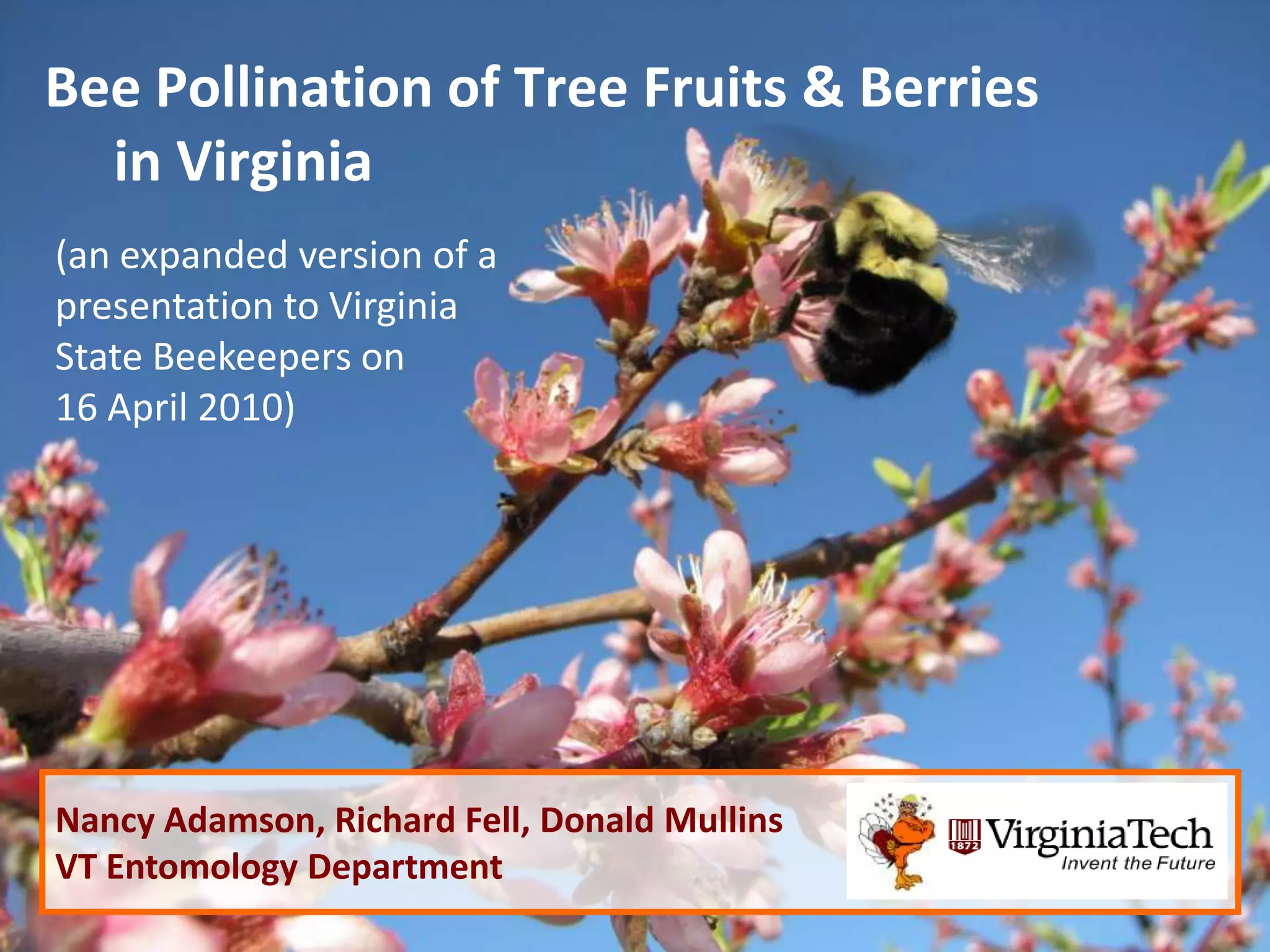
Bee Pollination of Tree Fruits & Berries
  in Virginia
(an expanded version of a
presentation to Virginia
State Beekeepers on
16 April 2010)


Nancy Adamson, Richard Fell, Donald Mullins
VT Entomology Department
Program Overview

 Tree fruits & berries grown in Virginia
 Colony recommendations
 Pollination research on non-Apis bees & a
  little more pollination biology


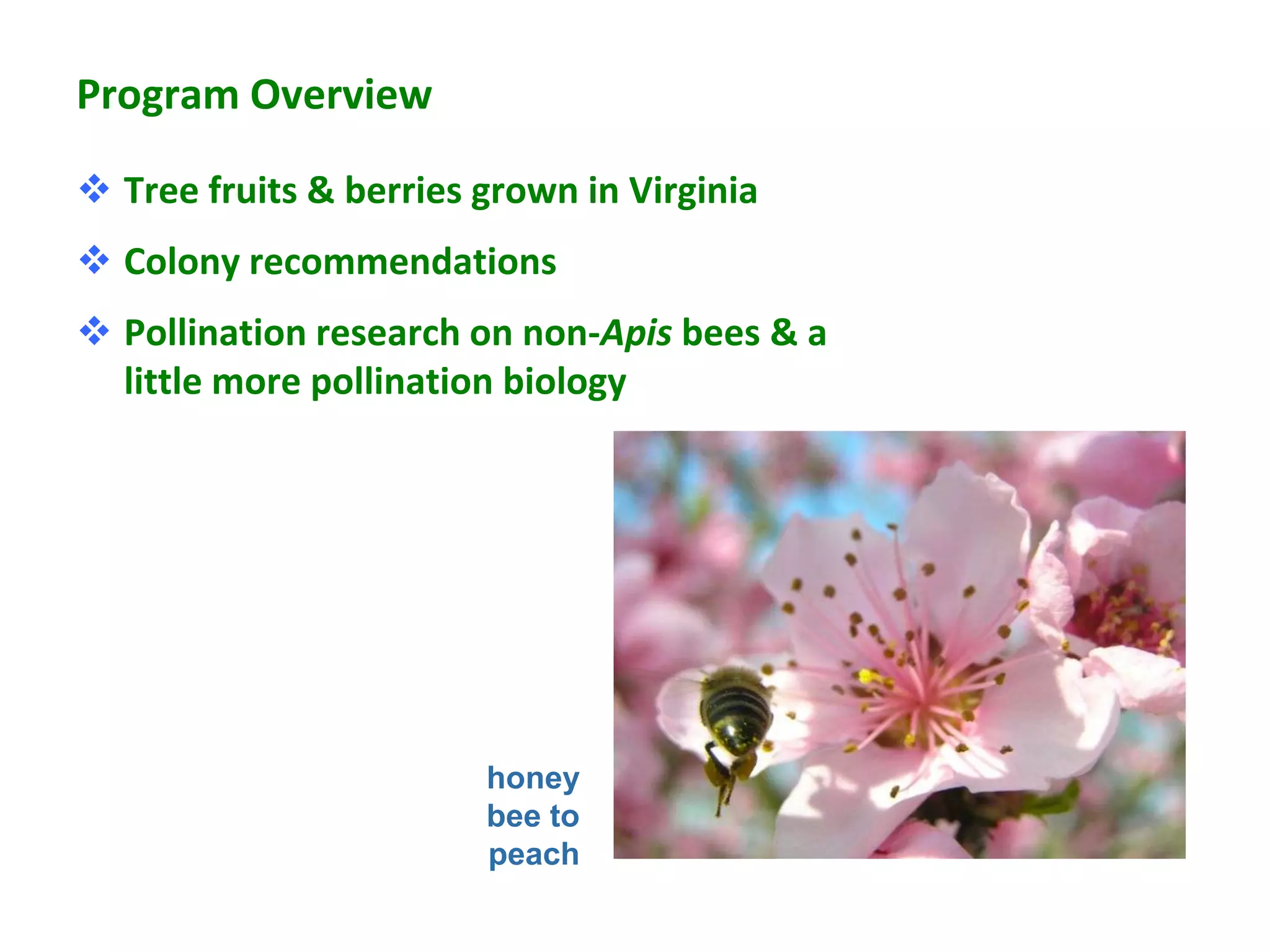
                        honey
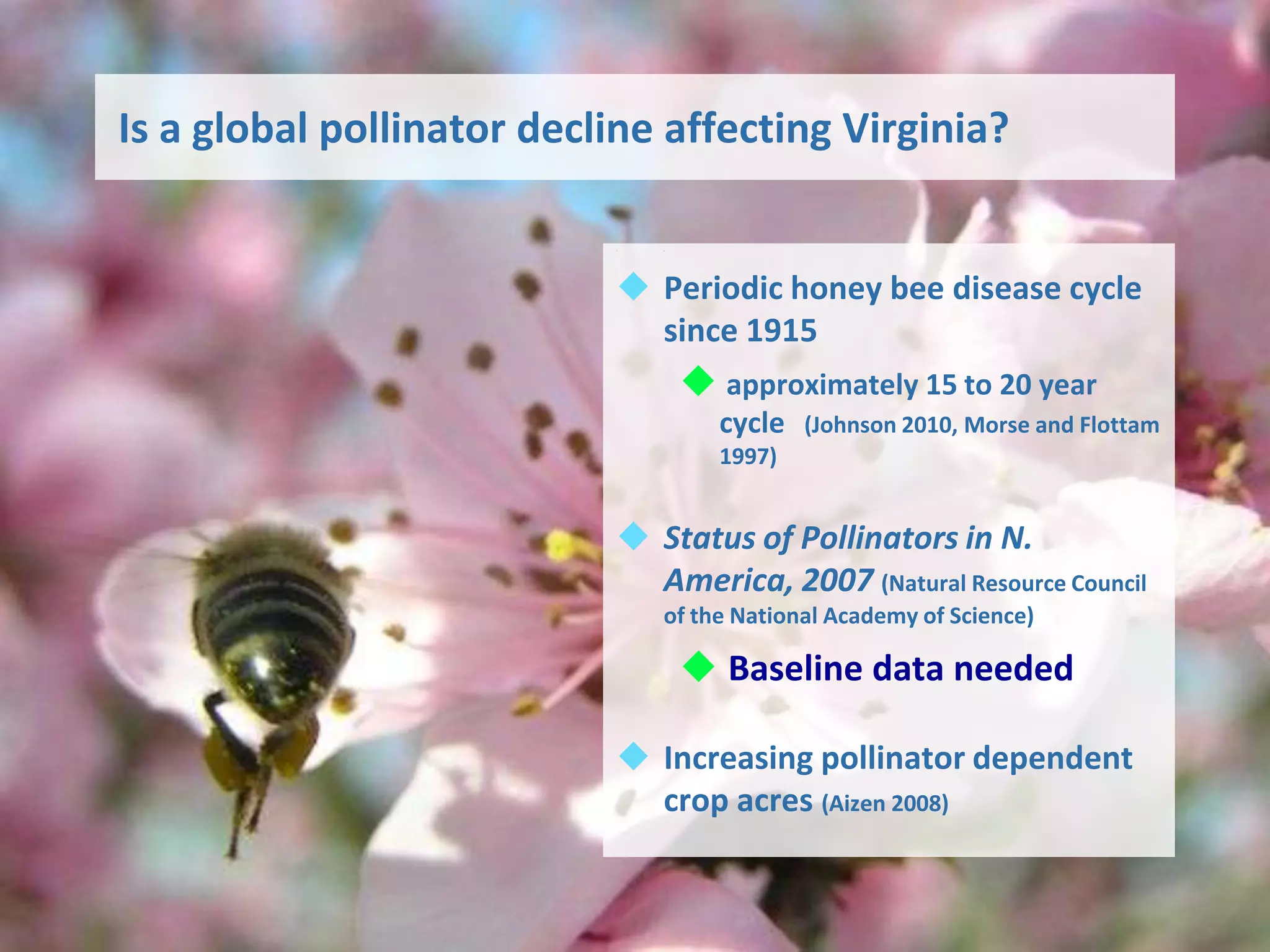
                        bee to
                        peach
Insect pollinated* fruit grown in Virginia

Rosaceae (rose family)              Other fruit families
 apple & crab apple, pear,          Cucurbitaceae (cucurbit):
  serviceberry, quince                watermelon, musk melon
 caneberry (raspberry,              Annonaceae (custard-apple):
  blackberry, black raspberry,        pawpaw
  wineberry)                         Grossulariaceae: gooseberry,
 peach, plum, nectarine,             currant
  apricot                            Ebonaceae (ebony): persimmon
 strawberry                         Caprifoliaceae (honeysuckle):
                                      elderberry
                                     Actinidiaceae (Chinese
Ericaceae (heath family)              gooseberry): kiwi
 blueberry, cranberry,
                                     Passifloraceae: passion flower
  huckleberry
                                     Cactaceae (cactus): prickly pear
* Grapes and mulberries don’t depend on insects—can you think of others?
Most fruit crops benefit from cross-pollination
Some crop varieties*require cross-pollination
    apples, blueberries, cherries, kiwis, persimmons, sunflowers,
     caneberries**, and hemp (McGregor 1976, Free 1993, McConkey 2009)

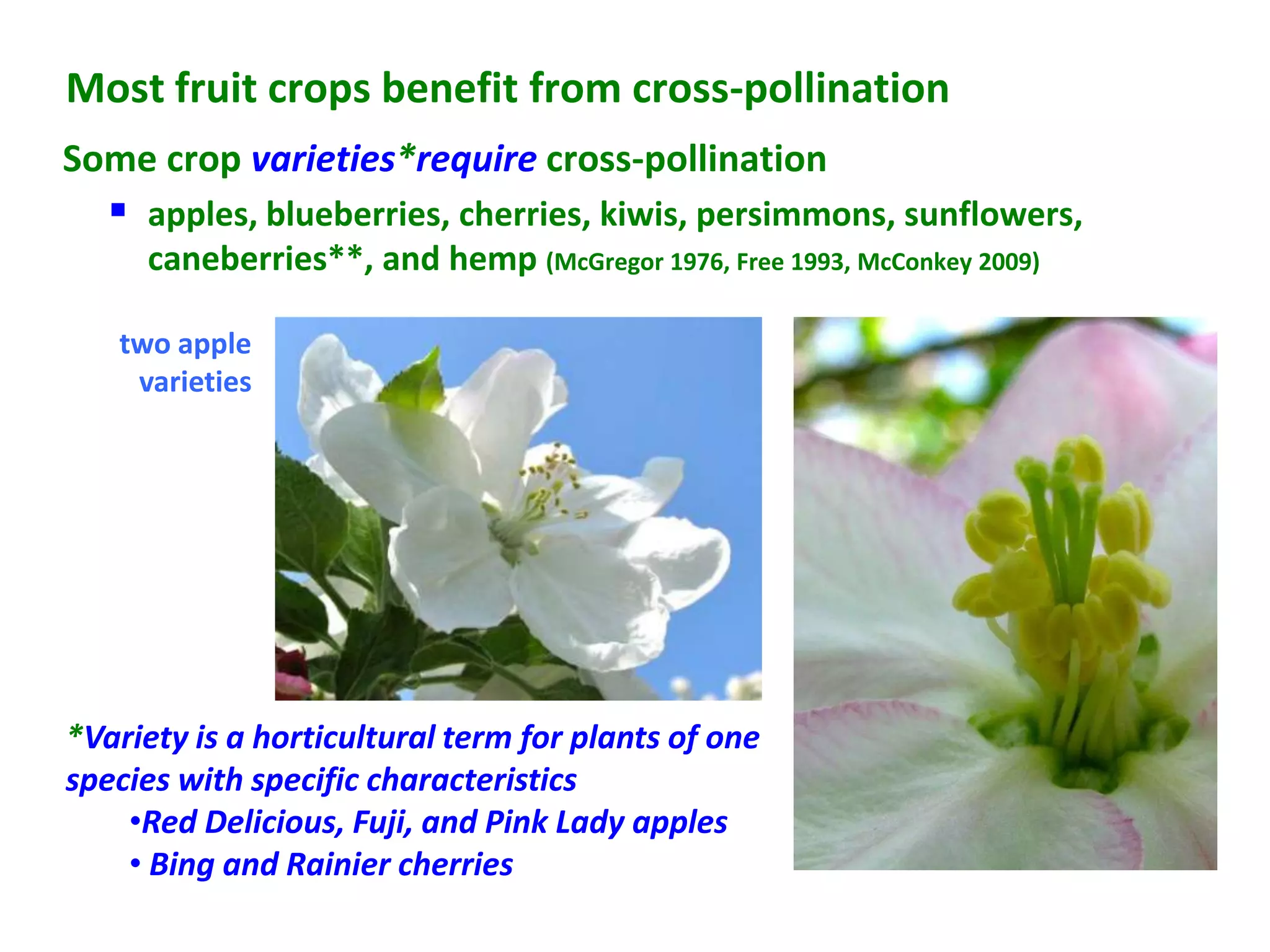
   two apple
    varieties


*Variety is a horticultural term for plants of one
species with specific characteristics
    •Red Delicious, Fuji, and Pink Lady apples
    • Bing and Rainier cherries
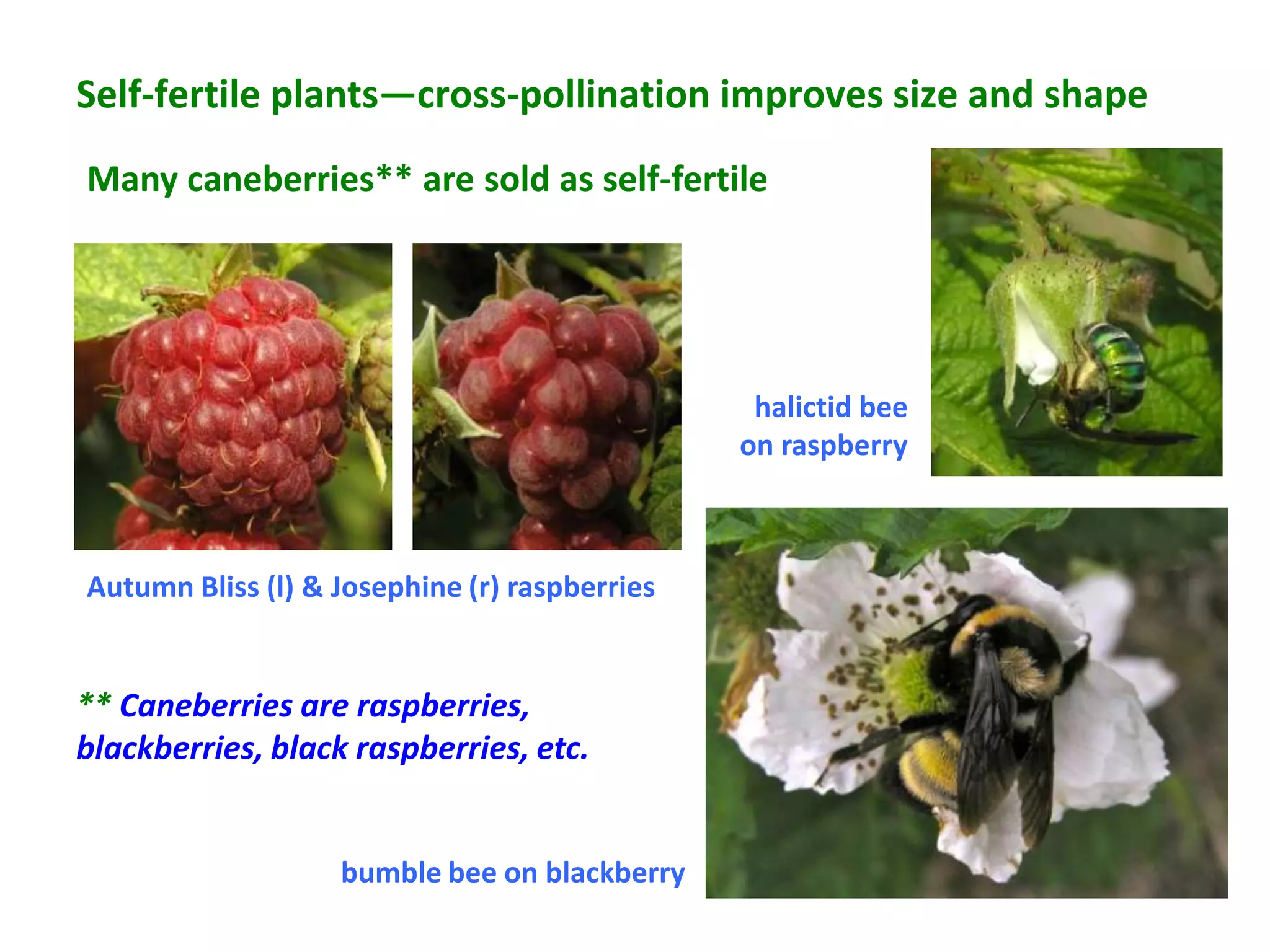
Self-fertile plants—cross-pollination improves size and shape
Many caneberries** are sold as self-fertile


                                                halictid bee
                                               on raspberry


Autumn Bliss (l) & Josephine (r) raspberries


** Caneberries are raspberries,
blackberries, black raspberries, etc.


                   bumble bee on blackberry
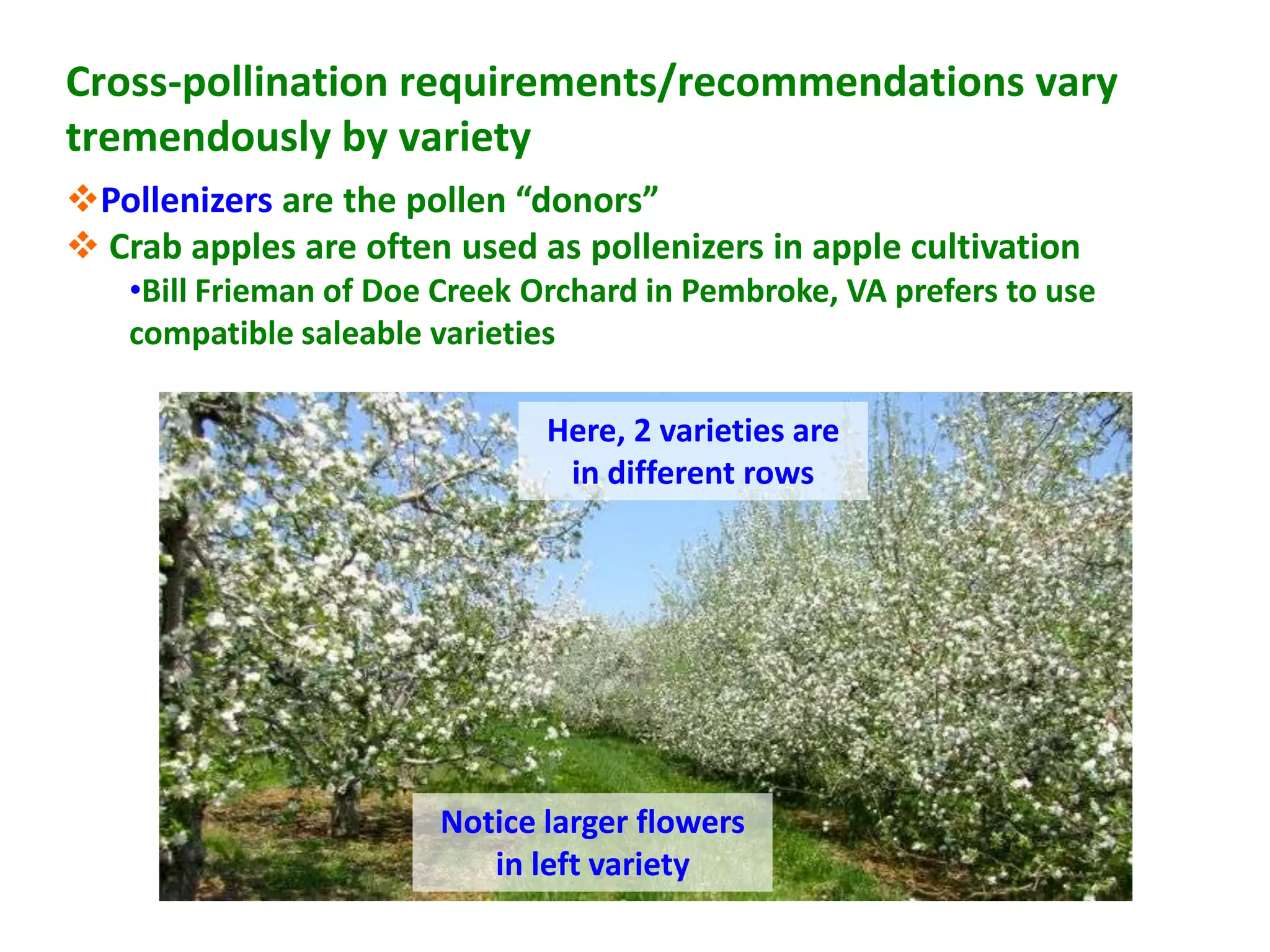
Cross-pollination requirements/recommendations vary
tremendously by variety
Pollenizers are the pollen “donors”
 Crab apples are often used as pollenizers in apple cultivation
    •Bill Frieman of Doe Creek Orchard in Pembroke, VA prefers to use
    compatible saleable varieties

                                Here, 2 varieties are
                                 in different rows


                        Notice larger flowers
                           in left variety
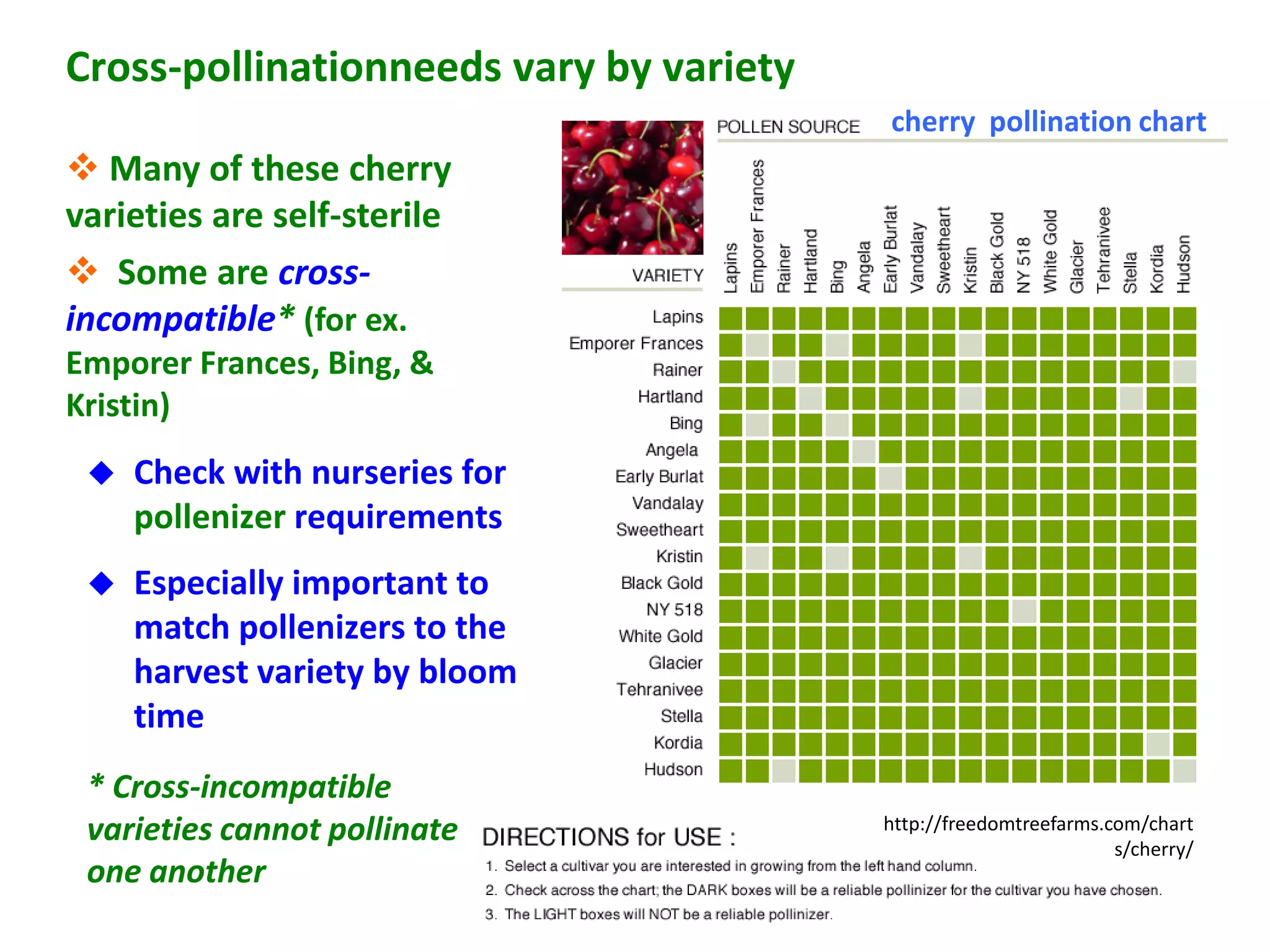
Cross-pollinationneeds vary by variety
                                         cherry pollination chart
 Many of these cherry
varieties are self-sterile
 Some are cross-
incompatible* (for ex.
Emporer Frances, Bing, &
Kristin)
    Check with nurseries for
     pollenizer requirements
    Especially important to
     match pollenizers to the
     harvest variety by bloom
     time
 * Cross-incompatible
 varieties cannot pollinate              http://freedomtreefarms.com/chart
                                                                  s/cherry/
 one another
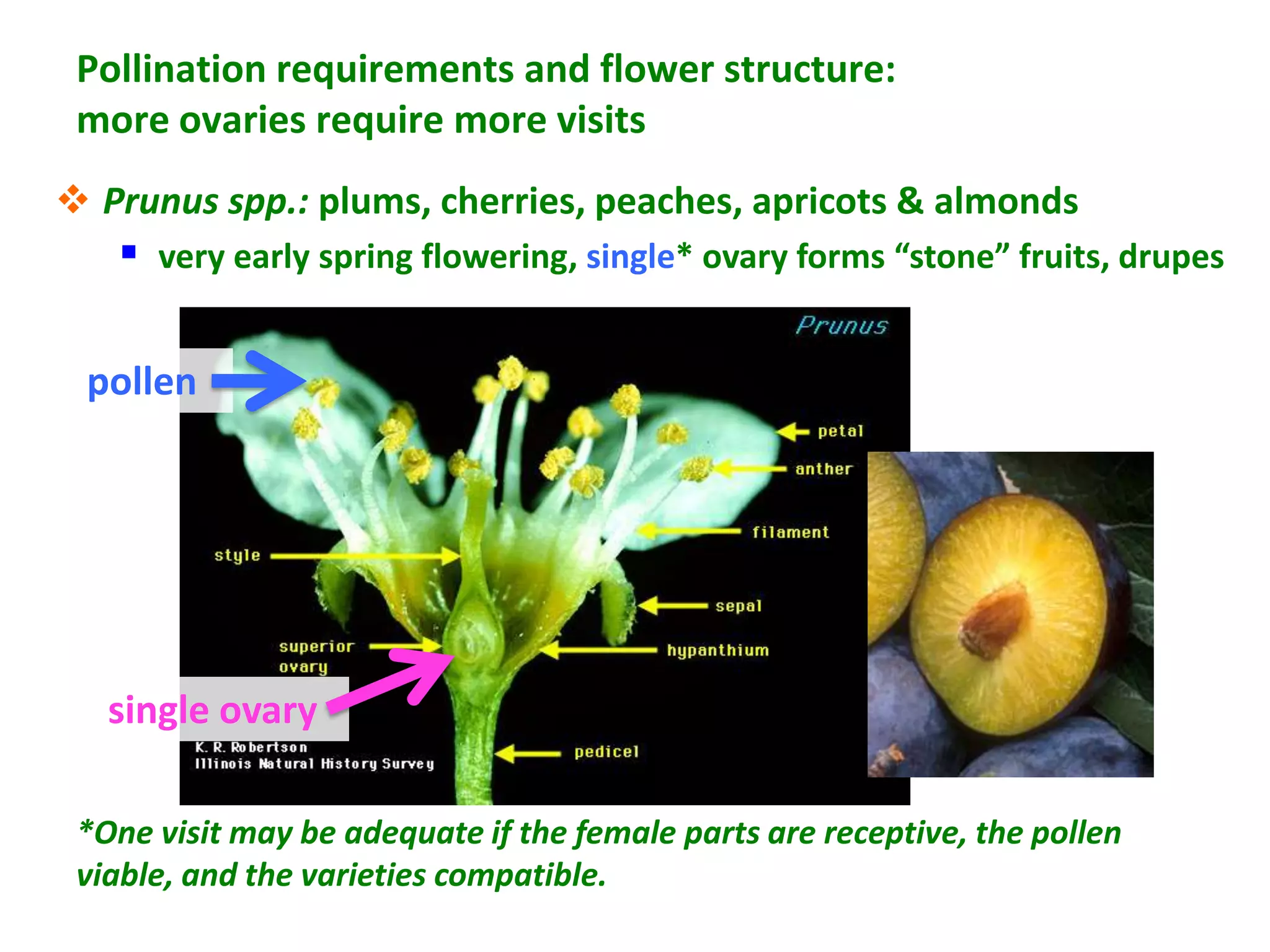
Pollination requirements and flower structure:
 more ovaries require more visits
 Prunus spp.: plums, cherries, peaches, apricots & almonds
    very early spring flowering, single* ovary forms “stone” fruits, drupes

 pollen


   single ovary

 *One visit may be adequate if the female parts are receptive, the pollen
 viable, and the varieties compatible.
Flower parts may mature at different times—promotes cross-
fertilization (vigor in the big scheme)
 Malus spp.– apples and crab apples
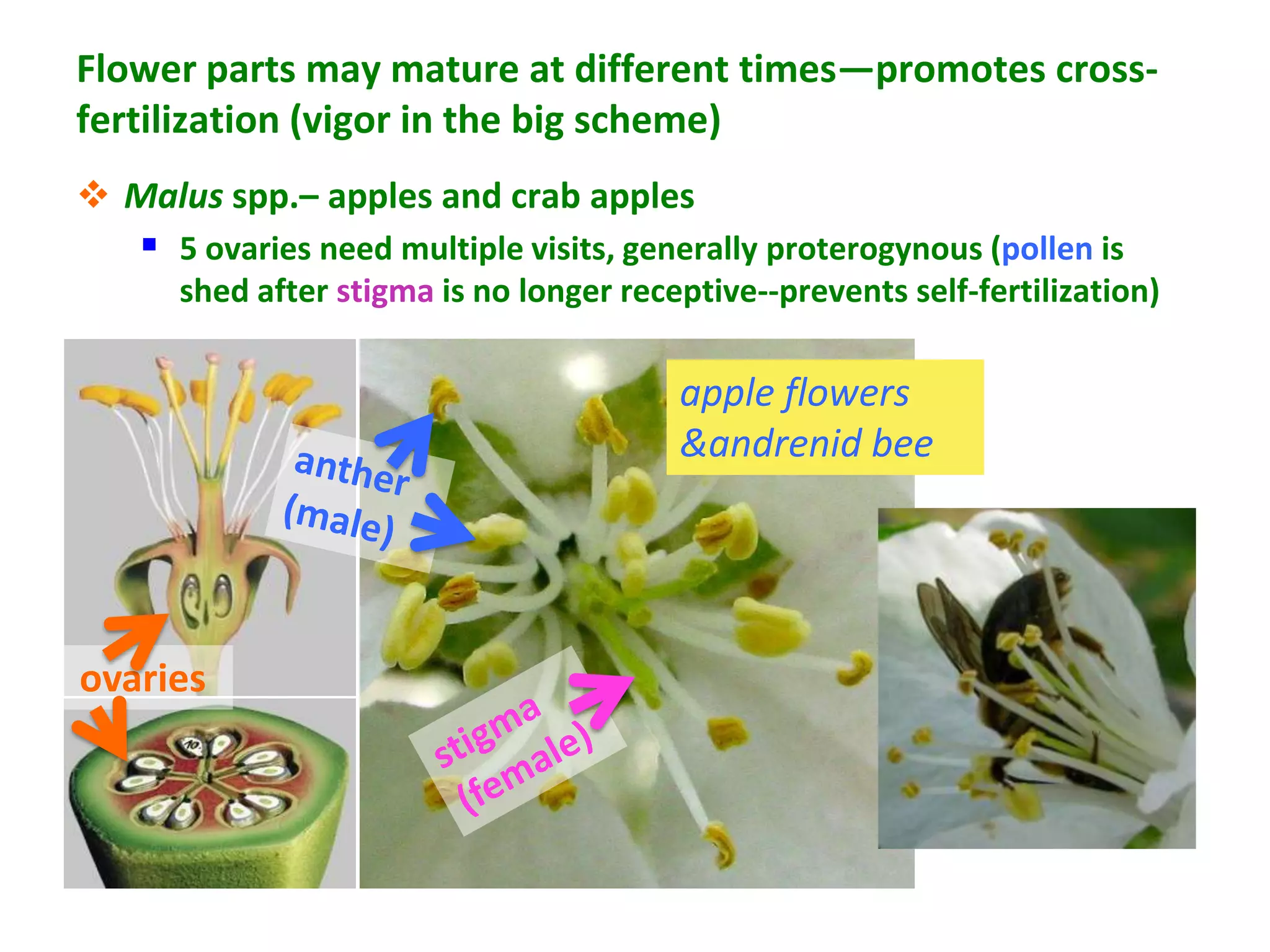
    5 ovaries need multiple visits, generally proterogynous (pollen is
      shed after stigma is no longer receptive--prevents self-fertilization)

                                         apple flowers
                                         &andrenid bee


ovaries
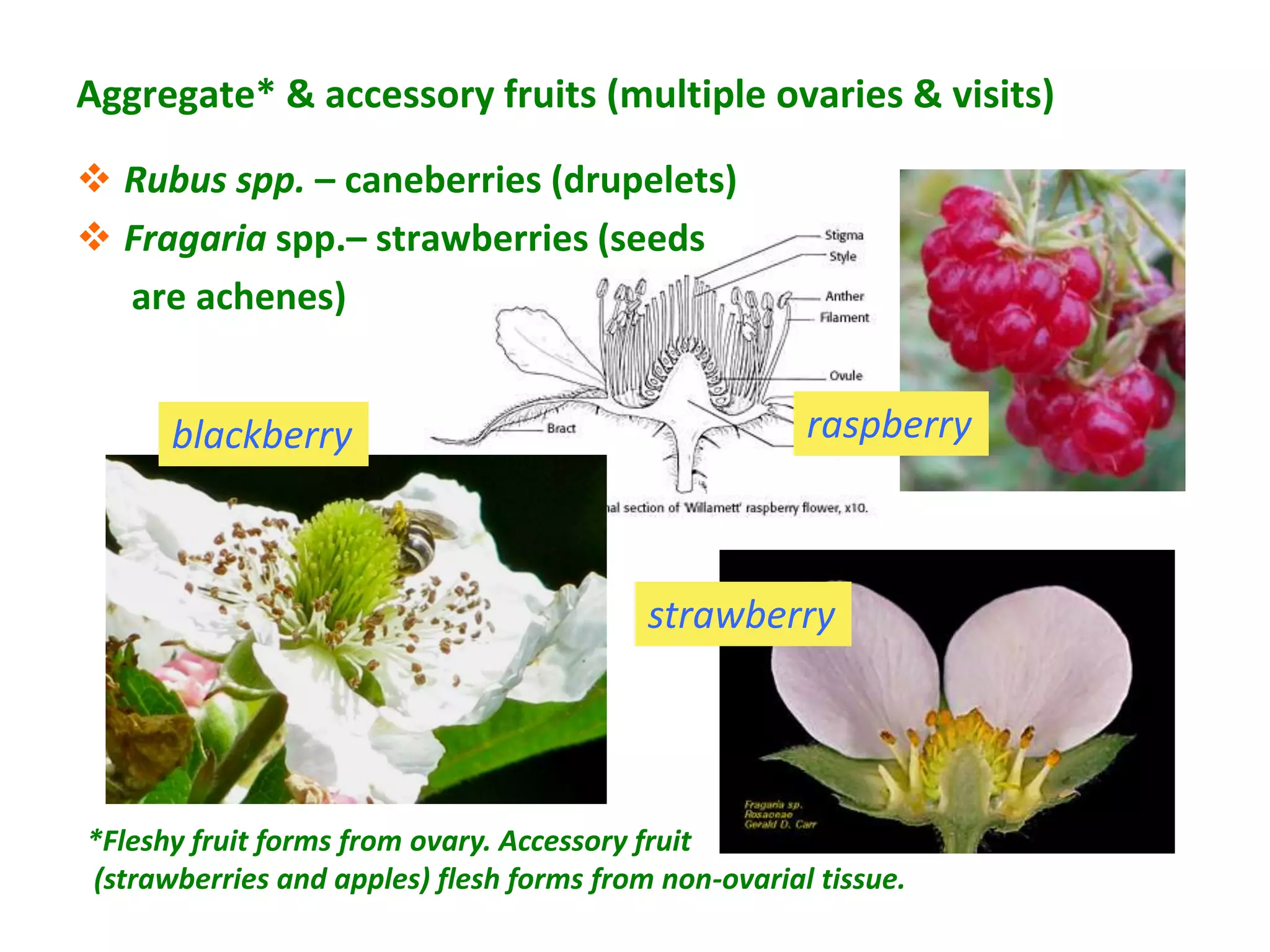
Aggregate* & accessory fruits (multiple ovaries & visits)

 Rubus spp. – caneberries (drupelets)
 Fragaria spp.– strawberries (seeds
  are achenes)


      blackberry                                      raspberry


                                          strawberry


*Fleshy fruit forms from ovary. Accessory fruit
(strawberries and apples) flesh forms from non-ovarial tissue.
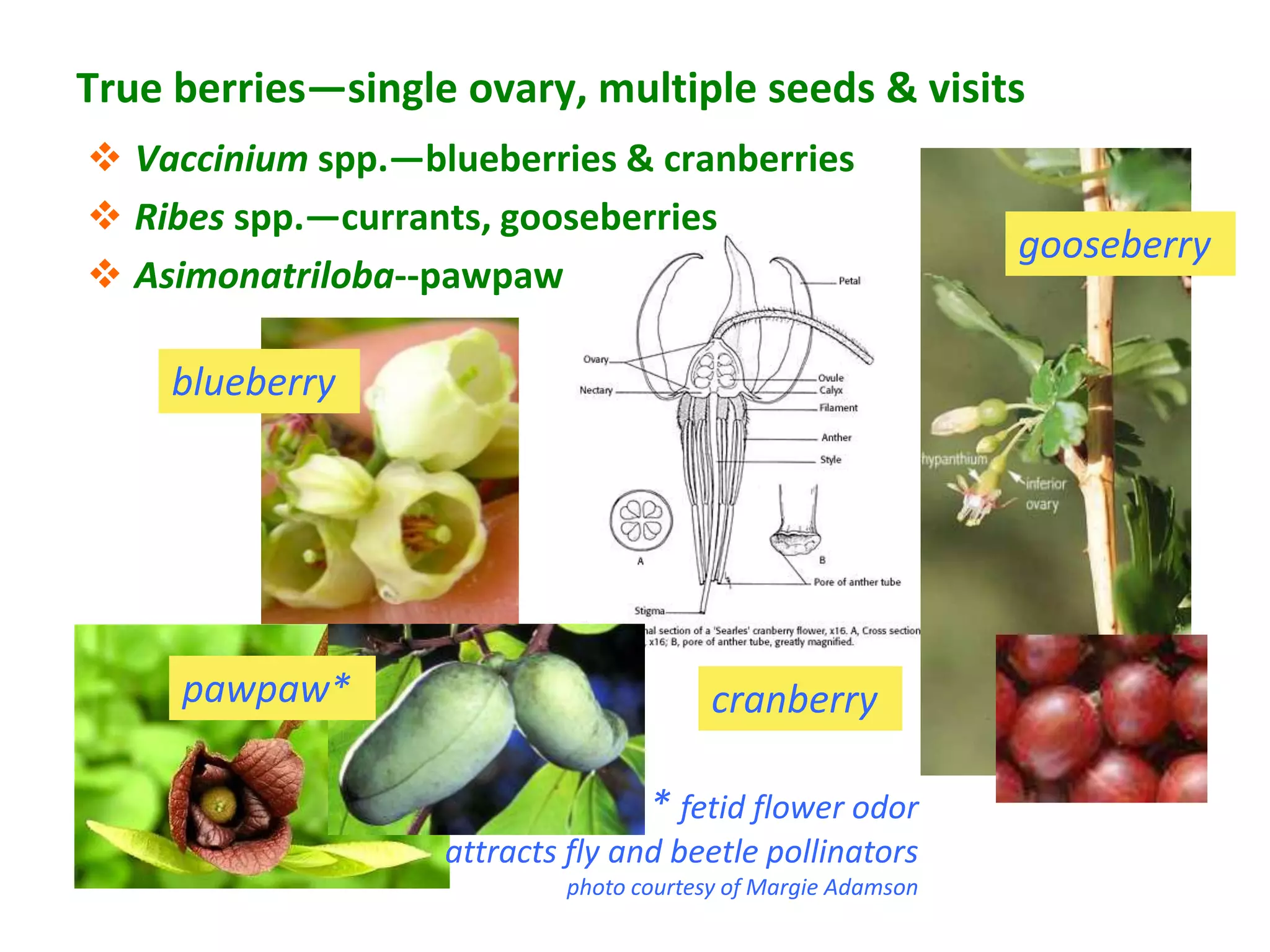
True berries—single ovary, multiple seeds & visits
 Vaccinium spp.—blueberries & cranberries
 Ribes spp.—currants, gooseberries
                                                               gooseberry
 Asimonatriloba--pawpaw

     blueberry


     pawpaw*                             cranberry

                                   * fetid flower odor
                   attracts fly and beetle pollinators
                            photo courtesy of Margie Adamson
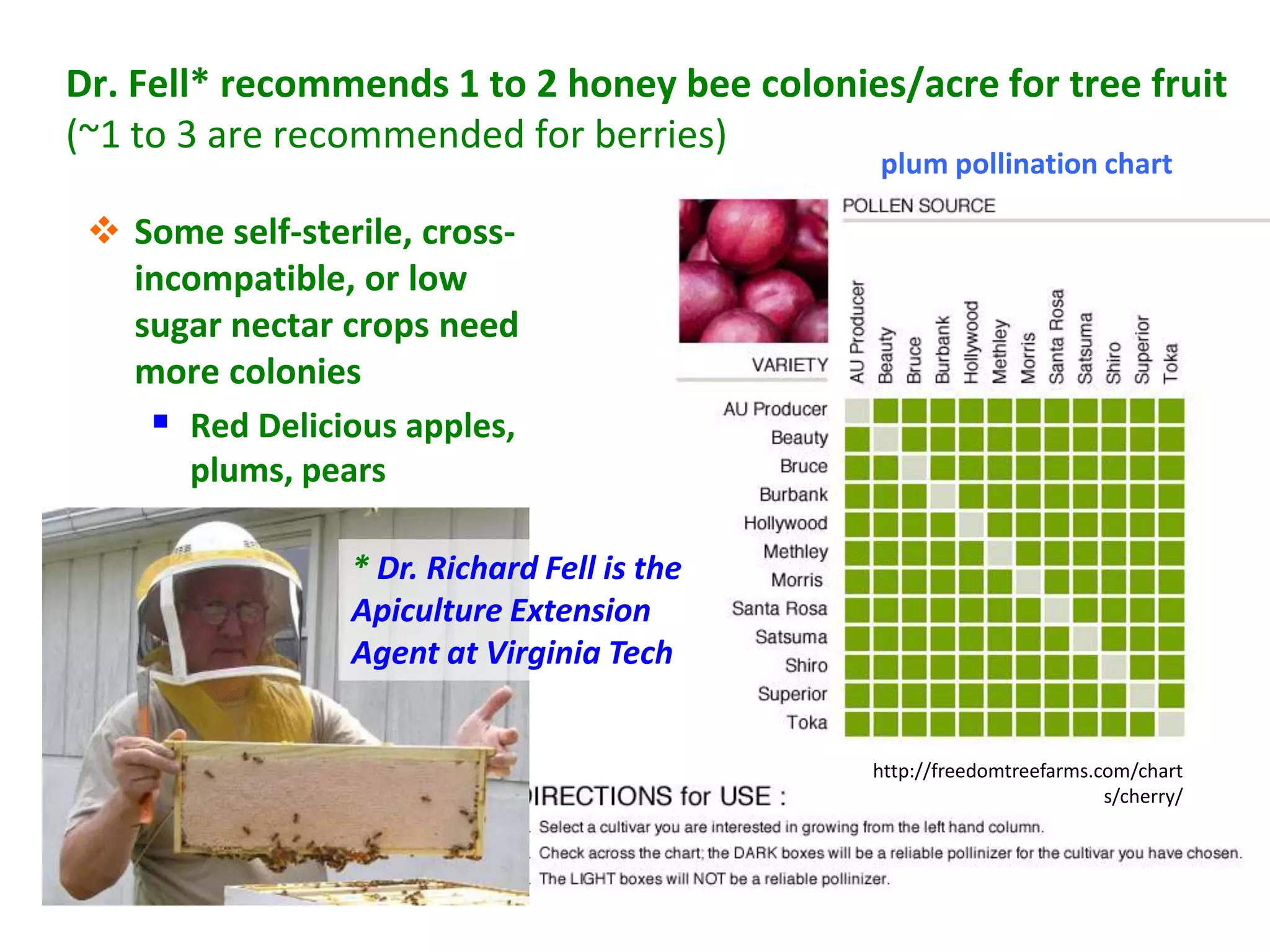
Dr. Fell* recommends 1 to 2 honey bee colonies/acre for tree fruit
(~1 to 3 are recommended for berries)
                                              plum pollination chart

  Some self-sterile, cross-
   incompatible, or low
   sugar nectar crops need
   more colonies
     Red Delicious apples,
      plums, pears

                 * Dr. Richard Fell is the
                 Apiculture Extension
                 Agent at Virginia Tech


                                             http://freedomtreefarms.com/chart
                                                                      s/cherry/
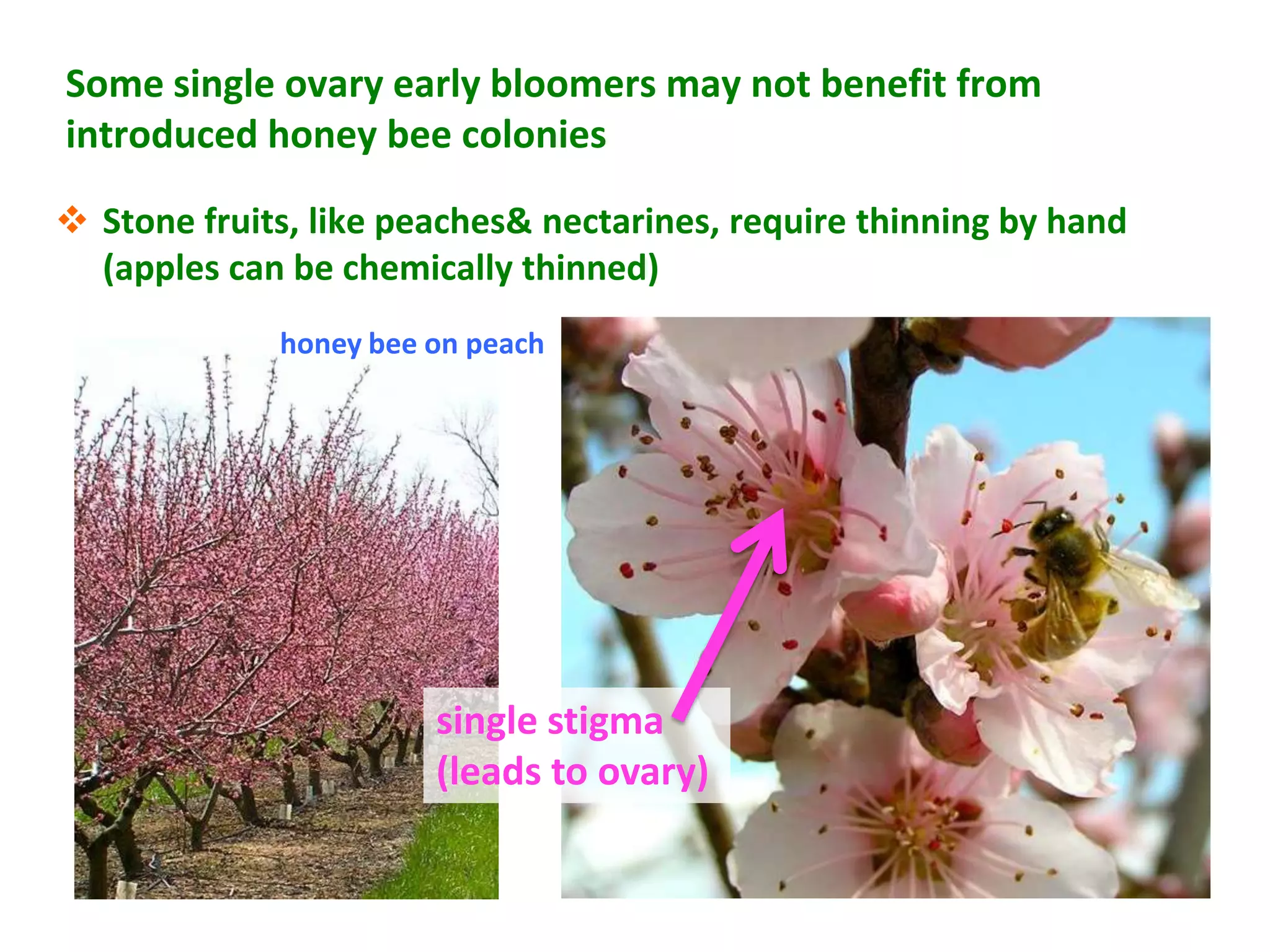
Some single ovary early bloomers may not benefit from
introduced honey bee colonies

 Stone fruits, like peaches& nectarines, require thinning by hand
  (apples can be chemically thinned)
             honey bee on peach


                       single stigma
                       (leads to ovary)
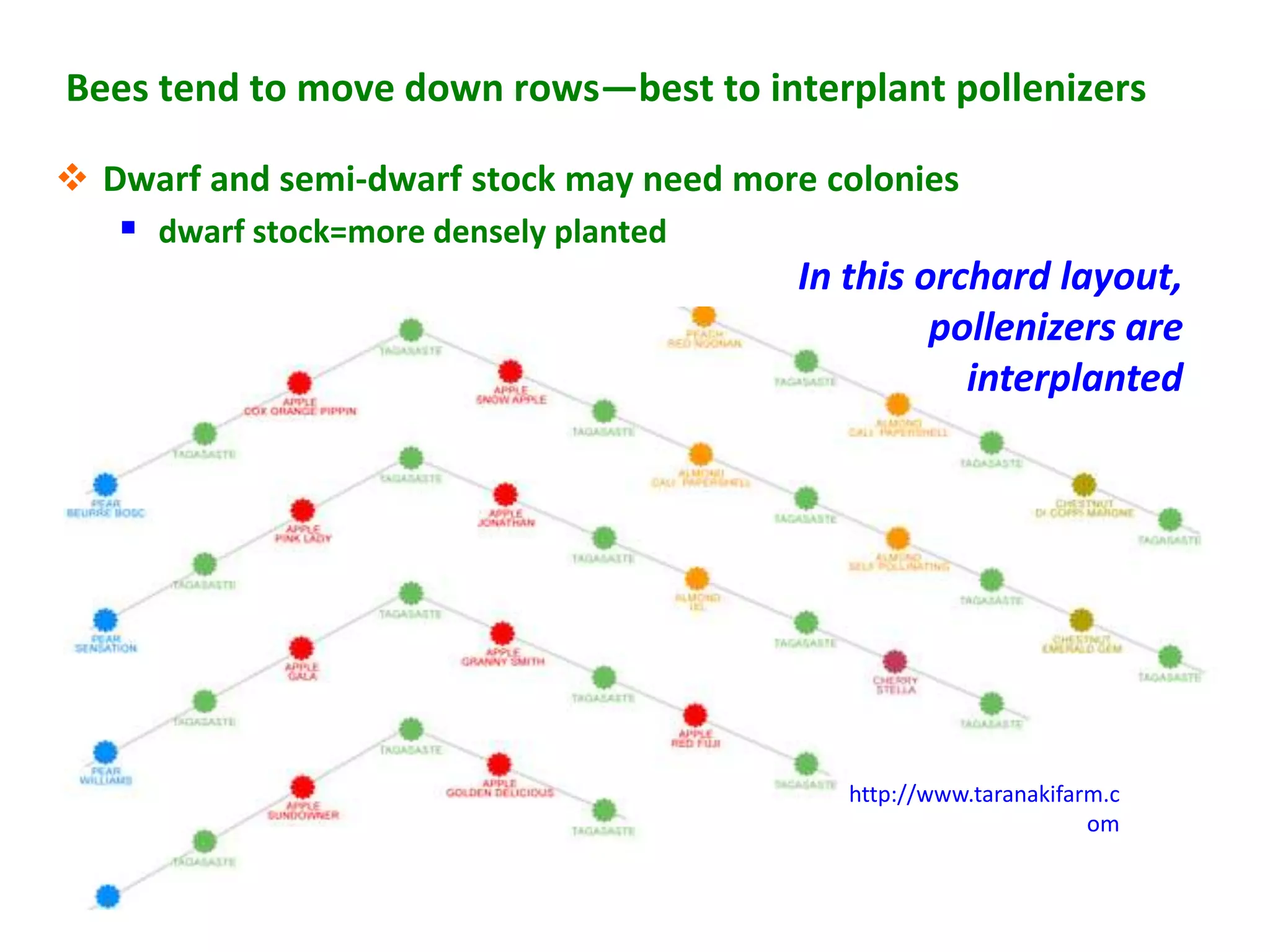
Bees tend to move down rows—best to interplant pollenizers

 Dwarf and semi-dwarf stock may need more colonies
    dwarf stock=more densely planted
                                         In this orchard layout,
                                                  pollenizers are
                                                    interplanted


                                            http://www.taranakifarm.c
                                                                  om
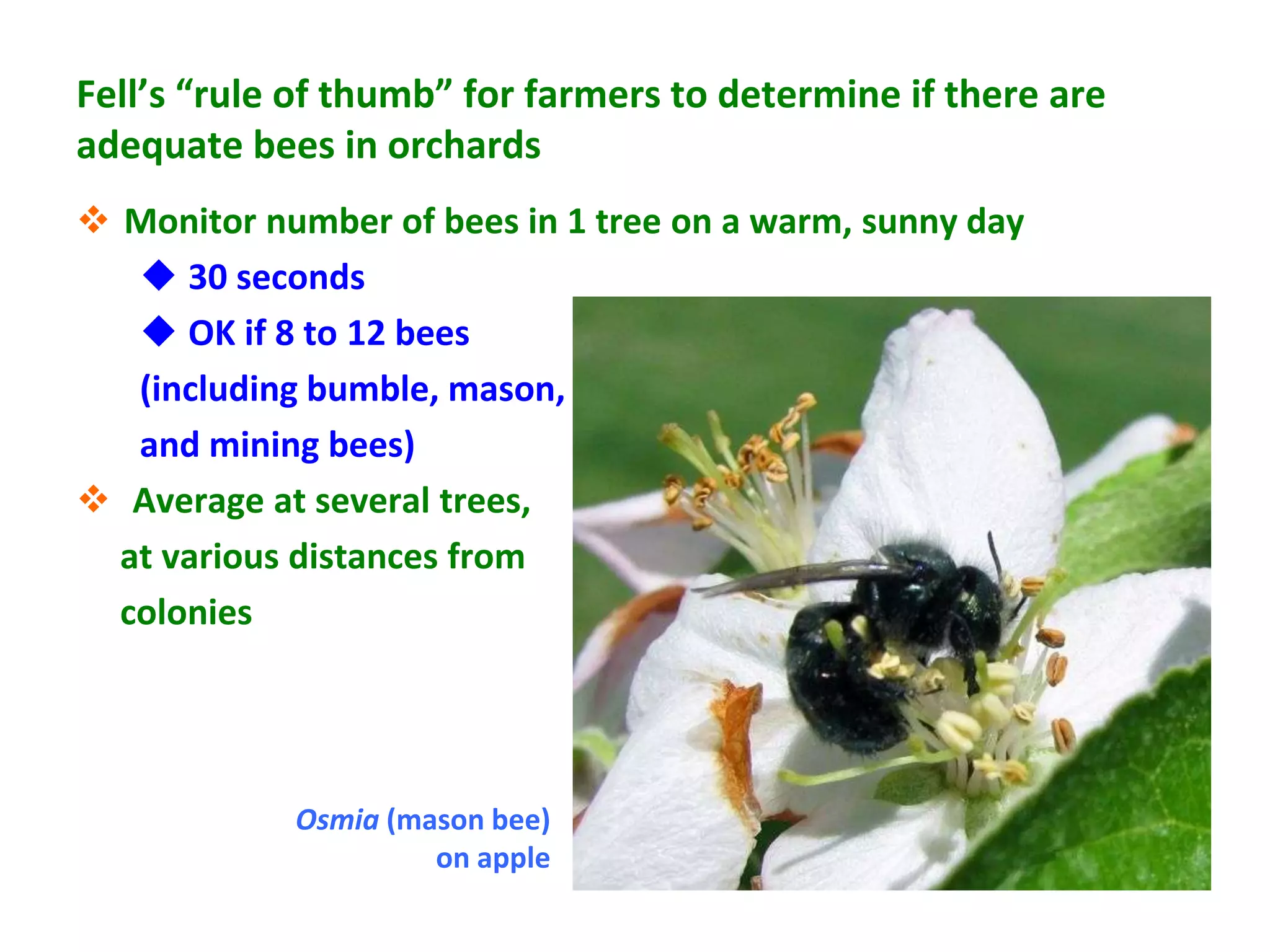
Fell’s “rule of thumb” for farmers to determine if there are
adequate bees in orchards
 Monitor number of bees in 1 tree on a warm, sunny day
    30 seconds
    OK if 8 to 12 bees
   (including bumble, mason,
   and mining bees)
 Average at several trees,
  at various distances from
  colonies


            Osmia (mason bee)
                     on apple
Questions before moving on to
    pollination research?
Is a global pollinator decline affecting Virginia?

                              1


                            Periodic honey bee disease cycle
                             since 1915
                                    approximately 15 to 20 year
                                     cycle   (Johnson 2010, Morse and Flottam
                                     1997)


                            Status of Pollinators in N.
                             America, 2007 (Natural Resource Council
                               of the National Academy of Science)

                                    Baseline data needed

                            Increasing pollinator dependent
                             crop acres (Aizen 2008)
Primary research objective

 Investigate the role of native and other non-Apis bees in
  pollination of entomophilous* crops in southwest Virginia

                                    Available Virginia crop values:
                                     apples $37.7 million
                                      apple industry value=$235 million
                                    (USDA-NASS 2009, VA Apple Board 2010)
                                     tomatoes $88.3 million (USDA-NASS 2006)**
                                     cucumbers $4.3 million (USDA-NASS 2006)
                                     watermelons $3.6 million (USDA-NASS 2006)
                                    **Not dependent on bees (except in
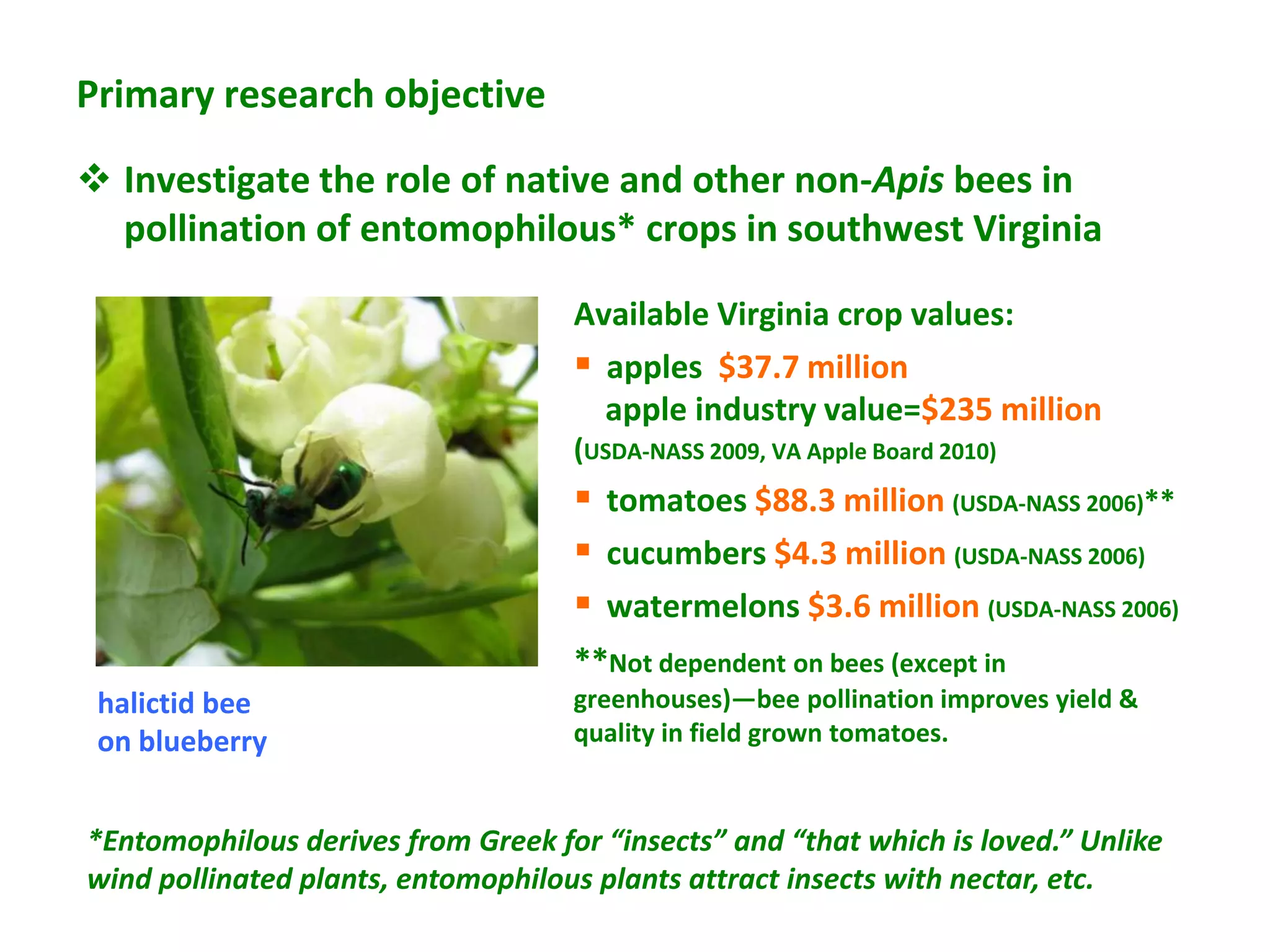
 halictid bee                       greenhouses)—bee pollination improves yield &
 on blueberry                       quality in field grown tomatoes.


*Entomophilous derives from Greek for “insects” and “that which is loved.” Unlike
wind pollinated plants, entomophilous plants attract insects with nectar, etc.
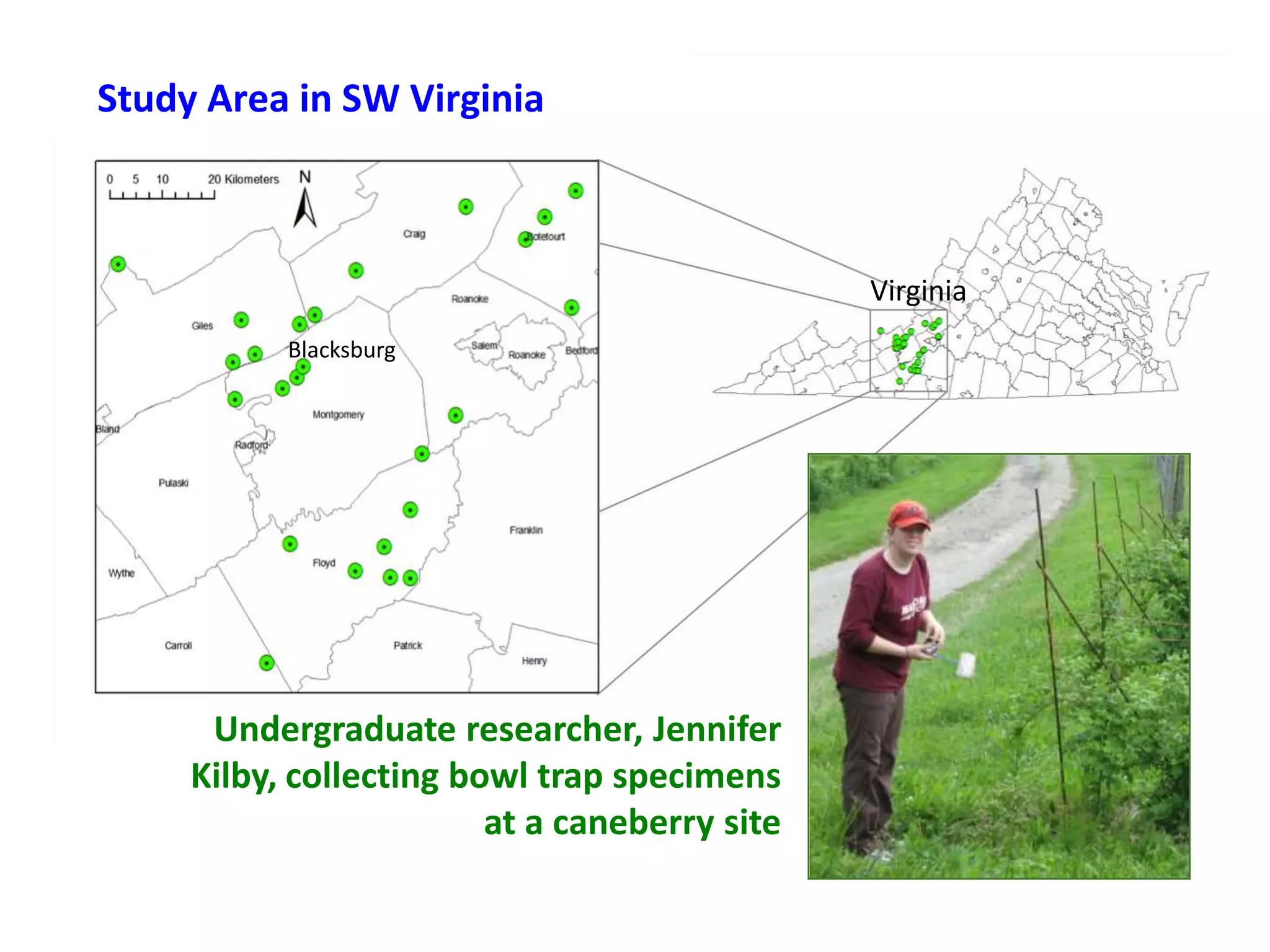
Study Area in SW Virginia


                                               Virginia
           Blacksburg


      Undergraduate researcher, Jennifer
     Kilby, collecting bowl trap specimens
                         at a caneberry site
Methods: Bee Surveys & Pollen Samples

 Survey bees in apple, blueberry, caneberry, &
  cucurbits
 • Survey only when weather
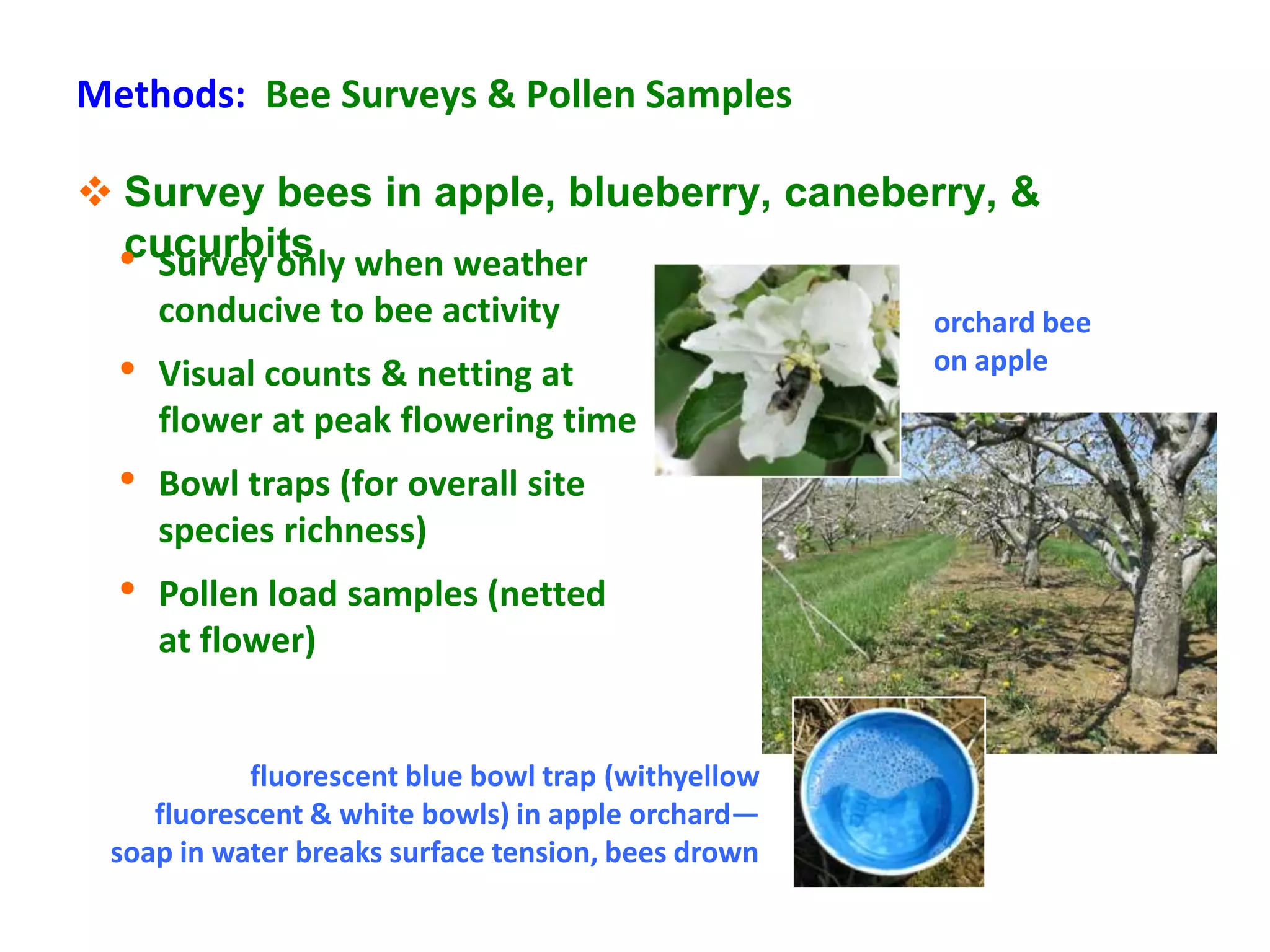
      conducive to bee activity                     orchard bee
  •   Visual counts & netting at                    on apple
      flower at peak flowering time
  •   Bowl traps (for overall site
      species richness)
  •   Pollen load samples (netted
      at flower)


           fluorescent blue bowl trap (withyellow
    fluorescent & white bowls) in apple orchard—
 soap in water breaks surface tension, bees drown
Insect pollinated fruit grown in Virginia
 Study crops
    apple
    blueberry
    caneberry
       • raspberry
       • blackberry
       • black raspberry


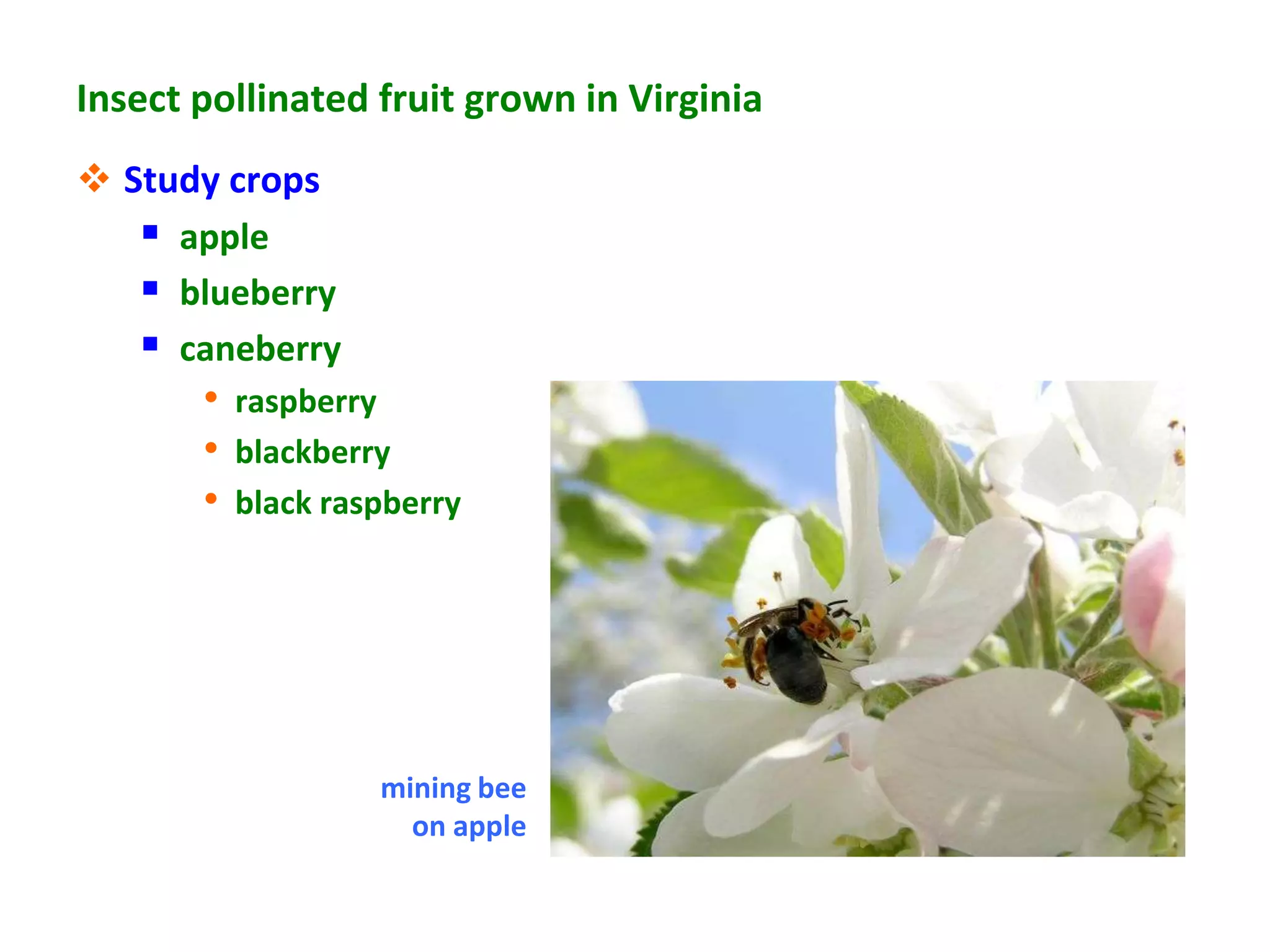
                  mining bee
                    on apple
Other insect pollinated fruit grown in Virginia
    watermelon, musk melon
    pear, crab apple, serviceberry, quince (pome fruits)
    peach, plum, nectarine, apricot(stone fruits)
    pawpaw
    strawberry
    wineberry
    gooseberry, currant
    persimmon
    cranberry, huckleberry
    elderberry
    kiwi
    passion fruit
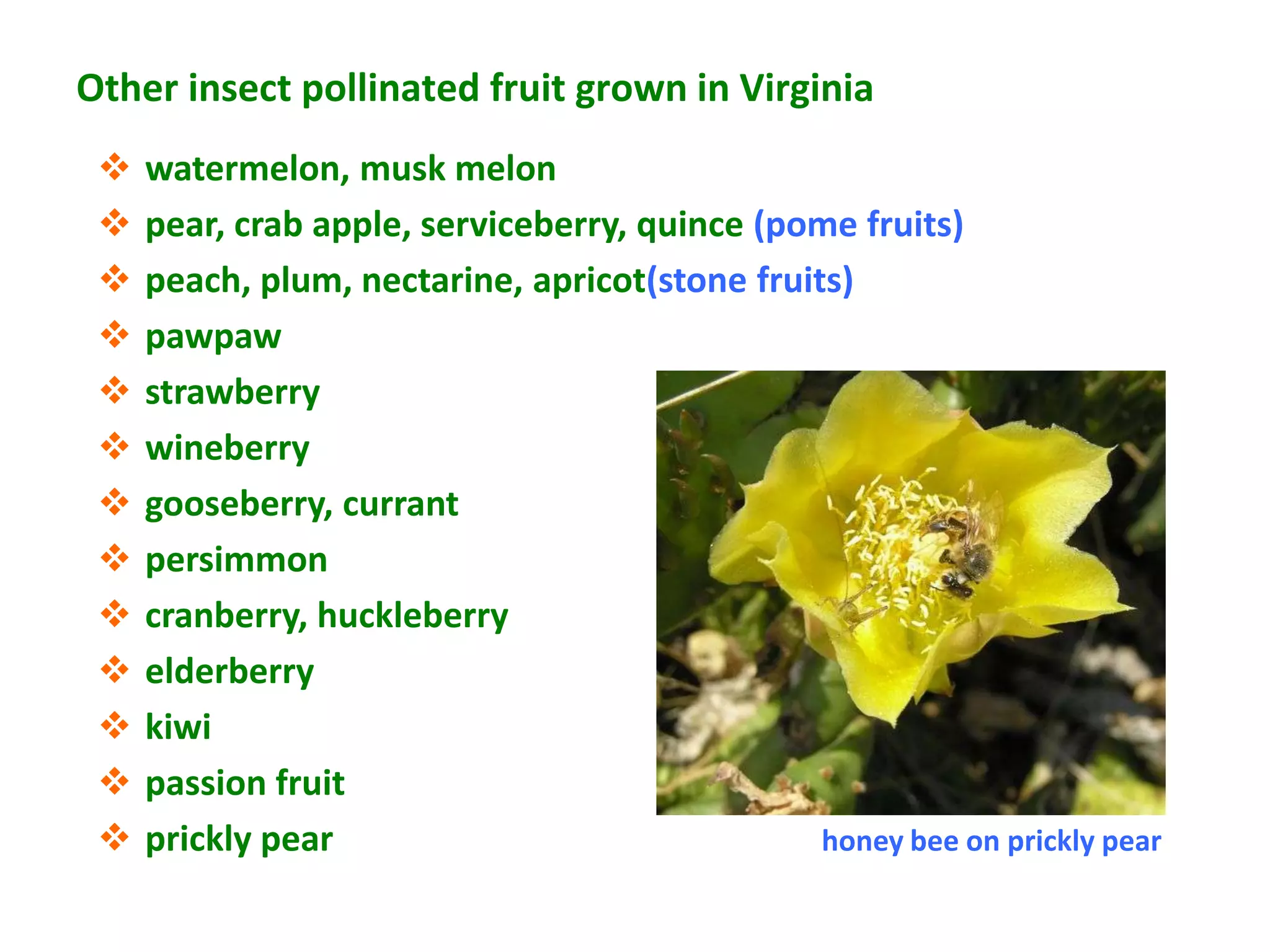
    prickly pear                               honey bee on prickly pear
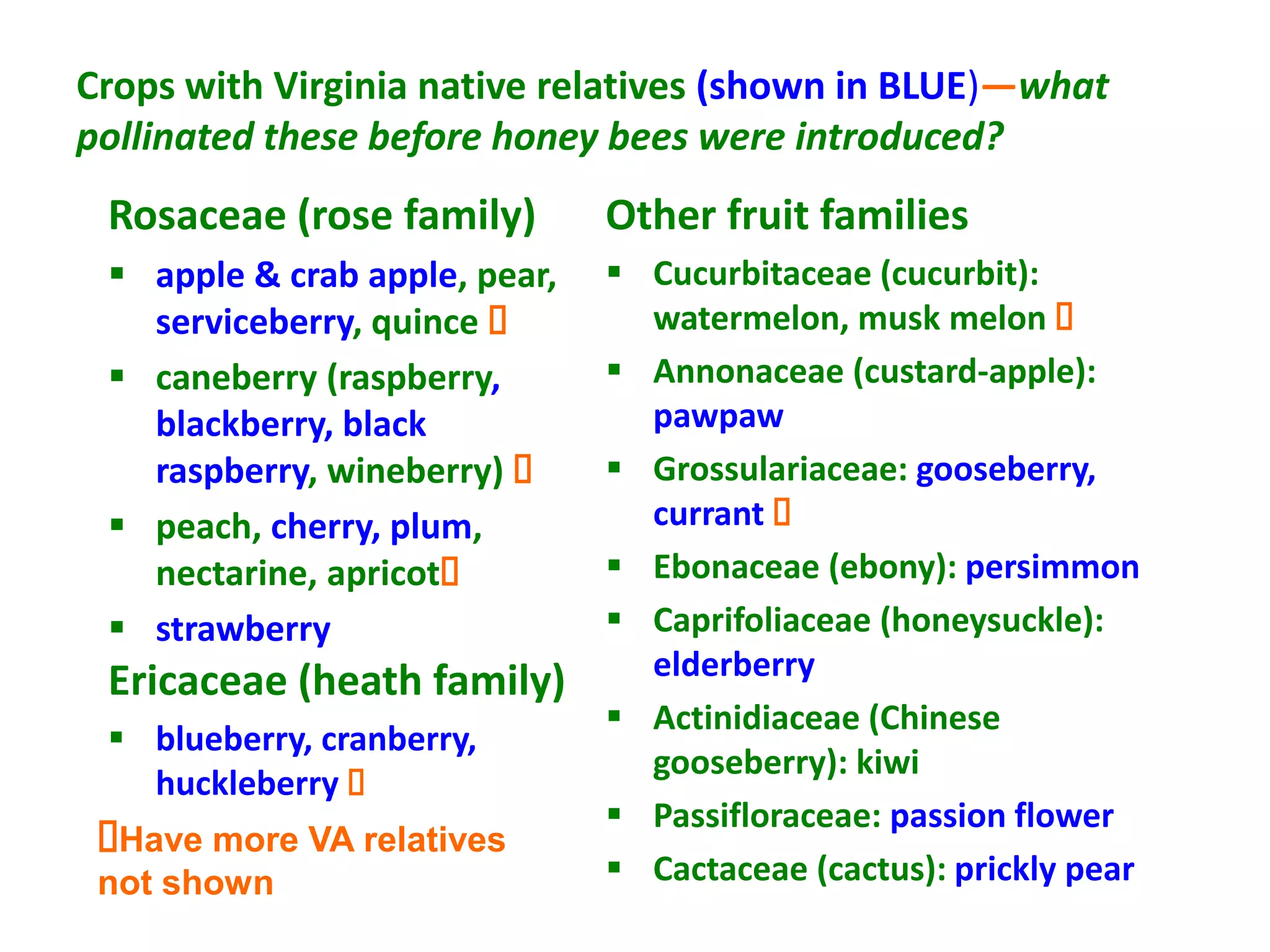
Crops with Virginia native relatives (shown in BLUE)—what
pollinated these before honey bees were introduced?
 Rosaceae (rose family)        Other fruit families
  apple & crab apple, pear,    Cucurbitaceae (cucurbit):
   serviceberry, quince         watermelon, musk melon 
  caneberry (raspberry,        Annonaceae (custard-apple):
   blackberry, black             pawpaw
   raspberry, wineberry)       Grossulariaceae: gooseberry,
  peach, cherry, plum,          currant 
   nectarine, apricot          Ebonaceae (ebony): persimmon
  strawberry                   Caprifoliaceae (honeysuckle):
                                 elderberry
 Ericaceae (heath family)
                                Actinidiaceae (Chinese
  blueberry, cranberry,
                                 gooseberry): kiwi
   huckleberry 
                                Passifloraceae: passion flower
 Have more VA relatives
 not shown                      Cactaceae (cactus): prickly pear
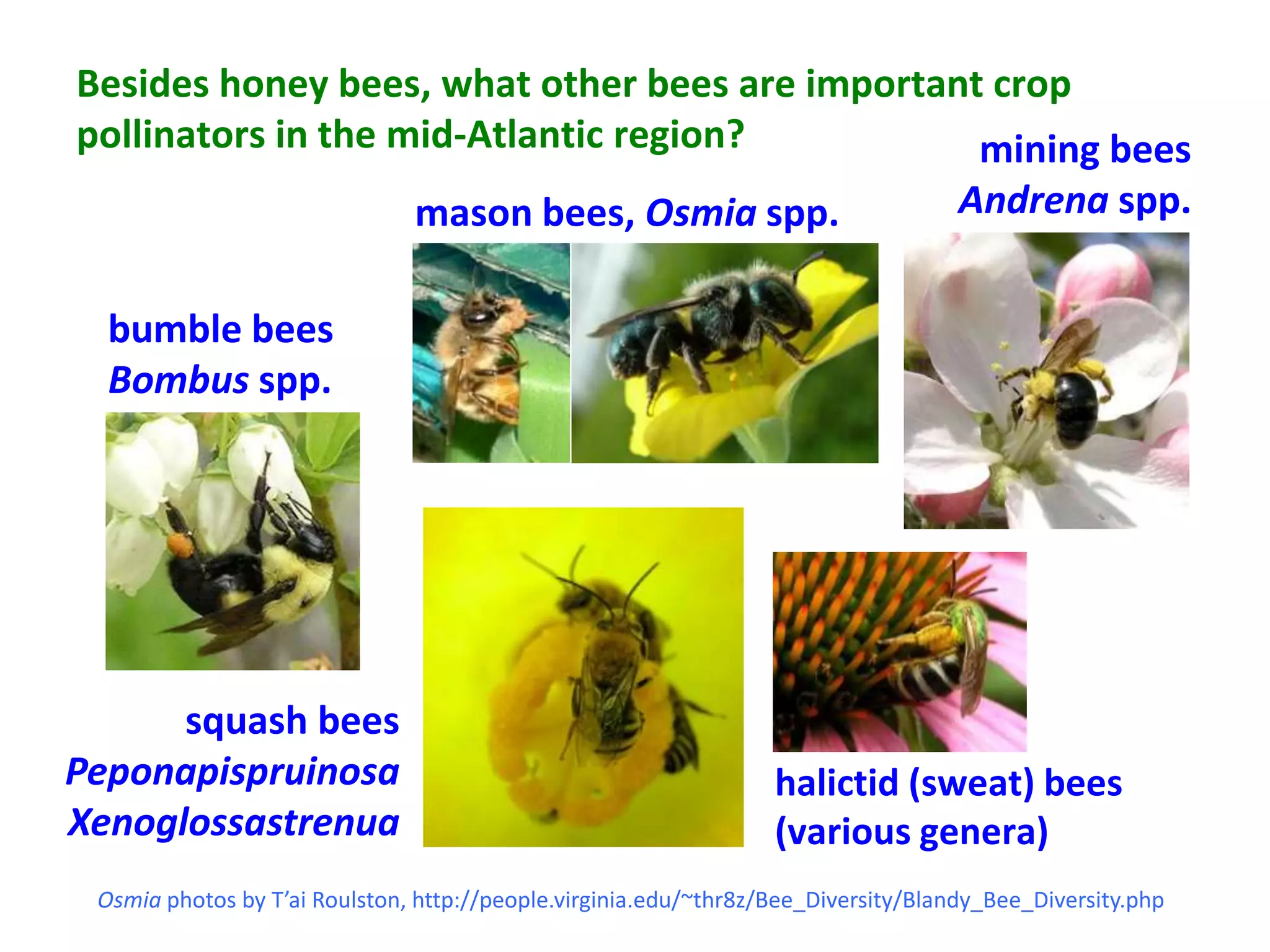
Besides honey bees, what other bees are important crop
pollinators in the mid-Atlantic region?          mining bees
                               mason bees, Osmia spp.                               Andrena spp.


  bumble bees
  Bombus spp.


      squash bees
Peponapispruinosa                                                 halictid (sweat) bees
Xenoglossastrenua                                                 (various genera)
 Osmia photos by T’ai Roulston, http://people.virginia.edu/~thr8z/Bee_Diversity/Blandy_Bee_Diversity.php
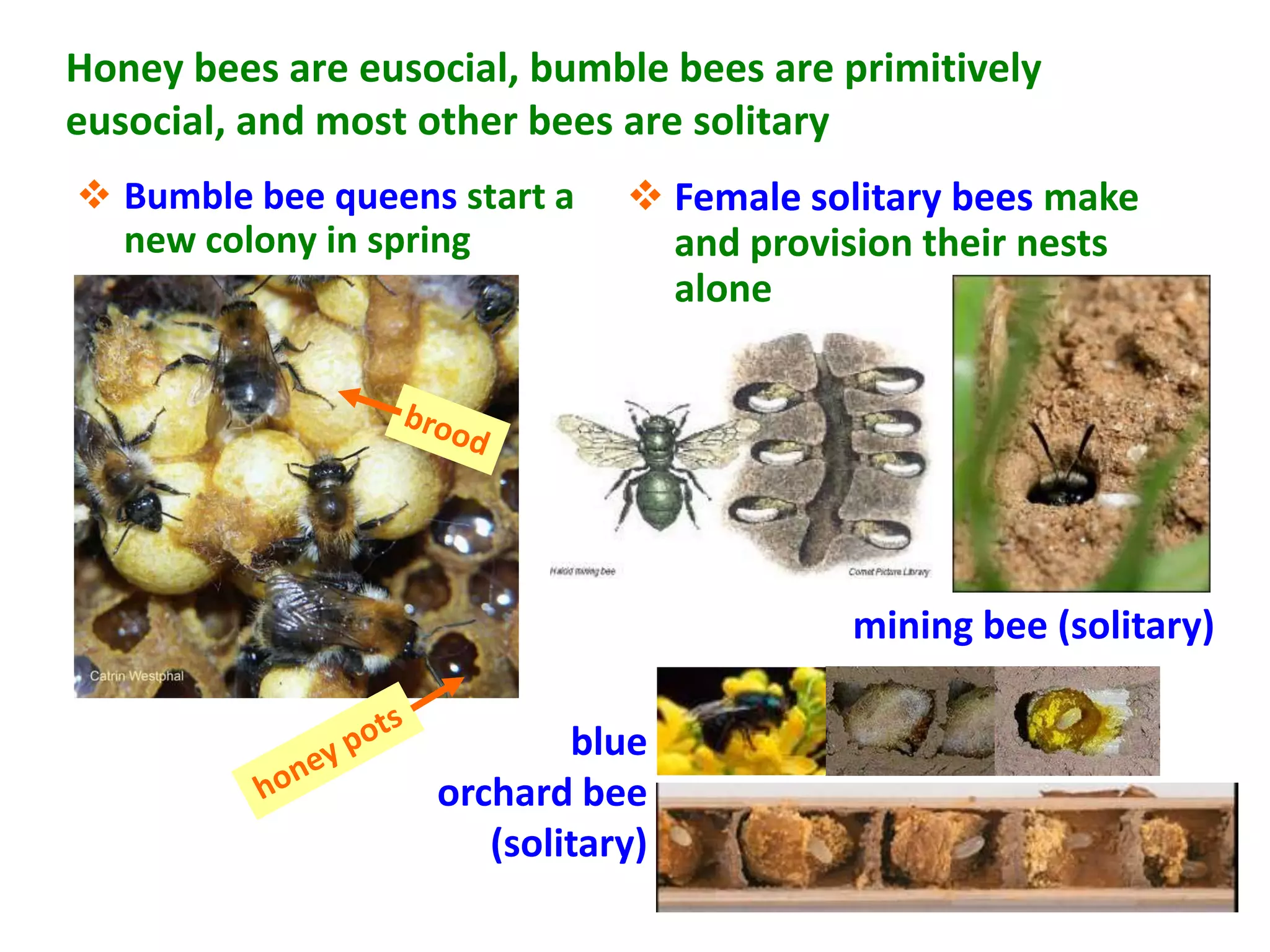
Honey bees are eusocial, bumble bees are primitively
eusocial, and most other bees are solitary
 Bumble bee queens start a    Female solitary bees make
  new colony in spring          and provision their nests
                                alone


                                         mining bee (solitary)

                           blue
                   orchard bee
                      (solitary)
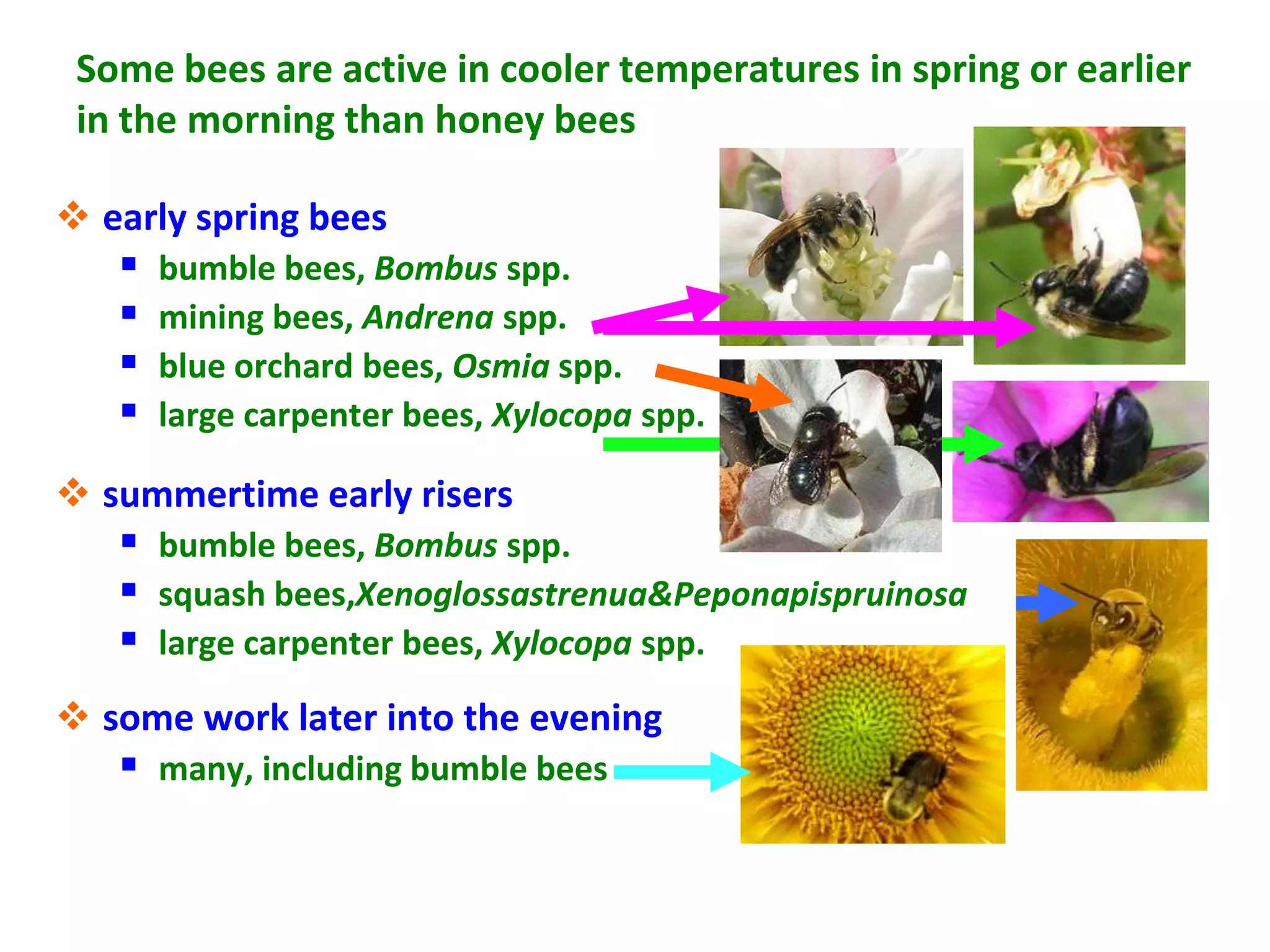
Some bees are active in cooler temperatures in spring or earlier
 in the morning than honey bees

 early spring bees
      bumble bees, Bombus spp.
      mining bees, Andrena spp.
      blue orchard bees, Osmia spp.
      large carpenter bees, Xylocopa spp.

 summertime early risers
    bumble bees, Bombus spp.
    squash bees,XenoglossastrenuaPeponapispruinosa
    large carpenter bees, Xylocopa spp.
 some work later into the evening
    many, including bumble bees
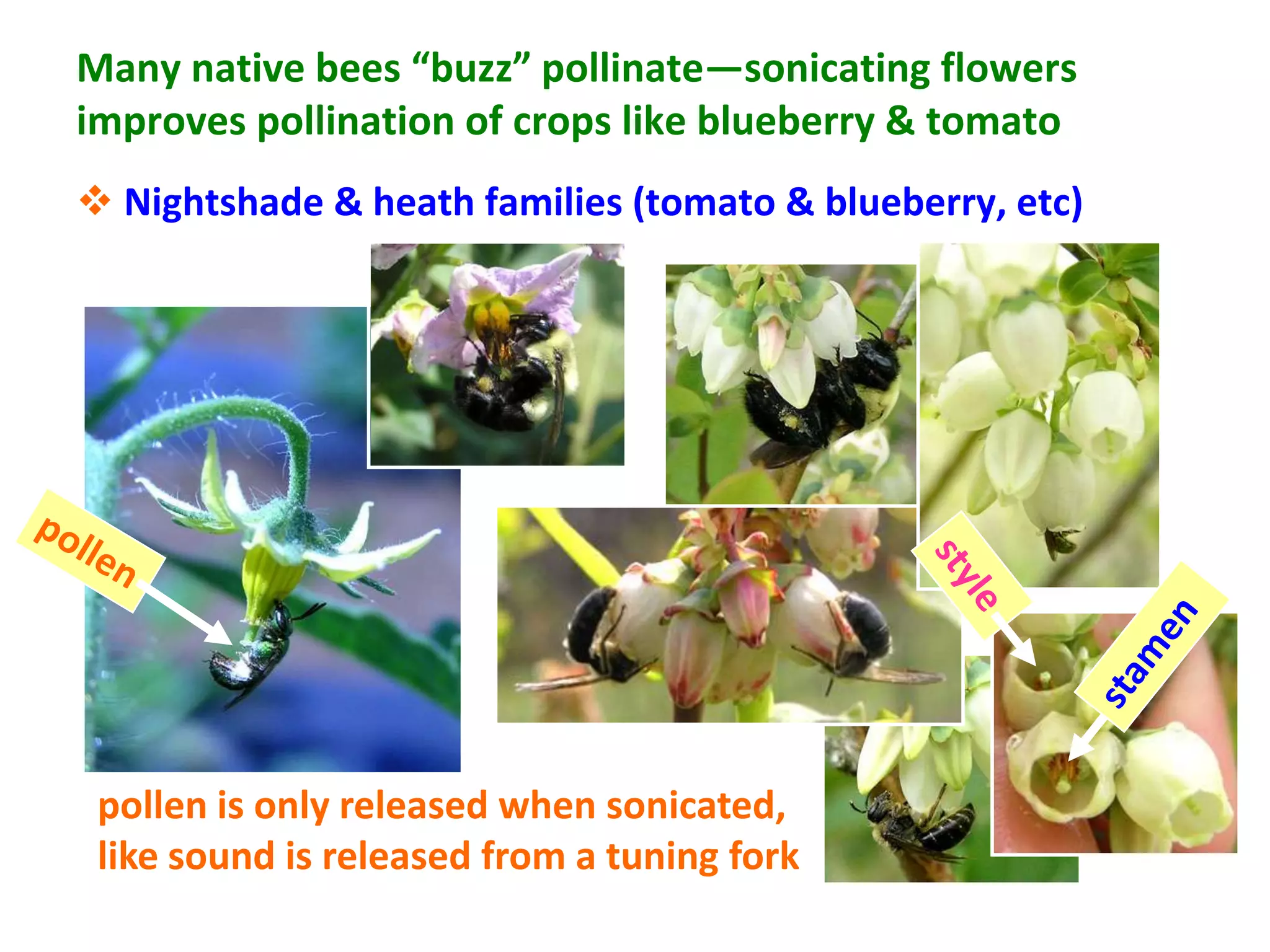
Many native bees “buzz” pollinate—sonicating flowers
improves pollination of crops like blueberry  tomato
 Nightshade  heath families (tomato  blueberry, etc)


 pollen is only released when sonicated,
 like sound is released from a tuning fork
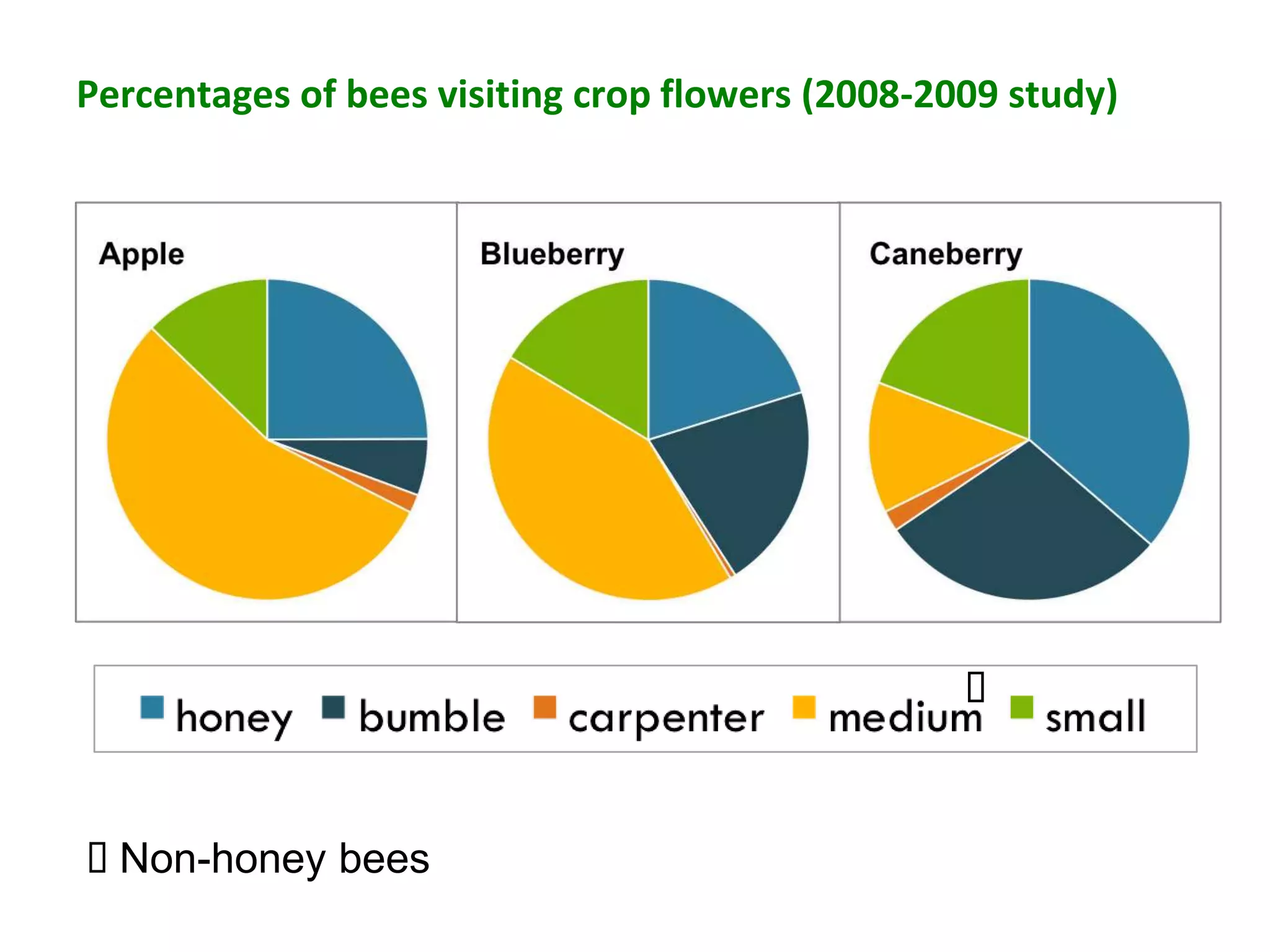
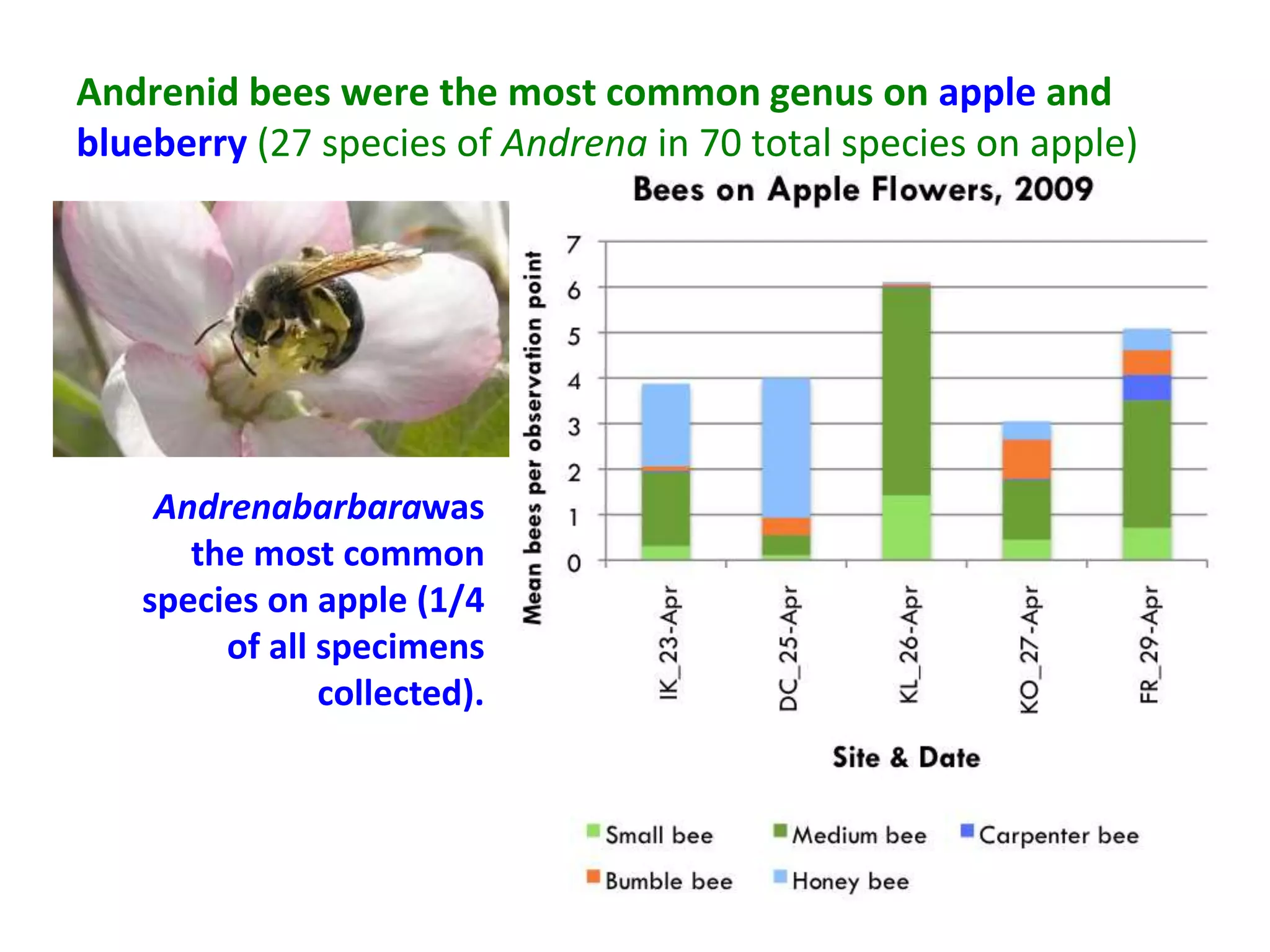
Percentages of bees visiting crop flowers (2008-2009 study)


Non-honey bees
Andrenid bees were the most common genus on apple and
blueberry (27 species of Andrena in 70 total species on apple)


    Andrenabarbarawas
      the most common
   species on apple (1/4
        of all specimens
               collected).
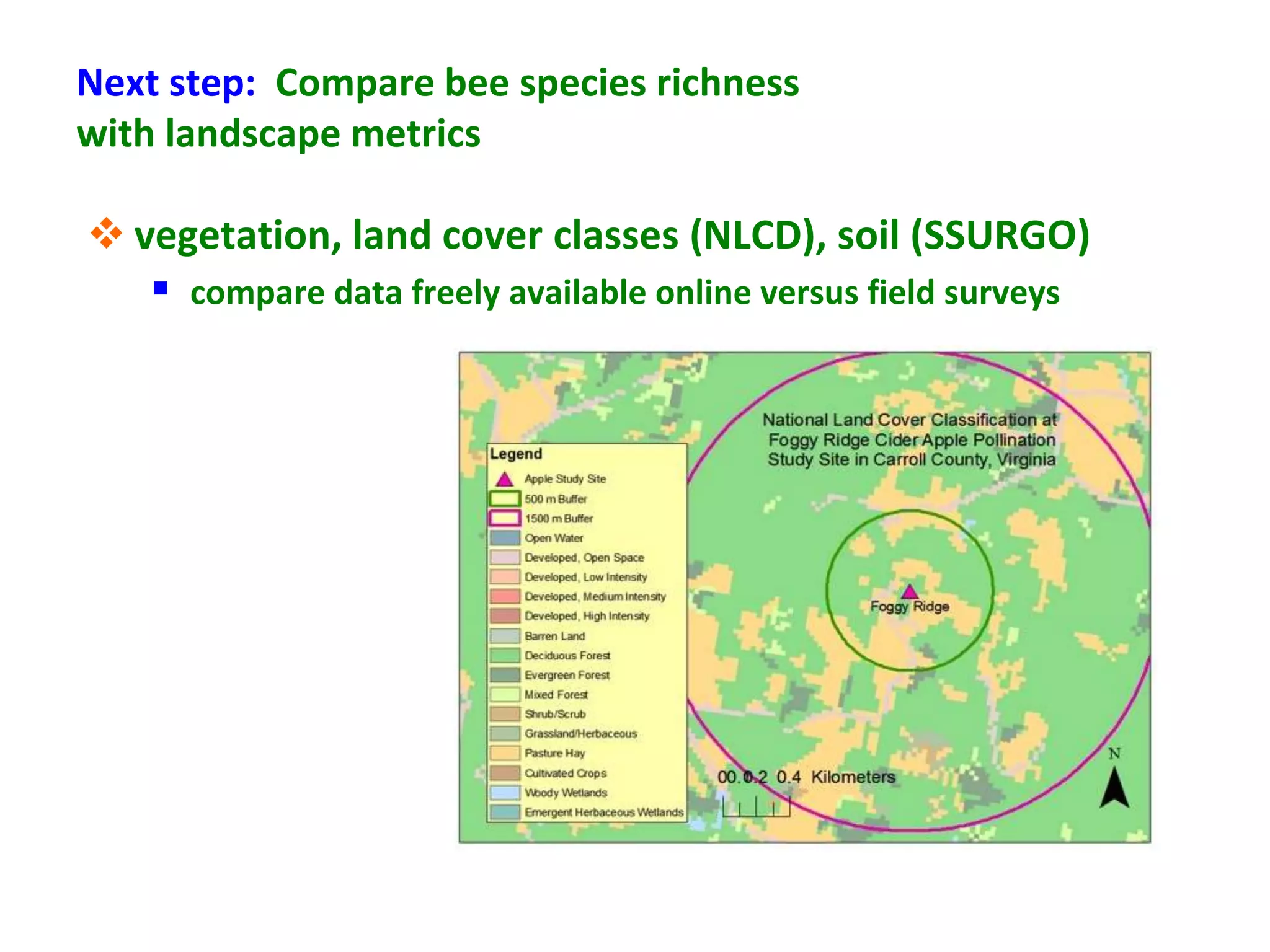
Next step: Compare bee species richness
with landscape metrics

 vegetation, land cover classes (NLCD), soil (SSURGO)
    compare data freely available online versus field surveys
Management Implications: Practices that support native bee
populations like protecting natural areas also benefit honey bees
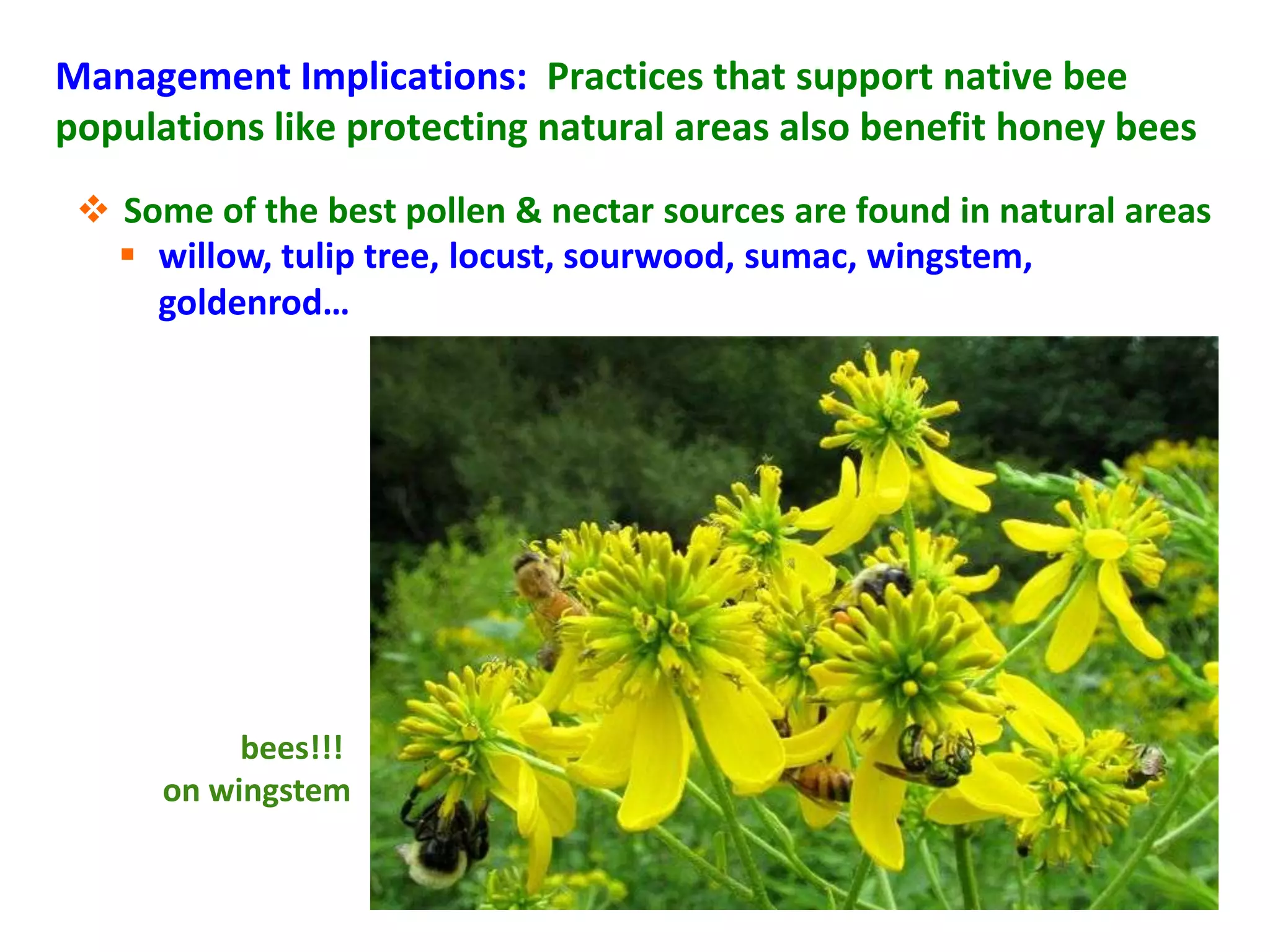
  Some of the best pollen  nectar sources are found in natural areas
    willow, tulip tree, locust, sourwood, sumac, wingstem,
     goldenrod…


           bees!!!
      on wingstem
Management Implications: Remind farmers to avoid chemical
use when bees are active or reduce use all together
 You can’t move native bee nests—avoid spraying during the day
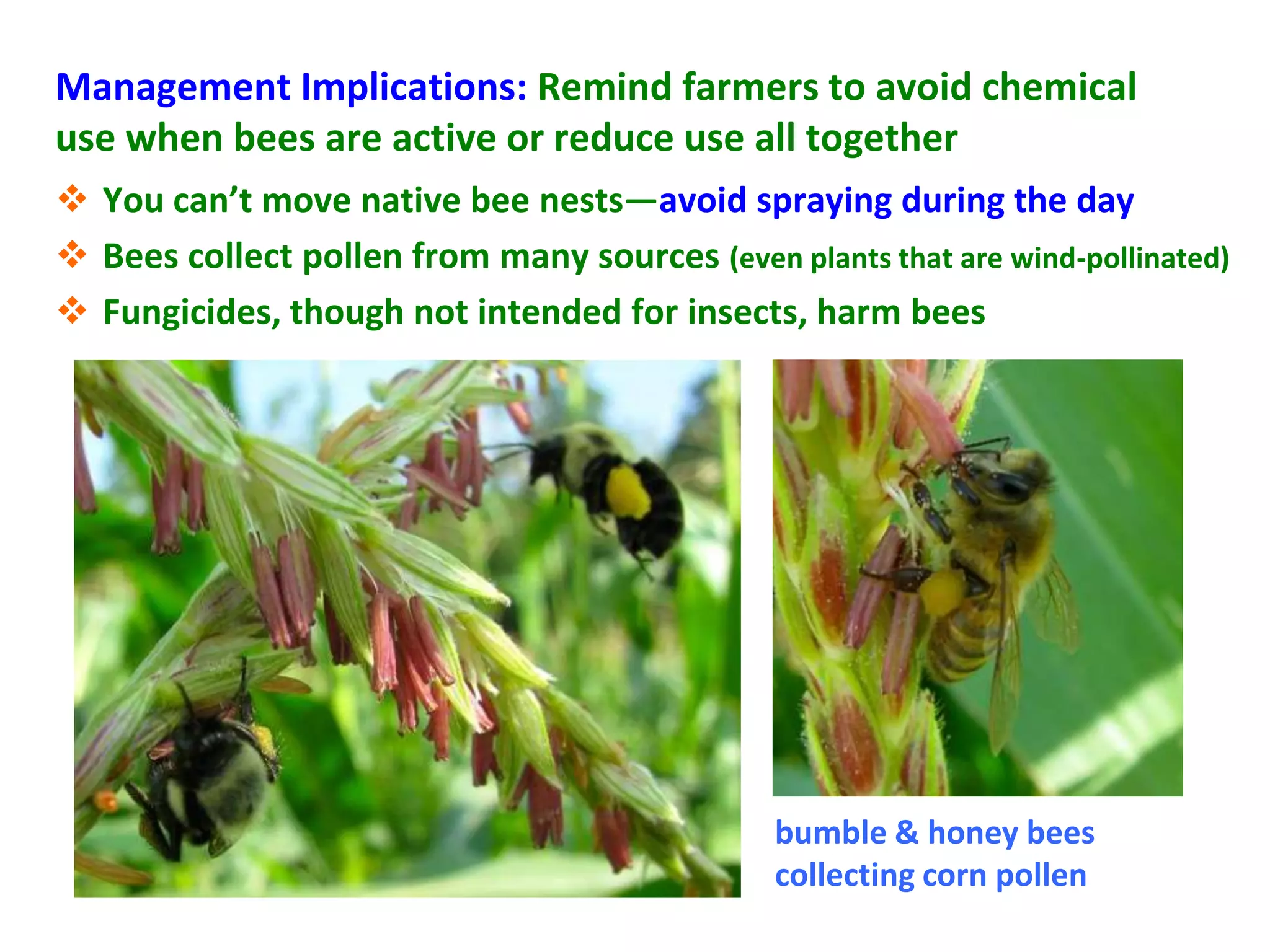
 Bees collect pollen from many sources (even plants that are wind-pollinated)
 Fungicides, though not intended for insects, harm bees


                                               bumble  honey bees
                                               collecting corn pollen
Management Implications: Native bees nest in the ground
and in vegetation
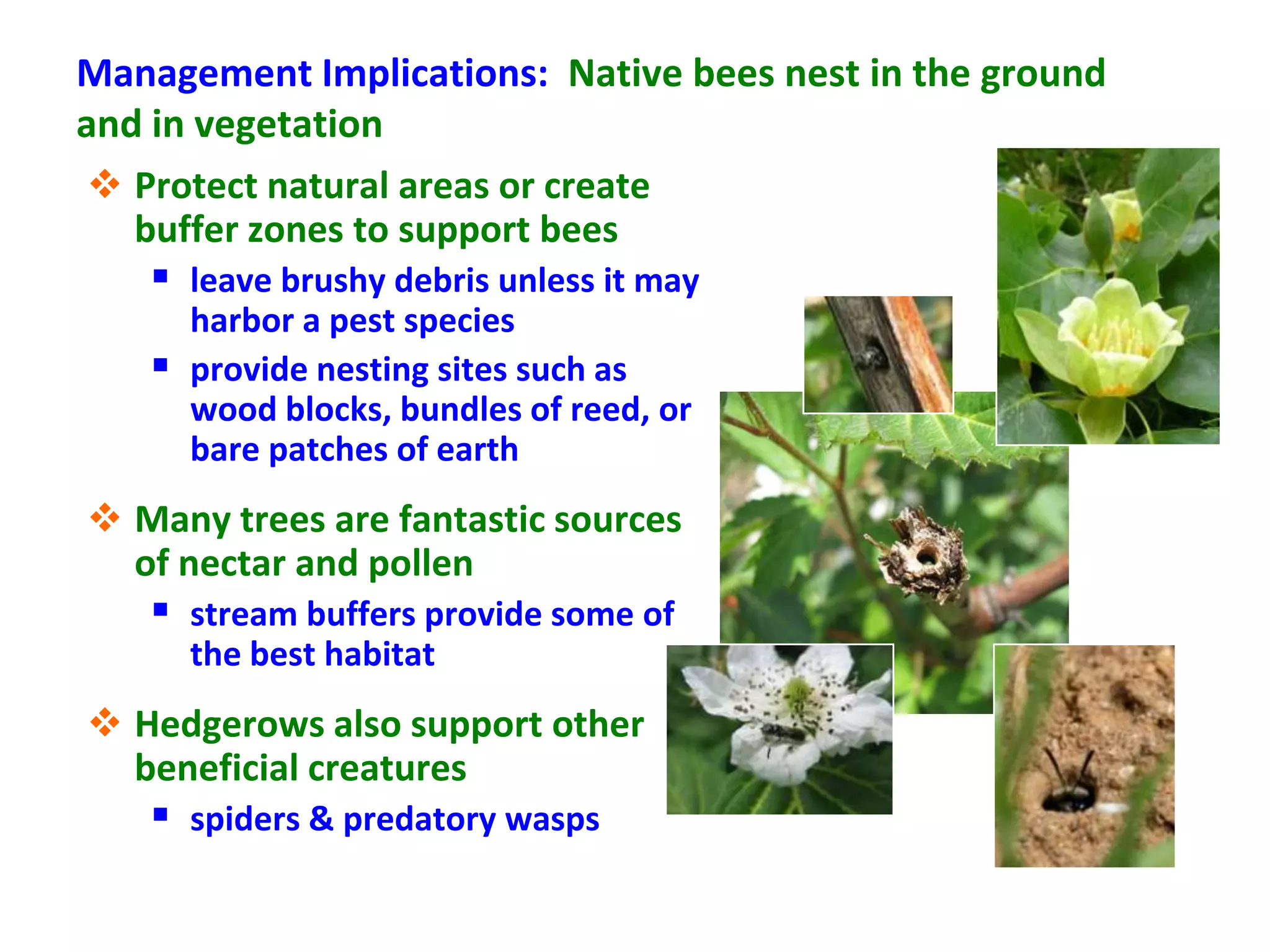
  Protect natural areas or create
   buffer zones to support bees
     leave brushy debris unless it may
     harbor a pest species
    provide nesting sites such as
     wood blocks, bundles of reed, or
     bare patches of earth
 Many trees are fantastic sources
  of nectar and pollen
    stream buffers provide some of
      the best habitat
 Hedgerows also support other
  beneficial creatures
    spiders  predatory wasps
The following links are in a small hand-out--they include info on
pollinator habitat  identification
FRONT SIDE
Xerces Society: www.xerces.org
Farming for Bees: Guidelines for Providing Native Bee Habitat on Farms Using
Farm Bill Programs for Pollinator Conservation
Pollinator Partnership: www.pollinator.org
Selecting Plants for Pollinators: A Regional Guide for Farmers, Land Managers,
and Gardeners in the Southeastern Mixed Forest Province
North American Pollinator Protection Campaign: www.nappc.org
Reducing Risk to Pollinators from Pesticides
Bee Identification
Discover Life: www.discoverlife.org/mp/20q?search=Apoidea
USGS, Sam Droege: www.slideshare.net/sdroege/slideshows
VA, T'ai Roulston: people.virginia.edu/~thr8z/Bee_Diversity/Blandy_Bee
       _Diversity.php
Florida (good intro): chiron.valdosta.edu/jbpascar/Intro.htm
Bug Guide: bugguide.net
BACK SIDE of HAND-OUT
National Biological Information Infrastructure:
pollinators.nbii.gov/portal/community/Communities/Ecological_Topics/Pollina
tors/Pollinator_Species/Invertebrates/Bees_and_Wasps/
USDA Sustaining Native Bee Habitat For Crop Poll’n
plants.usda.gov/pollinators/Agroforestry_Sustaining_Native_Bee_Habitat_for_
Crop_Pollination.pdf
SARE’s Managing Alternative Pollinators (for beekeepers, growers, and
conservationists) http://www.nraes.org/nra_map.html

                                 Mid-Atlantic
VA Fruit Page: http://www.virginiafruit.ento.vt.edu/VAFS-bees.html
Mid-Atlantic Apiculture Research Extension Consortium: maarec.psu.edu
DE Dept of Agric: dda.delaware.gov/plantind/pollinator.shtml (several terrific
guides on native bees, native plants, and farming for bees)
MD DNR: www.dnr.state.md.us/wildlife/wabees.asp (Wild Backyard--Bees)
PA  NJ: www.extension.org/mediawiki/files/1/15/NativeBees2009.pdf
Acknowledgements
 Richard Fell, Donald Mullins--Co-
  Advisors
 Douglas Pfeiffer, Lisa Kennedy,
  T’aiRoulston—Committee Members
 Virginia State government—grant
  support via the Virginia Cooperative
  Extension
 All the farmers who so generously give
  access to their farms for this research
 Sam Droege, US Geological Survey Bee
  Guru
 Margie Adamson, Sydney Church, Clare
  Davidoski,  Jennifer Kilby--behind the
  scenes
 VT Entomology Department
Thanks for use of photos from the following
web sources
 http://www.holtanatomical.com/
 http://appleparermuseum.com/Images/AppleLongSection230.jpe
   g
 http://comenius.susqu.edu/bi/202/ARCHAEPLASTIDA/VIRIDIPL
   ANTAE/Flowering%20Plants/judd-photos/Frageria-flower-l-s.jpg
 http://www.biologie.uni-hamburg.de/b-online/vascular/ros.htm
 http://www.inhs.uiuc.edu/~kenr/Photos/Prunus_flower.jpg
 http://www.beeculture.com/content/pollination_handbook/196.gif
 http://www.katsushikahokusai.org/Plum-Blossom-and-the-
   Moon.jpg
 http://knowledge.allianz.com/nopi_downloads/images/C5_plum_
   pox_resistant_plum_genetically_modified_GMO_q.jpg
 http://gemini.oscs.montana.edu/~mlavin/b436/labtotal.htm
 http://calphotos.berkeley.edu/imgs/128x192/0000_0000/0504/03
   00.jpeg
 http://www.naturehills.com/images/productImages/gooseberry_re
   d_big.jpg
 http://en.wikipedia.org/wiki/File:Asimina_triloba3.jpgto share a
Hopefully I haven’t forgotten anyone. If I have or you want
better photo with me, please contact me at nladamson@gmail.com.
Other photos are my own or acknowledged within the slides.
Questions?

Tree Fruit and Berry Pollination in Virginia (and the mid-Atlantic by extension)

  • 1.
    Bee Pollination ofTree Fruits & Berries in Virginia (an expanded version of a presentation to Virginia State Beekeepers on 16 April 2010) Nancy Adamson, Richard Fell, Donald Mullins VT Entomology Department
  • 2.
    Program Overview  Treefruits & berries grown in Virginia  Colony recommendations  Pollination research on non-Apis bees & a little more pollination biology honey bee to peach
  • 3.
    Insect pollinated* fruitgrown in Virginia Rosaceae (rose family) Other fruit families  apple & crab apple, pear,  Cucurbitaceae (cucurbit): serviceberry, quince watermelon, musk melon  caneberry (raspberry,  Annonaceae (custard-apple): blackberry, black raspberry, pawpaw wineberry)  Grossulariaceae: gooseberry,  peach, plum, nectarine, currant apricot  Ebonaceae (ebony): persimmon  strawberry  Caprifoliaceae (honeysuckle): elderberry  Actinidiaceae (Chinese Ericaceae (heath family) gooseberry): kiwi  blueberry, cranberry,  Passifloraceae: passion flower huckleberry  Cactaceae (cactus): prickly pear * Grapes and mulberries don’t depend on insects—can you think of others?
  • 4.
    Most fruit cropsbenefit from cross-pollination Some crop varieties*require cross-pollination  apples, blueberries, cherries, kiwis, persimmons, sunflowers, caneberries**, and hemp (McGregor 1976, Free 1993, McConkey 2009) two apple varieties *Variety is a horticultural term for plants of one species with specific characteristics •Red Delicious, Fuji, and Pink Lady apples • Bing and Rainier cherries
  • 5.
    Self-fertile plants—cross-pollination improvessize and shape Many caneberries** are sold as self-fertile halictid bee on raspberry Autumn Bliss (l) & Josephine (r) raspberries ** Caneberries are raspberries, blackberries, black raspberries, etc. bumble bee on blackberry
  • 6.
    Cross-pollination requirements/recommendations vary tremendouslyby variety Pollenizers are the pollen “donors”  Crab apples are often used as pollenizers in apple cultivation •Bill Frieman of Doe Creek Orchard in Pembroke, VA prefers to use compatible saleable varieties Here, 2 varieties are in different rows Notice larger flowers in left variety
  • 7.
    Cross-pollinationneeds vary byvariety cherry pollination chart  Many of these cherry varieties are self-sterile  Some are cross- incompatible* (for ex. Emporer Frances, Bing, & Kristin)  Check with nurseries for pollenizer requirements  Especially important to match pollenizers to the harvest variety by bloom time * Cross-incompatible varieties cannot pollinate http://freedomtreefarms.com/chart s/cherry/ one another
  • 8.
    Pollination requirements andflower structure: more ovaries require more visits  Prunus spp.: plums, cherries, peaches, apricots & almonds  very early spring flowering, single* ovary forms “stone” fruits, drupes pollen single ovary *One visit may be adequate if the female parts are receptive, the pollen viable, and the varieties compatible.
  • 9.
    Flower parts maymature at different times—promotes cross- fertilization (vigor in the big scheme)  Malus spp.– apples and crab apples  5 ovaries need multiple visits, generally proterogynous (pollen is shed after stigma is no longer receptive--prevents self-fertilization) apple flowers &andrenid bee ovaries
  • 10.
    Aggregate* & accessoryfruits (multiple ovaries & visits)  Rubus spp. – caneberries (drupelets)  Fragaria spp.– strawberries (seeds are achenes) blackberry raspberry strawberry *Fleshy fruit forms from ovary. Accessory fruit (strawberries and apples) flesh forms from non-ovarial tissue.
  • 11.
    True berries—single ovary,multiple seeds & visits  Vaccinium spp.—blueberries & cranberries  Ribes spp.—currants, gooseberries gooseberry  Asimonatriloba--pawpaw blueberry pawpaw* cranberry * fetid flower odor attracts fly and beetle pollinators photo courtesy of Margie Adamson
  • 12.
    Dr. Fell* recommends1 to 2 honey bee colonies/acre for tree fruit (~1 to 3 are recommended for berries) plum pollination chart  Some self-sterile, cross- incompatible, or low sugar nectar crops need more colonies  Red Delicious apples, plums, pears * Dr. Richard Fell is the Apiculture Extension Agent at Virginia Tech http://freedomtreefarms.com/chart s/cherry/
  • 13.
    Some single ovaryearly bloomers may not benefit from introduced honey bee colonies  Stone fruits, like peaches& nectarines, require thinning by hand (apples can be chemically thinned) honey bee on peach single stigma (leads to ovary)
  • 14.
    Bees tend tomove down rows—best to interplant pollenizers  Dwarf and semi-dwarf stock may need more colonies  dwarf stock=more densely planted In this orchard layout, pollenizers are interplanted http://www.taranakifarm.c om
  • 15.
    Fell’s “rule ofthumb” for farmers to determine if there are adequate bees in orchards  Monitor number of bees in 1 tree on a warm, sunny day  30 seconds  OK if 8 to 12 bees (including bumble, mason, and mining bees)  Average at several trees, at various distances from colonies Osmia (mason bee) on apple
  • 16.
    Questions before movingon to pollination research?
  • 17.
    Is a globalpollinator decline affecting Virginia?  1  Periodic honey bee disease cycle since 1915  approximately 15 to 20 year cycle (Johnson 2010, Morse and Flottam 1997)  Status of Pollinators in N. America, 2007 (Natural Resource Council of the National Academy of Science)  Baseline data needed  Increasing pollinator dependent crop acres (Aizen 2008)
  • 18.
    Primary research objective Investigate the role of native and other non-Apis bees in pollination of entomophilous* crops in southwest Virginia Available Virginia crop values:  apples $37.7 million apple industry value=$235 million (USDA-NASS 2009, VA Apple Board 2010)  tomatoes $88.3 million (USDA-NASS 2006)**  cucumbers $4.3 million (USDA-NASS 2006)  watermelons $3.6 million (USDA-NASS 2006) **Not dependent on bees (except in halictid bee greenhouses)—bee pollination improves yield & on blueberry quality in field grown tomatoes. *Entomophilous derives from Greek for “insects” and “that which is loved.” Unlike wind pollinated plants, entomophilous plants attract insects with nectar, etc.
  • 19.
    Study Area inSW Virginia Virginia Blacksburg Undergraduate researcher, Jennifer Kilby, collecting bowl trap specimens at a caneberry site
  • 20.
    Methods: Bee Surveys& Pollen Samples  Survey bees in apple, blueberry, caneberry, & cucurbits • Survey only when weather conducive to bee activity orchard bee • Visual counts & netting at on apple flower at peak flowering time • Bowl traps (for overall site species richness) • Pollen load samples (netted at flower) fluorescent blue bowl trap (withyellow fluorescent & white bowls) in apple orchard— soap in water breaks surface tension, bees drown
  • 21.
    Insect pollinated fruitgrown in Virginia  Study crops  apple  blueberry  caneberry • raspberry • blackberry • black raspberry mining bee on apple
  • 22.
    Other insect pollinatedfruit grown in Virginia  watermelon, musk melon  pear, crab apple, serviceberry, quince (pome fruits)  peach, plum, nectarine, apricot(stone fruits)  pawpaw  strawberry  wineberry  gooseberry, currant  persimmon  cranberry, huckleberry  elderberry  kiwi  passion fruit  prickly pear honey bee on prickly pear
  • 23.
    Crops with Virginianative relatives (shown in BLUE)—what pollinated these before honey bees were introduced? Rosaceae (rose family) Other fruit families  apple & crab apple, pear,  Cucurbitaceae (cucurbit): serviceberry, quince watermelon, musk melon  caneberry (raspberry,  Annonaceae (custard-apple): blackberry, black pawpaw raspberry, wineberry)  Grossulariaceae: gooseberry,  peach, cherry, plum, currant nectarine, apricot  Ebonaceae (ebony): persimmon  strawberry  Caprifoliaceae (honeysuckle): elderberry Ericaceae (heath family)  Actinidiaceae (Chinese  blueberry, cranberry, gooseberry): kiwi huckleberry  Passifloraceae: passion flower Have more VA relatives not shown  Cactaceae (cactus): prickly pear
  • 24.
    Besides honey bees,what other bees are important crop pollinators in the mid-Atlantic region? mining bees mason bees, Osmia spp. Andrena spp. bumble bees Bombus spp. squash bees Peponapispruinosa halictid (sweat) bees Xenoglossastrenua (various genera) Osmia photos by T’ai Roulston, http://people.virginia.edu/~thr8z/Bee_Diversity/Blandy_Bee_Diversity.php
  • 25.
    Honey bees areeusocial, bumble bees are primitively eusocial, and most other bees are solitary  Bumble bee queens start a  Female solitary bees make new colony in spring and provision their nests alone mining bee (solitary) blue orchard bee (solitary)
  • 26.
    Some bees areactive in cooler temperatures in spring or earlier in the morning than honey bees  early spring bees  bumble bees, Bombus spp.  mining bees, Andrena spp.  blue orchard bees, Osmia spp.  large carpenter bees, Xylocopa spp.  summertime early risers  bumble bees, Bombus spp.  squash bees,XenoglossastrenuaPeponapispruinosa  large carpenter bees, Xylocopa spp.  some work later into the evening  many, including bumble bees
  • 27.
    Many native bees“buzz” pollinate—sonicating flowers improves pollination of crops like blueberry tomato  Nightshade heath families (tomato blueberry, etc) pollen is only released when sonicated, like sound is released from a tuning fork
  • 28.
    Percentages of beesvisiting crop flowers (2008-2009 study) Non-honey bees
  • 29.
    Andrenid bees werethe most common genus on apple and blueberry (27 species of Andrena in 70 total species on apple) Andrenabarbarawas the most common species on apple (1/4 of all specimens collected).
  • 30.
    Next step: Comparebee species richness with landscape metrics  vegetation, land cover classes (NLCD), soil (SSURGO)  compare data freely available online versus field surveys
  • 31.
    Management Implications: Practicesthat support native bee populations like protecting natural areas also benefit honey bees  Some of the best pollen nectar sources are found in natural areas  willow, tulip tree, locust, sourwood, sumac, wingstem, goldenrod… bees!!! on wingstem
  • 32.
    Management Implications: Remindfarmers to avoid chemical use when bees are active or reduce use all together  You can’t move native bee nests—avoid spraying during the day  Bees collect pollen from many sources (even plants that are wind-pollinated)  Fungicides, though not intended for insects, harm bees bumble honey bees collecting corn pollen
  • 33.
    Management Implications: Nativebees nest in the ground and in vegetation  Protect natural areas or create buffer zones to support bees  leave brushy debris unless it may harbor a pest species  provide nesting sites such as wood blocks, bundles of reed, or bare patches of earth  Many trees are fantastic sources of nectar and pollen  stream buffers provide some of the best habitat  Hedgerows also support other beneficial creatures  spiders predatory wasps
  • 34.
    The following linksare in a small hand-out--they include info on pollinator habitat identification FRONT SIDE Xerces Society: www.xerces.org Farming for Bees: Guidelines for Providing Native Bee Habitat on Farms Using Farm Bill Programs for Pollinator Conservation Pollinator Partnership: www.pollinator.org Selecting Plants for Pollinators: A Regional Guide for Farmers, Land Managers, and Gardeners in the Southeastern Mixed Forest Province North American Pollinator Protection Campaign: www.nappc.org Reducing Risk to Pollinators from Pesticides Bee Identification Discover Life: www.discoverlife.org/mp/20q?search=Apoidea USGS, Sam Droege: www.slideshare.net/sdroege/slideshows VA, T'ai Roulston: people.virginia.edu/~thr8z/Bee_Diversity/Blandy_Bee _Diversity.php Florida (good intro): chiron.valdosta.edu/jbpascar/Intro.htm Bug Guide: bugguide.net
  • 35.
    BACK SIDE ofHAND-OUT National Biological Information Infrastructure: pollinators.nbii.gov/portal/community/Communities/Ecological_Topics/Pollina tors/Pollinator_Species/Invertebrates/Bees_and_Wasps/ USDA Sustaining Native Bee Habitat For Crop Poll’n plants.usda.gov/pollinators/Agroforestry_Sustaining_Native_Bee_Habitat_for_ Crop_Pollination.pdf SARE’s Managing Alternative Pollinators (for beekeepers, growers, and conservationists) http://www.nraes.org/nra_map.html Mid-Atlantic VA Fruit Page: http://www.virginiafruit.ento.vt.edu/VAFS-bees.html Mid-Atlantic Apiculture Research Extension Consortium: maarec.psu.edu DE Dept of Agric: dda.delaware.gov/plantind/pollinator.shtml (several terrific guides on native bees, native plants, and farming for bees) MD DNR: www.dnr.state.md.us/wildlife/wabees.asp (Wild Backyard--Bees) PA NJ: www.extension.org/mediawiki/files/1/15/NativeBees2009.pdf
  • 36.
    Acknowledgements  Richard Fell,Donald Mullins--Co- Advisors  Douglas Pfeiffer, Lisa Kennedy, T’aiRoulston—Committee Members  Virginia State government—grant support via the Virginia Cooperative Extension  All the farmers who so generously give access to their farms for this research  Sam Droege, US Geological Survey Bee Guru  Margie Adamson, Sydney Church, Clare Davidoski, Jennifer Kilby--behind the scenes  VT Entomology Department
  • 37.
    Thanks for useof photos from the following web sources  http://www.holtanatomical.com/  http://appleparermuseum.com/Images/AppleLongSection230.jpe g  http://comenius.susqu.edu/bi/202/ARCHAEPLASTIDA/VIRIDIPL ANTAE/Flowering%20Plants/judd-photos/Frageria-flower-l-s.jpg  http://www.biologie.uni-hamburg.de/b-online/vascular/ros.htm  http://www.inhs.uiuc.edu/~kenr/Photos/Prunus_flower.jpg  http://www.beeculture.com/content/pollination_handbook/196.gif  http://www.katsushikahokusai.org/Plum-Blossom-and-the- Moon.jpg  http://knowledge.allianz.com/nopi_downloads/images/C5_plum_ pox_resistant_plum_genetically_modified_GMO_q.jpg  http://gemini.oscs.montana.edu/~mlavin/b436/labtotal.htm  http://calphotos.berkeley.edu/imgs/128x192/0000_0000/0504/03 00.jpeg  http://www.naturehills.com/images/productImages/gooseberry_re d_big.jpg  http://en.wikipedia.org/wiki/File:Asimina_triloba3.jpgto share a Hopefully I haven’t forgotten anyone. If I have or you want better photo with me, please contact me at nladamson@gmail.com. Other photos are my own or acknowledged within the slides.
  • 38.

Editor's Notes

  • #3 Good afternoon! I’ll be talking about fruit and berry pollination and honey bee recommendations, then about my research on non-Apis bee crop pollinators. I realize that as beekeepers, you know a lot about pollination.
  • #4 Many of the fruits and vegetables we eat or the livestock we eat depend on insects for pollination. Can anyone think of fruit grown in Virginia that doesn’t require pollinators? The only ones I can think of are grapes and mulberries. You can see in this list, that the Rose family provides a lot of our fruit. We’ll return this list a little later.
  • #5 In general, cross-pollination means pollen from another plant rather than pollen from the same plant leading to fertilization. But, when we talk about cross-pollination, we usually mean pollen from another or many other varieties. Variety is a horticultural name for plants within the same species that have specific characteristics, like Red Delicious versus Fuji or Pink Lady apples. Many self-pollinating varieties are sold, but even those varieties have improved size and shape when cross-pollinated. In this diagram (the larger symbols are cherries with a big X over them), all except Lapins require cross-pollination, and Royal Ann, Lambert, and Bing are incompatible. In apples, some growers use crab apples as pollenizers for a variety of reasons. Pollenizers are the plants that provide the main pollen source. Bill Frieman of Doe Creek Orchards in Pembroke prefers to use compatible varieties that are all harvested, similar to this chart for cherries.
  • #6 In general, cross-pollination means pollen from another plant rather than pollen from the same plant leading to fertilization. But, when we talk about cross-pollination, we usually mean pollen from another or many other varieties. Variety is a horticultural name for plants within the same species that have specific characteristics, like Red Delicious versus Fuji or Pink Lady apples. Many self-pollinating varieties are sold, but even those varieties have improved size and shape when cross-pollinated. In this diagram (the larger symbols are cherries with a big X over them), all except Lapins require cross-pollination, and Royal Ann, Lambert, and Bing are incompatible. In apples, some growers use crab apples as pollenizers for a variety of reasons. Pollenizers are the plants that provide the main pollen source. Bill Frieman of Doe Creek Orchards in Pembroke prefers to use compatible varieties that are all harvested, similar to this chart for cherries.
  • #7 In general, cross-pollination means pollen from another plant rather than pollen from the same plant leading to fertilization. But, when we talk about cross-pollination, we usually mean pollen from another or many other varieties. Variety is a horticultural name for plants within the same species that have specific characteristics, like Red Delicious versus Fuji or Pink Lady apples. Many self-pollinating varieties are sold, but even those varieties have improved size and shape when cross-pollinated. In this diagram (the larger symbols are cherries with a big X over them), all except Lapins require cross-pollination, and Royal Ann, Lambert, and Bing are incompatible. In apples, some growers use crab apples as pollenizers for a variety of reasons. Pollenizers are the plants that provide the main pollen source. Bill Frieman of Doe Creek Orchards in Pembroke prefers to use compatible varieties that are all harvested, similar to this chart for cherries.
  • #8 In general, cross-pollination means pollen from another plant rather than pollen from the same plant leading to fertilization. But, when we talk about cross-pollination, we usually mean pollen from another or many other varieties. Variety is a horticultural name for plants within the same species that have specific characteristics, like Red Delicious versus Fuji or Pink Lady apples. Many self-pollinating varieties are sold, but even those varieties have improved size and shape when cross-pollinated. In this diagram (the larger symbols are cherries with a big X over them), all except Lapins require cross-pollination, and Royal Ann, Lambert, and Bing are incompatible. In apples, some growers use crab apples as pollenizers for a variety of reasons. Pollenizers are the plants that provide the main pollen source. Bill Frieman of Doe Creek Orchards in Pembroke prefers to use compatible varieties that are all harvested, similar to this chart for cherries.
  • #9 Now we’ll take a closer look at individual flowers and how they relate to pollinators. Most of the earliest flowering fruit are stone fruits, with single ovaries. Attached to the ovary are the style and stigma, which form the female parts (the whole thing is the pistil), which are receptive sometimes. They receive pollen from the male parts, the anthers (that hold the pollen) and filaments (stamen for the whole thing). For fertilization to occur, the female parts have to be receptive, the pollen must be viable, and the varieties must be compatible.
  • #10 In apples, which tend to bloom later than the stone fruits, multiple visits are required because there are 5 ovaries. In this central photo, the male parts are in different stages of maturity (they’re on the white filaments). The female parts aren’t that noticeable. They’re the green stems in the middle. This andrenid bee on the right can’t help contacting the female parts because the filaments are so closely packed that she’s forced to forage at the center. Some varieties are looser than this, allowing bees to forage only for nectar.
  • #11 Aggregate fruits like raspberries and blackberries form from multiple ovaries. Strawberry seeds form from multilple ovaries, but the fruit derives from other tissue (this is also the case in apples and pears, so those are also accessory fruits, since the fleshy fruit is not derived from ovarial tissue.
  • #12 Even though we refer to lots of other fruit as berries, in botanical or horticultural terms, true berries are those with a single ovary with multiple seeds, such as blueberries, gooseberries, and, believe it or not, pawpaw.
  • #13 Dr. Fell generally recommends 1 to 2 colonies per acre for tree fruit. Some varieties are self-sterile or cross-incompatible, so may require more, as with some apples and plums. Pear nectar has relatively lower sugar content, so is less attractive. Because peaches and nectarines need to be hand thinned (apples are chemically thinned), colonies are not generally recommended. In terms of orchard layout, density of trees increases when dwarf and semi-dwarf varieties are used, so higher numbers of colonies may be needed. In the past, pollenizers were planted in separate rows, but studies of foraging habits showed that bees tend to move down rows, so now pollenizers are interplanted as often as every 3 or 4 trees.
  • #14 Dr. Fell generally recommends 1 to 2 colonies per acre for tree fruit. Some varieties are self-sterile or cross-incompatible, so may require more, as with some apples and plums. Pear nectar has relatively lower sugar content, so is less attractive. Because peaches and nectarines need to be hand thinned (apples are chemically thinned), colonies are not generally recommended. In terms of orchard layout, density of trees increases when dwarf and semi-dwarf varieties are used, so higher numbers of colonies may be needed. In the past, pollenizers were planted in separate rows, but studies of foraging habits showed that bees tend to move down rows, so now pollenizers are interplanted as often as every 3 or 4 trees.
  • #15 Dr. Fell generally recommends 1 to 2 colonies per acre for tree fruit. Some varieties are self-sterile or cross-incompatible, so may require more, as with some apples and plums. Pear nectar has relatively lower sugar content, so is less attractive. Because peaches and nectarines need to be hand thinned (apples are chemically thinned), colonies are not generally recommended. In terms of orchard layout, density of trees increases when dwarf and semi-dwarf varieties are used, so higher numbers of colonies may be needed. In the past, pollenizers were planted in separate rows, but studies of foraging habits showed that bees tend to move down rows, so now pollenizers are interplanted as often as every 3 or 4 trees.
  • #16 How do you know if you have enough bees? Dr. Fell recommends observing one tree on a warm sunny day for 30 seconds and counting the bees you can see. Do this at several trees and at varying distances from honey bee colonies. If there are 8 to 12 bees on average, there are adequate bees. I would add that if you see bumble bees, mason bees, and andrenid bees, you can include them in the count.
  • #18 My research started in 2006, just when colony collapse disorder became big, bad news, adding to concerns about potential global pollinator decline. At that same time, the National Academy of Science highlighted the need for more baseline data on pollinators in the US. Since then, Marcelo Aizen and colleagues investigated pollinator decline around the globe. Rather than a decline, he found increasing acreages of pollinator dependent plants, and so increasing demand for pollination services. That’s good news, but we still don’t know much about non-Apis bee pollinators in this region, so that’s been the focus of my work.
  • #19 I’ve been studying bee pollinators on entomophilous croups in southwest Virginia. Entomophilous derives from Greek for “insects” and “that which is loved.” Unlike wind pollinated plants, entomophilous plants have developed mechanisms to attract insects, such as nectar. The crops I’ve looked at are apple, blueberry, caneberry, and cucurbits, and I’ll highlight results of the fruit research.
  • #20 The study area is SW VA within about a 75 km radius of Blacksburg and the VA Tech campus.
  • #21 I surveyed crops from mid-April through the end of summer starting with apples and blueberries in spring, caneberries and cucurbits in summer. I did visual counts and netting at flower to understand pollinator visitation, and used bowl traps to get a sense of overall site species richness. I also collected pollen load samples to take a look at flower constancy.
  • #23 These are some of the other fruits that grow in Virginia (besides tomatoes!).
  • #24 Here’s that list we saw earlier. We have other fruit related to apple—hawthorne, chokeberries. It turns out another fruit, mountain ash, used to be in the same genus as pear, which is Pyrus, but mountain ash is now in the genus Sorbus. We also have chokecherries and other wild cherries, lots of wild type blueberries and huckleberry species. Though we don’t have native cucurbit fruit, most of our squash varieties are from the New World. So, who do suppose pollinated all these plants before the honey bee arrived? Native bees, of course!
  • #28 The structure of some flowers allows pollen to be released when a certain vibration is emitted by the bees’ wing muscles. Honey bees can also vibrate their muscles, but don’t do so at the frequency needed for “buzz” pollination. Have you noticed not only the buzz of a bumble bee flying, but that special buzz when on some flowers?
  • #29 When I observed flowers, I had to group bees into these categories (what I could recognize). Though I could often recognize some categories within these, I couldn’t be about identifications without using a microscope. There are many genera that look very, very similar. You can see that medium bees were especially important for apple and bluebberries.
  • #30 Taking a closer look at species richness in one crop, andrenid bees were the most common genus on apple. Of 70 species found on apple, there 27 species of Andrena. However, of about 400 bees identified, nearly ¼ were one species of andrenid, Andrena barbara. Overall, for all crops studied, I found about 180 species of bees in 3 field seasons, which represent about ¼ of all known bee species in Virginia. Of these, 6 are state records, not necessarily because they are rare, but because there just has not bee a lot of sampling and identification (artifact of sampling) for a 100 years or so.
  • #31 So, my next steps will look more closely at bee species richness and landscape metrics, comparing field measures of habitat diversity with data available freely online.
  • #32 What I hope to share with farmers and land planners are practices that support native bee populations and also benefit honey bees. Some of the best pollen and nectar sources are in natural areas. Avoiding spraying chemicals when bees are active is just as important for native bees as honey bees.
  • #33 What I hope to share with farmers and land planners are practices that support native bee populations and also benefit honey bees. Some of the best pollen and nectar sources are in natural areas. Avoiding spraying chemicals when bees are active is just as important for native bees as honey bees.
  • #34 [Reiterate slide.] Protecting nesting areas of native bees also protects feral honey bees, and pollen and nectar resources of honey bees. One current trend in caneberries is the use of primocane varieties. These varieties are easier to manage because they are mowed down annually. But the canes provide nesting sites. Being aware of this, farmers could maintain some floricane varieties or wild caneberries, or keep cut canes on site until bees emerge in spring.
  • #37 With that I’d like to thank all for your attention and so on…