POLITICS and GOVERNANCE
with CONSTITUTION
(Lecture 1)
Prepared by: Raizza Corpuz
OBJECTIVES
• To understand the basic concept of political
science
• To develop a critical way of thinking in
interpreting Politics and Government.
• To evaluate how they know and understand
the topic
LAW, JUSTICE and RIGHTS
Human Rights
Social Justice
The Rule of Law
Ethics of Law
Legal System
According to Raymond Wacks ( 2008), legal
system lies in the heart of any society protecting
RIGHTS, imposing DUTIES and establishing a
framework for the conduct of almost every
social, political, and economic activity.
It endeavors to achieve JUSTICE, promote
freedom and uphold the rule of law and protect
security.
POLITICAL SCIENCE
(De Leon, 1999)
Systematic study of state and government
POLITICAL- derived from the Greek word
“POLIS” –meaning a city or the sovereign state
SCIENCE- comes from the Latin “SCIRE”-means
“to know”
SCIENCE of POLITICS
1. It is the basic knowledge and understanding of the
state and the principles and ideals which underlie
its organization and activities.
2. It is primarily concerned with the association of
human beings into ‘body politic’ or in a political
community.
3. It deals with those relations among men and groups
which are subject to control by the state with the
relations of men and groups to the state itself and
the relations of the state to other state.
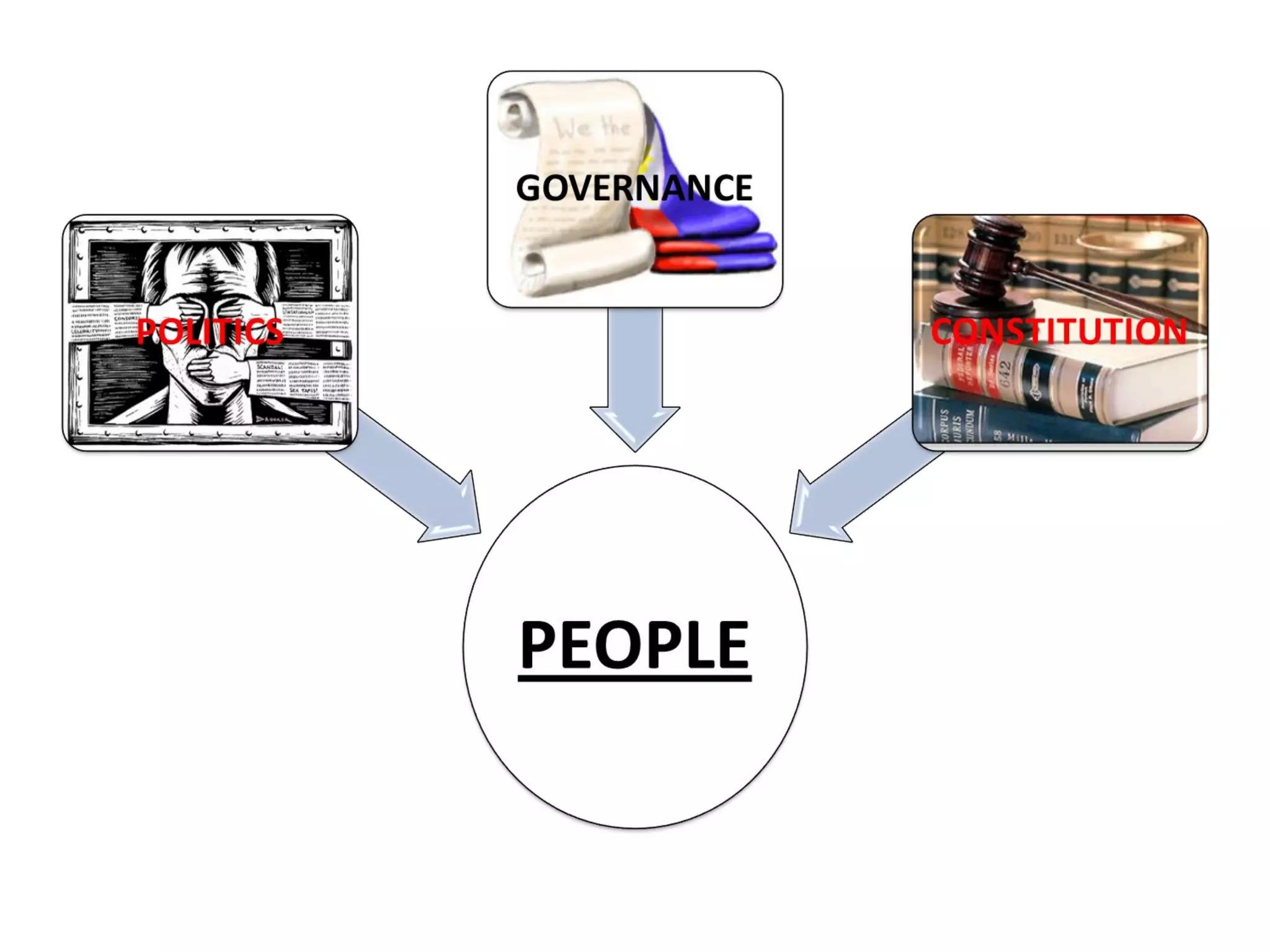
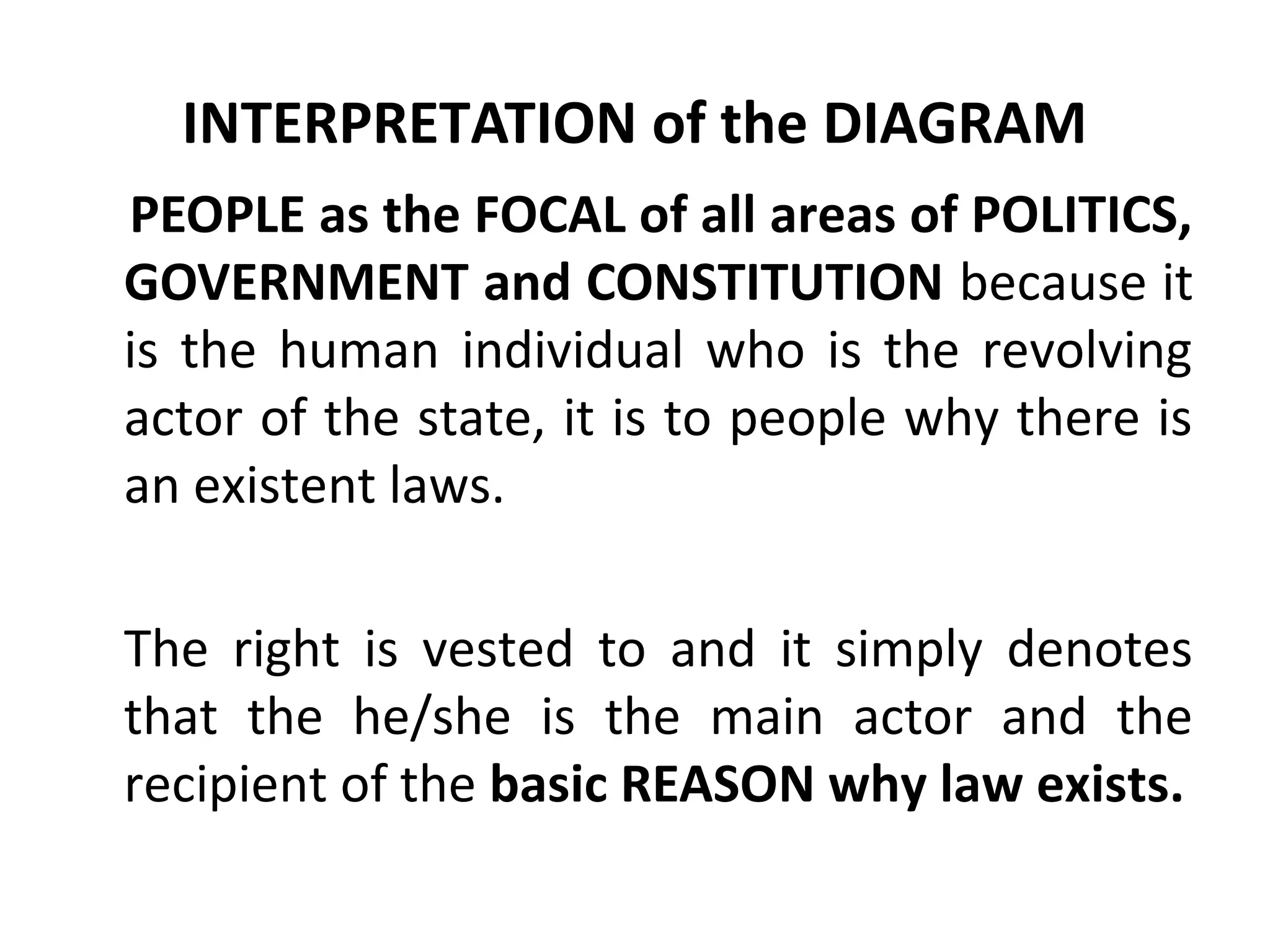
INTERPRETATION of the DIAGRAM
PEOPLE as the FOCAL of all areas of POLITICS,
GOVERNMENT and CONSTITUTION because it
is the human individual who is the revolving
actor of the state, it is to people why there is
an existent laws.
The right is vested to and it simply denotes
that the he/she is the main actor and the
recipient of the basic REASON why law exists.
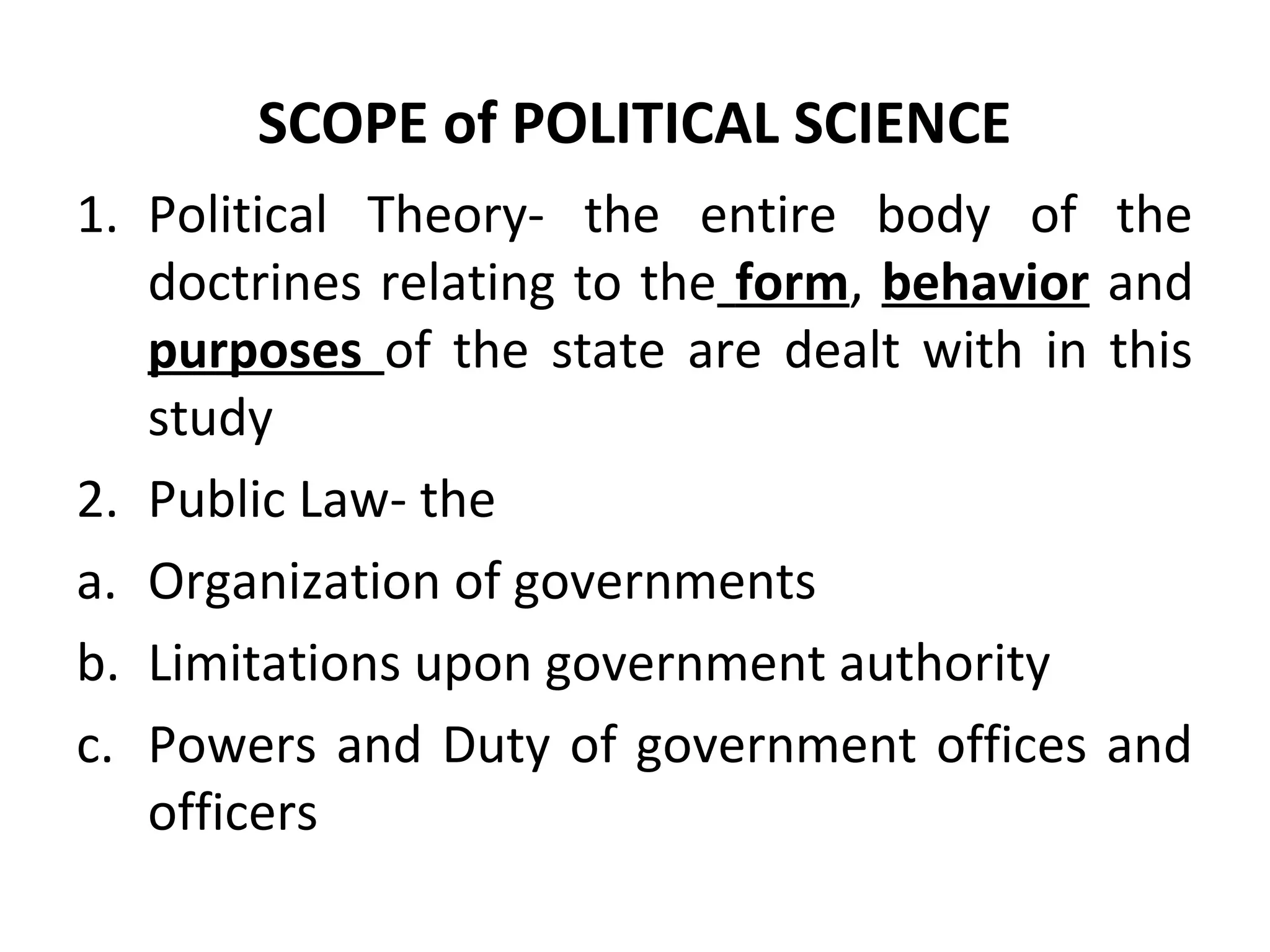
SCOPE of POLITICAL SCIENCE
1. Political Theory- the entire body of the
doctrines relating to the form, behavior and
purposes of the state are dealt with in this
study
2. Public Law- the
a. Organization of governments
b. Limitations upon government authority
c. Powers and Duty of government offices and
officers
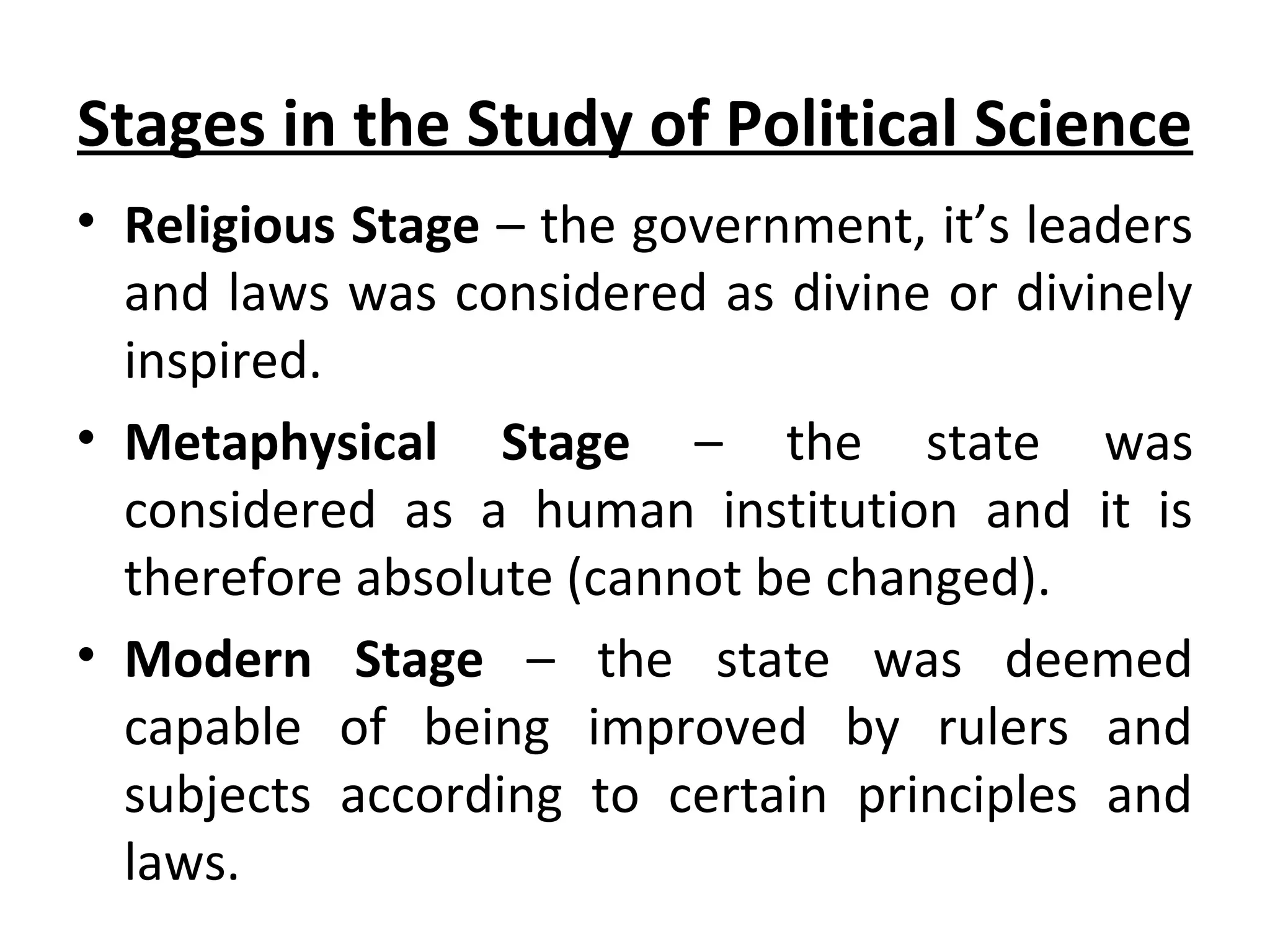
Stages in the Study of Political Science
• Religious Stage – the government, it’s leaders
and laws was considered as divine or divinely
inspired.
• Metaphysical Stage – the state was
considered as a human institution and it is
therefore absolute (cannot be changed).
• Modern Stage – the state was deemed
capable of being improved by rulers and
subjects according to certain principles and
laws.
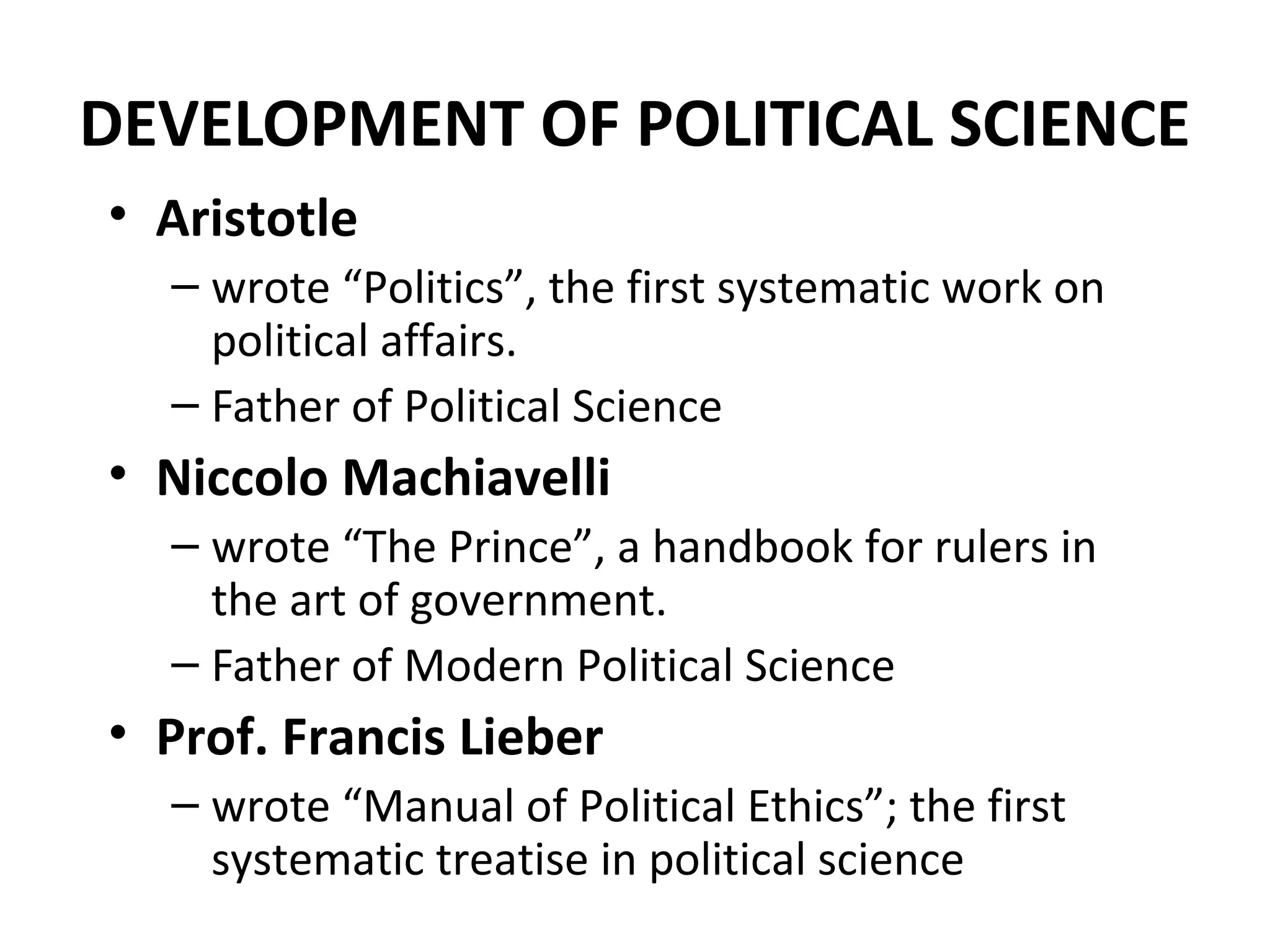
DEVELOPMENT OF POLITICAL SCIENCE
• Aristotle
– wrote “Politics”, the first systematic work on
political affairs.
– Father of Political Science
• Niccolo Machiavelli
– wrote “The Prince”, a handbook for rulers in
the art of government.
– Father of Modern Political Science
• Prof. Francis Lieber
– wrote “Manual of Political Ethics”; the first
systematic treatise in political science
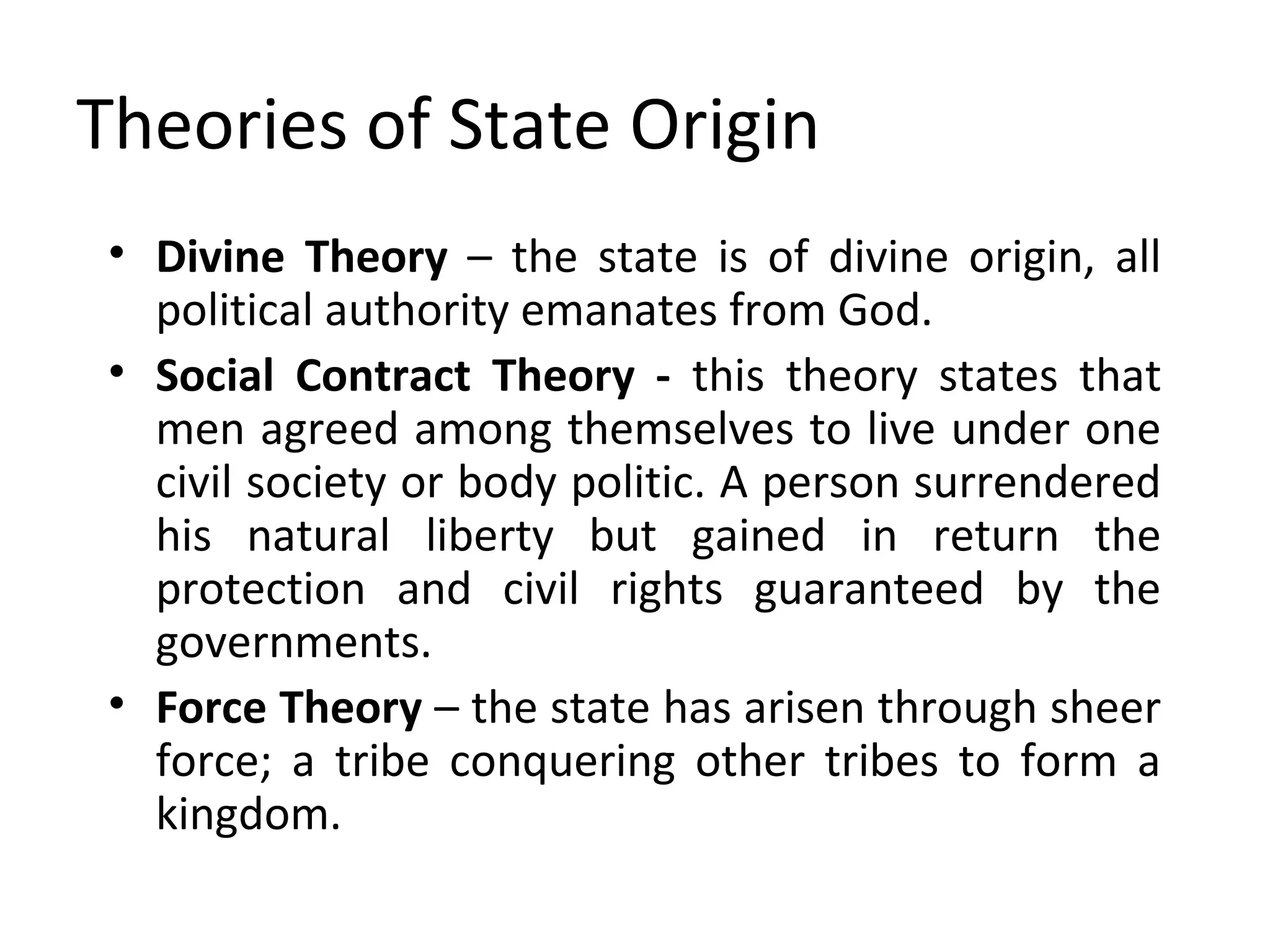
Theories of State Origin
• Divine Theory – the state is of divine origin, all
political authority emanates from God.
• Social Contract Theory - this theory states that
men agreed among themselves to live under one
civil society or body politic. A person surrendered
his natural liberty but gained in return the
protection and civil rights guaranteed by the
governments.
• Force Theory – the state has arisen through sheer
force; a tribe conquering other tribes to form a
kingdom.
What is a state?
A group of persons, more or less numerous,
permanently occupying a definite portion of
territory, independent of external control,
and possessing a government to which a
great body of inhabitants render habitual
obedience.
Elements of a State
• People
• Territory
• Government
• Sovereignty
What is the difference between
Nation and State?
• State is a legal or juristic concept, while
Nation is an ethnic or racial concept.
• Nasci = to be born indicates a relation of
birth or origin and implies a common race.
Thus, a nation may comprise several states
Example: Egypt, Iraq, Saudi, Lebanon,
Jordan, etc. belong to Arab nation.
What is the difference between
Nation and State?
• It is also possible for a single state to be
made up of more than one nation, e.g. US
which was the “melting pot” of many
nations that were eventually combined
into the “American nation”
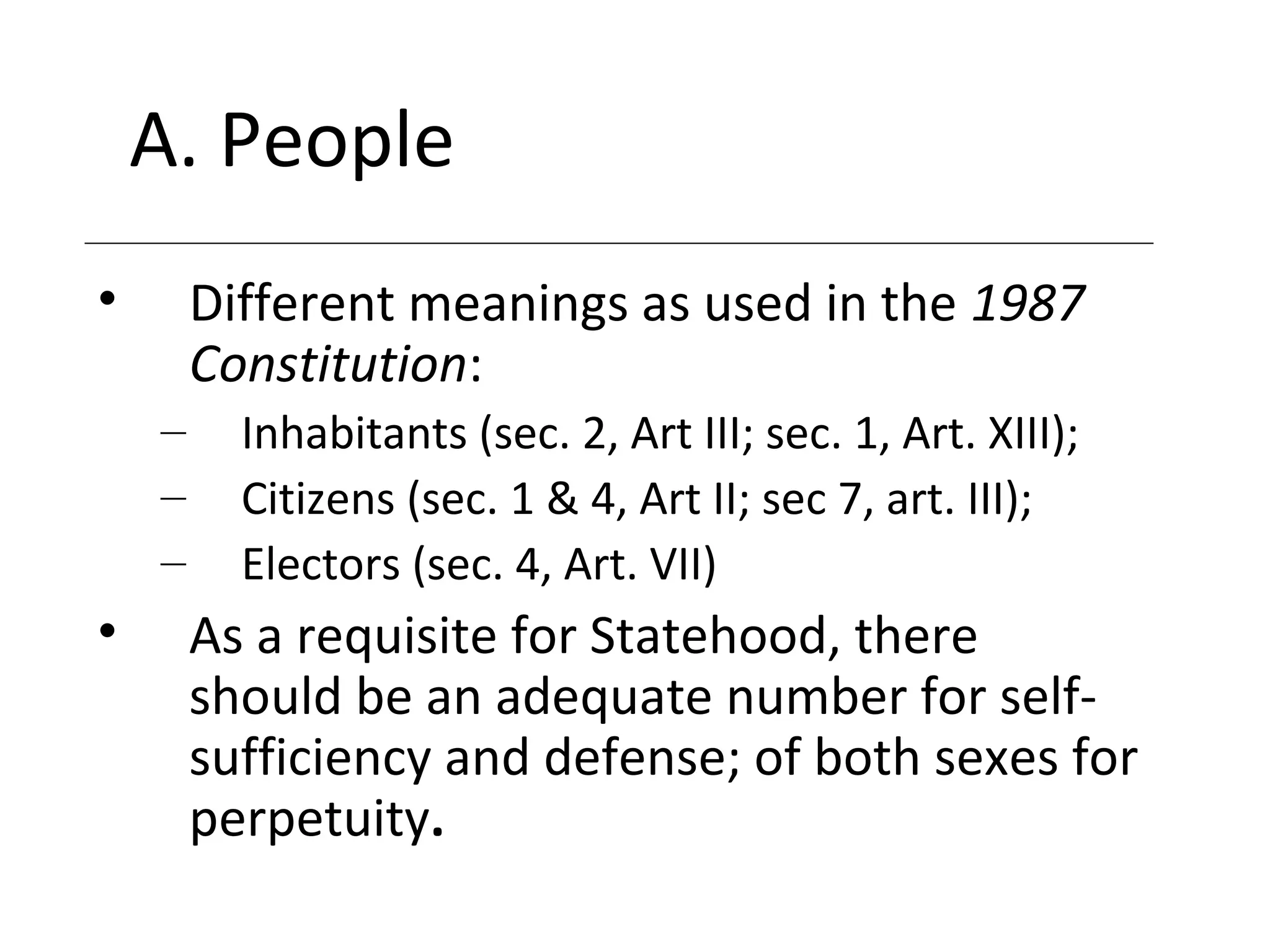
A. People
• Different meanings as used in the 1987
Constitution:
– Inhabitants (sec. 2, Art III; sec. 1, Art. XIII);
– Citizens (sec. 1 & 4, Art II; sec 7, art. III);
– Electors (sec. 4, Art. VII)
• As a requisite for Statehood, there
should be an adequate number for self-
sufficiency and defense; of both sexes for
perpetuity.
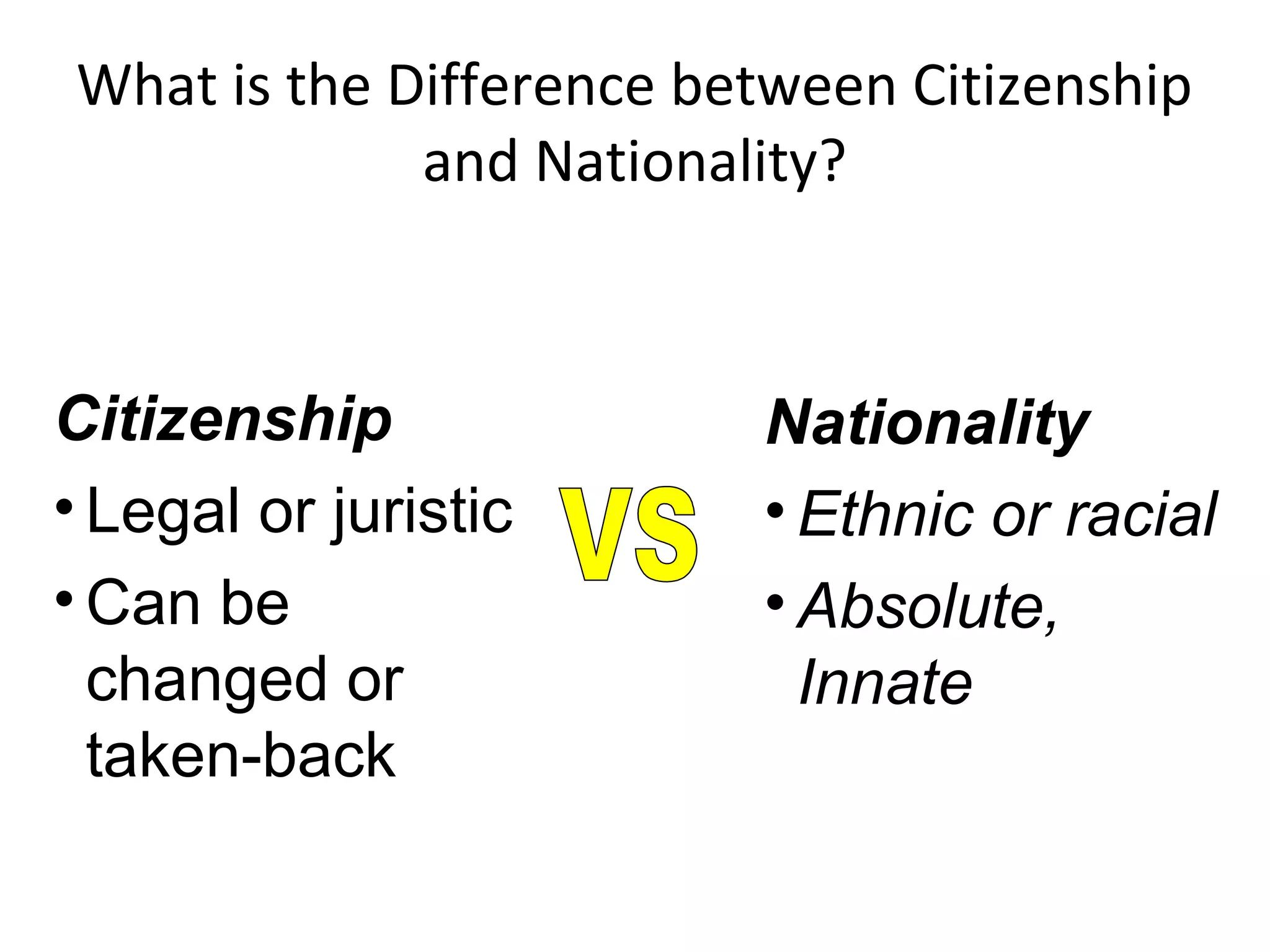
What is the Difference between Citizenship
and Nationality?
Citizenship
• Legal or juristic
• Can be
changed or
taken-back
Nationality
• Ethnic or racial
• Absolute,
Innate
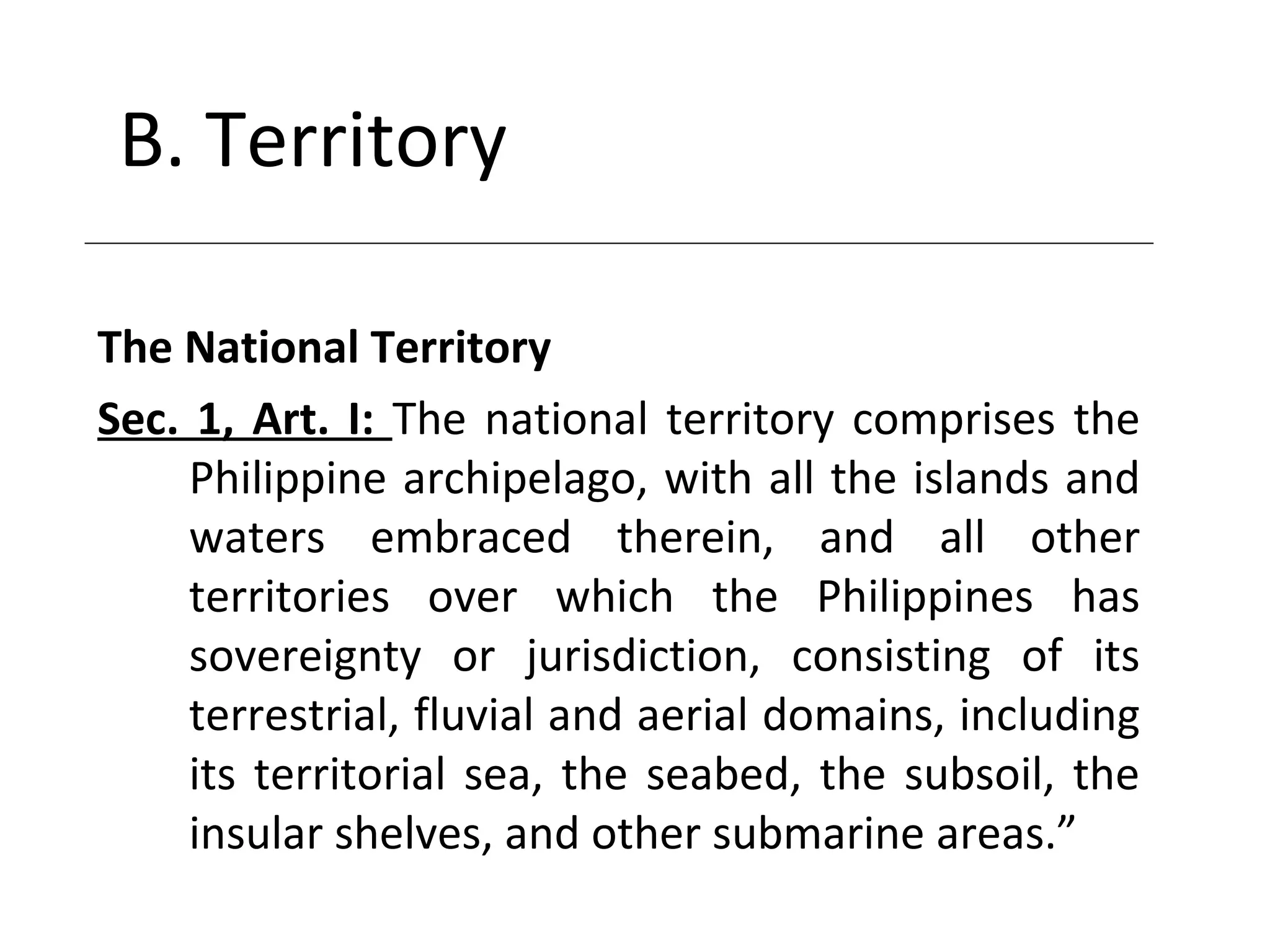
B. Territory
The National Territory
Sec. 1, Art. I: The national territory comprises the
Philippine archipelago, with all the islands and
waters embraced therein, and all other
territories over which the Philippines has
sovereignty or jurisdiction, consisting of its
terrestrial, fluvial and aerial domains, including
its territorial sea, the seabed, the subsoil, the
insular shelves, and other submarine areas.”
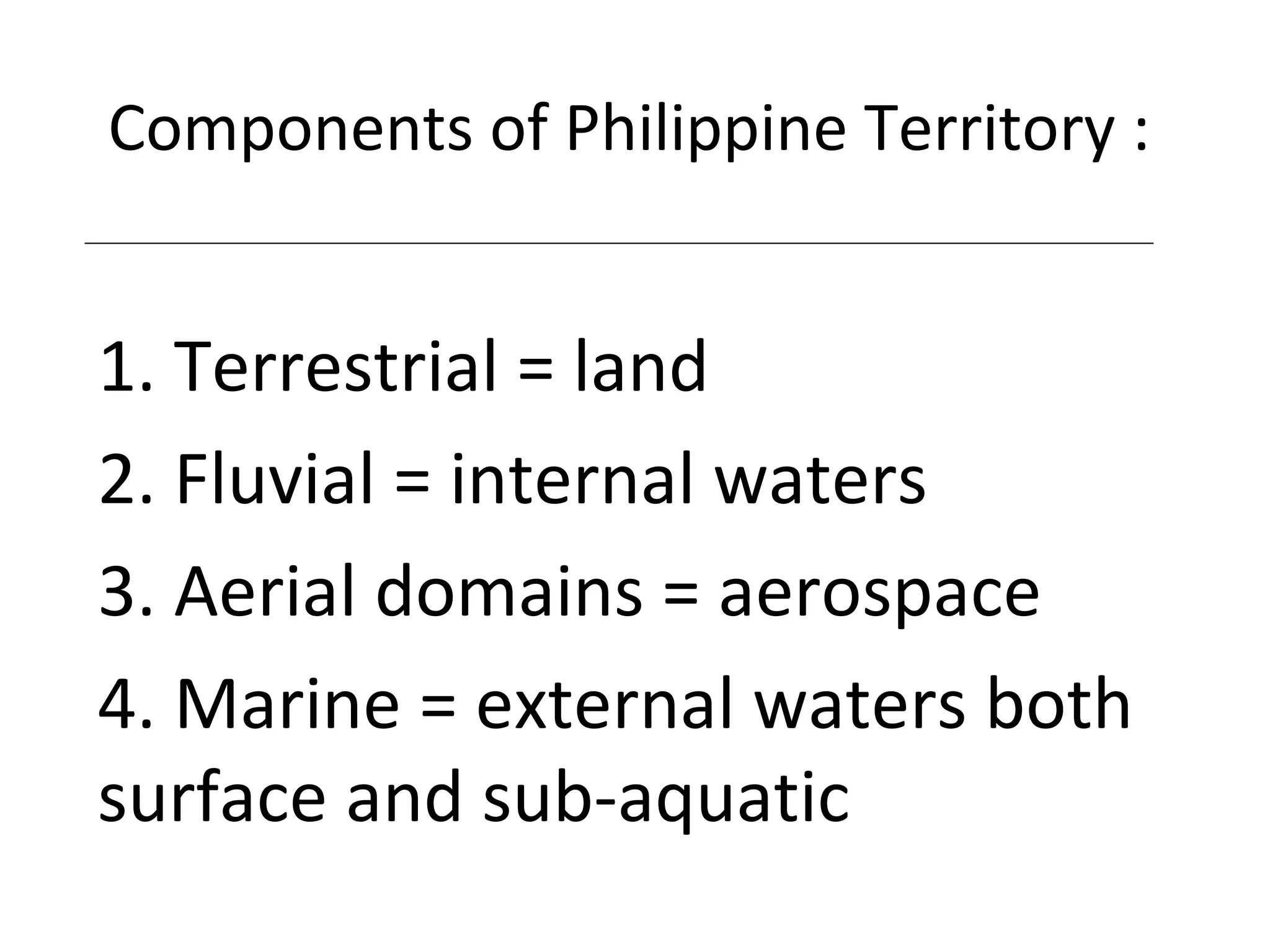
Components of Philippine Territory :
1. Terrestrial = land
2. Fluvial = internal waters
3. Aerial domains = aerospace
4. Marine = external waters both
surface and sub-aquatic
C. Government
• The agency or instrumentality through
which the will of the State is formulated,
expressed and realized.
• Our Constitution, however, requires our
government to be democratic and
republican.
C. Government
Section 1, Art II. The Philippines is a democratic and
republican State. Sovereignty resides in the
people and all government authority emanates
from them.
REPUBLICAN
• It is one wherein all government authority
emanates from the people and is exercised by
representatives chosen by the people.
C. Government
DEMOCRATIC
This emphasizes that the Philippines has some
aspects of direct democracy such as initiative
and referendum.
• Initiative -- Initiative" is the power of the
people to propose amendments to the
Constitution or to propose and enact
legislations through an election called for the
purpose.
• Referendum-- is the power of the electorate
to approve or reject a legislation through an
election called for the purpose
D. Sovereignty
• The supreme and uncontrollable power
innate in a State by which that State is
governed.
• Sovereignty resides in the people and all
government authority emanates from
them. (Sec. 1 Art.II)
Duties of the State
•Peace and Order
•Political Harmony (Good
Laws)
•Social Justice
•Economic Development
REFERENCES
Political Law, Isagani Cruz
Philippine Constitution De Leon, 1997
Chan Robles Virtual Law Library
Law Phil Project
Great Political Theories

Political Science Lecture 1

  • 1.
    POLITICS and GOVERNANCE withCONSTITUTION (Lecture 1) Prepared by: Raizza Corpuz
  • 2.
    OBJECTIVES • To understandthe basic concept of political science • To develop a critical way of thinking in interpreting Politics and Government. • To evaluate how they know and understand the topic
  • 3.
    LAW, JUSTICE andRIGHTS Human Rights Social Justice The Rule of Law Ethics of Law
  • 4.
    Legal System According toRaymond Wacks ( 2008), legal system lies in the heart of any society protecting RIGHTS, imposing DUTIES and establishing a framework for the conduct of almost every social, political, and economic activity. It endeavors to achieve JUSTICE, promote freedom and uphold the rule of law and protect security.
  • 5.
    POLITICAL SCIENCE (De Leon,1999) Systematic study of state and government POLITICAL- derived from the Greek word “POLIS” –meaning a city or the sovereign state SCIENCE- comes from the Latin “SCIRE”-means “to know”
  • 6.
    SCIENCE of POLITICS 1.It is the basic knowledge and understanding of the state and the principles and ideals which underlie its organization and activities. 2. It is primarily concerned with the association of human beings into ‘body politic’ or in a political community. 3. It deals with those relations among men and groups which are subject to control by the state with the relations of men and groups to the state itself and the relations of the state to other state.
  • 8.
    INTERPRETATION of theDIAGRAM PEOPLE as the FOCAL of all areas of POLITICS, GOVERNMENT and CONSTITUTION because it is the human individual who is the revolving actor of the state, it is to people why there is an existent laws. The right is vested to and it simply denotes that the he/she is the main actor and the recipient of the basic REASON why law exists.
  • 9.
    SCOPE of POLITICALSCIENCE 1. Political Theory- the entire body of the doctrines relating to the form, behavior and purposes of the state are dealt with in this study 2. Public Law- the a. Organization of governments b. Limitations upon government authority c. Powers and Duty of government offices and officers
  • 10.
    Stages in theStudy of Political Science • Religious Stage – the government, it’s leaders and laws was considered as divine or divinely inspired. • Metaphysical Stage – the state was considered as a human institution and it is therefore absolute (cannot be changed). • Modern Stage – the state was deemed capable of being improved by rulers and subjects according to certain principles and laws.
  • 11.
    DEVELOPMENT OF POLITICALSCIENCE • Aristotle – wrote “Politics”, the first systematic work on political affairs. – Father of Political Science • Niccolo Machiavelli – wrote “The Prince”, a handbook for rulers in the art of government. – Father of Modern Political Science • Prof. Francis Lieber – wrote “Manual of Political Ethics”; the first systematic treatise in political science
  • 12.
    Theories of StateOrigin • Divine Theory – the state is of divine origin, all political authority emanates from God. • Social Contract Theory - this theory states that men agreed among themselves to live under one civil society or body politic. A person surrendered his natural liberty but gained in return the protection and civil rights guaranteed by the governments. • Force Theory – the state has arisen through sheer force; a tribe conquering other tribes to form a kingdom.
  • 13.
    What is astate? A group of persons, more or less numerous, permanently occupying a definite portion of territory, independent of external control, and possessing a government to which a great body of inhabitants render habitual obedience.
  • 14.
    Elements of aState • People • Territory • Government • Sovereignty
  • 15.
    What is thedifference between Nation and State? • State is a legal or juristic concept, while Nation is an ethnic or racial concept. • Nasci = to be born indicates a relation of birth or origin and implies a common race. Thus, a nation may comprise several states Example: Egypt, Iraq, Saudi, Lebanon, Jordan, etc. belong to Arab nation.
  • 16.
    What is thedifference between Nation and State? • It is also possible for a single state to be made up of more than one nation, e.g. US which was the “melting pot” of many nations that were eventually combined into the “American nation”
  • 17.
    A. People • Differentmeanings as used in the 1987 Constitution: – Inhabitants (sec. 2, Art III; sec. 1, Art. XIII); – Citizens (sec. 1 & 4, Art II; sec 7, art. III); – Electors (sec. 4, Art. VII) • As a requisite for Statehood, there should be an adequate number for self- sufficiency and defense; of both sexes for perpetuity.
  • 18.
    What is theDifference between Citizenship and Nationality? Citizenship • Legal or juristic • Can be changed or taken-back Nationality • Ethnic or racial • Absolute, Innate
  • 19.
    B. Territory The NationalTerritory Sec. 1, Art. I: The national territory comprises the Philippine archipelago, with all the islands and waters embraced therein, and all other territories over which the Philippines has sovereignty or jurisdiction, consisting of its terrestrial, fluvial and aerial domains, including its territorial sea, the seabed, the subsoil, the insular shelves, and other submarine areas.”
  • 20.
    Components of PhilippineTerritory : 1. Terrestrial = land 2. Fluvial = internal waters 3. Aerial domains = aerospace 4. Marine = external waters both surface and sub-aquatic
  • 21.
    C. Government • Theagency or instrumentality through which the will of the State is formulated, expressed and realized. • Our Constitution, however, requires our government to be democratic and republican.
  • 22.
    C. Government Section 1,Art II. The Philippines is a democratic and republican State. Sovereignty resides in the people and all government authority emanates from them. REPUBLICAN • It is one wherein all government authority emanates from the people and is exercised by representatives chosen by the people.
  • 23.
    C. Government DEMOCRATIC This emphasizesthat the Philippines has some aspects of direct democracy such as initiative and referendum. • Initiative -- Initiative" is the power of the people to propose amendments to the Constitution or to propose and enact legislations through an election called for the purpose. • Referendum-- is the power of the electorate to approve or reject a legislation through an election called for the purpose
  • 24.
    D. Sovereignty • Thesupreme and uncontrollable power innate in a State by which that State is governed. • Sovereignty resides in the people and all government authority emanates from them. (Sec. 1 Art.II)
  • 25.
    Duties of theState •Peace and Order •Political Harmony (Good Laws) •Social Justice •Economic Development
  • 26.
    REFERENCES Political Law, IsaganiCruz Philippine Constitution De Leon, 1997 Chan Robles Virtual Law Library Law Phil Project Great Political Theories