Interaction Framework in HCI
•interaction models
translations between user and system
•ergonomics
physical characteristics of interaction
•interaction styles
the nature of user/system dialog
•context
social, organizational, motivational
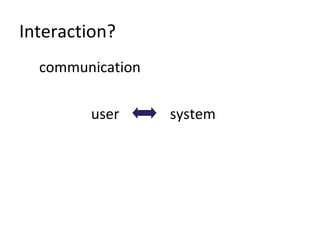
Interaction?
communication
user system
Models of Interaction
Why develop a model for interaction?
•To help us to understand an interactive
dialogue.
•To identify likely difficulties.
•To provide a framework to compare
different interaction styles.
Some terms of interaction
domain – the area of work under study
e.g. graphic design
goal – what you want to achieve
e.g. create a solid red triangle
task – how you go about doing it
– ultimately in terms of operations or
actions
e.g. … select fill tool, click over triangle
Donald Norman’s Model
• Seven stages
– user establishes the goal
– formulates intention
– specifies actions at interface
– executes action
– perceives system state
– interprets system state
– evaluates system state with respect to goal
• Norman’s model concentrates on user’s view of
the interface
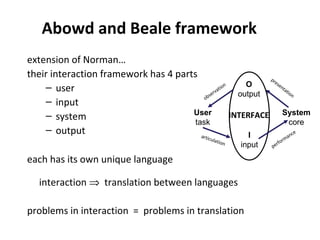
Abowd and Beale framework
extension of Norman…
their interaction framework has 4 parts
– user
– input
– system
– output
each has its own unique language
interaction ⇒ translation between languages
problems in interaction = problems in translation
User
task
System
core
I
input
O
output
INTERFACE
presentation
performance
articulation
observation
Using Abowd & Beale’s model
user intentions
→ translated into actions at the interface
→ translated into alterations of system state
→ reflected in the output display
→ interpreted by the user
general framework for understanding interaction
– not restricted to electronic computer systems
– identifies all major components involved in
interaction
– allows comparative assessment of systems
– an abstraction
Using Abowd & Beale’s model
user intentions
→ translated into actions at the interface
→ translated into alterations of system state
→ reflected in the output display
→ interpreted by the user
general framework for understanding interaction
– not restricted to electronic computer systems
– identifies all major components involved in
interaction
– allows comparative assessment of systems
– an abstraction
Using Abowd & Beale’s model
user intentions
→ translated into actions at the interface
→ translated into alterations of system state
→ reflected in the output display
→ interpreted by the user
general framework for understanding interaction
– not restricted to electronic computer systems
– identifies all major components involved in
interaction
– allows comparative assessment of systems
– an abstraction

POLITEKNIK MALAYSIA

  • 1.
  • 2.
    Interaction Framework inHCI •interaction models translations between user and system •ergonomics physical characteristics of interaction •interaction styles the nature of user/system dialog •context social, organizational, motivational
  • 3.
  • 4.
    Models of Interaction Whydevelop a model for interaction? •To help us to understand an interactive dialogue. •To identify likely difficulties. •To provide a framework to compare different interaction styles.
  • 5.
    Some terms ofinteraction domain – the area of work under study e.g. graphic design goal – what you want to achieve e.g. create a solid red triangle task – how you go about doing it – ultimately in terms of operations or actions e.g. … select fill tool, click over triangle
  • 6.
    Donald Norman’s Model •Seven stages – user establishes the goal – formulates intention – specifies actions at interface – executes action – perceives system state – interprets system state – evaluates system state with respect to goal • Norman’s model concentrates on user’s view of the interface
  • 7.
    Abowd and Bealeframework extension of Norman… their interaction framework has 4 parts – user – input – system – output each has its own unique language interaction ⇒ translation between languages problems in interaction = problems in translation User task System core I input O output INTERFACE presentation performance articulation observation
  • 8.
    Using Abowd &Beale’s model user intentions → translated into actions at the interface → translated into alterations of system state → reflected in the output display → interpreted by the user general framework for understanding interaction – not restricted to electronic computer systems – identifies all major components involved in interaction – allows comparative assessment of systems – an abstraction
  • 9.
    Using Abowd &Beale’s model user intentions → translated into actions at the interface → translated into alterations of system state → reflected in the output display → interpreted by the user general framework for understanding interaction – not restricted to electronic computer systems – identifies all major components involved in interaction – allows comparative assessment of systems – an abstraction
  • 10.
    Using Abowd &Beale’s model user intentions → translated into actions at the interface → translated into alterations of system state → reflected in the output display → interpreted by the user general framework for understanding interaction – not restricted to electronic computer systems – identifies all major components involved in interaction – allows comparative assessment of systems – an abstraction