Introduction to HCI
Professor Benjamin Lok
University of Florida
CEN 4721c / CAP5100
Spring 2017
Definition of HCI
• Human-computer interaction is a discipline concerned with the
design, evaluation and implementation of interactive
computing systems for human use and with the study of
major phenomena surrounding them.
• ACM SIGCHI Curricula for HCI (Hewett et al. 1992)
• http://sigchi.org/cdg/cdg2.html
What fields does HCI cover?
• Computer Science
• Psychology
• Communication
• Education
• Anthropology
• Design (e.g. graphic and industrial)
Outline
• Design
• What is design?
• How can we have a higher likelihood of good design?
• How do we design for different user groups?
• Implementation
• Evaluation
Norman Doors
• How do you open this door?
From: http://farm1.static.flickr.com/59/175678013_ed6a5028bc.jpg
Why we care
about HCI
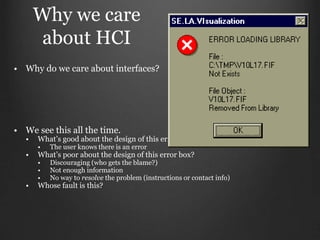
• Why do we care about interfaces?
• We see this all the time.
• What’s good about the design of this error box?
• The user knows there is an error
• What’s poor about the design of this error box?
• Discouraging (who gets the blame?)
• Not enough information
• No way to resolve the problem (instructions or contact info)
• Whose fault is this?
HCI Design
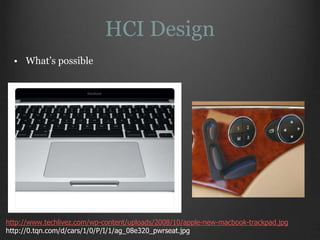
• What’s possible
http://www.techlivez.com/wp-content/uploads/2008/10/apple-new-macbook-trackpad.jpg
http://0.tqn.com/d/cars/1/0/P/I/1/ag_08e320_pwrseat.jpg
What do you feel about…
What makes developing good interfaces challenging?
Commercial Example: Phones
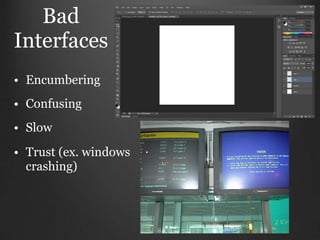
Bad
Interfaces
• Encumbering
• Confusing
• Slow
• Trust (ex. windows
crashing)
• What’s wrong with each?
• Type of error
• Who is affected
• Impact
• What’s a redesign solution?
Coke freestyle
http://www.creativecrash.com/system/photos/000/106/144/106144/big/Freestyle_th00
7.jpg?1285438080
https://www.youtube.com/watch?v=btMzicBpSK0
Importance of Design
• http://www.masternewmedia.org/news/2005/04/17/bad_user
_interface_design_can.htm
So how do you avoid bad
design?
• Example:
• Design the ultimate fast food hamburger drive through
Image from:
http://pigjockey.com/wp-content/uploads/2009/10/mcdonalds-6.jpg
User persona
user: https://xtensio.com/user-persona/ to create a
persona for
A. the person you were considering when you
developed your interface
B. someone different that your first user persona
Did your design support?
• A customer who can’t read English?
• A customer who is hearing impaired?
• A customer who has never eaten a hamburger before?
• A customer who is health conscious?
• A customer who has an IQ of less than 80?
• A customer who is over 7’ tall
• Did you design an interface for you?
• Is not that what someone already did?
Reflection
• Brainstorm a list of different perspectives.
• I am thinking of ... A drive-through interface... From the
point of view of ... the viewpoint you've chosen
• I think ... describe the drive-through interface from your
viewpoint. Be an actor - take on the character of your
viewpoint
• A question I have from this viewpoint is ... ask a question
from this viewpoint
• Wrap up: What new ideas do you have about the drive-
through that you didn't have before? What new questions
do you have?
Good HCI
• You can’t create one just by sitting around and dreaming one up
• What do you rely on?
• Known design solutions
• Research
• User feedback
• When in the development process should HCI be considered?
• Throughout the development process (Lean UX)
Cultural and International Diversity
• Language
• Date / Time conventions
• 1/4/15
• Weights and Measures
• Reading: left-to-right, up-and-down
• Telephone #s and addresses
• Names, titles, salutations
• SSN, ID, passport
• Icons, buttons, colors
• Etiquette, tone, formality
• Real world case: creating a simulation for nursing students. Standards of
care vary by area.
Elderly
• How are elderly users different than 18-65
year old users?
• How would design for elderly users?
• Reduced
• Motor skills
• Perception
• Vision, hearing, touch, mobility
• Speed
• Memory
• Other needs
• Technology experience is varied (How
many grandmothers use email?
mothers?)
• Uninformed on how technology could help
• Practice skills (hand-eye, problem solving)
• Touch screens, larger fonts, louder sounds
Children
• How are children different than 18-65
year old users?
• How would design for children?
• Technology familiarity
• Age changes:
• Physical dexterity
• (double-clicking, click and drag,
and small targets)
• Attention span
• Varied backgrounds (socio-economic)
• Goals
• Educational acceleration
• Socialization with peers
• Psychological – improve self-image,
self-confidence
• Creativity – art, music, etc.
exploration
Children
• Teenagers are a special group
• Next generation
• Beta test new interfaces, trends
• Cell phones, text messages, simulations, fantasy games,
virtual worlds
• Requires Safety
• They
• Like exploring (easy to reset state)
• Don’t mind making mistakes
• Like familiar characters and repetition
• Don’t like patronizing comments, inappropriate humor
• Design: Focus groups
Users with Disabilities
• How would design for users with vision limitations?
• 1998 Amendment to Rehabilitation Act
• Federal law to ensure access to IT, including computers and web sites
• Vision (text-to-speech)
• Blind (bill-reader)
• Low-vision
• Color-blind
• Hearing (conversion of tones to visual signals)
• Deaf
• Limited hearing
• Mobility (eye-gaze control, head-mounted optical mice)
• Learning
• Dyslexia
• Attention deficient, hemisphere specific, etc.
• Keyboard, mouse, color alternatives
Universal Usability
• Does not mean ‘dumbing down’
• Ex. Helping disabled has helped
others (parents w/ strollers, elderly)
• Ex. Door handles
• Goal: Address the needs of more
users - unlike yourself!
• Everyone is often not at full
faculties at all times
Universal Usability
• Interface should handle diversity of
users
• Backgrounds
• Abilities
• Motivation
• Personalities
• Cultures
• Technical capacity (e.g. Shadow Health and
Alcorn state example)
Physical Variation
• Field of anthropometry
• Basic data about human
dimensions
• Is no ‘average’ user
• Measures of what is 5-95% for
weight, height, gender,
culture, etc.
• Large variance reminds us
there is great ‘variety’
• Name some devices that this
would affect…
Outline
• Course Information and motivation for HCI
• Design
• Implementation
• How can we implement a good interface?
• Evaluation
Requirements Analysis
1. In designing a building I want inhabitants to
move between floors
1. (who are the users) Ascertain users’ needs
2. (how often do they move) Ensure proper reliability
3. (what approaches are likely users familiar with) Promote
appropriate standardization, integration, consistency, and
portability
Ascertain User’s Needs
• Develop use cases
• Actors (who)
• Goals (what)
• Scope (for which situations)
• Environment (where)
• Minimal Guarantee (minimum to
deliver)
• Satisfaction (when are you done)
• Equipment (with what)
• Let’s look at a use case for project 1
Standardization, Integration,
Consistency, Portability
• Standardization – common user-interface features
across multiple applications
• Apple
• Web
• Windows
• Smart phones
• Integration – across application packages
• file formats
• Consistency – common action sequences, terms, units,
layouts, color, typography within an application
• Portability – convert data and interfaces across multiple
hardware and software environments
• Word/HTML/PDF/ASCII/Flash
Outline
• Course Information and motivation for HCI
• Design
• Implementation
• Evaluation
• How do you measure a good interface
Usability Measures
• How can we measure the ‘goodness’ of an
interface?
• What are good metrics?
• ISO 9241
• Effectiveness
• Efficiency
• Satisfaction
• Schneiderman
• Time to learn
• Speed of performance
• Rate of errors
• Retention over time
• Subjective satisfaction
Usability Motivations
• Life-Critical systems
• Applications: air traffic, nuclear reactors, military, emergency dispatch
• Requirements: reliability and effective (even under stress)
• Not as important: cost, long training, satisfaction, retention
• Industrial and Commercial Use
• Applications: banking, insurance, inventory, reservations
• Requirements: short training, ease of use/learning, multiple languages,
adapt to local cultures, multiplatform, speed
• Office, Home, and Entertainment
• Applications: E-mail, ATMs, games, education, search engines, cell
phones/PDA
• Requirements: Ease of learning/use/retention, error rates, satisfaction
• Difficulties: cost, size
•Time to learn
•Speed of performance
•Rate of errors
•Retention over time
•Subjective satisfaction
Usability Motivations
• Exploratory, Creative, Collaborative
• Applications: Web browsing, search engines, simulations, scientific
visualization, CAD, computer graphics, music composition/artist, photo
arranger (email photos)
• Requirements: remove the ‘computer’ from the experience,
• Difficulties: user tech savvy-ness (apply this to application examples)
• Socio-technical systems
• Applications: health care, voting, police
• Requirements: Trust, security, accuracy, veracity, error handling, user
tech-savy-ness
•Time to learn
•Speed of performance
•Rate of errors
•Retention over time
•Subjective satisfaction
Reliability
• Actions function as specified
• Data displayed must be correct
• Updates done correctly
• Leads to trust! (software,
hardware, information) – case:
1994 Pentium FDIV bug
• Cost to Intel: $475 million
• Privacy, security, access, data
destruction, tampering
No More Norman Doors!
From: http://lcc3710.comprss.com/?p=140
Changing Behavior with
Good Design
• Piano Stairs – TheFunTheory.com
Images from: http://www.goodexperience.com/broken/i/04/02/america-fitness-s.jpg
http://failblog.files.wordpress.com/2009/08/fail-owned-lazy-escalator-
fail.jpg?w=500&h=375

01-Introduction to HCI.pptx

  • 1.
    Introduction to HCI ProfessorBenjamin Lok University of Florida CEN 4721c / CAP5100 Spring 2017
  • 2.
    Definition of HCI •Human-computer interaction is a discipline concerned with the design, evaluation and implementation of interactive computing systems for human use and with the study of major phenomena surrounding them. • ACM SIGCHI Curricula for HCI (Hewett et al. 1992) • http://sigchi.org/cdg/cdg2.html
  • 3.
    What fields doesHCI cover? • Computer Science • Psychology • Communication • Education • Anthropology • Design (e.g. graphic and industrial)
  • 4.
    Outline • Design • Whatis design? • How can we have a higher likelihood of good design? • How do we design for different user groups? • Implementation • Evaluation
  • 5.
    Norman Doors • Howdo you open this door? From: http://farm1.static.flickr.com/59/175678013_ed6a5028bc.jpg
  • 6.
    Why we care aboutHCI • Why do we care about interfaces? • We see this all the time. • What’s good about the design of this error box? • The user knows there is an error • What’s poor about the design of this error box? • Discouraging (who gets the blame?) • Not enough information • No way to resolve the problem (instructions or contact info) • Whose fault is this?
  • 7.
    HCI Design • What’spossible http://www.techlivez.com/wp-content/uploads/2008/10/apple-new-macbook-trackpad.jpg http://0.tqn.com/d/cars/1/0/P/I/1/ag_08e320_pwrseat.jpg
  • 8.
    What do youfeel about… What makes developing good interfaces challenging?
  • 9.
  • 10.
    Bad Interfaces • Encumbering • Confusing •Slow • Trust (ex. windows crashing)
  • 11.
    • What’s wrongwith each? • Type of error • Who is affected • Impact • What’s a redesign solution?
  • 12.
  • 13.
    Importance of Design •http://www.masternewmedia.org/news/2005/04/17/bad_user _interface_design_can.htm
  • 14.
    So how doyou avoid bad design? • Example: • Design the ultimate fast food hamburger drive through Image from: http://pigjockey.com/wp-content/uploads/2009/10/mcdonalds-6.jpg
  • 15.
    User persona user: https://xtensio.com/user-persona/to create a persona for A. the person you were considering when you developed your interface B. someone different that your first user persona
  • 16.
    Did your designsupport? • A customer who can’t read English? • A customer who is hearing impaired? • A customer who has never eaten a hamburger before? • A customer who is health conscious? • A customer who has an IQ of less than 80? • A customer who is over 7’ tall • Did you design an interface for you? • Is not that what someone already did?
  • 17.
    Reflection • Brainstorm alist of different perspectives. • I am thinking of ... A drive-through interface... From the point of view of ... the viewpoint you've chosen • I think ... describe the drive-through interface from your viewpoint. Be an actor - take on the character of your viewpoint • A question I have from this viewpoint is ... ask a question from this viewpoint • Wrap up: What new ideas do you have about the drive- through that you didn't have before? What new questions do you have?
  • 18.
    Good HCI • Youcan’t create one just by sitting around and dreaming one up • What do you rely on? • Known design solutions • Research • User feedback • When in the development process should HCI be considered? • Throughout the development process (Lean UX)
  • 19.
    Cultural and InternationalDiversity • Language • Date / Time conventions • 1/4/15 • Weights and Measures • Reading: left-to-right, up-and-down • Telephone #s and addresses • Names, titles, salutations • SSN, ID, passport • Icons, buttons, colors • Etiquette, tone, formality • Real world case: creating a simulation for nursing students. Standards of care vary by area.
  • 20.
    Elderly • How areelderly users different than 18-65 year old users? • How would design for elderly users? • Reduced • Motor skills • Perception • Vision, hearing, touch, mobility • Speed • Memory • Other needs • Technology experience is varied (How many grandmothers use email? mothers?) • Uninformed on how technology could help • Practice skills (hand-eye, problem solving) • Touch screens, larger fonts, louder sounds
  • 21.
    Children • How arechildren different than 18-65 year old users? • How would design for children? • Technology familiarity • Age changes: • Physical dexterity • (double-clicking, click and drag, and small targets) • Attention span • Varied backgrounds (socio-economic) • Goals • Educational acceleration • Socialization with peers • Psychological – improve self-image, self-confidence • Creativity – art, music, etc. exploration
  • 22.
    Children • Teenagers area special group • Next generation • Beta test new interfaces, trends • Cell phones, text messages, simulations, fantasy games, virtual worlds • Requires Safety • They • Like exploring (easy to reset state) • Don’t mind making mistakes • Like familiar characters and repetition • Don’t like patronizing comments, inappropriate humor • Design: Focus groups
  • 23.
    Users with Disabilities •How would design for users with vision limitations? • 1998 Amendment to Rehabilitation Act • Federal law to ensure access to IT, including computers and web sites • Vision (text-to-speech) • Blind (bill-reader) • Low-vision • Color-blind • Hearing (conversion of tones to visual signals) • Deaf • Limited hearing • Mobility (eye-gaze control, head-mounted optical mice) • Learning • Dyslexia • Attention deficient, hemisphere specific, etc. • Keyboard, mouse, color alternatives
  • 24.
    Universal Usability • Doesnot mean ‘dumbing down’ • Ex. Helping disabled has helped others (parents w/ strollers, elderly) • Ex. Door handles • Goal: Address the needs of more users - unlike yourself! • Everyone is often not at full faculties at all times
  • 25.
    Universal Usability • Interfaceshould handle diversity of users • Backgrounds • Abilities • Motivation • Personalities • Cultures • Technical capacity (e.g. Shadow Health and Alcorn state example)
  • 26.
    Physical Variation • Fieldof anthropometry • Basic data about human dimensions • Is no ‘average’ user • Measures of what is 5-95% for weight, height, gender, culture, etc. • Large variance reminds us there is great ‘variety’ • Name some devices that this would affect…
  • 27.
    Outline • Course Informationand motivation for HCI • Design • Implementation • How can we implement a good interface? • Evaluation
  • 28.
    Requirements Analysis 1. Indesigning a building I want inhabitants to move between floors 1. (who are the users) Ascertain users’ needs 2. (how often do they move) Ensure proper reliability 3. (what approaches are likely users familiar with) Promote appropriate standardization, integration, consistency, and portability
  • 29.
    Ascertain User’s Needs •Develop use cases • Actors (who) • Goals (what) • Scope (for which situations) • Environment (where) • Minimal Guarantee (minimum to deliver) • Satisfaction (when are you done) • Equipment (with what) • Let’s look at a use case for project 1
  • 30.
    Standardization, Integration, Consistency, Portability •Standardization – common user-interface features across multiple applications • Apple • Web • Windows • Smart phones • Integration – across application packages • file formats • Consistency – common action sequences, terms, units, layouts, color, typography within an application • Portability – convert data and interfaces across multiple hardware and software environments • Word/HTML/PDF/ASCII/Flash
  • 31.
    Outline • Course Informationand motivation for HCI • Design • Implementation • Evaluation • How do you measure a good interface
  • 32.
    Usability Measures • Howcan we measure the ‘goodness’ of an interface? • What are good metrics? • ISO 9241 • Effectiveness • Efficiency • Satisfaction • Schneiderman • Time to learn • Speed of performance • Rate of errors • Retention over time • Subjective satisfaction
  • 33.
    Usability Motivations • Life-Criticalsystems • Applications: air traffic, nuclear reactors, military, emergency dispatch • Requirements: reliability and effective (even under stress) • Not as important: cost, long training, satisfaction, retention • Industrial and Commercial Use • Applications: banking, insurance, inventory, reservations • Requirements: short training, ease of use/learning, multiple languages, adapt to local cultures, multiplatform, speed • Office, Home, and Entertainment • Applications: E-mail, ATMs, games, education, search engines, cell phones/PDA • Requirements: Ease of learning/use/retention, error rates, satisfaction • Difficulties: cost, size •Time to learn •Speed of performance •Rate of errors •Retention over time •Subjective satisfaction
  • 34.
    Usability Motivations • Exploratory,Creative, Collaborative • Applications: Web browsing, search engines, simulations, scientific visualization, CAD, computer graphics, music composition/artist, photo arranger (email photos) • Requirements: remove the ‘computer’ from the experience, • Difficulties: user tech savvy-ness (apply this to application examples) • Socio-technical systems • Applications: health care, voting, police • Requirements: Trust, security, accuracy, veracity, error handling, user tech-savy-ness •Time to learn •Speed of performance •Rate of errors •Retention over time •Subjective satisfaction
  • 35.
    Reliability • Actions functionas specified • Data displayed must be correct • Updates done correctly • Leads to trust! (software, hardware, information) – case: 1994 Pentium FDIV bug • Cost to Intel: $475 million • Privacy, security, access, data destruction, tampering
  • 36.
    No More NormanDoors! From: http://lcc3710.comprss.com/?p=140
  • 37.
    Changing Behavior with GoodDesign • Piano Stairs – TheFunTheory.com Images from: http://www.goodexperience.com/broken/i/04/02/america-fitness-s.jpg http://failblog.files.wordpress.com/2009/08/fail-owned-lazy-escalator- fail.jpg?w=500&h=375