Software Requirement Analysis
• Determining the needs or conditions to meet for a new or
altered product,
• In other words, process of studying and analyzing the
customer and the user/stakaholder needs to arrive at a
definition of software reqiurements.
• Requirements must be actionable, measurable, testable,
related to identified business needs or opportunities, and
defined to a level of detail sufficient for system design.
• Requirements can be functional and non- functional
Types of Requirements
• Functional requirements
• Performance requirements
– Speed, accuracy, frequency, throughput
• External interface requirements
• Design constraints
– Requirements are usually about “what”, this is a
“how”.
• Quality attributes
– i.e. reliability, portability, maintainability,
supportability
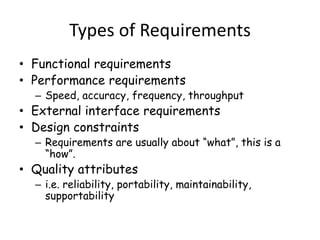
Requirements vs. Design
Requirements Design
Describe what will be
delivered
Describe how it will be done3
Primary goal of analysis:
UNDERSTANDING
Primary goal of design:
OPTIMIZATION
There is more than one
solution
There is only one (final)
solution
Customer interested Customer not interested (Most
of the time) except for external
Software Quality Attributes
 Correctness
 Reliability
 Rating = 1 – (Num Errors/ Num LOC)
 Can be allocated to subsystems
 Efficiency
 Integrity
 Usability
 Survivability
 Maintainability
 Verifiability
 Flexibility
 Portability
 Reusability
 Interoperability
 Expandability
Requirements Analysis
Defining Stakeholder profiles
• Description - brief description of the stakeholder type
• Type - Qualify s-h’s expertise, technical background, degree of
sophistication
• Responsibilities - List s-h’s key responsibilities with regard to
the system being developed - why a stakeholder?
• Success Criteria - How does the stakeholder define success?
How rewarded?
• Involvement - involved in the project in what way?
Requirements reviewer, system tester, ...
• Deliverables* - required by the stakeholder
• Comments/Issues - Problems that interfere w/ success, etc.
Requirements Analysis
Defining User Profiles
• Description - of the user type
• Type - qualify expertise, technical background, degree of
sophistication
• Responsibilities - user’s key resp.’s w.r.t. system being
developed
• Success Criteria - how this user defines success? rewarded?
• Involvement - How user involved in this project? what role?
• Deliverables - Are there any deliverables the user produces?
For whom?
• Comments/Issues - Problems that interfere w/ success, etc.
– This includes trends that make the user’s job easier or harder
Requirements Analysis
Defining User Work Environment
• Number of people involved in doing this now?
Changing?
• How long is a task cycle now? Changing?
• Any unique environmental constraints: mobile,
outdoors, in-flight, etc.
• Which system platforms are in use today? future?
• What other applications are in use? Need to
integrate?
Requirements Analysis
Product Overview
Put the product in perspective to other related
products and the user’s environment.
Independent?
Component of a larger system?
How do the subsystems interact with this?
Known interfaces between them and this
component?
Block diagram
Requirements Analysis
Other Product Requirements
• hardware platform requirements --
• system requirements -- supported host o.s.’s,
peripherals, companion software
• environmental requirements -- temperature, shock,
humidity, radiation, usage conditions, resource
availability, maintenance issues, type of error
recovery
• applicable standards -- legal, regulatory,
communications
Software Requirement Specification
• A software requirements specification (SRS) is a complete
description of the behavior of the system to be developed
• A document that clearly and precisely describes, each of the
essential requirements of the software and the external
interfaces.
– (functions, performance, design constraint, and quality attributes)
• Each requirement is defined in such a way that its
achievement is capable of being objectively verified by a
prescribed method; for example inspection, demonstration,
analysis, or test.2
Requirements Analysis
• Fundamental Techniques (Views)
• functional view
– hierarchy - function tree
– process  use cases
– information ow  data flow diagram (DFD)
• data oriented view
– data structures  data dictionary (DD), syntax diagram,
Jackson diagram
– relations between entities  entity relationship diagram
(ER)
• object-oriented view
– class structure  class diagram
Requirements Analysis
• algorithmic view
– control structures
– pseudo code, structogram, flow diagram, Jackson diagram
– conditions  rules, decision table
• state-oriented view
– state machines
– Petri nets
– sequence charts
Use Case
• use case is a description of a system’s
behavior as it responds to a request that
originates from outside of that system.
• it describes "who" can do "what" with the
system in question
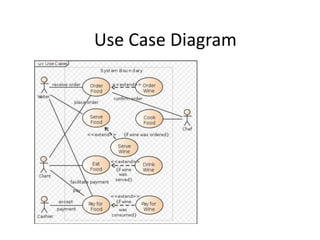
Use Case Diagram
• A use case diagram
– in the Unified Modeling Language (UML)
– a type of behavioral diagram defined by and created from
a Use-case analysis.
– Its purpose is to present a graphical overview of the
functionality provided by a system in terms of actors, their
goals (represented as use cases), and any dependencies
between those use cases.
• The main purpose
– to show what system functions are performed for which
actor.
– Roles of the actors in the system can be depicted.
Use Case Diagram
Data Flow Diagram (DFD)
• graphical representation of data ow (classical
technique)
• nodes:
– function  labeled circle
– store name  between two horizontal lines
– interface to environment  labeled rectangle
• directed edges: represent data flow
• properties of DFDs
– easy to create
– easy to read and understand
Data Dictionary
• A data dictionary is a collection of data about
data.
• It maintains information about the definition,
structure, and use of each data element that
an organization uses.
Software requirements specification
• Functional and Non-functional SRS
• IEEE 830-1998.
IEEE Std 830-1998 IEEE Recommended Practice
for Software Requirements Specifications -
Description
• Abstract: The content and qualities of a good software
requirementsspecification (SRS) are described and several
sample SRS outlines are presented. This recommended
practice is aimed at specifying requirements of software to be
developed but also can be applied to assist in the selection of
in-house and commercial software products. Guidelines for
compliance with 12207.1-1997 are also provided.
• Keywords: contract, customer, prototyping, software
requirements specification, supplier, system requirements
specifications
SRS
• Customer Requirements
• Functional Requirements
• Non-functional Requirements
• Performance Requirements
• Design Requirements
• Derived Requirements
• Allocated Requirements

Soft requirement

  • 1.
    Software Requirement Analysis •Determining the needs or conditions to meet for a new or altered product, • In other words, process of studying and analyzing the customer and the user/stakaholder needs to arrive at a definition of software reqiurements. • Requirements must be actionable, measurable, testable, related to identified business needs or opportunities, and defined to a level of detail sufficient for system design. • Requirements can be functional and non- functional
  • 2.
    Types of Requirements •Functional requirements • Performance requirements – Speed, accuracy, frequency, throughput • External interface requirements • Design constraints – Requirements are usually about “what”, this is a “how”. • Quality attributes – i.e. reliability, portability, maintainability, supportability
  • 3.
    Requirements vs. Design RequirementsDesign Describe what will be delivered Describe how it will be done3 Primary goal of analysis: UNDERSTANDING Primary goal of design: OPTIMIZATION There is more than one solution There is only one (final) solution Customer interested Customer not interested (Most of the time) except for external
  • 4.
    Software Quality Attributes Correctness  Reliability  Rating = 1 – (Num Errors/ Num LOC)  Can be allocated to subsystems  Efficiency  Integrity  Usability  Survivability  Maintainability  Verifiability  Flexibility  Portability  Reusability  Interoperability  Expandability
  • 5.
    Requirements Analysis Defining Stakeholderprofiles • Description - brief description of the stakeholder type • Type - Qualify s-h’s expertise, technical background, degree of sophistication • Responsibilities - List s-h’s key responsibilities with regard to the system being developed - why a stakeholder? • Success Criteria - How does the stakeholder define success? How rewarded? • Involvement - involved in the project in what way? Requirements reviewer, system tester, ... • Deliverables* - required by the stakeholder • Comments/Issues - Problems that interfere w/ success, etc.
  • 6.
    Requirements Analysis Defining UserProfiles • Description - of the user type • Type - qualify expertise, technical background, degree of sophistication • Responsibilities - user’s key resp.’s w.r.t. system being developed • Success Criteria - how this user defines success? rewarded? • Involvement - How user involved in this project? what role? • Deliverables - Are there any deliverables the user produces? For whom? • Comments/Issues - Problems that interfere w/ success, etc. – This includes trends that make the user’s job easier or harder
  • 7.
    Requirements Analysis Defining UserWork Environment • Number of people involved in doing this now? Changing? • How long is a task cycle now? Changing? • Any unique environmental constraints: mobile, outdoors, in-flight, etc. • Which system platforms are in use today? future? • What other applications are in use? Need to integrate?
  • 8.
    Requirements Analysis Product Overview Putthe product in perspective to other related products and the user’s environment. Independent? Component of a larger system? How do the subsystems interact with this? Known interfaces between them and this component? Block diagram
  • 9.
    Requirements Analysis Other ProductRequirements • hardware platform requirements -- • system requirements -- supported host o.s.’s, peripherals, companion software • environmental requirements -- temperature, shock, humidity, radiation, usage conditions, resource availability, maintenance issues, type of error recovery • applicable standards -- legal, regulatory, communications
  • 10.
    Software Requirement Specification •A software requirements specification (SRS) is a complete description of the behavior of the system to be developed • A document that clearly and precisely describes, each of the essential requirements of the software and the external interfaces. – (functions, performance, design constraint, and quality attributes) • Each requirement is defined in such a way that its achievement is capable of being objectively verified by a prescribed method; for example inspection, demonstration, analysis, or test.2
  • 11.
    Requirements Analysis • FundamentalTechniques (Views) • functional view – hierarchy - function tree – process  use cases – information ow  data flow diagram (DFD) • data oriented view – data structures  data dictionary (DD), syntax diagram, Jackson diagram – relations between entities  entity relationship diagram (ER) • object-oriented view – class structure  class diagram
  • 12.
    Requirements Analysis • algorithmicview – control structures – pseudo code, structogram, flow diagram, Jackson diagram – conditions  rules, decision table • state-oriented view – state machines – Petri nets – sequence charts
  • 13.
    Use Case • usecase is a description of a system’s behavior as it responds to a request that originates from outside of that system. • it describes "who" can do "what" with the system in question
  • 14.
    Use Case Diagram •A use case diagram – in the Unified Modeling Language (UML) – a type of behavioral diagram defined by and created from a Use-case analysis. – Its purpose is to present a graphical overview of the functionality provided by a system in terms of actors, their goals (represented as use cases), and any dependencies between those use cases. • The main purpose – to show what system functions are performed for which actor. – Roles of the actors in the system can be depicted.
  • 15.
  • 16.
    Data Flow Diagram(DFD) • graphical representation of data ow (classical technique) • nodes: – function  labeled circle – store name  between two horizontal lines – interface to environment  labeled rectangle • directed edges: represent data flow • properties of DFDs – easy to create – easy to read and understand
  • 17.
    Data Dictionary • Adata dictionary is a collection of data about data. • It maintains information about the definition, structure, and use of each data element that an organization uses.
  • 18.
    Software requirements specification •Functional and Non-functional SRS • IEEE 830-1998.
  • 19.
    IEEE Std 830-1998IEEE Recommended Practice for Software Requirements Specifications - Description • Abstract: The content and qualities of a good software requirementsspecification (SRS) are described and several sample SRS outlines are presented. This recommended practice is aimed at specifying requirements of software to be developed but also can be applied to assist in the selection of in-house and commercial software products. Guidelines for compliance with 12207.1-1997 are also provided. • Keywords: contract, customer, prototyping, software requirements specification, supplier, system requirements specifications
  • 20.
    SRS • Customer Requirements •Functional Requirements • Non-functional Requirements • Performance Requirements • Design Requirements • Derived Requirements • Allocated Requirements