Agent UML
Mohamed Elagnaf
D.tariq Alshhibya
Overview
UML for Agents
UML
Agent UML (AUML)
Agent Interaction Protocols
Richer Role Specification
Package Extension
Deployment Diagram Extension
Conclusion
UML
Static models: class, package
diagrams
Dynamic models:
Interaction diagrams (sequence
and collaboration)
State diagrams
Activity diagrams
Implementation models: component,
deployment diagrams
Object constraint language (OCL)
AUML: Agent UML
Both FIPA and OMG are exploring and
recommending extensions
to UML
Applications:
Specification of Agent Interaction
Protocols (AIP)
Richer role specification
Package extension
Deployment diagram extension
Agent Interaction Protocols
AIP describes a communication
pattern as an allowed sequence of
messages between agents and the
constraints of the content of
those messages.
FIPA has specified many protocols
Request Protocol, Query Protocol,
Request-when Protocol, Contract-
net Protocol, Iterated-Contract-Net
Protocol, Auction-English Protocol,
Auction-Dutch Protocol
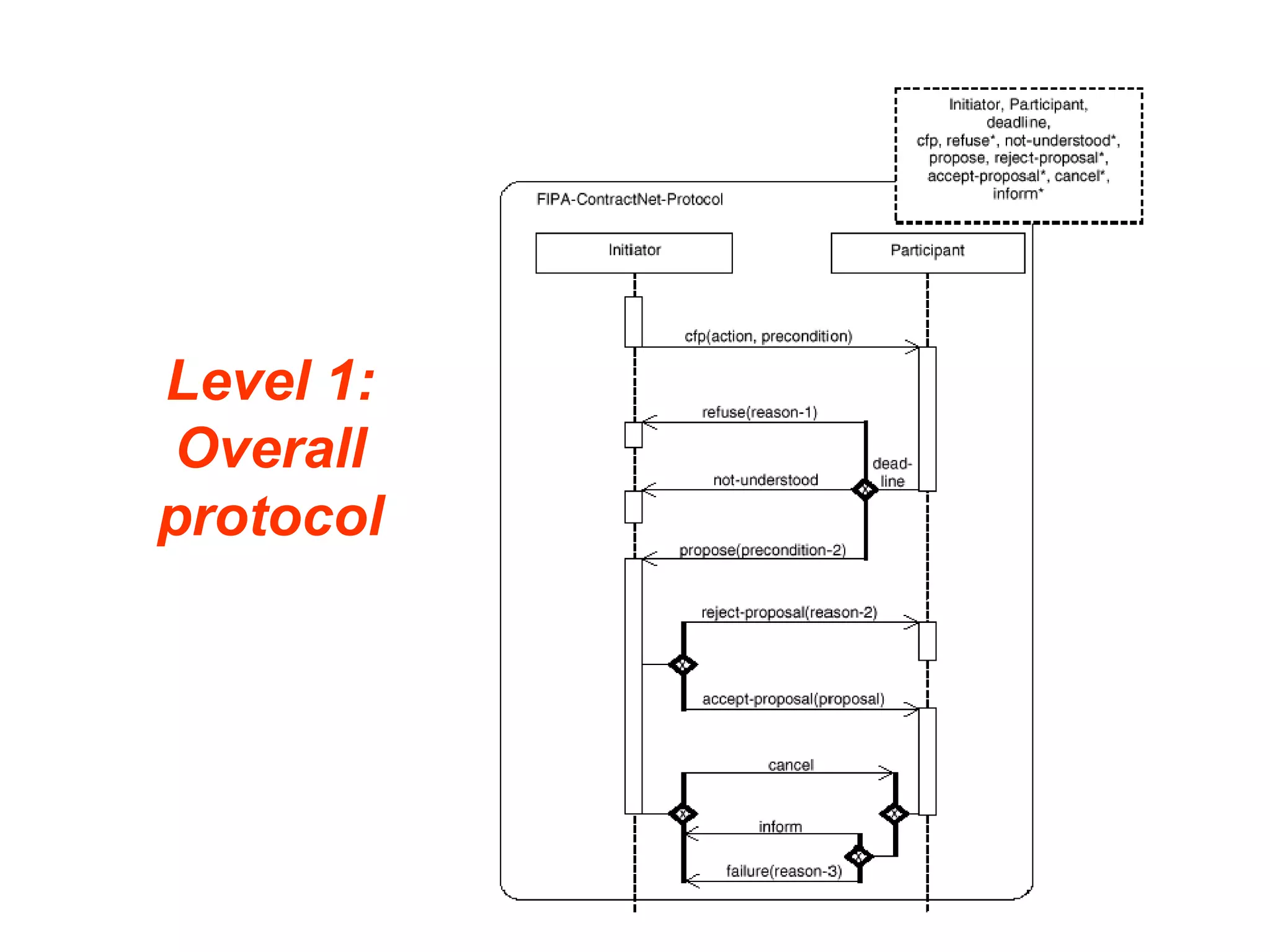
FIPA Contract-net Protocol
The manager solicits proposals from other agents by
issuing a call for proposals, which specifies the task and
any conditions the manager is placing upon the execution
of the task.
Agents receiving the call for proposals are viewed as
potential contractors, and are able to generate proposals to
perform the task as propose acts.
The contractor’s proposal includes the preconditions that
the contractor is setting out for the task, which may be the
price, time when the task will be done, etc.
The contractor may refuse to propose.
FIPA Contract-net Protocol, Cont’d.
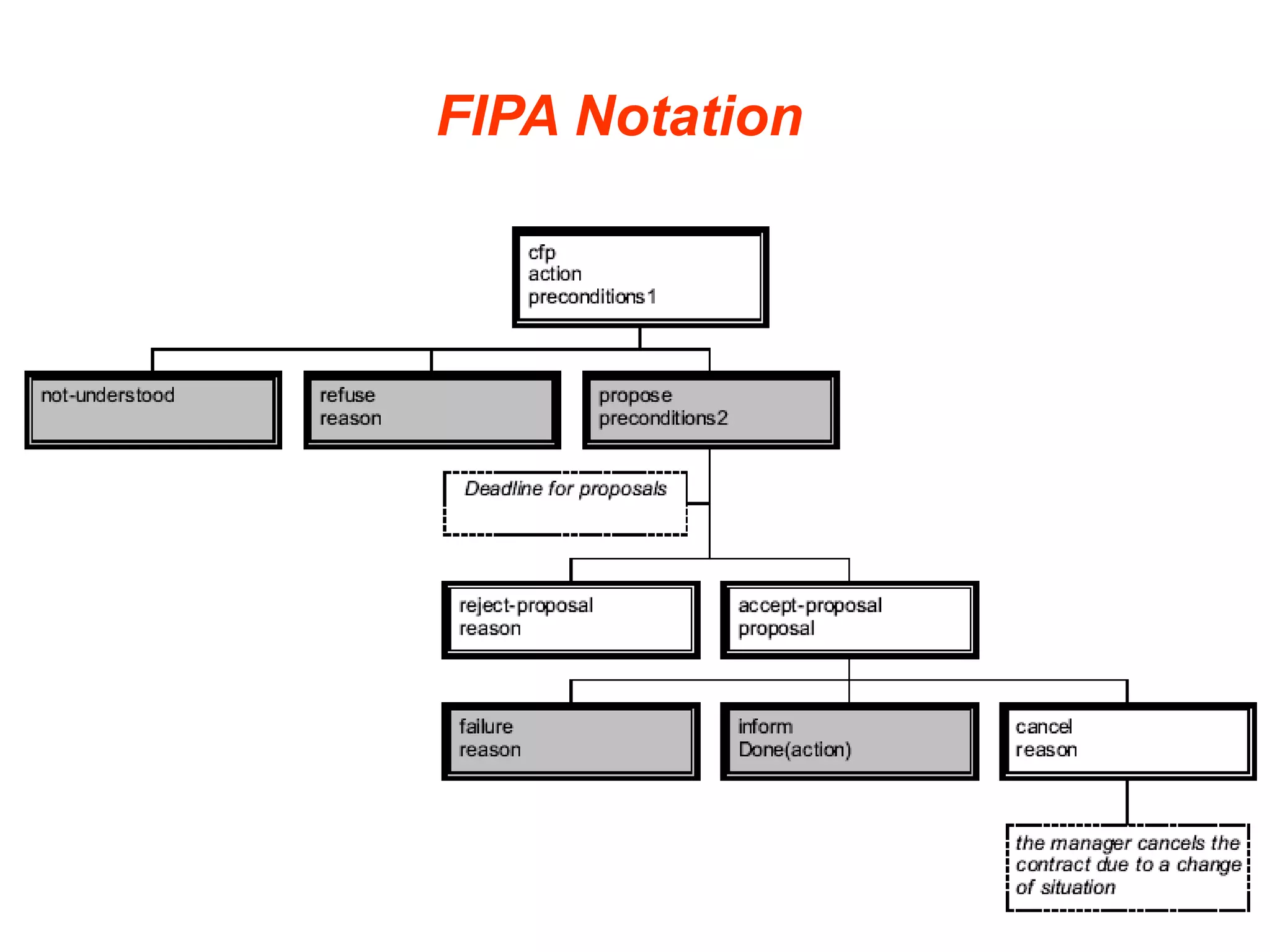
The manager receives back replies from all of the contractors,
evaluates the proposals and makes its choice of which agents will
perform the task. One, several, or no agents may be chosen. The
agents of the selected proposal(s) will be sent an acceptance
message, the others will receive a notice of rejection.
Once the manager accepts the proposal the contractor acquires a
commitment to perform the task. Once the contractor has completed the
task, it sends a completion message to the manager.
The protocol requires the manager to know when it has received all
replies. In the case that a contractor fails to reply with either a propose or
a refuse, the manager may potentially be left waiting indefinitely. To guard
against this, the cfp includes a deadline by which replies should be
received by the manager.
FIPA Notation
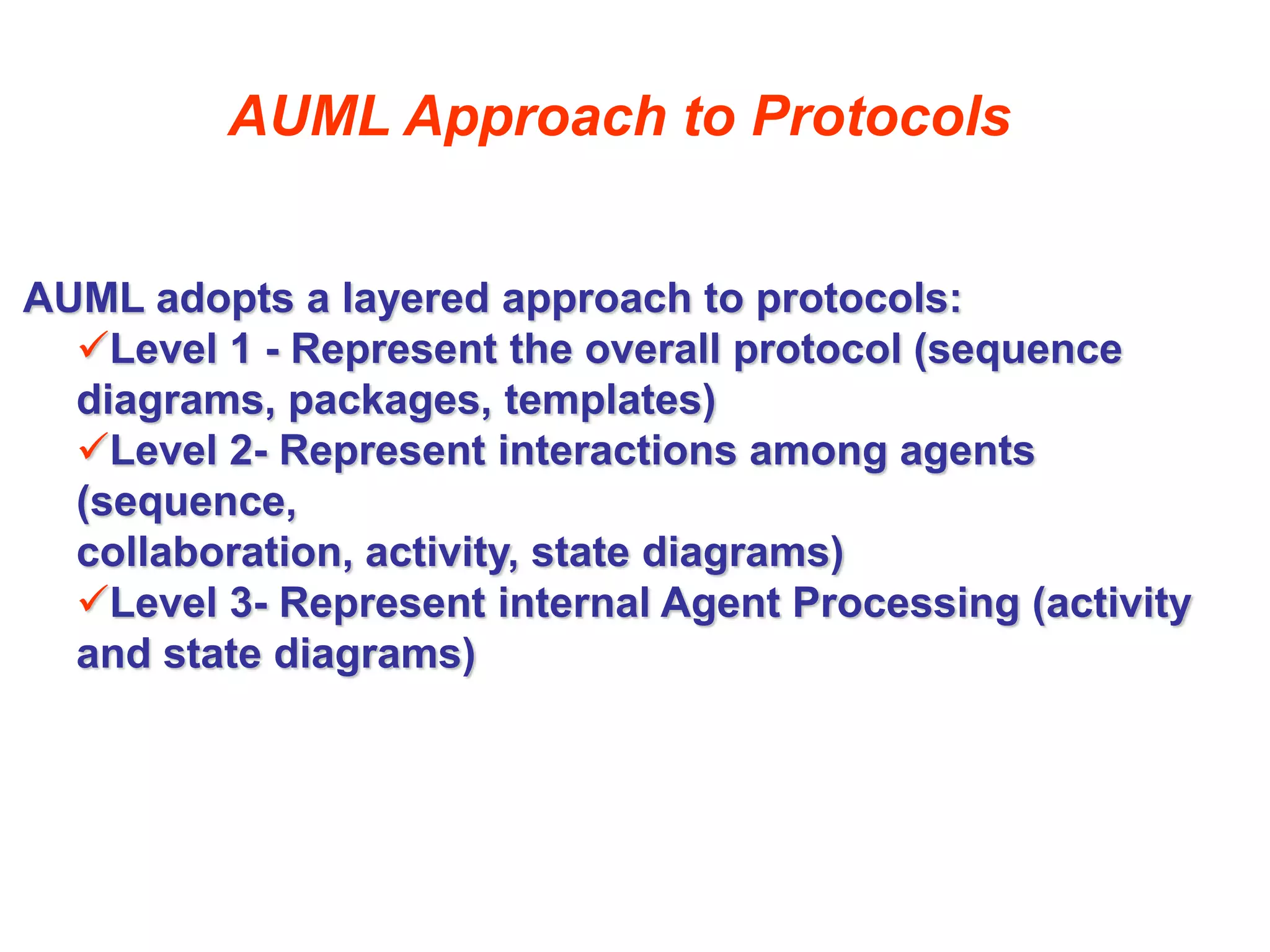
AUML Approach to Protocols
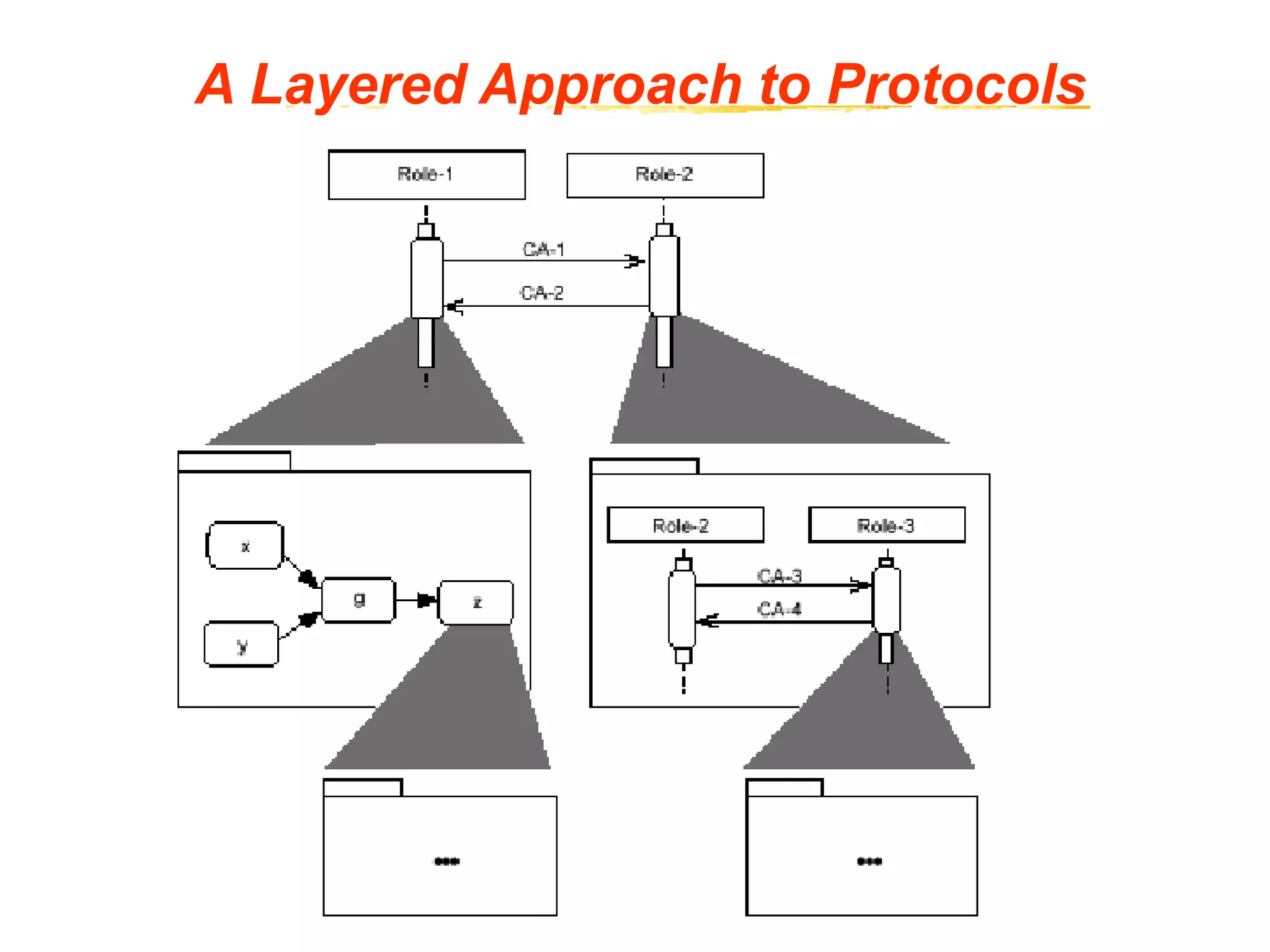
AUML adopts a layered approach to protocols:
Level 1 - Represent the overall protocol (sequence
diagrams, packages, templates)
Level 2- Represent interactions among agents
(sequence,
collaboration, activity, state diagrams)
Level 3- Represent internal Agent Processing (activity
and state diagrams)
A Layered Approach to Protocols
Level 1:
Overall
protocol
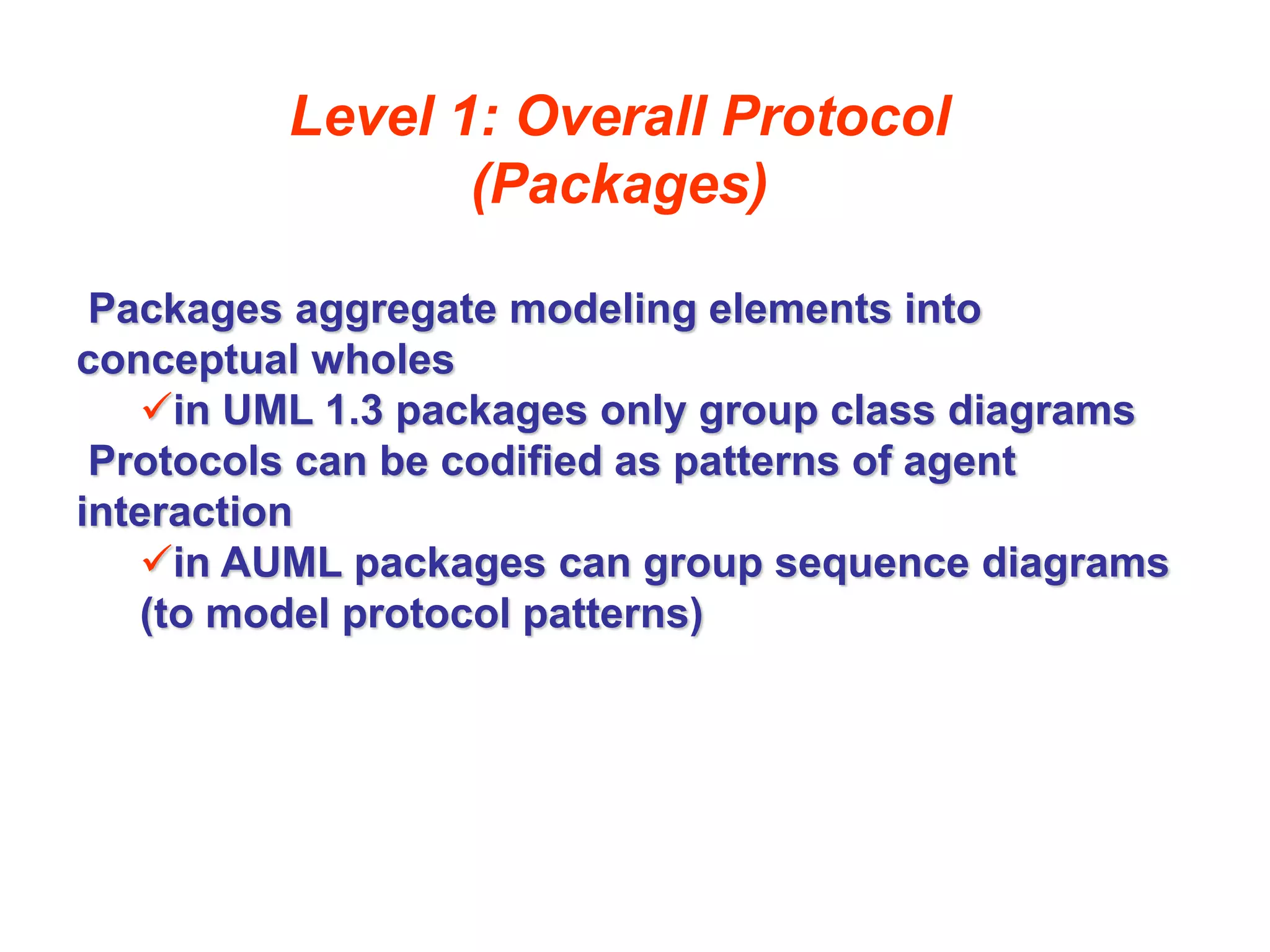
Level 1: Overall Protocol
(Packages)
Packages aggregate modeling elements into
conceptual wholes
in UML 1.3 packages only group class diagrams
Protocols can be codified as patterns of agent
interaction
in AUML packages can group sequence diagrams
(to model protocol patterns)
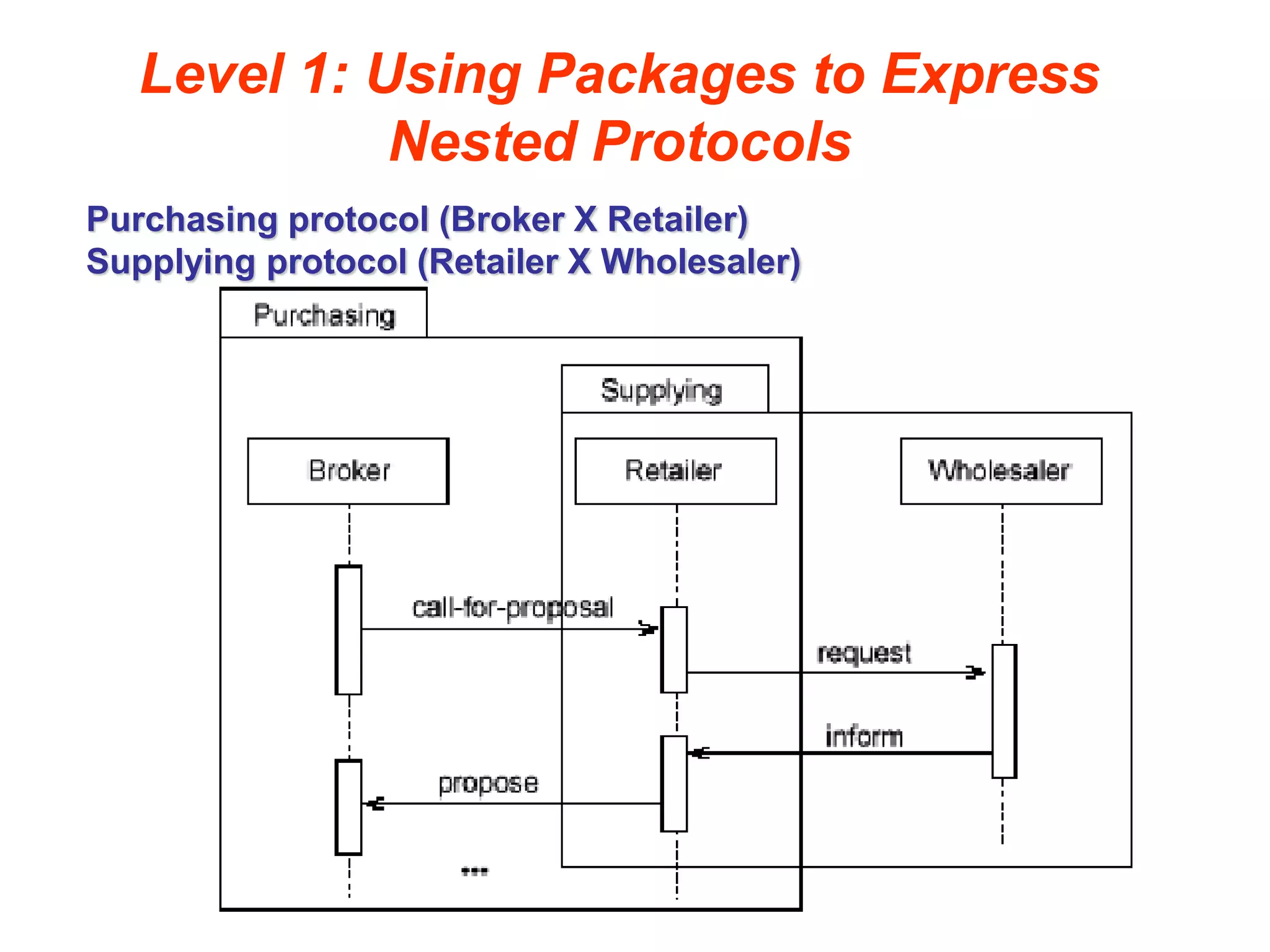
Level 1: Using Packages to Express
Nested Protocols
Purchasing protocol (Broker X Retailer)
Supplying protocol (Retailer X Wholesaler)
Level 1- Overall Protocol : Templates
In order for a package to be a true pattern (not simply a
reusable component) customization must be supported
A template is a parameterized model element whose
parameters are bound at model time
Represented by doted box in upper right corner of the
package
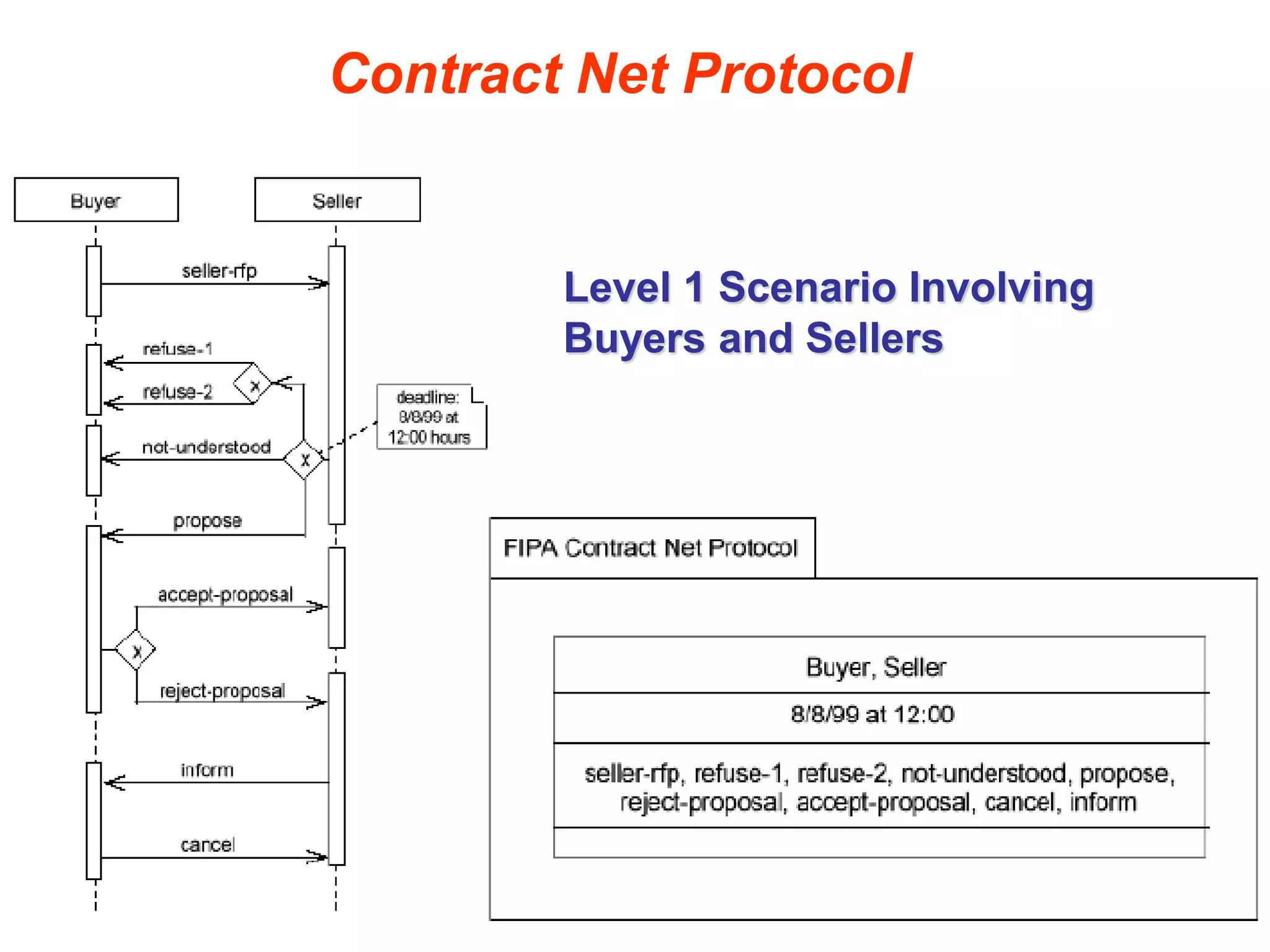
Contract Net Protocol
Level 1 Scenario Involving
Buyers and Sellers
Level 2: Interactions Among Agents
Extended sequence diagrams (concurrent threads of
interaction)
Collaboration diagrams
Activity diagrams
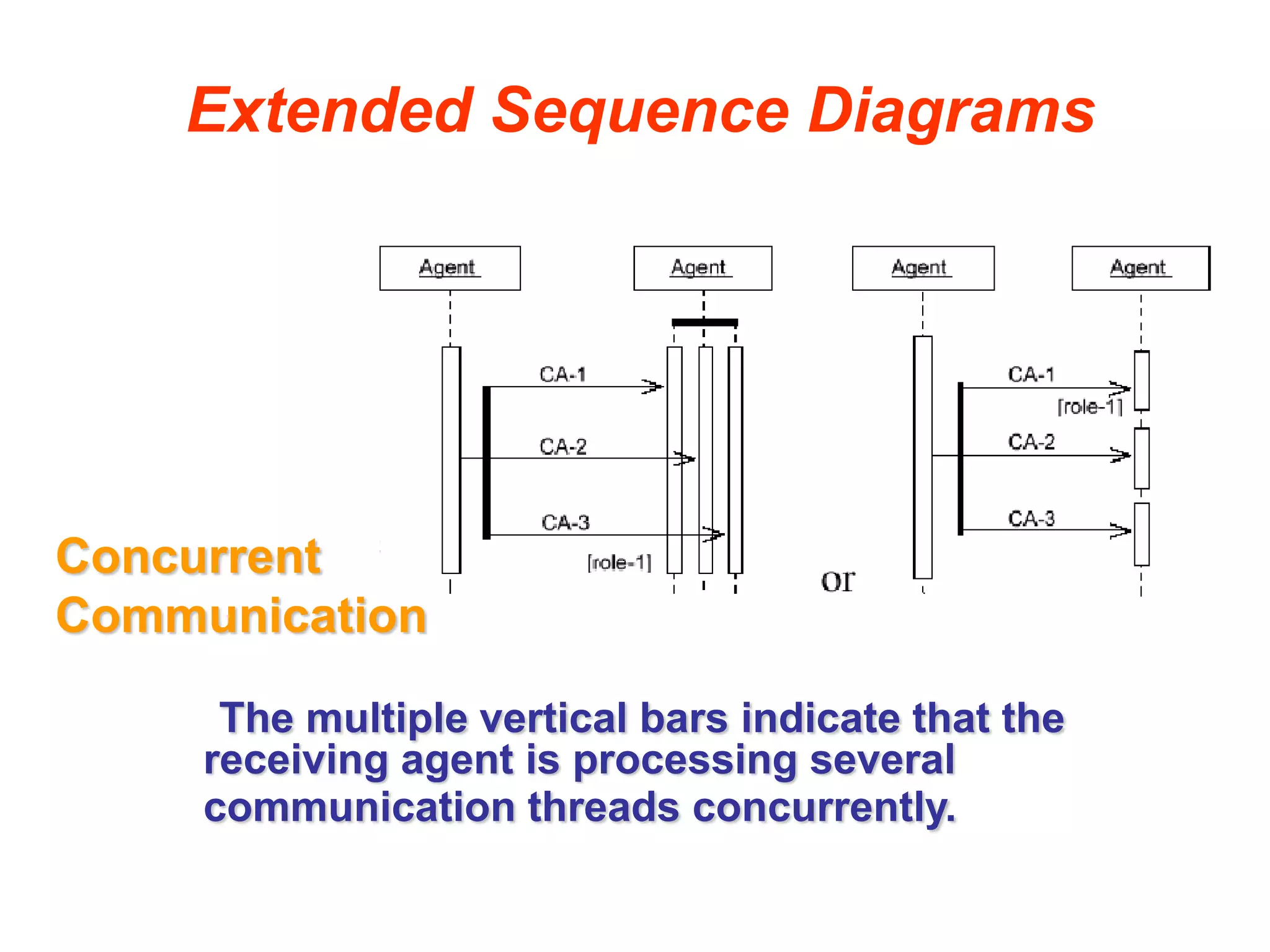
Extended Sequence Diagrams
The multiple vertical bars indicate that the
receiving agent is processing several
communication threads concurrently.
Concurrent
Communication
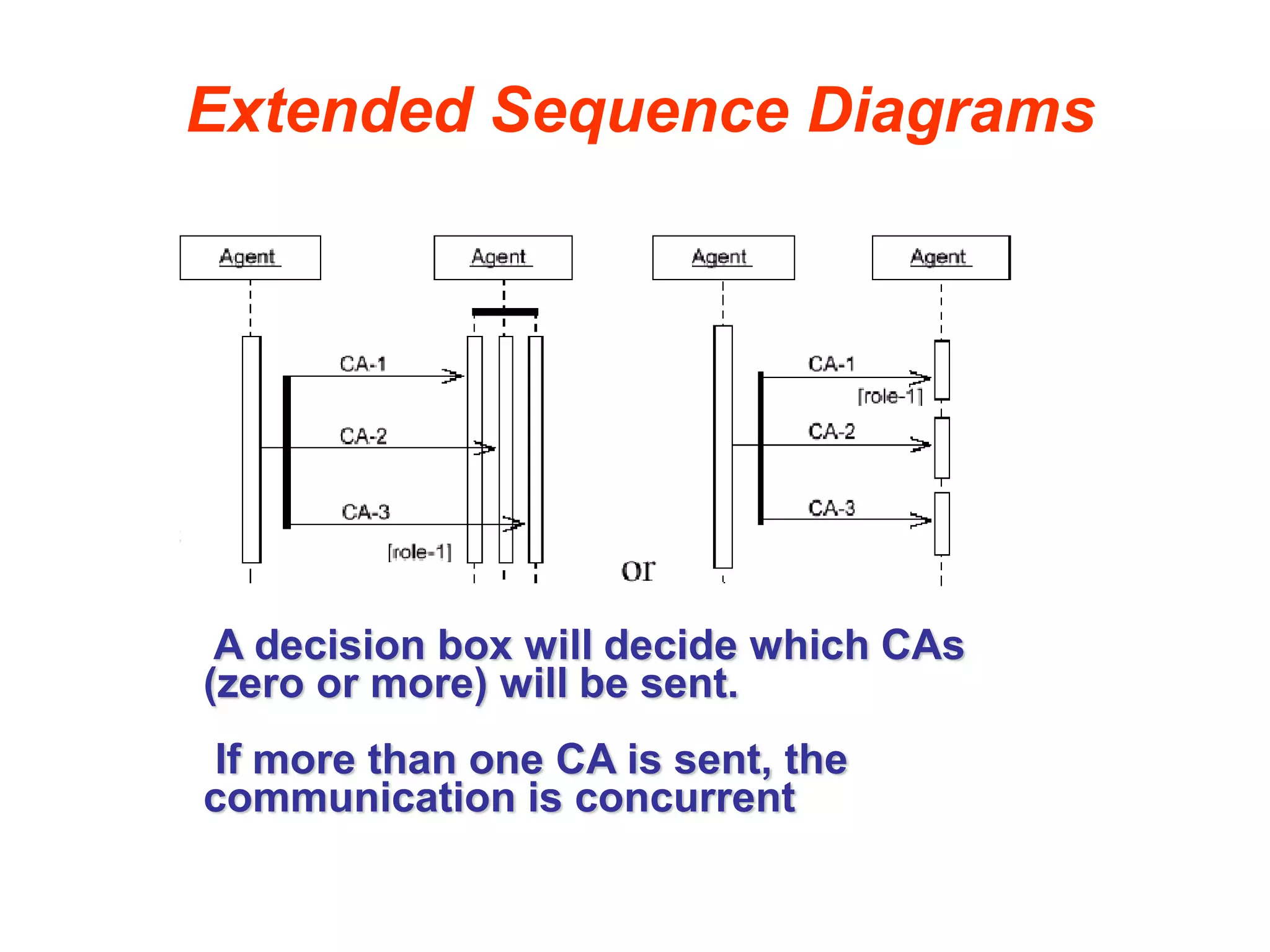
Extended Sequence Diagrams
A decision box will decide which CAs
(zero or more) will be sent.
If more than one CA is sent, the
communication is concurrent
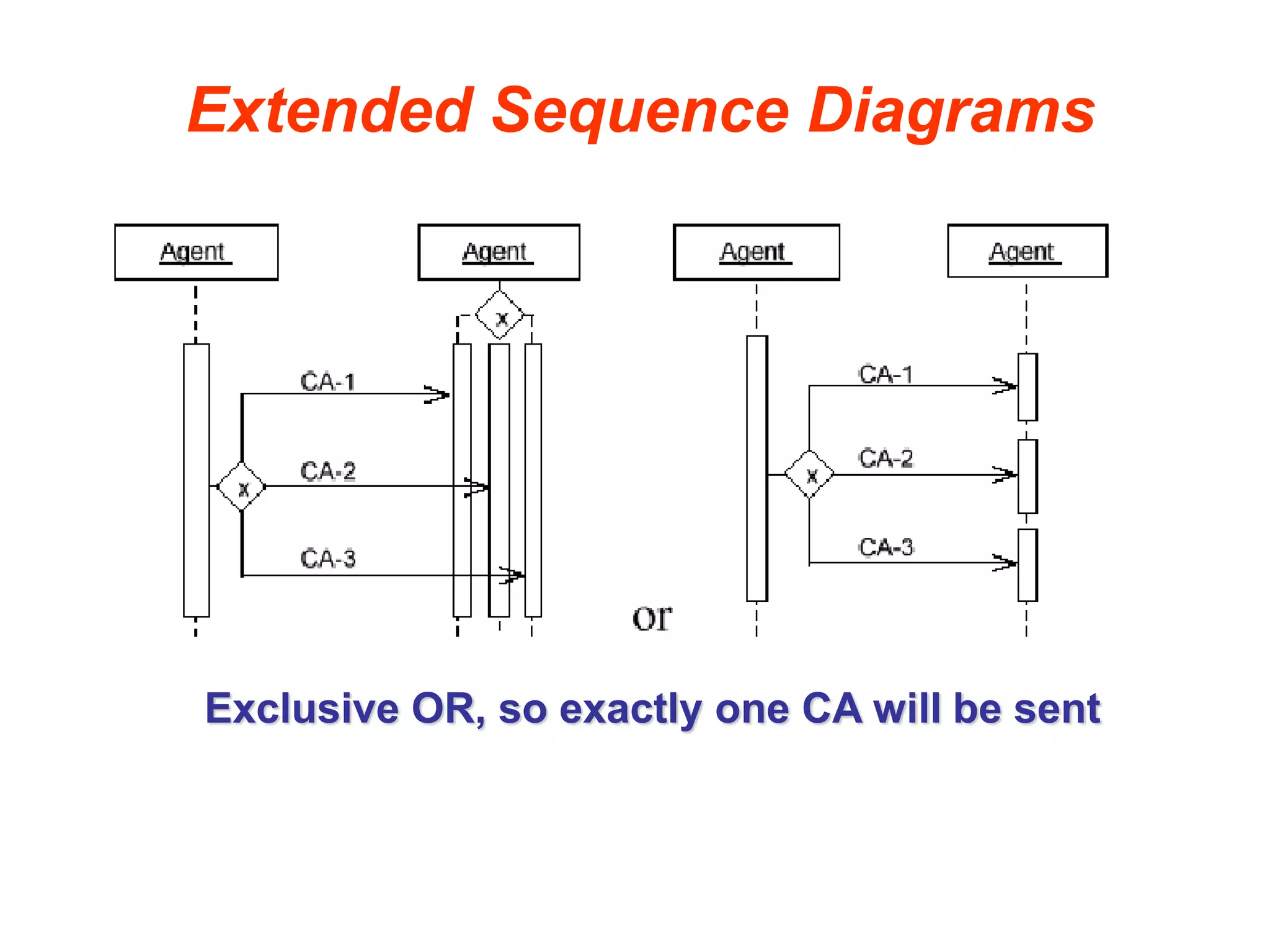
Extended Sequence Diagrams
Exclusive OR, so exactly one CA will be sent
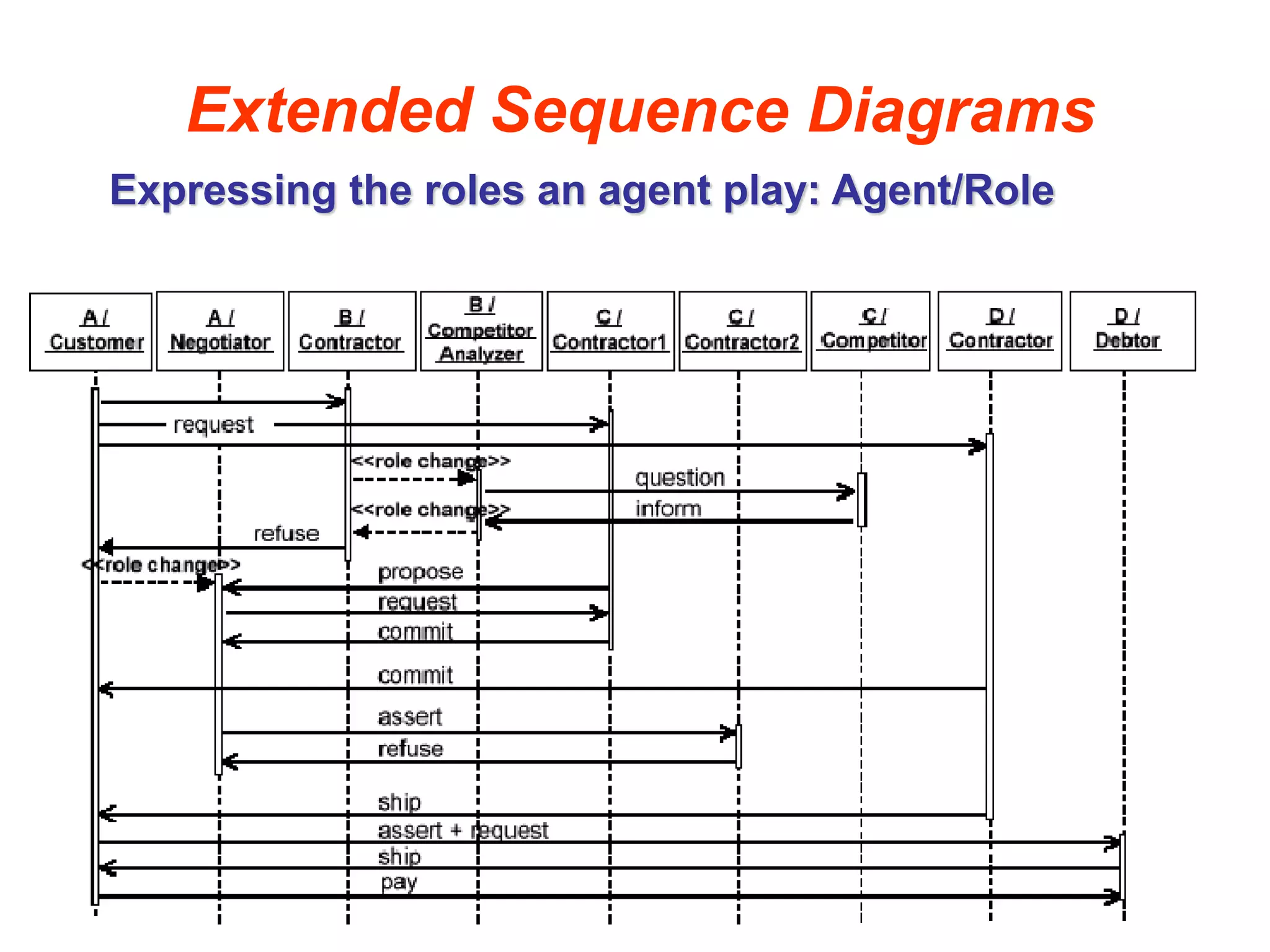
Extended Sequence Diagrams
Expressing the roles an agent play: Agent/Role
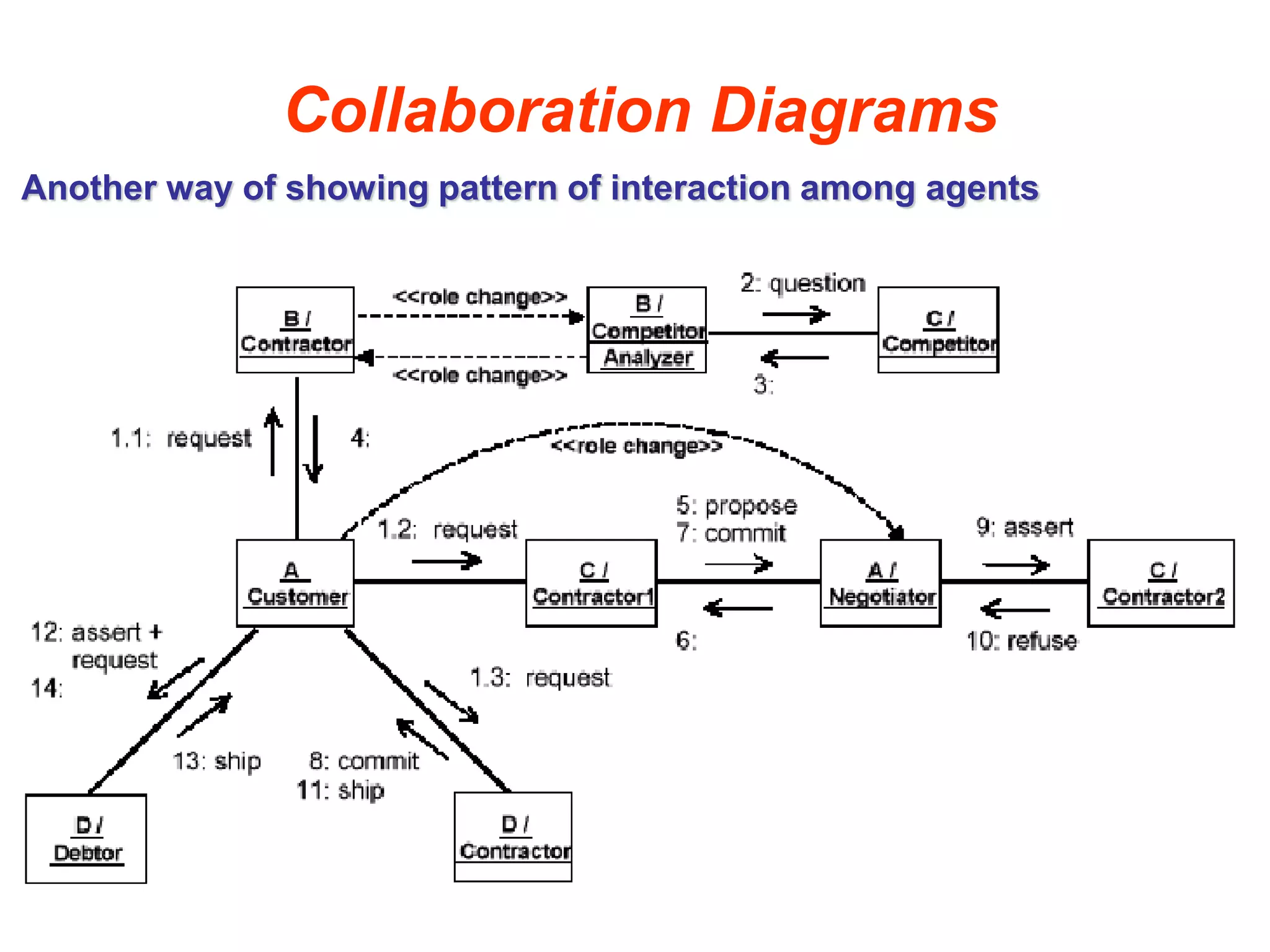
Collaboration Diagrams
Another way of showing pattern of interaction among agents
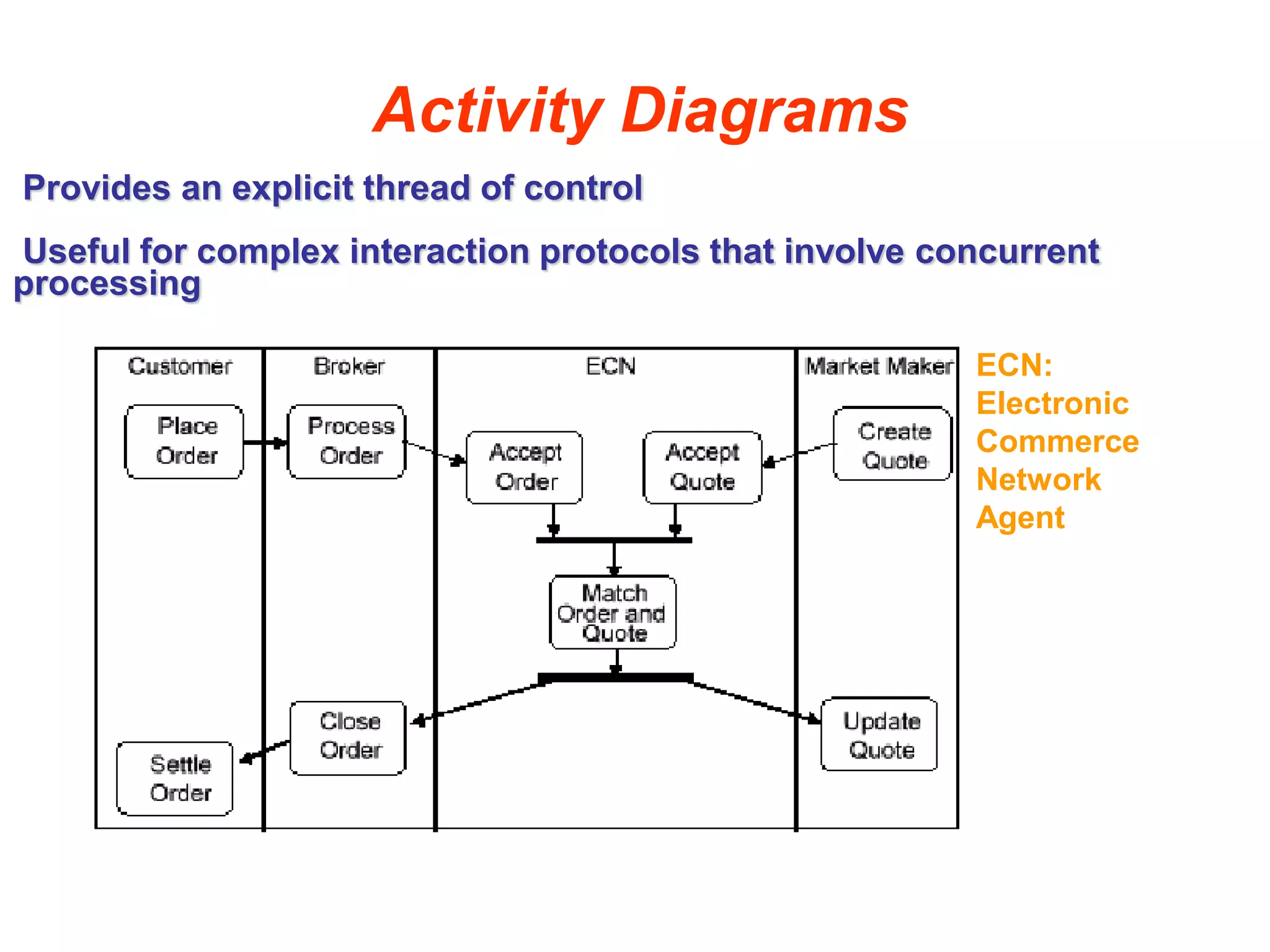
Activity Diagrams
Provides an explicit thread of control
Useful for complex interaction protocols that involve concurrent
processing
ECN:
Electronic
Commerce
Network
Agent
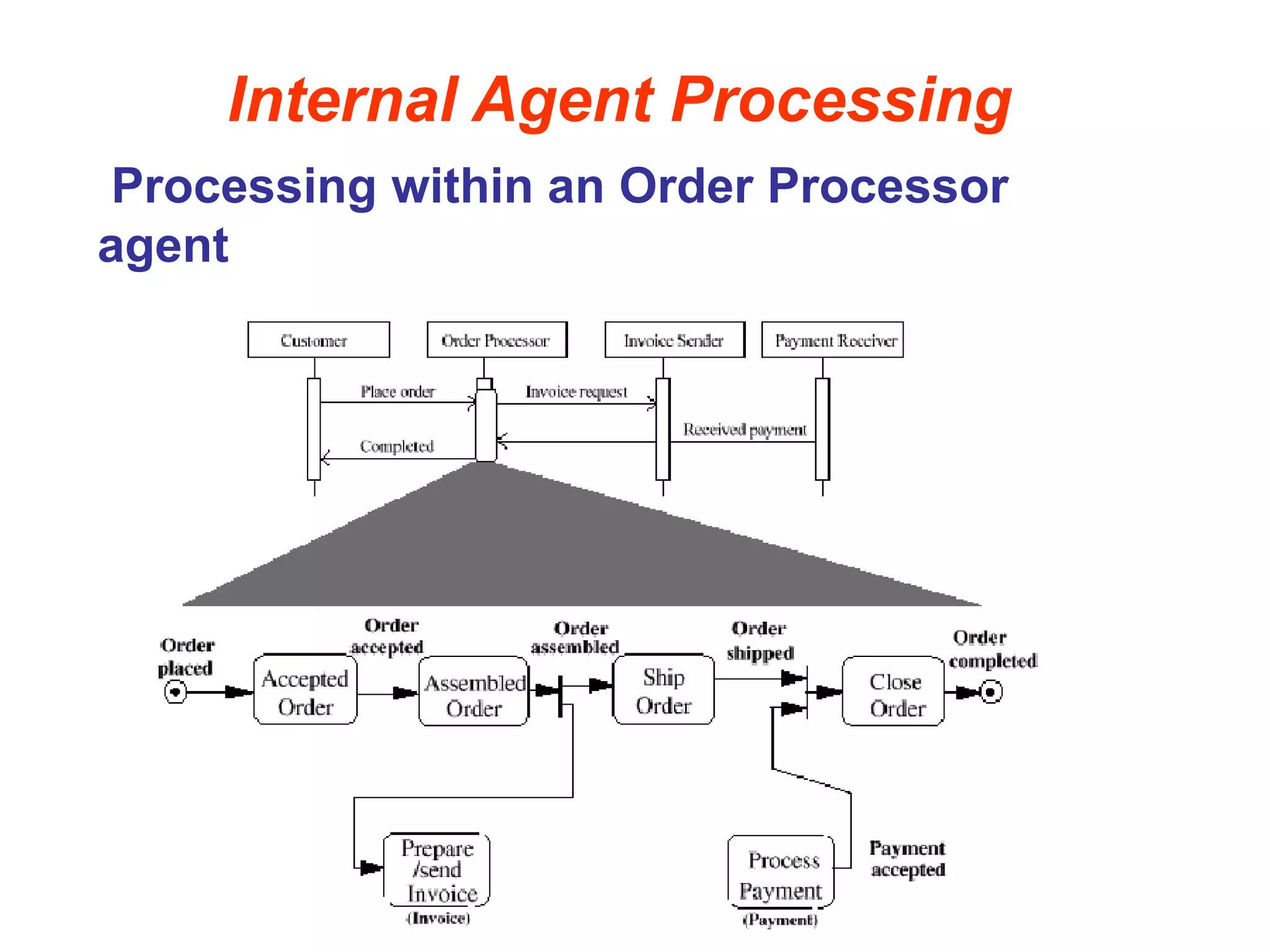
Internal Agent Processing
Processing within an Order Processor
agent
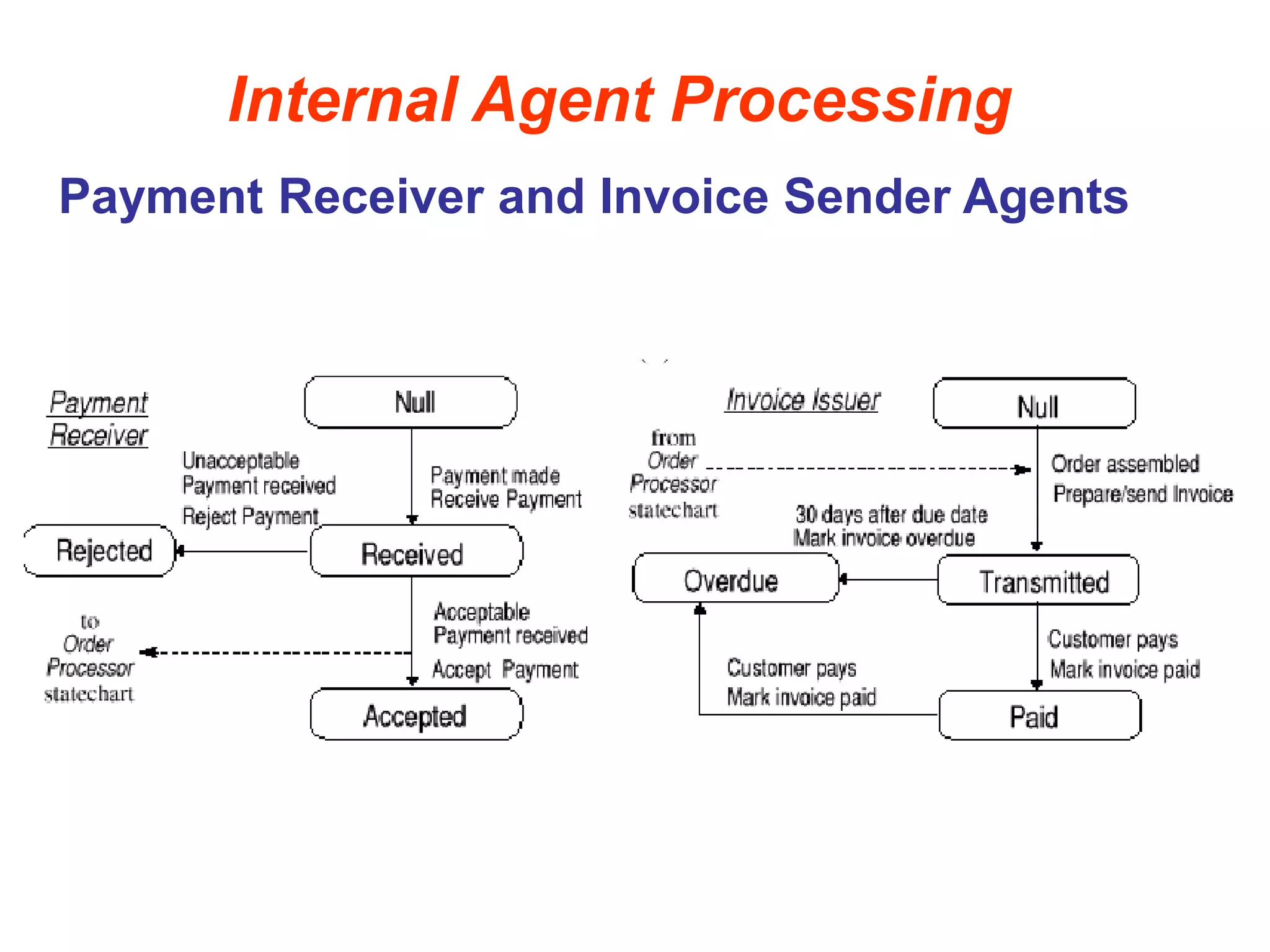
Internal Agent Processing
Payment Receiver and Invoice Sender Agents
Other AUML Considerations
Richer role specification
Package extension
Deployment diagram extension
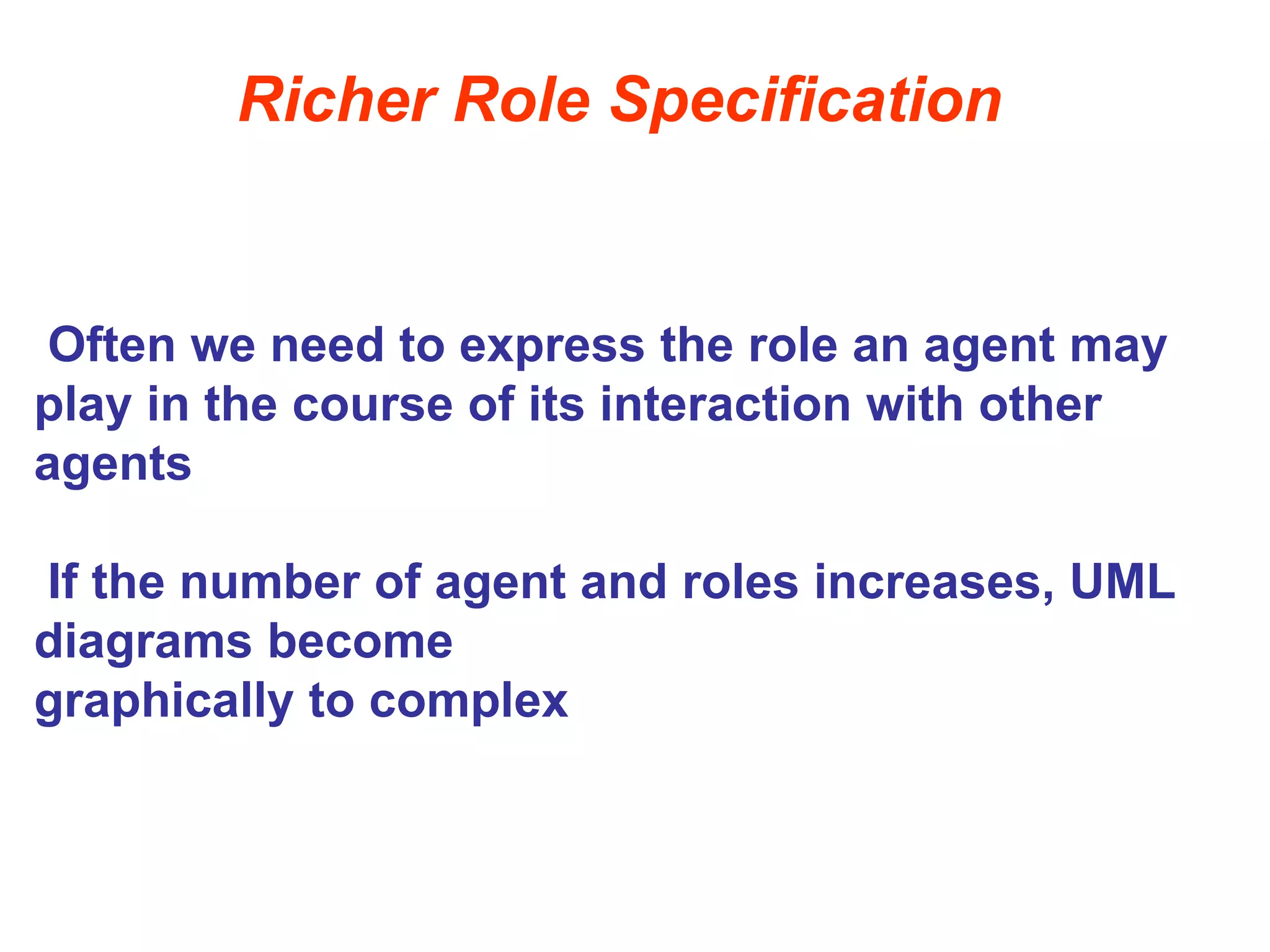
Richer Role Specification
Often we need to express the role an agent may
play in the course of its interaction with other
agents
If the number of agent and roles increases, UML
diagrams become
graphically to complex
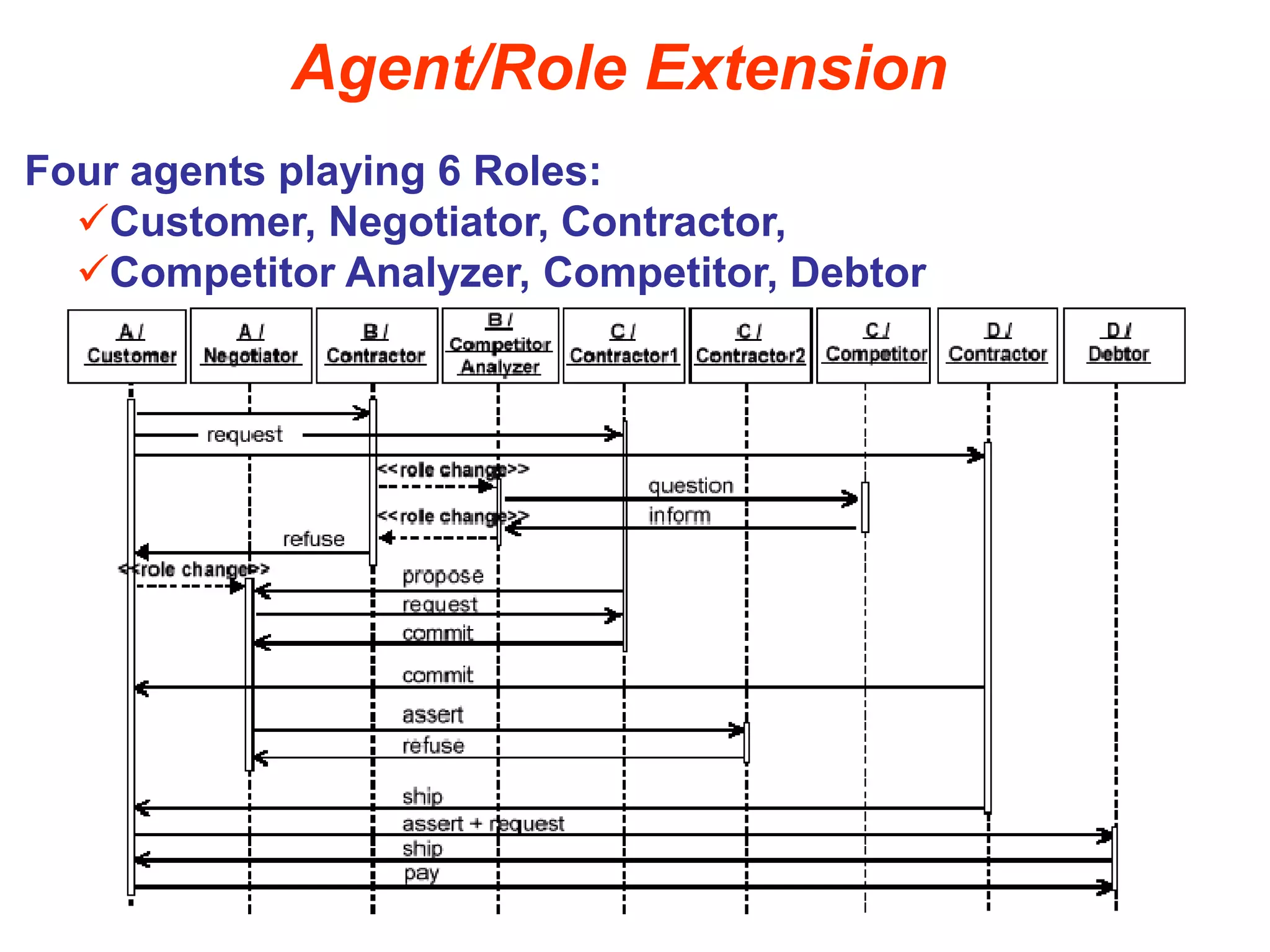
Agent/Role Extension
Four agents playing 6 Roles:
Customer, Negotiator, Contractor,
Competitor Analyzer, Competitor, Debtor
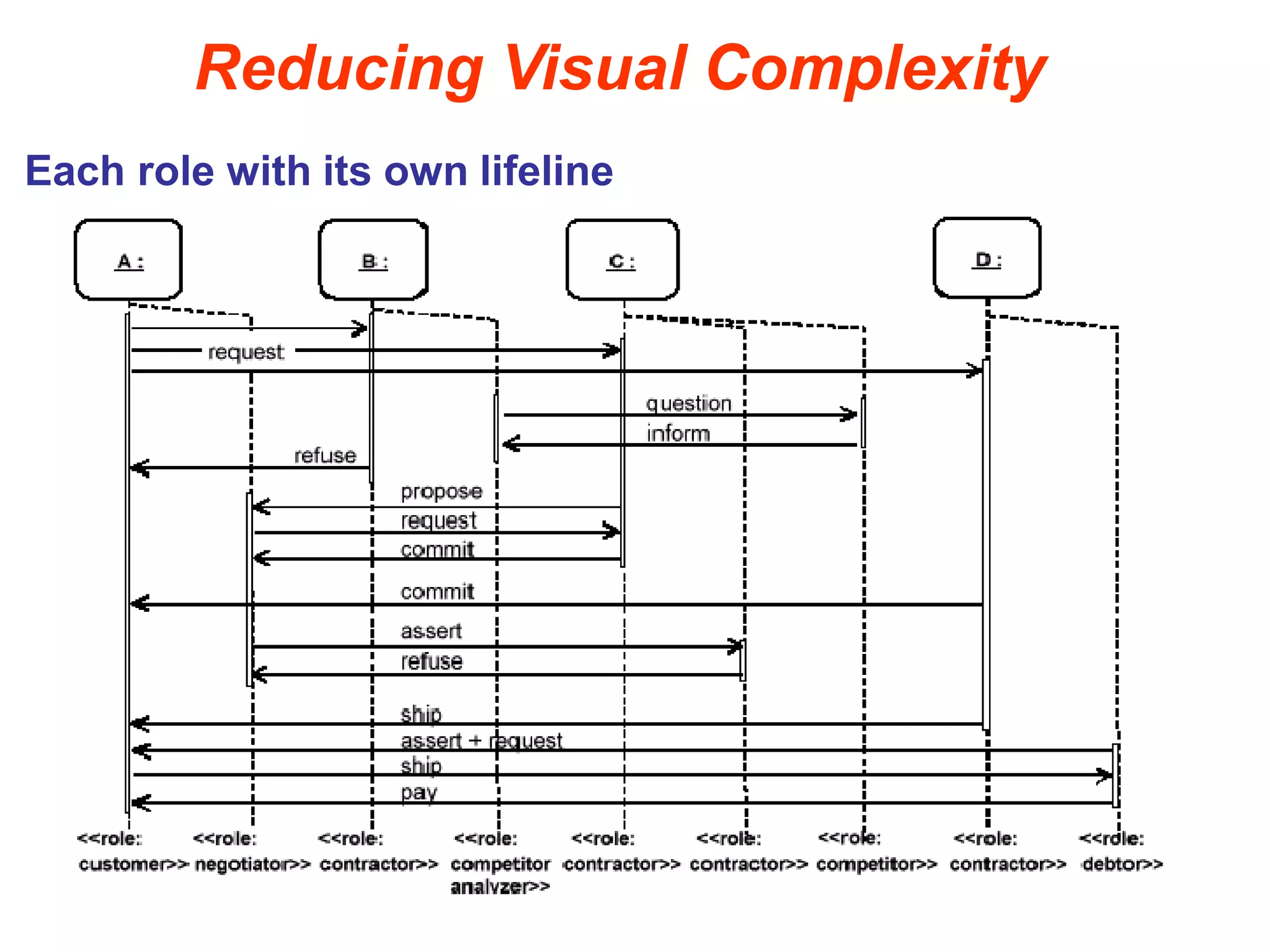
Reducing Visual Complexity
Each role with its own lifeline
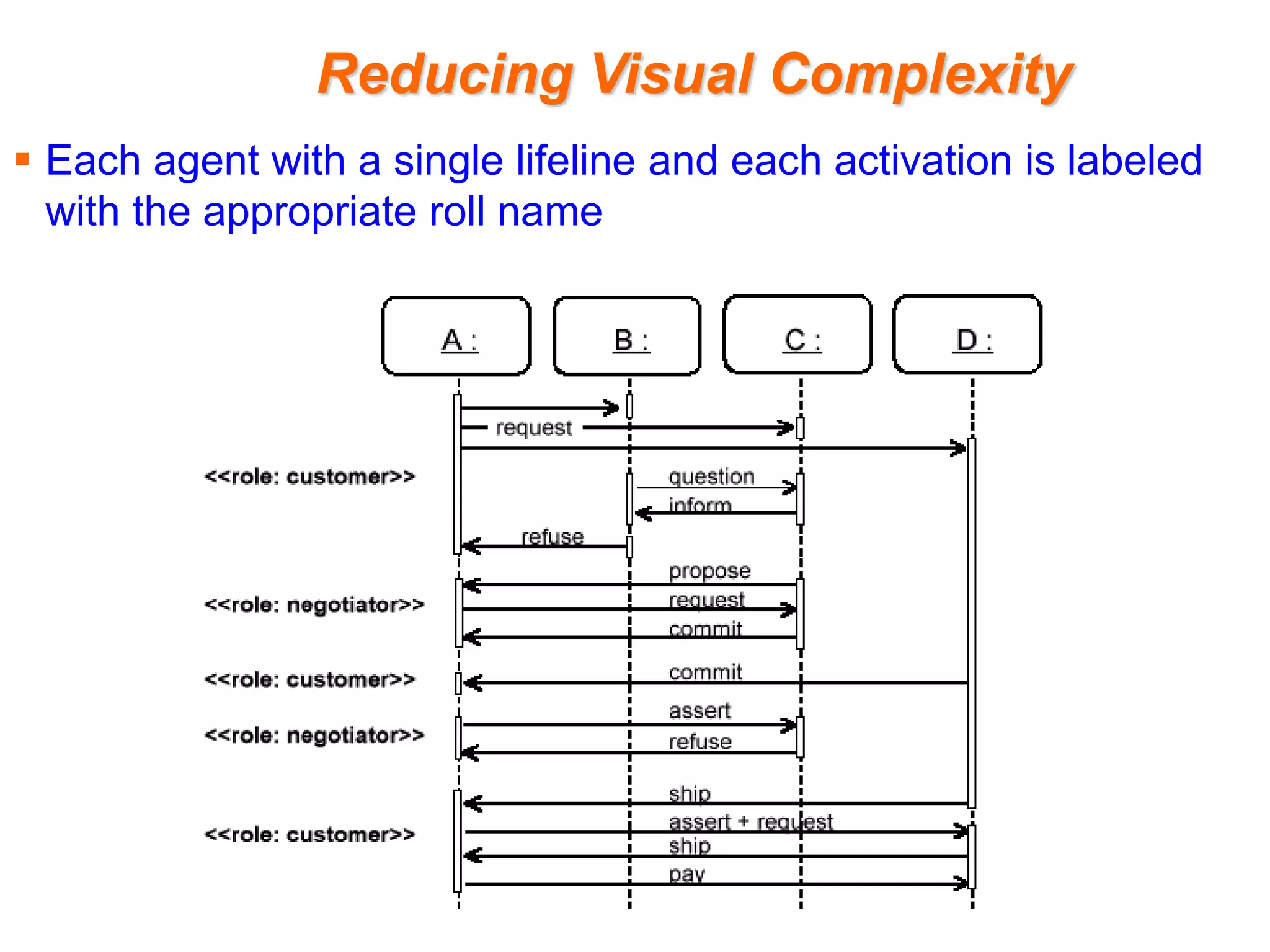
Reducing Visual Complexity
 Each agent with a single lifeline and each activation is labeled
with the appropriate roll name
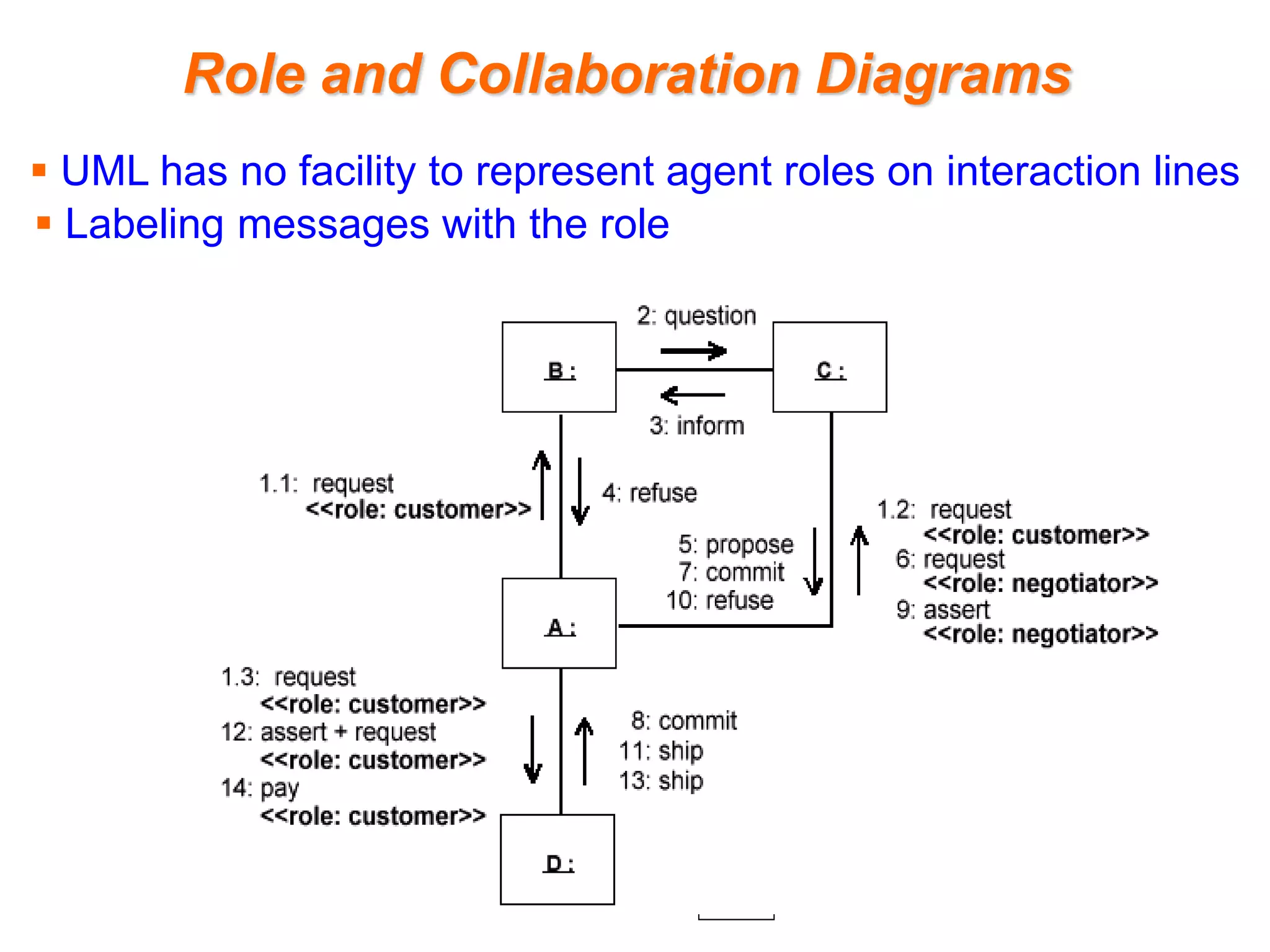
Role and Collaboration Diagrams
 UML has no facility to represent agent roles on interaction lines
 Labeling messages with the role
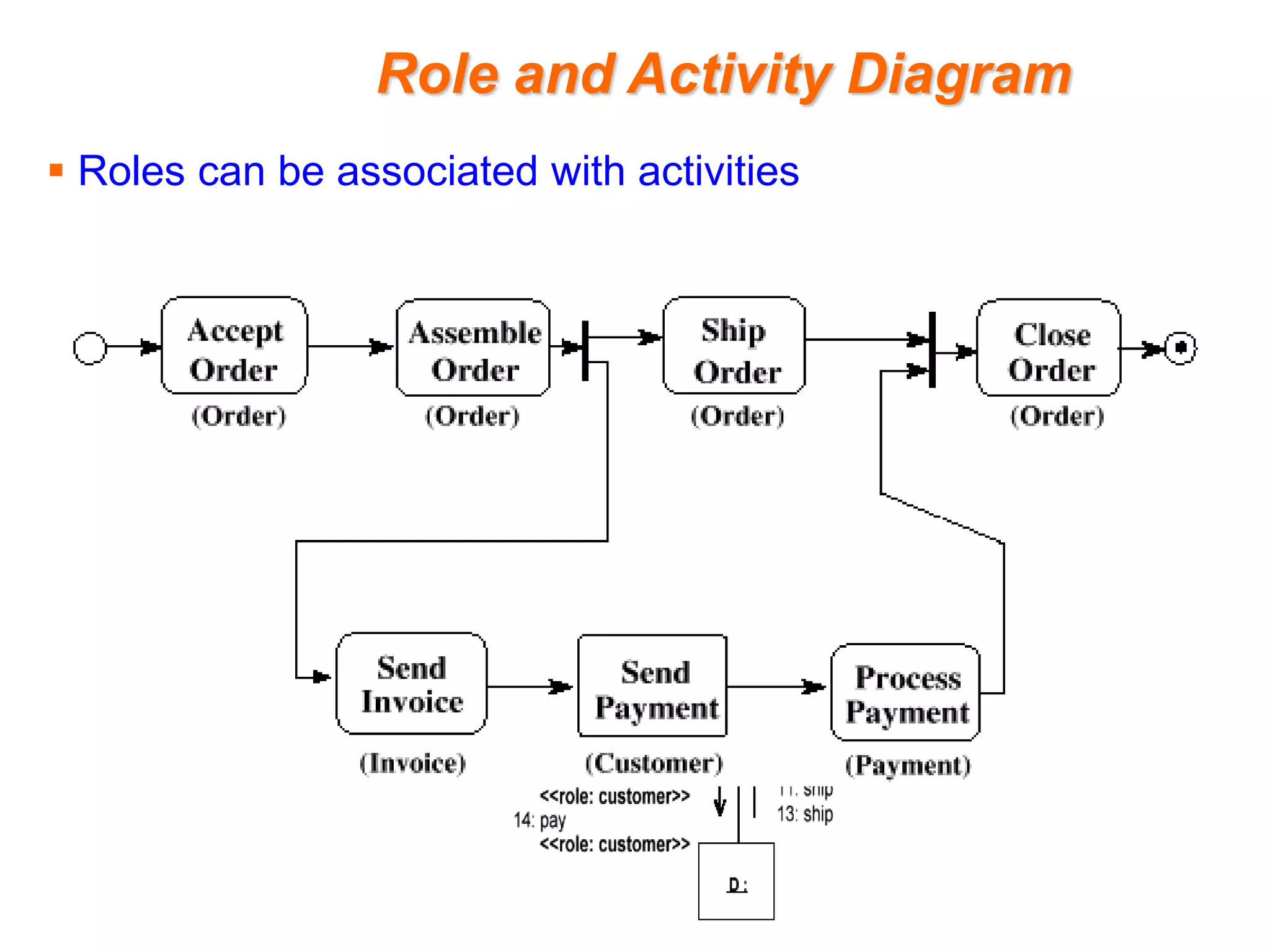
Role and Activity Diagram
 Roles can be associated with activities
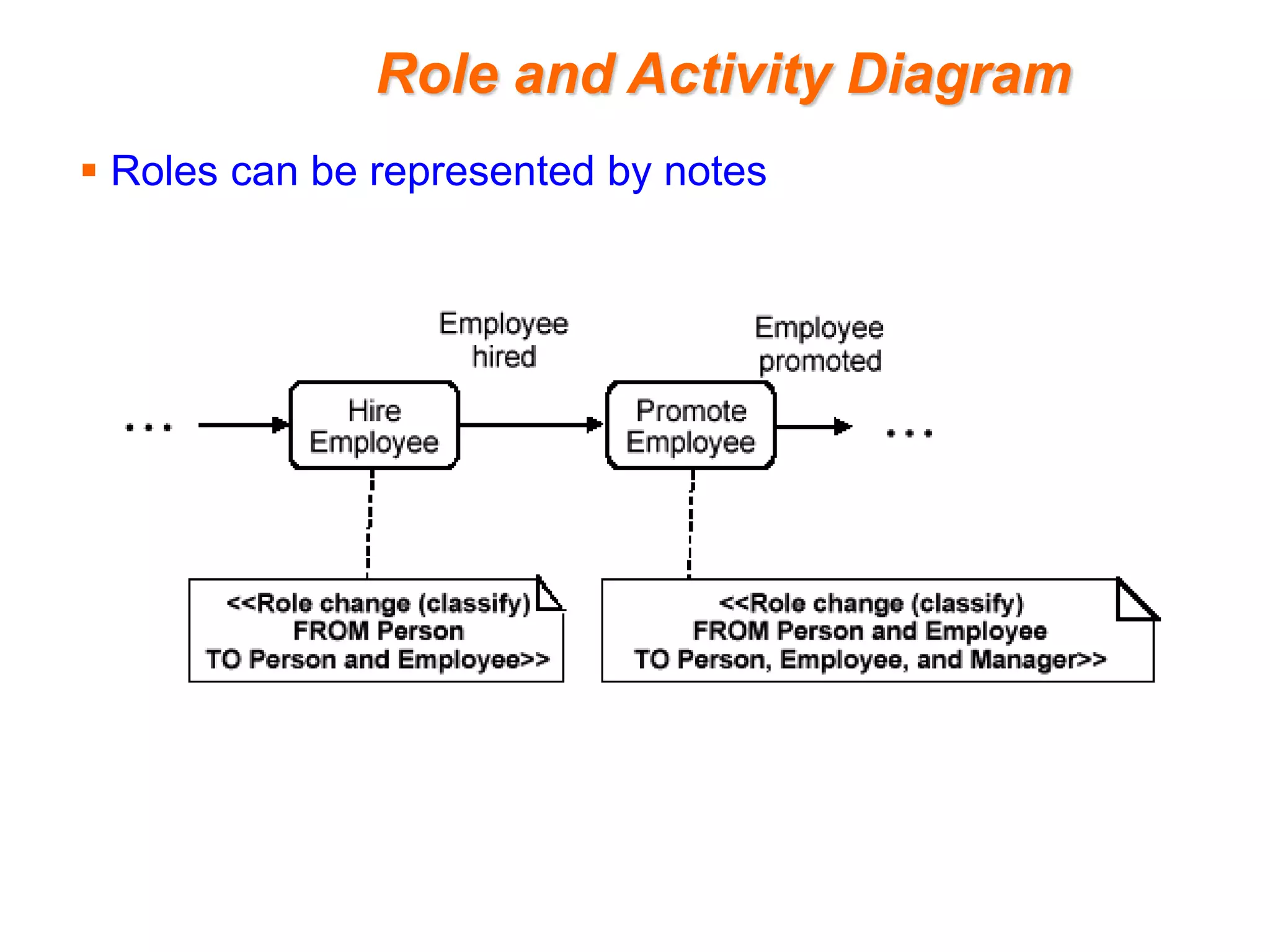
Role and Activity Diagram
 Roles can be represented by notes
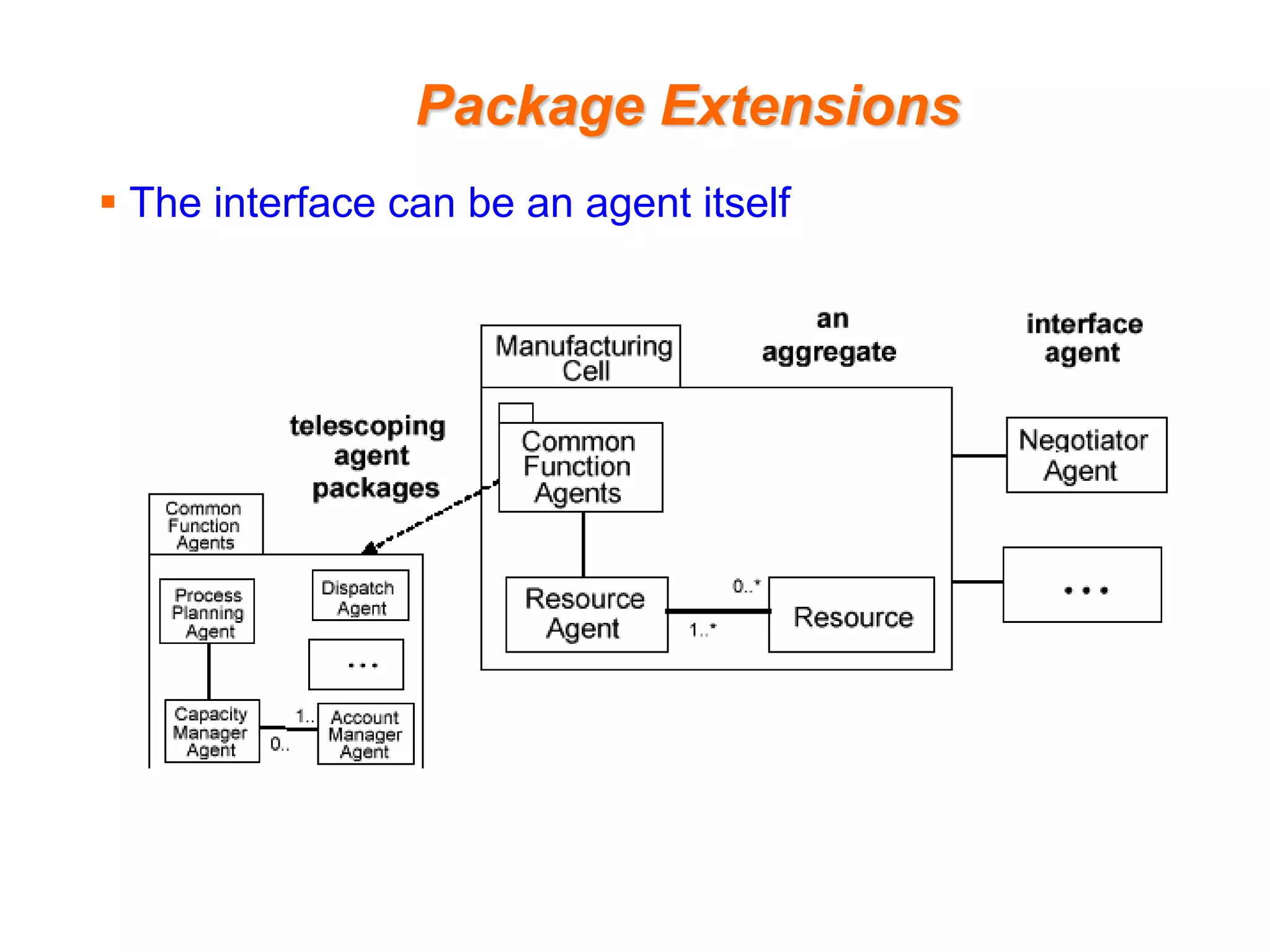
Package Extensions
 The interface can be an agent itself
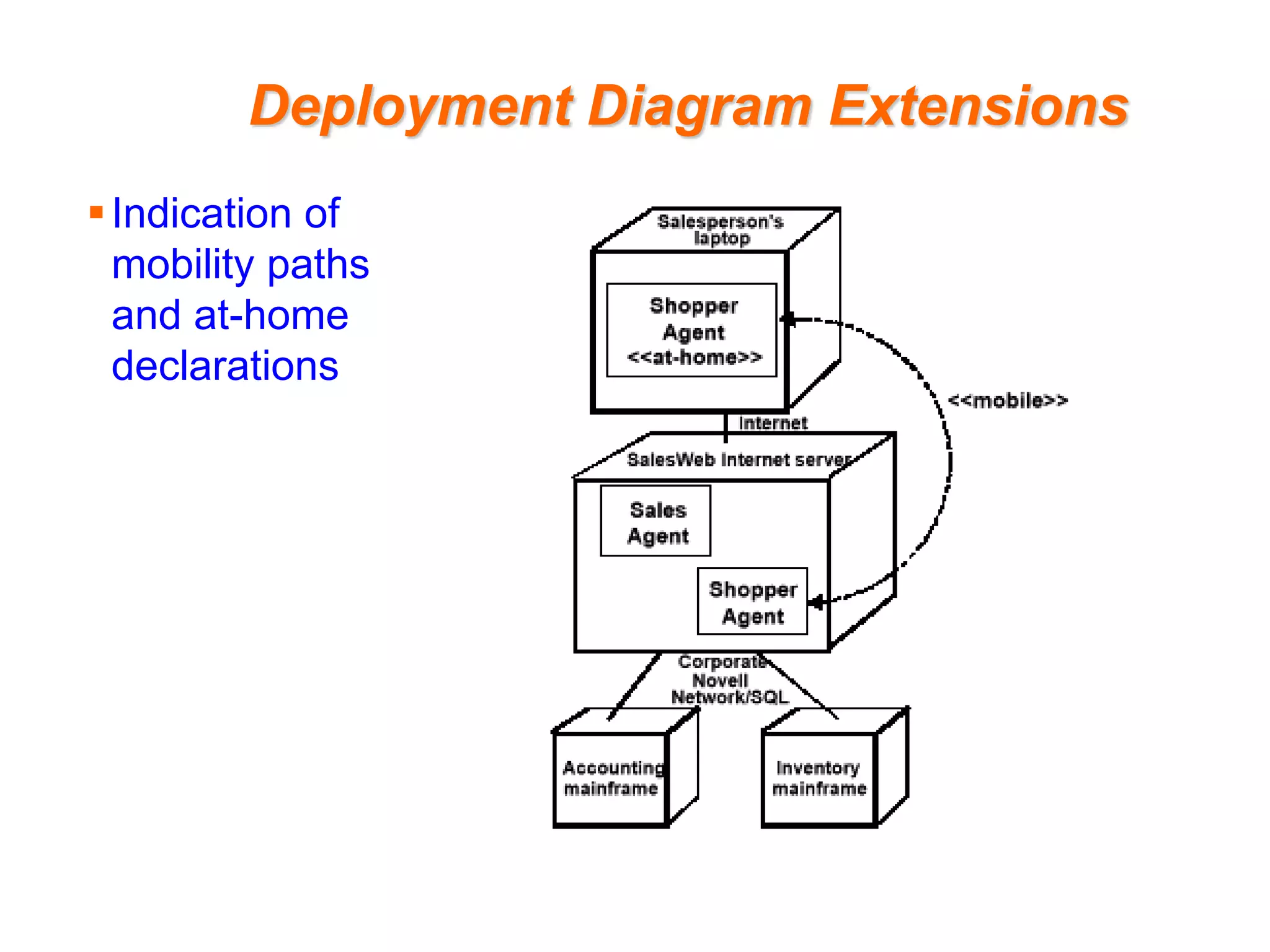
Deployment Diagram Extensions
Indication of
mobility paths
and at-home
declarations
Conclusions
 (A)UML provides tools for provides tools for
 Specifying agent interaction protocols
 Representing the internal behavior of an agent
 Representing role specification, packages with agent
interfaces, deployment diagrams indicating mobility, etc.
References
 James Odell, H. Van Dyke Parunak, Bernhard Bauer.
Representing Agent Interaction Protocols in UML, 1999.
 James Odell, H. Van Dyke Parunak, Bernhard Bauer.
Extending UML for Agents, 2000.
 James Odell, Conrad Bock. OMG document ad/99-12-01.
Suggested UML Extensions for Agents. Submitted to the OMG’s
Analysis and Design Task Force (ADTF) in response to the
Request of Information (RFI) entitled “UML2.0 RFI”. Dec. 1999.
 Bernhard Bauer. OMG document ad/99-12-03. Extending UML
for the Specification of Agent Interaction Protocols. FIPA
submission to the OMG’s Analysis and Design Task Force
(ADTF) in response to the Request of Information (RFI) entitled
“UML2.0 RFI”. Dec. 1999.

agent uml الوكيل باستخدام لغة النمذجة الموحدة

  • 1.
  • 2.
    Overview UML for Agents UML AgentUML (AUML) Agent Interaction Protocols Richer Role Specification Package Extension Deployment Diagram Extension Conclusion
  • 3.
    UML Static models: class,package diagrams Dynamic models: Interaction diagrams (sequence and collaboration) State diagrams Activity diagrams Implementation models: component, deployment diagrams Object constraint language (OCL)
  • 4.
    AUML: Agent UML BothFIPA and OMG are exploring and recommending extensions to UML Applications: Specification of Agent Interaction Protocols (AIP) Richer role specification Package extension Deployment diagram extension
  • 5.
    Agent Interaction Protocols AIPdescribes a communication pattern as an allowed sequence of messages between agents and the constraints of the content of those messages. FIPA has specified many protocols Request Protocol, Query Protocol, Request-when Protocol, Contract- net Protocol, Iterated-Contract-Net Protocol, Auction-English Protocol, Auction-Dutch Protocol
  • 6.
    FIPA Contract-net Protocol Themanager solicits proposals from other agents by issuing a call for proposals, which specifies the task and any conditions the manager is placing upon the execution of the task. Agents receiving the call for proposals are viewed as potential contractors, and are able to generate proposals to perform the task as propose acts. The contractor’s proposal includes the preconditions that the contractor is setting out for the task, which may be the price, time when the task will be done, etc. The contractor may refuse to propose.
  • 7.
    FIPA Contract-net Protocol,Cont’d. The manager receives back replies from all of the contractors, evaluates the proposals and makes its choice of which agents will perform the task. One, several, or no agents may be chosen. The agents of the selected proposal(s) will be sent an acceptance message, the others will receive a notice of rejection. Once the manager accepts the proposal the contractor acquires a commitment to perform the task. Once the contractor has completed the task, it sends a completion message to the manager. The protocol requires the manager to know when it has received all replies. In the case that a contractor fails to reply with either a propose or a refuse, the manager may potentially be left waiting indefinitely. To guard against this, the cfp includes a deadline by which replies should be received by the manager.
  • 8.
  • 9.
    AUML Approach toProtocols AUML adopts a layered approach to protocols: Level 1 - Represent the overall protocol (sequence diagrams, packages, templates) Level 2- Represent interactions among agents (sequence, collaboration, activity, state diagrams) Level 3- Represent internal Agent Processing (activity and state diagrams)
  • 10.
    A Layered Approachto Protocols
  • 11.
  • 12.
    Level 1: OverallProtocol (Packages) Packages aggregate modeling elements into conceptual wholes in UML 1.3 packages only group class diagrams Protocols can be codified as patterns of agent interaction in AUML packages can group sequence diagrams (to model protocol patterns)
  • 13.
    Level 1: UsingPackages to Express Nested Protocols Purchasing protocol (Broker X Retailer) Supplying protocol (Retailer X Wholesaler)
  • 14.
    Level 1- OverallProtocol : Templates In order for a package to be a true pattern (not simply a reusable component) customization must be supported A template is a parameterized model element whose parameters are bound at model time Represented by doted box in upper right corner of the package
  • 15.
    Contract Net Protocol Level1 Scenario Involving Buyers and Sellers
  • 16.
    Level 2: InteractionsAmong Agents Extended sequence diagrams (concurrent threads of interaction) Collaboration diagrams Activity diagrams
  • 17.
    Extended Sequence Diagrams Themultiple vertical bars indicate that the receiving agent is processing several communication threads concurrently. Concurrent Communication
  • 18.
    Extended Sequence Diagrams Adecision box will decide which CAs (zero or more) will be sent. If more than one CA is sent, the communication is concurrent
  • 19.
    Extended Sequence Diagrams ExclusiveOR, so exactly one CA will be sent
  • 20.
    Extended Sequence Diagrams Expressingthe roles an agent play: Agent/Role
  • 21.
    Collaboration Diagrams Another wayof showing pattern of interaction among agents
  • 22.
    Activity Diagrams Provides anexplicit thread of control Useful for complex interaction protocols that involve concurrent processing ECN: Electronic Commerce Network Agent
  • 23.
    Internal Agent Processing Processingwithin an Order Processor agent
  • 24.
    Internal Agent Processing PaymentReceiver and Invoice Sender Agents
  • 25.
    Other AUML Considerations Richerrole specification Package extension Deployment diagram extension
  • 26.
    Richer Role Specification Oftenwe need to express the role an agent may play in the course of its interaction with other agents If the number of agent and roles increases, UML diagrams become graphically to complex
  • 27.
    Agent/Role Extension Four agentsplaying 6 Roles: Customer, Negotiator, Contractor, Competitor Analyzer, Competitor, Debtor
  • 28.
    Reducing Visual Complexity Eachrole with its own lifeline
  • 29.
    Reducing Visual Complexity Each agent with a single lifeline and each activation is labeled with the appropriate roll name
  • 30.
    Role and CollaborationDiagrams  UML has no facility to represent agent roles on interaction lines  Labeling messages with the role
  • 31.
    Role and ActivityDiagram  Roles can be associated with activities
  • 32.
    Role and ActivityDiagram  Roles can be represented by notes
  • 33.
    Package Extensions  Theinterface can be an agent itself
  • 34.
    Deployment Diagram Extensions Indicationof mobility paths and at-home declarations
  • 35.
    Conclusions  (A)UML providestools for provides tools for  Specifying agent interaction protocols  Representing the internal behavior of an agent  Representing role specification, packages with agent interfaces, deployment diagrams indicating mobility, etc.
  • 36.
    References  James Odell,H. Van Dyke Parunak, Bernhard Bauer. Representing Agent Interaction Protocols in UML, 1999.  James Odell, H. Van Dyke Parunak, Bernhard Bauer. Extending UML for Agents, 2000.  James Odell, Conrad Bock. OMG document ad/99-12-01. Suggested UML Extensions for Agents. Submitted to the OMG’s Analysis and Design Task Force (ADTF) in response to the Request of Information (RFI) entitled “UML2.0 RFI”. Dec. 1999.  Bernhard Bauer. OMG document ad/99-12-03. Extending UML for the Specification of Agent Interaction Protocols. FIPA submission to the OMG’s Analysis and Design Task Force (ADTF) in response to the Request of Information (RFI) entitled “UML2.0 RFI”. Dec. 1999.