FUNCTIONFUNCTION
1
RECURSIVE FUNCTION
INTRODUCTION TO RECURSIVE
FUNCTION
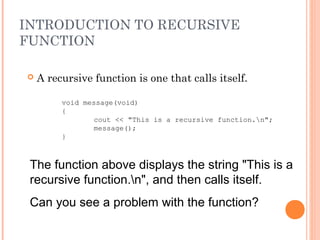
 A recursive function is one that calls itself.
void message(void)
{
cout << "This is a recursive function.n";
message();
}
The function above displays the string "This is a
recursive function.n", and then calls itself.
Can you see a problem with the function?
RECURSIVE FUNCTION
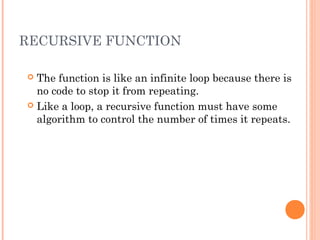
 The function is like an infinite loop because there is
no code to stop it from repeating.
 Like a loop, a recursive function must have some
algorithm to control the number of times it repeats.
RECURSIVE FUNCTION
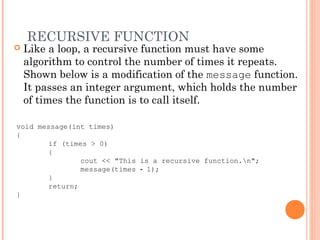
 Like a loop, a recursive function must have some
algorithm to control the number of times it repeats.
Shown below is a modification of the message function.
It passes an integer argument, which holds the number
of times the function is to call itself.
void message(int times)
{
if (times > 0)
{
cout << "This is a recursive function.n";
message(times 1);‑
}
return;
}
RECURSIVE FUNCTION
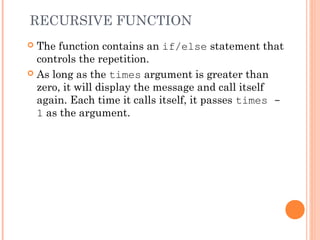
 The function contains an if/else statement that
controls the repetition.
 As long as the times argument is greater than
zero, it will display the message and call itself
again. Each time it calls itself, it passes times -
1 as the argument.
EXAMPLE PROGRAM 1
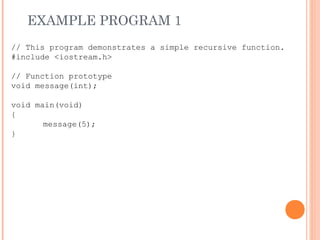
// This program demonstrates a simple recursive function.
#include <iostream.h>
// Function prototype
void message(int);
void main(void)
{
message(5);
}
PROGRAM 1 (CONTINUED)
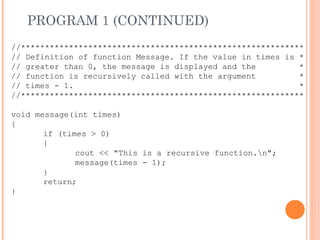
//***********************************************************
// Definition of function Message. If the value in times is *
// greater than 0, the message is displayed and the *
// function is recursively called with the argument *
// times - 1. *
//***********************************************************
void message(int times)
{
if (times > 0)
{
cout << "This is a recursive function.n";
message(times - 1);
}
return;
}
PROGRAM 1 (CONTINUED)
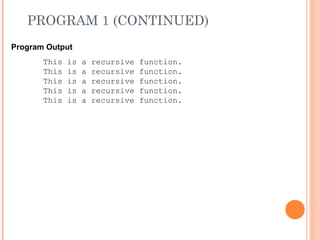
Program Output
  This is a recursive function.
This is a recursive function.
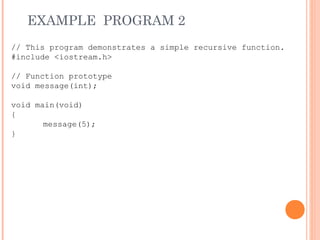
EXAMPLE PROGRAM 2
// This program demonstrates a simple recursive function.
#include <iostream.h>
// Function prototype
void message(int);
void main(void)
{
message(5);
}
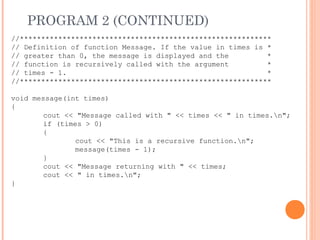
PROGRAM 2 (CONTINUED)
//***********************************************************
// Definition of function Message. If the value in times is *
// greater than 0, the message is displayed and the *
// function is recursively called with the argument *
// times - 1. *
//***********************************************************
void message(int times)
{
cout << "Message called with " << times << " in times.n";
if (times > 0)
{
cout << "This is a recursive function.n";
message(times - 1);
}
cout << "Message returning with " << times;
cout << " in times.n";
}
PROGRAM 2 (CONTINUED)
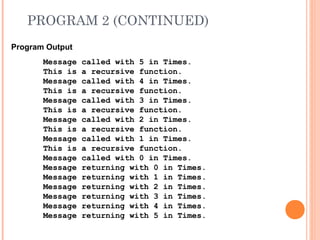
Program Output
Message called with 5 in Times.
This is a recursive function.
Message called with 4 in Times.
This is a recursive function.
Message called with 3 in Times.
This is a recursive function.
Message called with 2 in Times.
This is a recursive function.
Message called with 1 in Times.
This is a recursive function.
Message called with 0 in Times.
Message returning with 0 in Times.
Message returning with 1 in Times.
Message returning with 2 in Times.
Message returning with 3 in Times.
Message returning with 4 in Times.
Message returning with 5 in Times.

POLITEKNIK MALAYSIA

  • 1.
  • 2.
  • 3.
    INTRODUCTION TO RECURSIVE FUNCTION A recursive function is one that calls itself. void message(void) { cout << "This is a recursive function.n"; message(); } The function above displays the string "This is a recursive function.n", and then calls itself. Can you see a problem with the function?
  • 4.
    RECURSIVE FUNCTION  Thefunction is like an infinite loop because there is no code to stop it from repeating.  Like a loop, a recursive function must have some algorithm to control the number of times it repeats.
  • 5.
    RECURSIVE FUNCTION  Likea loop, a recursive function must have some algorithm to control the number of times it repeats. Shown below is a modification of the message function. It passes an integer argument, which holds the number of times the function is to call itself. void message(int times) { if (times > 0) { cout << "This is a recursive function.n"; message(times 1);‑ } return; }
  • 6.
    RECURSIVE FUNCTION  Thefunction contains an if/else statement that controls the repetition.  As long as the times argument is greater than zero, it will display the message and call itself again. Each time it calls itself, it passes times - 1 as the argument.
  • 7.
    EXAMPLE PROGRAM 1 //This program demonstrates a simple recursive function. #include <iostream.h> // Function prototype void message(int); void main(void) { message(5); }
  • 8.
    PROGRAM 1 (CONTINUED) //*********************************************************** //Definition of function Message. If the value in times is * // greater than 0, the message is displayed and the * // function is recursively called with the argument * // times - 1. * //*********************************************************** void message(int times) { if (times > 0) { cout << "This is a recursive function.n"; message(times - 1); } return; }
  • 9.
    PROGRAM 1 (CONTINUED) ProgramOutput   This is a recursive function. This is a recursive function. This is a recursive function. This is a recursive function. This is a recursive function.
  • 10.
    EXAMPLE PROGRAM 2 //This program demonstrates a simple recursive function. #include <iostream.h> // Function prototype void message(int); void main(void) { message(5); }
  • 11.
    PROGRAM 2 (CONTINUED) //*********************************************************** //Definition of function Message. If the value in times is * // greater than 0, the message is displayed and the * // function is recursively called with the argument * // times - 1. * //*********************************************************** void message(int times) { cout << "Message called with " << times << " in times.n"; if (times > 0) { cout << "This is a recursive function.n"; message(times - 1); } cout << "Message returning with " << times; cout << " in times.n"; }
  • 12.
    PROGRAM 2 (CONTINUED) ProgramOutput Message called with 5 in Times. This is a recursive function. Message called with 4 in Times. This is a recursive function. Message called with 3 in Times. This is a recursive function. Message called with 2 in Times. This is a recursive function. Message called with 1 in Times. This is a recursive function. Message called with 0 in Times. Message returning with 0 in Times. Message returning with 1 in Times. Message returning with 2 in Times. Message returning with 3 in Times. Message returning with 4 in Times. Message returning with 5 in Times.