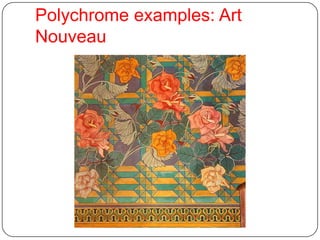
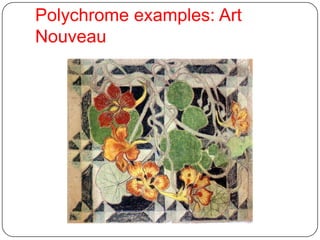
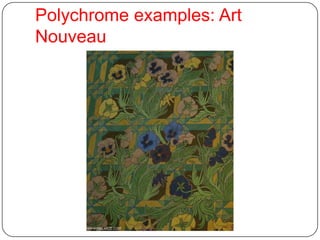
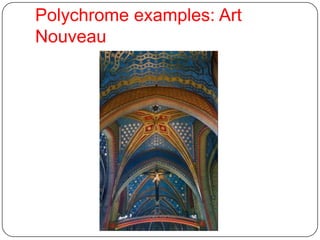
 Polychrome is one of the terms used to
  describe the use of multiple colors in
  one entity. It has also been defined as
  "The practice of decorating architectural
  elements, sculpture, etc., in a variety of
  colors."
 Most often, the term is used in
  conjunction with certain styles of
  architecture, pottery or sculpture in
  multiple colours.
 The word polychrome derives from
 the Greek πολύχρωμος (polychrom
 os), "colourful", from πολύς (polys),
 "many, much" + χρῶμα (chroma),
 "color."
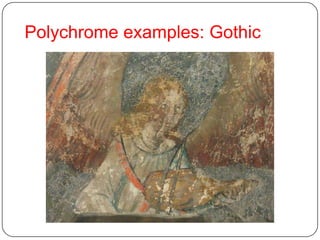
Polychrome examples: Gothic
Polychrome examples: Art
Nouveau


 http://panoramy.zbooy.pl/360/show.html?p=krako
 w-kosciol-franciszkanow-hdr&t=32&lang=p
Polychrome examples: Art
Nouveau
Polychrome examples: Art
Nouveau
Polychrome examples: Art
Nouveau
Polychrome examples: Art
Nouveau
The Franciscan Church of the Holy Trinity
in with the most interesting examples of
polychrome in Opole
Franciscan church i
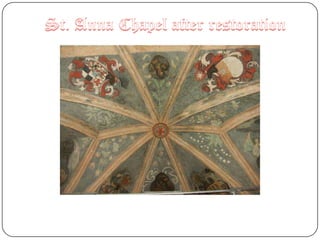
n Opole the chapel
of St. Anne with
polychrome from
XVI century
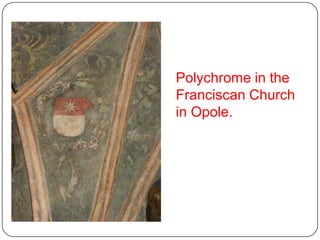
The coat of arms
of Opole Piast
Dynasty
The history of the Church of the Holy
Trinity in Opole.
            The church is situated in the very centre of
            the city and makes one complex with the
            Franciscan monastery. The
            original Gothic structure of Franciscan
            church in Opole underwent changes in
            history, according to changing styles in
            architecture. The
            biggest changes occurred in the Baroque
            period. The chancel is Gothic, the nave
            inside has baroque
            influences. Conservation works have
            greatly contributed to restoring gothic
            elements of the church.The temple has the
            form of a three-aisled hall (body) with a
Polychrome in
the
Franciscan
Church in
Opole.
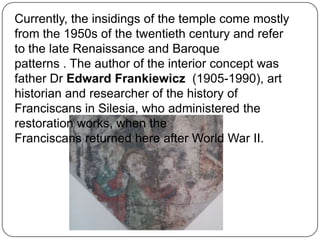
Currently, the insidings of the temple come mostly
from the 1950s of the twentieth century and refer
to the late Renaissance and Baroque
patterns . The author of the interior concept was
father Dr Edward Frankiewicz (1905-1990), art
historian and researcher of the history of
Franciscans in Silesia, who administered the
restoration works, when the
Franciscans returned here after World War II.
Polychrome in the
Franciscan Church
in Opole.
Polychrome in
Franciscan Church in
Opole
On the south wall of
the body, the right of
the entrance to
the St. Anne chapel,
the can be
seen fragments of
polychrome, exposed
      during the recent
work
conservation. You can
recognize two
angels supporting
the drapes,
the central scene is
illegible.
Polychrome in the
Franciscan Church in
Opole
Polychrome in Franciscan Church
Women preparing for
the restoration of
polychrome paintings
Church
in Bierdzany - an
antique wooden chu
rch of St.
NicholasHedwig.
The church was
built in 1711. It was
built in Baroque
style and in 1961
paintings with
biblical themes were
discovered during
the renovation of the
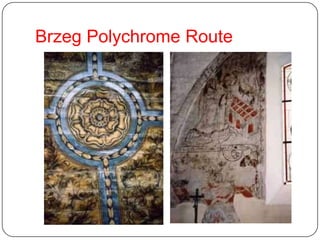
Brzeg Polychrome Route
 On the 53 km long route there are 14 churches
  mostly 600 years old country temples with around
  20 medieval polychrome paintings.
 During the Protestant Reformation initiated by
  Martin Luther in the 16th century the polychrome
  paintings were covered with plater to adjust the
  interior to the ideas of reformation.
 They were rediscovered recently and the best
  preserved Gothic examples are the polychrome in
  Małujowice, Strzelniki, Pogorzela i Krzyżowice.
Brzeg Polychrome Route
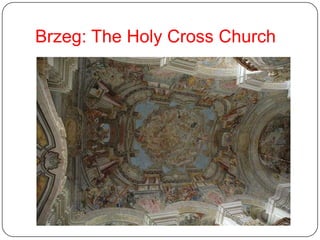
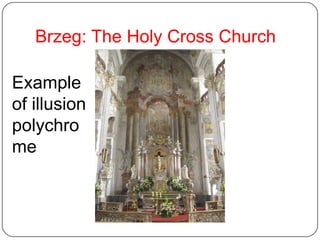
Brzeg: The Holy Cross Church

Example
of illusion
polychro
me
Brzeg: The Holy Cross Church
Brzeg Polychrome Route


Kościół in Małujowicach (360 degrees panorama)


 http://panoramy.zbooy.pl/360/show.html?max=1&
 p=malujowice-kosciol-wnetrze-1&lang=p&t=32
Brzeg Polychrome Route
Thank you for your
 attention

Polish Polychrome

  • 2.
     Polychrome isone of the terms used to describe the use of multiple colors in one entity. It has also been defined as "The practice of decorating architectural elements, sculpture, etc., in a variety of colors."  Most often, the term is used in conjunction with certain styles of architecture, pottery or sculpture in multiple colours.
  • 3.
     The wordpolychrome derives from the Greek πολύχρωμος (polychrom os), "colourful", from πολύς (polys), "many, much" + χρῶμα (chroma), "color."
  • 4.
  • 5.
    Polychrome examples: Art Nouveau http://panoramy.zbooy.pl/360/show.html?p=krako w-kosciol-franciszkanow-hdr&t=32&lang=p
  • 6.
  • 7.
  • 8.
  • 9.
  • 10.
    The Franciscan Churchof the Holy Trinity in with the most interesting examples of polychrome in Opole
  • 11.
    Franciscan church i nOpole the chapel of St. Anne with polychrome from XVI century The coat of arms of Opole Piast Dynasty
  • 12.
    The history ofthe Church of the Holy Trinity in Opole. The church is situated in the very centre of the city and makes one complex with the Franciscan monastery. The original Gothic structure of Franciscan church in Opole underwent changes in history, according to changing styles in architecture. The biggest changes occurred in the Baroque period. The chancel is Gothic, the nave inside has baroque influences. Conservation works have greatly contributed to restoring gothic elements of the church.The temple has the form of a three-aisled hall (body) with a
  • 13.
  • 14.
    Currently, the insidingsof the temple come mostly from the 1950s of the twentieth century and refer to the late Renaissance and Baroque patterns . The author of the interior concept was father Dr Edward Frankiewicz (1905-1990), art historian and researcher of the history of Franciscans in Silesia, who administered the restoration works, when the Franciscans returned here after World War II.
  • 15.
  • 18.
  • 19.
    On the southwall of the body, the right of the entrance to the St. Anne chapel, the can be seen fragments of polychrome, exposed during the recent work conservation. You can recognize two angels supporting the drapes, the central scene is illegible.
  • 20.
  • 21.
  • 22.
    Women preparing for therestoration of polychrome paintings
  • 24.
    Church in Bierdzany -an antique wooden chu rch of St. NicholasHedwig. The church was built in 1711. It was built in Baroque style and in 1961 paintings with biblical themes were discovered during the renovation of the
  • 26.
    Brzeg Polychrome Route On the 53 km long route there are 14 churches mostly 600 years old country temples with around 20 medieval polychrome paintings.  During the Protestant Reformation initiated by Martin Luther in the 16th century the polychrome paintings were covered with plater to adjust the interior to the ideas of reformation.  They were rediscovered recently and the best preserved Gothic examples are the polychrome in Małujowice, Strzelniki, Pogorzela i Krzyżowice.
  • 27.
  • 28.
    Brzeg: The HolyCross Church
  • 29.
    Brzeg: The HolyCross Church Example of illusion polychro me
  • 30.
    Brzeg: The HolyCross Church
  • 31.
  • 32.
    Brzeg Polychrome Route Kościółin Małujowicach (360 degrees panorama)  http://panoramy.zbooy.pl/360/show.html?max=1& p=malujowice-kosciol-wnetrze-1&lang=p&t=32
  • 33.
  • 34.
    Thank you foryour attention