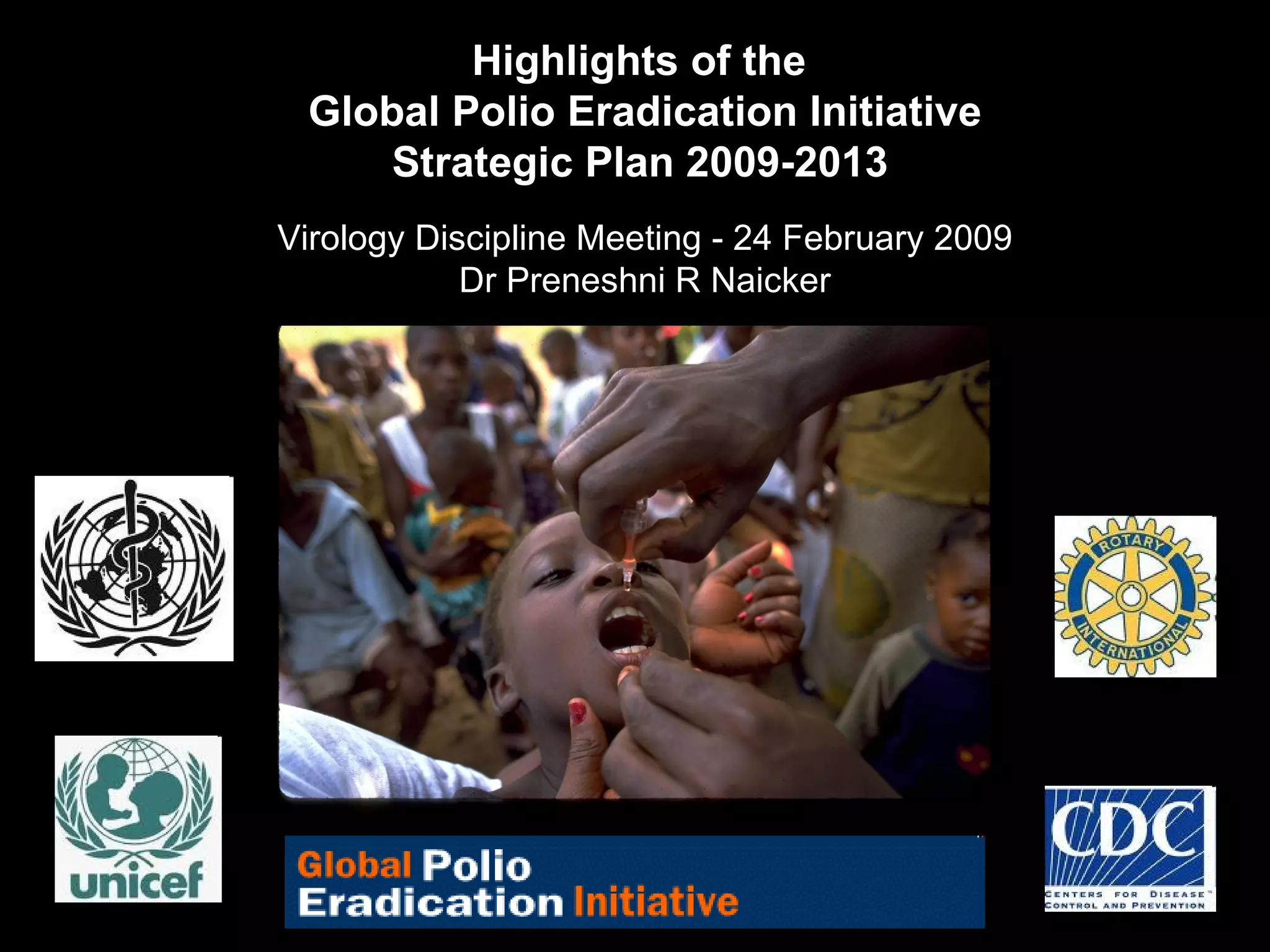
Highlights of the  Global Polio Eradication Initiative Strategic Plan 2009-2013   Virology Discipline Meeting - 24 February 2009 Dr Preneshni R Naicker
Goal of the Global Polio Eradication Initiative:  To ensure that no child will ever again be paralysed by either a wild or vaccine-derived poliovirus
Objective 1: Interrupt wild poliovirus transmission
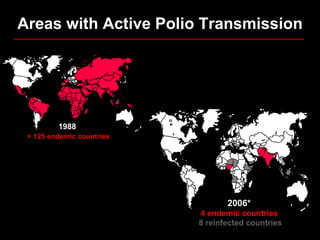
Areas with Active Polio Transmission 1988  > 125 endemic countries 2006*  4 endemic countries  8 reinfected countries
Situation analysis Indigenous poliovirus eradicated from all but 4 countries worldwide India, Nigeria, Pakistan, Afghanistan, indigenous type 1 and 3 wild poliovirus transmission is continuing  Type 2 wild poliovirus has been eradicated globally since 1999
Key challenges 1) Sub-optimal OPV delivery 2) Sub-optimal OPV efficacy 3) Prolonged outbreaks (persistent transmission for >12 months) due to suboptimal outbreak response  4) Continued international spread of poliovirus from areas of indigenous (eg Nigeria, India) and imported poliovirus transmission (eg Angola, Chad, parts of the Horn of Africa)
Strategic approach In all polio-infected areas: Implement an aggressive SIA strategy  prioritize eradication of type 1 poliovirus (higher paralytic attack rate and propensity for geographic spread) Optimize the OPV campaign  In areas of prolonged outbreaks International outbreak response guidelines To address international spread Maintain/increase routine immunization  Ensure immediate notification of newly-infected areas
 
Objective 2: Ensure sustainable surveillance for polioviruses
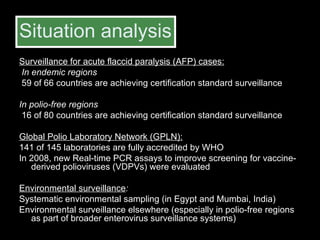
Situation analysis Surveillance for acute flaccid paralysis (AFP) cases: In endemic regions 59 of 66 countries are achieving certification standard surveillance  In polio-free regions   16 of 80 countries are achieving certification standard surveillance  Global Polio Laboratory Network (GPLN): 141 of 145 laboratories are fully accredited by WHO  In 2008, new Real-time PCR assays to improve screening for vaccine-derived polioviruses (VDPVs) were evaluated Environmental surveillance : Systematic environmental sampling (in Egypt and Mumbai, India) Environmental surveillance elsewhere (especially in polio-free regions as part of broader enterovirus surveillance systems)
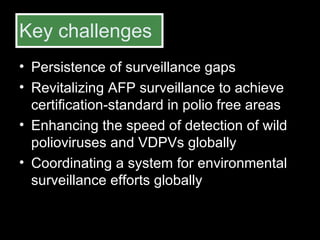
Key challenges Persistence of surveillance gaps Revitalizing AFP surveillance to achieve certification-standard in polio free areas Enhancing the speed of detection of wild polioviruses and VDPVs globally Coordinating a system for environmental surveillance efforts globally
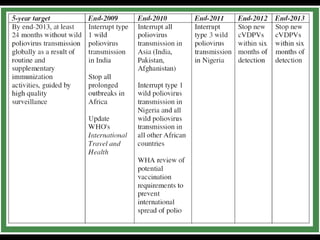
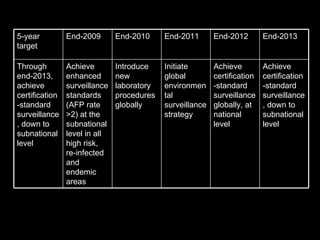
Achieve certification-standard surveillance, down to subnational level Achieve certification-standard surveillance globally, at national level Initiate global environmental surveillance strategy Introduce new laboratory procedures globally Achieve enhanced surveillance standards (AFP rate >2) at the subnational level in all high risk, re-infected and endemic areas Through end-2013, achieve certification-standard surveillance, down to subnational level End-2013 End-2012 End-2011 End-2010 End-2009 5-year target
Objective 3: Achieve certification  & containment of wild polioviruses
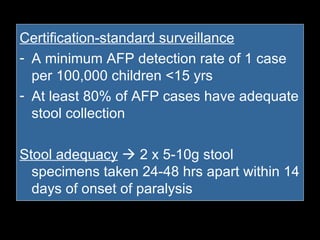
Certification-standard surveillance A minimum AFP detection rate of 1 case per 100,000 children <15 yrs At least 80% of AFP cases have adequate stool collection Stool adequacy     2 x 5-10g stool specimens taken 24-48 hrs apart within 14 days of onset of paralysis
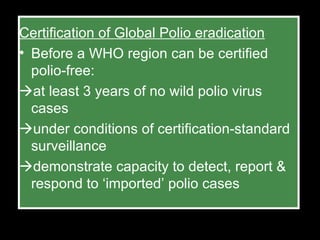
Certification of Global Polio eradication Before a WHO region can be certified polio-free:  at least 3 years of no wild polio virus cases  under conditions of certification-standard surveillance  demonstrate capacity to detect, report & respond to ‘imported’ polio cases
Situation analysis Three Regions are certified polio-free (AMR, EUR, WPR). Regional Certification Commissions (RCCs) are functioning in all three remaining endemic Regions, with National Certification Committees A framework for long-term containment of all polioviruses has been established
Containment of wild polio virus stocks Purpose:  To minimize the risk of an accidental or intentional reintroduction of wild poliovirus into the community from a laboratory or vaccine production site post-eradication Aim:   to locate laboratories worldwide that store wild poliovirus and potentially infectious materials, and ensure that those materials are handled under appropriate biosafety conditions.
Key challenges Establishing international consensus on long-term containment requirements for all polioviruses  Strategic approach Establish an area-specific process for certifying eradication in each conflict-affected area  Finalize and implement the long-term containment activities
Objective 4: Prepare for VAPP & VDPV elimination & the post-OPV era
Situation analysis The VAPP burden is 250-500 cases/yr Since 2000, at least 10 cVDPV outbreaks in 10 countries Of 33 recorded individuals with iVDPVs, 5 have excreted for >5 years (chronic excretors) ?date for the eventual cessation of the use of OPV in routine immunization programmes
Key challenges Fully characterising VDPV risks in low- and middle-income settings Coordinating OPV cessation internationally as soon as possible after certification of wild poliovirus eradication. Developing affordable options for IPV use in low- and middle-income countries Establishing a process for verification of VAPP/VDPV elimination.
Strategic approach Expand new laboratory diagnostic procedures to enhance sensitivity to detect VDPVs  Implement studies to better quantify and characterize iVDPV risks/implications Develop antiviral drugs to treat chronic iVDPVs  Establish affordable IPV options Establish WHA Resolutions on the eventual coordination of OPV cessation, long-term containment of all polioviruses and use of mOPV in response to cVDPVs following OPV cessation (including use of international stockpile of mOPV) Update risk assessment on potential for intentional use of polioviruses in the post-eradication era.
Objective 5: Plan for Re-structuring of the Global Polio Eradication Initiative for the VAPP/VDPV Elimination Phase
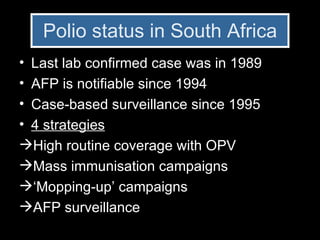
Polio status in South Africa Last lab confirmed case was in 1989 AFP is notifiable since 1994 Case-based surveillance since 1995 4 strategies High routine coverage with OPV Mass immunisation campaigns ‘ Mopping-up’ campaigns AFP surveillance
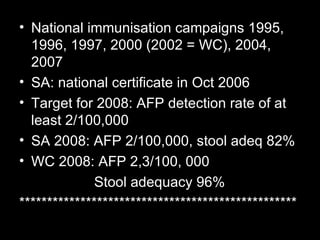
National immunisation campaigns 1995, 1996, 1997, 2000 (2002 = WC), 2004, 2007 SA: national certificate in Oct 2006 Target for 2008: AFP detection rate of at least 2/100,000 SA 2008: AFP 2/100,000, stool adeq 82% WC 2008: AFP 2,3/100, 000 Stool adequacy 96% **************************************************

Polio

  • 1.
    Highlights of the Global Polio Eradication Initiative Strategic Plan 2009-2013 Virology Discipline Meeting - 24 February 2009 Dr Preneshni R Naicker
  • 2.
    Goal of theGlobal Polio Eradication Initiative: To ensure that no child will ever again be paralysed by either a wild or vaccine-derived poliovirus
  • 3.
    Objective 1: Interruptwild poliovirus transmission
  • 4.
    Areas with ActivePolio Transmission 1988 > 125 endemic countries 2006* 4 endemic countries 8 reinfected countries
  • 5.
    Situation analysis Indigenouspoliovirus eradicated from all but 4 countries worldwide India, Nigeria, Pakistan, Afghanistan, indigenous type 1 and 3 wild poliovirus transmission is continuing Type 2 wild poliovirus has been eradicated globally since 1999
  • 6.
    Key challenges 1)Sub-optimal OPV delivery 2) Sub-optimal OPV efficacy 3) Prolonged outbreaks (persistent transmission for >12 months) due to suboptimal outbreak response 4) Continued international spread of poliovirus from areas of indigenous (eg Nigeria, India) and imported poliovirus transmission (eg Angola, Chad, parts of the Horn of Africa)
  • 7.
    Strategic approach Inall polio-infected areas: Implement an aggressive SIA strategy prioritize eradication of type 1 poliovirus (higher paralytic attack rate and propensity for geographic spread) Optimize the OPV campaign In areas of prolonged outbreaks International outbreak response guidelines To address international spread Maintain/increase routine immunization Ensure immediate notification of newly-infected areas
  • 8.
  • 9.
    Objective 2: Ensuresustainable surveillance for polioviruses
  • 10.
    Situation analysis Surveillancefor acute flaccid paralysis (AFP) cases: In endemic regions 59 of 66 countries are achieving certification standard surveillance In polio-free regions 16 of 80 countries are achieving certification standard surveillance Global Polio Laboratory Network (GPLN): 141 of 145 laboratories are fully accredited by WHO In 2008, new Real-time PCR assays to improve screening for vaccine-derived polioviruses (VDPVs) were evaluated Environmental surveillance : Systematic environmental sampling (in Egypt and Mumbai, India) Environmental surveillance elsewhere (especially in polio-free regions as part of broader enterovirus surveillance systems)
  • 11.
    Key challenges Persistenceof surveillance gaps Revitalizing AFP surveillance to achieve certification-standard in polio free areas Enhancing the speed of detection of wild polioviruses and VDPVs globally Coordinating a system for environmental surveillance efforts globally
  • 12.
    Achieve certification-standard surveillance,down to subnational level Achieve certification-standard surveillance globally, at national level Initiate global environmental surveillance strategy Introduce new laboratory procedures globally Achieve enhanced surveillance standards (AFP rate >2) at the subnational level in all high risk, re-infected and endemic areas Through end-2013, achieve certification-standard surveillance, down to subnational level End-2013 End-2012 End-2011 End-2010 End-2009 5-year target
  • 13.
    Objective 3: Achievecertification & containment of wild polioviruses
  • 14.
    Certification-standard surveillance Aminimum AFP detection rate of 1 case per 100,000 children <15 yrs At least 80% of AFP cases have adequate stool collection Stool adequacy  2 x 5-10g stool specimens taken 24-48 hrs apart within 14 days of onset of paralysis
  • 15.
    Certification of GlobalPolio eradication Before a WHO region can be certified polio-free:  at least 3 years of no wild polio virus cases  under conditions of certification-standard surveillance  demonstrate capacity to detect, report & respond to ‘imported’ polio cases
  • 16.
    Situation analysis ThreeRegions are certified polio-free (AMR, EUR, WPR). Regional Certification Commissions (RCCs) are functioning in all three remaining endemic Regions, with National Certification Committees A framework for long-term containment of all polioviruses has been established
  • 17.
    Containment of wildpolio virus stocks Purpose: To minimize the risk of an accidental or intentional reintroduction of wild poliovirus into the community from a laboratory or vaccine production site post-eradication Aim: to locate laboratories worldwide that store wild poliovirus and potentially infectious materials, and ensure that those materials are handled under appropriate biosafety conditions.
  • 18.
    Key challenges Establishinginternational consensus on long-term containment requirements for all polioviruses Strategic approach Establish an area-specific process for certifying eradication in each conflict-affected area Finalize and implement the long-term containment activities
  • 19.
    Objective 4: Preparefor VAPP & VDPV elimination & the post-OPV era
  • 20.
    Situation analysis TheVAPP burden is 250-500 cases/yr Since 2000, at least 10 cVDPV outbreaks in 10 countries Of 33 recorded individuals with iVDPVs, 5 have excreted for >5 years (chronic excretors) ?date for the eventual cessation of the use of OPV in routine immunization programmes
  • 21.
    Key challenges Fullycharacterising VDPV risks in low- and middle-income settings Coordinating OPV cessation internationally as soon as possible after certification of wild poliovirus eradication. Developing affordable options for IPV use in low- and middle-income countries Establishing a process for verification of VAPP/VDPV elimination.
  • 22.
    Strategic approach Expandnew laboratory diagnostic procedures to enhance sensitivity to detect VDPVs Implement studies to better quantify and characterize iVDPV risks/implications Develop antiviral drugs to treat chronic iVDPVs Establish affordable IPV options Establish WHA Resolutions on the eventual coordination of OPV cessation, long-term containment of all polioviruses and use of mOPV in response to cVDPVs following OPV cessation (including use of international stockpile of mOPV) Update risk assessment on potential for intentional use of polioviruses in the post-eradication era.
  • 23.
    Objective 5: Planfor Re-structuring of the Global Polio Eradication Initiative for the VAPP/VDPV Elimination Phase
  • 24.
    Polio status inSouth Africa Last lab confirmed case was in 1989 AFP is notifiable since 1994 Case-based surveillance since 1995 4 strategies High routine coverage with OPV Mass immunisation campaigns ‘ Mopping-up’ campaigns AFP surveillance
  • 25.
    National immunisation campaigns1995, 1996, 1997, 2000 (2002 = WC), 2004, 2007 SA: national certificate in Oct 2006 Target for 2008: AFP detection rate of at least 2/100,000 SA 2008: AFP 2/100,000, stool adeq 82% WC 2008: AFP 2,3/100, 000 Stool adequacy 96% **************************************************