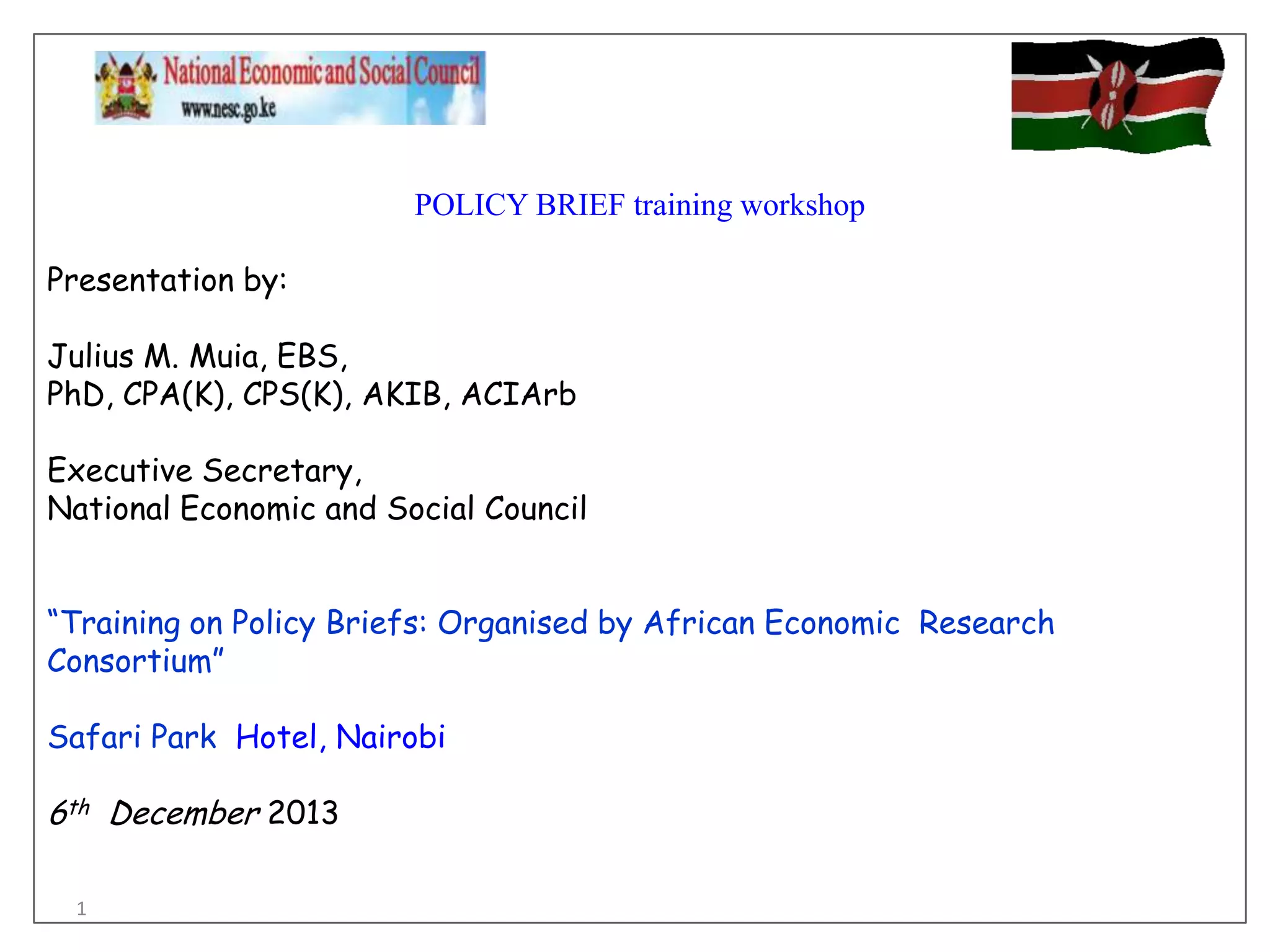
POLICY BRIEF training workshop
Presentation by:
Julius M. Muia, EBS,
PhD, CPA(K), CPS(K), AKIB, ACIArb
Executive Secretary,
National Economic and Social Council
“Training on Policy Briefs: Organised by African Economic Research
Consortium”
Safari Park Hotel, Nairobi

6th December 2013
1
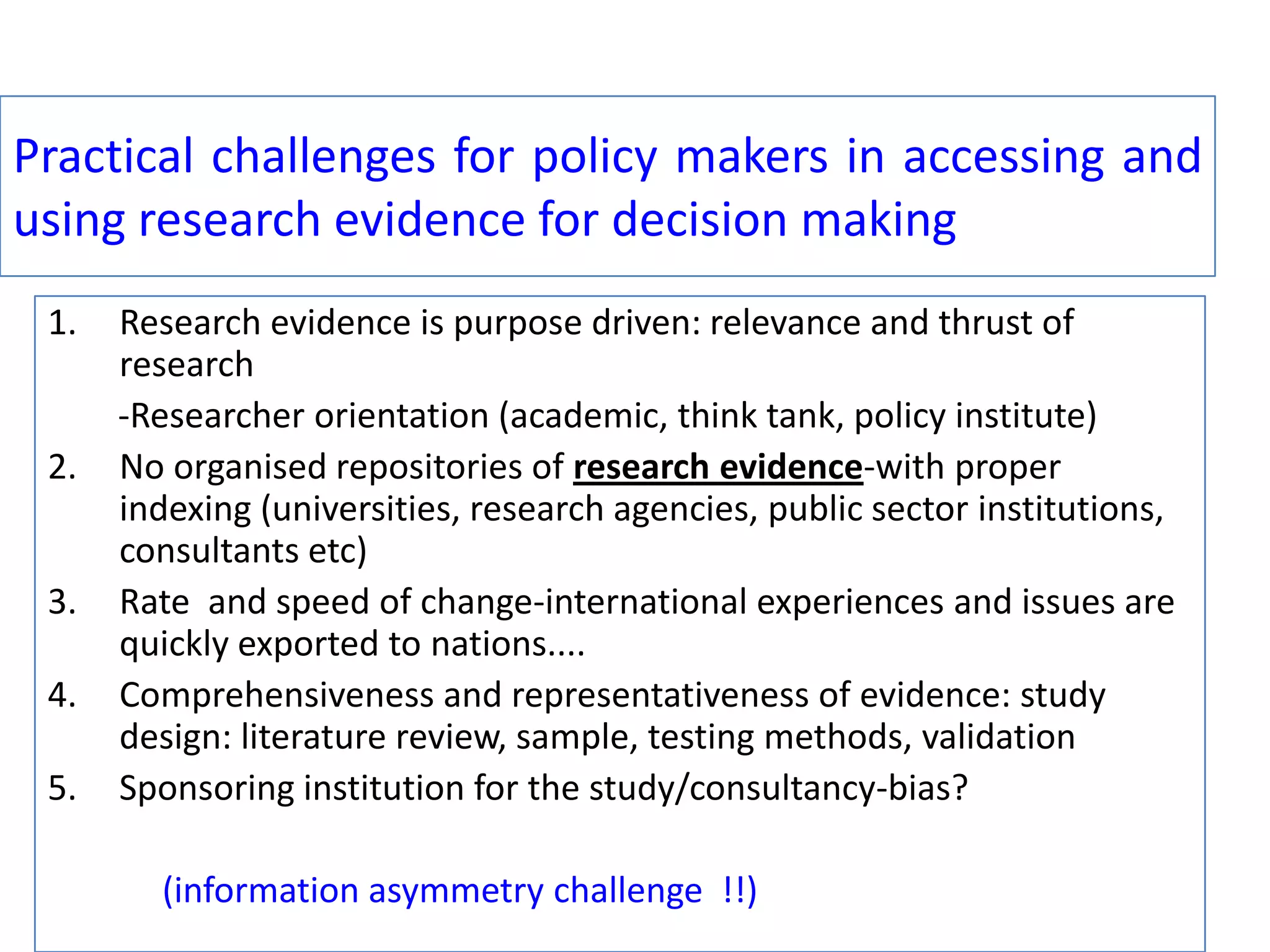
Practical challenges for policy makers in accessing and
using research evidence for decision making
1.

2.
3.
4.
5.

Research evidence is purpose driven: relevance and thrust of
research
-Researcher orientation (academic, think tank, policy institute)
No organised repositories of research evidence-with proper
indexing (universities, research agencies, public sector institutions,
consultants etc)
Rate and speed of change-international experiences and issues are
quickly exported to nations....
Comprehensiveness and representativeness of evidence: study
design: literature review, sample, testing methods, validation
Sponsoring institution for the study/consultancy-bias?
(information asymmetry challenge !!)
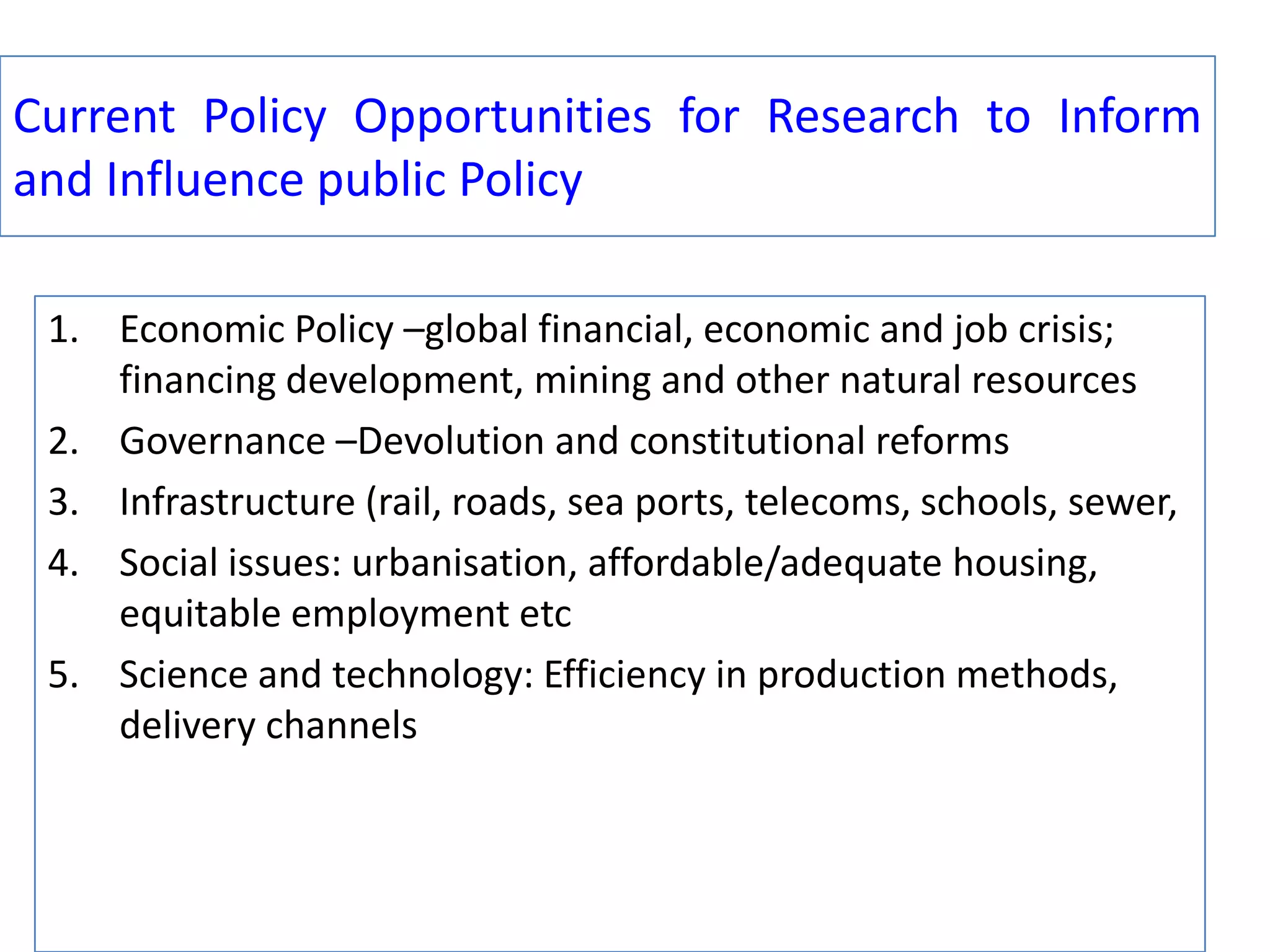
Current Policy Opportunities for Research to Inform
and Influence public Policy
1. Economic Policy –global financial, economic and job crisis;
financing development, mining and other natural resources
2. Governance –Devolution and constitutional reforms
3. Infrastructure (rail, roads, sea ports, telecoms, schools, sewer,
4. Social issues: urbanisation, affordable/adequate housing,
equitable employment etc
5. Science and technology: Efficiency in production methods,
delivery channels
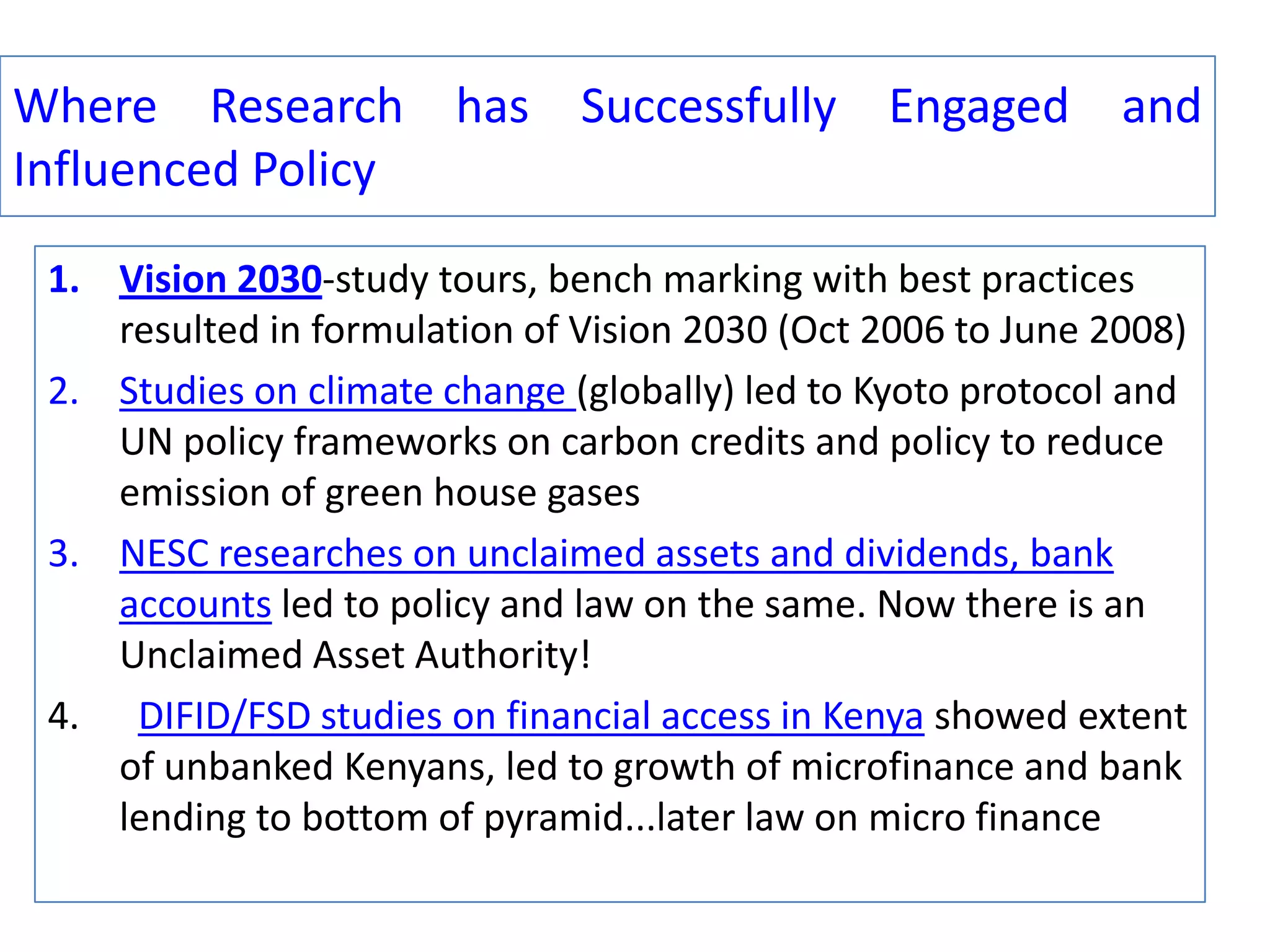
Where Research has Successfully Engaged and
Influenced Policy
1. Vision 2030-study tours, bench marking with best practices
resulted in formulation of Vision 2030 (Oct 2006 to June 2008)
2. Studies on climate change (globally) led to Kyoto protocol and
UN policy frameworks on carbon credits and policy to reduce
emission of green house gases
3. NESC researches on unclaimed assets and dividends, bank
accounts led to policy and law on the same. Now there is an
Unclaimed Asset Authority!
4. DIFID/FSD studies on financial access in Kenya showed extent
of unbanked Kenyans, led to growth of microfinance and bank
lending to bottom of pyramid...later law on micro finance
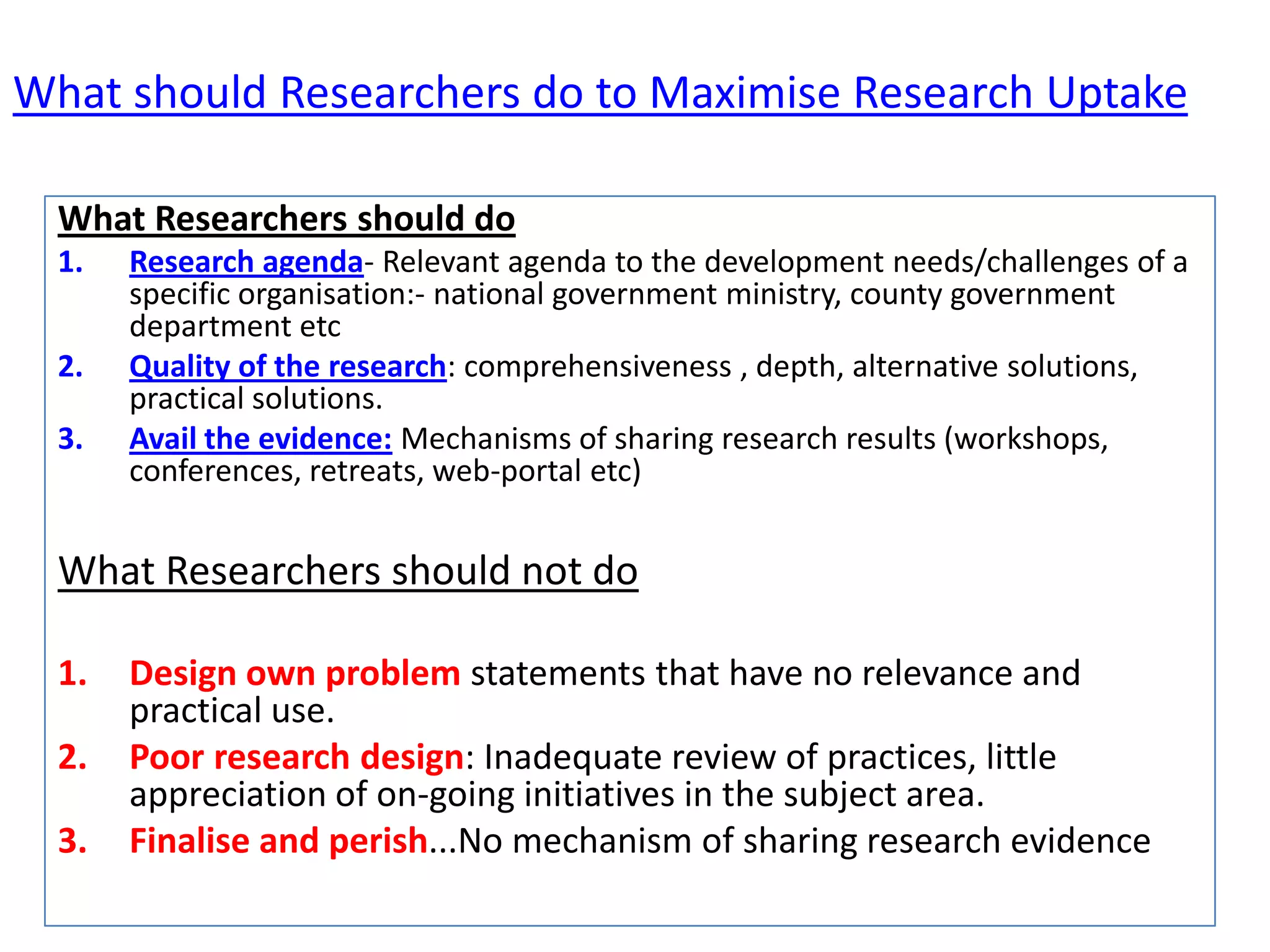
What should Researchers do to Maximise Research Uptake
What Researchers should do
1.
2.
3.

Research agenda- Relevant agenda to the development needs/challenges of a
specific organisation:- national government ministry, county government
department etc
Quality of the research: comprehensiveness , depth, alternative solutions,
practical solutions.
Avail the evidence: Mechanisms of sharing research results (workshops,
conferences, retreats, web-portal etc)

What Researchers should not do
1.
2.
3.

Design own problem statements that have no relevance and
practical use.
Poor research design: Inadequate review of practices, little
appreciation of on-going initiatives in the subject area.
Finalise and perish...No mechanism of sharing research evidence
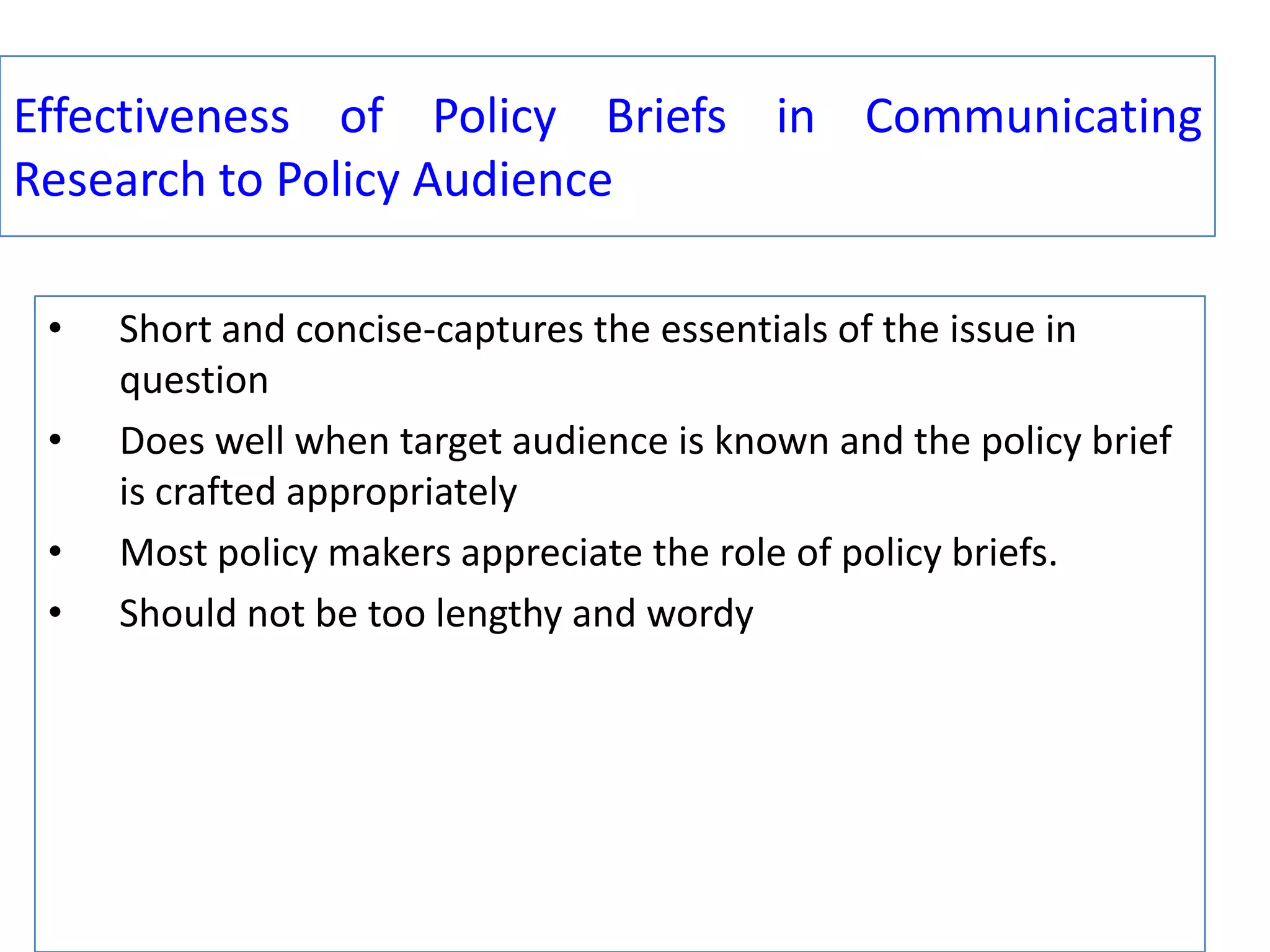
Effectiveness of Policy Briefs in Communicating
Research to Policy Audience
•

•
•
•

Short and concise-captures the essentials of the issue in
question
Does well when target audience is known and the policy brief
is crafted appropriately
Most policy makers appreciate the role of policy briefs.
Should not be too lengthy and wordy
END
THANK YOU
The National Economic and Social Council (NESC)
8th Floor, KICC Building
Harambee Avenue, Nairobi
Kenya
Tel 254 020 224787
www.nesc.go.ke

7

Policy panel - How to engage with policymakers

  • 1.
    POLICY BRIEF trainingworkshop Presentation by: Julius M. Muia, EBS, PhD, CPA(K), CPS(K), AKIB, ACIArb Executive Secretary, National Economic and Social Council “Training on Policy Briefs: Organised by African Economic Research Consortium” Safari Park Hotel, Nairobi 6th December 2013 1
  • 2.
    Practical challenges forpolicy makers in accessing and using research evidence for decision making 1. 2. 3. 4. 5. Research evidence is purpose driven: relevance and thrust of research -Researcher orientation (academic, think tank, policy institute) No organised repositories of research evidence-with proper indexing (universities, research agencies, public sector institutions, consultants etc) Rate and speed of change-international experiences and issues are quickly exported to nations.... Comprehensiveness and representativeness of evidence: study design: literature review, sample, testing methods, validation Sponsoring institution for the study/consultancy-bias? (information asymmetry challenge !!)
  • 3.
    Current Policy Opportunitiesfor Research to Inform and Influence public Policy 1. Economic Policy –global financial, economic and job crisis; financing development, mining and other natural resources 2. Governance –Devolution and constitutional reforms 3. Infrastructure (rail, roads, sea ports, telecoms, schools, sewer, 4. Social issues: urbanisation, affordable/adequate housing, equitable employment etc 5. Science and technology: Efficiency in production methods, delivery channels
  • 4.
    Where Research hasSuccessfully Engaged and Influenced Policy 1. Vision 2030-study tours, bench marking with best practices resulted in formulation of Vision 2030 (Oct 2006 to June 2008) 2. Studies on climate change (globally) led to Kyoto protocol and UN policy frameworks on carbon credits and policy to reduce emission of green house gases 3. NESC researches on unclaimed assets and dividends, bank accounts led to policy and law on the same. Now there is an Unclaimed Asset Authority! 4. DIFID/FSD studies on financial access in Kenya showed extent of unbanked Kenyans, led to growth of microfinance and bank lending to bottom of pyramid...later law on micro finance
  • 5.
    What should Researchersdo to Maximise Research Uptake What Researchers should do 1. 2. 3. Research agenda- Relevant agenda to the development needs/challenges of a specific organisation:- national government ministry, county government department etc Quality of the research: comprehensiveness , depth, alternative solutions, practical solutions. Avail the evidence: Mechanisms of sharing research results (workshops, conferences, retreats, web-portal etc) What Researchers should not do 1. 2. 3. Design own problem statements that have no relevance and practical use. Poor research design: Inadequate review of practices, little appreciation of on-going initiatives in the subject area. Finalise and perish...No mechanism of sharing research evidence
  • 6.
    Effectiveness of PolicyBriefs in Communicating Research to Policy Audience • • • • Short and concise-captures the essentials of the issue in question Does well when target audience is known and the policy brief is crafted appropriately Most policy makers appreciate the role of policy briefs. Should not be too lengthy and wordy
  • 7.
    END THANK YOU The NationalEconomic and Social Council (NESC) 8th Floor, KICC Building Harambee Avenue, Nairobi Kenya Tel 254 020 224787 www.nesc.go.ke 7