UNDERSTANDING POLICY PROCESSES
“The whole life of policy is a chaos of purposes and accidents. It is not at all a matter of the
rational implementation of the so-called decisions through selected strategies”
Edward Clay, 1984
There are no universal ‘best practices’ for influencing policy with research. Every circumstance is
different. Every situation presents its own challenges and opportunities for informing the
policymaking process and researchers need to be strategic about how they engage.
DIFFERENT THEORIES OF HOW EVIDENCE INFORMS POLICY
Conventional thinking on how evidence feeds into policy processes has changed significantly over
the last decade. The traditional ‘linear model’, where research evidence is commissioned to solve
a particular problem and communicated to policymakers, resulting in policy change, is recognised
as over-simplistic. This model assumes that researchers have sufficient access to full information in
determining the best policy option; that policy research is purely objective; and that the
policymakers will be convinced and make change as long as the evidence is credible. It also
ignores the political context and the many competing demands within which real-life policymaking
processes operatei
.
A more realistic viewpoint accepts the complexity of policymaking processes with research playing
only a minimal role. The iterative, ‘muddling through’ model recognises that policymakers are not
simply passive recipients of information but rather receive research-based information in the context
of their own agendas, and use it to expand their policy space. It recognises the limited time and
capacity they have to both seek out and use evidence; and explains the lack of closeness of the two
worlds partly as the failure of the two communities to keep up a constant flow of information and
ideas that would inform policy processes. It assumes that research feeds into policy over time
through discourse and learning.
A third approach centres more on discourse and the actors involved. Drawing on theories of actor
networks, epistemic communities, and policy entrepreneurs, there is greater attention given to
understanding social relations and individual-level interactions in how research interacts with the
policy process.
PRACTICAL CONSIDERATIONS FOR RESEARCHERS
It is important that you identify which part of the policymaking process you want to inform: this will
have consequences for the way that you present your research findings; the kinds of policy
messages that you develop (both implications of your research as well as policy recommendations
as appropriate); the communication tactics that you use; and the timing of your interventions.
Policymakers and researchers have very different notions of what is evidence: this means
communication between them is sometimes at cross purposes.
Vincent Cable, a Liberal Democrat MP and former Shadow Minister of Finance has said that policy
makers are practically incapable of using research-based evidence because of the 5 Ss: Speed –
they have to make decisions fast; Superficiality – they cover a wide brief; Spin – they have to stick
to a decision, at least for a reasonable period of time; Secrecy – many policy discussions have to
be held in secret; and Scientific Ignorance – few policy makers are scientists, and don’t
understand the scientific concept of testing a hypothesis.
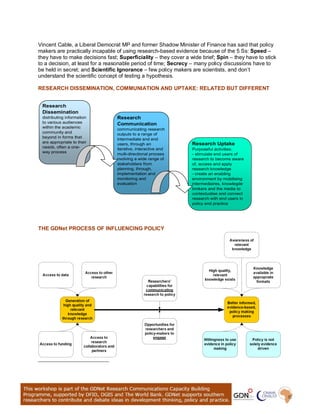
RESEARCH DISSEMINATION, COMMUNIATION AND UPTAKE: RELATED BUT DIFFERENT
THE GDNet PROCESS OF INFLUENCING POLICY
Research
Dissemination
distributing information
to various audiences
within the academic
community and
beyond in forms that
are appropriate to their
needs, often a one-
way process
Research
Communication
communicating research
outputs to a range of
intermediate and end
users, through an
iterative, interactive and
multi-directional process
nvolving a wide range of
stakeholders from
planning, through,
implementation and
monitoring and
evaluation
Research Uptake
Purposeful activities:
- stimulate end users of
research to become aware
of, access and apply
research knowledge
- create an enabling
environment by mobilising
intermediaires, knowlegde
brokers and the media to
contextualise and connect
research with end users in
policy and practice
WRITING POLICY BRIEFS
WHAT IS A POLICY BRIEF, AND WHY ARE THEY IMPORTANT?
Policy briefs are short summaries of research, used as a means to ‘unpack’ findings and
recommendations for audiences without specialist knowledge, and for those who simply don’t have
the time to read lots of long research documents.
Policy briefs provide an essential tool for bridging the research to policy divide. However, with every
piece of research there is a need to be clear about who the research is targeted at, and to think
strategically about how to reach your key audiences. Think about the best means of reaching your
audiences, and what channels are already open to you through the relationships you have built with
them and others.
IS WRITING AN EFFECTIVE POLICY BRIEF REALLY THAT DIFFICULT?
Learning to write effective policy briefs takes time and patience. Research may lose its ‘purity’ and
findings can be easily misrepresented through a poorly-written policy brief. Policy-makers, con-
strained by time and overwhelmed by various sources of information, are likely to make a snap
decision when choosing information to inform their decisions. This means that your brief must stand
out from the rest, in both its presentation and the clarity of content. You are trying to sell your
research, so be clear, and be heard!
TIPS FOR WRITING A POLICY BRIEF
Be Focused. All aspects of the policy brief (from the message to the layout) need to be clearly
focused on your target audience, (so ask yourself ‘How can my policy brief have the most possible
impact on this audience?’). Your argument must build on what they already know about a problem,
and then provide insight on what they don’t know. This provides a platform for you to introduce your
evidence on how the problem can be tackled.
Focus on the evidence. The common audience for a policy brief is not interested in the
research/analysis procedures conducted to produce the evidence, but are very interested to hear
different perspectives on a problem and potential solutions based on new evidence. A rational
argument is not enough and you must be able to back it up using evidence, and underline the
consequences of adopting particular alternatives.
Be practical and feasible. The policy brief is an action-oriented tool targeting policy practitioners.
As such, the brief must provide arguments based on what is actually happening in practice with a
particular policy, and propose recommendations which seem realistic to the target audience
Be Brief. To provide an adequately comprehensive but targeted argument within a limited space,
the focus of the brief needs to be limited to a particular problem or area of a problem. If your
research project has several elements don’t try to cover it all in one policy brief.
Get to the point. Your policy audience doesn’t have the time or inclination to read an in-depth 20-
page argument on a policy problem. Do not exceed 4-6 pages in length (i.e. usually not longer than
2,000 words).
Think about your language. This not only refers to using clear and simple language (i.e. not the
jargon and concepts of an academic discipline) but also to providing a well-explained and easy-to-
follow argument targeting a wide but knowledgeable audience.
Make the text accessible. Make it easy for your reader to read all the way through by subdividing
the text using clear descriptive titles as guides. Try to use the following structure as a guide
(suitable for a 2200 word/4 page policy brief):
PREPARATION
Who is your target audience?
What problem does your policy brief aim to address?
What is the core message of your brief?
WRITING THE BRIEF
Executive summary: [220 words max]
Introduction: [330 words max]
Methodology: [110-220 words max]
Results and conclusions: [660 words max]
References and other useful resources: [220 words max]
Be creative. The policy brief should catch the eye of the potential audience in order to create a
favourable impression (e.g. professional, innovative etc.). Think creatively about how you present
the information, e.g. use of colour, use of logos, photographs, slogans, illustrative quotes etc.
Make your policy brief travel. It’s not enough to simply write a policy brief and expect it to be read.
Put some energy behind it, engage with information intermediaries (whose job it is to access
research information and tailor it for different audiences), or go directly to policy makers and make
them aware of your policy brief. You could also explore using social media such as Twitter, Social
Bookmarking e.g. Delicious, Wikipedia and blogging to bring attention to your policy brief, but don’t
lose sight of your the real focus of audience!
COMMUNICATING EFFECTIVELY WITH YOU TARGET AUDIENCE
KENYA: OVERVIEW OF COMMUNICATION ENVIRONMENT
• Among media and ICT platforms, radio remains the most widely available, reaching directly into
more than 85 percent of Kenyan adults’ homes (according to the AudienceScapes survey)
• Mobile phones are increasingly widespread, but they have not yet reached the near-universal
coverage of radio
• Fewer than half of all adults can watch TV in their homes, and other ICTs such as computers and
MP3 players are available at home to only a tiny minority of Kenyans
• Urban/rural gap: Rural dwellers have significantly lower access to most media and ICT platforms
(Chart 1)
• Many regular viewers are evidently finding places to watch TV even though they do not have
direct access in their homes
• Although Kenyans already find ways to circumvent some barriers, other barriers remain (e.g. lack
of TV and electricity supply)
Use of Media and ICTs for Gathering News and Information
• Word-of-mouth sources (“friends and family” and “other people in the community”) are about as
important to survey respondents as are radio and television for staying informed
• Though mobile phones have become more accessible for general use, they are not widely used
for formal news collection via SMS services
• Institutional sources, such as government officials or literature produced by public agencies, are
also lower on the news and information totem pole for Kenyans surveyed
Level of Trustworthiness of Different Communication Tools
1. Mobile phones: relatively low level of trust - Possible constraints for development initiatives
based on mobile phones: expense of owing one; weak phone signals in some locations and
challenges of fixing broken phones
2. Internet: access remains limited especially in rural areas – main obstacle: lack of knowledge
about the internet
3. Radio: radio is an indispensable tool for delivering development information – 89% of Kenyan
adults get news and information from the radio on at least a weekly basis
4. TV: high level of trust in information received from TV – Constraints: TV sets are not ubiquitous
in Kenya; lack of TVs and electricity supply
5. Print Media: smaller audience than Radio and TV audiences / lower level of trust – Constraints:
costs and ability to read or understand newspapers
6. Word-of-Mouth: one of their most important and frequent sources of development in formation
BUT not very trustworthy
CONCLUSION
 Importance of analysing the audience for planning targeted communication, knowledge-
sharing or public education projects
 Learning about the information and communication preferences of specific, and how these
can guide effective development strategies
 Get a feel of where you need to place your information
 In Kenya the following are true and likely to be so for other African countries:
- An important aspect of word-of-mouth information networks is the roles played by new
"hubs" - people who tend to be at the center of such networks and are thus in a position to
transmit information more broadly and efficiently within a target group
- "opinion leaders" are considered to be one type of hub and are thus of potential interest to
development organisations as key local partners or champions in project efforts
- Opinion leaders can potentially help spread information and shape public opinion among a
wide audience - they are defined as respondents who said that people come to them "very
often" for opinions and advice about each issue
KEY RECOMMENDATIONS FOR AN EFFECTIVE COMMUNICATION
 Use structural formal channels: provide information through organised formal
communication channels. Informal networks should be considered complementary channels
 Timing is crucial: Provide information to policy actors as early in the policy formulation in
process as possible, but also strive to establish mechanisms that enable regular exchange of
information in the implementation and evaluation stages of the process
 Choose preferred formats: Provide policy input in writing (i.e. policy briefs, Press releases,
Op-Eds) and follow-up with face-to-face meetings, workshops and round table sessions if
possible
 Raise awareness: Use traditional media to raise awareness on relevant issues among the
general population
AudienceScapes is an interactive knowledge resource for the international development
community. It provides unique insights on how citizens and policymakers gather, share and use
information from all sources. For more information, visit http://www.audiencescapes.org/
PRESENTING COMPLEX DATA VISUALLY:
USING WEB-BASED TOOLS TO MAKE YOUR STATISTICS TRAVEL
Data and statistics are a powerful way to communicate development research.
Including data and statistics within research findings can enhance their impact, however, large
tables or spreadsheets of numbers take time to decipher and sometimes the true meaning behind
the data itself can be misinterpreted.
One option to prevent your data being misread is to present the figures visually in the form of
charts, graphs or even infographics. This will provide clarification and emphasis to your main points,
appeal to a number of learning styles and add impact and interest to your research findings.
There are now a plethora of online tools with which you can visualise data findings in an
interesting, accurate and arresting way. Here are some of the best:
 StatPlanet: this browser-based interactive data visualization and mapping application
allows you to create a wide range of visualizations, from simple Flash maps to more
advanced infographics.
http://www.sacmeq.org/statplanet/
 Xtimeline: allows you to create your own timelines of data.
http://www.xtimeline.com/index.aspx
 Gap Minder: this site created by Hans Rosling allows you to upload data and create an
interactive motion charts and graphs.
http://www.gapminder.org/upload-data/
 Many Eyes: created by IBM Research allows you to upload data in a range of very versatile
formats.
http://www-958.ibm.com/software/data/cognos/manyeyes/
 Creately: this is easy to use Online Diagramming software - purpose built for team
collaboration.
http://creately.com/
 Google Chart Tools: this application lets you include constantly changing research data
sourced online. Google has also released Fusion Tables where you can share, discuss and
track your charts and graphs with specific people online.
http://code.google.com/apis/chart/
 Hohli: this online chart maker is simple to use and allows you to create a range of colourful
pie, line, scatter, radar and bar charts.
http://charts.hohli.com/
 Tagcloud: allows you to upload texts and highlight the most common concepts. The clouds
can be exported as images and inserted in a website or power point presentation.
http://tagcrowd.com/
 Wordle: similar to tagcloud, this application lets you create images out of key phrases and
words relevant to your research, great for using in PowerPoint presentations.
http://www.wordle.net/
 Tableau: a free Windows-only software for creating colourful data visualisations.
http://www.tableausoftware.com/public/
To see how other researchers are presenting work in new innovative and visual ways see:
 Information is Beautiful: David McCandless, an “independent data journalist and
information designer interested in how designed information can help us understand the
world.”
http://www.informationisbeautiful.net/
 Flowing Data: This blog explores how “designers, statisticians and computer scientists are
using data to understand ourselves better.”
http://flowingdata.com/
 Afrographique: Ivan Colic’s blog “aims to collect as much data as possible with the aim of
presenting the information in an exciting and digestible format to all.”
http://afrographique.tumblr.com/

Top Tips_Research Communications: Effective Communication for Southern Researchers

  • 1.
    UNDERSTANDING POLICY PROCESSES “Thewhole life of policy is a chaos of purposes and accidents. It is not at all a matter of the rational implementation of the so-called decisions through selected strategies” Edward Clay, 1984 There are no universal ‘best practices’ for influencing policy with research. Every circumstance is different. Every situation presents its own challenges and opportunities for informing the policymaking process and researchers need to be strategic about how they engage. DIFFERENT THEORIES OF HOW EVIDENCE INFORMS POLICY Conventional thinking on how evidence feeds into policy processes has changed significantly over the last decade. The traditional ‘linear model’, where research evidence is commissioned to solve a particular problem and communicated to policymakers, resulting in policy change, is recognised as over-simplistic. This model assumes that researchers have sufficient access to full information in determining the best policy option; that policy research is purely objective; and that the policymakers will be convinced and make change as long as the evidence is credible. It also ignores the political context and the many competing demands within which real-life policymaking processes operatei . A more realistic viewpoint accepts the complexity of policymaking processes with research playing only a minimal role. The iterative, ‘muddling through’ model recognises that policymakers are not simply passive recipients of information but rather receive research-based information in the context of their own agendas, and use it to expand their policy space. It recognises the limited time and capacity they have to both seek out and use evidence; and explains the lack of closeness of the two worlds partly as the failure of the two communities to keep up a constant flow of information and ideas that would inform policy processes. It assumes that research feeds into policy over time through discourse and learning. A third approach centres more on discourse and the actors involved. Drawing on theories of actor networks, epistemic communities, and policy entrepreneurs, there is greater attention given to understanding social relations and individual-level interactions in how research interacts with the policy process. PRACTICAL CONSIDERATIONS FOR RESEARCHERS It is important that you identify which part of the policymaking process you want to inform: this will have consequences for the way that you present your research findings; the kinds of policy messages that you develop (both implications of your research as well as policy recommendations as appropriate); the communication tactics that you use; and the timing of your interventions. Policymakers and researchers have very different notions of what is evidence: this means communication between them is sometimes at cross purposes.
  • 2.
    Vincent Cable, aLiberal Democrat MP and former Shadow Minister of Finance has said that policy makers are practically incapable of using research-based evidence because of the 5 Ss: Speed – they have to make decisions fast; Superficiality – they cover a wide brief; Spin – they have to stick to a decision, at least for a reasonable period of time; Secrecy – many policy discussions have to be held in secret; and Scientific Ignorance – few policy makers are scientists, and don’t understand the scientific concept of testing a hypothesis. RESEARCH DISSEMINATION, COMMUNIATION AND UPTAKE: RELATED BUT DIFFERENT THE GDNet PROCESS OF INFLUENCING POLICY Research Dissemination distributing information to various audiences within the academic community and beyond in forms that are appropriate to their needs, often a one- way process Research Communication communicating research outputs to a range of intermediate and end users, through an iterative, interactive and multi-directional process nvolving a wide range of stakeholders from planning, through, implementation and monitoring and evaluation Research Uptake Purposeful activities: - stimulate end users of research to become aware of, access and apply research knowledge - create an enabling environment by mobilising intermediaires, knowlegde brokers and the media to contextualise and connect research with end users in policy and practice
  • 3.
    WRITING POLICY BRIEFS WHATIS A POLICY BRIEF, AND WHY ARE THEY IMPORTANT? Policy briefs are short summaries of research, used as a means to ‘unpack’ findings and recommendations for audiences without specialist knowledge, and for those who simply don’t have the time to read lots of long research documents. Policy briefs provide an essential tool for bridging the research to policy divide. However, with every piece of research there is a need to be clear about who the research is targeted at, and to think strategically about how to reach your key audiences. Think about the best means of reaching your audiences, and what channels are already open to you through the relationships you have built with them and others. IS WRITING AN EFFECTIVE POLICY BRIEF REALLY THAT DIFFICULT? Learning to write effective policy briefs takes time and patience. Research may lose its ‘purity’ and findings can be easily misrepresented through a poorly-written policy brief. Policy-makers, con- strained by time and overwhelmed by various sources of information, are likely to make a snap decision when choosing information to inform their decisions. This means that your brief must stand out from the rest, in both its presentation and the clarity of content. You are trying to sell your research, so be clear, and be heard! TIPS FOR WRITING A POLICY BRIEF Be Focused. All aspects of the policy brief (from the message to the layout) need to be clearly focused on your target audience, (so ask yourself ‘How can my policy brief have the most possible impact on this audience?’). Your argument must build on what they already know about a problem, and then provide insight on what they don’t know. This provides a platform for you to introduce your evidence on how the problem can be tackled. Focus on the evidence. The common audience for a policy brief is not interested in the research/analysis procedures conducted to produce the evidence, but are very interested to hear different perspectives on a problem and potential solutions based on new evidence. A rational argument is not enough and you must be able to back it up using evidence, and underline the consequences of adopting particular alternatives. Be practical and feasible. The policy brief is an action-oriented tool targeting policy practitioners. As such, the brief must provide arguments based on what is actually happening in practice with a particular policy, and propose recommendations which seem realistic to the target audience
  • 4.
    Be Brief. Toprovide an adequately comprehensive but targeted argument within a limited space, the focus of the brief needs to be limited to a particular problem or area of a problem. If your research project has several elements don’t try to cover it all in one policy brief. Get to the point. Your policy audience doesn’t have the time or inclination to read an in-depth 20- page argument on a policy problem. Do not exceed 4-6 pages in length (i.e. usually not longer than 2,000 words). Think about your language. This not only refers to using clear and simple language (i.e. not the jargon and concepts of an academic discipline) but also to providing a well-explained and easy-to- follow argument targeting a wide but knowledgeable audience. Make the text accessible. Make it easy for your reader to read all the way through by subdividing the text using clear descriptive titles as guides. Try to use the following structure as a guide (suitable for a 2200 word/4 page policy brief): PREPARATION Who is your target audience? What problem does your policy brief aim to address? What is the core message of your brief? WRITING THE BRIEF Executive summary: [220 words max] Introduction: [330 words max] Methodology: [110-220 words max] Results and conclusions: [660 words max] References and other useful resources: [220 words max] Be creative. The policy brief should catch the eye of the potential audience in order to create a favourable impression (e.g. professional, innovative etc.). Think creatively about how you present the information, e.g. use of colour, use of logos, photographs, slogans, illustrative quotes etc. Make your policy brief travel. It’s not enough to simply write a policy brief and expect it to be read. Put some energy behind it, engage with information intermediaries (whose job it is to access research information and tailor it for different audiences), or go directly to policy makers and make them aware of your policy brief. You could also explore using social media such as Twitter, Social Bookmarking e.g. Delicious, Wikipedia and blogging to bring attention to your policy brief, but don’t lose sight of your the real focus of audience!
  • 5.
    COMMUNICATING EFFECTIVELY WITHYOU TARGET AUDIENCE KENYA: OVERVIEW OF COMMUNICATION ENVIRONMENT • Among media and ICT platforms, radio remains the most widely available, reaching directly into more than 85 percent of Kenyan adults’ homes (according to the AudienceScapes survey) • Mobile phones are increasingly widespread, but they have not yet reached the near-universal coverage of radio • Fewer than half of all adults can watch TV in their homes, and other ICTs such as computers and MP3 players are available at home to only a tiny minority of Kenyans • Urban/rural gap: Rural dwellers have significantly lower access to most media and ICT platforms (Chart 1) • Many regular viewers are evidently finding places to watch TV even though they do not have direct access in their homes • Although Kenyans already find ways to circumvent some barriers, other barriers remain (e.g. lack of TV and electricity supply) Use of Media and ICTs for Gathering News and Information • Word-of-mouth sources (“friends and family” and “other people in the community”) are about as important to survey respondents as are radio and television for staying informed • Though mobile phones have become more accessible for general use, they are not widely used for formal news collection via SMS services • Institutional sources, such as government officials or literature produced by public agencies, are also lower on the news and information totem pole for Kenyans surveyed Level of Trustworthiness of Different Communication Tools 1. Mobile phones: relatively low level of trust - Possible constraints for development initiatives based on mobile phones: expense of owing one; weak phone signals in some locations and challenges of fixing broken phones 2. Internet: access remains limited especially in rural areas – main obstacle: lack of knowledge about the internet 3. Radio: radio is an indispensable tool for delivering development information – 89% of Kenyan adults get news and information from the radio on at least a weekly basis 4. TV: high level of trust in information received from TV – Constraints: TV sets are not ubiquitous in Kenya; lack of TVs and electricity supply 5. Print Media: smaller audience than Radio and TV audiences / lower level of trust – Constraints: costs and ability to read or understand newspapers 6. Word-of-Mouth: one of their most important and frequent sources of development in formation BUT not very trustworthy
  • 6.
    CONCLUSION  Importance ofanalysing the audience for planning targeted communication, knowledge- sharing or public education projects  Learning about the information and communication preferences of specific, and how these can guide effective development strategies  Get a feel of where you need to place your information  In Kenya the following are true and likely to be so for other African countries: - An important aspect of word-of-mouth information networks is the roles played by new "hubs" - people who tend to be at the center of such networks and are thus in a position to transmit information more broadly and efficiently within a target group - "opinion leaders" are considered to be one type of hub and are thus of potential interest to development organisations as key local partners or champions in project efforts - Opinion leaders can potentially help spread information and shape public opinion among a wide audience - they are defined as respondents who said that people come to them "very often" for opinions and advice about each issue KEY RECOMMENDATIONS FOR AN EFFECTIVE COMMUNICATION  Use structural formal channels: provide information through organised formal communication channels. Informal networks should be considered complementary channels  Timing is crucial: Provide information to policy actors as early in the policy formulation in process as possible, but also strive to establish mechanisms that enable regular exchange of information in the implementation and evaluation stages of the process  Choose preferred formats: Provide policy input in writing (i.e. policy briefs, Press releases, Op-Eds) and follow-up with face-to-face meetings, workshops and round table sessions if possible  Raise awareness: Use traditional media to raise awareness on relevant issues among the general population AudienceScapes is an interactive knowledge resource for the international development community. It provides unique insights on how citizens and policymakers gather, share and use information from all sources. For more information, visit http://www.audiencescapes.org/
  • 7.
    PRESENTING COMPLEX DATAVISUALLY: USING WEB-BASED TOOLS TO MAKE YOUR STATISTICS TRAVEL Data and statistics are a powerful way to communicate development research. Including data and statistics within research findings can enhance their impact, however, large tables or spreadsheets of numbers take time to decipher and sometimes the true meaning behind the data itself can be misinterpreted. One option to prevent your data being misread is to present the figures visually in the form of charts, graphs or even infographics. This will provide clarification and emphasis to your main points, appeal to a number of learning styles and add impact and interest to your research findings. There are now a plethora of online tools with which you can visualise data findings in an interesting, accurate and arresting way. Here are some of the best:  StatPlanet: this browser-based interactive data visualization and mapping application allows you to create a wide range of visualizations, from simple Flash maps to more advanced infographics. http://www.sacmeq.org/statplanet/  Xtimeline: allows you to create your own timelines of data. http://www.xtimeline.com/index.aspx  Gap Minder: this site created by Hans Rosling allows you to upload data and create an interactive motion charts and graphs. http://www.gapminder.org/upload-data/  Many Eyes: created by IBM Research allows you to upload data in a range of very versatile formats. http://www-958.ibm.com/software/data/cognos/manyeyes/
  • 8.
     Creately: thisis easy to use Online Diagramming software - purpose built for team collaboration. http://creately.com/  Google Chart Tools: this application lets you include constantly changing research data sourced online. Google has also released Fusion Tables where you can share, discuss and track your charts and graphs with specific people online. http://code.google.com/apis/chart/  Hohli: this online chart maker is simple to use and allows you to create a range of colourful pie, line, scatter, radar and bar charts. http://charts.hohli.com/  Tagcloud: allows you to upload texts and highlight the most common concepts. The clouds can be exported as images and inserted in a website or power point presentation. http://tagcrowd.com/  Wordle: similar to tagcloud, this application lets you create images out of key phrases and words relevant to your research, great for using in PowerPoint presentations. http://www.wordle.net/  Tableau: a free Windows-only software for creating colourful data visualisations. http://www.tableausoftware.com/public/ To see how other researchers are presenting work in new innovative and visual ways see:  Information is Beautiful: David McCandless, an “independent data journalist and information designer interested in how designed information can help us understand the world.” http://www.informationisbeautiful.net/  Flowing Data: This blog explores how “designers, statisticians and computer scientists are using data to understand ourselves better.” http://flowingdata.com/  Afrographique: Ivan Colic’s blog “aims to collect as much data as possible with the aim of presenting the information in an exciting and digestible format to all.” http://afrographique.tumblr.com/