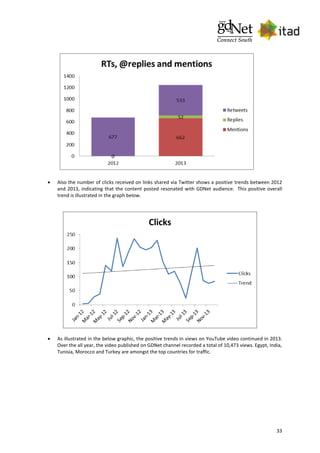
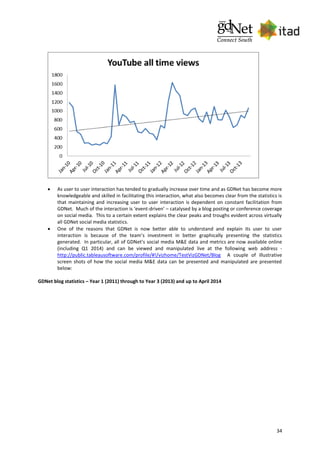
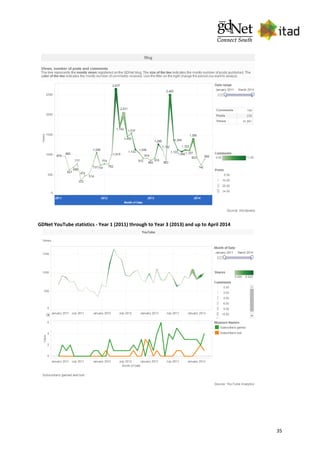
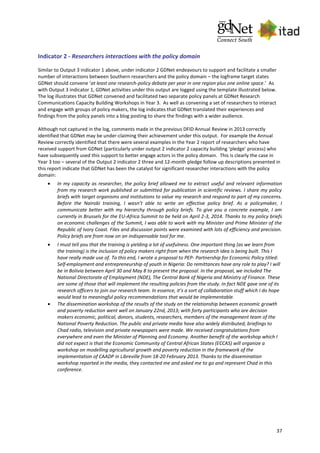
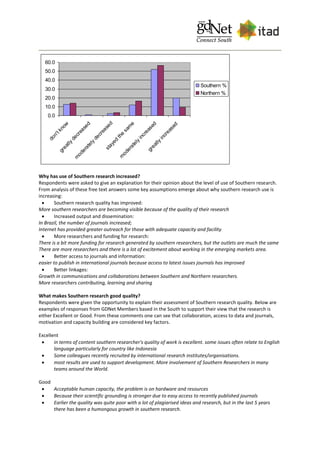
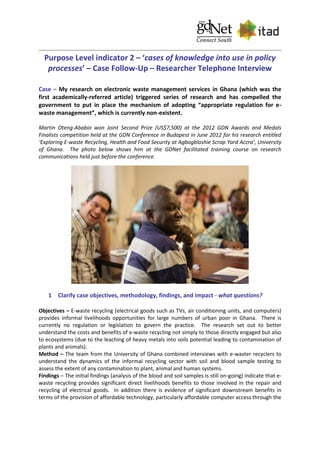
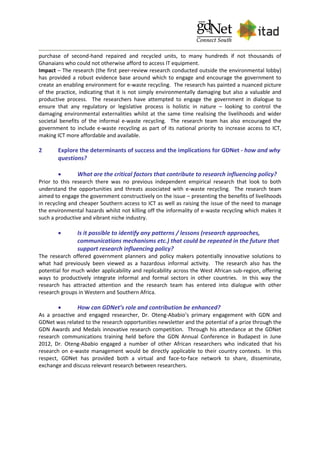
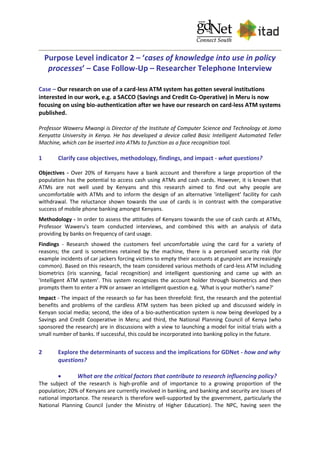
GDNet M&E Report 2014 – Year 3
Robbie Gregorowski, Jodie Ellis and Cheryl Brown
May 2014
i
Table of Contents
Executive Summary.................................................................................................................... ii
Introduction................................................................................................................................1
Outcome Level – Diverse research and policy audiences make better use of development
research from the global south..................................................................................................2
Output 1 - Southern research better informed by current ideas and knowledge ....................7
Output 2 - Researchers better able to communicate their research to policy........................18
Output 3 - Knowledge networking between researchers and with policy actors increased...30
Output 4 - Lessons about knowledge brokering best practice in the global south learnt and
communicated..........................................................................................................................39
Annexes (Volume II)
Annex 1: GDNet Year 3 web statistics
Annex 2: GDNet user base annual web survey questionnaire – Year 3
Annex 3: GDNet user base annual web survey results –Year 3
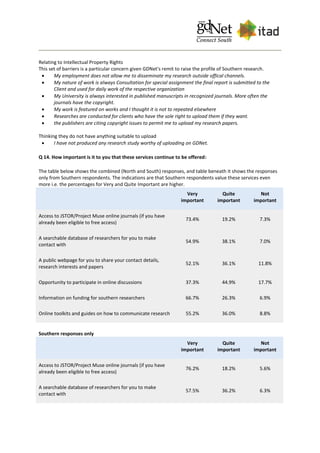
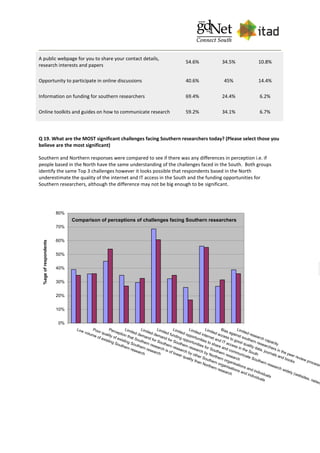
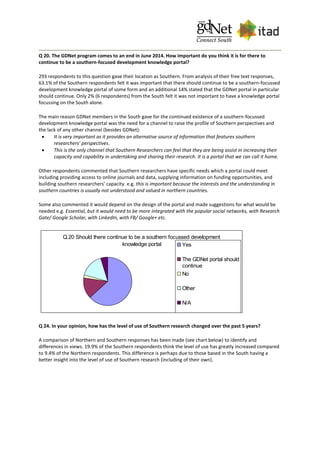
Annex 4: Analysis of web survey responses from GDNet users from the Global South
Annex 5: Cases of knowledge into use in the policy process – Baseline – Year 2 cases
Annex 6: Output 3 indicator 1 – GDNet ‘user base’ interaction – log
Annex 7: GDNet Social Media Annual Stat Report for Year 3 (2013)
Annex 8: Output 4 indicator 1 – Generation of best practice lessons – log
Annex 9: Participants’ Policy Brief Analysis
Annex 10: Checklist for editorial review of participants' policy briefs
ii
Executive Summary
This document provides the annual progress report (Year 3) and update to GDNet’s Baseline and M&E
Framework. The report covers the period January to December 2013, with data presented up to April 2014
where it is relevant and available. The document is structured according to the GDNet logframe – with
separate chapters from the Outcome-level down through Outputs 1 to 4. A box summarising the progress
against the logframe indicators in Year 3 is provided at the beginning of each chapter.
GDNet will close in June 2014. Consequently, in the second half of Year 3 the GDNet have focussed on three
priorities:
 A well-ordered closure of the programme, ensuring that the targets set for the programme in the
logframe are either met or exceeded;
 Documenting the lessons on knowledge brokering best practice they have generated over the life of
the programme; and,
 Ensuring that GDNet leaves behind an accessible and sustainable legacy.
GDNet has been successful in meeting all three priorities.
A well-ordered closure of the programme
Below is a summary of the progress made against the final set of indicator targets set out in the logframe:
 Outcome Indicator 1 - Exceeded target by 9 percentage points
 Outcome Indicator 2 – Met target
 Output 1 Indicator 1 - Met target. Exceeded target in terms of use. Met target in terms of satisfaction.
 Output 1 Indicator 2 - Met target
 Output 2 Indicator 1 – Confidence – Exceeded target / Ability – Met target
 Output 2 Indicator 2 – Met target
 Output 3 Indicator 1 – User to user interaction - Met target / Events – Met target
 Output 3 Indicator 2 – Exceeded target
 Output 4 Indicator 1 – On track to meet target (June 2014)
 Output 4 Indicator 2 - On track to meet target (June 2014)
GDNet has met or exceeded all of its January 2014 logframe targets and is on track to meet is June 2014
targets. A short elaboration of each outcome and indicator is provided below:
Outcome Indicator 1 – Southern researchers’ use of other southern research in own research
The GDNet user base annual web survey represents a key component of the M&E approach and has been
conducted annually since the baseline. Although the response rate is not particularly low for web surveys of its
type – attempting to engage what is a diffuse and generally passive user group - reasons for the low response
rate may relate to the general proliferation of online surveys (‘survey fatigue’) which for Year 3 cannot have
been helped by the user base being informed that the programme is closing in June 2014 and hence having
little incentive to contribute.
Target (January 2014): At least 60% of Southern researchers consulted by the programme use Southern
research in their own research to a moderate or great extent.
Year 3 Progress: - 69% of respondents use Southern research to a great or moderate extent, an increase of 5
percentage points from Year 2. Exceeded Target by 9 percentage points.
iii
The Year 3 web survey provided a number of interesting insights into the nature and perceptions of Southern
research by Southern users and how they tend to combine use of Northern and Southern research in a
complementary manner. From analysis of the survey data, it is possible that women are less likely than men to
distinguish between Northern and Southern research but the difference is not enough to be significant (given
the smaller sample size of responses from women).
Outcome Indicator 2 – Cases of knowledge into use in policy processes
No cases were developed in Year 3 but existing cases were updated. Reflecting on the case development
process over three years illustrates that GDNet has engaged a wealth of innovative, informed and highly
motivated researchers. The cases GDNet developed highlight what makes Southern research unique – its
practicality and innovativeness - something that more traditional Western research may do well to learn from.
Target (January 2014): A portfolio of 20 up-to-date cases of knowledge into use in the policy process (5 per
year)
Year 3 Progress: 21 cases developed, validated and updated throughout the life of the programme. Met target.
As well as providing GDNet with an interesting insight into the nature of research to policy processes being
pursued by their user base, the cases also offer a deep understanding of the nature of Southern research and
how Southern research can and does inform policy and practice.
Output 1 Indicator 1 – Level of use of and satisfaction with GDNet research-orientated online services
The M&E of the level of use of, and satisfaction with research-orientated online services combines GDNet’s
monthly web statistics with data generated from the annual GDNet user base web survey.
Target (January 2014): 20 % cumulative increase in use.
Progress: GDNet website receiving an average of 40,103 visitors per month in 2013; equivalent to just over 16%
year-on-year increase in use from 2011 to 2013, or a 32% cumulative increase in use. Exceeded Target.
Target (January 2014): Maintain high level of satisfaction.
Progress: High proportion of members continue to report satisfaction with each of GDNet's individual services
and in most cases satisfaction has increased e.g. Knowledgebase of online papers rated by 69.4% of
respondents and provision of online journals by 71% of respondents as extremely or moderately useful (an
increase of 8% on Year 2 in both cases). Met Target.
There is a significant difference between men and women in use of GDNet in terms of how often they visit the
GDNet website. 56% of men visit the GDNet website at least once a month, compared to only 38% women.
There does not seem to be any major differences in levels of satisfaction with GDNet services by male and
female users, with the exception the GDNet YouTube channel. Of those who expressed an opinion, only 8.4%
of men found it not at all useful, compared to 37.3% of women.
Output 1 Indicator 2 – Level of use of and satisfaction with themed services
The assessment of themed services is based on the triangulation between three sources of data: how GDNet
Members report their use in terms of frequency and satisfaction (as captured in the survey), number of hits to
the Thematic Windows pages, and how many Visits are recorded to the Thematic Landing Pages (taken from
GDNet's webstats).
Target (January 2014): 10% cumulative increase in use.
iv
Year 3 Progress: 39.1% of survey respondents report using Thematic Windows occasionally or frequently, an
increase of 3.2 points from the 2012 baseline. Average monthly hits for Thematic Windows pages are 10,491 in
2013 compared to 8,132 in 2012, an increase of 22%. Met Target.
Target (January 2014): Maintain high level of satisfaction.
Year 3 Progress: Thematic Windows are described as ‘extremely’ or ‘moderately’ useful by 42.8% of
respondents, no change from 2012. Met Target.
There is no significant difference between men and women in terms of use of, or satisfaction with, GDNet's
Thematic Windows.
Output 2 Indicator 1 – Researchers’ confidence and ability to communicate their research – immediately
following capacity building effort
In Year 3 the results of GDNet’s capacity building efforts were disaggregated by gender for the first time. And
in response to DFID’s feedback in the Year 2 Annual Review, a method of assessing ability based on a
systematic desk review of Policy Briefs was conducted
Target (January 2014): Consistent 30-40 % increase in confidence at the end of each workshop regardless of
starting point. Expect to see year-on-year improvement on value-added in workshops
Year 3 Progress: Overall increase of 52%. By gender: 43% average increase for male participants, 74% average
increase for female participants. Exceeded Target.
Target (January 2014): Consistent 50–60 % increase in ability at the end of each workshop regardless of starting
point. Expect to see year-on-year improvement on value-added in workshops
Year 3 Progress: Overall increase of 57%. By gender: 48% average increase for male participants, 84% average
increase for female participants. Met Target.
Target (January 2014): Increase in score awarded to written policy briefs by experts blinded to whether policy
brief was written pre or post training
Year 3 Progress: Quality of participants' policy briefs increase, on average, from a score of 1.8 to 3.0 out of 6
after a GDNet capacity building effort (a 64% increase). If the criterion relating to length is excluded, the
average increase is from 1.6 to 2.2 (a 39% increase). Met Target.
Disaggregating the results by gender reveals that confidence and ability increases significantly more amongst
women than men.
Output 2 Indicator 2 – Researchers’ confidence and ability to communicate their research – sustainability of
capacity building effort
Perhaps unsurprisingly researcher response rates after 12-months are low and those that do respond tend to
have a positive story to tell. However, the pledge cases presented are illustrative of sustainable change as a
result of a capacity building effort.
Target (January 2014): Rich portfolio of examples of researchers’ communications confidence and ability across
a range of sectors and regions.
v
Year 3 Progress: A third set of ‘pledge’ cases were developed in Year 3 from GDNet workshops 10-13. An
additional set of five Year 2 pledges were followed up after 12 months. In total GDNet has generated 3 and 12-
month pledge follow from 15 researchers. Met target.
Several of the pledge cases developed point to researcher interaction with the policy domain as a direct result
of GDNet support and hence can be captured and claimed under output 3 indictor 2.
Output 3 Indicator 1 – GDNet ‘user base’ interaction
In Year 3 GDNet has enhanced their focus on and support to user to user interaction. To do this they have
invested in better understanding and graphically presenting GDNet’s relevant Web 2.0 and social media usage
statistics as well as maintaining the user base interaction log template approach developed in Year 2. All of
GDNet’s social media M&E data and metrics are now available online (including Q1 2014) and can be viewed
and manipulated live at the following web address -
http://public.tableausoftware.com/profile/#!/vizhome/TestVizGDNet/Blog
Target (June 2014): 20% cumulative increase in user base interaction on spaces and platforms facilitated by
GDNet
Year 3 Progress: Indicators of user to user interaction indicate cumulative increases in interaction exceeding
20% - comments on blog postings increased by almost 50% between Year 2 and Year 3. Overall GDNet to user
interaction has also either been maintained or increased - by end of 2013, the number of followers on Twitter
reached 1941 followers (an increase of 541 followers throughout the year). This is an annual increase of 38.6%.
Target met.
Target (June 2014): Number of debates convened
Year 3 Progress: Throughout Year 3, the log template illustrates that GDNet has facilitated and recorded 22
discrete user base interaction ‘events’ of varying types, scales and formats – conferences, workshops,
meetings, knowledge product launches, and online courses. This has resulted in many hundreds of user to user
‘debates’. Target met.
Output 3 Indicator 2 – Researchers interactions with the policy domain
GDNet endeavours to support and facilitate a small number of interactions between Southern researchers and
the policy domain. The log designed to capture the nature of this interaction illustrates that GDNet convened
and facilitated two separate policy panels at GDNet Research Communications Capacity Building Workshops in
Year 3.
Target (June 2014): At least one research-policy debate per year in one region plus one online space
Year 3 Progress: GDNet convened and facilitated two separate policy panels at GDNet Research
Communications Capacity Building Workshops in Year 3. In addition, several of the Output 2 indicator 2 three
and 12-month ‘pledge’ follow up statements presented indicate that GDNet has been the catalyst for
significant researcher interactions with the policy domain. Target exceeded.
Comments made in the previous DFID Annual Review in 2013 correctly identified that GDNet may be under-
claiming their achievement under this output by not recognising researcher interaction with policy makers
catalysed by GDNet through output 2 training and capacity building support. This is clearly the case in Year 3
too – several of the Output 2 indicator 2 three and 12-month pledge follow up descriptions presented in this
report indicate that GDNet has been the catalyst for significant researcher interactions with the policy domain.
vi
Output 4 Indicator 1 – Generation of best practice lessons
Output 4 focuses on the expertise and experience generated by the GDNet team as experts in facilitating,
convening and, knowledge brokering in the Global South. GDNet have established a process to routinely log
and reflect on knowledge brokering best practice in order to generate lessons.
Target (June 2014): Four GDNet best practice products
Year 3 Progress: Reflective interviews and discussions have been used to generate source material. Content for
four short learning publications has been drafted. Outline produced for Legacy Publication. On Track to Meet
Target.
Most of the Legacy Publication content is dependent on the four short publications and the M&E Report being
produced. Peer response mechanism being discussed with partners e.g. e-discussion on Knowledge Brokers
Forum with GDNet's publications as stimulus material.
Output 4 Indicator 2 - Communication of lessons
GDNet is responsible for communicating the best practice lessons generated through the reflective activities in
order to share the knowledge and expertise they have developed with a wider audience. A record of the
communication of the best practice lessons is held in a log.
Target (June 2014): Dissemination plan for GDNet best practice products and other learning publications, for
January 2014 to June 2014.
Year 3 Progress: Dissemination plan has been produced pending confirmation of peer response mechanism
described above. Several examples identified of communication and uptake of existing GDNet lessons since
Year 2 M&E Report including citations and sharing at workshops. On Track to Meet Target.
Due to GDNet program closure, dissemination plan focus has shifted to ensuring publications are sent directly
to intermediaries and remain available online beyond June 2014.
1
Introduction
This document provides the annual progress report (Year 3) and update to GDNet’s Baseline and M&E
Framework. The document is structured according to the GDNet logframe – with separate chapters from the
Purpose-level down through Outputs 1 to 4. Each Chapter is structured as follows:
 Year 3 summary – A clear summary statement of progress for each output indicator for comparison
against the baseline, Year 1 and Year 2, and the relevant milestone. The statement is followed by a
more detailed elaboration of the Year 3 M&E data generated and an analysis of its implications.
 M&E approach summary – A very brief explanation of the approach and method adopted to generate
the data for each output indicator. Readers should refer to the 2011 GDNet Baseline and M&E
Framework for a more detailed account of how the M&E framework was designed and the methods
adopted.
 Data management plan – Setting out the on-going M&E roles and responsibilities within the GDNet
team.
 Evidence base – Providing detailed summaries of the relevant data used to support each output
indicator – typically web statistics, web users survey, log templates, and interviews.
Unless otherwise stated, Year 3 refers to the period January to December 2013. The GDNet M&E baseline was
established in December 2010. GDNet’s M&E is reviewed and reported on an annual reporting cycle according
to the calendar year January to December as follows:
Logframe M&E Framework
Baseline Baseline – est. December 2010
Milestone 1 (2011) Year 1 – January to December 2011
Milestone 2 (2012) Year 2 – January to December 2012
Target (2014) Year 3 – January to December 2013 with
data and analysis provided up to April
2014 where available and feasible
2
Outcome Level – Diverse research and policy audiences make better
use of development research from the global south
Progress against logframe indicators
Indicator 1 - Southern researchers’ use of other southern research in own research
Target (January 2014): At least 60% of Southern researchers consulted by the programme
use Southern research in their own research to a moderate or great extent
Progress: - 69% of respondents use Southern research to a great or moderate extent, an
increase of 5 percentage points from Year 2. Exceeded Target by 9 percentage points.
Notes: The Year 3 web survey provided a number of interesting insights into the nature and
perceptions of Southern research by Southern users and how they tend to combine use of
Northern and Southern research in a complementary manner. From analysis of the survey
data, it is possible that women are less likely than men to distinguish between Northern and
Southern research but the difference is not enough to be significant (given the smaller
sample size of responses from women).
Comments on M&E approach: The GDNet user base annual web survey represents a key
component of the M&E approach and has been conducted annually since the baseline.
Although the response rate is not particularly low for web surveys of its type – attempting to
engage what is a diffuse and generally passive user group - reasons for the low response rate
may relate to the general proliferation of online surveys (‘survey fatigue’) which for Year 3
cannot have been helped by the user base being informed that the programme is closing in
June 2014 and hence having little incentive to contribute.
Indicator 2 - Cases of knowledge into use in policy processes
Target (January 2014): A portfolio of 20 up-to-date cases of knowledge into use in the policy
process (5 per year)
Progress: 21 cases developed, validated and updated throughout the life of the programme.
Met Target.
Notes: As well as providing GDNet with an interesting insight into the nature of research to
policy processes being pursued by their user base, the cases also offer a deep understanding
of the nature of Southern research and how Southern research can and does inform policy
and practice.
Comments on M&E approach: No cases were developed in Year 3 but existing cases were
updated. Reflecting on the case development process over three years illustrates that GDNet
has engaged a wealth of innovative, informed and highly motivated researchers. The cases
GDNet developed highlight what makes Southern research unique – its practicality and
innovativeness - something that more traditional Western research may do well to learn
from.
3
Indicator 1 – Southern researchers’ use of other southern research in own research
GDNet user base web survey results – Surveyed using the same format as the baseline, Year 1 and Year 2, a
number of questions in the web survey provide an indication of the level of use of Southern research. Further
details and analysis of the Year 3 web survey are provided in Annex 4. Asked to what extent Southern
researchers use Southern research in their own work, 69% of respondents claimed that Southern research was
used to a great or moderate extent (See Annex 3 question 26). This represents a 5% increase on the Year 2,
Year 1 and baseline figures which all approximately 64%. When asked to describe the type of research that
they read, the most common response researchers gave is that they do not distinguish between Northern and
Southern research (34%) (See Annex 3 question 27). However, the next biggest group (28%) believe they read
more Northern than Southern research, followed by 25% who believe they read the same amount of Southern
and Northern research. These results are very similar to the baseline, Year 1, and Year 2 results.
GDNet Web Survey – Year 3
Introduction - The GDNet user base annual web survey represents a key component of the M&E approach and
has been conducted annually since the baseline. It provides a range of data to support reporting against GDNet
outcome, output 1 and output 2 indicators. This is the fourth time that the survey has been conducted, since
the baseline was carried out in 2010. A detailed analysis of the Year 3 results is presented in Annex 4.
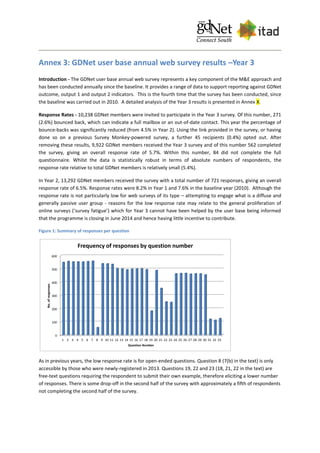
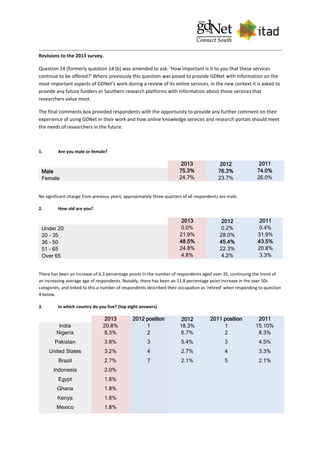
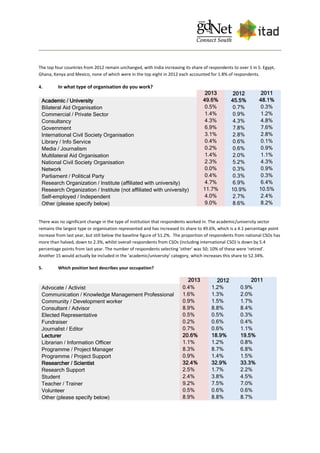
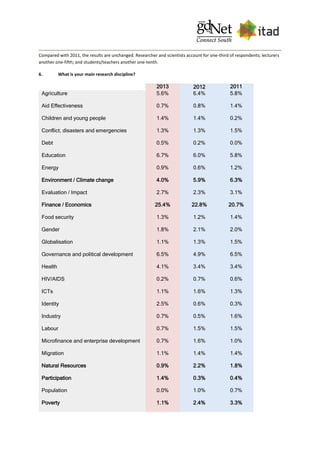
Response Rates - 10,238 GDNet members were invited to participate in the Year 3 survey. Of this number, 271
(2.6%) bounced back, which can indicate a full mailbox or an out-of-date contact. This year the percentage of
bounce-backs was significantly reduced (from 4.5% in Year 2). Using the link provided in the survey, or having
done so on a previous Survey Monkey-powered survey, a further 45 recipients (0.4%) opted out. After
removing these results, 9,922 GDNet members received the Year 3 survey and of this number 562 completed
the survey, giving an overall response rate of 5.7%. Within this number, 84 did not complete the full
questionnaire. Whilst the data is statistically robust in terms of absolute numbers of respondents, the response
rate relative to total GDNet members is relatively small (5.4%).
In Year 2, 13,292 GDNet members received the survey with a total number of 721 responses, giving an overall
response rate of 6.5%. Response rates were 8.2% in Year 1 and 7.6% in the baseline year (2010). Although the
response rate is not particularly low for web surveys of its type – attempting to engage what is a diffuse and
generally passive user group - reasons for the low response rate may relate to the general proliferation of
online surveys (‘survey fatigue’) which for Year 3 cannot have been helped by the user base being informed
that the programme is closing in June 2014 and hence having little incentive to contribute.
Disaggregation by gender
There is no significant difference between men and women in terms of their use of Southern research but it is
possible that women are less likely than men to distinguish between Northern and Southern research: 31% for
men, compared to 41% for women. None of the female respondents said that they read only Southern or only
Northern research, compared with 10 men (only Southern) and 5 men (only Northern). Given the smaller
sample size of responses from women, to be significant, the difference between results would need to be at
least 12.8%.
Reviewing the data generated in the three years since the baseline was established it is clear that GDNet has
exceeded its outcome level indicator 1 milestones throughout the course of the programme. Perhaps more
interestingly, what emerges is a nuanced picture of use – significant use of Southern research by Southern
researchers but perhaps no more significant than their use of Northern research. Noting the 5% increase in the
use of Southern research in Year 3, overall there appears to be a slight increase in the use of Southern research
over time. These are likely related to the slowly evolving nature and perception of Southern research. Similar
to previous years, the Year 3 web survey provided a number of interesting insights into the nature and
perceptions of Southern research by Southern users and how they tend to combine use of Northern and
4
Southern research in a complementary manner (See Annex 3 question 28). The following responses illustrate
this:
Southern Research is more relevant to me than Northern Research. I read Northern Research when it has been
done in the context of Southern Research. I am interesting in what others in my situation are doing to address
problems in their countries.
Research is either good or bad. There can be no discrimination between North and South....I have seen
examples of abysmal research from the north and brilliant work from the south and vice versa.
I believe that research are of two types: Quite useful research and Not so useful research. Research meant
for/aimed at public good are useful; especially for countries of global south. So I personally read/refer those
research those are meant for/aimed at public good, to enhance the wellbeing of people. In this backdrop, I do
not distinguish whether it is Northern Research or Southern Research. HOWEVER, OF COURSE, EFFECTIVE
SOUTHERN RESEARCH ARE OFTEN SEEM TO BE MORE ACCEPTABLE AS CASE STUDIES!!.
I try to read the most important international journals in my field and they hold mainly Northern research. If I
want to read the Southern ones, I have to try to look for them either in other journals or books... And so it
goes...
I usually look for good research design. There are some problems of substantive differentiation between the
most and the less developed contexts, but design and modelling is not very affected by them.
A theme that has emerged throughout GDNet’s M&E lifecycle is the potentially important niche that GDNet’s
has contributed to filling– raising the profile of the best Southern research so that it is perceived as on a par
with Northern research in terms of quality but also highlighting the feature of Southern research that defines it
from more traditional Northern or Western research – it’s applied and practical nature, grounded in local
contexts and addressing issues where there is strong demand or a clear evidence gap. It is clear from the
responses provided by the GDNet user base that they are passionate about the quality, value and utility of
research generated in the Global South and that they believe platforms such as GDNet provide an essential
function in raising its accessibility and overall profile in a global research system where Southern research
struggles to compete with better funded Northern research.
M&E approach summary
Purpose level indicator 1 draws on perceptions of use of Southern research gathered from the GDNet user
base web survey results conducted annually.
Data management plan
Robbie Gregorowski / ITAD
 On an annual basis – Repeat analysis of the annual GDNet user base web survey.
Sherine Ghoneim / GDNet
 On-going – Interpretation of the findings of the annual GDNet user base web survey and application to
better understand and improve the services GDNet offers
Evidence base
See Annex 2 for the GDNet user base web survey questionnaire.
See Annex 3 for a summary of the results of the Year 3 GDNet user base web survey.
5
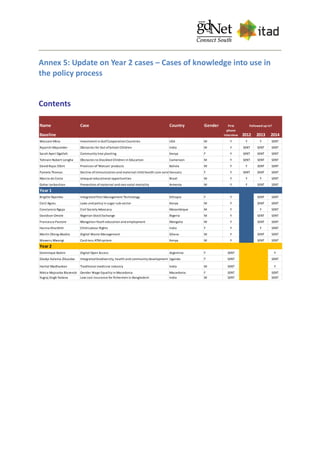
Indicator 2 - Cases of knowledge into use in policy processes
Cases of knowledge into use in the policy process – follow up status
Name Case Country Gender
Baseline 2012 2013 2014
Wassam Mina Investment in GulfCooperation Countries UEA M Y Y Y SENT
Rajarshi Majumder Obstacles for Out ofSchool Children India M Y SENT SENT SENT
Sarah Ayeri Ogalleh Community tree planting Kenya F Y SENT SENT SENT
Tohnain Nobert Lengha Obstacles to Diasbled Children in Education Cameroon M Y SENT SENT SENT
David Rojas Elbirt Provision of'Watsan'products Bolivia M Y Y SENT SENT
Pamela Thomas Decline ofimmunisation and maternal child health care service deliveryVanuatu F Y SENT SENT SENT
Marcio da Costa Unequal educational opportunities Brazil M Y Y Y SENT
Gohar Jerbashian Prevention ofmaternal and neo-natal mortality Armenia M Y Y SENT SENT
Year 1
Brigitte Nyambo Integrated Pest Management Technology Ethiopia F Y SENT SENT
Cecil Agutu Laws and policy in sugar sub-sector Kenya M Y SENT SENT
Constancio Nguja Civil Society Advocacy Mozambique M Y Y SENT
Davidson Omole Nigerian Stock Exchange Nigeria M Y SENT SENT
Francesco Pastore Mongolian Youth education and employment Mongolia M Y SENT SENT
Hasina Kharbhih Child Labour Rights India F Y Y SENT
Martin Oteng-Ababio Digital Waste Management Ghana M Y SENT SENT
Waweru Mwangi Card-less ATMsystem Kenya M Y SENT SENT
Year 2
Dominique Babini Digital Open Access Argentina F SENT Y
Gladys Kalema-Zikusoka Integrated biodiversity, health and community development Uganda F SENT SENT
Harilal Madhavkan Traditional medicine industry India M SENT Y
Nikica Mojsoska Blazevski Gender Wage Equality in Macedonia Macedonia F SENT SENT
Yugraj Singh Yadava Low cost insurance for fishermen in Bangladesh India M SENT SENT
First
phone
interview
Followed up in?
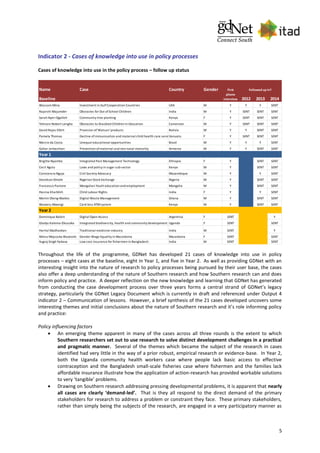
Throughout the life of the programme, GDNet has developed 21 cases of knowledge into use in policy
processes – eight cases at the baseline, eight in Year 1, and five in Year 2. As well as providing GDNet with an
interesting insight into the nature of research to policy processes being pursued by their user base, the cases
also offer a deep understanding of the nature of Southern research and how Southern research can and does
inform policy and practice. A deeper reflection on the new knowledge and learning that GDNet has generated
from conducting the case development process over three years forms a central strand of GDNet’s legacy
strategy, particularly the GDNet Legacy Document which is currently in draft and referenced under Output 4
indicator 2 – Communication of lessons. However, a brief synthesis of the 21 cases developed uncovers some
interesting themes and initial conclusions about the nature of Southern research and it’s role informing policy
and practice:
Policy influencing factors
 An emerging theme apparent in many of the cases across all three rounds is the extent to which
Southern researchers set out to use research to solve distinct development challenges in a practical
and pragmatic manner. Several of the themes which became the subject of the research in cases
identified had very little in the way of a prior robust, empirical research or evidence-base. In Year 2,
both the Uganda community health workers case where people lack basic access to effective
contraception and the Bangladesh small-scale fisheries case where fishermen and the families lack
affordable insurance illustrate how the application of action-research has provided workable solutions
to very ‘tangible’ problems.
 Drawing on Southern research addressing pressing developmental problems, it is apparent that nearly
all cases are clearly ‘demand-led’. That is they all respond to the direct demand of the primary
stakeholders for research to address a problem or constraint they face. These primary stakeholders,
rather than simply being the subjects of the research, are engaged in a very participatory manner as
6
stakeholder partners in the research process itself. Many of the cases illustrate the researchers go
one step further and from the outset engage policy makers as well as the primary stakeholders from
the outset. In this way policy makers are drawn into the research process as it develops.
 Involving decision makers in from the outset is just one way in which Southern research tends to take
a more innovative, informal and opportunistic approach to research dissemination. Southern
researchers conducting ‘action research’ seem at ease with engage a wider range of stakeholders –
local communities, politicians, civil servants, and the media (amongst others) throughout the research
process. This is in direct contrast to Western research which tends to engage decision-makers at the
end (if at all), disseminating research findings often through a relatively ‘formal’ and established
dissemination and communication processes – presenting at conferences and disseminating research
findings through formal journal peer-review processes.
 Similarly the cases continue to highlight that Southern researchers use a wider and more innovative
variety of tools to generate ‘evidence’ to support their research. Several cases highlight the use of
documentary evidence (photos and video footage) combined with more traditional research methods
such as key informant interviews to communicate the research to a wider audience of stakeholders. In
this way Southern researchers explicitly draw in the media, civil society organisations, NGOs, and the
private sector to put ‘pressure’ on decision-makers to legislate for change. Put simply, the cases
highlight that some Southern researchers are particularly adept at translating their research findings
into formats appropriate the meeting the needs of multiple stakeholder and audience groups and are
adept at employing a wide range of formats, platforms and channels to broad sets of stakeholders.
GDNet’s role and contribution
 GDNet has played a simple but critical role in sharing innovative research, connecting researchers in
one region or country with other researchers so that knowledge and learning in one context can
effectively be transferred and replicated in similar contexts elsewhere.
 The use of evidence in the most appropriate format – using photos and videos combined with more
formal research techniques such as surveys and interviews - is one of the areas where Southern
research can be considered more effective and advanced than more traditional Western research –
Southern research appears better at bringing in innovative technology such as the use of visual and
social media to generate more substantial impact. There is a potential role for a successor to GDNet
in sharing the lessons and experience of how best to combine the two forms of research as well as
potentially providing training in the use of more innovative research and documentation techniques
for Southern researchers – building the capacity of Southern researchers to present their research in
the most appropriate format for a particular stakeholder audience.
 Reflecting on the case development process over three years illustrates that GDNet has engaged a
wealth of innovative, informed and highly motivated researchers. The simple process of producing
the cases has provided a showcase for a number of these researchers and their policy influencing
skills. In their legacy document and communications, GDNet should use the experience of facilitating
this process to express their learning on the key success factors in producing effective, policy-
influencing Southern research. They should highlight what they have learned about makes Southern
research unique – its practicality and innovativeness - something that more traditional Western
research may do well to learn from.
7
Output 1 - Southern research better informed by current ideas and
knowledge
Progress against logframe indicators
Indicator 1 - Level of use of and satisfaction with GDNet research-orientated online
services
Target (January 2014): 20 % cumulative increase in use
Progress: GDNet website receiving an average of 40,103 visitors per month in 2013;
equivalent to just over 16% year-on-year increase in use from 2011 to 2013, or a 32%
cumulative increase in use. Exceeded Target.
Target (January 2014): Maintain high level of satisfaction
Progress: High proportion of members continue to report satisfaction with each of GDNet's
individual services and in most cases satisfaction has increased e.g. Knowledgebase of online
papers rated by 69.4% of respondents and provision of online journals by 71% of respondents
as extremely or moderately useful (an increase of 8% on Year 2 in both cases). Met Target.
Notes: There is a significant difference between men and women in use of GDNet in terms of
how often they visit the GDNet website. 56% of men visit the GDNet website at least once a
month, compared to only 38% women. There does not seem to be any major differences in
levels of satisfaction with GDNet services by male and female users, with the exception the
GDNet YouTube channel. Of those who expressed an opinion, only 8.4% of men found it not
at all useful, compared to 37.3% of women.
Comments on M&E approach: The M&E of the level of use of, and satisfaction with research-
orientated online services combines GDNet’s monthly web statistics with data generated
from the annual GDNet user base web survey.
Indicator 2 - Level of use of and satisfaction with themed services
Target (January 2014): 10% cumulative increase in use
Progress: 39.1% of survey respondents report using Thematic Windows occasionally or
frequently, an increase of 3.2 points from the 2012 baseline. Average monthly hits for
Thematic Windows pages are 10,491 in 2013 compared to 8,132 in 2012, an increase of 22%.
Met Target.
Target (January 2014): Maintain high level of satisfaction
Progress: Thematic Windows are described as ‘extremely’ or ‘moderately’ useful by 42.8% of
respondents, no change from 2012. Met Target.
Notes: There is no significant difference between men and women in terms of use of, or
satisfaction with, GDNet's Thematic Windows.
Comments on M&E approach: The assessment of themed services is based on the
triangulation between three sources of data: how GDNet Members report their use in terms
of frequency and satisfaction (as captured in the survey), number of hits to the Thematic
Windows pages, and how many Visits are recorded to the Thematic Landing Pages (taken
from GDNet's webstats).
8
Indicator 1 - Level of use of and satisfaction with GDNet research-orientated online
services
0
5000
10000
15000
20000
25000
30000
35000
40000
45000
Average
monthly
visitors
2011 2012 2013
Growth in use of GDNet's website
All visitors
Southern visitors
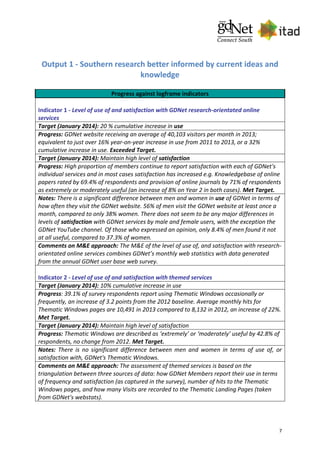
Level of use – The level of use of GDNet’s research-orientated online services continues to rise. At the headline
level, GDNet received an average of 40,103 visitors per month in Year 3. This represents a 16% increase in the
number of average monthly visitors over Year 2 and exceeds by over 4,500 visits per month the logframe-
defined milestone of a 20% cumulative increase in use (35,593 visitors)
1
. This is despite the website being
redesigned in December 2013, reducing the traffic significantly for that month. However, the percentage of
visitors coming from the Global South has fallen from 32% in Year 2 to 24% in Year 3
2
. It is unclear why the
percentage of Visitors coming from the Global South between Year 1 and Year 3 has fallen, but there are
several technical reasons why it is dangerous to draw conclusions from the number of recorded Visitors:
 Inaccurate data: generating location statistics based on IP address (which is how visitors' location is
determined) is notoriously unreliable.
 The influence of India and China: in January 2013, the visitors recorded from India represented about
a quarter of all visitors from the South that month, with China the second highest source of visitors.
3
 Shared IP addresses: Visitors are identified by the IP address of their internet connection. However,
multiple devices can share the same IP address, for example a whole university might share a single IP
address. In the South, there tends to be greater use of shared computers and internet cafes which
would increase this effect on webstats.
 Access from different types of devices: a single user could access the GDNet portal from their tablet,
work computer, home laptop and smartphone and in each case a different IP address be used and
therefore be counted as four visitors.
1
The 20% cumulative increase target for Year 3 was calculated in the same manner as compound interest i.e. by adding
10% to the projected Year 2 monthly average which was assumed to be 10% higher than that recorded for Year 1,
2
Established from users’ IP addresses.
3
India and China are the two largest sources of GDNet's Southern traffic. e.g. in January 2013 about 25% of the southern
visitors came from India alone. So it means that if something happens to Indian or Chinese internet connections (including
perhaps internet censorship) and the visitors reduce from there it will have a large impact on % of visitors from Global
South.
9
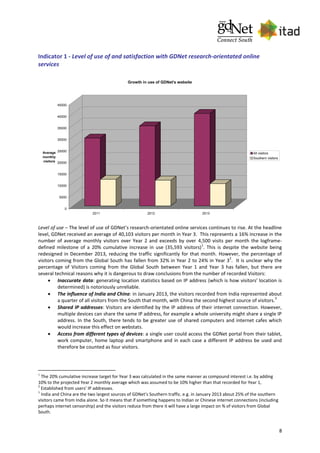
To provide a counterpoint to this, some analysis has been done of the number of Visits made to the GDNet
website. Although looking at visits does not address the problem of inaccuracy over geographical location it
does respond to the issues of shared IP addresses and multiple devices. The percentage of Visits coming from
the Global South is 41% for Year 3 and in some months over half of the visits made to the site came from the
South.
Comparing N/S ratio for Visitors and Visits in 2013
24%
76%
41%
59%
Southern
Northern
Southern
visits to
GDNet website
in 2013
Southern visitors to
GDNet website in
2013
0
10,000
20,000
30,000
40,000
50,000
60,000
70,000
80,000
90,000
Website
visits
January February March April May June July August September October November December
Visits to GDNet in 2013 each month
From the South From the North
10
A further explanation of the drop may relate to GDNet’s increased social media efforts throughout 2013 which
may have engaged a higher proportion is Northern / Western users who are more familiar with and have better
access to social media channels.
Considerable progress has taken place in terms of the average monthly document downloads from the GDNet
KnowledgeBase (KB). The average monthly document downloads were approximately 4,000 at the baseline,
11,900 during Year 1, 12,275 during Year 2, and increased to 18,504 during Year 3. This is a pleasing statistic as
it represents an increase in the ‘quality of use’ of GDNet’s online services. As referenced in the Year 1 report,
quality of use (developing a core of ‘involved’ users and focussing on their uptake of knowledge) has been a
focus of the GDNet team throughout Year 2 and Year 3. With this in mind, the GDNet team have endeavoured
to develop a small set of ‘quality of use’ indicators which will be followed up on in Year 3. These include the
total research paper abstract views which in Year 3 totalled 709,378 (compared to 333,162 in Year 2) and
averaged 59,115 per month (compared to 27,764 per month in Year 2). GDNet should be commended for the
progress they have made here – more than doubling the number of abstract views is an excellent indicator of
use and illustrates the extent to which the GDNet team has informed the ‘behaviour’ of its user base –
providing an essential service which encourages users to ‘actively’ engage with the site.
Abstractviews
Documentdownloads
ThematicWindowshits
0%
10%
20%
30%
40%
50%
60%
Change
from 2012
monthly
average
GDNet online services
Increases in use of GDNet Knowledgebase
Taken at face value these web stats results are pleasing as they indicate that there is high absolute usage of the
GDNet research paper abstracts (a key GDNet value-added service) and that almost half of all GDNet visitors
use the Knowledge Base – a quality of use indicator. Several of the comments provided in the web survey
appear to support the conclusion that GDNet’s user base have grown to depend on the services GDNet offers:
I always resort to GDNet when I source for materials to read to prepare a proposal or write up a paper or
article. Indeed, oftentimes GDN is the first website that I approach with confidence for such materials. It is only
through the GDN website that I can access the Jstor and the Muse collection. I recall in January 2014, I had to
give a talk to legislators from Nigeria who were in Lincoln University (UK) for a conference. Some important
articles I wanted to consult for the paper were in Jstor. But because GDNet was shut down, I had a hard time
accessing the articles. It was a few days to the event that I got alternative access. The stress was high.
This is the only channel that Southern Researchers can feel that they are being assist in increasing their capacity
and capability in undertaking and sharing their research. It is a portal that we can call it home.
11
Very important. The Southern Researchers need a platform to share their research and connect with other
researchers. This platform provided that kind of a platform.
GDNet has played a pivotal role in connecting the researchers to the literature, opportunities and funds. It must
continue to serve the world of research.
This portal is an important initiative sharing and encouraging researchers to conduct and use these materials
for their own work. This is specifically important as people from South get ideas and challenges from their own
context.
I felt like losing access to a resourceful library. Certainly, it is going to cause a big handicap to the researchers,
students in the developing countries. GDNet must reconsider its plan.
The survey and webstats appear to give contradictory messages about the demand for access to free journals.
As highlighted above, some Southern researchers appear to be dependent on GDNet as a source of peer-
reviewed research and the access GDNet provides (together with the news of funding opportunities) is
considered the most useful service GDNet offers (see table below). Furthermore, Southern respondents
reported that the second biggest challenge Southern researchers face is lack of access to journals and data and
nearly three-quarters of them said that it was very important that free access to e-journals should continue
(see Annex 3). However the volume of actual use via the GDNet website is declining. In 2012, researchers
made use of the online journals 84 times each month on average. In 2013, this monthly average dropped to
69. A further 237 visits were made each month, on average, to GDNet's Free Online Journals gateway page.
Two contributing factors to the 2012 levels of use not being maintained, are that GDNet's resources were
directed towards planning for closure in 2013 and away from promoting the online services; and the online
services were unavailable during December while the website was re-launched.
The number of recipients of GDN Newsletters continues to rise and the rate has picked up on Year 2: an
average of 22 new recipients per month receive the Research into Focus newsletter (up from an average of 15
in Year 2) and an average of 23 new recipients receive the Funding Opportunities newsletter (down from an
average of 17 in Year 2). Although this is still not as high a rate as in Year 1, it is not deemed too significant as
GDNet’s strategy focussed on quality involved usage is not based on newsletter recipients who, to a certain
extent, represent a less involved means of interaction with users. The Gender Audit carried out in 2012
however, highlighted that there is a gender difference in interest in email newsletters with GDNet's female
users (typically 25% of GDNet's membership) finding them useful while the male users prefer social media and
accessing the website directly.
The GDNet Team were quick to embrace technological progress in user engagement in Year 2 and have
continued this in Year 3. This is illustrated by the fact that GDNet now maintains several complementary
platforms alongside the website – a blog, Twitter feed, YouTube channel and LinkedIn page
4
– to support
interactive user engagement through cross-posting. The implications of maintaining multiple platforms are
discussed in the next section drawing on the web survey result assessing levels of satisfaction.
Disaggregation of responses on use, by gender
There is a significant difference between men and women in use of GDNet in terms of how often they visit the
GDNet website. 56% of men visit the GDNet website at least once a month, compared to only 38% women.
Perhaps as a consequence, men tend to use research found on GDNet's website more often than women:
52.2% of male respondents report using it in their work at least once every six months, compared to 34.1% of
women. Thematic Windows were introduced to reduce time searching the site (lack of time being a potential
barrier to use identified in GDNet's Gender Audit in Year 2) and the uptake among women is good, with 44%
using them frequently or occasionally. The indications are that men are more likely to use GDNet's social media
4
GDNet blog - http://gdnetblog.org/
GDNet Twitter – https://twitter.com/Connect2GDNet
GDNet YouTube – http://www.youtube.com/user/gdnetcairo
GDNet LinkedIn - http://www.linkedin.com/company/gdnet
12
tools (Twitter and YouTube) than women but there is not a big enough sample size from female members to be
certain.
Level of satisfaction – Satisfaction with GDNet’s research orientated online services is assessed based on the
web survey findings, in particular question 13 which asks GDNet users to rate GDNet services according to their
usefulness. A summary of the Year 3 results with the Year 2 results in brackets is provided below:
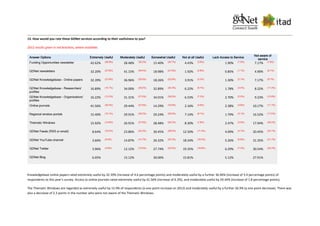
Answer Options Extremely Useful Moderately Useful Somewhat Useful Not at all Useful Lack Access to Service
Not aware of
service
Funding Opportunities newsletter 42.62% (36.9%)
28.48% (30.2%)
15.40% (20.7%)
4.43% (3.9%)
1.90% (1.5%)
7.17% (7.8%)
GDNet newsletters 32.20% (27.8%)
41.15% (40.4%)
18.98% (21.8%)
1.92% (2.8%)
0.85% (1.1%)
4.90% (6.1%)
GDNet Knowledgebase - Online papers 32.39% (27.8%)
36.96% (33.6%)
18.26% (22.9%)
3.91% (3.3%)
1.30% (2.7%)
7.17% (9.7%)
GDNet Knowledgebase - Researchers'
profiles
16.89% (15.1%)
34.00% (29.2%)
32.89% (34.3%)
6.22% (6.7%)
1.78% (3.4%)
8.22% (11.3%)
GDNet Knowledgebase - Organisations'
profiles
16.22% (13.3%)
31.31% (27.6%)
34.01% (36.5%)
6.53% (7.2%)
2.70% (2.5%)
9.23% (12.9%)
Online journals 41.56% (35.4%)
29.44% (27.6%)
14.29% (16.9%)
2.16% (4.6%)
2.38% (3.8%)
10.17% (11.7%)
Regional window portals 15.40% (15.1%)
29.91% (30.2%)
29.24% (28.0%)
7.14% (6.1%)
1.79% (3.1%)
16.52% (17.5%)
Thematic Windows 15.92% (14.9%)
26.91% (27.8%)
28.48% (26.3%)
8.30% (7.8%)
2.47% (3.0%)
17.94% (20.2%)
GDNet Feeds (RSS or email) 8.64% (10.5%)
23.86% (22.2%)
30.45% (28.5%)
12.50% (11.4%)
4.09% (4.7%)
20.45% (22.7%)
GDNet YouTube channel 3.66% (5.0%)
14.87% (14.7%)
26.32% (25.3%)
18.54% (16.5%)
5.26% (6.8%)
31.35% (31.7%)
GDNet Twitter 3.96% (4.8%)
12.12% (13.0%)
27.74% (23.5%)
19.35% (18.9%)
6.29% (7.4%)
30.54% (32.3%)
GDNet Blog 6.05% 15.12% 30.00% 15.81% 5.12% 27.91%
GDNet is aiming to maintain a high level of satisfaction as defined by the output 1 indicator 1 milestone
(January 2014). The web survey results, particularly those focussed on quality involved usage, suggest that this
has been achieved, if not exceeded. For example, the Knowledgebase online papers were rated extremely
useful by 32.39% (increase of 4.6% on Year 2) and moderately useful by a further 36.96% (increase of 3.4% on
Year 2) of respondents to this year’s survey. Access to online journals was rated extremely useful by 41.56%
(increase of 6.2% on Year 2), and moderately useful by 29.4% (increase of 1.8% on Year 2).
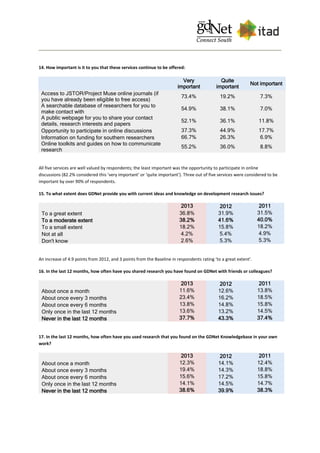
Question 14 in the web survey asked recipients to assess which of GDNet’s core services they felt it was
important to continue to be provided. Perhaps unsurprisingly, given the recipients were informed in the
survey introduction that GDNet would be closing in June 2014, nearly all of GDNet’s core services were deemed
by the respondents to be either very or quite important. The results are presented in the table below:
Very
important
Quite
important
Not important
Access to JSTOR/Project Muse online journals (if
you have already been eligible to free access)
73.4% 19.2% 7.3%
A searchable database of researchers for you to
make contact with
54.9% 38.1% 7.0%
A public webpage for you to share your contact
details, research interests and papers
52.1% 36.1% 11.8%
Opportunity to participate in online discussions 37.3% 44.9% 17.7%
Information on funding for southern researchers 66.7% 26.3% 6.9%
Online toolkits and guides on how to communicate
research
55.2% 36.0% 8.8%
All six core services are well valued by respondents; perceived as the least important was the opportunity to
participate in online discussions (82.2% considered this ‘very important’ or ‘quite important’) – an indicator of
very engaged usage perhaps not representative of GDNet’s ‘average’ user. However, four out of six core
services (access to online journals, researchers database, funding opportunities, and online toolkits and guides)
were considered to be important by over 90% of respondents. These findings may be useful to other
13
programmes / knowledge service in the future that have a mandate to support Southern researchers with their
knowledge needs and raised profile.
The Year 3 web survey again provides some interesting insights into GDNet’s newer social media / web 2.0
tools and platforms (GDNet’s feeds, YouTube channel, Twitter, and Community Groups) which have noticeable
lower usefulness ratings. In Year 3 GDNet has invested in better understanding the use and value of these
tools and platforms. A report drafted by GDNet’s social media lead illustrating GDNet’s social media ‘portfolio’
in Year 3 is presented in Annex 7. Contrasting the web survey results with the social media usage reporting
presents some interesting findings:
 GDNet’s portfolio of social media tools and platforms are seen as either extremely or moderately
useful by approximately a fifth to a quarter of web survey respondents, a relatively low general
satisfaction / usefulness rating broadly in line with Year 2.
 However, the detailed social media monitoring and reporting presented in Annex 7, demonstrates
that the use of the tools and platforms has steadily increased from Year 2 to Year 3, albeit from a
relatively low base.
As explained in the Year 2 report, the ‘90 – 9 – 1 rule’ is generally accepted by knowledge brokering experts
whereby 90% of knowledge network or platform members are passive and engage ad hoc and periodically, 9%
of users are passive but visit regularly, and only 1% can be considered engaged users who constructively
contribute to the platform or network. Therefore it is sensible of GDNet to develop a strategy that aims to
engage the 9% and 1% of regular users. The role GDNet’s Web 2.0 tools and services play with this smaller but
active ‘core’ user base is what is important as well the how the tools allow GDNet to engage with different
users in different contexts and at different times – at conferences and training events etc. The social media
report illustrates that during Year 3 GDNet produced 88 blog posts, 97 videos and 1582 tweets. These blog
posts received 14,717 views, broadly in line with Year 2 viewing figure of 15,916 despite the GDNet team
attending significantly fewer events in Year 3 which tends to be the catalyst for blog viewing.
Disaggregation of responses on satisfaction, by gender
There do not seem to be any major differences in levels of satisfaction with GDNet services by male and female
users. There were fewer responses to these questions than to some others in the survey, so the differences
that are observed tend not to be big enough to be considered significant, with the exception the GDNet
YouTube channel. Of those who expressed an opinion, 8.4% of men found it not at all useful, compared to
37.3% of women. However, there does appear to be a gap in awareness for some services, especially Twitter
and the GDNet blog, however the respondents give inconsistent answers to awareness between the questions
on frequency of use and satisfaction so this would need further investigation
5
.
M&E approach
The M&E of the level of use of, and satisfaction with research-orientated online services combines GDNet’s
monthly web statistics with data generated from the annual GDNet user base web survey.
Data management plan
Karim Sobh/Dina Abou Saada
 Design, testing and monthly production of standardised GDNet web statistics report.
Shahira Emara
 Monthly collection and quality assurance of web statistics
Robbie Gregorowski
 On an annual basis – assess level of use of research-orientated online services over previous 12
months through analysis of web statistics and through the annual GDNet users web survey, and report
on findings against baseline and lesson learnt to GDNet.
5
e.g. Q13: 26.3% of male respondents are unaware of GDNet's Twitter account compared with 39.8% of female
respondents but in Q12 this is 17.1% and 24.8% respectively. In Q13, for the GDNet blog the figures are 22.7% of men,
compared to 40.7% of women and in Q12, 14.8% and 25.9%.
14
Evidence base
A detailed explanation of the process used to generate the web statistics and GDNet user base web survey can
be found in the Baseline and M&E Framework report.
 Annex 2 provides an outline of the Year 3 web survey questionnaire.
 Annex 4 presents the results and a brief analysis of the Year 3 web survey responses.
15
Indicator 2 - Level of use of and satisfaction with themed services
In July 2011, GDNet piloted a beta version of 11 themed services and launched the full set of 23 themed
services in November that year. Year 2 was therefore the first year for which a baseline could be set for
satisfaction and use of the full set of Thematic Windows, and the figures presented below compare the
measures for 2012 and 2013.
Use of Thematic Windows
This can be understood based on three sources of data: how GDNet Members report their use in terms of
frequency (as captured in the survey), number of hits to the Thematic Windows pages and how many Visits are
recorded to the Thematic Landing Pages (taken from GDNet's webstats).
How often do GDNet Members use the Thematic Windows?
Through the survey, GDNet members report that they are using the Thematic Windows more frequently than
in 2012. In 2013, 39.2% of respondents used them Frequently or Occasionally, compared to 35.8% in 2012.
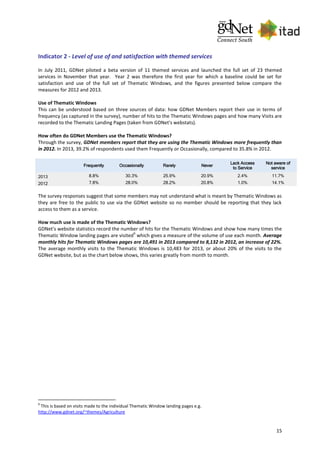
Frequently Occasionally Rarely Never
Lack Access
to Service
Not aware of
service
2013 8.8% 30.3% 25.9% 20.9% 2.4% 11.7%
2012 7.8% 28.0% 28.2% 20.8% 1.0% 14.1%
The survey responses suggest that some members may not understand what is meant by Thematic Windows as
they are free to the public to use via the GDNet website so no member should be reporting that they lack
access to them as a service.
How much use is made of the Thematic Windows?
GDNet's website statistics record the number of hits for the Thematic Windows and show how many times the
Thematic Window landing pages are visited
6
which gives a measure of the volume of use each month. Average
monthly hits for Thematic Windows pages are 10,491 in 2013 compared to 8,132 in 2012, an increase of 22%.
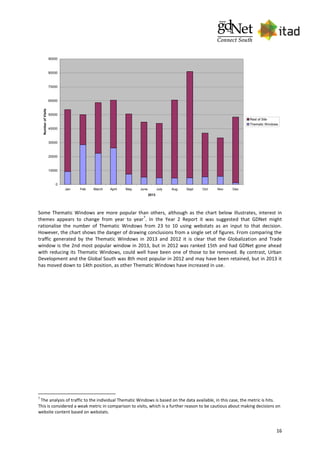
The average monthly visits to the Thematic Windows is 10,483 for 2013, or about 20% of the visits to the
GDNet website, but as the chart below shows, this varies greatly from month to month.
6
This is based on visits made to the individual Thematic Window landing pages e.g.
http://www.gdnet.org/~themes/Agriculture
16
0
10000
20000
30000
40000
50000
60000
70000
80000
90000
Jan Feb March April May June July Aug Sept Oct Nov Dec
2013
NumberofVisits
Rest of Site
Thematic Windows
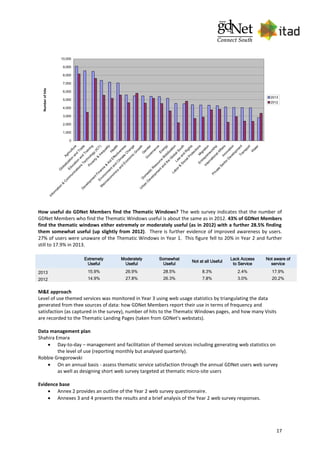
Some Thematic Windows are more popular than others, although as the chart below illustrates, interest in
themes appears to change from year to year
7
. In the Year 2 Report it was suggested that GDNet might
rationalise the number of Thematic Windows from 23 to 10 using webstats as an input to that decision.
However, the chart shows the danger of drawing conclusions from a single set of figures. From comparing the
traffic generated by the Thematic Windows in 2013 and 2012 it is clear that the Globalization and Trade
window is the 2nd most popular window in 2013, but in 2012 was ranked 15th and had GDNet gone ahead
with reducing its Thematic Windows, could well have been one of those to be removed. By contrast, Urban
Development and the Global South was 8th most popular in 2012 and may have been retained, but in 2013 it
has moved down to 14th position, as other Thematic Windows have increased in use.
7
The analysis of traffic to the individual Thematic Windows is based on the data available, in this case, the metric is hits.
This is considered a weak metric in comparison to visits, which is a further reason to be cautious about making decisions on
website content based on webstats.
17
0
1,000
2,000
3,000
4,000
5,000
6,000
7,000
8,000
9,000
10,000
Agriculture
G
lobalization
and
Trade
Education
and
Training
Inform
ation
&
C
om
m
unications
Technology
(IC
T)
Poverty
&
Inequality
H
ealth
D
evelopm
ent Finance
&
Aid
Effectiveness
Environm
ent and
C
lim
ate
C
hange
M
acroeconom
ics
and
Econom
ic
G
row
th
G
ender
G
overnance
Energy
D
om
estic
R
esource
M
obilization
U
rban
D
evelopm
ent and
the
G
lobal South
Law
and
R
ights
Labor &
Social Protections
M
igration
Entrepreneurship
International Affairs
Innovation
Private
Sector D
evelopm
ent
Transport
W
ater
Numberofhits
2013
2012
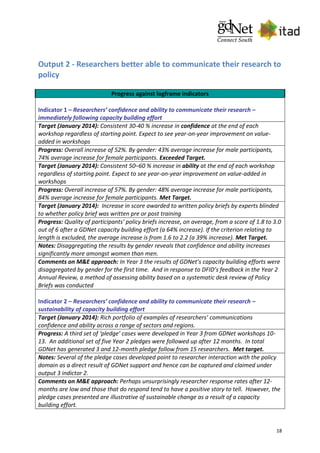
How useful do GDNet Members find the Thematic Windows? The web survey indicates that the number of
GDNet Members who find the Thematic Windows useful is about the same as in 2012. 43% of GDNet Members
find the thematic windows either extremely or moderately useful (as in 2012) with a further 28.5% finding
them somewhat useful (up slightly from 2012). There is further evidence of improved awareness by users.
27% of users were unaware of the Thematic Windows in Year 1. This figure fell to 20% in Year 2 and further
still to 17.9% in 2013.
Extremely
Useful
Moderately
Useful
Somewhat
Useful
Not at all Useful
Lack Access
to Service
Not aware of
service
2013 15.9% 26.9% 28.5% 8.3% 2.4% 17.9%
2012 14.9% 27.8% 26.3% 7.8% 3.0% 20.2%
M&E approach
Level of use themed services was monitored in Year 3 using web usage statistics by triangulating the data
generated from thee sources of data: how GDNet Members report their use in terms of frequency and
satisfaction (as captured in the survey), number of hits to the Thematic Windows pages, and how many Visits
are recorded to the Thematic Landing Pages (taken from GDNet's webstats).
Data management plan
Shahira Emara
 Day-to-day – management and facilitation of themed services including generating web statistics on
the level of use (reporting monthly but analysed quarterly).
Robbie Gregorowski
 On an annual basis - assess thematic service satisfaction through the annual GDNet users web survey
as well as designing short web survey targeted at thematic micro-site users
Evidence base
 Annex 2 provides an outline of the Year 2 web survey questionnaire.
 Annexes 3 and 4 presents the results and a brief analysis of the Year 2 web survey responses.
18
Output 2 - Researchers better able to communicate their research to
policy
Progress against logframe indicators
Indicator 1 – Researchers’ confidence and ability to communicate their research –
immediately following capacity building effort
Target (January 2014): Consistent 30-40 % increase in confidence at the end of each
workshop regardless of starting point. Expect to see year-on-year improvement on value-
added in workshops
Progress: Overall increase of 52%. By gender: 43% average increase for male participants,
74% average increase for female participants. Exceeded Target.
Target (January 2014): Consistent 50–60 % increase in ability at the end of each workshop
regardless of starting point. Expect to see year-on-year improvement on value-added in
workshops
Progress: Overall increase of 57%. By gender: 48% average increase for male participants,
84% average increase for female participants. Met Target.
Target (January 2014): Increase in score awarded to written policy briefs by experts blinded
to whether policy brief was written pre or post training
Progress: Quality of participants' policy briefs increase, on average, from a score of 1.8 to 3.0
out of 6 after a GDNet capacity building effort (a 64% increase). If the criterion relating to
length is excluded, the average increase is from 1.6 to 2.2 (a 39% increase). Met Target.
Notes: Disaggregating the results by gender reveals that confidence and ability increases
significantly more amongst women than men.
Comments on M&E approach: In Year 3 the results of GDNet’s capacity building efforts were
disaggregated by gender for the first time. And in response to DFID’s feedback in the Year 2
Annual Review, a method of assessing ability based on a systematic desk review of Policy
Briefs was conducted
Indicator 2 – Researchers’ confidence and ability to communicate their research –
sustainability of capacity building effort
Target (January 2014): Rich portfolio of examples of researchers’ communications
confidence and ability across a range of sectors and regions.
Progress: A third set of ‘pledge’ cases were developed in Year 3 from GDNet workshops 10-
13. An additional set of five Year 2 pledges were followed up after 12 months. In total
GDNet has generated 3 and 12-month pledge follow from 15 researchers. Met target.
Notes: Several of the pledge cases developed point to researcher interaction with the policy
domain as a direct result of GDNet support and hence can be captured and claimed under
output 3 indictor 2.
Comments on M&E approach: Perhaps unsurprisingly researcher response rates after 12-
months are low and those that do respond tend to have a positive story to tell. However, the
pledge cases presented are illustrative of sustainable change as a result of a capacity
building effort.
19
Indicator 1 – Researchers’ confidence and ability to communicate their research –
immediately following capacity building effort
During the Year 3 period GDNet conducted 3 training events with successful completion participant numbers as
follows:
Workshop 10: GDNet-AERC policy brief training, Tanzania 21 participants (18 men, 3 women)
Workshop 11: GDN Awards and Medals Finalists Philippines 18 participants
8
(7 men, 11 women)
Workshop 12: GDNet-AERC policy brief training Kenya 16 participants (13 men, 3 women)
Total 57 participants (38 men, 17 women)
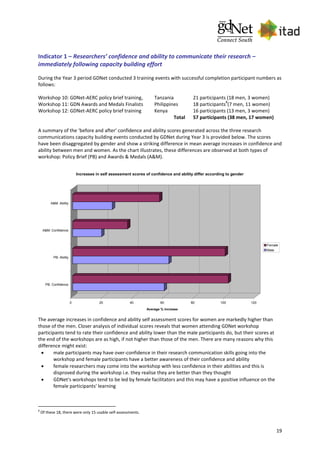
A summary of the ‘before and after’ confidence and ability scores generated across the three research
communications capacity building events conducted by GDNet during Year 3 is provided below. The scores
have been disaggregated by gender and show a striking difference in mean average increases in confidence and
ability between men and women. As the chart illustrates, these differences are observed at both types of
workshop: Policy Brief (PB) and Awards & Medals (A&M).
0 20 40 60 80 100 120
Average % increase
PB: Confidence
PB: Ability
A&M: Confidence
A&M: Ability
Increases in self assessment scores of confidence and ability differ according to gender
Female
Male
The average increases in confidence and ability self assessment scores for women are markedly higher than
those of the men. Closer analysis of individual scores reveals that women attending GDNet workshop
participants tend to rate their confidence and ability lower than the male participants do, but their scores at
the end of the workshops are as high, if not higher than those of the men. There are many reasons why this
difference might exist:
 male participants may have over-confidence in their research communication skills going into the
workshop and female participants have a better awareness of their confidence and ability
 female researchers may come into the workshop with less confidence in their abilities and this is
disproved during the workshop i.e. they realise they are better than they thought
 GDNet's workshops tend to be led by female facilitators and this may have a positive influence on the
female participants' learning
8
Of these 18, there were only 15 usable self-assessments.
20
Workshop 10 GDNet-AERC Policy Brief Workshop
7-9 June, 2013 Arusha, Tanzania
Mean average before Mean average after Mean average increase
Confidence 2.7 4.3 1.7
Women only 2.2 4.3 2.1
Men only 2.7 4.3 1.6
Ability 2.5 4.3 1.8
Women only 2.3 4.5 2.2
Men only 2.6 4.3 1.7
Workshop 11 Awards & Medals Presentation Skills
June 17-18, 2013 Manila, Philippines
Mean average before Mean average after Mean average increase
Confidence 3.5 4.5 1.0
Women only 3.3 4.5 1.2
Men only 3.7 4.4 0.7
Ability 3.2 4.4 1.2
Women only 2.8 4.4 1.6
Men only 3.5 4.4 0.9
Workshop 12 GDNet-AERC Policy Brief Workshop
6-8 December, 2013 Nairobi, Kenya
Mean average before Mean average after Mean average increase
Confidence 2.5 4.3 1.8
Women only 2.1 4.5 2.3
Men only 2.6 4.3 1.6
Ability 2.6 4.3 1.8
Women only 2.2 4.6 2.3
Men only 2.6 4.3 1.6
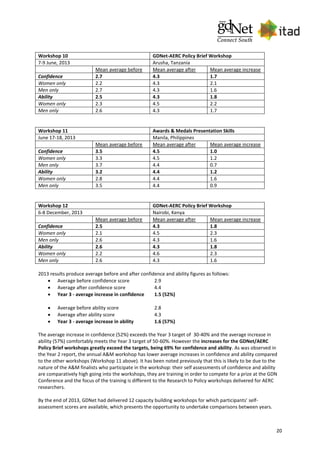
2013 results produce average before and after confidence and ability figures as follows:
 Average before confidence score 2.9
 Average after confidence score 4.4
 Year 3 - average increase in confidence 1.5 (52%)
 Average before ability score 2.8
 Average after ability score 4.3
 Year 3 - average increase in ability 1.6 (57%)
The average increase in confidence (52%) exceeds the Year 3 target of 30-40% and the average increase in
ability (57%) comfortably meets the Year 3 target of 50-60%. However the increases for the GDNet/AERC
Policy Brief workshops greatly exceed the targets, being 69% for confidence and ability. As was observed in
the Year 2 report, the annual A&M workshop has lower average increases in confidence and ability compared
to the other workshops (Workshop 11 above). It has been noted previously that this is likely to be due to the
nature of the A&M finalists who participate in the workshop: their self assessments of confidence and ability
are comparatively high going into the workshops, they are training in order to compete for a prize at the GDN
Conference and the focus of the training is different to the Research to Policy workshops delivered for AERC
researchers.
By the end of 2013, GDNet had delivered 12 capacity building workshops for which participants' self-
assessment scores are available, which presents the opportunity to undertake comparisons between years.
21
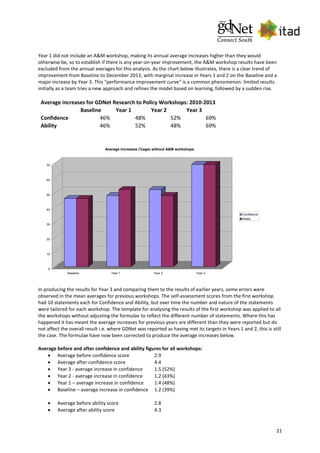
Year 1 did not include an A&M workshop, making its annual average increases higher than they would
otherwise be, so to establish if there is any year-on-year improvement, the A&M workshop results have been
excluded from the annual averages for this analysis. As the chart below illustrates, there is a clear trend of
improvement from Baseline to December 2013, with marginal increase in Years 1 and 2 on the Baseline and a
major increase by Year 3. This "performance improvement curve" is a common phenomenon: limited results
initially as a team tries a new approach and refines the model based on learning, followed by a sudden rise.
Average increases for GDNet Research to Policy Workshops: 2010-2013
Baseline Year 1 Year 2 Year 3
Confidence 46% 48% 52% 69%
Ability 46% 52% 48% 69%
0
10
20
30
40
50
60
70
Baseline Year 1 Year 2 Year 3
Average increases (%age) without A&M workshops
Confidence
Ability
In producing the results for Year 3 and comparing them to the results of earlier years, some errors were
observed in the mean averages for previous workshops. The self-assessment scores from the first workshop
had 10 statements each for Confidence and Ability, but over time the number and nature of the statements
were tailored for each workshop. The template for analysing the results of the first workshop was applied to all
the workshops without adjusting the formulae to reflect the different number of statements. Where this has
happened it has meant the average increases for previous years are different than they were reported but do
not affect the overall result i.e. where GDNet was reported as having met its targets in Years 1 and 2, this is still
the case. The formulae have now been corrected to produce the average increases below.
Average before and after confidence and ability figures for all workshops:
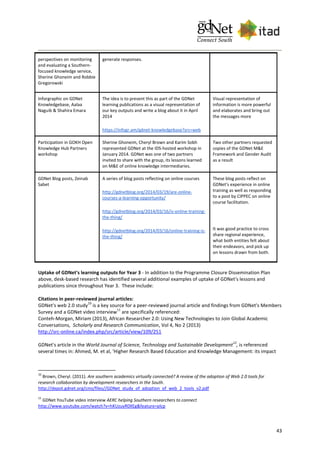
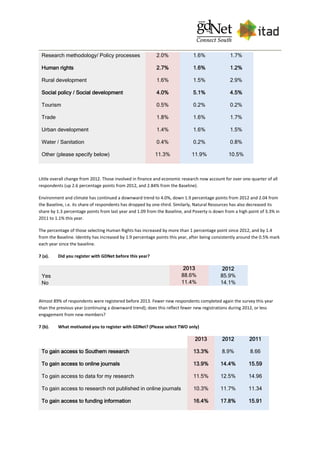
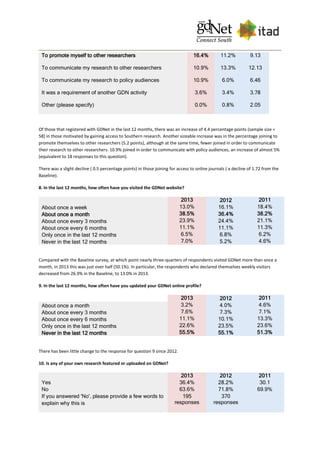
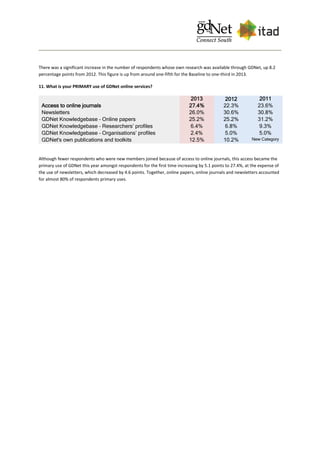
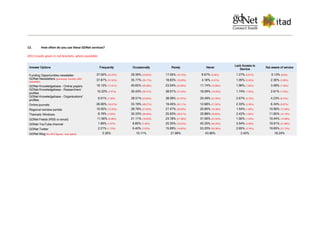
 Average before confidence score 2.9
 Average after confidence score 4.4
 Year 3 - average increase in confidence 1.5 (52%)
 Year 2 - average increase in confidence 1.2 (43%)
 Year 1 – average increase in confidence 1.4 (48%)
 Baseline – average increase in confidence 1.2 (39%)
 Average before ability score 2.8
 Average after ability score 4.3
22
 Year 3 - average increase in ability 1.6 (57%)
 Year 2 - average increase in ability 1.1 (41%)
 Year 1 – average increase in ability 1.4 (52%)
 Baseline – average increase in ability 1.1 (38%)
Participants' Policy Brief Analysis
In the annual review report for Year 2 of GDNet, DFID recommended strengthening the evaluation of the
capacity building training by, for example, testing written material produced before and after training. For Year
3, a method of external review of participants' policy briefs was designed and piloted to complement the
established self-assessment process (see Annex 9 for full details of method, results, analysis and reflections on
this M&E approach).
Two external consultants with expertise in research communication for policy audiences reviewed the "before"
and "revised" policy briefs of 18 participants in the GDNet/AERC 2013 Policy Brief workshops using a six-point
checklist of absolute (Yes/No) statements, supplied by ITAD, based on the advice given to participants by
GDNet on the elements of a good policy brief:
1. Length: Is the policy brief a suitable length?
2. Language: Is the policy brief written for a non-specialist audience?
3. Evidence: Are the arguments supported by research evidence?
4. Readability: Is the policy brief written in an easy-to-read format?
5. Policy-oriented: Is the brief targeted at a policy audience?
6. Persuasive: Does the policy brief have a consistent, single argument?
All but one of the criteria are subject to a degree of interpretation so the reviewers were asked to score the
briefs individually, and then discuss and agree the final scores between them. The consultants also provided
comments about each pair of policy briefs to explain their scoring and highlight the degree of change between
the versions which may not be reflected in the score, given the use of absolute statements.
Summary of average scores from Policy Brief review
Average score before (out of 6) 1.8
Average score after (out of 6) 3.0
Average increase 1.2 (64%)
The average participant's skill in producing policy briefs increased by 64%, however this headline is based on a
mean average and over-simplifies a more complicated picture. Some participants had much higher overall
increases, while some showed no overall increase or even scored lower on their revised policy brief; effectively
suggesting that their ability had decreased. The chart below shows the frequency of the positive and negative
differences in the scores for the before and revised briefs, across the 18 participants.
23
0
1
2
3
4
5
6
-3 -2 -1 0 1 2 3 4 5
Difference between Before and Revised
Frequency
12 of the 18 participants improved their overall scores by between 1 and 5 points. However, 4 participants
showed no overall improvement and 2 participants showed an overall decrease. In many cases this was
because a participant improved their brief on one aspect to the detriment of another. For example, one
participant reduced the word count of their "before" policy brief by over a third (excluding references) and also
improved the readability, but the reviewers felt this was at the expense of supporting their arguments with
relevant evidence and providing policy recommendations. The overall score for this participant therefore
stayed the same.
Challenges with writing succinctly
Participants appeared to struggle with the challenge of writing concisely (keeping their policy briefs below 2000
words) and convincingly for a policy audience. Before the training, 13 out of 18 of the policy briefs were too
long, with some close to 4000 words. After the training, 10 of the participants had reduced the length down to
between 1000 and 2000 words but several of these participants either failed to increase their scores on other
criteria or even scored worse on other criteria as a consequence. This suggests that the art of writing concisely
for a policy audience is unfamiliar to many researchers and it is something they will need to practise and
receive further support on over a longer time period than the current capacity building approach. The word
count is of course something which the researcher can check for themselves, while other aspects of a good
policy brief are qualitative and can only be judged through experience and learning from feedback over time.
To see the influence that the effort to write to a reduced length has on participant scores, the average scores
were recalculated with those for length removed (see below). There is still an improvement as a result of the
GDNet Capacity Building workshop, however it is only 39% compared with 64% when the scores for length are
included.
Summary of average scores from Policy Brief review (with scores for Length removed)
Average score before (out of 5) 1.6
Average score after (out of 5) 2.2
Average increase 0.6 (39%)
Comparison with self-assessment
The policy brief review activity used a different scoring approach to that used by the participants in their self-
assessment so comparisons can only be approximate: the average increase of the participants' scores was
24
64% and the average increased ability for the participants of the June and December 2013 workshops
through self-assessment was 70%.
From closer analysis, it appears that there is sometimes a gap between a participant's own assessment of what
they have learnt and their ability to put it into action. Contrary to the results of the policy brief review, all of
the participants except one
9
thought they were more able after the workshop, than before, to write a policy
brief and to identify key messages from their own research that are of interest to other audiences. One might
conclude that self-assessment therefore does not reflect the reality of the impact of training on participants.
However, it is the opinion of the evaluators that a combination of measures, with information about the
participant and their working environment are all required to establish a true picture.
Observations on the policy brief analysis method
In summary, the consultants concluded that the policy brief analysis method does not produce reliable
evidence of ability to write a policy brief. This is because the briefs were assessed in isolation by people who
lack background information on the specific context in which the brief might be used, the original research
upon which it was based, the length of time spent on each version, the participants' attitudes to how valuable
a policy brief would be in their environment, etc. However in piloting the method, some interesting insights
have been obtained, such as the challenge researchers have in writing concisely and how the method could be
adapted to be more effective and less resource intensive and these are detailed in the annex 9.
Implications for M&E of capacity building
The approach to monitoring and evaluating researchers’ confidence and ability to communicate their research
draws heavily on Kirkpatrick’s training evaluation model which outlines four levels of outcome:
Level 1 - Reaction - how the participants felt about the training or learning experience.
Level 2 - Learning - measuring the participants' attitudes, knowledge and skills - before and after.
Level 3 - Behaviour - looking at the transfer of the knowledge, skills and attitude when back on the job.
Level 4 - Results - the effect the training contributes to in the participant's organisation or wider environment.
Standard workshop evaluation forms and reflection activities such as the After Action Reviews undertaken by
the facilitators help one identify how participants felt about the training (Level 1). Self-assessment scores are
useful to indicate changes in knowledge and attitude (level 2), and some form of practical test can be used to
assess development of skills. The pledges and follow-up interviews used by GDNet establish the extent to
which learning can be applied in the researchers' native environment where factors beyond their control may
constrain or support implementation (Levels 3 and 4).
In its current design, the policy brief review score falls somewhere between being a practical test of skills (Level
2) and an assessment of the participants' ability to apply their learning in the immediate term (Level 3) but as
the discussion above suggests, changes would need to be made in order for it to be an effective measure of
either level. Based on the Kirkpatrick framework, to test objectively if knowledge has increased one should use
before and after questionnaires that test knowledge and which have been based on the learning objectives. To
test skills then, participants could be given shorter standardised exercises e.g. all given the same piece of
research from which to draw key messages.
Conclusion
The results for 2013, combined with analysis of the results of the workshops in preceding years imply that
GDNet continues to provide effective training and capacity building activities which demonstrate a significant
and immediate transfer of confidence and ability to attendees. The GDNet team has defined an effective
approach to training and capacity building and is competent and confident in its delivery.
The self-assessment scores reveal interesting differences in increases in confidence and ability following
capacity building workshops, depending on the type of participant (male, female, AERC researcher, Awards &
Medals finalists, etc.). These merit further investigation which GDNet is unable to undertake before closure and
it is hoped that another organisation might pursue these questions, and others raised during the report.
9
One participant reported that their ability to identify key messages was as high as before (4 out of 5).
25
Indicator 2 – Researchers’ confidence and ability to communicate their research –
sustainability of capacity building effort
It has always been the understanding of the GDNet team that increased confidence and ability immediately
following a capacity building event is not particularly meaningful. Rather what is more important is a long term
and sustainable increase in confidence and ability, and what this means for how these researchers do their
jobs. Output 2 indicator 2 assesses this using the ‘pledge’. The long term sustainability and impact of GDNet’s
capacity building efforts are assessed 3 months after each workshop through a ‘pledge’. Each participant is
asked to respond to the following:
Question – What will you do differently as a result of attending this workshop?
Pledge – ‘Within the next 3 months I will…’
All 3 and 12 month pledge follow up data GDNet received to date is presented in chronological order by
workshop / event in an Excel database. A sample of the most informative ‘pledge’ statements generated in
Year 3 (workshops 10 to 13) is presented below.
Workshop 10 – AERC policy brief training
Pledge :
Write a policy brief from my research and communicate the results using social media and other media.
3-month follow up:
I indeed benefited from my participation in the workshop. I was able to communicate my work on social media
platforms, as well as to inform all those who are connected with me on the different platforms about my other
work. The work done in Arusha was of a great importance to me and I believe the experience will be repeated
again in order to allow to a bigger number of researchers to benefit from your experience. I remember having
been asked in the past, in 2010, to write a policy brief out of my research that I had completed, and I did not
know how to do it. Some colleagues I met in Arusha, and who had previously benefited from your workshops,
told me that GDNet goes in depth, allowing researchers to understand the expected outcome of such exercise.
Once again, thank you and I hope I can benefit from other GDNet workshops.
Pledge :
I will reach my policymaker through internet. My policy brief will reach AERC before June 25th (deadline).
3-month follow up:
I have not been able to fulfil my promises because, my final report was approved subject to revision based on
the comments raised by the resource persons during the biannual. Right now, the revised analysis have been
accomplished and am tidying up the final report to send to the A.E.R.C. The policy brief to be drawn from this
revised report will be sent to you afterwards. A brief on our study written during the policy brief training
workshop could not be sent since it was overtaken by the post biannual review report. Hence the 26th deadline
was not met.
Workshop 11 – GDN Awards and Medals Finalists training
Pledge :
Be more careful about designing my presentation and making it more suitable to target audience.
3-month follow up:
Yes, I think I have successfully realized the goal. After attending the workshop, I have revised the style and
contents of the presentation. I worked till 2am the day before I presented my work just to achieve the 2 goals -
redesign and readjust. The workshop taught me that what I think is important may not be a vital point in
audience's minds, what I think is nice-looking may not be that attractive in audience's eyes. When I redesign my
slides, I kept the most important points while deleted somehow less important parts. I also took great care in
confining my talk within the time limit. I controlled my speech in a normal speed that audience from different
discipline could understand. I also avoided putting down too technical words or econometrics formulae and
26
tried my best to make the speech easy to follow. All of the above points are core elements that I learnt during
the workshop. Therefore, the workshop I attended contributed to my success a lot. Thanks again for the GDN to
provide such an excellent workshop.
Pledge :
When making PowerPoint presentation, try to be more visual and brief.
3-month follow up:
I would like to thank GDNet for arranging such a wonderful training session. Though I have not made any major
presentation since the training albeit I would definitely say that workshop/training helped me a big time to
understand how to lay down a good power point presentation. Beforehand I would put all the nitty gritties in
the presentation but now I know that you provide the skeleton of the concept specially when you have to finish
it in a stipulated time. I would say I will be able to use the knowledge that I acquired from that training
whenever I make a presentation.
Workshop 12 – ERF workshop "Writing winning research proposals and papers"
Pledge :
3-month follow up:
No pledge follow up has been received from Workshop 12 participants despite the efforts to GDNet to facilitate
this.
Workshop 13 – AERC Policy Brief Workshop
Pledge :
The way to write a policy brief for policymakers, the way to communicate with other researchers, the way to
disseminate the results of the research
3-month follow up:
My participation in the workshop was an amazing and enriching experience at all levels. Techniques and
learnings are significantly useful for me as a researcher (Associate Professor at the Félix Houphouët-Boigny
University) and an economic policymaker (Director General of African Integration).
In my capacity as researcher, the policy brief allowed me to extract useful and relevant information from my
research work published or submitted for publication in scientific reviews. I share my policy briefs with target
organisms and institutions to value my research and respond to part of my concerns. Before the Nairobi
training, I wasn’t able to write an effective policy brief. As a policymaker, I communicate better with my
hierarchy through policy briefs. To give you a concrete example, I am currently in Brussels for the EU-Africa
Summit to be held on April 2-3, 2014. Thanks to my policy briefs on economic challenges of the Summit, I was
able to work with my Minister and Prime Minister of the Republic of Ivory Coast. Files and discussion points
were examined with lots of efficiency and precision. Policy briefs are from now on an indispensable tool for me.
I would like to seize this opportunity to express my gratitude to the GDNet team for this initiative “Policy brief
training workshop”. It is from my point of view an experience to repeat in order to allow others to benefit from
that important capacity building activity.
Pledge :
Be able to communicate my findings through social media and fellow research groups. I will also make an
attempt to get it to policymakers
3-month follow up:
I must tell you that the training is yielding a lot of usefulness. One important thing (as we learn from the
training) is the inclusion of policy makers right from when the research idea is being built. This I have really
made use of. To this end, I wrote a proposal to PEP- Partnership for Economic Policy titled: Self-employment and
entrepreneurship of youth in Nigeria: Do remittances have any role to play? I will be in Bolivia between April 30
and May 8 to present the proposal. In the proposal, we included The National Directorate of Employment (NDE),
27
The Central Bank of Nigeria and Ministry of Finance. These are some of those that will implement the resulting
policies from the study. In fact NDE gave one of its research officers to join the our research team. In essence,
its a sort of collaboration stuff which I do hope would lead to meaningful policy recommendations that would
be implementable.
As well as generating new pledges and follow up in Year 3 from workshops 10 to 13, GDNet has also engaged
past GDNet training and capacity building recipients to provide 12-month follow up on their pledges. Due to an
expected non-response rate over pledge, 3-month follow up, and 12-month follow up, the sample after 12
months is much smaller. Nevertheless, a significant number of attendees have responded with 12-month
feedback on their pledges. A sample of these from workshops conducted in the baseline, Year 1 and Year 2 is
provided below:
Workshop 8 - AERC Policy Brief Training Workshop
Pledge :
Try to disseminate my research outputs in line with what I have learned; give my first press-conference
3-month follow up:
I had planned for the country workshop this December, unfortunately, I had a poor response from policy makers
because of timing and I am postponing it to February/March next year. I have not been able to give a press
conference yet. I have not chickened out. I will do it at the appropriate time. Please, I feel like discussing this
idea with you. I need help to be connected to people and organisations that can help me kick start it.
12-month follow up:
The workshop took place on 14th of March, 2013 at Sheraton Hotel in Pretoria; and I prepared a workshop
report to AERC. Policy-makers attended from various government bodies (National Treasury, National and
provincial departments of health, economic Development Department etc), universities and civil society. In my
view, it was encouraging with a level of satisfactory engagement from the audience.
Pledge :
Finalise my policy brief on the AERC project; develop two more policy briefs under the future agriculture
consortium. I will be glad if GDN can provide me with feedback on the draft policy brief.
3-month follow up:
I managed to complete the 3 policy briefs and submitted them for review. The workshop assisted me very much
to understand that a brief is nothing without recommendations or what the policy maker can take home. I have
tried to build that into the ones i have done.
12-month follow up:
I should say i haven’t been able to communicate my research recommendations with any of the targeted
audiences. However, I am positive, I recently joined the Lilongwe University of Agriculture and Natural Resources
as a Lecturer which gives me more leeway in communicating my research work in different forums. My research
work is also on the Future Agricultures website and Research gate where it is available for download and public
view.
Pledge :
In three months, I will identify my target policymakers in order to hold a dissemination workshop of the results
of my work on links between economic growth.
3-month follow up:
Regarding the dissemination, we had a slight delay on the organization as AERC just sent us the grant
agreement that we signed and returned. We have chosen the Ministry of Economy and Planning as the
godfather of the ceremony and if AERC sends us money, we will arrange the release in late October or early
November.
12-month follow up:
The dissemination workshop of the results of the study on the relationship between economic growth and
poverty reduction went well on January 22nd, 2013; with forty participants who are decision makers economic,
28
political, donors, students, researchers, members of the management team of the National Poverty Reduction.
The public and private media have also widely distributed; briefings to Chad radio, television and private
newspapers were made. We received congratulations from everywhere and even the Minister of Planning and
Economy. Another benefit of the workshop which I did not expect is that the Economic Community of Central
African States (ECCAS) will organize a workshop on modeling agricultural growth and poverty reduction in the
framework of the implementation of CAADP in Libreville from 18-20 February 2013. Thanks to the dissemination
workshop reported in the media, they contacted me and asked me to go and represent Chad in this conference.
As I could not go because of my commitments with AERC in Arusha, Tanzania, I have appointed another
colleague who represented Chad in Libreville. According to the project leader, I might be requested to provide
technical support during the entire course of the project. This shows how a dissemination workshop is very
beneficial for researchers because it make them known by the public.
Workshop 9 - AERC Policy Brief Training Workshop
Pledge :
I will prepare a policy brief from my research project and a new article for consideration by the press/media.
3-month follow up:
I am in a position to prepare both the policy brief and media article using the knowledge gained from the
workshop. We have not published the media article because my research colleague advised that we could share
it with the media after the dissemination workshop of our project to policymakers and academics within
Uganda. I intend to distill policy briefs for some of my other research work and if acceptable I could share them
with you or Andrew for review.
12-month follow up:
I am happy to inform you that the paper was accepted and published in the Journal of African Development
(JAD) - Spring 2013, Volume 15 # 1 with the other papers in that project. I have prepared the policy brief and
media article are shared with my co-author for review before publication. However, as indicated in my earlier
mail, we will publish the briefs after the dissemination workshop which we have not been in position to organize
to-date. I can however, share with you a copy of the policy brief from my other working papers prepared using
the knowledge gained from the policy workshop. I have not prepared any media articles for my other working
papers.
Pledge :
I will attempt to make my research more relevant.
3-month follow up:
The greatest obstacle is really breaking the barriers to reach out to the intended research consumers, in
particular those in policy arena. Nonetheless, efforts in this direction are on-going.
12-month follow up:
It is great for me having to hear from you and learning that you're keen following up on the impact of the
training we had. As you may recall, one of the key issues in making research relevant was knowing issues that
policy makers grapple with, and being able to deliver timely and robust research output on such key issues. Over
the past one year (2012), I have explored this, taking advantage of working in a policy environment and
undertaken two important research projects addressing pertinent issues in the formulation and implementation
of monetary policy at the central Bank of Uganda.
- One was an analysis of exchange rate pass through to domestic prices in Uganda, and recently published in the
Journal of Statistics and Econometric Methods. The estimate in here is the current evidence based statistical
justification the Bank of Uganda is using to dampen exchange rate volatilities.
 During the same year, the government of Uganda anticipated funding the national budget deficit using
domestic borrowing after major donors suspended budget support to Uganda. Whether this form of
deficit financing wouldn't compromise macroeconomic stability was a significant concern. This is what I
have addressed in the second paper, but is yet to be disseminated to the wider public as it awaits initial
publication in the Bank of Uganda Staff Working Paper series. Internally however, results are being
29
quoted by colleagues in the policy circles to argue out policies.
 I have also had about 2 papers and a policy brief in fiscal policy published by UNU WIDER,
correspondences of which I have shared with officials in the Macro department of the Finance Ministry
and senior management of the Bank of Uganda.
 - Finally, I'm now leading a crusade to have policy brief extracts from the Bank research that is
conducted by staff. Hopefully, they will all benefit from your guidelines at the GDnet website as I intend
to make it a reference point.
The pledges provide not only an insight in to the nature of the application of the capacity building but also a
very clear link from training to increased confidence / ability to direct application by the researchers – the
sustainability of the capacity building effort. A number of pledges point directly to higher order outcomes and
possibly even impact (all be it small scale) as a result of GDNet’s capacity building efforts. For the purposes of
GDNet M&E, some also point to researcher interaction with the policy domain as a direct result of GDNet
support and hence can be captured and claimed under output 3 indictor 2. The follow up, particularly the 12-
month follow up, also points to the complexity of any change pathway from enhanced research capacity to
informed policy. This clearly highlights the limited extent of GDNet’s contribution as well as the extent to
which change is dependent on multiple exogenous factors.
As GDNet approaches closure, there is an opportunity to more systematically interrogate the pledge follow up.
In order to synthesise any lessons that have emerged as well as trace the change pathways of any particularly
interesting or insightful pledges - from the provision of training right through to the application / use of new
skills and knowledge in terms of higher order outcomes or impact. GDNet will aim to capture some of these
lessons under its small series of legacy and reflection publications in Year 3.
Data management plan
Robbie Gregorowski / ITAD
 Design and testing of workshop questionnaire template and results
Zeinab Sabet / GDNet
 On-going – defining confidence and ability statements in advance of each workshop,
 Facilitating questionnaire completion by participants at each workshop,
 Recording results following each workshop in the results template,
 Facilitating the 3-month ‘pledge’ email and telephone follow-up with a sample of participants (approx.
25%) following each workshop and completing the pledge follow-up template,
 Facilitating the 12-month ‘pledge’ follow up with those who submitted 3-month follow up.
 Synthesis of pledge results into a small number of cases on an annual basis,
 Follow-up on training event feedback to extract learning for GDNet and feed this back into improved
training and capacity building provision.
Evidence base
GDNet holds the capacity building workshop questionnaire responses, including the pledge statements and the
3-month follow up response in an Excel database designed by ITAD. It is not practical to include this as an
annex but GDNet is happy to share the database with interested parties.
30
Output 3 - Knowledge networking between researchers and with
policy actors increased
Progress against logframe indicators
Indicator 1 – GDNet ‘user base’ interaction
Target (June 2014): 20% cumulative increase in user base interaction on spaces and
platforms facilitated by GDNet
Progress: Indicators of user to user interaction indicate cumulative increases in interaction
exceeding 20% - comments on blog postings increased by almost 50% between Year 2 and
Year 3. Overall GDNet to user interaction has also either been maintained or increased - by
end of 2013, the number of followers on Twitter reached 1941 followers (an increase of 541
followers throughout the year). This is an annual increase of 38.6%. Target met.
Target (June 2014): Number of debates convened
Progress: Throughout Year 3, the log template illustrates that GDNet has facilitated and
recorded 22 discrete user base interaction ‘events’ of varying types, scales and formats –
conferences, workshops, meetings, knowledge product launches, and online courses. This
has resulted in many hundreds of user to user ‘debates’. Target met.
Notes: In Year 3 and in response to the previous DFID Annual Review GDNet has focussed on
facilitating and tracking user to user interaction as opposed to GDNet to user interaction.
Comments on M&E approach: All of GDNet’s social media M&E data and metrics are now
available online (including Q1 2014) and can be viewed and manipulated live at the following
web address - http://public.tableausoftware.com/profile/#!/vizhome/TestVizGDNet/Blog
Indicator 2 - Researchers interactions with the policy domain
Target (June 2014): At least one research-policy debate per year in one region plus one
online space
Progress: GDNet convened and facilitated two separate policy panels at GDNet Research
Communications Capacity Building Workshops in Year 3. In addition, several of the Output 2
indicator 2 three and 12-month ‘pledge’ follow up statements presented indicate that GDNet
has been the catalyst for significant researcher interactions with the policy domain. Target
exceeded.
Notes: GDNet potentially under-claiming by not recognising researcher interaction with
policy makers catalysed by GDNet through output 2 training and capacity building support.
Indicator 1 – GDNet ‘user base’ interaction
The 2013 DFID Annual Review asked GDNet to better articulate:
1. How it defines ‘user base interaction?’
2. What the nature of this interaction is - how is it happening and where?
3. How the programme is measuring it in terms of indicators?
In response to points 1 and 2 GDNet believes it is helpful to distinguish between
 GDNet to user interaction – This takes place through multiple platforms and channels
including: researcher registration on the knowledgebase to showcase profile and/or access
online journals; recipients of GDNet newsletters; regional bulletins; membership of a
community group; and, GDNet online surveys such as the Annual GDNet web survey. GDNet
31
to user interaction also takes places through a range of Web 2.0 and social media platforms
and channels including signing up to the GDNet blog; twitter community; Connect South
LinkedIn Group; and, attendance at training event/workshop.
 User to user interaction – GDNet provides a number of ‘spaces’ and platforms where it aims
to catalyse user to user interaction. These spaces are likely to include the GDNet blog, twitter
community as well as any other spaces where users can interact through comment and
discussion.
Responding to point 3, in terms of indicators:
 Focussing on Web 2.0 and the use of social media, GDNet to user interaction is relatively easy
to assess in terms of:
i. Blog – number of blog postings as well as number of views of each blog
ii. YouTube channel – number of video uploads and number of views
iii. Twitter – number of clicks
 Indicators that relate to user to user interaction are more challenging to define but are likely
to include instances where GDNet can claim to have ‘catalysed’ user to user interaction.
These may include:
i. Blog – number of comments/responses on each blog posting
ii. YouTube channel – number of video shares and comments
iii. Twitter – number of retweets and tweet replies
iv. LinkedIn – number of exchanges
In Year 3 GDNet has enhanced their focus on and support to user to user interaction. To do this they have
invested in better understanding and graphically presenting GDNet’s relevant Web 2.0 and social media usage
statistics as well as maintaining the user base interaction log template approach developed in Year 2.
User base interaction log template
GDNet logs ‘user base’ interaction in a log template presented in Annex 6. The aim of the template is to set out
‘at a glance’ and in a ‘living document’ the nature of the interaction, the results that this interaction produces,
as well as any lessons GDNet learns as a result of this interaction. The log was designed to be analysed and
synthesised annually in order to establish the extent of user base interaction. The GDNet team convened an
internal synthesis and learning retreat in April 2014 to review the log. The GDNet team’s findings and
reflections on user base interaction during Year 3 are produced in the table below:
GDNet Team user base interaction log synthesis review
 Throughout Year 3, the log template illustrates that GDNet has facilitated and recorded 22 discrete user base
interaction ‘events’ of varying types, scales and formats – conferences, workshops, meetings, knowledge
product launches, and online courses. The stakeholders that combine to form GDNet’s user base is clearly large
and diverse, comprising not just of Southern researchers but also of policy makers, donors, and various other
interested users. What is quickly apparent is that the number of ‘debates’ convened as a result of these events,
particularly subsequent user to user debates must number many hundreds if not thousands and is almost
impossible to trace and track,
 User to user interaction: The social media suite of tools was built to generate traffic from and to the GDNet
portal and knowledge base. The change in our approach, following the 2013 Annual Review meeting and the
revision of the ‘user base interaction’ definition was a good eye opener for the team. This resulted in introducing
a number of new techniques with the aim to trigger more online interaction; such as guest blogging, asking
questions on Twitter and engaging with Tweets and followers. Although the new social media M&E indicators
show an increase in user to user interaction, more time was needed for the team to frame our messages in order
to generate more online discussions and interaction with and among our users (i.e. writing opinionated pieces,
initiating Twitter chats, capitalizing more on the LinkedIn discussions and interaction that were generated in the
framework of the Connect South campaign)
 Revisiting our approach: introducing new practices such as guest blogging and engaging in discussions with
followers on Twitter enabled us to switch from GDNet-user to user-user interaction. Also focusing on the quality
32
of content generated on social media this year rather than quantity was key; not necessarily the more the
merrier. (i.e. content generated during the 2014 ERF conference compared to that of the 2013 GDN Annual
conference; less posts and live tweets with better quality)
 Promoting knowledgebase content through social media: not much progress was made towards that direction
because of lack of time and commitment from the team, but most importantly because there was a need to
build the team’s capacity in writing opinionated pieces that are more likely to spin content and trigger online
discussions. It isn’t enough to make the knowledge available out there; there is a constant need to trigger
discussions and engage with users around it. However, writing opinionated pieces might have been controversial
as it doesn’t fall under GDNet’s mandate. Where there was some potential for the team to generate such
knowledge was writing op-eds on challenges of research communications and research uptake.
 A fully dedicated skilled team is key for outreach: throughout its experience, GDNet came to the conclusion
that when little effort is invested, limited outcome and outreach becomes unavoidable (i.e. limited outcome at
the LACEA conference due to remote coverage)
 Data visualization: the team needed more time to learn and invest in visuals, which would have also contributed
in increasing user base interaction
 M&E of social media: In response to the change in our social media approach for user to user interaction, the
team has developed a set of metrics and indicators which were used to produce monthly and quarterly reports
throughout the year, as well as a GDNet Social Media Annual Report which is presented in Annex 7.
Web 2.0 and Social Media reporting
In Year 3 GDNet have significantly advanced both their capacity to deploy Web 2.0 / social media tools to
catalyse user to user interaction but also advanced their own capacity to monitor and graphically present this
interaction through enhanced data visualisation. In doing this the findings generated by the log synthesis are
supported by social media usage statistics. The 2013 Social Media Report presented in Annex 7 summarises
GDNet’s Web 2.0/Social Media usage statistics during Year 3 and presents them against Years 1 and 2. Some
interesting findings are evident in terms of user to user interaction indicators:
 GDNet’s total blog views dropped slightly in Year 3 (14,717 views) compared to Year 2 (15,916 views).
Similarly the total number of blog post also dropped slightly – from 106 in Year 2 to 88 in Year 3.
However, the number of blog comments, including comments on guest blog postings, rose
significantly in Year 3, from just 17 in Year 1, and 38 in Year 2, to 59 comments in Year 3. And these
comments were generated from a smaller number of total blog postings.
 In terms of user to user interaction on Twitter, GDNet started to track some additional metrics as of
Q2 in 2013 (Year 3). Whilst comparison with previous years is not possible as data is only partially
available for 2012, the initial signs are of steadily increasing user to user interaction. By end of 2013,
the number of followers on Twitter reached 1941 followers (an increase of 541 followers throughout
the year). This is an annual increase of 38.6%. Results for 2013 indicate a significant number of
mentions (662), replies (52) and retweets (533).
33
 Also the number of clicks received on links shared via Twitter shows a positive trends between 2012
and 2013, indicating that the content posted resonated with GDNet audience. This positive overall
trend is illustrated in the graph below.
 As illustrated in the below graphic, the positive trends in views on YouTube video continued in 2013.
Over the all year, the video published on GDNet channel recorded a total of 10,473 views. Egypt, India,
Tunisia, Morocco and Turkey are amongst the top countries for traffic.
34
 As user to user interaction has tended to gradually increase over time and as GDNet has become more
knowledgeable and skilled in facilitating this interaction, what also becomes clear from the statistics is
that maintaining and increasing user to user interaction is dependent on constant facilitation from
GDNet. Much of the interaction is ‘event-driven’ – catalysed by a blog posting or conference coverage
on social media. This to a certain extent explains the clear peaks and troughs evident across virtually
all GDNet social media statistics.
 One of the reasons that GDNet is now better able to understand and explain its user to user
interaction is because of the team’s investment in better graphically presenting the statistics
generated. In particular, all of GDNet’s social media M&E data and metrics are now available online
(including Q1 2014) and can be viewed and manipulated live at the following web address -
http://public.tableausoftware.com/profile/#!/vizhome/TestVizGDNet/Blog A couple of illustrative
screen shots of how the social media M&E data can be presented and manipulated are presented
below:
GDNet blog statistics – Year 1 (2011) through to Year 3 (2013) and up to April 2014
35
GDNet YouTube statistics - Year 1 (2011) through to Year 3 (2013) and up to April 2014
36
Data management plan
Robbie Gregorowski / ITAD
 Annually from baseline - designing GDNet user base interaction log template
Zeinab Sabet / GDNet
 On-going completion of log
 Bi-annually – organisation of GDNet team synthesis and learning retreats to reflect on log inputs and
generate collective learning
 Generation and presentation of GDNet social media web stat
Evidence base
The latest version of the template for logging GDNet user base interaction is provided in Annex 6.
37
Indicator 2 - Researchers interactions with the policy domain
Similar to Output 3 indicator 1 above, under indicator 2 GDNet endeavours to support and facilitate a smaller
number of interactions between Southern researchers and the policy domain – the logframe target states
GDNet should convene ‘at least one research-policy debate per year in one region plus one online space.’ As
with Output 3 indicator 1, GDNet activities under this output are logged using the template illustrated below.
The log illustrates that GDNet convened and facilitated two separate policy panels at GDNet Research
Communications Capacity Building Workshops in Year 3. As well as convening a set of researchers to interact
and engage with groups of policy makers, the log indicates that GDNet translated their experiences and
findings from the policy panels into a blog posting to share the findings with a wider audience.
Although not captured in the log, comments made in the previous DFID Annual Review in 2013 correctly
identified that GDNet may be under-claiming their achievement under this output. For example the Annual
Review correctly identified that there were several examples in the Year 2 report of researchers who have
received support from GDNet (particularly under output 2 indicator 2 capacity building ‘pledge’ process) who
have subsequently used this support to better engage actors in the policy domain. This is clearly the case in
Year 3 too – several of the Output 2 indicator 2 three and 12-month pledge follow up descriptions presented in
this report indicate that GDNet has been the catalyst for significant researcher interactions with the policy
domain:
 In my capacity as researcher, the policy brief allowed me to extract useful and relevant information
from my research work published or submitted for publication in scientific reviews. I share my policy
briefs with target organisms and institutions to value my research and respond to part of my concerns.
Before the Nairobi training, I wasn’t able to write an effective policy brief. As a policymaker, I
communicate better with my hierarchy through policy briefs. To give you a concrete example, I am
currently in Brussels for the EU-Africa Summit to be held on April 2-3, 2014. Thanks to my policy briefs
on economic challenges of the Summit, I was able to work with my Minister and Prime Minister of the
Republic of Ivory Coast. Files and discussion points were examined with lots of efficiency and precision.
Policy briefs are from now on an indispensable tool for me.
 I must tell you that the training is yielding a lot of usefulness. One important thing (as we learn from
the training) is the inclusion of policy makers right from when the research idea is being built. This I
have really made use of. To this end, I wrote a proposal to PEP- Partnership for Economic Policy titled:
Self-employment and entrepreneurship of youth in Nigeria: Do remittances have any role to play? I will
be in Bolivia between April 30 and May 8 to present the proposal. In the proposal, we included The
National Directorate of Employment (NDE), The Central Bank of Nigeria and Ministry of Finance. These
are some of those that will implement the resulting policies from the study. In fact NDE gave one of its
research officers to join our research team. In essence, it’s a sort of collaboration stuff which I do hope
would lead to meaningful policy recommendations that would be implementable.
 The dissemination workshop of the results of the study on the relationship between economic growth
and poverty reduction went well on January 22nd, 2013; with forty participants who are decision
makers economic, political, donors, students, researchers, members of the management team of the
National Poverty Reduction. The public and private media have also widely distributed; briefings to
Chad radio, television and private newspapers were made. We received congratulations from
everywhere and even the Minister of Planning and Economy. Another benefit of the workshop which I
did not expect is that the Economic Community of Central African States (ECCAS) will organize a
workshop on modelling agricultural growth and poverty reduction in the framework of the
implementation of CAADP in Libreville from 18-20 February 2013. Thanks to the dissemination
workshop reported in the media, they contacted me and asked me to go and represent Chad in this
conference.
38
Date &
Person at
GDNet
Aim and nature of facilitation
from GDNet
(event or activity)
Nature of researcher – policy domain
interaction
Specific products / results / outcomes Lessons for GDN / GDNet
June and
December
2013
Zeinab
Sabet &
Haitham
Khouly
(GDNet),
Megan
Lloyd-
Laney,
Andrew
Clappison
and
Nyasha
Musandu
(CommsCo
nsult), Pier
Andrea
Pirani
(Euforic
Services)
Policy panels organized at GDNet
Research Communications Capacity
Building Workshops
 GDNet-AERC Policy Brief
Training Workshop –
June 7-9, 2013
Arusha, Tanzania
 GDNet-AERC Policy Brief
Training Workshop –
December 6-8, 2013
Nairobi, Kenya
 Policy panels are organized as part of
the GDNet Research Communications
Capacity Building Workshops and are
targeted at southern researchers who
benefit from workshops. In most cases,
researchers to attend such workshops
are identified and chosen by the RNP in
collaboration with whom workshops
are organized (i.e. AERC in Africa)
 Policy panels consist of a number of
policymakers who share with
participants their take on effective
research communications, particularly
how an effective policy brief should be,
the dos and don’ts researchers should
take into consideration to maximize
research uptake
A blog post was produced on the policy panel that
took place in December 2013, covering policymakers’
advice and possible ways they shared with researchers
to make a policy brief effective. Given the similarity in
the content/advices of all policy panels, we have
decided not to produce new ones to avoid duplication.
The same blog was reposted and cross-posted online
towards a better outreach.
http://gdnetblog.org/2013/12/19/the-policymakers-
take-and-advice-on-research-communication-
challenges/
Below is an example of a blog post on a policy panel
organized in December 2011.
http://gdnetblog.org/2011/12/14/policymakers-
addressing-researchers-at-the-gdnet-aerc-policy-brief-
training-workshop/
 Organizing policy panels as part of the research
communications capacity building workshops proved
to be a very successful approach not only in
establishing a research-policy interface, but also in
completing the theoretical learning that such
workshops provide with practical discussions and
advices based on policymakers’ own experiences in
getting informed by evidence-based research.
 Policy panels can be a good opportunity to help
researchers establish the first contact with their
target audience. If we had the resources, it would
have been useful to invite policymakers working in
the areas of relevance to researchers’ work.
 Sharing lessons and advices that came out of such
policy panels online enhanced the existing online
interaction with our user base. Blogs were cross-
posted on other platforms than gdntblog
(http://www.researchtoaction.org/2011/12/policym
akers-address-researchers-at-the-gdnet-aerc-policy-
brief-training-workshop/ ) to reach a broader
research community.
 Very positive feedback by researchers about the
panels
Data management plan
Zeinab Sabet and Shahira Emara / GDNet
 On-going – logging researcher – policy domain interaction according to log template and extracting lessons for GDNet
All staff led by Sherine Ghoneim / Shahira Emara
 Bi-annually – organisation of GDNet team synthesis and learning retreats to reflect on log inputs and generate collective learning
Evidence base
The latest version of the template for logging researcher – policy domain interaction is provided above.
39
Output 4 - Lessons about knowledge brokering best practice in the
global south learnt and communicated
Progress against logframe indicators
Indicator 1 - Generation of best practice lessons
Target (June 2014): Four GDNet best practice products
Progress: Reflective interviews and discussions have been used to generate source material.
Content for four short learning publications has been drafted. Outline produced for Legacy
Publication. On Track to Meet Target.
Notes: Most of the Legacy Publication content is dependent on the four short publications
and the M&E Report being produced. Peer response mechanism being discussed with
partners e.g. e-discussion on Knowledge Brokers Forum with GDNet's publications as
stimulus material.
Indicator 2 - Communication of lessons
Target (June 2014): Dissemination plan for GDNet best practice products and other learning
publications, for January 2014 to June 2014.
Progress: Dissemination plan has been produced pending confirmation of peer response
mechanism described above. Several examples identified of communication and uptake of
existing GDNet lessons since Year 2 M&E Report including citations and sharing at
workshops. On Track to Meet Target.
Notes: Due to GDNet program closure, dissemination plan focus has shifted to ensuring
publications are sent directly to intermediaries and remain available online beyond June
2014.
Indicator 1 - Generation of best practice lessons
Knowledge brokers such as GDNet generate, interpret, synthesize and communicate research-based
information from diverse perspectives. They also foster links, interaction, understanding and collaboration
between researchers and decision makers. GDNet and its partners have acquired significant experience and
expertise on knowledge brokering best practice in the Global South. Output 4 focuses on the expertise and
experience generated by the GDNet team as experts in facilitating, convening and, knowledge brokering in the
Global South.
GDNet have established a process to routinely log and reflect on knowledge brokering best practice in order to
generate lessons. A copy of the full Output 4 indicator 1 log is located in Annex 8. GDNet held a team synthesis
and learning retreat in April 2013 to reflect on the lessons contained in the Year 3 log. A summary of the key
reflections, messages, and conclusions distilled during this event is presented below:
GDNet team knowledge brokering best practice log synthesis
Having been in business for over a decade and approaching the final year of the program in 2014, GDNet has
picked up a wealth of lessons. The team is in the process of producing five publication pieces to reflect on
lessons compiled throughout the years to be completed and communicated in June 2014. As well as a legacy
document to capture the journey of GDNet, theory of change, major achievements, disappointments,
opportunities and stories of change. The underlying principle behind these publications is to reflect and share
on GDNet’s experience in general as a knowledge broker and to be useful to other knowledge intermediaries
40
and initiatives. These publications are:
● GDNet Legacy document - This document looks at the journey of GDNet from 2010-2014. It analyzes
the stories behind GDNet, reflects on success and failures, stories from team, challenges and
opportunities with the program and synthesises learnt.
● Listening to the South - Based on GDNet experience with Southern researchers, this publication aims
to convey to other knowledge brokers what Southern researches had to say about the challenges
they face.
● Reflections on Capacity Building - From 2010-2014, GDNet’s capacity building program focused on
building the confidence and ability of Southern researchers to communicate research findings. This
publication aims to share first hand experience in doing so with Southern researchers and explaining
the approach behind running the programs and the follow-up approaches- using pledges- with
researchers.
● Using Social media in knowledge brokering - This publication aims to communicate lessons from the
experience of GDNet on the use of social media as a knowledge broker, especially that social media
was a component that grew on the program as it developed and was not a planned activity from the
outset.
● Reflecting on the use of M&E - This reflective piece draws on the lessons of developing and
managing the GDNet M&E system, and shows how M&E has developed to be a core research
function for GDNet to better understand its user-base.
In addition to these five publications, the log holds a host of wider reflective learnings compiled throughout
2013 and 2014. This is a team effort based on brainstorming sessions and interviews with some team
members and friends of GDNet. Contributors to this template have been generous enough to provide input
that is very useful and sincere and they are most appreciated for doing so. The template is presented in Annex
8, but it is worth highlighting three main lessons that we found rather interesting for readers of this report.
Firstly, we know a lot about Southern researchers, and the team is concerned about who will take the lead on
connecting them after we are gone. We came to realize that the value of and demand for Southern research is
distinctive. That Southern research is seen mostly as valuable but moderately used, signals inequality of
knowledge (link to survey results 2012). More studies needs to be done to understand why this is happening
and to challenge the stereotypes around the quality of Southern research. We have compiled evidence that
Southern research is more practical and solution-driven while Northern research is more empirical and
theory-based mostly because Northern research gets better chances at prestigious peer-reviewed journals.
This is something we are calling on donors and knowledge intermediaries to think about how to address in the
years to come.
Secondly, M&E was viewed as important, by the team members; it helped us to compile, understand and
analyse a lot about researchers and their behaviour. It did not depend in its data analysis on only one method,
but by using different methods, helped us compile both quantitative and qualitative evidence that is robust
enough to stand up to scrutiny.
Finally social media; the team has become highly skilled in event reporting and communication using social
media tools. Not only has the team mastered some of the tools e.g. Twitter, YouTube, GDNet Blog, etc., but
also skilled up in the know-how of crafting effective messages, especially in communicating topical issues.
Looking back it was indeed a challenging year. Managing the team’s motivation levels and keeping spirits up
to deliver on a successful program continues to become a challenge as the program comes to an end within a
few months.
41
The log itself, as well as the synthesis of best practice lessons above that derived from it, demonstrates that
GDNet continues to generate lessons about knowledge brokering best practice in the Global South into Year 3.
As the programme approaches closure, the GDNet team have sensibly and valuably turned their attention to
reflecting and sharing GDNet’s experience in general as a knowledge broker with the aim of providing a
sustainable and useful legacy of knowledge to other knowledge intermediaries and initiatives. Reflective
interviews and discussions have been used to generate source material. Content for four short learning
publications has been drafted and an outline produced for the Legacy Publication. Most of the Legacy
Publication content is dependent on the four short publications and this M&E Report being produced. Peer
response mechanism is being discussed with partners e.g. e-discussion on Knowledge Brokers Forum with
GDNet's publications as stimulus material.
Data management plan
All GDNet staff and external service providers
 Completion of a short reflective summary following each input, activity or event.
All staff led by Sherine Ghoneim / Shahira Emara
 Bi-annually – organisation of GDNet team synthesis and learning retreats to reflect on log inputs and
generate collective learning
Evidence base
The best practice lessons generated by GDNet throughout Year 3 are provided in the Output 4 indicator 1 log in
Annex 8.
42
Indicator 2 - Communication of lessons
GDNet is responsible for communicating the best practice lessons generated through the reflective activities
detailed above in order to share the knowledge and expertise they have developed with a wider audience. As
the programme approaches closure a Dissemination plan has been drafted and is summarised below. Due to
GDNet program closure, the dissemination plan's focus has shifted to ensuring publications are sent directly to
intermediaries and remain available online beyond June 2014. The primary target audiences are fellow online
intermediaries and those who fund or evaluate them. It should be noted that the four short learning
publications and legacy document are still being produced and dissemination will therefore not happen before
May-June and hence no responses will be captured in time for the DFID review.
GDNet Programme Closure Dissemination Plan
Name of product Communications Channel Responses/ outcomes
from comments if any
GDNet Legacy Document
Connecting South: a
synthesis of learning from
the GDNet Program, 2010 to
2014
The GDNet Team and
Partners , edited by Cheryl
Brown
Ideally we would circulate the draft report to
GDNet's partners, associates and peers to generate
discussion around the learning.
Making available on R4D and sharing through
Research To Action and Knowledge Brokerage
Forum inviting comments in these forums.
This is all considered part of a
dissemination plan that will
take place Between May and
June 2014.
Listening to the South: What
GDNet has learned about
Southern researchers,
Shahira Emara and Cheryl
Brown
For this publication we will share the draft with
partners who share the same mission and
perspective to solicit feedback and responses.
We also plan to circulate to partners and friends.
Also share on other website like R2A, and trigger a
couple of blog posts.
Same
Becoming better capacity
builders: What GDNet has
learned about developing
researchers' confidence and
ability to communicate,
Zeinab Sabet
Share and circulate capacity building paper for
feedback and input if any. And whether lessons
reflect on others experience as well.
Provide opportunity for others to add input,
comment, include useful resources, or any other
response from partners.
Same
Making connections: What
GDNet has learned about
using social media to raise
the profile of Southern
research, Zeinab Sabet and
Shahira Emara
Based on Direct experience with GDNet and
partners experience with social media, the team will
circulate this publication for peer response and
comments on GDNet learning.
As above
Learning by design: Two As above, will be circulated to GDNet's peers to As above
43
perspectives on monitoring
and evaluating a Southern-
focused knowledge service,
Sherine Ghoneim and Robbie
Gregorowski
generate responses.
Inforgraphic on GDNet
Knowledgebase, Aalaa
Naguib & Shahira Emara
The idea is to present this as part of the GDNet
learning publications as a visual representation of
our key outputs and write a blog about it in April
2014
https://infogr.am/gdnet-knowledgebase?src=web
Visual representation of
information is more powerful
and elaborates and bring out
the messages more
Participation in GOKH Open
Knowledge Hub Partners
workshop
Sherine Ghoneim, Cheryl Brown and Karim Sobh
represented GDNet at the IDS-hosted workshop in
January 2014. GDNet was one of two partners
invited to share with the group, its lessons learned
on M&E of online knowledge intermediaries.
Two other partners requested
copies of the GDNet M&E
Framework and Gender Audit
as a result
GDNet Blog posts, Zeinab
Sabet
A series of blog posts reflecting on online courses
http://gdnetblog.org/2014/03/19/are-online-
courses-a-learning-opportunity/
http://gdnetblog.org/2014/03/16/is-online-training-
the-thing/
http://gdnetblog.org/2014/03/16/online-training-is-
the-thing/
These blog posts reflect on
GDNet’s experience in online
training as well as responding
to a post by CIPPEC on online
course facilitation.
It was good practice to cross
share regional experience,
what both entities felt about
their endeavors, and pick up
on lessons drawn from both.
Uptake of GDNet's learning outputs for Year 3 - In addition to the Programme Closure Dissemination Plan
above, desk-based research has identified several additional examples of uptake of GDNet's lessons and
publications since throughout Year 3. These include:
Citations in peer-reviewed journal articles:
GDNet's web 2.0 study
10
is a key source for a peer-reviewed journal article and findings from GDNet's Members
Survey and a GDNet video interview
11
are specifically referenced:
Conteh-Morgan, Miriam (2013), African Researcher 2.0: Using New Technologies to Join Global Academic
Conversations, Scholarly and Research Communication, Vol 4, No 2 (2013)
http://src-online.ca/index.php/src/article/view/109/251
GDNet's article in the World Journal of Science, Technology and Sustainable Development
12
, is referenced
several times in: Ahmed, M. et al, 'Higher Research Based Education and Knowledge Management: its impact
10
Brown, Cheryl. (2011). Are southern academics virtually connected? A review of the adoption of Web 2.0 tools for
research collaboration by development researchers in the South.
http://depot.gdnet.org/cms/files//GDNet_study_of_adoption_of_web_2_tools_v2.pdf
11
GDNet YouTube video interview AERC helping Southern researchers to connect
http://www.youtube.com/watch?v=hKUzuyR0XEg&feature=plcp
44
on students' productivity' in Volume 4, Issue 1 of the International Journal of Research In Social Sciences (IJRSS),
http://fac.ksu.edu.sa/shasin/publication/35891
Citations in other publications
The GDNet web 2.0 study is also cited in Harris, R. Impact of Research on Development Policy and Practice: An
Annotated Bibliography available from http://www.rogharris.org/resources.html The literature review is due
to be published in a book in 2014 according to: http://www.researchtoaction.org/2013/07/the-impact-of-
research-on-development-policy-and-practice/
The findings from the study are also summarised in a section on Development Researchers (3.2.1.2) in Euforic
Services, Oxford, United Kingdom. Social Media Engagement: A report of activities from the R4D project. CABI,
Wallingford, Oxfordshire, UK (2013) available from http://r4d.dfid.gov.uk/Output/192583/
Finally, the study is listed as a recommended reading by Eldis in their social media learning paper:
'Communicating Climate Change through Social Media: the Eldis experience', V. Erkkilä, June 2013.
http://www.eldis.org/go/home&id=65434&type=Document#.U1D4aFfLKRM
In the Year 2 report it was noted that GDNet's learning on gender from its Gender Audit
13
was shared at the
March 2013, IDS-hosted workshop on "Indicators for the Monitoring and Evaluation of Knowledge
Management and Knowledge Brokering in International Development". A key recommendation of the audit
was included in the subsequent workshop report: "It is important that benchmarks/targets exist to make the
information you collect of use; e.g., an indicator on the ratio of female researchers within your project is of
limited use unless the ratio of female researchers in the wider world is known." (p. 14) See: 'The use of
Indicators for the Monitoring and Evaluation of Knowledge Management and Knowledge Brokering in
International Development', Walter Mansfield and Philipp Grunewald). http://www.ids.ac.uk/publication/the-
use-of-indicators-for-the-monitoring-and-evaluation-of-knowledge-management-and-knowledge-brokering-in-
international-development
M&E approach
Monitoring GDNet’s communications of the best practice lessons were managed in Year 3 through a log
template.
Data management plan
All staff led by Sherine Ghoneim / Shahira Emara
 On-going completion of the communications activities log
 Bi-annually – organisation of GDNet team synthesis and learning retreats to reflect on log inputs and
generate collective learning
Evidence base
A summary of the communication of best practice lessons conducted by GDNet throughout Year 3 is provided
in the text above.
12
Ghoneim, S., & Brown, C. (2011). Capacity Building of Knowledge Managment among research institutes: Reflections
from the GDNET Experience. World Journal of Science, Technology and Sustainable Development. 8(2/3).
13
Brown, Cheryl. (2013). Implementing a gender audit of an online knowledge service: The experience of GDNet
Annex 1: GDNet Year 3 web statistics
Month Jan Feb March April May June July Aug Sept Oct Nov Dec Totals
Target
2014
Traffic 2013
MS2-
2012
MS1-
2011
Total no. of Hits 329,904 228,421 263,999 273,499 251,745 241,967 256,600 281,747 250,611 442,261 266,548 182,642 3,269,944 272,495 145,960 130,984 157,181
Total no. of Visits 53,654 50,098 58,691 60,431 50,564 44,737 43,827 60,535 80,982 59,864 57,924 48,319 669,626 55,802 43,237 41,324 49,589
Total no. of Visits
from the South 34,891 21,775 25,292 28,732 24,711 21,622 22,503 20,308 15,521 24,031 30,501 4,482 274,369 41%
Total no. of
Visitors 47,312 44,199 50,764 48,918 41,497 35,242 35,585 37,005 40,027 33,994 33,120 33,568 481,231 40,103 34,709 29,416 35,299
Total no. of
Visitors from the
South 13,021 11,792 14,465 13,179 10,295 8,595 8,256 8,366 9,109 8,605 7,837 1,860 115,380 24% 32% 39%
Total document
downloads from
KB 15,662 6,434 9,055 10,546 11,784 11,305 11,580 73,998 35,688 24,494 19,517 7,856 237,919 19,827 12,275 11,972
Research Paper
abstract views 41,803 25,632 36,804 44,890 45,475 48,450 47,780 130,834 128,018 90,460 60,072 35,286 735,504 61,292 27,764
KB pages
stats(res+doc+or
g abstracts) 111,648 68,945 102,025 103,641 111,304 113,995 87,442 226,753 248,833 218,945 131,522 87,874 1,612,927 134,411 65,110
% of KB stats to
overall website
stats 33.84% 30.18% 38.65% 37.89% 44.21% 47.11% 34.08% 80.48% 99.29% 49.51% 49.34% 48.11% 39.93% 0.45
Newsletters
New recipients -
Funding Opps 28 29 29 12 8 17 10 35 38 22 20 28 276 23 51
Total recipients -
Funding Opps 8,872 8,901 8,930 8,938 8,943 8,960 8,968 9,000 9,037 9,048 9,068 9,097 9,097
New recipients -
Research in Focus 0 33 28 12 10 19 11 35 41 22 21 28 260 22 14 47
Total recipients -
Research in Focus 36,442 36,458 36,486 36,591 36,742 36,761 36,831 36,893 36,974 37,089 37,110 37,156 37,156
Reseachers
No. new
researchers'
registrations 162 89 145 79 76 72 65 61 56 55 47 41 948 79 160 53
No. of accepted
res profiles/month 30 33 29 12 11 19 11 38 41 22 22 29 297 25 21 53
No. of
researchers
update their
profiles 85 67 109 59 54 40 93 48 57 24 32 47 630 53 79 113
Total no. of
researcher
profiles 12,549 12,582 12,611 12,622 12,627 12,646 12,655 12,693 12,733 12,739 12,761 12,789 12,789
No. of
researchers with
research papers 4 3 3 2 1 2 0 0 0 0 0 0
No. of
researchers
accessing online
jrnl 77 75 73 88 71 76 49 69 68 66 67 47 826 69 84 105
Organizations
No of applications
to register as an
org 1 1 1 1 0 1 0 3 4 1 1 3 17 1 67
No. of new
organisation
profiles/month 35 22 27 37 22 22 13 12 8 4 5 5 212 18 33 15
Total no. of
organization
abstracts 5,204 5,226 5,253 5,284 5,289 5,311 5,319 5,331 5,332 5,336 5,341 5,346 5,346
No. of new
organisation with
documents 23 21 20 20 20 19 9 11 8 4 4 5 164 14 306
Documents
No. of new online
research
papers/month 211 208 190 197 186 221 172 169 187 176 158 146 2,221 185 168 83
Total no. of
document
abstracts 19,953 20,161 20,351 20,540 20,602 20,823 20,992 21,159 21,343 21,514 21,672 21,818 21,818
Total New
content
generated 276 263 246 246 219 262 196 219 236 202 185 180 2,730 228 223 150
Mth Avg
Annex 2: GDNet user base annual web survey questionnaire – Year 3
[Available as separate PDF file]
Annex 3: GDNet user base annual web survey results –Year 3
Introduction - The GDNet user base annual web survey represents a key component of the M&E approach and
has been conducted annually since the baseline. It provides a range of data to support reporting against GDNet
outcome, output 1 and output 2 indicators. This is the fourth time that the survey has been conducted, since
the baseline was carried out in 2010. A detailed analysis of the Year 3 results is presented in Annex X.
Response Rates - 10,238 GDNet members were invited to participate in the Year 3 survey. Of this number, 271
(2.6%) bounced back, which can indicate a full mailbox or an out-of-date contact. This year the percentage of
bounce-backs was significantly reduced (from 4.5% in Year 2). Using the link provided in the survey, or having
done so on a previous Survey Monkey-powered survey, a further 45 recipients (0.4%) opted out. After
removing these results, 9,922 GDNet members received the Year 3 survey and of this number 562 completed
the survey, giving an overall response rate of 5.7%. Within this number, 84 did not complete the full
questionnaire. Whilst the data is statistically robust in terms of absolute numbers of respondents, the
response rate relative to total GDNet members is relatively small (5.4%).
In Year 2, 13,292 GDNet members received the survey with a total number of 721 responses, giving an overall
response rate of 6.5%. Response rates were 8.2% in Year 1 and 7.6% in the baseline year (2010). Although the
response rate is not particularly low for web surveys of its type – attempting to engage what is a diffuse and
generally passive user group - reasons for the low response rate may relate to the general proliferation of
online surveys (‘survey fatigue’) which for Year 3 cannot have been helped by the user base being informed
that the programme is closing in June 2014 and hence having little incentive to contribute.
Figure 1: Summary of responses per question
0
100
200
300
400
500
600
1 2 3 4 5 6 7 8 9 10 11 12 13 14 15 16 17 18 19 20 21 22 23 24 25 26 27 28 29 30 31 32 33
No.ofresponses
Question Number
Frequency of responses by question number
As in previous years, the low response rate is for open-ended questions. Question 8 (7(b) in the text) is only
accessible by those who were newly-registered in 2013. Questions 19, 22 and 23 (18, 21, 22 in the text) are
free-text questions requiring the respondent to submit their own example, therefore eliciting a lower number
of responses. There is some drop-off in the second half of the survey with approximately a fifth of respondents
not completing the second half of the survey.
Revisions to the 2013 survey.
Question 14 (formerly question 14 (b) was amended to ask: ‘How important is it to you that these services
continue to be offered?’ Where previously this question was posed to provide GDNet with information on the
most important aspects of GDNet’s work during a review of its online services, in the new context it is asked to
provide any future funders or Southern research platforms with information about those services that
researchers value most.
The final comments box provided respondents with the opportunity to provide any further comment on their
experience of using GDNet in their work and how online knowledge services and research portals should meet
the needs of researchers in the future.
1. Are you male or female?
2013 2012 2011
Male 75.3% 76.3% 74.0%
Female 24.7% 23.7% 26.0%
No significant change from previous years; approximately three-quarters of all respondents are male.
2. How old are you?
2013 2012 2011
Under 20 0.0% 0.2% 0.4%
20 - 35 21.9% 28.0% 31.9%
36 - 50 48.5% 45.4% 43.5%
51 - 65 24.8% 22.3% 20.8%
Over 65 4.8% 4.2% 3.3%
There has been an increase of 6.3 percentage points in the number of respondents aged over 35, continuing the trend of
an increasing average age of respondents. Notably, there has been an 11.8 percentage point increase in the over 50s
categories, and linked to this a number of respondents described their occupation as ‘retired’ when responding to question
4 below.
3. In which country do you live? (top eight answers)
2013 2012 position 2012 2011 position 2011
India 20.8% 1 18.3% 1 15.10%
Nigeria 8.3% 2 6.7% 2 8.3%
Pakistan 3.8% 3 5.4% 3 4.5%
United States 3.2% 4 2.7% 4 3.3%
Brazil 2.7% 7 2.1% 5 2.1%
Indonesia 2.0%
Egypt 1.8%
Ghana 1.8%
Kenya 1.8%
Mexico 1.8%
The top four countries from 2012 remain unchanged, with India increasing its share of respondents to over 1 in 5. Egypt,
Ghana, Kenya and Mexico, none of which were in the top eight in 2012 each accounted for 1.8% of respondents.
4. In what type of organisation do you work?
2013 2012 2011
Academic / University 49.6% 45.5% 48.1%
Bilateral Aid Organisation 0.5% 0.7% 0.3%
Commercial / Private Sector 1.4% 0.9% 1.2%
Consultancy 4.3% 4.3% 4.8%
Government 6.9% 7.8% 7.6%
International Civil Society Organisation 3.1% 2.8% 2.8%
Library / Info Service 0.4% 0.6% 0.1%
Media / Journalism 0.2% 0.6% 0.9%
Multilateral Aid Organisation 1.4% 2.0% 1.1%
National Civil Society Organisation 2.3% 5.2% 4.3%
Network 0.0% 0.3% 0.9%
Parliament / Political Party 0.4% 0.3% 0.3%
Research Organization / Institute (affiliated with university) 4.7% 6.9% 6.4%
Research Organization / Institute (not affiliated with university) 11.7% 10.9% 10.5%
Self-employed / Independent 4.0% 2.7% 2.4%
Other (please specify below) 9.0% 8.6% 8.2%
There was no significant change in the type of institution that respondents worked in. The academic/university sector
remains the largest type or organisation represented and has increased its share to 49.6%, which is a 4.1 percentage point
increase from last year, but still below the baseline figure of 51.2%. The proportion of respondents from national CSOs has
more than halved, down to 2.3%, whilst overall respondents from CSOs (including international CSO) is down by 5.4
percentage points from last year. The number of respondents selecting ‘other’ was 50; 10% of these were ‘retired’.
Another 15 would actually be included in the ‘academic/university’ category, which increases this share to 52.34%.
5. Which position best describes your occupation?
2013 2012 2011
Advocate / Activist 0.4% 1.2% 0.9%
Communication / Knowledge Management Professional 1.6% 1.3% 2.0%
Community / Development worker 0.9% 1.5% 1.7%
Consultant / Advisor 8.9% 8.8% 8.4%
Elected Representative 0.5% 0.5% 0.3%
Fundraiser 0.2% 0.6% 0.4%
Journalist / Editor 0.7% 0.6% 1.1%
Lecturer 20.6% 18.9% 19.5%
Librarian / Information Officer 1.1% 1.2% 0.8%
Programme / Project Manager 8.3% 8.7% 6.8%
Programme / Project Support 0.9% 1.4% 1.5%
Researcher / Scientist 32.4% 32.9% 33.3%
Research Support 2.5% 1.7% 2.2%
Student 2.4% 3.8% 4.5%
Teacher / Trainer 9.2% 7.5% 7.0%
Volunteer 0.5% 0.6% 0.6%
Other (please specify below) 8.9% 8.8% 8.7%
Compared with 2011, the results are unchanged. Researcher and scientists account for one-third of respondents; lecturers
another one-fifth; and students/teachers another one-tenth.
6. What is your main research discipline?
2013 2012 2011
Agriculture 5.6% 6.4% 5.8%
Aid Effectiveness 0.7% 0.8% 1.4%
Children and young people 1.4% 1.4% 0.2%
Conflict, disasters and emergencies 1.3% 1.3% 1.5%
Debt 0.5% 0.2% 0.0%
Education 6.7% 6.0% 5.8%
Energy 0.9% 0.6% 1.2%
Environment / Climate change 4.0% 5.9% 6.3%
Evaluation / Impact 2.7% 2.3% 3.1%
Finance / Economics 25.4% 22.8% 20.7%
Food security 1.3% 1.2% 1.4%
Gender 1.8% 2.1% 2.0%
Globalisation 1.1% 1.3% 1.5%
Governance and political development 6.5% 4.9% 6.5%
Health 4.1% 3.4% 3.4%
HIV/AIDS 0.2% 0.7% 0.6%
ICTs 1.1% 1.6% 1.3%
Identity 2.5% 0.6% 0.3%
Industry 0.7% 0.5% 1.6%
Labour 0.7% 1.5% 1.5%
Microfinance and enterprise development 0.7% 1.6% 1.0%
Migration 1.1% 1.4% 1.4%
Natural Resources 0.9% 2.2% 1.8%
Participation 1.4% 0.3% 0.4%
Population 0.0% 1.0% 0.7%
Poverty 1.1% 2.4% 3.3%
Research methodology/ Policy processes 2.0% 1.6% 1.7%
Human rights 2.7% 1.6% 1.2%
Rural development 1.6% 1.5% 2.9%
Social policy / Social development 4.0% 5.1% 4.5%
Tourism 0.5% 0.2% 0.2%
Trade 1.8% 1.6% 1.7%
Urban development 1.4% 1.6% 1.5%
Water / Sanitation 0.4% 0.2% 0.8%
Other (please specify below) 11.3% 11.9% 10.5%
Little overall change from 2012. Those involved in finance and economic research now account for over one-quarter of all
respondents (up 2.6 percentage points from 2012, and 2.84% from the Baseline).
Environment and climate has continued a downward trend to 4.0%, down 1.9 percentage points from 2012 and 2.04 from
the Baseline, i.e. its share of respondents has dropped by one-third. Similarly, Natural Resources has also decreased its
share by 1.3 percentage points from last year and 1.09 from the Baseline, and Poverty is down from a high point of 3.3% in
2011 to 1.1% this year.
The percentage of those selecting Human Rights has increased by more than 1 percentage point since 2012, and by 1.4
from the Baseline. Identity has increased by 1.9 percentage points this year, after being consistently around the 0.5% mark
each year since the baseline.
7 (a). Did you register with GDNet before this year?
2013 2012
Yes 88.6% 85.9%
No 11.4% 14.1%
Almost 89% of respondents were registered before 2013. Fewer new respondents completed again the survey this year
than the previous year (continuing a downward trend); does this reflect fewer new registrations during 2012, or less
engagement from new members?
7 (b). What motivated you to register with GDNet? (Please select TWO only)
2013 2012 2011
To gain access to Southern research 13.3% 8.9% 8.66
To gain access to online journals 13.9% 14.4% 15.59
To gain access to data for my research 11.5% 12.5% 14.96
To gain access to research not published in online journals 10.3% 11.7% 11.34
To gain access to funding information 16.4% 17.8% 15.91
To promote myself to other researchers 16.4% 11.2% 9.13
To communicate my research to other researchers 10.9% 13.3% 12.13
To communicate my research to policy audiences 10.9% 6.0% 6.46
It was a requirement of another GDN activity 3.6% 3.4% 3.78
Other (please specify) 0.0% 0.8% 2.05
Of those that registered with GDNet in the last 12 months, there was an increase of 4.4 percentage points (sample size =
58) in those motivated by gaining access to Southern research. Another sizeable increase was in the percentage joining to
promote themselves to other researchers (5.2 points), although at the same time, fewer joined in order to communicate
their research to other researchers. 10.9% joined in order to communicate with policy audiences, an increase of almost 5%
(equivalent to 18 responses to this question).
There was a slight decline ( 0.5 percentage points) in those joining for access to online journals ( a decline of 1.72 from the
Baseline).
8. In the last 12 months, how often have you visited the GDNet website?
2013 2012 2011
About once a week 13.0% 16.1% 18.4%
About once a month 38.5% 36.4% 38.2%
About once every 3 months 23.9% 24.4% 21.1%
About once every 6 months 11.1% 11.1% 11.3%
Only once in the last 12 months 6.5% 6.8% 6.2%
Never in the last 12 months 7.0% 5.2% 4.6%
Compared with the Baseline survey, at which point nearly three-quarters of respondents visited GDNet more than once a
month, in 2013 this was just over half (50.1%). In particular, the respondents who declared themselves weekly visitors
decreased from 26.9% in the Baseline, to 13.0% in 2013.
9. In the last 12 months, how often have you updated your GDNet online profile?
2013 2012 2011
About once a month 3.2% 4.0% 4.6%
About once every 3 months 7.6% 7.3% 7.1%
About once every 6 months 11.1% 10.1% 13.3%
Only once in the last 12 months 22.6% 23.5% 23.6%
Never in the last 12 months 55.5% 55.1% 51.3%
There has been little change to the response for question 9 since 2012.
10. Is any of your own research featured or uploaded on GDNet?
2013 2012 2011
Yes 36.4% 28.2% 30.1
No 63.6% 71.8% 69.9%
If you answered 'No', please provide a few words to
explain why this is
195
responses
370
responses
There was a significant increase in the number of respondents whose own research was available through GDNet, up 8.2
percentage points from 2012. This figure is up from around one-fifth for the Baseline to one-third in 2013.
11. What is your PRIMARY use of GDNet online services?
2013 2012 2011
Access to online journals 27.4% 22.3% 23.6%
Newsletters 26.0% 30.6% 30.8%
GDNet Knowledgebase – Online papers 25.2% 25.2% 31.2%
GDNet Knowledgebase – Researchers’ profiles 6.4% 6.8% 9.3%
GDNet Knowledgebase – Organisations’ profiles 2.4% 5.0% 5.0%
GDNet's own publications and toolkits 12.5% 10.2% New Category
Although fewer respondents who were new members joined because of access to online journals, this access became the
primary use of GDNet this year amongst respondents for the first time increasing by 5.1 points to 27.4%, at the expense of
the use of newsletters, which decreased by 4.6 points. Together, online papers, online journals and newsletters accounted
for almost 80% of respondents primary uses.
12. How often do you use these GDNet services?
2012 results given in red brackets, where available.
Answer Options Frequently Occasionally Rarely Never
Lack Access to
Service
Not aware of service
Funding Opportunities newsletter 37.00% (33.24%) 29.39% (33.92%) 17.55% (16.15%) 8.67% (9.36%) 1.27% (0.81%) 6.13% (8.8%)
GDNet Newsletters (previously ‘monthly GDN
newsletter)
37.87% (37.02%) 35.77% (35.77%) 18.83% (18.09%) 4.18% (4.97%) 1.05% (0.55%) 2.30% (3.59%)
GDNet Knowledgebase - Online papers 19.13% (17.91%) 40.65% (39.39%) 23.04% (23.69%) 11.74% (10.06%) 1.96% (1.65%) 3.48% (7.30%)
GDNet Knowledgebase - Researchers'
profiles
10.22% (7.91%) 30.43% (26.41%) 38.91% (37.43%) 16.09% (19.35%) 1.74% (1.55%) 2.61% (7.34%)
GDNet Knowledgebase - Organisations'
profiles
6.01% (7.39%) 28.51% (23.62%) 38.08% (37.97%) 20.49% (21.59%) 2.67% (0.72%) 4.23% (8.70%)
Online journals 26.00% (18.07%) 33.19% (28.57%) 19.45% (23.11%) 12.68% (17.02%) 2.33% (3.36%) 6.34% (9.87%)
Regional window portals 10.55% (12.05%) 28.79% (27.83%) 27.47% (26.69%) 20.66% (18.36%) 1.54% (1.58%) 10.99% (13.49%)
Thematic Windows 8.79% (7.83%) 30.33% (28.06%) 25.93% (28.21%) 20.88% (20.80%) 2.42% (1.00%) 11.65% (14.10%)
GDNet Feeds (RSS or email) 11.56% (9.08%) 21.11% (19.60%) 23.78% (27.38%) 31.56% (27.52%) 1.56% (1.44%) 10.44% (14.99%)
GDNet YouTube channel 1.99% (1.87%) 8.85% (7.46%) 20.35% (19.23%) 45.35% (46.20%) 3.54% (3.59%) 19.91% (21.66%)
GDNet Twitter 2.21% (1.73%) 6.40% (7.63%) 15.89% (14.82%) 53.20% (50.36%) 2.65% (3.74%) 19.65% (21.73%)
GDNet Blog (No 2012 figures – new option) 3.30% 10.11% 21.98% 43.96% 2.42% 18.24%
13. How would you rate these GDNet services according to their usefulness to you?
2012 results given in red brackets, where available.
Answer Options Extremely Useful Moderately Useful Somewhat Useful Not at all Useful Lack Access to Service
Not aware of
service
Funding Opportunities newsletter 42.62% (36.9%)
28.48% (30.2%)
15.40% (20.7%)
4.43% (3.9%)
1.90% (1.5%)
7.17% (7.8%)
GDNet newsletters 32.20% (27.8%)
41.15% (40.4%)
18.98% (21.8%)
1.92% (2.8%)
0.85% (1.1%)
4.90% (6.1%)
GDNet Knowledgebase - Online papers 32.39% (27.8%)
36.96% (33.6%)
18.26% (22.9%)
3.91% (3.3%)
1.30% (2.7%)
7.17% (9.7%)
GDNet Knowledgebase - Researchers'
profiles
16.89% (15.1%)
34.00% (29.2%)
32.89% (34.3%)
6.22% (6.7%)
1.78% (3.4%)
8.22% (11.3%)
GDNet Knowledgebase - Organisations'
profiles
16.22% (13.3%)
31.31% (27.6%)
34.01% (36.5%)
6.53% (7.2%)
2.70% (2.5%)
9.23% (12.9%)
Online journals 41.56% (35.4%)
29.44% (27.6%)
14.29% (16.9%)
2.16% (4.6%)
2.38% (3.8%)
10.17% (11.7%)
Regional window portals 15.40% (15.1%)
29.91% (30.2%)
29.24% (28.0%)
7.14% (6.1%)
1.79% (3.1%)
16.52% (17.5%)
Thematic Windows 15.92% (14.9%)
26.91% (27.8%)
28.48% (26.3%)
8.30% (7.8%)
2.47% (3.0%)
17.94% (20.2%)
GDNet Feeds (RSS or email) 8.64% (10.5%)
23.86% (22.2%)
30.45% (28.5%)
12.50% (11.4%)
4.09% (4.7%)
20.45% (22.7%)
GDNet YouTube channel 3.66% (5.0%)
14.87% (14.7%)
26.32% (25.3%)
18.54% (16.5%)
5.26% (6.8%)
31.35% (31.7%)
GDNet Twitter 3.96% (4.8%)
12.12% (13.0%)
27.74% (23.5%)
19.35% (18.9%)
6.29% (7.4%)
30.54% (32.3%)
GDNet Blog 6.05% 15.12% 30.00% 15.81% 5.12% 27.91%
Knowledgebase online papers rated extremely useful by 32.39% (increase of 4.6 percentage points) and moderately useful by a further 36.96% (increase of 3.4 percentage points) of
respondents to this year’s survey. Access to online journals rated extremely useful by 41.56% (increase of 6.2%), and moderately useful by 29.44% (increase of 1.8 percentage points).
The Thematic Windows are regarded as extremely useful by 15.9% of respondents (a one-point increase on 2012) and moderately useful by a further 26.9% (a one point decrease). There was
also a decrease of 2.3 points in the number who were not aware of the Thematic Windows.
In respect of all services, fewer respondents were unaware of them, and 10/11 services were more accessible in 2013 than in 2012.
As in 2012, respondents are the least aware of GDNet's social media channels (i.e. Twitter, YouTube, and to a lesser extent the Blog), with roughly one-third of all respondents unaware of
these resources. There has been a small decline in the usefulness ratings of these channels.
14. How important is it to you that these services continue to be offered:
Very
important
Quite
important
Not important
Access to JSTOR/Project Muse online journals (if
you have already been eligible to free access)
73.4% 19.2% 7.3%
A searchable database of researchers for you to
make contact with
54.9% 38.1% 7.0%
A public webpage for you to share your contact
details, research interests and papers
52.1% 36.1% 11.8%
Opportunity to participate in online discussions 37.3% 44.9% 17.7%
Information on funding for southern researchers 66.7% 26.3% 6.9%
Online toolkits and guides on how to communicate
research
55.2% 36.0% 8.8%
All five services are well valued by respondents; the least important was the opportunity to participate in online
discussions (82.2% considered this ‘very important’ or ‘quite important’). Three out of five services were considered to be
important by over 90% of respondents.
15. To what extent does GDNet provide you with current ideas and knowledge on development research issues?
2013 2012 2011
To a great extent 36.8% 31.9% 31.5%
To a moderate extent 38.2% 41.6% 40.0%
To a small extent 18.2% 15.8% 18.2%
Not at all 4.2% 5.4% 4.9%
Don't know 2.6% 5.3% 5.3%
An increase of 4.9 points from 2012, and 3 points from the Baseline in respondents rating ‘to a great extent’.
16. In the last 12 months, how often have you shared research you have found on GDNet with friends or colleagues?
2013 2012 2011
About once a month 11.6% 12.6% 13.8%
About once every 3 months 23.4% 16.2% 18.5%
About once every 6 months 13.8% 14.8% 15.8%
Only once in the last 12 months 13.6% 13.2% 14.5%
Never in the last 12 months 37.7% 43.3% 37.4%
17. In the last 12 months, how often have you used research that you found on the GDNet Knowledgebase in your own
work?
2013 2012 2011
About once a month 12.3% 14.1% 12.4%
About once every 3 months 19.4% 14.3% 18.8%
About once every 6 months 15.6% 17.2% 15.8%
Only once in the last 12 months 14.1% 14.5% 14.7%
Never in the last 12 months 38.6% 39.9% 38.3%
Research is being shared through GDNet more frequently than in 2012, but comparing results for all years indicates that
2012 might have been an anomaly, as results for 2013, 2011 and the Baseline are largely the same. The 2013 change from
the Baseline in respondents sharing research with colleagues or friends more than once every three months is a decrease
of 1.8 points. Use of research found through GDNet more than once every three months has decreased by 5 points since
the Baseline.
As in previous years, roughly 40% of respondents have not used GDNet research in their own work in the last 12 months.
18. Are you able to provide a short example of where GDNet has informed your research?
[183 responses – 129 ‘useful’]
- transition economy.
-finance-banking
climate change and environmental safety.
1. Millennium Development Goals
2. Agricultural policies
Access to comparative data
agricultural research climate change
An opening for me to participate in KIE Conference 2013, where my research paper was featured and published
At Arusha during the biannual workshop of AERC
At several instances, I have used research obtained through online access provided by GDNet or through articles discovered here in my scientific reports,
publications as well as when I edit Wikipedia (I am an established editor of the English Wikipedia).
Availability of current publications on the issue of governance
Being in Developing country with somewhat poor environment researchwise, I find DGNet very useful to update me with new research topics and
methodologies ...
Bibliographical quests
By giving information on funding opportunities.
By providing access to publish my work on innovation
By uploading published articles
communication
access to some research papers
Connect South is an excellent initiative.
Connectivities and proper GDNet research.
contacts which I received from Bangladesh and Pakistan researchers were useful. we are sharing our research works and experiences.
cross-cutting themes provide wider knowledge and views on current debates which informs my research
deficit sustainabulity
macro economic data bases
Development opportunities
Discussed in class Room
Doing research on time preference of forest uger members
Economics
economics,writing paper eetc...
Education and Training Policy development
Education status in the south.
For authoring research papers and framing research projects.
For elaborating research projects about the technology transfer and the rural development.
funding my project in Kenya has not received any aid,please help me in Africa.
GDNet does not know my research, what ever they inform it is late. Actually most of the researchers are not aware about the services.
GDNet has able me to view the ideology and progress on certain category to help us better capture the a global view to position and base our research
elements.
GDNet provided useful information on the areas of research interest
Got to know about oil/gas sector and some policies
Helpful to Improve My Research Network globally.
HIV/AIDS STUDY
I always resort to GDNet when I source for materials to read to prepare a proposal or write up a paper or article. Indeed, oftentimes GDN is the first website
that I approach with confidence for such materials. It is only through the GDN website that I can access the Jstor and the Muse collection. I recall in January
2014, I had to give a talk to legislators from Nigeria who were in Lincoln University (UK) for a conference. Some important articles I wanted to consult for the
paper were in Jstor. But because GDNet was shut down, I had a hard time accessing the articles. It was a few days to the event that I got alternative access.
The stress was high.
I am currently working on the issue of access to water and sanitation and its impact on child heath. initially I just limited my research to what I could find
through google scholar and unfortunately I could not access everything that where available up to the day I found on the GDN's website that some of the
researchers from other developping countries have availed their papers.This was really helpful.
i am presently doing research about migration and livelihood diversification in India. For which i found very useful papers and similar research in some other
countries helps me lot to do my research effectively
I am working on Ethnicity and Identity. So, research papers related to my topic have helped me a lot.
I at the first instance not able to understand the question. But with whatever I understand Iam writing. I was able to get information in e-mail regarding who
was the researcher of the month and that was one thing I was getting motivated and to become one in that list. I was also looking for funding opportunities
that was one of the main reason I joined GDNet, but could not get much information regarding that and also whether I had an opportunity to apply for too.
I began to make research in the field "Inclusive economic development"
I got GDN Award and short-listed which enabled me to get IMF_GDN fellowship for 5 weeks in 2005. That was extremely valuable.
I have done a project in the 12th RRC of SANEI and was nominated for GRC 2013 of the GDN. For both the SANEI project and GDN competition GDNet was
helpful in the research project and also the preparation of the Expression of Interest and detailed proposal for the GRC
I have not been deeply involved in research until recently. Just be back because I start doing some research again.
I obtained information of poverty status in Uganda which helped us to write a proposal to DFID funding
I thought it was a useful funding source.
I use it for my own information and skilling, without necessarily in my own research texts.
I was able to access a number of very important papers in Ecology and Environment via JSTOR. IT was used only for academic purposes. I was able to
complete my thesis with the help of JSTOR. Without this help, it would have been very difficult to complete my Ph.D. thesis. Or I would have been forced to
travel for nearly 800 km to Indian Institute of Science, Bangalore to try to find the papers I needed.
I was able to know about the funding opportunities for the local organization very often which made it possible for me to interact with the local organization to
submit their proposal for their project activities.
I was evaluating the effectiveness using central bank notes as a monetary policy tool and I requested any available resource via the group email. I received
valuable feedback from group GDNet mailing list members.
I was looking for work on urban land issues in Africa and found great resources on your website which I was able to use.
I'm answering the questionnaire from a perspective I had as a Southern Researcher, some 10 years ago, when I used GDNet extensively and when it was a
truly precious and rare facility then for me. Now that i work at a UK University, it has decreased in it's importance.
Re. research - I used to use it to identify and access other similar studies.
In my work, in the university
in partiocular providing news about junior colleagues
In some Southern universities we lack access to knowledge and contact with researchers of other Southern countries. Our research is very local and in a way
unrelated to the current debates on our research fields. GDNET was a source of that knowledge and wide perspective.
In teaching areas such as development, human rights.
In the area of data provision
In the area of energy access and urbanisation
In the funding newsletter, I saw information on current research concern from the donors. I then adjust my work according to the international agenda.
in writing papers
information about funding/grants and research areas having contemporary relevance
Inter-disciplinary approach towards understanding any phenomena.
It alerts the issues of the important of institutions for economic development and development finance.
It did not help me at all I needed to access Jstor and I got nothing.
it has informed me on the research opportunity,competition for South Korean Research Competititon,and others
It helps me with access to JStor.
It is a learning platform for me.
It provides me some hint on some of the current development issues. Only that each time I go through some of its call for grant application, my category (age
wise) are often restricted. The programme does not take cognizance of those who had to labour hard to receive education late in life as myself. This tend to
discourage my interaction with the site. Though I have always in the past shown interest, but none of its 'calls' has ever favoured my age bracket. I think a
review of this policy to accommodate those who, purely on self effort, receive education late will make a great positive impact.
it seems to me that the ideas on this network are very much part of the public discussion AND do notoffer original thinking needed to overcome the obstacles
created by the global institutional framework
It used to help me access Jstor, but not anymore.
It was useful when I applied for a funded research from the Africa Economic Research Consortium in 2007
I've used an article to complete my research, it was a recent work and extremly important .
Journal Articles and data provision
Kuppam experience was used in training fresh entrants to administration
many areas of adaptive agricultural research
Methodological issues
MORE FINDINGS ON RESILIENCY MODELS AND OTHER DEVELOPMENT THEORIES WHICH ARE USEFUL TO PRODUCE PAPERS FOR
PUBLICATIONS.
My colleagues in school, who are also part of the GDNet group of researchers also do research projects with GDNet on microfinance. Thus, I share notes
with them personally, not online.
My research? You mean, a paper of mine? I don´t really remember it
Natural Resource Management
Governance
Natural resources management
New ideas on policy communication
No, because i havent seen paparrs about terrorism in latim america
not know, but as i intend to involve my self intensively in research in monatary and budgetary policies, i can provide further how GDN has informed my
research.
on Infromal sector, labour economics etc.
On issues of development GDNet provides vital information in various perspectives
on Oil price and energy area I got some useful papers by members.
On poverty and inequality, for example, GDNet research has provided a broad range of research materials that contributed substantially as reference
materials for my organization's training programs and advocacy.
On the eductaion and health sector, have been able to read up other countries case studies
ON THE SOCIAL DEVELOPMENT AGRICULTURE AND HUMAN DEVELOPMENT.
Online discussion on gender by the UN facilitators
ONLINE JOURNALS
Online journals and access to WDI indicators Database are very useful for me in doing my research.
Online papers help in designing study and improve methods.
Papers developed on transition economies which hardly find their way to journals, but still have some value.
Papers like "Women and education, Bangladesh" led me to do a comparative study in my region
Policy influencing tools
poverty, gender
Presently I am working on reproductive healthcare services and its utilization in north east India. For literature review, GDNet was very useful. In fact, I even
that to call for a regional level discussion with the people working in this area. however, I couldn't manage to do it.
Principally in the area of socio-economic and project Management
Reading journals
reading on line published research contributed extensively to literature search and review purposes, particularly work from researchers in Latin America,
Transition States and Africa.
Research inputs were used for write-ups and articles.
Research on Invasive species and mountain ecosystem
several experiences with knowledge transfer for policy
Some of my papers I have uploaded in the GDNet website. Many researchers easily get the same from the website.
specially while preparing papers for gender empowerment.
Surveys
the online papers were very useful and free access to online journals was an added advantage.
The output of two research projects financed by the CERGE CEE (the one on restructuring of enterprise sector in CEE and the other on labor market in CEE)
have been important references for two of my published research papers.
The policy brief tool kit contributed to finalizing my paper and presenting it in a concise form for policy makers.
The research proposals and the topics discussed for funding have helped me to focus on certain key areas of research and knowledge management.
The themes that are popular for southern world.
The topic and methodological framework for some the papers have provided me with new ideas
There was an excellent paper on resource and development, a review of the resource curse thesis
this is useful
through free access to some online journal i was able to have access to research work dealing with migration, citizenship, women history and human rights.
Through other similar research reports.
Trade policy and insustrialization
Unfortunately no.
But I have forwarded the newsletter with items of interest to my research networks.
University Research
Used materials in various publications and books I have written
We are working on developing a community based referral system for resource poor settings, we used the data base in GDNet for our literature search and
found very useful.
While looking for Simulation tools and Data mining tools.
WIDER-UNUWIDER WOrkshop on Southern Engines of Global Growth.
Women's empowerment and gender issues
Yes but in french
Yes, a paper on output and asset patterns in the informal sector. I found it through GDNet and it has been extremely helpful in my latest research endeavors.
Yes, New Researchers research And many other things related to knowledge access.
19. What are the MOST significant challenges facing Southern researchers today? (Please select those you believe are
the most significant)
2013 2012 2011
Low volume of existing Southern research 8.9% 8.9% 6.8%
Poor quality of existing Southern research 8.3% 7.5% 8.4%
Perception that Southern research is of lower quality than
Northern research
10.8% 9.9% 13.9%
Limited demand for Southern research by other Southern
organisations and individuals
7.7% 7.6% 8.7%
Limited demand for Southern research by Northern
organisations and individuals
6.9% 6.3% 9.8%
Limited funding opportunities for Southern research 15.5% 15.7% 29.1%
Limited opportunities to share and communicate Southern
research widely (websites, networks, etc.)
7.6% 8.2% 12. 8%
Limited internet and IT access in the South 5.6% 6.0% 7.1%
Limited access to good quality data, journals and books 12.9% 12.1% New Category
Bias against southern researchers in the peer review
process
6.4% 6.7% New Category
Limited research capacity 8.8% 8.9% New Category
Other (please specify) 0.8% 2.2% 3.4%
There is no significant change since 2012, when the three new categories were added. Limited funding opportunities and
limited access to good quality data, journals and books remain the most commonly cited challenges facing Southern
researchers, together accounting for over one-quarter of all responses.
Those responses in answer to ‘other (please specify)
In Brazilian case, the long delay we have to free access to the best international journals. That is why J-Stor was so important for me, but I
regret it is not working anymore via GDNet.
THE SPACES PLAY AN IMPORTANT ROLE IN RESEARCHERS INSPIRATION.
Limited Training opportunities for Workshops that deal with 'Writing winning Research Proposals, and Writing for Scholarly Publications
SPECIFICALLY.
limited appreciation and use of research findings
frequently low motivation for research in Southern countries
1) dependency of southern research on northern funding
2) lack on networking
3) lack of commercialization of research
4) lack of local framework support to research eg Policies, etc.
Our governments are not interested in R&D nor in long term objectives.
limited understanding of the need, values and culture in southern countries rural areas, and therefore the available research is often
completely beside the reality of life.
little use of research
social and cultural consideration
We need more opportunities to link between southern researchers. We also need more South- south cooperation and opportunities to travel
to seminars, conferences and workshops. As most of us are short of funds and our institutions are also unable to help us in this regard, we
also need more sources of funds to attend such meetings.
Access to data and statistical softwares such as STATA, EViews and MIcrofit should be provided.
the dominance of orthodox ideas about the process of institutional and productive change
Limited availability of findings in English.
In Brazil, the research is not serious and also the data are not accessible because they are not provided by the government.
Many times the top journals' peer review process is totally flawed. Friends are able to publish, others, well, they are the others.
Language barrier. If southern researcher don't write clearly, northern researchers and donors don't remember they know more than one
language. But if northern researcher know how to say hello in another language it is a big thing to celebrate. Most so called high impact
journals are in English. Another form of imperialism.
20. The GDNet program comes to an end in June 2014. How important do you think it is for there to continue to be a
southern-focused development knowledge portal?
[Free text - summary of responses below]
354 responses. Of the 354 responses, 277 described it as ‘very important’ ‘extremely important’ or ‘essential’ for such a
service to continue – 78.2% of responses. 11 respondents, or 3.1% considered it to be unimportant. A selection of
comments from those responding ‘very important’ is given below:
It is very important for the southern researcher to have such kind of opportunity as if it cease to exist the available lot will also face the
consequences ultimately going from bad to worst case scenario.
GDNet should continue his work as before
it is important for me because I would like to be more connected with the other researcher. Also, because I have access to a lot of information's
regarding the journal's, the researcher, the available positions, the publications, etc.
It is very important that the GDNet program continues because this program is very useful especially access to online journals.
It's very important that this window remains open to us in the South- Hopefully
It is imoortant to keep providing information at least on the cuttingedge research issues and research programs and themes of other
organizations
It is very much important(indispensable) to continue to be a southern focused development knowledge portal!!!
This is the only channel that Southern Researchers can feel that they are being assist in increasing their capacity and capability in undertaking
and sharing their research. It is a portal that we can call it home.
Very important, but it should be integrated better with mainstream research.
Quite useful as it provides ample and important knowledge on southern focused development which provide inputs to various research work for
us.
Very Important. The Southern Researchers need a platform to share their research and connect with other researchers. This platform provided that
kind of a platform.
Extremely important .
Its continuance is highly relevant and services are appreciable
It is very important for there to be a southern-focused development knowledge portal
It is of utmost important that such portal continues or a similar format. Thank you.
This is a critical program and I am dismayed to see it disappear. Very difficult to access info when one is teaching in a southern country
Very important as it will provide a portal to researcher to promote their research for the betterment of the society.
It is the only service that is giving access to high volume of academic literature to southern scholars. Termination of the programme will affect the
southern scholars.
GDNet has played a pivotal role in connecting the researchers to the literature, opportunities and funds. It must continue to serve the world of
research.
The complete termination of the programme will pose a huge challenge to me. This is a platform where I easily get access to information.
Because it has helped to build capacity and partnership between the south and the west
It is very important that the programme continues. People like me just joined and I have just begun to see the great opportunities there in. For
instance, I was able to found my CV on net posted by GDN when I uploaded it unto the GDN site. This is a unique opportunity. The opportunity
becomes multiplied if I also upload my completed research reports as well.
It is important to continue for many reasons: support southern research with funds, access to online journals, and training
Our problem is access to good data quality. It will also increase funding opportunities for African researchers.
Its very important. It would had been surely beneficial for those who are looking for fund opportunities, journal data base, communicate with good
researchers and share their research work.
Very important and it should be continued as a pioneering model of peer support as well as networking among southern researchers
in first to become accessfully to all reseachers in the south using the major idioma like arabic, french, spanish..
Secondly themes intersting the actual problema of south and then to publish morly empirical research.
third share the responsabilties with the southern reseachers
It is important since it is one of limited channel for southern research to access funding opportunities.
It is na importante tool for the ones that have little acess to other sources, and mainly depend on the portal to expand their research and
knowledge.
Is very important because the southern countries need information releated with our own context, ideas, culture.
Access to Journals and data such as World Bank Development Indicators for Southern researchers are very important and should continue to be
available.
Very important to continue to create innovative and need-based services.
i think it is important despite the Little use i had...... i think it is better to continue the promotion of these sites
I think it is very important as the GDNet program currently provides an opportunity to targeted networking and research dissemination for
southern researchers.
this is important because the interests and the understanding in southern countries is usually not understood and valued in northern countries.
It is very important to continue such a knowledge portal as a tool for capacity building.
We were getting a lot of benefit from the website. I am sad to find that this program is going to end in June 2014. My opinion is that it should not be
discontinued.
This program should be continued. Maybe we are not knowing and using GDNet's full potential.
it is very important for there to continue to be a southern focused development knowledge portal because it will help us in developing areas to
project our intellectual findings and abilities
It is very important to continue the project as it helps in providing the information related to research related activities
Very important. It is a useful resource particularly suited for developing countries as it accessible . Most data bases are only access upon
subscription .
Very important. Once GDNet ceases to exist, it is very difficult, nearly impossible, to access journals on JSTOR. These are usually very expensive
for institutions in the South to subscribe to. Hence I would highly recommend continuation of this service.
GDNET Program should continue and never stop. It is extremely valuable for research activity and networking.
very important due to the huge number of challenges for southern researchers mentioned above.
I think it is an important link between researchers, would be useful to continue.
I wish and think that it is important to continue to be a southern-focused development knowledge portal?
It is very important. Even if a person visits the website once in a while he/she comes across the latest developments in the area, which is helpful in
advancing research.
GDNet should be continued to be a southern-focused development knowledge portal.
Very important - my answers don't reflect this, but I find it useful as a way of keeping in touch with developments in this area, not met by other
bodies / sites etc
Very important. GDNet should continue doing its excellent work' and motivate and encourage researchers in doing quality research.
Please continue, if there is no funding for monitoring posts or updating the website information there is still a valauble resource
It is VERY SAD to hear that you are pulling down this service. I am not given any convincing reason why this measure is being taken. In short, the
decision is not well thought, thus i do not welcome it.
It is very important, since research is very difficult to develop in countries like Bolivia.
It would be great to redouble this effort - and improve access and utility in the next phase.
Very important and should be sustained. It is the only global platform for quality journal access by Southern researchers.
It is very important because the southern-focused development challenges will be drowned by other global issues if there are fewer knowledge
portal devoted to them.
It is very very much important I think it is for there to continue to be a southern-focused development knowledge portal.
extremely important as GDNet offers critical issues on developmental aspects on various fronts with regard to South
I feel it is extremely important and I would hold it very wrong on the part of GDNet to suddenly withdraw this support. I hope this will be continued.
This portal is an important initiative sharing and encouraging researchers to conduct and use these materials for their own work.This is
specifically important as people from South get ideas and challenges from their own context.
it is so much important for me. i could not able to digest,GDnet is going close by June 2014. access to the journals, information of funding
opportunities and conferences etc plays vital role in building our research carrier.
I felt like loosing access to a resourceful library. Certainly, it is going to cause a big handicap to the researchers, students in the developing
countries. GDNet must reconsider its plan.
Is very important so we can acces databases mainly jpurnal that arent avalilable
It's very important as an initiative to develop a regional research network, and to provide quality papers for research
21. Other than GDNet, which sources of Southern research (organisations, networks, websites etc.) do you refer to?
22. Other than GDNet, which services (organisations, networks, websites etc.) do you use for disseminating / communicating your own research?
23. In the last 12 months have you submitted an article to a peer-reviewed journal?
2013 2012
Yes 65.1% 56.9%
No 34.9% 43.1%
A significant (8.2 point) increase in the proportion of respondents that has submitted an article.
24. In your opinion, how has the level of use of Southern research changed over the past 5 years?
2013 2012 2011
Greatly increased 18.0% 15.9% 19.3%
Moderately increased 52.8% 55.5% 55.25%
Stayed the same 12.9% 10.7% 11.5%
Moderately decreased 2.6% 2.9% 1.8%
Greatly decreased 0.9% 0.4% 0.6%
Don't know 12.9% 14.6% 11.6%
There has been little change in the perception of the level of use of Southern research in the preceding year – 70.8%
believe there has been an increase in the level of use over 5 years, compared with 71.4% in 2012.
25. Aside from your own work, how would you describe the quality of Southern research today?
2013 2012 2011
Excellent 8.8% 9.5% 9.6%
Good 53.7% 48.2% 48.9%
Fair 27.8% 27.2% 27.6%
Poor 4.9% 6.1% 7.0%
Don't know 4.7% 8.9% 6.9%
Although there has been a slight decrease in the proportion that think Southern research is ‘excellent’ (down 0.7 points),
the proportion of respondents that consider it to be at least ‘good’, is 62.5%, up from 57.7% in 2012.
26. To what extent do you think Southern researchers use Southern research in their own work?
2013 2012 2011
To a great extent 22.6% 18.9% 15.4%
To a moderate extent 46.6% 45.2% 49.0%
To a small extent 21.5% 22.1% 26.9%
Not at all 1.5% 1.3% 0.6%
Don't know 7.8% 12.5% 8.1%
69.2% of Southern researchers perceive that other southern researchers make use of Southern research at least to a
moderate extent, compared with 64.1% in 2012. However, this increased percentage is as a result of a larger proportion
providing a response other than ‘don’t know’; the other response percentages are almost unchanged from 2012.
27. Which sentence best describes the type of research you read?
2013 2012 2011
I only read Southern research 2.4% 1.7% 1.1%
I read more Southern research than Northern
research
9.5% 11.6% 10.2%
I read the same amount of Southern and Northern
research
24.8% 24.9% 26.9%
I read more Northern research than Southern
research
28.0% 26.0% 28.1%
I only read Northern research 1.1% 0.9% 1.5%
I do not distinguish between Northern and Southern
research
34.3% 34.9% 32.3%
If possible, please explain your choice:
More southern research:
My own activities tend to be policy oriented and I feel that Southern research has more to give in that area.
My work is mostly Southern based and I try to look for and use relevant and related knowledge and experiences
More and more scientific journals are published in the south.
Because my focus is in the South, the most relevant references for a contextual comparison is research conducted in the South.
Because they largely deal with studies of developing economies where I belong
Since it is dictated by accessibility, I also get to read southern research as the quality of research is at par with the rest of the world.
what matters is the subject i am looking for - there are as more writings from south as from north
Mostly is the context, the southern research reflect my culture, describe similar situations.
Most of the time, policy approached and model of the North are irrelevant for a small islands country like Vanuatu when it comes to creating jobs,
raising financial competency and alleviating income poverty. So I usually read research from small islands economies and low income economies
and few research from the North.
Depending of topic, one can read more Southern research than Norther and vice-versa. But when the topic is related of the southern area, it is best
to read more southern research
Because it is directly relevant for us. But my work on food insecurity is well appreciated in Ethiopia and cited by several researchers and
organizations. Another work on external debt has been included as working paper of Deb. relief.
External Debt and Economic Growth: An Empirical Study of Ethiopia’, paper included in ‘Debt relief Now’, A week of action against global debt,
Copenhagen, Oct 11-17.
i read issues that are close to me (proximity)
a great deal of good work from latin american is freely available
It's not a choice at all. Other than access to my country research database I have too little access to other southern countries,, aside from GDNET
plataform
More northern research
I think the quality of northern research is higher, so I use them more often.
Because northern research outputs are usually published online and easier to access than southern research
Less Southern research available on topics of my interest
I have more opportunities of using Northern research
Northern research easily accessed and well publicized
There is more content with the Northern researchers.
Because the north is well disseminated, and easy to reach..
Southern Research is more relevant to me than Northern Research. I read Northern Research when it has been done in the context of Southern
Research. I am interesting in what others in my situation are doing to address problems in their countries.
The amount and quality of Northern research tends to be in my discipline quite higher than the amount and quality of southern research.
Research itself is available more on northern research compared to southern research. Most of the research that are done here want to apply the
northern research in southern scenario.
I try to read the most important international journals in my field and they hold mainly Northern research. If I want to read the Southern ones, I
have to try to look for them either in other journals or books... And so it goes...
I would like to read more Southern Research but it is hard to access. Increasingly seeing more southern researchers in northern journals.
Scientific journals and online data bases publish more Northern research articles, I think.
It is easier to obtain research from the Northern tan the Southern.
Because Northern research is still the benchmark. The north dominate the publishing outlets that provide sustained, consistent and reliable top
quality research ideas and innovation.
It is very hard to access Southern research.
Because certain articles are not available in the Southern Research.
The amount of papers that comes from Northern resesars is greather han Southern research
Northern research are recent, credible , use a large databases and recent techniques and are easy to read and understand.
I don’t distinguish
I usually look for good research design. There are some problems of substantive differentiation between the most and the less developed
contexts, but design and modelling is not very affected by them.
I do not use read/research on the basis of authorship/region but rather by relevance to my own research
It is good to read about global research as you can compare the different conditions faced and comparison can be made. Different solutions are
required for different environments on different scales and it is very interesting to know this.
I look at a good research regardless if it is southern or northern researchers.
The reason why I don't distinguish between Northern and Southern Research is purely for comparative evaluation.
Of course Southern research is not on par with Northern research. However, it is good to have a research benchmark on the North (apart from a
bench mark in the South). Besides, research is an active learning process, and never stagnant, and therefore, it is imperative to stay abreast
global research developments.
All Iam interested in is the quality and availability of research output
I do not choose literature to read from the Southern/Northern perspective, but on a thematic basis
I believe that research are of two types: Quite useful research and Not so useful research. Research meant for/aimed at public good are useful;
especially for countries of global south. So I personally read/refer those research those are meant for/aimed at public good, to enhance the well
being of people. In this backdrop, I do not distinguish whether it is Northern Research or Southern Research. HOWEVER, OF COURSE, EFFECTIVE
SOUTHERN RESEARCH ARE OFTEN SEEM TO BE MORE ACCEPTABLE AS CASE STUDIES!!.
They have their respective merits.
I tend to focus on best international practive in research; irregardles of source.
The most important is which piece of works greatly contribute to the advancement of the knowledge and debate in the field.
Personaly, I don't look to the origine of the research texts, but to its content and quality.
i want to to interrogate both the voices /representation of both North and South on any topic that i am working on.
content and value added of the information is what matters not so much where it comes from
I read on content and subject/theme. Authors and providence comes later
Because research is research except that GDNet need to change the research and selection of researchers into the system which encourages
more researchers to join
Good research will attract attentions, be it northern or southern.
If it's published in hghly-rated peer-reviewed journal, then it doesn't really matter who authored it.
What I need is good research outcome simple
My choices of research to read are dependent how relevant the research is to the topic/problem that I am interested in.
I do not distinguish between Southern and Northern research. I only considers the relevance.
I believe there is only good or bad research and feel it is important to be global in ones view of the state of the art/literature hence it is essential
that research is not distinguishe
I see research as the same whether wriiten by a Northern or Southern researcher.
Research is either good or bad. There can be no discrimination between North and South....I have seen examples of absymal research from the
north and brilliant work from the south and vice versa.
Research methodology becomes most important.
I believe an objective research should be the criterion for reading and accessing rather than these regional biases. Any researcher doing credible
work will be read far and wide.
I search relevant material from where it is available
Research is research where you do it is immaterial . the results and how it has interpreted is mor important.
I look at the methodology and framework if it suits my research topic, as these are what I search for in online databases.
I read whatever I need to read to address the research I'm doing. North, south, east or west. My work is in macroeconomics, development, and
applied econometrics, public policy
I am only care about the research work good for the society and I don't believe in publish or perish process.
It is important that the research is good and free of ideology, not the division South and North.
28. In the last 12 months, how often have you used Southern research in your own work?
2013 2012 2011
About once a month 26.3% 25.8%
About once every 3 months 24.0% 23.9%
About once every 6 months 22.0% 14.9%
Only once in the last 12 months 9.5% 9.9%
Never in the last 12 months 8.4% 10.5%
Don't know 9.7% 15.0%
29. In the last 12 months and to the best of your knowledge, how often has your own research been referenced or cited
by other Southern researchers?
2013 2012 2011
About once a month 8.8% 8.9%
About once every 3 months 19.3% 13.3%
About once every 6 months 14.7% 12.9%
Only once in the last 12 months 9.9% 9.2%
Never in the last 12 months 15.4% 14.3%
Don't know 32.0% 41.3%
31. If possible, can you detail a specific example of where your research has been used by other Southern researchers?
[121 responses]
I am working on Chilika Lake, its Ecological and Environmental aspect, it has been cited by others.
My research on Migrant Labour in Southeast Asia is often cited in journal/book publications
My organization is a network member of the Intercontinental Network for the Promotion of Social Solidarity Economy which has institutional
members in 80 countries in 5 continents (Africa, Asia, Latin America & the Caribbean, Europe, & North America). Our research studies are
disseminated via our websites <www.ripess.org> and <www.socioeco.org>. My research studies are used mostly in such Asian countries as
Bangladesh, Cambodia, Indonesia, India, Japan, Laos, Malsysia, Nepal, Philippines, Sri Lanka, South Korea, Thailand, and Vietnam.
Prasad, Kiran (2008). Gender-Sensitive Communication Policies for Women’s Development: Issues and Challenges. In K. Sarikakis and L.R. Shade
(Eds) Feminist Interventions in International Communication: Minding the Gap. Lanham, MD: Rowman & Littlefield cited by Mohamed Ben Moussa
in his chapter on "The Impact of the Internet for Feminist Movements in Morocco: Empowerment and Reproduction of Patriarchy Online" in Kiran
Prasad (Ed.) (2013). "New Media and Pathways to Social Change: Shifting Development Discourses", New Delhi: BRPC.
Research from CCCCC
My research has been cited by researchers from Asia and Benin
Básicamente en el ámbito de políticas de participacion en Argentina, Colombia y Peru
1. "Capacity Building for International Negotiations and Trade Facilitation in the East African Community" - Published by the Economic
Commission for Africa - at Page Number - 70. Link is http://www.uneca.org/sites/default/files/publications/atpcworkinprogress84.pdf
2. "International Funding Resources" Published by the Graduate Assistant at the Grant Development Office of the Maxwell School of Citizenship
and Public Affairs - at Page Number - 64. Link is
http://www.maxwell.syr.edu/uploadedFiles/International%20Funding%20Resources%2010-12.pdf
3. "Financial Access 2012 - Getting to a More Comprehensive Picture" Published by the International Finance Corporation (IFC) - at Page Number -
42. Link is http://www.cgap.org/sites/default/files/cgap_forum_FAS2012.pdf
4. Huq U. R. ; Khan M.M.; (2013) The Supply Side Gaps and Opportunities of Small & Medium Enterprises (SMEs) in Bangladesh, the European
Journal of Business and Management, Bol.5, No.28, 2013. At page number – 78. Link is
http://www.iiste.org/Journals/index.php/EJBM/article/viewFile/8720/9006
5. Hwang S. R., Tsai C.W., (June 2013), The Research on Japan’s Policy of Official Development Aid for the Governance of Ganges River in India
(1985 – 2013), Doctor of Law Thesis, Graduate Institute of Mainland China Studies and Dr. Sun Yat-sen’ Thoughts College of Social Science,
Chinese Culture University. Accessed on December 22, 2013 at http://ir.lib.pccu.edu.tw/bitstream/987654321/25313/2/fb130926144919.pdf
6. Rafiqul, Islam Mohammed, Women’s Empowerment for Sustainable Development in Bangladesh (September 11, 2010). OIDA International
Journal of Sustainable Development, Vol. 1, No. 8, pp. 77-83, 2010. Page No. 82. Available at SSRN: http://ssrn.com/abstract=1675563
7. Developing Economic Corridors in South Asia, The Asian Development Bank (2013) Page No. 222. Link is
https://adbconnect.adb.org/files/basic/anonymous/api/library/74e10933-e5cd-4a6d-a89a-026b74feb4c9/document/4c6a5fa0-41c2-46de-ab1b-
3d2f8a38cd8d/media
My impact of pay for performance paper has been cited several times by both western and southern researchers
As reference for third year students at University.
an article written in 2003, with a legal assessment of what would change for associations and foundations with the new civil code, is surprisingly
quite popular on academia.edu.
but I'm afraid I don't know how it's being used.
Mostly in online journals on fisheries, socio-economic and environment
My research on Measuring Well-being in Developing countries, Islamic religiosity and quality of life and social development in Islamic countries
was well received and used
I have observed demand for some of my articles (full text) in ResearchGate.
a paper has been posted in IDEAS
Garoma, Dawit; Admassie, Asefa; Ayele, Gezahegn; Beyene, Fekadu (2013) "Analysis of determinants of gross margin income generated through
fishing activity to rural households around Lake Ziway and Langano in Ethiopia" Journal of Agricultural Sciences 4 (11): 596-607. 12
I was asked to act as an external reader for a thesis on Indian monetary issues by a Southern origin researcher. My research was referred to
extensively in the thesis.
My work on Financial Repression, Export Causality, Saving Function, Forest Management, Urban Quality of Life, Rule of Law and Legal
Development, Property Regimes in NRM, Myths and Realities of Long-run Development.
My paper in "International Journal of Emerging Markets" (Emerald) was referred by two Southern researchers in their papers.
Regional Network on Poverty Eradication
Diálogos em Ambientes, Culturas, Educação e Cidadania - UFF
http://dialogosuff.blogspot.com.br/p/blog-page.html
Lawinsky, L. et al. As abordagens ecossistêmicas para a saúde humana: integrando saúde do trabalhador e saúde ambiental.
http://www.ins.gob.pe/repositorioaps/0/0/jer/maestria_2012/Art%C3%ADculo%206.pdf
David Mayer-Foulkes, 2010. "Divergences and Convergences in Human Development," Human Development Research Papers (2009 to present)
HDRP-2010-20, Human Development Report Office (HDRO), United Nations Development Programme (UNDP).
Cited by:
Asongu Simplice, 2012. "African Development: Beyond Income Convergence," Working Papers 12/002, African Governance and Development
Institute..
David Mayer-Foulkes, 2009. "Long-Term Fundamentals of the 2008 Economic Crisis," Documentos de Trabajo DTE 467, CIDE, Division de
Economia.
cited by
Giancarlo Bertocco, 2011. "Global Saving Glut and housing bubble: a critical analysis," Economics and Quantitative Methods qf1112, Department
of Economics, University of Insubria.
Cited in published papers and from international organizaciones like IDB and World Bank
I have worked on national ICT policy and plans in Sub-Saharan Africa as well as in South-East Asia. I see this can be leveraged by many who are
doing similar work in these regional with challenges almost similar.
Chinese researchers on China Latin America relations asked for my papers at the end of 2013
Most of the people citing my work are from the north, I believe. but some researchers from Chine, India, Mexico, Brazil and a few from Africa have
also cited my work.
Some Latin American PhD students used my research for their dissertations concerning my country.
Yes , in AERC workshops and analysis on the Nigerian economy
well, my papers on the 'The Political Economy of Fiscal Federalism and the Dilemma of Constructing a Developmental State in Nigeria'
(International Political Science Review) is widely cited by both northern and southern researchers. The same apply to my works on elections-see
the Journal of African Elections. The Journals are widely circulated.
Used in India on Open and Distance Learning.
To develop a referral framework in Kenya rural setting.
My research is now used in a Ph.D thesis written by a student and a paper wrote in 2013 and published in Google Scholar has been cited by some
southern authors.
South African researchers tend to cite each others' work ... Many examples on Google scholar's citation index
my research report is published in University of Manchester database and a Southern researcher based in Australia used it an came to meet me
and developed his research based on some of the factors from my research.
My doctoral research was in the area of large class teaching in Pakistan. This has been used extensively by other large class researchers from the
South and the North
My article on Pakistani Taliban's peace talk with Islamabad was cited by www.cnsnews.com. Following is the link to the citation:
http://cnsnews.com/news/article/pakistan-offers-negotiate-al-qaeda-linked-terrorists Also, Institute for the Study on War (ISW) gave a reference to
the same article.
Ford Foundation sponsored Research paper: The Incidence of Corruption in India:. Is the Neglect of Governance Endangering. Human Security in
South Asia? by Shabnam Mallick and Rajarshi Sen cited in book India and International Law: Introduction, edited by Bimal N. Patel.
I have seen papers authored by a Southern researcher that cited my own research
(http://inderscience.metapress.com/content/a3668007087wv4n5/)
REPEC/IDEAS shows 31 downloads of my work in the last 3 months
My publication has been cited in a journal published by Elsevier
Challenges and possibilities for achieving household food security in the Western Sudan region: The role of female farmers
Ibnouf, F.O. Food Security, volume 3, issue 2, year 2011, pp. 215 - 231
has been cited in: Gender, agroforestry and food security in Africa
Kiptot, E., Franzel, S., Degrande, A.
Current Opinion in Environmental Sustainability
volume 6, issue 1, year 2014, pp. 104 - 109
32. If possible, can you detail an example of where your research has been used by decision-makers or people involved
in a policy process?
[113 responses] A selection of responses is given below.
yes, by the Government of Cameroon, in the design of Cameroon's PRSP
Now I am working on my D.Lit.Degree which will be very useful for policy makers.
My research team has stablished a good relationship with the municipal education department of Rio de Janeiro, where we are located. They have
taking into account our research findings and we have also provided courses about educational data (uses and misuses) to school principals and
coordinators. Our research on school segregation can be also influencing diffusely some others as this matter has got importance in Brazilian
context. School admission policies are under our focus.
Yes- used by the Australian Institute of Criminology
My paper on social solidarity economy has been used by UNRISD and the UN Task Force on SSE.
En los temas "novedosos" de participación y ciudadanía por las nuevas estructuras y funciones del Estado Ecuatoriano
In policies relating to price volatility aspects of plantation crops in Kerala, in price forecasting, WTO implications and policies on crops
govt. of MADHYA-PRADESH ,India .The State achieved 18 % Agricultural GDP growth rate during 2012-13
Yes. I developed our University's Research Policy and Research Ethics Policy. These documents are now being used, to help our government to
develop our National Research Policy.
I also developed our University's Intellectual Policy. This policy is in DRAFT Format, and is now being discussed in Faculties, and will eventually
go for Senate Approval.
Many countries got funding implement pay for performance pilot based program using my research as rational
My work on voting behaviour was used to modify the electoral law.
this is what I have been tasked with now, writing policy based on my research work in the Pacific
an example: http://uniandes.edu.co/noticias/informacion-general/santurban
Very often, policy makers read our blogs and use our data (indices describing the economy, forecasts, etc.). Nobody reads 30-page papers or
research reports.
I SPECIALIZE IN LABOR AND EMPLOYMENT ISSUES AND POLICIES, SO DECISION MAKERS REFER TO THEM AS BASIS FOR CREATING DATA
BASE AND SUGGESTED POLICIES
The need for a diploma in librarianship in the country had been emphasised in my research and has since been positively responded to by our
University, despite, it is now suspended for 2 years.
My article on "Medical Research in India" appeared in "Current Science" in late 1997 and especially the small formula of roughly assessing the
institutional performance was used by some government agencies. However, since I left Medical Librarianship in 1998, and joined a Social Science
Research Institute, I can not confirm exactly which organizations actually used it as I have never received any official intimation/confirmation from
any of the research establishments.
My research has been used for developing local, National and the global policy for Elimination Lymphatic filariasis (as an Indian scientist from the
VCRC, Indian Council of Medical Research, Pondicherry), where I worked earlier.
In National Development PLanning, Monetary Policy Formulation, Financial Sector Development, Public Finance and Project Evaluation in
Biotswana.
My research has been used by decision-makers and policy-makers involved in Urban Transport of Argentinean cities and for institutions related
with Logistics and Ministry of Industry of the Province of Cordoba (Argentina).
As a member of the Technical Advisory Committee on Monetary Policy of the Reserve Bank of India. As an external expert asked to testify to
policy committees and commissions. Invited to conferences designed to give policy inputs based on my research.
Since our Institute is an autonomous body under Ministry of Urban Development, much of our mandate is to assist in furthering the policy agenda
of the government. Hence the use of our research by decisions makers and policy makers is a regular thing.
In developing policy framework for the Business Process Outsourcing in Kenya, my work between November 2012 and October 2013 was used to
inform the policy document.
research on agricultral productivity, and in the informal business sector has been used by policy makers in Liberia
As a former member of parliament, planning commission and chairman of high level expenditure commission, my policy recommendations are
used in planning budget etc
It has been used by commercial banks to revise their lending policies, universities for research and private sector to understand the nature and
operations of small business in Uganda
Expert services to international advisory organizations working with Armenian government.
My findings in a paper on stock market risk analysis in India have been discussed in policy paper by regulatory authority of stock market in India.
A Pacific parliament that looks at changing its constitution requested for my research inputs.
My research was used by the Mexican Commission on Macroeconomics and Health
I am aware that my research has influenced decision making of the Indian insurance regulators and companies. Anyway, no one acknowledges.
Once some one reads an idea it becomes his/ hers. I have no complaints on this as I am happy if my ideas are put to use somehow or the other by
someone. I do not want to quote anything or make any claims. I am happy with my research - my views - my opinions. I know that many others do
value it as well. I have never been concerned about someone calling up and acknowledging.
My works has fed the e-Government model in The Gambia and national ICT policies and plans projects (NICI) undertaken by many sub-Saharan
African countries under UN-ECA's AISI initiatives.
The Ministry of Foreign Affairs of Chile asked for two of my papers while preparing material for new authorities (February 2014)
I was the main coordinator of an Electoral Atlas of my country. People, politicians, and scholars use it. I wrote some reports about institutional
design that were presented to decision-makers. I wrote some proposals for legal changes that were presented to stakeholders. I am a part of an
advocacy project at my university.
Developing a Financial Consumer Protection Framework for Vanuatu
An Analysis of Health and Growth Relationship used by a Nigerian Think Thank Group
Well, the best I can say is that I have had the chance to approach policy makers with my ideas through workshop and training opportunities for
policy makers.
Yes,by the Government of India My research paper on Teacher Education in India.
The work of the Urban Land Markets Programme Southern Africa has been extensively used by policy makers etc. An example would be the five
chapters on property markets in the 2010 State of African Cities Report (UN Habitat) which was widely distributed and is referenced fairly often.
The approach was also used in the South African National Development Plan, generated by the Presidency in the country.
1)On the bases our animal / field studies contributed to the National programme for prevention and control of fluorosis run by Ministry of Health
and family welfare GOI I am the trainer to the consultant and technicians engaged in the programme.,
2) Survey report in 5 district in Tamil Nadu helped in getting HOGENAKKAL WATER SUPPLY AND FLUOROSIS MITIGATION PROJECT from
JICA.
3) Our expertise in Fluorosis research helped in establishing a regional Fluoride and Fluorosis management center at Malkapur in Andhra Pradesh.
It will be for 10 States Detailed Project Report prepared by me. .
4) Animal and field study on lathrus Sativus pulse consumption in present situation will help in lifting/not lifting the ban on Kesari dal.
My working paper on microeconomic reform was read by the Australian Productivity Commission. I've made invited contributions to The
Conversation on foreign investment
See above. Cited in UNDP Solution Exchange Microfinance community resource and discussion on sector
Yes, I can, but don't have time. It was research I did specifically for particular decision makers, commissioned by them (I do applied research).
Women and the Arab Spring: A Window of Opportunity or More of the Same?
As consult and teach for my states public service college, some of my work is presented and influences local decision makers.
33. We value your advice and feedback. We will be sharing with donors and service providers, what we have learnt from
our members about the needs of Southern researchers. Please use the box below to make any other comments about
how GDNet has made a difference or how online knowledge services and research portals should meet your needs. Any
comment that you make will be kept confidential and any personal data will be removed. Thank you for taking the time
to provide your views.
[126 responses]
As GDNet is a window of opportunity for the southern researchers, it should be continued to benefit maximum people across the globe.
Please do not stop the services provided by www.GDNet.org. This is my earnest request.
I hope that you will continue to do as in the previous looking to hear good news after June this year
Well-researched online knowledge services are extremely important since they are well-researched, are readily available, and are a free service for
my students and for me.
GDNet should continue its research portal and online knowledge services. Thank you.
Thank you for allowing me to participate in your survey.
1. a nice medium
2. require more funding
3. services should continue
Many thanks to GDN team for their tremendous work. Your work was very useful to most of us. God bless you!
El intercambio es importate para el desarrollo de la investigacion e investigadores del sur, pero este debe de hacerse con herramientas que
faciliten (interfases amigables y descomplicadas) para los usuarios, generar estrategias de dialogo a tiempo real entre pares y especialistas
diversos en un marco de complejizacion de la investigación y sus productos.
Plz keep the project on or do something substitute to it at least for the sake of southern research
I wish this site should continue for the academicians specially. God bless us.
Great job in profiling researchers and organizations as well as disseminating research and research opportunities hence I recommend
continuation of GDNet.
I think GDNet is helpful for the southern researchers through the training that provide. Then, getting access to online journals and online research
papers is very important. But I think GDnet must search some collaboration with some southern universities and research institutes in order to
increase the quality of the southern research.
GD Net to si great..chor ke mat jana (GD Net you are great, don't leave)
GdNet could be a reliable source of Researcher profile and activities to link up / network.
It is essential to continue GDNet for another couple of years (5 years) to ensure sustainability of the outcomes due to this effort.
I think GDnet should provide and publicise access to online publication to southern researchers from the francophone countries. A lot of good
researches are being conducted there.
I believe such portals should be as connected as possible with each other, to avoid duplication of efforts, and with state-of-the-art internal search
engines / filing features. Easier said than done, I know. But you did ask. :)
Thank you for all your efforts
Thank you GDNet but you may publish also your informations in French
Please make the services reach all part of the Africa, we still left behind. Thank for some part of eastern doing great.
Regards.
The GDNet has really exposed me to networking with colleagues and offered me several information and opportunities in broadening my scientific
horizon
Wish online access to journal services be restored
it is too long , too demanding and in vain do not contact me again. it took me so much time to crate a profile to answer your survey without any
benefit not even a small paper of research.
IT IS A LOST OPPORTUNITY FOR SOUTHERN RESEARCHERS IF GDN DECIDES TO STOP ITS SERVICES... NEVERTHELESS MAY WE BE GIVEN
AT LEAST A CHANCE TO PARTICIPATE IN CONFERENCES
I would like that GDNet will continue and really I don't know why this programme will end by june.
The GDnet program must continue.
Please carry on your highly informative work!!
The GDNet has been playing quite an important role especially for Social Science Researchers by way of providing free access to JSTOR & Project
Muse to Individual Researchers. I personally feel that had there been sort of "aggressive campaign" of such services, the usability would have
increased manifold. Me as a Library professional, have informed more than 100 researchers/academicians about free availability of JSTOR &
Project Muse and other online resources and every time ( I repeat, EVERY TIME meaning in EVERY CASE) the person was overwhelmed with the
news as s/he heard the news first from me!! I am citing the scenario at Calcutta, India. I presume that the scenario might be same elsewhere as
well!!
GDNet help improving the visibility of southern research and researchers.
In my view, two things can be done to help southern researchers increase their pace of publication, the impact of their researches on policy-
making and their audience other the world. The first one is the increase of the expression space, that is the increase of the number of of journal
edited by southern researchers and posted on renown portals like Jstore,Elsevier-DirectScience, Wiley, etc. The second think is to reduce the
weight of papers available online. One of the most important obstacle of access to online papers and journals is the quality of Internet in the south.
Based on my experience almost all the Universities and research centres from the south have access to Internet but there remain a very important
problem of its quality. Without a good quality Internet service, researchers both have problems to access to others researches and this impact on
the quality of their own researches and fac problems to post their own research, which in general are in very havy formats.
Thanks. Please continue GDNet
i wish for gd Net a long life!!
GDNet provides and sponsors an invaluable international conference through research competitions. This would otherwise be impossible for
many Southern researcher like myself to participate due to lack of funding. Online knowledge and information sharing is extremely valuable for us
to be aware of development in the field and engage ourselves. Thank you GDNet.
Thanks for being there for us all. It is sad to note that my own country based decisions and policy formulation more on geographical and political
considerations than informed decisions
GDnet is cool anyway, help us to have a view about global reseach work
Ways to integrate Southern research more effectively with mainstream would be most productive. GDNet has done well but should stop
functioning as an enclave. For example, Southern researchers remain clients, not experts for GDN. The experts called are mostly northern
researchers.
Knowledge exchange through online sources has been increasingly gaining importance and it has brought the domain of research closer to each
other. Most people around the world now gain access to knowledge through research portals of very good quality, GDNet being one of them.
Online platforms create space that researchers have been seeking for to disseminate their research findings and have their work peer reviewed.
GDNET was however not so well marketed in Kenya where research is gaining value among the academics.
Online knowledge services and research potentials can be widely popular if their availability disseminated through newsletters
it will be good if GdNet continue to serve as there is still wide gap between North and South. other wise the Southern researcher will be once again
demoted to a position where they will not be able to engage critically on any debate related to issues of both local and global significance.
GDnet has promoted /disseminated my resarch paper and that of several other persons in the developing World
In my opinion the mindset here is not to tell about the research that we are doing to anyone and keep it as confidential as possible for others might
try to implement our ideas. If that is taken out of the mind and the importance of collaborative research is stressed more, it will be good. One more
important concern in south is regarding access to journals and making it free of charge. Thanks for the support you are extending from your end
to help the people in south and improving the quality of research.
There is the need for given southern researchers more opportunity to explore their environment. This could be done through funding and
conduction of more conferences.
GDNET should introduce funding which targets students at Various universities in Sub-Saharan Africa especially not only policy analysis but
which will enable the students to appreciate research as a way of life. Instead, you are concentrating funding already experienced people who
don't know the evolving research problems in the communities instead they rely on secondary information to conduct research. We need research
which is conducted on the communities daily lives and propose practical solutions to resolve the problems. That is why Sub-Saharan African
countries are not able to meet MDGs because the current researchers tend to rely on small pieces of information obtained from Government
coffers yet actually we need proactive information which is current to tackle poverty and its related problems from the communities. So my advice,
support university students and academic staff to conduct research in the rural and urban areas to obtain real research problems, solutions and
young researchers to appreciate it. You need to know that Africa is still lagging behind because we have not nurtured the current students in
conducting research in their education. It becomes very difficult for leaders to make informed decisions in providing better service delivery
because they are not well conversant with research yet it is a powerful tool to sort out citizens problems in the country. Put more funds in training
researchers rather carrying out secondary research in analyzing policies which are not practical to the community needs because we need current
information to address the daily challenges. Let us not to get donors to fund research in the sake of public identity and recognition. we need real
donors to resolve southern researchers from deep holes of ignorance, poverty and laziness
GDNet is working excellently
Thank you GDNet for providing the research service over the past years.
news and events published in GDNet reaches us lately or when the date line was due
I would say . . . GD Net, please continue doing the good work in this part of the globe.
Meaningful data is the pre-requisite to support the original research ideas. In view of this a strong and authentic data base to be created. So from
the single window all sorts of required data to be downloaded for the research and time can be saved.
Please keep in touch
Gaining access to quality research has been quite easy with the GDNet platform. In the coming years, a platform should be established to facilitate
cross-border research between researchers on the platform.
Thanks a lot to GDNet for the generous support of my economics research. It is a great pity that GDNet plans to end it's activity. I think personally
GDNet should work further. Southern researchers all are in the big need of all services similar to provided by the GDNet. Thank you again!
GDN should just continue to exist. I have indeed benefited a lot especially (from the GDN training I received) being so much conscious of the
research interest of the policy makers and getting them involved in research designs and drawing policy recommendations as much as possible.
This would indeed increase the probability of being implemented.
Is it possible that GDN try to open a list about Latín American research at NBER? It will be great for us!!!
Had tried over the years, needs to enlarge their capacities for training programmes if need be.
I don't think the distinction between Southern and Northern research is useful, except when it comes to finding sources of research. A focus on
global research is more useful. Efforts to improve southern research should focus on bring it closer to "Northern research" standards, to
"Northern" researchers and their networks. GDns funds, in my opinion, are best used to strengthen regional networks that have a global flavor.
Research and researchers in Latin America have GREATLY benefitted from the existence of LACEA and the venues it provides for cross
fertilization. Its conferences are a venue for global research but from which LA researchers most naturally benefit. Many first-class researchers
working today in the region would not even think of the possibility of conducting their research from L.A. if it weren't for the strong globalized
network that LACEA has made possible, and its ramifications.
merci de prendre le pouls des chercheurs du sud intéressés à contribuer plus pour meilleur échange d'idées sur les problèmes qui sont l'apanage
du sud. d'ouvrir les colonnes des journaux à plus de chercheurs sud;.l'élite ne se définit pas priori mais surement par tri a posteriori!
Research is essential for the development of African countries. GDNet can provide more opportunities for young African researchers to help them
improve.
The shared tools and information through newsletter proved to be useful
I wish you good luck in the next project. The GDNet program was really a great source of information!
There is need for capacity building for us the young researchers especially in a developed nations
Thank You GDN!
Honestly, I hope GDN continue with this activity, frankly, it is helpful for establish communications with other colleagues and stay updated
Now that I understand some objectives of GDNet, it would be great if the resources are available online after June 2014. I'll check it now. Thank
you.
GDNet, if extended should promote initiatives of opening regional resource network in various sub-sectors. Strategic alliance can be sought for
more sustainability of GDNet learning. We are willing to propose our collaboration if welcomed.
I actually stumbled on the gnet website while browsing for something totally different. I think when a similar is created, there should be a wider
coverage spanning universities and research institutes so that those who need the services will be aware. thank you for a great job thus far
GDNet has been invaluable to my career as a researcher. I joined GDNet about a decade ago. I just can't imagine that GDNet will cease. Please do
whatever you can to keep it going. I have always told my students and colleagues about GDNet service as a solution to limited access we have to
journal publications due to prohibitive costs.
I don't know any other platform where it is possible to share southern research, this is the only one as far as I know.
GDNet provided a very valuable source for Southern researchers. Online access to Southern research output is critical to advance our knowledge
on social, political and economic issues.
The services provided by www.gdnet.org website should not be closed (stopped).
It has provided us opportunity for funding.
be repeat the GDNet program access to the resources is very helpful
Thanks for proving us lot of information on various research and development. It is really a IEC window on Southern research.
I have benefited and I am benefiting from my partnership with GDN
We are grateful we connected with GDNet. we have enjoyed your services. We would only wish you could continue a little longer. Nevertheless, we
are thankful indeed for the service.
It's a noble job, it connects researchers globally. I think more research opportunities should be created in future. Wish all the best to GDNet.
Thanks
It would be a great lost for me in particular and for Cameroonian researchers to see GDNet closed as mentioned. Tell us how we can help to make
GDNet continue to supporting us.
I really appreciate GDNet, i have some regret that i didn't take advantage of it early.
Very sad that GDNet is disappearing. But it is very difficult to run such a network where other platforms have become predominant, and therefore
there is such competition for peoples' web time.
southern researchers must be given more opportunities to present their papers in the knowledge fairs. I ahd participated in four of them but
without an opportunity to present the paper
I believe that the need for a knowledge portal of this kind is still as acute as it was ten years ago.
Please continue the GDNEt program beyong June 2014
Southern researchers need access to more online journals, databases and subject specific softwares. In addition, funding facilities to be
improved. Importance shoul be given to field research.
I think it should be continued
CHANGE IS THE ONLY ALTERNATIVE. OTHERWISE, JUST DIE OUT
I really value GDNet for the opportunities it give southern reserachers to communicate and interact as well as for the information provided in the
site about grants and funding are really helpful. If there is no additional funding to continue with this valuable initiative, it would be great to
maintain the server and the information that is hosted there.
I am not happy after reading that you are closing this service.
The biggest challenge for Indian researchers is low priority accorded to it in Indian academic institutions. Most new private schools are simply
teaching shops. This is also the case with government universities, especially at the state level.
GDNet should work much more closely with administrators and researchers at Indian institutions to provide focused research support and
resources. GDNet is potentially a great resource but I find the information often dated and less than relevant. It needs to become much more
responsive to ground-level research needs. Instead of simply waiting for researchers to find GDNet, it should proactively reach out to Southern
institutions and researchers offline and online.
This was a valuable resource for me 10 years ago. It is a shame that it didn't progress from it's early beginnings, probably due to lack of
knowledge and investment it would take to keep up with other IT developments in this area. I am glad it was available and certainly maintained my
focus on funding opportunities, which I will now miss.
The GDNet is not only of use for great producers, but also for consumers of knowledge. Maybe the survey could have looked more into the
consumer side.
I was not able to access the online journals. So, it was useless from my point of view.
The GDNet is a good portal and online knowledge was very much essential for any researcher. So I think it was a good platform for me.
If you continue with this endeavour, which I hope you do given is importance.... you should eliminate the age limit that applies in many of your
calls.
Age limit has an implicit bias against southern researchers, as we enter the "research market" later in life (on average)
kindly educate me about foreign funding agency research funding opportunities.
It greatly contribute to my own research endeavours;
It represents a systematic means of acquiring, sharing and using knowledge effectively;
It allow me to publish documents, share ideas, work collaboratively;
It is easily searchable repositories
its so sad that GDNet is coming to an end. The site was of great assistance to many aspiring researchers in developing nations.
Annex 4: Analysis of web survey responses from GDNet users from
the Global South
Background on the analysis of "Southern" respondents
Additional analysis of the 2013 data survey (collected in January/February 2014) has been done on only those
GDNet Members who responded and stated their location as being a Southern country. This means that if
respondents are Southern nationals based in Northern countries, their survey responses were excluded, while
the views of Northern nationals based in Southern countries may be included. The countries were coded as
Southern if they were listed within the Low or Middle income World Bank categories for that year
1
; although
there are different ways to classify countries as Northern or Southern, this is the way DFID has previously
asked GDNet to differentiate between North and South in its reporting, and is the approach adopted here. The
World Bank classifications are updated each year on July 1st. As of July 2013, the following countries should
therefore be considered Northern, using the World Bank classification: Antigua & Barbuda, Chile, Latvia,
Lithuania, Russian Federation and Uruguay; likewise Hungary should now be considered Southern.
Highlighted below are questions where answers from the Southern-only respondents are particularly
illuminating about the Southern research context and needs of researchers.
Q 10. Is any of your own research featured or uploaded on GDNet?
195 respondents provided an explanation of why their own research was not on GDNet. Of these, there were
65 usable responses from members based in the South. The main reason that these Southern respondents
gave was lack of information; either the respondent did not know that they could submit their research to the
portal or they did not have the information they needed to do it e.g.
 I do not know how to upload
 I didn´t know can I do that, I thought was a site for information and consult
 I am unable to update my info because I forgot my password
 Did not know that I am allowed to upload my research on GD Net.
Other key reasons were:
Lack of time
 Once, I tried to upload some of my papers but found this task is demanding enough time for each paper.
Uploading process could have been much easier I surely would have uploaded all my papers.
 Too many activities plus the fact that I am already present on other online platforms.
 Pressure of work
No clear incentive for doing so
 I dont have the impression that it is an effective way to communicate
 I feel not many people in my country will not access it.
 My research are already available on the website of partner university (University of Liège, Belgium)
Internet problems or lack of ICT skills and knowledge
 Internet problem in this part of the world is very bad. I was uploading last month it was slow, and
network went off
 Unfortunately I have some technical probelmes with my computer and that's why can't update my
profile
 I was unable to access the website after registering
 I have problem to my English , but I translated my research,& opened my profile. But for publication I
couldn't open URL . phrase What does this mean? URL - I do not understand what and how to do URL.
1
See http://data.worldbank.org/about/country-classifications/country-and-lending-groups for the latest
categories.
Relating to Intellectual Property Rights
This set of barriers is a particular concern given GDNet's remit to raise the profile of Southern research.
 My employment does not allow me to disseminate my research outside offical channels.
 My nature of work is always Consultation for special assignment the final report is submitted to the
Client and used for daily work of the respective organization
 My University is always interested in published manuscripts in recognized journals. More often the
journals have the copyright.
 My work is featured on works and I thought it is not to repeated elsewhere
 Researches are conducted for clients who have the sole right to upload them if they want.
 the publishers are citing copyright issues to permit me to upload my research papers.
Thinking they do not have anything suitable to upload
 I have not produced any research study worthy of uploading on GDNet.
Q 14. How important is it to you that these services continue to be offered:
The table below shows the combined (North and South) responses, and table beneath it shows the responses
only from Southern respondents. The indications are that Southern respondents value these services even
more i.e. the percentages for Very and Quite Important are higher.
Very
important
Quite
important
Not
important
Access to JSTOR/Project Muse online journals (if you have
already been eligible to free access)
73.4% 19.2% 7.3%
A searchable database of researchers for you to make
contact with
54.9% 38.1% 7.0%
A public webpage for you to share your contact details,
research interests and papers
52.1% 36.1% 11.8%
Opportunity to participate in online discussions 37.3% 44.9% 17.7%
Information on funding for southern researchers 66.7% 26.3% 6.9%
Online toolkits and guides on how to communicate research 55.2% 36.0% 8.8%
Southern responses only
Very
important
Quite
important
Not
important
Access to JSTOR/Project Muse online journals (if you have
already been eligible to free access)
76.2% 18.2% 5.6%
A searchable database of researchers for you to make
contact with
57.5% 36.2% 6.3%
A public webpage for you to share your contact details,
research interests and papers
54.6% 34.5% 10.8%
Opportunity to participate in online discussions 40.6% 45% 14.4%
Information on funding for southern researchers 69.4% 24.4% 6.2%
Online toolkits and guides on how to communicate research 59.2% 34.1% 6.7%
Q 19. What are the MOST significant challenges facing Southern researchers today? (Please select those you
believe are the most significant)
Southern and Northern responses were compared to see if there was any differences in perception i.e. if
people based in the North have the same understanding of the challenges faced in the South. Both groups
identify the same Top 3 challenges however it looks possible that respondents based in the North
underestimate the quality of the internet and IT access in the South and the funding opportunities for
Southern researchers, although the difference may not be big enough to be significant.
Comparison of perceptions of challenges facing Southern researchers
0%
10%
20%
30%
40%
50%
60%
70%
80%
Low volume of existing Southern research
Poor quality of existing Southern research
Perception that Southern research is of lower quality than Northern research
Limited demand for Southern research by other Southern organisations and individuals
Limited demand for Southern research by Northern organisations and individuals
Limited funding opportunities for Southern research
Limited opportunities to share and communicate Southern research widely (websites, netwo
Limited internet and IT access in the South
Limited access to good quality data, journals and books
Bias against southern researchers in the peer review process
Limited research capacity
%ageofrespondents
Q 20. The GDNet program comes to an end in June 2014. How important do you think it is for there to
continue to be a southern-focused development knowledge portal?
293 respondents to this question gave their location as Southern. From analysis of their free text responses,
63.1% of the Southern respondents felt it was important that there should continue to be a southern-focussed
development knowledge portal of some form and an additional 14% stated that the GDNet portal in particular
should continue. Only 2% (6 respondents) from the South felt it was not important to have a knowledge portal
focussing on the South alone.
The main reason GDNet members in the South gave for the continued existence of a southern-focussed
development knowledge portal was the need for a channel to raise the profile of Southern perspectives and
the lack of any other channel (besides GDNet):
 It is very important as it provides an alternative source of information that features southern
researchers' perspectives.
 This is the only channel that Southern Researchers can feel that they are being assist in increasing their
capacity and capability in undertaking and sharing their research. It is a portal that we can call it home.
Other respondents commented that Southern researchers have specific needs which a portal could meet
including providing access to online journals and data, supplying information on funding opportunities, and
building southern researchers' capacity. e.g. this is important because the interests and the understanding in
southern countries is usually not understood and valued in northern countries.
Some also commented it would depend on the design of the portal and made suggestions for what would be
needed e.g. Essential, but it would need to be more integrated with the popular social networks, with Research
Gate/ Google Scholar, with LinkedIn, with FB/ Google+ etc.
Q.20 Should there continue to be a southern focussed development
knowledge portal Yes
The GDNet portal should
continue
No
Other
N/A
Q 24. In your opinion, how has the level of use of Southern research changed over the past 5 years?
A comparison of Northern and Southern responses has been made (see chart below) to identify and
differences in views. 19.9% of the Southern respondents think the level of use has greatly increased compared
to 9.4% of the Northern respondents. This difference is perhaps due to those based in the South having a
better insight into the level of use of Southern research (including of their own).
0.0
10.0
20.0
30.0
40.0
50.0
60.0
don't know
greatly
decreased
m
oderately
decreased
stayed
the
sam
e
m
oderately
increased
greatly
increased
Southern %
Northern %
Why has use of Southern research increased?
Respondents were asked to give an explanation for their opinion about the level of use of Southern research.
From analysis of these free text answers some key assumptions emerge about why southern research use is
increasing:
 Southern research quality has improved:
More southern researchers are becoming visible because of the quality of their research
 Increased output and dissemination:
In Brazil, the number of journals increased;
Internet has provided greater outreach for those with adequate capacity and facility
 More researchers and funding for research:
There is a bit more funding for research generated by southern researchers, but the outlets are much the same
There are more researchers and there is a lot of excitement about working in the emerging markets area.
 Better access to journals and information:
easier to publish in international journals because access to latest issues journals has improved
 Better linkages:
Growth in communications and collaborations between Southern and Northern researchers.
More researchers contributing, learning and sharing
What makes Southern research good quality?
Respondents were given the opportunity to explain their assessment of Southern research quality. Below are
examples of responses from GDNet Members based in the South to support their view that the research is
either Excellent or Good. From these comments one can see that collaboration, access to data and journals,
motivation and capacity building are considered key factors.
Excellent
 in terms of content southern researcher's quality of work is excellent. some issues often relate to English
language particularly for country like Indonesia
 Some colleagues recently recruited by international research institutes/organisations.
 most results are used to support development. More involvement of Southern Researchers in many
teams around the World.
Good
 Acceptable human capacity, the problem is on hardware and resources
 Because their scientific grounding is stronger due to easy access to recently published journals
 Earlier the quality was quite poor with a lot of plagiarised ideas and research, but in the last 5 years
there has been a humongous growth in southern research.
 Experience as editor at Indian journals tells me that Southern research is more relevant and attentive to
Southern realities
 I think that the increasing number of researchs, southern networks, universities and other southern
institutions impact positively the quality of southern research.
 More researchers are aggressive to make their research available online.
 More resources involved, more exchanges between us, more technological developments to do so.
 Research standards are more widely followed
 Researchers are more motivated to make his or her work, because there are economic incentives to do
that.
 Southern research provides realistic and grassroot insights which is often excellent in shaping policy for
development.
 Southern scientists are having more opportunities to interact with colleagues globally. This has
influenced reseaerch output quality
 Use of updated research methodology has improved
Why is there more to be done to improve Southern research quality?
By analysing the explanations given by those Southern respondents who consider the research to be only Fair
or Poor quality, one can understand more about some of the difficulties facing researchers in the South and
their capacity needs. The main challenges appear to be lack of funding for research and research skills such as
commitment to objectivity and rigour.
Fair
 education is only available to part of the population, and therefore the understanding interest and
knowledge varies quite much in southern countries. It often does not include the reality of the majority
in the south.
 I believe there are, at least for Romance language countries, difficulties in being objective.
 I think it is mixed: some are good some are poor. In general the capacity challenge remains huge
 It is fair because we are still much constrain with data problem. There are good concepts and ideas but
are not explorable due primarily to data unavailability even if there is funding
 many researchers are self funded and so cannot do much with the meagre resources available to them.
 Research level is still very low and commitment to research still low due to lack of funding.
 Sometimes there is a lack of empirical rigour and disciplined application of recognised methods
 Still has a long way to go in terms of quality. Right now people seem to be obsessed only with quantity -
at least in India it is like this.
 There is a need for southern scholars to engage more with theory and link our findings to broader
theoretical debates. We tend to have descriptive papers which while important, do not strengthen
theory building.
 We replicate too much central (colonial) content, without properly verifying it applicability and validity
for our regional reality.
Poor
 Poor skills and weak institutions. Negative selection, as the best people go into other occupations -
become doctors, engineers, government and business.
 In my area - education - there is lack of good training within universities. But the area also resists
scientific training. There is kind of catch 22 problem
 Southern Research in areas other than STM (Science, Technology & Medicine) are extremely
underfunded. In certain Countries, funding is extremely poor and because of this serious monitoring is
virtually non-existent and naturally accountability is virtually nil.
27. Which sentence best describes the type of research you read?
The reasons given by respondents based in the South for why they read more Northern research than
Southern research provide further insights into the challenges they face:
 Because northern research outputs are usually published online and easier to access than southern
research
 It's not a choice at all. Other than access to my country research database I have too little access to
other southern countries,, aside from GDNET platform
 Because Northern research is still the benchmark. The north dominate the publishing outlets that
provide sustained, consistent and reliable top quality research ideas and innovation.
Annex 5: Update on Year 2 cases – Cases of knowledge into use in
the policy process
Contents
Name Case Country Gender
Baseline 2012 2013 2014
Wassam Mina Investment in GulfCooperation Countries UEA M Y Y Y SENT
Rajarshi Majumder Obstacles for Out ofSchool Children India M Y SENT SENT SENT
Sarah Ayeri Ogalleh Community tree planting Kenya F Y SENT SENT SENT
Tohnain Nobert Lengha Obstacles to Diasbled Children in Education Cameroon M Y SENT SENT SENT
David Rojas Elbirt Provision of'Watsan'products Bolivia M Y Y SENT SENT
Pamela Thomas Decline ofimmunisation and maternal child health care service deliveryVanuatu F Y SENT SENT SENT
Marcio da Costa Unequal educational opportunities Brazil M Y Y Y SENT
Gohar Jerbashian Prevention ofmaternal and neo-natal mortality Armenia M Y Y SENT SENT
Year 1
Brigitte Nyambo Integrated Pest Management Technology Ethiopia F Y SENT SENT
Cecil Agutu Laws and policy in sugar sub-sector Kenya M Y SENT SENT
Constancio Nguja Civil Society Advocacy Mozambique M Y Y SENT
Davidson Omole Nigerian Stock Exchange Nigeria M Y SENT SENT
Francesco Pastore Mongolian Youth education and employment Mongolia M Y SENT SENT
Hasina Kharbhih Child Labour Rights India F Y Y SENT
Martin Oteng-Ababio Digital Waste Management Ghana M Y SENT SENT
Waweru Mwangi Card-less ATMsystem Kenya M Y SENT SENT
Year 2
Dominique Babini Digital Open Access Argentina F SENT Y
Gladys Kalema-Zikusoka Integrated biodiversity, health and community development Uganda F SENT SENT
Harilal Madhavkan Traditional medicine industry India M SENT Y
Nikica Mojsoska Blazevski Gender Wage Equality in Macedonia Macedonia F SENT SENT
Yugraj Singh Yadava Low cost insurance for fishermen in Bangladesh India M SENT SENT
First
phone
interview
Followed up in?
Purpose Level indicator 2 – ‘cases of knowledge into use in policy
processes’ – Case Follow-Up – Researcher Telephone Interview
Case – An earlier version of ‘The Location Determinants of FDI in GCC Countries’ has been
included in a volume published by a prestigious UAE think tank - Gulf Research Center - the
work of which is read by GCC and UAE policy makers. Also I got a number of personal
invitations and nominations to participate in conferences, seminars, and symposia, which
suggest familiarity and interest in one's research.
1 Clarify case objectives, methodology, findings, and impact - what questions?
Objectives - The research, funded by the UAE University Office of Research Affaires, focused on
gaining a better understanding of the impact of location factors on foreign direct investment (FDI) in
resource rich Gulf Cooperation Countries (GCCs). The research was undertaken as a classical piece
of research with no specific audience in mind. The method was primarily desk-based and took an
econometric approach which involved panel data regression models. Data was obtained from
UNCTAD, World Development Indictors, and UN data statistics data sets. The research uncovered
some surprising and counter-intuitive findings – that whilst institutional quality (rule of law), trade
openness (sum of exports and imports/GDP), and infrastructure development (telecommunications)
are all positively correlated with FDI flows, oil (price and production) seem to be negatively
correlated. The impact of this research came through interest in the unexpected findings from GCC
policy makers. The research findings were published by an influential UEA think-tank – The Gulf
Research Center – and disseminated in a number of forms (a discussion paper in the Economic E-
journal and workshop and seminar presentations at the European University Institute conference in
Florence in 2007.
2 Explore the determinants of success and the implications for GDNet - how and why
questions?
 What are the critical factors that contribute to research influencing policy?
The unexpected and counter-intuitive findings generated by the research caught the attention of
policy makers in the Gulf engaged with a pressing current issue – how to bring about economic
diversification away from oil in the GCC.
 Is it possible to identify any patterns / lessons (research approaches,
communications mechanisms etc.) that could be repeated in the future that
support research influencing policy?
The researcher did not explicitly set out to engage with policy makers or to influence policy or
programming with the research. Instead he set out to provide a rigorous and robust examination of
an issue which had not been properly examined before. In this way his findings became of interest
to policy makers because he was able to provide them with the sound ‘evidence-base’ upon which to
support their arguments for economic diversification away from oil. In terms of identifying types /
patterns for repeating research to have similar influence, then the key message to emerge relates to
classical research model – selecting a research area which has not be adequately examined and for
which there may be interest in the findings.
 How can GDNet’s role and contribution be enhanced?
The researcher has been involved with GDNet since 2003 when he was first selected as an Awards
and Medals finalist. He has had two subsequent papers selected for the Awards and Medals Finals.
This ‘recognition’ for his research has significantly boosted his confidence and convinced him as a
relatively junior researcher in 2003 that he was capable of producing high quality research that was
going to be recognized later on, one way or the other, at an international level. This encouraged him
in his career and has meant that he has been an active GDNet participant since 2003.
Suggestions for enhancing GDNet’s role includes decentralizing the A&M finals to the regional level
so that researchers from the Middle East compete and engage with other researchers from the
region before selection of the best to compete at the global scale. Similarly, it would be interesting
to follow up with and trace the career progressions and achievements of various A&M Finalists in
order to develop a group of GDN A&M Alumni who could form a global network of senior advisors to
support more junior researchers who are about to go through the same process they gone –
facilitated and branded by GDN.
Progress Update 2012
This article has been among the top 25 hottest articles at the Journal of Multinational Financial
Management for 14 quarters. This article has also served as the basis for other articles by the author
on the topic of FDI flows in resource rich GCC countries. A selected article is listed below.
Mina, Wasseem. 2009. “External Commitment Mechanisms, Institutions, and FDI in GCC Countries.”
Journal of International Financial Markets, Institutions, & Money, 19 (2): 371-386.
Progress Update 2013
This article has been among the top 25 hottest articles at the Journal of Multinational Financial
Management for the full year of 2012 and now for 17 quarters. This article has also served as the
basis for other research by the author on the topic of FDI flows to MENA countries in general and to
specific GCC countries. The citations for this research are provided below.
Mina, Wasseem Michel. 2012. “The Institutional Reforms Debate and FDI Flows to the MENA Region:
The “Best” Ensemble.” World Development, 40 (9): 1798-1809.
Mina, Wasseem. 2012. “Inward FDI in the United Arab Emirates and its policy context,” Columbia FDI
Profiles, ISSN: 2159-2268 (December) (refereed)
Purpose Level indicator 2 – ‘cases of knowledge into use in policy
processes’ – Case Follow-Up – Researcher Telephone Interview
Case – Action was taken by local government (Sarva Shikhsa Mission, Burdwan district,
West Bengal, India) after submission of my research results on schemes related to Out of
School children, Migrant children and Children with Special Needs. Many of my
suggestions were incorporated in subsequent schemes.
1 Clarify case objectives, methodology, findings, and impact - what questions?
The research was on out of school children and children with special needs, ages 6-9 and 10-
14, specifically it focused on children who were out of formal schooling. These children were
either never enrolled or had been withdrawn due to financial reasons or for work. The
research was part of an evaluation of the Sarva Shikhsa Mission ‘Education For All’
programme, aiming to get children into education by 2010. The objective of Rajarshi’s
research was to evaluate the success of the back to school camps, where children go to
learn in order to be reintegrated into formal schools.
The research method used the Child Census and Programme data to do random sampling of
participants in mobile villages and back to school camps. Rajarshi interviewed teachers,
parents and 6% of all district children, through a structured questionnaire which was
followed by statistical analysis.
Findings were shared through a report and presentation to district officials, administration
and committees. The presentation outlined results, suggestions and recommendations on
how to improve the scheme. The impact of the research was enhanced by having
implementers of the scheme present at the presentation in order to discuss ways in which
to improve the scheme’s policies. An example of a suggestion which was incorporated was
the inclusion of tiffin at back to school camps to mirror the set-up at formal schools.
2 Explore the determinants of success and the implications for GDNet - how and why
questions?
 What are the critical factors that contribute to research influencing policy?
In this case, there was a clear link between the research objective and the policy influence it
would have. The demand for this research was explicit from the start. One critical factor
which meant the research findings were acted on, was having top-level decision makers in
attendance at the presentation. In addition, the district directors showed a personal
commitment to the success of the schemes and an active interest in linking research with
policy from the start.
Another factor relates to the fact that future funding of the schemes is dependent on the
success of them. Evaluation findings are shared amongst all stakeholders through various
methods including publication on shared sites for transparency. Policy must therefore justify
why findings are or are not acted on.
 Is it possible to identify any patterns in terms of types / mechanisms for
research influencing policy?
This case demonstrates the strong link between the district administration and academia in
this region. The relationship works well as academics, district offices and officials on the
ground can learn from one another.
 How can GDNet’s role and contribution be enhanced?
GDNet have recently removed Rajarshi’s access the JSTOR which has caused problems.
GDNet should try to support research dissemination, for example by organising
dissemination workshops at the local level and encouraging participation by local
government actors to strengthen the link between academic research and development
policy.
Purpose Level indicator 2 – ‘cases of knowledge into use in policy
processes’ – Case Follow-Up – Researcher Telephone Interview
As part of my research on the Mau Complex of Kenya, I recommended that efforts should be
geared towards incorporating the inhabitants in the conservation efforts if we are to save
the forest. Currently, I see a lot of work ongoing in the Mau with most organizations
targeting the primary stakeholders- the communities in the Mau. There may be no policy so
far, but the action taken by these institutions is amazingly encouraging!
1 Clarify case objectives, methodology, findings, and impact - what questions?
The research was part of Sarah’s Masters Qualification. It stemmed from her undergraduate
study which involved Participatory Rural Appraisal with communities of the Mau Complex (a
resettled community) to develop community action plans and highlight the issues and
challenges they are facing. One such issue was the degradation of land in the area and the
existence of a strong threat of deforestation. Sarah’s MA research objective was to explore
the habits and attitudes of farmers towards planting trees on their land. The research
methodology involved participant observation and questionnaires amongst farmers.
Research findings showed that some farmers are planting trees but only with the aim of
meeting their own basic needs. Other farmers are not planting trees. There appeared to be
no coherence or unity between the farmers in using tree planting to preserve their shared
environment. Sarah concluded that if development programmes in the area are to be
effective and sustainable they need to actively engage these farmers at every level. This will
mean that approaches and techniques used to rehabilitate the land will be based on local
knowledge and first-hand experience. A key advantage of involving farmers and allowing
them to guide interventions is that they will be motivated, empowered and unified to
improve the situation for their own benefit.
The impact of Sarah’s research findings and conclusions was evident in subsequent
proposals for development interventions. Following the research, Sarah presented her
findings at several conferences reaching a wide audience of academics and development
practitioners. Following these presentations, new projects were implemented in the Mau
complex with a clear emphasis on the issues Sarah’s research had addressed, suggesting
that her research had influenced them directly.
2 Explore the determinants of success and the implications for GDNet - how and why
questions?
 What are the critical factors that contribute to research influencing policy?
There were several reasons why Sarah’s research was effective. The community
involvement at the research stage meant that beneficiaries (the key stakeholder in this case)
had an interest in the issues and trusted the results, leading to stronger commitment from
them to resulting policy/programme interventions.
In addition, the dissemination of the research findings amongst a wide audience and backed
by her university meant that there was great potential for collaboration with others.
 Is it possible to identify any patterns in terms of types / mechanisms for
research influencing policy?
The topic of Sarah’s research was very prominent and politically relevant which meant the
government and associated actors were likely to take it seriously. Academic research has
the potential to influence programming providing it addresses issues relevant to society.
 How can GDNet’s role and contribution be enhanced?
GDNet could arrange forums or e-conferences in which researchers can share findings and
ideas on particular issues. These issues should be identified by the researchers themselves
not by GDNet, so as to ensure interest. Then all research scientists interested in this topic
can participate in the forum.
Purpose Level indicator 2 – ‘cases of knowledge into use in policy
processes’ – Case Follow-Up – Researcher Telephone Interview
The study that I led on children living with disabilities and Education has
been used by policy makers in Cameroon to propose better approaches for
the education of children living with disabilities in the country.
1 Clarify case objectives, methodology, findings, and impact - what questions?
Tohnain works at the Ministry of Scientific Research in Cameroon. The ministry aims to
identify relevant issues facing society and conduct quality research to present to
government in the hope of informing policy changes.
The research objective was to understand the obstacles to disabled children participating in
education. At the time (2008) a law on the rights of disabled people existed in Cameroon,
however there was no mention of education and children were not considered as a distinct
category. There was no state presence in the promotion of disabled children in schools, only
private and religious institutions lobbied for this. Consequently there was a high rate of
children with disabilities dropping out of school.
The methodology used a qualitative approach with informal interviews of children living
with disabilities, parents of these children and educational institutions. A key consideration
was type of disability as this greatly influenced the factors preventing participation in
education.
The findings highlighted a range of issues. Family attitudes, whereby parents felt education
was worthless since disabled children could not participate in normal society, meant
children were not encouraged to attend school. Children were not motivated to go to school
as they felt discriminated against and poorly looked after by teachers. Many problems came
from practical issues such as the lack of suitable facilities and difficulty in accessing
classrooms.
The research was written up and presented at several workshops attended by the general
public, delegates from the Ministry of Education and the Ministry of Social Affairs. The
impact of the research was evident in the passing of a new law in 2010 reflecting many of
the recommendations put forward during the presentations. The law calls for the obligatory
inclusion of disabled children in schools and made educational institutions responsible for
making schools more accessible to disabled children, through better training of staff in
special education and improved services. All new construction of schools must consider
disabled access. Children with disabilities should also be exempt from paying for secondary
schooling (primary education is already free for all). In addition to the new law, the
Ministry of Social Affairs began a new campaign in 2010 aim at empowering disabled
children through education, again demonstrating recognition of the research findings.
Tohnain wanted to add that a significant reason for his interest in and commitment to this
topic is that he himself grew up with a disability and found the schooling system particularly
difficult.
2 Explore the determinants of success and the implications for GDNet - how and why
questions?
 What are the critical factors that contribute to research influencing policy?
Tohnain felt that a key factor in making his research lead to policy changes was the
important and sensitive topic. The issue of disability had been talked about and lobbied for
by many advocacy groups, including a graduate association Tohnain is part of, however very
little action had been taken by government to understand and tackle the issues. Tohnain’s
research findings highlighted the problems to be more significant than previously
understood and enabled the government to take action based on actual data.
 Is it possible to identify any patterns in terms of types / mechanisms for
research influencing policy?
In some ways the link between Tohnain’s research and the resulting policy change was
inherent since bringing the two together is key aim of the Ministry of Scientific Research,
who select research areas relevant to current policy challenges. However, in this case the
important factors were the relevance of the topic, the validity of the research and the open
dissemination of the findings.
 How can GDNet’s role and contribution be enhanced?
GDNet could support worldwide sharing of research results. They could facilitate the syncing
up of research studies around the world to enable focus and comparison, for example by
encouraging partnerships between research institutes.
Purpose Level indicator 2 – ‘cases of knowledge into use in policy
processes’ – Case Follow-Up – Researcher Telephone Interview
Case – By SNV to design microfinance projects in water sanitation, where my ethnographic
insights have helped to understand from a holistic point of view the value of home
infrastructure and bathrooms. Based on my discoveries, Water for People has designed
and build in Cochabamba city, in Bolivia, thousands of sanitation units for the base of the
pyramid.
1 Clarify case objectives, methodology, findings, and impact - what questions?
2
The objectives of the research stemmed from a previous research effort to better understand and
improve the provision of water and sanitation (watsan) in Bolivia. The earlier research was very
quantitative in its approach and focused on the watsan technologies. SNV commissioned the
researcher through Water For People (WFP) to examine the provision of watsan from the
perspective of the beneficiaries as consumers of watsan products – better understanding their
demands and perspectives through an ethnographic approach.
The method involved a cross-case analysis of three major cities in Bolivia and combined participant
observation, conversational interviews, and lots of photos (geographically tagged using Google
Picassa) to produce visual documentaries of local watsan uses. The research findings highlighted
local adaptations of watsan systems to meet local needs, norms, and contexts. By better
understanding the so-called ‘cultural anchors’ SNV were able to improve the design and roll out of
the watsan technologies they were supporting by tailoring them to local demands, ensuring more
sustainable uptake of these technologies.
Research impact was felt both in terms of improving the provision of watsan through a better
understanding of local contextual factors and demands, and more widely, in terms of highlighting
the importance of engaging with those ‘at the base of the pyramid’ to ensure that solutions are not
purely technocratic and imposed from the top-down based on a supposed understanding of the
most appropriate solutions. The provision of watsan was found to be less about sound intervention
strategy, generic design, and lowest possible cost, and more about local demands and specific usage.
Technicians therefore need to transcend two cultures – their own technological approach and an
ethnographic understanding of those they are supporting. In the case of watsan this may result in 3
or 4 different watsan designs for different types of families in different contexts – rural, peri-urban,
and urban etc.
2 Explore the determinants of success and the implications for GDNet - how and why
questions?
 What are the critical factors that contribute to research influencing policy?
All partners involved (research team, funding agency, policy makers) need to move away from a
rigid, top-down approach to the provision of support, to one that involves them in a process of
learning and adaptation – an ethnographic research process that engages with local perspectives
and embraces them.
 Is it possible to identify any patterns / lessons (research approaches,
communications mechanisms etc.) that could be repeated in the future that
support research influencing policy?
The assignment was defined as ‘applied research’ from the outset. This meant that the research
explicitly set out to examine, better understand, and improve an intervention. It was expected that
the findings would result in policy and programming changes and the demand for this came directly
from those funding and implementing the interventions.
 How can GDNet’s role and contribution be enhanced?
The researcher’s perception of GDNet was that it is very academic and researcher orientated.
Therefore GDNet’s contribution could be enhanced by facilitating linkages between academia and
policy makers, or academia and the private sector / implementers of interventions. Overall, the
researcher felt that the research presented on GDNet was too abstract and not addressing ‘real-
world’ issues and concerns – was not applied enough to connect useful research findings to those
who use those findings. He suggested that research be synthesized, tailored and presented
according to specific research themes so as to be appropriate for a wider audience, not simply for
academic use.
Purpose Level indicator 2 – ‘cases of knowledge into use in policy
processes’ – Case Follow-Up – Researcher Telephone Interview
Case – Village-level research undertaken for UNICEF in Vanuatu and Solomon Islands into
immunisation and maternal child health care service delivery has been used to re-structure
maternal health service policy and delivery and to develop new communication materials and
services to encourage better use of maternal and child health care services. (Pamela Thomas, GDN
Awards and Medals panel judge)
1 Clarify case objectives, methodology, findings, and impact - what questions?
The research on improving rural health service delivery in immunization and maternal child health
care in Vanuatu and the Solomon islands was funded by UNICEF and involved a team of 12
researchers, two of which were trained in research communications by GDNet through the GDN
Oceania Development Network (ODN). The objective of the research was to better understand why
rates of immunization and maternal child health care have been declining in recent years in order to
provide suggestions as to how these health services could be better operated and improved. The
research method was based around a random sample of villages health centers across a sample of
islands. Researchers were given 3 weeks of training in questionnaire delivery. The questionnaire
was delivered in the local ‘Bizlamar’ dialect and involved both qualitative and quantitative questions.
Those interviewed included heads of households (mainly women) and health workers delivering the
services using a separate questionnaire. The researchers training involved participant observation
techniques in order to better understand and engage with the primary stakeholders. The research,
set out in a report to UNICEF, contained some unusual and unexpected findings. For example, a key
determinant of rate of health service delivery related to the nature of the local church group. Follow
up research identified this as a communications issue, whereby some local pastors were very vocal
and informed about the importance and availability of immunization and maternal child health care
whilst others were not effectively communicating this to their congregations. The impact of the
research on policy came from a direct requirement from UNICEF that the research report contain
specific and practical policy recommendations. The research was presented by the team at a
meeting involving UNICEF and those funding health services in government where the importance of
funding communications training for local health care workers in order to improve their ability to
engage with village residents was set out. This lead to changes in health worker training with an
increased proportion of the training curriculum budget spent on communications materials and
skills.
2 Explore the determinants of success and the implications for GDNet - how and why
questions?
 What are the critical factors that contribute to research influencing policy?
There was a very direct interaction between funders, researchers and those responsible for policy
making from the outset of the research. A collaborative relationship was established very early on
through a tripartite working group to steer the research. The researchers understood that the
government health department were key stakeholders to involve – the demand for the research
came from a need for policy makers to have specific questions answered.
 Is it possible to identify any patterns / lessons (research approaches,
communications mechanisms etc.) that could be repeated in the future that
support research influencing policy?
A critical mechanism for research to influence policy relates to researchers being aware that their
research may (should) have valuable policy implications. This requires researchers to write in a way
that is accessible to policy makers and to set out from the beginning (within a research proposal)
what the policy relevance of the research is and to demonstrate that the demand for the research is
more than simply the private desire for an academic publication.
 How can GDNet’s role and contribution be enhanced?
A potential role for GDNet relates to developing and putting forward guidelines for researchers on
how to best formulate research to address policy implications. This may involve training researchers
to bring about a ‘mindset’ change in terms of thinking beyond simply producing good quality
research but also to think about audience, and demand, and potential policy influence of that
research. This will involve training researchers in research communications and could potentially
involve directly engaging and training specific researchers / communications experts to be
‘champions’ of research communications within the organisations and institutes which they work.
Purpose Level indicator 2 – ‘cases of knowledge into use in policy
processes’ – Case Follow-Up – Researcher Telephone Interview
Case – I have been concerned with the structure of educational opportunities within public
educational systems, in Brazil. Recently, a big municipal educational system changed its
student registration procedures under some influence of our research findings. We were
also invited to present our piece of research for a Municipal Board of Education.
1 Clarify case objectives, methodology, findings, and impact - what questions?
The objective of this on-going piece of research by the Faculty of Education at the Federal University
in Rio de Janeiro is to better understand the structure and underlying causes of unequal educational
opportunities within public educational systems in Brazil. The research is looking at the impact of
not having strict rules for school registration enforced by state authorities and how this supports the
emergence of ‘hidden’ quasi-markets for public education. The research team has designed a
mixed-method approach which draws on a number of disciplines including statistics, geography,
economics, urban planning, and education. A relatively large team of over 35 academics and
researchers have employed in-depth interviews, focus groups, household surveys, statistical analysis
of census data, and the analysis of national educational test results. The research has been greatly
supported by Rio Board of Education who have granted the research team access to the complete
database of all student registrations and achievements across the metropolitan area going back 8
years. The preliminary findings of the research indicate that excellent and poor performing schools
can exists next to each other in urban areas due to discretionary selection taking place according to
systems of patronage and clientalism operating through social networks which reinforce unequal
and hierarchical education provision. Furthermore, the research shows that school selection for
children 2 or 3 years of age can significantly define and influence future life prospects. Despite the
research being on-going, the impact of the preliminary findings are already starting to take effect. A
request by the lead researcher to interview the Rio Secretary of Education resulted in a discussion in
the preliminary findings. This opportunistic discussion lead to the Municipal Board of Education
introducing a random selection process, managed through a computerized process, for primary
school selection across Rio.
2 Explore the determinants of success and the implications for GDNet - how and why
questions?
 What are the critical factors that contribute to research influencing policy?
Engaging key decision makers throughout the research process was key in bringing about the policy
change to enforce randomized selection of school places. Although, engaging key stakeholders did
not occur as part of a planned dissemination and communications process, engaging these
individuals results in a range of ‘follow-up’ requests to discuss and present the preliminary findings
with other interest parties – researchers outside Brazil, other educational policy makers,
municipality officials outside Rio etc.
 Is it possible to identify any patterns / lessons (research approaches,
communications mechanisms etc.) that could be repeated in the future that
support research influencing policy?
The research addressed a topic which has been increasingly on the public agenda in recent years. In
future, the research team will design a dedicated media engagement plan as they have realized the
potential such a plan would offer in terms of the research influencing policy. Presently the team
receive period request for TV, newspaper and radio interviews, demonstrating that public interest in
the inequality of education provision is strong. The research team have also realized that engaging
civil society organisations to lobby policy makers on their behalf can have a big impact. For example,
a research team member is also on the council of the Brazilian Education for All NGO, which has
established direct links to education policy makers. This is a connection the research team is keen to
strengthen in subsequent phases of the research.
 How can GDNet’s role and contribution be enhanced?
The lead research mentioned that he had been an Awards and Medals Finalist at the GDN
Conference in Prague about 5 years ago. The experience encouraged and motivated him as a
researcher and gave him confidence that he could produce ‘world class’ research. In advance of the
conference he was provided with research presentation training which he found very useful and still
refers to the materials. He also regularly accesses JSTOR through GDNet as it provides more up to
date access than provided by his research institution.
In terms of GDNet enhancing his contribution, he would welcome training on research
communications and policy influence for his team. He suggested GDNet could manage a training of
trainers approach country by country.
The researcher also mentioned that he felt that GDNet coverage of educational research had fallen
at the expense of an increasing focus on economics-related research. Consequently he would
endorse and would be willing to participate in a GDNet thematic group on education.
Progress Update 2012
As a leader of the research team, I was invited to make a speech to more than 60 Brazilian journalists when
recent results of the national examination program for elementary and middle school (Prova Brasil) were
released, on September. In addition to general comments on the exam results, I could present some findings
of our research suggesting that hidden - unregulated - selection processes (hidden quasi-markets) may have
big impact over the schools’s results. We may estimate impacts of different factors on the school-mix
composition, as colour, parent’s educational level, residential location, poorness (socioeconomic disadvantage)
by means of segregation ratios, using also georeferenciation procedures. That is possible just because our
Municipal Secretary of Education (the board of education) has been generously granting our access to some
confidential data of the students, which allow us to plot them on maps and to relate data from different
databases. Several academic papers and presentations have stemmed from this piece of research.
Continuing with this collaboration, our other research concern (but strongly tied to the “inequality of
educational opportunities” matter) about the grasping and use of educational evaluation data by educators
has taken an upwards trajectory. We began to build an internet site intended to disseminate and explain
educational data to teachers and we are also in the threshold of a course to municipal teachers of Rio de
Janeiro on this subject. The municipal planning institute has been our partner in the site building (with an
NGO) and the Board of Education will also be in the teachers training course. National agency for support to
educational research and amelioration has been financing our activities.
Progress Update 2013
I cannot state that our piece of research has been decisive to influence some students’ registration municipal
policies in our city, Rio de Janeiro, but there have been occurring changes in such policies since we started our
conversation with the municipal board of education. The power of schools authorities to select students – that
our research has demonstrated that can increase social segregation processes – has been reduced since some
policies of school choice + random enrolment were created. Some other pieces of research on educational
quasi-markets and the “ecology” of educational markets have been put forth in other cities as the theme has
grown in the agenda.
We have also began a small program for training educational bureaucracy and teachers on the use and
understanding of educational data, especially those stemming from standardized evaluation and accountability
systems. This initiative is part of a project financed by federal Brazilian agency for the support to improvement
of educational staff. Our first (four months) class consisted of officers that directly deal with educational data
in the board of education and local educational authorities. We have just began the second class with school
principals. In those meetings we can show and discuss questions about school segregation and inequality.
Our partnership with a NGO to create an internet site to provide information and training on educational data
is going on. Recently, a member of our research team was invited to help to reformulate the Brazilian forms of
annual educational census.
Several papers have been also presented in national and international academic events and published in
journals. We have also been invited to present our research results to the educational board staff in Rio de
Janeiro and, very recently, to collaborate with a new monitoring and evaluation system of municipal early
childhood education.
Purpose Level indicator 2 – ‘cases of knowledge into use in policy
processes’ – Case Follow-Up – Researcher Telephone Interview
Case – Recommendations presented in my ”Analysis of Health Care Policies in Armenia"
(developed with funding from World Vision Armenia, 2010) were used by World Vision
Armenia officials for developing their health programs and promoting some
recommendations to national level health policy.
1 Clarify case objectives, methodology, findings, and impact - what questions?
Based on a memorandum of understanding signed between the World Vision Armenia and the
Ministry of Health (MoH), the overall objective of the research was to examine which of the policies
and programmes supported by the MoH in Armenia are being effective in preventing maternal and
neo-natal mortality, and in the meantime to suggest new policy interventions that can be
implemented at national, community, and household levels. The method was primarily desk-based
and involved the analysis of data provided by the Armenian Statistical Service such as household
surveys, socio-economic situation, and the Demographic and Health survey. The findings were
presented in a paper submitted to World Vision and the MoH, with recommendations split into
three areas: national-level policy, and local and household-level programming. Impact stemmed
from the outcomes of the research providing both World Vision and the MoH with the ‘evidence
base’ to support and substantiate what they understood as key problems in policy and programming
on maternal, neo-natal, infant, and child mortality and health. The robust data analysis provided
the MoH civil servants with the evidence they required to present solid recommendations to
government ministers in order to serve as a basis for change.
2 Explore the determinants of success and the implications for GDNet - how and why
questions?
 What are the critical factors that contribute to research influencing policy?
The selection of researcher provide critical – World Vision engaged the researcher because they
knew she had established contacts with the MoH and had an established track record in policy
formation in the field of maternal and child mortality and health with particular focus on neo-natal
mortality and health in Armenia.
Similarly, maternal and child healthcare is presently a ‘headline’ issue in Armenia which is covered in
the media and involves a number of very active stakeholder groups particularly grassroots women’s
groups who are actively lobbying on the issue.
 Is it possible to identify any patterns / lessons (research approaches,
communications mechanisms etc.) that could be repeated in the future that
support research influencing policy?
As well as all stakeholder groups being proactively engaged around the same issue (research
addressing a concern for the MoH, who in turn, presented the findings to Ministers with a request
for policy and programming change), a critical factor was the availability of robust data upon which
to base the research. Given the relatively simple research design, the validity of the findings
depended on the strength of the underlying data. The researcher believed that more specific, wider-
ranging recommendations could have been made had more reliable and robust disaggregated data
been available – e.g. disaggregating between infant and child deaths in Yerevan from the resident of
a rural area surrounding the city or from the remote areas as opposed to a genuine resident of the
city was not possible until recently, as the healthcare institutions were reporting aggregated data
only.
 How can GDNet’s role and contribution be enhanced?
The researcher has a number of papers stored and disseminated through GDNet as well as a number
of colleagues who have received financial support for training through GDNet. This support and the
services that GDNet provides is encouraging and motivating for researchers who otherwise tend to
feel that their research is not recognized outside the very small national arena. Any mechanisms
that GDNet can provide to facilitate the level of communication and interaction of researchers
working on similar issues in different places would be most welcome. It is a very encouraging and
motivating factor to feel that the work a research produces is being read and shared with an
audience outside the national stakeholder group.
Progress Update 2012
Several changes have taken place after the report was prepared and submitted to the WVArmenia and MOH,
though they cannot be fully attributed to the advocacy actions taken according to the recommendations
within the frames of the policy paper. Here are just a few examples of the follow on initiatives and
achievements:
 Health Human Resource Strategy development is initiated by the MOH.
 Flour fortification program development and implementation is in progress.
 Public awareness campaigns on healthy life style and health care programs financed by from the state
budget have been implemented.
 Round table discussions on Health Reforms were organized with participation of health care providers,
health authorities, marz2
authorities, the MOH and State Health Agency representatives, and NGOs.
 The issues of enhancing equity and universal access to qualified healthcare services in poor and
marginalized communities, as well as increasing the health care financing has been in public discourse
and supported by relevant policy makers, which resulted in increased and targeted state funding for
health sector and particularly for MCH.
2
Marz – administrative unit (region) in the Republic of Armenia
Purpose Level indicator 2 – ‘cases of knowledge into use in policy
processes’ – Case Follow-Up – Researcher Telephone Interview
Brigitte Nyambo is an Entomologist and specialised researcher in Integrated Pest Management
Technology (IPM) and research for development at the International Centre for Insect Physiology
and Ecology (ICIPE). Brigitte got to know about GDNet through friends that are researchers on
development issues. She attended GDNet’s workshop on “Maximizing the Impact of Agricultural
Research in Africa”, which took place in Addis Ababa, Ethiopia on October 21-22, 2008 in partnership
with ACBF, WBI, ODI and IFPRI.
Case – The experiences and lessons learned from the development and dissemination of biocontrol
IPM-based diamondback moth management in Brassica crops on East Africa was used to influence
biocontrol policy in Ethiopia in terms of allowing the introduction of exotic parasitoids in Ethiopia
which was impossible for a number of years. It was also used to introduce the new technology in
Ethiopia and Cameroon; there are now plans to use similar approaches in Central and Southern
Africa.
IPM (Integrated pest management technology)
1 Clarify case objectives, methodology, findings, and impact - what questions?
Case objectives: The objective of the research was to introduce exotic parasitoids in Ethiopia, with
the aim of cutting down the cost of production and increasing the benefit of the consumer. Because
pesticides have proven to be bad for health and environment, the research team was eager to find a
sustainable alternative that would be cost effective for both consumers and producers.
Methodology: Brigitte and her team introduced a biological control agent aiming to naturally
control the insect pest. In the context of IPM, the agent cannot work on its own. That’s why the
team had to look for components that are compatible with the agent. The following actions were
taken:
- Educate and increase the awareness of farmers and special workers about the
advantage of the natural insect pest control and the way the natural enemy function
- Raise the awareness of policymakers about the natural enemy in order to get their
permission for its introduction in the country
Findings: The findings about Kenya, Tanzania and Uganda are very encouraging. Wherever the
parasitoid was piloted, the pesticide application was reduced by around 75%. In other words, “for
every $ spent, there is a cost benefit rate of 1 to 26”. This is exactly what helped increasing the
quality of the products.
Impact: Applied in Kenya, the introduction of exotic parasitoids was highly appreciated by both
farmers and exporters. It led to an improvement of the food safety, which affected positively the
domestic market. In addition, the International Fund for Agricultural Development (IFAD) upscaled
the lessons learned by Brigitte and her team in East Africa (Malawi, Zambia, Mozambique and
Rwanda).
2 Explore the determinants of success and the implications for GDNet - how and why
questions?
 What are the critical factors that contribute to research influencing policy?
The socio-economic impact remains one of the most critical factors that would contribute to
research influencing policy. The research team managed to reflect on the socio-economic aspect of
the use of pesticides through:
- Proving to what extent using the natural enemy can be cost effective for both farmers
and consumers
- Raising the environmental benefits that would evolve from the introduction of a
biological control agent
- Addressing the issue of food security and its improvement
The team was able to validate the research results along the above-mentioned lines.
 Is it possible to identify any patterns / lessons (research approaches,
communications mechanisms etc.) that could be repeated in the future that
support research influencing policy?
1. The involvement of a multidisciplinary team, which included researchers, special workers,
farmers, donors and other development partners
2. The continuity was a critical factor – a lot of research lack to deliver because of internal
movements and lack of coordination
3. The contribution and collaboration of international institutions
4. Raising the awareness and understanding of farmers about the importance of biocontrol
IPM in the context of their production system
5. Sharing information at national, regional and international levels using different
communication tools such as publications, national and regional workshops, international
conferences, Radio and TV programs, leaflets and the involvement of PHD scholars in the
process
 How can GDNet’s role and contribution be enhanced?
GDNet can help researchers through two key services:
1. Funding opportunities
2. Publishing successful stories on its portal
Purpose Level indicator 2 – ‘cases of knowledge into use in policy
processes’ – Case Follow-Up – Researcher Telephone Interview
Case – My research has been used in the formulation of national laws and government policy in
the sugar sub-sector in Kenya. Given the success in this sector, other agricultural sectors like coffee
have applied the same models.
Cecil Agutu is a researcher and member of the team that launched in 2001 a campaign
entitled “The Sugar Campaign for Change (SUCAM)” with the aim to advocate for reforming
the sugar sub-sector in Kenya. Cecil learned about GDNet online.
1 Clarify case objectives, methodology, findings, and impact - what questions?
Case objectives: The campaign was launched in 2001 with the aim to advocate for a new reform
towards the revival and better management of the sugar sub-sector in Kenyan, which was not given
enough attention in favor of other sub-sectors such as tea or flour. The first six months were
dedicated to the research and information gathering needed to inform and influence policymakers
and other stakeholders involved in the sector.
Methodology: The campaign team used existing research and information to draft position papers
and policy briefs, which were shared with policymakers afterwards. Interviews with stakeholders
involved in the sector were also conducted. On the other hand, the team produced simplified
material for farmers, such as leaflets and calendars. A lot of interviews were conducted in the field
with farmers. Radio was the main communication channel for the campaign given that it remains the
most widely used channel in Kenya. The campaign team also seeked advise from academic working
on the sugar sub-sector, which helped them provide policymakers with robust evidence on the sub-
sector. A case form India was referred to in order to demonstrate to the Kenyan Government that
the sugar sub-sector is viable only if it is supported.
Findings: The campaign team identified two areas for improvement: reviving the sector and
introducing a legislative framework to govern the sector.
It is worth mentioning here that three factors have led to the sugar sub-sector’s decline:
- The sub-sector used to be governed by “political patronage” – a Board in charge of the sub-
sector, of which members were directly appointed by the President and therefore not
accountable to the community and its stakeholders
- The investment in the sub-sector was very limited, which had a significant impact on the
efficiency
- There was a lack of a legislation protecting the farmers’ rights; some of whom were not paid
for 2 years
Impact: According to Cecil, the campaign had a positive and a negative impact, which he described
as follows:
Positive impact
- Within a period of 9 months, the campaign team was able to reach parliamentarians and
influence them – 17 outstanding related issues were addressed by parliamentarians who
established a democratically elected new board, chairman of which was to be a sugar
farmer.
- The necessary legal framework was established 9 months after the launch of the campaign.
It was applied in other sectors, such as the coffee sector.
- Farmers’ rights are now preserved: they have to be paid within 30 days of delivery, or else
they are paid at the market rate.
- The sugar sub-sector was run as a monopole: most of the factories were controlled by the
Government. The campaign pushed for the private industry to compete.
- At the international level: Given that Kenya is a member of the Common Market for Eastern
and Southern Africa (COMESA), imported duty free sugar was sold in the Kenyan market,
competing thus with the Kenyan sugar. The campaign pushed for a moratorium allowing the
sugar industry to improve and compete with imported sugar. Today the competition is in
favor of the Kenyan sugar, not only because of its better quality but also because imported
sugar became taxed.
Negative impact
- What the campaign did not achieve within the first 5 years was reforming the National Sugar
Farmer Association towards a better support of the sugar farmers.
- It took a few years before the campaign succeeds in getting the support of all stakeholders,
some of which were reluctant and resisted the campaign (i.e. sugarcane importers, members
of old Board)
2 Explore the determinants of success and the implications for GDNet - how and why
questions?
 What are the critical factors that contribute to research influencing policy?
The following factors were described as critical to research influencing policy according to Cecil:
1. Robust research, directed and specified to the problem helped reaching the stakeholders
2. Presenting the research in a way that reached the farmers and helped them seeing the
broad picture of the sub-sector, with all its potential and weaknesses
3. Using a variety of approaches in gathering needed information, which included approaching
influential people in the sector, as well as directly affected stakeholders
4. Identifying the audience first before choosing the communication channel to use is very
important “The way you present your evidence to different audiences is critical”
 Is it possible to identify any patterns / lessons (research approaches,
communications mechanisms etc.) that could be repeated in the future that
support research influencing policy?
1. The need to be well grounded using robust research
2. Moving from the bottom upwards: the information was disseminated first to farmers, the
primary stakeholders in the sub-sector, before reaching the policy actors (e.g. When
parliamentarians realized how well informed the primary stakeholders were, they were
pushed to take actions
3. Using different forms of information dissemination: direct meetings, Radio, simple
pamphlets, policy briefs, identifying the influential political party members before
approaching parliamentarians
4. “Do not let success go to your head”; do more because change takes some time before it
happens
5. Establishing a democratically elected board followed by an awareness campaign helping
farmers to elect the Board members has led to a certain spillover: people used the same
standards in electing their parliamentarians
 How can GDNet’s role and contribution be enhanced?
Throughout his own experience, Cecil realised to what extent researchers produce robust research
which can be beneficial to their countries and have the potential to influence development policies.
However, those researchers lack communication skills that allow them to reach their target
audiences. According to him, GDNet can through:
- Sharing cases where research brought about change with the policymakers and research
communities
- Help disseminating online research from different countries
- Building reserachers’ capacity in communicating their research to their target audience
Purpose Level indicator 2 – ‘cases of knowledge into use in policy
processes’ – Case Follow-Up – Researcher Telephone Interview
Case – I am an official opinion-maker in my country. I am an analyst on international politics on a
private TV channel called STV. My opinions are discussed by political parties and civil society
organizations.
Constancio Nguja is a researcher and external relations officer at the NGO networking organisation
and think-tank Joint in Mozambique - http://www.joint.org.mz/joint2/
1 Clarify case objectives, methodology, findings, and impact - what questions?
Objectives and method – Joint do not conduct primary research. Rather they pick up research and
evidence on key issues for civil society (human rights, good governance and international relations)
in Mozambique based on the work of other researchers. In this way Joint staff aim to use research
to inform media debate and inform policy.
Findings and impact - Recently, for example, Constancio Nguja, identified that Mozambique
students were advocating for improved student rights for students studying in South Sudan.
Because of the critical nature of their protesting the students were dismissed from their places at
university by the Mozambique authorities. Joint picked up on the issue of the student treatment by
producing an article on the matter. This was subsequently picked up and published by several
newspapers in Mozambique leading to public debate on the issue of student rights. This broad the
issue to the attention of the public and placed pressure on the government to treat students fairly.
2 Explore the determinants of success and the implications for GDNet - how and why
questions?
 What are the critical factors that contribute to research influencing policy?
Mozambique still has a young and emerging democratic political system which is not yet fully open
and transparent. The tools to support a system of multi-party democracy involving civil society and
political parties are still being developed. Joint is playing a key role in the process by advocating on
behalf of national NGO and civil society organisations – connecting groups of actors concerning with
advocating good governance. The use of robust evidence and sound knowledge based on Southern
research plays a key role in the legitimacy of this process.
 Is it possible to identify any patterns / lessons (research approaches,
communications mechanisms etc.) that could be repeated in the future that
support research influencing policy?
Critical to effective advocacy is the combination of robust evidence with an understanding of local
context – understanding who to engage and how best to engage them. This, in turn, relates to
understanding the different incentives and motivations of the various stakeholders involved in any
change process – researchers, civil society organisations, the media, and policy makers themselves.
 How can GDNet’s role and contribution be enhanced?
GDNet offer the potential to provide two key services to advocacy organisations such as Joint:
1 A platform to connect organisations within and outside Mozambique who conduct similar
research-based advocacy programmes so that individuals and organisations can connect with one
another, share outputs, and exchange ideas.
2 Provide resources in terms of training and capacity building support and activities be
enhance the skills – confidence and ability – of researchers and advocacy experts such as Constancio.
GDNet should focus these resources not just on well-connected, English-speaking researchers in the
Global South but also on the poorer, less well networked, non-English speaking networks and
countries such as Mozambique, where perhaps the need is the greatest.
Progress Update: 2013
Civil society in general is improving.
This year we had the following political scenarios”
1. Doctors demonstrated for their salary and conditions improvement – this was the
first riots of well educated people since our independence in 1975;
2. Former combatants (not exactly veterans) demonstrated demanding for better
conditions;
3. RENAMO, the former rebel movement started attacking some state facilities and
infrastructure in the central region of Mozambique. The group is in negotiations with
the government aiming at accommodating both parties’ interests in a near future;
4. There will be local elections this year and only 70 percent of the electorate is
registered. For me, it means that people are losing interest on democracy and
elections. Demonstrations are becoming best way of reivindicating people’s rights;
5. The scenario is worsening and being uncertain and unpredictable for several reasons
that have to do with the management of expectations regarding to the discovery and
exploitation of natural resources including gas, coal and forest resources;
6. If we compare which actors are well politically playing, I would put this hierarchy:
Government (led by FRELIMO party), Media, Civil Society Organizations, RENAMO
(the main opposition party), the Parliament, and the other parties. This is my own
opinion on 2013 progress update. I may be wrong or not.... but if GDN has funding to
pursue a study on the issue, I would be available to embark in. I am about to present
my masters dissertation where I comment on the effective public policies to manage
expectations, if we want to avoid a case of curse resource.
Purpose Level indicator 2 – ‘cases of knowledge into use in policy
processes’ – Case Follow-Up – Researcher Telephone Interview
Case – My research has contributed to increased knowledge of the Nigerian stock market.
In line with some of my findings and those of others, a second-tier securities exchange
market was introduced in Nigeria.
Dr Davidson Omole is presently engaged as a Research Information Advisor with the
Government of Ontario, conducting policy research and preparing reports for public policies.
Previously he was a Senior Research Fellow with the Nigerian Institute of Social and
Economic Research (NISER) and Senior Lecturer in the Department of Economic at the
national University of Lesotho.
1 Clarify case objectives, methodology, findings, and impact - what questions?
Objectives - The Nigerian Stock Exchange was opened in 1960, but growth and development since its
inception has been underwhelming. This research was initiated to understand some of the reasons
for the lack of performance, and specifically to investigate why the number of organizations listed on
the exchange has not grown as might be expected.
Methodology - Based close to the Stock Exchange building, Dr Davidson's research was conducted
using a combination of face-to-face interviews and an analysis of stock market data and
documentation from the Stock Market library. Interviews were conducted with experts and
employees at the Stock Exchange as well as with a mix of listed and non-listed companies to try to
elucidate what factors affect the decision to list.
Findings - The research found that for many medium-scale organizations, the listing criteria is too
complex and too restrictive to make listing a realistic possibility. Companies are required to submit 5
years of audited accounts, to expose the company's books to rigorous analysis by outside
organizations, and to pay a high listing fee. Many small and medium-sized businesses cannot afford
to audit every year, and are put off by the prospect of close scrutiny of their operations from
outside. It also found that there were cultural reasons why African businessmen were reluctant to
sell stock in their own business; these businesses are traditionally family businesses, to be passed
wholesale down the generations.
However, small and medium-sized organizations have a lot to gain from listing; they can expand
their capital base and benefit from the increased exposure as well as increasing their access to raw
materials, resources and markets. Therefore the research recommended that action be taken to
increase the number of listed medium-sized organizations.
Impact - The research was used to develop a set of revised listing criteria for the target companies;
fees were reduced and the requirement for audited accounts was reduced to three years. This
ultimately resulted in the creation of the 'second-tier securities exchange', although this appears to
have failed to address the problems adequately, there being only 12 companies listed in 2011.
2 Explore the determinants of success and the implications for GDNet - how and why
questions?
 What are the critical factors that contribute to research influencing policy?
The research received financial support from both the African Economic Research Consortium
(AERC) and NISER, and is a successful example of policy-oriented research. A copy of the research
was held at the Nigerian Stock Exchange library, where its recommendations were taken up by
policy-makers there.
 Is it possible to identify any patterns / lessons (research approaches,
communications mechanisms etc.) that could be repeated in the future that
support research influencing policy?
The research was part-funded by the AERC, who helped to publicize it through the AERC conference,
where it was presented to peers before being passed to the Nigerian Stock Exchange. The research
received wider circulation and recognition because of the role played by the AERC.
 How can GDNet’s role and contribution be enhanced?
GDNet is valuable in terms of its role in making soft copies of research papers available to it's
network, similar to the AERC. It would be useful to explore how more linkages with libraries and
other research databases can be made to enhance this role.
Purpose Level indicator 2 – ‘cases of knowledge into use in policy
processes’ – Case Follow-Up – Researcher Telephone Interview
Case – My research on Mongolian youth has been used to design interventions by the
Mongolian government. The ILO and UNDP have often quoted my research. My research
has been used to design national action plans on labour market policies in some countries.
Francesco Pastore is Assistant Professor of Economics at Seconda Università di Napoli. Since
September 2010, he has been the Secretary of the Italian Association of Labour Economics
(AIEL). He has acted as an advisor to international organisations including the ILO, UNDP,
UNESCO and the World Bank.
1 Clarify case objectives, methodology, findings, and impact - what questions?
Objectives - More than half of the population of Mongolia is under 24 years old, and more than a
quarter of this group are unemployed. This research aimed to a) define the character of
disadvantaged youth (aged 15 - 29) in the Mongolian labour market; and b) to use the empirical
evidence gathered to aid the identification of opportunities both in terms of education and within
the labour market, to improve labour market outcomes for this youth.
Methodology - Information was gathered using the' School to Work transition survey' (SWTS)
developed by the International Labour Organisation. This type of survey is unique in that it:
1) develops indicators that define the stages of transition and the quality of transition;
and
2) applies 'decent work' as a concept to be integrated into the analytical framework
built around the SWTS.3
The survey gathers new information not previously collected on the education of parents,
aspirations of young people and details of other training courses.
Findings - The survey found that in relation to education, the rate of drop-out, especially amongst
young men that are employed in herding from a young age, is a big factor. There is an awareness of
the importance of education, and undertaking some form of higher education is a commonly-
expressed aspiration. However, there is a clear contrast between educational aspiration and actual
realization. The young are often limited to jobs with low productivity, mostly within the agricultural
sector, and as a result of these poor employment prospects, emigration is high among the young.
Impact - A series of policy tools were proposed to the government of Mongolia following this
research, including providing a small amount of financial support to households and ensuring that
this is spent in a way that enables the young to stay in education, and building more schools in
peripheral areas. These policy tools have influenced the design of government interventions.
2 Explore the determinants of success and the implications for GDNet - how and why
questions?
 What are the critical factors that contribute to research influencing policy?
3
http://www.ilo.org/employment/areas/WCMS_140862/lang--en/index.htm
Policy in this area is usually based on poor information - the government needed new datasets to
support policy. The generation of productive employment for young people is a high priority for the
government, which was already running a successful National Employment Programme and
considers youth employment as key to several MDGs. Their engagement is critical.
 Is it possible to identify any patterns / lessons (research approaches,
communications mechanisms etc.) that could be repeated in the future that
support research influencing policy?
A key lesson is the involvement of international organizations, such as the ILO and UNESCO and their
ability to interact with the government, which is far greater than that of academic researchers, since
these international organizations have established relationships with government. These
relationships mean that policy is perceived as more democratic i.e. it is not imposed by western
researchers but comes through government.
The international factor has also enabled lessons from the unique, nationally-representative
Mongolian SWTS to be shared widely, and the success in Mongolia has been a factor in spreading
School to Work surveys to 25 developing countries to support policy development across the
developing world.
 How can GDNet’s role and contribution be enhanced?
The researcher originally had high expectations when signing up to GDNet, and indeed does have
research published on the GDNet website. However it is felt that GDNet could do more to encourage
the creation of independent and decentralized networks for independent researchers, and to
establish links between academic researchers (including those based in the Global North) and work
going on in the Global South. Such work as is carried out could be better publicized.
Purpose Level indicator 2 – ‘cases of knowledge into use in policy
processes’ – Case Follow-Up – Researcher Telephone Interview
Case – An explanatory study of children engaged in rat hole mining in the coal mines of Jaintia
Hills District, Maghalaya State, India.
Hasina Kharbhih (centre) won Second Prize (US$10,000) in the Japanese Award for Most Innovative
Development Project (MIDP) at the 2011 GDN Awards and Medals Competition for her research
entitled ‘Impulse Case Information Centre Database’, Impulse NGO Network. Further details can be
found at http://www.impulsesocialenterprises.com/
1 Clarify case objectives, methodology, findings, and impact - what questions?
Objectives – The research set out to explore and gain a better understanding of nature of the
children engaged in rat hole mining in the coal mines of Jaintia Hills District, Maghalaya State, India.
The Impulse team set out to explore the nature of the work the children undertake in these informal
and unregulated mines (hours of work, wages, work conditions, level of freedom, seasonality etc.) as
well as the original nationality and ethnicity of the children, typically crossing the border from Nepal
and Bangladesh.
Method – The team employed a rapid assessment method to map the status of the children working
in the mines. This involved training a small number of researchers to gain access to the mining areas
in a low key and non-threatening manner in order to engage the children in an informal interview
process to assess their opinions, motivations and behavior. This method was supplemented by a
number of primary needs assessments and specific case studies. The team conducted approximately
200 interviews with child miners to supplement an sample of 900 interviews. These interviews,
which had to be conducted without the permission of the mine owners, were also used to inform
the child miners of their rights and highlight any violations of their rights. The subtle and
participatory research and knowledge gathering process was used to build a network of informal
contacts within the mines, beyond the knowledge of the mine owners. Small cameras and video
cameras were used to document the conditions in the mines.
2013 Update
The media intervention continue, as a strategy with both national and International Media, in a at
least minimum every months, for the entire last year. Also received the India Positive Award from
CNN/IBN for involving Media in positive stories for change.
Findings – The research team were able to map the origins, age distribution and gender of the
children working in the mines as well as observe and document the nature and conditions of the
work, average wages, typical hazards. These were mapped against headline secondary data sources
such as the volume of coal generated and exported from the District. The combination of both
sources allowed the team to demonstrate and document that children were actively being trafficked
into the mines and that this processes was in clear violation of the UN Convention on the Rights of a
Child which has been ratified by the Indian Government. They were also able to demonstrate that as
the coal produced was being informally exported to Nepal and Bangladesh on the black market, the
state was receiving no tax benefit from the industry.
Impact – As well as publishing a formal research report to present the findings of the research, the
team also produced a range of communications products and events to support the research and to
help ensure wider impact. These included conducting a press release of the findings aimed at
involving and engaging the Indian national and international media, sending preliminary research
findings to a range of Indian government stakeholders and inviting them to engage in discussing the
findings through a series of meetings, workshops and exchange of correspondence. The team also
supported the various media outlets and key interested parties (BBC, CNN, Asian Human Rights
Commission etc.) to visit the mining areas and meet some of the child miners in order to produce
their own reports and support an international lobbying and advocacy campaign on the rights of
child miners. In terms of headline impact, the research brought about a number of changes. The UN
Special Rapporteur on Human Trafficking questioned the governments of India, Nepal and
Bangladesh on the process. International mining companies who may have been involved in
purchasing the coal from these mines reviewed their coal producing practices in order not to be
involved in child labour. The Indian Government sent an investigating team from the National
Commission for Child Rights to investigate the process of rat hole mining which sparked a national
debate on the practice and the legislation and regulation needs to control it. More actively, a small
number of criminal cases have been filed against mine owners.
2013 Update
Last year 2012-2013 Sydney Morning Herald, ABC News New York, SBS World News Australia, New
York Times, BBC The Week came to visit the coal mines, and investigating report was published and
telecast, they work closely to work on what new aspect need to be covered. All these media work
closely with Impulse NGO Network.
NCPCR hold follow up meetings and deadline given to the government, led Meghalaya State Mining
Policy, which Meghalaya State Legislative on October 2013 passed. Impulse NGO Network follow up,
objecting that the policy has to be review as it was not child friendly as per the law of India.
After submitting a Written Complaint General Assembly in 17 May 2011 (Paragraph36-42,
A/HRC/17/35/Add. This year it is submitting Follow up Written Statement to UN Human Rights
Council along with its International NGO Partner Human Rights Now Japan.
Impulse NGO Network is also following up to file a Public Litigation Interest in the Supreme Court of
India between 2013-2014 , as it has exhausted all government Ministry intervention.
2 Explore the determinants of success and the implications for GDNet - how and why
questions?
 What are the critical factors that contribute to research influencing policy?
Getting the UN Special Rapporteur on Human Trafficking to question the governments of India,
Nepal and Bangladesh about the practice of child labour in the mines was crucial to the high-order
impact of the research. For this to happen the team realized that they required documentary
evidence (photos and video footage) as well as more traditional research findings from child
interviews etc. Evidence needed to be in the appropriate format – hence the research has a visual
design from the outset. The visual nature of the research and its presentation facilitated strong
engagement by the media. Working with the media was also part of the research design from the
outset. Before the findings had been released the research team had identified critical stakeholders
(national and international media outlets, international private sector mining companies, UN human
rights agencies, and regional and central government departments in India) in order target the
research findings in an appropriate format to the each stakeholder group.
 Is it possible to identify any patterns / lessons (research approaches,
communications mechanisms etc.) that could be repeated in the future that
support research influencing policy?
A critical lesson is that it is important to generate and use a form of evidence that substantiates the
research – the use of photo and video to support data generated in interviews. The Impulse team,
as well as developing strong participatory research skills, also have established a small network of
media partners across India who support transforming the research generated by Impulse into
media friendly messages. This is one of the areas where Southern research can be considered more
effective and advanced than more traditional Western research – Southern research is better at
bringing in innovative technology such as the use of visual and social media to generate more
substantial impact.
2013 Update
This continued, and many Financial Institution from abroad, responded by writing to Impulse NGO
Network, with queries, as they are becoming hesitant, to finance coal business in India, or even in
Bangladesh where Meghalaya export major part of the coal.
 How can GDNet’s role and contribution be enhanced?
Impulse is a media-savvy and well connected research and advocacy organisation. GDNet provides
an ideal platform for such an organisation to share its research and to connect with similar groups of
researchers and organisations. Impulse would like to see GDNet being more vocal and expressive in
terms of sharing lessons and key success factors in making research successful. For example, can the
case shared by Impulse and particularly its use of visual media to support research findings be
replicated elsewhere? Have other GDNet registered researchers used visual media to generate
equally impressive results?
Purpose Level indicator 2 – ‘cases of knowledge into use in policy
processes’ – Case Follow-Up – Researcher Telephone Interview
Case – My research on electronic waste management services in Ghana (which was the
first academically-referred article) triggered series of research and has compelled the
government to put in place the mechanism of adopting “appropriate regulation for e-
waste management”, which is currently non-existent.
Martin Oteng-Ababio won Joint Second Prize (US$7,500) at the 2012 GDN Awards and Medals
Finalists competition held at the GDN Conference in Budapest in June 2012 for his research entitled
‘Exploring E-waste Recycling, Health and Food Security at Agbogbloshie Scrap Yard Accra’, University
of Ghana. The photo below shows him at the GDNet facilitated training course on research
communications held just before the conference.
1 Clarify case objectives, methodology, findings, and impact - what questions?
Objectives – E-waste recycling (electrical goods such as TVs, air conditioning units, and computers)
provides informal livelihoods opportunities for large numbers of urban poor in Ghana. There is
currently no regulation or legislation to govern the practice. The research set out to better
understand the costs and benefits of e-waste recycling not simply to those directly engaged but also
to ecosystems (due to the leaching of heavy metals into soils potential leading to contamination of
plants and animals).
Method – The team from the University of Ghana combined interviews with e-waster recyclers to
understand the dynamics of the informal recycling sector with soil and blood sample testing to
assess the extent of any contamination to plant, animal and human systems.
Findings – The initial findings (analysis of the blood and soil samples is still on-going) indicate that e-
waste recycling provides significant direct livelihoods benefits to those involved in the repair and
recycling of electrical goods. In addition there is evidence of significant downstream benefits in
terms of the provision of affordable technology, particularly affordable computer access through the
purchase of second-hand repaired and recycled units, to many hundreds if not thousands of
Ghanaians who could not otherwise afford to access IT equipment.
Impact – The research (the first peer-review research conducted outside the environmental lobby)
has provided a robust evidence base around which to engage and encourage the government to
create an enabling environment for e-waste recycling. The research has painted a nuanced picture
of the practice, indicating that it is not simply environmentally damaging but also a valuable and
productive process. The researchers have attempted to engage the government in dialogue to
ensure that any regulatory or legislative process is holistic in nature – looking to control the
damaging environmental externalities whilst at the same time realising the livelihoods and wider
societal benefits of the informal e-waste recycling. The research team has also encouraged the
government to include e-waste recycling as part of its national priority to increase access to ICT,
making ICT more affordable and available.
2 Explore the determinants of success and the implications for GDNet - how and why
questions?
 What are the critical factors that contribute to research influencing policy?
Prior to this research there was no previous independent empirical research that look to both
understand the opportunities and threats associated with e-waste recycling. The research team
aimed to engage the government constructively on the issue – presenting the benefits of livelihoods
in recycling and cheaper Southern access to ICT as well as raising the issue of the need to manage
the environmental hazards whilst not killing off the informality of e-waste recycling which makes it
such a productive and vibrant niche industry.
 Is it possible to identify any patterns / lessons (research approaches,
communications mechanisms etc.) that could be repeated in the future that
support research influencing policy?
The research offered government planners and policy makers potentially innovative solutions to
what had previously been viewed as a hazardous informal activity. The research also has the
potential for much wider applicability and replicability across the West African sub-region, offering
ways to productively integrate informal and formal sectors in other countries. In this way the
research has attracted attention and the research team has entered into dialogue with other
research groups in Western and Southern Africa.
 How can GDNet’s role and contribution be enhanced?
As a proactive and engaged researcher, Dr. Oteng-Ababio’s primary engagement with GDN and
GDNet was related to the research opportunities newsletter and the potential of a prize through the
GDN Awards and Medals innovative research competition. Through his attendance at the GDNet
research communications training held before the GDN Annual Conference in Budapest in June
2012, Dr. Oteng-Ababio engaged a number of other African researchers who indicated that his
research on e-waste management would be directly applicable to their country contexts. In this
respect, GDNet has provided both a virtual and face-to-face network to share, disseminate,
exchange and discuss relevant research between researchers.
Purpose Level indicator 2 – ‘cases of knowledge into use in policy
processes’ – Case Follow-Up – Researcher Telephone Interview
Case – Our research on use of a card-less ATM system has gotten several institutions
interested in our work, e.g. a SACCO (Savings and Credit Co-Operative) in Meru is now
focusing on using bio-authentication after we have our research on card-less ATM systems
published.
Professor Waweru Mwangi is Director of the Institute of Computer Science and Technology at Jomo
Kenyatta University in Kenya. He has developed a device called Basic Intelligent Automated Teller
Machine, which can be inserted into ATMs to function as a face recognition tool.
1 Clarify case objectives, methodology, findings, and impact - what questions?
Objectives - Over 20% of Kenyans have a bank account and therefore a large proportion of the
population has the potential to access cash using ATMs and cash cards. However, it is known that
ATMs are not well used by Kenyans and this research aimed to find out why people are
uncomfortable with ATMs and to inform the design of an alternative 'intelligent' facility for cash
withdrawal. The reluctance shown towards the use of cards is in contrast with the comparative
success of mobile phone banking amongst Kenyans.
Methodology - In order to assess the attitudes of Kenyans towards the use of cash cards at ATMs,
Professor Waweru's team conducted interviews, and combined this with an analysis of data
providing by banks on frequency of card usage.
Findings - Research showed the customers feel uncomfortable using the card for a variety of
reasons; the card is sometimes retained by the machine, there is a perceived security risk (for
example incidents of car jackers forcing victims to empty their accounts at gunpoint are increasingly
common). Based on this research, the team considered various methods of card-less ATM including
biometrics (iris scanning, facial recognition) and intelligent questioning and came up with an
'Intelligent ATM system'. This system recognizes the account holder through biometrics and then
prompts them to enter a PIN or answer an intelligent question e.g. 'What is your mother's name?'
Impact - The impact of the research so far has been threefold: first, the research and the potential
benefits and problems of the cardless ATM system has been picked up and discussed widely in
Kenyan social media; second, the idea of a bio-authentication system is now being developed by a
Savings and Credit Cooperative in Meru; and third, the National Planning Council of Kenya (who
sponsored the research) are in discussions with a view to launching a model for initial trials with a
small number of banks. If successful, this could be incorporated into banking policy in the future.
2 Explore the determinants of success and the implications for GDNet - how and why
questions?
 What are the critical factors that contribute to research influencing policy?
The subject of the research is high-profile and of importance to a growing proportion of the
population; 20% of Kenyans are currently involved in banking, and banking and security are issues of
national importance. The research is therefore well-supported by the government, particularly the
National Planning Council (under the Ministry of Higher Education). The NPC, having seen the
success of mobile banking in the population at large, provided sponsorship of 1.2 million KSH for this
research. The government were actively looking for research into this issue and Professor Waweru's
organization responded.
 Is it possible to identify any patterns / lessons (research approaches,
communications mechanisms etc.) that could be repeated in the future that
support research influencing policy?
In this area, the government is actively seeking solutions, and the research responded.
 How can GDNet’s role and contribution be enhanced?
The team was able to access important published research on GDNet on biometrics from other
southern researchers (mainly based in India) to inform its own research. The team did not make
contact with these researchers through GDNet, although furthering the research through
collaboration with these other researchers would be a useful next step.
Purpose Level indicator 2 – ‘Cases of knowledge into use in policy
processes’ – Dominique Babini
Case 2– My research on open access has influenced decisions in the Experts Committee of the Argentine
National System of Digital Repositories from the Ministry of Science, Technology and Innovation
1 Clarify case objectives, methodology, findings, and impact - what questions?
Objectives – Dominique Babini is the Open Access Advocacy Program leader at CLACSO - Latin America Council
on Social Sciences, and open access scholarly communications researcher at the University of Buenos Aires.
Her work focusses on how to better understand and provide open access to research outputs as a global public
good. The rationale underlying this is based on the fact that the vast majority of research in Latin America is
funded by government so should be freely available in the public domain.
Methodology – Dominique and her colleagues at CLACSO aimed to build an open-access digital repository to
better understand how research is provided and disseminated in order to demonstrate a viable platform and
model for the dissemination of research results in open access. Essentially the project aimed to demonstrate
the feasibility of an OA dissemination model in order inform and contribute to policies in Argentina that would
mandate in support of OA to research results.
Findings – The program also aimed to demonstrate to Argentinian (and wider regional research organisations
– institutions producing research outputs) that an OA digital repository could provide a vehicle that would
raise the visibility and impact of the research they produce. To do this the program engaged and involved
researchers, editors, and librarians in order to create an active community to advocate for OA dissemination of
research in Latin America and to support the transition from traditional to modern OA scholarly
communications. The digital repository now contains 30,000 full text research publications and handles
approximately 850,000 downloads per month.
Outcomes and impact – CLACSO’s OA Advocacy Program has also contributed to and witnessed major changes
to the OA environment in Latin America. For example, Mexico which was previously strongly influenced by
copyright law from the US has recently introduced significant OA legislation and supported the primary
research institution in the country to mandate that all its research will be published as OA through their own
digital repository. Similarly in Argentina the program has contributed to draft legislation in the form of a Bill
that has been approved by Deputies in 2012 and is now in discussion in the Senate which states that all
government-funded research needs to be made available in digital OA repositories. More broadly in terms of
outcomes and impact, the OA Advocacy Program has been at the forefront of generating the interest of a
variety of global organisations engaged in shaping the OA debate as it gains pace. In particular, the program
has led some of the push-back against the traditional Northern publishers’ attempts to commercialise OA
publications through the introduction of Article Processing Charges (APCs). The program has advocated that
APCs are unreasonable, unnecessary and unsustainable / unaffordable for Southern research producers. The
team at CLASCO has adopted some of the ideas set out in Charlotte Hess and Ellen Ostrom’s book -
Understanding Knowledge as a Commons: From Theory to Practice – to demonstrate the potential of
managing OA scholarly communication globally as a commons, managed by governments and the global
research community as public service and not allow the commercial academic publishers and new commercial
entrepreneurs to once again build new enclosures to research results dissemination to allow participation of
the South in the global conversation.
2 Explore the determinants of success and the implications for GDNet - how and why
questions?
 What are the critical factors that contribute to research influencing policy?
Open access scholarly communications research can better influence policy at institutional, national and
international level if it can contribute to better understand the costs, benefits, opportunities for institutions
and governments to adopt open access policies that require that all government-funded research results (own
government funds and also international cooperation funds) be available in open access digital repositories.
 Is it possible to identify any patterns / lessons (research approaches,
communications mechanisms etc.) that could be repeated in the future that
support research influencing policy?
Replication and further influence over the OA agenda relates to creating and mobilising networks of like-
minded people across the research and science policy sector in the global south. Essential is that a combined
and unified voice representing the global south emerges and advocates around a unified position before it is
too late.
 How can GDNet’s role and contribution be enhanced?
GDNet supports development research capacity in developing regions and is concerned about mobilizing that
knowledge for further research and in support of policymaking. A way forward for this mission is to support
open access scholarly communications from a Global South perspective, with a GDNet Open Access Advocacy
Program to connect with the networks in Latin America, Asia and Africa, a GDNet declaration in support of
open access, etc.
In the Global South, where research is mainly government-funded (national government and international
cooperation), there is a need to build open access scholarly communications as a commons, and avoid new
enclosures proposed by academic commercial publishers pushing for APC´s (article processing charges) which
are unaffordable for developing regions who want and need to participate in the global conversation.
GDNet already provides its own publications, and its members publications, in open access. It gives GDNet
authority to advance in drafting an agenda for open access advocacy from a Global South perspective.
Contact details and further reading
Dominique Babini
dasbabini@gmail.com
 http://biblioteca.clacso.edu.ar/archivos_web_adj/149.pdf
 https://twitter.com/dominiquebabini
 http://www.linkedin.com/in/dominiquebabini
 Understanding Knowledge as a Commons: From Theory to Practice:
http://mitpress.mit.edu/books/understanding-knowledge-commons
2014 Case Update
In 2013 I had mentioned that, as a member of the Experts Committee of the National
Science Digital Repositories System of Argentina I had “contributed to draft legislation
in the form of a Bill that has been approved by Deputies in 2012 and is now in
discussion in the Senate which states that all government-funded research needs to be
made available in digital Open Access repositories”
News:
In 2013 the Senate has also approved the legislation.
http://en.mincyt.gob.ar/news/the-law-on-open-access-to-scientific-information-was-
approved-9320
Also in 2013, our program was invited by UNESCO to present the situation of Open
Access in Latin America and the Caribbean at the First Regional Consultation on Open
Access, and we contributed in the Final Report of recommendations.
Afterwards we contacted UNESCO so they could provide input into public consultation
about an open access legislation in México, legislation which has been approved by
Senate in March and by Deputies of the Mexican Congress the 8 April 2014
Purpose Level indicator 2 – ‘Cases of knowledge into use in policy
processes’ – Gladys Kalema-Zikusoka
Case – Determining the feasibility and safety of community health workers giving three monthly Depo-
Provera Injections
1 Clarify case objectives, methodology, findings, and impact - what questions?
Objectives – To determine if lay community health volunteers can safely give three month Depo-Provera
contraceptive injections, which would greatly increase family planning uptake in rural communities typically
living far away from health centres, and reduce the burden on local health centers which are often
understaffed to be able to meet the unmet need of rural women for modern family planning. The medical
doctors were opposing this, because they felt that lay people cannot safely give injections. If successful, this
would eventually lead to a national policy change.
Methodology – Four pilot sites in Uganda were selected by FHI360, an American international non profit
organization working in Uganda; and in 2008 Conservation Through Public Health (CTPH) became the partner
for the project in Bwindi Impenetrable National Park communities in SW Uganda. CTPH had been
implementing a family planning program in Bwindi communities for one year where we found that injections
rather than the pill was the most popular, reliable and practical contraceptive particularly for women living far
away from health centres. We selected 13 out of our 29 community conservation health volunteers to receive
two weeks training in giving injections safely starting with a tomato and then eventually women who were
given the injection on the arm.
Findings – The 13 volunteers were able to safely give Depo-Provera with no injection reactions.
Outcomes and impact – Outcomes: Enabling community based Depo-Provera to double the uptake of new
users to modern family planning and to continue being the most popular contraceptive where now over 60%
of women are on modern family planning, which is much greater than the country average of 28%.
Impact: Similar success was registered at the other pilot sites in central Uganda, after which FHI360 took these
results to build the evidence for policy change within the Ministry of Health. The advocacy campaign was
successful where after two years, the MOH developed guidelines allowing trained community health
volunteers now formally recognised as Village Health Teams to give Depo-Provera injections. FHI360 and other
stakeholders are now advocating for similar policy change in neighbouring Kenya.
2 Explore the determinants of success and the implications for GDNet - how and why
questions?
 What are the critical factors that contribute to research influencing policy?
 Designing the research project from the beginning in a way that will influence policy
 Engaging key stakeholders, including policy makers, in the project from the beginning
 Designing an advocacy campaign as part of the dissemination of the research findings
 Is it possible to identify any patterns / lessons (research approaches,
communications mechanisms etc.) that could be repeated in the future that
support research influencing policy?
Engaging the target audience from the very beginning is key. FHI360 identified key policy makers within
Ministry of Health and nurtured them to become champions in this advocacy campaign. One of the most
effective champions was the Commissioner for Reproductive Health, who eventually became the
Commissioner for Community Health.
 How can GDNet’s role and contribution be enhanced?
GDNet’s role and contribution can be enhanced by connecting researchers to the appropriate policy makers to
enable their findings to influence policy.
Contact details and further reading
Dr. Angela Akol, Uganda Country Director, FHI360: aakol@fhi360.org
Dr. Gladys Kalema-Zikusoka, Founder and CEO, CTPH: gladys@ctph.org
http://www.k4health.org/sites/default/files/Brief%205_CBD%20of%20DMPA.pdf
http://advancefamilyplanning.org/sites/default/files/resources/Nakaske%20CBD-
injecatable%20study%20tour%20report.pdf
http://pdf.usaid.gov/pdf_docs/PNADI515.pdf
http://www.fhi360.org/sites/default/files/media/documents/brief4-capacity-building-uganda.pdf
Purpose Level indicator 2 – ‘Cases of knowledge into use in policy
processes’ – Harilal Madhavan
Case 1 – I was invited to write policy papers on the traditional medicine industry, medicinal plant supply chain
etc. and to be a part of the team whose work resulted in better representing a particular indigenous medicine
into the national health framework in India.
1 Clarify case objectives, methodology, findings, and impact - what questions?
Objectives –Harilal Madhavan’s work focuses on understanding local health systems, the protection of
indigenous knowledge in medicine, and also indigenous innovations and mainstreaming in public health. He
specifically works on Ayurvedic medicine and other indigenous systems known in Kerala, a southern state of
India. Of particular relevance to the research-policy interface was Harilal’s research on problems of Ayurvedic
sector in Kerala. The specific objectives of the research were:
1. To look at the transformation of Ayurvedic knowledge in the southern state of Kerala along with
contemporary state of agency of actors, networks and working models.
2. To assess how far the state known for its indigenous knowledge can capitalize in converting the
knowledge into a livelihood stream for many people.
3. To assess how far the traditional healers are mainstreamed in the public health network.
Methodology – The research methodology involved collecting data from 50 firms across Kerala from different
turnover categories and also the traditional practitioners, who treat people and provide other indigenous
medical services. The data looked upon the mode of practices, constraints, innovations, networks,
collaborations of learning platforms, capacity building and state support through a set of structured
interviews. One important methodology used was to make the stakeholders of the sector and government
meet and talk about their issues. As a part of my project, representatives of 45 firms met the health secretary
in two continuous workshops to present the issues. This worked so favourably that the state has taken up
some issues of immediate priority.
Findings – Key findings resulting from the research include:
 Although there are many small outlets and medical practitioners producing Ayurvedic medicines in
Kerala they largely lack an institutional framework and network to support them verify authenticity,
quality and test toxicity levels in the medicines. Therefore they struggle to grow beyond individual
niche markets as many practitioners and firms are ridiculed as quackery.
 The sector faces a huge raw material constraint, even if Kerala state is known for its biodiversity. This
is mainly because lack of connectivity of institutions and co-operatives. A key recommendation was to
better link and develop the co-operatives as a way of linking wild plant collectors and firms so that a
sustainable collection could be planned.
 Plant collectors receive only 2-3% of the final market price of the product. They face a strong
incentive to over collect, which leads to threat to wild plant sustainability.
Outcomes and impact –The research presented to the Kerala State government suggested that there is an
urgent need for a nodal agency to inform Ayurvedic medicine stakeholders about the property rights and also
to provide a better understanding of the potential gains of the sector. The research author also recommended
the drafting of an IPR bill that includes a protection policy for biodiversity within the State in consultation with
the community. The Bill would make provision for the welfare of the community and also protect it from
external infringement. Such a Bill was passed by the Kerala State government in 2011 but follow-up activities
have been constrained by remaining doubts about the whether or not the Bill will be passed by the Federal
state as well as how it will sit within the national legal framework. Recognising that the key constraint to the
development of the Ayurvedic medicine sector in Kerala relates to institutional connections, networking, and
knowledge sharing, the research was instrumental in the establishment of Confederation of Ayurvedic
Renaissance in Kerala (CARe Keralam) consortium. The consortium helps to develop a medicinal plant linkage
with community cooperatives and potential tribal medicinal plant collectors. They also fund village level
cultivation practices with a buy back arrangement, and offer raw materials to around 20 firms in the state.
2 Explore the determinants of success and the implications for GDNet - how and why
questions?
 What are the critical factors that contribute to research influencing policy?
A research process such as the one detailed above benefits from being initiated through the collective
engagement of all of the key stakeholders involved in the sector – in this case the researchers engage tribal
medicinal plant collectors, local communities, medicinal product producing firms, and the Kerala State
government regulatory authorities. This not only provided a solid understanding of the context and political
economy but also introduced key stakeholders to one another and built trust and understanding between the
groups.
Related to the point above, action-research intended to provide solutions to practical problems should look for
solutions that already exist in the community / problem-area itself. Solutions don’t necessarily need to be
imported. As the lead researcher, Harilal Madhavan, summarises ‘Much of the evidence for policy making
already exists in informal networks around problem areas before it exists in the public domain. The research
framework and its subsequent findings should be largely based on this local understanding.’
 Is it possible to identify any patterns / lessons (research approaches,
communications mechanisms etc.) that could be repeated in the future that
support research influencing policy?
Research processes involving local communities should commence with community awareness raising
activities which aim to inform the communities about the issue, the problem the research is looking to better
understand or address, as well as their rights in relation to the sector and the potential benefits exercising
their rights could bring. This supports research acceptance by the community as well as providing local
communities with useful new knowledge.
 How can GDNet’s role and contribution be enhanced?
GDNet could provide an essential knowledge sharing service on research best practice involving indigenous
practice and indigenous knowledge. This would involve sharing research models and approaches and
providing examples of successful research from different contexts.
Contact details and further reading
Harilal Madhavan, PhD
Faculty, Member of Health, Nutrition and Development Initiative (HAND-I)
Azim Premji University
Electronic City, Hosur Road (Beside NICE Road)
Bangalore - 560 100, India
09364506645 (cell)
Email: harilalms@gmail.com
 http://www.azimpremjiuniversity.edu.in/harilal-madhavan
 http://www.researchgate.net/profile/Harilal_Madhavan/
2014 Case Update
Now the above mentioned Cluster is elevated as a the Cluster Innovation Centre (CIC) supported by
the National Innovation Council (NInC), Government of India, promotes innovation leading to
entrepreneurship which will benefit to the people at large having potential for successful marketing.
CIC in CARe KERALAM is the only Ayurveda cluster in the country, selected by NInC, for the promotion
of ayurveda products and services to the global market, at international standards. I wish to continue
the work on this particular cluster, and waiting for the initial years of operation to complete (at least
three years), so that I can do an evaluative study to look at how far the cluster has promoted the
interests of the small entrepreneurs and traditional medical firms through market and standardization,
seemingly as a mainstreaming strategy. And how far the concern of sustainability (both in terms of
raw material (medicinal plants) and financial viability of firms)
In the meantime, I also extended my research to understand the less researched and other two
related interests, like one; codification of traditional health practices and the cases and models of
revitalization in the Kerala state and two; looking at the emergence of pharmaceutical market for
Tibetan medicines in south Asian countries. The first research is supported by Azim premji University
and second by European Research Council.
Purpose Level indicator 2 – ‘Cases of knowledge into use in policy
processes’ – Nikica Mojsoska-Blazevski
Case – Research on Social Safety Nets and Activation Policies: legislative changes; seasonal work; regular job-
search “tests”
1 Clarify case objectives, methodology, findings, and impact - what questions?
Objectives –
Title of the research study - “Activation Policies and Smart Safety Nets in Macedonia: Constraints in Beneficiary
Profile, Benefit Design, and Institutional Capacity”
The objective of the research was to provide detailed analyses of the social assistance and benefit system in
Macedonia with a focus on the internal disincentives present in the system which discourage or constrain
labour market activity of the beneficiaries. Research findings would be used to propose and design policies and
measures for decreasing the dependency on welfare among those who are able to work, and promoting their
employability with a combination of incentive-based cash transfers and services. In this regard, activation is
defined as a combination of policy tools that supports and incentivizes job searching and job finding as a way
to increase productive participation in society and self-sufficiency.
Methodology – The research involved desk and field-work. The desk-work was conducted through a review of
the national legislation in the area of social assistance and unemployment benefits, and previous studies and
reports related to the effectiveness of the anti-poverty policies and their likely effects on work incentives
among the recipients. This stage also involved data collection from the State Statistical Office, Ministry of
Labour and Social Policy and Employment Service Agency. The field-work was conducted through data
collection and in-depth interviews with three Social Work Centres (SWCs) and three Local Employment Offices
(LEOs). The field-work was intended at collecting more detailed information on what happens on the field, as
well as for identifying time-use of the staff of the SWCs and LES on different tasks.
Findings – Findings from the research showed which the main disincentives are in the system for greater
activation of the social assistance and unemployment benefit recipients, both from legislative and practical
side. The research identified few areas where legislation should be changed if the system were to incentivize
the recipients of the social financial assistance and of unemployment benefit to actively search for a job and
accept job offers. In addition, the field research clearly showed that the capacity of the public institutions in
promoting greater activation is rather limited, and that most of the work time of the staff is spent on
administration and passive policies, apart from the activation and active labour market policies.
Outcomes and impact –
The research resulted in a study which describes the social assistance system and unemployment benefit
system, identifies main challenges towards greater activation and proposes some measures and activities for
improvement of the policies, mainly based on the experience of the OECD countries. The findings from the
report were presented to the Ministry of Labour and Social Policy, including the Employment Service Agency
(which is an implementing body of the Ministry). In addition, a more wider debate was organized in the
premises of the World Bank office in Macedonia where representatives from several institutions were present
(Ministry of Finance, National Bank of Macedonia, US Embassy, few think-thanks and academia researchers).
The research has impacted the policy in two different ways:
- The labour legislation was amended as to distinguish between active unemployed persons (i.e.
jobseekers) and other persons who register as unemployed but do not actively search for a job. This
has resulted in halving the number of registered unemployed in the country (Macedonia is a country
with high unemployment which is at 30% measured by the Labour Force Survey),
- Legislation on seasonal work has been changed so that seasonal workers can now work more days per
year without losing the right for social financial assistance (their right is only put on withhold).
However, the impact of the research could be enhanced which requires more time, mainly due to the nature
of the challenges. For instance, the understaffing of the public institutions and the capacity building would
require more time and financial resources.
2 Explore the determinants of success and the implications for GDNet - how and why
questions?
 What are the critical factors that contribute to research influencing policy?
There are several factors that are crucial for a research to influence policy-making. First, the research has to be
at least in part demand driven, i.e. demanded by the policymakers, or at least that policymakers are interested
in the findings. Second, it has to be conducted by a neutral researcher/research institution, so that the findings
are not biased (not to mention the need for a high quality research). Third, it has to always include a field-work
component as field research given stronger arguments and looks at the practical side of how a policy, law or
measure is implemented and what is their impact for end-users. Fourth, the research has to be of high quality,
but at the same time it has to be written and communicated in a manner that is understandable for the
policymakers and civil servants (not to forget that they are not experts in the area). In the communication or
presentation of the findings we should avoid as much as possible fancy formulas and regressions. Fifth, the
research has to keep in mind that the end goal of the research is to inform the policymakers, not to criticize
them by any means. Sixth, the researcher has to make alliances with NGO’s, academia, influential international
organizations, media, etc. so that the impact on the society as a whole is greater.
 Is it possible to identify any patterns / lessons (research approaches,
communications mechanisms etc.) that could be repeated in the future that
support research influencing policy?
Absolutely, those would be:
- keep informed the civil servants (from the respective ministry/institution) on the progress of the
research along the way;
- form alliances with other intrusted parties such as NGO’s, academia, influential international
organizations, media, etc;
- provide evidence for policymakers for making their policies more effective rather than providing pure
criticism;
- strongly keep your position as an independent (and quality) researcher/research institution;
- always offer extra support/time to the civil servants/staff from the respective public institutions for
understanding better the findings or designing new measures and policies.
 How can GDNet’s role and contribution be enhanced?
GDNet can play a substantial role in promoting quality research that would influence policymaking. This can be
done through: supporting financially independent and quality research; providing a forum for discussion and
sharing good experiences among researchers from different countries and continents; promoting joint
research projects of researchers from different developing countries; offering specific trainings for
researchers, etc.
Contact details and further reading
Nikica Mojsoska-Blazevski, University American College-Skopje, School of Business Economics and
Management
E-mail: nikica@uacs.edu.mk
 World Bank. 2012. “Activation and Smart Safety Nets in the Western Balkans: The Case of FYR
Macedonia.” Background paper for the Western Balkans Activation and Smart Safety Nets analytical
work, prepared by Nikica Mojsoska-Blazevski; unpublished manuscript, World Bank, Washington, DC.
 World Bank. 2012. “Review of Programs and Services Aimed at the Activation of the Unemployed and
Social Assistance Beneficiaries in FYR Macedonia.” Background paper for the Western Balkans
Activation and Smart Safety Nets analytical work, prepared by Nikica Mojsoska-Blazevski; unpublished
manuscript, World Bank, Washington, DC.
Purpose Level indicator 2 – ‘Cases of knowledge into use in policy
processes’ – Yugraj Singh Yadava / Rajdeep Mukherjee
Case 3 – We have developed a model for low-cost group insurance scheme for fishermen in Bangladesh.
Recently (September 2012), Jiban Bima Corporation, the nationalized insurance agency of Bangladesh
introduced a low-cost group insurance scheme for fishers.
1 Clarify case objectives, methodology, findings, and impact - what questions?
Objectives – The Bay of Bengal Programme (BOBP) and its successor the BOBP Inter-Governmental
Organisation (BOBP-IGO) have been in existence since 1979 charged with developing and supporting small-
scale coastal fisheries in Bay of Bengal (BoB) countries. Safety at sea has been a long running concern of BOBP
which was heightened following the 2004 Asian tsunami. In response to this, BOBP-IGO undertook a Sida and
International Maritime Organisation-funded program with the objective of better understanding the risks and
dangers faced by small-scale sea fishermen in Bangladesh, India, Maldives and Sri Lanka. The program also
aimed to better understand how to introduce safety needs to mitigate these risks. A separate component on
establishing data collection mechanism on accidents at sea was funded by the National Institute for
Occupational Safety and Health of the USA.
Methodology – The team aimed to transfer and build on knowledge generated from putting in place a similar
group-based insurance safety net scheme in India through engaging with a range of stakeholders engaged in
the small-scale fishing industry in Bangladesh. BOBP-IGO employed a multi-stakeholder participatory
engagement approach engaging fishermen, fishermen’s associations, the public sector (Jiban Bima Corporation
(JBC) as the Bangladeshi national insurance organisation), and the Bangladeshi Ministry of Fisheries and
Livestock). As well as the participatory engagement component of the research, the program team also
established a systematic accident reporting and data collection system to begin to collect and record reliable
data on sea accidents and fatalities in order to better understand the nature of the risk facing small-scale
fishermen. The team understood that a total population of almost 3m people are dependent on fisheries as
the main livelihoods and on average each fishing village in Bangladesh has 4-5 families which have lost the
main breadwinner to a fishing accident at sea.
Findings – The research demonstrated that the only viable form of insurance for high risk fishermen would be
a group-based insurance scheme and that a private sector insurance provider would be unlikely to provide
such a scheme. The team approached JBC who have a public mandate to provide affordable insurance. JBC
designed a reduced premium product which was rolled out in September 2012 to 1500 fishermen organized as
fishermen association with membership of 50-100 people in each association.. The scheme has proved
successful, with fishermen paying Bangladeshi Taka (BDT) 1250 per head per year for 3 years contract. The
premium can also be paid in monthly instalments. This provides cover to the value of BDT 200,000 (US$2450
approx.) to the fishermen’s families in the event of a fatality and BDT 100,000 (US$1225 approx.) in the event
of serious disability.
Outcomes and impact – Although it is too early to estimate the potential impact of the insurance scheme, it
can potentially prevent destitution of a fishermen family in case of fatality or injury to the breadwinner. The
scheme itself has continued to expand and now is estimated to cover 2.5-3% of Bangladeshi coastal fishermen.
The BOBP-IGO is also assessing and promoting the transferability of the scheme which the team feel is
particularly suited to multiple countries in Africa where fishermen tend to operate in poor communities and
face high risks.
2 Explore the determinants of success and the implications for GDNet - how and why
questions?
 What are the critical factors that contribute to research influencing policy?
As with many of the cases developed over the past 3 years for GDNet, the primary success factor relates to
action-research being instigated in response to an apparent need and demand – it is grass-roots demand
driven. Fishermen and their families clearly lacked a viable insurance product to provide them with an
urgently needed safety net. The BOBP-IGO research team set about better understanding the problem and
designing a viable solution. Understanding the context and the issue at hand required the participation of
multiple stakeholders – from the national government right down to the fishermen.
 Is it possible to identify any patterns / lessons (research approaches,
communications mechanisms etc.) that could be repeated in the future that
support research influencing policy?
Gaining the trust of the fishermen was critical to the success of the insurance scheme. The scheme was
designed to meet the needs of the fishermen. In order to pilot test and later sell the product, mutual
understanding and trust between the fishermen, fishermen’s associations, JBC, and the research team was
critical. BOBP-IGO took on the role of an ‘honest broker’ or impartial agency, connecting the fishermen’s
associations to JBC. This is typical of ‘action-research’ in the global south where the research team plays a role
beyond generating robust evidence.
 How can GDNet’s role and contribution be enhanced?
GDNet has a critical role to play in knowledge sharing – taking cases such as the one set out above, re-
packaging research findings and success stories, so that researchers working in different contexts but to
address similar issues, can learn from each other and engage to share lessons and transfer successes.
Contact details and further reading
Yugraj S Yadava, Ph.D
Director - Bay of Bengal Programme Inter- Governmental Organisation
91, St Mary's Road, Abhiramapuram, Chennai 600 018, Tamil Nadu, India
Tel: # 91 44 24936188 (O); +91 9841042235 (mobile)
Fax: # 91 44 24936102
Email: Yugraj.Yadava@bobpigo.org; bobpysy@md2.vsnl.net.in;
Website: www.bobpigo.org
Facebook: www.facebook.com/BOBPIGO
Annex 6: Output 3 indicator 1 – GDNet ‘user base’ interaction – log
Below is the log created by the GDNet team to record GDNet user-base interaction throughout Year 3. It is further synthesised and summarised under Output 3 indicator 1
in the main report.
Date &
Person
at
GDNet
Aim and nature of facilitation from
GDNet
(event or activity)
Brief level and nature of user base Specific products / results / outcomes
produced
Lessons for GDN / GDNet
Example
21/03/11
SG
To introduce GDN alumni to the GDNet
alumni facilitator and each other, and
welcome them to the virtual network
25 out 40 alumni respond by introducing
themselves to the group
 Excel database of alumni contact details
and key research interests
 A number of alumni already met and
know each other
 Alumni spontaneously organise meeting
at GDN Annual Conference
 Group facilitation required at least once a month to
ensure continued group engagement
Events/convening spaces online
Sherine
Ghoneim
(GDNet)M
arch 2013
“GDN ‘s High Level Panel Seminar and
open consultation on the post-2015
development agenda”
March, 2013
New-Delhi, India
GDNet contributed with an attempt to
trigger interaction on its social media
platforms (i.e. GDNet blog and Twitter)
 The open consultation/survey was targeted
at a broad spectrum of GDN audience,
including GDNet’s user base. Users were
directed to the survey through online
channels (i.e. GDNet Blog, Twitter account,
portal)
Blog post – March 2013
http://gdnetblog.org/2013/03/01/gdn-
launches-a-high-level-panel-seminar-and-
open-consultation-on-the-post-2015-
development-agenda/
Blog post – Sep 2013
http://gdnetblog.org/2013/09/12/the-gdn-
community-shares-its-views-on-the-post-
mdg-development-agenda/
 This event provided a significant opportunity that
could have been used to trigger online user base
interaction. As a matter of example, organising a
‘Twitter chat’ if early planning took place
Shahira
Emara
&Zeinab
Sabet
(GDNet),
with the
support of
ERF 18th
Annual Conference–Economic
Development and the Rise of Islamist
Parties
March 3-5, 2013
Kuwait, Kuwait
GDNet undertook a complete social
 A broad spectrum of ERF (GDNet’s Regional
Network Partner)’s user base attended the
Conference, including southern and northern
researchers, policymakers and Economic
Research Forum’s staff, and were directed to
GDNet’s knowledge base/portal and GDNet
blog.
 GDNet’s user base was engaged in a
range of social media tools, including
blog posts, video blogs, video
interviews and Twitter.
 Both GDNet and ERF blogs were used
for the social media coverage of the
events
General lessons learned
 The bigger the social media reporting team is the
more content will be generated resulting in a better
and faster coverage that, in turns, guarantees a
better outreach. Stats about online outreach and
interaction this year are lower than last year’s
conference, which took place in Cairo and therefore
Pier
Andrea
Pirani
(Euforic
services)
March
2013
media coverage of the event, including
blog posts, video blogs, video interviews,
twitter.
Total Blog posts: 16on ERF Blog(including 2
posts in Arabic) and 5 on GDNet Blog
 2479 views for the ERF blog
during March 2013
 The GDNet blog received
1266views& 782 visitors in
March 2013
Total of talking heads: 13
http://www.youtube.com/playlist?list=PLoX
K33aSuhKj_BIyfBbkSR9I-bQcxdT1J
The playlist of 13 videos recorded897 views
in March 2013
Photographs – 105
pictureshttp://www.flickr.com/photos/gdne
t/sets/72157632905377488//
Newsletters
- 3 E-Newsletter
provided an opportunity for almost all the GDNet
team to take part in the social media coverage.
 Good internet connectivity and a dedicated space
for the social media team are key to robust social
media coverage
 Twitter being very useful in terms of content
spinning
 Newsletter is the product that completes social
media efforts – very effective in drawing the
attention of conference’s participants particularly,
and GDNet user base in general, to social media
content generated throughout the conference.
Newsletters are essential, particularly when the
audience isn’t familiar with social media.
 Significant added value of video interviews/talking
heads – visuals being usually very influential
 A conference trailer and images projected on LCDs
screens during breaks like last year would have
been useful in drawing attention to the work done
throughout the conference (visuals are
unbeatable!)
 ERF needs to invest more time and resources on
their blog throughout the year to ensure a better
engagement by their target audience at
conferences and events
GDNet team lessons learned
 Very useful to have a ‘go to’ person to support the
difference stages of the SM coverage process and
provide instructions when needed
 Daily team meetings and set up milestones and
check in points during the day were very useful for
coordination and time management
 Such events provide an opportunity for GDNet to
reach a broader segment of southern researchers
and introduce to them GDNet’s services that aim to
help them showcase their work
 Blog stories are generally much more challenging
and time consuming than video blogs – the latter
allow for covering technical sessions when resource
persons lack the knowledge about the topic
Zeinab GDN 13th
Annual Conference -  A broad spectrum of GDNet's user base This wide range of GDNet's user base was
Sabet &
Shahira
Emara
(GDNet),
with the
support of
Pier
Andrea
Pirani
(Euforic
services)
+ GDN
volunteer
June 2013
“Inequality, Social Protection and
Inclusive Growth”
June 19-21, 2013
Manila, Philippines
 GDNet undertook complete social
media coverage of the event,
including blog posts, video blogs,
video interviews and twitter.
attended the Conference, including southern
and northern researchers, policymakers,
Awards & Medals Finalists and donors
engaged in a range of social media tools,
including blog posts, video blogs, video
interviews and twitter.
Total of Blog posts covering the conference
–24 (including 6 guest
blogs)http://gdnetblog.org/tag/gdn2013/
- The total number of views for the
period from 17/06 to 27/06 is
1893 views
- The views recorded in June 2013
- 2493 views
Total of talking heads
26 -
http://www.youtube.com/playlist?list=PLoX
K33aSuhKjhMSzDR3x82_0FCqFzIE1N
- The total number of views for the
period from 17 to 27 June 2013 is
582views
- The views recorded during the
period from 17 June to 17 July
2013 (post-conference content
generated) - 1273 views
Photographs – 173
http://www.flickr.com/photos/gdnet/sets/7
2157634211832140/
Twitter
- Total number of tweets using the
#GDN2013: 761 tweets
- Total number of tweeps (Twitter
users) who used the #GDN2013:
88 tweeps
- Total number of new followers
for @Connect2GDNet: 30
followers
- Total number of mentions and
replies on Twitter: 163
- Total number of Retweets: 157
 Detailed planning and well-resourced team are key
for good online coverage
 The everlasting challenge is to engage conference
participants online during the conference,
especially when they are not social media users
 The use of a daily newsletter making bits and pieces
from social media content and coverage travel to
participants’ inboxes, which encouraged their
engagement on both GDNet Blog and twitter
 Visuals are unbeatable in engaging the audience - A
conference trailer and images projected on LCDs
screens during breaks like last year would have
been useful in drawing the attention to the work
done throughout the conference (visuals are
unbeatable!)
 Introducing a guest blogging approach was very
successful, not only in producing content by experts
on topics and regions covered at the conference
(i.e. journalists, speakers, students from the Asian
region), but also in triggering discussions and
comments on both blog and Twitter.
 Twitter being very useful in terms of content
spinning
 Blog stories are generally much more challenging
and time consuming than video blogs – require
good knowledge about the topics discussed at the
conference
Newsletter
Daily newsletter (total of 3 newsletter) sent
to 374 recipients
Zeinab
Sabet
(GDNet)&
Niveen
Wahish
(ERF)
October
2013
ERF workshop –“Political Economy of
Transformation in the Arab World”
October 27-28, 2013
Tunis, Tunisia
GDNet undertook the social media
coverage of the event, including blog
posts, video blogs, video interviews and
Twitter.
 A group of ERF user base attended the
workshop, including southern and northern
researchers and ERF’s staff; who were
directed to both GDNet and ERF blogs
 GDNet Twitter account and knowledge
services portal were used to direct GDNet
userbase to blog posts and video interviews
generated during the event
 GDNet’s user base was engaged in a
range of social media tools, including
blog posts, video blogs, video
interviews and Twitter.
 Both GDNet and ERF blogs were used
for the social media coverage of the
events
Total Blog posts: 11 on GDNet
Blog(including 7 guest blogs)and8 cross-
posts on ERF Blog
http://gdnetblog.org/tag/political-
economy/
- The GDNet blog received 730
views during the period from
October 22nd
to November 6th
- The ERF blog received 217 views
& 782 visitors in March 2013
Total of talking heads: 9
http://www.youtube.com/playlist?list=PLoX
K33aSuhKhivbAZb0DYp3zQFXJjPcz8
The playlist of 9 videos recordedgenerated
157 views
Photographs –
99pictureshttp://www.flickr.com/photos/gd
net/sets/72157637000343263/
 Such events provide an opportunity for GDNet to
reach a broader segment of southern researchers
 Early planning with ERF team allowed us to apply
once again the guest blogging approach – key
speakers and presenters contributed with blog
posts about their research work prior to the
workshop.
 Significant added value of video interviews/talking
heads, particularly when it comes to covering
technical topics/sessions
 Visuals are very important and influential (i.e.
pictures and video interviews)
 The challenge remains in engaging participants
online

Twitter
- 96 Retweets and Mentions on
Twitter
- 31 new followers
Zeinab
Sabet
(GDNet)
&Carolina
Zuluaga(L
ACEA)
October
2013
17th Annual LACEA Meeting –
November 1-3, 2012
October 31st – November 2nd, 2013
Mexico City, Mexico
GNDet undertook remotely, in
collaboration with the LACEA team, the
social media coverage of the meeting
A broad spectrum of GDNet's user base attended
the Conference, including southern and northern
researchers, policymakers and academicians
Lack of a fully dedicated skilled team –
limited online coverage
Total Blog posts: 4guest blogs
http://gdnetblog.org/tag/lacea/
 Detailed planning and well-resourced team are key
for good online coverage - Aiming to cover such an
event remotely was too ambitious. the presence of
a fully dedicated skilled team was essential to
ensure a regular and on time content for both
GDNet blog and twitter
 When little effort is invested, little outcome and
outreach should be expected
Zeinab
Sabet
(GDNet) &
Hoda El
Enbaby
(ERF)
Novembe
r 2013
ERF workshop – “Women economic
empowerment in the MENA region”
November 29, 2013
London, United Kingdom
GNDet undertook remotely, in
collaboration with the ERF team, the
social media coverage of the event
 A group of ERF researchers and London
School of Economics & Political Sciences’
Middle East Centre attended the workshop
Two guest blogs
Twitter coverage
 Engaging with partners to provide the social media
reporting service on regular basis is very effective –
not only it provides an opportunity for GDNet to get
a better outreach, but also triggers experience
sharing (partners benefiting from GDNet experience
in social media reporting)
 GDNet’s physical presence in ERF premises
facilitates coordination and early preparation for
such events, which leads to more effective coverage
and early contact with events participants
 Communicating with participants who have
firsthand experience triggers better content for
social media purposes
 Capitalizing on partners’ online presence (i.e. using
their SM platforms) is essential
 Producing material beforehand, preparing audience
and maybe making some teezers (like papers,
discussions) available before the event starts helps
in engaging the audience
 Drawing a standard email informing interviewees
about their interviews and inviting them to
subscribe to the blog is good practice for online
Shahira
Emara,
Dina
Mannaa
(GDNet)
&Hoda El
Enbaby
(ERF)
December
2013
ERF conference – “The Egyptian labor
market in a revolutionary era: Results
from the 2012 survey”
December 7-8, 2013
Cairo, Egypt
GDNet undertook complete social media
coverage of the event, including blog
posts, video blogs, video interviews and
Twitter.
 A group of ERF user base attended the
conference, including southern and northern
researchers and ERF’s staff; who were
directed to both GDNet and ERF blogs
 GDNet Twitter account and knowledge
services portal were used to direct GDNet
userbase to blog posts and video interviews
generated during the event
12 blogs (including 2 Arabic posts; and 4
guest blogs)
http://gdnetblog.org/tag/elmps/
Total of talking heads: 15
http://www.youtube.com/playlist?list=PLoX
K33aSuhKiKAL_0PAteFUI6uPafsdYt
engagement
Aalaa
Naguib &
Shahira
Moneib
(GDNet)
December
2013
ERF workshop – “Incentives for better
quality higher education in Egypt and
Jordan”
December 12, 2013
Cairo, Egypt
GDNet provided social media coverage
of the one day event
 A group of ERF researchers and staff
attended the workshop
1 blog post
http://gdnetblog.org/2013/12/24/education
-in-egypt-a-deep-rooted-problem/#more-
4277
2 talking heads
http://www.youtube.com/playlist?list=PLoX
K33aSuhKjB9yDwlXQfeC6UsSlkR2o8
Twitter coverage
GDNet experience
Dina
Mannaa
& Aalaa
Naguib
(GDNet)
December
2013
Egypt Network for Integrated
Development (ENID)’s first Annual
Conference
December 14th
, 2013
Cairo, Egypt
 A broad spectrum of ENID userbase attended
the event, including those responsible for
various development projects and initiatives
in South Upper-Egypt and Egyptian
policymakers
 GDNet social media platforms were used to
direct GDNet userbase to the content
generated during the event
Total blog posts: 6
http://gdnetblog.org/tag/enid/
Total talking heads: 10
http://www.youtube.com/playlist?list=PLoX
K33aSuhKg28JKyRsrsV509qn0L33aL
 Capitalizing on partners’ online presence (i.e. using
their SM platforms) is essential
 Producing material beforehand would have helped
in preparing the audience for the online coverage
 Drawing a standard email informing interviewees
about their interviews and inviting them to
subscribe to the blog is good practice for online
engagement
 Early planning and better involvement of partners’
team members in the SM coverage process would
have facilitated audience engagement online
Online support for researchers
Zeinab
Sabet &
Shahira
Emara
(GDNet),
with the
support of
Megan
Lloyd-
Laney
GDNet Presentation Skills Training for
Awards & Medals Finalists
June 17-18, 2013
Budapest, Hungary
 Organised in collaboration with
CommsConsult, the two-day
Training aimed at building the
confidence and presentation skills
of the Awards & Medals Finalists in
 GDNet co-delivered the training, together
with CommsConsult, to a wide group of 20
academic researchers from Africa, Asia,
Europe and Latin America, who were
selected as finalists for the GDN Awards &
Medals Competition
 Finalists were expected to present their
research at the GDN Annual Conference
 A&M Finalists were engaged in a range
of social media tools, including talking
heads and recording of their mock-
presentations. GDN Annual
Conference participants were also able
to follow the A&M Finalists Training
related posts and video interviews
through the GDNet blog.
 Difficult to engage academic researchers during
workshop and in discussions
 Very challenging to work with such a mixed group
of academic researchers coming from different
background/cultures/education (some of them
were too confident to get involved in discussions or
group work)
 The presence of 4 resource persons allowed for
individual feedback tailored to researchers’
different needs
(CommsC
onsult)
and Pier
Andrea
Pirani
(Euforic
services)
June 2013
preparation for the final and
determinative phase of the
competition - presenting their
research to the audience and
judging committee at the
conference. Participants were
trained to both identify the
headlines of their research and
make it accessible for a range of
different audiences through
developing principles of effective
communication in the written and
spoken word.
 GNDet undertook the social media
coverage of the workshop, and
facilitated the "writing for
development" through its
community group for the
participants of the workshop.
Total Blog posts: 13 -
http://gdnetblog.org/tag/gdn2013/
Video Interviews: 11 –
http://www.youtube.com/playlist?list=PLo
XK33aSuhKjhMSzDR3x82_0FCqFzIE1N
 Talking head generated 97 views
on GDNet Youtube channel
Photographs – 57
http://www.flickr.com/photos/gdnet/sets
/72157637407265866/
Twitter coverage
 The climax of the training sessions was
the presentation of each finalist's
research in a confident and engaging
style to the other scholars at the
conference and the judging committee
 All researchers completed a
questionnaire where they pledged
how they would do their job
differently in the future in terms of
communicating their research, which
was to be followed-up 3 months later
(please see output 2)
 Effective use of video-critique and peer review
methods to improve the styles and build the
confidence of participants to present their work in
different forums, including at the Conference
Ceremony later in the week
 Using visuals, particularly interviews and recording
of video-critique sessions made it easier to break
the ice with participants and engage with them
throughout the conference that followed the
workshop
 This workshop created an exposure opportunity for
GDNet – some of the participants of the workshop
didn’t know about the services GDNet offers to
showcase their work
 Drawing a standard email informing interviewees
about their interviews and inviting them to
subscribe to the blog is good practice for online
engagement
Zeinab
Sabet and
Haitham
ElKhouly
(GDNet),
with the
support of
Andrew
Clappison
and
Nyasha
GDNet-AERC Policy Brief Training
Workshop –
June 7-9, 2013
Arusha, Tanzania
 Organised in collaboration with
CommsConsult, Euforic Services
and AERC, the workshop aimed at
building the capacity and skills of
researchers in communicating
research to maximise its uptake
GDNet user base interaction has been improved by
using social media tools at the workshop,
particularly Twitter which was introduced to
participants through a Hands-on training on the
third day.
The workshop was targeted at a group of academic
researchers from Benin; Burkina Faso; Cameroon;
Côte d’Ivoire; Kenya; Malawi; Nigeria; Uganda;
Tanzania; Togo; Zambia.
A wiki was specifically designed and set for
the workshop:
http://gdnetcairo.pbworks.com/w/page/6
6395879/Main%20page%20-
%20GDNet%20AERC%20Policy%20Brief%20
-%20June%202013
Photographs – 54
http://www.flickr.com/photos/gdnet/sets
 Establishing contact with researchers early on is
very useful – introducing them to the facilitation
team through an email and the wiki prior to the
event as well as sharing some workshop material in
advance
 Extending the workshop a third day dedicated to
introduce participants to the use of social media for
research proved to be a successful approach – not
only the feedback from participants was positive,
but it also resulted in an increase of user base
interaction using the different social media
Musandu
(CommsC
onsult),
Pier
Andrea
Pirani
(Euforic
Services)
and impact, and helping the
researchers produce a Policy Brief
for each research project by the
end of the workshop.
.
/72157634205029757/
Twitter – tweets were sent throughout the
workshop
platforms they were trained on at the workshop
(i.e. Twitter, Delicious, Blog)
 Capacity building events are good opportunities not
only to produce content for GDNet social media
platforms, but also to encourage user base
interaction online. It helps ensure a regular content
for the blog and interesting input from researchers
on research uptake. Workshops provide an
opportunity for GDNet to hear from African
researchers about the challenges they face when
communicating their research to their audiences
 Talking heads being an effective learning and
practice tool for both GDNet team and researchers
 Reflecting on important sessions, particularly policy
panels, on the blog triggered a lot of interaction
both on Blog and Twitter – interesting content for
GDNet user base, partners and other knowledge
intermediaries
 Drawing a standard email informing interviewees
about their interviews and inviting them to
subscribe to the blog is good practice for online
engagement
Zeinab
Sabet
(GDNet),
with the
support of
Megan
Lloyd-
Laney and
Andrew
Clappison
(CommsC
onsult)
GDNet-AERC Policy Brief Training
Workshop –
December 6-8 , 2013
Arusha, Tanzania
 Organised in collaboration with
CommsConsult and AERC, the
workshop aimed at building the
capacity and skills of researchers in
communicating research to
maximise its uptake and impact,
and helping the researchers
produce a Policy Brief for each
research project by the end of the
workshop.
 GNDet undertook the social media
coverage of the workshop
.
GDNet user base interaction has been improved by
using social media tools at the workshop, including
blog posts, talking heads with participants and
Twitter.
The workshop was targeted at a group of academic
researchers from Benin, Chad, Uganda, Ghana,
Nigeria, Cameron, Kenya and Ethiopia. The
research projects involved were: Macroeconomic
management of foreign aid; Institutions and
service delivery
A wiki was specifically designed and set for
the workshop:
http://gdnetcairo.pbworks.com/w/page/7
0989195/Main%20page%20-
%20GDNet%20AERC%20Policy%20Brief%20
-%20December%202013
Total Blog posts: 2
http://gdnetblog.org/category/capacity-
building/
Photographs – 71
http://www.flickr.com/photos/gdnet/sets
/72157638607377523/
Talking heads: 6
http://www.youtube.com/playlist?list=PLo
XK33aSuhKiwcEfPUR2dbIGfauukI8g0
 Talking heads received 31 views
Twitter – tweets were sent throughout the
workshop
GDNet-CIPPEC Spaces for Engagement Program
GDNet&CI GDNet-CIPPEC Resource Toolkit – How-  Resource toolkit is dedicated to a wide range Resource toolkit has been made available on  The production of guides and their circulation on
PPEC
(Leandro
Echt&
Vanesa
Weyrauch
)
to-Guides
– 2013
A series of 5 guides addressing research
communications were produced in 2013,
adding thus to the resource toolkit
produced in 2012 and covering policy
influence planning, and monitoring and
evaluation.
1. Toolkit 1: First approach to
research communication
2. Toolkit 2: Policy briefs
3. Toolkit 3: Engage with media
4. Toolkit 4: Online tools
5. Toolkit 5: Dynamic formats to
communicate research
of audience in the Global South (including
GDNet larger audience and CIPPEC
constituencies)
 Available in both languages, English and
Spanish
 The resource toolkit is a series of guides
aiming at strengthening Southern
researchers’ communications capacity and
enhancing their influence plan towards a
better policy outreach
GDNet Portal
https://www.gdnet.org/xml_rendering_engi
ne/cwe_page_renderer.gdnet?id=capacity_
building_how_to_guides
And on Vippal platform
http://www.vippal.cippec.org/biblioteca/
online platforms led to an interaction with INASP,
which included the content of the toolkit “How to
communicate research for policy influence” in their
trainings in Africa.
(INASP Evidence-Informed Policy Making (EIPM)
programme works with partners to build capacities
to access, evaluate and use research for
policymaking. INASP leads a consortium that is part
of the DFID funded programme ‘Building Capacity
for Use of Research Evidence (BCURE)’ which has
the aim of building capacity for policy makers and
their staff to demand and utilise research evidence
in decision making.)
 Any knowledge should be made public so that other
stakeholders make use of it and ensure a bigger
outreach - INASP translatedSFE toolkits on M&E
(produced in 2012) toolkits to Arab to be used in
the ‘MENA Policy Links’, a joint programme
delivered by the Westminster Foundation for
Democracy and the Arab Institute for Parliamentary
Training and Legislative Studies.
 How-to-guides are a good opportunity to feature
work by others that is practical and applicable
GDNet
and
CIPPEC
(Leandro
Echt&
consultan
t Jorge
Papadópu
los)
Paper “Paradigms, production, demand
and use of evidence in childcare policies
in Latin America”
Study on how policymakers in LA use
evidence when formulating childhood
policies.Based on the following
questions: What are the major concerns
of policy makers about childcare in Latin
America? What is the type of
information and knowledge used or
needed during the policy making
process?, the paper has two main
objectives. First, to identify the degree of
development of early childhood’s
policies in four Latin American countries:
Argentina, Chile, Costa Rica and
Uruguay. Second, it aims at determining
what type of knowledge is required by
 Available in Spanish The study has been posted at VIPPAL’s site
and shared through its social networks:
twitter, facebook and google +. Moreover, it
has been uploaded at
http://cippec.org/priorizarlaequidad/
 Based on previous failed experiences, in this
opportunity we decided to commission the study to
well-known researchers, from the small group of
applications we received, to ensure they can deliver
the expected quality of research.
 Consider other ways of promoting research calls.
One optional strategy would have been to partner
with an organization with expertise on childcare
policies so as to build on their existing networks and
knowledge of experts on this field.
 A more intensive work can be done to promote the
paper’s findings among Latin American policy
makers working on childcare policies
decision makers in the process of policy
learning, either to enhance it
incrementally or transform it at a
paradigmatic level.
GDNet,
Politics &
Ideas, &
CIPPEC
(Vanesa
Weyrauch
)
Paper “Lessons learned
on promoting better links between
research and policy in Latin America. A
collaborative reflection on Spaces for
engagement: using
knowledge to improve public decisions,
a 6 year programme
conducted by CIPPEC with the support
of GDNet”
A paper that synthetizes and shares 20
lessons learned through the 6-year
programme that aimed at promoting
spaces of engagement between
researchers and policymakers
 Available in English
 Dedicated to a wide range of audience in the
Global South interested in on what has
worked and what has not in terms of the key
activities of the programme: research
production, capacity development
andnetworking and partnerships
 Valuable evidence that can guide strategic
design of future workby the diverse partners
of the programme
 Share this knowledge with
organisations/persons working in this field.
In order to receive inputs regarding the program,
different people that have been part of
SFEactivities were contacted
By September 2013, the paper had been read by
1755 people at Scribd.
The study has been posted at VIPPAL’s site
and shared through its social networks:
twitter, facebook and google +. Moreover, it
has been uploaded at Politics& Ideas, and
P&I team has developed different blog posts
addressing each lesson reflected on the
paper
 As the paper present different lessons, it was a
good communication and dissemination strategy to
produce single blog posts addressing each lesson
with a separate reflection. That gave us the
possibility to deepen in the content of the paper.
 It was a good practice to reflect and systematize
what we have learned in the last six years.
Moreover, it was relevant opening this learning
process to others, both in terms of receiving their
feedback and thoughts to co-construct new
knowledge and in sharing this new knowledge with
them.
GDNet
(Zeinab
Sabet)
&CIPPEC
(Julia
D'Agostin
o;
Leandro
Echt,
Clara
Richard&
Vanesa
Weyrauch
)
GDNet-CIPPEC Online Courses – 2013
 One Spanish online course
delivered and facilitated on “How
to monitor and evaluate policy
influence” (from April 28th
to June
16th
, 2013)
 One English online course on
research communications piloted
and moderated (from April 22nd
to
June 9th
)
 Spanish course dedicated to Latin American
researchers. 42 applications received
(members of universities, think tanks, civil
society organizations and policymakers). 13
participants selected from 11 countries
(Argentina, Brazil, Colombia, Ecuador,
Dominican Republic, El Salvador, Guatemala,
Honduras, Mexico, Nicaragua and Peru)
 100% said that the course reflected
best practices and current knowledge
on the topic.
 100% mentioned that quality of
materials provided was high
 100% believed that the teaching
methodology was appropriate to the
objectives of the course.
 100% expressed that the facilitator
 Online training material are provided,
including 6 modules per course
 Courses are evaluated by participants
with suggestions for improvement
 Online courses continue to be a great space for
interaction of people with utterly varied profiles
who needed to improve their research
communications: from women working with
reproductive health in Ghana, to others looking
after elderly people in Singapore; from those
working in public infrastructure improving roads in
Eastern Cape Province in South Africa to those
working in energy saving for the youth in
Kyrgyzstan.
 Other than the material we provided to the
participants, what everybody appreciated the most
was the virtual space that allows everyone to open
up and describe their concerns without feeling shy.
The virtual forum creates an excellent opportunity
were clear in their interventions and
that they were receptive to
participants’ needs and interests.
 100% considered that the course
addressed issues that are relevant to
their work and environment.
 100% thought that the exercises of the
modules were useful.
 89%believed that aspects addressed in
the course can be applied in their daily
work.
 44%was able to share the exercises and
suggested tools with their organization.
 100%expressed their satisfaction with
the overall course.
 English course dedicated to African and
Asian researchers. 115 applications received,
18 researchers, think tanks, CSOs and
policymakers from 12 countries: Bangladesh,
Cameroon, Ghana, India, Kenya, Kyrgyzstan,
Nigeria, Singapore, Sri Lanka, South Africa,
Tanzania and Zambia.
 90% said that the quality of the course
was excellent or very good.
 80%consider that the clarity of
modules' content was excellent or very
good.
 90% believed that the amount of
material was excellent or very good.
 70% expressed that the teaching
methodology was excellent or very
good.
 100% considered that the facilitation of
the course was excellent or very good.
 70% thought that the course was
relevant for their work.
 88%believed that the exercises were
useful or very useful.
 80%said that the spaces for virtual
to those who are generally more hesitant to speak
up in public, to share not only successful
experiences but also their failures. This is most
definitely easier in this format. For example, most
of the participants realized that most of the time
they were doing dissemination instead of
communication of their research, and that actually
after trying different strategies to reach decision-
makers they had failed to do so. Although the
theory sounded great, implementing it was another
story. When a participant shared his/her
experience, others interested in the case asked
about it, gave advice and opened up to share their
own experiences of failure.
 Regarding the facilitator’s role, we learned thatthis
tone encourages the group to learn from each
other instead of being a tutor-participants vertical
course. As facilitators, we may know about strategic
plans, theories, useful readings, tools, etc., but we
don’t necessarily know or understand every single
context in which people work. Our job is to ask the
right questions, something that only comes by
having a genuine interest in each participant’s
story. However, the answers come from them,
therefore creating a dynamic that is much more
interesting and gives real meaning to the content of
the course. This methodology empowers
participants and encourages active participation
and sharing of experiences.
 The fact that forums remain open along the course
also allows reflection and in-depth learning; no rush
is expected in answering questions, giving an
opinion or making a comment. In this sense, the
course allows for (better) team participation.
Participants generally also have a chance to get
back to their working team in their organization and
exchange were useful or very useful.
 90%consider that they learned what
they needed and gained new skills, and
that those knowledge and skills will
improve their effectiveness and results.
 70% believed that other benefits from
participating of the course was the
possibility of knowing experiences form
other organizations, 70% consider that
they come back to work with new ideas
for their activities, and 50% appraise
the contacts with colleagues.
 30%was able to share the exercises and
suggested tools with their organization.
 90%expressed their satisfaction with
the overall course.
share what they learned, being it an exercise or a
group discussion. Although you can’t expect
everyone to take the time to discuss with their
team (or sometimes they don’t even have a team!),
we encourage talking to someone in their
organizations once the course is completed. The
results have been rewarding. For example, one of
the participants arrived with a communication
strategy that had been developed before the
course, but was then able to improve it with her
colleagues due to the insight gained from some of
the course exercises. It was not only great for
others to learn from this participant’s work but also
for us to have the opportunity to work with a
genuine communication strategy.
CIPPEC
(Leandro
Echt and
Natalia
Aquilino)
Presentations for think tanks, NGOs and
universities
CIPPEC was invited to share its
experience on policy influence and on
M&E systems at different national and
regional events and through technical
assistances to other organizations. In all
cases, CIPPEC’s participation and support
were mainly based on the research
produced under SFE programme.
 Think Tank Initiative Latin
America Annual Meeting
(Peru, April 2013)
 “M&E at Civil Society
Organizations: What? Why?
How?”, organized by the
American Chamber of
Commerce (AmCham) in
Argentina (Argentina,
September 2013)
 “Lobbying from the civil
society: think tanks’
Even though these activities did not take place
under SFE program, they were fed by SFE content
and research on M&E, policy influence and think
tanks’ issues.
Think Tank Initiative Latin America Annual
Meeting (Peru, April 2013). Through these
activities, CIPPEC shared its experience with 12
Latin American think tanks supported by IDRC.
“M&E at Civil Society Organizations: What? Why?
How?” organized by the American Chamber of
Commerce (AmCham) in Argentina (Argentina,
September 2013). CIPPEC shared its lessons on
M&E with more than 100 members of Argentinean
NGOs.
Technical assistance to design and implement an
M&E system at the think tank Salvadoran
Foundation for Economic and Social Development
(FUSADES) (July 2013 - June 2014) . CIPPEC
delivered a workshop for more than 20 people
working at the think tank FUSADES, in order to
help the organization develop an M&E system.
 Monitoring and evaluation issues represent a
huge challenge within organizations, and
many of them are seeking assistance on this
issue
 Long term projects, like the one developed
with FUSADES, allow for a broader learning
experience and a more sustainable
institutional improvement, than ad hoc
workshops.
strategies for policy
influence”, at the Inter
American University (UAI)
(Argentina, September 2013)
 Technical assistance to design
and implement an M&E
system at the think tank
Salvadoran Foundation for
Economic and Social
Development (FUSADES) (July
2013 - June 2014)
CIPPEC
(Leandro
Echt&
Vanesa
Weyrauch
)
Communications efforts – SFE reaching
a broad presence on virtual spaces
Southern researchers interested in bridging
research and policy, in improving their capacities
for policy influence and in how to improve
organizational processes.
13 posts on Politics & Ideas:
 A role for think tanks in polarized
societies (March 2013)
 Say no to developing new
communication channels that are not
linked to your core business (April
2013)
 Involving the private sector in funding
ideas: planning a fundraising event
(part 1)(May 2013)
 Involving the private sector in funding
ideas: planning a fundraising event
(part 2)(June 2013)
 Institutionalizing the demand for
research: Public Sector Advisory
Council for research
organizations(June 2013)
 Clear rules for a publishing process
(July 2013)
 Communication innovations to inform
public debate: PLAAS’ Fact Check
series (July 2013)
 Online courses as a learning
opportunity (July 2013)
 Online courses: a learning opportunity
with a broader outreach (August 2013)
 Excellent opportunities to broaden the scope
of our activities to a specific audience,
interested in think tanks and knowledge
management
 It is a good strategy to reflect on other
organization’s experiences, and share the
good practices with a broader audience – it
triggers online discussions and interaction
among users
 It was good to generate a series of posts on
think tanks executive directors’ roles. Some of
these reflections were noted and shared
through the “Think Tank Watch”, a site
dedicated to “covering The Think Tank Scene
in Washington, DC & Beyond”.
 Addressing political incentives for
electoral debates: CIPPEC’s Agenda for
the President 2011-2015 (August
2013)
 Think tanks’ executive directors:
background, profiles and
qualities(August 2013)
 How to conduct a transition in the
Executive Direction? Two experiences
from think thanks in Latin
America(August 2013)
 More reflections on transitions in think
tanks’ executive direction: FUSADES’
experience (September 2013)
CIPPEC
(Leandro
Echt)
Revamp of VIPPAL
 The first action undertook
was the redesign of the
technological platform of the
website:
www.cippec.org/vippal. The
website was migrated from a
closed platform to
Wordpress.
 Secondly, we reformulated
VIPPAL’s graphic design.
 Third, all the texts of the
website and social networks
were rewritten, in order to
gain clarity and use powerful
messages. VIPPAL’s content is
available in Spanish as a way
to increase its impact in the
region and offer an
alternative in a market of
ideas whose productions are
mostly created in English.
However, in the resources
section, whenever possible
productions were included in
Southern researchers, not only in Latin America
but also in Africa and Asia given the English
interface, interested in bridging research to policy
VIPPAL (October 2th-December 31th)
Unique visitors: 1458
Page views: 6559
Average visit duration: 03:11 mins.
Countries visiting: 68
Top 5: Argentina, Mexico, Perú, Venezuela,
Colombia
TWITTER (October 2th-December 31th)
Following: 443
Followed: 208
Tweets: More than 100
VIDEO (October 2th-December 31th)
Spanish views: 474
 The reorientation of VIPPAL’s graphic design
improved its visual identity to get closer to the
users of its services. It is important to say that
the redesign of the sections considered that
all content, activities and resources produced
under the six years of SFE is available at the
public domain.
 Besides VIPPAL’s site in Spanish, developing
an SFE site in English with all the history of the
program’s products and activities will allow
the content to be available at the public
domain for everyone interested in linking
research and policy in Africa and Asia.
 Using social media in an active way, specially
twitter, allowed the program reflections to be
spread out among a broader audience, helped
by retweets and other possibilities of Twitter.
both languages. Moreover, an
English landing page was
designed in order to make all
SFE content available for
English-spoken audiences:
www.vippal.org/en .This will
easy GDNet’s dissemination
of SFE six year- activities.
 Video: As part of the process
of improving virtual presence,
the fourth decision was to
produce a video to explain
the importance of planning
policy influence. This is a
short humorous animated
story, which describes the
attempts of a researcher to
bring his work to a politician.
The video also works as a
description of VIPPAL’s
objectives. The video is
available both in Spanish and
English. This will reach the
Spanish regional community,
but also use a wide variety of
communication channels that
work in English, as the
Onthinktanks’ blog or
Politics&Ideas. GDNet’s staff
could also share the video
with their audiences.
 Social networks: A fifth step
of the strategy was enhancing
VIPPAL’s social media
presence.
Coverage of “Communicating Complex Ideas and Critical Thinking”
Shahira
Emara,
Maya
Madkour
(GDNet) &
Enrique
Mendizab
A book on “Communicating complex
ideas and critical thinking”
The book represents a dialogue between
academics or researchers and
communication practitioners on
developing critical thinking capacity and
 The book is targeted at researchers and
communication practitioners, and indirectly
policymakers and communication
practitioners
 Researchers will study the links between
research and policy in their own disciplines
The book and its different chapters were
introduced through a series of posts
published throughout 2012 and 2013.
http://gdnetblog.org/tag/critical-thinking/
 More or less the same lessons apply from last year,
it would have been better if the GDNet team were
more involved in this project and work closely with
researchers and onthinktanks.
 This is a long term project that requires more than
two years to complete. Hence, it would have been
helpful if coordination between onthinktanks and
al
(Mendiza
bal Ltd)
communicating complex ideas to a wide
variety of audiences.
The objective of this project is to gain a
greater and more nuanced
understanding of the challenges and
opportunities for research uptake among
think tanks and policy research institutes
in developing countries.
http://cloud2.gdnet.org/cms.php?id=crit
ical_thinking_capacity
and policy contexts. The book will contain 5-6
chapters; looking at governance policies and
electoral reform in Argentina by CIPPEC;
School reform in the Middle East by AUC; the
social marketing and re-branding of breast
milk in South Africa by Mixed Media; civilian
control of the state security sector by BSCP;
and public poisoning and harmful
technologies by Groupo FARO
gdnetblog was planned early on for timely feature
of material
 No interaction between researchers,
communicators and policy makers was visible
online. The pilot is based on a research book that
criticizes the fact that researchers keep
communicating their research ideas to each other,
to the same audience (R- R). two years on, we are
still not clear if the research has helped break this
pattern (R-P/ P-R)
 Reflecting on the different chapters in the form of
blog stories was essential to ensure a broader
outreach
 Launching an online discussion forum to gather
ideas and suggestions on that specific issue could
have been very useful
Thematic
Haitham
Khouly,
Maya
Madkour,
Zeinab
Sabet +
team
Integrating social media into GDNet
knowledge base
The aim is to use social media platforms,
mainly blog and twitter to help
knowledge base content travel to reach
end users
 Generating online reflections on KB content
 Blog stories and tweets targeted at GDNet’s
braod spectrum of users
GDNet Blog
Blogging on KB content was introduced in
the GDNet Social Media Strategy (see log
output 4) and implemented in the last
quarter of 2012.
Each team member was asked to produce
blog stories on papers from regional and
thematic portals of his/her responsibility.
Content generation is planned according to
the GDNet monthly social media
plan/calendar.
- Blog post on corruption &
governance
http://gdnetblog.org/2013/03/1
5/corruption-a-plague-to-the-
nigerian-economy/
Twitter
KB content has been included in twitter
planning since beginning of 2012 and
ongoing up till now.
 Making use of social media and online presence in KB
content spinning ensures a better outreach and
enhances research communications and uptake
 Social media arouses curiosity of researchers to read
papers on KB and creates awareness around GDNet
services and Campaigns (capacity building activities,
connect South, Online Services, Journals, datasets,…)
Connect South Campaign
Shahira Connect South Campaign (Cont'd)  The campaign is targeted at researchers, 9 Blog posts in 2012,  The campaign enables GDNet to strengthen its online
Emara &
Dina
Mannaa
(GDNet),
Clare
Gorman &
Cheryl
Brown
Launched in June 2012, the aim of the
campaign is to encourage members of
the development research and policy
communities to adopt a more inclusive
approach to southern researchers’
knowledge. The Connect South
campaign calls on people and
organizations working in development to
pledge their support and re-establishes
GDNet’s own commitments to southern
researchers.
policymakers, communication practitioners,
think tanks, development research institutes,
NGOs and any other actors/bodies involved in
knowledge management and development
reseach
 The campaign provides the perfect example of a
user base-user base interaction
http://gdnetblog.org/category/connect-
south-campaign/
GDNet Youtube Channel
20 videos
http://www.youtube.com/playlist?list=PL1E
A873FA2BCD64DB&feature=view_all
These generated 790 views on youtube
Twitter
Regular tweets have been sent about the
campaign since its launch
Prezi
2179 views as of February 20th
http://prezi.com/126vw29fbeap/the-gdnet-
connect-south-campaign/
LinkedIn
251 members and they are actually active
ones, they always share their experience
and some of them have shared their pledges
to connect south
Introductory video
A short video documentary was made to
bring forward and explain the aim of the
campaign.
http://www.youtube.com/watch?v=ZHm3V
DLhEuM
presence and triggered online interaction (i.e. CS
interviews and talking heads were used as content for
GDNet Blog and Twitter)
 The CS network (see LinkedIn) needs constant
nurturing and attention. Champions (including GDNet
staff) are needed to animate the discussion, progress
in the debate and encourage pledges
 The CS directs traffic to GDNet accounts on social
media platforms (i.e. spinning blog content on CS
discussions on LinkedIn and vice versa)
 However in the build-up of closure, it was challenging
to keep up with the momentum of the discussion
group. Also during review process direction was
geared towards encouraging the GDNet team to focus
efforts on program deliverables with regards to
Southern Research outreach and uptake
 We are now dealing with the dilemma of the
shutdown of the GDNet program, which entails that
the CS initiative will consequently come to an end and
the energy is dying away. It doesn’t work well when
program is coming to an end.
Annex 7: GDNet Social Media Annual Stat Report for Year 3 (2013)
GDNet’s experience with social media is a special one. Firstly, in its evolution from an event-driven approach to
a cross-cutting integral pillar throughout the program. Building on the experience and skills developed in the
previous 3 years (2010-2012), as well as the social media strategy developed in 2012 to support the objectives
of the programme, the focus in 2013 was on integrating social media in the overall GDNet program.
The social media calendar developed in the third quarter of 2012 was being updated regularly throughout
2013, capturing thus relevant hooks and events to ensure a constant flow of content was produced on GDNet
social media channels. It is throughout 2013 that social media has finally become fully integrated within the
program’s different outputs. It is worth mentioning that the integration of social media provided a significant
opportunity for the GDNet team to acquire and put into action their new set of skills.
Three main channels have been used by the team: the GDNet blog; a branded YouTube channel; and the
@Connect2GDNet Twitter account. While YouTube was mainly used to publish short interviews recorded
during events and workshops organized by GDNet or attended and covered by the team, the blog and Twitter
saw new contents being produced on a regular basis.
Over the year, the following outputs were produced:
 88 blog posts
 97 videos
 1582 tweets
In the original version of its logframe, GDNet was granted the role of interaction catalyst for its research
community. As social media grew big throughout the program, so did our thinking about interaction and how
to measure. Until the first quarter of 2013, our focus was on GDNet-user base interaction; in other words
engaging with our audience. The 2013 DFID annual review enabled us to revisit our understanding of both
terms, ‘user base’ and ‘interaction’. While ‘user base’ is defined as Southern researchers with whom GDNet
has engaged (registration on the knowledgebase to showcase profile and/or access online journals; recipients
of GDNet newsletters, regional bulletins, online surveys; following/ participating in GDNet online and social
media spaces: gdnetblog; twitter community; Connect South LinkedIn Group attendance at training
event/workshop, membership of a community group); ‘interaction’ is defined as Southern researchers’
interaction with other Southern researchers. Therefore, our approach to social media was revisited to focus
more on triggering interaction among users through spaces and platforms convened and facilitated by GDNet.
This change in perspective was also reflected in our M&E approach. As of the second quarter of 2013, we
developed a set of new indicators to measure user to user interaction on GDNet social media channels and
platforms. These include:
 Comments on GDNet blog,
 Retweets and mentions on Twitter
 Comments and shares on YouTube channel.
GDNet Blog
The graph shows a positive trend starting from January 2010 (the date when the blog was set up) till today.
The highest point in terms of traffic for 2013 is recorded in June, coinciding with the GDN Annual Conference
in Manila, Philippines. The GDNet and Euforic Services team was keen to seize the opportunity of having a
mixed audience not limited to the GDN one; audiences from the East Asian Development Network, Philippines
Institute for Development Studies and the Asian Development Bank engaged both on Twitter and the GDNet
Blog. A new guest blogging approach was piloted at the conference; GDNet blog hosted posts from journalists
and students who participated in the conference. This, in fact, triggered more interaction from the Asian
region on both Twitter and GDNet blog.
An increase in traffic is also recorded again in in December 2013, when the GDNet team provided social
reporting for a number of events organized by GDNet partners ERF and AERC:
 ERF Conference, “The Egyptian labor market in a post-revolutionary era: results from the 2012
survey”;
 Egypt Network for Integrated Development (ENID) Annual Conference;
 ERF workshop “ Incentives for Better Quality Higher Education in Egypt and Jordan”;
 GDNet-AERC Policy Brief Training Workshop.
Other events were covered during the fourth and last quarter of 2013, including LACEA Annual Conference,
ERF workshop on “Women Economic Empowerment in the MENA Region”, ERF workshop on “The political
economy of transformation in the ERF region”.
Looking at year on year data, for the first time in 2013 the total blog views were slightly lower than the
previous year. The reason for this result can be found in the decreased time available for GDNet staff to create
social media content and provide coverage to events. This is also confirmed by the reduced number of posts
published in 2013 as opposed to 2013 – see chart below.
However, the increasing number of comments received on the various blog posts can be used as a proxy for
increased users’ engagement with GDNet and the content produced by the team. Additionally, this is also
confirmed by the number of time GDNet blog posts have been shared (484)by readers and users.
GDNet Twitter
As of Q2 2013 we started to track additional metrics in Twitter, to gain a better understanding of its value and
results in terms of user base interaction.
By end of 2013, the number of followers on Twitter reached 1941 followers (an increase of 541 followers
throughout the year).
Also the number of clicks received on links shared via Twitter shows a positive trends between 2012 and 2013,
indicating that the content posted resonated with GDNet audience.
Additionally, we started measuring the interaction with and among our users through metrics such as
mentions, replies and re-tweets.
As it can see for the graph above, these metrics are only partially available for 2012. Results for 2013 indicate a
significant number of mentions (662), replies (52) and retweets (533).
Using the location field in Twitter accounts, the below map is an attempt to approximate the geographic
location and mapping of our followers. Please note that the below map refers to Q1 2014; we decided to
include it here in this annual report on 2013 as it gives a clear indication of where followers are located.
GDNet YouTube Channel
The positive trends in views on YouTube video continued in 2013. Over the all year, the video published on
GDNet channel recorded a total of 10,473 views. Egypt, India, Tunisia, Morocco and Turkey are amongst the
top countries for traffic.
As for Twitter, also for YouTube we started collecting additional metrics and backdated them to cover previous
years. Looking at the graph below, we can see that in 2013 interaction is maintained at previous year level for
number of time GDNet videos have been shared by users. It also increase in number of comments received
and it decreases for number of likes.
Finally, we also collected data at YouTube channel level to monitor the number of users that subscribed or
unsubscribed to the channel over time. As it can be seen from the graph below, while the number of users
unsubscribing from GDNet YouTube channel remained unchanged, the number of new users subscribing has
increased of almost three times.
Feedburner
In 2013, we kept using FeedBurner to publish and monitor the uptake of our content via RSS feeds, a
publishing format used to help the user who want to subscribe to access information he/she is interested in.
The graph shows a positive trend, with a strong increase in the number of hits throughout 2013.
Likewise, also the number of reach and clicks on feed content has increased quite significantly in 2013.
Prepared by Zeinab Sabet – GDNet social media expert
Annex 8: Output 4 indicator 1 – Generation of best practice lessons – log
Below is the log created by the GDNet team to record their generation of best practice lessons throughout Year 3. It is further synthesised and summarised under Output 4
indicator 1 in the main report.
Date & Person at
GDNet
Title , date, and location
of reflective
events/products
Event / Product Objective Participants
Involved
Brief Summary of Best Practice lessons
generated
Dina Mannaa &
Shahira Emara
Support from GDNet
team when required
Knowledge services
brainstorming reflective
meeting.
The Knowledge services intends to:
· Raise the profile of Southern
researchers and make southern research
more accessible
· Diverse research and policy audiences
make better use of development
research from the global South
· Extend the outreach of KB research
beyond website, using social media and
regional/ Thematic bulletins
Knowledge
Services team
It is in the mandate of GDNet to raise the
profile of Southern research. GDNet had done
so by expanding the KB and adding more and
more papers to the repository as per the
logframe. GDNet’s knowledgebase (KB) is a
huge reservoir of knowledge. It holds more
than 22,100 research papers, mostly produced
by Southern researchers.
- Who will take care of the KB after GDNet
exits industry. Value is jeopardised
- As program approaches end of funding
period, the team came to question the the
knowledgebase permanence. Ten years plus
went into building the Southern based KB
portal, now who will carry on with this mission
and continue to cater for the South?
- Having a small team made it easier to
accommodate to trending technologies like
the open-data. Even though it was not
originally planned as part of the logframe,
having this flexibility allowed us to respond
technically to this opportunity.
- Building up a huge reservoir of research
papers is not enough, data validation is a must
to ensure data reliability and continuing
access.
- Results from annual GDNet surveys confirm
that researchers mostly value access to online
journals and datasets (like jstor). With GDNet
discontinuing this services, this is something
for DFID and other donors to look into
alternative possibilities to grant access to
datasets.
- It was a challenge to keep researchers
motivated to continue to contribute their
papers to the KB, given the closure note. Why
would a researcher make the effort to submit
his work to a program coming to an end in just
a few months.
- Trying to keep the morale of the team to
continue to push and market for Southern
research was a challenge. Managing team
dynamics at end of program is tough.
- GDNet always had a heavy technical
structure. One lessons is to make use of free
available knowledge platforms to host KB
content and be more user-friendly and open
up to two way exchange with other platforms
early on. Have more of data sharing
agreements, like the one between GDNet and
ELDIS.
- In the future: For other knowledge
intermediaries.,it is good practice to educate
user-base on how to make use of Open data
Platforms to increase research uptake.
- Scoping out partnerships to work together
rather than in competition is essential to the
success of the overall knowledge networks
model. It would have been rather interesting if
other networks like for example ERF, LACEA,
CERGE or ELDIS had similar models to
exchange and facilitate research papers being
it technically or as part of the program.
Interviewed by Cheryl
Brown Jan 2014
Zeinab Sabet &
Shahira Emara
March 2014
Building research
Communications
Capacity
An interview and brainstorming session
was held with Research Communications
Capacity Building Manager to reflect on
lessons generated from capacity building
program throughout 2013 and up to date
Zeinab Sabet The Capacity Building (CB) program has been
on throughout the DFID funding period, it is a
good opportunity to think about the evolution
of the CB and how it was delivered to
Southern researchers.
- The program is usually delivered in
partnership. Calling on partners’ experiences
to co-deliver the program. This was an
enriching experience to skill up the team with
various expertise.
- The program had a clear core program,
however, the team members were flexible
enough to tailor to each workshop based on
need assessments held prior to workshops.
For example, the workshop delivered to the
awards and medals finalists group by GDN is
different from the one delivered to AERC
(RNP). The first is more customized for
presentation skills, while the latter is more
organized around policy briefs. (More
examples in Output 2)
- It was good practice to hold regular “After
Action Review” (AAR) following each
organized event with all involved facilitators
and workshop organizers; to path the way for
better facilitation next time around.
- M&E has allowed us to measure the impact
on training participants immediately. It also
provides feedback on how to improve the way
we deliver our workshops
- Confidence and ability score (quantitative
tool) is a good indicator but it is not an
accurate reflection of the learnings earned. As
it is based on self perception and assessment
of researchers of themselves.
- On the other hand, following up with
researchers’ pledges they make at the end of
workshops after 3 & 6 months up to a year,
was found to be a good qualitative tool to
collect feedback and monitor progress and
uptake of training. We could hear from
researchers in their own words how they
planned to take capacities earned at workshop
forward and whether pledges they made
were actually done.
- Through the pledge we ask researchers to
communicate learning to others, to make sure
learning travel as much as we can. Some
researchers were keen to do that, and
examples of which are reflected in Capacity
Building publication.
- However, working with researchers who
have institutional connections is easier, than
researchers who work on their own. Because
simply the first group can transfer learning
more systematically.
- GDNet would have loved to see a full circle of
policy impact. So do dedicated researchers
who attend our Capacity Building workshops.
GDNet handholds researchers to start with
workshop delivery, post workshop mentoring,
follow up on pledges, assist in sharing learning
with peers. It would be ultimate to also
provide support to hold dissemination
workshops/ policy labs to bring together
researchers and policy makers. or work with
other initiatives who can do that.
- Post workshop mentoring provided by
GDNet’s help desk to workshop participants
was deemed valuable.
- Online courses provide a cost-effective
learning opportunity and ensuring a broader
outreach to invite more researchers. With
trending technologies in e-learning platform,
now it is much easier to foster interaction
between participants and follow up with them
directly.
- Online courses provide the opportunity for
participants to engage and learn from each
other, instead of the traditional tutor-
participants vertical approach.
Interviewed by Cheryl
Brown
Feb 2014
Working with social
media
Social media efforts aim to:
· Create a two way active relationship
with stakeholders
· Allow KB to travel to end users
· Arouse curiosity of researchers to read
papers published on Knowledgebase
· Raise awareness around GDNet
services, products and Campaigns
(connect South, Online Services, Journals,
datasets, …)
· Increase and direct more traffic to
GDNet products
Zeinab Sabet &
Shahira Emara
Over the years, the GDNet team has been
cumulatively building up the capacity to
incorporate the use of social media in GDNet’s
different activities. This “learning by practice”
has substantially contributed to develop the
team’s skills, as they grow confident by time.
- The collaborative and coordinated training
sessions and streamlined communication with
Euforic Services have also provided systematic
guidance to the team, so as to stay up to date
with the trending tools and techniques for the
use of social media in research
communications.
- Initially, social media was perceived by
GDNet as an informal medium, GDNet has
come to realize and practice the value of
· Keep users informed and updated with
the latest news
· Ensure better accessibility, simpleness
and user friendliness
· Announce capacity building activities
and events
· Events reporting and creating a parallel
online community to spread outreach
and messages.
“quality” over “quantity” in disseminating
effective messages using social media tools.
- Having said so, interaction may also be about
quantity; in the sense that the more content is
put out there (especially on twitter and blog),
the more opportunity there is for the user
base reacts to.
- Interaction is different from one event to the
other depending on audience engagement
we learnt that it's difficult to get a good level
of interaction if you haven't already
established some kind of relationship with
online audience in advance.
- GDNet has also managed to upgrade its
interaction through social media from building
a strong relationship with its user base, to
triggering “user to user” interaction
(discussions), which is a noteworthy form of
intermediation.
- Social media is all about exposing your work
to a broader body of audience. The risk that
comes with that is criticism, be it good or bad,
which could be quite a challenge for
researchers. The message we are trying to
send to southern researchers here is to
become open to different opinions, even if
some of which might not be appealing.
- People say more in less. When a speaker is
granted a ‘90 second’ talking head, they
become more clear and precise on the main
message of their work they want to push out.
Dina Mannaa &
Shahira Emara
March 2014
Reflective session on
Connect South
Connect South aims to:
· To encourage members of the
development research and policy
communities to adopt a more inclusive
approach to southern researchers’
knowledge
· The Connect South campaign calls on
people and organizations working in
development to pledge their support
and re-establishes GDNet’s own
commitments to southern researchers
Discussions during review process were
geared towards encouraging the GDNet team
to focus efforts on program deliverables with
regards to Southern Research outreach and
uptake, as opposed to more of an advocacy
role. That and the need to focus to prioritise
exit, which affected continuity and
momentum of CS discussions.
- The CS initiative picked up well enough
before the downturn turn of events, which
can be largely attributed to the innovativity of
the idea and the little effort it requires of
researchers to commit.
- Nevertheless, we are faced with the dilemma
of the shutdown of the GDNet program, which
entails that the CS initiative will consequently
come to an end and the energy is dying away.
It doesn’t work well when program is coming
to an end.
- Suggested Forward looking: Talk to members
of CS and partners to see if anyone would be
interested to volunteer to facilitate the group
discussions as such. However this is subject to
exit plans for suite of social media channels
GDNet team virtual
chat
Learning & Publication Reflections on the creating a space on
the GDNet website to document lessons
and learnings
Dina Mannaa &
Shahira Emara
- It was good practice to dedicate a section of
the website to the learnings the program
came about throughout the years. Also
complementary effort using social media tools
to push out the learning was used.
- Now with GDNet exit, it is rather important
to make sure lessons are delivered, if not
personally delivered.
Cheryl Brown Interview with GDNet
Director and M&E
Consultant
After using a 4 years old M&E system,
what are the reflections from those who
were involved in the strategic thinking
and the build up of the M&E system for
GDNet.
Robbie
Gregorowski
Sherine
Ghoneim
With the program coming to an end, it was
useful to reflect on the M&E in place to
measure impact of GDNet as a knowledge
network and how this has evolved over four
years. It is obvious that M&E enhances
transparency and accountability, but the team
at GDNet was able to draw some other
reflective observations as well:
- M&E is not the sole responsibility of an
external consultant, it was very useful that the
team were involved at the outset to make
sense of how to read indicators, collect data,
and understand results.
- Not only does M&E tell us if we are on the
right track, but it helps us understand why
things are happening the way they are. How
Social media grew on the program, made us
realize why we use it, what to trigger and how
to measure impact?
- It helps us undertake a systematic culture of
learning. It allows a perspective to change
things around when needed, like with guest
blogging and social media new indicators of
interaction. It also allows the team to
understand how we can better support
Southern researchers.
- Plan the use of a range of methods to collect
input; maintaining a balance between
standard monitoring tools ( survey) and
tailored ones based on the program’s
activities (pledges for the capacity building
workshops based on the GDNet model) is
good practice.
- Pledges are a unique method to collect input
and measure qualitatively confidence and
ability of researchers post- capacity building
workshops. It was also a good method to stay
in touch and build a relationship with
researchers rather than one-off events. And
most importantly it allowed us to trace cases
over a period of time (3 - 6 months and one
year)
- Citation analysis simply does not work per
say, it is not an appropriate model for
Southern research, simply because southern
research is not published in peer reviewed
journals that citation engines pick up.
- From running GDNet’s annual surveys we
came to strongly understand, as this becomes
clear one year after the other, that Southern
research is not of lower quality in comparison
to Northern research, but however
complimentary. Southern research is seen by
our user-base as one that provides more
practical solutions development problems
unlike the case with Northern research that is
more empirical.
Aalaa Naguib &
Shahira Emara
Feb 2014
Experience with
Southern researchers
This event was a get-together by the
team to reflect on our experiences to
have met and worked with Southern
researchers whether during capacity
building workshops or events reporting
using social media.
The team shared their views on what
they know about challenges to
communicate Southern based research.
Haitham el
Khouly, Zeinab
Sabet, Aalaa
Naguib, Dina
Mannaa &
Shahira Emara
This exercise was energizing and interesting to
put together what we, as a team, know about
Southern researchers challenges and want to
share with other intermediaries. It made sense
that even though the program is coming to an
end, we can still be useful.
These reflections are captured in the learning
publication ‘Listening to the South’.
It was good practice to sit down and re-think
our Theory of change, whether we achieved it,
or how far did we go about it?
We do this exercise on a yearly basis, but this
time we were serious about writing and
documenting everything down. And it had a
different spirit to it. The recognition here, is
that we are a good team trying to be useful to
others and not allowing the tacit knowledge
we compiled to die away.
Dina Mannaa & Dina
A. Saada
March 2014
Support from GDNet
team when required
Launch of the new
website
The idea of launching a new website
came to make both websites similar for
the user to feel the link between GDN
and GDNet. The new website is built on
open data.
Aalaa Naguib,
Haitham
elkhouly, Dina
Mannaa & Dina
A. Saada
Open Data will allow reuse of data available in
the knowledge base to ensure that it can be
further used and reused.
The open data initiative ensures that GDNet
remains a useful resource for raising the
voices of Southern researchers as well as for
other knowledge intermediaries to benefit
from its robust repository even after the
program comes to an end.
The use of SEO tools like alexa audit reports,
allowed us to be mindful of some of the issues
raised through M&E tool that were taken into
consideration in the development of the new
website. e.g. the use of keywords and titles for
the pages, alternative text (alt) for images
Reviewing website material and making it
more user-friendly, helped filter through
content that is absolutely necessary to include
and let go of baggage.
The team members gained more skills in
improving the reachability of each page to
create a more user friendly interface.
Annex 9: Participants’ Policy Brief Analysis
In the annual review report for Year 2 of GDNet, DFID recommended strengthening the evaluation of
the capacity building training by, for example, testing written material produced before and after
training. For Year 3, a method of external review of participants' policy briefs was designed and
piloted to complement the established self-assessment process.
GDNet obtained copies of researchers' policy briefs from the two GDNET-AERC Policy Brief workshops
in 2013. Each participant produced two versions. In advance of the workshop, participants are asked
by AERC to submit a first draft policy brief. Participants work on their drafts in "policy brief surgeries"
during the workshop based on comments from the facilitators, and in some cases peers. Participants
are then given two weeks to finalise and submit their revised briefs, during which they can request
assistance from the GDNet Help Desk. After removing those written in French, there were 18 pairs of
policy briefs available for reviewing, which were put into a random order to reduce bias (such as the
"halos and horns" effect commonly found in exam marking).
Two external consultants
4
with expertise in research communication for policy audiences were
contracted to review the pairs of policy briefs using a six-point checklist of absolute (Yes/No)
statements, supplied by ITAD, based on the advice given to participants by GDNet on the elements of
a good policy brief.
1. Length: Is the policy brief a suitable length?
2. Language: Is the policy brief written for a non-specialist audience?
3. Evidence: Are the arguments supported by research evidence?
4. Readability: Is the policy brief written in an easy-to-read format?
5. Policy-oriented: Is the brief targeted at a policy audience?
6. Persuasive: Does the policy brief have a consistent, single argument?
All but one of the criteria are subject to a degree of interpretation so the reviewers were asked to
score the briefs individually, and then discuss and agree the final scores between them. Furthermore
the criteria were tested by the consultants on the first pair of policy briefs and the definitions of two
of the criteria were subsequently revised, in consultation with Itad (see Annex 10 for final fuller
version with definitions). This resulted in each participant receiving a score out of six for their
"before" and "revised" policy briefs.
The consultants also provided comments about each pair of policy briefs to explain their scoring and
highlight the degree of change between the versions which may not be reflected in the score, given
the use of absolute statements. The scores were analysed by Itad and cross-referenced with the self-
assessment scores submitted by the individual participants to explore the extent to which the scores
match participants' own perception of their increase in ability.
Summary of average scores from Policy Brief review
Average score before (out of 6) 1.8
Average score after (out of 6) 3.0
Average increase 1.2 (64%)
The above figures indicate that the average participant's skill in producing policy briefs increased by
64%, which is six percentage points less than the average self-assessment results for these two
workshops (see below for a more detailed comparison). However this headline is based on a mean
average and over-simplifies a more complicated picture. Some participants had much higher overall
increases, while some showed no overall increase or even scored lower on their revised policy brief;
effectively suggesting that their ability had decreased. The chart below shows the frequency of the
4
Catherine Fisher and Clare Gorman, both of whom have worked with GDNet previously and between them have
a strong understanding of the program, of southern researchers and the research-to-policy environment.
positive and negative differences in the scores for the before and revised briefs, across the 18
participants.
0
1
2
3
4
5
6
-3 -2 -1 0 1 2 3 4 5
Difference between Before and Revised
Frequency
12 of the 18 participants improved their overall scores by between 1 and 5 points. However, 4
participants showed no overall improvement and 2 participants showed an overall decrease. In many
cases this was because a participant improved their brief on one aspect to the detriment of another.
For example, one participant reduced the word count of their "before" policy brief by over a third
(excluding references) and also improved the readability, but the reviewers felt this was at the
expense of supporting their arguments with relevant evidence and providing policy
recommendations. The overall score for this participant therefore stayed the same.
Challenges with writing succinctly
Participants appeared to struggle with the challenge of writing concisely (keeping their policy briefs
below 2000 words) and convincingly for a policy audience. Before the training, 13 out of 18 of the
policy briefs were too long, with some close to 4000 words. After the training, 10 of the participants
had reduced the length down to between 1000 and 2000 words but several of these participants
either failed to increase their scores on other criteria or even scored worse on other criteria as a
consequence. This suggests that the art of writing concisely for a policy audience is unfamiliar to
many researchers and it is something they will need to practise and receive further support on over a
longer time period than the current capacity building approach. The word count, is of course
something which the researcher can check for themselves, while other aspects of a good policy brief
are qualitative and can only be judged through experience and learning from feedback over time. To
see the influence that the effort to write to a reduced length has on participant scores, the average
scores were recalculated with those for length removed (see below). There is still an improvement as
a result of the GDNet Capacity Building workshop, however it is only 39% compared with 64% when
the scores for length are included.
Summary of average scores from Policy Brief review (with scores for Length removed)
Average score before (out of 5) 1.6
Average score after (out of 5) 2.2
Average increase 0.6 (39%)
Comparison with self-assessment
The policy brief review activity used a different scoring approach to that used by the participants in
their self-assessment so comparisons can only be approximate: the average increase of the
participants' scores was 64% and the average increased ability for the participants of the June and
December 2013 workshops through self-assessment was 70%.
Because the percentage increases are not strictly comparable, the participants' perceptions of
whether their ability had improved (and the direction of that improvement) was looked at in
comparison to the change (or not) in their scores.
The consultants recommended specifically comparing:
 the participants' scores for the Persuasiveness criterion with the scores participants gave
themselves for the self-assessment statement on ability to "identify key messages from their
own research that are of interest to other audiences (e.g. policy makers, media, etc…)".
 the participants' overall scores with their scores for the self-assessment ability statement
"Write for different audiences. Specifically I can create: policy brief; other communications
products"
From this analysis, it appears that there is sometimes a gap between a participant's own assessment
of what they have learnt and their ability to put it into action. Contrary to the results of the policy
brief review, all of the participants except one
5
thought they were more able after the workshop, than
before, to write a policy brief and to identify key messages from their own research that are of
interest to other audiences. One might conclude that self-assessment therefore does not reflect the
reality of the impact of training on participants. However, it is the opinion of the evaluators that a
combination of measures, with information about the participant and their working environment are
all required to establish a true picture.
Observations on the policy brief analysis method
After the review of policy briefs, Itad discussed the design and implementation of the method with
the consultants and explored how on might improve it going forward. The main observations and
recommendations are listed below, but in summary, the exercise of writing a policy brief and
submitting it to be assessed in isolation, by people who lack background information on the specific
context in which it might be used, the original research upon which it is based, the length of time
spent on each version, the participants' attitudes to how valuable a policy brief would be in their
environment, etc. will not produce reliable evidence of ability. However in piloting the method, some
interesting insights have been obtained, such as the challenge researchers have in writing concisely
and how the method could be adapted to be more effective and less resource intensive.
Key observations:
 The method looks at the process of writing a policy brief from idea to end product as a
standalone activity but in reality this would be part of a much wider set of communications
activities; because the policy brief has been isolated one risks not getting the true picture.
 The assessment only tests the participant's skill at applying what they have learnt in the
training; there is no opportunity to express broader reactions to the policy brief and what is
being tested. Given GDNet's focus has been on behaviour, a successful outcome could be a
participant deciding that policy briefs are not appropriate to their specific research or audience
(they might decide that face to face communication would be more relevant).
 Writing a really good policy brief takes a long time. Reviewers did not know how much time
participants spent on the draft and revised versions and it is not known whether all
participants had sufficient time to work on the policy briefs after the workshop.
 Motivation will have an impact on the effort put in to revising policy briefs. One participant
submitted as their draft version a formatted document that had been produced for the AERC
Biannual Conference the previous month; the revised version scored worse but one might ask
what incentive there was to spend time on the brief once the event had passed. To control for
this, one could ask participants to draft the brief on Day 1 and submit the revised version after
the workshop.
5
One participant reported that their ability to identify key messages was as high as before (4 out of
5).
 It is difficult to assess the appropriateness of a policy brief without knowing the intended
audience. In future it would help if participants were asked to provide a short rationale for the
reviewers and trainers: who is it for, what they know about them, what the policy context is,
etc.
 In using Yes/No scoring rather than a rating scale for each of the criteria, it was helpful having
two reviewers working together to discuss and agree a single score. The reviewers felt it would
have been better to use a rating scale for each criteria so that one can indicate where some
attempt has been made, perhaps using the same range as for Self-Assessment to enable direct
comparisons.
 This method does not give enough information to identify how to improve the training. If the
purpose was for participants to be able to write good quality policy briefs within two weeks of
the workshop, then in some cases, the scores suggest it failed. But these scores could be due
to any of: content, pedagogy, setup, participant selection, length of workshop/training,
participant motivation to work on the briefs, time available to work on them, etc. None of
which is clear without more information and evaluation; although the pledges do help one to
understand if there are outside factors that affect participants' ability to apply learning.
Implications for M&E of capacity building
The approach to monitoring and evaluating researchers’ confidence and ability to communicate their
research draws heavily on Kirkpatrick’s training evaluation model which outlines four levels of
outcome:
Level 1 - Reaction - how the participants felt about the training or learning experience.
Level 2 - Learning - measuring the participants' attitudes, knowledge and skills - before and after.
Level 3 - Behaviour - looking at the transfer of the knowledge, skills and attitude when back on the
job.
Level 4 - Results - the effect the training contributes to in the participant's organisation or wider
environment.
Standard workshop evaluation forms and reflection activities such as the After Action Reviews
undertaken by the facilitators help one identify how participants felt about the training (Level 1). Self-
assessment scores are useful to indicate changes in knowledge and attitude (level 2), and some form
of practical test can be used to assess development of skills. The pledges and follow-up interviews
used by GDNet establish the extent to which learning can be applied in the researchers' native
environment where factors beyond their control may constrain or support implementation (Levels 3
and 4).
In its current design, the policy brief review score falls somewhere between being a practical test of
skills (Level 2) and an assessment of the participants' ability to apply their learning in the immediate
term (Level 3) but as the discussion above suggests, changes would need to be made in order for it to
be an effective measure of either level. Based on the Kirkpatrick framework, to test objectively if
knowledge has increased one should use before and after questionnaires that test knowledge and
which have been based on the learning objectives. To test skills then, participants could be given
shorter standardised exercises e.g. all given the same piece of research from which to draw key
messages.
Annex 10: Checklist for editorial review of participants' policy
briefs
Monitoring and Evaluating GDNet's
Research Communications Capacity Building Workshops:
1. Length: Is the policy brief a suitable length?
Yes = policy brief is between 1000 and 2000 words long including references.
No = policy brief is less than 1000 words, or greater than 2000 words, including references.
2. Language: Is the policy brief written for a non-specialist audience?
Yes = some attempts are made to explain technical and research terms; policy brief is in professional
language that can be understood by a non-specialist.
No = little attempt to explain technical and research terms; policy brief is hard to understand for a
non-specialist; uses unprofessional language.
3. Evidence: Are the arguments supported by research evidence?
Yes = arguments are generally supported by clear reference to relevant evidence; proper citations are
used with full details in a references section; the research upon which the brief is based appears to be
reliable
No = most of the arguments are unsupported by relevant evidence; referencing is absent or
inadequate; insufficient information provided on the research to allow for assessment of reliability or
research seems unreliable.
4. Readability: Is the policy brief written in an easy-to-read format?
Yes = most of the sentences are short; formatting e.g. short paragraphs, sub-headings, bullet points
and boxes are used to break up the text.
No = most of the policy brief is written in essay style; many long sentences and long paragraphs; little
attempt at layout.
5. Policy-oriented: Is the brief targeted at a policy audience?
Yes = the policy brief includes realistic policy recommendations; there is some evidence of the author
considering the policy-making context; real-life examples are used.
No = recommendations are absent or generic; there is little attempt to contextualise the research and
arguments for a policy-making audience.
6. Persuasive: Does the policy brief have a consistent, single argument?
Yes = Policy brief has a persuasive line of argument which carries through the document; policy
recommendations are supported by the research presented in the brief; the brief focuses on a
particular problem, or area of a problem; a sense of urgency is conveyed.
No = No clear line of argument; no sense of urgency; policy recommendations unsupported by the
research presented in the brief; document covers too many elements of the research given the 1000-
2000 word limit.
Cheryl Brown, for ITAD
marketinglady@btinternet.com
19th February, 2014

GDNet M&E Report 2014 – Year 3

  • 1.
    GDNet M&E Report2014 – Year 3 Robbie Gregorowski, Jodie Ellis and Cheryl Brown May 2014
  • 2.
    i Table of Contents ExecutiveSummary.................................................................................................................... ii Introduction................................................................................................................................1 Outcome Level – Diverse research and policy audiences make better use of development research from the global south..................................................................................................2 Output 1 - Southern research better informed by current ideas and knowledge ....................7 Output 2 - Researchers better able to communicate their research to policy........................18 Output 3 - Knowledge networking between researchers and with policy actors increased...30 Output 4 - Lessons about knowledge brokering best practice in the global south learnt and communicated..........................................................................................................................39 Annexes (Volume II) Annex 1: GDNet Year 3 web statistics Annex 2: GDNet user base annual web survey questionnaire – Year 3 Annex 3: GDNet user base annual web survey results –Year 3 Annex 4: Analysis of web survey responses from GDNet users from the Global South Annex 5: Cases of knowledge into use in the policy process – Baseline – Year 2 cases Annex 6: Output 3 indicator 1 – GDNet ‘user base’ interaction – log Annex 7: GDNet Social Media Annual Stat Report for Year 3 (2013) Annex 8: Output 4 indicator 1 – Generation of best practice lessons – log Annex 9: Participants’ Policy Brief Analysis Annex 10: Checklist for editorial review of participants' policy briefs
  • 3.
    ii Executive Summary This documentprovides the annual progress report (Year 3) and update to GDNet’s Baseline and M&E Framework. The report covers the period January to December 2013, with data presented up to April 2014 where it is relevant and available. The document is structured according to the GDNet logframe – with separate chapters from the Outcome-level down through Outputs 1 to 4. A box summarising the progress against the logframe indicators in Year 3 is provided at the beginning of each chapter. GDNet will close in June 2014. Consequently, in the second half of Year 3 the GDNet have focussed on three priorities:  A well-ordered closure of the programme, ensuring that the targets set for the programme in the logframe are either met or exceeded;  Documenting the lessons on knowledge brokering best practice they have generated over the life of the programme; and,  Ensuring that GDNet leaves behind an accessible and sustainable legacy. GDNet has been successful in meeting all three priorities. A well-ordered closure of the programme Below is a summary of the progress made against the final set of indicator targets set out in the logframe:  Outcome Indicator 1 - Exceeded target by 9 percentage points  Outcome Indicator 2 – Met target  Output 1 Indicator 1 - Met target. Exceeded target in terms of use. Met target in terms of satisfaction.  Output 1 Indicator 2 - Met target  Output 2 Indicator 1 – Confidence – Exceeded target / Ability – Met target  Output 2 Indicator 2 – Met target  Output 3 Indicator 1 – User to user interaction - Met target / Events – Met target  Output 3 Indicator 2 – Exceeded target  Output 4 Indicator 1 – On track to meet target (June 2014)  Output 4 Indicator 2 - On track to meet target (June 2014) GDNet has met or exceeded all of its January 2014 logframe targets and is on track to meet is June 2014 targets. A short elaboration of each outcome and indicator is provided below: Outcome Indicator 1 – Southern researchers’ use of other southern research in own research The GDNet user base annual web survey represents a key component of the M&E approach and has been conducted annually since the baseline. Although the response rate is not particularly low for web surveys of its type – attempting to engage what is a diffuse and generally passive user group - reasons for the low response rate may relate to the general proliferation of online surveys (‘survey fatigue’) which for Year 3 cannot have been helped by the user base being informed that the programme is closing in June 2014 and hence having little incentive to contribute. Target (January 2014): At least 60% of Southern researchers consulted by the programme use Southern research in their own research to a moderate or great extent. Year 3 Progress: - 69% of respondents use Southern research to a great or moderate extent, an increase of 5 percentage points from Year 2. Exceeded Target by 9 percentage points.
  • 4.
    iii The Year 3web survey provided a number of interesting insights into the nature and perceptions of Southern research by Southern users and how they tend to combine use of Northern and Southern research in a complementary manner. From analysis of the survey data, it is possible that women are less likely than men to distinguish between Northern and Southern research but the difference is not enough to be significant (given the smaller sample size of responses from women). Outcome Indicator 2 – Cases of knowledge into use in policy processes No cases were developed in Year 3 but existing cases were updated. Reflecting on the case development process over three years illustrates that GDNet has engaged a wealth of innovative, informed and highly motivated researchers. The cases GDNet developed highlight what makes Southern research unique – its practicality and innovativeness - something that more traditional Western research may do well to learn from. Target (January 2014): A portfolio of 20 up-to-date cases of knowledge into use in the policy process (5 per year) Year 3 Progress: 21 cases developed, validated and updated throughout the life of the programme. Met target. As well as providing GDNet with an interesting insight into the nature of research to policy processes being pursued by their user base, the cases also offer a deep understanding of the nature of Southern research and how Southern research can and does inform policy and practice. Output 1 Indicator 1 – Level of use of and satisfaction with GDNet research-orientated online services The M&E of the level of use of, and satisfaction with research-orientated online services combines GDNet’s monthly web statistics with data generated from the annual GDNet user base web survey. Target (January 2014): 20 % cumulative increase in use. Progress: GDNet website receiving an average of 40,103 visitors per month in 2013; equivalent to just over 16% year-on-year increase in use from 2011 to 2013, or a 32% cumulative increase in use. Exceeded Target. Target (January 2014): Maintain high level of satisfaction. Progress: High proportion of members continue to report satisfaction with each of GDNet's individual services and in most cases satisfaction has increased e.g. Knowledgebase of online papers rated by 69.4% of respondents and provision of online journals by 71% of respondents as extremely or moderately useful (an increase of 8% on Year 2 in both cases). Met Target. There is a significant difference between men and women in use of GDNet in terms of how often they visit the GDNet website. 56% of men visit the GDNet website at least once a month, compared to only 38% women. There does not seem to be any major differences in levels of satisfaction with GDNet services by male and female users, with the exception the GDNet YouTube channel. Of those who expressed an opinion, only 8.4% of men found it not at all useful, compared to 37.3% of women. Output 1 Indicator 2 – Level of use of and satisfaction with themed services The assessment of themed services is based on the triangulation between three sources of data: how GDNet Members report their use in terms of frequency and satisfaction (as captured in the survey), number of hits to the Thematic Windows pages, and how many Visits are recorded to the Thematic Landing Pages (taken from GDNet's webstats). Target (January 2014): 10% cumulative increase in use.
  • 5.
    iv Year 3 Progress:39.1% of survey respondents report using Thematic Windows occasionally or frequently, an increase of 3.2 points from the 2012 baseline. Average monthly hits for Thematic Windows pages are 10,491 in 2013 compared to 8,132 in 2012, an increase of 22%. Met Target. Target (January 2014): Maintain high level of satisfaction. Year 3 Progress: Thematic Windows are described as ‘extremely’ or ‘moderately’ useful by 42.8% of respondents, no change from 2012. Met Target. There is no significant difference between men and women in terms of use of, or satisfaction with, GDNet's Thematic Windows. Output 2 Indicator 1 – Researchers’ confidence and ability to communicate their research – immediately following capacity building effort In Year 3 the results of GDNet’s capacity building efforts were disaggregated by gender for the first time. And in response to DFID’s feedback in the Year 2 Annual Review, a method of assessing ability based on a systematic desk review of Policy Briefs was conducted Target (January 2014): Consistent 30-40 % increase in confidence at the end of each workshop regardless of starting point. Expect to see year-on-year improvement on value-added in workshops Year 3 Progress: Overall increase of 52%. By gender: 43% average increase for male participants, 74% average increase for female participants. Exceeded Target. Target (January 2014): Consistent 50–60 % increase in ability at the end of each workshop regardless of starting point. Expect to see year-on-year improvement on value-added in workshops Year 3 Progress: Overall increase of 57%. By gender: 48% average increase for male participants, 84% average increase for female participants. Met Target. Target (January 2014): Increase in score awarded to written policy briefs by experts blinded to whether policy brief was written pre or post training Year 3 Progress: Quality of participants' policy briefs increase, on average, from a score of 1.8 to 3.0 out of 6 after a GDNet capacity building effort (a 64% increase). If the criterion relating to length is excluded, the average increase is from 1.6 to 2.2 (a 39% increase). Met Target. Disaggregating the results by gender reveals that confidence and ability increases significantly more amongst women than men. Output 2 Indicator 2 – Researchers’ confidence and ability to communicate their research – sustainability of capacity building effort Perhaps unsurprisingly researcher response rates after 12-months are low and those that do respond tend to have a positive story to tell. However, the pledge cases presented are illustrative of sustainable change as a result of a capacity building effort. Target (January 2014): Rich portfolio of examples of researchers’ communications confidence and ability across a range of sectors and regions.
  • 6.
    v Year 3 Progress:A third set of ‘pledge’ cases were developed in Year 3 from GDNet workshops 10-13. An additional set of five Year 2 pledges were followed up after 12 months. In total GDNet has generated 3 and 12- month pledge follow from 15 researchers. Met target. Several of the pledge cases developed point to researcher interaction with the policy domain as a direct result of GDNet support and hence can be captured and claimed under output 3 indictor 2. Output 3 Indicator 1 – GDNet ‘user base’ interaction In Year 3 GDNet has enhanced their focus on and support to user to user interaction. To do this they have invested in better understanding and graphically presenting GDNet’s relevant Web 2.0 and social media usage statistics as well as maintaining the user base interaction log template approach developed in Year 2. All of GDNet’s social media M&E data and metrics are now available online (including Q1 2014) and can be viewed and manipulated live at the following web address - http://public.tableausoftware.com/profile/#!/vizhome/TestVizGDNet/Blog Target (June 2014): 20% cumulative increase in user base interaction on spaces and platforms facilitated by GDNet Year 3 Progress: Indicators of user to user interaction indicate cumulative increases in interaction exceeding 20% - comments on blog postings increased by almost 50% between Year 2 and Year 3. Overall GDNet to user interaction has also either been maintained or increased - by end of 2013, the number of followers on Twitter reached 1941 followers (an increase of 541 followers throughout the year). This is an annual increase of 38.6%. Target met. Target (June 2014): Number of debates convened Year 3 Progress: Throughout Year 3, the log template illustrates that GDNet has facilitated and recorded 22 discrete user base interaction ‘events’ of varying types, scales and formats – conferences, workshops, meetings, knowledge product launches, and online courses. This has resulted in many hundreds of user to user ‘debates’. Target met. Output 3 Indicator 2 – Researchers interactions with the policy domain GDNet endeavours to support and facilitate a small number of interactions between Southern researchers and the policy domain. The log designed to capture the nature of this interaction illustrates that GDNet convened and facilitated two separate policy panels at GDNet Research Communications Capacity Building Workshops in Year 3. Target (June 2014): At least one research-policy debate per year in one region plus one online space Year 3 Progress: GDNet convened and facilitated two separate policy panels at GDNet Research Communications Capacity Building Workshops in Year 3. In addition, several of the Output 2 indicator 2 three and 12-month ‘pledge’ follow up statements presented indicate that GDNet has been the catalyst for significant researcher interactions with the policy domain. Target exceeded. Comments made in the previous DFID Annual Review in 2013 correctly identified that GDNet may be under- claiming their achievement under this output by not recognising researcher interaction with policy makers catalysed by GDNet through output 2 training and capacity building support. This is clearly the case in Year 3 too – several of the Output 2 indicator 2 three and 12-month pledge follow up descriptions presented in this report indicate that GDNet has been the catalyst for significant researcher interactions with the policy domain.
  • 7.
    vi Output 4 Indicator1 – Generation of best practice lessons Output 4 focuses on the expertise and experience generated by the GDNet team as experts in facilitating, convening and, knowledge brokering in the Global South. GDNet have established a process to routinely log and reflect on knowledge brokering best practice in order to generate lessons. Target (June 2014): Four GDNet best practice products Year 3 Progress: Reflective interviews and discussions have been used to generate source material. Content for four short learning publications has been drafted. Outline produced for Legacy Publication. On Track to Meet Target. Most of the Legacy Publication content is dependent on the four short publications and the M&E Report being produced. Peer response mechanism being discussed with partners e.g. e-discussion on Knowledge Brokers Forum with GDNet's publications as stimulus material. Output 4 Indicator 2 - Communication of lessons GDNet is responsible for communicating the best practice lessons generated through the reflective activities in order to share the knowledge and expertise they have developed with a wider audience. A record of the communication of the best practice lessons is held in a log. Target (June 2014): Dissemination plan for GDNet best practice products and other learning publications, for January 2014 to June 2014. Year 3 Progress: Dissemination plan has been produced pending confirmation of peer response mechanism described above. Several examples identified of communication and uptake of existing GDNet lessons since Year 2 M&E Report including citations and sharing at workshops. On Track to Meet Target. Due to GDNet program closure, dissemination plan focus has shifted to ensuring publications are sent directly to intermediaries and remain available online beyond June 2014.
  • 8.
    1 Introduction This document providesthe annual progress report (Year 3) and update to GDNet’s Baseline and M&E Framework. The document is structured according to the GDNet logframe – with separate chapters from the Purpose-level down through Outputs 1 to 4. Each Chapter is structured as follows:  Year 3 summary – A clear summary statement of progress for each output indicator for comparison against the baseline, Year 1 and Year 2, and the relevant milestone. The statement is followed by a more detailed elaboration of the Year 3 M&E data generated and an analysis of its implications.  M&E approach summary – A very brief explanation of the approach and method adopted to generate the data for each output indicator. Readers should refer to the 2011 GDNet Baseline and M&E Framework for a more detailed account of how the M&E framework was designed and the methods adopted.  Data management plan – Setting out the on-going M&E roles and responsibilities within the GDNet team.  Evidence base – Providing detailed summaries of the relevant data used to support each output indicator – typically web statistics, web users survey, log templates, and interviews. Unless otherwise stated, Year 3 refers to the period January to December 2013. The GDNet M&E baseline was established in December 2010. GDNet’s M&E is reviewed and reported on an annual reporting cycle according to the calendar year January to December as follows: Logframe M&E Framework Baseline Baseline – est. December 2010 Milestone 1 (2011) Year 1 – January to December 2011 Milestone 2 (2012) Year 2 – January to December 2012 Target (2014) Year 3 – January to December 2013 with data and analysis provided up to April 2014 where available and feasible
  • 9.
    2 Outcome Level –Diverse research and policy audiences make better use of development research from the global south Progress against logframe indicators Indicator 1 - Southern researchers’ use of other southern research in own research Target (January 2014): At least 60% of Southern researchers consulted by the programme use Southern research in their own research to a moderate or great extent Progress: - 69% of respondents use Southern research to a great or moderate extent, an increase of 5 percentage points from Year 2. Exceeded Target by 9 percentage points. Notes: The Year 3 web survey provided a number of interesting insights into the nature and perceptions of Southern research by Southern users and how they tend to combine use of Northern and Southern research in a complementary manner. From analysis of the survey data, it is possible that women are less likely than men to distinguish between Northern and Southern research but the difference is not enough to be significant (given the smaller sample size of responses from women). Comments on M&E approach: The GDNet user base annual web survey represents a key component of the M&E approach and has been conducted annually since the baseline. Although the response rate is not particularly low for web surveys of its type – attempting to engage what is a diffuse and generally passive user group - reasons for the low response rate may relate to the general proliferation of online surveys (‘survey fatigue’) which for Year 3 cannot have been helped by the user base being informed that the programme is closing in June 2014 and hence having little incentive to contribute. Indicator 2 - Cases of knowledge into use in policy processes Target (January 2014): A portfolio of 20 up-to-date cases of knowledge into use in the policy process (5 per year) Progress: 21 cases developed, validated and updated throughout the life of the programme. Met Target. Notes: As well as providing GDNet with an interesting insight into the nature of research to policy processes being pursued by their user base, the cases also offer a deep understanding of the nature of Southern research and how Southern research can and does inform policy and practice. Comments on M&E approach: No cases were developed in Year 3 but existing cases were updated. Reflecting on the case development process over three years illustrates that GDNet has engaged a wealth of innovative, informed and highly motivated researchers. The cases GDNet developed highlight what makes Southern research unique – its practicality and innovativeness - something that more traditional Western research may do well to learn from.
  • 10.
    3 Indicator 1 –Southern researchers’ use of other southern research in own research GDNet user base web survey results – Surveyed using the same format as the baseline, Year 1 and Year 2, a number of questions in the web survey provide an indication of the level of use of Southern research. Further details and analysis of the Year 3 web survey are provided in Annex 4. Asked to what extent Southern researchers use Southern research in their own work, 69% of respondents claimed that Southern research was used to a great or moderate extent (See Annex 3 question 26). This represents a 5% increase on the Year 2, Year 1 and baseline figures which all approximately 64%. When asked to describe the type of research that they read, the most common response researchers gave is that they do not distinguish between Northern and Southern research (34%) (See Annex 3 question 27). However, the next biggest group (28%) believe they read more Northern than Southern research, followed by 25% who believe they read the same amount of Southern and Northern research. These results are very similar to the baseline, Year 1, and Year 2 results. GDNet Web Survey – Year 3 Introduction - The GDNet user base annual web survey represents a key component of the M&E approach and has been conducted annually since the baseline. It provides a range of data to support reporting against GDNet outcome, output 1 and output 2 indicators. This is the fourth time that the survey has been conducted, since the baseline was carried out in 2010. A detailed analysis of the Year 3 results is presented in Annex 4. Response Rates - 10,238 GDNet members were invited to participate in the Year 3 survey. Of this number, 271 (2.6%) bounced back, which can indicate a full mailbox or an out-of-date contact. This year the percentage of bounce-backs was significantly reduced (from 4.5% in Year 2). Using the link provided in the survey, or having done so on a previous Survey Monkey-powered survey, a further 45 recipients (0.4%) opted out. After removing these results, 9,922 GDNet members received the Year 3 survey and of this number 562 completed the survey, giving an overall response rate of 5.7%. Within this number, 84 did not complete the full questionnaire. Whilst the data is statistically robust in terms of absolute numbers of respondents, the response rate relative to total GDNet members is relatively small (5.4%). In Year 2, 13,292 GDNet members received the survey with a total number of 721 responses, giving an overall response rate of 6.5%. Response rates were 8.2% in Year 1 and 7.6% in the baseline year (2010). Although the response rate is not particularly low for web surveys of its type – attempting to engage what is a diffuse and generally passive user group - reasons for the low response rate may relate to the general proliferation of online surveys (‘survey fatigue’) which for Year 3 cannot have been helped by the user base being informed that the programme is closing in June 2014 and hence having little incentive to contribute. Disaggregation by gender There is no significant difference between men and women in terms of their use of Southern research but it is possible that women are less likely than men to distinguish between Northern and Southern research: 31% for men, compared to 41% for women. None of the female respondents said that they read only Southern or only Northern research, compared with 10 men (only Southern) and 5 men (only Northern). Given the smaller sample size of responses from women, to be significant, the difference between results would need to be at least 12.8%. Reviewing the data generated in the three years since the baseline was established it is clear that GDNet has exceeded its outcome level indicator 1 milestones throughout the course of the programme. Perhaps more interestingly, what emerges is a nuanced picture of use – significant use of Southern research by Southern researchers but perhaps no more significant than their use of Northern research. Noting the 5% increase in the use of Southern research in Year 3, overall there appears to be a slight increase in the use of Southern research over time. These are likely related to the slowly evolving nature and perception of Southern research. Similar to previous years, the Year 3 web survey provided a number of interesting insights into the nature and perceptions of Southern research by Southern users and how they tend to combine use of Northern and
  • 11.
    4 Southern research ina complementary manner (See Annex 3 question 28). The following responses illustrate this: Southern Research is more relevant to me than Northern Research. I read Northern Research when it has been done in the context of Southern Research. I am interesting in what others in my situation are doing to address problems in their countries. Research is either good or bad. There can be no discrimination between North and South....I have seen examples of abysmal research from the north and brilliant work from the south and vice versa. I believe that research are of two types: Quite useful research and Not so useful research. Research meant for/aimed at public good are useful; especially for countries of global south. So I personally read/refer those research those are meant for/aimed at public good, to enhance the wellbeing of people. In this backdrop, I do not distinguish whether it is Northern Research or Southern Research. HOWEVER, OF COURSE, EFFECTIVE SOUTHERN RESEARCH ARE OFTEN SEEM TO BE MORE ACCEPTABLE AS CASE STUDIES!!. I try to read the most important international journals in my field and they hold mainly Northern research. If I want to read the Southern ones, I have to try to look for them either in other journals or books... And so it goes... I usually look for good research design. There are some problems of substantive differentiation between the most and the less developed contexts, but design and modelling is not very affected by them. A theme that has emerged throughout GDNet’s M&E lifecycle is the potentially important niche that GDNet’s has contributed to filling– raising the profile of the best Southern research so that it is perceived as on a par with Northern research in terms of quality but also highlighting the feature of Southern research that defines it from more traditional Northern or Western research – it’s applied and practical nature, grounded in local contexts and addressing issues where there is strong demand or a clear evidence gap. It is clear from the responses provided by the GDNet user base that they are passionate about the quality, value and utility of research generated in the Global South and that they believe platforms such as GDNet provide an essential function in raising its accessibility and overall profile in a global research system where Southern research struggles to compete with better funded Northern research. M&E approach summary Purpose level indicator 1 draws on perceptions of use of Southern research gathered from the GDNet user base web survey results conducted annually. Data management plan Robbie Gregorowski / ITAD  On an annual basis – Repeat analysis of the annual GDNet user base web survey. Sherine Ghoneim / GDNet  On-going – Interpretation of the findings of the annual GDNet user base web survey and application to better understand and improve the services GDNet offers Evidence base See Annex 2 for the GDNet user base web survey questionnaire. See Annex 3 for a summary of the results of the Year 3 GDNet user base web survey.
  • 12.
    5 Indicator 2 -Cases of knowledge into use in policy processes Cases of knowledge into use in the policy process – follow up status Name Case Country Gender Baseline 2012 2013 2014 Wassam Mina Investment in GulfCooperation Countries UEA M Y Y Y SENT Rajarshi Majumder Obstacles for Out ofSchool Children India M Y SENT SENT SENT Sarah Ayeri Ogalleh Community tree planting Kenya F Y SENT SENT SENT Tohnain Nobert Lengha Obstacles to Diasbled Children in Education Cameroon M Y SENT SENT SENT David Rojas Elbirt Provision of'Watsan'products Bolivia M Y Y SENT SENT Pamela Thomas Decline ofimmunisation and maternal child health care service deliveryVanuatu F Y SENT SENT SENT Marcio da Costa Unequal educational opportunities Brazil M Y Y Y SENT Gohar Jerbashian Prevention ofmaternal and neo-natal mortality Armenia M Y Y SENT SENT Year 1 Brigitte Nyambo Integrated Pest Management Technology Ethiopia F Y SENT SENT Cecil Agutu Laws and policy in sugar sub-sector Kenya M Y SENT SENT Constancio Nguja Civil Society Advocacy Mozambique M Y Y SENT Davidson Omole Nigerian Stock Exchange Nigeria M Y SENT SENT Francesco Pastore Mongolian Youth education and employment Mongolia M Y SENT SENT Hasina Kharbhih Child Labour Rights India F Y Y SENT Martin Oteng-Ababio Digital Waste Management Ghana M Y SENT SENT Waweru Mwangi Card-less ATMsystem Kenya M Y SENT SENT Year 2 Dominique Babini Digital Open Access Argentina F SENT Y Gladys Kalema-Zikusoka Integrated biodiversity, health and community development Uganda F SENT SENT Harilal Madhavkan Traditional medicine industry India M SENT Y Nikica Mojsoska Blazevski Gender Wage Equality in Macedonia Macedonia F SENT SENT Yugraj Singh Yadava Low cost insurance for fishermen in Bangladesh India M SENT SENT First phone interview Followed up in? Throughout the life of the programme, GDNet has developed 21 cases of knowledge into use in policy processes – eight cases at the baseline, eight in Year 1, and five in Year 2. As well as providing GDNet with an interesting insight into the nature of research to policy processes being pursued by their user base, the cases also offer a deep understanding of the nature of Southern research and how Southern research can and does inform policy and practice. A deeper reflection on the new knowledge and learning that GDNet has generated from conducting the case development process over three years forms a central strand of GDNet’s legacy strategy, particularly the GDNet Legacy Document which is currently in draft and referenced under Output 4 indicator 2 – Communication of lessons. However, a brief synthesis of the 21 cases developed uncovers some interesting themes and initial conclusions about the nature of Southern research and it’s role informing policy and practice: Policy influencing factors  An emerging theme apparent in many of the cases across all three rounds is the extent to which Southern researchers set out to use research to solve distinct development challenges in a practical and pragmatic manner. Several of the themes which became the subject of the research in cases identified had very little in the way of a prior robust, empirical research or evidence-base. In Year 2, both the Uganda community health workers case where people lack basic access to effective contraception and the Bangladesh small-scale fisheries case where fishermen and the families lack affordable insurance illustrate how the application of action-research has provided workable solutions to very ‘tangible’ problems.  Drawing on Southern research addressing pressing developmental problems, it is apparent that nearly all cases are clearly ‘demand-led’. That is they all respond to the direct demand of the primary stakeholders for research to address a problem or constraint they face. These primary stakeholders, rather than simply being the subjects of the research, are engaged in a very participatory manner as
  • 13.
    6 stakeholder partners inthe research process itself. Many of the cases illustrate the researchers go one step further and from the outset engage policy makers as well as the primary stakeholders from the outset. In this way policy makers are drawn into the research process as it develops.  Involving decision makers in from the outset is just one way in which Southern research tends to take a more innovative, informal and opportunistic approach to research dissemination. Southern researchers conducting ‘action research’ seem at ease with engage a wider range of stakeholders – local communities, politicians, civil servants, and the media (amongst others) throughout the research process. This is in direct contrast to Western research which tends to engage decision-makers at the end (if at all), disseminating research findings often through a relatively ‘formal’ and established dissemination and communication processes – presenting at conferences and disseminating research findings through formal journal peer-review processes.  Similarly the cases continue to highlight that Southern researchers use a wider and more innovative variety of tools to generate ‘evidence’ to support their research. Several cases highlight the use of documentary evidence (photos and video footage) combined with more traditional research methods such as key informant interviews to communicate the research to a wider audience of stakeholders. In this way Southern researchers explicitly draw in the media, civil society organisations, NGOs, and the private sector to put ‘pressure’ on decision-makers to legislate for change. Put simply, the cases highlight that some Southern researchers are particularly adept at translating their research findings into formats appropriate the meeting the needs of multiple stakeholder and audience groups and are adept at employing a wide range of formats, platforms and channels to broad sets of stakeholders. GDNet’s role and contribution  GDNet has played a simple but critical role in sharing innovative research, connecting researchers in one region or country with other researchers so that knowledge and learning in one context can effectively be transferred and replicated in similar contexts elsewhere.  The use of evidence in the most appropriate format – using photos and videos combined with more formal research techniques such as surveys and interviews - is one of the areas where Southern research can be considered more effective and advanced than more traditional Western research – Southern research appears better at bringing in innovative technology such as the use of visual and social media to generate more substantial impact. There is a potential role for a successor to GDNet in sharing the lessons and experience of how best to combine the two forms of research as well as potentially providing training in the use of more innovative research and documentation techniques for Southern researchers – building the capacity of Southern researchers to present their research in the most appropriate format for a particular stakeholder audience.  Reflecting on the case development process over three years illustrates that GDNet has engaged a wealth of innovative, informed and highly motivated researchers. The simple process of producing the cases has provided a showcase for a number of these researchers and their policy influencing skills. In their legacy document and communications, GDNet should use the experience of facilitating this process to express their learning on the key success factors in producing effective, policy- influencing Southern research. They should highlight what they have learned about makes Southern research unique – its practicality and innovativeness - something that more traditional Western research may do well to learn from.
  • 14.
    7 Output 1 -Southern research better informed by current ideas and knowledge Progress against logframe indicators Indicator 1 - Level of use of and satisfaction with GDNet research-orientated online services Target (January 2014): 20 % cumulative increase in use Progress: GDNet website receiving an average of 40,103 visitors per month in 2013; equivalent to just over 16% year-on-year increase in use from 2011 to 2013, or a 32% cumulative increase in use. Exceeded Target. Target (January 2014): Maintain high level of satisfaction Progress: High proportion of members continue to report satisfaction with each of GDNet's individual services and in most cases satisfaction has increased e.g. Knowledgebase of online papers rated by 69.4% of respondents and provision of online journals by 71% of respondents as extremely or moderately useful (an increase of 8% on Year 2 in both cases). Met Target. Notes: There is a significant difference between men and women in use of GDNet in terms of how often they visit the GDNet website. 56% of men visit the GDNet website at least once a month, compared to only 38% women. There does not seem to be any major differences in levels of satisfaction with GDNet services by male and female users, with the exception the GDNet YouTube channel. Of those who expressed an opinion, only 8.4% of men found it not at all useful, compared to 37.3% of women. Comments on M&E approach: The M&E of the level of use of, and satisfaction with research- orientated online services combines GDNet’s monthly web statistics with data generated from the annual GDNet user base web survey. Indicator 2 - Level of use of and satisfaction with themed services Target (January 2014): 10% cumulative increase in use Progress: 39.1% of survey respondents report using Thematic Windows occasionally or frequently, an increase of 3.2 points from the 2012 baseline. Average monthly hits for Thematic Windows pages are 10,491 in 2013 compared to 8,132 in 2012, an increase of 22%. Met Target. Target (January 2014): Maintain high level of satisfaction Progress: Thematic Windows are described as ‘extremely’ or ‘moderately’ useful by 42.8% of respondents, no change from 2012. Met Target. Notes: There is no significant difference between men and women in terms of use of, or satisfaction with, GDNet's Thematic Windows. Comments on M&E approach: The assessment of themed services is based on the triangulation between three sources of data: how GDNet Members report their use in terms of frequency and satisfaction (as captured in the survey), number of hits to the Thematic Windows pages, and how many Visits are recorded to the Thematic Landing Pages (taken from GDNet's webstats).
  • 15.
    8 Indicator 1 -Level of use of and satisfaction with GDNet research-orientated online services 0 5000 10000 15000 20000 25000 30000 35000 40000 45000 Average monthly visitors 2011 2012 2013 Growth in use of GDNet's website All visitors Southern visitors Level of use – The level of use of GDNet’s research-orientated online services continues to rise. At the headline level, GDNet received an average of 40,103 visitors per month in Year 3. This represents a 16% increase in the number of average monthly visitors over Year 2 and exceeds by over 4,500 visits per month the logframe- defined milestone of a 20% cumulative increase in use (35,593 visitors) 1 . This is despite the website being redesigned in December 2013, reducing the traffic significantly for that month. However, the percentage of visitors coming from the Global South has fallen from 32% in Year 2 to 24% in Year 3 2 . It is unclear why the percentage of Visitors coming from the Global South between Year 1 and Year 3 has fallen, but there are several technical reasons why it is dangerous to draw conclusions from the number of recorded Visitors:  Inaccurate data: generating location statistics based on IP address (which is how visitors' location is determined) is notoriously unreliable.  The influence of India and China: in January 2013, the visitors recorded from India represented about a quarter of all visitors from the South that month, with China the second highest source of visitors. 3  Shared IP addresses: Visitors are identified by the IP address of their internet connection. However, multiple devices can share the same IP address, for example a whole university might share a single IP address. In the South, there tends to be greater use of shared computers and internet cafes which would increase this effect on webstats.  Access from different types of devices: a single user could access the GDNet portal from their tablet, work computer, home laptop and smartphone and in each case a different IP address be used and therefore be counted as four visitors. 1 The 20% cumulative increase target for Year 3 was calculated in the same manner as compound interest i.e. by adding 10% to the projected Year 2 monthly average which was assumed to be 10% higher than that recorded for Year 1, 2 Established from users’ IP addresses. 3 India and China are the two largest sources of GDNet's Southern traffic. e.g. in January 2013 about 25% of the southern visitors came from India alone. So it means that if something happens to Indian or Chinese internet connections (including perhaps internet censorship) and the visitors reduce from there it will have a large impact on % of visitors from Global South.
  • 16.
    9 To provide acounterpoint to this, some analysis has been done of the number of Visits made to the GDNet website. Although looking at visits does not address the problem of inaccuracy over geographical location it does respond to the issues of shared IP addresses and multiple devices. The percentage of Visits coming from the Global South is 41% for Year 3 and in some months over half of the visits made to the site came from the South. Comparing N/S ratio for Visitors and Visits in 2013 24% 76% 41% 59% Southern Northern Southern visits to GDNet website in 2013 Southern visitors to GDNet website in 2013 0 10,000 20,000 30,000 40,000 50,000 60,000 70,000 80,000 90,000 Website visits January February March April May June July August September October November December Visits to GDNet in 2013 each month From the South From the North
  • 17.
    10 A further explanationof the drop may relate to GDNet’s increased social media efforts throughout 2013 which may have engaged a higher proportion is Northern / Western users who are more familiar with and have better access to social media channels. Considerable progress has taken place in terms of the average monthly document downloads from the GDNet KnowledgeBase (KB). The average monthly document downloads were approximately 4,000 at the baseline, 11,900 during Year 1, 12,275 during Year 2, and increased to 18,504 during Year 3. This is a pleasing statistic as it represents an increase in the ‘quality of use’ of GDNet’s online services. As referenced in the Year 1 report, quality of use (developing a core of ‘involved’ users and focussing on their uptake of knowledge) has been a focus of the GDNet team throughout Year 2 and Year 3. With this in mind, the GDNet team have endeavoured to develop a small set of ‘quality of use’ indicators which will be followed up on in Year 3. These include the total research paper abstract views which in Year 3 totalled 709,378 (compared to 333,162 in Year 2) and averaged 59,115 per month (compared to 27,764 per month in Year 2). GDNet should be commended for the progress they have made here – more than doubling the number of abstract views is an excellent indicator of use and illustrates the extent to which the GDNet team has informed the ‘behaviour’ of its user base – providing an essential service which encourages users to ‘actively’ engage with the site. Abstractviews Documentdownloads ThematicWindowshits 0% 10% 20% 30% 40% 50% 60% Change from 2012 monthly average GDNet online services Increases in use of GDNet Knowledgebase Taken at face value these web stats results are pleasing as they indicate that there is high absolute usage of the GDNet research paper abstracts (a key GDNet value-added service) and that almost half of all GDNet visitors use the Knowledge Base – a quality of use indicator. Several of the comments provided in the web survey appear to support the conclusion that GDNet’s user base have grown to depend on the services GDNet offers: I always resort to GDNet when I source for materials to read to prepare a proposal or write up a paper or article. Indeed, oftentimes GDN is the first website that I approach with confidence for such materials. It is only through the GDN website that I can access the Jstor and the Muse collection. I recall in January 2014, I had to give a talk to legislators from Nigeria who were in Lincoln University (UK) for a conference. Some important articles I wanted to consult for the paper were in Jstor. But because GDNet was shut down, I had a hard time accessing the articles. It was a few days to the event that I got alternative access. The stress was high. This is the only channel that Southern Researchers can feel that they are being assist in increasing their capacity and capability in undertaking and sharing their research. It is a portal that we can call it home.
  • 18.
    11 Very important. TheSouthern Researchers need a platform to share their research and connect with other researchers. This platform provided that kind of a platform. GDNet has played a pivotal role in connecting the researchers to the literature, opportunities and funds. It must continue to serve the world of research. This portal is an important initiative sharing and encouraging researchers to conduct and use these materials for their own work. This is specifically important as people from South get ideas and challenges from their own context. I felt like losing access to a resourceful library. Certainly, it is going to cause a big handicap to the researchers, students in the developing countries. GDNet must reconsider its plan. The survey and webstats appear to give contradictory messages about the demand for access to free journals. As highlighted above, some Southern researchers appear to be dependent on GDNet as a source of peer- reviewed research and the access GDNet provides (together with the news of funding opportunities) is considered the most useful service GDNet offers (see table below). Furthermore, Southern respondents reported that the second biggest challenge Southern researchers face is lack of access to journals and data and nearly three-quarters of them said that it was very important that free access to e-journals should continue (see Annex 3). However the volume of actual use via the GDNet website is declining. In 2012, researchers made use of the online journals 84 times each month on average. In 2013, this monthly average dropped to 69. A further 237 visits were made each month, on average, to GDNet's Free Online Journals gateway page. Two contributing factors to the 2012 levels of use not being maintained, are that GDNet's resources were directed towards planning for closure in 2013 and away from promoting the online services; and the online services were unavailable during December while the website was re-launched. The number of recipients of GDN Newsletters continues to rise and the rate has picked up on Year 2: an average of 22 new recipients per month receive the Research into Focus newsletter (up from an average of 15 in Year 2) and an average of 23 new recipients receive the Funding Opportunities newsletter (down from an average of 17 in Year 2). Although this is still not as high a rate as in Year 1, it is not deemed too significant as GDNet’s strategy focussed on quality involved usage is not based on newsletter recipients who, to a certain extent, represent a less involved means of interaction with users. The Gender Audit carried out in 2012 however, highlighted that there is a gender difference in interest in email newsletters with GDNet's female users (typically 25% of GDNet's membership) finding them useful while the male users prefer social media and accessing the website directly. The GDNet Team were quick to embrace technological progress in user engagement in Year 2 and have continued this in Year 3. This is illustrated by the fact that GDNet now maintains several complementary platforms alongside the website – a blog, Twitter feed, YouTube channel and LinkedIn page 4 – to support interactive user engagement through cross-posting. The implications of maintaining multiple platforms are discussed in the next section drawing on the web survey result assessing levels of satisfaction. Disaggregation of responses on use, by gender There is a significant difference between men and women in use of GDNet in terms of how often they visit the GDNet website. 56% of men visit the GDNet website at least once a month, compared to only 38% women. Perhaps as a consequence, men tend to use research found on GDNet's website more often than women: 52.2% of male respondents report using it in their work at least once every six months, compared to 34.1% of women. Thematic Windows were introduced to reduce time searching the site (lack of time being a potential barrier to use identified in GDNet's Gender Audit in Year 2) and the uptake among women is good, with 44% using them frequently or occasionally. The indications are that men are more likely to use GDNet's social media 4 GDNet blog - http://gdnetblog.org/ GDNet Twitter – https://twitter.com/Connect2GDNet GDNet YouTube – http://www.youtube.com/user/gdnetcairo GDNet LinkedIn - http://www.linkedin.com/company/gdnet
  • 19.
    12 tools (Twitter andYouTube) than women but there is not a big enough sample size from female members to be certain. Level of satisfaction – Satisfaction with GDNet’s research orientated online services is assessed based on the web survey findings, in particular question 13 which asks GDNet users to rate GDNet services according to their usefulness. A summary of the Year 3 results with the Year 2 results in brackets is provided below: Answer Options Extremely Useful Moderately Useful Somewhat Useful Not at all Useful Lack Access to Service Not aware of service Funding Opportunities newsletter 42.62% (36.9%) 28.48% (30.2%) 15.40% (20.7%) 4.43% (3.9%) 1.90% (1.5%) 7.17% (7.8%) GDNet newsletters 32.20% (27.8%) 41.15% (40.4%) 18.98% (21.8%) 1.92% (2.8%) 0.85% (1.1%) 4.90% (6.1%) GDNet Knowledgebase - Online papers 32.39% (27.8%) 36.96% (33.6%) 18.26% (22.9%) 3.91% (3.3%) 1.30% (2.7%) 7.17% (9.7%) GDNet Knowledgebase - Researchers' profiles 16.89% (15.1%) 34.00% (29.2%) 32.89% (34.3%) 6.22% (6.7%) 1.78% (3.4%) 8.22% (11.3%) GDNet Knowledgebase - Organisations' profiles 16.22% (13.3%) 31.31% (27.6%) 34.01% (36.5%) 6.53% (7.2%) 2.70% (2.5%) 9.23% (12.9%) Online journals 41.56% (35.4%) 29.44% (27.6%) 14.29% (16.9%) 2.16% (4.6%) 2.38% (3.8%) 10.17% (11.7%) Regional window portals 15.40% (15.1%) 29.91% (30.2%) 29.24% (28.0%) 7.14% (6.1%) 1.79% (3.1%) 16.52% (17.5%) Thematic Windows 15.92% (14.9%) 26.91% (27.8%) 28.48% (26.3%) 8.30% (7.8%) 2.47% (3.0%) 17.94% (20.2%) GDNet Feeds (RSS or email) 8.64% (10.5%) 23.86% (22.2%) 30.45% (28.5%) 12.50% (11.4%) 4.09% (4.7%) 20.45% (22.7%) GDNet YouTube channel 3.66% (5.0%) 14.87% (14.7%) 26.32% (25.3%) 18.54% (16.5%) 5.26% (6.8%) 31.35% (31.7%) GDNet Twitter 3.96% (4.8%) 12.12% (13.0%) 27.74% (23.5%) 19.35% (18.9%) 6.29% (7.4%) 30.54% (32.3%) GDNet Blog 6.05% 15.12% 30.00% 15.81% 5.12% 27.91% GDNet is aiming to maintain a high level of satisfaction as defined by the output 1 indicator 1 milestone (January 2014). The web survey results, particularly those focussed on quality involved usage, suggest that this has been achieved, if not exceeded. For example, the Knowledgebase online papers were rated extremely useful by 32.39% (increase of 4.6% on Year 2) and moderately useful by a further 36.96% (increase of 3.4% on Year 2) of respondents to this year’s survey. Access to online journals was rated extremely useful by 41.56% (increase of 6.2% on Year 2), and moderately useful by 29.4% (increase of 1.8% on Year 2). Question 14 in the web survey asked recipients to assess which of GDNet’s core services they felt it was important to continue to be provided. Perhaps unsurprisingly, given the recipients were informed in the survey introduction that GDNet would be closing in June 2014, nearly all of GDNet’s core services were deemed by the respondents to be either very or quite important. The results are presented in the table below: Very important Quite important Not important Access to JSTOR/Project Muse online journals (if you have already been eligible to free access) 73.4% 19.2% 7.3% A searchable database of researchers for you to make contact with 54.9% 38.1% 7.0% A public webpage for you to share your contact details, research interests and papers 52.1% 36.1% 11.8% Opportunity to participate in online discussions 37.3% 44.9% 17.7% Information on funding for southern researchers 66.7% 26.3% 6.9% Online toolkits and guides on how to communicate research 55.2% 36.0% 8.8% All six core services are well valued by respondents; perceived as the least important was the opportunity to participate in online discussions (82.2% considered this ‘very important’ or ‘quite important’) – an indicator of very engaged usage perhaps not representative of GDNet’s ‘average’ user. However, four out of six core services (access to online journals, researchers database, funding opportunities, and online toolkits and guides) were considered to be important by over 90% of respondents. These findings may be useful to other
  • 20.
    13 programmes / knowledgeservice in the future that have a mandate to support Southern researchers with their knowledge needs and raised profile. The Year 3 web survey again provides some interesting insights into GDNet’s newer social media / web 2.0 tools and platforms (GDNet’s feeds, YouTube channel, Twitter, and Community Groups) which have noticeable lower usefulness ratings. In Year 3 GDNet has invested in better understanding the use and value of these tools and platforms. A report drafted by GDNet’s social media lead illustrating GDNet’s social media ‘portfolio’ in Year 3 is presented in Annex 7. Contrasting the web survey results with the social media usage reporting presents some interesting findings:  GDNet’s portfolio of social media tools and platforms are seen as either extremely or moderately useful by approximately a fifth to a quarter of web survey respondents, a relatively low general satisfaction / usefulness rating broadly in line with Year 2.  However, the detailed social media monitoring and reporting presented in Annex 7, demonstrates that the use of the tools and platforms has steadily increased from Year 2 to Year 3, albeit from a relatively low base. As explained in the Year 2 report, the ‘90 – 9 – 1 rule’ is generally accepted by knowledge brokering experts whereby 90% of knowledge network or platform members are passive and engage ad hoc and periodically, 9% of users are passive but visit regularly, and only 1% can be considered engaged users who constructively contribute to the platform or network. Therefore it is sensible of GDNet to develop a strategy that aims to engage the 9% and 1% of regular users. The role GDNet’s Web 2.0 tools and services play with this smaller but active ‘core’ user base is what is important as well the how the tools allow GDNet to engage with different users in different contexts and at different times – at conferences and training events etc. The social media report illustrates that during Year 3 GDNet produced 88 blog posts, 97 videos and 1582 tweets. These blog posts received 14,717 views, broadly in line with Year 2 viewing figure of 15,916 despite the GDNet team attending significantly fewer events in Year 3 which tends to be the catalyst for blog viewing. Disaggregation of responses on satisfaction, by gender There do not seem to be any major differences in levels of satisfaction with GDNet services by male and female users. There were fewer responses to these questions than to some others in the survey, so the differences that are observed tend not to be big enough to be considered significant, with the exception the GDNet YouTube channel. Of those who expressed an opinion, 8.4% of men found it not at all useful, compared to 37.3% of women. However, there does appear to be a gap in awareness for some services, especially Twitter and the GDNet blog, however the respondents give inconsistent answers to awareness between the questions on frequency of use and satisfaction so this would need further investigation 5 . M&E approach The M&E of the level of use of, and satisfaction with research-orientated online services combines GDNet’s monthly web statistics with data generated from the annual GDNet user base web survey. Data management plan Karim Sobh/Dina Abou Saada  Design, testing and monthly production of standardised GDNet web statistics report. Shahira Emara  Monthly collection and quality assurance of web statistics Robbie Gregorowski  On an annual basis – assess level of use of research-orientated online services over previous 12 months through analysis of web statistics and through the annual GDNet users web survey, and report on findings against baseline and lesson learnt to GDNet. 5 e.g. Q13: 26.3% of male respondents are unaware of GDNet's Twitter account compared with 39.8% of female respondents but in Q12 this is 17.1% and 24.8% respectively. In Q13, for the GDNet blog the figures are 22.7% of men, compared to 40.7% of women and in Q12, 14.8% and 25.9%.
  • 21.
    14 Evidence base A detailedexplanation of the process used to generate the web statistics and GDNet user base web survey can be found in the Baseline and M&E Framework report.  Annex 2 provides an outline of the Year 3 web survey questionnaire.  Annex 4 presents the results and a brief analysis of the Year 3 web survey responses.
  • 22.
    15 Indicator 2 -Level of use of and satisfaction with themed services In July 2011, GDNet piloted a beta version of 11 themed services and launched the full set of 23 themed services in November that year. Year 2 was therefore the first year for which a baseline could be set for satisfaction and use of the full set of Thematic Windows, and the figures presented below compare the measures for 2012 and 2013. Use of Thematic Windows This can be understood based on three sources of data: how GDNet Members report their use in terms of frequency (as captured in the survey), number of hits to the Thematic Windows pages and how many Visits are recorded to the Thematic Landing Pages (taken from GDNet's webstats). How often do GDNet Members use the Thematic Windows? Through the survey, GDNet members report that they are using the Thematic Windows more frequently than in 2012. In 2013, 39.2% of respondents used them Frequently or Occasionally, compared to 35.8% in 2012. Frequently Occasionally Rarely Never Lack Access to Service Not aware of service 2013 8.8% 30.3% 25.9% 20.9% 2.4% 11.7% 2012 7.8% 28.0% 28.2% 20.8% 1.0% 14.1% The survey responses suggest that some members may not understand what is meant by Thematic Windows as they are free to the public to use via the GDNet website so no member should be reporting that they lack access to them as a service. How much use is made of the Thematic Windows? GDNet's website statistics record the number of hits for the Thematic Windows and show how many times the Thematic Window landing pages are visited 6 which gives a measure of the volume of use each month. Average monthly hits for Thematic Windows pages are 10,491 in 2013 compared to 8,132 in 2012, an increase of 22%. The average monthly visits to the Thematic Windows is 10,483 for 2013, or about 20% of the visits to the GDNet website, but as the chart below shows, this varies greatly from month to month. 6 This is based on visits made to the individual Thematic Window landing pages e.g. http://www.gdnet.org/~themes/Agriculture
  • 23.
    16 0 10000 20000 30000 40000 50000 60000 70000 80000 90000 Jan Feb MarchApril May June July Aug Sept Oct Nov Dec 2013 NumberofVisits Rest of Site Thematic Windows Some Thematic Windows are more popular than others, although as the chart below illustrates, interest in themes appears to change from year to year 7 . In the Year 2 Report it was suggested that GDNet might rationalise the number of Thematic Windows from 23 to 10 using webstats as an input to that decision. However, the chart shows the danger of drawing conclusions from a single set of figures. From comparing the traffic generated by the Thematic Windows in 2013 and 2012 it is clear that the Globalization and Trade window is the 2nd most popular window in 2013, but in 2012 was ranked 15th and had GDNet gone ahead with reducing its Thematic Windows, could well have been one of those to be removed. By contrast, Urban Development and the Global South was 8th most popular in 2012 and may have been retained, but in 2013 it has moved down to 14th position, as other Thematic Windows have increased in use. 7 The analysis of traffic to the individual Thematic Windows is based on the data available, in this case, the metric is hits. This is considered a weak metric in comparison to visits, which is a further reason to be cautious about making decisions on website content based on webstats.
  • 24.
    17 0 1,000 2,000 3,000 4,000 5,000 6,000 7,000 8,000 9,000 10,000 Agriculture G lobalization and Trade Education and Training Inform ation & C om m unications Technology (IC T) Poverty & Inequality H ealth D evelopm ent Finance & Aid Effectiveness Environm ent and C lim ate C hange M acroeconom ics and Econom ic G row th G ender G overnance Energy D om estic R esource M obilization U rban D evelopm entand the G lobal South Law and R ights Labor & Social Protections M igration Entrepreneurship International Affairs Innovation Private Sector D evelopm ent Transport W ater Numberofhits 2013 2012 How useful do GDNet Members find the Thematic Windows? The web survey indicates that the number of GDNet Members who find the Thematic Windows useful is about the same as in 2012. 43% of GDNet Members find the thematic windows either extremely or moderately useful (as in 2012) with a further 28.5% finding them somewhat useful (up slightly from 2012). There is further evidence of improved awareness by users. 27% of users were unaware of the Thematic Windows in Year 1. This figure fell to 20% in Year 2 and further still to 17.9% in 2013. Extremely Useful Moderately Useful Somewhat Useful Not at all Useful Lack Access to Service Not aware of service 2013 15.9% 26.9% 28.5% 8.3% 2.4% 17.9% 2012 14.9% 27.8% 26.3% 7.8% 3.0% 20.2% M&E approach Level of use themed services was monitored in Year 3 using web usage statistics by triangulating the data generated from thee sources of data: how GDNet Members report their use in terms of frequency and satisfaction (as captured in the survey), number of hits to the Thematic Windows pages, and how many Visits are recorded to the Thematic Landing Pages (taken from GDNet's webstats). Data management plan Shahira Emara  Day-to-day – management and facilitation of themed services including generating web statistics on the level of use (reporting monthly but analysed quarterly). Robbie Gregorowski  On an annual basis - assess thematic service satisfaction through the annual GDNet users web survey as well as designing short web survey targeted at thematic micro-site users Evidence base  Annex 2 provides an outline of the Year 2 web survey questionnaire.  Annexes 3 and 4 presents the results and a brief analysis of the Year 2 web survey responses.
  • 25.
    18 Output 2 -Researchers better able to communicate their research to policy Progress against logframe indicators Indicator 1 – Researchers’ confidence and ability to communicate their research – immediately following capacity building effort Target (January 2014): Consistent 30-40 % increase in confidence at the end of each workshop regardless of starting point. Expect to see year-on-year improvement on value- added in workshops Progress: Overall increase of 52%. By gender: 43% average increase for male participants, 74% average increase for female participants. Exceeded Target. Target (January 2014): Consistent 50–60 % increase in ability at the end of each workshop regardless of starting point. Expect to see year-on-year improvement on value-added in workshops Progress: Overall increase of 57%. By gender: 48% average increase for male participants, 84% average increase for female participants. Met Target. Target (January 2014): Increase in score awarded to written policy briefs by experts blinded to whether policy brief was written pre or post training Progress: Quality of participants' policy briefs increase, on average, from a score of 1.8 to 3.0 out of 6 after a GDNet capacity building effort (a 64% increase). If the criterion relating to length is excluded, the average increase is from 1.6 to 2.2 (a 39% increase). Met Target. Notes: Disaggregating the results by gender reveals that confidence and ability increases significantly more amongst women than men. Comments on M&E approach: In Year 3 the results of GDNet’s capacity building efforts were disaggregated by gender for the first time. And in response to DFID’s feedback in the Year 2 Annual Review, a method of assessing ability based on a systematic desk review of Policy Briefs was conducted Indicator 2 – Researchers’ confidence and ability to communicate their research – sustainability of capacity building effort Target (January 2014): Rich portfolio of examples of researchers’ communications confidence and ability across a range of sectors and regions. Progress: A third set of ‘pledge’ cases were developed in Year 3 from GDNet workshops 10- 13. An additional set of five Year 2 pledges were followed up after 12 months. In total GDNet has generated 3 and 12-month pledge follow from 15 researchers. Met target. Notes: Several of the pledge cases developed point to researcher interaction with the policy domain as a direct result of GDNet support and hence can be captured and claimed under output 3 indictor 2. Comments on M&E approach: Perhaps unsurprisingly researcher response rates after 12- months are low and those that do respond tend to have a positive story to tell. However, the pledge cases presented are illustrative of sustainable change as a result of a capacity building effort.
  • 26.
    19 Indicator 1 –Researchers’ confidence and ability to communicate their research – immediately following capacity building effort During the Year 3 period GDNet conducted 3 training events with successful completion participant numbers as follows: Workshop 10: GDNet-AERC policy brief training, Tanzania 21 participants (18 men, 3 women) Workshop 11: GDN Awards and Medals Finalists Philippines 18 participants 8 (7 men, 11 women) Workshop 12: GDNet-AERC policy brief training Kenya 16 participants (13 men, 3 women) Total 57 participants (38 men, 17 women) A summary of the ‘before and after’ confidence and ability scores generated across the three research communications capacity building events conducted by GDNet during Year 3 is provided below. The scores have been disaggregated by gender and show a striking difference in mean average increases in confidence and ability between men and women. As the chart illustrates, these differences are observed at both types of workshop: Policy Brief (PB) and Awards & Medals (A&M). 0 20 40 60 80 100 120 Average % increase PB: Confidence PB: Ability A&M: Confidence A&M: Ability Increases in self assessment scores of confidence and ability differ according to gender Female Male The average increases in confidence and ability self assessment scores for women are markedly higher than those of the men. Closer analysis of individual scores reveals that women attending GDNet workshop participants tend to rate their confidence and ability lower than the male participants do, but their scores at the end of the workshops are as high, if not higher than those of the men. There are many reasons why this difference might exist:  male participants may have over-confidence in their research communication skills going into the workshop and female participants have a better awareness of their confidence and ability  female researchers may come into the workshop with less confidence in their abilities and this is disproved during the workshop i.e. they realise they are better than they thought  GDNet's workshops tend to be led by female facilitators and this may have a positive influence on the female participants' learning 8 Of these 18, there were only 15 usable self-assessments.
  • 27.
    20 Workshop 10 GDNet-AERCPolicy Brief Workshop 7-9 June, 2013 Arusha, Tanzania Mean average before Mean average after Mean average increase Confidence 2.7 4.3 1.7 Women only 2.2 4.3 2.1 Men only 2.7 4.3 1.6 Ability 2.5 4.3 1.8 Women only 2.3 4.5 2.2 Men only 2.6 4.3 1.7 Workshop 11 Awards & Medals Presentation Skills June 17-18, 2013 Manila, Philippines Mean average before Mean average after Mean average increase Confidence 3.5 4.5 1.0 Women only 3.3 4.5 1.2 Men only 3.7 4.4 0.7 Ability 3.2 4.4 1.2 Women only 2.8 4.4 1.6 Men only 3.5 4.4 0.9 Workshop 12 GDNet-AERC Policy Brief Workshop 6-8 December, 2013 Nairobi, Kenya Mean average before Mean average after Mean average increase Confidence 2.5 4.3 1.8 Women only 2.1 4.5 2.3 Men only 2.6 4.3 1.6 Ability 2.6 4.3 1.8 Women only 2.2 4.6 2.3 Men only 2.6 4.3 1.6 2013 results produce average before and after confidence and ability figures as follows:  Average before confidence score 2.9  Average after confidence score 4.4  Year 3 - average increase in confidence 1.5 (52%)  Average before ability score 2.8  Average after ability score 4.3  Year 3 - average increase in ability 1.6 (57%) The average increase in confidence (52%) exceeds the Year 3 target of 30-40% and the average increase in ability (57%) comfortably meets the Year 3 target of 50-60%. However the increases for the GDNet/AERC Policy Brief workshops greatly exceed the targets, being 69% for confidence and ability. As was observed in the Year 2 report, the annual A&M workshop has lower average increases in confidence and ability compared to the other workshops (Workshop 11 above). It has been noted previously that this is likely to be due to the nature of the A&M finalists who participate in the workshop: their self assessments of confidence and ability are comparatively high going into the workshops, they are training in order to compete for a prize at the GDN Conference and the focus of the training is different to the Research to Policy workshops delivered for AERC researchers. By the end of 2013, GDNet had delivered 12 capacity building workshops for which participants' self- assessment scores are available, which presents the opportunity to undertake comparisons between years.
  • 28.
    21 Year 1 didnot include an A&M workshop, making its annual average increases higher than they would otherwise be, so to establish if there is any year-on-year improvement, the A&M workshop results have been excluded from the annual averages for this analysis. As the chart below illustrates, there is a clear trend of improvement from Baseline to December 2013, with marginal increase in Years 1 and 2 on the Baseline and a major increase by Year 3. This "performance improvement curve" is a common phenomenon: limited results initially as a team tries a new approach and refines the model based on learning, followed by a sudden rise. Average increases for GDNet Research to Policy Workshops: 2010-2013 Baseline Year 1 Year 2 Year 3 Confidence 46% 48% 52% 69% Ability 46% 52% 48% 69% 0 10 20 30 40 50 60 70 Baseline Year 1 Year 2 Year 3 Average increases (%age) without A&M workshops Confidence Ability In producing the results for Year 3 and comparing them to the results of earlier years, some errors were observed in the mean averages for previous workshops. The self-assessment scores from the first workshop had 10 statements each for Confidence and Ability, but over time the number and nature of the statements were tailored for each workshop. The template for analysing the results of the first workshop was applied to all the workshops without adjusting the formulae to reflect the different number of statements. Where this has happened it has meant the average increases for previous years are different than they were reported but do not affect the overall result i.e. where GDNet was reported as having met its targets in Years 1 and 2, this is still the case. The formulae have now been corrected to produce the average increases below. Average before and after confidence and ability figures for all workshops:  Average before confidence score 2.9  Average after confidence score 4.4  Year 3 - average increase in confidence 1.5 (52%)  Year 2 - average increase in confidence 1.2 (43%)  Year 1 – average increase in confidence 1.4 (48%)  Baseline – average increase in confidence 1.2 (39%)  Average before ability score 2.8  Average after ability score 4.3
  • 29.
    22  Year 3- average increase in ability 1.6 (57%)  Year 2 - average increase in ability 1.1 (41%)  Year 1 – average increase in ability 1.4 (52%)  Baseline – average increase in ability 1.1 (38%) Participants' Policy Brief Analysis In the annual review report for Year 2 of GDNet, DFID recommended strengthening the evaluation of the capacity building training by, for example, testing written material produced before and after training. For Year 3, a method of external review of participants' policy briefs was designed and piloted to complement the established self-assessment process (see Annex 9 for full details of method, results, analysis and reflections on this M&E approach). Two external consultants with expertise in research communication for policy audiences reviewed the "before" and "revised" policy briefs of 18 participants in the GDNet/AERC 2013 Policy Brief workshops using a six-point checklist of absolute (Yes/No) statements, supplied by ITAD, based on the advice given to participants by GDNet on the elements of a good policy brief: 1. Length: Is the policy brief a suitable length? 2. Language: Is the policy brief written for a non-specialist audience? 3. Evidence: Are the arguments supported by research evidence? 4. Readability: Is the policy brief written in an easy-to-read format? 5. Policy-oriented: Is the brief targeted at a policy audience? 6. Persuasive: Does the policy brief have a consistent, single argument? All but one of the criteria are subject to a degree of interpretation so the reviewers were asked to score the briefs individually, and then discuss and agree the final scores between them. The consultants also provided comments about each pair of policy briefs to explain their scoring and highlight the degree of change between the versions which may not be reflected in the score, given the use of absolute statements. Summary of average scores from Policy Brief review Average score before (out of 6) 1.8 Average score after (out of 6) 3.0 Average increase 1.2 (64%) The average participant's skill in producing policy briefs increased by 64%, however this headline is based on a mean average and over-simplifies a more complicated picture. Some participants had much higher overall increases, while some showed no overall increase or even scored lower on their revised policy brief; effectively suggesting that their ability had decreased. The chart below shows the frequency of the positive and negative differences in the scores for the before and revised briefs, across the 18 participants.
  • 30.
    23 0 1 2 3 4 5 6 -3 -2 -10 1 2 3 4 5 Difference between Before and Revised Frequency 12 of the 18 participants improved their overall scores by between 1 and 5 points. However, 4 participants showed no overall improvement and 2 participants showed an overall decrease. In many cases this was because a participant improved their brief on one aspect to the detriment of another. For example, one participant reduced the word count of their "before" policy brief by over a third (excluding references) and also improved the readability, but the reviewers felt this was at the expense of supporting their arguments with relevant evidence and providing policy recommendations. The overall score for this participant therefore stayed the same. Challenges with writing succinctly Participants appeared to struggle with the challenge of writing concisely (keeping their policy briefs below 2000 words) and convincingly for a policy audience. Before the training, 13 out of 18 of the policy briefs were too long, with some close to 4000 words. After the training, 10 of the participants had reduced the length down to between 1000 and 2000 words but several of these participants either failed to increase their scores on other criteria or even scored worse on other criteria as a consequence. This suggests that the art of writing concisely for a policy audience is unfamiliar to many researchers and it is something they will need to practise and receive further support on over a longer time period than the current capacity building approach. The word count is of course something which the researcher can check for themselves, while other aspects of a good policy brief are qualitative and can only be judged through experience and learning from feedback over time. To see the influence that the effort to write to a reduced length has on participant scores, the average scores were recalculated with those for length removed (see below). There is still an improvement as a result of the GDNet Capacity Building workshop, however it is only 39% compared with 64% when the scores for length are included. Summary of average scores from Policy Brief review (with scores for Length removed) Average score before (out of 5) 1.6 Average score after (out of 5) 2.2 Average increase 0.6 (39%) Comparison with self-assessment The policy brief review activity used a different scoring approach to that used by the participants in their self- assessment so comparisons can only be approximate: the average increase of the participants' scores was
  • 31.
    24 64% and theaverage increased ability for the participants of the June and December 2013 workshops through self-assessment was 70%. From closer analysis, it appears that there is sometimes a gap between a participant's own assessment of what they have learnt and their ability to put it into action. Contrary to the results of the policy brief review, all of the participants except one 9 thought they were more able after the workshop, than before, to write a policy brief and to identify key messages from their own research that are of interest to other audiences. One might conclude that self-assessment therefore does not reflect the reality of the impact of training on participants. However, it is the opinion of the evaluators that a combination of measures, with information about the participant and their working environment are all required to establish a true picture. Observations on the policy brief analysis method In summary, the consultants concluded that the policy brief analysis method does not produce reliable evidence of ability to write a policy brief. This is because the briefs were assessed in isolation by people who lack background information on the specific context in which the brief might be used, the original research upon which it was based, the length of time spent on each version, the participants' attitudes to how valuable a policy brief would be in their environment, etc. However in piloting the method, some interesting insights have been obtained, such as the challenge researchers have in writing concisely and how the method could be adapted to be more effective and less resource intensive and these are detailed in the annex 9. Implications for M&E of capacity building The approach to monitoring and evaluating researchers’ confidence and ability to communicate their research draws heavily on Kirkpatrick’s training evaluation model which outlines four levels of outcome: Level 1 - Reaction - how the participants felt about the training or learning experience. Level 2 - Learning - measuring the participants' attitudes, knowledge and skills - before and after. Level 3 - Behaviour - looking at the transfer of the knowledge, skills and attitude when back on the job. Level 4 - Results - the effect the training contributes to in the participant's organisation or wider environment. Standard workshop evaluation forms and reflection activities such as the After Action Reviews undertaken by the facilitators help one identify how participants felt about the training (Level 1). Self-assessment scores are useful to indicate changes in knowledge and attitude (level 2), and some form of practical test can be used to assess development of skills. The pledges and follow-up interviews used by GDNet establish the extent to which learning can be applied in the researchers' native environment where factors beyond their control may constrain or support implementation (Levels 3 and 4). In its current design, the policy brief review score falls somewhere between being a practical test of skills (Level 2) and an assessment of the participants' ability to apply their learning in the immediate term (Level 3) but as the discussion above suggests, changes would need to be made in order for it to be an effective measure of either level. Based on the Kirkpatrick framework, to test objectively if knowledge has increased one should use before and after questionnaires that test knowledge and which have been based on the learning objectives. To test skills then, participants could be given shorter standardised exercises e.g. all given the same piece of research from which to draw key messages. Conclusion The results for 2013, combined with analysis of the results of the workshops in preceding years imply that GDNet continues to provide effective training and capacity building activities which demonstrate a significant and immediate transfer of confidence and ability to attendees. The GDNet team has defined an effective approach to training and capacity building and is competent and confident in its delivery. The self-assessment scores reveal interesting differences in increases in confidence and ability following capacity building workshops, depending on the type of participant (male, female, AERC researcher, Awards & Medals finalists, etc.). These merit further investigation which GDNet is unable to undertake before closure and it is hoped that another organisation might pursue these questions, and others raised during the report. 9 One participant reported that their ability to identify key messages was as high as before (4 out of 5).
  • 32.
    25 Indicator 2 –Researchers’ confidence and ability to communicate their research – sustainability of capacity building effort It has always been the understanding of the GDNet team that increased confidence and ability immediately following a capacity building event is not particularly meaningful. Rather what is more important is a long term and sustainable increase in confidence and ability, and what this means for how these researchers do their jobs. Output 2 indicator 2 assesses this using the ‘pledge’. The long term sustainability and impact of GDNet’s capacity building efforts are assessed 3 months after each workshop through a ‘pledge’. Each participant is asked to respond to the following: Question – What will you do differently as a result of attending this workshop? Pledge – ‘Within the next 3 months I will…’ All 3 and 12 month pledge follow up data GDNet received to date is presented in chronological order by workshop / event in an Excel database. A sample of the most informative ‘pledge’ statements generated in Year 3 (workshops 10 to 13) is presented below. Workshop 10 – AERC policy brief training Pledge : Write a policy brief from my research and communicate the results using social media and other media. 3-month follow up: I indeed benefited from my participation in the workshop. I was able to communicate my work on social media platforms, as well as to inform all those who are connected with me on the different platforms about my other work. The work done in Arusha was of a great importance to me and I believe the experience will be repeated again in order to allow to a bigger number of researchers to benefit from your experience. I remember having been asked in the past, in 2010, to write a policy brief out of my research that I had completed, and I did not know how to do it. Some colleagues I met in Arusha, and who had previously benefited from your workshops, told me that GDNet goes in depth, allowing researchers to understand the expected outcome of such exercise. Once again, thank you and I hope I can benefit from other GDNet workshops. Pledge : I will reach my policymaker through internet. My policy brief will reach AERC before June 25th (deadline). 3-month follow up: I have not been able to fulfil my promises because, my final report was approved subject to revision based on the comments raised by the resource persons during the biannual. Right now, the revised analysis have been accomplished and am tidying up the final report to send to the A.E.R.C. The policy brief to be drawn from this revised report will be sent to you afterwards. A brief on our study written during the policy brief training workshop could not be sent since it was overtaken by the post biannual review report. Hence the 26th deadline was not met. Workshop 11 – GDN Awards and Medals Finalists training Pledge : Be more careful about designing my presentation and making it more suitable to target audience. 3-month follow up: Yes, I think I have successfully realized the goal. After attending the workshop, I have revised the style and contents of the presentation. I worked till 2am the day before I presented my work just to achieve the 2 goals - redesign and readjust. The workshop taught me that what I think is important may not be a vital point in audience's minds, what I think is nice-looking may not be that attractive in audience's eyes. When I redesign my slides, I kept the most important points while deleted somehow less important parts. I also took great care in confining my talk within the time limit. I controlled my speech in a normal speed that audience from different discipline could understand. I also avoided putting down too technical words or econometrics formulae and
  • 33.
    26 tried my bestto make the speech easy to follow. All of the above points are core elements that I learnt during the workshop. Therefore, the workshop I attended contributed to my success a lot. Thanks again for the GDN to provide such an excellent workshop. Pledge : When making PowerPoint presentation, try to be more visual and brief. 3-month follow up: I would like to thank GDNet for arranging such a wonderful training session. Though I have not made any major presentation since the training albeit I would definitely say that workshop/training helped me a big time to understand how to lay down a good power point presentation. Beforehand I would put all the nitty gritties in the presentation but now I know that you provide the skeleton of the concept specially when you have to finish it in a stipulated time. I would say I will be able to use the knowledge that I acquired from that training whenever I make a presentation. Workshop 12 – ERF workshop "Writing winning research proposals and papers" Pledge : 3-month follow up: No pledge follow up has been received from Workshop 12 participants despite the efforts to GDNet to facilitate this. Workshop 13 – AERC Policy Brief Workshop Pledge : The way to write a policy brief for policymakers, the way to communicate with other researchers, the way to disseminate the results of the research 3-month follow up: My participation in the workshop was an amazing and enriching experience at all levels. Techniques and learnings are significantly useful for me as a researcher (Associate Professor at the Félix Houphouët-Boigny University) and an economic policymaker (Director General of African Integration). In my capacity as researcher, the policy brief allowed me to extract useful and relevant information from my research work published or submitted for publication in scientific reviews. I share my policy briefs with target organisms and institutions to value my research and respond to part of my concerns. Before the Nairobi training, I wasn’t able to write an effective policy brief. As a policymaker, I communicate better with my hierarchy through policy briefs. To give you a concrete example, I am currently in Brussels for the EU-Africa Summit to be held on April 2-3, 2014. Thanks to my policy briefs on economic challenges of the Summit, I was able to work with my Minister and Prime Minister of the Republic of Ivory Coast. Files and discussion points were examined with lots of efficiency and precision. Policy briefs are from now on an indispensable tool for me. I would like to seize this opportunity to express my gratitude to the GDNet team for this initiative “Policy brief training workshop”. It is from my point of view an experience to repeat in order to allow others to benefit from that important capacity building activity. Pledge : Be able to communicate my findings through social media and fellow research groups. I will also make an attempt to get it to policymakers 3-month follow up: I must tell you that the training is yielding a lot of usefulness. One important thing (as we learn from the training) is the inclusion of policy makers right from when the research idea is being built. This I have really made use of. To this end, I wrote a proposal to PEP- Partnership for Economic Policy titled: Self-employment and entrepreneurship of youth in Nigeria: Do remittances have any role to play? I will be in Bolivia between April 30 and May 8 to present the proposal. In the proposal, we included The National Directorate of Employment (NDE),
  • 34.
    27 The Central Bankof Nigeria and Ministry of Finance. These are some of those that will implement the resulting policies from the study. In fact NDE gave one of its research officers to join the our research team. In essence, its a sort of collaboration stuff which I do hope would lead to meaningful policy recommendations that would be implementable. As well as generating new pledges and follow up in Year 3 from workshops 10 to 13, GDNet has also engaged past GDNet training and capacity building recipients to provide 12-month follow up on their pledges. Due to an expected non-response rate over pledge, 3-month follow up, and 12-month follow up, the sample after 12 months is much smaller. Nevertheless, a significant number of attendees have responded with 12-month feedback on their pledges. A sample of these from workshops conducted in the baseline, Year 1 and Year 2 is provided below: Workshop 8 - AERC Policy Brief Training Workshop Pledge : Try to disseminate my research outputs in line with what I have learned; give my first press-conference 3-month follow up: I had planned for the country workshop this December, unfortunately, I had a poor response from policy makers because of timing and I am postponing it to February/March next year. I have not been able to give a press conference yet. I have not chickened out. I will do it at the appropriate time. Please, I feel like discussing this idea with you. I need help to be connected to people and organisations that can help me kick start it. 12-month follow up: The workshop took place on 14th of March, 2013 at Sheraton Hotel in Pretoria; and I prepared a workshop report to AERC. Policy-makers attended from various government bodies (National Treasury, National and provincial departments of health, economic Development Department etc), universities and civil society. In my view, it was encouraging with a level of satisfactory engagement from the audience. Pledge : Finalise my policy brief on the AERC project; develop two more policy briefs under the future agriculture consortium. I will be glad if GDN can provide me with feedback on the draft policy brief. 3-month follow up: I managed to complete the 3 policy briefs and submitted them for review. The workshop assisted me very much to understand that a brief is nothing without recommendations or what the policy maker can take home. I have tried to build that into the ones i have done. 12-month follow up: I should say i haven’t been able to communicate my research recommendations with any of the targeted audiences. However, I am positive, I recently joined the Lilongwe University of Agriculture and Natural Resources as a Lecturer which gives me more leeway in communicating my research work in different forums. My research work is also on the Future Agricultures website and Research gate where it is available for download and public view. Pledge : In three months, I will identify my target policymakers in order to hold a dissemination workshop of the results of my work on links between economic growth. 3-month follow up: Regarding the dissemination, we had a slight delay on the organization as AERC just sent us the grant agreement that we signed and returned. We have chosen the Ministry of Economy and Planning as the godfather of the ceremony and if AERC sends us money, we will arrange the release in late October or early November. 12-month follow up: The dissemination workshop of the results of the study on the relationship between economic growth and poverty reduction went well on January 22nd, 2013; with forty participants who are decision makers economic,
  • 35.
    28 political, donors, students,researchers, members of the management team of the National Poverty Reduction. The public and private media have also widely distributed; briefings to Chad radio, television and private newspapers were made. We received congratulations from everywhere and even the Minister of Planning and Economy. Another benefit of the workshop which I did not expect is that the Economic Community of Central African States (ECCAS) will organize a workshop on modeling agricultural growth and poverty reduction in the framework of the implementation of CAADP in Libreville from 18-20 February 2013. Thanks to the dissemination workshop reported in the media, they contacted me and asked me to go and represent Chad in this conference. As I could not go because of my commitments with AERC in Arusha, Tanzania, I have appointed another colleague who represented Chad in Libreville. According to the project leader, I might be requested to provide technical support during the entire course of the project. This shows how a dissemination workshop is very beneficial for researchers because it make them known by the public. Workshop 9 - AERC Policy Brief Training Workshop Pledge : I will prepare a policy brief from my research project and a new article for consideration by the press/media. 3-month follow up: I am in a position to prepare both the policy brief and media article using the knowledge gained from the workshop. We have not published the media article because my research colleague advised that we could share it with the media after the dissemination workshop of our project to policymakers and academics within Uganda. I intend to distill policy briefs for some of my other research work and if acceptable I could share them with you or Andrew for review. 12-month follow up: I am happy to inform you that the paper was accepted and published in the Journal of African Development (JAD) - Spring 2013, Volume 15 # 1 with the other papers in that project. I have prepared the policy brief and media article are shared with my co-author for review before publication. However, as indicated in my earlier mail, we will publish the briefs after the dissemination workshop which we have not been in position to organize to-date. I can however, share with you a copy of the policy brief from my other working papers prepared using the knowledge gained from the policy workshop. I have not prepared any media articles for my other working papers. Pledge : I will attempt to make my research more relevant. 3-month follow up: The greatest obstacle is really breaking the barriers to reach out to the intended research consumers, in particular those in policy arena. Nonetheless, efforts in this direction are on-going. 12-month follow up: It is great for me having to hear from you and learning that you're keen following up on the impact of the training we had. As you may recall, one of the key issues in making research relevant was knowing issues that policy makers grapple with, and being able to deliver timely and robust research output on such key issues. Over the past one year (2012), I have explored this, taking advantage of working in a policy environment and undertaken two important research projects addressing pertinent issues in the formulation and implementation of monetary policy at the central Bank of Uganda. - One was an analysis of exchange rate pass through to domestic prices in Uganda, and recently published in the Journal of Statistics and Econometric Methods. The estimate in here is the current evidence based statistical justification the Bank of Uganda is using to dampen exchange rate volatilities.  During the same year, the government of Uganda anticipated funding the national budget deficit using domestic borrowing after major donors suspended budget support to Uganda. Whether this form of deficit financing wouldn't compromise macroeconomic stability was a significant concern. This is what I have addressed in the second paper, but is yet to be disseminated to the wider public as it awaits initial publication in the Bank of Uganda Staff Working Paper series. Internally however, results are being
  • 36.
    29 quoted by colleaguesin the policy circles to argue out policies.  I have also had about 2 papers and a policy brief in fiscal policy published by UNU WIDER, correspondences of which I have shared with officials in the Macro department of the Finance Ministry and senior management of the Bank of Uganda.  - Finally, I'm now leading a crusade to have policy brief extracts from the Bank research that is conducted by staff. Hopefully, they will all benefit from your guidelines at the GDnet website as I intend to make it a reference point. The pledges provide not only an insight in to the nature of the application of the capacity building but also a very clear link from training to increased confidence / ability to direct application by the researchers – the sustainability of the capacity building effort. A number of pledges point directly to higher order outcomes and possibly even impact (all be it small scale) as a result of GDNet’s capacity building efforts. For the purposes of GDNet M&E, some also point to researcher interaction with the policy domain as a direct result of GDNet support and hence can be captured and claimed under output 3 indictor 2. The follow up, particularly the 12- month follow up, also points to the complexity of any change pathway from enhanced research capacity to informed policy. This clearly highlights the limited extent of GDNet’s contribution as well as the extent to which change is dependent on multiple exogenous factors. As GDNet approaches closure, there is an opportunity to more systematically interrogate the pledge follow up. In order to synthesise any lessons that have emerged as well as trace the change pathways of any particularly interesting or insightful pledges - from the provision of training right through to the application / use of new skills and knowledge in terms of higher order outcomes or impact. GDNet will aim to capture some of these lessons under its small series of legacy and reflection publications in Year 3. Data management plan Robbie Gregorowski / ITAD  Design and testing of workshop questionnaire template and results Zeinab Sabet / GDNet  On-going – defining confidence and ability statements in advance of each workshop,  Facilitating questionnaire completion by participants at each workshop,  Recording results following each workshop in the results template,  Facilitating the 3-month ‘pledge’ email and telephone follow-up with a sample of participants (approx. 25%) following each workshop and completing the pledge follow-up template,  Facilitating the 12-month ‘pledge’ follow up with those who submitted 3-month follow up.  Synthesis of pledge results into a small number of cases on an annual basis,  Follow-up on training event feedback to extract learning for GDNet and feed this back into improved training and capacity building provision. Evidence base GDNet holds the capacity building workshop questionnaire responses, including the pledge statements and the 3-month follow up response in an Excel database designed by ITAD. It is not practical to include this as an annex but GDNet is happy to share the database with interested parties.
  • 37.
    30 Output 3 -Knowledge networking between researchers and with policy actors increased Progress against logframe indicators Indicator 1 – GDNet ‘user base’ interaction Target (June 2014): 20% cumulative increase in user base interaction on spaces and platforms facilitated by GDNet Progress: Indicators of user to user interaction indicate cumulative increases in interaction exceeding 20% - comments on blog postings increased by almost 50% between Year 2 and Year 3. Overall GDNet to user interaction has also either been maintained or increased - by end of 2013, the number of followers on Twitter reached 1941 followers (an increase of 541 followers throughout the year). This is an annual increase of 38.6%. Target met. Target (June 2014): Number of debates convened Progress: Throughout Year 3, the log template illustrates that GDNet has facilitated and recorded 22 discrete user base interaction ‘events’ of varying types, scales and formats – conferences, workshops, meetings, knowledge product launches, and online courses. This has resulted in many hundreds of user to user ‘debates’. Target met. Notes: In Year 3 and in response to the previous DFID Annual Review GDNet has focussed on facilitating and tracking user to user interaction as opposed to GDNet to user interaction. Comments on M&E approach: All of GDNet’s social media M&E data and metrics are now available online (including Q1 2014) and can be viewed and manipulated live at the following web address - http://public.tableausoftware.com/profile/#!/vizhome/TestVizGDNet/Blog Indicator 2 - Researchers interactions with the policy domain Target (June 2014): At least one research-policy debate per year in one region plus one online space Progress: GDNet convened and facilitated two separate policy panels at GDNet Research Communications Capacity Building Workshops in Year 3. In addition, several of the Output 2 indicator 2 three and 12-month ‘pledge’ follow up statements presented indicate that GDNet has been the catalyst for significant researcher interactions with the policy domain. Target exceeded. Notes: GDNet potentially under-claiming by not recognising researcher interaction with policy makers catalysed by GDNet through output 2 training and capacity building support. Indicator 1 – GDNet ‘user base’ interaction The 2013 DFID Annual Review asked GDNet to better articulate: 1. How it defines ‘user base interaction?’ 2. What the nature of this interaction is - how is it happening and where? 3. How the programme is measuring it in terms of indicators? In response to points 1 and 2 GDNet believes it is helpful to distinguish between  GDNet to user interaction – This takes place through multiple platforms and channels including: researcher registration on the knowledgebase to showcase profile and/or access online journals; recipients of GDNet newsletters; regional bulletins; membership of a community group; and, GDNet online surveys such as the Annual GDNet web survey. GDNet
  • 38.
    31 to user interactionalso takes places through a range of Web 2.0 and social media platforms and channels including signing up to the GDNet blog; twitter community; Connect South LinkedIn Group; and, attendance at training event/workshop.  User to user interaction – GDNet provides a number of ‘spaces’ and platforms where it aims to catalyse user to user interaction. These spaces are likely to include the GDNet blog, twitter community as well as any other spaces where users can interact through comment and discussion. Responding to point 3, in terms of indicators:  Focussing on Web 2.0 and the use of social media, GDNet to user interaction is relatively easy to assess in terms of: i. Blog – number of blog postings as well as number of views of each blog ii. YouTube channel – number of video uploads and number of views iii. Twitter – number of clicks  Indicators that relate to user to user interaction are more challenging to define but are likely to include instances where GDNet can claim to have ‘catalysed’ user to user interaction. These may include: i. Blog – number of comments/responses on each blog posting ii. YouTube channel – number of video shares and comments iii. Twitter – number of retweets and tweet replies iv. LinkedIn – number of exchanges In Year 3 GDNet has enhanced their focus on and support to user to user interaction. To do this they have invested in better understanding and graphically presenting GDNet’s relevant Web 2.0 and social media usage statistics as well as maintaining the user base interaction log template approach developed in Year 2. User base interaction log template GDNet logs ‘user base’ interaction in a log template presented in Annex 6. The aim of the template is to set out ‘at a glance’ and in a ‘living document’ the nature of the interaction, the results that this interaction produces, as well as any lessons GDNet learns as a result of this interaction. The log was designed to be analysed and synthesised annually in order to establish the extent of user base interaction. The GDNet team convened an internal synthesis and learning retreat in April 2014 to review the log. The GDNet team’s findings and reflections on user base interaction during Year 3 are produced in the table below: GDNet Team user base interaction log synthesis review  Throughout Year 3, the log template illustrates that GDNet has facilitated and recorded 22 discrete user base interaction ‘events’ of varying types, scales and formats – conferences, workshops, meetings, knowledge product launches, and online courses. The stakeholders that combine to form GDNet’s user base is clearly large and diverse, comprising not just of Southern researchers but also of policy makers, donors, and various other interested users. What is quickly apparent is that the number of ‘debates’ convened as a result of these events, particularly subsequent user to user debates must number many hundreds if not thousands and is almost impossible to trace and track,  User to user interaction: The social media suite of tools was built to generate traffic from and to the GDNet portal and knowledge base. The change in our approach, following the 2013 Annual Review meeting and the revision of the ‘user base interaction’ definition was a good eye opener for the team. This resulted in introducing a number of new techniques with the aim to trigger more online interaction; such as guest blogging, asking questions on Twitter and engaging with Tweets and followers. Although the new social media M&E indicators show an increase in user to user interaction, more time was needed for the team to frame our messages in order to generate more online discussions and interaction with and among our users (i.e. writing opinionated pieces, initiating Twitter chats, capitalizing more on the LinkedIn discussions and interaction that were generated in the framework of the Connect South campaign)  Revisiting our approach: introducing new practices such as guest blogging and engaging in discussions with followers on Twitter enabled us to switch from GDNet-user to user-user interaction. Also focusing on the quality
  • 39.
    32 of content generatedon social media this year rather than quantity was key; not necessarily the more the merrier. (i.e. content generated during the 2014 ERF conference compared to that of the 2013 GDN Annual conference; less posts and live tweets with better quality)  Promoting knowledgebase content through social media: not much progress was made towards that direction because of lack of time and commitment from the team, but most importantly because there was a need to build the team’s capacity in writing opinionated pieces that are more likely to spin content and trigger online discussions. It isn’t enough to make the knowledge available out there; there is a constant need to trigger discussions and engage with users around it. However, writing opinionated pieces might have been controversial as it doesn’t fall under GDNet’s mandate. Where there was some potential for the team to generate such knowledge was writing op-eds on challenges of research communications and research uptake.  A fully dedicated skilled team is key for outreach: throughout its experience, GDNet came to the conclusion that when little effort is invested, limited outcome and outreach becomes unavoidable (i.e. limited outcome at the LACEA conference due to remote coverage)  Data visualization: the team needed more time to learn and invest in visuals, which would have also contributed in increasing user base interaction  M&E of social media: In response to the change in our social media approach for user to user interaction, the team has developed a set of metrics and indicators which were used to produce monthly and quarterly reports throughout the year, as well as a GDNet Social Media Annual Report which is presented in Annex 7. Web 2.0 and Social Media reporting In Year 3 GDNet have significantly advanced both their capacity to deploy Web 2.0 / social media tools to catalyse user to user interaction but also advanced their own capacity to monitor and graphically present this interaction through enhanced data visualisation. In doing this the findings generated by the log synthesis are supported by social media usage statistics. The 2013 Social Media Report presented in Annex 7 summarises GDNet’s Web 2.0/Social Media usage statistics during Year 3 and presents them against Years 1 and 2. Some interesting findings are evident in terms of user to user interaction indicators:  GDNet’s total blog views dropped slightly in Year 3 (14,717 views) compared to Year 2 (15,916 views). Similarly the total number of blog post also dropped slightly – from 106 in Year 2 to 88 in Year 3. However, the number of blog comments, including comments on guest blog postings, rose significantly in Year 3, from just 17 in Year 1, and 38 in Year 2, to 59 comments in Year 3. And these comments were generated from a smaller number of total blog postings.  In terms of user to user interaction on Twitter, GDNet started to track some additional metrics as of Q2 in 2013 (Year 3). Whilst comparison with previous years is not possible as data is only partially available for 2012, the initial signs are of steadily increasing user to user interaction. By end of 2013, the number of followers on Twitter reached 1941 followers (an increase of 541 followers throughout the year). This is an annual increase of 38.6%. Results for 2013 indicate a significant number of mentions (662), replies (52) and retweets (533).
  • 40.
    33  Also thenumber of clicks received on links shared via Twitter shows a positive trends between 2012 and 2013, indicating that the content posted resonated with GDNet audience. This positive overall trend is illustrated in the graph below.  As illustrated in the below graphic, the positive trends in views on YouTube video continued in 2013. Over the all year, the video published on GDNet channel recorded a total of 10,473 views. Egypt, India, Tunisia, Morocco and Turkey are amongst the top countries for traffic.
  • 41.
    34  As userto user interaction has tended to gradually increase over time and as GDNet has become more knowledgeable and skilled in facilitating this interaction, what also becomes clear from the statistics is that maintaining and increasing user to user interaction is dependent on constant facilitation from GDNet. Much of the interaction is ‘event-driven’ – catalysed by a blog posting or conference coverage on social media. This to a certain extent explains the clear peaks and troughs evident across virtually all GDNet social media statistics.  One of the reasons that GDNet is now better able to understand and explain its user to user interaction is because of the team’s investment in better graphically presenting the statistics generated. In particular, all of GDNet’s social media M&E data and metrics are now available online (including Q1 2014) and can be viewed and manipulated live at the following web address - http://public.tableausoftware.com/profile/#!/vizhome/TestVizGDNet/Blog A couple of illustrative screen shots of how the social media M&E data can be presented and manipulated are presented below: GDNet blog statistics – Year 1 (2011) through to Year 3 (2013) and up to April 2014
  • 42.
    35 GDNet YouTube statistics- Year 1 (2011) through to Year 3 (2013) and up to April 2014
  • 43.
    36 Data management plan RobbieGregorowski / ITAD  Annually from baseline - designing GDNet user base interaction log template Zeinab Sabet / GDNet  On-going completion of log  Bi-annually – organisation of GDNet team synthesis and learning retreats to reflect on log inputs and generate collective learning  Generation and presentation of GDNet social media web stat Evidence base The latest version of the template for logging GDNet user base interaction is provided in Annex 6.
  • 44.
    37 Indicator 2 -Researchers interactions with the policy domain Similar to Output 3 indicator 1 above, under indicator 2 GDNet endeavours to support and facilitate a smaller number of interactions between Southern researchers and the policy domain – the logframe target states GDNet should convene ‘at least one research-policy debate per year in one region plus one online space.’ As with Output 3 indicator 1, GDNet activities under this output are logged using the template illustrated below. The log illustrates that GDNet convened and facilitated two separate policy panels at GDNet Research Communications Capacity Building Workshops in Year 3. As well as convening a set of researchers to interact and engage with groups of policy makers, the log indicates that GDNet translated their experiences and findings from the policy panels into a blog posting to share the findings with a wider audience. Although not captured in the log, comments made in the previous DFID Annual Review in 2013 correctly identified that GDNet may be under-claiming their achievement under this output. For example the Annual Review correctly identified that there were several examples in the Year 2 report of researchers who have received support from GDNet (particularly under output 2 indicator 2 capacity building ‘pledge’ process) who have subsequently used this support to better engage actors in the policy domain. This is clearly the case in Year 3 too – several of the Output 2 indicator 2 three and 12-month pledge follow up descriptions presented in this report indicate that GDNet has been the catalyst for significant researcher interactions with the policy domain:  In my capacity as researcher, the policy brief allowed me to extract useful and relevant information from my research work published or submitted for publication in scientific reviews. I share my policy briefs with target organisms and institutions to value my research and respond to part of my concerns. Before the Nairobi training, I wasn’t able to write an effective policy brief. As a policymaker, I communicate better with my hierarchy through policy briefs. To give you a concrete example, I am currently in Brussels for the EU-Africa Summit to be held on April 2-3, 2014. Thanks to my policy briefs on economic challenges of the Summit, I was able to work with my Minister and Prime Minister of the Republic of Ivory Coast. Files and discussion points were examined with lots of efficiency and precision. Policy briefs are from now on an indispensable tool for me.  I must tell you that the training is yielding a lot of usefulness. One important thing (as we learn from the training) is the inclusion of policy makers right from when the research idea is being built. This I have really made use of. To this end, I wrote a proposal to PEP- Partnership for Economic Policy titled: Self-employment and entrepreneurship of youth in Nigeria: Do remittances have any role to play? I will be in Bolivia between April 30 and May 8 to present the proposal. In the proposal, we included The National Directorate of Employment (NDE), The Central Bank of Nigeria and Ministry of Finance. These are some of those that will implement the resulting policies from the study. In fact NDE gave one of its research officers to join our research team. In essence, it’s a sort of collaboration stuff which I do hope would lead to meaningful policy recommendations that would be implementable.  The dissemination workshop of the results of the study on the relationship between economic growth and poverty reduction went well on January 22nd, 2013; with forty participants who are decision makers economic, political, donors, students, researchers, members of the management team of the National Poverty Reduction. The public and private media have also widely distributed; briefings to Chad radio, television and private newspapers were made. We received congratulations from everywhere and even the Minister of Planning and Economy. Another benefit of the workshop which I did not expect is that the Economic Community of Central African States (ECCAS) will organize a workshop on modelling agricultural growth and poverty reduction in the framework of the implementation of CAADP in Libreville from 18-20 February 2013. Thanks to the dissemination workshop reported in the media, they contacted me and asked me to go and represent Chad in this conference.
  • 45.
    38 Date & Person at GDNet Aimand nature of facilitation from GDNet (event or activity) Nature of researcher – policy domain interaction Specific products / results / outcomes Lessons for GDN / GDNet June and December 2013 Zeinab Sabet & Haitham Khouly (GDNet), Megan Lloyd- Laney, Andrew Clappison and Nyasha Musandu (CommsCo nsult), Pier Andrea Pirani (Euforic Services) Policy panels organized at GDNet Research Communications Capacity Building Workshops  GDNet-AERC Policy Brief Training Workshop – June 7-9, 2013 Arusha, Tanzania  GDNet-AERC Policy Brief Training Workshop – December 6-8, 2013 Nairobi, Kenya  Policy panels are organized as part of the GDNet Research Communications Capacity Building Workshops and are targeted at southern researchers who benefit from workshops. In most cases, researchers to attend such workshops are identified and chosen by the RNP in collaboration with whom workshops are organized (i.e. AERC in Africa)  Policy panels consist of a number of policymakers who share with participants their take on effective research communications, particularly how an effective policy brief should be, the dos and don’ts researchers should take into consideration to maximize research uptake A blog post was produced on the policy panel that took place in December 2013, covering policymakers’ advice and possible ways they shared with researchers to make a policy brief effective. Given the similarity in the content/advices of all policy panels, we have decided not to produce new ones to avoid duplication. The same blog was reposted and cross-posted online towards a better outreach. http://gdnetblog.org/2013/12/19/the-policymakers- take-and-advice-on-research-communication- challenges/ Below is an example of a blog post on a policy panel organized in December 2011. http://gdnetblog.org/2011/12/14/policymakers- addressing-researchers-at-the-gdnet-aerc-policy-brief- training-workshop/  Organizing policy panels as part of the research communications capacity building workshops proved to be a very successful approach not only in establishing a research-policy interface, but also in completing the theoretical learning that such workshops provide with practical discussions and advices based on policymakers’ own experiences in getting informed by evidence-based research.  Policy panels can be a good opportunity to help researchers establish the first contact with their target audience. If we had the resources, it would have been useful to invite policymakers working in the areas of relevance to researchers’ work.  Sharing lessons and advices that came out of such policy panels online enhanced the existing online interaction with our user base. Blogs were cross- posted on other platforms than gdntblog (http://www.researchtoaction.org/2011/12/policym akers-address-researchers-at-the-gdnet-aerc-policy- brief-training-workshop/ ) to reach a broader research community.  Very positive feedback by researchers about the panels Data management plan Zeinab Sabet and Shahira Emara / GDNet  On-going – logging researcher – policy domain interaction according to log template and extracting lessons for GDNet All staff led by Sherine Ghoneim / Shahira Emara  Bi-annually – organisation of GDNet team synthesis and learning retreats to reflect on log inputs and generate collective learning Evidence base The latest version of the template for logging researcher – policy domain interaction is provided above.
  • 46.
    39 Output 4 -Lessons about knowledge brokering best practice in the global south learnt and communicated Progress against logframe indicators Indicator 1 - Generation of best practice lessons Target (June 2014): Four GDNet best practice products Progress: Reflective interviews and discussions have been used to generate source material. Content for four short learning publications has been drafted. Outline produced for Legacy Publication. On Track to Meet Target. Notes: Most of the Legacy Publication content is dependent on the four short publications and the M&E Report being produced. Peer response mechanism being discussed with partners e.g. e-discussion on Knowledge Brokers Forum with GDNet's publications as stimulus material. Indicator 2 - Communication of lessons Target (June 2014): Dissemination plan for GDNet best practice products and other learning publications, for January 2014 to June 2014. Progress: Dissemination plan has been produced pending confirmation of peer response mechanism described above. Several examples identified of communication and uptake of existing GDNet lessons since Year 2 M&E Report including citations and sharing at workshops. On Track to Meet Target. Notes: Due to GDNet program closure, dissemination plan focus has shifted to ensuring publications are sent directly to intermediaries and remain available online beyond June 2014. Indicator 1 - Generation of best practice lessons Knowledge brokers such as GDNet generate, interpret, synthesize and communicate research-based information from diverse perspectives. They also foster links, interaction, understanding and collaboration between researchers and decision makers. GDNet and its partners have acquired significant experience and expertise on knowledge brokering best practice in the Global South. Output 4 focuses on the expertise and experience generated by the GDNet team as experts in facilitating, convening and, knowledge brokering in the Global South. GDNet have established a process to routinely log and reflect on knowledge brokering best practice in order to generate lessons. A copy of the full Output 4 indicator 1 log is located in Annex 8. GDNet held a team synthesis and learning retreat in April 2013 to reflect on the lessons contained in the Year 3 log. A summary of the key reflections, messages, and conclusions distilled during this event is presented below: GDNet team knowledge brokering best practice log synthesis Having been in business for over a decade and approaching the final year of the program in 2014, GDNet has picked up a wealth of lessons. The team is in the process of producing five publication pieces to reflect on lessons compiled throughout the years to be completed and communicated in June 2014. As well as a legacy document to capture the journey of GDNet, theory of change, major achievements, disappointments, opportunities and stories of change. The underlying principle behind these publications is to reflect and share on GDNet’s experience in general as a knowledge broker and to be useful to other knowledge intermediaries
  • 47.
    40 and initiatives. Thesepublications are: ● GDNet Legacy document - This document looks at the journey of GDNet from 2010-2014. It analyzes the stories behind GDNet, reflects on success and failures, stories from team, challenges and opportunities with the program and synthesises learnt. ● Listening to the South - Based on GDNet experience with Southern researchers, this publication aims to convey to other knowledge brokers what Southern researches had to say about the challenges they face. ● Reflections on Capacity Building - From 2010-2014, GDNet’s capacity building program focused on building the confidence and ability of Southern researchers to communicate research findings. This publication aims to share first hand experience in doing so with Southern researchers and explaining the approach behind running the programs and the follow-up approaches- using pledges- with researchers. ● Using Social media in knowledge brokering - This publication aims to communicate lessons from the experience of GDNet on the use of social media as a knowledge broker, especially that social media was a component that grew on the program as it developed and was not a planned activity from the outset. ● Reflecting on the use of M&E - This reflective piece draws on the lessons of developing and managing the GDNet M&E system, and shows how M&E has developed to be a core research function for GDNet to better understand its user-base. In addition to these five publications, the log holds a host of wider reflective learnings compiled throughout 2013 and 2014. This is a team effort based on brainstorming sessions and interviews with some team members and friends of GDNet. Contributors to this template have been generous enough to provide input that is very useful and sincere and they are most appreciated for doing so. The template is presented in Annex 8, but it is worth highlighting three main lessons that we found rather interesting for readers of this report. Firstly, we know a lot about Southern researchers, and the team is concerned about who will take the lead on connecting them after we are gone. We came to realize that the value of and demand for Southern research is distinctive. That Southern research is seen mostly as valuable but moderately used, signals inequality of knowledge (link to survey results 2012). More studies needs to be done to understand why this is happening and to challenge the stereotypes around the quality of Southern research. We have compiled evidence that Southern research is more practical and solution-driven while Northern research is more empirical and theory-based mostly because Northern research gets better chances at prestigious peer-reviewed journals. This is something we are calling on donors and knowledge intermediaries to think about how to address in the years to come. Secondly, M&E was viewed as important, by the team members; it helped us to compile, understand and analyse a lot about researchers and their behaviour. It did not depend in its data analysis on only one method, but by using different methods, helped us compile both quantitative and qualitative evidence that is robust enough to stand up to scrutiny. Finally social media; the team has become highly skilled in event reporting and communication using social media tools. Not only has the team mastered some of the tools e.g. Twitter, YouTube, GDNet Blog, etc., but also skilled up in the know-how of crafting effective messages, especially in communicating topical issues. Looking back it was indeed a challenging year. Managing the team’s motivation levels and keeping spirits up to deliver on a successful program continues to become a challenge as the program comes to an end within a few months.
  • 48.
    41 The log itself,as well as the synthesis of best practice lessons above that derived from it, demonstrates that GDNet continues to generate lessons about knowledge brokering best practice in the Global South into Year 3. As the programme approaches closure, the GDNet team have sensibly and valuably turned their attention to reflecting and sharing GDNet’s experience in general as a knowledge broker with the aim of providing a sustainable and useful legacy of knowledge to other knowledge intermediaries and initiatives. Reflective interviews and discussions have been used to generate source material. Content for four short learning publications has been drafted and an outline produced for the Legacy Publication. Most of the Legacy Publication content is dependent on the four short publications and this M&E Report being produced. Peer response mechanism is being discussed with partners e.g. e-discussion on Knowledge Brokers Forum with GDNet's publications as stimulus material. Data management plan All GDNet staff and external service providers  Completion of a short reflective summary following each input, activity or event. All staff led by Sherine Ghoneim / Shahira Emara  Bi-annually – organisation of GDNet team synthesis and learning retreats to reflect on log inputs and generate collective learning Evidence base The best practice lessons generated by GDNet throughout Year 3 are provided in the Output 4 indicator 1 log in Annex 8.
  • 49.
    42 Indicator 2 -Communication of lessons GDNet is responsible for communicating the best practice lessons generated through the reflective activities detailed above in order to share the knowledge and expertise they have developed with a wider audience. As the programme approaches closure a Dissemination plan has been drafted and is summarised below. Due to GDNet program closure, the dissemination plan's focus has shifted to ensuring publications are sent directly to intermediaries and remain available online beyond June 2014. The primary target audiences are fellow online intermediaries and those who fund or evaluate them. It should be noted that the four short learning publications and legacy document are still being produced and dissemination will therefore not happen before May-June and hence no responses will be captured in time for the DFID review. GDNet Programme Closure Dissemination Plan Name of product Communications Channel Responses/ outcomes from comments if any GDNet Legacy Document Connecting South: a synthesis of learning from the GDNet Program, 2010 to 2014 The GDNet Team and Partners , edited by Cheryl Brown Ideally we would circulate the draft report to GDNet's partners, associates and peers to generate discussion around the learning. Making available on R4D and sharing through Research To Action and Knowledge Brokerage Forum inviting comments in these forums. This is all considered part of a dissemination plan that will take place Between May and June 2014. Listening to the South: What GDNet has learned about Southern researchers, Shahira Emara and Cheryl Brown For this publication we will share the draft with partners who share the same mission and perspective to solicit feedback and responses. We also plan to circulate to partners and friends. Also share on other website like R2A, and trigger a couple of blog posts. Same Becoming better capacity builders: What GDNet has learned about developing researchers' confidence and ability to communicate, Zeinab Sabet Share and circulate capacity building paper for feedback and input if any. And whether lessons reflect on others experience as well. Provide opportunity for others to add input, comment, include useful resources, or any other response from partners. Same Making connections: What GDNet has learned about using social media to raise the profile of Southern research, Zeinab Sabet and Shahira Emara Based on Direct experience with GDNet and partners experience with social media, the team will circulate this publication for peer response and comments on GDNet learning. As above Learning by design: Two As above, will be circulated to GDNet's peers to As above
  • 50.
    43 perspectives on monitoring andevaluating a Southern- focused knowledge service, Sherine Ghoneim and Robbie Gregorowski generate responses. Inforgraphic on GDNet Knowledgebase, Aalaa Naguib & Shahira Emara The idea is to present this as part of the GDNet learning publications as a visual representation of our key outputs and write a blog about it in April 2014 https://infogr.am/gdnet-knowledgebase?src=web Visual representation of information is more powerful and elaborates and bring out the messages more Participation in GOKH Open Knowledge Hub Partners workshop Sherine Ghoneim, Cheryl Brown and Karim Sobh represented GDNet at the IDS-hosted workshop in January 2014. GDNet was one of two partners invited to share with the group, its lessons learned on M&E of online knowledge intermediaries. Two other partners requested copies of the GDNet M&E Framework and Gender Audit as a result GDNet Blog posts, Zeinab Sabet A series of blog posts reflecting on online courses http://gdnetblog.org/2014/03/19/are-online- courses-a-learning-opportunity/ http://gdnetblog.org/2014/03/16/is-online-training- the-thing/ http://gdnetblog.org/2014/03/16/online-training-is- the-thing/ These blog posts reflect on GDNet’s experience in online training as well as responding to a post by CIPPEC on online course facilitation. It was good practice to cross share regional experience, what both entities felt about their endeavors, and pick up on lessons drawn from both. Uptake of GDNet's learning outputs for Year 3 - In addition to the Programme Closure Dissemination Plan above, desk-based research has identified several additional examples of uptake of GDNet's lessons and publications since throughout Year 3. These include: Citations in peer-reviewed journal articles: GDNet's web 2.0 study 10 is a key source for a peer-reviewed journal article and findings from GDNet's Members Survey and a GDNet video interview 11 are specifically referenced: Conteh-Morgan, Miriam (2013), African Researcher 2.0: Using New Technologies to Join Global Academic Conversations, Scholarly and Research Communication, Vol 4, No 2 (2013) http://src-online.ca/index.php/src/article/view/109/251 GDNet's article in the World Journal of Science, Technology and Sustainable Development 12 , is referenced several times in: Ahmed, M. et al, 'Higher Research Based Education and Knowledge Management: its impact 10 Brown, Cheryl. (2011). Are southern academics virtually connected? A review of the adoption of Web 2.0 tools for research collaboration by development researchers in the South. http://depot.gdnet.org/cms/files//GDNet_study_of_adoption_of_web_2_tools_v2.pdf 11 GDNet YouTube video interview AERC helping Southern researchers to connect http://www.youtube.com/watch?v=hKUzuyR0XEg&feature=plcp
  • 51.
    44 on students' productivity'in Volume 4, Issue 1 of the International Journal of Research In Social Sciences (IJRSS), http://fac.ksu.edu.sa/shasin/publication/35891 Citations in other publications The GDNet web 2.0 study is also cited in Harris, R. Impact of Research on Development Policy and Practice: An Annotated Bibliography available from http://www.rogharris.org/resources.html The literature review is due to be published in a book in 2014 according to: http://www.researchtoaction.org/2013/07/the-impact-of- research-on-development-policy-and-practice/ The findings from the study are also summarised in a section on Development Researchers (3.2.1.2) in Euforic Services, Oxford, United Kingdom. Social Media Engagement: A report of activities from the R4D project. CABI, Wallingford, Oxfordshire, UK (2013) available from http://r4d.dfid.gov.uk/Output/192583/ Finally, the study is listed as a recommended reading by Eldis in their social media learning paper: 'Communicating Climate Change through Social Media: the Eldis experience', V. Erkkilä, June 2013. http://www.eldis.org/go/home&id=65434&type=Document#.U1D4aFfLKRM In the Year 2 report it was noted that GDNet's learning on gender from its Gender Audit 13 was shared at the March 2013, IDS-hosted workshop on "Indicators for the Monitoring and Evaluation of Knowledge Management and Knowledge Brokering in International Development". A key recommendation of the audit was included in the subsequent workshop report: "It is important that benchmarks/targets exist to make the information you collect of use; e.g., an indicator on the ratio of female researchers within your project is of limited use unless the ratio of female researchers in the wider world is known." (p. 14) See: 'The use of Indicators for the Monitoring and Evaluation of Knowledge Management and Knowledge Brokering in International Development', Walter Mansfield and Philipp Grunewald). http://www.ids.ac.uk/publication/the- use-of-indicators-for-the-monitoring-and-evaluation-of-knowledge-management-and-knowledge-brokering-in- international-development M&E approach Monitoring GDNet’s communications of the best practice lessons were managed in Year 3 through a log template. Data management plan All staff led by Sherine Ghoneim / Shahira Emara  On-going completion of the communications activities log  Bi-annually – organisation of GDNet team synthesis and learning retreats to reflect on log inputs and generate collective learning Evidence base A summary of the communication of best practice lessons conducted by GDNet throughout Year 3 is provided in the text above. 12 Ghoneim, S., & Brown, C. (2011). Capacity Building of Knowledge Managment among research institutes: Reflections from the GDNET Experience. World Journal of Science, Technology and Sustainable Development. 8(2/3). 13 Brown, Cheryl. (2013). Implementing a gender audit of an online knowledge service: The experience of GDNet
  • 52.
    Annex 1: GDNetYear 3 web statistics Month Jan Feb March April May June July Aug Sept Oct Nov Dec Totals Target 2014 Traffic 2013 MS2- 2012 MS1- 2011 Total no. of Hits 329,904 228,421 263,999 273,499 251,745 241,967 256,600 281,747 250,611 442,261 266,548 182,642 3,269,944 272,495 145,960 130,984 157,181 Total no. of Visits 53,654 50,098 58,691 60,431 50,564 44,737 43,827 60,535 80,982 59,864 57,924 48,319 669,626 55,802 43,237 41,324 49,589 Total no. of Visits from the South 34,891 21,775 25,292 28,732 24,711 21,622 22,503 20,308 15,521 24,031 30,501 4,482 274,369 41% Total no. of Visitors 47,312 44,199 50,764 48,918 41,497 35,242 35,585 37,005 40,027 33,994 33,120 33,568 481,231 40,103 34,709 29,416 35,299 Total no. of Visitors from the South 13,021 11,792 14,465 13,179 10,295 8,595 8,256 8,366 9,109 8,605 7,837 1,860 115,380 24% 32% 39% Total document downloads from KB 15,662 6,434 9,055 10,546 11,784 11,305 11,580 73,998 35,688 24,494 19,517 7,856 237,919 19,827 12,275 11,972 Research Paper abstract views 41,803 25,632 36,804 44,890 45,475 48,450 47,780 130,834 128,018 90,460 60,072 35,286 735,504 61,292 27,764 KB pages stats(res+doc+or g abstracts) 111,648 68,945 102,025 103,641 111,304 113,995 87,442 226,753 248,833 218,945 131,522 87,874 1,612,927 134,411 65,110 % of KB stats to overall website stats 33.84% 30.18% 38.65% 37.89% 44.21% 47.11% 34.08% 80.48% 99.29% 49.51% 49.34% 48.11% 39.93% 0.45 Newsletters New recipients - Funding Opps 28 29 29 12 8 17 10 35 38 22 20 28 276 23 51 Total recipients - Funding Opps 8,872 8,901 8,930 8,938 8,943 8,960 8,968 9,000 9,037 9,048 9,068 9,097 9,097 New recipients - Research in Focus 0 33 28 12 10 19 11 35 41 22 21 28 260 22 14 47 Total recipients - Research in Focus 36,442 36,458 36,486 36,591 36,742 36,761 36,831 36,893 36,974 37,089 37,110 37,156 37,156 Reseachers No. new researchers' registrations 162 89 145 79 76 72 65 61 56 55 47 41 948 79 160 53 No. of accepted res profiles/month 30 33 29 12 11 19 11 38 41 22 22 29 297 25 21 53 No. of researchers update their profiles 85 67 109 59 54 40 93 48 57 24 32 47 630 53 79 113 Total no. of researcher profiles 12,549 12,582 12,611 12,622 12,627 12,646 12,655 12,693 12,733 12,739 12,761 12,789 12,789 No. of researchers with research papers 4 3 3 2 1 2 0 0 0 0 0 0 No. of researchers accessing online jrnl 77 75 73 88 71 76 49 69 68 66 67 47 826 69 84 105 Organizations No of applications to register as an org 1 1 1 1 0 1 0 3 4 1 1 3 17 1 67 No. of new organisation profiles/month 35 22 27 37 22 22 13 12 8 4 5 5 212 18 33 15 Total no. of organization abstracts 5,204 5,226 5,253 5,284 5,289 5,311 5,319 5,331 5,332 5,336 5,341 5,346 5,346 No. of new organisation with documents 23 21 20 20 20 19 9 11 8 4 4 5 164 14 306 Documents No. of new online research papers/month 211 208 190 197 186 221 172 169 187 176 158 146 2,221 185 168 83 Total no. of document abstracts 19,953 20,161 20,351 20,540 20,602 20,823 20,992 21,159 21,343 21,514 21,672 21,818 21,818 Total New content generated 276 263 246 246 219 262 196 219 236 202 185 180 2,730 228 223 150 Mth Avg
  • 53.
    Annex 2: GDNetuser base annual web survey questionnaire – Year 3 [Available as separate PDF file]
  • 54.
    Annex 3: GDNetuser base annual web survey results –Year 3 Introduction - The GDNet user base annual web survey represents a key component of the M&E approach and has been conducted annually since the baseline. It provides a range of data to support reporting against GDNet outcome, output 1 and output 2 indicators. This is the fourth time that the survey has been conducted, since the baseline was carried out in 2010. A detailed analysis of the Year 3 results is presented in Annex X. Response Rates - 10,238 GDNet members were invited to participate in the Year 3 survey. Of this number, 271 (2.6%) bounced back, which can indicate a full mailbox or an out-of-date contact. This year the percentage of bounce-backs was significantly reduced (from 4.5% in Year 2). Using the link provided in the survey, or having done so on a previous Survey Monkey-powered survey, a further 45 recipients (0.4%) opted out. After removing these results, 9,922 GDNet members received the Year 3 survey and of this number 562 completed the survey, giving an overall response rate of 5.7%. Within this number, 84 did not complete the full questionnaire. Whilst the data is statistically robust in terms of absolute numbers of respondents, the response rate relative to total GDNet members is relatively small (5.4%). In Year 2, 13,292 GDNet members received the survey with a total number of 721 responses, giving an overall response rate of 6.5%. Response rates were 8.2% in Year 1 and 7.6% in the baseline year (2010). Although the response rate is not particularly low for web surveys of its type – attempting to engage what is a diffuse and generally passive user group - reasons for the low response rate may relate to the general proliferation of online surveys (‘survey fatigue’) which for Year 3 cannot have been helped by the user base being informed that the programme is closing in June 2014 and hence having little incentive to contribute. Figure 1: Summary of responses per question 0 100 200 300 400 500 600 1 2 3 4 5 6 7 8 9 10 11 12 13 14 15 16 17 18 19 20 21 22 23 24 25 26 27 28 29 30 31 32 33 No.ofresponses Question Number Frequency of responses by question number As in previous years, the low response rate is for open-ended questions. Question 8 (7(b) in the text) is only accessible by those who were newly-registered in 2013. Questions 19, 22 and 23 (18, 21, 22 in the text) are free-text questions requiring the respondent to submit their own example, therefore eliciting a lower number of responses. There is some drop-off in the second half of the survey with approximately a fifth of respondents not completing the second half of the survey.
  • 55.
    Revisions to the2013 survey. Question 14 (formerly question 14 (b) was amended to ask: ‘How important is it to you that these services continue to be offered?’ Where previously this question was posed to provide GDNet with information on the most important aspects of GDNet’s work during a review of its online services, in the new context it is asked to provide any future funders or Southern research platforms with information about those services that researchers value most. The final comments box provided respondents with the opportunity to provide any further comment on their experience of using GDNet in their work and how online knowledge services and research portals should meet the needs of researchers in the future. 1. Are you male or female? 2013 2012 2011 Male 75.3% 76.3% 74.0% Female 24.7% 23.7% 26.0% No significant change from previous years; approximately three-quarters of all respondents are male. 2. How old are you? 2013 2012 2011 Under 20 0.0% 0.2% 0.4% 20 - 35 21.9% 28.0% 31.9% 36 - 50 48.5% 45.4% 43.5% 51 - 65 24.8% 22.3% 20.8% Over 65 4.8% 4.2% 3.3% There has been an increase of 6.3 percentage points in the number of respondents aged over 35, continuing the trend of an increasing average age of respondents. Notably, there has been an 11.8 percentage point increase in the over 50s categories, and linked to this a number of respondents described their occupation as ‘retired’ when responding to question 4 below. 3. In which country do you live? (top eight answers) 2013 2012 position 2012 2011 position 2011 India 20.8% 1 18.3% 1 15.10% Nigeria 8.3% 2 6.7% 2 8.3% Pakistan 3.8% 3 5.4% 3 4.5% United States 3.2% 4 2.7% 4 3.3% Brazil 2.7% 7 2.1% 5 2.1% Indonesia 2.0% Egypt 1.8% Ghana 1.8% Kenya 1.8% Mexico 1.8%
  • 56.
    The top fourcountries from 2012 remain unchanged, with India increasing its share of respondents to over 1 in 5. Egypt, Ghana, Kenya and Mexico, none of which were in the top eight in 2012 each accounted for 1.8% of respondents. 4. In what type of organisation do you work? 2013 2012 2011 Academic / University 49.6% 45.5% 48.1% Bilateral Aid Organisation 0.5% 0.7% 0.3% Commercial / Private Sector 1.4% 0.9% 1.2% Consultancy 4.3% 4.3% 4.8% Government 6.9% 7.8% 7.6% International Civil Society Organisation 3.1% 2.8% 2.8% Library / Info Service 0.4% 0.6% 0.1% Media / Journalism 0.2% 0.6% 0.9% Multilateral Aid Organisation 1.4% 2.0% 1.1% National Civil Society Organisation 2.3% 5.2% 4.3% Network 0.0% 0.3% 0.9% Parliament / Political Party 0.4% 0.3% 0.3% Research Organization / Institute (affiliated with university) 4.7% 6.9% 6.4% Research Organization / Institute (not affiliated with university) 11.7% 10.9% 10.5% Self-employed / Independent 4.0% 2.7% 2.4% Other (please specify below) 9.0% 8.6% 8.2% There was no significant change in the type of institution that respondents worked in. The academic/university sector remains the largest type or organisation represented and has increased its share to 49.6%, which is a 4.1 percentage point increase from last year, but still below the baseline figure of 51.2%. The proportion of respondents from national CSOs has more than halved, down to 2.3%, whilst overall respondents from CSOs (including international CSO) is down by 5.4 percentage points from last year. The number of respondents selecting ‘other’ was 50; 10% of these were ‘retired’. Another 15 would actually be included in the ‘academic/university’ category, which increases this share to 52.34%. 5. Which position best describes your occupation? 2013 2012 2011 Advocate / Activist 0.4% 1.2% 0.9% Communication / Knowledge Management Professional 1.6% 1.3% 2.0% Community / Development worker 0.9% 1.5% 1.7% Consultant / Advisor 8.9% 8.8% 8.4% Elected Representative 0.5% 0.5% 0.3% Fundraiser 0.2% 0.6% 0.4% Journalist / Editor 0.7% 0.6% 1.1% Lecturer 20.6% 18.9% 19.5% Librarian / Information Officer 1.1% 1.2% 0.8% Programme / Project Manager 8.3% 8.7% 6.8% Programme / Project Support 0.9% 1.4% 1.5% Researcher / Scientist 32.4% 32.9% 33.3% Research Support 2.5% 1.7% 2.2% Student 2.4% 3.8% 4.5% Teacher / Trainer 9.2% 7.5% 7.0% Volunteer 0.5% 0.6% 0.6% Other (please specify below) 8.9% 8.8% 8.7%
  • 57.
    Compared with 2011,the results are unchanged. Researcher and scientists account for one-third of respondents; lecturers another one-fifth; and students/teachers another one-tenth. 6. What is your main research discipline? 2013 2012 2011 Agriculture 5.6% 6.4% 5.8% Aid Effectiveness 0.7% 0.8% 1.4% Children and young people 1.4% 1.4% 0.2% Conflict, disasters and emergencies 1.3% 1.3% 1.5% Debt 0.5% 0.2% 0.0% Education 6.7% 6.0% 5.8% Energy 0.9% 0.6% 1.2% Environment / Climate change 4.0% 5.9% 6.3% Evaluation / Impact 2.7% 2.3% 3.1% Finance / Economics 25.4% 22.8% 20.7% Food security 1.3% 1.2% 1.4% Gender 1.8% 2.1% 2.0% Globalisation 1.1% 1.3% 1.5% Governance and political development 6.5% 4.9% 6.5% Health 4.1% 3.4% 3.4% HIV/AIDS 0.2% 0.7% 0.6% ICTs 1.1% 1.6% 1.3% Identity 2.5% 0.6% 0.3% Industry 0.7% 0.5% 1.6% Labour 0.7% 1.5% 1.5% Microfinance and enterprise development 0.7% 1.6% 1.0% Migration 1.1% 1.4% 1.4% Natural Resources 0.9% 2.2% 1.8% Participation 1.4% 0.3% 0.4% Population 0.0% 1.0% 0.7% Poverty 1.1% 2.4% 3.3%
  • 58.
    Research methodology/ Policyprocesses 2.0% 1.6% 1.7% Human rights 2.7% 1.6% 1.2% Rural development 1.6% 1.5% 2.9% Social policy / Social development 4.0% 5.1% 4.5% Tourism 0.5% 0.2% 0.2% Trade 1.8% 1.6% 1.7% Urban development 1.4% 1.6% 1.5% Water / Sanitation 0.4% 0.2% 0.8% Other (please specify below) 11.3% 11.9% 10.5% Little overall change from 2012. Those involved in finance and economic research now account for over one-quarter of all respondents (up 2.6 percentage points from 2012, and 2.84% from the Baseline). Environment and climate has continued a downward trend to 4.0%, down 1.9 percentage points from 2012 and 2.04 from the Baseline, i.e. its share of respondents has dropped by one-third. Similarly, Natural Resources has also decreased its share by 1.3 percentage points from last year and 1.09 from the Baseline, and Poverty is down from a high point of 3.3% in 2011 to 1.1% this year. The percentage of those selecting Human Rights has increased by more than 1 percentage point since 2012, and by 1.4 from the Baseline. Identity has increased by 1.9 percentage points this year, after being consistently around the 0.5% mark each year since the baseline. 7 (a). Did you register with GDNet before this year? 2013 2012 Yes 88.6% 85.9% No 11.4% 14.1% Almost 89% of respondents were registered before 2013. Fewer new respondents completed again the survey this year than the previous year (continuing a downward trend); does this reflect fewer new registrations during 2012, or less engagement from new members? 7 (b). What motivated you to register with GDNet? (Please select TWO only) 2013 2012 2011 To gain access to Southern research 13.3% 8.9% 8.66 To gain access to online journals 13.9% 14.4% 15.59 To gain access to data for my research 11.5% 12.5% 14.96 To gain access to research not published in online journals 10.3% 11.7% 11.34 To gain access to funding information 16.4% 17.8% 15.91
  • 59.
    To promote myselfto other researchers 16.4% 11.2% 9.13 To communicate my research to other researchers 10.9% 13.3% 12.13 To communicate my research to policy audiences 10.9% 6.0% 6.46 It was a requirement of another GDN activity 3.6% 3.4% 3.78 Other (please specify) 0.0% 0.8% 2.05 Of those that registered with GDNet in the last 12 months, there was an increase of 4.4 percentage points (sample size = 58) in those motivated by gaining access to Southern research. Another sizeable increase was in the percentage joining to promote themselves to other researchers (5.2 points), although at the same time, fewer joined in order to communicate their research to other researchers. 10.9% joined in order to communicate with policy audiences, an increase of almost 5% (equivalent to 18 responses to this question). There was a slight decline ( 0.5 percentage points) in those joining for access to online journals ( a decline of 1.72 from the Baseline). 8. In the last 12 months, how often have you visited the GDNet website? 2013 2012 2011 About once a week 13.0% 16.1% 18.4% About once a month 38.5% 36.4% 38.2% About once every 3 months 23.9% 24.4% 21.1% About once every 6 months 11.1% 11.1% 11.3% Only once in the last 12 months 6.5% 6.8% 6.2% Never in the last 12 months 7.0% 5.2% 4.6% Compared with the Baseline survey, at which point nearly three-quarters of respondents visited GDNet more than once a month, in 2013 this was just over half (50.1%). In particular, the respondents who declared themselves weekly visitors decreased from 26.9% in the Baseline, to 13.0% in 2013. 9. In the last 12 months, how often have you updated your GDNet online profile? 2013 2012 2011 About once a month 3.2% 4.0% 4.6% About once every 3 months 7.6% 7.3% 7.1% About once every 6 months 11.1% 10.1% 13.3% Only once in the last 12 months 22.6% 23.5% 23.6% Never in the last 12 months 55.5% 55.1% 51.3% There has been little change to the response for question 9 since 2012. 10. Is any of your own research featured or uploaded on GDNet? 2013 2012 2011 Yes 36.4% 28.2% 30.1 No 63.6% 71.8% 69.9% If you answered 'No', please provide a few words to explain why this is 195 responses 370 responses
  • 60.
    There was asignificant increase in the number of respondents whose own research was available through GDNet, up 8.2 percentage points from 2012. This figure is up from around one-fifth for the Baseline to one-third in 2013. 11. What is your PRIMARY use of GDNet online services? 2013 2012 2011 Access to online journals 27.4% 22.3% 23.6% Newsletters 26.0% 30.6% 30.8% GDNet Knowledgebase – Online papers 25.2% 25.2% 31.2% GDNet Knowledgebase – Researchers’ profiles 6.4% 6.8% 9.3% GDNet Knowledgebase – Organisations’ profiles 2.4% 5.0% 5.0% GDNet's own publications and toolkits 12.5% 10.2% New Category Although fewer respondents who were new members joined because of access to online journals, this access became the primary use of GDNet this year amongst respondents for the first time increasing by 5.1 points to 27.4%, at the expense of the use of newsletters, which decreased by 4.6 points. Together, online papers, online journals and newsletters accounted for almost 80% of respondents primary uses.
  • 61.
    12. How oftendo you use these GDNet services? 2012 results given in red brackets, where available. Answer Options Frequently Occasionally Rarely Never Lack Access to Service Not aware of service Funding Opportunities newsletter 37.00% (33.24%) 29.39% (33.92%) 17.55% (16.15%) 8.67% (9.36%) 1.27% (0.81%) 6.13% (8.8%) GDNet Newsletters (previously ‘monthly GDN newsletter) 37.87% (37.02%) 35.77% (35.77%) 18.83% (18.09%) 4.18% (4.97%) 1.05% (0.55%) 2.30% (3.59%) GDNet Knowledgebase - Online papers 19.13% (17.91%) 40.65% (39.39%) 23.04% (23.69%) 11.74% (10.06%) 1.96% (1.65%) 3.48% (7.30%) GDNet Knowledgebase - Researchers' profiles 10.22% (7.91%) 30.43% (26.41%) 38.91% (37.43%) 16.09% (19.35%) 1.74% (1.55%) 2.61% (7.34%) GDNet Knowledgebase - Organisations' profiles 6.01% (7.39%) 28.51% (23.62%) 38.08% (37.97%) 20.49% (21.59%) 2.67% (0.72%) 4.23% (8.70%) Online journals 26.00% (18.07%) 33.19% (28.57%) 19.45% (23.11%) 12.68% (17.02%) 2.33% (3.36%) 6.34% (9.87%) Regional window portals 10.55% (12.05%) 28.79% (27.83%) 27.47% (26.69%) 20.66% (18.36%) 1.54% (1.58%) 10.99% (13.49%) Thematic Windows 8.79% (7.83%) 30.33% (28.06%) 25.93% (28.21%) 20.88% (20.80%) 2.42% (1.00%) 11.65% (14.10%) GDNet Feeds (RSS or email) 11.56% (9.08%) 21.11% (19.60%) 23.78% (27.38%) 31.56% (27.52%) 1.56% (1.44%) 10.44% (14.99%) GDNet YouTube channel 1.99% (1.87%) 8.85% (7.46%) 20.35% (19.23%) 45.35% (46.20%) 3.54% (3.59%) 19.91% (21.66%) GDNet Twitter 2.21% (1.73%) 6.40% (7.63%) 15.89% (14.82%) 53.20% (50.36%) 2.65% (3.74%) 19.65% (21.73%) GDNet Blog (No 2012 figures – new option) 3.30% 10.11% 21.98% 43.96% 2.42% 18.24%
  • 62.
    13. How wouldyou rate these GDNet services according to their usefulness to you? 2012 results given in red brackets, where available. Answer Options Extremely Useful Moderately Useful Somewhat Useful Not at all Useful Lack Access to Service Not aware of service Funding Opportunities newsletter 42.62% (36.9%) 28.48% (30.2%) 15.40% (20.7%) 4.43% (3.9%) 1.90% (1.5%) 7.17% (7.8%) GDNet newsletters 32.20% (27.8%) 41.15% (40.4%) 18.98% (21.8%) 1.92% (2.8%) 0.85% (1.1%) 4.90% (6.1%) GDNet Knowledgebase - Online papers 32.39% (27.8%) 36.96% (33.6%) 18.26% (22.9%) 3.91% (3.3%) 1.30% (2.7%) 7.17% (9.7%) GDNet Knowledgebase - Researchers' profiles 16.89% (15.1%) 34.00% (29.2%) 32.89% (34.3%) 6.22% (6.7%) 1.78% (3.4%) 8.22% (11.3%) GDNet Knowledgebase - Organisations' profiles 16.22% (13.3%) 31.31% (27.6%) 34.01% (36.5%) 6.53% (7.2%) 2.70% (2.5%) 9.23% (12.9%) Online journals 41.56% (35.4%) 29.44% (27.6%) 14.29% (16.9%) 2.16% (4.6%) 2.38% (3.8%) 10.17% (11.7%) Regional window portals 15.40% (15.1%) 29.91% (30.2%) 29.24% (28.0%) 7.14% (6.1%) 1.79% (3.1%) 16.52% (17.5%) Thematic Windows 15.92% (14.9%) 26.91% (27.8%) 28.48% (26.3%) 8.30% (7.8%) 2.47% (3.0%) 17.94% (20.2%) GDNet Feeds (RSS or email) 8.64% (10.5%) 23.86% (22.2%) 30.45% (28.5%) 12.50% (11.4%) 4.09% (4.7%) 20.45% (22.7%) GDNet YouTube channel 3.66% (5.0%) 14.87% (14.7%) 26.32% (25.3%) 18.54% (16.5%) 5.26% (6.8%) 31.35% (31.7%) GDNet Twitter 3.96% (4.8%) 12.12% (13.0%) 27.74% (23.5%) 19.35% (18.9%) 6.29% (7.4%) 30.54% (32.3%) GDNet Blog 6.05% 15.12% 30.00% 15.81% 5.12% 27.91% Knowledgebase online papers rated extremely useful by 32.39% (increase of 4.6 percentage points) and moderately useful by a further 36.96% (increase of 3.4 percentage points) of respondents to this year’s survey. Access to online journals rated extremely useful by 41.56% (increase of 6.2%), and moderately useful by 29.44% (increase of 1.8 percentage points). The Thematic Windows are regarded as extremely useful by 15.9% of respondents (a one-point increase on 2012) and moderately useful by a further 26.9% (a one point decrease). There was also a decrease of 2.3 points in the number who were not aware of the Thematic Windows.
  • 63.
    In respect ofall services, fewer respondents were unaware of them, and 10/11 services were more accessible in 2013 than in 2012. As in 2012, respondents are the least aware of GDNet's social media channels (i.e. Twitter, YouTube, and to a lesser extent the Blog), with roughly one-third of all respondents unaware of these resources. There has been a small decline in the usefulness ratings of these channels.
  • 64.
    14. How importantis it to you that these services continue to be offered: Very important Quite important Not important Access to JSTOR/Project Muse online journals (if you have already been eligible to free access) 73.4% 19.2% 7.3% A searchable database of researchers for you to make contact with 54.9% 38.1% 7.0% A public webpage for you to share your contact details, research interests and papers 52.1% 36.1% 11.8% Opportunity to participate in online discussions 37.3% 44.9% 17.7% Information on funding for southern researchers 66.7% 26.3% 6.9% Online toolkits and guides on how to communicate research 55.2% 36.0% 8.8% All five services are well valued by respondents; the least important was the opportunity to participate in online discussions (82.2% considered this ‘very important’ or ‘quite important’). Three out of five services were considered to be important by over 90% of respondents. 15. To what extent does GDNet provide you with current ideas and knowledge on development research issues? 2013 2012 2011 To a great extent 36.8% 31.9% 31.5% To a moderate extent 38.2% 41.6% 40.0% To a small extent 18.2% 15.8% 18.2% Not at all 4.2% 5.4% 4.9% Don't know 2.6% 5.3% 5.3% An increase of 4.9 points from 2012, and 3 points from the Baseline in respondents rating ‘to a great extent’. 16. In the last 12 months, how often have you shared research you have found on GDNet with friends or colleagues? 2013 2012 2011 About once a month 11.6% 12.6% 13.8% About once every 3 months 23.4% 16.2% 18.5% About once every 6 months 13.8% 14.8% 15.8% Only once in the last 12 months 13.6% 13.2% 14.5% Never in the last 12 months 37.7% 43.3% 37.4% 17. In the last 12 months, how often have you used research that you found on the GDNet Knowledgebase in your own work? 2013 2012 2011 About once a month 12.3% 14.1% 12.4% About once every 3 months 19.4% 14.3% 18.8% About once every 6 months 15.6% 17.2% 15.8% Only once in the last 12 months 14.1% 14.5% 14.7% Never in the last 12 months 38.6% 39.9% 38.3%
  • 65.
    Research is beingshared through GDNet more frequently than in 2012, but comparing results for all years indicates that 2012 might have been an anomaly, as results for 2013, 2011 and the Baseline are largely the same. The 2013 change from the Baseline in respondents sharing research with colleagues or friends more than once every three months is a decrease of 1.8 points. Use of research found through GDNet more than once every three months has decreased by 5 points since the Baseline. As in previous years, roughly 40% of respondents have not used GDNet research in their own work in the last 12 months. 18. Are you able to provide a short example of where GDNet has informed your research? [183 responses – 129 ‘useful’] - transition economy. -finance-banking climate change and environmental safety. 1. Millennium Development Goals 2. Agricultural policies Access to comparative data agricultural research climate change An opening for me to participate in KIE Conference 2013, where my research paper was featured and published At Arusha during the biannual workshop of AERC At several instances, I have used research obtained through online access provided by GDNet or through articles discovered here in my scientific reports, publications as well as when I edit Wikipedia (I am an established editor of the English Wikipedia). Availability of current publications on the issue of governance Being in Developing country with somewhat poor environment researchwise, I find DGNet very useful to update me with new research topics and methodologies ... Bibliographical quests By giving information on funding opportunities. By providing access to publish my work on innovation By uploading published articles communication access to some research papers Connect South is an excellent initiative. Connectivities and proper GDNet research. contacts which I received from Bangladesh and Pakistan researchers were useful. we are sharing our research works and experiences. cross-cutting themes provide wider knowledge and views on current debates which informs my research deficit sustainabulity macro economic data bases Development opportunities Discussed in class Room Doing research on time preference of forest uger members Economics economics,writing paper eetc... Education and Training Policy development Education status in the south. For authoring research papers and framing research projects. For elaborating research projects about the technology transfer and the rural development. funding my project in Kenya has not received any aid,please help me in Africa. GDNet does not know my research, what ever they inform it is late. Actually most of the researchers are not aware about the services. GDNet has able me to view the ideology and progress on certain category to help us better capture the a global view to position and base our research elements. GDNet provided useful information on the areas of research interest
  • 66.
    Got to knowabout oil/gas sector and some policies Helpful to Improve My Research Network globally. HIV/AIDS STUDY I always resort to GDNet when I source for materials to read to prepare a proposal or write up a paper or article. Indeed, oftentimes GDN is the first website that I approach with confidence for such materials. It is only through the GDN website that I can access the Jstor and the Muse collection. I recall in January 2014, I had to give a talk to legislators from Nigeria who were in Lincoln University (UK) for a conference. Some important articles I wanted to consult for the paper were in Jstor. But because GDNet was shut down, I had a hard time accessing the articles. It was a few days to the event that I got alternative access. The stress was high. I am currently working on the issue of access to water and sanitation and its impact on child heath. initially I just limited my research to what I could find through google scholar and unfortunately I could not access everything that where available up to the day I found on the GDN's website that some of the researchers from other developping countries have availed their papers.This was really helpful. i am presently doing research about migration and livelihood diversification in India. For which i found very useful papers and similar research in some other countries helps me lot to do my research effectively I am working on Ethnicity and Identity. So, research papers related to my topic have helped me a lot. I at the first instance not able to understand the question. But with whatever I understand Iam writing. I was able to get information in e-mail regarding who was the researcher of the month and that was one thing I was getting motivated and to become one in that list. I was also looking for funding opportunities that was one of the main reason I joined GDNet, but could not get much information regarding that and also whether I had an opportunity to apply for too. I began to make research in the field "Inclusive economic development" I got GDN Award and short-listed which enabled me to get IMF_GDN fellowship for 5 weeks in 2005. That was extremely valuable. I have done a project in the 12th RRC of SANEI and was nominated for GRC 2013 of the GDN. For both the SANEI project and GDN competition GDNet was helpful in the research project and also the preparation of the Expression of Interest and detailed proposal for the GRC I have not been deeply involved in research until recently. Just be back because I start doing some research again. I obtained information of poverty status in Uganda which helped us to write a proposal to DFID funding I thought it was a useful funding source. I use it for my own information and skilling, without necessarily in my own research texts. I was able to access a number of very important papers in Ecology and Environment via JSTOR. IT was used only for academic purposes. I was able to complete my thesis with the help of JSTOR. Without this help, it would have been very difficult to complete my Ph.D. thesis. Or I would have been forced to travel for nearly 800 km to Indian Institute of Science, Bangalore to try to find the papers I needed. I was able to know about the funding opportunities for the local organization very often which made it possible for me to interact with the local organization to submit their proposal for their project activities. I was evaluating the effectiveness using central bank notes as a monetary policy tool and I requested any available resource via the group email. I received valuable feedback from group GDNet mailing list members. I was looking for work on urban land issues in Africa and found great resources on your website which I was able to use. I'm answering the questionnaire from a perspective I had as a Southern Researcher, some 10 years ago, when I used GDNet extensively and when it was a truly precious and rare facility then for me. Now that i work at a UK University, it has decreased in it's importance. Re. research - I used to use it to identify and access other similar studies. In my work, in the university in partiocular providing news about junior colleagues In some Southern universities we lack access to knowledge and contact with researchers of other Southern countries. Our research is very local and in a way unrelated to the current debates on our research fields. GDNET was a source of that knowledge and wide perspective. In teaching areas such as development, human rights. In the area of data provision In the area of energy access and urbanisation In the funding newsletter, I saw information on current research concern from the donors. I then adjust my work according to the international agenda. in writing papers information about funding/grants and research areas having contemporary relevance Inter-disciplinary approach towards understanding any phenomena. It alerts the issues of the important of institutions for economic development and development finance. It did not help me at all I needed to access Jstor and I got nothing. it has informed me on the research opportunity,competition for South Korean Research Competititon,and others It helps me with access to JStor. It is a learning platform for me. It provides me some hint on some of the current development issues. Only that each time I go through some of its call for grant application, my category (age wise) are often restricted. The programme does not take cognizance of those who had to labour hard to receive education late in life as myself. This tend to discourage my interaction with the site. Though I have always in the past shown interest, but none of its 'calls' has ever favoured my age bracket. I think a review of this policy to accommodate those who, purely on self effort, receive education late will make a great positive impact. it seems to me that the ideas on this network are very much part of the public discussion AND do notoffer original thinking needed to overcome the obstacles created by the global institutional framework It used to help me access Jstor, but not anymore.
  • 67.
    It was usefulwhen I applied for a funded research from the Africa Economic Research Consortium in 2007 I've used an article to complete my research, it was a recent work and extremly important . Journal Articles and data provision Kuppam experience was used in training fresh entrants to administration many areas of adaptive agricultural research Methodological issues MORE FINDINGS ON RESILIENCY MODELS AND OTHER DEVELOPMENT THEORIES WHICH ARE USEFUL TO PRODUCE PAPERS FOR PUBLICATIONS. My colleagues in school, who are also part of the GDNet group of researchers also do research projects with GDNet on microfinance. Thus, I share notes with them personally, not online. My research? You mean, a paper of mine? I don´t really remember it Natural Resource Management Governance Natural resources management New ideas on policy communication No, because i havent seen paparrs about terrorism in latim america not know, but as i intend to involve my self intensively in research in monatary and budgetary policies, i can provide further how GDN has informed my research. on Infromal sector, labour economics etc. On issues of development GDNet provides vital information in various perspectives on Oil price and energy area I got some useful papers by members. On poverty and inequality, for example, GDNet research has provided a broad range of research materials that contributed substantially as reference materials for my organization's training programs and advocacy. On the eductaion and health sector, have been able to read up other countries case studies ON THE SOCIAL DEVELOPMENT AGRICULTURE AND HUMAN DEVELOPMENT. Online discussion on gender by the UN facilitators ONLINE JOURNALS Online journals and access to WDI indicators Database are very useful for me in doing my research. Online papers help in designing study and improve methods. Papers developed on transition economies which hardly find their way to journals, but still have some value. Papers like "Women and education, Bangladesh" led me to do a comparative study in my region Policy influencing tools poverty, gender Presently I am working on reproductive healthcare services and its utilization in north east India. For literature review, GDNet was very useful. In fact, I even that to call for a regional level discussion with the people working in this area. however, I couldn't manage to do it. Principally in the area of socio-economic and project Management Reading journals reading on line published research contributed extensively to literature search and review purposes, particularly work from researchers in Latin America, Transition States and Africa. Research inputs were used for write-ups and articles. Research on Invasive species and mountain ecosystem several experiences with knowledge transfer for policy Some of my papers I have uploaded in the GDNet website. Many researchers easily get the same from the website. specially while preparing papers for gender empowerment. Surveys the online papers were very useful and free access to online journals was an added advantage. The output of two research projects financed by the CERGE CEE (the one on restructuring of enterprise sector in CEE and the other on labor market in CEE) have been important references for two of my published research papers. The policy brief tool kit contributed to finalizing my paper and presenting it in a concise form for policy makers. The research proposals and the topics discussed for funding have helped me to focus on certain key areas of research and knowledge management. The themes that are popular for southern world. The topic and methodological framework for some the papers have provided me with new ideas There was an excellent paper on resource and development, a review of the resource curse thesis this is useful
  • 68.
    through free accessto some online journal i was able to have access to research work dealing with migration, citizenship, women history and human rights. Through other similar research reports. Trade policy and insustrialization Unfortunately no. But I have forwarded the newsletter with items of interest to my research networks. University Research Used materials in various publications and books I have written We are working on developing a community based referral system for resource poor settings, we used the data base in GDNet for our literature search and found very useful. While looking for Simulation tools and Data mining tools. WIDER-UNUWIDER WOrkshop on Southern Engines of Global Growth. Women's empowerment and gender issues Yes but in french Yes, a paper on output and asset patterns in the informal sector. I found it through GDNet and it has been extremely helpful in my latest research endeavors. Yes, New Researchers research And many other things related to knowledge access. 19. What are the MOST significant challenges facing Southern researchers today? (Please select those you believe are the most significant) 2013 2012 2011 Low volume of existing Southern research 8.9% 8.9% 6.8% Poor quality of existing Southern research 8.3% 7.5% 8.4% Perception that Southern research is of lower quality than Northern research 10.8% 9.9% 13.9% Limited demand for Southern research by other Southern organisations and individuals 7.7% 7.6% 8.7% Limited demand for Southern research by Northern organisations and individuals 6.9% 6.3% 9.8% Limited funding opportunities for Southern research 15.5% 15.7% 29.1% Limited opportunities to share and communicate Southern research widely (websites, networks, etc.) 7.6% 8.2% 12. 8% Limited internet and IT access in the South 5.6% 6.0% 7.1% Limited access to good quality data, journals and books 12.9% 12.1% New Category Bias against southern researchers in the peer review process 6.4% 6.7% New Category Limited research capacity 8.8% 8.9% New Category Other (please specify) 0.8% 2.2% 3.4% There is no significant change since 2012, when the three new categories were added. Limited funding opportunities and limited access to good quality data, journals and books remain the most commonly cited challenges facing Southern researchers, together accounting for over one-quarter of all responses. Those responses in answer to ‘other (please specify) In Brazilian case, the long delay we have to free access to the best international journals. That is why J-Stor was so important for me, but I regret it is not working anymore via GDNet. THE SPACES PLAY AN IMPORTANT ROLE IN RESEARCHERS INSPIRATION. Limited Training opportunities for Workshops that deal with 'Writing winning Research Proposals, and Writing for Scholarly Publications SPECIFICALLY. limited appreciation and use of research findings frequently low motivation for research in Southern countries 1) dependency of southern research on northern funding 2) lack on networking 3) lack of commercialization of research
  • 69.
    4) lack oflocal framework support to research eg Policies, etc. Our governments are not interested in R&D nor in long term objectives. limited understanding of the need, values and culture in southern countries rural areas, and therefore the available research is often completely beside the reality of life. little use of research social and cultural consideration We need more opportunities to link between southern researchers. We also need more South- south cooperation and opportunities to travel to seminars, conferences and workshops. As most of us are short of funds and our institutions are also unable to help us in this regard, we also need more sources of funds to attend such meetings. Access to data and statistical softwares such as STATA, EViews and MIcrofit should be provided. the dominance of orthodox ideas about the process of institutional and productive change Limited availability of findings in English. In Brazil, the research is not serious and also the data are not accessible because they are not provided by the government. Many times the top journals' peer review process is totally flawed. Friends are able to publish, others, well, they are the others. Language barrier. If southern researcher don't write clearly, northern researchers and donors don't remember they know more than one language. But if northern researcher know how to say hello in another language it is a big thing to celebrate. Most so called high impact journals are in English. Another form of imperialism. 20. The GDNet program comes to an end in June 2014. How important do you think it is for there to continue to be a southern-focused development knowledge portal? [Free text - summary of responses below] 354 responses. Of the 354 responses, 277 described it as ‘very important’ ‘extremely important’ or ‘essential’ for such a service to continue – 78.2% of responses. 11 respondents, or 3.1% considered it to be unimportant. A selection of comments from those responding ‘very important’ is given below: It is very important for the southern researcher to have such kind of opportunity as if it cease to exist the available lot will also face the consequences ultimately going from bad to worst case scenario. GDNet should continue his work as before it is important for me because I would like to be more connected with the other researcher. Also, because I have access to a lot of information's regarding the journal's, the researcher, the available positions, the publications, etc. It is very important that the GDNet program continues because this program is very useful especially access to online journals. It's very important that this window remains open to us in the South- Hopefully It is imoortant to keep providing information at least on the cuttingedge research issues and research programs and themes of other organizations It is very much important(indispensable) to continue to be a southern focused development knowledge portal!!! This is the only channel that Southern Researchers can feel that they are being assist in increasing their capacity and capability in undertaking and sharing their research. It is a portal that we can call it home. Very important, but it should be integrated better with mainstream research. Quite useful as it provides ample and important knowledge on southern focused development which provide inputs to various research work for us. Very Important. The Southern Researchers need a platform to share their research and connect with other researchers. This platform provided that kind of a platform. Extremely important . Its continuance is highly relevant and services are appreciable It is very important for there to be a southern-focused development knowledge portal It is of utmost important that such portal continues or a similar format. Thank you. This is a critical program and I am dismayed to see it disappear. Very difficult to access info when one is teaching in a southern country Very important as it will provide a portal to researcher to promote their research for the betterment of the society. It is the only service that is giving access to high volume of academic literature to southern scholars. Termination of the programme will affect the southern scholars. GDNet has played a pivotal role in connecting the researchers to the literature, opportunities and funds. It must continue to serve the world of research. The complete termination of the programme will pose a huge challenge to me. This is a platform where I easily get access to information. Because it has helped to build capacity and partnership between the south and the west
  • 70.
    It is veryimportant that the programme continues. People like me just joined and I have just begun to see the great opportunities there in. For instance, I was able to found my CV on net posted by GDN when I uploaded it unto the GDN site. This is a unique opportunity. The opportunity becomes multiplied if I also upload my completed research reports as well. It is important to continue for many reasons: support southern research with funds, access to online journals, and training Our problem is access to good data quality. It will also increase funding opportunities for African researchers. Its very important. It would had been surely beneficial for those who are looking for fund opportunities, journal data base, communicate with good researchers and share their research work. Very important and it should be continued as a pioneering model of peer support as well as networking among southern researchers in first to become accessfully to all reseachers in the south using the major idioma like arabic, french, spanish.. Secondly themes intersting the actual problema of south and then to publish morly empirical research. third share the responsabilties with the southern reseachers It is important since it is one of limited channel for southern research to access funding opportunities. It is na importante tool for the ones that have little acess to other sources, and mainly depend on the portal to expand their research and knowledge. Is very important because the southern countries need information releated with our own context, ideas, culture. Access to Journals and data such as World Bank Development Indicators for Southern researchers are very important and should continue to be available. Very important to continue to create innovative and need-based services. i think it is important despite the Little use i had...... i think it is better to continue the promotion of these sites I think it is very important as the GDNet program currently provides an opportunity to targeted networking and research dissemination for southern researchers. this is important because the interests and the understanding in southern countries is usually not understood and valued in northern countries. It is very important to continue such a knowledge portal as a tool for capacity building. We were getting a lot of benefit from the website. I am sad to find that this program is going to end in June 2014. My opinion is that it should not be discontinued. This program should be continued. Maybe we are not knowing and using GDNet's full potential. it is very important for there to continue to be a southern focused development knowledge portal because it will help us in developing areas to project our intellectual findings and abilities It is very important to continue the project as it helps in providing the information related to research related activities Very important. It is a useful resource particularly suited for developing countries as it accessible . Most data bases are only access upon subscription . Very important. Once GDNet ceases to exist, it is very difficult, nearly impossible, to access journals on JSTOR. These are usually very expensive for institutions in the South to subscribe to. Hence I would highly recommend continuation of this service. GDNET Program should continue and never stop. It is extremely valuable for research activity and networking. very important due to the huge number of challenges for southern researchers mentioned above. I think it is an important link between researchers, would be useful to continue. I wish and think that it is important to continue to be a southern-focused development knowledge portal? It is very important. Even if a person visits the website once in a while he/she comes across the latest developments in the area, which is helpful in advancing research. GDNet should be continued to be a southern-focused development knowledge portal. Very important - my answers don't reflect this, but I find it useful as a way of keeping in touch with developments in this area, not met by other bodies / sites etc Very important. GDNet should continue doing its excellent work' and motivate and encourage researchers in doing quality research. Please continue, if there is no funding for monitoring posts or updating the website information there is still a valauble resource It is VERY SAD to hear that you are pulling down this service. I am not given any convincing reason why this measure is being taken. In short, the decision is not well thought, thus i do not welcome it. It is very important, since research is very difficult to develop in countries like Bolivia. It would be great to redouble this effort - and improve access and utility in the next phase. Very important and should be sustained. It is the only global platform for quality journal access by Southern researchers. It is very important because the southern-focused development challenges will be drowned by other global issues if there are fewer knowledge portal devoted to them. It is very very much important I think it is for there to continue to be a southern-focused development knowledge portal. extremely important as GDNet offers critical issues on developmental aspects on various fronts with regard to South I feel it is extremely important and I would hold it very wrong on the part of GDNet to suddenly withdraw this support. I hope this will be continued. This portal is an important initiative sharing and encouraging researchers to conduct and use these materials for their own work.This is
  • 71.
    specifically important aspeople from South get ideas and challenges from their own context. it is so much important for me. i could not able to digest,GDnet is going close by June 2014. access to the journals, information of funding opportunities and conferences etc plays vital role in building our research carrier. I felt like loosing access to a resourceful library. Certainly, it is going to cause a big handicap to the researchers, students in the developing countries. GDNet must reconsider its plan. Is very important so we can acces databases mainly jpurnal that arent avalilable It's very important as an initiative to develop a regional research network, and to provide quality papers for research
  • 72.
    21. Other thanGDNet, which sources of Southern research (organisations, networks, websites etc.) do you refer to?
  • 73.
    22. Other thanGDNet, which services (organisations, networks, websites etc.) do you use for disseminating / communicating your own research?
  • 74.
    23. In thelast 12 months have you submitted an article to a peer-reviewed journal? 2013 2012 Yes 65.1% 56.9% No 34.9% 43.1% A significant (8.2 point) increase in the proportion of respondents that has submitted an article. 24. In your opinion, how has the level of use of Southern research changed over the past 5 years? 2013 2012 2011 Greatly increased 18.0% 15.9% 19.3% Moderately increased 52.8% 55.5% 55.25% Stayed the same 12.9% 10.7% 11.5% Moderately decreased 2.6% 2.9% 1.8% Greatly decreased 0.9% 0.4% 0.6% Don't know 12.9% 14.6% 11.6% There has been little change in the perception of the level of use of Southern research in the preceding year – 70.8% believe there has been an increase in the level of use over 5 years, compared with 71.4% in 2012. 25. Aside from your own work, how would you describe the quality of Southern research today? 2013 2012 2011 Excellent 8.8% 9.5% 9.6% Good 53.7% 48.2% 48.9% Fair 27.8% 27.2% 27.6% Poor 4.9% 6.1% 7.0% Don't know 4.7% 8.9% 6.9% Although there has been a slight decrease in the proportion that think Southern research is ‘excellent’ (down 0.7 points), the proportion of respondents that consider it to be at least ‘good’, is 62.5%, up from 57.7% in 2012. 26. To what extent do you think Southern researchers use Southern research in their own work? 2013 2012 2011 To a great extent 22.6% 18.9% 15.4% To a moderate extent 46.6% 45.2% 49.0% To a small extent 21.5% 22.1% 26.9% Not at all 1.5% 1.3% 0.6% Don't know 7.8% 12.5% 8.1% 69.2% of Southern researchers perceive that other southern researchers make use of Southern research at least to a moderate extent, compared with 64.1% in 2012. However, this increased percentage is as a result of a larger proportion providing a response other than ‘don’t know’; the other response percentages are almost unchanged from 2012. 27. Which sentence best describes the type of research you read? 2013 2012 2011
  • 75.
    I only readSouthern research 2.4% 1.7% 1.1% I read more Southern research than Northern research 9.5% 11.6% 10.2% I read the same amount of Southern and Northern research 24.8% 24.9% 26.9% I read more Northern research than Southern research 28.0% 26.0% 28.1% I only read Northern research 1.1% 0.9% 1.5% I do not distinguish between Northern and Southern research 34.3% 34.9% 32.3% If possible, please explain your choice: More southern research: My own activities tend to be policy oriented and I feel that Southern research has more to give in that area. My work is mostly Southern based and I try to look for and use relevant and related knowledge and experiences More and more scientific journals are published in the south. Because my focus is in the South, the most relevant references for a contextual comparison is research conducted in the South. Because they largely deal with studies of developing economies where I belong Since it is dictated by accessibility, I also get to read southern research as the quality of research is at par with the rest of the world. what matters is the subject i am looking for - there are as more writings from south as from north Mostly is the context, the southern research reflect my culture, describe similar situations. Most of the time, policy approached and model of the North are irrelevant for a small islands country like Vanuatu when it comes to creating jobs, raising financial competency and alleviating income poverty. So I usually read research from small islands economies and low income economies and few research from the North. Depending of topic, one can read more Southern research than Norther and vice-versa. But when the topic is related of the southern area, it is best to read more southern research Because it is directly relevant for us. But my work on food insecurity is well appreciated in Ethiopia and cited by several researchers and organizations. Another work on external debt has been included as working paper of Deb. relief. External Debt and Economic Growth: An Empirical Study of Ethiopia’, paper included in ‘Debt relief Now’, A week of action against global debt, Copenhagen, Oct 11-17. i read issues that are close to me (proximity) a great deal of good work from latin american is freely available It's not a choice at all. Other than access to my country research database I have too little access to other southern countries,, aside from GDNET plataform More northern research I think the quality of northern research is higher, so I use them more often. Because northern research outputs are usually published online and easier to access than southern research Less Southern research available on topics of my interest I have more opportunities of using Northern research Northern research easily accessed and well publicized There is more content with the Northern researchers. Because the north is well disseminated, and easy to reach.. Southern Research is more relevant to me than Northern Research. I read Northern Research when it has been done in the context of Southern Research. I am interesting in what others in my situation are doing to address problems in their countries. The amount and quality of Northern research tends to be in my discipline quite higher than the amount and quality of southern research. Research itself is available more on northern research compared to southern research. Most of the research that are done here want to apply the northern research in southern scenario. I try to read the most important international journals in my field and they hold mainly Northern research. If I want to read the Southern ones, I have to try to look for them either in other journals or books... And so it goes... I would like to read more Southern Research but it is hard to access. Increasingly seeing more southern researchers in northern journals. Scientific journals and online data bases publish more Northern research articles, I think. It is easier to obtain research from the Northern tan the Southern. Because Northern research is still the benchmark. The north dominate the publishing outlets that provide sustained, consistent and reliable top
  • 76.
    quality research ideasand innovation. It is very hard to access Southern research. Because certain articles are not available in the Southern Research. The amount of papers that comes from Northern resesars is greather han Southern research Northern research are recent, credible , use a large databases and recent techniques and are easy to read and understand. I don’t distinguish I usually look for good research design. There are some problems of substantive differentiation between the most and the less developed contexts, but design and modelling is not very affected by them. I do not use read/research on the basis of authorship/region but rather by relevance to my own research It is good to read about global research as you can compare the different conditions faced and comparison can be made. Different solutions are required for different environments on different scales and it is very interesting to know this. I look at a good research regardless if it is southern or northern researchers. The reason why I don't distinguish between Northern and Southern Research is purely for comparative evaluation. Of course Southern research is not on par with Northern research. However, it is good to have a research benchmark on the North (apart from a bench mark in the South). Besides, research is an active learning process, and never stagnant, and therefore, it is imperative to stay abreast global research developments. All Iam interested in is the quality and availability of research output I do not choose literature to read from the Southern/Northern perspective, but on a thematic basis I believe that research are of two types: Quite useful research and Not so useful research. Research meant for/aimed at public good are useful; especially for countries of global south. So I personally read/refer those research those are meant for/aimed at public good, to enhance the well being of people. In this backdrop, I do not distinguish whether it is Northern Research or Southern Research. HOWEVER, OF COURSE, EFFECTIVE SOUTHERN RESEARCH ARE OFTEN SEEM TO BE MORE ACCEPTABLE AS CASE STUDIES!!. They have their respective merits. I tend to focus on best international practive in research; irregardles of source. The most important is which piece of works greatly contribute to the advancement of the knowledge and debate in the field. Personaly, I don't look to the origine of the research texts, but to its content and quality. i want to to interrogate both the voices /representation of both North and South on any topic that i am working on. content and value added of the information is what matters not so much where it comes from I read on content and subject/theme. Authors and providence comes later Because research is research except that GDNet need to change the research and selection of researchers into the system which encourages more researchers to join Good research will attract attentions, be it northern or southern. If it's published in hghly-rated peer-reviewed journal, then it doesn't really matter who authored it. What I need is good research outcome simple My choices of research to read are dependent how relevant the research is to the topic/problem that I am interested in. I do not distinguish between Southern and Northern research. I only considers the relevance. I believe there is only good or bad research and feel it is important to be global in ones view of the state of the art/literature hence it is essential that research is not distinguishe I see research as the same whether wriiten by a Northern or Southern researcher. Research is either good or bad. There can be no discrimination between North and South....I have seen examples of absymal research from the north and brilliant work from the south and vice versa. Research methodology becomes most important. I believe an objective research should be the criterion for reading and accessing rather than these regional biases. Any researcher doing credible work will be read far and wide. I search relevant material from where it is available Research is research where you do it is immaterial . the results and how it has interpreted is mor important. I look at the methodology and framework if it suits my research topic, as these are what I search for in online databases. I read whatever I need to read to address the research I'm doing. North, south, east or west. My work is in macroeconomics, development, and applied econometrics, public policy I am only care about the research work good for the society and I don't believe in publish or perish process. It is important that the research is good and free of ideology, not the division South and North. 28. In the last 12 months, how often have you used Southern research in your own work? 2013 2012 2011
  • 77.
    About once amonth 26.3% 25.8% About once every 3 months 24.0% 23.9% About once every 6 months 22.0% 14.9% Only once in the last 12 months 9.5% 9.9% Never in the last 12 months 8.4% 10.5% Don't know 9.7% 15.0% 29. In the last 12 months and to the best of your knowledge, how often has your own research been referenced or cited by other Southern researchers? 2013 2012 2011 About once a month 8.8% 8.9% About once every 3 months 19.3% 13.3% About once every 6 months 14.7% 12.9% Only once in the last 12 months 9.9% 9.2% Never in the last 12 months 15.4% 14.3% Don't know 32.0% 41.3% 31. If possible, can you detail a specific example of where your research has been used by other Southern researchers? [121 responses] I am working on Chilika Lake, its Ecological and Environmental aspect, it has been cited by others. My research on Migrant Labour in Southeast Asia is often cited in journal/book publications My organization is a network member of the Intercontinental Network for the Promotion of Social Solidarity Economy which has institutional members in 80 countries in 5 continents (Africa, Asia, Latin America & the Caribbean, Europe, & North America). Our research studies are disseminated via our websites <www.ripess.org> and <www.socioeco.org>. My research studies are used mostly in such Asian countries as Bangladesh, Cambodia, Indonesia, India, Japan, Laos, Malsysia, Nepal, Philippines, Sri Lanka, South Korea, Thailand, and Vietnam. Prasad, Kiran (2008). Gender-Sensitive Communication Policies for Women’s Development: Issues and Challenges. In K. Sarikakis and L.R. Shade (Eds) Feminist Interventions in International Communication: Minding the Gap. Lanham, MD: Rowman & Littlefield cited by Mohamed Ben Moussa in his chapter on "The Impact of the Internet for Feminist Movements in Morocco: Empowerment and Reproduction of Patriarchy Online" in Kiran Prasad (Ed.) (2013). "New Media and Pathways to Social Change: Shifting Development Discourses", New Delhi: BRPC. Research from CCCCC My research has been cited by researchers from Asia and Benin Básicamente en el ámbito de políticas de participacion en Argentina, Colombia y Peru 1. "Capacity Building for International Negotiations and Trade Facilitation in the East African Community" - Published by the Economic Commission for Africa - at Page Number - 70. Link is http://www.uneca.org/sites/default/files/publications/atpcworkinprogress84.pdf 2. "International Funding Resources" Published by the Graduate Assistant at the Grant Development Office of the Maxwell School of Citizenship and Public Affairs - at Page Number - 64. Link is http://www.maxwell.syr.edu/uploadedFiles/International%20Funding%20Resources%2010-12.pdf 3. "Financial Access 2012 - Getting to a More Comprehensive Picture" Published by the International Finance Corporation (IFC) - at Page Number - 42. Link is http://www.cgap.org/sites/default/files/cgap_forum_FAS2012.pdf 4. Huq U. R. ; Khan M.M.; (2013) The Supply Side Gaps and Opportunities of Small & Medium Enterprises (SMEs) in Bangladesh, the European Journal of Business and Management, Bol.5, No.28, 2013. At page number – 78. Link is http://www.iiste.org/Journals/index.php/EJBM/article/viewFile/8720/9006 5. Hwang S. R., Tsai C.W., (June 2013), The Research on Japan’s Policy of Official Development Aid for the Governance of Ganges River in India (1985 – 2013), Doctor of Law Thesis, Graduate Institute of Mainland China Studies and Dr. Sun Yat-sen’ Thoughts College of Social Science, Chinese Culture University. Accessed on December 22, 2013 at http://ir.lib.pccu.edu.tw/bitstream/987654321/25313/2/fb130926144919.pdf 6. Rafiqul, Islam Mohammed, Women’s Empowerment for Sustainable Development in Bangladesh (September 11, 2010). OIDA International Journal of Sustainable Development, Vol. 1, No. 8, pp. 77-83, 2010. Page No. 82. Available at SSRN: http://ssrn.com/abstract=1675563 7. Developing Economic Corridors in South Asia, The Asian Development Bank (2013) Page No. 222. Link is https://adbconnect.adb.org/files/basic/anonymous/api/library/74e10933-e5cd-4a6d-a89a-026b74feb4c9/document/4c6a5fa0-41c2-46de-ab1b- 3d2f8a38cd8d/media My impact of pay for performance paper has been cited several times by both western and southern researchers As reference for third year students at University. an article written in 2003, with a legal assessment of what would change for associations and foundations with the new civil code, is surprisingly quite popular on academia.edu. but I'm afraid I don't know how it's being used. Mostly in online journals on fisheries, socio-economic and environment
  • 78.
    My research onMeasuring Well-being in Developing countries, Islamic religiosity and quality of life and social development in Islamic countries was well received and used I have observed demand for some of my articles (full text) in ResearchGate. a paper has been posted in IDEAS Garoma, Dawit; Admassie, Asefa; Ayele, Gezahegn; Beyene, Fekadu (2013) "Analysis of determinants of gross margin income generated through fishing activity to rural households around Lake Ziway and Langano in Ethiopia" Journal of Agricultural Sciences 4 (11): 596-607. 12 I was asked to act as an external reader for a thesis on Indian monetary issues by a Southern origin researcher. My research was referred to extensively in the thesis. My work on Financial Repression, Export Causality, Saving Function, Forest Management, Urban Quality of Life, Rule of Law and Legal Development, Property Regimes in NRM, Myths and Realities of Long-run Development. My paper in "International Journal of Emerging Markets" (Emerald) was referred by two Southern researchers in their papers. Regional Network on Poverty Eradication Diálogos em Ambientes, Culturas, Educação e Cidadania - UFF http://dialogosuff.blogspot.com.br/p/blog-page.html Lawinsky, L. et al. As abordagens ecossistêmicas para a saúde humana: integrando saúde do trabalhador e saúde ambiental. http://www.ins.gob.pe/repositorioaps/0/0/jer/maestria_2012/Art%C3%ADculo%206.pdf David Mayer-Foulkes, 2010. "Divergences and Convergences in Human Development," Human Development Research Papers (2009 to present) HDRP-2010-20, Human Development Report Office (HDRO), United Nations Development Programme (UNDP). Cited by: Asongu Simplice, 2012. "African Development: Beyond Income Convergence," Working Papers 12/002, African Governance and Development Institute.. David Mayer-Foulkes, 2009. "Long-Term Fundamentals of the 2008 Economic Crisis," Documentos de Trabajo DTE 467, CIDE, Division de Economia. cited by Giancarlo Bertocco, 2011. "Global Saving Glut and housing bubble: a critical analysis," Economics and Quantitative Methods qf1112, Department of Economics, University of Insubria. Cited in published papers and from international organizaciones like IDB and World Bank I have worked on national ICT policy and plans in Sub-Saharan Africa as well as in South-East Asia. I see this can be leveraged by many who are doing similar work in these regional with challenges almost similar. Chinese researchers on China Latin America relations asked for my papers at the end of 2013 Most of the people citing my work are from the north, I believe. but some researchers from Chine, India, Mexico, Brazil and a few from Africa have also cited my work. Some Latin American PhD students used my research for their dissertations concerning my country. Yes , in AERC workshops and analysis on the Nigerian economy well, my papers on the 'The Political Economy of Fiscal Federalism and the Dilemma of Constructing a Developmental State in Nigeria' (International Political Science Review) is widely cited by both northern and southern researchers. The same apply to my works on elections-see the Journal of African Elections. The Journals are widely circulated. Used in India on Open and Distance Learning. To develop a referral framework in Kenya rural setting. My research is now used in a Ph.D thesis written by a student and a paper wrote in 2013 and published in Google Scholar has been cited by some southern authors. South African researchers tend to cite each others' work ... Many examples on Google scholar's citation index my research report is published in University of Manchester database and a Southern researcher based in Australia used it an came to meet me and developed his research based on some of the factors from my research. My doctoral research was in the area of large class teaching in Pakistan. This has been used extensively by other large class researchers from the South and the North My article on Pakistani Taliban's peace talk with Islamabad was cited by www.cnsnews.com. Following is the link to the citation: http://cnsnews.com/news/article/pakistan-offers-negotiate-al-qaeda-linked-terrorists Also, Institute for the Study on War (ISW) gave a reference to the same article. Ford Foundation sponsored Research paper: The Incidence of Corruption in India:. Is the Neglect of Governance Endangering. Human Security in South Asia? by Shabnam Mallick and Rajarshi Sen cited in book India and International Law: Introduction, edited by Bimal N. Patel. I have seen papers authored by a Southern researcher that cited my own research (http://inderscience.metapress.com/content/a3668007087wv4n5/) REPEC/IDEAS shows 31 downloads of my work in the last 3 months My publication has been cited in a journal published by Elsevier Challenges and possibilities for achieving household food security in the Western Sudan region: The role of female farmers Ibnouf, F.O. Food Security, volume 3, issue 2, year 2011, pp. 215 - 231 has been cited in: Gender, agroforestry and food security in Africa Kiptot, E., Franzel, S., Degrande, A. Current Opinion in Environmental Sustainability volume 6, issue 1, year 2014, pp. 104 - 109
  • 79.
    32. If possible,can you detail an example of where your research has been used by decision-makers or people involved in a policy process? [113 responses] A selection of responses is given below. yes, by the Government of Cameroon, in the design of Cameroon's PRSP Now I am working on my D.Lit.Degree which will be very useful for policy makers. My research team has stablished a good relationship with the municipal education department of Rio de Janeiro, where we are located. They have taking into account our research findings and we have also provided courses about educational data (uses and misuses) to school principals and coordinators. Our research on school segregation can be also influencing diffusely some others as this matter has got importance in Brazilian context. School admission policies are under our focus. Yes- used by the Australian Institute of Criminology My paper on social solidarity economy has been used by UNRISD and the UN Task Force on SSE. En los temas "novedosos" de participación y ciudadanía por las nuevas estructuras y funciones del Estado Ecuatoriano In policies relating to price volatility aspects of plantation crops in Kerala, in price forecasting, WTO implications and policies on crops govt. of MADHYA-PRADESH ,India .The State achieved 18 % Agricultural GDP growth rate during 2012-13 Yes. I developed our University's Research Policy and Research Ethics Policy. These documents are now being used, to help our government to develop our National Research Policy. I also developed our University's Intellectual Policy. This policy is in DRAFT Format, and is now being discussed in Faculties, and will eventually go for Senate Approval. Many countries got funding implement pay for performance pilot based program using my research as rational My work on voting behaviour was used to modify the electoral law. this is what I have been tasked with now, writing policy based on my research work in the Pacific an example: http://uniandes.edu.co/noticias/informacion-general/santurban Very often, policy makers read our blogs and use our data (indices describing the economy, forecasts, etc.). Nobody reads 30-page papers or research reports. I SPECIALIZE IN LABOR AND EMPLOYMENT ISSUES AND POLICIES, SO DECISION MAKERS REFER TO THEM AS BASIS FOR CREATING DATA BASE AND SUGGESTED POLICIES The need for a diploma in librarianship in the country had been emphasised in my research and has since been positively responded to by our University, despite, it is now suspended for 2 years. My article on "Medical Research in India" appeared in "Current Science" in late 1997 and especially the small formula of roughly assessing the institutional performance was used by some government agencies. However, since I left Medical Librarianship in 1998, and joined a Social Science Research Institute, I can not confirm exactly which organizations actually used it as I have never received any official intimation/confirmation from any of the research establishments. My research has been used for developing local, National and the global policy for Elimination Lymphatic filariasis (as an Indian scientist from the VCRC, Indian Council of Medical Research, Pondicherry), where I worked earlier. In National Development PLanning, Monetary Policy Formulation, Financial Sector Development, Public Finance and Project Evaluation in Biotswana. My research has been used by decision-makers and policy-makers involved in Urban Transport of Argentinean cities and for institutions related with Logistics and Ministry of Industry of the Province of Cordoba (Argentina). As a member of the Technical Advisory Committee on Monetary Policy of the Reserve Bank of India. As an external expert asked to testify to policy committees and commissions. Invited to conferences designed to give policy inputs based on my research. Since our Institute is an autonomous body under Ministry of Urban Development, much of our mandate is to assist in furthering the policy agenda of the government. Hence the use of our research by decisions makers and policy makers is a regular thing. In developing policy framework for the Business Process Outsourcing in Kenya, my work between November 2012 and October 2013 was used to inform the policy document. research on agricultral productivity, and in the informal business sector has been used by policy makers in Liberia As a former member of parliament, planning commission and chairman of high level expenditure commission, my policy recommendations are used in planning budget etc It has been used by commercial banks to revise their lending policies, universities for research and private sector to understand the nature and operations of small business in Uganda Expert services to international advisory organizations working with Armenian government. My findings in a paper on stock market risk analysis in India have been discussed in policy paper by regulatory authority of stock market in India. A Pacific parliament that looks at changing its constitution requested for my research inputs. My research was used by the Mexican Commission on Macroeconomics and Health I am aware that my research has influenced decision making of the Indian insurance regulators and companies. Anyway, no one acknowledges. Once some one reads an idea it becomes his/ hers. I have no complaints on this as I am happy if my ideas are put to use somehow or the other by someone. I do not want to quote anything or make any claims. I am happy with my research - my views - my opinions. I know that many others do value it as well. I have never been concerned about someone calling up and acknowledging. My works has fed the e-Government model in The Gambia and national ICT policies and plans projects (NICI) undertaken by many sub-Saharan African countries under UN-ECA's AISI initiatives. The Ministry of Foreign Affairs of Chile asked for two of my papers while preparing material for new authorities (February 2014) I was the main coordinator of an Electoral Atlas of my country. People, politicians, and scholars use it. I wrote some reports about institutional design that were presented to decision-makers. I wrote some proposals for legal changes that were presented to stakeholders. I am a part of an advocacy project at my university.
  • 80.
    Developing a FinancialConsumer Protection Framework for Vanuatu An Analysis of Health and Growth Relationship used by a Nigerian Think Thank Group Well, the best I can say is that I have had the chance to approach policy makers with my ideas through workshop and training opportunities for policy makers. Yes,by the Government of India My research paper on Teacher Education in India. The work of the Urban Land Markets Programme Southern Africa has been extensively used by policy makers etc. An example would be the five chapters on property markets in the 2010 State of African Cities Report (UN Habitat) which was widely distributed and is referenced fairly often. The approach was also used in the South African National Development Plan, generated by the Presidency in the country. 1)On the bases our animal / field studies contributed to the National programme for prevention and control of fluorosis run by Ministry of Health and family welfare GOI I am the trainer to the consultant and technicians engaged in the programme., 2) Survey report in 5 district in Tamil Nadu helped in getting HOGENAKKAL WATER SUPPLY AND FLUOROSIS MITIGATION PROJECT from JICA. 3) Our expertise in Fluorosis research helped in establishing a regional Fluoride and Fluorosis management center at Malkapur in Andhra Pradesh. It will be for 10 States Detailed Project Report prepared by me. . 4) Animal and field study on lathrus Sativus pulse consumption in present situation will help in lifting/not lifting the ban on Kesari dal. My working paper on microeconomic reform was read by the Australian Productivity Commission. I've made invited contributions to The Conversation on foreign investment See above. Cited in UNDP Solution Exchange Microfinance community resource and discussion on sector Yes, I can, but don't have time. It was research I did specifically for particular decision makers, commissioned by them (I do applied research). Women and the Arab Spring: A Window of Opportunity or More of the Same? As consult and teach for my states public service college, some of my work is presented and influences local decision makers. 33. We value your advice and feedback. We will be sharing with donors and service providers, what we have learnt from our members about the needs of Southern researchers. Please use the box below to make any other comments about how GDNet has made a difference or how online knowledge services and research portals should meet your needs. Any comment that you make will be kept confidential and any personal data will be removed. Thank you for taking the time to provide your views. [126 responses] As GDNet is a window of opportunity for the southern researchers, it should be continued to benefit maximum people across the globe. Please do not stop the services provided by www.GDNet.org. This is my earnest request. I hope that you will continue to do as in the previous looking to hear good news after June this year Well-researched online knowledge services are extremely important since they are well-researched, are readily available, and are a free service for my students and for me. GDNet should continue its research portal and online knowledge services. Thank you. Thank you for allowing me to participate in your survey. 1. a nice medium 2. require more funding 3. services should continue Many thanks to GDN team for their tremendous work. Your work was very useful to most of us. God bless you! El intercambio es importate para el desarrollo de la investigacion e investigadores del sur, pero este debe de hacerse con herramientas que faciliten (interfases amigables y descomplicadas) para los usuarios, generar estrategias de dialogo a tiempo real entre pares y especialistas diversos en un marco de complejizacion de la investigación y sus productos. Plz keep the project on or do something substitute to it at least for the sake of southern research I wish this site should continue for the academicians specially. God bless us. Great job in profiling researchers and organizations as well as disseminating research and research opportunities hence I recommend continuation of GDNet. I think GDNet is helpful for the southern researchers through the training that provide. Then, getting access to online journals and online research papers is very important. But I think GDnet must search some collaboration with some southern universities and research institutes in order to increase the quality of the southern research. GD Net to si great..chor ke mat jana (GD Net you are great, don't leave) GdNet could be a reliable source of Researcher profile and activities to link up / network. It is essential to continue GDNet for another couple of years (5 years) to ensure sustainability of the outcomes due to this effort. I think GDnet should provide and publicise access to online publication to southern researchers from the francophone countries. A lot of good researches are being conducted there. I believe such portals should be as connected as possible with each other, to avoid duplication of efforts, and with state-of-the-art internal search engines / filing features. Easier said than done, I know. But you did ask. :) Thank you for all your efforts Thank you GDNet but you may publish also your informations in French
  • 81.
    Please make theservices reach all part of the Africa, we still left behind. Thank for some part of eastern doing great. Regards. The GDNet has really exposed me to networking with colleagues and offered me several information and opportunities in broadening my scientific horizon Wish online access to journal services be restored it is too long , too demanding and in vain do not contact me again. it took me so much time to crate a profile to answer your survey without any benefit not even a small paper of research. IT IS A LOST OPPORTUNITY FOR SOUTHERN RESEARCHERS IF GDN DECIDES TO STOP ITS SERVICES... NEVERTHELESS MAY WE BE GIVEN AT LEAST A CHANCE TO PARTICIPATE IN CONFERENCES I would like that GDNet will continue and really I don't know why this programme will end by june. The GDnet program must continue. Please carry on your highly informative work!! The GDNet has been playing quite an important role especially for Social Science Researchers by way of providing free access to JSTOR & Project Muse to Individual Researchers. I personally feel that had there been sort of "aggressive campaign" of such services, the usability would have increased manifold. Me as a Library professional, have informed more than 100 researchers/academicians about free availability of JSTOR & Project Muse and other online resources and every time ( I repeat, EVERY TIME meaning in EVERY CASE) the person was overwhelmed with the news as s/he heard the news first from me!! I am citing the scenario at Calcutta, India. I presume that the scenario might be same elsewhere as well!! GDNet help improving the visibility of southern research and researchers. In my view, two things can be done to help southern researchers increase their pace of publication, the impact of their researches on policy- making and their audience other the world. The first one is the increase of the expression space, that is the increase of the number of of journal edited by southern researchers and posted on renown portals like Jstore,Elsevier-DirectScience, Wiley, etc. The second think is to reduce the weight of papers available online. One of the most important obstacle of access to online papers and journals is the quality of Internet in the south. Based on my experience almost all the Universities and research centres from the south have access to Internet but there remain a very important problem of its quality. Without a good quality Internet service, researchers both have problems to access to others researches and this impact on the quality of their own researches and fac problems to post their own research, which in general are in very havy formats. Thanks. Please continue GDNet i wish for gd Net a long life!! GDNet provides and sponsors an invaluable international conference through research competitions. This would otherwise be impossible for many Southern researcher like myself to participate due to lack of funding. Online knowledge and information sharing is extremely valuable for us to be aware of development in the field and engage ourselves. Thank you GDNet. Thanks for being there for us all. It is sad to note that my own country based decisions and policy formulation more on geographical and political considerations than informed decisions GDnet is cool anyway, help us to have a view about global reseach work Ways to integrate Southern research more effectively with mainstream would be most productive. GDNet has done well but should stop functioning as an enclave. For example, Southern researchers remain clients, not experts for GDN. The experts called are mostly northern researchers. Knowledge exchange through online sources has been increasingly gaining importance and it has brought the domain of research closer to each other. Most people around the world now gain access to knowledge through research portals of very good quality, GDNet being one of them. Online platforms create space that researchers have been seeking for to disseminate their research findings and have their work peer reviewed. GDNET was however not so well marketed in Kenya where research is gaining value among the academics. Online knowledge services and research potentials can be widely popular if their availability disseminated through newsletters it will be good if GdNet continue to serve as there is still wide gap between North and South. other wise the Southern researcher will be once again demoted to a position where they will not be able to engage critically on any debate related to issues of both local and global significance. GDnet has promoted /disseminated my resarch paper and that of several other persons in the developing World In my opinion the mindset here is not to tell about the research that we are doing to anyone and keep it as confidential as possible for others might try to implement our ideas. If that is taken out of the mind and the importance of collaborative research is stressed more, it will be good. One more important concern in south is regarding access to journals and making it free of charge. Thanks for the support you are extending from your end to help the people in south and improving the quality of research. There is the need for given southern researchers more opportunity to explore their environment. This could be done through funding and conduction of more conferences. GDNET should introduce funding which targets students at Various universities in Sub-Saharan Africa especially not only policy analysis but which will enable the students to appreciate research as a way of life. Instead, you are concentrating funding already experienced people who don't know the evolving research problems in the communities instead they rely on secondary information to conduct research. We need research which is conducted on the communities daily lives and propose practical solutions to resolve the problems. That is why Sub-Saharan African countries are not able to meet MDGs because the current researchers tend to rely on small pieces of information obtained from Government coffers yet actually we need proactive information which is current to tackle poverty and its related problems from the communities. So my advice, support university students and academic staff to conduct research in the rural and urban areas to obtain real research problems, solutions and young researchers to appreciate it. You need to know that Africa is still lagging behind because we have not nurtured the current students in conducting research in their education. It becomes very difficult for leaders to make informed decisions in providing better service delivery because they are not well conversant with research yet it is a powerful tool to sort out citizens problems in the country. Put more funds in training researchers rather carrying out secondary research in analyzing policies which are not practical to the community needs because we need current information to address the daily challenges. Let us not to get donors to fund research in the sake of public identity and recognition. we need real donors to resolve southern researchers from deep holes of ignorance, poverty and laziness GDNet is working excellently Thank you GDNet for providing the research service over the past years. news and events published in GDNet reaches us lately or when the date line was due
  • 82.
    I would say. . . GD Net, please continue doing the good work in this part of the globe. Meaningful data is the pre-requisite to support the original research ideas. In view of this a strong and authentic data base to be created. So from the single window all sorts of required data to be downloaded for the research and time can be saved. Please keep in touch Gaining access to quality research has been quite easy with the GDNet platform. In the coming years, a platform should be established to facilitate cross-border research between researchers on the platform. Thanks a lot to GDNet for the generous support of my economics research. It is a great pity that GDNet plans to end it's activity. I think personally GDNet should work further. Southern researchers all are in the big need of all services similar to provided by the GDNet. Thank you again! GDN should just continue to exist. I have indeed benefited a lot especially (from the GDN training I received) being so much conscious of the research interest of the policy makers and getting them involved in research designs and drawing policy recommendations as much as possible. This would indeed increase the probability of being implemented. Is it possible that GDN try to open a list about Latín American research at NBER? It will be great for us!!! Had tried over the years, needs to enlarge their capacities for training programmes if need be. I don't think the distinction between Southern and Northern research is useful, except when it comes to finding sources of research. A focus on global research is more useful. Efforts to improve southern research should focus on bring it closer to "Northern research" standards, to "Northern" researchers and their networks. GDns funds, in my opinion, are best used to strengthen regional networks that have a global flavor. Research and researchers in Latin America have GREATLY benefitted from the existence of LACEA and the venues it provides for cross fertilization. Its conferences are a venue for global research but from which LA researchers most naturally benefit. Many first-class researchers working today in the region would not even think of the possibility of conducting their research from L.A. if it weren't for the strong globalized network that LACEA has made possible, and its ramifications. merci de prendre le pouls des chercheurs du sud intéressés à contribuer plus pour meilleur échange d'idées sur les problèmes qui sont l'apanage du sud. d'ouvrir les colonnes des journaux à plus de chercheurs sud;.l'élite ne se définit pas priori mais surement par tri a posteriori! Research is essential for the development of African countries. GDNet can provide more opportunities for young African researchers to help them improve. The shared tools and information through newsletter proved to be useful I wish you good luck in the next project. The GDNet program was really a great source of information! There is need for capacity building for us the young researchers especially in a developed nations Thank You GDN! Honestly, I hope GDN continue with this activity, frankly, it is helpful for establish communications with other colleagues and stay updated Now that I understand some objectives of GDNet, it would be great if the resources are available online after June 2014. I'll check it now. Thank you. GDNet, if extended should promote initiatives of opening regional resource network in various sub-sectors. Strategic alliance can be sought for more sustainability of GDNet learning. We are willing to propose our collaboration if welcomed. I actually stumbled on the gnet website while browsing for something totally different. I think when a similar is created, there should be a wider coverage spanning universities and research institutes so that those who need the services will be aware. thank you for a great job thus far GDNet has been invaluable to my career as a researcher. I joined GDNet about a decade ago. I just can't imagine that GDNet will cease. Please do whatever you can to keep it going. I have always told my students and colleagues about GDNet service as a solution to limited access we have to journal publications due to prohibitive costs. I don't know any other platform where it is possible to share southern research, this is the only one as far as I know. GDNet provided a very valuable source for Southern researchers. Online access to Southern research output is critical to advance our knowledge on social, political and economic issues. The services provided by www.gdnet.org website should not be closed (stopped). It has provided us opportunity for funding. be repeat the GDNet program access to the resources is very helpful Thanks for proving us lot of information on various research and development. It is really a IEC window on Southern research. I have benefited and I am benefiting from my partnership with GDN We are grateful we connected with GDNet. we have enjoyed your services. We would only wish you could continue a little longer. Nevertheless, we are thankful indeed for the service. It's a noble job, it connects researchers globally. I think more research opportunities should be created in future. Wish all the best to GDNet. Thanks It would be a great lost for me in particular and for Cameroonian researchers to see GDNet closed as mentioned. Tell us how we can help to make GDNet continue to supporting us. I really appreciate GDNet, i have some regret that i didn't take advantage of it early. Very sad that GDNet is disappearing. But it is very difficult to run such a network where other platforms have become predominant, and therefore there is such competition for peoples' web time. southern researchers must be given more opportunities to present their papers in the knowledge fairs. I ahd participated in four of them but without an opportunity to present the paper I believe that the need for a knowledge portal of this kind is still as acute as it was ten years ago. Please continue the GDNEt program beyong June 2014 Southern researchers need access to more online journals, databases and subject specific softwares. In addition, funding facilities to be improved. Importance shoul be given to field research. I think it should be continued CHANGE IS THE ONLY ALTERNATIVE. OTHERWISE, JUST DIE OUT I really value GDNet for the opportunities it give southern reserachers to communicate and interact as well as for the information provided in the site about grants and funding are really helpful. If there is no additional funding to continue with this valuable initiative, it would be great to
  • 83.
    maintain the serverand the information that is hosted there. I am not happy after reading that you are closing this service. The biggest challenge for Indian researchers is low priority accorded to it in Indian academic institutions. Most new private schools are simply teaching shops. This is also the case with government universities, especially at the state level. GDNet should work much more closely with administrators and researchers at Indian institutions to provide focused research support and resources. GDNet is potentially a great resource but I find the information often dated and less than relevant. It needs to become much more responsive to ground-level research needs. Instead of simply waiting for researchers to find GDNet, it should proactively reach out to Southern institutions and researchers offline and online. This was a valuable resource for me 10 years ago. It is a shame that it didn't progress from it's early beginnings, probably due to lack of knowledge and investment it would take to keep up with other IT developments in this area. I am glad it was available and certainly maintained my focus on funding opportunities, which I will now miss. The GDNet is not only of use for great producers, but also for consumers of knowledge. Maybe the survey could have looked more into the consumer side. I was not able to access the online journals. So, it was useless from my point of view. The GDNet is a good portal and online knowledge was very much essential for any researcher. So I think it was a good platform for me. If you continue with this endeavour, which I hope you do given is importance.... you should eliminate the age limit that applies in many of your calls. Age limit has an implicit bias against southern researchers, as we enter the "research market" later in life (on average) kindly educate me about foreign funding agency research funding opportunities. It greatly contribute to my own research endeavours; It represents a systematic means of acquiring, sharing and using knowledge effectively; It allow me to publish documents, share ideas, work collaboratively; It is easily searchable repositories its so sad that GDNet is coming to an end. The site was of great assistance to many aspiring researchers in developing nations.
  • 84.
    Annex 4: Analysisof web survey responses from GDNet users from the Global South Background on the analysis of "Southern" respondents Additional analysis of the 2013 data survey (collected in January/February 2014) has been done on only those GDNet Members who responded and stated their location as being a Southern country. This means that if respondents are Southern nationals based in Northern countries, their survey responses were excluded, while the views of Northern nationals based in Southern countries may be included. The countries were coded as Southern if they were listed within the Low or Middle income World Bank categories for that year 1 ; although there are different ways to classify countries as Northern or Southern, this is the way DFID has previously asked GDNet to differentiate between North and South in its reporting, and is the approach adopted here. The World Bank classifications are updated each year on July 1st. As of July 2013, the following countries should therefore be considered Northern, using the World Bank classification: Antigua & Barbuda, Chile, Latvia, Lithuania, Russian Federation and Uruguay; likewise Hungary should now be considered Southern. Highlighted below are questions where answers from the Southern-only respondents are particularly illuminating about the Southern research context and needs of researchers. Q 10. Is any of your own research featured or uploaded on GDNet? 195 respondents provided an explanation of why their own research was not on GDNet. Of these, there were 65 usable responses from members based in the South. The main reason that these Southern respondents gave was lack of information; either the respondent did not know that they could submit their research to the portal or they did not have the information they needed to do it e.g.  I do not know how to upload  I didn´t know can I do that, I thought was a site for information and consult  I am unable to update my info because I forgot my password  Did not know that I am allowed to upload my research on GD Net. Other key reasons were: Lack of time  Once, I tried to upload some of my papers but found this task is demanding enough time for each paper. Uploading process could have been much easier I surely would have uploaded all my papers.  Too many activities plus the fact that I am already present on other online platforms.  Pressure of work No clear incentive for doing so  I dont have the impression that it is an effective way to communicate  I feel not many people in my country will not access it.  My research are already available on the website of partner university (University of Liège, Belgium) Internet problems or lack of ICT skills and knowledge  Internet problem in this part of the world is very bad. I was uploading last month it was slow, and network went off  Unfortunately I have some technical probelmes with my computer and that's why can't update my profile  I was unable to access the website after registering  I have problem to my English , but I translated my research,& opened my profile. But for publication I couldn't open URL . phrase What does this mean? URL - I do not understand what and how to do URL. 1 See http://data.worldbank.org/about/country-classifications/country-and-lending-groups for the latest categories.
  • 85.
    Relating to IntellectualProperty Rights This set of barriers is a particular concern given GDNet's remit to raise the profile of Southern research.  My employment does not allow me to disseminate my research outside offical channels.  My nature of work is always Consultation for special assignment the final report is submitted to the Client and used for daily work of the respective organization  My University is always interested in published manuscripts in recognized journals. More often the journals have the copyright.  My work is featured on works and I thought it is not to repeated elsewhere  Researches are conducted for clients who have the sole right to upload them if they want.  the publishers are citing copyright issues to permit me to upload my research papers. Thinking they do not have anything suitable to upload  I have not produced any research study worthy of uploading on GDNet. Q 14. How important is it to you that these services continue to be offered: The table below shows the combined (North and South) responses, and table beneath it shows the responses only from Southern respondents. The indications are that Southern respondents value these services even more i.e. the percentages for Very and Quite Important are higher. Very important Quite important Not important Access to JSTOR/Project Muse online journals (if you have already been eligible to free access) 73.4% 19.2% 7.3% A searchable database of researchers for you to make contact with 54.9% 38.1% 7.0% A public webpage for you to share your contact details, research interests and papers 52.1% 36.1% 11.8% Opportunity to participate in online discussions 37.3% 44.9% 17.7% Information on funding for southern researchers 66.7% 26.3% 6.9% Online toolkits and guides on how to communicate research 55.2% 36.0% 8.8% Southern responses only Very important Quite important Not important Access to JSTOR/Project Muse online journals (if you have already been eligible to free access) 76.2% 18.2% 5.6% A searchable database of researchers for you to make contact with 57.5% 36.2% 6.3%
  • 86.
    A public webpagefor you to share your contact details, research interests and papers 54.6% 34.5% 10.8% Opportunity to participate in online discussions 40.6% 45% 14.4% Information on funding for southern researchers 69.4% 24.4% 6.2% Online toolkits and guides on how to communicate research 59.2% 34.1% 6.7% Q 19. What are the MOST significant challenges facing Southern researchers today? (Please select those you believe are the most significant) Southern and Northern responses were compared to see if there was any differences in perception i.e. if people based in the North have the same understanding of the challenges faced in the South. Both groups identify the same Top 3 challenges however it looks possible that respondents based in the North underestimate the quality of the internet and IT access in the South and the funding opportunities for Southern researchers, although the difference may not be big enough to be significant. Comparison of perceptions of challenges facing Southern researchers 0% 10% 20% 30% 40% 50% 60% 70% 80% Low volume of existing Southern research Poor quality of existing Southern research Perception that Southern research is of lower quality than Northern research Limited demand for Southern research by other Southern organisations and individuals Limited demand for Southern research by Northern organisations and individuals Limited funding opportunities for Southern research Limited opportunities to share and communicate Southern research widely (websites, netwo Limited internet and IT access in the South Limited access to good quality data, journals and books Bias against southern researchers in the peer review process Limited research capacity %ageofrespondents
  • 87.
    Q 20. TheGDNet program comes to an end in June 2014. How important do you think it is for there to continue to be a southern-focused development knowledge portal? 293 respondents to this question gave their location as Southern. From analysis of their free text responses, 63.1% of the Southern respondents felt it was important that there should continue to be a southern-focussed development knowledge portal of some form and an additional 14% stated that the GDNet portal in particular should continue. Only 2% (6 respondents) from the South felt it was not important to have a knowledge portal focussing on the South alone. The main reason GDNet members in the South gave for the continued existence of a southern-focussed development knowledge portal was the need for a channel to raise the profile of Southern perspectives and the lack of any other channel (besides GDNet):  It is very important as it provides an alternative source of information that features southern researchers' perspectives.  This is the only channel that Southern Researchers can feel that they are being assist in increasing their capacity and capability in undertaking and sharing their research. It is a portal that we can call it home. Other respondents commented that Southern researchers have specific needs which a portal could meet including providing access to online journals and data, supplying information on funding opportunities, and building southern researchers' capacity. e.g. this is important because the interests and the understanding in southern countries is usually not understood and valued in northern countries. Some also commented it would depend on the design of the portal and made suggestions for what would be needed e.g. Essential, but it would need to be more integrated with the popular social networks, with Research Gate/ Google Scholar, with LinkedIn, with FB/ Google+ etc. Q.20 Should there continue to be a southern focussed development knowledge portal Yes The GDNet portal should continue No Other N/A Q 24. In your opinion, how has the level of use of Southern research changed over the past 5 years? A comparison of Northern and Southern responses has been made (see chart below) to identify and differences in views. 19.9% of the Southern respondents think the level of use has greatly increased compared to 9.4% of the Northern respondents. This difference is perhaps due to those based in the South having a better insight into the level of use of Southern research (including of their own).
  • 88.
    0.0 10.0 20.0 30.0 40.0 50.0 60.0 don't know greatly decreased m oderately decreased stayed the sam e m oderately increased greatly increased Southern % Northern% Why has use of Southern research increased? Respondents were asked to give an explanation for their opinion about the level of use of Southern research. From analysis of these free text answers some key assumptions emerge about why southern research use is increasing:  Southern research quality has improved: More southern researchers are becoming visible because of the quality of their research  Increased output and dissemination: In Brazil, the number of journals increased; Internet has provided greater outreach for those with adequate capacity and facility  More researchers and funding for research: There is a bit more funding for research generated by southern researchers, but the outlets are much the same There are more researchers and there is a lot of excitement about working in the emerging markets area.  Better access to journals and information: easier to publish in international journals because access to latest issues journals has improved  Better linkages: Growth in communications and collaborations between Southern and Northern researchers. More researchers contributing, learning and sharing What makes Southern research good quality? Respondents were given the opportunity to explain their assessment of Southern research quality. Below are examples of responses from GDNet Members based in the South to support their view that the research is either Excellent or Good. From these comments one can see that collaboration, access to data and journals, motivation and capacity building are considered key factors. Excellent  in terms of content southern researcher's quality of work is excellent. some issues often relate to English language particularly for country like Indonesia  Some colleagues recently recruited by international research institutes/organisations.  most results are used to support development. More involvement of Southern Researchers in many teams around the World. Good  Acceptable human capacity, the problem is on hardware and resources  Because their scientific grounding is stronger due to easy access to recently published journals  Earlier the quality was quite poor with a lot of plagiarised ideas and research, but in the last 5 years there has been a humongous growth in southern research.
  • 89.
     Experience aseditor at Indian journals tells me that Southern research is more relevant and attentive to Southern realities  I think that the increasing number of researchs, southern networks, universities and other southern institutions impact positively the quality of southern research.  More researchers are aggressive to make their research available online.  More resources involved, more exchanges between us, more technological developments to do so.  Research standards are more widely followed  Researchers are more motivated to make his or her work, because there are economic incentives to do that.  Southern research provides realistic and grassroot insights which is often excellent in shaping policy for development.  Southern scientists are having more opportunities to interact with colleagues globally. This has influenced reseaerch output quality  Use of updated research methodology has improved Why is there more to be done to improve Southern research quality? By analysing the explanations given by those Southern respondents who consider the research to be only Fair or Poor quality, one can understand more about some of the difficulties facing researchers in the South and their capacity needs. The main challenges appear to be lack of funding for research and research skills such as commitment to objectivity and rigour. Fair  education is only available to part of the population, and therefore the understanding interest and knowledge varies quite much in southern countries. It often does not include the reality of the majority in the south.  I believe there are, at least for Romance language countries, difficulties in being objective.  I think it is mixed: some are good some are poor. In general the capacity challenge remains huge  It is fair because we are still much constrain with data problem. There are good concepts and ideas but are not explorable due primarily to data unavailability even if there is funding  many researchers are self funded and so cannot do much with the meagre resources available to them.  Research level is still very low and commitment to research still low due to lack of funding.  Sometimes there is a lack of empirical rigour and disciplined application of recognised methods  Still has a long way to go in terms of quality. Right now people seem to be obsessed only with quantity - at least in India it is like this.  There is a need for southern scholars to engage more with theory and link our findings to broader theoretical debates. We tend to have descriptive papers which while important, do not strengthen theory building.  We replicate too much central (colonial) content, without properly verifying it applicability and validity for our regional reality. Poor  Poor skills and weak institutions. Negative selection, as the best people go into other occupations - become doctors, engineers, government and business.  In my area - education - there is lack of good training within universities. But the area also resists scientific training. There is kind of catch 22 problem  Southern Research in areas other than STM (Science, Technology & Medicine) are extremely underfunded. In certain Countries, funding is extremely poor and because of this serious monitoring is virtually non-existent and naturally accountability is virtually nil. 27. Which sentence best describes the type of research you read? The reasons given by respondents based in the South for why they read more Northern research than Southern research provide further insights into the challenges they face:
  • 90.
     Because northernresearch outputs are usually published online and easier to access than southern research  It's not a choice at all. Other than access to my country research database I have too little access to other southern countries,, aside from GDNET platform  Because Northern research is still the benchmark. The north dominate the publishing outlets that provide sustained, consistent and reliable top quality research ideas and innovation.
  • 91.
    Annex 5: Updateon Year 2 cases – Cases of knowledge into use in the policy process Contents Name Case Country Gender Baseline 2012 2013 2014 Wassam Mina Investment in GulfCooperation Countries UEA M Y Y Y SENT Rajarshi Majumder Obstacles for Out ofSchool Children India M Y SENT SENT SENT Sarah Ayeri Ogalleh Community tree planting Kenya F Y SENT SENT SENT Tohnain Nobert Lengha Obstacles to Diasbled Children in Education Cameroon M Y SENT SENT SENT David Rojas Elbirt Provision of'Watsan'products Bolivia M Y Y SENT SENT Pamela Thomas Decline ofimmunisation and maternal child health care service deliveryVanuatu F Y SENT SENT SENT Marcio da Costa Unequal educational opportunities Brazil M Y Y Y SENT Gohar Jerbashian Prevention ofmaternal and neo-natal mortality Armenia M Y Y SENT SENT Year 1 Brigitte Nyambo Integrated Pest Management Technology Ethiopia F Y SENT SENT Cecil Agutu Laws and policy in sugar sub-sector Kenya M Y SENT SENT Constancio Nguja Civil Society Advocacy Mozambique M Y Y SENT Davidson Omole Nigerian Stock Exchange Nigeria M Y SENT SENT Francesco Pastore Mongolian Youth education and employment Mongolia M Y SENT SENT Hasina Kharbhih Child Labour Rights India F Y Y SENT Martin Oteng-Ababio Digital Waste Management Ghana M Y SENT SENT Waweru Mwangi Card-less ATMsystem Kenya M Y SENT SENT Year 2 Dominique Babini Digital Open Access Argentina F SENT Y Gladys Kalema-Zikusoka Integrated biodiversity, health and community development Uganda F SENT SENT Harilal Madhavkan Traditional medicine industry India M SENT Y Nikica Mojsoska Blazevski Gender Wage Equality in Macedonia Macedonia F SENT SENT Yugraj Singh Yadava Low cost insurance for fishermen in Bangladesh India M SENT SENT First phone interview Followed up in?
  • 92.
    Purpose Level indicator2 – ‘cases of knowledge into use in policy processes’ – Case Follow-Up – Researcher Telephone Interview Case – An earlier version of ‘The Location Determinants of FDI in GCC Countries’ has been included in a volume published by a prestigious UAE think tank - Gulf Research Center - the work of which is read by GCC and UAE policy makers. Also I got a number of personal invitations and nominations to participate in conferences, seminars, and symposia, which suggest familiarity and interest in one's research. 1 Clarify case objectives, methodology, findings, and impact - what questions? Objectives - The research, funded by the UAE University Office of Research Affaires, focused on gaining a better understanding of the impact of location factors on foreign direct investment (FDI) in resource rich Gulf Cooperation Countries (GCCs). The research was undertaken as a classical piece of research with no specific audience in mind. The method was primarily desk-based and took an econometric approach which involved panel data regression models. Data was obtained from UNCTAD, World Development Indictors, and UN data statistics data sets. The research uncovered some surprising and counter-intuitive findings – that whilst institutional quality (rule of law), trade openness (sum of exports and imports/GDP), and infrastructure development (telecommunications) are all positively correlated with FDI flows, oil (price and production) seem to be negatively correlated. The impact of this research came through interest in the unexpected findings from GCC policy makers. The research findings were published by an influential UEA think-tank – The Gulf Research Center – and disseminated in a number of forms (a discussion paper in the Economic E- journal and workshop and seminar presentations at the European University Institute conference in Florence in 2007. 2 Explore the determinants of success and the implications for GDNet - how and why questions?  What are the critical factors that contribute to research influencing policy? The unexpected and counter-intuitive findings generated by the research caught the attention of policy makers in the Gulf engaged with a pressing current issue – how to bring about economic diversification away from oil in the GCC.  Is it possible to identify any patterns / lessons (research approaches, communications mechanisms etc.) that could be repeated in the future that support research influencing policy? The researcher did not explicitly set out to engage with policy makers or to influence policy or programming with the research. Instead he set out to provide a rigorous and robust examination of an issue which had not been properly examined before. In this way his findings became of interest to policy makers because he was able to provide them with the sound ‘evidence-base’ upon which to support their arguments for economic diversification away from oil. In terms of identifying types / patterns for repeating research to have similar influence, then the key message to emerge relates to classical research model – selecting a research area which has not be adequately examined and for which there may be interest in the findings.
  • 93.
     How canGDNet’s role and contribution be enhanced? The researcher has been involved with GDNet since 2003 when he was first selected as an Awards and Medals finalist. He has had two subsequent papers selected for the Awards and Medals Finals. This ‘recognition’ for his research has significantly boosted his confidence and convinced him as a relatively junior researcher in 2003 that he was capable of producing high quality research that was going to be recognized later on, one way or the other, at an international level. This encouraged him in his career and has meant that he has been an active GDNet participant since 2003. Suggestions for enhancing GDNet’s role includes decentralizing the A&M finals to the regional level so that researchers from the Middle East compete and engage with other researchers from the region before selection of the best to compete at the global scale. Similarly, it would be interesting to follow up with and trace the career progressions and achievements of various A&M Finalists in order to develop a group of GDN A&M Alumni who could form a global network of senior advisors to support more junior researchers who are about to go through the same process they gone – facilitated and branded by GDN. Progress Update 2012 This article has been among the top 25 hottest articles at the Journal of Multinational Financial Management for 14 quarters. This article has also served as the basis for other articles by the author on the topic of FDI flows in resource rich GCC countries. A selected article is listed below. Mina, Wasseem. 2009. “External Commitment Mechanisms, Institutions, and FDI in GCC Countries.” Journal of International Financial Markets, Institutions, & Money, 19 (2): 371-386. Progress Update 2013 This article has been among the top 25 hottest articles at the Journal of Multinational Financial Management for the full year of 2012 and now for 17 quarters. This article has also served as the basis for other research by the author on the topic of FDI flows to MENA countries in general and to specific GCC countries. The citations for this research are provided below. Mina, Wasseem Michel. 2012. “The Institutional Reforms Debate and FDI Flows to the MENA Region: The “Best” Ensemble.” World Development, 40 (9): 1798-1809. Mina, Wasseem. 2012. “Inward FDI in the United Arab Emirates and its policy context,” Columbia FDI Profiles, ISSN: 2159-2268 (December) (refereed)
  • 94.
    Purpose Level indicator2 – ‘cases of knowledge into use in policy processes’ – Case Follow-Up – Researcher Telephone Interview Case – Action was taken by local government (Sarva Shikhsa Mission, Burdwan district, West Bengal, India) after submission of my research results on schemes related to Out of School children, Migrant children and Children with Special Needs. Many of my suggestions were incorporated in subsequent schemes. 1 Clarify case objectives, methodology, findings, and impact - what questions? The research was on out of school children and children with special needs, ages 6-9 and 10- 14, specifically it focused on children who were out of formal schooling. These children were either never enrolled or had been withdrawn due to financial reasons or for work. The research was part of an evaluation of the Sarva Shikhsa Mission ‘Education For All’ programme, aiming to get children into education by 2010. The objective of Rajarshi’s research was to evaluate the success of the back to school camps, where children go to learn in order to be reintegrated into formal schools. The research method used the Child Census and Programme data to do random sampling of participants in mobile villages and back to school camps. Rajarshi interviewed teachers, parents and 6% of all district children, through a structured questionnaire which was followed by statistical analysis. Findings were shared through a report and presentation to district officials, administration and committees. The presentation outlined results, suggestions and recommendations on how to improve the scheme. The impact of the research was enhanced by having implementers of the scheme present at the presentation in order to discuss ways in which to improve the scheme’s policies. An example of a suggestion which was incorporated was the inclusion of tiffin at back to school camps to mirror the set-up at formal schools. 2 Explore the determinants of success and the implications for GDNet - how and why questions?  What are the critical factors that contribute to research influencing policy? In this case, there was a clear link between the research objective and the policy influence it would have. The demand for this research was explicit from the start. One critical factor which meant the research findings were acted on, was having top-level decision makers in attendance at the presentation. In addition, the district directors showed a personal commitment to the success of the schemes and an active interest in linking research with policy from the start. Another factor relates to the fact that future funding of the schemes is dependent on the success of them. Evaluation findings are shared amongst all stakeholders through various methods including publication on shared sites for transparency. Policy must therefore justify why findings are or are not acted on.
  • 95.
     Is itpossible to identify any patterns in terms of types / mechanisms for research influencing policy? This case demonstrates the strong link between the district administration and academia in this region. The relationship works well as academics, district offices and officials on the ground can learn from one another.  How can GDNet’s role and contribution be enhanced? GDNet have recently removed Rajarshi’s access the JSTOR which has caused problems. GDNet should try to support research dissemination, for example by organising dissemination workshops at the local level and encouraging participation by local government actors to strengthen the link between academic research and development policy.
  • 96.
    Purpose Level indicator2 – ‘cases of knowledge into use in policy processes’ – Case Follow-Up – Researcher Telephone Interview As part of my research on the Mau Complex of Kenya, I recommended that efforts should be geared towards incorporating the inhabitants in the conservation efforts if we are to save the forest. Currently, I see a lot of work ongoing in the Mau with most organizations targeting the primary stakeholders- the communities in the Mau. There may be no policy so far, but the action taken by these institutions is amazingly encouraging! 1 Clarify case objectives, methodology, findings, and impact - what questions? The research was part of Sarah’s Masters Qualification. It stemmed from her undergraduate study which involved Participatory Rural Appraisal with communities of the Mau Complex (a resettled community) to develop community action plans and highlight the issues and challenges they are facing. One such issue was the degradation of land in the area and the existence of a strong threat of deforestation. Sarah’s MA research objective was to explore the habits and attitudes of farmers towards planting trees on their land. The research methodology involved participant observation and questionnaires amongst farmers. Research findings showed that some farmers are planting trees but only with the aim of meeting their own basic needs. Other farmers are not planting trees. There appeared to be no coherence or unity between the farmers in using tree planting to preserve their shared environment. Sarah concluded that if development programmes in the area are to be effective and sustainable they need to actively engage these farmers at every level. This will mean that approaches and techniques used to rehabilitate the land will be based on local knowledge and first-hand experience. A key advantage of involving farmers and allowing them to guide interventions is that they will be motivated, empowered and unified to improve the situation for their own benefit. The impact of Sarah’s research findings and conclusions was evident in subsequent proposals for development interventions. Following the research, Sarah presented her findings at several conferences reaching a wide audience of academics and development practitioners. Following these presentations, new projects were implemented in the Mau complex with a clear emphasis on the issues Sarah’s research had addressed, suggesting that her research had influenced them directly. 2 Explore the determinants of success and the implications for GDNet - how and why questions?  What are the critical factors that contribute to research influencing policy? There were several reasons why Sarah’s research was effective. The community involvement at the research stage meant that beneficiaries (the key stakeholder in this case) had an interest in the issues and trusted the results, leading to stronger commitment from them to resulting policy/programme interventions. In addition, the dissemination of the research findings amongst a wide audience and backed by her university meant that there was great potential for collaboration with others.
  • 97.
     Is itpossible to identify any patterns in terms of types / mechanisms for research influencing policy? The topic of Sarah’s research was very prominent and politically relevant which meant the government and associated actors were likely to take it seriously. Academic research has the potential to influence programming providing it addresses issues relevant to society.  How can GDNet’s role and contribution be enhanced? GDNet could arrange forums or e-conferences in which researchers can share findings and ideas on particular issues. These issues should be identified by the researchers themselves not by GDNet, so as to ensure interest. Then all research scientists interested in this topic can participate in the forum.
  • 98.
    Purpose Level indicator2 – ‘cases of knowledge into use in policy processes’ – Case Follow-Up – Researcher Telephone Interview The study that I led on children living with disabilities and Education has been used by policy makers in Cameroon to propose better approaches for the education of children living with disabilities in the country. 1 Clarify case objectives, methodology, findings, and impact - what questions? Tohnain works at the Ministry of Scientific Research in Cameroon. The ministry aims to identify relevant issues facing society and conduct quality research to present to government in the hope of informing policy changes. The research objective was to understand the obstacles to disabled children participating in education. At the time (2008) a law on the rights of disabled people existed in Cameroon, however there was no mention of education and children were not considered as a distinct category. There was no state presence in the promotion of disabled children in schools, only private and religious institutions lobbied for this. Consequently there was a high rate of children with disabilities dropping out of school. The methodology used a qualitative approach with informal interviews of children living with disabilities, parents of these children and educational institutions. A key consideration was type of disability as this greatly influenced the factors preventing participation in education. The findings highlighted a range of issues. Family attitudes, whereby parents felt education was worthless since disabled children could not participate in normal society, meant children were not encouraged to attend school. Children were not motivated to go to school as they felt discriminated against and poorly looked after by teachers. Many problems came from practical issues such as the lack of suitable facilities and difficulty in accessing classrooms. The research was written up and presented at several workshops attended by the general public, delegates from the Ministry of Education and the Ministry of Social Affairs. The impact of the research was evident in the passing of a new law in 2010 reflecting many of the recommendations put forward during the presentations. The law calls for the obligatory inclusion of disabled children in schools and made educational institutions responsible for making schools more accessible to disabled children, through better training of staff in special education and improved services. All new construction of schools must consider disabled access. Children with disabilities should also be exempt from paying for secondary schooling (primary education is already free for all). In addition to the new law, the Ministry of Social Affairs began a new campaign in 2010 aim at empowering disabled children through education, again demonstrating recognition of the research findings. Tohnain wanted to add that a significant reason for his interest in and commitment to this topic is that he himself grew up with a disability and found the schooling system particularly difficult.
  • 99.
    2 Explore thedeterminants of success and the implications for GDNet - how and why questions?  What are the critical factors that contribute to research influencing policy? Tohnain felt that a key factor in making his research lead to policy changes was the important and sensitive topic. The issue of disability had been talked about and lobbied for by many advocacy groups, including a graduate association Tohnain is part of, however very little action had been taken by government to understand and tackle the issues. Tohnain’s research findings highlighted the problems to be more significant than previously understood and enabled the government to take action based on actual data.  Is it possible to identify any patterns in terms of types / mechanisms for research influencing policy? In some ways the link between Tohnain’s research and the resulting policy change was inherent since bringing the two together is key aim of the Ministry of Scientific Research, who select research areas relevant to current policy challenges. However, in this case the important factors were the relevance of the topic, the validity of the research and the open dissemination of the findings.  How can GDNet’s role and contribution be enhanced? GDNet could support worldwide sharing of research results. They could facilitate the syncing up of research studies around the world to enable focus and comparison, for example by encouraging partnerships between research institutes.
  • 100.
    Purpose Level indicator2 – ‘cases of knowledge into use in policy processes’ – Case Follow-Up – Researcher Telephone Interview Case – By SNV to design microfinance projects in water sanitation, where my ethnographic insights have helped to understand from a holistic point of view the value of home infrastructure and bathrooms. Based on my discoveries, Water for People has designed and build in Cochabamba city, in Bolivia, thousands of sanitation units for the base of the pyramid. 1 Clarify case objectives, methodology, findings, and impact - what questions? 2 The objectives of the research stemmed from a previous research effort to better understand and improve the provision of water and sanitation (watsan) in Bolivia. The earlier research was very quantitative in its approach and focused on the watsan technologies. SNV commissioned the researcher through Water For People (WFP) to examine the provision of watsan from the perspective of the beneficiaries as consumers of watsan products – better understanding their demands and perspectives through an ethnographic approach. The method involved a cross-case analysis of three major cities in Bolivia and combined participant observation, conversational interviews, and lots of photos (geographically tagged using Google Picassa) to produce visual documentaries of local watsan uses. The research findings highlighted local adaptations of watsan systems to meet local needs, norms, and contexts. By better understanding the so-called ‘cultural anchors’ SNV were able to improve the design and roll out of the watsan technologies they were supporting by tailoring them to local demands, ensuring more sustainable uptake of these technologies. Research impact was felt both in terms of improving the provision of watsan through a better understanding of local contextual factors and demands, and more widely, in terms of highlighting the importance of engaging with those ‘at the base of the pyramid’ to ensure that solutions are not purely technocratic and imposed from the top-down based on a supposed understanding of the most appropriate solutions. The provision of watsan was found to be less about sound intervention strategy, generic design, and lowest possible cost, and more about local demands and specific usage. Technicians therefore need to transcend two cultures – their own technological approach and an ethnographic understanding of those they are supporting. In the case of watsan this may result in 3 or 4 different watsan designs for different types of families in different contexts – rural, peri-urban, and urban etc. 2 Explore the determinants of success and the implications for GDNet - how and why questions?  What are the critical factors that contribute to research influencing policy? All partners involved (research team, funding agency, policy makers) need to move away from a rigid, top-down approach to the provision of support, to one that involves them in a process of learning and adaptation – an ethnographic research process that engages with local perspectives and embraces them.  Is it possible to identify any patterns / lessons (research approaches, communications mechanisms etc.) that could be repeated in the future that support research influencing policy?
  • 101.
    The assignment wasdefined as ‘applied research’ from the outset. This meant that the research explicitly set out to examine, better understand, and improve an intervention. It was expected that the findings would result in policy and programming changes and the demand for this came directly from those funding and implementing the interventions.  How can GDNet’s role and contribution be enhanced? The researcher’s perception of GDNet was that it is very academic and researcher orientated. Therefore GDNet’s contribution could be enhanced by facilitating linkages between academia and policy makers, or academia and the private sector / implementers of interventions. Overall, the researcher felt that the research presented on GDNet was too abstract and not addressing ‘real- world’ issues and concerns – was not applied enough to connect useful research findings to those who use those findings. He suggested that research be synthesized, tailored and presented according to specific research themes so as to be appropriate for a wider audience, not simply for academic use.
  • 102.
    Purpose Level indicator2 – ‘cases of knowledge into use in policy processes’ – Case Follow-Up – Researcher Telephone Interview Case – Village-level research undertaken for UNICEF in Vanuatu and Solomon Islands into immunisation and maternal child health care service delivery has been used to re-structure maternal health service policy and delivery and to develop new communication materials and services to encourage better use of maternal and child health care services. (Pamela Thomas, GDN Awards and Medals panel judge) 1 Clarify case objectives, methodology, findings, and impact - what questions? The research on improving rural health service delivery in immunization and maternal child health care in Vanuatu and the Solomon islands was funded by UNICEF and involved a team of 12 researchers, two of which were trained in research communications by GDNet through the GDN Oceania Development Network (ODN). The objective of the research was to better understand why rates of immunization and maternal child health care have been declining in recent years in order to provide suggestions as to how these health services could be better operated and improved. The research method was based around a random sample of villages health centers across a sample of islands. Researchers were given 3 weeks of training in questionnaire delivery. The questionnaire was delivered in the local ‘Bizlamar’ dialect and involved both qualitative and quantitative questions. Those interviewed included heads of households (mainly women) and health workers delivering the services using a separate questionnaire. The researchers training involved participant observation techniques in order to better understand and engage with the primary stakeholders. The research, set out in a report to UNICEF, contained some unusual and unexpected findings. For example, a key determinant of rate of health service delivery related to the nature of the local church group. Follow up research identified this as a communications issue, whereby some local pastors were very vocal and informed about the importance and availability of immunization and maternal child health care whilst others were not effectively communicating this to their congregations. The impact of the research on policy came from a direct requirement from UNICEF that the research report contain specific and practical policy recommendations. The research was presented by the team at a meeting involving UNICEF and those funding health services in government where the importance of funding communications training for local health care workers in order to improve their ability to engage with village residents was set out. This lead to changes in health worker training with an increased proportion of the training curriculum budget spent on communications materials and skills. 2 Explore the determinants of success and the implications for GDNet - how and why questions?  What are the critical factors that contribute to research influencing policy? There was a very direct interaction between funders, researchers and those responsible for policy making from the outset of the research. A collaborative relationship was established very early on through a tripartite working group to steer the research. The researchers understood that the government health department were key stakeholders to involve – the demand for the research came from a need for policy makers to have specific questions answered.
  • 103.
     Is itpossible to identify any patterns / lessons (research approaches, communications mechanisms etc.) that could be repeated in the future that support research influencing policy? A critical mechanism for research to influence policy relates to researchers being aware that their research may (should) have valuable policy implications. This requires researchers to write in a way that is accessible to policy makers and to set out from the beginning (within a research proposal) what the policy relevance of the research is and to demonstrate that the demand for the research is more than simply the private desire for an academic publication.  How can GDNet’s role and contribution be enhanced? A potential role for GDNet relates to developing and putting forward guidelines for researchers on how to best formulate research to address policy implications. This may involve training researchers to bring about a ‘mindset’ change in terms of thinking beyond simply producing good quality research but also to think about audience, and demand, and potential policy influence of that research. This will involve training researchers in research communications and could potentially involve directly engaging and training specific researchers / communications experts to be ‘champions’ of research communications within the organisations and institutes which they work.
  • 104.
    Purpose Level indicator2 – ‘cases of knowledge into use in policy processes’ – Case Follow-Up – Researcher Telephone Interview Case – I have been concerned with the structure of educational opportunities within public educational systems, in Brazil. Recently, a big municipal educational system changed its student registration procedures under some influence of our research findings. We were also invited to present our piece of research for a Municipal Board of Education. 1 Clarify case objectives, methodology, findings, and impact - what questions? The objective of this on-going piece of research by the Faculty of Education at the Federal University in Rio de Janeiro is to better understand the structure and underlying causes of unequal educational opportunities within public educational systems in Brazil. The research is looking at the impact of not having strict rules for school registration enforced by state authorities and how this supports the emergence of ‘hidden’ quasi-markets for public education. The research team has designed a mixed-method approach which draws on a number of disciplines including statistics, geography, economics, urban planning, and education. A relatively large team of over 35 academics and researchers have employed in-depth interviews, focus groups, household surveys, statistical analysis of census data, and the analysis of national educational test results. The research has been greatly supported by Rio Board of Education who have granted the research team access to the complete database of all student registrations and achievements across the metropolitan area going back 8 years. The preliminary findings of the research indicate that excellent and poor performing schools can exists next to each other in urban areas due to discretionary selection taking place according to systems of patronage and clientalism operating through social networks which reinforce unequal and hierarchical education provision. Furthermore, the research shows that school selection for children 2 or 3 years of age can significantly define and influence future life prospects. Despite the research being on-going, the impact of the preliminary findings are already starting to take effect. A request by the lead researcher to interview the Rio Secretary of Education resulted in a discussion in the preliminary findings. This opportunistic discussion lead to the Municipal Board of Education introducing a random selection process, managed through a computerized process, for primary school selection across Rio. 2 Explore the determinants of success and the implications for GDNet - how and why questions?  What are the critical factors that contribute to research influencing policy? Engaging key decision makers throughout the research process was key in bringing about the policy change to enforce randomized selection of school places. Although, engaging key stakeholders did not occur as part of a planned dissemination and communications process, engaging these individuals results in a range of ‘follow-up’ requests to discuss and present the preliminary findings with other interest parties – researchers outside Brazil, other educational policy makers, municipality officials outside Rio etc.  Is it possible to identify any patterns / lessons (research approaches, communications mechanisms etc.) that could be repeated in the future that support research influencing policy?
  • 105.
    The research addresseda topic which has been increasingly on the public agenda in recent years. In future, the research team will design a dedicated media engagement plan as they have realized the potential such a plan would offer in terms of the research influencing policy. Presently the team receive period request for TV, newspaper and radio interviews, demonstrating that public interest in the inequality of education provision is strong. The research team have also realized that engaging civil society organisations to lobby policy makers on their behalf can have a big impact. For example, a research team member is also on the council of the Brazilian Education for All NGO, which has established direct links to education policy makers. This is a connection the research team is keen to strengthen in subsequent phases of the research.  How can GDNet’s role and contribution be enhanced? The lead research mentioned that he had been an Awards and Medals Finalist at the GDN Conference in Prague about 5 years ago. The experience encouraged and motivated him as a researcher and gave him confidence that he could produce ‘world class’ research. In advance of the conference he was provided with research presentation training which he found very useful and still refers to the materials. He also regularly accesses JSTOR through GDNet as it provides more up to date access than provided by his research institution. In terms of GDNet enhancing his contribution, he would welcome training on research communications and policy influence for his team. He suggested GDNet could manage a training of trainers approach country by country. The researcher also mentioned that he felt that GDNet coverage of educational research had fallen at the expense of an increasing focus on economics-related research. Consequently he would endorse and would be willing to participate in a GDNet thematic group on education. Progress Update 2012 As a leader of the research team, I was invited to make a speech to more than 60 Brazilian journalists when recent results of the national examination program for elementary and middle school (Prova Brasil) were released, on September. In addition to general comments on the exam results, I could present some findings of our research suggesting that hidden - unregulated - selection processes (hidden quasi-markets) may have big impact over the schools’s results. We may estimate impacts of different factors on the school-mix composition, as colour, parent’s educational level, residential location, poorness (socioeconomic disadvantage) by means of segregation ratios, using also georeferenciation procedures. That is possible just because our Municipal Secretary of Education (the board of education) has been generously granting our access to some confidential data of the students, which allow us to plot them on maps and to relate data from different databases. Several academic papers and presentations have stemmed from this piece of research. Continuing with this collaboration, our other research concern (but strongly tied to the “inequality of educational opportunities” matter) about the grasping and use of educational evaluation data by educators has taken an upwards trajectory. We began to build an internet site intended to disseminate and explain educational data to teachers and we are also in the threshold of a course to municipal teachers of Rio de Janeiro on this subject. The municipal planning institute has been our partner in the site building (with an NGO) and the Board of Education will also be in the teachers training course. National agency for support to educational research and amelioration has been financing our activities.
  • 106.
    Progress Update 2013 Icannot state that our piece of research has been decisive to influence some students’ registration municipal policies in our city, Rio de Janeiro, but there have been occurring changes in such policies since we started our conversation with the municipal board of education. The power of schools authorities to select students – that our research has demonstrated that can increase social segregation processes – has been reduced since some policies of school choice + random enrolment were created. Some other pieces of research on educational quasi-markets and the “ecology” of educational markets have been put forth in other cities as the theme has grown in the agenda. We have also began a small program for training educational bureaucracy and teachers on the use and understanding of educational data, especially those stemming from standardized evaluation and accountability systems. This initiative is part of a project financed by federal Brazilian agency for the support to improvement of educational staff. Our first (four months) class consisted of officers that directly deal with educational data in the board of education and local educational authorities. We have just began the second class with school principals. In those meetings we can show and discuss questions about school segregation and inequality. Our partnership with a NGO to create an internet site to provide information and training on educational data is going on. Recently, a member of our research team was invited to help to reformulate the Brazilian forms of annual educational census. Several papers have been also presented in national and international academic events and published in journals. We have also been invited to present our research results to the educational board staff in Rio de Janeiro and, very recently, to collaborate with a new monitoring and evaluation system of municipal early childhood education.
  • 107.
    Purpose Level indicator2 – ‘cases of knowledge into use in policy processes’ – Case Follow-Up – Researcher Telephone Interview Case – Recommendations presented in my ”Analysis of Health Care Policies in Armenia" (developed with funding from World Vision Armenia, 2010) were used by World Vision Armenia officials for developing their health programs and promoting some recommendations to national level health policy. 1 Clarify case objectives, methodology, findings, and impact - what questions? Based on a memorandum of understanding signed between the World Vision Armenia and the Ministry of Health (MoH), the overall objective of the research was to examine which of the policies and programmes supported by the MoH in Armenia are being effective in preventing maternal and neo-natal mortality, and in the meantime to suggest new policy interventions that can be implemented at national, community, and household levels. The method was primarily desk-based and involved the analysis of data provided by the Armenian Statistical Service such as household surveys, socio-economic situation, and the Demographic and Health survey. The findings were presented in a paper submitted to World Vision and the MoH, with recommendations split into three areas: national-level policy, and local and household-level programming. Impact stemmed from the outcomes of the research providing both World Vision and the MoH with the ‘evidence base’ to support and substantiate what they understood as key problems in policy and programming on maternal, neo-natal, infant, and child mortality and health. The robust data analysis provided the MoH civil servants with the evidence they required to present solid recommendations to government ministers in order to serve as a basis for change. 2 Explore the determinants of success and the implications for GDNet - how and why questions?  What are the critical factors that contribute to research influencing policy? The selection of researcher provide critical – World Vision engaged the researcher because they knew she had established contacts with the MoH and had an established track record in policy formation in the field of maternal and child mortality and health with particular focus on neo-natal mortality and health in Armenia. Similarly, maternal and child healthcare is presently a ‘headline’ issue in Armenia which is covered in the media and involves a number of very active stakeholder groups particularly grassroots women’s groups who are actively lobbying on the issue.  Is it possible to identify any patterns / lessons (research approaches, communications mechanisms etc.) that could be repeated in the future that support research influencing policy? As well as all stakeholder groups being proactively engaged around the same issue (research addressing a concern for the MoH, who in turn, presented the findings to Ministers with a request for policy and programming change), a critical factor was the availability of robust data upon which to base the research. Given the relatively simple research design, the validity of the findings depended on the strength of the underlying data. The researcher believed that more specific, wider- ranging recommendations could have been made had more reliable and robust disaggregated data
  • 108.
    been available –e.g. disaggregating between infant and child deaths in Yerevan from the resident of a rural area surrounding the city or from the remote areas as opposed to a genuine resident of the city was not possible until recently, as the healthcare institutions were reporting aggregated data only.  How can GDNet’s role and contribution be enhanced? The researcher has a number of papers stored and disseminated through GDNet as well as a number of colleagues who have received financial support for training through GDNet. This support and the services that GDNet provides is encouraging and motivating for researchers who otherwise tend to feel that their research is not recognized outside the very small national arena. Any mechanisms that GDNet can provide to facilitate the level of communication and interaction of researchers working on similar issues in different places would be most welcome. It is a very encouraging and motivating factor to feel that the work a research produces is being read and shared with an audience outside the national stakeholder group. Progress Update 2012 Several changes have taken place after the report was prepared and submitted to the WVArmenia and MOH, though they cannot be fully attributed to the advocacy actions taken according to the recommendations within the frames of the policy paper. Here are just a few examples of the follow on initiatives and achievements:  Health Human Resource Strategy development is initiated by the MOH.  Flour fortification program development and implementation is in progress.  Public awareness campaigns on healthy life style and health care programs financed by from the state budget have been implemented.  Round table discussions on Health Reforms were organized with participation of health care providers, health authorities, marz2 authorities, the MOH and State Health Agency representatives, and NGOs.  The issues of enhancing equity and universal access to qualified healthcare services in poor and marginalized communities, as well as increasing the health care financing has been in public discourse and supported by relevant policy makers, which resulted in increased and targeted state funding for health sector and particularly for MCH. 2 Marz – administrative unit (region) in the Republic of Armenia
  • 109.
    Purpose Level indicator2 – ‘cases of knowledge into use in policy processes’ – Case Follow-Up – Researcher Telephone Interview Brigitte Nyambo is an Entomologist and specialised researcher in Integrated Pest Management Technology (IPM) and research for development at the International Centre for Insect Physiology and Ecology (ICIPE). Brigitte got to know about GDNet through friends that are researchers on development issues. She attended GDNet’s workshop on “Maximizing the Impact of Agricultural Research in Africa”, which took place in Addis Ababa, Ethiopia on October 21-22, 2008 in partnership with ACBF, WBI, ODI and IFPRI. Case – The experiences and lessons learned from the development and dissemination of biocontrol IPM-based diamondback moth management in Brassica crops on East Africa was used to influence biocontrol policy in Ethiopia in terms of allowing the introduction of exotic parasitoids in Ethiopia which was impossible for a number of years. It was also used to introduce the new technology in Ethiopia and Cameroon; there are now plans to use similar approaches in Central and Southern Africa. IPM (Integrated pest management technology) 1 Clarify case objectives, methodology, findings, and impact - what questions? Case objectives: The objective of the research was to introduce exotic parasitoids in Ethiopia, with the aim of cutting down the cost of production and increasing the benefit of the consumer. Because pesticides have proven to be bad for health and environment, the research team was eager to find a sustainable alternative that would be cost effective for both consumers and producers. Methodology: Brigitte and her team introduced a biological control agent aiming to naturally control the insect pest. In the context of IPM, the agent cannot work on its own. That’s why the team had to look for components that are compatible with the agent. The following actions were taken: - Educate and increase the awareness of farmers and special workers about the advantage of the natural insect pest control and the way the natural enemy function - Raise the awareness of policymakers about the natural enemy in order to get their permission for its introduction in the country Findings: The findings about Kenya, Tanzania and Uganda are very encouraging. Wherever the parasitoid was piloted, the pesticide application was reduced by around 75%. In other words, “for every $ spent, there is a cost benefit rate of 1 to 26”. This is exactly what helped increasing the quality of the products. Impact: Applied in Kenya, the introduction of exotic parasitoids was highly appreciated by both farmers and exporters. It led to an improvement of the food safety, which affected positively the domestic market. In addition, the International Fund for Agricultural Development (IFAD) upscaled the lessons learned by Brigitte and her team in East Africa (Malawi, Zambia, Mozambique and Rwanda).
  • 110.
    2 Explore thedeterminants of success and the implications for GDNet - how and why questions?  What are the critical factors that contribute to research influencing policy? The socio-economic impact remains one of the most critical factors that would contribute to research influencing policy. The research team managed to reflect on the socio-economic aspect of the use of pesticides through: - Proving to what extent using the natural enemy can be cost effective for both farmers and consumers - Raising the environmental benefits that would evolve from the introduction of a biological control agent - Addressing the issue of food security and its improvement The team was able to validate the research results along the above-mentioned lines.  Is it possible to identify any patterns / lessons (research approaches, communications mechanisms etc.) that could be repeated in the future that support research influencing policy? 1. The involvement of a multidisciplinary team, which included researchers, special workers, farmers, donors and other development partners 2. The continuity was a critical factor – a lot of research lack to deliver because of internal movements and lack of coordination 3. The contribution and collaboration of international institutions 4. Raising the awareness and understanding of farmers about the importance of biocontrol IPM in the context of their production system 5. Sharing information at national, regional and international levels using different communication tools such as publications, national and regional workshops, international conferences, Radio and TV programs, leaflets and the involvement of PHD scholars in the process  How can GDNet’s role and contribution be enhanced? GDNet can help researchers through two key services: 1. Funding opportunities 2. Publishing successful stories on its portal
  • 111.
    Purpose Level indicator2 – ‘cases of knowledge into use in policy processes’ – Case Follow-Up – Researcher Telephone Interview Case – My research has been used in the formulation of national laws and government policy in the sugar sub-sector in Kenya. Given the success in this sector, other agricultural sectors like coffee have applied the same models. Cecil Agutu is a researcher and member of the team that launched in 2001 a campaign entitled “The Sugar Campaign for Change (SUCAM)” with the aim to advocate for reforming the sugar sub-sector in Kenya. Cecil learned about GDNet online. 1 Clarify case objectives, methodology, findings, and impact - what questions? Case objectives: The campaign was launched in 2001 with the aim to advocate for a new reform towards the revival and better management of the sugar sub-sector in Kenyan, which was not given enough attention in favor of other sub-sectors such as tea or flour. The first six months were dedicated to the research and information gathering needed to inform and influence policymakers and other stakeholders involved in the sector. Methodology: The campaign team used existing research and information to draft position papers and policy briefs, which were shared with policymakers afterwards. Interviews with stakeholders involved in the sector were also conducted. On the other hand, the team produced simplified material for farmers, such as leaflets and calendars. A lot of interviews were conducted in the field with farmers. Radio was the main communication channel for the campaign given that it remains the most widely used channel in Kenya. The campaign team also seeked advise from academic working on the sugar sub-sector, which helped them provide policymakers with robust evidence on the sub- sector. A case form India was referred to in order to demonstrate to the Kenyan Government that the sugar sub-sector is viable only if it is supported. Findings: The campaign team identified two areas for improvement: reviving the sector and introducing a legislative framework to govern the sector. It is worth mentioning here that three factors have led to the sugar sub-sector’s decline: - The sub-sector used to be governed by “political patronage” – a Board in charge of the sub- sector, of which members were directly appointed by the President and therefore not accountable to the community and its stakeholders - The investment in the sub-sector was very limited, which had a significant impact on the efficiency - There was a lack of a legislation protecting the farmers’ rights; some of whom were not paid for 2 years Impact: According to Cecil, the campaign had a positive and a negative impact, which he described as follows: Positive impact - Within a period of 9 months, the campaign team was able to reach parliamentarians and influence them – 17 outstanding related issues were addressed by parliamentarians who established a democratically elected new board, chairman of which was to be a sugar farmer. - The necessary legal framework was established 9 months after the launch of the campaign. It was applied in other sectors, such as the coffee sector. - Farmers’ rights are now preserved: they have to be paid within 30 days of delivery, or else they are paid at the market rate.
  • 112.
    - The sugarsub-sector was run as a monopole: most of the factories were controlled by the Government. The campaign pushed for the private industry to compete. - At the international level: Given that Kenya is a member of the Common Market for Eastern and Southern Africa (COMESA), imported duty free sugar was sold in the Kenyan market, competing thus with the Kenyan sugar. The campaign pushed for a moratorium allowing the sugar industry to improve and compete with imported sugar. Today the competition is in favor of the Kenyan sugar, not only because of its better quality but also because imported sugar became taxed. Negative impact - What the campaign did not achieve within the first 5 years was reforming the National Sugar Farmer Association towards a better support of the sugar farmers. - It took a few years before the campaign succeeds in getting the support of all stakeholders, some of which were reluctant and resisted the campaign (i.e. sugarcane importers, members of old Board) 2 Explore the determinants of success and the implications for GDNet - how and why questions?  What are the critical factors that contribute to research influencing policy? The following factors were described as critical to research influencing policy according to Cecil: 1. Robust research, directed and specified to the problem helped reaching the stakeholders 2. Presenting the research in a way that reached the farmers and helped them seeing the broad picture of the sub-sector, with all its potential and weaknesses 3. Using a variety of approaches in gathering needed information, which included approaching influential people in the sector, as well as directly affected stakeholders 4. Identifying the audience first before choosing the communication channel to use is very important “The way you present your evidence to different audiences is critical”  Is it possible to identify any patterns / lessons (research approaches, communications mechanisms etc.) that could be repeated in the future that support research influencing policy? 1. The need to be well grounded using robust research 2. Moving from the bottom upwards: the information was disseminated first to farmers, the primary stakeholders in the sub-sector, before reaching the policy actors (e.g. When parliamentarians realized how well informed the primary stakeholders were, they were pushed to take actions 3. Using different forms of information dissemination: direct meetings, Radio, simple pamphlets, policy briefs, identifying the influential political party members before approaching parliamentarians 4. “Do not let success go to your head”; do more because change takes some time before it happens 5. Establishing a democratically elected board followed by an awareness campaign helping farmers to elect the Board members has led to a certain spillover: people used the same standards in electing their parliamentarians
  • 113.
     How canGDNet’s role and contribution be enhanced? Throughout his own experience, Cecil realised to what extent researchers produce robust research which can be beneficial to their countries and have the potential to influence development policies. However, those researchers lack communication skills that allow them to reach their target audiences. According to him, GDNet can through: - Sharing cases where research brought about change with the policymakers and research communities - Help disseminating online research from different countries - Building reserachers’ capacity in communicating their research to their target audience
  • 114.
    Purpose Level indicator2 – ‘cases of knowledge into use in policy processes’ – Case Follow-Up – Researcher Telephone Interview Case – I am an official opinion-maker in my country. I am an analyst on international politics on a private TV channel called STV. My opinions are discussed by political parties and civil society organizations. Constancio Nguja is a researcher and external relations officer at the NGO networking organisation and think-tank Joint in Mozambique - http://www.joint.org.mz/joint2/ 1 Clarify case objectives, methodology, findings, and impact - what questions? Objectives and method – Joint do not conduct primary research. Rather they pick up research and evidence on key issues for civil society (human rights, good governance and international relations) in Mozambique based on the work of other researchers. In this way Joint staff aim to use research to inform media debate and inform policy. Findings and impact - Recently, for example, Constancio Nguja, identified that Mozambique students were advocating for improved student rights for students studying in South Sudan. Because of the critical nature of their protesting the students were dismissed from their places at university by the Mozambique authorities. Joint picked up on the issue of the student treatment by producing an article on the matter. This was subsequently picked up and published by several newspapers in Mozambique leading to public debate on the issue of student rights. This broad the issue to the attention of the public and placed pressure on the government to treat students fairly. 2 Explore the determinants of success and the implications for GDNet - how and why questions?  What are the critical factors that contribute to research influencing policy? Mozambique still has a young and emerging democratic political system which is not yet fully open and transparent. The tools to support a system of multi-party democracy involving civil society and political parties are still being developed. Joint is playing a key role in the process by advocating on behalf of national NGO and civil society organisations – connecting groups of actors concerning with advocating good governance. The use of robust evidence and sound knowledge based on Southern research plays a key role in the legitimacy of this process.  Is it possible to identify any patterns / lessons (research approaches, communications mechanisms etc.) that could be repeated in the future that support research influencing policy? Critical to effective advocacy is the combination of robust evidence with an understanding of local context – understanding who to engage and how best to engage them. This, in turn, relates to understanding the different incentives and motivations of the various stakeholders involved in any change process – researchers, civil society organisations, the media, and policy makers themselves.  How can GDNet’s role and contribution be enhanced? GDNet offer the potential to provide two key services to advocacy organisations such as Joint:
  • 115.
    1 A platformto connect organisations within and outside Mozambique who conduct similar research-based advocacy programmes so that individuals and organisations can connect with one another, share outputs, and exchange ideas. 2 Provide resources in terms of training and capacity building support and activities be enhance the skills – confidence and ability – of researchers and advocacy experts such as Constancio. GDNet should focus these resources not just on well-connected, English-speaking researchers in the Global South but also on the poorer, less well networked, non-English speaking networks and countries such as Mozambique, where perhaps the need is the greatest. Progress Update: 2013 Civil society in general is improving. This year we had the following political scenarios” 1. Doctors demonstrated for their salary and conditions improvement – this was the first riots of well educated people since our independence in 1975; 2. Former combatants (not exactly veterans) demonstrated demanding for better conditions; 3. RENAMO, the former rebel movement started attacking some state facilities and infrastructure in the central region of Mozambique. The group is in negotiations with the government aiming at accommodating both parties’ interests in a near future; 4. There will be local elections this year and only 70 percent of the electorate is registered. For me, it means that people are losing interest on democracy and elections. Demonstrations are becoming best way of reivindicating people’s rights; 5. The scenario is worsening and being uncertain and unpredictable for several reasons that have to do with the management of expectations regarding to the discovery and exploitation of natural resources including gas, coal and forest resources; 6. If we compare which actors are well politically playing, I would put this hierarchy: Government (led by FRELIMO party), Media, Civil Society Organizations, RENAMO (the main opposition party), the Parliament, and the other parties. This is my own opinion on 2013 progress update. I may be wrong or not.... but if GDN has funding to pursue a study on the issue, I would be available to embark in. I am about to present my masters dissertation where I comment on the effective public policies to manage expectations, if we want to avoid a case of curse resource.
  • 116.
    Purpose Level indicator2 – ‘cases of knowledge into use in policy processes’ – Case Follow-Up – Researcher Telephone Interview Case – My research has contributed to increased knowledge of the Nigerian stock market. In line with some of my findings and those of others, a second-tier securities exchange market was introduced in Nigeria. Dr Davidson Omole is presently engaged as a Research Information Advisor with the Government of Ontario, conducting policy research and preparing reports for public policies. Previously he was a Senior Research Fellow with the Nigerian Institute of Social and Economic Research (NISER) and Senior Lecturer in the Department of Economic at the national University of Lesotho. 1 Clarify case objectives, methodology, findings, and impact - what questions? Objectives - The Nigerian Stock Exchange was opened in 1960, but growth and development since its inception has been underwhelming. This research was initiated to understand some of the reasons for the lack of performance, and specifically to investigate why the number of organizations listed on the exchange has not grown as might be expected. Methodology - Based close to the Stock Exchange building, Dr Davidson's research was conducted using a combination of face-to-face interviews and an analysis of stock market data and documentation from the Stock Market library. Interviews were conducted with experts and employees at the Stock Exchange as well as with a mix of listed and non-listed companies to try to elucidate what factors affect the decision to list. Findings - The research found that for many medium-scale organizations, the listing criteria is too complex and too restrictive to make listing a realistic possibility. Companies are required to submit 5 years of audited accounts, to expose the company's books to rigorous analysis by outside organizations, and to pay a high listing fee. Many small and medium-sized businesses cannot afford to audit every year, and are put off by the prospect of close scrutiny of their operations from outside. It also found that there were cultural reasons why African businessmen were reluctant to sell stock in their own business; these businesses are traditionally family businesses, to be passed wholesale down the generations. However, small and medium-sized organizations have a lot to gain from listing; they can expand their capital base and benefit from the increased exposure as well as increasing their access to raw materials, resources and markets. Therefore the research recommended that action be taken to increase the number of listed medium-sized organizations. Impact - The research was used to develop a set of revised listing criteria for the target companies; fees were reduced and the requirement for audited accounts was reduced to three years. This ultimately resulted in the creation of the 'second-tier securities exchange', although this appears to have failed to address the problems adequately, there being only 12 companies listed in 2011. 2 Explore the determinants of success and the implications for GDNet - how and why questions?  What are the critical factors that contribute to research influencing policy?
  • 117.
    The research receivedfinancial support from both the African Economic Research Consortium (AERC) and NISER, and is a successful example of policy-oriented research. A copy of the research was held at the Nigerian Stock Exchange library, where its recommendations were taken up by policy-makers there.  Is it possible to identify any patterns / lessons (research approaches, communications mechanisms etc.) that could be repeated in the future that support research influencing policy? The research was part-funded by the AERC, who helped to publicize it through the AERC conference, where it was presented to peers before being passed to the Nigerian Stock Exchange. The research received wider circulation and recognition because of the role played by the AERC.  How can GDNet’s role and contribution be enhanced? GDNet is valuable in terms of its role in making soft copies of research papers available to it's network, similar to the AERC. It would be useful to explore how more linkages with libraries and other research databases can be made to enhance this role.
  • 118.
    Purpose Level indicator2 – ‘cases of knowledge into use in policy processes’ – Case Follow-Up – Researcher Telephone Interview Case – My research on Mongolian youth has been used to design interventions by the Mongolian government. The ILO and UNDP have often quoted my research. My research has been used to design national action plans on labour market policies in some countries. Francesco Pastore is Assistant Professor of Economics at Seconda Università di Napoli. Since September 2010, he has been the Secretary of the Italian Association of Labour Economics (AIEL). He has acted as an advisor to international organisations including the ILO, UNDP, UNESCO and the World Bank. 1 Clarify case objectives, methodology, findings, and impact - what questions? Objectives - More than half of the population of Mongolia is under 24 years old, and more than a quarter of this group are unemployed. This research aimed to a) define the character of disadvantaged youth (aged 15 - 29) in the Mongolian labour market; and b) to use the empirical evidence gathered to aid the identification of opportunities both in terms of education and within the labour market, to improve labour market outcomes for this youth. Methodology - Information was gathered using the' School to Work transition survey' (SWTS) developed by the International Labour Organisation. This type of survey is unique in that it: 1) develops indicators that define the stages of transition and the quality of transition; and 2) applies 'decent work' as a concept to be integrated into the analytical framework built around the SWTS.3 The survey gathers new information not previously collected on the education of parents, aspirations of young people and details of other training courses. Findings - The survey found that in relation to education, the rate of drop-out, especially amongst young men that are employed in herding from a young age, is a big factor. There is an awareness of the importance of education, and undertaking some form of higher education is a commonly- expressed aspiration. However, there is a clear contrast between educational aspiration and actual realization. The young are often limited to jobs with low productivity, mostly within the agricultural sector, and as a result of these poor employment prospects, emigration is high among the young. Impact - A series of policy tools were proposed to the government of Mongolia following this research, including providing a small amount of financial support to households and ensuring that this is spent in a way that enables the young to stay in education, and building more schools in peripheral areas. These policy tools have influenced the design of government interventions. 2 Explore the determinants of success and the implications for GDNet - how and why questions?  What are the critical factors that contribute to research influencing policy? 3 http://www.ilo.org/employment/areas/WCMS_140862/lang--en/index.htm
  • 119.
    Policy in thisarea is usually based on poor information - the government needed new datasets to support policy. The generation of productive employment for young people is a high priority for the government, which was already running a successful National Employment Programme and considers youth employment as key to several MDGs. Their engagement is critical.  Is it possible to identify any patterns / lessons (research approaches, communications mechanisms etc.) that could be repeated in the future that support research influencing policy? A key lesson is the involvement of international organizations, such as the ILO and UNESCO and their ability to interact with the government, which is far greater than that of academic researchers, since these international organizations have established relationships with government. These relationships mean that policy is perceived as more democratic i.e. it is not imposed by western researchers but comes through government. The international factor has also enabled lessons from the unique, nationally-representative Mongolian SWTS to be shared widely, and the success in Mongolia has been a factor in spreading School to Work surveys to 25 developing countries to support policy development across the developing world.  How can GDNet’s role and contribution be enhanced? The researcher originally had high expectations when signing up to GDNet, and indeed does have research published on the GDNet website. However it is felt that GDNet could do more to encourage the creation of independent and decentralized networks for independent researchers, and to establish links between academic researchers (including those based in the Global North) and work going on in the Global South. Such work as is carried out could be better publicized.
  • 120.
    Purpose Level indicator2 – ‘cases of knowledge into use in policy processes’ – Case Follow-Up – Researcher Telephone Interview Case – An explanatory study of children engaged in rat hole mining in the coal mines of Jaintia Hills District, Maghalaya State, India. Hasina Kharbhih (centre) won Second Prize (US$10,000) in the Japanese Award for Most Innovative Development Project (MIDP) at the 2011 GDN Awards and Medals Competition for her research entitled ‘Impulse Case Information Centre Database’, Impulse NGO Network. Further details can be found at http://www.impulsesocialenterprises.com/ 1 Clarify case objectives, methodology, findings, and impact - what questions? Objectives – The research set out to explore and gain a better understanding of nature of the children engaged in rat hole mining in the coal mines of Jaintia Hills District, Maghalaya State, India. The Impulse team set out to explore the nature of the work the children undertake in these informal and unregulated mines (hours of work, wages, work conditions, level of freedom, seasonality etc.) as well as the original nationality and ethnicity of the children, typically crossing the border from Nepal and Bangladesh. Method – The team employed a rapid assessment method to map the status of the children working in the mines. This involved training a small number of researchers to gain access to the mining areas in a low key and non-threatening manner in order to engage the children in an informal interview process to assess their opinions, motivations and behavior. This method was supplemented by a number of primary needs assessments and specific case studies. The team conducted approximately 200 interviews with child miners to supplement an sample of 900 interviews. These interviews, which had to be conducted without the permission of the mine owners, were also used to inform the child miners of their rights and highlight any violations of their rights. The subtle and participatory research and knowledge gathering process was used to build a network of informal
  • 121.
    contacts within themines, beyond the knowledge of the mine owners. Small cameras and video cameras were used to document the conditions in the mines. 2013 Update The media intervention continue, as a strategy with both national and International Media, in a at least minimum every months, for the entire last year. Also received the India Positive Award from CNN/IBN for involving Media in positive stories for change. Findings – The research team were able to map the origins, age distribution and gender of the children working in the mines as well as observe and document the nature and conditions of the work, average wages, typical hazards. These were mapped against headline secondary data sources such as the volume of coal generated and exported from the District. The combination of both sources allowed the team to demonstrate and document that children were actively being trafficked into the mines and that this processes was in clear violation of the UN Convention on the Rights of a Child which has been ratified by the Indian Government. They were also able to demonstrate that as the coal produced was being informally exported to Nepal and Bangladesh on the black market, the state was receiving no tax benefit from the industry. Impact – As well as publishing a formal research report to present the findings of the research, the team also produced a range of communications products and events to support the research and to help ensure wider impact. These included conducting a press release of the findings aimed at involving and engaging the Indian national and international media, sending preliminary research findings to a range of Indian government stakeholders and inviting them to engage in discussing the findings through a series of meetings, workshops and exchange of correspondence. The team also supported the various media outlets and key interested parties (BBC, CNN, Asian Human Rights Commission etc.) to visit the mining areas and meet some of the child miners in order to produce their own reports and support an international lobbying and advocacy campaign on the rights of child miners. In terms of headline impact, the research brought about a number of changes. The UN Special Rapporteur on Human Trafficking questioned the governments of India, Nepal and Bangladesh on the process. International mining companies who may have been involved in purchasing the coal from these mines reviewed their coal producing practices in order not to be involved in child labour. The Indian Government sent an investigating team from the National Commission for Child Rights to investigate the process of rat hole mining which sparked a national debate on the practice and the legislation and regulation needs to control it. More actively, a small number of criminal cases have been filed against mine owners. 2013 Update Last year 2012-2013 Sydney Morning Herald, ABC News New York, SBS World News Australia, New York Times, BBC The Week came to visit the coal mines, and investigating report was published and telecast, they work closely to work on what new aspect need to be covered. All these media work closely with Impulse NGO Network. NCPCR hold follow up meetings and deadline given to the government, led Meghalaya State Mining Policy, which Meghalaya State Legislative on October 2013 passed. Impulse NGO Network follow up, objecting that the policy has to be review as it was not child friendly as per the law of India. After submitting a Written Complaint General Assembly in 17 May 2011 (Paragraph36-42, A/HRC/17/35/Add. This year it is submitting Follow up Written Statement to UN Human Rights Council along with its International NGO Partner Human Rights Now Japan. Impulse NGO Network is also following up to file a Public Litigation Interest in the Supreme Court of India between 2013-2014 , as it has exhausted all government Ministry intervention.
  • 122.
    2 Explore thedeterminants of success and the implications for GDNet - how and why questions?  What are the critical factors that contribute to research influencing policy? Getting the UN Special Rapporteur on Human Trafficking to question the governments of India, Nepal and Bangladesh about the practice of child labour in the mines was crucial to the high-order impact of the research. For this to happen the team realized that they required documentary evidence (photos and video footage) as well as more traditional research findings from child interviews etc. Evidence needed to be in the appropriate format – hence the research has a visual design from the outset. The visual nature of the research and its presentation facilitated strong engagement by the media. Working with the media was also part of the research design from the outset. Before the findings had been released the research team had identified critical stakeholders (national and international media outlets, international private sector mining companies, UN human rights agencies, and regional and central government departments in India) in order target the research findings in an appropriate format to the each stakeholder group.  Is it possible to identify any patterns / lessons (research approaches, communications mechanisms etc.) that could be repeated in the future that support research influencing policy? A critical lesson is that it is important to generate and use a form of evidence that substantiates the research – the use of photo and video to support data generated in interviews. The Impulse team, as well as developing strong participatory research skills, also have established a small network of media partners across India who support transforming the research generated by Impulse into media friendly messages. This is one of the areas where Southern research can be considered more effective and advanced than more traditional Western research – Southern research is better at bringing in innovative technology such as the use of visual and social media to generate more substantial impact. 2013 Update This continued, and many Financial Institution from abroad, responded by writing to Impulse NGO Network, with queries, as they are becoming hesitant, to finance coal business in India, or even in Bangladesh where Meghalaya export major part of the coal.  How can GDNet’s role and contribution be enhanced? Impulse is a media-savvy and well connected research and advocacy organisation. GDNet provides an ideal platform for such an organisation to share its research and to connect with similar groups of researchers and organisations. Impulse would like to see GDNet being more vocal and expressive in terms of sharing lessons and key success factors in making research successful. For example, can the case shared by Impulse and particularly its use of visual media to support research findings be replicated elsewhere? Have other GDNet registered researchers used visual media to generate equally impressive results?
  • 123.
    Purpose Level indicator2 – ‘cases of knowledge into use in policy processes’ – Case Follow-Up – Researcher Telephone Interview Case – My research on electronic waste management services in Ghana (which was the first academically-referred article) triggered series of research and has compelled the government to put in place the mechanism of adopting “appropriate regulation for e- waste management”, which is currently non-existent. Martin Oteng-Ababio won Joint Second Prize (US$7,500) at the 2012 GDN Awards and Medals Finalists competition held at the GDN Conference in Budapest in June 2012 for his research entitled ‘Exploring E-waste Recycling, Health and Food Security at Agbogbloshie Scrap Yard Accra’, University of Ghana. The photo below shows him at the GDNet facilitated training course on research communications held just before the conference. 1 Clarify case objectives, methodology, findings, and impact - what questions? Objectives – E-waste recycling (electrical goods such as TVs, air conditioning units, and computers) provides informal livelihoods opportunities for large numbers of urban poor in Ghana. There is currently no regulation or legislation to govern the practice. The research set out to better understand the costs and benefits of e-waste recycling not simply to those directly engaged but also to ecosystems (due to the leaching of heavy metals into soils potential leading to contamination of plants and animals). Method – The team from the University of Ghana combined interviews with e-waster recyclers to understand the dynamics of the informal recycling sector with soil and blood sample testing to assess the extent of any contamination to plant, animal and human systems. Findings – The initial findings (analysis of the blood and soil samples is still on-going) indicate that e- waste recycling provides significant direct livelihoods benefits to those involved in the repair and recycling of electrical goods. In addition there is evidence of significant downstream benefits in terms of the provision of affordable technology, particularly affordable computer access through the
  • 124.
    purchase of second-handrepaired and recycled units, to many hundreds if not thousands of Ghanaians who could not otherwise afford to access IT equipment. Impact – The research (the first peer-review research conducted outside the environmental lobby) has provided a robust evidence base around which to engage and encourage the government to create an enabling environment for e-waste recycling. The research has painted a nuanced picture of the practice, indicating that it is not simply environmentally damaging but also a valuable and productive process. The researchers have attempted to engage the government in dialogue to ensure that any regulatory or legislative process is holistic in nature – looking to control the damaging environmental externalities whilst at the same time realising the livelihoods and wider societal benefits of the informal e-waste recycling. The research team has also encouraged the government to include e-waste recycling as part of its national priority to increase access to ICT, making ICT more affordable and available. 2 Explore the determinants of success and the implications for GDNet - how and why questions?  What are the critical factors that contribute to research influencing policy? Prior to this research there was no previous independent empirical research that look to both understand the opportunities and threats associated with e-waste recycling. The research team aimed to engage the government constructively on the issue – presenting the benefits of livelihoods in recycling and cheaper Southern access to ICT as well as raising the issue of the need to manage the environmental hazards whilst not killing off the informality of e-waste recycling which makes it such a productive and vibrant niche industry.  Is it possible to identify any patterns / lessons (research approaches, communications mechanisms etc.) that could be repeated in the future that support research influencing policy? The research offered government planners and policy makers potentially innovative solutions to what had previously been viewed as a hazardous informal activity. The research also has the potential for much wider applicability and replicability across the West African sub-region, offering ways to productively integrate informal and formal sectors in other countries. In this way the research has attracted attention and the research team has entered into dialogue with other research groups in Western and Southern Africa.  How can GDNet’s role and contribution be enhanced? As a proactive and engaged researcher, Dr. Oteng-Ababio’s primary engagement with GDN and GDNet was related to the research opportunities newsletter and the potential of a prize through the GDN Awards and Medals innovative research competition. Through his attendance at the GDNet research communications training held before the GDN Annual Conference in Budapest in June 2012, Dr. Oteng-Ababio engaged a number of other African researchers who indicated that his research on e-waste management would be directly applicable to their country contexts. In this respect, GDNet has provided both a virtual and face-to-face network to share, disseminate, exchange and discuss relevant research between researchers.
  • 125.
    Purpose Level indicator2 – ‘cases of knowledge into use in policy processes’ – Case Follow-Up – Researcher Telephone Interview Case – Our research on use of a card-less ATM system has gotten several institutions interested in our work, e.g. a SACCO (Savings and Credit Co-Operative) in Meru is now focusing on using bio-authentication after we have our research on card-less ATM systems published. Professor Waweru Mwangi is Director of the Institute of Computer Science and Technology at Jomo Kenyatta University in Kenya. He has developed a device called Basic Intelligent Automated Teller Machine, which can be inserted into ATMs to function as a face recognition tool. 1 Clarify case objectives, methodology, findings, and impact - what questions? Objectives - Over 20% of Kenyans have a bank account and therefore a large proportion of the population has the potential to access cash using ATMs and cash cards. However, it is known that ATMs are not well used by Kenyans and this research aimed to find out why people are uncomfortable with ATMs and to inform the design of an alternative 'intelligent' facility for cash withdrawal. The reluctance shown towards the use of cards is in contrast with the comparative success of mobile phone banking amongst Kenyans. Methodology - In order to assess the attitudes of Kenyans towards the use of cash cards at ATMs, Professor Waweru's team conducted interviews, and combined this with an analysis of data providing by banks on frequency of card usage. Findings - Research showed the customers feel uncomfortable using the card for a variety of reasons; the card is sometimes retained by the machine, there is a perceived security risk (for example incidents of car jackers forcing victims to empty their accounts at gunpoint are increasingly common). Based on this research, the team considered various methods of card-less ATM including biometrics (iris scanning, facial recognition) and intelligent questioning and came up with an 'Intelligent ATM system'. This system recognizes the account holder through biometrics and then prompts them to enter a PIN or answer an intelligent question e.g. 'What is your mother's name?' Impact - The impact of the research so far has been threefold: first, the research and the potential benefits and problems of the cardless ATM system has been picked up and discussed widely in Kenyan social media; second, the idea of a bio-authentication system is now being developed by a Savings and Credit Cooperative in Meru; and third, the National Planning Council of Kenya (who sponsored the research) are in discussions with a view to launching a model for initial trials with a small number of banks. If successful, this could be incorporated into banking policy in the future. 2 Explore the determinants of success and the implications for GDNet - how and why questions?  What are the critical factors that contribute to research influencing policy? The subject of the research is high-profile and of importance to a growing proportion of the population; 20% of Kenyans are currently involved in banking, and banking and security are issues of national importance. The research is therefore well-supported by the government, particularly the National Planning Council (under the Ministry of Higher Education). The NPC, having seen the
  • 126.
    success of mobilebanking in the population at large, provided sponsorship of 1.2 million KSH for this research. The government were actively looking for research into this issue and Professor Waweru's organization responded.  Is it possible to identify any patterns / lessons (research approaches, communications mechanisms etc.) that could be repeated in the future that support research influencing policy? In this area, the government is actively seeking solutions, and the research responded.  How can GDNet’s role and contribution be enhanced? The team was able to access important published research on GDNet on biometrics from other southern researchers (mainly based in India) to inform its own research. The team did not make contact with these researchers through GDNet, although furthering the research through collaboration with these other researchers would be a useful next step.
  • 127.
    Purpose Level indicator2 – ‘Cases of knowledge into use in policy processes’ – Dominique Babini Case 2– My research on open access has influenced decisions in the Experts Committee of the Argentine National System of Digital Repositories from the Ministry of Science, Technology and Innovation 1 Clarify case objectives, methodology, findings, and impact - what questions? Objectives – Dominique Babini is the Open Access Advocacy Program leader at CLACSO - Latin America Council on Social Sciences, and open access scholarly communications researcher at the University of Buenos Aires. Her work focusses on how to better understand and provide open access to research outputs as a global public good. The rationale underlying this is based on the fact that the vast majority of research in Latin America is funded by government so should be freely available in the public domain. Methodology – Dominique and her colleagues at CLACSO aimed to build an open-access digital repository to better understand how research is provided and disseminated in order to demonstrate a viable platform and model for the dissemination of research results in open access. Essentially the project aimed to demonstrate the feasibility of an OA dissemination model in order inform and contribute to policies in Argentina that would mandate in support of OA to research results. Findings – The program also aimed to demonstrate to Argentinian (and wider regional research organisations – institutions producing research outputs) that an OA digital repository could provide a vehicle that would raise the visibility and impact of the research they produce. To do this the program engaged and involved researchers, editors, and librarians in order to create an active community to advocate for OA dissemination of research in Latin America and to support the transition from traditional to modern OA scholarly communications. The digital repository now contains 30,000 full text research publications and handles approximately 850,000 downloads per month. Outcomes and impact – CLACSO’s OA Advocacy Program has also contributed to and witnessed major changes to the OA environment in Latin America. For example, Mexico which was previously strongly influenced by copyright law from the US has recently introduced significant OA legislation and supported the primary research institution in the country to mandate that all its research will be published as OA through their own digital repository. Similarly in Argentina the program has contributed to draft legislation in the form of a Bill that has been approved by Deputies in 2012 and is now in discussion in the Senate which states that all government-funded research needs to be made available in digital OA repositories. More broadly in terms of outcomes and impact, the OA Advocacy Program has been at the forefront of generating the interest of a variety of global organisations engaged in shaping the OA debate as it gains pace. In particular, the program has led some of the push-back against the traditional Northern publishers’ attempts to commercialise OA publications through the introduction of Article Processing Charges (APCs). The program has advocated that APCs are unreasonable, unnecessary and unsustainable / unaffordable for Southern research producers. The team at CLASCO has adopted some of the ideas set out in Charlotte Hess and Ellen Ostrom’s book - Understanding Knowledge as a Commons: From Theory to Practice – to demonstrate the potential of managing OA scholarly communication globally as a commons, managed by governments and the global research community as public service and not allow the commercial academic publishers and new commercial entrepreneurs to once again build new enclosures to research results dissemination to allow participation of the South in the global conversation. 2 Explore the determinants of success and the implications for GDNet - how and why questions?  What are the critical factors that contribute to research influencing policy?
  • 128.
    Open access scholarlycommunications research can better influence policy at institutional, national and international level if it can contribute to better understand the costs, benefits, opportunities for institutions and governments to adopt open access policies that require that all government-funded research results (own government funds and also international cooperation funds) be available in open access digital repositories.  Is it possible to identify any patterns / lessons (research approaches, communications mechanisms etc.) that could be repeated in the future that support research influencing policy? Replication and further influence over the OA agenda relates to creating and mobilising networks of like- minded people across the research and science policy sector in the global south. Essential is that a combined and unified voice representing the global south emerges and advocates around a unified position before it is too late.  How can GDNet’s role and contribution be enhanced? GDNet supports development research capacity in developing regions and is concerned about mobilizing that knowledge for further research and in support of policymaking. A way forward for this mission is to support open access scholarly communications from a Global South perspective, with a GDNet Open Access Advocacy Program to connect with the networks in Latin America, Asia and Africa, a GDNet declaration in support of open access, etc. In the Global South, where research is mainly government-funded (national government and international cooperation), there is a need to build open access scholarly communications as a commons, and avoid new enclosures proposed by academic commercial publishers pushing for APC´s (article processing charges) which are unaffordable for developing regions who want and need to participate in the global conversation. GDNet already provides its own publications, and its members publications, in open access. It gives GDNet authority to advance in drafting an agenda for open access advocacy from a Global South perspective. Contact details and further reading Dominique Babini dasbabini@gmail.com  http://biblioteca.clacso.edu.ar/archivos_web_adj/149.pdf  https://twitter.com/dominiquebabini  http://www.linkedin.com/in/dominiquebabini  Understanding Knowledge as a Commons: From Theory to Practice: http://mitpress.mit.edu/books/understanding-knowledge-commons 2014 Case Update In 2013 I had mentioned that, as a member of the Experts Committee of the National Science Digital Repositories System of Argentina I had “contributed to draft legislation in the form of a Bill that has been approved by Deputies in 2012 and is now in discussion in the Senate which states that all government-funded research needs to be made available in digital Open Access repositories” News: In 2013 the Senate has also approved the legislation. http://en.mincyt.gob.ar/news/the-law-on-open-access-to-scientific-information-was- approved-9320 Also in 2013, our program was invited by UNESCO to present the situation of Open Access in Latin America and the Caribbean at the First Regional Consultation on Open Access, and we contributed in the Final Report of recommendations. Afterwards we contacted UNESCO so they could provide input into public consultation about an open access legislation in México, legislation which has been approved by Senate in March and by Deputies of the Mexican Congress the 8 April 2014
  • 129.
    Purpose Level indicator2 – ‘Cases of knowledge into use in policy processes’ – Gladys Kalema-Zikusoka Case – Determining the feasibility and safety of community health workers giving three monthly Depo- Provera Injections 1 Clarify case objectives, methodology, findings, and impact - what questions? Objectives – To determine if lay community health volunteers can safely give three month Depo-Provera contraceptive injections, which would greatly increase family planning uptake in rural communities typically living far away from health centres, and reduce the burden on local health centers which are often understaffed to be able to meet the unmet need of rural women for modern family planning. The medical doctors were opposing this, because they felt that lay people cannot safely give injections. If successful, this would eventually lead to a national policy change. Methodology – Four pilot sites in Uganda were selected by FHI360, an American international non profit organization working in Uganda; and in 2008 Conservation Through Public Health (CTPH) became the partner for the project in Bwindi Impenetrable National Park communities in SW Uganda. CTPH had been implementing a family planning program in Bwindi communities for one year where we found that injections rather than the pill was the most popular, reliable and practical contraceptive particularly for women living far away from health centres. We selected 13 out of our 29 community conservation health volunteers to receive two weeks training in giving injections safely starting with a tomato and then eventually women who were given the injection on the arm. Findings – The 13 volunteers were able to safely give Depo-Provera with no injection reactions. Outcomes and impact – Outcomes: Enabling community based Depo-Provera to double the uptake of new users to modern family planning and to continue being the most popular contraceptive where now over 60% of women are on modern family planning, which is much greater than the country average of 28%. Impact: Similar success was registered at the other pilot sites in central Uganda, after which FHI360 took these results to build the evidence for policy change within the Ministry of Health. The advocacy campaign was successful where after two years, the MOH developed guidelines allowing trained community health volunteers now formally recognised as Village Health Teams to give Depo-Provera injections. FHI360 and other stakeholders are now advocating for similar policy change in neighbouring Kenya. 2 Explore the determinants of success and the implications for GDNet - how and why questions?  What are the critical factors that contribute to research influencing policy?  Designing the research project from the beginning in a way that will influence policy  Engaging key stakeholders, including policy makers, in the project from the beginning  Designing an advocacy campaign as part of the dissemination of the research findings  Is it possible to identify any patterns / lessons (research approaches, communications mechanisms etc.) that could be repeated in the future that support research influencing policy? Engaging the target audience from the very beginning is key. FHI360 identified key policy makers within Ministry of Health and nurtured them to become champions in this advocacy campaign. One of the most
  • 130.
    effective champions wasthe Commissioner for Reproductive Health, who eventually became the Commissioner for Community Health.  How can GDNet’s role and contribution be enhanced? GDNet’s role and contribution can be enhanced by connecting researchers to the appropriate policy makers to enable their findings to influence policy. Contact details and further reading Dr. Angela Akol, Uganda Country Director, FHI360: aakol@fhi360.org Dr. Gladys Kalema-Zikusoka, Founder and CEO, CTPH: gladys@ctph.org http://www.k4health.org/sites/default/files/Brief%205_CBD%20of%20DMPA.pdf http://advancefamilyplanning.org/sites/default/files/resources/Nakaske%20CBD- injecatable%20study%20tour%20report.pdf http://pdf.usaid.gov/pdf_docs/PNADI515.pdf http://www.fhi360.org/sites/default/files/media/documents/brief4-capacity-building-uganda.pdf
  • 131.
    Purpose Level indicator2 – ‘Cases of knowledge into use in policy processes’ – Harilal Madhavan Case 1 – I was invited to write policy papers on the traditional medicine industry, medicinal plant supply chain etc. and to be a part of the team whose work resulted in better representing a particular indigenous medicine into the national health framework in India. 1 Clarify case objectives, methodology, findings, and impact - what questions? Objectives –Harilal Madhavan’s work focuses on understanding local health systems, the protection of indigenous knowledge in medicine, and also indigenous innovations and mainstreaming in public health. He specifically works on Ayurvedic medicine and other indigenous systems known in Kerala, a southern state of India. Of particular relevance to the research-policy interface was Harilal’s research on problems of Ayurvedic sector in Kerala. The specific objectives of the research were: 1. To look at the transformation of Ayurvedic knowledge in the southern state of Kerala along with contemporary state of agency of actors, networks and working models. 2. To assess how far the state known for its indigenous knowledge can capitalize in converting the knowledge into a livelihood stream for many people. 3. To assess how far the traditional healers are mainstreamed in the public health network. Methodology – The research methodology involved collecting data from 50 firms across Kerala from different turnover categories and also the traditional practitioners, who treat people and provide other indigenous medical services. The data looked upon the mode of practices, constraints, innovations, networks, collaborations of learning platforms, capacity building and state support through a set of structured interviews. One important methodology used was to make the stakeholders of the sector and government meet and talk about their issues. As a part of my project, representatives of 45 firms met the health secretary in two continuous workshops to present the issues. This worked so favourably that the state has taken up some issues of immediate priority. Findings – Key findings resulting from the research include:  Although there are many small outlets and medical practitioners producing Ayurvedic medicines in Kerala they largely lack an institutional framework and network to support them verify authenticity, quality and test toxicity levels in the medicines. Therefore they struggle to grow beyond individual niche markets as many practitioners and firms are ridiculed as quackery.  The sector faces a huge raw material constraint, even if Kerala state is known for its biodiversity. This is mainly because lack of connectivity of institutions and co-operatives. A key recommendation was to better link and develop the co-operatives as a way of linking wild plant collectors and firms so that a sustainable collection could be planned.  Plant collectors receive only 2-3% of the final market price of the product. They face a strong incentive to over collect, which leads to threat to wild plant sustainability. Outcomes and impact –The research presented to the Kerala State government suggested that there is an urgent need for a nodal agency to inform Ayurvedic medicine stakeholders about the property rights and also to provide a better understanding of the potential gains of the sector. The research author also recommended the drafting of an IPR bill that includes a protection policy for biodiversity within the State in consultation with the community. The Bill would make provision for the welfare of the community and also protect it from external infringement. Such a Bill was passed by the Kerala State government in 2011 but follow-up activities have been constrained by remaining doubts about the whether or not the Bill will be passed by the Federal state as well as how it will sit within the national legal framework. Recognising that the key constraint to the development of the Ayurvedic medicine sector in Kerala relates to institutional connections, networking, and knowledge sharing, the research was instrumental in the establishment of Confederation of Ayurvedic Renaissance in Kerala (CARe Keralam) consortium. The consortium helps to develop a medicinal plant linkage
  • 132.
    with community cooperativesand potential tribal medicinal plant collectors. They also fund village level cultivation practices with a buy back arrangement, and offer raw materials to around 20 firms in the state. 2 Explore the determinants of success and the implications for GDNet - how and why questions?  What are the critical factors that contribute to research influencing policy? A research process such as the one detailed above benefits from being initiated through the collective engagement of all of the key stakeholders involved in the sector – in this case the researchers engage tribal medicinal plant collectors, local communities, medicinal product producing firms, and the Kerala State government regulatory authorities. This not only provided a solid understanding of the context and political economy but also introduced key stakeholders to one another and built trust and understanding between the groups. Related to the point above, action-research intended to provide solutions to practical problems should look for solutions that already exist in the community / problem-area itself. Solutions don’t necessarily need to be imported. As the lead researcher, Harilal Madhavan, summarises ‘Much of the evidence for policy making already exists in informal networks around problem areas before it exists in the public domain. The research framework and its subsequent findings should be largely based on this local understanding.’  Is it possible to identify any patterns / lessons (research approaches, communications mechanisms etc.) that could be repeated in the future that support research influencing policy? Research processes involving local communities should commence with community awareness raising activities which aim to inform the communities about the issue, the problem the research is looking to better understand or address, as well as their rights in relation to the sector and the potential benefits exercising their rights could bring. This supports research acceptance by the community as well as providing local communities with useful new knowledge.  How can GDNet’s role and contribution be enhanced? GDNet could provide an essential knowledge sharing service on research best practice involving indigenous practice and indigenous knowledge. This would involve sharing research models and approaches and providing examples of successful research from different contexts. Contact details and further reading Harilal Madhavan, PhD Faculty, Member of Health, Nutrition and Development Initiative (HAND-I) Azim Premji University Electronic City, Hosur Road (Beside NICE Road) Bangalore - 560 100, India 09364506645 (cell) Email: harilalms@gmail.com  http://www.azimpremjiuniversity.edu.in/harilal-madhavan  http://www.researchgate.net/profile/Harilal_Madhavan/
  • 133.
    2014 Case Update Nowthe above mentioned Cluster is elevated as a the Cluster Innovation Centre (CIC) supported by the National Innovation Council (NInC), Government of India, promotes innovation leading to entrepreneurship which will benefit to the people at large having potential for successful marketing. CIC in CARe KERALAM is the only Ayurveda cluster in the country, selected by NInC, for the promotion of ayurveda products and services to the global market, at international standards. I wish to continue the work on this particular cluster, and waiting for the initial years of operation to complete (at least three years), so that I can do an evaluative study to look at how far the cluster has promoted the interests of the small entrepreneurs and traditional medical firms through market and standardization, seemingly as a mainstreaming strategy. And how far the concern of sustainability (both in terms of raw material (medicinal plants) and financial viability of firms) In the meantime, I also extended my research to understand the less researched and other two related interests, like one; codification of traditional health practices and the cases and models of revitalization in the Kerala state and two; looking at the emergence of pharmaceutical market for Tibetan medicines in south Asian countries. The first research is supported by Azim premji University and second by European Research Council.
  • 134.
    Purpose Level indicator2 – ‘Cases of knowledge into use in policy processes’ – Nikica Mojsoska-Blazevski Case – Research on Social Safety Nets and Activation Policies: legislative changes; seasonal work; regular job- search “tests” 1 Clarify case objectives, methodology, findings, and impact - what questions? Objectives – Title of the research study - “Activation Policies and Smart Safety Nets in Macedonia: Constraints in Beneficiary Profile, Benefit Design, and Institutional Capacity” The objective of the research was to provide detailed analyses of the social assistance and benefit system in Macedonia with a focus on the internal disincentives present in the system which discourage or constrain labour market activity of the beneficiaries. Research findings would be used to propose and design policies and measures for decreasing the dependency on welfare among those who are able to work, and promoting their employability with a combination of incentive-based cash transfers and services. In this regard, activation is defined as a combination of policy tools that supports and incentivizes job searching and job finding as a way to increase productive participation in society and self-sufficiency. Methodology – The research involved desk and field-work. The desk-work was conducted through a review of the national legislation in the area of social assistance and unemployment benefits, and previous studies and reports related to the effectiveness of the anti-poverty policies and their likely effects on work incentives among the recipients. This stage also involved data collection from the State Statistical Office, Ministry of Labour and Social Policy and Employment Service Agency. The field-work was conducted through data collection and in-depth interviews with three Social Work Centres (SWCs) and three Local Employment Offices (LEOs). The field-work was intended at collecting more detailed information on what happens on the field, as well as for identifying time-use of the staff of the SWCs and LES on different tasks. Findings – Findings from the research showed which the main disincentives are in the system for greater activation of the social assistance and unemployment benefit recipients, both from legislative and practical side. The research identified few areas where legislation should be changed if the system were to incentivize the recipients of the social financial assistance and of unemployment benefit to actively search for a job and accept job offers. In addition, the field research clearly showed that the capacity of the public institutions in promoting greater activation is rather limited, and that most of the work time of the staff is spent on administration and passive policies, apart from the activation and active labour market policies. Outcomes and impact – The research resulted in a study which describes the social assistance system and unemployment benefit system, identifies main challenges towards greater activation and proposes some measures and activities for improvement of the policies, mainly based on the experience of the OECD countries. The findings from the report were presented to the Ministry of Labour and Social Policy, including the Employment Service Agency (which is an implementing body of the Ministry). In addition, a more wider debate was organized in the premises of the World Bank office in Macedonia where representatives from several institutions were present (Ministry of Finance, National Bank of Macedonia, US Embassy, few think-thanks and academia researchers). The research has impacted the policy in two different ways: - The labour legislation was amended as to distinguish between active unemployed persons (i.e. jobseekers) and other persons who register as unemployed but do not actively search for a job. This has resulted in halving the number of registered unemployed in the country (Macedonia is a country with high unemployment which is at 30% measured by the Labour Force Survey), - Legislation on seasonal work has been changed so that seasonal workers can now work more days per year without losing the right for social financial assistance (their right is only put on withhold).
  • 135.
    However, the impactof the research could be enhanced which requires more time, mainly due to the nature of the challenges. For instance, the understaffing of the public institutions and the capacity building would require more time and financial resources. 2 Explore the determinants of success and the implications for GDNet - how and why questions?  What are the critical factors that contribute to research influencing policy? There are several factors that are crucial for a research to influence policy-making. First, the research has to be at least in part demand driven, i.e. demanded by the policymakers, or at least that policymakers are interested in the findings. Second, it has to be conducted by a neutral researcher/research institution, so that the findings are not biased (not to mention the need for a high quality research). Third, it has to always include a field-work component as field research given stronger arguments and looks at the practical side of how a policy, law or measure is implemented and what is their impact for end-users. Fourth, the research has to be of high quality, but at the same time it has to be written and communicated in a manner that is understandable for the policymakers and civil servants (not to forget that they are not experts in the area). In the communication or presentation of the findings we should avoid as much as possible fancy formulas and regressions. Fifth, the research has to keep in mind that the end goal of the research is to inform the policymakers, not to criticize them by any means. Sixth, the researcher has to make alliances with NGO’s, academia, influential international organizations, media, etc. so that the impact on the society as a whole is greater.  Is it possible to identify any patterns / lessons (research approaches, communications mechanisms etc.) that could be repeated in the future that support research influencing policy? Absolutely, those would be: - keep informed the civil servants (from the respective ministry/institution) on the progress of the research along the way; - form alliances with other intrusted parties such as NGO’s, academia, influential international organizations, media, etc; - provide evidence for policymakers for making their policies more effective rather than providing pure criticism; - strongly keep your position as an independent (and quality) researcher/research institution; - always offer extra support/time to the civil servants/staff from the respective public institutions for understanding better the findings or designing new measures and policies.  How can GDNet’s role and contribution be enhanced? GDNet can play a substantial role in promoting quality research that would influence policymaking. This can be done through: supporting financially independent and quality research; providing a forum for discussion and sharing good experiences among researchers from different countries and continents; promoting joint research projects of researchers from different developing countries; offering specific trainings for researchers, etc. Contact details and further reading Nikica Mojsoska-Blazevski, University American College-Skopje, School of Business Economics and Management E-mail: nikica@uacs.edu.mk  World Bank. 2012. “Activation and Smart Safety Nets in the Western Balkans: The Case of FYR Macedonia.” Background paper for the Western Balkans Activation and Smart Safety Nets analytical work, prepared by Nikica Mojsoska-Blazevski; unpublished manuscript, World Bank, Washington, DC.  World Bank. 2012. “Review of Programs and Services Aimed at the Activation of the Unemployed and Social Assistance Beneficiaries in FYR Macedonia.” Background paper for the Western Balkans
  • 136.
    Activation and SmartSafety Nets analytical work, prepared by Nikica Mojsoska-Blazevski; unpublished manuscript, World Bank, Washington, DC. Purpose Level indicator 2 – ‘Cases of knowledge into use in policy processes’ – Yugraj Singh Yadava / Rajdeep Mukherjee Case 3 – We have developed a model for low-cost group insurance scheme for fishermen in Bangladesh. Recently (September 2012), Jiban Bima Corporation, the nationalized insurance agency of Bangladesh introduced a low-cost group insurance scheme for fishers. 1 Clarify case objectives, methodology, findings, and impact - what questions? Objectives – The Bay of Bengal Programme (BOBP) and its successor the BOBP Inter-Governmental Organisation (BOBP-IGO) have been in existence since 1979 charged with developing and supporting small- scale coastal fisheries in Bay of Bengal (BoB) countries. Safety at sea has been a long running concern of BOBP which was heightened following the 2004 Asian tsunami. In response to this, BOBP-IGO undertook a Sida and International Maritime Organisation-funded program with the objective of better understanding the risks and dangers faced by small-scale sea fishermen in Bangladesh, India, Maldives and Sri Lanka. The program also aimed to better understand how to introduce safety needs to mitigate these risks. A separate component on establishing data collection mechanism on accidents at sea was funded by the National Institute for Occupational Safety and Health of the USA. Methodology – The team aimed to transfer and build on knowledge generated from putting in place a similar group-based insurance safety net scheme in India through engaging with a range of stakeholders engaged in the small-scale fishing industry in Bangladesh. BOBP-IGO employed a multi-stakeholder participatory engagement approach engaging fishermen, fishermen’s associations, the public sector (Jiban Bima Corporation (JBC) as the Bangladeshi national insurance organisation), and the Bangladeshi Ministry of Fisheries and Livestock). As well as the participatory engagement component of the research, the program team also established a systematic accident reporting and data collection system to begin to collect and record reliable data on sea accidents and fatalities in order to better understand the nature of the risk facing small-scale fishermen. The team understood that a total population of almost 3m people are dependent on fisheries as the main livelihoods and on average each fishing village in Bangladesh has 4-5 families which have lost the main breadwinner to a fishing accident at sea. Findings – The research demonstrated that the only viable form of insurance for high risk fishermen would be a group-based insurance scheme and that a private sector insurance provider would be unlikely to provide such a scheme. The team approached JBC who have a public mandate to provide affordable insurance. JBC designed a reduced premium product which was rolled out in September 2012 to 1500 fishermen organized as fishermen association with membership of 50-100 people in each association.. The scheme has proved successful, with fishermen paying Bangladeshi Taka (BDT) 1250 per head per year for 3 years contract. The premium can also be paid in monthly instalments. This provides cover to the value of BDT 200,000 (US$2450 approx.) to the fishermen’s families in the event of a fatality and BDT 100,000 (US$1225 approx.) in the event of serious disability. Outcomes and impact – Although it is too early to estimate the potential impact of the insurance scheme, it can potentially prevent destitution of a fishermen family in case of fatality or injury to the breadwinner. The scheme itself has continued to expand and now is estimated to cover 2.5-3% of Bangladeshi coastal fishermen. The BOBP-IGO is also assessing and promoting the transferability of the scheme which the team feel is particularly suited to multiple countries in Africa where fishermen tend to operate in poor communities and face high risks.
  • 137.
    2 Explore thedeterminants of success and the implications for GDNet - how and why questions?  What are the critical factors that contribute to research influencing policy? As with many of the cases developed over the past 3 years for GDNet, the primary success factor relates to action-research being instigated in response to an apparent need and demand – it is grass-roots demand driven. Fishermen and their families clearly lacked a viable insurance product to provide them with an urgently needed safety net. The BOBP-IGO research team set about better understanding the problem and designing a viable solution. Understanding the context and the issue at hand required the participation of multiple stakeholders – from the national government right down to the fishermen.  Is it possible to identify any patterns / lessons (research approaches, communications mechanisms etc.) that could be repeated in the future that support research influencing policy? Gaining the trust of the fishermen was critical to the success of the insurance scheme. The scheme was designed to meet the needs of the fishermen. In order to pilot test and later sell the product, mutual understanding and trust between the fishermen, fishermen’s associations, JBC, and the research team was critical. BOBP-IGO took on the role of an ‘honest broker’ or impartial agency, connecting the fishermen’s associations to JBC. This is typical of ‘action-research’ in the global south where the research team plays a role beyond generating robust evidence.  How can GDNet’s role and contribution be enhanced? GDNet has a critical role to play in knowledge sharing – taking cases such as the one set out above, re- packaging research findings and success stories, so that researchers working in different contexts but to address similar issues, can learn from each other and engage to share lessons and transfer successes. Contact details and further reading Yugraj S Yadava, Ph.D Director - Bay of Bengal Programme Inter- Governmental Organisation 91, St Mary's Road, Abhiramapuram, Chennai 600 018, Tamil Nadu, India Tel: # 91 44 24936188 (O); +91 9841042235 (mobile) Fax: # 91 44 24936102 Email: Yugraj.Yadava@bobpigo.org; bobpysy@md2.vsnl.net.in; Website: www.bobpigo.org Facebook: www.facebook.com/BOBPIGO
  • 138.
    Annex 6: Output3 indicator 1 – GDNet ‘user base’ interaction – log Below is the log created by the GDNet team to record GDNet user-base interaction throughout Year 3. It is further synthesised and summarised under Output 3 indicator 1 in the main report. Date & Person at GDNet Aim and nature of facilitation from GDNet (event or activity) Brief level and nature of user base Specific products / results / outcomes produced Lessons for GDN / GDNet Example 21/03/11 SG To introduce GDN alumni to the GDNet alumni facilitator and each other, and welcome them to the virtual network 25 out 40 alumni respond by introducing themselves to the group  Excel database of alumni contact details and key research interests  A number of alumni already met and know each other  Alumni spontaneously organise meeting at GDN Annual Conference  Group facilitation required at least once a month to ensure continued group engagement Events/convening spaces online Sherine Ghoneim (GDNet)M arch 2013 “GDN ‘s High Level Panel Seminar and open consultation on the post-2015 development agenda” March, 2013 New-Delhi, India GDNet contributed with an attempt to trigger interaction on its social media platforms (i.e. GDNet blog and Twitter)  The open consultation/survey was targeted at a broad spectrum of GDN audience, including GDNet’s user base. Users were directed to the survey through online channels (i.e. GDNet Blog, Twitter account, portal) Blog post – March 2013 http://gdnetblog.org/2013/03/01/gdn- launches-a-high-level-panel-seminar-and- open-consultation-on-the-post-2015- development-agenda/ Blog post – Sep 2013 http://gdnetblog.org/2013/09/12/the-gdn- community-shares-its-views-on-the-post- mdg-development-agenda/  This event provided a significant opportunity that could have been used to trigger online user base interaction. As a matter of example, organising a ‘Twitter chat’ if early planning took place Shahira Emara &Zeinab Sabet (GDNet), with the support of ERF 18th Annual Conference–Economic Development and the Rise of Islamist Parties March 3-5, 2013 Kuwait, Kuwait GDNet undertook a complete social  A broad spectrum of ERF (GDNet’s Regional Network Partner)’s user base attended the Conference, including southern and northern researchers, policymakers and Economic Research Forum’s staff, and were directed to GDNet’s knowledge base/portal and GDNet blog.  GDNet’s user base was engaged in a range of social media tools, including blog posts, video blogs, video interviews and Twitter.  Both GDNet and ERF blogs were used for the social media coverage of the events General lessons learned  The bigger the social media reporting team is the more content will be generated resulting in a better and faster coverage that, in turns, guarantees a better outreach. Stats about online outreach and interaction this year are lower than last year’s conference, which took place in Cairo and therefore
  • 139.
    Pier Andrea Pirani (Euforic services) March 2013 media coverage ofthe event, including blog posts, video blogs, video interviews, twitter. Total Blog posts: 16on ERF Blog(including 2 posts in Arabic) and 5 on GDNet Blog  2479 views for the ERF blog during March 2013  The GDNet blog received 1266views& 782 visitors in March 2013 Total of talking heads: 13 http://www.youtube.com/playlist?list=PLoX K33aSuhKj_BIyfBbkSR9I-bQcxdT1J The playlist of 13 videos recorded897 views in March 2013 Photographs – 105 pictureshttp://www.flickr.com/photos/gdne t/sets/72157632905377488// Newsletters - 3 E-Newsletter provided an opportunity for almost all the GDNet team to take part in the social media coverage.  Good internet connectivity and a dedicated space for the social media team are key to robust social media coverage  Twitter being very useful in terms of content spinning  Newsletter is the product that completes social media efforts – very effective in drawing the attention of conference’s participants particularly, and GDNet user base in general, to social media content generated throughout the conference. Newsletters are essential, particularly when the audience isn’t familiar with social media.  Significant added value of video interviews/talking heads – visuals being usually very influential  A conference trailer and images projected on LCDs screens during breaks like last year would have been useful in drawing attention to the work done throughout the conference (visuals are unbeatable!)  ERF needs to invest more time and resources on their blog throughout the year to ensure a better engagement by their target audience at conferences and events GDNet team lessons learned  Very useful to have a ‘go to’ person to support the difference stages of the SM coverage process and provide instructions when needed  Daily team meetings and set up milestones and check in points during the day were very useful for coordination and time management  Such events provide an opportunity for GDNet to reach a broader segment of southern researchers and introduce to them GDNet’s services that aim to help them showcase their work  Blog stories are generally much more challenging and time consuming than video blogs – the latter allow for covering technical sessions when resource persons lack the knowledge about the topic Zeinab GDN 13th Annual Conference -  A broad spectrum of GDNet's user base This wide range of GDNet's user base was
  • 140.
    Sabet & Shahira Emara (GDNet), with the supportof Pier Andrea Pirani (Euforic services) + GDN volunteer June 2013 “Inequality, Social Protection and Inclusive Growth” June 19-21, 2013 Manila, Philippines  GDNet undertook complete social media coverage of the event, including blog posts, video blogs, video interviews and twitter. attended the Conference, including southern and northern researchers, policymakers, Awards & Medals Finalists and donors engaged in a range of social media tools, including blog posts, video blogs, video interviews and twitter. Total of Blog posts covering the conference –24 (including 6 guest blogs)http://gdnetblog.org/tag/gdn2013/ - The total number of views for the period from 17/06 to 27/06 is 1893 views - The views recorded in June 2013 - 2493 views Total of talking heads 26 - http://www.youtube.com/playlist?list=PLoX K33aSuhKjhMSzDR3x82_0FCqFzIE1N - The total number of views for the period from 17 to 27 June 2013 is 582views - The views recorded during the period from 17 June to 17 July 2013 (post-conference content generated) - 1273 views Photographs – 173 http://www.flickr.com/photos/gdnet/sets/7 2157634211832140/ Twitter - Total number of tweets using the #GDN2013: 761 tweets - Total number of tweeps (Twitter users) who used the #GDN2013: 88 tweeps - Total number of new followers for @Connect2GDNet: 30 followers - Total number of mentions and replies on Twitter: 163 - Total number of Retweets: 157  Detailed planning and well-resourced team are key for good online coverage  The everlasting challenge is to engage conference participants online during the conference, especially when they are not social media users  The use of a daily newsletter making bits and pieces from social media content and coverage travel to participants’ inboxes, which encouraged their engagement on both GDNet Blog and twitter  Visuals are unbeatable in engaging the audience - A conference trailer and images projected on LCDs screens during breaks like last year would have been useful in drawing the attention to the work done throughout the conference (visuals are unbeatable!)  Introducing a guest blogging approach was very successful, not only in producing content by experts on topics and regions covered at the conference (i.e. journalists, speakers, students from the Asian region), but also in triggering discussions and comments on both blog and Twitter.  Twitter being very useful in terms of content spinning  Blog stories are generally much more challenging and time consuming than video blogs – require good knowledge about the topics discussed at the conference
  • 141.
    Newsletter Daily newsletter (totalof 3 newsletter) sent to 374 recipients Zeinab Sabet (GDNet)& Niveen Wahish (ERF) October 2013 ERF workshop –“Political Economy of Transformation in the Arab World” October 27-28, 2013 Tunis, Tunisia GDNet undertook the social media coverage of the event, including blog posts, video blogs, video interviews and Twitter.  A group of ERF user base attended the workshop, including southern and northern researchers and ERF’s staff; who were directed to both GDNet and ERF blogs  GDNet Twitter account and knowledge services portal were used to direct GDNet userbase to blog posts and video interviews generated during the event  GDNet’s user base was engaged in a range of social media tools, including blog posts, video blogs, video interviews and Twitter.  Both GDNet and ERF blogs were used for the social media coverage of the events Total Blog posts: 11 on GDNet Blog(including 7 guest blogs)and8 cross- posts on ERF Blog http://gdnetblog.org/tag/political- economy/ - The GDNet blog received 730 views during the period from October 22nd to November 6th - The ERF blog received 217 views & 782 visitors in March 2013 Total of talking heads: 9 http://www.youtube.com/playlist?list=PLoX K33aSuhKhivbAZb0DYp3zQFXJjPcz8 The playlist of 9 videos recordedgenerated 157 views Photographs – 99pictureshttp://www.flickr.com/photos/gd net/sets/72157637000343263/  Such events provide an opportunity for GDNet to reach a broader segment of southern researchers  Early planning with ERF team allowed us to apply once again the guest blogging approach – key speakers and presenters contributed with blog posts about their research work prior to the workshop.  Significant added value of video interviews/talking heads, particularly when it comes to covering technical topics/sessions  Visuals are very important and influential (i.e. pictures and video interviews)  The challenge remains in engaging participants online 
  • 142.
    Twitter - 96 Retweetsand Mentions on Twitter - 31 new followers Zeinab Sabet (GDNet) &Carolina Zuluaga(L ACEA) October 2013 17th Annual LACEA Meeting – November 1-3, 2012 October 31st – November 2nd, 2013 Mexico City, Mexico GNDet undertook remotely, in collaboration with the LACEA team, the social media coverage of the meeting A broad spectrum of GDNet's user base attended the Conference, including southern and northern researchers, policymakers and academicians Lack of a fully dedicated skilled team – limited online coverage Total Blog posts: 4guest blogs http://gdnetblog.org/tag/lacea/  Detailed planning and well-resourced team are key for good online coverage - Aiming to cover such an event remotely was too ambitious. the presence of a fully dedicated skilled team was essential to ensure a regular and on time content for both GDNet blog and twitter  When little effort is invested, little outcome and outreach should be expected Zeinab Sabet (GDNet) & Hoda El Enbaby (ERF) Novembe r 2013 ERF workshop – “Women economic empowerment in the MENA region” November 29, 2013 London, United Kingdom GNDet undertook remotely, in collaboration with the ERF team, the social media coverage of the event  A group of ERF researchers and London School of Economics & Political Sciences’ Middle East Centre attended the workshop Two guest blogs Twitter coverage  Engaging with partners to provide the social media reporting service on regular basis is very effective – not only it provides an opportunity for GDNet to get a better outreach, but also triggers experience sharing (partners benefiting from GDNet experience in social media reporting)  GDNet’s physical presence in ERF premises facilitates coordination and early preparation for such events, which leads to more effective coverage and early contact with events participants  Communicating with participants who have firsthand experience triggers better content for social media purposes  Capitalizing on partners’ online presence (i.e. using their SM platforms) is essential  Producing material beforehand, preparing audience and maybe making some teezers (like papers, discussions) available before the event starts helps in engaging the audience  Drawing a standard email informing interviewees about their interviews and inviting them to subscribe to the blog is good practice for online Shahira Emara, Dina Mannaa (GDNet) &Hoda El Enbaby (ERF) December 2013 ERF conference – “The Egyptian labor market in a revolutionary era: Results from the 2012 survey” December 7-8, 2013 Cairo, Egypt GDNet undertook complete social media coverage of the event, including blog posts, video blogs, video interviews and Twitter.  A group of ERF user base attended the conference, including southern and northern researchers and ERF’s staff; who were directed to both GDNet and ERF blogs  GDNet Twitter account and knowledge services portal were used to direct GDNet userbase to blog posts and video interviews generated during the event 12 blogs (including 2 Arabic posts; and 4 guest blogs) http://gdnetblog.org/tag/elmps/ Total of talking heads: 15 http://www.youtube.com/playlist?list=PLoX K33aSuhKiKAL_0PAteFUI6uPafsdYt
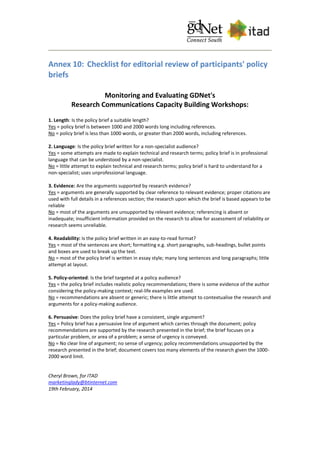
  • 143.
    engagement Aalaa Naguib & Shahira Moneib (GDNet) December 2013 ERF workshop– “Incentives for better quality higher education in Egypt and Jordan” December 12, 2013 Cairo, Egypt GDNet provided social media coverage of the one day event  A group of ERF researchers and staff attended the workshop 1 blog post http://gdnetblog.org/2013/12/24/education -in-egypt-a-deep-rooted-problem/#more- 4277 2 talking heads http://www.youtube.com/playlist?list=PLoX K33aSuhKjB9yDwlXQfeC6UsSlkR2o8 Twitter coverage GDNet experience Dina Mannaa & Aalaa Naguib (GDNet) December 2013 Egypt Network for Integrated Development (ENID)’s first Annual Conference December 14th , 2013 Cairo, Egypt  A broad spectrum of ENID userbase attended the event, including those responsible for various development projects and initiatives in South Upper-Egypt and Egyptian policymakers  GDNet social media platforms were used to direct GDNet userbase to the content generated during the event Total blog posts: 6 http://gdnetblog.org/tag/enid/ Total talking heads: 10 http://www.youtube.com/playlist?list=PLoX K33aSuhKg28JKyRsrsV509qn0L33aL  Capitalizing on partners’ online presence (i.e. using their SM platforms) is essential  Producing material beforehand would have helped in preparing the audience for the online coverage  Drawing a standard email informing interviewees about their interviews and inviting them to subscribe to the blog is good practice for online engagement  Early planning and better involvement of partners’ team members in the SM coverage process would have facilitated audience engagement online Online support for researchers Zeinab Sabet & Shahira Emara (GDNet), with the support of Megan Lloyd- Laney GDNet Presentation Skills Training for Awards & Medals Finalists June 17-18, 2013 Budapest, Hungary  Organised in collaboration with CommsConsult, the two-day Training aimed at building the confidence and presentation skills of the Awards & Medals Finalists in  GDNet co-delivered the training, together with CommsConsult, to a wide group of 20 academic researchers from Africa, Asia, Europe and Latin America, who were selected as finalists for the GDN Awards & Medals Competition  Finalists were expected to present their research at the GDN Annual Conference  A&M Finalists were engaged in a range of social media tools, including talking heads and recording of their mock- presentations. GDN Annual Conference participants were also able to follow the A&M Finalists Training related posts and video interviews through the GDNet blog.  Difficult to engage academic researchers during workshop and in discussions  Very challenging to work with such a mixed group of academic researchers coming from different background/cultures/education (some of them were too confident to get involved in discussions or group work)  The presence of 4 resource persons allowed for individual feedback tailored to researchers’ different needs
  • 144.
    (CommsC onsult) and Pier Andrea Pirani (Euforic services) June 2013 preparationfor the final and determinative phase of the competition - presenting their research to the audience and judging committee at the conference. Participants were trained to both identify the headlines of their research and make it accessible for a range of different audiences through developing principles of effective communication in the written and spoken word.  GNDet undertook the social media coverage of the workshop, and facilitated the "writing for development" through its community group for the participants of the workshop. Total Blog posts: 13 - http://gdnetblog.org/tag/gdn2013/ Video Interviews: 11 – http://www.youtube.com/playlist?list=PLo XK33aSuhKjhMSzDR3x82_0FCqFzIE1N  Talking head generated 97 views on GDNet Youtube channel Photographs – 57 http://www.flickr.com/photos/gdnet/sets /72157637407265866/ Twitter coverage  The climax of the training sessions was the presentation of each finalist's research in a confident and engaging style to the other scholars at the conference and the judging committee  All researchers completed a questionnaire where they pledged how they would do their job differently in the future in terms of communicating their research, which was to be followed-up 3 months later (please see output 2)  Effective use of video-critique and peer review methods to improve the styles and build the confidence of participants to present their work in different forums, including at the Conference Ceremony later in the week  Using visuals, particularly interviews and recording of video-critique sessions made it easier to break the ice with participants and engage with them throughout the conference that followed the workshop  This workshop created an exposure opportunity for GDNet – some of the participants of the workshop didn’t know about the services GDNet offers to showcase their work  Drawing a standard email informing interviewees about their interviews and inviting them to subscribe to the blog is good practice for online engagement Zeinab Sabet and Haitham ElKhouly (GDNet), with the support of Andrew Clappison and Nyasha GDNet-AERC Policy Brief Training Workshop – June 7-9, 2013 Arusha, Tanzania  Organised in collaboration with CommsConsult, Euforic Services and AERC, the workshop aimed at building the capacity and skills of researchers in communicating research to maximise its uptake GDNet user base interaction has been improved by using social media tools at the workshop, particularly Twitter which was introduced to participants through a Hands-on training on the third day. The workshop was targeted at a group of academic researchers from Benin; Burkina Faso; Cameroon; Côte d’Ivoire; Kenya; Malawi; Nigeria; Uganda; Tanzania; Togo; Zambia. A wiki was specifically designed and set for the workshop: http://gdnetcairo.pbworks.com/w/page/6 6395879/Main%20page%20- %20GDNet%20AERC%20Policy%20Brief%20 -%20June%202013 Photographs – 54 http://www.flickr.com/photos/gdnet/sets  Establishing contact with researchers early on is very useful – introducing them to the facilitation team through an email and the wiki prior to the event as well as sharing some workshop material in advance  Extending the workshop a third day dedicated to introduce participants to the use of social media for research proved to be a successful approach – not only the feedback from participants was positive, but it also resulted in an increase of user base interaction using the different social media
  • 145.
    Musandu (CommsC onsult), Pier Andrea Pirani (Euforic Services) and impact, andhelping the researchers produce a Policy Brief for each research project by the end of the workshop. . /72157634205029757/ Twitter – tweets were sent throughout the workshop platforms they were trained on at the workshop (i.e. Twitter, Delicious, Blog)  Capacity building events are good opportunities not only to produce content for GDNet social media platforms, but also to encourage user base interaction online. It helps ensure a regular content for the blog and interesting input from researchers on research uptake. Workshops provide an opportunity for GDNet to hear from African researchers about the challenges they face when communicating their research to their audiences  Talking heads being an effective learning and practice tool for both GDNet team and researchers  Reflecting on important sessions, particularly policy panels, on the blog triggered a lot of interaction both on Blog and Twitter – interesting content for GDNet user base, partners and other knowledge intermediaries  Drawing a standard email informing interviewees about their interviews and inviting them to subscribe to the blog is good practice for online engagement Zeinab Sabet (GDNet), with the support of Megan Lloyd- Laney and Andrew Clappison (CommsC onsult) GDNet-AERC Policy Brief Training Workshop – December 6-8 , 2013 Arusha, Tanzania  Organised in collaboration with CommsConsult and AERC, the workshop aimed at building the capacity and skills of researchers in communicating research to maximise its uptake and impact, and helping the researchers produce a Policy Brief for each research project by the end of the workshop.  GNDet undertook the social media coverage of the workshop . GDNet user base interaction has been improved by using social media tools at the workshop, including blog posts, talking heads with participants and Twitter. The workshop was targeted at a group of academic researchers from Benin, Chad, Uganda, Ghana, Nigeria, Cameron, Kenya and Ethiopia. The research projects involved were: Macroeconomic management of foreign aid; Institutions and service delivery A wiki was specifically designed and set for the workshop: http://gdnetcairo.pbworks.com/w/page/7 0989195/Main%20page%20- %20GDNet%20AERC%20Policy%20Brief%20 -%20December%202013 Total Blog posts: 2 http://gdnetblog.org/category/capacity- building/ Photographs – 71 http://www.flickr.com/photos/gdnet/sets /72157638607377523/ Talking heads: 6 http://www.youtube.com/playlist?list=PLo XK33aSuhKiwcEfPUR2dbIGfauukI8g0  Talking heads received 31 views Twitter – tweets were sent throughout the workshop GDNet-CIPPEC Spaces for Engagement Program GDNet&CI GDNet-CIPPEC Resource Toolkit – How-  Resource toolkit is dedicated to a wide range Resource toolkit has been made available on  The production of guides and their circulation on
  • 146.
    PPEC (Leandro Echt& Vanesa Weyrauch ) to-Guides – 2013 A seriesof 5 guides addressing research communications were produced in 2013, adding thus to the resource toolkit produced in 2012 and covering policy influence planning, and monitoring and evaluation. 1. Toolkit 1: First approach to research communication 2. Toolkit 2: Policy briefs 3. Toolkit 3: Engage with media 4. Toolkit 4: Online tools 5. Toolkit 5: Dynamic formats to communicate research of audience in the Global South (including GDNet larger audience and CIPPEC constituencies)  Available in both languages, English and Spanish  The resource toolkit is a series of guides aiming at strengthening Southern researchers’ communications capacity and enhancing their influence plan towards a better policy outreach GDNet Portal https://www.gdnet.org/xml_rendering_engi ne/cwe_page_renderer.gdnet?id=capacity_ building_how_to_guides And on Vippal platform http://www.vippal.cippec.org/biblioteca/ online platforms led to an interaction with INASP, which included the content of the toolkit “How to communicate research for policy influence” in their trainings in Africa. (INASP Evidence-Informed Policy Making (EIPM) programme works with partners to build capacities to access, evaluate and use research for policymaking. INASP leads a consortium that is part of the DFID funded programme ‘Building Capacity for Use of Research Evidence (BCURE)’ which has the aim of building capacity for policy makers and their staff to demand and utilise research evidence in decision making.)  Any knowledge should be made public so that other stakeholders make use of it and ensure a bigger outreach - INASP translatedSFE toolkits on M&E (produced in 2012) toolkits to Arab to be used in the ‘MENA Policy Links’, a joint programme delivered by the Westminster Foundation for Democracy and the Arab Institute for Parliamentary Training and Legislative Studies.  How-to-guides are a good opportunity to feature work by others that is practical and applicable GDNet and CIPPEC (Leandro Echt& consultan t Jorge Papadópu los) Paper “Paradigms, production, demand and use of evidence in childcare policies in Latin America” Study on how policymakers in LA use evidence when formulating childhood policies.Based on the following questions: What are the major concerns of policy makers about childcare in Latin America? What is the type of information and knowledge used or needed during the policy making process?, the paper has two main objectives. First, to identify the degree of development of early childhood’s policies in four Latin American countries: Argentina, Chile, Costa Rica and Uruguay. Second, it aims at determining what type of knowledge is required by  Available in Spanish The study has been posted at VIPPAL’s site and shared through its social networks: twitter, facebook and google +. Moreover, it has been uploaded at http://cippec.org/priorizarlaequidad/  Based on previous failed experiences, in this opportunity we decided to commission the study to well-known researchers, from the small group of applications we received, to ensure they can deliver the expected quality of research.  Consider other ways of promoting research calls. One optional strategy would have been to partner with an organization with expertise on childcare policies so as to build on their existing networks and knowledge of experts on this field.  A more intensive work can be done to promote the paper’s findings among Latin American policy makers working on childcare policies
  • 147.
    decision makers inthe process of policy learning, either to enhance it incrementally or transform it at a paradigmatic level. GDNet, Politics & Ideas, & CIPPEC (Vanesa Weyrauch ) Paper “Lessons learned on promoting better links between research and policy in Latin America. A collaborative reflection on Spaces for engagement: using knowledge to improve public decisions, a 6 year programme conducted by CIPPEC with the support of GDNet” A paper that synthetizes and shares 20 lessons learned through the 6-year programme that aimed at promoting spaces of engagement between researchers and policymakers  Available in English  Dedicated to a wide range of audience in the Global South interested in on what has worked and what has not in terms of the key activities of the programme: research production, capacity development andnetworking and partnerships  Valuable evidence that can guide strategic design of future workby the diverse partners of the programme  Share this knowledge with organisations/persons working in this field. In order to receive inputs regarding the program, different people that have been part of SFEactivities were contacted By September 2013, the paper had been read by 1755 people at Scribd. The study has been posted at VIPPAL’s site and shared through its social networks: twitter, facebook and google +. Moreover, it has been uploaded at Politics& Ideas, and P&I team has developed different blog posts addressing each lesson reflected on the paper  As the paper present different lessons, it was a good communication and dissemination strategy to produce single blog posts addressing each lesson with a separate reflection. That gave us the possibility to deepen in the content of the paper.  It was a good practice to reflect and systematize what we have learned in the last six years. Moreover, it was relevant opening this learning process to others, both in terms of receiving their feedback and thoughts to co-construct new knowledge and in sharing this new knowledge with them. GDNet (Zeinab Sabet) &CIPPEC (Julia D'Agostin o; Leandro Echt, Clara Richard& Vanesa Weyrauch ) GDNet-CIPPEC Online Courses – 2013  One Spanish online course delivered and facilitated on “How to monitor and evaluate policy influence” (from April 28th to June 16th , 2013)  One English online course on research communications piloted and moderated (from April 22nd to June 9th )  Spanish course dedicated to Latin American researchers. 42 applications received (members of universities, think tanks, civil society organizations and policymakers). 13 participants selected from 11 countries (Argentina, Brazil, Colombia, Ecuador, Dominican Republic, El Salvador, Guatemala, Honduras, Mexico, Nicaragua and Peru)  100% said that the course reflected best practices and current knowledge on the topic.  100% mentioned that quality of materials provided was high  100% believed that the teaching methodology was appropriate to the objectives of the course.  100% expressed that the facilitator  Online training material are provided, including 6 modules per course  Courses are evaluated by participants with suggestions for improvement  Online courses continue to be a great space for interaction of people with utterly varied profiles who needed to improve their research communications: from women working with reproductive health in Ghana, to others looking after elderly people in Singapore; from those working in public infrastructure improving roads in Eastern Cape Province in South Africa to those working in energy saving for the youth in Kyrgyzstan.  Other than the material we provided to the participants, what everybody appreciated the most was the virtual space that allows everyone to open up and describe their concerns without feeling shy. The virtual forum creates an excellent opportunity
  • 148.
    were clear intheir interventions and that they were receptive to participants’ needs and interests.  100% considered that the course addressed issues that are relevant to their work and environment.  100% thought that the exercises of the modules were useful.  89%believed that aspects addressed in the course can be applied in their daily work.  44%was able to share the exercises and suggested tools with their organization.  100%expressed their satisfaction with the overall course.  English course dedicated to African and Asian researchers. 115 applications received, 18 researchers, think tanks, CSOs and policymakers from 12 countries: Bangladesh, Cameroon, Ghana, India, Kenya, Kyrgyzstan, Nigeria, Singapore, Sri Lanka, South Africa, Tanzania and Zambia.  90% said that the quality of the course was excellent or very good.  80%consider that the clarity of modules' content was excellent or very good.  90% believed that the amount of material was excellent or very good.  70% expressed that the teaching methodology was excellent or very good.  100% considered that the facilitation of the course was excellent or very good.  70% thought that the course was relevant for their work.  88%believed that the exercises were useful or very useful.  80%said that the spaces for virtual to those who are generally more hesitant to speak up in public, to share not only successful experiences but also their failures. This is most definitely easier in this format. For example, most of the participants realized that most of the time they were doing dissemination instead of communication of their research, and that actually after trying different strategies to reach decision- makers they had failed to do so. Although the theory sounded great, implementing it was another story. When a participant shared his/her experience, others interested in the case asked about it, gave advice and opened up to share their own experiences of failure.  Regarding the facilitator’s role, we learned thatthis tone encourages the group to learn from each other instead of being a tutor-participants vertical course. As facilitators, we may know about strategic plans, theories, useful readings, tools, etc., but we don’t necessarily know or understand every single context in which people work. Our job is to ask the right questions, something that only comes by having a genuine interest in each participant’s story. However, the answers come from them, therefore creating a dynamic that is much more interesting and gives real meaning to the content of the course. This methodology empowers participants and encourages active participation and sharing of experiences.  The fact that forums remain open along the course also allows reflection and in-depth learning; no rush is expected in answering questions, giving an opinion or making a comment. In this sense, the course allows for (better) team participation. Participants generally also have a chance to get back to their working team in their organization and
  • 149.
    exchange were usefulor very useful.  90%consider that they learned what they needed and gained new skills, and that those knowledge and skills will improve their effectiveness and results.  70% believed that other benefits from participating of the course was the possibility of knowing experiences form other organizations, 70% consider that they come back to work with new ideas for their activities, and 50% appraise the contacts with colleagues.  30%was able to share the exercises and suggested tools with their organization.  90%expressed their satisfaction with the overall course. share what they learned, being it an exercise or a group discussion. Although you can’t expect everyone to take the time to discuss with their team (or sometimes they don’t even have a team!), we encourage talking to someone in their organizations once the course is completed. The results have been rewarding. For example, one of the participants arrived with a communication strategy that had been developed before the course, but was then able to improve it with her colleagues due to the insight gained from some of the course exercises. It was not only great for others to learn from this participant’s work but also for us to have the opportunity to work with a genuine communication strategy. CIPPEC (Leandro Echt and Natalia Aquilino) Presentations for think tanks, NGOs and universities CIPPEC was invited to share its experience on policy influence and on M&E systems at different national and regional events and through technical assistances to other organizations. In all cases, CIPPEC’s participation and support were mainly based on the research produced under SFE programme.  Think Tank Initiative Latin America Annual Meeting (Peru, April 2013)  “M&E at Civil Society Organizations: What? Why? How?”, organized by the American Chamber of Commerce (AmCham) in Argentina (Argentina, September 2013)  “Lobbying from the civil society: think tanks’ Even though these activities did not take place under SFE program, they were fed by SFE content and research on M&E, policy influence and think tanks’ issues. Think Tank Initiative Latin America Annual Meeting (Peru, April 2013). Through these activities, CIPPEC shared its experience with 12 Latin American think tanks supported by IDRC. “M&E at Civil Society Organizations: What? Why? How?” organized by the American Chamber of Commerce (AmCham) in Argentina (Argentina, September 2013). CIPPEC shared its lessons on M&E with more than 100 members of Argentinean NGOs. Technical assistance to design and implement an M&E system at the think tank Salvadoran Foundation for Economic and Social Development (FUSADES) (July 2013 - June 2014) . CIPPEC delivered a workshop for more than 20 people working at the think tank FUSADES, in order to help the organization develop an M&E system.  Monitoring and evaluation issues represent a huge challenge within organizations, and many of them are seeking assistance on this issue  Long term projects, like the one developed with FUSADES, allow for a broader learning experience and a more sustainable institutional improvement, than ad hoc workshops.
  • 150.
    strategies for policy influence”,at the Inter American University (UAI) (Argentina, September 2013)  Technical assistance to design and implement an M&E system at the think tank Salvadoran Foundation for Economic and Social Development (FUSADES) (July 2013 - June 2014) CIPPEC (Leandro Echt& Vanesa Weyrauch ) Communications efforts – SFE reaching a broad presence on virtual spaces Southern researchers interested in bridging research and policy, in improving their capacities for policy influence and in how to improve organizational processes. 13 posts on Politics & Ideas:  A role for think tanks in polarized societies (March 2013)  Say no to developing new communication channels that are not linked to your core business (April 2013)  Involving the private sector in funding ideas: planning a fundraising event (part 1)(May 2013)  Involving the private sector in funding ideas: planning a fundraising event (part 2)(June 2013)  Institutionalizing the demand for research: Public Sector Advisory Council for research organizations(June 2013)  Clear rules for a publishing process (July 2013)  Communication innovations to inform public debate: PLAAS’ Fact Check series (July 2013)  Online courses as a learning opportunity (July 2013)  Online courses: a learning opportunity with a broader outreach (August 2013)  Excellent opportunities to broaden the scope of our activities to a specific audience, interested in think tanks and knowledge management  It is a good strategy to reflect on other organization’s experiences, and share the good practices with a broader audience – it triggers online discussions and interaction among users  It was good to generate a series of posts on think tanks executive directors’ roles. Some of these reflections were noted and shared through the “Think Tank Watch”, a site dedicated to “covering The Think Tank Scene in Washington, DC & Beyond”.
  • 151.
     Addressing politicalincentives for electoral debates: CIPPEC’s Agenda for the President 2011-2015 (August 2013)  Think tanks’ executive directors: background, profiles and qualities(August 2013)  How to conduct a transition in the Executive Direction? Two experiences from think thanks in Latin America(August 2013)  More reflections on transitions in think tanks’ executive direction: FUSADES’ experience (September 2013) CIPPEC (Leandro Echt) Revamp of VIPPAL  The first action undertook was the redesign of the technological platform of the website: www.cippec.org/vippal. The website was migrated from a closed platform to Wordpress.  Secondly, we reformulated VIPPAL’s graphic design.  Third, all the texts of the website and social networks were rewritten, in order to gain clarity and use powerful messages. VIPPAL’s content is available in Spanish as a way to increase its impact in the region and offer an alternative in a market of ideas whose productions are mostly created in English. However, in the resources section, whenever possible productions were included in Southern researchers, not only in Latin America but also in Africa and Asia given the English interface, interested in bridging research to policy VIPPAL (October 2th-December 31th) Unique visitors: 1458 Page views: 6559 Average visit duration: 03:11 mins. Countries visiting: 68 Top 5: Argentina, Mexico, Perú, Venezuela, Colombia TWITTER (October 2th-December 31th) Following: 443 Followed: 208 Tweets: More than 100 VIDEO (October 2th-December 31th) Spanish views: 474  The reorientation of VIPPAL’s graphic design improved its visual identity to get closer to the users of its services. It is important to say that the redesign of the sections considered that all content, activities and resources produced under the six years of SFE is available at the public domain.  Besides VIPPAL’s site in Spanish, developing an SFE site in English with all the history of the program’s products and activities will allow the content to be available at the public domain for everyone interested in linking research and policy in Africa and Asia.  Using social media in an active way, specially twitter, allowed the program reflections to be spread out among a broader audience, helped by retweets and other possibilities of Twitter.
  • 152.
    both languages. Moreover,an English landing page was designed in order to make all SFE content available for English-spoken audiences: www.vippal.org/en .This will easy GDNet’s dissemination of SFE six year- activities.  Video: As part of the process of improving virtual presence, the fourth decision was to produce a video to explain the importance of planning policy influence. This is a short humorous animated story, which describes the attempts of a researcher to bring his work to a politician. The video also works as a description of VIPPAL’s objectives. The video is available both in Spanish and English. This will reach the Spanish regional community, but also use a wide variety of communication channels that work in English, as the Onthinktanks’ blog or Politics&Ideas. GDNet’s staff could also share the video with their audiences.  Social networks: A fifth step of the strategy was enhancing VIPPAL’s social media presence. Coverage of “Communicating Complex Ideas and Critical Thinking” Shahira Emara, Maya Madkour (GDNet) & Enrique Mendizab A book on “Communicating complex ideas and critical thinking” The book represents a dialogue between academics or researchers and communication practitioners on developing critical thinking capacity and  The book is targeted at researchers and communication practitioners, and indirectly policymakers and communication practitioners  Researchers will study the links between research and policy in their own disciplines The book and its different chapters were introduced through a series of posts published throughout 2012 and 2013. http://gdnetblog.org/tag/critical-thinking/  More or less the same lessons apply from last year, it would have been better if the GDNet team were more involved in this project and work closely with researchers and onthinktanks.  This is a long term project that requires more than two years to complete. Hence, it would have been helpful if coordination between onthinktanks and
  • 153.
    al (Mendiza bal Ltd) communicating complexideas to a wide variety of audiences. The objective of this project is to gain a greater and more nuanced understanding of the challenges and opportunities for research uptake among think tanks and policy research institutes in developing countries. http://cloud2.gdnet.org/cms.php?id=crit ical_thinking_capacity and policy contexts. The book will contain 5-6 chapters; looking at governance policies and electoral reform in Argentina by CIPPEC; School reform in the Middle East by AUC; the social marketing and re-branding of breast milk in South Africa by Mixed Media; civilian control of the state security sector by BSCP; and public poisoning and harmful technologies by Groupo FARO gdnetblog was planned early on for timely feature of material  No interaction between researchers, communicators and policy makers was visible online. The pilot is based on a research book that criticizes the fact that researchers keep communicating their research ideas to each other, to the same audience (R- R). two years on, we are still not clear if the research has helped break this pattern (R-P/ P-R)  Reflecting on the different chapters in the form of blog stories was essential to ensure a broader outreach  Launching an online discussion forum to gather ideas and suggestions on that specific issue could have been very useful Thematic Haitham Khouly, Maya Madkour, Zeinab Sabet + team Integrating social media into GDNet knowledge base The aim is to use social media platforms, mainly blog and twitter to help knowledge base content travel to reach end users  Generating online reflections on KB content  Blog stories and tweets targeted at GDNet’s braod spectrum of users GDNet Blog Blogging on KB content was introduced in the GDNet Social Media Strategy (see log output 4) and implemented in the last quarter of 2012. Each team member was asked to produce blog stories on papers from regional and thematic portals of his/her responsibility. Content generation is planned according to the GDNet monthly social media plan/calendar. - Blog post on corruption & governance http://gdnetblog.org/2013/03/1 5/corruption-a-plague-to-the- nigerian-economy/ Twitter KB content has been included in twitter planning since beginning of 2012 and ongoing up till now.  Making use of social media and online presence in KB content spinning ensures a better outreach and enhances research communications and uptake  Social media arouses curiosity of researchers to read papers on KB and creates awareness around GDNet services and Campaigns (capacity building activities, connect South, Online Services, Journals, datasets,…) Connect South Campaign Shahira Connect South Campaign (Cont'd)  The campaign is targeted at researchers, 9 Blog posts in 2012,  The campaign enables GDNet to strengthen its online
  • 154.
    Emara & Dina Mannaa (GDNet), Clare Gorman & Cheryl Brown Launchedin June 2012, the aim of the campaign is to encourage members of the development research and policy communities to adopt a more inclusive approach to southern researchers’ knowledge. The Connect South campaign calls on people and organizations working in development to pledge their support and re-establishes GDNet’s own commitments to southern researchers. policymakers, communication practitioners, think tanks, development research institutes, NGOs and any other actors/bodies involved in knowledge management and development reseach  The campaign provides the perfect example of a user base-user base interaction http://gdnetblog.org/category/connect- south-campaign/ GDNet Youtube Channel 20 videos http://www.youtube.com/playlist?list=PL1E A873FA2BCD64DB&feature=view_all These generated 790 views on youtube Twitter Regular tweets have been sent about the campaign since its launch Prezi 2179 views as of February 20th http://prezi.com/126vw29fbeap/the-gdnet- connect-south-campaign/ LinkedIn 251 members and they are actually active ones, they always share their experience and some of them have shared their pledges to connect south Introductory video A short video documentary was made to bring forward and explain the aim of the campaign. http://www.youtube.com/watch?v=ZHm3V DLhEuM presence and triggered online interaction (i.e. CS interviews and talking heads were used as content for GDNet Blog and Twitter)  The CS network (see LinkedIn) needs constant nurturing and attention. Champions (including GDNet staff) are needed to animate the discussion, progress in the debate and encourage pledges  The CS directs traffic to GDNet accounts on social media platforms (i.e. spinning blog content on CS discussions on LinkedIn and vice versa)  However in the build-up of closure, it was challenging to keep up with the momentum of the discussion group. Also during review process direction was geared towards encouraging the GDNet team to focus efforts on program deliverables with regards to Southern Research outreach and uptake  We are now dealing with the dilemma of the shutdown of the GDNet program, which entails that the CS initiative will consequently come to an end and the energy is dying away. It doesn’t work well when program is coming to an end.
  • 155.
    Annex 7: GDNetSocial Media Annual Stat Report for Year 3 (2013) GDNet’s experience with social media is a special one. Firstly, in its evolution from an event-driven approach to a cross-cutting integral pillar throughout the program. Building on the experience and skills developed in the previous 3 years (2010-2012), as well as the social media strategy developed in 2012 to support the objectives of the programme, the focus in 2013 was on integrating social media in the overall GDNet program. The social media calendar developed in the third quarter of 2012 was being updated regularly throughout 2013, capturing thus relevant hooks and events to ensure a constant flow of content was produced on GDNet social media channels. It is throughout 2013 that social media has finally become fully integrated within the program’s different outputs. It is worth mentioning that the integration of social media provided a significant opportunity for the GDNet team to acquire and put into action their new set of skills. Three main channels have been used by the team: the GDNet blog; a branded YouTube channel; and the @Connect2GDNet Twitter account. While YouTube was mainly used to publish short interviews recorded during events and workshops organized by GDNet or attended and covered by the team, the blog and Twitter saw new contents being produced on a regular basis. Over the year, the following outputs were produced:  88 blog posts  97 videos  1582 tweets In the original version of its logframe, GDNet was granted the role of interaction catalyst for its research community. As social media grew big throughout the program, so did our thinking about interaction and how to measure. Until the first quarter of 2013, our focus was on GDNet-user base interaction; in other words engaging with our audience. The 2013 DFID annual review enabled us to revisit our understanding of both terms, ‘user base’ and ‘interaction’. While ‘user base’ is defined as Southern researchers with whom GDNet has engaged (registration on the knowledgebase to showcase profile and/or access online journals; recipients of GDNet newsletters, regional bulletins, online surveys; following/ participating in GDNet online and social media spaces: gdnetblog; twitter community; Connect South LinkedIn Group attendance at training event/workshop, membership of a community group); ‘interaction’ is defined as Southern researchers’ interaction with other Southern researchers. Therefore, our approach to social media was revisited to focus more on triggering interaction among users through spaces and platforms convened and facilitated by GDNet. This change in perspective was also reflected in our M&E approach. As of the second quarter of 2013, we developed a set of new indicators to measure user to user interaction on GDNet social media channels and platforms. These include:  Comments on GDNet blog,  Retweets and mentions on Twitter  Comments and shares on YouTube channel. GDNet Blog
  • 156.
    The graph showsa positive trend starting from January 2010 (the date when the blog was set up) till today. The highest point in terms of traffic for 2013 is recorded in June, coinciding with the GDN Annual Conference in Manila, Philippines. The GDNet and Euforic Services team was keen to seize the opportunity of having a mixed audience not limited to the GDN one; audiences from the East Asian Development Network, Philippines Institute for Development Studies and the Asian Development Bank engaged both on Twitter and the GDNet Blog. A new guest blogging approach was piloted at the conference; GDNet blog hosted posts from journalists and students who participated in the conference. This, in fact, triggered more interaction from the Asian region on both Twitter and GDNet blog. An increase in traffic is also recorded again in in December 2013, when the GDNet team provided social reporting for a number of events organized by GDNet partners ERF and AERC:  ERF Conference, “The Egyptian labor market in a post-revolutionary era: results from the 2012 survey”;  Egypt Network for Integrated Development (ENID) Annual Conference;  ERF workshop “ Incentives for Better Quality Higher Education in Egypt and Jordan”;  GDNet-AERC Policy Brief Training Workshop. Other events were covered during the fourth and last quarter of 2013, including LACEA Annual Conference, ERF workshop on “Women Economic Empowerment in the MENA Region”, ERF workshop on “The political economy of transformation in the ERF region”.
  • 157.
    Looking at yearon year data, for the first time in 2013 the total blog views were slightly lower than the previous year. The reason for this result can be found in the decreased time available for GDNet staff to create social media content and provide coverage to events. This is also confirmed by the reduced number of posts published in 2013 as opposed to 2013 – see chart below. However, the increasing number of comments received on the various blog posts can be used as a proxy for increased users’ engagement with GDNet and the content produced by the team. Additionally, this is also confirmed by the number of time GDNet blog posts have been shared (484)by readers and users. GDNet Twitter As of Q2 2013 we started to track additional metrics in Twitter, to gain a better understanding of its value and results in terms of user base interaction. By end of 2013, the number of followers on Twitter reached 1941 followers (an increase of 541 followers throughout the year).
  • 158.
    Also the numberof clicks received on links shared via Twitter shows a positive trends between 2012 and 2013, indicating that the content posted resonated with GDNet audience. Additionally, we started measuring the interaction with and among our users through metrics such as mentions, replies and re-tweets. As it can see for the graph above, these metrics are only partially available for 2012. Results for 2013 indicate a significant number of mentions (662), replies (52) and retweets (533). Using the location field in Twitter accounts, the below map is an attempt to approximate the geographic location and mapping of our followers. Please note that the below map refers to Q1 2014; we decided to include it here in this annual report on 2013 as it gives a clear indication of where followers are located.
  • 159.
    GDNet YouTube Channel Thepositive trends in views on YouTube video continued in 2013. Over the all year, the video published on GDNet channel recorded a total of 10,473 views. Egypt, India, Tunisia, Morocco and Turkey are amongst the top countries for traffic.
  • 160.
    As for Twitter,also for YouTube we started collecting additional metrics and backdated them to cover previous years. Looking at the graph below, we can see that in 2013 interaction is maintained at previous year level for number of time GDNet videos have been shared by users. It also increase in number of comments received and it decreases for number of likes. Finally, we also collected data at YouTube channel level to monitor the number of users that subscribed or unsubscribed to the channel over time. As it can be seen from the graph below, while the number of users unsubscribing from GDNet YouTube channel remained unchanged, the number of new users subscribing has increased of almost three times.
  • 161.
    Feedburner In 2013, wekept using FeedBurner to publish and monitor the uptake of our content via RSS feeds, a publishing format used to help the user who want to subscribe to access information he/she is interested in. The graph shows a positive trend, with a strong increase in the number of hits throughout 2013. Likewise, also the number of reach and clicks on feed content has increased quite significantly in 2013.
  • 162.
    Prepared by ZeinabSabet – GDNet social media expert
  • 163.
    Annex 8: Output4 indicator 1 – Generation of best practice lessons – log Below is the log created by the GDNet team to record their generation of best practice lessons throughout Year 3. It is further synthesised and summarised under Output 4 indicator 1 in the main report. Date & Person at GDNet Title , date, and location of reflective events/products Event / Product Objective Participants Involved Brief Summary of Best Practice lessons generated Dina Mannaa & Shahira Emara Support from GDNet team when required Knowledge services brainstorming reflective meeting. The Knowledge services intends to: · Raise the profile of Southern researchers and make southern research more accessible · Diverse research and policy audiences make better use of development research from the global South · Extend the outreach of KB research beyond website, using social media and regional/ Thematic bulletins Knowledge Services team It is in the mandate of GDNet to raise the profile of Southern research. GDNet had done so by expanding the KB and adding more and more papers to the repository as per the logframe. GDNet’s knowledgebase (KB) is a huge reservoir of knowledge. It holds more than 22,100 research papers, mostly produced by Southern researchers. - Who will take care of the KB after GDNet exits industry. Value is jeopardised - As program approaches end of funding period, the team came to question the the knowledgebase permanence. Ten years plus went into building the Southern based KB portal, now who will carry on with this mission and continue to cater for the South? - Having a small team made it easier to accommodate to trending technologies like the open-data. Even though it was not
  • 164.
    originally planned aspart of the logframe, having this flexibility allowed us to respond technically to this opportunity. - Building up a huge reservoir of research papers is not enough, data validation is a must to ensure data reliability and continuing access. - Results from annual GDNet surveys confirm that researchers mostly value access to online journals and datasets (like jstor). With GDNet discontinuing this services, this is something for DFID and other donors to look into alternative possibilities to grant access to datasets. - It was a challenge to keep researchers motivated to continue to contribute their papers to the KB, given the closure note. Why would a researcher make the effort to submit his work to a program coming to an end in just a few months. - Trying to keep the morale of the team to continue to push and market for Southern research was a challenge. Managing team dynamics at end of program is tough. - GDNet always had a heavy technical structure. One lessons is to make use of free available knowledge platforms to host KB content and be more user-friendly and open
  • 165.
    up to twoway exchange with other platforms early on. Have more of data sharing agreements, like the one between GDNet and ELDIS. - In the future: For other knowledge intermediaries.,it is good practice to educate user-base on how to make use of Open data Platforms to increase research uptake. - Scoping out partnerships to work together rather than in competition is essential to the success of the overall knowledge networks model. It would have been rather interesting if other networks like for example ERF, LACEA, CERGE or ELDIS had similar models to exchange and facilitate research papers being it technically or as part of the program. Interviewed by Cheryl Brown Jan 2014 Zeinab Sabet & Shahira Emara March 2014 Building research Communications Capacity An interview and brainstorming session was held with Research Communications Capacity Building Manager to reflect on lessons generated from capacity building program throughout 2013 and up to date Zeinab Sabet The Capacity Building (CB) program has been on throughout the DFID funding period, it is a good opportunity to think about the evolution of the CB and how it was delivered to Southern researchers. - The program is usually delivered in partnership. Calling on partners’ experiences to co-deliver the program. This was an enriching experience to skill up the team with various expertise. - The program had a clear core program,
  • 166.
    however, the teammembers were flexible enough to tailor to each workshop based on need assessments held prior to workshops. For example, the workshop delivered to the awards and medals finalists group by GDN is different from the one delivered to AERC (RNP). The first is more customized for presentation skills, while the latter is more organized around policy briefs. (More examples in Output 2) - It was good practice to hold regular “After Action Review” (AAR) following each organized event with all involved facilitators and workshop organizers; to path the way for better facilitation next time around. - M&E has allowed us to measure the impact on training participants immediately. It also provides feedback on how to improve the way we deliver our workshops - Confidence and ability score (quantitative tool) is a good indicator but it is not an accurate reflection of the learnings earned. As it is based on self perception and assessment of researchers of themselves. - On the other hand, following up with researchers’ pledges they make at the end of workshops after 3 & 6 months up to a year, was found to be a good qualitative tool to collect feedback and monitor progress and
  • 167.
    uptake of training.We could hear from researchers in their own words how they planned to take capacities earned at workshop forward and whether pledges they made were actually done. - Through the pledge we ask researchers to communicate learning to others, to make sure learning travel as much as we can. Some researchers were keen to do that, and examples of which are reflected in Capacity Building publication. - However, working with researchers who have institutional connections is easier, than researchers who work on their own. Because simply the first group can transfer learning more systematically. - GDNet would have loved to see a full circle of policy impact. So do dedicated researchers who attend our Capacity Building workshops. GDNet handholds researchers to start with workshop delivery, post workshop mentoring, follow up on pledges, assist in sharing learning with peers. It would be ultimate to also provide support to hold dissemination workshops/ policy labs to bring together researchers and policy makers. or work with other initiatives who can do that. - Post workshop mentoring provided by GDNet’s help desk to workshop participants
  • 168.
    was deemed valuable. -Online courses provide a cost-effective learning opportunity and ensuring a broader outreach to invite more researchers. With trending technologies in e-learning platform, now it is much easier to foster interaction between participants and follow up with them directly. - Online courses provide the opportunity for participants to engage and learn from each other, instead of the traditional tutor- participants vertical approach. Interviewed by Cheryl Brown Feb 2014 Working with social media Social media efforts aim to: · Create a two way active relationship with stakeholders · Allow KB to travel to end users · Arouse curiosity of researchers to read papers published on Knowledgebase · Raise awareness around GDNet services, products and Campaigns (connect South, Online Services, Journals, datasets, …) · Increase and direct more traffic to GDNet products Zeinab Sabet & Shahira Emara Over the years, the GDNet team has been cumulatively building up the capacity to incorporate the use of social media in GDNet’s different activities. This “learning by practice” has substantially contributed to develop the team’s skills, as they grow confident by time. - The collaborative and coordinated training sessions and streamlined communication with Euforic Services have also provided systematic guidance to the team, so as to stay up to date with the trending tools and techniques for the use of social media in research communications. - Initially, social media was perceived by GDNet as an informal medium, GDNet has come to realize and practice the value of
  • 169.
    · Keep usersinformed and updated with the latest news · Ensure better accessibility, simpleness and user friendliness · Announce capacity building activities and events · Events reporting and creating a parallel online community to spread outreach and messages. “quality” over “quantity” in disseminating effective messages using social media tools. - Having said so, interaction may also be about quantity; in the sense that the more content is put out there (especially on twitter and blog), the more opportunity there is for the user base reacts to. - Interaction is different from one event to the other depending on audience engagement we learnt that it's difficult to get a good level of interaction if you haven't already established some kind of relationship with online audience in advance. - GDNet has also managed to upgrade its interaction through social media from building a strong relationship with its user base, to triggering “user to user” interaction (discussions), which is a noteworthy form of intermediation. - Social media is all about exposing your work to a broader body of audience. The risk that comes with that is criticism, be it good or bad, which could be quite a challenge for researchers. The message we are trying to send to southern researchers here is to become open to different opinions, even if some of which might not be appealing. - People say more in less. When a speaker is
  • 170.
    granted a ‘90second’ talking head, they become more clear and precise on the main message of their work they want to push out. Dina Mannaa & Shahira Emara March 2014 Reflective session on Connect South Connect South aims to: · To encourage members of the development research and policy communities to adopt a more inclusive approach to southern researchers’ knowledge · The Connect South campaign calls on people and organizations working in development to pledge their support and re-establishes GDNet’s own commitments to southern researchers Discussions during review process were geared towards encouraging the GDNet team to focus efforts on program deliverables with regards to Southern Research outreach and uptake, as opposed to more of an advocacy role. That and the need to focus to prioritise exit, which affected continuity and momentum of CS discussions. - The CS initiative picked up well enough before the downturn turn of events, which can be largely attributed to the innovativity of the idea and the little effort it requires of researchers to commit. - Nevertheless, we are faced with the dilemma of the shutdown of the GDNet program, which entails that the CS initiative will consequently come to an end and the energy is dying away. It doesn’t work well when program is coming to an end. - Suggested Forward looking: Talk to members of CS and partners to see if anyone would be interested to volunteer to facilitate the group discussions as such. However this is subject to exit plans for suite of social media channels
  • 171.
    GDNet team virtual chat Learning& Publication Reflections on the creating a space on the GDNet website to document lessons and learnings Dina Mannaa & Shahira Emara - It was good practice to dedicate a section of the website to the learnings the program came about throughout the years. Also complementary effort using social media tools to push out the learning was used. - Now with GDNet exit, it is rather important to make sure lessons are delivered, if not personally delivered. Cheryl Brown Interview with GDNet Director and M&E Consultant After using a 4 years old M&E system, what are the reflections from those who were involved in the strategic thinking and the build up of the M&E system for GDNet. Robbie Gregorowski Sherine Ghoneim With the program coming to an end, it was useful to reflect on the M&E in place to measure impact of GDNet as a knowledge network and how this has evolved over four years. It is obvious that M&E enhances transparency and accountability, but the team at GDNet was able to draw some other reflective observations as well: - M&E is not the sole responsibility of an external consultant, it was very useful that the team were involved at the outset to make sense of how to read indicators, collect data, and understand results. - Not only does M&E tell us if we are on the right track, but it helps us understand why things are happening the way they are. How Social media grew on the program, made us realize why we use it, what to trigger and how to measure impact?
  • 172.
    - It helpsus undertake a systematic culture of learning. It allows a perspective to change things around when needed, like with guest blogging and social media new indicators of interaction. It also allows the team to understand how we can better support Southern researchers. - Plan the use of a range of methods to collect input; maintaining a balance between standard monitoring tools ( survey) and tailored ones based on the program’s activities (pledges for the capacity building workshops based on the GDNet model) is good practice. - Pledges are a unique method to collect input and measure qualitatively confidence and ability of researchers post- capacity building workshops. It was also a good method to stay in touch and build a relationship with researchers rather than one-off events. And most importantly it allowed us to trace cases over a period of time (3 - 6 months and one year) - Citation analysis simply does not work per say, it is not an appropriate model for Southern research, simply because southern research is not published in peer reviewed journals that citation engines pick up. - From running GDNet’s annual surveys we
  • 173.
    came to stronglyunderstand, as this becomes clear one year after the other, that Southern research is not of lower quality in comparison to Northern research, but however complimentary. Southern research is seen by our user-base as one that provides more practical solutions development problems unlike the case with Northern research that is more empirical. Aalaa Naguib & Shahira Emara Feb 2014 Experience with Southern researchers This event was a get-together by the team to reflect on our experiences to have met and worked with Southern researchers whether during capacity building workshops or events reporting using social media. The team shared their views on what they know about challenges to communicate Southern based research. Haitham el Khouly, Zeinab Sabet, Aalaa Naguib, Dina Mannaa & Shahira Emara This exercise was energizing and interesting to put together what we, as a team, know about Southern researchers challenges and want to share with other intermediaries. It made sense that even though the program is coming to an end, we can still be useful. These reflections are captured in the learning publication ‘Listening to the South’. It was good practice to sit down and re-think our Theory of change, whether we achieved it, or how far did we go about it? We do this exercise on a yearly basis, but this time we were serious about writing and documenting everything down. And it had a different spirit to it. The recognition here, is that we are a good team trying to be useful to others and not allowing the tacit knowledge we compiled to die away.
  • 174.
    Dina Mannaa &Dina A. Saada March 2014 Support from GDNet team when required Launch of the new website The idea of launching a new website came to make both websites similar for the user to feel the link between GDN and GDNet. The new website is built on open data. Aalaa Naguib, Haitham elkhouly, Dina Mannaa & Dina A. Saada Open Data will allow reuse of data available in the knowledge base to ensure that it can be further used and reused. The open data initiative ensures that GDNet remains a useful resource for raising the voices of Southern researchers as well as for other knowledge intermediaries to benefit from its robust repository even after the program comes to an end. The use of SEO tools like alexa audit reports, allowed us to be mindful of some of the issues raised through M&E tool that were taken into consideration in the development of the new website. e.g. the use of keywords and titles for the pages, alternative text (alt) for images Reviewing website material and making it more user-friendly, helped filter through content that is absolutely necessary to include and let go of baggage. The team members gained more skills in improving the reachability of each page to create a more user friendly interface.
  • 175.
    Annex 9: Participants’Policy Brief Analysis In the annual review report for Year 2 of GDNet, DFID recommended strengthening the evaluation of the capacity building training by, for example, testing written material produced before and after training. For Year 3, a method of external review of participants' policy briefs was designed and piloted to complement the established self-assessment process. GDNet obtained copies of researchers' policy briefs from the two GDNET-AERC Policy Brief workshops in 2013. Each participant produced two versions. In advance of the workshop, participants are asked by AERC to submit a first draft policy brief. Participants work on their drafts in "policy brief surgeries" during the workshop based on comments from the facilitators, and in some cases peers. Participants are then given two weeks to finalise and submit their revised briefs, during which they can request assistance from the GDNet Help Desk. After removing those written in French, there were 18 pairs of policy briefs available for reviewing, which were put into a random order to reduce bias (such as the "halos and horns" effect commonly found in exam marking). Two external consultants 4 with expertise in research communication for policy audiences were contracted to review the pairs of policy briefs using a six-point checklist of absolute (Yes/No) statements, supplied by ITAD, based on the advice given to participants by GDNet on the elements of a good policy brief. 1. Length: Is the policy brief a suitable length? 2. Language: Is the policy brief written for a non-specialist audience? 3. Evidence: Are the arguments supported by research evidence? 4. Readability: Is the policy brief written in an easy-to-read format? 5. Policy-oriented: Is the brief targeted at a policy audience? 6. Persuasive: Does the policy brief have a consistent, single argument? All but one of the criteria are subject to a degree of interpretation so the reviewers were asked to score the briefs individually, and then discuss and agree the final scores between them. Furthermore the criteria were tested by the consultants on the first pair of policy briefs and the definitions of two of the criteria were subsequently revised, in consultation with Itad (see Annex 10 for final fuller version with definitions). This resulted in each participant receiving a score out of six for their "before" and "revised" policy briefs. The consultants also provided comments about each pair of policy briefs to explain their scoring and highlight the degree of change between the versions which may not be reflected in the score, given the use of absolute statements. The scores were analysed by Itad and cross-referenced with the self- assessment scores submitted by the individual participants to explore the extent to which the scores match participants' own perception of their increase in ability. Summary of average scores from Policy Brief review Average score before (out of 6) 1.8 Average score after (out of 6) 3.0 Average increase 1.2 (64%) The above figures indicate that the average participant's skill in producing policy briefs increased by 64%, which is six percentage points less than the average self-assessment results for these two workshops (see below for a more detailed comparison). However this headline is based on a mean average and over-simplifies a more complicated picture. Some participants had much higher overall increases, while some showed no overall increase or even scored lower on their revised policy brief; effectively suggesting that their ability had decreased. The chart below shows the frequency of the 4 Catherine Fisher and Clare Gorman, both of whom have worked with GDNet previously and between them have a strong understanding of the program, of southern researchers and the research-to-policy environment.
  • 176.
    positive and negativedifferences in the scores for the before and revised briefs, across the 18 participants. 0 1 2 3 4 5 6 -3 -2 -1 0 1 2 3 4 5 Difference between Before and Revised Frequency 12 of the 18 participants improved their overall scores by between 1 and 5 points. However, 4 participants showed no overall improvement and 2 participants showed an overall decrease. In many cases this was because a participant improved their brief on one aspect to the detriment of another. For example, one participant reduced the word count of their "before" policy brief by over a third (excluding references) and also improved the readability, but the reviewers felt this was at the expense of supporting their arguments with relevant evidence and providing policy recommendations. The overall score for this participant therefore stayed the same. Challenges with writing succinctly Participants appeared to struggle with the challenge of writing concisely (keeping their policy briefs below 2000 words) and convincingly for a policy audience. Before the training, 13 out of 18 of the policy briefs were too long, with some close to 4000 words. After the training, 10 of the participants had reduced the length down to between 1000 and 2000 words but several of these participants either failed to increase their scores on other criteria or even scored worse on other criteria as a consequence. This suggests that the art of writing concisely for a policy audience is unfamiliar to many researchers and it is something they will need to practise and receive further support on over a longer time period than the current capacity building approach. The word count, is of course something which the researcher can check for themselves, while other aspects of a good policy brief are qualitative and can only be judged through experience and learning from feedback over time. To see the influence that the effort to write to a reduced length has on participant scores, the average scores were recalculated with those for length removed (see below). There is still an improvement as a result of the GDNet Capacity Building workshop, however it is only 39% compared with 64% when the scores for length are included. Summary of average scores from Policy Brief review (with scores for Length removed) Average score before (out of 5) 1.6 Average score after (out of 5) 2.2 Average increase 0.6 (39%) Comparison with self-assessment
  • 177.
    The policy briefreview activity used a different scoring approach to that used by the participants in their self-assessment so comparisons can only be approximate: the average increase of the participants' scores was 64% and the average increased ability for the participants of the June and December 2013 workshops through self-assessment was 70%. Because the percentage increases are not strictly comparable, the participants' perceptions of whether their ability had improved (and the direction of that improvement) was looked at in comparison to the change (or not) in their scores. The consultants recommended specifically comparing:  the participants' scores for the Persuasiveness criterion with the scores participants gave themselves for the self-assessment statement on ability to "identify key messages from their own research that are of interest to other audiences (e.g. policy makers, media, etc…)".  the participants' overall scores with their scores for the self-assessment ability statement "Write for different audiences. Specifically I can create: policy brief; other communications products" From this analysis, it appears that there is sometimes a gap between a participant's own assessment of what they have learnt and their ability to put it into action. Contrary to the results of the policy brief review, all of the participants except one 5 thought they were more able after the workshop, than before, to write a policy brief and to identify key messages from their own research that are of interest to other audiences. One might conclude that self-assessment therefore does not reflect the reality of the impact of training on participants. However, it is the opinion of the evaluators that a combination of measures, with information about the participant and their working environment are all required to establish a true picture. Observations on the policy brief analysis method After the review of policy briefs, Itad discussed the design and implementation of the method with the consultants and explored how on might improve it going forward. The main observations and recommendations are listed below, but in summary, the exercise of writing a policy brief and submitting it to be assessed in isolation, by people who lack background information on the specific context in which it might be used, the original research upon which it is based, the length of time spent on each version, the participants' attitudes to how valuable a policy brief would be in their environment, etc. will not produce reliable evidence of ability. However in piloting the method, some interesting insights have been obtained, such as the challenge researchers have in writing concisely and how the method could be adapted to be more effective and less resource intensive. Key observations:  The method looks at the process of writing a policy brief from idea to end product as a standalone activity but in reality this would be part of a much wider set of communications activities; because the policy brief has been isolated one risks not getting the true picture.  The assessment only tests the participant's skill at applying what they have learnt in the training; there is no opportunity to express broader reactions to the policy brief and what is being tested. Given GDNet's focus has been on behaviour, a successful outcome could be a participant deciding that policy briefs are not appropriate to their specific research or audience (they might decide that face to face communication would be more relevant).  Writing a really good policy brief takes a long time. Reviewers did not know how much time participants spent on the draft and revised versions and it is not known whether all participants had sufficient time to work on the policy briefs after the workshop.  Motivation will have an impact on the effort put in to revising policy briefs. One participant submitted as their draft version a formatted document that had been produced for the AERC Biannual Conference the previous month; the revised version scored worse but one might ask what incentive there was to spend time on the brief once the event had passed. To control for this, one could ask participants to draft the brief on Day 1 and submit the revised version after the workshop. 5 One participant reported that their ability to identify key messages was as high as before (4 out of 5).
  • 178.
     It isdifficult to assess the appropriateness of a policy brief without knowing the intended audience. In future it would help if participants were asked to provide a short rationale for the reviewers and trainers: who is it for, what they know about them, what the policy context is, etc.  In using Yes/No scoring rather than a rating scale for each of the criteria, it was helpful having two reviewers working together to discuss and agree a single score. The reviewers felt it would have been better to use a rating scale for each criteria so that one can indicate where some attempt has been made, perhaps using the same range as for Self-Assessment to enable direct comparisons.  This method does not give enough information to identify how to improve the training. If the purpose was for participants to be able to write good quality policy briefs within two weeks of the workshop, then in some cases, the scores suggest it failed. But these scores could be due to any of: content, pedagogy, setup, participant selection, length of workshop/training, participant motivation to work on the briefs, time available to work on them, etc. None of which is clear without more information and evaluation; although the pledges do help one to understand if there are outside factors that affect participants' ability to apply learning. Implications for M&E of capacity building The approach to monitoring and evaluating researchers’ confidence and ability to communicate their research draws heavily on Kirkpatrick’s training evaluation model which outlines four levels of outcome: Level 1 - Reaction - how the participants felt about the training or learning experience. Level 2 - Learning - measuring the participants' attitudes, knowledge and skills - before and after. Level 3 - Behaviour - looking at the transfer of the knowledge, skills and attitude when back on the job. Level 4 - Results - the effect the training contributes to in the participant's organisation or wider environment. Standard workshop evaluation forms and reflection activities such as the After Action Reviews undertaken by the facilitators help one identify how participants felt about the training (Level 1). Self- assessment scores are useful to indicate changes in knowledge and attitude (level 2), and some form of practical test can be used to assess development of skills. The pledges and follow-up interviews used by GDNet establish the extent to which learning can be applied in the researchers' native environment where factors beyond their control may constrain or support implementation (Levels 3 and 4). In its current design, the policy brief review score falls somewhere between being a practical test of skills (Level 2) and an assessment of the participants' ability to apply their learning in the immediate term (Level 3) but as the discussion above suggests, changes would need to be made in order for it to be an effective measure of either level. Based on the Kirkpatrick framework, to test objectively if knowledge has increased one should use before and after questionnaires that test knowledge and which have been based on the learning objectives. To test skills then, participants could be given shorter standardised exercises e.g. all given the same piece of research from which to draw key messages.
  • 179.
    Annex 10: Checklistfor editorial review of participants' policy briefs Monitoring and Evaluating GDNet's Research Communications Capacity Building Workshops: 1. Length: Is the policy brief a suitable length? Yes = policy brief is between 1000 and 2000 words long including references. No = policy brief is less than 1000 words, or greater than 2000 words, including references. 2. Language: Is the policy brief written for a non-specialist audience? Yes = some attempts are made to explain technical and research terms; policy brief is in professional language that can be understood by a non-specialist. No = little attempt to explain technical and research terms; policy brief is hard to understand for a non-specialist; uses unprofessional language. 3. Evidence: Are the arguments supported by research evidence? Yes = arguments are generally supported by clear reference to relevant evidence; proper citations are used with full details in a references section; the research upon which the brief is based appears to be reliable No = most of the arguments are unsupported by relevant evidence; referencing is absent or inadequate; insufficient information provided on the research to allow for assessment of reliability or research seems unreliable. 4. Readability: Is the policy brief written in an easy-to-read format? Yes = most of the sentences are short; formatting e.g. short paragraphs, sub-headings, bullet points and boxes are used to break up the text. No = most of the policy brief is written in essay style; many long sentences and long paragraphs; little attempt at layout. 5. Policy-oriented: Is the brief targeted at a policy audience? Yes = the policy brief includes realistic policy recommendations; there is some evidence of the author considering the policy-making context; real-life examples are used. No = recommendations are absent or generic; there is little attempt to contextualise the research and arguments for a policy-making audience. 6. Persuasive: Does the policy brief have a consistent, single argument? Yes = Policy brief has a persuasive line of argument which carries through the document; policy recommendations are supported by the research presented in the brief; the brief focuses on a particular problem, or area of a problem; a sense of urgency is conveyed. No = No clear line of argument; no sense of urgency; policy recommendations unsupported by the research presented in the brief; document covers too many elements of the research given the 1000- 2000 word limit. Cheryl Brown, for ITAD marketinglady@btinternet.com 19th February, 2014