Acacia Research and Learning Forum  Tutorial  No.2  8 th  October 2009 Dakar, Senegal
Session outline 1400-1500  Storytelling  1500-1515  Break  1515-1600 6 lessons from our experience in, and  8 key steps, to influencing policy in  complex contexts (45 min) 1600-1700 Presentation and use of the Alignment,  Interest and Influence Matrix as a way  to identify and prioritize our target  audiences - 45 minutes (including  Q&A)
Storytelling At your table and with your neighbour, describe a story about a policy process that you’ve been engaged with What was the context? What was the aim of engagement? What actions  did the process involve? What was the result of the actions?  [10 minutes] Switch roles – if you were listening you should now tell the story [10 minutes]
Storytelling Then coming together with the rest of the table, from your collective experience, identify key lessons for effective policy engagement.  Write 1 lesson on 1 card Identify about 6 lessons [20 min] Feedback Each table to present two cards in turn
RAPID OUTCOME MAPPING APPROACH (ROMA)
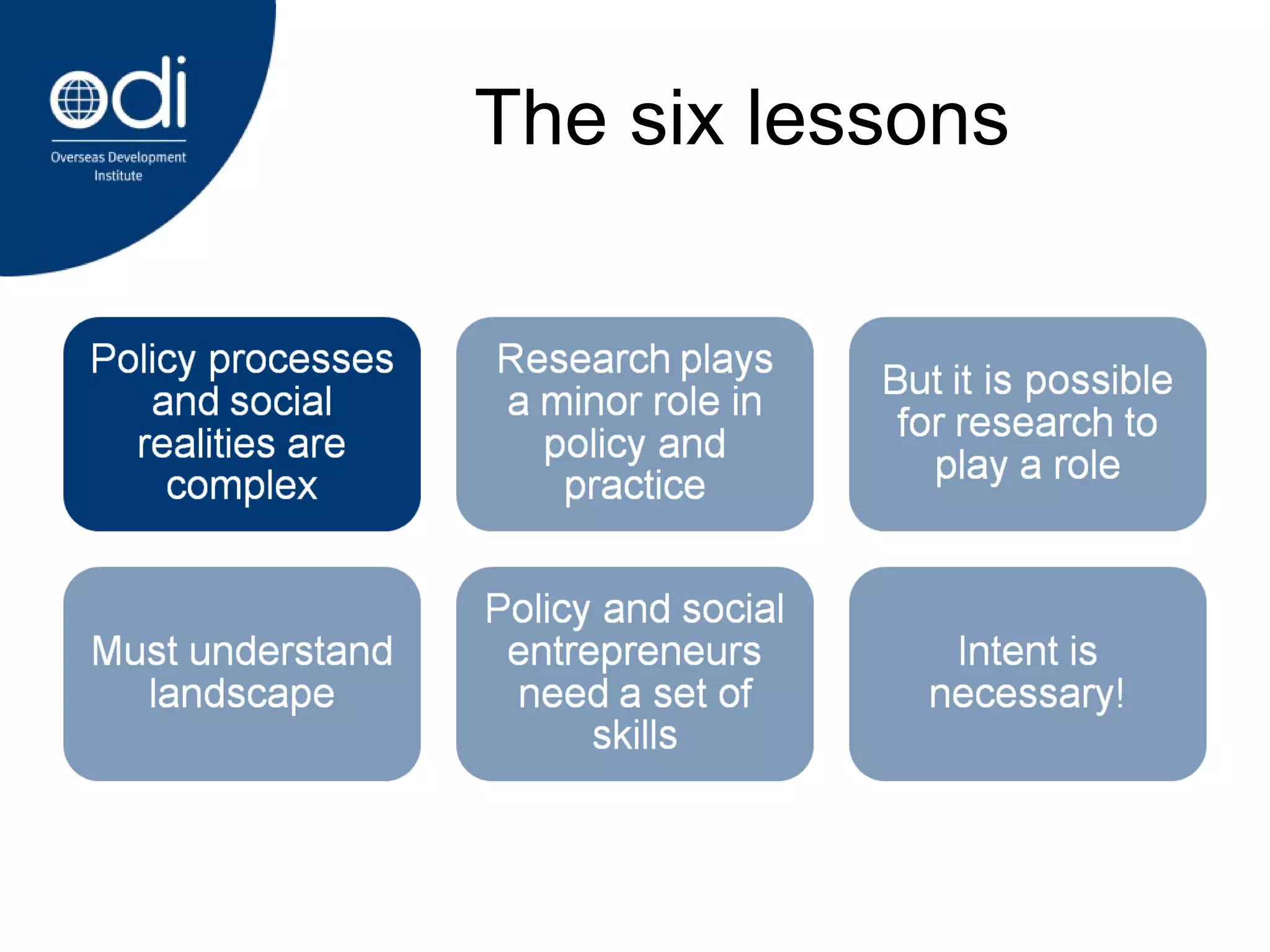
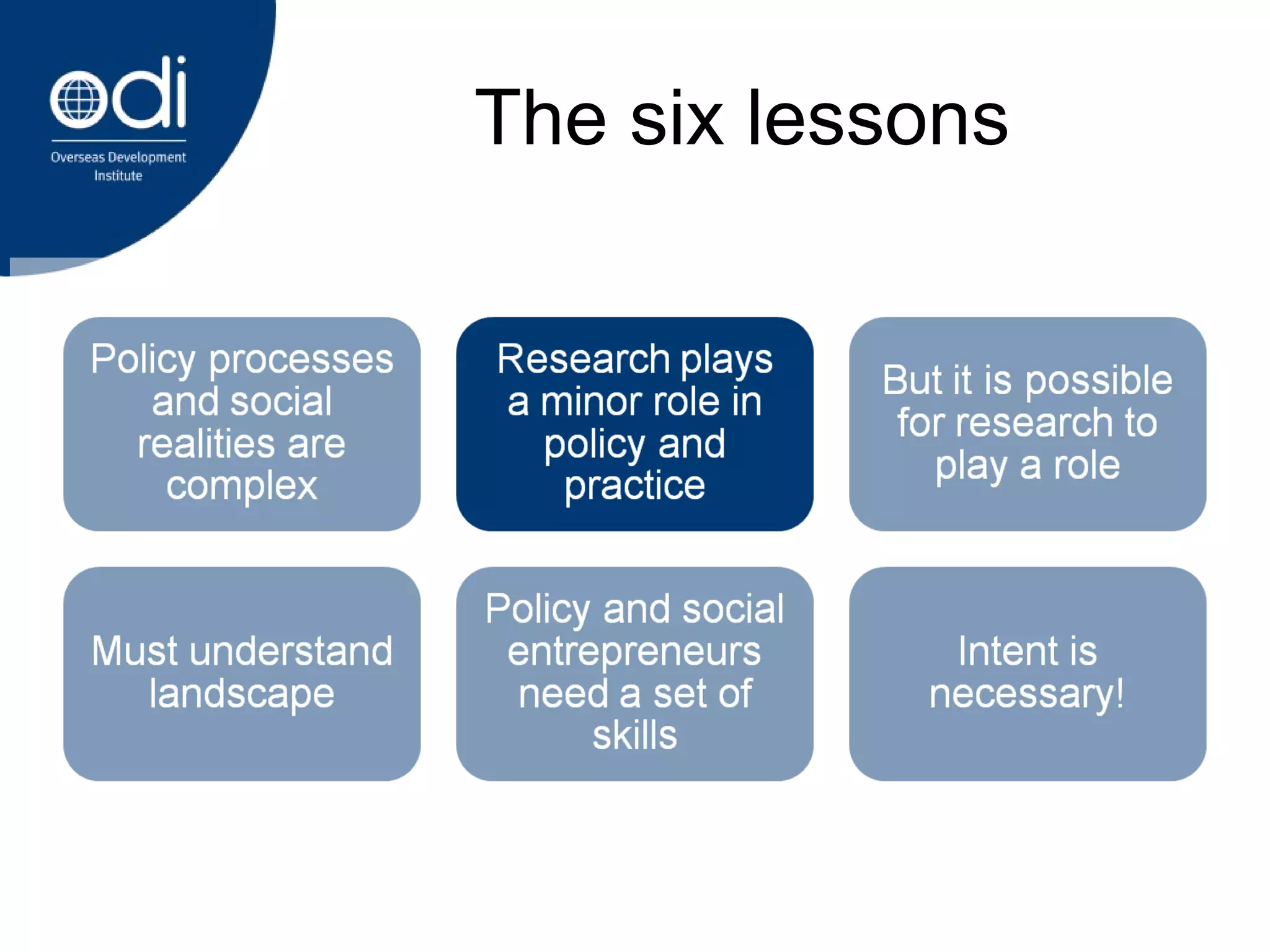
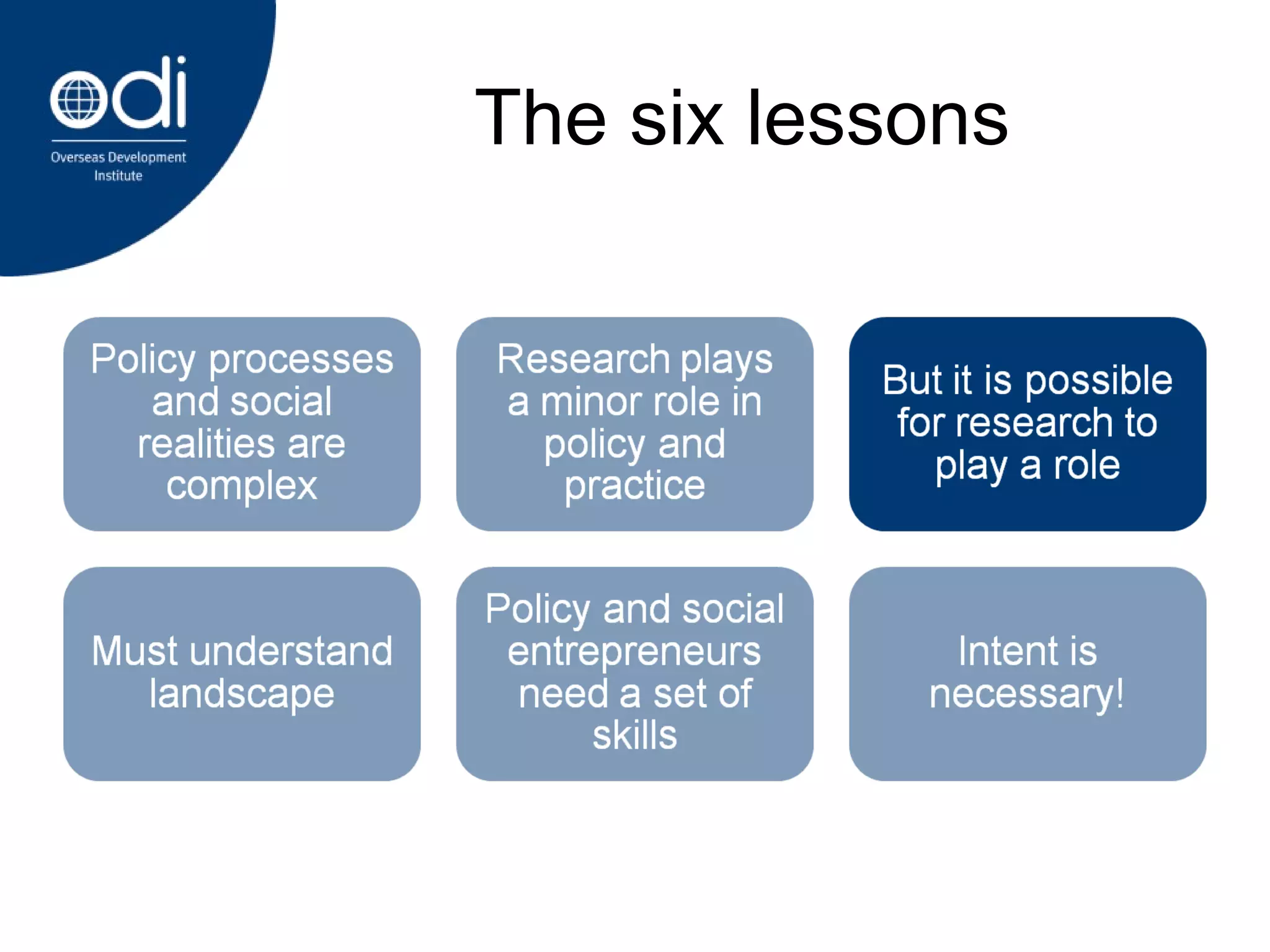
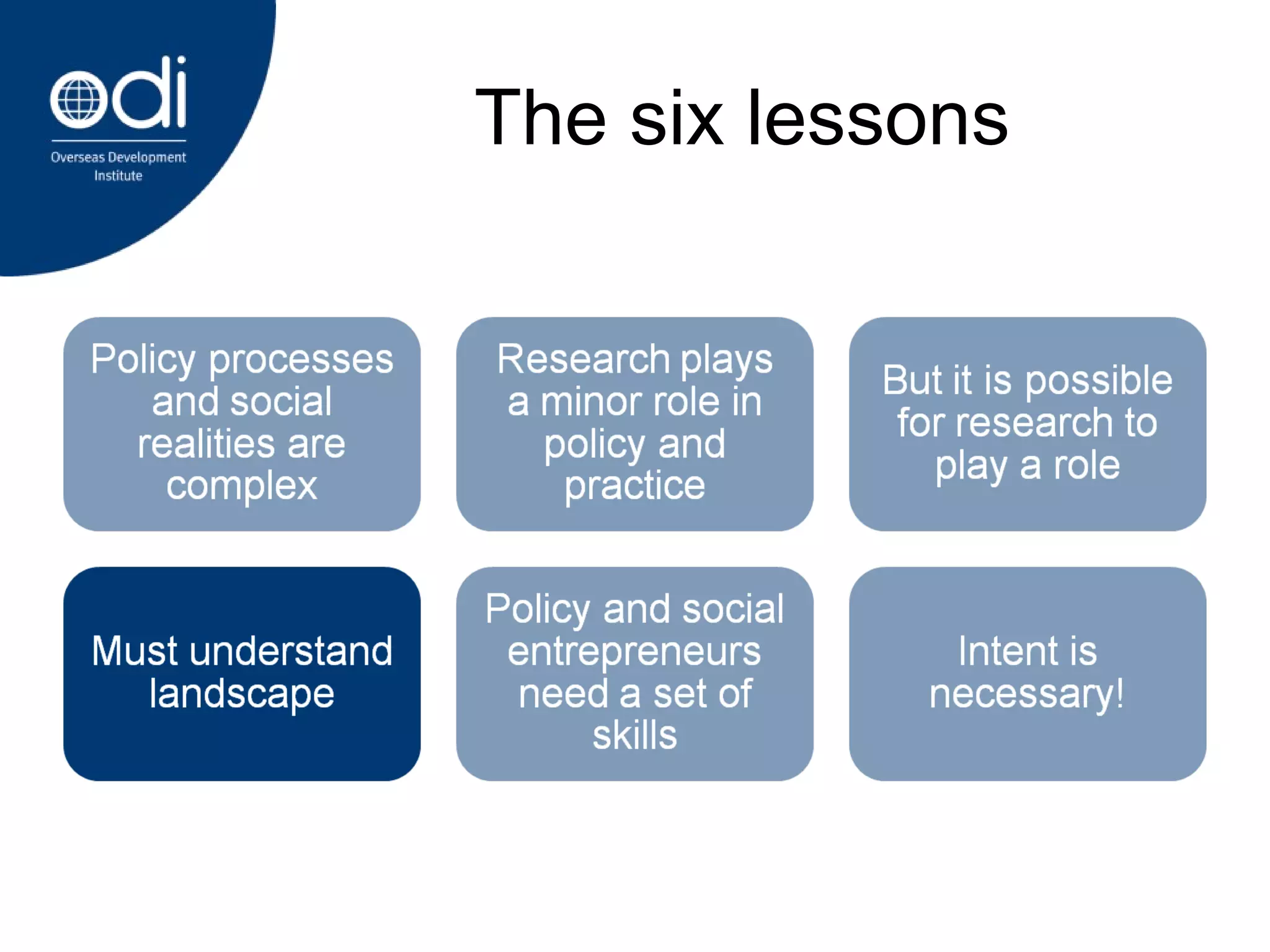
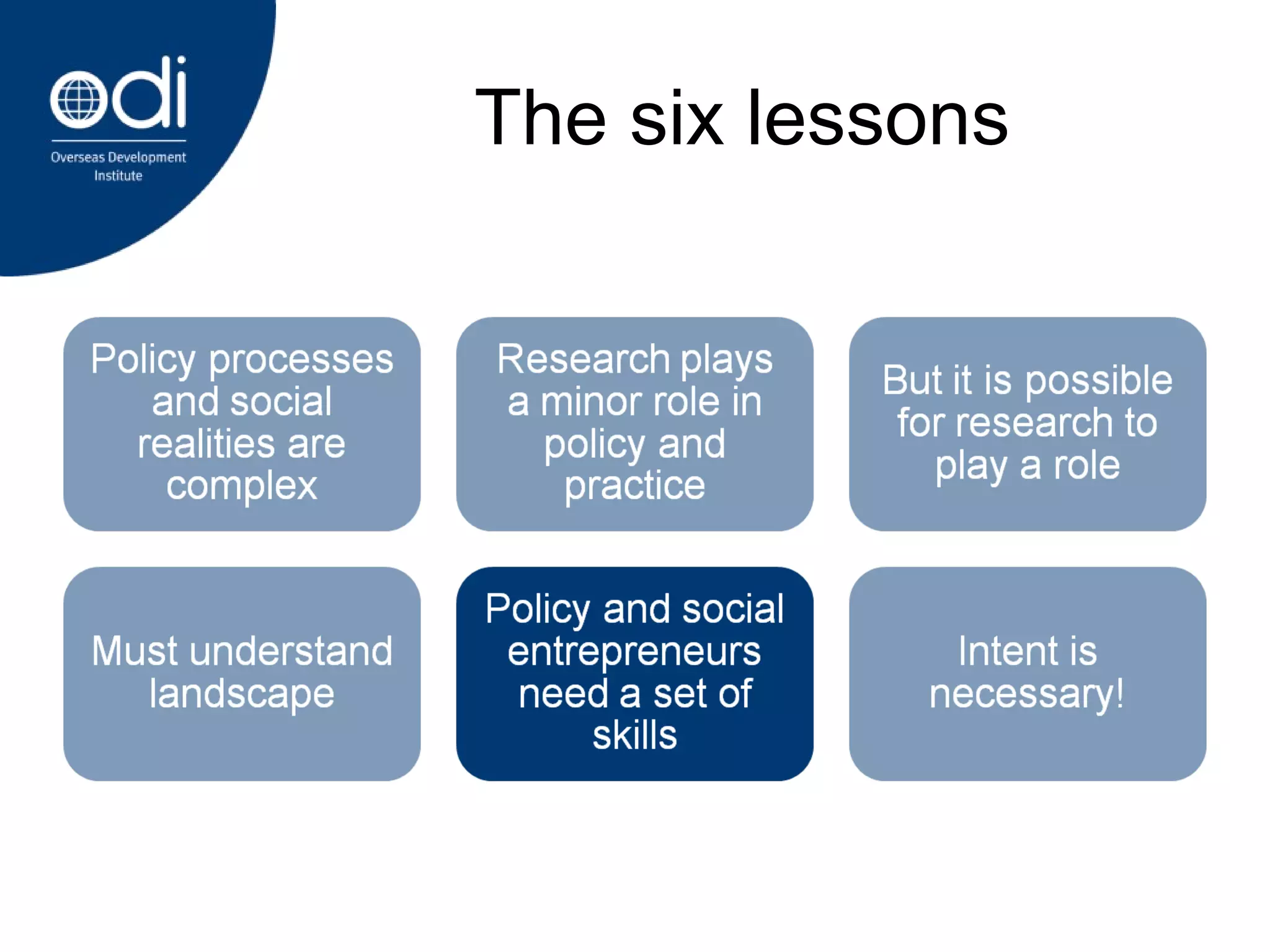
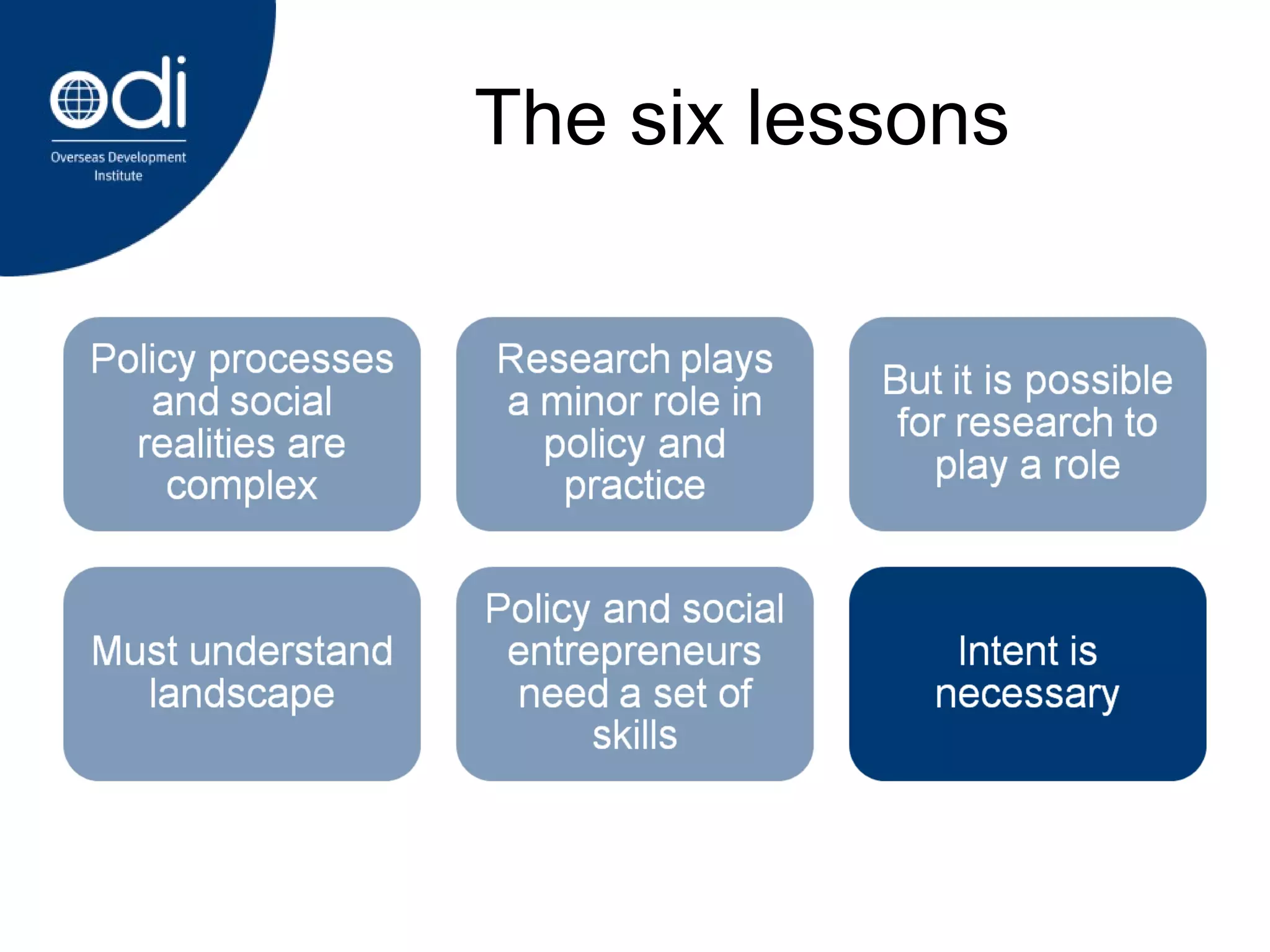
The six lessons
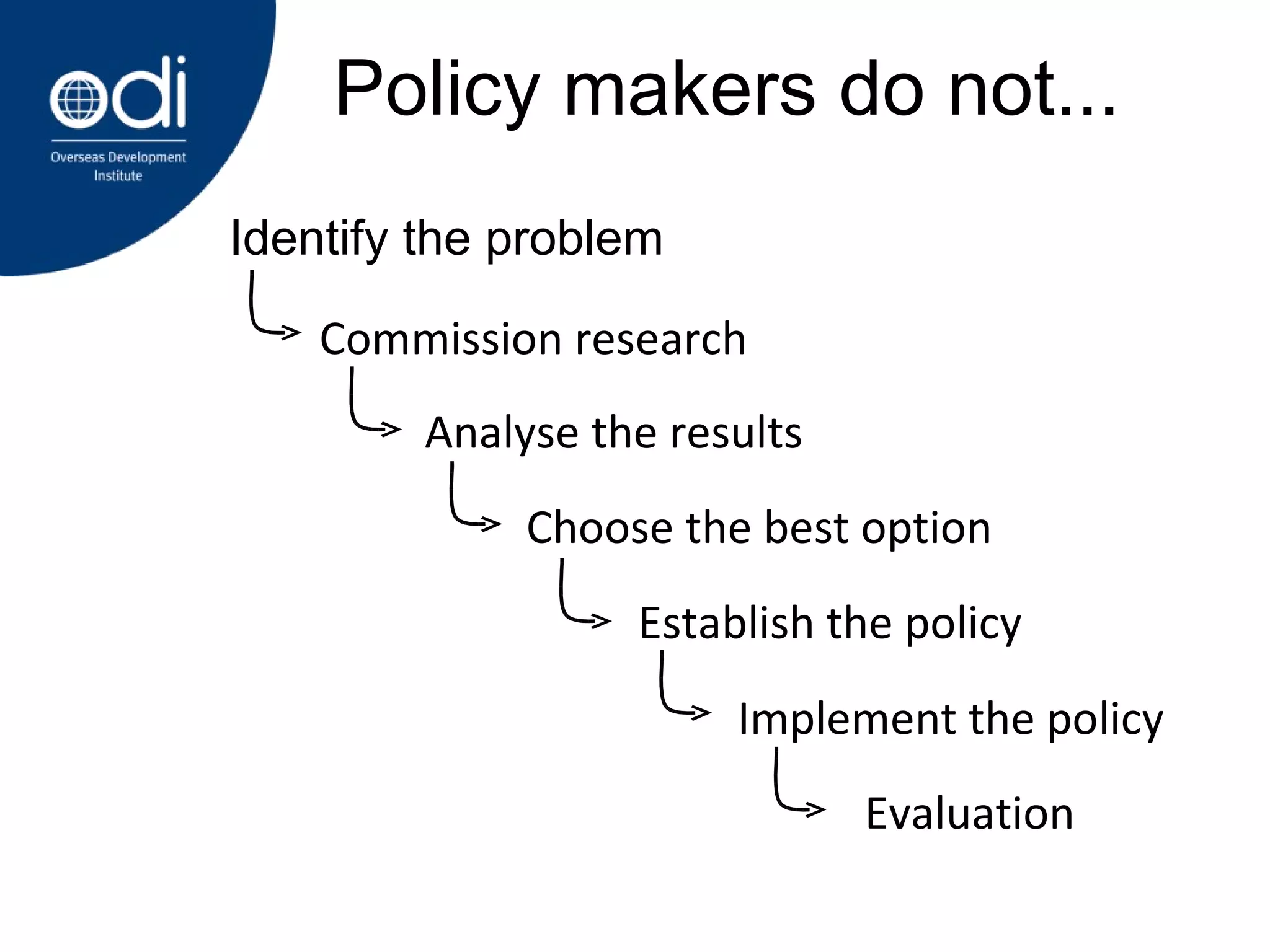
Identify the problem Policy makers do not...  Commission research Analyse the results Choose the best option Establish the policy Evaluation Implement the policy
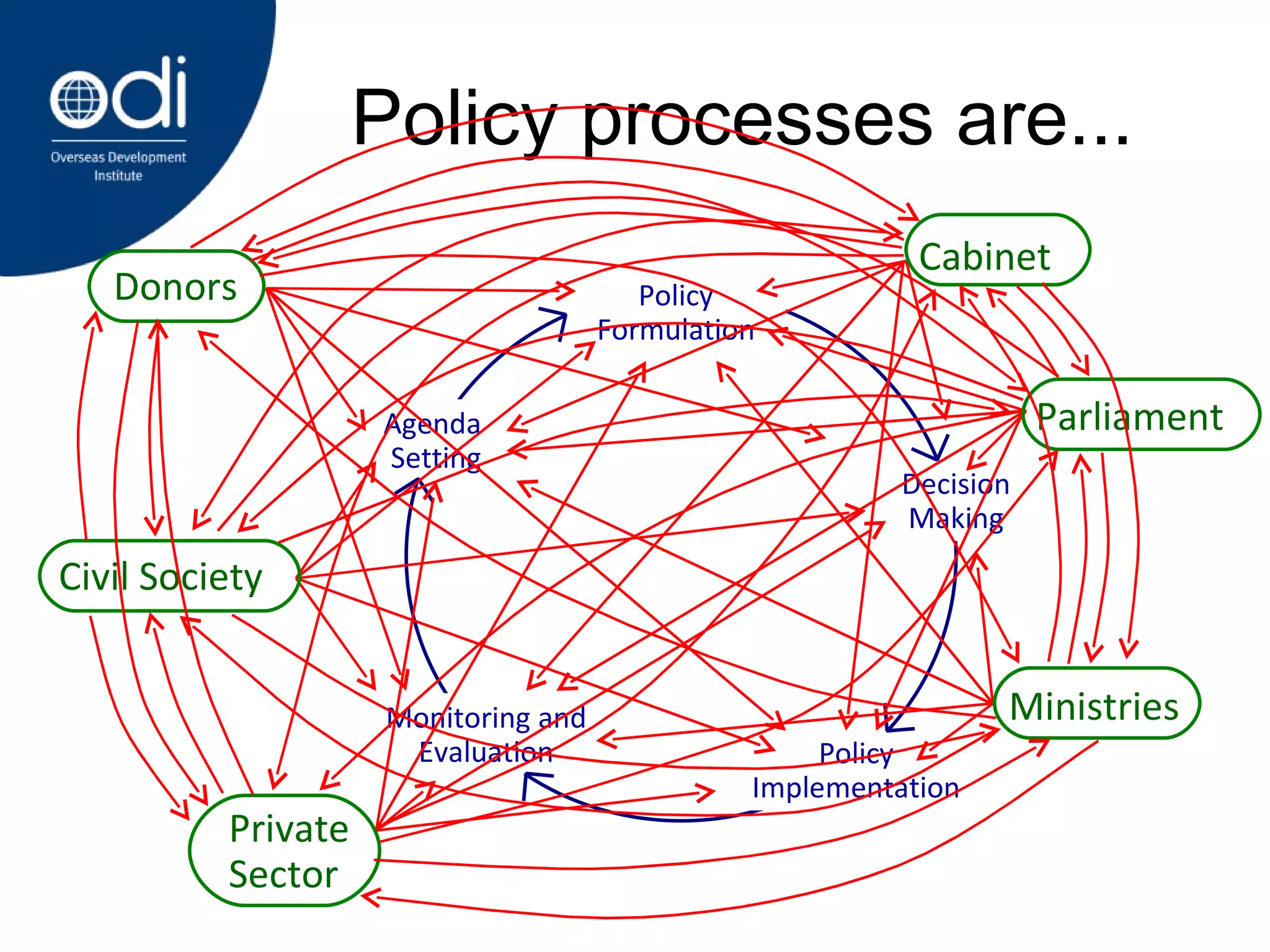
Policy processes are... Monitoring and Evaluation Agenda  Setting Decision Making Policy Implementation Policy Formulation Civil Society Donors Cabinet Parliament Ministries Private  Sector
The six lessons
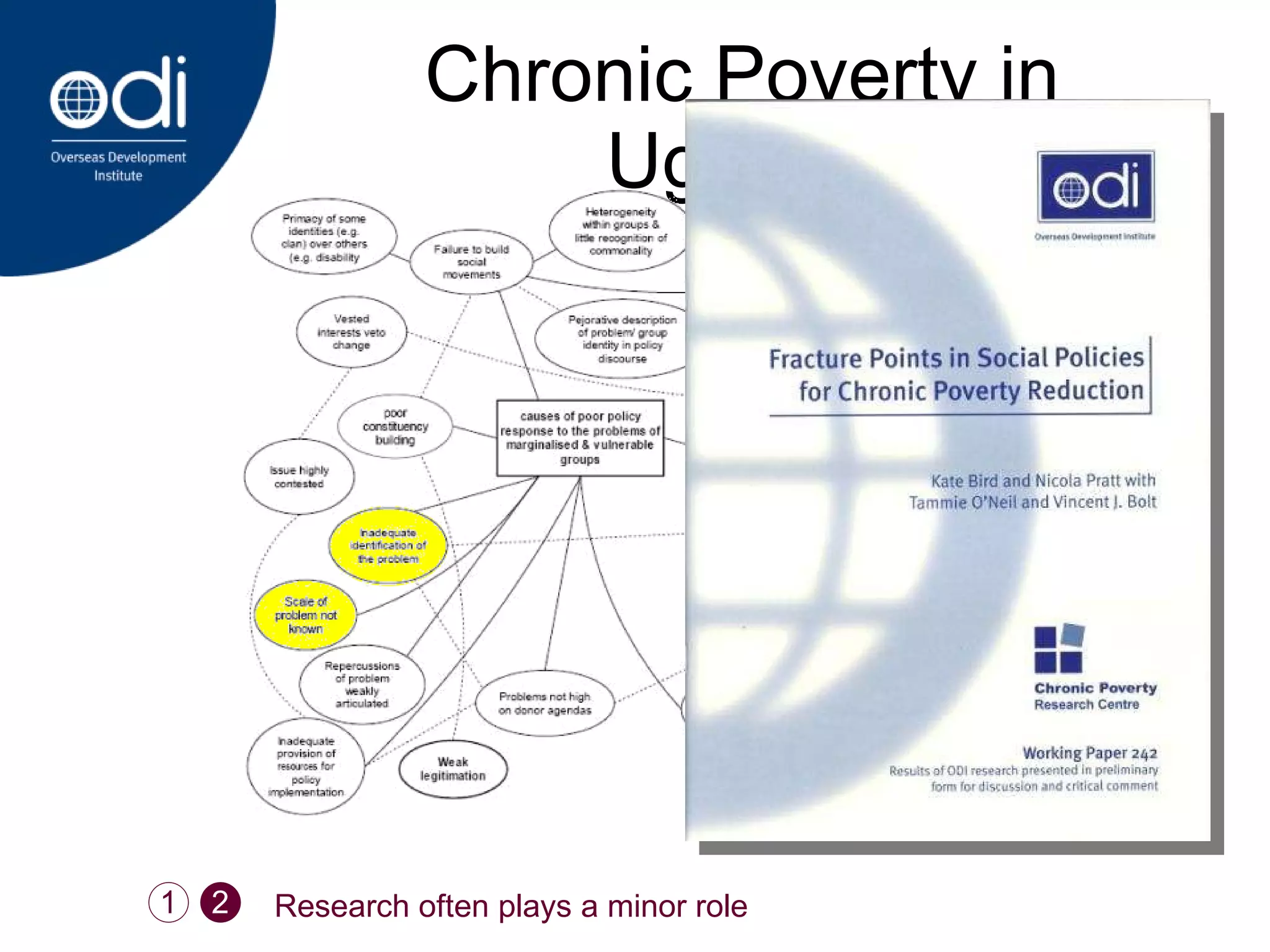
Chronic Poverty in Uganda 1 Research often plays a minor role 2
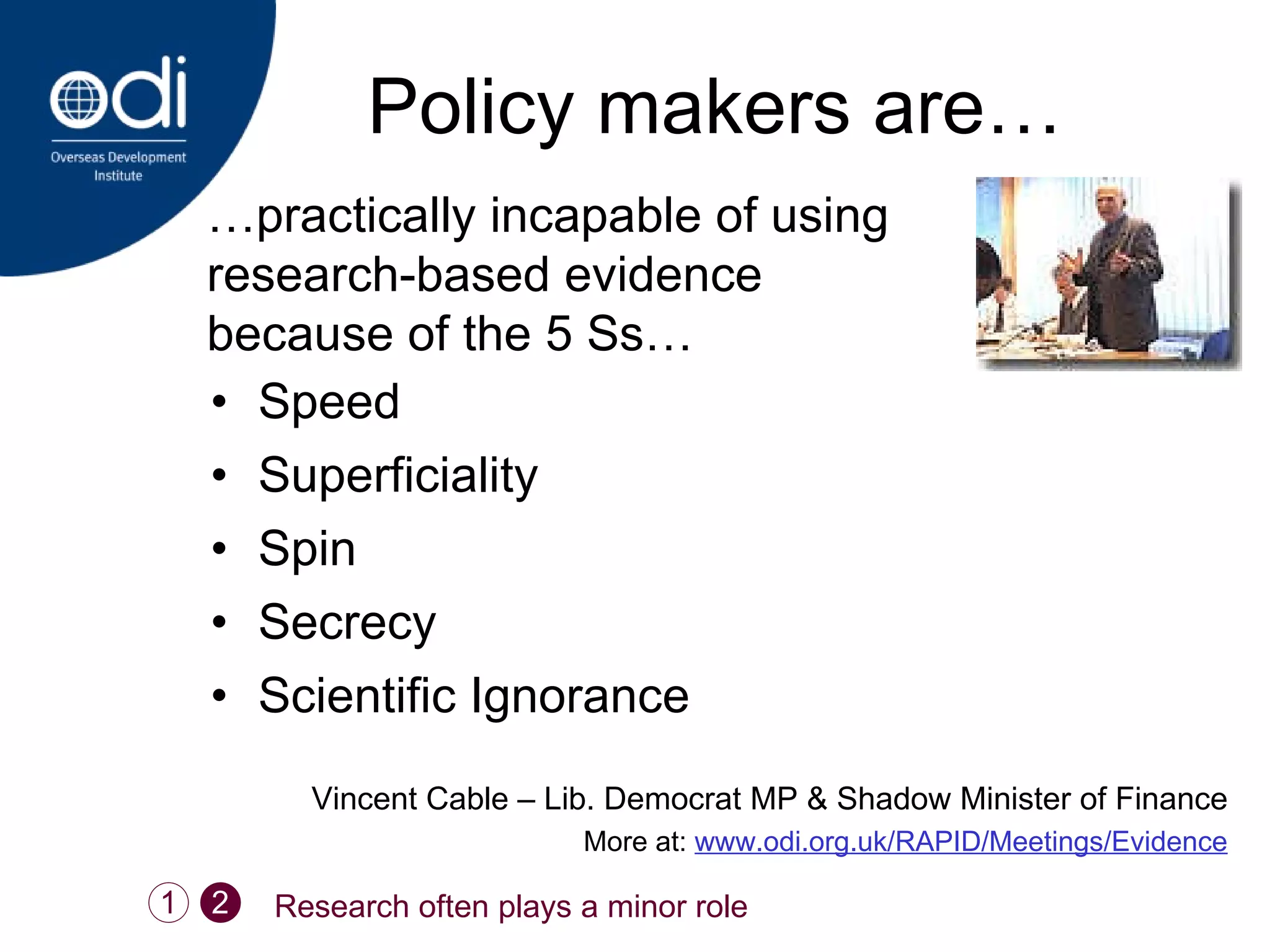
Policy makers are… Speed Superficiality Spin Secrecy Scientific Ignorance Vincent Cable – Lib. Democrat MP & Shadow Minister of Finance More at:  www.odi.org.uk/RAPID/Meetings/Evidence … practically incapable of using research-based evidence because of the 5 Ss…  1 Research often plays a minor role 2
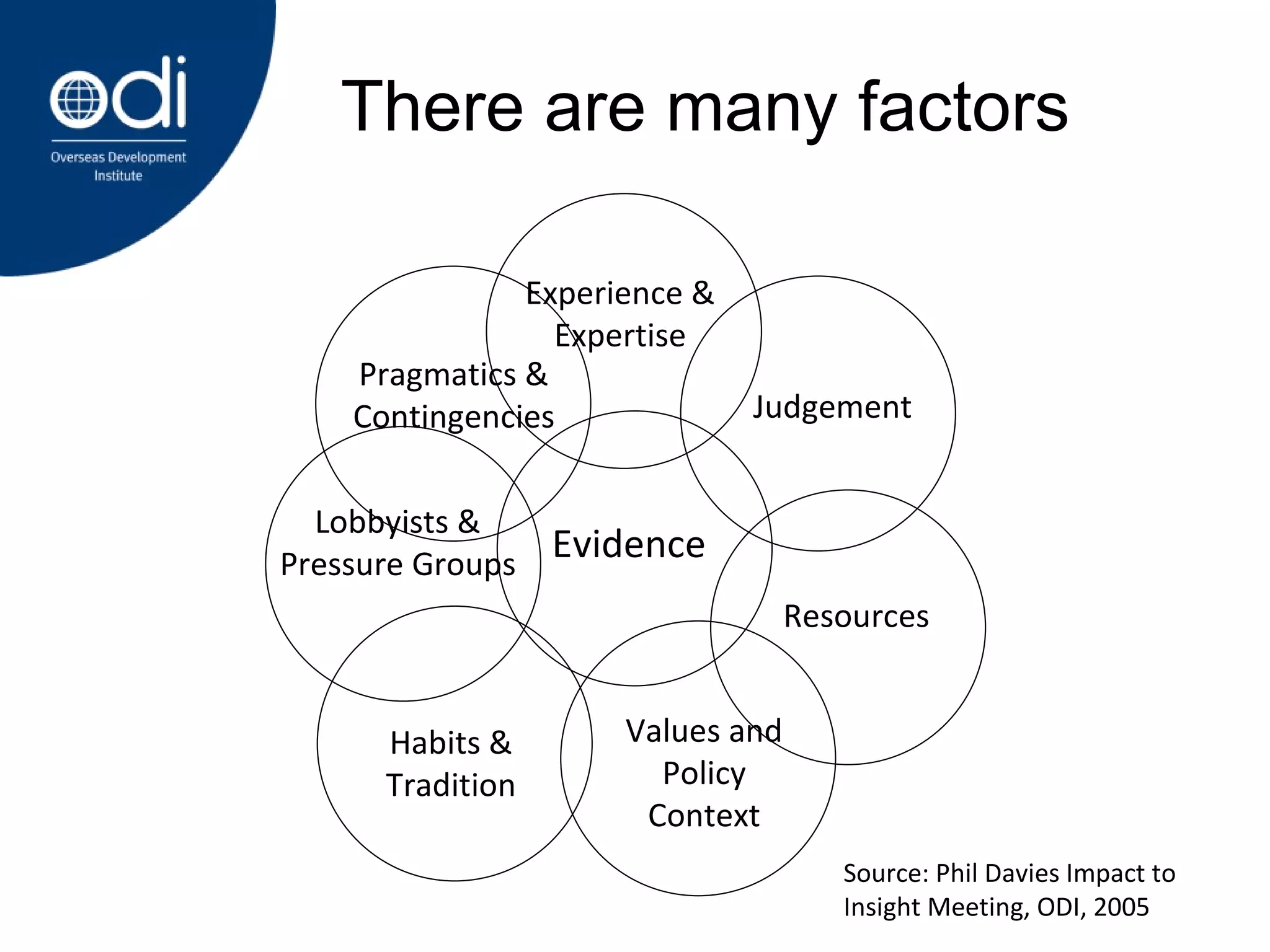
There are many factors  Source: Phil Davies Impact to  Insight Meeting, ODI, 2005 Evidence Experience & Expertise Judgement Resources Values and Policy Context Habits & Tradition Lobbyists & Pressure Groups Pragmatics & Contingencies
Different notions of evidence Source: Phil Davies Impact to Insight Meeting, ODI, 2005 Colloquial (Contextual) Anything that seems reasonable Policy relevant Timely Clear Message Policy Makers’ Evidence ‘ Scientific’ (Context free) Proven empirically Theoretically driven As long as it takes Caveats and qualifications Researchers’ Evidence
The six lessons
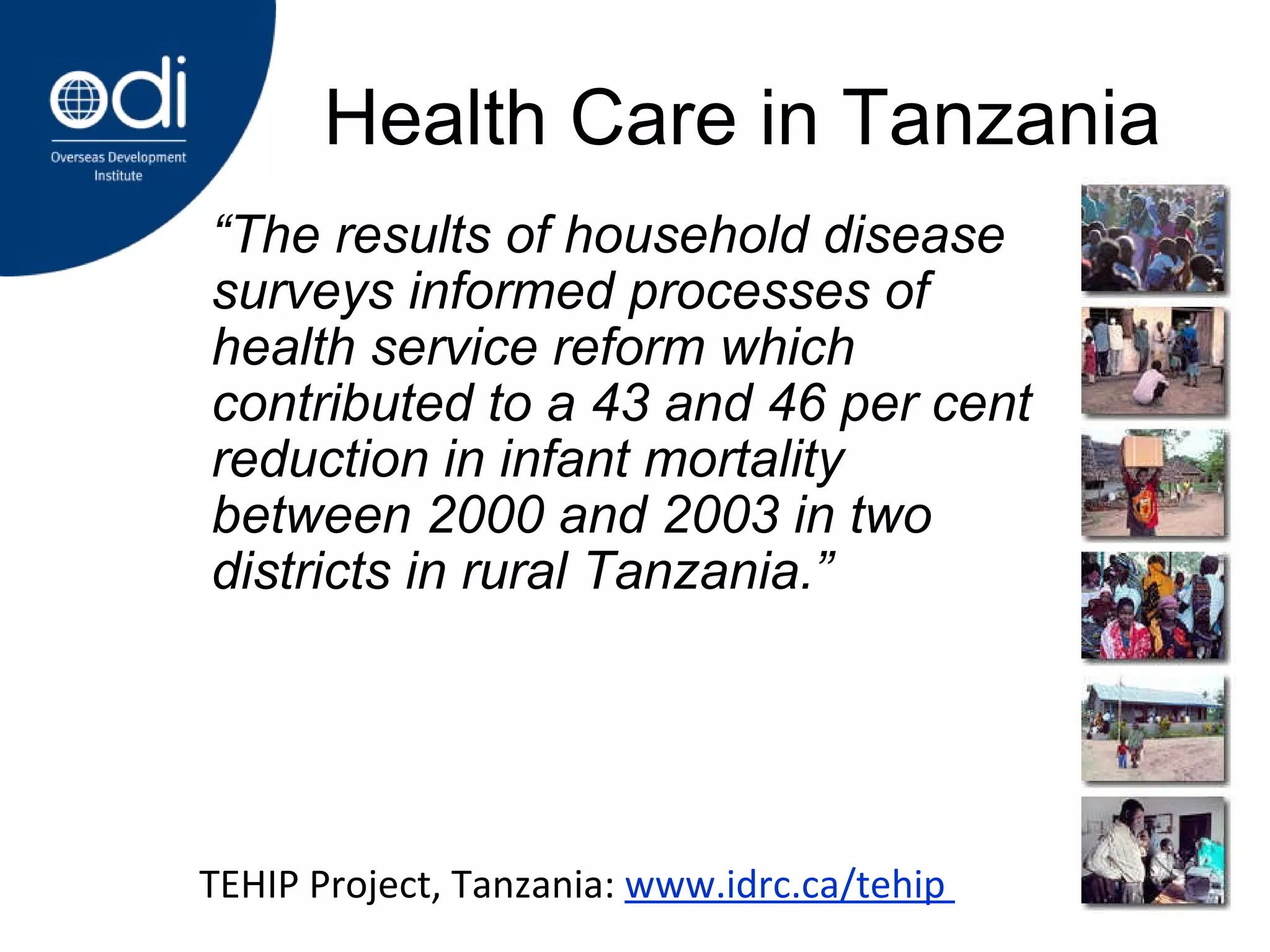
Health Care in Tanzania “ The  results of household disease surveys informed processes of health service reform which contributed to a 43 and 46 per cent reduction in infant mortality between 2000 and 2003 in two districts in rural Tanzania.” TEHIP Project, Tanzania:  www.idrc.ca/tehip
The six lessons
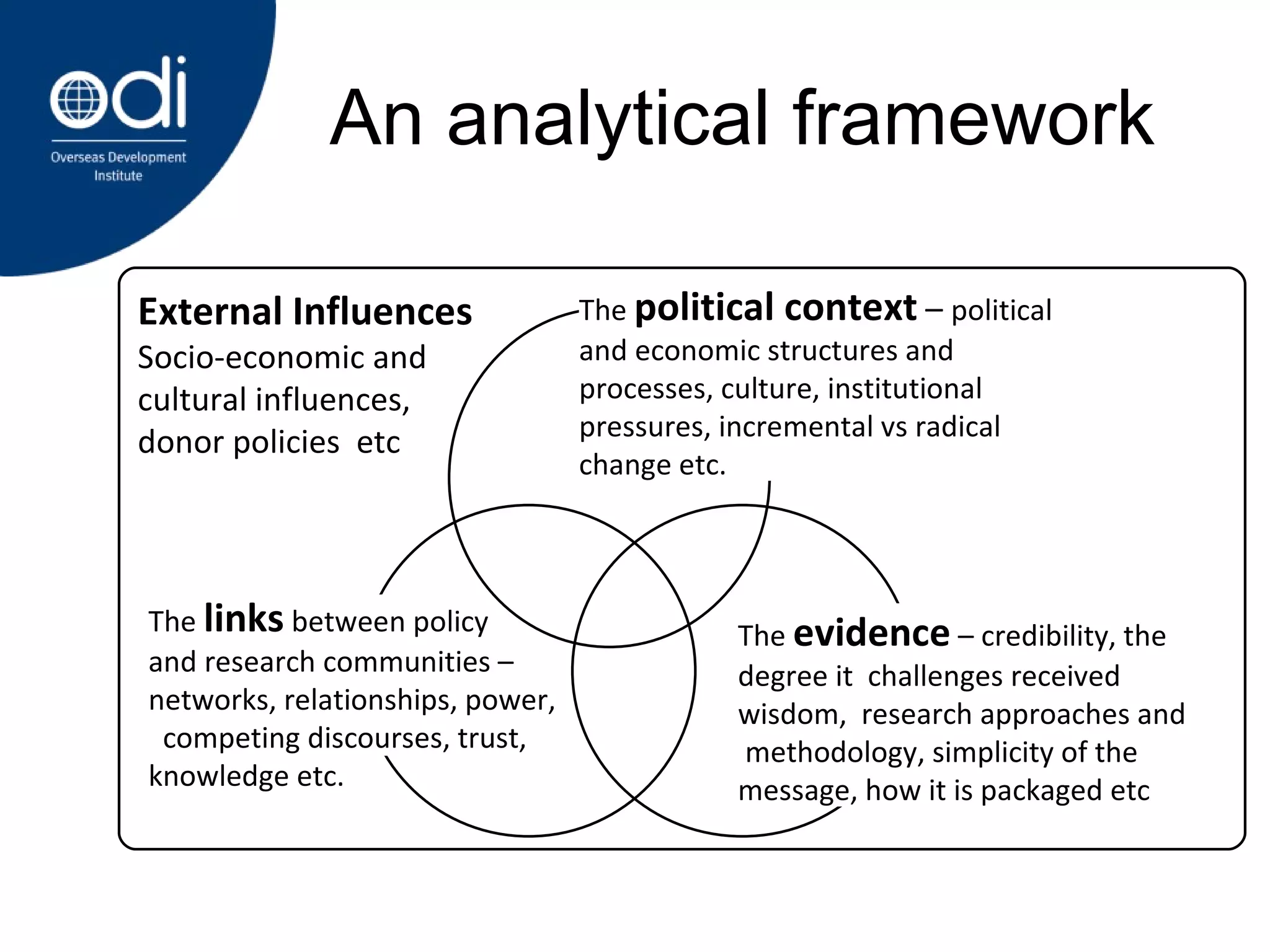
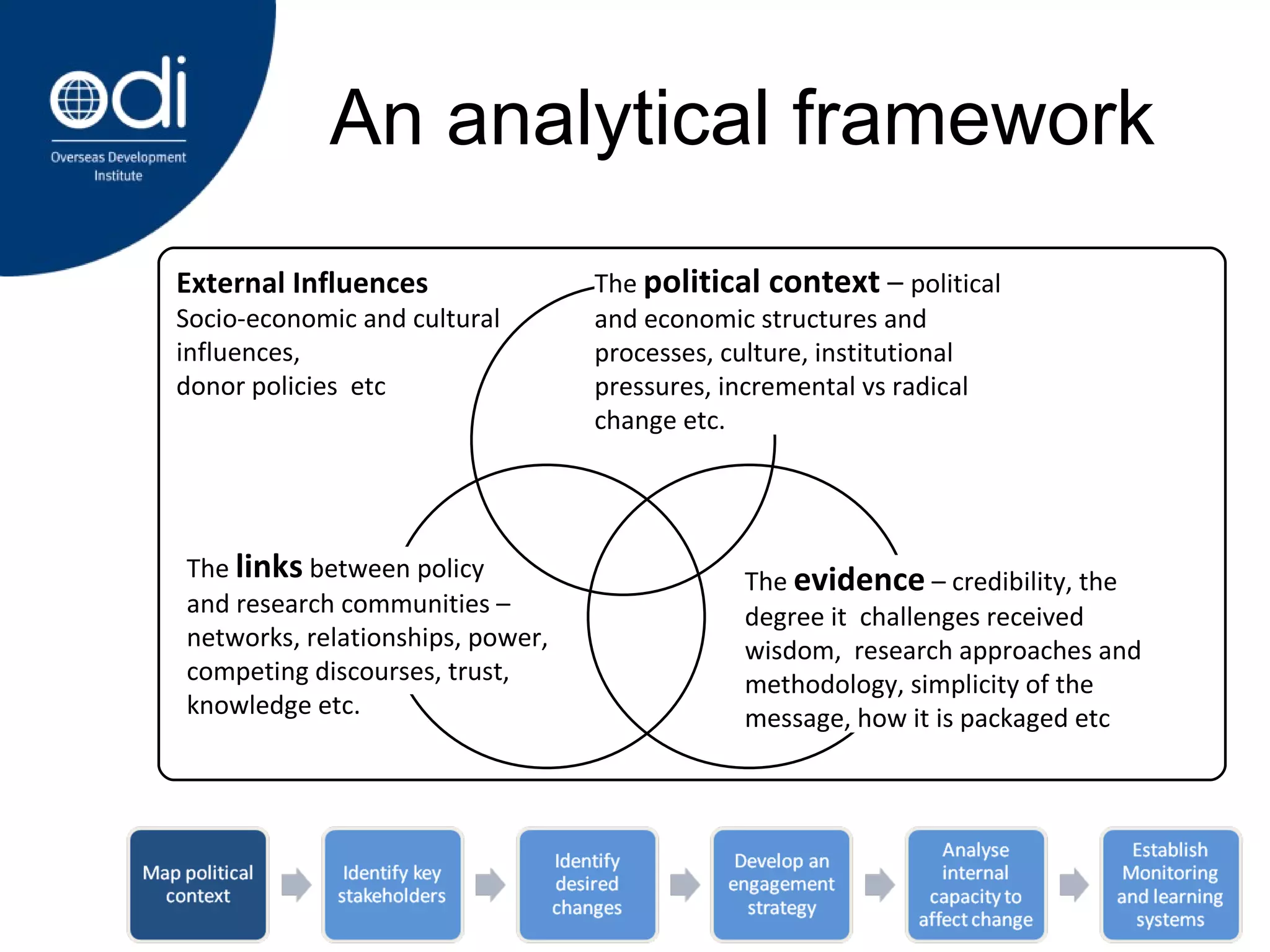
An analytical framework The  political context  –  political and economic structures and processes, culture, institutional pressures, incremental vs radical change etc. The  evidence  – credibility, the degree it  challenges received wisdom,  research approaches and  methodology, simplicity of the message, how it is packaged etc   External Influences  Socio-economic and cultural influences,  donor policies  etc The  links  between policy and research communities – networks, relationships, power,  competing discourses, trust, knowledge etc.
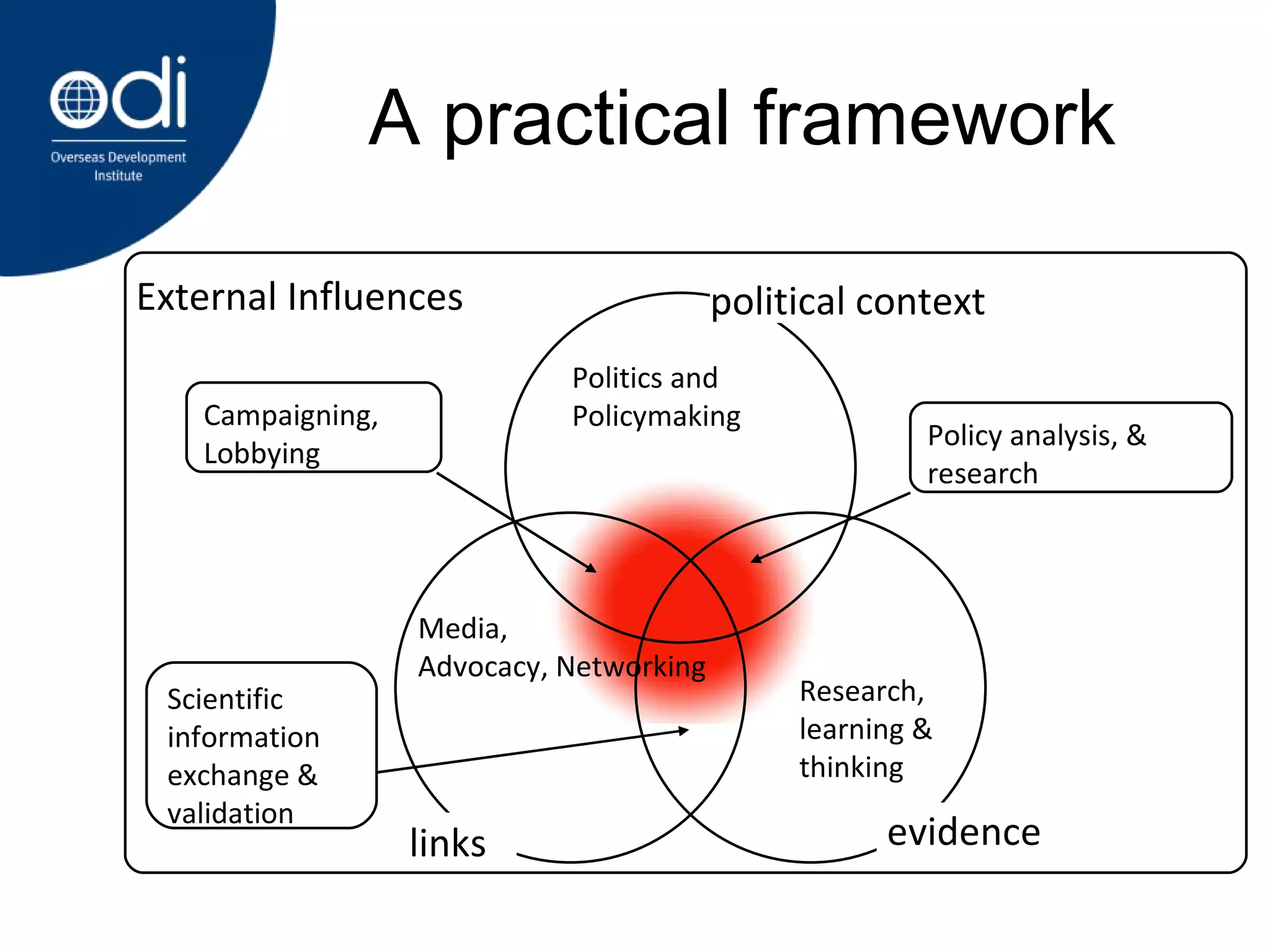
A practical framework political context evidence links Politics and Policymaking Media,  Advocacy, Networking Research, learning & thinking External Influences  Scientific information exchange & validation Policy analysis, & research Campaigning, Lobbying
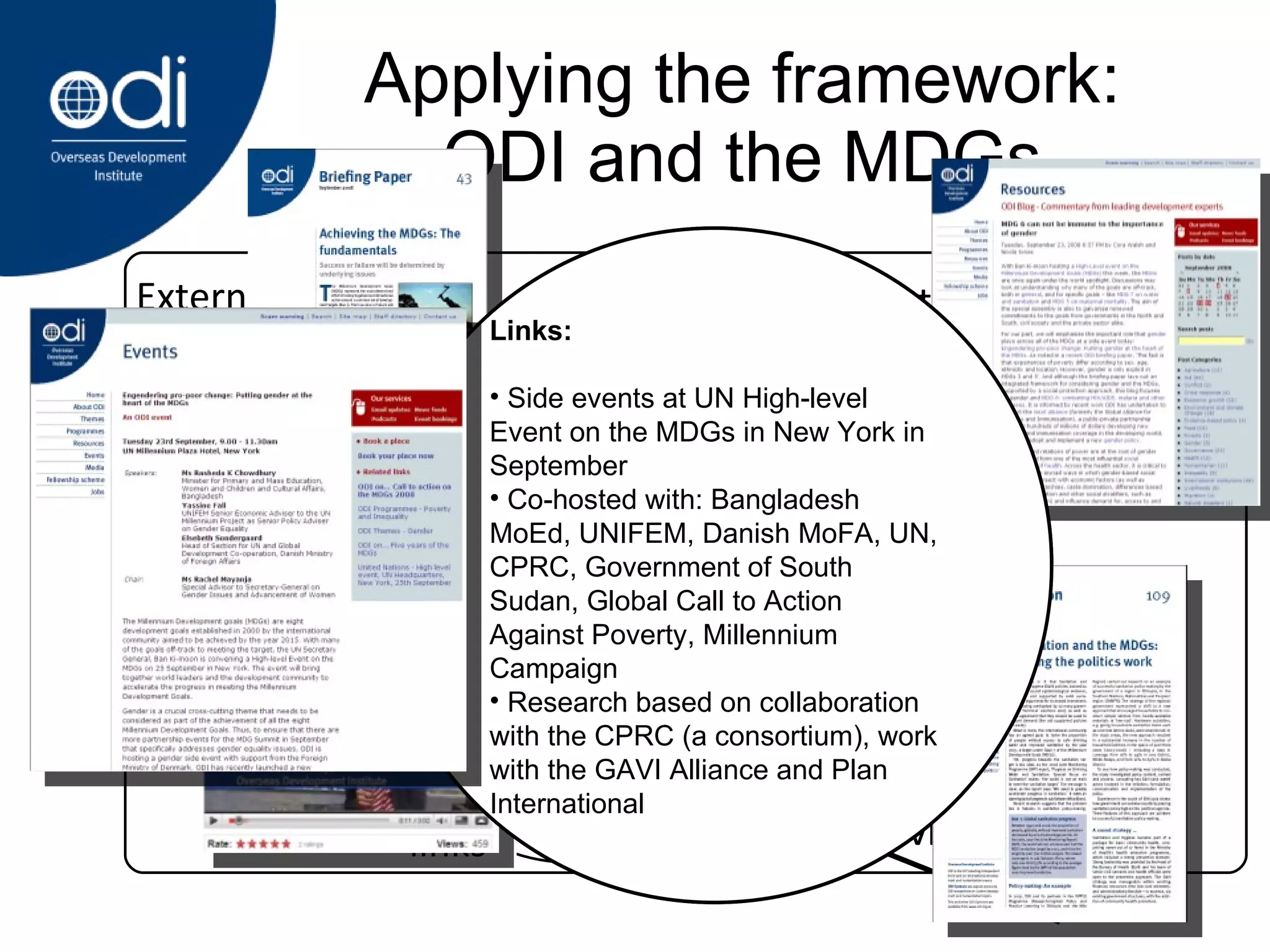
Applying the framework: ODI and the MDGs political context evidence links Politics and Policymaking Media,  Advocacy, Networking Research, learning & thinking Political context: 2008 is just after mid-way point, so opportunity to analyse and refocus through UN-sponsored Call-to-Action UK government, among other national governments and international actors, has strong political will towards progressing on MDGs One reason for this political will is that many of the MDGs are off-track to meet targets UN High-level event in September 2008 Links: Side events at UN High-level Event on the MDGs in New York in September Co-hosted with: Bangladesh MoEd, UNIFEM, Danish MoFA, UN, CPRC, Government of South Sudan, Global Call to Action Against Poverty, Millennium Campaign Research based on collaboration with the CPRC (a consortium), work with the GAVI Alliance and Plan International External Influences  Evidence:
The six lessons
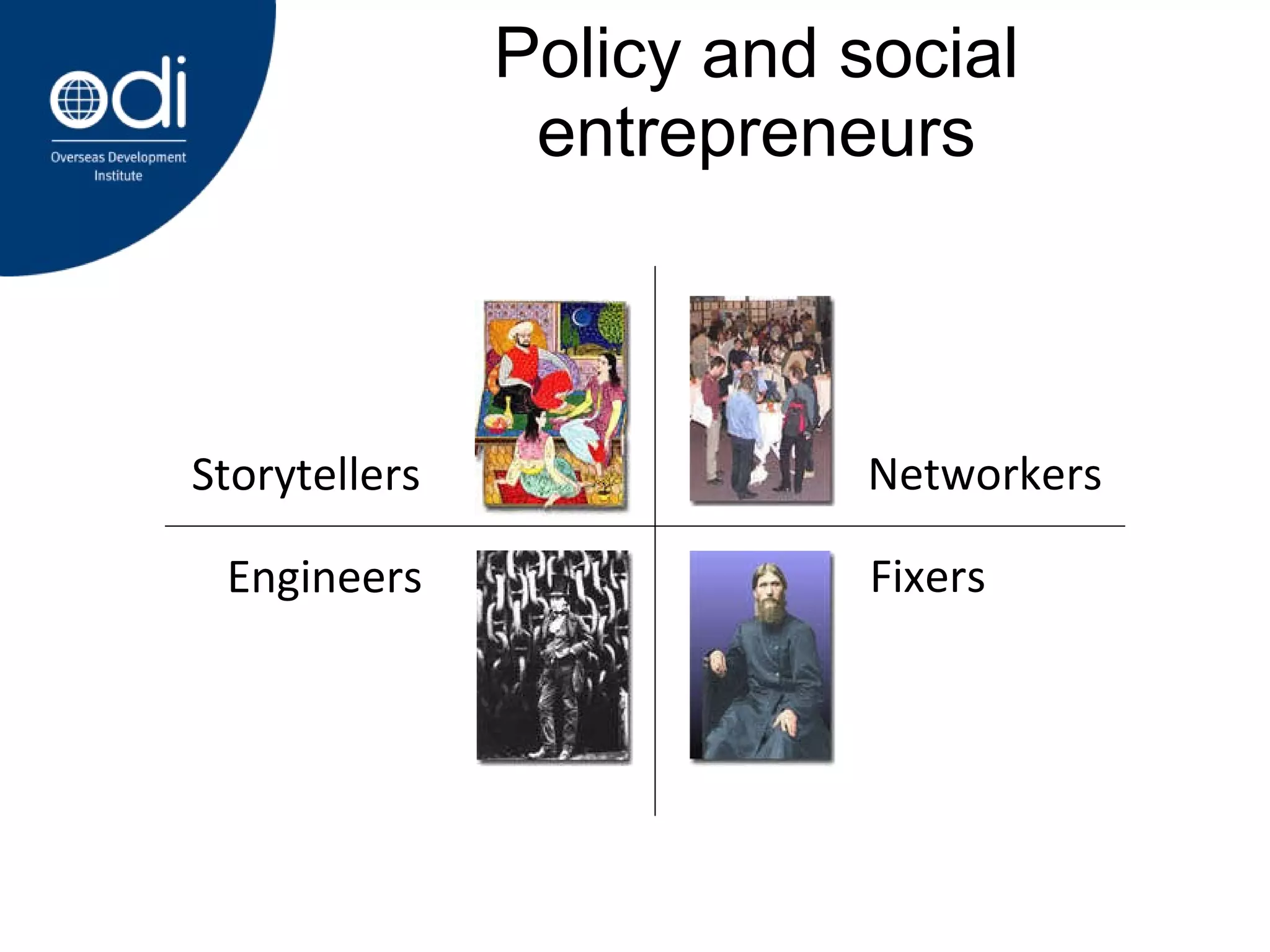
Policy and social entrepreneurs Storytellers Engineers Networkers Fixers
The six lessons
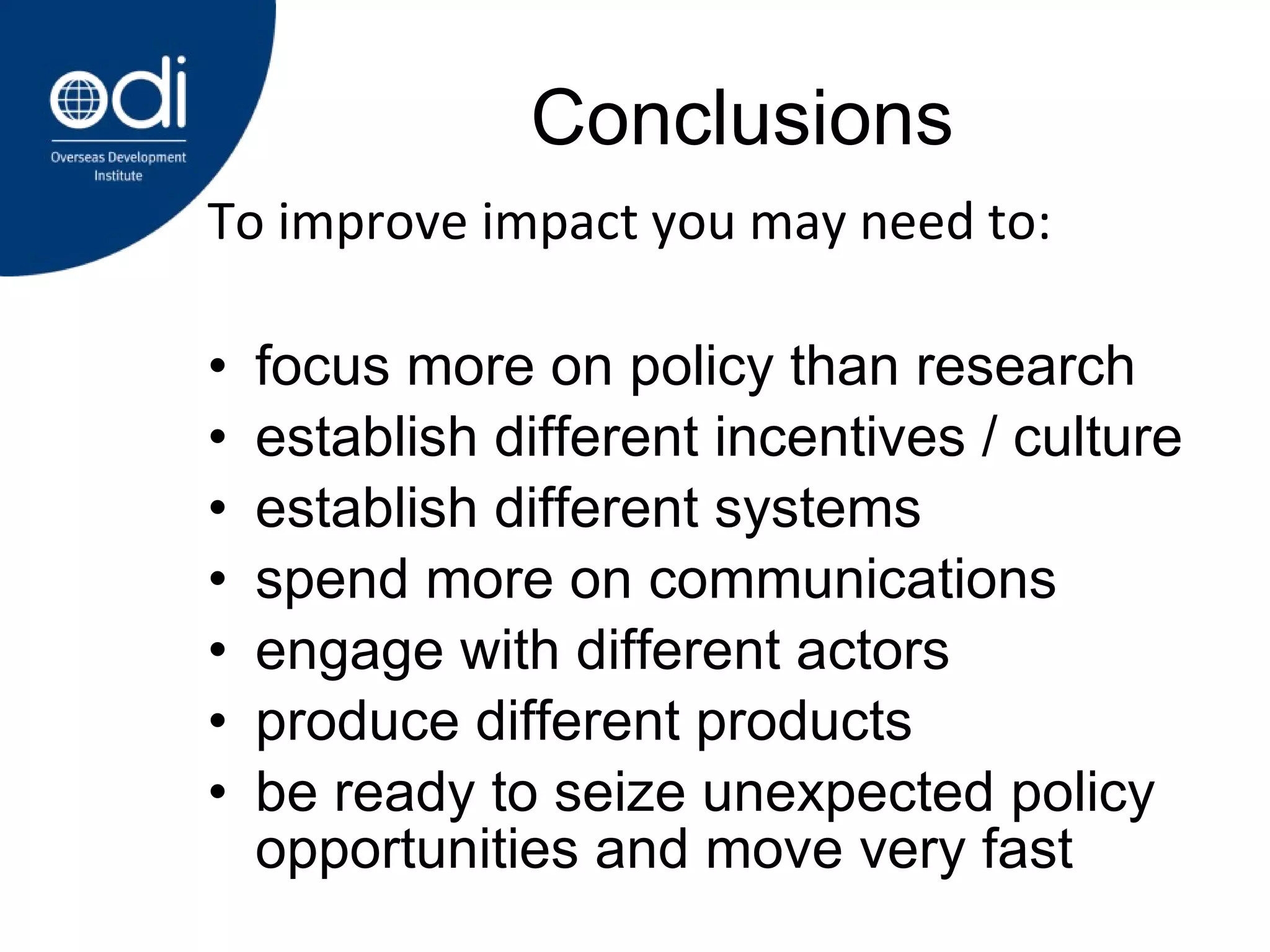
Conclusions focus more on policy than research establish different incentives / culture establish different systems spend more on communications engage with different actors produce different products be ready to seize unexpected policy opportunities and move very fast To improve impact you may need to:
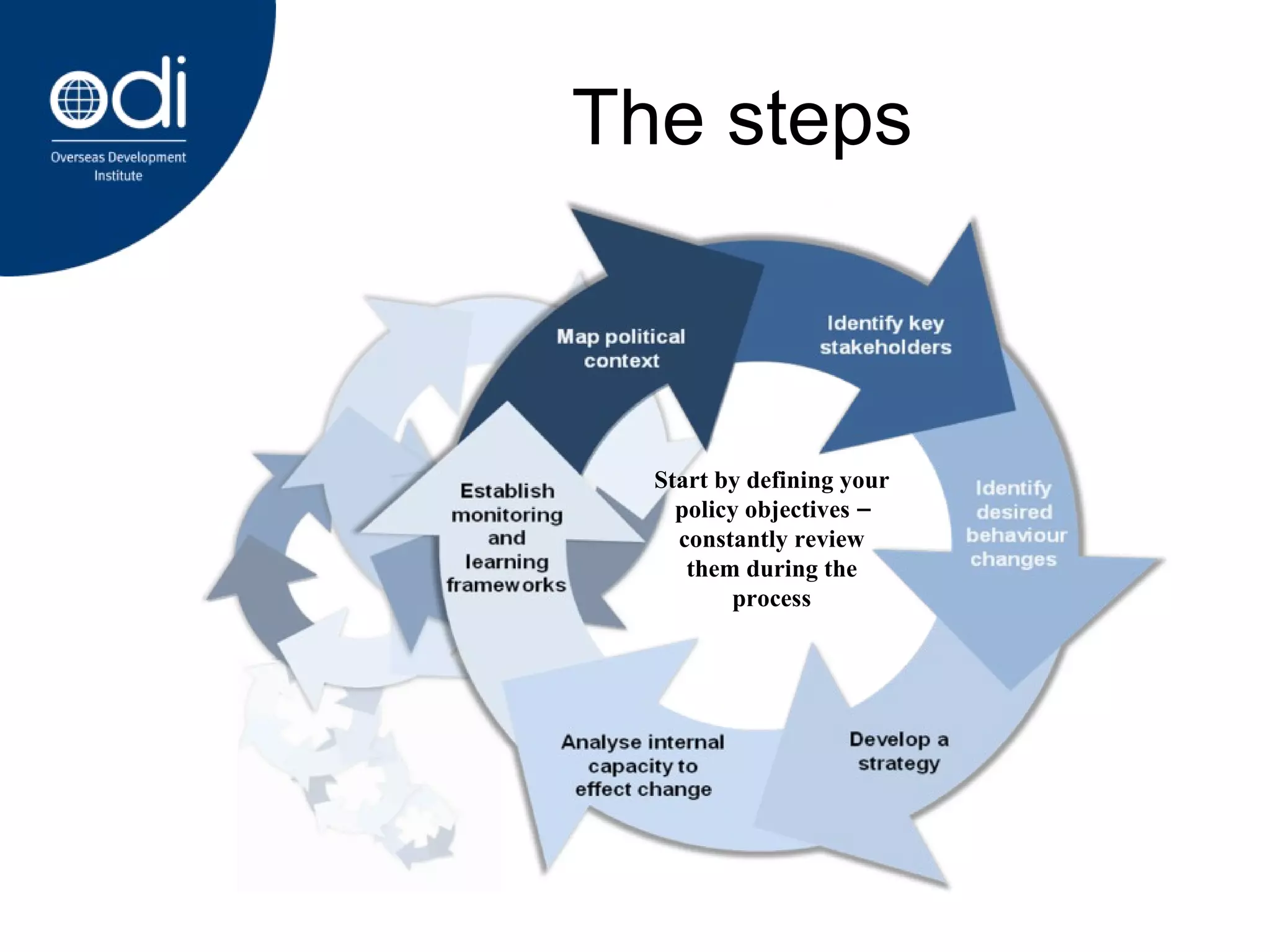
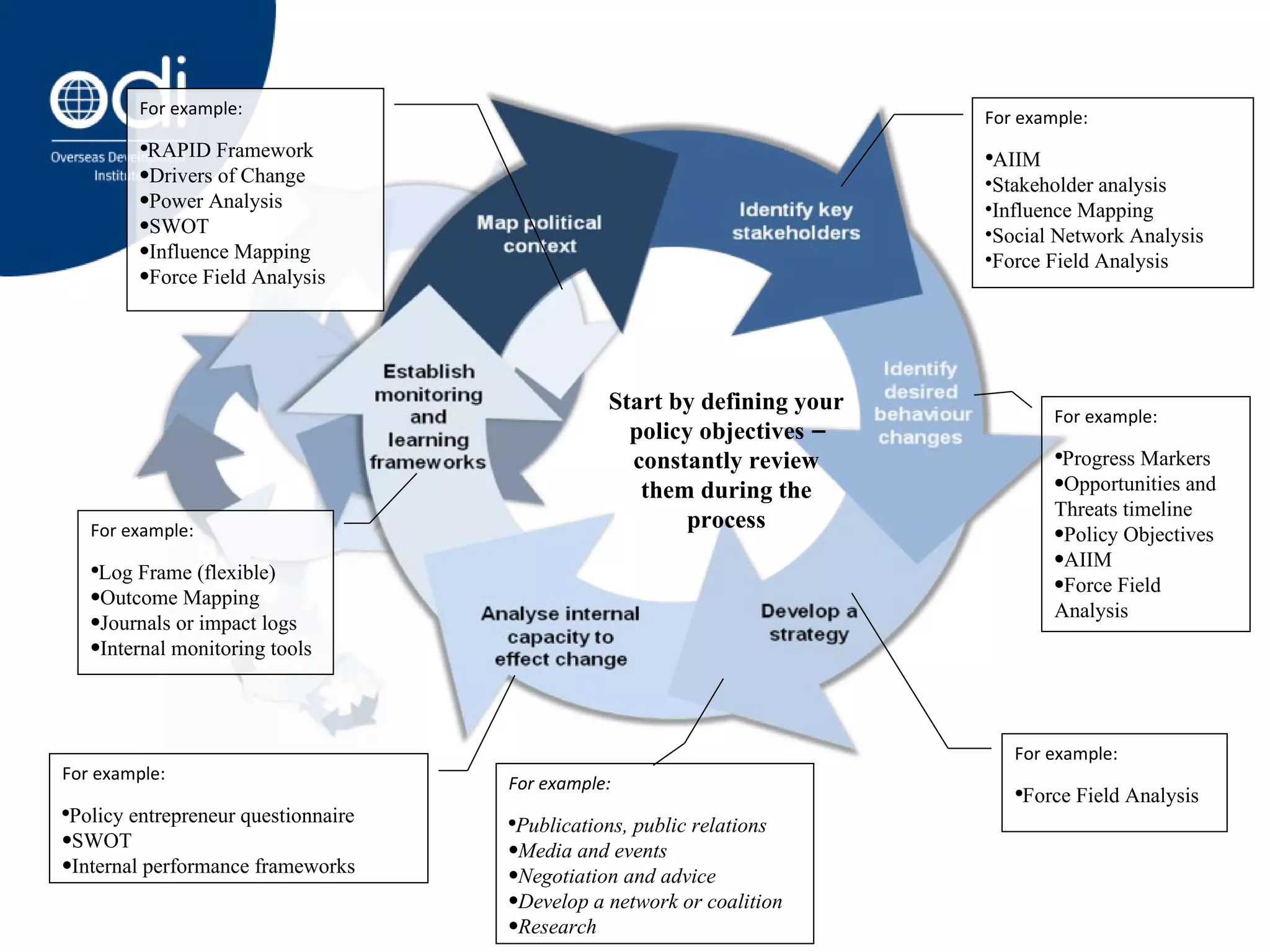
The steps Start by defining your policy objectives – constantly review them during the process
An analytical framework The  political context  –  political and economic structures and processes, culture, institutional pressures, incremental vs radical change etc. The  evidence  – credibility, the degree it  challenges received wisdom,  research approaches and  methodology, simplicity of the message, how it is packaged etc   External Influences  Socio-economic and cultural influences,  donor policies  etc The  links  between policy and research communities – networks, relationships, power,  competing discourses, trust, knowledge etc.
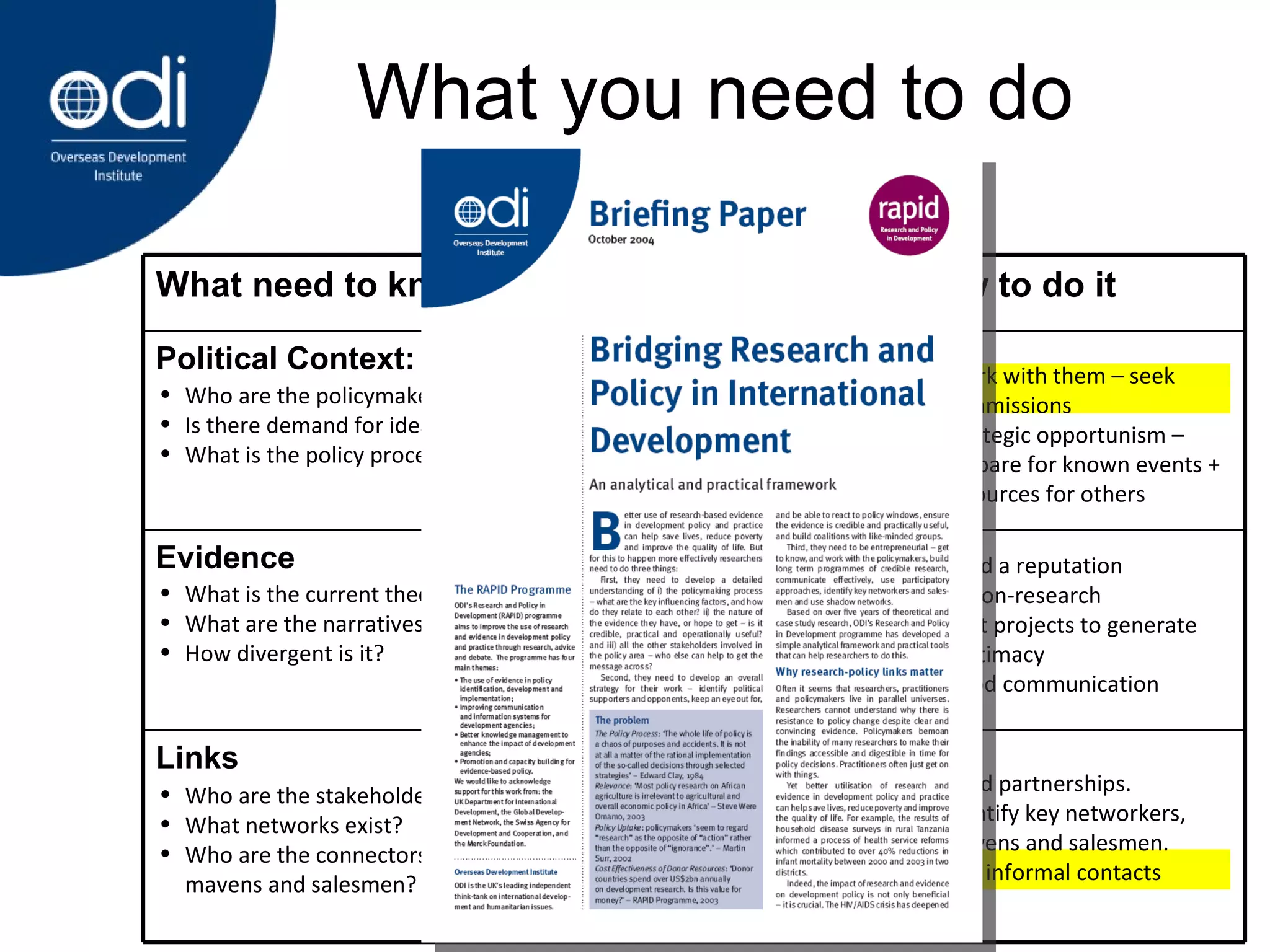
What you need to do Who are the policymakers? Is there demand for ideas? What is the policy process? What is the current theory? What are the narratives? How divergent is it? Who are the stakeholders? What networks exist? Who are the connectors, mavens and salesmen? Get to know the policymakers. Identify friends and foes. Prepare for policy opportunities.  Look out for policy windows. Work with them – seek commissions Strategic opportunism – prepare for known events + resources for others Establish credibility Provide practical solutions Establish legitimacy. Present clear options Use familiar narratives. Build a reputation Action-research Pilot projects to generate legitimacy Good communication Get to know the others Work through existing networks. Build coalitions. Build new policy networks .  Build partnerships. Identify key networkers, mavens and salesmen. Use informal contacts What need to know What need to do How to do it Political Context: Evidence Links
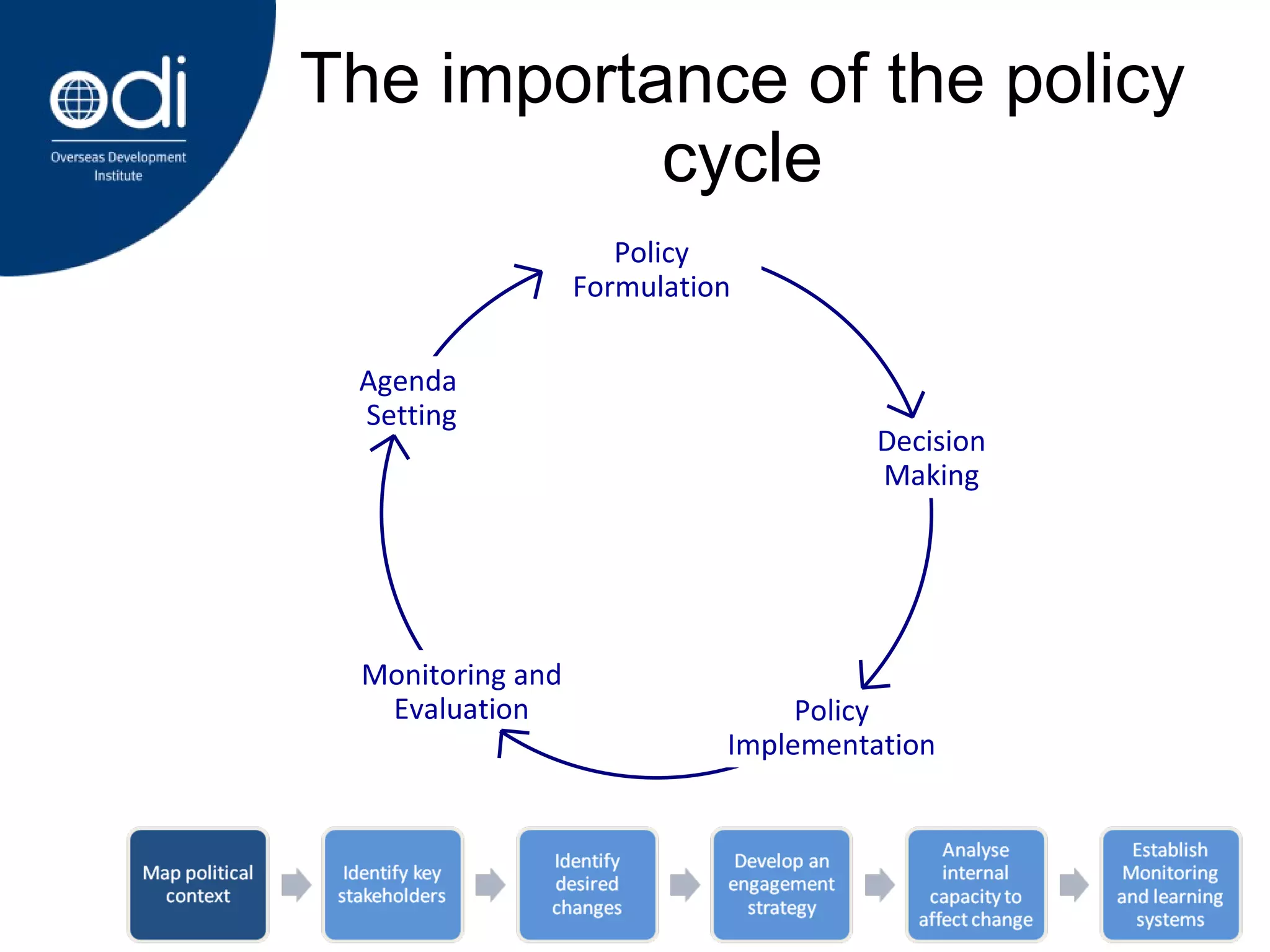
The importance of the policy cycle Monitoring and Evaluation Agenda  Setting Decision Making Policy Implementation Policy Formulation
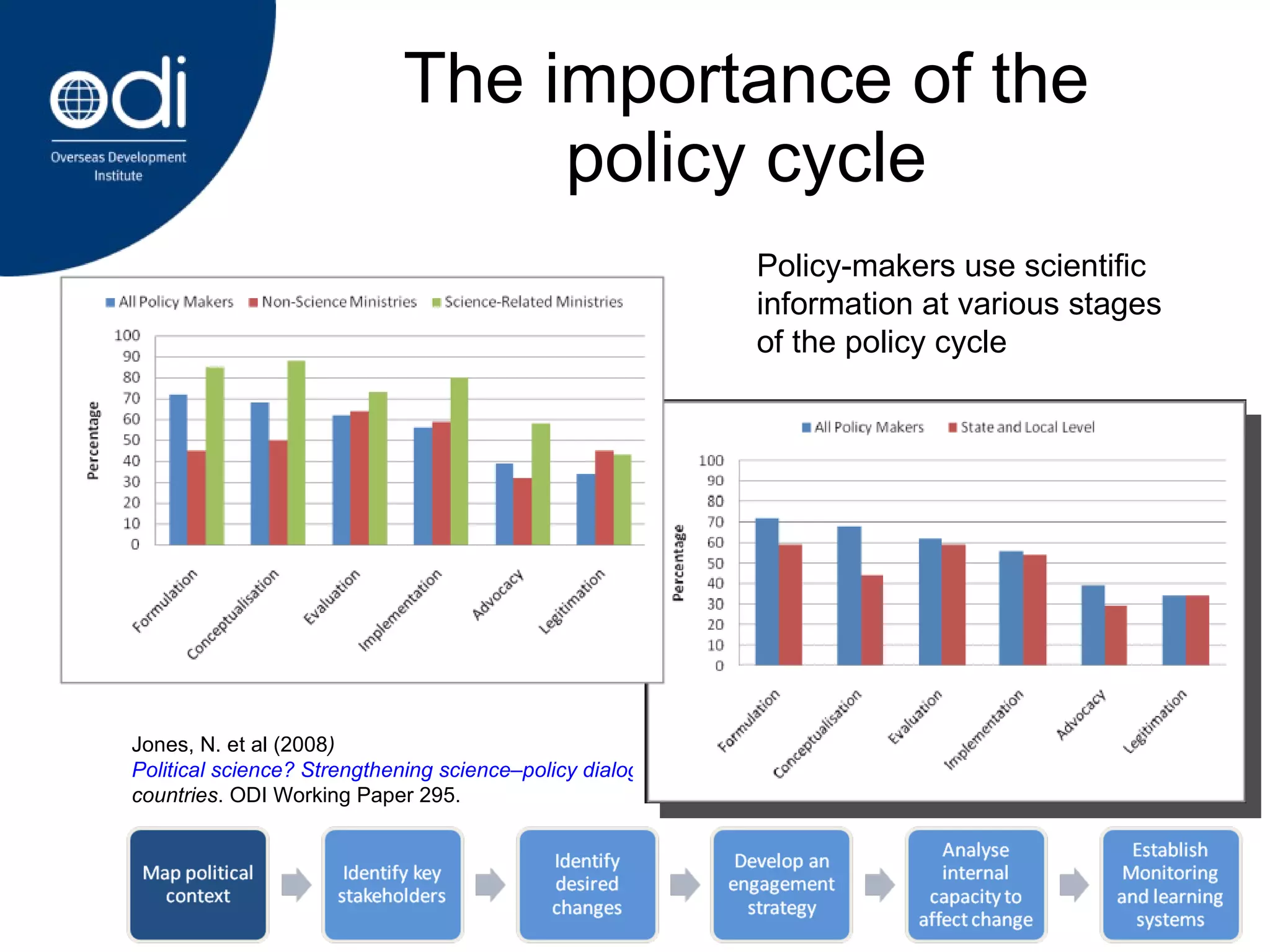
The importance of the policy cycle Policy-makers use scientific information at various stages of the policy cycle Jones, N. et al (2008 )  Political science? Strengthening science–policy dialogue in developing  countries . ODI Working Paper 295.
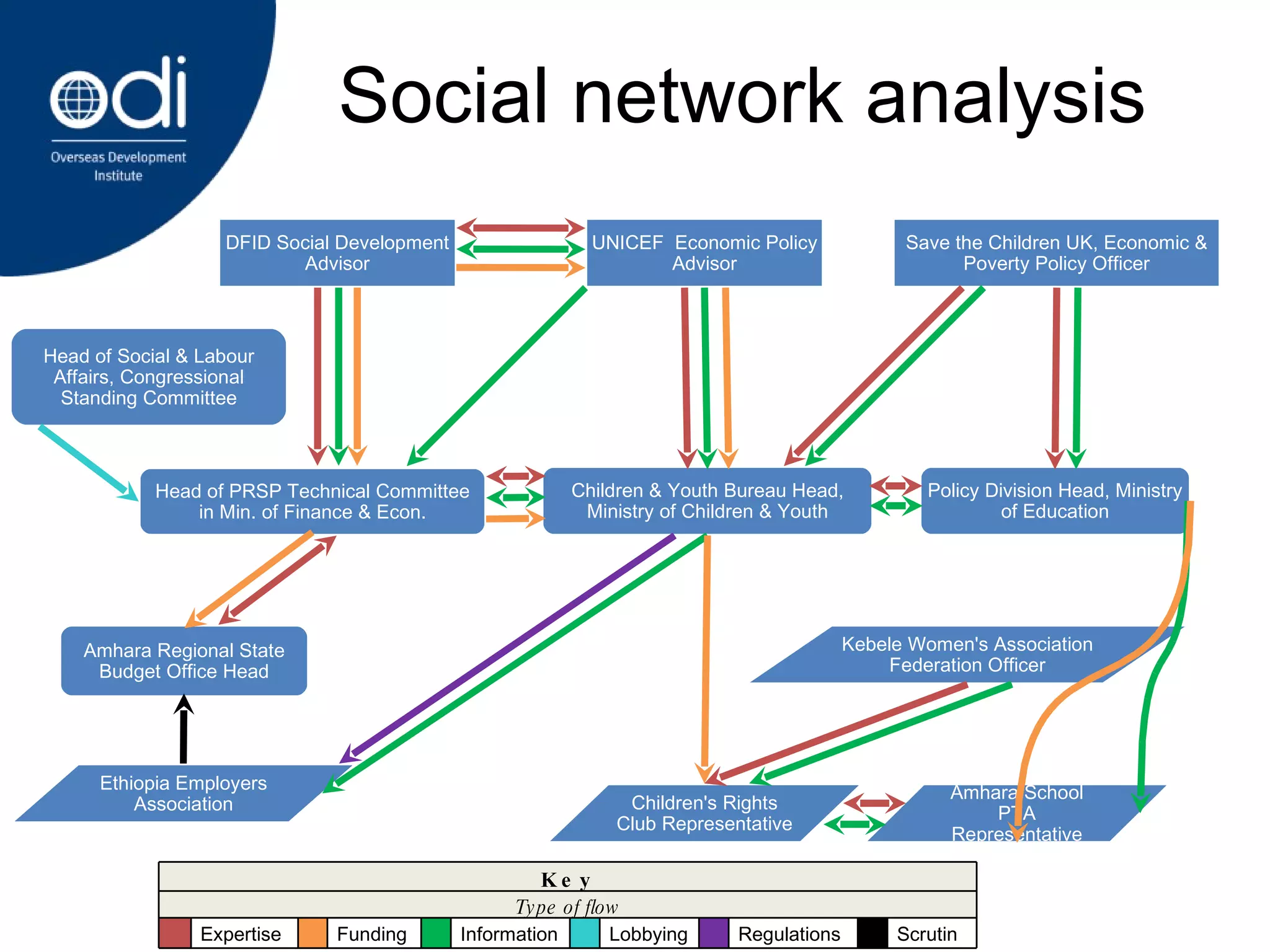
Social network analysis DFID Social Development Advisor Ethiopia Employers Association Head of PRSP Technical Committee in Min. of Finance & Econ. Head of Social & Labour Affairs, Congressional Standing Committee UNICEF  Economic Policy Advisor Children & Youth Bureau Head, Ministry of Children & Youth Children's Rights Club Representative Save the Children UK, Economic & Poverty Policy Officer Policy Division Head, Ministry of Education Kebele Women's Association Federation Officer Amhara School PTA Representative Amhara Regional State Budget Office Head Key Type of flow Expertise Funding Information Lobbying Regulations Scrutiny
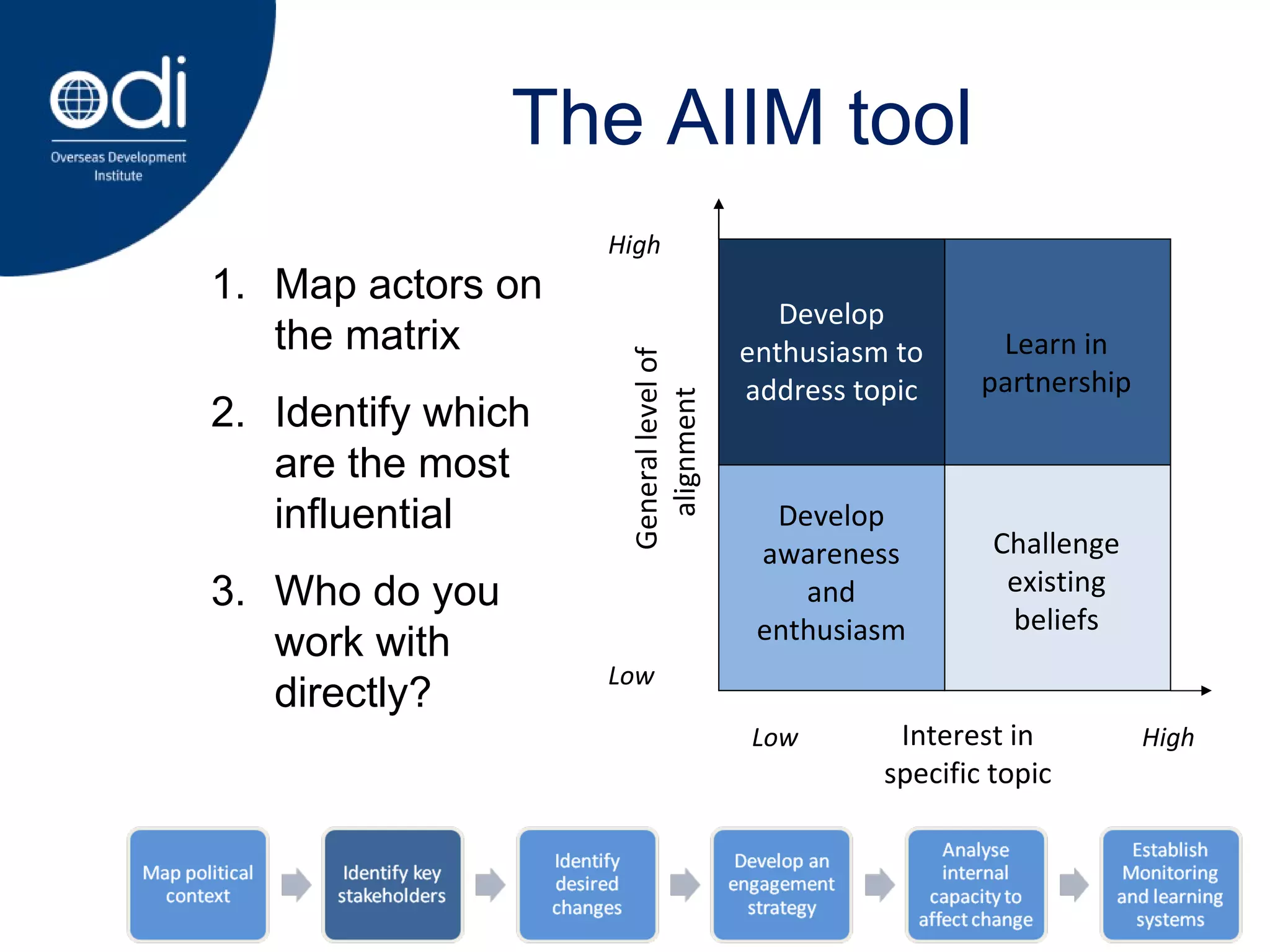
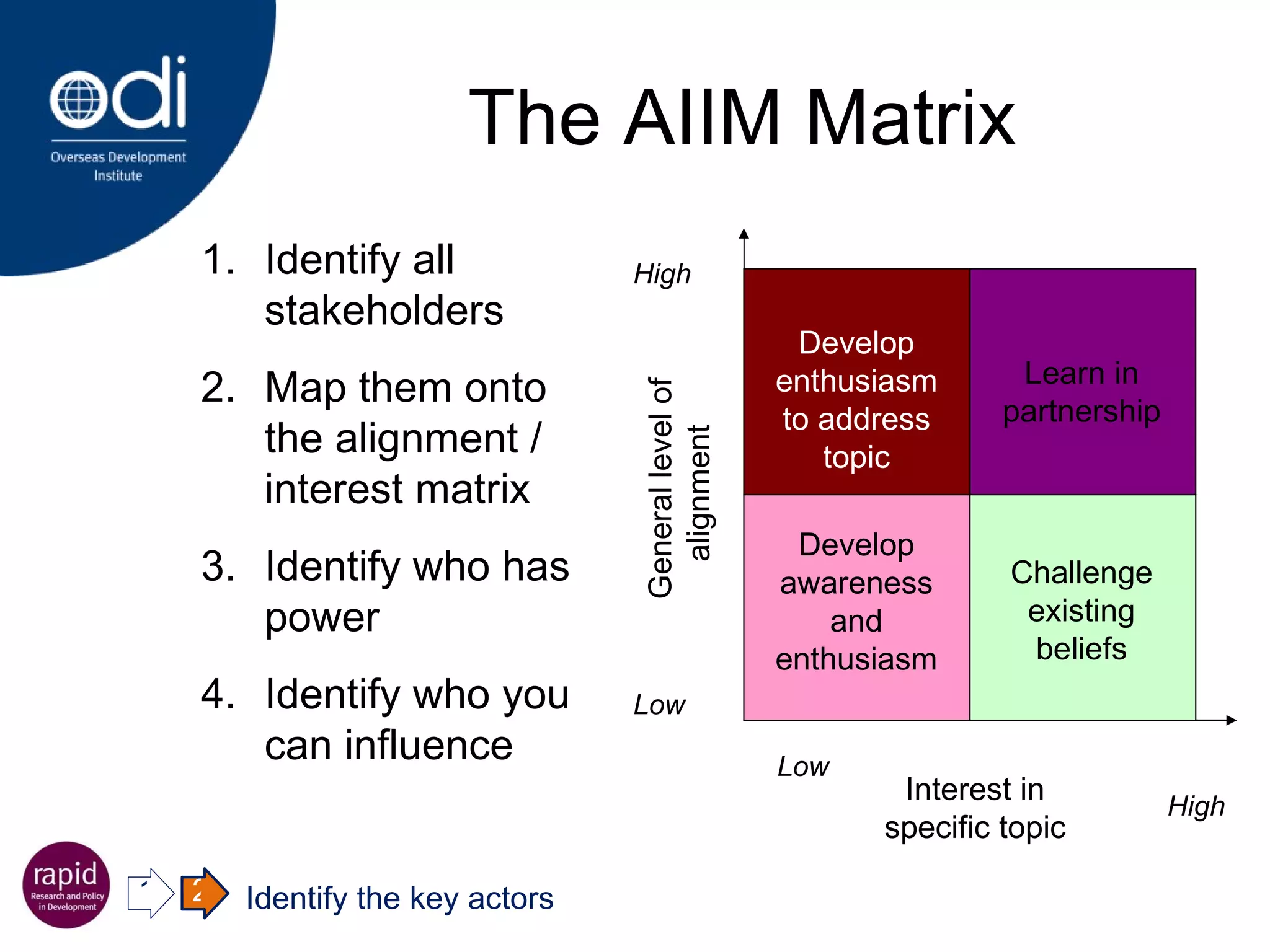
The AIIM tool Develop enthusiasm to address topic Learn in partnership Develop awareness and enthusiasm Challenge existing beliefs High General level of alignment  Low Low High Interest in specific topic Map actors on the matrix Identify which are the most influential   Who do you work with directly?
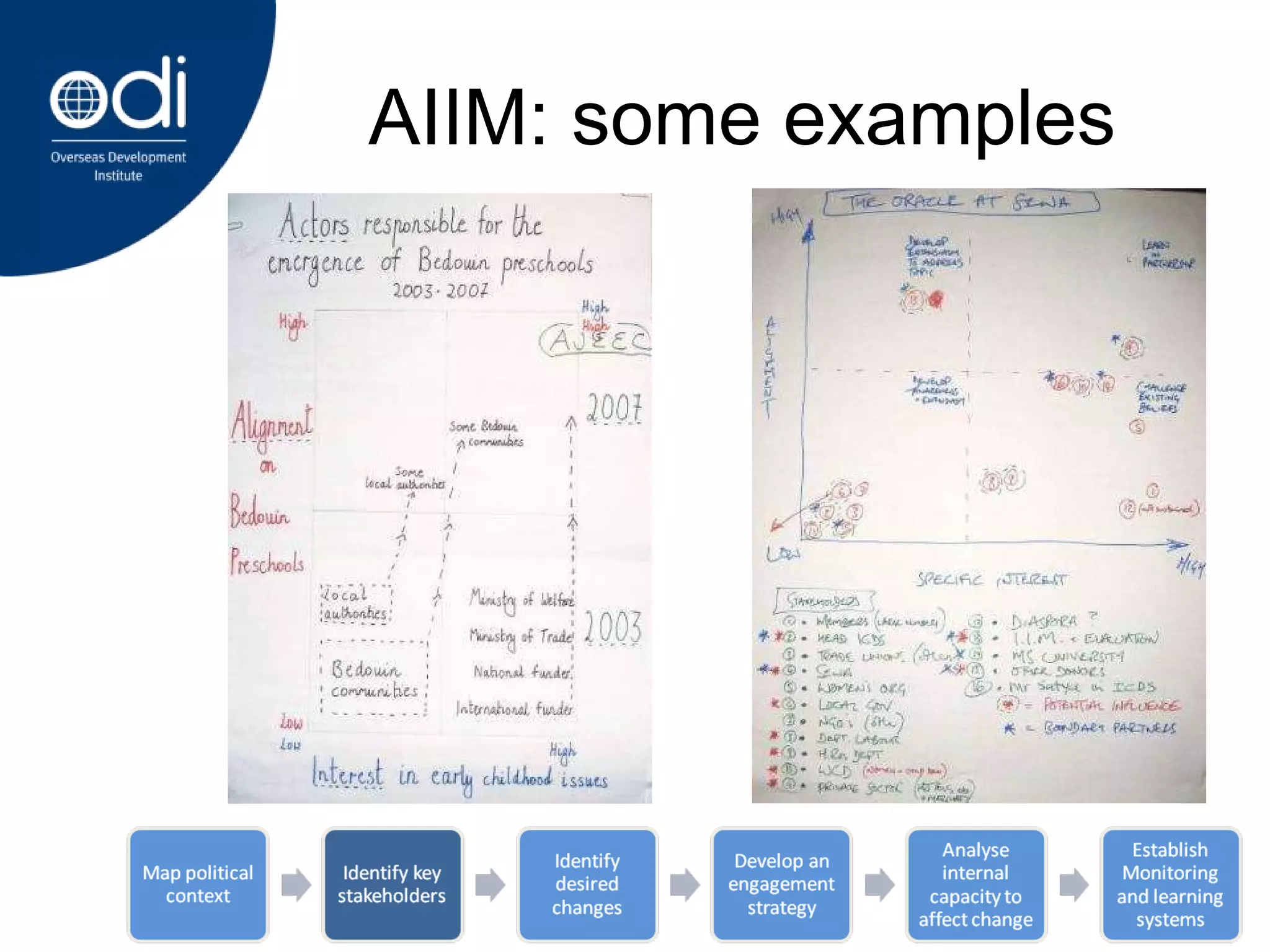
AIIM: some examples
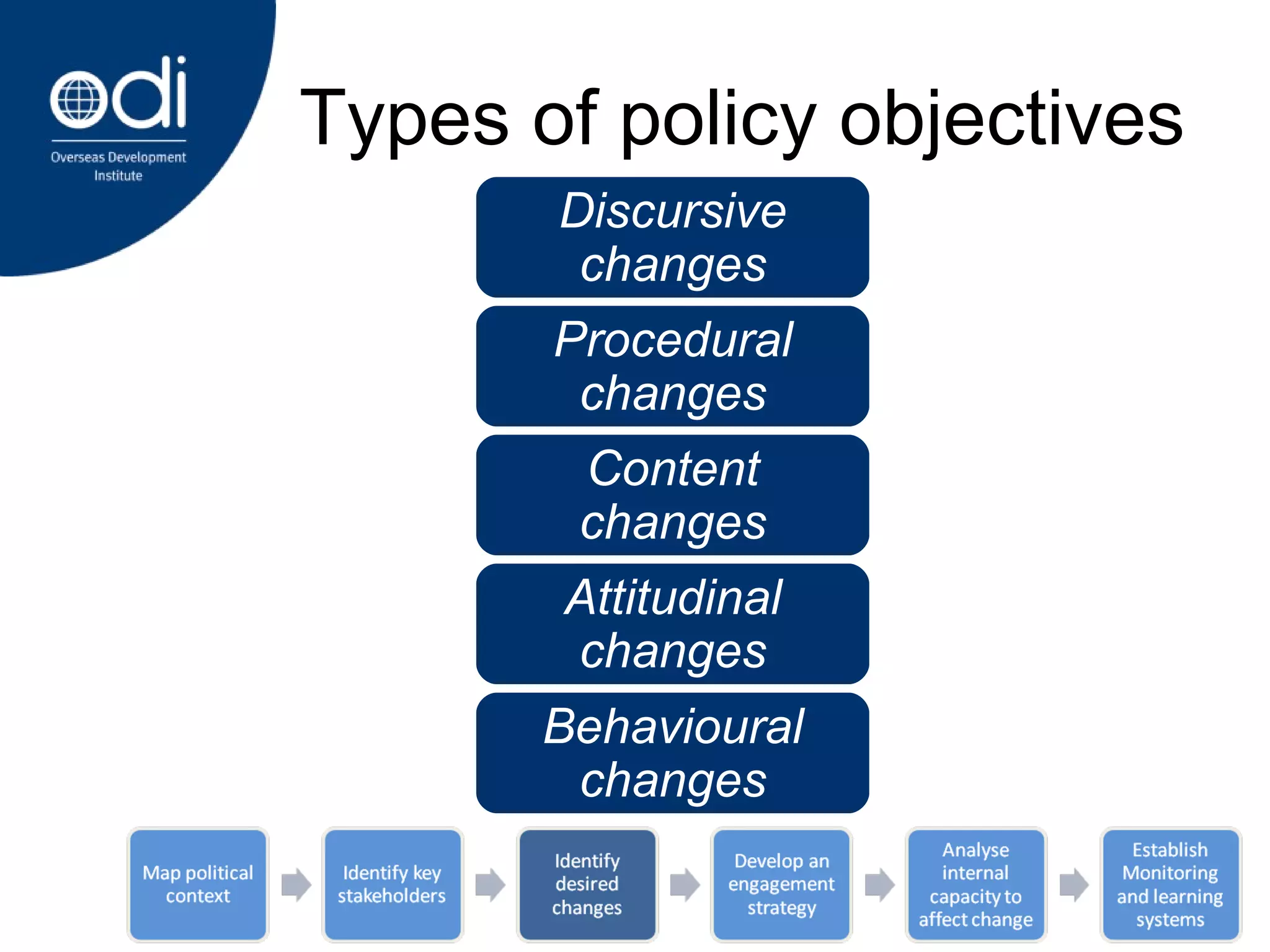
Types of policy objectives Discursive changes Procedural changes Content changes Attitudinal changes Behavioural changes
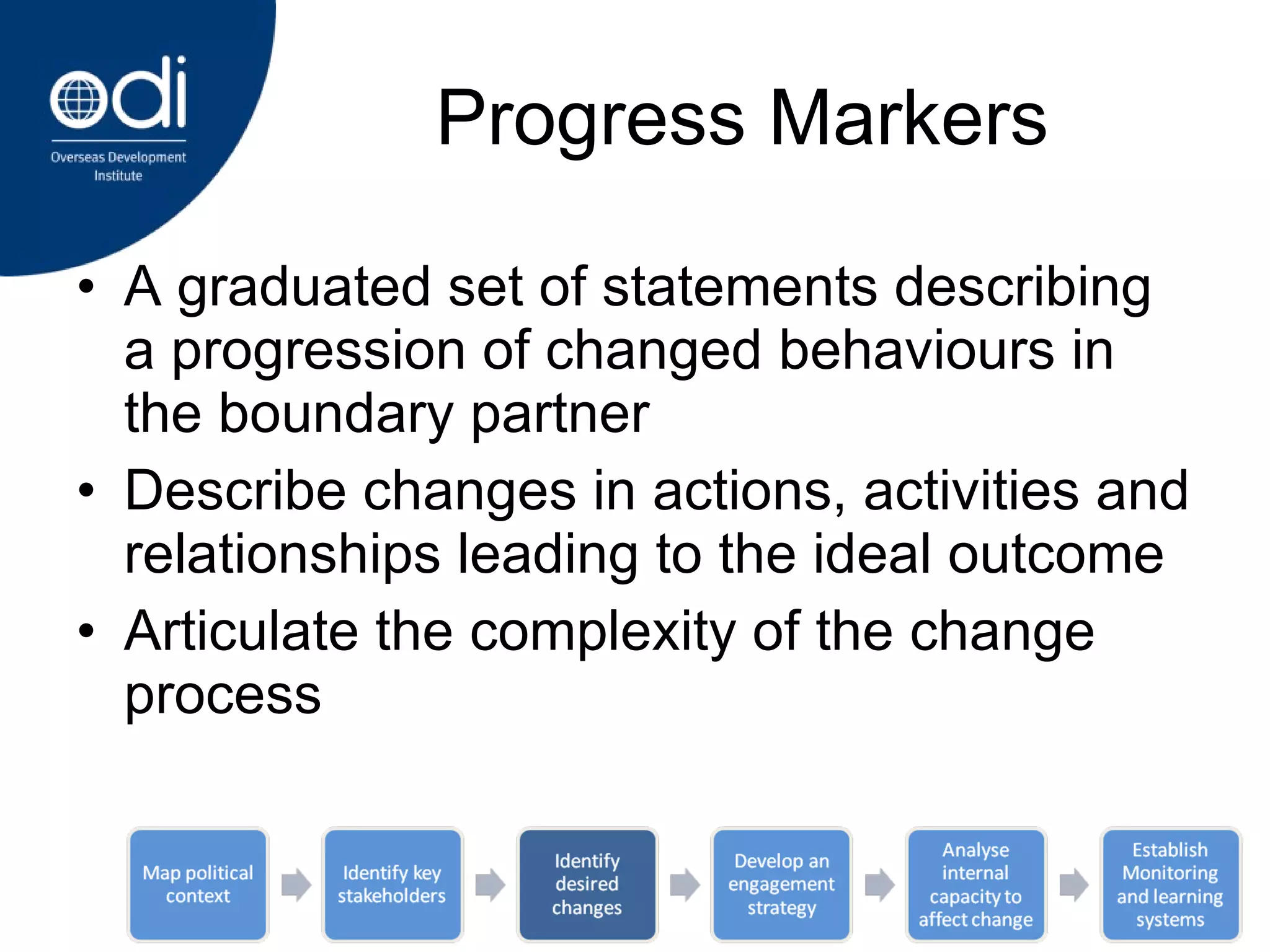
Progress Markers A graduated set of statements describing a progression of changed behaviours in the boundary partner Describe changes in actions, activities and relationships leading to the ideal outcome Articulate the complexity of the change process
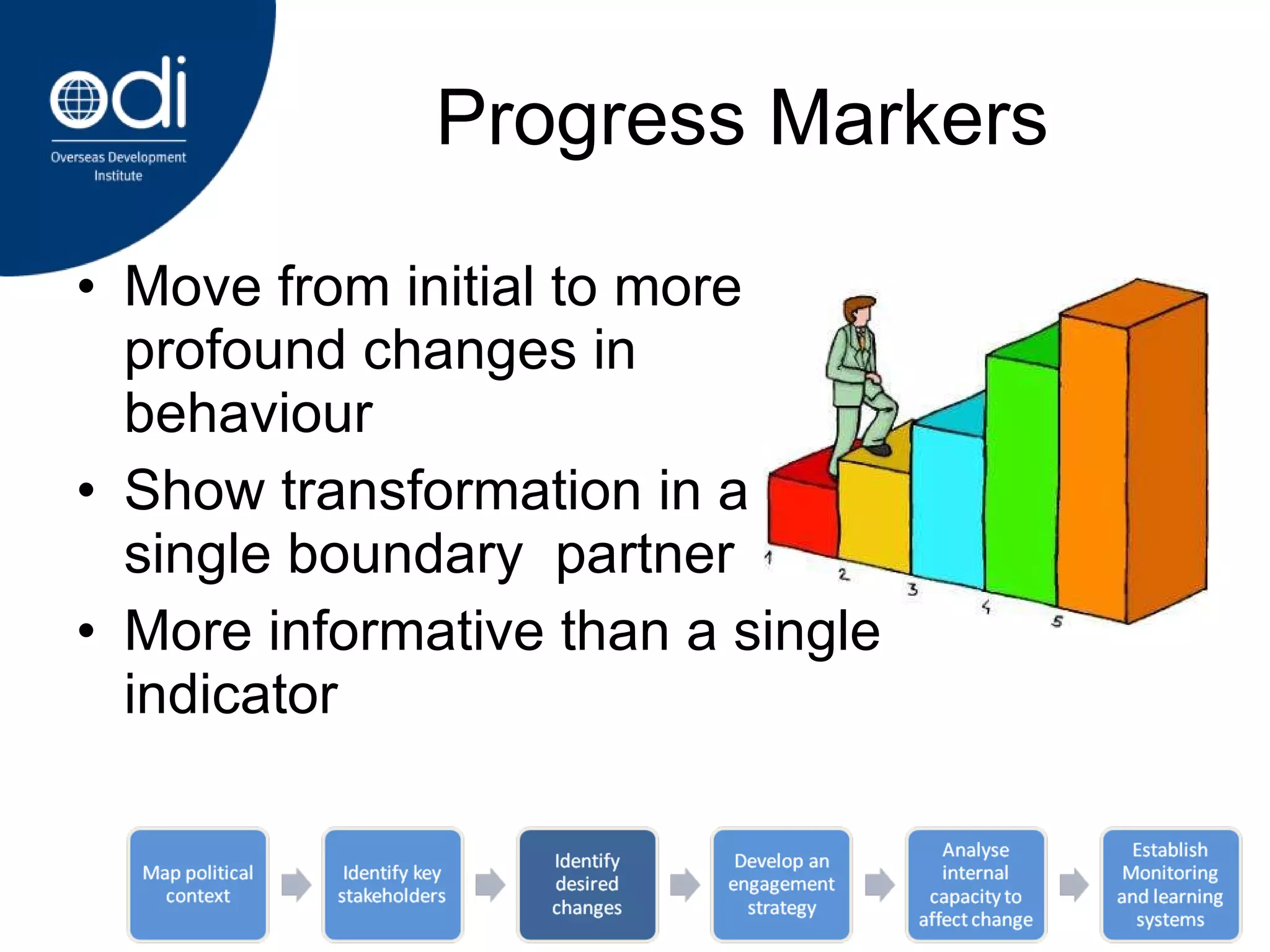
Progress Markers Move from initial to more profound changes in behaviour Show transformation in a single boundary  partner More informative than a single indicator
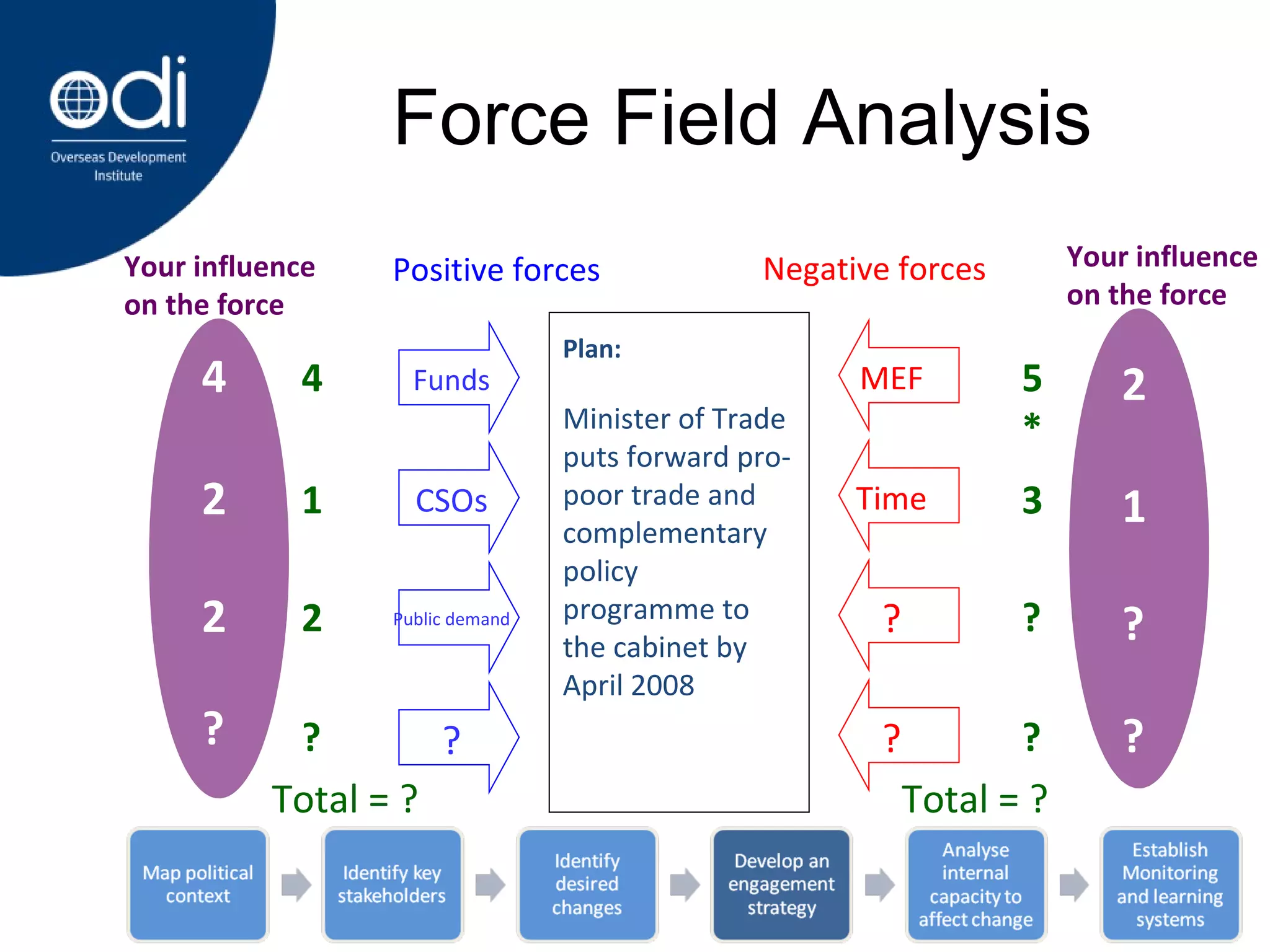
Force Field Analysis 5* 3 ? ? Total = ? MEF Time ? ? Negative forces 4 1 2 ? Total = ? Funds CSOs Public demand ? Positive forces 2 1 ? ? Your influence on the force Plan:  Minister of Trade puts forward pro-poor trade and complementary policy programme to the cabinet by April 2008 4 2 2 ? Your influence on the force
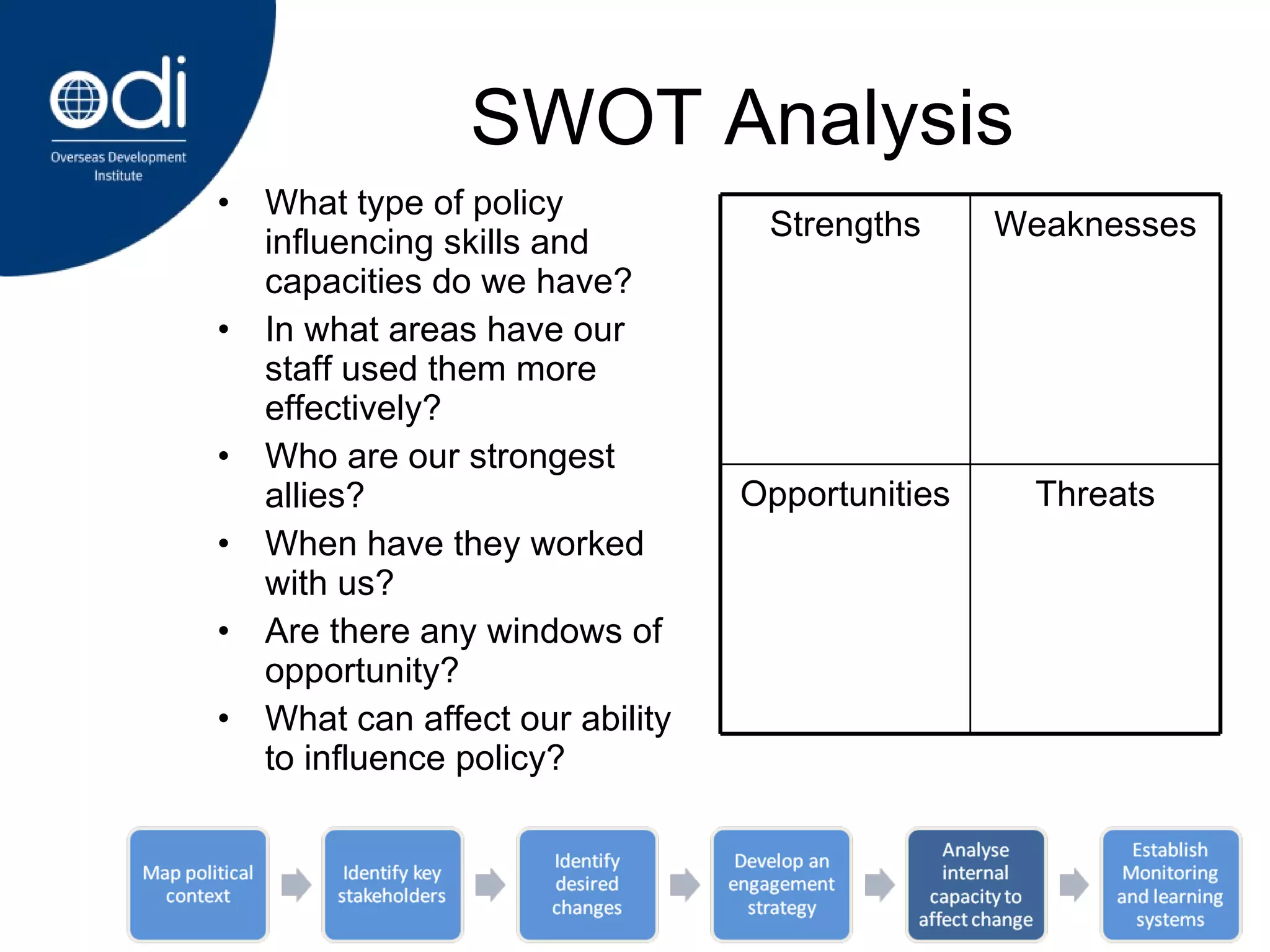
SWOT Analysis What type of policy influencing skills and capacities do we have? In what areas have our staff used them more effectively? Who are our strongest allies? When have they worked with us? Are there any windows of opportunity? What can affect our ability to influence policy? Strengths Weaknesses Opportunities Threats
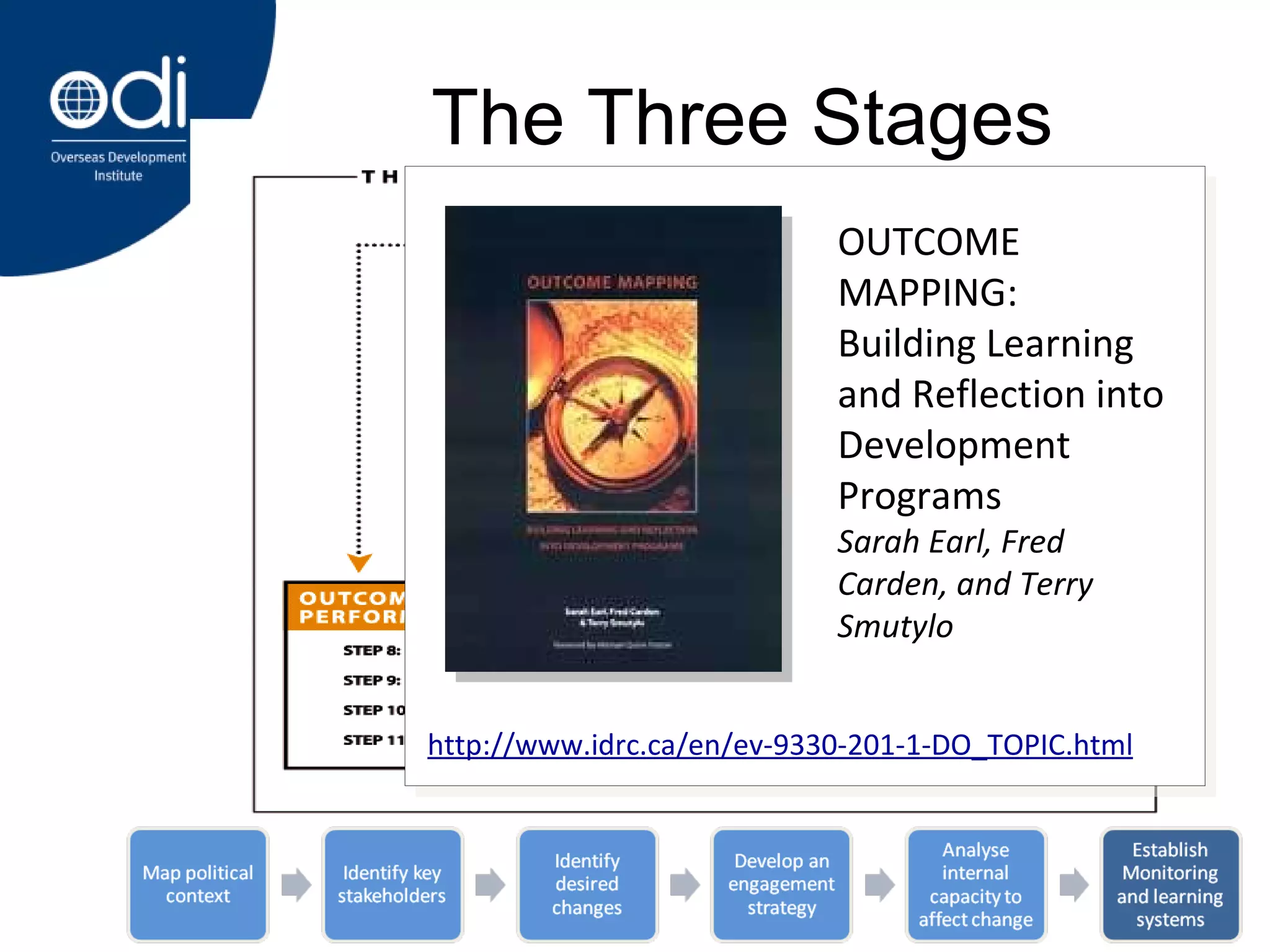
The Three Stages OUTCOME MAPPING: Building Learning and Reflection into Development Programs Sarah Earl, Fred Carden, and Terry Smutylo http://www.idrc.ca/en/ev-9330-201-1-DO_TOPIC.html
For example: Progress Markers Opportunities and Threats timeline Policy Objectives AIIM Force Field Analysis For example: Force Field Analysis For example: Policy entrepreneur questionnaire SWOT Internal performance frameworks For example: Log Frame (flexible) Outcome Mapping Journals or impact logs Internal monitoring tools Start by defining your policy objectives – constantly review them during the process For example: AIIM Stakeholder analysis Influence Mapping Social Network Analysis Force Field Analysis For example: Publications, public relations Media and events Negotiation and advice Develop a network or coalition Research For example: RAPID Framework Drivers of Change Power Analysis SWOT Influence Mapping Force Field Analysis
The AIIM Matrix Develop enthusiasm to address topic Learn in partnership Develop awareness and enthusiasm Challenge existing beliefs High General level of alignment  Low Low High Interest in specific topic 1 Identify the key actors 2 Identify all stakeholders Map them onto the alignment / interest matrix Identify who has power Identify who you can influence
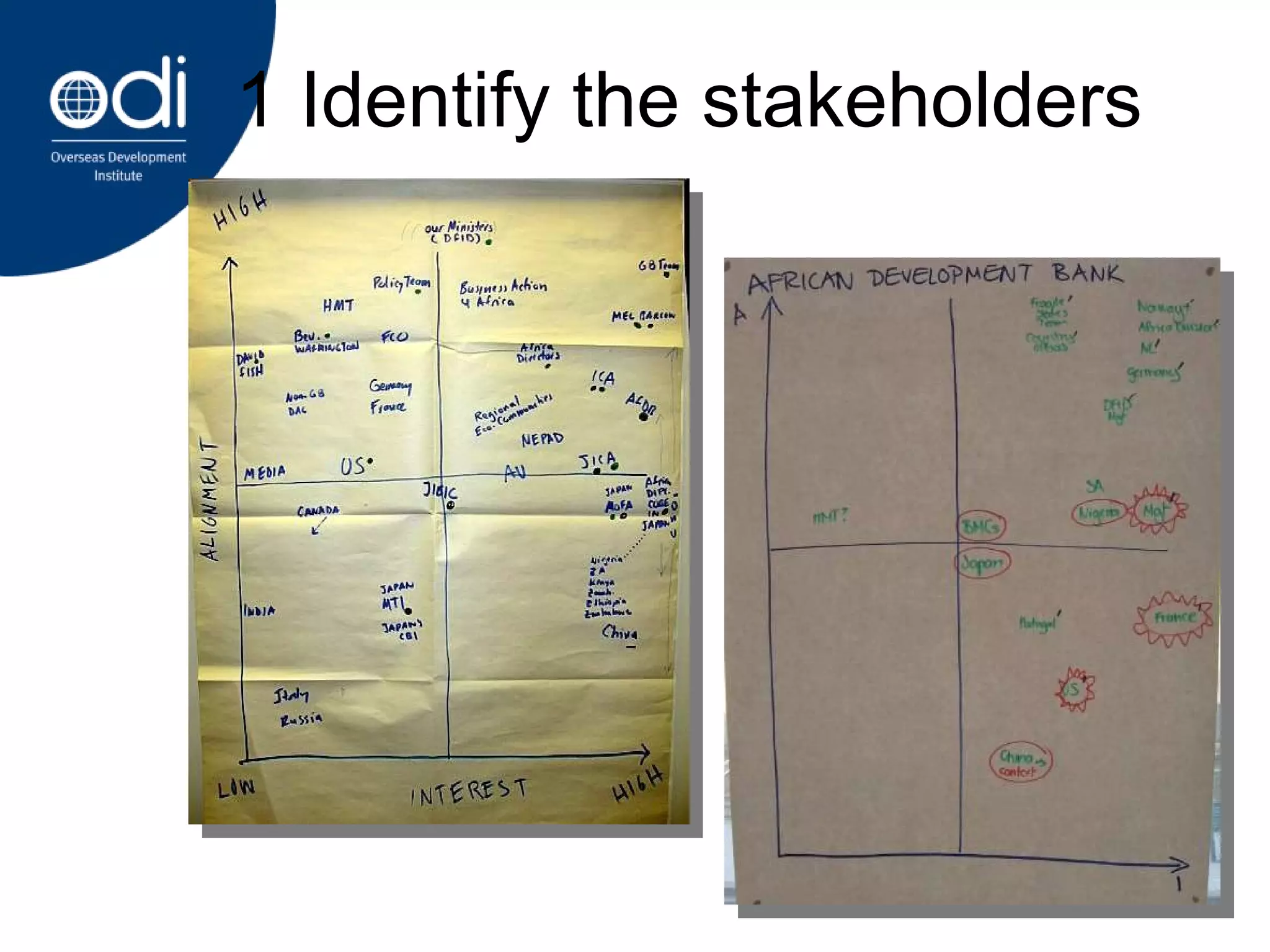
1 Identify the stakeholders
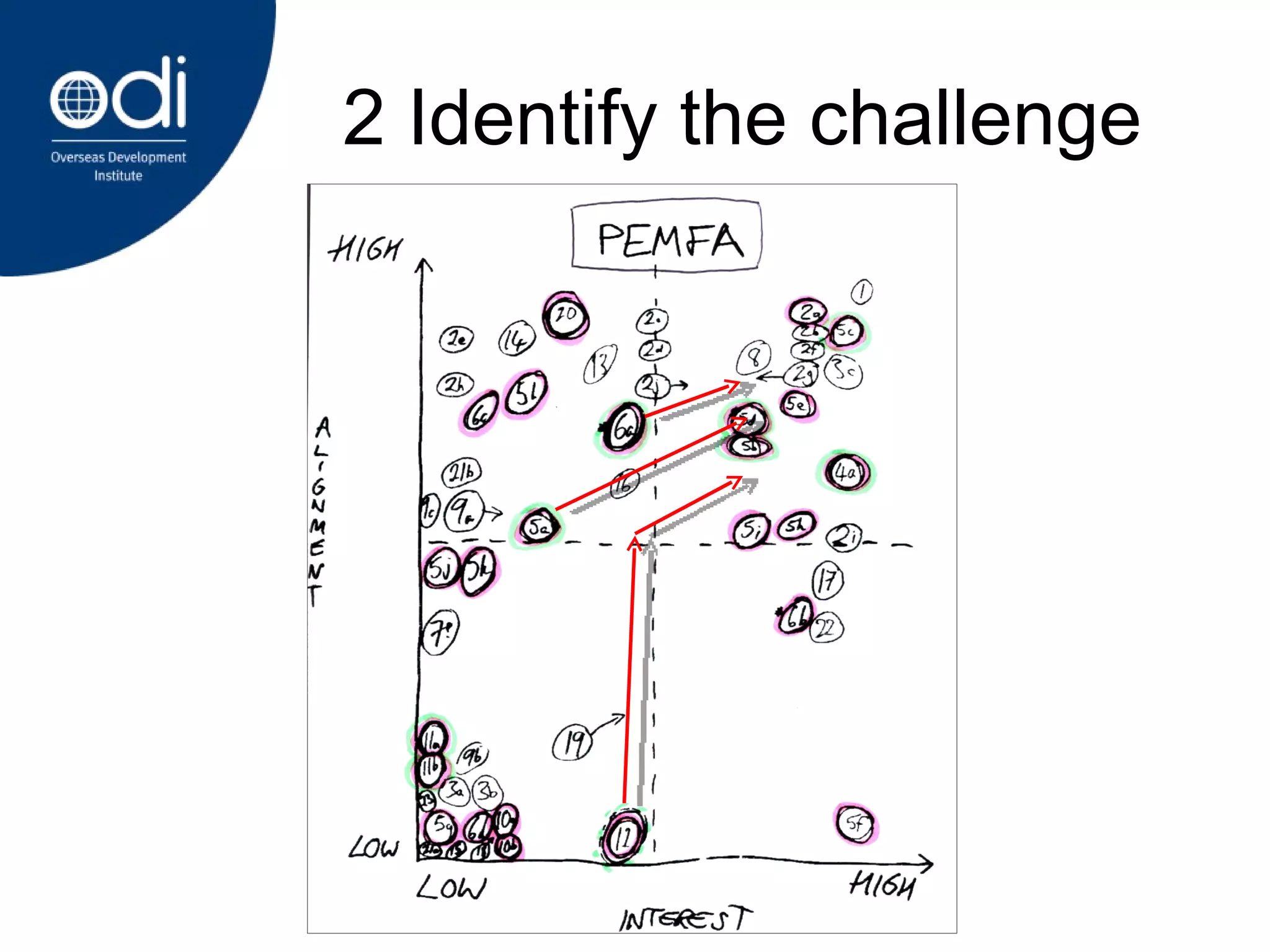
2 Identify the challenge
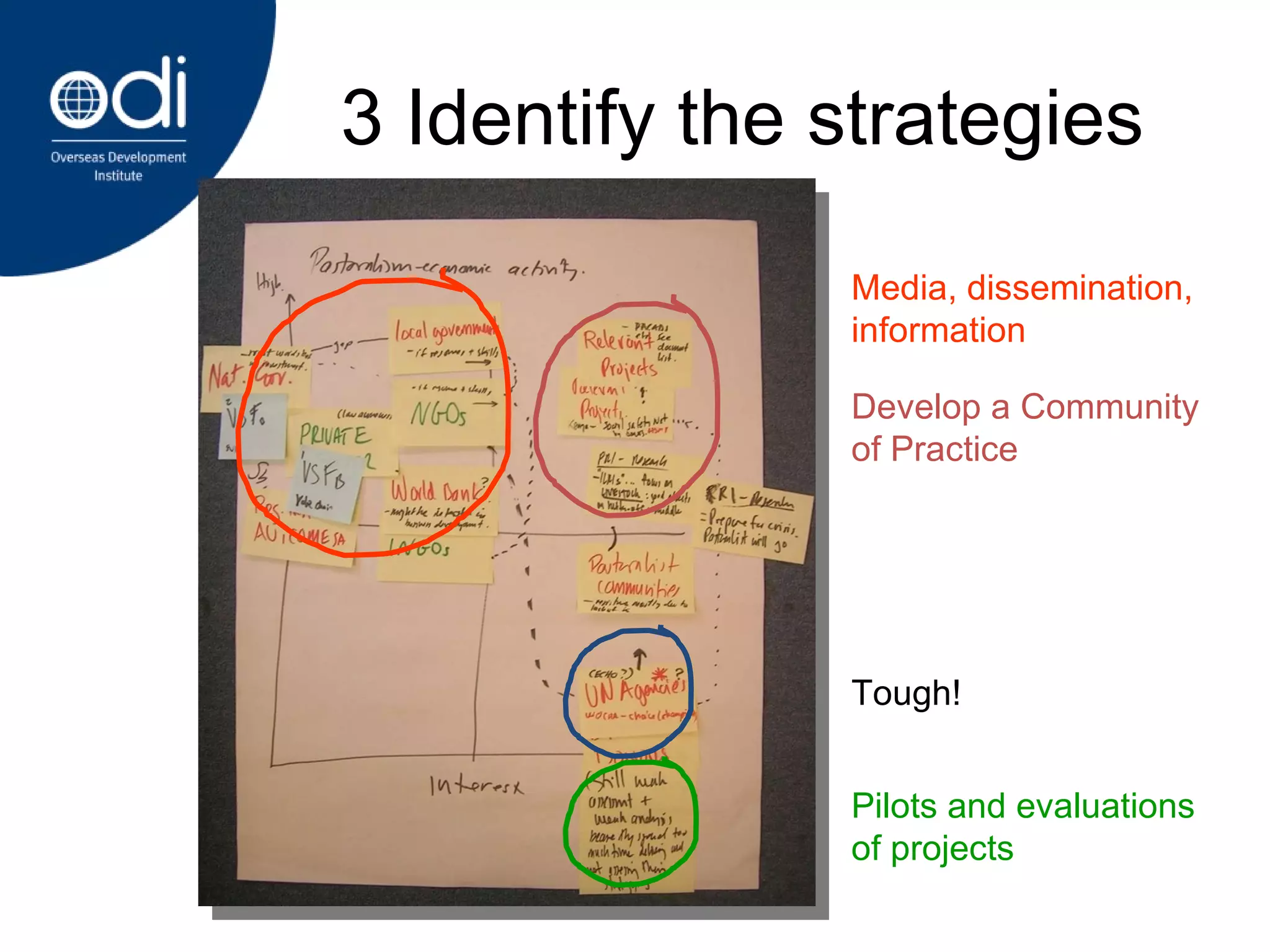
3 Identify the strategies Develop a Community of Practice Media, dissemination, information Pilots and evaluations of projects Tough!
How to do it List the key actors. Locate them on the matrix.  Identify the most influential actors. Identify the ones you can influence. Map where you’d like them to be and what you could do to get them there. Discussion: What did you  learn? Did the tool work? Could it be improved?
Thank you! [email_address]

Acacia Research and Learning Forum Tutorial 2

  • 1.
    Acacia Research andLearning Forum Tutorial No.2 8 th October 2009 Dakar, Senegal
  • 2.
    Session outline 1400-1500 Storytelling 1500-1515 Break 1515-1600 6 lessons from our experience in, and 8 key steps, to influencing policy in complex contexts (45 min) 1600-1700 Presentation and use of the Alignment, Interest and Influence Matrix as a way to identify and prioritize our target audiences - 45 minutes (including Q&A)
  • 3.
    Storytelling At yourtable and with your neighbour, describe a story about a policy process that you’ve been engaged with What was the context? What was the aim of engagement? What actions did the process involve? What was the result of the actions? [10 minutes] Switch roles – if you were listening you should now tell the story [10 minutes]
  • 4.
    Storytelling Then comingtogether with the rest of the table, from your collective experience, identify key lessons for effective policy engagement. Write 1 lesson on 1 card Identify about 6 lessons [20 min] Feedback Each table to present two cards in turn
  • 5.
    RAPID OUTCOME MAPPINGAPPROACH (ROMA)
  • 6.
  • 7.
    Identify the problemPolicy makers do not... Commission research Analyse the results Choose the best option Establish the policy Evaluation Implement the policy
  • 8.
    Policy processes are...Monitoring and Evaluation Agenda Setting Decision Making Policy Implementation Policy Formulation Civil Society Donors Cabinet Parliament Ministries Private Sector
  • 9.
  • 10.
    Chronic Poverty inUganda 1 Research often plays a minor role 2
  • 11.
    Policy makers are…Speed Superficiality Spin Secrecy Scientific Ignorance Vincent Cable – Lib. Democrat MP & Shadow Minister of Finance More at: www.odi.org.uk/RAPID/Meetings/Evidence … practically incapable of using research-based evidence because of the 5 Ss… 1 Research often plays a minor role 2
  • 12.
    There are manyfactors Source: Phil Davies Impact to Insight Meeting, ODI, 2005 Evidence Experience & Expertise Judgement Resources Values and Policy Context Habits & Tradition Lobbyists & Pressure Groups Pragmatics & Contingencies
  • 13.
    Different notions ofevidence Source: Phil Davies Impact to Insight Meeting, ODI, 2005 Colloquial (Contextual) Anything that seems reasonable Policy relevant Timely Clear Message Policy Makers’ Evidence ‘ Scientific’ (Context free) Proven empirically Theoretically driven As long as it takes Caveats and qualifications Researchers’ Evidence
  • 14.
  • 15.
    Health Care inTanzania “ The results of household disease surveys informed processes of health service reform which contributed to a 43 and 46 per cent reduction in infant mortality between 2000 and 2003 in two districts in rural Tanzania.” TEHIP Project, Tanzania: www.idrc.ca/tehip
  • 16.
  • 17.
    An analytical frameworkThe political context – political and economic structures and processes, culture, institutional pressures, incremental vs radical change etc. The evidence – credibility, the degree it challenges received wisdom, research approaches and methodology, simplicity of the message, how it is packaged etc External Influences Socio-economic and cultural influences, donor policies etc The links between policy and research communities – networks, relationships, power, competing discourses, trust, knowledge etc.
  • 18.
    A practical frameworkpolitical context evidence links Politics and Policymaking Media, Advocacy, Networking Research, learning & thinking External Influences Scientific information exchange & validation Policy analysis, & research Campaigning, Lobbying
  • 19.
    Applying the framework:ODI and the MDGs political context evidence links Politics and Policymaking Media, Advocacy, Networking Research, learning & thinking Political context: 2008 is just after mid-way point, so opportunity to analyse and refocus through UN-sponsored Call-to-Action UK government, among other national governments and international actors, has strong political will towards progressing on MDGs One reason for this political will is that many of the MDGs are off-track to meet targets UN High-level event in September 2008 Links: Side events at UN High-level Event on the MDGs in New York in September Co-hosted with: Bangladesh MoEd, UNIFEM, Danish MoFA, UN, CPRC, Government of South Sudan, Global Call to Action Against Poverty, Millennium Campaign Research based on collaboration with the CPRC (a consortium), work with the GAVI Alliance and Plan International External Influences Evidence:
  • 20.
  • 21.
    Policy and socialentrepreneurs Storytellers Engineers Networkers Fixers
  • 22.
  • 23.
    Conclusions focus moreon policy than research establish different incentives / culture establish different systems spend more on communications engage with different actors produce different products be ready to seize unexpected policy opportunities and move very fast To improve impact you may need to:
  • 24.
    The steps Startby defining your policy objectives – constantly review them during the process
  • 25.
    An analytical frameworkThe political context – political and economic structures and processes, culture, institutional pressures, incremental vs radical change etc. The evidence – credibility, the degree it challenges received wisdom, research approaches and methodology, simplicity of the message, how it is packaged etc External Influences Socio-economic and cultural influences, donor policies etc The links between policy and research communities – networks, relationships, power, competing discourses, trust, knowledge etc.
  • 26.
    What you needto do Who are the policymakers? Is there demand for ideas? What is the policy process? What is the current theory? What are the narratives? How divergent is it? Who are the stakeholders? What networks exist? Who are the connectors, mavens and salesmen? Get to know the policymakers. Identify friends and foes. Prepare for policy opportunities. Look out for policy windows. Work with them – seek commissions Strategic opportunism – prepare for known events + resources for others Establish credibility Provide practical solutions Establish legitimacy. Present clear options Use familiar narratives. Build a reputation Action-research Pilot projects to generate legitimacy Good communication Get to know the others Work through existing networks. Build coalitions. Build new policy networks . Build partnerships. Identify key networkers, mavens and salesmen. Use informal contacts What need to know What need to do How to do it Political Context: Evidence Links
  • 27.
    The importance ofthe policy cycle Monitoring and Evaluation Agenda Setting Decision Making Policy Implementation Policy Formulation
  • 28.
    The importance ofthe policy cycle Policy-makers use scientific information at various stages of the policy cycle Jones, N. et al (2008 ) Political science? Strengthening science–policy dialogue in developing countries . ODI Working Paper 295.
  • 29.
    Social network analysisDFID Social Development Advisor Ethiopia Employers Association Head of PRSP Technical Committee in Min. of Finance & Econ. Head of Social & Labour Affairs, Congressional Standing Committee UNICEF Economic Policy Advisor Children & Youth Bureau Head, Ministry of Children & Youth Children's Rights Club Representative Save the Children UK, Economic & Poverty Policy Officer Policy Division Head, Ministry of Education Kebele Women's Association Federation Officer Amhara School PTA Representative Amhara Regional State Budget Office Head Key Type of flow Expertise Funding Information Lobbying Regulations Scrutiny
  • 30.
    The AIIM toolDevelop enthusiasm to address topic Learn in partnership Develop awareness and enthusiasm Challenge existing beliefs High General level of alignment Low Low High Interest in specific topic Map actors on the matrix Identify which are the most influential Who do you work with directly?
  • 31.
  • 32.
    Types of policyobjectives Discursive changes Procedural changes Content changes Attitudinal changes Behavioural changes
  • 33.
    Progress Markers Agraduated set of statements describing a progression of changed behaviours in the boundary partner Describe changes in actions, activities and relationships leading to the ideal outcome Articulate the complexity of the change process
  • 34.
    Progress Markers Movefrom initial to more profound changes in behaviour Show transformation in a single boundary partner More informative than a single indicator
  • 35.
    Force Field Analysis5* 3 ? ? Total = ? MEF Time ? ? Negative forces 4 1 2 ? Total = ? Funds CSOs Public demand ? Positive forces 2 1 ? ? Your influence on the force Plan: Minister of Trade puts forward pro-poor trade and complementary policy programme to the cabinet by April 2008 4 2 2 ? Your influence on the force
  • 36.
    SWOT Analysis Whattype of policy influencing skills and capacities do we have? In what areas have our staff used them more effectively? Who are our strongest allies? When have they worked with us? Are there any windows of opportunity? What can affect our ability to influence policy? Strengths Weaknesses Opportunities Threats
  • 37.
    The Three StagesOUTCOME MAPPING: Building Learning and Reflection into Development Programs Sarah Earl, Fred Carden, and Terry Smutylo http://www.idrc.ca/en/ev-9330-201-1-DO_TOPIC.html
  • 38.
    For example: ProgressMarkers Opportunities and Threats timeline Policy Objectives AIIM Force Field Analysis For example: Force Field Analysis For example: Policy entrepreneur questionnaire SWOT Internal performance frameworks For example: Log Frame (flexible) Outcome Mapping Journals or impact logs Internal monitoring tools Start by defining your policy objectives – constantly review them during the process For example: AIIM Stakeholder analysis Influence Mapping Social Network Analysis Force Field Analysis For example: Publications, public relations Media and events Negotiation and advice Develop a network or coalition Research For example: RAPID Framework Drivers of Change Power Analysis SWOT Influence Mapping Force Field Analysis
  • 39.
    The AIIM MatrixDevelop enthusiasm to address topic Learn in partnership Develop awareness and enthusiasm Challenge existing beliefs High General level of alignment Low Low High Interest in specific topic 1 Identify the key actors 2 Identify all stakeholders Map them onto the alignment / interest matrix Identify who has power Identify who you can influence
  • 40.
    1 Identify thestakeholders
  • 41.
    2 Identify thechallenge
  • 42.
    3 Identify thestrategies Develop a Community of Practice Media, dissemination, information Pilots and evaluations of projects Tough!
  • 43.
    How to doit List the key actors. Locate them on the matrix. Identify the most influential actors. Identify the ones you can influence. Map where you’d like them to be and what you could do to get them there. Discussion: What did you learn? Did the tool work? Could it be improved?
  • 44.

Editor's Notes

  • #2 Hi – I’m Ajoy Datta, a researcher at the Overseas Development Institute (ODI). The ODI is a think tank working on international development and humanitarian issues I work in the RAPID Group within ODI RAPID stands for Research and Policy in Development RAPID is one of 5 groups we do work on the interface between knowledge/research and policy We have a dual focus on firstly, research on the role of knowledge in policy – looking at political context, socio-cultural factors, mapping stakeholders, types of evidence that are favoured in different contexts/sectors and/or actors Then secondly, on facilitating the development of skils and abilities of organisations and institutions to better promote the uptake of research/knowledge in policy processes and outcomes
  • #5 Lessons could include something you learnt about the nature of policy processes, the role of research in policy processes, it could be something about methods for engagement that worked, or those that didn’t, about steps you should take to help influence, or the importance of planning, etc
  • #6 Now I’ll present 6 lessons we’ve learnt about the policy process and 8 key steps to developing and implementing an influencing strategy. The lessons will appear obvious and are taken as a given these days. But for us they emerged from our work over the last 5-6 years with civil society organisations, think tanks, donors, and more recently parliamantarians
  • #7 The first lesson is that policy processes and social realities are very complex. Now many of us have talked about this at various points throughout the last few days. I’ll just provide some key points
  • #8 Traditionally (a long time ago!) policy processes were seen as linear and logical processes Where at the start, the problem was identified, research would be commissioned, results would be analysed…… and then the policy would be evaluated However, as we all know they are very rarely linear and logical. Simply presenting research results to policymakers and expecting them to put it into practice is very unlikely to work. Examples – dodgy dossier used to justify Iraq War in the UK
  • #9 Policy processes were later seen as a cyclical process While most policy processes do involve sequential stages from agenda setting through decision-making to implementation and evaluation, sometimes some stages take a very long time, and sometimes several stages occur more or less simultaneously. For example 3 steps of the process – agenda setting, policy formulation and decision making - might happen at the same time in a minister’s head Traditionally M&E was rarely done (though that may change with Many actors are involved: ministers, parliament, civil servants, the private sector, civil society, the media etc., and in the development sector, also the donors They are all busily seeking to engage in the process directly, though different actors will be involved in different parts of the process and some will be more legitimate than others For example cabinet should focus on decision making and agenda setting, while parliament may focus more on policy implementation and M&E But they will also be trying to influence each other Clay and Schaeffer’s 1984 book Room for Manoeuvre describes “ the whole life of policy as a chaos of purposes and accidents” Doing a workshop in India, senior reps of the a key ministry involved in ground water extraction, were upset at their policy processes being called chaotic So we use the terms complex, multifactorial and non linear
  • #10 The second lesson is that research often plays a minor role in policy and practice
  • #11 A recent ODI study of factors influencing chronic poverty in Uganda found that only two of twenty five issues had an immediate information deficit, and hence could be researchable The study is documented in this product available on the ODI website
  • #12 In a talk on evidence-based policymaking at ODI in 2003 Vincent Cable, the shadow minister of Finance, said that policy makers are practically incapable of using research-based evidence because of the 5 Ss… Speed – they have to make decisions fast; Superficiality – they cover a wide brief; Spin – they have to stick to a decision, at least for a reasonable period of time; Secrecy – many policy discussions have to be held in secret; and Scientific Ignorance – few policy makers are scientists, and don’t understand the scientific concept of testing a hypothesis. Dr Vincent Cable – MP for Twickenham, in “The Political Context”, Does Evidence Matter Meeting Series, ODI, May 2003.
  • #13 At another ODI meeting, Phil Davies, working in the UK Cabinet Office, described how policy makers tend to be more heavily influenced by their own values, experience, expertise and judgement, the influence of lobbyists and pressure groups and pragmatism based on the amount of resources they have available.
  • #14 He went on to describe how researchers and policymakers have completely different concepts of what constitutes good evidence. Researchers only consider their results to be reliable if they are proven scientifically, underpinned by theory, are reluctant to say anything until it is, and then wrap it up in caveats and qualifications. Policy makers will take more or less anything that can help them to make a decision which seems reasonable and has a clear message and is available at the right time
  • #15 The Third lesson is that while research may play a minor role in policy and practice, it can play some role
  • #16 Research-based evidence can contribute to policies which can have a dramatic impact on peoples’ lives. H ouse-hold disease surveys undertaken by the Tanzania Integrated Health Improvement informed processes of health service reform which contributed to a 43 and 46 per cent reduction in infant mortality in two districts in rural Tanzania between 2000 and 2003.”
  • #17 The fourth lesson is that for research to play a role , researchers need a holistic understanding of the context they are working in.
  • #18 There’s a huge number of factors They can take 2-3 years to understand fully While there are an infinite number of factors which affect how research-based evidence does or doesn’t influence policy, it is possible to get enough understanding to be able to make decisions about how to maximise the impact of research on policy and practice relatively easily. ODI has developed a simple analytical framework identifying four broad groups of factors. The first group, which we call external influences, are those factors outside the context you are working in which affect what happens within it. Donor policies, for example, can be hugely influential in highly indebted countries. The second, the political context, includes the people, institutions and processes involved in policy making, also the policy windows, which can open and close and can have negative and positive consequences on policy processes, eg. Champions being appointed to key policymaking posts, or economic crises instigating economic reform, snap elections, etc The third are around the evidence itself, including the type, quality and contestability of the research and how it is communicated and who is the messenger; and the fourth, which we call links, includes mechanisms affecting how the evidence gets into the policy process. Bridging Research and Policy in International Development: An Analytical and Practical Framework. RAPID Briefing Paper 1, October 2004.
  • #19 This framework turns the analysis into practical actions Maps nicely onto real life functions – for example political context maps onto politics and policymaking, while evidence maps onto research, learning and thinking Overlaps between evidence and policy making include policy analysis and policy research, while overlaps between politics and media, advocacy and networking, include campaigning and lobbying This red blob is all important. Its were policymakers, researchers and key intermediaries come together. ODI has commissioned around 100 case studies of how research and policy has been bridged, which found that where researchers work closely with policymakers and other actors, you have a good link between research and policy Not all research has to be policy relevant – hence blue sky research
  • #20 In Sub-Saharan Africa, 800 times more likely to die during childbirth than in the West, and is really simple to address
  • #21 The fifth lesson is that to influence policy, certain skills are necessary.
  • #22 To influence policy we say you need to be a policy entrepreneur They need to be good storytellers to synthesise simple compelling stories from the results of the research. They need to be good networkers to work effectively with all the other stakeholders. They need to be good engineers to build a programme which pulls all of this together. They need to be political fixers, able to understanding the politics and identify the key players. Or they need to work in multidisciplinary teams with others who have these skills.
  • #23 Successful initiatives express their intent explicitly in order to communicate a common purpose and goal.
  • #24 Expand Illustrate with examples ODI does have right incentives for researchers to be policy focussed
  • #25 The steps we outline are based on an IDRC approach to managing projects called outcome mapping – a methodology for planning, monitoring and evaluating projects. We have applied this approach to developing strategies to influence policy. The template which we propose has never as far as we know been applied in its entirety, you may find some steps more relevant than others, or you may apply them in a different way. The key thing which we emphasise is to be systematic and be critical in your methods, ensure you have enough information at each stage before you move on. By going through the steps and working through the tools, it helps you and your team build a better understanding of the policy process. E.g. the Accountability Programme in Tanzania (ACT) did a political economy analysis to assess the context for civil society engagement with the government. It then identified key stakeholders but realised there was a gap in its political economy analysis. so it went back to do more mapping of the context before coming back
  • #26 Starting from an intention to use some research-based evidence to promote a specific policy or practice, the first step is to map the policy context around that specific policy issue and identify the key fac tors which may influence the policy process. The RAPID framework, which I talked about earlier is useful for this
  • #27 T he framework provides a useful checklist of questions for this, including questions about the four key factors – context, evidence, links and external factors This is documented in a briefing paper on the RAPID website As well as the RAPID framework you can use a political economy approach focussing on the distribution of power and wealth between groups and individuals – paying attention to politics and economic interests
  • #28 Break it down into stages, where is your influence best applied?
  • #29 Important because policy makers use evidence at various stages of the policy cycle From an ODI study for Scidevnet we found that scientific ministries tended to use scientific evidence at policy formulation and conceptualisation stags while non scientific ministries tended to draw on scientific evidence at evaluation and implementation phases
  • #30 Another way to map context is to look at actors and the relationships between them. Doing a social network analysis is one way to do this
  • #31 The second step is to identify the key influential stakeholders. RAPID’s Alignment, Interest and Influence Matrix (AIIM) can be used to map actors along three dimensions: their level of interest in the issue (on the x axis), the degree of alignment with the proposed policy (on the y axis), and their ability to exert influence on the policy process (highlighted by the size of your cross/marker) Actors who are highly interested and highly aligned should be natural allies and collaborators, actors who are highly interested but not aligned are potential obstacles, and need to be brought into alignment, or somehow prevented from creating obstacles. Stimulating enthusiasm among powerful actors who are highly aligned but not interested can increase the chance of success.
  • #32 Here are a couple of examples that were produced in a workshop with staff working for the Bernard Van Leer Foundation.
  • #33 Once you’ve identified key stakeholders, identify the changes you desire This could be policy change, but this can be broken down into 5 types of change Discursive changes: These refer to changes in the labels or narratives of policy actors. They reflect a new or improved understanding of a subject -- even if it does not imply an effective change of policy or practice. Procedural changes: These refer to changes in the way certain processes are undertaken. For example, the incorporation of consultations to otherwise closed processes, or small changes in the way that national policies are implemented in the field. Content changes: These refer to changes in the content of policies including strategy papers, legislation and budgets. These are formal changes in the policy framework.  Attitudinal changes: These refer to changes in the way policy actors think about a given issue. This might be an important change to target in the event that key stakeholders have high influence but lack interest in a policy area or are not necessarily aligned with the policy objectives of the programme. Behavioural changes: These refer to more durable changes in the way that policy actors behave (act or relate to others) as a consequence of formal and informal changes in discourse, process and content.
  • #34 Regarding behaviour change, progress markers could be a useful way of identifying desired changes This is a concept from IDRC’s Outcome Mapping methodology is a graduated set of statements describing a progression of changed behaviours in the target audience. It describes changes in that audience’s actions, activities and relationships which could lead to an ideal outcome
  • #35 So you move from initial simple to more profound changes in behaviour over the course of time
  • #36 Having identified the necessary behavior changes, the fourth step is to develop a strategy to achieve the milestone changes in the process. There are many strategic planning tools that can be used for this. A tool called Force Field Analysis is a flexible tool that can be used to identify the forces supporting and opposing the desired change and suggest concrete responses. The forces can be ranked first according to their degree of influence over the change, and then according to the degree of control it is possible for the project team to exert over them. Activities can then be identified to reduce the high negative forces and to increase low positive forces. Sometimes it is not possible to influence actors directly and it is necessary to target others who can influence them. This might mean rethinking the priority stakeholders. A Strategy Map can also be a useful way of visualising the emerging strategy to identify common lines of action and facilitate coordination.
  • #37 The fifth step is to consider the competencies required to successfully operationalise the strategy. Strengths, weaknesses, opportunities and threats (SWOT) analysis is another useful tool to identify whether a project has the necessary resources to achieve its objectives, which also recognizes the potential impact of external influences. Necessary capacities include - skills and abilities, Funding lines. Commitment to positions, Contacts and Partners, Existing activities, Other orgs relevant to the issue, Resources: financial, technical, human, Political and policy space, Other groups or forces
  • #38 The last step is to establish a monitoring and learning system. The outcome mapping methodology can be used to do this Outcome Mapping is a project planning, monitoring and evaluation tool that has been developed by IDRC. It includes a series of steps before during and after a project. More information about this can be found on the IDRC web site.