GDNet M&E Report 2013 – Year 2
Robbie Gregorowski and Jodie Dubber
Revised August 2013
1
Table of Contents
Introduction ............................................................................................................................................................ 2
GDNet Year 2 M&E Summary ................................................................................................................................. 4
Outcome Level ........................................................................................................................................................ 8
Output 1 - Southern research better informed by current ideas and knowledge................................................ 13
Output 2 - Researchers better able to communicate their research to policy ..................................................... 22
Output 3 - Knowledge networking between researchers and with policy actors increased ................................ 32
Output 4 - Lessons about knowledge brokering best practice in the global south learnt and communicated .... 37
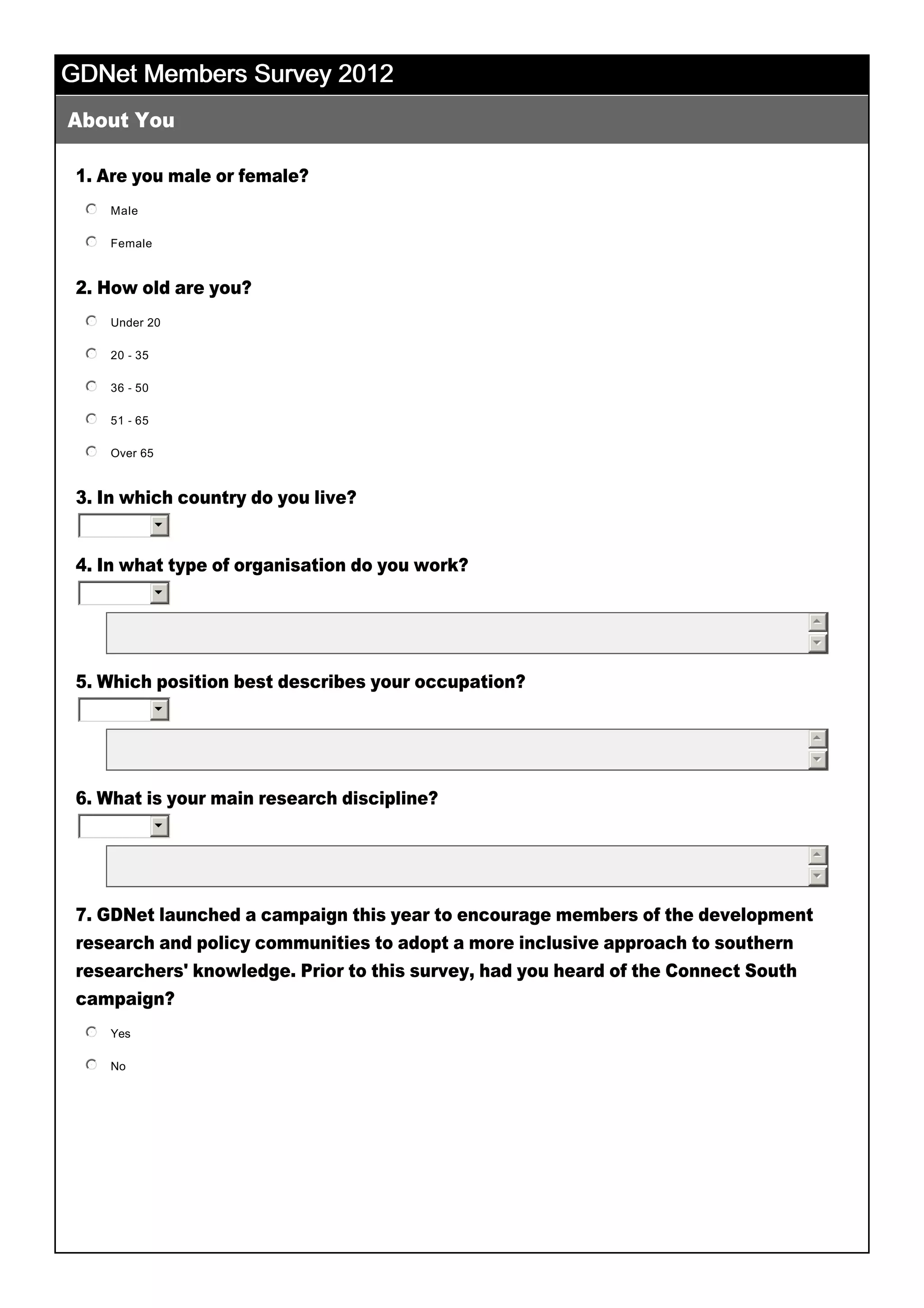
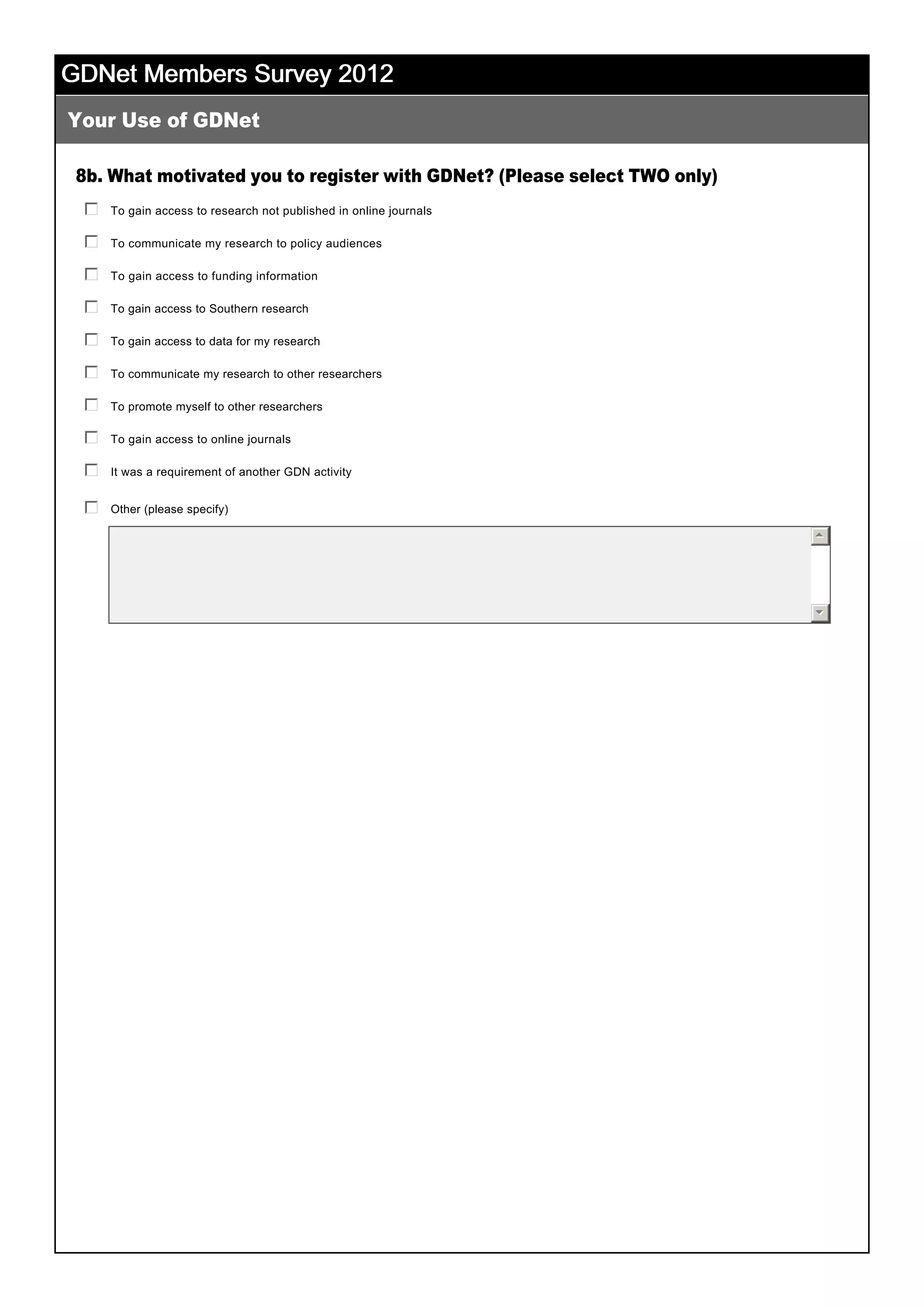
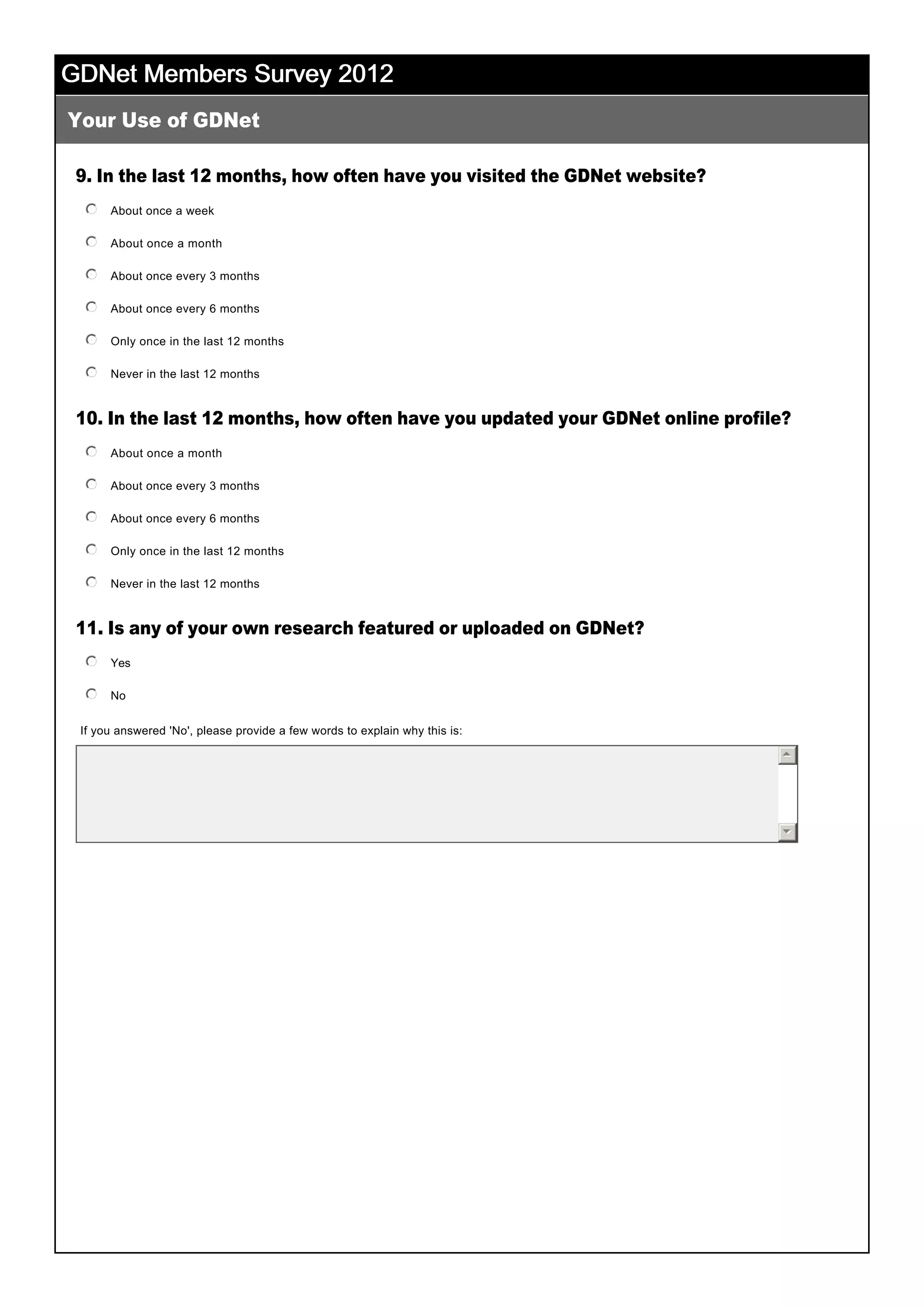
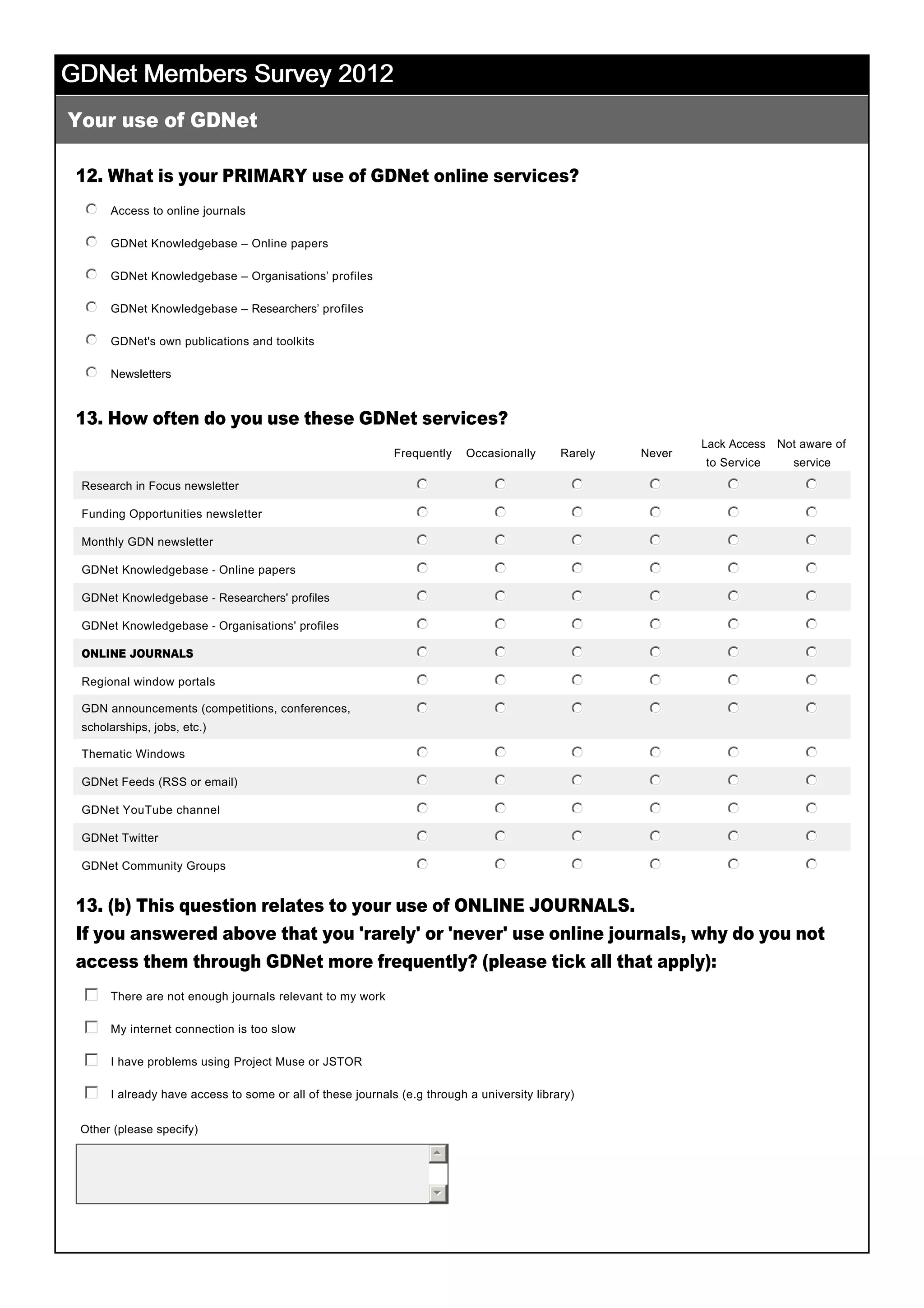
Annex 1: GDNet user base annual web survey questionnaire –Year 2................................................................. 44
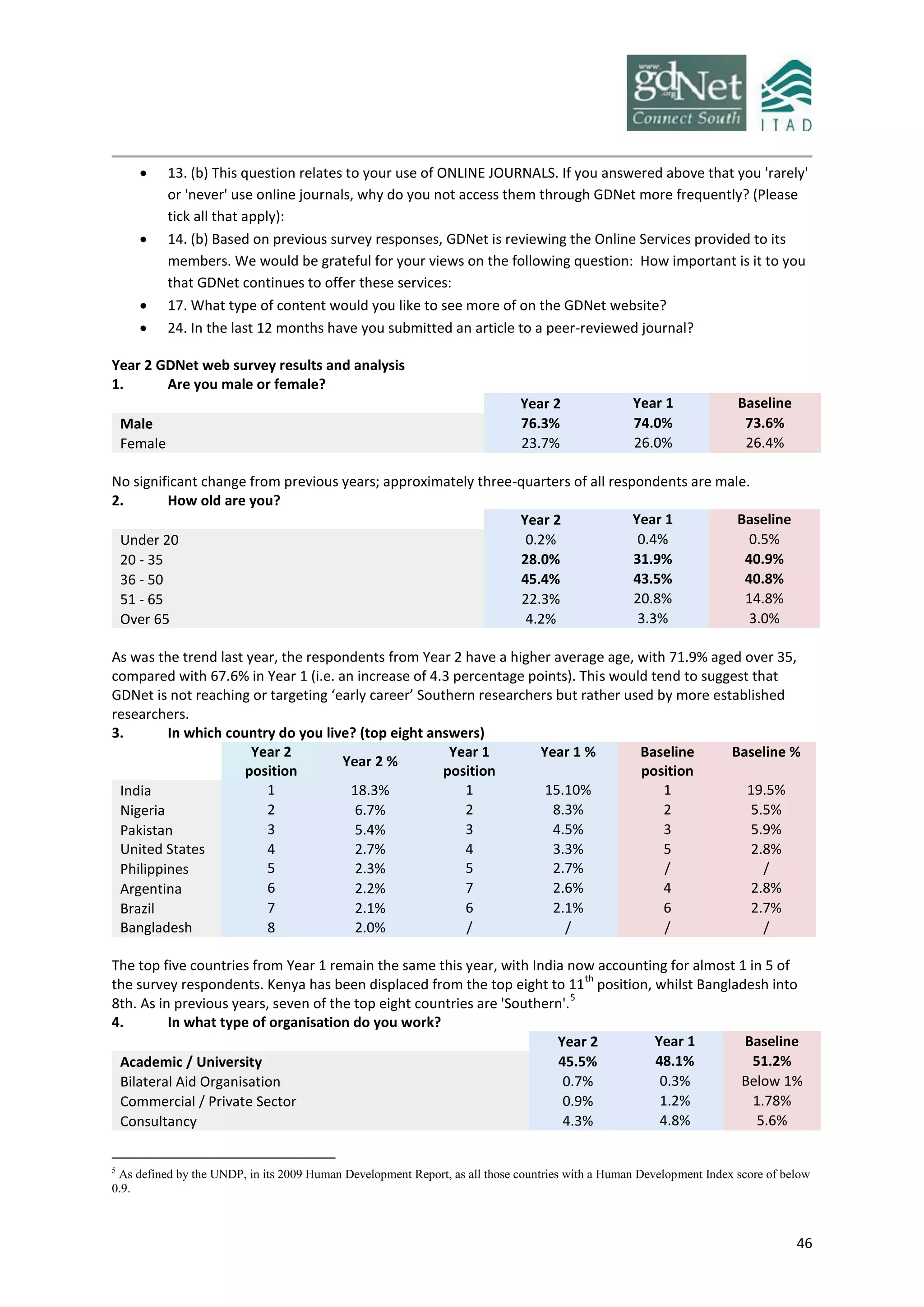
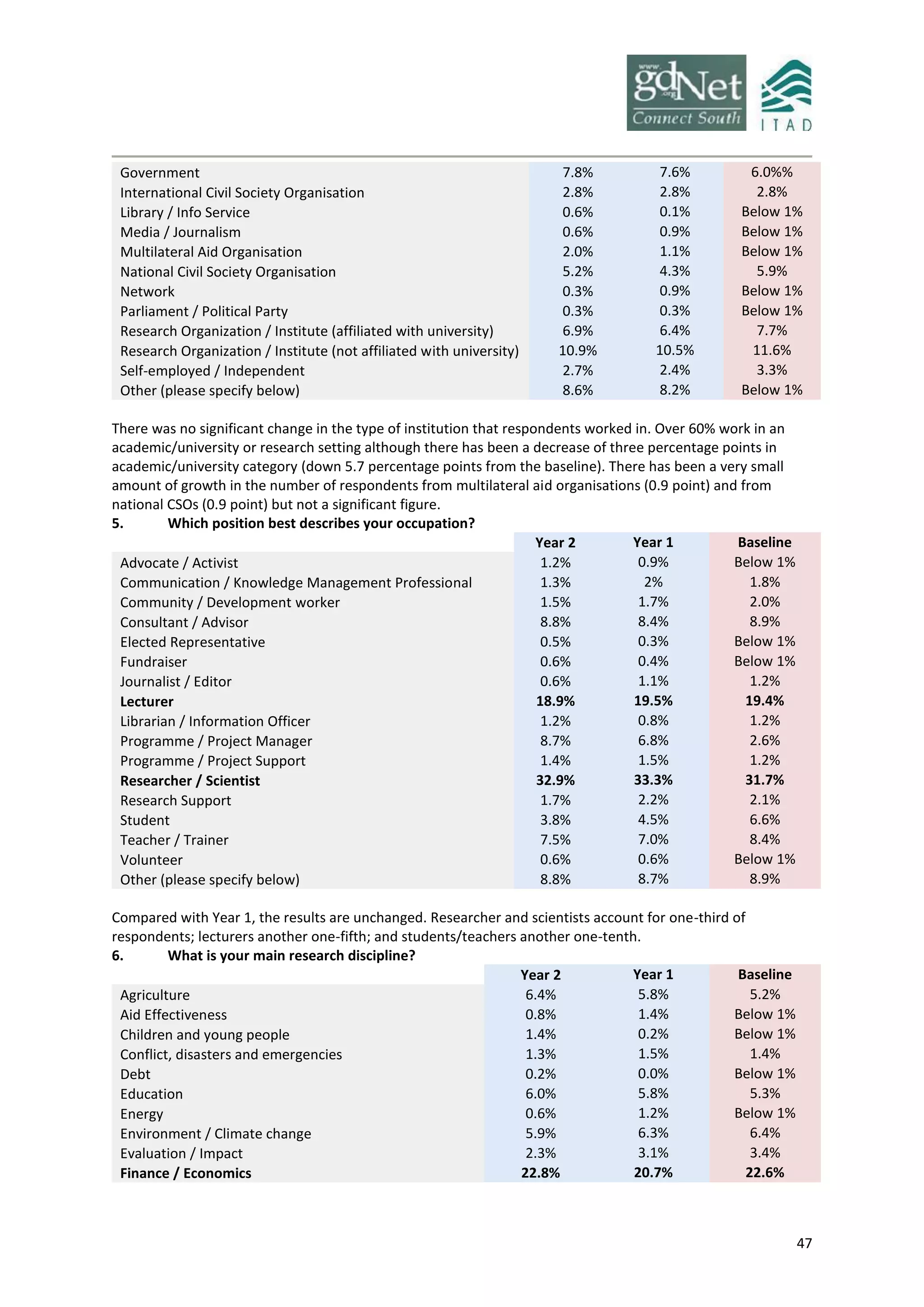
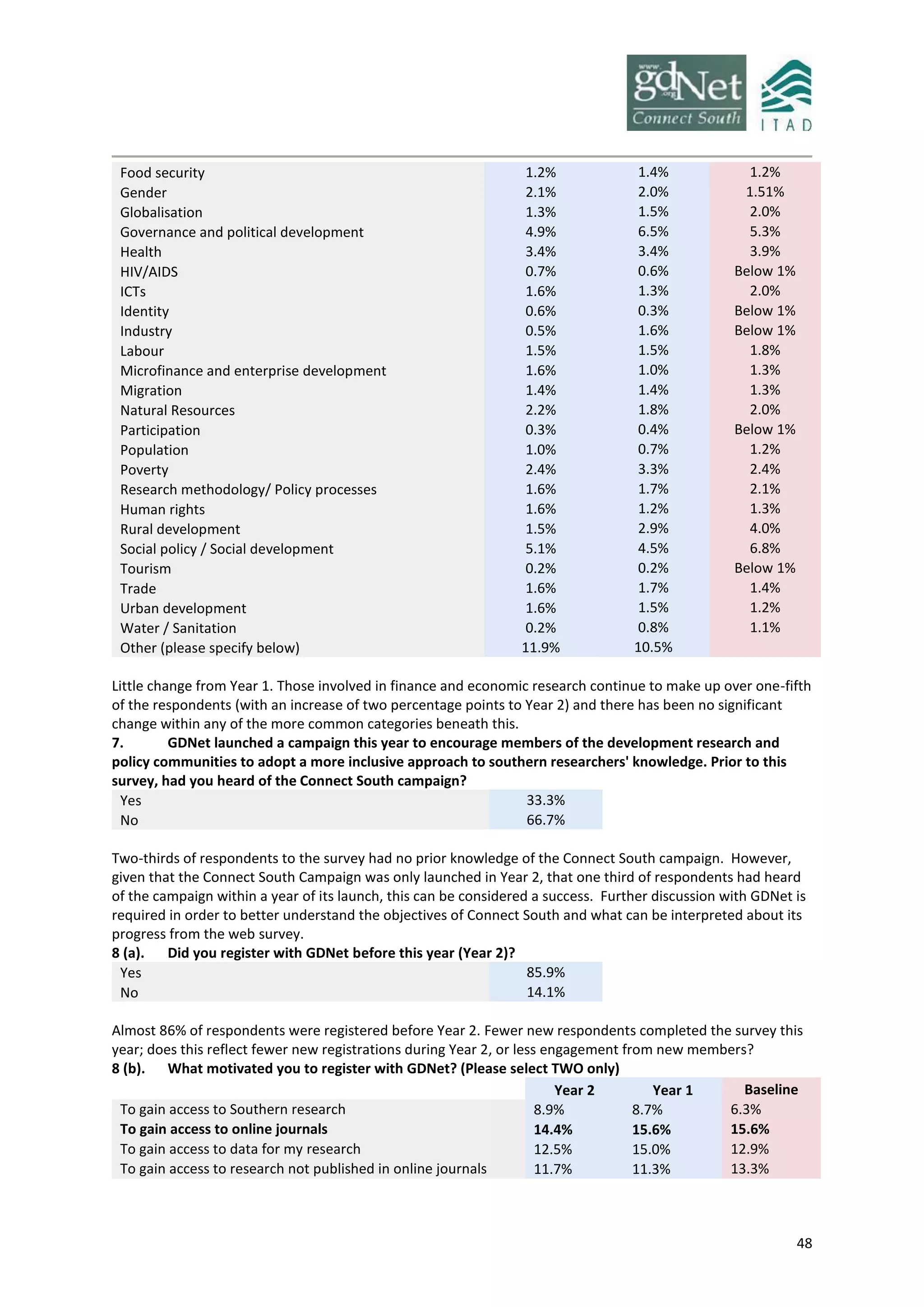
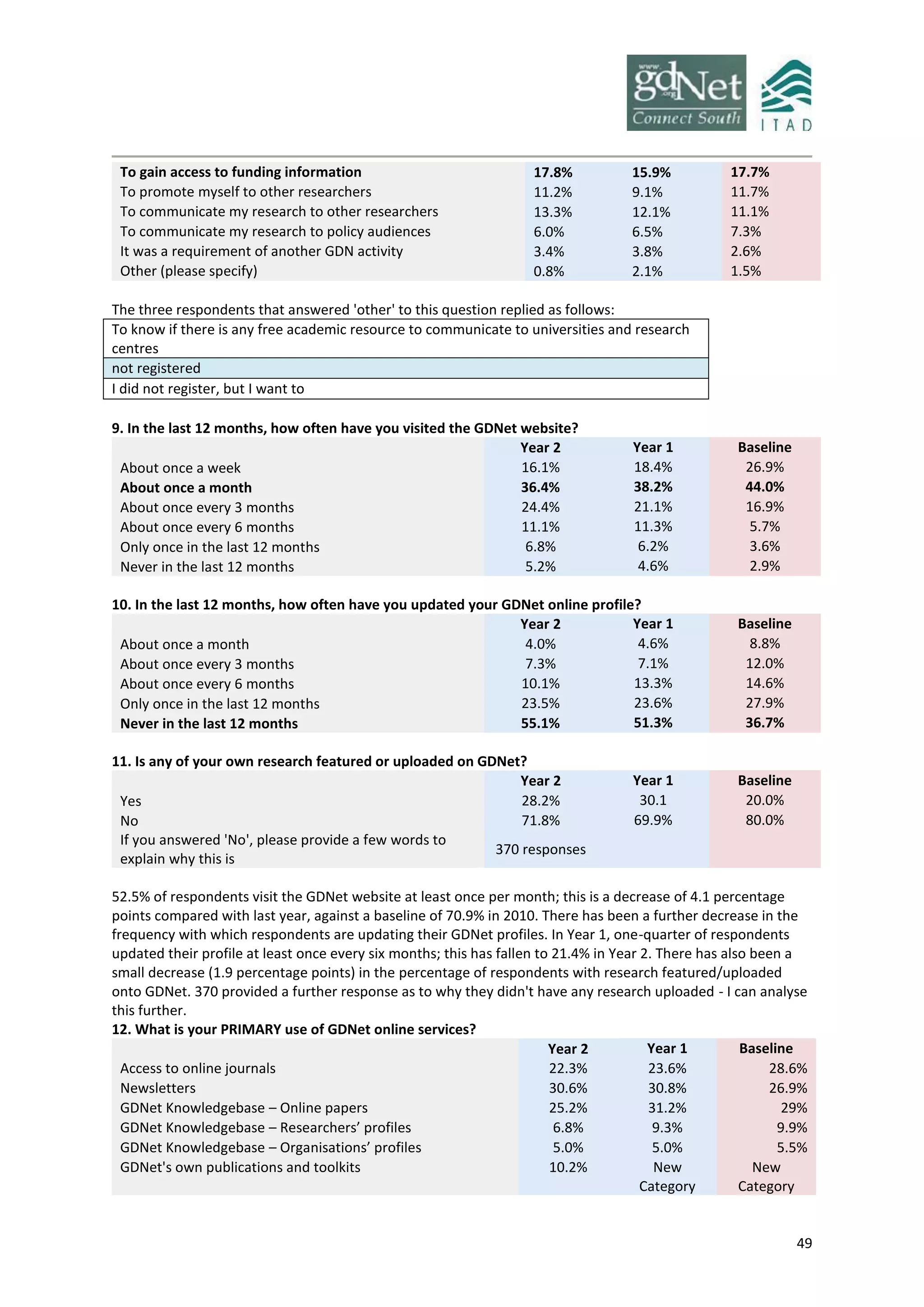
Annex 2: GDNet user base annual web survey results –Year 2 ............................................................................ 45
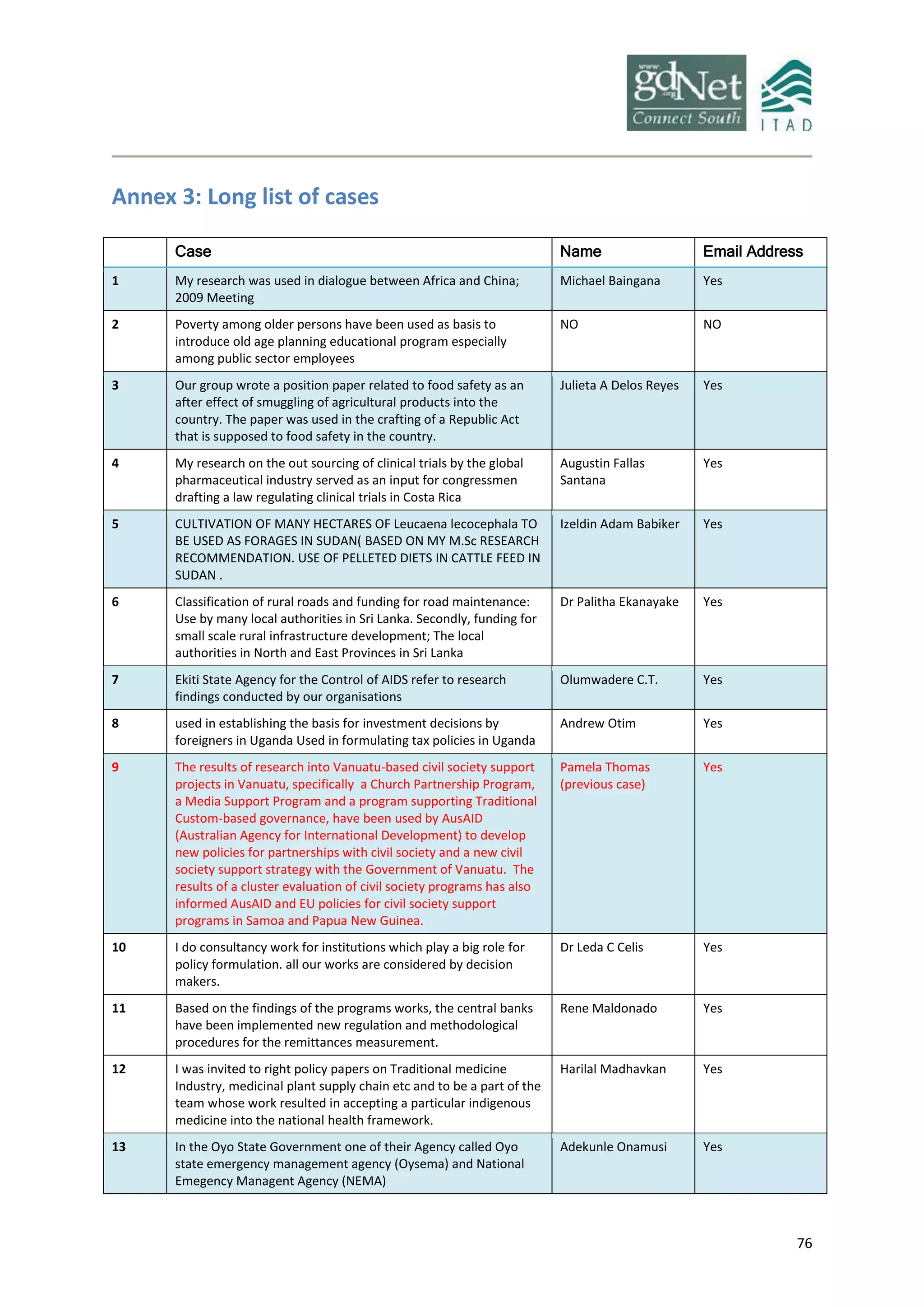
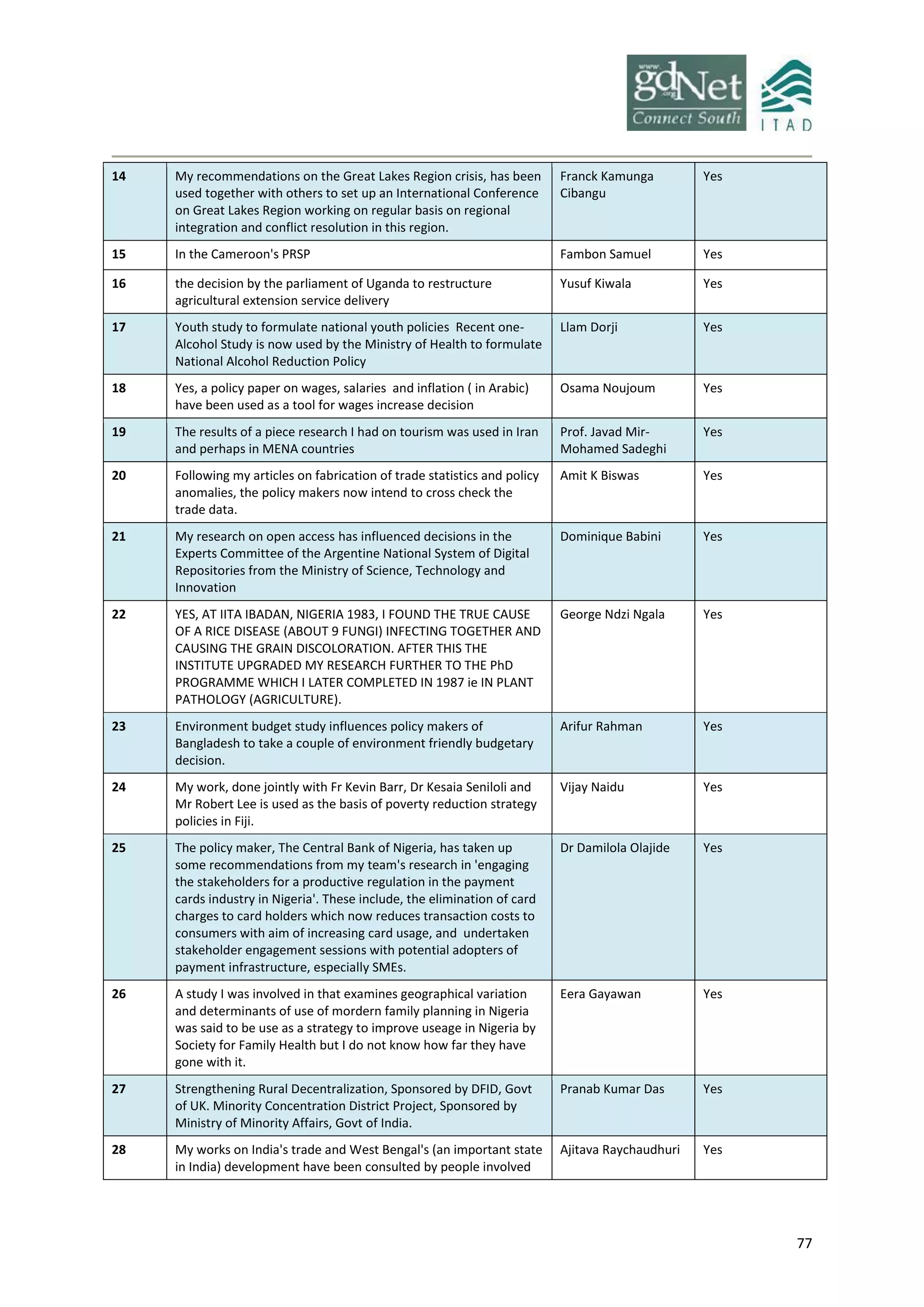
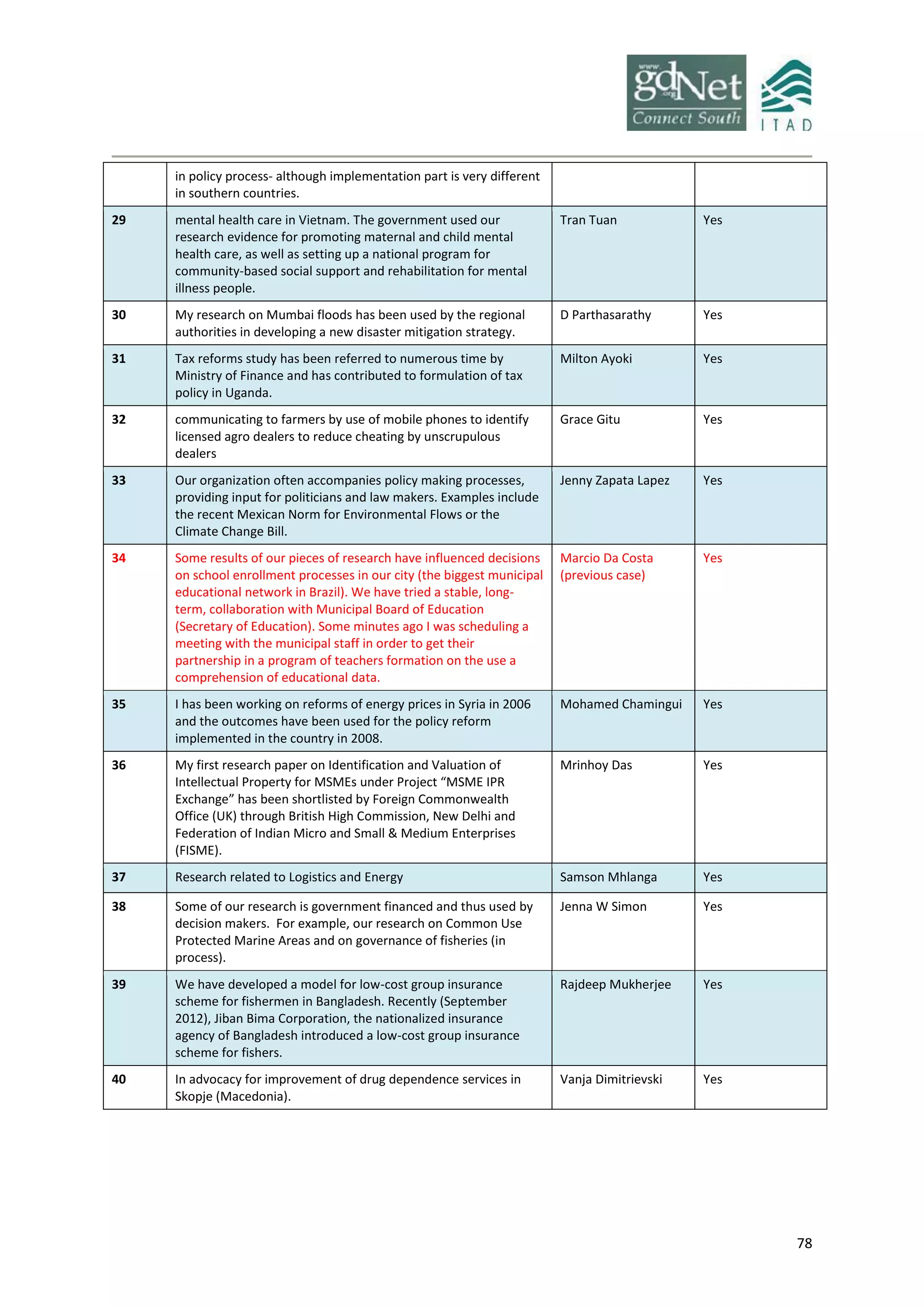
Annex 3: Long list of cases .................................................................................................................................... 76
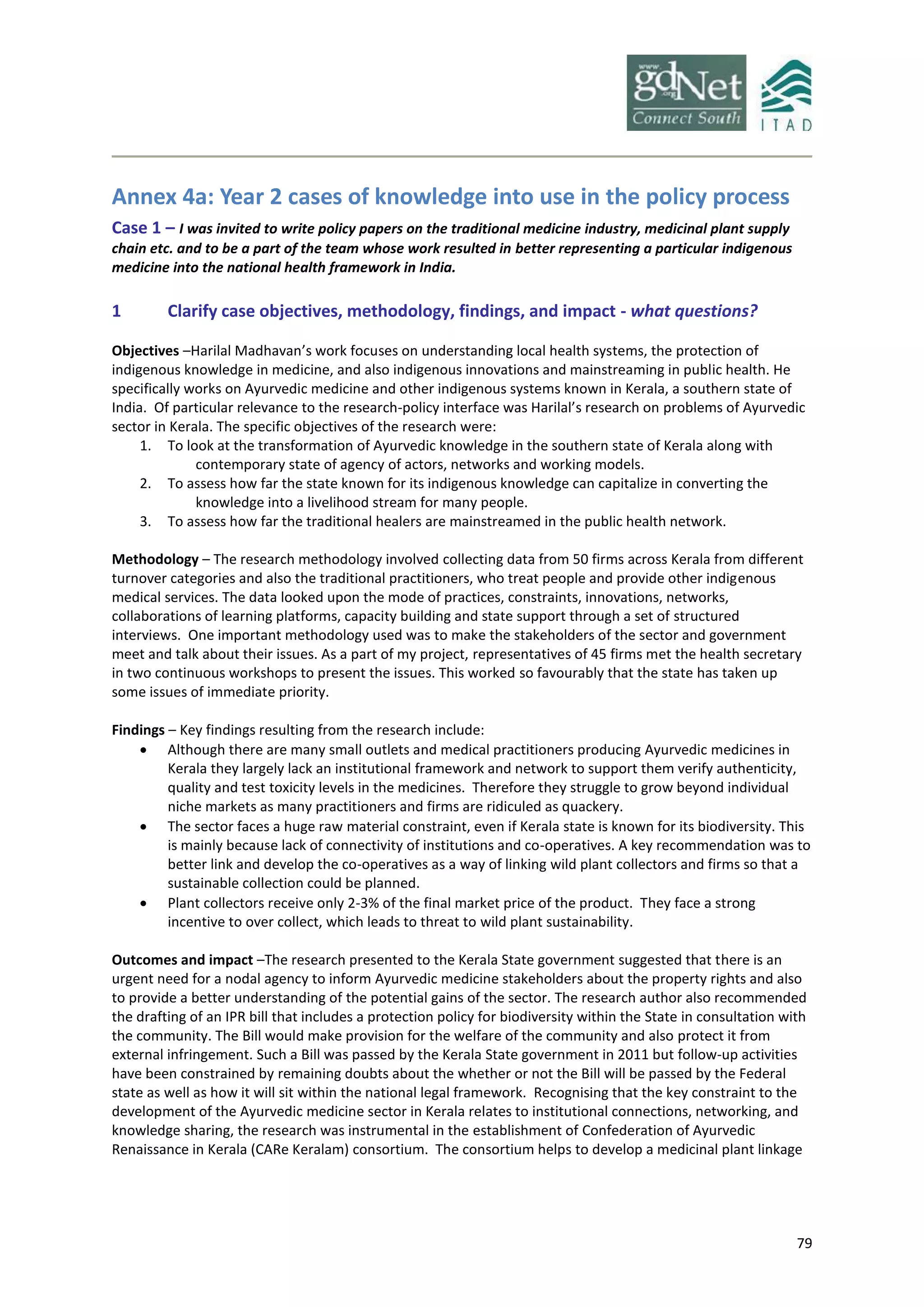
Annex 4a: Year 2 cases of knowledge into use in the policy process ................................................................... 79
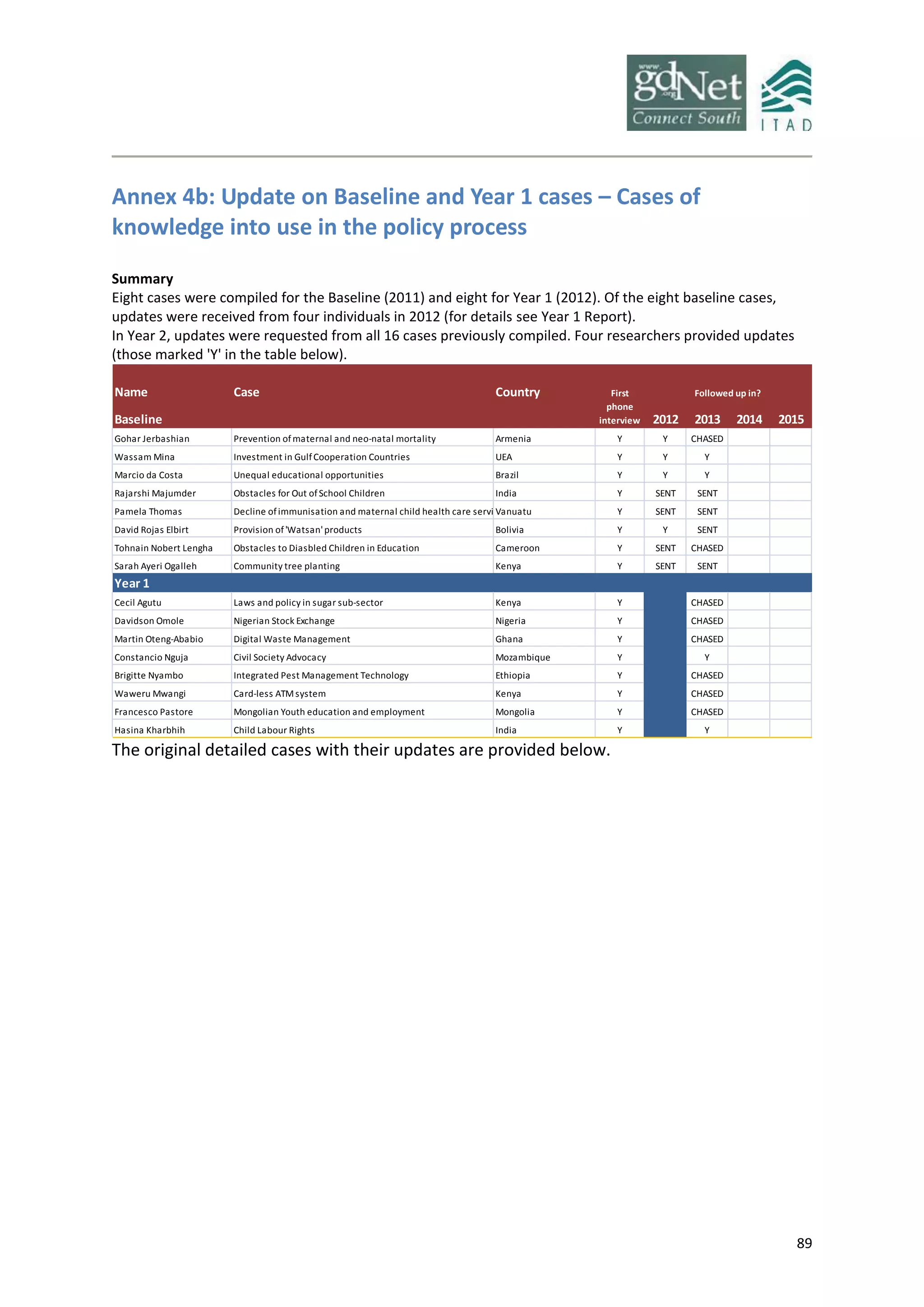
Annex 4b: Update on Baseline and Year 1 cases – Cases of knowledge into use in the policy process ............... 89
Annex 5: Output 3 indicator 1 – GDNet ‘user base’ interaction – log................................................................... 99
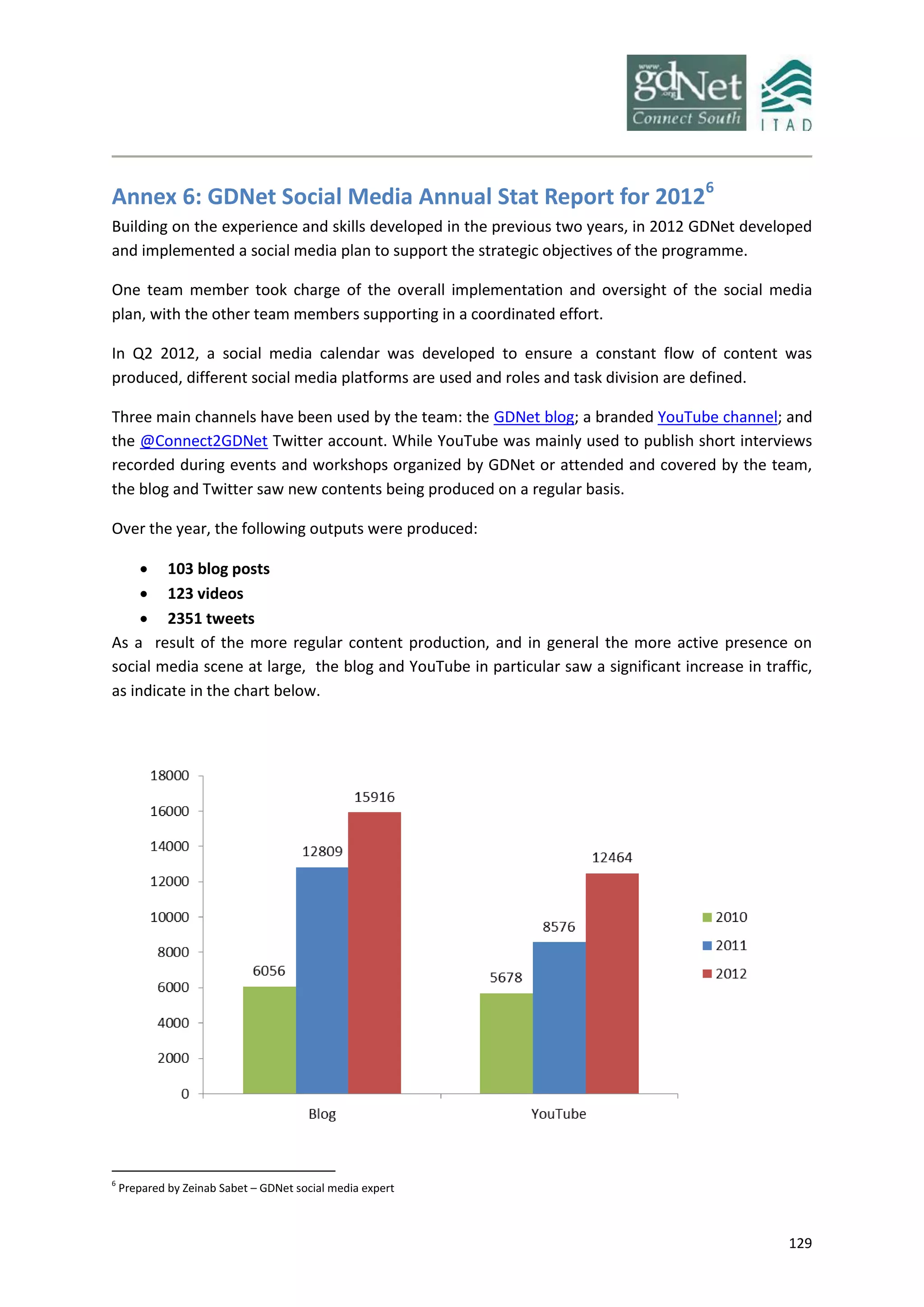
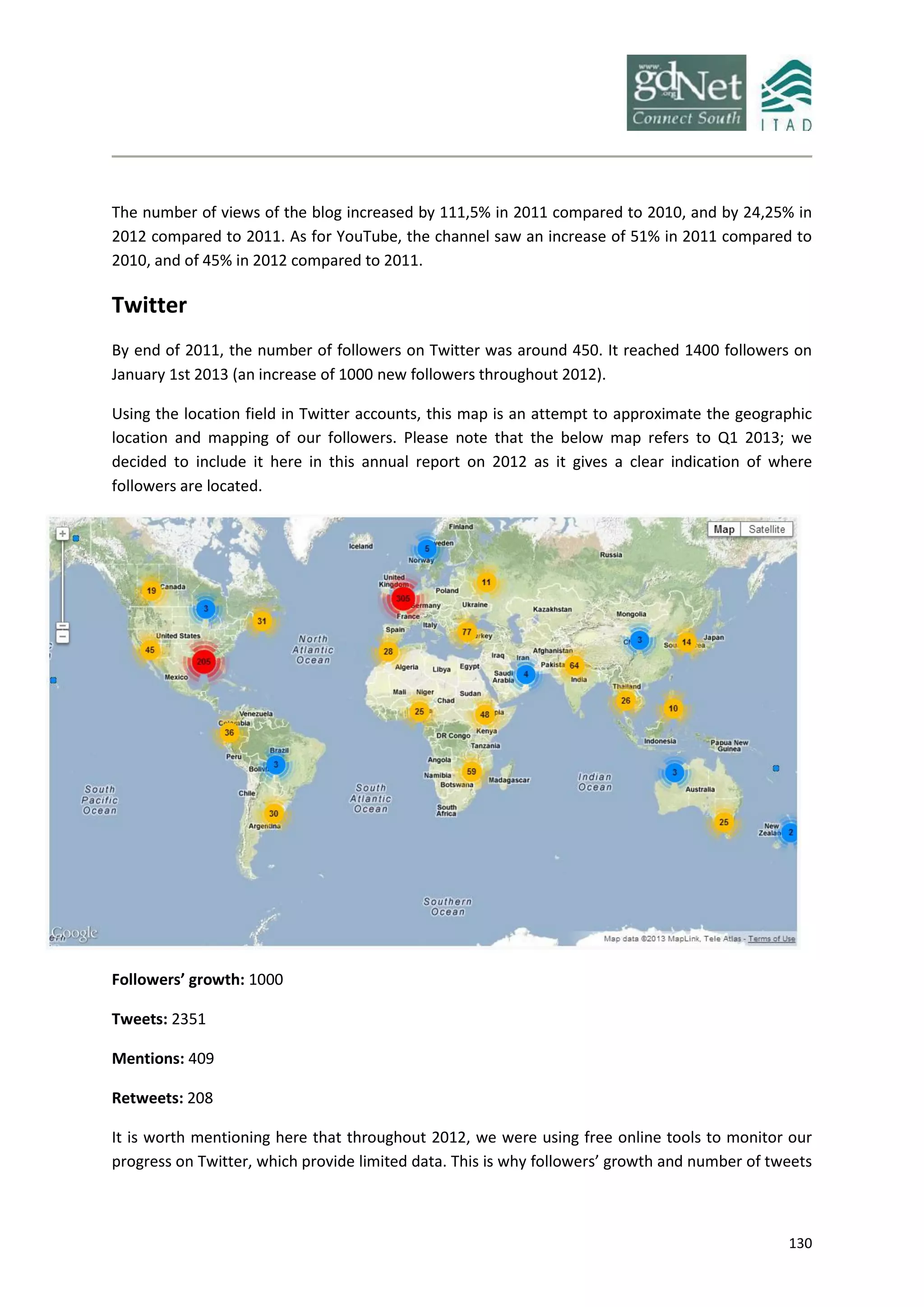
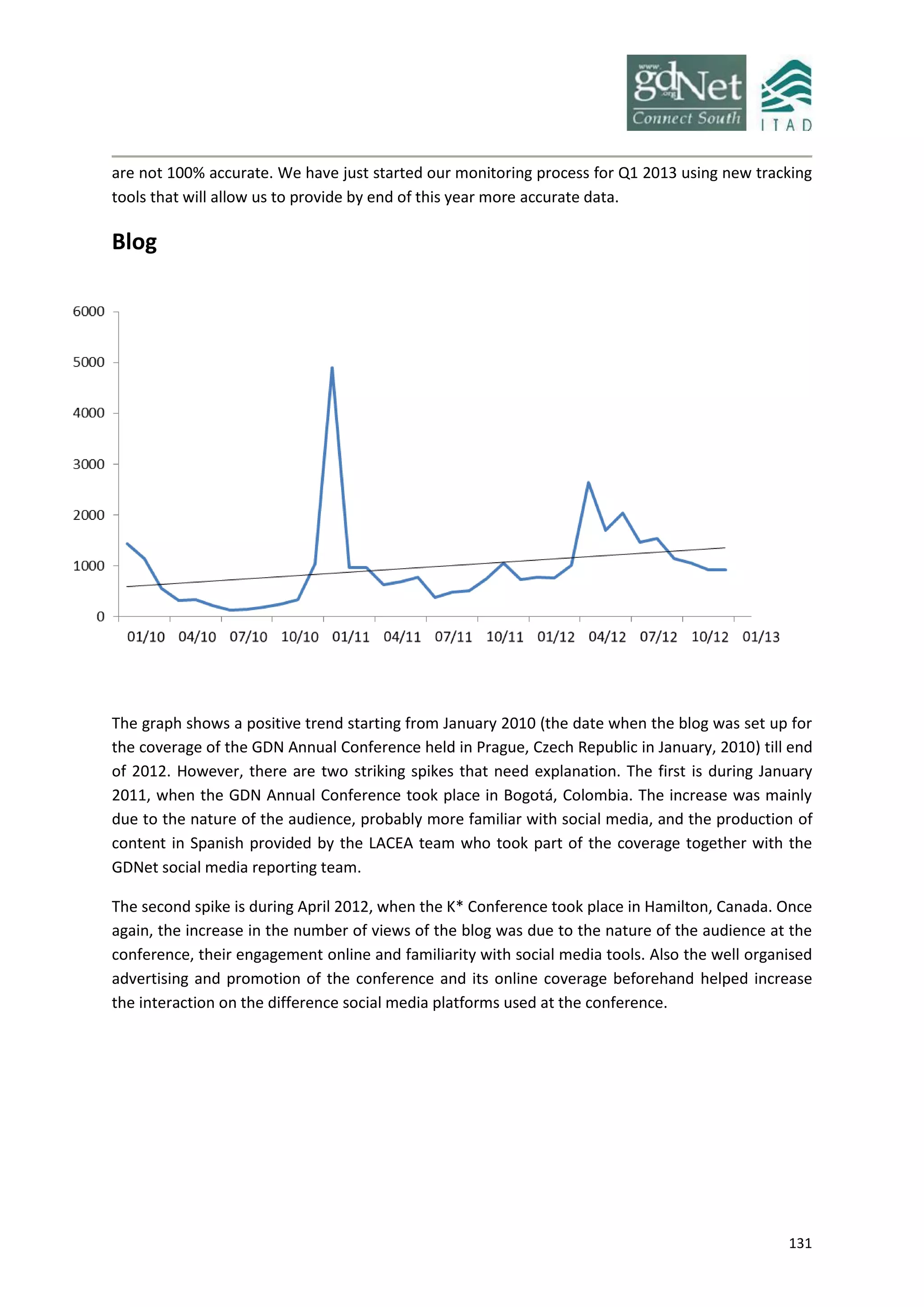
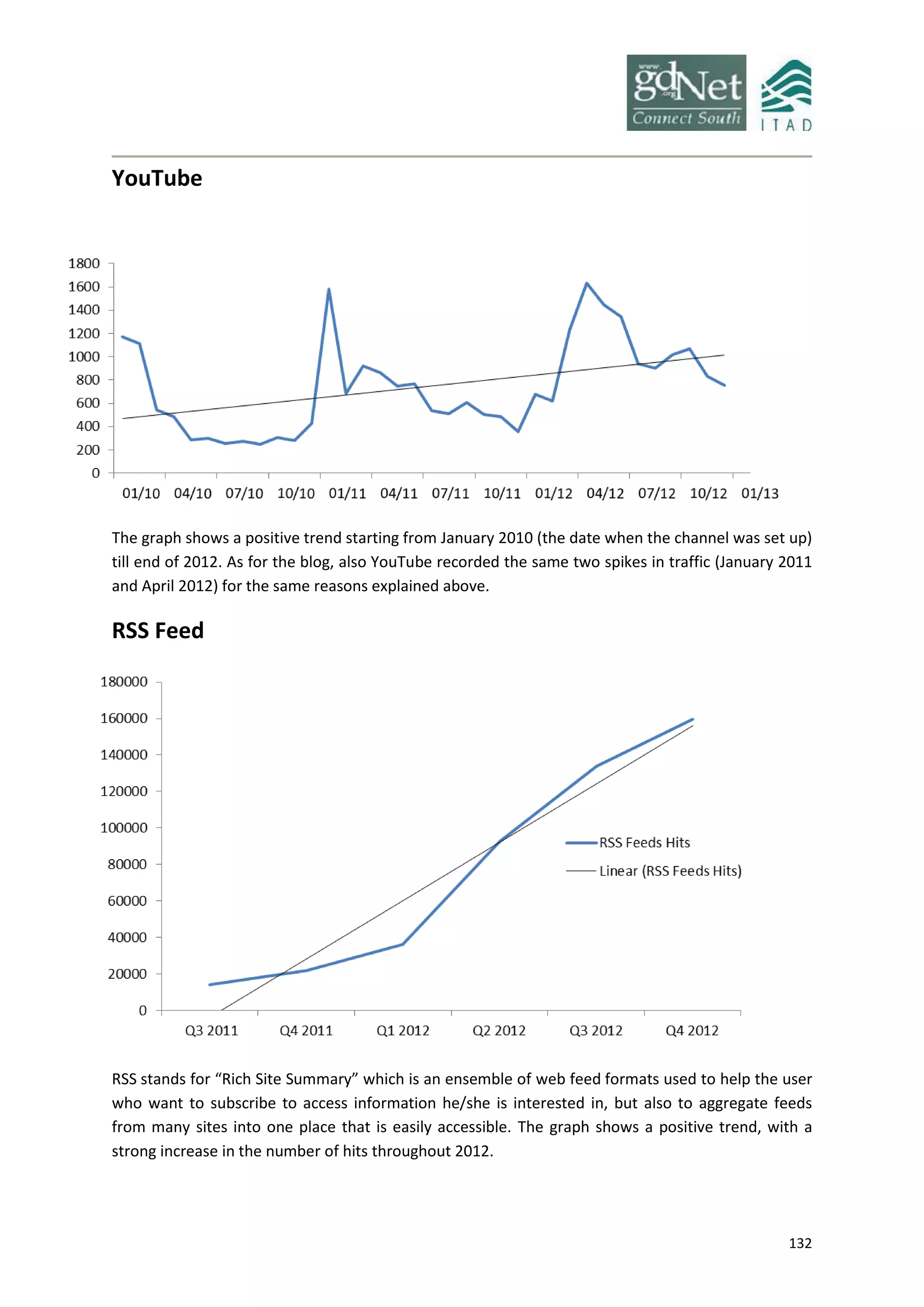
Annex 6: GDNet Social Media Annual Stat Report for 2012 ............................................................................... 129
Annex 7: Output 3 indicator 2 – Researchers interactions with the policy domain – log................................... 133
Annex 8: Output 4 indicator 1 – Generation of best practice lessons – log........................................................ 135
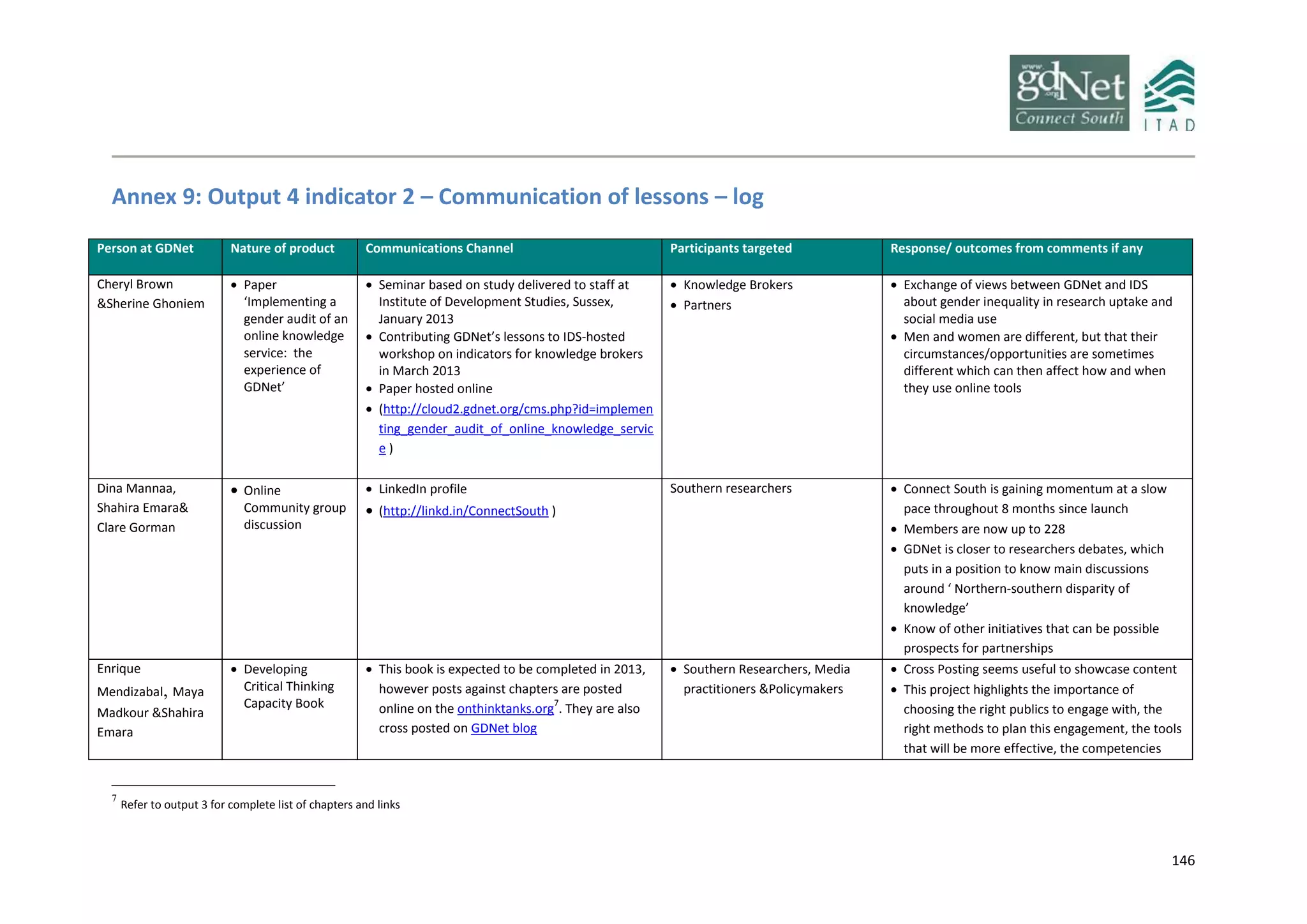
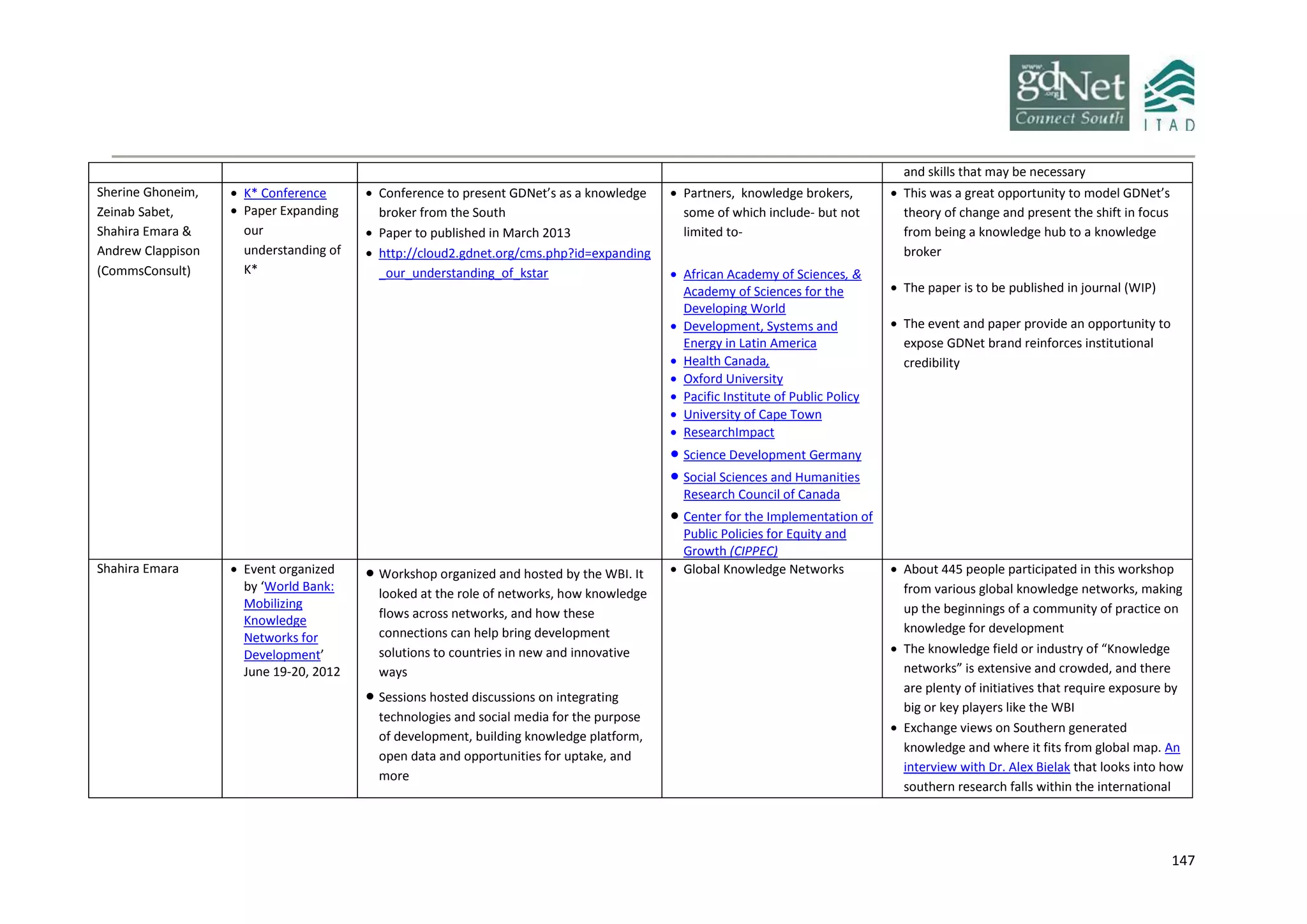
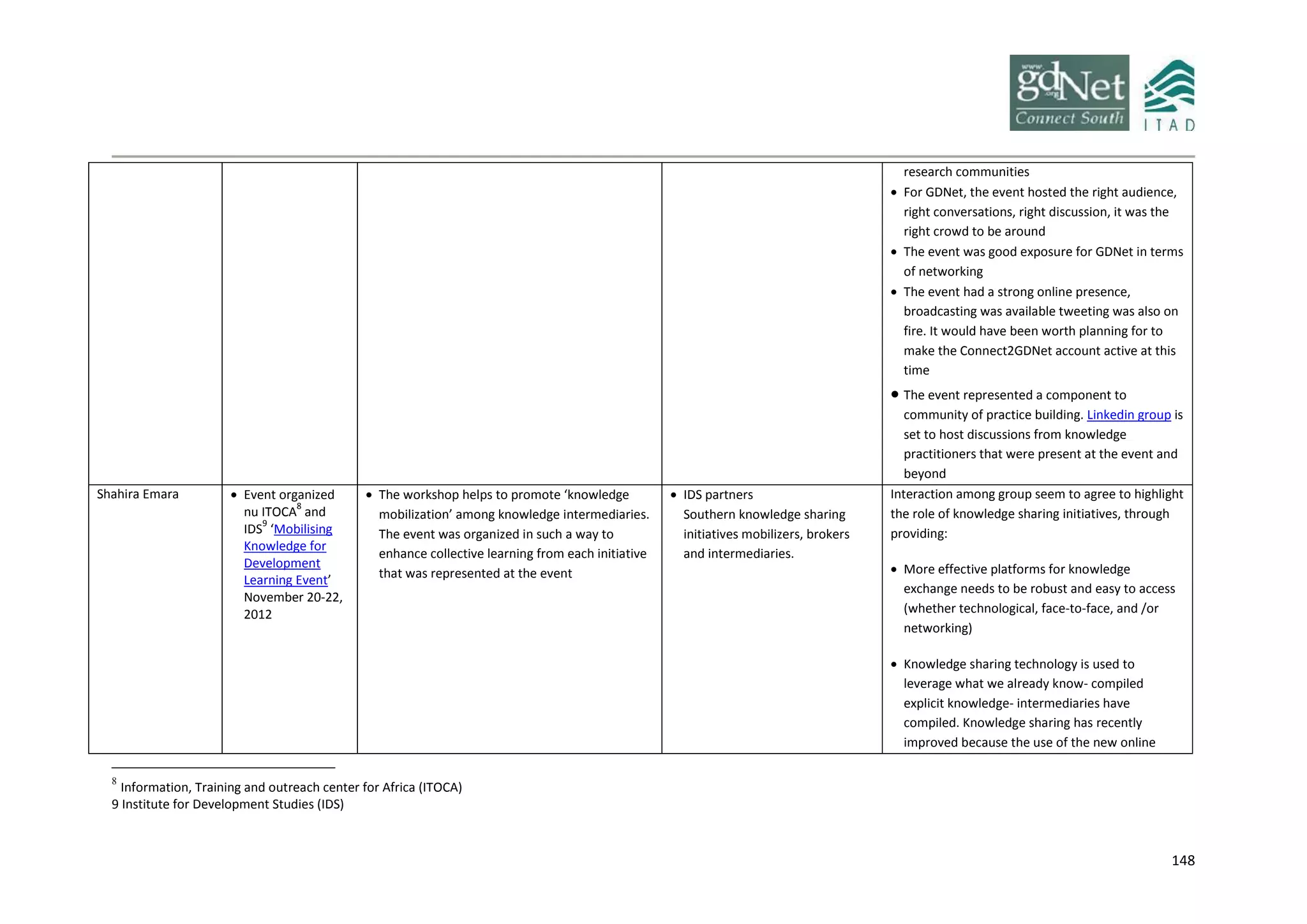
Annex 9: Output 4 indicator 2 – Communication of lessons – log...................................................................... 146
2
Introduction
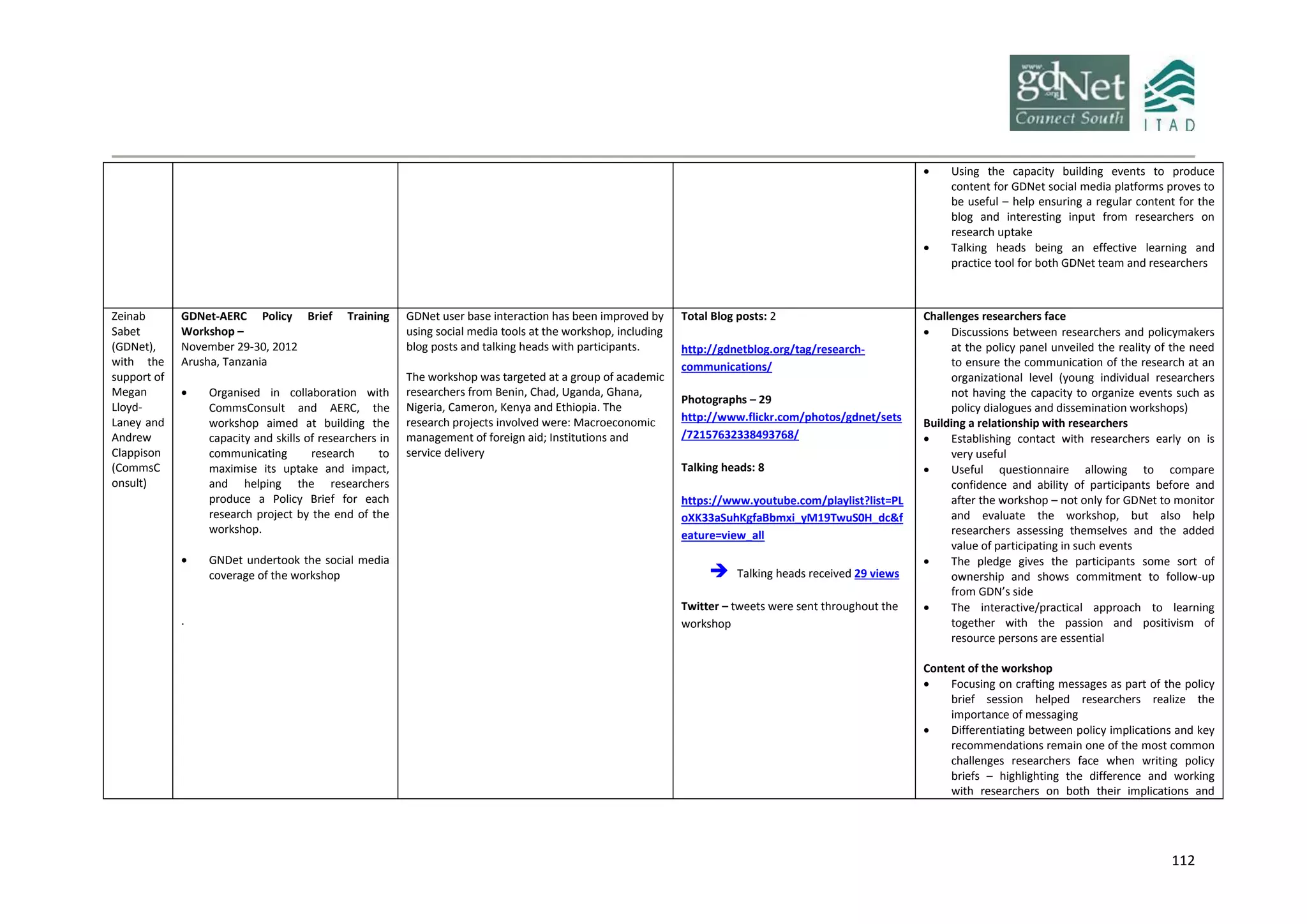
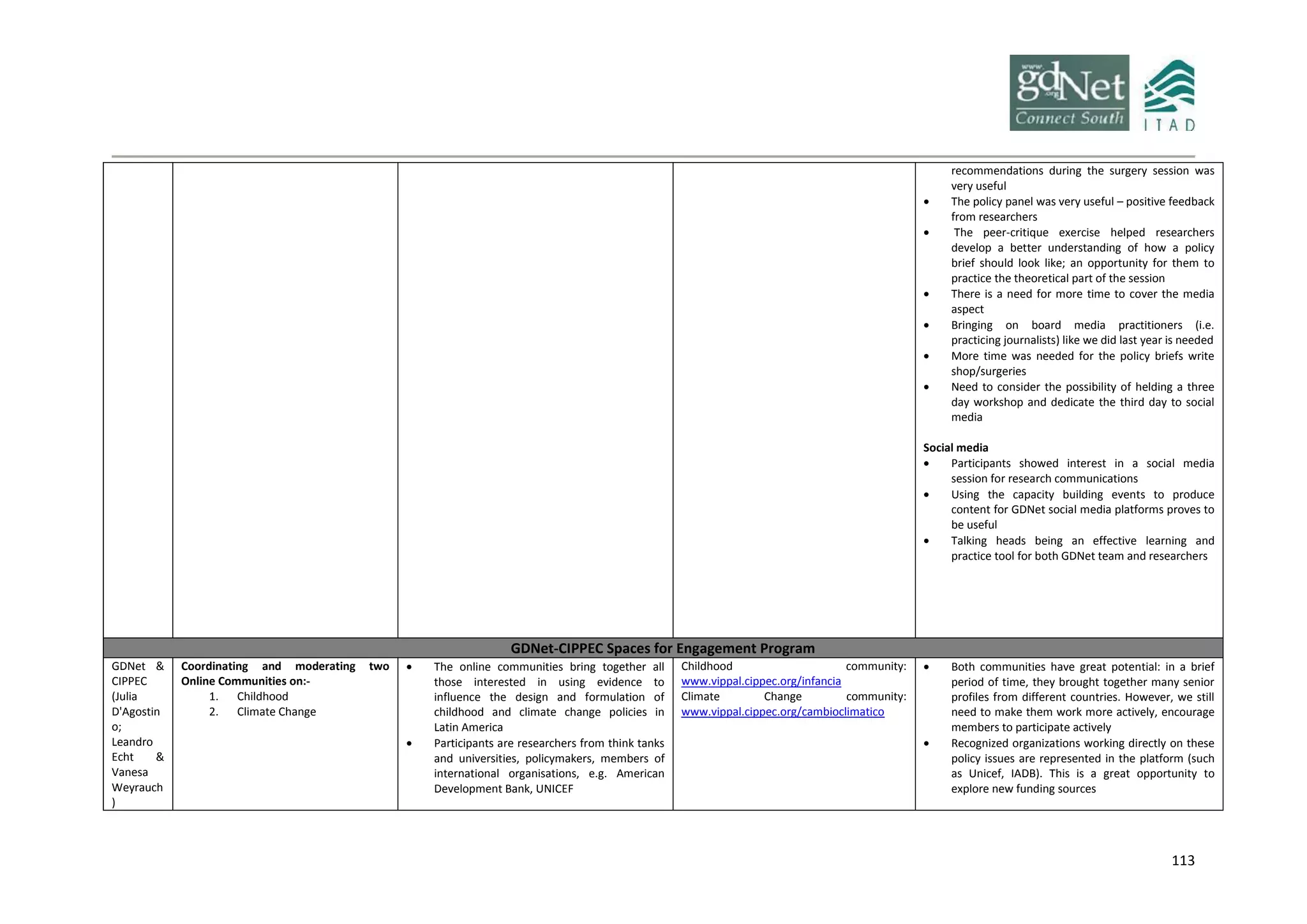
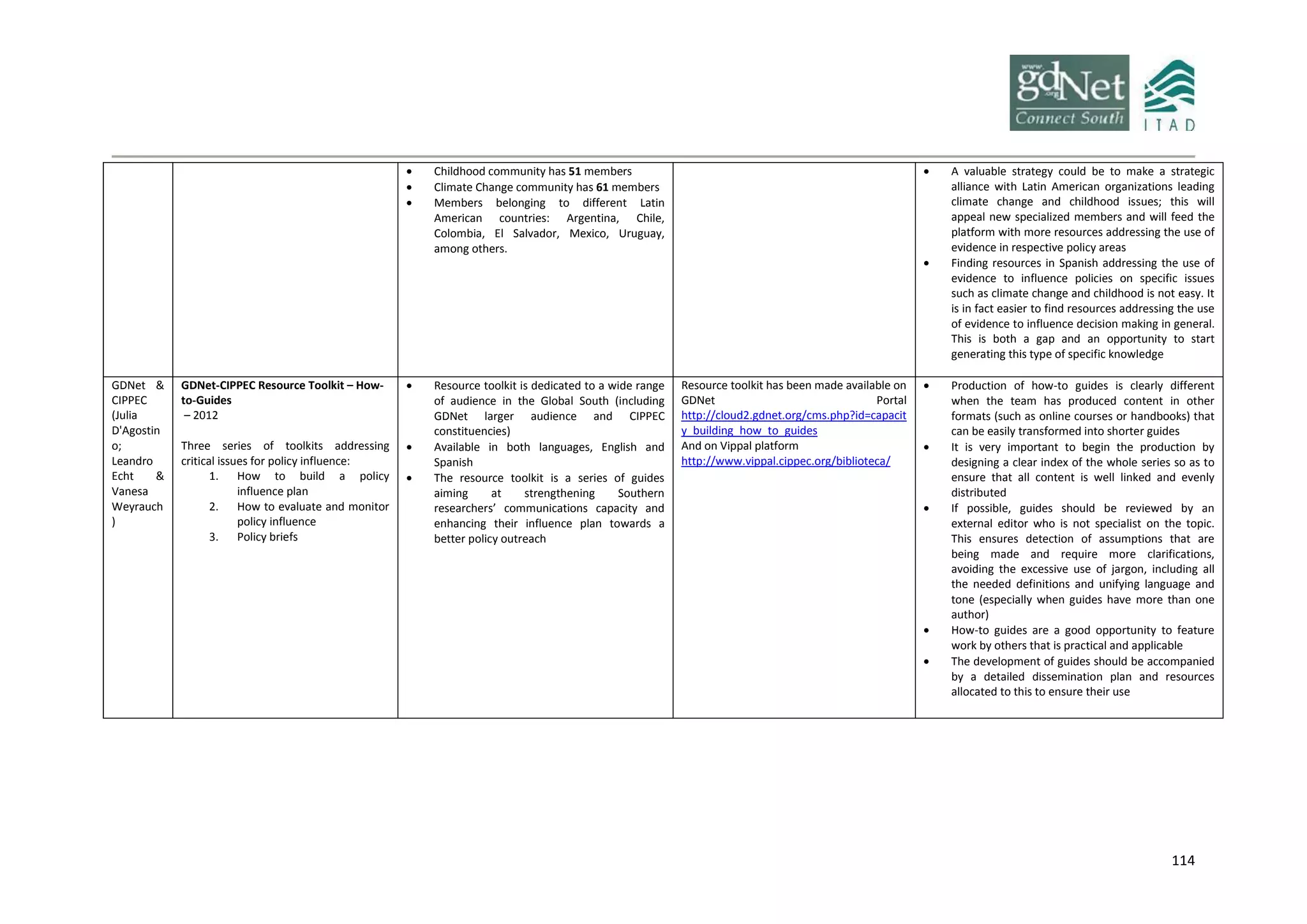
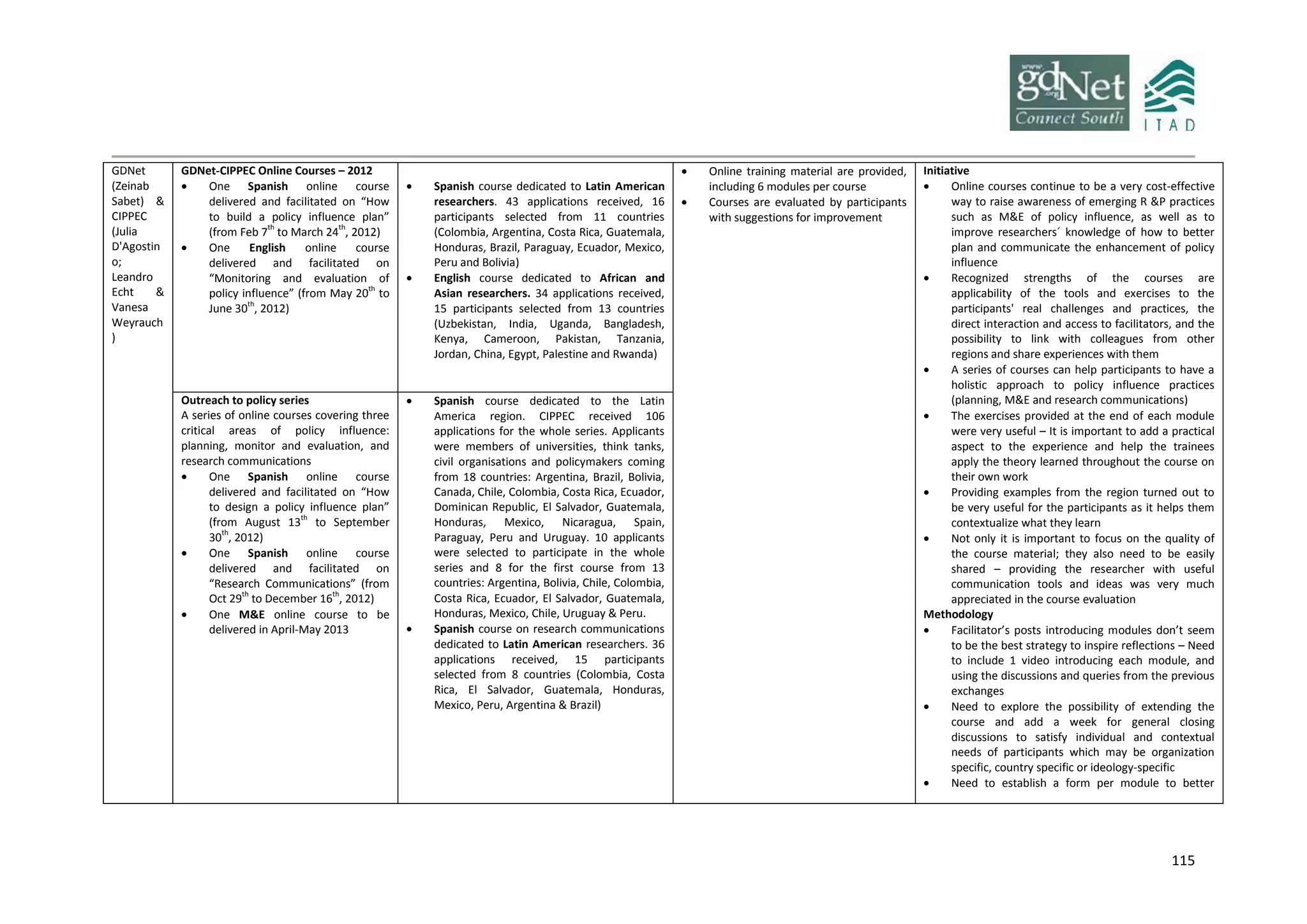
This document provides the annual progress report (Year2) and update to GDNet’s Baseline and M&E
Framework. The document is structured according to the GDNet logframe – with separate chapters from the
Purpose-level down through Outputs 1 to 4. Each Chapter is structured as follows:
 Year 2 summary – A clear summary statement of progress for each output indicator for comparison
against the baseline and Year 1, and the relevant milestone. The statement is followed by a more
detailed elaboration of the Year 2 M&E data generated and an analysis of its implications.
 M&E approach summary – A very brief explanation of the approach and method adopted to generate
the data for each output indicator. Readers should refer to the 2011 GDNet Baseline and M&E
Framework for a more detailed account of how the M&E framework was designed and the methods
adopted.
 Data management plan – Setting out the on-going M&E roles and responsibilities within the GDNet
team.
 Evidence base – Providing detailed summaries of the relevant data used to support each output
indicator – typically web statistics, web users survey, log templates, and interviews.
Unless otherwise stated, Year 2 refers to the period January to December 2012. The GDNet M&E baseline was
established in December 2010. GDNet’s M&E is reviewed and reported on an annual reporting cycle according
to the calendar year January to December as follows:
Logframe M&E Framework
Baseline Baseline – est. December 2010
Milestone 1 (2011) Year 1 – January to December 2011
Milestone 2 (2012) Year 2 – January to December 2012
Target (2014) Year 3 – January to December 2013 with
the potential to extend to July 2014 to
cover GDNet Programme completion
The essence of the Year 1 M&E report was to highlight the progress the GDNet team had made in generating a
robust knowledge and evidence base relating to the provision of knowledge services and capacity support to
Southern researchers. Following on from this, the essence of the Year 2 M&E report has been to investigate
GDNet’s progress in the ‘ownership’ of evidence base - synthesising the knowledge they hold and developing
best practice lessons. Overall it is the belief of the M&E expert that GDNet is demonstrating a maturing
institutional capacity as a leading knowledge brokering institution for Southern research.
Note from GDNet on their Year 2 strategy and their approach to monitoring,
evaluation and learning
From our experience, knowledge matters, partnership matters, and skills and capacity matters and
our recognition of this has guided the development of a number of activities in year two: the
Connect South campaign, the new ThinkNet platform, and consolidation of our team's skills and
composition.
Based on our reflections and learning about the landscape, we see that we still occupy an important
niche and meet an important need: engaging with the South and supporting southern research
uptake. GDNet has been maturing as an organisation that offers knowledge services and we are
investing in open data plans that will be available towards the end of 2013 and will enable us to offer
related products by the end of next year that incorporate knowledge aggregation, and expanded
3
regional knowledge portals.
2012 saw a focused approach to encourage stakeholders to engage with services provided by GDNet
be them knowledge services or the research communications capacity building program. During the
course of the year the GDNet team developed a strategy to use digital tools to increase the outreach
and uptake of southern research systematically throughout the four output areas as indicated by the
logframe. After the launch of 23 thematic portals together with 7 regional portals, GDNet's
Knowledge Services continue to become an advocate for southern researchers and seek to
understand more about their needs and the barriers to access knowledge and the uptake of
southern research. Two desk reviews were commissioned to look closer at those areas;
‘Implementing a gender audit of an online knowledge service: The experience of GDNet’ and
‘Southern Research uptake’.
Under GDN’s new management, both parties are progressing integrated interaction - bringing both
websites under one online platform and building a combined approach to Open Data by early 2014
as key milestones. Interim measures to streamline branding and enhance content exchange and
outreach have been rolled out.
Finally, as an example of GDNet’s maturing institutional capacity and self-belief as a knowledge
broker for Southern researchers, 2012 saw the launch of the Connect South campaign
(www.ConnectSouth.org); an initiative to encourage development research stakeholders to create a
more enabling environment for southern researchers. The aims of this campaign are reflected in the
GDNet’s four key areas of activity.
4
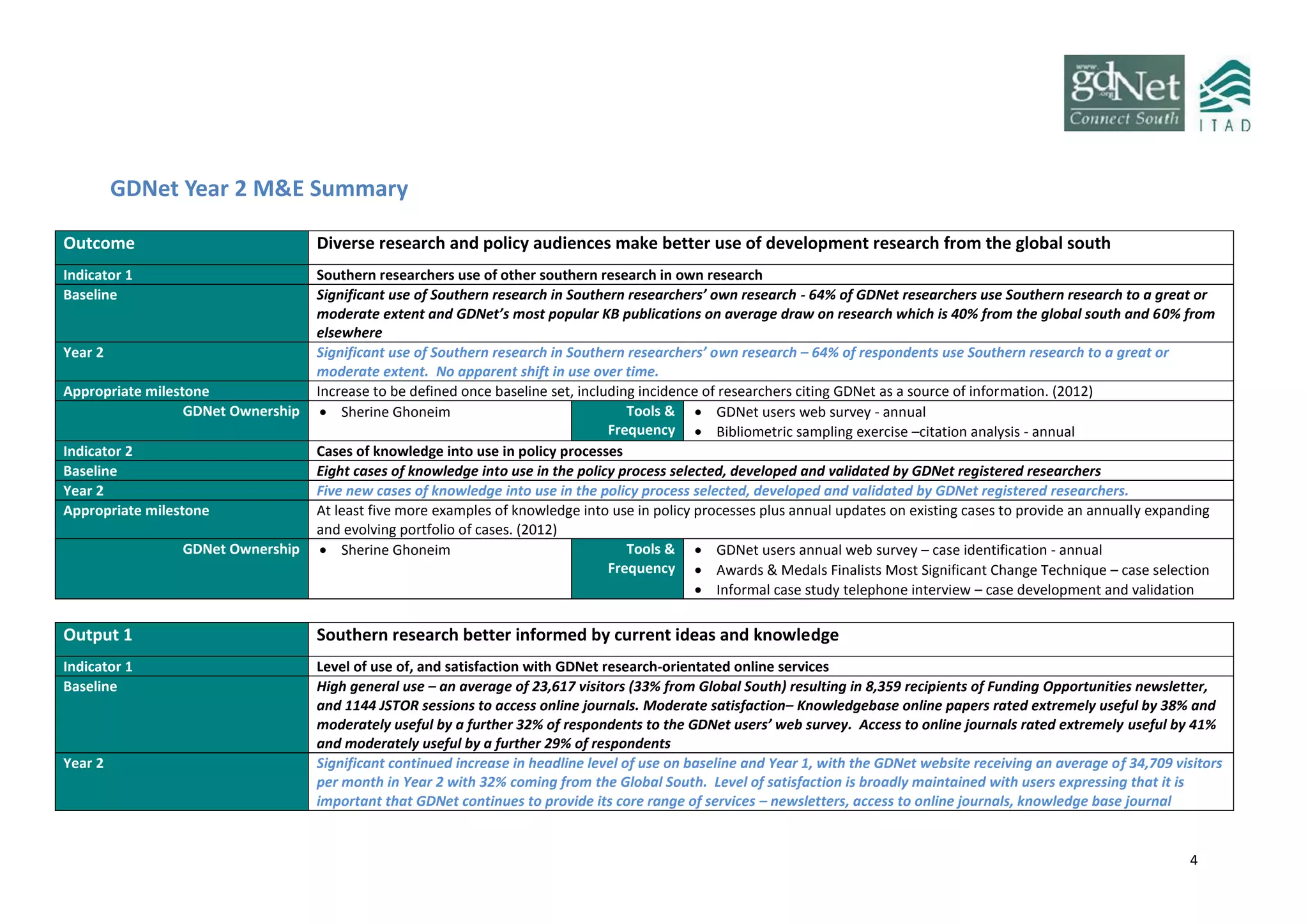
GDNet Year 2 M&E Summary
Outcome Diverse research and policy audiences make better use of development research from the global south
Indicator 1 Southern researchers use of other southern research in own research
Baseline Significant use of Southern research in Southern researchers’ own research - 64% of GDNet researchers use Southern research to a great or
moderate extent and GDNet’s most popular KB publications on average draw on research which is 40% from the global south and 60% from
elsewhere
Year 2 Significant use of Southern research in Southern researchers’ own research – 64% of respondents use Southern research to a great or
moderate extent. No apparent shift in use over time.
Appropriate milestone Increase to be defined once baseline set, including incidence of researchers citing GDNet as a source of information. (2012)
GDNet Ownership  Sherine Ghoneim Tools &
Frequency
 GDNet users web survey - annual
 Bibliometric sampling exercise –citation analysis - annual
Indicator 2 Cases of knowledge into use in policy processes
Baseline Eight cases of knowledge into use in the policy process selected, developed and validated by GDNet registered researchers
Year 2 Five new cases of knowledge into use in the policy process selected, developed and validated by GDNet registered researchers.
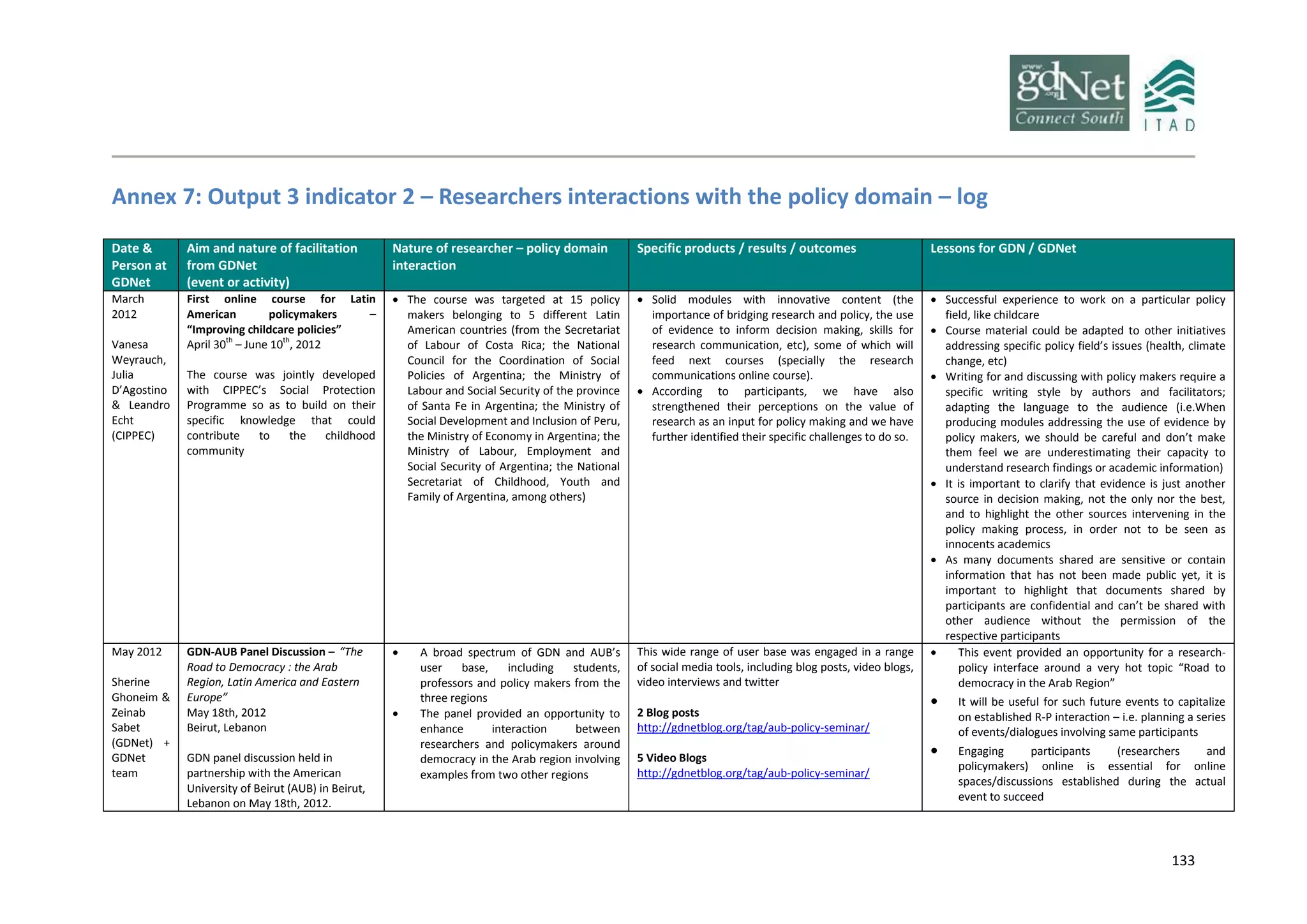
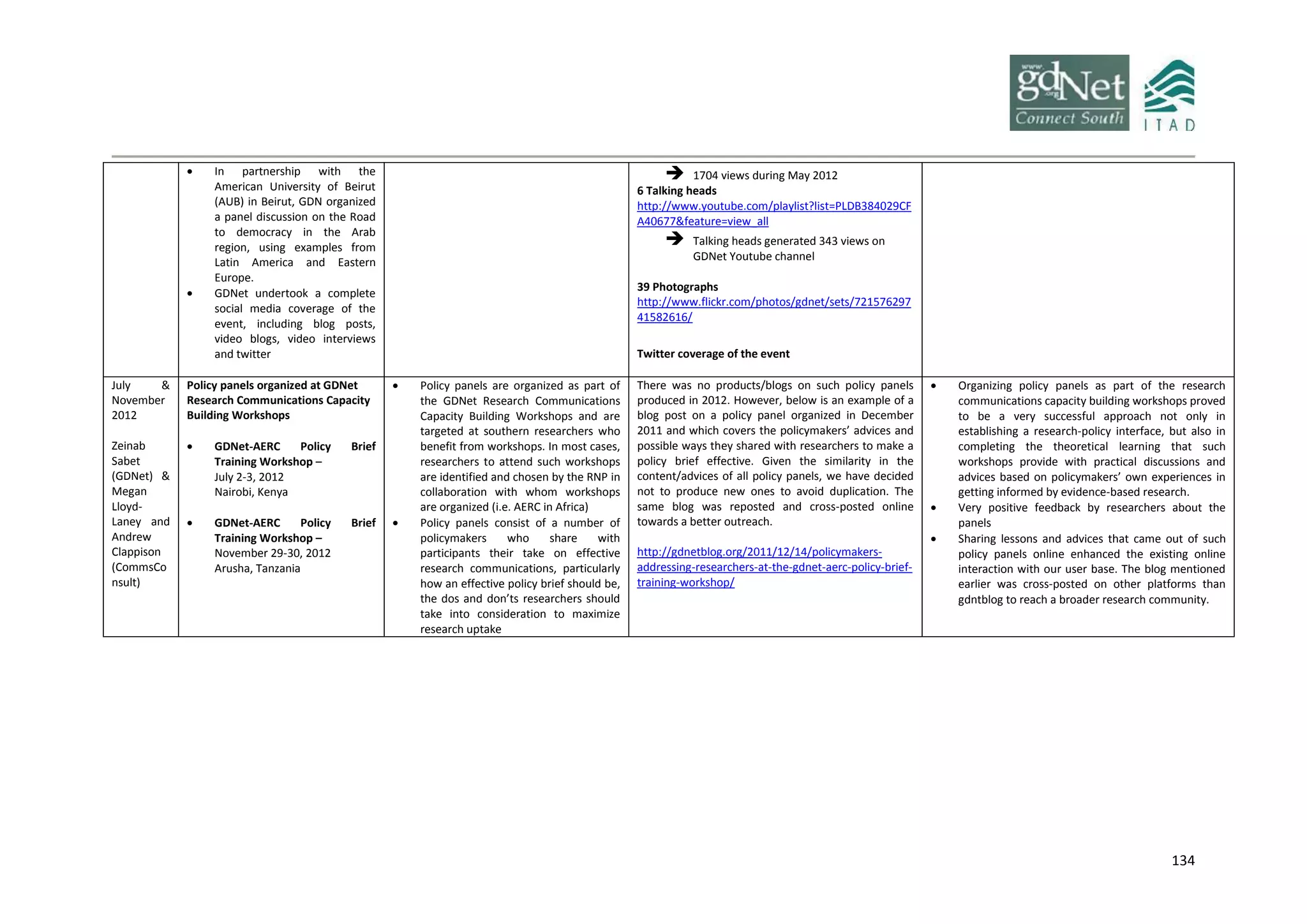
Appropriate milestone At least five more examples of knowledge into use in policy processes plus annual updates on existing cases to provide an annually expanding
and evolving portfolio of cases. (2012)
GDNet Ownership  Sherine Ghoneim Tools &
Frequency
 GDNet users annual web survey – case identification - annual
 Awards & Medals Finalists Most Significant Change Technique – case selection
 Informal case study telephone interview – case development and validation
Output 1 Southern research better informed by current ideas and knowledge
Indicator 1 Level of use of, and satisfaction with GDNet research-orientated online services
Baseline High general use – an average of 23,617 visitors (33% from Global South) resulting in 8,359 recipients of Funding Opportunities newsletter,
and 1144 JSTOR sessions to access online journals. Moderate satisfaction– Knowledgebase online papers rated extremely useful by 38% and
moderately useful by a further 32% of respondents to the GDNet users’ web survey. Access to online journals rated extremely useful by 41%
and moderately useful by a further 29% of respondents
Year 2 Significant continued increase in headline level of use on baseline and Year 1, with the GDNet website receiving an average of 34,709 visitors
per month in Year 2 with 32% coming from the Global South. Level of satisfaction is broadly maintained with users expressing that it is
important that GDNet continues to provide its core range of services – newsletters, access to online journals, knowledge base journal
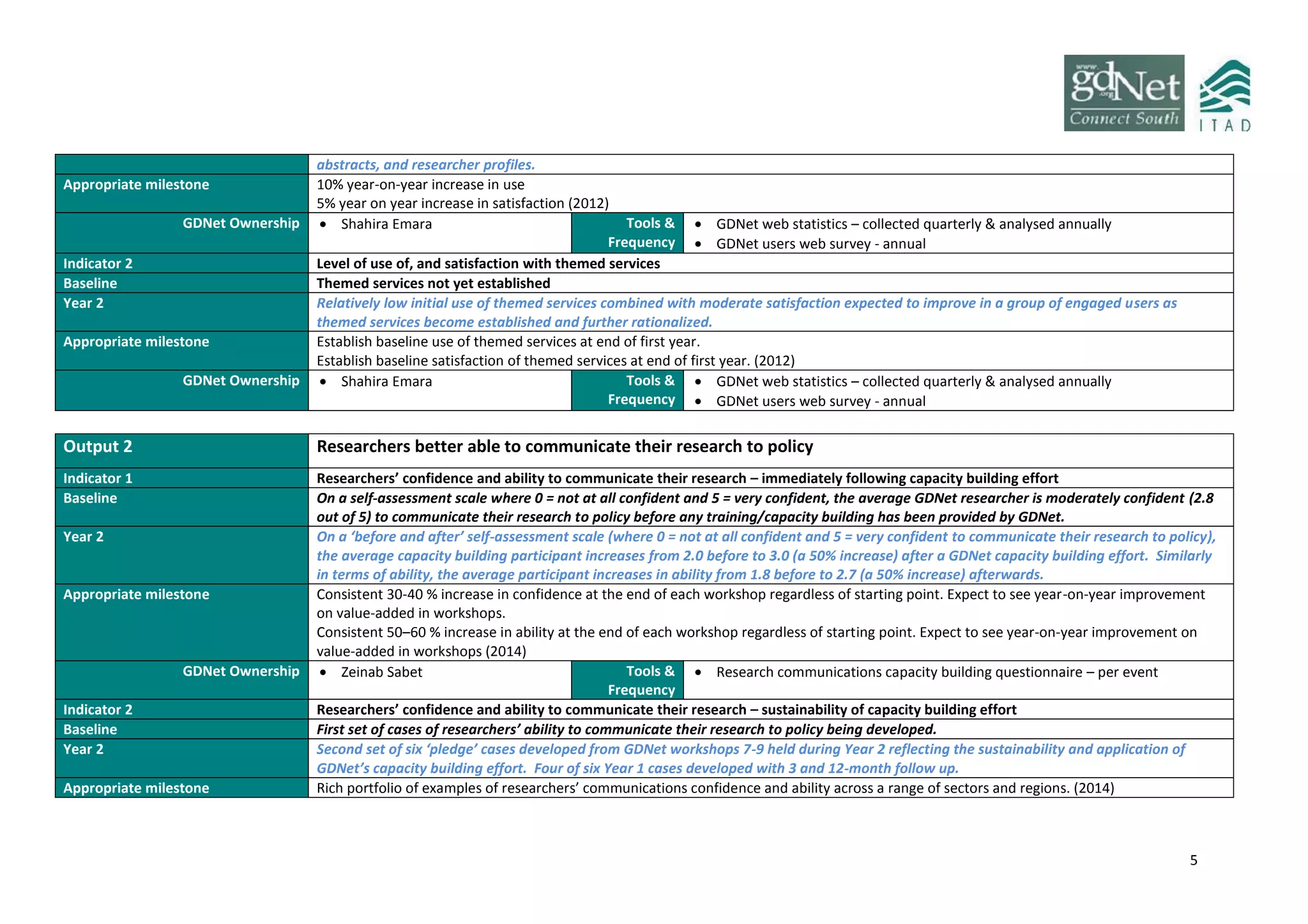
5
abstracts, and researcher profiles.
Appropriate milestone 10% year-on-year increase in use
5% year on year increase in satisfaction (2012)
GDNet Ownership  Shahira Emara Tools &
Frequency
 GDNet web statistics – collected quarterly & analysed annually
 GDNet users web survey - annual
Indicator 2 Level of use of, and satisfaction with themed services
Baseline Themed services not yet established
Year 2 Relatively low initial use of themed services combined with moderate satisfaction expected to improve in a group of engaged users as
themed services become established and further rationalized.
Appropriate milestone Establish baseline use of themed services at end of first year.
Establish baseline satisfaction of themed services at end of first year. (2012)
GDNet Ownership  Shahira Emara Tools &
Frequency
 GDNet web statistics – collected quarterly & analysed annually
 GDNet users web survey - annual
Output 2 Researchers better able to communicate their research to policy
Indicator 1 Researchers’ confidence and ability to communicate their research – immediately following capacity building effort
Baseline On a self-assessment scale where 0 = not at all confident and 5 = very confident, the average GDNet researcher is moderately confident (2.8
out of 5) to communicate their research to policy before any training/capacity building has been provided by GDNet.
Year 2 On a ‘before and after’ self-assessment scale (where 0 = not at all confident and 5 = very confident to communicate their research to policy),
the average capacity building participant increases from 2.0 before to 3.0 (a 50% increase) after a GDNet capacity building effort. Similarly
in terms of ability, the average participant increases in ability from 1.8 before to 2.7 (a 50% increase) afterwards.
Appropriate milestone Consistent 30-40 % increase in confidence at the end of each workshop regardless of starting point. Expect to see year-on-year improvement
on value-added in workshops.
Consistent 50–60 % increase in ability at the end of each workshop regardless of starting point. Expect to see year-on-year improvement on
value-added in workshops (2014)
GDNet Ownership  Zeinab Sabet Tools &
Frequency
 Research communications capacity building questionnaire – per event
Indicator 2 Researchers’ confidence and ability to communicate their research – sustainability of capacity building effort
Baseline First set of cases of researchers’ ability to communicate their research to policy being developed.
Year 2 Second set of six ‘pledge’ cases developed from GDNet workshops 7-9 held during Year 2 reflecting the sustainability and application of
GDNet’s capacity building effort. Four of six Year 1 cases developed with 3 and 12-month follow up.
Appropriate milestone Rich portfolio of examples of researchers’ communications confidence and ability across a range of sectors and regions. (2014)
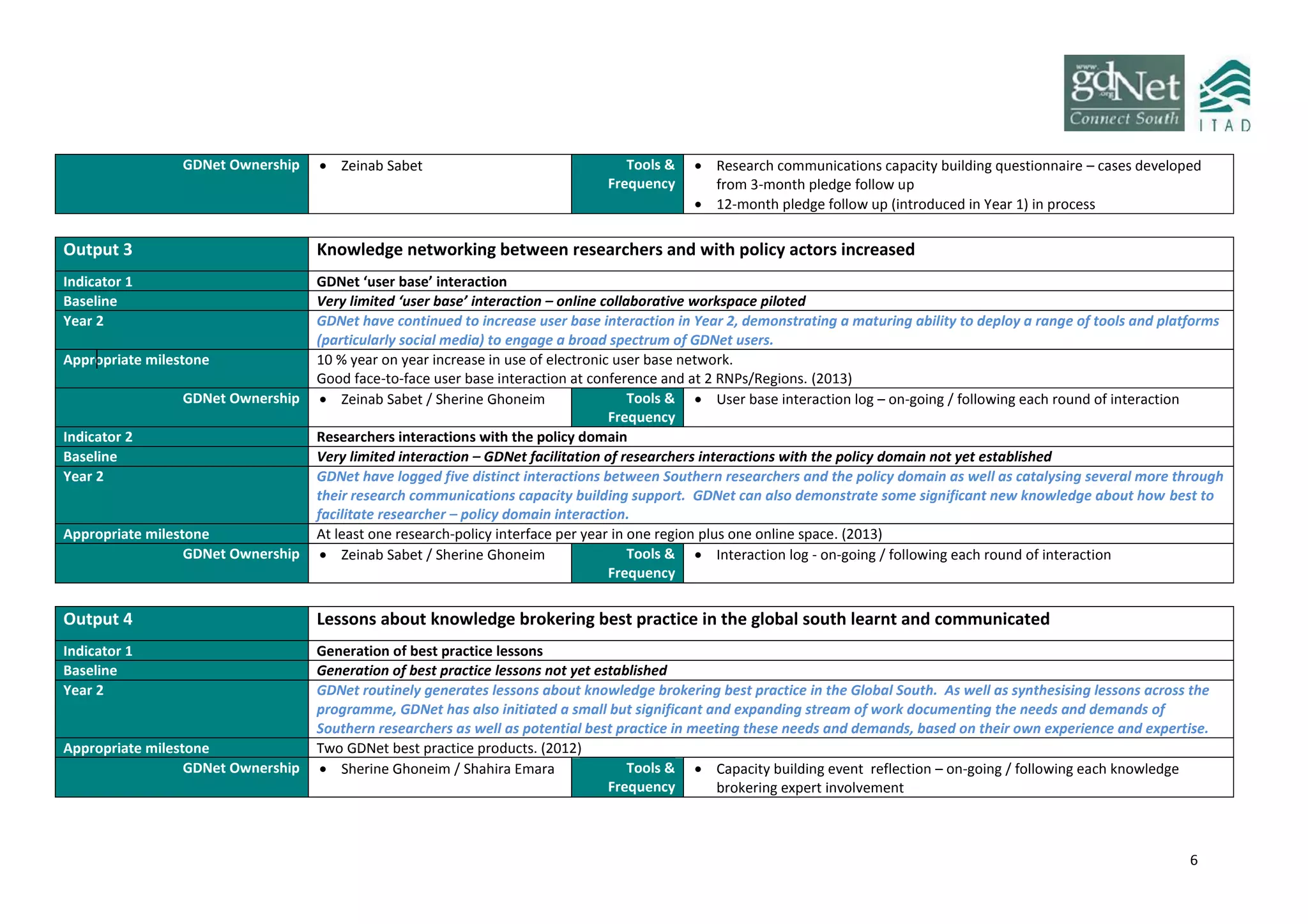
6
GDNet Ownership  Zeinab Sabet Tools &
Frequency
 Research communications capacity building questionnaire – cases developed
from 3-month pledge follow up
 12-month pledge follow up (introduced in Year 1) in process
Output 3 Knowledge networking between researchers and with policy actors increased
Indicator 1 GDNet ‘user base’ interaction
Baseline Very limited ‘user base’ interaction – online collaborative workspace piloted
Year 2 GDNet have continued to increase user base interaction in Year 2, demonstrating a maturing ability to deploy a range of tools and platforms
(particularly social media) to engage a broad spectrum of GDNet users.
Appropriate milestone 10 % year on year increase in use of electronic user base network.
Good face-to-face user base interaction at conference and at 2 RNPs/Regions. (2013)
GDNet Ownership  Zeinab Sabet / Sherine Ghoneim Tools &
Frequency
 User base interaction log – on-going / following each round of interaction
Indicator 2 Researchers interactions with the policy domain
Baseline Very limited interaction – GDNet facilitation of researchers interactions with the policy domain not yet established
Year 2 GDNet have logged five distinct interactions between Southern researchers and the policy domain as well as catalysing several more through
their research communications capacity building support. GDNet can also demonstrate some significant new knowledge about how best to
facilitate researcher – policy domain interaction.
Appropriate milestone At least one research-policy interface per year in one region plus one online space. (2013)
GDNet Ownership  Zeinab Sabet / Sherine Ghoneim Tools &
Frequency
 Interaction log - on-going / following each round of interaction
Output 4 Lessons about knowledge brokering best practice in the global south learnt and communicated
Indicator 1 Generation of best practice lessons
Baseline Generation of best practice lessons not yet established
Year 2 GDNet routinely generates lessons about knowledge brokering best practice in the Global South. As well as synthesising lessons across the
programme, GDNet has also initiated a small but significant and expanding stream of work documenting the needs and demands of
Southern researchers as well as potential best practice in meeting these needs and demands, based on their own experience and expertise.
Appropriate milestone Two GDNet best practice products. (2012)
GDNet Ownership  Sherine Ghoneim / Shahira Emara Tools &
Frequency
 Capacity building event reflection – on-going / following each knowledge
brokering expert involvement
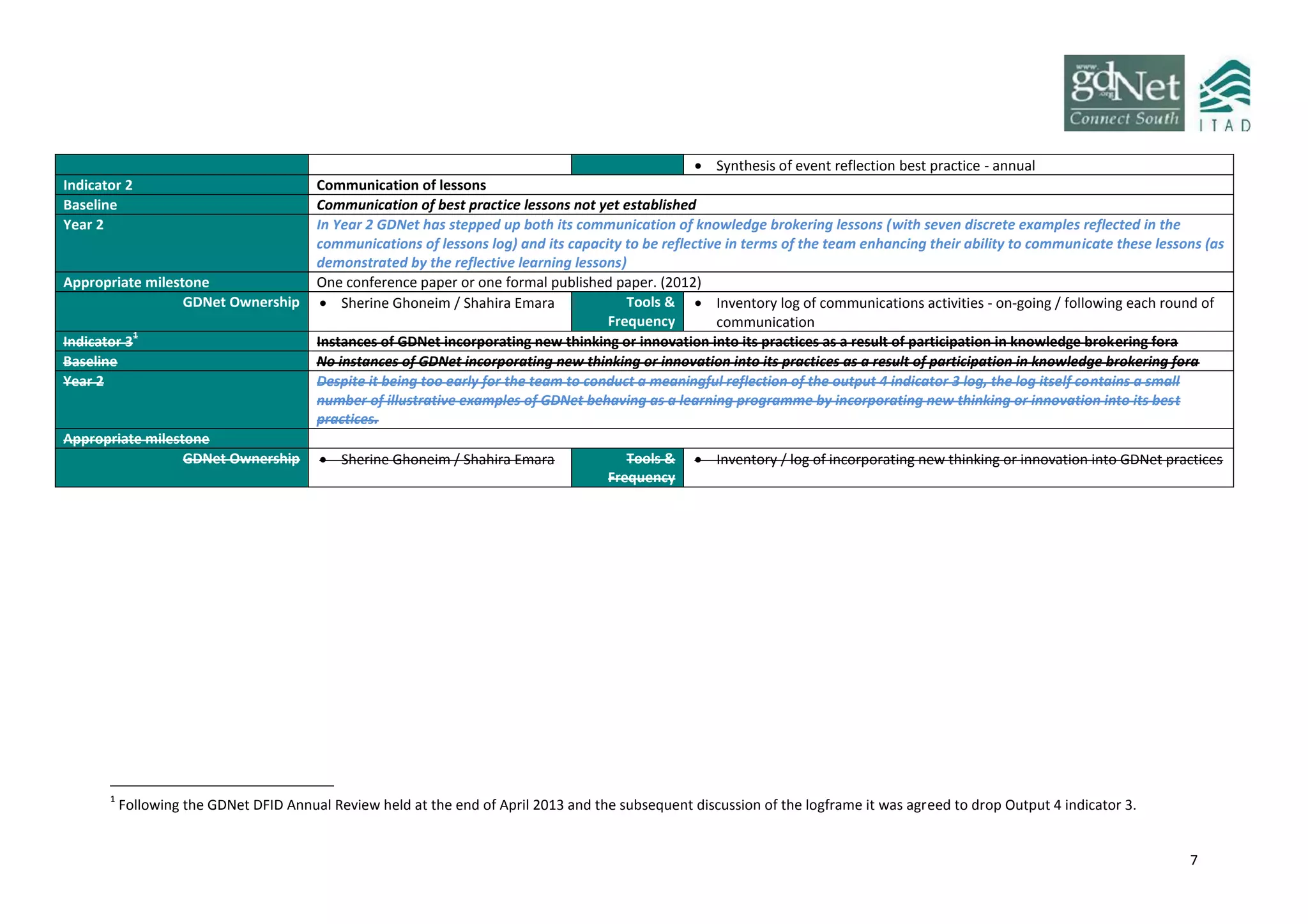
7
 Synthesis of event reflection best practice - annual
Indicator 2 Communication of lessons
Baseline Communication of best practice lessons not yet established
Year 2 In Year 2 GDNet has stepped up both its communication of knowledge brokering lessons (with seven discrete examples reflected in the
communications of lessons log) and its capacity to be reflective in terms of the team enhancing their ability to communicate these lessons (as
demonstrated by the reflective learning lessons)
Appropriate milestone One conference paper or one formal published paper. (2012)
GDNet Ownership  Sherine Ghoneim / Shahira Emara Tools &
Frequency
 Inventory log of communications activities - on-going / following each round of
communication
Indicator 3
1
Instances of GDNet incorporating new thinking or innovation into its practices as a result of participation in knowledge brokering fora
Baseline No instances of GDNet incorporating new thinking or innovation into its practices as a result of participation in knowledge brokering fora
Year 2 Despite it being too early for the team to conduct a meaningful reflection of the output 4 indicator 3 log, the log itself contains a small
number of illustrative examples of GDNet behaving as a learning programme by incorporating new thinking or innovation into its best
practices.
Appropriate milestone
GDNet Ownership  Sherine Ghoneim / Shahira Emara Tools &
Frequency
 Inventory / log of incorporating new thinking or innovation into GDNet practices
1
Following the GDNet DFID Annual Review held at the end of April 2013 and the subsequent discussion of the logframe it was agreed to drop Output 4 indicator 3.
8
Outcome Level
Indicator 1 - Southern researchers’ use of other southern research in own research
Year 2 summary – Significant use of Southern research in Southern researchers’ own research – 64% of
respondents use Southern research to a great or moderate extent. No apparent shift in use over time.
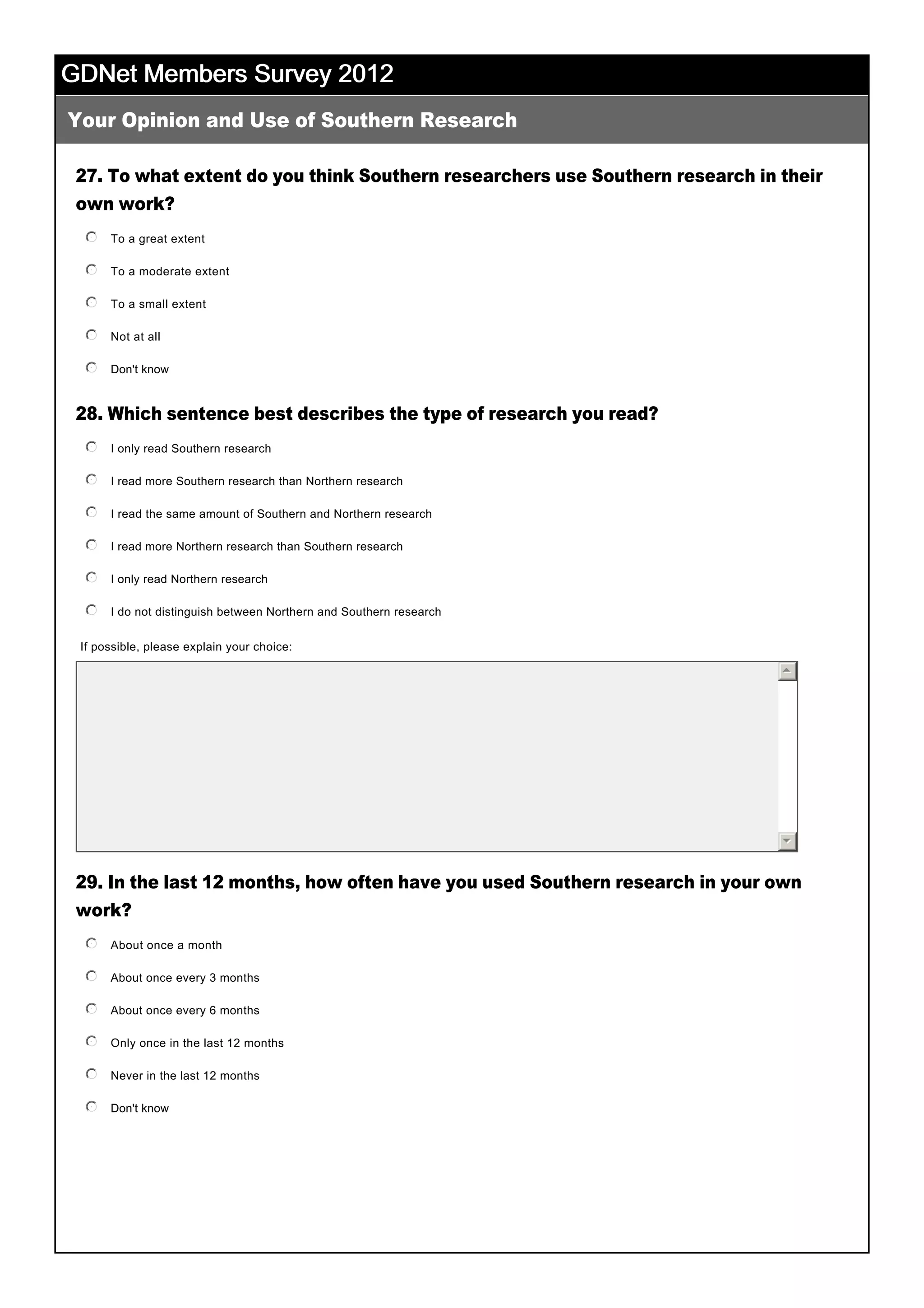
GDNet user base web survey results – Surveyed using the same format as the baseline and Year 1, a number of
questions in the web survey provide an indication of the level of use of Southern research. Further details and
analysis of the Year 2 web survey are provided in Annex 2. Asked to what extent Southern researchers use
Southern research in their own work, 64% of respondents claimed that Southern research was used to a great
or moderate extent (See Annex 2 question 27). This is precisely the same percentage figure as the baseline and
Year 1. When asked to describe the type of research that they read, the most common response researchers
gave is that they do not distinguish between Northern and Southern research (34%) (See Annex 2 question 28).
However, the next biggest group (26%) believe they read more Northern than Southern research, followed by
25% who believe they read the same amount of Southern and Northern research. These results are very
similar to the baseline and Year 1 results.
As with the baseline, what emerges from the results of the web survey is a nuanced picture of use – significant
use of Southern research by Southern researchers but perhaps no more significant than their use of Northern
research. There appears to be very little apparent change in this trend over time – between the baseline and
Year 2. The Year 2 web survey provided a number of interesting insights into the nature and perceptions of
Southern research by Southern users and how they tend to combine use of Northern and Southern research in
a complementary manner (See Annex 2 question 28). The following responses illustrate this:
“Development of my own discipline takes place primarily in the North. I read books and articles written in the
North to keep to date on these theoretical developments. I also read Southern research to understand how the
theory is being applied in the region. As a matter of fact, I do a lot of South-North/North South research.”
“I believe one type of research feed the other, and vice versa. While Northern research is strongly grounded on
theories and a quite rectangular approach of thinking, Southern research addresses the complexity of the
developing world, with apparently backward behaviours rooted in a mosaic of cultures that bring forth the
impetus to challenge mainstream reflection paths and theories. The difficulties encountered in trying to apply
such theories in Africa e.g., due to the lack of appropriate data or research context, give scientists in the South
the opportunity to contribute to developing new theories or to provide insights to modifying existing ones.”
“Northern research arenas have demonstrably failed to impact measurably on issues like poverty and
inequality, much less their source cause, corruption. Southern research offers more outside-the-box thinking,
often due to necessity mothering invention.”
“Southern research quality is picking up, albeit slowly. The northern research in general is more structured and
is supported by generous funding. Also, the clustering of researchers also benefits the northern research much
more than the southern ones. But I would reiterate, a proper choice of southern researchers, where matching of
quality, capacity and the research topic is supreme, could produce excellent result provided generous funding
support comes.”
As highlighted in the Year 1 report, these responses hint at a potentially important niche for GDNet to more
proactively fill – raising the profile of the best Southern research so that it is perceived as on a par with
Northern research in terms of quality but also highlighting the feature of Southern research that defines it from
more traditional Northern or Western research – it’s applied and practical nature, grounded in local contexts
and addressing issues where there is strong demand or a clear evidence gap. To a certain extent GDNet already
9
does this through its tagline to ‘showcase’ Southern research but it is not clear that GDNet’s remit covers an
explicit focus on enhancing the perception of Southern research based on its unique features.
Note on the GDNet web survey in response to comments made in the GDNet DFID Annual Review – see
Annex 2 for a more detailed introduction to the web survey: The GDNet web survey has been conducted
annually since the baseline and provides a range of data to support outcome, output 1 and output 2 indicators.
Whilst the data is statistically robust in terms of absolute numbers of respondents (721 in Year 2), the response
rate relative to total GDNet members is relatively small (5.4%). This is not an unusually low response rate for a
survey of this nature to what is a diffuse and generally passive user group. However 5.4% response rate in Year
2 is down from 8.2% in Year 1 which suggests GDNet’s members may be suffering from ‘survey fatigue’. In
addition and as explicitly set out in the baseline M&E report, all web surveys of this nature suffer from
response bias whereby those motivated to respond tend to be those with particularly strong feelings (positive
and negative) towards the services offered. The DFID Annual Review team also mentioned in their feedback on
the Year 2 M&E report that the survey methodology should be improved in order to generate responses from a
more representative sample of GDNet members. Responding to this feedback, the M&E team will investigate
ways to improve the survey in terms engaging a more representative sample in Year 3. This of course depends
on how to accurately define a ‘representative’ GDNet user, given that the vast majority of GDNet’s users are
likely to be ‘passive’ – using GDNet as one of a selection of research accessing and knowledge sharing tools
periodically and ad hoc – and therefore accessing a valid sample of ‘representative’ users who by their nature
tend not to respond to web surveys could be a challenge.. However, options to improve the web survey may
involve sending survey to randomly selected user profiles or emailing every Xth member to ask them to
participate in a short telephone interview which would complement the findings of the broader web survey.
M&E approach summary
Purpose level indicator 1 draws on perceptions of use of Southern research gathered from the GDNet user
base web survey results conducted annually.
Data management plan
Robbie Gregorowski / ITAD
 On an annual basis – Repeat analysis of the annual GDNet user base web survey.
Sherine Ghoneim / GDNet
 On-going – Interpretation of the findings of the annual GDNet user base web survey and application to
better understand and improve the services GDNet offers
Evidence base
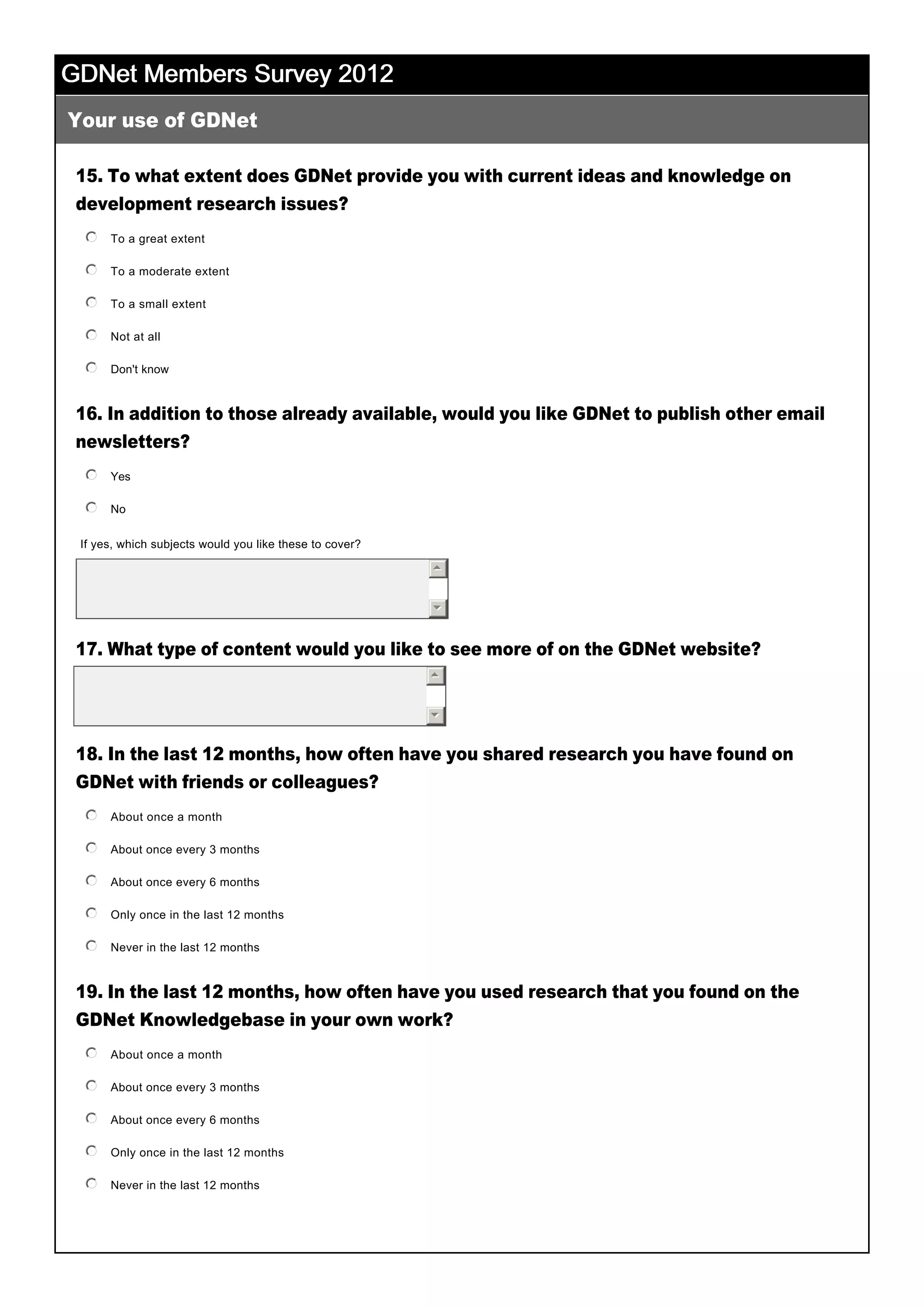
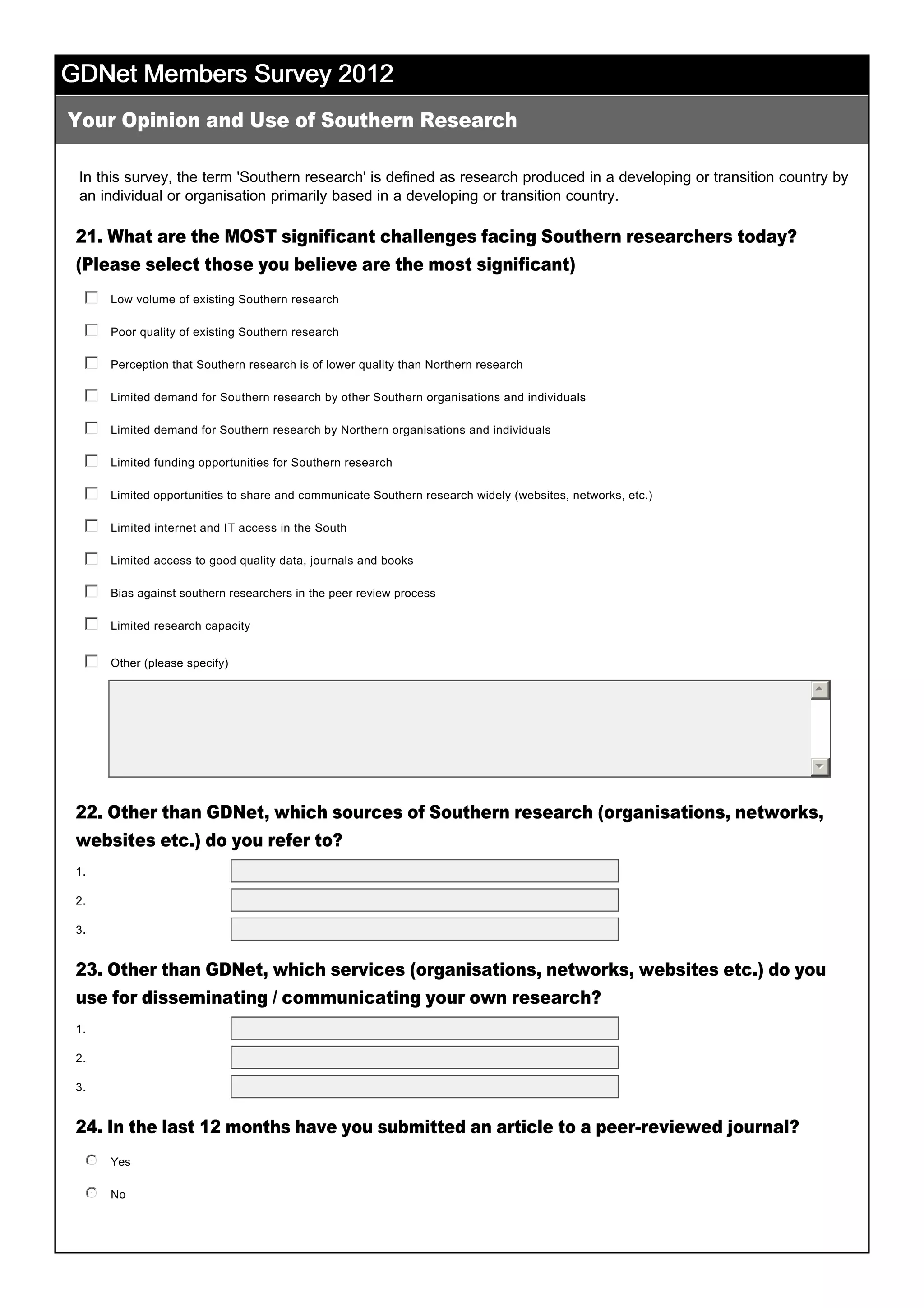
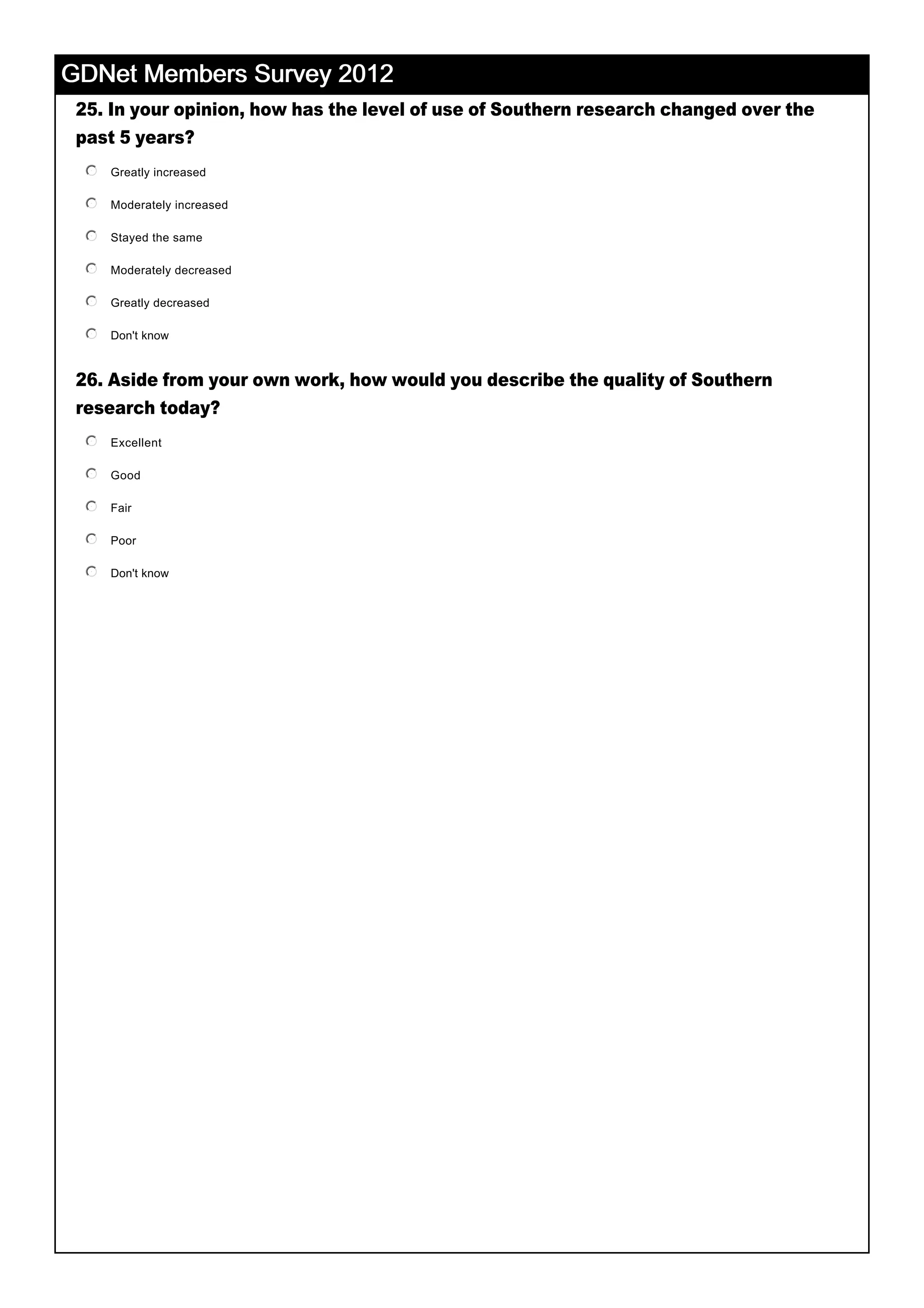
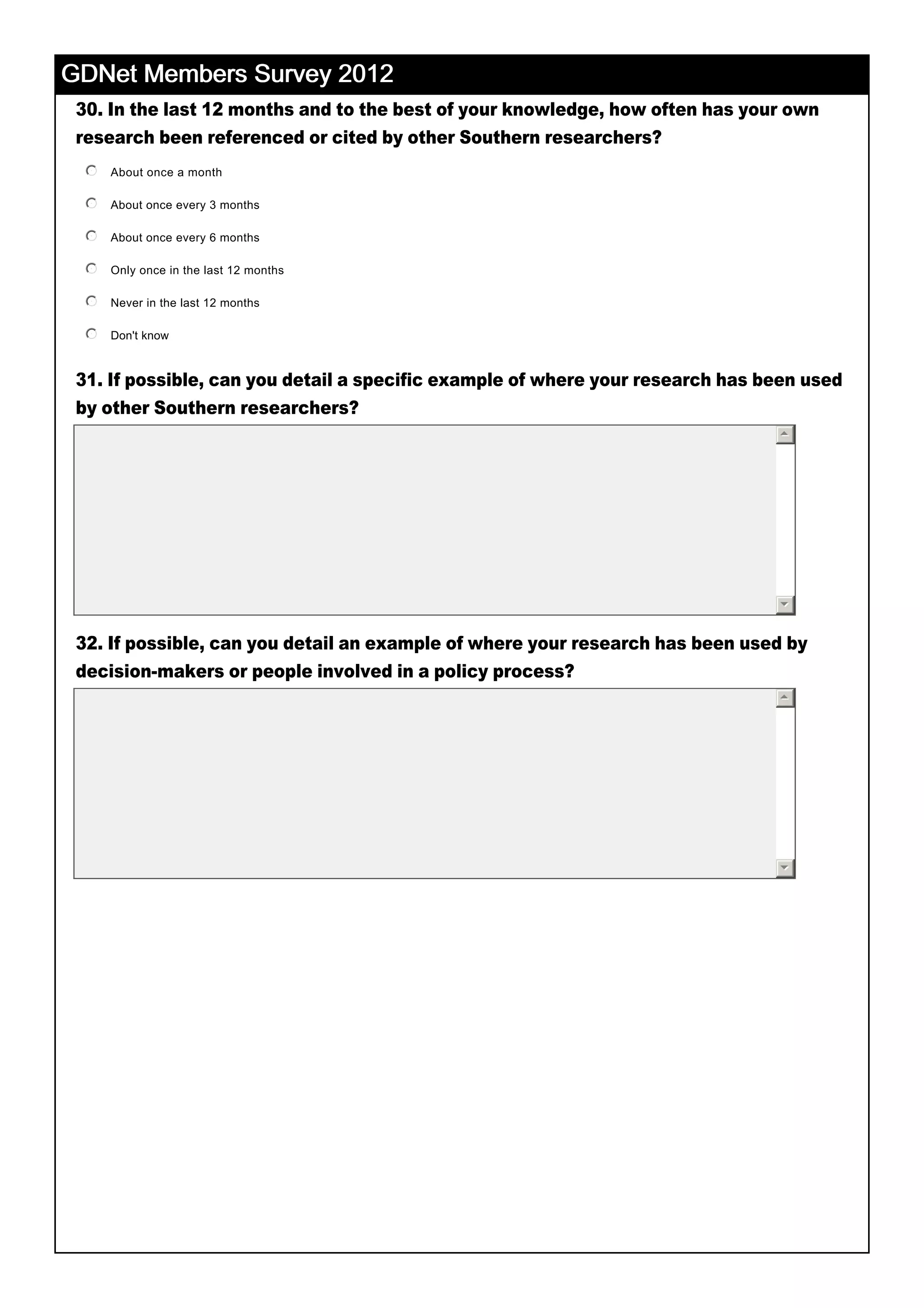
See Annex 1 for the GDNet user base web survey questionnaire including the new questions added in Year 2.
See Annex 2 for a summary of the results of the Year 2 GDNet user base web survey.
10
Indicator 2 - Cases of knowledge into use in policy processes
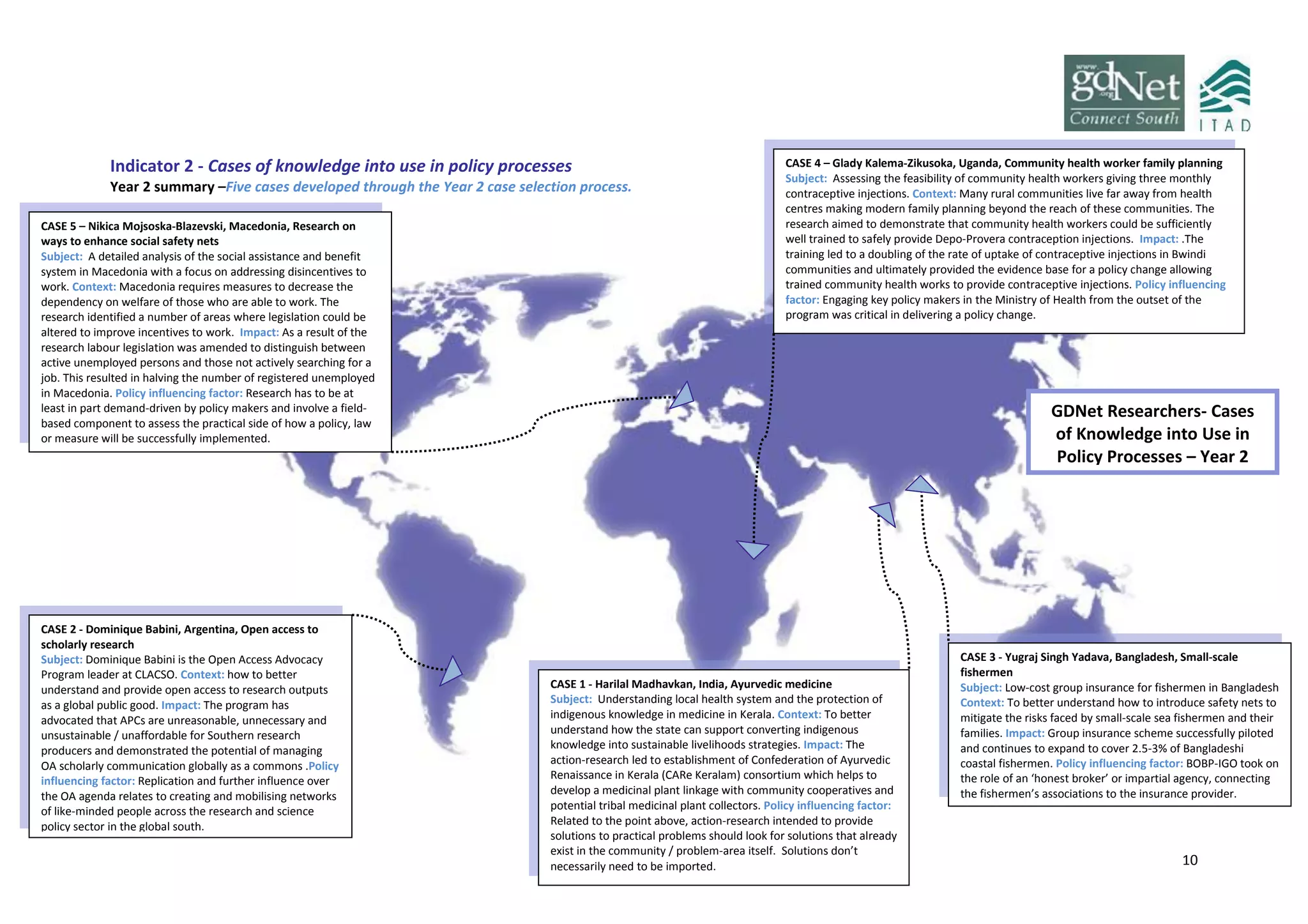
Year 2 summary –Five cases developed through the Year 2 case selection process.
GDNet Researchers- Cases
of Knowledge into Use in
Policy Processes – Year 2
CASE 3 - Yugraj Singh Yadava, Bangladesh, Small-scale
fishermen
Subject: Low-cost group insurance for fishermen in Bangladesh
Context: To better understand how to introduce safety nets to
mitigate the risks faced by small-scale sea fishermen and their
families. Impact: Group insurance scheme successfully piloted
and continues to expand to cover 2.5-3% of Bangladeshi
coastal fishermen. Policy influencing factor: BOBP-IGO took on
the role of an ‘honest broker’ or impartial agency, connecting
the fishermen’s associations to the insurance provider.
CASE 2 - Dominique Babini, Argentina, Open access to
scholarly research
Subject: Dominique Babini is the Open Access Advocacy
Program leader at CLACSO. Context: how to better
understand and provide open access to research outputs
as a global public good. Impact: The program has
advocated that APCs are unreasonable, unnecessary and
unsustainable / unaffordable for Southern research
producers and demonstrated the potential of managing
OA scholarly communication globally as a commons .Policy
influencing factor: Replication and further influence over
the OA agenda relates to creating and mobilising networks
of like-minded people across the research and science
policy sector in the global south.
CASE 1 - Harilal Madhavkan, India, Ayurvedic medicine
Subject: Understanding local health system and the protection of
indigenous knowledge in medicine in Kerala. Context: To better
understand how the state can support converting indigenous
knowledge into sustainable livelihoods strategies. Impact: The
action-research led to establishment of Confederation of Ayurvedic
Renaissance in Kerala (CARe Keralam) consortium which helps to
develop a medicinal plant linkage with community cooperatives and
potential tribal medicinal plant collectors. Policy influencing factor:
Related to the point above, action-research intended to provide
solutions to practical problems should look for solutions that already
exist in the community / problem-area itself. Solutions don’t
necessarily need to be imported.
CASE 4 – Glady Kalema-Zikusoka, Uganda, Community health worker family planning
Subject: Assessing the feasibility of community health workers giving three monthly
contraceptive injections. Context: Many rural communities live far away from health
centres making modern family planning beyond the reach of these communities. The
research aimed to demonstrate that community health workers could be sufficiently
well trained to safely provide Depo-Provera contraception injections. Impact: .The
training led to a doubling of the rate of uptake of contraceptive injections in Bwindi
communities and ultimately provided the evidence base for a policy change allowing
trained community health works to provide contraceptive injections. Policy influencing
factor: Engaging key policy makers in the Ministry of Health from the outset of the
program was critical in delivering a policy change.
CASE 5 – Nikica Mojsoska-Blazevski, Macedonia, Research on
ways to enhance social safety nets
Subject: A detailed analysis of the social assistance and benefit
system in Macedonia with a focus on addressing disincentives to
work. Context: Macedonia requires measures to decrease the
dependency on welfare of those who are able to work. The
research identified a number of areas where legislation could be
altered to improve incentives to work. Impact: As a result of the
research labour legislation was amended to distinguish between
active unemployed persons and those not actively searching for a
job. This resulted in halving the number of registered unemployed
in Macedonia. Policy influencing factor: Research has to be at
least in part demand-driven by policy makers and involve a field-
based component to assess the practical side of how a policy, law
or measure will be successfully implemented.
11
The Year 2 case selection process produced five cases following the case selection process held with the GDN
Awards and Medals Finalists at the GDN Annual Conference in Manila in June 2013. The latest round of cases
adds to the eight developed in each of the previous two years to provide GDNet with a deeper understanding
of the nature of Southern research and some very informative illustrations of how Southern research can
inform policy and practice. Drawing on the Year 2 cases as well as the understanding GDNet has gained across
all three rounds uncovers some interesting themes and initial conclusions about the nature of Southern
research:
Policy influencing factors
 An emerging theme apparent in many of the cases across all three rounds is the extent to which
Southern researchers set out to use research to solve distinct development problems in a practical
and pragmatic manner. Several of the themes which became the subject of the research in cases
identified had very little in the way of a prior robust, empirical research or evidence-base. Both the
Uganda community health workers case where people lack basic access to effective contraception and
the Bangladesh small-scale fisheries case where fishermen and the families lack affordable insurance
illustrate how the application of action-research has provided workable solutions to very ‘tangible’
problems.
 Drawing on Southern research addressing pressing developmental problems, it is apparent that nearly
all cases are clearly ‘demand-led’. That is they all respond to the direct demand of the primary
stakeholders for research to address a problem or constraint they face. These primary stakeholders,
rather than simply being the subjects of the research, are engaged in a very participatory manner as
stakeholder partners in the research process itself. Many of the cases illustrate the researchers go
one step further and from the outset engage policy makers as well as the primary stakeholders from
the outset. In this way policy makers are drawn into the research process as it develops.
 Involving decision makers in from the outset is just one way in which Southern research tends to take
a more innovative, informal and opportunistic approach to research dissemination. Southern
researchers conducting ‘action research’ seem at ease with engage a wider range of stakeholders –
local communities, politicians, civil servants, and the media (amongst others) throughout the research
process. This is in direct contrast to Western research which tends to engage decision-makers at the
end (if at all), disseminating research findings often through a relatively ‘formal’ and established
dissemination and communication processes – presenting at conferences and disseminating research
findings through formal journal peer-review processes.
 Similarly the cases continue to highlight that Southern researchers use a wider and more innovative
variety of tools to generate ‘evidence’ to support their research. Several cases highlight the use of
documentary evidence (photos and video footage) combined with more traditional research methods
such as key informant interviews to communicate the research to a wider audience of stakeholders. In
this way Southern researchers explicitly draw in the media, civil society organisations, NGOs, and the
private sector to put ‘pressure’ on decision-makers to legislate for change. Put simply, the cases
highlight that some Southern researchers are particularly adept at translating their research findings
into formats appropriate the meeting the needs of multiple stakeholder and audience groups and are
adept at employing a wide range of formats, platforms and channels to broad sets of stakeholders.
GDNet’s role and contribution
 GDNet can play a simple but critical role in sharing innovative research, connecting researchers in one
region or country with other researchers so that knowledge and learning in one context can effectively
be transferred and replicated in similar contexts elsewhere.
 The use of evidence in the most appropriate format – using photos and videos combined with more
formal research techniques such as surveys and interviews - is one of the areas where Southern
research can be considered more effective and advanced than more traditional Western research –
Southern research appears better at bringing in innovative technology such as the use of visual and
social media to generate more substantial impact. There is a potential role for GDNet in sharing the
lessons and experience of how best to combine the two forms of research as well as potentially
providing training in the use of more innovative research and documentation techniques for Southern
12
researchers – building the capacity of Southern researchers to present their research in the most
appropriate format for a particular stakeholder audience.
 Overall, the case selection process has identified that GDNet engages a wealth of innovative, informed
and highly motivated researchers. The simple process of producing the cases has provided a
showcase for a number of these researchers. GDNet could use the on-going case selection process to
provide a platform expressing GDNet’s lessons and learning on the key success factors in producing
effective, policy-influencing work – this would both help raise the profile of innovativeness of
Southern research (something that more traditional Western research may learn from) and help bring
the lessons and success stories to a wider audience.
M&E approach summary
The aim for this indicator is to develop a robust and credible portfolio of cases of knowledge into use on a year
on year basis – updating progress with existing cases and developing new ones. The process for developing
new cases involves 3 stages which are repeated annually:
 Stage 1 – Case identification from GDNet Registered Researchers - A broad number of ‘cases’ (approx.
35-50) are identified from responses to the annual GDNet user base web survey.
 Stage 2 – Most significant selection and validation panels – Engaging a group of GDN A&M Finalists at
successive GDN Annual Conferences, the next of which is being held in Manila in June 2013 to review
and select the ‘most significant’ cases. The A&M Finalists panel is followed by a second panel of
GDNet key stakeholders including GDNet staff and independent research communications experts to
further review and select the most significant cases down to a shortlist of 8-10 cases.
 Stage 3 – Development and Validation of Most Significant Cases - The authors of the 8-10 selected
cases are contacted by the ITAD consultant and each invited to an informal telephone interview to
discuss and develop their case in more detail.
Data management plan
Robbie Gregorowski / ITAD
 On an annual basis – Facilitation of the case selection process and development of new cases.
Zeinab Sabet / GDNet
 On-going – more detailed case follow-up and lesson learning if required.
Sherine Ghoneim / GDNet
 On-going – Extraction and synthesis of lessons to enhance GDNet’s role and contribution.
Evidence base
A detailed explanation of the process designed to identify the cases can be found in the Baseline and M&E
Framework report.
 Annex 3 provides the long-list of cases gained from the web survey.
 Annex 4a provides the full write ups of the five new cases developed in Year 2.
 Annex 4b provides the updates and revalidated write ups of the cases developed at the baseline and
Year 1. Note – engaging researchers to update their cases perhaps unsurprisingly has proved to be a
challenge with the majority of researchers failing to engage in the follow up process in the years
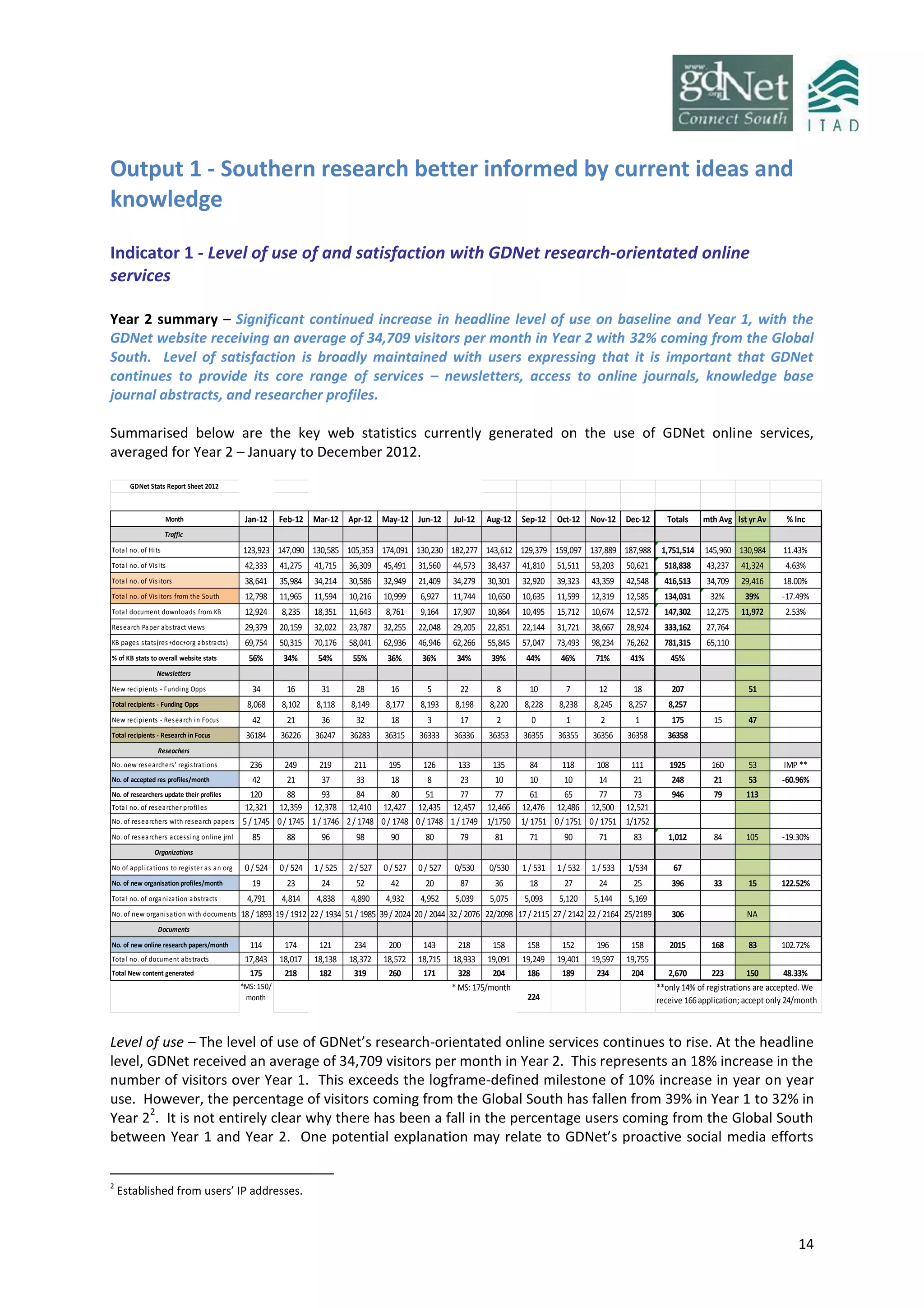
subsequent to them developing the case. A summary of the limited responses (despite chasing) is
provided in the table below.
13
Cases of knowledge into use in the policy process – follow up status
Name Case Country
Baseline 2012 2013 2014
Gohar Jerbashian Prevention of maternal and neo-natal mortality Armenia Y Y CHASED
Wassam Mina Investment in Gulf Cooperation Countries UEA Y Y Y
Marcio da Costa Unequal educational opportunities Brazil Y Y Y
Rajarshi Majumder Obstacles for Out of School Children India Y SENT SENT
Pamela Thomas Decline of immunisation and maternal child health care service deliveryVanuatu Y SENT SENT
David Rojas Elbirt Provision of 'Watsan'products Bolivia Y Y SENT
Tohnain Nobert Lengha Obstacles to Diasbled Children in Education Cameroon Y SENT CHASED
Sarah Ayeri Ogalleh Community tree planting Kenya Y SENT SENT
Year 1
Cecil Agutu Laws and policy in sugar sub-sector Kenya Y CHASED
Davidson Omole Nigerian Stock Exchange Nigeria Y CHASED
Martin Oteng-Ababio Digital Waste Management Ghana Y CHASED
Constancio Nguja Civil Society Advocacy Mozambique Y Y
Brigitte Nyambo Integrated Pest Management Technology Ethiopia Y CHASED
Waweru Mwangi Card-less ATMsystem Kenya Y CHASED
Francesco Pastore Mongolian Youth education and employment Mongolia Y CHASED
Hasina Kharbhih Child Labour Rights India Y Y
Year 2
Augustin Fallas Santana Outsourcing clinical trials by pharmaceutical industry Costa Rica N
Dr Palitha Ekanayake Classification of rural roads Sri Lanka N
Harilal Madhavkan Traditional medicine industry India Y
Llam Dorji Youth policies Bhutan N
Dominique Babini Digital Open Access Argentina Y
Dr Damilola Olajide Regulation in the payment card industry Nigeria N
Tran Tuan Mental Health Care in Vietnam Viet Nam N
Rajdeep Mukherjee Low cost insurance for fishermen in Bangladesh India Y
Nadia Afrin Shams Builidng Inclusive Information Knowledge System Bangladesh N
Gladys Kalema-Zikusoka Integrated biodiversity, health and community development Uganda Y
Nikica Mojsoska Blazevski Gender Wage Equality in Macedonia Macedonia Y
First
phone
interview
Followed up in?
14
Output 1 - Southern research better informed by current ideas and
knowledge
Indicator 1 - Level of use of and satisfaction with GDNet research-orientated online
services
Year 2 summary – Significant continued increase in headline level of use on baseline and Year 1, with the
GDNet website receiving an average of 34,709 visitors per month in Year 2 with 32% coming from the Global
South. Level of satisfaction is broadly maintained with users expressing that it is important that GDNet
continues to provide its core range of services – newsletters, access to online journals, knowledge base
journal abstracts, and researcher profiles.
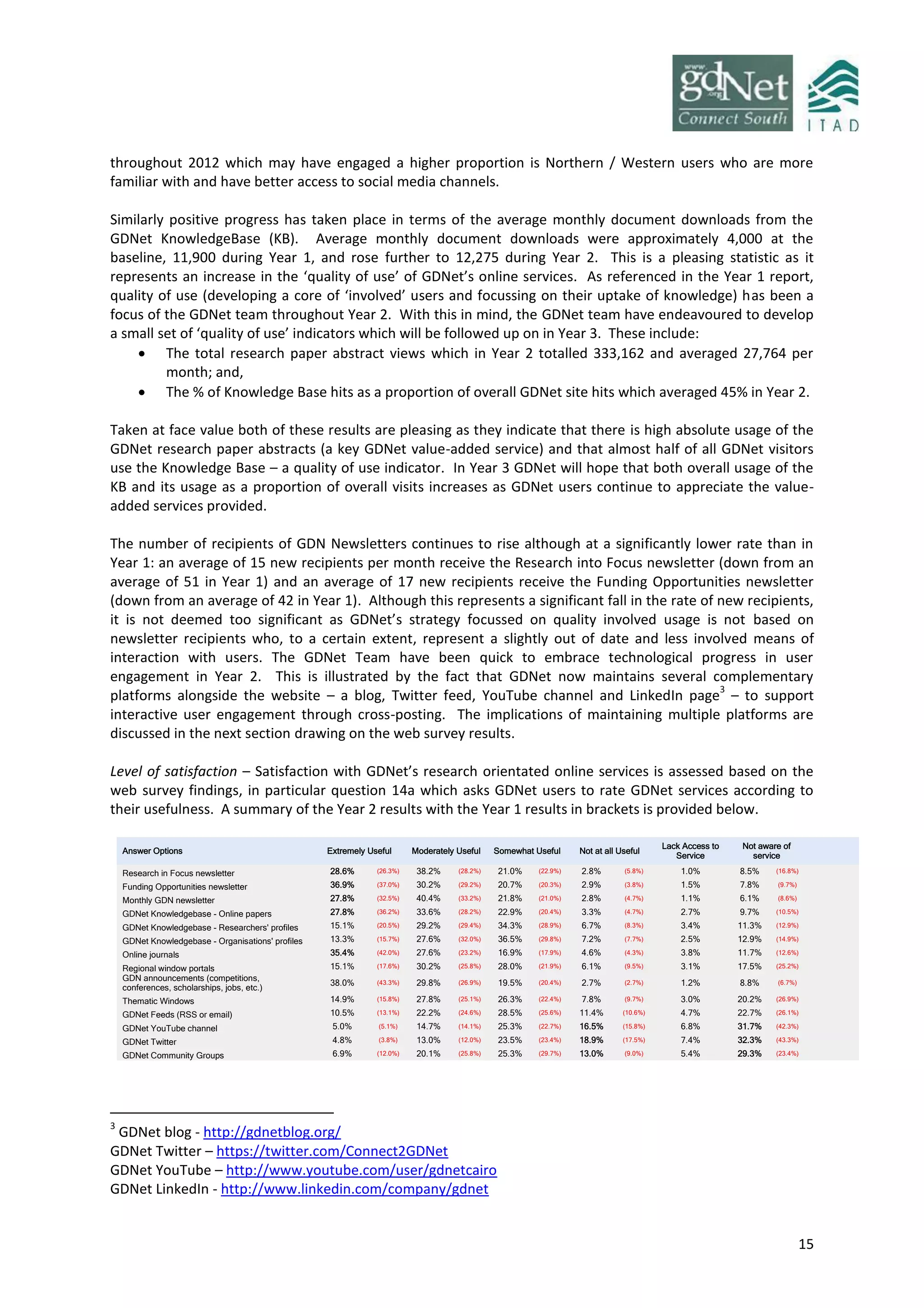
Summarised below are the key web statistics currently generated on the use of GDNet online services,
averaged for Year 2 – January to December 2012.
GDNet Stats Report Sheet 2012
Month Jan-12 Feb-12 Mar-12 Apr-12 May-12 Jun-12 Jul-12 Aug-12 Sep-12 Oct-12 Nov-12 Dec-12 Totals mth Avg lst yr Av % Inc
Traffic
Total no. of Hits 123,923 147,090 130,585 105,353 174,091 130,230 182,277 143,612 129,379 159,097 137,889 187,988 1,751,514 145,960 130,984 11.43%
Total no. of Visits 42,333 41,275 41,715 36,309 45,491 31,560 44,573 38,437 41,810 51,511 53,203 50,621 518,838 43,237 41,324 4.63%
Total no. of Visitors 38,641 35,984 34,214 30,586 32,949 21,409 34,279 30,301 32,920 39,323 43,359 42,548 416,513 34,709 29,416 18.00%
Total no. of Visitors from the South 12,798 11,965 11,594 10,216 10,999 6,927 11,744 10,650 10,635 11,599 12,319 12,585 134,031 32% 39% -17.49%
Total document downloads from KB 12,924 8,235 18,351 11,643 8,761 9,164 17,907 10,864 10,495 15,712 10,674 12,572 147,302 12,275 11,972 2.53%
Research Paper abstract views 29,379 20,159 32,022 23,787 32,255 22,048 29,205 22,851 22,144 31,721 38,667 28,924 333,162 27,764
KB pages stats(res+doc+org abstracts) 69,754 50,315 70,176 58,041 62,936 46,946 62,266 55,845 57,047 73,493 98,234 76,262 781,315 65,110
% of KB stats to overall website stats 56% 34% 54% 55% 36% 36% 34% 39% 44% 46% 71% 41% 45%
Newsletters
New recipients - Funding Opps 34 16 31 28 16 5 22 8 10 7 12 18 207 51
Total recipients - Funding Opps 8,068 8,102 8,118 8,149 8,177 8,193 8,198 8,220 8,228 8,238 8,245 8,257 8,257
New recipients - Research in Focus 42 21 36 32 18 3 17 2 0 1 2 1 175 15 47
Total recipients - Research in Focus 36184 36226 36247 36283 36315 36333 36336 36353 36355 36355 36356 36358 36358
Reseachers
No. new researchers' registrations 236 249 219 211 195 126 133 135 84 118 108 111 1925 160 53 IMP **
No. of accepted res profiles/month 42 21 37 33 18 8 23 10 10 10 14 21 248 21 53 -60.96%
No. of researchers update their profiles 120 88 93 84 80 51 77 77 61 65 77 73 946 79 113
Total no. of researcher profiles 12,321 12,359 12,378 12,410 12,427 12,435 12,457 12,466 12,476 12,486 12,500 12,521
No. of researchers with research papers 5/ 1745 0/ 1745 1/ 1746 2/ 1748 0/ 1748 0/ 1748 1/ 1749 1/1750 1/ 1751 0/ 1751 0/ 1751 1/1752
No. of researchers accessing online jrnl 85 88 96 98 90 80 79 81 71 90 71 83 1,012 84 105 -19.30%
Organizations
No of applications to register as an org 0/ 524 0/ 524 1/ 525 2/ 527 0/ 527 0/ 527 0/530 0/530 1/ 531 1/ 532 1/ 533 1/534 67
No. of new organisation profiles/month 19 23 24 52 42 20 87 36 18 27 24 25 396 33 15 122.52%
Total no. of organization abstracts 4,791 4,814 4,838 4,890 4,932 4,952 5,039 5,075 5,093 5,120 5,144 5,169
No. of new organisation with documents 18/ 1893 19/ 1912 22/ 1934 51/ 1985 39/ 2024 20/ 2044 32/ 2076 22/2098 17/ 2115 27/ 2142 22/ 2164 25/2189 306 NA
Documents
No. of new online research papers/month 114 174 121 234 200 143 218 158 158 152 196 158 2015 168 83 102.72%
Total no. of document abstracts 17,843 18,017 18,138 18,372 18,572 18,715 18,933 19,091 19,249 19,401 19,597 19,755
Total New content generated 175 218 182 319 260 171 328 204 186 189 234 204 2,670 223 150 48.33%
224
*MS: 150/
month
*MS: 175/month **only 14% of registrations are accepted. We
receive 166application; accept only 24/month
Level of use – The level of use of GDNet’s research-orientated online services continues to rise. At the headline
level, GDNet received an average of 34,709 visitors per month in Year 2. This represents an 18% increase in the
number of visitors over Year 1. This exceeds the logframe-defined milestone of 10% increase in year on year
use. However, the percentage of visitors coming from the Global South has fallen from 39% in Year 1 to 32% in
Year 2
2
. It is not entirely clear why there has been a fall in the percentage users coming from the Global South
between Year 1 and Year 2. One potential explanation may relate to GDNet’s proactive social media efforts
2
Established from users’ IP addresses.
15
throughout 2012 which may have engaged a higher proportion is Northern / Western users who are more
familiar with and have better access to social media channels.
Similarly positive progress has taken place in terms of the average monthly document downloads from the
GDNet KnowledgeBase (KB). Average monthly document downloads were approximately 4,000 at the
baseline, 11,900 during Year 1, and rose further to 12,275 during Year 2. This is a pleasing statistic as it
represents an increase in the ‘quality of use’ of GDNet’s online services. As referenced in the Year 1 report,
quality of use (developing a core of ‘involved’ users and focussing on their uptake of knowledge) has been a
focus of the GDNet team throughout Year 2. With this in mind, the GDNet team have endeavoured to develop
a small set of ‘quality of use’ indicators which will be followed up on in Year 3. These include:
 The total research paper abstract views which in Year 2 totalled 333,162 and averaged 27,764 per
month; and,
 The % of Knowledge Base hits as a proportion of overall GDNet site hits which averaged 45% in Year 2.
Taken at face value both of these results are pleasing as they indicate that there is high absolute usage of the
GDNet research paper abstracts (a key GDNet value-added service) and that almost half of all GDNet visitors
use the Knowledge Base – a quality of use indicator. In Year 3 GDNet will hope that both overall usage of the
KB and its usage as a proportion of overall visits increases as GDNet users continue to appreciate the value-
added services provided.
The number of recipients of GDN Newsletters continues to rise although at a significantly lower rate than in
Year 1: an average of 15 new recipients per month receive the Research into Focus newsletter (down from an
average of 51 in Year 1) and an average of 17 new recipients receive the Funding Opportunities newsletter
(down from an average of 42 in Year 1). Although this represents a significant fall in the rate of new recipients,
it is not deemed too significant as GDNet’s strategy focussed on quality involved usage is not based on
newsletter recipients who, to a certain extent, represent a slightly out of date and less involved means of
interaction with users. The GDNet Team have been quick to embrace technological progress in user
engagement in Year 2. This is illustrated by the fact that GDNet now maintains several complementary
platforms alongside the website – a blog, Twitter feed, YouTube channel and LinkedIn page
3
– to support
interactive user engagement through cross-posting. The implications of maintaining multiple platforms are
discussed in the next section drawing on the web survey results.
Level of satisfaction – Satisfaction with GDNet’s research orientated online services is assessed based on the
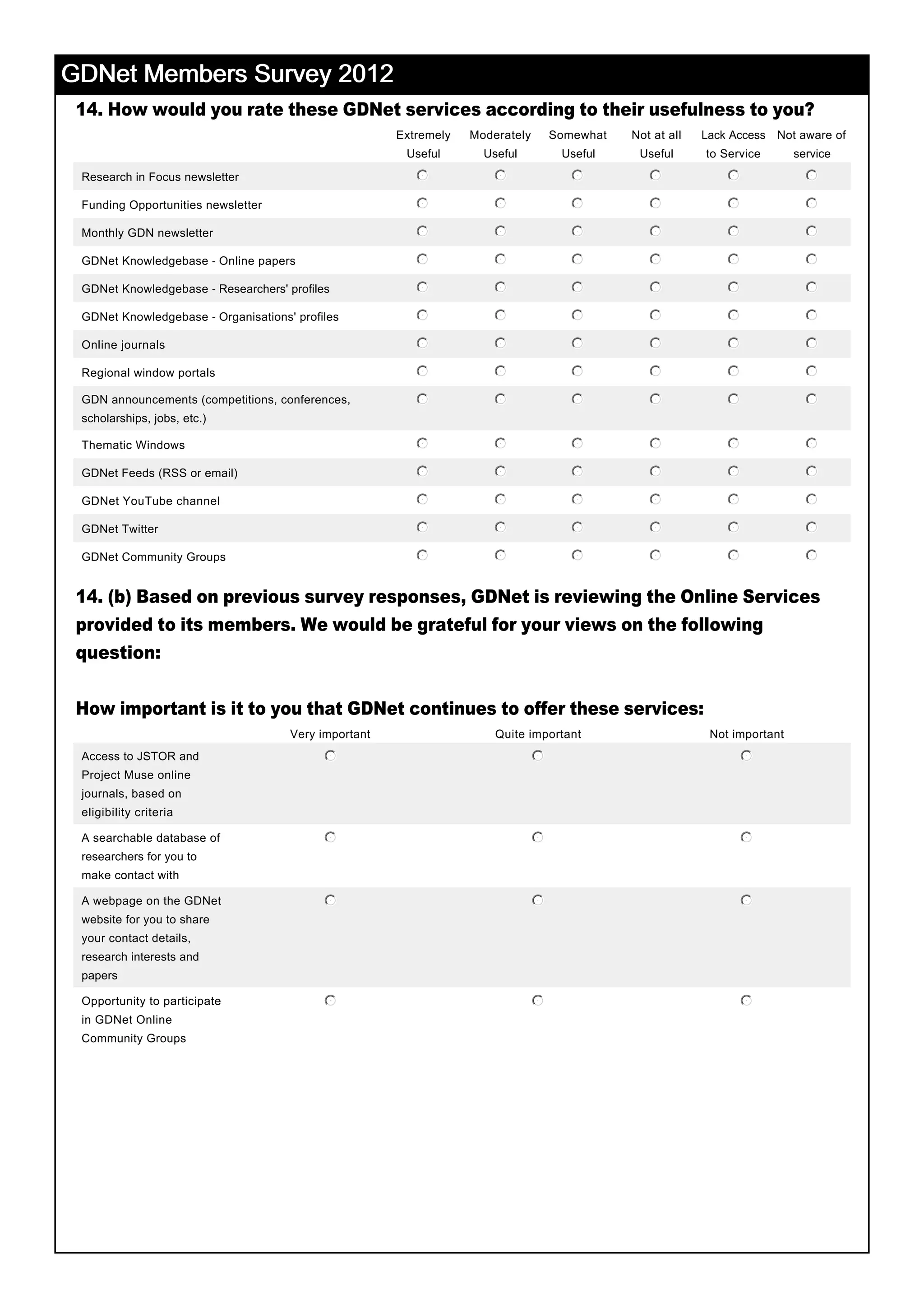
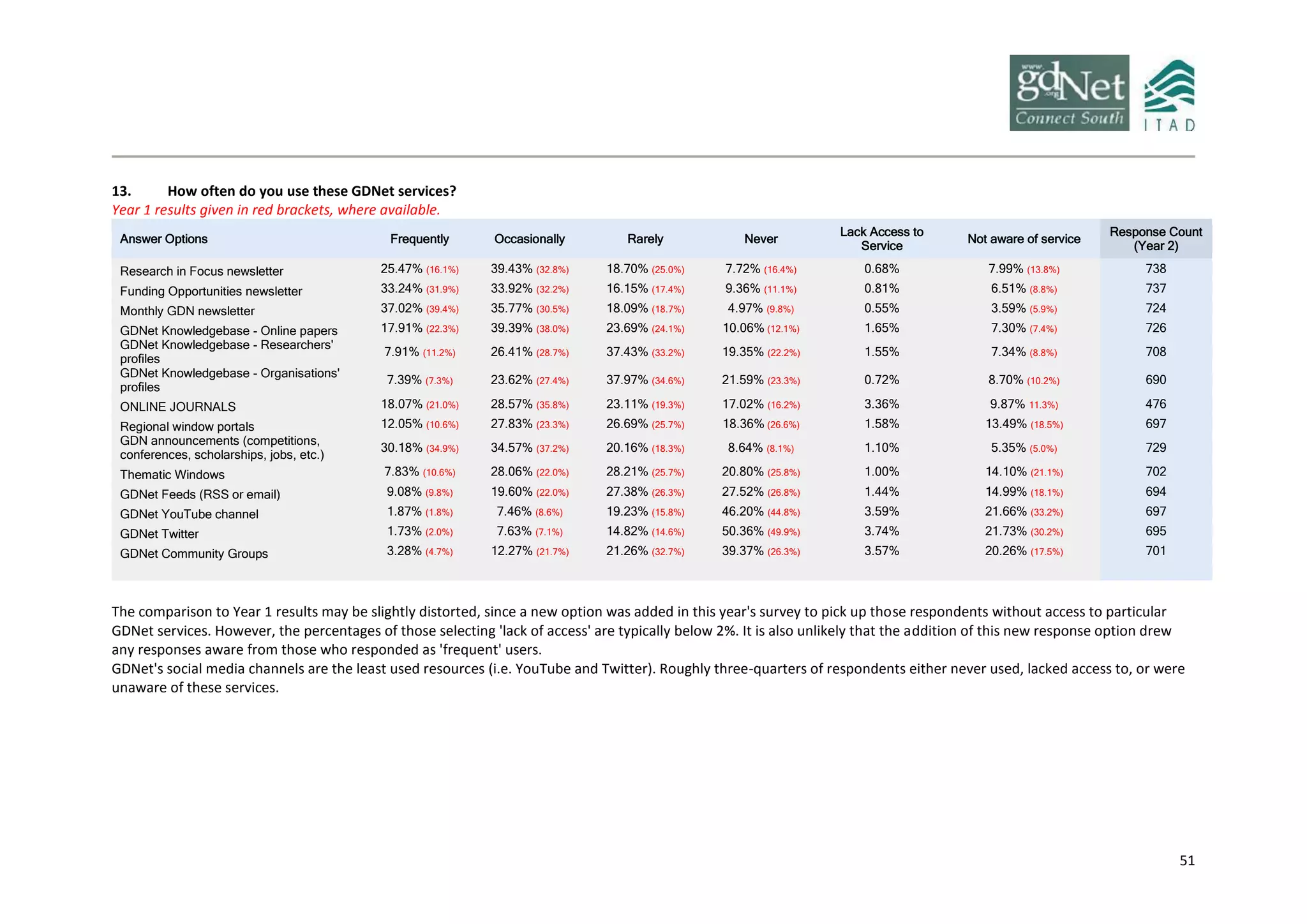
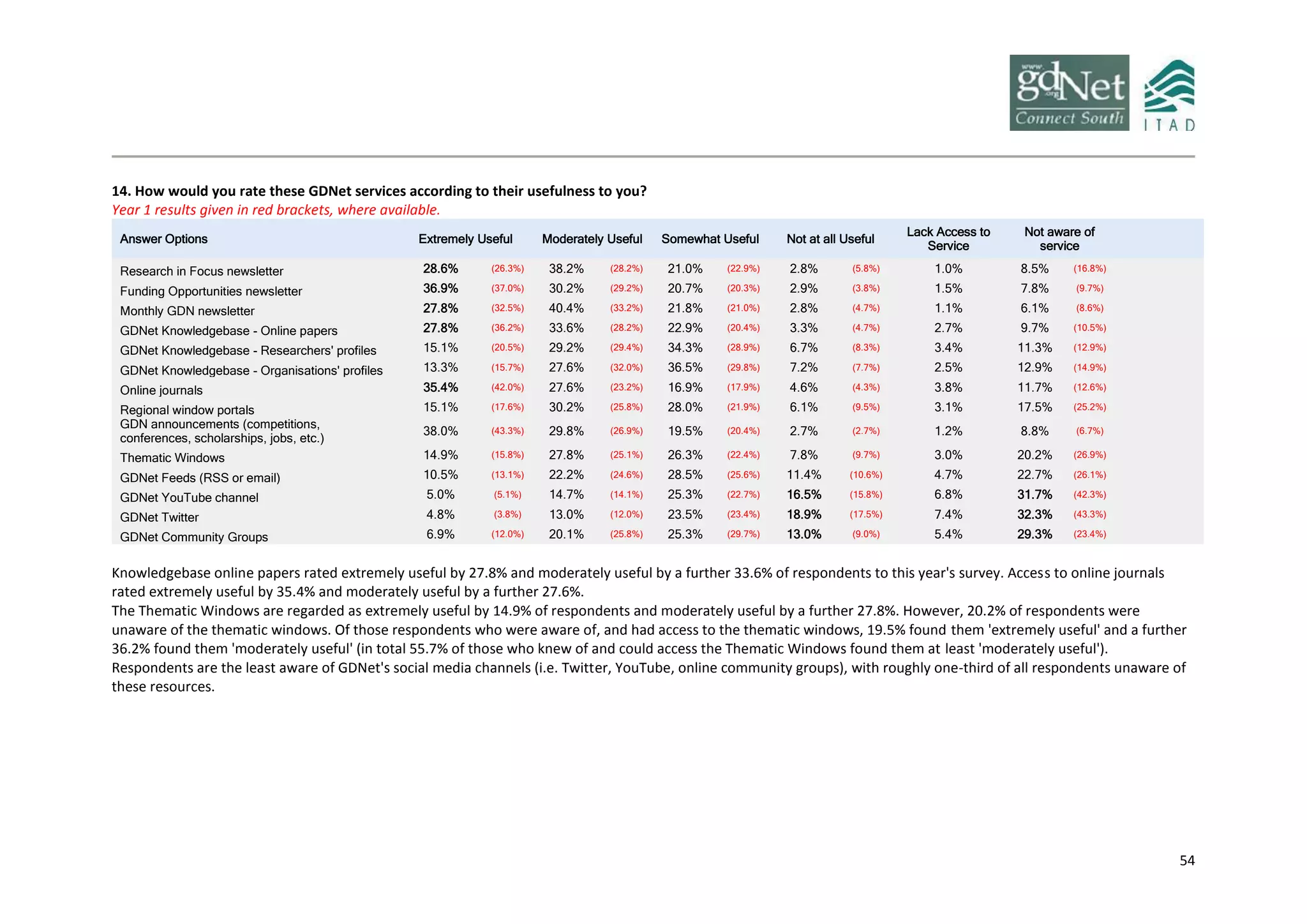
web survey findings, in particular question 14a which asks GDNet users to rate GDNet services according to
their usefulness. A summary of the Year 2 results with the Year 1 results in brackets is provided below.
Answer Options Extremely Useful Moderately Useful Somewhat Useful Not at all Useful
Lack Access to
Service
Not aware of
service
Research in Focus newsletter 28.6% (26.3%) 38.2% (28.2%) 21.0% (22.9%) 2.8% (5.8%) 1.0% 8.5% (16.8%)
Funding Opportunities newsletter 36.9% (37.0%) 30.2% (29.2%) 20.7% (20.3%) 2.9% (3.8%) 1.5% 7.8% (9.7%)
Monthly GDN newsletter 27.8% (32.5%) 40.4% (33.2%) 21.8% (21.0%) 2.8% (4.7%) 1.1% 6.1% (8.6%)
GDNet Knowledgebase - Online papers 27.8% (36.2%) 33.6% (28.2%) 22.9% (20.4%) 3.3% (4.7%) 2.7% 9.7% (10.5%)
GDNet Knowledgebase - Researchers' profiles 15.1% (20.5%) 29.2% (29.4%) 34.3% (28.9%) 6.7% (8.3%) 3.4% 11.3% (12.9%)
GDNet Knowledgebase - Organisations' profiles 13.3% (15.7%) 27.6% (32.0%) 36.5% (29.8%) 7.2% (7.7%) 2.5% 12.9% (14.9%)
Online journals 35.4% (42.0%) 27.6% (23.2%) 16.9% (17.9%) 4.6% (4.3%) 3.8% 11.7% (12.6%)
Regional window portals 15.1% (17.6%) 30.2% (25.8%) 28.0% (21.9%) 6.1% (9.5%) 3.1% 17.5% (25.2%)
GDN announcements (competitions,
conferences, scholarships, jobs, etc.)
38.0% (43.3%) 29.8% (26.9%) 19.5% (20.4%) 2.7% (2.7%) 1.2% 8.8% (6.7%)
Thematic Windows 14.9% (15.8%) 27.8% (25.1%) 26.3% (22.4%) 7.8% (9.7%) 3.0% 20.2% (26.9%)
GDNet Feeds (RSS or email) 10.5% (13.1%) 22.2% (24.6%) 28.5% (25.6%) 11.4% (10.6%) 4.7% 22.7% (26.1%)
GDNet YouTube channel 5.0% (5.1%) 14.7% (14.1%) 25.3% (22.7%) 16.5% (15.8%) 6.8% 31.7% (42.3%)
GDNet Twitter 4.8% (3.8%) 13.0% (12.0%) 23.5% (23.4%) 18.9% (17.5%) 7.4% 32.3% (43.3%)
GDNet Community Groups 6.9% (12.0%) 20.1% (25.8%) 25.3% (29.7%) 13.0% (9.0%) 5.4% 29.3% (23.4%)
3
GDNet blog - http://gdnetblog.org/
GDNet Twitter – https://twitter.com/Connect2GDNet
GDNet YouTube – http://www.youtube.com/user/gdnetcairo
GDNet LinkedIn - http://www.linkedin.com/company/gdnet
16
In broadest terms, GDNet has maintained overall high levels of satisfaction with key services in line with both
the baseline and Year 1 figures. However, GDNet is aiming for a 5% year on year increase in satisfaction as
defined by the output 1 indicator 1 milestone. This has not been achieved but may be considered unrealistic
given the stable and established nature of GDNet’s key services – newsletters and access to online journals.
It is possible to draw a number of headline conclusions from the results:
 In line with both the baseline and Year 1 findings, GDNet users seem satisfied with the key services
provided by GDNet. The KnowledgeBase online papers rated extremely useful by 28% (Year 1 - 36%)
and moderately useful by 34% (Year 1 - 28%) of users. This represents a slight decrease in satisfaction
on both the baseline and Year 1 figures but still represents a high overall level of satisfaction.
 Other services rated as extremely useful include: GDN announcements (38%); Funding Opportunities
newsletter (37%) and, accessing the online journals (35%). As has been clear from the outset, a
priority for Southern researchers is accessing information on potential funding opportunities and
funding sources. This binding constraint is well known to the GDNet yet is one that cannot be simply
overcome through the provision of information and knowledge.
Lessons on the use and satisfaction of GDNet research-orientated online service
derived from the GDNet Gender Audit
The starting point for the GDNet Gender Audit was analysis of the member survey responses from
2011. While the main reasons for registering with GDNet were the same for the male and female
members (gaining funding information, data for their research and to access online journals) there
were differences in relation to use and satisfaction. The primary reason for using GDNet for women
is email newsletters, while for men it is the online database of papers; male GDNet members are
nearly twice as likely to visit the GDNet website on a weekly basis than female members and are also
more likely to have used GDNet’s social media products than female members.
This analysis and the subsequent review of literature about the gender digital divide suggests the
need for separate milestones for men and women for use of and satisfaction with GDNet's services,
and even for individual services. From sharing the Gender Audit with others in the sector, it has also
become clear that there is little value in reporting on the ratio of men to women in terms of use of
services unless a relevant benchmark is available e.g. the proportion of men to women among
southern researchers. On the basis of the Gender Audit, a question was added to the 2012 survey to
help GDNet identify if there are different content needs for men and women.
The full report produced by GDNet consultant Cheryl Brown can be found here -
http://cloud2.gdnet.org/cms.php?id=implementing_gender_audit_of_online_knowledge_service
The Year 1 M&E report highlighted two issues for GDNet to pay further attention to in Year 2.
First, a number of services were less highly rated by survey respondents. Amongst GDNet’s ‘core’ services, the
KnowledgeBase researcher and organisational profiles and Regional Window portals are deemed to be
moderately and somewhat useful by the majority of users. This remains the case in Year 2. In order to better
understand this an additional question was added to the Year 2 survey which asked responders how important
it was to them for GDNet to continue to offer certain services. A summary of the results of question 14b is
provided below:
17
Answer Options
Very
important
Quite important
Not
important
Response
Count
Access to JSTOR and Project Muse
online journals, based on eligibility
criteria
547 (73%) 157 (21%) 39 (5%) 743
A searchable database of researchers
for you to make contact with
453 (61%) 237 (32%) 41 (6%) 731
A webpage on the GDNet website for
you to share your contact details,
research interests and papers
427 (58%) 259 (35%) 50 (7%) 736
Opportunity to participate in GDNet
Online Community Groups
349 (48%) 294 (40%) 84 (12%) 727
The results are interesting as they tend to indicate that whist access to journals is seen as a core GDNet service,
researcher and organisational profiles are also seen by GDNet users to be very important, with a strong
implication that they would be missed if they were closed. This is in slight contrast to the findings of question
14a which hinted that these services were deemed only slightly useful.
Second, the results in both Year 1 and Year 2 point to only limited use and satisfaction with GDNet’s newer
‘Web 2.0’ tools and platforms (GDNet’s feeds, YouTube channel, Twitter, and Community Groups) which are
considered only somewhat useful by between a fifth and a quarter or respondents in both Year 1 and Year 2.
Positively, the Year 2 results indicate a small but significant increase in GDNet user awareness of these services.
For example, 42% of users were unaware of GDNet’s YouTube Channel in Year 1. This has fallen to 32% in Year
2. Statistics on the channel itself tend to reflect relatively strong usage with a total of 29,866 views as of 19
March 2013. Similarly, 43% of users were unaware of GDNet’s Twitter feed in Year 1. This has fallen to 32% in
Year 2. Whilst these statistics point to increased awareness amongst GDNet’s users, the GDNet team would
also be keen to point out that high satisfaction and use of services of this nature is unlikely across GDNet
entire, rather amorphous and passive user base. The ‘90 – 9 – 1 rule’ is generally accepted by knowledge
brokering experts whereby 90% of knowledge network or platform members are passive and engage ad hoc
and periodically, 9% of users are passive but visit regularly, and only 1% can be considered engaged users who
constructively contribute to the platform or network. Therefore it is sensible of GDNet to develop a strategy
that aims to engage the 9% and 1% of regular users. Therefore, the role GDNet’s Web 2.0 tools and services
play with this smaller but active ‘core’ user base is what is important as well the how the tools allow GDNet to
engage with different users in different contexts and at different times – at conferences and training events
etc. With this in mind a more nuanced interpretation of the web survey results tends to indicate that the
GDNet team is getting more sophisticated at engaging and catering for the needs of different users across their
user base, combining established core services to general users as well as a range of services for more engaged
users.
There are a small number of anomalies between the webstats and the web survey, highlighting some issues
that require further interrogation and explanation by GDNet during Year 3:
 More detailed and nuanced interrogation and investigation on gender-based demand and use of
GDNet services – see table above.
 Free access to online journals - Since the programme was conceived, but particularly during Year 2,
there has been a big change in policies on open access. Most recently the World Bank and the
Welcome Trust both launched open access policies; JSTOR has opened free access to Africa, but now
restricts some access to India and Pakistan). In contrast, GDNet access to JSTOR and Project Muse
online journals is viewed by users as a core service (73% of users believe it is very important that
GDNet continue to provide free journal access) yet the web stats indicate that there is an average of
only 84 online journal sessions through GDNet per month. GDNet should further investigate this
anomaly in order to establish the continued value of free access to online journals in an era of
increasing open access.
 Visitors from the Global South - The percentage of visitors to GDNet from the Global South appears to
be between 30 and 40% and may be falling (32% in Year 2 compared to 39% in Year 1) according to
18
the web statistics, yet the researchers from the Global South are main target audience for GDNet.
This has a number of implications:
o GDNet should be more explicit about how the web stats identifying visitors from the Global
South are defined and generated. Generating location statistics based on IP address is
notoriously unreliable. The web survey results seem to suggest that a higher proportion of
GDNet users are based in the Global South than the web stats indicate. Web survey question
3 lists the top 8 countries in which users live with the USA (no. 4 with 2.7%) as the only
Western country and India (18.3%) and Nigeria (6.7%) first and second respectively.
o In terms of increasing users from the Global South, GDNet initiated the Connect South
campaign during Year 2.
4
The web survey shows that one third of users have heard of the
campaign which is reasonable given the campaign was established during Year 2. During Year
3 GDNet should devise a couple of questions to add to the web survey in order to assess the
impact of the campaign as well as any new knowledge it has generated in terms of GDNet
better profiling GDNet users and their needs, perhaps disaggregated according to general and
engaged users as well as any difference between Southern users in different locations.
Informal feedback from the GDNet team indicates that, through their experience working
with different sets of researchers in different countries, the team is increasingly aware of
subtle but important differences in capacities and knowledge needs across the Global South.
As far as possible GDNet should express these differences and tailor their services
accordingly.
 Use and value of thematic windows – The thematic windows, launched and piloted in Year 1 as a key
value added service for engaged users, are dealt with separately under output 1 indicator 2 below.
 As mentioned in the note under the Outcome section, the 2013 DFID Annual Review raised a concern
over the validity of any findings and conclusion drawn from the GDNet Annual Web Survey which had
a response rate of only 5.4%. Responding to this feedback, the M&E team will investigate ways to
improve the survey in terms engaging a more representative sample in Year 3.
M&E approach
The M&E of the level of use of, and satisfaction with research-orientated online services combines GDNet’s
monthly web statistics with data generated from the annual GDNet user base web survey.
Data management plan
Karim Sobh
 Design, testing and monthly production of standardised GDNet web statistics report.
Shahira Emara
 Monthly collection and quality assurance of web statistics
Robbie Gregorowski
 On an annual basis – assess level of use of research-orientated online services over previous 12
months through analysis of web statistics and through the annual GDNet users web survey, and report
on findings against baseline and lesson learnt to GDNet.
Evidence base
A detailed explanation of the process used to generate the web statistics and GDNet user base web survey can
be found in the Baseline and M&E Framework report.
 Annex 1 provides an outline of the Year 2 web survey questionnaire.
 Annex 2 presents the results and a brief analysis of the Year 2 web survey responses.
4
http://www.connectsouth.org/
19
Indicator 2 - Level of use of and satisfaction with themed services
Year 2 summary – Relatively low initial use of themed services combined with moderate satisfaction
expected to improve in a group of engaged users as themed services become established and further
rationalised.
GDNet piloted a beta version of 11 themed services on 13 July 2011, over half way through the Year 1, and
launched the full set of 23 themed services on 11 November 2011. Therefore the full set of 23 themed services
have been established and further piloted throughout Year 2. Analysis of the web survey and web statistics
indicates that:
 Overall use of the thematic windows is relatively low in comparison to GDNet’s more established core
services. However, this is to be expected of a service is designed to cater for the thematic needs of
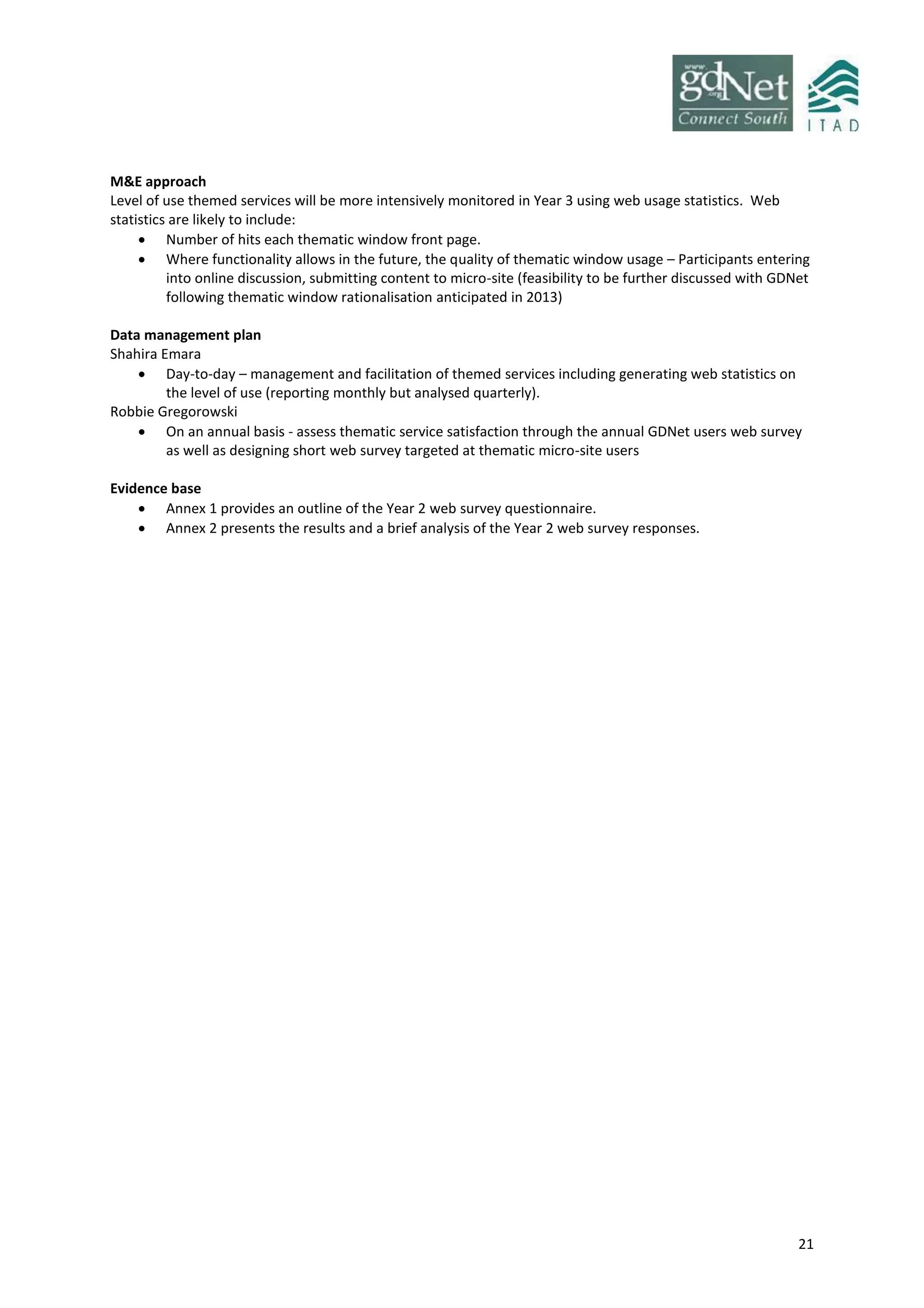
more engaged users. The pie chart below presents the average monthly number of hits to the top
five thematic windows (Agriculture, Education and training, Environment and climate change, Health
and, Information and Communications Technology). Analysis of the limited webstats that GDNet is
able to generate that relate directly to themed service usage indicates that these five themes are
clearly the most popular – these 5 themes account for 30% of total themed service visits across all 23
themes. By contrast the least visited five themes (Labor & Social Protection, Private Sector
Development, Law and Rights, Transport, and International Affairs) account for only 12% of total
theme visits. Or looking at it another way – the top 5 themes receive on average three times as many
hits as the bottom five. It is difficult for GDNet to define the precise level of use as disaggregation of
different ‘pathways’ by which users navigate the site is not feasible. So, for example, a thematic user
may view a number of research abstract highlighted through a thematic window. This activity will be
counted as a Research Paper abstract view on the web statistics but the pathway to the view through
the thematic window will not be identified. The implication is that the web statistics indicating high
overall use of the KB pages as well as the high number of research abstract views are likely to some
extent to be attributable to the thematic windows.
 The web survey also points to a small but growing group of users who find the thematic windows
useful. 43% of survey respondents find the thematic windows either extremely or moderately useful
with a further 26% finding them somewhat useful. There is also some evidence of improved
awareness by users of what is still a new GDNet service – 27% of users were unaware of the thematic
windows in Year 1. This figure had fallen to 20% in Year 2.
20
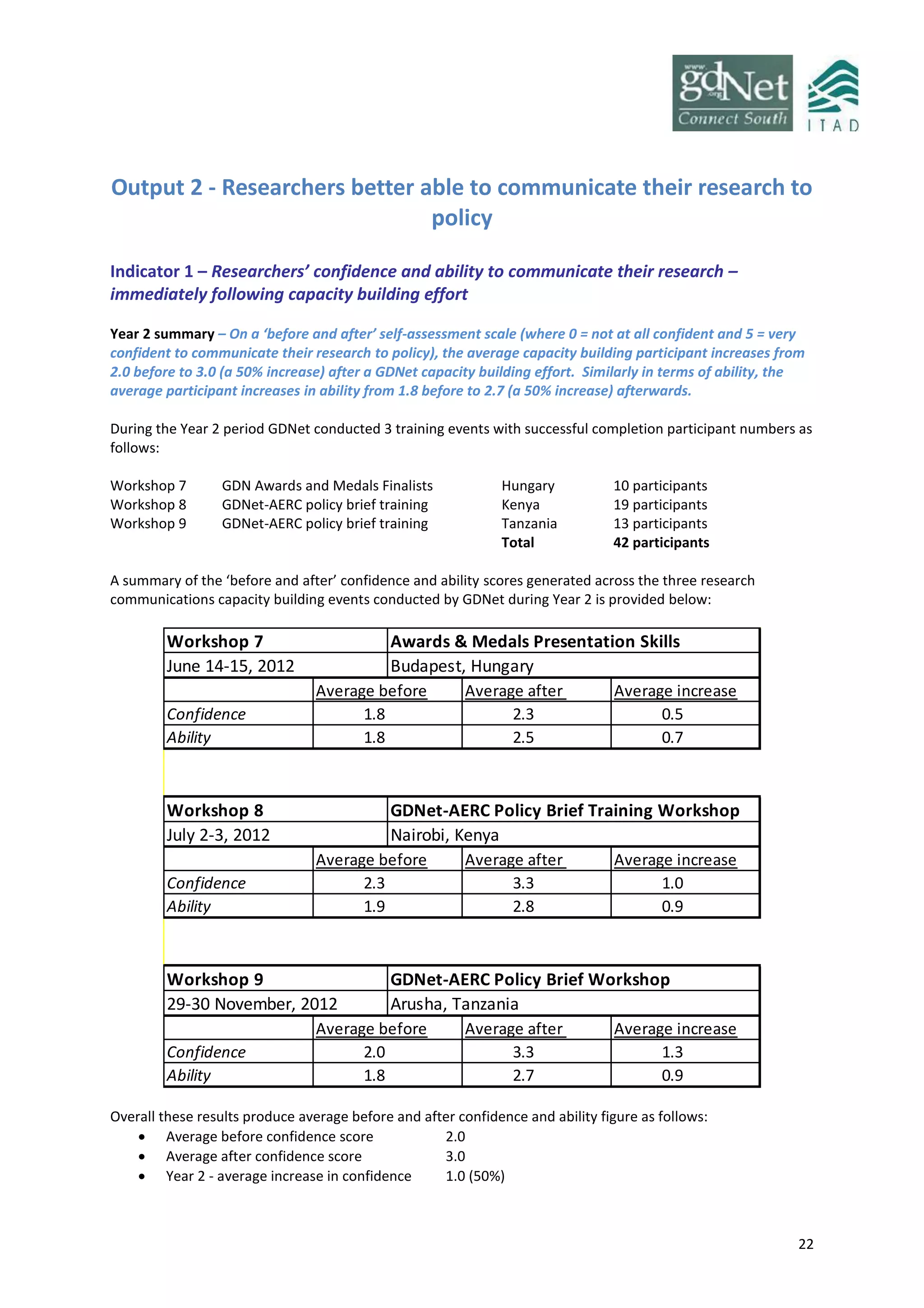
GDNet will use the experience gained from the extended piloting of the 23 thematic windows during Year 2 to
rationalise their scope and enhance their utility to users. Effectively maintaining and facilitating 23 themes is
not feasible given GDNet’s resources as the themes require continual content curation in order to remain
relevant and ‘fresh’. Therefore, based on the usage statistics, GDNet is likely to reduce the number of themes
from 23 down to approximately 10 during Year 3. According to the average monthly hits per month across all
23 themes as presented in the table below, a natural split seems to occur between theme 11 – governance and
those below it. It is anticipated that focussing on a smaller set of themes will further enhance the level of use
and satisfaction as the themes become established as a core value-added GDNet service.
21
M&E approach
Level of use themed services will be more intensively monitored in Year 3 using web usage statistics. Web
statistics are likely to include:
 Number of hits each thematic window front page.
 Where functionality allows in the future, the quality of thematic window usage – Participants entering
into online discussion, submitting content to micro-site (feasibility to be further discussed with GDNet
following thematic window rationalisation anticipated in 2013)
Data management plan
Shahira Emara
 Day-to-day – management and facilitation of themed services including generating web statistics on
the level of use (reporting monthly but analysed quarterly).
Robbie Gregorowski
 On an annual basis - assess thematic service satisfaction through the annual GDNet users web survey
as well as designing short web survey targeted at thematic micro-site users
Evidence base
 Annex 1 provides an outline of the Year 2 web survey questionnaire.
 Annex 2 presents the results and a brief analysis of the Year 2 web survey responses.
22
Output 2 - Researchers better able to communicate their research to
policy
Indicator 1 – Researchers’ confidence and ability to communicate their research –
immediately following capacity building effort
Year 2 summary – On a ‘before and after’ self-assessment scale (where 0 = not at all confident and 5 = very
confident to communicate their research to policy), the average capacity building participant increases from
2.0 before to 3.0 (a 50% increase) after a GDNet capacity building effort. Similarly in terms of ability, the
average participant increases in ability from 1.8 before to 2.7 (a 50% increase) afterwards.
During the Year 2 period GDNet conducted 3 training events with successful completion participant numbers as
follows:
Workshop 7 GDN Awards and Medals Finalists Hungary 10 participants
Workshop 8 GDNet-AERC policy brief training Kenya 19 participants
Workshop 9 GDNet-AERC policy brief training Tanzania 13 participants
Total 42 participants
A summary of the ‘before and after’ confidence and ability scores generated across the three research
communications capacity building events conducted by GDNet during Year 2 is provided below:
Workshop 7 Awards & Medals Presentation Skills
June 14-15, 2012 Budapest, Hungary
Average before Average after Average increase
Confidence 1.8 2.3 0.5
Ability 1.8 2.5 0.7
Workshop 8 GDNet-AERC Policy Brief Training Workshop
July 2-3, 2012 Nairobi, Kenya
Average before Average after Average increase
Confidence 2.3 3.3 1.0
Ability 1.9 2.8 0.9
Workshop 9 GDNet-AERC Policy Brief Workshop
29-30 November, 2012 Arusha, Tanzania
Average before Average after Average increase
Confidence 2.0 3.3 1.3
Ability 1.8 2.7 0.9
Overall these results produce average before and after confidence and ability figure as follows:
 Average before confidence score 2.0
 Average after confidence score 3.0
 Year 2 - average increase in confidence 1.0 (50%)
23
 Year 1 – average increase in confidence 1.3 (50%)
 Baseline – average increase in confidence 1.2 (39%)
 Average before ability score 1.8
 Average after ability score 2.7
 Year 2 - average increase in ability 0.9 (50%)
 Year 1 – average increase in ability 1.6 (89%)
 Baseline – average increase in ability 1.1 (38%)
Confidence – Across the 3 GDNet events from June – November 2012, the average GDNet researcher is
moderately confident (2.0 out of 5) to communicate their research to policy before any training/capacity
building has been provided by GDNet. This average confidence figure rises to 3.0 immediately following a
training / capacity building event. This equates to an average 50% increase in confidence immediately
following a capacity building event. This matches the Year 1 figure. This figure demonstrates that GDNet’s
training and capacity building activities are effective in terms of the immediate transfer of confidence to
attendees.
Ability – Across the same events, the average GDNet researcher is slightly less able than confident (1.8 out of 5)
to communicate their research to policy before any training/capacity building has been provided by GDNet.
This average ability figure rises to 2.7 immediately following a training / capacity building event. This equates to
an average 33% increase in ability immediately following a capacity building event. This is significantly down
on the Year 1 average ability increase GDNet was able to deliver.
These results imply a number of broad conclusions:
 GDNet continues to provide effective training and capacity building activities which demonstrate a
significant and immediate transfer of confidence and ability to attendees. The GDNet team have
defined an effective approach to training and capacity building and are competent and confident in its
delivery.
 Between Year 1 and Year 2 GDNet has not been able to deliver an increase in the magnitude of
confidence and ability scores as they did between baseline and Year 1. Rather the magnitude of the
increase in confidence transfer seems to have stabilised broadly in line with the Year 1 figures. The
magnitude of the increase in ability transfer is considerably lower than the Year 1 figures. This
divergence between the increases in confidence and ability is hard to explain. One possible
explanation is that following the training, researchers are confident (in terms of knowledge transfer)
but have not yet put the knowledge into practice (feel less able).
 It is interesting to note that the magnitude of the increase in confidence and ability for the Awards
and Medals Finalists (workshop 7) are significantly lower than the other two workshops. Discussing
this with the GDNet team reveals a couple of explanations and conclusions:
o As ‘eminent’ / ‘emerging’ Southern researchers, the Awards and Medals Finalists are likely to
have more specific and advanced research communications needs and demands. Feedback
from them tends to indicate that they would like specific training on using social media and
other online platforms and tools to support research communications rather than broader
training in drafting and presenting policy briefs etc.
o One implication is that GDNet should attempt to tailor the training and capacity building
events according to their understanding of the attendees. In particular, GDNet should pilot a
more advance and challenging event for the next cohort of Awards and Medals Finalists at
the 2013 GDN Conference in Manila.
o More broadly, the GDNet team feel that they now have a better understanding of Southern
researchers’ needs based on experience of conducting training in a variety of contexts. Put
simply, researchers emanating from Asia and Latin America tend to want to focus more on
the use of social media for research communications and enhancing their skills in this area.
Researchers from Central, Southern and Eastern Africa tend to need support with key
research communications skills such as synthesising key messages, drafting policy briefs and
24
putting together presentations. This perhaps reflects their own challenges in accessing
resources and technology. In future, the GDNet team will endeavour to tailor the content
and objectives of each of the workshops according to their understanding of the nature of
skills and capacity of specific sub-sets of Southern researchers. These and other lessons to
have emerged from GDNet’s output 2 activities are reflected in the output 4 indicator 1 log
template, indicating GDNet’s enhanced capacity as a learning programme.
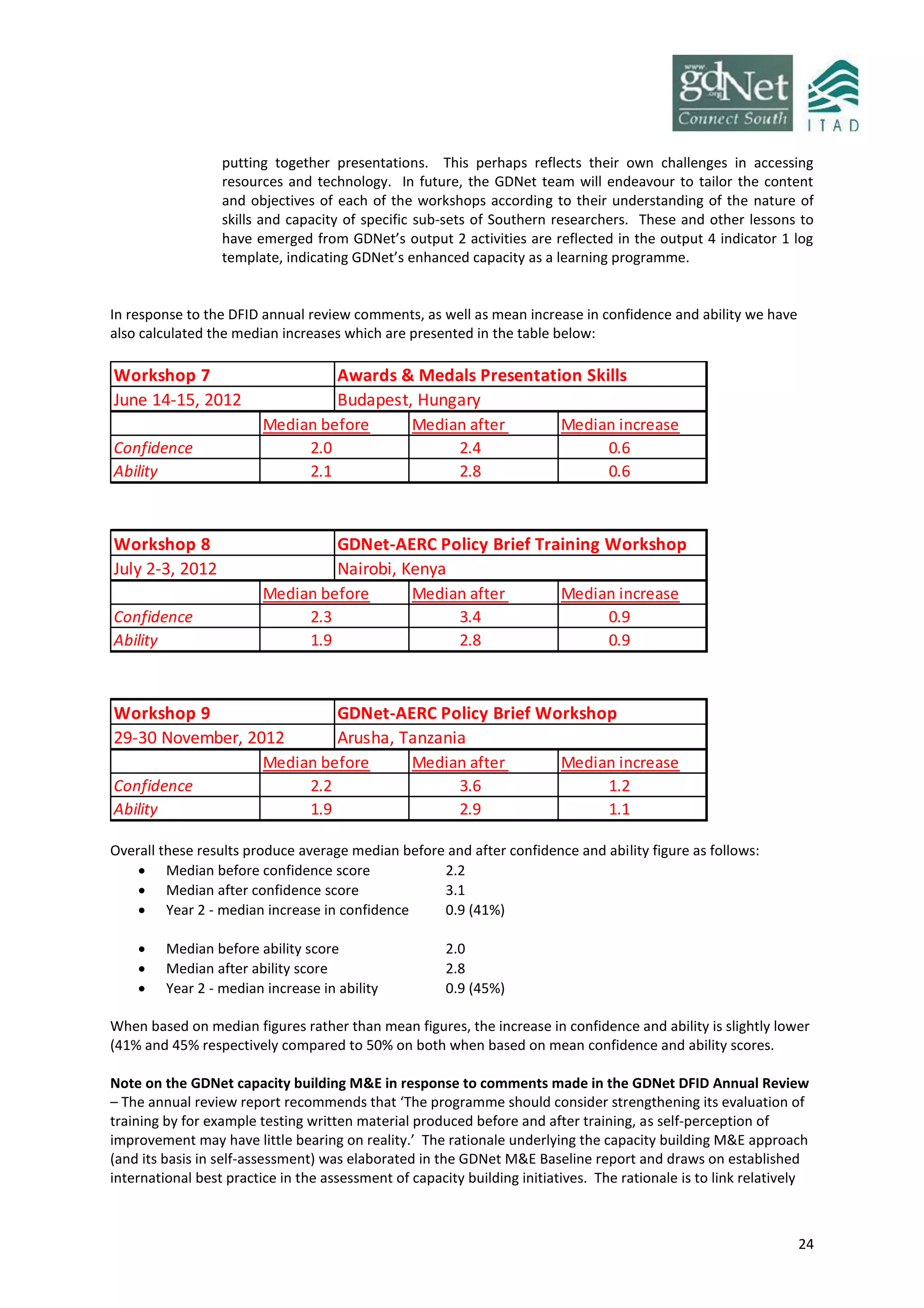
In response to the DFID annual review comments, as well as mean increase in confidence and ability we have
also calculated the median increases which are presented in the table below:
Workshop 7 Awards & Medals Presentation Skills
June 14-15, 2012 Budapest, Hungary
Median before Median after Median increase
Confidence 2.0 2.4 0.6
Ability 2.1 2.8 0.6
Workshop 8 GDNet-AERC Policy Brief Training Workshop
July 2-3, 2012 Nairobi, Kenya
Median before Median after Median increase
Confidence 2.3 3.4 0.9
Ability 1.9 2.8 0.9
Workshop 9 GDNet-AERC Policy Brief Workshop
29-30 November, 2012 Arusha, Tanzania
Median before Median after Median increase
Confidence 2.2 3.6 1.2
Ability 1.9 2.9 1.1
Overall these results produce average median before and after confidence and ability figure as follows:
 Median before confidence score 2.2
 Median after confidence score 3.1
 Year 2 - median increase in confidence 0.9 (41%)
 Median before ability score 2.0
 Median after ability score 2.8
 Year 2 - median increase in ability 0.9 (45%)
When based on median figures rather than mean figures, the increase in confidence and ability is slightly lower
(41% and 45% respectively compared to 50% on both when based on mean confidence and ability scores.
Note on the GDNet capacity building M&E in response to comments made in the GDNet DFID Annual Review
– The annual review report recommends that ‘The programme should consider strengthening its evaluation of
training by for example testing written material produced before and after training, as self-perception of
improvement may have little bearing on reality.’ The rationale underlying the capacity building M&E approach
(and its basis in self-assessment) was elaborated in the GDNet M&E Baseline report and draws on established
international best practice in the assessment of capacity building initiatives. The rationale is to link relatively
25
short term changes as a result of a capacity building event (reaction and learning) to more significant changes
in terms of behaviour and results.
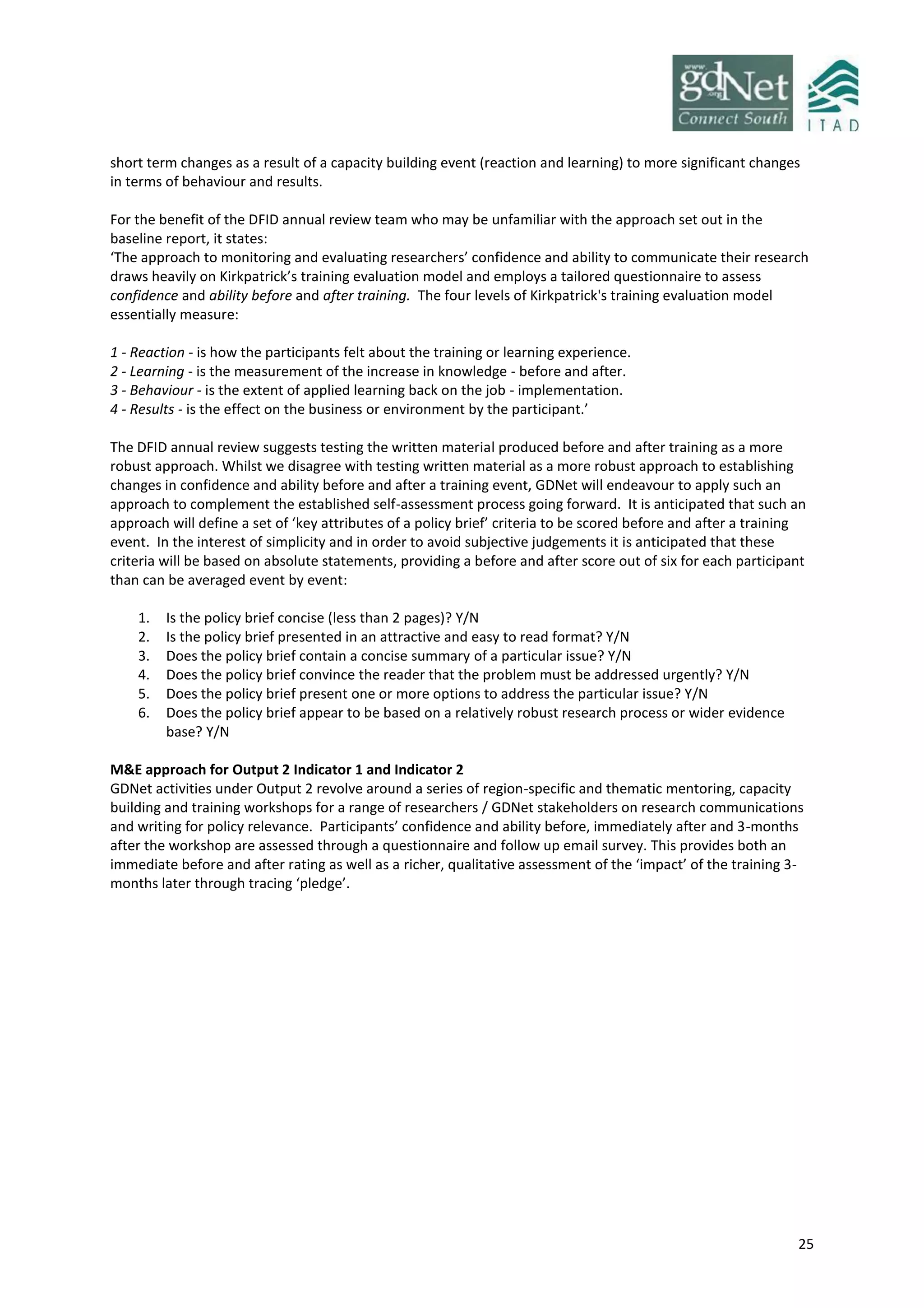
For the benefit of the DFID annual review team who may be unfamiliar with the approach set out in the
baseline report, it states:
‘The approach to monitoring and evaluating researchers’ confidence and ability to communicate their research
draws heavily on Kirkpatrick’s training evaluation model and employs a tailored questionnaire to assess
confidence and ability before and after training. The four levels of Kirkpatrick's training evaluation model
essentially measure:
1 - Reaction - is how the participants felt about the training or learning experience.
2 - Learning - is the measurement of the increase in knowledge - before and after.
3 - Behaviour - is the extent of applied learning back on the job - implementation.
4 - Results - is the effect on the business or environment by the participant.’
The DFID annual review suggests testing the written material produced before and after training as a more
robust approach. Whilst we disagree with testing written material as a more robust approach to establishing
changes in confidence and ability before and after a training event, GDNet will endeavour to apply such an
approach to complement the established self-assessment process going forward. It is anticipated that such an
approach will define a set of ‘key attributes of a policy brief’ criteria to be scored before and after a training
event. In the interest of simplicity and in order to avoid subjective judgements it is anticipated that these
criteria will be based on absolute statements, providing a before and after score out of six for each participant
than can be averaged event by event:
1. Is the policy brief concise (less than 2 pages)? Y/N
2. Is the policy brief presented in an attractive and easy to read format? Y/N
3. Does the policy brief contain a concise summary of a particular issue? Y/N
4. Does the policy brief convince the reader that the problem must be addressed urgently? Y/N
5. Does the policy brief present one or more options to address the particular issue? Y/N
6. Does the policy brief appear to be based on a relatively robust research process or wider evidence
base? Y/N
M&E approach for Output 2 Indicator 1 and Indicator 2
GDNet activities under Output 2 revolve around a series of region-specific and thematic mentoring, capacity
building and training workshops for a range of researchers / GDNet stakeholders on research communications
and writing for policy relevance. Participants’ confidence and ability before, immediately after and 3-months
after the workshop are assessed through a questionnaire and follow up email survey. This provides both an
immediate before and after rating as well as a richer, qualitative assessment of the ‘impact’ of the training 3-
months later through tracing ‘pledge’.
26
Indicator 2 – Researchers’ confidence and ability to communicate their research –
sustainability of capacity building effort
Year 2 summary – Second set of six ‘pledge’ cases developed from GDNet workshops 7-9 held during Year 2
reflecting the sustainability and application of GDNet’s capacity building effort. Four of six Year 1 cases
developed with 3 and 12-month follow up.
It has always been the understanding of the GDNet team that increased confidence and ability immediately
following a capacity building event is not particularly meaningful. Rather what is more important is a long term
and sustainable increase in confidence and ability, and what this means for how these researchers do their
jobs. Output 2 indicator 2 assesses this using the ‘pledge’. The long term sustainability and impact of GDNet’s
capacity building efforts are assesses 3-months after each workshop through a ‘pledge’. Each participant is
asked to respond to the following:
Question – What will you do differently as a result of attending this workshop?
Pledge – ‘Within the next 3 months I will…’
All 3 and 12 month pledge follow up data GDNet received to date is presented in chronological order by
workshop / event in an Excel database. A sample of the most informative ‘pledge’ statements generated in
Year 2 (workshops 7 to 9) is presented below.
Workshop 7 – Awards and Medals Presentation Skills
Pledge :
I will be presenting my papers without any hesitation.
3-month follow up:
After coming back from Budapest, I have shown improved communication skills both in terms of interpersonal
as well as professional level. The personal guidance extended by your communication team was superb and
excellent. This has helped me to modify my presentation to the audiences suitability and helped to formulate
my oral presentation with the relevant wording and communications. I have submitted a paper for the
presentation whose wording of the findings were critically appreciated by the climate change community in
India. Further, I am presenting several papers and oral presentation in India pertaining to my works. My
presentation on "Critical Concerns in Social Sector Budgeting in India" and also "Budgeting for Water Resources
Development in India" have been greatly appreciated. Further, the communication skills learnt at Budapest
meeting have helped to sharpen my advocacy skills which are bearing significant result in my access to
governmental apparatus
Workshop 8 – GDNet-AERC Policy Brief Training Workshop - Nairobi
Pledge :
I will submit my policy brief to AERC for publication; I will organize a national policy workshop where we will
share our findings with policymakers and the media.
3-month follow up:
l have submitted my policy brief to the AERC for publication. Concerning pledge number 2, we had the national
policy workshop on September 13, 2012. The title of our project is "the effect of socioeconomic and national
health insurance status on household demand for prenatal and postnatal health care in Ghana", policymakers
from the Ministry of health, the national health insurance authority, NGOs, midwives, medical doctors and the
media were invited and findings were shared with them. The dissemination took the form of a 20 minute
presentation of the research findings, followed by a discussion. The participants were happy that we had
undertaken such a study, and expressed their appreciation for the useful recommendations we made to them.
My participation in your workshop helped me greatly in the selection of the participants (audience) for our
workshop and also in deciding on the mode of communicating the findings and the policy recommendations.
27
Pledge :
Prepare policy messages from my previous research work and also help others doing so
3-month follow up:
Let me start by saying that the Training on Policy Brief in Nairobi was more than useful to me and my
department. When I returned from that training, I shared the materials with my colleagues at the Economic
Policy Analysis Unit of the ECOWAS Commission. I also made a presentation that helped them grasp the
fundamental message from your training. Since my arrival from Nairobi, we have been preparing Policy briefs
from our in-house research. That really helped us to present our research findings to our Management team. To
sum it up, your training was very timely and useful to all of us into research and policy analysis. I am really very
grateful to you and the AERC for making this possible.
Pledge :
I will make sure that our policy brief and other briefs that I will write from other research papers I have done are
out for dissemination; and will also try to write for newspapers in my country
3-month follow up:
Pledge 1: I worked on AERC policy brief and submitted it. We have printed copies of the brief and disseminated
them to policy makers and comments are positive. People appreciate the briefs and this means that u did a
wonderful job. At the institute where am based as a research fellow (Policy analysis and development Research
Institute (PADRI)) I am writing policy briefs from IDRC Project on Social Protection in Uganda.
We are also thinking about training other researchers from Universities, NGOs and research organization in
Uganda Under PADRI on how to write policy briefs using the experience from workshop. This is because we have
realised that so many researchers in Uganda do not know how to write policy briefs. This is at thinking stage
though. Pledge 2: I have not got any headway on this but we have opportunity to write for upcoming regional
newspaper which will be running weekly in Uganda and Rwanda. We got slot to start writing topical issues on
economy.
Pledge :
Try to disseminate my research outputs in line with what I have learned; give my first press-conference.
3-month follow up:
I had planned for the country workshop this December, unfortunately, I had a poor response from policy makers
because of timing and I am postponing it to February/march next year.
I have not been able to give a press conference yet. I have not chickened out. I will do it at the appropriate time.
Please, I feel like discussing this idea with you. I need help to be connected to people and organisations that can
help me kick start it.
Pledge :
Select the targeted audiences; select the right media to access the audiences; get the message through in
repeated efforts
3-month follow up:
As you know in Africa everything is politics and politics driven. Research outputs are not seen as potential inputs
for policy, rather as propaganda tools. Most of the time only favourable findings are welcome. To be frank I
don't feel very free in communicating research outputs. I have to be cautious. One of my worries was that our
research output was covering the period 1994 to 2004. Findings in this period may not be seen as relevant in
Ethiopian context and in the eye of those who influence policy. They could be interpreted as picking the bad
moment for defacing the performance. Therefore I had to extend the research coverage to cover the years after
2004 and bear the consequence. I have done that to a satisfactory level (with a little left) and I have planned a
dissemination workshop for November 2/2012. I have made a preliminary selection of my audience including
people from the media. Two of my pledges are on the way and the third is a sequel.
Workshop 9 – GDNet-AERC Policy Brief Training Workshop - Arusha
28
Pledge :
I will organise a dissemination workshop of my research on the impact of foreign aid on growth factors in Sub-
Saharan Africa.
3-month follow up:
The policy brief Training Workshop was a real opportunity for me to understand major advances on research
communications. The workshop familiarized me with a broad range of writing of Policy Brief. In fact, the
workshop gave me tools to write a good policy brief. I will organize the dissemination workshop of my research
at my Research Centre. Actually, the paper has been sent to AERC to the final evaluation. I am waiting
comments and suggestions from AERC reviewers to improve the quality of paper. After taking in account
suggestions and comments, i will organize the workshop dissemination. At this moment, i could not give you a
schedule.
Pledge :
I will prepare a policy brief from my research project and a new article for consideration by the press/media
3-month follow up:
I have in position to prepare both the policy brief and media article using the knowledge gained from the
workshop. We have not published the media article because my research colleague advised that we could share
it with the media after the dissemination workshop of our project to policymakers and academics within
Uganda. I intend to distil policy briefs for some of my other research work and if acceptable I could share them
with you or Andrew for review.
Pledge :
I will attempt to make my research more relevant.
3-month follow up:
The greatest obstacle is really breaking the barriers to reach out to the intended research consumers, in
particular those in policy arena. Nonetheless, efforts in this direction are on-going.
As well as generating new pledges and follow up in Year 2 from workshops 7 to 9, GDNet has also engaged past
GDNet training and capacity building recipients to provide 12-month follow up on their pledges. Due to an
expected non-response rate over pledge, 3-month follow up, and 12-month follow up, the sample after 12
months is much smaller. Nevertheless, a significant number of attendees have responded with 12-month
feedback on their pledges. A sample of these from workshops 1 to 6 conducted in the baseline and Year 1 is
provided below:
Workshop 5 - PEM Research Communications Workshop
Pledge :
Redo the policy brief and contact media on communicating the results
3-month follow up:
We have redone the policy brief on water sector a couple of months after the workshop. We have
communicated some of our recent results to donors and other stakeholders, however, as the on-going products
are not yet finalized we have not prepared anything that can be disseminated to media. As indicated in Delhi
workshop, we do plan to communicate some of our results to media institutions. So, half of the promise is done.
We will be communicating the progress (including our communication outputs) to GDN.
12-month follow up:
Last year we have made 6 town-hall meetings with around 300 citizens from Yerevan (capital) and 2 towns and
several surrounding villages. That communication/dissemination/outreach mode was the primary mode for us
during the last year as we were in the process of consultations during the finalization of our policy simulation
papers. We have submitted our policy simulations at the end of the 2012 but we still in the process of final
formulation based on the feedback from GDP technical advisers. Thus, the papers are not final yet to print and
disseminate, therefore no media intervention was made as of today.
29
Pledge :
Set up a network among stakeholders related to policymaking process
3-month follow up:
The process to set up the network is still going. However, there are several obstacles to implement the idea.
Based on the plan, we will start the network creation process through an FDG that involves stakeholders related
to education, health and water sector. The purpose of this FGD is to explore and gather information about any
development issues related to education, health and water sector, particularly the issues that happen recently.
Also this FGD process will try to set up a strategy on how each stakeholder can take role in policy changing. This
FGD is not happened yet, since it is quite difficult to find a time to gather all those people. Besides that it is quite
hard to find some people who have the same concern or interest with CEDS, mainly for this project. So far, the
effort that I have done to start this network is by identifying the stakeholders and make a list of them. This
process is done by conducting some informal meeting with some people. I hope the FGD can be held quite soon. I
plan to set up the FGD in the middle of March.
12-month follow up:
* The FGD was held around July last year. On that FGD we invited several people from different background,
such as NGO workers, health expert, government budget expert, and academicians. At this first FGD we agreed
to establish a network between academicians and CSO activists. After this FGD we held several regular
discussions. Normally the discussion was held once in a month.
* During the discussion process we found that creating network among those actors in not really easy, mainly in
finding the common interest from all the participants. We thought there is a need to create some activities that
involve all the participants.
* Due to this reason, on the last discussion that was held on November last year, we agreed to held a workshop
that invites different stakeholders who have concerns on public policy. We took health sector as the main issue
for the workshop. The purpose of this workshop is mainly to design the advocacy strategy to make a change of a
public policy, especially on health issue. Unfortunately, because of the workload each participant, this workshop
still cannot be executed. So far, the curriculum of the workshop has been designed, we're still waiting for the
right time to run the workshop. Perhaps next month.
Pledge :
Prepare a press release and a policy brief
3-month follow up:
Following your guidelines during the October PEM Communications Workshop in New Delhi, we have prepared
three policy briefs for each of the three sectors on education, health and water services. Policy briefs have not
been disseminated because we are in the midst of preparation for a major conference to present these policy
briefs to our target audience composed mostly of policy makers and sectoral stakeholders. The Conference will
be held on March 13 of this year. A press release will come shortly prior to the Conference. We are also at the
thick of preparation in launching our website to be able to disseminate the results of our study on Strengthening
Institutions in Public Expenditures Accountability. The PEM Asia Workshop has significantly helped us in crafting
the requirements of GDN especially in the formulation of policy briefs and technical presentations.
12-month follow up:
1. Prepared one (1) policy brief on the health sector using the BIA as tool of analysis.
2. Launched our PEM webpage linked to the Center for Research and Communication website.
3. Conducted Roundtable discussions with policymakers such as members of the Congress and Department
officials and key stakeholders such as CSOs and private organizations interested in social responsibility programs
in health, water and education.
4. On January 29, we have been invited to a roundtable discussion with Senator Ramon Magsaysay Jr--an
auspicious chance to inform him of the results of our PEM research, focusing on the need for evidence-based
research specifically on public accountability related to budget expenditures on the three social sectors of
education, health and water. The BIA tool of analysis will be highlighted in this activity.
5. The March 2012 conference did not push through but on February 26-27 this year, we will finally conduct the
Policy Conference on the Issues, Challenges and Initiatives facing the Education, Health and Water sectors. The
30
conference seeks to raise the level of awareness on policy issues and concerns affecting the three social sectors.
The research outcomes we shall present in the said conference can aid development policymakers in making
informed judgments in formulating strategies and pushing for reforms in the three sectors. The conference will
also discuss current initiatives in addressing policy issues/challenges which the participants may find
appropriate and useful in their respective organizations and communities. Policymakers, members of POs and
NGOs, the academe and selected members of media will be in attendance.
Workshop 6 - GDNet-AERC Policy Brief Training Workshop
Pledge :
Review the way of writing key abstracts, presenting the results of my work to colleagues, policymakers and
media
3-month follow up:
I am currently at the Centre of Studies of African Economies (CSAE), Oxford University. And, today (29.02)
(between 1-2.30 PM local time) I presented my paper titled "Trade liberalization, labour market reform and
firm's labour demand: evidence from Cameroon" at the CSAE seminar. The feedback I received show that,
relative to the past (i.e. before the workshop in Nairobi) I made a lot of progress regarding two points: (1) the
abstract, and (2) policy implications of the results. You remember we had a group work on (i) the meaning of
policy implications of the results, and (ii) how to present them. This shows that I made a lot of progress on
writing the abstract as well as the presentation of the policy implications. However, and still from the feedback I
received, I still have some problems on how to present the results, namely the background information. Any
assistance from you or GDN is still welcome.
12-month follow up:
Yes I attended the ATPS annual workshop in 2011 and i presented my paper co-authored with my colleague
(Bayo Ajala) titled "Towards effective research uptake and innovative communication of research projects in
Nigeria ". Yes the output has been published in the proceedings of the workshop which is available on the ATPS
website. I work for the government and there are laid down protocols to sharing the results of our project. On
my part l have been able to demonstrate part of what I have learnt in many of the projects I am involved in at
work
The pledges provide not only an insight in to the nature of the application of the capacity building but also a
very clear link from training to increased confidence / ability to direct application by the researchers – the
sustainability of the capacity building effort. A number of pledges point directly to higher order outcomes and
possibly even impact (all be it small scale) as a result of GDNet’s capacity building efforts. For the purposes of
GDNet M&E, some also point to researcher interaction with the policy domain as a direct result of GDNet
support and hence should be captured and claimed under output 3 indictor 2. The follow up, particularly the
12-month follow up, also points to the complexity of any change pathway from enhanced research capacity to
informed policy. This clearly highlights the limited extent of GDNet’s contribution as well as the extent to
which change is dependent on multiple exogenous factors.
That said, now that GDNet has 3 years of training and capacity building experience, there is an opportunity for
GDNet to more systematically interrogate the pledge follow up. This will allow GDNet to synthesise any lessons
that have emerged as well as trace the change pathways of any particularly interesting or insightful pledges -
from the provision of training right through to the application / use of new skills and knowledge in terms of
higher order outcomes or impact. Ultimately this may allow GDNet to start to make some claims about
GDNet’s contribution to enhanced research uptake and evidence informed policy through training and capacity
building.
Data management plan
Robbie Gregorowski / ITAD
 Design and testing of workshop questionnaire template and results
Zeinab Sabet / GDNet
 On-going – defining confidence and ability statements in advance of each workshop,
31
 Facilitating questionnaire completion by participants at each workshop,
 Recording results following each workshop in the results template,
 Facilitating the 3-month ‘pledge’ email and telephone follow-up with a sample of participants (approx.
25%) following each workshop and completing the pledge follow-up template,
 Facilitating the 12-month ‘pledge’ follow up with those who submitted 3-month follow up.
 Synthesis of pledge results into a small number of cases on an annual basis,
 Follow-up on training event feedback to extract learning for GDNet and feed this back into improved
training and capacity building provision.
Evidence base
GDNet holds the capacity building workshop questionnaire responses, including the pledge statements and the
3-month follow up response in an Excel database designed by ITAD. It is not practical to include this as an
annex but GDNet is happy to share the database with interested parties.
32
Output 3 - Knowledge networking between researchers and with
policy actors increased
Indicator 1 – GDNet ‘user base’ interaction
Year 2 summary – GDNet have continued to increase user base interaction in Year 2, demonstrating a
maturing ability to deploy a range of tools and platforms (particularly social media) to engage a broad
spectrum of GDNet users.
GDNet user base interaction involves Southern researchers with whom GDNet has built a sustained
engagement – through attendance at a capacity building event, conference, or membership of a community or
thematic group. GDNet logs all its interaction with its ‘user base’ in a log template presented in Annex 5. The
aim of the template is to set out ‘at a glance’ the nature of the interaction, the results that this interaction
produces, as well as any lessons GDNet learns as a result of this interaction. The purpose of the log is to
provide a ‘living’ document which GDNet staff can interrogate periodically in order to learn lessons on the
nature of their interaction with their key set of stakeholders. The log is designed to be analysed and
synthesised annually in order to establish the extent of user base interaction. Indicators of increased user base
interaction will relate to sustained or even increased blog views and responses, sustained or increased
subscriptions, views and ‘click throughs’ to GDNet social media such as Twitter and YouTube. It is anticipated
that log will also include indicators of more strategic and in-depth user base interaction such as collaboration
with specific partners to produce research communications products as well as panels and presentations at
workshops and conferences.
GDNet held their first team synthesis and learning retreat on 31 March 2013. A summary of sum of the key
reflections, messages, and conclusions taken that were distilled during this event are presented below:
GDNet Team user base interaction log synthesis
On 31 March 2013 the GDNet team came together at their first learning retreat to identify, discuss and reflect on the
lessons generated from implementing the programme over the previous year. This table presents the findings from the
synthesis discussion of the output 3 indicator 1 log template on user base interaction. The GDNet team focused on
discussing: the nature of the interaction GDNet has been facilitating throughout 2012 with its user base; interrogating the
results of different types of interaction; and drawing out some reflections and lessons learned to be taken into
consideration when undertaking future activities. A copy of the log template is presented in Annex X. This is designed to
be a ‘living’ document which all GDNet team members are invited to input in and update.
The key messages to emerge from the learning retreat are as follows:
 Understanding of audience nature: GDNet have developed a better understanding of the nature of our different
audiences. The log demonstrates that the level of engagement shown by a specific audience differs according to
its nature; i.e. online users are definitely easier to engage at conferences and events than audiences that are
unfamiliar with social media tools. Therefore, we have been trying throughout 2012 and through different
activities to use different interaction tools (including but not limited to social media ones) to engage different
types of audience.
 Blog evolution: Although the use of social media was not defined in the original planning of the GDNet
programme and logframe, there has evolved an increasing awareness of and dedication to its role and
importance nowadays to the programme. This is due to the exposure it provides for the programme, as well as
the global activities GDNet takes part of and which confirms social media as the most effective and powerful way
to communicate today. Throughout 2012, the team has been working to better understand how to use social
media as communication and interaction tools in GDNet’s different outputs and activities. As part of the
integration process, GDNet are ensuring that team capacity is built and sustained accordingly. A GDNet Social
33
Media Strategy was developed towards this purpose.
 Setting metrics to measure success: Although a key element when reaching a broader audience, embedding
social media in our activities was not enough to improve the researcher to researcher interaction. There was a
clear need for metrics to be set in order to monitor the GDNet online presence on the different social media
tools and the way such presence would facilitate user base interaction.
 M&E of social media: In response to the perceived need for metrics to monitor and explain the use and value of
GDNet’s social media, the team has developed a set of metrics and indicators which they plan to produce on a
monthly and quarterly basis. Based on these indicators, the team has produced a first draft GDNet Social Media
Annual Report which is presented in Annex 6.
 Revisiting our approach: A key lesson learnt this year is the need to strategically reposition the GDNet blog to
focus on effective engagement with and amongst the GDNet user base. The team has increasingly recognised
the diversity of the GDNet user base and the potential of social media as a means of interaction. To respond to
this, the blog needs to have a clear niche and focus, and metrics to be set out that would look for an increase in
interaction, rather than number of visits. This has implications for the way GDNet does things. The team are
looking into repositioning the blog so it can address specific requirements for specific people and in redesigning
the blog, looking into means of catalysing and promoting interactions among the user base. Other next steps
during Year 3include revisiting our social media strategy, streamlining the skillset of our team, and building our
institutional capacity as a knowledge-broker.
A review of the output 3 indicator 1 log template together with the reflections to emerge from the learning
retreat reveals three significant conclusions:
 User base interaction continues to increase – The log template provides a rich source of examples of
user base interaction organised by activity and event together with some usage statistics of the
various platforms and tools GDNet have used to facilitate this interaction. The Social Media Annual
Report is a useful innovation by the programme to collate some statistics on user base interaction.
For example, GDNet’s blog received 15,916 views during Year 2. This is up from 12,809 in Year 1, an
increase of almost 25%. GDNet’s Twitter feed had 450 followers at the end of 2011. This had
increased to 1400 by 1 January 2013. There are also emerging indicators of user to user interaction
(409 Twitter mentions and 208 re-tweets) as well as GDNet to user interaction.
 GDNet are becoming experts on user base interaction - GDNet have developed considerable
knowledge and expertise on facilitating user base interaction as demonstrated by the learning retreat
findings synthesised by the team and summarised in table above. This is in line with the essence of
the Year 2 M&E report presented in the introduction - to investigate GDNet’s progress in the
‘ownership’ of evidence base - synthesising the knowledge they hold and developing best practice
lessons. A key message to emerge from this is GDNet’s constantly improving understanding of the
nature of the user base and the need to tailor tools and platforms as well as the broader knowledge
base to the specific needs and demands of different users. This is an area where the GDNet team will
aim to continue to enhance their learning and, in due course, feed this back into programme design
and implementation.
 Year 3 should focus on initiating user to user interaction - In Year 3 GDNet should look at ways to
catalyse and facilitate user to user interaction as well as GDNet to user interaction. In Year 2 GDNet
can clearly demonstrate they have established and continued to expand user base interaction,
particularly in terms of GDNet to user interaction. A logical but far more challenging next step will be
to catalyse user to user interaction. For example, triggering comments and interaction between users
in response to a blog posting, or multiplying the impact of tweets through Twitter by engaging users to
re-tweet messages. Responding to this challenge should be a focus for GDNet in Year 3.
Note on GDNet-user base interaction and user to user interaction in response to comments in the DFID
Annual Review 2013 – As highlighted in the M&E report GDNet, the DFID Annual Review team correctly
identified that GDNet needs to better articulate:
34
1. How it defines ‘user base interaction?’
2. What the nature of this interaction is - how is it happening and where?
3. How the programme is measuring it in terms of indicators?
Some preliminary responses to these questions is set out below:
 In terms of points 1 and 2 – defining the two types of interaction and the nature of the interaction
under each, it is helpful for GDNet to distinguish between:
 GDNet to user interaction – This takes place through multiple platforms and channels
including: researcher registration on the knowledgebase to showcase profile and/or access
online journals; recipients of GDNet newsletters; regional bulletins; membership of a
community group; and, GDNet online surveys such as the Annual GDNet web survey. GDNet
to user interaction also takes places through a range of Web 2.0 and social media platforms
and channels including signing up to the GDNet blog; twitter community; Connect South
LinkedIn Group; and, attendance at training event/workshop.
 User to user interaction – GDNet provides a number of ‘spaces’ and platforms where it aims
to catalyse user to user interaction. These spaces are likely to include the GDNet blog, twitter
community as well as any other spaces where users can interact through comment and
discussion.
 Responding to point 3, in terms of indicators:
 Focussing on Web 2.0 and the use of social media, GDNet to user interaction is relatively easy
to assess in terms of, for example:
i. Blog – number of blog postings as well as number of views of each blog
ii. YouTube channel – number of video uploads and number of views
iii. Twitter – number of clicks
 Indicators that relate to user to user interaction are more challenging to define but are likely
to include instances where GDNet can claim to have ‘catalysed’ user to user interaction.
These may include:
i. Blog – number of comments/responses on each blog posting
ii. YouTube channel – number of video shares and comments
iii. Twitter – number of retweets and tweet replies
iv. LinkedIn – number of exchanges
Data management plan
Robbie Gregorowski / ITAD
 Annually from baseline - designing GDNet user base interaction log template
Zeinab Sabet and Shahira Emara / GDNet
 On-going completion of log
 Bi-annually – organisation of GDNet team synthesis and learning retreats to reflect on log inputs and
generate collective learning
Evidence base
The latest version of the template for logging GDNet user base interaction is provided in Annex 5.
35
Indicator 2 - Researchers interactions with the policy domain
Year 2 summary – GDNet have logged five distinct interactions between Southern researchers and the policy
domain as well as catalysing several more through their research communications capacity building support.
GDNet can also demonstrate some significant new knowledge about how best to facilitate researcher –
policy domain interaction.
Similar to Output 3 indicator 1 GDNet also endeavours to support and facilitate a smaller number of
interactions between Southern researchers and the policy domain. As with Output 3 indicator 1, GDNet
activities under this output are logged using the template in Annex 7. The rationale supporting the template is
for GDNet to both record activities as well as identify results and lessons from facilitating the interaction
between Southern researchers and the policy domain.
GDNet held their first team synthesis and learning retreat on 31 March 2013. A summary of sum of the key
reflections, messages, and conclusions taken that were distilled during this event are presented below:
GDNet team researcher-policy domain interaction log synthesis
The GDNet team has learnt that ad hoc, one-off events such as Research to Policy seminars are not likely to have the
desired impact if there is no follow-up; without this, there is also no way to get a feel for the lessons learned or impact of
the event. Similarly, the value of organising a policy dialogue in collaboration with one of the Regional Network Partners is
questionable unless it is set within an on-going broader programme. To increase the value one might need to develop a
thematic agenda and to identify which researchers it is GDNet wants to interact with certain policy-makers, rather than
just convening spaces for interaction. The team is now in a position where it can act on this learning and design activities
that cut across different outputs. For example, in place of these one-off ad hoc events, GDNet is interested in the longer-
term "policy lab" model where there is an opportunity for researchers and policy-makers to interact over time and address
a particular policy concern. This could be timed for launch, or to culminate at the GDN conference or be integrated into a
longer-term research capacity-building approach.
Interrogation of the log also shows that sometimes a researcher to researcher activity can provide an opportunity to
improve researchers’ interaction with the policy domain. A good example of this are the policy panels organised as part of
the GDNet Research Communications Capacity Building workshops and which proved to be a successful approach in
establishing a research-policy face to face interaction (See Output 2 indicators 1 and 2). In this regard, GDNet has been
providing a helpdesk facility to ensure effective writing of policy briefs, which is a valuable tool to inform policy using
evidence-based research. Also GDNet has been keen to conduct the follow-up of pledges with researchers involved in
capacity building workshops to make sure they contribute with their research to the policy-informing process. There is
clearly a need to seize different opportunities that can help increase interactions between Southern researchers and the
policy domain.
In line with Year 1, GDNet have logged five distinct interactions between Southern researchers and the policy
domain. Again, this facilitation has mainly been event driven and based around organising and facilitating
special sessions at workshops and conferences where researchers and policy actors are encouraged to interact
and engage with each other. What is just as valid, and reflected on in the log synthesis above but less in the log
itself, is the interaction GDNet have catalysed through the Output 2 research communications capacity building
set of activities. The workshops often focus on supporting researchers to draft and present policy briefs and
presentations to policymakers, and the ‘pledge’ section of the workshop follow-up questionnaire contains a
number of examples where researchers have subsequently reported success against their pledges in terms of
having successfully engaged policy makers. More details of this interaction are provided under output 2
indicator 2 on page 23. In Year 3 GDNet should develop a process to ensure that research-policy domain
interaction conducted under output 2 is recorded in the output 3 indicator 2 log template, and that the lessons
and implications of this are reflected on in the learning retreat.
Note on ‘researchers interaction with the policy domain’ in response to comments in the DFID Annual
Review 2013 – As highlighted by the DFID review team, GDNet may be under-claiming their achievement under
this output. For example the Annual Review correctly identifies that there are several examples of researchers
who have received support from GDNet (particularly under output 2 capacity building) who have subsequently
used this support to better engage actors in the policy domain. These examples are being systematically
36
recorded in the ‘pledge’ process under output 2 and should be captured, claimed and analysed under output 3
indicator 2.
Data management plan
Zeinab Sabet and Shahira Emara / GDNet
 On-going – logging researcher – policy domain interaction according to log template and extracting
lessons for GDNet
All staff led by Sherine Ghoneim / Shahira Emara
 Bi-annually – organisation of GDNet team synthesis and learning retreats to reflect on log inputs and
generate collective learning
Evidence base
The latest version of the template for logging researcher – policy domain interaction is provided in Annex 7.
37
Output 4 - Lessons about knowledge brokering best practice in the
global south learnt and communicated
Indicator 1 - Generation of best practice lessons
Year 2 summary – GDNet routinely generates lessons about knowledge brokering best practice in the Global
South. As well as synthesising lessons across the programme, GDNet has also initiated a small but significant
and expanding stream of work documenting the needs and demands of Southern researchers as well as
potential best practice in meeting these needs and demands, based on their own experience and expertise.
Knowledge brokers such as GDNet generate, interpret, synthesize and communicate research-based
information from diverse perspectives. They also foster links, interaction, understanding and collaboration
between researchers and decision makers. GDNet and its partners have acquired and continue to develop
significant experience and expertise on knowledge brokering best practice in the Global South. Output 4
focuses on the expertise and experience generated by the GDNet team as experts in facilitating, convening
and, knowledge brokering in the Global South.
GDNet have established a process to routinely log and reflect on knowledge brokering best practice in order to
generate lessons. A copy of the output 4 indicator 1 log is located in Annex 8. GDNet held their first team
synthesis and learning retreat on 31 March 2013 to reflect on the lessons contained in the log. A summary of
sum of the key reflections, messages, and conclusions distilled during this event is presented below:
GDNet team knowledge brokering best practice log synthesis
The aim for this indicator is to show examples where GDNet has generated and synthesized best practices based on its
experience as a knowledge broker. The GDNet team came together to reflect on internal as well as external learning and
identify lessons generated from outputs (1), (2) and (3). Survey findings of previous years were analyzed and combined
with qualitative measure to help draw a clear picture of the experience of Southern researchers and the challenges
towards the use and uptake of Southern research. Key findings entail: based on statistics and user feedback there is a
clear demand for the services GDNet provides and there is potential for higher knowledge products that will results from
integrating output areas.
The longer GDNet continues to support Southern researchers through the suite of services it provides, the more the team
at GDNet realizes the value of these services. Based on the survey results, one key learning is the value of Southern
research in developing knowledge cases based on real and practical gaps, unlike Northern research which feeds into
journal literature tradition. And for GDNet to continue to support Southern researchers a well-crafted outreach strategy is
needed. One aspect of this strategy is Social Media. Even though social media was not set as an indicator when the GDNet
logframe was created, GDNet has decided to use various social media tools and channels throughout its spectrum of
activities.
Having spent time studying the behavior of southern researchers online, two key findings emerge. The first is that there
are gender implications to the use of online services where our study finds that there are some differences in the way
male and female members make use of GDNet's online services. It would be interesting to carry out some qualitative
research among members to understand more about why this is the case. Gender is not asked as part of the researchers
registration process, and GDNet needs to assess whether it should be included as a mandatory field or weighted against
creating another barrier to researcher registration. The second finding is that GDNet needs to assess the value of
researchers’ profiles. Given that GDNet is a public service and that access to journals and datasets are increasingly
becoming publicly available as well.
One final key learning is that it is useful to support research to research and research to policy interaction, but a step by
step manual that is practical and easy to use and follow is valued. A set of ‘how to guides’ were produced in partnership
with CIPPEC related to Capacity Building efforts on how to: define components of a public policy influence plan; monitor
and evaluate (M&E) the policy influence process; and communicate research for policy influence using policy briefs. (More
on lessons shared at the synthesis meeting are discussed in details in Annex 8).
38
In 2013, the GDNet team will focus efforts to collate and produce best practice lessons with regards to strategizing the use
of social media throughout all GDNet’s activities, facilitating online courses, managing partnerships, and how to set up and
operate knowledge services programs.
The log itself, as well as the synthesis of best practice lessons that derived from it, demonstrates that GDNet
routinely generates lessons about knowledge brokering best practice in the Global South. As well as
synthesising lessons across the programme, GDNet has also initiated a small but significant and expanding
stream of work documenting the needs and demands of Southern researchers as well as potential best practice
in meeting these needs and demands, based on their own experience and expertise. The lessons on the use
and satisfaction of GDNet research-orientated online service derived from the GDNet Gender Audit referred to
on page 14 of this report are a good example of this.
It is anticipated in Year 3 that the GDNet team will continue the start they have made to synthesise and then
package their knowledge brokering best practice as one or two stand-alone products that directly relate to
GDNet’s experience and expertise as a knowledge broker for Southern researchers.
M&E approach
Monitoring Output 4 indicator 1 activities involves GDNet staff completing the log of reflective activities above
in order to contribute to a ‘living’ document of GDNet’s learning and best practice. In order to capture the new
knowledge generated across GDNet’s portfolio of activities, GDNet staff will need to ensure those people
engaged to support and facilitate these activities (including external experts) are required to produce a short
reflection on their input. GDNet will organise periodic (perhaps bi-annual) reflective events, such as team
retreats, in order to extract and synthesise this knowledge and produce best practice lessons. Reflective
events will be complemented by occasional distinct learning products.
Data management plan
All GDNet staff and external service providers
 Completion of a short reflective summary following each input, activity or event.
All staff led by Sherine Ghoneim / Shahira Emara
 Bi-annually – organisation of GDNet team synthesis and learning retreats to reflect on log inputs and
generate collective learning
Evidence base
The best practice lessons generated by GDNet throughout Year 2 are provided in the Output 4 indicator 1 log in
Annex 8.
39
Indicator 2 - Communication of lessons
Year 2 summary – In Year 2 GDNet has stepped up both its communication of knowledge brokering lessons
(with seven discrete examples reflected in the communications of lessons log) and its capacity to be reflective
in terms of the team enhancing their ability to communicate these lessons (as demonstrated by the reflective
learning lessons)
GDNet is responsible for communicating the best practice lessons generated through the reflective activities
detailed above in order to share the knowledge and expertise they have developed with a wider audience.
Audiences are likely to include other knowledge brokers such as DFID Research Uptake Team, the IDS Impact
and Learning Team, as well as the wider interested public. Communications channels may include emailing the
best practice note to relevant stakeholder groups such as the Knowledge Brokers Forum, presenting the
findings at relevant seminars and conferences such as the GDN Annual Conference, as well as the use of more
broad appeal social media channels such as blog posting, and the use of Twitter. GDNet is also expected to
highlight the best practice lessons through its web platform.
GDNet have established a process to routinely log and reflect on the communication of lessons – see the
output 4 indicator 2 log template in Annex 9. GDNet held their first team synthesis and learning retreat on 31
March 2013. A summary of sum of the key reflections, messages, and conclusions taken that were distilled
during this event are presented below:
GDNet team communication of lessons log synthesis
Under this indicator GDNet looks to demonstrate where it has communicated reflective lessons based on its experience as
a knowledge broker to the wider knowledge brokering community. The GDNet team came together to reflect on internal
as well as external learning and identify lessons generated across outputs (1), (2) and (3). The team mapped out spaces
during the year in which online and offline communications happened. During the synthesis meeting, the ‘getting
together’ was one key communication channel where internal communications and bringing the team on the same page
was useful. The major lessons to emerge from the synthesis are:
 For communications to be effective, GDNet needs to be aware of the context of which it communicates. i.e.
Content is King. Having said that, it’s worth mentioning that to create dialogue around synthesis it is important
to choose the right publics to engage with, the right methods to plan this engagement, the tools that will be
more effective for outreach and the competencies and skills that may be necessary. A mixture between online
and offline communication channels is optimum but cannot be standardized. The team feels it is difficult to rely
solely on one means without the other.
 The knowledge field or industry of “Knowledge networks” is extensive and crowded, and there are plenty of
initiatives that require exposure by big or key players like the WBI or UNU. These events provide an opportunity
to expose GDNet which in turn positions it within global communities. During 2012, GDNet participated in the K*
event organized by UNU-INWEH, and this was the highest exposure for GDNet during the year. This event was
particularly special, because it collated both online and face-to-face communication efforts. GDNet was selected
as one of the case studies to portray its theory of change and shift from knowledge sharing to knowledge
brokering. The opportunity was available during the conference to present to the audience, and a study was
commissioned by the K* team that will be published in March-April 2013.
 Another interesting anchor to this experience, is that GDNet offered its blog platform to host discussion and
stories from the conference by multiple contributors from the audience; partners; K* team; and ODI. The
audience during this event was not necessarily Southern. However, the conference offered the right audience,
right conversations, right discussion. It was the right crowd to be around.
 When communicating GDNet's lessons, the choice of venue matters and being clear on who our target audience
is. Our sharing of the Gender Audit study with the Knowledge Services staff at the Institute of Development
Studies through a presentation and discussion at their building is a clear example of how to choose the right
audience and the right space. This example also illustrates the value of sharing lessons with those with whom
you have a relationship as you can continue to learn together.
 Another lesson we have learnt is that the format of what we produce to capture our learning need not be a
formal paper; it could be a blog post, a set of top tips or a brief.
 Knowledge sharing is about exchange, GDNet needs to extend efforts beyond outreach and more towards
impact and uptake. GDNet seems to be doing a lot of push (outward) communications. Nevertheless,
communication is also about listening. There are no indicators set to do that, but GDNet needs to invest efforts
40
into listening to key stakeholders via various social media channels and facilitating dialogue among its
constituencies. The team came to agree that GDNet needs to keep progressing towards better communication
and to keep things as simple and sociable as possible.
 To maintain a consistent messaging on key lessons generated in 2013, GDNet plans to assign resources
committed to communicate GDNet lessons. These resources will also look into developing higher editorial
products, present them in relevant outreach stations and go beyond sharing learning at a single event or blog
post and based on our revisit of our social media strategy, look to promote on different platforms where
relevant.
In Year 2 GDNet has stepped up both its communication of knowledge brokering lessons (seven discrete
examples reflected in the communications of lessons log) and its capacity to be reflective in terms of the team
enhancing their ability to communicate these lessons (as demonstrated by the reflective learning lessons
summarised above).
The output 4 indicator 2 log is impressive because of its scope - GDNet are communicating knowledge
brokering best practice lessons through a variety of products (GDNet papers, online discussions, book chapters)
tailored to a range of audiences (other knowledge brokers, Southern researchers, and the wider public), using a
diversity of platforms and channels (face to face at workshops and seminars, through the GDNet web platform,
and through a variety of web 2.0 social media).
The log reflection indicates that GDNet are becoming increasingly sophisticated in terms of their own abilities
as a knowledge broker – communicating lessons according to the nature of the audience and their needs.
Perhaps most interesting is GDNet’s realisation that to be most effective requires a knowledge broker to
establish genuine exchange with their audience – in response in Year 3 the team will attempt to generate one
or two indicators to reflect how they are listening and responding to their stakeholder audience.
Also an interesting finding relates to the realisation of the importance of consistent messaging – GDNet needs
to create its own reputation and profile amongst its stakeholder audience – its position and niche within a
complex and crowded knowledge brokering field.
M&E approach
Monitoring GDNet’s communications of the best practice lessons is managed through the log template.
Data management plan
All staff led by Sherine Ghoneim / Shahira Emara
 On-going completion of the communications activities log
 Bi-annually – organisation of GDNet team synthesis and learning retreats to reflect on log inputs and
generate collective learning
Evidence base
A summary of the communication of best practice lessons conducted by GDNet throughout Year 2 is provided
in the Output 4 indicator 2 log in Annex 9.
41
Indicator 3 - Instances of GDNet incorporating new thinking or innovation into its best practices as a result of participation in knowledge
brokering fora
Year 2 summary – Despite it being too early for the team to conduct a meaningful reflection of the output 4 indicator 3 log, the log itself contains a small number of
illustrative examples of GDNet behaving as a learning programme by incorporating new thinking or innovation into its best practices.
As output 4 indicator 3 was introduced as a new indicator following the GDNet Year 1 M&E report / 2012 Annual Review, it is deemed too soon to for the GDNet team to
conduct a meaningful synthesis of the log of activities under this indicator. The log itself containing the first sets of activities that GDNet have noted as instance of them
incorporating new thinking or innovation into GDNet best practice is presented below.
Date & Person
at GDNet
Description of new thinking or innovation and
knowledge brokering fora in which it was
identified
Nature of anticipated change as a result of new thinking or
innovation
Outcomes as a result of new thinking or
innovation
September
2012
Sherine
Ghoneim,
Shahira Emara,
Enrique
Mendizabal,
Vanessa
Weyrauch
Developed the ThinkNet initiative to target
southern researchers and think tanks, based
on GDNet's engagement with think tanks
 Increased understanding of the changes in the research and
policy environment, of what works and doesn't, learning from
others.
GDNet becomes part of the debate and discussion
of how to best support research to policy,
specifically in the South
Enrique
Mendizabal,
Maya Madkour
&Shahira
Emara
Working with Enrique Mendizabal (contributor
to OnThinkTanks) we identified that the
experience of southern think tanks in
translating research to policy can be quite
different to those of the North.
 We embarked on a critical thinking book designed to capture
the experience from the South
 Sharing learning through a series of cases in the
book and through blog posts
Cheryl Brown
&Sherine
Ghoniem
From analysing our member survey data we
recognised that different genders have
different behaviour patterns. We conducted a
gender audit of GDNet's online services
drawing on the experiences of other
knowledge service providers, and have started
to share the findings with them, e.g a seminar
with knowledge services staff at IDS. From this
seminar we concluded that indicators relating
 Increased satisfaction with GDNet services among female
members.
 Become more conscious of gender in the
planning and implementation of GDNet's
current and future activities.
42
to satisfaction were more relevant for gender
than those relating to increased website visits.
GDNet team
and ITAD
GDNet will continue to reflect on lessons to
keep learning and to be able to actively
respond to ever changing environment
GDNet is developing bigger ears towards listening,
understanding and analysing the impact of services GDNet
offers.
It also notes the progress the GDNet team had made in
generating evidence related to the provision of knowledge
services and capacity support to Southern researchers.
Finally, it reflects on a maturing institutional behavior towards
knowledge broker.
The introduction of an M&E culture to the
organisation will help in the reshaping and
positioning of GDNet's activities and influence the
way we do work.
GDNet Team Strategic Partnerships are fundamental.
GDNet is a strong knowledge institution based
on its experience and team composition, but
we also recognise that to carry out our
mandate, it cannot be done in isolation. It is by
working with partners on the ground to their
requirements that influences out work and has
strengthened our programme's outputs.
Keeping GDNet lean and focused and bringing in expertise as
required e.g. a professional trainer to deliver GDNet workshops.
No size fits all, GDNet inherits the flexibility to custom programs
to RNPs and non-RNPs to achieve common grounds where
resources versus objectives versus deliverables are clearly
mapped
For example the nature of the partnership with CIPPEC, is very
different from AERC, ERF and LACEA. CIPPEC presents a model
where south-south learning is gauged to produce online training
courses, research material about research to policy and
developing communications and influence strategies. While
AERC are tuned to for research communications capacity
building workshops for their network of researchers and provide
support to develop their own Research Communications and
Uptake Strategy though the knowledge services never picked-
up. Finally, ERF partners with GDNet on the MENA knowledge
services portal, providing social media coverage for ERF events,
and training workshops as required
For partnerships to work best, commitment of leadership is
necessary from the outset. Partners can be engaged in many
different levels depending on common interest and the level of
maturity of the network.
Strategic partnerships will remain an integral part
of the design of our activities and outputs.
43
Despite it being too early for the team to conduct a meaningful reflection of the output 4 indicator 3 log, the log itself contains a small number of illustrative examples of
GDNet behaving as a learning programme by incorporating new thinking or innovation into its best practices:
 Becoming more conscious of gender characteristics of the GDNet user base in the planning and implementation of GDNet's current and future activities.
 The creation of a culture of a learning programme within the GDNet team – one that uses M&E to be results focussed, encourages systematic and participatory
reflection and lesson learning across the team, and finally, one that progressively transfer responsibility and ownership of key programme functions from external
consultants to internal team members.
 Seeking strategic partnerships across the knowledge brokering sector in order to ensure that GDNet’s influence and impact is maximised geographically across the
Global South.
Note on output 4 indicator 3 in response to comments in the DFID Annual Review 2013 – based on the Annual Review comments and subsequent discussion between
GDNet and DFID it was agreed to drop output 4 indicator 3 in the latest version of the logframe. Consequently GDNet activities in this area will not be reflected in the Year 3
M&E report and will not represent a target for GDNet in their final year to 2014. That said, an underlying theme of the Year 3 M&E remains that GDNet has generated a
wealth of knowledge and experience relating to the provision of knowledge services and capacity support to Southern researchers. And consequently that GDNet is
demonstrating a maturing institutional capacity as a leading knowledge brokering institution for Southern research. Therefore despite it not being a formal logframe
requirement GDNet should pursue opportunities to share this knowledge as a wider contribution to a global public good supporting Southern research.
M&E approach
Monitoring instances of GDNet incorporating new thinking or innovation into its best practices as a result of participation in knowledge brokering fora is managed through
the log template above and periodically assessed and synthesised by the GDNet team to establish new knowledge and learning.
Data management plan
All staff led by Sherine Ghoneim / Shahira Emara
 On-going completion of the communications activities log
 Bi-annually – organisation of GDNet team synthesis and learning retreats to reflect on log inputs and generate collective learning
Evidence base
GDNet’s instances of incorporating new thinking or innovation into its best practices as a result of participation in knowledge brokering for a are set out in the Output 4
indictor 3 log template above.
44
Annex 1: GDNet user base annual web survey questionnaire –Year 2
GDNet Members Survey 2012GDNet Members Survey 2012GDNet Members Survey 2012GDNet Members Survey 2012
Thank you for agreeing to take part in the GDNet Members survey. The survey should only take 10 to 15 minutes to 
complete.
Your feedback will help us to understand more about our members, the challenges facing researchers in developing 
and transition countries and how we can improve GDNet’s services to support you more effectively. 
Many thanks for your time.  
 
 
GDNet Members Survey 2012GDNet Members Survey 2012GDNet Members Survey 2012GDNet Members Survey 2012
1. Are you male or female?
2. How old are you?
3. In which country do you live?
 
4. In what type of organisation do you work?
 
 
5. Which position best describes your occupation?
 
 
6. What is your main research discipline?
 
 
7. GDNet launched a campaign this year to encourage members of the development
research and policy communities to adopt a more inclusive approach to southern
researchers' knowledge. Prior to this survey, had you heard of the Connect South
campaign?
 
About You
6
6
55
66
6
55
66
6
55
66
 
Male
 
nmlkj
Female
 
nmlkj
Under 20
 
nmlkj
20 ­ 35
 
nmlkj
36 ­ 50
 
nmlkj
51 ­ 65
 
nmlkj
Over 65
 
nmlkj
Yes
 
nmlkj
No
 
nmlkj
Other 
GDNet Members Survey 2012GDNet Members Survey 2012GDNet Members Survey 2012GDNet Members Survey 2012
8. Did you register with GDNet before this year (2012)?
 
Your Use of GDNet
 
Yes
 
nmlkj
No
 
nmlkj
GDNet Members Survey 2012GDNet Members Survey 2012GDNet Members Survey 2012GDNet Members Survey 2012
8b. What motivated you to register with GDNet? (Please select TWO only)
 
Your Use of GDNet
 
To gain access to research not published in online journals
 
gfedc
To communicate my research to policy audiences
 
gfedc
To gain access to funding information
 
gfedc
To gain access to Southern research
 
gfedc
To gain access to data for my research
 
gfedc
To communicate my research to other researchers
 
gfedc
To promote myself to other researchers
 
gfedc
To gain access to online journals
 
gfedc
It was a requirement of another GDN activity
 
gfedc
Other (please specify)
 
 
gfedc
55
66
GDNet Members Survey 2012GDNet Members Survey 2012GDNet Members Survey 2012GDNet Members Survey 2012
9. In the last 12 months, how often have you visited the GDNet website?
10. In the last 12 months, how often have you updated your GDNet online profile?
11. Is any of your own research featured or uploaded on GDNet?
 
Your Use of GDNet
 
About once a week
 
nmlkj
About once a month
 
nmlkj
About once every 3 months
 
nmlkj
About once every 6 months
 
nmlkj
Only once in the last 12 months
 
nmlkj
Never in the last 12 months
 
nmlkj
About once a month
 
nmlkj
About once every 3 months
 
nmlkj
About once every 6 months
 
nmlkj
Only once in the last 12 months
 
nmlkj
Never in the last 12 months
 
nmlkj
Yes
 
nmlkj
No
 
nmlkj
If you answered 'No', please provide a few words to explain why this is: 
55
66
GDNet Members Survey 2012GDNet Members Survey 2012GDNet Members Survey 2012GDNet Members Survey 2012
12. What is your PRIMARY use of GDNet online services?
13. How often do you use these GDNet services?
13. (b) This question relates to your use of ONLINE JOURNALS.
If you answered above that you 'rarely' or 'never' use online journals, why do you not
access them through GDNet more frequently? (please tick all that apply):
 
Your use of GDNet
Frequently Occasionally Rarely Never
Lack Access 
to Service
Not aware of 
service
Research in Focus newsletter nmlkj nmlkj nmlkj nmlkj nmlkj nmlkj
Funding Opportunities newsletter nmlkj nmlkj nmlkj nmlkj nmlkj nmlkj
Monthly GDN newsletter nmlkj nmlkj nmlkj nmlkj nmlkj nmlkj
GDNet Knowledgebase ­ Online papers nmlkj nmlkj nmlkj nmlkj nmlkj nmlkj
GDNet Knowledgebase ­ Researchers' profiles nmlkj nmlkj nmlkj nmlkj nmlkj nmlkj
GDNet Knowledgebase ­ Organisations' profiles nmlkj nmlkj nmlkj nmlkj nmlkj nmlkj
ONLINE JOURNALS nmlkj nmlkj nmlkj nmlkj nmlkj nmlkj
Regional window portals nmlkj nmlkj nmlkj nmlkj nmlkj nmlkj
GDN announcements (competitions, conferences, 
scholarships, jobs, etc.)
nmlkj nmlkj nmlkj nmlkj nmlkj nmlkj
Thematic Windows nmlkj nmlkj nmlkj nmlkj nmlkj nmlkj
GDNet Feeds (RSS or email) nmlkj nmlkj nmlkj nmlkj nmlkj nmlkj
GDNet YouTube channel nmlkj nmlkj nmlkj nmlkj nmlkj nmlkj
GDNet Twitter nmlkj nmlkj nmlkj nmlkj nmlkj nmlkj
GDNet Community Groups nmlkj nmlkj nmlkj nmlkj nmlkj nmlkj
Access to online journals
 
nmlkj
GDNet Knowledgebase – Online papers
 
nmlkj
GDNet Knowledgebase – Organisations’ profiles
 
nmlkj
GDNet Knowledgebase – Researchers’ profiles
 
nmlkj
GDNet's own publications and toolkits
 
nmlkj
Newsletters
 
nmlkj
There are not enough journals relevant to my work
 
gfedc
My internet connection is too slow
 
gfedc
I have problems using Project Muse or JSTOR
 
gfedc
I already have access to some or all of these journals (e.g through a university library)
 
gfedc
Other (please specify) 
55
66
GDNet Members Survey 2012GDNet Members Survey 2012GDNet Members Survey 2012GDNet Members Survey 2012
14. How would you rate these GDNet services according to their usefulness to you?
14. (b) Based on previous survey responses, GDNet is reviewing the Online Services
provided to its members. We would be grateful for your views on the following
question:
How important is it to you that GDNet continues to offer these services:
Extremely 
Useful
Moderately 
Useful
Somewhat 
Useful
Not at all 
Useful
Lack Access 
to Service
Not aware of 
service
Research in Focus newsletter nmlkj nmlkj nmlkj nmlkj nmlkj nmlkj
Funding Opportunities newsletter nmlkj nmlkj nmlkj nmlkj nmlkj nmlkj
Monthly GDN newsletter nmlkj nmlkj nmlkj nmlkj nmlkj nmlkj
GDNet Knowledgebase ­ Online papers nmlkj nmlkj nmlkj nmlkj nmlkj nmlkj
GDNet Knowledgebase ­ Researchers' profiles nmlkj nmlkj nmlkj nmlkj nmlkj nmlkj
GDNet Knowledgebase ­ Organisations' profiles nmlkj nmlkj nmlkj nmlkj nmlkj nmlkj
Online journals nmlkj nmlkj nmlkj nmlkj nmlkj nmlkj
Regional window portals nmlkj nmlkj nmlkj nmlkj nmlkj nmlkj
GDN announcements (competitions, conferences, 
scholarships, jobs, etc.)
nmlkj nmlkj nmlkj nmlkj nmlkj nmlkj
Thematic Windows nmlkj nmlkj nmlkj nmlkj nmlkj nmlkj
GDNet Feeds (RSS or email) nmlkj nmlkj nmlkj nmlkj nmlkj nmlkj
GDNet YouTube channel nmlkj nmlkj nmlkj nmlkj nmlkj nmlkj
GDNet Twitter nmlkj nmlkj nmlkj nmlkj nmlkj nmlkj
GDNet Community Groups nmlkj nmlkj nmlkj nmlkj nmlkj nmlkj
Very important Quite important Not important
Access to JSTOR and 
Project Muse online 
journals, based on 
eligibility criteria
nmlkj nmlkj nmlkj
A searchable database of 
researchers for you to 
make contact with
nmlkj nmlkj nmlkj
A webpage on the GDNet 
website for you to share 
your contact details, 
research interests and 
papers
nmlkj nmlkj nmlkj
Opportunity to participate 
in GDNet Online 
Community Groups
nmlkj nmlkj nmlkj
 
GDNet Members Survey 2012GDNet Members Survey 2012GDNet Members Survey 2012GDNet Members Survey 2012
15. To what extent does GDNet provide you with current ideas and knowledge on
development research issues?
16. In addition to those already available, would you like GDNet to publish other email
newsletters?
17. What type of content would you like to see more of on the GDNet website?
 
18. In the last 12 months, how often have you shared research you have found on
GDNet with friends or colleagues?
19. In the last 12 months, how often have you used research that you found on the
GDNet Knowledgebase in your own work?
 
Your use of GDNet
55
66
To a great extent
 
nmlkj
To a moderate extent
 
nmlkj
To a small extent
 
nmlkj
Not at all
 
nmlkj
Don't know
 
nmlkj
Yes
 
nmlkj
No
 
nmlkj
If yes, which subjects would you like these to cover? 
55
66
About once a month
 
nmlkj
About once every 3 months
 
nmlkj
About once every 6 months
 
nmlkj
Only once in the last 12 months
 
nmlkj
Never in the last 12 months
 
nmlkj
About once a month
 
nmlkj
About once every 3 months
 
nmlkj
About once every 6 months
 
nmlkj
Only once in the last 12 months
 
nmlkj
Never in the last 12 months
 
nmlkj
GDNet Members Survey 2012GDNet Members Survey 2012GDNet Members Survey 2012GDNet Members Survey 2012
20. Are you able to provide a short example of where GDNet has informed your
research?
 
55
66
 
GDNet Members Survey 2012GDNet Members Survey 2012GDNet Members Survey 2012GDNet Members Survey 2012
In this survey, the term 'Southern research' is defined as research produced in a developing or transition country by 
an individual or organisation primarily based in a developing or transition country. 
21. What are the MOST significant challenges facing Southern researchers today?
(Please select those you believe are the most significant)
22. Other than GDNet, which sources of Southern research (organisations, networks,
websites etc.) do you refer to?
23. Other than GDNet, which services (organisations, networks, websites etc.) do you
use for disseminating / communicating your own research?
24. In the last 12 months have you submitted an article to a peer­reviewed journal?
 
Your Opinion and Use of Southern Research
1.
2.
3.
1.
2.
3.
Low volume of existing Southern research
 
gfedc
Poor quality of existing Southern research
 
gfedc
Perception that Southern research is of lower quality than Northern research
 
gfedc
Limited demand for Southern research by other Southern organisations and individuals
 
gfedc
Limited demand for Southern research by Northern organisations and individuals
 
gfedc
Limited funding opportunities for Southern research
 
gfedc
Limited opportunities to share and communicate Southern research widely (websites, networks, etc.)
 
gfedc
Limited internet and IT access in the South
 
gfedc
Limited access to good quality data, journals and books
 
gfedc
Bias against southern researchers in the peer review process
 
gfedc
Limited research capacity
 
gfedc
Other (please specify)
 
 
gfedc
55
66
Yes
 
nmlkj
No
 
nmlkj
GDNet Members Survey 2012GDNet Members Survey 2012GDNet Members Survey 2012GDNet Members Survey 2012
25. In your opinion, how has the level of use of Southern research changed over the
past 5 years?
26. Aside from your own work, how would you describe the quality of Southern
research today?
 
Greatly increased
 
nmlkj
Moderately increased
 
nmlkj
Stayed the same
 
nmlkj
Moderately decreased
 
nmlkj
Greatly decreased
 
nmlkj
Don't know
 
nmlkj
Excellent
 
nmlkj
Good
 
nmlkj
Fair
 
nmlkj
Poor
 
nmlkj
Don't know
 
nmlkj
GDNet Members Survey 2012GDNet Members Survey 2012GDNet Members Survey 2012GDNet Members Survey 2012
27. To what extent do you think Southern researchers use Southern research in their
own work?
28. Which sentence best describes the type of research you read?
29. In the last 12 months, how often have you used Southern research in your own
work?
 
Your Opinion and Use of Southern Research
To a great extent
 
nmlkj
To a moderate extent
 
nmlkj
To a small extent
 
nmlkj
Not at all
 
nmlkj
Don't know
 
nmlkj
I only read Southern research
 
nmlkj
I read more Southern research than Northern research
 
nmlkj
I read the same amount of Southern and Northern research
 
nmlkj
I read more Northern research than Southern research
 
nmlkj
I only read Northern research
 
nmlkj
I do not distinguish between Northern and Southern research
 
nmlkj
If possible, please explain your choice: 
55
66
About once a month
 
nmlkj
About once every 3 months
 
nmlkj
About once every 6 months
 
nmlkj
Only once in the last 12 months
 
nmlkj
Never in the last 12 months
 
nmlkj
Don't know
 
nmlkj
GDNet Members Survey 2012GDNet Members Survey 2012GDNet Members Survey 2012GDNet Members Survey 2012
30. In the last 12 months and to the best of your knowledge, how often has your own
research been referenced or cited by other Southern researchers?
31. If possible, can you detail a specific example of where your research has been used
by other Southern researchers?
 
32. If possible, can you detail an example of where your research has been used by
decision­makers or people involved in a policy process?
 
55
66
55
66
 
About once a month
 
nmlkj
About once every 3 months
 
nmlkj
About once every 6 months
 
nmlkj
Only once in the last 12 months
 
nmlkj
Never in the last 12 months
 
nmlkj
Don't know
 
nmlkj
GDNet Members Survey 2012GDNet Members Survey 2012GDNet Members Survey 2012GDNet Members Survey 2012
We appreciate the time and thought you have given to this survey. Your comments will provide very valuable feedback 
and learning which will improve GDNet services.  
33. It would greatly help GDNet if we could discuss your answers in more depth. If you
are willing to be directly contacted via email, please provide your name and email
address below. GDNet will ensure your contact details are not passed on to any other
individuals or organisations.
34. We would be delighted to hear more from you about how GDNet has made a
difference or how we can improve the services we provide. Please provide any
feedback in the box below.
 
 
Thank you for completing this survey!
Name
Email Address
55
66
45
Annex 2: GDNet user base annual web survey results –Year 2
Introduction
The GDNet user base annual web survey for a key component of the M&E approach. The survey was first
conducted at the end of 2010, repeated in 2011 (Year 1), and most recently in December 2012 (Year 2). This
document presents the results of the Year 2 web survey along with a brief analysis of the results and
comparison to the baseline and Year 1.
Year 2 Response Rates
This year, 14,017 GDNet members were sent an invitation to participate in the Year 2 survey. Of this number,
635 (4.5%) bounced back, indicating an out-of-date address or a full mailbox. This is an increase of 3
percentage points on the bounce back figure for Year 1, and suggests that the GDNet list of contacts may be
slightly more out-of-date. The list of bounce back email addresses will be supplied to GDNet in order that they
can update their records accordingly.
Using the link provided in the survey, or having done so on a previous Survey Monkey-powered survey, a
further 90 recipients (0.6%) opted out.
After removing these results, 13,292 GDNet members received the Year 2 survey and of this number 721
completed the survey (5.4%) and 151 partially completed it (1.1%), giving an overall response rate of 6.5%.
This is disappointing compared with the response rates of previous years (8.2% in Year 1 and 7.6% in the
baseline year (2010)) and comes despite an extension to the survey deadline to allow for any lack of response
due to the Christmas holiday season. The reasons for the slightly disappointing response rate is unclear but
may relate to the general proliferation of online surveys in recent times. Although disappointing, the total
number of respondents is sufficient to draw some robust and relevant conclusions of GDNet’s Year 2
performance.
Figure 1: Summary of responses per question
0
100
200
300
400
500
600
700
800
900
1000
1 2 3 4 5 6 7 8 8b 9 101112131415161718192021222324252627282930313233343536
No.ofResponses
Question No.
The lowest responses are on open-ended questions. Question 8b is only for those who were newly-registered
in Year 2. Questions 33 and 34 ask for more narrative responses of specific examples of research and therefore
have relatively low response rates.
New Questions for Year 2
At the request of GDNet, several new questions were added to the Year 2 survey:
 7. GDNet launched a campaign this year to encourage members of the development research and
policy communities to adopt a more inclusive approach to southern researchers' knowledge. Prior to
this survey, had you heard of the Connect South campaign?
46
 13. (b) This question relates to your use of ONLINE JOURNALS. If you answered above that you 'rarely'
or 'never' use online journals, why do you not access them through GDNet more frequently? (Please
tick all that apply):
 14. (b) Based on previous survey responses, GDNet is reviewing the Online Services provided to its
members. We would be grateful for your views on the following question: How important is it to you
that GDNet continues to offer these services:
 17. What type of content would you like to see more of on the GDNet website?
 24. In the last 12 months have you submitted an article to a peer-reviewed journal?
Year 2 GDNet web survey results and analysis
1. Are you male or female?
Year 2 Year 1 Baseline
Male 76.3% 74.0% 73.6%
Female 23.7% 26.0% 26.4%
No significant change from previous years; approximately three-quarters of all respondents are male.
2. How old are you?
Year 2 Year 1 Baseline
Under 20 0.2% 0.4% 0.5%
20 - 35 28.0% 31.9% 40.9%
36 - 50 45.4% 43.5% 40.8%
51 - 65 22.3% 20.8% 14.8%
Over 65 4.2% 3.3% 3.0%
As was the trend last year, the respondents from Year 2 have a higher average age, with 71.9% aged over 35,
compared with 67.6% in Year 1 (i.e. an increase of 4.3 percentage points). This would tend to suggest that
GDNet is not reaching or targeting ‘early career’ Southern researchers but rather used by more established
researchers.
3. In which country do you live? (top eight answers)
Year 2
position
Year 2 %
Year 1
position
Year 1 % Baseline
position
Baseline %
India 1 18.3% 1 15.10% 1 19.5%
Nigeria 2 6.7% 2 8.3% 2 5.5%
Pakistan 3 5.4% 3 4.5% 3 5.9%
United States 4 2.7% 4 3.3% 5 2.8%
Philippines 5 2.3% 5 2.7% / /
Argentina 6 2.2% 7 2.6% 4 2.8%
Brazil 7 2.1% 6 2.1% 6 2.7%
Bangladesh 8 2.0% / / / /
The top five countries from Year 1 remain the same this year, with India now accounting for almost 1 in 5 of
the survey respondents. Kenya has been displaced from the top eight to 11
th
position, whilst Bangladesh into
8th. As in previous years, seven of the top eight countries are 'Southern'.
5
4. In what type of organisation do you work?
Year 2 Year 1 Baseline
Academic / University 45.5% 48.1% 51.2%
Bilateral Aid Organisation 0.7% 0.3% Below 1%
Commercial / Private Sector 0.9% 1.2% 1.78%
Consultancy 4.3% 4.8% 5.6%
5
As defined by the UNDP, in its 2009 Human Development Report, as all those countries with a Human Development Index score of below
0.9.
47
Government 7.8% 7.6% 6.0%%
International Civil Society Organisation 2.8% 2.8% 2.8%
Library / Info Service 0.6% 0.1% Below 1%
Media / Journalism 0.6% 0.9% Below 1%
Multilateral Aid Organisation 2.0% 1.1% Below 1%
National Civil Society Organisation 5.2% 4.3% 5.9%
Network 0.3% 0.9% Below 1%
Parliament / Political Party 0.3% 0.3% Below 1%
Research Organization / Institute (affiliated with university) 6.9% 6.4% 7.7%
Research Organization / Institute (not affiliated with university) 10.9% 10.5% 11.6%
Self-employed / Independent 2.7% 2.4% 3.3%
Other (please specify below) 8.6% 8.2% Below 1%
There was no significant change in the type of institution that respondents worked in. Over 60% work in an
academic/university or research setting although there has been a decrease of three percentage points in
academic/university category (down 5.7 percentage points from the baseline). There has been a very small
amount of growth in the number of respondents from multilateral aid organisations (0.9 point) and from
national CSOs (0.9 point) but not a significant figure.
5. Which position best describes your occupation?
Year 2 Year 1 Baseline
Advocate / Activist 1.2% 0.9% Below 1%
Communication / Knowledge Management Professional 1.3% 2% 1.8%
Community / Development worker 1.5% 1.7% 2.0%
Consultant / Advisor 8.8% 8.4% 8.9%
Elected Representative 0.5% 0.3% Below 1%
Fundraiser 0.6% 0.4% Below 1%
Journalist / Editor 0.6% 1.1% 1.2%
Lecturer 18.9% 19.5% 19.4%
Librarian / Information Officer 1.2% 0.8% 1.2%
Programme / Project Manager 8.7% 6.8% 2.6%
Programme / Project Support 1.4% 1.5% 1.2%
Researcher / Scientist 32.9% 33.3% 31.7%
Research Support 1.7% 2.2% 2.1%
Student 3.8% 4.5% 6.6%
Teacher / Trainer 7.5% 7.0% 8.4%
Volunteer 0.6% 0.6% Below 1%
Other (please specify below) 8.8% 8.7% 8.9%
Compared with Year 1, the results are unchanged. Researcher and scientists account for one-third of
respondents; lecturers another one-fifth; and students/teachers another one-tenth.
6. What is your main research discipline?
Year 2 Year 1 Baseline
Agriculture 6.4% 5.8% 5.2%
Aid Effectiveness 0.8% 1.4% Below 1%
Children and young people 1.4% 0.2% Below 1%
Conflict, disasters and emergencies 1.3% 1.5% 1.4%
Debt 0.2% 0.0% Below 1%
Education 6.0% 5.8% 5.3%
Energy 0.6% 1.2% Below 1%
Environment / Climate change 5.9% 6.3% 6.4%
Evaluation / Impact 2.3% 3.1% 3.4%
Finance / Economics 22.8% 20.7% 22.6%
48
Food security 1.2% 1.4% 1.2%
Gender 2.1% 2.0% 1.51%
Globalisation 1.3% 1.5% 2.0%
Governance and political development 4.9% 6.5% 5.3%
Health 3.4% 3.4% 3.9%
HIV/AIDS 0.7% 0.6% Below 1%
ICTs 1.6% 1.3% 2.0%
Identity 0.6% 0.3% Below 1%
Industry 0.5% 1.6% Below 1%
Labour 1.5% 1.5% 1.8%
Microfinance and enterprise development 1.6% 1.0% 1.3%
Migration 1.4% 1.4% 1.3%
Natural Resources 2.2% 1.8% 2.0%
Participation 0.3% 0.4% Below 1%
Population 1.0% 0.7% 1.2%
Poverty 2.4% 3.3% 2.4%
Research methodology/ Policy processes 1.6% 1.7% 2.1%
Human rights 1.6% 1.2% 1.3%
Rural development 1.5% 2.9% 4.0%
Social policy / Social development 5.1% 4.5% 6.8%
Tourism 0.2% 0.2% Below 1%
Trade 1.6% 1.7% 1.4%
Urban development 1.6% 1.5% 1.2%
Water / Sanitation 0.2% 0.8% 1.1%
Other (please specify below) 11.9% 10.5%
Little change from Year 1. Those involved in finance and economic research continue to make up over one-fifth
of the respondents (with an increase of two percentage points to Year 2) and there has been no significant
change within any of the more common categories beneath this.
7. GDNet launched a campaign this year to encourage members of the development research and
policy communities to adopt a more inclusive approach to southern researchers' knowledge. Prior to this
survey, had you heard of the Connect South campaign?
Yes 33.3%
No 66.7%
Two-thirds of respondents to the survey had no prior knowledge of the Connect South campaign. However,
given that the Connect South Campaign was only launched in Year 2, that one third of respondents had heard
of the campaign within a year of its launch, this can be considered a success. Further discussion with GDNet is
required in order to better understand the objectives of Connect South and what can be interpreted about its
progress from the web survey.
8 (a). Did you register with GDNet before this year (Year 2)?
Yes 85.9%
No 14.1%
Almost 86% of respondents were registered before Year 2. Fewer new respondents completed the survey this
year; does this reflect fewer new registrations during Year 2, or less engagement from new members?
8 (b). What motivated you to register with GDNet? (Please select TWO only)
Year 2 Year 1 Baseline
To gain access to Southern research 8.9% 8.7% 6.3%
To gain access to online journals 14.4% 15.6% 15.6%
To gain access to data for my research 12.5% 15.0% 12.9%
To gain access to research not published in online journals 11.7% 11.3% 13.3%
49
To gain access to funding information 17.8% 15.9% 17.7%
To promote myself to other researchers 11.2% 9.1% 11.7%
To communicate my research to other researchers 13.3% 12.1% 11.1%
To communicate my research to policy audiences 6.0% 6.5% 7.3%
It was a requirement of another GDN activity 3.4% 3.8% 2.6%
Other (please specify) 0.8% 2.1% 1.5%
The three respondents that answered 'other' to this question replied as follows:
To know if there is any free academic resource to communicate to universities and research
centres
not registered
I did not register, but I want to
9. In the last 12 months, how often have you visited the GDNet website?
Year 2 Year 1 Baseline
About once a week 16.1% 18.4% 26.9%
About once a month 36.4% 38.2% 44.0%
About once every 3 months 24.4% 21.1% 16.9%
About once every 6 months 11.1% 11.3% 5.7%
Only once in the last 12 months 6.8% 6.2% 3.6%
Never in the last 12 months 5.2% 4.6% 2.9%
10. In the last 12 months, how often have you updated your GDNet online profile?
Year 2 Year 1 Baseline
About once a month 4.0% 4.6% 8.8%
About once every 3 months 7.3% 7.1% 12.0%
About once every 6 months 10.1% 13.3% 14.6%
Only once in the last 12 months 23.5% 23.6% 27.9%
Never in the last 12 months 55.1% 51.3% 36.7%
11. Is any of your own research featured or uploaded on GDNet?
Year 2 Year 1 Baseline
Yes 28.2% 30.1 20.0%
No 71.8% 69.9% 80.0%
If you answered 'No', please provide a few words to
explain why this is
370 responses
52.5% of respondents visit the GDNet website at least once per month; this is a decrease of 4.1 percentage
points compared with last year, against a baseline of 70.9% in 2010. There has been a further decrease in the
frequency with which respondents are updating their GDNet profiles. In Year 1, one-quarter of respondents
updated their profile at least once every six months; this has fallen to 21.4% in Year 2. There has also been a
small decrease (1.9 percentage points) in the percentage of respondents with research featured/uploaded
onto GDNet. 370 provided a further response as to why they didn't have any research uploaded - I can analyse
this further.
12. What is your PRIMARY use of GDNet online services?
Year 2 Year 1 Baseline
Access to online journals 22.3% 23.6% 28.6%
Newsletters 30.6% 30.8% 26.9%
GDNet Knowledgebase – Online papers 25.2% 31.2% 29%
GDNet Knowledgebase – Researchers’ profiles 6.8% 9.3% 9.9%
GDNet Knowledgebase – Organisations’ profiles 5.0% 5.0% 5.5%
GDNet's own publications and toolkits 10.2% New
Category
New
Category
50
A new category introduced this year, GDNet's own publications and toolkits, is the primary use of GDNet for
one in ten of respondents. Newsletters are the primary use of almost one-third of respondents, and GDNet
knowledgebase online papers are now the primary use of one-quarter of respondents compared with one-
third last year.
The use of profiles, both researchers and organisations accounts for around 12% of respondents' primary use -
a small decrease from the Year 1 result.
51
13. How often do you use these GDNet services?
Year 1 results given in red brackets, where available.
Answer Options Frequently Occasionally Rarely Never
Lack Access to
Service
Not aware of service
Response Count
(Year 2)
Research in Focus newsletter 25.47% (16.1%) 39.43% (32.8%) 18.70% (25.0%) 7.72% (16.4%) 0.68% 7.99% (13.8%) 738
Funding Opportunities newsletter 33.24% (31.9%) 33.92% (32.2%) 16.15% (17.4%) 9.36% (11.1%) 0.81% 6.51% (8.8%) 737
Monthly GDN newsletter 37.02% (39.4%) 35.77% (30.5%) 18.09% (18.7%) 4.97% (9.8%) 0.55% 3.59% (5.9%) 724
GDNet Knowledgebase - Online papers 17.91% (22.3%) 39.39% (38.0%) 23.69% (24.1%) 10.06% (12.1%) 1.65% 7.30% (7.4%) 726
GDNet Knowledgebase - Researchers'
profiles
7.91% (11.2%) 26.41% (28.7%) 37.43% (33.2%) 19.35% (22.2%) 1.55% 7.34% (8.8%) 708
GDNet Knowledgebase - Organisations'
profiles
7.39% (7.3%) 23.62% (27.4%) 37.97% (34.6%) 21.59% (23.3%) 0.72% 8.70% (10.2%) 690
ONLINE JOURNALS 18.07% (21.0%) 28.57% (35.8%) 23.11% (19.3%) 17.02% (16.2%) 3.36% 9.87% 11.3%) 476
Regional window portals 12.05% (10.6%) 27.83% (23.3%) 26.69% (25.7%) 18.36% (26.6%) 1.58% 13.49% (18.5%) 697
GDN announcements (competitions,
conferences, scholarships, jobs, etc.)
30.18% (34.9%) 34.57% (37.2%) 20.16% (18.3%) 8.64% (8.1%) 1.10% 5.35% (5.0%) 729
Thematic Windows 7.83% (10.6%) 28.06% (22.0%) 28.21% (25.7%) 20.80% (25.8%) 1.00% 14.10% (21.1%) 702
GDNet Feeds (RSS or email) 9.08% (9.8%) 19.60% (22.0%) 27.38% (26.3%) 27.52% (26.8%) 1.44% 14.99% (18.1%) 694
GDNet YouTube channel 1.87% (1.8%) 7.46% (8.6%) 19.23% (15.8%) 46.20% (44.8%) 3.59% 21.66% (33.2%) 697
GDNet Twitter 1.73% (2.0%) 7.63% (7.1%) 14.82% (14.6%) 50.36% (49.9%) 3.74% 21.73% (30.2%) 695
GDNet Community Groups 3.28% (4.7%) 12.27% (21.7%) 21.26% (32.7%) 39.37% (26.3%) 3.57% 20.26% (17.5%) 701
The comparison to Year 1 results may be slightly distorted, since a new option was added in this year's survey to pick up those respondents without access to particular
GDNet services. However, the percentages of those selecting 'lack of access' are typically below 2%. It is also unlikely that the addition of this new response option drew
any responses aware from those who responded as 'frequent' users.
GDNet's social media channels are the least used resources (i.e. YouTube and Twitter). Roughly three-quarters of respondents either never used, lacked access to, or were
unaware of these services.
52
13. (b) This question relates to your use of ONLINE JOURNALS. If you answered above that you 'rarely' or
'never' use online journals, why do you not access them through GDNet more frequently? (please tick all
that apply):
Year 2 New Question
There are not enough journals relevant to my work 36.7% /
My internet connection is too slow 22.2% /
I have problems using Project Muse or JSTOR 28.8% /
I already have access to some or all of these journals
(e.g. through a university library)
35.9%
/
Other (please specify) /
A selection of the responses from those that selected 'other' to the above question are below:
Several respondents were unaware that GDNet offered access to journals; several stated that they were too
busy to access them.
Other respondents are making use of other sources of online journals:
When I need a specific journal article I google its title. If it is publicly available on GDNet, it should come up. I don't care where it comes up, googling it will
generally find it if it's available. I don't need to go to a specific site with a small subset of journals.
Google is more convenient for scanning research about climate change and carbon market around the world.
I already have access to some journals but we have a not-too-short delay in full-access to those recently published. Then sometimes I use JSTOR, via GDN,
when I need access to some recent journals.
I can access most of the journals of interest to me through the internet.
I use other online journals but did not tried ever to look into this and also the periodic updates are not frequently circulated through mails. Other issue I have
noticed whenever we use google search engine we never find a single link to this site.
Some respondents gave more detail as to their difficulties in accessing Project Muse or JSTOR or finding
relevant research:
My studying domain is Networking, when I search a keyword I refer to Cisco and other Networking site, I registered this site because my cousin want an
article about medicine.
Project Muse doesn't have access to any relevant research
I tried JSTOR once but I had the access simply denied and I don´t know why.
JSTOR is restricted only for users from developing countries.
MUSE is almost useless. I rarely find material that I can access.
I cannot access JSTOR and Project Muse. They only offer very limited number of journals, all of which are not my interests.
I dont have idea bout Project Muse or JSTOR. I think my university doesn't have this access.
I dont know how to access GDNet network, I have other sources to access online Journals therefore GDNet is not my top priority
I focused on other journals in my research
I have access only to some journals in Project Muse and no access to JSTOR
I have no need to access this
Language was mentioned as a difficulty by two respondents:
language there are no publications in Arabic or in French
My English level not so higher , I have elementary level
A selection of further comments:
Not user friendly. Hard to navigate.
53
Online journal access not offered in CEE region
our NGO is small one so we need basic knowledge with guidelines
The publisher is not willing to provide copyright for my paper and unless I submit full paper you wouldn't provide access to me. This is a circle which has been
going on for a couple of years.
There was a problem when I was registering. I've got a strange e-mail that in order to finalise registration I need to submit a paper. I couldn't do it immediately,
lost the strange e-mail, didn't know how to finalise the registration and now I'm not sure about my status.
this year and last year we had youth uprising in Yemen which negatively affect many services in Yemen including Internet services beside the uncertainty of
the political situation
Though I frequently use JSTOR, I get problem accessing project muse.
My duties and involvement in some research processes are the two main reasons that limit me from staying online and search for online sources that can
build my knowledge base on subjects of my interest.
Your web site does not really work to access journal. It is better if you give us password and address to directly link to journal.
54
14. How would you rate these GDNet services according to their usefulness to you?
Year 1 results given in red brackets, where available.
Answer Options Extremely Useful Moderately Useful Somewhat Useful Not at all Useful
Lack Access to
Service
Not aware of
service
Research in Focus newsletter 28.6% (26.3%) 38.2% (28.2%) 21.0% (22.9%) 2.8% (5.8%) 1.0% 8.5% (16.8%)
Funding Opportunities newsletter 36.9% (37.0%) 30.2% (29.2%) 20.7% (20.3%) 2.9% (3.8%) 1.5% 7.8% (9.7%)
Monthly GDN newsletter 27.8% (32.5%) 40.4% (33.2%) 21.8% (21.0%) 2.8% (4.7%) 1.1% 6.1% (8.6%)
GDNet Knowledgebase - Online papers 27.8% (36.2%) 33.6% (28.2%) 22.9% (20.4%) 3.3% (4.7%) 2.7% 9.7% (10.5%)
GDNet Knowledgebase - Researchers' profiles 15.1% (20.5%) 29.2% (29.4%) 34.3% (28.9%) 6.7% (8.3%) 3.4% 11.3% (12.9%)
GDNet Knowledgebase - Organisations' profiles 13.3% (15.7%) 27.6% (32.0%) 36.5% (29.8%) 7.2% (7.7%) 2.5% 12.9% (14.9%)
Online journals 35.4% (42.0%) 27.6% (23.2%) 16.9% (17.9%) 4.6% (4.3%) 3.8% 11.7% (12.6%)
Regional window portals 15.1% (17.6%) 30.2% (25.8%) 28.0% (21.9%) 6.1% (9.5%) 3.1% 17.5% (25.2%)
GDN announcements (competitions,
conferences, scholarships, jobs, etc.)
38.0% (43.3%) 29.8% (26.9%) 19.5% (20.4%) 2.7% (2.7%) 1.2% 8.8% (6.7%)
Thematic Windows 14.9% (15.8%) 27.8% (25.1%) 26.3% (22.4%) 7.8% (9.7%) 3.0% 20.2% (26.9%)
GDNet Feeds (RSS or email) 10.5% (13.1%) 22.2% (24.6%) 28.5% (25.6%) 11.4% (10.6%) 4.7% 22.7% (26.1%)
GDNet YouTube channel 5.0% (5.1%) 14.7% (14.1%) 25.3% (22.7%) 16.5% (15.8%) 6.8% 31.7% (42.3%)
GDNet Twitter 4.8% (3.8%) 13.0% (12.0%) 23.5% (23.4%) 18.9% (17.5%) 7.4% 32.3% (43.3%)
GDNet Community Groups 6.9% (12.0%) 20.1% (25.8%) 25.3% (29.7%) 13.0% (9.0%) 5.4% 29.3% (23.4%)
Knowledgebase online papers rated extremely useful by 27.8% and moderately useful by a further 33.6% of respondents to this year's survey. Access to online journals
rated extremely useful by 35.4% and moderately useful by a further 27.6%.
The Thematic Windows are regarded as extremely useful by 14.9% of respondents and moderately useful by a further 27.8%. However, 20.2% of respondents were
unaware of the thematic windows. Of those respondents who were aware of, and had access to the thematic windows, 19.5% found them 'extremely useful' and a further
36.2% found them 'moderately useful' (in total 55.7% of those who knew of and could access the Thematic Windows found them at least 'moderately useful').
Respondents are the least aware of GDNet's social media channels (i.e. Twitter, YouTube, online community groups), with roughly one-third of all respondents unaware of
these resources.
55
14. (b) Based on previous survey responses, GDNet is reviewing the Online Services provided to its
members. We would be grateful for your views on the following question: How important is it to you that
GDNet continues to offer these services:
Answer Options
Very
important
Quite important
Not
important
Response
Count
Access to JSTOR and Project Muse online
journals, based on eligibility criteria
547 (73%) 157 (21%) 39 (5%) 743
A searchable database of researchers for
you to make contact with
453 (61%) 237 (32%) 41 (6%) 731
A webpage on the GDNet website for you
to share your contact details, research
interests and papers
427 (58%) 259 (35%) 50 (7%) 736
Opportunity to participate in GDNet
Online Community Groups
349 (48%) 294 (40%) 84 (12%) 727
This is a new question, based on survey results from previous years. Access to JSTOR and Project Muse is the
most important online service offered by GDNet according to the respondents. 95% rated this 'very' or 'quite'
important. All four of the online services listed are well supported by respondents. Half of all respondents
consider the opportunity to participate in online community groups to be 'very important'.
15. To what extent does GDNet provide you with current ideas and knowledge on development research
issues?
Year 2 Year 1 Baseline
To a great extent 31.9% 31.5% 33.8%
To a moderate extent 41.6% 40.0% 39.9%
To a small extent 15.8% 18.2% 16.4%
Not at all 5.4% 4.9% 3.6%
Don't know 5.3% 5.3% 6.3%
16. In addition to those already available, would you like GDNet to publish other email newsletters?
Year 2 Responses New Question
Yes 42.9% 318 /
No 57.1% 424 /
If yes, which subjects would you like these to cover? 216 /
A selection of the suggested subjects for additional newsletters is below. Most were by research sector (e.g.
environment and climate change, agriculture etc), and some were asking for more funding and research
information despite the existence of the 'Funding Opportunities' and 'Research in Focus' Newsletters,
suggesting that these respondents may have been among those responding that they were 'not aware of the
service', in earlier questions. A selection of the remainder are given below:
- Technology watch in the food sector; - Transfer of technology in the agricultural sector; - Development of cooperatives and other rural organizations.
1. Case studies on how to improve the development effectiveness of public expenditures. 2. Material on how to change the structure of incentives governing
the behaviour of politicians, so that their self-interests match with the citizens' self-interests, thus substantially improving the development effectiveness of
public expenditures.
A community newsletters of Development Information Centres/Libraries
Budgeting
about new scholarships and competitions
Basic of research, growth preparation etc. for new & Small NGOs like us.
56
BRICS
business history, corporate social responsibility and diaspora studies
Conferences and workshops
country-specific policy analyses
debates on development issues cross country - parallel development policy updates intersectoral researches
Development Economics and Human Capital Related Issues
Development issues in the informal sectors
development news and funding
e-government e-citizen public policies
Email newsletters concerning monitoring and evaluation and impact
energy, good governance, international security
Engineering
Entrepreneurship and Enterprise Development
Environment and Climatic Change Environmental education, waste management Environment and Education Environmental governance
environmental health/sciences, food safety, water & sanitation
Evaluations in developing countries.
Food Security, Natural Resources and Rural Development
Higher Education Information Technology and Development in the South eLearning and its impact on development
Higher education quality management tools
History and social theories. debates on nation, nationalism and nationality questions
I think there should be one newsletter containing all info. Summary and links to details of those summaries. Moreover, this letter should have table of
contents. Newsletters from AIP and JASA (journal of acoustical society of America) have such convenient formats.
indexed journals
Indian economy
Indigenous knowledge related
Information on new databases and new journals accessible through the GDNet portal
labour mobility FDI
Library and Information Science
linking all the information to search engines
Make a quarterly Theme; collate and report on completed Research, on-going research and publications in reputed journals in, say, last 6 months
More information about events, launch of research reports
new burning topics, like climate change, fdi
57
Newer technology with local touch
NEWSLETTERS IN ENGLISH AND IN FRENCH
No = because it isn't useful (it's one more on tons of newsletters etc).
On development good practices
Online courses, Special news
Regional thematic summary
To help develop poor countries
Training and research funding.
univ websites
What to do as a researcher? Guidelines for newcomers. Suggestions from others.
Yes, round-up of thematic development research
17. What type of content would you like to see more of on the GDNet website?
In terms of subject area
environment forest
Environment and Education and community development
Migration, ethnic minorities, second migrant´s generation
International labour migration
POLICY ORIENTED RESEARCH
Banking and Technology, Business Analytics
Governance, Climate governance
Technology
Gender and labour, development and trade, communication and business
Agriculture
Macroeconomic Stability GDP Fluctuations and Growth Business Cycle Volatility
Development Management Issues
Social Innovation
Peace Studies.
Information Science as a tool for community development in Africa. (All information in the Political development should be well informed to the citizen.
Scientific and Technological Development
Development Economics, Health and Education, Public Economics
Dynamics and power relations in the sector
Agriculture, Rural Development and related issues
Gender and Conflict studies
Global economic governance and development
More towards commercial sector
Recent Development on Civil Society Sectors at National or international level.
Studies on grassroots organizations and civil society.
mutation breeding researches
Globalisation and social violence study funding opportunities
micro enterprises and development
evaluation methods
Climate Change and Human right based
58
Debate on global poverty, food security, climate change etc. both from official/government/multilateral and civil society perspectives. Population and
development could be another important aspect of focus.
SUSTAINABLE DEVELOPMENT EDUCATION
Transition Political economy development, governance
Issues related to Development, Youth and Development Ethics
political philosophy and historiographical analysis
Primary Health Care
Political Economies
Emerging insurgents in Africa, Good governance and developing societies
foreign trade, investment, economic statistics
Water Sanitation
Macroeconomics of the Middle East
Main stream economics or allied discipline research aimed to address developing economy issues.
Impact researches
human development
Issues relevant to education, gender budgeting
organ transplantation game theory and graph theory
How to tackle food security situation in South Asia
Natural resources management.
Governance
In terms of resource type
More multimedia resources
multimedia, short films, educational videos, powerpoints
Video
Research videos
More access to journals
Online Journal and funding opportunities.
Access to journals. Before you write, you have to read.
Release of journals and databases
Research findings; newsletter
More information on funding and conferences, seminars
funding and other opportunities for African scientists
Thematic funding opportunities, especially for student
Funding opportunities
All conference information besides GDN
Recent reports on MDGs per region and initiatives in place by UN Agencies. Research programs on Rural and Gender perspectives and ICTs impact on
Development.
Research statistics by theme, etc.
Data sets availability
Theory-based content
More theoretical papers.
Focus on current political debates, with thematic focus
All publications
Training and Job Opportunities
Capacity development for third world researchers
Publications, Research opportunities including jobs, international exchange
Consultancy jobs
59
More geographically- focused content
18. In the last 12 months, how often have you shared research you have found on GDNet with friends or
colleagues?
Year 2 Year 1 Baseline
About once a month 12.6% 13.8% 17.7%
About once every 3 months 16.2% 18.5% 19.1%
About once every 6 months 14.8% 15.8% 13.6%
Only once in the last 12 months 13.2% 14.5% 12.9%
Never in the last 12 months 43.3% 37.4% 36.7%
An increase of 5.9 percentage points in those respondents that have not shared GDNet research with friends
or colleagues.
19. In the last 12 months, how often have you used research that you found on the GDNet Knowledgebase
in your own work?
Year 2 Year 1 Baseline
About once a month 14.1% 12.4% 17.6%
About once every 3 months 14.3% 18.8% 19.1%
About once every 6 months 17.2% 15.8% 14.0%
Only once in the last 12 months 14.5% 14.7% 12.8%
Never in the last 12 months 39.9% 38.3% 36.5%
No significant change from Year 1 results. Roughly 40% of respondents have not used GDNet research in their
own work in the last 12 months.
20. Are you able to provide a short example of where GDNet has informed your research?
[424 responses]
About climate change in the world.
African window
After publishing my work on GDNet about three years ago, I was contacted by others interesting Researchers to know more and to invite me collaborating in
similar works (projects).
Agriculture strategies as per the climate change scenario
As a Research Director, I have been involved the process of researches conducted under my unit by Academia/Research Farms. I had the opportunity to
provide inputs for preparation of Terms of References for Research Study on the basis of knowledge and experiences that I had acquired from GDNet.
As I explained before, presently I just use GDN when I need to access sober journals.
As of now I don't really remember the usefulness of GDNet. I have registered but don't know much about the opportunities and usefulness of GDNet fully
At Delhi Sustainable Development Summit 2013.
At Mombasa or Nairobi about brief for officials.
Followings on Workshops that are geared to enhance skills and capacity to communicate research findings
for teaching research methodology & developmental issues for our doctoral students and during sharing experiences with filed functionaries
GDN research medal winner work on commuting workers in India (Chandrashekhar)
GDNet provides almost every journals/ papers I need for my research (esp. JSTOR) since my university do not have access for leafing journals.
I always look at GDN's research on food security issues, inclusive development, and poverty
I am drafting a proposal I intend to submit to the current Awards & Medals Competition. I was inspired from a call in 2009 but I was still busy with my PhD
I am impressed by the number of scholars of the Global South who have exposed their research foci through GDNET.
I am working on a white paper on issues related to program evaluation research in NGOs operating in the developing world. I have used some of the online
resources provided by GDNet as part of my literature review.
I came to know many latest information as far as social, economical development, environmental issues and human right and health care and global issues.
Research papers/publications are also very fruitful for me.
60
I got information on the GDN funding opportunities and got my research funded by the GDN. However, in terms of references, the GDN has not helped a lot
as I have access to alternative sources of literature. However, for those researchers without access to literature, GDN could be vital.
I got lots of information on development issues
I got papers dealing with environmental policies.
I got to know about the activities of the 3IE on impact evaluation through the forum. Although I am yet to benefit but the awareness is very important to my
professional interest.
I have exploited several articles downloaded from JSTOR to develop articles published in Forest Policy and Economics
I have read research reports/ papers on insurance and health insurance, which have helped me in my lectures, papers at seminars, discussions with students
etc.
I read many of the abstracts of the research especially by Asians. I find the ground breaking/cutting edge empirical research most useful. I look forward to
theoretical contributions of Asian academics
I studies researches conducted by UN agencies and others based on my topic of Child Protection, Nutrition and health etc.
I used GDNet toolkit in my research work.
Impact assessment: used reports from GDNET to understand how to conduct impact assessment of two programs I have conducted
In the topics and methodology that the network uses, will be very useful the connection with other institutions in the South.
In understanding the politics of Carbon and Climate Change.
information for training module
first this is during my PhD study on labour markets analysis and after that when I wrote some papers in development studies
It allows me stay connected with a community of researchers. Though my own research has not been on policy or directly about development but it is more
about historical and anthropological issues of urban life, an arena directly influenced by development processes. In this sense, GDNet is indirectly crucial to
my research. Its online services i.e. jstor and project muse are particularly helpful for researchers like me who live in a non-metropolitan city devoid of good
library.
It gives me ideas of how to search for research partners in the South. Often, those that have pro-World Bank or Pro-Washington Consensus research
published at GDN also publish or produce other more critical research in the South. Thus, I can use GDN databases to find progressive researchers in spite of
this portal being such neoliberal mouthpiece.
It has greatly helped me on the issues related to Migration
It informed me of the frontier of knowledge in some areas of my research interest.
It is useful in looking for background research
It is very important and current information about environmental issues and I coordinate a research group that profit it.
Knowledge management
Largest public, private and government enterprise application cloud e-direction policy and Green IT devices innovation
Mainly giving access to online journals through JSTOR
My research report funded by the SANEI has been displayed in related website of GDNet
Once again, please make up a short intro on the GDNet. Kind of a guide for beginners.
One of my Doctoral students is working on liquid fertilizer use in Nigeria. Her inspiration came from following the research we did on Effectiveness Efficiency
and Sustainability of fertilizer use in SSA, which she followed on GDNet.
Our Research Results are available on ICRISAT web site under RP-Markets, Institutions and Policies
Papers and comments on the Mexican economic situation were use for comparative purposes on a paper on the evolution of Brazilian industrial indicators.
Papers dealing with governance issues.
Presently I am doing research about migration in Tamil Nadu, India. so, the availability of separate cluster and research on this issue across the world gave
me enough inputs to channelize my idea about migration
Provision of data base and information in new areas
Quality Research
Reference Materials
Socioeconomic issues, especially concerning food security measures in Asian sub-continent
Tailoring results to inform policy
The articles and researches on early childhood care and education have been extremely helpful in formulating interventions in program areas.
The databases and the online journals come very handy when I am doing some reference work or reviewing.
The only examples are some of the papers given at the 2012 conference in Budapest. They provided useful ideas about the future of cities and population
mobility and about the way young people deal with social and spatial alienation.
The scholarly approach of the papers and link to journals has kept me abreast with recent techniques/approaches in research
61
The thematic newsletters and the access to JSTOR are immensely valuable to me and my work.
The Zanzibar urban water and sanitation was very encouraging example among many.
There are many examples that GDNet has informed to all of its readers. - Economy - Society - Political developments - Conflicts, Conflict
prevention/resolution, etc.
Through conference, I attend GDNet greatly expose me to the pool of experts in my own specialized field and put me on the correct track towards my
academic career. Thanks.
Through south Asia research window, a German team of researchers contacted me for further research details
Through updates from peers on global issues.
Through workshops organised by our Oceania Development Network.
Two papers produced by researchers in Peru and Latin American countries on education and child labour were useful to develop the conceptual framework
for a piece of research I designed for a policy making forum related to social policy focused on children early this year.
used information in developing a research proposal on effect of climate change in urban areas
VAR Analysis
Very useful in archival literature review and being in-touch with what is the latest focus.
Well the research on Climate change has helped me to analyse me survey on Climate change.
when doing research on funding opportunities for LAC
With regards to sustainable development (SD) issues, GDNet has been helpful for my work. I am interested in Governance and Policy aspects that need to be
considered when establishing and managing institutions for SD.
yes I like full working relations with GDNet Knowledgebase action with regard to Pakistan & Afghanistan
Yes, I recently lead an information needs assessment survey on HIV Testing and Counselling & Prevention of Mother to Child Transmission of HIV study in
the Federal Capital Territory of Nigeria, in which I applied learning's on methodology from GDNet.
Yes. I gave gained valuable research areas and methodology.
Youth Development.
62
21. What are the MOST significant challenges facing Southern researchers today? (Please select those you
believe are the most significant)
Year 2 Year 1 Baseline
Low volume of existing Southern research 8.9% 6.8% 6.7%
Poor quality of existing Southern research 7.5% 8.4% 8.8%
Perception that Southern research is of lower quality than Northern
research
9.9% 13.9% 15.0%
Limited demand for Southern research by other Southern organisations
and individuals
7.6% 8.7% 8.5%
Limited demand for Southern research by Northern organisations and
individuals
6.3% 9.8% 9.1%
Limited funding opportunities for Southern research 15.7% 29.1% 29.4%
Limited opportunities to share and communicate Southern research widely
(websites, networks, etc.)
8.2% 12. 8% 13.9%
Limited internet and IT access in the South 6.0% 7.1% 8.07%
Limited access to good quality data, journals and books 12.1% New
Category
New
Category
Bias against southern researchers in the peer review process 6.7% New
Category
New
Category
Limited research capacity 8.9% New
Category
New
Category
Other (please specify) 2.2% 3.4% 0.6%
The frequency of the selection of 'limited funding opportunities for Southern research' has decreased by 13.2
percentage points since last year. However, this is probably due to the inclusion of new categories including
'Limited Access to good quality data, journals and books', which made up 12.1% of responses. If the figures are
recalculated so that percentages are calculated based on the Year 1 set of options, 'limited funding
opportunities' makes up 21.7% of the responses - still a decrease of 7.4 percentage points. The 'low volume of
existing Southern research' is selected more frequently this time.
22. Other than GDNet, which sources of Southern research (organisations, networks, websites etc.) do you
refer to?
56% of respondents answered this question. The most popular responses were:
CODESRIA CGIAR
SSRN Un Agencies
World Bank AERC
ADB Google
Eldis SANDEE
SSRN Research Gate
OSSREA IDRC
IDEAS
As Year 1, the World Bank was the most frequently cited source of Southern research by respondents, being
cited by 8.8% of respondents.
23. Other than GDNet, which services (organisations, networks, websites etc.) do you use for disseminating
/ communicating your own research?
REPEC Research gate
SANDEE SSRN
WB LinkedIn
IDEAS AERC
Academic.edu 3ie
Conferences (various) ERC
In Year 2, SSRN is the most frequently used service for disseminating the research of respondents, mentioned
by 8.3% of respondents to this question. REPEC was the most frequently cited response in Year 1; this year it is
63
cited by 4.8% in contrast to 10% of respondents in Year 1. Research Gate did not appear in the list of most
cited services in Year 1, but in Year 2 is cited by 4.4% of respondents, making it the third most cited service this
year.
24. In the last 12 months have you submitted an article to a peer-reviewed journal?
Year 2 New question
Yes 56.9%
No 43.1%
This is a new question for Year 2; just over half of respondents have submitted an article to a peer-reviewed
journal during Year 2.
25. In your opinion, how has the level of use of Southern research changed over the past 5 years?
Year 2 Year 1 Baseline
Greatly increased 15.9% 19.3% 18.1%
Moderately increased 55.5% 55.25% 50.9%
Stayed the same 10.7% 11.5% 14.4%
Moderately decreased 2.9% 1.8% 1.8%
Greatly decreased 0.4% 0.6% 0.6%
Don't know 14.6% 11.6% 11.6%
There has been little change in the perception of the level of use of Southern research in the preceding year.
Slightly fewer respondents say that there has been a great increase, but over 50% believe that there has been
a moderate increase.
26. Aside from your own work, how would you describe the quality of Southern research today?
Year 2 Year 1 Baseline
Excellent 9.5% 9.6% 8.3%
Good 48.2% 48.9% 50.3%
Fair 27.2% 27.6% 27.9%
Poor 6.1% 7.0% 5.2%
Don't know 8.9% 6.9% 8.3%
There has been no change in the perception of the quality of Southern research. Almost half of respondents
rate the quality as 'good'.
27. To what extent do you think Southern researchers use Southern research in their own work?
Year 2 Year 1 Baseline
To a great extent 18.9% 15.4% 17.4%
To a moderate extent 45.2% 49.0% 46.8%
To a small extent 22.1% 26.9% 25.1%
Not at all 1.3% 0.6% 1.6%
Don't know 12.5% 8.1% 9.1%
There has been a small increase of the proportion of respondents who see Southern researchers using other
Southern research to a great extent. However, the number who didn't know, also increased.
64
28. Which sentence best describes the type of research you read?
Year 2 Year 1 Baseline
I only read Southern research 1.7% 1.1% 3.0%
I read more Southern research than Northern research 11.6% 10.2% 12.1%
I read the same amount of Southern and Northern research 24.9% 26.9% 24.1%
I read more Northern research than Southern research 26.0% 28.1% 25.7%
I only read Northern research 0.9% 1.5% 1.4%
I do not distinguish between Northern and Southern research 34.9% 32.3% 33.7%
If possible, please explain your choice:
Basically, I read only article published in journals with impact factors. Even if these researches have been carried out in the South, there are mostly co-
authors from the North.
Broadly speaking, in the field of quality of life and subjective wellbeing there is more research done in the "North" than in the "South".
Development of my own discipline takes place primarily in the North. I read books and articles written in the North to keep to date on these theoretical
developments. I also read Southern research to understand how the theory is being applied in the region. As a matter of fact, I do a lot of South-North/North
South research.
Geography should not matter, only quality. Just that it is southern, does not become more relevant.
Governments and Southern research organisations have failed to invest in data collection and management. This makes research output to be of poor quality.
We tend to produce information on the basis of perceptions rather than on the basis of scientific data (quantitative). They lack elegance in conclusion and for
policy purpose.
I believe one type of research feed the other, and vice versa. While Northern research is strongly grounded on theories and a quite rectangular approach of
thinking, Southern research addresses the complexity of the developing world, with apparently backward behaviours rooted in a mosaic of cultures that bring
forth the impetus to challenge mainstream reflection paths and theories. The difficulties encountered in trying to apply such theories in Africa e.g., due to the
lack of appropriate data or research context, give scientists in the South the opportunity to contribute to developing new theories or to provide insights to
modifying existing ones.
I do read both, and to some extent the quantity of whether S or N depends on the topic. If a Southern African writer/topic, then mostly S, but recently,
focussing of Islam and gender, I've been reading a great deal of N research, because most Muslim African women writers are in the N of Africa and their
cultural allegiances are not directed southwards. However, even here, I've been reading S researchers (on Islam and gender) and attending local conferences
on the subject. So it's not that I don't distinguish between S and N research as that I find both pertinent, and, indeed, essential.
I feel more engaged by Northern theoretical proposals and have not found enough Southern research following up upon it.
I find the division of Southern and Northern is not quite correct. I look for my research and read papers depending on the subject but not on the geographic
location of the research.
I go for the work I think will do more justice to my research interest. I have discovered some Northern researchers are very pro-south in their works. Also I like
comparing different schools of thought and the way to get this sometimes is reading Northern and Southern researchers.
northern research have bonafid publisher
Northern coverage of Russia is either lacking data or politically biased
Northern research arenas have demonstrably failed to impact measurably on issues like poverty and inequality, much less their source cause, corruption.
Southern research offers more outside-the-box thinking, often due to necessity mothering invention.
Northern research is hegemonic. Not acknowledging it is counterproductive for the chances of publication in peer-reviewed journals.
Northern research offer quality and accurate data while southern research give an in-depth analysis of events in the south.
Research cannot be divided. the methodology can always be used and shared
Southern research gives idea about new areas of research and northern research gives idea about up-to-date methodologies.
Southern gives to you a more close info about the subject while the northern gives you an outside and sometimes more complete view of the subject.
Southern research papers are easily accessible and researchers can be easily contacted.
Southern research quality is picking up, albeit slowly. The northern research in general is more structured and is supported by generous funding. Also, the
clustering of researchers also benefits the northern research much more than the southern ones. But I would reiterate, a proper choice of southern
researchers, where matching of quality, capacity and the research topic is supreme, could produce excellent result provided generous funding support comes.
The quality in the North is better. Why waste time on something which does not contribute to the literature I am interested in?
The research topic has to be context specific, for e.g.: if it is about displacmental effects on tribals, I prefer reading more local researchers than Northern ones
who have least exposure to the field realities.
What counts as "southern?" Outlet, scholar origin, scholar location, scholar citizenship?
29. In the last 12 months, how often have you used Southern research in your own work?
Year 2 Year 1 Baseline
65
About once a month 25.8% 26.4% 28.0%
About once every 3 months 23.9% 25.6% 20.8%
About once every 6 months 14.9% 16.9% 15.1%
Only once in the last 12 months 9.9% 10.6% 10.6%
Never in the last 12 months 10.5% 8.3% 10.5%
Don't know 15.0% 12.2% 15.0%
30. In the last 12 months and to the best of your knowledge, how often has your own research been
referenced or cited by other Southern researchers?
Year 2 Year 1 Baseline
About once a month 8.9% 8.0% 7.6%
About once every 3 months 13.3% 11.1% 11.8%
About once every 6 months 12.9% 16.4% 11.8%
Only once in the last 12 months 9.2% 9.5% 8.5%
Never in the last 12 months 14.3% 13.2% 16.9%
Don't know 41.3% 41.8% 43.4%
31. If possible, can you detail a specific example of where your research has been used by other Southern
researchers?
[156 responses]
A small university in the USA.
According to MPRA there are some quotations from my work
Adama in the study of waste management in Nigeria
AFRICAN SYMPOSIUM, AFRICAN RESEARCH REVIEW
Among my researchers for Ph.D. Degree at my Institute.
At one time I had a paper published at a Southern journal. There people used my contact details to get in touch with me on possible collaborative works.
BOOK PUBLICATIONS AND JOURNALS
Cited in Academic articles; blogs; NGO publications
Cited in scientific articles available in google Scholar
Different articles and presentations have been used by other researchers and quoted in newspapers
DR. MARIEKA GRYZENHOUT, UNIV. OF ORANGE FREE STATE, SOUTH AFRICA, CITED MY ARTICLE 'CONSERVATION AND BIODIVERSITY IN
CAMEROON' WHEN SHE WROTE AN ARTICLE IN A RECENT ISSUE OF INTERNATIONAL MYCOLOGICAL ASSOCIATION JOURNAL 2012.
examples among citations listed in http://scholar.google.com/citations?user=6mMR35EAAAAJ&hl=en
finance to climate change
For my PhD review and proposal writing.
http://cerac.org.co/es/publicaciones/libros/guatemala-en-la-encrucijada.html
I am co-author of one of the first books titled; waterbird survey the sanaga river and coastal Cameroon. Which led to the discovery of a new bird species of
birds in Cameroon and also contributed to the designation of the Rio-del Rey wetlands as wetlands of international importance. see www.wiwo.org/projects or
www.ramsar.org or www.wtgandparthers.org
I ask my own students to check some of my work and my colleagues work.
I don't spend time looking at how many times over a period of time my work is cited or used by other scholars. I know that MA and PhD students in
Development Studies, Migration and Pacific Studies read my work. For instance, a recent MA graduate at USP, Ronald Kumar cited my publication relating to
migration in Fiji.
I get occasional emails from people in Egypt, Malawi, and other countries who have found my work on my web site and want to follow up with me.
I receive request for tomato seeds - which are products a funded-project.
I refuse to answer questions referring to us as southern researchers
Ideas Website provides the information
In biodiversity conservation and agriculture promotion programme of my work the findings of others work is used by me
In my students thesis and in their papers
66
In trainings and advocacy about human rights and social and health issues.
it has been used by MA university student and other report
Just produce articles with no practical consequences.
labour market policies manpower planning policies human capital development
Last year I got an article published by a Journal of a Chilean University.
Mainly in the study of coordination in the domain of public policy and public management.
mostly when working on a country in the region and the paper provides a very useful non published data
My articles on trade, corruption and development.
MY EPW paper has been cited in many subsequent papers. My MUNICH REPEC archive work has been cited in southern works
My Journal of Development Effectiveness papers have been received very well, with one of them ("Evaluation of Governance: A Study of the Government of
India's Outcome Budget") being amongst the Journal's "most read" (downloaded) papers.
My paper on FDI has been used severally by researchers in Portugal, UK and Nigeria, while the one on advertisement has also been used in India, Britain
and Pakistan.
My paper on India VIX has been used by some Indian researchers.
My research work is being referred in PhD Thesis and research papers.
My research has been applied in various networks such as Keep Your promise Campaign, the local city and town assemblies in my country in dealing with
issues of water, sanitation and hygiene.
My research has been used by some members of my university.
My research is mostly used by northern researchers or my colleagues who are aware of my work
My research on Forces Migration impact on Development has been used several times in the Universities of Kinshasa and Oxford , UK
My research team has had some impact on the approach of inequalities of educational opportunities, considering territorial aspects, in Brazil. Brazil has a
good national system of educational information, but poorly used by educational researchers. Our team has proposed some original approaches and there are
already some other groups that have been influenced by our work.
My work has been cited by other researchers as they write their papers or proposals
My work was used by colleagues within my institute, and students for theses
Ollier, Maria Matilde. 2008. "La institucionalización democrática en el callejón: la inestabilidad presidencial en el Cono Sur (1992-2003)." America Latina
Hoy (49):73-103.
One may get a clear picture of citations, downloads etc (although only a fraction is reported) of my works from RePEC website in Economics (a link is given in
my profile uploaded in GDN too). But many of my books and articles are referred to by other southern researchers
One of my research paper has been referred in a paper by Centre for Contemporary Studies and Research "Second Green Revolution: Call for Caution"
Only as expressed informally via LinkedIn etc.
Poverty, inequality, FDI, and international remittances articles on the South.
Presentation of the Nigeria World Bank Civil Society Organisation at World Annual & Spring Meeting.
Reference of authority
Regional Network on Poverty Eradication International Annual Seminar
RENEWABLE ENERGY JOURNALS
Research related to mental health care in Vietnam
Results of my survey on election of 2002, Economic reform in Algeria and other papers.
self help groups- scheme extension evaluation - in rural areas
Some papers related with the remittances flows analysis, especially in the central banks
Some researchers referred to my papers and books.
The papers that I have written refer to southamerican countries.
The work on EES of fertilizer use in SSA
Use of community based income generation for their livelihood development
We are part of Argentinean networks that publish and use our material indeed.
Yes, in a ibero-american project of climate change
Youth Studies Alcohol Studies Civil Society Study Environment study
67
32. If possible, can you detail an example of where your research has been used by decision-makers or
people involved in a policy process?
[165 responses] A selection of responses is given below.
My research was used in dialogue between Africa and China; 2009 Meeting
Poverty among older persons have been used as basis to introduce old age planning educational program especially among public sector employees
Our group wrote a position paper related to food safety as an after effect of smuggling of agricultural products into the country. The paper was used in
the crafting of a Republic Act that is supposed to food safety in the country.
My research on the out sourcing of clinical trials by the global pharmaceutical industry served as an input for congressmen drafting a law regulating
clinical trials in Costa Rica
CULTIVATION OF MANY HECTARES OF Leucaena lecocephala TO BE USED AS FORAGES IN SUDAN (BASED ON MY M.Sc RESEARCH
RECOMMENDATION. USE OF PELLETED DIETS IN CATTLE FEED IN SUDAN.
Classification of rural roads and funding for road maintenance: Use by many local authorities in Sri Lanka. Secondly, funding for small scale rural
infrastructure development; The local authorities in North and East Provinces in Sri Lanka
Ekiti State Agency for the Control of AIDS refer to research findings conducted by our organisations
used in establishing the basis for investment decisions by foreigners in Uganda Used in formulating tax policies in Uganda
The results of research into Vanuatu-based civil society support projects in Vanuatu, specifically a Church Partnership Program, a Media Support
Program and a program supporting Traditional Custom-based governance, have been used by AusAID (Australian Agency for International
Development) to develop new policies for partnerships with civil society and a new civil society support strategy with the Government of Vanuatu. The
results of a cluster evaluation of civil society programs has also informed Usaid and EU policies for civil society support programs in Samoa and
Papua New Guinea.
I do consultancy work for institutions which play a big role for policy formulation. All our works are considered by decision makers.
One of my books published on education in the Pacific is used by the School of Education for about five years as a textbook. Research on sport
participants of the Cook Islands influence Cook Islands' development planning in sport.
Based on the findings of the programs works, the central banks have been implemented new regulation and methodological procedures for the
remittances measurement.
My institute has been a consultant for the U.S. government and several U.S. states to conduct applied research and make policy recommendations in
the areas of substance abuse prevention, mental health programs, and HIV/AIDS prevention programs.
I was invited to right policy papers on Traditional medicine Industry, medicinal plant supply chain etc and to be a part of the team whose work resulted
in accepting a particular indigenous medicine into the national health framework.
In the Oyo State Government one of their Agency called Oyo state emergency management agency (Oysema) and National Emegency Managment
Agency (NEMA)
Findings of the projects I participated in were used as a basis for ministerial decisions about introducing the foreign language in grade one of primary
school.
My recommendations on the Great Lakes Region crisis, has been used together with others to set up an International Conference on Great Lakes
Region working on regular basis on regional integration and conflict resolution in this region.
In the Cameroon's PRSP
A piece I wrote for UNESCO was acknowledged in the development of health policy for indigenous peoples.
the decision by the parliament of Uganda to restructure agricultural extension service delivery
Youth study to formulate national youth policies Recent one-Alcohol Study is now used by the Ministry of Health to formulate National Alcohol
Reduction Policy
Yes, a policy paper on wages, salaries and inflation ( in Arabic) have been used as a tool for wages increase decision
The results of a piece research I had on tourism was used in Iran and perhaps in MENA countries
Following my articles on fabrication of trade statistics and policy anomalies, the policy makers now intend to cross check the trade data.
My research on open access has influenced decisions in the Experts Committee of the Argentine National System of Digital Repositories from the
Ministry of Science, Technology and Innovation
YES, AT IITA IBADAN, NIGERIA 1983, I FOUND THE TRUE CAUSE OF A RICE DISEASE (ABOUT 9 FUNGI) INFECTING TOGETHER AND
CAUSING THE GRAIN DISCOLORATION. AFTER THIS THE INSTITUTE UPGRADED MY RESEARCH FURTHER TO THE PhD PROGRAMME
WHICH I LATER COMPLETED IN 1987 i.e. IN PLANT PATHOLOGY (AGRICULTURE).
Environment budget study influences policy makers of Bangladesh to take a couple of environment friendly budgetary decision.
My work, done jointly with Fr Kevin Barr, Dr Kesaia Seniloli and Mr Robert Lee is used as the basis of poverty reduction strategy policies in Fiji.
The policy maker, The Central Bank of Nigeria, has taken up some recommendations from my team's research in 'engaging the stakeholders for a
productive regulation in the payment cards industry in Nigeria'. These include the elimination of card charges to card holders which now reduces
transaction costs to consumers with aim of increasing card usage, and undertaken stakeholder engagement sessions with potential adopters of
payment infrastructure, especially SMEs.
A study I was involved in that examines geographical variation and determinants of use of modern family planning in Nigeria was said to be use as a
strategy to improve usage in Nigeria by Society for Family Health but I do not know how far they have gone with it.
Strengthening Rural Decentralization, Sponsored by DFID, Govt of UK. Minority Concentration District Project, Sponsored by Ministry of Minority
Affairs, Govt of India.
My works on India's trade and West Bengal's (an important state in India) development have been consulted by people involved in policy process-
although implementation part is very different in southern countries.
Mental health care in Vietnam. The government used our research evidence for promoting maternal and child mental health care, as well as setting
up a national program for community-based social support and rehabilitation for mental illness people.
My research on Mumbai floods has been used by the regional authorities in developing a new disaster mitigation strategy.
68
Tax reforms study has been referred to numerous times by Ministry of Finance and has contributed to formulation of tax policy in Uganda.
communicating to farmers by use of mobile phones to identify licensed agro dealers to reduce cheating by unscrupulous dealers
Our organization often accompanies policy making processes, providing input for politicians and law makers. Examples include the recent Mexican
Norm for Environmental Flows or the Climate Change Bill.
Some results of our pieces of research have influenced decisions on school enrolment processes in our city (the biggest municipal educational
network in Brazil). We have tried a stable, long-term, collaboration with Municipal Board of Education (Secretary of Education). Some minutes ago I
was scheduling a meeting with the municipal staff in order to get their partnership in a program of teachers formation on the use a comprehension of
educational data.
I has been working on reforms of energy prices in Syria in 2006 and the outcomes have been used for the policy reform implemented in the country in
2008.
My first research paper on Identification and Valuation of Intellectual Property for MSMEs under Project “MSME IPR Exchange” has been shortlisted
by Foreign Commonwealth Office (UK) through British High Commission, New Delhi and Federation of Indian Micro and Small & Medium Enterprises
(FISME).
Research related to Logistics and Energy
Some of our research is government financed and thus used by decision makers. For example, our research on Common Use Protected Marine
Areas and on governance of fisheries (in process).
We have developed a model for low-cost group insurance scheme for fishermen in Bangladesh. Recently (September 2012), Jiban Bima Corporation,
the nationalized insurance agency of Bangladesh introduced a low-cost group insurance scheme for fishers.
In advocacy for improvement of drug dependence services in Skopje (Macedonia).
33. It would greatly help GDNet if we could discuss your answers in more depth. If you are willing to be
directly contacted via email, please provide your name and email address below. GDNet will ensure your
contact details are not passed on to any other individuals or organisations.
[526 responses]
34. We would be delighted to hear more from you about how GDNet has made a difference or how we can
improve the services we provide. Please provide any feedback in the box below.
1. There is need for GDNet to be organising and sponsoring training workshops on research methodology for researchers in the South. 2. There is also a
need for GDNet to be organising and sponsoring trainings on application of some econometrics and statistical packages. 3. The network should be able to
sponsor individual and group studies proposed by researchers in the South. 4. There is a need for the network to be sponsoring conference attendance by the
researchers in the South.
1-Providing quality research. 2- By researchers Profile. 3- by Conference. I Have met Pierre Jacqet .I knew him for ten years personally.
Access to qualified research papers is important for us to learn, shape and develop our research topics. It would be great if such access could be more
available. Thank you.
Actually, GDNet has improved researches everywhere and helped many countries in the South to make ease difficulties of development and education.
Actually, we've been lost amid millions of apparent research possibilities, but then we have to write projects and more projects that terminate within – who
knows – in which drawer. What we need is a place where we can enter quickly and objectively in a process of applied research that results in concrete
actions for the exchange of knowledge. Thank you.
As of now there is little difference
belogh@gmail.com
By publishing more of working papers and providing links to research institutes and universities
Contact should be improved and other opportunities both for research purposes and publications
Continue doing the good work you are doing.
Dear Sirs/Madams: As Palestine has become recently a non-member state in the UN, as the majority of the UN General Assembly voted just a few weeks
ago, would you please add to your "Country Lists" and wherever possible the name: "Palestine (Occupied)" instead West Bank or anything else. Thank you
in advance for your understanding and cooperation. Kind regards. ---- Hilmi Prof. Dr. Hilmi S. Salem Professor and Multidisciplinary Research
Scientist/Engineer Bethlehem, West Bank Palestine (Occupied)
Definitely GDNet is very useful to researcher. It keeps researchers in the South abreast with ongoing research in the world.
Do a flash notification of such services as the journal access. You know your website is crowded. One can easily miss out on the beautiful sections and
packages you have. You may also want to de-congest the webpage a bit.
Do try to increase the variety of perspectives in development research away from the Washington Consensus. Simply including pro-WC or WB-funded
research done by Southern think-tanks or universities is no longer a credible manner to continue preaching neoliberalism in development economics. Instead,
combine your positive efforts to have more Southern research used worldwide with the inclusion of economic perspectives that are NOT neoliberal in explicit
69
or implicit terms.
easier access
Education Aid Effectiveness
Every things are in order and keep it up!
Focus of the research should be multidisciplinary and contemporary.
For sure, GDNet is increasing the visibility of southern research and researchers
From all the components mentioned in the survey, I seriously think I should look more in depth into the opportunities GDNet provides.
GD Net has popularized and energized research activity in the South. What is needed is promoting institutions/ academies/ researchers through long term
funding and/ or incentives. Creation of GD Net chairs could be thought of. Dr. George E. Thomas.
GDNet is producing very decent services
GDN has made a big difference on producing diversity of knowledge in Africa but have not put much efforts in central Africa and especially on conflict areas
as great Lakes Region despite its impact on the development of the Region and natural resources spoliation.
GDN helped me to reach some researchers and to contact them even within Sri Lanka. The Prominence they give for southern research is mostly welcomed
and it helped me a lot to increase my research updates. As an aspiring student to be an economist I would recommend this website to many graduate level
students as it well help them a lot.
GDN should continue to deliver his existing services
GDNet HAD BEEN A USEFUL PLATFORM FOR REFERENCES AND SHARING OF IDEAS.
GDNet had made a difference with a great extent especially in youngsters community
GDNet has actually contributed to improvement in my capacity through the online access to Journal articles. Analytical capacity development is very important
to Southern Researchers.
GDNet has been benefiting me a lot with updated researches and information. Due to my personal as well as professional limitations I could not utilize the full
potentials of it. I hope I will be able to utilize the maximum potentials in future.
GDNet has been of significant help in my research work.
GDNet has definitely made a lot to me by letting me have access to research in the south. I also eagerly follow funding opportunities released by the GDNet. I
would like to see GDNet give more voice to Southern academics and researchers based in the North. I would also urge GDNet to be more inclusive by
involving people not attached to any institution. Breaking into academia and research institutions is a tall order for otherwise well-qualified Southern
researchers based in the North.
GDNet has enhanced not only my research but my teaching because I added this as one of the reference portals for my students in a subject titled:
Development Perspectives...
GDNet has motivated the young researcher in South
GDNet has provided a good source of information BUT I have never enjoyed any funding facility from the body despite my earlier requests. Thank You
GDNet helps to connect researchers around the world. It is a forum for forging needed links to advance the frontiers of knowledge in today's world.
GDNet is a good opportunity for me to make research work
GDNet is a great idea. However, I find that my issues (governance, identity politics) are less present than economic issues.
GDNet is a successful network that allows interaction between researchers and promote the popularization of science.
GDNet is a very strong concept and idea. It still needs to work on how to make it more interactive and a place where to live, share
GDNET is a wonderful platform and I have gained a lot since almost 5 years ago till date. I will be more useful as I embark with MBA research and PhD as
from 2013-14 and I would like to be guided or mentored on an award winning research or icebreaking research which is still being nurtured at the
background. For your information in 2012 I was selected one of the six most promising conservation leaders of the WWF US Russel E train conservation
leadership recognitions see website. In 2012 also I have been selected by the presidency as one of the national experts in procurement in relation to water
and environmental affairs-focus is mostly on challenging assignments involving procurement related to World bank and other multilateral organisations. I hope
to update my profile and current works very soon.
70
GDNet Is an excellent platform for researcher. And I think connect south campaign will be very effective for everyone in near future.
GDNet is a useful network and I believe many more researchers from the South needs to be networked through wider advertisement of the network so that
they can gain knowledge and information.
GDNet is doing great service. I am expecting access to more journals in JOSTER
GDNet is great by its quality and quantity of information and supports we get
GDNet is performing good work especially in affording researchers from south articulate their issues in researches.
GDNet is the best research-promoted organization I've ever known and engage so far. It helps open my eyes and experience to the world frontier researchers
and experts. This is possible through opportunity provided by the GDNet's conferences and competitions opened to the developing countries' researchers and
PhD students.
GDNet provides free and easy access to some volumes of top ranked journals that ordinary require paid subscription.
GDNet provides wonderful information about funding opportunities. But, being a small NGO, we couldn't use the opportunities well. However, we will try to
visit the website frequently and make use of your services well in the near future.
GDNet's contribution in my life is always very great and I am really grateful to GDNet.
GDNet is very helpful. It has greatly improved my research approach, increased my knowledge and provided tremendous resources and opportunity to
interact with other members of the network.
Give us access to JSTOR and other online journal, I find it difficult to access JSTOR in particular
Great job! keep it up
Great work/service. I have no doubt if GDNet was not there, folks interested in research would be living a hell life
Have some way and space to engage with research done by non-English speaking communities. Vernacular publications should also find way to GDNet web
community.
I am not sure If I can apply for a fund from GDNet.
I am satisfied with current situation.
I applied to the Collaborative Research Grant Competition on Macroeconomic Volatility and Regional Fiscal and Monetary Policies in Latin America,
Caribbean, Asia and the Pacific early this year. In June, I received a note stating that my proposal had been shortlisted. However, there has been no
communication about the final outcome of the research grant competition as of yet. I presume my proposal was rejected, but I would very much like to know
about its overall evaluation by the research sponsors (GDN and IDB). In this sense, I would appreciate much more organization in the handling of
competitions and better communication with grant applicants in the future.
I believe GDNet can improve its services by proactively promoting research, including case studies, on how to improve the development effectiveness of
public expenditures.
I dealt with GDN when your organization where in Washington DC, but when you moved to India you just deal with South Asians and you ignored completely
the Middle East Researchers. For example all your funds directed to specific countries, and all Conferences invite all Western Speakers and none of them
from Developing countries. This is also applied to team who select funds and awards. I know you suppose to have an office in Egypt but this is useless
I do not know much about GDNet, but the support that GDNet gives to LACEA for example is of great importance for researchers. Maybe we need more
presence of GDNet in our countries.
I feel GDN's focus and interest are disproportionately concentrated on "young" researchers (which is supportable). Since we have crossed that range, I feel
somewhat aloof from the process. I concentrate more on those activities/ organisations for whom we still matter significantly!
I greatly appreciate about your effort. Keep on moving high.
I have a proposal that most of the researchers in the Arabic world have some good research in Arabic but they do not know good writing English skills, so
maybe you can think of a platform or another way to share or translate their works.
I have already explained and I believe that GDNet policy makers would think about my suggestions.
I have been participating and forwarded research proposals to GDN since 2007 and never ever got a chance to work with GDN.
I have extremely benefited from the connections I had with ERF and GDN. Not having known and worked with then, I could not have done the researches that
I have performed so far. Here I thank them for everything.
I have just started looking at GDNet. I hope in the coming years, I will increase my use of this network-based resource organisation.
71
I have not used enough this source in the past. But I hope to extensively use it from now.
I have started actively using GDNet very recently. I found it extremely interesting and informative. I feel the thematic areas are to be expanded to include
issues like DEVELOPMENT ETHICS.
I have worked as GDNet SA Regional window coordinator for approximately three years. I think GDNet is doing great to facilitate research and researchers.
However, regional activities like seminars, conferences and capacity building workshops should be increased. Moreover, ranking of research organizations
and researchers like REPec would develop more interest in GDNet and more research material would be submitted to GDNet databases.
I haven't heard much and used GDNet however I would like to hear about its services in detail
I highly appreciate GDNet. Thank GDNet very much. Nguyen Trong Lieu Viet nam
I hope to make use of GDNet more in future.
I just want encourage GDNet that it should keep on doing the great job it doing. It is very nice Organisation that closed to us.
I keenly follow the development discussions and medal competition themes with GDN. Also keenly looking forward to find many online papers of my interest.
Would always look for re-ensuring south and north connections in southern research themes.
I knew GDN in 2004, two years after getting my Msc. degree. At that time I could not imagine there were so many programs for research funding. But, through
one of its annual conference in Dakar, Senegal in January 2005, I met with people from the GDNs African window, the African Economic Research
Consortium, AERC. They not only encouraged me to send one of my research proposal for funding to their institution but also told me about the Collaborative
PhD Program the AERC is financing in SSA. In 2006, I applied to the AERC PhD program and was selected. I am currently completing my PhD Thesis,
thanks to the opportunity GDN offered me to meet AERCs staff and know about it.
I like the services provided and information sharing. Keep up. more information need to be provided on short courses and conferences so that we in south can
build our capacity
I like the way you support research by providing wide array of information on grants, forums, and research outputs. Thank you.
I like this web
I lost my login password and can't retrieve that after repeated attempt
I love GDNet!
I love to share knowledge, thanks for your help to advance the knowledge. Good luck.
I need at least one workshop participation through your financial support
I need some opportunities in forestry et more access to relevant journal.
I really appreciate the fundings opportunities for southern researchers.
I see very little information on grants, conference support funding and short-term summer fellowships for South Asian esp. Pakistani researchers. There are
obviously reasons for that but if it can be great helped in any way, it will be great.
I think GDNET is a great place for people who are younger and still more active in research than I am.
I think GDNET is doing best.
I think it's a good window of sharing and knowing others. Good luck!
I think that GDN may provide more attention to publishing works from the south and provides it for free access on GDNet. Most of outcomes of the global
research projects, that I really found very interesting, are published by a good publisher but with charge which is not easy to access in developing countries
I think that GDNet is important for development researcher. However, it does not provide required research facilities for scholars who are involved in deep
research on theoretical foundation of
I think you are doing well
I think you are providing an excellent service especially with your newsletters and journal access services.
I thinks the GDNet have to cooperate or collaborate with northern research network
I will be glad if more research focus can be extended to real estate or land economy
72
I will be glad to get more educative information from GDNet. Improve in getting detailed document and researchers contact. Also information on call for papers
and free publication.
I WILL LIKE ACCESS TO THE WEBSITE FOR ONLINE JOURNALS, KNOWLEDGE BASED JOURNALS AND DEVELOPMENT RESEARCH JOURNALS.
I wish GDNet asks me to send the proposals according to the needs I see myself. GDNet should be able to evaluate ideas from researchers instead of giving
them straight jackets to fit in.
I would like really but sometimes it is difficult to get the desired work on time.
I would like to be associated with GDNet because it is a very good platform.
If GDNet would also focus accomodating more on electoral politics, peace and conflict, and human rights would be better.
If is possible, GDNET is a excellent free service, but needs to disseminate one more between researchers by themes automatically send it across the GDNet
System. May be this could know best the integrants of GDNet. Is only an observation. Greetings and congratulations.
In between computer breakdowns and lack of net access, I remain intrigued by opportunities GDNet to develop my abilities as a researcher in issues
surrounding news media capacity, and its rapid shrinkage. I am happy to be quoted by name.
In my view what is needed more of GDNet is more visibility as this will help upcoming researchers source for funds, scholarships and connect with one
another.
In some way I have received more information about GDNet services before a few years. Even I am surprised that it declares such an active work. But I am
not able to suggest you ways to improve your services.
Information about current research and the access to journals are very important. Information on funding opportunities and access to data are very valuable
as well. This all helps to compensate the resources that researchers lack.
information excellent
Instead of focusing on activist variety of poverty research it will be of great help to the policy makers as well as academia if research is focus is shifted to more
macro perspective of the southerners.
It had contributed in improving the quality of research that I had conducted in recent time.
It had made a difference to me by capacity building and knowledge sharing. Provide more training opportunities and funding
It has greatly helped me on how to write articles, conduct good research work.
It has helped a lot in opening research opportunities for people coming from the emerging and transitional economies
It has increased the access to a wide variety of research papers
It is a service which enables researchers and advisors contribute practical and professional recommendations to their area of expertise. I can say that GDNet
is a partner in development.
It is going on well
It is more useful to share our research work and thoughts with others and to contribute to human development.
It is to be GREAT, if done!
It opened up opportunity to get in touch with different types of research that is going on in Southern countries and through access to online journals and other
research papers/books about reference of Northern research.
It provides contemporary issues, promotes research interest and capability to members and the public it serves and is more informing. To improve the
situation researcher in different countries should be encouraged to conduct joint assignments in various countries for knowledge sharing and capacity building
It should be more topic oriented. Need to provide access to some useful software, specifically of some statistical software. Some tutorials on newly developed
ideas and on software.
It will be a great help, If we could receive hard copy of GDNet's publication.
It would be very helpful in the Pacific is GDNet could provide additional support to ODN for more in-depth training in research methods, analysis and
presenting research results to ensure a wider distribution of their work. GDN has provided good support to date and this is evident in an improvement in
research but this would benefit greatly from workshops that were longer and provided opportunity for more in-depth activity.
It would be wise for GDNet to widen chances of funding for researchers instead of a once per year competitions which narrows access to funding to other
Southern researchers. Provide open call for proposals every quarter of the year.
73
It's an important platform for all those interested in keeping at pace with trends in development work; research and the especially the academic field.
It's one of the very informative and knowledge sharing platform
Journal access has helped. I spread the news and many friends use it now.
KEEP IT UP WITH THE GOOD WORK, GDNet!!!!!!!!!!!!
Keep it up.
Keep us informed by email.
Lecturers and scholars are looking for research opportunities in terms of conferences and journal article writings. It is important that you give your organisation
more publicity for wider acceptance, especially in Nigeria. You can make use of the already existing members for this task. I'm willing to be of help in this
capacity. Although the ICT is the trend now, but usage of other means such as posters, newsletters to universities about your activities could also help.
Mail all publications Mail all Research fund circular, call for papers, conference attendance, training workshop attendance. Fund allocation developing
country like Bangladesh also University located in remote area. Arrange conference, training, workshop at Bangladeshi University located in remote area.
Make the network for a better understanding
Many researches, Data, Books on Transition Economies are inaccessible unless you pay for. It will be of great support for researchers of the south to get
access to them if possible through GDN web.
Many thanks for all
May be providing more opportunities to attend conferences or organize conferences so that our work can be heard by more people.
More funding to Southern researchers. More contact with the researchers.
More journals made available to researchers would be greatly appreciated.
More news on research funding opportunities for the southern scholars
More of Information and Political economy.
More sources of funding More research exchange opportunities More news on employment and consulting opportunities
My current research is mainly "northern," that is, related to U.S. social policy. My use of your services is currently restricted to keeping up with the literature
and research on the developing world; because that has been and I am sure will be in the future, one of my main research interests. Currently, your services
and resources are sufficient for my purposes.
My interest in GDNet decreased in time mostly because there is little reference on Eastern Europe and little interest in supporting social research in this part
of the world.
My request is that you try and respond to reactions and comments from members even if late to motivate participation
Okay. I have no feedback unless you activate my profile which is pending now due to password.
Online access to JSTOR and other academic sources is a great advantage for independent researchers who go in and out of organizations that may have
access to such resources. These resources are really rare for southern researchers and GDN has made a big difference to our ability to use the latest
research findings. These days SSRN/Google scholar have made some material available more freely than past decades. However, GDN's access is one of
the best things that I value.
Open-Ended Response
Overall, the service provided by GDNet is already of high quality. I will appreciate if more information on funding source is provided via GDNet website.
People in India specially the North-Eastern Region lacks awareness of GDNet & Southern Research. It would be nice if you can open some liaison office or
maybe we can work together for creating awareness among the masses.
Please give access to JSTOR and Other Archives to Researchers in all developing/emerging economies, including India
Please help the researchers in workshops and training programs by sponsoring them.
Please increase the funding research availability so that southern research can joint.
74
Please keep up the excellent work.
Please try and get us greater access to academic journal articles on open access basis
Please try to improve the outlook of the home page of GDNet.
Project MUSE and JSTOR should be made accessible to all members without criteria.
Providing access to science direct.
Researchers are able to find my papers in the internet from GDNet website. My request please provide this service in future.
respond quickly when articles submitted for review and then for publishing subject to quality of paper/article
SANEI(GDNet) has given me scope of research by extending funds and I was also invited to attend the workshop held in Sri Lanka organised by the GDNet in
Nov 2009
Send me all newsletters and tell me about forum on line.
Should give some methodological training to southern researcher.
Since I am in India and working in state agricultural university, most of the international journals are not accessible for me. I often found very difficult to collect
world standard literature for review. journal like world development and college student development etc. if possible, if GDNet expand it online journal access,
that will be very good for me and more like me
Some years ago I could take part in a meeting, under the invitation of GDN, in Prague. I was younger and not very confident in my research capacity yet. That
was a great experience.
Suggest conduct workshops to discuss the research situation, and how to develop and promote the capabilities, knowledge of young researchers, and
development of a network to exchange experience and knowledge between researchers, especially in the developing countries in Africa
Thanks for integrating southern researchers. Northern researchers working on southern problems should be encouraged further to share their work.
that a really good service
The age limit in the academic competitions GDNET launches regularly is a serious problem for "senior" - albeit underfunded- researchers living in the south
The biggest difference you have made is your interest to improve your services based on the opinion of service users.
The funding opportunities newsletter could be of great use but the opportunities are almost always dates/expired or not applicable, especially those for
Asia/South Asia.
The funding opportunities will encourage me to produce research output which will not only help in policy development but increase my exposure to other
development conscious environment. Thanks for sharing your resources online.
The GDNET website needs lot of improvement. I am registered as a researcher and I am unable to edit my profile despite several attempts due to a technical
hitch on the website. I have requested help via e-mail but I am yet to receive any help or acknowledgement. It is awful!!!
The GRPs of Explaining Growth and Understanding Reforms were of great help. They were among very rare sources of funding for the research activities and
allowed (especially the latter one) to perform a really valuable research projects. Not only we have largely improved our capacity, but also the studies were
appreciated by many local and international researchers and still attract some attention. I have a hope to convert the UR report into a series of academic
papers (unfortunately, as of now I lacked funds for such a work -- but still hope to raise them).
The limited number of journals accessed through Project Muse and JSTOR and the difficulty of accessing them through your website is forcing me to
withdraw my membership from your site.
The services provided by GDNet is second to none. I do appreciate the efforts and other resources expended on running GDNet. Thanks.
There are still many researchable areas in the south but I guess limited access to fund is one among the stumbling blocks
There is accurate knowledge to people how they get funding to attend any international conferences. There should be a procedure to get fund to get result
based information and attend international conferences
There is always room for improvement.
There is much discussion on the reframing of the definition of scholarly research in many universities. For example, community engaged research. Taking the
voices of non technical experts into centre stage in the development discourse. Redefining the parameters of the research by valuing the communities who
were involved in the research.
75
They are doing their best.
This effort is commendable believing it will be used to improve the service
This platform provides a good opportunity , but is currently sub optimally used due to limited capacity
Through GDNet knowledge base and researcher profile I have been exposed to research community globally. This way, I have had opportunity to collaborate
in a number of research and capacity building projects. Services that will increase the participation of Southern researchers in GDNet activities e.g. research
competitions - proposals - providing wider scope ranging from trade to public finance, investment, etc. and mentoring will make GDD more relevant and will
generate a lot of interest and commitment from Southern researchers and their institutions. I hope in future, GDNet will pay more attention to building capacity
of research institutions in the south to which its members (researchers) are affiliated to if it is to have greater and sustainable impact in the south.
To increase the budget for research work
to make access to more journals
Volunteers' Networking
Website layout should be improved. More funding/ scholarship/ fellowship opportunities should be advertised
When you contact me back for further details, I SHALL DO MY BEST THANKS.
Without access to JSTOR, I couldn't do any good research at all. Ideas and new methodologies wouldn't be at all useful, as southern researchers seldom
develop good and useful ones, unfortunately, mainly in my area.
would like to be more involved in GDNet
Would look forward to GDNet coming up with more funding opportunities in the field of research in Urban Development and Regional Studies.
yes GDNet has made a difference in development
You have contributed in bringing up researchers/writers
Your services are nice, the problems with me - time limitation :(
76
Annex 3: Long list of cases
Case Name Email Address
1 My research was used in dialogue between Africa and China;
2009 Meeting
Michael Baingana Yes
2 Poverty among older persons have been used as basis to
introduce old age planning educational program especially
among public sector employees
NO NO
3 Our group wrote a position paper related to food safety as an
after effect of smuggling of agricultural products into the
country. The paper was used in the crafting of a Republic Act
that is supposed to food safety in the country.
Julieta A Delos Reyes Yes
4 My research on the out sourcing of clinical trials by the global
pharmaceutical industry served as an input for congressmen
drafting a law regulating clinical trials in Costa Rica
Augustin Fallas
Santana
Yes
5 CULTIVATION OF MANY HECTARES OF Leucaena lecocephala TO
BE USED AS FORAGES IN SUDAN( BASED ON MY M.Sc RESEARCH
RECOMMENDATION. USE OF PELLETED DIETS IN CATTLE FEED IN
SUDAN .
Izeldin Adam Babiker Yes
6 Classification of rural roads and funding for road maintenance:
Use by many local authorities in Sri Lanka. Secondly, funding for
small scale rural infrastructure development; The local
authorities in North and East Provinces in Sri Lanka
Dr Palitha Ekanayake Yes
7 Ekiti State Agency for the Control of AIDS refer to research
findings conducted by our organisations
Olumwadere C.T. Yes
8 used in establishing the basis for investment decisions by
foreigners in Uganda Used in formulating tax policies in Uganda
Andrew Otim Yes
9 The results of research into Vanuatu-based civil society support
projects in Vanuatu, specifically a Church Partnership Program,
a Media Support Program and a program supporting Traditional
Custom-based governance, have been used by AusAID
(Australian Agency for International Development) to develop
new policies for partnerships with civil society and a new civil
society support strategy with the Government of Vanuatu. The
results of a cluster evaluation of civil society programs has also
informed AusAID and EU policies for civil society support
programs in Samoa and Papua New Guinea.
Pamela Thomas
(previous case)
Yes
10 I do consultancy work for institutions which play a big role for
policy formulation. all our works are considered by decision
makers.
Dr Leda C Celis Yes
11 Based on the findings of the programs works, the central banks
have been implemented new regulation and methodological
procedures for the remittances measurement.
Rene Maldonado Yes
12 I was invited to right policy papers on Traditional medicine
Industry, medicinal plant supply chain etc and to be a part of the
team whose work resulted in accepting a particular indigenous
medicine into the national health framework.
Harilal Madhavkan Yes
13 In the Oyo State Government one of their Agency called Oyo
state emergency management agency (Oysema) and National
Emegency Managent Agency (NEMA)
Adekunle Onamusi Yes
77
14 My recommendations on the Great Lakes Region crisis, has been
used together with others to set up an International Conference
on Great Lakes Region working on regular basis on regional
integration and conflict resolution in this region.
Franck Kamunga
Cibangu
Yes
15 In the Cameroon's PRSP Fambon Samuel Yes
16 the decision by the parliament of Uganda to restructure
agricultural extension service delivery
Yusuf Kiwala Yes
17 Youth study to formulate national youth policies Recent one-
Alcohol Study is now used by the Ministry of Health to formulate
National Alcohol Reduction Policy
Llam Dorji Yes
18 Yes, a policy paper on wages, salaries and inflation ( in Arabic)
have been used as a tool for wages increase decision
Osama Noujoum Yes
19 The results of a piece research I had on tourism was used in Iran
and perhaps in MENA countries
Prof. Javad Mir-
Mohamed Sadeghi
Yes
20 Following my articles on fabrication of trade statistics and policy
anomalies, the policy makers now intend to cross check the
trade data.
Amit K Biswas Yes
21 My research on open access has influenced decisions in the
Experts Committee of the Argentine National System of Digital
Repositories from the Ministry of Science, Technology and
Innovation
Dominique Babini Yes
22 YES, AT IITA IBADAN, NIGERIA 1983, I FOUND THE TRUE CAUSE
OF A RICE DISEASE (ABOUT 9 FUNGI) INFECTING TOGETHER AND
CAUSING THE GRAIN DISCOLORATION. AFTER THIS THE
INSTITUTE UPGRADED MY RESEARCH FURTHER TO THE PhD
PROGRAMME WHICH I LATER COMPLETED IN 1987 ie IN PLANT
PATHOLOGY (AGRICULTURE).
George Ndzi Ngala Yes
23 Environment budget study influences policy makers of
Bangladesh to take a couple of environment friendly budgetary
decision.
Arifur Rahman Yes
24 My work, done jointly with Fr Kevin Barr, Dr Kesaia Seniloli and
Mr Robert Lee is used as the basis of poverty reduction strategy
policies in Fiji.
Vijay Naidu Yes
25 The policy maker, The Central Bank of Nigeria, has taken up
some recommendations from my team's research in 'engaging
the stakeholders for a productive regulation in the payment
cards industry in Nigeria'. These include, the elimination of card
charges to card holders which now reduces transaction costs to
consumers with aim of increasing card usage, and undertaken
stakeholder engagement sessions with potential adopters of
payment infrastructure, especially SMEs.
Dr Damilola Olajide Yes
26 A study I was involved in that examines geographical variation
and determinants of use of mordern family planning in Nigeria
was said to be use as a strategy to improve useage in Nigeria by
Society for Family Health but I do not know how far they have
gone with it.
Eera Gayawan Yes
27 Strengthening Rural Decentralization, Sponsored by DFID, Govt
of UK. Minority Concentration District Project, Sponsored by
Ministry of Minority Affairs, Govt of India.
Pranab Kumar Das Yes
28 My works on India's trade and West Bengal's (an important state
in India) development have been consulted by people involved
Ajitava Raychaudhuri Yes
78
in policy process- although implementation part is very different
in southern countries.
29 mental health care in Vietnam. The government used our
research evidence for promoting maternal and child mental
health care, as well as setting up a national program for
community-based social support and rehabilitation for mental
illness people.
Tran Tuan Yes
30 My research on Mumbai floods has been used by the regional
authorities in developing a new disaster mitigation strategy.
D Parthasarathy Yes
31 Tax reforms study has been referred to numerous time by
Ministry of Finance and has contributed to formulation of tax
policy in Uganda.
Milton Ayoki Yes
32 communicating to farmers by use of mobile phones to identify
licensed agro dealers to reduce cheating by unscrupulous
dealers
Grace Gitu Yes
33 Our organization often accompanies policy making processes,
providing input for politicians and law makers. Examples include
the recent Mexican Norm for Environmental Flows or the
Climate Change Bill.
Jenny Zapata Lapez Yes
34 Some results of our pieces of research have influenced decisions
on school enrollment processes in our city (the biggest municipal
educational network in Brazil). We have tried a stable, long-
term, collaboration with Municipal Board of Education
(Secretary of Education). Some minutes ago I was scheduling a
meeting with the municipal staff in order to get their
partnership in a program of teachers formation on the use a
comprehension of educational data.
Marcio Da Costa
(previous case)
Yes
35 I has been working on reforms of energy prices in Syria in 2006
and the outcomes have been used for the policy reform
implemented in the country in 2008.
Mohamed Chamingui Yes
36 My first research paper on Identification and Valuation of
Intellectual Property for MSMEs under Project “MSME IPR
Exchange” has been shortlisted by Foreign Commonwealth
Office (UK) through British High Commission, New Delhi and
Federation of Indian Micro and Small & Medium Enterprises
(FISME).
Mrinhoy Das Yes
37 Research related to Logistics and Energy Samson Mhlanga Yes
38 Some of our research is government financed and thus used by
decision makers. For example, our research on Common Use
Protected Marine Areas and on governance of fisheries (in
process).
Jenna W Simon Yes
39 We have developed a model for low-cost group insurance
scheme for fishermen in Bangladesh. Recently (September
2012), Jiban Bima Corporation, the nationalized insurance
agency of Bangladesh introduced a low-cost group insurance
scheme for fishers.
Rajdeep Mukherjee Yes
40 In advocacy for improvement of drug dependence services in
Skopje (Macedonia).
Vanja Dimitrievski Yes
79
Annex 4a: Year 2 cases of knowledge into use in the policy process
Case 1 – I was invited to write policy papers on the traditional medicine industry, medicinal plant supply
chain etc. and to be a part of the team whose work resulted in better representing a particular indigenous
medicine into the national health framework in India.
1 Clarify case objectives, methodology, findings, and impact - what questions?
Objectives –Harilal Madhavan’s work focuses on understanding local health systems, the protection of
indigenous knowledge in medicine, and also indigenous innovations and mainstreaming in public health. He
specifically works on Ayurvedic medicine and other indigenous systems known in Kerala, a southern state of
India. Of particular relevance to the research-policy interface was Harilal’s research on problems of Ayurvedic
sector in Kerala. The specific objectives of the research were:
1. To look at the transformation of Ayurvedic knowledge in the southern state of Kerala along with
contemporary state of agency of actors, networks and working models.
2. To assess how far the state known for its indigenous knowledge can capitalize in converting the
knowledge into a livelihood stream for many people.
3. To assess how far the traditional healers are mainstreamed in the public health network.
Methodology – The research methodology involved collecting data from 50 firms across Kerala from different
turnover categories and also the traditional practitioners, who treat people and provide other indigenous
medical services. The data looked upon the mode of practices, constraints, innovations, networks,
collaborations of learning platforms, capacity building and state support through a set of structured
interviews. One important methodology used was to make the stakeholders of the sector and government
meet and talk about their issues. As a part of my project, representatives of 45 firms met the health secretary
in two continuous workshops to present the issues. This worked so favourably that the state has taken up
some issues of immediate priority.
Findings – Key findings resulting from the research include:
 Although there are many small outlets and medical practitioners producing Ayurvedic medicines in
Kerala they largely lack an institutional framework and network to support them verify authenticity,
quality and test toxicity levels in the medicines. Therefore they struggle to grow beyond individual
niche markets as many practitioners and firms are ridiculed as quackery.
 The sector faces a huge raw material constraint, even if Kerala state is known for its biodiversity. This
is mainly because lack of connectivity of institutions and co-operatives. A key recommendation was to
better link and develop the co-operatives as a way of linking wild plant collectors and firms so that a
sustainable collection could be planned.
 Plant collectors receive only 2-3% of the final market price of the product. They face a strong
incentive to over collect, which leads to threat to wild plant sustainability.
Outcomes and impact –The research presented to the Kerala State government suggested that there is an
urgent need for a nodal agency to inform Ayurvedic medicine stakeholders about the property rights and also
to provide a better understanding of the potential gains of the sector. The research author also recommended
the drafting of an IPR bill that includes a protection policy for biodiversity within the State in consultation with
the community. The Bill would make provision for the welfare of the community and also protect it from
external infringement. Such a Bill was passed by the Kerala State government in 2011 but follow-up activities
have been constrained by remaining doubts about the whether or not the Bill will be passed by the Federal
state as well as how it will sit within the national legal framework. Recognising that the key constraint to the
development of the Ayurvedic medicine sector in Kerala relates to institutional connections, networking, and
knowledge sharing, the research was instrumental in the establishment of Confederation of Ayurvedic
Renaissance in Kerala (CARe Keralam) consortium. The consortium helps to develop a medicinal plant linkage
80
with community cooperatives and potential tribal medicinal plant collectors. They also fund village level
cultivation practices with a buy back arrangement, and offer raw materials to around 20 firms in the state.
2 Explore the determinants of success and the implications for GDNet - how and why
questions?
 What are the critical factors that contribute to research influencing policy?
A research process such as the one detailed above benefits from being initiated through the collective
engagement of all of the key stakeholders involved in the sector – in this case the researchers engage tribal
medicinal plant collectors, local communities, medicinal product producing firms, and the Kerala State
government regulatory authorities. This not only provided a solid understanding of the context and political
economy but also introduced key stakeholders to one another and built trust and understanding between the
groups.
Related to the point above, action-research intended to provide solutions to practical problems should look for
solutions that already exist in the community / problem-area itself. Solutions don’t necessarily need to be
imported. As the lead researcher, Harilal Madhavan, summarises ‘Much of the evidence for policy making
already exists in informal networks around problem areas before it exists in the public domain. The research
framework and its subsequent findings should be largely based on this local understanding.’
 Is it possible to identify any patterns / lessons (research approaches,
communications mechanisms etc.) that could be repeated in the future that
support research influencing policy?
Research processes involving local communities should commence with community awareness raising
activities which aim to inform the communities about the issue, the problem the research is looking to better
understand or address, as well as their rights in relation to the sector and the potential benefits exercising
their rights could bring. This supports research acceptance by the community as well as providing local
communities with useful new knowledge.
 How can GDNet’s role and contribution be enhanced?
GDNet could provide an essential knowledge sharing service on research best practice involving indigenous
practice and indigenous knowledge. This would involve sharing research models and approaches and
providing examples of successful research from different contexts.
Contact details and further reading
Harilal Madhavan, PhD
Faculty, Member of Health, Nutrition and Development Initiative (HAND-I)
Azim Premji University
Electronic City, Hosur Road (Beside NICE Road)
Bangalore - 560 100, India
09364506645 (cell)
Email: harilalms@gmail.com
 http://www.azimpremjiuniversity.edu.in/harilal-madhavan
 http://www.researchgate.net/profile/Harilal_Madhavan/
81
Case 2– My research on open access has influenced decisions in the Experts Committee of the Argentine
National System of Digital Repositories from the Ministry of Science, Technology and Innovation
1 Clarify case objectives, methodology, findings, and impact - what questions?
Objectives – Dominique Babini is the Open Access Advocacy Program leader at CLACSO - Latin America Council
on Social Sciences, and open access scholarly communications researcher at the University of Buenos Aires.
Her work focusses on how to better understand and provide open access to research outputs as a global public
good. The rationale underlying this is based on the fact that the vast majority of research in Latin America is
funded by government so should be freely available in the public domain.
Methodology – Dominique and her colleagues at CLACSO aimed to build an open-access digital repository to
better understand how research is provided and disseminated in order to demonstrate a viable platform and
model for the dissemination of research results in open access. Essentially the project aimed to demonstrate
the feasibility of an OA dissemination model in order inform and contribute to policies in Argentina that would
mandate in support of OA to research results.
Findings – The program also aimed to demonstrate to Argentinian (and wider regional research organisations
– institutions producing research outputs) that an OA digital repository could provide a vehicle that would
raise the visibility and impact of the research they produce. To do this the program engaged and involved
researchers, editors, and librarians in order to create an active community to advocate for OA dissemination of
research in Latin America and to support the transition from traditional to modern OA scholarly
communications. The digital repository now contains 30,000 full text research publications and handles
approximately 850,000 downloads per month.
Outcomes and impact – CLACSO’s OA Advocacy Program has also contributed to and witnessed major changes
to the OA environment in Latin America. For example, Mexico which was previously strongly influenced by
copyright law from the US has recently introduced significant OA legislation and supported the primary
research institution in the country to mandate that all its research will be published as OA through their own
digital repository. Similarly in Argentina the program has contributed to draft legislation in the form of a Bill
that has been approved by Deputies in 2012 and is now in discussion in the Senate which states that all
government-funded research needs to be made available in digital OA repositories. More broadly in terms of
outcomes and impact, the OA Advocacy Program has been at the forefront of generating the interest of a
variety of global organisations engaged in shaping the OA debate as it gains pace. In particular, the program
has led some of the push-back against the traditional Northern publishers’ attempts to commercialise OA
publications through the introduction of Article Processing Charges (APCs). The program has advocated that
APCs are unreasonable, unnecessary and unsustainable / unaffordable for Southern research producers. The
team at CLASCO has adopted some of the ideas set out in Charlotte Hess and Ellen Ostrom’s book -
Understanding Knowledge as a Commons: From Theory to Practice – to demonstrate the potential of
managing OA scholarly communication globally as a commons, managed by governments and the global
research community as public service and not allow the commercial academic publishers and new commercial
entrepreneurs to once again build new enclosures to research results dissemination to allow participation of
the South in the global conversation.
2 Explore the determinants of success and the implications for GDNet - how and why
questions?
 What are the critical factors that contribute to research influencing policy?
Open access scholarly communications research can better influence policy at institutional, national and
international level if it can contribute to better understand the costs, benefits, opportunities for institutions
and governments to adopt open access policies that require that all government-funded research results (own
government funds and also international cooperation funds) be available in open access digital repositories.
82
 Is it possible to identify any patterns / lessons (research approaches,
communications mechanisms etc.) that could be repeated in the future that
support research influencing policy?
Replication and further influence over the OA agenda relates to creating and mobilising networks of like-
minded people across the research and science policy sector in the global south. Essential is that a combined
and unified voice representing the global south emerges and advocates around a unified position before it is
too late.
 How can GDNet’s role and contribution be enhanced?
GDNet supports development research capacity in developing regions and is concerned about mobilizing that
knowledge for further research and in support of policymaking. A way forward for this mission is to support
open access scholarly communications from a Global South perspective, with a GDNet Open Access Advocacy
Program to connect with the networks in Latin America, Asia and Africa, a GDNet declaration in support of
open access, etc.
In the Global South, where research is mainly government-funded (national government and international
cooperation), there is a need to build open access scholarly communications as a commons, and avoid new
enclosures proposed by academic commercial publishers pushing for APC´s (article processing charges) which
are unaffordable for developing regions who want and need to participate in the global conversation.
GDNet already provides its own publications, and its members publications, in open access. It gives GDNet
authority to advance in drafting an agenda for open access advocacy from a Global South perspective.
Contact details and further reading
Dominique Babini
dasbabini@gmail.com
 http://biblioteca.clacso.edu.ar/archivos_web_adj/149.pdf
 https://twitter.com/dominiquebabini
 http://www.linkedin.com/in/dominiquebabini
 Understanding Knowledge as a Commons: From Theory to Practice:
http://mitpress.mit.edu/books/understanding-knowledge-commons
83
Case 3 – We have developed a model for low-cost group insurance scheme for fishermen in Bangladesh.
Recently (September 2012), Jiban Bima Corporation, the nationalized insurance agency of Bangladesh
introduced a low-cost group insurance scheme for fishers.
1 Clarify case objectives, methodology, findings, and impact - what questions?
Objectives – The Bay of Bengal Programme (BOBP) and its successor the BOBP Inter-Governmental
Organisation (BOBP-IGO) have been in existence since 1979 charged with developing and supporting small-
scale coastal fisheries in Bay of Bengal (BoB) countries. Safety at sea has been a long running concern of BOBP
which was heightened following the 2004 Asian tsunami. In response to this, BOBP-IGO undertook a Sida and
International Maritime Organisation-funded program with the objective of better understanding the risks and
dangers faced by small-scale sea fishermen in Bangladesh, India, Maldives and Sri Lanka. The program also
aimed to better understand how to introduce safety needs to mitigate these risks. A separate component on
establishing data collection mechanism on accidents at sea was funded by the National Institute for
Occupational Safety and Health of the USA.
Methodology – The team aimed to transfer and build on knowledge generated from putting in place a similar
group-based insurance safety net scheme in India through engaging with a range of stakeholders engaged in
the small-scale fishing industry in Bangladesh. BOBP-IGO employed a multi-stakeholder participatory
engagement approach engaging fishermen, fishermen’s associations, the public sector (Jiban Bima Corporation
(JBC) as the Bangladeshi national insurance organisation), and the Bangladeshi Ministry of Fisheries and
Livestock). As well as the participatory engagement component of the research, the program team also
established a systematic accident reporting and data collection system to begin to collect and record reliable
data on sea accidents and fatalities in order to better understand the nature of the risk facing small-scale
fishermen. The team understood that a total population of almost 3m people are dependent on fisheries as
the main livelihoods and on average each fishing village in Bangladesh has 4-5 families which have lost the
main breadwinner to a fishing accident at sea.
Findings – The research demonstrated that the only viable form of insurance for high risk fishermen would be
a group-based insurance scheme and that a private sector insurance provider would be unlikely to provide
such a scheme. The team approached JBC who have a public mandate to provide affordable insurance. JBC
designed a reduced premium product which was rolled out in September 2012 to 1500 fishermen organized as
fishermen association with membership of 50-100 people in each association.. The scheme has proved
successful, with fishermen paying Bangladeshi Taka (BDT) 1250 per head per year for 3 years contract. The
premium can also be paid in monthly instalments. This provides cover to the value of BDT 200,000 (US$2450
approx.) to the fishermen’s families in the event of a fatality and BDT 100,000 (US$1225 approx.) in the event
of serious disability.
Outcomes and impact – Although it is too early to estimate the potential impact of the insurance scheme, it
can potentially prevent destitution of a fishermen family in case of fatality or injury to the breadwinner. The
scheme itself has continued to expand and now is estimated to cover 2.5-3% of Bangladeshi coastal fishermen.
The BOBP-IGO is also assessing and promoting the transferability of the scheme which the team feel is
particularly suited to multiple countries in Africa where fishermen tend to operate in poor communities and
face high risks.
2 Explore the determinants of success and the implications for GDNet - how and why
questions?
 What are the critical factors that contribute to research influencing policy?
As with many of the cases developed over the past 3 years for GDNet, the primary success factor relates to
action-research being instigated in response to an apparent need and demand – it is grass-roots demand
driven. Fishermen and their families clearly lacked a viable insurance product to provide them with an
urgently needed safety net. The BOBP-IGO research team set about better understanding the problem and
84
designing a viable solution. Understanding the context and the issue at hand required the participation of
multiple stakeholders – from the national government right down to the fishermen.
 Is it possible to identify any patterns / lessons (research approaches,
communications mechanisms etc.) that could be repeated in the future that
support research influencing policy?
Gaining the trust of the fishermen was critical to the success of the insurance scheme. The scheme was
designed to meet the needs of the fishermen. In order to pilot test and later sell the product, mutual
understanding and trust between the fishermen, fishermen’s associations, JBC, and the research team was
critical. BOBP-IGO took on the role of an ‘honest broker’ or impartial agency, connecting the fishermen’s
associations to JBC. This is typical of ‘action-research’ in the global south where the research team plays a role
beyond generating robust evidence.
 How can GDNet’s role and contribution be enhanced?
GDNet has a critical role to play in knowledge sharing – taking cases such as the one set out above, re-
packaging research findings and success stories, so that researchers working in different contexts but to
address similar issues, can learn from each other and engage to share lessons and transfer successes.
Contact details and further reading
Yugraj S Yadava, Ph.D
Director - Bay of Bengal Programme Inter- Governmental Organisation
91, St Mary's Road, Abhiramapuram, Chennai 600 018, Tamil Nadu, India
Tel: # 91 44 24936188 (O); +91 9841042235 (mobile)
Fax: # 91 44 24936102
Email: Yugraj.Yadava@bobpigo.org; bobpysy@md2.vsnl.net.in;
Website: www.bobpigo.org
Facebook: www.facebook.com/BOBPIGO
85
Case 4 – Determining the feasibility and safety of community health workers giving three monthly Depo-
Provera contraceptive injections
1 Clarify case objectives, methodology, findings, and impact - what questions?
Objectives – To determine if lay community health volunteers can safely give three month Depo-Provera
contraceptive injections, which would greatly increase family planning uptake in rural communities typically
living far away from health centres, and reduce the burden on local health centers which are often
understaffed to be able to meet the unmet need of rural women for modern family planning. The medical
doctors were opposing this, because they felt that lay people cannot safely give injections. If successful, this
would eventually lead to a national policy change.
Methodology – Four pilot sites in Uganda were selected by FHI360, an American international non profit
organization working in Uganda; and in 2008 Conservation Through Public Health (CTPH) became the partner
for the project in Bwindi Impenetrable National Park communities in SW Uganda. CTPH had been
implementing a family planning program in Bwindi communities for one year where we found that injections
rather than the pill was the most popular, reliable and practical contraceptive particularly for women living far
away from health centres. We selected 13 out of our 29 community conservation health volunteers to receive
two weeks training in giving injections safely starting with a tomato and then eventually women who were
given the injection on the arm.
Findings – The 13 volunteers were able to safely give Depo-Provera with no injection reactions.
Outcomes and impact – Outcomes: Enabling community-based heath-workers to provide Depo-Provera
contraceptive injections led to double the uptake of new users to modern family planning. In addition, Depo-
Provera continues to be the most popular contraceptive where now over 60% of women are on modern family
planning, which is much greater than the country average of 28%.
Impact: Similar success was registered at the other pilot sites in central Uganda, after which FHI360 took these
results to build the evidence for policy change within the Ministry of Health. The advocacy campaign was
successful where after two years, the MOH developed guidelines allowing trained community health
volunteers now formally recognised as Village Health Teams to give Depo-Provera injections. FHI360 and other
stakeholders are now advocating for similar policy change in neighbouring Kenya.
2 Explore the determinants of success and the implications for GDNet - how and why
questions?
 What are the critical factors that contribute to research influencing policy?
 Designing the research project from the beginning in a way that will influence policy
 Engaging key stakeholders, including policy makers, in the project from the beginning
 Designing an advocacy campaign as part of the dissemination of the research findings
 Is it possible to identify any patterns / lessons (research approaches,
communications mechanisms etc.) that could be repeated in the future that
support research influencing policy?
Engaging the target audience from the very beginning is key. FHI360 identified key policy makers within
Ministry of Health and nurtured them to become champions in this advocacy campaign. One of the most
effective champions was the Commissioner for Reproductive Health, who eventually became the
Commissioner for Community Health.
86
 How can GDNet’s role and contribution be enhanced?
GDNet’s role and contribution can be enhanced by connecting researchers to the appropriate policy makers to
enable their findings to influence policy.
Contact details and further reading
Dr. Angela Akol, Uganda Country Director, FHI360: aakol@fhi360.org
Dr. Gladys Kalema-Zikusoka, Founder and CEO, CTPH: gladys@ctph.org
http://www.k4health.org/sites/default/files/Brief%205_CBD%20of%20DMPA.pdf
http://advancefamilyplanning.org/sites/default/files/resources/Nakaske%20CBD-
injecatable%20study%20tour%20report.pdf
http://pdf.usaid.gov/pdf_docs/PNADI515.pdf
http://www.fhi360.org/sites/default/files/media/documents/brief4-capacity-building-uganda.pdf
87
Case 5 – Research on Social Safety Nets and Activation Policies: legislative changes; seasonal work; regular
job-search “tests”
1 Clarify case objectives, methodology, findings, and impact - what questions?
Objectives –
Title of the research study - “Activation Policies and Smart Safety Nets in Macedonia: Constraints in Beneficiary
Profile, Benefit Design, and Institutional Capacity”
The objective of the research was to provide detailed analyses of the social assistance and benefit system in
Macedonia with a focus on the internal disincentives present in the system which discourage or constrain
labour market activity of the beneficiaries. Research findings would be used to propose and design policies and
measures for decreasing the dependency on welfare among those who are able to work, and promoting their
employability with a combination of incentive-based cash transfers and services. In this regard, activation is
defined as a combination of policy tools that supports and incentivizes job searching and job finding as a way
to increase productive participation in society and self-sufficiency.
Methodology – The research involved desk and field-work. The desk-work was conducted through a review of
the national legislation in the area of social assistance and unemployment benefits, and previous studies and
reports related to the effectiveness of the anti-poverty policies and their likely effects on work incentives
among the recipients. This stage also involved data collection from the State Statistical Office, Ministry of
Labour and Social Policy and Employment Service Agency. The field-work was conducted through data
collection and in-depth interviews with three Social Work Centres (SWCs) and three Local Employment Offices
(LEOs). The field-work was intended at collecting more detailed information on what happens on the field, as
well as for identifying time-use of the staff of the SWCs and LES on different tasks.
Findings – Findings from the research showed which the main disincentives are in the system for greater
activation of the social assistance and unemployment benefit recipients, both from legislative and practical
side. The research identified few areas where legislation should be changed if the system were to incentivize
the recipients of the social financial assistance and of unemployment benefit to actively search for a job and
accept job offers. In addition, the field research clearly showed that the capacity of the public institutions in
promoting greater activation is rather limited, and that most of the work time of the staff is spent on
administration and passive policies, apart from the activation and active labour market policies.
Outcomes and impact –
The research resulted in a study which describes the social assistance system and unemployment benefit
system, identifies main challenges towards greater activation and proposes some measures and activities for
improvement of the policies, mainly based on the experience of the OECD countries. The findings from the
report were presented to the Ministry of Labour and Social Policy, including the Employment Service Agency
(which is an implementing body of the Ministry). In addition, a more wider debate was organized in the
premises of the World Bank office in Macedonia where representatives from several institutions were present
(Ministry of Finance, National Bank of Macedonia, US Embassy, few think-thanks and academia researchers).
The research has impacted the policy in two different ways:
- The labour legislation was amended as to distinguish between active unemployed persons (i.e.
jobseekers) and other persons who register as unemployed but do not actively search for a job. This
has resulted in halving the number of registered unemployed in the country (Macedonia is a country
with high unemployment which is at 30% measured by the Labour Force Survey),
- Legislation on seasonal work has been changed so that seasonal workers can now work more days per
year without losing the right for social financial assistance (their right is only put on withhold).
However, the impact of the research could be enhanced which requires more time, mainly due to the nature
of the challenges. For instance, the understaffing of the public institutions and the capacity building would
require more time and financial resources.
2 Explore the determinants of success and the implications for GDNet - how and why
questions?
88
 What are the critical factors that contribute to research influencing policy?
There are several factors that are crucial for a research to influence policy-making. First, the research has to be
at least in part demand driven, i.e. demanded by the policymakers, or at least that policymakers are interested
in the findings. Second, it has to be conducted by a neutral researcher/research institution, so that the findings
are not biased (not to mention the need for a high quality research). Third, it has to always include a field-work
component as field research given stronger arguments and looks at the practical side of how a policy, law or
measure is implemented and what is their impact for end-users. Fourth, the research has to be of high quality,
but at the same time it has to be written and communicated in a manner that is understandable for the
policymakers and civil servants (not to forget that they are not experts in the area). In the communication or
presentation of the findings we should avoid as much as possible fancy formulas and regressions. Fifth, the
research has to keep in mind that the end goal of the research is to inform the policymakers, not to criticize
them by any means. Sixth, the researcher has to make alliances with NGO’s, academia, influential international
organizations, media, etc. so that the impact on the society as a whole is greater.
 Is it possible to identify any patterns / lessons (research approaches,
communications mechanisms etc.) that could be repeated in the future that
support research influencing policy?
Absolutely, those would be:
- keep informed the civil servants (from the respective ministry/institution) on the progress of the
research along the way;
- form alliances with other intrusted parties such as NGO’s, academia, influential international
organizations, media, etc;
- provide evidence for policymakers for making their policies more effective rather than providing pure
criticism;
- strongly keep your position as an independent (and quality) researcher/research institution;
- always offer extra support/time to the civil servants/staff from the respective public institutions for
understanding better the findings or designing new measures and policies.
 How can GDNet’s role and contribution be enhanced?
GDNet can play a substantial role in promoting quality research that would influence policymaking. This can be
done through: supporting financially independent and quality research; providing a forum for discussion and
sharing good experiences among researchers from different countries and continents; promoting joint
research projects of researchers from different developing countries; offering specific trainings for
researchers, etc.
Contact details and further reading
Nikica Mojsoska-Blazevski, University American College-Skopje, School of Business Economics and
Management
E-mail: nikica@uacs.edu.mk
 World Bank. 2012. “Activation and Smart Safety Nets in the Western Balkans: The Case of FYR
Macedonia.” Background paper for the Western Balkans Activation and Smart Safety Nets analytical
work, prepared by Nikica Mojsoska-Blazevski; unpublished manuscript, World Bank, Washington, DC.
 World Bank. 2012. “Review of Programs and Services Aimed at the Activation of the Unemployed and
Social Assistance Beneficiaries in FYR Macedonia.” Background paper for the Western Balkans
Activation and Smart Safety Nets analytical work, prepared by Nikica Mojsoska-Blazevski; unpublished
manuscript, World Bank, Washington, DC.
89
Annex 4b: Update on Baseline and Year 1 cases – Cases of
knowledge into use in the policy process
Summary
Eight cases were compiled for the Baseline (2011) and eight for Year 1 (2012). Of the eight baseline cases,
updates were received from four individuals in 2012 (for details see Year 1 Report).
In Year 2, updates were requested from all 16 cases previously compiled. Four researchers provided updates
(those marked 'Y' in the table below).
Name Case Country
Baseline 2012 2013 2014 2015
Gohar Jerbashian Prevention ofmaternal and neo-natal mortality Armenia Y Y CHASED
Wassam Mina Investment in GulfCooperation Countries UEA Y Y Y
Marcio da Costa Unequal educational opportunities Brazil Y Y Y
Rajarshi Majumder Obstacles for Out ofSchool Children India Y SENT SENT
Pamela Thomas Decline ofimmunisation and maternal child health care service deliveryVanuatu Y SENT SENT
David Rojas Elbirt Provision of'Watsan'products Bolivia Y Y SENT
Tohnain Nobert Lengha Obstacles to Diasbled Children in Education Cameroon Y SENT CHASED
Sarah Ayeri Ogalleh Community tree planting Kenya Y SENT SENT
Year 1
Cecil Agutu Laws and policy in sugar sub-sector Kenya Y CHASED
Davidson Omole Nigerian Stock Exchange Nigeria Y CHASED
Martin Oteng-Ababio Digital Waste Management Ghana Y CHASED
Constancio Nguja Civil Society Advocacy Mozambique Y Y
Brigitte Nyambo Integrated Pest Management Technology Ethiopia Y CHASED
Waweru Mwangi Card-less ATMsystem Kenya Y CHASED
Francesco Pastore Mongolian Youth education and employment Mongolia Y CHASED
Hasina Kharbhih Child Labour Rights India Y Y
First
phone
interview
Followed up in?
The original detailed cases with their updates are provided below.
90
Purpose Level indicator 2 – ‘cases of knowledge into use in policy
processes’ – Case Follow-Up – Researcher Telephone Interview
Case – I am an official opinion-maker in my country. I am an analyst on international politics on a private TV
channel called STV. My opinions are discussed by political parties and civil society organizations.
Constancio Nguja is a researcher and external relations officer at the NGO networking organisation and think-
tank Joint in Mozambique - http://www.joint.org.mz/joint2/
1 Clarify case objectives, methodology, findings, and impact - what questions?
Objectives and method – Joint do not conduct primary research. Rather they pick up research and evidence
on key issues for civil society (human rights, good governance and international relations) in Mozambique
based on the work of other researchers. In this way Joint staff aim to use research to inform media debate
and inform policy.
Findings and impact - Recently, for example, Constancio Nguja, identified that Mozambique students were
advocating for improved student rights for students studying in South Sudan. Because of the critical nature of
their protesting the students were dismissed from their places at university by the Mozambique authorities.
Joint picked up on the issue of the student treatment by producing an article on the matter. This was
subsequently picked up and published by several newspapers in Mozambique leading to public debate on the
issue of student rights. This broad the issue to the attention of the public and placed pressure on the
government to treat students fairly.
2 Explore the determinants of success and the implications for GDNet - how and why
questions?
 What are the critical factors that contribute to research influencing policy?
Mozambique still has a young and emerging democratic political system which is not yet fully open and
transparent. The tools to support a system of multi-party democracy involving civil society and political parties
are still being developed. Joint is playing a key role in the process by advocating on behalf of national NGO and
civil society organisations – connecting groups of actors concerning with advocating good governance. The use
of robust evidence and sound knowledge based on Southern research plays a key role in the legitimacy of this
process.
 Is it possible to identify any patterns / lessons (research approaches,
communications mechanisms etc.) that could be repeated in the future that
support research influencing policy?
Critical to effective advocacy is the combination of robust evidence with an understanding of local context –
understanding who to engage and how best to engage them. This, in turn, relates to understanding the
different incentives and motivations of the various stakeholders involved in any change process – researchers,
civil society organisations, the media, and policy makers themselves.
 How can GDNet’s role and contribution be enhanced?
GDNet offer the potential to provide two key services to advocacy organisations such as Joint:
1 A platform to connect organisations within and outside Mozambique who conduct similar research-
based advocacy programmes so that individuals and organisations can connect with one another, share
outputs, and exchange ideas.
2 Provide resources in terms of training and capacity building support and activities be enhance the
skills – confidence and ability – of researchers and advocacy experts such as Constancio. GDNet should focus
these resources not just on well-connected, English-speaking researchers in the Global South but also on the
poorer, less well networked, non-English speaking networks and countries such as Mozambique, where
perhaps the need is the greatest.
91
Progress Update: 2013
Civil society in general is improving.
This year we had the following political scenarios”
1. Doctors demonstrated for their salary and conditions improvement – this was the first riots of
well-educated people since our independence in 1975;
2. Former combatants (not exactly veterans) demonstrated demanding for better conditions;
3. RENAMO, the former rebel movement started attacking some state facilities and
infrastructure in the central region of Mozambique. The group is in negotiations with the
government aiming at accommodating both parties’ interests in a near future;
4. There will be local elections this year and only 70 per cent of the electorate is registered. For
me, it means that people are losing interest on democracy and elections. Demonstrations are
becoming best way of reivindicating people’s rights;
5. The scenario is worsening and being uncertain and unpredictable for several reasons that
have to do with the management of expectations regarding to the discovery and exploitation
of natural resources including gas, coal and forest resources;
6. If we compare which actors are well politically playing, I would put this hierarchy:
Government (led by FRELIMO party), Media, Civil Society Organizations, RENAMO (the main
opposition party), the Parliament, and the other parties. This is my own opinion on 2013
progress update. I may be wrong or not.... but if GDN has funding to pursue a study on the
issue, I would be available to embark in. I am about to present my masters dissertation where
I comment on the effective public policies to manage expectations, if we want to avoid a case
of curse resource.
92
Purpose Level indicator 2 – ‘cases of knowledge into use in policy
processes’ – Case Follow-Up – Researcher Telephone Interview
Case – I have been concerned with the structure of educational opportunities within public educational
systems, in Brazil. Recently, a big municipal educational system changed its student registration procedures
under some influence of our research findings. We were also invited to present our piece of research for a
Municipal Board of Education.
1 Clarify case objectives, methodology, findings, and impact - what questions?
The objective of this on-going piece of research by the Faculty of Education at the Federal University in Rio de
Janeiro is to better understand the structure and underlying causes of unequal educational opportunities
within public educational systems in Brazil. The research is looking at the impact of not having strict rules for
school registration enforced by state authorities and how this supports the emergence of ‘hidden’ quasi-
markets for public education. The research team has designed a mixed-method approach which draws on a
number of disciplines including statistics, geography, economics, urban planning, and education. A relatively
large team of over 35 academics and researchers have employed in-depth interviews, focus groups, household
surveys, statistical analysis of census data, and the analysis of national educational test results. The research
has been greatly supported by Rio Board of Education who have granted the research team access to the
complete database of all student registrations and achievements across the metropolitan area going back 8
years. The preliminary findings of the research indicate that excellent and poor performing schools can exists
next to each other in urban areas due to discretionary selection taking place according to systems of patronage
and clientalism operating through social networks which reinforce unequal and hierarchical education
provision. Furthermore, the research shows that school selection for children 2 or 3 years of age can
significantly define and influence future life prospects. Despite the research being on-going, the impact of the
preliminary findings are already starting to take effect. A request by the lead researcher to interview the Rio
Secretary of Education resulted in a discussion in the preliminary findings. This opportunistic discussion lead
to the Municipal Board of Education introducing a random selection process, managed through a
computerized process, for primary school selection across Rio.
2 Explore the determinants of success and the implications for GDNet - how and why
questions?
 What are the critical factors that contribute to research influencing policy?
Engaging key decision makers throughout the research process was key in bringing about the policy change to
enforce randomized selection of school places. Although, engaging key stakeholders did not occur as part of a
planned dissemination and communications process, engaging these individuals results in a range of ‘follow-
up’ requests to discuss and present the preliminary findings with other interest parties – researchers outside
Brazil, other educational policy makers, municipality officials outside Rio etc.
 Is it possible to identify any patterns / lessons (research approaches,
communications mechanisms etc.) that could be repeated in the future that
support research influencing policy?
The research addressed a topic which has been increasingly on the public agenda in recent years. In future,
the research team will design a dedicated media engagement plan as they have realized the potential such a
plan would offer in terms of the research influencing policy. Presently the team receive period request for TV,
newspaper and radio interviews, demonstrating that public interest in the inequality of education provision is
strong. The research team have also realized that engaging civil society organisations to lobby policy makers
on their behalf can have a big impact. For example, a research team member is also on the council of the
Brazilian Education for All NGO, which has established direct links to education policy makers. This is a
connection the research team is keen to strengthen in subsequent phases of the research.
 How can GDNet’s role and contribution be enhanced?
The lead research mentioned that he had been an Awards and Medals Finalist at the GDN Conference in
Prague about 5 years ago. The experience encouraged and motivated him as a researcher and gave him
confidence that he could produce ‘world class’ research. In advance of the conference he was provided with
93
research presentation training which he found very useful and still refers to the materials. He also regularly
accesses JSTOR through GDNet as it provides more up to date access than provided by his research institution.
In terms of GDNet enhancing his contribution, he would welcome training on research communications and
policy influence for his team. He suggested GDNet could manage a training of trainers approach country by
country.
The researcher also mentioned that he felt that GDNet coverage of educational research had fallen at the
expense of an increasing focus on economics-related research. Consequently he would endorse and would be
willing to participate in a GDNet thematic group on education.
Progress Update 2012
As a leader of the research team, I was invited to make a speech to more than 60 Brazilian journalists when
recent results of the national examination program for elementary and middle school (Prova Brasil) were
released, on September. In addition to general comments on the exam results, I could present some findings
of our research suggesting that hidden - unregulated - selection processes (hidden quasi-markets) may have
big impact over the schools’s results. We may estimate impacts of different factors on the school-mix
composition, as colour, parent’s educational level, residential location, poorness (socioeconomic disadvantage)
by means of segregation ratios, using also georeferenciation procedures. That is possible just because our
Municipal Secretary of Education (the board of education) has been generously granting our access to some
confidential data of the students, which allow us to plot them on maps and to relate data from different
databases. Several academic papers and presentations have stemmed from this piece of research.
Continuing with this collaboration, our other research concern (but strongly tied to the “inequality of
educational opportunities” matter) about the grasping and use of educational evaluation data by educators
has taken an upwards trajectory. We began to build an internet site intended to disseminate and explain
educational data to teachers and we are also in the threshold of a course to municipal teachers of Rio de
Janeiro on this subject. The municipal planning institute has been our partner in the site building (with an
NGO) and the Board of Education will also be in the teachers training course. National agency for support to
educational research and amelioration has been financing our activities.
Progress Update 2013
I cannot state that our piece of research has been decisive to influence some students’ registration municipal
policies in our city, Rio de Janeiro, but there have been occurring changes in such policies since we started our
conversation with the municipal board of education. The power of schools authorities to select students – that
our research has demonstrated that can increase social segregation processes – has been reduced since some
policies of school choice + random enrolment were created. Some other pieces of research on educational
quasi-markets and the “ecology” of educational markets have been put forth in other cities as the theme has
grown in the agenda.
We have also began a small program for training educational bureaucracy and teachers on the use and
understanding of educational data, especially those stemming from standardized evaluation and accountability
systems. This initiative is part of a project financed by federal Brazilian agency for the support to improvement
of educational staff. Our first (four months) class consisted of officers that directly deal with educational data
in the board of education and local educational authorities. We have just began the second class with school
principals. In those meetings we can show and discuss questions about school segregation and inequality.
Our partnership with a NGO to create an internet site to provide information and training on educational data
is going on. Recently, a member of our research team was invited to help to reformulate the Brazilian forms of
annual educational census.
Several papers have been also presented in national and international academic events and published in
journals. We have also been invited to present our research results to the educational board staff in Rio de
Janeiro and, very recently, to collaborate with a new monitoring and evaluation system of municipal early
childhood education.
94
Purpose Level indicator 2 – ‘cases of knowledge into use in policy
processes’ – Case Follow-Up – Researcher Telephone Interview
Case – An explanatory study of children engaged in rat hole mining in the coal mines of Jaintia Hills District,
Maghalaya State, India.
Hasina Kharbhih (centre) won Second Prize (US$10,000) in the Japanese Award for Most Innovative
Development Project (MIDP) at the 2011 GDN Awards and Medals Competition for her Innovative Good
practice model, Meghalaya Model. Under the 5 Ps and 5 Rs.
Innovative Project implemented ‘Impulse Case Information Centre Database’, Impulse NGO Network. Further
details can be found at www.impulseasia.org/http://www.impulsesocialenterprises.com/
1 Clarify case objectives, methodology, findings, and impact - what questions?
Objectives – The research set out to explore and gain a better understanding of nature of the children
engaged in rat hole mining in the coal mines of Jaintia Hills District, Meghalaya one of the eight north eastern
State, of India. This research was part of the Meghalaya Model process and tools The Impulse team set out to
explore the nature of the work the children undertake in these informal and unregulated mines (hours of
work, wages, work conditions, level of freedom, seasonality etc.) as well as the original nationality and
ethnicity of the children, typically crossing the border from Nepal and Bangladesh.
Method – The team employed a rapid assessment method to map the status of the children working in the
mines. This involved training a small number of researchers to gain access to the mining areas in a low key and
non-threatening manner in order to engage the children in an informal interview process to assess their
opinions, motivations and behavior. This method was supplemented by a number of primary needs
assessments and specific case studies. The team conducted approximately 200 interviews with child miners
for one research and 1000 interviews with child miners was conducted in phase visit for Impulse data bank and
this was supplemented as secondary data’s to the research. These interviews, which had to be conducted
without the permission of the mine owners, were also used to inform the child miners of their rights and
highlight any violations of their rights. The subtle and participatory research and knowledge gathering process
was used to build a network of informal contacts within the mines, beyond the knowledge of the mine owners.
Small cameras and video cameras were used to document the conditions in the mines. Also media
intervention print and electronic followed up as part of the research documentation and lobbying tools.
2013 Update
The media intervention continue, as a strategy with both national and International Media, in a at least
minimum every months, for the entire last year. Also received the India Positive Award from CNN/IBN for
involving Media in positive stories for change.
95
Findings – The research team were able to map the origins, age distribution and gender of the children
working in the mines as well as observe and document the nature and conditions of the work, average wages,
typical hazards. These were mapped against headline secondary data sources such as the volume of coal
generated and exported from the District. The combination of both sources allowed the team to demonstrate
and document those children were actively being trafficked into the mines and that this processes was in clear
violation of the UN Convention on the Rights of a Child which has been ratified by the Indian Government.
They were also able to demonstrate that as the coal produced was being informally exported to Bangladesh
officially, but the state was not receiving tax benefit from the industry
Impact – As well as publishing two formal research report to present the findings of the research, the team
also produced a range of communications products and events to support the research and to help ensure
wider impact. These included conducting a press release started through Asian Human Right Commission,
Honkong ,and that lead to other print and Electronic Media intervention of the findings aimed at involving and
engaging the Indian national and international media, sending preliminary research findings to a range of
Indian government stakeholders and inviting them to engage in discussing the findings through a series of
meetings, workshops and exchange of correspondence. The team also supported the various media outlets
and key interested parties (France 24, France 2, CNN-IBN,Le-mond, Asian Human Rights Commission, Telekha
Human Right Now Japan etc.) to visit the mining areas and meet some of the child miners in order to produce
their own reports and support an international lobbying and advocacy campaign on the rights of child miners.
In terms of headline impact, the research brought about a number of changes. The UN Special Rapporteur on
Human Trafficking questioned the governments of India, Nepal and Bangladesh on the process. International
mining companies who may have been involved in purchasing the coal from Bangaladesh where the coal is
exported, these mines reviewed their coal producing practices in order not to be involved in child labor. The
Indian Government sent an investigating team from the National Commission for Protection of Child Rights in
three phases to investigate the process of rat hole mining and have follow up meeting with State Government
which sparked a national debate on the practice and the legislation and regulation needs to control it. More
actively, a small number of criminal cases have been filed against mine owners. Also National Human Right
Commission, Ministry of Mines Government of India sent a fact finding team to visit and have meeting with
State Government.
2013 Update
Last year 2012-2013 Sydney Morning Herald, ABC News New York, SBS World News Australia, New York Times,
BBC The Week came to visit the coal mines, and investigating report was published and telecast, they work
closely to work on what new aspect need to be covered. All these media work closely with Impulse NGO
Network.
NCPCR hold follow up meetings and deadline given to the government, led Meghalaya State Mining Policy,
which Meghalaya State Legislative on October 2013 passed. Impulse NGO Network follow up, objecting that
the policy has to be review as it was not child friendly as per the law of India.
After submitting a Written Complaint General Assembly in 17 May 2011 (Paragraph36-42, A/HRC/17/35/Add.
This year it is submitting Follow up Written Statement to UN Human Rights Council along with its International
NGO Partner Human Rights Now Japan.
Impulse NGO Network is also following up to file a Public Litigation Interest in the Supreme Court of India
between 2013-2014 ,as it has exhausted all government Ministry intervention.
2 Explore the determinants of success and the implications for GDNet - how and why
questions?
 What are the critical factors that contribute to research influencing policy?
Getting the UN Special Rapporteur on Human Trafficking to question the governments of India, Nepal and
Bangladesh about the practice of child labor in the mines was crucial to the high-order impact of the research.
For this to happen the team realized that they required documentary evidence (photos and video footage) as
well as more traditional research findings from child interviews etc. Evidence needed to be in the appropriate
format – hence the research has a visual design from the outset. The visual nature of the research and its
presentation facilitated strong engagement by the media. Working with the media was also part of the
research design from the outset. Before the findings had been released the research team had identified
critical stakeholders (national and international media outlets, international private sector mining companies,
96
UN human rights agencies, and regional and central government departments in India) in order target the
research findings in an appropriate format to the each stakeholder group.
 Is it possible to identify any patterns / lessons (research approaches,
communications mechanisms etc.) that could be repeated in the future that
support research influencing policy?
A critical lesson is that it is important to generate and use a form of evidence that substantiates the research –
the use of photo and video to support data generated in interviews. The Impulse team, as well as developing
strong participatory research skills, also have established a small media partners network of media partners
across India and globally who support transforming the research generated by Impulse into media friendly
messages and working jointly on what component each media houses has to highlight, to retain non duplicacy
and systematic approach. This is one of the areas where Southern research can be considered more effective
and advanced than more traditional Western research – Southern research is better at bringing in innovative
technology such as the use of visual and social media, getting strong media houses to work together to
generate more substantial impact.
2013 Update
This continued, and many Financial Institution from abroad, responded by writing to Impulse NGO Network,
with queries, as they are becoming hesitant, to finance coal business in India, or even in Bangladesh where
Meghalaya export major part of the coal.
 How can GDNet’s role and contribution be enhanced?
Impulse is a media-savvy and well connected research and advocacy organisation. GDNet provides an ideal
platform for such an organisation to share its research and to connect with similar groups of researchers and
organisations. Impulse would like to see GDNet being more vocal and expressive in terms of sharing lessons
and key success factors in making research successful. For example, can the case shared by Impulse and
particularly its use of visual media to support research findings be replicated elsewhere? Have other GDNet
registered researchers used visual media to generate equally impressive results?
97
Purpose Level indicator 2 – ‘cases of knowledge into use in policy
processes’ – Case Follow-Up – Researcher Telephone Interview
Case – An earlier version of ‘The Location Determinants of FDI in GCC Countries’ has been included in a
volume published by a prestigious UAE think tank - Gulf Research Center - the work of which is read by GCC
and UAE policy makers. Also I got a number of personal invitations and nominations to participate in
conferences, seminars, and symposia, which suggest familiarity and interest in one's research.
1 Clarify case objectives, methodology, findings, and impact - what questions?
Objectives - The research, funded by the UAE University Office of Research Affaires, focused on gaining a
better understanding of the impact of location factors on foreign direct investment (FDI) in resource rich Gulf
Cooperation Countries (GCCs). The research was undertaken as a classical piece of research with no specific
audience in mind. The method was primarily desk-based and took an econometric approach which involved
panel data regression models. Data was obtained from UNCTAD, World Development Indictors, and UN data
statistics data sets. The research uncovered some surprising and counter-intuitive findings – that whilst
institutional quality (rule of law), trade openness (sum of exports and imports/GDP), and infrastructure
development (telecommunications) are all positively correlated with FDI flows, oil (price and production) seem
to be negatively correlated. The impact of this research came through interest in the unexpected findings
from GCC policy makers. The research findings were published by an influential UEA think-tank – The Gulf
Research Center – and disseminated in a number of forms (a discussion paper in the Economic E-journal and
workshop and seminar presentations at the European University Institute conference in Florence in 2007.
2 Explore the determinants of success and the implications for GDNet - how and why
questions?
 What are the critical factors that contribute to research influencing policy?
The unexpected and counter-intuitive findings generated by the research caught the attention of policy
makers in the Gulf engaged with a pressing current issue – how to bring about economic diversification away
from oil in the GCC.
 Is it possible to identify any patterns / lessons (research approaches,
communications mechanisms etc.) that could be repeated in the future that
support research influencing policy?
The researcher did not explicitly set out to engage with policy makers or to influence policy or programming
with the research. Instead he set out to provide a rigorous and robust examination of an issue which had not
been properly examined before. In this way his findings became of interest to policy makers because he was
able to provide them with the sound ‘evidence-base’ upon which to support their arguments for economic
diversification away from oil. In terms of identifying types / patterns for repeating research to have similar
influence, then the key message to emerge relates to classical research model – selecting a research area
which has not be adequately examined and for which there may be interest in the findings.
 How can GDNet’s role and contribution be enhanced?
The researcher has been involved with GDNet since 2003 when he was first selected as an Awards and Medals
finalist. He has had two subsequent papers selected for the Awards and Medals Finals. This ‘recognition’ for
his research has significantly boosted his confidence and convinced him as a relatively junior researcher in
2003 that he was capable of producing high quality research that was going to be recognized later on, one way
or the other, at an international level. This encouraged him in his career and has meant that he has been an
active GDNet participant since 2003.
Suggestions for enhancing GDNet’s role includes decentralizing the A&M finals to the regional level so that
researchers from the Middle East compete and engage with other researchers from the region before
selection of the best to compete at the global scale. Similarly, it would be interesting to follow up with and
trace the career progressions and achievements of various A&M Finalists in order to develop a group of GDN
A&M Alumni who could form a global network of senior advisors to support more junior researchers who are
about to go through the same process they gone – facilitated and branded by GDN.
98
Progress Update 2012
This article has been among the top 25 hottest articles at the Journal of Multinational Financial Management
for 14 quarters. This article has also served as the basis for other articles by the author on the topic of FDI
flows in resource rich GCC countries. A selected article is listed below.
Mina, Wasseem. 2009. “External Commitment Mechanisms, Institutions, and FDI in GCC Countries.” Journal of
International Financial Markets, Institutions, & Money, 19 (2): 371-386.
Progress Update 2013
This article has been among the top 25 hottest articles at the Journal of Multinational Financial Management
for the full year of 2012 and now for 17 quarters. This article has also served as the basis for other research by
the author on the topic of FDI flows to MENA countries in general and to specific GCC countries. The citations
for this research are provided below.
Mina, Wasseem Michel. 2012. “The Institutional Reforms Debate and FDI Flows to the MENA Region: The
“Best” Ensemble.” World Development, 40 (9): 1798-1809.
Mina, Wasseem. 2012. “Inward FDI in the United Arab Emirates and its policy context,” Columbia FDI Profiles,
ISSN: 2159-2268 (December) (refereed)
99
Annex 5: Output 3 indicator 1 – GDNet ‘user base’ interaction – log
Below is a compilation of main reflective lessons according to the cluster used by the GDNet team in the log template. These have been extracted from the log template
below and are further synthesised and summarised under Output 3 indicator 1 in the main report.
Summary of main reflective lessons derived from GDNet user base interaction
I. Events/convening spaces online
This cluster includes GDN, RNPs and partners’ events where GDNet provided social media coverage and convened online spaces and discussions.
General learning
 The concept of follow and participate proved to be successful in engaging events’ audiences online
 There is a strong demand and commitment from GDNet partners’ leadership for a regular online/social media coverage of major events
 Alignment with objectives of GDNet program – convening spaces online and providing social media coverage for key events increase the knowledge networking and interaction between researchers and with
policy actors. Also such opportunities enable GDNet to reach a broader segment of southern researchers and introduce them to GDNet services
 GDNet’s ability to align resources vs. objectives vs. deliverables – tailoring deliverables according to program objectives, partners’ needs, resources and social media team capacities (generating content that
relies more on video interviewing when topics are too technical)
 There is a need to inspire a broader community through a well-designed strategy which includes pre-during-post coverage
 A “culture challenge” is sometimes drawn by the nature of the audience – i.e. ERF audience and lack of online presence and engagement. This is where newsletters are valuable, as well as engaging event
participants in pre-event online discussions.
 In 2012, a few events provided a significant opportunity for the GDNet team to put into practice the social media skills that were developed throughout 2011
 LACEA 17th Annual Conference vs. K* Conference: detailed planning and well-resourced and skilled team are key for robust online coverage. LACEA 17th Annual Conference proves the need for a well-
resourced skilled team on the ground as the early detailed planning was not enough to ensure a good remote coverage. On the other hand, the GDNet experience at the K* Conference was very successful as
both detailed planning and well-resourced skilled team were provided ineffectiveness of providing social media coverage remotely – such events require a fully dedicated team on the ground
 The GDN African Capacity Building Initiative (held in Arusha, Tanzania in December 2012) provided an opportunity for a strong realization: research communications capacity building is necessary as it
addresses a specific demand, but is definitely not sufficient in order to get research to inform policy – the demand for further support is frequently asked by GDNet userbase. GDNet is actively looking into
possible ways to offer further support that complement the standard one provided at the RCCB trainings
Technicalities, tools and logistics
 Infrastructure – a good internet connectivity and a dedicated space for social media team are vital and help foster the team spirit and coordination
 Newsletters proved to be an effective tool to engage audiences online according to their nature by making the social media content travel to their mailboxes
 Future events should be covered by minimum two persons – to ensure a faster and more complete coverage, which in turns broaden the outreach
 Using some tools, such as newsletters, as well as pre-event online discussions to engage audiences online
 Added value of visual effects – talking heads being very influential, as well as trailer and event images on LCDs during event
100
II. GDNet experience
This cluster includes global events where GDNet provided social media coverage.
 Reflecting on GDNet experience in international forums provides excellent networking opportunities and online interactions with researchers, policymakers and knowledge providers
 GDNet’s participation in and social media coverage on international forums and events strengthens its online presence
III. Supporting researchers online
This cluster includes research communications capacity building events where GDNet provided social media coverage and facilitated online interactions between researchers.
 Establishing contact with researchers early on and tailoring the capacity building workshops according to the nature of the group involved improves interaction among researchers
 Effective use of peer-review methods at workshops proved to be essential in establishing contacts among researchers involved and strengthening interaction
 Capacity building workshops provide excellent networking opportunities, as well as social media content which improves online interactions and strengthens GDNet’s online presence
IV. GDNet-CIPPEC Spaces for Engagement Program
This cluster includes all activities conducted under the above-mentioned program and which involved online interactions between southern researchers.
 The GDNet-CIPPEC Spaces for Engagement Program provides a good example of how GDNet has been successfully managing a partnership based on a multi-year program that is producing a number of
activities (see details under this cluster in log 3 – indicator 1)
V. Thematic
This cluster reflects on the use of social media platforms to help knowledge base content travel to reach end users.
 Blogging allows for opinions and value added to online discussions
 Developing a GDNet Social Media Strategy which aimed at integrating social media into GDNet’s different areas of work (including knowledge base, knowledge services, capacity building) proved to be
essential not only to strengthen GDNet’s online presence, but also to broaden the outreach
 Making use of social media and online presence in KB content spinning ensures a better outreach and enhances research communications and uptake
 GDNet is currently looking into revamping the blog to showcase how social media has contributed towards a better outreach of GDNet’s different activities
VI. Coverage of “Communicating Complex Ideas and Critical Thinking”
This cluster reflects on the online coverage of the book and the interactions it eventually generated.
 This is a long term project that requires more than one year to complete. Hence, it would have been helpful if coordination between onthinktanks and gdnetblog was planned early on for timely feature of
material towards a better outreach and a regular interaction online
 No interaction between researchers, communicators and policy makers was visible online.
VII. Connect South Campaign
This cluster reflects on the online coverage of the campaign online and d the interactions and discussions it eventually generated.
 The campaign provided an excellent opportunity for GDNet to strengthen its online presence (i.e. CS interviews and talking heads were used as content for GDNet Blog and Twitter) and to improve interaction
among userbase
 According to CS planning, phase 1 was a successful endeavor on individual basis; the next phase is targeted at institutional partnerships to support CS – this will provide a golden opportunity for GDNet to
increase awareness about its online presence and engage institutional partners more on its social media platforms towards a better interaction not only among researchers but also with policymakers
101
Date &
Person
at
GDNet
Aim and nature of facilitation from
GDNet
(event or activity)
Brief level and nature of user base Specific products / results / outcomes
produced
Lessons for GDN / GDNet
Example
21/03/11
SG
To introduce GDN alumni to the GDNet
alumni facilitator and each other, and
welcome them to the virtual network
25 out 40 alumni respond by introducing
themselves to the group
 Excel database of alumni contact details
and key research interests
 A number of alumni already met and
know each other
 Alumni spontaneously organise meeting
at GDN Annual Conference
 Group facilitation required at least once a month to
ensure continued group engagement
Events/convening spaces online
Zeinab
Sabet,
January
2012
“Understanding and Avoiding the Oil
Curse in the Arab World” – ERF-AFESD
Conference
January 15-16, 2012
Kuwait, Kuwait
GDNet undertook a complete social
media coverage of the event, including
blogs posts, video blogs, video
interviews, Twitter and Flickr
 A broad spectrum of ERF (GDNet’s Regional
Network Partner)’s user base attended the
conference, including southern and northern
researchers, policymakers and Economic
Research Forum’s staff. Attendees were
directed to both ERF and GDNet blogs, as
well as GDNet’s knowledge base/portal
 This wide range of user base was
engaged in a range of social media
tools, including blog posts, video blogs,
video interviews, Twitter and Flickr
 Both ERF and GDNet blogs were used
for the social media coverage of the
event
Total Blog posts: 2 on ERFBlog and 1 on
GDNetBlog
Total Video Blogs: 8 on ERFBlog and 1 on
GDNetBlog
The total number of views for Jan 2012 is
416 views on ERF blog
Total of video interviews: 9 interviews
These generated 847 views on GDNet
Youtube Channel
Photographs:
http://www.flickr.com/photos/gdnet/sets/7
2157628875432657/
1 blog post and 1 video blog on gdnetblog
 This event provided a significant opportunity to put
into practice the social media skills developed the
year before
 Pretty challenging to get the event fully covered on
different social media platforms by one team
member
 Blog stories are generally much more challenging
and time consuming than video blogs – require
good knowledge about the topics discussed at the
conference
 Need to engage the audience more on social media
platforms – pretty challenging to engage ERF
audience on twitter at the conference
 ERF needs to invest more time and resources on
their blog throughout the year to ensure a better
engagement by their target audience at
conferences and events
 Newsletters being an effective tool to direct traffic
to blog and twitter, particularly with this kind of
audience
102
GDNet user base interaction has been
improved by using social media tools,
including blog posts, video blogs, video
interviews and twitter.
Dina
Mannaa,
Haitham
Khouly,
Shahira
Emara,
Shahira
Moneib,
Maya
Madkour
& Zeinab
Sabet
(GDNet),
with the
support of
Andrew
Clappison
and Betty
Alen
(CommsC
onsult)
and Pier
Andrea
Pirani
(Euforic
services)
ERF Pre-conference Workshop –
Political Economy of Arab Awakening
March 24, 2012
Cairo, Egypt
GDNet undertook complete social media
coverage of the event, including blog
posts, video blogs, video interviews,
twitter and a video trailer of the
conference.
 A broad spectrum of ERF (GDNet's Regional
Network Partner)'s user base attended the
Conference, including southern and northern
researchers, policymakers and Economic
Research Forum's staff, and were directed to
GDNet's knowledge base/website and GDNet
blog.
 This wide range of GDNet's user base
was engaged in a range of social media
tools, including blog posts, video blogs,
video interviews and Twitter.
 Both GDNet and ERF blogs were used
for the social media coverage of the
events
Total Blog posts: 3 on ERF Blog
Total Video Blogs: 2 posted on ERF Blog
Total of talking heads: 4
http://www.youtube.com/playlist?list=PL2F
63690616C1ED85&feature=view_all
Photographs -
http://www.flickr.com/photos/gdnet/sets/7
2157629291639000/
Twitter
?
General lessons learned
 The pre-conference workshop provided a good
opportunity to hook the conference participants
with social media platforms and give more visibility
to the social media teamwork before the ERF
Annual conference
 Cross-posting content between ERF and GDNet
blogs helps reaching a broader audience
 A bigger social media team ( which was the case
here given that both workshop and conference took
place in Cairo) ensures a better and faster coverage
using a broad range of social media tools and
platforms; which in turns guarantees a better
outreach
 Providing a robust social media coverage is almost
impossible without a good internet connectivity and
a dedicated space for the social media team; which
will help fostering team spirit and coordination
 Twitter being very useful in terms of content
spinning
 Newsletter being very effective in directing the
conference participants to the blog, twitter and
Youtube channel
 Sharing some images from the conference on LCDs
screens during coffee breaks and between the
session was very helpful – catchy enough to get
participants interested in the social media coverage
provided by the team
 Significant added value of video interviews/talking
heads – visuals being usually very influential
 A conference trailer is very useful in drawing
attention to the work done throughout the
conference (visuals are unbeatable!)
GDNet team lessons learned
 The pre-conference workshop and the conference
Dina
Mannaa,
Haitham
Khouly,
Shahira
Emara,
Shahira
Moneib,
Maya
Madkour
ERF 18th
Annual Conference – Corruption
and Economic Development
March 25-27, 2012
Cairo, Egypt
GDNet undertook a complete social
media coverage of the event, including
blog posts, video blogs, video interviews,
twitter and a video trailer of the
conference.
 A broad spectrum of ERF (GDNet’s Regional
Network Partner)’s user base attended the
Conference, including southern and northern
researchers, policymakers and Economic
Research Forum’s staff, and were directed to
GDNet’s knowledge base/website and GDNet
blog.

 This wide range of GDNet’s user base
was engaged in a range of social media
tools, including blog posts, video blogs,
video interviews and Twitter.
 Both GDNet and ERF blogs were used
for the social media coverage of the
events
Total Blog posts: 8 on ERF Blog (including 3
103
& Zeinab
Sabet
(GDNet),
with the
support of
Andrew
Clappison
and Betty
Allen
(CommsC
onsult)
and Pier
Andrea
Pirani
(Euforic
services)
posts in Arabic) and 4 on GDNet Blog
Total Video Blogs: 13 posted on ERF Blog
and 2 on GDNet Blog
 2960 views for the ERF blog
during March 2012
 The ERF blog received almost
1000 views during the 2012
conference compared to the
2011 conference
 The GDNet blog received 1010
views in March 2012
Total of talking heads: 22
http://www.youtube.com/playlist?list=PL2F
63690616C1ED85&feature=view_all
 The playlist of 25 videos recorder
1230 views in March 2012
 Today it records 2570 views on
GDNet Youtube channel
Photographs – 68 pictures
http://www.flickr.com/photos/gdnet/sets/7
2157629291639000/
Twitter
- 579 tweets were sent by 15
different users
- +16 new followers between 22
March and 31 March on
provided an opportunity for the GDNet team to put
into practice their social media skills developed at
the SM training delivered by Pier Andrea Pirani
(Euforic services)
 Very useful to have a ‘go to’ person to support the
difference stages of the SM coverage process and
provide instructions when needed
 Daily team meetings and set up milestones and
check in points during the day were very useful for
the coordination and time management
 Video training on the job was very difficult – need
more prep time also to get familiar with equipment
GDNet lessons learned
 Such events provide an opportunity for GDNet to
reach a broader segment of southern researchers
and introduce to them what GDNet offers to help
them showcase their work
 Need to improve branding and GDNet promotion
(online and offline) throughout such events
 Need to arrange for a better deal with the
professional photographer to ensure good quality
pictures for the social media platforms - this would
free up space for team members to work on other
tasks
104
@erflatest
- 9 new followers on
@connect2gdnet
Video Trailer –
http://www.youtube.com/watch?v=Hjxjso0
stBE&list=PL2F63690616C1ED85&index=1
The trailer generated 80 views in March
2012 and 347 views today
Newsletters
- 3 E-Newsletter to 1851
subscriptions (only 135 bounced)
Zeinab
Sabet,
Maya
Madkour
& Shahira
Emara
(GDNet),
with the
support of
Pier
Andrea
Pirani
(Euforic
services)
+ GDNet
team
GDN 13th
Annual Conference -
“Urbanization and Development: Delving
Deeper into the Nexus”
June 16-18, 2012
Budapest, Hungary
 GDNet undertook complete social
media coverage of the event,
including blog posts, video blogs,
video interviews and twitter.
 A broad spectrum of GDNet's user base
attended the Conference, including southern
and northern researchers, policymakers,
Awards & Medals Finalists and donors
This wide range of GDNet's user base was
engaged in a range of social media tools,
including blog posts, video blogs, video
interviews and twitter.
Total of Blog posts covering the conference
–4 http://gdnetblog.org/tag/gdn2012/
Total of video blogs
24 – http://gdnetblog.org/tag/gdn2012/
 These generated 1590 views.
from 11/06 to 28/06
 Today the posts generates 2031
views
Total of talking heads
33 -
http://www.youtube.com/playlist?list=PL1D
3E076E0B06E57D&feature=view_all)
 These generated 863 views.
from 11/06 to 28/06
 Today the posts generates 1321
 The blog proved to have a truly global outreach,
recording visits from 121 different countries over
this quarter when the conference was held. United
States, India, United Kingdom, Egypt, Hungary and
South Africa rank amongst the top ten countries.
 The fact that the conference was held during
summer this year limited the number of
participants who physically attended different
sessions and plenaries – hence very limited
engagement on social media platforms
 The challenge of engaging the conference
participants on social media platforms
 The absence of a daily newsletter making bits and
pieces from social media content and coverage
travel to participants’ inboxes limited their
engagement on both GDNet Blog and twitter
 Promoting the conference on the GDNet portal is
good practice as it directs some traffic to the social
media platforms throughout and after the
conference
 A conference trailer is very useful in drawing
attention to the work done throughout the
conference (visuals are unbeatable!)
 The conference has always been a good
105
views
One conference video trailer –
GDN Awards and Medals Competition:
Recognizing innovative ideas
http://www.youtube.com/watch?v=s0e6Ru
nL9es&list=PL1D3E076E0B06E57D&index=3
2
 The Conference trailer received
53 views
Photographs – 66
http://www.flickr.com/photos/gdnet/sets/7
2157630103111844/
Twitter
- Number of tweets sent from
@connect2gdnet 146 tweets
- 12 new followers
opportunity for GDNet in terms of networking
 This particular year, the conference created the
occasion for GDNet to launch its ConnectSouth
campaign given the broad spectrum of user base
(including researchers, policymakers and donors)
who attended the conference
 The challenge in getting participants to use and
interact on the GDNet Community Group that we
were facing last year remains
Zeinab
Sabet
(GDNet) &
Sergio
Held
(LACEA)
17th Annual LACEA Meeting –
November 1-3, 2012
Lima, Perú
GNDet undertook remotely, in
collaboration with the LACEA team, the
social media coverage of the meeting
A broad spectrum of GDNet's user base attended
the Conference, including southern and northern
researchers, policymakers and academicians
Lack of a fully dedicated skilled team –
limited online coverage
Total Blog posts: 2
http://gdnetblog.org/tag/lacea/
Twitter coverage
 Detailed planning and well-resourced team are key
for online coverage
 Aiming to cover such an event remotely was too
ambitious – the presence of a fully dedicated skilled
team was essential to ensure a regular and on time
content for both GDNet blog and twitter
 Such a big event requires a fully dedicated team to
the social media, that is not involved in other
conference-related tasks
Zeinab
Sabet
(GDNet) +
GDNet
team
GDN African Capacity Building Initiative
December 1st, 2012
Arusha, Tanzania
GDN organized a brainstorming,
interactive and moderated workshop
The Workshop brought together leading
researchers, academics, practitioners and key
members of the development community engaged
in development research related work in Africa. To
maintain even regional representation, GDN
included researchers from Anglophone as well as
Talking heads: 4
https://www.youtube.com/playlist?list=PL
oXK33aSuhKjd-
 The workshop provided an opportunity for GDNet
to hear from African researchers about the
challenges they face when communicating their
research to their audiences
 Once again, this workshop highlighted the
importance of communicating research at an
106
around African researchers from the
disciplines of economics and other social
sciences, as well as other stakeholders in
Africa in an effort to better understand
the conditions in which African
researchers work, and the obstacles they
face in the production and dissemination
of their work.
Francophone African countries. KjfYGeHCGHJ4UQFQ3Cr&feature=view_all organizational level
 There is a need for GDN to complete the efforts
conducted by GDNet in terms of capacity building,
by organizing dissemination workshops and policy
dialogues bringing together research and
policymakers from the field
Zeinab
Sabet
(GDNet)
AERC Biannual Research Workshop:-
Gender and Economic Development in
Africa
December 2nd, 2012
Arusha, Tanzania
GDNet provided some social media
coverage through twitter and
talkingheads
The Biannual workshop brought together leading
researchers, academic, practitioners and
policymakers from Africa and the developed world
Half day participation – limited production
Talking heads:
4https://www.youtube.com/playlist?list=PL
oXK33aSuhKgg082_sEUyTIQctizJKeIV
Twitter coverage
 Future events should be covered by minimum two
persons – to ensure a faster and more complete
coverage, which in turns broaden the outreach
 Accessibility to material is key to ensure a good
understanding of the topics discussed
GDNet experience
Sherine
Ghoneim
(GDNet) +
GDNet
team
Food Secure Arab World Conference –
Organised by the International Food
Policy Research Institute (IFPRI) and the
United Nations Economic and Social
Commission for Western Asia (ESCWA)
February 6-7, 2011
Beirut, Lebanon
 A broad spectrum of GDNet's user base
attended the Conference, including southern
and northern researchers, Economists,
nutritionists, agriculturalists, development
practitioners, students and government
officials
 GDNet participated in the conference;
Director S. Ghoneim reflected on the
conference discussions and addressed
different questions: how to maximize the
impact of research? how to inform policy
process in a timely fashion? what will it take
to make a difference?
Total Blog posts: 2
http://gdnetblog.org/tag/food-security/
 Reflecting on GDNet experience in international
forums focusing on lessons learnt from extending
knowledge service and research uptake, provided
for excellent networking opportunities with
researchers, policymakers and knowledge
providers. As a result of the intervention means of
collaboration with IFPRI towards Arab Spatial
Outreach, mapping key regional indicators of
interest and relevance to both the research domain
are well underway. The intervention contributed
also to informing the agenda and the setup of a
new social science network in the region.
 Use of social media is extremely effective in
immediate and extended outreach of key messages
 A good panel mix of researchers, policymakers, civil
society and knowledge intermediaries focused on a
key thematic areas in a particular region was very
informative
 The interactive session design succeeded in
ensuring high level participation from the floor
including research and policy actors
Sherine K* Conference –  A broad spectrum of GDNet’s user base, - This wide range of GDNet’s user  A big conference with such a wide user base
107
Ghoneim,
Shahira
Emara &
Zeinab
Sabet
(GDNet)
Gail
Wilson &
Louise
Shaxson
(ODI),
Andrew
Clappison
(CommsC
onsult)
and Alex
T. Bielak
(United
Nations
University
) + GDNet
team
April 24 – 27, 2012
Hamilton, Ontario, Canada.
among others (members and audiences of
UNU-INWEH, IDRC, Canadian Water
Network, Natural resources Canada)
attended the Conference and were directed
to GDNet blog
base was engaged in a range of
social media tools, including blog
posts, video blogs, video
interviews and Twitter.
- GDNet blogs was used for the
social media coverage of the
event; which was conducted by
social media team
Total Blog posts: 12
Total Video Blogs: 9
http://gdnetblog.org/tag/kstar2012/
- 2461 views
Total of talking heads: 18
http://www.youtube.com/playlist?list=PL10
A8AFA69C03F2D8&feature=view_all
 The playlist of 25 videos
recorded 687 views in April
 Today it records 1318 views on
GDNet Youtube channel
Photographs – 49 photos
http://www.flickr.com/photos/gdnet/sets/7
2157629529828912/
Twitter – Number of followers increased
from 25 to 30
Around 450+ tweets
requires a broad range of social media tools to
ensure an extensive coverage
 The availability of a big social media team ensure a
complete and fast coverage as well as a continuous
presence on different social media platforms
 Twitter being very useful in terms of content
spinning
 This event was a very good example of audience
engagement on both twitter and blog
 Significant added value of video interviews/talking
heads – visuals being usually very influential
Sherine
Ghoneim
& Zeinab
Sabet
(GDNet) +
GDNet
GDN-AUB Panel Discussion – “The Road
to Democracy : the Arab Region, Latin
America and Eastern Europe”
May 18th, 2012
Beirut, Lebanon
 A broad spectrum of GDN and AUB’s user
base, among others (students, professors,
policy makers), attended the Conference and
were directed to GDNet's knowledge
base/website and GDNet blog
This wide range of user base was engaged in
a range of social media tools, including blog
posts, video blogs, video interviews and
twitter
Total Blog posts
 Difficult to get a full coverage of such intense
discussions by one team member
 Video interviews are very useful when there is a
lack of resources to ensure an extensive coverage
 Twitter being very useful in terms of content
spinning
108
team GDN panel discussion held in partnership
with the American University of Beirut
(AUB) in Beirut, Lebanon on May 18th,
2012.
 In partnership with the American
University of Beirut (AUB) in Beirut,
GDN organized a panel discussion
on the Road to democracy in the
Arab region, using examples from
Latin America and Eastern Europe.
 GDNet undertook a complete social
media coverage of the event,
including blog posts, video blogs,
video interviews and twitter
2 - http://gdnetblog.org/tag/aub-policy-
seminar/
Total Video Blogs
5- http://gdnetblog.org/tag/aub-policy-
seminar/
 1704 views during May 2012
Talking heads
6 -
http://www.youtube.com/playlist?list=PLDB
384029CFA40677&feature=view_all
 Talking heads generated 343
views on GDNet Youtube channel
Photographs - 39
http://www.flickr.com/photos/gdnet/sets/7
2157629741582616/
Twitter
Shahira
Emara
(GDNet)
World Bank: Mobilizing Knowledge
Networks for Development –
June 19-20, 2012
Washington DC - US
This event was organized and hosted by
the WBI. It looked at the role of
networks, how knowledge flows across
networks, and how these connections
can help bring development solutions to
countries in new and innovative ways
 About 445 people participated in this
workshop from various global
knowledge networks, making up the
beginnings of a community of practice
on knowledge for development.
 Sessions hosted discussions on
integrating technologies and social
media for the purpose of development,
building knowledge platform, open
data and opportunities for uptake, and
more
1 video interview on GDNet Youtube
Channel
http://www.youtube.com/watch?v=vpITLyR
ZTOU&list=PL1EA873FA2BCD64DB&index=2
0
Material from event is available at
(http://web.worldbank.org/WBSITE/EXTERN
AL/PROJECTS/0,,contentMDK:23229068~pa
gePK:41367~piPK:51533~theSitePK:40941,0
0.html )
 Filed or industry of “Knowledge networks” is
extensive and crowded, and there are plenty of
initiatives that require exposure by big or key
players like the WBI
 For GDNet, the event hosted the right audience,
right conversations, right discussion, it was the right
crowd to be around
 The event was good exposure for GDNet in terms
of networking
 The event had a strong online presence,
broadcasting was available tweeting was also on
fire. It would have been worth planning for to make
the Connect2GDNet account active at this time, I
tweeted from my own account, but I think the
GDNet presence would have made a difference
 The event represented a component to community
of practice building. Linkedin group is set to host
discussions from knowledge practitioners that were
present at the event and beyond,
(http://www.linkedin.com/groups/Knowledge-
Development-
4387230?gid=4387230&trk=hb_side_g )
109
Online support for researchers
Zeinab
Sabet,
Maya
Madkour
& Shahira
Emara
(GDNet),
with the
support of
Megan
Lloyd-
Laney &
Betty
Allen
(CommsC
onsult)
and Pier
Andrea
Pirani
(Euforic
services)
GDNet Presentation Skills Training for
Awards & Medals Finalists
June 14-15, 2012
Budapest, Hungary
 Organised in collaboration with
CommsConsult, the two-day
Training aimed at building the
confidence and presentation skills
of the Awards & Medals Finalists in
preparation for the final and
determinative phase of the
competition - presenting their
research to the audience and
judging committee at the
conference. Participants were
trained to both identify the
headlines of their research and
make it accessible for a range of
different audiences through
developing principles of effective
communication in the written and
spoken word.
 GNDet undertook the social media
coverage of the workshop, and
facilitated the "writing for
development" through its
community group for the
participants of the workshop.
 GDNet co-delivered the training, together
with CommsConsult, to a wide group of 20
academic researchers from Africa, Asia,
Europe and Latin America, who were
selected as finalists for the GDN Awards &
Medals Competition
 Finalists were expected to present their
research at the GDN Annual Conference
 A&M Finalists were engaged in a range
of social media tools, including talking
heads, recording of their mock-
presentations, and a video trailer
about recognizing innovative ideas.
GDN Annual Conference participants
were also able to follow the A&M
Finalists Training related posts and
video interviews through the GDNet
blog and Community Group.
Total Blog posts: 4 -
http://gdnetblog.org/category/capacity-
building/
Video Interviews: 16 –
https://www.youtube.com/playlist?list=PL
oXK33aSuhKiqyM583ccxigfBwTzuxt4e&feat
ure=view_all
 Talking head generated 751
views on GDNet Youtube channel
Video Trailer -
http://www.youtube.com/watch?v=s0e6R
unL9es&list=PL1D3E076E0B06E57D&index=
32
 Trailer generated 53 views
Photographs -
http://www.flickr.com/photos/gdnet/sets
/72157630031119737/
 Difficult to engage academic researchers during
workshop and in discussions
 Very challenging to work with such a mixed group
of academic researchers coming from different
background/cultures/education (some of them
were too confident to get involved in discussions or
group work)
 The assumption that researchers and those running
innovative projects need to work on skills is correct.
However, the workshop needs to be better tailored
to cater to a diverse group.
 Effective use of video-critique and peer review
methods to improve the styles and build the
confidence of participants to present their work in
different forums, including at the Conference
Ceremony later in the week
 The fact that the target audience of this workshop
are Awards and Medals Finalists who are there to
present their work at the Competition Judging
Committee makes it quite challenging to get them
to appreciate the added value that such a capacity
building event may offer them; most of them being
focused to learn what would serve their
presentation – they usually get to appreciate this
learning experience after they are done with their
presentations
 This workshop created an exposure opportunity for
GDNet – some of the participants of the workshop
didn’t know about the services GDNet offer them to
showcase their work
 Participants found the social media session and
quick hands on training very useful
 More time is needed for the social media session
and the “data visualization” session
110
Twitter – 14 tweets sent
 A GDNet Community Group was set up
specifically for the Awards & Medals
Finalists of 2012, where all workshop-
related material were uploaded.
Facilitated by GDNet, the group
provided a space for researchers to
interact with each other and with
workshop facilitators -
http://cloud2.gdnet.org/cms.php?id=
1235&custom_page_id=35
 The climax of the training sessions was
the presentation of each finalist's
research in a confident and engaging
style to the other scholars at the
conference and the judging committee
 All researchers completed a
questionnaire where they pledged
how they would do their job
differently in the future in terms of
communicating their research, which
was to be followed-up 3 months later
(please see output 2)
Zeinab
Sabet and
Haitham
ElKhouly
(GDNet),
with the
support of
Megan
Lloyd-
Laney,
Farai
Samhung
u
(CommsC
onsult)
GDNet-AERC Policy Brief Training
Workshop –
July 2-3, 2012
Nairobi, Kenya
 Organised in collaboration with
CommsConsult and AERC, the
workshop aimed at building the
capacity and skills of researchers in
communicating research to
maximise its uptake and impact,
and helping the researchers
produce a Policy Brief for each
research project by the end of the
workshop.
GDNet user base interaction has been improved by
using social media tools at the workshop, including
blog posts and talking heads with participants.
And
Through GDNet Writing for Development
Communities
A GDNet Community Group was set up specifically
for the group of researchers who attended the
workshop, where all workshop related material
were uploaded. The group provided a space for
researchers to interact with each other and with
workshop facilitators.
Total Blog posts: 1
http://gdnetblog.org/tag/aerc/
Total Video Blogs: 1
http://gdnetblog.org/2012/08/08/why-do-
researchers-struggle-to-communicate-
their-research-to-policy/
Photographs – 45
http://www.flickr.com/photos/gdnet/sets
/72157630432623634/
Building a relationship with researchers
 Establishing contact with researchers early on is
very useful – introducing them to the facilitation
team through an email prior to the event as well as
sharing some workshop material in advance
 Useful questionnaire allowing to compare
confidence and ability of participants before and
after the workshop – not only for GDNet to monitor
and evaluate the workshop, but also help
researchers assessing themselves and the added
value of participating in such events
 The pledge gives the participants some sort of
ownership and shows commitment to follow-up
from GDNet’s side
 The three months follow-up on the pledge
(followed by a one year follow-up which is currently
111
 GNDet undertook the social media
coverage of the workshop, and
facilitated the "writing for
development" through its
community group for the
participants of the workshop that
was organised in collaboration with
AERC and CommsConsult
.
Talking heads: 6
http://www.youtube.com/playlist?list=PLA
8680D07D02392A0&feature=view_all
 Talking heads received 106 views
A GDNet Community Group was set up for
this workshop - GDNet Community Group
being conducted for 2011 workshops) raises
GDNet’s credibility and ensures a permanent
contact with researchers
 The interactive/practical approach to learning
together with the passion and positivism of
resource persons are essential
Content of the workshop
 Dedicating one full session to crafting key messages
out of the research was very useful – once
researchers were able to develop strong and
concise messages, writing a policy brief became
much easier
 Differentiating between policy implications and key
recommendations remain one of the most common
challenges researchers face when writing policy
briefs – highlighting the difference and working
with researchers on both their implications and
recommendations during the surgery session was
very useful
 Organizing a policy panel where policymakers share
their experiences with research and advise
researchers how to best get their voices heard is
essential and has to be part of each and every
capacity building workshop
 Although it can get sensitive, the peer-critique is a
very advantageous exercise for researchers
 When it comes to practicing media at the
workshop, introducing “pitching stories to editors”
session to researchers was very successful. I think
we should be having two sessions; one mock press
conference and one pitching stories for editors. Or
hold both at the same time and let participants
choose
 Bringing on board media practitioners (i.e.
practicing journalists) like we did last year is needed
 More time was needed for the policy briefs write
shop/surgeries – need to consider the possibility to
hold a three day workshop and dedicate the third
day to social media
Social media
112
 Using the capacity building events to produce
content for GDNet social media platforms proves to
be useful – help ensuring a regular content for the
blog and interesting input from researchers on
research uptake
 Talking heads being an effective learning and
practice tool for both GDNet team and researchers
Zeinab
Sabet
(GDNet),
with the
support of
Megan
Lloyd-
Laney and
Andrew
Clappison
(CommsC
onsult)
GDNet-AERC Policy Brief Training
Workshop –
November 29-30, 2012
Arusha, Tanzania
 Organised in collaboration with
CommsConsult and AERC, the
workshop aimed at building the
capacity and skills of researchers in
communicating research to
maximise its uptake and impact,
and helping the researchers
produce a Policy Brief for each
research project by the end of the
workshop.
 GNDet undertook the social media
coverage of the workshop
.
GDNet user base interaction has been improved by
using social media tools at the workshop, including
blog posts and talking heads with participants.
The workshop was targeted at a group of academic
researchers from Benin, Chad, Uganda, Ghana,
Nigeria, Cameron, Kenya and Ethiopia. The
research projects involved were: Macroeconomic
management of foreign aid; Institutions and
service delivery
Total Blog posts: 2
http://gdnetblog.org/tag/research-
communications/
Photographs – 29
http://www.flickr.com/photos/gdnet/sets
/72157632338493768/
Talking heads: 8
https://www.youtube.com/playlist?list=PL
oXK33aSuhKgfaBbmxi_yM19TwuS0H_dc&f
eature=view_all
 Talking heads received 29 views
Twitter – tweets were sent throughout the
workshop
Challenges researchers face
 Discussions between researchers and policymakers
at the policy panel unveiled the reality of the need
to ensure the communication of the research at an
organizational level (young individual researchers
not having the capacity to organize events such as
policy dialogues and dissemination workshops)
Building a relationship with researchers
 Establishing contact with researchers early on is
very useful
 Useful questionnaire allowing to compare
confidence and ability of participants before and
after the workshop – not only for GDNet to monitor
and evaluate the workshop, but also help
researchers assessing themselves and the added
value of participating in such events
 The pledge gives the participants some sort of
ownership and shows commitment to follow-up
from GDN’s side
 The interactive/practical approach to learning
together with the passion and positivism of
resource persons are essential
Content of the workshop
 Focusing on crafting messages as part of the policy
brief session helped researchers realize the
importance of messaging
 Differentiating between policy implications and key
recommendations remain one of the most common
challenges researchers face when writing policy
briefs – highlighting the difference and working
with researchers on both their implications and
113
recommendations during the surgery session was
very useful
 The policy panel was very useful – positive feedback
from researchers
 The peer-critique exercise helped researchers
develop a better understanding of how a policy
brief should look like; an opportunity for them to
practice the theoretical part of the session
 There is a need for more time to cover the media
aspect
 Bringing on board media practitioners (i.e.
practicing journalists) like we did last year is needed
 More time was needed for the policy briefs write
shop/surgeries
 Need to consider the possibility of helding a three
day workshop and dedicate the third day to social
media
Social media
 Participants showed interest in a social media
session for research communications
 Using the capacity building events to produce
content for GDNet social media platforms proves to
be useful
 Talking heads being an effective learning and
practice tool for both GDNet team and researchers
GDNet-CIPPEC Spaces for Engagement Program
GDNet &
CIPPEC
(Julia
D'Agostin
o;
Leandro
Echt &
Vanesa
Weyrauch
)
Coordinating and moderating two
Online Communities on:-
1. Childhood
2. Climate Change
 The online communities bring together all
those interested in using evidence to
influence the design and formulation of
childhood and climate change policies in
Latin America
 Participants are researchers from think tanks
and universities, policymakers, members of
international organisations, e.g. American
Development Bank, UNICEF
Childhood community:
www.vippal.cippec.org/infancia
Climate Change community:
www.vippal.cippec.org/cambioclimatico
 Both communities have great potential: in a brief
period of time, they brought together many senior
profiles from different countries. However, we still
need to make them work more actively, encourage
members to participate actively
 Recognized organizations working directly on these
policy issues are represented in the platform (such
as Unicef, IADB). This is a great opportunity to
explore new funding sources
114
 Childhood community has 51 members
 Climate Change community has 61 members
 Members belonging to different Latin
American countries: Argentina, Chile,
Colombia, El Salvador, Mexico, Uruguay,
among others.
 A valuable strategy could be to make a strategic
alliance with Latin American organizations leading
climate change and childhood issues; this will
appeal new specialized members and will feed the
platform with more resources addressing the use of
evidence in respective policy areas
 Finding resources in Spanish addressing the use of
evidence to influence policies on specific issues
such as climate change and childhood is not easy. It
is in fact easier to find resources addressing the use
of evidence to influence decision making in general.
This is both a gap and an opportunity to start
generating this type of specific knowledge
GDNet &
CIPPEC
(Julia
D'Agostin
o;
Leandro
Echt &
Vanesa
Weyrauch
)
GDNet-CIPPEC Resource Toolkit – How-
to-Guides
– 2012
Three series of toolkits addressing
critical issues for policy influence:
1. How to build a policy
influence plan
2. How to evaluate and monitor
policy influence
3. Policy briefs
 Resource toolkit is dedicated to a wide range
of audience in the Global South (including
GDNet larger audience and CIPPEC
constituencies)
 Available in both languages, English and
Spanish
 The resource toolkit is a series of guides
aiming at strengthening Southern
researchers’ communications capacity and
enhancing their influence plan towards a
better policy outreach
Resource toolkit has been made available on
GDNet Portal
http://cloud2.gdnet.org/cms.php?id=capacit
y_building_how_to_guides
And on Vippal platform
http://www.vippal.cippec.org/biblioteca/
 Production of how-to guides is clearly different
when the team has produced content in other
formats (such as online courses or handbooks) that
can be easily transformed into shorter guides
 It is very important to begin the production by
designing a clear index of the whole series so as to
ensure that all content is well linked and evenly
distributed
 If possible, guides should be reviewed by an
external editor who is not specialist on the topic.
This ensures detection of assumptions that are
being made and require more clarifications,
avoiding the excessive use of jargon, including all
the needed definitions and unifying language and
tone (especially when guides have more than one
author)
 How-to guides are a good opportunity to feature
work by others that is practical and applicable
 The development of guides should be accompanied
by a detailed dissemination plan and resources
allocated to this to ensure their use
115
GDNet
(Zeinab
Sabet) &
CIPPEC
(Julia
D'Agostin
o;
Leandro
Echt &
Vanesa
Weyrauch
)
GDNet-CIPPEC Online Courses – 2012
 One Spanish online course
delivered and facilitated on “How
to build a policy influence plan”
(from Feb 7th
to March 24th
, 2012)
 One English online course
delivered and facilitated on
“Monitoring and evaluation of
policy influence” (from May 20th
to
June 30th
, 2012)
 Spanish course dedicated to Latin American
researchers. 43 applications received, 16
participants selected from 11 countries
(Colombia, Argentina, Costa Rica, Guatemala,
Honduras, Brazil, Paraguay, Ecuador, Mexico,
Peru and Bolivia)
 English course dedicated to African and
Asian researchers. 34 applications received,
15 participants selected from 13 countries
(Uzbekistan, India, Uganda, Bangladesh,
Kenya, Cameroon, Pakistan, Tanzania,
Jordan, China, Egypt, Palestine and Rwanda)
 Online training material are provided,
including 6 modules per course
 Courses are evaluated by participants
with suggestions for improvement
Initiative
 Online courses continue to be a very cost-effective
way to raise awareness of emerging R &P practices
such as M&E of policy influence, as well as to
improve researchers´ knowledge of how to better
plan and communicate the enhancement of policy
influence
 Recognized strengths of the courses are
applicability of the tools and exercises to the
participants' real challenges and practices, the
direct interaction and access to facilitators, and the
possibility to link with colleagues from other
regions and share experiences with them
 A series of courses can help participants to have a
holistic approach to policy influence practices
(planning, M&E and research communications)
 The exercises provided at the end of each module
were very useful – It is important to add a practical
aspect to the experience and help the trainees
apply the theory learned throughout the course on
their own work
 Providing examples from the region turned out to
be very useful for the participants as it helps them
contextualize what they learn
 Not only it is important to focus on the quality of
the course material; they also need to be easily
shared – providing the researcher with useful
communication tools and ideas was very much
appreciated in the course evaluation
Methodology
 Facilitator’s posts introducing modules don’t seem
to be the best strategy to inspire reflections – Need
to include 1 video introducing each module, and
using the discussions and queries from the previous
exchanges
 Need to explore the possibility of extending the
course and add a week for general closing
discussions to satisfy individual and contextual
needs of participants which may be organization
specific, country specific or ideology-specific
 Need to establish a form per module to better
Outreach to policy series
A series of online courses covering three
critical areas of policy influence:
planning, monitor and evaluation, and
research communications
 One Spanish online course
delivered and facilitated on “How
to design a policy influence plan”
(from August 13th
to September
30th
, 2012)
 One Spanish online course
delivered and facilitated on
“Research Communications” (from
Oct 29th
to December 16th
, 2012)
 One M&E online course to be
delivered in April-May 2013
 Spanish course dedicated to the Latin
America region. CIPPEC received 106
applications for the whole series. Applicants
were members of universities, think tanks,
civil organisations and policymakers coming
from 18 countries: Argentina, Brazil, Bolivia,
Canada, Chile, Colombia, Costa Rica, Ecuador,
Dominican Republic, El Salvador, Guatemala,
Honduras, Mexico, Nicaragua, Spain,
Paraguay, Peru and Uruguay. 10 applicants
were selected to participate in the whole
series and 8 for the first course from 13
countries: Argentina, Bolivia, Chile, Colombia,
Costa Rica, Ecuador, El Salvador, Guatemala,
Honduras, Mexico, Chile, Uruguay & Peru.
 Spanish course on research communications
dedicated to Latin American researchers. 36
applications received, 15 participants
selected from 8 countries (Colombia, Costa
Rica, El Salvador, Guatemala, Honduras,
Mexico, Peru, Argentina & Brazil)
116
organize the discussions within the forum + a
general forum “Coffee forum” to openly discuss
general topics
 Although making exercises mandatory ensured
participants engagement, some of them submitted
their exercises very late which hampered their
opportunity to receive comments. There is a need
to think about increasing the number of exercises,
with a holistic exercise at the end of the course
 Some of the participants ‘suggestions we received
in the evaluation regarding content included:
implementation of public policy; policy evaluation;
civil society participation; networking and coalition
building; organizational management of CSOs;
knowledge management; South-South
collaboration and research methodologies
 Incorporate some “special guests” as expert on a
specific issue of the modules will be interesting for
participants
Participation
 The frequency of posts and replies was dispersed
with some participants making more than others.
This is affected to a large extent by the travel plans
of participants during the course as well as cases of
internet hitches (due mostly to travel); some
participants fell out of contact throughout the
course  The availability aspect has to be included
in the TORs so that participants consider their
availability before applying
 A dominant effect of the facilitator seems to appear
due to his role, as well as him being almost the only
initiator of new topics/questions to be discussed on
the forum. Allocating more time to participants for
reading the modules and sharing thoughts might
solve this problem
 From the surveys we realized that most of the
participants do the exercises and share content
with members of their own organizations  Need
to encourage this practice as well as include it as a
GDNet
(Zeinab
Sabet) &
CIPPEC
(Julia
D'Agostin
o;
Leandro
Echt &
Vanesa
Weyrauch
)
GDNet-CIPPEC English Online Course on
Research Communications – 2012
The course has been developed jointly by
Julia D’Agostino and Zeinab Sabet, with
review and input from Enrique
Mendizabal and Vanesa Weyrauch
The course will be piloted in April 2013
for the African region
 This course will be targeted at the African
researchers
 Online training material are provided,
including 6 modules per course
 Courses are evaluated by participants
with suggestions for improvement
117
requirement in the ToRs
 In case more than one participant are selected from
the same country, there is a need for diversity 
selecting representatives of civil society (CSO, think
tanks, universities), researchers and policymakers in
order to ensure more interesting and balanced
debates
Role of the facilitator
 Giving feedback and posting comments one-by-one
seems to be a good strategy as everybody is able to
read comments on his/her own exercise; also
participants should be given the possibility of
reading feedback given to each other’s in case they
are interested. Moreover, a final post or general
document addressing common issues and
suggestions related to all exercises would be very
useful
 When following up on participants’ activity
(participation, exercises), it is very important to
combine exchanges through both forums and e-
mails, as these allow a more private dialogue in
which participants can share problems or
difficulties they encounter
Architecture and technical features of the platform
 As many documents are shared through the forum
and not in the library, we will need to improve the
usefulness of the Media library by encouraging its
use and organizing the documents in a friendlier
way
 As some participants have difficulties with the
internet connection in certain areas, especially rural
ones; they should be given more time to
participate, submit exercises, or even reflect on a
new methodology without strict deadlines
118
GDNet
(Zeinab
Sabet) &
CIPPEC
(Julia
D'Agostin
o;
Leandro
Echt &
Vanesa
Weyrauch
)
GDNet-CIPPEC grant to support the
organizational development
The winner will receive a grant of
USD3000
This is targeted at the Latin American researchers
who would complete the series of the three online
courses (How to design a policy influence plan;
Monitoring and evaluation of policy influence;
How to communicate research)
The grant will support the organizational
development; participants who completed
the whole series will have the possibility to
submit a proposal for the development of :-
- A policy influence plan
- A research communications
strategy
- An M&E system
P.S. the course on M&E of policy influence
will take place in March 2013
 No lessons learned yet
CIPPEC
(Julia
D'Agostin
o;
Leandro
Echt &
Vanesa
Weyrauch
)
Peer Assistance between PRIs of LA,
Asia & Africa
June, 2012
Bogota, Colombia
An open call to support one peer
assistance experience between a skilled
PRI from LA and one in Asia or Africa, to
share lessons learned both on content
and process with other think tanks in
developing countries
 7 applications received; 2 policy research
institutes participated in this experience; 3
other potential supporters expressed interest
in this kind of practices (UNICEF, INASP, and
AFREA)
 CINEP from Colombia and ZeipNET (Evidence
Informed Policy Network) from Zimbabwe
were awarded with the support.
 Additional support by INASP was provided to
the peer assistance experience between
ZeipNet and CINEP. They contributed with
additional U$960, which shows their interest
in providing support to South – South
collaboration and in a potential partnership
to scale up peer assistance in the future.
Peer assistance final report:
http://www.vippal.cippec.org/media/public
aciones/biblioteca/report_peer_assistance_
between_latin_america_and_africa_gdnet_
and_cippec.pdf
Lessons learned by participants
 Need to invest more time and resources in the
production of more detailed and extensive
information about both organizations to maximize
the benefit from the exchange
 Important to select an exchange partner with
criteria of mutual benefit; the visiting organization
should be able to share and teach things to the host
organization and learn from it
 Extra funds and time for the visitor to visit other
regional projects, so that the learning is not limited
to the visited location
 Factors that enabled learning:
a. Warm and friendly environment
b. Top level (Executive Directors) support
for the initiative
c. Unlimited access to all required
information
d. Host team members willing to learn
from others and to share their
experiences.
e. Political, economic, social and cultural
similarities between the two countries,
despite their apparent differences
(language, culture, size)
 Factors hindering learning
119
f. Language barrier; which was disregarded
because hosts were very good in English
in this particular case
Lessons learned by organizers
 Need to survey with peer organizations the topics
of their interest before launching the ToRs
 During the selection process, organizers should:
a. Do research about the think tanks that
apply to ensure a well-informed
selection
b. Do research about the potential hosts to
ensure success
 Need to have a detailed working plan to be shared
with involved think tanks to be clear our their
activities and goals, which will also serve as an M&E
tool for the coordinator of the peer assistance
experience
 Important that the selected host organization
masters English so as to avoid communications
problems and to ensure a collective systematization
of lessons learned
 Need to promote the exchange of documents and
consultations between the peers before the visit 
“break the ice” method
 An active participation of the organizers during the
visit is important to encourage debates and also
take stock of lessons learned
 A guide of questions provided by the organizers is
very useful for participants to produce a fruitful
final report of the experience
 For future South – South exchanges more funds are
needed to support the travel cost
Leandro
Echt –
CIPPEC
International Conference on Evidence-
Informed Policy Making
February 27th to 29th, 2012
NACETEM, Ile Ife, Nigeria
 50 delegates, including both researchers and
policymakers, representing 18 countries and
4 continents. The aim of the conference was
to go beyond anecdote and prejudice to
 A CIPPEC presentation on “Spaces for
engagement” experience, discussing
the experiences gained over the years
by GDNet and CIPPEC working with
 There was a special highlight on the need to
generate “more synergies” between different
platforms, to promote the use of evidence among
policy makers, strengthen researchers’ influencing
120
CIPPEC was selected and supported by
an INASP (International Network for the
Availability of Scientific Publications)
fellowship to participate as speaker at
the International Conference on
Evidence-Informed Policy Making
(http://iceipm.inasp.info/)
focus on the actual evidence on evidence-
informed policy making.
diverse think tanks, research centers,
universities and experts in Latin
America, Africa and Asia.
 One blog post
http://gdnetblog.org/2012/05/13/spaces-
for-engagement-at-the-international-
conference-on-evidence-informed-policy-
making/
skills, and achieve sustainability of linkages.
Leandro
Echt –
CIPPEC
K* Star Conference
April 24-28, 2012
Hamilton, Canada
Conference organized by United Nations
University Institute for Water,
Environment and Health (UNU-INWEH).
 More 60 participants, including researchers,
policymakers, think tanks, private sector,
NGOs and universities, from different
countries around the world (Canada,
Netherlands, Germany, England, Kenya,
Cameroon, USA, Ghana, Vanuatu, among
others); members and audiences of UNU-
INWEH, IDRC, Canadian Water Network,
Natural resources Canada.
 CIPPEC participated not only in the
panel “K* Star with Civil Society”, but
also presented “Spaces for
Engagement” in the Market place at
the conference. CIPPEC was the only
South American representative
 CIPPEC was also invited to write the
case study of the “Spaces for
engagement programme”:
http://www.inweh.unu.edu/River/Kno
wledgeManagement/documents/KStar
_ConceptPaper_FINAL_Oct29_WEB.pd
f, pages 37-44.
 The K* Star Conference had a great
social media coverage, not only in
GDNet blog, but also in other different
channels.
 Researh impact wrote a blog post
about this work:
https://researchimpact.wordpres
s.com/2012/04/19/
 A blog post on GDNetblog:
http://gdnetblog.org/2012/04/2
7/kstar-with-civil-society-
brokering-relationships-instead-
of-knowledge/
 Very important to participate in such events as
some innovative products can emerge – CIPPEC was
invited, together with York University of Canada,
Participatory Development Associates of Ghana
(PDA), Pacific Institute of Public Policy of Vanuatu,
to write a paper comparing their different
experiences in knowledge management activities
 Such events represent a good opportunity for social
media interviews, which can serve the global
interest in bridging research and policy - CIPPEC
interviewed the Executive Director of the Pacific
Institute of Public Policy in Vanuatu, who shared his
experience in launching a think tank. This interview
was shared on DEAL (Executive Directors of Latin
America, www.vippal.org/deal )
Leandro International Symposium on the Politics  More than 40 participants, including A CIPPEC presentation as part of the panel
121
Echt –
CIPPEC
of Poverty Research and Pro-Poor Policy
Development
November 19-20, 2012
Cape Town, South Africa
Organized by the Institute for Poverty,
Land and Agrarian Studies (PLAAS)
researchers, policymakers, think tanks, NGOs
and universities, from different countries
(South Africa, Indonesia, England, Mexico,
Ecuador, Argentina, Norway, USA, among
others).
“More about Think Tanks in the African,
Asian and Latin American context”, and it
focused on the role that think tanks can play
in the research/policy making interface,
involving tools for policy influence planning
and research communications. Most of the
presentation was based on lessons learned
from the “Spaces for engagement
programme”.
Event report:
http://www.plaas.org.za/sites/default/files/
publications-
pdf/Report%20on%20International%20Sym
posium.pdf
 Participating in such events not only gives more
visibility to our work, but also deepen the South-
South cooperation by sharing lessons learned and
experiences with think tanks from other southern
regions
Leandro
Echt –
CIPPEC
Training in pedagogy skills
October 2 - November 2, 2012
Bogotá, Colombia
Organised by INASP; CIPPEC was invited
because of its broad and recognized
experience in capacity building for policy
makers, mostly under the “Spaces for
engagement” programme.
 16 participants; policymakers, academic
researchers, think tanks and NGOs, coming
from 11 different countries in Latin America;
including policymakers, academic
researchers, NGOs and think tanks
An article for the INASP Winter Newsletter,
which was published in December, entitled
“Defining a research agenda. Balancing
internal and external influences”. The article
analyses the factors that may influence the
definition of a think tank’s (or similar
organizations) research agenda. Available
at:
http://www.inasp.info/media/www/docum
ents/2013_INASP_Newsletter_49_web.pdf
 CIPPEC’s work under the SFE programme is well
recognized by Latin American think tanks and
organisations working on bridging research and
policy
 It is important to keep the relationship with the
organisers of such events. i.e. CIPPEC was invited to
write an article for the INASP December newsletter,
which was another opportunity to give more
visibility to our work
CIPPEC
(Julia
D'Agostin
o;
Leandro
Echt &
Vanesa
Weyrauch
)
New Online Platform VIPPAL – Bridging
Research and Policy in Latin America
February 2012
 VIPPAL is a virtual space for all those
interested in strengthening the links between
research and public policy in Latin America. It
works as a space where people can find
different resources addressing BRP issues (in
the Library), and also serves as a window to
showcase CIPPEC and GDNet’s work in
“Spaces for engagement”.
www.vippal.cippec.org
- 4346 visits
- 2385 unique visitors
- Visits from 75 countries around
the world
- More than 10679 pages visited
- Average of 3,36 minutes per visit
VIPPAL Platform
 Although it is valuable to have a space in Spanish
for those interested in bridging research and policy,
it is very time consuming to ensure regular updates
of the platform
 Most of the relevant products are in English and not
in Spanish
 The new platform is an appropriate space to
concentrate not only current activities and
products, but also all the spectrum of resources
(handbooks, papers, etc) that the programme has
produced in the last five years.
 Need to invest more time and human resources in
A new version of the newsletter VIPPAL
(also hosted in VIPPAL platorm)
 With a more visually attractive interface, it
shares BRP information and resources
through its different sections.
www.vippal.cippec.org
- 11 editions in 2012
- More than 4000 users/receivers
122
- More than 80 subscriptions
Links to the 11 editions:
Boletín XI, diciembre de 2012
Boletín X, noviembre de 2012
Boletín IX, octubre de 2012
Boletín VIII, septiembre de 2012
Boletín VII, agosto de 2012
Boletín VI, julio de 2012
Boletín V, junio de 2012
Boletín IV, mayo de 2012
Boletín III, abril de 2012
Boletín II, marzo de 2012
Boletín I, febrero de 2012
uploading valuable information and resources to
the platform, writing different articles, etc, to
ensure a regular update pf the space with cutting
edge information on policy influence
 Need to ensure regular cross posting from VIPPAL´s
different sub-platforms (including Climate Change
and Childhood online communities) to VIPPAL’s
main platform, and vice-versa. This will save time
and guarantee a regular update of the information
and a broader outreach
Newsletter
 From our experience with EBPDN, we learned that
there is a need for more friendly formats for both
platform and newsletter. It needs to be more
visually attractive with images and videos.
 A more proactive communication strategy is
essential for the newsletter and its subscriptions, as
well as for the programme´s visibility
CIPPEC
(Julia
D'Agostin
o;
Leandro
Echt &
Vanesa
Weyrauch
)
Spaces for Engagement’s lessosn
learned dissemination activities
CIPPEC has been disseminating the
lessons learned from the Joint
programme “Spaces for Engagement:
Using Knowledge to Improve Public
Decisions” through different hannels
addressing research uptake
A broad spectrum of users, including academic
researchers, policymakers, think tanks, NGOs
A series of posts on onthinktanks.org, with
one CIPPEC member (Leandro Echt)
becoming a permanent contributor to the
blog)
 Improving the quality of a think tank’s
publications: Lessons from CIPPEC:
http://onthinktanks.org/2012/10/24/i
mproving-the-quality-of-a-think-tanks-
publications-lessons-from-cippec/
 Interview to Laura Zommer (former
Director of Communications at
CIPPEC):
http://onthinktanks.org/2012/07/23/t
he-onthinktanks-interview-laura-
zommer-part-1-of-3/
 Interview to Nicolás Ducoté (former
General Director and founder at
Excellent opportunities to broaden the scope of our
activities to a specific audience, interested in think tanks
and knowledge management
 In September 2012, Hans Gutbrod, new Head
of the Think Tank Initiative, published a post
in Onthinktanks blog entitled “Reflections on
Bringing Think Tanks Together: a Community
of Practice?”
(http://onthinktanks.org/2012/09/03/reflecti
ons-on-bringing-think-tanks-together-a-
community-of-practice/). We replied to his
reflections, and presented the work done by
GDNet and CIPPEC in the last six years. In
December, Hans Gutbrod contacted us asking
for a talk in which he expressed his interest in
strengthen links with CIPPEC and visualize
future opportunities of synergies.
 Peter Taylor, Senior Program Specialist for the
123
CIPPEC):
http://onthinktanks.org/2012/09/10/t
he-onthinktanks-interview-nicolas-
ducote-part-1-of-2/
 Interview to Monica Galilea (former
responsible of CADEP’s
Communication’s Unit):
http://onthinktanks.org/2012/10/29/i
nterview-of-monica-galilea-cadeps-
former-director-of-communications/
 Improving the quality of a think tank’s
publications: Lessons from CIPPEC:
http://onthinktanks.org/2012/10/24/i
mproving-the-quality-of-a-think-tanks-
publications-lessons-from-cippec/.
An article published in the INASP Winter
December Newsletter on “Defining a
research agenda. Balancing internal and
external influences”. Available at:
http://www.inasp.info/media/www/docum
ents/2013_INASP_Newsletter_49_web.pdf
Online courses were disseminated on
different websites of civil society
organization, think tanks and public
agencies
Think Tank Initiative (International
Development Research Centre (IDRC), read
the post on “Improving the quality of a think
tank’s publications: Lessons from CIPPEC” and
used the content in his presentation at the
meeting of all TTI grantees, donors and
advisors in Cape Town, South Africa, in June
2012.
CIPPEC
(Julia
D'Agostin
o;
Leandro
Echt &
Vanesa
Weyrauch
)
Executive Directors of Latin America
(DEAL)
DEAL is a community of practice that
brings together executive directors from
the more prominent PRIs in Latin
America interested in improving the
impact of policy research.
www.vippal.org/deal
 DEAL is a space allowing the search of answers,
sharing knowledge, best practices and lessons
learned, discussing challenges and dilemmas,
and receiving materials and skills regarding the
complex world of directors leading institutes
that seek to influence public policies
 The number of members raised from 16 to 27
during 2012
- 27 CEOs of leading think tanks in the
Latin American region are members
- 5 experts and former CEOs
- 13 countries
 11 videos on critical issues for CEOs and
think tanks work
 3 background notes:
 “How to attract, retain and
motivate staff?” (November
2011)
 “Monitoring and evaluation of
Policy influence: is time to begin”
(July 2012)
 “Improving the quality of a think
tank’s publications: Lessons from
CIPPEC” (October 2012)
Initiative
 The strength of DEAL lies in the idea of gathering a
number of CEOs of the most prominent think tanks
in Latin America in a closed space.
 DEAL as a space for knowledge exchange about
institutional issues is more valuable than DEAL as a
space for learning about critical issues relating to
policy influence.
 DEAL competes with other spaces: most of the
members are already asked to participate in other
spaces (for example, the TTI platform, and they are
124
In 2011 the number was 26?  Other resources:
 Interviews with Simon Maxwell
(ex Director of Overseas
Development Institute), Orazio
Bellettini (Director of Grupo
FARO, Ecuador), Laura Zommer
(ex Director of Communication at
CIPPEC), Nicolás Ducoté (ex
Director and founder of CIPPEC)
and Mónica Galilea (Responsible
of the Communication’s Unit at
CADEP, Paraguay).
 Three videos in which CEO’s talk
about communication strategies
of their organizations (Nitlapan,
Nicaragua; Fedesarrollo,
Colombia; and Fundar, Mexico).
paid for that, or other networks related to their
professional careers).
 DEAL should have more specific criteria for
membership, which will serve as a motive for CEOs
to subscribe and remain as members.
Architecture, resources and content of the platform
 From our experience, we realized that generally
speaking CEOs are not theme-driven. Therefore,
content and resources should be more technical
and practical, such as ‘Ask the experts’ documents.
A good idea will be to generate a series of practical
documents for CEOs – offering tangible benefits to
members
 Since DEAL is a private space, it could have more
confidential information: tools for accountability,
human resources management, different internal
processes, etc.
 According to members, interviews and videos are
the most valuable resources DEAL is offering to
them.
 The platform and the frequency in which resources
are shared seem not to be aligned with the
schedule and priorities of each organization. It
should be the agenda of organizations involved that
leads the topics of DEAL and not the other way.
 There is a lack of conceptual architecture of the
themes/issues addressed in the platform. We
should think about reorganizing the content
thematically (communication, staffing, policy
influence, etc)
Participation
 Difficult to engage Executive Directors in
exchanging ideas, resources and experiences. Even
though they welcome information and knowledge
posted by CIPPEC and experts, their level of
spontaneous participation is low due to their lack of
125
time and their skills to manage technological
aspects of the platform.
 Difficult to get Executive Directors proactively check
the platform. The best strategy is that discussions
reach their mailboxes so they can communicate
through messages. In that way, the platform will
operate as an interactive space
 CEOs visit the platform only when they received an
e mail with the information of the content. It would
be better if they know exactly when information
will be updates  Need to make it periodically (i.e.
Newsletter).
 CEOs of less developed think tanks have more
incentives to participate in the discussions than the
ones of more developed institutes.
 Many CEOs are senior researchers who still think in
terms of content and not in terms of management.
The role of the expert
 The role of the expert should be clearer. The best
way to take advantage of the experts would be to
generate a discussion among directors, and based
on that experts could make comments and give
impressions.
New ideas
 We should try to commit CEO’s time beforehand,
by holding some specific activities in the year, for
example by moderating online debates or
organizing webinar to address relevant challenges
or issues proposed by them.
 Many of the current members of DEAL are twitter
users. CEOs’ should have the possibility to subscribe
to DEAL by Twitter. Moreover, DEAL should have a
Twitter feed, and CEO’s tweets should appear in the
platform.
Coverage of “Communicating Complex Ideas and Critical Thinking”
Shahira A book on “Communicating complex  The book is targeted at researchers and 1 blog post introducing the book:  This is a long term project that requires more than
126
Emara,
Maya
Madkour
(GDNet) &
Enrique
Mendizab
al
(Mendiza
bal Ltd)
ideas and critical thinking”
The book represents a dialogue between
academics or researchers and
communication practitioners on
developing critical thinking capacity and
communicating complex ideas to a wide
variety of audiences.
The objective of this project is to gain a
greater and more nuanced
understanding of the challenges and
opportunities for research uptake among
think tanks and policy research institutes
in developing countries.
http://cloud2.gdnet.org/cms.php?id=crit
ical_thinking_capacity
communication practitioners, and indirectly
policymakers and communication
practitioners
 Researchers will study the links between
research and policy in their own disciplines
and policy contexts. The book will contain 5-6
chapters; looking at governance policies and
electoral reform in Argentina by CIPPEC;
School reform in the Middle East by AUC; the
social marketing and re-branding of breast
milk in South Africa by Mixed Media; civilian
control of the state security sector by BSCP;
and public poisoning and harmful
technologies by Groupo FARO
Developing Critical Thinking Capacity
to Communicate
http://gdnetblog.org/2012/09/04/developin
g-critical-thinking-capacity-to-
communicate/
Five posts cross-posted from onthinktanks:
Can think tanks have the cake and eat it
too? CIPPEC’s dilemmas in promoting
electoral reform in Argentina -
http://gdnetblog.org/2012/09/16/can-
think-tanks-have-the-cake-and-eat-it-too-
cippecs-dilemmas-in-promoting-electoral-
reform-in-argentina/
 Civilian control of the military in Serbia
http://gdnetblog.org/2012/09/26/civilian-
control-of-the-military-in-serbia/
 Middle East education reform think
tank project
http://gdnetblog.org/2012/09/27/middle-
east-education-reform-think-tank-project/
 Public poisoning as ‘communication’ in
Ecuador: Lessons from the
perpetuation of harmful technology
http://gdnetblog.org/2012/09/30/public-
poisoning-as-communication-in-ecuador-
lessons-from-the-perpetuation-of-harmful-
technology/
 The people, the planet, the can – The
social marketing and re-branding
of breastmilk
http://gdnetblog.org/2012/10/01/the-
people-the-planet-the-can-the-social-
marketing-and-re-branding-of-breastmilk/
one year to complete. Hence, it would have been
helpful, if coordination between onthinktanks and
gdnetblog was planned early on for timely feature
of material
 This is a step approach to thinkNet, the link was not
established early on to make proper connection
between two pilots
 It works better if GDNet worked closer to this
projects researchers and main lead
 No interaction between researchers,
communicators and policy makers was visible
online. The pilot is based on a research book that
criticizes the fact that researchers keep
communicating their research ideas to each other,
to the same audience (R- R). One year on, we are
still not clear if the research has helped break this
pattern (R-P/ P-R)
 Reflecting on the different chapters in the form of
blog stories was essential to ensure a broader
outreach
 Launching an online discussion forum to gather
ideas and suggestions on that specific issue could
have been very useful
Thematic
Haitham Integrating social media into GDNet  Generating online reflections on KB content GDNet Blog  Making use of social media and online presence in KB
127
Khouly,
Maya
Madkour,
Zeinab
Sabet +
team
knowledge base
The aim is to use social media platforms,
mainly blog and twitter to help
knowledge base content travel to reach
end users
 Blog stories and tweets targeted at GDNet’s
braod spectrum of users
Blogging on KB content was introduced in
the GDNet Social Media Strategy (see log
output 4) and implemented in the last
quarter of 2012.
Each team member was asked to produce
blog stories on papers from regional and
thematic portals of his/her responsibility.
Content generation is planned according to
the GDNet monthly social media
plan/calendar.
- Blog post on climate change
http://gdnetblog.org/2012/11/0
8/another-reason-why-the-
storm-of-the-century-should-be-
on-everyones-mind/
- Blog post on human rights and
citizenship
http://gdnetblog.org/2012/10/1
1/human-rights-citizenship-and-
the-arab-spring/
Twitter
KB content has been included in twitter
planning since beginning of 2012
content spinning ensures a better outreach and
enhances research communications and uptake
 Social media arouses curiosity of researchers to read
papers on KB and creates awareness around GDNet
services and Campaigns (connect South, Online
Services, Journals, datasets,…)
Connect South Campaign
Shahira
Emara &
Dina
Mannaa
(GDNet),
Clare
Gorman &
Cheryl
Brown
Connect South Campaign
Launched in June 2012
The aim of the campaign is to encourage
members of the development research
and policy communities to adopt a more
inclusive approach to southern
researchers’ knowledge. The Connect
South campaign calls on people and
organizations working in development to
pledge their support and re-establishes
GDNet’s own commitments to southern
researchers.
 The campaign is targeted at researchers,
policymakers, communication practitioners,
think tanks, development research institutes,
NGOs and any other actors/bodies involved in
knowledge management and development
reseach
 The campaign provides the perfect example of a
user base-user base interaction
9 Blog posts
http://gdnetblog.org/category/connect-
south-campaign/
GDNet Youtube Channel
20 videos
http://www.youtube.com/playlist?list=PL1E
A873FA2BCD64DB&feature=view_all
These generated 790 views on youtube
Twitter
Regular tweets have been sent about the
campaign since its launch
Prezi
2179 views as of February 20th
http://prezi.com/126vw29fbeap/the-gdnet-
 The campaign enables GDNet to strengthen its online
presence (i.e. CS interviews and talking heads were
used as content for GDNet Blog and Twitter)
 The CS network (see LinkedIn) needs constant
nurturing and attention. Champions (including GDNet
staff) are needed to animate the discussion, progress
in the debate and encourage pledges
 The CS directs traffic to GDNet accounts on social
media platforms (i.e. spinning blog content on CS
discussions on LinkedIn and vice versa)
 According to CS planning, phase 1 was a successful
endeavor on individual basis; the next phase is
targeted at institutional partnerships to support CS –
this will provide a golden opportunity for GDNet to
increase awareness about its online presence and
128
connect-south-campaign/
LinkedIn
251 members and they are actually active
ones, they always share their experience
and some of them have shared their pledges
to connect south
engage institutional partners more on its social media
platforms
129
Annex 6: GDNet Social Media Annual Stat Report for 20126
Building on the experience and skills developed in the previous two years, in 2012 GDNet developed
and implemented a social media plan to support the strategic objectives of the programme.
One team member took charge of the overall implementation and oversight of the social media
plan, with the other team members supporting in a coordinated effort.
In Q2 2012, a social media calendar was developed to ensure a constant flow of content was
produced, different social media platforms are used and roles and task division are defined.
Three main channels have been used by the team: the GDNet blog; a branded YouTube channel; and
the @Connect2GDNet Twitter account. While YouTube was mainly used to publish short interviews
recorded during events and workshops organized by GDNet or attended and covered by the team,
the blog and Twitter saw new contents being produced on a regular basis.
Over the year, the following outputs were produced:
 103 blog posts
 123 videos
 2351 tweets
As a result of the more regular content production, and in general the more active presence on
social media scene at large, the blog and YouTube in particular saw a significant increase in traffic,
as indicate in the chart below.
6
Prepared by Zeinab Sabet – GDNet social media expert
130
The number of views of the blog increased by 111,5% in 2011 compared to 2010, and by 24,25% in
2012 compared to 2011. As for YouTube, the channel saw an increase of 51% in 2011 compared to
2010, and of 45% in 2012 compared to 2011.
Twitter
By end of 2011, the number of followers on Twitter was around 450. It reached 1400 followers on
January 1st 2013 (an increase of 1000 new followers throughout 2012).
Using the location field in Twitter accounts, this map is an attempt to approximate the geographic
location and mapping of our followers. Please note that the below map refers to Q1 2013; we
decided to include it here in this annual report on 2012 as it gives a clear indication of where
followers are located.
Followers’ growth: 1000
Tweets: 2351
Mentions: 409
Retweets: 208
It is worth mentioning here that throughout 2012, we were using free online tools to monitor our
progress on Twitter, which provide limited data. This is why followers’ growth and number of tweets
131
are not 100% accurate. We have just started our monitoring process for Q1 2013 using new tracking
tools that will allow us to provide by end of this year more accurate data.
Blog
The graph shows a positive trend starting from January 2010 (the date when the blog was set up for
the coverage of the GDN Annual Conference held in Prague, Czech Republic in January, 2010) till end
of 2012. However, there are two striking spikes that need explanation. The first is during January
2011, when the GDN Annual Conference took place in Bogotá, Colombia. The increase was mainly
due to the nature of the audience, probably more familiar with social media, and the production of
content in Spanish provided by the LACEA team who took part of the coverage together with the
GDNet social media reporting team.
The second spike is during April 2012, when the K* Conference took place in Hamilton, Canada. Once
again, the increase in the number of views of the blog was due to the nature of the audience at the
conference, their engagement online and familiarity with social media tools. Also the well organised
advertising and promotion of the conference and its online coverage beforehand helped increase
the interaction on the difference social media platforms used at the conference.
132
YouTube
The graph shows a positive trend starting from January 2010 (the date when the channel was set up)
till end of 2012. As for the blog, also YouTube recorded the same two spikes in traffic (January 2011
and April 2012) for the same reasons explained above.
RSS Feed
RSS stands for “Rich Site Summary” which is an ensemble of web feed formats used to help the user
who want to subscribe to access information he/she is interested in, but also to aggregate feeds
from many sites into one place that is easily accessible. The graph shows a positive trend, with a
strong increase in the number of hits throughout 2012.
133
Annex 7: Output 3 indicator 2 – Researchers interactions with the policy domain – log
Date &
Person at
GDNet
Aim and nature of facilitation
from GDNet
(event or activity)
Nature of researcher – policy domain
interaction
Specific products / results / outcomes Lessons for GDN / GDNet
March
2012
Vanesa
Weyrauch,
Julia
D’Agostino
& Leandro
Echt
(CIPPEC)
First online course for Latin
American policymakers –
“Improving childcare policies”
April 30th
– June 10th
, 2012
The course was jointly developed
with CIPPEC’s Social Protection
Programme so as to build on their
specific knowledge that could
contribute to the childhood
community
 The course was targeted at 15 policy
makers belonging to 5 different Latin
American countries (from the Secretariat
of Labour of Costa Rica; the National
Council for the Coordination of Social
Policies of Argentina; the Ministry of
Labour and Social Security of the province
of Santa Fe in Argentina; the Ministry of
Social Development and Inclusion of Peru,
the Ministry of Economy in Argentina; the
Ministry of Labour, Employment and
Social Security of Argentina; the National
Secretariat of Childhood, Youth and
Family of Argentina, among others)
 Solid modules with innovative content (the
importance of bridging research and policy, the use
of evidence to inform decision making, skills for
research communication, etc), some of which will
feed next courses (specially the research
communications online course).
 According to participants, we have also
strengthened their perceptions on the value of
research as an input for policy making and we have
further identified their specific challenges to do so.
 Successful experience to work on a particular policy
field, like childcare
 Course material could be adapted to other initiatives
addressing specific policy field’s issues (health, climate
change, etc)
 Writing for and discussing with policy makers require a
specific writing style by authors and facilitators;
adapting the language to the audience (i.e.When
producing modules addressing the use of evidence by
policy makers, we should be careful and don’t make
them feel we are underestimating their capacity to
understand research findings or academic information)
 It is important to clarify that evidence is just another
source in decision making, not the only nor the best,
and to highlight the other sources intervening in the
policy making process, in order not to be seen as
innocents academics
 As many documents shared are sensitive or contain
information that has not been made public yet, it is
important to highlight that documents shared by
participants are confidential and can’t be shared with
other audience without the permission of the
respective participants
May 2012
Sherine
Ghoneim &
Zeinab
Sabet
(GDNet) +
GDNet
team
GDN-AUB Panel Discussion – “The
Road to Democracy : the Arab
Region, Latin America and Eastern
Europe”
May 18th, 2012
Beirut, Lebanon
GDN panel discussion held in
partnership with the American
University of Beirut (AUB) in Beirut,
Lebanon on May 18th, 2012.
 A broad spectrum of GDN and AUB’s
user base, including students,
professors and policy makers from the
three regions
 The panel provided an opportunity to
enhance interaction between
researchers and policymakers around
democracy in the Arab region involving
examples from two other regions
This wide range of user base was engaged in a range
of social media tools, including blog posts, video blogs,
video interviews and twitter
2 Blog posts
http://gdnetblog.org/tag/aub-policy-seminar/
5 Video Blogs
http://gdnetblog.org/tag/aub-policy-seminar/
 This event provided an opportunity for a research-
policy interface around a very hot topic “Road to
democracy in the Arab Region”
 It will be useful for such future events to capitalize
on established R-P interaction – i.e. planning a series
of events/dialogues involving same participants
 Engaging participants (researchers and
policymakers) online is essential for online
spaces/discussions established during the actual
event to succeed
134
 In partnership with the
American University of Beirut
(AUB) in Beirut, GDN organized
a panel discussion on the Road
to democracy in the Arab
region, using examples from
Latin America and Eastern
Europe.
 GDNet undertook a complete
social media coverage of the
event, including blog posts,
video blogs, video interviews
and twitter
 1704 views during May 2012
6 Talking heads
http://www.youtube.com/playlist?list=PLDB384029CF
A40677&feature=view_all
 Talking heads generated 343 views on
GDNet Youtube channel
39 Photographs
http://www.flickr.com/photos/gdnet/sets/721576297
41582616/
Twitter coverage of the event
July &
November
2012
Zeinab
Sabet
(GDNet) &
Megan
Lloyd-
Laney and
Andrew
Clappison
(CommsCo
nsult)
Policy panels organized at GDNet
Research Communications Capacity
Building Workshops
 GDNet-AERC Policy Brief
Training Workshop –
July 2-3, 2012
Nairobi, Kenya
 GDNet-AERC Policy Brief
Training Workshop –
November 29-30, 2012
Arusha, Tanzania
 Policy panels are organized as part of
the GDNet Research Communications
Capacity Building Workshops and are
targeted at southern researchers who
benefit from workshops. In most cases,
researchers to attend such workshops
are identified and chosen by the RNP in
collaboration with whom workshops
are organized (i.e. AERC in Africa)
 Policy panels consist of a number of
policymakers who share with
participants their take on effective
research communications, particularly
how an effective policy brief should be,
the dos and don’ts researchers should
take into consideration to maximize
research uptake
There was no products/blogs on such policy panels
produced in 2012. However, below is an example of a
blog post on a policy panel organized in December
2011 and which covers the policymakers’ advices and
possible ways they shared with researchers to make a
policy brief effective. Given the similarity in the
content/advices of all policy panels, we have decided
not to produce new ones to avoid duplication. The
same blog was reposted and cross-posted online
towards a better outreach.
http://gdnetblog.org/2011/12/14/policymakers-
addressing-researchers-at-the-gdnet-aerc-policy-brief-
training-workshop/
 Organizing policy panels as part of the research
communications capacity building workshops proved
to be a very successful approach not only in
establishing a research-policy interface, but also in
completing the theoretical learning that such
workshops provide with practical discussions and
advices based on policymakers’ own experiences in
getting informed by evidence-based research.
 Very positive feedback by researchers about the
panels
 Sharing lessons and advices that came out of such
policy panels online enhanced the existing online
interaction with our user base. The blog mentioned
earlier was cross-posted on other platforms than
gdntblog to reach a broader research community.
135
Annex 8: Output 4 indicator 1 – Generation of best practice lessons – log
Date &Person
At GDNet
Title, date and location of
reflective event / product
Event / product objective Participants involved Brief summary of best practice lessons
generated
 Knowledge
services team
 This is an
ongoing effort
 Support from
GDNet team
when
required
GDNet continue to do
what it does best, the
Knowledge Services team
added over 2000 paper
this year. GDNet provides
knowledge services under
output 1, this covers,
 Knowledgebase is an
entrenched activity of
GDNet
- Thematic/Regional
portals
- Push services,
newsletters, marketing
and outreach
- Online journals &
datasets
- Researchers
registrations
 GDNet platform
The Knowledge services intends to:
 Raise the profile of Southern researchers and make
southern research more accessible
 Diverse research and policy audiences make better use
of development research from the global South
 Promote thematic/regional knowledge through e-
bulletins. Every newsletter includes a briefing summary
on FON’s, latest news, upcoming events, links to papers,
organizations and researchers on GDNet’s respective
portals
 Extend the outreach of KB research beyond website,
using social media
 Invite researches to register profiles and contribute
documents to the KB
 Public Good
 GDNet community
subscribed to email alerts
 Within the user base,
certain services, are
targeted at specific
audience
Knowledgebase is considered the main asset and
core activity of GDNet, having looked on the
various components of the KS, spelled out
earlier, these learning emerge:
 One unique learning; is the value of Southern
research in developing knowledge cases
based on real/practical gaps. Unlike northern
research which feeds into journal literature
tradition
 During 2012, GDNet embarked on a refocused
approach for themed/regional services.
Internal capacity of team has increased in the
sense that team members now not only focus
on generating content on a regional levels, but
also thematically
 The clustering of the KS library help
decentralize content to encourage
collaborations and interaction amongst user-
base and cater for different flavors
(regions/themes of interest)
 Thematic/regional portals facilitate catering of
an array of services to researchers. Not limited
to showcasing topical research, but also to
include relevant funding news, online
discussions announcements, and so on
 Having introduced thematic portals, we
learned that Geography matters. It is
important to realize that researchers have a
sense of affiliation or belonging. There is
136
interest to build on south-south learning. In
general people share the same region specific
issues and it is common to look for
knowledge about joint issues. This is
important to take into consideration in
positioning of content and the provision of
knowledge services. It is pretty complex
when trying to make a balance between
thinking global versus region specific issues
 To deal with ever changing dynamics of
knowledge industry, there is a shift in
paradigm towards open and linked data.
Though GDNet is a public good, still building
an online infrastructure based on open data
is a key milestone for sustainability
 Zeinab Sabet,
Pier Andrea
Shahira
Emara& Pier
Andrea Pirani
(Euphoric
services)
 Networking
and
interactions
between
researchers
and with
policy
actorsQ3 2012
 Support from
GDNet team
when
required
 GDNet worked to
strategize its social
media effort and review
its toolkit to improve
outreach and uptake of
GDNet services this
includes:
Blog
Twitter
LinkedIn,
YouTube
Delicious
RSS feeds and email alerts
Social media efforts aim to:
 Create a two way active relationship with stakeholders
 Allow KB to travel to end users
 Arouse curiosity of researchers to read papers published
on Knowledgebase
 Raise awareness around GDNet services, products and
Campaigns (connect South, Online Services, Journals,
datasets, …)
 Increase and direct more traffic to GDNet products
 Keep users informed and updated with the latest news
 Ensure better accessibility, simpleness and user
friendliness
 Announce capacity building activities and events
 GDNet is a public service
and hence is targets the
public domain
Having implemented social media (SM)
consistently throughout 2012, GDNet developed
some lessons and best practices, some of which
are summarized below:
 SM fosters a relaxed environment away from
website formalities. Audience is more
comfortable to engage, make comments and
reply to posts. SM triggers user responsiveness
 SM also contributes back to the user. In the
sense that if researcher make a comment on
blog or reply to a tweet, this is immediately
reflected on their own profiles.
 It’s a fantastic space to host opinionated views
and stimulate discussions
 Multiple stakeholders are already using SM
platform, and hence it’s an active reach out,
rather than expect users visit the website
 Cost effective method to make friends.
Establish new connections with a diverse
group of followers that would otherwise have
137
been hard to reach
 Users of online spaces embed open cultures to
institute new online connections with
organizations in the filed
 Content curation and cross posting is one key
benefit of SM. Cross posting and making use of
others work is key to raise the profile of
southern researchers.
 Earmark time for Twitter represents a regular
station to post content, news, events, and
announcements
 Develop a content calendar is very useful, to
plan posts and topics to discuss. And be in sync
with different activities provided by GDNet,
being it capacity building, knowledge sharing
or networking
 Understanding indicators and usage statistics
(M&E) are key elements to interpret and
analyze user behavior online and tailor
services accordingly
This activity is
led by Reem
Mansour
 Support from
GDNet team
when
required
Researchers experience &
User engagement
 Users who use GDNet
researcher profiles
registered on the KB
 Researchers use their profiles to get access to online
data sets and journals to help them do research
 Researchers use their profiles contribute documents to
the KB
Researchers registered on the
KnowledgeBase
In times where data, research and knowledge is
becoming increasingly open access. The use of
online journals and datasets is not enough as an
incentive to encourage researchers to sign up for
researcher profiles, key observations include:
 There is a noticeable decrease in the number
of researcher registrations and update of
researcher profiles. Users are becoming
consumed by profile proliferations.
Maintaining multiple profiles with separate
log-in details is becoming tedious
 However, personalized marketing emails
targeted at featured researchers on
regional/thematic portals create stronger links
between GDNet and researchers. Despite a
138
very low response rate on this front, but the
ones who reply back are encouraged to
contribute more documents to the KB and
keep posted with latest GDNet news. In a way
this enhances loyalty and builds credibility
 Moderating researcher profile has become a
challenge to GDNet. Let alone the complexity
to manage a group of people, profiles are
prone to hacking and defining the means of
engagement has become unsettling
 At this stage, GDNet is at a ‘pause, think and
react’ stage. Where it is to review the value
of a researcher profile services to its
constituencies. Is a researcher profile worth
the amount of work that goes into
moderating it? How many are using
researchers profile, and aside from access to
online services, how useful to still offer this
service? Given the increased competitiveness
and outreach of tools like LinkedIn, Google
communities, and Facebook, does GDNet
need to maintain researchers profile
registrations?
 Dina Mannaa,
Shahira Emara
& Clare
Gorman
 Q2 2012
 Support from
GDNet team
when
required
The Connect South (CS)
Campaign includes several
online presence and
anchors to raise
awareness about the
campaign, some of these
anchors are:
 Linked in profile
 Connect South Charter
of Commitment
The Connect South (CS) campaign was launched to:
 To encourage members of the development research
and policy communities to adopt a more inclusive
approach to southern researchers’ knowledge
 The Connect South campaign calls on people and
organizations working in development to pledge their
support and re-establishes GDNet’s own commitments
to southern researchers
 The campaign follows four broad directions:
o Driving a debate on how to create a level playing field
for southern research
 Global Researchers
 Public campaign
The principles of the CS campaign resonate
throughout the work of GDNet. Consequently,
the campaign is seen to underpin GDNet’s work
plan rather a stand-alone activity.
 The birth of the CS is extracted from past
learning. GDNet came to realize that it is
difficult to raise the profile of Southern
research alone. Collective action is needed to
bring Southern perspectives into global issues
and debates
 CS turns out to be a good platform to use as a
sounding board to a number of issues
concerning southern researcher’s knowledge.
139
 Connect South
Animation o Fostering southern ownership of GDNet’s work by
encouraging new members to join GDNet and existing
members to be more proactive
o Highlighting the key challenges facing southern
researchers (e.g. access to information, securing funding
and communicating findings) and putting forward
solutions
o Demonstrating how GDNet is building southern capacity
in communicating research at the international level
E.g. How can knowledge from the south
count? And whose responsibility is it to make
it count?
 The campaign enables GDNet to engage in a
range of timely discussions e.g. The inequality
of knowledge
 The CS network (see LinkedIn) needs constant
nurturing and attention. Champions (including
GDNet staff) are needed to animate the
discussion, progress in the debate and
encourage pledges
 Campaign partners from the global South will
increase impact. A clear strategy and
commitment to engage with interested
organizations is needed for the next phase of
the campaign
 CS is a win-win for everyone involved. The
campaign doesn’t just ask people and
organizations to ‘step up to the plate’ but to
share the work they’re already doing
 Connect south campaign also provides a larger
umbrella to look into the challenges that
southern researchers face while conducting
their research? What can GDNet do to
overcome those barriers? What needs to be
done for southern researcher’s knowledge to
have more of an impact?
 Phase 1 of the campaign was a successful
endeavor on individual basis, however the
next phase GDNet needs to attract
institutional partnerships to support CS
 This activity is
led by Dina
abu Saada,
Haitham el
Khouly & Dina
 Comprehensive Web
Environment (CWE)-
CMS documentation is
launched and
 Documentation of the procedures followed for updating
different windows of the knowledgebase
 Making various changes to the CMS including visual aid
and illustrations
 The wizard involved technical enhancements to the
 CMS users
 GDNet team
 Regional coordinators
Help buttons make it easier to access and use
the content management system
 The platform now is supplemented with
proper documentation of how to update
140
Mannaa, Code
Corner
 February-
March 2012
 Support from
GDNet team
when
required
introduced to the team existing system. These include instructions in form of
tips and images to enable better access and easier
website updates
pages, upload files, add documents, creates
links, and many other content related
updates
 This helped to create a standardized
systematic procedure for learning the CWE as
a tool for website update
Sherine
Ghoneim
&Cheryl Brown
Published
February 2013
 Support from
GDNet team
when
required
 Rising from an emerging
need to better
understand the GDNet
audience, GDNet took
on a study on
‘Implementing a gender
audit of an online
knowledge service: the
experience of GDNet
 The study’s objective is to identify the potential barriers
facing women in the use of online knowledge services
 Implement a gender audit of the design and delivery of
GDNet’s online knowledge services including its
database of researchers, papers and organization
profiles (the GDNet Knowledgebase), its community
groups and blog
 Recommend how GDNet can respond in the immediate
and longer-term
 Publication and slides
being hosted on GDNet
website
 13 member of IDS
Knowledge Services
department at seminar;
slides circulated to other
staff at IDS.
Gender is not part of researchers registration
process, GDNet to assess whether it should be
included as a mandatory field or weighted
against creating another barrier to researcher
registration. The GDNet survey data highlights
that there seem to be some real differences in
the way male and female members make use of
its online services and it would be interesting to
carry out qualitative research among members
to understand more about why this is the case.
 Female generally subscribe to use Newsletters
more than male
 Female use less of Social media
 Female researchers are less active in
contributing their documents to the KB than
male
 Disaggregation by gender is appropriate for
indicators on satisfaction with services, but
not use because ratio in wider population is
unknown so benchmarking is not possible
 Cheryl Brown
&Sherine
Ghoneim
 Support from
Uptake of Southern
research ( work in
progress)
 GDNet members survey data (2010 and 2011) was
analyzed and combined with a review of qualitative
data, and peer-reviewed and grey literature to help
GDNet create a clearer picture of the experience of
southern researchers and the use of southern research.
 Series of blog posts and a
paper (in production, 1st
blog post is published on
GDNet blog)
Early findings/learning from study include:
 Varied definitions and values attached to the
term “the South” e.g. a way of referring to
developing countries without discomfort; a
badge of honour.
141
GDNet team
when
required
Research questions of the study include:
 What are the most significant challenges facing
southern researchers today?
 Which channels do southern researchers use for
communicating their research?
 What are the perceptions around the quality of
southern research? And is the North/South distinction
still being made?
 Where is southern research having an impact on policy-
makers and how does this happen?
 Southern researchers are experiencing
challenges to raising the profile of their
research knowledge based on the perception
that southern research and southern research
journals are of lower quality
 Southern researchers at a disadvantage either
because their research does not fit the anglo-
centric model of research, or because the
article they cite come from the “wrong”
sources, due to lack of access to certain
international journals
 Enrique
Mendizabal,
Maya
Madkour
&Shahira
Emara
 Support from
GDNet team
when
required
 Communicating
complex ideas and
critical thinking Book (
Work in progress)
 This book looks into
developing critical
thinking capacity of
researchers and
communications
practitioners to
communicate complex
ideas
 The objective of this project is to gain a greater and
more nuanced understanding of the challenges and
opportunities for research uptake among think tanks
and policy research institutes in developing countries.
 Researchers will study the links between research and
policy in their own disciplines and policy contexts. The
book will contain 5-6 chapters; looking at governance
policies and electoral reform in Argentina by CIPPEC;
School reform in the Middle East by AUC; the social
marketing and re-branding of breast milk in South Africa
by Mixed Media; civilian control of the state security
sector by BSCP; and public poisoning and harmful
technologies by Groupo FARO
 http://cloud2.gdnet.org/cms.php?id=critical_thinking_c
apacity
 (http://onthinktanks.org/2012/07/16/communicating-
complex-ideas-a-book-in-progress/)
 http://gdnetblog.org/tag/critical-thinking/
 The book consists of 6 chapters, each chapter is
produced by a Southern lead institute. Every
institute is to2 posts based on the chapter of the
book and they have published. These shapter
stories are hosted on GDNet and OnThinkTanks
blog platforms.
 The book provides useful insights why
researchers keep communicating to the same
community
 It develops capacity for critical thinking that is
indispensable when think tanks and policy
research institutes make choices about how
they will communicate in the future
 April 2012
 Sherine
Ghoneim,
Zeinab Sabet,
Shahira Emara
& Andrew
Clappison
 K* Conference
 Organized by United
Nations University –
Institute for Water,
Environment and Health
(UNU-INWEH)
 The aim of this conference is to discuss similarities and
differences in the context of improving knowledge use
in policy, industry and practice, where K* (KStar) has
been claimed as the overarching concept
 GDNet was selected as one of the case studies to
showcase its experience as a Knowledge broker
GDNet hosted online discussions from the Kstar
on the GDNet blog
(http://gdnetblog.org/tag/kstar2012/ ). The
conference was an interesting platform that
brought together a handsome number of
initiatives that work in the knowledge industry.
This was by far an excellent opportunity for
142
(CommsConsu
lt)
 Support from
GDNet team
when
required
exposure and be around the right people
 The concept of partnership, and offering the
blog as a platform for communication was very
successful and set an example of partnerships
 The conference plans to publish a green paper
as a result of the conference and include the
case studies selected in the publication
 (http://cloud2.gdnet.org/~expanding_our_und
erstanding_of_kstar )
 Zeinab Sabet
 Support from
GDNet team
when
required
 How to Guides  ‘How to Guides’ is a series of guides to help Southern
researchers enhance their research uptake and increase
their influence plan for policy outreach
 Broad spectrum of GDNet
larger audience & CIPPEC
affiliated constituencies
Since this is the first time to produce How to
guides for external audience, its worth
mentioning that they are considered a good
opportunity to feature and complement work by
others when practical and applicable. Some
reflections /implications include;
 Earlier production of content for online
courses and handbooks helped in producing
how-to guides
 Detailed planning and clear outline/index of
the whole series are essential to ensure that
all content is well linked and evenly distributed
 If possible, guides should be reviewed by an
external editor who is not specialist on the
topic. This ensures detection of assumptions
that are being made and require more
clarifications, avoiding the excessive use of
jargon, including all the needed definitions and
unifying language and tone (especially when
guides have more than one author)
143
 The development planning of guides should be
accompanied by a detailed dissemination plan
that includes the dissemination channels and
resources involved
 Zeinab Sabet
 Ongoing
effort
Support from
GDNet team
when required
 Research
Communications
capacity Building
Program
 Building researchers’ capacity to better communicate
research findings to policy
 Southern Researchers and
network of GDN, RNPs and
partners
This is a reflection on lessons learnt from output
2, as such this section is divided into 4 sub-
sections as noted hereunder:
1. Workshop design and orientation
 Capacity building workshops being demand
driven – tailoring workshops according to the
nature of each group of researchers involved
remains a strong element of the Research
Communications Capacity Building Program
 The writeshop orientation when designing and
conducting capacity building workshops
proved to be very effective as it enables
participants to put into practice the acquired
skills and produce policy briefs on their
research work at the workshop
2. M&E aspect
 Testing confidence and ability of participants
involved in capacity building workshops
enables GDNet team to assess whether
program objectives are met
 The pledge proved to be a key distinguishing
feature as it increases participants’ sense of
ownership and shows GDNet’s commitment to
follow-up on the relationship established at
144
workshops
3.Bridging research and policy
 A high level investment is needed to strongly
strengthen links between research and policy
– the GDN African Capacity Building Initiative
(held in Arusha, Tanzania in December 2012)
provided an opportunity for a strong
realization: research communications capacity
building is necessary as it addresses a specific
demand, but is definitely not sufficient in
order to get research to inform policy – the
demand for further support is frequently
asked by GDNet user base. GDNet is actively
looking into possible ways to offer further
support that complement the standard one
provided at the RCCB trainings
 Online courses proved to be very effective in
building researchers’ capacity to better
communicate their research to policy – a
series of online courses covering three critical
areas of policy influence (policy influence
planning, research communications,
monitoring and evaluation) was designed and
conducted in collaboration with CIPPEC under
the GDNet-CIPPEC Spaces for Engagement
Program
4. Strengthening partnerships
 The GDNet-CIPPEC Spaces for Engagement
Program provides a good example of how
145
GDNet has been successfully managing a
partnership based on a multi-year program
that is producing a number of activities (see
details under this cluster in log 3 – indicator 1)
146
Annex 9: Output 4 indicator 2 – Communication of lessons – log
Person at GDNet Nature of product Communications Channel Participants targeted Response/ outcomes from comments if any
Cheryl Brown
&Sherine Ghoniem
 Paper
‘Implementing a
gender audit of an
online knowledge
service: the
experience of
GDNet’
 Seminar based on study delivered to staff at
Institute of Development Studies, Sussex,
January 2013
 Contributing GDNet’s lessons to IDS-hosted
workshop on indicators for knowledge brokers
in March 2013
 Paper hosted online
 (http://cloud2.gdnet.org/cms.php?id=implemen
ting_gender_audit_of_online_knowledge_servic
e )
 Knowledge Brokers
 Partners
 Exchange of views between GDNet and IDS
about gender inequality in research uptake and
social media use
 Men and women are different, but that their
circumstances/opportunities are sometimes
different which can then affect how and when
they use online tools
Dina Mannaa,
Shahira Emara&
Clare Gorman
 Online
Community group
discussion
 LinkedIn profile
 (http://linkd.in/ConnectSouth )
Southern researchers  Connect South is gaining momentum at a slow
pace throughout 8 months since launch
 Members are now up to 228
 GDNet is closer to researchers debates, which
puts in a position to know main discussions
around ‘ Northern-southern disparity of
knowledge’
 Know of other initiatives that can be possible
prospects for partnerships
Enrique
Mendizabal, Maya
Madkour &Shahira
Emara
 Developing
Critical Thinking
Capacity Book
 This book is expected to be completed in 2013,
however posts against chapters are posted
online on the onthinktanks.org
7
. They are also
cross posted on GDNet blog
 Southern Researchers, Media
practitioners &Policymakers
 Cross Posting seems useful to showcase content
 This project highlights the importance of
choosing the right publics to engage with, the
right methods to plan this engagement, the tools
that will be more effective, the competencies
7
Refer to output 3 for complete list of chapters and links
147
and skills that may be necessary
Sherine Ghoneim,
Zeinab Sabet,
Shahira Emara &
Andrew Clappison
(CommsConsult)
 K* Conference
 Paper Expanding
our
understanding of
K*
 Conference to present GDNet’s as a knowledge
broker from the South
 Paper to published in March 2013
 http://cloud2.gdnet.org/cms.php?id=expanding
_our_understanding_of_kstar
 Partners, knowledge brokers,
some of which include- but not
limited to-
 African Academy of Sciences, &
Academy of Sciences for the
Developing World
 Development, Systems and
Energy in Latin America
 Health Canada,
 Oxford University
 Pacific Institute of Public Policy
 University of Cape Town
 ResearchImpact
 Science Development Germany
 Social Sciences and Humanities
Research Council of Canada
 Center for the Implementation of
Public Policies for Equity and
Growth (CIPPEC)
 This was a great opportunity to model GDNet’s
theory of change and present the shift in focus
from being a knowledge hub to a knowledge
broker
 The paper is to be published in journal (WIP)
 The event and paper provide an opportunity to
expose GDNet brand reinforces institutional
credibility
Shahira Emara  Event organized
by ‘World Bank:
Mobilizing
Knowledge
Networks for
Development’
June 19-20, 2012
 Workshop organized and hosted by the WBI. It
looked at the role of networks, how knowledge
flows across networks, and how these
connections can help bring development
solutions to countries in new and innovative
ways
 Sessions hosted discussions on integrating
technologies and social media for the purpose
of development, building knowledge platform,
open data and opportunities for uptake, and
more
 Global Knowledge Networks  About 445 people participated in this workshop
from various global knowledge networks, making
up the beginnings of a community of practice on
knowledge for development
 The knowledge field or industry of “Knowledge
networks” is extensive and crowded, and there
are plenty of initiatives that require exposure by
big or key players like the WBI
 Exchange views on Southern generated
knowledge and where it fits from global map. An
interview with Dr. Alex Bielak that looks into how
southern research falls within the international
148
research communities
 For GDNet, the event hosted the right audience,
right conversations, right discussion, it was the
right crowd to be around
 The event was good exposure for GDNet in terms
of networking
 The event had a strong online presence,
broadcasting was available tweeting was also on
fire. It would have been worth planning for to
make the Connect2GDNet account active at this
time
 The event represented a component to
community of practice building. Linkedin group is
set to host discussions from knowledge
practitioners that were present at the event and
beyond
Shahira Emara  Event organized
nu ITOCA
8
and
IDS
9
‘Mobilising
Knowledge for
Development
Learning Event’
November 20-22,
2012
 The workshop helps to promote ‘knowledge
mobilization’ among knowledge intermediaries.
The event was organized in such a way to
enhance collective learning from each initiative
that was represented at the event
 IDS partners
Southern knowledge sharing
initiatives mobilizers, brokers
and intermediaries.
Interaction among group seem to agree to highlight
the role of knowledge sharing initiatives, through
providing:
 More effective platforms for knowledge
exchange needs to be robust and easy to access
(whether technological, face-to-face, and /or
networking)
 Knowledge sharing technology is used to
leverage what we already know- compiled
explicit knowledge- intermediaries have
compiled. Knowledge sharing has recently
improved because the use of the new online
8
Information, Training and outreach center for Africa (ITOCA)
9 Institute for Development Studies (IDS)
149
technologies and online tools
 Build connections between people acting as
knowledge mobilisers, brokers and
intermediaries
 Generate and capture learning, which will
subsequently be packaged to share with others
working in knowledge mobilization
Other main learning outcomes
 Knowledge sharing is about exchange- give and
take relationship
 Improved access to credible research is highly
needed
 What good does technology do to send a
message in 6 seconds if it takes 6 months to get
someone to act on it
 No one size fits all for linking research to policy
especially in local contexts. In the sense that
culture is different from one context to the
other. Is culture an aspect to share or keep? The
other emerging question is the ownership of
knowledge? Who owns it? And who can make it
available and accessible
 Content is King. The recognition that
intermediation is all about having good content.
150
Zeinab Sabet  A series of Blog
posts that
intriguer
challenges by
Southern
researchers in
communicating
research finding
and providing
simple and clear
tips to go about
the
 Blogs were posted on the GDNet blog
 Why do researchers struggle to communicate
their research for evidence-based
policymaking?
 Research uptake: a road hedged up with thorns
 Tips to overcome research communications
challenges
 The challenges facing southern researchers in
the Arab world
 Public audience  These posts were inspired from real needs and
challenges of southern researchers who
attended research communications capacity
building training events
 This makes GDNet close to southern
communities and listen well to their real needs
based on actual challenges
 It helps GDNet tailor and deliver services to
address required gaps related to southern
knowledge and communications capacity
151

GDNet Year 2 M&E Report 2013

  • 1.
    GDNet M&E Report2013 – Year 2 Robbie Gregorowski and Jodie Dubber Revised August 2013
  • 2.
    1 Table of Contents Introduction............................................................................................................................................................ 2 GDNet Year 2 M&E Summary ................................................................................................................................. 4 Outcome Level ........................................................................................................................................................ 8 Output 1 - Southern research better informed by current ideas and knowledge................................................ 13 Output 2 - Researchers better able to communicate their research to policy ..................................................... 22 Output 3 - Knowledge networking between researchers and with policy actors increased ................................ 32 Output 4 - Lessons about knowledge brokering best practice in the global south learnt and communicated .... 37 Annex 1: GDNet user base annual web survey questionnaire –Year 2................................................................. 44 Annex 2: GDNet user base annual web survey results –Year 2 ............................................................................ 45 Annex 3: Long list of cases .................................................................................................................................... 76 Annex 4a: Year 2 cases of knowledge into use in the policy process ................................................................... 79 Annex 4b: Update on Baseline and Year 1 cases – Cases of knowledge into use in the policy process ............... 89 Annex 5: Output 3 indicator 1 – GDNet ‘user base’ interaction – log................................................................... 99 Annex 6: GDNet Social Media Annual Stat Report for 2012 ............................................................................... 129 Annex 7: Output 3 indicator 2 – Researchers interactions with the policy domain – log................................... 133 Annex 8: Output 4 indicator 1 – Generation of best practice lessons – log........................................................ 135 Annex 9: Output 4 indicator 2 – Communication of lessons – log...................................................................... 146
  • 3.
    2 Introduction This document providesthe annual progress report (Year2) and update to GDNet’s Baseline and M&E Framework. The document is structured according to the GDNet logframe – with separate chapters from the Purpose-level down through Outputs 1 to 4. Each Chapter is structured as follows:  Year 2 summary – A clear summary statement of progress for each output indicator for comparison against the baseline and Year 1, and the relevant milestone. The statement is followed by a more detailed elaboration of the Year 2 M&E data generated and an analysis of its implications.  M&E approach summary – A very brief explanation of the approach and method adopted to generate the data for each output indicator. Readers should refer to the 2011 GDNet Baseline and M&E Framework for a more detailed account of how the M&E framework was designed and the methods adopted.  Data management plan – Setting out the on-going M&E roles and responsibilities within the GDNet team.  Evidence base – Providing detailed summaries of the relevant data used to support each output indicator – typically web statistics, web users survey, log templates, and interviews. Unless otherwise stated, Year 2 refers to the period January to December 2012. The GDNet M&E baseline was established in December 2010. GDNet’s M&E is reviewed and reported on an annual reporting cycle according to the calendar year January to December as follows: Logframe M&E Framework Baseline Baseline – est. December 2010 Milestone 1 (2011) Year 1 – January to December 2011 Milestone 2 (2012) Year 2 – January to December 2012 Target (2014) Year 3 – January to December 2013 with the potential to extend to July 2014 to cover GDNet Programme completion The essence of the Year 1 M&E report was to highlight the progress the GDNet team had made in generating a robust knowledge and evidence base relating to the provision of knowledge services and capacity support to Southern researchers. Following on from this, the essence of the Year 2 M&E report has been to investigate GDNet’s progress in the ‘ownership’ of evidence base - synthesising the knowledge they hold and developing best practice lessons. Overall it is the belief of the M&E expert that GDNet is demonstrating a maturing institutional capacity as a leading knowledge brokering institution for Southern research. Note from GDNet on their Year 2 strategy and their approach to monitoring, evaluation and learning From our experience, knowledge matters, partnership matters, and skills and capacity matters and our recognition of this has guided the development of a number of activities in year two: the Connect South campaign, the new ThinkNet platform, and consolidation of our team's skills and composition. Based on our reflections and learning about the landscape, we see that we still occupy an important niche and meet an important need: engaging with the South and supporting southern research uptake. GDNet has been maturing as an organisation that offers knowledge services and we are investing in open data plans that will be available towards the end of 2013 and will enable us to offer related products by the end of next year that incorporate knowledge aggregation, and expanded
  • 4.
    3 regional knowledge portals. 2012saw a focused approach to encourage stakeholders to engage with services provided by GDNet be them knowledge services or the research communications capacity building program. During the course of the year the GDNet team developed a strategy to use digital tools to increase the outreach and uptake of southern research systematically throughout the four output areas as indicated by the logframe. After the launch of 23 thematic portals together with 7 regional portals, GDNet's Knowledge Services continue to become an advocate for southern researchers and seek to understand more about their needs and the barriers to access knowledge and the uptake of southern research. Two desk reviews were commissioned to look closer at those areas; ‘Implementing a gender audit of an online knowledge service: The experience of GDNet’ and ‘Southern Research uptake’. Under GDN’s new management, both parties are progressing integrated interaction - bringing both websites under one online platform and building a combined approach to Open Data by early 2014 as key milestones. Interim measures to streamline branding and enhance content exchange and outreach have been rolled out. Finally, as an example of GDNet’s maturing institutional capacity and self-belief as a knowledge broker for Southern researchers, 2012 saw the launch of the Connect South campaign (www.ConnectSouth.org); an initiative to encourage development research stakeholders to create a more enabling environment for southern researchers. The aims of this campaign are reflected in the GDNet’s four key areas of activity.
  • 5.
    4 GDNet Year 2M&E Summary Outcome Diverse research and policy audiences make better use of development research from the global south Indicator 1 Southern researchers use of other southern research in own research Baseline Significant use of Southern research in Southern researchers’ own research - 64% of GDNet researchers use Southern research to a great or moderate extent and GDNet’s most popular KB publications on average draw on research which is 40% from the global south and 60% from elsewhere Year 2 Significant use of Southern research in Southern researchers’ own research – 64% of respondents use Southern research to a great or moderate extent. No apparent shift in use over time. Appropriate milestone Increase to be defined once baseline set, including incidence of researchers citing GDNet as a source of information. (2012) GDNet Ownership  Sherine Ghoneim Tools & Frequency  GDNet users web survey - annual  Bibliometric sampling exercise –citation analysis - annual Indicator 2 Cases of knowledge into use in policy processes Baseline Eight cases of knowledge into use in the policy process selected, developed and validated by GDNet registered researchers Year 2 Five new cases of knowledge into use in the policy process selected, developed and validated by GDNet registered researchers. Appropriate milestone At least five more examples of knowledge into use in policy processes plus annual updates on existing cases to provide an annually expanding and evolving portfolio of cases. (2012) GDNet Ownership  Sherine Ghoneim Tools & Frequency  GDNet users annual web survey – case identification - annual  Awards & Medals Finalists Most Significant Change Technique – case selection  Informal case study telephone interview – case development and validation Output 1 Southern research better informed by current ideas and knowledge Indicator 1 Level of use of, and satisfaction with GDNet research-orientated online services Baseline High general use – an average of 23,617 visitors (33% from Global South) resulting in 8,359 recipients of Funding Opportunities newsletter, and 1144 JSTOR sessions to access online journals. Moderate satisfaction– Knowledgebase online papers rated extremely useful by 38% and moderately useful by a further 32% of respondents to the GDNet users’ web survey. Access to online journals rated extremely useful by 41% and moderately useful by a further 29% of respondents Year 2 Significant continued increase in headline level of use on baseline and Year 1, with the GDNet website receiving an average of 34,709 visitors per month in Year 2 with 32% coming from the Global South. Level of satisfaction is broadly maintained with users expressing that it is important that GDNet continues to provide its core range of services – newsletters, access to online journals, knowledge base journal
  • 6.
    5 abstracts, and researcherprofiles. Appropriate milestone 10% year-on-year increase in use 5% year on year increase in satisfaction (2012) GDNet Ownership  Shahira Emara Tools & Frequency  GDNet web statistics – collected quarterly & analysed annually  GDNet users web survey - annual Indicator 2 Level of use of, and satisfaction with themed services Baseline Themed services not yet established Year 2 Relatively low initial use of themed services combined with moderate satisfaction expected to improve in a group of engaged users as themed services become established and further rationalized. Appropriate milestone Establish baseline use of themed services at end of first year. Establish baseline satisfaction of themed services at end of first year. (2012) GDNet Ownership  Shahira Emara Tools & Frequency  GDNet web statistics – collected quarterly & analysed annually  GDNet users web survey - annual Output 2 Researchers better able to communicate their research to policy Indicator 1 Researchers’ confidence and ability to communicate their research – immediately following capacity building effort Baseline On a self-assessment scale where 0 = not at all confident and 5 = very confident, the average GDNet researcher is moderately confident (2.8 out of 5) to communicate their research to policy before any training/capacity building has been provided by GDNet. Year 2 On a ‘before and after’ self-assessment scale (where 0 = not at all confident and 5 = very confident to communicate their research to policy), the average capacity building participant increases from 2.0 before to 3.0 (a 50% increase) after a GDNet capacity building effort. Similarly in terms of ability, the average participant increases in ability from 1.8 before to 2.7 (a 50% increase) afterwards. Appropriate milestone Consistent 30-40 % increase in confidence at the end of each workshop regardless of starting point. Expect to see year-on-year improvement on value-added in workshops. Consistent 50–60 % increase in ability at the end of each workshop regardless of starting point. Expect to see year-on-year improvement on value-added in workshops (2014) GDNet Ownership  Zeinab Sabet Tools & Frequency  Research communications capacity building questionnaire – per event Indicator 2 Researchers’ confidence and ability to communicate their research – sustainability of capacity building effort Baseline First set of cases of researchers’ ability to communicate their research to policy being developed. Year 2 Second set of six ‘pledge’ cases developed from GDNet workshops 7-9 held during Year 2 reflecting the sustainability and application of GDNet’s capacity building effort. Four of six Year 1 cases developed with 3 and 12-month follow up. Appropriate milestone Rich portfolio of examples of researchers’ communications confidence and ability across a range of sectors and regions. (2014)
  • 7.
    6 GDNet Ownership Zeinab Sabet Tools & Frequency  Research communications capacity building questionnaire – cases developed from 3-month pledge follow up  12-month pledge follow up (introduced in Year 1) in process Output 3 Knowledge networking between researchers and with policy actors increased Indicator 1 GDNet ‘user base’ interaction Baseline Very limited ‘user base’ interaction – online collaborative workspace piloted Year 2 GDNet have continued to increase user base interaction in Year 2, demonstrating a maturing ability to deploy a range of tools and platforms (particularly social media) to engage a broad spectrum of GDNet users. Appropriate milestone 10 % year on year increase in use of electronic user base network. Good face-to-face user base interaction at conference and at 2 RNPs/Regions. (2013) GDNet Ownership  Zeinab Sabet / Sherine Ghoneim Tools & Frequency  User base interaction log – on-going / following each round of interaction Indicator 2 Researchers interactions with the policy domain Baseline Very limited interaction – GDNet facilitation of researchers interactions with the policy domain not yet established Year 2 GDNet have logged five distinct interactions between Southern researchers and the policy domain as well as catalysing several more through their research communications capacity building support. GDNet can also demonstrate some significant new knowledge about how best to facilitate researcher – policy domain interaction. Appropriate milestone At least one research-policy interface per year in one region plus one online space. (2013) GDNet Ownership  Zeinab Sabet / Sherine Ghoneim Tools & Frequency  Interaction log - on-going / following each round of interaction Output 4 Lessons about knowledge brokering best practice in the global south learnt and communicated Indicator 1 Generation of best practice lessons Baseline Generation of best practice lessons not yet established Year 2 GDNet routinely generates lessons about knowledge brokering best practice in the Global South. As well as synthesising lessons across the programme, GDNet has also initiated a small but significant and expanding stream of work documenting the needs and demands of Southern researchers as well as potential best practice in meeting these needs and demands, based on their own experience and expertise. Appropriate milestone Two GDNet best practice products. (2012) GDNet Ownership  Sherine Ghoneim / Shahira Emara Tools & Frequency  Capacity building event reflection – on-going / following each knowledge brokering expert involvement
  • 8.
    7  Synthesis ofevent reflection best practice - annual Indicator 2 Communication of lessons Baseline Communication of best practice lessons not yet established Year 2 In Year 2 GDNet has stepped up both its communication of knowledge brokering lessons (with seven discrete examples reflected in the communications of lessons log) and its capacity to be reflective in terms of the team enhancing their ability to communicate these lessons (as demonstrated by the reflective learning lessons) Appropriate milestone One conference paper or one formal published paper. (2012) GDNet Ownership  Sherine Ghoneim / Shahira Emara Tools & Frequency  Inventory log of communications activities - on-going / following each round of communication Indicator 3 1 Instances of GDNet incorporating new thinking or innovation into its practices as a result of participation in knowledge brokering fora Baseline No instances of GDNet incorporating new thinking or innovation into its practices as a result of participation in knowledge brokering fora Year 2 Despite it being too early for the team to conduct a meaningful reflection of the output 4 indicator 3 log, the log itself contains a small number of illustrative examples of GDNet behaving as a learning programme by incorporating new thinking or innovation into its best practices. Appropriate milestone GDNet Ownership  Sherine Ghoneim / Shahira Emara Tools & Frequency  Inventory / log of incorporating new thinking or innovation into GDNet practices 1 Following the GDNet DFID Annual Review held at the end of April 2013 and the subsequent discussion of the logframe it was agreed to drop Output 4 indicator 3.
  • 9.
    8 Outcome Level Indicator 1- Southern researchers’ use of other southern research in own research Year 2 summary – Significant use of Southern research in Southern researchers’ own research – 64% of respondents use Southern research to a great or moderate extent. No apparent shift in use over time. GDNet user base web survey results – Surveyed using the same format as the baseline and Year 1, a number of questions in the web survey provide an indication of the level of use of Southern research. Further details and analysis of the Year 2 web survey are provided in Annex 2. Asked to what extent Southern researchers use Southern research in their own work, 64% of respondents claimed that Southern research was used to a great or moderate extent (See Annex 2 question 27). This is precisely the same percentage figure as the baseline and Year 1. When asked to describe the type of research that they read, the most common response researchers gave is that they do not distinguish between Northern and Southern research (34%) (See Annex 2 question 28). However, the next biggest group (26%) believe they read more Northern than Southern research, followed by 25% who believe they read the same amount of Southern and Northern research. These results are very similar to the baseline and Year 1 results. As with the baseline, what emerges from the results of the web survey is a nuanced picture of use – significant use of Southern research by Southern researchers but perhaps no more significant than their use of Northern research. There appears to be very little apparent change in this trend over time – between the baseline and Year 2. The Year 2 web survey provided a number of interesting insights into the nature and perceptions of Southern research by Southern users and how they tend to combine use of Northern and Southern research in a complementary manner (See Annex 2 question 28). The following responses illustrate this: “Development of my own discipline takes place primarily in the North. I read books and articles written in the North to keep to date on these theoretical developments. I also read Southern research to understand how the theory is being applied in the region. As a matter of fact, I do a lot of South-North/North South research.” “I believe one type of research feed the other, and vice versa. While Northern research is strongly grounded on theories and a quite rectangular approach of thinking, Southern research addresses the complexity of the developing world, with apparently backward behaviours rooted in a mosaic of cultures that bring forth the impetus to challenge mainstream reflection paths and theories. The difficulties encountered in trying to apply such theories in Africa e.g., due to the lack of appropriate data or research context, give scientists in the South the opportunity to contribute to developing new theories or to provide insights to modifying existing ones.” “Northern research arenas have demonstrably failed to impact measurably on issues like poverty and inequality, much less their source cause, corruption. Southern research offers more outside-the-box thinking, often due to necessity mothering invention.” “Southern research quality is picking up, albeit slowly. The northern research in general is more structured and is supported by generous funding. Also, the clustering of researchers also benefits the northern research much more than the southern ones. But I would reiterate, a proper choice of southern researchers, where matching of quality, capacity and the research topic is supreme, could produce excellent result provided generous funding support comes.” As highlighted in the Year 1 report, these responses hint at a potentially important niche for GDNet to more proactively fill – raising the profile of the best Southern research so that it is perceived as on a par with Northern research in terms of quality but also highlighting the feature of Southern research that defines it from more traditional Northern or Western research – it’s applied and practical nature, grounded in local contexts and addressing issues where there is strong demand or a clear evidence gap. To a certain extent GDNet already
  • 10.
    9 does this throughits tagline to ‘showcase’ Southern research but it is not clear that GDNet’s remit covers an explicit focus on enhancing the perception of Southern research based on its unique features. Note on the GDNet web survey in response to comments made in the GDNet DFID Annual Review – see Annex 2 for a more detailed introduction to the web survey: The GDNet web survey has been conducted annually since the baseline and provides a range of data to support outcome, output 1 and output 2 indicators. Whilst the data is statistically robust in terms of absolute numbers of respondents (721 in Year 2), the response rate relative to total GDNet members is relatively small (5.4%). This is not an unusually low response rate for a survey of this nature to what is a diffuse and generally passive user group. However 5.4% response rate in Year 2 is down from 8.2% in Year 1 which suggests GDNet’s members may be suffering from ‘survey fatigue’. In addition and as explicitly set out in the baseline M&E report, all web surveys of this nature suffer from response bias whereby those motivated to respond tend to be those with particularly strong feelings (positive and negative) towards the services offered. The DFID Annual Review team also mentioned in their feedback on the Year 2 M&E report that the survey methodology should be improved in order to generate responses from a more representative sample of GDNet members. Responding to this feedback, the M&E team will investigate ways to improve the survey in terms engaging a more representative sample in Year 3. This of course depends on how to accurately define a ‘representative’ GDNet user, given that the vast majority of GDNet’s users are likely to be ‘passive’ – using GDNet as one of a selection of research accessing and knowledge sharing tools periodically and ad hoc – and therefore accessing a valid sample of ‘representative’ users who by their nature tend not to respond to web surveys could be a challenge.. However, options to improve the web survey may involve sending survey to randomly selected user profiles or emailing every Xth member to ask them to participate in a short telephone interview which would complement the findings of the broader web survey. M&E approach summary Purpose level indicator 1 draws on perceptions of use of Southern research gathered from the GDNet user base web survey results conducted annually. Data management plan Robbie Gregorowski / ITAD  On an annual basis – Repeat analysis of the annual GDNet user base web survey. Sherine Ghoneim / GDNet  On-going – Interpretation of the findings of the annual GDNet user base web survey and application to better understand and improve the services GDNet offers Evidence base See Annex 1 for the GDNet user base web survey questionnaire including the new questions added in Year 2. See Annex 2 for a summary of the results of the Year 2 GDNet user base web survey.
  • 11.
    10 Indicator 2 -Cases of knowledge into use in policy processes Year 2 summary –Five cases developed through the Year 2 case selection process. GDNet Researchers- Cases of Knowledge into Use in Policy Processes – Year 2 CASE 3 - Yugraj Singh Yadava, Bangladesh, Small-scale fishermen Subject: Low-cost group insurance for fishermen in Bangladesh Context: To better understand how to introduce safety nets to mitigate the risks faced by small-scale sea fishermen and their families. Impact: Group insurance scheme successfully piloted and continues to expand to cover 2.5-3% of Bangladeshi coastal fishermen. Policy influencing factor: BOBP-IGO took on the role of an ‘honest broker’ or impartial agency, connecting the fishermen’s associations to the insurance provider. CASE 2 - Dominique Babini, Argentina, Open access to scholarly research Subject: Dominique Babini is the Open Access Advocacy Program leader at CLACSO. Context: how to better understand and provide open access to research outputs as a global public good. Impact: The program has advocated that APCs are unreasonable, unnecessary and unsustainable / unaffordable for Southern research producers and demonstrated the potential of managing OA scholarly communication globally as a commons .Policy influencing factor: Replication and further influence over the OA agenda relates to creating and mobilising networks of like-minded people across the research and science policy sector in the global south. CASE 1 - Harilal Madhavkan, India, Ayurvedic medicine Subject: Understanding local health system and the protection of indigenous knowledge in medicine in Kerala. Context: To better understand how the state can support converting indigenous knowledge into sustainable livelihoods strategies. Impact: The action-research led to establishment of Confederation of Ayurvedic Renaissance in Kerala (CARe Keralam) consortium which helps to develop a medicinal plant linkage with community cooperatives and potential tribal medicinal plant collectors. Policy influencing factor: Related to the point above, action-research intended to provide solutions to practical problems should look for solutions that already exist in the community / problem-area itself. Solutions don’t necessarily need to be imported. CASE 4 – Glady Kalema-Zikusoka, Uganda, Community health worker family planning Subject: Assessing the feasibility of community health workers giving three monthly contraceptive injections. Context: Many rural communities live far away from health centres making modern family planning beyond the reach of these communities. The research aimed to demonstrate that community health workers could be sufficiently well trained to safely provide Depo-Provera contraception injections. Impact: .The training led to a doubling of the rate of uptake of contraceptive injections in Bwindi communities and ultimately provided the evidence base for a policy change allowing trained community health works to provide contraceptive injections. Policy influencing factor: Engaging key policy makers in the Ministry of Health from the outset of the program was critical in delivering a policy change. CASE 5 – Nikica Mojsoska-Blazevski, Macedonia, Research on ways to enhance social safety nets Subject: A detailed analysis of the social assistance and benefit system in Macedonia with a focus on addressing disincentives to work. Context: Macedonia requires measures to decrease the dependency on welfare of those who are able to work. The research identified a number of areas where legislation could be altered to improve incentives to work. Impact: As a result of the research labour legislation was amended to distinguish between active unemployed persons and those not actively searching for a job. This resulted in halving the number of registered unemployed in Macedonia. Policy influencing factor: Research has to be at least in part demand-driven by policy makers and involve a field- based component to assess the practical side of how a policy, law or measure will be successfully implemented.
  • 12.
    11 The Year 2case selection process produced five cases following the case selection process held with the GDN Awards and Medals Finalists at the GDN Annual Conference in Manila in June 2013. The latest round of cases adds to the eight developed in each of the previous two years to provide GDNet with a deeper understanding of the nature of Southern research and some very informative illustrations of how Southern research can inform policy and practice. Drawing on the Year 2 cases as well as the understanding GDNet has gained across all three rounds uncovers some interesting themes and initial conclusions about the nature of Southern research: Policy influencing factors  An emerging theme apparent in many of the cases across all three rounds is the extent to which Southern researchers set out to use research to solve distinct development problems in a practical and pragmatic manner. Several of the themes which became the subject of the research in cases identified had very little in the way of a prior robust, empirical research or evidence-base. Both the Uganda community health workers case where people lack basic access to effective contraception and the Bangladesh small-scale fisheries case where fishermen and the families lack affordable insurance illustrate how the application of action-research has provided workable solutions to very ‘tangible’ problems.  Drawing on Southern research addressing pressing developmental problems, it is apparent that nearly all cases are clearly ‘demand-led’. That is they all respond to the direct demand of the primary stakeholders for research to address a problem or constraint they face. These primary stakeholders, rather than simply being the subjects of the research, are engaged in a very participatory manner as stakeholder partners in the research process itself. Many of the cases illustrate the researchers go one step further and from the outset engage policy makers as well as the primary stakeholders from the outset. In this way policy makers are drawn into the research process as it develops.  Involving decision makers in from the outset is just one way in which Southern research tends to take a more innovative, informal and opportunistic approach to research dissemination. Southern researchers conducting ‘action research’ seem at ease with engage a wider range of stakeholders – local communities, politicians, civil servants, and the media (amongst others) throughout the research process. This is in direct contrast to Western research which tends to engage decision-makers at the end (if at all), disseminating research findings often through a relatively ‘formal’ and established dissemination and communication processes – presenting at conferences and disseminating research findings through formal journal peer-review processes.  Similarly the cases continue to highlight that Southern researchers use a wider and more innovative variety of tools to generate ‘evidence’ to support their research. Several cases highlight the use of documentary evidence (photos and video footage) combined with more traditional research methods such as key informant interviews to communicate the research to a wider audience of stakeholders. In this way Southern researchers explicitly draw in the media, civil society organisations, NGOs, and the private sector to put ‘pressure’ on decision-makers to legislate for change. Put simply, the cases highlight that some Southern researchers are particularly adept at translating their research findings into formats appropriate the meeting the needs of multiple stakeholder and audience groups and are adept at employing a wide range of formats, platforms and channels to broad sets of stakeholders. GDNet’s role and contribution  GDNet can play a simple but critical role in sharing innovative research, connecting researchers in one region or country with other researchers so that knowledge and learning in one context can effectively be transferred and replicated in similar contexts elsewhere.  The use of evidence in the most appropriate format – using photos and videos combined with more formal research techniques such as surveys and interviews - is one of the areas where Southern research can be considered more effective and advanced than more traditional Western research – Southern research appears better at bringing in innovative technology such as the use of visual and social media to generate more substantial impact. There is a potential role for GDNet in sharing the lessons and experience of how best to combine the two forms of research as well as potentially providing training in the use of more innovative research and documentation techniques for Southern
  • 13.
    12 researchers – buildingthe capacity of Southern researchers to present their research in the most appropriate format for a particular stakeholder audience.  Overall, the case selection process has identified that GDNet engages a wealth of innovative, informed and highly motivated researchers. The simple process of producing the cases has provided a showcase for a number of these researchers. GDNet could use the on-going case selection process to provide a platform expressing GDNet’s lessons and learning on the key success factors in producing effective, policy-influencing work – this would both help raise the profile of innovativeness of Southern research (something that more traditional Western research may learn from) and help bring the lessons and success stories to a wider audience. M&E approach summary The aim for this indicator is to develop a robust and credible portfolio of cases of knowledge into use on a year on year basis – updating progress with existing cases and developing new ones. The process for developing new cases involves 3 stages which are repeated annually:  Stage 1 – Case identification from GDNet Registered Researchers - A broad number of ‘cases’ (approx. 35-50) are identified from responses to the annual GDNet user base web survey.  Stage 2 – Most significant selection and validation panels – Engaging a group of GDN A&M Finalists at successive GDN Annual Conferences, the next of which is being held in Manila in June 2013 to review and select the ‘most significant’ cases. The A&M Finalists panel is followed by a second panel of GDNet key stakeholders including GDNet staff and independent research communications experts to further review and select the most significant cases down to a shortlist of 8-10 cases.  Stage 3 – Development and Validation of Most Significant Cases - The authors of the 8-10 selected cases are contacted by the ITAD consultant and each invited to an informal telephone interview to discuss and develop their case in more detail. Data management plan Robbie Gregorowski / ITAD  On an annual basis – Facilitation of the case selection process and development of new cases. Zeinab Sabet / GDNet  On-going – more detailed case follow-up and lesson learning if required. Sherine Ghoneim / GDNet  On-going – Extraction and synthesis of lessons to enhance GDNet’s role and contribution. Evidence base A detailed explanation of the process designed to identify the cases can be found in the Baseline and M&E Framework report.  Annex 3 provides the long-list of cases gained from the web survey.  Annex 4a provides the full write ups of the five new cases developed in Year 2.  Annex 4b provides the updates and revalidated write ups of the cases developed at the baseline and Year 1. Note – engaging researchers to update their cases perhaps unsurprisingly has proved to be a challenge with the majority of researchers failing to engage in the follow up process in the years subsequent to them developing the case. A summary of the limited responses (despite chasing) is provided in the table below.
  • 14.
    13 Cases of knowledgeinto use in the policy process – follow up status Name Case Country Baseline 2012 2013 2014 Gohar Jerbashian Prevention of maternal and neo-natal mortality Armenia Y Y CHASED Wassam Mina Investment in Gulf Cooperation Countries UEA Y Y Y Marcio da Costa Unequal educational opportunities Brazil Y Y Y Rajarshi Majumder Obstacles for Out of School Children India Y SENT SENT Pamela Thomas Decline of immunisation and maternal child health care service deliveryVanuatu Y SENT SENT David Rojas Elbirt Provision of 'Watsan'products Bolivia Y Y SENT Tohnain Nobert Lengha Obstacles to Diasbled Children in Education Cameroon Y SENT CHASED Sarah Ayeri Ogalleh Community tree planting Kenya Y SENT SENT Year 1 Cecil Agutu Laws and policy in sugar sub-sector Kenya Y CHASED Davidson Omole Nigerian Stock Exchange Nigeria Y CHASED Martin Oteng-Ababio Digital Waste Management Ghana Y CHASED Constancio Nguja Civil Society Advocacy Mozambique Y Y Brigitte Nyambo Integrated Pest Management Technology Ethiopia Y CHASED Waweru Mwangi Card-less ATMsystem Kenya Y CHASED Francesco Pastore Mongolian Youth education and employment Mongolia Y CHASED Hasina Kharbhih Child Labour Rights India Y Y Year 2 Augustin Fallas Santana Outsourcing clinical trials by pharmaceutical industry Costa Rica N Dr Palitha Ekanayake Classification of rural roads Sri Lanka N Harilal Madhavkan Traditional medicine industry India Y Llam Dorji Youth policies Bhutan N Dominique Babini Digital Open Access Argentina Y Dr Damilola Olajide Regulation in the payment card industry Nigeria N Tran Tuan Mental Health Care in Vietnam Viet Nam N Rajdeep Mukherjee Low cost insurance for fishermen in Bangladesh India Y Nadia Afrin Shams Builidng Inclusive Information Knowledge System Bangladesh N Gladys Kalema-Zikusoka Integrated biodiversity, health and community development Uganda Y Nikica Mojsoska Blazevski Gender Wage Equality in Macedonia Macedonia Y First phone interview Followed up in?
  • 15.
    14 Output 1 -Southern research better informed by current ideas and knowledge Indicator 1 - Level of use of and satisfaction with GDNet research-orientated online services Year 2 summary – Significant continued increase in headline level of use on baseline and Year 1, with the GDNet website receiving an average of 34,709 visitors per month in Year 2 with 32% coming from the Global South. Level of satisfaction is broadly maintained with users expressing that it is important that GDNet continues to provide its core range of services – newsletters, access to online journals, knowledge base journal abstracts, and researcher profiles. Summarised below are the key web statistics currently generated on the use of GDNet online services, averaged for Year 2 – January to December 2012. GDNet Stats Report Sheet 2012 Month Jan-12 Feb-12 Mar-12 Apr-12 May-12 Jun-12 Jul-12 Aug-12 Sep-12 Oct-12 Nov-12 Dec-12 Totals mth Avg lst yr Av % Inc Traffic Total no. of Hits 123,923 147,090 130,585 105,353 174,091 130,230 182,277 143,612 129,379 159,097 137,889 187,988 1,751,514 145,960 130,984 11.43% Total no. of Visits 42,333 41,275 41,715 36,309 45,491 31,560 44,573 38,437 41,810 51,511 53,203 50,621 518,838 43,237 41,324 4.63% Total no. of Visitors 38,641 35,984 34,214 30,586 32,949 21,409 34,279 30,301 32,920 39,323 43,359 42,548 416,513 34,709 29,416 18.00% Total no. of Visitors from the South 12,798 11,965 11,594 10,216 10,999 6,927 11,744 10,650 10,635 11,599 12,319 12,585 134,031 32% 39% -17.49% Total document downloads from KB 12,924 8,235 18,351 11,643 8,761 9,164 17,907 10,864 10,495 15,712 10,674 12,572 147,302 12,275 11,972 2.53% Research Paper abstract views 29,379 20,159 32,022 23,787 32,255 22,048 29,205 22,851 22,144 31,721 38,667 28,924 333,162 27,764 KB pages stats(res+doc+org abstracts) 69,754 50,315 70,176 58,041 62,936 46,946 62,266 55,845 57,047 73,493 98,234 76,262 781,315 65,110 % of KB stats to overall website stats 56% 34% 54% 55% 36% 36% 34% 39% 44% 46% 71% 41% 45% Newsletters New recipients - Funding Opps 34 16 31 28 16 5 22 8 10 7 12 18 207 51 Total recipients - Funding Opps 8,068 8,102 8,118 8,149 8,177 8,193 8,198 8,220 8,228 8,238 8,245 8,257 8,257 New recipients - Research in Focus 42 21 36 32 18 3 17 2 0 1 2 1 175 15 47 Total recipients - Research in Focus 36184 36226 36247 36283 36315 36333 36336 36353 36355 36355 36356 36358 36358 Reseachers No. new researchers' registrations 236 249 219 211 195 126 133 135 84 118 108 111 1925 160 53 IMP ** No. of accepted res profiles/month 42 21 37 33 18 8 23 10 10 10 14 21 248 21 53 -60.96% No. of researchers update their profiles 120 88 93 84 80 51 77 77 61 65 77 73 946 79 113 Total no. of researcher profiles 12,321 12,359 12,378 12,410 12,427 12,435 12,457 12,466 12,476 12,486 12,500 12,521 No. of researchers with research papers 5/ 1745 0/ 1745 1/ 1746 2/ 1748 0/ 1748 0/ 1748 1/ 1749 1/1750 1/ 1751 0/ 1751 0/ 1751 1/1752 No. of researchers accessing online jrnl 85 88 96 98 90 80 79 81 71 90 71 83 1,012 84 105 -19.30% Organizations No of applications to register as an org 0/ 524 0/ 524 1/ 525 2/ 527 0/ 527 0/ 527 0/530 0/530 1/ 531 1/ 532 1/ 533 1/534 67 No. of new organisation profiles/month 19 23 24 52 42 20 87 36 18 27 24 25 396 33 15 122.52% Total no. of organization abstracts 4,791 4,814 4,838 4,890 4,932 4,952 5,039 5,075 5,093 5,120 5,144 5,169 No. of new organisation with documents 18/ 1893 19/ 1912 22/ 1934 51/ 1985 39/ 2024 20/ 2044 32/ 2076 22/2098 17/ 2115 27/ 2142 22/ 2164 25/2189 306 NA Documents No. of new online research papers/month 114 174 121 234 200 143 218 158 158 152 196 158 2015 168 83 102.72% Total no. of document abstracts 17,843 18,017 18,138 18,372 18,572 18,715 18,933 19,091 19,249 19,401 19,597 19,755 Total New content generated 175 218 182 319 260 171 328 204 186 189 234 204 2,670 223 150 48.33% 224 *MS: 150/ month *MS: 175/month **only 14% of registrations are accepted. We receive 166application; accept only 24/month Level of use – The level of use of GDNet’s research-orientated online services continues to rise. At the headline level, GDNet received an average of 34,709 visitors per month in Year 2. This represents an 18% increase in the number of visitors over Year 1. This exceeds the logframe-defined milestone of 10% increase in year on year use. However, the percentage of visitors coming from the Global South has fallen from 39% in Year 1 to 32% in Year 2 2 . It is not entirely clear why there has been a fall in the percentage users coming from the Global South between Year 1 and Year 2. One potential explanation may relate to GDNet’s proactive social media efforts 2 Established from users’ IP addresses.
  • 16.
    15 throughout 2012 whichmay have engaged a higher proportion is Northern / Western users who are more familiar with and have better access to social media channels. Similarly positive progress has taken place in terms of the average monthly document downloads from the GDNet KnowledgeBase (KB). Average monthly document downloads were approximately 4,000 at the baseline, 11,900 during Year 1, and rose further to 12,275 during Year 2. This is a pleasing statistic as it represents an increase in the ‘quality of use’ of GDNet’s online services. As referenced in the Year 1 report, quality of use (developing a core of ‘involved’ users and focussing on their uptake of knowledge) has been a focus of the GDNet team throughout Year 2. With this in mind, the GDNet team have endeavoured to develop a small set of ‘quality of use’ indicators which will be followed up on in Year 3. These include:  The total research paper abstract views which in Year 2 totalled 333,162 and averaged 27,764 per month; and,  The % of Knowledge Base hits as a proportion of overall GDNet site hits which averaged 45% in Year 2. Taken at face value both of these results are pleasing as they indicate that there is high absolute usage of the GDNet research paper abstracts (a key GDNet value-added service) and that almost half of all GDNet visitors use the Knowledge Base – a quality of use indicator. In Year 3 GDNet will hope that both overall usage of the KB and its usage as a proportion of overall visits increases as GDNet users continue to appreciate the value- added services provided. The number of recipients of GDN Newsletters continues to rise although at a significantly lower rate than in Year 1: an average of 15 new recipients per month receive the Research into Focus newsletter (down from an average of 51 in Year 1) and an average of 17 new recipients receive the Funding Opportunities newsletter (down from an average of 42 in Year 1). Although this represents a significant fall in the rate of new recipients, it is not deemed too significant as GDNet’s strategy focussed on quality involved usage is not based on newsletter recipients who, to a certain extent, represent a slightly out of date and less involved means of interaction with users. The GDNet Team have been quick to embrace technological progress in user engagement in Year 2. This is illustrated by the fact that GDNet now maintains several complementary platforms alongside the website – a blog, Twitter feed, YouTube channel and LinkedIn page 3 – to support interactive user engagement through cross-posting. The implications of maintaining multiple platforms are discussed in the next section drawing on the web survey results. Level of satisfaction – Satisfaction with GDNet’s research orientated online services is assessed based on the web survey findings, in particular question 14a which asks GDNet users to rate GDNet services according to their usefulness. A summary of the Year 2 results with the Year 1 results in brackets is provided below. Answer Options Extremely Useful Moderately Useful Somewhat Useful Not at all Useful Lack Access to Service Not aware of service Research in Focus newsletter 28.6% (26.3%) 38.2% (28.2%) 21.0% (22.9%) 2.8% (5.8%) 1.0% 8.5% (16.8%) Funding Opportunities newsletter 36.9% (37.0%) 30.2% (29.2%) 20.7% (20.3%) 2.9% (3.8%) 1.5% 7.8% (9.7%) Monthly GDN newsletter 27.8% (32.5%) 40.4% (33.2%) 21.8% (21.0%) 2.8% (4.7%) 1.1% 6.1% (8.6%) GDNet Knowledgebase - Online papers 27.8% (36.2%) 33.6% (28.2%) 22.9% (20.4%) 3.3% (4.7%) 2.7% 9.7% (10.5%) GDNet Knowledgebase - Researchers' profiles 15.1% (20.5%) 29.2% (29.4%) 34.3% (28.9%) 6.7% (8.3%) 3.4% 11.3% (12.9%) GDNet Knowledgebase - Organisations' profiles 13.3% (15.7%) 27.6% (32.0%) 36.5% (29.8%) 7.2% (7.7%) 2.5% 12.9% (14.9%) Online journals 35.4% (42.0%) 27.6% (23.2%) 16.9% (17.9%) 4.6% (4.3%) 3.8% 11.7% (12.6%) Regional window portals 15.1% (17.6%) 30.2% (25.8%) 28.0% (21.9%) 6.1% (9.5%) 3.1% 17.5% (25.2%) GDN announcements (competitions, conferences, scholarships, jobs, etc.) 38.0% (43.3%) 29.8% (26.9%) 19.5% (20.4%) 2.7% (2.7%) 1.2% 8.8% (6.7%) Thematic Windows 14.9% (15.8%) 27.8% (25.1%) 26.3% (22.4%) 7.8% (9.7%) 3.0% 20.2% (26.9%) GDNet Feeds (RSS or email) 10.5% (13.1%) 22.2% (24.6%) 28.5% (25.6%) 11.4% (10.6%) 4.7% 22.7% (26.1%) GDNet YouTube channel 5.0% (5.1%) 14.7% (14.1%) 25.3% (22.7%) 16.5% (15.8%) 6.8% 31.7% (42.3%) GDNet Twitter 4.8% (3.8%) 13.0% (12.0%) 23.5% (23.4%) 18.9% (17.5%) 7.4% 32.3% (43.3%) GDNet Community Groups 6.9% (12.0%) 20.1% (25.8%) 25.3% (29.7%) 13.0% (9.0%) 5.4% 29.3% (23.4%) 3 GDNet blog - http://gdnetblog.org/ GDNet Twitter – https://twitter.com/Connect2GDNet GDNet YouTube – http://www.youtube.com/user/gdnetcairo GDNet LinkedIn - http://www.linkedin.com/company/gdnet
  • 17.
    16 In broadest terms,GDNet has maintained overall high levels of satisfaction with key services in line with both the baseline and Year 1 figures. However, GDNet is aiming for a 5% year on year increase in satisfaction as defined by the output 1 indicator 1 milestone. This has not been achieved but may be considered unrealistic given the stable and established nature of GDNet’s key services – newsletters and access to online journals. It is possible to draw a number of headline conclusions from the results:  In line with both the baseline and Year 1 findings, GDNet users seem satisfied with the key services provided by GDNet. The KnowledgeBase online papers rated extremely useful by 28% (Year 1 - 36%) and moderately useful by 34% (Year 1 - 28%) of users. This represents a slight decrease in satisfaction on both the baseline and Year 1 figures but still represents a high overall level of satisfaction.  Other services rated as extremely useful include: GDN announcements (38%); Funding Opportunities newsletter (37%) and, accessing the online journals (35%). As has been clear from the outset, a priority for Southern researchers is accessing information on potential funding opportunities and funding sources. This binding constraint is well known to the GDNet yet is one that cannot be simply overcome through the provision of information and knowledge. Lessons on the use and satisfaction of GDNet research-orientated online service derived from the GDNet Gender Audit The starting point for the GDNet Gender Audit was analysis of the member survey responses from 2011. While the main reasons for registering with GDNet were the same for the male and female members (gaining funding information, data for their research and to access online journals) there were differences in relation to use and satisfaction. The primary reason for using GDNet for women is email newsletters, while for men it is the online database of papers; male GDNet members are nearly twice as likely to visit the GDNet website on a weekly basis than female members and are also more likely to have used GDNet’s social media products than female members. This analysis and the subsequent review of literature about the gender digital divide suggests the need for separate milestones for men and women for use of and satisfaction with GDNet's services, and even for individual services. From sharing the Gender Audit with others in the sector, it has also become clear that there is little value in reporting on the ratio of men to women in terms of use of services unless a relevant benchmark is available e.g. the proportion of men to women among southern researchers. On the basis of the Gender Audit, a question was added to the 2012 survey to help GDNet identify if there are different content needs for men and women. The full report produced by GDNet consultant Cheryl Brown can be found here - http://cloud2.gdnet.org/cms.php?id=implementing_gender_audit_of_online_knowledge_service The Year 1 M&E report highlighted two issues for GDNet to pay further attention to in Year 2. First, a number of services were less highly rated by survey respondents. Amongst GDNet’s ‘core’ services, the KnowledgeBase researcher and organisational profiles and Regional Window portals are deemed to be moderately and somewhat useful by the majority of users. This remains the case in Year 2. In order to better understand this an additional question was added to the Year 2 survey which asked responders how important it was to them for GDNet to continue to offer certain services. A summary of the results of question 14b is provided below:
  • 18.
    17 Answer Options Very important Quite important Not important Response Count Accessto JSTOR and Project Muse online journals, based on eligibility criteria 547 (73%) 157 (21%) 39 (5%) 743 A searchable database of researchers for you to make contact with 453 (61%) 237 (32%) 41 (6%) 731 A webpage on the GDNet website for you to share your contact details, research interests and papers 427 (58%) 259 (35%) 50 (7%) 736 Opportunity to participate in GDNet Online Community Groups 349 (48%) 294 (40%) 84 (12%) 727 The results are interesting as they tend to indicate that whist access to journals is seen as a core GDNet service, researcher and organisational profiles are also seen by GDNet users to be very important, with a strong implication that they would be missed if they were closed. This is in slight contrast to the findings of question 14a which hinted that these services were deemed only slightly useful. Second, the results in both Year 1 and Year 2 point to only limited use and satisfaction with GDNet’s newer ‘Web 2.0’ tools and platforms (GDNet’s feeds, YouTube channel, Twitter, and Community Groups) which are considered only somewhat useful by between a fifth and a quarter or respondents in both Year 1 and Year 2. Positively, the Year 2 results indicate a small but significant increase in GDNet user awareness of these services. For example, 42% of users were unaware of GDNet’s YouTube Channel in Year 1. This has fallen to 32% in Year 2. Statistics on the channel itself tend to reflect relatively strong usage with a total of 29,866 views as of 19 March 2013. Similarly, 43% of users were unaware of GDNet’s Twitter feed in Year 1. This has fallen to 32% in Year 2. Whilst these statistics point to increased awareness amongst GDNet’s users, the GDNet team would also be keen to point out that high satisfaction and use of services of this nature is unlikely across GDNet entire, rather amorphous and passive user base. The ‘90 – 9 – 1 rule’ is generally accepted by knowledge brokering experts whereby 90% of knowledge network or platform members are passive and engage ad hoc and periodically, 9% of users are passive but visit regularly, and only 1% can be considered engaged users who constructively contribute to the platform or network. Therefore it is sensible of GDNet to develop a strategy that aims to engage the 9% and 1% of regular users. Therefore, the role GDNet’s Web 2.0 tools and services play with this smaller but active ‘core’ user base is what is important as well the how the tools allow GDNet to engage with different users in different contexts and at different times – at conferences and training events etc. With this in mind a more nuanced interpretation of the web survey results tends to indicate that the GDNet team is getting more sophisticated at engaging and catering for the needs of different users across their user base, combining established core services to general users as well as a range of services for more engaged users. There are a small number of anomalies between the webstats and the web survey, highlighting some issues that require further interrogation and explanation by GDNet during Year 3:  More detailed and nuanced interrogation and investigation on gender-based demand and use of GDNet services – see table above.  Free access to online journals - Since the programme was conceived, but particularly during Year 2, there has been a big change in policies on open access. Most recently the World Bank and the Welcome Trust both launched open access policies; JSTOR has opened free access to Africa, but now restricts some access to India and Pakistan). In contrast, GDNet access to JSTOR and Project Muse online journals is viewed by users as a core service (73% of users believe it is very important that GDNet continue to provide free journal access) yet the web stats indicate that there is an average of only 84 online journal sessions through GDNet per month. GDNet should further investigate this anomaly in order to establish the continued value of free access to online journals in an era of increasing open access.  Visitors from the Global South - The percentage of visitors to GDNet from the Global South appears to be between 30 and 40% and may be falling (32% in Year 2 compared to 39% in Year 1) according to
  • 19.
    18 the web statistics,yet the researchers from the Global South are main target audience for GDNet. This has a number of implications: o GDNet should be more explicit about how the web stats identifying visitors from the Global South are defined and generated. Generating location statistics based on IP address is notoriously unreliable. The web survey results seem to suggest that a higher proportion of GDNet users are based in the Global South than the web stats indicate. Web survey question 3 lists the top 8 countries in which users live with the USA (no. 4 with 2.7%) as the only Western country and India (18.3%) and Nigeria (6.7%) first and second respectively. o In terms of increasing users from the Global South, GDNet initiated the Connect South campaign during Year 2. 4 The web survey shows that one third of users have heard of the campaign which is reasonable given the campaign was established during Year 2. During Year 3 GDNet should devise a couple of questions to add to the web survey in order to assess the impact of the campaign as well as any new knowledge it has generated in terms of GDNet better profiling GDNet users and their needs, perhaps disaggregated according to general and engaged users as well as any difference between Southern users in different locations. Informal feedback from the GDNet team indicates that, through their experience working with different sets of researchers in different countries, the team is increasingly aware of subtle but important differences in capacities and knowledge needs across the Global South. As far as possible GDNet should express these differences and tailor their services accordingly.  Use and value of thematic windows – The thematic windows, launched and piloted in Year 1 as a key value added service for engaged users, are dealt with separately under output 1 indicator 2 below.  As mentioned in the note under the Outcome section, the 2013 DFID Annual Review raised a concern over the validity of any findings and conclusion drawn from the GDNet Annual Web Survey which had a response rate of only 5.4%. Responding to this feedback, the M&E team will investigate ways to improve the survey in terms engaging a more representative sample in Year 3. M&E approach The M&E of the level of use of, and satisfaction with research-orientated online services combines GDNet’s monthly web statistics with data generated from the annual GDNet user base web survey. Data management plan Karim Sobh  Design, testing and monthly production of standardised GDNet web statistics report. Shahira Emara  Monthly collection and quality assurance of web statistics Robbie Gregorowski  On an annual basis – assess level of use of research-orientated online services over previous 12 months through analysis of web statistics and through the annual GDNet users web survey, and report on findings against baseline and lesson learnt to GDNet. Evidence base A detailed explanation of the process used to generate the web statistics and GDNet user base web survey can be found in the Baseline and M&E Framework report.  Annex 1 provides an outline of the Year 2 web survey questionnaire.  Annex 2 presents the results and a brief analysis of the Year 2 web survey responses. 4 http://www.connectsouth.org/
  • 20.
    19 Indicator 2 -Level of use of and satisfaction with themed services Year 2 summary – Relatively low initial use of themed services combined with moderate satisfaction expected to improve in a group of engaged users as themed services become established and further rationalised. GDNet piloted a beta version of 11 themed services on 13 July 2011, over half way through the Year 1, and launched the full set of 23 themed services on 11 November 2011. Therefore the full set of 23 themed services have been established and further piloted throughout Year 2. Analysis of the web survey and web statistics indicates that:  Overall use of the thematic windows is relatively low in comparison to GDNet’s more established core services. However, this is to be expected of a service is designed to cater for the thematic needs of more engaged users. The pie chart below presents the average monthly number of hits to the top five thematic windows (Agriculture, Education and training, Environment and climate change, Health and, Information and Communications Technology). Analysis of the limited webstats that GDNet is able to generate that relate directly to themed service usage indicates that these five themes are clearly the most popular – these 5 themes account for 30% of total themed service visits across all 23 themes. By contrast the least visited five themes (Labor & Social Protection, Private Sector Development, Law and Rights, Transport, and International Affairs) account for only 12% of total theme visits. Or looking at it another way – the top 5 themes receive on average three times as many hits as the bottom five. It is difficult for GDNet to define the precise level of use as disaggregation of different ‘pathways’ by which users navigate the site is not feasible. So, for example, a thematic user may view a number of research abstract highlighted through a thematic window. This activity will be counted as a Research Paper abstract view on the web statistics but the pathway to the view through the thematic window will not be identified. The implication is that the web statistics indicating high overall use of the KB pages as well as the high number of research abstract views are likely to some extent to be attributable to the thematic windows.  The web survey also points to a small but growing group of users who find the thematic windows useful. 43% of survey respondents find the thematic windows either extremely or moderately useful with a further 26% finding them somewhat useful. There is also some evidence of improved awareness by users of what is still a new GDNet service – 27% of users were unaware of the thematic windows in Year 1. This figure had fallen to 20% in Year 2.
  • 21.
    20 GDNet will usethe experience gained from the extended piloting of the 23 thematic windows during Year 2 to rationalise their scope and enhance their utility to users. Effectively maintaining and facilitating 23 themes is not feasible given GDNet’s resources as the themes require continual content curation in order to remain relevant and ‘fresh’. Therefore, based on the usage statistics, GDNet is likely to reduce the number of themes from 23 down to approximately 10 during Year 3. According to the average monthly hits per month across all 23 themes as presented in the table below, a natural split seems to occur between theme 11 – governance and those below it. It is anticipated that focussing on a smaller set of themes will further enhance the level of use and satisfaction as the themes become established as a core value-added GDNet service.
  • 22.
    21 M&E approach Level ofuse themed services will be more intensively monitored in Year 3 using web usage statistics. Web statistics are likely to include:  Number of hits each thematic window front page.  Where functionality allows in the future, the quality of thematic window usage – Participants entering into online discussion, submitting content to micro-site (feasibility to be further discussed with GDNet following thematic window rationalisation anticipated in 2013) Data management plan Shahira Emara  Day-to-day – management and facilitation of themed services including generating web statistics on the level of use (reporting monthly but analysed quarterly). Robbie Gregorowski  On an annual basis - assess thematic service satisfaction through the annual GDNet users web survey as well as designing short web survey targeted at thematic micro-site users Evidence base  Annex 1 provides an outline of the Year 2 web survey questionnaire.  Annex 2 presents the results and a brief analysis of the Year 2 web survey responses.
  • 23.
    22 Output 2 -Researchers better able to communicate their research to policy Indicator 1 – Researchers’ confidence and ability to communicate their research – immediately following capacity building effort Year 2 summary – On a ‘before and after’ self-assessment scale (where 0 = not at all confident and 5 = very confident to communicate their research to policy), the average capacity building participant increases from 2.0 before to 3.0 (a 50% increase) after a GDNet capacity building effort. Similarly in terms of ability, the average participant increases in ability from 1.8 before to 2.7 (a 50% increase) afterwards. During the Year 2 period GDNet conducted 3 training events with successful completion participant numbers as follows: Workshop 7 GDN Awards and Medals Finalists Hungary 10 participants Workshop 8 GDNet-AERC policy brief training Kenya 19 participants Workshop 9 GDNet-AERC policy brief training Tanzania 13 participants Total 42 participants A summary of the ‘before and after’ confidence and ability scores generated across the three research communications capacity building events conducted by GDNet during Year 2 is provided below: Workshop 7 Awards & Medals Presentation Skills June 14-15, 2012 Budapest, Hungary Average before Average after Average increase Confidence 1.8 2.3 0.5 Ability 1.8 2.5 0.7 Workshop 8 GDNet-AERC Policy Brief Training Workshop July 2-3, 2012 Nairobi, Kenya Average before Average after Average increase Confidence 2.3 3.3 1.0 Ability 1.9 2.8 0.9 Workshop 9 GDNet-AERC Policy Brief Workshop 29-30 November, 2012 Arusha, Tanzania Average before Average after Average increase Confidence 2.0 3.3 1.3 Ability 1.8 2.7 0.9 Overall these results produce average before and after confidence and ability figure as follows:  Average before confidence score 2.0  Average after confidence score 3.0  Year 2 - average increase in confidence 1.0 (50%)
  • 24.
    23  Year 1– average increase in confidence 1.3 (50%)  Baseline – average increase in confidence 1.2 (39%)  Average before ability score 1.8  Average after ability score 2.7  Year 2 - average increase in ability 0.9 (50%)  Year 1 – average increase in ability 1.6 (89%)  Baseline – average increase in ability 1.1 (38%) Confidence – Across the 3 GDNet events from June – November 2012, the average GDNet researcher is moderately confident (2.0 out of 5) to communicate their research to policy before any training/capacity building has been provided by GDNet. This average confidence figure rises to 3.0 immediately following a training / capacity building event. This equates to an average 50% increase in confidence immediately following a capacity building event. This matches the Year 1 figure. This figure demonstrates that GDNet’s training and capacity building activities are effective in terms of the immediate transfer of confidence to attendees. Ability – Across the same events, the average GDNet researcher is slightly less able than confident (1.8 out of 5) to communicate their research to policy before any training/capacity building has been provided by GDNet. This average ability figure rises to 2.7 immediately following a training / capacity building event. This equates to an average 33% increase in ability immediately following a capacity building event. This is significantly down on the Year 1 average ability increase GDNet was able to deliver. These results imply a number of broad conclusions:  GDNet continues to provide effective training and capacity building activities which demonstrate a significant and immediate transfer of confidence and ability to attendees. The GDNet team have defined an effective approach to training and capacity building and are competent and confident in its delivery.  Between Year 1 and Year 2 GDNet has not been able to deliver an increase in the magnitude of confidence and ability scores as they did between baseline and Year 1. Rather the magnitude of the increase in confidence transfer seems to have stabilised broadly in line with the Year 1 figures. The magnitude of the increase in ability transfer is considerably lower than the Year 1 figures. This divergence between the increases in confidence and ability is hard to explain. One possible explanation is that following the training, researchers are confident (in terms of knowledge transfer) but have not yet put the knowledge into practice (feel less able).  It is interesting to note that the magnitude of the increase in confidence and ability for the Awards and Medals Finalists (workshop 7) are significantly lower than the other two workshops. Discussing this with the GDNet team reveals a couple of explanations and conclusions: o As ‘eminent’ / ‘emerging’ Southern researchers, the Awards and Medals Finalists are likely to have more specific and advanced research communications needs and demands. Feedback from them tends to indicate that they would like specific training on using social media and other online platforms and tools to support research communications rather than broader training in drafting and presenting policy briefs etc. o One implication is that GDNet should attempt to tailor the training and capacity building events according to their understanding of the attendees. In particular, GDNet should pilot a more advance and challenging event for the next cohort of Awards and Medals Finalists at the 2013 GDN Conference in Manila. o More broadly, the GDNet team feel that they now have a better understanding of Southern researchers’ needs based on experience of conducting training in a variety of contexts. Put simply, researchers emanating from Asia and Latin America tend to want to focus more on the use of social media for research communications and enhancing their skills in this area. Researchers from Central, Southern and Eastern Africa tend to need support with key research communications skills such as synthesising key messages, drafting policy briefs and
  • 25.
    24 putting together presentations.This perhaps reflects their own challenges in accessing resources and technology. In future, the GDNet team will endeavour to tailor the content and objectives of each of the workshops according to their understanding of the nature of skills and capacity of specific sub-sets of Southern researchers. These and other lessons to have emerged from GDNet’s output 2 activities are reflected in the output 4 indicator 1 log template, indicating GDNet’s enhanced capacity as a learning programme. In response to the DFID annual review comments, as well as mean increase in confidence and ability we have also calculated the median increases which are presented in the table below: Workshop 7 Awards & Medals Presentation Skills June 14-15, 2012 Budapest, Hungary Median before Median after Median increase Confidence 2.0 2.4 0.6 Ability 2.1 2.8 0.6 Workshop 8 GDNet-AERC Policy Brief Training Workshop July 2-3, 2012 Nairobi, Kenya Median before Median after Median increase Confidence 2.3 3.4 0.9 Ability 1.9 2.8 0.9 Workshop 9 GDNet-AERC Policy Brief Workshop 29-30 November, 2012 Arusha, Tanzania Median before Median after Median increase Confidence 2.2 3.6 1.2 Ability 1.9 2.9 1.1 Overall these results produce average median before and after confidence and ability figure as follows:  Median before confidence score 2.2  Median after confidence score 3.1  Year 2 - median increase in confidence 0.9 (41%)  Median before ability score 2.0  Median after ability score 2.8  Year 2 - median increase in ability 0.9 (45%) When based on median figures rather than mean figures, the increase in confidence and ability is slightly lower (41% and 45% respectively compared to 50% on both when based on mean confidence and ability scores. Note on the GDNet capacity building M&E in response to comments made in the GDNet DFID Annual Review – The annual review report recommends that ‘The programme should consider strengthening its evaluation of training by for example testing written material produced before and after training, as self-perception of improvement may have little bearing on reality.’ The rationale underlying the capacity building M&E approach (and its basis in self-assessment) was elaborated in the GDNet M&E Baseline report and draws on established international best practice in the assessment of capacity building initiatives. The rationale is to link relatively
  • 26.
    25 short term changesas a result of a capacity building event (reaction and learning) to more significant changes in terms of behaviour and results. For the benefit of the DFID annual review team who may be unfamiliar with the approach set out in the baseline report, it states: ‘The approach to monitoring and evaluating researchers’ confidence and ability to communicate their research draws heavily on Kirkpatrick’s training evaluation model and employs a tailored questionnaire to assess confidence and ability before and after training. The four levels of Kirkpatrick's training evaluation model essentially measure: 1 - Reaction - is how the participants felt about the training or learning experience. 2 - Learning - is the measurement of the increase in knowledge - before and after. 3 - Behaviour - is the extent of applied learning back on the job - implementation. 4 - Results - is the effect on the business or environment by the participant.’ The DFID annual review suggests testing the written material produced before and after training as a more robust approach. Whilst we disagree with testing written material as a more robust approach to establishing changes in confidence and ability before and after a training event, GDNet will endeavour to apply such an approach to complement the established self-assessment process going forward. It is anticipated that such an approach will define a set of ‘key attributes of a policy brief’ criteria to be scored before and after a training event. In the interest of simplicity and in order to avoid subjective judgements it is anticipated that these criteria will be based on absolute statements, providing a before and after score out of six for each participant than can be averaged event by event: 1. Is the policy brief concise (less than 2 pages)? Y/N 2. Is the policy brief presented in an attractive and easy to read format? Y/N 3. Does the policy brief contain a concise summary of a particular issue? Y/N 4. Does the policy brief convince the reader that the problem must be addressed urgently? Y/N 5. Does the policy brief present one or more options to address the particular issue? Y/N 6. Does the policy brief appear to be based on a relatively robust research process or wider evidence base? Y/N M&E approach for Output 2 Indicator 1 and Indicator 2 GDNet activities under Output 2 revolve around a series of region-specific and thematic mentoring, capacity building and training workshops for a range of researchers / GDNet stakeholders on research communications and writing for policy relevance. Participants’ confidence and ability before, immediately after and 3-months after the workshop are assessed through a questionnaire and follow up email survey. This provides both an immediate before and after rating as well as a richer, qualitative assessment of the ‘impact’ of the training 3- months later through tracing ‘pledge’.
  • 27.
    26 Indicator 2 –Researchers’ confidence and ability to communicate their research – sustainability of capacity building effort Year 2 summary – Second set of six ‘pledge’ cases developed from GDNet workshops 7-9 held during Year 2 reflecting the sustainability and application of GDNet’s capacity building effort. Four of six Year 1 cases developed with 3 and 12-month follow up. It has always been the understanding of the GDNet team that increased confidence and ability immediately following a capacity building event is not particularly meaningful. Rather what is more important is a long term and sustainable increase in confidence and ability, and what this means for how these researchers do their jobs. Output 2 indicator 2 assesses this using the ‘pledge’. The long term sustainability and impact of GDNet’s capacity building efforts are assesses 3-months after each workshop through a ‘pledge’. Each participant is asked to respond to the following: Question – What will you do differently as a result of attending this workshop? Pledge – ‘Within the next 3 months I will…’ All 3 and 12 month pledge follow up data GDNet received to date is presented in chronological order by workshop / event in an Excel database. A sample of the most informative ‘pledge’ statements generated in Year 2 (workshops 7 to 9) is presented below. Workshop 7 – Awards and Medals Presentation Skills Pledge : I will be presenting my papers without any hesitation. 3-month follow up: After coming back from Budapest, I have shown improved communication skills both in terms of interpersonal as well as professional level. The personal guidance extended by your communication team was superb and excellent. This has helped me to modify my presentation to the audiences suitability and helped to formulate my oral presentation with the relevant wording and communications. I have submitted a paper for the presentation whose wording of the findings were critically appreciated by the climate change community in India. Further, I am presenting several papers and oral presentation in India pertaining to my works. My presentation on "Critical Concerns in Social Sector Budgeting in India" and also "Budgeting for Water Resources Development in India" have been greatly appreciated. Further, the communication skills learnt at Budapest meeting have helped to sharpen my advocacy skills which are bearing significant result in my access to governmental apparatus Workshop 8 – GDNet-AERC Policy Brief Training Workshop - Nairobi Pledge : I will submit my policy brief to AERC for publication; I will organize a national policy workshop where we will share our findings with policymakers and the media. 3-month follow up: l have submitted my policy brief to the AERC for publication. Concerning pledge number 2, we had the national policy workshop on September 13, 2012. The title of our project is "the effect of socioeconomic and national health insurance status on household demand for prenatal and postnatal health care in Ghana", policymakers from the Ministry of health, the national health insurance authority, NGOs, midwives, medical doctors and the media were invited and findings were shared with them. The dissemination took the form of a 20 minute presentation of the research findings, followed by a discussion. The participants were happy that we had undertaken such a study, and expressed their appreciation for the useful recommendations we made to them. My participation in your workshop helped me greatly in the selection of the participants (audience) for our workshop and also in deciding on the mode of communicating the findings and the policy recommendations.
  • 28.
    27 Pledge : Prepare policymessages from my previous research work and also help others doing so 3-month follow up: Let me start by saying that the Training on Policy Brief in Nairobi was more than useful to me and my department. When I returned from that training, I shared the materials with my colleagues at the Economic Policy Analysis Unit of the ECOWAS Commission. I also made a presentation that helped them grasp the fundamental message from your training. Since my arrival from Nairobi, we have been preparing Policy briefs from our in-house research. That really helped us to present our research findings to our Management team. To sum it up, your training was very timely and useful to all of us into research and policy analysis. I am really very grateful to you and the AERC for making this possible. Pledge : I will make sure that our policy brief and other briefs that I will write from other research papers I have done are out for dissemination; and will also try to write for newspapers in my country 3-month follow up: Pledge 1: I worked on AERC policy brief and submitted it. We have printed copies of the brief and disseminated them to policy makers and comments are positive. People appreciate the briefs and this means that u did a wonderful job. At the institute where am based as a research fellow (Policy analysis and development Research Institute (PADRI)) I am writing policy briefs from IDRC Project on Social Protection in Uganda. We are also thinking about training other researchers from Universities, NGOs and research organization in Uganda Under PADRI on how to write policy briefs using the experience from workshop. This is because we have realised that so many researchers in Uganda do not know how to write policy briefs. This is at thinking stage though. Pledge 2: I have not got any headway on this but we have opportunity to write for upcoming regional newspaper which will be running weekly in Uganda and Rwanda. We got slot to start writing topical issues on economy. Pledge : Try to disseminate my research outputs in line with what I have learned; give my first press-conference. 3-month follow up: I had planned for the country workshop this December, unfortunately, I had a poor response from policy makers because of timing and I am postponing it to February/march next year. I have not been able to give a press conference yet. I have not chickened out. I will do it at the appropriate time. Please, I feel like discussing this idea with you. I need help to be connected to people and organisations that can help me kick start it. Pledge : Select the targeted audiences; select the right media to access the audiences; get the message through in repeated efforts 3-month follow up: As you know in Africa everything is politics and politics driven. Research outputs are not seen as potential inputs for policy, rather as propaganda tools. Most of the time only favourable findings are welcome. To be frank I don't feel very free in communicating research outputs. I have to be cautious. One of my worries was that our research output was covering the period 1994 to 2004. Findings in this period may not be seen as relevant in Ethiopian context and in the eye of those who influence policy. They could be interpreted as picking the bad moment for defacing the performance. Therefore I had to extend the research coverage to cover the years after 2004 and bear the consequence. I have done that to a satisfactory level (with a little left) and I have planned a dissemination workshop for November 2/2012. I have made a preliminary selection of my audience including people from the media. Two of my pledges are on the way and the third is a sequel. Workshop 9 – GDNet-AERC Policy Brief Training Workshop - Arusha
  • 29.
    28 Pledge : I willorganise a dissemination workshop of my research on the impact of foreign aid on growth factors in Sub- Saharan Africa. 3-month follow up: The policy brief Training Workshop was a real opportunity for me to understand major advances on research communications. The workshop familiarized me with a broad range of writing of Policy Brief. In fact, the workshop gave me tools to write a good policy brief. I will organize the dissemination workshop of my research at my Research Centre. Actually, the paper has been sent to AERC to the final evaluation. I am waiting comments and suggestions from AERC reviewers to improve the quality of paper. After taking in account suggestions and comments, i will organize the workshop dissemination. At this moment, i could not give you a schedule. Pledge : I will prepare a policy brief from my research project and a new article for consideration by the press/media 3-month follow up: I have in position to prepare both the policy brief and media article using the knowledge gained from the workshop. We have not published the media article because my research colleague advised that we could share it with the media after the dissemination workshop of our project to policymakers and academics within Uganda. I intend to distil policy briefs for some of my other research work and if acceptable I could share them with you or Andrew for review. Pledge : I will attempt to make my research more relevant. 3-month follow up: The greatest obstacle is really breaking the barriers to reach out to the intended research consumers, in particular those in policy arena. Nonetheless, efforts in this direction are on-going. As well as generating new pledges and follow up in Year 2 from workshops 7 to 9, GDNet has also engaged past GDNet training and capacity building recipients to provide 12-month follow up on their pledges. Due to an expected non-response rate over pledge, 3-month follow up, and 12-month follow up, the sample after 12 months is much smaller. Nevertheless, a significant number of attendees have responded with 12-month feedback on their pledges. A sample of these from workshops 1 to 6 conducted in the baseline and Year 1 is provided below: Workshop 5 - PEM Research Communications Workshop Pledge : Redo the policy brief and contact media on communicating the results 3-month follow up: We have redone the policy brief on water sector a couple of months after the workshop. We have communicated some of our recent results to donors and other stakeholders, however, as the on-going products are not yet finalized we have not prepared anything that can be disseminated to media. As indicated in Delhi workshop, we do plan to communicate some of our results to media institutions. So, half of the promise is done. We will be communicating the progress (including our communication outputs) to GDN. 12-month follow up: Last year we have made 6 town-hall meetings with around 300 citizens from Yerevan (capital) and 2 towns and several surrounding villages. That communication/dissemination/outreach mode was the primary mode for us during the last year as we were in the process of consultations during the finalization of our policy simulation papers. We have submitted our policy simulations at the end of the 2012 but we still in the process of final formulation based on the feedback from GDP technical advisers. Thus, the papers are not final yet to print and disseminate, therefore no media intervention was made as of today.
  • 30.
    29 Pledge : Set upa network among stakeholders related to policymaking process 3-month follow up: The process to set up the network is still going. However, there are several obstacles to implement the idea. Based on the plan, we will start the network creation process through an FDG that involves stakeholders related to education, health and water sector. The purpose of this FGD is to explore and gather information about any development issues related to education, health and water sector, particularly the issues that happen recently. Also this FGD process will try to set up a strategy on how each stakeholder can take role in policy changing. This FGD is not happened yet, since it is quite difficult to find a time to gather all those people. Besides that it is quite hard to find some people who have the same concern or interest with CEDS, mainly for this project. So far, the effort that I have done to start this network is by identifying the stakeholders and make a list of them. This process is done by conducting some informal meeting with some people. I hope the FGD can be held quite soon. I plan to set up the FGD in the middle of March. 12-month follow up: * The FGD was held around July last year. On that FGD we invited several people from different background, such as NGO workers, health expert, government budget expert, and academicians. At this first FGD we agreed to establish a network between academicians and CSO activists. After this FGD we held several regular discussions. Normally the discussion was held once in a month. * During the discussion process we found that creating network among those actors in not really easy, mainly in finding the common interest from all the participants. We thought there is a need to create some activities that involve all the participants. * Due to this reason, on the last discussion that was held on November last year, we agreed to held a workshop that invites different stakeholders who have concerns on public policy. We took health sector as the main issue for the workshop. The purpose of this workshop is mainly to design the advocacy strategy to make a change of a public policy, especially on health issue. Unfortunately, because of the workload each participant, this workshop still cannot be executed. So far, the curriculum of the workshop has been designed, we're still waiting for the right time to run the workshop. Perhaps next month. Pledge : Prepare a press release and a policy brief 3-month follow up: Following your guidelines during the October PEM Communications Workshop in New Delhi, we have prepared three policy briefs for each of the three sectors on education, health and water services. Policy briefs have not been disseminated because we are in the midst of preparation for a major conference to present these policy briefs to our target audience composed mostly of policy makers and sectoral stakeholders. The Conference will be held on March 13 of this year. A press release will come shortly prior to the Conference. We are also at the thick of preparation in launching our website to be able to disseminate the results of our study on Strengthening Institutions in Public Expenditures Accountability. The PEM Asia Workshop has significantly helped us in crafting the requirements of GDN especially in the formulation of policy briefs and technical presentations. 12-month follow up: 1. Prepared one (1) policy brief on the health sector using the BIA as tool of analysis. 2. Launched our PEM webpage linked to the Center for Research and Communication website. 3. Conducted Roundtable discussions with policymakers such as members of the Congress and Department officials and key stakeholders such as CSOs and private organizations interested in social responsibility programs in health, water and education. 4. On January 29, we have been invited to a roundtable discussion with Senator Ramon Magsaysay Jr--an auspicious chance to inform him of the results of our PEM research, focusing on the need for evidence-based research specifically on public accountability related to budget expenditures on the three social sectors of education, health and water. The BIA tool of analysis will be highlighted in this activity. 5. The March 2012 conference did not push through but on February 26-27 this year, we will finally conduct the Policy Conference on the Issues, Challenges and Initiatives facing the Education, Health and Water sectors. The
  • 31.
    30 conference seeks toraise the level of awareness on policy issues and concerns affecting the three social sectors. The research outcomes we shall present in the said conference can aid development policymakers in making informed judgments in formulating strategies and pushing for reforms in the three sectors. The conference will also discuss current initiatives in addressing policy issues/challenges which the participants may find appropriate and useful in their respective organizations and communities. Policymakers, members of POs and NGOs, the academe and selected members of media will be in attendance. Workshop 6 - GDNet-AERC Policy Brief Training Workshop Pledge : Review the way of writing key abstracts, presenting the results of my work to colleagues, policymakers and media 3-month follow up: I am currently at the Centre of Studies of African Economies (CSAE), Oxford University. And, today (29.02) (between 1-2.30 PM local time) I presented my paper titled "Trade liberalization, labour market reform and firm's labour demand: evidence from Cameroon" at the CSAE seminar. The feedback I received show that, relative to the past (i.e. before the workshop in Nairobi) I made a lot of progress regarding two points: (1) the abstract, and (2) policy implications of the results. You remember we had a group work on (i) the meaning of policy implications of the results, and (ii) how to present them. This shows that I made a lot of progress on writing the abstract as well as the presentation of the policy implications. However, and still from the feedback I received, I still have some problems on how to present the results, namely the background information. Any assistance from you or GDN is still welcome. 12-month follow up: Yes I attended the ATPS annual workshop in 2011 and i presented my paper co-authored with my colleague (Bayo Ajala) titled "Towards effective research uptake and innovative communication of research projects in Nigeria ". Yes the output has been published in the proceedings of the workshop which is available on the ATPS website. I work for the government and there are laid down protocols to sharing the results of our project. On my part l have been able to demonstrate part of what I have learnt in many of the projects I am involved in at work The pledges provide not only an insight in to the nature of the application of the capacity building but also a very clear link from training to increased confidence / ability to direct application by the researchers – the sustainability of the capacity building effort. A number of pledges point directly to higher order outcomes and possibly even impact (all be it small scale) as a result of GDNet’s capacity building efforts. For the purposes of GDNet M&E, some also point to researcher interaction with the policy domain as a direct result of GDNet support and hence should be captured and claimed under output 3 indictor 2. The follow up, particularly the 12-month follow up, also points to the complexity of any change pathway from enhanced research capacity to informed policy. This clearly highlights the limited extent of GDNet’s contribution as well as the extent to which change is dependent on multiple exogenous factors. That said, now that GDNet has 3 years of training and capacity building experience, there is an opportunity for GDNet to more systematically interrogate the pledge follow up. This will allow GDNet to synthesise any lessons that have emerged as well as trace the change pathways of any particularly interesting or insightful pledges - from the provision of training right through to the application / use of new skills and knowledge in terms of higher order outcomes or impact. Ultimately this may allow GDNet to start to make some claims about GDNet’s contribution to enhanced research uptake and evidence informed policy through training and capacity building. Data management plan Robbie Gregorowski / ITAD  Design and testing of workshop questionnaire template and results Zeinab Sabet / GDNet  On-going – defining confidence and ability statements in advance of each workshop,
  • 32.
    31  Facilitating questionnairecompletion by participants at each workshop,  Recording results following each workshop in the results template,  Facilitating the 3-month ‘pledge’ email and telephone follow-up with a sample of participants (approx. 25%) following each workshop and completing the pledge follow-up template,  Facilitating the 12-month ‘pledge’ follow up with those who submitted 3-month follow up.  Synthesis of pledge results into a small number of cases on an annual basis,  Follow-up on training event feedback to extract learning for GDNet and feed this back into improved training and capacity building provision. Evidence base GDNet holds the capacity building workshop questionnaire responses, including the pledge statements and the 3-month follow up response in an Excel database designed by ITAD. It is not practical to include this as an annex but GDNet is happy to share the database with interested parties.
  • 33.
    32 Output 3 -Knowledge networking between researchers and with policy actors increased Indicator 1 – GDNet ‘user base’ interaction Year 2 summary – GDNet have continued to increase user base interaction in Year 2, demonstrating a maturing ability to deploy a range of tools and platforms (particularly social media) to engage a broad spectrum of GDNet users. GDNet user base interaction involves Southern researchers with whom GDNet has built a sustained engagement – through attendance at a capacity building event, conference, or membership of a community or thematic group. GDNet logs all its interaction with its ‘user base’ in a log template presented in Annex 5. The aim of the template is to set out ‘at a glance’ the nature of the interaction, the results that this interaction produces, as well as any lessons GDNet learns as a result of this interaction. The purpose of the log is to provide a ‘living’ document which GDNet staff can interrogate periodically in order to learn lessons on the nature of their interaction with their key set of stakeholders. The log is designed to be analysed and synthesised annually in order to establish the extent of user base interaction. Indicators of increased user base interaction will relate to sustained or even increased blog views and responses, sustained or increased subscriptions, views and ‘click throughs’ to GDNet social media such as Twitter and YouTube. It is anticipated that log will also include indicators of more strategic and in-depth user base interaction such as collaboration with specific partners to produce research communications products as well as panels and presentations at workshops and conferences. GDNet held their first team synthesis and learning retreat on 31 March 2013. A summary of sum of the key reflections, messages, and conclusions taken that were distilled during this event are presented below: GDNet Team user base interaction log synthesis On 31 March 2013 the GDNet team came together at their first learning retreat to identify, discuss and reflect on the lessons generated from implementing the programme over the previous year. This table presents the findings from the synthesis discussion of the output 3 indicator 1 log template on user base interaction. The GDNet team focused on discussing: the nature of the interaction GDNet has been facilitating throughout 2012 with its user base; interrogating the results of different types of interaction; and drawing out some reflections and lessons learned to be taken into consideration when undertaking future activities. A copy of the log template is presented in Annex X. This is designed to be a ‘living’ document which all GDNet team members are invited to input in and update. The key messages to emerge from the learning retreat are as follows:  Understanding of audience nature: GDNet have developed a better understanding of the nature of our different audiences. The log demonstrates that the level of engagement shown by a specific audience differs according to its nature; i.e. online users are definitely easier to engage at conferences and events than audiences that are unfamiliar with social media tools. Therefore, we have been trying throughout 2012 and through different activities to use different interaction tools (including but not limited to social media ones) to engage different types of audience.  Blog evolution: Although the use of social media was not defined in the original planning of the GDNet programme and logframe, there has evolved an increasing awareness of and dedication to its role and importance nowadays to the programme. This is due to the exposure it provides for the programme, as well as the global activities GDNet takes part of and which confirms social media as the most effective and powerful way to communicate today. Throughout 2012, the team has been working to better understand how to use social media as communication and interaction tools in GDNet’s different outputs and activities. As part of the integration process, GDNet are ensuring that team capacity is built and sustained accordingly. A GDNet Social
  • 34.
    33 Media Strategy wasdeveloped towards this purpose.  Setting metrics to measure success: Although a key element when reaching a broader audience, embedding social media in our activities was not enough to improve the researcher to researcher interaction. There was a clear need for metrics to be set in order to monitor the GDNet online presence on the different social media tools and the way such presence would facilitate user base interaction.  M&E of social media: In response to the perceived need for metrics to monitor and explain the use and value of GDNet’s social media, the team has developed a set of metrics and indicators which they plan to produce on a monthly and quarterly basis. Based on these indicators, the team has produced a first draft GDNet Social Media Annual Report which is presented in Annex 6.  Revisiting our approach: A key lesson learnt this year is the need to strategically reposition the GDNet blog to focus on effective engagement with and amongst the GDNet user base. The team has increasingly recognised the diversity of the GDNet user base and the potential of social media as a means of interaction. To respond to this, the blog needs to have a clear niche and focus, and metrics to be set out that would look for an increase in interaction, rather than number of visits. This has implications for the way GDNet does things. The team are looking into repositioning the blog so it can address specific requirements for specific people and in redesigning the blog, looking into means of catalysing and promoting interactions among the user base. Other next steps during Year 3include revisiting our social media strategy, streamlining the skillset of our team, and building our institutional capacity as a knowledge-broker. A review of the output 3 indicator 1 log template together with the reflections to emerge from the learning retreat reveals three significant conclusions:  User base interaction continues to increase – The log template provides a rich source of examples of user base interaction organised by activity and event together with some usage statistics of the various platforms and tools GDNet have used to facilitate this interaction. The Social Media Annual Report is a useful innovation by the programme to collate some statistics on user base interaction. For example, GDNet’s blog received 15,916 views during Year 2. This is up from 12,809 in Year 1, an increase of almost 25%. GDNet’s Twitter feed had 450 followers at the end of 2011. This had increased to 1400 by 1 January 2013. There are also emerging indicators of user to user interaction (409 Twitter mentions and 208 re-tweets) as well as GDNet to user interaction.  GDNet are becoming experts on user base interaction - GDNet have developed considerable knowledge and expertise on facilitating user base interaction as demonstrated by the learning retreat findings synthesised by the team and summarised in table above. This is in line with the essence of the Year 2 M&E report presented in the introduction - to investigate GDNet’s progress in the ‘ownership’ of evidence base - synthesising the knowledge they hold and developing best practice lessons. A key message to emerge from this is GDNet’s constantly improving understanding of the nature of the user base and the need to tailor tools and platforms as well as the broader knowledge base to the specific needs and demands of different users. This is an area where the GDNet team will aim to continue to enhance their learning and, in due course, feed this back into programme design and implementation.  Year 3 should focus on initiating user to user interaction - In Year 3 GDNet should look at ways to catalyse and facilitate user to user interaction as well as GDNet to user interaction. In Year 2 GDNet can clearly demonstrate they have established and continued to expand user base interaction, particularly in terms of GDNet to user interaction. A logical but far more challenging next step will be to catalyse user to user interaction. For example, triggering comments and interaction between users in response to a blog posting, or multiplying the impact of tweets through Twitter by engaging users to re-tweet messages. Responding to this challenge should be a focus for GDNet in Year 3. Note on GDNet-user base interaction and user to user interaction in response to comments in the DFID Annual Review 2013 – As highlighted in the M&E report GDNet, the DFID Annual Review team correctly identified that GDNet needs to better articulate:
  • 35.
    34 1. How itdefines ‘user base interaction?’ 2. What the nature of this interaction is - how is it happening and where? 3. How the programme is measuring it in terms of indicators? Some preliminary responses to these questions is set out below:  In terms of points 1 and 2 – defining the two types of interaction and the nature of the interaction under each, it is helpful for GDNet to distinguish between:  GDNet to user interaction – This takes place through multiple platforms and channels including: researcher registration on the knowledgebase to showcase profile and/or access online journals; recipients of GDNet newsletters; regional bulletins; membership of a community group; and, GDNet online surveys such as the Annual GDNet web survey. GDNet to user interaction also takes places through a range of Web 2.0 and social media platforms and channels including signing up to the GDNet blog; twitter community; Connect South LinkedIn Group; and, attendance at training event/workshop.  User to user interaction – GDNet provides a number of ‘spaces’ and platforms where it aims to catalyse user to user interaction. These spaces are likely to include the GDNet blog, twitter community as well as any other spaces where users can interact through comment and discussion.  Responding to point 3, in terms of indicators:  Focussing on Web 2.0 and the use of social media, GDNet to user interaction is relatively easy to assess in terms of, for example: i. Blog – number of blog postings as well as number of views of each blog ii. YouTube channel – number of video uploads and number of views iii. Twitter – number of clicks  Indicators that relate to user to user interaction are more challenging to define but are likely to include instances where GDNet can claim to have ‘catalysed’ user to user interaction. These may include: i. Blog – number of comments/responses on each blog posting ii. YouTube channel – number of video shares and comments iii. Twitter – number of retweets and tweet replies iv. LinkedIn – number of exchanges Data management plan Robbie Gregorowski / ITAD  Annually from baseline - designing GDNet user base interaction log template Zeinab Sabet and Shahira Emara / GDNet  On-going completion of log  Bi-annually – organisation of GDNet team synthesis and learning retreats to reflect on log inputs and generate collective learning Evidence base The latest version of the template for logging GDNet user base interaction is provided in Annex 5.
  • 36.
    35 Indicator 2 -Researchers interactions with the policy domain Year 2 summary – GDNet have logged five distinct interactions between Southern researchers and the policy domain as well as catalysing several more through their research communications capacity building support. GDNet can also demonstrate some significant new knowledge about how best to facilitate researcher – policy domain interaction. Similar to Output 3 indicator 1 GDNet also endeavours to support and facilitate a smaller number of interactions between Southern researchers and the policy domain. As with Output 3 indicator 1, GDNet activities under this output are logged using the template in Annex 7. The rationale supporting the template is for GDNet to both record activities as well as identify results and lessons from facilitating the interaction between Southern researchers and the policy domain. GDNet held their first team synthesis and learning retreat on 31 March 2013. A summary of sum of the key reflections, messages, and conclusions taken that were distilled during this event are presented below: GDNet team researcher-policy domain interaction log synthesis The GDNet team has learnt that ad hoc, one-off events such as Research to Policy seminars are not likely to have the desired impact if there is no follow-up; without this, there is also no way to get a feel for the lessons learned or impact of the event. Similarly, the value of organising a policy dialogue in collaboration with one of the Regional Network Partners is questionable unless it is set within an on-going broader programme. To increase the value one might need to develop a thematic agenda and to identify which researchers it is GDNet wants to interact with certain policy-makers, rather than just convening spaces for interaction. The team is now in a position where it can act on this learning and design activities that cut across different outputs. For example, in place of these one-off ad hoc events, GDNet is interested in the longer- term "policy lab" model where there is an opportunity for researchers and policy-makers to interact over time and address a particular policy concern. This could be timed for launch, or to culminate at the GDN conference or be integrated into a longer-term research capacity-building approach. Interrogation of the log also shows that sometimes a researcher to researcher activity can provide an opportunity to improve researchers’ interaction with the policy domain. A good example of this are the policy panels organised as part of the GDNet Research Communications Capacity Building workshops and which proved to be a successful approach in establishing a research-policy face to face interaction (See Output 2 indicators 1 and 2). In this regard, GDNet has been providing a helpdesk facility to ensure effective writing of policy briefs, which is a valuable tool to inform policy using evidence-based research. Also GDNet has been keen to conduct the follow-up of pledges with researchers involved in capacity building workshops to make sure they contribute with their research to the policy-informing process. There is clearly a need to seize different opportunities that can help increase interactions between Southern researchers and the policy domain. In line with Year 1, GDNet have logged five distinct interactions between Southern researchers and the policy domain. Again, this facilitation has mainly been event driven and based around organising and facilitating special sessions at workshops and conferences where researchers and policy actors are encouraged to interact and engage with each other. What is just as valid, and reflected on in the log synthesis above but less in the log itself, is the interaction GDNet have catalysed through the Output 2 research communications capacity building set of activities. The workshops often focus on supporting researchers to draft and present policy briefs and presentations to policymakers, and the ‘pledge’ section of the workshop follow-up questionnaire contains a number of examples where researchers have subsequently reported success against their pledges in terms of having successfully engaged policy makers. More details of this interaction are provided under output 2 indicator 2 on page 23. In Year 3 GDNet should develop a process to ensure that research-policy domain interaction conducted under output 2 is recorded in the output 3 indicator 2 log template, and that the lessons and implications of this are reflected on in the learning retreat. Note on ‘researchers interaction with the policy domain’ in response to comments in the DFID Annual Review 2013 – As highlighted by the DFID review team, GDNet may be under-claiming their achievement under this output. For example the Annual Review correctly identifies that there are several examples of researchers who have received support from GDNet (particularly under output 2 capacity building) who have subsequently used this support to better engage actors in the policy domain. These examples are being systematically
  • 37.
    36 recorded in the‘pledge’ process under output 2 and should be captured, claimed and analysed under output 3 indicator 2. Data management plan Zeinab Sabet and Shahira Emara / GDNet  On-going – logging researcher – policy domain interaction according to log template and extracting lessons for GDNet All staff led by Sherine Ghoneim / Shahira Emara  Bi-annually – organisation of GDNet team synthesis and learning retreats to reflect on log inputs and generate collective learning Evidence base The latest version of the template for logging researcher – policy domain interaction is provided in Annex 7.
  • 38.
    37 Output 4 -Lessons about knowledge brokering best practice in the global south learnt and communicated Indicator 1 - Generation of best practice lessons Year 2 summary – GDNet routinely generates lessons about knowledge brokering best practice in the Global South. As well as synthesising lessons across the programme, GDNet has also initiated a small but significant and expanding stream of work documenting the needs and demands of Southern researchers as well as potential best practice in meeting these needs and demands, based on their own experience and expertise. Knowledge brokers such as GDNet generate, interpret, synthesize and communicate research-based information from diverse perspectives. They also foster links, interaction, understanding and collaboration between researchers and decision makers. GDNet and its partners have acquired and continue to develop significant experience and expertise on knowledge brokering best practice in the Global South. Output 4 focuses on the expertise and experience generated by the GDNet team as experts in facilitating, convening and, knowledge brokering in the Global South. GDNet have established a process to routinely log and reflect on knowledge brokering best practice in order to generate lessons. A copy of the output 4 indicator 1 log is located in Annex 8. GDNet held their first team synthesis and learning retreat on 31 March 2013 to reflect on the lessons contained in the log. A summary of sum of the key reflections, messages, and conclusions distilled during this event is presented below: GDNet team knowledge brokering best practice log synthesis The aim for this indicator is to show examples where GDNet has generated and synthesized best practices based on its experience as a knowledge broker. The GDNet team came together to reflect on internal as well as external learning and identify lessons generated from outputs (1), (2) and (3). Survey findings of previous years were analyzed and combined with qualitative measure to help draw a clear picture of the experience of Southern researchers and the challenges towards the use and uptake of Southern research. Key findings entail: based on statistics and user feedback there is a clear demand for the services GDNet provides and there is potential for higher knowledge products that will results from integrating output areas. The longer GDNet continues to support Southern researchers through the suite of services it provides, the more the team at GDNet realizes the value of these services. Based on the survey results, one key learning is the value of Southern research in developing knowledge cases based on real and practical gaps, unlike Northern research which feeds into journal literature tradition. And for GDNet to continue to support Southern researchers a well-crafted outreach strategy is needed. One aspect of this strategy is Social Media. Even though social media was not set as an indicator when the GDNet logframe was created, GDNet has decided to use various social media tools and channels throughout its spectrum of activities. Having spent time studying the behavior of southern researchers online, two key findings emerge. The first is that there are gender implications to the use of online services where our study finds that there are some differences in the way male and female members make use of GDNet's online services. It would be interesting to carry out some qualitative research among members to understand more about why this is the case. Gender is not asked as part of the researchers registration process, and GDNet needs to assess whether it should be included as a mandatory field or weighted against creating another barrier to researcher registration. The second finding is that GDNet needs to assess the value of researchers’ profiles. Given that GDNet is a public service and that access to journals and datasets are increasingly becoming publicly available as well. One final key learning is that it is useful to support research to research and research to policy interaction, but a step by step manual that is practical and easy to use and follow is valued. A set of ‘how to guides’ were produced in partnership with CIPPEC related to Capacity Building efforts on how to: define components of a public policy influence plan; monitor and evaluate (M&E) the policy influence process; and communicate research for policy influence using policy briefs. (More on lessons shared at the synthesis meeting are discussed in details in Annex 8).
  • 39.
    38 In 2013, theGDNet team will focus efforts to collate and produce best practice lessons with regards to strategizing the use of social media throughout all GDNet’s activities, facilitating online courses, managing partnerships, and how to set up and operate knowledge services programs. The log itself, as well as the synthesis of best practice lessons that derived from it, demonstrates that GDNet routinely generates lessons about knowledge brokering best practice in the Global South. As well as synthesising lessons across the programme, GDNet has also initiated a small but significant and expanding stream of work documenting the needs and demands of Southern researchers as well as potential best practice in meeting these needs and demands, based on their own experience and expertise. The lessons on the use and satisfaction of GDNet research-orientated online service derived from the GDNet Gender Audit referred to on page 14 of this report are a good example of this. It is anticipated in Year 3 that the GDNet team will continue the start they have made to synthesise and then package their knowledge brokering best practice as one or two stand-alone products that directly relate to GDNet’s experience and expertise as a knowledge broker for Southern researchers. M&E approach Monitoring Output 4 indicator 1 activities involves GDNet staff completing the log of reflective activities above in order to contribute to a ‘living’ document of GDNet’s learning and best practice. In order to capture the new knowledge generated across GDNet’s portfolio of activities, GDNet staff will need to ensure those people engaged to support and facilitate these activities (including external experts) are required to produce a short reflection on their input. GDNet will organise periodic (perhaps bi-annual) reflective events, such as team retreats, in order to extract and synthesise this knowledge and produce best practice lessons. Reflective events will be complemented by occasional distinct learning products. Data management plan All GDNet staff and external service providers  Completion of a short reflective summary following each input, activity or event. All staff led by Sherine Ghoneim / Shahira Emara  Bi-annually – organisation of GDNet team synthesis and learning retreats to reflect on log inputs and generate collective learning Evidence base The best practice lessons generated by GDNet throughout Year 2 are provided in the Output 4 indicator 1 log in Annex 8.
  • 40.
    39 Indicator 2 -Communication of lessons Year 2 summary – In Year 2 GDNet has stepped up both its communication of knowledge brokering lessons (with seven discrete examples reflected in the communications of lessons log) and its capacity to be reflective in terms of the team enhancing their ability to communicate these lessons (as demonstrated by the reflective learning lessons) GDNet is responsible for communicating the best practice lessons generated through the reflective activities detailed above in order to share the knowledge and expertise they have developed with a wider audience. Audiences are likely to include other knowledge brokers such as DFID Research Uptake Team, the IDS Impact and Learning Team, as well as the wider interested public. Communications channels may include emailing the best practice note to relevant stakeholder groups such as the Knowledge Brokers Forum, presenting the findings at relevant seminars and conferences such as the GDN Annual Conference, as well as the use of more broad appeal social media channels such as blog posting, and the use of Twitter. GDNet is also expected to highlight the best practice lessons through its web platform. GDNet have established a process to routinely log and reflect on the communication of lessons – see the output 4 indicator 2 log template in Annex 9. GDNet held their first team synthesis and learning retreat on 31 March 2013. A summary of sum of the key reflections, messages, and conclusions taken that were distilled during this event are presented below: GDNet team communication of lessons log synthesis Under this indicator GDNet looks to demonstrate where it has communicated reflective lessons based on its experience as a knowledge broker to the wider knowledge brokering community. The GDNet team came together to reflect on internal as well as external learning and identify lessons generated across outputs (1), (2) and (3). The team mapped out spaces during the year in which online and offline communications happened. During the synthesis meeting, the ‘getting together’ was one key communication channel where internal communications and bringing the team on the same page was useful. The major lessons to emerge from the synthesis are:  For communications to be effective, GDNet needs to be aware of the context of which it communicates. i.e. Content is King. Having said that, it’s worth mentioning that to create dialogue around synthesis it is important to choose the right publics to engage with, the right methods to plan this engagement, the tools that will be more effective for outreach and the competencies and skills that may be necessary. A mixture between online and offline communication channels is optimum but cannot be standardized. The team feels it is difficult to rely solely on one means without the other.  The knowledge field or industry of “Knowledge networks” is extensive and crowded, and there are plenty of initiatives that require exposure by big or key players like the WBI or UNU. These events provide an opportunity to expose GDNet which in turn positions it within global communities. During 2012, GDNet participated in the K* event organized by UNU-INWEH, and this was the highest exposure for GDNet during the year. This event was particularly special, because it collated both online and face-to-face communication efforts. GDNet was selected as one of the case studies to portray its theory of change and shift from knowledge sharing to knowledge brokering. The opportunity was available during the conference to present to the audience, and a study was commissioned by the K* team that will be published in March-April 2013.  Another interesting anchor to this experience, is that GDNet offered its blog platform to host discussion and stories from the conference by multiple contributors from the audience; partners; K* team; and ODI. The audience during this event was not necessarily Southern. However, the conference offered the right audience, right conversations, right discussion. It was the right crowd to be around.  When communicating GDNet's lessons, the choice of venue matters and being clear on who our target audience is. Our sharing of the Gender Audit study with the Knowledge Services staff at the Institute of Development Studies through a presentation and discussion at their building is a clear example of how to choose the right audience and the right space. This example also illustrates the value of sharing lessons with those with whom you have a relationship as you can continue to learn together.  Another lesson we have learnt is that the format of what we produce to capture our learning need not be a formal paper; it could be a blog post, a set of top tips or a brief.  Knowledge sharing is about exchange, GDNet needs to extend efforts beyond outreach and more towards impact and uptake. GDNet seems to be doing a lot of push (outward) communications. Nevertheless, communication is also about listening. There are no indicators set to do that, but GDNet needs to invest efforts
  • 41.
    40 into listening tokey stakeholders via various social media channels and facilitating dialogue among its constituencies. The team came to agree that GDNet needs to keep progressing towards better communication and to keep things as simple and sociable as possible.  To maintain a consistent messaging on key lessons generated in 2013, GDNet plans to assign resources committed to communicate GDNet lessons. These resources will also look into developing higher editorial products, present them in relevant outreach stations and go beyond sharing learning at a single event or blog post and based on our revisit of our social media strategy, look to promote on different platforms where relevant. In Year 2 GDNet has stepped up both its communication of knowledge brokering lessons (seven discrete examples reflected in the communications of lessons log) and its capacity to be reflective in terms of the team enhancing their ability to communicate these lessons (as demonstrated by the reflective learning lessons summarised above). The output 4 indicator 2 log is impressive because of its scope - GDNet are communicating knowledge brokering best practice lessons through a variety of products (GDNet papers, online discussions, book chapters) tailored to a range of audiences (other knowledge brokers, Southern researchers, and the wider public), using a diversity of platforms and channels (face to face at workshops and seminars, through the GDNet web platform, and through a variety of web 2.0 social media). The log reflection indicates that GDNet are becoming increasingly sophisticated in terms of their own abilities as a knowledge broker – communicating lessons according to the nature of the audience and their needs. Perhaps most interesting is GDNet’s realisation that to be most effective requires a knowledge broker to establish genuine exchange with their audience – in response in Year 3 the team will attempt to generate one or two indicators to reflect how they are listening and responding to their stakeholder audience. Also an interesting finding relates to the realisation of the importance of consistent messaging – GDNet needs to create its own reputation and profile amongst its stakeholder audience – its position and niche within a complex and crowded knowledge brokering field. M&E approach Monitoring GDNet’s communications of the best practice lessons is managed through the log template. Data management plan All staff led by Sherine Ghoneim / Shahira Emara  On-going completion of the communications activities log  Bi-annually – organisation of GDNet team synthesis and learning retreats to reflect on log inputs and generate collective learning Evidence base A summary of the communication of best practice lessons conducted by GDNet throughout Year 2 is provided in the Output 4 indicator 2 log in Annex 9.
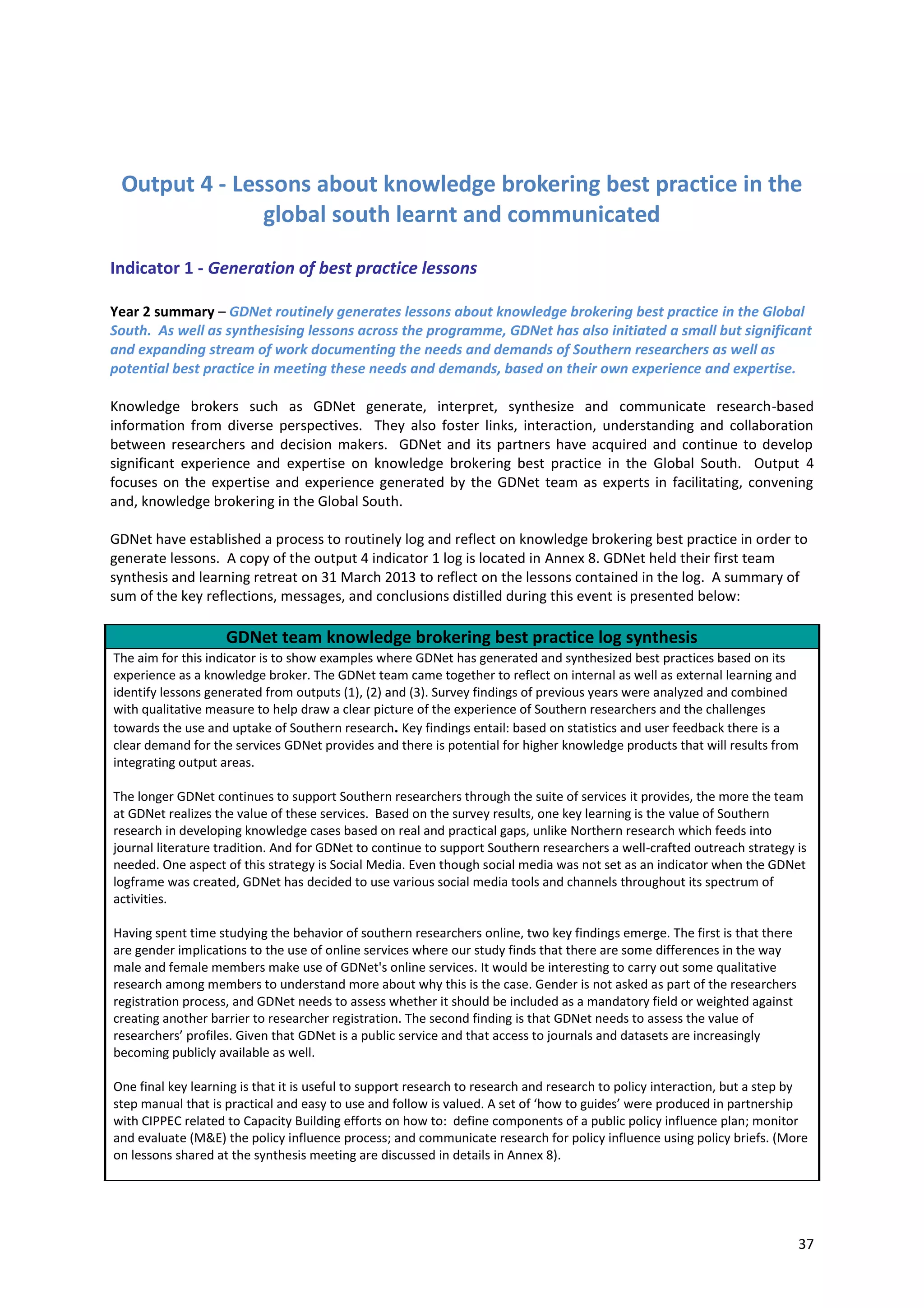
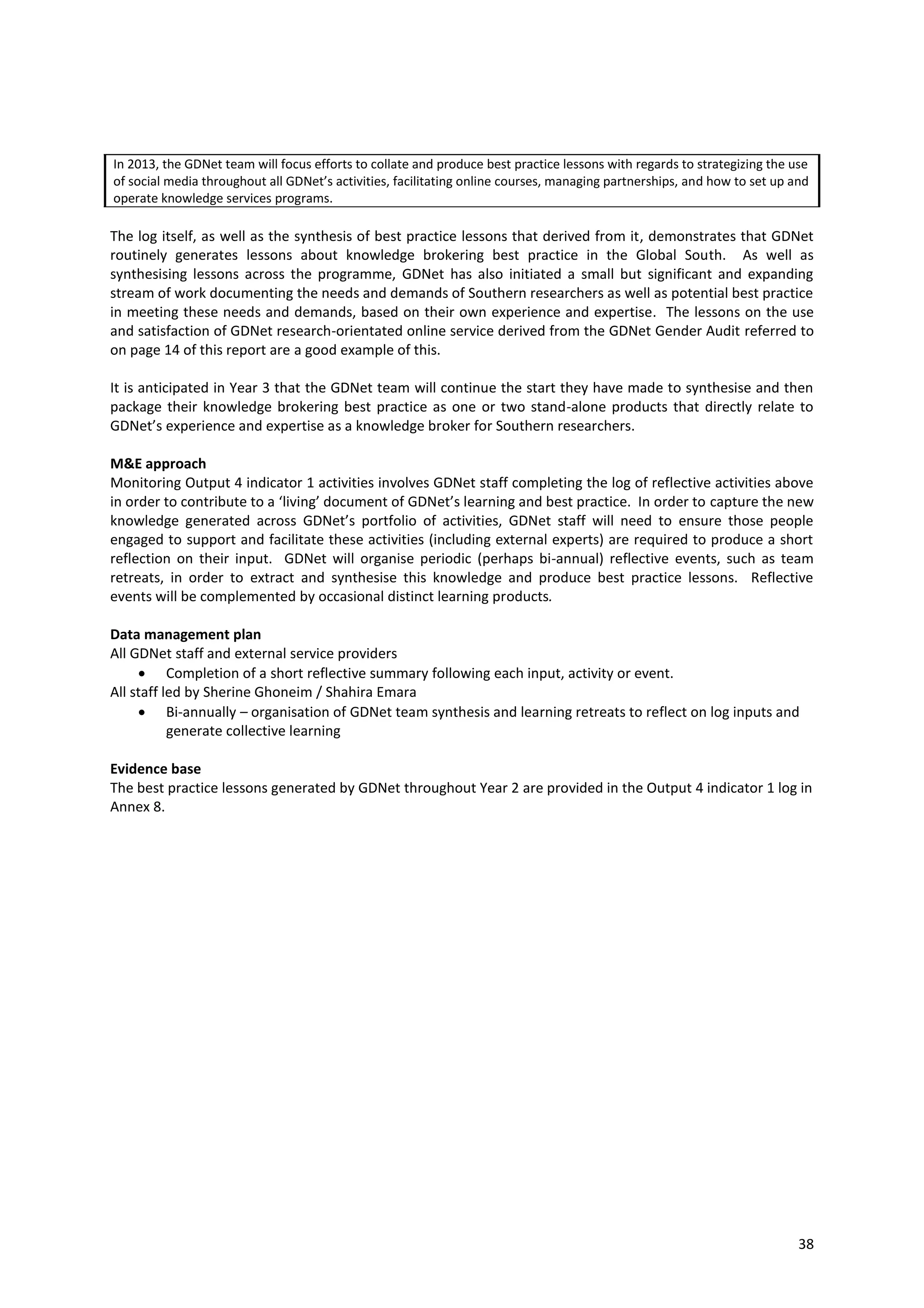
  • 42.
    41 Indicator 3 -Instances of GDNet incorporating new thinking or innovation into its best practices as a result of participation in knowledge brokering fora Year 2 summary – Despite it being too early for the team to conduct a meaningful reflection of the output 4 indicator 3 log, the log itself contains a small number of illustrative examples of GDNet behaving as a learning programme by incorporating new thinking or innovation into its best practices. As output 4 indicator 3 was introduced as a new indicator following the GDNet Year 1 M&E report / 2012 Annual Review, it is deemed too soon to for the GDNet team to conduct a meaningful synthesis of the log of activities under this indicator. The log itself containing the first sets of activities that GDNet have noted as instance of them incorporating new thinking or innovation into GDNet best practice is presented below. Date & Person at GDNet Description of new thinking or innovation and knowledge brokering fora in which it was identified Nature of anticipated change as a result of new thinking or innovation Outcomes as a result of new thinking or innovation September 2012 Sherine Ghoneim, Shahira Emara, Enrique Mendizabal, Vanessa Weyrauch Developed the ThinkNet initiative to target southern researchers and think tanks, based on GDNet's engagement with think tanks  Increased understanding of the changes in the research and policy environment, of what works and doesn't, learning from others. GDNet becomes part of the debate and discussion of how to best support research to policy, specifically in the South Enrique Mendizabal, Maya Madkour &Shahira Emara Working with Enrique Mendizabal (contributor to OnThinkTanks) we identified that the experience of southern think tanks in translating research to policy can be quite different to those of the North.  We embarked on a critical thinking book designed to capture the experience from the South  Sharing learning through a series of cases in the book and through blog posts Cheryl Brown &Sherine Ghoniem From analysing our member survey data we recognised that different genders have different behaviour patterns. We conducted a gender audit of GDNet's online services drawing on the experiences of other knowledge service providers, and have started to share the findings with them, e.g a seminar with knowledge services staff at IDS. From this seminar we concluded that indicators relating  Increased satisfaction with GDNet services among female members.  Become more conscious of gender in the planning and implementation of GDNet's current and future activities.
  • 43.
    42 to satisfaction weremore relevant for gender than those relating to increased website visits. GDNet team and ITAD GDNet will continue to reflect on lessons to keep learning and to be able to actively respond to ever changing environment GDNet is developing bigger ears towards listening, understanding and analysing the impact of services GDNet offers. It also notes the progress the GDNet team had made in generating evidence related to the provision of knowledge services and capacity support to Southern researchers. Finally, it reflects on a maturing institutional behavior towards knowledge broker. The introduction of an M&E culture to the organisation will help in the reshaping and positioning of GDNet's activities and influence the way we do work. GDNet Team Strategic Partnerships are fundamental. GDNet is a strong knowledge institution based on its experience and team composition, but we also recognise that to carry out our mandate, it cannot be done in isolation. It is by working with partners on the ground to their requirements that influences out work and has strengthened our programme's outputs. Keeping GDNet lean and focused and bringing in expertise as required e.g. a professional trainer to deliver GDNet workshops. No size fits all, GDNet inherits the flexibility to custom programs to RNPs and non-RNPs to achieve common grounds where resources versus objectives versus deliverables are clearly mapped For example the nature of the partnership with CIPPEC, is very different from AERC, ERF and LACEA. CIPPEC presents a model where south-south learning is gauged to produce online training courses, research material about research to policy and developing communications and influence strategies. While AERC are tuned to for research communications capacity building workshops for their network of researchers and provide support to develop their own Research Communications and Uptake Strategy though the knowledge services never picked- up. Finally, ERF partners with GDNet on the MENA knowledge services portal, providing social media coverage for ERF events, and training workshops as required For partnerships to work best, commitment of leadership is necessary from the outset. Partners can be engaged in many different levels depending on common interest and the level of maturity of the network. Strategic partnerships will remain an integral part of the design of our activities and outputs.
  • 44.
    43 Despite it beingtoo early for the team to conduct a meaningful reflection of the output 4 indicator 3 log, the log itself contains a small number of illustrative examples of GDNet behaving as a learning programme by incorporating new thinking or innovation into its best practices:  Becoming more conscious of gender characteristics of the GDNet user base in the planning and implementation of GDNet's current and future activities.  The creation of a culture of a learning programme within the GDNet team – one that uses M&E to be results focussed, encourages systematic and participatory reflection and lesson learning across the team, and finally, one that progressively transfer responsibility and ownership of key programme functions from external consultants to internal team members.  Seeking strategic partnerships across the knowledge brokering sector in order to ensure that GDNet’s influence and impact is maximised geographically across the Global South. Note on output 4 indicator 3 in response to comments in the DFID Annual Review 2013 – based on the Annual Review comments and subsequent discussion between GDNet and DFID it was agreed to drop output 4 indicator 3 in the latest version of the logframe. Consequently GDNet activities in this area will not be reflected in the Year 3 M&E report and will not represent a target for GDNet in their final year to 2014. That said, an underlying theme of the Year 3 M&E remains that GDNet has generated a wealth of knowledge and experience relating to the provision of knowledge services and capacity support to Southern researchers. And consequently that GDNet is demonstrating a maturing institutional capacity as a leading knowledge brokering institution for Southern research. Therefore despite it not being a formal logframe requirement GDNet should pursue opportunities to share this knowledge as a wider contribution to a global public good supporting Southern research. M&E approach Monitoring instances of GDNet incorporating new thinking or innovation into its best practices as a result of participation in knowledge brokering fora is managed through the log template above and periodically assessed and synthesised by the GDNet team to establish new knowledge and learning. Data management plan All staff led by Sherine Ghoneim / Shahira Emara  On-going completion of the communications activities log  Bi-annually – organisation of GDNet team synthesis and learning retreats to reflect on log inputs and generate collective learning Evidence base GDNet’s instances of incorporating new thinking or innovation into its best practices as a result of participation in knowledge brokering for a are set out in the Output 4 indictor 3 log template above.
  • 45.
    44 Annex 1: GDNetuser base annual web survey questionnaire –Year 2
  • 46.
    GDNet Members Survey2012GDNet Members Survey 2012GDNet Members Survey 2012GDNet Members Survey 2012 Thank you for agreeing to take part in the GDNet Members survey. The survey should only take 10 to 15 minutes to  complete. Your feedback will help us to understand more about our members, the challenges facing researchers in developing  and transition countries and how we can improve GDNet’s services to support you more effectively.  Many thanks for your time.      
  • 47.
    GDNet Members Survey2012GDNet Members Survey 2012GDNet Members Survey 2012GDNet Members Survey 2012 1. Are you male or female? 2. How old are you? 3. In which country do you live?   4. In what type of organisation do you work?     5. Which position best describes your occupation?     6. What is your main research discipline?     7. GDNet launched a campaign this year to encourage members of the development research and policy communities to adopt a more inclusive approach to southern researchers' knowledge. Prior to this survey, had you heard of the Connect South campaign?   About You 6 6 55 66 6 55 66 6 55 66   Male   nmlkj Female   nmlkj Under 20   nmlkj 20 ­ 35   nmlkj 36 ­ 50   nmlkj 51 ­ 65   nmlkj Over 65   nmlkj Yes   nmlkj No   nmlkj Other 
  • 48.
    GDNet Members Survey2012GDNet Members Survey 2012GDNet Members Survey 2012GDNet Members Survey 2012 8. Did you register with GDNet before this year (2012)?   Your Use of GDNet   Yes   nmlkj No   nmlkj
  • 49.
    GDNet Members Survey2012GDNet Members Survey 2012GDNet Members Survey 2012GDNet Members Survey 2012 8b. What motivated you to register with GDNet? (Please select TWO only)   Your Use of GDNet   To gain access to research not published in online journals   gfedc To communicate my research to policy audiences   gfedc To gain access to funding information   gfedc To gain access to Southern research   gfedc To gain access to data for my research   gfedc To communicate my research to other researchers   gfedc To promote myself to other researchers   gfedc To gain access to online journals   gfedc It was a requirement of another GDN activity   gfedc Other (please specify)     gfedc 55 66
  • 50.
    GDNet Members Survey2012GDNet Members Survey 2012GDNet Members Survey 2012GDNet Members Survey 2012 9. In the last 12 months, how often have you visited the GDNet website? 10. In the last 12 months, how often have you updated your GDNet online profile? 11. Is any of your own research featured or uploaded on GDNet?   Your Use of GDNet   About once a week   nmlkj About once a month   nmlkj About once every 3 months   nmlkj About once every 6 months   nmlkj Only once in the last 12 months   nmlkj Never in the last 12 months   nmlkj About once a month   nmlkj About once every 3 months   nmlkj About once every 6 months   nmlkj Only once in the last 12 months   nmlkj Never in the last 12 months   nmlkj Yes   nmlkj No   nmlkj If you answered 'No', please provide a few words to explain why this is:  55 66
  • 51.
    GDNet Members Survey2012GDNet Members Survey 2012GDNet Members Survey 2012GDNet Members Survey 2012 12. What is your PRIMARY use of GDNet online services? 13. How often do you use these GDNet services? 13. (b) This question relates to your use of ONLINE JOURNALS. If you answered above that you 'rarely' or 'never' use online journals, why do you not access them through GDNet more frequently? (please tick all that apply):   Your use of GDNet Frequently Occasionally Rarely Never Lack Access  to Service Not aware of  service Research in Focus newsletter nmlkj nmlkj nmlkj nmlkj nmlkj nmlkj Funding Opportunities newsletter nmlkj nmlkj nmlkj nmlkj nmlkj nmlkj Monthly GDN newsletter nmlkj nmlkj nmlkj nmlkj nmlkj nmlkj GDNet Knowledgebase ­ Online papers nmlkj nmlkj nmlkj nmlkj nmlkj nmlkj GDNet Knowledgebase ­ Researchers' profiles nmlkj nmlkj nmlkj nmlkj nmlkj nmlkj GDNet Knowledgebase ­ Organisations' profiles nmlkj nmlkj nmlkj nmlkj nmlkj nmlkj ONLINE JOURNALS nmlkj nmlkj nmlkj nmlkj nmlkj nmlkj Regional window portals nmlkj nmlkj nmlkj nmlkj nmlkj nmlkj GDN announcements (competitions, conferences,  scholarships, jobs, etc.) nmlkj nmlkj nmlkj nmlkj nmlkj nmlkj Thematic Windows nmlkj nmlkj nmlkj nmlkj nmlkj nmlkj GDNet Feeds (RSS or email) nmlkj nmlkj nmlkj nmlkj nmlkj nmlkj GDNet YouTube channel nmlkj nmlkj nmlkj nmlkj nmlkj nmlkj GDNet Twitter nmlkj nmlkj nmlkj nmlkj nmlkj nmlkj GDNet Community Groups nmlkj nmlkj nmlkj nmlkj nmlkj nmlkj Access to online journals   nmlkj GDNet Knowledgebase – Online papers   nmlkj GDNet Knowledgebase – Organisations’ profiles   nmlkj GDNet Knowledgebase – Researchers’ profiles   nmlkj GDNet's own publications and toolkits   nmlkj Newsletters   nmlkj There are not enough journals relevant to my work   gfedc My internet connection is too slow   gfedc I have problems using Project Muse or JSTOR   gfedc I already have access to some or all of these journals (e.g through a university library)   gfedc Other (please specify)  55 66
  • 52.
    GDNet Members Survey2012GDNet Members Survey 2012GDNet Members Survey 2012GDNet Members Survey 2012 14. How would you rate these GDNet services according to their usefulness to you? 14. (b) Based on previous survey responses, GDNet is reviewing the Online Services provided to its members. We would be grateful for your views on the following question: How important is it to you that GDNet continues to offer these services: Extremely  Useful Moderately  Useful Somewhat  Useful Not at all  Useful Lack Access  to Service Not aware of  service Research in Focus newsletter nmlkj nmlkj nmlkj nmlkj nmlkj nmlkj Funding Opportunities newsletter nmlkj nmlkj nmlkj nmlkj nmlkj nmlkj Monthly GDN newsletter nmlkj nmlkj nmlkj nmlkj nmlkj nmlkj GDNet Knowledgebase ­ Online papers nmlkj nmlkj nmlkj nmlkj nmlkj nmlkj GDNet Knowledgebase ­ Researchers' profiles nmlkj nmlkj nmlkj nmlkj nmlkj nmlkj GDNet Knowledgebase ­ Organisations' profiles nmlkj nmlkj nmlkj nmlkj nmlkj nmlkj Online journals nmlkj nmlkj nmlkj nmlkj nmlkj nmlkj Regional window portals nmlkj nmlkj nmlkj nmlkj nmlkj nmlkj GDN announcements (competitions, conferences,  scholarships, jobs, etc.) nmlkj nmlkj nmlkj nmlkj nmlkj nmlkj Thematic Windows nmlkj nmlkj nmlkj nmlkj nmlkj nmlkj GDNet Feeds (RSS or email) nmlkj nmlkj nmlkj nmlkj nmlkj nmlkj GDNet YouTube channel nmlkj nmlkj nmlkj nmlkj nmlkj nmlkj GDNet Twitter nmlkj nmlkj nmlkj nmlkj nmlkj nmlkj GDNet Community Groups nmlkj nmlkj nmlkj nmlkj nmlkj nmlkj Very important Quite important Not important Access to JSTOR and  Project Muse online  journals, based on  eligibility criteria nmlkj nmlkj nmlkj A searchable database of  researchers for you to  make contact with nmlkj nmlkj nmlkj A webpage on the GDNet  website for you to share  your contact details,  research interests and  papers nmlkj nmlkj nmlkj Opportunity to participate  in GDNet Online  Community Groups nmlkj nmlkj nmlkj  
  • 53.
    GDNet Members Survey2012GDNet Members Survey 2012GDNet Members Survey 2012GDNet Members Survey 2012 15. To what extent does GDNet provide you with current ideas and knowledge on development research issues? 16. In addition to those already available, would you like GDNet to publish other email newsletters? 17. What type of content would you like to see more of on the GDNet website?   18. In the last 12 months, how often have you shared research you have found on GDNet with friends or colleagues? 19. In the last 12 months, how often have you used research that you found on the GDNet Knowledgebase in your own work?   Your use of GDNet 55 66 To a great extent   nmlkj To a moderate extent   nmlkj To a small extent   nmlkj Not at all   nmlkj Don't know   nmlkj Yes   nmlkj No   nmlkj If yes, which subjects would you like these to cover?  55 66 About once a month   nmlkj About once every 3 months   nmlkj About once every 6 months   nmlkj Only once in the last 12 months   nmlkj Never in the last 12 months   nmlkj About once a month   nmlkj About once every 3 months   nmlkj About once every 6 months   nmlkj Only once in the last 12 months   nmlkj Never in the last 12 months   nmlkj
  • 54.
    GDNet Members Survey2012GDNet Members Survey 2012GDNet Members Survey 2012GDNet Members Survey 2012 20. Are you able to provide a short example of where GDNet has informed your research?   55 66  
  • 55.
    GDNet Members Survey2012GDNet Members Survey 2012GDNet Members Survey 2012GDNet Members Survey 2012 In this survey, the term 'Southern research' is defined as research produced in a developing or transition country by  an individual or organisation primarily based in a developing or transition country.  21. What are the MOST significant challenges facing Southern researchers today? (Please select those you believe are the most significant) 22. Other than GDNet, which sources of Southern research (organisations, networks, websites etc.) do you refer to? 23. Other than GDNet, which services (organisations, networks, websites etc.) do you use for disseminating / communicating your own research? 24. In the last 12 months have you submitted an article to a peer­reviewed journal?   Your Opinion and Use of Southern Research 1. 2. 3. 1. 2. 3. Low volume of existing Southern research   gfedc Poor quality of existing Southern research   gfedc Perception that Southern research is of lower quality than Northern research   gfedc Limited demand for Southern research by other Southern organisations and individuals   gfedc Limited demand for Southern research by Northern organisations and individuals   gfedc Limited funding opportunities for Southern research   gfedc Limited opportunities to share and communicate Southern research widely (websites, networks, etc.)   gfedc Limited internet and IT access in the South   gfedc Limited access to good quality data, journals and books   gfedc Bias against southern researchers in the peer review process   gfedc Limited research capacity   gfedc Other (please specify)     gfedc 55 66 Yes   nmlkj No   nmlkj
  • 56.
    GDNet Members Survey2012GDNet Members Survey 2012GDNet Members Survey 2012GDNet Members Survey 2012 25. In your opinion, how has the level of use of Southern research changed over the past 5 years? 26. Aside from your own work, how would you describe the quality of Southern research today?   Greatly increased   nmlkj Moderately increased   nmlkj Stayed the same   nmlkj Moderately decreased   nmlkj Greatly decreased   nmlkj Don't know   nmlkj Excellent   nmlkj Good   nmlkj Fair   nmlkj Poor   nmlkj Don't know   nmlkj
  • 57.
    GDNet Members Survey2012GDNet Members Survey 2012GDNet Members Survey 2012GDNet Members Survey 2012 27. To what extent do you think Southern researchers use Southern research in their own work? 28. Which sentence best describes the type of research you read? 29. In the last 12 months, how often have you used Southern research in your own work?   Your Opinion and Use of Southern Research To a great extent   nmlkj To a moderate extent   nmlkj To a small extent   nmlkj Not at all   nmlkj Don't know   nmlkj I only read Southern research   nmlkj I read more Southern research than Northern research   nmlkj I read the same amount of Southern and Northern research   nmlkj I read more Northern research than Southern research   nmlkj I only read Northern research   nmlkj I do not distinguish between Northern and Southern research   nmlkj If possible, please explain your choice:  55 66 About once a month   nmlkj About once every 3 months   nmlkj About once every 6 months   nmlkj Only once in the last 12 months   nmlkj Never in the last 12 months   nmlkj Don't know   nmlkj
  • 58.
    GDNet Members Survey2012GDNet Members Survey 2012GDNet Members Survey 2012GDNet Members Survey 2012 30. In the last 12 months and to the best of your knowledge, how often has your own research been referenced or cited by other Southern researchers? 31. If possible, can you detail a specific example of where your research has been used by other Southern researchers?   32. If possible, can you detail an example of where your research has been used by decision­makers or people involved in a policy process?   55 66 55 66   About once a month   nmlkj About once every 3 months   nmlkj About once every 6 months   nmlkj Only once in the last 12 months   nmlkj Never in the last 12 months   nmlkj Don't know   nmlkj
  • 59.
    GDNet Members Survey2012GDNet Members Survey 2012GDNet Members Survey 2012GDNet Members Survey 2012 We appreciate the time and thought you have given to this survey. Your comments will provide very valuable feedback  and learning which will improve GDNet services.   33. It would greatly help GDNet if we could discuss your answers in more depth. If you are willing to be directly contacted via email, please provide your name and email address below. GDNet will ensure your contact details are not passed on to any other individuals or organisations. 34. We would be delighted to hear more from you about how GDNet has made a difference or how we can improve the services we provide. Please provide any feedback in the box below.     Thank you for completing this survey! Name Email Address 55 66
  • 60.
    45 Annex 2: GDNetuser base annual web survey results –Year 2 Introduction The GDNet user base annual web survey for a key component of the M&E approach. The survey was first conducted at the end of 2010, repeated in 2011 (Year 1), and most recently in December 2012 (Year 2). This document presents the results of the Year 2 web survey along with a brief analysis of the results and comparison to the baseline and Year 1. Year 2 Response Rates This year, 14,017 GDNet members were sent an invitation to participate in the Year 2 survey. Of this number, 635 (4.5%) bounced back, indicating an out-of-date address or a full mailbox. This is an increase of 3 percentage points on the bounce back figure for Year 1, and suggests that the GDNet list of contacts may be slightly more out-of-date. The list of bounce back email addresses will be supplied to GDNet in order that they can update their records accordingly. Using the link provided in the survey, or having done so on a previous Survey Monkey-powered survey, a further 90 recipients (0.6%) opted out. After removing these results, 13,292 GDNet members received the Year 2 survey and of this number 721 completed the survey (5.4%) and 151 partially completed it (1.1%), giving an overall response rate of 6.5%. This is disappointing compared with the response rates of previous years (8.2% in Year 1 and 7.6% in the baseline year (2010)) and comes despite an extension to the survey deadline to allow for any lack of response due to the Christmas holiday season. The reasons for the slightly disappointing response rate is unclear but may relate to the general proliferation of online surveys in recent times. Although disappointing, the total number of respondents is sufficient to draw some robust and relevant conclusions of GDNet’s Year 2 performance. Figure 1: Summary of responses per question 0 100 200 300 400 500 600 700 800 900 1000 1 2 3 4 5 6 7 8 8b 9 101112131415161718192021222324252627282930313233343536 No.ofResponses Question No. The lowest responses are on open-ended questions. Question 8b is only for those who were newly-registered in Year 2. Questions 33 and 34 ask for more narrative responses of specific examples of research and therefore have relatively low response rates. New Questions for Year 2 At the request of GDNet, several new questions were added to the Year 2 survey:  7. GDNet launched a campaign this year to encourage members of the development research and policy communities to adopt a more inclusive approach to southern researchers' knowledge. Prior to this survey, had you heard of the Connect South campaign?
  • 61.
    46  13. (b)This question relates to your use of ONLINE JOURNALS. If you answered above that you 'rarely' or 'never' use online journals, why do you not access them through GDNet more frequently? (Please tick all that apply):  14. (b) Based on previous survey responses, GDNet is reviewing the Online Services provided to its members. We would be grateful for your views on the following question: How important is it to you that GDNet continues to offer these services:  17. What type of content would you like to see more of on the GDNet website?  24. In the last 12 months have you submitted an article to a peer-reviewed journal? Year 2 GDNet web survey results and analysis 1. Are you male or female? Year 2 Year 1 Baseline Male 76.3% 74.0% 73.6% Female 23.7% 26.0% 26.4% No significant change from previous years; approximately three-quarters of all respondents are male. 2. How old are you? Year 2 Year 1 Baseline Under 20 0.2% 0.4% 0.5% 20 - 35 28.0% 31.9% 40.9% 36 - 50 45.4% 43.5% 40.8% 51 - 65 22.3% 20.8% 14.8% Over 65 4.2% 3.3% 3.0% As was the trend last year, the respondents from Year 2 have a higher average age, with 71.9% aged over 35, compared with 67.6% in Year 1 (i.e. an increase of 4.3 percentage points). This would tend to suggest that GDNet is not reaching or targeting ‘early career’ Southern researchers but rather used by more established researchers. 3. In which country do you live? (top eight answers) Year 2 position Year 2 % Year 1 position Year 1 % Baseline position Baseline % India 1 18.3% 1 15.10% 1 19.5% Nigeria 2 6.7% 2 8.3% 2 5.5% Pakistan 3 5.4% 3 4.5% 3 5.9% United States 4 2.7% 4 3.3% 5 2.8% Philippines 5 2.3% 5 2.7% / / Argentina 6 2.2% 7 2.6% 4 2.8% Brazil 7 2.1% 6 2.1% 6 2.7% Bangladesh 8 2.0% / / / / The top five countries from Year 1 remain the same this year, with India now accounting for almost 1 in 5 of the survey respondents. Kenya has been displaced from the top eight to 11 th position, whilst Bangladesh into 8th. As in previous years, seven of the top eight countries are 'Southern'. 5 4. In what type of organisation do you work? Year 2 Year 1 Baseline Academic / University 45.5% 48.1% 51.2% Bilateral Aid Organisation 0.7% 0.3% Below 1% Commercial / Private Sector 0.9% 1.2% 1.78% Consultancy 4.3% 4.8% 5.6% 5 As defined by the UNDP, in its 2009 Human Development Report, as all those countries with a Human Development Index score of below 0.9.
  • 62.
    47 Government 7.8% 7.6%6.0%% International Civil Society Organisation 2.8% 2.8% 2.8% Library / Info Service 0.6% 0.1% Below 1% Media / Journalism 0.6% 0.9% Below 1% Multilateral Aid Organisation 2.0% 1.1% Below 1% National Civil Society Organisation 5.2% 4.3% 5.9% Network 0.3% 0.9% Below 1% Parliament / Political Party 0.3% 0.3% Below 1% Research Organization / Institute (affiliated with university) 6.9% 6.4% 7.7% Research Organization / Institute (not affiliated with university) 10.9% 10.5% 11.6% Self-employed / Independent 2.7% 2.4% 3.3% Other (please specify below) 8.6% 8.2% Below 1% There was no significant change in the type of institution that respondents worked in. Over 60% work in an academic/university or research setting although there has been a decrease of three percentage points in academic/university category (down 5.7 percentage points from the baseline). There has been a very small amount of growth in the number of respondents from multilateral aid organisations (0.9 point) and from national CSOs (0.9 point) but not a significant figure. 5. Which position best describes your occupation? Year 2 Year 1 Baseline Advocate / Activist 1.2% 0.9% Below 1% Communication / Knowledge Management Professional 1.3% 2% 1.8% Community / Development worker 1.5% 1.7% 2.0% Consultant / Advisor 8.8% 8.4% 8.9% Elected Representative 0.5% 0.3% Below 1% Fundraiser 0.6% 0.4% Below 1% Journalist / Editor 0.6% 1.1% 1.2% Lecturer 18.9% 19.5% 19.4% Librarian / Information Officer 1.2% 0.8% 1.2% Programme / Project Manager 8.7% 6.8% 2.6% Programme / Project Support 1.4% 1.5% 1.2% Researcher / Scientist 32.9% 33.3% 31.7% Research Support 1.7% 2.2% 2.1% Student 3.8% 4.5% 6.6% Teacher / Trainer 7.5% 7.0% 8.4% Volunteer 0.6% 0.6% Below 1% Other (please specify below) 8.8% 8.7% 8.9% Compared with Year 1, the results are unchanged. Researcher and scientists account for one-third of respondents; lecturers another one-fifth; and students/teachers another one-tenth. 6. What is your main research discipline? Year 2 Year 1 Baseline Agriculture 6.4% 5.8% 5.2% Aid Effectiveness 0.8% 1.4% Below 1% Children and young people 1.4% 0.2% Below 1% Conflict, disasters and emergencies 1.3% 1.5% 1.4% Debt 0.2% 0.0% Below 1% Education 6.0% 5.8% 5.3% Energy 0.6% 1.2% Below 1% Environment / Climate change 5.9% 6.3% 6.4% Evaluation / Impact 2.3% 3.1% 3.4% Finance / Economics 22.8% 20.7% 22.6%
  • 63.
    48 Food security 1.2%1.4% 1.2% Gender 2.1% 2.0% 1.51% Globalisation 1.3% 1.5% 2.0% Governance and political development 4.9% 6.5% 5.3% Health 3.4% 3.4% 3.9% HIV/AIDS 0.7% 0.6% Below 1% ICTs 1.6% 1.3% 2.0% Identity 0.6% 0.3% Below 1% Industry 0.5% 1.6% Below 1% Labour 1.5% 1.5% 1.8% Microfinance and enterprise development 1.6% 1.0% 1.3% Migration 1.4% 1.4% 1.3% Natural Resources 2.2% 1.8% 2.0% Participation 0.3% 0.4% Below 1% Population 1.0% 0.7% 1.2% Poverty 2.4% 3.3% 2.4% Research methodology/ Policy processes 1.6% 1.7% 2.1% Human rights 1.6% 1.2% 1.3% Rural development 1.5% 2.9% 4.0% Social policy / Social development 5.1% 4.5% 6.8% Tourism 0.2% 0.2% Below 1% Trade 1.6% 1.7% 1.4% Urban development 1.6% 1.5% 1.2% Water / Sanitation 0.2% 0.8% 1.1% Other (please specify below) 11.9% 10.5% Little change from Year 1. Those involved in finance and economic research continue to make up over one-fifth of the respondents (with an increase of two percentage points to Year 2) and there has been no significant change within any of the more common categories beneath this. 7. GDNet launched a campaign this year to encourage members of the development research and policy communities to adopt a more inclusive approach to southern researchers' knowledge. Prior to this survey, had you heard of the Connect South campaign? Yes 33.3% No 66.7% Two-thirds of respondents to the survey had no prior knowledge of the Connect South campaign. However, given that the Connect South Campaign was only launched in Year 2, that one third of respondents had heard of the campaign within a year of its launch, this can be considered a success. Further discussion with GDNet is required in order to better understand the objectives of Connect South and what can be interpreted about its progress from the web survey. 8 (a). Did you register with GDNet before this year (Year 2)? Yes 85.9% No 14.1% Almost 86% of respondents were registered before Year 2. Fewer new respondents completed the survey this year; does this reflect fewer new registrations during Year 2, or less engagement from new members? 8 (b). What motivated you to register with GDNet? (Please select TWO only) Year 2 Year 1 Baseline To gain access to Southern research 8.9% 8.7% 6.3% To gain access to online journals 14.4% 15.6% 15.6% To gain access to data for my research 12.5% 15.0% 12.9% To gain access to research not published in online journals 11.7% 11.3% 13.3%
  • 64.
    49 To gain accessto funding information 17.8% 15.9% 17.7% To promote myself to other researchers 11.2% 9.1% 11.7% To communicate my research to other researchers 13.3% 12.1% 11.1% To communicate my research to policy audiences 6.0% 6.5% 7.3% It was a requirement of another GDN activity 3.4% 3.8% 2.6% Other (please specify) 0.8% 2.1% 1.5% The three respondents that answered 'other' to this question replied as follows: To know if there is any free academic resource to communicate to universities and research centres not registered I did not register, but I want to 9. In the last 12 months, how often have you visited the GDNet website? Year 2 Year 1 Baseline About once a week 16.1% 18.4% 26.9% About once a month 36.4% 38.2% 44.0% About once every 3 months 24.4% 21.1% 16.9% About once every 6 months 11.1% 11.3% 5.7% Only once in the last 12 months 6.8% 6.2% 3.6% Never in the last 12 months 5.2% 4.6% 2.9% 10. In the last 12 months, how often have you updated your GDNet online profile? Year 2 Year 1 Baseline About once a month 4.0% 4.6% 8.8% About once every 3 months 7.3% 7.1% 12.0% About once every 6 months 10.1% 13.3% 14.6% Only once in the last 12 months 23.5% 23.6% 27.9% Never in the last 12 months 55.1% 51.3% 36.7% 11. Is any of your own research featured or uploaded on GDNet? Year 2 Year 1 Baseline Yes 28.2% 30.1 20.0% No 71.8% 69.9% 80.0% If you answered 'No', please provide a few words to explain why this is 370 responses 52.5% of respondents visit the GDNet website at least once per month; this is a decrease of 4.1 percentage points compared with last year, against a baseline of 70.9% in 2010. There has been a further decrease in the frequency with which respondents are updating their GDNet profiles. In Year 1, one-quarter of respondents updated their profile at least once every six months; this has fallen to 21.4% in Year 2. There has also been a small decrease (1.9 percentage points) in the percentage of respondents with research featured/uploaded onto GDNet. 370 provided a further response as to why they didn't have any research uploaded - I can analyse this further. 12. What is your PRIMARY use of GDNet online services? Year 2 Year 1 Baseline Access to online journals 22.3% 23.6% 28.6% Newsletters 30.6% 30.8% 26.9% GDNet Knowledgebase – Online papers 25.2% 31.2% 29% GDNet Knowledgebase – Researchers’ profiles 6.8% 9.3% 9.9% GDNet Knowledgebase – Organisations’ profiles 5.0% 5.0% 5.5% GDNet's own publications and toolkits 10.2% New Category New Category
  • 65.
    50 A new categoryintroduced this year, GDNet's own publications and toolkits, is the primary use of GDNet for one in ten of respondents. Newsletters are the primary use of almost one-third of respondents, and GDNet knowledgebase online papers are now the primary use of one-quarter of respondents compared with one- third last year. The use of profiles, both researchers and organisations accounts for around 12% of respondents' primary use - a small decrease from the Year 1 result.
  • 66.
    51 13. How oftendo you use these GDNet services? Year 1 results given in red brackets, where available. Answer Options Frequently Occasionally Rarely Never Lack Access to Service Not aware of service Response Count (Year 2) Research in Focus newsletter 25.47% (16.1%) 39.43% (32.8%) 18.70% (25.0%) 7.72% (16.4%) 0.68% 7.99% (13.8%) 738 Funding Opportunities newsletter 33.24% (31.9%) 33.92% (32.2%) 16.15% (17.4%) 9.36% (11.1%) 0.81% 6.51% (8.8%) 737 Monthly GDN newsletter 37.02% (39.4%) 35.77% (30.5%) 18.09% (18.7%) 4.97% (9.8%) 0.55% 3.59% (5.9%) 724 GDNet Knowledgebase - Online papers 17.91% (22.3%) 39.39% (38.0%) 23.69% (24.1%) 10.06% (12.1%) 1.65% 7.30% (7.4%) 726 GDNet Knowledgebase - Researchers' profiles 7.91% (11.2%) 26.41% (28.7%) 37.43% (33.2%) 19.35% (22.2%) 1.55% 7.34% (8.8%) 708 GDNet Knowledgebase - Organisations' profiles 7.39% (7.3%) 23.62% (27.4%) 37.97% (34.6%) 21.59% (23.3%) 0.72% 8.70% (10.2%) 690 ONLINE JOURNALS 18.07% (21.0%) 28.57% (35.8%) 23.11% (19.3%) 17.02% (16.2%) 3.36% 9.87% 11.3%) 476 Regional window portals 12.05% (10.6%) 27.83% (23.3%) 26.69% (25.7%) 18.36% (26.6%) 1.58% 13.49% (18.5%) 697 GDN announcements (competitions, conferences, scholarships, jobs, etc.) 30.18% (34.9%) 34.57% (37.2%) 20.16% (18.3%) 8.64% (8.1%) 1.10% 5.35% (5.0%) 729 Thematic Windows 7.83% (10.6%) 28.06% (22.0%) 28.21% (25.7%) 20.80% (25.8%) 1.00% 14.10% (21.1%) 702 GDNet Feeds (RSS or email) 9.08% (9.8%) 19.60% (22.0%) 27.38% (26.3%) 27.52% (26.8%) 1.44% 14.99% (18.1%) 694 GDNet YouTube channel 1.87% (1.8%) 7.46% (8.6%) 19.23% (15.8%) 46.20% (44.8%) 3.59% 21.66% (33.2%) 697 GDNet Twitter 1.73% (2.0%) 7.63% (7.1%) 14.82% (14.6%) 50.36% (49.9%) 3.74% 21.73% (30.2%) 695 GDNet Community Groups 3.28% (4.7%) 12.27% (21.7%) 21.26% (32.7%) 39.37% (26.3%) 3.57% 20.26% (17.5%) 701 The comparison to Year 1 results may be slightly distorted, since a new option was added in this year's survey to pick up those respondents without access to particular GDNet services. However, the percentages of those selecting 'lack of access' are typically below 2%. It is also unlikely that the addition of this new response option drew any responses aware from those who responded as 'frequent' users. GDNet's social media channels are the least used resources (i.e. YouTube and Twitter). Roughly three-quarters of respondents either never used, lacked access to, or were unaware of these services.
  • 67.
    52 13. (b) Thisquestion relates to your use of ONLINE JOURNALS. If you answered above that you 'rarely' or 'never' use online journals, why do you not access them through GDNet more frequently? (please tick all that apply): Year 2 New Question There are not enough journals relevant to my work 36.7% / My internet connection is too slow 22.2% / I have problems using Project Muse or JSTOR 28.8% / I already have access to some or all of these journals (e.g. through a university library) 35.9% / Other (please specify) / A selection of the responses from those that selected 'other' to the above question are below: Several respondents were unaware that GDNet offered access to journals; several stated that they were too busy to access them. Other respondents are making use of other sources of online journals: When I need a specific journal article I google its title. If it is publicly available on GDNet, it should come up. I don't care where it comes up, googling it will generally find it if it's available. I don't need to go to a specific site with a small subset of journals. Google is more convenient for scanning research about climate change and carbon market around the world. I already have access to some journals but we have a not-too-short delay in full-access to those recently published. Then sometimes I use JSTOR, via GDN, when I need access to some recent journals. I can access most of the journals of interest to me through the internet. I use other online journals but did not tried ever to look into this and also the periodic updates are not frequently circulated through mails. Other issue I have noticed whenever we use google search engine we never find a single link to this site. Some respondents gave more detail as to their difficulties in accessing Project Muse or JSTOR or finding relevant research: My studying domain is Networking, when I search a keyword I refer to Cisco and other Networking site, I registered this site because my cousin want an article about medicine. Project Muse doesn't have access to any relevant research I tried JSTOR once but I had the access simply denied and I don´t know why. JSTOR is restricted only for users from developing countries. MUSE is almost useless. I rarely find material that I can access. I cannot access JSTOR and Project Muse. They only offer very limited number of journals, all of which are not my interests. I dont have idea bout Project Muse or JSTOR. I think my university doesn't have this access. I dont know how to access GDNet network, I have other sources to access online Journals therefore GDNet is not my top priority I focused on other journals in my research I have access only to some journals in Project Muse and no access to JSTOR I have no need to access this Language was mentioned as a difficulty by two respondents: language there are no publications in Arabic or in French My English level not so higher , I have elementary level A selection of further comments: Not user friendly. Hard to navigate.
  • 68.
    53 Online journal accessnot offered in CEE region our NGO is small one so we need basic knowledge with guidelines The publisher is not willing to provide copyright for my paper and unless I submit full paper you wouldn't provide access to me. This is a circle which has been going on for a couple of years. There was a problem when I was registering. I've got a strange e-mail that in order to finalise registration I need to submit a paper. I couldn't do it immediately, lost the strange e-mail, didn't know how to finalise the registration and now I'm not sure about my status. this year and last year we had youth uprising in Yemen which negatively affect many services in Yemen including Internet services beside the uncertainty of the political situation Though I frequently use JSTOR, I get problem accessing project muse. My duties and involvement in some research processes are the two main reasons that limit me from staying online and search for online sources that can build my knowledge base on subjects of my interest. Your web site does not really work to access journal. It is better if you give us password and address to directly link to journal.
  • 69.
    54 14. How wouldyou rate these GDNet services according to their usefulness to you? Year 1 results given in red brackets, where available. Answer Options Extremely Useful Moderately Useful Somewhat Useful Not at all Useful Lack Access to Service Not aware of service Research in Focus newsletter 28.6% (26.3%) 38.2% (28.2%) 21.0% (22.9%) 2.8% (5.8%) 1.0% 8.5% (16.8%) Funding Opportunities newsletter 36.9% (37.0%) 30.2% (29.2%) 20.7% (20.3%) 2.9% (3.8%) 1.5% 7.8% (9.7%) Monthly GDN newsletter 27.8% (32.5%) 40.4% (33.2%) 21.8% (21.0%) 2.8% (4.7%) 1.1% 6.1% (8.6%) GDNet Knowledgebase - Online papers 27.8% (36.2%) 33.6% (28.2%) 22.9% (20.4%) 3.3% (4.7%) 2.7% 9.7% (10.5%) GDNet Knowledgebase - Researchers' profiles 15.1% (20.5%) 29.2% (29.4%) 34.3% (28.9%) 6.7% (8.3%) 3.4% 11.3% (12.9%) GDNet Knowledgebase - Organisations' profiles 13.3% (15.7%) 27.6% (32.0%) 36.5% (29.8%) 7.2% (7.7%) 2.5% 12.9% (14.9%) Online journals 35.4% (42.0%) 27.6% (23.2%) 16.9% (17.9%) 4.6% (4.3%) 3.8% 11.7% (12.6%) Regional window portals 15.1% (17.6%) 30.2% (25.8%) 28.0% (21.9%) 6.1% (9.5%) 3.1% 17.5% (25.2%) GDN announcements (competitions, conferences, scholarships, jobs, etc.) 38.0% (43.3%) 29.8% (26.9%) 19.5% (20.4%) 2.7% (2.7%) 1.2% 8.8% (6.7%) Thematic Windows 14.9% (15.8%) 27.8% (25.1%) 26.3% (22.4%) 7.8% (9.7%) 3.0% 20.2% (26.9%) GDNet Feeds (RSS or email) 10.5% (13.1%) 22.2% (24.6%) 28.5% (25.6%) 11.4% (10.6%) 4.7% 22.7% (26.1%) GDNet YouTube channel 5.0% (5.1%) 14.7% (14.1%) 25.3% (22.7%) 16.5% (15.8%) 6.8% 31.7% (42.3%) GDNet Twitter 4.8% (3.8%) 13.0% (12.0%) 23.5% (23.4%) 18.9% (17.5%) 7.4% 32.3% (43.3%) GDNet Community Groups 6.9% (12.0%) 20.1% (25.8%) 25.3% (29.7%) 13.0% (9.0%) 5.4% 29.3% (23.4%) Knowledgebase online papers rated extremely useful by 27.8% and moderately useful by a further 33.6% of respondents to this year's survey. Access to online journals rated extremely useful by 35.4% and moderately useful by a further 27.6%. The Thematic Windows are regarded as extremely useful by 14.9% of respondents and moderately useful by a further 27.8%. However, 20.2% of respondents were unaware of the thematic windows. Of those respondents who were aware of, and had access to the thematic windows, 19.5% found them 'extremely useful' and a further 36.2% found them 'moderately useful' (in total 55.7% of those who knew of and could access the Thematic Windows found them at least 'moderately useful'). Respondents are the least aware of GDNet's social media channels (i.e. Twitter, YouTube, online community groups), with roughly one-third of all respondents unaware of these resources.
  • 70.
    55 14. (b) Basedon previous survey responses, GDNet is reviewing the Online Services provided to its members. We would be grateful for your views on the following question: How important is it to you that GDNet continues to offer these services: Answer Options Very important Quite important Not important Response Count Access to JSTOR and Project Muse online journals, based on eligibility criteria 547 (73%) 157 (21%) 39 (5%) 743 A searchable database of researchers for you to make contact with 453 (61%) 237 (32%) 41 (6%) 731 A webpage on the GDNet website for you to share your contact details, research interests and papers 427 (58%) 259 (35%) 50 (7%) 736 Opportunity to participate in GDNet Online Community Groups 349 (48%) 294 (40%) 84 (12%) 727 This is a new question, based on survey results from previous years. Access to JSTOR and Project Muse is the most important online service offered by GDNet according to the respondents. 95% rated this 'very' or 'quite' important. All four of the online services listed are well supported by respondents. Half of all respondents consider the opportunity to participate in online community groups to be 'very important'. 15. To what extent does GDNet provide you with current ideas and knowledge on development research issues? Year 2 Year 1 Baseline To a great extent 31.9% 31.5% 33.8% To a moderate extent 41.6% 40.0% 39.9% To a small extent 15.8% 18.2% 16.4% Not at all 5.4% 4.9% 3.6% Don't know 5.3% 5.3% 6.3% 16. In addition to those already available, would you like GDNet to publish other email newsletters? Year 2 Responses New Question Yes 42.9% 318 / No 57.1% 424 / If yes, which subjects would you like these to cover? 216 / A selection of the suggested subjects for additional newsletters is below. Most were by research sector (e.g. environment and climate change, agriculture etc), and some were asking for more funding and research information despite the existence of the 'Funding Opportunities' and 'Research in Focus' Newsletters, suggesting that these respondents may have been among those responding that they were 'not aware of the service', in earlier questions. A selection of the remainder are given below: - Technology watch in the food sector; - Transfer of technology in the agricultural sector; - Development of cooperatives and other rural organizations. 1. Case studies on how to improve the development effectiveness of public expenditures. 2. Material on how to change the structure of incentives governing the behaviour of politicians, so that their self-interests match with the citizens' self-interests, thus substantially improving the development effectiveness of public expenditures. A community newsletters of Development Information Centres/Libraries Budgeting about new scholarships and competitions Basic of research, growth preparation etc. for new & Small NGOs like us.
  • 71.
    56 BRICS business history, corporatesocial responsibility and diaspora studies Conferences and workshops country-specific policy analyses debates on development issues cross country - parallel development policy updates intersectoral researches Development Economics and Human Capital Related Issues Development issues in the informal sectors development news and funding e-government e-citizen public policies Email newsletters concerning monitoring and evaluation and impact energy, good governance, international security Engineering Entrepreneurship and Enterprise Development Environment and Climatic Change Environmental education, waste management Environment and Education Environmental governance environmental health/sciences, food safety, water & sanitation Evaluations in developing countries. Food Security, Natural Resources and Rural Development Higher Education Information Technology and Development in the South eLearning and its impact on development Higher education quality management tools History and social theories. debates on nation, nationalism and nationality questions I think there should be one newsletter containing all info. Summary and links to details of those summaries. Moreover, this letter should have table of contents. Newsletters from AIP and JASA (journal of acoustical society of America) have such convenient formats. indexed journals Indian economy Indigenous knowledge related Information on new databases and new journals accessible through the GDNet portal labour mobility FDI Library and Information Science linking all the information to search engines Make a quarterly Theme; collate and report on completed Research, on-going research and publications in reputed journals in, say, last 6 months More information about events, launch of research reports new burning topics, like climate change, fdi
  • 72.
    57 Newer technology withlocal touch NEWSLETTERS IN ENGLISH AND IN FRENCH No = because it isn't useful (it's one more on tons of newsletters etc). On development good practices Online courses, Special news Regional thematic summary To help develop poor countries Training and research funding. univ websites What to do as a researcher? Guidelines for newcomers. Suggestions from others. Yes, round-up of thematic development research 17. What type of content would you like to see more of on the GDNet website? In terms of subject area environment forest Environment and Education and community development Migration, ethnic minorities, second migrant´s generation International labour migration POLICY ORIENTED RESEARCH Banking and Technology, Business Analytics Governance, Climate governance Technology Gender and labour, development and trade, communication and business Agriculture Macroeconomic Stability GDP Fluctuations and Growth Business Cycle Volatility Development Management Issues Social Innovation Peace Studies. Information Science as a tool for community development in Africa. (All information in the Political development should be well informed to the citizen. Scientific and Technological Development Development Economics, Health and Education, Public Economics Dynamics and power relations in the sector Agriculture, Rural Development and related issues Gender and Conflict studies Global economic governance and development More towards commercial sector Recent Development on Civil Society Sectors at National or international level. Studies on grassroots organizations and civil society. mutation breeding researches Globalisation and social violence study funding opportunities micro enterprises and development evaluation methods Climate Change and Human right based
  • 73.
    58 Debate on globalpoverty, food security, climate change etc. both from official/government/multilateral and civil society perspectives. Population and development could be another important aspect of focus. SUSTAINABLE DEVELOPMENT EDUCATION Transition Political economy development, governance Issues related to Development, Youth and Development Ethics political philosophy and historiographical analysis Primary Health Care Political Economies Emerging insurgents in Africa, Good governance and developing societies foreign trade, investment, economic statistics Water Sanitation Macroeconomics of the Middle East Main stream economics or allied discipline research aimed to address developing economy issues. Impact researches human development Issues relevant to education, gender budgeting organ transplantation game theory and graph theory How to tackle food security situation in South Asia Natural resources management. Governance In terms of resource type More multimedia resources multimedia, short films, educational videos, powerpoints Video Research videos More access to journals Online Journal and funding opportunities. Access to journals. Before you write, you have to read. Release of journals and databases Research findings; newsletter More information on funding and conferences, seminars funding and other opportunities for African scientists Thematic funding opportunities, especially for student Funding opportunities All conference information besides GDN Recent reports on MDGs per region and initiatives in place by UN Agencies. Research programs on Rural and Gender perspectives and ICTs impact on Development. Research statistics by theme, etc. Data sets availability Theory-based content More theoretical papers. Focus on current political debates, with thematic focus All publications Training and Job Opportunities Capacity development for third world researchers Publications, Research opportunities including jobs, international exchange Consultancy jobs
  • 74.
    59 More geographically- focusedcontent 18. In the last 12 months, how often have you shared research you have found on GDNet with friends or colleagues? Year 2 Year 1 Baseline About once a month 12.6% 13.8% 17.7% About once every 3 months 16.2% 18.5% 19.1% About once every 6 months 14.8% 15.8% 13.6% Only once in the last 12 months 13.2% 14.5% 12.9% Never in the last 12 months 43.3% 37.4% 36.7% An increase of 5.9 percentage points in those respondents that have not shared GDNet research with friends or colleagues. 19. In the last 12 months, how often have you used research that you found on the GDNet Knowledgebase in your own work? Year 2 Year 1 Baseline About once a month 14.1% 12.4% 17.6% About once every 3 months 14.3% 18.8% 19.1% About once every 6 months 17.2% 15.8% 14.0% Only once in the last 12 months 14.5% 14.7% 12.8% Never in the last 12 months 39.9% 38.3% 36.5% No significant change from Year 1 results. Roughly 40% of respondents have not used GDNet research in their own work in the last 12 months. 20. Are you able to provide a short example of where GDNet has informed your research? [424 responses] About climate change in the world. African window After publishing my work on GDNet about three years ago, I was contacted by others interesting Researchers to know more and to invite me collaborating in similar works (projects). Agriculture strategies as per the climate change scenario As a Research Director, I have been involved the process of researches conducted under my unit by Academia/Research Farms. I had the opportunity to provide inputs for preparation of Terms of References for Research Study on the basis of knowledge and experiences that I had acquired from GDNet. As I explained before, presently I just use GDN when I need to access sober journals. As of now I don't really remember the usefulness of GDNet. I have registered but don't know much about the opportunities and usefulness of GDNet fully At Delhi Sustainable Development Summit 2013. At Mombasa or Nairobi about brief for officials. Followings on Workshops that are geared to enhance skills and capacity to communicate research findings for teaching research methodology & developmental issues for our doctoral students and during sharing experiences with filed functionaries GDN research medal winner work on commuting workers in India (Chandrashekhar) GDNet provides almost every journals/ papers I need for my research (esp. JSTOR) since my university do not have access for leafing journals. I always look at GDN's research on food security issues, inclusive development, and poverty I am drafting a proposal I intend to submit to the current Awards & Medals Competition. I was inspired from a call in 2009 but I was still busy with my PhD I am impressed by the number of scholars of the Global South who have exposed their research foci through GDNET. I am working on a white paper on issues related to program evaluation research in NGOs operating in the developing world. I have used some of the online resources provided by GDNet as part of my literature review. I came to know many latest information as far as social, economical development, environmental issues and human right and health care and global issues. Research papers/publications are also very fruitful for me.
  • 75.
    60 I got informationon the GDN funding opportunities and got my research funded by the GDN. However, in terms of references, the GDN has not helped a lot as I have access to alternative sources of literature. However, for those researchers without access to literature, GDN could be vital. I got lots of information on development issues I got papers dealing with environmental policies. I got to know about the activities of the 3IE on impact evaluation through the forum. Although I am yet to benefit but the awareness is very important to my professional interest. I have exploited several articles downloaded from JSTOR to develop articles published in Forest Policy and Economics I have read research reports/ papers on insurance and health insurance, which have helped me in my lectures, papers at seminars, discussions with students etc. I read many of the abstracts of the research especially by Asians. I find the ground breaking/cutting edge empirical research most useful. I look forward to theoretical contributions of Asian academics I studies researches conducted by UN agencies and others based on my topic of Child Protection, Nutrition and health etc. I used GDNet toolkit in my research work. Impact assessment: used reports from GDNET to understand how to conduct impact assessment of two programs I have conducted In the topics and methodology that the network uses, will be very useful the connection with other institutions in the South. In understanding the politics of Carbon and Climate Change. information for training module first this is during my PhD study on labour markets analysis and after that when I wrote some papers in development studies It allows me stay connected with a community of researchers. Though my own research has not been on policy or directly about development but it is more about historical and anthropological issues of urban life, an arena directly influenced by development processes. In this sense, GDNet is indirectly crucial to my research. Its online services i.e. jstor and project muse are particularly helpful for researchers like me who live in a non-metropolitan city devoid of good library. It gives me ideas of how to search for research partners in the South. Often, those that have pro-World Bank or Pro-Washington Consensus research published at GDN also publish or produce other more critical research in the South. Thus, I can use GDN databases to find progressive researchers in spite of this portal being such neoliberal mouthpiece. It has greatly helped me on the issues related to Migration It informed me of the frontier of knowledge in some areas of my research interest. It is useful in looking for background research It is very important and current information about environmental issues and I coordinate a research group that profit it. Knowledge management Largest public, private and government enterprise application cloud e-direction policy and Green IT devices innovation Mainly giving access to online journals through JSTOR My research report funded by the SANEI has been displayed in related website of GDNet Once again, please make up a short intro on the GDNet. Kind of a guide for beginners. One of my Doctoral students is working on liquid fertilizer use in Nigeria. Her inspiration came from following the research we did on Effectiveness Efficiency and Sustainability of fertilizer use in SSA, which she followed on GDNet. Our Research Results are available on ICRISAT web site under RP-Markets, Institutions and Policies Papers and comments on the Mexican economic situation were use for comparative purposes on a paper on the evolution of Brazilian industrial indicators. Papers dealing with governance issues. Presently I am doing research about migration in Tamil Nadu, India. so, the availability of separate cluster and research on this issue across the world gave me enough inputs to channelize my idea about migration Provision of data base and information in new areas Quality Research Reference Materials Socioeconomic issues, especially concerning food security measures in Asian sub-continent Tailoring results to inform policy The articles and researches on early childhood care and education have been extremely helpful in formulating interventions in program areas. The databases and the online journals come very handy when I am doing some reference work or reviewing. The only examples are some of the papers given at the 2012 conference in Budapest. They provided useful ideas about the future of cities and population mobility and about the way young people deal with social and spatial alienation. The scholarly approach of the papers and link to journals has kept me abreast with recent techniques/approaches in research
  • 76.
    61 The thematic newslettersand the access to JSTOR are immensely valuable to me and my work. The Zanzibar urban water and sanitation was very encouraging example among many. There are many examples that GDNet has informed to all of its readers. - Economy - Society - Political developments - Conflicts, Conflict prevention/resolution, etc. Through conference, I attend GDNet greatly expose me to the pool of experts in my own specialized field and put me on the correct track towards my academic career. Thanks. Through south Asia research window, a German team of researchers contacted me for further research details Through updates from peers on global issues. Through workshops organised by our Oceania Development Network. Two papers produced by researchers in Peru and Latin American countries on education and child labour were useful to develop the conceptual framework for a piece of research I designed for a policy making forum related to social policy focused on children early this year. used information in developing a research proposal on effect of climate change in urban areas VAR Analysis Very useful in archival literature review and being in-touch with what is the latest focus. Well the research on Climate change has helped me to analyse me survey on Climate change. when doing research on funding opportunities for LAC With regards to sustainable development (SD) issues, GDNet has been helpful for my work. I am interested in Governance and Policy aspects that need to be considered when establishing and managing institutions for SD. yes I like full working relations with GDNet Knowledgebase action with regard to Pakistan & Afghanistan Yes, I recently lead an information needs assessment survey on HIV Testing and Counselling & Prevention of Mother to Child Transmission of HIV study in the Federal Capital Territory of Nigeria, in which I applied learning's on methodology from GDNet. Yes. I gave gained valuable research areas and methodology. Youth Development.
  • 77.
    62 21. What arethe MOST significant challenges facing Southern researchers today? (Please select those you believe are the most significant) Year 2 Year 1 Baseline Low volume of existing Southern research 8.9% 6.8% 6.7% Poor quality of existing Southern research 7.5% 8.4% 8.8% Perception that Southern research is of lower quality than Northern research 9.9% 13.9% 15.0% Limited demand for Southern research by other Southern organisations and individuals 7.6% 8.7% 8.5% Limited demand for Southern research by Northern organisations and individuals 6.3% 9.8% 9.1% Limited funding opportunities for Southern research 15.7% 29.1% 29.4% Limited opportunities to share and communicate Southern research widely (websites, networks, etc.) 8.2% 12. 8% 13.9% Limited internet and IT access in the South 6.0% 7.1% 8.07% Limited access to good quality data, journals and books 12.1% New Category New Category Bias against southern researchers in the peer review process 6.7% New Category New Category Limited research capacity 8.9% New Category New Category Other (please specify) 2.2% 3.4% 0.6% The frequency of the selection of 'limited funding opportunities for Southern research' has decreased by 13.2 percentage points since last year. However, this is probably due to the inclusion of new categories including 'Limited Access to good quality data, journals and books', which made up 12.1% of responses. If the figures are recalculated so that percentages are calculated based on the Year 1 set of options, 'limited funding opportunities' makes up 21.7% of the responses - still a decrease of 7.4 percentage points. The 'low volume of existing Southern research' is selected more frequently this time. 22. Other than GDNet, which sources of Southern research (organisations, networks, websites etc.) do you refer to? 56% of respondents answered this question. The most popular responses were: CODESRIA CGIAR SSRN Un Agencies World Bank AERC ADB Google Eldis SANDEE SSRN Research Gate OSSREA IDRC IDEAS As Year 1, the World Bank was the most frequently cited source of Southern research by respondents, being cited by 8.8% of respondents. 23. Other than GDNet, which services (organisations, networks, websites etc.) do you use for disseminating / communicating your own research? REPEC Research gate SANDEE SSRN WB LinkedIn IDEAS AERC Academic.edu 3ie Conferences (various) ERC In Year 2, SSRN is the most frequently used service for disseminating the research of respondents, mentioned by 8.3% of respondents to this question. REPEC was the most frequently cited response in Year 1; this year it is
  • 78.
    63 cited by 4.8%in contrast to 10% of respondents in Year 1. Research Gate did not appear in the list of most cited services in Year 1, but in Year 2 is cited by 4.4% of respondents, making it the third most cited service this year. 24. In the last 12 months have you submitted an article to a peer-reviewed journal? Year 2 New question Yes 56.9% No 43.1% This is a new question for Year 2; just over half of respondents have submitted an article to a peer-reviewed journal during Year 2. 25. In your opinion, how has the level of use of Southern research changed over the past 5 years? Year 2 Year 1 Baseline Greatly increased 15.9% 19.3% 18.1% Moderately increased 55.5% 55.25% 50.9% Stayed the same 10.7% 11.5% 14.4% Moderately decreased 2.9% 1.8% 1.8% Greatly decreased 0.4% 0.6% 0.6% Don't know 14.6% 11.6% 11.6% There has been little change in the perception of the level of use of Southern research in the preceding year. Slightly fewer respondents say that there has been a great increase, but over 50% believe that there has been a moderate increase. 26. Aside from your own work, how would you describe the quality of Southern research today? Year 2 Year 1 Baseline Excellent 9.5% 9.6% 8.3% Good 48.2% 48.9% 50.3% Fair 27.2% 27.6% 27.9% Poor 6.1% 7.0% 5.2% Don't know 8.9% 6.9% 8.3% There has been no change in the perception of the quality of Southern research. Almost half of respondents rate the quality as 'good'. 27. To what extent do you think Southern researchers use Southern research in their own work? Year 2 Year 1 Baseline To a great extent 18.9% 15.4% 17.4% To a moderate extent 45.2% 49.0% 46.8% To a small extent 22.1% 26.9% 25.1% Not at all 1.3% 0.6% 1.6% Don't know 12.5% 8.1% 9.1% There has been a small increase of the proportion of respondents who see Southern researchers using other Southern research to a great extent. However, the number who didn't know, also increased.
  • 79.
    64 28. Which sentencebest describes the type of research you read? Year 2 Year 1 Baseline I only read Southern research 1.7% 1.1% 3.0% I read more Southern research than Northern research 11.6% 10.2% 12.1% I read the same amount of Southern and Northern research 24.9% 26.9% 24.1% I read more Northern research than Southern research 26.0% 28.1% 25.7% I only read Northern research 0.9% 1.5% 1.4% I do not distinguish between Northern and Southern research 34.9% 32.3% 33.7% If possible, please explain your choice: Basically, I read only article published in journals with impact factors. Even if these researches have been carried out in the South, there are mostly co- authors from the North. Broadly speaking, in the field of quality of life and subjective wellbeing there is more research done in the "North" than in the "South". Development of my own discipline takes place primarily in the North. I read books and articles written in the North to keep to date on these theoretical developments. I also read Southern research to understand how the theory is being applied in the region. As a matter of fact, I do a lot of South-North/North South research. Geography should not matter, only quality. Just that it is southern, does not become more relevant. Governments and Southern research organisations have failed to invest in data collection and management. This makes research output to be of poor quality. We tend to produce information on the basis of perceptions rather than on the basis of scientific data (quantitative). They lack elegance in conclusion and for policy purpose. I believe one type of research feed the other, and vice versa. While Northern research is strongly grounded on theories and a quite rectangular approach of thinking, Southern research addresses the complexity of the developing world, with apparently backward behaviours rooted in a mosaic of cultures that bring forth the impetus to challenge mainstream reflection paths and theories. The difficulties encountered in trying to apply such theories in Africa e.g., due to the lack of appropriate data or research context, give scientists in the South the opportunity to contribute to developing new theories or to provide insights to modifying existing ones. I do read both, and to some extent the quantity of whether S or N depends on the topic. If a Southern African writer/topic, then mostly S, but recently, focussing of Islam and gender, I've been reading a great deal of N research, because most Muslim African women writers are in the N of Africa and their cultural allegiances are not directed southwards. However, even here, I've been reading S researchers (on Islam and gender) and attending local conferences on the subject. So it's not that I don't distinguish between S and N research as that I find both pertinent, and, indeed, essential. I feel more engaged by Northern theoretical proposals and have not found enough Southern research following up upon it. I find the division of Southern and Northern is not quite correct. I look for my research and read papers depending on the subject but not on the geographic location of the research. I go for the work I think will do more justice to my research interest. I have discovered some Northern researchers are very pro-south in their works. Also I like comparing different schools of thought and the way to get this sometimes is reading Northern and Southern researchers. northern research have bonafid publisher Northern coverage of Russia is either lacking data or politically biased Northern research arenas have demonstrably failed to impact measurably on issues like poverty and inequality, much less their source cause, corruption. Southern research offers more outside-the-box thinking, often due to necessity mothering invention. Northern research is hegemonic. Not acknowledging it is counterproductive for the chances of publication in peer-reviewed journals. Northern research offer quality and accurate data while southern research give an in-depth analysis of events in the south. Research cannot be divided. the methodology can always be used and shared Southern research gives idea about new areas of research and northern research gives idea about up-to-date methodologies. Southern gives to you a more close info about the subject while the northern gives you an outside and sometimes more complete view of the subject. Southern research papers are easily accessible and researchers can be easily contacted. Southern research quality is picking up, albeit slowly. The northern research in general is more structured and is supported by generous funding. Also, the clustering of researchers also benefits the northern research much more than the southern ones. But I would reiterate, a proper choice of southern researchers, where matching of quality, capacity and the research topic is supreme, could produce excellent result provided generous funding support comes. The quality in the North is better. Why waste time on something which does not contribute to the literature I am interested in? The research topic has to be context specific, for e.g.: if it is about displacmental effects on tribals, I prefer reading more local researchers than Northern ones who have least exposure to the field realities. What counts as "southern?" Outlet, scholar origin, scholar location, scholar citizenship? 29. In the last 12 months, how often have you used Southern research in your own work? Year 2 Year 1 Baseline
  • 80.
    65 About once amonth 25.8% 26.4% 28.0% About once every 3 months 23.9% 25.6% 20.8% About once every 6 months 14.9% 16.9% 15.1% Only once in the last 12 months 9.9% 10.6% 10.6% Never in the last 12 months 10.5% 8.3% 10.5% Don't know 15.0% 12.2% 15.0% 30. In the last 12 months and to the best of your knowledge, how often has your own research been referenced or cited by other Southern researchers? Year 2 Year 1 Baseline About once a month 8.9% 8.0% 7.6% About once every 3 months 13.3% 11.1% 11.8% About once every 6 months 12.9% 16.4% 11.8% Only once in the last 12 months 9.2% 9.5% 8.5% Never in the last 12 months 14.3% 13.2% 16.9% Don't know 41.3% 41.8% 43.4% 31. If possible, can you detail a specific example of where your research has been used by other Southern researchers? [156 responses] A small university in the USA. According to MPRA there are some quotations from my work Adama in the study of waste management in Nigeria AFRICAN SYMPOSIUM, AFRICAN RESEARCH REVIEW Among my researchers for Ph.D. Degree at my Institute. At one time I had a paper published at a Southern journal. There people used my contact details to get in touch with me on possible collaborative works. BOOK PUBLICATIONS AND JOURNALS Cited in Academic articles; blogs; NGO publications Cited in scientific articles available in google Scholar Different articles and presentations have been used by other researchers and quoted in newspapers DR. MARIEKA GRYZENHOUT, UNIV. OF ORANGE FREE STATE, SOUTH AFRICA, CITED MY ARTICLE 'CONSERVATION AND BIODIVERSITY IN CAMEROON' WHEN SHE WROTE AN ARTICLE IN A RECENT ISSUE OF INTERNATIONAL MYCOLOGICAL ASSOCIATION JOURNAL 2012. examples among citations listed in http://scholar.google.com/citations?user=6mMR35EAAAAJ&hl=en finance to climate change For my PhD review and proposal writing. http://cerac.org.co/es/publicaciones/libros/guatemala-en-la-encrucijada.html I am co-author of one of the first books titled; waterbird survey the sanaga river and coastal Cameroon. Which led to the discovery of a new bird species of birds in Cameroon and also contributed to the designation of the Rio-del Rey wetlands as wetlands of international importance. see www.wiwo.org/projects or www.ramsar.org or www.wtgandparthers.org I ask my own students to check some of my work and my colleagues work. I don't spend time looking at how many times over a period of time my work is cited or used by other scholars. I know that MA and PhD students in Development Studies, Migration and Pacific Studies read my work. For instance, a recent MA graduate at USP, Ronald Kumar cited my publication relating to migration in Fiji. I get occasional emails from people in Egypt, Malawi, and other countries who have found my work on my web site and want to follow up with me. I receive request for tomato seeds - which are products a funded-project. I refuse to answer questions referring to us as southern researchers Ideas Website provides the information In biodiversity conservation and agriculture promotion programme of my work the findings of others work is used by me In my students thesis and in their papers
  • 81.
    66 In trainings andadvocacy about human rights and social and health issues. it has been used by MA university student and other report Just produce articles with no practical consequences. labour market policies manpower planning policies human capital development Last year I got an article published by a Journal of a Chilean University. Mainly in the study of coordination in the domain of public policy and public management. mostly when working on a country in the region and the paper provides a very useful non published data My articles on trade, corruption and development. MY EPW paper has been cited in many subsequent papers. My MUNICH REPEC archive work has been cited in southern works My Journal of Development Effectiveness papers have been received very well, with one of them ("Evaluation of Governance: A Study of the Government of India's Outcome Budget") being amongst the Journal's "most read" (downloaded) papers. My paper on FDI has been used severally by researchers in Portugal, UK and Nigeria, while the one on advertisement has also been used in India, Britain and Pakistan. My paper on India VIX has been used by some Indian researchers. My research work is being referred in PhD Thesis and research papers. My research has been applied in various networks such as Keep Your promise Campaign, the local city and town assemblies in my country in dealing with issues of water, sanitation and hygiene. My research has been used by some members of my university. My research is mostly used by northern researchers or my colleagues who are aware of my work My research on Forces Migration impact on Development has been used several times in the Universities of Kinshasa and Oxford , UK My research team has had some impact on the approach of inequalities of educational opportunities, considering territorial aspects, in Brazil. Brazil has a good national system of educational information, but poorly used by educational researchers. Our team has proposed some original approaches and there are already some other groups that have been influenced by our work. My work has been cited by other researchers as they write their papers or proposals My work was used by colleagues within my institute, and students for theses Ollier, Maria Matilde. 2008. "La institucionalización democrática en el callejón: la inestabilidad presidencial en el Cono Sur (1992-2003)." America Latina Hoy (49):73-103. One may get a clear picture of citations, downloads etc (although only a fraction is reported) of my works from RePEC website in Economics (a link is given in my profile uploaded in GDN too). But many of my books and articles are referred to by other southern researchers One of my research paper has been referred in a paper by Centre for Contemporary Studies and Research "Second Green Revolution: Call for Caution" Only as expressed informally via LinkedIn etc. Poverty, inequality, FDI, and international remittances articles on the South. Presentation of the Nigeria World Bank Civil Society Organisation at World Annual & Spring Meeting. Reference of authority Regional Network on Poverty Eradication International Annual Seminar RENEWABLE ENERGY JOURNALS Research related to mental health care in Vietnam Results of my survey on election of 2002, Economic reform in Algeria and other papers. self help groups- scheme extension evaluation - in rural areas Some papers related with the remittances flows analysis, especially in the central banks Some researchers referred to my papers and books. The papers that I have written refer to southamerican countries. The work on EES of fertilizer use in SSA Use of community based income generation for their livelihood development We are part of Argentinean networks that publish and use our material indeed. Yes, in a ibero-american project of climate change Youth Studies Alcohol Studies Civil Society Study Environment study
  • 82.
    67 32. If possible,can you detail an example of where your research has been used by decision-makers or people involved in a policy process? [165 responses] A selection of responses is given below. My research was used in dialogue between Africa and China; 2009 Meeting Poverty among older persons have been used as basis to introduce old age planning educational program especially among public sector employees Our group wrote a position paper related to food safety as an after effect of smuggling of agricultural products into the country. The paper was used in the crafting of a Republic Act that is supposed to food safety in the country. My research on the out sourcing of clinical trials by the global pharmaceutical industry served as an input for congressmen drafting a law regulating clinical trials in Costa Rica CULTIVATION OF MANY HECTARES OF Leucaena lecocephala TO BE USED AS FORAGES IN SUDAN (BASED ON MY M.Sc RESEARCH RECOMMENDATION. USE OF PELLETED DIETS IN CATTLE FEED IN SUDAN. Classification of rural roads and funding for road maintenance: Use by many local authorities in Sri Lanka. Secondly, funding for small scale rural infrastructure development; The local authorities in North and East Provinces in Sri Lanka Ekiti State Agency for the Control of AIDS refer to research findings conducted by our organisations used in establishing the basis for investment decisions by foreigners in Uganda Used in formulating tax policies in Uganda The results of research into Vanuatu-based civil society support projects in Vanuatu, specifically a Church Partnership Program, a Media Support Program and a program supporting Traditional Custom-based governance, have been used by AusAID (Australian Agency for International Development) to develop new policies for partnerships with civil society and a new civil society support strategy with the Government of Vanuatu. The results of a cluster evaluation of civil society programs has also informed Usaid and EU policies for civil society support programs in Samoa and Papua New Guinea. I do consultancy work for institutions which play a big role for policy formulation. All our works are considered by decision makers. One of my books published on education in the Pacific is used by the School of Education for about five years as a textbook. Research on sport participants of the Cook Islands influence Cook Islands' development planning in sport. Based on the findings of the programs works, the central banks have been implemented new regulation and methodological procedures for the remittances measurement. My institute has been a consultant for the U.S. government and several U.S. states to conduct applied research and make policy recommendations in the areas of substance abuse prevention, mental health programs, and HIV/AIDS prevention programs. I was invited to right policy papers on Traditional medicine Industry, medicinal plant supply chain etc and to be a part of the team whose work resulted in accepting a particular indigenous medicine into the national health framework. In the Oyo State Government one of their Agency called Oyo state emergency management agency (Oysema) and National Emegency Managment Agency (NEMA) Findings of the projects I participated in were used as a basis for ministerial decisions about introducing the foreign language in grade one of primary school. My recommendations on the Great Lakes Region crisis, has been used together with others to set up an International Conference on Great Lakes Region working on regular basis on regional integration and conflict resolution in this region. In the Cameroon's PRSP A piece I wrote for UNESCO was acknowledged in the development of health policy for indigenous peoples. the decision by the parliament of Uganda to restructure agricultural extension service delivery Youth study to formulate national youth policies Recent one-Alcohol Study is now used by the Ministry of Health to formulate National Alcohol Reduction Policy Yes, a policy paper on wages, salaries and inflation ( in Arabic) have been used as a tool for wages increase decision The results of a piece research I had on tourism was used in Iran and perhaps in MENA countries Following my articles on fabrication of trade statistics and policy anomalies, the policy makers now intend to cross check the trade data. My research on open access has influenced decisions in the Experts Committee of the Argentine National System of Digital Repositories from the Ministry of Science, Technology and Innovation YES, AT IITA IBADAN, NIGERIA 1983, I FOUND THE TRUE CAUSE OF A RICE DISEASE (ABOUT 9 FUNGI) INFECTING TOGETHER AND CAUSING THE GRAIN DISCOLORATION. AFTER THIS THE INSTITUTE UPGRADED MY RESEARCH FURTHER TO THE PhD PROGRAMME WHICH I LATER COMPLETED IN 1987 i.e. IN PLANT PATHOLOGY (AGRICULTURE). Environment budget study influences policy makers of Bangladesh to take a couple of environment friendly budgetary decision. My work, done jointly with Fr Kevin Barr, Dr Kesaia Seniloli and Mr Robert Lee is used as the basis of poverty reduction strategy policies in Fiji. The policy maker, The Central Bank of Nigeria, has taken up some recommendations from my team's research in 'engaging the stakeholders for a productive regulation in the payment cards industry in Nigeria'. These include the elimination of card charges to card holders which now reduces transaction costs to consumers with aim of increasing card usage, and undertaken stakeholder engagement sessions with potential adopters of payment infrastructure, especially SMEs. A study I was involved in that examines geographical variation and determinants of use of modern family planning in Nigeria was said to be use as a strategy to improve usage in Nigeria by Society for Family Health but I do not know how far they have gone with it. Strengthening Rural Decentralization, Sponsored by DFID, Govt of UK. Minority Concentration District Project, Sponsored by Ministry of Minority Affairs, Govt of India. My works on India's trade and West Bengal's (an important state in India) development have been consulted by people involved in policy process- although implementation part is very different in southern countries. Mental health care in Vietnam. The government used our research evidence for promoting maternal and child mental health care, as well as setting up a national program for community-based social support and rehabilitation for mental illness people. My research on Mumbai floods has been used by the regional authorities in developing a new disaster mitigation strategy.
  • 83.
    68 Tax reforms studyhas been referred to numerous times by Ministry of Finance and has contributed to formulation of tax policy in Uganda. communicating to farmers by use of mobile phones to identify licensed agro dealers to reduce cheating by unscrupulous dealers Our organization often accompanies policy making processes, providing input for politicians and law makers. Examples include the recent Mexican Norm for Environmental Flows or the Climate Change Bill. Some results of our pieces of research have influenced decisions on school enrolment processes in our city (the biggest municipal educational network in Brazil). We have tried a stable, long-term, collaboration with Municipal Board of Education (Secretary of Education). Some minutes ago I was scheduling a meeting with the municipal staff in order to get their partnership in a program of teachers formation on the use a comprehension of educational data. I has been working on reforms of energy prices in Syria in 2006 and the outcomes have been used for the policy reform implemented in the country in 2008. My first research paper on Identification and Valuation of Intellectual Property for MSMEs under Project “MSME IPR Exchange” has been shortlisted by Foreign Commonwealth Office (UK) through British High Commission, New Delhi and Federation of Indian Micro and Small & Medium Enterprises (FISME). Research related to Logistics and Energy Some of our research is government financed and thus used by decision makers. For example, our research on Common Use Protected Marine Areas and on governance of fisheries (in process). We have developed a model for low-cost group insurance scheme for fishermen in Bangladesh. Recently (September 2012), Jiban Bima Corporation, the nationalized insurance agency of Bangladesh introduced a low-cost group insurance scheme for fishers. In advocacy for improvement of drug dependence services in Skopje (Macedonia). 33. It would greatly help GDNet if we could discuss your answers in more depth. If you are willing to be directly contacted via email, please provide your name and email address below. GDNet will ensure your contact details are not passed on to any other individuals or organisations. [526 responses] 34. We would be delighted to hear more from you about how GDNet has made a difference or how we can improve the services we provide. Please provide any feedback in the box below. 1. There is need for GDNet to be organising and sponsoring training workshops on research methodology for researchers in the South. 2. There is also a need for GDNet to be organising and sponsoring trainings on application of some econometrics and statistical packages. 3. The network should be able to sponsor individual and group studies proposed by researchers in the South. 4. There is a need for the network to be sponsoring conference attendance by the researchers in the South. 1-Providing quality research. 2- By researchers Profile. 3- by Conference. I Have met Pierre Jacqet .I knew him for ten years personally. Access to qualified research papers is important for us to learn, shape and develop our research topics. It would be great if such access could be more available. Thank you. Actually, GDNet has improved researches everywhere and helped many countries in the South to make ease difficulties of development and education. Actually, we've been lost amid millions of apparent research possibilities, but then we have to write projects and more projects that terminate within – who knows – in which drawer. What we need is a place where we can enter quickly and objectively in a process of applied research that results in concrete actions for the exchange of knowledge. Thank you. As of now there is little difference belogh@gmail.com By publishing more of working papers and providing links to research institutes and universities Contact should be improved and other opportunities both for research purposes and publications Continue doing the good work you are doing. Dear Sirs/Madams: As Palestine has become recently a non-member state in the UN, as the majority of the UN General Assembly voted just a few weeks ago, would you please add to your "Country Lists" and wherever possible the name: "Palestine (Occupied)" instead West Bank or anything else. Thank you in advance for your understanding and cooperation. Kind regards. ---- Hilmi Prof. Dr. Hilmi S. Salem Professor and Multidisciplinary Research Scientist/Engineer Bethlehem, West Bank Palestine (Occupied) Definitely GDNet is very useful to researcher. It keeps researchers in the South abreast with ongoing research in the world. Do a flash notification of such services as the journal access. You know your website is crowded. One can easily miss out on the beautiful sections and packages you have. You may also want to de-congest the webpage a bit. Do try to increase the variety of perspectives in development research away from the Washington Consensus. Simply including pro-WC or WB-funded research done by Southern think-tanks or universities is no longer a credible manner to continue preaching neoliberalism in development economics. Instead, combine your positive efforts to have more Southern research used worldwide with the inclusion of economic perspectives that are NOT neoliberal in explicit
  • 84.
    69 or implicit terms. easieraccess Education Aid Effectiveness Every things are in order and keep it up! Focus of the research should be multidisciplinary and contemporary. For sure, GDNet is increasing the visibility of southern research and researchers From all the components mentioned in the survey, I seriously think I should look more in depth into the opportunities GDNet provides. GD Net has popularized and energized research activity in the South. What is needed is promoting institutions/ academies/ researchers through long term funding and/ or incentives. Creation of GD Net chairs could be thought of. Dr. George E. Thomas. GDNet is producing very decent services GDN has made a big difference on producing diversity of knowledge in Africa but have not put much efforts in central Africa and especially on conflict areas as great Lakes Region despite its impact on the development of the Region and natural resources spoliation. GDN helped me to reach some researchers and to contact them even within Sri Lanka. The Prominence they give for southern research is mostly welcomed and it helped me a lot to increase my research updates. As an aspiring student to be an economist I would recommend this website to many graduate level students as it well help them a lot. GDN should continue to deliver his existing services GDNet HAD BEEN A USEFUL PLATFORM FOR REFERENCES AND SHARING OF IDEAS. GDNet had made a difference with a great extent especially in youngsters community GDNet has actually contributed to improvement in my capacity through the online access to Journal articles. Analytical capacity development is very important to Southern Researchers. GDNet has been benefiting me a lot with updated researches and information. Due to my personal as well as professional limitations I could not utilize the full potentials of it. I hope I will be able to utilize the maximum potentials in future. GDNet has been of significant help in my research work. GDNet has definitely made a lot to me by letting me have access to research in the south. I also eagerly follow funding opportunities released by the GDNet. I would like to see GDNet give more voice to Southern academics and researchers based in the North. I would also urge GDNet to be more inclusive by involving people not attached to any institution. Breaking into academia and research institutions is a tall order for otherwise well-qualified Southern researchers based in the North. GDNet has enhanced not only my research but my teaching because I added this as one of the reference portals for my students in a subject titled: Development Perspectives... GDNet has motivated the young researcher in South GDNet has provided a good source of information BUT I have never enjoyed any funding facility from the body despite my earlier requests. Thank You GDNet helps to connect researchers around the world. It is a forum for forging needed links to advance the frontiers of knowledge in today's world. GDNet is a good opportunity for me to make research work GDNet is a great idea. However, I find that my issues (governance, identity politics) are less present than economic issues. GDNet is a successful network that allows interaction between researchers and promote the popularization of science. GDNet is a very strong concept and idea. It still needs to work on how to make it more interactive and a place where to live, share GDNET is a wonderful platform and I have gained a lot since almost 5 years ago till date. I will be more useful as I embark with MBA research and PhD as from 2013-14 and I would like to be guided or mentored on an award winning research or icebreaking research which is still being nurtured at the background. For your information in 2012 I was selected one of the six most promising conservation leaders of the WWF US Russel E train conservation leadership recognitions see website. In 2012 also I have been selected by the presidency as one of the national experts in procurement in relation to water and environmental affairs-focus is mostly on challenging assignments involving procurement related to World bank and other multilateral organisations. I hope to update my profile and current works very soon.
  • 85.
    70 GDNet Is anexcellent platform for researcher. And I think connect south campaign will be very effective for everyone in near future. GDNet is a useful network and I believe many more researchers from the South needs to be networked through wider advertisement of the network so that they can gain knowledge and information. GDNet is doing great service. I am expecting access to more journals in JOSTER GDNet is great by its quality and quantity of information and supports we get GDNet is performing good work especially in affording researchers from south articulate their issues in researches. GDNet is the best research-promoted organization I've ever known and engage so far. It helps open my eyes and experience to the world frontier researchers and experts. This is possible through opportunity provided by the GDNet's conferences and competitions opened to the developing countries' researchers and PhD students. GDNet provides free and easy access to some volumes of top ranked journals that ordinary require paid subscription. GDNet provides wonderful information about funding opportunities. But, being a small NGO, we couldn't use the opportunities well. However, we will try to visit the website frequently and make use of your services well in the near future. GDNet's contribution in my life is always very great and I am really grateful to GDNet. GDNet is very helpful. It has greatly improved my research approach, increased my knowledge and provided tremendous resources and opportunity to interact with other members of the network. Give us access to JSTOR and other online journal, I find it difficult to access JSTOR in particular Great job! keep it up Great work/service. I have no doubt if GDNet was not there, folks interested in research would be living a hell life Have some way and space to engage with research done by non-English speaking communities. Vernacular publications should also find way to GDNet web community. I am not sure If I can apply for a fund from GDNet. I am satisfied with current situation. I applied to the Collaborative Research Grant Competition on Macroeconomic Volatility and Regional Fiscal and Monetary Policies in Latin America, Caribbean, Asia and the Pacific early this year. In June, I received a note stating that my proposal had been shortlisted. However, there has been no communication about the final outcome of the research grant competition as of yet. I presume my proposal was rejected, but I would very much like to know about its overall evaluation by the research sponsors (GDN and IDB). In this sense, I would appreciate much more organization in the handling of competitions and better communication with grant applicants in the future. I believe GDNet can improve its services by proactively promoting research, including case studies, on how to improve the development effectiveness of public expenditures. I dealt with GDN when your organization where in Washington DC, but when you moved to India you just deal with South Asians and you ignored completely the Middle East Researchers. For example all your funds directed to specific countries, and all Conferences invite all Western Speakers and none of them from Developing countries. This is also applied to team who select funds and awards. I know you suppose to have an office in Egypt but this is useless I do not know much about GDNet, but the support that GDNet gives to LACEA for example is of great importance for researchers. Maybe we need more presence of GDNet in our countries. I feel GDN's focus and interest are disproportionately concentrated on "young" researchers (which is supportable). Since we have crossed that range, I feel somewhat aloof from the process. I concentrate more on those activities/ organisations for whom we still matter significantly! I greatly appreciate about your effort. Keep on moving high. I have a proposal that most of the researchers in the Arabic world have some good research in Arabic but they do not know good writing English skills, so maybe you can think of a platform or another way to share or translate their works. I have already explained and I believe that GDNet policy makers would think about my suggestions. I have been participating and forwarded research proposals to GDN since 2007 and never ever got a chance to work with GDN. I have extremely benefited from the connections I had with ERF and GDN. Not having known and worked with then, I could not have done the researches that I have performed so far. Here I thank them for everything. I have just started looking at GDNet. I hope in the coming years, I will increase my use of this network-based resource organisation.
  • 86.
    71 I have notused enough this source in the past. But I hope to extensively use it from now. I have started actively using GDNet very recently. I found it extremely interesting and informative. I feel the thematic areas are to be expanded to include issues like DEVELOPMENT ETHICS. I have worked as GDNet SA Regional window coordinator for approximately three years. I think GDNet is doing great to facilitate research and researchers. However, regional activities like seminars, conferences and capacity building workshops should be increased. Moreover, ranking of research organizations and researchers like REPec would develop more interest in GDNet and more research material would be submitted to GDNet databases. I haven't heard much and used GDNet however I would like to hear about its services in detail I highly appreciate GDNet. Thank GDNet very much. Nguyen Trong Lieu Viet nam I hope to make use of GDNet more in future. I just want encourage GDNet that it should keep on doing the great job it doing. It is very nice Organisation that closed to us. I keenly follow the development discussions and medal competition themes with GDN. Also keenly looking forward to find many online papers of my interest. Would always look for re-ensuring south and north connections in southern research themes. I knew GDN in 2004, two years after getting my Msc. degree. At that time I could not imagine there were so many programs for research funding. But, through one of its annual conference in Dakar, Senegal in January 2005, I met with people from the GDNs African window, the African Economic Research Consortium, AERC. They not only encouraged me to send one of my research proposal for funding to their institution but also told me about the Collaborative PhD Program the AERC is financing in SSA. In 2006, I applied to the AERC PhD program and was selected. I am currently completing my PhD Thesis, thanks to the opportunity GDN offered me to meet AERCs staff and know about it. I like the services provided and information sharing. Keep up. more information need to be provided on short courses and conferences so that we in south can build our capacity I like the way you support research by providing wide array of information on grants, forums, and research outputs. Thank you. I like this web I lost my login password and can't retrieve that after repeated attempt I love GDNet! I love to share knowledge, thanks for your help to advance the knowledge. Good luck. I need at least one workshop participation through your financial support I need some opportunities in forestry et more access to relevant journal. I really appreciate the fundings opportunities for southern researchers. I see very little information on grants, conference support funding and short-term summer fellowships for South Asian esp. Pakistani researchers. There are obviously reasons for that but if it can be great helped in any way, it will be great. I think GDNET is a great place for people who are younger and still more active in research than I am. I think GDNET is doing best. I think it's a good window of sharing and knowing others. Good luck! I think that GDN may provide more attention to publishing works from the south and provides it for free access on GDNet. Most of outcomes of the global research projects, that I really found very interesting, are published by a good publisher but with charge which is not easy to access in developing countries I think that GDNet is important for development researcher. However, it does not provide required research facilities for scholars who are involved in deep research on theoretical foundation of I think you are doing well I think you are providing an excellent service especially with your newsletters and journal access services. I thinks the GDNet have to cooperate or collaborate with northern research network I will be glad if more research focus can be extended to real estate or land economy
  • 87.
    72 I will beglad to get more educative information from GDNet. Improve in getting detailed document and researchers contact. Also information on call for papers and free publication. I WILL LIKE ACCESS TO THE WEBSITE FOR ONLINE JOURNALS, KNOWLEDGE BASED JOURNALS AND DEVELOPMENT RESEARCH JOURNALS. I wish GDNet asks me to send the proposals according to the needs I see myself. GDNet should be able to evaluate ideas from researchers instead of giving them straight jackets to fit in. I would like really but sometimes it is difficult to get the desired work on time. I would like to be associated with GDNet because it is a very good platform. If GDNet would also focus accomodating more on electoral politics, peace and conflict, and human rights would be better. If is possible, GDNET is a excellent free service, but needs to disseminate one more between researchers by themes automatically send it across the GDNet System. May be this could know best the integrants of GDNet. Is only an observation. Greetings and congratulations. In between computer breakdowns and lack of net access, I remain intrigued by opportunities GDNet to develop my abilities as a researcher in issues surrounding news media capacity, and its rapid shrinkage. I am happy to be quoted by name. In my view what is needed more of GDNet is more visibility as this will help upcoming researchers source for funds, scholarships and connect with one another. In some way I have received more information about GDNet services before a few years. Even I am surprised that it declares such an active work. But I am not able to suggest you ways to improve your services. Information about current research and the access to journals are very important. Information on funding opportunities and access to data are very valuable as well. This all helps to compensate the resources that researchers lack. information excellent Instead of focusing on activist variety of poverty research it will be of great help to the policy makers as well as academia if research is focus is shifted to more macro perspective of the southerners. It had contributed in improving the quality of research that I had conducted in recent time. It had made a difference to me by capacity building and knowledge sharing. Provide more training opportunities and funding It has greatly helped me on how to write articles, conduct good research work. It has helped a lot in opening research opportunities for people coming from the emerging and transitional economies It has increased the access to a wide variety of research papers It is a service which enables researchers and advisors contribute practical and professional recommendations to their area of expertise. I can say that GDNet is a partner in development. It is going on well It is more useful to share our research work and thoughts with others and to contribute to human development. It is to be GREAT, if done! It opened up opportunity to get in touch with different types of research that is going on in Southern countries and through access to online journals and other research papers/books about reference of Northern research. It provides contemporary issues, promotes research interest and capability to members and the public it serves and is more informing. To improve the situation researcher in different countries should be encouraged to conduct joint assignments in various countries for knowledge sharing and capacity building It should be more topic oriented. Need to provide access to some useful software, specifically of some statistical software. Some tutorials on newly developed ideas and on software. It will be a great help, If we could receive hard copy of GDNet's publication. It would be very helpful in the Pacific is GDNet could provide additional support to ODN for more in-depth training in research methods, analysis and presenting research results to ensure a wider distribution of their work. GDN has provided good support to date and this is evident in an improvement in research but this would benefit greatly from workshops that were longer and provided opportunity for more in-depth activity. It would be wise for GDNet to widen chances of funding for researchers instead of a once per year competitions which narrows access to funding to other Southern researchers. Provide open call for proposals every quarter of the year.
  • 88.
    73 It's an importantplatform for all those interested in keeping at pace with trends in development work; research and the especially the academic field. It's one of the very informative and knowledge sharing platform Journal access has helped. I spread the news and many friends use it now. KEEP IT UP WITH THE GOOD WORK, GDNet!!!!!!!!!!!! Keep it up. Keep us informed by email. Lecturers and scholars are looking for research opportunities in terms of conferences and journal article writings. It is important that you give your organisation more publicity for wider acceptance, especially in Nigeria. You can make use of the already existing members for this task. I'm willing to be of help in this capacity. Although the ICT is the trend now, but usage of other means such as posters, newsletters to universities about your activities could also help. Mail all publications Mail all Research fund circular, call for papers, conference attendance, training workshop attendance. Fund allocation developing country like Bangladesh also University located in remote area. Arrange conference, training, workshop at Bangladeshi University located in remote area. Make the network for a better understanding Many researches, Data, Books on Transition Economies are inaccessible unless you pay for. It will be of great support for researchers of the south to get access to them if possible through GDN web. Many thanks for all May be providing more opportunities to attend conferences or organize conferences so that our work can be heard by more people. More funding to Southern researchers. More contact with the researchers. More journals made available to researchers would be greatly appreciated. More news on research funding opportunities for the southern scholars More of Information and Political economy. More sources of funding More research exchange opportunities More news on employment and consulting opportunities My current research is mainly "northern," that is, related to U.S. social policy. My use of your services is currently restricted to keeping up with the literature and research on the developing world; because that has been and I am sure will be in the future, one of my main research interests. Currently, your services and resources are sufficient for my purposes. My interest in GDNet decreased in time mostly because there is little reference on Eastern Europe and little interest in supporting social research in this part of the world. My request is that you try and respond to reactions and comments from members even if late to motivate participation Okay. I have no feedback unless you activate my profile which is pending now due to password. Online access to JSTOR and other academic sources is a great advantage for independent researchers who go in and out of organizations that may have access to such resources. These resources are really rare for southern researchers and GDN has made a big difference to our ability to use the latest research findings. These days SSRN/Google scholar have made some material available more freely than past decades. However, GDN's access is one of the best things that I value. Open-Ended Response Overall, the service provided by GDNet is already of high quality. I will appreciate if more information on funding source is provided via GDNet website. People in India specially the North-Eastern Region lacks awareness of GDNet & Southern Research. It would be nice if you can open some liaison office or maybe we can work together for creating awareness among the masses. Please give access to JSTOR and Other Archives to Researchers in all developing/emerging economies, including India Please help the researchers in workshops and training programs by sponsoring them. Please increase the funding research availability so that southern research can joint.
  • 89.
    74 Please keep upthe excellent work. Please try and get us greater access to academic journal articles on open access basis Please try to improve the outlook of the home page of GDNet. Project MUSE and JSTOR should be made accessible to all members without criteria. Providing access to science direct. Researchers are able to find my papers in the internet from GDNet website. My request please provide this service in future. respond quickly when articles submitted for review and then for publishing subject to quality of paper/article SANEI(GDNet) has given me scope of research by extending funds and I was also invited to attend the workshop held in Sri Lanka organised by the GDNet in Nov 2009 Send me all newsletters and tell me about forum on line. Should give some methodological training to southern researcher. Since I am in India and working in state agricultural university, most of the international journals are not accessible for me. I often found very difficult to collect world standard literature for review. journal like world development and college student development etc. if possible, if GDNet expand it online journal access, that will be very good for me and more like me Some years ago I could take part in a meeting, under the invitation of GDN, in Prague. I was younger and not very confident in my research capacity yet. That was a great experience. Suggest conduct workshops to discuss the research situation, and how to develop and promote the capabilities, knowledge of young researchers, and development of a network to exchange experience and knowledge between researchers, especially in the developing countries in Africa Thanks for integrating southern researchers. Northern researchers working on southern problems should be encouraged further to share their work. that a really good service The age limit in the academic competitions GDNET launches regularly is a serious problem for "senior" - albeit underfunded- researchers living in the south The biggest difference you have made is your interest to improve your services based on the opinion of service users. The funding opportunities newsletter could be of great use but the opportunities are almost always dates/expired or not applicable, especially those for Asia/South Asia. The funding opportunities will encourage me to produce research output which will not only help in policy development but increase my exposure to other development conscious environment. Thanks for sharing your resources online. The GDNET website needs lot of improvement. I am registered as a researcher and I am unable to edit my profile despite several attempts due to a technical hitch on the website. I have requested help via e-mail but I am yet to receive any help or acknowledgement. It is awful!!! The GRPs of Explaining Growth and Understanding Reforms were of great help. They were among very rare sources of funding for the research activities and allowed (especially the latter one) to perform a really valuable research projects. Not only we have largely improved our capacity, but also the studies were appreciated by many local and international researchers and still attract some attention. I have a hope to convert the UR report into a series of academic papers (unfortunately, as of now I lacked funds for such a work -- but still hope to raise them). The limited number of journals accessed through Project Muse and JSTOR and the difficulty of accessing them through your website is forcing me to withdraw my membership from your site. The services provided by GDNet is second to none. I do appreciate the efforts and other resources expended on running GDNet. Thanks. There are still many researchable areas in the south but I guess limited access to fund is one among the stumbling blocks There is accurate knowledge to people how they get funding to attend any international conferences. There should be a procedure to get fund to get result based information and attend international conferences There is always room for improvement. There is much discussion on the reframing of the definition of scholarly research in many universities. For example, community engaged research. Taking the voices of non technical experts into centre stage in the development discourse. Redefining the parameters of the research by valuing the communities who were involved in the research.
  • 90.
    75 They are doingtheir best. This effort is commendable believing it will be used to improve the service This platform provides a good opportunity , but is currently sub optimally used due to limited capacity Through GDNet knowledge base and researcher profile I have been exposed to research community globally. This way, I have had opportunity to collaborate in a number of research and capacity building projects. Services that will increase the participation of Southern researchers in GDNet activities e.g. research competitions - proposals - providing wider scope ranging from trade to public finance, investment, etc. and mentoring will make GDD more relevant and will generate a lot of interest and commitment from Southern researchers and their institutions. I hope in future, GDNet will pay more attention to building capacity of research institutions in the south to which its members (researchers) are affiliated to if it is to have greater and sustainable impact in the south. To increase the budget for research work to make access to more journals Volunteers' Networking Website layout should be improved. More funding/ scholarship/ fellowship opportunities should be advertised When you contact me back for further details, I SHALL DO MY BEST THANKS. Without access to JSTOR, I couldn't do any good research at all. Ideas and new methodologies wouldn't be at all useful, as southern researchers seldom develop good and useful ones, unfortunately, mainly in my area. would like to be more involved in GDNet Would look forward to GDNet coming up with more funding opportunities in the field of research in Urban Development and Regional Studies. yes GDNet has made a difference in development You have contributed in bringing up researchers/writers Your services are nice, the problems with me - time limitation :(
  • 91.
    76 Annex 3: Longlist of cases Case Name Email Address 1 My research was used in dialogue between Africa and China; 2009 Meeting Michael Baingana Yes 2 Poverty among older persons have been used as basis to introduce old age planning educational program especially among public sector employees NO NO 3 Our group wrote a position paper related to food safety as an after effect of smuggling of agricultural products into the country. The paper was used in the crafting of a Republic Act that is supposed to food safety in the country. Julieta A Delos Reyes Yes 4 My research on the out sourcing of clinical trials by the global pharmaceutical industry served as an input for congressmen drafting a law regulating clinical trials in Costa Rica Augustin Fallas Santana Yes 5 CULTIVATION OF MANY HECTARES OF Leucaena lecocephala TO BE USED AS FORAGES IN SUDAN( BASED ON MY M.Sc RESEARCH RECOMMENDATION. USE OF PELLETED DIETS IN CATTLE FEED IN SUDAN . Izeldin Adam Babiker Yes 6 Classification of rural roads and funding for road maintenance: Use by many local authorities in Sri Lanka. Secondly, funding for small scale rural infrastructure development; The local authorities in North and East Provinces in Sri Lanka Dr Palitha Ekanayake Yes 7 Ekiti State Agency for the Control of AIDS refer to research findings conducted by our organisations Olumwadere C.T. Yes 8 used in establishing the basis for investment decisions by foreigners in Uganda Used in formulating tax policies in Uganda Andrew Otim Yes 9 The results of research into Vanuatu-based civil society support projects in Vanuatu, specifically a Church Partnership Program, a Media Support Program and a program supporting Traditional Custom-based governance, have been used by AusAID (Australian Agency for International Development) to develop new policies for partnerships with civil society and a new civil society support strategy with the Government of Vanuatu. The results of a cluster evaluation of civil society programs has also informed AusAID and EU policies for civil society support programs in Samoa and Papua New Guinea. Pamela Thomas (previous case) Yes 10 I do consultancy work for institutions which play a big role for policy formulation. all our works are considered by decision makers. Dr Leda C Celis Yes 11 Based on the findings of the programs works, the central banks have been implemented new regulation and methodological procedures for the remittances measurement. Rene Maldonado Yes 12 I was invited to right policy papers on Traditional medicine Industry, medicinal plant supply chain etc and to be a part of the team whose work resulted in accepting a particular indigenous medicine into the national health framework. Harilal Madhavkan Yes 13 In the Oyo State Government one of their Agency called Oyo state emergency management agency (Oysema) and National Emegency Managent Agency (NEMA) Adekunle Onamusi Yes
  • 92.
    77 14 My recommendationson the Great Lakes Region crisis, has been used together with others to set up an International Conference on Great Lakes Region working on regular basis on regional integration and conflict resolution in this region. Franck Kamunga Cibangu Yes 15 In the Cameroon's PRSP Fambon Samuel Yes 16 the decision by the parliament of Uganda to restructure agricultural extension service delivery Yusuf Kiwala Yes 17 Youth study to formulate national youth policies Recent one- Alcohol Study is now used by the Ministry of Health to formulate National Alcohol Reduction Policy Llam Dorji Yes 18 Yes, a policy paper on wages, salaries and inflation ( in Arabic) have been used as a tool for wages increase decision Osama Noujoum Yes 19 The results of a piece research I had on tourism was used in Iran and perhaps in MENA countries Prof. Javad Mir- Mohamed Sadeghi Yes 20 Following my articles on fabrication of trade statistics and policy anomalies, the policy makers now intend to cross check the trade data. Amit K Biswas Yes 21 My research on open access has influenced decisions in the Experts Committee of the Argentine National System of Digital Repositories from the Ministry of Science, Technology and Innovation Dominique Babini Yes 22 YES, AT IITA IBADAN, NIGERIA 1983, I FOUND THE TRUE CAUSE OF A RICE DISEASE (ABOUT 9 FUNGI) INFECTING TOGETHER AND CAUSING THE GRAIN DISCOLORATION. AFTER THIS THE INSTITUTE UPGRADED MY RESEARCH FURTHER TO THE PhD PROGRAMME WHICH I LATER COMPLETED IN 1987 ie IN PLANT PATHOLOGY (AGRICULTURE). George Ndzi Ngala Yes 23 Environment budget study influences policy makers of Bangladesh to take a couple of environment friendly budgetary decision. Arifur Rahman Yes 24 My work, done jointly with Fr Kevin Barr, Dr Kesaia Seniloli and Mr Robert Lee is used as the basis of poverty reduction strategy policies in Fiji. Vijay Naidu Yes 25 The policy maker, The Central Bank of Nigeria, has taken up some recommendations from my team's research in 'engaging the stakeholders for a productive regulation in the payment cards industry in Nigeria'. These include, the elimination of card charges to card holders which now reduces transaction costs to consumers with aim of increasing card usage, and undertaken stakeholder engagement sessions with potential adopters of payment infrastructure, especially SMEs. Dr Damilola Olajide Yes 26 A study I was involved in that examines geographical variation and determinants of use of mordern family planning in Nigeria was said to be use as a strategy to improve useage in Nigeria by Society for Family Health but I do not know how far they have gone with it. Eera Gayawan Yes 27 Strengthening Rural Decentralization, Sponsored by DFID, Govt of UK. Minority Concentration District Project, Sponsored by Ministry of Minority Affairs, Govt of India. Pranab Kumar Das Yes 28 My works on India's trade and West Bengal's (an important state in India) development have been consulted by people involved Ajitava Raychaudhuri Yes
  • 93.
    78 in policy process-although implementation part is very different in southern countries. 29 mental health care in Vietnam. The government used our research evidence for promoting maternal and child mental health care, as well as setting up a national program for community-based social support and rehabilitation for mental illness people. Tran Tuan Yes 30 My research on Mumbai floods has been used by the regional authorities in developing a new disaster mitigation strategy. D Parthasarathy Yes 31 Tax reforms study has been referred to numerous time by Ministry of Finance and has contributed to formulation of tax policy in Uganda. Milton Ayoki Yes 32 communicating to farmers by use of mobile phones to identify licensed agro dealers to reduce cheating by unscrupulous dealers Grace Gitu Yes 33 Our organization often accompanies policy making processes, providing input for politicians and law makers. Examples include the recent Mexican Norm for Environmental Flows or the Climate Change Bill. Jenny Zapata Lapez Yes 34 Some results of our pieces of research have influenced decisions on school enrollment processes in our city (the biggest municipal educational network in Brazil). We have tried a stable, long- term, collaboration with Municipal Board of Education (Secretary of Education). Some minutes ago I was scheduling a meeting with the municipal staff in order to get their partnership in a program of teachers formation on the use a comprehension of educational data. Marcio Da Costa (previous case) Yes 35 I has been working on reforms of energy prices in Syria in 2006 and the outcomes have been used for the policy reform implemented in the country in 2008. Mohamed Chamingui Yes 36 My first research paper on Identification and Valuation of Intellectual Property for MSMEs under Project “MSME IPR Exchange” has been shortlisted by Foreign Commonwealth Office (UK) through British High Commission, New Delhi and Federation of Indian Micro and Small & Medium Enterprises (FISME). Mrinhoy Das Yes 37 Research related to Logistics and Energy Samson Mhlanga Yes 38 Some of our research is government financed and thus used by decision makers. For example, our research on Common Use Protected Marine Areas and on governance of fisheries (in process). Jenna W Simon Yes 39 We have developed a model for low-cost group insurance scheme for fishermen in Bangladesh. Recently (September 2012), Jiban Bima Corporation, the nationalized insurance agency of Bangladesh introduced a low-cost group insurance scheme for fishers. Rajdeep Mukherjee Yes 40 In advocacy for improvement of drug dependence services in Skopje (Macedonia). Vanja Dimitrievski Yes
  • 94.
    79 Annex 4a: Year2 cases of knowledge into use in the policy process Case 1 – I was invited to write policy papers on the traditional medicine industry, medicinal plant supply chain etc. and to be a part of the team whose work resulted in better representing a particular indigenous medicine into the national health framework in India. 1 Clarify case objectives, methodology, findings, and impact - what questions? Objectives –Harilal Madhavan’s work focuses on understanding local health systems, the protection of indigenous knowledge in medicine, and also indigenous innovations and mainstreaming in public health. He specifically works on Ayurvedic medicine and other indigenous systems known in Kerala, a southern state of India. Of particular relevance to the research-policy interface was Harilal’s research on problems of Ayurvedic sector in Kerala. The specific objectives of the research were: 1. To look at the transformation of Ayurvedic knowledge in the southern state of Kerala along with contemporary state of agency of actors, networks and working models. 2. To assess how far the state known for its indigenous knowledge can capitalize in converting the knowledge into a livelihood stream for many people. 3. To assess how far the traditional healers are mainstreamed in the public health network. Methodology – The research methodology involved collecting data from 50 firms across Kerala from different turnover categories and also the traditional practitioners, who treat people and provide other indigenous medical services. The data looked upon the mode of practices, constraints, innovations, networks, collaborations of learning platforms, capacity building and state support through a set of structured interviews. One important methodology used was to make the stakeholders of the sector and government meet and talk about their issues. As a part of my project, representatives of 45 firms met the health secretary in two continuous workshops to present the issues. This worked so favourably that the state has taken up some issues of immediate priority. Findings – Key findings resulting from the research include:  Although there are many small outlets and medical practitioners producing Ayurvedic medicines in Kerala they largely lack an institutional framework and network to support them verify authenticity, quality and test toxicity levels in the medicines. Therefore they struggle to grow beyond individual niche markets as many practitioners and firms are ridiculed as quackery.  The sector faces a huge raw material constraint, even if Kerala state is known for its biodiversity. This is mainly because lack of connectivity of institutions and co-operatives. A key recommendation was to better link and develop the co-operatives as a way of linking wild plant collectors and firms so that a sustainable collection could be planned.  Plant collectors receive only 2-3% of the final market price of the product. They face a strong incentive to over collect, which leads to threat to wild plant sustainability. Outcomes and impact –The research presented to the Kerala State government suggested that there is an urgent need for a nodal agency to inform Ayurvedic medicine stakeholders about the property rights and also to provide a better understanding of the potential gains of the sector. The research author also recommended the drafting of an IPR bill that includes a protection policy for biodiversity within the State in consultation with the community. The Bill would make provision for the welfare of the community and also protect it from external infringement. Such a Bill was passed by the Kerala State government in 2011 but follow-up activities have been constrained by remaining doubts about the whether or not the Bill will be passed by the Federal state as well as how it will sit within the national legal framework. Recognising that the key constraint to the development of the Ayurvedic medicine sector in Kerala relates to institutional connections, networking, and knowledge sharing, the research was instrumental in the establishment of Confederation of Ayurvedic Renaissance in Kerala (CARe Keralam) consortium. The consortium helps to develop a medicinal plant linkage
  • 95.
    80 with community cooperativesand potential tribal medicinal plant collectors. They also fund village level cultivation practices with a buy back arrangement, and offer raw materials to around 20 firms in the state. 2 Explore the determinants of success and the implications for GDNet - how and why questions?  What are the critical factors that contribute to research influencing policy? A research process such as the one detailed above benefits from being initiated through the collective engagement of all of the key stakeholders involved in the sector – in this case the researchers engage tribal medicinal plant collectors, local communities, medicinal product producing firms, and the Kerala State government regulatory authorities. This not only provided a solid understanding of the context and political economy but also introduced key stakeholders to one another and built trust and understanding between the groups. Related to the point above, action-research intended to provide solutions to practical problems should look for solutions that already exist in the community / problem-area itself. Solutions don’t necessarily need to be imported. As the lead researcher, Harilal Madhavan, summarises ‘Much of the evidence for policy making already exists in informal networks around problem areas before it exists in the public domain. The research framework and its subsequent findings should be largely based on this local understanding.’  Is it possible to identify any patterns / lessons (research approaches, communications mechanisms etc.) that could be repeated in the future that support research influencing policy? Research processes involving local communities should commence with community awareness raising activities which aim to inform the communities about the issue, the problem the research is looking to better understand or address, as well as their rights in relation to the sector and the potential benefits exercising their rights could bring. This supports research acceptance by the community as well as providing local communities with useful new knowledge.  How can GDNet’s role and contribution be enhanced? GDNet could provide an essential knowledge sharing service on research best practice involving indigenous practice and indigenous knowledge. This would involve sharing research models and approaches and providing examples of successful research from different contexts. Contact details and further reading Harilal Madhavan, PhD Faculty, Member of Health, Nutrition and Development Initiative (HAND-I) Azim Premji University Electronic City, Hosur Road (Beside NICE Road) Bangalore - 560 100, India 09364506645 (cell) Email: harilalms@gmail.com  http://www.azimpremjiuniversity.edu.in/harilal-madhavan  http://www.researchgate.net/profile/Harilal_Madhavan/
  • 96.
    81 Case 2– Myresearch on open access has influenced decisions in the Experts Committee of the Argentine National System of Digital Repositories from the Ministry of Science, Technology and Innovation 1 Clarify case objectives, methodology, findings, and impact - what questions? Objectives – Dominique Babini is the Open Access Advocacy Program leader at CLACSO - Latin America Council on Social Sciences, and open access scholarly communications researcher at the University of Buenos Aires. Her work focusses on how to better understand and provide open access to research outputs as a global public good. The rationale underlying this is based on the fact that the vast majority of research in Latin America is funded by government so should be freely available in the public domain. Methodology – Dominique and her colleagues at CLACSO aimed to build an open-access digital repository to better understand how research is provided and disseminated in order to demonstrate a viable platform and model for the dissemination of research results in open access. Essentially the project aimed to demonstrate the feasibility of an OA dissemination model in order inform and contribute to policies in Argentina that would mandate in support of OA to research results. Findings – The program also aimed to demonstrate to Argentinian (and wider regional research organisations – institutions producing research outputs) that an OA digital repository could provide a vehicle that would raise the visibility and impact of the research they produce. To do this the program engaged and involved researchers, editors, and librarians in order to create an active community to advocate for OA dissemination of research in Latin America and to support the transition from traditional to modern OA scholarly communications. The digital repository now contains 30,000 full text research publications and handles approximately 850,000 downloads per month. Outcomes and impact – CLACSO’s OA Advocacy Program has also contributed to and witnessed major changes to the OA environment in Latin America. For example, Mexico which was previously strongly influenced by copyright law from the US has recently introduced significant OA legislation and supported the primary research institution in the country to mandate that all its research will be published as OA through their own digital repository. Similarly in Argentina the program has contributed to draft legislation in the form of a Bill that has been approved by Deputies in 2012 and is now in discussion in the Senate which states that all government-funded research needs to be made available in digital OA repositories. More broadly in terms of outcomes and impact, the OA Advocacy Program has been at the forefront of generating the interest of a variety of global organisations engaged in shaping the OA debate as it gains pace. In particular, the program has led some of the push-back against the traditional Northern publishers’ attempts to commercialise OA publications through the introduction of Article Processing Charges (APCs). The program has advocated that APCs are unreasonable, unnecessary and unsustainable / unaffordable for Southern research producers. The team at CLASCO has adopted some of the ideas set out in Charlotte Hess and Ellen Ostrom’s book - Understanding Knowledge as a Commons: From Theory to Practice – to demonstrate the potential of managing OA scholarly communication globally as a commons, managed by governments and the global research community as public service and not allow the commercial academic publishers and new commercial entrepreneurs to once again build new enclosures to research results dissemination to allow participation of the South in the global conversation. 2 Explore the determinants of success and the implications for GDNet - how and why questions?  What are the critical factors that contribute to research influencing policy? Open access scholarly communications research can better influence policy at institutional, national and international level if it can contribute to better understand the costs, benefits, opportunities for institutions and governments to adopt open access policies that require that all government-funded research results (own government funds and also international cooperation funds) be available in open access digital repositories.
  • 97.
    82  Is itpossible to identify any patterns / lessons (research approaches, communications mechanisms etc.) that could be repeated in the future that support research influencing policy? Replication and further influence over the OA agenda relates to creating and mobilising networks of like- minded people across the research and science policy sector in the global south. Essential is that a combined and unified voice representing the global south emerges and advocates around a unified position before it is too late.  How can GDNet’s role and contribution be enhanced? GDNet supports development research capacity in developing regions and is concerned about mobilizing that knowledge for further research and in support of policymaking. A way forward for this mission is to support open access scholarly communications from a Global South perspective, with a GDNet Open Access Advocacy Program to connect with the networks in Latin America, Asia and Africa, a GDNet declaration in support of open access, etc. In the Global South, where research is mainly government-funded (national government and international cooperation), there is a need to build open access scholarly communications as a commons, and avoid new enclosures proposed by academic commercial publishers pushing for APC´s (article processing charges) which are unaffordable for developing regions who want and need to participate in the global conversation. GDNet already provides its own publications, and its members publications, in open access. It gives GDNet authority to advance in drafting an agenda for open access advocacy from a Global South perspective. Contact details and further reading Dominique Babini dasbabini@gmail.com  http://biblioteca.clacso.edu.ar/archivos_web_adj/149.pdf  https://twitter.com/dominiquebabini  http://www.linkedin.com/in/dominiquebabini  Understanding Knowledge as a Commons: From Theory to Practice: http://mitpress.mit.edu/books/understanding-knowledge-commons
  • 98.
    83 Case 3 –We have developed a model for low-cost group insurance scheme for fishermen in Bangladesh. Recently (September 2012), Jiban Bima Corporation, the nationalized insurance agency of Bangladesh introduced a low-cost group insurance scheme for fishers. 1 Clarify case objectives, methodology, findings, and impact - what questions? Objectives – The Bay of Bengal Programme (BOBP) and its successor the BOBP Inter-Governmental Organisation (BOBP-IGO) have been in existence since 1979 charged with developing and supporting small- scale coastal fisheries in Bay of Bengal (BoB) countries. Safety at sea has been a long running concern of BOBP which was heightened following the 2004 Asian tsunami. In response to this, BOBP-IGO undertook a Sida and International Maritime Organisation-funded program with the objective of better understanding the risks and dangers faced by small-scale sea fishermen in Bangladesh, India, Maldives and Sri Lanka. The program also aimed to better understand how to introduce safety needs to mitigate these risks. A separate component on establishing data collection mechanism on accidents at sea was funded by the National Institute for Occupational Safety and Health of the USA. Methodology – The team aimed to transfer and build on knowledge generated from putting in place a similar group-based insurance safety net scheme in India through engaging with a range of stakeholders engaged in the small-scale fishing industry in Bangladesh. BOBP-IGO employed a multi-stakeholder participatory engagement approach engaging fishermen, fishermen’s associations, the public sector (Jiban Bima Corporation (JBC) as the Bangladeshi national insurance organisation), and the Bangladeshi Ministry of Fisheries and Livestock). As well as the participatory engagement component of the research, the program team also established a systematic accident reporting and data collection system to begin to collect and record reliable data on sea accidents and fatalities in order to better understand the nature of the risk facing small-scale fishermen. The team understood that a total population of almost 3m people are dependent on fisheries as the main livelihoods and on average each fishing village in Bangladesh has 4-5 families which have lost the main breadwinner to a fishing accident at sea. Findings – The research demonstrated that the only viable form of insurance for high risk fishermen would be a group-based insurance scheme and that a private sector insurance provider would be unlikely to provide such a scheme. The team approached JBC who have a public mandate to provide affordable insurance. JBC designed a reduced premium product which was rolled out in September 2012 to 1500 fishermen organized as fishermen association with membership of 50-100 people in each association.. The scheme has proved successful, with fishermen paying Bangladeshi Taka (BDT) 1250 per head per year for 3 years contract. The premium can also be paid in monthly instalments. This provides cover to the value of BDT 200,000 (US$2450 approx.) to the fishermen’s families in the event of a fatality and BDT 100,000 (US$1225 approx.) in the event of serious disability. Outcomes and impact – Although it is too early to estimate the potential impact of the insurance scheme, it can potentially prevent destitution of a fishermen family in case of fatality or injury to the breadwinner. The scheme itself has continued to expand and now is estimated to cover 2.5-3% of Bangladeshi coastal fishermen. The BOBP-IGO is also assessing and promoting the transferability of the scheme which the team feel is particularly suited to multiple countries in Africa where fishermen tend to operate in poor communities and face high risks. 2 Explore the determinants of success and the implications for GDNet - how and why questions?  What are the critical factors that contribute to research influencing policy? As with many of the cases developed over the past 3 years for GDNet, the primary success factor relates to action-research being instigated in response to an apparent need and demand – it is grass-roots demand driven. Fishermen and their families clearly lacked a viable insurance product to provide them with an urgently needed safety net. The BOBP-IGO research team set about better understanding the problem and
  • 99.
    84 designing a viablesolution. Understanding the context and the issue at hand required the participation of multiple stakeholders – from the national government right down to the fishermen.  Is it possible to identify any patterns / lessons (research approaches, communications mechanisms etc.) that could be repeated in the future that support research influencing policy? Gaining the trust of the fishermen was critical to the success of the insurance scheme. The scheme was designed to meet the needs of the fishermen. In order to pilot test and later sell the product, mutual understanding and trust between the fishermen, fishermen’s associations, JBC, and the research team was critical. BOBP-IGO took on the role of an ‘honest broker’ or impartial agency, connecting the fishermen’s associations to JBC. This is typical of ‘action-research’ in the global south where the research team plays a role beyond generating robust evidence.  How can GDNet’s role and contribution be enhanced? GDNet has a critical role to play in knowledge sharing – taking cases such as the one set out above, re- packaging research findings and success stories, so that researchers working in different contexts but to address similar issues, can learn from each other and engage to share lessons and transfer successes. Contact details and further reading Yugraj S Yadava, Ph.D Director - Bay of Bengal Programme Inter- Governmental Organisation 91, St Mary's Road, Abhiramapuram, Chennai 600 018, Tamil Nadu, India Tel: # 91 44 24936188 (O); +91 9841042235 (mobile) Fax: # 91 44 24936102 Email: Yugraj.Yadava@bobpigo.org; bobpysy@md2.vsnl.net.in; Website: www.bobpigo.org Facebook: www.facebook.com/BOBPIGO
  • 100.
    85 Case 4 –Determining the feasibility and safety of community health workers giving three monthly Depo- Provera contraceptive injections 1 Clarify case objectives, methodology, findings, and impact - what questions? Objectives – To determine if lay community health volunteers can safely give three month Depo-Provera contraceptive injections, which would greatly increase family planning uptake in rural communities typically living far away from health centres, and reduce the burden on local health centers which are often understaffed to be able to meet the unmet need of rural women for modern family planning. The medical doctors were opposing this, because they felt that lay people cannot safely give injections. If successful, this would eventually lead to a national policy change. Methodology – Four pilot sites in Uganda were selected by FHI360, an American international non profit organization working in Uganda; and in 2008 Conservation Through Public Health (CTPH) became the partner for the project in Bwindi Impenetrable National Park communities in SW Uganda. CTPH had been implementing a family planning program in Bwindi communities for one year where we found that injections rather than the pill was the most popular, reliable and practical contraceptive particularly for women living far away from health centres. We selected 13 out of our 29 community conservation health volunteers to receive two weeks training in giving injections safely starting with a tomato and then eventually women who were given the injection on the arm. Findings – The 13 volunteers were able to safely give Depo-Provera with no injection reactions. Outcomes and impact – Outcomes: Enabling community-based heath-workers to provide Depo-Provera contraceptive injections led to double the uptake of new users to modern family planning. In addition, Depo- Provera continues to be the most popular contraceptive where now over 60% of women are on modern family planning, which is much greater than the country average of 28%. Impact: Similar success was registered at the other pilot sites in central Uganda, after which FHI360 took these results to build the evidence for policy change within the Ministry of Health. The advocacy campaign was successful where after two years, the MOH developed guidelines allowing trained community health volunteers now formally recognised as Village Health Teams to give Depo-Provera injections. FHI360 and other stakeholders are now advocating for similar policy change in neighbouring Kenya. 2 Explore the determinants of success and the implications for GDNet - how and why questions?  What are the critical factors that contribute to research influencing policy?  Designing the research project from the beginning in a way that will influence policy  Engaging key stakeholders, including policy makers, in the project from the beginning  Designing an advocacy campaign as part of the dissemination of the research findings  Is it possible to identify any patterns / lessons (research approaches, communications mechanisms etc.) that could be repeated in the future that support research influencing policy? Engaging the target audience from the very beginning is key. FHI360 identified key policy makers within Ministry of Health and nurtured them to become champions in this advocacy campaign. One of the most effective champions was the Commissioner for Reproductive Health, who eventually became the Commissioner for Community Health.
  • 101.
    86  How canGDNet’s role and contribution be enhanced? GDNet’s role and contribution can be enhanced by connecting researchers to the appropriate policy makers to enable their findings to influence policy. Contact details and further reading Dr. Angela Akol, Uganda Country Director, FHI360: aakol@fhi360.org Dr. Gladys Kalema-Zikusoka, Founder and CEO, CTPH: gladys@ctph.org http://www.k4health.org/sites/default/files/Brief%205_CBD%20of%20DMPA.pdf http://advancefamilyplanning.org/sites/default/files/resources/Nakaske%20CBD- injecatable%20study%20tour%20report.pdf http://pdf.usaid.gov/pdf_docs/PNADI515.pdf http://www.fhi360.org/sites/default/files/media/documents/brief4-capacity-building-uganda.pdf
  • 102.
    87 Case 5 –Research on Social Safety Nets and Activation Policies: legislative changes; seasonal work; regular job-search “tests” 1 Clarify case objectives, methodology, findings, and impact - what questions? Objectives – Title of the research study - “Activation Policies and Smart Safety Nets in Macedonia: Constraints in Beneficiary Profile, Benefit Design, and Institutional Capacity” The objective of the research was to provide detailed analyses of the social assistance and benefit system in Macedonia with a focus on the internal disincentives present in the system which discourage or constrain labour market activity of the beneficiaries. Research findings would be used to propose and design policies and measures for decreasing the dependency on welfare among those who are able to work, and promoting their employability with a combination of incentive-based cash transfers and services. In this regard, activation is defined as a combination of policy tools that supports and incentivizes job searching and job finding as a way to increase productive participation in society and self-sufficiency. Methodology – The research involved desk and field-work. The desk-work was conducted through a review of the national legislation in the area of social assistance and unemployment benefits, and previous studies and reports related to the effectiveness of the anti-poverty policies and their likely effects on work incentives among the recipients. This stage also involved data collection from the State Statistical Office, Ministry of Labour and Social Policy and Employment Service Agency. The field-work was conducted through data collection and in-depth interviews with three Social Work Centres (SWCs) and three Local Employment Offices (LEOs). The field-work was intended at collecting more detailed information on what happens on the field, as well as for identifying time-use of the staff of the SWCs and LES on different tasks. Findings – Findings from the research showed which the main disincentives are in the system for greater activation of the social assistance and unemployment benefit recipients, both from legislative and practical side. The research identified few areas where legislation should be changed if the system were to incentivize the recipients of the social financial assistance and of unemployment benefit to actively search for a job and accept job offers. In addition, the field research clearly showed that the capacity of the public institutions in promoting greater activation is rather limited, and that most of the work time of the staff is spent on administration and passive policies, apart from the activation and active labour market policies. Outcomes and impact – The research resulted in a study which describes the social assistance system and unemployment benefit system, identifies main challenges towards greater activation and proposes some measures and activities for improvement of the policies, mainly based on the experience of the OECD countries. The findings from the report were presented to the Ministry of Labour and Social Policy, including the Employment Service Agency (which is an implementing body of the Ministry). In addition, a more wider debate was organized in the premises of the World Bank office in Macedonia where representatives from several institutions were present (Ministry of Finance, National Bank of Macedonia, US Embassy, few think-thanks and academia researchers). The research has impacted the policy in two different ways: - The labour legislation was amended as to distinguish between active unemployed persons (i.e. jobseekers) and other persons who register as unemployed but do not actively search for a job. This has resulted in halving the number of registered unemployed in the country (Macedonia is a country with high unemployment which is at 30% measured by the Labour Force Survey), - Legislation on seasonal work has been changed so that seasonal workers can now work more days per year without losing the right for social financial assistance (their right is only put on withhold). However, the impact of the research could be enhanced which requires more time, mainly due to the nature of the challenges. For instance, the understaffing of the public institutions and the capacity building would require more time and financial resources. 2 Explore the determinants of success and the implications for GDNet - how and why questions?
  • 103.
    88  What arethe critical factors that contribute to research influencing policy? There are several factors that are crucial for a research to influence policy-making. First, the research has to be at least in part demand driven, i.e. demanded by the policymakers, or at least that policymakers are interested in the findings. Second, it has to be conducted by a neutral researcher/research institution, so that the findings are not biased (not to mention the need for a high quality research). Third, it has to always include a field-work component as field research given stronger arguments and looks at the practical side of how a policy, law or measure is implemented and what is their impact for end-users. Fourth, the research has to be of high quality, but at the same time it has to be written and communicated in a manner that is understandable for the policymakers and civil servants (not to forget that they are not experts in the area). In the communication or presentation of the findings we should avoid as much as possible fancy formulas and regressions. Fifth, the research has to keep in mind that the end goal of the research is to inform the policymakers, not to criticize them by any means. Sixth, the researcher has to make alliances with NGO’s, academia, influential international organizations, media, etc. so that the impact on the society as a whole is greater.  Is it possible to identify any patterns / lessons (research approaches, communications mechanisms etc.) that could be repeated in the future that support research influencing policy? Absolutely, those would be: - keep informed the civil servants (from the respective ministry/institution) on the progress of the research along the way; - form alliances with other intrusted parties such as NGO’s, academia, influential international organizations, media, etc; - provide evidence for policymakers for making their policies more effective rather than providing pure criticism; - strongly keep your position as an independent (and quality) researcher/research institution; - always offer extra support/time to the civil servants/staff from the respective public institutions for understanding better the findings or designing new measures and policies.  How can GDNet’s role and contribution be enhanced? GDNet can play a substantial role in promoting quality research that would influence policymaking. This can be done through: supporting financially independent and quality research; providing a forum for discussion and sharing good experiences among researchers from different countries and continents; promoting joint research projects of researchers from different developing countries; offering specific trainings for researchers, etc. Contact details and further reading Nikica Mojsoska-Blazevski, University American College-Skopje, School of Business Economics and Management E-mail: nikica@uacs.edu.mk  World Bank. 2012. “Activation and Smart Safety Nets in the Western Balkans: The Case of FYR Macedonia.” Background paper for the Western Balkans Activation and Smart Safety Nets analytical work, prepared by Nikica Mojsoska-Blazevski; unpublished manuscript, World Bank, Washington, DC.  World Bank. 2012. “Review of Programs and Services Aimed at the Activation of the Unemployed and Social Assistance Beneficiaries in FYR Macedonia.” Background paper for the Western Balkans Activation and Smart Safety Nets analytical work, prepared by Nikica Mojsoska-Blazevski; unpublished manuscript, World Bank, Washington, DC.
  • 104.
    89 Annex 4b: Updateon Baseline and Year 1 cases – Cases of knowledge into use in the policy process Summary Eight cases were compiled for the Baseline (2011) and eight for Year 1 (2012). Of the eight baseline cases, updates were received from four individuals in 2012 (for details see Year 1 Report). In Year 2, updates were requested from all 16 cases previously compiled. Four researchers provided updates (those marked 'Y' in the table below). Name Case Country Baseline 2012 2013 2014 2015 Gohar Jerbashian Prevention ofmaternal and neo-natal mortality Armenia Y Y CHASED Wassam Mina Investment in GulfCooperation Countries UEA Y Y Y Marcio da Costa Unequal educational opportunities Brazil Y Y Y Rajarshi Majumder Obstacles for Out ofSchool Children India Y SENT SENT Pamela Thomas Decline ofimmunisation and maternal child health care service deliveryVanuatu Y SENT SENT David Rojas Elbirt Provision of'Watsan'products Bolivia Y Y SENT Tohnain Nobert Lengha Obstacles to Diasbled Children in Education Cameroon Y SENT CHASED Sarah Ayeri Ogalleh Community tree planting Kenya Y SENT SENT Year 1 Cecil Agutu Laws and policy in sugar sub-sector Kenya Y CHASED Davidson Omole Nigerian Stock Exchange Nigeria Y CHASED Martin Oteng-Ababio Digital Waste Management Ghana Y CHASED Constancio Nguja Civil Society Advocacy Mozambique Y Y Brigitte Nyambo Integrated Pest Management Technology Ethiopia Y CHASED Waweru Mwangi Card-less ATMsystem Kenya Y CHASED Francesco Pastore Mongolian Youth education and employment Mongolia Y CHASED Hasina Kharbhih Child Labour Rights India Y Y First phone interview Followed up in? The original detailed cases with their updates are provided below.
  • 105.
    90 Purpose Level indicator2 – ‘cases of knowledge into use in policy processes’ – Case Follow-Up – Researcher Telephone Interview Case – I am an official opinion-maker in my country. I am an analyst on international politics on a private TV channel called STV. My opinions are discussed by political parties and civil society organizations. Constancio Nguja is a researcher and external relations officer at the NGO networking organisation and think- tank Joint in Mozambique - http://www.joint.org.mz/joint2/ 1 Clarify case objectives, methodology, findings, and impact - what questions? Objectives and method – Joint do not conduct primary research. Rather they pick up research and evidence on key issues for civil society (human rights, good governance and international relations) in Mozambique based on the work of other researchers. In this way Joint staff aim to use research to inform media debate and inform policy. Findings and impact - Recently, for example, Constancio Nguja, identified that Mozambique students were advocating for improved student rights for students studying in South Sudan. Because of the critical nature of their protesting the students were dismissed from their places at university by the Mozambique authorities. Joint picked up on the issue of the student treatment by producing an article on the matter. This was subsequently picked up and published by several newspapers in Mozambique leading to public debate on the issue of student rights. This broad the issue to the attention of the public and placed pressure on the government to treat students fairly. 2 Explore the determinants of success and the implications for GDNet - how and why questions?  What are the critical factors that contribute to research influencing policy? Mozambique still has a young and emerging democratic political system which is not yet fully open and transparent. The tools to support a system of multi-party democracy involving civil society and political parties are still being developed. Joint is playing a key role in the process by advocating on behalf of national NGO and civil society organisations – connecting groups of actors concerning with advocating good governance. The use of robust evidence and sound knowledge based on Southern research plays a key role in the legitimacy of this process.  Is it possible to identify any patterns / lessons (research approaches, communications mechanisms etc.) that could be repeated in the future that support research influencing policy? Critical to effective advocacy is the combination of robust evidence with an understanding of local context – understanding who to engage and how best to engage them. This, in turn, relates to understanding the different incentives and motivations of the various stakeholders involved in any change process – researchers, civil society organisations, the media, and policy makers themselves.  How can GDNet’s role and contribution be enhanced? GDNet offer the potential to provide two key services to advocacy organisations such as Joint: 1 A platform to connect organisations within and outside Mozambique who conduct similar research- based advocacy programmes so that individuals and organisations can connect with one another, share outputs, and exchange ideas. 2 Provide resources in terms of training and capacity building support and activities be enhance the skills – confidence and ability – of researchers and advocacy experts such as Constancio. GDNet should focus these resources not just on well-connected, English-speaking researchers in the Global South but also on the poorer, less well networked, non-English speaking networks and countries such as Mozambique, where perhaps the need is the greatest.
  • 106.
    91 Progress Update: 2013 Civilsociety in general is improving. This year we had the following political scenarios” 1. Doctors demonstrated for their salary and conditions improvement – this was the first riots of well-educated people since our independence in 1975; 2. Former combatants (not exactly veterans) demonstrated demanding for better conditions; 3. RENAMO, the former rebel movement started attacking some state facilities and infrastructure in the central region of Mozambique. The group is in negotiations with the government aiming at accommodating both parties’ interests in a near future; 4. There will be local elections this year and only 70 per cent of the electorate is registered. For me, it means that people are losing interest on democracy and elections. Demonstrations are becoming best way of reivindicating people’s rights; 5. The scenario is worsening and being uncertain and unpredictable for several reasons that have to do with the management of expectations regarding to the discovery and exploitation of natural resources including gas, coal and forest resources; 6. If we compare which actors are well politically playing, I would put this hierarchy: Government (led by FRELIMO party), Media, Civil Society Organizations, RENAMO (the main opposition party), the Parliament, and the other parties. This is my own opinion on 2013 progress update. I may be wrong or not.... but if GDN has funding to pursue a study on the issue, I would be available to embark in. I am about to present my masters dissertation where I comment on the effective public policies to manage expectations, if we want to avoid a case of curse resource.
  • 107.
    92 Purpose Level indicator2 – ‘cases of knowledge into use in policy processes’ – Case Follow-Up – Researcher Telephone Interview Case – I have been concerned with the structure of educational opportunities within public educational systems, in Brazil. Recently, a big municipal educational system changed its student registration procedures under some influence of our research findings. We were also invited to present our piece of research for a Municipal Board of Education. 1 Clarify case objectives, methodology, findings, and impact - what questions? The objective of this on-going piece of research by the Faculty of Education at the Federal University in Rio de Janeiro is to better understand the structure and underlying causes of unequal educational opportunities within public educational systems in Brazil. The research is looking at the impact of not having strict rules for school registration enforced by state authorities and how this supports the emergence of ‘hidden’ quasi- markets for public education. The research team has designed a mixed-method approach which draws on a number of disciplines including statistics, geography, economics, urban planning, and education. A relatively large team of over 35 academics and researchers have employed in-depth interviews, focus groups, household surveys, statistical analysis of census data, and the analysis of national educational test results. The research has been greatly supported by Rio Board of Education who have granted the research team access to the complete database of all student registrations and achievements across the metropolitan area going back 8 years. The preliminary findings of the research indicate that excellent and poor performing schools can exists next to each other in urban areas due to discretionary selection taking place according to systems of patronage and clientalism operating through social networks which reinforce unequal and hierarchical education provision. Furthermore, the research shows that school selection for children 2 or 3 years of age can significantly define and influence future life prospects. Despite the research being on-going, the impact of the preliminary findings are already starting to take effect. A request by the lead researcher to interview the Rio Secretary of Education resulted in a discussion in the preliminary findings. This opportunistic discussion lead to the Municipal Board of Education introducing a random selection process, managed through a computerized process, for primary school selection across Rio. 2 Explore the determinants of success and the implications for GDNet - how and why questions?  What are the critical factors that contribute to research influencing policy? Engaging key decision makers throughout the research process was key in bringing about the policy change to enforce randomized selection of school places. Although, engaging key stakeholders did not occur as part of a planned dissemination and communications process, engaging these individuals results in a range of ‘follow- up’ requests to discuss and present the preliminary findings with other interest parties – researchers outside Brazil, other educational policy makers, municipality officials outside Rio etc.  Is it possible to identify any patterns / lessons (research approaches, communications mechanisms etc.) that could be repeated in the future that support research influencing policy? The research addressed a topic which has been increasingly on the public agenda in recent years. In future, the research team will design a dedicated media engagement plan as they have realized the potential such a plan would offer in terms of the research influencing policy. Presently the team receive period request for TV, newspaper and radio interviews, demonstrating that public interest in the inequality of education provision is strong. The research team have also realized that engaging civil society organisations to lobby policy makers on their behalf can have a big impact. For example, a research team member is also on the council of the Brazilian Education for All NGO, which has established direct links to education policy makers. This is a connection the research team is keen to strengthen in subsequent phases of the research.  How can GDNet’s role and contribution be enhanced? The lead research mentioned that he had been an Awards and Medals Finalist at the GDN Conference in Prague about 5 years ago. The experience encouraged and motivated him as a researcher and gave him confidence that he could produce ‘world class’ research. In advance of the conference he was provided with
  • 108.
    93 research presentation trainingwhich he found very useful and still refers to the materials. He also regularly accesses JSTOR through GDNet as it provides more up to date access than provided by his research institution. In terms of GDNet enhancing his contribution, he would welcome training on research communications and policy influence for his team. He suggested GDNet could manage a training of trainers approach country by country. The researcher also mentioned that he felt that GDNet coverage of educational research had fallen at the expense of an increasing focus on economics-related research. Consequently he would endorse and would be willing to participate in a GDNet thematic group on education. Progress Update 2012 As a leader of the research team, I was invited to make a speech to more than 60 Brazilian journalists when recent results of the national examination program for elementary and middle school (Prova Brasil) were released, on September. In addition to general comments on the exam results, I could present some findings of our research suggesting that hidden - unregulated - selection processes (hidden quasi-markets) may have big impact over the schools’s results. We may estimate impacts of different factors on the school-mix composition, as colour, parent’s educational level, residential location, poorness (socioeconomic disadvantage) by means of segregation ratios, using also georeferenciation procedures. That is possible just because our Municipal Secretary of Education (the board of education) has been generously granting our access to some confidential data of the students, which allow us to plot them on maps and to relate data from different databases. Several academic papers and presentations have stemmed from this piece of research. Continuing with this collaboration, our other research concern (but strongly tied to the “inequality of educational opportunities” matter) about the grasping and use of educational evaluation data by educators has taken an upwards trajectory. We began to build an internet site intended to disseminate and explain educational data to teachers and we are also in the threshold of a course to municipal teachers of Rio de Janeiro on this subject. The municipal planning institute has been our partner in the site building (with an NGO) and the Board of Education will also be in the teachers training course. National agency for support to educational research and amelioration has been financing our activities. Progress Update 2013 I cannot state that our piece of research has been decisive to influence some students’ registration municipal policies in our city, Rio de Janeiro, but there have been occurring changes in such policies since we started our conversation with the municipal board of education. The power of schools authorities to select students – that our research has demonstrated that can increase social segregation processes – has been reduced since some policies of school choice + random enrolment were created. Some other pieces of research on educational quasi-markets and the “ecology” of educational markets have been put forth in other cities as the theme has grown in the agenda. We have also began a small program for training educational bureaucracy and teachers on the use and understanding of educational data, especially those stemming from standardized evaluation and accountability systems. This initiative is part of a project financed by federal Brazilian agency for the support to improvement of educational staff. Our first (four months) class consisted of officers that directly deal with educational data in the board of education and local educational authorities. We have just began the second class with school principals. In those meetings we can show and discuss questions about school segregation and inequality. Our partnership with a NGO to create an internet site to provide information and training on educational data is going on. Recently, a member of our research team was invited to help to reformulate the Brazilian forms of annual educational census. Several papers have been also presented in national and international academic events and published in journals. We have also been invited to present our research results to the educational board staff in Rio de Janeiro and, very recently, to collaborate with a new monitoring and evaluation system of municipal early childhood education.
  • 109.
    94 Purpose Level indicator2 – ‘cases of knowledge into use in policy processes’ – Case Follow-Up – Researcher Telephone Interview Case – An explanatory study of children engaged in rat hole mining in the coal mines of Jaintia Hills District, Maghalaya State, India. Hasina Kharbhih (centre) won Second Prize (US$10,000) in the Japanese Award for Most Innovative Development Project (MIDP) at the 2011 GDN Awards and Medals Competition for her Innovative Good practice model, Meghalaya Model. Under the 5 Ps and 5 Rs. Innovative Project implemented ‘Impulse Case Information Centre Database’, Impulse NGO Network. Further details can be found at www.impulseasia.org/http://www.impulsesocialenterprises.com/ 1 Clarify case objectives, methodology, findings, and impact - what questions? Objectives – The research set out to explore and gain a better understanding of nature of the children engaged in rat hole mining in the coal mines of Jaintia Hills District, Meghalaya one of the eight north eastern State, of India. This research was part of the Meghalaya Model process and tools The Impulse team set out to explore the nature of the work the children undertake in these informal and unregulated mines (hours of work, wages, work conditions, level of freedom, seasonality etc.) as well as the original nationality and ethnicity of the children, typically crossing the border from Nepal and Bangladesh. Method – The team employed a rapid assessment method to map the status of the children working in the mines. This involved training a small number of researchers to gain access to the mining areas in a low key and non-threatening manner in order to engage the children in an informal interview process to assess their opinions, motivations and behavior. This method was supplemented by a number of primary needs assessments and specific case studies. The team conducted approximately 200 interviews with child miners for one research and 1000 interviews with child miners was conducted in phase visit for Impulse data bank and this was supplemented as secondary data’s to the research. These interviews, which had to be conducted without the permission of the mine owners, were also used to inform the child miners of their rights and highlight any violations of their rights. The subtle and participatory research and knowledge gathering process was used to build a network of informal contacts within the mines, beyond the knowledge of the mine owners. Small cameras and video cameras were used to document the conditions in the mines. Also media intervention print and electronic followed up as part of the research documentation and lobbying tools. 2013 Update The media intervention continue, as a strategy with both national and International Media, in a at least minimum every months, for the entire last year. Also received the India Positive Award from CNN/IBN for involving Media in positive stories for change.
  • 110.
    95 Findings – Theresearch team were able to map the origins, age distribution and gender of the children working in the mines as well as observe and document the nature and conditions of the work, average wages, typical hazards. These were mapped against headline secondary data sources such as the volume of coal generated and exported from the District. The combination of both sources allowed the team to demonstrate and document those children were actively being trafficked into the mines and that this processes was in clear violation of the UN Convention on the Rights of a Child which has been ratified by the Indian Government. They were also able to demonstrate that as the coal produced was being informally exported to Bangladesh officially, but the state was not receiving tax benefit from the industry Impact – As well as publishing two formal research report to present the findings of the research, the team also produced a range of communications products and events to support the research and to help ensure wider impact. These included conducting a press release started through Asian Human Right Commission, Honkong ,and that lead to other print and Electronic Media intervention of the findings aimed at involving and engaging the Indian national and international media, sending preliminary research findings to a range of Indian government stakeholders and inviting them to engage in discussing the findings through a series of meetings, workshops and exchange of correspondence. The team also supported the various media outlets and key interested parties (France 24, France 2, CNN-IBN,Le-mond, Asian Human Rights Commission, Telekha Human Right Now Japan etc.) to visit the mining areas and meet some of the child miners in order to produce their own reports and support an international lobbying and advocacy campaign on the rights of child miners. In terms of headline impact, the research brought about a number of changes. The UN Special Rapporteur on Human Trafficking questioned the governments of India, Nepal and Bangladesh on the process. International mining companies who may have been involved in purchasing the coal from Bangaladesh where the coal is exported, these mines reviewed their coal producing practices in order not to be involved in child labor. The Indian Government sent an investigating team from the National Commission for Protection of Child Rights in three phases to investigate the process of rat hole mining and have follow up meeting with State Government which sparked a national debate on the practice and the legislation and regulation needs to control it. More actively, a small number of criminal cases have been filed against mine owners. Also National Human Right Commission, Ministry of Mines Government of India sent a fact finding team to visit and have meeting with State Government. 2013 Update Last year 2012-2013 Sydney Morning Herald, ABC News New York, SBS World News Australia, New York Times, BBC The Week came to visit the coal mines, and investigating report was published and telecast, they work closely to work on what new aspect need to be covered. All these media work closely with Impulse NGO Network. NCPCR hold follow up meetings and deadline given to the government, led Meghalaya State Mining Policy, which Meghalaya State Legislative on October 2013 passed. Impulse NGO Network follow up, objecting that the policy has to be review as it was not child friendly as per the law of India. After submitting a Written Complaint General Assembly in 17 May 2011 (Paragraph36-42, A/HRC/17/35/Add. This year it is submitting Follow up Written Statement to UN Human Rights Council along with its International NGO Partner Human Rights Now Japan. Impulse NGO Network is also following up to file a Public Litigation Interest in the Supreme Court of India between 2013-2014 ,as it has exhausted all government Ministry intervention. 2 Explore the determinants of success and the implications for GDNet - how and why questions?  What are the critical factors that contribute to research influencing policy? Getting the UN Special Rapporteur on Human Trafficking to question the governments of India, Nepal and Bangladesh about the practice of child labor in the mines was crucial to the high-order impact of the research. For this to happen the team realized that they required documentary evidence (photos and video footage) as well as more traditional research findings from child interviews etc. Evidence needed to be in the appropriate format – hence the research has a visual design from the outset. The visual nature of the research and its presentation facilitated strong engagement by the media. Working with the media was also part of the research design from the outset. Before the findings had been released the research team had identified critical stakeholders (national and international media outlets, international private sector mining companies,
  • 111.
    96 UN human rightsagencies, and regional and central government departments in India) in order target the research findings in an appropriate format to the each stakeholder group.  Is it possible to identify any patterns / lessons (research approaches, communications mechanisms etc.) that could be repeated in the future that support research influencing policy? A critical lesson is that it is important to generate and use a form of evidence that substantiates the research – the use of photo and video to support data generated in interviews. The Impulse team, as well as developing strong participatory research skills, also have established a small media partners network of media partners across India and globally who support transforming the research generated by Impulse into media friendly messages and working jointly on what component each media houses has to highlight, to retain non duplicacy and systematic approach. This is one of the areas where Southern research can be considered more effective and advanced than more traditional Western research – Southern research is better at bringing in innovative technology such as the use of visual and social media, getting strong media houses to work together to generate more substantial impact. 2013 Update This continued, and many Financial Institution from abroad, responded by writing to Impulse NGO Network, with queries, as they are becoming hesitant, to finance coal business in India, or even in Bangladesh where Meghalaya export major part of the coal.  How can GDNet’s role and contribution be enhanced? Impulse is a media-savvy and well connected research and advocacy organisation. GDNet provides an ideal platform for such an organisation to share its research and to connect with similar groups of researchers and organisations. Impulse would like to see GDNet being more vocal and expressive in terms of sharing lessons and key success factors in making research successful. For example, can the case shared by Impulse and particularly its use of visual media to support research findings be replicated elsewhere? Have other GDNet registered researchers used visual media to generate equally impressive results?
  • 112.
    97 Purpose Level indicator2 – ‘cases of knowledge into use in policy processes’ – Case Follow-Up – Researcher Telephone Interview Case – An earlier version of ‘The Location Determinants of FDI in GCC Countries’ has been included in a volume published by a prestigious UAE think tank - Gulf Research Center - the work of which is read by GCC and UAE policy makers. Also I got a number of personal invitations and nominations to participate in conferences, seminars, and symposia, which suggest familiarity and interest in one's research. 1 Clarify case objectives, methodology, findings, and impact - what questions? Objectives - The research, funded by the UAE University Office of Research Affaires, focused on gaining a better understanding of the impact of location factors on foreign direct investment (FDI) in resource rich Gulf Cooperation Countries (GCCs). The research was undertaken as a classical piece of research with no specific audience in mind. The method was primarily desk-based and took an econometric approach which involved panel data regression models. Data was obtained from UNCTAD, World Development Indictors, and UN data statistics data sets. The research uncovered some surprising and counter-intuitive findings – that whilst institutional quality (rule of law), trade openness (sum of exports and imports/GDP), and infrastructure development (telecommunications) are all positively correlated with FDI flows, oil (price and production) seem to be negatively correlated. The impact of this research came through interest in the unexpected findings from GCC policy makers. The research findings were published by an influential UEA think-tank – The Gulf Research Center – and disseminated in a number of forms (a discussion paper in the Economic E-journal and workshop and seminar presentations at the European University Institute conference in Florence in 2007. 2 Explore the determinants of success and the implications for GDNet - how and why questions?  What are the critical factors that contribute to research influencing policy? The unexpected and counter-intuitive findings generated by the research caught the attention of policy makers in the Gulf engaged with a pressing current issue – how to bring about economic diversification away from oil in the GCC.  Is it possible to identify any patterns / lessons (research approaches, communications mechanisms etc.) that could be repeated in the future that support research influencing policy? The researcher did not explicitly set out to engage with policy makers or to influence policy or programming with the research. Instead he set out to provide a rigorous and robust examination of an issue which had not been properly examined before. In this way his findings became of interest to policy makers because he was able to provide them with the sound ‘evidence-base’ upon which to support their arguments for economic diversification away from oil. In terms of identifying types / patterns for repeating research to have similar influence, then the key message to emerge relates to classical research model – selecting a research area which has not be adequately examined and for which there may be interest in the findings.  How can GDNet’s role and contribution be enhanced? The researcher has been involved with GDNet since 2003 when he was first selected as an Awards and Medals finalist. He has had two subsequent papers selected for the Awards and Medals Finals. This ‘recognition’ for his research has significantly boosted his confidence and convinced him as a relatively junior researcher in 2003 that he was capable of producing high quality research that was going to be recognized later on, one way or the other, at an international level. This encouraged him in his career and has meant that he has been an active GDNet participant since 2003. Suggestions for enhancing GDNet’s role includes decentralizing the A&M finals to the regional level so that researchers from the Middle East compete and engage with other researchers from the region before selection of the best to compete at the global scale. Similarly, it would be interesting to follow up with and trace the career progressions and achievements of various A&M Finalists in order to develop a group of GDN A&M Alumni who could form a global network of senior advisors to support more junior researchers who are about to go through the same process they gone – facilitated and branded by GDN.
  • 113.
    98 Progress Update 2012 Thisarticle has been among the top 25 hottest articles at the Journal of Multinational Financial Management for 14 quarters. This article has also served as the basis for other articles by the author on the topic of FDI flows in resource rich GCC countries. A selected article is listed below. Mina, Wasseem. 2009. “External Commitment Mechanisms, Institutions, and FDI in GCC Countries.” Journal of International Financial Markets, Institutions, & Money, 19 (2): 371-386. Progress Update 2013 This article has been among the top 25 hottest articles at the Journal of Multinational Financial Management for the full year of 2012 and now for 17 quarters. This article has also served as the basis for other research by the author on the topic of FDI flows to MENA countries in general and to specific GCC countries. The citations for this research are provided below. Mina, Wasseem Michel. 2012. “The Institutional Reforms Debate and FDI Flows to the MENA Region: The “Best” Ensemble.” World Development, 40 (9): 1798-1809. Mina, Wasseem. 2012. “Inward FDI in the United Arab Emirates and its policy context,” Columbia FDI Profiles, ISSN: 2159-2268 (December) (refereed)
  • 114.
    99 Annex 5: Output3 indicator 1 – GDNet ‘user base’ interaction – log Below is a compilation of main reflective lessons according to the cluster used by the GDNet team in the log template. These have been extracted from the log template below and are further synthesised and summarised under Output 3 indicator 1 in the main report. Summary of main reflective lessons derived from GDNet user base interaction I. Events/convening spaces online This cluster includes GDN, RNPs and partners’ events where GDNet provided social media coverage and convened online spaces and discussions. General learning  The concept of follow and participate proved to be successful in engaging events’ audiences online  There is a strong demand and commitment from GDNet partners’ leadership for a regular online/social media coverage of major events  Alignment with objectives of GDNet program – convening spaces online and providing social media coverage for key events increase the knowledge networking and interaction between researchers and with policy actors. Also such opportunities enable GDNet to reach a broader segment of southern researchers and introduce them to GDNet services  GDNet’s ability to align resources vs. objectives vs. deliverables – tailoring deliverables according to program objectives, partners’ needs, resources and social media team capacities (generating content that relies more on video interviewing when topics are too technical)  There is a need to inspire a broader community through a well-designed strategy which includes pre-during-post coverage  A “culture challenge” is sometimes drawn by the nature of the audience – i.e. ERF audience and lack of online presence and engagement. This is where newsletters are valuable, as well as engaging event participants in pre-event online discussions.  In 2012, a few events provided a significant opportunity for the GDNet team to put into practice the social media skills that were developed throughout 2011  LACEA 17th Annual Conference vs. K* Conference: detailed planning and well-resourced and skilled team are key for robust online coverage. LACEA 17th Annual Conference proves the need for a well- resourced skilled team on the ground as the early detailed planning was not enough to ensure a good remote coverage. On the other hand, the GDNet experience at the K* Conference was very successful as both detailed planning and well-resourced skilled team were provided ineffectiveness of providing social media coverage remotely – such events require a fully dedicated team on the ground  The GDN African Capacity Building Initiative (held in Arusha, Tanzania in December 2012) provided an opportunity for a strong realization: research communications capacity building is necessary as it addresses a specific demand, but is definitely not sufficient in order to get research to inform policy – the demand for further support is frequently asked by GDNet userbase. GDNet is actively looking into possible ways to offer further support that complement the standard one provided at the RCCB trainings Technicalities, tools and logistics  Infrastructure – a good internet connectivity and a dedicated space for social media team are vital and help foster the team spirit and coordination  Newsletters proved to be an effective tool to engage audiences online according to their nature by making the social media content travel to their mailboxes  Future events should be covered by minimum two persons – to ensure a faster and more complete coverage, which in turns broaden the outreach  Using some tools, such as newsletters, as well as pre-event online discussions to engage audiences online  Added value of visual effects – talking heads being very influential, as well as trailer and event images on LCDs during event
  • 115.
    100 II. GDNet experience Thiscluster includes global events where GDNet provided social media coverage.  Reflecting on GDNet experience in international forums provides excellent networking opportunities and online interactions with researchers, policymakers and knowledge providers  GDNet’s participation in and social media coverage on international forums and events strengthens its online presence III. Supporting researchers online This cluster includes research communications capacity building events where GDNet provided social media coverage and facilitated online interactions between researchers.  Establishing contact with researchers early on and tailoring the capacity building workshops according to the nature of the group involved improves interaction among researchers  Effective use of peer-review methods at workshops proved to be essential in establishing contacts among researchers involved and strengthening interaction  Capacity building workshops provide excellent networking opportunities, as well as social media content which improves online interactions and strengthens GDNet’s online presence IV. GDNet-CIPPEC Spaces for Engagement Program This cluster includes all activities conducted under the above-mentioned program and which involved online interactions between southern researchers.  The GDNet-CIPPEC Spaces for Engagement Program provides a good example of how GDNet has been successfully managing a partnership based on a multi-year program that is producing a number of activities (see details under this cluster in log 3 – indicator 1) V. Thematic This cluster reflects on the use of social media platforms to help knowledge base content travel to reach end users.  Blogging allows for opinions and value added to online discussions  Developing a GDNet Social Media Strategy which aimed at integrating social media into GDNet’s different areas of work (including knowledge base, knowledge services, capacity building) proved to be essential not only to strengthen GDNet’s online presence, but also to broaden the outreach  Making use of social media and online presence in KB content spinning ensures a better outreach and enhances research communications and uptake  GDNet is currently looking into revamping the blog to showcase how social media has contributed towards a better outreach of GDNet’s different activities VI. Coverage of “Communicating Complex Ideas and Critical Thinking” This cluster reflects on the online coverage of the book and the interactions it eventually generated.  This is a long term project that requires more than one year to complete. Hence, it would have been helpful if coordination between onthinktanks and gdnetblog was planned early on for timely feature of material towards a better outreach and a regular interaction online  No interaction between researchers, communicators and policy makers was visible online. VII. Connect South Campaign This cluster reflects on the online coverage of the campaign online and d the interactions and discussions it eventually generated.  The campaign provided an excellent opportunity for GDNet to strengthen its online presence (i.e. CS interviews and talking heads were used as content for GDNet Blog and Twitter) and to improve interaction among userbase  According to CS planning, phase 1 was a successful endeavor on individual basis; the next phase is targeted at institutional partnerships to support CS – this will provide a golden opportunity for GDNet to increase awareness about its online presence and engage institutional partners more on its social media platforms towards a better interaction not only among researchers but also with policymakers
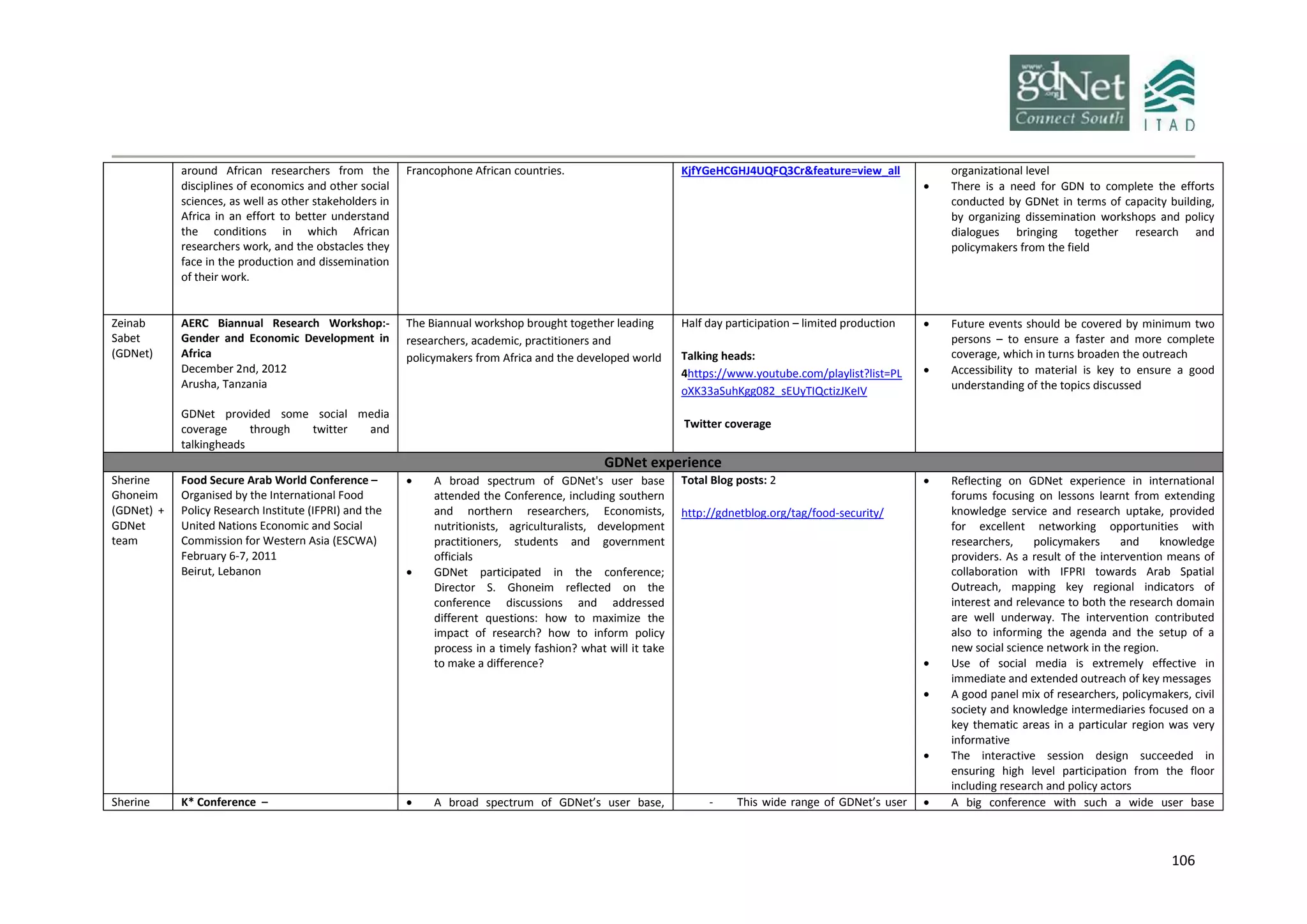
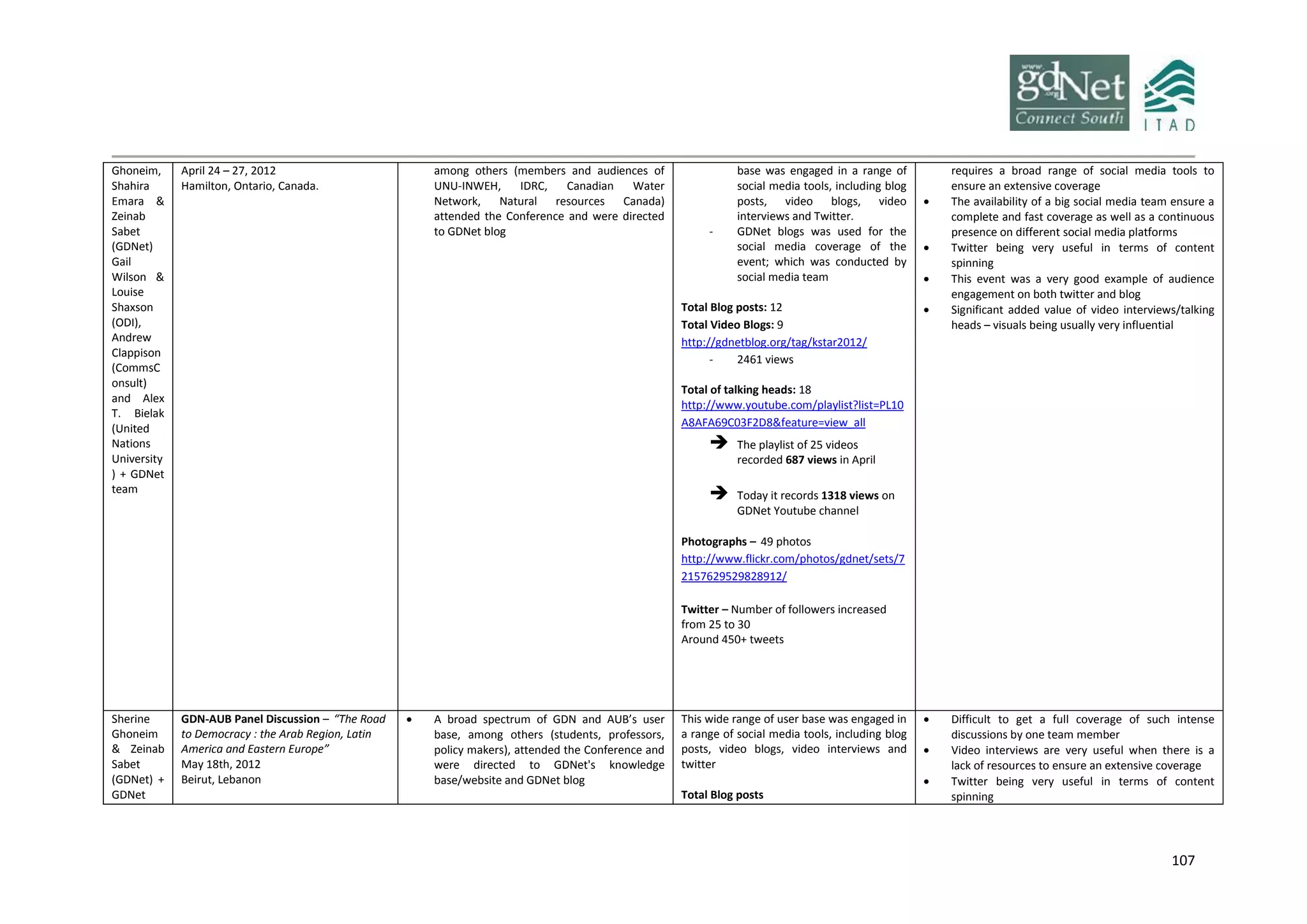
  • 116.
    101 Date & Person at GDNet Aim andnature of facilitation from GDNet (event or activity) Brief level and nature of user base Specific products / results / outcomes produced Lessons for GDN / GDNet Example 21/03/11 SG To introduce GDN alumni to the GDNet alumni facilitator and each other, and welcome them to the virtual network 25 out 40 alumni respond by introducing themselves to the group  Excel database of alumni contact details and key research interests  A number of alumni already met and know each other  Alumni spontaneously organise meeting at GDN Annual Conference  Group facilitation required at least once a month to ensure continued group engagement Events/convening spaces online Zeinab Sabet, January 2012 “Understanding and Avoiding the Oil Curse in the Arab World” – ERF-AFESD Conference January 15-16, 2012 Kuwait, Kuwait GDNet undertook a complete social media coverage of the event, including blogs posts, video blogs, video interviews, Twitter and Flickr  A broad spectrum of ERF (GDNet’s Regional Network Partner)’s user base attended the conference, including southern and northern researchers, policymakers and Economic Research Forum’s staff. Attendees were directed to both ERF and GDNet blogs, as well as GDNet’s knowledge base/portal  This wide range of user base was engaged in a range of social media tools, including blog posts, video blogs, video interviews, Twitter and Flickr  Both ERF and GDNet blogs were used for the social media coverage of the event Total Blog posts: 2 on ERFBlog and 1 on GDNetBlog Total Video Blogs: 8 on ERFBlog and 1 on GDNetBlog The total number of views for Jan 2012 is 416 views on ERF blog Total of video interviews: 9 interviews These generated 847 views on GDNet Youtube Channel Photographs: http://www.flickr.com/photos/gdnet/sets/7 2157628875432657/ 1 blog post and 1 video blog on gdnetblog  This event provided a significant opportunity to put into practice the social media skills developed the year before  Pretty challenging to get the event fully covered on different social media platforms by one team member  Blog stories are generally much more challenging and time consuming than video blogs – require good knowledge about the topics discussed at the conference  Need to engage the audience more on social media platforms – pretty challenging to engage ERF audience on twitter at the conference  ERF needs to invest more time and resources on their blog throughout the year to ensure a better engagement by their target audience at conferences and events  Newsletters being an effective tool to direct traffic to blog and twitter, particularly with this kind of audience
  • 117.
    102 GDNet user baseinteraction has been improved by using social media tools, including blog posts, video blogs, video interviews and twitter. Dina Mannaa, Haitham Khouly, Shahira Emara, Shahira Moneib, Maya Madkour & Zeinab Sabet (GDNet), with the support of Andrew Clappison and Betty Alen (CommsC onsult) and Pier Andrea Pirani (Euforic services) ERF Pre-conference Workshop – Political Economy of Arab Awakening March 24, 2012 Cairo, Egypt GDNet undertook complete social media coverage of the event, including blog posts, video blogs, video interviews, twitter and a video trailer of the conference.  A broad spectrum of ERF (GDNet's Regional Network Partner)'s user base attended the Conference, including southern and northern researchers, policymakers and Economic Research Forum's staff, and were directed to GDNet's knowledge base/website and GDNet blog.  This wide range of GDNet's user base was engaged in a range of social media tools, including blog posts, video blogs, video interviews and Twitter.  Both GDNet and ERF blogs were used for the social media coverage of the events Total Blog posts: 3 on ERF Blog Total Video Blogs: 2 posted on ERF Blog Total of talking heads: 4 http://www.youtube.com/playlist?list=PL2F 63690616C1ED85&feature=view_all Photographs - http://www.flickr.com/photos/gdnet/sets/7 2157629291639000/ Twitter ? General lessons learned  The pre-conference workshop provided a good opportunity to hook the conference participants with social media platforms and give more visibility to the social media teamwork before the ERF Annual conference  Cross-posting content between ERF and GDNet blogs helps reaching a broader audience  A bigger social media team ( which was the case here given that both workshop and conference took place in Cairo) ensures a better and faster coverage using a broad range of social media tools and platforms; which in turns guarantees a better outreach  Providing a robust social media coverage is almost impossible without a good internet connectivity and a dedicated space for the social media team; which will help fostering team spirit and coordination  Twitter being very useful in terms of content spinning  Newsletter being very effective in directing the conference participants to the blog, twitter and Youtube channel  Sharing some images from the conference on LCDs screens during coffee breaks and between the session was very helpful – catchy enough to get participants interested in the social media coverage provided by the team  Significant added value of video interviews/talking heads – visuals being usually very influential  A conference trailer is very useful in drawing attention to the work done throughout the conference (visuals are unbeatable!) GDNet team lessons learned  The pre-conference workshop and the conference Dina Mannaa, Haitham Khouly, Shahira Emara, Shahira Moneib, Maya Madkour ERF 18th Annual Conference – Corruption and Economic Development March 25-27, 2012 Cairo, Egypt GDNet undertook a complete social media coverage of the event, including blog posts, video blogs, video interviews, twitter and a video trailer of the conference.  A broad spectrum of ERF (GDNet’s Regional Network Partner)’s user base attended the Conference, including southern and northern researchers, policymakers and Economic Research Forum’s staff, and were directed to GDNet’s knowledge base/website and GDNet blog.   This wide range of GDNet’s user base was engaged in a range of social media tools, including blog posts, video blogs, video interviews and Twitter.  Both GDNet and ERF blogs were used for the social media coverage of the events Total Blog posts: 8 on ERF Blog (including 3
  • 118.
    103 & Zeinab Sabet (GDNet), with the supportof Andrew Clappison and Betty Allen (CommsC onsult) and Pier Andrea Pirani (Euforic services) posts in Arabic) and 4 on GDNet Blog Total Video Blogs: 13 posted on ERF Blog and 2 on GDNet Blog  2960 views for the ERF blog during March 2012  The ERF blog received almost 1000 views during the 2012 conference compared to the 2011 conference  The GDNet blog received 1010 views in March 2012 Total of talking heads: 22 http://www.youtube.com/playlist?list=PL2F 63690616C1ED85&feature=view_all  The playlist of 25 videos recorder 1230 views in March 2012  Today it records 2570 views on GDNet Youtube channel Photographs – 68 pictures http://www.flickr.com/photos/gdnet/sets/7 2157629291639000/ Twitter - 579 tweets were sent by 15 different users - +16 new followers between 22 March and 31 March on provided an opportunity for the GDNet team to put into practice their social media skills developed at the SM training delivered by Pier Andrea Pirani (Euforic services)  Very useful to have a ‘go to’ person to support the difference stages of the SM coverage process and provide instructions when needed  Daily team meetings and set up milestones and check in points during the day were very useful for the coordination and time management  Video training on the job was very difficult – need more prep time also to get familiar with equipment GDNet lessons learned  Such events provide an opportunity for GDNet to reach a broader segment of southern researchers and introduce to them what GDNet offers to help them showcase their work  Need to improve branding and GDNet promotion (online and offline) throughout such events  Need to arrange for a better deal with the professional photographer to ensure good quality pictures for the social media platforms - this would free up space for team members to work on other tasks
  • 119.
    104 @erflatest - 9 newfollowers on @connect2gdnet Video Trailer – http://www.youtube.com/watch?v=Hjxjso0 stBE&list=PL2F63690616C1ED85&index=1 The trailer generated 80 views in March 2012 and 347 views today Newsletters - 3 E-Newsletter to 1851 subscriptions (only 135 bounced) Zeinab Sabet, Maya Madkour & Shahira Emara (GDNet), with the support of Pier Andrea Pirani (Euforic services) + GDNet team GDN 13th Annual Conference - “Urbanization and Development: Delving Deeper into the Nexus” June 16-18, 2012 Budapest, Hungary  GDNet undertook complete social media coverage of the event, including blog posts, video blogs, video interviews and twitter.  A broad spectrum of GDNet's user base attended the Conference, including southern and northern researchers, policymakers, Awards & Medals Finalists and donors This wide range of GDNet's user base was engaged in a range of social media tools, including blog posts, video blogs, video interviews and twitter. Total of Blog posts covering the conference –4 http://gdnetblog.org/tag/gdn2012/ Total of video blogs 24 – http://gdnetblog.org/tag/gdn2012/  These generated 1590 views. from 11/06 to 28/06  Today the posts generates 2031 views Total of talking heads 33 - http://www.youtube.com/playlist?list=PL1D 3E076E0B06E57D&feature=view_all)  These generated 863 views. from 11/06 to 28/06  Today the posts generates 1321  The blog proved to have a truly global outreach, recording visits from 121 different countries over this quarter when the conference was held. United States, India, United Kingdom, Egypt, Hungary and South Africa rank amongst the top ten countries.  The fact that the conference was held during summer this year limited the number of participants who physically attended different sessions and plenaries – hence very limited engagement on social media platforms  The challenge of engaging the conference participants on social media platforms  The absence of a daily newsletter making bits and pieces from social media content and coverage travel to participants’ inboxes limited their engagement on both GDNet Blog and twitter  Promoting the conference on the GDNet portal is good practice as it directs some traffic to the social media platforms throughout and after the conference  A conference trailer is very useful in drawing attention to the work done throughout the conference (visuals are unbeatable!)  The conference has always been a good
  • 120.
    105 views One conference videotrailer – GDN Awards and Medals Competition: Recognizing innovative ideas http://www.youtube.com/watch?v=s0e6Ru nL9es&list=PL1D3E076E0B06E57D&index=3 2  The Conference trailer received 53 views Photographs – 66 http://www.flickr.com/photos/gdnet/sets/7 2157630103111844/ Twitter - Number of tweets sent from @connect2gdnet 146 tweets - 12 new followers opportunity for GDNet in terms of networking  This particular year, the conference created the occasion for GDNet to launch its ConnectSouth campaign given the broad spectrum of user base (including researchers, policymakers and donors) who attended the conference  The challenge in getting participants to use and interact on the GDNet Community Group that we were facing last year remains Zeinab Sabet (GDNet) & Sergio Held (LACEA) 17th Annual LACEA Meeting – November 1-3, 2012 Lima, Perú GNDet undertook remotely, in collaboration with the LACEA team, the social media coverage of the meeting A broad spectrum of GDNet's user base attended the Conference, including southern and northern researchers, policymakers and academicians Lack of a fully dedicated skilled team – limited online coverage Total Blog posts: 2 http://gdnetblog.org/tag/lacea/ Twitter coverage  Detailed planning and well-resourced team are key for online coverage  Aiming to cover such an event remotely was too ambitious – the presence of a fully dedicated skilled team was essential to ensure a regular and on time content for both GDNet blog and twitter  Such a big event requires a fully dedicated team to the social media, that is not involved in other conference-related tasks Zeinab Sabet (GDNet) + GDNet team GDN African Capacity Building Initiative December 1st, 2012 Arusha, Tanzania GDN organized a brainstorming, interactive and moderated workshop The Workshop brought together leading researchers, academics, practitioners and key members of the development community engaged in development research related work in Africa. To maintain even regional representation, GDN included researchers from Anglophone as well as Talking heads: 4 https://www.youtube.com/playlist?list=PL oXK33aSuhKjd-  The workshop provided an opportunity for GDNet to hear from African researchers about the challenges they face when communicating their research to their audiences  Once again, this workshop highlighted the importance of communicating research at an
  • 121.
    106 around African researchersfrom the disciplines of economics and other social sciences, as well as other stakeholders in Africa in an effort to better understand the conditions in which African researchers work, and the obstacles they face in the production and dissemination of their work. Francophone African countries. KjfYGeHCGHJ4UQFQ3Cr&feature=view_all organizational level  There is a need for GDN to complete the efforts conducted by GDNet in terms of capacity building, by organizing dissemination workshops and policy dialogues bringing together research and policymakers from the field Zeinab Sabet (GDNet) AERC Biannual Research Workshop:- Gender and Economic Development in Africa December 2nd, 2012 Arusha, Tanzania GDNet provided some social media coverage through twitter and talkingheads The Biannual workshop brought together leading researchers, academic, practitioners and policymakers from Africa and the developed world Half day participation – limited production Talking heads: 4https://www.youtube.com/playlist?list=PL oXK33aSuhKgg082_sEUyTIQctizJKeIV Twitter coverage  Future events should be covered by minimum two persons – to ensure a faster and more complete coverage, which in turns broaden the outreach  Accessibility to material is key to ensure a good understanding of the topics discussed GDNet experience Sherine Ghoneim (GDNet) + GDNet team Food Secure Arab World Conference – Organised by the International Food Policy Research Institute (IFPRI) and the United Nations Economic and Social Commission for Western Asia (ESCWA) February 6-7, 2011 Beirut, Lebanon  A broad spectrum of GDNet's user base attended the Conference, including southern and northern researchers, Economists, nutritionists, agriculturalists, development practitioners, students and government officials  GDNet participated in the conference; Director S. Ghoneim reflected on the conference discussions and addressed different questions: how to maximize the impact of research? how to inform policy process in a timely fashion? what will it take to make a difference? Total Blog posts: 2 http://gdnetblog.org/tag/food-security/  Reflecting on GDNet experience in international forums focusing on lessons learnt from extending knowledge service and research uptake, provided for excellent networking opportunities with researchers, policymakers and knowledge providers. As a result of the intervention means of collaboration with IFPRI towards Arab Spatial Outreach, mapping key regional indicators of interest and relevance to both the research domain are well underway. The intervention contributed also to informing the agenda and the setup of a new social science network in the region.  Use of social media is extremely effective in immediate and extended outreach of key messages  A good panel mix of researchers, policymakers, civil society and knowledge intermediaries focused on a key thematic areas in a particular region was very informative  The interactive session design succeeded in ensuring high level participation from the floor including research and policy actors Sherine K* Conference –  A broad spectrum of GDNet’s user base, - This wide range of GDNet’s user  A big conference with such a wide user base
  • 122.
    107 Ghoneim, Shahira Emara & Zeinab Sabet (GDNet) Gail Wilson & Louise Shaxson (ODI), Andrew Clappison (CommsC onsult) andAlex T. Bielak (United Nations University ) + GDNet team April 24 – 27, 2012 Hamilton, Ontario, Canada. among others (members and audiences of UNU-INWEH, IDRC, Canadian Water Network, Natural resources Canada) attended the Conference and were directed to GDNet blog base was engaged in a range of social media tools, including blog posts, video blogs, video interviews and Twitter. - GDNet blogs was used for the social media coverage of the event; which was conducted by social media team Total Blog posts: 12 Total Video Blogs: 9 http://gdnetblog.org/tag/kstar2012/ - 2461 views Total of talking heads: 18 http://www.youtube.com/playlist?list=PL10 A8AFA69C03F2D8&feature=view_all  The playlist of 25 videos recorded 687 views in April  Today it records 1318 views on GDNet Youtube channel Photographs – 49 photos http://www.flickr.com/photos/gdnet/sets/7 2157629529828912/ Twitter – Number of followers increased from 25 to 30 Around 450+ tweets requires a broad range of social media tools to ensure an extensive coverage  The availability of a big social media team ensure a complete and fast coverage as well as a continuous presence on different social media platforms  Twitter being very useful in terms of content spinning  This event was a very good example of audience engagement on both twitter and blog  Significant added value of video interviews/talking heads – visuals being usually very influential Sherine Ghoneim & Zeinab Sabet (GDNet) + GDNet GDN-AUB Panel Discussion – “The Road to Democracy : the Arab Region, Latin America and Eastern Europe” May 18th, 2012 Beirut, Lebanon  A broad spectrum of GDN and AUB’s user base, among others (students, professors, policy makers), attended the Conference and were directed to GDNet's knowledge base/website and GDNet blog This wide range of user base was engaged in a range of social media tools, including blog posts, video blogs, video interviews and twitter Total Blog posts  Difficult to get a full coverage of such intense discussions by one team member  Video interviews are very useful when there is a lack of resources to ensure an extensive coverage  Twitter being very useful in terms of content spinning
  • 123.
    108 team GDN paneldiscussion held in partnership with the American University of Beirut (AUB) in Beirut, Lebanon on May 18th, 2012.  In partnership with the American University of Beirut (AUB) in Beirut, GDN organized a panel discussion on the Road to democracy in the Arab region, using examples from Latin America and Eastern Europe.  GDNet undertook a complete social media coverage of the event, including blog posts, video blogs, video interviews and twitter 2 - http://gdnetblog.org/tag/aub-policy- seminar/ Total Video Blogs 5- http://gdnetblog.org/tag/aub-policy- seminar/  1704 views during May 2012 Talking heads 6 - http://www.youtube.com/playlist?list=PLDB 384029CFA40677&feature=view_all  Talking heads generated 343 views on GDNet Youtube channel Photographs - 39 http://www.flickr.com/photos/gdnet/sets/7 2157629741582616/ Twitter Shahira Emara (GDNet) World Bank: Mobilizing Knowledge Networks for Development – June 19-20, 2012 Washington DC - US This event was organized and hosted by the WBI. It looked at the role of networks, how knowledge flows across networks, and how these connections can help bring development solutions to countries in new and innovative ways  About 445 people participated in this workshop from various global knowledge networks, making up the beginnings of a community of practice on knowledge for development.  Sessions hosted discussions on integrating technologies and social media for the purpose of development, building knowledge platform, open data and opportunities for uptake, and more 1 video interview on GDNet Youtube Channel http://www.youtube.com/watch?v=vpITLyR ZTOU&list=PL1EA873FA2BCD64DB&index=2 0 Material from event is available at (http://web.worldbank.org/WBSITE/EXTERN AL/PROJECTS/0,,contentMDK:23229068~pa gePK:41367~piPK:51533~theSitePK:40941,0 0.html )  Filed or industry of “Knowledge networks” is extensive and crowded, and there are plenty of initiatives that require exposure by big or key players like the WBI  For GDNet, the event hosted the right audience, right conversations, right discussion, it was the right crowd to be around  The event was good exposure for GDNet in terms of networking  The event had a strong online presence, broadcasting was available tweeting was also on fire. It would have been worth planning for to make the Connect2GDNet account active at this time, I tweeted from my own account, but I think the GDNet presence would have made a difference  The event represented a component to community of practice building. Linkedin group is set to host discussions from knowledge practitioners that were present at the event and beyond, (http://www.linkedin.com/groups/Knowledge- Development- 4387230?gid=4387230&trk=hb_side_g )
  • 124.
    109 Online support forresearchers Zeinab Sabet, Maya Madkour & Shahira Emara (GDNet), with the support of Megan Lloyd- Laney & Betty Allen (CommsC onsult) and Pier Andrea Pirani (Euforic services) GDNet Presentation Skills Training for Awards & Medals Finalists June 14-15, 2012 Budapest, Hungary  Organised in collaboration with CommsConsult, the two-day Training aimed at building the confidence and presentation skills of the Awards & Medals Finalists in preparation for the final and determinative phase of the competition - presenting their research to the audience and judging committee at the conference. Participants were trained to both identify the headlines of their research and make it accessible for a range of different audiences through developing principles of effective communication in the written and spoken word.  GNDet undertook the social media coverage of the workshop, and facilitated the "writing for development" through its community group for the participants of the workshop.  GDNet co-delivered the training, together with CommsConsult, to a wide group of 20 academic researchers from Africa, Asia, Europe and Latin America, who were selected as finalists for the GDN Awards & Medals Competition  Finalists were expected to present their research at the GDN Annual Conference  A&M Finalists were engaged in a range of social media tools, including talking heads, recording of their mock- presentations, and a video trailer about recognizing innovative ideas. GDN Annual Conference participants were also able to follow the A&M Finalists Training related posts and video interviews through the GDNet blog and Community Group. Total Blog posts: 4 - http://gdnetblog.org/category/capacity- building/ Video Interviews: 16 – https://www.youtube.com/playlist?list=PL oXK33aSuhKiqyM583ccxigfBwTzuxt4e&feat ure=view_all  Talking head generated 751 views on GDNet Youtube channel Video Trailer - http://www.youtube.com/watch?v=s0e6R unL9es&list=PL1D3E076E0B06E57D&index= 32  Trailer generated 53 views Photographs - http://www.flickr.com/photos/gdnet/sets /72157630031119737/  Difficult to engage academic researchers during workshop and in discussions  Very challenging to work with such a mixed group of academic researchers coming from different background/cultures/education (some of them were too confident to get involved in discussions or group work)  The assumption that researchers and those running innovative projects need to work on skills is correct. However, the workshop needs to be better tailored to cater to a diverse group.  Effective use of video-critique and peer review methods to improve the styles and build the confidence of participants to present their work in different forums, including at the Conference Ceremony later in the week  The fact that the target audience of this workshop are Awards and Medals Finalists who are there to present their work at the Competition Judging Committee makes it quite challenging to get them to appreciate the added value that such a capacity building event may offer them; most of them being focused to learn what would serve their presentation – they usually get to appreciate this learning experience after they are done with their presentations  This workshop created an exposure opportunity for GDNet – some of the participants of the workshop didn’t know about the services GDNet offer them to showcase their work  Participants found the social media session and quick hands on training very useful  More time is needed for the social media session and the “data visualization” session
  • 125.
    110 Twitter – 14tweets sent  A GDNet Community Group was set up specifically for the Awards & Medals Finalists of 2012, where all workshop- related material were uploaded. Facilitated by GDNet, the group provided a space for researchers to interact with each other and with workshop facilitators - http://cloud2.gdnet.org/cms.php?id= 1235&custom_page_id=35  The climax of the training sessions was the presentation of each finalist's research in a confident and engaging style to the other scholars at the conference and the judging committee  All researchers completed a questionnaire where they pledged how they would do their job differently in the future in terms of communicating their research, which was to be followed-up 3 months later (please see output 2) Zeinab Sabet and Haitham ElKhouly (GDNet), with the support of Megan Lloyd- Laney, Farai Samhung u (CommsC onsult) GDNet-AERC Policy Brief Training Workshop – July 2-3, 2012 Nairobi, Kenya  Organised in collaboration with CommsConsult and AERC, the workshop aimed at building the capacity and skills of researchers in communicating research to maximise its uptake and impact, and helping the researchers produce a Policy Brief for each research project by the end of the workshop. GDNet user base interaction has been improved by using social media tools at the workshop, including blog posts and talking heads with participants. And Through GDNet Writing for Development Communities A GDNet Community Group was set up specifically for the group of researchers who attended the workshop, where all workshop related material were uploaded. The group provided a space for researchers to interact with each other and with workshop facilitators. Total Blog posts: 1 http://gdnetblog.org/tag/aerc/ Total Video Blogs: 1 http://gdnetblog.org/2012/08/08/why-do- researchers-struggle-to-communicate- their-research-to-policy/ Photographs – 45 http://www.flickr.com/photos/gdnet/sets /72157630432623634/ Building a relationship with researchers  Establishing contact with researchers early on is very useful – introducing them to the facilitation team through an email prior to the event as well as sharing some workshop material in advance  Useful questionnaire allowing to compare confidence and ability of participants before and after the workshop – not only for GDNet to monitor and evaluate the workshop, but also help researchers assessing themselves and the added value of participating in such events  The pledge gives the participants some sort of ownership and shows commitment to follow-up from GDNet’s side  The three months follow-up on the pledge (followed by a one year follow-up which is currently
  • 126.
    111  GNDet undertookthe social media coverage of the workshop, and facilitated the "writing for development" through its community group for the participants of the workshop that was organised in collaboration with AERC and CommsConsult . Talking heads: 6 http://www.youtube.com/playlist?list=PLA 8680D07D02392A0&feature=view_all  Talking heads received 106 views A GDNet Community Group was set up for this workshop - GDNet Community Group being conducted for 2011 workshops) raises GDNet’s credibility and ensures a permanent contact with researchers  The interactive/practical approach to learning together with the passion and positivism of resource persons are essential Content of the workshop  Dedicating one full session to crafting key messages out of the research was very useful – once researchers were able to develop strong and concise messages, writing a policy brief became much easier  Differentiating between policy implications and key recommendations remain one of the most common challenges researchers face when writing policy briefs – highlighting the difference and working with researchers on both their implications and recommendations during the surgery session was very useful  Organizing a policy panel where policymakers share their experiences with research and advise researchers how to best get their voices heard is essential and has to be part of each and every capacity building workshop  Although it can get sensitive, the peer-critique is a very advantageous exercise for researchers  When it comes to practicing media at the workshop, introducing “pitching stories to editors” session to researchers was very successful. I think we should be having two sessions; one mock press conference and one pitching stories for editors. Or hold both at the same time and let participants choose  Bringing on board media practitioners (i.e. practicing journalists) like we did last year is needed  More time was needed for the policy briefs write shop/surgeries – need to consider the possibility to hold a three day workshop and dedicate the third day to social media Social media
  • 127.
    112  Using thecapacity building events to produce content for GDNet social media platforms proves to be useful – help ensuring a regular content for the blog and interesting input from researchers on research uptake  Talking heads being an effective learning and practice tool for both GDNet team and researchers Zeinab Sabet (GDNet), with the support of Megan Lloyd- Laney and Andrew Clappison (CommsC onsult) GDNet-AERC Policy Brief Training Workshop – November 29-30, 2012 Arusha, Tanzania  Organised in collaboration with CommsConsult and AERC, the workshop aimed at building the capacity and skills of researchers in communicating research to maximise its uptake and impact, and helping the researchers produce a Policy Brief for each research project by the end of the workshop.  GNDet undertook the social media coverage of the workshop . GDNet user base interaction has been improved by using social media tools at the workshop, including blog posts and talking heads with participants. The workshop was targeted at a group of academic researchers from Benin, Chad, Uganda, Ghana, Nigeria, Cameron, Kenya and Ethiopia. The research projects involved were: Macroeconomic management of foreign aid; Institutions and service delivery Total Blog posts: 2 http://gdnetblog.org/tag/research- communications/ Photographs – 29 http://www.flickr.com/photos/gdnet/sets /72157632338493768/ Talking heads: 8 https://www.youtube.com/playlist?list=PL oXK33aSuhKgfaBbmxi_yM19TwuS0H_dc&f eature=view_all  Talking heads received 29 views Twitter – tweets were sent throughout the workshop Challenges researchers face  Discussions between researchers and policymakers at the policy panel unveiled the reality of the need to ensure the communication of the research at an organizational level (young individual researchers not having the capacity to organize events such as policy dialogues and dissemination workshops) Building a relationship with researchers  Establishing contact with researchers early on is very useful  Useful questionnaire allowing to compare confidence and ability of participants before and after the workshop – not only for GDNet to monitor and evaluate the workshop, but also help researchers assessing themselves and the added value of participating in such events  The pledge gives the participants some sort of ownership and shows commitment to follow-up from GDN’s side  The interactive/practical approach to learning together with the passion and positivism of resource persons are essential Content of the workshop  Focusing on crafting messages as part of the policy brief session helped researchers realize the importance of messaging  Differentiating between policy implications and key recommendations remain one of the most common challenges researchers face when writing policy briefs – highlighting the difference and working with researchers on both their implications and
  • 128.
    113 recommendations during thesurgery session was very useful  The policy panel was very useful – positive feedback from researchers  The peer-critique exercise helped researchers develop a better understanding of how a policy brief should look like; an opportunity for them to practice the theoretical part of the session  There is a need for more time to cover the media aspect  Bringing on board media practitioners (i.e. practicing journalists) like we did last year is needed  More time was needed for the policy briefs write shop/surgeries  Need to consider the possibility of helding a three day workshop and dedicate the third day to social media Social media  Participants showed interest in a social media session for research communications  Using the capacity building events to produce content for GDNet social media platforms proves to be useful  Talking heads being an effective learning and practice tool for both GDNet team and researchers GDNet-CIPPEC Spaces for Engagement Program GDNet & CIPPEC (Julia D'Agostin o; Leandro Echt & Vanesa Weyrauch ) Coordinating and moderating two Online Communities on:- 1. Childhood 2. Climate Change  The online communities bring together all those interested in using evidence to influence the design and formulation of childhood and climate change policies in Latin America  Participants are researchers from think tanks and universities, policymakers, members of international organisations, e.g. American Development Bank, UNICEF Childhood community: www.vippal.cippec.org/infancia Climate Change community: www.vippal.cippec.org/cambioclimatico  Both communities have great potential: in a brief period of time, they brought together many senior profiles from different countries. However, we still need to make them work more actively, encourage members to participate actively  Recognized organizations working directly on these policy issues are represented in the platform (such as Unicef, IADB). This is a great opportunity to explore new funding sources
  • 129.
    114  Childhood communityhas 51 members  Climate Change community has 61 members  Members belonging to different Latin American countries: Argentina, Chile, Colombia, El Salvador, Mexico, Uruguay, among others.  A valuable strategy could be to make a strategic alliance with Latin American organizations leading climate change and childhood issues; this will appeal new specialized members and will feed the platform with more resources addressing the use of evidence in respective policy areas  Finding resources in Spanish addressing the use of evidence to influence policies on specific issues such as climate change and childhood is not easy. It is in fact easier to find resources addressing the use of evidence to influence decision making in general. This is both a gap and an opportunity to start generating this type of specific knowledge GDNet & CIPPEC (Julia D'Agostin o; Leandro Echt & Vanesa Weyrauch ) GDNet-CIPPEC Resource Toolkit – How- to-Guides – 2012 Three series of toolkits addressing critical issues for policy influence: 1. How to build a policy influence plan 2. How to evaluate and monitor policy influence 3. Policy briefs  Resource toolkit is dedicated to a wide range of audience in the Global South (including GDNet larger audience and CIPPEC constituencies)  Available in both languages, English and Spanish  The resource toolkit is a series of guides aiming at strengthening Southern researchers’ communications capacity and enhancing their influence plan towards a better policy outreach Resource toolkit has been made available on GDNet Portal http://cloud2.gdnet.org/cms.php?id=capacit y_building_how_to_guides And on Vippal platform http://www.vippal.cippec.org/biblioteca/  Production of how-to guides is clearly different when the team has produced content in other formats (such as online courses or handbooks) that can be easily transformed into shorter guides  It is very important to begin the production by designing a clear index of the whole series so as to ensure that all content is well linked and evenly distributed  If possible, guides should be reviewed by an external editor who is not specialist on the topic. This ensures detection of assumptions that are being made and require more clarifications, avoiding the excessive use of jargon, including all the needed definitions and unifying language and tone (especially when guides have more than one author)  How-to guides are a good opportunity to feature work by others that is practical and applicable  The development of guides should be accompanied by a detailed dissemination plan and resources allocated to this to ensure their use
  • 130.
    115 GDNet (Zeinab Sabet) & CIPPEC (Julia D'Agostin o; Leandro Echt & Vanesa Weyrauch ) GDNet-CIPPECOnline Courses – 2012  One Spanish online course delivered and facilitated on “How to build a policy influence plan” (from Feb 7th to March 24th , 2012)  One English online course delivered and facilitated on “Monitoring and evaluation of policy influence” (from May 20th to June 30th , 2012)  Spanish course dedicated to Latin American researchers. 43 applications received, 16 participants selected from 11 countries (Colombia, Argentina, Costa Rica, Guatemala, Honduras, Brazil, Paraguay, Ecuador, Mexico, Peru and Bolivia)  English course dedicated to African and Asian researchers. 34 applications received, 15 participants selected from 13 countries (Uzbekistan, India, Uganda, Bangladesh, Kenya, Cameroon, Pakistan, Tanzania, Jordan, China, Egypt, Palestine and Rwanda)  Online training material are provided, including 6 modules per course  Courses are evaluated by participants with suggestions for improvement Initiative  Online courses continue to be a very cost-effective way to raise awareness of emerging R &P practices such as M&E of policy influence, as well as to improve researchers´ knowledge of how to better plan and communicate the enhancement of policy influence  Recognized strengths of the courses are applicability of the tools and exercises to the participants' real challenges and practices, the direct interaction and access to facilitators, and the possibility to link with colleagues from other regions and share experiences with them  A series of courses can help participants to have a holistic approach to policy influence practices (planning, M&E and research communications)  The exercises provided at the end of each module were very useful – It is important to add a practical aspect to the experience and help the trainees apply the theory learned throughout the course on their own work  Providing examples from the region turned out to be very useful for the participants as it helps them contextualize what they learn  Not only it is important to focus on the quality of the course material; they also need to be easily shared – providing the researcher with useful communication tools and ideas was very much appreciated in the course evaluation Methodology  Facilitator’s posts introducing modules don’t seem to be the best strategy to inspire reflections – Need to include 1 video introducing each module, and using the discussions and queries from the previous exchanges  Need to explore the possibility of extending the course and add a week for general closing discussions to satisfy individual and contextual needs of participants which may be organization specific, country specific or ideology-specific  Need to establish a form per module to better Outreach to policy series A series of online courses covering three critical areas of policy influence: planning, monitor and evaluation, and research communications  One Spanish online course delivered and facilitated on “How to design a policy influence plan” (from August 13th to September 30th , 2012)  One Spanish online course delivered and facilitated on “Research Communications” (from Oct 29th to December 16th , 2012)  One M&E online course to be delivered in April-May 2013  Spanish course dedicated to the Latin America region. CIPPEC received 106 applications for the whole series. Applicants were members of universities, think tanks, civil organisations and policymakers coming from 18 countries: Argentina, Brazil, Bolivia, Canada, Chile, Colombia, Costa Rica, Ecuador, Dominican Republic, El Salvador, Guatemala, Honduras, Mexico, Nicaragua, Spain, Paraguay, Peru and Uruguay. 10 applicants were selected to participate in the whole series and 8 for the first course from 13 countries: Argentina, Bolivia, Chile, Colombia, Costa Rica, Ecuador, El Salvador, Guatemala, Honduras, Mexico, Chile, Uruguay & Peru.  Spanish course on research communications dedicated to Latin American researchers. 36 applications received, 15 participants selected from 8 countries (Colombia, Costa Rica, El Salvador, Guatemala, Honduras, Mexico, Peru, Argentina & Brazil)
  • 131.
    116 organize the discussionswithin the forum + a general forum “Coffee forum” to openly discuss general topics  Although making exercises mandatory ensured participants engagement, some of them submitted their exercises very late which hampered their opportunity to receive comments. There is a need to think about increasing the number of exercises, with a holistic exercise at the end of the course  Some of the participants ‘suggestions we received in the evaluation regarding content included: implementation of public policy; policy evaluation; civil society participation; networking and coalition building; organizational management of CSOs; knowledge management; South-South collaboration and research methodologies  Incorporate some “special guests” as expert on a specific issue of the modules will be interesting for participants Participation  The frequency of posts and replies was dispersed with some participants making more than others. This is affected to a large extent by the travel plans of participants during the course as well as cases of internet hitches (due mostly to travel); some participants fell out of contact throughout the course  The availability aspect has to be included in the TORs so that participants consider their availability before applying  A dominant effect of the facilitator seems to appear due to his role, as well as him being almost the only initiator of new topics/questions to be discussed on the forum. Allocating more time to participants for reading the modules and sharing thoughts might solve this problem  From the surveys we realized that most of the participants do the exercises and share content with members of their own organizations  Need to encourage this practice as well as include it as a GDNet (Zeinab Sabet) & CIPPEC (Julia D'Agostin o; Leandro Echt & Vanesa Weyrauch ) GDNet-CIPPEC English Online Course on Research Communications – 2012 The course has been developed jointly by Julia D’Agostino and Zeinab Sabet, with review and input from Enrique Mendizabal and Vanesa Weyrauch The course will be piloted in April 2013 for the African region  This course will be targeted at the African researchers  Online training material are provided, including 6 modules per course  Courses are evaluated by participants with suggestions for improvement
  • 132.
    117 requirement in theToRs  In case more than one participant are selected from the same country, there is a need for diversity  selecting representatives of civil society (CSO, think tanks, universities), researchers and policymakers in order to ensure more interesting and balanced debates Role of the facilitator  Giving feedback and posting comments one-by-one seems to be a good strategy as everybody is able to read comments on his/her own exercise; also participants should be given the possibility of reading feedback given to each other’s in case they are interested. Moreover, a final post or general document addressing common issues and suggestions related to all exercises would be very useful  When following up on participants’ activity (participation, exercises), it is very important to combine exchanges through both forums and e- mails, as these allow a more private dialogue in which participants can share problems or difficulties they encounter Architecture and technical features of the platform  As many documents are shared through the forum and not in the library, we will need to improve the usefulness of the Media library by encouraging its use and organizing the documents in a friendlier way  As some participants have difficulties with the internet connection in certain areas, especially rural ones; they should be given more time to participate, submit exercises, or even reflect on a new methodology without strict deadlines
  • 133.
    118 GDNet (Zeinab Sabet) & CIPPEC (Julia D'Agostin o; Leandro Echt & Vanesa Weyrauch ) GDNet-CIPPECgrant to support the organizational development The winner will receive a grant of USD3000 This is targeted at the Latin American researchers who would complete the series of the three online courses (How to design a policy influence plan; Monitoring and evaluation of policy influence; How to communicate research) The grant will support the organizational development; participants who completed the whole series will have the possibility to submit a proposal for the development of :- - A policy influence plan - A research communications strategy - An M&E system P.S. the course on M&E of policy influence will take place in March 2013  No lessons learned yet CIPPEC (Julia D'Agostin o; Leandro Echt & Vanesa Weyrauch ) Peer Assistance between PRIs of LA, Asia & Africa June, 2012 Bogota, Colombia An open call to support one peer assistance experience between a skilled PRI from LA and one in Asia or Africa, to share lessons learned both on content and process with other think tanks in developing countries  7 applications received; 2 policy research institutes participated in this experience; 3 other potential supporters expressed interest in this kind of practices (UNICEF, INASP, and AFREA)  CINEP from Colombia and ZeipNET (Evidence Informed Policy Network) from Zimbabwe were awarded with the support.  Additional support by INASP was provided to the peer assistance experience between ZeipNet and CINEP. They contributed with additional U$960, which shows their interest in providing support to South – South collaboration and in a potential partnership to scale up peer assistance in the future. Peer assistance final report: http://www.vippal.cippec.org/media/public aciones/biblioteca/report_peer_assistance_ between_latin_america_and_africa_gdnet_ and_cippec.pdf Lessons learned by participants  Need to invest more time and resources in the production of more detailed and extensive information about both organizations to maximize the benefit from the exchange  Important to select an exchange partner with criteria of mutual benefit; the visiting organization should be able to share and teach things to the host organization and learn from it  Extra funds and time for the visitor to visit other regional projects, so that the learning is not limited to the visited location  Factors that enabled learning: a. Warm and friendly environment b. Top level (Executive Directors) support for the initiative c. Unlimited access to all required information d. Host team members willing to learn from others and to share their experiences. e. Political, economic, social and cultural similarities between the two countries, despite their apparent differences (language, culture, size)  Factors hindering learning
  • 134.
    119 f. Language barrier;which was disregarded because hosts were very good in English in this particular case Lessons learned by organizers  Need to survey with peer organizations the topics of their interest before launching the ToRs  During the selection process, organizers should: a. Do research about the think tanks that apply to ensure a well-informed selection b. Do research about the potential hosts to ensure success  Need to have a detailed working plan to be shared with involved think tanks to be clear our their activities and goals, which will also serve as an M&E tool for the coordinator of the peer assistance experience  Important that the selected host organization masters English so as to avoid communications problems and to ensure a collective systematization of lessons learned  Need to promote the exchange of documents and consultations between the peers before the visit  “break the ice” method  An active participation of the organizers during the visit is important to encourage debates and also take stock of lessons learned  A guide of questions provided by the organizers is very useful for participants to produce a fruitful final report of the experience  For future South – South exchanges more funds are needed to support the travel cost Leandro Echt – CIPPEC International Conference on Evidence- Informed Policy Making February 27th to 29th, 2012 NACETEM, Ile Ife, Nigeria  50 delegates, including both researchers and policymakers, representing 18 countries and 4 continents. The aim of the conference was to go beyond anecdote and prejudice to  A CIPPEC presentation on “Spaces for engagement” experience, discussing the experiences gained over the years by GDNet and CIPPEC working with  There was a special highlight on the need to generate “more synergies” between different platforms, to promote the use of evidence among policy makers, strengthen researchers’ influencing
  • 135.
    120 CIPPEC was selectedand supported by an INASP (International Network for the Availability of Scientific Publications) fellowship to participate as speaker at the International Conference on Evidence-Informed Policy Making (http://iceipm.inasp.info/) focus on the actual evidence on evidence- informed policy making. diverse think tanks, research centers, universities and experts in Latin America, Africa and Asia.  One blog post http://gdnetblog.org/2012/05/13/spaces- for-engagement-at-the-international- conference-on-evidence-informed-policy- making/ skills, and achieve sustainability of linkages. Leandro Echt – CIPPEC K* Star Conference April 24-28, 2012 Hamilton, Canada Conference organized by United Nations University Institute for Water, Environment and Health (UNU-INWEH).  More 60 participants, including researchers, policymakers, think tanks, private sector, NGOs and universities, from different countries around the world (Canada, Netherlands, Germany, England, Kenya, Cameroon, USA, Ghana, Vanuatu, among others); members and audiences of UNU- INWEH, IDRC, Canadian Water Network, Natural resources Canada.  CIPPEC participated not only in the panel “K* Star with Civil Society”, but also presented “Spaces for Engagement” in the Market place at the conference. CIPPEC was the only South American representative  CIPPEC was also invited to write the case study of the “Spaces for engagement programme”: http://www.inweh.unu.edu/River/Kno wledgeManagement/documents/KStar _ConceptPaper_FINAL_Oct29_WEB.pd f, pages 37-44.  The K* Star Conference had a great social media coverage, not only in GDNet blog, but also in other different channels.  Researh impact wrote a blog post about this work: https://researchimpact.wordpres s.com/2012/04/19/  A blog post on GDNetblog: http://gdnetblog.org/2012/04/2 7/kstar-with-civil-society- brokering-relationships-instead- of-knowledge/  Very important to participate in such events as some innovative products can emerge – CIPPEC was invited, together with York University of Canada, Participatory Development Associates of Ghana (PDA), Pacific Institute of Public Policy of Vanuatu, to write a paper comparing their different experiences in knowledge management activities  Such events represent a good opportunity for social media interviews, which can serve the global interest in bridging research and policy - CIPPEC interviewed the Executive Director of the Pacific Institute of Public Policy in Vanuatu, who shared his experience in launching a think tank. This interview was shared on DEAL (Executive Directors of Latin America, www.vippal.org/deal ) Leandro International Symposium on the Politics  More than 40 participants, including A CIPPEC presentation as part of the panel
  • 136.
    121 Echt – CIPPEC of PovertyResearch and Pro-Poor Policy Development November 19-20, 2012 Cape Town, South Africa Organized by the Institute for Poverty, Land and Agrarian Studies (PLAAS) researchers, policymakers, think tanks, NGOs and universities, from different countries (South Africa, Indonesia, England, Mexico, Ecuador, Argentina, Norway, USA, among others). “More about Think Tanks in the African, Asian and Latin American context”, and it focused on the role that think tanks can play in the research/policy making interface, involving tools for policy influence planning and research communications. Most of the presentation was based on lessons learned from the “Spaces for engagement programme”. Event report: http://www.plaas.org.za/sites/default/files/ publications- pdf/Report%20on%20International%20Sym posium.pdf  Participating in such events not only gives more visibility to our work, but also deepen the South- South cooperation by sharing lessons learned and experiences with think tanks from other southern regions Leandro Echt – CIPPEC Training in pedagogy skills October 2 - November 2, 2012 Bogotá, Colombia Organised by INASP; CIPPEC was invited because of its broad and recognized experience in capacity building for policy makers, mostly under the “Spaces for engagement” programme.  16 participants; policymakers, academic researchers, think tanks and NGOs, coming from 11 different countries in Latin America; including policymakers, academic researchers, NGOs and think tanks An article for the INASP Winter Newsletter, which was published in December, entitled “Defining a research agenda. Balancing internal and external influences”. The article analyses the factors that may influence the definition of a think tank’s (or similar organizations) research agenda. Available at: http://www.inasp.info/media/www/docum ents/2013_INASP_Newsletter_49_web.pdf  CIPPEC’s work under the SFE programme is well recognized by Latin American think tanks and organisations working on bridging research and policy  It is important to keep the relationship with the organisers of such events. i.e. CIPPEC was invited to write an article for the INASP December newsletter, which was another opportunity to give more visibility to our work CIPPEC (Julia D'Agostin o; Leandro Echt & Vanesa Weyrauch ) New Online Platform VIPPAL – Bridging Research and Policy in Latin America February 2012  VIPPAL is a virtual space for all those interested in strengthening the links between research and public policy in Latin America. It works as a space where people can find different resources addressing BRP issues (in the Library), and also serves as a window to showcase CIPPEC and GDNet’s work in “Spaces for engagement”. www.vippal.cippec.org - 4346 visits - 2385 unique visitors - Visits from 75 countries around the world - More than 10679 pages visited - Average of 3,36 minutes per visit VIPPAL Platform  Although it is valuable to have a space in Spanish for those interested in bridging research and policy, it is very time consuming to ensure regular updates of the platform  Most of the relevant products are in English and not in Spanish  The new platform is an appropriate space to concentrate not only current activities and products, but also all the spectrum of resources (handbooks, papers, etc) that the programme has produced in the last five years.  Need to invest more time and human resources in A new version of the newsletter VIPPAL (also hosted in VIPPAL platorm)  With a more visually attractive interface, it shares BRP information and resources through its different sections. www.vippal.cippec.org - 11 editions in 2012 - More than 4000 users/receivers
  • 137.
    122 - More than80 subscriptions Links to the 11 editions: Boletín XI, diciembre de 2012 Boletín X, noviembre de 2012 Boletín IX, octubre de 2012 Boletín VIII, septiembre de 2012 Boletín VII, agosto de 2012 Boletín VI, julio de 2012 Boletín V, junio de 2012 Boletín IV, mayo de 2012 Boletín III, abril de 2012 Boletín II, marzo de 2012 Boletín I, febrero de 2012 uploading valuable information and resources to the platform, writing different articles, etc, to ensure a regular update pf the space with cutting edge information on policy influence  Need to ensure regular cross posting from VIPPAL´s different sub-platforms (including Climate Change and Childhood online communities) to VIPPAL’s main platform, and vice-versa. This will save time and guarantee a regular update of the information and a broader outreach Newsletter  From our experience with EBPDN, we learned that there is a need for more friendly formats for both platform and newsletter. It needs to be more visually attractive with images and videos.  A more proactive communication strategy is essential for the newsletter and its subscriptions, as well as for the programme´s visibility CIPPEC (Julia D'Agostin o; Leandro Echt & Vanesa Weyrauch ) Spaces for Engagement’s lessosn learned dissemination activities CIPPEC has been disseminating the lessons learned from the Joint programme “Spaces for Engagement: Using Knowledge to Improve Public Decisions” through different hannels addressing research uptake A broad spectrum of users, including academic researchers, policymakers, think tanks, NGOs A series of posts on onthinktanks.org, with one CIPPEC member (Leandro Echt) becoming a permanent contributor to the blog)  Improving the quality of a think tank’s publications: Lessons from CIPPEC: http://onthinktanks.org/2012/10/24/i mproving-the-quality-of-a-think-tanks- publications-lessons-from-cippec/  Interview to Laura Zommer (former Director of Communications at CIPPEC): http://onthinktanks.org/2012/07/23/t he-onthinktanks-interview-laura- zommer-part-1-of-3/  Interview to Nicolás Ducoté (former General Director and founder at Excellent opportunities to broaden the scope of our activities to a specific audience, interested in think tanks and knowledge management  In September 2012, Hans Gutbrod, new Head of the Think Tank Initiative, published a post in Onthinktanks blog entitled “Reflections on Bringing Think Tanks Together: a Community of Practice?” (http://onthinktanks.org/2012/09/03/reflecti ons-on-bringing-think-tanks-together-a- community-of-practice/). We replied to his reflections, and presented the work done by GDNet and CIPPEC in the last six years. In December, Hans Gutbrod contacted us asking for a talk in which he expressed his interest in strengthen links with CIPPEC and visualize future opportunities of synergies.  Peter Taylor, Senior Program Specialist for the
  • 138.
    123 CIPPEC): http://onthinktanks.org/2012/09/10/t he-onthinktanks-interview-nicolas- ducote-part-1-of-2/  Interview toMonica Galilea (former responsible of CADEP’s Communication’s Unit): http://onthinktanks.org/2012/10/29/i nterview-of-monica-galilea-cadeps- former-director-of-communications/  Improving the quality of a think tank’s publications: Lessons from CIPPEC: http://onthinktanks.org/2012/10/24/i mproving-the-quality-of-a-think-tanks- publications-lessons-from-cippec/. An article published in the INASP Winter December Newsletter on “Defining a research agenda. Balancing internal and external influences”. Available at: http://www.inasp.info/media/www/docum ents/2013_INASP_Newsletter_49_web.pdf Online courses were disseminated on different websites of civil society organization, think tanks and public agencies Think Tank Initiative (International Development Research Centre (IDRC), read the post on “Improving the quality of a think tank’s publications: Lessons from CIPPEC” and used the content in his presentation at the meeting of all TTI grantees, donors and advisors in Cape Town, South Africa, in June 2012. CIPPEC (Julia D'Agostin o; Leandro Echt & Vanesa Weyrauch ) Executive Directors of Latin America (DEAL) DEAL is a community of practice that brings together executive directors from the more prominent PRIs in Latin America interested in improving the impact of policy research. www.vippal.org/deal  DEAL is a space allowing the search of answers, sharing knowledge, best practices and lessons learned, discussing challenges and dilemmas, and receiving materials and skills regarding the complex world of directors leading institutes that seek to influence public policies  The number of members raised from 16 to 27 during 2012 - 27 CEOs of leading think tanks in the Latin American region are members - 5 experts and former CEOs - 13 countries  11 videos on critical issues for CEOs and think tanks work  3 background notes:  “How to attract, retain and motivate staff?” (November 2011)  “Monitoring and evaluation of Policy influence: is time to begin” (July 2012)  “Improving the quality of a think tank’s publications: Lessons from CIPPEC” (October 2012) Initiative  The strength of DEAL lies in the idea of gathering a number of CEOs of the most prominent think tanks in Latin America in a closed space.  DEAL as a space for knowledge exchange about institutional issues is more valuable than DEAL as a space for learning about critical issues relating to policy influence.  DEAL competes with other spaces: most of the members are already asked to participate in other spaces (for example, the TTI platform, and they are
  • 139.
    124 In 2011 thenumber was 26?  Other resources:  Interviews with Simon Maxwell (ex Director of Overseas Development Institute), Orazio Bellettini (Director of Grupo FARO, Ecuador), Laura Zommer (ex Director of Communication at CIPPEC), Nicolás Ducoté (ex Director and founder of CIPPEC) and Mónica Galilea (Responsible of the Communication’s Unit at CADEP, Paraguay).  Three videos in which CEO’s talk about communication strategies of their organizations (Nitlapan, Nicaragua; Fedesarrollo, Colombia; and Fundar, Mexico). paid for that, or other networks related to their professional careers).  DEAL should have more specific criteria for membership, which will serve as a motive for CEOs to subscribe and remain as members. Architecture, resources and content of the platform  From our experience, we realized that generally speaking CEOs are not theme-driven. Therefore, content and resources should be more technical and practical, such as ‘Ask the experts’ documents. A good idea will be to generate a series of practical documents for CEOs – offering tangible benefits to members  Since DEAL is a private space, it could have more confidential information: tools for accountability, human resources management, different internal processes, etc.  According to members, interviews and videos are the most valuable resources DEAL is offering to them.  The platform and the frequency in which resources are shared seem not to be aligned with the schedule and priorities of each organization. It should be the agenda of organizations involved that leads the topics of DEAL and not the other way.  There is a lack of conceptual architecture of the themes/issues addressed in the platform. We should think about reorganizing the content thematically (communication, staffing, policy influence, etc) Participation  Difficult to engage Executive Directors in exchanging ideas, resources and experiences. Even though they welcome information and knowledge posted by CIPPEC and experts, their level of spontaneous participation is low due to their lack of
  • 140.
    125 time and theirskills to manage technological aspects of the platform.  Difficult to get Executive Directors proactively check the platform. The best strategy is that discussions reach their mailboxes so they can communicate through messages. In that way, the platform will operate as an interactive space  CEOs visit the platform only when they received an e mail with the information of the content. It would be better if they know exactly when information will be updates  Need to make it periodically (i.e. Newsletter).  CEOs of less developed think tanks have more incentives to participate in the discussions than the ones of more developed institutes.  Many CEOs are senior researchers who still think in terms of content and not in terms of management. The role of the expert  The role of the expert should be clearer. The best way to take advantage of the experts would be to generate a discussion among directors, and based on that experts could make comments and give impressions. New ideas  We should try to commit CEO’s time beforehand, by holding some specific activities in the year, for example by moderating online debates or organizing webinar to address relevant challenges or issues proposed by them.  Many of the current members of DEAL are twitter users. CEOs’ should have the possibility to subscribe to DEAL by Twitter. Moreover, DEAL should have a Twitter feed, and CEO’s tweets should appear in the platform. Coverage of “Communicating Complex Ideas and Critical Thinking” Shahira A book on “Communicating complex  The book is targeted at researchers and 1 blog post introducing the book:  This is a long term project that requires more than
  • 141.
    126 Emara, Maya Madkour (GDNet) & Enrique Mendizab al (Mendiza bal Ltd) ideasand critical thinking” The book represents a dialogue between academics or researchers and communication practitioners on developing critical thinking capacity and communicating complex ideas to a wide variety of audiences. The objective of this project is to gain a greater and more nuanced understanding of the challenges and opportunities for research uptake among think tanks and policy research institutes in developing countries. http://cloud2.gdnet.org/cms.php?id=crit ical_thinking_capacity communication practitioners, and indirectly policymakers and communication practitioners  Researchers will study the links between research and policy in their own disciplines and policy contexts. The book will contain 5-6 chapters; looking at governance policies and electoral reform in Argentina by CIPPEC; School reform in the Middle East by AUC; the social marketing and re-branding of breast milk in South Africa by Mixed Media; civilian control of the state security sector by BSCP; and public poisoning and harmful technologies by Groupo FARO Developing Critical Thinking Capacity to Communicate http://gdnetblog.org/2012/09/04/developin g-critical-thinking-capacity-to- communicate/ Five posts cross-posted from onthinktanks: Can think tanks have the cake and eat it too? CIPPEC’s dilemmas in promoting electoral reform in Argentina - http://gdnetblog.org/2012/09/16/can- think-tanks-have-the-cake-and-eat-it-too- cippecs-dilemmas-in-promoting-electoral- reform-in-argentina/  Civilian control of the military in Serbia http://gdnetblog.org/2012/09/26/civilian- control-of-the-military-in-serbia/  Middle East education reform think tank project http://gdnetblog.org/2012/09/27/middle- east-education-reform-think-tank-project/  Public poisoning as ‘communication’ in Ecuador: Lessons from the perpetuation of harmful technology http://gdnetblog.org/2012/09/30/public- poisoning-as-communication-in-ecuador- lessons-from-the-perpetuation-of-harmful- technology/  The people, the planet, the can – The social marketing and re-branding of breastmilk http://gdnetblog.org/2012/10/01/the- people-the-planet-the-can-the-social- marketing-and-re-branding-of-breastmilk/ one year to complete. Hence, it would have been helpful, if coordination between onthinktanks and gdnetblog was planned early on for timely feature of material  This is a step approach to thinkNet, the link was not established early on to make proper connection between two pilots  It works better if GDNet worked closer to this projects researchers and main lead  No interaction between researchers, communicators and policy makers was visible online. The pilot is based on a research book that criticizes the fact that researchers keep communicating their research ideas to each other, to the same audience (R- R). One year on, we are still not clear if the research has helped break this pattern (R-P/ P-R)  Reflecting on the different chapters in the form of blog stories was essential to ensure a broader outreach  Launching an online discussion forum to gather ideas and suggestions on that specific issue could have been very useful Thematic Haitham Integrating social media into GDNet  Generating online reflections on KB content GDNet Blog  Making use of social media and online presence in KB
  • 142.
    127 Khouly, Maya Madkour, Zeinab Sabet + team knowledge base Theaim is to use social media platforms, mainly blog and twitter to help knowledge base content travel to reach end users  Blog stories and tweets targeted at GDNet’s braod spectrum of users Blogging on KB content was introduced in the GDNet Social Media Strategy (see log output 4) and implemented in the last quarter of 2012. Each team member was asked to produce blog stories on papers from regional and thematic portals of his/her responsibility. Content generation is planned according to the GDNet monthly social media plan/calendar. - Blog post on climate change http://gdnetblog.org/2012/11/0 8/another-reason-why-the- storm-of-the-century-should-be- on-everyones-mind/ - Blog post on human rights and citizenship http://gdnetblog.org/2012/10/1 1/human-rights-citizenship-and- the-arab-spring/ Twitter KB content has been included in twitter planning since beginning of 2012 content spinning ensures a better outreach and enhances research communications and uptake  Social media arouses curiosity of researchers to read papers on KB and creates awareness around GDNet services and Campaigns (connect South, Online Services, Journals, datasets,…) Connect South Campaign Shahira Emara & Dina Mannaa (GDNet), Clare Gorman & Cheryl Brown Connect South Campaign Launched in June 2012 The aim of the campaign is to encourage members of the development research and policy communities to adopt a more inclusive approach to southern researchers’ knowledge. The Connect South campaign calls on people and organizations working in development to pledge their support and re-establishes GDNet’s own commitments to southern researchers.  The campaign is targeted at researchers, policymakers, communication practitioners, think tanks, development research institutes, NGOs and any other actors/bodies involved in knowledge management and development reseach  The campaign provides the perfect example of a user base-user base interaction 9 Blog posts http://gdnetblog.org/category/connect- south-campaign/ GDNet Youtube Channel 20 videos http://www.youtube.com/playlist?list=PL1E A873FA2BCD64DB&feature=view_all These generated 790 views on youtube Twitter Regular tweets have been sent about the campaign since its launch Prezi 2179 views as of February 20th http://prezi.com/126vw29fbeap/the-gdnet-  The campaign enables GDNet to strengthen its online presence (i.e. CS interviews and talking heads were used as content for GDNet Blog and Twitter)  The CS network (see LinkedIn) needs constant nurturing and attention. Champions (including GDNet staff) are needed to animate the discussion, progress in the debate and encourage pledges  The CS directs traffic to GDNet accounts on social media platforms (i.e. spinning blog content on CS discussions on LinkedIn and vice versa)  According to CS planning, phase 1 was a successful endeavor on individual basis; the next phase is targeted at institutional partnerships to support CS – this will provide a golden opportunity for GDNet to increase awareness about its online presence and
  • 143.
    128 connect-south-campaign/ LinkedIn 251 members andthey are actually active ones, they always share their experience and some of them have shared their pledges to connect south engage institutional partners more on its social media platforms
  • 144.
    129 Annex 6: GDNetSocial Media Annual Stat Report for 20126 Building on the experience and skills developed in the previous two years, in 2012 GDNet developed and implemented a social media plan to support the strategic objectives of the programme. One team member took charge of the overall implementation and oversight of the social media plan, with the other team members supporting in a coordinated effort. In Q2 2012, a social media calendar was developed to ensure a constant flow of content was produced, different social media platforms are used and roles and task division are defined. Three main channels have been used by the team: the GDNet blog; a branded YouTube channel; and the @Connect2GDNet Twitter account. While YouTube was mainly used to publish short interviews recorded during events and workshops organized by GDNet or attended and covered by the team, the blog and Twitter saw new contents being produced on a regular basis. Over the year, the following outputs were produced:  103 blog posts  123 videos  2351 tweets As a result of the more regular content production, and in general the more active presence on social media scene at large, the blog and YouTube in particular saw a significant increase in traffic, as indicate in the chart below. 6 Prepared by Zeinab Sabet – GDNet social media expert
  • 145.
    130 The number ofviews of the blog increased by 111,5% in 2011 compared to 2010, and by 24,25% in 2012 compared to 2011. As for YouTube, the channel saw an increase of 51% in 2011 compared to 2010, and of 45% in 2012 compared to 2011. Twitter By end of 2011, the number of followers on Twitter was around 450. It reached 1400 followers on January 1st 2013 (an increase of 1000 new followers throughout 2012). Using the location field in Twitter accounts, this map is an attempt to approximate the geographic location and mapping of our followers. Please note that the below map refers to Q1 2013; we decided to include it here in this annual report on 2012 as it gives a clear indication of where followers are located. Followers’ growth: 1000 Tweets: 2351 Mentions: 409 Retweets: 208 It is worth mentioning here that throughout 2012, we were using free online tools to monitor our progress on Twitter, which provide limited data. This is why followers’ growth and number of tweets
  • 146.
    131 are not 100%accurate. We have just started our monitoring process for Q1 2013 using new tracking tools that will allow us to provide by end of this year more accurate data. Blog The graph shows a positive trend starting from January 2010 (the date when the blog was set up for the coverage of the GDN Annual Conference held in Prague, Czech Republic in January, 2010) till end of 2012. However, there are two striking spikes that need explanation. The first is during January 2011, when the GDN Annual Conference took place in Bogotá, Colombia. The increase was mainly due to the nature of the audience, probably more familiar with social media, and the production of content in Spanish provided by the LACEA team who took part of the coverage together with the GDNet social media reporting team. The second spike is during April 2012, when the K* Conference took place in Hamilton, Canada. Once again, the increase in the number of views of the blog was due to the nature of the audience at the conference, their engagement online and familiarity with social media tools. Also the well organised advertising and promotion of the conference and its online coverage beforehand helped increase the interaction on the difference social media platforms used at the conference.
  • 147.
    132 YouTube The graph showsa positive trend starting from January 2010 (the date when the channel was set up) till end of 2012. As for the blog, also YouTube recorded the same two spikes in traffic (January 2011 and April 2012) for the same reasons explained above. RSS Feed RSS stands for “Rich Site Summary” which is an ensemble of web feed formats used to help the user who want to subscribe to access information he/she is interested in, but also to aggregate feeds from many sites into one place that is easily accessible. The graph shows a positive trend, with a strong increase in the number of hits throughout 2012.
  • 148.
    133 Annex 7: Output3 indicator 2 – Researchers interactions with the policy domain – log Date & Person at GDNet Aim and nature of facilitation from GDNet (event or activity) Nature of researcher – policy domain interaction Specific products / results / outcomes Lessons for GDN / GDNet March 2012 Vanesa Weyrauch, Julia D’Agostino & Leandro Echt (CIPPEC) First online course for Latin American policymakers – “Improving childcare policies” April 30th – June 10th , 2012 The course was jointly developed with CIPPEC’s Social Protection Programme so as to build on their specific knowledge that could contribute to the childhood community  The course was targeted at 15 policy makers belonging to 5 different Latin American countries (from the Secretariat of Labour of Costa Rica; the National Council for the Coordination of Social Policies of Argentina; the Ministry of Labour and Social Security of the province of Santa Fe in Argentina; the Ministry of Social Development and Inclusion of Peru, the Ministry of Economy in Argentina; the Ministry of Labour, Employment and Social Security of Argentina; the National Secretariat of Childhood, Youth and Family of Argentina, among others)  Solid modules with innovative content (the importance of bridging research and policy, the use of evidence to inform decision making, skills for research communication, etc), some of which will feed next courses (specially the research communications online course).  According to participants, we have also strengthened their perceptions on the value of research as an input for policy making and we have further identified their specific challenges to do so.  Successful experience to work on a particular policy field, like childcare  Course material could be adapted to other initiatives addressing specific policy field’s issues (health, climate change, etc)  Writing for and discussing with policy makers require a specific writing style by authors and facilitators; adapting the language to the audience (i.e.When producing modules addressing the use of evidence by policy makers, we should be careful and don’t make them feel we are underestimating their capacity to understand research findings or academic information)  It is important to clarify that evidence is just another source in decision making, not the only nor the best, and to highlight the other sources intervening in the policy making process, in order not to be seen as innocents academics  As many documents shared are sensitive or contain information that has not been made public yet, it is important to highlight that documents shared by participants are confidential and can’t be shared with other audience without the permission of the respective participants May 2012 Sherine Ghoneim & Zeinab Sabet (GDNet) + GDNet team GDN-AUB Panel Discussion – “The Road to Democracy : the Arab Region, Latin America and Eastern Europe” May 18th, 2012 Beirut, Lebanon GDN panel discussion held in partnership with the American University of Beirut (AUB) in Beirut, Lebanon on May 18th, 2012.  A broad spectrum of GDN and AUB’s user base, including students, professors and policy makers from the three regions  The panel provided an opportunity to enhance interaction between researchers and policymakers around democracy in the Arab region involving examples from two other regions This wide range of user base was engaged in a range of social media tools, including blog posts, video blogs, video interviews and twitter 2 Blog posts http://gdnetblog.org/tag/aub-policy-seminar/ 5 Video Blogs http://gdnetblog.org/tag/aub-policy-seminar/  This event provided an opportunity for a research- policy interface around a very hot topic “Road to democracy in the Arab Region”  It will be useful for such future events to capitalize on established R-P interaction – i.e. planning a series of events/dialogues involving same participants  Engaging participants (researchers and policymakers) online is essential for online spaces/discussions established during the actual event to succeed
  • 149.
    134  In partnershipwith the American University of Beirut (AUB) in Beirut, GDN organized a panel discussion on the Road to democracy in the Arab region, using examples from Latin America and Eastern Europe.  GDNet undertook a complete social media coverage of the event, including blog posts, video blogs, video interviews and twitter  1704 views during May 2012 6 Talking heads http://www.youtube.com/playlist?list=PLDB384029CF A40677&feature=view_all  Talking heads generated 343 views on GDNet Youtube channel 39 Photographs http://www.flickr.com/photos/gdnet/sets/721576297 41582616/ Twitter coverage of the event July & November 2012 Zeinab Sabet (GDNet) & Megan Lloyd- Laney and Andrew Clappison (CommsCo nsult) Policy panels organized at GDNet Research Communications Capacity Building Workshops  GDNet-AERC Policy Brief Training Workshop – July 2-3, 2012 Nairobi, Kenya  GDNet-AERC Policy Brief Training Workshop – November 29-30, 2012 Arusha, Tanzania  Policy panels are organized as part of the GDNet Research Communications Capacity Building Workshops and are targeted at southern researchers who benefit from workshops. In most cases, researchers to attend such workshops are identified and chosen by the RNP in collaboration with whom workshops are organized (i.e. AERC in Africa)  Policy panels consist of a number of policymakers who share with participants their take on effective research communications, particularly how an effective policy brief should be, the dos and don’ts researchers should take into consideration to maximize research uptake There was no products/blogs on such policy panels produced in 2012. However, below is an example of a blog post on a policy panel organized in December 2011 and which covers the policymakers’ advices and possible ways they shared with researchers to make a policy brief effective. Given the similarity in the content/advices of all policy panels, we have decided not to produce new ones to avoid duplication. The same blog was reposted and cross-posted online towards a better outreach. http://gdnetblog.org/2011/12/14/policymakers- addressing-researchers-at-the-gdnet-aerc-policy-brief- training-workshop/  Organizing policy panels as part of the research communications capacity building workshops proved to be a very successful approach not only in establishing a research-policy interface, but also in completing the theoretical learning that such workshops provide with practical discussions and advices based on policymakers’ own experiences in getting informed by evidence-based research.  Very positive feedback by researchers about the panels  Sharing lessons and advices that came out of such policy panels online enhanced the existing online interaction with our user base. The blog mentioned earlier was cross-posted on other platforms than gdntblog to reach a broader research community.
  • 150.
    135 Annex 8: Output4 indicator 1 – Generation of best practice lessons – log Date &Person At GDNet Title, date and location of reflective event / product Event / product objective Participants involved Brief summary of best practice lessons generated  Knowledge services team  This is an ongoing effort  Support from GDNet team when required GDNet continue to do what it does best, the Knowledge Services team added over 2000 paper this year. GDNet provides knowledge services under output 1, this covers,  Knowledgebase is an entrenched activity of GDNet - Thematic/Regional portals - Push services, newsletters, marketing and outreach - Online journals & datasets - Researchers registrations  GDNet platform The Knowledge services intends to:  Raise the profile of Southern researchers and make southern research more accessible  Diverse research and policy audiences make better use of development research from the global South  Promote thematic/regional knowledge through e- bulletins. Every newsletter includes a briefing summary on FON’s, latest news, upcoming events, links to papers, organizations and researchers on GDNet’s respective portals  Extend the outreach of KB research beyond website, using social media  Invite researches to register profiles and contribute documents to the KB  Public Good  GDNet community subscribed to email alerts  Within the user base, certain services, are targeted at specific audience Knowledgebase is considered the main asset and core activity of GDNet, having looked on the various components of the KS, spelled out earlier, these learning emerge:  One unique learning; is the value of Southern research in developing knowledge cases based on real/practical gaps. Unlike northern research which feeds into journal literature tradition  During 2012, GDNet embarked on a refocused approach for themed/regional services. Internal capacity of team has increased in the sense that team members now not only focus on generating content on a regional levels, but also thematically  The clustering of the KS library help decentralize content to encourage collaborations and interaction amongst user- base and cater for different flavors (regions/themes of interest)  Thematic/regional portals facilitate catering of an array of services to researchers. Not limited to showcasing topical research, but also to include relevant funding news, online discussions announcements, and so on  Having introduced thematic portals, we learned that Geography matters. It is important to realize that researchers have a sense of affiliation or belonging. There is
  • 151.
    136 interest to buildon south-south learning. In general people share the same region specific issues and it is common to look for knowledge about joint issues. This is important to take into consideration in positioning of content and the provision of knowledge services. It is pretty complex when trying to make a balance between thinking global versus region specific issues  To deal with ever changing dynamics of knowledge industry, there is a shift in paradigm towards open and linked data. Though GDNet is a public good, still building an online infrastructure based on open data is a key milestone for sustainability  Zeinab Sabet, Pier Andrea Shahira Emara& Pier Andrea Pirani (Euphoric services)  Networking and interactions between researchers and with policy actorsQ3 2012  Support from GDNet team when required  GDNet worked to strategize its social media effort and review its toolkit to improve outreach and uptake of GDNet services this includes: Blog Twitter LinkedIn, YouTube Delicious RSS feeds and email alerts Social media efforts aim to:  Create a two way active relationship with stakeholders  Allow KB to travel to end users  Arouse curiosity of researchers to read papers published on Knowledgebase  Raise awareness around GDNet services, products and Campaigns (connect South, Online Services, Journals, datasets, …)  Increase and direct more traffic to GDNet products  Keep users informed and updated with the latest news  Ensure better accessibility, simpleness and user friendliness  Announce capacity building activities and events  GDNet is a public service and hence is targets the public domain Having implemented social media (SM) consistently throughout 2012, GDNet developed some lessons and best practices, some of which are summarized below:  SM fosters a relaxed environment away from website formalities. Audience is more comfortable to engage, make comments and reply to posts. SM triggers user responsiveness  SM also contributes back to the user. In the sense that if researcher make a comment on blog or reply to a tweet, this is immediately reflected on their own profiles.  It’s a fantastic space to host opinionated views and stimulate discussions  Multiple stakeholders are already using SM platform, and hence it’s an active reach out, rather than expect users visit the website  Cost effective method to make friends. Establish new connections with a diverse group of followers that would otherwise have
  • 152.
    137 been hard toreach  Users of online spaces embed open cultures to institute new online connections with organizations in the filed  Content curation and cross posting is one key benefit of SM. Cross posting and making use of others work is key to raise the profile of southern researchers.  Earmark time for Twitter represents a regular station to post content, news, events, and announcements  Develop a content calendar is very useful, to plan posts and topics to discuss. And be in sync with different activities provided by GDNet, being it capacity building, knowledge sharing or networking  Understanding indicators and usage statistics (M&E) are key elements to interpret and analyze user behavior online and tailor services accordingly This activity is led by Reem Mansour  Support from GDNet team when required Researchers experience & User engagement  Users who use GDNet researcher profiles registered on the KB  Researchers use their profiles to get access to online data sets and journals to help them do research  Researchers use their profiles contribute documents to the KB Researchers registered on the KnowledgeBase In times where data, research and knowledge is becoming increasingly open access. The use of online journals and datasets is not enough as an incentive to encourage researchers to sign up for researcher profiles, key observations include:  There is a noticeable decrease in the number of researcher registrations and update of researcher profiles. Users are becoming consumed by profile proliferations. Maintaining multiple profiles with separate log-in details is becoming tedious  However, personalized marketing emails targeted at featured researchers on regional/thematic portals create stronger links between GDNet and researchers. Despite a
  • 153.
    138 very low responserate on this front, but the ones who reply back are encouraged to contribute more documents to the KB and keep posted with latest GDNet news. In a way this enhances loyalty and builds credibility  Moderating researcher profile has become a challenge to GDNet. Let alone the complexity to manage a group of people, profiles are prone to hacking and defining the means of engagement has become unsettling  At this stage, GDNet is at a ‘pause, think and react’ stage. Where it is to review the value of a researcher profile services to its constituencies. Is a researcher profile worth the amount of work that goes into moderating it? How many are using researchers profile, and aside from access to online services, how useful to still offer this service? Given the increased competitiveness and outreach of tools like LinkedIn, Google communities, and Facebook, does GDNet need to maintain researchers profile registrations?  Dina Mannaa, Shahira Emara & Clare Gorman  Q2 2012  Support from GDNet team when required The Connect South (CS) Campaign includes several online presence and anchors to raise awareness about the campaign, some of these anchors are:  Linked in profile  Connect South Charter of Commitment The Connect South (CS) campaign was launched to:  To encourage members of the development research and policy communities to adopt a more inclusive approach to southern researchers’ knowledge  The Connect South campaign calls on people and organizations working in development to pledge their support and re-establishes GDNet’s own commitments to southern researchers  The campaign follows four broad directions: o Driving a debate on how to create a level playing field for southern research  Global Researchers  Public campaign The principles of the CS campaign resonate throughout the work of GDNet. Consequently, the campaign is seen to underpin GDNet’s work plan rather a stand-alone activity.  The birth of the CS is extracted from past learning. GDNet came to realize that it is difficult to raise the profile of Southern research alone. Collective action is needed to bring Southern perspectives into global issues and debates  CS turns out to be a good platform to use as a sounding board to a number of issues concerning southern researcher’s knowledge.
  • 154.
    139  Connect South Animationo Fostering southern ownership of GDNet’s work by encouraging new members to join GDNet and existing members to be more proactive o Highlighting the key challenges facing southern researchers (e.g. access to information, securing funding and communicating findings) and putting forward solutions o Demonstrating how GDNet is building southern capacity in communicating research at the international level E.g. How can knowledge from the south count? And whose responsibility is it to make it count?  The campaign enables GDNet to engage in a range of timely discussions e.g. The inequality of knowledge  The CS network (see LinkedIn) needs constant nurturing and attention. Champions (including GDNet staff) are needed to animate the discussion, progress in the debate and encourage pledges  Campaign partners from the global South will increase impact. A clear strategy and commitment to engage with interested organizations is needed for the next phase of the campaign  CS is a win-win for everyone involved. The campaign doesn’t just ask people and organizations to ‘step up to the plate’ but to share the work they’re already doing  Connect south campaign also provides a larger umbrella to look into the challenges that southern researchers face while conducting their research? What can GDNet do to overcome those barriers? What needs to be done for southern researcher’s knowledge to have more of an impact?  Phase 1 of the campaign was a successful endeavor on individual basis, however the next phase GDNet needs to attract institutional partnerships to support CS  This activity is led by Dina abu Saada, Haitham el Khouly & Dina  Comprehensive Web Environment (CWE)- CMS documentation is launched and  Documentation of the procedures followed for updating different windows of the knowledgebase  Making various changes to the CMS including visual aid and illustrations  The wizard involved technical enhancements to the  CMS users  GDNet team  Regional coordinators Help buttons make it easier to access and use the content management system  The platform now is supplemented with proper documentation of how to update
  • 155.
    140 Mannaa, Code Corner  February- March2012  Support from GDNet team when required introduced to the team existing system. These include instructions in form of tips and images to enable better access and easier website updates pages, upload files, add documents, creates links, and many other content related updates  This helped to create a standardized systematic procedure for learning the CWE as a tool for website update Sherine Ghoneim &Cheryl Brown Published February 2013  Support from GDNet team when required  Rising from an emerging need to better understand the GDNet audience, GDNet took on a study on ‘Implementing a gender audit of an online knowledge service: the experience of GDNet  The study’s objective is to identify the potential barriers facing women in the use of online knowledge services  Implement a gender audit of the design and delivery of GDNet’s online knowledge services including its database of researchers, papers and organization profiles (the GDNet Knowledgebase), its community groups and blog  Recommend how GDNet can respond in the immediate and longer-term  Publication and slides being hosted on GDNet website  13 member of IDS Knowledge Services department at seminar; slides circulated to other staff at IDS. Gender is not part of researchers registration process, GDNet to assess whether it should be included as a mandatory field or weighted against creating another barrier to researcher registration. The GDNet survey data highlights that there seem to be some real differences in the way male and female members make use of its online services and it would be interesting to carry out qualitative research among members to understand more about why this is the case.  Female generally subscribe to use Newsletters more than male  Female use less of Social media  Female researchers are less active in contributing their documents to the KB than male  Disaggregation by gender is appropriate for indicators on satisfaction with services, but not use because ratio in wider population is unknown so benchmarking is not possible  Cheryl Brown &Sherine Ghoneim  Support from Uptake of Southern research ( work in progress)  GDNet members survey data (2010 and 2011) was analyzed and combined with a review of qualitative data, and peer-reviewed and grey literature to help GDNet create a clearer picture of the experience of southern researchers and the use of southern research.  Series of blog posts and a paper (in production, 1st blog post is published on GDNet blog) Early findings/learning from study include:  Varied definitions and values attached to the term “the South” e.g. a way of referring to developing countries without discomfort; a badge of honour.
  • 156.
    141 GDNet team when required Research questionsof the study include:  What are the most significant challenges facing southern researchers today?  Which channels do southern researchers use for communicating their research?  What are the perceptions around the quality of southern research? And is the North/South distinction still being made?  Where is southern research having an impact on policy- makers and how does this happen?  Southern researchers are experiencing challenges to raising the profile of their research knowledge based on the perception that southern research and southern research journals are of lower quality  Southern researchers at a disadvantage either because their research does not fit the anglo- centric model of research, or because the article they cite come from the “wrong” sources, due to lack of access to certain international journals  Enrique Mendizabal, Maya Madkour &Shahira Emara  Support from GDNet team when required  Communicating complex ideas and critical thinking Book ( Work in progress)  This book looks into developing critical thinking capacity of researchers and communications practitioners to communicate complex ideas  The objective of this project is to gain a greater and more nuanced understanding of the challenges and opportunities for research uptake among think tanks and policy research institutes in developing countries.  Researchers will study the links between research and policy in their own disciplines and policy contexts. The book will contain 5-6 chapters; looking at governance policies and electoral reform in Argentina by CIPPEC; School reform in the Middle East by AUC; the social marketing and re-branding of breast milk in South Africa by Mixed Media; civilian control of the state security sector by BSCP; and public poisoning and harmful technologies by Groupo FARO  http://cloud2.gdnet.org/cms.php?id=critical_thinking_c apacity  (http://onthinktanks.org/2012/07/16/communicating- complex-ideas-a-book-in-progress/)  http://gdnetblog.org/tag/critical-thinking/  The book consists of 6 chapters, each chapter is produced by a Southern lead institute. Every institute is to2 posts based on the chapter of the book and they have published. These shapter stories are hosted on GDNet and OnThinkTanks blog platforms.  The book provides useful insights why researchers keep communicating to the same community  It develops capacity for critical thinking that is indispensable when think tanks and policy research institutes make choices about how they will communicate in the future  April 2012  Sherine Ghoneim, Zeinab Sabet, Shahira Emara & Andrew Clappison  K* Conference  Organized by United Nations University – Institute for Water, Environment and Health (UNU-INWEH)  The aim of this conference is to discuss similarities and differences in the context of improving knowledge use in policy, industry and practice, where K* (KStar) has been claimed as the overarching concept  GDNet was selected as one of the case studies to showcase its experience as a Knowledge broker GDNet hosted online discussions from the Kstar on the GDNet blog (http://gdnetblog.org/tag/kstar2012/ ). The conference was an interesting platform that brought together a handsome number of initiatives that work in the knowledge industry. This was by far an excellent opportunity for
  • 157.
    142 (CommsConsu lt)  Support from GDNetteam when required exposure and be around the right people  The concept of partnership, and offering the blog as a platform for communication was very successful and set an example of partnerships  The conference plans to publish a green paper as a result of the conference and include the case studies selected in the publication  (http://cloud2.gdnet.org/~expanding_our_und erstanding_of_kstar )  Zeinab Sabet  Support from GDNet team when required  How to Guides  ‘How to Guides’ is a series of guides to help Southern researchers enhance their research uptake and increase their influence plan for policy outreach  Broad spectrum of GDNet larger audience & CIPPEC affiliated constituencies Since this is the first time to produce How to guides for external audience, its worth mentioning that they are considered a good opportunity to feature and complement work by others when practical and applicable. Some reflections /implications include;  Earlier production of content for online courses and handbooks helped in producing how-to guides  Detailed planning and clear outline/index of the whole series are essential to ensure that all content is well linked and evenly distributed  If possible, guides should be reviewed by an external editor who is not specialist on the topic. This ensures detection of assumptions that are being made and require more clarifications, avoiding the excessive use of jargon, including all the needed definitions and unifying language and tone (especially when guides have more than one author)
  • 158.
    143  The developmentplanning of guides should be accompanied by a detailed dissemination plan that includes the dissemination channels and resources involved  Zeinab Sabet  Ongoing effort Support from GDNet team when required  Research Communications capacity Building Program  Building researchers’ capacity to better communicate research findings to policy  Southern Researchers and network of GDN, RNPs and partners This is a reflection on lessons learnt from output 2, as such this section is divided into 4 sub- sections as noted hereunder: 1. Workshop design and orientation  Capacity building workshops being demand driven – tailoring workshops according to the nature of each group of researchers involved remains a strong element of the Research Communications Capacity Building Program  The writeshop orientation when designing and conducting capacity building workshops proved to be very effective as it enables participants to put into practice the acquired skills and produce policy briefs on their research work at the workshop 2. M&E aspect  Testing confidence and ability of participants involved in capacity building workshops enables GDNet team to assess whether program objectives are met  The pledge proved to be a key distinguishing feature as it increases participants’ sense of ownership and shows GDNet’s commitment to follow-up on the relationship established at
  • 159.
    144 workshops 3.Bridging research andpolicy  A high level investment is needed to strongly strengthen links between research and policy – the GDN African Capacity Building Initiative (held in Arusha, Tanzania in December 2012) provided an opportunity for a strong realization: research communications capacity building is necessary as it addresses a specific demand, but is definitely not sufficient in order to get research to inform policy – the demand for further support is frequently asked by GDNet user base. GDNet is actively looking into possible ways to offer further support that complement the standard one provided at the RCCB trainings  Online courses proved to be very effective in building researchers’ capacity to better communicate their research to policy – a series of online courses covering three critical areas of policy influence (policy influence planning, research communications, monitoring and evaluation) was designed and conducted in collaboration with CIPPEC under the GDNet-CIPPEC Spaces for Engagement Program 4. Strengthening partnerships  The GDNet-CIPPEC Spaces for Engagement Program provides a good example of how
  • 160.
    145 GDNet has beensuccessfully managing a partnership based on a multi-year program that is producing a number of activities (see details under this cluster in log 3 – indicator 1)
  • 161.
    146 Annex 9: Output4 indicator 2 – Communication of lessons – log Person at GDNet Nature of product Communications Channel Participants targeted Response/ outcomes from comments if any Cheryl Brown &Sherine Ghoniem  Paper ‘Implementing a gender audit of an online knowledge service: the experience of GDNet’  Seminar based on study delivered to staff at Institute of Development Studies, Sussex, January 2013  Contributing GDNet’s lessons to IDS-hosted workshop on indicators for knowledge brokers in March 2013  Paper hosted online  (http://cloud2.gdnet.org/cms.php?id=implemen ting_gender_audit_of_online_knowledge_servic e )  Knowledge Brokers  Partners  Exchange of views between GDNet and IDS about gender inequality in research uptake and social media use  Men and women are different, but that their circumstances/opportunities are sometimes different which can then affect how and when they use online tools Dina Mannaa, Shahira Emara& Clare Gorman  Online Community group discussion  LinkedIn profile  (http://linkd.in/ConnectSouth ) Southern researchers  Connect South is gaining momentum at a slow pace throughout 8 months since launch  Members are now up to 228  GDNet is closer to researchers debates, which puts in a position to know main discussions around ‘ Northern-southern disparity of knowledge’  Know of other initiatives that can be possible prospects for partnerships Enrique Mendizabal, Maya Madkour &Shahira Emara  Developing Critical Thinking Capacity Book  This book is expected to be completed in 2013, however posts against chapters are posted online on the onthinktanks.org 7 . They are also cross posted on GDNet blog  Southern Researchers, Media practitioners &Policymakers  Cross Posting seems useful to showcase content  This project highlights the importance of choosing the right publics to engage with, the right methods to plan this engagement, the tools that will be more effective, the competencies 7 Refer to output 3 for complete list of chapters and links
  • 162.
    147 and skills thatmay be necessary Sherine Ghoneim, Zeinab Sabet, Shahira Emara & Andrew Clappison (CommsConsult)  K* Conference  Paper Expanding our understanding of K*  Conference to present GDNet’s as a knowledge broker from the South  Paper to published in March 2013  http://cloud2.gdnet.org/cms.php?id=expanding _our_understanding_of_kstar  Partners, knowledge brokers, some of which include- but not limited to-  African Academy of Sciences, & Academy of Sciences for the Developing World  Development, Systems and Energy in Latin America  Health Canada,  Oxford University  Pacific Institute of Public Policy  University of Cape Town  ResearchImpact  Science Development Germany  Social Sciences and Humanities Research Council of Canada  Center for the Implementation of Public Policies for Equity and Growth (CIPPEC)  This was a great opportunity to model GDNet’s theory of change and present the shift in focus from being a knowledge hub to a knowledge broker  The paper is to be published in journal (WIP)  The event and paper provide an opportunity to expose GDNet brand reinforces institutional credibility Shahira Emara  Event organized by ‘World Bank: Mobilizing Knowledge Networks for Development’ June 19-20, 2012  Workshop organized and hosted by the WBI. It looked at the role of networks, how knowledge flows across networks, and how these connections can help bring development solutions to countries in new and innovative ways  Sessions hosted discussions on integrating technologies and social media for the purpose of development, building knowledge platform, open data and opportunities for uptake, and more  Global Knowledge Networks  About 445 people participated in this workshop from various global knowledge networks, making up the beginnings of a community of practice on knowledge for development  The knowledge field or industry of “Knowledge networks” is extensive and crowded, and there are plenty of initiatives that require exposure by big or key players like the WBI  Exchange views on Southern generated knowledge and where it fits from global map. An interview with Dr. Alex Bielak that looks into how southern research falls within the international
  • 163.
    148 research communities  ForGDNet, the event hosted the right audience, right conversations, right discussion, it was the right crowd to be around  The event was good exposure for GDNet in terms of networking  The event had a strong online presence, broadcasting was available tweeting was also on fire. It would have been worth planning for to make the Connect2GDNet account active at this time  The event represented a component to community of practice building. Linkedin group is set to host discussions from knowledge practitioners that were present at the event and beyond Shahira Emara  Event organized nu ITOCA 8 and IDS 9 ‘Mobilising Knowledge for Development Learning Event’ November 20-22, 2012  The workshop helps to promote ‘knowledge mobilization’ among knowledge intermediaries. The event was organized in such a way to enhance collective learning from each initiative that was represented at the event  IDS partners Southern knowledge sharing initiatives mobilizers, brokers and intermediaries. Interaction among group seem to agree to highlight the role of knowledge sharing initiatives, through providing:  More effective platforms for knowledge exchange needs to be robust and easy to access (whether technological, face-to-face, and /or networking)  Knowledge sharing technology is used to leverage what we already know- compiled explicit knowledge- intermediaries have compiled. Knowledge sharing has recently improved because the use of the new online 8 Information, Training and outreach center for Africa (ITOCA) 9 Institute for Development Studies (IDS)
  • 164.
    149 technologies and onlinetools  Build connections between people acting as knowledge mobilisers, brokers and intermediaries  Generate and capture learning, which will subsequently be packaged to share with others working in knowledge mobilization Other main learning outcomes  Knowledge sharing is about exchange- give and take relationship  Improved access to credible research is highly needed  What good does technology do to send a message in 6 seconds if it takes 6 months to get someone to act on it  No one size fits all for linking research to policy especially in local contexts. In the sense that culture is different from one context to the other. Is culture an aspect to share or keep? The other emerging question is the ownership of knowledge? Who owns it? And who can make it available and accessible  Content is King. The recognition that intermediation is all about having good content.
  • 165.
    150 Zeinab Sabet A series of Blog posts that intriguer challenges by Southern researchers in communicating research finding and providing simple and clear tips to go about the  Blogs were posted on the GDNet blog  Why do researchers struggle to communicate their research for evidence-based policymaking?  Research uptake: a road hedged up with thorns  Tips to overcome research communications challenges  The challenges facing southern researchers in the Arab world  Public audience  These posts were inspired from real needs and challenges of southern researchers who attended research communications capacity building training events  This makes GDNet close to southern communities and listen well to their real needs based on actual challenges  It helps GDNet tailor and deliver services to address required gaps related to southern knowledge and communications capacity
  • 166.