Theoretical Discrete
Probability
Distribution -
Poisson’s Distribution
CONTENT
 1. Definition of Poisson’s Distribution
 2. Properties of Poisson’s Distribution
 3. Example of Poisson’s Distribution
 4. Fitting of Poisson’s Distribution
 5. Applications of Poisson’s Distribution
1. POISSON’S DISTRIBUTION
 Poisson’s distribution is used in situations where,
1. 𝑝, probability of success i.e. chance of occurrence of an event is indefinitely
very small (𝑝 → 0. )
2. 𝑛,number of trials indefinitely large, i.e. 𝑛 → ∞
3. 𝑚, is a positive real number. say parameter of Poisson distribution 𝑚 = 𝑛. 𝑝
 Definition: A Discrete random variable 𝑋 taking values 0,1,2…. Is said to
follow poisson's distribution with parameters 𝑚, and its given by,
𝑃 𝑋 = 𝑟 =
𝑒−𝑚
𝑚 𝑟
𝑟!
; 𝑟 = 0,1,2 & 𝑚 > 0
= 0 ; 𝑜𝑡ℎ𝑒𝑟𝑤𝑖𝑠𝑒
Where, 𝑚 = parameter of Poisson distribution
𝑟 = Last sentence of the problem!
2. PROPERTIES OF POISSON’S DISTRIBUTION
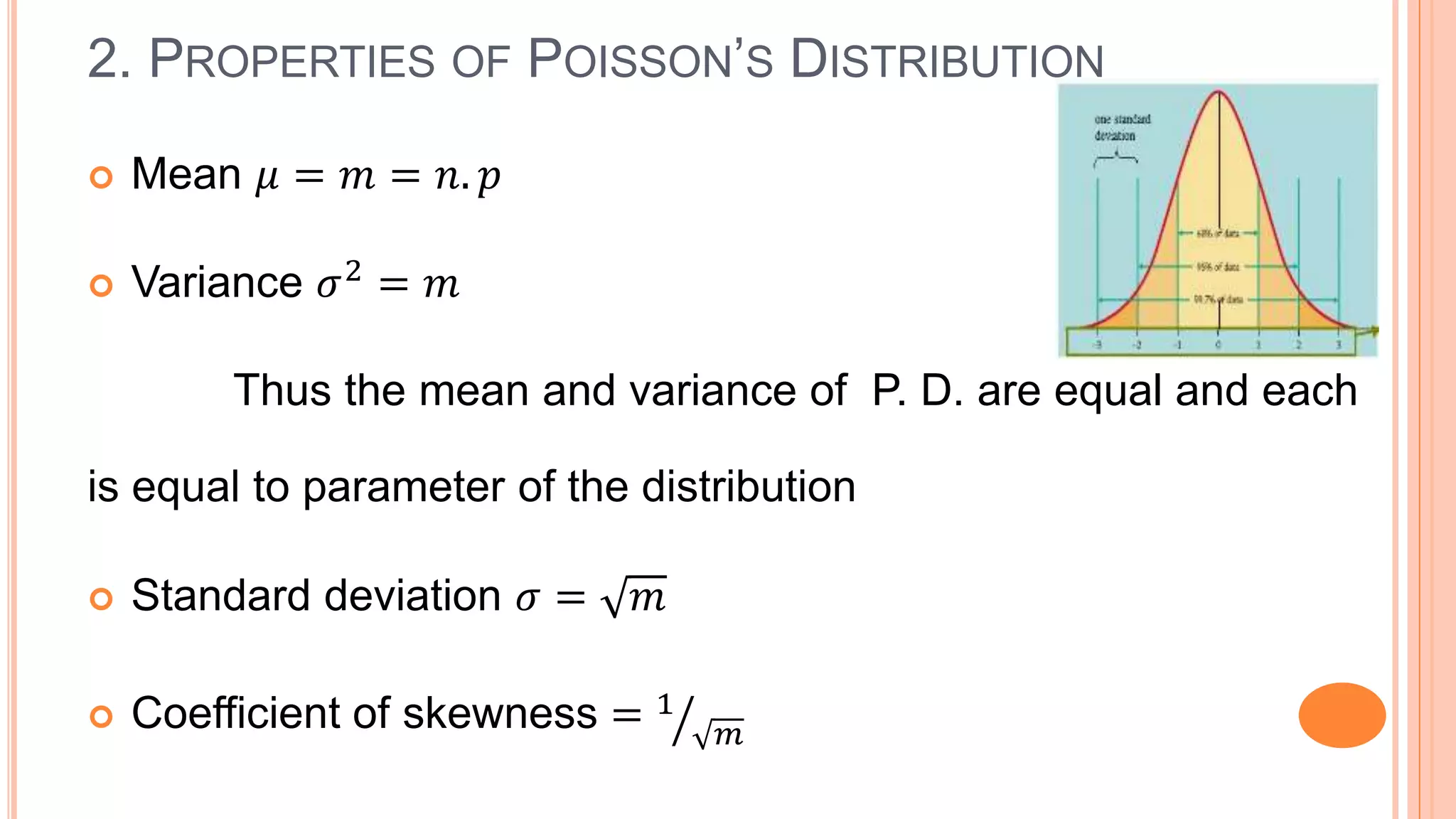
 Mean 𝜇 = 𝑚 = 𝑛. 𝑝
 Variance 𝜎2 = 𝑚
Thus the mean and variance of P. D. are equal and each
is equal to parameter of the distribution
 Standard deviation 𝜎 = 𝑚
 Coefficient of skewness = 1
𝑚
3. EXAMPLE OF POISSON’S DISTRIBUTION
 If 2% of the electric bulbs manufactured by a company are defective. Find the
probability that in a sample of 100 bulbs a) 3 are defective b) at least two are
defective.
Ans: Given, 2% 𝑏𝑢𝑙𝑏𝑠 𝑎𝑟𝑒 𝑑𝑒𝑓𝑒𝑐𝑡𝑖𝑣𝑒 = 𝑝 = 2% = 0.02
ℎ𝑒𝑟𝑒, 𝑛 = 100
Here p is very small and n is large so we use poisson’s distribution, so P. D.
formula
𝑃 𝑋 = 𝑟 =
𝑒−𝑚
𝑚 𝑟
𝑟!
Here, 𝑚 = 𝑚𝑒𝑎𝑛 = 𝑛. 𝑝 = 100 × 0.02 = 2
a) Three bulbs are defective means 𝑟 = 3
𝑃 𝑟 = 3 =
𝑒−2
23
3!
= 0.1804
Probability that 3 bulb are defective is 0.1804
CONT….
b) At least two bulbs are defective:
Probability that at least two bulb are defective means 𝑟 = 2,3,4,5 … .100
As, Total Probability = 1.
Also, 𝑃 𝑥 ≥ 2 = [𝑃 𝑥 = 2 + 𝑃 𝑥 = 3 + ⋯ + 𝑃(𝑥 = 100]
𝑃 𝑥 ≥ 2 = 1 − [𝑃 𝑥 = 0 + 𝑃(𝑥 = 1)]
𝑃 𝑥 ≥ 2 = 1 − [
𝑒−220
0!
+
𝑒−221
1!
] = 0.541
Probability that at least two bulbs are defective is 0.541
4. FITTING OF POISSON’S DISTRIBUTION
 Fitting of a distribution to a data means,
1. Estimation the parameters of distribution on the basis of data
2. Computing probabilities
3. Computing expected frequencies.
 When a Poisson distribution is to be fitted to an observed data the following
procedure is adopted
1. Find 𝑚𝑒𝑎𝑛 𝑥 =
𝑓𝑥
𝑓
2. Poisson’s Parameter 𝑚 = 𝑥
3. Poisson’s Distribution function 𝑃 𝑋 = 𝑟 =
𝑒−𝑚 𝑚 𝑟
𝑟!
; 𝑟 = 0,1,2 …
4. Put 𝑟 = 0; 𝑃 0 = 𝑃 𝑟 = 0 =
𝑒−𝑚 𝑚0
0!
= 𝑒−𝑚
5. Find the expected frequency of r= 0 𝑖. 𝑒. 𝐹 0 = 𝑁 × 𝑃 0 , 𝑤ℎ𝑒𝑟𝑒 𝑁 = 𝑓
6. The other expected frequencies can be found using
𝐹 𝑟 + 1 =
𝑚
𝑟 + 1
× 𝐹 𝑟 𝑓𝑜𝑟 𝑟 = 0,1,2 … .
EXAMPLE OF FITTING OF POISSON’S DISTRIBUTION
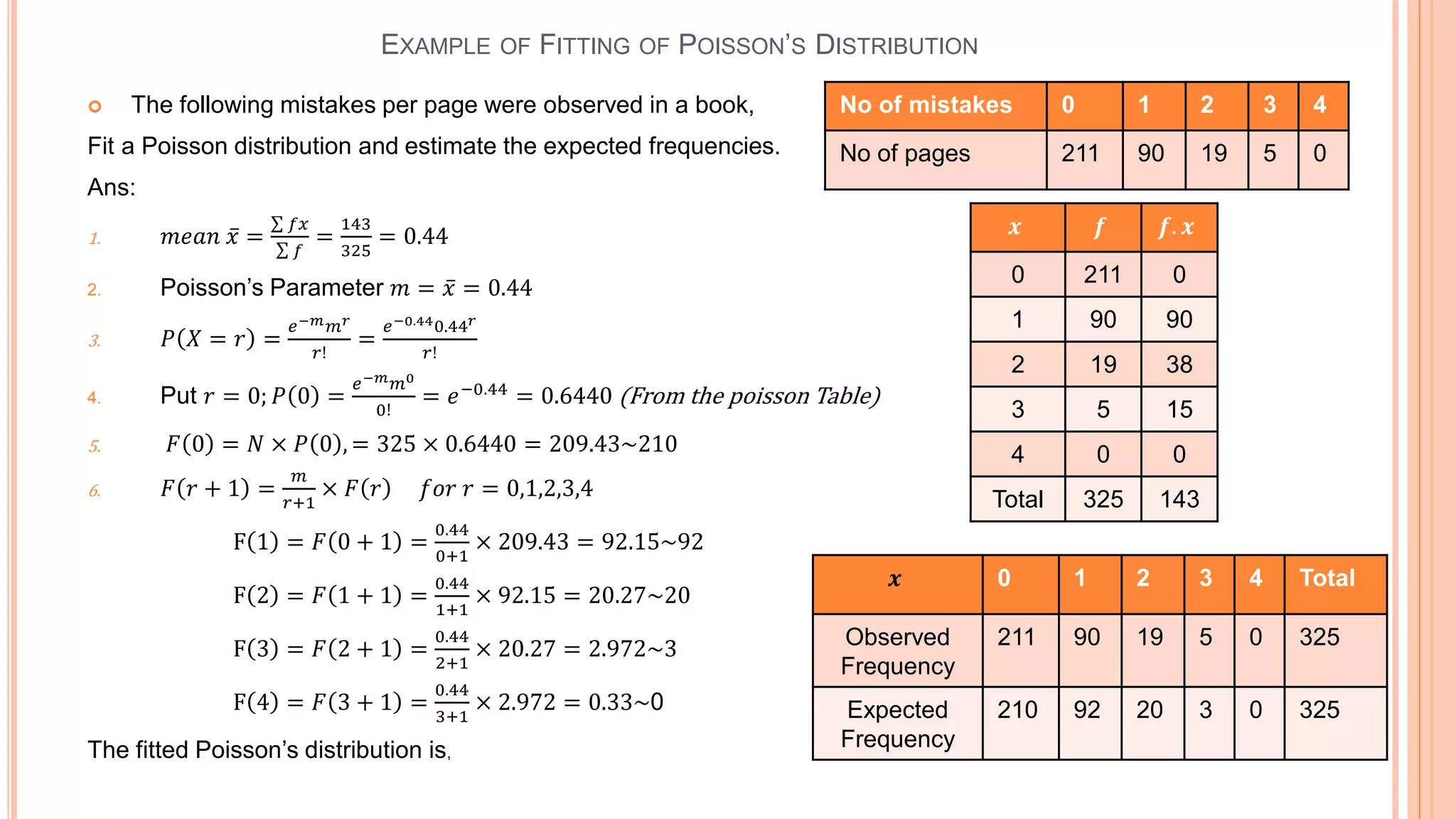
 The following mistakes per page were observed in a book,
Fit a Poisson distribution and estimate the expected frequencies.
Ans:
1. 𝑚𝑒𝑎𝑛 𝑥 =
𝑓𝑥
𝑓
=
143
325
= 0.44
2. Poisson’s Parameter 𝑚 = 𝑥 = 0.44
3. 𝑃 𝑋 = 𝑟 =
𝑒−𝑚 𝑚 𝑟
𝑟!
=
𝑒−0.440.44 𝑟
𝑟!
4. Put 𝑟 = 0; 𝑃 0 =
𝑒−𝑚 𝑚0
0!
= 𝑒−0.44
= 0.6440 (From the poisson Table)
5. 𝐹 0 = 𝑁 × 𝑃 0 , = 325 × 0.6440 = 209.43~210
6. 𝐹 𝑟 + 1 =
𝑚
𝑟+1
× 𝐹 𝑟 𝑓𝑜𝑟 𝑟 = 0,1,2,3,4
F 1 = 𝐹 0 + 1 =
0.44
0+1
× 209.43 = 92.15~92
F 2 = 𝐹 1 + 1 =
0.44
1+1
× 92.15 = 20.27~20
F 3 = 𝐹 2 + 1 =
0.44
2+1
× 20.27 = 2.972~3
F 4 = 𝐹 3 + 1 =
0.44
3+1
× 2.972 = 0.33~0
The fitted Poisson’s distribution is,
No of mistakes 0 1 2 3 4
No of pages 211 90 19 5 0
𝒙 𝒇 𝒇. 𝒙
0 211 0
1 90 90
2 19 38
3 5 15
4 0 0
Total 325 143
𝒙 0 1 2 3 4 Total
Observed
Frequency
211 90 19 5 0 325
Expected
Frequency
210 92 20 3 0 325
5. APPLICATIONS OF POISSON’S DISTRIBUTION
Poisson’s distribution is used in,
1. To find number of defective items found in a large
size lot.
2. To find number of deaths due to snake-bite in a
village
3. To know number of persons affected due to
radiation
4. To know arrival pattern of defective vehicles,
patients in a hospital or telephone calls.
5. In biology, to count number of bacteria.
Thank you

Poisson's distribution

  • 1.
  • 2.
    CONTENT  1. Definitionof Poisson’s Distribution  2. Properties of Poisson’s Distribution  3. Example of Poisson’s Distribution  4. Fitting of Poisson’s Distribution  5. Applications of Poisson’s Distribution
  • 3.
    1. POISSON’S DISTRIBUTION Poisson’s distribution is used in situations where, 1. 𝑝, probability of success i.e. chance of occurrence of an event is indefinitely very small (𝑝 → 0. ) 2. 𝑛,number of trials indefinitely large, i.e. 𝑛 → ∞ 3. 𝑚, is a positive real number. say parameter of Poisson distribution 𝑚 = 𝑛. 𝑝  Definition: A Discrete random variable 𝑋 taking values 0,1,2…. Is said to follow poisson's distribution with parameters 𝑚, and its given by, 𝑃 𝑋 = 𝑟 = 𝑒−𝑚 𝑚 𝑟 𝑟! ; 𝑟 = 0,1,2 & 𝑚 > 0 = 0 ; 𝑜𝑡ℎ𝑒𝑟𝑤𝑖𝑠𝑒 Where, 𝑚 = parameter of Poisson distribution 𝑟 = Last sentence of the problem!
  • 4.
    2. PROPERTIES OFPOISSON’S DISTRIBUTION  Mean 𝜇 = 𝑚 = 𝑛. 𝑝  Variance 𝜎2 = 𝑚 Thus the mean and variance of P. D. are equal and each is equal to parameter of the distribution  Standard deviation 𝜎 = 𝑚  Coefficient of skewness = 1 𝑚
  • 5.
    3. EXAMPLE OFPOISSON’S DISTRIBUTION  If 2% of the electric bulbs manufactured by a company are defective. Find the probability that in a sample of 100 bulbs a) 3 are defective b) at least two are defective. Ans: Given, 2% 𝑏𝑢𝑙𝑏𝑠 𝑎𝑟𝑒 𝑑𝑒𝑓𝑒𝑐𝑡𝑖𝑣𝑒 = 𝑝 = 2% = 0.02 ℎ𝑒𝑟𝑒, 𝑛 = 100 Here p is very small and n is large so we use poisson’s distribution, so P. D. formula 𝑃 𝑋 = 𝑟 = 𝑒−𝑚 𝑚 𝑟 𝑟! Here, 𝑚 = 𝑚𝑒𝑎𝑛 = 𝑛. 𝑝 = 100 × 0.02 = 2 a) Three bulbs are defective means 𝑟 = 3 𝑃 𝑟 = 3 = 𝑒−2 23 3! = 0.1804 Probability that 3 bulb are defective is 0.1804
  • 6.
    CONT…. b) At leasttwo bulbs are defective: Probability that at least two bulb are defective means 𝑟 = 2,3,4,5 … .100 As, Total Probability = 1. Also, 𝑃 𝑥 ≥ 2 = [𝑃 𝑥 = 2 + 𝑃 𝑥 = 3 + ⋯ + 𝑃(𝑥 = 100] 𝑃 𝑥 ≥ 2 = 1 − [𝑃 𝑥 = 0 + 𝑃(𝑥 = 1)] 𝑃 𝑥 ≥ 2 = 1 − [ 𝑒−220 0! + 𝑒−221 1! ] = 0.541 Probability that at least two bulbs are defective is 0.541
  • 7.
    4. FITTING OFPOISSON’S DISTRIBUTION  Fitting of a distribution to a data means, 1. Estimation the parameters of distribution on the basis of data 2. Computing probabilities 3. Computing expected frequencies.  When a Poisson distribution is to be fitted to an observed data the following procedure is adopted 1. Find 𝑚𝑒𝑎𝑛 𝑥 = 𝑓𝑥 𝑓 2. Poisson’s Parameter 𝑚 = 𝑥 3. Poisson’s Distribution function 𝑃 𝑋 = 𝑟 = 𝑒−𝑚 𝑚 𝑟 𝑟! ; 𝑟 = 0,1,2 … 4. Put 𝑟 = 0; 𝑃 0 = 𝑃 𝑟 = 0 = 𝑒−𝑚 𝑚0 0! = 𝑒−𝑚 5. Find the expected frequency of r= 0 𝑖. 𝑒. 𝐹 0 = 𝑁 × 𝑃 0 , 𝑤ℎ𝑒𝑟𝑒 𝑁 = 𝑓 6. The other expected frequencies can be found using 𝐹 𝑟 + 1 = 𝑚 𝑟 + 1 × 𝐹 𝑟 𝑓𝑜𝑟 𝑟 = 0,1,2 … .
  • 8.
    EXAMPLE OF FITTINGOF POISSON’S DISTRIBUTION  The following mistakes per page were observed in a book, Fit a Poisson distribution and estimate the expected frequencies. Ans: 1. 𝑚𝑒𝑎𝑛 𝑥 = 𝑓𝑥 𝑓 = 143 325 = 0.44 2. Poisson’s Parameter 𝑚 = 𝑥 = 0.44 3. 𝑃 𝑋 = 𝑟 = 𝑒−𝑚 𝑚 𝑟 𝑟! = 𝑒−0.440.44 𝑟 𝑟! 4. Put 𝑟 = 0; 𝑃 0 = 𝑒−𝑚 𝑚0 0! = 𝑒−0.44 = 0.6440 (From the poisson Table) 5. 𝐹 0 = 𝑁 × 𝑃 0 , = 325 × 0.6440 = 209.43~210 6. 𝐹 𝑟 + 1 = 𝑚 𝑟+1 × 𝐹 𝑟 𝑓𝑜𝑟 𝑟 = 0,1,2,3,4 F 1 = 𝐹 0 + 1 = 0.44 0+1 × 209.43 = 92.15~92 F 2 = 𝐹 1 + 1 = 0.44 1+1 × 92.15 = 20.27~20 F 3 = 𝐹 2 + 1 = 0.44 2+1 × 20.27 = 2.972~3 F 4 = 𝐹 3 + 1 = 0.44 3+1 × 2.972 = 0.33~0 The fitted Poisson’s distribution is, No of mistakes 0 1 2 3 4 No of pages 211 90 19 5 0 𝒙 𝒇 𝒇. 𝒙 0 211 0 1 90 90 2 19 38 3 5 15 4 0 0 Total 325 143 𝒙 0 1 2 3 4 Total Observed Frequency 211 90 19 5 0 325 Expected Frequency 210 92 20 3 0 325
  • 9.
    5. APPLICATIONS OFPOISSON’S DISTRIBUTION Poisson’s distribution is used in, 1. To find number of defective items found in a large size lot. 2. To find number of deaths due to snake-bite in a village 3. To know number of persons affected due to radiation 4. To know arrival pattern of defective vehicles, patients in a hospital or telephone calls. 5. In biology, to count number of bacteria.
  • 10.