Chapter 7
Corporate Strategies I
Moses Acquaah, Ph.D.
377 Bryan Building
Phone: (336) 334-5305
Email: acquaah@uncg.edu
Lecture Objectives
Define corporate strategy.
Explain the difference between a single-business firm and a
multiple-business firm.
Discuss how corporate strategy is related to the other firm
strategies.
Explain the corporate strategic directions available to firms.
Describe the various organizational growth strategies.
Discuss the reasons/motives for diversification
Discuss the advantages and disadvantages of related &
unrelated diversification.
Explain how growth strategies can be implemented.
Describe when organizational stability is an appropriate
strategic choice.
What is Corporate Strategy?
Those strategies concerned with the broad and
long-term questions of
what business(es) the organization is in or wants to be
in & what it wants to do with those businesses
Task involves
Moves to enter new businesses
Actions to boost combined performance of businesses
Ways to capture synergy among related businesses
Establishing investment priorities & steering
corporate resources into most attractive units
Single & Multiple Business
Organizations
Single business organizations
Operates primarily in only one industry (e.g., Coca-Cola
– Beverage Industry; Wrigley Jr. Company – Chewing
Gum)
Multiple Business Organizations
Operates in more than one industry
Example: PepsiCo – Snack Food Industry business
(Frito Lay); & Beverage Industry
Philip Morris Companies – Tobacco Industry; Brewery
Industry (Miller Brewery); & Food Processing Industry
(Kraft General Foods).
Corporate, Competitive &
Functional Strategies
Corporate strategy establishes the overall
direction that the organization hopes to go.
Competitive & functional strategies provide
the means or mechanisms for making sure
the organization gets there.
Possible Corporate Strategic
Directions
(1) Moving the organization ahead --
Organizational Growth
(2) Keeping the organization where it is --
Organizational Stability
(3) Reversing the organization’s weaknesses or
decline -- Organizational Renewal
ORGANIZATIONAL
GROWTH
Growth strategy
Involves the attainment of specific growth objectives by
increasing the level of an firm’s operations
Typical growth objectives for businesses
Increase in sales revenues
Increase in earnings or profits
Other performance measures
Growth objectives of not-for-profit businesses
Increasing clients served or patrons attracted
Broadening the geographic area
Increasing programs offered
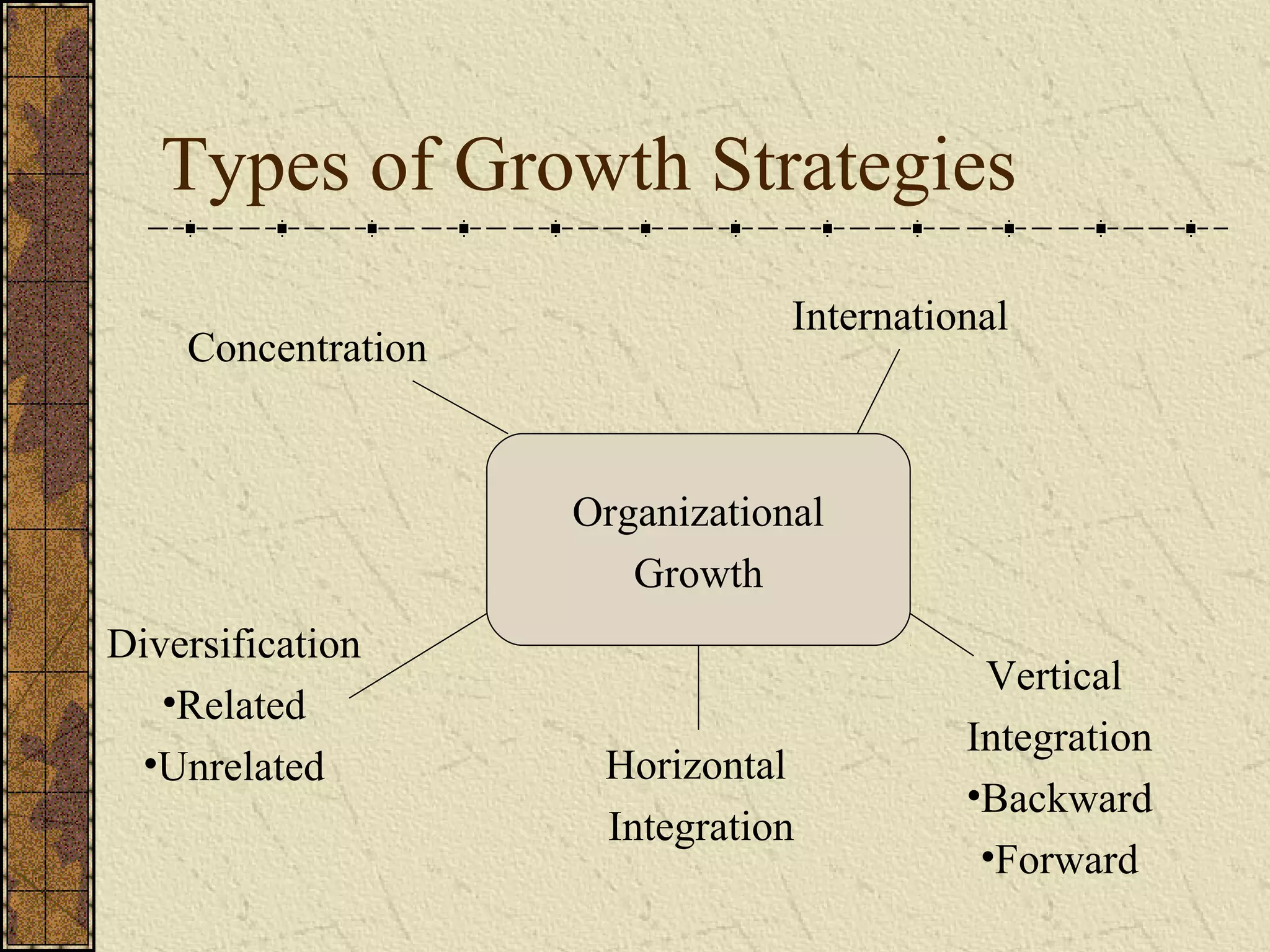
Types of Growth Strategies
Organizational
Growth
Diversification
•Related
•Unrelated Horizontal
Integration
Vertical
Integration
•Backward
•Forward
Concentration
International
Concentration Strategy
A growth strategy where the firm
Concentrates on its primary line of business
Looks for ways to meet its growth objectives
through increasing its level of operation in this
primary business
When a single-business organization
pursues growth, it is using the concentration
strategy
Concentration Strategy
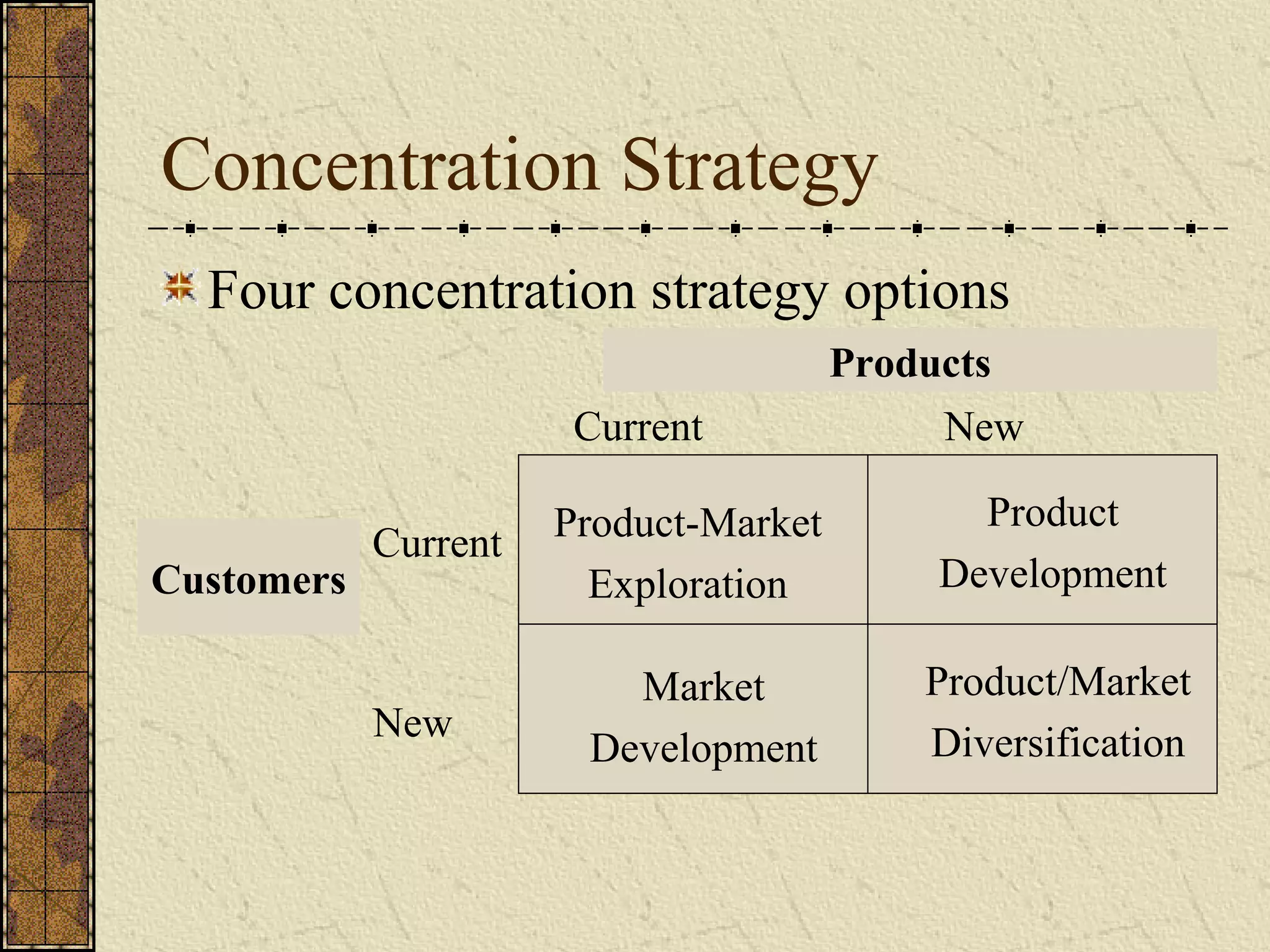
Four concentration strategy options
Products
Customers
Current
New
Current New
Product-Market
Exploration
Product
Development
Market
Development
Product/Market
Diversification
Concentration Strategy
Product-Market Exploration Option
Describes attempts by firm to increase sales of
its current product(s) in its current market(s) by
depending on its functional & competitive
strategies
Product Development Option
Firm create new product for use by its current
market (customers)
Concentration Strategy
Market Development Option
When a firm sell its current products in new
markets (additional geographic areas or market
segments not currently served by firm)
Product-Market Diversification Option
Where firm seeks to expand both into new
products & new markets
Single-business firm becomes a multiple-
business firm since it is now operating in a
different industry
Concentration Strategy
Advantage
Organization becomes very good at what it does
Drawback
Organization is vulnerable to industry and other
external environmental shifts
Concentration strategy is used by both small-
sized and large organizations
Vertical Integration Strategies
An organization’s attempt to gain control of
Its inputs (backward integration) -- supplier
Its output (forward integration) -- distributor
Or both inputs and output
Purpose is to (1) reduce resource acquisition costs, &
(2) deal with inefficient operations
Vertical Integration
Considered a growth strategy because the firm’s
operations are expanded beyond primary business
Mixed empirical results as to whether strategy helps or
hurt performance
What is the role of outsourcing in achieving same
objective as vertical integration?
Vertical Integration Strategies
Benefits
Reduced purchasing &
selling costs
Improved coordination
of functions &
capabilities
Protected proprietary
technology
Costs
Reduced flexibility as
firm is locked into
products & technology
Create an exit barrier
due to existence of
assets that are hard to
sell
Difficulties in
integrating various
operations
Financial costs of
acquiring or starting up
Horizontal Integration Strategies
Expanding the firm's operations through combining
with competitors operating in the same industry &
doing the same things
It is an appropriate corporate growth strategy as
long as
It enables the company to meet its growth objectives
It can be strategically managed to attain a sustainable
competitive advantage
It satisfies legal and regulatory guidelines
Diversification Strategies
A corporate growth strategy in which a firm
expands its operation by moving into a
different industry
Many reasons or motives for diversification
Two major types of diversification
Related (concentric) diversification
Unrelated (conglomerate) diversification
Why Do Firms Diversify?
To Grow
Increase sales & profitability beyond what firm’s
core businesses can provide
Managerial self-serving behavior -- compensation
Managerial “hubris” -- pride or status that come from
managing a large business
To more fully utilize existing resources and
capabilities
Skills in sales & marketing, general management
skills & knowledge, distribution channels, etc.
Why Do Firms Diversify?
Risk reduction and/or spreading
Escape from unattractive or undesirable industries (e.g., tobacco
& oil companies)
Stability of profit flows (CAPM: systematic vs. unsystematic
risks; shareholders & diversified portfolios)
To make use of surplus cash flows
Large cash balances attract corporate raiders
Use cash balances to avoid hostile takeovers
To build shareholder value
Create synergy among the businesses of a firm
Make 2 + 2 = 5: The whole should be greater than the sum of
the parts
Why Do Firms Diversify
Synergy can be obtained in three ways
Exploiting economies of scale
Exploiting economies of scope
Efficient allocation of capital through the use of portfolio
management techniques
Problems that prevent diversified firms from
realizing synergies
A poor understanding of how diversification activities will “fit”
or be coordinated with existing businesses
Dangers or risks associated with the acquisition of businesses
Problems with the development of internal businesses
Why Do Firms Diversify?
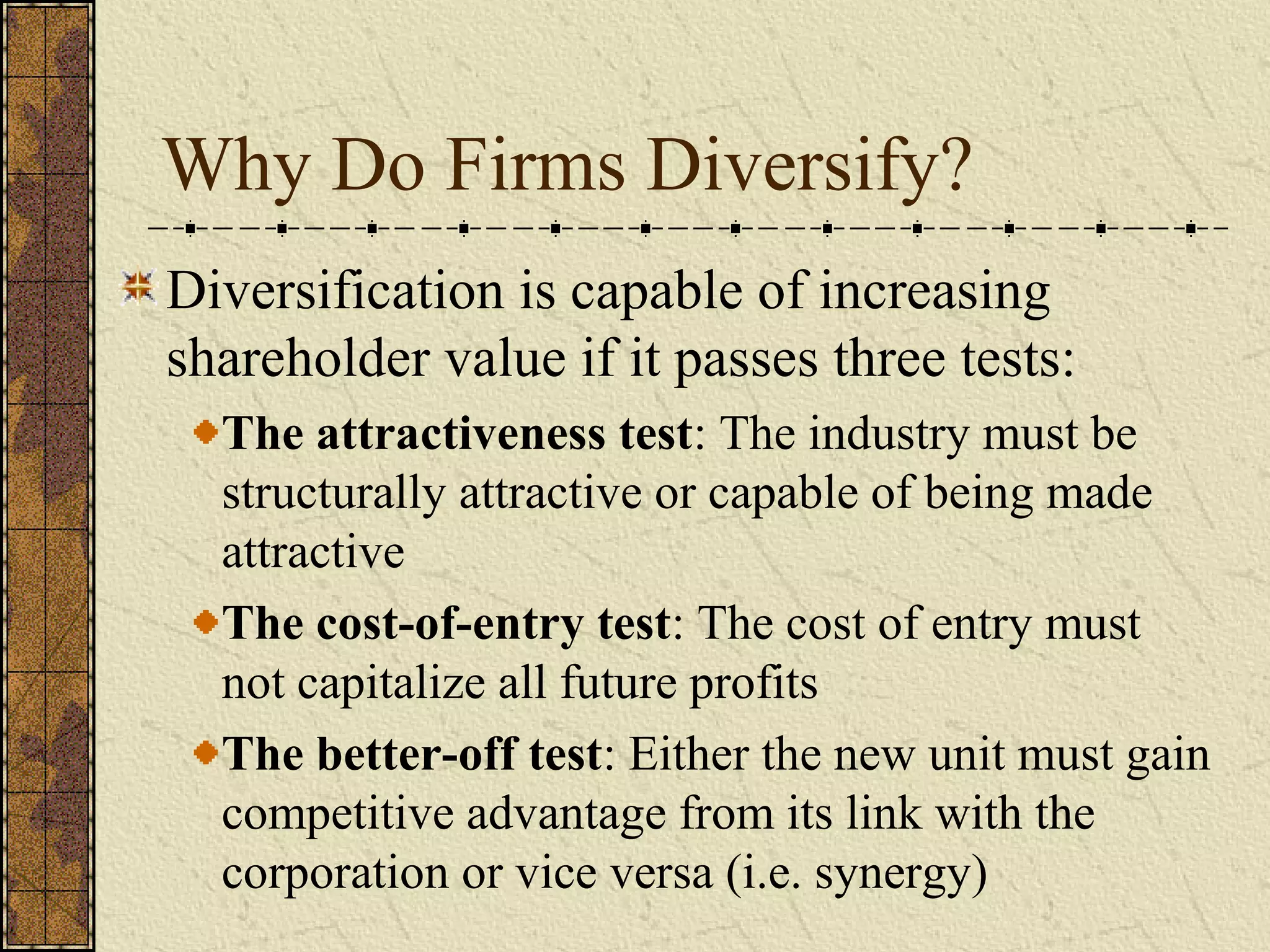
Diversification is capable of increasing
shareholder value if it passes three tests:
The attractiveness test: The industry must be
structurally attractive or capable of being made
attractive
The cost-of-entry test: The cost of entry must
not capitalize all future profits
The better-off test: Either the new unit must gain
competitive advantage from its link with the
corporation or vice versa (i.e. synergy)
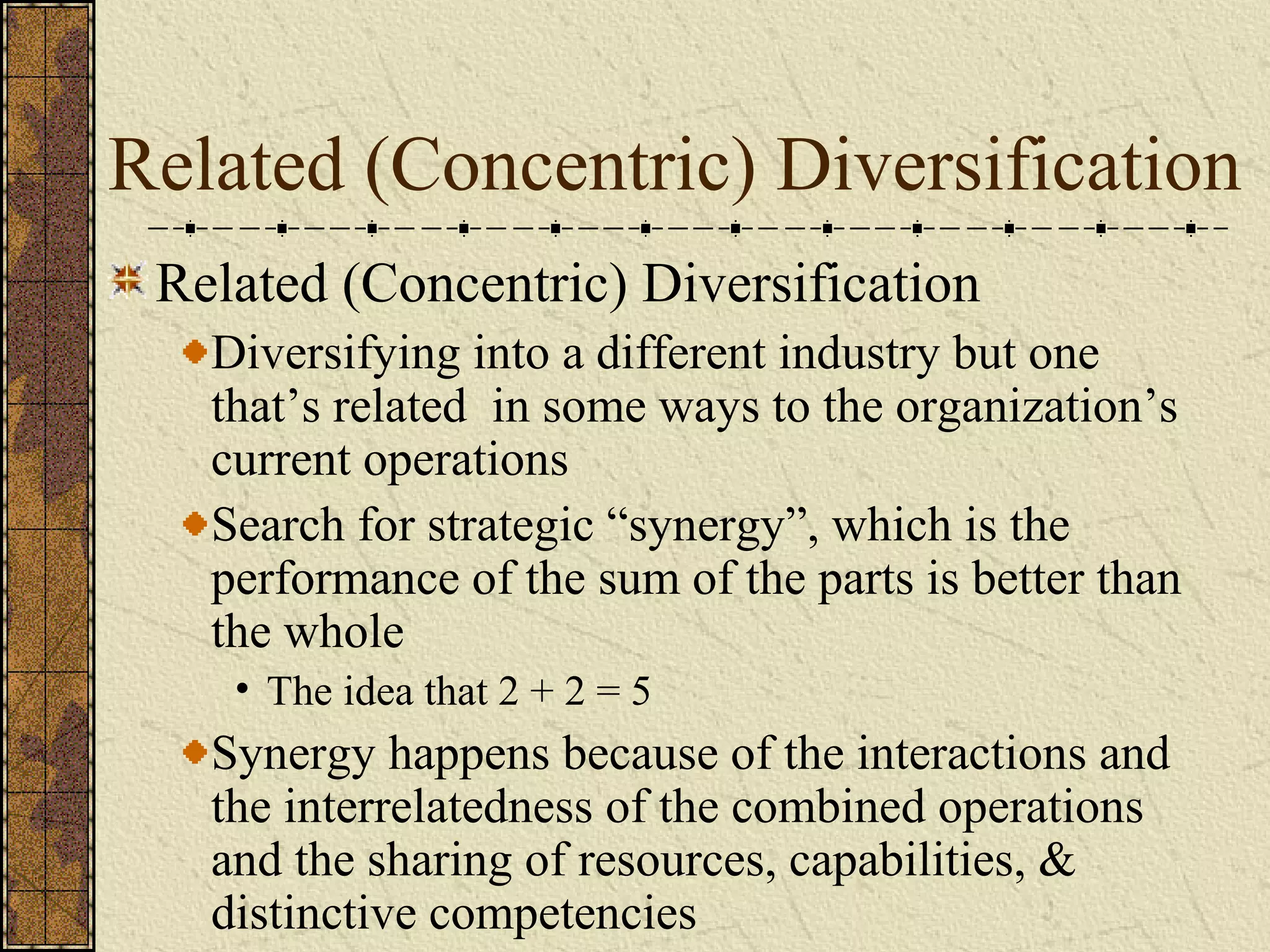
Related (Concentric) Diversification
Diversifying into a different industry but one
that’s related in some ways to the organization’s
current operations
Search for strategic “synergy”, which is the
performance of the sum of the parts is better than
the whole
• The idea that 2 + 2 = 5
Synergy happens because of the interactions and
the interrelatedness of the combined operations
and the sharing of resources, capabilities, &
distinctive competencies
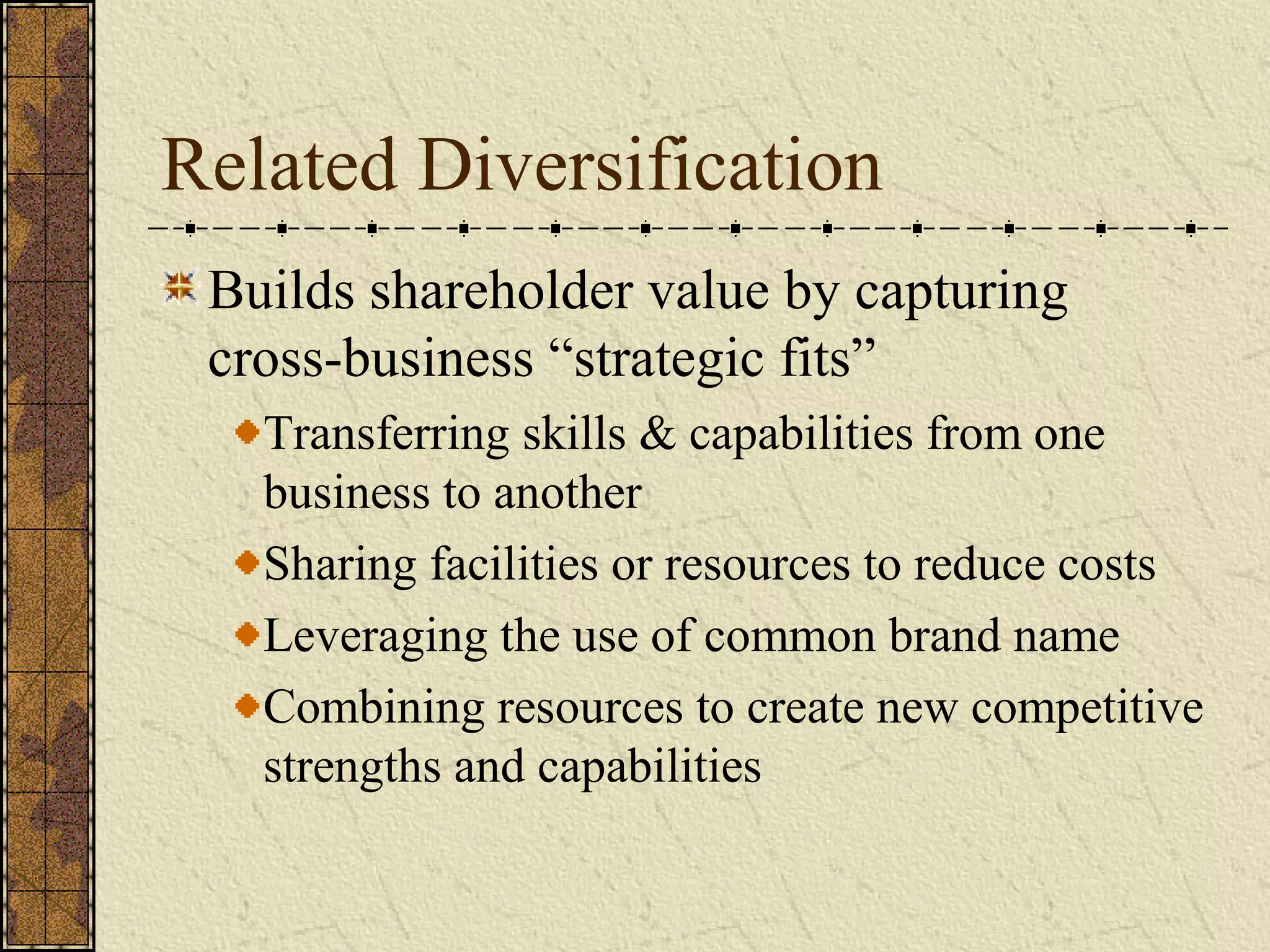
Related Diversification
Builds shareholder value by capturing
cross-business “strategic fits”
Transferring skills & capabilities from one
business to another
Sharing facilities or resources to reduce costs
Leveraging the use of common brand name
Combining resources to create new competitive
strengths and capabilities
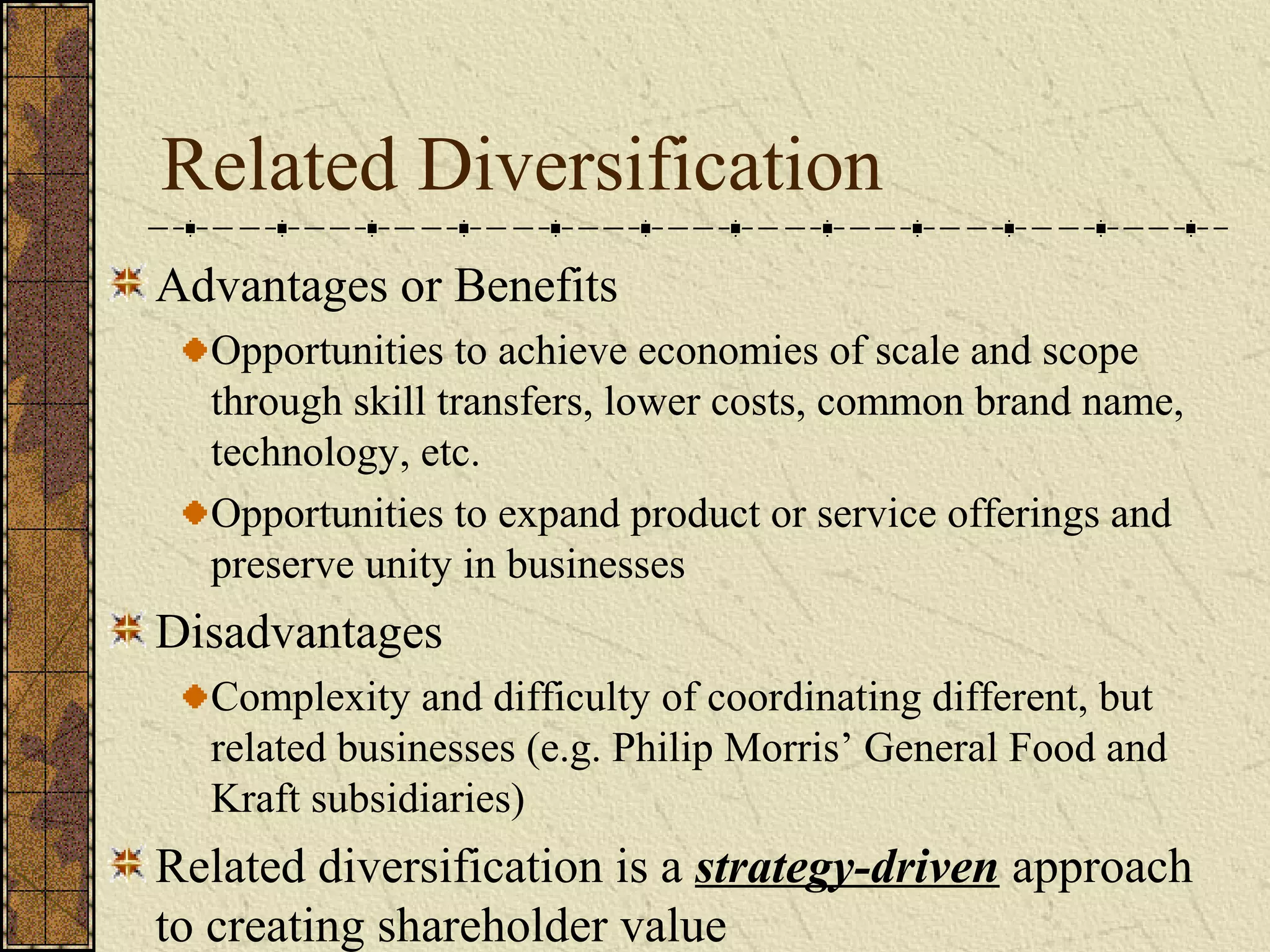
Related Diversification
Advantages or Benefits
Opportunities to achieve economies of scale and scope
through skill transfers, lower costs, common brand name,
technology, etc.
Opportunities to expand product or service offerings and
preserve unity in businesses
Disadvantages
Complexity and difficulty of coordinating different, but
related businesses (e.g. Philip Morris’ General Food and
Kraft subsidiaries)
Related diversification is a strategy-driven approach
to creating shareholder value
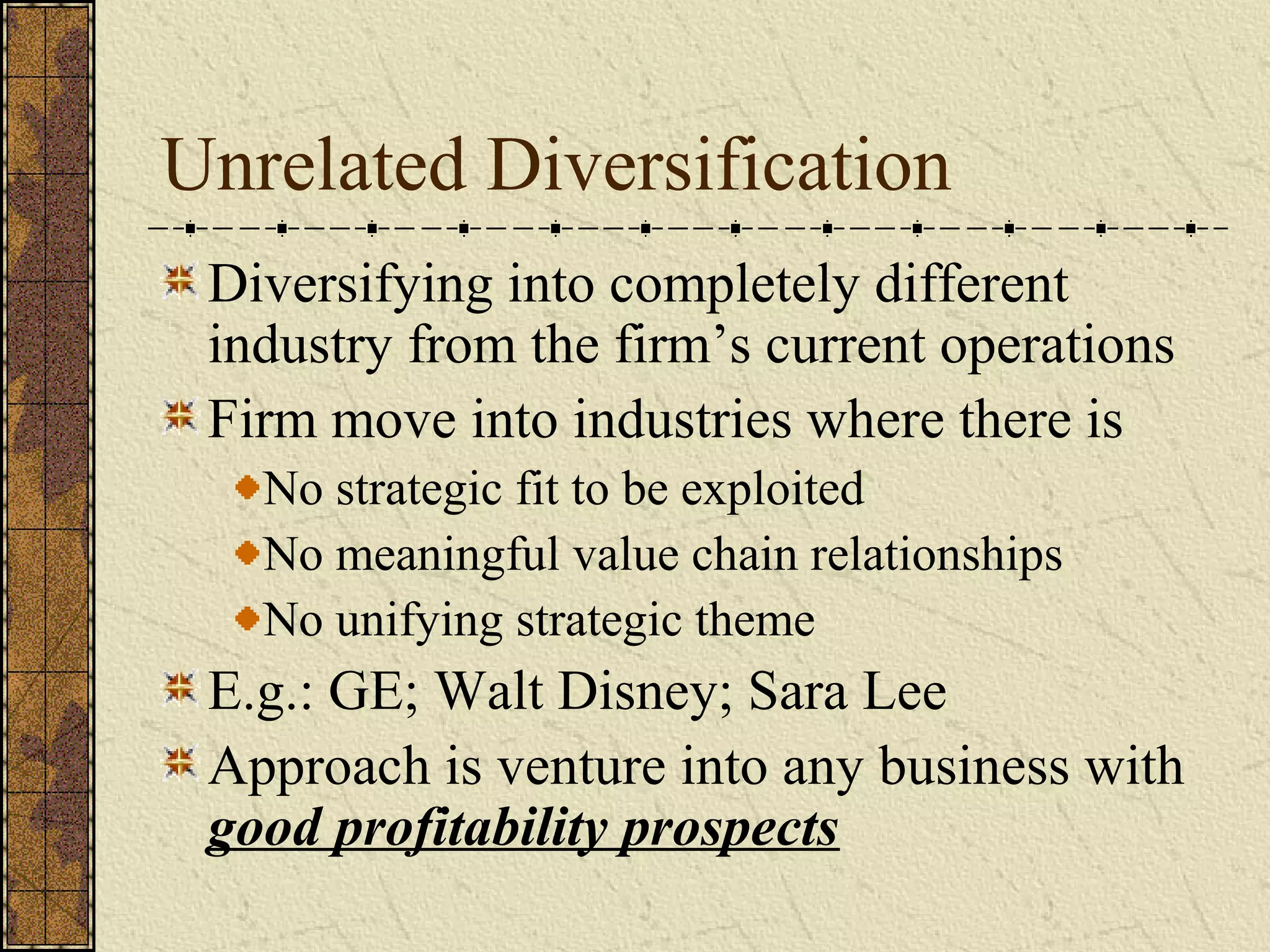
Unrelated Diversification
Diversifying into completely different
industry from the firm’s current operations
Firm move into industries where there is
No strategic fit to be exploited
No meaningful value chain relationships
No unifying strategic theme
E.g.: GE; Walt Disney; Sara Lee
Approach is venture into any business with
good profitability prospects
Unrelated Diversification
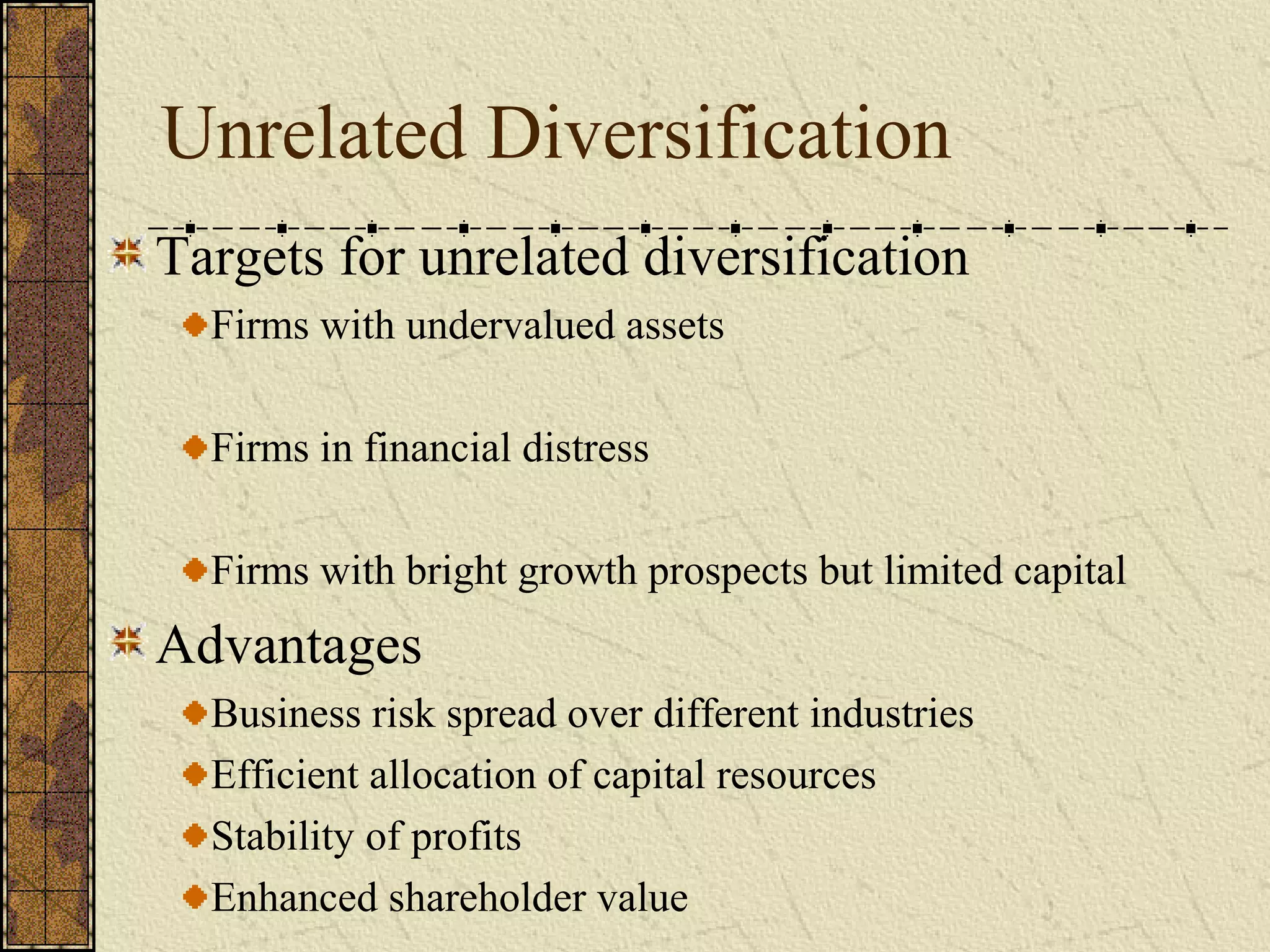
Targets for unrelated diversification
Firms with undervalued assets
Firms in financial distress
Firms with bright growth prospects but limited capital
Advantages
Business risk spread over different industries
Efficient allocation of capital resources
Stability of profits
Enhanced shareholder value
Unrelated Diversification
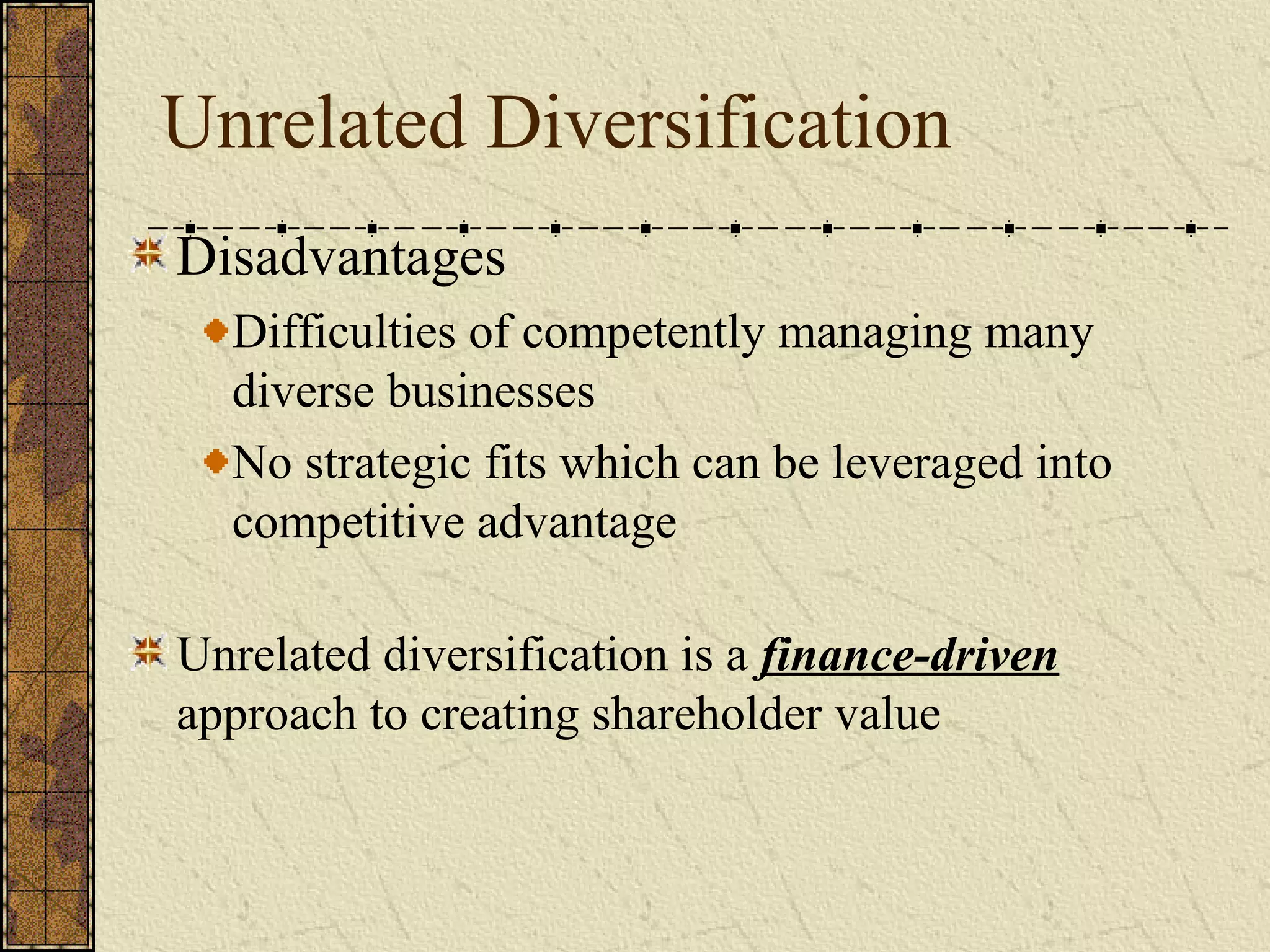
Disadvantages
Difficulties of competently managing many
diverse businesses
No strategic fits which can be leveraged into
competitive advantage
Unrelated diversification is a finance-driven
approach to creating shareholder value
Implementing Growth Strategies
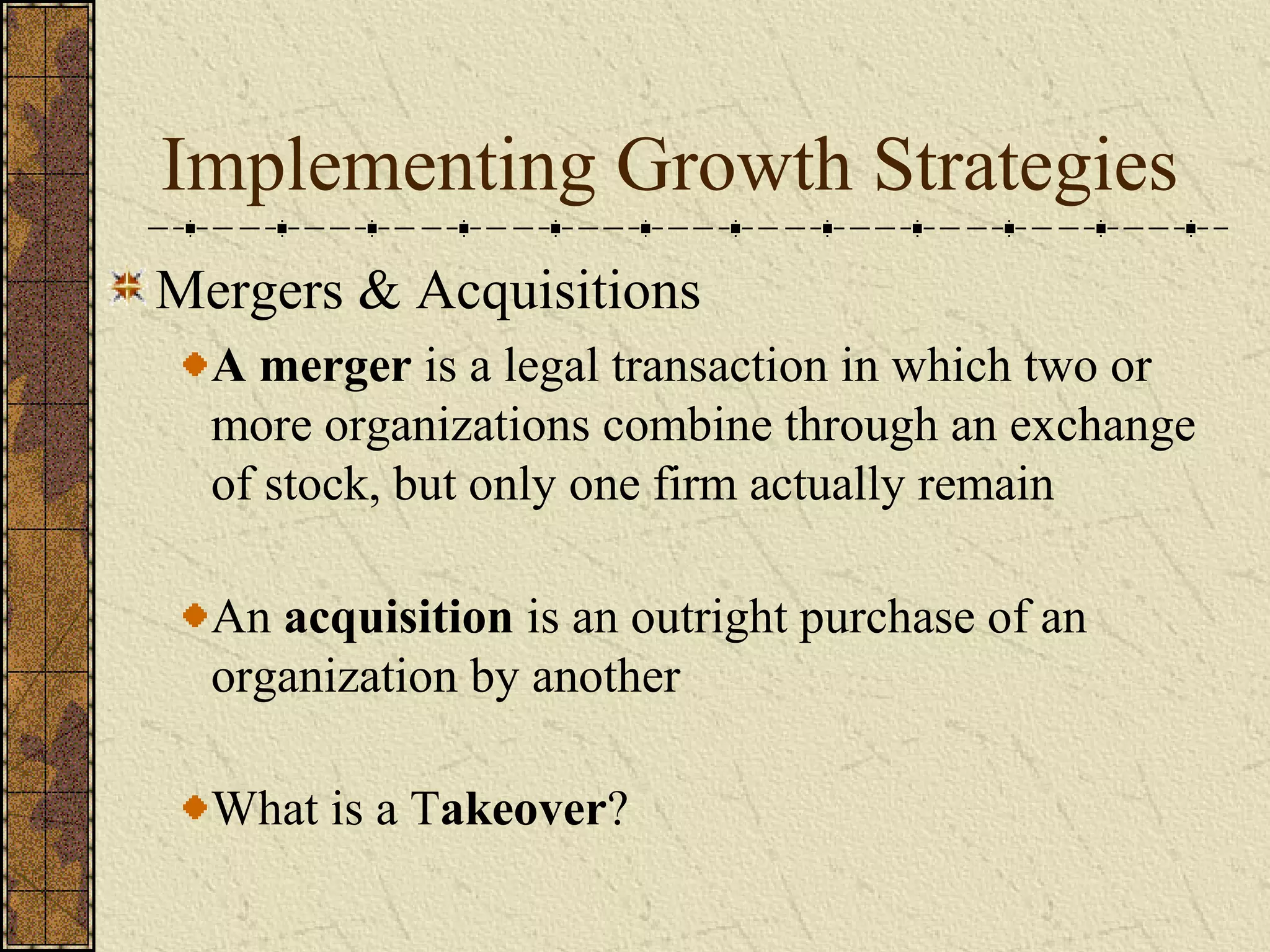
Mergers & Acquisitions
A merger is a legal transaction in which two or
more organizations combine through an exchange
of stock, but only one firm actually remain
An acquisition is an outright purchase of an
organization by another
What is a Takeover?
Implementing Growth Strategies
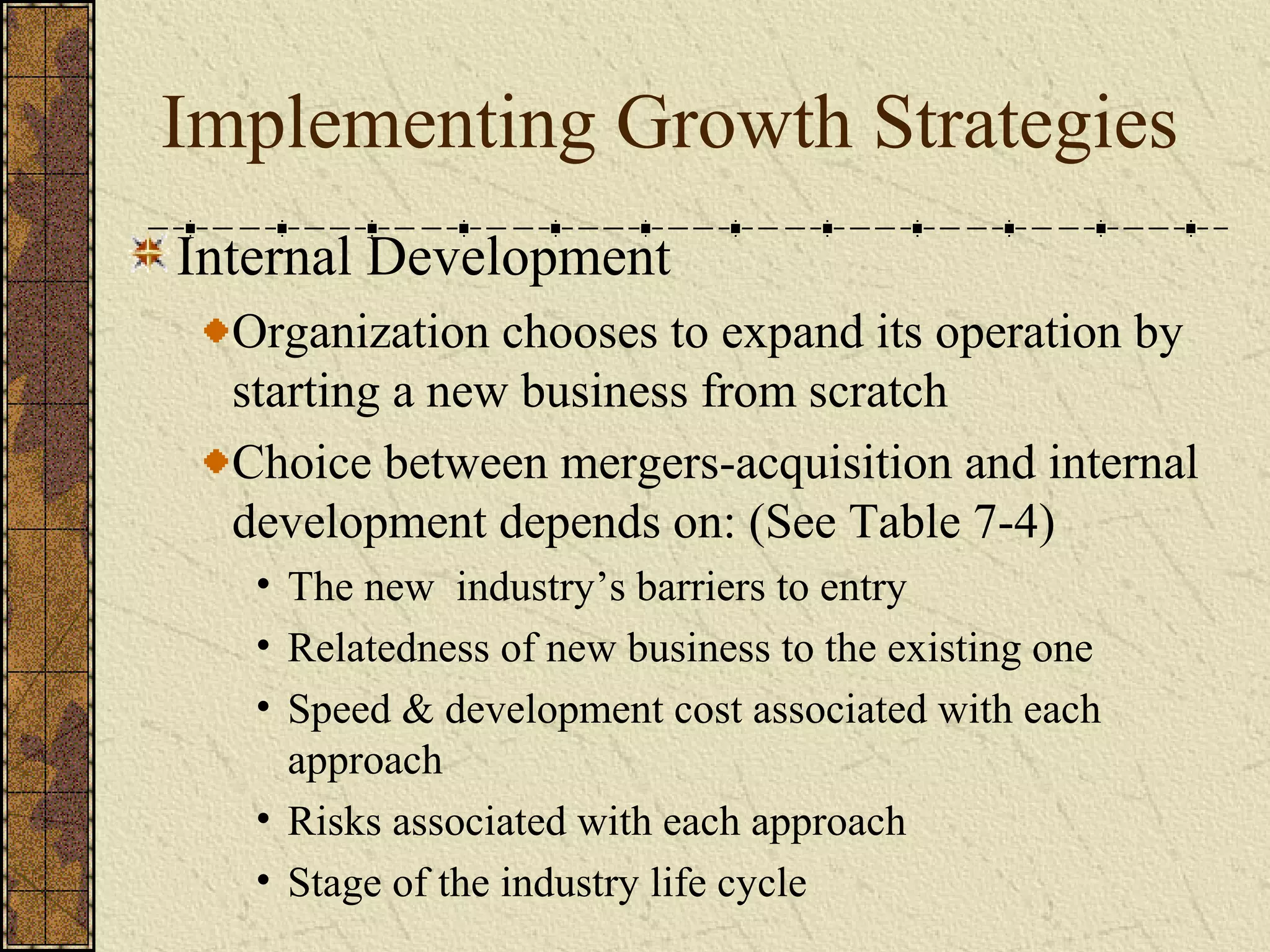
Internal Development
Organization chooses to expand its operation by
starting a new business from scratch
Choice between mergers-acquisition and internal
development depends on: (See Table 7-4)
• The new industry’s barriers to entry
• Relatedness of new business to the existing one
• Speed & development cost associated with each
approach
• Risks associated with each approach
• Stage of the industry life cycle
Implementing Growth Strategies
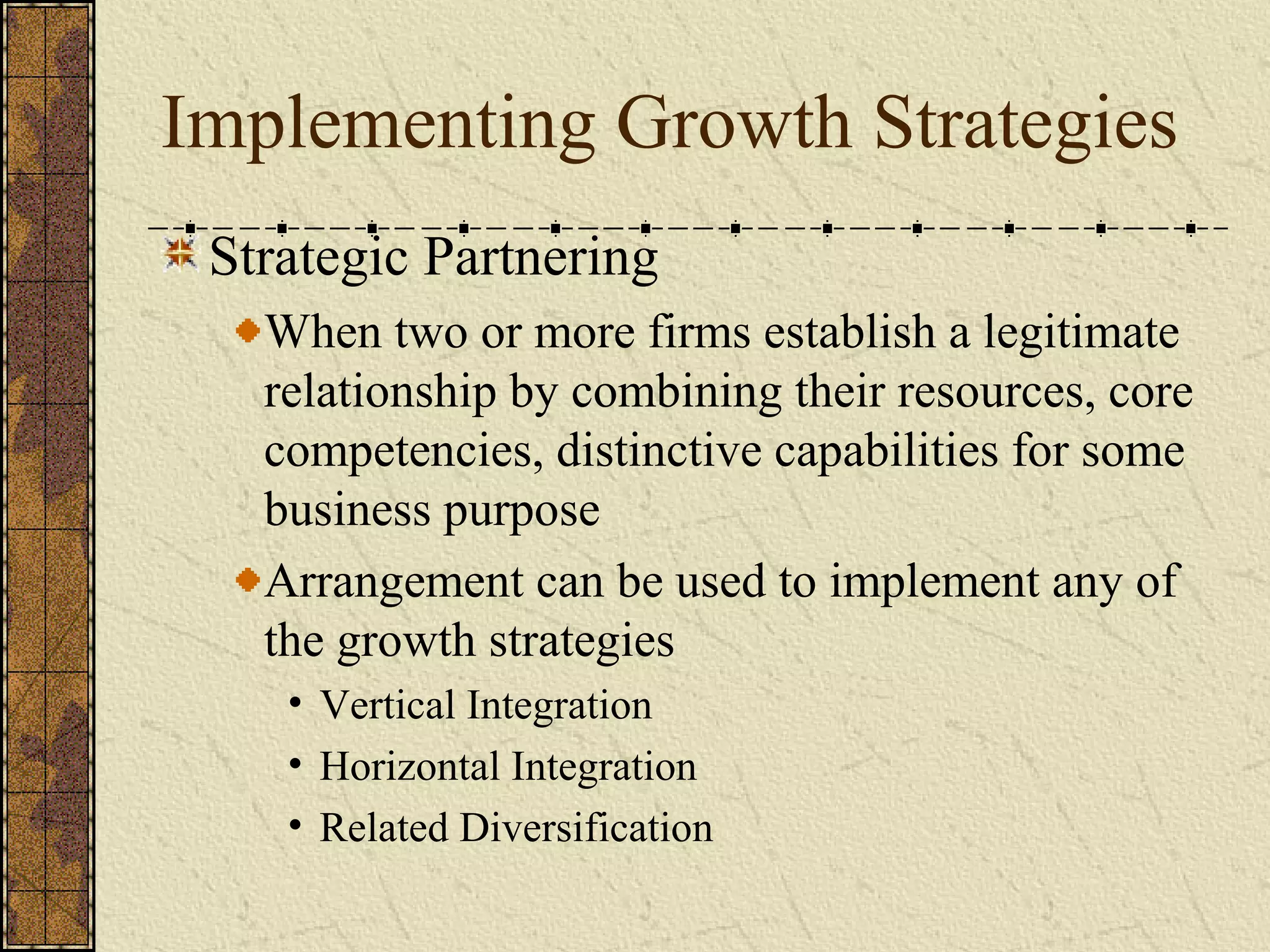
Strategic Partnering
When two or more firms establish a legitimate
relationship by combining their resources, core
competencies, distinctive capabilities for some
business purpose
Arrangement can be used to implement any of
the growth strategies
• Vertical Integration
• Horizontal Integration
• Related Diversification
Implementing Growth Strategies
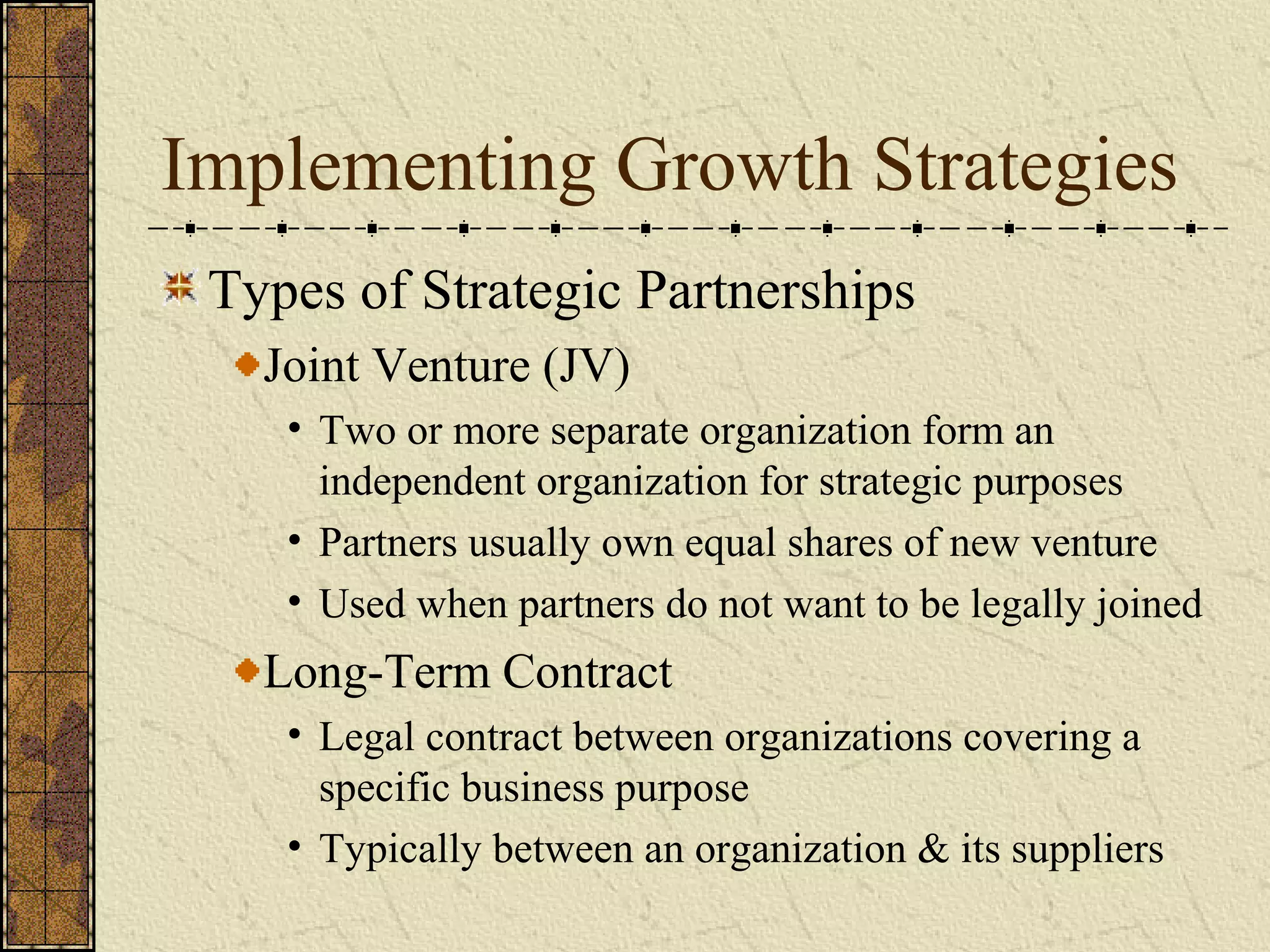
Types of Strategic Partnerships
Joint Venture (JV)
• Two or more separate organization form an
independent organization for strategic purposes
• Partners usually own equal shares of new venture
• Used when partners do not want to be legally joined
Long-Term Contract
• Legal contract between organizations covering a
specific business purpose
• Typically between an organization & its suppliers
Implementing Growth Strategies
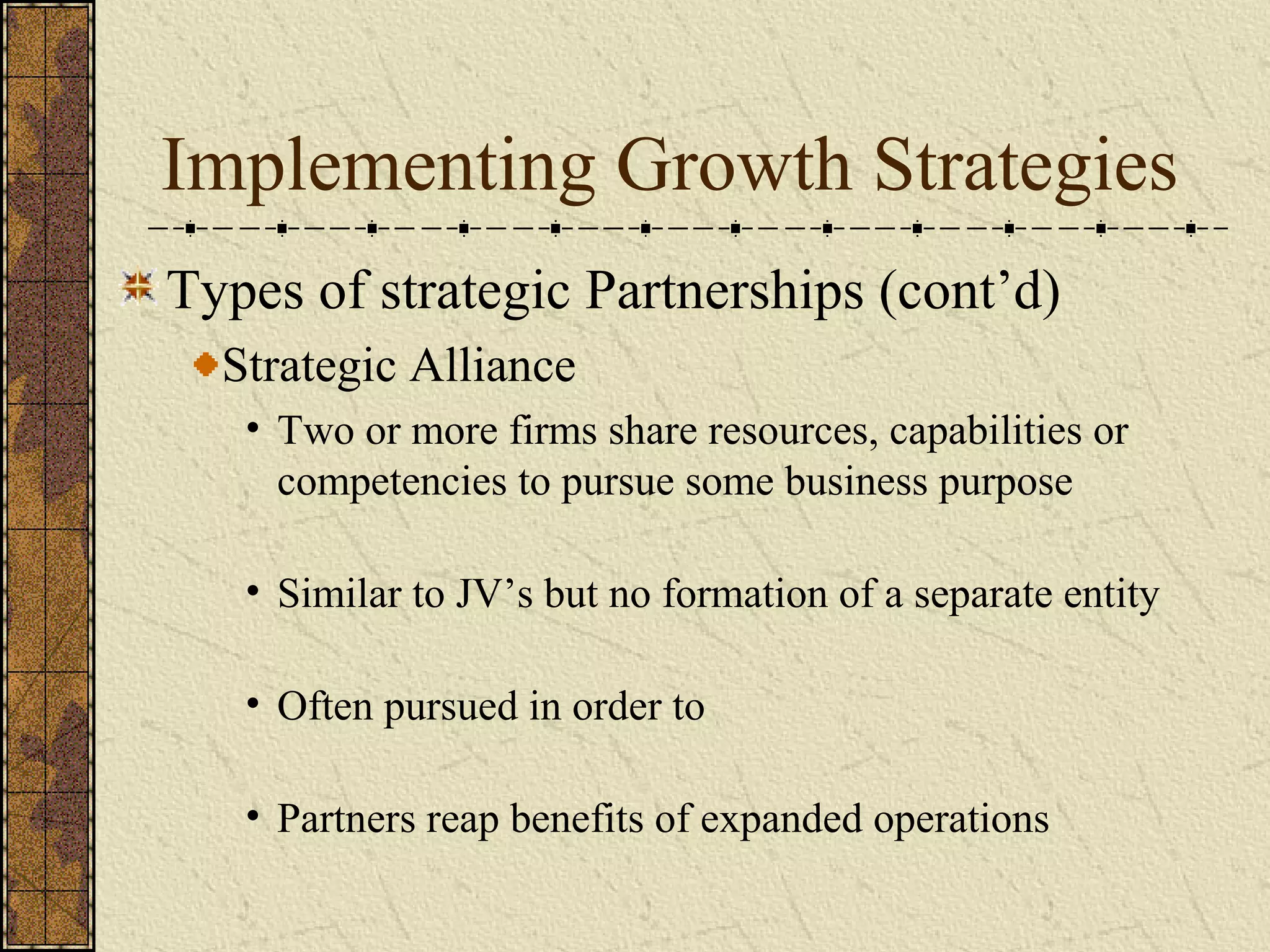
Types of strategic Partnerships (cont’d)
Strategic Alliance
• Two or more firms share resources, capabilities or
competencies to pursue some business purpose
• Similar to JV’s but no formation of a separate entity
• Often pursued in order to
• Partners reap benefits of expanded operations
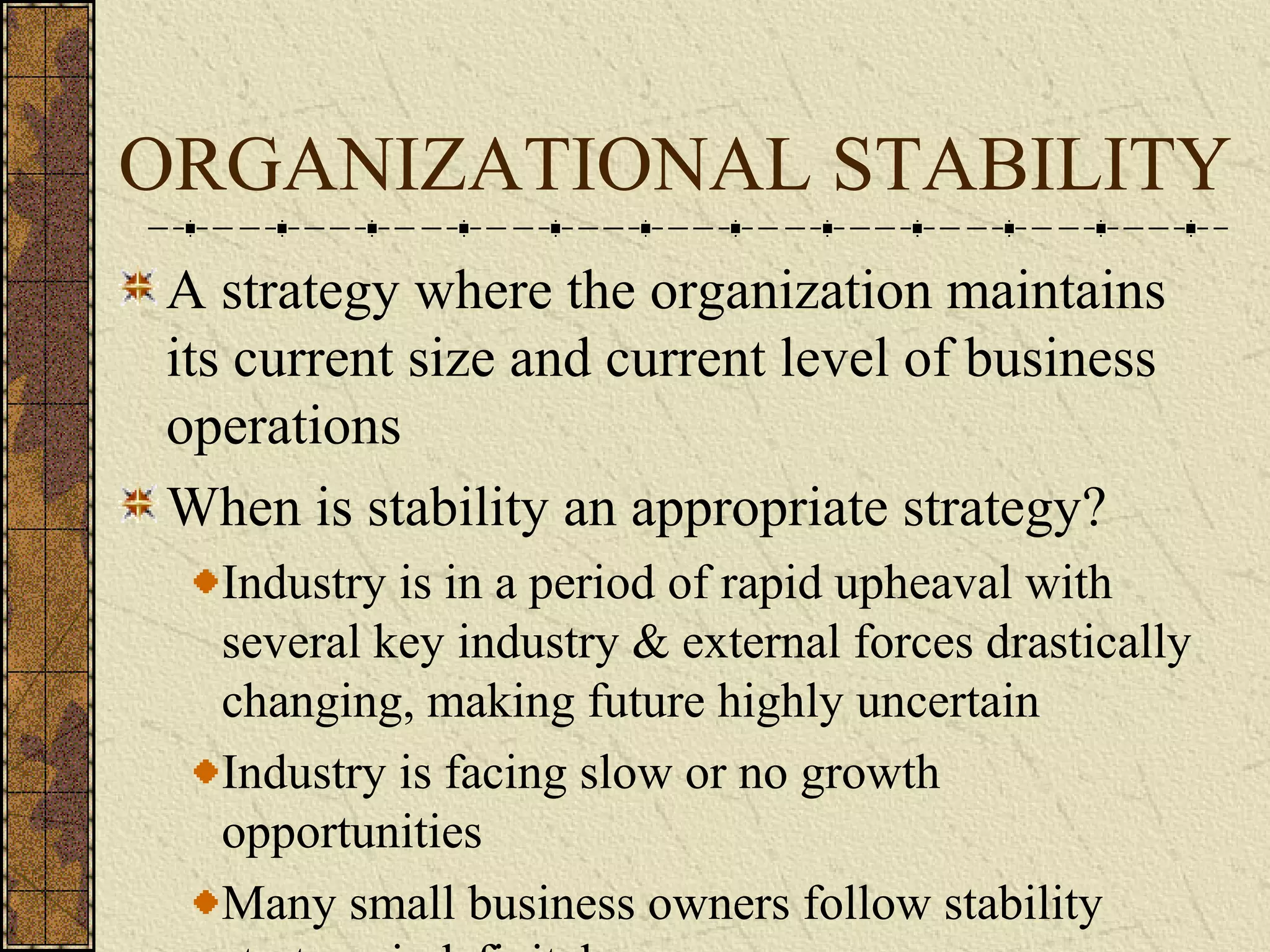
ORGANIZATIONAL STABILITY
A strategy where the organization maintains
its current size and current level of business
operations
When is stability an appropriate strategy?
Industry is in a period of rapid upheaval with
several key industry & external forces drastically
changing, making future highly uncertain
Industry is facing slow or no growth
opportunities
Many small business owners follow stability
ORGANIZATIONAL STABILITY
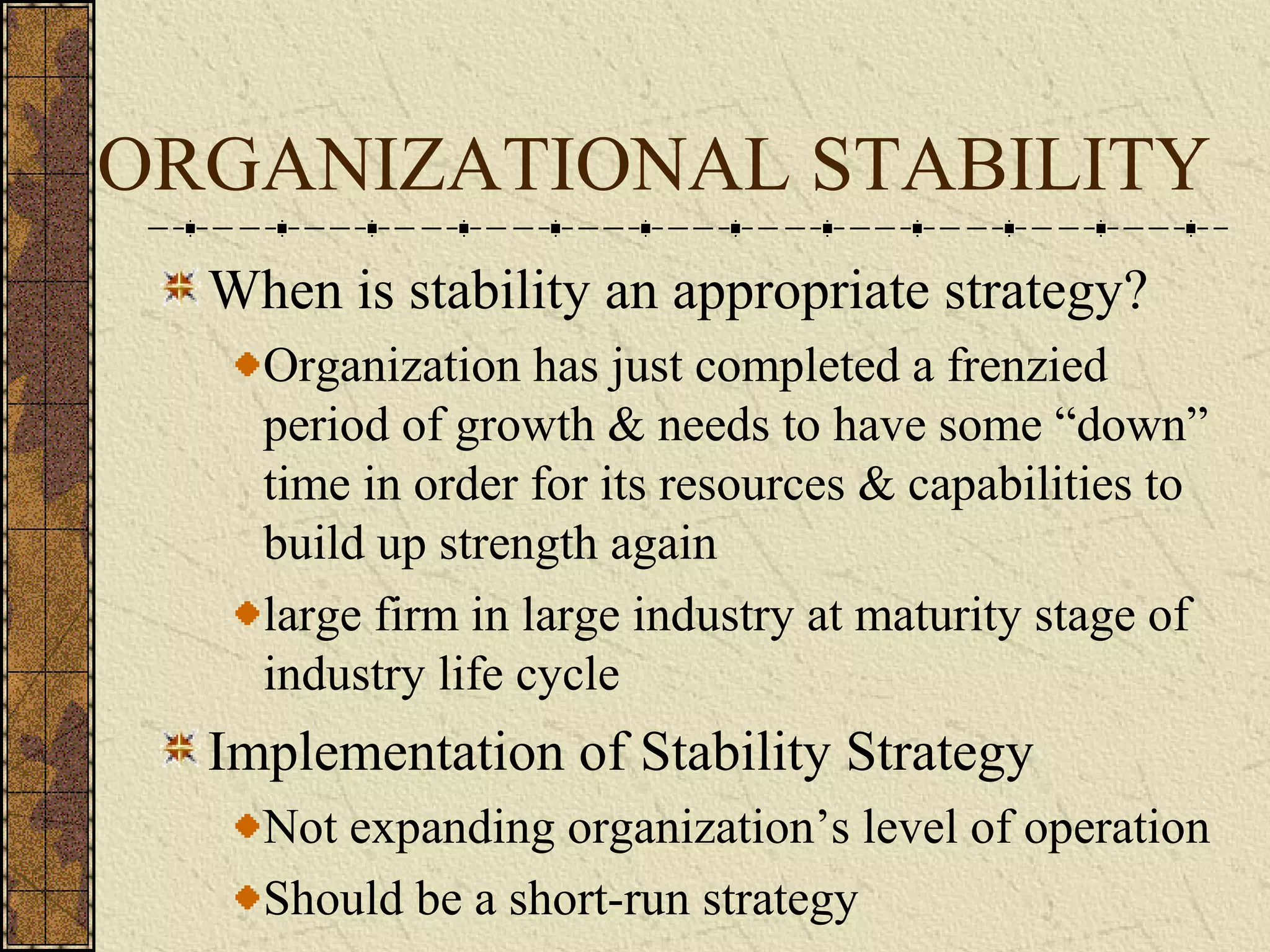
When is stability an appropriate strategy?
Organization has just completed a frenzied
period of growth & needs to have some “down”
time in order for its resources & capabilities to
build up strength again
large firm in large industry at maturity stage of
industry life cycle
Implementation of Stability Strategy
Not expanding organization’s level of operation
Should be a short-run strategy

Corporate and Growth Strategy

  • 1.
    Chapter 7 Corporate StrategiesI Moses Acquaah, Ph.D. 377 Bryan Building Phone: (336) 334-5305 Email: acquaah@uncg.edu
  • 2.
    Lecture Objectives Define corporatestrategy. Explain the difference between a single-business firm and a multiple-business firm. Discuss how corporate strategy is related to the other firm strategies. Explain the corporate strategic directions available to firms. Describe the various organizational growth strategies. Discuss the reasons/motives for diversification Discuss the advantages and disadvantages of related & unrelated diversification. Explain how growth strategies can be implemented. Describe when organizational stability is an appropriate strategic choice.
  • 3.
    What is CorporateStrategy? Those strategies concerned with the broad and long-term questions of what business(es) the organization is in or wants to be in & what it wants to do with those businesses Task involves Moves to enter new businesses Actions to boost combined performance of businesses Ways to capture synergy among related businesses Establishing investment priorities & steering corporate resources into most attractive units
  • 4.
    Single & MultipleBusiness Organizations Single business organizations Operates primarily in only one industry (e.g., Coca-Cola – Beverage Industry; Wrigley Jr. Company – Chewing Gum) Multiple Business Organizations Operates in more than one industry Example: PepsiCo – Snack Food Industry business (Frito Lay); & Beverage Industry Philip Morris Companies – Tobacco Industry; Brewery Industry (Miller Brewery); & Food Processing Industry (Kraft General Foods).
  • 5.
    Corporate, Competitive & FunctionalStrategies Corporate strategy establishes the overall direction that the organization hopes to go. Competitive & functional strategies provide the means or mechanisms for making sure the organization gets there.
  • 6.
    Possible Corporate Strategic Directions (1)Moving the organization ahead -- Organizational Growth (2) Keeping the organization where it is -- Organizational Stability (3) Reversing the organization’s weaknesses or decline -- Organizational Renewal
  • 7.
    ORGANIZATIONAL GROWTH Growth strategy Involves theattainment of specific growth objectives by increasing the level of an firm’s operations Typical growth objectives for businesses Increase in sales revenues Increase in earnings or profits Other performance measures Growth objectives of not-for-profit businesses Increasing clients served or patrons attracted Broadening the geographic area Increasing programs offered
  • 8.
    Types of GrowthStrategies Organizational Growth Diversification •Related •Unrelated Horizontal Integration Vertical Integration •Backward •Forward Concentration International
  • 9.
    Concentration Strategy A growthstrategy where the firm Concentrates on its primary line of business Looks for ways to meet its growth objectives through increasing its level of operation in this primary business When a single-business organization pursues growth, it is using the concentration strategy
  • 10.
    Concentration Strategy Four concentrationstrategy options Products Customers Current New Current New Product-Market Exploration Product Development Market Development Product/Market Diversification
  • 11.
    Concentration Strategy Product-Market ExplorationOption Describes attempts by firm to increase sales of its current product(s) in its current market(s) by depending on its functional & competitive strategies Product Development Option Firm create new product for use by its current market (customers)
  • 12.
    Concentration Strategy Market DevelopmentOption When a firm sell its current products in new markets (additional geographic areas or market segments not currently served by firm) Product-Market Diversification Option Where firm seeks to expand both into new products & new markets Single-business firm becomes a multiple- business firm since it is now operating in a different industry
  • 13.
    Concentration Strategy Advantage Organization becomesvery good at what it does Drawback Organization is vulnerable to industry and other external environmental shifts Concentration strategy is used by both small- sized and large organizations
  • 14.
    Vertical Integration Strategies Anorganization’s attempt to gain control of Its inputs (backward integration) -- supplier Its output (forward integration) -- distributor Or both inputs and output Purpose is to (1) reduce resource acquisition costs, & (2) deal with inefficient operations Vertical Integration Considered a growth strategy because the firm’s operations are expanded beyond primary business Mixed empirical results as to whether strategy helps or hurt performance What is the role of outsourcing in achieving same objective as vertical integration?
  • 15.
    Vertical Integration Strategies Benefits Reducedpurchasing & selling costs Improved coordination of functions & capabilities Protected proprietary technology Costs Reduced flexibility as firm is locked into products & technology Create an exit barrier due to existence of assets that are hard to sell Difficulties in integrating various operations Financial costs of acquiring or starting up
  • 16.
    Horizontal Integration Strategies Expandingthe firm's operations through combining with competitors operating in the same industry & doing the same things It is an appropriate corporate growth strategy as long as It enables the company to meet its growth objectives It can be strategically managed to attain a sustainable competitive advantage It satisfies legal and regulatory guidelines
  • 17.
    Diversification Strategies A corporategrowth strategy in which a firm expands its operation by moving into a different industry Many reasons or motives for diversification Two major types of diversification Related (concentric) diversification Unrelated (conglomerate) diversification
  • 18.
    Why Do FirmsDiversify? To Grow Increase sales & profitability beyond what firm’s core businesses can provide Managerial self-serving behavior -- compensation Managerial “hubris” -- pride or status that come from managing a large business To more fully utilize existing resources and capabilities Skills in sales & marketing, general management skills & knowledge, distribution channels, etc.
  • 19.
    Why Do FirmsDiversify? Risk reduction and/or spreading Escape from unattractive or undesirable industries (e.g., tobacco & oil companies) Stability of profit flows (CAPM: systematic vs. unsystematic risks; shareholders & diversified portfolios) To make use of surplus cash flows Large cash balances attract corporate raiders Use cash balances to avoid hostile takeovers To build shareholder value Create synergy among the businesses of a firm Make 2 + 2 = 5: The whole should be greater than the sum of the parts
  • 20.
    Why Do FirmsDiversify Synergy can be obtained in three ways Exploiting economies of scale Exploiting economies of scope Efficient allocation of capital through the use of portfolio management techniques Problems that prevent diversified firms from realizing synergies A poor understanding of how diversification activities will “fit” or be coordinated with existing businesses Dangers or risks associated with the acquisition of businesses Problems with the development of internal businesses
  • 21.
    Why Do FirmsDiversify? Diversification is capable of increasing shareholder value if it passes three tests: The attractiveness test: The industry must be structurally attractive or capable of being made attractive The cost-of-entry test: The cost of entry must not capitalize all future profits The better-off test: Either the new unit must gain competitive advantage from its link with the corporation or vice versa (i.e. synergy)
  • 22.
    Related (Concentric) Diversification Related(Concentric) Diversification Diversifying into a different industry but one that’s related in some ways to the organization’s current operations Search for strategic “synergy”, which is the performance of the sum of the parts is better than the whole • The idea that 2 + 2 = 5 Synergy happens because of the interactions and the interrelatedness of the combined operations and the sharing of resources, capabilities, & distinctive competencies
  • 23.
    Related Diversification Builds shareholdervalue by capturing cross-business “strategic fits” Transferring skills & capabilities from one business to another Sharing facilities or resources to reduce costs Leveraging the use of common brand name Combining resources to create new competitive strengths and capabilities
  • 24.
    Related Diversification Advantages orBenefits Opportunities to achieve economies of scale and scope through skill transfers, lower costs, common brand name, technology, etc. Opportunities to expand product or service offerings and preserve unity in businesses Disadvantages Complexity and difficulty of coordinating different, but related businesses (e.g. Philip Morris’ General Food and Kraft subsidiaries) Related diversification is a strategy-driven approach to creating shareholder value
  • 25.
    Unrelated Diversification Diversifying intocompletely different industry from the firm’s current operations Firm move into industries where there is No strategic fit to be exploited No meaningful value chain relationships No unifying strategic theme E.g.: GE; Walt Disney; Sara Lee Approach is venture into any business with good profitability prospects
  • 26.
    Unrelated Diversification Targets forunrelated diversification Firms with undervalued assets Firms in financial distress Firms with bright growth prospects but limited capital Advantages Business risk spread over different industries Efficient allocation of capital resources Stability of profits Enhanced shareholder value
  • 27.
    Unrelated Diversification Disadvantages Difficulties ofcompetently managing many diverse businesses No strategic fits which can be leveraged into competitive advantage Unrelated diversification is a finance-driven approach to creating shareholder value
  • 28.
    Implementing Growth Strategies Mergers& Acquisitions A merger is a legal transaction in which two or more organizations combine through an exchange of stock, but only one firm actually remain An acquisition is an outright purchase of an organization by another What is a Takeover?
  • 29.
    Implementing Growth Strategies InternalDevelopment Organization chooses to expand its operation by starting a new business from scratch Choice between mergers-acquisition and internal development depends on: (See Table 7-4) • The new industry’s barriers to entry • Relatedness of new business to the existing one • Speed & development cost associated with each approach • Risks associated with each approach • Stage of the industry life cycle
  • 30.
    Implementing Growth Strategies StrategicPartnering When two or more firms establish a legitimate relationship by combining their resources, core competencies, distinctive capabilities for some business purpose Arrangement can be used to implement any of the growth strategies • Vertical Integration • Horizontal Integration • Related Diversification
  • 31.
    Implementing Growth Strategies Typesof Strategic Partnerships Joint Venture (JV) • Two or more separate organization form an independent organization for strategic purposes • Partners usually own equal shares of new venture • Used when partners do not want to be legally joined Long-Term Contract • Legal contract between organizations covering a specific business purpose • Typically between an organization & its suppliers
  • 32.
    Implementing Growth Strategies Typesof strategic Partnerships (cont’d) Strategic Alliance • Two or more firms share resources, capabilities or competencies to pursue some business purpose • Similar to JV’s but no formation of a separate entity • Often pursued in order to • Partners reap benefits of expanded operations
  • 33.
    ORGANIZATIONAL STABILITY A strategywhere the organization maintains its current size and current level of business operations When is stability an appropriate strategy? Industry is in a period of rapid upheaval with several key industry & external forces drastically changing, making future highly uncertain Industry is facing slow or no growth opportunities Many small business owners follow stability
  • 34.
    ORGANIZATIONAL STABILITY When isstability an appropriate strategy? Organization has just completed a frenzied period of growth & needs to have some “down” time in order for its resources & capabilities to build up strength again large firm in large industry at maturity stage of industry life cycle Implementation of Stability Strategy Not expanding organization’s level of operation Should be a short-run strategy