A Level Economics
Year 1 (AS)
Summer 2016
Note the resource download link for this workshop:
Student Name:
www.tutor2u.net/economics
@tutor2uEcon
@tutor2u_Jon
@tutor2uGeoff
More Economics revision and support at:
Follow tutor2u Economics on Twitter:
2 A LEVEL ECONOMICS YEAR 1 (AS) Revision Workshop www.tutor2u.net 3
A01 Knowledge
Definition, basic theory
A02 Application
Examples, evidence
A03 Analysis
Explanation of theory, diagrams
A04 Evaluation
Using judgement, weighing up
Exam Advice
PEEEL Evaluation
Paragraphs
P Point
E Explanation
E Evidence/Example
E Evaluation
L Link back to the question
Evaluation Reminder
T Timescale
W Wider Context
E Efficiency
E Equality/Equity
P Priority
Exam Advice
The command words ANALYSE or EXPLAIN require a student
to produce some explanation of the theory in their answer.
You should develop CHAINS OF ANALYSIS, making 3 or 4
links using connectives to develop your point.
*This means that... *This leads to...
*This has an impact on... *Therefore...
*This can cause... *This is because...
*On the other hand... *Which in turn...
The command words EVALUATE, JUSTIFY, EXAMINE or
ASSESS require a student to demonstrate a judgement in
their answer. You will need to weigh up the evidence from
your analysis and pass a judgement on the original question.
*It depends on... *In the short run...
*In the long run... *The most important
point
*The effect on equity/equality is
*The most cost effective…
*The best solution in the circumstances
is...
A LEVEL ECONOMICS YEAR 1 (AS)
REVISION WORKSHOP 2016
Welcome to our revision workshop which will consist of five sessions listed below.
Whilst it is impossible to cover the entire AS micro specification in just one day, we
aim to focus on key concepts and ideas, embedded in examination technique and
advice. Some areas will inevitably be considered with a light touch, however we
aim to equip you with the tools to be able to continue in depth revision under you
own steam. Today’s sessions will cover:
1 How Markets Work and Elasticities
2 Market Failure and Government Intervention
3 Measuring UK Economic Performance
4 Demand Side Policies (Fiscal and Monetary)
5 Supply Side Policies and Policy Conflicts
At the back of the booklet you will find a glossary of key macroeconomic terms and concepts.
Skills at AS
The Price Mechanism
What are the functions of the price mechanism?
5p charge on bags from supermarkets and other retailers
In October 2015, the UK Government introduced a 5p surcharge on all plastic
bags used for shoppers in most retail outlets (extending a regulation that had
already been in place in certain parts of the country). This surcharge is not a
tax – the government do not collect the money. The monies earned from the
surcharge can be kept by the retailers. The policy is an attempt to reduce the
use of the plastic bags as they have a negative impact on the environment.
Here, the surcharge is being used as ...........................................................
What factors affect demand and supply for a product or service?
Session 1
How Markets Work
and Elasticities
In this session we will consider the importance
of price as a means to allocating resources in an
economy, the factors that impact on demand and
supply of products, the calculation of elasticities
and the factors that impact on elasticities.
£
Demand Supply
1
2
3
4
5
4 A LEVEL ECONOMICS YEAR 1 (AS) Revision Workshop www.tutor2u.net 5
£
From the table above, which is the most important factor that can impact on demand and supply
for each of the following firms (Note: there is no particular right or wrong answer here – you have
to justify the factor that you have chosen):
Demand factors in the news – Hoverboards:
One of the most popular gifts given this Christmas was the ‘hoverboard’ or ‘self-balancing’ board,
made popular by a number of celebrities such as Lily Allen and Justin Bieber. The boards use
clever gyro-rotational technology to respond to minute pressure from the feet of the rider to balance
and move forwards or backwards. The price ranges from £250 to £600 per board. Many firms
have manufactured the boards as much of the technology has not been patented.
Demand Factor
A Luxury Gold
Watch
A budget tablet
Flight between
Manchester and
London
Dry cleaning
service
Supply Factor
Factor Explanation
1
2
What are the most important factors that have
influenced the price of hoverboards in the UK from
January 2016? Explain your answer:
Diesel pumps may run dry in the UK
A report released in September 2015 by the RAC Foundation has warned that the availability of
diesel fuel used by motorists could start to become scarcer, with the UK needing to rely more
and more on imported stocks.
The issue appears to have arisen for two reasons. Firstly, there has been an increase in the
purchase of cars that use diesel fuel (from 1.6 million vehicles in 1994 to 11 million vehicles
in 2014). This was prompted by a change in the tax regime in 2001, when the Government
attempted to encourage a greater use of diesel instead of unleaded petrol. This was driven by
a Government desire to reduce the creation of carbon dioxide (CO2) which is more prevalent
in petrol cars than diesel.
An ironic outcome of this change was that the Government now has a
greater emphasis on reducing Nitrogen Dioxide (NO2) which is more
prevalent when diesel cars are used. A recent government study put
the number of premature deaths in the UK attributed specifically
to NO2 at 23,500.
However, there is a time-lag between any government attempt
to alter the market and an actual change in the purchase of
diesel or petrol cars.
The second issue relates to the refining of oil to create
diesel fuel. The same report from RACF says that there
are now only 6 major oil refineries in the UK. These
refineries were built to create petrol rather than diesel
so are not set up to accommodate the need for the
change in demand for diesel fuel.
This combination of problems could well lead to a shortage
of the availability of diesel and increase the UK’s need to
import (at a higher price) from foreign suppliers.
List 2 factors that have impacted on the demand
and supply of diesel.
Factor Cause
Demand
Supply
Likely impact on price
of diesel petrol
What has caused a potential failure of government intervention in this market?
6 A LEVEL ECONOMICS YEAR 1 (AS) Revision Workshop www.tutor2u.net 7
£
Q1
P1
S1
D1
Price of
Diesel
Quantity of
Diesel
Using the diagram here,
illustrate what you think
may have happened to
demand and supply of
diesel over the last
15 years.
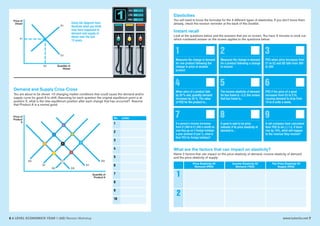
Demand and Supply Criss-Cross
You are about to be shown 10 changing market conditions that could cause the demand and/or
supply curve for good A to shift. Assuming for each question the original equilibrium point is at
position X, what is the new equilibrium position after each change that has occurred? Assume
that Product A is a normal good.
Elasticities
You will need to know the formulae for the 4 different types of elasticities. If you don’t know them
already, check the revision reminder at the back of this booklet.
Instant recall
Look at the questions below and the answers that are on screen. You have 3 minutes to work out
which numbered answer on the screen applies to the questions below:
S3
S1
S2
D2
D1
D3
Price of
Product
A
Quantity of
Product A
C
G
D
E
F
I
X B
A
No. Letter
1
2
3
4
5
6
7
8
9
10
Measures the change in demand
for one product following the
change in price of another
product
Measures the change in demand
for a product following a change
in income
PED when price increases from
£1 to £2 and QD falls from 300
to 200
When price of a product falls
by 20 % and, quantity demand
increases by 20 %. The value
of PED for the product is...
The income elasticity of demand
for bus travel is –2.0, this means
that bus travel is...
PED if the price of a good
increases from £5 to £10,
causing demand to drop from
10 to 8 units a week,
If a person's income increases
from £1,000 to £1,500 a month so
now they go on 2 foreign holidays
a year (instead of just 1), what is
their YED for foreign holidays?
A good is said to be price
inelastic if its price elasticity of
demand is...
A rail company have calculated
their PED to be (-) 1.2. If fares
rise by 10%, what will happen
to the revenue they receive?
Price Elasticity Of
Demand (PED)
Income Elasticity Of
Demand (YED)
The Price Elasticity Of
Supply (PES)
What are the factors that can impact on elasticity?
Name 2 factors that can impact on the price elasticity of demand, income elasticity of demand
and the price elasticity of supply:
1
2
8 A LEVEL ECONOMICS YEAR 1 (AS) Revision Workshop www.tutor2u.net 9
The Impact of elasticities
Consider this question:
“With the help of an appropriate
diagram, explain how the price
elasticity of demand for peak rail
tickets will affect the total revenue
that the government receives if
it introduces an indirect tax of
5% on all rail tickets.”
Assuming that both students have
drawn a correct diagram, which of these
answers would obtain more marks for
application and why?
Student 1 response
The price elasticity of demand for peak rail tickets is inelastic. As the cost of purchasing these
tickets increases the demand for rail travel will decrease but by a relatively small proportion
compared to the increase in cost. This will mean that the government will see an increase in
revenue from increasing taxes on rail travel.
Student 2 response
The elasticity of demand for peak rail tickets is price inelastic. Extract C (line 3) indicates that
some substitutes do exist (such as road travel) but many rail users choose to do so as it is the
quickest form of transport for their daily commute. So if, for example, the government increases
taxes by 5% the government will see a rise in revenue. Some of this rise in revenue may be
offset by the fact that all rail fares will increase so there may be some reduction in demand for
rail use during off-peak times.
Exam Tip - Elasticities is an important topic when you are evaluating Government
policies to combat market failures. It is worth attempting to include discussion about
elasticity of the product or service that you are covering in any evaluative questions.
Consider the following products/services. State whether you think demand is price elastic or inelastic.
What would be the impact of an increase in government indirect tax on their consumption?
Product Cigarettes Air travel Crisps
Elasticity
Impact of indirect
tax increase on
consumption
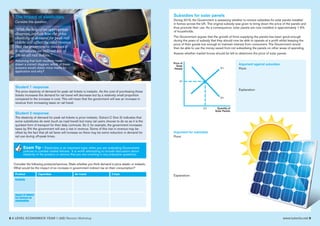
Subsidies for solar panels
During 2016, the Government is assessing whether to remove subsidies for solar panels installed
in homes across the UK. The original subsidy was given to bring down the price of the panels and
thus promote their use. As a consequence, solar panels are now installed in approximately 1.5%
of households.
The Government argues that the growth of firms supplying the panels has been good enough
during the years of subsidy that they should now be able to operate at a profit whilst keeping the
price of their goods low enough to maintain interest from consumers. The Government would
then be able to use the money saved from not subsidising the panels on other areas of spending.
Assess whether market forces should be left to determine the price of solar panels.
Q1
P1
S1
D1
Price of
Solar
Panels
Quantity of
Solar Panels
Argument against subsidies
Point:
Explanation:
Argument for subsidies
Point:
Explanation:
Extension Activities
10 A LEVEL ECONOMICS YEAR 1 (AS) Revision Workshop www.tutor2u.net 11
Activity 1:
Activity 2:
Question 1 – Alex buys a new car for £12, 000. Two years later, he estimates the current
value of his car as £8, 000. Alex sees the same model is now selling for £15, 000 in his
local car dealership. What is the opportunity cost of Alex keeping the car?
A £8, 000
B £12, 000
C £15, 000
D £7, 000
Question 2 – The use of maximum prices on products such as prescriptions is designed to:
A Increase consumption of a public good
B Reduce the excludability of a private good
C Reduce the free rider problem
D Increase consumption of a merit good
Question 3 – The North Korean economy allegedly experienced widespread famine in
2008, with production down on 2007. This may have been down to?
A Reduced exports from the North Korean economy
B A fall in the rate of increase of agricultural productivity
C The government receiving inadequate information about what needed to be produced
D Increased trade with China
Question 4 – If the Production Possibility Frontier is a straight line...
A Opportunity cost is increasing
B Opportunity cost is decreasing
C Opportunity cost is variable
D Opportunity cost is constant
Question 5 – Free goods...
A Include the NHS and Education
B Have zero opportunity cost
C Are non-rival and non-excludable
D Are best provided by governments
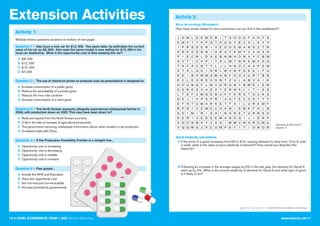
Answerstomultiple-choicequestions:1.A,2.D,3.C,4.D,5.B
Multiple-choice questions (answers on bottom of next page):
Micro terminology Wordsearch
How many words related to micro economics can you find in this wordsearch?
Answers at the end of
session 2
Quick elasticity calculations
A If the price of a good increases from £5 to £10, causing demand to drop from 10 to 8 units
a week, what is the value of price elasticity of demand? How would you describe this
elasticity?
B Following an increase in the average wages by 5% in the last year, the demand for Good A
went up by 2%. What is the income elasticity of demand for Good A and what type of good
is it likely to be?
12 A LEVEL ECONOMICS YEAR 1 (AS) Revision Workshop www.tutor2u.net 13
Session 2
Market Failure and Government
Interventions
In this session we will consider under what circumstances
free-market conditions do not always lead to the optimum
social outcome. We will also look at how the Government
intervenes to combat such market failure and how this
intervention is not always successful,
Market Failure
Examples of market failure
Complete Market Failure:
Succinct definitions!
Merit Good
Partial Market Failure:
1
Externalities:
Example
2
Example
3
Example
4
Example
5
Example
Production Consumption
Example (positive) Example (negative)
Note: AQA do not require diagrams for their AS assessment on externalities. Edexcel and OCR
do require such diagrams. Activity 1 for the Extension Activities at the end of this chapter tests
knowledge of these diagrams.
Museum charges for temporary exhibitions
Since 2001, most museums in the UK do not charge for
entry. This change was brought about by a government
policy aimed at improving access to and attendance at
the country’s cultural heritage. Figures suggest that
attendance at museums across the country has
increased by over 50% as a result of this policy.
However, some museums still maintain a charge for
temporary exhibitions. These are exhibitions that
showcase artefacts or historical information loaned
from other sources. For example, the exhibition entitled
‘Sunken cities: Egypt's lost worlds’ (showing
images and artefacts from two ancient
Egyptian cities lost to the sea) at the
British Museum between May and
November 2016 will cost £16.50
to enter.
Museums argue that this admission
charge helps to cover the cost of
putting on the exhibition and
subsidises the cost of free entry to
the main sections of the museum.
14 A LEVEL ECONOMICS YEAR 1 (AS) Revision Workshop www.tutor2u.net 15
Assess the arguments for and against museums charging for entry to temporary exhibitions
Argument For Argument Against
Point
Explanation
Evidence
Assess the view that the proposed merger between Celesio AG and Sainsbury’s Pharmacies
will INEVITABLY lead to welfare loss.
Argument For Argument Against
Point
Explanation
Evidence
How does the level of competition within a market lead to market failure and welfare loss?
CMA investigates merger between Celesio and Sainsbury’s
Pharmacy
The Competition and Markets Authority is to investigate the proposed merger between
Celesio AG (owners of Lloyds Pharmacies) and Sainsbury’s Pharmacies.
Celesio owns and runs 1542 outlets, whilst Sainsbury’s has 277 pharmacies (mainly within their
supermarkets). The CMA has identified where 78 local areas may be affected by the merger,
with some of the pharmacies likely to close.
The CMA recognise that pharmacies do not compete on price as much as other outlets as their
primary business revolves around the set fee for prescription drugs. Pharmacies compete on the
quality and range of products, with a primary factor including their opening times.
Factors that suggest that the iPlayer service is a Public Good
Factors that suggest that the iPlayer service is NOT a Public Good
Is the BBC iPlayer a Public Good?
The BBC iPlayer service has some elements of the descriptors used to define public
goods in economics.
The site allows a ‘catch-up’ service for BBC programmes, most of which have been made or
purchased using finance from
the UK TV Licence fee, but
does not require the user to
have such a licence. Users
only have to be accessing
the service from within the
UK. With EU co-operation
it may soon be possible for
UK citizens to access the
BBC iPlayer whilst abroad.
A subscription-based version
of the iPlayer was trialled in
the rest of the EU but this
has not been continued.
16 A LEVEL ECONOMICS YEAR 1 (AS) Revision Workshop www.tutor2u.net 17
Evaluate the view that the BBC iPlayer service should be a subscription-only facility, like the
services already supplied by firms such as Netflix and Amazon Prime.
Argument For Argument Against
Point
Explanation
Evidence
Evaluation
Government Intervention to combat market failure
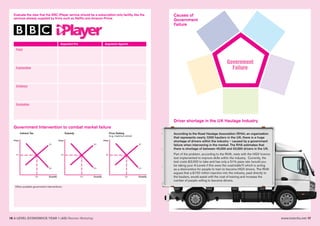
Driver shortage in the UK Haulage Industry
Q1
P1
S1
D1
Price
Quantity Q1
P1
S1
D1
Price
Quantity Q1
P1
S1
D1
Price
Quantity
Indirect Tax Subsidy Price Setting
(e.g. maximum price)
Other possible government interventions:
Causes of
Government
Failure
Government
Failure
According to the Road Haulage Association (RHA), an organisation
that represents nearly 7,000 hauliers in the UK, there is a huge
shortage of drivers within the industry – caused by a government
failure when intervening in the market. The RHA estimates that
there is shortage of between 45,000 and 50,000 drivers in the UK.
Part of the problem, according to the RHA, rests with the HGV licence
test implemented to improve skills within the industry. Currently, the
test costs £3,000 to take and has only a 51% pass rate (would you
be taking your A-Levels if this were the cost/odds?) which is acting
as a disincentive for people to train to become HGV drivers. The RHA
argues that a £150 million injection into the industry, paid directly to
the hauliers, would assist with the cost of training and increase the
number of people willing to become drivers.
18 A LEVEL ECONOMICS YEAR 1 (AS) Revision Workshop www.tutor2u.net 19
Assess the view that a £150 million subsidy to the haulage industry will certainly lead to a
welfare gain for the UK economy
Argument For Argument Against
Point
Explanation
Evidence
Evaluation
Link Back
Measure
What could the
UK do next?
What measures do the WEF use to determine levels of equality?
Equality in the UK
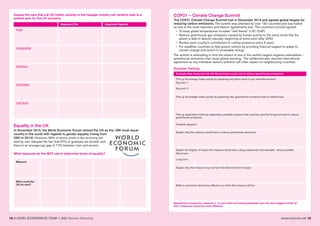
In November 2015, the World Economic Forum ranked the UK as the 18th most equal
country in the world with regards to gender equality (rising from
26th in 2014). However, 66% of senior posts in the economy are
held by men (despite the fact that 57% of graduate are female) and
there is an average pay gap of 17% between men and women.
COP21 – Climate Change Summit
The COP21 Climate Change Summit met in December 2015 and agreed global targets for
reducing carbon emissions. The summit was attended by over 190 countries and was hailed
as one of the most important and historic agreements ever. The countries involved agreed:
• To keep global temperatures increase "well below" 2.0C (3.6F)
• Reduce greenhouse gas emissions caused by human activity to the same levels that the
planet is able to absorb naturally, beginning at some point after 2050
• Review each country's contribution to cutting emissions every 5 years
• For wealthier countries to help poorer nations by providing financial support to adapt to
climate change and switch to renewable energy.
The summit is attempting to limit the impact of one of the world’s largest negative externalities –
greenhouse emissions that cause global warming. The settlement also requires international
agreement as any individual nation’s pollution will often impact on neighbouring countries.
Question Framing
Evaluate two measures the UK Government could use to reduce greenhouse emissions.
Pick up knowledge marks quickly by explaining key terms used in your extended answer:
Key term 1
Key term 2
Pick up knowledge marks quickly by explaining why greenhouse emissions lead to welfare loss:
Pick up application marks by explaining a possible measure that could be used by the government to reduce
greenhouse emissions:
Possible diagram?
Explain why this measure would lead to reduce greenhouse emissions:
Explain the degree of impact this measure would have, using evidence(or real example) where possible:
Short term:
Long term:
Explain why this measure may not have the desired level of impact:
Make a conclusion about how effective you think this measure will be:
Repeat this process for measure 2. In your final concluding paragraph you can also suggest which of
the 2 measures would be more effective.
Extension Activities
20 A LEVEL ECONOMICS YEAR 1 (AS) Revision Workshop www.tutor2u.net 21
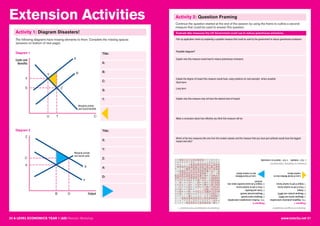
Activity 1: Diagram Disasters!
Activity 2: Question Framing
The following diagrams have missing elements to them. Complete the missing spaces
(answers on bottom of next page).
Title:
A:
B:
C:
S:
T:
Continue the question started at the end of the session by using the frame to outline a second
measure that could be used to answer this question
Diagram 1
U T C
Marginal private
and social benefits
V
S
A
BY
Z
Costs and
Benefits
Title:
X:
Y:
Z:
A:
D:
Diagram 2
B D Output
Marginal private
and social costs
C
Z
A
Y
X
AnswerstoDiagramDisasters!Answerstowordsearchfromsession1:
AnswerstoElasticityCalculations:
a:-0.2–Inelasticb:0.4–GoodAisanecessity
Diagram1
Title:Negativeproductionexternalities
A:Marginalsocialcost(MSC)
B:Marginalprivatecost(MPC)
C:Output
S:Priceiflefttomarketforces
T:Outputiflefttomarketforces
Diagram2
Title:Positiveconsumptionexternalities
X:Marginalsocialbenefit
Y:Marginalprivatebenefit
Z:CostsandBenefits
A:Priceiflefttomarketforces
D:Outputifallsocialbenefitstakeninto
account
LossofSocialWelfaredueto
marketfailure
LossofSocialWelfare
duetomarketfailure
Evaluate two measures the UK Government could use to reduce greenhouse emissions.
Pick up application marks by explaining a possible measure that could be used by the government to reduce greenhouse emissions:
Possible diagram?
Explain why this measure would lead to reduce greenhouse emissions:
Explain the degree of impact this measure would have, using evidence (or real example) where possible:
Short term:
Long term:
Explain why this measure may not have the desired level of impact:
Make a conclusion about how effective you think this measure will be:
Which of the two measures (the one from the revision session and the measure that you have just outlined) would have the biggest
impact and why?
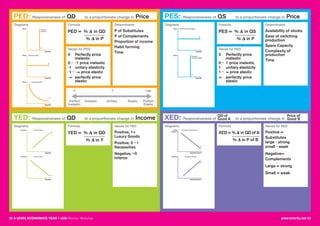
PED: Responsiveness of
Diagrams Formula
Values for PED:
Determinants
to a proportionate change in
Perfect
Inelastic
0 -1 -∞
Inelastic Unitary Elastic Perfect
Elastic
QD
PED = % Δ∆ in QD
% Δ∆ in P
0 Perfectly price
inelastic
0→ -1 price inelastic
-1 unitary elasticity
-1→ -∞ price elastic
-∞ perfectly price
elastic
Price
P of Substitutes
P of Complements
Proportion of income
Habit forming
Time
PES: Responsiveness of
Diagrams Formula
Values for PED:
Determinants
to a proportionate change inQS
PES = % Δ∆ in QS
% Δ∆ in P
0 Perfectly price
inelastic
0→ 1 price inelastic
1 unitary elasticity
1→ ∞ price elastic
∞ perfectly price
elastic
Price
Availability of stocks
Ease of switching
production
Spare Capacity
Complexity of
production
Time
YED: Responsiveness of
Diagrams Formula Values for YED
to a proportionate change inQD
YED = % Δ∆ in QD
% Δ∆ in Y
Income
Positive, 1+
Luxury Goods
Positive, 0→ 1
Necessities
Negative, <0
Inferior
XED: Responsiveness of
Diagrams Formula Values for XED
to a proportionate change in
XED = % Δ∆ in QD of A
% Δ∆ in P of B
Positive =
Substitutes
large - strong
small - weak
Negative=
Complements
Large = strong
Small = weak
Price of
Good B
QD of
Good A
22 A LEVEL ECONOMICS YEAR 1 (AS) Revision Workshop www.tutor2u.net 23
Price
Perfectly
Inelastic
D
Quantity
Price
Perfectly
Inelastic Supply
S
Quantity
Price Perfectly elastic
Unitary elasticity
D
Quantity
Price
D
D
D
D
D
Quantity
Income Normal Good
Quantity
Income Inferior Good
Quantity
Price Perfectly Elastic Supply
S
Quantity
Price
Good X
Complementary Goods
Quantity Good Y
Income Substitute Goods
Quantity Good Y
24 A LEVEL ECONOMICS YEAR 1 (AS) Revision Workshop www.tutor2u.net 25
Session 3
Measuring UK Economic
Performance
In this session we will consider how the UK’s economic performance is
measured, how the economy is currently performing and discuss the validity
of the measures that are used.
Time
RealGDP
Using the letter
codes below, place
where you think
the following might
appear on the
diagram.
Key Indicator Depends on...
A
B
D
E
F
The number of new housing starts
begins to fall
Rising real income
More building skips start appearing
on the streets
More companies attempt to
introduce wage freezes
Imports of sewing machines rise
C Rising homelessness
A fall in income tax
A fall in interest rates
A rise in the value of the GB
Pound compared to the Euro
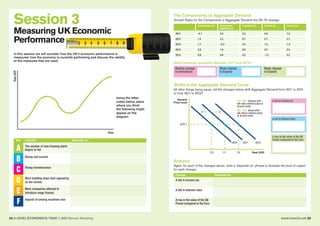
The Components of Aggregate Demand
Growth Rates for the Components of Aggregate Demand the UK (% change)
Shifts in the Aggregate Demand Curve
All other things being equal, will the changes below shift Aggregate Demand from AD1 to AD2
or from AD1 to AD3?
Quick numeracy questions (between 2011 and 2015):
2011
2012
2013
2014
2015
-0.1
1.5
1.7
2.6
0.8
Consumption (C)
0.0
2.3
-0.3
1.6
0.6
Government
Spending (G)
2.3
0.7
3.4
8.6
4.2
Investment (I)
5.6
0.7
1.5
0.5
-1.2
Exports (X)
1.0
3.1
1.4
2.4
5.2
Imports (m)
Median change
in Investment
Mean change
in Exports
Mode change
in Exports
A fall in income tax
A fall in interest rates
A rise in the value of the GB
Pound compared to the Euro
Analysis
Again, for each of the changes above, write a ‘depends on’ phrase to illustrate the level of impact
for each change:
AD3 AD1 AD2
Y3
GPL1
General
Price Level
Y1 Y2 Real GDP
AD1- AD2: Outward shift –
will raise national output at
all price levels
AD1- AD3: Inward shift –
will reduce national output
at all price levels
Change Depends on...
26 A LEVEL ECONOMICS YEAR 1 (AS) Revision Workshop
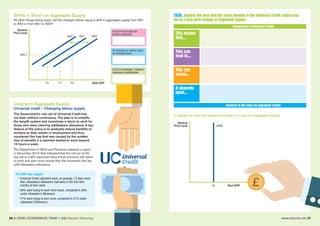
Shifts in Short run Aggregate Supply
All other things being equal, will the changes below cause a shift in aggregate supply from AS1
to AS2 or from AS1 to AS3?
TASK: Analyse the view that the move towards to the Universal Credit system has
led to a long term change in Aggregate Supply.
A fall in real wages for
people employed
An increase in carbon taxes
on polluting firms
AS2 AS1 AS3
Y2
GPL1
General
Price Level
Y1 Y3 Real GDP
Long term Aggregate Supply
Universal credit – Changing labour supply
The Government's role-out of Universal Credit has
not been without controversy. The plan is to simplify
the benefit system and incentivise a return to work for
those who were claiming JobSeekers allowance. A key
feature of the policy is to gradually reduce benefits to
workers as they remain in employment and thus
counteract the trap that was caused by the sudden
loss of benefits if a claimant started to work beyond
16 hours a week.
The Department of Work and Pensions released a report
in December 2015 that indicated that the roll-out of UC
has led to a 8% improved chance that someone will return
to work and earn more money than the incentives that lay
with Jobseekers allowance.
The DWP also suggest
• Universal Credit claimants work, on average, 12 days more
than Jobseeker’s Allowance claimants in the first nine
months of their claim
• 86% were trying to work more hours, compared to 38%
under Jobseeker’s Allowance
• 77% were trying to earn more, compared to 51% under
Jobseeker’s Allowance.
A fall in employers’ national
insurance contributions
Introduction of Universal Credit
This means
that...
This can
lead to...
This can
cause...
It depends
upon...
A diagram to show this apparent change in in long run Aggregate Supply
Yp Real GDP
General
Price Level LRAS
£
www.tutor2u.net 27
Increase in the long run aggregate supply
28 A LEVEL ECONOMICS YEAR 1 (AS) Revision Workshop www.tutor2u.net 29
Growth in the UK Economy
Explain 3 reasons why the UK appears to be growing at a slower rate in 2015 compared to 2014.
One Two Three
Risks of higher inflation and
higher interest rates
Environmental effects Inequalities of income
and wealth
Growing a Dynamic Private
Sector
Sound Macro Policies to
control inflation
Focusing on addressing
Equity / Fairness
What are the economic and social costs of Economic Growth?
What is the best way to attain sustainable economic
growth in the long run?
Source: ONS
What is meant by ‘sustainable’?
Building Trust / Social Capital Growing Intra-Regional Trade Improving Institutions
Employment
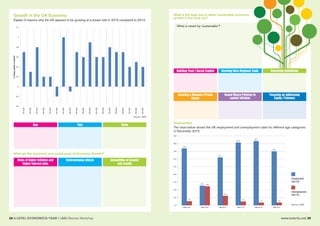
The chart below shows the UK employment and unemployment rates for different age categories
in December 2015
Employment
rate (%)
Unemployment
rate (%)
Source: ONS
30 A LEVEL ECONOMICS YEAR 1 (AS) Revision Workshop www.tutor2u.net 31
Evaluate the view that employment and unemployment rates of 16 to 25 year olds (in the
UK) represents a significant issue with regards to the performance of the UK economy.
Argument For Argument Against
Point
Explanation
Evidence
Evaluation
Link Back to the question
Evaluate the view that the very low levels of inflation within the UK should not concern the
Government as it is primarily caused by falling prices for fuel and food.
Argument For Argument Against
Point
Explanation
Evidence
Evaluation
Link Back to the question
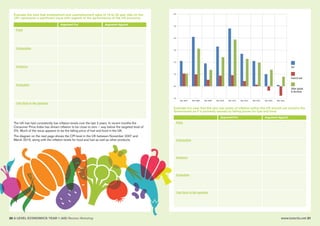
The UK has had consistently low inflation levels over the last 2 years. In recent months the
Consumer Price Index has shown inflation to be close to zero – way below the targeted level of
2%. Much of the issue appears to be the falling price of fuel and food in the UK.
The diagram on the next page shows the CPI level in the UK between November 2007 and
March 2015, along with the inflation levels for food and fuel as well as other products.
CPI
Food & fuel
Other goods
& Services
Extension Activities
32 A LEVEL ECONOMICS YEAR 1 (AS) Revision Workshop www.tutor2u.net 33
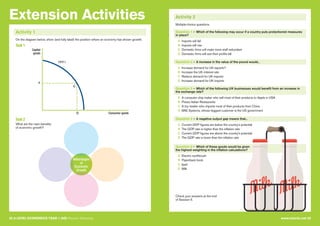
Activity 1
On the diagram below, show (and fully label) the position where an economy has shown growth.
Task 1
Task 2
What are the main benefits
of economic growth?
B
A
PPF1
E
Capital
goods
Consumer goods
Advantages
of
Economic
Growth
Activity 2
Question 1 – Which of the following may occur if a country puts protectionist measures
in place?
A Imports will fall
B Imports will rise
C Domestic firms will make more staff redundant
D Domestic firms will see their profits fall
Question 3 – Which of the following UK businesses would benefit from an increase in
the exchange rate?
A A computer chip maker who sell most of their products to Apple in USA
B Prezzo Italian Restaurants
C A toy retailer who imports most of their products from China
D BAE Systems, whose biggest customer is the US government
Question 5 – Which of these goods would be given
the highest weighting in the inflation calculations?
A Electric toothbrush
B Paperback book
C Ipad
D Milk
Question 2 – A increase in the value of the pound would...
A Increase demand for UK exports?
B Increase the UK interest rate
C Reduce demand for UK imports
D Increase demand for UK imports
Question 4 – A negative output gap means that...
A Current GDP figures are below the country's potential
B The GDP rate is higher than the inflation rate
C Current GDP figures are above the country's potential
D The GDP rate is lower than the inflation rate
Multiple-choice questions
Check your answers at the end
of Session 5.
www.tutor2u.net 3534 A LEVEL ECONOMICS YEAR 1 (AS) Revision Workshop
Session 4
Demand Side Policies
(Fiscal and Monetary)
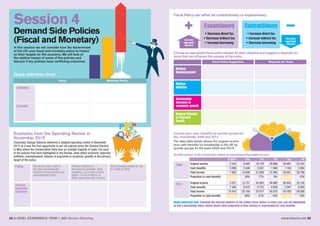
In this session we will consider how the Government
of the UK uses fiscal and monetary policy to impact
on their targets for the economy. We will look at
the relative impact of some of the policies and
discuss if any policies have conflicting outcomes.
Quick definition time!
Fiscal Monetary Policy
Definition
Example
Policy Big energy users such as
the steel and chemicals
industries to be exempt from
environmental tariffs.
Phased reduction in
Government spending. State
spending - as a share of total
output - to fall to 36.5% in
2020, down from 45% in 2010.
Total education budget to rise
by £10bn by 2020.
Primary
economic
objective
Examples from the Spending Review in
November 2015
Chancellor George Osborne delivered a detailed spending review in November
2015 as it was the first opportunity to set out policies since the General Election
in May where the Conservative Party won an outright majority of seats. For each
of the policies that were highlighted in the Review, state which economic objective
(inflation, unemployment, balance of payments or economic growth) is the primary
target of the policy.
Fiscal Policy can either be contractionary or expansionary:
Contractionary
• Increase direct tax
• Increase indirect tax
• Decrease borrowing
+ Expansionary
• Decrease direct tax
• Decrease indirect tax
• Increase borrowing
Increase
aggregate
demand
Decrease
aggregate
demand
Choose an appropriate fiscal policy needed for each objective and suggest a ‘depends on’
factor that can influence the success of the policy:
Income plus cash benefits by quintile groups for
ALL households, 2000 and 2014
The data table below shows the original income
plus cash benefits for households in the UK by
quintile groups for the years 2000 and 2014.
Quintile groups of all households ranked by equivalised disposable income
Reduce
Unemployment
Reduce
Inflation
Sustainable
increase in
economic growth
Reduce Balance
of Payment
Deficit
Fiscal Policy Suggestion ‘Depends on’ factor
2000
2014
Bottom 2nd 3rd 4th Top All
Original income 2 534 8 600 18 179 29 968 56 887 23 234
Cash benefits 5 268 5 426 3 647 1 994 1 134 3 494
Total income 7 802 14 026 21 826 31 962 58 021 26 728
Proportion in cash benefits 39% 17% 6% 13%
Original income 5 521 13 731 24 842 40 880 80 803 33 155
Cash benefits 7 394 8 413 6 775 4 695 2 947 6 045
Total income 12 915 22 144 31 617 45 575 83 750 39 200
Proportion in cash benefits 38% 21% 10% 15%
Quick numerical task: Calculate the missing numbers in the yellow boxes above. In each case, you are attempting
to find a percentage figure which shows what proportion of total income is represented by cash benefits.
www.tutor2u.net 3736 A LEVEL ECONOMICS YEAR 1 (AS) Revision Workshop
Evaluation
Will the change in the way that income is distributed between 2000 and 2014 lead to an
increase in aggregate demand?
PEEEL Argument for Argument against
Point
Explanation
Evidence
Evaluation
Link Back
to Question
£
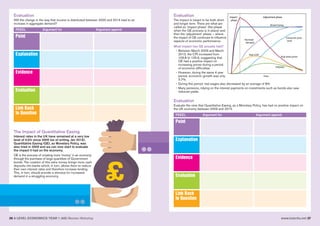
The Impact of Quantitative Easing
Interest rates in the UK have remained at a very low
level of 0.5% since 2009 (as of writing, Jan 2016).
Quantitative Easing (QE), as Monetary Policy, was
also tried in 2009 and we can now start to evaluate
the impact it had on the economy.
QE is the process of creating more ‘money’ in an economy
through the purchase of large quantities of Government
bonds. The creation of this extra money brings more cash
deposits into banks which, in turn, allows them to reduce
their own interest rates and therefore increase lending.
This, in turn, should provide a stimulus for increased
demand in a struggling economy.
Evaluation
Evaluate the view that Quantitative Easing, as a Monetary Policy, has had no positive impact on
the UK economy between 2009 and 2015.
PEEEL Argument for Argument against
Point
Explanation
Evidence
Evaluation
Link Back
to Question
Evaluation
The impact is meant to be both short
and longer term. There are what are
called an ‘impact phase’ (the phase
when the QE process is in place) and
then the ‘adjustment’ phase – where
the impact of QE continues to influence
aspects of economic performance.
What impact has QE actually had?
• Between March 2009 and March
2013, the CPI increased from
109.8 to 125.6, suggesting that
QE had a positive impact on
increasing prices during a period
of economic difficulties
• However, during the same 4 year
period, economic growth was only
3.7%.
• During this period, real wages also decreased by an average of 8%
• Many pensions, relying on the interest payments on investments such as bonds also saw
reduced yields.
www.tutor2u.net 3938 A LEVEL ECONOMICS YEAR 1 (AS) Revision Workshop
Whatever happened to ‘Forward Guidance’?
Forward Guidance was the strategy introduced by Mark Carney when he was first
appointed as Governor of the Bank of England in 2013. The idea was to ‘pre-warn’ people
about possible interest rate changes – giving as much notice as possible about a time-
frame so that individuals and firms could plan to adjust when changes were made.
However, as part of this guidance, Carney said
that there would be no changes to interest rates
whilst unemployment remained above 7%.
Unemployment dropped to this level within 6
months of his appointment. Instead, the strategy
was altered so that there would be no change to
interest rates whilst a range of measures (such as
the output gap) were above set levels. In effect,
a policy that had been set up to give clear guide-
lines to the economy became more complex and
less... clear!
Advantages of Forward Guidance Impact of changes to Forward Guidance
Evaluation
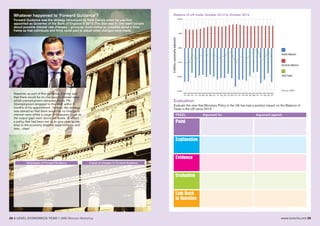
Evaluate the view that Monetary Policy in the UK has had a positive impact on the Balance of
Trade in the UK since 2013.
PEEEL Argument for Argument against
Point
Explanation
Evidence
Evaluation
Link Back
to Question
Balance of UK trade, October 2013 to October 2015
Goods Balance
Services Balance
Total Trade
Source: ONS
Extension Activities
40 A LEVEL ECONOMICS YEAR 1 (AS) Revision Workshop www.tutor2u.net 41
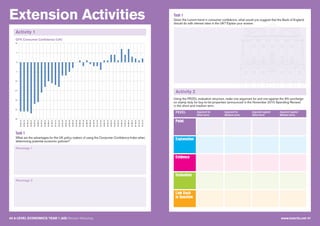
Activity 1
GFK Consumer Confidence (UK)
Activity 2
Using the PEEEL evaluation structure, make one argument for and one against the 3% surcharge
on stamp duty for buy-to-let properties (announced in the November 2015 Spending Review)
in the short and medium term.
PEEEL Argument for
(Short term)
Argument for
(Medium term)
Argument against
(Short term)
Argument against
(Medium term)
Point
Explanation
Evidence
Evaluation
Link Back
to Question
Task 1
What are the advantages for the UK policy makers of using the Consumer Confidence Index when
determining potential economic policies?
Task 1
Given the current trend in consumer confidence, what would you suggest that the Bank of England
should do with interest rates in the UK? Explain your answer.
Advantage 1
Advantage 2
42 A LEVEL ECONOMICS YEAR 1 (AS) Revision Workshop www.tutor2u.net 43
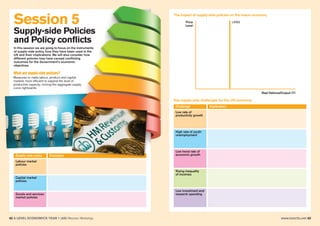
Session 5
Supply-side Policies
and Policy conflicts
In this session we are going to focus on the instruments
of supply-side policy, how they have been used in the
UK and their implications. We will also consider how
different policies may have caused conflicting
outcomes for the Government’s economic
objectives.
What are supply-side policies?
Measures to make labour, product and capital
markets more efficient to expand the level of
productive capacity, moving the aggregate supply
curve rightwards.
Labour market
policies
Capital market
policies
Goods and services
market policies
The impact of supply-side policies on the macro economy
Key supply-side challenges for the UK economy:
Price
Level
LRAS
Real NationalOutput (Y)
Supply-side policy Examples
Low rate of
productivity growth
High rate of youth
unemployment
Low trend rate of
economic growth
Rising inequality
of incomes
Low investment and
research spending
Challenge Explanation
www.tutor2u.net 4544 A LEVEL ECONOMICS YEAR 1 (AS) Revision Workshop
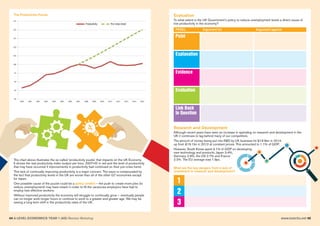
The Productivity Puzzle
Productivity Pre-crisis trend
The chart above illustrates the so-called ‘productivity puzzle’ that impacts on the UK Economy.
It shows the real productivity index (output per hour, 2007=0) in red and the level of productivity
that may have occurred if improvements in productivity had continued on their pre-crisis trend.
This lack of continually improving productivity is a major concern. The issue is compounded by
the fact that productivity levels in the UK are worse than all of the other G7 economies except
for Japan.
One possible cause of the puzzle could be a policy conflict – the push to create more jobs (to
reduce unemployment) may have meant in order to fill the vacancies employers have had to
employ less effective workers.
Without improved productivity the economy will struggle to continually grow – eventually people
can no longer work longer hours or continue to work to a greater and greater age. We may be
seeing a long-term shift in the productivity rates of the UK.
Evaluation
To what extent is the UK Government’s policy to reduce unemployment levels a direct cause of
low productivity in the economy?
Research and Development
Although recent years have seen an increase in spending on research and development in the
UK it continues to lag behind many of our competitors.
The amount of money being put into R&D by UK business hit £19.9bn in 2014,
up from £19.1bn in 2013 at constant prices. This amounted to 1.1% of GDP.
However, South Korea spent 4.1% of GDP on developing
new technology and products, Japan 3.4%,
Germany 2.9%, the US 2.7% and France
2.2%. The EU average was 1.9pc.
PEEEL Argument for Argument against
Point
Explanation
Evidence
Evaluation
Link Back
to Question
1
2
3
What are the key dangers from a lack of
investment in research and development?
www.tutor2u.net 4746 A LEVEL ECONOMICS YEAR 1 (AS) Revision Workshop
1
2
3
What are the key advantages of developing Enterprise Zones?
Has this conflict been reflected in the
statistics?
UK Economic Growth and the Balance of Payment Current Account
UK Enterprise Zones
Enterprise zones have been set up in 24 regions within the UK.
The concept is to create regionalised hubs for promoting growth
and creativity in areas that may have traditionally suffered from
higher unemployment.
In each zone, the organisation specialises in a particular set of
industries that have the potential for success in that are (e.g.
Advanced Manufacturing/Engineering in Birmingham, Aerospace
in Manchester).
The Government attempts to attract businesses to the area by
promising advantages such as a streamlined planning process,
enhanced capital allowances or improved transport links.
Conflict between unemployment
and inflation
Economists will often talk about the conflict between
unemployment and inflation (see the Phillips Curve).
Traditionally, the concern was that any monetary
or fiscal policy put in place to reduce inflation often
required controlling aggregate demand. So,
increasing interest rates will reduce AD but as
demand falls so will employment as firms start to
lay-off employees as they are no longer needed.
Economists suggest that there is a trade-off
between economic growth and the balance
of payments current account. A positive
economic growth suggests that people are
wealthier – in the UK as people earn more
money they will tend to purchase more
imported goods.Thus, economic growth may
lead to a larger deficit on the BoP Current
Account.
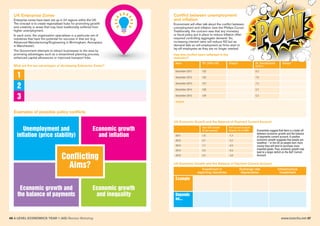
Examples of possible policy conflicts
Conflicting
Aims?
Unemployment and
inflation (price stability)
Economic growth
and inflation
Economic growth and
the balance of payments
Economic growth
and inequality
Name CPI (2005=100) Change? UK Unemployment
(LFS) %
December 2011 122
Real GDP Growth
(% per annum)
BoP Current Account
Balance (% of GDP)
2011 1.6 -1.7
2012 0.7 -3.7
2013 1.7 -4.5
2014 3.0 -5.5
2015 2.5 -3.6
8.3
December 2012 125 7.8
December 2013 127 7.2
December 2014 128 5.7
December 2015 129 5.3
Analysis
Change?
Investment in
exporting industries
Exchange rate
depreciation
Infrastructure
Investment
Example
Depends
on...
www.tutor2u.net 4948 A LEVEL ECONOMICS YEAR 1 (AS) Revision Workshop
Paris Climate Summit 2015
All of the major economies of the world met and discussed the issue of
climate change in Paris in November 2015.At the end, each government
agreed to new targets to reduce carbon emissions and attempt to limit the
rise in average world temperatures to less than 2 degrees. Some of the
agreed measures are legally binding (e.g. to measure and review emissions),
so the UK government must now implement a raft of measures to ensure
that they are met within the agreed timeframe.
The EU bloc of nations produces 9% of the world’s greenhouse emissions
with only China and the USA polluting more.The UK will start to formulate
new policies to meet the agreed targets but these will include further
measures of taxes on polluting firms/products, incentives for firms using
or developing greener technology and greater regulation on polluting
firms/consumers.
PEEEL Argument for Argument against
Point
Explanation
Evidence
Evaluation
Link Back
to Question
Evaluate the view that further measures by the UK Government aimed at reducing
greenhouse emissions will always lead to lower economic growth.
Suggest 2 new policies that the government could introduce to reduce greenhouse emissions in the UK:
1 2
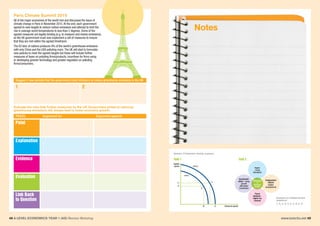
B D
A
C
PPF1
PPF2
E
Capital
goods
Consumer goods
Advantages
of
Economic
Growth
Higher
Living
Standards
Employment
effects
(higher
employment)
Fiscal
dividend -
higher tax
revenue
Accelerator
effect - rising
growth
stimulates
investment
F
Answers to multiple-choice
questions:
1. A, 2. D, 3. C, 4. A, 5. D
Task 1 Task 2
Session 3 Extension Activity answers:
Notes
Extension Activities
50 A LEVEL ECONOMICS YEAR 1 (AS) Revision Workshop www.tutor2u.net 51
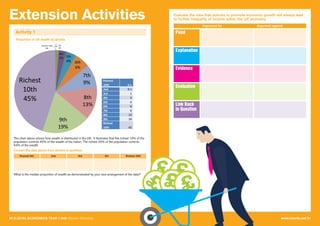
Activity 1
Proportion of UK wealth by deciles
The chart above shows how wealth is distributed in the UK. It illustrates that the richest 10% of the
population controls 45% of the wealth of the nation. The richest 20% of the population controls
64% of the wealth.
Convert the data above from deciles to quintiles:
What is the median proportion of wealth as demonstrated by your new arrangement of the data?
Poorest 5th 2nd 3rd 4th Richest 20th
Evaluate the view that policies to promote economic growth will always lead
to further inequality of income within the UK economy.
Argument for Argument against
Point
Explanation
Evidence
Evaluation
Link Back
to Question
£ ££ £ £
52 A LEVEL ECONOMICS YEAR 1 (AS) Revision Workshop www.tutor2u.net 53
Top Tips to Improve Your
Exam Answer
Crisp and accurate
definitions
1 key point per
paragraph
+
Supporting examples /
evidence / diagrams
+ evaluate as you go
Evaluate conclusions
Command Word What does it meann
Argue This term appears often in essay questions and requires you to examine,
analyse carefully and present considerations for and against items involved.
Assess Express the meaning of, translate, exemplify (give examples of), solve, or
comment upon the subject. Usually you will give your judgement or reaction
to the problem, but always make use of evidence.
Discuss Give reasons or present facts for and against an issue; try to provide by
giving reasons or evidence for and against.
Evaluate Give reasons or present facts for and against an issue; try to provide by giving
reasons or evidence for and against.
Explain Present in brief, clear form.
Interpret Make a careful judgement of the worth of something (e.g. a theory) in the light
of its truth, usefulness etc. Give supporting evidence. You might include your
opinion to a lesser extent, or refer to other theories.
State Clarify and interpret the material you present. State the ‘how’ and ‘why’, the
results, and where possible causes.
Define Give concise, clear meanings.
Remember that during the exam, in your writing you should take particular care with your spelling,
punctuation and grammar, as well as the clarity of expression.
Building an Essay Answer
Understanding the key command words in a question
General advice for supported MC questions (EdExcel Board only)
• Define key terms throughout questions 1 to 8 on the EdExcel paper
• Consider the key concept or model that lies behind question
• Apply the information provided e.g. the effects of a tax or a subsidy on a market
• Annotate the diagrams provided in the question paper e.g. shading in or labelling areas
of consumer & producer surplus, govt spending on a subsidy or agency spending on a buffer
stock
• Be prepared to annotate tables of data too - complete them or make some simple calculations
• Be prepared to calculate percentages and show your workings, including a relevant formula
• Reject one or more of the options – remember to briefly explain why you have rejected them
• A suitable diagram can score two marks out of three - be prepared to offer simple
diagrammatic analysis - this unit credits the application of demand and supply diagrams to
economic issues
• Be prepared to offer economic analysis, for example, explaining how the free rider problem
occurs in the provision of public goods. This will always be credited with marks.
• Offer real world examples as a way of applying theory - for example causes of geographical
immobility, causes of imperfect information
Hints for getting higher scores on data questions
One data response question is usually based on applying the theories of supply and demand and
also government intervention in markets i.e. indirect taxes, subsidies, price floors or ceilings, buffer
stock schemes, carbon trading and so on). The other question is usually on one or more aspects
of market failure (externalities, merit or demerit goods, public goods, monopoly and also the
distribution of income). Keep in mind that some questions will overlap these two broad areas.
Definition questions
• A clear, accurate succinct definition is all that is needed for full marks
• Where appropriate, this could be supported by an example or by a relevant formula
• It is often the case that one full sentence is sufficient
• A correct diagram to show understanding of a term may also get full marks
Data Description
E.g. “Identify 2 points of comparison”, “Identify 2 significant changes”, “Compare 2 significant
changes” or “Identify 2 significant features”.
• Two features should be clearly stated, ideally each in a separate paragraph
• Each point should represent a significant feature of the data.
• A good answer provides overview, backed up by evidence from the data
• Each feature identified must be supported by the use of relevant statistics
• Use of data must be accurate, e.g. the units must be correctly stated (e.g. $s per capita)
• No marks are awarded for candidates who just ‘trawl’ through the data – the instructions
are to identify two main/significant features of the data
• For time series data, give an overview, i.e. “over the whole period the price of coffee
rose by X%”
• Do not try to explain the data! This is not what the question is asking – you will be
wasting valuable time in the exam and might struggle to complete the questions carrying
the highest marks
54 A LEVEL ECONOMICS YEAR 1 (AS) Revision Workshop www.tutor2u.net 55
Analysis and Explanation Questions
These nearly always require at least one analysis diagram to score full marks e.g. “With the help
of a demand and supply diagram.” Here are some of the key diagrams you will need to know for
AS microeconomics.
To score high marks on explanation and analysis
• Define the economic terms that are in the question
• Make good use of one (possibly more) diagrams - fully labelled with correct units on axes.
• When explaining something, there are marks for identifying a relevant factor and constructing
a logical argument linked to the factor identified
• Additional marks are awarded for relevant use of
elasticity concepts – if you change the elasticity,
often you get a different outcome (e.g. the
effects of taxation on demand for de-merit
goods)
• Carefully look at question instructions
and then attempt to answer, maintaining
relevance
Production Possibility Curve (and shifts in) Negative externalities in production and consumption
Price elasticity of demand and total revenue Positive externalities in production and consumption
Shifts in supply and demand Economies of large scale production
Consumer and producer surplus Maximum and minimum prices
Allocative efficiency in a market Indirect taxes
De-merit goods and information failure Government subsidies for producers and consumers
Buffer stock agency schemes Elasticity of supply – different supply curves
Developing your evaluation skills
Evaluation questions carry the highest marks and ask for more from the student. For the AQA
evaluation marks are reserved for the final essay-style question. But for EdExcel, evaluation marks
are available in more questions – summarised below:
Here are some thoughts from the examiners
(i) Before you can evaluate you must analyse!
(ii) Evaluate each argument as it is introduced into the answer
(iii) Examiners like students who develop clear chains of reasoning in their answers
(iv) Try to make at least 3 “explicit” references to the data given in the question
(v) “Answers do not always have a clear, logical structure”. Hints for better marks:
a. Identify the area of economics which is being tested in the essay-style question
b. Outline the relevant theory, using a diagram if possible (they really do help!)
c. Evaluate arguments/policies as you go
d. Develop one key point per paragraph and leave a clear line between each paragraph
e. Remember to come to a ‘final judgement’ including referring back to the data
f. A conclusion is essential and should not just repeat earlier points
g. Leave yourself 5 minutes for a final judgement of 4-5 lines. This is time well spent.
Try to incorporate a new idea, e.g. how a policy may impact on different parties;
how the policy may have different short v long run effects.
• Answers should include alternative points of view and these should be clearly identified
• Some attempt should be made to consider the strengths and weaknesses of the different
viewpoints. [Rank them if possible].
• Where possible, use data to provide support for arguments or to refute a point of view
• Final judgements might be qualified by statements that include phrases such as
‘it depends on’.
• Useful evaluative words: “However, nevertheless, it is likely that, on the other hand….”
• Maintain a high quality of presentation, especially in high mark questions and with your
diagrams.
56 A LEVEL ECONOMICS YEAR 1 (AS) Revision Workshop www.tutor2u.net 57
Ability to pay The idea that taxes should be levied on a person according to how well that person can shoulder the
burden / afford to pay
Absolute poverty The number of people living below a certain income threshold or the number of hous holds unable
to afford certain basic goods and services. The United Nations definition is a severe and persistent
deprivation of basic human needs
Ad valorem tax An indirect tax based on a percentage of the sales price of a good or service. An increase in an ad
valorem tax causes an inward shift in the supply curve
Adverse selection Where the expected value of a transaction is known more accurately by the buyer or the seller due to
an asymmetry of information; e.g. health insurance
Allocative efficiency Allocative efficiency occurs when the value that consumers place on a good or service (reflected in
the price they are willing and able to pay) equals the cost of the resources used up in production.
Asking price The price at which a security, commodity or currency is offered for sale on the market - generally the
lowest price the seller will accept.
Asymmetric information Occurs when somebody knows more than somebody else in the market. Such asymmetric information
can make it difficult for the two people to do business together. A situation in which some agents have
more information than others and this affects the outcome of a bargain between them
Automation A production technique that uses capital machinery / technology to replace or enhance human labour
Average cost Average or unit cost (AC) is the total cost divided by the number of units of the commodity produced.
Barriers to entry Factors which make it difficult or expensive for new firms to enter a market in order to compete with
existing suppliers. Examples of barriers to entry include the effect of patents; brand loyalty among
consumers; the high costs of buying capital equipment and also the need to win licences to operate
in certain markets.
Barter The practice of exchanging one good or service for another, without using money
Basic economic problem The basic problem is that there are infinite wants but finite (non-renewable) resources with which to
satisfy them
Black market Illegal market in which market price is higher than a legally imposed price ceiling.
Bottlenecks Any factor that causes production to be delayed or stopped – this may reduce the price elasticity of
supply of a product
Brand A distinctive product offering which is created by the use of a logo, symbol, name, design, packaging
or combination thereof. The key in designing and building a brand is to differentiate it from competitors.
Buffer stock Buffer stock schemes seek to stabilize the market price of agricultural products by buying up supplies
of the product when harvests are plentiful and selling stocks of the product onto the market when
supplies are low.
Bulk-buying The purchase by one organisation of large quantities of a product or raw material, which often results
in a lower price because of their market power and because it is cheaper to deal with one customer
and the deliveries can be on a larger scale.
Buyer’s market A market that favours buyers because supply is plentiful relative to demand and therefore prices are
relatively low. The opposite of a seller's market.
By-product A by-product is a good or service that is produced as a consequence of producing a other good or
service.
Capacity utilisation The extent to which a business is making full use of existing factor resources
Capacity-building Efforts to develop human skills or infrastructures within a community or organisation
Capital goods Producer or capital goods such as plant (factories) and machinery and equipment are useful for the
goods and services they can help produce in the future. Distinguished from "financial capital",
meaning funds which are available to finance the production or acquisition of real capital
Capital-intensive A production technique which uses a high proportion of capital to labour
Capitalist economy An economic system organised along capitalist lines uses market-determined prices to guide our
choices about the production and distribution of goods. One key role for the state is to maintain the
rule of law and protect private property.
Carbon credits An allowance to a business to generate a specific level of emissions – may be traded in a carbon
market
Cartel A cartel is a formal agreement among firms. Cartel members may agree on prices, total industry
output, market shares, allocation of customers, allocation of territories, bid rigging, establishment of
common sales agencies, and the division of profits or combination of these.
Ceteris paribus To simplify analysis, economists isolate the relationship between two variables by assuming ceteris
paribus - all other influencing factors are held constant.
Command and control Laws and regulation backed up by inspection and penalties for non-compliance
Command economy An economic system where all resources are allocated by the government, with no markets (egg
ex-Soviet bloc, North Korea).
Common resources Goods or services that have characteristics of rivalry in consumption and non-excludability - grazing land
or fish stocks are examples. The over-exploitation of common resources can lead to the "tragedy of
the commons"
Competition policy Government policy directed at encouraging competition in the private sector: e.g. the investigation of
takeovers or restrictive practices
Competitive market A market where no single firm has a dominant position and where the consumer has plenty of choice
when buying goods or services. There are few barriers to the entry of new firms
Competitive supply Goods in competitive supply are alternative products a firm could make with its resources. E.g.
a farmer can plant potatoes or carrots. An electronics factory can produce VCRs or DVDs.
Complements Two complements are said to be in joint demand. Examples include: fish and chips, DVD players and
DVDs, iron ore and steel,
Composite demand Where goods or services have more than one use so that an increase in the demand for one product
leads to a fall in supply of the other. E.g. milk which can be used for cheese, yoghurts, cream, butter
and other products. If more milk is used for manufacturing cheese, ceteris paribus there is less
available for butter.
Conspicuous Conspicuous consumption is consumption designed to impress others rather than something that is
consumption wanted for its own sake.
Constraints Limits to what we can afford to consume – we have to operate within budgets, and make choices
from those sets that are feasible/affordable. There is always a set of conceivable thing that are
actually available, and another set of that aren't
Consumer sovereignty Consumer sovereignty exists when the economic system allows scarce resources to be allocated to
producing goods and services that reflect the wishes of consumers. Sovereignty can be distorted by
the effects of persuasive advertising
Consumer surplus A measure of the welfare that people gain from the consumption of goods and services, or a measure
of the benefits they derive from the exchange of goods. Consumer surplus is the difference between
the total amount that consumers are willing and able to pay for a good or service (indicated by the
demand curve) and the total amount that they actually pay (the market price)
Contestable market Market with no entry barriers - firms can enter or leave without significant cost.
Costs Costs faced by a business when producing a good or service for a market. Every business faces
costs - these must be recouped if a business is to make a profit from its activities. In the short run a
firm will have fixed and variable costs of production.
Cross price elasticity Responsiveness of demand for good X following a change in the price of good Y (a related good).
of demand With cross price elasticity we make an important distinction between substitute products and
complementary goods and services.
Deadweight loss The loss in producer and consumer surplus due to an inefficient level of production perhaps resulting
from market failure or government failure
Demand curve A demand curve shows the relationship between the price of an item and the quantity demanded over
a period of time. For normal goods, more of a product will be demanded as the price falls.
De-merit goods The consumption of de-merit goods can lead to negative externalities which causes a fall in social
welfare. Consumers may be unaware of the negative externalities that these goods create - they have
imperfect information.
Derived demand The demand for a product X might be strongly linked to the demand for a related product Y - giving
rise to the idea of a derived demand.
Diminishing returns As more of a variable factor (e.g. labour) is added to a fixed factor (e.g. capital) a firm will reach a
point where it has a disproportionate quantity of labour to capital and so the marginal product of
labour will fall, thus raising marginal costs
Disposable income Income that remains after direct taxes and government charges has been paid.
Division of labour The specialization of labour in specific tasks, intended to increase productivity
Economic efficiency Economic efficiency is about making the best use of our scarce resources among competing ends so
that economic and social welfare is maximised over time
Economic planning Government policies aimed at influencing trends in the economy.
Economy of scale Reductions in long-run average cost from an increase in the scale of production.
Economy of scope Economies of scope occur where it is cheaper to produce a range of products.
Effective demand Demand in economics must be effective. Only when a consumers' desire to buy a product is backed
up by an ability to pay for it do we speak of demand.
Elastic demand Demand for which price elasticity is greater than 1
Elastic supply Where the price elasticity of supply is greater than +1
Elasticity of supply Price elasticity of supply measures the relationship between change in quantity supplied and a
change in price.
Emission tax A charge made to firms that pollute the environment based on the quantity of pollution they emit i.e.
the volume of CO2 emissions
Entrepreneur An entrepreneur is an individual who seeks to supply products to a market for a rate of return (i.e. a
profit). Entrepreneurs will usually invest their own financial capital in a business and take on the risks
associated with a business investment.
AS MICRO Key Term Glossary
58 A LEVEL ECONOMICS YEAR 1 (AS) Revision Workshop www.tutor2u.net 59
Equilibrium Equilibrium means ‘at rest’ or ‘a state of balance’ - i.e. a situation where there is no tendency for
change. The concept is used in both microeconomics (e.g. equilibrium prices in a market) and also
in macroeconomics (e.g. equilibrium national income)
Excess demand The difference between the quantity supplied and the higher quantity demanded when price is set
below the equilibrium price. This will result in queuing and an upward pressure on price
Excess supply When supply is greater than demand and there are unsold goods in the market. Surpluses put
downward pressure on the market price.
Excludability The property of a good whereby a person can be prevented from using it
External cost Costs faced by a third party for which no appropriate compensation is forthcoming. Identifying and
then estimating a monetary value for air and noise pollution is a difficult exercise - but one that is
increasingly important for economists concerned with the impact of economic activity on our environment.
External growth When a company increases its sales and profits by buying other companies, rather than from its own
operations.
Externalities Externalities are third party effects arising from production and consumption of goods and services for
which no appropriate compensation is paid.
Factor incomes Factor incomes are the rewards to factors of production. Labour receives wages and salaries, land
earns rent, capital earns interest and enterprise earns profit.
Finite resources There are only a finite number of workers, machines, acres of land and reserves of oil and other natural
resources on the earth. By producing more for an ever-increasing population, we may destroy the
natural resources of the planet.
Fixed costs Costs that do not vary directly with the level of output. Examples of fixed costs include: rent and
business rates, the depreciation in the value of capital equipment (plant and machinery) due to age
and marketing and advertising costs.
Free market System of buying and selling that is not under the control of the government, and where people can
buy and sell freely, or an economy where free markets exist, and most companies and property are not
owned by the state
Freemium A business model, especially on the Internet, whereby basic services are provided free of charge
while more advanced (premium) features must be paid for
Geographical immobility People may also experience geographical immobility – meaning that there are barriers to them moving
from one area to another to find work
Gini Coefficient The Gini coefficient measures the extent to which the distribution of income (or, in some cases,
consumption expenditures) among individuals or households within an economy deviates from a
perfectly equal distribution. The coefficient ranges from 0 -meaning perfect equality -to 1- complete
inequality.
Government failure Policies that cause a deeper market failure. Government failure may range from the trivial, when
intervention is merely ineffective, to cases where intervention produces new and more serious
problems that did not exist before
Health rationing Health rationing occurs when the demand for health care services outstrips the available resources
leading to waiting lists and delays for health treatment.
Horizontal equity Horizontal equity requires equals to be treated equally e.g. people in the same income group should
be taxed at the same percentage rate
Incentives Incentives matter enormously in any study of microeconomics, markets and market failure. For
competitive markets to work efficiently economic agents (i.e. consumers and producers) must
respond to price signals in the market.
Incidence of a tax How the final burden of a tax is shared out. If demand for a good is elastic and a tax is imposed then
the tax may fall mainly on the producer as they will be unable to put prices up without losing a lot of
demand.
Income Income represents a flow of earnings from using factors of production to generate an output of goods
and services. For example wages and salaries are a factor reward to labour and interest is the flow of
income for the ownership of capital.
Income elasticity Measures the relationship between a change in quantity demanded and a change in real income.
of demand The formula for income elasticity is: percentage change in quantity demanded divided by the percentage
change in income
Indirect tax An indirect tax is imposed on producers (suppliers) by the government. Examples include excise
duties on cigarettes, alcohol and fuel and also value added tax.
Inelastic demand When the price elasticity of demand is less than 1
Inelastic supply When the price elasticity of supply is less than +1
Inferior good When demand for a product falls as real incomes increases
Informal economy Undeclared economic activity which forms the shadow economy
Information failure Information failure occurs when people have inaccurate, incomplete, uncertain or misunderstood data
and so make potentially ‘wrong’ choices.
Innovation The commercial development of exploiting new or improved goods and services.
Inputs Labour, capital and other resources used in the production of goods and services
Intellectual property Intellectual property (IP) is the legal property rights over creations of the mind, both artistic and
commercial, and the corresponding fields of law. Common types of intellectual property include
copyrights, trademarks, patents, and trade secrets.
Internalised Internalising is where any spill-over effects from economic activity are absorbed by the consumer or
firm themselves. This may arise for example, where a pollution tax has been charged on the good that
makes them pay the external costs themselves
Inventories Unsold products, finished and unfinished, and the raw materials used to make them
Invisible hand Adam Smith - one of the founding fathers of modern economics, described how the invisible or
hidden hand of the market operated in a competitive market through the pursuit of self-interest to
allocate resources in society's best interest
Joint supply Joint supply describes a situation where an increase or decrease in the supply of one good leads to
an increase or decrease in supply of another by-product. For example an expansion in the volume of
beef production will lead to a rising market supply of beef hides. A contraction in supply of lamb will
reduce the supply of wool.
Land Natural resources available for production
Latent demand Latent demand exists when there is willingness to purchase a good or service, but where the
consumer lacks the purchasing power to be able to afford the product. Latent demand is affected by
persuasive advertising - where the producer is seeking to influence consumer tastes and preferences.
Long run Period of time in which all inputs may be varied but the basic technology of production is unchanged.
Market equilibrium Equilibrium means a state of equality between demand and supply. Without a shift in demand and/or
supply there will be no change in market price. Prices where demand and supply are out of balance
are termed points of disequilibrium
Market failure Market failure exists when the competitive outcome of markets is not efficient from the point of view of
the economy as a whole. This is usually because the benefits that the market confers on individuals or
firms carrying out a particular activity diverge from the benefits to society as a whole
Market incentives Market signals that motivate economic actors to change their behaviour (perhaps in the direction of
greater economic efficiency)
Market power Market power refers to the ability of a firm to influence or control the terms and condition on which
goods are bought and sold. Monopolies can influence price by varying their output because
consumers have limited choice of rival products.
Market shortage Where demand exceeds supply at a given price
Market supply Market supply is the total amount of an item producers are willing and able to sell at different prices,
over a given period of time egg one month. Industry, a market supply curve is the horizontal summation
of all each individual firm’s supply curves.
Maximum price A legally-imposed maximum price in a market that suppliers cannot exceed - in an attempt to prevent
the market price from rising above a certain level. To be effective a maximum price has to be set below
the free market price
Means tested benefits Welfare payments which are only paid to households who can prove they are poor
Merit good A merit good is a product that society values and judges that everyone should have regardless of
whether an individual wants them. In this sense, the government (or state) is acting paternally in
providing merit goods and services
Minimum price A legally imposed price floor below which the normal market price cannot fall. To be effective the
minimum price has to be set above the normal equilibrium price. A good example of this is minimum
wage legislation currently in force in the UK
Mixed economy Where resources are partly allocated by the market and partly by the government
Monopoly A single seller of a product in a given market or industry
Moral hazard When people take actions that increase social costs because they are insured against private loss:
sometimes it is called hidden action due to the agent’s actions being hidden from the principal.
Negative externality Negative externalities occur when production and/or consumption impose external costs on third
parties outside of the market for which no appropriate compensation is paid. This causes social costs
to exceed private costs
Niche market A specialist section of a larger market e.g. hand-made chocolates
Non price competition Competing not on the basis of price but by other means, such as the quality of the product, packaging,
customer service, etc
Non-renewable resources Non-renewable resources are resources which are finite and cannot be replaced. Minerals, fossil fuels
and so on are all non-renewable resources
Non-rival consumption Non-rivalry means that the consumption of a good by one person does not reduce the amount
available for others. An example could be air. Non-rivalry is one of the key characteristics of a public
good
Normal goods Normal goods have a positive income elasticity of demand. Necessities have an income elasticity
of demand of between 0 and +1. Luxuries have income elasticity > +1 demand rises more than
proportionate to a change in income
Normative statements Normative statements express an opinion about what ought to be. They are subjective statements -
i.e. they carry value judgments. For example, the level of duty on petrol is too unfair and unfairly
penalizes motorist
Oligopoly A market dominated by a few large suppliers. Market concentration is high with typically the leading
five firms taking over sixty per cent of total market sales.
60 A LEVEL ECONOMICS YEAR 1 (AS) Revision Workshop www.tutor2u.net 61
Opportunity cost The cost of any choice in terms of the next best alternative foregone.
Ostentatious Some goods are luxurious items where satisfaction comes from knowing both the price of the good
consumption and being able to flaunt consumption of it to other people!
Out-sourcing Subcontracting a process, such as design or manufacturing, to another company
Overhead costs Business costs–such as rent and utilities–that don't directly relate to the production or sale of goods
and services
Pareto efficiency In neoclassical economics, an action done in an economy that harms no one and helps at least one
person. A situation is Pareto efficient if the only way to make one person better off is to make another
person worse off.
Peak pricing When a business raises prices at a time when demand is strongest
Persuasive advertising Designed to manipulate consumer preferences and cause a change in demand
Perverse demand curve A perverse demand curve is one which slopes upwards from left to right. Therefore an increase in
price leads to an increase in demand. This may happen where goods are strongly affected by price
expectations or in the case of Giffen goods
Planned economy In a planned economy, decisions about what to produce, how much to produce and for whom are
decided by central planners working for the government rather than allocated using the price
mechanism.
Polluter pays principle The government may choose to intervene in a market to ensure that the firms and consumers who
create negative externalities include them when making their decisions egg first parties are forced to
internalise external costs & benefits through indirect taxes.
Positional goods Goods which are at least in part demanded because their possession or consumption implies social
or other status of those acquiring them
Positive externalities Positive externalities exist when third parties benefit from the spill-over effects of production/
consumption e.g. the social returns from investment in education & training or the positive benefits
from health care and medical research.
Positive statement Objective statements that can be tested or rejected by referring to the available evidence. Positive
economics deals with objective explanation. For example: “A rise in consumer incomes will lead to a
rise in the demand for new cars.” Or “A fall in the exchange rate will lead to an increase in exports
overseas.”
Poverty trap The poverty trap affects people on low incomes. It creates a disincentive to look for work or work
longer hours because of the effects of the tax and benefits system.
Preferences Our tastes, likes, rankings – e.g. I have a preference for organic foods and I prefer the Independent
newspaper to the Guardian
Price elasticity of demand Price elasticity of demand measures the responsiveness of demand for a product following a change
in its own price.
Price elasticity of supply Price elasticity of supply measures the relationship between change in quantity supplied and a change
in price.
Price mechanism The means by which decisions of consumers and businesses interact to determine the allocation of
resources between different goods and services.
Price signals Changes in price act as a signal about how resources should be allocated. A rise in price encourages
producers to switch into making that good but encourages consumers to use an alternative substitute
product (therefore rationing the product).
Private benefit The rewards to individuals, firms or consumers from consuming or producing goods and services.
Also known as internal benefits
Private cost Costs of an economic activity to individuals and firms. Also known as internal costs.
Privatisation Selling off a state run industry to the private sector
Producer surplus The difference between what producers are willing and able to supply a good for and the price they
actually receive. The level of producer surplus is shown by the area above the supply curve and below
the market price.
Production possibility A boundary that shows the combinations of two or more goods and services that can be produced
frontier using all available factor resources efficiently
Productive efficiency The output of productive efficiency occurs when a business in a given market or industry reaches the
lowest point of its average cost curve implying an efficient use of scarce resources and a high level of
factor productivity.
Productivity A measure of efficiency = output per unit of input or output per person employed
Profit Profits are made when total revenue exceeds total cost. Total profit = total revenue - total cost. Profit
per unit supplied = price = average total cost
Property rights Property rights confer legal control or ownership of a good. For markets to operate efficiently, property
rights must be clearly defined and protected - perhaps through government legislation and regulation
Public bads Public bads include environmental damage and global warming which affects everyone – no one is
excluded from the dis-benefits
Public goods Pure public goods are non-rival – consumption of the good by one person does not reduce the
amount available for consumption by another person, and non-excludable – where it is not possible
to provide a good or service to one person without it thereby being available for others to enjoy.
Public sector Government organisations that provide goods and services in the economy - for example through
state education and the national health service.
Purchasing power A measure of money's value in terms of what it can buy. Purchasing power tends to change over time,
mainly because of inflation.
Quota A quota is a limit on the quantity of a product can be supplied to a market
Rational choice ‘Rational choice’ involves the weighing up of costs and benefits and trying to maximise the surplus of
benefits over costs
Real wage The real wage is the purchasing power of money wages
Redistribution Measures taken by government to transfer income from some individuals to others
Regressive tax A tax is said to be regressive when low income earners pay a higher proportion of their income in tax
than high income earners
Relative poverty Relative poverty measures the extent to which a household's financial resources falls below an
average income threshold for the economy
Scarcity Scarce means limited. There is only a limited amount of resources available to produce the unlimited
amount of goods and services we desire.
Seller’s market A market where demand exceeds supply, allowing the sellers of a product to have greater control over
prices, terms, etc. The opposite of a buyer's market.
Shortage A situation in which quantity demanded is greater than quantity supplied
Signalling Prices have a signalling function because the price in a market sends important information to
producers and consumers
Social benefit The benefit of production or consumption of a product for society as a whole. Social benefit = private
benefit + external benefit
Social cost The cost of production or consumption of a product for society as a whole. Social cost = private cost
+ external cost
Social efficiency The socially efficient output is where Social Marginal Cost (SMC) = Social Marginal Benefit. (SMB)
Spare capacity Where a firm or economy can produce more with existing resources. When there is plenty of spare
capacity, elasticity of supply tends to be high
Specialisaton A method of production where a business or area focuses on the production of a limited scope of
products or services to gain greater productive efficiency
Speculation Speculation is the activity of buying a good or service in anticipation of a change in the price/market
value e.g. currency or stock-market speculation
Spill-over effects External effects of economic activity, which have an impact on outsiders who are not producing or
consuming a product – these can be negative (creating external costs) or positive (creating external
benefits)
Stakeholders Groups who have an interest in the activity of a business e.g. shareholders, managers, employees,
suppliers, customers, government and local communities. Different stakeholders have different
objectives e.g. owners want maximum profits, customers low prices and workers high wages and
rising living standards.
State provision Government-provided good or services - funded through tax revenue in order to provide goods which
have positive externalities or are public goods
Subsidy Payments by the government to suppliers that reduce their costs. The effect of a subsidy is to
increase supply and therefore reduce the market equilibrium price.
Substitutes Goods in competitive demand and act as replacements for another product
Substitutes in production A substitute in production is a product that could have been produced using the same resources.
Take the example of barley. An increase in the price of wheat makes wheat growing more attractive.
The pursuit of the profit motive may cause farmers to use land to grow wheat rather than barley.
Supply Quantity of a good or service that a producer is willing and able to supply onto the market at a given
price in a given time period.
Supply chain Different stages of making, distributing and selling a good or service from the production of parts,
through to distribution and sale of the product.
Supply shock An event that directly alters firms' costs and prices shifting the supply curve either to the right (lower
costs) or to the left (higher costs). Examples include unexpected changes in the global prices of
commodities such as oil, gas and hard metals.
Tax incidence The manner in which the burden of an indirect tax is shared between participants in the market i.e.
consumers and producers
Time lags Time lags occur in production, particularly in agriculture, when decisions about the quantity to be
produced are made well ahead of the actual sale. Demand and the price may change in the interval,
creating a problem for the producer.
Tragedy of the Commons When no one owns a resource, it gets over-used, for example fish stocks and deforestation - people
use and benefit from it without regard to the effect on others
Transactions cost Costs that parties incur in the process of agreeing and following through on a deal
Transfer payments Government welfare benefits made available through the social security system
Value judgement A view of the rightness or wrongness of something, based on a personal view.
Variable cost Variable costs vary directly with output. I.e. as production rises, a firm will face higher total variable
costs because it needs to purchase extra resources to achieve an expansion of supply. Common
examples of variable costs or a business include the costs of raw materials, labour costs and
consumables.
Willingness to pay The maximum price a consumer is prepared pay to obtain a product
62 A LEVEL ECONOMICS YEAR 1 (AS) Revision Workshop www.tutor2u.net 63
AS MACRO Key Term Glossary
Aggregate Demand and GDP
Aggregate demand The total spending on goods and services in an economy = C+I+G+X-M
Capital Capital is factors of production that are used to make other goods and services, for example
machinery, plant and equipment and technology.
Constant prices Constant prices tells us that the data has been inflation adjusted
Consumer durables Products such as washing machines that are not used up immediately when consumed and which
provide a flow of services over time
FTSE-100 Index The FTSE 100, tracks share-price movements in the 100 largest companies by market capitalization
listed on the London Stock Exchange
GDP The monetary value of the output of goods and services produced inside a country
Household wealth The value of assets – including property, shares, savings and pension fund assets
Informal economy Economic activity which goes unrecorded
Injection of demand Money entering the circular flow – investment, government spending and exports
Leakage of demand Money leaving the circular flow – saving, taxation and imports
Multiplier effect If there is an initial injection (e.g. a rise in exports) into the economy then the final increase in AD
and Real GDP will be greater.
Negative equity When the value of an asset falls below the debt left to pay on that asset. Term is most commonly
used in connection with property prices and mortgages
Nominal Nominal means the money value of something, for example the money value of a weekly
wage unadjusted for the effects of inflation
Nominal GDP This is the monetary value of all goods and services expressed at current prices
Paradox of thrift If people save more, it will reduce consumption, thus aggregate demand will fall, impeding economic
growth and, in fact, lowering the general level of savings
Precautionary saving Saving because of fears of a loss of real income or employment
Real disposable income Income after taxes and benefits, adjusted for the effects of inflation
Real wage The nominal wage adjusted for the effects of inflation
Saving ratio The percentage of disposable income that is saved rather than spent
Withdrawal A leakage from the circular flow of income (savings, taxation and imports)
Economic Cycle
Accelerator effect Capital investment is linked positively to expected growth of consumer demand
Animal spirits The state of confidence or pessimism held by consumers and businesses.
Business cycle Fluctuations of economic growth around trend
Components of AD AD=C+I+G+X-M. Household consumption is the largest element accounting for 60% of the total in
2011. Government consumption accounted for 23% and investment for 15%.
Consumer confidence Confidence surveys, with information generally released ahead of official statistical data, can indicate
changes to the economic outlook as well as turning points in the economic cycle
Demand shock An unexpected shock to one or more of the components of aggregate demand e.g. From recession
in the economy of a major trading partner
Depression Used to describe a severe recession which may become a prolonged downturn in the economy and
where GDP falls by at least 10 per cent.
Double dip recession When an economy goes into recession twice without a full recovery in between
Economic cycle Variations in the annual rate of growth of an economy over time
Economic shocks Unpredictable events such as volatile prices for oil, gas and foodstuffs.
Economic stability When indicators such as growth, prices and unemployment do not change much from one year to
another.
Expectations How we expect the future to unfold – this can have powerful effects on the spending
decisions of households, businesses and the government
Fine-tuning Changes in policy designed to gradually influence demand, output and prices
Forecast A prediction made about the likely future performance of an economy
GDP by value added In 2011 services accounted for 76% of UK Gross Value Added, manufacturing 11%, mining and
quarrying, and utilities 6%, construction 7% and agriculture, hunting and fishing 1%
Gross Investment This measures total investment spending in buildings and machinery, some of which is spending on
replacement investment i.e. worn-out, fully depreciated equipment
Lagging indicators Indicators which tend to follow economic cycles e.g. unemployment
Leading indicators Indicators which predict future economic trends e.g. consumer confidence
Output gap The difference between potential and actual real national income in an economy
Peak The high point of the economic cycle beyond which a recession starts
Recession A period of at least six months when an economy suffers a fall in output
Slowdown A fall in the rate of growth of an economy but not a full-scale recession
Slump A sustained decrease in real GDP and a persistent rise in unemployment
Soft landing A slowdown in economic activity but which does not result in a recession
Supply shock An unexpected shock to one or more of the components of aggregate supply e.g. Higher oil and gas
prices or a rise in the cost of imported food
Target A target is an objective of government policy e.g. low inflation or rising employment
Trade-off A trade-off implies that choices have to be made between different objectives of economic policy for
example a choice between unemployment and inflation
Trough The low point of the economic cycle beyond which a recovery starts
Fiscal Policy
AAA credit rating The best credit rating that can be given to a corporation's or government’s bonds, effectively
indicating that the risk of default is negligible
Bond Both companies and governments can issue bonds when they need to borrow money
Bond yield The rate of interest market investors demand when purchasing government bonds
Budget deficit When government spending > tax revenues. This leads to a rise in the level of debt
Business taxation Taxation aimed at firms, such as VAT, Corporation Tax and a carbon tax
Corporation Tax A tax on the profits made by companies
Disposable income Income after the effects of direct taxes and welfare benefits have been calculated
Fiscal austerity When government spending is being cut and/or taxation is being raised
Fiscal stimulus Increased public spending and lower taxation, aimed at boosting economic activity
Gilts Another word for government bonds
Government debt The debt issued by a national government for example by the sale of bonds
Keynesian economics The belief that the state can directly stimulate demand in a stagnating economy. For instance, by
borrowing money for projects like roads, schools and hospitals.
Progressive tax A tax that takes an increasing proportion of income as income rises
Regressive tax A tax that takes a smaller proportion of income as the taxpayer’s income rises
Sovereign debt Debt issued by or guaranteed by a government
Economic Growth and Development
BRIC countries Brazil, Russia, India and China - short hand for a group of fast-growing countries
Catch-up effect When countries that start off poor but grow more rapidly than countries that start off rich causing
convergence in the standard of living measured by per capita GDP.
De-industrialization A decline in the share of national income from manufacturing industries
Economic growth The increase in a country’s capacity to produce goods and services
Gini Coefficient Measure of the extent to which groups of households, from the bottom of the income distribution
upwards, receive less than an equal share of income.
GDP per capita National income per head of population
Gross National Income The same as GDP except that it adds what a country earns from overseas investments
and subtracts what foreigners earn in a country and send back home
Human Development An index devised to assess comparative levels of development in countries, quantified
Index in terms of literacy, life expectancy and purchasing power
Lorenz Curve A way of showing the unequal distribution of income and wealth in an economy
Purchasing Power The exchange rate that equates the price of a basket of identical traded goods and services in
Parity (PPP) two countries
Sustainable growth Growth without non-renewable resources being used up or pollution becoming intolerable
Inflation
Appreciation When the value of an asset or exchange rate increases in value relative to another
Credit crunch Situation where banks across the economy reduce lending to each other due to falling confidence
that loans will be repaid
Deflation A persistent fall in the general price level of goods and services
Depreciation A fall in the market value of one exchange rate against another
Disinflation A fall in the rate of inflation. This means a slower increase in prices but not a fall in prices (deflation)
Euro Zone 17 countries (currently) that share a single currency (the Euro) and a common policy interest rate
set by the European Central Bank
Inflation target The Bank of England has an inflation target of 2% for the consumer price index
Money supply The total amount of money in an economy at a given time
Over-heating When an economy is growing too fast and aggregate supply cannot keep up with demand, leads to
a rise in demand-pull and cost-push inflation
Price stability A period of low stable inflation of between 1-4% when price rises are modest
Quantitative easing Attempts by a central bank to increase the base supply of money by buying debt off banks and other
financial institutions. Has occurred in the UK since 2009
64 A LEVEL ECONOMICS YEAR 1 (AS) Revision Workshop www.tutor2u.net 65
Real interest rate Nominal (money) rate of interest adjusted for inflation
Transmission The process by which changes in interest rates and/or the supply of money work to
mechanism affect demand, output and prices
Supply-side Policies
Brain drain Movement of highly skilled people from their own country to another country
Economic infrastructure Economic infrastructure includes energy, water, transport, and digital communications
Factor mobility The extent to which resources can move to alternative uses
Human Capital Accumulated skills, experience, aptitudes and motivation of a nation's workforce
Infrastructure Transport links, communications networks, sewage systems, energy plants and other
facilities essential for the efficient functioning of a country and its economy
Innovation Changes to products or production processes – innovation is important in delivering improvements
in dynamic efficiency
Investment Spending on capital goods including plant & machinery and infrastructure
Productive potential The productive capacity of the economy – boosted by high quality investment
Productivity Productivity refers to how efficiently inputs are used to produce outputs. Labour productivity is
generally defined as output per hour worked
Social Infrastructure Social infrastructure includes capital spending on schools and hospitals
Trade and Balance of Payments
Balance of Payments The total of all the money coming into a country from abroad less all of the money going out of the
country during the same period
Balance of Trade Difference between exports and imports of goods only or goods and services combined
Competitiveness Cost and non-price factors that make a business successful in international markets
Current account The balance of imports and exports of goods and services, income and transfers combined
Currency war A term used to describe competitive devaluation of currencies, a scenario where various nations
try to devalue their currencies in an attempt to gain an advantage over each other
Exchange rate The rate at which one currency is traded against another
Export revenue Sales from selling goods and services overseas
FDI Foreign direct investment from overseas businesses into a specific country
Free trade Ability of people to undertake trade with people in other countries free from any restraints imposed
imposed by governments or other regulators
Globalisation The deepening of relationships between countries reflected in increasing trade and investment.
Import A good or a service produced overseas. Imports are a leakage of demand from the circular flow.
Remittances The sending of money to people in another country. For many lower-income nations, remittance
income is now a big contribution to their Gross National Income (GNI)
Sterling exchange rate The Sterling Exchange Rate Index (SERI) measures sterling’s value against a ‘basket’ of currencies,
index ‘trade-weighted’ (based on currencies’ relative importance in UK trade)
Tariff A tax on imported products which may be ad valorem (%) or a specific tax
Trade deficit When a country imports a greater value of goods and services than it exports.
Trade surplus When the value of exports exceeds the value of imports in a given time period
Unemployment
Apprenticeships Paid jobs that incorporate on and off the job training
Claimant Count The number of people claiming Jobseeker’s Allowance (JSA) benefits
Cyclical unemployment Involuntary unemployment due to a lack of demand. This is also known as Keynesian unemployment
Frictional Unemp Transitional unemployment as people move between jobs or are in active job search
Full Employment Jobs for all that want them but not zero unemployment because some people are always between
jobs, there will usually be some frictional unemployment
Labour shedding When businesses reduce the size of their workforce
Long-term Unemp People out of work for at least one year, often suffering structural unemployment
Economically active Those aged 16 and over who are either in employment or unemployed
Structural Unemp A mismatch between people's skills and requirements of the new jobs due to occupational and
geographical immobility of labour
Unemployment trap Disincentive caused by tax and benefit system that may make people worse off if they take a new job
Keep Up to Date with
Your Economics!
Tutor2u provides many opportunities for students and teachers to keep up to date with the latest
developments and issues affecting the UK and other countries. We write regular blogs and provide
streamed presentations and news services such as those on Scoop.It and Slide Share.
Scoop.It – Go to www.scoop.it/t/developments-in-the-uk-economy/
Slide Share – Go to www.slideshare.net/tutor2u
Our main AS macro economics blog focusing on the UK economy can be found here:
www.tutor2u.net/blog/index.php/economics/C4
66 A LEVEL ECONOMICS YEAR 1 (AS) Revision Workshop www.tutor2u.net 67
Notes

AS economics revision workbook 2016

  • 1.
    A Level Economics Year1 (AS) Summer 2016 Note the resource download link for this workshop: Student Name: www.tutor2u.net/economics @tutor2uEcon @tutor2u_Jon @tutor2uGeoff More Economics revision and support at: Follow tutor2u Economics on Twitter:
  • 2.
    2 A LEVELECONOMICS YEAR 1 (AS) Revision Workshop www.tutor2u.net 3 A01 Knowledge Definition, basic theory A02 Application Examples, evidence A03 Analysis Explanation of theory, diagrams A04 Evaluation Using judgement, weighing up Exam Advice PEEEL Evaluation Paragraphs P Point E Explanation E Evidence/Example E Evaluation L Link back to the question Evaluation Reminder T Timescale W Wider Context E Efficiency E Equality/Equity P Priority Exam Advice The command words ANALYSE or EXPLAIN require a student to produce some explanation of the theory in their answer. You should develop CHAINS OF ANALYSIS, making 3 or 4 links using connectives to develop your point. *This means that... *This leads to... *This has an impact on... *Therefore... *This can cause... *This is because... *On the other hand... *Which in turn... The command words EVALUATE, JUSTIFY, EXAMINE or ASSESS require a student to demonstrate a judgement in their answer. You will need to weigh up the evidence from your analysis and pass a judgement on the original question. *It depends on... *In the short run... *In the long run... *The most important point *The effect on equity/equality is *The most cost effective… *The best solution in the circumstances is... A LEVEL ECONOMICS YEAR 1 (AS) REVISION WORKSHOP 2016 Welcome to our revision workshop which will consist of five sessions listed below. Whilst it is impossible to cover the entire AS micro specification in just one day, we aim to focus on key concepts and ideas, embedded in examination technique and advice. Some areas will inevitably be considered with a light touch, however we aim to equip you with the tools to be able to continue in depth revision under you own steam. Today’s sessions will cover: 1 How Markets Work and Elasticities 2 Market Failure and Government Intervention 3 Measuring UK Economic Performance 4 Demand Side Policies (Fiscal and Monetary) 5 Supply Side Policies and Policy Conflicts At the back of the booklet you will find a glossary of key macroeconomic terms and concepts. Skills at AS The Price Mechanism What are the functions of the price mechanism? 5p charge on bags from supermarkets and other retailers In October 2015, the UK Government introduced a 5p surcharge on all plastic bags used for shoppers in most retail outlets (extending a regulation that had already been in place in certain parts of the country). This surcharge is not a tax – the government do not collect the money. The monies earned from the surcharge can be kept by the retailers. The policy is an attempt to reduce the use of the plastic bags as they have a negative impact on the environment. Here, the surcharge is being used as ........................................................... What factors affect demand and supply for a product or service? Session 1 How Markets Work and Elasticities In this session we will consider the importance of price as a means to allocating resources in an economy, the factors that impact on demand and supply of products, the calculation of elasticities and the factors that impact on elasticities. £ Demand Supply 1 2 3 4 5
  • 3.
    4 A LEVELECONOMICS YEAR 1 (AS) Revision Workshop www.tutor2u.net 5 £ From the table above, which is the most important factor that can impact on demand and supply for each of the following firms (Note: there is no particular right or wrong answer here – you have to justify the factor that you have chosen): Demand factors in the news – Hoverboards: One of the most popular gifts given this Christmas was the ‘hoverboard’ or ‘self-balancing’ board, made popular by a number of celebrities such as Lily Allen and Justin Bieber. The boards use clever gyro-rotational technology to respond to minute pressure from the feet of the rider to balance and move forwards or backwards. The price ranges from £250 to £600 per board. Many firms have manufactured the boards as much of the technology has not been patented. Demand Factor A Luxury Gold Watch A budget tablet Flight between Manchester and London Dry cleaning service Supply Factor Factor Explanation 1 2 What are the most important factors that have influenced the price of hoverboards in the UK from January 2016? Explain your answer: Diesel pumps may run dry in the UK A report released in September 2015 by the RAC Foundation has warned that the availability of diesel fuel used by motorists could start to become scarcer, with the UK needing to rely more and more on imported stocks. The issue appears to have arisen for two reasons. Firstly, there has been an increase in the purchase of cars that use diesel fuel (from 1.6 million vehicles in 1994 to 11 million vehicles in 2014). This was prompted by a change in the tax regime in 2001, when the Government attempted to encourage a greater use of diesel instead of unleaded petrol. This was driven by a Government desire to reduce the creation of carbon dioxide (CO2) which is more prevalent in petrol cars than diesel. An ironic outcome of this change was that the Government now has a greater emphasis on reducing Nitrogen Dioxide (NO2) which is more prevalent when diesel cars are used. A recent government study put the number of premature deaths in the UK attributed specifically to NO2 at 23,500. However, there is a time-lag between any government attempt to alter the market and an actual change in the purchase of diesel or petrol cars. The second issue relates to the refining of oil to create diesel fuel. The same report from RACF says that there are now only 6 major oil refineries in the UK. These refineries were built to create petrol rather than diesel so are not set up to accommodate the need for the change in demand for diesel fuel. This combination of problems could well lead to a shortage of the availability of diesel and increase the UK’s need to import (at a higher price) from foreign suppliers. List 2 factors that have impacted on the demand and supply of diesel. Factor Cause Demand Supply Likely impact on price of diesel petrol What has caused a potential failure of government intervention in this market?
  • 4.
    6 A LEVELECONOMICS YEAR 1 (AS) Revision Workshop www.tutor2u.net 7 £ Q1 P1 S1 D1 Price of Diesel Quantity of Diesel Using the diagram here, illustrate what you think may have happened to demand and supply of diesel over the last 15 years. Demand and Supply Criss-Cross You are about to be shown 10 changing market conditions that could cause the demand and/or supply curve for good A to shift. Assuming for each question the original equilibrium point is at position X, what is the new equilibrium position after each change that has occurred? Assume that Product A is a normal good. Elasticities You will need to know the formulae for the 4 different types of elasticities. If you don’t know them already, check the revision reminder at the back of this booklet. Instant recall Look at the questions below and the answers that are on screen. You have 3 minutes to work out which numbered answer on the screen applies to the questions below: S3 S1 S2 D2 D1 D3 Price of Product A Quantity of Product A C G D E F I X B A No. Letter 1 2 3 4 5 6 7 8 9 10 Measures the change in demand for one product following the change in price of another product Measures the change in demand for a product following a change in income PED when price increases from £1 to £2 and QD falls from 300 to 200 When price of a product falls by 20 % and, quantity demand increases by 20 %. The value of PED for the product is... The income elasticity of demand for bus travel is –2.0, this means that bus travel is... PED if the price of a good increases from £5 to £10, causing demand to drop from 10 to 8 units a week, If a person's income increases from £1,000 to £1,500 a month so now they go on 2 foreign holidays a year (instead of just 1), what is their YED for foreign holidays? A good is said to be price inelastic if its price elasticity of demand is... A rail company have calculated their PED to be (-) 1.2. If fares rise by 10%, what will happen to the revenue they receive? Price Elasticity Of Demand (PED) Income Elasticity Of Demand (YED) The Price Elasticity Of Supply (PES) What are the factors that can impact on elasticity? Name 2 factors that can impact on the price elasticity of demand, income elasticity of demand and the price elasticity of supply: 1 2
  • 5.
    8 A LEVELECONOMICS YEAR 1 (AS) Revision Workshop www.tutor2u.net 9 The Impact of elasticities Consider this question: “With the help of an appropriate diagram, explain how the price elasticity of demand for peak rail tickets will affect the total revenue that the government receives if it introduces an indirect tax of 5% on all rail tickets.” Assuming that both students have drawn a correct diagram, which of these answers would obtain more marks for application and why? Student 1 response The price elasticity of demand for peak rail tickets is inelastic. As the cost of purchasing these tickets increases the demand for rail travel will decrease but by a relatively small proportion compared to the increase in cost. This will mean that the government will see an increase in revenue from increasing taxes on rail travel. Student 2 response The elasticity of demand for peak rail tickets is price inelastic. Extract C (line 3) indicates that some substitutes do exist (such as road travel) but many rail users choose to do so as it is the quickest form of transport for their daily commute. So if, for example, the government increases taxes by 5% the government will see a rise in revenue. Some of this rise in revenue may be offset by the fact that all rail fares will increase so there may be some reduction in demand for rail use during off-peak times. Exam Tip - Elasticities is an important topic when you are evaluating Government policies to combat market failures. It is worth attempting to include discussion about elasticity of the product or service that you are covering in any evaluative questions. Consider the following products/services. State whether you think demand is price elastic or inelastic. What would be the impact of an increase in government indirect tax on their consumption? Product Cigarettes Air travel Crisps Elasticity Impact of indirect tax increase on consumption Subsidies for solar panels During 2016, the Government is assessing whether to remove subsidies for solar panels installed in homes across the UK. The original subsidy was given to bring down the price of the panels and thus promote their use. As a consequence, solar panels are now installed in approximately 1.5% of households. The Government argues that the growth of firms supplying the panels has been good enough during the years of subsidy that they should now be able to operate at a profit whilst keeping the price of their goods low enough to maintain interest from consumers. The Government would then be able to use the money saved from not subsidising the panels on other areas of spending. Assess whether market forces should be left to determine the price of solar panels. Q1 P1 S1 D1 Price of Solar Panels Quantity of Solar Panels Argument against subsidies Point: Explanation: Argument for subsidies Point: Explanation:
  • 6.
    Extension Activities 10 ALEVEL ECONOMICS YEAR 1 (AS) Revision Workshop www.tutor2u.net 11 Activity 1: Activity 2: Question 1 – Alex buys a new car for £12, 000. Two years later, he estimates the current value of his car as £8, 000. Alex sees the same model is now selling for £15, 000 in his local car dealership. What is the opportunity cost of Alex keeping the car? A £8, 000 B £12, 000 C £15, 000 D £7, 000 Question 2 – The use of maximum prices on products such as prescriptions is designed to: A Increase consumption of a public good B Reduce the excludability of a private good C Reduce the free rider problem D Increase consumption of a merit good Question 3 – The North Korean economy allegedly experienced widespread famine in 2008, with production down on 2007. This may have been down to? A Reduced exports from the North Korean economy B A fall in the rate of increase of agricultural productivity C The government receiving inadequate information about what needed to be produced D Increased trade with China Question 4 – If the Production Possibility Frontier is a straight line... A Opportunity cost is increasing B Opportunity cost is decreasing C Opportunity cost is variable D Opportunity cost is constant Question 5 – Free goods... A Include the NHS and Education B Have zero opportunity cost C Are non-rival and non-excludable D Are best provided by governments Answerstomultiple-choicequestions:1.A,2.D,3.C,4.D,5.B Multiple-choice questions (answers on bottom of next page): Micro terminology Wordsearch How many words related to micro economics can you find in this wordsearch? Answers at the end of session 2 Quick elasticity calculations A If the price of a good increases from £5 to £10, causing demand to drop from 10 to 8 units a week, what is the value of price elasticity of demand? How would you describe this elasticity? B Following an increase in the average wages by 5% in the last year, the demand for Good A went up by 2%. What is the income elasticity of demand for Good A and what type of good is it likely to be?
  • 7.
    12 A LEVELECONOMICS YEAR 1 (AS) Revision Workshop www.tutor2u.net 13 Session 2 Market Failure and Government Interventions In this session we will consider under what circumstances free-market conditions do not always lead to the optimum social outcome. We will also look at how the Government intervenes to combat such market failure and how this intervention is not always successful, Market Failure Examples of market failure Complete Market Failure: Succinct definitions! Merit Good Partial Market Failure: 1 Externalities: Example 2 Example 3 Example 4 Example 5 Example Production Consumption Example (positive) Example (negative) Note: AQA do not require diagrams for their AS assessment on externalities. Edexcel and OCR do require such diagrams. Activity 1 for the Extension Activities at the end of this chapter tests knowledge of these diagrams. Museum charges for temporary exhibitions Since 2001, most museums in the UK do not charge for entry. This change was brought about by a government policy aimed at improving access to and attendance at the country’s cultural heritage. Figures suggest that attendance at museums across the country has increased by over 50% as a result of this policy. However, some museums still maintain a charge for temporary exhibitions. These are exhibitions that showcase artefacts or historical information loaned from other sources. For example, the exhibition entitled ‘Sunken cities: Egypt's lost worlds’ (showing images and artefacts from two ancient Egyptian cities lost to the sea) at the British Museum between May and November 2016 will cost £16.50 to enter. Museums argue that this admission charge helps to cover the cost of putting on the exhibition and subsidises the cost of free entry to the main sections of the museum.
  • 8.
    14 A LEVELECONOMICS YEAR 1 (AS) Revision Workshop www.tutor2u.net 15 Assess the arguments for and against museums charging for entry to temporary exhibitions Argument For Argument Against Point Explanation Evidence Assess the view that the proposed merger between Celesio AG and Sainsbury’s Pharmacies will INEVITABLY lead to welfare loss. Argument For Argument Against Point Explanation Evidence How does the level of competition within a market lead to market failure and welfare loss? CMA investigates merger between Celesio and Sainsbury’s Pharmacy The Competition and Markets Authority is to investigate the proposed merger between Celesio AG (owners of Lloyds Pharmacies) and Sainsbury’s Pharmacies. Celesio owns and runs 1542 outlets, whilst Sainsbury’s has 277 pharmacies (mainly within their supermarkets). The CMA has identified where 78 local areas may be affected by the merger, with some of the pharmacies likely to close. The CMA recognise that pharmacies do not compete on price as much as other outlets as their primary business revolves around the set fee for prescription drugs. Pharmacies compete on the quality and range of products, with a primary factor including their opening times. Factors that suggest that the iPlayer service is a Public Good Factors that suggest that the iPlayer service is NOT a Public Good Is the BBC iPlayer a Public Good? The BBC iPlayer service has some elements of the descriptors used to define public goods in economics. The site allows a ‘catch-up’ service for BBC programmes, most of which have been made or purchased using finance from the UK TV Licence fee, but does not require the user to have such a licence. Users only have to be accessing the service from within the UK. With EU co-operation it may soon be possible for UK citizens to access the BBC iPlayer whilst abroad. A subscription-based version of the iPlayer was trialled in the rest of the EU but this has not been continued.
  • 9.
    16 A LEVELECONOMICS YEAR 1 (AS) Revision Workshop www.tutor2u.net 17 Evaluate the view that the BBC iPlayer service should be a subscription-only facility, like the services already supplied by firms such as Netflix and Amazon Prime. Argument For Argument Against Point Explanation Evidence Evaluation Government Intervention to combat market failure Driver shortage in the UK Haulage Industry Q1 P1 S1 D1 Price Quantity Q1 P1 S1 D1 Price Quantity Q1 P1 S1 D1 Price Quantity Indirect Tax Subsidy Price Setting (e.g. maximum price) Other possible government interventions: Causes of Government Failure Government Failure According to the Road Haulage Association (RHA), an organisation that represents nearly 7,000 hauliers in the UK, there is a huge shortage of drivers within the industry – caused by a government failure when intervening in the market. The RHA estimates that there is shortage of between 45,000 and 50,000 drivers in the UK. Part of the problem, according to the RHA, rests with the HGV licence test implemented to improve skills within the industry. Currently, the test costs £3,000 to take and has only a 51% pass rate (would you be taking your A-Levels if this were the cost/odds?) which is acting as a disincentive for people to train to become HGV drivers. The RHA argues that a £150 million injection into the industry, paid directly to the hauliers, would assist with the cost of training and increase the number of people willing to become drivers.
  • 10.
    18 A LEVELECONOMICS YEAR 1 (AS) Revision Workshop www.tutor2u.net 19 Assess the view that a £150 million subsidy to the haulage industry will certainly lead to a welfare gain for the UK economy Argument For Argument Against Point Explanation Evidence Evaluation Link Back Measure What could the UK do next? What measures do the WEF use to determine levels of equality? Equality in the UK In November 2015, the World Economic Forum ranked the UK as the 18th most equal country in the world with regards to gender equality (rising from 26th in 2014). However, 66% of senior posts in the economy are held by men (despite the fact that 57% of graduate are female) and there is an average pay gap of 17% between men and women. COP21 – Climate Change Summit The COP21 Climate Change Summit met in December 2015 and agreed global targets for reducing carbon emissions. The summit was attended by over 190 countries and was hailed as one of the most important and historic agreements ever. The countries involved agreed: • To keep global temperatures increase "well below" 2.0C (3.6F) • Reduce greenhouse gas emissions caused by human activity to the same levels that the planet is able to absorb naturally, beginning at some point after 2050 • Review each country's contribution to cutting emissions every 5 years • For wealthier countries to help poorer nations by providing financial support to adapt to climate change and switch to renewable energy. The summit is attempting to limit the impact of one of the world’s largest negative externalities – greenhouse emissions that cause global warming. The settlement also requires international agreement as any individual nation’s pollution will often impact on neighbouring countries. Question Framing Evaluate two measures the UK Government could use to reduce greenhouse emissions. Pick up knowledge marks quickly by explaining key terms used in your extended answer: Key term 1 Key term 2 Pick up knowledge marks quickly by explaining why greenhouse emissions lead to welfare loss: Pick up application marks by explaining a possible measure that could be used by the government to reduce greenhouse emissions: Possible diagram? Explain why this measure would lead to reduce greenhouse emissions: Explain the degree of impact this measure would have, using evidence(or real example) where possible: Short term: Long term: Explain why this measure may not have the desired level of impact: Make a conclusion about how effective you think this measure will be: Repeat this process for measure 2. In your final concluding paragraph you can also suggest which of the 2 measures would be more effective.
  • 11.
    Extension Activities 20 ALEVEL ECONOMICS YEAR 1 (AS) Revision Workshop www.tutor2u.net 21 Activity 1: Diagram Disasters! Activity 2: Question Framing The following diagrams have missing elements to them. Complete the missing spaces (answers on bottom of next page). Title: A: B: C: S: T: Continue the question started at the end of the session by using the frame to outline a second measure that could be used to answer this question Diagram 1 U T C Marginal private and social benefits V S A BY Z Costs and Benefits Title: X: Y: Z: A: D: Diagram 2 B D Output Marginal private and social costs C Z A Y X AnswerstoDiagramDisasters!Answerstowordsearchfromsession1: AnswerstoElasticityCalculations: a:-0.2–Inelasticb:0.4–GoodAisanecessity Diagram1 Title:Negativeproductionexternalities A:Marginalsocialcost(MSC) B:Marginalprivatecost(MPC) C:Output S:Priceiflefttomarketforces T:Outputiflefttomarketforces Diagram2 Title:Positiveconsumptionexternalities X:Marginalsocialbenefit Y:Marginalprivatebenefit Z:CostsandBenefits A:Priceiflefttomarketforces D:Outputifallsocialbenefitstakeninto account LossofSocialWelfaredueto marketfailure LossofSocialWelfare duetomarketfailure Evaluate two measures the UK Government could use to reduce greenhouse emissions. Pick up application marks by explaining a possible measure that could be used by the government to reduce greenhouse emissions: Possible diagram? Explain why this measure would lead to reduce greenhouse emissions: Explain the degree of impact this measure would have, using evidence (or real example) where possible: Short term: Long term: Explain why this measure may not have the desired level of impact: Make a conclusion about how effective you think this measure will be: Which of the two measures (the one from the revision session and the measure that you have just outlined) would have the biggest impact and why?
  • 12.
    PED: Responsiveness of DiagramsFormula Values for PED: Determinants to a proportionate change in Perfect Inelastic 0 -1 -∞ Inelastic Unitary Elastic Perfect Elastic QD PED = % Δ∆ in QD % Δ∆ in P 0 Perfectly price inelastic 0→ -1 price inelastic -1 unitary elasticity -1→ -∞ price elastic -∞ perfectly price elastic Price P of Substitutes P of Complements Proportion of income Habit forming Time PES: Responsiveness of Diagrams Formula Values for PED: Determinants to a proportionate change inQS PES = % Δ∆ in QS % Δ∆ in P 0 Perfectly price inelastic 0→ 1 price inelastic 1 unitary elasticity 1→ ∞ price elastic ∞ perfectly price elastic Price Availability of stocks Ease of switching production Spare Capacity Complexity of production Time YED: Responsiveness of Diagrams Formula Values for YED to a proportionate change inQD YED = % Δ∆ in QD % Δ∆ in Y Income Positive, 1+ Luxury Goods Positive, 0→ 1 Necessities Negative, <0 Inferior XED: Responsiveness of Diagrams Formula Values for XED to a proportionate change in XED = % Δ∆ in QD of A % Δ∆ in P of B Positive = Substitutes large - strong small - weak Negative= Complements Large = strong Small = weak Price of Good B QD of Good A 22 A LEVEL ECONOMICS YEAR 1 (AS) Revision Workshop www.tutor2u.net 23 Price Perfectly Inelastic D Quantity Price Perfectly Inelastic Supply S Quantity Price Perfectly elastic Unitary elasticity D Quantity Price D D D D D Quantity Income Normal Good Quantity Income Inferior Good Quantity Price Perfectly Elastic Supply S Quantity Price Good X Complementary Goods Quantity Good Y Income Substitute Goods Quantity Good Y
  • 13.
    24 A LEVELECONOMICS YEAR 1 (AS) Revision Workshop www.tutor2u.net 25 Session 3 Measuring UK Economic Performance In this session we will consider how the UK’s economic performance is measured, how the economy is currently performing and discuss the validity of the measures that are used. Time RealGDP Using the letter codes below, place where you think the following might appear on the diagram. Key Indicator Depends on... A B D E F The number of new housing starts begins to fall Rising real income More building skips start appearing on the streets More companies attempt to introduce wage freezes Imports of sewing machines rise C Rising homelessness A fall in income tax A fall in interest rates A rise in the value of the GB Pound compared to the Euro The Components of Aggregate Demand Growth Rates for the Components of Aggregate Demand the UK (% change) Shifts in the Aggregate Demand Curve All other things being equal, will the changes below shift Aggregate Demand from AD1 to AD2 or from AD1 to AD3? Quick numeracy questions (between 2011 and 2015): 2011 2012 2013 2014 2015 -0.1 1.5 1.7 2.6 0.8 Consumption (C) 0.0 2.3 -0.3 1.6 0.6 Government Spending (G) 2.3 0.7 3.4 8.6 4.2 Investment (I) 5.6 0.7 1.5 0.5 -1.2 Exports (X) 1.0 3.1 1.4 2.4 5.2 Imports (m) Median change in Investment Mean change in Exports Mode change in Exports A fall in income tax A fall in interest rates A rise in the value of the GB Pound compared to the Euro Analysis Again, for each of the changes above, write a ‘depends on’ phrase to illustrate the level of impact for each change: AD3 AD1 AD2 Y3 GPL1 General Price Level Y1 Y2 Real GDP AD1- AD2: Outward shift – will raise national output at all price levels AD1- AD3: Inward shift – will reduce national output at all price levels Change Depends on...
  • 14.
    26 A LEVELECONOMICS YEAR 1 (AS) Revision Workshop Shifts in Short run Aggregate Supply All other things being equal, will the changes below cause a shift in aggregate supply from AS1 to AS2 or from AS1 to AS3? TASK: Analyse the view that the move towards to the Universal Credit system has led to a long term change in Aggregate Supply. A fall in real wages for people employed An increase in carbon taxes on polluting firms AS2 AS1 AS3 Y2 GPL1 General Price Level Y1 Y3 Real GDP Long term Aggregate Supply Universal credit – Changing labour supply The Government's role-out of Universal Credit has not been without controversy. The plan is to simplify the benefit system and incentivise a return to work for those who were claiming JobSeekers allowance. A key feature of the policy is to gradually reduce benefits to workers as they remain in employment and thus counteract the trap that was caused by the sudden loss of benefits if a claimant started to work beyond 16 hours a week. The Department of Work and Pensions released a report in December 2015 that indicated that the roll-out of UC has led to a 8% improved chance that someone will return to work and earn more money than the incentives that lay with Jobseekers allowance. The DWP also suggest • Universal Credit claimants work, on average, 12 days more than Jobseeker’s Allowance claimants in the first nine months of their claim • 86% were trying to work more hours, compared to 38% under Jobseeker’s Allowance • 77% were trying to earn more, compared to 51% under Jobseeker’s Allowance. A fall in employers’ national insurance contributions Introduction of Universal Credit This means that... This can lead to... This can cause... It depends upon... A diagram to show this apparent change in in long run Aggregate Supply Yp Real GDP General Price Level LRAS £ www.tutor2u.net 27 Increase in the long run aggregate supply
  • 15.
    28 A LEVELECONOMICS YEAR 1 (AS) Revision Workshop www.tutor2u.net 29 Growth in the UK Economy Explain 3 reasons why the UK appears to be growing at a slower rate in 2015 compared to 2014. One Two Three Risks of higher inflation and higher interest rates Environmental effects Inequalities of income and wealth Growing a Dynamic Private Sector Sound Macro Policies to control inflation Focusing on addressing Equity / Fairness What are the economic and social costs of Economic Growth? What is the best way to attain sustainable economic growth in the long run? Source: ONS What is meant by ‘sustainable’? Building Trust / Social Capital Growing Intra-Regional Trade Improving Institutions Employment The chart below shows the UK employment and unemployment rates for different age categories in December 2015 Employment rate (%) Unemployment rate (%) Source: ONS
  • 16.
    30 A LEVELECONOMICS YEAR 1 (AS) Revision Workshop www.tutor2u.net 31 Evaluate the view that employment and unemployment rates of 16 to 25 year olds (in the UK) represents a significant issue with regards to the performance of the UK economy. Argument For Argument Against Point Explanation Evidence Evaluation Link Back to the question Evaluate the view that the very low levels of inflation within the UK should not concern the Government as it is primarily caused by falling prices for fuel and food. Argument For Argument Against Point Explanation Evidence Evaluation Link Back to the question The UK has had consistently low inflation levels over the last 2 years. In recent months the Consumer Price Index has shown inflation to be close to zero – way below the targeted level of 2%. Much of the issue appears to be the falling price of fuel and food in the UK. The diagram on the next page shows the CPI level in the UK between November 2007 and March 2015, along with the inflation levels for food and fuel as well as other products. CPI Food & fuel Other goods & Services
  • 17.
    Extension Activities 32 ALEVEL ECONOMICS YEAR 1 (AS) Revision Workshop www.tutor2u.net 33 Activity 1 On the diagram below, show (and fully label) the position where an economy has shown growth. Task 1 Task 2 What are the main benefits of economic growth? B A PPF1 E Capital goods Consumer goods Advantages of Economic Growth Activity 2 Question 1 – Which of the following may occur if a country puts protectionist measures in place? A Imports will fall B Imports will rise C Domestic firms will make more staff redundant D Domestic firms will see their profits fall Question 3 – Which of the following UK businesses would benefit from an increase in the exchange rate? A A computer chip maker who sell most of their products to Apple in USA B Prezzo Italian Restaurants C A toy retailer who imports most of their products from China D BAE Systems, whose biggest customer is the US government Question 5 – Which of these goods would be given the highest weighting in the inflation calculations? A Electric toothbrush B Paperback book C Ipad D Milk Question 2 – A increase in the value of the pound would... A Increase demand for UK exports? B Increase the UK interest rate C Reduce demand for UK imports D Increase demand for UK imports Question 4 – A negative output gap means that... A Current GDP figures are below the country's potential B The GDP rate is higher than the inflation rate C Current GDP figures are above the country's potential D The GDP rate is lower than the inflation rate Multiple-choice questions Check your answers at the end of Session 5.
  • 18.
    www.tutor2u.net 3534 ALEVEL ECONOMICS YEAR 1 (AS) Revision Workshop Session 4 Demand Side Policies (Fiscal and Monetary) In this session we will consider how the Government of the UK uses fiscal and monetary policy to impact on their targets for the economy. We will look at the relative impact of some of the policies and discuss if any policies have conflicting outcomes. Quick definition time! Fiscal Monetary Policy Definition Example Policy Big energy users such as the steel and chemicals industries to be exempt from environmental tariffs. Phased reduction in Government spending. State spending - as a share of total output - to fall to 36.5% in 2020, down from 45% in 2010. Total education budget to rise by £10bn by 2020. Primary economic objective Examples from the Spending Review in November 2015 Chancellor George Osborne delivered a detailed spending review in November 2015 as it was the first opportunity to set out policies since the General Election in May where the Conservative Party won an outright majority of seats. For each of the policies that were highlighted in the Review, state which economic objective (inflation, unemployment, balance of payments or economic growth) is the primary target of the policy. Fiscal Policy can either be contractionary or expansionary: Contractionary • Increase direct tax • Increase indirect tax • Decrease borrowing + Expansionary • Decrease direct tax • Decrease indirect tax • Increase borrowing Increase aggregate demand Decrease aggregate demand Choose an appropriate fiscal policy needed for each objective and suggest a ‘depends on’ factor that can influence the success of the policy: Income plus cash benefits by quintile groups for ALL households, 2000 and 2014 The data table below shows the original income plus cash benefits for households in the UK by quintile groups for the years 2000 and 2014. Quintile groups of all households ranked by equivalised disposable income Reduce Unemployment Reduce Inflation Sustainable increase in economic growth Reduce Balance of Payment Deficit Fiscal Policy Suggestion ‘Depends on’ factor 2000 2014 Bottom 2nd 3rd 4th Top All Original income 2 534 8 600 18 179 29 968 56 887 23 234 Cash benefits 5 268 5 426 3 647 1 994 1 134 3 494 Total income 7 802 14 026 21 826 31 962 58 021 26 728 Proportion in cash benefits 39% 17% 6% 13% Original income 5 521 13 731 24 842 40 880 80 803 33 155 Cash benefits 7 394 8 413 6 775 4 695 2 947 6 045 Total income 12 915 22 144 31 617 45 575 83 750 39 200 Proportion in cash benefits 38% 21% 10% 15% Quick numerical task: Calculate the missing numbers in the yellow boxes above. In each case, you are attempting to find a percentage figure which shows what proportion of total income is represented by cash benefits.
  • 19.
    www.tutor2u.net 3736 ALEVEL ECONOMICS YEAR 1 (AS) Revision Workshop Evaluation Will the change in the way that income is distributed between 2000 and 2014 lead to an increase in aggregate demand? PEEEL Argument for Argument against Point Explanation Evidence Evaluation Link Back to Question £ The Impact of Quantitative Easing Interest rates in the UK have remained at a very low level of 0.5% since 2009 (as of writing, Jan 2016). Quantitative Easing (QE), as Monetary Policy, was also tried in 2009 and we can now start to evaluate the impact it had on the economy. QE is the process of creating more ‘money’ in an economy through the purchase of large quantities of Government bonds. The creation of this extra money brings more cash deposits into banks which, in turn, allows them to reduce their own interest rates and therefore increase lending. This, in turn, should provide a stimulus for increased demand in a struggling economy. Evaluation Evaluate the view that Quantitative Easing, as a Monetary Policy, has had no positive impact on the UK economy between 2009 and 2015. PEEEL Argument for Argument against Point Explanation Evidence Evaluation Link Back to Question Evaluation The impact is meant to be both short and longer term. There are what are called an ‘impact phase’ (the phase when the QE process is in place) and then the ‘adjustment’ phase – where the impact of QE continues to influence aspects of economic performance. What impact has QE actually had? • Between March 2009 and March 2013, the CPI increased from 109.8 to 125.6, suggesting that QE had a positive impact on increasing prices during a period of economic difficulties • However, during the same 4 year period, economic growth was only 3.7%. • During this period, real wages also decreased by an average of 8% • Many pensions, relying on the interest payments on investments such as bonds also saw reduced yields.
  • 20.
    www.tutor2u.net 3938 ALEVEL ECONOMICS YEAR 1 (AS) Revision Workshop Whatever happened to ‘Forward Guidance’? Forward Guidance was the strategy introduced by Mark Carney when he was first appointed as Governor of the Bank of England in 2013. The idea was to ‘pre-warn’ people about possible interest rate changes – giving as much notice as possible about a time- frame so that individuals and firms could plan to adjust when changes were made. However, as part of this guidance, Carney said that there would be no changes to interest rates whilst unemployment remained above 7%. Unemployment dropped to this level within 6 months of his appointment. Instead, the strategy was altered so that there would be no change to interest rates whilst a range of measures (such as the output gap) were above set levels. In effect, a policy that had been set up to give clear guide- lines to the economy became more complex and less... clear! Advantages of Forward Guidance Impact of changes to Forward Guidance Evaluation Evaluate the view that Monetary Policy in the UK has had a positive impact on the Balance of Trade in the UK since 2013. PEEEL Argument for Argument against Point Explanation Evidence Evaluation Link Back to Question Balance of UK trade, October 2013 to October 2015 Goods Balance Services Balance Total Trade Source: ONS
  • 21.
    Extension Activities 40 ALEVEL ECONOMICS YEAR 1 (AS) Revision Workshop www.tutor2u.net 41 Activity 1 GFK Consumer Confidence (UK) Activity 2 Using the PEEEL evaluation structure, make one argument for and one against the 3% surcharge on stamp duty for buy-to-let properties (announced in the November 2015 Spending Review) in the short and medium term. PEEEL Argument for (Short term) Argument for (Medium term) Argument against (Short term) Argument against (Medium term) Point Explanation Evidence Evaluation Link Back to Question Task 1 What are the advantages for the UK policy makers of using the Consumer Confidence Index when determining potential economic policies? Task 1 Given the current trend in consumer confidence, what would you suggest that the Bank of England should do with interest rates in the UK? Explain your answer. Advantage 1 Advantage 2
  • 22.
    42 A LEVELECONOMICS YEAR 1 (AS) Revision Workshop www.tutor2u.net 43 Session 5 Supply-side Policies and Policy conflicts In this session we are going to focus on the instruments of supply-side policy, how they have been used in the UK and their implications. We will also consider how different policies may have caused conflicting outcomes for the Government’s economic objectives. What are supply-side policies? Measures to make labour, product and capital markets more efficient to expand the level of productive capacity, moving the aggregate supply curve rightwards. Labour market policies Capital market policies Goods and services market policies The impact of supply-side policies on the macro economy Key supply-side challenges for the UK economy: Price Level LRAS Real NationalOutput (Y) Supply-side policy Examples Low rate of productivity growth High rate of youth unemployment Low trend rate of economic growth Rising inequality of incomes Low investment and research spending Challenge Explanation
  • 23.
    www.tutor2u.net 4544 ALEVEL ECONOMICS YEAR 1 (AS) Revision Workshop The Productivity Puzzle Productivity Pre-crisis trend The chart above illustrates the so-called ‘productivity puzzle’ that impacts on the UK Economy. It shows the real productivity index (output per hour, 2007=0) in red and the level of productivity that may have occurred if improvements in productivity had continued on their pre-crisis trend. This lack of continually improving productivity is a major concern. The issue is compounded by the fact that productivity levels in the UK are worse than all of the other G7 economies except for Japan. One possible cause of the puzzle could be a policy conflict – the push to create more jobs (to reduce unemployment) may have meant in order to fill the vacancies employers have had to employ less effective workers. Without improved productivity the economy will struggle to continually grow – eventually people can no longer work longer hours or continue to work to a greater and greater age. We may be seeing a long-term shift in the productivity rates of the UK. Evaluation To what extent is the UK Government’s policy to reduce unemployment levels a direct cause of low productivity in the economy? Research and Development Although recent years have seen an increase in spending on research and development in the UK it continues to lag behind many of our competitors. The amount of money being put into R&D by UK business hit £19.9bn in 2014, up from £19.1bn in 2013 at constant prices. This amounted to 1.1% of GDP. However, South Korea spent 4.1% of GDP on developing new technology and products, Japan 3.4%, Germany 2.9%, the US 2.7% and France 2.2%. The EU average was 1.9pc. PEEEL Argument for Argument against Point Explanation Evidence Evaluation Link Back to Question 1 2 3 What are the key dangers from a lack of investment in research and development?
  • 24.
    www.tutor2u.net 4746 ALEVEL ECONOMICS YEAR 1 (AS) Revision Workshop 1 2 3 What are the key advantages of developing Enterprise Zones? Has this conflict been reflected in the statistics? UK Economic Growth and the Balance of Payment Current Account UK Economic Growth and the Balance of Payment Current Account UK Enterprise Zones Enterprise zones have been set up in 24 regions within the UK. The concept is to create regionalised hubs for promoting growth and creativity in areas that may have traditionally suffered from higher unemployment. In each zone, the organisation specialises in a particular set of industries that have the potential for success in that are (e.g. Advanced Manufacturing/Engineering in Birmingham, Aerospace in Manchester). The Government attempts to attract businesses to the area by promising advantages such as a streamlined planning process, enhanced capital allowances or improved transport links. Conflict between unemployment and inflation Economists will often talk about the conflict between unemployment and inflation (see the Phillips Curve). Traditionally, the concern was that any monetary or fiscal policy put in place to reduce inflation often required controlling aggregate demand. So, increasing interest rates will reduce AD but as demand falls so will employment as firms start to lay-off employees as they are no longer needed. Economists suggest that there is a trade-off between economic growth and the balance of payments current account. A positive economic growth suggests that people are wealthier – in the UK as people earn more money they will tend to purchase more imported goods.Thus, economic growth may lead to a larger deficit on the BoP Current Account. Examples of possible policy conflicts Conflicting Aims? Unemployment and inflation (price stability) Economic growth and inflation Economic growth and the balance of payments Economic growth and inequality Name CPI (2005=100) Change? UK Unemployment (LFS) % December 2011 122 Real GDP Growth (% per annum) BoP Current Account Balance (% of GDP) 2011 1.6 -1.7 2012 0.7 -3.7 2013 1.7 -4.5 2014 3.0 -5.5 2015 2.5 -3.6 8.3 December 2012 125 7.8 December 2013 127 7.2 December 2014 128 5.7 December 2015 129 5.3 Analysis Change? Investment in exporting industries Exchange rate depreciation Infrastructure Investment Example Depends on...
  • 25.
    www.tutor2u.net 4948 ALEVEL ECONOMICS YEAR 1 (AS) Revision Workshop Paris Climate Summit 2015 All of the major economies of the world met and discussed the issue of climate change in Paris in November 2015.At the end, each government agreed to new targets to reduce carbon emissions and attempt to limit the rise in average world temperatures to less than 2 degrees. Some of the agreed measures are legally binding (e.g. to measure and review emissions), so the UK government must now implement a raft of measures to ensure that they are met within the agreed timeframe. The EU bloc of nations produces 9% of the world’s greenhouse emissions with only China and the USA polluting more.The UK will start to formulate new policies to meet the agreed targets but these will include further measures of taxes on polluting firms/products, incentives for firms using or developing greener technology and greater regulation on polluting firms/consumers. PEEEL Argument for Argument against Point Explanation Evidence Evaluation Link Back to Question Evaluate the view that further measures by the UK Government aimed at reducing greenhouse emissions will always lead to lower economic growth. Suggest 2 new policies that the government could introduce to reduce greenhouse emissions in the UK: 1 2 B D A C PPF1 PPF2 E Capital goods Consumer goods Advantages of Economic Growth Higher Living Standards Employment effects (higher employment) Fiscal dividend - higher tax revenue Accelerator effect - rising growth stimulates investment F Answers to multiple-choice questions: 1. A, 2. D, 3. C, 4. A, 5. D Task 1 Task 2 Session 3 Extension Activity answers: Notes
  • 26.
    Extension Activities 50 ALEVEL ECONOMICS YEAR 1 (AS) Revision Workshop www.tutor2u.net 51 Activity 1 Proportion of UK wealth by deciles The chart above shows how wealth is distributed in the UK. It illustrates that the richest 10% of the population controls 45% of the wealth of the nation. The richest 20% of the population controls 64% of the wealth. Convert the data above from deciles to quintiles: What is the median proportion of wealth as demonstrated by your new arrangement of the data? Poorest 5th 2nd 3rd 4th Richest 20th Evaluate the view that policies to promote economic growth will always lead to further inequality of income within the UK economy. Argument for Argument against Point Explanation Evidence Evaluation Link Back to Question £ ££ £ £
  • 27.
    52 A LEVELECONOMICS YEAR 1 (AS) Revision Workshop www.tutor2u.net 53 Top Tips to Improve Your Exam Answer Crisp and accurate definitions 1 key point per paragraph + Supporting examples / evidence / diagrams + evaluate as you go Evaluate conclusions Command Word What does it meann Argue This term appears often in essay questions and requires you to examine, analyse carefully and present considerations for and against items involved. Assess Express the meaning of, translate, exemplify (give examples of), solve, or comment upon the subject. Usually you will give your judgement or reaction to the problem, but always make use of evidence. Discuss Give reasons or present facts for and against an issue; try to provide by giving reasons or evidence for and against. Evaluate Give reasons or present facts for and against an issue; try to provide by giving reasons or evidence for and against. Explain Present in brief, clear form. Interpret Make a careful judgement of the worth of something (e.g. a theory) in the light of its truth, usefulness etc. Give supporting evidence. You might include your opinion to a lesser extent, or refer to other theories. State Clarify and interpret the material you present. State the ‘how’ and ‘why’, the results, and where possible causes. Define Give concise, clear meanings. Remember that during the exam, in your writing you should take particular care with your spelling, punctuation and grammar, as well as the clarity of expression. Building an Essay Answer Understanding the key command words in a question General advice for supported MC questions (EdExcel Board only) • Define key terms throughout questions 1 to 8 on the EdExcel paper • Consider the key concept or model that lies behind question • Apply the information provided e.g. the effects of a tax or a subsidy on a market • Annotate the diagrams provided in the question paper e.g. shading in or labelling areas of consumer & producer surplus, govt spending on a subsidy or agency spending on a buffer stock • Be prepared to annotate tables of data too - complete them or make some simple calculations • Be prepared to calculate percentages and show your workings, including a relevant formula • Reject one or more of the options – remember to briefly explain why you have rejected them • A suitable diagram can score two marks out of three - be prepared to offer simple diagrammatic analysis - this unit credits the application of demand and supply diagrams to economic issues • Be prepared to offer economic analysis, for example, explaining how the free rider problem occurs in the provision of public goods. This will always be credited with marks. • Offer real world examples as a way of applying theory - for example causes of geographical immobility, causes of imperfect information Hints for getting higher scores on data questions One data response question is usually based on applying the theories of supply and demand and also government intervention in markets i.e. indirect taxes, subsidies, price floors or ceilings, buffer stock schemes, carbon trading and so on). The other question is usually on one or more aspects of market failure (externalities, merit or demerit goods, public goods, monopoly and also the distribution of income). Keep in mind that some questions will overlap these two broad areas. Definition questions • A clear, accurate succinct definition is all that is needed for full marks • Where appropriate, this could be supported by an example or by a relevant formula • It is often the case that one full sentence is sufficient • A correct diagram to show understanding of a term may also get full marks Data Description E.g. “Identify 2 points of comparison”, “Identify 2 significant changes”, “Compare 2 significant changes” or “Identify 2 significant features”. • Two features should be clearly stated, ideally each in a separate paragraph • Each point should represent a significant feature of the data. • A good answer provides overview, backed up by evidence from the data • Each feature identified must be supported by the use of relevant statistics • Use of data must be accurate, e.g. the units must be correctly stated (e.g. $s per capita) • No marks are awarded for candidates who just ‘trawl’ through the data – the instructions are to identify two main/significant features of the data • For time series data, give an overview, i.e. “over the whole period the price of coffee rose by X%” • Do not try to explain the data! This is not what the question is asking – you will be wasting valuable time in the exam and might struggle to complete the questions carrying the highest marks
  • 28.
    54 A LEVELECONOMICS YEAR 1 (AS) Revision Workshop www.tutor2u.net 55 Analysis and Explanation Questions These nearly always require at least one analysis diagram to score full marks e.g. “With the help of a demand and supply diagram.” Here are some of the key diagrams you will need to know for AS microeconomics. To score high marks on explanation and analysis • Define the economic terms that are in the question • Make good use of one (possibly more) diagrams - fully labelled with correct units on axes. • When explaining something, there are marks for identifying a relevant factor and constructing a logical argument linked to the factor identified • Additional marks are awarded for relevant use of elasticity concepts – if you change the elasticity, often you get a different outcome (e.g. the effects of taxation on demand for de-merit goods) • Carefully look at question instructions and then attempt to answer, maintaining relevance Production Possibility Curve (and shifts in) Negative externalities in production and consumption Price elasticity of demand and total revenue Positive externalities in production and consumption Shifts in supply and demand Economies of large scale production Consumer and producer surplus Maximum and minimum prices Allocative efficiency in a market Indirect taxes De-merit goods and information failure Government subsidies for producers and consumers Buffer stock agency schemes Elasticity of supply – different supply curves Developing your evaluation skills Evaluation questions carry the highest marks and ask for more from the student. For the AQA evaluation marks are reserved for the final essay-style question. But for EdExcel, evaluation marks are available in more questions – summarised below: Here are some thoughts from the examiners (i) Before you can evaluate you must analyse! (ii) Evaluate each argument as it is introduced into the answer (iii) Examiners like students who develop clear chains of reasoning in their answers (iv) Try to make at least 3 “explicit” references to the data given in the question (v) “Answers do not always have a clear, logical structure”. Hints for better marks: a. Identify the area of economics which is being tested in the essay-style question b. Outline the relevant theory, using a diagram if possible (they really do help!) c. Evaluate arguments/policies as you go d. Develop one key point per paragraph and leave a clear line between each paragraph e. Remember to come to a ‘final judgement’ including referring back to the data f. A conclusion is essential and should not just repeat earlier points g. Leave yourself 5 minutes for a final judgement of 4-5 lines. This is time well spent. Try to incorporate a new idea, e.g. how a policy may impact on different parties; how the policy may have different short v long run effects. • Answers should include alternative points of view and these should be clearly identified • Some attempt should be made to consider the strengths and weaknesses of the different viewpoints. [Rank them if possible]. • Where possible, use data to provide support for arguments or to refute a point of view • Final judgements might be qualified by statements that include phrases such as ‘it depends on’. • Useful evaluative words: “However, nevertheless, it is likely that, on the other hand….” • Maintain a high quality of presentation, especially in high mark questions and with your diagrams.
  • 29.
    56 A LEVELECONOMICS YEAR 1 (AS) Revision Workshop www.tutor2u.net 57 Ability to pay The idea that taxes should be levied on a person according to how well that person can shoulder the burden / afford to pay Absolute poverty The number of people living below a certain income threshold or the number of hous holds unable to afford certain basic goods and services. The United Nations definition is a severe and persistent deprivation of basic human needs Ad valorem tax An indirect tax based on a percentage of the sales price of a good or service. An increase in an ad valorem tax causes an inward shift in the supply curve Adverse selection Where the expected value of a transaction is known more accurately by the buyer or the seller due to an asymmetry of information; e.g. health insurance Allocative efficiency Allocative efficiency occurs when the value that consumers place on a good or service (reflected in the price they are willing and able to pay) equals the cost of the resources used up in production. Asking price The price at which a security, commodity or currency is offered for sale on the market - generally the lowest price the seller will accept. Asymmetric information Occurs when somebody knows more than somebody else in the market. Such asymmetric information can make it difficult for the two people to do business together. A situation in which some agents have more information than others and this affects the outcome of a bargain between them Automation A production technique that uses capital machinery / technology to replace or enhance human labour Average cost Average or unit cost (AC) is the total cost divided by the number of units of the commodity produced. Barriers to entry Factors which make it difficult or expensive for new firms to enter a market in order to compete with existing suppliers. Examples of barriers to entry include the effect of patents; brand loyalty among consumers; the high costs of buying capital equipment and also the need to win licences to operate in certain markets. Barter The practice of exchanging one good or service for another, without using money Basic economic problem The basic problem is that there are infinite wants but finite (non-renewable) resources with which to satisfy them Black market Illegal market in which market price is higher than a legally imposed price ceiling. Bottlenecks Any factor that causes production to be delayed or stopped – this may reduce the price elasticity of supply of a product Brand A distinctive product offering which is created by the use of a logo, symbol, name, design, packaging or combination thereof. The key in designing and building a brand is to differentiate it from competitors. Buffer stock Buffer stock schemes seek to stabilize the market price of agricultural products by buying up supplies of the product when harvests are plentiful and selling stocks of the product onto the market when supplies are low. Bulk-buying The purchase by one organisation of large quantities of a product or raw material, which often results in a lower price because of their market power and because it is cheaper to deal with one customer and the deliveries can be on a larger scale. Buyer’s market A market that favours buyers because supply is plentiful relative to demand and therefore prices are relatively low. The opposite of a seller's market. By-product A by-product is a good or service that is produced as a consequence of producing a other good or service. Capacity utilisation The extent to which a business is making full use of existing factor resources Capacity-building Efforts to develop human skills or infrastructures within a community or organisation Capital goods Producer or capital goods such as plant (factories) and machinery and equipment are useful for the goods and services they can help produce in the future. Distinguished from "financial capital", meaning funds which are available to finance the production or acquisition of real capital Capital-intensive A production technique which uses a high proportion of capital to labour Capitalist economy An economic system organised along capitalist lines uses market-determined prices to guide our choices about the production and distribution of goods. One key role for the state is to maintain the rule of law and protect private property. Carbon credits An allowance to a business to generate a specific level of emissions – may be traded in a carbon market Cartel A cartel is a formal agreement among firms. Cartel members may agree on prices, total industry output, market shares, allocation of customers, allocation of territories, bid rigging, establishment of common sales agencies, and the division of profits or combination of these. Ceteris paribus To simplify analysis, economists isolate the relationship between two variables by assuming ceteris paribus - all other influencing factors are held constant. Command and control Laws and regulation backed up by inspection and penalties for non-compliance Command economy An economic system where all resources are allocated by the government, with no markets (egg ex-Soviet bloc, North Korea). Common resources Goods or services that have characteristics of rivalry in consumption and non-excludability - grazing land or fish stocks are examples. The over-exploitation of common resources can lead to the "tragedy of the commons" Competition policy Government policy directed at encouraging competition in the private sector: e.g. the investigation of takeovers or restrictive practices Competitive market A market where no single firm has a dominant position and where the consumer has plenty of choice when buying goods or services. There are few barriers to the entry of new firms Competitive supply Goods in competitive supply are alternative products a firm could make with its resources. E.g. a farmer can plant potatoes or carrots. An electronics factory can produce VCRs or DVDs. Complements Two complements are said to be in joint demand. Examples include: fish and chips, DVD players and DVDs, iron ore and steel, Composite demand Where goods or services have more than one use so that an increase in the demand for one product leads to a fall in supply of the other. E.g. milk which can be used for cheese, yoghurts, cream, butter and other products. If more milk is used for manufacturing cheese, ceteris paribus there is less available for butter. Conspicuous Conspicuous consumption is consumption designed to impress others rather than something that is consumption wanted for its own sake. Constraints Limits to what we can afford to consume – we have to operate within budgets, and make choices from those sets that are feasible/affordable. There is always a set of conceivable thing that are actually available, and another set of that aren't Consumer sovereignty Consumer sovereignty exists when the economic system allows scarce resources to be allocated to producing goods and services that reflect the wishes of consumers. Sovereignty can be distorted by the effects of persuasive advertising Consumer surplus A measure of the welfare that people gain from the consumption of goods and services, or a measure of the benefits they derive from the exchange of goods. Consumer surplus is the difference between the total amount that consumers are willing and able to pay for a good or service (indicated by the demand curve) and the total amount that they actually pay (the market price) Contestable market Market with no entry barriers - firms can enter or leave without significant cost. Costs Costs faced by a business when producing a good or service for a market. Every business faces costs - these must be recouped if a business is to make a profit from its activities. In the short run a firm will have fixed and variable costs of production. Cross price elasticity Responsiveness of demand for good X following a change in the price of good Y (a related good). of demand With cross price elasticity we make an important distinction between substitute products and complementary goods and services. Deadweight loss The loss in producer and consumer surplus due to an inefficient level of production perhaps resulting from market failure or government failure Demand curve A demand curve shows the relationship between the price of an item and the quantity demanded over a period of time. For normal goods, more of a product will be demanded as the price falls. De-merit goods The consumption of de-merit goods can lead to negative externalities which causes a fall in social welfare. Consumers may be unaware of the negative externalities that these goods create - they have imperfect information. Derived demand The demand for a product X might be strongly linked to the demand for a related product Y - giving rise to the idea of a derived demand. Diminishing returns As more of a variable factor (e.g. labour) is added to a fixed factor (e.g. capital) a firm will reach a point where it has a disproportionate quantity of labour to capital and so the marginal product of labour will fall, thus raising marginal costs Disposable income Income that remains after direct taxes and government charges has been paid. Division of labour The specialization of labour in specific tasks, intended to increase productivity Economic efficiency Economic efficiency is about making the best use of our scarce resources among competing ends so that economic and social welfare is maximised over time Economic planning Government policies aimed at influencing trends in the economy. Economy of scale Reductions in long-run average cost from an increase in the scale of production. Economy of scope Economies of scope occur where it is cheaper to produce a range of products. Effective demand Demand in economics must be effective. Only when a consumers' desire to buy a product is backed up by an ability to pay for it do we speak of demand. Elastic demand Demand for which price elasticity is greater than 1 Elastic supply Where the price elasticity of supply is greater than +1 Elasticity of supply Price elasticity of supply measures the relationship between change in quantity supplied and a change in price. Emission tax A charge made to firms that pollute the environment based on the quantity of pollution they emit i.e. the volume of CO2 emissions Entrepreneur An entrepreneur is an individual who seeks to supply products to a market for a rate of return (i.e. a profit). Entrepreneurs will usually invest their own financial capital in a business and take on the risks associated with a business investment. AS MICRO Key Term Glossary
  • 30.
    58 A LEVELECONOMICS YEAR 1 (AS) Revision Workshop www.tutor2u.net 59 Equilibrium Equilibrium means ‘at rest’ or ‘a state of balance’ - i.e. a situation where there is no tendency for change. The concept is used in both microeconomics (e.g. equilibrium prices in a market) and also in macroeconomics (e.g. equilibrium national income) Excess demand The difference between the quantity supplied and the higher quantity demanded when price is set below the equilibrium price. This will result in queuing and an upward pressure on price Excess supply When supply is greater than demand and there are unsold goods in the market. Surpluses put downward pressure on the market price. Excludability The property of a good whereby a person can be prevented from using it External cost Costs faced by a third party for which no appropriate compensation is forthcoming. Identifying and then estimating a monetary value for air and noise pollution is a difficult exercise - but one that is increasingly important for economists concerned with the impact of economic activity on our environment. External growth When a company increases its sales and profits by buying other companies, rather than from its own operations. Externalities Externalities are third party effects arising from production and consumption of goods and services for which no appropriate compensation is paid. Factor incomes Factor incomes are the rewards to factors of production. Labour receives wages and salaries, land earns rent, capital earns interest and enterprise earns profit. Finite resources There are only a finite number of workers, machines, acres of land and reserves of oil and other natural resources on the earth. By producing more for an ever-increasing population, we may destroy the natural resources of the planet. Fixed costs Costs that do not vary directly with the level of output. Examples of fixed costs include: rent and business rates, the depreciation in the value of capital equipment (plant and machinery) due to age and marketing and advertising costs. Free market System of buying and selling that is not under the control of the government, and where people can buy and sell freely, or an economy where free markets exist, and most companies and property are not owned by the state Freemium A business model, especially on the Internet, whereby basic services are provided free of charge while more advanced (premium) features must be paid for Geographical immobility People may also experience geographical immobility – meaning that there are barriers to them moving from one area to another to find work Gini Coefficient The Gini coefficient measures the extent to which the distribution of income (or, in some cases, consumption expenditures) among individuals or households within an economy deviates from a perfectly equal distribution. The coefficient ranges from 0 -meaning perfect equality -to 1- complete inequality. Government failure Policies that cause a deeper market failure. Government failure may range from the trivial, when intervention is merely ineffective, to cases where intervention produces new and more serious problems that did not exist before Health rationing Health rationing occurs when the demand for health care services outstrips the available resources leading to waiting lists and delays for health treatment. Horizontal equity Horizontal equity requires equals to be treated equally e.g. people in the same income group should be taxed at the same percentage rate Incentives Incentives matter enormously in any study of microeconomics, markets and market failure. For competitive markets to work efficiently economic agents (i.e. consumers and producers) must respond to price signals in the market. Incidence of a tax How the final burden of a tax is shared out. If demand for a good is elastic and a tax is imposed then the tax may fall mainly on the producer as they will be unable to put prices up without losing a lot of demand. Income Income represents a flow of earnings from using factors of production to generate an output of goods and services. For example wages and salaries are a factor reward to labour and interest is the flow of income for the ownership of capital. Income elasticity Measures the relationship between a change in quantity demanded and a change in real income. of demand The formula for income elasticity is: percentage change in quantity demanded divided by the percentage change in income Indirect tax An indirect tax is imposed on producers (suppliers) by the government. Examples include excise duties on cigarettes, alcohol and fuel and also value added tax. Inelastic demand When the price elasticity of demand is less than 1 Inelastic supply When the price elasticity of supply is less than +1 Inferior good When demand for a product falls as real incomes increases Informal economy Undeclared economic activity which forms the shadow economy Information failure Information failure occurs when people have inaccurate, incomplete, uncertain or misunderstood data and so make potentially ‘wrong’ choices. Innovation The commercial development of exploiting new or improved goods and services. Inputs Labour, capital and other resources used in the production of goods and services Intellectual property Intellectual property (IP) is the legal property rights over creations of the mind, both artistic and commercial, and the corresponding fields of law. Common types of intellectual property include copyrights, trademarks, patents, and trade secrets. Internalised Internalising is where any spill-over effects from economic activity are absorbed by the consumer or firm themselves. This may arise for example, where a pollution tax has been charged on the good that makes them pay the external costs themselves Inventories Unsold products, finished and unfinished, and the raw materials used to make them Invisible hand Adam Smith - one of the founding fathers of modern economics, described how the invisible or hidden hand of the market operated in a competitive market through the pursuit of self-interest to allocate resources in society's best interest Joint supply Joint supply describes a situation where an increase or decrease in the supply of one good leads to an increase or decrease in supply of another by-product. For example an expansion in the volume of beef production will lead to a rising market supply of beef hides. A contraction in supply of lamb will reduce the supply of wool. Land Natural resources available for production Latent demand Latent demand exists when there is willingness to purchase a good or service, but where the consumer lacks the purchasing power to be able to afford the product. Latent demand is affected by persuasive advertising - where the producer is seeking to influence consumer tastes and preferences. Long run Period of time in which all inputs may be varied but the basic technology of production is unchanged. Market equilibrium Equilibrium means a state of equality between demand and supply. Without a shift in demand and/or supply there will be no change in market price. Prices where demand and supply are out of balance are termed points of disequilibrium Market failure Market failure exists when the competitive outcome of markets is not efficient from the point of view of the economy as a whole. This is usually because the benefits that the market confers on individuals or firms carrying out a particular activity diverge from the benefits to society as a whole Market incentives Market signals that motivate economic actors to change their behaviour (perhaps in the direction of greater economic efficiency) Market power Market power refers to the ability of a firm to influence or control the terms and condition on which goods are bought and sold. Monopolies can influence price by varying their output because consumers have limited choice of rival products. Market shortage Where demand exceeds supply at a given price Market supply Market supply is the total amount of an item producers are willing and able to sell at different prices, over a given period of time egg one month. Industry, a market supply curve is the horizontal summation of all each individual firm’s supply curves. Maximum price A legally-imposed maximum price in a market that suppliers cannot exceed - in an attempt to prevent the market price from rising above a certain level. To be effective a maximum price has to be set below the free market price Means tested benefits Welfare payments which are only paid to households who can prove they are poor Merit good A merit good is a product that society values and judges that everyone should have regardless of whether an individual wants them. In this sense, the government (or state) is acting paternally in providing merit goods and services Minimum price A legally imposed price floor below which the normal market price cannot fall. To be effective the minimum price has to be set above the normal equilibrium price. A good example of this is minimum wage legislation currently in force in the UK Mixed economy Where resources are partly allocated by the market and partly by the government Monopoly A single seller of a product in a given market or industry Moral hazard When people take actions that increase social costs because they are insured against private loss: sometimes it is called hidden action due to the agent’s actions being hidden from the principal. Negative externality Negative externalities occur when production and/or consumption impose external costs on third parties outside of the market for which no appropriate compensation is paid. This causes social costs to exceed private costs Niche market A specialist section of a larger market e.g. hand-made chocolates Non price competition Competing not on the basis of price but by other means, such as the quality of the product, packaging, customer service, etc Non-renewable resources Non-renewable resources are resources which are finite and cannot be replaced. Minerals, fossil fuels and so on are all non-renewable resources Non-rival consumption Non-rivalry means that the consumption of a good by one person does not reduce the amount available for others. An example could be air. Non-rivalry is one of the key characteristics of a public good Normal goods Normal goods have a positive income elasticity of demand. Necessities have an income elasticity of demand of between 0 and +1. Luxuries have income elasticity > +1 demand rises more than proportionate to a change in income Normative statements Normative statements express an opinion about what ought to be. They are subjective statements - i.e. they carry value judgments. For example, the level of duty on petrol is too unfair and unfairly penalizes motorist Oligopoly A market dominated by a few large suppliers. Market concentration is high with typically the leading five firms taking over sixty per cent of total market sales.
  • 31.
    60 A LEVELECONOMICS YEAR 1 (AS) Revision Workshop www.tutor2u.net 61 Opportunity cost The cost of any choice in terms of the next best alternative foregone. Ostentatious Some goods are luxurious items where satisfaction comes from knowing both the price of the good consumption and being able to flaunt consumption of it to other people! Out-sourcing Subcontracting a process, such as design or manufacturing, to another company Overhead costs Business costs–such as rent and utilities–that don't directly relate to the production or sale of goods and services Pareto efficiency In neoclassical economics, an action done in an economy that harms no one and helps at least one person. A situation is Pareto efficient if the only way to make one person better off is to make another person worse off. Peak pricing When a business raises prices at a time when demand is strongest Persuasive advertising Designed to manipulate consumer preferences and cause a change in demand Perverse demand curve A perverse demand curve is one which slopes upwards from left to right. Therefore an increase in price leads to an increase in demand. This may happen where goods are strongly affected by price expectations or in the case of Giffen goods Planned economy In a planned economy, decisions about what to produce, how much to produce and for whom are decided by central planners working for the government rather than allocated using the price mechanism. Polluter pays principle The government may choose to intervene in a market to ensure that the firms and consumers who create negative externalities include them when making their decisions egg first parties are forced to internalise external costs & benefits through indirect taxes. Positional goods Goods which are at least in part demanded because their possession or consumption implies social or other status of those acquiring them Positive externalities Positive externalities exist when third parties benefit from the spill-over effects of production/ consumption e.g. the social returns from investment in education & training or the positive benefits from health care and medical research. Positive statement Objective statements that can be tested or rejected by referring to the available evidence. Positive economics deals with objective explanation. For example: “A rise in consumer incomes will lead to a rise in the demand for new cars.” Or “A fall in the exchange rate will lead to an increase in exports overseas.” Poverty trap The poverty trap affects people on low incomes. It creates a disincentive to look for work or work longer hours because of the effects of the tax and benefits system. Preferences Our tastes, likes, rankings – e.g. I have a preference for organic foods and I prefer the Independent newspaper to the Guardian Price elasticity of demand Price elasticity of demand measures the responsiveness of demand for a product following a change in its own price. Price elasticity of supply Price elasticity of supply measures the relationship between change in quantity supplied and a change in price. Price mechanism The means by which decisions of consumers and businesses interact to determine the allocation of resources between different goods and services. Price signals Changes in price act as a signal about how resources should be allocated. A rise in price encourages producers to switch into making that good but encourages consumers to use an alternative substitute product (therefore rationing the product). Private benefit The rewards to individuals, firms or consumers from consuming or producing goods and services. Also known as internal benefits Private cost Costs of an economic activity to individuals and firms. Also known as internal costs. Privatisation Selling off a state run industry to the private sector Producer surplus The difference between what producers are willing and able to supply a good for and the price they actually receive. The level of producer surplus is shown by the area above the supply curve and below the market price. Production possibility A boundary that shows the combinations of two or more goods and services that can be produced frontier using all available factor resources efficiently Productive efficiency The output of productive efficiency occurs when a business in a given market or industry reaches the lowest point of its average cost curve implying an efficient use of scarce resources and a high level of factor productivity. Productivity A measure of efficiency = output per unit of input or output per person employed Profit Profits are made when total revenue exceeds total cost. Total profit = total revenue - total cost. Profit per unit supplied = price = average total cost Property rights Property rights confer legal control or ownership of a good. For markets to operate efficiently, property rights must be clearly defined and protected - perhaps through government legislation and regulation Public bads Public bads include environmental damage and global warming which affects everyone – no one is excluded from the dis-benefits Public goods Pure public goods are non-rival – consumption of the good by one person does not reduce the amount available for consumption by another person, and non-excludable – where it is not possible to provide a good or service to one person without it thereby being available for others to enjoy. Public sector Government organisations that provide goods and services in the economy - for example through state education and the national health service. Purchasing power A measure of money's value in terms of what it can buy. Purchasing power tends to change over time, mainly because of inflation. Quota A quota is a limit on the quantity of a product can be supplied to a market Rational choice ‘Rational choice’ involves the weighing up of costs and benefits and trying to maximise the surplus of benefits over costs Real wage The real wage is the purchasing power of money wages Redistribution Measures taken by government to transfer income from some individuals to others Regressive tax A tax is said to be regressive when low income earners pay a higher proportion of their income in tax than high income earners Relative poverty Relative poverty measures the extent to which a household's financial resources falls below an average income threshold for the economy Scarcity Scarce means limited. There is only a limited amount of resources available to produce the unlimited amount of goods and services we desire. Seller’s market A market where demand exceeds supply, allowing the sellers of a product to have greater control over prices, terms, etc. The opposite of a buyer's market. Shortage A situation in which quantity demanded is greater than quantity supplied Signalling Prices have a signalling function because the price in a market sends important information to producers and consumers Social benefit The benefit of production or consumption of a product for society as a whole. Social benefit = private benefit + external benefit Social cost The cost of production or consumption of a product for society as a whole. Social cost = private cost + external cost Social efficiency The socially efficient output is where Social Marginal Cost (SMC) = Social Marginal Benefit. (SMB) Spare capacity Where a firm or economy can produce more with existing resources. When there is plenty of spare capacity, elasticity of supply tends to be high Specialisaton A method of production where a business or area focuses on the production of a limited scope of products or services to gain greater productive efficiency Speculation Speculation is the activity of buying a good or service in anticipation of a change in the price/market value e.g. currency or stock-market speculation Spill-over effects External effects of economic activity, which have an impact on outsiders who are not producing or consuming a product – these can be negative (creating external costs) or positive (creating external benefits) Stakeholders Groups who have an interest in the activity of a business e.g. shareholders, managers, employees, suppliers, customers, government and local communities. Different stakeholders have different objectives e.g. owners want maximum profits, customers low prices and workers high wages and rising living standards. State provision Government-provided good or services - funded through tax revenue in order to provide goods which have positive externalities or are public goods Subsidy Payments by the government to suppliers that reduce their costs. The effect of a subsidy is to increase supply and therefore reduce the market equilibrium price. Substitutes Goods in competitive demand and act as replacements for another product Substitutes in production A substitute in production is a product that could have been produced using the same resources. Take the example of barley. An increase in the price of wheat makes wheat growing more attractive. The pursuit of the profit motive may cause farmers to use land to grow wheat rather than barley. Supply Quantity of a good or service that a producer is willing and able to supply onto the market at a given price in a given time period. Supply chain Different stages of making, distributing and selling a good or service from the production of parts, through to distribution and sale of the product. Supply shock An event that directly alters firms' costs and prices shifting the supply curve either to the right (lower costs) or to the left (higher costs). Examples include unexpected changes in the global prices of commodities such as oil, gas and hard metals. Tax incidence The manner in which the burden of an indirect tax is shared between participants in the market i.e. consumers and producers Time lags Time lags occur in production, particularly in agriculture, when decisions about the quantity to be produced are made well ahead of the actual sale. Demand and the price may change in the interval, creating a problem for the producer. Tragedy of the Commons When no one owns a resource, it gets over-used, for example fish stocks and deforestation - people use and benefit from it without regard to the effect on others Transactions cost Costs that parties incur in the process of agreeing and following through on a deal Transfer payments Government welfare benefits made available through the social security system Value judgement A view of the rightness or wrongness of something, based on a personal view. Variable cost Variable costs vary directly with output. I.e. as production rises, a firm will face higher total variable costs because it needs to purchase extra resources to achieve an expansion of supply. Common examples of variable costs or a business include the costs of raw materials, labour costs and consumables. Willingness to pay The maximum price a consumer is prepared pay to obtain a product
  • 32.
    62 A LEVELECONOMICS YEAR 1 (AS) Revision Workshop www.tutor2u.net 63 AS MACRO Key Term Glossary Aggregate Demand and GDP Aggregate demand The total spending on goods and services in an economy = C+I+G+X-M Capital Capital is factors of production that are used to make other goods and services, for example machinery, plant and equipment and technology. Constant prices Constant prices tells us that the data has been inflation adjusted Consumer durables Products such as washing machines that are not used up immediately when consumed and which provide a flow of services over time FTSE-100 Index The FTSE 100, tracks share-price movements in the 100 largest companies by market capitalization listed on the London Stock Exchange GDP The monetary value of the output of goods and services produced inside a country Household wealth The value of assets – including property, shares, savings and pension fund assets Informal economy Economic activity which goes unrecorded Injection of demand Money entering the circular flow – investment, government spending and exports Leakage of demand Money leaving the circular flow – saving, taxation and imports Multiplier effect If there is an initial injection (e.g. a rise in exports) into the economy then the final increase in AD and Real GDP will be greater. Negative equity When the value of an asset falls below the debt left to pay on that asset. Term is most commonly used in connection with property prices and mortgages Nominal Nominal means the money value of something, for example the money value of a weekly wage unadjusted for the effects of inflation Nominal GDP This is the monetary value of all goods and services expressed at current prices Paradox of thrift If people save more, it will reduce consumption, thus aggregate demand will fall, impeding economic growth and, in fact, lowering the general level of savings Precautionary saving Saving because of fears of a loss of real income or employment Real disposable income Income after taxes and benefits, adjusted for the effects of inflation Real wage The nominal wage adjusted for the effects of inflation Saving ratio The percentage of disposable income that is saved rather than spent Withdrawal A leakage from the circular flow of income (savings, taxation and imports) Economic Cycle Accelerator effect Capital investment is linked positively to expected growth of consumer demand Animal spirits The state of confidence or pessimism held by consumers and businesses. Business cycle Fluctuations of economic growth around trend Components of AD AD=C+I+G+X-M. Household consumption is the largest element accounting for 60% of the total in 2011. Government consumption accounted for 23% and investment for 15%. Consumer confidence Confidence surveys, with information generally released ahead of official statistical data, can indicate changes to the economic outlook as well as turning points in the economic cycle Demand shock An unexpected shock to one or more of the components of aggregate demand e.g. From recession in the economy of a major trading partner Depression Used to describe a severe recession which may become a prolonged downturn in the economy and where GDP falls by at least 10 per cent. Double dip recession When an economy goes into recession twice without a full recovery in between Economic cycle Variations in the annual rate of growth of an economy over time Economic shocks Unpredictable events such as volatile prices for oil, gas and foodstuffs. Economic stability When indicators such as growth, prices and unemployment do not change much from one year to another. Expectations How we expect the future to unfold – this can have powerful effects on the spending decisions of households, businesses and the government Fine-tuning Changes in policy designed to gradually influence demand, output and prices Forecast A prediction made about the likely future performance of an economy GDP by value added In 2011 services accounted for 76% of UK Gross Value Added, manufacturing 11%, mining and quarrying, and utilities 6%, construction 7% and agriculture, hunting and fishing 1% Gross Investment This measures total investment spending in buildings and machinery, some of which is spending on replacement investment i.e. worn-out, fully depreciated equipment Lagging indicators Indicators which tend to follow economic cycles e.g. unemployment Leading indicators Indicators which predict future economic trends e.g. consumer confidence Output gap The difference between potential and actual real national income in an economy Peak The high point of the economic cycle beyond which a recession starts Recession A period of at least six months when an economy suffers a fall in output Slowdown A fall in the rate of growth of an economy but not a full-scale recession Slump A sustained decrease in real GDP and a persistent rise in unemployment Soft landing A slowdown in economic activity but which does not result in a recession Supply shock An unexpected shock to one or more of the components of aggregate supply e.g. Higher oil and gas prices or a rise in the cost of imported food Target A target is an objective of government policy e.g. low inflation or rising employment Trade-off A trade-off implies that choices have to be made between different objectives of economic policy for example a choice between unemployment and inflation Trough The low point of the economic cycle beyond which a recovery starts Fiscal Policy AAA credit rating The best credit rating that can be given to a corporation's or government’s bonds, effectively indicating that the risk of default is negligible Bond Both companies and governments can issue bonds when they need to borrow money Bond yield The rate of interest market investors demand when purchasing government bonds Budget deficit When government spending > tax revenues. This leads to a rise in the level of debt Business taxation Taxation aimed at firms, such as VAT, Corporation Tax and a carbon tax Corporation Tax A tax on the profits made by companies Disposable income Income after the effects of direct taxes and welfare benefits have been calculated Fiscal austerity When government spending is being cut and/or taxation is being raised Fiscal stimulus Increased public spending and lower taxation, aimed at boosting economic activity Gilts Another word for government bonds Government debt The debt issued by a national government for example by the sale of bonds Keynesian economics The belief that the state can directly stimulate demand in a stagnating economy. For instance, by borrowing money for projects like roads, schools and hospitals. Progressive tax A tax that takes an increasing proportion of income as income rises Regressive tax A tax that takes a smaller proportion of income as the taxpayer’s income rises Sovereign debt Debt issued by or guaranteed by a government Economic Growth and Development BRIC countries Brazil, Russia, India and China - short hand for a group of fast-growing countries Catch-up effect When countries that start off poor but grow more rapidly than countries that start off rich causing convergence in the standard of living measured by per capita GDP. De-industrialization A decline in the share of national income from manufacturing industries Economic growth The increase in a country’s capacity to produce goods and services Gini Coefficient Measure of the extent to which groups of households, from the bottom of the income distribution upwards, receive less than an equal share of income. GDP per capita National income per head of population Gross National Income The same as GDP except that it adds what a country earns from overseas investments and subtracts what foreigners earn in a country and send back home Human Development An index devised to assess comparative levels of development in countries, quantified Index in terms of literacy, life expectancy and purchasing power Lorenz Curve A way of showing the unequal distribution of income and wealth in an economy Purchasing Power The exchange rate that equates the price of a basket of identical traded goods and services in Parity (PPP) two countries Sustainable growth Growth without non-renewable resources being used up or pollution becoming intolerable Inflation Appreciation When the value of an asset or exchange rate increases in value relative to another Credit crunch Situation where banks across the economy reduce lending to each other due to falling confidence that loans will be repaid Deflation A persistent fall in the general price level of goods and services Depreciation A fall in the market value of one exchange rate against another Disinflation A fall in the rate of inflation. This means a slower increase in prices but not a fall in prices (deflation) Euro Zone 17 countries (currently) that share a single currency (the Euro) and a common policy interest rate set by the European Central Bank Inflation target The Bank of England has an inflation target of 2% for the consumer price index Money supply The total amount of money in an economy at a given time Over-heating When an economy is growing too fast and aggregate supply cannot keep up with demand, leads to a rise in demand-pull and cost-push inflation Price stability A period of low stable inflation of between 1-4% when price rises are modest Quantitative easing Attempts by a central bank to increase the base supply of money by buying debt off banks and other financial institutions. Has occurred in the UK since 2009
  • 33.
    64 A LEVELECONOMICS YEAR 1 (AS) Revision Workshop www.tutor2u.net 65 Real interest rate Nominal (money) rate of interest adjusted for inflation Transmission The process by which changes in interest rates and/or the supply of money work to mechanism affect demand, output and prices Supply-side Policies Brain drain Movement of highly skilled people from their own country to another country Economic infrastructure Economic infrastructure includes energy, water, transport, and digital communications Factor mobility The extent to which resources can move to alternative uses Human Capital Accumulated skills, experience, aptitudes and motivation of a nation's workforce Infrastructure Transport links, communications networks, sewage systems, energy plants and other facilities essential for the efficient functioning of a country and its economy Innovation Changes to products or production processes – innovation is important in delivering improvements in dynamic efficiency Investment Spending on capital goods including plant & machinery and infrastructure Productive potential The productive capacity of the economy – boosted by high quality investment Productivity Productivity refers to how efficiently inputs are used to produce outputs. Labour productivity is generally defined as output per hour worked Social Infrastructure Social infrastructure includes capital spending on schools and hospitals Trade and Balance of Payments Balance of Payments The total of all the money coming into a country from abroad less all of the money going out of the country during the same period Balance of Trade Difference between exports and imports of goods only or goods and services combined Competitiveness Cost and non-price factors that make a business successful in international markets Current account The balance of imports and exports of goods and services, income and transfers combined Currency war A term used to describe competitive devaluation of currencies, a scenario where various nations try to devalue their currencies in an attempt to gain an advantage over each other Exchange rate The rate at which one currency is traded against another Export revenue Sales from selling goods and services overseas FDI Foreign direct investment from overseas businesses into a specific country Free trade Ability of people to undertake trade with people in other countries free from any restraints imposed imposed by governments or other regulators Globalisation The deepening of relationships between countries reflected in increasing trade and investment. Import A good or a service produced overseas. Imports are a leakage of demand from the circular flow. Remittances The sending of money to people in another country. For many lower-income nations, remittance income is now a big contribution to their Gross National Income (GNI) Sterling exchange rate The Sterling Exchange Rate Index (SERI) measures sterling’s value against a ‘basket’ of currencies, index ‘trade-weighted’ (based on currencies’ relative importance in UK trade) Tariff A tax on imported products which may be ad valorem (%) or a specific tax Trade deficit When a country imports a greater value of goods and services than it exports. Trade surplus When the value of exports exceeds the value of imports in a given time period Unemployment Apprenticeships Paid jobs that incorporate on and off the job training Claimant Count The number of people claiming Jobseeker’s Allowance (JSA) benefits Cyclical unemployment Involuntary unemployment due to a lack of demand. This is also known as Keynesian unemployment Frictional Unemp Transitional unemployment as people move between jobs or are in active job search Full Employment Jobs for all that want them but not zero unemployment because some people are always between jobs, there will usually be some frictional unemployment Labour shedding When businesses reduce the size of their workforce Long-term Unemp People out of work for at least one year, often suffering structural unemployment Economically active Those aged 16 and over who are either in employment or unemployed Structural Unemp A mismatch between people's skills and requirements of the new jobs due to occupational and geographical immobility of labour Unemployment trap Disincentive caused by tax and benefit system that may make people worse off if they take a new job Keep Up to Date with Your Economics! Tutor2u provides many opportunities for students and teachers to keep up to date with the latest developments and issues affecting the UK and other countries. We write regular blogs and provide streamed presentations and news services such as those on Scoop.It and Slide Share. Scoop.It – Go to www.scoop.it/t/developments-in-the-uk-economy/ Slide Share – Go to www.slideshare.net/tutor2u Our main AS macro economics blog focusing on the UK economy can be found here: www.tutor2u.net/blog/index.php/economics/C4
  • 34.
    66 A LEVELECONOMICS YEAR 1 (AS) Revision Workshop www.tutor2u.net 67 Notes