
External
                       Environment

By Alex Arancibia, for Nuevo Mundo High School – Gye, 2012

Sources:        - Business and Management for IB, Paul Hoang, 2007
           - Business and Management for IB, Peter Stimpson, 2011
           - Business and Management for IB, Paul Clark, 2009
Businesses depend for their survival on
 understanding and responding to external
 factors that are beyond their control. Many of
 the factors are ‘constraints’ because they may
 limit the nature of decisions that business
 managers can take.
PEST Analysis
An acronym standing for political, economic, social,
 technological that refers to an analytical framework
 for external environment factors affecting business
 objectives and strategies. PEST is sometimes
 rearranged as STEP and has also been extended to
 STEEPLE (social, technological, economic,
 environmental, political, legal and ethical) and
 PESTLE (same categories as STEEPLE but without
 ethical considerations)
Political
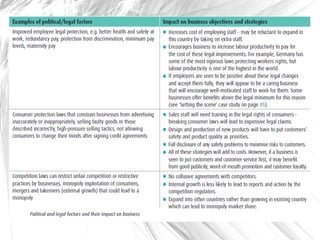
In most countries, political and legal constraints on a business
   fall into the following main categories:
● employment laws
● consumer protection laws
● business competition laws
● political changes resulting from a new government, e.g. policies
  towards foreign direct investment by multinationals
● major policy changes such as nationalizing some banks in the
 US and UK after the 2008–9 crisis.
Employment rights
In China, current employment rights are governed by the
  PRC Employment Law of 1995. There are 13 sections
  to this law which cover almost all aspects of
  employment relationships. These include working
  hours, holidays, health and safety, training, social welfare,
  disputes and discrimination on the grounds of race, sex,
  disability or age.
1 Why do you think the Chinese government introduced such a wide-
  ranging law as this, covering all aspects of employer–employee
  relationships?
2 Do these laws help or damage business interests? Explain your
  answer.
Economic
Mainly four macro-economic objectives:
● economic growth and rising living standards
● low levels of inflation
● low levels of unemployment
● balance of payments equilibrium, over time,
  between the value of imports and exports.
Economic
Governments use tools known as 'policies' to
 achieve their objectives. Mainly fiscal and
 monetary policies.


fiscal policy changes in government spending
  levels and tax rates
monetary policy changes in the level of interest
 rates which make loan capital more or less
 expensive
Economic

    Fiscal policy

    Direct
       
           To income, wealth or profit

    Indirect
       
           Sales tax, such as VAT, or demerit goods
Economic

    Fiscal policy

    Progressive: proportion of tax increases as the
    income increases

    Regressive: proportion of tax falls as income of
    taxpayer rises

    Proportional: percentage of tax remains the same,
    irrespective of income.
Common examples of taxes: income,
 corporation, sales, capital gains,
 inheritance, excise, customs, stamp
Economic

    Monetary policy

    Is designed to control the amount of spending
    and investment by altering interest rates to
    affect the money supply and exchange rates.

    What are the implications of higher interest
    rates?
Economic
Monetary Policy
Businesses are charged varying levels of
 interest rates for four main reasons:


  -Risk
  -Time
  -Administration costs
  -Expectations
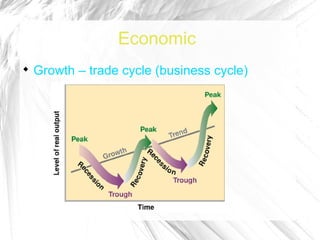
Economic

    Growth – trade cycle (business cycle)
Economic

    Growth
      
          Balance of payments
             •   Current account: X – M
             •   Capital account: flows of money, government
                 reserves, foreign currencies.

      
          Exchange rate
             •   Appreciation
             •   Depreciation
      
          Protectionism
             
                 Tariffs, quotas, subsidies, embargos, tech and
                 safety standards
K&Q sell jeans in the UK. They buy their jeans
 from an American supplier and import 10,000
 pairs for a cost $30 each, per month. K&Q
 then sell these to customers at a price of £30
 each
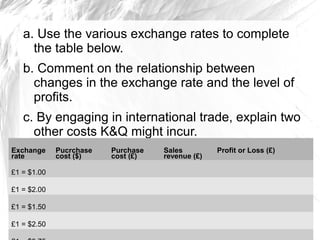
a. Use the various exchange rates to complete
     the table below.
   b. Comment on the relationship between
     changes in the exchange rate and the level of
     profits.
   c. By engaging in international trade, explain two
     other costs K&Q might incur.
   d. Examine how a (£)
Exchange
rate
           Pucrchase
           cost ($)       high exchange rateor Loss (£)
                     Purchase
                     cost
                                Sales
                                revenue (£)
                                            Profit can be

       both an opportunity and a threat to a business
£1 = $1.00
       such as K&Q
£1 = $2.00

£1 = $1.50

£1 = $2.50
Economic

    Inflation
    
        Demand Pull inflation
    
        Cost Push inflation



    How does inflation impact on international
    competitiveness of a country?

    How do governments control inflation?
Economic

    Unemployment
       
           What are its social costs?
       
           What are its economics costs?



    What do governments do to tackle
    unemployment?
Economic

    Unemployment policies
      
          Demand-side
           
             Expansionary fiscal
           
             Expansionary monetary
           
             Protectionist measures
Economic
Unemployment policies
  -Supply-side
    -Stimulate investment and business
     activity
    -Education and training
Economic

    Types of unemployment
      
          Frictional / transitional
      
          Seasonal
      
          Technological
      
          Regional
      
          Structural
      
          Cyclical
Social and Cultural
The attitude of a society towards a wide range of
 different issues will affect what good and
 services are provided in the economy
The structure of society is constantly evolving.
 The changes occurring in many countries
 include:
● an ageing population with reduced birth rates and longer life
   expectancy, although in some nations the average age is falling due
   to high birth rates
● changing role of women – increasingly seeking employment and
   posts of responsibility in industry
● improved education facilities – resulting in increasing literacy and
   more skilled and adaptable workforces
● early retirement in many high-income countries – leading
  to more leisure time for a growing number of relatively
  wealthy pensioners
● in some countries, rising divorce rates – creating
   increasing numbers of single-person households
● job insecurity, often created by the forces of globalization
   – forcing more employees to accept temporary and part-
   time employment (some workers prefer this option)
● increased levels of immigration – resulting in changing
   and widening consumer tastes
An ageing population
The main effects associated with an ageing
 population are:
● a larger proportion of the population over the
  age of retirement
● a smaller proportion of the population in lower
  age ranges, e.g. 0–16 years old
● a smaller number of workers in the economy
  but a larger number of dependants, that is
  below working age or retired – this puts a
  higher tax burden on the working population.
An ageing population
Business objectives and strategy will need to adapt to:
● changing patterns of demand. There will be more ‘grey’
  consumers than teenagers and they buy different products.
  Therefore, a construction company might switch from building
  large apartments for families to smaller units with special
  facilities for the elderly. Market research will be important for a
  business that believes the demand for its portfolio of products
  could change as the population ages.
● a change in the age structure of the workforce. There may be
  reduced numbers of youthful employees available, and
  businesses may need to adapt their workforce planning to
  enable the employment of older workers, or to keep existing
  workers beyond retirement age. Although younger employees
  are said to be more adaptable and easier to train in new
  technologies, older workers may show more loyalty to a
  business and will have years of experience that could improve
  customer service.
Changing patterns of employment

The main features of changing patterns of employment include:
● an increase in the number of women in employment and in the
  range of occupations in which they are employed
● an increase in student employment on a part-time basis – some
  industries are substantially staffed by students and part-timers, e.g.
  McDonald’s; most other fast-food shops and supermarkets are
  largely staffed in this way
● an increase in temporary, part-time and flexible employment
  contracts – these are introduced by employers to reduce the fi xed
  costs of full-time and salaried posts and to allow for flexibility when
  faced with seasonal demand or uncertainties caused by increasing
  globalisation
● more women taking maternity leave and then returning to work.
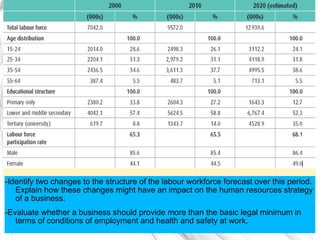
-Identify two changes to the structure of the labour workforce forecast over this period.
   Explain how these changes might have an impact on the human resources strategy
   of a business.
-Evaluate whether a business should provide more than the basic legal minimum in
   terms of conditions of employment and health and safety at work.
The impact of multiculturalism


The most consumed take-out food in the UK is
 not fish and chips or the American hamburger
 but the Indian curry.


Look at the immigration issue in the US which
 evolved into the 'Arizona Law'.
Technological
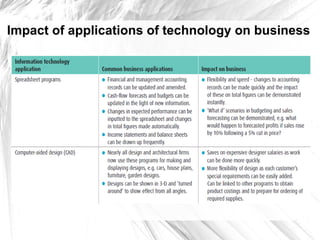
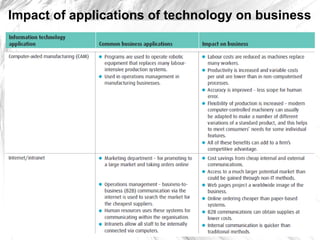
Technological change is affecting all businesses
  and all departments within business.


Think of two simple things people do:
     
         checking a bank account balance
     
         Sending a résumé


How has technology affected these two
 processes?
Impact of applications of technology on business
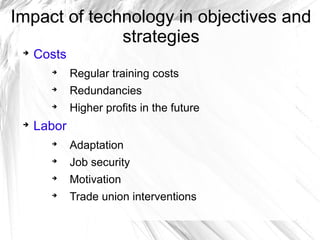
Impact of technology in objectives and
              strategies
 
     Costs
       
             Regular training costs
       
             Redundancies
       
             Higher profits in the future
 
     Labor
       
             Adaptation
       
             Job security
       
             Motivation
       
             Trade union interventions
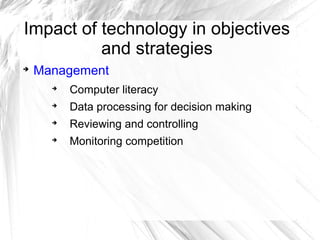
Impact of technology in objectives
          and strategies

    Management
      
          Computer literacy
      
          Data processing for decision making
      
          Reviewing and controlling
      
          Monitoring competition
Environmental

    Externalities: +/-

    Public awareness: for example, global warming

    Weather changes: Tsunami SE Asia (2004),
    Katrina US (2005)

    Health: Mad cow disease (late 90s), Bird flu
    (2006), Swine flu (2009),
PEST Analysis of Pepsi


The PEST analysis method has been successfully applied by Pepsi, which
  has obtained economic advantage in its industry. The PEST analysis
  method and examples specific to Pepsi are seen in the following factors:


Political: The manufacture, delivery, and use of numerous Pepsi products
  are subject to many federal regulations, like the Food, Drug and Cosmetic
  Act. The business is also governed by government and foreign rules. The
  international business is subjected to the political stability.


Economic: The products of Pepsi are influenced by the raw material yield
  being used in the soft drinks, juices, etc. All distribution is affected by the
  cost of fuel. Operations in international markets involve the study of
  unpredictable changes in foreign exchange rate. The economic impacts of
  such movements are serious because these affect the growth. Pepsi is
  also subjected to availability of energy, supply of money, business cycles,
  etc.
.
Social: Lifestyle has great influence on the use
 of Pepsi products, and their advertisements
 are designed accordingly. Introduction of Pepsi
 products in the international market requires
 an in depth study of the local social structure.


Technology: Pepsi is influenced by the modern
  manufacturing techniques applicable to their
  business divisions of soft drinks, juices, and
  snack food. Pepsi has to focus on the latest
  distribution techniques, and other technological
  advances in their industry
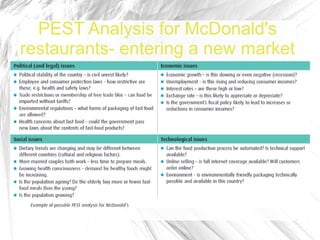
PEST Analysis for McDonald's
restaurants- entering a new market
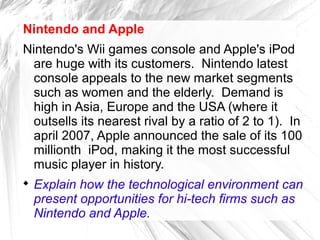
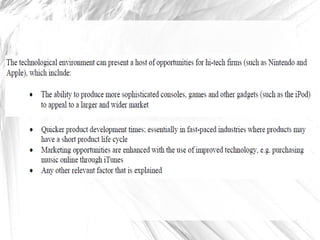
Nintendo and Apple
Nintendo's Wii games console and Apple's iPod
  are huge with its customers. Nintendo latest
  console appeals to the new market segments
  such as women and the elderly. Demand is
  high in Asia, Europe and the USA (where it
  outsells its nearest rival by a ratio of 2 to 1). In
  april 2007, Apple announced the sale of its 100
  millionth iPod, making it the most successful
  music player in history.

    Explain how the technological environment can
    present opportunities for hi-tech firms such as
    Nintendo and Apple.
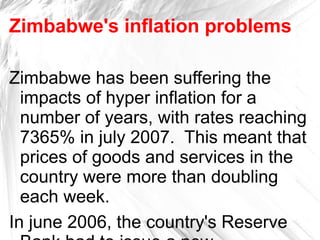
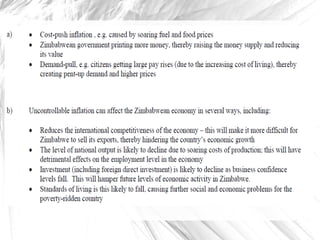
Zimbabwe's inflation problems

Zimbabwe has been suffering the
  impacts of hyper inflation for a
  number of years, with rates reaching
  7365% in july 2007. This meant that
  prices of goods and services in the
  country were more than doubling
  each week.
In june 2006, the country's Reserve

    http://www.revistalideres.ec/empresas/textilera-gra

    http://www.elcomercio.com/negocios/compras-tarje

External Environment

  • 1.
    External Environment By Alex Arancibia, for Nuevo Mundo High School – Gye, 2012 Sources: - Business and Management for IB, Paul Hoang, 2007 - Business and Management for IB, Peter Stimpson, 2011 - Business and Management for IB, Paul Clark, 2009
  • 3.
    Businesses depend fortheir survival on understanding and responding to external factors that are beyond their control. Many of the factors are ‘constraints’ because they may limit the nature of decisions that business managers can take.
  • 4.
    PEST Analysis An acronymstanding for political, economic, social, technological that refers to an analytical framework for external environment factors affecting business objectives and strategies. PEST is sometimes rearranged as STEP and has also been extended to STEEPLE (social, technological, economic, environmental, political, legal and ethical) and PESTLE (same categories as STEEPLE but without ethical considerations)
  • 5.
    Political In most countries,political and legal constraints on a business fall into the following main categories: ● employment laws ● consumer protection laws ● business competition laws ● political changes resulting from a new government, e.g. policies towards foreign direct investment by multinationals ● major policy changes such as nationalizing some banks in the US and UK after the 2008–9 crisis.
  • 6.
    Employment rights In China,current employment rights are governed by the PRC Employment Law of 1995. There are 13 sections to this law which cover almost all aspects of employment relationships. These include working hours, holidays, health and safety, training, social welfare, disputes and discrimination on the grounds of race, sex, disability or age. 1 Why do you think the Chinese government introduced such a wide- ranging law as this, covering all aspects of employer–employee relationships? 2 Do these laws help or damage business interests? Explain your answer.
  • 8.
    Economic Mainly four macro-economicobjectives: ● economic growth and rising living standards ● low levels of inflation ● low levels of unemployment ● balance of payments equilibrium, over time, between the value of imports and exports.
  • 9.
    Economic Governments use toolsknown as 'policies' to achieve their objectives. Mainly fiscal and monetary policies. fiscal policy changes in government spending levels and tax rates monetary policy changes in the level of interest rates which make loan capital more or less expensive
  • 10.
    Economic  Fiscal policy  Direct  To income, wealth or profit  Indirect  Sales tax, such as VAT, or demerit goods
  • 11.
    Economic  Fiscal policy  Progressive: proportion of tax increases as the income increases  Regressive: proportion of tax falls as income of taxpayer rises  Proportional: percentage of tax remains the same, irrespective of income. Common examples of taxes: income, corporation, sales, capital gains, inheritance, excise, customs, stamp
  • 13.
    Economic  Monetary policy  Is designed to control the amount of spending and investment by altering interest rates to affect the money supply and exchange rates.  What are the implications of higher interest rates?
  • 14.
    Economic Monetary Policy Businesses arecharged varying levels of interest rates for four main reasons: -Risk -Time -Administration costs -Expectations
  • 15.
    Economic  Growth – trade cycle (business cycle)
  • 16.
    Economic  Growth  Balance of payments • Current account: X – M • Capital account: flows of money, government reserves, foreign currencies.  Exchange rate • Appreciation • Depreciation  Protectionism  Tariffs, quotas, subsidies, embargos, tech and safety standards
  • 17.
    K&Q sell jeansin the UK. They buy their jeans from an American supplier and import 10,000 pairs for a cost $30 each, per month. K&Q then sell these to customers at a price of £30 each
  • 18.
    a. Use thevarious exchange rates to complete the table below. b. Comment on the relationship between changes in the exchange rate and the level of profits. c. By engaging in international trade, explain two other costs K&Q might incur. d. Examine how a (£) Exchange rate Pucrchase cost ($) high exchange rateor Loss (£) Purchase cost Sales revenue (£) Profit can be both an opportunity and a threat to a business £1 = $1.00 such as K&Q £1 = $2.00 £1 = $1.50 £1 = $2.50
  • 19.
    Economic  Inflation  Demand Pull inflation  Cost Push inflation  How does inflation impact on international competitiveness of a country?  How do governments control inflation?
  • 20.
    Economic  Unemployment  What are its social costs?  What are its economics costs?  What do governments do to tackle unemployment?
  • 21.
    Economic  Unemployment policies  Demand-side  Expansionary fiscal  Expansionary monetary  Protectionist measures
  • 22.
    Economic Unemployment policies -Supply-side -Stimulate investment and business activity -Education and training
  • 23.
    Economic  Types of unemployment  Frictional / transitional  Seasonal  Technological  Regional  Structural  Cyclical
  • 24.
    Social and Cultural Theattitude of a society towards a wide range of different issues will affect what good and services are provided in the economy The structure of society is constantly evolving. The changes occurring in many countries include: ● an ageing population with reduced birth rates and longer life expectancy, although in some nations the average age is falling due to high birth rates ● changing role of women – increasingly seeking employment and posts of responsibility in industry ● improved education facilities – resulting in increasing literacy and more skilled and adaptable workforces
  • 25.
    ● early retirementin many high-income countries – leading to more leisure time for a growing number of relatively wealthy pensioners ● in some countries, rising divorce rates – creating increasing numbers of single-person households ● job insecurity, often created by the forces of globalization – forcing more employees to accept temporary and part- time employment (some workers prefer this option) ● increased levels of immigration – resulting in changing and widening consumer tastes
  • 26.
    An ageing population Themain effects associated with an ageing population are: ● a larger proportion of the population over the age of retirement ● a smaller proportion of the population in lower age ranges, e.g. 0–16 years old ● a smaller number of workers in the economy but a larger number of dependants, that is below working age or retired – this puts a higher tax burden on the working population.
  • 27.
    An ageing population Businessobjectives and strategy will need to adapt to: ● changing patterns of demand. There will be more ‘grey’ consumers than teenagers and they buy different products. Therefore, a construction company might switch from building large apartments for families to smaller units with special facilities for the elderly. Market research will be important for a business that believes the demand for its portfolio of products could change as the population ages. ● a change in the age structure of the workforce. There may be reduced numbers of youthful employees available, and businesses may need to adapt their workforce planning to enable the employment of older workers, or to keep existing workers beyond retirement age. Although younger employees are said to be more adaptable and easier to train in new technologies, older workers may show more loyalty to a business and will have years of experience that could improve customer service.
  • 28.
    Changing patterns ofemployment The main features of changing patterns of employment include: ● an increase in the number of women in employment and in the range of occupations in which they are employed ● an increase in student employment on a part-time basis – some industries are substantially staffed by students and part-timers, e.g. McDonald’s; most other fast-food shops and supermarkets are largely staffed in this way ● an increase in temporary, part-time and flexible employment contracts – these are introduced by employers to reduce the fi xed costs of full-time and salaried posts and to allow for flexibility when faced with seasonal demand or uncertainties caused by increasing globalisation ● more women taking maternity leave and then returning to work.
  • 29.
    -Identify two changesto the structure of the labour workforce forecast over this period. Explain how these changes might have an impact on the human resources strategy of a business. -Evaluate whether a business should provide more than the basic legal minimum in terms of conditions of employment and health and safety at work.
  • 30.
    The impact ofmulticulturalism The most consumed take-out food in the UK is not fish and chips or the American hamburger but the Indian curry. Look at the immigration issue in the US which evolved into the 'Arizona Law'.
  • 31.
    Technological Technological change isaffecting all businesses and all departments within business. Think of two simple things people do:  checking a bank account balance  Sending a résumé How has technology affected these two processes?
  • 32.
    Impact of applicationsof technology on business
  • 33.
    Impact of applicationsof technology on business
  • 34.
    Impact of technologyin objectives and strategies  Costs  Regular training costs  Redundancies  Higher profits in the future  Labor  Adaptation  Job security  Motivation  Trade union interventions
  • 35.
    Impact of technologyin objectives and strategies  Management  Computer literacy  Data processing for decision making  Reviewing and controlling  Monitoring competition
  • 36.
    Environmental  Externalities: +/-  Public awareness: for example, global warming  Weather changes: Tsunami SE Asia (2004), Katrina US (2005)  Health: Mad cow disease (late 90s), Bird flu (2006), Swine flu (2009),
  • 37.
    PEST Analysis ofPepsi The PEST analysis method has been successfully applied by Pepsi, which has obtained economic advantage in its industry. The PEST analysis method and examples specific to Pepsi are seen in the following factors: Political: The manufacture, delivery, and use of numerous Pepsi products are subject to many federal regulations, like the Food, Drug and Cosmetic Act. The business is also governed by government and foreign rules. The international business is subjected to the political stability. Economic: The products of Pepsi are influenced by the raw material yield being used in the soft drinks, juices, etc. All distribution is affected by the cost of fuel. Operations in international markets involve the study of unpredictable changes in foreign exchange rate. The economic impacts of such movements are serious because these affect the growth. Pepsi is also subjected to availability of energy, supply of money, business cycles, etc. .
  • 38.
    Social: Lifestyle hasgreat influence on the use of Pepsi products, and their advertisements are designed accordingly. Introduction of Pepsi products in the international market requires an in depth study of the local social structure. Technology: Pepsi is influenced by the modern manufacturing techniques applicable to their business divisions of soft drinks, juices, and snack food. Pepsi has to focus on the latest distribution techniques, and other technological advances in their industry
  • 39.
    PEST Analysis forMcDonald's restaurants- entering a new market
  • 40.
    Nintendo and Apple Nintendo'sWii games console and Apple's iPod are huge with its customers. Nintendo latest console appeals to the new market segments such as women and the elderly. Demand is high in Asia, Europe and the USA (where it outsells its nearest rival by a ratio of 2 to 1). In april 2007, Apple announced the sale of its 100 millionth iPod, making it the most successful music player in history.  Explain how the technological environment can present opportunities for hi-tech firms such as Nintendo and Apple.
  • 42.
    Zimbabwe's inflation problems Zimbabwehas been suffering the impacts of hyper inflation for a number of years, with rates reaching 7365% in july 2007. This meant that prices of goods and services in the country were more than doubling each week. In june 2006, the country's Reserve
  • 44.
    http://www.revistalideres.ec/empresas/textilera-gra  http://www.elcomercio.com/negocios/compras-tarje