Schedule Management
Knowledge Area
A Guide to the Project Management Body of Knowledge (PMBOK® Guide) 6th Edition
Presented by : Zaur Ahmadov, PMP®
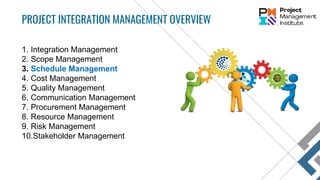
PROJECT INTEGRATION MANAGEMENT OVERVIEW
1. Integration Management
2. Scope Management
3. Schedule Management
4. Cost Management
5. Quality Management
6. Communication Management
7. Procurement Management
8. Resource Management
9. Risk Management
10.Stakeholder Management
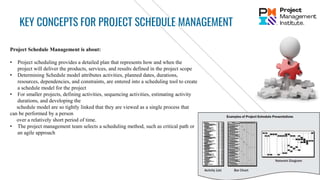
KEY CONCEPTS FOR PROJECT SCHEDULE MANAGEMENT
Project Schedule Management is about:
• Project scheduling provides a detailed plan that represents how and when the
project will deliver the products, services, and results defined in the project scope
• Determining Schedule model attributes activities, planned dates, durations,
resources, dependencies, and constraints, are entered into a scheduling tool to create
a schedule model for the project
• For smaller projects, defining activities, sequencing activities, estimating activity
durations, and developing the
schedule model are so tightly linked that they are viewed as a single process that
can be performed by a person
over a relatively short period of time.
• The project management team selects a scheduling method, such as critical path or
an agile approach
TRENDS IN PROJECT INTEGRATION MANAGEMENT
 Iterative scheduling with a backlog.
- This is a form of rolling wave planning based on adaptive life cycles, such as the agile approach for
product development. The requirements are documented in user stories that are then prioritized and refined
just prior to construction, and the product features are developed using time-boxed periods of work.
 On-demand scheduling.
- This approach, typically used in a Kanban system, is based on the theory-of-constraints and pull-based
scheduling concepts from lean manufacturing to limit a team’s work in progress in order to balance demand
against the team’s delivery throughput.
TAILORING PROJECT SCHEDULE MANAGEMENT
o Life cycle approach. What is the most appropriate life cycle approach that allows for a more detailed
schedule?
o Resource availability. What are the factors influencing durations (such as the correlation between
available resources and their productivity)?
o Project dimensions. How will the presence of project complexity, technological uncertainty, product
novelty, pace, or progress tracking (such as earned value, percentage complete, red-yellow-green (stop
light) indicators) impact the desired level of control?
o Technology support. Is technology used to develop, record, transmit, receive, and store project
schedule model information and is it readily accessible?
CONSIDERATIONS FOR AGILE/ADAPTIVE ENVIRONMENTS
 Short cycles of planning, executing
 Rapid feedback of review cycles
 Prioritize backlog of requirements
 User stories
 Change is welcome
Project Management Process Groups
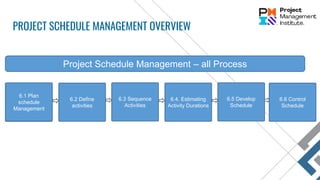
PROJECT SCHEDULE MANAGEMENT OVERVIEW
Project Schedule Management – all Process
5.1 Plan scope
Management
6.6 Control
Schedule
6.1 Plan
schedule
Management
6.2 Define
activities
6.3 Sequence
Activities
6.4. Estimating
Activity Durations
6.5 Develop
Schedule
PROJECT SCHEDULE MANAGEMENT OVERVIEW
Plan Schedule Management
Inputs Tools & Technics Outputs
.1 Project charter
.2 Project management plan
• Scope management plan
• Development approach
.3 Enterprise environmental
factors
.4 Organizational process assets
.1 Expert judgment
.2 Data analysis
.3 Meetings
.1 Schedule management
plan
PLAN SCHEDULE MANAGEMENT: INPUTS
Enterprise Environment Factors (EEF)
 Organizational culture and structure
 Team resource availability and skills
 Physical resource availability
 Scheduling software,
 Commercial databases, such as standardized
estimating data.
Organizational Process Assets
 Historical information and lessons learned repositories;
 Existing formal and informal schedule development, management- and
control-related policies, procedures, and guidelines;
 Templates and forms; and
 Monitoring and reporting tools.
PLAN SCHEDULE MANAGEMENT: OUTPUTS
Schedule Management Plan
 Project schedule model development.
 Release and iteration length. When using an adaptive life cycle, the time-boxed periods for releases, waves, and iterations are specified.
 Level of accuracy. The level of accuracy specifies the acceptable range used in determining realistic activity duration estimates and may include an amount for
contingencies.
 Units of measure. Each unit of measurement (such as staff hours, staff days, or weeks for time measures, or meters, liters, tons, kilometers, or cubic yards for
quantity measures) is defined for each of the resources.
 Organizational procedures links. The work breakdown structure (WBS) (Section 5.4) provides the framework for the schedule management plan, allowing for
consistency with the estimates and resulting schedules.
 Project schedule model maintenance. The process used to update the status and record progress of the project in the schedule model during the execution of the
project is defined.
 Control thresholds. Variance thresholds for monitoring schedule performance may be specified to indicate an agreed-upon amount of variation to be allowed
before some action needs to be taken. Thresholds are typically expressed as percentage deviations from the parameters established in the baseline plan.
 Rules of performance measurement. Earned value management (EVM) rules or other physical measurement rules of performance measurement are set. For
example, the schedule management plan may specify:
 - Rules for establishing percent complete,
 - EVM techniques (e.g., baselines, fixed-formula, percent complete, etc.) to be employed (for more specific information, refer to the Practice Standard for Earned
Value Management [17]), and
 - Schedule performance measurements such as schedule variance (SV) and schedule performance index (SPI) used to assess the magnitude of variation to the
original schedule baseline.
 Reporting formats. The formats and frequency for the various schedule reports are defined.
PROJECT SCHEDULE MANAGEMENT OVERVIEW
Define Activities
Inputs Tools & Technics Outputs
.1 Project management plan
• Schedule management plan
• Scope baseline
.2 Enterprise environmental
factors
.3 Organizational process assets
.1 Expert judgment
.2 Decomposition
.3 Rolling wave planning
.4 Meetings
.1 Activity list
.2 Activity attributes
.3 Milestone list
.4 Change requests
.5 Project management plan
updates
• Schedule baseline
• Cost baseline
DEFINE ACTIVITIES : INPUTS
ENTERPRISE ENVIRONMENTAL FACTORS (EEF)
 Organizational cultures and structure,
 Published commercial information from commercial
databases, and
 Project management information system (PMIS).
ORGANIZATIONAL PROCESS ASSETS (OPA)
 Lessons learned repository containing historical information regarding activity
lists used by previous similar projects,
 Standardized processes,
 Templates that contain a standard activity list or a portion of an activity list
from a previous project, and
 Existing formal and informal activity planning-related policies, procedures,
and guidelines, such as the scheduling methodology, that are considered in
developing the activity definitions.
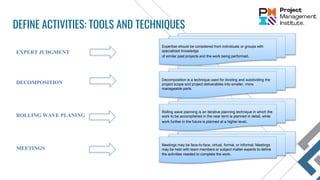
DEFINE ACTIVITIES: TOOLS AND TECHNIQUES
EXPERT JUDGMENT
DECOMPOSITION
ROLLING WAVE PLANING
MEETINGS
Expertise should be considered from individuals or groups with
specialized knowledge
of similar past projects and the work being performed.
Decomposition is a technique used for dividing and subdividing the
project scope and project deliverables into smaller, more
manageable parts.
Rolling wave planning is an iterative planning technique in which the
work to be accomplished in the near term is planned in detail, while
work further in the future is planned at a higher level.
Meetings may be face-to-face, virtual, formal, or informal. Meetings
may be held with team members or subject matter experts to define
the activities needed to complete the work.
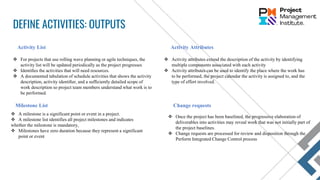
DEFINE ACTIVITIES: OUTPUTS
Activity List Activity Attributes
 For projects that use rolling wave planning or agile techniques, the
activity list will be updated periodically as the project progresses
 Identifies the activities that will need resources.
 A documented tabulation of schedule activities that shows the activity
description, activity identifier, and a sufficiently detailed scope of
work description so project team members understand what work is to
be performed.
 Activity attributes extend the description of the activity by identifying
multiple components associated with each activity
 Activity attributes can be used to identify the place where the work has
to be performed, the project calendar the activity is assigned to, and the
type of effort involved.
Milestone List
 A milestone is a significant point or event in a project.
 A milestone list identifies all project milestones and indicates
whether the milestone is mandatory,
 Milestones have zero duration because they represent a significant
point or event
Change requests
 Once the project has been baselined, the progressive elaboration of
deliverables into activities may reveal work that was not initially part of
the project baselines.
 Change requests are processed for review and disposition through the
Perform Integrated Change Control process
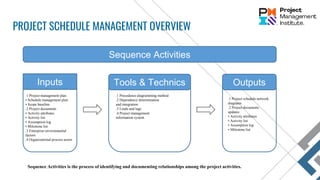
PROJECT SCHEDULE MANAGEMENT OVERVIEW
Sequence Activities
Inputs Tools & Technics Outputs
.1 Project management plan
• Schedule management plan
• Scope baseline
.2 Project documents
• Activity attributes
• Activity list
• Assumption log
• Milestone list
.3 Enterprise environmental
factors
.4 Organizational process assets
.1 Precedence diagramming method
.2 Dependency determination
and integration
.3 Leads and lags
.4 Project management
information system
.1 Project schedule network
diagrams
.2 Project documents
updates
• Activity attributes
• Activity list
• Assumption log
• Milestone list
Sequence Activities is the process of identifying and documenting relationships among the project activities.
SEQUENCE ACTIVITIES: TOOLS AND TECHNIQUES
PRECEDENCE DIAGRAMMING METHOD
Constructing a schedule model in which activities are represented by nodes and are graphically linked by one or more logical relationships to show the
sequence in which the activities are to be performed.
 Finish-to-start (FS) > [Most common used]
 Finish-to-finish (FF)
 Start-to-start (SS)
 Start-to-finish (SF) > [Very rarely used ]
Activity A Activity B
Finish-to-start (FS)
Activity A Activity A
Activity B
Start-to-start (SS)
Activity B
Finish-to-finish (FF)
Activity A Activity B
Start-to-Finish (SF)
Precedence Diagramming Method (PDM) Relationship Types
Dependency Determination and Integration
 Mandatory dependencies >
Sometimes called: hard logic or hard dependencies
 Discretionary dependencies >
Sometimes called: preferred logic, preferential logic, or soft logic
 External dependencies > (Out of project team control)
 Internal dependencies > (Under project team control)
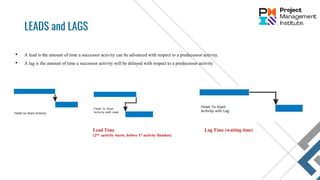
LEADS and LAGS
• A lead is the amount of time a successor activity can be advanced with respect to a predecessor activity.
• A lag is the amount of time a successor activity will be delayed with respect to a predecessor activity.
Lag Time (waiting time)
Lead Time
(2nd activity starts, before 1st activity finishes)
PROJECT SCHEDULE MANAGEMENT OVERVIEW
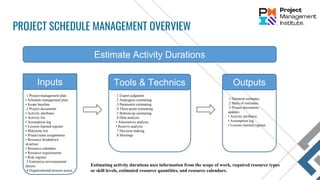
Estimate Activity Durations
Inputs Tools & Technics Outputs
.1 Project management plan
• Schedule management plan
• Scope baseline
.2 Project documents
• Activity attributes
• Activity list
• Assumption log
• Lessons learned register
• Milestone list
• Project team assignments
• Resource breakdown
structure
• Resource calendars
• Resource requirements
• Risk register
.3 Enterprise environmental
factors
.4 Organizational process assets
.1 Expert judgment
.2 Analogous estimating
.3 Parametric estimating
.4 Three-point estimating
.5 Bottom-up estimating
.6 Data analysis
• Alternatives analysis
• Reserve analysis
.7 Decision making
.8 Meetings
.1 Duration estimates
.2 Basis of estimates
.3 Project documents
updates
• Activity attributes
• Assumption log
• Lessons learned register
Estimating activity durations uses information from the scope of work, required resource types
or skill levels, estimated resource quantities, and resource calendars.
Estimate Activity Durations
When estimating durations need to consider following factors :
 Law of diminishing returns.
- Increase in resource will eventually bring diminishing returns.
 Number of resources
- Adding resource doesn’t necessary reduce duration
- Risk
- Knowledge transfer/Learning curve
 Advances in technology
- Faster equipment / learning curve
 Motivation of staff
- Student syndrome / Parkinson’s Law
The Estimate Activity Durations process requires an estimation of the amount of work effort required to complete the activity and the amount of
available resources estimated to complete the activity.
 Level of details leads to accuracy
 Activity lists
 Activity resource requirements
 Activity attributes
 Resource capabilities
 OPA (Organizational Process Assets)
Estimate Activity Durations : TOOLS & TECHNIQUES
Decision making technique
 Determine confidence of estimates
 Voting
 Fist of Five
• Closed fist no support
• Five fingers full support
• Fewer than three fingers, the team member discuss any objections.
Estimate Activity Durations : TOOLS & TECHNIQUES
Analog Estimating technique
 Creates an analogy
 Use similar projects scope
 Use already completed history projects scopes
 Also called : Top-down Estimating.
Analog Estimating considerations
 Fast estimating way
 Need to consider whole historical project scope
 Least reliable estimating approach
 Reliable information
 Expert Judgment
Estimate Activity Durations : TOOLS & TECHNIQUES
Parametric Estimating technique
 Math. parameters for estimating
 Repetitive work
 Learning Curve
 Algorithm to calculate duration ( Time per unit, Square per meter, historical data etc…)
Duration and Effort
 Durations - How long activity will take time
 Effort is counted human labor time/cost
Example :
 Senior Developer - Given programing task can complete in 20 hours
 Remote/Part time Developer – Given programing task can be complete in 2 segments of 15
hours each.
Note : Remote/Part time developer will finish task lower rate than senior developer.
Estimate Activity Durations : TOOLS & TECHNIQUES
PERT Estimating/ Also called Beta Distribution
Program Evolution and Review technique
 O = Optimistic
 M = Most Likely
 P = Pessimistic
Formulated as (O+4*M+P)/6
(5+4*10+20)/6 = 10.83
Three Point Estimating/ Also called Triangular distribution
Finds an average of
 O = Optimistic
 M = Most Likely
 P = Pessimistic
Formulated as (O+M+P)/3
(5+10+20)/3 = 11.66
Estimate Activity Durations : TOOLS & TECHNIQUES
Bottom-UP Estimating / Exact estimating on WBS based
 More accurate and detailed estimating
 Duration of each work packages are estimating
 Takes huge time but most accurate and reliable.
 Why Bottom-Up ? Because it’s estimating each work package duration from bottom to top.
Data Analysis [Alternatives analysis and Reserve analysis]
Alternatives analysis : Alternatives analysis is used to compare various levels of resource capability or skills; scheduling
compression techniques, different tools and make, rent, or buy decisions regarding the resources.
Reserve analysis : Reserve analysis is used to determine the amount of contingency and management reserve needed for
the project.
Estimate Activity Durations
Estimates also include :
Range of Variance
 Range of +/- days or weeks
 Percentage of acceptable target date
Basis of Estimates
 Basis of the Estimate
 Assumptions made
 Known constraints
 Range of possible estimates
 Confidence level of the final estimate
 Risk influencing this estimate
PROJECT SCHEDULE MANAGEMENT OVERVIEW
Develop Schedule
Inputs Tools & Technics Outputs
.1 Project management plan
• Schedule management plan
• Scope baseline
.2 Project documents
• Activity attributes
• Activity list
• Assumption log
• Basis of estimates
• Duration estimates
• Lessons learned register
• Milestone list
• Project schedule network
diagrams
• Project team assignments
• Resource calendars
• Resource requirements
• Risk register
.3 Agreements
.4 Enterprise environmental
factors
.5 Organizational process assets
.1 Schedule network analysis
.2 Critical path method
.3 Resource optimization
.4 Data analysis
• What-if scenario analysis
• Simulation
.5 Leads and lags
.6 Schedule compression
.7 Project management
information system
.8 Agile release planning
.1 Schedule baseline
.2 Project schedule
.3 Schedule data
.4 Project calendars
.5 Change requests
.6 Project management plan
updates
• Schedule management plan
• Cost baseline
.7 Project documents updates
• Activity attributes
• Assumption log
• Duration estimates
• Lessons learned register
• Resource requirements
• Risk register
Develop Schedule
Develop Schedule is an iterative process
 Schedule development can require the review and revision of duration estimates, resource estimates, and schedule reserves to
establish an approved project schedule that can serve as a baseline to track progress
 Once the activity start and finish dates have been determined, it is common to have the project staff assigned to the
activities review their assigned activities.
Project constraints
 When and how work can be implemented
 Weather conditions
 Government requirements
 Industry regulations, best practice, or guidelines
 Time frames that for delivery of materials
Develop Schedule : Tools & Techniques
Schedule network analysis is the overarching technique used to generate the project schedule model. It employs several other
techniques such as critical path method, resource optimization techniques and modeling techniques.
SCHEDULE NETWORK ANALYSIS
Free Float
Free float is how long an
activity can be delayed,
without delaying the Early
Start of its successor activity
Total Float
Total float is how long an
activity can be delayed,
without delaying the project
completion date
Project Float
A project can be delayed
without passing the
customer expected
completion date.
ABD = 20 days > Critical path
ACD = 12 days
Total Float = Duration of CP – Duration of none CP
Total Float = LF – EF = LS – ES
Total Float = 20-12=8
Free float of Activity C = ES of next activity – EF of Activity C – 1
Free Float = 16-7-1 = 8
NOTE : A critical path is normally characterized
by zero total float on the critical path.
Develop Schedule : Tools & Techniques
RESOURCE OPTIMIZATION
 Resource leveling
- Resource leveling can often cause the original critical path to change.
 Resource smoothing
- the critical path is not changed and the completion date not delayed
Develop Schedule : Tools & Techniques
 What-if scenario analysis - What-if scenario analysis is the process of evaluating scenarios in order to predict
their effect, positive or negative, on project objectives.
 Simulation - Simulation models the combined effects of individual project risks and other sources of uncertainty to evaluate
their potential impact on achieving project objectives. The most common simulation technique is Monte Carlo analysis in which
risks and other sources of uncertainty are used to calculate possible schedule outcomes for the total project.
 Schedule compression
- Crashing.
- Fast tracking
Develop Schedule : Tools & Techniques
Agile Release planning
 A high-level summary timeline of the release schedule
 Determines the number of iterations or sprints in the release,
 Product Roadmap and product vision
 How much needs to be developed
 How long it will take to have a releasable product
Develop Schedule : Outputs
PROJECT SCHEDULE - The project schedule is an output of a schedule model that presents linked activities with planned dates, durations,
milestones, and resources.
SCHEDULE DATA - The schedule data for the project schedule model is the collection of information for describing and controlling the
schedule.
 Resource requirements by time period, often in the form of a resource histogram;
 Alternative schedules, such as best-case or worst-case, not resource-leveled or resource-leveled, or with or without imposed dates; and
 Applied schedule reserves.
PROJECT CALENDARS - A project calendar identifies working days and shifts that are available for scheduled activities.
PROJECT SCHEDULE MANAGEMENT OVERVIEW
Control Schedule
Inputs Tools & Technics Outputs
.1 Project management plan
• Schedule management plan
• Schedule baseline
• Scope baseline
• Performance measurement
baseline
.2 Project documents
• Lessons learned register
• Project calendars
• Project schedule
• Resource calendars
• Schedule data
.3 Work performance data
.4 Organizational process assets
.1 Data analysis
• Earned value analysis
• Iteration burndown chart
• Performance reviews
• Trend analysis
• Variance analysis
• What-if scenario analysis
.2 Critical path method
.3 Project management
information system
.4 Resource optimization
.6 Leads and lags
.7 Schedule compression
.1 Work performance
information
.2 Schedule forecasts
.3 Change requests
.4 Project management plan
updates
• Schedule management plan
• Schedule baseline
• Cost baseline
• Performance measurement
baseline
.5 Project documents updates
• Assumption log
• Basis of estimates
• Lessons learned register
• Project schedule
• Resource calendars
• Risk register
• Schedule data
Control Schedule
 Determining the current status of the project schedule,
 Influencing the factors that create schedule changes,
 Reconsidering necessary schedule reserves,
 Determining if the project schedule has changed, and
 Managing the actual changes as they occur.
When an agile approach is used, Control Schedule is concerned with :
 Determining the current status of the project schedule by comparing the total amount of work delivered and accepted against the estimates
of work completed for the elapsed time cycle;
 Conducting retrospectives for correcting processes and improving,
 Reprioritizing the remaining work plan (backlog);
 Determining the rate at which the deliverables are produced, validated, and accepted (velocity) in the given time per iteration (agreed-upon
work cycle duration, typically 2 weeks or 1 month);
 Determining that the project schedule has changed; and
 Managing the actual changes as they occur.
Control Schedule is concerned with :
Control Schedule : Tools & Techniques
 Earned value analysis.
 Iteration burndown chart
 Performance reviews.
 Trend analysis
 Variance analysis.
 What-if scenario analysis
 Critical Path Metod
 Project Management Information system (PMIS)
 Resource Optimization
 Leads and Lags
 Schedule Compression
Good Luck !
Zaur Ahmadov, PMP®
IT / Telecom Project Manager
Email : zaur.ahmadov@gmail.com
Source used : PMBOK 6th Edition

PMP-Schedule Management area

  • 1.
    Schedule Management Knowledge Area AGuide to the Project Management Body of Knowledge (PMBOK® Guide) 6th Edition Presented by : Zaur Ahmadov, PMP®
  • 2.
    PROJECT INTEGRATION MANAGEMENTOVERVIEW 1. Integration Management 2. Scope Management 3. Schedule Management 4. Cost Management 5. Quality Management 6. Communication Management 7. Procurement Management 8. Resource Management 9. Risk Management 10.Stakeholder Management
  • 3.
    KEY CONCEPTS FORPROJECT SCHEDULE MANAGEMENT Project Schedule Management is about: • Project scheduling provides a detailed plan that represents how and when the project will deliver the products, services, and results defined in the project scope • Determining Schedule model attributes activities, planned dates, durations, resources, dependencies, and constraints, are entered into a scheduling tool to create a schedule model for the project • For smaller projects, defining activities, sequencing activities, estimating activity durations, and developing the schedule model are so tightly linked that they are viewed as a single process that can be performed by a person over a relatively short period of time. • The project management team selects a scheduling method, such as critical path or an agile approach
  • 4.
    TRENDS IN PROJECTINTEGRATION MANAGEMENT  Iterative scheduling with a backlog. - This is a form of rolling wave planning based on adaptive life cycles, such as the agile approach for product development. The requirements are documented in user stories that are then prioritized and refined just prior to construction, and the product features are developed using time-boxed periods of work.  On-demand scheduling. - This approach, typically used in a Kanban system, is based on the theory-of-constraints and pull-based scheduling concepts from lean manufacturing to limit a team’s work in progress in order to balance demand against the team’s delivery throughput.
  • 5.
    TAILORING PROJECT SCHEDULEMANAGEMENT o Life cycle approach. What is the most appropriate life cycle approach that allows for a more detailed schedule? o Resource availability. What are the factors influencing durations (such as the correlation between available resources and their productivity)? o Project dimensions. How will the presence of project complexity, technological uncertainty, product novelty, pace, or progress tracking (such as earned value, percentage complete, red-yellow-green (stop light) indicators) impact the desired level of control? o Technology support. Is technology used to develop, record, transmit, receive, and store project schedule model information and is it readily accessible?
  • 6.
    CONSIDERATIONS FOR AGILE/ADAPTIVEENVIRONMENTS  Short cycles of planning, executing  Rapid feedback of review cycles  Prioritize backlog of requirements  User stories  Change is welcome
  • 7.
  • 8.
    PROJECT SCHEDULE MANAGEMENTOVERVIEW Project Schedule Management – all Process 5.1 Plan scope Management 6.6 Control Schedule 6.1 Plan schedule Management 6.2 Define activities 6.3 Sequence Activities 6.4. Estimating Activity Durations 6.5 Develop Schedule
  • 9.
    PROJECT SCHEDULE MANAGEMENTOVERVIEW Plan Schedule Management Inputs Tools & Technics Outputs .1 Project charter .2 Project management plan • Scope management plan • Development approach .3 Enterprise environmental factors .4 Organizational process assets .1 Expert judgment .2 Data analysis .3 Meetings .1 Schedule management plan
  • 10.
    PLAN SCHEDULE MANAGEMENT:INPUTS Enterprise Environment Factors (EEF)  Organizational culture and structure  Team resource availability and skills  Physical resource availability  Scheduling software,  Commercial databases, such as standardized estimating data. Organizational Process Assets  Historical information and lessons learned repositories;  Existing formal and informal schedule development, management- and control-related policies, procedures, and guidelines;  Templates and forms; and  Monitoring and reporting tools.
  • 11.
    PLAN SCHEDULE MANAGEMENT:OUTPUTS Schedule Management Plan  Project schedule model development.  Release and iteration length. When using an adaptive life cycle, the time-boxed periods for releases, waves, and iterations are specified.  Level of accuracy. The level of accuracy specifies the acceptable range used in determining realistic activity duration estimates and may include an amount for contingencies.  Units of measure. Each unit of measurement (such as staff hours, staff days, or weeks for time measures, or meters, liters, tons, kilometers, or cubic yards for quantity measures) is defined for each of the resources.  Organizational procedures links. The work breakdown structure (WBS) (Section 5.4) provides the framework for the schedule management plan, allowing for consistency with the estimates and resulting schedules.  Project schedule model maintenance. The process used to update the status and record progress of the project in the schedule model during the execution of the project is defined.  Control thresholds. Variance thresholds for monitoring schedule performance may be specified to indicate an agreed-upon amount of variation to be allowed before some action needs to be taken. Thresholds are typically expressed as percentage deviations from the parameters established in the baseline plan.  Rules of performance measurement. Earned value management (EVM) rules or other physical measurement rules of performance measurement are set. For example, the schedule management plan may specify:  - Rules for establishing percent complete,  - EVM techniques (e.g., baselines, fixed-formula, percent complete, etc.) to be employed (for more specific information, refer to the Practice Standard for Earned Value Management [17]), and  - Schedule performance measurements such as schedule variance (SV) and schedule performance index (SPI) used to assess the magnitude of variation to the original schedule baseline.  Reporting formats. The formats and frequency for the various schedule reports are defined.
  • 12.
    PROJECT SCHEDULE MANAGEMENTOVERVIEW Define Activities Inputs Tools & Technics Outputs .1 Project management plan • Schedule management plan • Scope baseline .2 Enterprise environmental factors .3 Organizational process assets .1 Expert judgment .2 Decomposition .3 Rolling wave planning .4 Meetings .1 Activity list .2 Activity attributes .3 Milestone list .4 Change requests .5 Project management plan updates • Schedule baseline • Cost baseline
  • 13.
    DEFINE ACTIVITIES :INPUTS ENTERPRISE ENVIRONMENTAL FACTORS (EEF)  Organizational cultures and structure,  Published commercial information from commercial databases, and  Project management information system (PMIS). ORGANIZATIONAL PROCESS ASSETS (OPA)  Lessons learned repository containing historical information regarding activity lists used by previous similar projects,  Standardized processes,  Templates that contain a standard activity list or a portion of an activity list from a previous project, and  Existing formal and informal activity planning-related policies, procedures, and guidelines, such as the scheduling methodology, that are considered in developing the activity definitions.
  • 14.
    DEFINE ACTIVITIES: TOOLSAND TECHNIQUES EXPERT JUDGMENT DECOMPOSITION ROLLING WAVE PLANING MEETINGS Expertise should be considered from individuals or groups with specialized knowledge of similar past projects and the work being performed. Decomposition is a technique used for dividing and subdividing the project scope and project deliverables into smaller, more manageable parts. Rolling wave planning is an iterative planning technique in which the work to be accomplished in the near term is planned in detail, while work further in the future is planned at a higher level. Meetings may be face-to-face, virtual, formal, or informal. Meetings may be held with team members or subject matter experts to define the activities needed to complete the work.
  • 15.
    DEFINE ACTIVITIES: OUTPUTS ActivityList Activity Attributes  For projects that use rolling wave planning or agile techniques, the activity list will be updated periodically as the project progresses  Identifies the activities that will need resources.  A documented tabulation of schedule activities that shows the activity description, activity identifier, and a sufficiently detailed scope of work description so project team members understand what work is to be performed.  Activity attributes extend the description of the activity by identifying multiple components associated with each activity  Activity attributes can be used to identify the place where the work has to be performed, the project calendar the activity is assigned to, and the type of effort involved. Milestone List  A milestone is a significant point or event in a project.  A milestone list identifies all project milestones and indicates whether the milestone is mandatory,  Milestones have zero duration because they represent a significant point or event Change requests  Once the project has been baselined, the progressive elaboration of deliverables into activities may reveal work that was not initially part of the project baselines.  Change requests are processed for review and disposition through the Perform Integrated Change Control process
  • 16.
    PROJECT SCHEDULE MANAGEMENTOVERVIEW Sequence Activities Inputs Tools & Technics Outputs .1 Project management plan • Schedule management plan • Scope baseline .2 Project documents • Activity attributes • Activity list • Assumption log • Milestone list .3 Enterprise environmental factors .4 Organizational process assets .1 Precedence diagramming method .2 Dependency determination and integration .3 Leads and lags .4 Project management information system .1 Project schedule network diagrams .2 Project documents updates • Activity attributes • Activity list • Assumption log • Milestone list Sequence Activities is the process of identifying and documenting relationships among the project activities.
  • 17.
    SEQUENCE ACTIVITIES: TOOLSAND TECHNIQUES PRECEDENCE DIAGRAMMING METHOD Constructing a schedule model in which activities are represented by nodes and are graphically linked by one or more logical relationships to show the sequence in which the activities are to be performed.  Finish-to-start (FS) > [Most common used]  Finish-to-finish (FF)  Start-to-start (SS)  Start-to-finish (SF) > [Very rarely used ] Activity A Activity B Finish-to-start (FS) Activity A Activity A Activity B Start-to-start (SS) Activity B Finish-to-finish (FF) Activity A Activity B Start-to-Finish (SF) Precedence Diagramming Method (PDM) Relationship Types Dependency Determination and Integration  Mandatory dependencies > Sometimes called: hard logic or hard dependencies  Discretionary dependencies > Sometimes called: preferred logic, preferential logic, or soft logic  External dependencies > (Out of project team control)  Internal dependencies > (Under project team control)
  • 18.
    LEADS and LAGS •A lead is the amount of time a successor activity can be advanced with respect to a predecessor activity. • A lag is the amount of time a successor activity will be delayed with respect to a predecessor activity. Lag Time (waiting time) Lead Time (2nd activity starts, before 1st activity finishes)
  • 19.
    PROJECT SCHEDULE MANAGEMENTOVERVIEW Estimate Activity Durations Inputs Tools & Technics Outputs .1 Project management plan • Schedule management plan • Scope baseline .2 Project documents • Activity attributes • Activity list • Assumption log • Lessons learned register • Milestone list • Project team assignments • Resource breakdown structure • Resource calendars • Resource requirements • Risk register .3 Enterprise environmental factors .4 Organizational process assets .1 Expert judgment .2 Analogous estimating .3 Parametric estimating .4 Three-point estimating .5 Bottom-up estimating .6 Data analysis • Alternatives analysis • Reserve analysis .7 Decision making .8 Meetings .1 Duration estimates .2 Basis of estimates .3 Project documents updates • Activity attributes • Assumption log • Lessons learned register Estimating activity durations uses information from the scope of work, required resource types or skill levels, estimated resource quantities, and resource calendars.
  • 20.
    Estimate Activity Durations Whenestimating durations need to consider following factors :  Law of diminishing returns. - Increase in resource will eventually bring diminishing returns.  Number of resources - Adding resource doesn’t necessary reduce duration - Risk - Knowledge transfer/Learning curve  Advances in technology - Faster equipment / learning curve  Motivation of staff - Student syndrome / Parkinson’s Law The Estimate Activity Durations process requires an estimation of the amount of work effort required to complete the activity and the amount of available resources estimated to complete the activity.  Level of details leads to accuracy  Activity lists  Activity resource requirements  Activity attributes  Resource capabilities  OPA (Organizational Process Assets)
  • 21.
    Estimate Activity Durations: TOOLS & TECHNIQUES Decision making technique  Determine confidence of estimates  Voting  Fist of Five • Closed fist no support • Five fingers full support • Fewer than three fingers, the team member discuss any objections.
  • 22.
    Estimate Activity Durations: TOOLS & TECHNIQUES Analog Estimating technique  Creates an analogy  Use similar projects scope  Use already completed history projects scopes  Also called : Top-down Estimating. Analog Estimating considerations  Fast estimating way  Need to consider whole historical project scope  Least reliable estimating approach  Reliable information  Expert Judgment
  • 23.
    Estimate Activity Durations: TOOLS & TECHNIQUES Parametric Estimating technique  Math. parameters for estimating  Repetitive work  Learning Curve  Algorithm to calculate duration ( Time per unit, Square per meter, historical data etc…) Duration and Effort  Durations - How long activity will take time  Effort is counted human labor time/cost Example :  Senior Developer - Given programing task can complete in 20 hours  Remote/Part time Developer – Given programing task can be complete in 2 segments of 15 hours each. Note : Remote/Part time developer will finish task lower rate than senior developer.
  • 24.
    Estimate Activity Durations: TOOLS & TECHNIQUES PERT Estimating/ Also called Beta Distribution Program Evolution and Review technique  O = Optimistic  M = Most Likely  P = Pessimistic Formulated as (O+4*M+P)/6 (5+4*10+20)/6 = 10.83 Three Point Estimating/ Also called Triangular distribution Finds an average of  O = Optimistic  M = Most Likely  P = Pessimistic Formulated as (O+M+P)/3 (5+10+20)/3 = 11.66
  • 25.
    Estimate Activity Durations: TOOLS & TECHNIQUES Bottom-UP Estimating / Exact estimating on WBS based  More accurate and detailed estimating  Duration of each work packages are estimating  Takes huge time but most accurate and reliable.  Why Bottom-Up ? Because it’s estimating each work package duration from bottom to top. Data Analysis [Alternatives analysis and Reserve analysis] Alternatives analysis : Alternatives analysis is used to compare various levels of resource capability or skills; scheduling compression techniques, different tools and make, rent, or buy decisions regarding the resources. Reserve analysis : Reserve analysis is used to determine the amount of contingency and management reserve needed for the project.
  • 26.
    Estimate Activity Durations Estimatesalso include : Range of Variance  Range of +/- days or weeks  Percentage of acceptable target date Basis of Estimates  Basis of the Estimate  Assumptions made  Known constraints  Range of possible estimates  Confidence level of the final estimate  Risk influencing this estimate
  • 27.
    PROJECT SCHEDULE MANAGEMENTOVERVIEW Develop Schedule Inputs Tools & Technics Outputs .1 Project management plan • Schedule management plan • Scope baseline .2 Project documents • Activity attributes • Activity list • Assumption log • Basis of estimates • Duration estimates • Lessons learned register • Milestone list • Project schedule network diagrams • Project team assignments • Resource calendars • Resource requirements • Risk register .3 Agreements .4 Enterprise environmental factors .5 Organizational process assets .1 Schedule network analysis .2 Critical path method .3 Resource optimization .4 Data analysis • What-if scenario analysis • Simulation .5 Leads and lags .6 Schedule compression .7 Project management information system .8 Agile release planning .1 Schedule baseline .2 Project schedule .3 Schedule data .4 Project calendars .5 Change requests .6 Project management plan updates • Schedule management plan • Cost baseline .7 Project documents updates • Activity attributes • Assumption log • Duration estimates • Lessons learned register • Resource requirements • Risk register
  • 28.
    Develop Schedule Develop Scheduleis an iterative process  Schedule development can require the review and revision of duration estimates, resource estimates, and schedule reserves to establish an approved project schedule that can serve as a baseline to track progress  Once the activity start and finish dates have been determined, it is common to have the project staff assigned to the activities review their assigned activities. Project constraints  When and how work can be implemented  Weather conditions  Government requirements  Industry regulations, best practice, or guidelines  Time frames that for delivery of materials
  • 29.
    Develop Schedule :Tools & Techniques Schedule network analysis is the overarching technique used to generate the project schedule model. It employs several other techniques such as critical path method, resource optimization techniques and modeling techniques. SCHEDULE NETWORK ANALYSIS Free Float Free float is how long an activity can be delayed, without delaying the Early Start of its successor activity Total Float Total float is how long an activity can be delayed, without delaying the project completion date Project Float A project can be delayed without passing the customer expected completion date. ABD = 20 days > Critical path ACD = 12 days Total Float = Duration of CP – Duration of none CP Total Float = LF – EF = LS – ES Total Float = 20-12=8 Free float of Activity C = ES of next activity – EF of Activity C – 1 Free Float = 16-7-1 = 8 NOTE : A critical path is normally characterized by zero total float on the critical path.
  • 30.
    Develop Schedule :Tools & Techniques RESOURCE OPTIMIZATION  Resource leveling - Resource leveling can often cause the original critical path to change.  Resource smoothing - the critical path is not changed and the completion date not delayed
  • 31.
    Develop Schedule :Tools & Techniques  What-if scenario analysis - What-if scenario analysis is the process of evaluating scenarios in order to predict their effect, positive or negative, on project objectives.  Simulation - Simulation models the combined effects of individual project risks and other sources of uncertainty to evaluate their potential impact on achieving project objectives. The most common simulation technique is Monte Carlo analysis in which risks and other sources of uncertainty are used to calculate possible schedule outcomes for the total project.  Schedule compression - Crashing. - Fast tracking
  • 32.
    Develop Schedule :Tools & Techniques Agile Release planning  A high-level summary timeline of the release schedule  Determines the number of iterations or sprints in the release,  Product Roadmap and product vision  How much needs to be developed  How long it will take to have a releasable product
  • 33.
    Develop Schedule :Outputs PROJECT SCHEDULE - The project schedule is an output of a schedule model that presents linked activities with planned dates, durations, milestones, and resources. SCHEDULE DATA - The schedule data for the project schedule model is the collection of information for describing and controlling the schedule.  Resource requirements by time period, often in the form of a resource histogram;  Alternative schedules, such as best-case or worst-case, not resource-leveled or resource-leveled, or with or without imposed dates; and  Applied schedule reserves. PROJECT CALENDARS - A project calendar identifies working days and shifts that are available for scheduled activities.
  • 35.
    PROJECT SCHEDULE MANAGEMENTOVERVIEW Control Schedule Inputs Tools & Technics Outputs .1 Project management plan • Schedule management plan • Schedule baseline • Scope baseline • Performance measurement baseline .2 Project documents • Lessons learned register • Project calendars • Project schedule • Resource calendars • Schedule data .3 Work performance data .4 Organizational process assets .1 Data analysis • Earned value analysis • Iteration burndown chart • Performance reviews • Trend analysis • Variance analysis • What-if scenario analysis .2 Critical path method .3 Project management information system .4 Resource optimization .6 Leads and lags .7 Schedule compression .1 Work performance information .2 Schedule forecasts .3 Change requests .4 Project management plan updates • Schedule management plan • Schedule baseline • Cost baseline • Performance measurement baseline .5 Project documents updates • Assumption log • Basis of estimates • Lessons learned register • Project schedule • Resource calendars • Risk register • Schedule data
  • 36.
    Control Schedule  Determiningthe current status of the project schedule,  Influencing the factors that create schedule changes,  Reconsidering necessary schedule reserves,  Determining if the project schedule has changed, and  Managing the actual changes as they occur. When an agile approach is used, Control Schedule is concerned with :  Determining the current status of the project schedule by comparing the total amount of work delivered and accepted against the estimates of work completed for the elapsed time cycle;  Conducting retrospectives for correcting processes and improving,  Reprioritizing the remaining work plan (backlog);  Determining the rate at which the deliverables are produced, validated, and accepted (velocity) in the given time per iteration (agreed-upon work cycle duration, typically 2 weeks or 1 month);  Determining that the project schedule has changed; and  Managing the actual changes as they occur. Control Schedule is concerned with :
  • 37.
    Control Schedule :Tools & Techniques  Earned value analysis.  Iteration burndown chart  Performance reviews.  Trend analysis  Variance analysis.  What-if scenario analysis  Critical Path Metod  Project Management Information system (PMIS)  Resource Optimization  Leads and Lags  Schedule Compression
  • 38.
    Good Luck ! ZaurAhmadov, PMP® IT / Telecom Project Manager Email : zaur.ahmadov@gmail.com Source used : PMBOK 6th Edition