Project management
and
project cycle management
Project Cycle Management
-----

A short training course in project cycle management for
subdivisions of MFAR in Sri Lanka
MFAR, ICEIDA and UNU-FTP

Ministry of Fisheries and
Aquatic Resources (DFAR)

Icelandic International
Development Agency (ICEIDA)

United Nations University Fisheries
Training Programme (UNU-FTP)

Sri Lanka

Iceland

Iceland
Content of the lecture
•
•
•
•
•

What is a project?
How does project management benefit you?
Project cycle management (PCM)
PCM tools
Project managers
Learning objectives
• After this lecture participants will understand
the basics of project management, know the
role of project manager and principles of
project cycle management
A project
• What is a project
– Defined start and end, specific scope, cost and
duration
– A temporary endeavor undertaken to create a
unique product, service or result
– A series of activities aimed at bringing about
clearly specified objectives within a defined time
period and with a defined budget
(EU Aid delivery methods)
Benefits of project management
• Project management was developed to save
time by properly planning a project and
considering all relevant factors which may
affect its outcome
• The benefits have been proven - it saves
time and money - and generates a more
successful outcome …. if guidelines are
followed
How does project management
benefit you?
•
•
•
•
•
•

You will have goal clarity and measurement
Your resources will be coordinated
Your risks will be identified and managed
You will increase the possibilities of time savings
You will increase the possibilities of cost savings
You will increase the possibilities of achieving the
agreed outcome
• You will increase the possibilities to deliver projects
successfully
Improved quality
• Decision-making routes and processes are
clearly defined
• Deadlines, costs and resources are
controlled systematically
– All processes in the project management activity chain
are coordinated to ensure they remain in harmony with
one another

• The result will help you to get:
– more speed
– greater flexibility
– improved quality
What project management helps
you to achieve
•
•
•
•
•
•
•

Plan tasks in project
Avoid dependencies problems
Reduce risks
Track progress accurately
Organize project process and timeline
Improve stakeholder - staff communication
Improve management of stakeholders’
expectations
• Complete within budget and on time
Project success factors
•
•
•
•
•
•
•
•
•
•

Stakeholder involvement
Executive management support
Clear statement of requirements
Proper planning
Realistic expectations
Smaller project milestones
Competent staff
Ownership
Clear vision and objectives
Hard working and focused staff
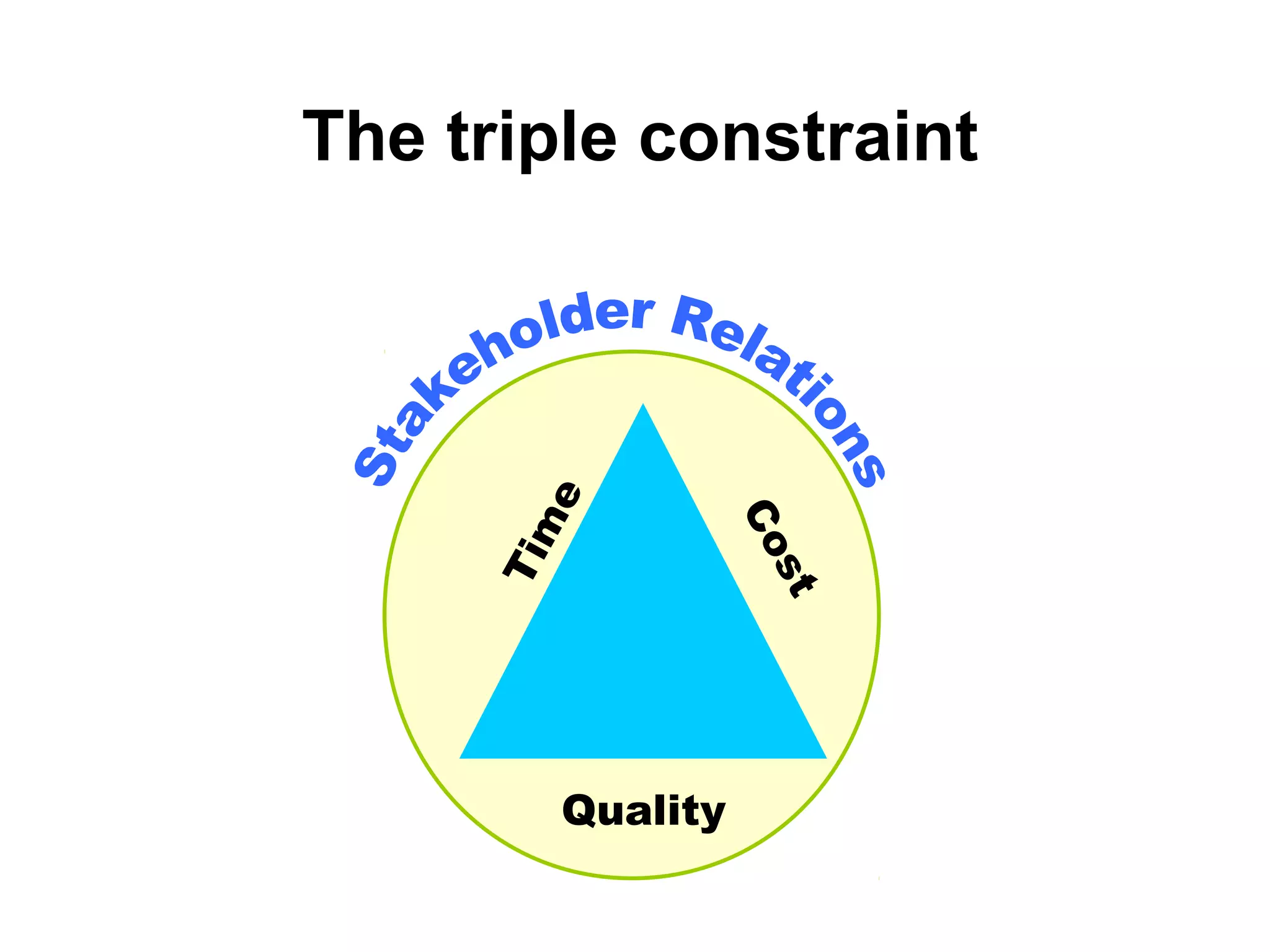
Ti
m

t

Quality

s
Co

e

The triple constraint
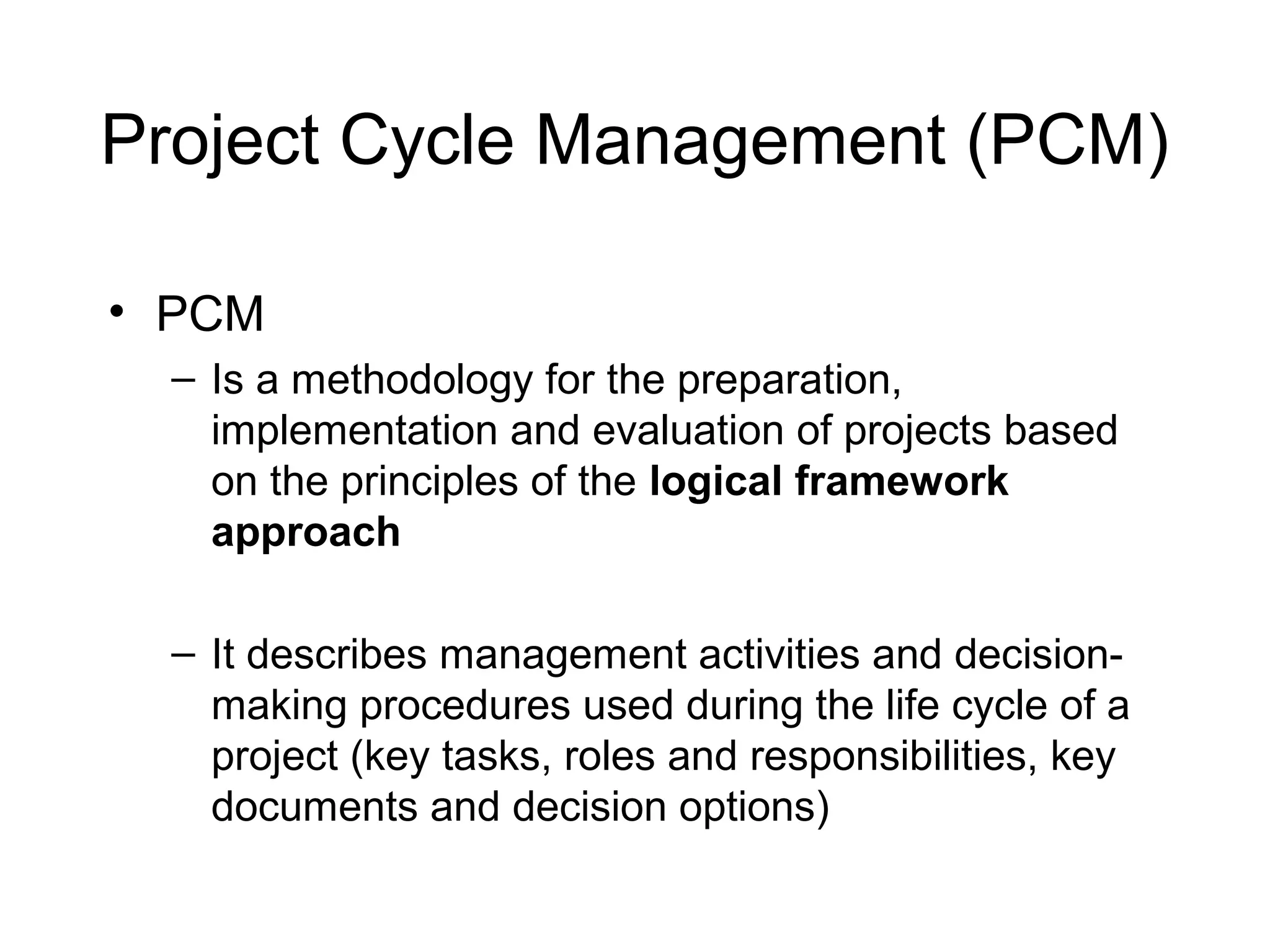
Project Cycle Management (PCM)
• PCM
– Is a methodology for the preparation,
implementation and evaluation of projects based
on the principles of the logical framework
approach
– It describes management activities and decisionmaking procedures used during the life cycle of a
project (key tasks, roles and responsibilities, key
documents and decision options)
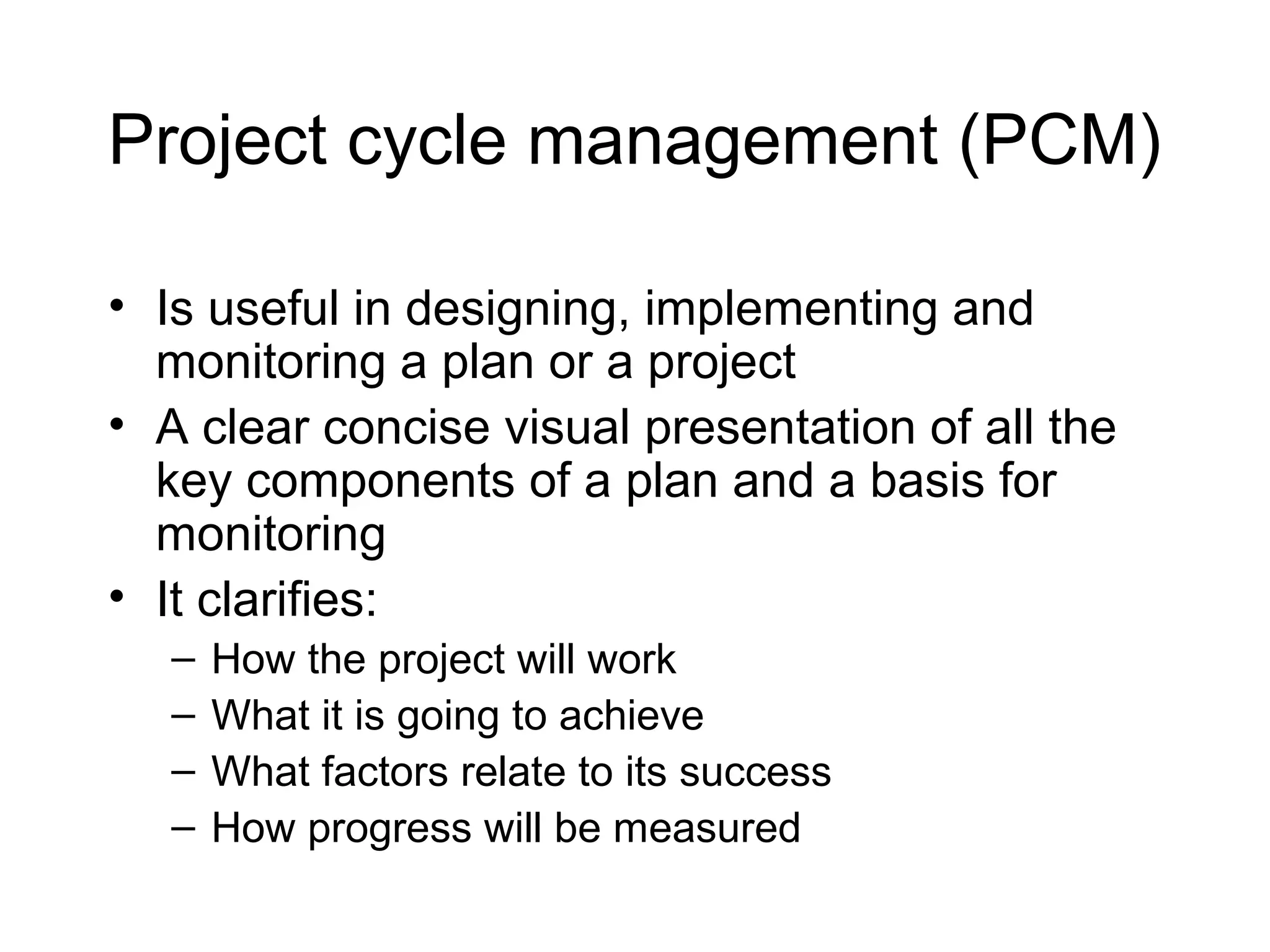
Project cycle management (PCM)
• Is useful in designing, implementing and
monitoring a plan or a project
• A clear concise visual presentation of all the
key components of a plan and a basis for
monitoring
• It clarifies:
–
–
–
–

How the project will work
What it is going to achieve
What factors relate to its success
How progress will be measured
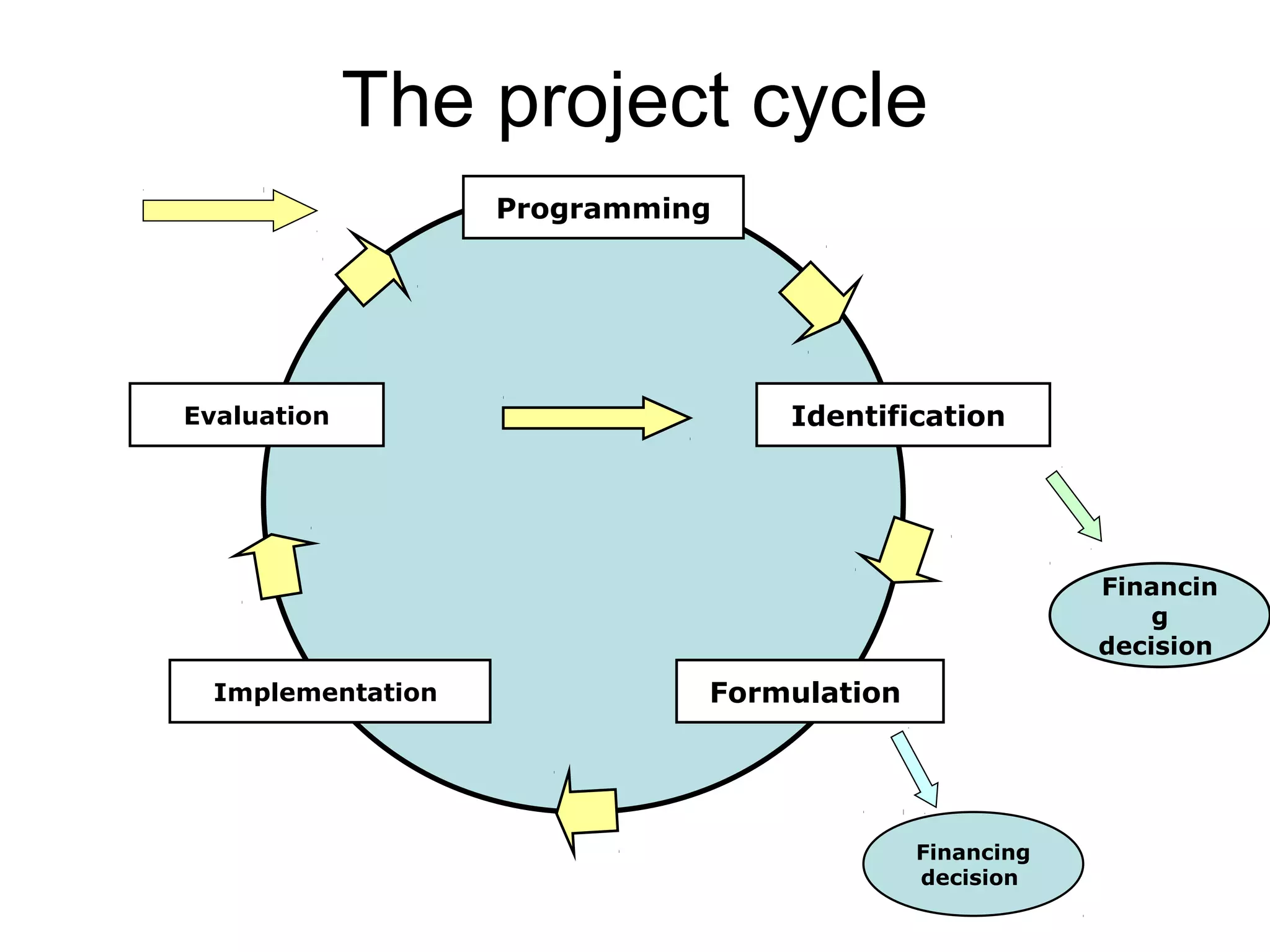
The project cycle
Programming

Evaluation

Identification

Financin
g
decision
Implementation

Formulation

Financing
decision
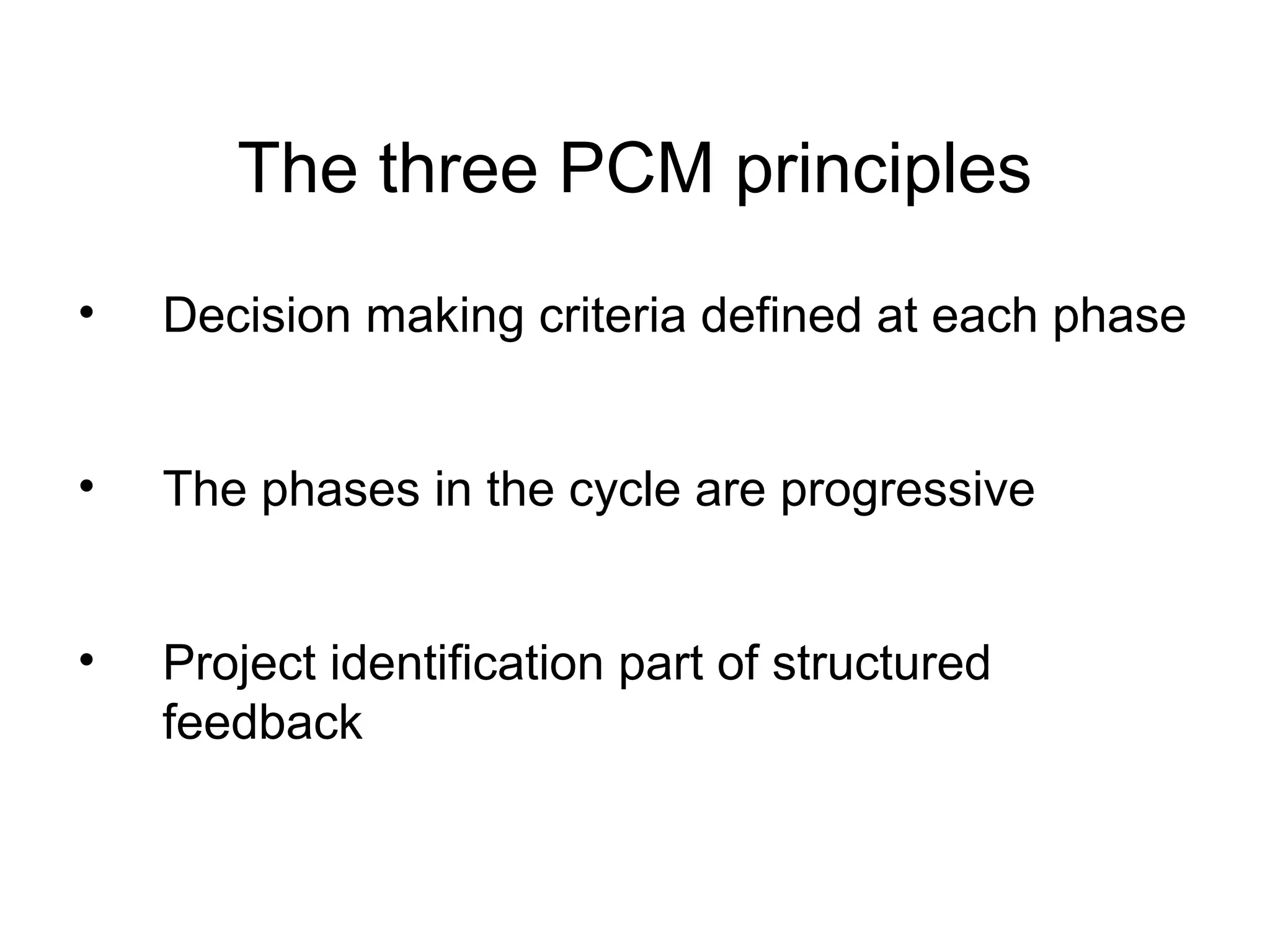
The three PCM principles
•

Decision making criteria defined at each phase

•

The phases in the cycle are progressive

•

Project identification part of structured
feedback
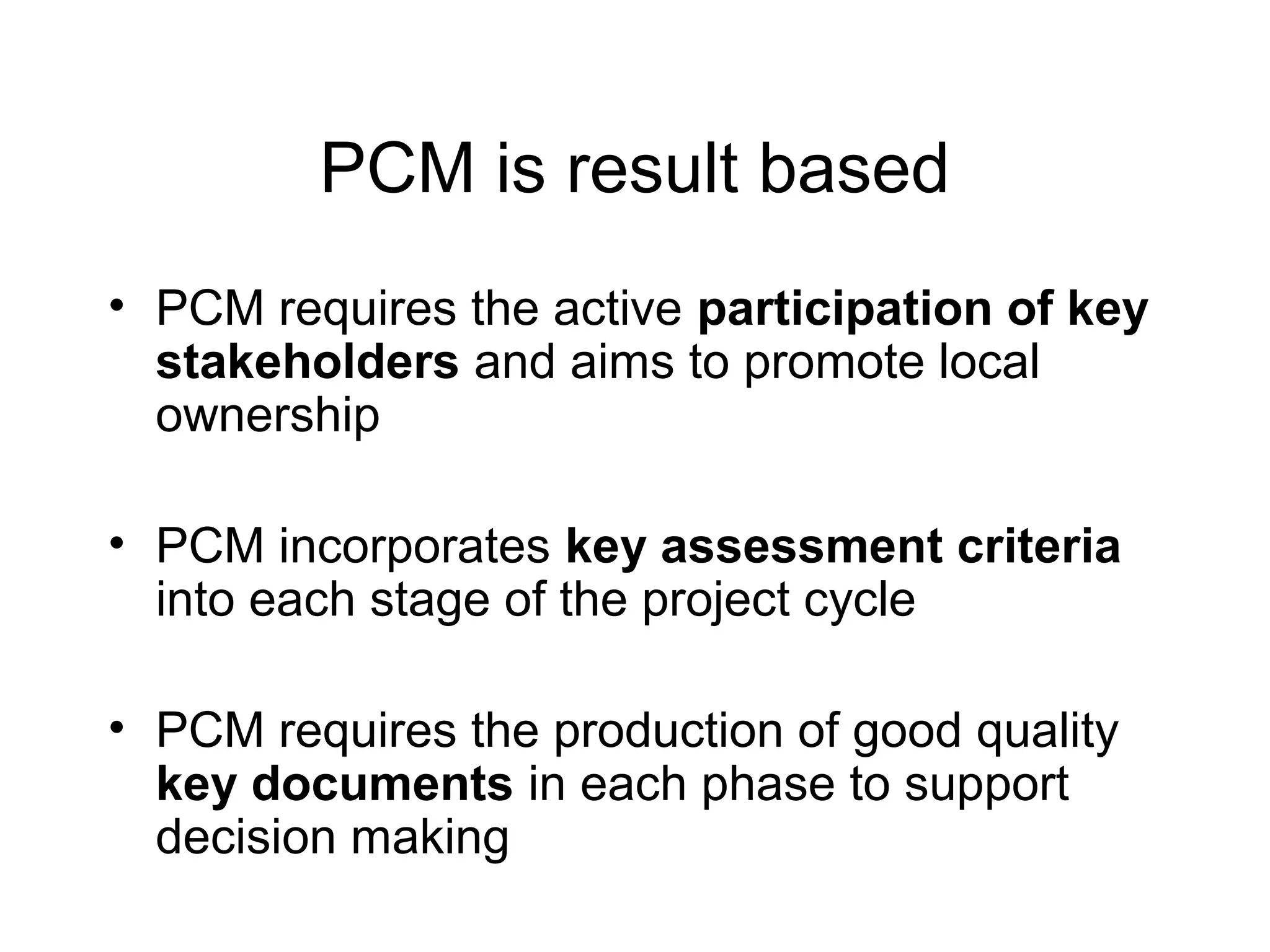
PCM is result based
• PCM requires the active participation of key
stakeholders and aims to promote local
ownership
• PCM incorporates key assessment criteria
into each stage of the project cycle
• PCM requires the production of good quality
key documents in each phase to support
decision making
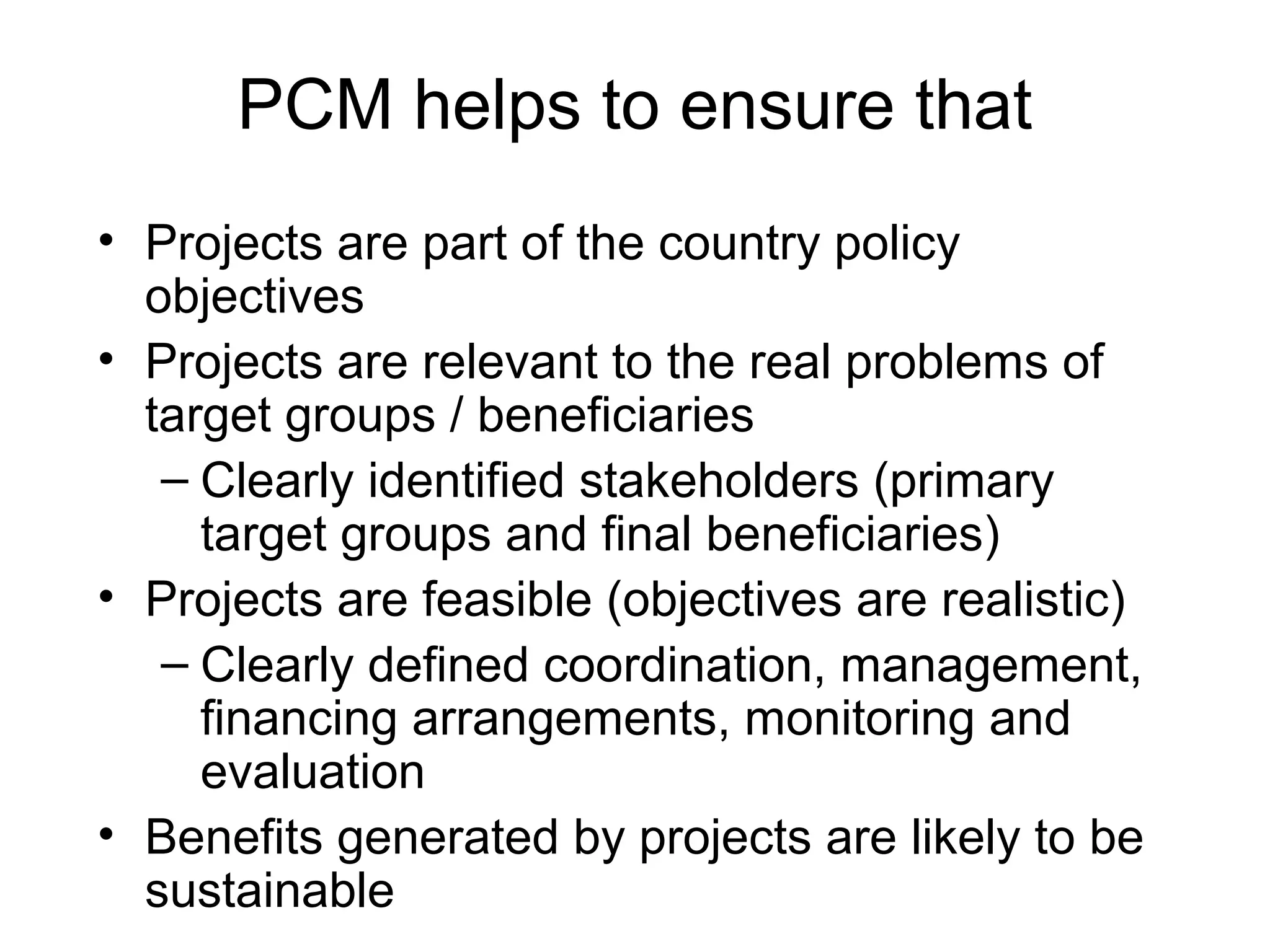
PCM helps to ensure that
• Projects are part of the country policy
objectives
• Projects are relevant to the real problems of
target groups / beneficiaries
– Clearly identified stakeholders (primary
target groups and final beneficiaries)
• Projects are feasible (objectives are realistic)
– Clearly defined coordination, management,
financing arrangements, monitoring and
evaluation
• Benefits generated by projects are likely to be
sustainable
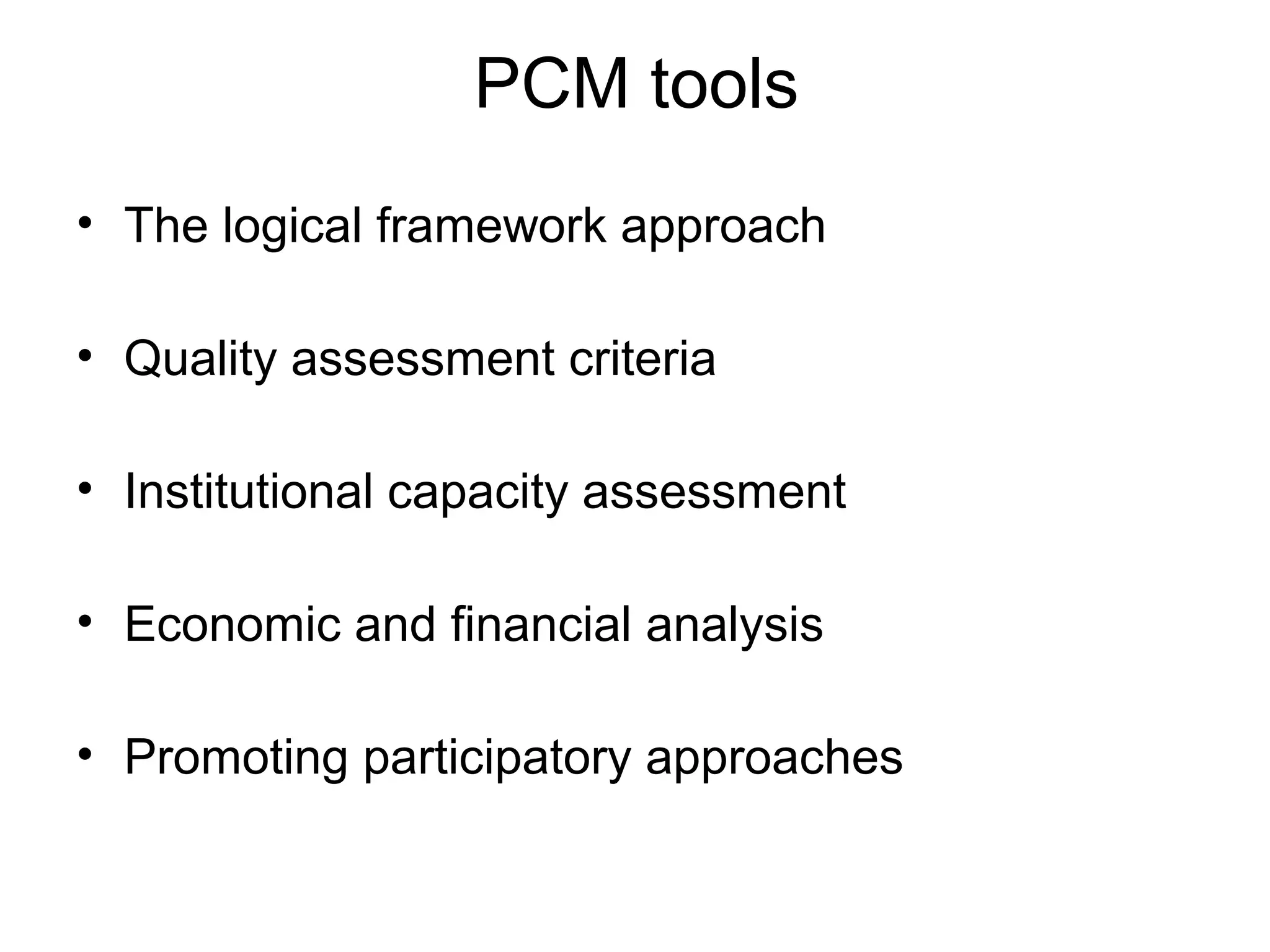
PCM tools
• The logical framework approach
• Quality assessment criteria
• Institutional capacity assessment
• Economic and financial analysis
• Promoting participatory approaches
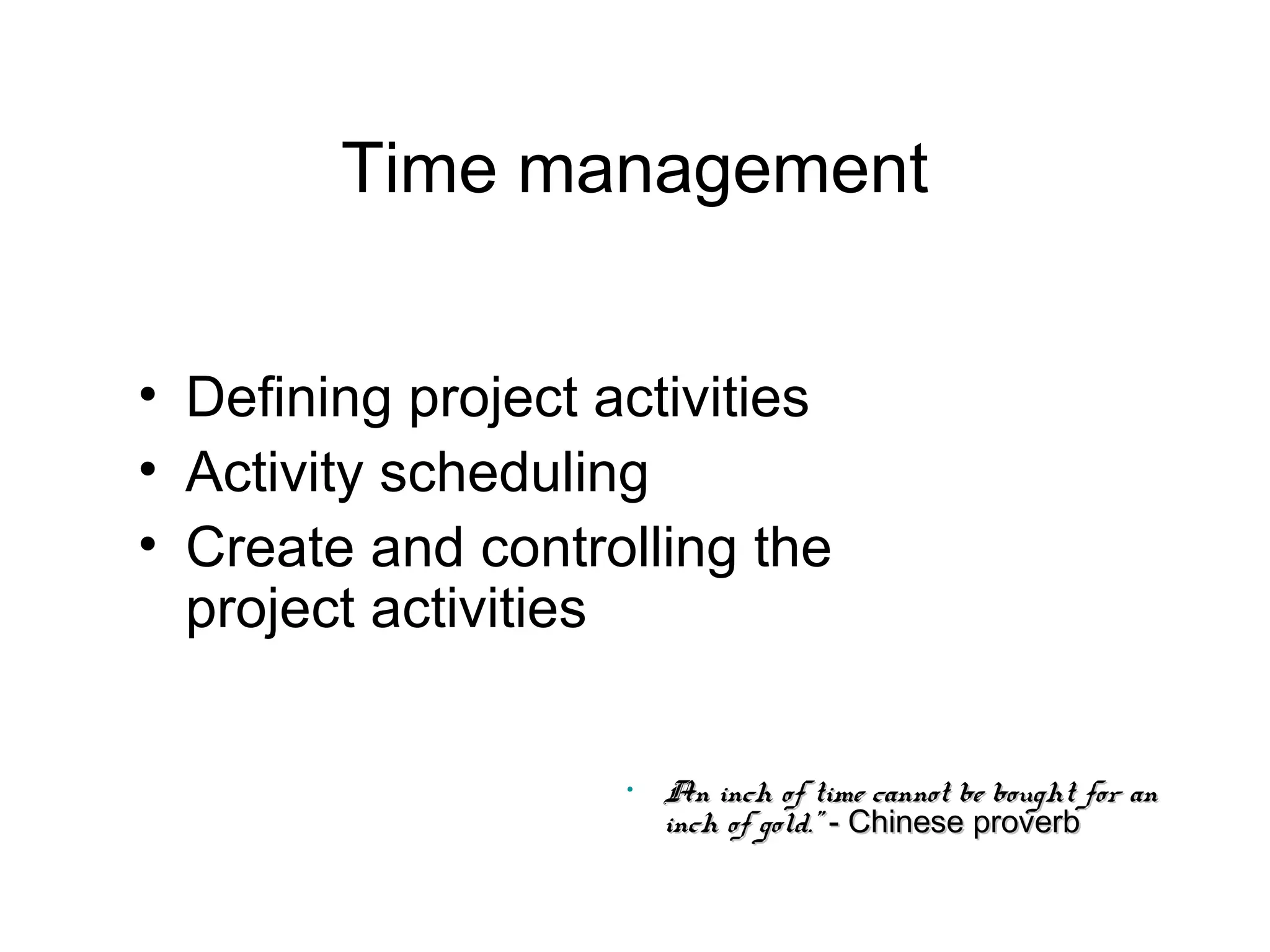
Time management
• Defining project activities
• Activity scheduling
• Create and controlling the
project activities

•

An inch of time cannot be bought for an
inch of gold." - Chinese proverb
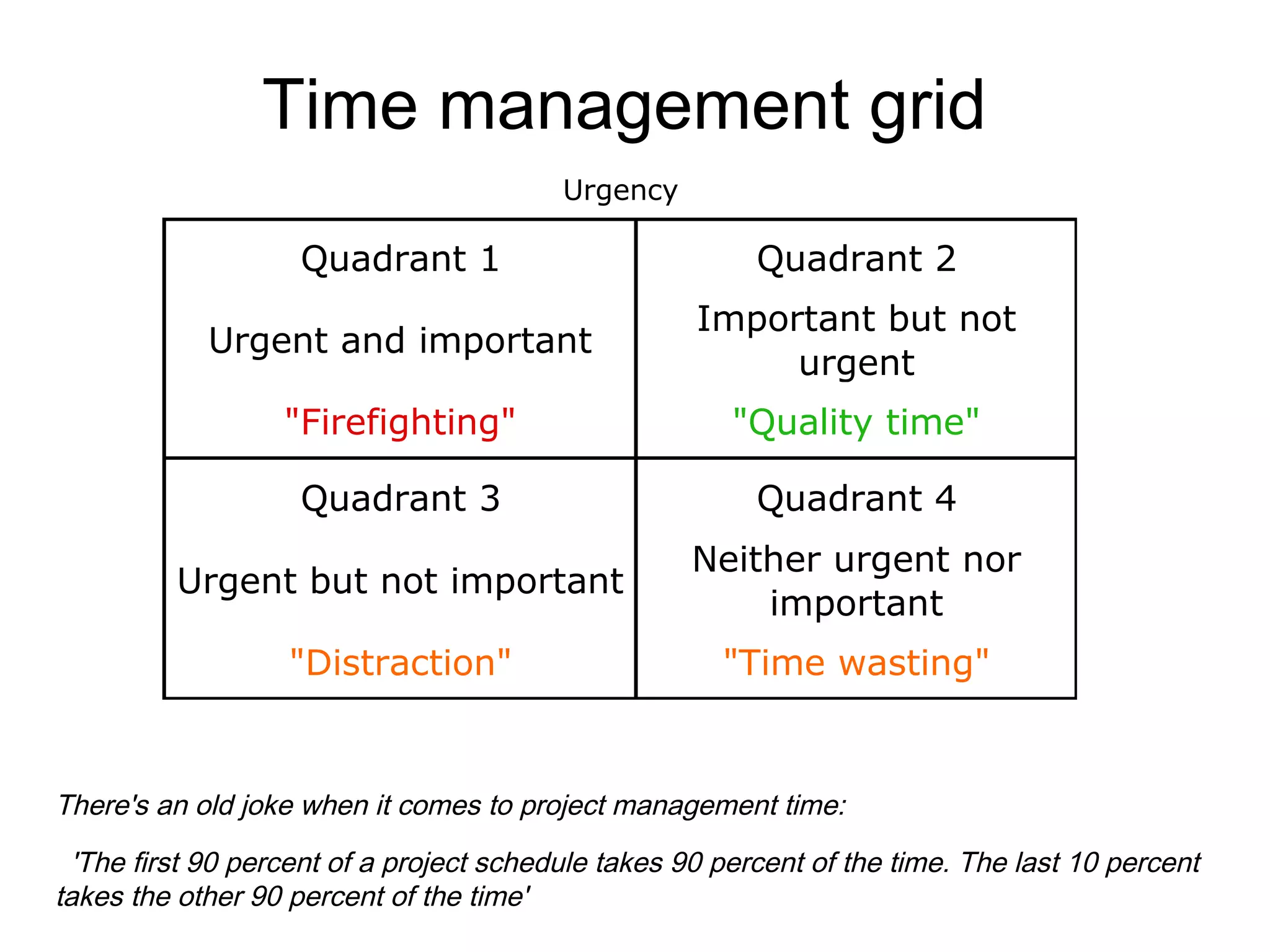
Time management grid
Urgency

Quadrant 2

Urgent and important

Important but not
urgent

"Firefighting"

"Quality time"

Quadrant 3

Quadrant 4

Urgent but not important

Neither urgent nor
important

"Distraction"

Importance

Quadrant 1

"Time wasting"

There's an old joke when it comes to project management time:
'The first 90 percent of a project schedule takes 90 percent of the time. The last 10 percent
takes the other 90 percent of the time'
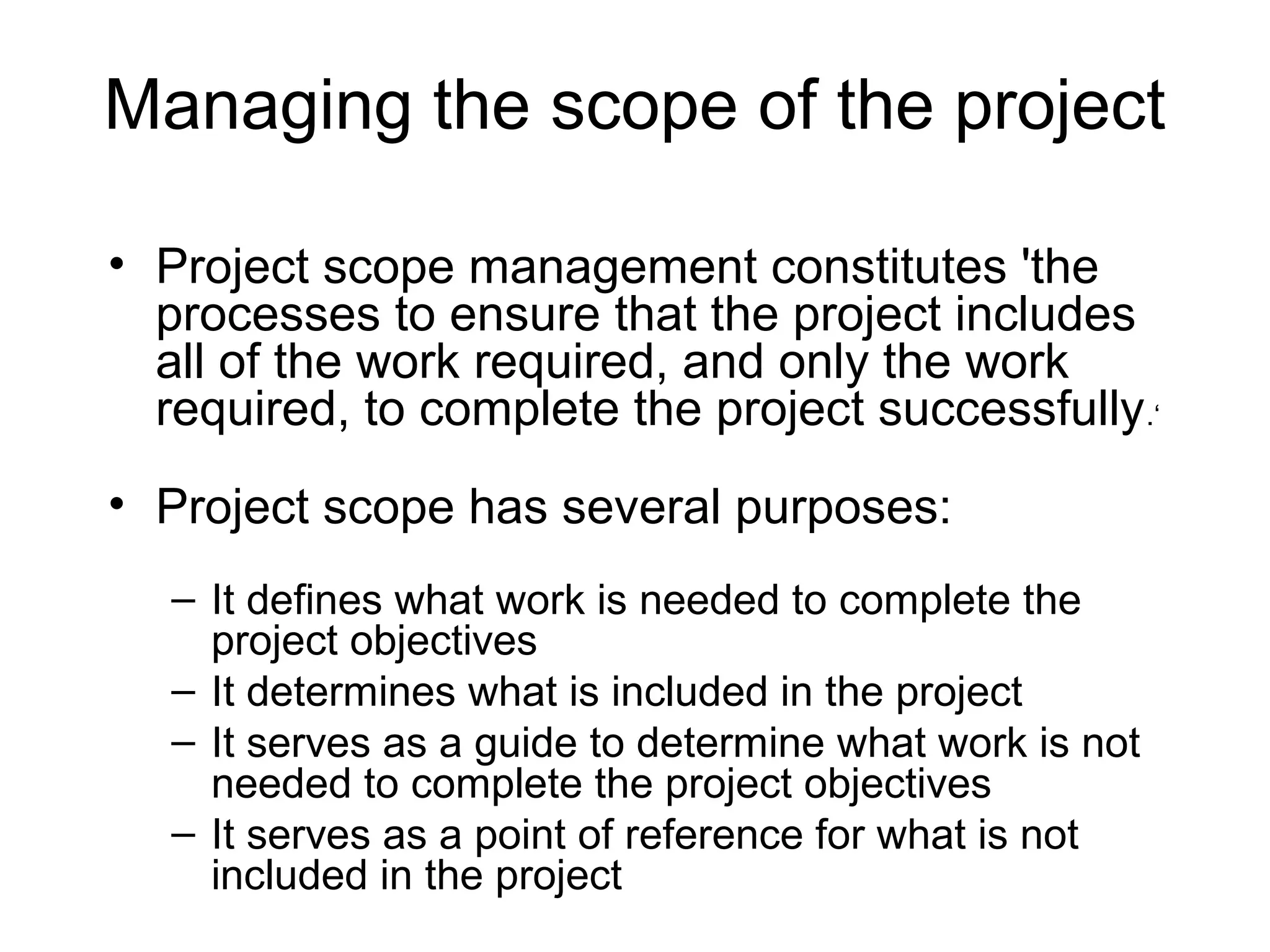
Managing the scope of the project
• Project scope management constitutes 'the
processes to ensure that the project includes
all of the work required, and only the work
required, to complete the project successfully .‘
• Project scope has several purposes:
– It defines what work is needed to complete the
project objectives
– It determines what is included in the project
– It serves as a guide to determine what work is not
needed to complete the project objectives
– It serves as a point of reference for what is not
included in the project
Role of a project manager
• The role of a project manager is affected by
the one-shot nature of the project
• The role of a project manager is difficult when
team members are still linked to their
permanent work areas
– Members may be assigned to several projects
simultaneously

• Managers must rely on their communication
skills and powers of persuasion
Project manager attributes
•
•
•
•
•
•
•
•

Leader & manager
Facilitator, coordinator
Communicator
Credibility: Technical/
Administrative
Work under pressure
Goal-oriented
Innovator
Versatilist

• Knowledgeable about
the organization
• Political sensitivity
• Conflict: sense,
confront, resolve
• Can deal with stress,
chaos, ambiguity
• Planning and followthrough
• Ethical dilemmas
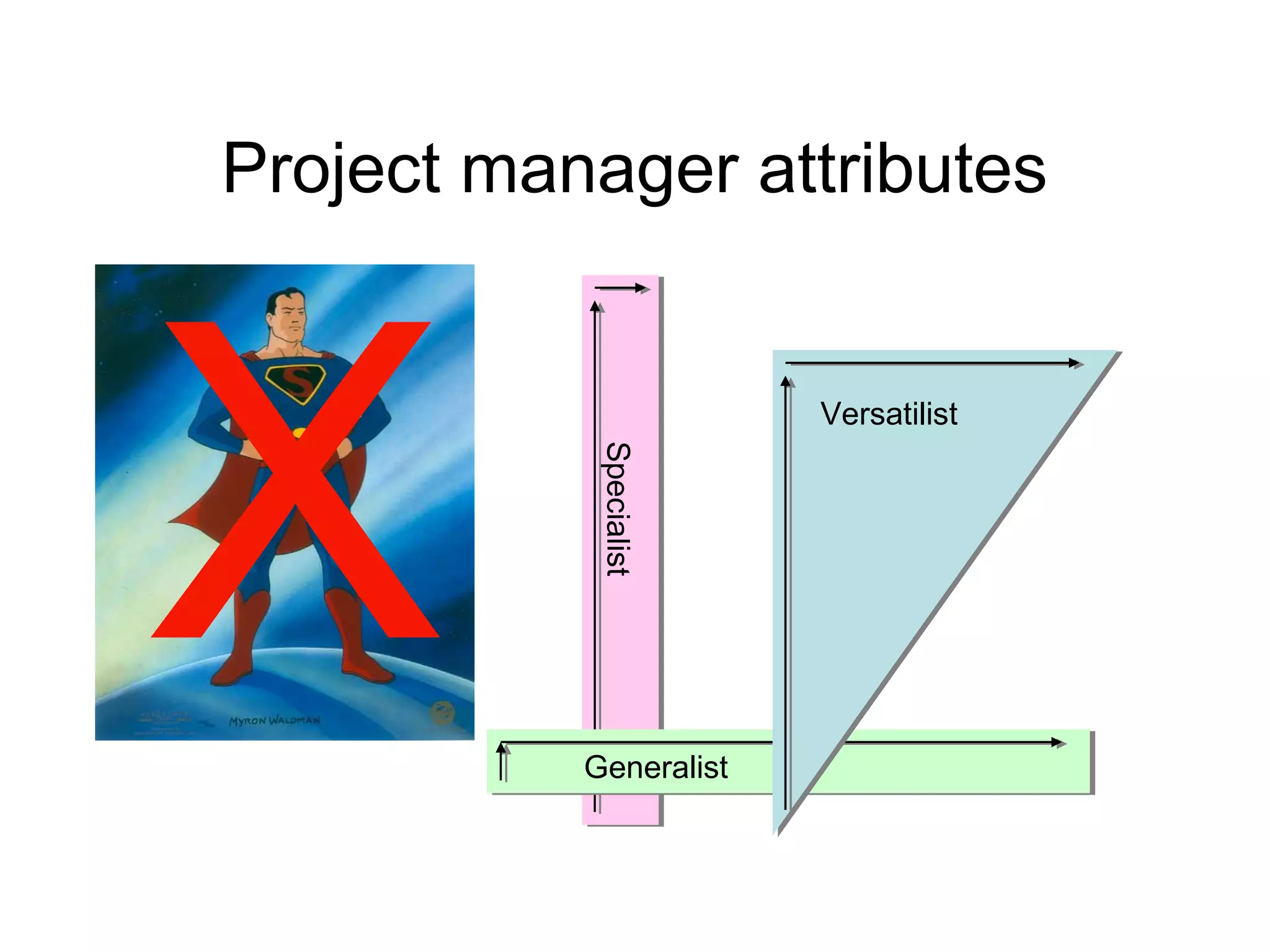
Project manager attributes

Specialist

X

Versatilist

Generalist
Project manager duties
•
•
•
•
•
•
•
•
•
•

Reports to senior management
Communicates with users
Plans and schedules
Obtains and allocates resources
Controls risks
Manages people
Coordinates
Implements quality assurance
Controls the budget
Delivers results
Project teams
•
•
•
•
•
•

Diversity of knowledge needed
Cross-functional
Self-directed
Often ad-hoc or temporary
Often distributed (geographically)
Start and end dates
Project personnel skills
• Technical
• Political
• Problem-oriented
– (vs. discipline-oriented)

• Goal-oriented
• Flexibility, adaptability
• High self-esteem
– can handle failure, risk, uncertainty,
unexpected
– can share blame and credit
Governmental projects
• Legal constraints on government projects
– Laws, statutes, ordinances, directives, regulations,
budgets, and policies

• Accountability to the public
– Accountable to legislative & judicial bodies,
interest groups, the press and the public

• Utilization of public resources
– Objective is not higher ROI, but public good
Project governance
• Risk planning
– Balancing risk avoidance and risk acceptance

• Life cycle management
– From concept to replacement

• Strategic change
– Balancing the solution and the ability to utilize

• Value management
– Adopting consistent processes, building in quality
and adding value
Project management
methodology scope
• What is a methodology
– The way we do things around here !
– Communication, consistency, understanding,
accountability

• Project management vs. other activities
• This way project management uses the same
approach for all situations
References
• British Standard 60971, 2000:2
• European Commission (2004). Project Cycle
Management Guidelines. Downloaded 1st March
from:http://ec.europa.eu/europeaid/qsm/documents/p
cm_manual_2004_en.pdf

D1 l5 project management

  • 1.
    Project management and project cyclemanagement Project Cycle Management ----- A short training course in project cycle management for subdivisions of MFAR in Sri Lanka MFAR, ICEIDA and UNU-FTP Ministry of Fisheries and Aquatic Resources (DFAR) Icelandic International Development Agency (ICEIDA) United Nations University Fisheries Training Programme (UNU-FTP) Sri Lanka Iceland Iceland
  • 2.
    Content of thelecture • • • • • What is a project? How does project management benefit you? Project cycle management (PCM) PCM tools Project managers
  • 3.
    Learning objectives • Afterthis lecture participants will understand the basics of project management, know the role of project manager and principles of project cycle management
  • 4.
    A project • Whatis a project – Defined start and end, specific scope, cost and duration – A temporary endeavor undertaken to create a unique product, service or result – A series of activities aimed at bringing about clearly specified objectives within a defined time period and with a defined budget (EU Aid delivery methods)
  • 5.
    Benefits of projectmanagement • Project management was developed to save time by properly planning a project and considering all relevant factors which may affect its outcome • The benefits have been proven - it saves time and money - and generates a more successful outcome …. if guidelines are followed
  • 6.
    How does projectmanagement benefit you? • • • • • • You will have goal clarity and measurement Your resources will be coordinated Your risks will be identified and managed You will increase the possibilities of time savings You will increase the possibilities of cost savings You will increase the possibilities of achieving the agreed outcome • You will increase the possibilities to deliver projects successfully
  • 7.
    Improved quality • Decision-makingroutes and processes are clearly defined • Deadlines, costs and resources are controlled systematically – All processes in the project management activity chain are coordinated to ensure they remain in harmony with one another • The result will help you to get: – more speed – greater flexibility – improved quality
  • 8.
    What project managementhelps you to achieve • • • • • • • Plan tasks in project Avoid dependencies problems Reduce risks Track progress accurately Organize project process and timeline Improve stakeholder - staff communication Improve management of stakeholders’ expectations • Complete within budget and on time
  • 9.
    Project success factors • • • • • • • • • • Stakeholderinvolvement Executive management support Clear statement of requirements Proper planning Realistic expectations Smaller project milestones Competent staff Ownership Clear vision and objectives Hard working and focused staff
  • 10.
  • 11.
    Project Cycle Management(PCM) • PCM – Is a methodology for the preparation, implementation and evaluation of projects based on the principles of the logical framework approach – It describes management activities and decisionmaking procedures used during the life cycle of a project (key tasks, roles and responsibilities, key documents and decision options)
  • 12.
    Project cycle management(PCM) • Is useful in designing, implementing and monitoring a plan or a project • A clear concise visual presentation of all the key components of a plan and a basis for monitoring • It clarifies: – – – – How the project will work What it is going to achieve What factors relate to its success How progress will be measured
  • 13.
  • 14.
    The three PCMprinciples • Decision making criteria defined at each phase • The phases in the cycle are progressive • Project identification part of structured feedback
  • 15.
    PCM is resultbased • PCM requires the active participation of key stakeholders and aims to promote local ownership • PCM incorporates key assessment criteria into each stage of the project cycle • PCM requires the production of good quality key documents in each phase to support decision making
  • 16.
    PCM helps toensure that • Projects are part of the country policy objectives • Projects are relevant to the real problems of target groups / beneficiaries – Clearly identified stakeholders (primary target groups and final beneficiaries) • Projects are feasible (objectives are realistic) – Clearly defined coordination, management, financing arrangements, monitoring and evaluation • Benefits generated by projects are likely to be sustainable
  • 17.
    PCM tools • Thelogical framework approach • Quality assessment criteria • Institutional capacity assessment • Economic and financial analysis • Promoting participatory approaches
  • 18.
    Time management • Definingproject activities • Activity scheduling • Create and controlling the project activities • An inch of time cannot be bought for an inch of gold." - Chinese proverb
  • 19.
    Time management grid Urgency Quadrant2 Urgent and important Important but not urgent "Firefighting" "Quality time" Quadrant 3 Quadrant 4 Urgent but not important Neither urgent nor important "Distraction" Importance Quadrant 1 "Time wasting" There's an old joke when it comes to project management time: 'The first 90 percent of a project schedule takes 90 percent of the time. The last 10 percent takes the other 90 percent of the time'
  • 20.
    Managing the scopeof the project • Project scope management constitutes 'the processes to ensure that the project includes all of the work required, and only the work required, to complete the project successfully .‘ • Project scope has several purposes: – It defines what work is needed to complete the project objectives – It determines what is included in the project – It serves as a guide to determine what work is not needed to complete the project objectives – It serves as a point of reference for what is not included in the project
  • 21.
    Role of aproject manager • The role of a project manager is affected by the one-shot nature of the project • The role of a project manager is difficult when team members are still linked to their permanent work areas – Members may be assigned to several projects simultaneously • Managers must rely on their communication skills and powers of persuasion
  • 22.
    Project manager attributes • • • • • • • • Leader& manager Facilitator, coordinator Communicator Credibility: Technical/ Administrative Work under pressure Goal-oriented Innovator Versatilist • Knowledgeable about the organization • Political sensitivity • Conflict: sense, confront, resolve • Can deal with stress, chaos, ambiguity • Planning and followthrough • Ethical dilemmas
  • 23.
  • 24.
    Project manager duties • • • • • • • • • • Reportsto senior management Communicates with users Plans and schedules Obtains and allocates resources Controls risks Manages people Coordinates Implements quality assurance Controls the budget Delivers results
  • 25.
    Project teams • • • • • • Diversity ofknowledge needed Cross-functional Self-directed Often ad-hoc or temporary Often distributed (geographically) Start and end dates
  • 26.
    Project personnel skills •Technical • Political • Problem-oriented – (vs. discipline-oriented) • Goal-oriented • Flexibility, adaptability • High self-esteem – can handle failure, risk, uncertainty, unexpected – can share blame and credit
  • 27.
    Governmental projects • Legalconstraints on government projects – Laws, statutes, ordinances, directives, regulations, budgets, and policies • Accountability to the public – Accountable to legislative & judicial bodies, interest groups, the press and the public • Utilization of public resources – Objective is not higher ROI, but public good
  • 28.
    Project governance • Riskplanning – Balancing risk avoidance and risk acceptance • Life cycle management – From concept to replacement • Strategic change – Balancing the solution and the ability to utilize • Value management – Adopting consistent processes, building in quality and adding value
  • 29.
    Project management methodology scope •What is a methodology – The way we do things around here ! – Communication, consistency, understanding, accountability • Project management vs. other activities • This way project management uses the same approach for all situations
  • 30.
    References • British Standard60971, 2000:2 • European Commission (2004). Project Cycle Management Guidelines. Downloaded 1st March from:http://ec.europa.eu/europeaid/qsm/documents/p cm_manual_2004_en.pdf

Editor's Notes

  • #5 is a unique set of coordinated activities, with a definite starting and finishing points, undertaken by an individual or organization to meet specific objectives within defined schedule, cost and performance parameters (British Standard 60971, 2000:2)
  • #6 Even though project management gives you set of tools to schedule and organize, there are many factors that need to be considered if projects are to be successful. It is not a magical solution Project management does not do the work for you, but helps you to be specific and organized without losing the overview of what you are doing and why. Importance of project management With limited resources, project management can be very important by: Increasing productivity Boosting efficiency Making the most of every resource Making sure that deadlines are met
  • #7 Like with other things, experience can be a big factor. But just as with young people, if they have the guidance while they are developing their talents they are more likely to progress. In a way we can say that project management can guide people and help them to progress in their profession.
  • #9 This is a list of favourable outcomes. But, just like when a contractor wants to build a house. it is not enough to bring the drawings and get the tools on location. He actually really has to do the work. The drawings guides him and the tools makes the labour easier for him.
  • #10 To increase the chances of positive outcome, project managers have to think about all of the factor that can influence positive outcome and the threat of failure, Tomorrow we will discuss and give you hands on practise on how to use set of tools that analyse different factors of outside- and internal elements that are useful for project management.
  • #11 Project management success indicators Project is completed within time, cost and quality requirements Will make: Sponsor/beneficiary satisfied Minimal scope or mutually agreed to scope changes No adverse impact/interruption to regular work flow of the organization No change to the corporate culture
  • #12  Project cycle management - PCM PCM describes management activities and decision making procedures used during the life time of a project Tasks Roles Responsibility Key documents Decisions options The EC has adopted PCM as its primary set of project design and management tool based upon the Logical Framework Approach We will have special lecture on the logframe matrix that is used to decide further activities (after we have done proper analysis)
  • #14 The cycle is generally divided in 5 phases: Programming Identification Formulation Implementation Evaluation and audit The project cycle Follows the life of a project from the initial idea through to its completion Provides a structure to ensure that stakeholders are consulted Defines key decisions, information requirements and responsibilities at each phase Tomorrow we are going to talk about the tools that are used in the implementation-stage to analyse important factors that influence the project and stakeholders
  • #17 Before you evaluate what project you would like to implement, you will have to apply certain criteria on how to choose a project. And making shore that they will be able to serve certain role in the overall objectives that are stated in the mission/vision of a institute. To be able to find out what an organization or an institution is capable of performing we need to analyse them. This is for example being done right now here in Sri Lanka by FAO (the team of Richard Banks)
  • #18 These are the large tools that is used in PCM - A set of tools in plannig and scheduling stage of implementation that we are going to take a look at tomorrow are: SWOT, PESTLE, Stakeholder analysis, Problem analysis, Objective analysis, strategic analysis. The logical frame work Matrix is the frame where you arrange the actions that you need to perform, and state their objectives The logframe matrix, as well connected with the activity schedules that is again linked with the budget. These large elements of the PCM analyse the resources that are available so activities can be adjusted accordingly.
  • #22 If people are put in a project group, how do you make them work on the project as well as making them perform their normal duties as well? Be flexible jet firm Here it would be good to name an example from Sri Lanka – e.g. How did you manage to work on the project of making this course?
  • #23 Project manager has to be able to fulfil the needs and demands of the project
  • #24 Specialist Deep skills Narrow scope Peer-Recognized Unknown outside domain Generalist Shallow skills Broad scope Quick response Recognized in other Domains Versatilist Deep skills Wide scope of roles Broad experience recognized in other domains
  • #25 Whatever needs to be done, has to be done by a project manager, even though it involves him/her decide that some one else should do the actual work!
  • #26 Last lecture was about teams and culture so there is no need of spending to much time on this slide. The rule of thumb is, a group of many should be able to deliver more than one person, they can divide their work and be specialized in their fields, and the team should be more flexible regarding workload, time and knowledge.
  • #27 It depends on the project when you select what kind of people are going to do the work on a project. But often you have to mix together specialists and versatileist, depending on the purpose of the project. The most important is to get the people that can get the job done! This slides describes several favorable elements of a project personnel.
  • #28 In contrast to Government projects are for example, the development of new products within private companies. Such projects are normally run “under the radar” and do not have accountability to the general public. The success of such projects is measured in things like ROI, profits and sales. Official projects have different agenda, which are normally aimed for the benefit of the general public or improving elements of official bodies.
  • #29 Within lifetime of projects, there are numeral factors that need to be taken care of. The people that work on a project have to remember that projects can be dynamic and decicions may need to be revised within the project lifetime. The project governance has to fit within the frame of numerous factors. And along the way there are questions that come up that need to be aswered, events that happens and may have to be responsed to. The plan has to be flexible enough to be able to bend and ajust to changes. Good governance has to be able to create the “flexibility” Project governance ensures: That the scope is defined according to all key stakeholders’ needs A clear understanding of roles and responsibilities exists An organizational perspective is honored The ultimate decisional authority is with an individual, not a committee The budget is adequate for the scope Necessary resources are available Overall project timelines are set and achieved
  • #30 There will be more coverage on methodology in the next lecture.