Health Problems in
   Women with
Hereditary Bleeding
    Disorders

 Magdy El Ekiaby, MD
 Shabrawishi HTC, Egypt
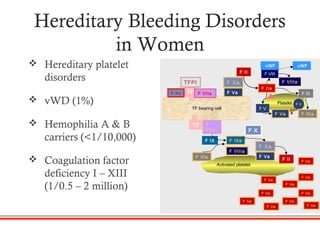
Hereditary Bleeding Disorders
          in Women
 Hereditary platelet                                                       vWF                    vWF
                                                             F II           F VIII
   disorders                     TFPI                 F Xa                               F VIIIa
                                                                          F IIa
                          F Xa   TF F VIIa            F Va                                            F XI
 vWD (1%)                                                                             Platelet F V
                                   TF bearing cell                        FV
                                                                                   F Va               F XIa

 Hemophilia A & B                 TF     F
                                          VIIa                      F X
   carriers (<1/10,000)                  F IX          F IXa
                                                                          F Xa
                                                       F VIIIa
                                    F XIa                                 F Va
 Coagulation factor                             Activated platelet
                                                                                         F II         F IIa


   deficiency I – XIII                                                     F IIa
                                                                                                      F IIa


   (1/0.5 – 2 million)                                                    F IIa
                                                                                           F IIa

                                                                                                      F IIa

                                                               F IIa                       F IIa
                                                                               F IIa                     F IIa
Inheritance
 Hereditary bleeding diseases are inherited as recessive
   characters

 Women with heterozygote bleeding disorders usually
   are asymptomatic, or experience mild bleeding
   problems

 In rare cases, there might be compounded
   heterozygote inheritance of bleeding disorders in
   which case bleeding symptoms may be severe

 Women with homozygote inheritance pattern suffer
   from severe bleeding symptoms, particularly those
   related to their reproductive system, eg menstrual
Reproductive Health
         Problems
 Menorrhagea

 Dysmenorrhea

 Hemorrhagic ovarian
   cyst

 Pregnancy and delivery

 Impact of bleeding
   disorders on women
Menstrual Cycle
 Normal menstrual cycle should be less than 7 days
   long during which blood loss does not exceed 80 ml*

 Women of modern societies may experience up to 500
   cycles during their fertile age

 Chronic disturbance of menses may have its impact on
   the health, psychological and social life of the women

 Every effort should be done to identify menorrhagea,
   its probable causes, so that it can be properly
   managed.

                 *ACOG, Management of anovulatory bleeding 2000, p.1-12
Menorrhagea
 It is defined as prolonged menstruation (>7 days)
   and/or excessive blood loss (>80 ml)

 Excessive passage of blood clots, pain and flooding are
   also common features of menorrhagea*

 Adolescent girls and perimenopausal women may
   suffer most, as the menstrual cycles are usually
   anovulatory


                                *Kadir et al, Haemophilia 2009
Hemorrhagic Ovarian Cysts
 In normal women, minor bleeding may occur with
   rupture of the graafian follicle

 Women with HBD are more likely to have more
   significant bleeding at ovulation in the form of:
    Hemorrhagic ovarian cyst
    Broad ligament hematoma
    Hemoperitoneum

 Prevalence of hemorrhagic ovarian cysts in women
   with HBD ranges from 2 – 25%*
                               *James, Hemophilia 2005
Clinical Assessment of
            Menorrhagea
 Iron deficiency anemia in women complaining of
   menorrhagea is an indication of excessive blood loss
   during menstruation

 Iron deficiency anemia will not manifest for a long
   time, while menorrhagea may be existing

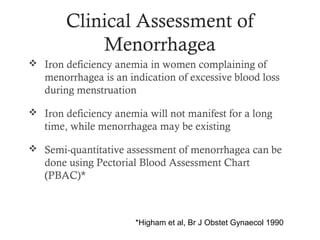
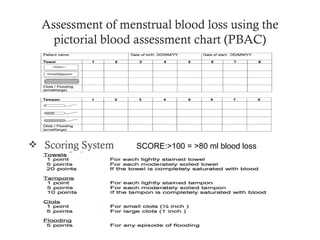
 Semi-quantitative assessment of menorrhagea can be
   done using Pectorial Blood Assessment Chart
   (PBAC)*


                       *Higham et al, Br J Obstet Gynaecol 1990
Assessment of menstrual blood loss using the
    pictorial blood assessment chart (PBAC)


 Scoring System   SCORE:>100 = >80 ml blood loss
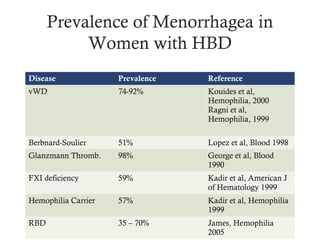
Prevalence of Menorrhagea in
           Women with HBD
Disease              Prevalence   Reference
vWD                  74-92%       Kouides et al,
                                  Hemophilia, 2000
                                  Ragni et al,
                                  Hemophilia, 1999

Berbnard-Soulier     51%          Lopez et al, Blood 1998
Glanzmann Thromb.    98%          George et al, Blood
                                  1990
FXI deficiency       59%          Kadir et al, American J
                                  of Hematology 1999
Hemophilia Carrier   57%          Kadir et al, Hemophilia
                                  1999
RBD                  35 – 70%     James, Hemophilia
                                  2005
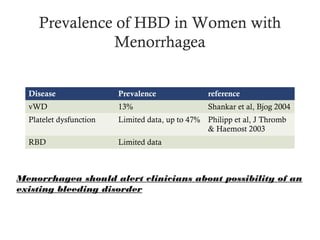
Prevalence of HBD in Women with
               Menorrhagea


  Disease                Prevalence               reference
  vWD                    13%                      Shankar et al, Bjog 2004
  Platelet dysfunction   Limited data, up to 47% Philipp et al, J Thromb
                                                 & Haemost 2003
  RBD                    Limited data


Menorrhagea should alert clinicians about possibility of an
existing bleeding disorder
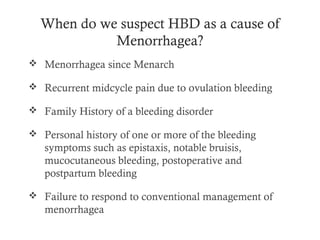
When do we suspect HBD as a cause of
            Menorrhagea?
 Menorrhagea since Menarch

 Recurrent midcycle pain due to ovulation bleeding

 Family History of a bleeding disorder

 Personal history of one or more of the bleeding
   symptoms such as epistaxis, notable bruisis,
   mucocutaneous bleeding, postoperative and
   postpartum bleeding

 Failure to respond to conventional management of
   menorrhagea
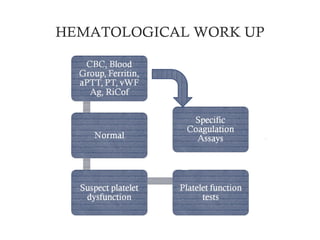
HEMATOLOGICAL WORK UP
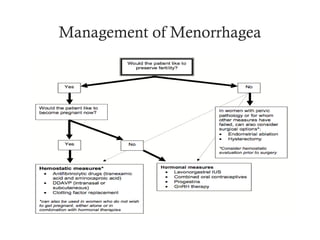
Management of Menorrhagea
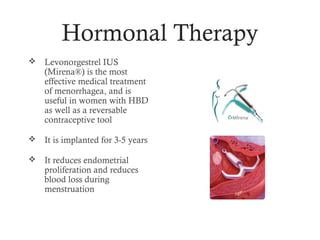
Hormonal Therapy
   Levonorgestrel IUS
    (MirenaĀ®) is the most
    effective medical treatment
    of menorrhagea, and is
    useful in women with HBD
    as well as a reversable
    contraceptive tool

   It is implanted for 3-5 years

   It reduces endometrial
    proliferation and reduces
    blood loss during
    menstruation
Hormonal Therapy
 Combined hormonal therapy to reduce blood loss by
   thinning the endometrium and probably increasing
   FVIII & vWF levels, such as contraceptive pills,
   transdermal contraceptive patches & vaginal rings

 Oral progestogens

 Gonadotropin-releasing hormone (GnRH) analogues
   (stop ovulation)
Hemostatic Therapy
 Anti-fibrinolytics

 DDAVP

 Specific clotting factor concentrates

 Blood component transfusion
Anti-fibrinolytic Agents
 Tanexamic acid and Epsilon Amino Caproic Acid
   (EACA), are known to have hemostatic effect and
   may help to control menorrhagea

 Oral Tranexamic acid (1g, 3 – 4 times daily) during
   menstrual period is known to reduce menorrhagea

 Usually it is well tolerated but side effects include
   nausea, vomiting, headache and diarrhea
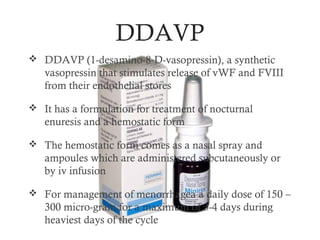
DDAVP
 DDAVP (1-desamino-8-D-vasopressin), a synthetic
   vasopressin that stimulates release of vWF and FVIII
   from their endothelial stores

 It has a formulation for treatment of nocturnal
   enuresis and a hemostatic form

 The hemostatic form comes as a nasal spray and
   ampoules which are administered subcutaneously or
   by iv infusion

 For management of menorrhagea a daily dose of 150 –
   300 micro-gram for a maximum of 3-4 days during
   heaviest days of the cycle
DDAVP
 It is mainly effective in Hemophilia A carriers, vWD
   (except type 2B) and to some extent in Glanzmann
   thrombasthenia and Bernard-Soulier Syndrome

 Side effects include tachycardia, flushing, and
   headache

 Small risk of hyponatremia and water intoxication
   with repeated doses, so better advise water intake
   restriction during therapy
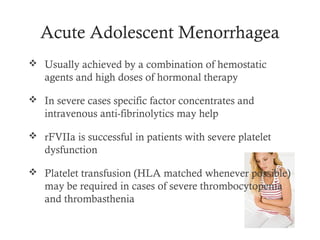
Acute Adolescent Menorrhagea
 Usually achieved by a combination of hemostatic
   agents and high doses of hormonal therapy

 In severe cases specific factor concentrates and
   intravenous anti-fibrinolytics may help

 rFVIIa is successful in patients with severe platelet
   dysfunction

 Platelet transfusion (HLA matched whenever possible)
   may be required in cases of severe thrombocytopenia
   and thrombasthenia
Counselling
 Issues of counselling include:
    Marriage
    Preconception
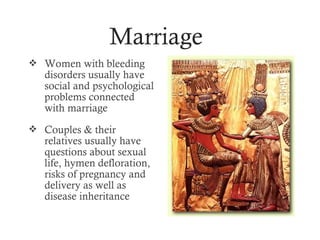
Marriage
 Women with bleeding
   disorders usually have
   social and psychological
   problems connected
   with marriage
 Couples & their
   relatives usually have
   questions about sexual
   life, hymen defloration,
   risks of pregnancy and
   delivery as well as
   disease inheritance
Preconception
 Advantages:
   Provides adequate information on the genetic
     implications of their disorders, the available
     reproductive choices, and options for prenatal diagnosis
   Allows planning for pregnancy and establishing how
     and where pregnancy can be best managed
   Immunization against HBV & HAV for those likely to
     receive blood transfusion
   DDAVP test dose to assess response
   General hematenic supplmentation
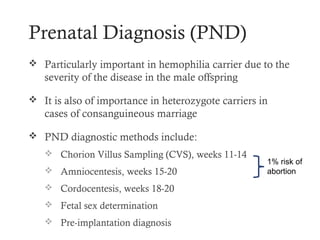
Prenatal Diagnosis (PND)
 Particularly important in hemophilia carrier due to the
   severity of the disease in the male offspring

 It is also of importance in heterozygote carriers in
   cases of consanguineous marriage

 PND diagnostic methods include:
    Chorion Villus Sampling (CVS), weeks 11-14
                                                     1% risk of
    Amniocentesis, weeks 15-20                      abortion

    Cordocentesis, weeks 18-20
    Fetal sex determination
    Pre-implantation diagnosis
Antenatal management
 Increased levels of vWF, FVIII, Fibrinogen as well as
   plasminogen activator inhibitors, particularly during
   third trimester of pregnancy, reduces bleeding episodes
   and complications in women with HBDs
              (Bremme, Best Pract Res Clin Hematol, 2003)

 20% of normal pregnancies may wetness a bleeding
   episode due to obstetric problems, which should not
   be overlooked in women with HBDs

 Women with FI & FXIII deficiency are particularly at
   risk of miscarriage, placental abruption and preterm
   delivery which may require factor replacement during
   pregnancy                                  (Chi & Kadir,
Labour & delivery
   Third trimester coagulation factor levels should be known before
    delivery and factor replacement may be considered in those with
    low levels

   DDAVP may be used in hemophilia carriers and vWD during
    delivery with caution

   Matched packed RBCs should be reserved for emergency
    bleeding

   Cesarean section as well as other obstetrical procedures should be
    evaluated for least traumatic manipulation of the fetus

   Cord fetal blood sample to assess if the baby has inherited the
    bleeding disorder
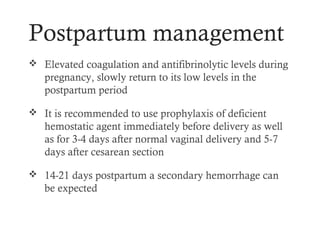
Postpartum management
 Elevated coagulation and antifibrinolytic levels during
   pregnancy, slowly return to its low levels in the
   postpartum period

 It is recommended to use prophylaxis of deficient
   hemostatic agent immediately before delivery as well
   as for 3-4 days after normal vaginal delivery and 5-7
   days after cesarean section

 14-21 days postpartum a secondary hemorrhage can
   be expected
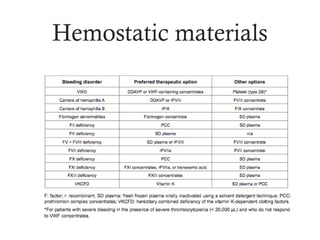
Hemostatic materials
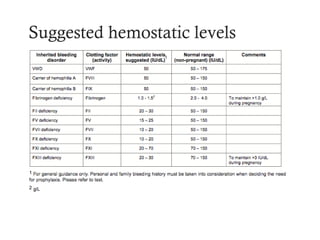
Suggested hemostatic levels
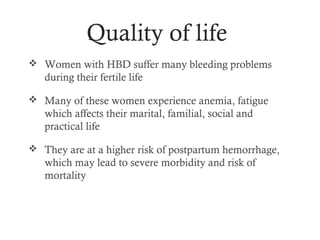
Quality of life
 Women with HBD suffer many bleeding problems
   during their fertile life

 Many of these women experience anemia, fatigue
   which affects their marital, familial, social and
   practical life

 They are at a higher risk of postpartum hemorrhage,
   which may lead to severe morbidity and risk of
   mortality
Conclusion
 The prevalence of HBD is not insignificant

 Women suffering from menorrhagea, particularly
   since adolescence should be investigated to exclude
   HBD

 Women with HBD should receive care for their
   reproductive life in specialized centers, or at least
   under common supervision from an obstetrician and a
   hematologist

 Proper management of women with HBD can greatly
   improve the quality of their lives

Women with hbd

  • 1.
    Health Problems in Women with Hereditary Bleeding Disorders Magdy El Ekiaby, MD Shabrawishi HTC, Egypt
  • 3.
    Hereditary Bleeding Disorders in Women  Hereditary platelet vWF vWF F II F VIII disorders TFPI F Xa F VIIIa F IIa F Xa TF F VIIa F Va F XI  vWD (1%) Platelet F V TF bearing cell FV F Va F XIa  Hemophilia A & B TF F VIIa F X carriers (<1/10,000) F IX F IXa F Xa F VIIIa F XIa F Va  Coagulation factor Activated platelet F II F IIa deficiency I – XIII F IIa F IIa (1/0.5 – 2 million) F IIa F IIa F IIa F IIa F IIa F IIa F IIa
  • 4.
    Inheritance  Hereditary bleedingdiseases are inherited as recessive characters  Women with heterozygote bleeding disorders usually are asymptomatic, or experience mild bleeding problems  In rare cases, there might be compounded heterozygote inheritance of bleeding disorders in which case bleeding symptoms may be severe  Women with homozygote inheritance pattern suffer from severe bleeding symptoms, particularly those related to their reproductive system, eg menstrual
  • 5.
    Reproductive Health Problems  Menorrhagea  Dysmenorrhea  Hemorrhagic ovarian cyst  Pregnancy and delivery  Impact of bleeding disorders on women
  • 6.
    Menstrual Cycle  Normalmenstrual cycle should be less than 7 days long during which blood loss does not exceed 80 ml*  Women of modern societies may experience up to 500 cycles during their fertile age  Chronic disturbance of menses may have its impact on the health, psychological and social life of the women  Every effort should be done to identify menorrhagea, its probable causes, so that it can be properly managed. *ACOG, Management of anovulatory bleeding 2000, p.1-12
  • 7.
    Menorrhagea  It isdefined as prolonged menstruation (>7 days) and/or excessive blood loss (>80 ml)  Excessive passage of blood clots, pain and flooding are also common features of menorrhagea*  Adolescent girls and perimenopausal women may suffer most, as the menstrual cycles are usually anovulatory *Kadir et al, Haemophilia 2009
  • 8.
    Hemorrhagic Ovarian Cysts In normal women, minor bleeding may occur with rupture of the graafian follicle  Women with HBD are more likely to have more significant bleeding at ovulation in the form of:  Hemorrhagic ovarian cyst  Broad ligament hematoma  Hemoperitoneum  Prevalence of hemorrhagic ovarian cysts in women with HBD ranges from 2 – 25%* *James, Hemophilia 2005
  • 9.
    Clinical Assessment of Menorrhagea  Iron deficiency anemia in women complaining of menorrhagea is an indication of excessive blood loss during menstruation  Iron deficiency anemia will not manifest for a long time, while menorrhagea may be existing  Semi-quantitative assessment of menorrhagea can be done using Pectorial Blood Assessment Chart (PBAC)* *Higham et al, Br J Obstet Gynaecol 1990
  • 10.
    Assessment of menstrualblood loss using the pictorial blood assessment chart (PBAC)  Scoring System SCORE:>100 = >80 ml blood loss
  • 11.
    Prevalence of Menorrhageain Women with HBD Disease Prevalence Reference vWD 74-92% Kouides et al, Hemophilia, 2000 Ragni et al, Hemophilia, 1999 Berbnard-Soulier 51% Lopez et al, Blood 1998 Glanzmann Thromb. 98% George et al, Blood 1990 FXI deficiency 59% Kadir et al, American J of Hematology 1999 Hemophilia Carrier 57% Kadir et al, Hemophilia 1999 RBD 35 – 70% James, Hemophilia 2005
  • 12.
    Prevalence of HBDin Women with Menorrhagea Disease Prevalence reference vWD 13% Shankar et al, Bjog 2004 Platelet dysfunction Limited data, up to 47% Philipp et al, J Thromb & Haemost 2003 RBD Limited data Menorrhagea should alert clinicians about possibility of an existing bleeding disorder
  • 13.
    When do wesuspect HBD as a cause of Menorrhagea?  Menorrhagea since Menarch  Recurrent midcycle pain due to ovulation bleeding  Family History of a bleeding disorder  Personal history of one or more of the bleeding symptoms such as epistaxis, notable bruisis, mucocutaneous bleeding, postoperative and postpartum bleeding  Failure to respond to conventional management of menorrhagea
  • 14.
  • 15.
  • 16.
    Hormonal Therapy  Levonorgestrel IUS (Mirena®) is the most effective medical treatment of menorrhagea, and is useful in women with HBD as well as a reversable contraceptive tool  It is implanted for 3-5 years  It reduces endometrial proliferation and reduces blood loss during menstruation
  • 17.
    Hormonal Therapy  Combinedhormonal therapy to reduce blood loss by thinning the endometrium and probably increasing FVIII & vWF levels, such as contraceptive pills, transdermal contraceptive patches & vaginal rings  Oral progestogens  Gonadotropin-releasing hormone (GnRH) analogues (stop ovulation)
  • 18.
    Hemostatic Therapy  Anti-fibrinolytics DDAVP  Specific clotting factor concentrates  Blood component transfusion
  • 19.
    Anti-fibrinolytic Agents  Tanexamicacid and Epsilon Amino Caproic Acid (EACA), are known to have hemostatic effect and may help to control menorrhagea  Oral Tranexamic acid (1g, 3 – 4 times daily) during menstrual period is known to reduce menorrhagea  Usually it is well tolerated but side effects include nausea, vomiting, headache and diarrhea
  • 20.
    DDAVP  DDAVP (1-desamino-8-D-vasopressin),a synthetic vasopressin that stimulates release of vWF and FVIII from their endothelial stores  It has a formulation for treatment of nocturnal enuresis and a hemostatic form  The hemostatic form comes as a nasal spray and ampoules which are administered subcutaneously or by iv infusion  For management of menorrhagea a daily dose of 150 – 300 micro-gram for a maximum of 3-4 days during heaviest days of the cycle
  • 21.
    DDAVP  It ismainly effective in Hemophilia A carriers, vWD (except type 2B) and to some extent in Glanzmann thrombasthenia and Bernard-Soulier Syndrome  Side effects include tachycardia, flushing, and headache  Small risk of hyponatremia and water intoxication with repeated doses, so better advise water intake restriction during therapy
  • 22.
    Acute Adolescent Menorrhagea Usually achieved by a combination of hemostatic agents and high doses of hormonal therapy  In severe cases specific factor concentrates and intravenous anti-fibrinolytics may help  rFVIIa is successful in patients with severe platelet dysfunction  Platelet transfusion (HLA matched whenever possible) may be required in cases of severe thrombocytopenia and thrombasthenia
  • 23.
    Counselling  Issues ofcounselling include:  Marriage  Preconception
  • 24.
    Marriage  Women withbleeding disorders usually have social and psychological problems connected with marriage  Couples & their relatives usually have questions about sexual life, hymen defloration, risks of pregnancy and delivery as well as disease inheritance
  • 25.
    Preconception  Advantages:  Provides adequate information on the genetic implications of their disorders, the available reproductive choices, and options for prenatal diagnosis  Allows planning for pregnancy and establishing how and where pregnancy can be best managed  Immunization against HBV & HAV for those likely to receive blood transfusion  DDAVP test dose to assess response  General hematenic supplmentation
  • 26.
    Prenatal Diagnosis (PND) Particularly important in hemophilia carrier due to the severity of the disease in the male offspring  It is also of importance in heterozygote carriers in cases of consanguineous marriage  PND diagnostic methods include:  Chorion Villus Sampling (CVS), weeks 11-14 1% risk of  Amniocentesis, weeks 15-20 abortion  Cordocentesis, weeks 18-20  Fetal sex determination  Pre-implantation diagnosis
  • 27.
    Antenatal management  Increasedlevels of vWF, FVIII, Fibrinogen as well as plasminogen activator inhibitors, particularly during third trimester of pregnancy, reduces bleeding episodes and complications in women with HBDs (Bremme, Best Pract Res Clin Hematol, 2003)  20% of normal pregnancies may wetness a bleeding episode due to obstetric problems, which should not be overlooked in women with HBDs  Women with FI & FXIII deficiency are particularly at risk of miscarriage, placental abruption and preterm delivery which may require factor replacement during pregnancy (Chi & Kadir,
  • 28.
    Labour & delivery  Third trimester coagulation factor levels should be known before delivery and factor replacement may be considered in those with low levels  DDAVP may be used in hemophilia carriers and vWD during delivery with caution  Matched packed RBCs should be reserved for emergency bleeding  Cesarean section as well as other obstetrical procedures should be evaluated for least traumatic manipulation of the fetus  Cord fetal blood sample to assess if the baby has inherited the bleeding disorder
  • 29.
    Postpartum management  Elevatedcoagulation and antifibrinolytic levels during pregnancy, slowly return to its low levels in the postpartum period  It is recommended to use prophylaxis of deficient hemostatic agent immediately before delivery as well as for 3-4 days after normal vaginal delivery and 5-7 days after cesarean section  14-21 days postpartum a secondary hemorrhage can be expected
  • 30.
  • 31.
  • 32.
    Quality of life Women with HBD suffer many bleeding problems during their fertile life  Many of these women experience anemia, fatigue which affects their marital, familial, social and practical life  They are at a higher risk of postpartum hemorrhage, which may lead to severe morbidity and risk of mortality
  • 33.
    Conclusion  The prevalenceof HBD is not insignificant  Women suffering from menorrhagea, particularly since adolescence should be investigated to exclude HBD  Women with HBD should receive care for their reproductive life in specialized centers, or at least under common supervision from an obstetrician and a hematologist  Proper management of women with HBD can greatly improve the quality of their lives