The theory that states that pieces
of Earth’s lithosphere are in
constant, slow motion, driven by
convection currents in the mantle.
• The theory of plate tectonics
explains the formation,
movement, and subduction of
Earth’s plates.
Forces that causes Earth’s
          plates to move.
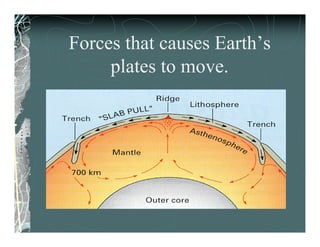
• The plates of the lithosphere float on top of the Asthenosphere.
• Convection currents rise in the Asthenosphere and spread out
beneath the lithosphere.
• Convection current forces drag the overlying plates along. The
currents cools and sinks deeper into the mantle.
• Scientist think that the downward movement may provide the
force that causes the subduction of plates carrying oceanic crust.
Forces that causes Earth’s
     plates to move.
Slab Push Hypothesis
• Magma rising along the mid oceanic
ridge exerts a force that pushes an oceanic
plate away from the ridge.
• The force of gravity causes plate
movement by pulling cooler, denser
oceanic plates down toward the mantle.
• Slab push and pull work together with
convection currents to move the plates.
The earth’s surface is made
up of about nine large plates
& several smaller plates.
Places where two plates meet.
There are three types of
 plate boundaries.
1. Transform Boundary
2. Divergent Boundary
3. Convergent Boundary
Two plates slip past each
other, moving in opposite
directions.
Earthquakes occur frequently
    along this boundary.
The San
Andreas
fault in
California is
an example
of a
transform
boundary.
Two plates move away from
each other.
• When divergent boundary
develop on land, two of Earth’s
plates slide apart.
• A rift valley forms along the
divergent valley.
• Ex. The Great Rift Valley in
east Africa is about 3,000
kilometers long.
Two plates move towards
      each other.
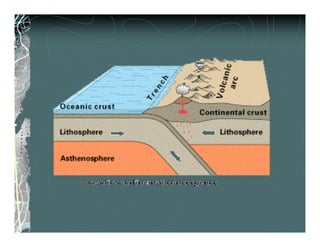
• When plates converge, it
 results in a collision.
 • Collisions happen between:
1. Oceanic crust to oceanic crust
2. Oceanic crust to continental crust
3. Continental crust to continental crust
Plate Movement
• The plates move at about 1-10
centimeters per year.
• The North American and Eurasian
plates move at about 2.5 cm/year.
Plate Movement
• Pangaea existed about 260 million
years ago.
• Approximately 225 million years ago
Pangaea began to break apart.
Plate Movement

Plate tectonics

  • 2.
    The theory thatstates that pieces of Earth’s lithosphere are in constant, slow motion, driven by convection currents in the mantle.
  • 3.
    • The theoryof plate tectonics explains the formation, movement, and subduction of Earth’s plates.
  • 4.
    Forces that causesEarth’s plates to move. • The plates of the lithosphere float on top of the Asthenosphere. • Convection currents rise in the Asthenosphere and spread out beneath the lithosphere. • Convection current forces drag the overlying plates along. The currents cools and sinks deeper into the mantle. • Scientist think that the downward movement may provide the force that causes the subduction of plates carrying oceanic crust.
  • 5.
    Forces that causesEarth’s plates to move.
  • 6.
    Slab Push Hypothesis •Magma rising along the mid oceanic ridge exerts a force that pushes an oceanic plate away from the ridge. • The force of gravity causes plate movement by pulling cooler, denser oceanic plates down toward the mantle. • Slab push and pull work together with convection currents to move the plates.
  • 7.
    The earth’s surfaceis made up of about nine large plates & several smaller plates.
  • 9.
    Places where twoplates meet.
  • 11.
    There are threetypes of plate boundaries. 1. Transform Boundary 2. Divergent Boundary 3. Convergent Boundary
  • 12.
    Two plates slippast each other, moving in opposite directions.
  • 13.
    Earthquakes occur frequently along this boundary.
  • 14.
    The San Andreas fault in Californiais an example of a transform boundary.
  • 15.
    Two plates moveaway from each other.
  • 16.
    • When divergentboundary develop on land, two of Earth’s plates slide apart. • A rift valley forms along the divergent valley. • Ex. The Great Rift Valley in east Africa is about 3,000 kilometers long.
  • 18.
    Two plates movetowards each other.
  • 19.
    • When platesconverge, it results in a collision. • Collisions happen between: 1. Oceanic crust to oceanic crust 2. Oceanic crust to continental crust 3. Continental crust to continental crust
  • 23.
    Plate Movement • Theplates move at about 1-10 centimeters per year. • The North American and Eurasian plates move at about 2.5 cm/year.
  • 24.
    Plate Movement • Pangaeaexisted about 260 million years ago. • Approximately 225 million years ago Pangaea began to break apart.
  • 25.