M.Iqbal Khan SS Biology GHSS Mochh
Mianwali 03135448175
Plant Transport1- Reason for transport system
2- Transport system in plants
3- Adaptations of xylem tissues
4- Adaptations of phloem tissues
5- Absorption of root hair cells
6- Water movement processes
7- Transpiration pull
8- Rate of transpiration
M.Iqbal Khan SS Biology GHSS Mochh
Mianwali 03135448175
1. Reason for transport system
 Unicellular organisms
 They can transport materials like oxygen and urea in and
out of their bodies by diffusion or osmosis easily.
 Multicellular organisms
 Most of the cells inside the organisms are too far from the
surface of their bodies and diffusion and osmosis are too
slow to be relied on.
 A transportation system is required for food and oxygen to
be brought efficiently from one place to another.
 Diffusion and osmosis would take place between the
transport system and the cells.
M.Iqbal Khan SS Biology GHSS Mochh
Mianwali 03135448175
2. Transport system in plants
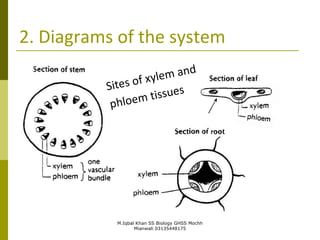
 Xylem and Phloem tissues
 Xylems transport water and minerals salts (nitrates) from
roots to leaves in a unidirectional motion
 Phloems transport organic products (sucrose) from the
leaves to all parts of the plant in a bidirectional motion
 Vascular bundles
 Xylem and Phloem tissues are arranged in vascular
bundles. A cambium separates the xylems and phloems.
 The cambium undergoes division to produce new xylems
and phloems.
M.Iqbal Khan SS Biology GHSS Mochh
Mianwali 03135448175
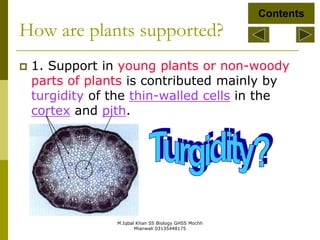
How are plants supported?
 1. Support in young plants or non-woody
parts of plants is contributed mainly by
turgidity of the thin-walled cells in the
cortex and pith.
Contents
M.Iqbal Khan SS Biology GHSS Mochh
Mianwali 03135448175
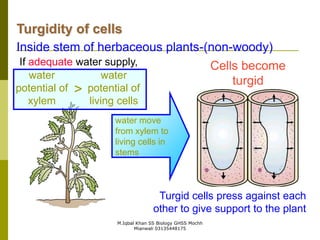
Turgidity of cells
Inside stem of herbaceous plants-(non-woody)
water
potential of
living cells
water
potential of
xylem
>
water move
from xylem to
living cells in
stems
Cells become
turgid
Turgid cells press against each
other to give support to the plant
If adequate water supply,
M.Iqbal Khan SS Biology GHSS Mochh
Mianwali 03135448175
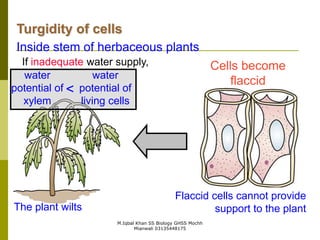
Turgidity of cells
Inside stem of herbaceous plants
water
potential of
living cells
water
potential of
xylem
<
Cells become
flaccid
Flaccid cells cannot provide
support to the plantThe plant wilts
If inadequate water supply,
M.Iqbal Khan SS Biology GHSS Mochh
Mianwali 03135448175
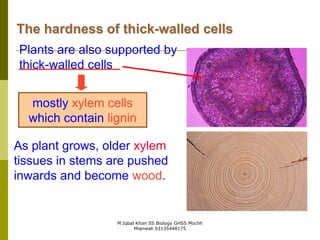
The hardness of thick-walled cells
Plants are also supported by
thick-walled cells
mostly xylem cells
which contain lignin
As plant grows, older xylem
tissues in stems are pushed
inwards and become wood.
M.Iqbal Khan SS Biology GHSS Mochh
Mianwali 03135448175
2. Diagrams of the system
M.Iqbal Khan SS Biology GHSS Mochh
Mianwali 03135448175
3. Functions of Xylem tissues
 Support
 Consists of lignin to provide the plant with support
 Transport of water and nitrates
 Conducts water and dissolved mineral salts from the roots
to all other parts of the plant
M.Iqbal Khan SS Biology GHSS Mochh
Mianwali 03135448175
3. Formation of Xylem tubes
 The xylem cells die when they mature. The cross
walls and cell contents will break down.
 A hollow lumen will be left. There is no obstruction
to the flow of water.
 The walls of the cells are thickened with lignin. It
causes the walls to be rigid, supporting the plant.
M.Iqbal Khan SS Biology GHSS Mochh
Mianwali 03135448175
3. Adaptations of Xylem tissues
 Absence cross walls
 Maintains a continuous
lumen
 Protoplasm disintegrate
 Allows water to move
efficiently
 Dead empty tube
 Maintains a continuous
lumen
 Lignified walls
 Walls are rigid
 Xylem will not collapse
 Supports the plant
M.Iqbal Khan SS Biology GHSS Mochh
Mianwali 03135448175
4. Adaptations of Phloem tissues
 Bi-directional sucrose
flow
 Food can be transported
to all parts of the plant
 Cross walls perforated
by sieve tubes
 Single row of thin
elongated walls with
minute pores
 Living cells to conduct
the food in the tube
 Companion cell present
 Consists of protoplasm
and mitochondria
 Assists sieve tubes in
transport of food
 Provides energy
required for active
transport
 When dead, sieve
elements will die off
M.Iqbal Khan SS Biology GHSS Mochh
Mianwali 03135448175
5. Root hair cells
 Plants absorb water and minerals from the soil
through the root hairs.
 Root hair cells absorb water and nitrates from the
soil efficiently.
 They help to hold the plant more firmly to the
ground.
M.Iqbal Khan SS Biology GHSS Mochh
Mianwali 03135448175
5. Adaptations of root hairs
 Finger-like extensions
 Increases surface area to
volume ratio
 To absorb water and
mineral salts at a faster
rate
 Lower water potential
 Allow osmosis and
diffusion of nitrates to
take place
 Large vacuole
 To absorb as much
water as it can hold
 Is a living cell
 Carries out respiration
 This provides energy for
active transport to take
place when water
potential is lower in the
soil
M.Iqbal Khan SS Biology GHSS Mochh
Mianwali 03135448175
5. Osmosis in the Root cells
 The soil particles have a higher water potential than the
vacuole of the root hair cell.
 Water and nitrates diffuse from the soil particles to the root
hair cell.
 The root hair cell becomes more dilute than the surrounding
cortex cells. Water and nitrates diffuse from the root hair cell
to the cortex cells by osmosis.
 Water diffuses from one cell to another until water eventually
enters the xylem tubes
 Intake of water in the roots, the root hair cells become turgid.
A pressure is thus generated. This pressure is called root
pressure. This forces water up the xylem tissues.
M.Iqbal Khan SS Biology GHSS Mochh
Mianwali 03135448175
6. Forces causing water movement
 Root pressure
 Produced by the continuous movement of water through
the root hair cells
 Pushes water up the xylem
 Transpiration pull
 Produced by the evaporation of water from the leaves
 Pulls water up the xylem
 Capillary action
 Produced by the conduction of water by the xylem
through its continuous lumen
 Pushes water up narrow xylem vessels
M.Iqbal Khan SS Biology GHSS Mochh
Mianwali 03135448175
7. Transpiration in the stomata
 In the stem xylem, water is pulled up the stem by
transpiration pull.
 Osmosis continues through the leaf cells and water is
eventually drawn in from the xylem vessels in the stem.
 As the water evaporates, the water potential of cell sap
decreases. It draws water from the lower cells by osmosis.
 Water evaporates from the surfaces of leaf cells into air
spaces.
 Water vapour from the air spaces diffuses through the stoma
and into the atmosphere.
M.Iqbal Khan SS Biology GHSS Mochh
Mianwali 03135448175
7. Transpiration pull of plants
 Plants absorb a large amount of water, but make use of only a
small portion of the water.
 A large portion of water is lost by evaporation of water
through the stomata of the leaves. This process is called
transpiration.
 Transpiration is the loss of water vapour mainly from the
stomata of the leaves.
 As water evaporates from the leaves, more is drawn up
through the plant to replace it due to cohesion forces
between water molecules in the xylem tissues.
 A pulling force called the transpiration pull is formed.
M.Iqbal Khan SS Biology GHSS Mochh
Mianwali 03135448175
7. Importance of Transpiration pull
 Transpiration pull is the transport of water and
mineral salts or nitrate ions from the soil to the
leaves.
 Ensures a constant flow of water to be taken from
the soil to the leaves.
 Enables photosynthesis to occur.
M.Iqbal Khan SS Biology GHSS Mochh
Mianwali 03135448175
8. Rate of transpiration increase
 Humidity of air
 Low
 Dryness of air
 High
 Temperature of air
 High
 Speed of wind
 High
 Light intensity
 High
M.Iqbal Khan SS Biology GHSS Mochh
Mianwali 03135448175
8. Light intensity
 Presence of light
 Photosynthesis occurs.
 Cell sap in guard cells has higher concentration of glucose.
 Water enters the guard cells by osmosis causing guard
cells to become turgid.
 Stomata opens and transpiration increases.
 Absence of light
 No photosynthesis occurs.
 Plant loses water, guard cells flaccid.
 Stomata closes and transpiration decreases.

Plant transport

  • 1.
    M.Iqbal Khan SSBiology GHSS Mochh Mianwali 03135448175 Plant Transport1- Reason for transport system 2- Transport system in plants 3- Adaptations of xylem tissues 4- Adaptations of phloem tissues 5- Absorption of root hair cells 6- Water movement processes 7- Transpiration pull 8- Rate of transpiration
  • 2.
    M.Iqbal Khan SSBiology GHSS Mochh Mianwali 03135448175 1. Reason for transport system  Unicellular organisms  They can transport materials like oxygen and urea in and out of their bodies by diffusion or osmosis easily.  Multicellular organisms  Most of the cells inside the organisms are too far from the surface of their bodies and diffusion and osmosis are too slow to be relied on.  A transportation system is required for food and oxygen to be brought efficiently from one place to another.  Diffusion and osmosis would take place between the transport system and the cells.
  • 3.
    M.Iqbal Khan SSBiology GHSS Mochh Mianwali 03135448175 2. Transport system in plants  Xylem and Phloem tissues  Xylems transport water and minerals salts (nitrates) from roots to leaves in a unidirectional motion  Phloems transport organic products (sucrose) from the leaves to all parts of the plant in a bidirectional motion  Vascular bundles  Xylem and Phloem tissues are arranged in vascular bundles. A cambium separates the xylems and phloems.  The cambium undergoes division to produce new xylems and phloems.
  • 4.
    M.Iqbal Khan SSBiology GHSS Mochh Mianwali 03135448175 How are plants supported?  1. Support in young plants or non-woody parts of plants is contributed mainly by turgidity of the thin-walled cells in the cortex and pith. Contents
  • 5.
    M.Iqbal Khan SSBiology GHSS Mochh Mianwali 03135448175 Turgidity of cells Inside stem of herbaceous plants-(non-woody) water potential of living cells water potential of xylem > water move from xylem to living cells in stems Cells become turgid Turgid cells press against each other to give support to the plant If adequate water supply,
  • 6.
    M.Iqbal Khan SSBiology GHSS Mochh Mianwali 03135448175 Turgidity of cells Inside stem of herbaceous plants water potential of living cells water potential of xylem < Cells become flaccid Flaccid cells cannot provide support to the plantThe plant wilts If inadequate water supply,
  • 7.
    M.Iqbal Khan SSBiology GHSS Mochh Mianwali 03135448175 The hardness of thick-walled cells Plants are also supported by thick-walled cells mostly xylem cells which contain lignin As plant grows, older xylem tissues in stems are pushed inwards and become wood.
  • 8.
    M.Iqbal Khan SSBiology GHSS Mochh Mianwali 03135448175 2. Diagrams of the system
  • 9.
    M.Iqbal Khan SSBiology GHSS Mochh Mianwali 03135448175 3. Functions of Xylem tissues  Support  Consists of lignin to provide the plant with support  Transport of water and nitrates  Conducts water and dissolved mineral salts from the roots to all other parts of the plant
  • 10.
    M.Iqbal Khan SSBiology GHSS Mochh Mianwali 03135448175 3. Formation of Xylem tubes  The xylem cells die when they mature. The cross walls and cell contents will break down.  A hollow lumen will be left. There is no obstruction to the flow of water.  The walls of the cells are thickened with lignin. It causes the walls to be rigid, supporting the plant.
  • 11.
    M.Iqbal Khan SSBiology GHSS Mochh Mianwali 03135448175 3. Adaptations of Xylem tissues  Absence cross walls  Maintains a continuous lumen  Protoplasm disintegrate  Allows water to move efficiently  Dead empty tube  Maintains a continuous lumen  Lignified walls  Walls are rigid  Xylem will not collapse  Supports the plant
  • 12.
    M.Iqbal Khan SSBiology GHSS Mochh Mianwali 03135448175 4. Adaptations of Phloem tissues  Bi-directional sucrose flow  Food can be transported to all parts of the plant  Cross walls perforated by sieve tubes  Single row of thin elongated walls with minute pores  Living cells to conduct the food in the tube  Companion cell present  Consists of protoplasm and mitochondria  Assists sieve tubes in transport of food  Provides energy required for active transport  When dead, sieve elements will die off
  • 13.
    M.Iqbal Khan SSBiology GHSS Mochh Mianwali 03135448175 5. Root hair cells  Plants absorb water and minerals from the soil through the root hairs.  Root hair cells absorb water and nitrates from the soil efficiently.  They help to hold the plant more firmly to the ground.
  • 14.
    M.Iqbal Khan SSBiology GHSS Mochh Mianwali 03135448175 5. Adaptations of root hairs  Finger-like extensions  Increases surface area to volume ratio  To absorb water and mineral salts at a faster rate  Lower water potential  Allow osmosis and diffusion of nitrates to take place  Large vacuole  To absorb as much water as it can hold  Is a living cell  Carries out respiration  This provides energy for active transport to take place when water potential is lower in the soil
  • 15.
    M.Iqbal Khan SSBiology GHSS Mochh Mianwali 03135448175 5. Osmosis in the Root cells  The soil particles have a higher water potential than the vacuole of the root hair cell.  Water and nitrates diffuse from the soil particles to the root hair cell.  The root hair cell becomes more dilute than the surrounding cortex cells. Water and nitrates diffuse from the root hair cell to the cortex cells by osmosis.  Water diffuses from one cell to another until water eventually enters the xylem tubes  Intake of water in the roots, the root hair cells become turgid. A pressure is thus generated. This pressure is called root pressure. This forces water up the xylem tissues.
  • 16.
    M.Iqbal Khan SSBiology GHSS Mochh Mianwali 03135448175 6. Forces causing water movement  Root pressure  Produced by the continuous movement of water through the root hair cells  Pushes water up the xylem  Transpiration pull  Produced by the evaporation of water from the leaves  Pulls water up the xylem  Capillary action  Produced by the conduction of water by the xylem through its continuous lumen  Pushes water up narrow xylem vessels
  • 17.
    M.Iqbal Khan SSBiology GHSS Mochh Mianwali 03135448175 7. Transpiration in the stomata  In the stem xylem, water is pulled up the stem by transpiration pull.  Osmosis continues through the leaf cells and water is eventually drawn in from the xylem vessels in the stem.  As the water evaporates, the water potential of cell sap decreases. It draws water from the lower cells by osmosis.  Water evaporates from the surfaces of leaf cells into air spaces.  Water vapour from the air spaces diffuses through the stoma and into the atmosphere.
  • 18.
    M.Iqbal Khan SSBiology GHSS Mochh Mianwali 03135448175 7. Transpiration pull of plants  Plants absorb a large amount of water, but make use of only a small portion of the water.  A large portion of water is lost by evaporation of water through the stomata of the leaves. This process is called transpiration.  Transpiration is the loss of water vapour mainly from the stomata of the leaves.  As water evaporates from the leaves, more is drawn up through the plant to replace it due to cohesion forces between water molecules in the xylem tissues.  A pulling force called the transpiration pull is formed.
  • 19.
    M.Iqbal Khan SSBiology GHSS Mochh Mianwali 03135448175 7. Importance of Transpiration pull  Transpiration pull is the transport of water and mineral salts or nitrate ions from the soil to the leaves.  Ensures a constant flow of water to be taken from the soil to the leaves.  Enables photosynthesis to occur.
  • 20.
    M.Iqbal Khan SSBiology GHSS Mochh Mianwali 03135448175 8. Rate of transpiration increase  Humidity of air  Low  Dryness of air  High  Temperature of air  High  Speed of wind  High  Light intensity  High
  • 21.
    M.Iqbal Khan SSBiology GHSS Mochh Mianwali 03135448175 8. Light intensity  Presence of light  Photosynthesis occurs.  Cell sap in guard cells has higher concentration of glucose.  Water enters the guard cells by osmosis causing guard cells to become turgid.  Stomata opens and transpiration increases.  Absence of light  No photosynthesis occurs.  Plant loses water, guard cells flaccid.  Stomata closes and transpiration decreases.