TISSUES AND
TYPES OF
PLANT TISSUES
TISSUES
Tissue is a cellular organizational level intermediate
between cells and a complete organism. A tissue is an ensemble of
similar cells from the same origin that together carry out a specific
function. Organs are then formed by the functional grouping
together of multiple tissues.
The study of tissue is known as histology or, in connection with
disease, histopathology. The classical tools for studying tissues are
the paraffin block in which tissue is embedded and then sectioned,
the histological stain, and the optical microscope. In the last couple of
decades, developments in electron microscopy,immunofluorescence,
and the use of frozen tissue sections have enhanced the detail that
can be observed in tissues. With these tools, the classical
appearances of tissues can be examined in health and disease,
enabling considerable refinement of clinical diagnosis and prognosis.
TYPES OF TISSUES
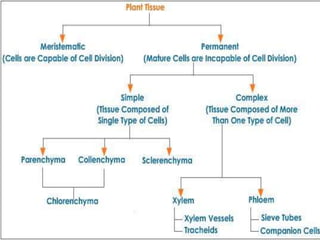
PLANT
TISSUES
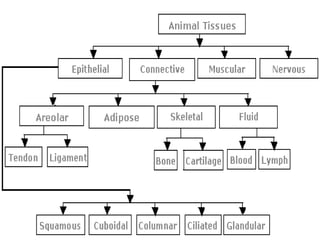
ANIMAL
TISSUES
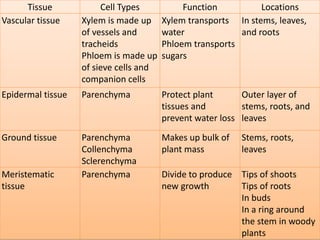
Tissue Cell Types Function Locations
Vascular tissue Xylem is made up
of vessels and
tracheids
Phloem is made up
of sieve cells and
companion cells
Xylem transports
water
Phloem transports
sugars
In stems, leaves,
and roots
Epidermal tissue Parenchyma Protect plant
tissues and
prevent water loss
Outer layer of
stems, roots, and
leaves
Ground tissue Parenchyma
Collenchyma
Sclerenchyma
Makes up bulk of
plant mass
Stems, roots,
leaves
Meristematic
tissue
Parenchyma Divide to produce
new growth
Tips of shoots
Tips of roots
In buds
In a ring around
the stem in woody
plants
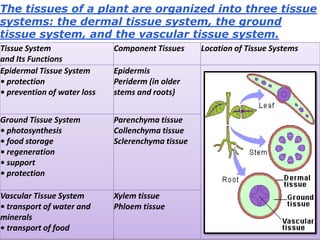
Tissue System
and Its Functions
Component Tissues Location of Tissue Systems
Epidermal Tissue System
• protection
• prevention of water loss
Epidermis
Periderm (in older
stems and roots)
Ground Tissue System
• photosynthesis
• food storage
• regeneration
• support
• protection
Parenchyma tissue
Collenchyma tissue
Sclerenchyma tissue
Vascular Tissue System
• transport of water and
minerals
• transport of food
Xylem tissue
Phloem tissue
The tissues of a plant are organized into three tissue
systems: the dermal tissue system, the ground
tissue system, and the vascular tissue system.
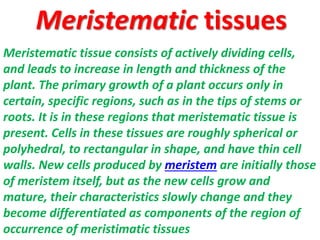
Meristematic tissue consists of actively dividing cells,
and leads to increase in length and thickness of the
plant. The primary growth of a plant occurs only in
certain, specific regions, such as in the tips of stems or
roots. It is in these regions that meristematic tissue is
present. Cells in these tissues are roughly spherical or
polyhedral, to rectangular in shape, and have thin cell
walls. New cells produced by meristem are initially those
of meristem itself, but as the new cells grow and
mature, their characteristics slowly change and they
become differentiated as components of the region of
occurrence of meristimatic tissues
Meristematic tissues
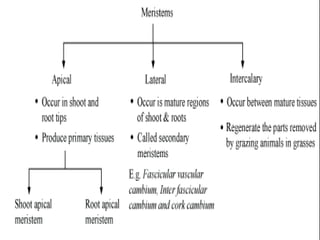
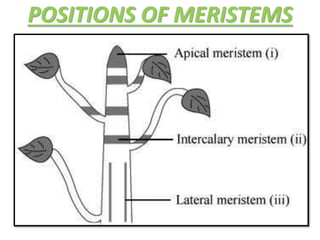
a) Apical Meristem - It is present at the growing tips of stems
and roots and increases the length of the stem and
root. They form growing parts at the apices of roots
and stems and are responsible for increase in length,
also called primary growth. This meristem is
responsible for the linear growth of an organ.
b) Lateral Meristem - This meristem consist of cells which
mainly divide in one plane and cause the organ to
increase in diameter and growth. Lateral Meristem
usually occurs beneath the bark of the tree in the form
of Cork Cambium and in vascular bundles of dicots in
the form of vascular cambium. The activity of this
cambium results in the formation of secondary growth.
c) Intercalary Meristem - This meristem is located in between
permanent tissues. It is usually present at the base of

node, inter node and on leaf base. They are
responsible for growth in length of the plant.
a) Apical Meristem - It is present at the growing tips of stems
and roots and increases the length of the stem and
root. They form growing parts at the apices of roots
and stems and are responsible for increase in length,
also called primary growth. This meristem is
responsible for the linear growth of an organ.
b) Lateral Meristem - This meristem consist of cells which
mainly divide in one plane and cause the organ to
increase in diameter and growth. Lateral Meristem
usually occurs beneath the bark of the tree in the form
of Cork Cambium and in vascular bundles of dicots in
the form of vascular cambium. The activity of this
cambium results in the formation of secondary growth.
c) Intercalary Meristem - This meristem is located in between
permanent tissues. It is usually present at the base of
node, inter node and on leaf base. They are
responsible for growth in length of the plant.
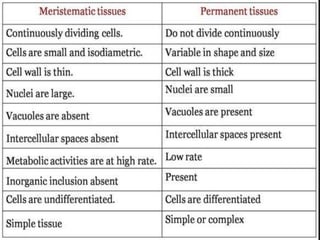
The cells of meristematic tissues are similar in
structure and have thin and elastic primary cell
wall made up of cellulose. They are compactly
arranged without inter-cellular spaces between
them. Each cell contains a dense cytoplasm and
a prominent nucleus. Dense protoplasm of
meristematic cells contains very few vacuoles.
Normally the meristematic cells are
oval, polygonal or rectangular in shape.
Meristemetic tissue cells have a
large nucleus with small or no vacuoles, they
have no inter cellular spaces.
POSITIONS OF MERISTEMS
Permanent tissues
The meristematic tissues that take up a specific role
lose the ability to divide. This process of taking up a
permanent shape, size and a function is
called cellular differentiation. Cells of meristematic
tissue differentiate to form different types of
permanent tissue. There are 3 types of permanent
tissues:
1. simple permanent tissues
2. complex permanent tissues
3. special or secretory tissues (glandular).
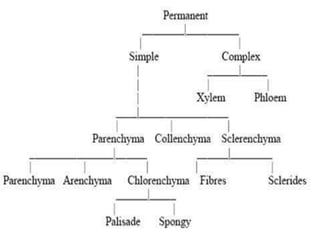
Simple permanent tissues
These tissues are called simple because
they are composed of similar types of cells
which have common origin and function.
They are further classified into:
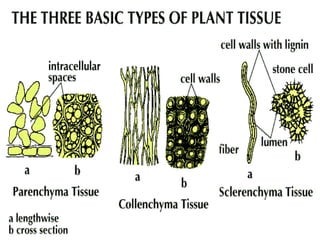
Parenchyma
Collenchyma
Sclerenchyma
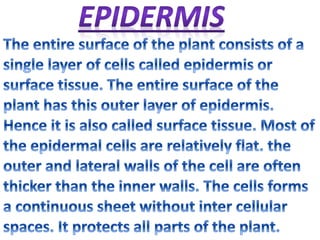
Epidermis
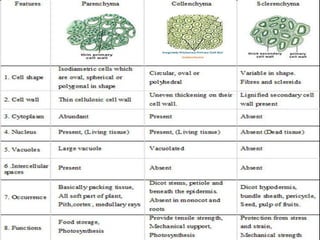
Parenchyma
Parenchyma (Para - 'beside'; chyma - 'in filling, loose,
unpacked') is the bulk of a substance. In plants, it
consists of relatively unspecialised cells with thin cell
walls that are usually loosely packed so that large
spaces between cells (intercellular spaces) are found in
this tissue. This tissue provides support to plants and
also stores food. In some situations, a parenchyma
contains chlorophyll and performs photosynthesis, in
which case it is called a chlorenchyma. In aquatic plants,
large air cavities are present in parenchyma to give
support to them to float on water. Such a parenchyma
type is called parenchyma.
Parenchyma
Parenchyma is the most common plant tissue. It is
relatively unspecialized and makes up a substantial
part of the volume of a herbaceous plant and of the
leaves, flowers and the fruits of woody plants. The
thin-walled parenchyma cells have large vacuoles
and distinct intercellular spaces.
Functions:
the most important function of the parenchyma cells
of roots and stem is the storage of food (e.g. starch)
and water, the intercellular air spaces permit
gaseous exchange.
Aerenchyma
Aerenchyma is an airy tissue found in roots of plants,
which allows exchange of gases between the shoot and
the root. It contains large air-filled cavities, which provide
a low-resistance internal pathway for the exchange of
gases such as oxygen and ethylene between the plant
parts above the water and the submerged tissues.
It is found in both roots that are submitted to anaerobic
conditions such as flooding (Visser et al, 1997). For
example, Blom et al (1994) researched adaptive responses
of plants to flooding along the banks of the Rhine river,
wich included such morphological changes such as
aerenchyma formation.
Sometimes, parenchyma cells contain
chloroplast , These type of parenchyma cells
are known as Chlorenchyma . They perform
photosynthesis in plants.
PARENCHYMA THAT CONTAINS CHLOROPHYLL
AND PERFORMS PHOTOSYNTHESIS IN PLANTS.
When Chloroplast developed in Parenchyma
and gets green than it is called Chlorenchyma
tissue.
Collenchyma
Collenchyma is Greek word where "Collen" means gum and
"enchyma" means infusion. It is a living tissue of primary body
like Parenchyma. Cells are thin-walled but possess thickening
of cellulose and pectin substances at the corners where
number of cells join together. This tissue gives a tensile
strength to the plant and the cells are compactly arranged and
have very little inter-cellular spaces. It occurs chiefly
in hypodermis of stems and leaves. It is absent
in monocots and in roots.
Collenchymatous tissue acts as a supporting tissue in
stems of young plants. It provides mechanical support,
elasticity, and tensile strength to the plant body. It helps in
manufacturing sugar and storing it as starch. It is present in
the margin of leaves and resist tearing effect of the wind.
Sclerenchyma
Sclerenchyma is Greek word where "Sclrenes" means hard and "enchyma"
means infusion. This tissue consists of thick-walled, dead cells. These cells
have hard and extremely thick secondary walls due to uniform distribution
of lignin. Lignin deposition is so thick that the cell walls become strong, rigid
and impermeable to water. Sclerenchymatous cells are closely packed
without inter-cellular spaces between them. Thus, they appear as hexagonal
net in transverse section. The cells are cemented with the help of lamella.
The middle lamella is a wall that lies between adjacent cells.
Sclerenchymatous cells mainly occur in hypodermis, pericycle, secondary
xylem and phloem. They also occur in endocorp of almond and coconut. It is
made of pectin, lignin, protein. The cells of sclerenchymatous cells can be
classified as :
Fibres- Fibres are long, elongated sclerenchymatous cells with pointed ends.
Sclerides- Sclerenchymatous cells which are short and possess extremely
thick, lamellated, lignified walls with long singular piths. They are called
sclerides.
The main function of Sclerenchymatous tissues is to give support to the
plant.
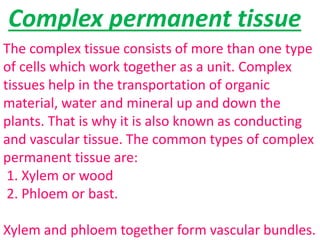
Complex permanent tissue
The complex tissue consists of more than one type
of cells which work together as a unit. Complex
tissues help in the transportation of organic
material, water and mineral up and down the
plants. That is why it is also known as conducting
and vascular tissue. The common types of complex
permanent tissue are:
1. Xylem or wood
2. Phloem or bast.
Xylem and phloem together form vascular bundles.
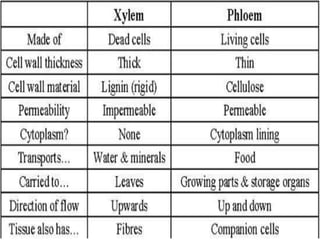
Xylem
Xylem consists of:
1. Tracheid
2. Vessel Members
3. Xylem fibers
4. Xylem parenchyma.
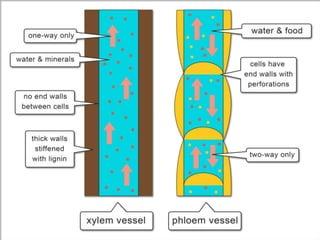
Xylem is a chief, conducting tissue
of vascular plants. It is responsible for
conduction of water and mineral ions.
Xylem is a very important plant tissue as it is part of the ‘plumbing’ of
a plant. Think of bundles of pipes running along the main axis of
stems and roots. It carries water and dissolved substances
throughout and consists of a combination of parenchyma cells, fibers,
vessels, tracheids and ray cells. Long tubes made up of individual cells
are the vessels, while vessel members are open at each end.
Internally, there may be bars of wall material extending across the
open space. These cells are joined end to end to form long tubes.
Vessel members and tracheids are dead at maturity. Tracheids have
thick secondary cell walls and are tapered at the ends. They do not
have end openings such as the vessels. The tracheids ends overlap
with each other, with pairs of pits present. The pit pairs allow water
to pass from cell to cell. While most conduction in the xylem is up and
down, there is some side-to-side or lateral conduction via rays. Rays
are horizontal rows of long-living parenchyma cells that arise out of
the vascular cambium. In trees, and other woody plants, ray will
radiate out from the center of stems and roots and in cross-section
will look like the spokes of a wheel.
Phloem
Phloem consists of:
Sieve tube
Sieve cell
Companion cell
Phloem fiber
Phloem parenchyma.
Phloem is an equally important plant tissue as it also is part of the ‘plumbing’
of a plant. Primarily, phloem carries dissolved food substances throughout the
plant. This conduction system is composed of sieve-tube member and
companion cells, that are without secondary walls. The parent cells of the
vascular cambium produce both xylem and phloem. This usually also includes
fibers, parenchyma and ray cells. Sieve tubes are formed from sieve-tube
members laid end to end. The end walls, unlike vessel members in xylem, do
not have openings. The end walls, however, are full of small pores where
cytoplasm extends from cell to cell. These porous connections are called sieve
plates. In spite of the fact that their cytoplasm is actively involved in the
conduction of food materials, sieve-tube members do not have nuclei at
maturity. It is the companion cells that are nestled between sieve-tube
members that function in some manner bringing about the conduction of food.
Sieve-tube members that are alive contain a polymer called callose . Callose
stays in solution as long at the cell contents are under pressure. As a repair
mechanism, if an insect injures a cell and the pressure drops, the callose will
precipitate. However, the callose and a phloem protein will be moved through
the nearest sieve plate where they will form a plug. This prevents further
leakage of sieve tube contents and the injury is not necessarily fatal to overall
plant turgor pressure. Phloem transports food and materials in plants in
upwards and downwards as required.
PLANT TISSUES.pptx
PLANT TISSUES.pptx