Planning Process for Economic Growth
             in Pakistan


                Dr. Vaqar Ahmed
     Sustainable Development Policy Center   1
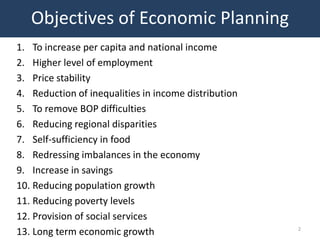
Objectives of Economic Planning
1. To increase per capita and national income
2. Higher level of employment
3. Price stability
4. Reduction of inequalities in income distribution
5. To remove BOP difficulties
6. Reducing regional disparities
7. Self-sufficiency in food
8. Redressing imbalances in the economy
9. Increase in savings
10. Reducing population growth
11. Reducing poverty levels
12. Provision of social services
                                                      2
13. Long term economic growth
Planning Myths


                 3
Myth 1: Planning is useless because
     policies lack consistency


                                      4
Myth 2: LDCs including Pakistan have not
completed the tenure of their economic policies


                                             5
Myth 2: LDCs including Pakistan have not completed the
           tenure of their economic policies

   The discontinuity was not in policies but projects


                                                        6
Myth 3: Pakistan Vs. South Korea Model
                Myth


                                    7
Myth 3: Pakistan Vs. South Korea Model

• Aid Received

• Model Focus


                                    8
Planning for Growth

• Financing for Growth
  – Debt Funding
  – Equity funding


• Public Sector Funding :
  – PSDP
  – Assistance
  – Equity

                                9
Planning for Income Distribution

• Can growth & distribution be achieved
  simultaneously?

• Is growth necessary for distribution?

• Is it economic growth that leads to reduction
  in poverty or the process of distribution?

  – Case of Trade Liberalization ?                10
Policy Planning & Implementation Stages

 •   Data Collection
 •   Analysis
 •   Planning & Prioritizing
 •   Implementation
 •   Monitoring


                                    11
Planning Process and Machinery in
             Pakistan


                                    12
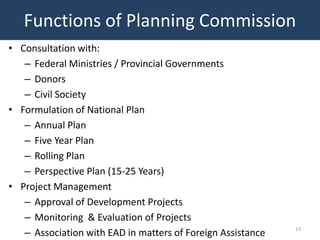
Functions of Planning Commission
• Consultation with:
   – Federal Ministries / Provincial Governments
   – Donors
   – Civil Society
• Formulation of National Plan
   – Annual Plan
   – Five Year Plan
   – Rolling Plan
   – Perspective Plan (15-25 Years)
• Project Management
   – Approval of Development Projects
   – Monitoring & Evaluation of Projects
   – Association with EAD in matters of Foreign Assistance   13
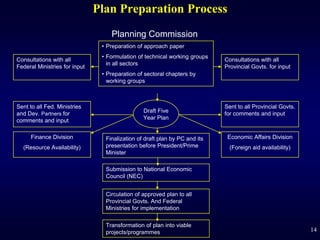
Plan Preparation Process
                                   Planning Commission
                                • Preparation of approach paper
                                • Formulation of technical working groups
Consultations with all                                                      Consultations with all
                                  in all sectors
Federal Ministries for input                                                Provincial Govts. for input
                                • Preparation of sectoral chapters by
                                  working groups


Sent to all Fed. Ministries                                                 Sent to all Provincial Govts.
and Dev. Partners for                           Draft Five                  for comments and input
comments and input                              Year Plan


     Finance Division            Finalization of draft plan by PC and its    Economic Affairs Division
  (Resource Availability)        presentation before President/Prime          (Foreign aid availability)
                                 Minister

                                 Submission to National Economic
                                 Council (NEC)


                                 Circulation of approved plan to all
                                 Provincial Govts. And Federal
                                 Ministries for implementation

                                 Transformation of plan into viable
                                 projects/programmes                                                        14
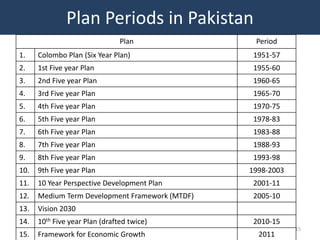
Plan Periods in Pakistan
                                Plan              Period
1.    Colombo Plan (Six Year Plan)                1951-57
2.    1st Five year Plan                          1955-60
3.    2nd Five year Plan                          1960-65
4.    3rd Five year Plan                          1965-70
5.    4th Five year Plan                          1970-75
6.    5th Five year Plan                          1978-83
7.    6th Five year Plan                          1983-88
8.    7th Five year Plan                          1988-93
9.    8th Five year Plan                          1993-98
10.   9th Five year Plan                         1998-2003
11.   10 Year Perspective Development Plan        2001-11
12.   Medium Term Development Framework (MTDF)    2005-10
13.   Vision 2030
14.   10th Five year Plan (drafted twice)         2010-15
                                                             15
15.   Framework for Economic Growth                2011
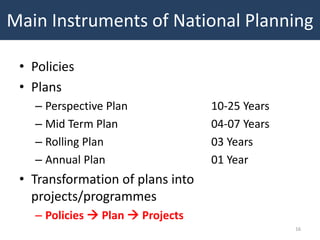
Main Instruments of National Planning

 • Policies
 • Plans
   – Perspective Plan             10-25 Years
   – Mid Term Plan                04-07 Years
   – Rolling Plan                 03 Years
   – Annual Plan                  01 Year
 • Transformation of plans into
   projects/programmes
   – Policies  Plan  Projects
                                                16
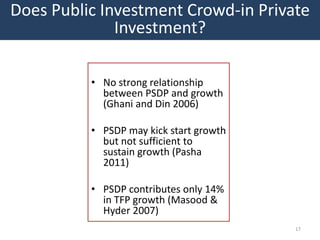
Does Public Investment Crowd-in Private
              Investment?

          • No strong relationship
            between PSDP and growth
            (Ghani and Din 2006)

          • PSDP may kick start growth
            but not sufficient to
            sustain growth (Pasha
            2011)

          • PSDP contributes only 14%
            in TFP growth (Masood &
            Hyder 2007)
                                         17
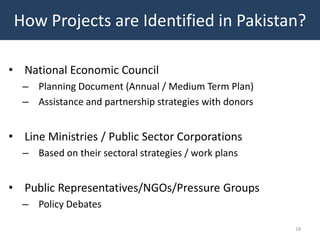
How Projects are Identified in Pakistan?

• National Economic Council
  – Planning Document (Annual / Medium Term Plan)
  – Assistance and partnership strategies with donors


• Line Ministries / Public Sector Corporations
  – Based on their sectoral strategies / work plans


• Public Representatives/NGOs/Pressure Groups
  – Policy Debates

                                                        18
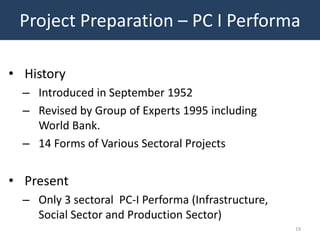
Project Preparation – PC I Performa

• History
  – Introduced in September 1952
  – Revised by Group of Experts 1995 including
    World Bank.
  – 14 Forms of Various Sectoral Projects


• Present
  – Only 3 sectoral PC-I Performa (Infrastructure,
    Social Sector and Production Sector)
                                                     19
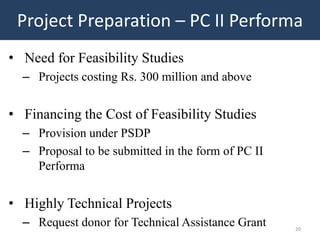
Project Preparation – PC II Performa
• Need for Feasibility Studies
  – Projects costing Rs. 300 million and above


• Financing the Cost of Feasibility Studies
  – Provision under PSDP
  – Proposal to be submitted in the form of PC II
    Performa


• Highly Technical Projects
  – Request donor for Technical Assistance Grant    20
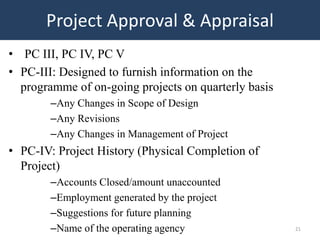
Project Approval & Appraisal
• PC III, PC IV, PC V
• PC-III: Designed to furnish information on the
  programme of on-going projects on quarterly basis
        –Any Changes in Scope of Design
        –Any Revisions
        –Any Changes in Management of Project
• PC-IV: Project History (Physical Completion of
  Project)
        –Accounts Closed/amount unaccounted
        –Employment generated by the project
        –Suggestions for future planning
        –Name of the operating agency                 21
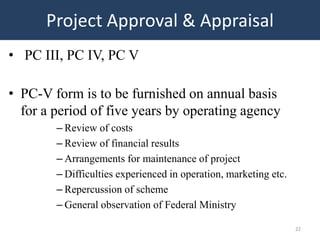
Project Approval & Appraisal
• PC III, PC IV, PC V

• PC-V form is to be furnished on annual basis
  for a period of five years by operating agency
        – Review of costs
        – Review of financial results
        – Arrangements for maintenance of project
        – Difficulties experienced in operation, marketing etc.
        – Repercussion of scheme
        – General observation of Federal Ministry

                                                                  22
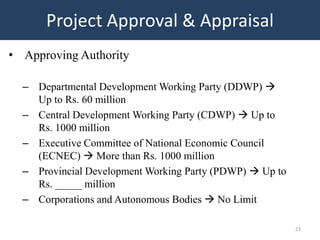
Project Approval & Appraisal
• Approving Authority

  – Departmental Development Working Party (DDWP) 
    Up to Rs. 60 million
  – Central Development Working Party (CDWP)  Up to
    Rs. 1000 million
  – Executive Committee of National Economic Council
    (ECNEC)  More than Rs. 1000 million
  – Provincial Development Working Party (PDWP)  Up to
    Rs. _____ million
  – Corporations and Autonomous Bodies  No Limit

                                                          23
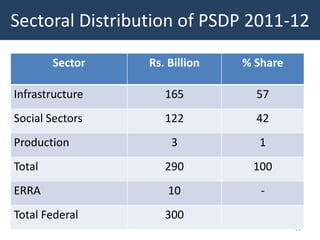
Sectoral Distribution of PSDP 2011-12

        Sector   Rs. Billion   % Share

Infrastructure      165          57
Social Sectors      122          42
Production           3           1
Total               290         100
ERRA                 10           -
Total Federal       300
                                         24
Why is PSDP Falling?


 Size of PSDP [Federal + Provincial]   Share of PSDP in Overall Expenditure


Current Expenditure Crowding out Development Expenditure25
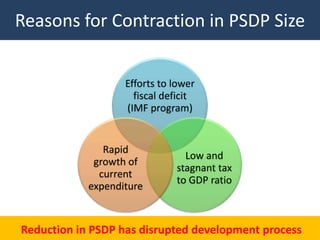
Reasons for Contraction in PSDP Size


                   Efforts to lower
                     fiscal deficit
                   (IMF program)


               Rapid
                                Low and
             growth of
                              stagnant tax
              current
                              to GDP ratio
            expenditure


Reduction in PSDP has disrupted development process
                                                  26
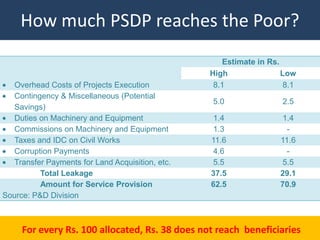
How much PSDP reaches the Poor?
                                                     Estimate in Rs.
                                                  High               Low
   Overhead Costs of Projects Execution            8.1                8.1
   Contingency & Miscellaneous (Potential
                                                  5.0                2.5
   Savings)
   Duties on Machinery and Equipment               1.4               1.4
   Commissions on Machinery and Equipment          1.3                -
   Taxes and IDC on Civil Works                   11.6              11.6
   Corruption Payments                             4.6                -
   Transfer Payments for Land Acquisition, etc.    5.5               5.5
          Total Leakage                           37.5              29.1
          Amount for Service Provision            62.5              70.9
Source: P&D Division


     For every Rs. 100 allocated, Rs. 38 does not reach beneficiaries
                                                                    27
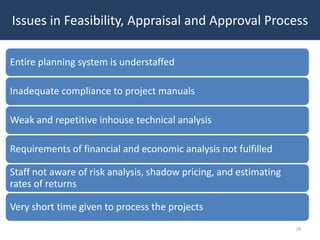
Issues in Feasibility, Appraisal and Approval Process

Entire planning system is understaffed

Inadequate compliance to project manuals

Weak and repetitive inhouse technical analysis

Requirements of financial and economic analysis not fulfilled

Staff not aware of risk analysis, shadow pricing, and estimating
rates of returns

Very short time given to process the projects
                                                                   28
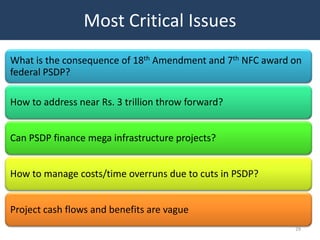
Most Critical Issues
What is the consequence of 18th Amendment and 7th NFC award on
federal PSDP?

How to address near Rs. 3 trillion throw forward?


Can PSDP finance mega infrastructure projects?


How to manage costs/time overruns due to cuts in PSDP?


Project cash flows and benefits are vague
                                                            29
Rationalization of PSDP Portfolio


                                    30
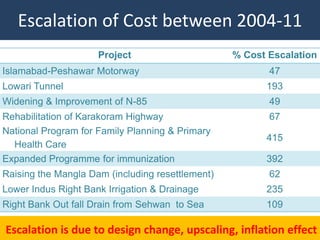
Escalation of Cost between 2004-11
                     Project                      % Cost Escalation
Islamabad-Peshawar Motorway                              47
Lowari Tunnel                                           193
Widening & Improvement of N-85                           49
Rehabilitation of Karakoram Highway                      67
National Program for Family Planning & Primary
                                                        415
  Health Care
Expanded Programme for immunization                     392
Raising the Mangla Dam (including resettlement)          62
Lower Indus Right Bank Irrigation & Drainage            235
Right Bank Out fall Drain from Sehwan to Sea            109

Escalation is due to design change, upscaling, inflation effect
                                                          31
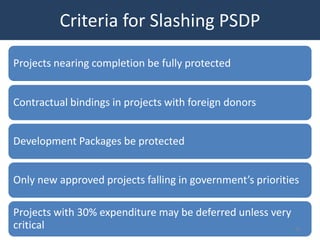
Criteria for Slashing PSDP

Projects nearing completion be fully protected


Contractual bindings in projects with foreign donors


Development Packages be protected


Only new approved projects falling in government’s priorities

Projects with 30% expenditure may be deferred unless very
critical                                                    32
Analysis of Projects in PSDP


                               33
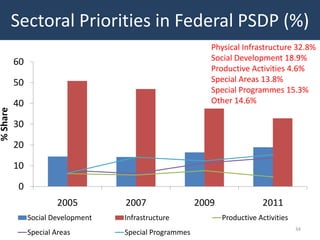
Sectoral Priorities in Federal PSDP (%)
                                                            Physical Infrastructure 32.8%
          60                                                Social Development 18.9%
                                                            Productive Activities 4.6%
          50                                                Special Areas 13.8%
                                                            Special Programmes 15.3%
          40                                                Other 14.6%
% Share


          30

          20

          10

           0
                        2005        2007                 2009               2011
               Social Development   Infrastructure              Productive Activities
                                                                                        34
               Special Areas        Special Programmes
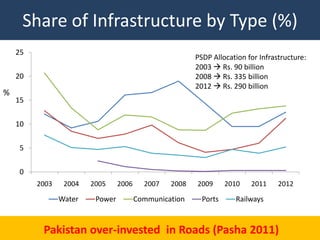
Share of Infrastructure by Type (%)
    25
                                                        PSDP Allocation for Infrastructure:
                                                        2003  Rs. 90 billion
    20                                                  2008  Rs. 335 billion
                                                        2012  Rs. 290 billion
%
    15

    10

    5

    0
         2003    2004   2005     2006     2007   2008   2009      2010   2011     2012

                Water    Power          Communication     Ports     Railways


          Pakistan over-invested in Roads (Pasha 2011)                                   35
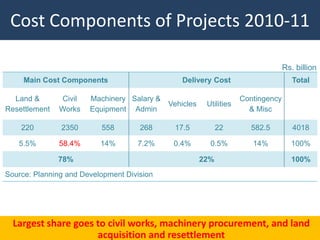
Cost Components of Projects 2010-11

                                                                                  Rs. billion
     Main Cost Components                      Delivery Cost                         Total

  Land &       Civil   Machinery Salary &                           Contingency
                                            Vehicles    Utilities
Resettlement   Works   Equipment Admin                                & Misc

    220        2350       558        268     17.5            22        582.5         4018

   5.5%        58.4%      14%       7.2%     0.4%        0.5%          14%          100%

               78%                                     22%                          100%
Source: Planning and Development Division


  Largest share goes to civil works, machinery procurement, and land
                                                                 36
                     acquisition and resettlement
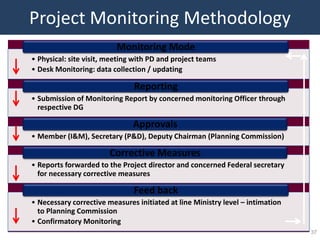
Project Monitoring Methodology
                          Monitoring Mode
• Physical: site visit, meeting with PD and project teams
• Desk Monitoring: data collection / updating

                               Reporting
• Submission of Monitoring Report by concerned monitoring Officer through
  respective DG

                               Approvals
• Member (I&M), Secretary (P&D), Deputy Chairman (Planning Commission)

                        Corrective Measures
• Reports forwarded to the Project director and concerned Federal secretary
  for necessary corrective measures

                               Feed back
• Necessary corrective measures initiated at line Ministry level – intimation
  to Planning Commission
• Confirmatory Monitoring
                                                                                37
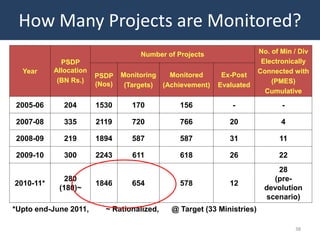
How Many Projects are Monitored?
                                     Number of Projects                 No. of Min / Div
             PSDP                                                        Electronically
  Year     Allocation                                                   Connected with
                        PSDP    Monitoring   Monitored      Ex-Post
            (BN Rs.)                                                        (PMES)
                        (Nos)    (Targets) (Achievement)   Evaluated
                                                                          Cumulative

2005-06       204       1530       170          156            -               -

2007-08       335       2119       720          766           20               4

2008-09       219       1894       587          587           31              11

2009-10       300       2243       611          618           26              22
                                                                             28
              280                                                           (pre-
2010-11*                1846       654          578           12
            (180)~                                                        devolution
                                                                          scenario)
*Upto end-June 2011,      ~ Rationalized,    @ Target (33 Ministries)

                                                                                   38
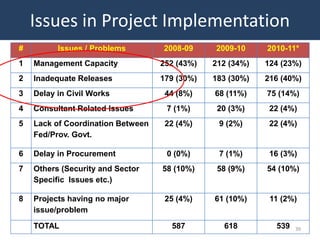
Issues in Project Implementation
#         Issues / Problems        2008-09     2009-10     2010-11*
1   Management Capacity            252 (43%)   212 (34%)   124 (23%)
2   Inadequate Releases            179 (30%)   183 (30%)   216 (40%)
3   Delay in Civil Works            44 (8%)    68 (11%)    75 (14%)
4   Consultant Related Issues       7 (1%)      20 (3%)     22 (4%)
5   Lack of Coordination Between    22 (4%)     9 (2%)      22 (4%)
    Fed/Prov. Govt.

6   Delay in Procurement            0 (0%)      7 (1%)      16 (3%)
7   Others (Security and Sector    58 (10%)     58 (9%)    54 (10%)
    Specific Issues etc.)

8   Projects having no major        25 (4%)    61 (10%)     11 (2%)
    issue/problem

    TOTAL                            587         618         539   39
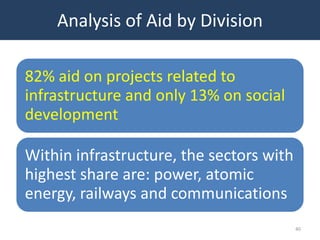
Analysis of Aid by Division

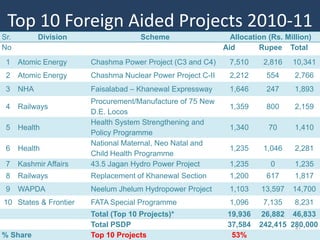
82% aid on projects related to
infrastructure and only 13% on social
development

Within infrastructure, the sectors with
highest share are: power, atomic
energy, railways and communications
                                          40
Top 10 Foreign Aided Projects 2010-11
Sr.         Division                  Scheme                   Allocation (Rs. Million)
No                                                           Aid       Rupee Total
 1    Atomic Energy     Chashma Power Project (C3 and C4)     7,510     2,816    10,341
 2    Atomic Energy     Chashma Nuclear Power Project C-II    2,212      554      2,766
 3    NHA               Faisalabad – Khanewal Expressway      1,646      247      1,893
                        Procurement/Manufacture of 75 New
 4    Railways                                                1,359      800      2,159
                        D.E. Locos
                        Health System Strengthening and
 5    Health                                                  1,340       70      1,410
                        Policy Programme
                        National Maternal, Neo Natal and
 6    Health                                                  1,235     1,046     2,281
                        Child Health Programme
 7    Kashmir Affairs   43.5 Jagan Hydro Power Project        1,235        0      1,235
 8    Railways          Replacement of Khanewal Section       1,200      617      1,817
 9    WAPDA             Neelum Jhelum Hydropower Project      1,103     13,597   14,700
10 States & Frontier    FATA Special Programme                1,096     7,135     8,231
                        Total (Top 10 Projects)*              19,936    26,882 46,833
                        Total PSDP                            37,584   242,415 280,000
                                                                                41
% Share                 Top 10 Projects                        53%
7th NFC Award & 18th Amendment


                                 42
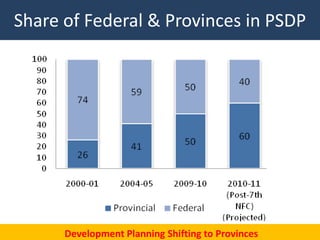
Share of Federal & Provinces in PSDP


                                                   43
      Development Planning Shifting to Provinces
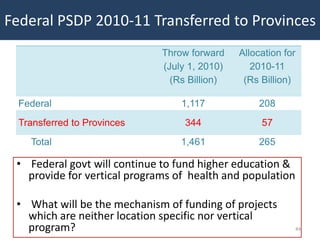
Federal PSDP 2010-11 Transferred to Provinces
                              Throw forward    Allocation for
                              (July 1, 2010)      2010-11
                                (Rs Billion)    (Rs Billion)

  Federal                         1,117            208
  Transferred to Provinces         344              57
    Total                         1,461            265

 • Federal govt will continue to fund higher education &
   provide for vertical programs of health and population

 • What will be the mechanism of funding of projects
   which are neither location specific nor vertical
   program?                                                 44
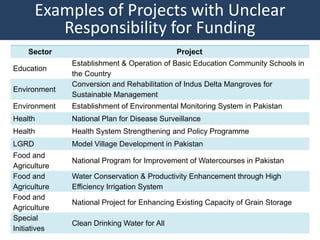
Examples of Projects with Unclear
          Responsibility for Funding
    Sector                                   Project
              Establishment & Operation of Basic Education Community Schools in
Education
              the Country
              Conversion and Rehabilitation of Indus Delta Mangroves for
Environment
              Sustainable Management
Environment   Establishment of Environmental Monitoring System in Pakistan
Health        National Plan for Disease Surveillance
Health        Health System Strengthening and Policy Programme
LGRD          Model Village Development in Pakistan
Food and
              National Program for Improvement of Watercourses in Pakistan
Agriculture
Food and      Water Conservation & Productivity Enhancement through High
Agriculture   Efficiency Irrigation System
Food and
              National Project for Enhancing Existing Capacity of Grain Storage
Agriculture
Special
              Clean Drinking Water for All
Initiatives                                                                       45
Reforms Agenda for PSDP


                          46
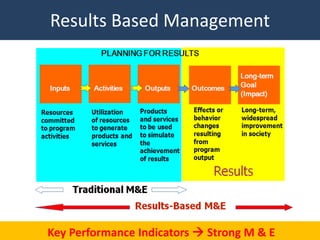
Results Based Management


Key Performance Indicators  Strong M & E   47
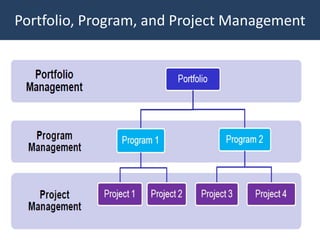
Portfolio, Program, and Project Management


                                        48
How Provinces should Rationalize
          Throwforward?

Projects which are politically driven do not provide
economic justification

Several projects represent a duplication

New and ongoing projects for which expenditure incurred
is less than 25% should be considered for closure


                                                          49
Minimizing the Leakages

Project management costs should be minimized (including
corruption)

Dedicated Project Directors Required [current incentives
distorted]

Consultancy charges should be rationalized


Contingencies should be reduced


Public sector projects should be exempted from GST
                                                           50
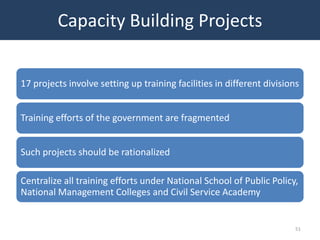
Capacity Building Projects


17 projects involve setting up training facilities in different divisions


Training efforts of the government are fragmented


Such projects should be rationalized

Centralize all training efforts under National School of Public Policy,
National Management Colleges and Civil Service Academy


                                                                        51
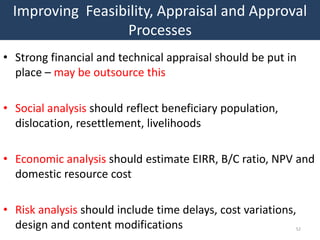
Improving Feasibility, Appraisal and Approval
                 Processes
• Strong financial and technical appraisal should be put in
  place – may be outsource this

• Social analysis should reflect beneficiary population,
  dislocation, resettlement, livelihoods

• Economic analysis should estimate EIRR, B/C ratio, NPV and
  domestic resource cost

• Risk analysis should include time delays, cost variations,
  design and content modifications                         52
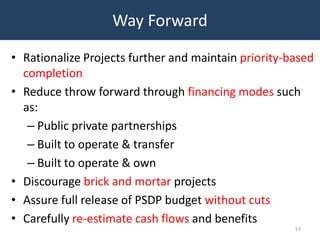
Way Forward

• Rationalize Projects further and maintain priority-based
  completion
• Reduce throw forward through financing modes such
  as:
   – Public private partnerships
   – Built to operate & transfer
   – Built to operate & own
• Discourage brick and mortar projects
• Assure full release of PSDP budget without cuts
• Carefully re-estimate cash flows and benefits
                                                      53
Thank You


 www.sdpi.org
vaqar@sdpi.org   54
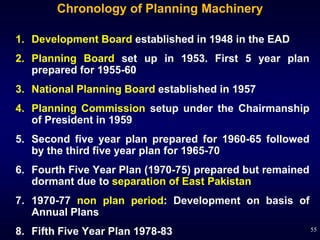
Chronology of Planning Machinery

1. Development Board established in 1948 in the EAD
2. Planning Board set up in 1953. First 5 year plan
   prepared for 1955-60
3. National Planning Board established in 1957
4. Planning Commission setup under the Chairmanship
   of President in 1959
5. Second five year plan prepared for 1960-65 followed
   by the third five year plan for 1965-70
6. Fourth Five Year Plan (1970-75) prepared but remained
   dormant due to separation of East Pakistan
7. 1970-77 non plan period: Development on basis of
   Annual Plans
8. Fifth Five Year Plan 1978-83                            55
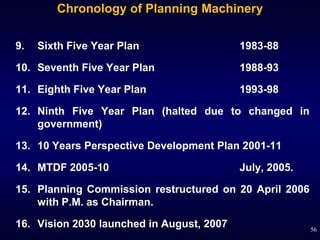
Chronology of Planning Machinery

9.   Sixth Five Year Plan                  1983-88

10. Seventh Five Year Plan                 1988-93

11. Eighth Five Year Plan                  1993-98

12. Ninth Five Year Plan (halted due to changed in
    government)

13. 10 Years Perspective Development Plan 2001-11

14. MTDF 2005-10                           July, 2005.

15. Planning Commission restructured on 20 April 2006
    with P.M. as Chairman.

16. Vision 2030 launched in August, 2007                 56
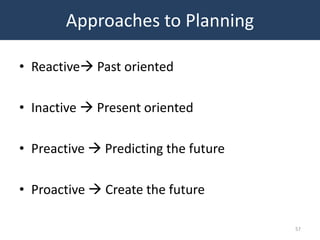
Approaches to Planning

• Reactive Past oriented

• Inactive  Present oriented

• Preactive  Predicting the future

• Proactive  Create the future

                                      57
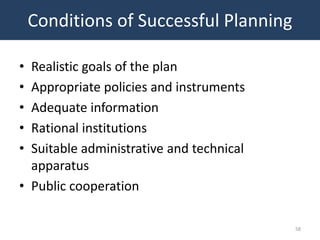
Conditions of Successful Planning

• Realistic goals of the plan
• Appropriate policies and instruments
• Adequate information
• Rational institutions
• Suitable administrative and technical
  apparatus
• Public cooperation

                                          58
Project Management Lifecycle

•   Identification and Formulation
•   Appraisal and Approval
•   Implementation
•   Completion and Closure
•   Ex-post Evaluation


                                     59

Planning Process for Economic Development in Pakistan

  • 1.
    Planning Process forEconomic Growth in Pakistan Dr. Vaqar Ahmed Sustainable Development Policy Center 1
  • 2.
    Objectives of EconomicPlanning 1. To increase per capita and national income 2. Higher level of employment 3. Price stability 4. Reduction of inequalities in income distribution 5. To remove BOP difficulties 6. Reducing regional disparities 7. Self-sufficiency in food 8. Redressing imbalances in the economy 9. Increase in savings 10. Reducing population growth 11. Reducing poverty levels 12. Provision of social services 2 13. Long term economic growth
  • 3.
  • 4.
    Myth 1: Planningis useless because policies lack consistency 4
  • 5.
    Myth 2: LDCsincluding Pakistan have not completed the tenure of their economic policies 5
  • 6.
    Myth 2: LDCsincluding Pakistan have not completed the tenure of their economic policies The discontinuity was not in policies but projects 6
  • 7.
    Myth 3: PakistanVs. South Korea Model Myth 7
  • 8.
    Myth 3: PakistanVs. South Korea Model • Aid Received • Model Focus 8
  • 9.
    Planning for Growth •Financing for Growth – Debt Funding – Equity funding • Public Sector Funding : – PSDP – Assistance – Equity 9
  • 10.
    Planning for IncomeDistribution • Can growth & distribution be achieved simultaneously? • Is growth necessary for distribution? • Is it economic growth that leads to reduction in poverty or the process of distribution? – Case of Trade Liberalization ? 10
  • 11.
    Policy Planning &Implementation Stages • Data Collection • Analysis • Planning & Prioritizing • Implementation • Monitoring 11
  • 12.
    Planning Process andMachinery in Pakistan 12
  • 13.
    Functions of PlanningCommission • Consultation with: – Federal Ministries / Provincial Governments – Donors – Civil Society • Formulation of National Plan – Annual Plan – Five Year Plan – Rolling Plan – Perspective Plan (15-25 Years) • Project Management – Approval of Development Projects – Monitoring & Evaluation of Projects – Association with EAD in matters of Foreign Assistance 13
  • 14.
    Plan Preparation Process Planning Commission • Preparation of approach paper • Formulation of technical working groups Consultations with all Consultations with all in all sectors Federal Ministries for input Provincial Govts. for input • Preparation of sectoral chapters by working groups Sent to all Fed. Ministries Sent to all Provincial Govts. and Dev. Partners for Draft Five for comments and input comments and input Year Plan Finance Division Finalization of draft plan by PC and its Economic Affairs Division (Resource Availability) presentation before President/Prime (Foreign aid availability) Minister Submission to National Economic Council (NEC) Circulation of approved plan to all Provincial Govts. And Federal Ministries for implementation Transformation of plan into viable projects/programmes 14
  • 15.
    Plan Periods inPakistan Plan Period 1. Colombo Plan (Six Year Plan) 1951-57 2. 1st Five year Plan 1955-60 3. 2nd Five year Plan 1960-65 4. 3rd Five year Plan 1965-70 5. 4th Five year Plan 1970-75 6. 5th Five year Plan 1978-83 7. 6th Five year Plan 1983-88 8. 7th Five year Plan 1988-93 9. 8th Five year Plan 1993-98 10. 9th Five year Plan 1998-2003 11. 10 Year Perspective Development Plan 2001-11 12. Medium Term Development Framework (MTDF) 2005-10 13. Vision 2030 14. 10th Five year Plan (drafted twice) 2010-15 15 15. Framework for Economic Growth 2011
  • 16.
    Main Instruments ofNational Planning • Policies • Plans – Perspective Plan 10-25 Years – Mid Term Plan 04-07 Years – Rolling Plan 03 Years – Annual Plan 01 Year • Transformation of plans into projects/programmes – Policies  Plan  Projects 16
  • 17.
    Does Public InvestmentCrowd-in Private Investment? • No strong relationship between PSDP and growth (Ghani and Din 2006) • PSDP may kick start growth but not sufficient to sustain growth (Pasha 2011) • PSDP contributes only 14% in TFP growth (Masood & Hyder 2007) 17
  • 18.
    How Projects areIdentified in Pakistan? • National Economic Council – Planning Document (Annual / Medium Term Plan) – Assistance and partnership strategies with donors • Line Ministries / Public Sector Corporations – Based on their sectoral strategies / work plans • Public Representatives/NGOs/Pressure Groups – Policy Debates 18
  • 19.
    Project Preparation –PC I Performa • History – Introduced in September 1952 – Revised by Group of Experts 1995 including World Bank. – 14 Forms of Various Sectoral Projects • Present – Only 3 sectoral PC-I Performa (Infrastructure, Social Sector and Production Sector) 19
  • 20.
    Project Preparation –PC II Performa • Need for Feasibility Studies – Projects costing Rs. 300 million and above • Financing the Cost of Feasibility Studies – Provision under PSDP – Proposal to be submitted in the form of PC II Performa • Highly Technical Projects – Request donor for Technical Assistance Grant 20
  • 21.
    Project Approval &Appraisal • PC III, PC IV, PC V • PC-III: Designed to furnish information on the programme of on-going projects on quarterly basis –Any Changes in Scope of Design –Any Revisions –Any Changes in Management of Project • PC-IV: Project History (Physical Completion of Project) –Accounts Closed/amount unaccounted –Employment generated by the project –Suggestions for future planning –Name of the operating agency 21
  • 22.
    Project Approval &Appraisal • PC III, PC IV, PC V • PC-V form is to be furnished on annual basis for a period of five years by operating agency – Review of costs – Review of financial results – Arrangements for maintenance of project – Difficulties experienced in operation, marketing etc. – Repercussion of scheme – General observation of Federal Ministry 22
  • 23.
    Project Approval &Appraisal • Approving Authority – Departmental Development Working Party (DDWP)  Up to Rs. 60 million – Central Development Working Party (CDWP)  Up to Rs. 1000 million – Executive Committee of National Economic Council (ECNEC)  More than Rs. 1000 million – Provincial Development Working Party (PDWP)  Up to Rs. _____ million – Corporations and Autonomous Bodies  No Limit 23
  • 24.
    Sectoral Distribution ofPSDP 2011-12 Sector Rs. Billion % Share Infrastructure 165 57 Social Sectors 122 42 Production 3 1 Total 290 100 ERRA 10 - Total Federal 300 24
  • 25.
    Why is PSDPFalling? Size of PSDP [Federal + Provincial] Share of PSDP in Overall Expenditure Current Expenditure Crowding out Development Expenditure25
  • 26.
    Reasons for Contractionin PSDP Size Efforts to lower fiscal deficit (IMF program) Rapid Low and growth of stagnant tax current to GDP ratio expenditure Reduction in PSDP has disrupted development process 26
  • 27.
    How much PSDPreaches the Poor? Estimate in Rs. High Low Overhead Costs of Projects Execution 8.1 8.1 Contingency & Miscellaneous (Potential 5.0 2.5 Savings) Duties on Machinery and Equipment 1.4 1.4 Commissions on Machinery and Equipment 1.3 - Taxes and IDC on Civil Works 11.6 11.6 Corruption Payments 4.6 - Transfer Payments for Land Acquisition, etc. 5.5 5.5 Total Leakage 37.5 29.1 Amount for Service Provision 62.5 70.9 Source: P&D Division For every Rs. 100 allocated, Rs. 38 does not reach beneficiaries 27
  • 28.
    Issues in Feasibility,Appraisal and Approval Process Entire planning system is understaffed Inadequate compliance to project manuals Weak and repetitive inhouse technical analysis Requirements of financial and economic analysis not fulfilled Staff not aware of risk analysis, shadow pricing, and estimating rates of returns Very short time given to process the projects 28
  • 29.
    Most Critical Issues Whatis the consequence of 18th Amendment and 7th NFC award on federal PSDP? How to address near Rs. 3 trillion throw forward? Can PSDP finance mega infrastructure projects? How to manage costs/time overruns due to cuts in PSDP? Project cash flows and benefits are vague 29
  • 30.
  • 31.
    Escalation of Costbetween 2004-11 Project % Cost Escalation Islamabad-Peshawar Motorway 47 Lowari Tunnel 193 Widening & Improvement of N-85 49 Rehabilitation of Karakoram Highway 67 National Program for Family Planning & Primary 415 Health Care Expanded Programme for immunization 392 Raising the Mangla Dam (including resettlement) 62 Lower Indus Right Bank Irrigation & Drainage 235 Right Bank Out fall Drain from Sehwan to Sea 109 Escalation is due to design change, upscaling, inflation effect 31
  • 32.
    Criteria for SlashingPSDP Projects nearing completion be fully protected Contractual bindings in projects with foreign donors Development Packages be protected Only new approved projects falling in government’s priorities Projects with 30% expenditure may be deferred unless very critical 32
  • 33.
  • 34.
    Sectoral Priorities inFederal PSDP (%) Physical Infrastructure 32.8% 60 Social Development 18.9% Productive Activities 4.6% 50 Special Areas 13.8% Special Programmes 15.3% 40 Other 14.6% % Share 30 20 10 0 2005 2007 2009 2011 Social Development Infrastructure Productive Activities 34 Special Areas Special Programmes
  • 35.
    Share of Infrastructureby Type (%) 25 PSDP Allocation for Infrastructure: 2003  Rs. 90 billion 20 2008  Rs. 335 billion 2012  Rs. 290 billion % 15 10 5 0 2003 2004 2005 2006 2007 2008 2009 2010 2011 2012 Water Power Communication Ports Railways Pakistan over-invested in Roads (Pasha 2011) 35
  • 36.
    Cost Components ofProjects 2010-11 Rs. billion Main Cost Components Delivery Cost Total Land & Civil Machinery Salary & Contingency Vehicles Utilities Resettlement Works Equipment Admin & Misc 220 2350 558 268 17.5 22 582.5 4018 5.5% 58.4% 14% 7.2% 0.4% 0.5% 14% 100% 78% 22% 100% Source: Planning and Development Division Largest share goes to civil works, machinery procurement, and land 36 acquisition and resettlement
  • 37.
    Project Monitoring Methodology Monitoring Mode • Physical: site visit, meeting with PD and project teams • Desk Monitoring: data collection / updating Reporting • Submission of Monitoring Report by concerned monitoring Officer through respective DG Approvals • Member (I&M), Secretary (P&D), Deputy Chairman (Planning Commission) Corrective Measures • Reports forwarded to the Project director and concerned Federal secretary for necessary corrective measures Feed back • Necessary corrective measures initiated at line Ministry level – intimation to Planning Commission • Confirmatory Monitoring 37
  • 38.
    How Many Projectsare Monitored? Number of Projects No. of Min / Div PSDP Electronically Year Allocation Connected with PSDP Monitoring Monitored Ex-Post (BN Rs.) (PMES) (Nos) (Targets) (Achievement) Evaluated Cumulative 2005-06 204 1530 170 156 - - 2007-08 335 2119 720 766 20 4 2008-09 219 1894 587 587 31 11 2009-10 300 2243 611 618 26 22 28 280 (pre- 2010-11* 1846 654 578 12 (180)~ devolution scenario) *Upto end-June 2011, ~ Rationalized, @ Target (33 Ministries) 38
  • 39.
    Issues in ProjectImplementation # Issues / Problems 2008-09 2009-10 2010-11* 1 Management Capacity 252 (43%) 212 (34%) 124 (23%) 2 Inadequate Releases 179 (30%) 183 (30%) 216 (40%) 3 Delay in Civil Works 44 (8%) 68 (11%) 75 (14%) 4 Consultant Related Issues 7 (1%) 20 (3%) 22 (4%) 5 Lack of Coordination Between 22 (4%) 9 (2%) 22 (4%) Fed/Prov. Govt. 6 Delay in Procurement 0 (0%) 7 (1%) 16 (3%) 7 Others (Security and Sector 58 (10%) 58 (9%) 54 (10%) Specific Issues etc.) 8 Projects having no major 25 (4%) 61 (10%) 11 (2%) issue/problem TOTAL 587 618 539 39
  • 40.
    Analysis of Aidby Division 82% aid on projects related to infrastructure and only 13% on social development Within infrastructure, the sectors with highest share are: power, atomic energy, railways and communications 40
  • 41.
    Top 10 ForeignAided Projects 2010-11 Sr. Division Scheme Allocation (Rs. Million) No Aid Rupee Total 1 Atomic Energy Chashma Power Project (C3 and C4) 7,510 2,816 10,341 2 Atomic Energy Chashma Nuclear Power Project C-II 2,212 554 2,766 3 NHA Faisalabad – Khanewal Expressway 1,646 247 1,893 Procurement/Manufacture of 75 New 4 Railways 1,359 800 2,159 D.E. Locos Health System Strengthening and 5 Health 1,340 70 1,410 Policy Programme National Maternal, Neo Natal and 6 Health 1,235 1,046 2,281 Child Health Programme 7 Kashmir Affairs 43.5 Jagan Hydro Power Project 1,235 0 1,235 8 Railways Replacement of Khanewal Section 1,200 617 1,817 9 WAPDA Neelum Jhelum Hydropower Project 1,103 13,597 14,700 10 States & Frontier FATA Special Programme 1,096 7,135 8,231 Total (Top 10 Projects)* 19,936 26,882 46,833 Total PSDP 37,584 242,415 280,000 41 % Share Top 10 Projects 53%
  • 42.
    7th NFC Award& 18th Amendment 42
  • 43.
    Share of Federal& Provinces in PSDP 43 Development Planning Shifting to Provinces
  • 44.
    Federal PSDP 2010-11Transferred to Provinces Throw forward Allocation for (July 1, 2010) 2010-11 (Rs Billion) (Rs Billion) Federal 1,117 208 Transferred to Provinces 344 57 Total 1,461 265 • Federal govt will continue to fund higher education & provide for vertical programs of health and population • What will be the mechanism of funding of projects which are neither location specific nor vertical program? 44
  • 45.
    Examples of Projectswith Unclear Responsibility for Funding Sector Project Establishment & Operation of Basic Education Community Schools in Education the Country Conversion and Rehabilitation of Indus Delta Mangroves for Environment Sustainable Management Environment Establishment of Environmental Monitoring System in Pakistan Health National Plan for Disease Surveillance Health Health System Strengthening and Policy Programme LGRD Model Village Development in Pakistan Food and National Program for Improvement of Watercourses in Pakistan Agriculture Food and Water Conservation & Productivity Enhancement through High Agriculture Efficiency Irrigation System Food and National Project for Enhancing Existing Capacity of Grain Storage Agriculture Special Clean Drinking Water for All Initiatives 45
  • 46.
  • 47.
    Results Based Management KeyPerformance Indicators  Strong M & E 47
  • 48.
    Portfolio, Program, andProject Management 48
  • 49.
    How Provinces shouldRationalize Throwforward? Projects which are politically driven do not provide economic justification Several projects represent a duplication New and ongoing projects for which expenditure incurred is less than 25% should be considered for closure 49
  • 50.
    Minimizing the Leakages Projectmanagement costs should be minimized (including corruption) Dedicated Project Directors Required [current incentives distorted] Consultancy charges should be rationalized Contingencies should be reduced Public sector projects should be exempted from GST 50
  • 51.
    Capacity Building Projects 17projects involve setting up training facilities in different divisions Training efforts of the government are fragmented Such projects should be rationalized Centralize all training efforts under National School of Public Policy, National Management Colleges and Civil Service Academy 51
  • 52.
    Improving Feasibility, Appraisaland Approval Processes • Strong financial and technical appraisal should be put in place – may be outsource this • Social analysis should reflect beneficiary population, dislocation, resettlement, livelihoods • Economic analysis should estimate EIRR, B/C ratio, NPV and domestic resource cost • Risk analysis should include time delays, cost variations, design and content modifications 52
  • 53.
    Way Forward • RationalizeProjects further and maintain priority-based completion • Reduce throw forward through financing modes such as: – Public private partnerships – Built to operate & transfer – Built to operate & own • Discourage brick and mortar projects • Assure full release of PSDP budget without cuts • Carefully re-estimate cash flows and benefits 53
  • 54.
  • 55.
    Chronology of PlanningMachinery 1. Development Board established in 1948 in the EAD 2. Planning Board set up in 1953. First 5 year plan prepared for 1955-60 3. National Planning Board established in 1957 4. Planning Commission setup under the Chairmanship of President in 1959 5. Second five year plan prepared for 1960-65 followed by the third five year plan for 1965-70 6. Fourth Five Year Plan (1970-75) prepared but remained dormant due to separation of East Pakistan 7. 1970-77 non plan period: Development on basis of Annual Plans 8. Fifth Five Year Plan 1978-83 55
  • 56.
    Chronology of PlanningMachinery 9. Sixth Five Year Plan 1983-88 10. Seventh Five Year Plan 1988-93 11. Eighth Five Year Plan 1993-98 12. Ninth Five Year Plan (halted due to changed in government) 13. 10 Years Perspective Development Plan 2001-11 14. MTDF 2005-10 July, 2005. 15. Planning Commission restructured on 20 April 2006 with P.M. as Chairman. 16. Vision 2030 launched in August, 2007 56
  • 57.
    Approaches to Planning •Reactive Past oriented • Inactive  Present oriented • Preactive  Predicting the future • Proactive  Create the future 57
  • 58.
    Conditions of SuccessfulPlanning • Realistic goals of the plan • Appropriate policies and instruments • Adequate information • Rational institutions • Suitable administrative and technical apparatus • Public cooperation 58
  • 59.
    Project Management Lifecycle • Identification and Formulation • Appraisal and Approval • Implementation • Completion and Closure • Ex-post Evaluation 59

Editor's Notes

  • #25 Others include: Environment, Agriculture and Livestock, Industries and Commerce, Minerals
  • #26 This psdp does not include self-financed public investment by PSEs
  • #28 Implementation issues: difficulties in land acquisition, appointment of contractors, procurement etc.
  • #29 Implementation issues: difficulties in land acquisition, appointment of contractors, procurement etc.
  • #30 Masood & Hyder 2007: Contribution to TFP growth %: Cotton growth (12%), manufactured exports (32%), human capital index (27%), development expenditure (14%), credit to private sector (8%), Others (7%).
  • #32 Implementation issues: difficulties in delay in release of funds, lack of capacity, land acquisition, appointment of contractors, procurement etc.
  • #33 Implementation issues: difficulties in land acquisition, appointment of contractors, procurement etc.
  • #34 Implementation issues: difficulties in land acquisition, appointment of contractors, procurement etc.
  • #39 Implementation issues: difficulties in land acquisition, appointment of contractors, procurement etc.
  • #40 Implementation issues: difficulties in land acquisition, appointment of contractors, procurement etc.
  • #41 Implementation issues: difficulties in land acquisition, appointment of contractors, procurement etc.
  • #42 Implementation issues: difficulties in land acquisition, appointment of contractors, procurement etc.
  • #43 Implementation issues: difficulties in land acquisition, appointment of contractors, procurement etc.
  • #46 Implementation issues: difficulties in land acquisition, appointment of contractors, procurement etc.
  • #47 Implementation issues: difficulties in land acquisition, appointment of contractors, procurement etc.
  • #48 Implementation issues: difficulties in land acquisition, appointment of contractors, procurement etc.
  • #49 Integrated spatial planning, investment programming and portfolio management along with E-governance and M &E
  • #50 Implementation issues: difficulties in land acquisition, appointment of contractors, procurement etc.
  • #51 Implementation issues: difficulties in land acquisition, appointment of contractors, procurement etc.
  • #52 Implementation issues: difficulties in land acquisition, appointment of contractors, procurement etc.
  • #53 Implementation issues: difficulties in land acquisition, appointment of contractors, procurement etc.