Ministry of Planning
Welcome to
Banglade
sh
Planning
Commissi
on
2
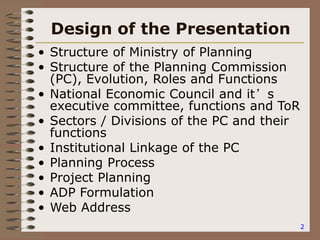
Design of the Presentation
• Structure of Ministry of Planning
• Structure of the Planning Commission
(PC), Evolution, Roles and Functions
• National Economic Council and it’s
executive committee, functions and ToR
• Sectors / Divisions of the PC and their
functions
• Institutional Linkage of the PC
• Planning Process
• Project Planning
• ADP Formulation
• Web Address
3
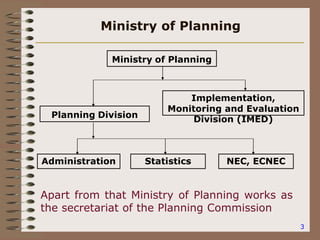
Ministry of Planning
Planning Division
Implementation,
Monitoring and Evaluation
Division (IMED)
Administration Statistics NEC, ECNEC
Apart from that Ministry of Planning works as
the secretariat of the Planning Commission
4
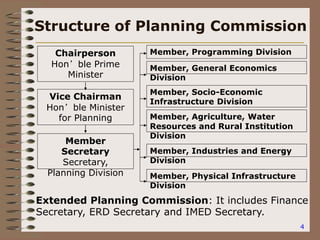
Structure of Planning Commission
Chairperson
Hon’ble Prime
Minister
Vice Chairman
Hon’ble Minister
for Planning
Member
Secretary
Secretary,
Planning Division
Member, Socio-Economic
Infrastructure Division
Member, Programming Division
Member, Industries and Energy
Division
Member, Agriculture, Water
Resources and Rural Institution
Division
Member, Physical Infrastructure
Division
Member, General Economics
Division
Extended Planning Commission: It includes Finance
Secretary, ERD Secretary and IMED Secretary.
June 03, 2009 5
Evolution of Planning Commission
• Pakistan Planning Commission, 1953
• Planning Board Created in 1956 and was renamed as
East Pakistan Planning Department, the full-fledged
planning agency of then East Pakistan.
• Planning Cell created in 1971
• Bangladesh Planning Commission started in 1972
• Project Implementation Bureau(PIB) started in 1975
• External Resource mobilization was entrusted to ERD
in 1975
• The Planning Division created in 1975
• Planning cells created in different Ministries/
Divisions in 1975
6
Role of the Commission
• Planning Commission is entrusted with
the task of planning socio-economic
development of the country
• It has a three-folded role in development
 Advisory role: Advising the government in matters of
development goals and objectives, priorities, strategies
and policy measures
 Executive role: Preparation of plan, processing of
development projects for approval, preparation of
Annual Development Programme (ADP)
 Coordination role: Co-ordination of whole range of
planning activities
7
Functions of the Planning
Commission
• Policy Planning
• Sectoral Planning
• Programme Planning
• Project Planning
• Evaluation of plans & their impact on the
economic development
• Five year Plan
• Poverty Reduction Strategy Paper
• Preperation of ADP
• Appraisal of Projects
8
Planning Commission mainly
works through:
• National Economic Council (NEC)
• Executive committee on National
Economic Council (ECNEC)
9
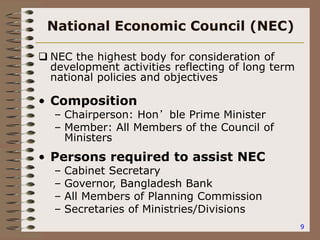
National Economic Council (NEC)
 NEC the highest body for consideration of
development activities reflecting of long term
national policies and objectives
• Composition
– Chairperson: Hon’ble Prime Minister
– Member: All Members of the Council of
Ministers
• Persons required to assist NEC
– Cabinet Secretary
– Governor, Bangladesh Bank
– All Members of Planning Commission
– Secretaries of Ministries/Divisions
10
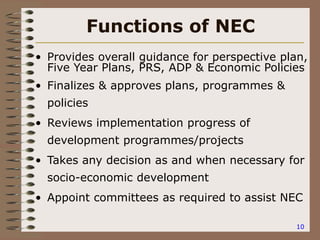
Functions of NEC
• Provides overall guidance for perspective plan,
Five Year Plans, PRS, ADP & Economic Policies
• Finalizes & approves plans, programmes &
policies
• Reviews implementation progress of
development programmes/projects
• Takes any decision as and when necessary for
socio-economic development
• Appoint committees as required to assist NEC
11
ECNEC
• Composition
– Hon’ble Prime Minister – Chairperson
– Minister for Finance– Alternate Chairman
– Minister for Planning – Member
– Minister for Agriculture – Member
– Minister for Labour and Employment – Member
– Minister for Water Resource – Member
– Minister for Commerce – Member
– Minister for Communications – Member
– Minister for Shipping – Member
– Ministers / State Ministers for relevant Ministries – Member
• Officers of assisting ECNEC
– Cabinet secretary
– Principal secretary/secretary, office of the Prime Minister
– Secretaries, Planning, Finance, ERD & IMED
– All members of the planning Commission & relevant
secretaries.
12
ToR of ECNEC
• Approves projects (costing over Tk. 25 crore)
• Reviews projects’ implementation
• Considers Public Private Partnership (PPP)
proposals
• Monitors economic situation & economic
activities
• Policy review
• Consider measures & impact relating to aid
of the development partners
13
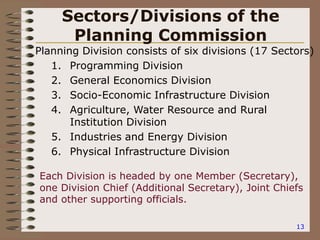
Sectors/Divisions of the
Planning Commission
Planning Division consists of six divisions (17 Sectors)
1. Programming Division
2. General Economics Division
3. Socio-Economic Infrastructure Division
4. Agriculture, Water Resource and Rural
Institution Division
5. Industries and Energy Division
6. Physical Infrastructure Division
Each Division is headed by one Member (Secretary),
one Division Chief (Additional Secretary), Joint Chiefs
and other supporting officials.
14
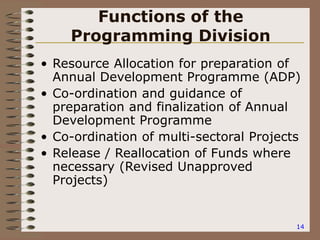
Functions of the
Programming Division
• Resource Allocation for preparation of
Annual Development Programme (ADP)
• Co-ordination and guidance of
preparation and finalization of Annual
Development Programme
• Co-ordination of multi-sectoral Projects
• Release / Reallocation of Funds where
necessary (Revised Unapproved
Projects)
15
Functions of the
General Economics Division
• Evaluation of Plans and Policies
• Review of macro-economic situation
• Assist to determine macro-economic
Policies.
• Co-ordination of finalization of plan,
perspective plan, Five-year plan etc.
• Poverty Reduction Strategy Paper,
MDGs, Vision Paper etc.
16
Functions of the
Socio-Economic Infrastructure Division
• Formulation of sectoral plans for education,
health, Socio-Welfare, Women Affairs,
Youth and Sports, Cultural Affairs, Mass
Communication, Science and ICT, Public
Administration, Labour and Employement
• Process and apprise of development
projects for approval
• Preparation of sectoral Annual
Development programmes in consultation
with line ministries
• Formulation of sectoral development and
Planning Policies
17
Functions of the Agriculture, Water
Resources and Rural Development Division
• Formulation of Sectoral Plans for
Agriculture including Forest Livestock
and Fisheries, Water resources and
Rural Development.
• Process and apprise of development
projects for approval
• Preparation of sectoral Annual
Development programmes in
consultation with line ministries
• Formulation of sectoral development
and planning Policies.
18
Functions of the Industries
and Energy Division
• Formulation of sectoral Plans for
Industries, Power, Oil, gas and
natural resources.
• Process and apprise of development
projects for approval
• Preparation of sectoral Annual
Development programmes in
consultation with line ministries
• Formulation of sectoral development
and planning Policies.
19
Functions of the Physical
Infrastructure Division
• Formulation of sectoral Plans for
Transport (Road, Rail, Shipping, Air),
Communication, Physical Planning,
Water Supply and Housing
• Process and apprise of development
projects for approval
• Preparation of sectoral Annual
Development programmes in
consultation with line ministries
• Formulation of sectoral development
and planning Policies
20
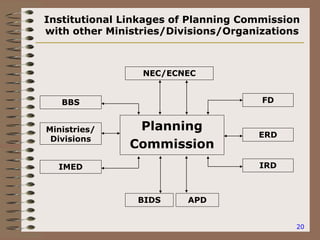
Institutional Linkages of Planning Commission
with other Ministries/Divisions/Organizations
Planning
Commission
NEC/ECNEC
ERD
FD
Ministries/
Divisions
BBS
APD
IRD
BIDS
IMED
21
Planning Process
• Perspective Plan
• 15-20 Years vision indicative
• Last one in 1995:Participatory Perspective Plan
• Objectives:
– Poverty Reduction
– Generation of Productive Employment
– Attaining Self Sufficiency in food production
– HRD
– Private Sector Development
• Work on preparation of participatory perspective plan for
2010-2021 is going on.
• Preparation of vision paper 2030 is going on.
• 6th Five-Year plan is under preparation
* Poverty Reduction Strategy: Unlocking the Potentials
(2005-2008)
* Second Poverty Reduction Strategy: Moving Ahead
(2009-2011)
22
Planning Process (Cont…)
• Prepared based on Models – Input
Output (IO) table , Social
Accounting Matrix (SAM) &
Computable General Equilibrium
(CGE) model
• Prepared in Consultation with
Sectors, Ministries, Agencies
23
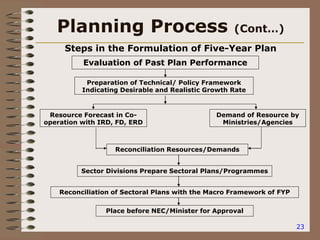
Planning Process (Cont…)
Steps in the Formulation of Five-Year Plan
Evaluation of Past Plan Performance
Preparation of Technical/ Policy Framework
Indicating Desirable and Realistic Growth Rate
Reconciliation of Sectoral Plans with the Macro Framework of FYP
Resource Forecast in Co-
operation with IRD, FD, ERD
Reconciliation Resources/Demands
Sector Divisions Prepare Sectoral Plans/Programmes
Demand of Resource by
Ministries/Agencies
Place before NEC/Minister for Approval
24
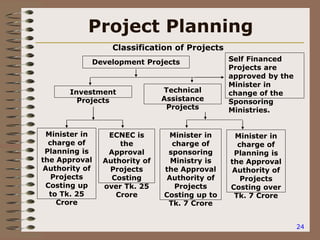
Project Planning
Classification of Projects
Development Projects
Investment
Projects
Technical
Assistance
Projects
Minister in
charge of
Planning is
the Approval
Authority of
Projects
Costing up
to Tk. 25
Crore
ECNEC is
the
Approval
Authority of
Projects
Costing
over Tk. 25
Crore
Minister in
charge of
sponsoring
Ministry is
the Approval
Authority of
Projects
Costing up to
Tk. 7 Crore
Minister in
charge of
Planning is
the Approval
Authority of
Projects
Costing over
Tk. 7 Crore
Self Financed
Projects are
approved by the
Minister in
change of the
Sponsoring
Ministries.
25
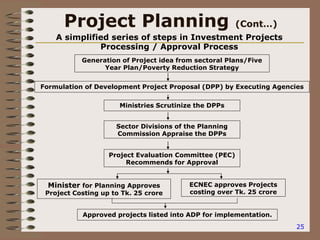
Project Planning (Cont…)
A simplified series of steps in Investment Projects
Processing / Approval Process
Generation of Project idea from sectoral Plans/Five
Year Plan/Poverty Reduction Strategy
Formulation of Development Project Proposal (DPP) by Executing Agencies
Ministries Scrutinize the DPPs
Sector Divisions of the Planning
Commission Appraise the DPPs
Project Evaluation Committee (PEC)
Recommends for Approval
Minister for Planning Approves
Project Costing up to Tk. 25 crore
ECNEC approves Projects
costing over Tk. 25 crore
Approved projects listed into ADP for implementation.
26
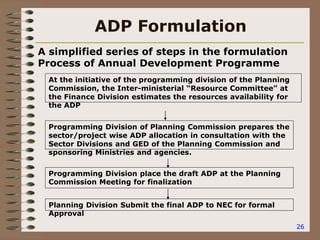
ADP Formulation
A simplified series of steps in the formulation
Process of Annual Development Programme
At the initiative of the programming division of the Planning
Commission, the Inter-ministerial “Resource Committee” at
the Finance Division estimates the resources availability for
the ADP
Programming Division of Planning Commission prepares the
sector/project wise ADP allocation in consultation with the
Sector Divisions and GED of the Planning Commission and
sponsoring Ministries and agencies.
Programming Division place the draft ADP at the Planning
Commission Meeting for finalization
Planning Division Submit the final ADP to NEC for formal
Approval
Please Visit
www.plancomm.gov.bd
Bangladesh Planning
Commission
Thank You
Bangladesh Planning
Commission

Bangladesh Planning Commission

  • 1.
    Ministry of Planning Welcometo Banglade sh Planning Commissi on
  • 2.
    2 Design of thePresentation • Structure of Ministry of Planning • Structure of the Planning Commission (PC), Evolution, Roles and Functions • National Economic Council and it’s executive committee, functions and ToR • Sectors / Divisions of the PC and their functions • Institutional Linkage of the PC • Planning Process • Project Planning • ADP Formulation • Web Address
  • 3.
    3 Ministry of Planning Ministryof Planning Planning Division Implementation, Monitoring and Evaluation Division (IMED) Administration Statistics NEC, ECNEC Apart from that Ministry of Planning works as the secretariat of the Planning Commission
  • 4.
    4 Structure of PlanningCommission Chairperson Hon’ble Prime Minister Vice Chairman Hon’ble Minister for Planning Member Secretary Secretary, Planning Division Member, Socio-Economic Infrastructure Division Member, Programming Division Member, Industries and Energy Division Member, Agriculture, Water Resources and Rural Institution Division Member, Physical Infrastructure Division Member, General Economics Division Extended Planning Commission: It includes Finance Secretary, ERD Secretary and IMED Secretary.
  • 5.
    June 03, 20095 Evolution of Planning Commission • Pakistan Planning Commission, 1953 • Planning Board Created in 1956 and was renamed as East Pakistan Planning Department, the full-fledged planning agency of then East Pakistan. • Planning Cell created in 1971 • Bangladesh Planning Commission started in 1972 • Project Implementation Bureau(PIB) started in 1975 • External Resource mobilization was entrusted to ERD in 1975 • The Planning Division created in 1975 • Planning cells created in different Ministries/ Divisions in 1975
  • 6.
    6 Role of theCommission • Planning Commission is entrusted with the task of planning socio-economic development of the country • It has a three-folded role in development  Advisory role: Advising the government in matters of development goals and objectives, priorities, strategies and policy measures  Executive role: Preparation of plan, processing of development projects for approval, preparation of Annual Development Programme (ADP)  Coordination role: Co-ordination of whole range of planning activities
  • 7.
    7 Functions of thePlanning Commission • Policy Planning • Sectoral Planning • Programme Planning • Project Planning • Evaluation of plans & their impact on the economic development • Five year Plan • Poverty Reduction Strategy Paper • Preperation of ADP • Appraisal of Projects
  • 8.
    8 Planning Commission mainly worksthrough: • National Economic Council (NEC) • Executive committee on National Economic Council (ECNEC)
  • 9.
    9 National Economic Council(NEC)  NEC the highest body for consideration of development activities reflecting of long term national policies and objectives • Composition – Chairperson: Hon’ble Prime Minister – Member: All Members of the Council of Ministers • Persons required to assist NEC – Cabinet Secretary – Governor, Bangladesh Bank – All Members of Planning Commission – Secretaries of Ministries/Divisions
  • 10.
    10 Functions of NEC •Provides overall guidance for perspective plan, Five Year Plans, PRS, ADP & Economic Policies • Finalizes & approves plans, programmes & policies • Reviews implementation progress of development programmes/projects • Takes any decision as and when necessary for socio-economic development • Appoint committees as required to assist NEC
  • 11.
    11 ECNEC • Composition – Hon’blePrime Minister – Chairperson – Minister for Finance– Alternate Chairman – Minister for Planning – Member – Minister for Agriculture – Member – Minister for Labour and Employment – Member – Minister for Water Resource – Member – Minister for Commerce – Member – Minister for Communications – Member – Minister for Shipping – Member – Ministers / State Ministers for relevant Ministries – Member • Officers of assisting ECNEC – Cabinet secretary – Principal secretary/secretary, office of the Prime Minister – Secretaries, Planning, Finance, ERD & IMED – All members of the planning Commission & relevant secretaries.
  • 12.
    12 ToR of ECNEC •Approves projects (costing over Tk. 25 crore) • Reviews projects’ implementation • Considers Public Private Partnership (PPP) proposals • Monitors economic situation & economic activities • Policy review • Consider measures & impact relating to aid of the development partners
  • 13.
    13 Sectors/Divisions of the PlanningCommission Planning Division consists of six divisions (17 Sectors) 1. Programming Division 2. General Economics Division 3. Socio-Economic Infrastructure Division 4. Agriculture, Water Resource and Rural Institution Division 5. Industries and Energy Division 6. Physical Infrastructure Division Each Division is headed by one Member (Secretary), one Division Chief (Additional Secretary), Joint Chiefs and other supporting officials.
  • 14.
    14 Functions of the ProgrammingDivision • Resource Allocation for preparation of Annual Development Programme (ADP) • Co-ordination and guidance of preparation and finalization of Annual Development Programme • Co-ordination of multi-sectoral Projects • Release / Reallocation of Funds where necessary (Revised Unapproved Projects)
  • 15.
    15 Functions of the GeneralEconomics Division • Evaluation of Plans and Policies • Review of macro-economic situation • Assist to determine macro-economic Policies. • Co-ordination of finalization of plan, perspective plan, Five-year plan etc. • Poverty Reduction Strategy Paper, MDGs, Vision Paper etc.
  • 16.
    16 Functions of the Socio-EconomicInfrastructure Division • Formulation of sectoral plans for education, health, Socio-Welfare, Women Affairs, Youth and Sports, Cultural Affairs, Mass Communication, Science and ICT, Public Administration, Labour and Employement • Process and apprise of development projects for approval • Preparation of sectoral Annual Development programmes in consultation with line ministries • Formulation of sectoral development and Planning Policies
  • 17.
    17 Functions of theAgriculture, Water Resources and Rural Development Division • Formulation of Sectoral Plans for Agriculture including Forest Livestock and Fisheries, Water resources and Rural Development. • Process and apprise of development projects for approval • Preparation of sectoral Annual Development programmes in consultation with line ministries • Formulation of sectoral development and planning Policies.
  • 18.
    18 Functions of theIndustries and Energy Division • Formulation of sectoral Plans for Industries, Power, Oil, gas and natural resources. • Process and apprise of development projects for approval • Preparation of sectoral Annual Development programmes in consultation with line ministries • Formulation of sectoral development and planning Policies.
  • 19.
    19 Functions of thePhysical Infrastructure Division • Formulation of sectoral Plans for Transport (Road, Rail, Shipping, Air), Communication, Physical Planning, Water Supply and Housing • Process and apprise of development projects for approval • Preparation of sectoral Annual Development programmes in consultation with line ministries • Formulation of sectoral development and planning Policies
  • 20.
    20 Institutional Linkages ofPlanning Commission with other Ministries/Divisions/Organizations Planning Commission NEC/ECNEC ERD FD Ministries/ Divisions BBS APD IRD BIDS IMED
  • 21.
    21 Planning Process • PerspectivePlan • 15-20 Years vision indicative • Last one in 1995:Participatory Perspective Plan • Objectives: – Poverty Reduction – Generation of Productive Employment – Attaining Self Sufficiency in food production – HRD – Private Sector Development • Work on preparation of participatory perspective plan for 2010-2021 is going on. • Preparation of vision paper 2030 is going on. • 6th Five-Year plan is under preparation * Poverty Reduction Strategy: Unlocking the Potentials (2005-2008) * Second Poverty Reduction Strategy: Moving Ahead (2009-2011)
  • 22.
    22 Planning Process (Cont…) •Prepared based on Models – Input Output (IO) table , Social Accounting Matrix (SAM) & Computable General Equilibrium (CGE) model • Prepared in Consultation with Sectors, Ministries, Agencies
  • 23.
    23 Planning Process (Cont…) Stepsin the Formulation of Five-Year Plan Evaluation of Past Plan Performance Preparation of Technical/ Policy Framework Indicating Desirable and Realistic Growth Rate Reconciliation of Sectoral Plans with the Macro Framework of FYP Resource Forecast in Co- operation with IRD, FD, ERD Reconciliation Resources/Demands Sector Divisions Prepare Sectoral Plans/Programmes Demand of Resource by Ministries/Agencies Place before NEC/Minister for Approval
  • 24.
    24 Project Planning Classification ofProjects Development Projects Investment Projects Technical Assistance Projects Minister in charge of Planning is the Approval Authority of Projects Costing up to Tk. 25 Crore ECNEC is the Approval Authority of Projects Costing over Tk. 25 Crore Minister in charge of sponsoring Ministry is the Approval Authority of Projects Costing up to Tk. 7 Crore Minister in charge of Planning is the Approval Authority of Projects Costing over Tk. 7 Crore Self Financed Projects are approved by the Minister in change of the Sponsoring Ministries.
  • 25.
    25 Project Planning (Cont…) Asimplified series of steps in Investment Projects Processing / Approval Process Generation of Project idea from sectoral Plans/Five Year Plan/Poverty Reduction Strategy Formulation of Development Project Proposal (DPP) by Executing Agencies Ministries Scrutinize the DPPs Sector Divisions of the Planning Commission Appraise the DPPs Project Evaluation Committee (PEC) Recommends for Approval Minister for Planning Approves Project Costing up to Tk. 25 crore ECNEC approves Projects costing over Tk. 25 crore Approved projects listed into ADP for implementation.
  • 26.
    26 ADP Formulation A simplifiedseries of steps in the formulation Process of Annual Development Programme At the initiative of the programming division of the Planning Commission, the Inter-ministerial “Resource Committee” at the Finance Division estimates the resources availability for the ADP Programming Division of Planning Commission prepares the sector/project wise ADP allocation in consultation with the Sector Divisions and GED of the Planning Commission and sponsoring Ministries and agencies. Programming Division place the draft ADP at the Planning Commission Meeting for finalization Planning Division Submit the final ADP to NEC for formal Approval
  • 27.
  • 28.