PLANNING MACHINERY IN PAKISTAN

DEPARTMENT OF ECCONOMICS
LAHORE COLLEGE FOR WOMEN
UNIVERSITY
PLANNING
CONTENTS
• Planning concept
• . Objectives of Economic Planning
• History
• Development Board
• Planning Board

• Chronology of Planning Machinery
• Functions of planning commission
CONTENTS
• Main Instruments of National Planning
• Plan Periods in Pakistan
PLANNING CONCEPT
Planning has been defined by various economists in different manners.
Generally it is understood to be a dynamic process
achievement of economic independence
• overcoming backwardness
• implementation of socio-economic
• Transformation
a method of analysis.
•

In essence, a plan is a package of economic and social policies expressed
with quantified targets and objectives to be achieved during a laid-down
period
OBJECTIVES OF ECONOMIC PLANNING
• To increase per capita and national income

• Higher level of employment
• Price stability
• Reduction of inequalities in income distribution

• Redressing imbalances in the economy
• Reducing poverty levels
• Provision of social services

• Long term economic growth
HISTORY
Development Board:
• Establishment of development board in 1948
• 1st development plan (1950)

Planning board:
• Establishment of Planning Board
• Purposes of establishment
• Terms of reference of the board
CHRONOLOGY OF PLANNING MACHINERY
Development Board established in 1948
Planning Board set up in 1953
First 5 year plan prepared for 1955-60
National Planning Board established in1957
Planning Commission setup under the Chairmanship of President in 1959
Second five year plan prepared for 1960-65 followed by the third five year
plan for 1965-70
• Fourth Five Year Plan (1970-75) prepared but remained dormant due to
separation of East Pakistan
• 1970-77 non plan period : Development on basis of Annual Plans
•
•
•
•
•
•
CHRONOLOGY OF PLANNING MACHINERY
• Fifth Five Year Plan 1978-83
• Sixth Five Year Plan 1983-88
• Seventh Five Year Plan 1988-93
• Eighth Five Year Plan 1993-98
• Ninth Five Year Plan (halted due to changed in government)

• 10 Years Perspective Development Plan 2001-11
• Planning Commission restructured on 20 April 2006 with P.M. as Chairman
• Vision 2030 launched in August, 2007
PURPOSES

• to develop the resources of the country,

• to promote the welfare of the people,
• provide adequate living standards,

• meeting the social needs of people
• giving opportunity to all and aim at the widest
and most equitable distribution of national
income
TERMS OF REFERENCE:
i) To review the development that has taken place since
independence.
ii) To assess the resources - material and human, which can be
made available for d
beginning from April, 1954
iii) To prepare a national plan of development based on the fullest
possible utilisation

in a period of 5 years from Ist April, 1955 as a step towards the
attainment of the
Government's policy.
iv) To make proposals regarding the administrative machinery.
v) To make any other recommendations which in the opinion of the
Board will can not suitable for the implementation of the plan.
FUNCTIONS
• To prepare future five year plans of economic and
social development.
• To make additions and alterations in the existing five
year plan.
To tender such technical advice and offer such
comments on financial matters be
• be requested by the Ministries of Government.
• To stimulate and, where necessary, to initiate the
preparation of schemes required in economic and
social fields.
FUNCTIONS
To maintain a continuous and constant review of the
progress of development,
To maintain a continuous review of the economic
conditions of the country so fadevelopment plans.
To submit such periodic reports as the Government may
desire from time to time
To encourage the improvement and expansion of
research in particular economic investigations and
evaluation needed to support effective planning and
development.
• Generally to advise the Government on economic
policies and problems in various development plans
PLANNING COMMISION OF PAKISTAN
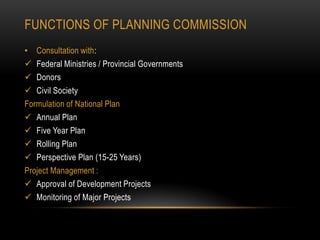
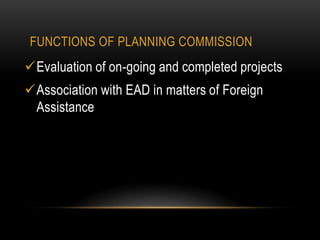
FUNCTIONS OF PLANNING COMMISSION
• Consultation with:
 Federal Ministries / Provincial Governments
 Donors
 Civil Society
Formulation of National Plan
 Annual Plan
 Five Year Plan
 Rolling Plan
 Perspective Plan (15-25 Years)
Project Management :
 Approval of Development Projects
 Monitoring of Major Projects
FUNCTIONS OF PLANNING COMMISSION

Evaluation of on-going and completed projects

Association with EAD in matters of Foreign
Assistance
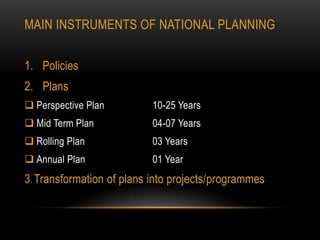
MAIN INSTRUMENTS OF NATIONAL PLANNING
1. Policies

2. Plans
 Perspective Plan

10-25 Years

 Mid Term Plan

04-07 Years

 Rolling Plan

03 Years

 Annual Plan

01 Year

3. Transformation of plans into projects/programmes
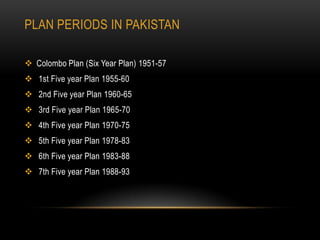
PLAN PERIODS IN PAKISTAN
 Colombo Plan (Six Year Plan) 1951-57
 1st Five year Plan 1955-60
 2nd Five year Plan 1960-65
 3rd Five year Plan 1965-70
 4th Five year Plan 1970-75

 5th Five year Plan 1978-83
 6th Five year Plan 1983-88
 7th Five year Plan 1988-93
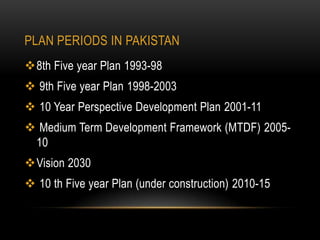
PLAN PERIODS IN PAKISTAN
8th Five year Plan 1993-98

 9th Five year Plan 1998-2003
 10 Year Perspective Development Plan 2001-11
 Medium Term Development Framework (MTDF) 200510
Vision 2030
 10 th Five year Plan (under construction) 2010-15
ANNUAL PLAN
• The principal instrument for adjusting the five year plan
to current realities.
• regarded as the implementation side of the five year
plan.
Includes evaluation of:
• past performance
• presentation of the main targets,
• of the investment programme in the public and private
sectors
• Economic policies necessary to achieve the target
ROLL ON PLAN

• To bring flexibility with five year plan.

• a roll-on plan of medium term is designed in
which the sectoral and project-wise position is
adjusted according to the foregoing year.
• For initial 3 years plan prepared for a, b, c years.
• For next 3 years a replaced with d in order to let
it remain for 3 years
FIVE YEAR PLAN

• Advantage of achieving solid results

• is a general statement of objectives and targets
relating to the economy as a whole and its
various component sectors.
• does not authorise expenditure to the relevant
operating agencies
PERSPECTIVE PLAN
• to provide a long-term (15-25 years) economic and
social policy framework to achieve long term objectives.
• Pakistan’s 1st perspective plan was abandoned after
east Bengal separation.

• The third five year plan justified the Perspective Plan
• Confidence of country in future
• Realistic statement of goals to be achieved.
PUBLIC SECTOR DEVELOPMENT
PROGRAMME(PSDP)
• Document enlisting public sector projects with
specific allocations
• Part of country’s annual budget
• Due to constraint which exists on government
funds, projects are competing for a limited
amount of funds available for development.
PREPARATION OF PSDP

• co-ordinated by the Programming Section of the
Planning and Development Division.
• The procedure starts in oct / nov each year
STRATEGIES TO BE ADOPTED:
FEDERAL VS. PROVINCIAL
PROJECTS
• Major share of the development programme is
allocated to federal projects
• 10% allocated to NWFP and balochistan and 90% to
other provinces
• Federal government gives funds for projects under
PSDP.
ON-GOING VS NEW PROJECTS

Preference is accorded to on-going projects for
their early completion
. At present some 80% of the total development
expenditure is allocated to on-going projects and
the remainder to new projects.
FOREIGN-AIDED PROJECTS
•

Aided projects are duly funded in accordance
with the agreement signed with the donor
agencies.

• The allocation of funds is done in the light of the
PSDP call letter issued annually by the
Programming Section.
DEFINITION OF PROJECT AND ITS CONTRIBUTION
TOWARD ACHIEVEMENT OF OVERALL PLAN
GOALS/OBJECTIVES.

• Projects are defined in different ways
• From the stand point of economics, a project is;
• the minimum investment which is economically and
technically feasible
• .an activity on which we spend money in expectation of
returns and which logically seems to lend itself to
planning, financing and implementation as a unit.
• Careful project preparation requires efficient economic
use of capital funds .
• Only the technically, financially and economically sound
projects/ programmes, with support of concerned
departments can provide successful implementation of
the plan.
PC-I, II, III, IV & V PROFORMAE
•

to laying down an effective organization for
planning, five proformae were prescribed for
preparation and implementation of development
schemes.

• PC-I and PC-II deal with submission of project proposal
• PCIII is concerned with the progress of ongoing
projects
• PC-IV and PC-V are to be filled in after completion of a
project.
PC-I PROFORMA
• PC-I is the basic form on which all projects/schemes
are required to be drawn up. It was used for all
sectors.
• for bigger and complex projects which required quite
detailed information PC-I form, was elaborated and 12
separate forms suitable for particular sectors were
introduced in July, 1974.
PC I'S FOUR PARTS :
• Part 'A' is the "Project Digest",

• Part 'B' entitled "Project Description and Financing",
• Part 'C' deals with "Project Requirements",
• Part 'D' deals with “Enviroumental Aspects”.
 Low cost PC I :
 used for low cost projects costing 1 million.
PC-II PROFORMA
• PC-II is required for:

• conducting surveys and feasibility studies
• Used in respect of larger projects, intended to get full
justification for undertaking the project before large
resources are tied up with them.
PC-III PROFORMA
• PC-III performa is:
• to furnish information on going projects
• done on quarterly basis with agencies required to submit
report within 20 days
• provides information on physical as well as financial
progress of projects with all hindrances.
PC-IV & V PROFORMAE
• PC-IV form is required:

• to be submitted at the time when the project is
adjudged to be complete
•

PC-V form is:

• to be furnished on an annual basis for a period of five
years by the agencies responsible for operation and
maintenance of the projects.
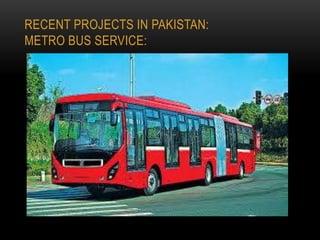
RECENT PROJECTS IN PAKISTAN:
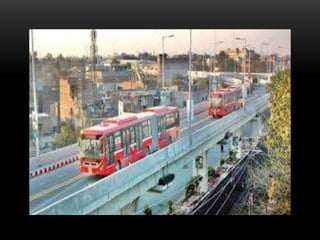
METRO BUS SERVICE:
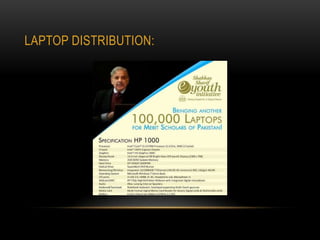
LAPTOP DISTRIBUTION:
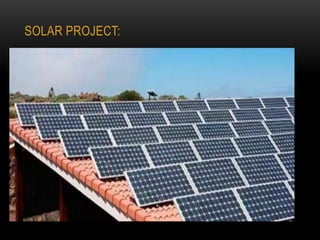
SOLAR PROJECT:
THANK YOU

planning machinery

  • 1.
    PLANNING MACHINERY INPAKISTAN DEPARTMENT OF ECCONOMICS LAHORE COLLEGE FOR WOMEN UNIVERSITY
  • 2.
  • 3.
    CONTENTS • Planning concept •. Objectives of Economic Planning • History • Development Board • Planning Board • Chronology of Planning Machinery • Functions of planning commission
  • 4.
    CONTENTS • Main Instrumentsof National Planning • Plan Periods in Pakistan
  • 5.
    PLANNING CONCEPT Planning hasbeen defined by various economists in different manners. Generally it is understood to be a dynamic process achievement of economic independence • overcoming backwardness • implementation of socio-economic • Transformation a method of analysis. • In essence, a plan is a package of economic and social policies expressed with quantified targets and objectives to be achieved during a laid-down period
  • 6.
    OBJECTIVES OF ECONOMICPLANNING • To increase per capita and national income • Higher level of employment • Price stability • Reduction of inequalities in income distribution • Redressing imbalances in the economy • Reducing poverty levels • Provision of social services • Long term economic growth
  • 7.
    HISTORY Development Board: • Establishmentof development board in 1948 • 1st development plan (1950) Planning board: • Establishment of Planning Board • Purposes of establishment • Terms of reference of the board
  • 8.
    CHRONOLOGY OF PLANNINGMACHINERY Development Board established in 1948 Planning Board set up in 1953 First 5 year plan prepared for 1955-60 National Planning Board established in1957 Planning Commission setup under the Chairmanship of President in 1959 Second five year plan prepared for 1960-65 followed by the third five year plan for 1965-70 • Fourth Five Year Plan (1970-75) prepared but remained dormant due to separation of East Pakistan • 1970-77 non plan period : Development on basis of Annual Plans • • • • • •
  • 9.
    CHRONOLOGY OF PLANNINGMACHINERY • Fifth Five Year Plan 1978-83 • Sixth Five Year Plan 1983-88 • Seventh Five Year Plan 1988-93 • Eighth Five Year Plan 1993-98 • Ninth Five Year Plan (halted due to changed in government) • 10 Years Perspective Development Plan 2001-11 • Planning Commission restructured on 20 April 2006 with P.M. as Chairman • Vision 2030 launched in August, 2007
  • 10.
    PURPOSES • to developthe resources of the country, • to promote the welfare of the people, • provide adequate living standards, • meeting the social needs of people • giving opportunity to all and aim at the widest and most equitable distribution of national income
  • 11.
    TERMS OF REFERENCE: i)To review the development that has taken place since independence. ii) To assess the resources - material and human, which can be made available for d beginning from April, 1954 iii) To prepare a national plan of development based on the fullest possible utilisation in a period of 5 years from Ist April, 1955 as a step towards the attainment of the Government's policy. iv) To make proposals regarding the administrative machinery. v) To make any other recommendations which in the opinion of the Board will can not suitable for the implementation of the plan.
  • 12.
    FUNCTIONS • To preparefuture five year plans of economic and social development. • To make additions and alterations in the existing five year plan. To tender such technical advice and offer such comments on financial matters be • be requested by the Ministries of Government. • To stimulate and, where necessary, to initiate the preparation of schemes required in economic and social fields.
  • 13.
    FUNCTIONS To maintain acontinuous and constant review of the progress of development, To maintain a continuous review of the economic conditions of the country so fadevelopment plans. To submit such periodic reports as the Government may desire from time to time To encourage the improvement and expansion of research in particular economic investigations and evaluation needed to support effective planning and development.
  • 14.
    • Generally toadvise the Government on economic policies and problems in various development plans
  • 15.
  • 16.
    FUNCTIONS OF PLANNINGCOMMISSION • Consultation with:  Federal Ministries / Provincial Governments  Donors  Civil Society Formulation of National Plan  Annual Plan  Five Year Plan  Rolling Plan  Perspective Plan (15-25 Years) Project Management :  Approval of Development Projects  Monitoring of Major Projects
  • 17.
    FUNCTIONS OF PLANNINGCOMMISSION Evaluation of on-going and completed projects Association with EAD in matters of Foreign Assistance
  • 18.
    MAIN INSTRUMENTS OFNATIONAL PLANNING 1. Policies 2. Plans  Perspective Plan 10-25 Years  Mid Term Plan 04-07 Years  Rolling Plan 03 Years  Annual Plan 01 Year 3. Transformation of plans into projects/programmes
  • 19.
    PLAN PERIODS INPAKISTAN  Colombo Plan (Six Year Plan) 1951-57  1st Five year Plan 1955-60  2nd Five year Plan 1960-65  3rd Five year Plan 1965-70  4th Five year Plan 1970-75  5th Five year Plan 1978-83  6th Five year Plan 1983-88  7th Five year Plan 1988-93
  • 20.
    PLAN PERIODS INPAKISTAN 8th Five year Plan 1993-98  9th Five year Plan 1998-2003  10 Year Perspective Development Plan 2001-11  Medium Term Development Framework (MTDF) 200510 Vision 2030  10 th Five year Plan (under construction) 2010-15
  • 21.
    ANNUAL PLAN • Theprincipal instrument for adjusting the five year plan to current realities. • regarded as the implementation side of the five year plan. Includes evaluation of: • past performance • presentation of the main targets, • of the investment programme in the public and private sectors • Economic policies necessary to achieve the target
  • 22.
    ROLL ON PLAN •To bring flexibility with five year plan. • a roll-on plan of medium term is designed in which the sectoral and project-wise position is adjusted according to the foregoing year. • For initial 3 years plan prepared for a, b, c years. • For next 3 years a replaced with d in order to let it remain for 3 years
  • 23.
    FIVE YEAR PLAN •Advantage of achieving solid results • is a general statement of objectives and targets relating to the economy as a whole and its various component sectors. • does not authorise expenditure to the relevant operating agencies
  • 24.
    PERSPECTIVE PLAN • toprovide a long-term (15-25 years) economic and social policy framework to achieve long term objectives. • Pakistan’s 1st perspective plan was abandoned after east Bengal separation. • The third five year plan justified the Perspective Plan • Confidence of country in future • Realistic statement of goals to be achieved.
  • 25.
    PUBLIC SECTOR DEVELOPMENT PROGRAMME(PSDP) •Document enlisting public sector projects with specific allocations • Part of country’s annual budget • Due to constraint which exists on government funds, projects are competing for a limited amount of funds available for development.
  • 26.
    PREPARATION OF PSDP •co-ordinated by the Programming Section of the Planning and Development Division. • The procedure starts in oct / nov each year
  • 27.
    STRATEGIES TO BEADOPTED: FEDERAL VS. PROVINCIAL PROJECTS • Major share of the development programme is allocated to federal projects • 10% allocated to NWFP and balochistan and 90% to other provinces • Federal government gives funds for projects under PSDP.
  • 28.
    ON-GOING VS NEWPROJECTS Preference is accorded to on-going projects for their early completion . At present some 80% of the total development expenditure is allocated to on-going projects and the remainder to new projects.
  • 29.
    FOREIGN-AIDED PROJECTS • Aided projectsare duly funded in accordance with the agreement signed with the donor agencies. • The allocation of funds is done in the light of the PSDP call letter issued annually by the Programming Section.
  • 30.
    DEFINITION OF PROJECTAND ITS CONTRIBUTION TOWARD ACHIEVEMENT OF OVERALL PLAN GOALS/OBJECTIVES. • Projects are defined in different ways • From the stand point of economics, a project is; • the minimum investment which is economically and technically feasible • .an activity on which we spend money in expectation of returns and which logically seems to lend itself to planning, financing and implementation as a unit.
  • 31.
    • Careful projectpreparation requires efficient economic use of capital funds . • Only the technically, financially and economically sound projects/ programmes, with support of concerned departments can provide successful implementation of the plan.
  • 32.
    PC-I, II, III,IV & V PROFORMAE • to laying down an effective organization for planning, five proformae were prescribed for preparation and implementation of development schemes. • PC-I and PC-II deal with submission of project proposal • PCIII is concerned with the progress of ongoing projects • PC-IV and PC-V are to be filled in after completion of a project.
  • 33.
    PC-I PROFORMA • PC-Iis the basic form on which all projects/schemes are required to be drawn up. It was used for all sectors. • for bigger and complex projects which required quite detailed information PC-I form, was elaborated and 12 separate forms suitable for particular sectors were introduced in July, 1974.
  • 34.
    PC I'S FOURPARTS : • Part 'A' is the "Project Digest", • Part 'B' entitled "Project Description and Financing", • Part 'C' deals with "Project Requirements", • Part 'D' deals with “Enviroumental Aspects”.  Low cost PC I :  used for low cost projects costing 1 million.
  • 35.
    PC-II PROFORMA • PC-IIis required for: • conducting surveys and feasibility studies • Used in respect of larger projects, intended to get full justification for undertaking the project before large resources are tied up with them.
  • 36.
    PC-III PROFORMA • PC-IIIperforma is: • to furnish information on going projects • done on quarterly basis with agencies required to submit report within 20 days • provides information on physical as well as financial progress of projects with all hindrances.
  • 37.
    PC-IV & VPROFORMAE • PC-IV form is required: • to be submitted at the time when the project is adjudged to be complete • PC-V form is: • to be furnished on an annual basis for a period of five years by the agencies responsible for operation and maintenance of the projects.
  • 38.
    RECENT PROJECTS INPAKISTAN: METRO BUS SERVICE:
  • 40.
  • 42.
  • 43.