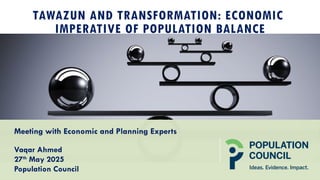
TAWAZUN AND TRANSFORMATION: ECONOMIC
IMPERATIVE OF POPULATION BALANCE
Meeting with Economic and Planning Experts
Vaqar Ahmed
27th
May 2025
Population Council
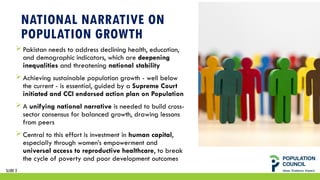
NATIONAL NARRATIVE ON
POPULATION GROWTH
 Pakistan needs to address declining health, education,
and demographic indicators, which are deepening
inequalities and threatening national stability
 Achieving sustainable population growth - well below
the current - is essential, guided by a Supreme Court
initiated and CCI endorsed action plan on Population
 A unifying national narrative is needed to build cross-
sector consensus for balanced growth, drawing lessons
from peers
 Central to this effort is investment in human capital,
especially through women’s empowerment and
universal access to reproductive healthcare, to break
the cycle of poverty and poor development outcomes
SLIDE 2
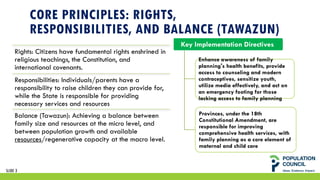
CORE PRINCIPLES: RIGHTS,
RESPONSIBILITIES, AND BALANCE (TAWAZUN)
Rights: Citizens have fundamental rights enshrined in
religious teachings, the Constitution, and
international covenants.
Responsibilities: Individuals/parents have a
responsibility to raise children they can provide for,
while the State is responsible for providing
necessary services and resources
Balance (Tawazun): Achieving a balance between
family size and resources at the micro level, and
between population growth and available
resources/regenerative capacity at the macro level.
Key Implementation Directives
Enhance awareness of family
planning's health benefits, provide
access to counseling and modern
contraceptives, sensitize youth,
utilize media effectively, and act on
an emergency footing for those
lacking access to family planning
Provinces, under the 18th
Constitutional Amendment, are
responsible for improving
comprehensive health services, with
family planning as a core element of
maternal and child care
SLIDE 3
SLIDE 4
CORE IDEA
Population as a Fundamental Economic Variable
Population dynamics are not just social issues, but
fundamental economic variables that impact labor
supply, consumption, public expenditure, and long-
term economic planning.
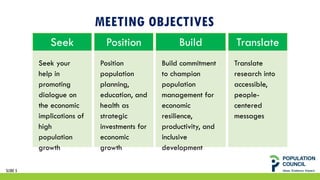
MEETING OBJECTIVES
Seek
Seek your
help in
promoting
dialogue on
the economic
implications of
high
population
growth
Position
Position
population
planning,
education, and
health as
strategic
investments for
economic
growth
Build
Build commitment
to champion
population
management for
economic
resilience,
productivity, and
inclusive
development
Translate
Translate
research into
accessible,
people-
centered
messages
SLIDE 5
BRIDGING THE CURRENT GAP
IN ECONOMIC CONSENSUS
While the economic consequences of rapid
population growth are intuitively understood,
there's a critical lack of alignment among
economists on its precise correlation with
macroeconomic indicators and actionable
policy responses
This brainstorm will specifically address this
divergence by integrating the "Tawazun"
(balance between population size and
resources) narrative directly into core economic
discourse.
SLIDE 6
SHAPING FUTURE
MACROECONOMIC PLANNING
AND BUDGETARY FRAMEWORKS
The insights from this meeting will directly inform how
future national economic and fiscal strategies are
designed
By analyzing the projections, economists could identify
specific mechanisms to embed population dynamics as
a central tenet of long-term planning, ensuring fiscal
sustainability, and rationalized public expenditure
This includes exploring how balanced population
growth can improve savings, enhance quality of life,
and promote intergenerational investments at the
household level.
SLIDE 7
SLIDE 8
UNLOCKING GROWTH
For Pakistan to achieve its aspiration of
inclusive and sustainable growth, economic
planners must define how addressing
demographic pressures can reduce inequality
and support human capital development
This brainstorm will generate concrete
strategies for investing in human capital –
particularly through family planning, health,
and education – as a strategic imperative for
future economic growth, transforming the youth
bulge from a potential liability into a
demographic dividend.
EMPOWERING INFLUENTIAL
VOICES
By promoting ownership and commitment among
leading economic experts, this meeting aims to
expand the pool of influential voices advocating for
population management from a powerful economic
lens
This will directly impact future policy and planning
frameworks, ensuring that population factors are
recognized and addressed as fundamental economic
variables, crucial for Pakistan's long-term viability
and security.
Without this critical alignment and integration,
Pakistan risks derailing national progress across
multiple sectors as demographic pressures continue to
outpace resource availability.
SLIDE 9
AS AN ECONOMIC PLANNER
WHAT MAY BE PRIORITIZED?
 Total Fertility Rate (TFR): At 3.6, Pakistan’s high TFR
drives unsustainable population growth; reducing it
to 2.1 is critical
 Dependency Ratio: With 64% under 30, Pakistan must
convert its youth bulge into a productive elite
 Contraceptive Prevalence Rate (CPR): Only 34% of
women able to use contraception - raising this
to 52% could accelerate TFR decline and save $1.5B
annually in healthcare costs
 Urbanization Rate: Faster urban growth (3% annual)
could lower fertility and boost productivity, but requires
job-focused infrastructure investment.
SLIDE 10
WHY IT MATTERS ECONOMICALLY?
Total Fertility Rate (TFR): The Growth Engine
 Population Momentum: Even if TFR falls to 2.1 today, Pakistan’s population will keep growing for
decades due to its youthful age structure (like a "snowball effect")
 Demographic Dividend Window: To capitalize, TFR must decline before the working-age
population peaks. Pakistan’s window (2040-2050) is closing fast
Macroeconomic Impact:
 High TFR (3.6) → More children = higher public spending on education/health (currently ~6%
of GDP vs. needed 12%).
 Low TFR (2.1) → Frees up fiscal space for infrastructure/jobs (e.g., Bangladesh saved 1.5% of
GDP annually post-TFR decline)
 TFR-Poverty Nexus
 Household Level: Each additional child reduces per-capita income by 15-20%
 National Level: A 1-point TFR drop could raise GDP growth by 0.5-1% annually.
SLIDE 11
WHY IT MATTERS ECONOMICALLY?
Dependency Ratio: The Productivity Lever
 Current Status:
 Youth Dependency (0-14 years): 63%
 Old-Age Dependency (65+): 4%
 Working-Age (15-64): 33% (but underutilized due to low female participation)
 Projected Shift: Working-age population will peak at 65% by 2050 (if jobs exist).
 Economic Make-or-Break
 Optimistic Scenario (Low Dependency):
 Requires 2 million jobs/year until 2040.
 Pessimistic Scenario (High Dependency):
 Unemployment could hit 30% (current: 6.3%), triggering social unrest.
SLIDE 12
WHY IT MATTERS ECONOMICALLY?
The Cross-Indicator Linkage
TFR Dependency Ratio:
→ Lower TFR today means fewer dependents tomorrow.
Policy Triad for Success:
 Family Planning: Raise CPR to 52% to accelerate TFR decline.
 Education Quality: Fix stunting (40% of kids) to ensure future workers are
productive.
 Job-Led Growth: Export industries (textiles, IT) must absorb youth.
Warning:
If Pakistan’s TFR remains >3 until 2030, its dependency ratio will stay elevated,
costing 2-3% of GDP growth annually.
SLIDE 13
ECONOMIC PLANNERS KEY INTERVENTION
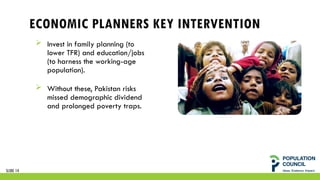
 Invest in family planning (to
lower TFR) and education/jobs
(to harness the working-age
population).
 Without these, Pakistan risks
missed demographic dividend
and prolonged poverty traps.
SLIDE 14
COLLECTIVE WISDOM
 Group 1: "Household Economics and Well-being: The Case for Investing in Family
Planning"
 Focus: How population balance improves savings, quality of life, and intergenerational
investments at the household level.
 Group 2: "Integrating Tawazun into Macroeconomic Planning and Budgetary Frameworks"
 Focus: Identifying ways to embed the population-resource balance into national
economic and fiscal strategies.
 Group 3: "The Economics of Equity: Population Management for Inclusive and Sustainable
Growth"
 Focus: Analyzing how addressing demographic pressures can reduce inequality and
support human capital development.
SLIDE 15
GROUP 1: HOUSEHOLD ECONOMICS AND WELL-BEING:
THE CASE FOR INVESTING IN FAMILY PLANNING
 Question 1: Beyond individual health benefits, how specifically does family planning and
achieving "Tawazun" at the household level translate into tangible improvements in
household savings rates, investment capacity (e.g., in children's education and health), and
overall quality of life for families in Pakistan? What data or evidence can support these
linkages?
 Question 2: What are the key policy interventions and public/private sector initiatives that
could most effectively enable Pakistani households, especially the most vulnerable, to make
informed family planning choices and realize the associated economic benefits? Consider
financial incentives, access to services, and community-level programs.
 Question 3: From a household perspective, what are the greatest barriers (e.g., cultural,
economic, access-related) to adopting balanced family sizes, and how can these barriers be
overcome to accelerate the realization of household economic well-being through family
planning?
SLIDE 16
GROUP 2: INTEGRATING TAWAZUN INTO
MACROECONOMIC PLANNING AND BUDGETARY
FRAMEWORKS
Question 1: What specific macroeconomic frameworks can be adapted or developed to
effectively quantify the long-term economic dividends of achieving "Tawazun" (e.g., reduced per
capita public expenditure, increased productivity, higher savings rates) in Pakistan? How can
these be incorporated into national planning documents (e.g., 5-year plans, Vision/Uraan
Pakistan, Provincial Growth Strategies)?
Question 2: How can the concept of "Tawazun" be directly embedded into Pakistan’s and
provincial budget allocation processes and fiscal strategies? Identify specific budget lines,
investment areas, or fiscal reforms that would incentivize and support population management as
a core driver of fiscal sustainability.
Question 3: What are the institutional mechanisms and inter-ministerial coordination strategies
required to ensure that population factors are consistently integrated as fundamental economic
variables across all levels of federal and provincial macroeconomic planning and budgetary
frameworks?
SLIDE 17
GROUP 3: THE ECONOMICS OF EQUITY:
POPULATION MANAGEMENT FOR INCLUSIVE AND
SUSTAINABLE GROWTH
 Question 1: How does rapid, unbalanced population growth in Pakistan exacerbate existing
inequalities (e.g., income, gender, regional) and hinder inclusive development? Provide specific
examples of how demographic pressures disproportionately affect vulnerable groups.
 Question 2: What targeted population management interventions, viewed through an economic
lens, can effectively reduce inequality and accelerate human capital development across all
segments of Pakistani society? Consider investments in girls' education, women's empowerment,
and equitable access to reproductive health services.
 Question 3: What are the essential monitoring and evaluation frameworks needed to track the
economic impact of population management strategies on equity and human capital
development in Pakistan? How can success be measured beyond just demographic indicators to
capture improvements in living standards and reduced disparities?
SLIDE 18
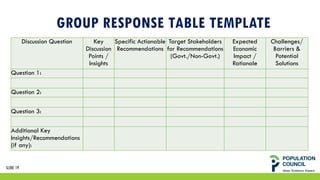
GROUP RESPONSE TABLE TEMPLATE
Discussion Question Key
Discussion
Points /
Insights
Specific Actionable
Recommendations
Target Stakeholders
for Recommendations
(Govt./Non-Govt.)
Expected
Economic
Impact /
Rationale
Challenges/
Barriers &
Potential
Solutions
Question 1:
Question 2:
Question 3:
Additional Key
Insights/Recommendations
(if any):
SLIDE 19
THANK YOU

Population Growth and Economic Progress.

  • 1.
    TAWAZUN AND TRANSFORMATION:ECONOMIC IMPERATIVE OF POPULATION BALANCE Meeting with Economic and Planning Experts Vaqar Ahmed 27th May 2025 Population Council
  • 2.
    NATIONAL NARRATIVE ON POPULATIONGROWTH  Pakistan needs to address declining health, education, and demographic indicators, which are deepening inequalities and threatening national stability  Achieving sustainable population growth - well below the current - is essential, guided by a Supreme Court initiated and CCI endorsed action plan on Population  A unifying national narrative is needed to build cross- sector consensus for balanced growth, drawing lessons from peers  Central to this effort is investment in human capital, especially through women’s empowerment and universal access to reproductive healthcare, to break the cycle of poverty and poor development outcomes SLIDE 2
  • 3.
    CORE PRINCIPLES: RIGHTS, RESPONSIBILITIES,AND BALANCE (TAWAZUN) Rights: Citizens have fundamental rights enshrined in religious teachings, the Constitution, and international covenants. Responsibilities: Individuals/parents have a responsibility to raise children they can provide for, while the State is responsible for providing necessary services and resources Balance (Tawazun): Achieving a balance between family size and resources at the micro level, and between population growth and available resources/regenerative capacity at the macro level. Key Implementation Directives Enhance awareness of family planning's health benefits, provide access to counseling and modern contraceptives, sensitize youth, utilize media effectively, and act on an emergency footing for those lacking access to family planning Provinces, under the 18th Constitutional Amendment, are responsible for improving comprehensive health services, with family planning as a core element of maternal and child care SLIDE 3
  • 4.
    SLIDE 4 CORE IDEA Populationas a Fundamental Economic Variable Population dynamics are not just social issues, but fundamental economic variables that impact labor supply, consumption, public expenditure, and long- term economic planning.
  • 5.
    MEETING OBJECTIVES Seek Seek your helpin promoting dialogue on the economic implications of high population growth Position Position population planning, education, and health as strategic investments for economic growth Build Build commitment to champion population management for economic resilience, productivity, and inclusive development Translate Translate research into accessible, people- centered messages SLIDE 5
  • 6.
    BRIDGING THE CURRENTGAP IN ECONOMIC CONSENSUS While the economic consequences of rapid population growth are intuitively understood, there's a critical lack of alignment among economists on its precise correlation with macroeconomic indicators and actionable policy responses This brainstorm will specifically address this divergence by integrating the "Tawazun" (balance between population size and resources) narrative directly into core economic discourse. SLIDE 6
  • 7.
    SHAPING FUTURE MACROECONOMIC PLANNING ANDBUDGETARY FRAMEWORKS The insights from this meeting will directly inform how future national economic and fiscal strategies are designed By analyzing the projections, economists could identify specific mechanisms to embed population dynamics as a central tenet of long-term planning, ensuring fiscal sustainability, and rationalized public expenditure This includes exploring how balanced population growth can improve savings, enhance quality of life, and promote intergenerational investments at the household level. SLIDE 7
  • 8.
    SLIDE 8 UNLOCKING GROWTH ForPakistan to achieve its aspiration of inclusive and sustainable growth, economic planners must define how addressing demographic pressures can reduce inequality and support human capital development This brainstorm will generate concrete strategies for investing in human capital – particularly through family planning, health, and education – as a strategic imperative for future economic growth, transforming the youth bulge from a potential liability into a demographic dividend.
  • 9.
    EMPOWERING INFLUENTIAL VOICES By promotingownership and commitment among leading economic experts, this meeting aims to expand the pool of influential voices advocating for population management from a powerful economic lens This will directly impact future policy and planning frameworks, ensuring that population factors are recognized and addressed as fundamental economic variables, crucial for Pakistan's long-term viability and security. Without this critical alignment and integration, Pakistan risks derailing national progress across multiple sectors as demographic pressures continue to outpace resource availability. SLIDE 9
  • 10.
    AS AN ECONOMICPLANNER WHAT MAY BE PRIORITIZED?  Total Fertility Rate (TFR): At 3.6, Pakistan’s high TFR drives unsustainable population growth; reducing it to 2.1 is critical  Dependency Ratio: With 64% under 30, Pakistan must convert its youth bulge into a productive elite  Contraceptive Prevalence Rate (CPR): Only 34% of women able to use contraception - raising this to 52% could accelerate TFR decline and save $1.5B annually in healthcare costs  Urbanization Rate: Faster urban growth (3% annual) could lower fertility and boost productivity, but requires job-focused infrastructure investment. SLIDE 10
  • 11.
    WHY IT MATTERSECONOMICALLY? Total Fertility Rate (TFR): The Growth Engine  Population Momentum: Even if TFR falls to 2.1 today, Pakistan’s population will keep growing for decades due to its youthful age structure (like a "snowball effect")  Demographic Dividend Window: To capitalize, TFR must decline before the working-age population peaks. Pakistan’s window (2040-2050) is closing fast Macroeconomic Impact:  High TFR (3.6) → More children = higher public spending on education/health (currently ~6% of GDP vs. needed 12%).  Low TFR (2.1) → Frees up fiscal space for infrastructure/jobs (e.g., Bangladesh saved 1.5% of GDP annually post-TFR decline)  TFR-Poverty Nexus  Household Level: Each additional child reduces per-capita income by 15-20%  National Level: A 1-point TFR drop could raise GDP growth by 0.5-1% annually. SLIDE 11
  • 12.
    WHY IT MATTERSECONOMICALLY? Dependency Ratio: The Productivity Lever  Current Status:  Youth Dependency (0-14 years): 63%  Old-Age Dependency (65+): 4%  Working-Age (15-64): 33% (but underutilized due to low female participation)  Projected Shift: Working-age population will peak at 65% by 2050 (if jobs exist).  Economic Make-or-Break  Optimistic Scenario (Low Dependency):  Requires 2 million jobs/year until 2040.  Pessimistic Scenario (High Dependency):  Unemployment could hit 30% (current: 6.3%), triggering social unrest. SLIDE 12
  • 13.
    WHY IT MATTERSECONOMICALLY? The Cross-Indicator Linkage TFR Dependency Ratio: → Lower TFR today means fewer dependents tomorrow. Policy Triad for Success:  Family Planning: Raise CPR to 52% to accelerate TFR decline.  Education Quality: Fix stunting (40% of kids) to ensure future workers are productive.  Job-Led Growth: Export industries (textiles, IT) must absorb youth. Warning: If Pakistan’s TFR remains >3 until 2030, its dependency ratio will stay elevated, costing 2-3% of GDP growth annually. SLIDE 13
  • 14.
    ECONOMIC PLANNERS KEYINTERVENTION  Invest in family planning (to lower TFR) and education/jobs (to harness the working-age population).  Without these, Pakistan risks missed demographic dividend and prolonged poverty traps. SLIDE 14
  • 15.
    COLLECTIVE WISDOM  Group1: "Household Economics and Well-being: The Case for Investing in Family Planning"  Focus: How population balance improves savings, quality of life, and intergenerational investments at the household level.  Group 2: "Integrating Tawazun into Macroeconomic Planning and Budgetary Frameworks"  Focus: Identifying ways to embed the population-resource balance into national economic and fiscal strategies.  Group 3: "The Economics of Equity: Population Management for Inclusive and Sustainable Growth"  Focus: Analyzing how addressing demographic pressures can reduce inequality and support human capital development. SLIDE 15
  • 16.
    GROUP 1: HOUSEHOLDECONOMICS AND WELL-BEING: THE CASE FOR INVESTING IN FAMILY PLANNING  Question 1: Beyond individual health benefits, how specifically does family planning and achieving "Tawazun" at the household level translate into tangible improvements in household savings rates, investment capacity (e.g., in children's education and health), and overall quality of life for families in Pakistan? What data or evidence can support these linkages?  Question 2: What are the key policy interventions and public/private sector initiatives that could most effectively enable Pakistani households, especially the most vulnerable, to make informed family planning choices and realize the associated economic benefits? Consider financial incentives, access to services, and community-level programs.  Question 3: From a household perspective, what are the greatest barriers (e.g., cultural, economic, access-related) to adopting balanced family sizes, and how can these barriers be overcome to accelerate the realization of household economic well-being through family planning? SLIDE 16
  • 17.
    GROUP 2: INTEGRATINGTAWAZUN INTO MACROECONOMIC PLANNING AND BUDGETARY FRAMEWORKS Question 1: What specific macroeconomic frameworks can be adapted or developed to effectively quantify the long-term economic dividends of achieving "Tawazun" (e.g., reduced per capita public expenditure, increased productivity, higher savings rates) in Pakistan? How can these be incorporated into national planning documents (e.g., 5-year plans, Vision/Uraan Pakistan, Provincial Growth Strategies)? Question 2: How can the concept of "Tawazun" be directly embedded into Pakistan’s and provincial budget allocation processes and fiscal strategies? Identify specific budget lines, investment areas, or fiscal reforms that would incentivize and support population management as a core driver of fiscal sustainability. Question 3: What are the institutional mechanisms and inter-ministerial coordination strategies required to ensure that population factors are consistently integrated as fundamental economic variables across all levels of federal and provincial macroeconomic planning and budgetary frameworks? SLIDE 17
  • 18.
    GROUP 3: THEECONOMICS OF EQUITY: POPULATION MANAGEMENT FOR INCLUSIVE AND SUSTAINABLE GROWTH  Question 1: How does rapid, unbalanced population growth in Pakistan exacerbate existing inequalities (e.g., income, gender, regional) and hinder inclusive development? Provide specific examples of how demographic pressures disproportionately affect vulnerable groups.  Question 2: What targeted population management interventions, viewed through an economic lens, can effectively reduce inequality and accelerate human capital development across all segments of Pakistani society? Consider investments in girls' education, women's empowerment, and equitable access to reproductive health services.  Question 3: What are the essential monitoring and evaluation frameworks needed to track the economic impact of population management strategies on equity and human capital development in Pakistan? How can success be measured beyond just demographic indicators to capture improvements in living standards and reduced disparities? SLIDE 18
  • 19.
    GROUP RESPONSE TABLETEMPLATE Discussion Question Key Discussion Points / Insights Specific Actionable Recommendations Target Stakeholders for Recommendations (Govt./Non-Govt.) Expected Economic Impact / Rationale Challenges/ Barriers & Potential Solutions Question 1: Question 2: Question 3: Additional Key Insights/Recommendations (if any): SLIDE 19
  • 20.

Editor's Notes

  • #3 Core Principles of Tawazun : Balance among Rights, Resources and Responsibilities
  • #4 Core Principles of Tawazun : Balance among Rights, Resources and Responsibilities