Definition of planning
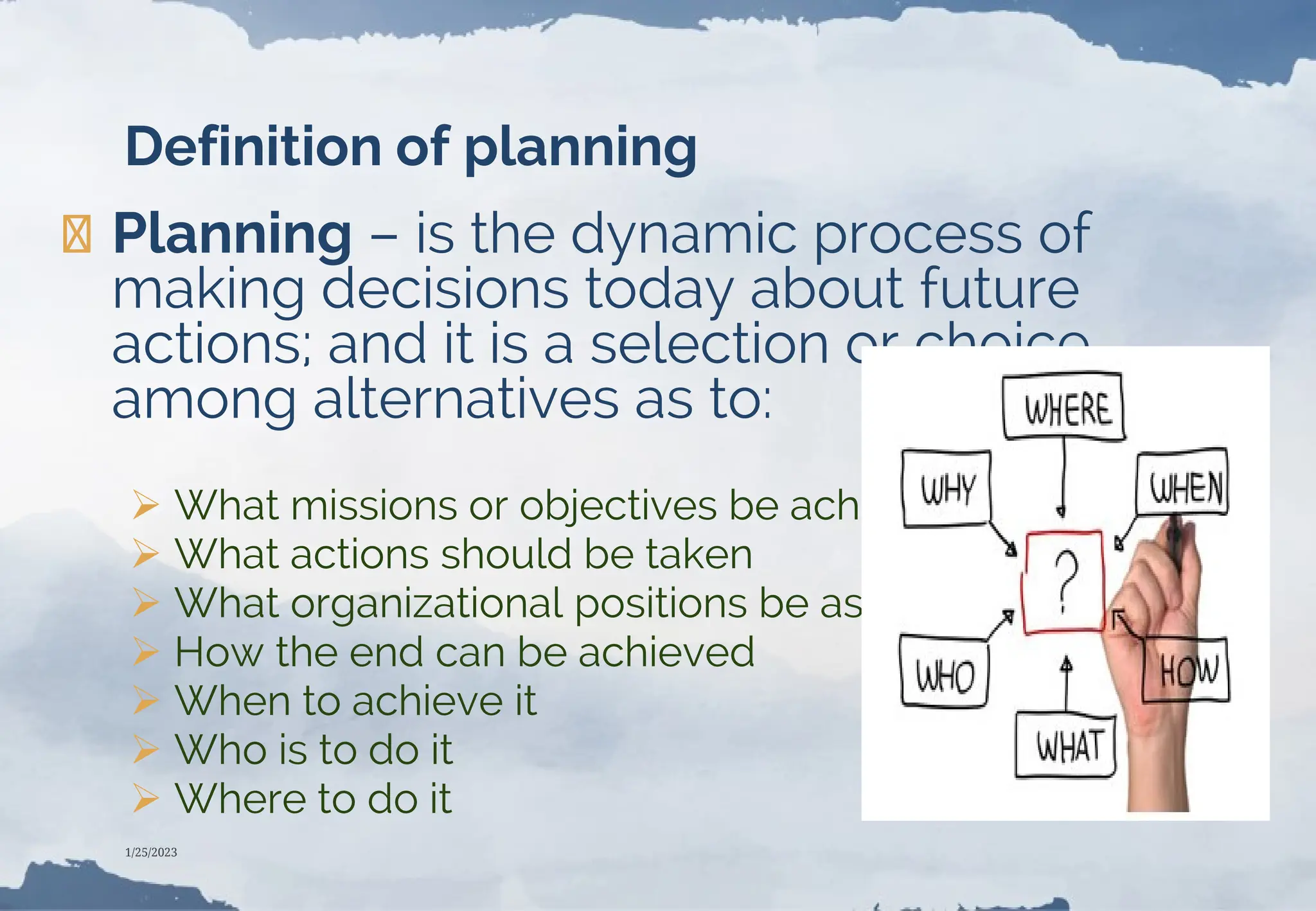
❯Planning– is the dynamic process of
making decisions today about future
actions; and it is a selection or choice
among alternatives as to:
What missions or objectives be achieved
What actions should be taken
What organizational positions be assigned
How the end can be achieved
When to achieve it
Who is to do it
Where to do it
1/25/2023
3.
Planning ……………
❯ Planningchoosing a goal and developing a strategy to
achieve that goal
❯ Planning - is preparing today for tomorrow; it is the activity
that allows managers to determine what they want and how
to get it: they set goals and decide how to reach them.
❯ planning is a systematic way of deciding today about the
future and doing things in a purposeful manner.
1/25/2023
4.
Nature of planning
It is goal oriented.
Primacy of planning.
Pervasiveness/ universality of planning.
Planning and information are deeply related.
Planning is a continuous process.
Planning is the means to an end.
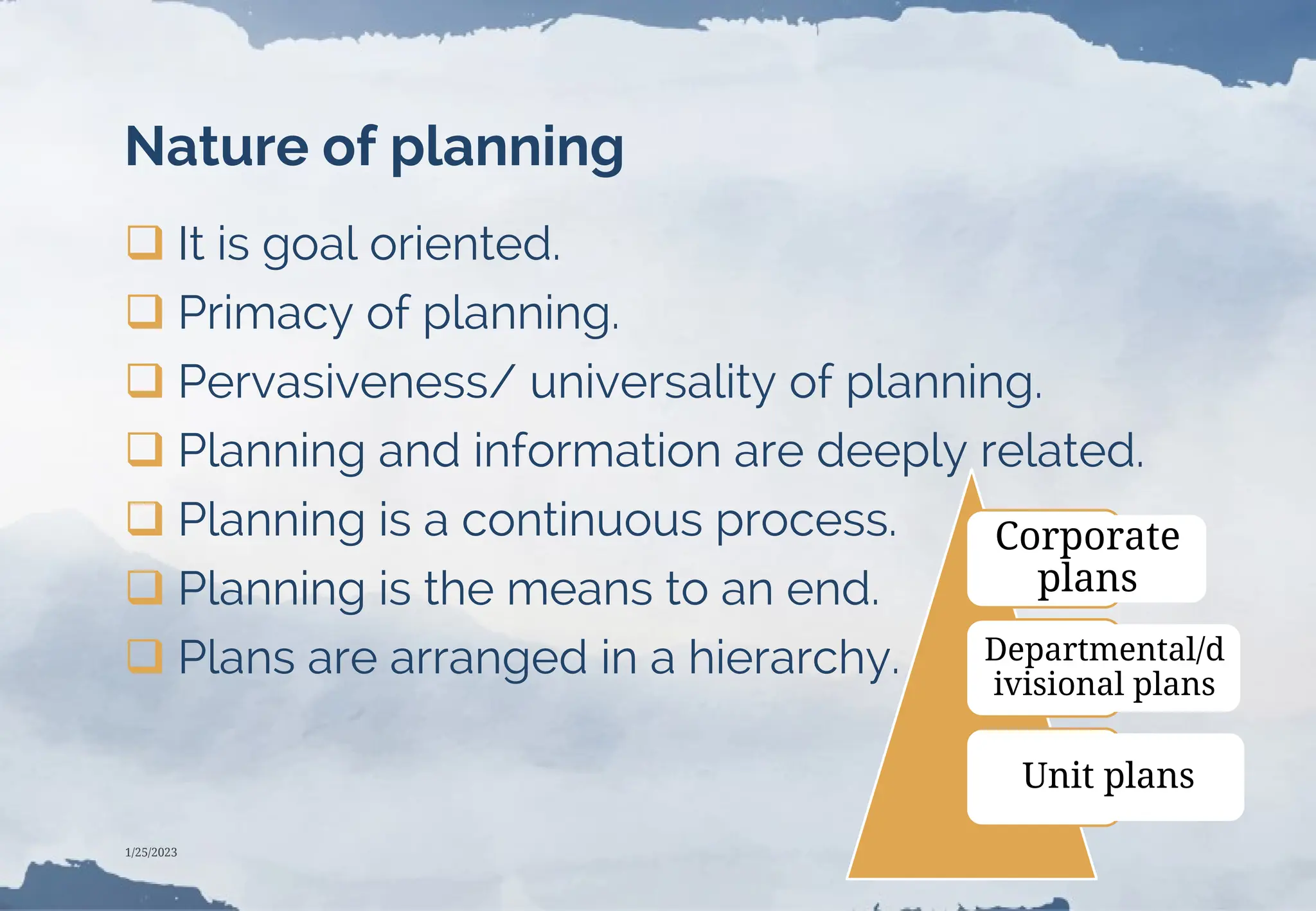
Plans are arranged in a hierarchy.
Corporate
plans
Departmental/d
ivisional plans
Unit plans
1/25/2023
5.
Importance of planning
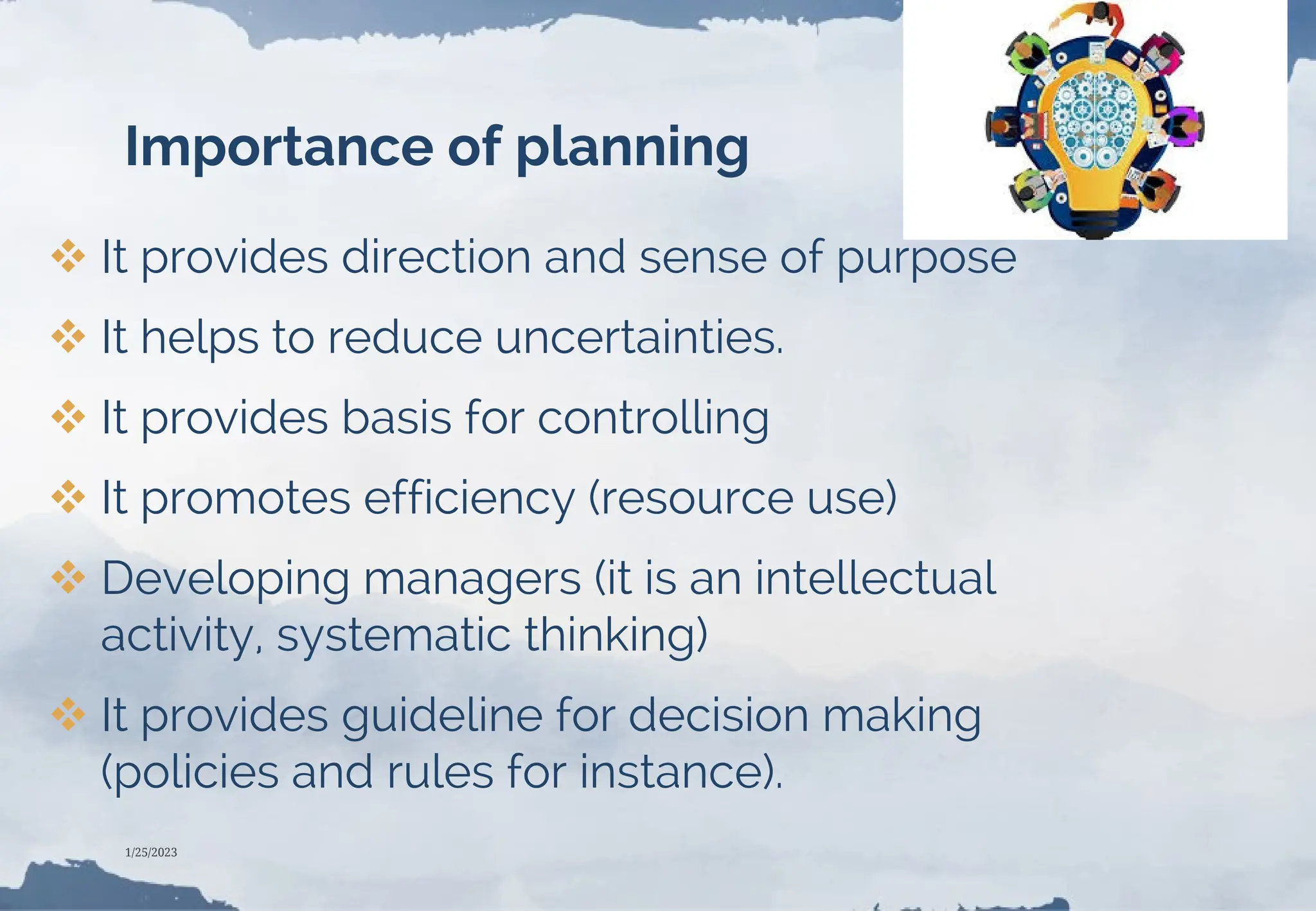
It provides direction and sense of purpose
It helps to reduce uncertainties.
It provides basis for controlling
It promotes efficiency (resource use)
Developing managers (it is an intellectual
activity, systematic thinking)
It provides guideline for decision making
(policies and rules for instance).
1/25/2023
6.
Shortcomings of planning
Planning is risky (uncertainties)
It is a difficult and complicated task
It is expensive and time consuming
Affected by external factors (nature,
government policies,…)
1/25/2023
7.
Components of planning
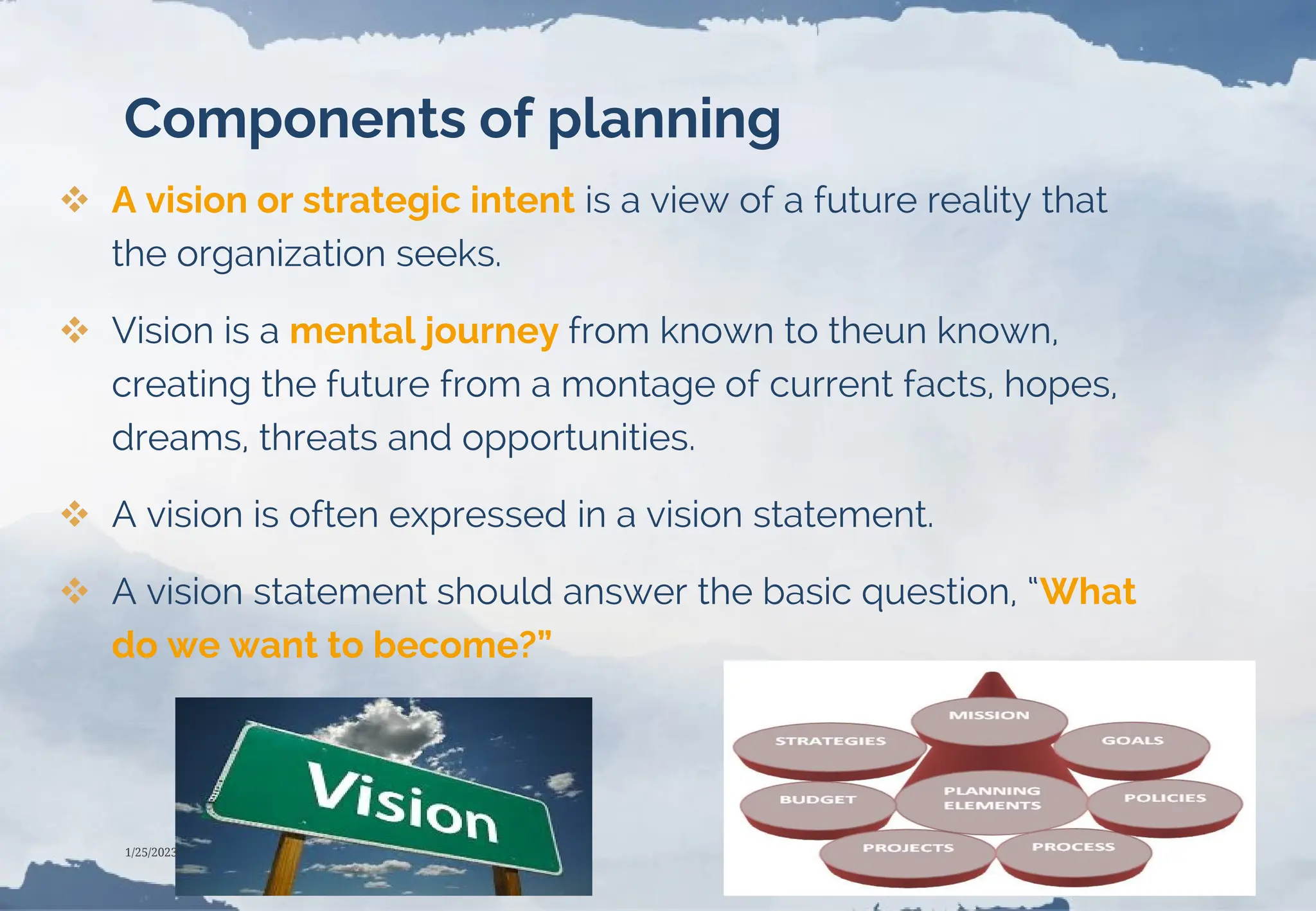
A vision or strategic intent is a view of a future reality that
the organization seeks.
Vision is a mental journey from known to theun known,
creating the future from a montage of current facts, hopes,
dreams, threats and opportunities.
A vision is often expressed in a vision statement.
A vision statement should answer the basic question, “What
do we want to become?”
1/25/2023
8.
Components of planning………
Mission
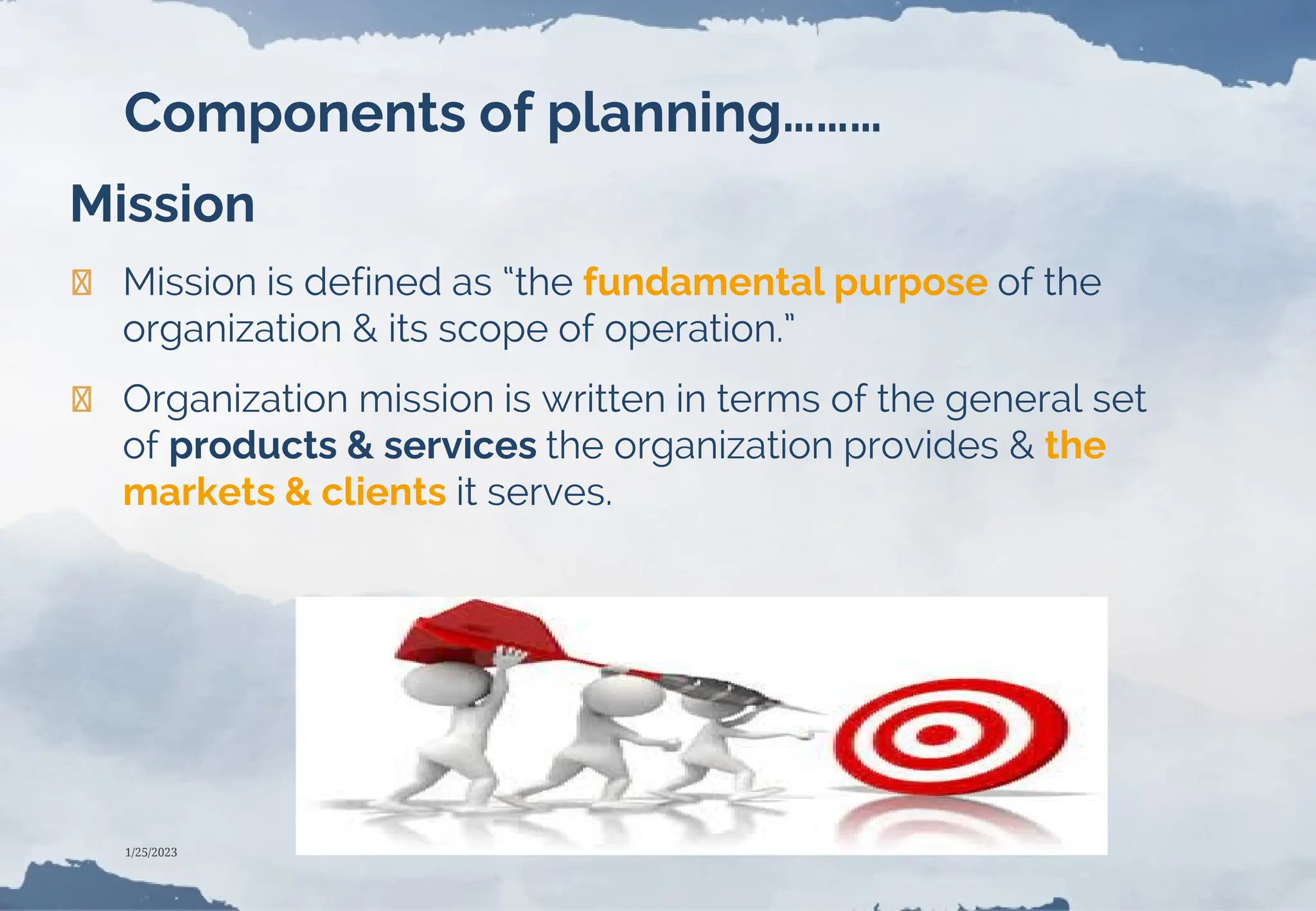
❯Mission is defined as “the fundamental purpose of the
organization & its scope of operation.”
❯ Organization mission is written in terms of the general set
of products & services the organization provides & the
markets & clients it serves.
1/25/2023
9.
Components of planning………
❯An organization’s mission statement is a concise introduction
to its work. It describes an organization in terms of its:
❯ Purpose: what the organization seeks to accomplish (WHY
DO WE EXIST?)
❯ Target Audience: the target group or beneficiaries of the
organization’s work (WHO DO WE SERVE?)
❯ Business: the main method or activity through which the
organization tries to fulfill this purpose (WHAT SERVICES DO
WE PROVIDE and HOW DO WE GO ABOUT PROVIDING
THEM?)
1/25/2023
10.
Components of planning………
Objectives
❯Objectives are the important ends of planning toward which
organizing, staffing, leading and controlling are aimed.
❯ Objectives are the important ends toward which organizational
and individual efforts or activities are directed.
❯ Objectives are essential starting points in planning because they
provide direction for all other managerial activities.
❯ While enterprise objectives are the basic plan of the firm;
department may also have its own objectives.
1/25/2023
11.
Objectives…………….
Points toconsider Include:
Quantification (if possible)
Indicate how the mission can be achieved
Represent specific planned levels of achievement
Provide precise points or states to be achieved
Allow review and appraisal of achievement
Make clear:
What is to be accomplished
How much is to be accomplished
By when it is to be accomplished
By whom it is to be accomplished
1/25/2023
12.
Setting objectives/Goals
❯ Inshort an objective should be Specific, Measurable, Achievable, Relevant and
Time bound (SMART)
❯ Specificity indicates clearly what needs to be achieved. Example: reduce
delay.
❯ Measurability indicates the possibility to determine if the desired condition is
fulfilled. Example: Reduce delays by 40% by the end of 2012.
❯ Achievability indicates a consensus and commitment to the objectives among
the major stakeholders
❯ Relevance indicates objectives need to be achievable. It answers feasibility,
the availability of authority of the managers and the means of realization.
❯ Time bound indicates a clear understanding of the time scales associated with
each objective as defined. It is difficult to have commitment without time
frame.
1/25/2023
13.
Planning process
❯ Formalplanning is a systematic process.
❯ The elements of a formal planning process provide a
general pattern of rational planning.
❯ They do not form a step-by-step procedure, yet the
sequence approximates behavior in a formal planning
environment.
1/25/2023
14.
Planning process
Establishingobjective/setting organizational
goals. It has three steps.
Assessing the present situation
Anticipating future conditions
Setting the objectives
It is only after the managers have at least the
rudimentary knowledge about their capabilities and
available opportunities that objective setting does
make sense.
1/25/2023
15.
Planning process
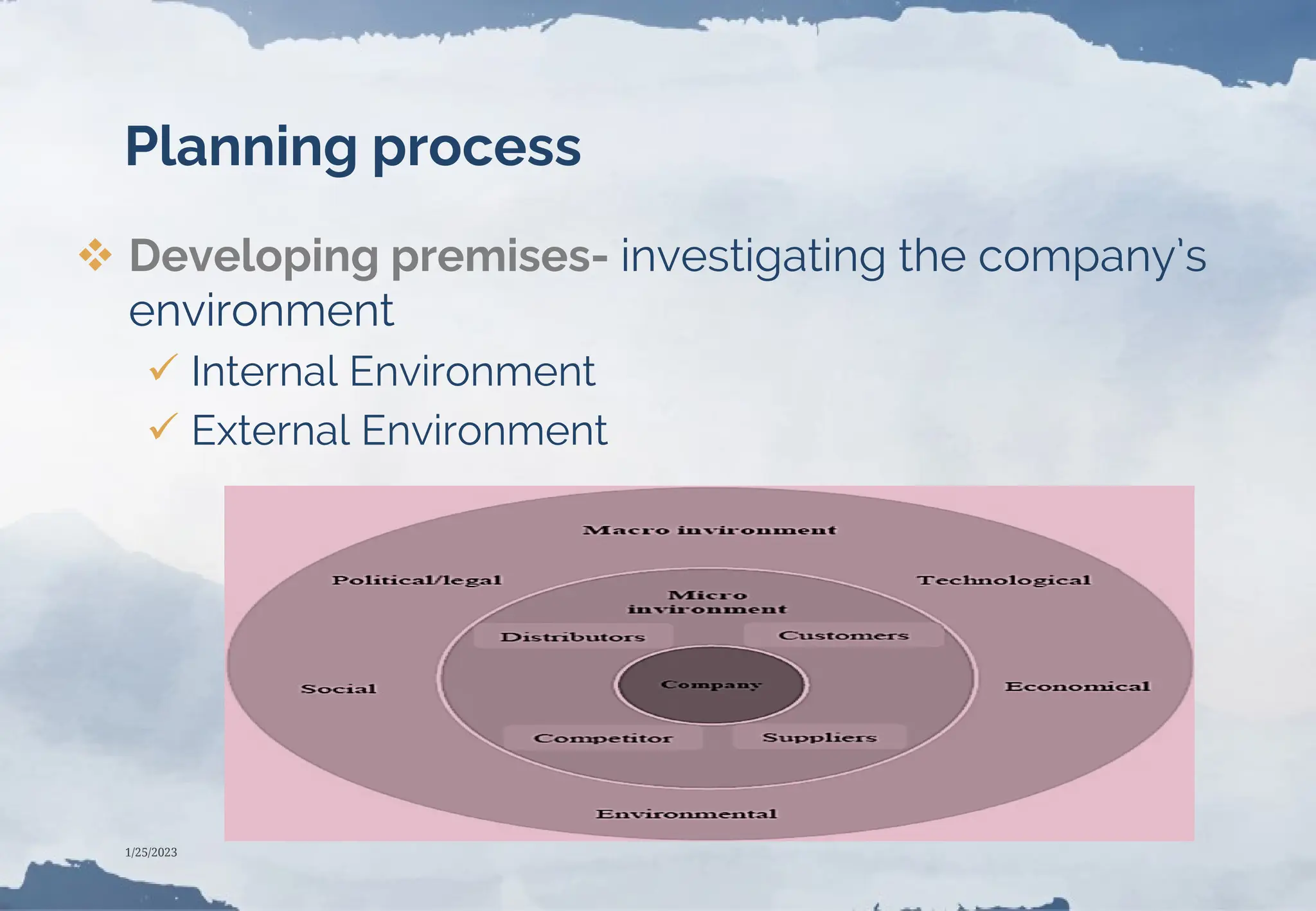
Developingpremises- investigating the company’s
environment
Internal Environment
External Environment
1/25/2023
16.
Planning process…………..
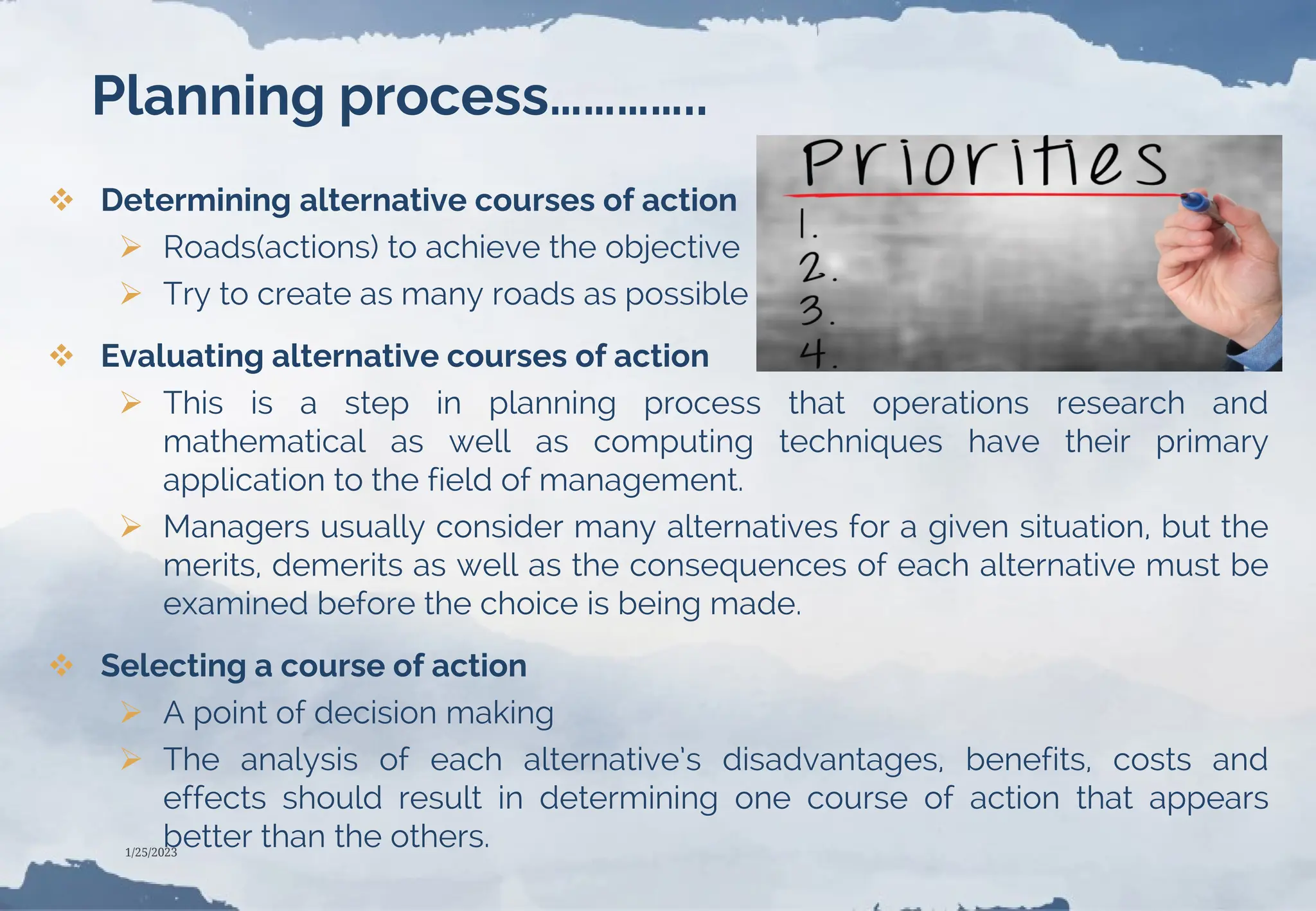
Determiningalternative courses of action
Roads(actions) to achieve the objective
Try to create as many roads as possible
Evaluating alternative courses of action
This is a step in planning process that operations research and
mathematical as well as computing techniques have their primary
application to the field of management.
Managers usually consider many alternatives for a given situation, but the
merits, demerits as well as the consequences of each alternative must be
examined before the choice is being made.
Selecting a course of action
A point of decision making
The analysis of each alternative’s disadvantages, benefits, costs and
effects should result in determining one course of action that appears
better than the others.
1/25/2023
17.
Planning process…………….
Formulatingderivative plans(supportive plan
Numbering plan by Budgeting plans.
Plans will have meaning when they are changed into numbers.
Budgeting is the means of adding various plans together and set
important standards against which planning process can be
measured.
Implementing the plan.
❯ This is a step where by the entire organization will be in motion or real
operation.
what resource will be use
who will be involved
how the plan will be evaluated
Controlling and evaluating the results (monitor progress)
1/25/2023
18.
Types of plan
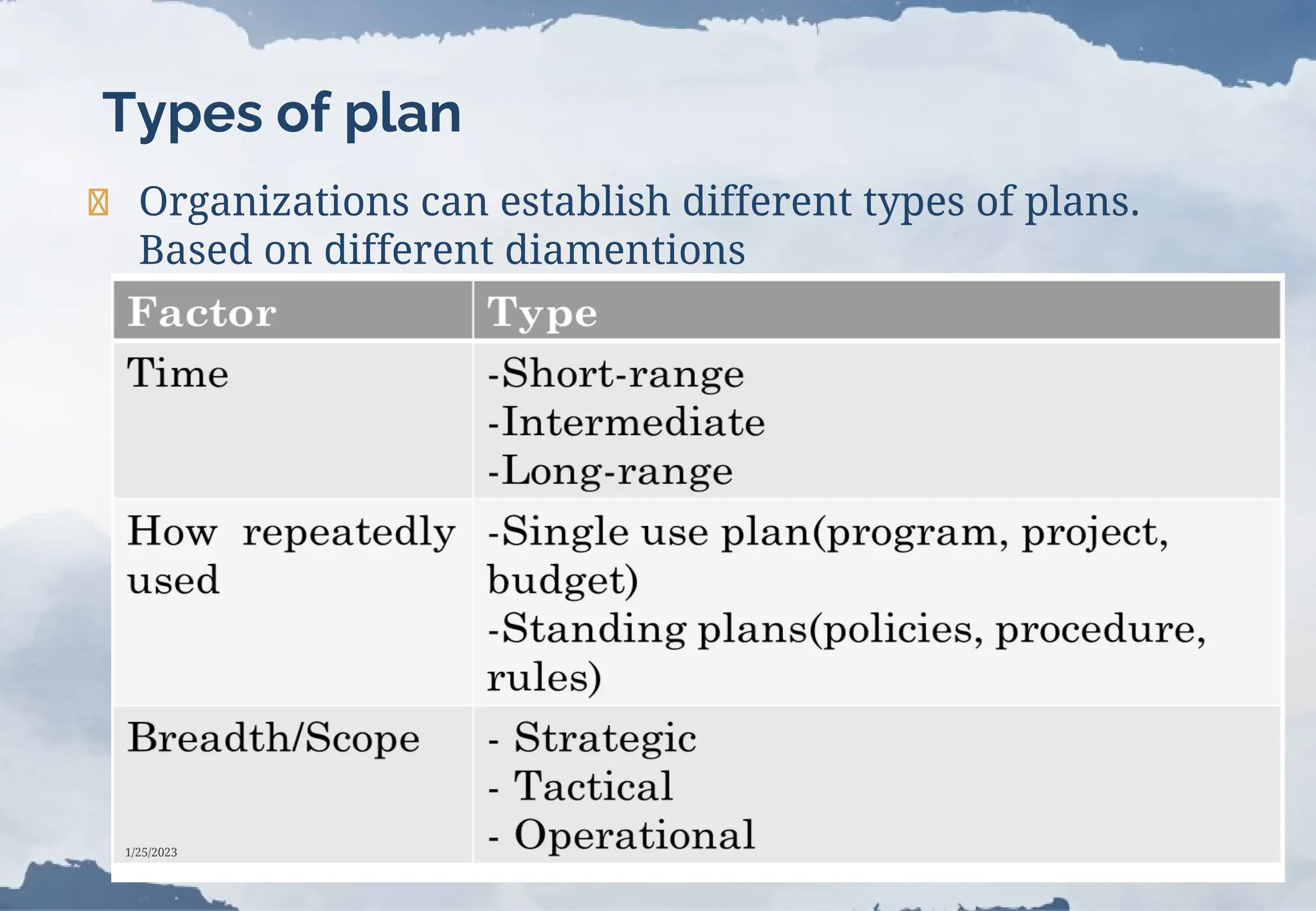
❯Organizations can establish different types of plans.
Based on different diamentions
1/25/2023
19.
Time dimetion
❯ Timedimension refers to the time periods for which
the planning is intended. Based on the length of time
a plan covers, we do have three types of plans:
❯ Long-range (five years or more),
❯ medium-range (between one and five years)
❯ short-range plans (one year or less)
❯ Of course, we should also remember that time frames
vary widely from industry to industry, because what
is considered to be long for one industry might be
intermediate of short for others.
1/25/2023
20.
Scope/breadth dimension
❯ Plansin an organization may differ in their scope; accordingly,
organizations can have:
Strategic,
Tactical,
operational plans
1/25/2023
21.
Strategic plan
❯ Strategicplans are the plans developed to achieve
strategic goals.
❯ More precisely, a strategic plan is a general plan
outlining decisions of resource allocation, priorities,
and action steps necessary to reach strategic goals.
❯ These plans are set by the board of directors and top
management, generally have an extended time horizon,
and address questions of scope, resource deployment,
competitive advantage, and synergy.
1/25/2023
22.
Tactical plan
❯ Atactical plan, aimed at achieving tactical goals, is
developed to implement specific parts of a strategic plan.
❯ Tactical plans typically involve upper and middle
management and, compared with strategic plans, have a
somewhat shorter time horizon and a more specific and
concrete focus.
❯ Thus tactical plans are concerned more with actually
getting things done than with deciding what to do.
1/25/2023
23.
Operational plan
❯ Anoperational plan focuses on carrying out tactical
plans to achieve operational goals.
❯ Developed by middle and lower-level managers,
operational plans have a short-term focus and are
relatively narrow in scope.
❯ Each one deals with a fairly small set of activities
1/25/2023
24.
Use dimension
❯ Thisclassification is based on their usage(how
repeatedly/frequently a given plan is used)
Single use plans
❯ Are developed to achieve specific purposes and
dissolved when these have been accomplished.
❯ They are developed for relatively unique and non-
repetitive situation.
Program
Project
Budget
1/25/2023
25.
Standing plan……………
❯ Aprogram is a complex set of objectives and plans to
achieve an important, one-time organizational goal
❯ A project is similar to a program, but generally smaller in
scope and complexity.
❯ A project may be a part of a broader program, or it may be a
self-contained single-use plan.
❯ Budgets are single-use plans that commit resources to
activities, projects, or programs.
❯ They are powerful tools that allocate scarce resources
among multiple and often competing uses.
1/25/2023
26.
Standing plan
❯ Standingplans- are plans that provide an ongoing
guidance for performing recurring activates.
❯ It is formulated to be used again and again.
❯ Standing plans allow managers to save time.
❯ Standing plans become valuable under relatively
stable situations.
❯ E.g. a bank can more easily approve or reject loan
requests if criteria are established in advance to
evaluate credit ratings, collateral assets, and related
applicant information.
1/25/2023
Standing plan…….
❯ Asa general guide for action, a policy is the most general
form of standing plan.
❯ A policy specifics the organization's general response to a
designated problem or situation.
❯ Procedures define a precise series of steps to be used in
achieving a specific job.
❯ The narrowest of the standing plans, rules and regulations,
describe exactly how specific activities are to be carried
out.
❯ Rather than guiding decision making, rules and regulations
actually take the place of decision making in various
situations.
1/25/2023
29.
Characteristics of agood plan
❯ Objectivity
❯ Futurity
❯ Flexibility
❯ Stability
❯ Comprehensive
❯ Simplicity and clarity
1/25/2023