EARTH AND LIFE
SCIENCE 11
Republic of the Philippines
Department of Education
REGION VII (Central Visayas)
Schools Division of Bais City
Q1/Week 1
CONTENT STANDARD
1. The formation of the universe and the solar
system
1. The subsystems (geosphere, hydrosphere,
atmosphere, and biosphere) that make up the
Earth
1. The Earth’s internal structure
PERFORMANCE STANDARD
Conduct a survey to assess the possible
geologic/ hydrometeorological hazards
that your community may experience.
MOST ESSENTIAL LEARNING
COMPETENCIES
1) Recognize the uniqueness of Earth, being the only planet
in the solar system with properties necessary to support
life. (S11/12ES-Ia-e- 3)
2)Explain that the Earth consists of four subsystems, across
whose boundaries matter and energy flow. (S11/12ES-Ia-e- 4)
LESSON OBJECTIVES
At the end of this lesson, the students can:
1) Describe the Earth’s Structure.
2) Identify the Earth’s Subsystem.
3) Identify the layers of the Earth’s Interior.
4) Identify the characteristics of earth that are necessary to support life.
5) Explain how the characteristics of the Earth sustain the needs of a
living organism.
6) Create a representation of the earth’s structure using materials that
can be found at home.
Preparatory Activities/ Daily Routine
1. Prayer
2. Checking of attendance
3. Distribution of Corrected Activity Sheets
Motivation/Recall
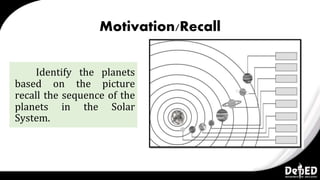
Identify the planets
based on the picture
recall the sequence of the
planets in the Solar
System.
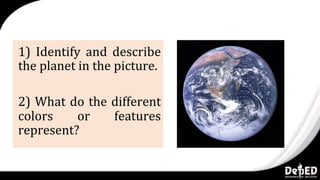
1) Identify and describe
the planet in the picture.
2) What do the different
colors or features
represent?
Activity
Unlocking Activity (15 minutes)
Instructions:
1) The Class will be divided into three groups. Students, please
count-off and remember your numbers as this will be the
basis for our groupings.
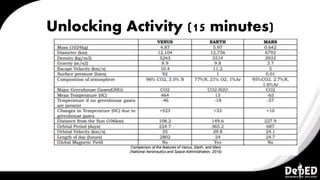
1) Using a manila paper, the groups shall give their comparison
of the planets based on the following: a) mass, b) size), c)
density, d) mean temperature, e) gravity, f) length of day, g)
magnetic field, and atmosphere composition.
Unlocking Activity (15 minutes)
Instructions:
Group 1: Compare Venus and Earth
Group 2: Earth and Mars
Group 3: Venus and Mars
Unlocking Activity (15 minutes)
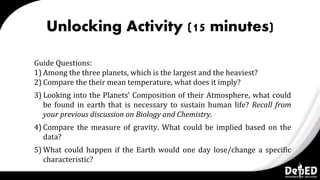
Guide Questions:
1) Among the three planets, which is the largest and the heaviest?
2) Compare the their mean temperature, what does it imply?
3) Looking into the Planets’ Composition of their Atmosphere, what could
be found in earth that is necessary to sustain human life? Recall from
your previous discussion on Biology and Chemistry.
4) Compare the measure of gravity. What could be implied based on the
data?
5) What could happen if the Earth would one day lose/change a specific
characteristic?
Unlocking Activity (15 minutes)
After completing the task, please post
your work on the chalkboard. Each group
shall present their observations and
comparisons within 2-3 minutes.
Overview of the Lesson
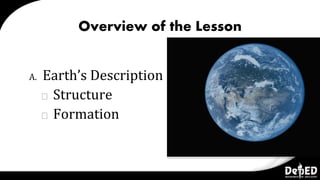
A. Earth’s Description
⮚ Structure
⮚ Formation
Overview of the Lesson
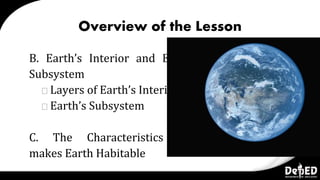
B. Earth’s Interior and Earth’s
Subsystem
⮚ Layers of Earth’s Interior
⮚ Earth’s Subsystem
C. The Characteristics that
makes Earth Habitable
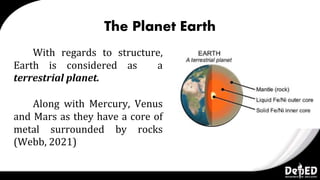
The Planet Earth
With regards to structure,
Earth is considered as a
terrestrial planet.
Along with Mercury, Venus
and Mars as they have a core of
metal surrounded by rocks
(Webb, 2021)
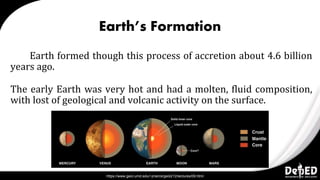
Earth’s Formation
Earth formed though this process of accretion about 4.6 billion
years ago.
The early Earth was very hot and had a molten, fluid composition,
with lost of geological and volcanic activity on the surface.
https://www.geol.umd.edu/~jmerck/geol212/lectures/09.html
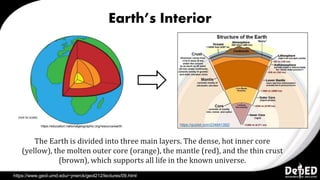
Earth’s Interior
The Earth is divided into three main layers. The dense, hot inner core
(yellow), the molten outer core (orange), the mantle (red), and the thin crust
(brown), which supports all life in the known universe.
https://www.geol.umd.edu/~jmerck/geol212/lectures/09.html
https://education.nationalgeographic.org/resource/earth https://quizlet.com/234641392/
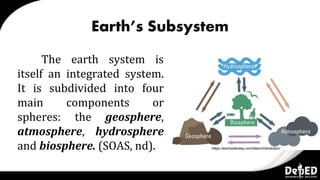
Earth’s Subsystem
The earth system is
itself an integrated system.
It is subdivided into four
main components or
spheres: the geosphere,
atmosphere, hydrosphere
and biosphere. (SOAS, nd). https://eschooltoday.com/learn/interaction/
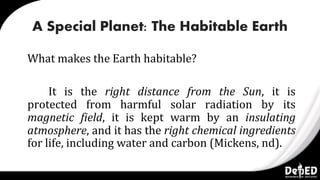
A Special Planet: The Habitable Earth
What makes the Earth habitable?
It is the right distance from the Sun, it is
protected from harmful solar radiation by its
magnetic field, it is kept warm by an insulating
atmosphere, and it has the right chemical ingredients
for life, including water and carbon (Mickens, nd).
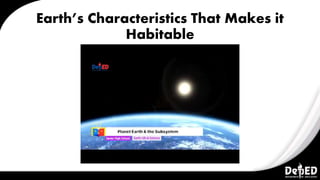
Earth’s Characteristics That Makes it
Habitable
Assessment
ASSESSMENT
ASSESSMENT
ASSESSMENT
ASSESSMENT
For items 6-10. Create a concept map
showing the relationship or interaction of
the different subsystems.
REFERENCES
Articles and Books:
▪ A Special Planet: The Habitable Earth. Mickens R. (nd). Retrieved from:
https://www.amnh.org/exhibitions/permanent/planet-earth/why-is-the-earth-habitable
▪ Mercado, R. (2021). Earth and Life Science: Quarter 1 – Module 1: Origin and Structure of
the Earth – Planet Earth. Department of Education – Region IV-A CALABARZON
▪ National Geographic: Earth Structure. Retrieved from:
https://education.nationalgeographic.org/resource/resource-library-earth-structure
▪ SHS Earth and Life Science Q1 Ep1: Planet Earth and the Subsystem.
https://drive.google.com/file/d/1gsD1g4oI9Yg5ts-dPcieRtUl1ZqikwN2/view?usp=sharing
▪ Retrieved from: https://www.youtube.com/watch?v=in3yPabB8vs
▪ The Earth and its Components: The Main Component of Earth System. SOAS University of
London. Retrieved from: https://www.soas.ac.uk/cedep-demos/000_P500_ESM_K3736-
Demo/unit1/page_15
▪ Webb, P. (2021). Introduction to oceanography. Roger Williams University. Chapter 3.1-3
Assignment
With the knowledge gained from
this lesson, create a representation of
our planets that you can find at home.
REFERENCES
Online Photos:
• How do the Earth's spheres interact? Retrieved from:
https://eschooltoday.com/learn/interaction/
• Earth’s Interior. Retrieved from: https://education.nationalgeographic.org/resource/earth
• Structure of the Earth. Retrieved from: https://quizlet.com/234641392/
• Planetary Interior. Retrieved from:
https://www.geol.umd.edu/~jmerck/geol212/lectures/09.html
• https://www.amnh.org/exhibitions/permanent/planet-earth/why-is-the-earth-habitable
Thank you and see you next
meeting!
Prepared by: Roxanne Mae S. Dagotdot

Planet Earth and its Subsystems.pptx

  • 1.
    EARTH AND LIFE SCIENCE11 Republic of the Philippines Department of Education REGION VII (Central Visayas) Schools Division of Bais City Q1/Week 1
  • 2.
    CONTENT STANDARD 1. Theformation of the universe and the solar system 1. The subsystems (geosphere, hydrosphere, atmosphere, and biosphere) that make up the Earth 1. The Earth’s internal structure
  • 3.
    PERFORMANCE STANDARD Conduct asurvey to assess the possible geologic/ hydrometeorological hazards that your community may experience.
  • 4.
    MOST ESSENTIAL LEARNING COMPETENCIES 1)Recognize the uniqueness of Earth, being the only planet in the solar system with properties necessary to support life. (S11/12ES-Ia-e- 3) 2)Explain that the Earth consists of four subsystems, across whose boundaries matter and energy flow. (S11/12ES-Ia-e- 4)
  • 5.
    LESSON OBJECTIVES At theend of this lesson, the students can: 1) Describe the Earth’s Structure. 2) Identify the Earth’s Subsystem. 3) Identify the layers of the Earth’s Interior. 4) Identify the characteristics of earth that are necessary to support life. 5) Explain how the characteristics of the Earth sustain the needs of a living organism. 6) Create a representation of the earth’s structure using materials that can be found at home.
  • 6.
    Preparatory Activities/ DailyRoutine 1. Prayer 2. Checking of attendance 3. Distribution of Corrected Activity Sheets
  • 7.
    Motivation/Recall Identify the planets basedon the picture recall the sequence of the planets in the Solar System.
  • 8.
    1) Identify anddescribe the planet in the picture. 2) What do the different colors or features represent?
  • 9.
  • 10.
    Unlocking Activity (15minutes) Instructions: 1) The Class will be divided into three groups. Students, please count-off and remember your numbers as this will be the basis for our groupings. 1) Using a manila paper, the groups shall give their comparison of the planets based on the following: a) mass, b) size), c) density, d) mean temperature, e) gravity, f) length of day, g) magnetic field, and atmosphere composition.
  • 11.
    Unlocking Activity (15minutes) Instructions: Group 1: Compare Venus and Earth Group 2: Earth and Mars Group 3: Venus and Mars
  • 12.
  • 13.
    Unlocking Activity (15minutes) Guide Questions: 1) Among the three planets, which is the largest and the heaviest? 2) Compare the their mean temperature, what does it imply? 3) Looking into the Planets’ Composition of their Atmosphere, what could be found in earth that is necessary to sustain human life? Recall from your previous discussion on Biology and Chemistry. 4) Compare the measure of gravity. What could be implied based on the data? 5) What could happen if the Earth would one day lose/change a specific characteristic?
  • 14.
    Unlocking Activity (15minutes) After completing the task, please post your work on the chalkboard. Each group shall present their observations and comparisons within 2-3 minutes.
  • 15.
    Overview of theLesson A. Earth’s Description ⮚ Structure ⮚ Formation
  • 16.
    Overview of theLesson B. Earth’s Interior and Earth’s Subsystem ⮚ Layers of Earth’s Interior ⮚ Earth’s Subsystem C. The Characteristics that makes Earth Habitable
  • 17.
    The Planet Earth Withregards to structure, Earth is considered as a terrestrial planet. Along with Mercury, Venus and Mars as they have a core of metal surrounded by rocks (Webb, 2021)
  • 19.
    Earth’s Formation Earth formedthough this process of accretion about 4.6 billion years ago. The early Earth was very hot and had a molten, fluid composition, with lost of geological and volcanic activity on the surface. https://www.geol.umd.edu/~jmerck/geol212/lectures/09.html
  • 20.
    Earth’s Interior The Earthis divided into three main layers. The dense, hot inner core (yellow), the molten outer core (orange), the mantle (red), and the thin crust (brown), which supports all life in the known universe. https://www.geol.umd.edu/~jmerck/geol212/lectures/09.html https://education.nationalgeographic.org/resource/earth https://quizlet.com/234641392/
  • 22.
    Earth’s Subsystem The earthsystem is itself an integrated system. It is subdivided into four main components or spheres: the geosphere, atmosphere, hydrosphere and biosphere. (SOAS, nd). https://eschooltoday.com/learn/interaction/
  • 24.
    A Special Planet:The Habitable Earth What makes the Earth habitable? It is the right distance from the Sun, it is protected from harmful solar radiation by its magnetic field, it is kept warm by an insulating atmosphere, and it has the right chemical ingredients for life, including water and carbon (Mickens, nd).
  • 25.
  • 26.
  • 27.
  • 28.
  • 29.
  • 30.
    ASSESSMENT For items 6-10.Create a concept map showing the relationship or interaction of the different subsystems.
  • 31.
    REFERENCES Articles and Books: ▪A Special Planet: The Habitable Earth. Mickens R. (nd). Retrieved from: https://www.amnh.org/exhibitions/permanent/planet-earth/why-is-the-earth-habitable ▪ Mercado, R. (2021). Earth and Life Science: Quarter 1 – Module 1: Origin and Structure of the Earth – Planet Earth. Department of Education – Region IV-A CALABARZON ▪ National Geographic: Earth Structure. Retrieved from: https://education.nationalgeographic.org/resource/resource-library-earth-structure ▪ SHS Earth and Life Science Q1 Ep1: Planet Earth and the Subsystem. https://drive.google.com/file/d/1gsD1g4oI9Yg5ts-dPcieRtUl1ZqikwN2/view?usp=sharing ▪ Retrieved from: https://www.youtube.com/watch?v=in3yPabB8vs ▪ The Earth and its Components: The Main Component of Earth System. SOAS University of London. Retrieved from: https://www.soas.ac.uk/cedep-demos/000_P500_ESM_K3736- Demo/unit1/page_15 ▪ Webb, P. (2021). Introduction to oceanography. Roger Williams University. Chapter 3.1-3
  • 32.
  • 33.
    With the knowledgegained from this lesson, create a representation of our planets that you can find at home.
  • 34.
    REFERENCES Online Photos: • Howdo the Earth's spheres interact? Retrieved from: https://eschooltoday.com/learn/interaction/ • Earth’s Interior. Retrieved from: https://education.nationalgeographic.org/resource/earth • Structure of the Earth. Retrieved from: https://quizlet.com/234641392/ • Planetary Interior. Retrieved from: https://www.geol.umd.edu/~jmerck/geol212/lectures/09.html • https://www.amnh.org/exhibitions/permanent/planet-earth/why-is-the-earth-habitable
  • 35.
    Thank you andsee you next meeting! Prepared by: Roxanne Mae S. Dagotdot