Forum
Uber, car clubs and driverless cars:
The end of the road for
urban car ownership?
#PlanFrm
@BloombergNEF
@planstrategic
Chair: 	 Kevin McCullagh
Founder, Plan
Panelist: 	Debbie Nathan
Head of Consumer
Research, Plan
Panelist:	Colin McKerracher
Head of Advanced Transport,
Bloomberg New Energy Finance
Panelist:	Timandra Harkness
Co-presenter of
FutureProofing, Radio 4
Panelist:	Oliver Le Grice
former Chief Designer
Advanced Design, Land Rover
Speaker:	Lars Hesselgren
Director Research
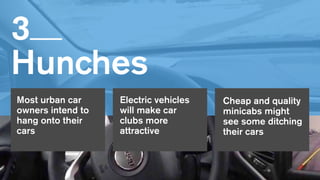
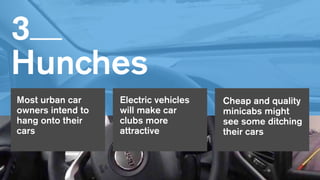
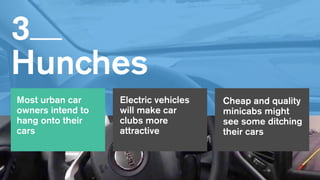
PLP Architecture
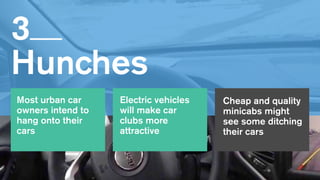
16:30	Introduction
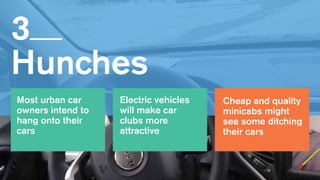
16:40	Highlights from Plan’s urban mobility survey
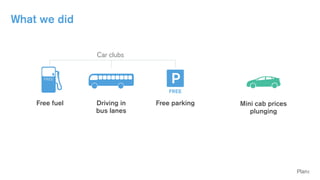
16:50	Opening remarks from panelists
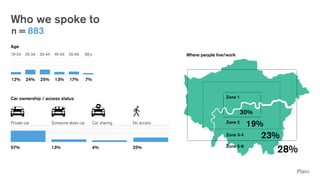
17:00	 Chaired discussion
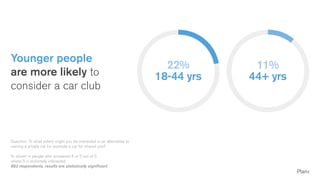
17:35	Preview of an urban infrastructure concept
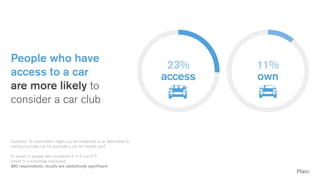
17:45	QA
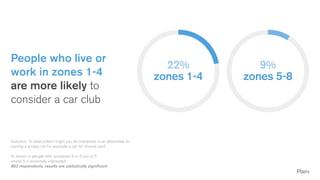
18:30	Drinks
Title
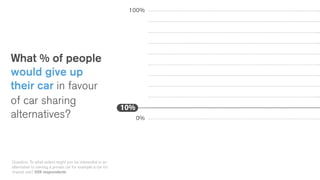
Final presentation
00 XXX 2014
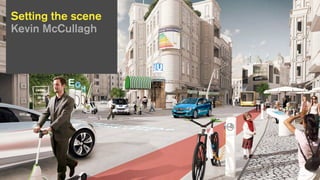
Setting the scene
Kevin McCullagh
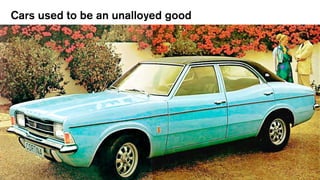
Cars used to be an unalloyed good
Richer mobility
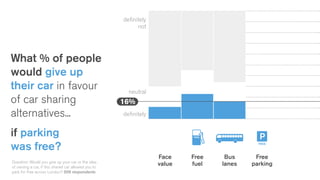
service ecosystem
New mobility modes
Multi-modal apps
Seamless payments
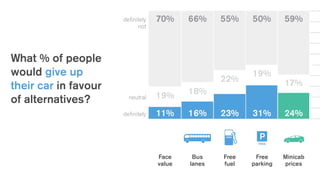
2003
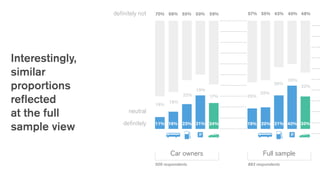
London congestion
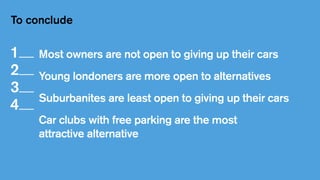
charging begins
2004
ZipCar
launches
1980s
High occupancy vehicle
lanes in the USA
1982
Athens Ring
Odd/Even system
2014
London congestion nears
pre-charging levels
2020
Paris to ban
diesel cars
2010
Boris Bike
scheme launched
2034
Hamburg to ban
cars from centre
2030
Helsinki eliminates
private-car ownership
2040
DfT expects 25%
increase in traffic
since 2015
Squeeze on car use
Higher parking costs
Congestion charging
Lower speed limits
Traffic-calming measures
Stricter emission laws
No-car developments
Limited car zones
The long squeeze
and alternatives
2km1km 5km 10km 15km+
Costandconvenience
(Price / Comfort / Flexibility / Speed)
Bus
Scooter
Tram
Taxi
Minicab
Walk
Luxury
chauffeur
Metro
Bike
Typical urban
journey length
Private car
Dynamic minibus
Uses data to determine
routes and offer point
to point pick-ups and
drop-offs, e.g. Bridj
Mobility services
Hailable
mini cab
Mini cab that can be hailed
with an app, e.g. Uber
Action
zone
Motorbike
Multi-
modal
payment
Taxi
hailing
apps
Parking
services
Multi-
modal
planner
Navigation
P2P
car sharing
Car owners rent their
cars directly to other
consumers, e.g. RelayRides
Free-
floating
car sharing
Cars are collected from and
returned to, any parking
space within a pre-defined
area, e.g. DriveNow
Shared
Scooter
Shared
bike
Micro
car sharing
For smaller (typically 3-5)
pre-determined groups
of users, e.g. Audi Unite
Point-to-point
car sharing Back-to-base
car sharing
e-bike
Bicycle with integrated
electrical motor for
propulsion, e.g. GoCycle
There are more alternatives
to car ownership now
Title 1 line
UK car sales
1.75m
2007 2009 2011 2013 2015
1.85m
1.95m
2.05m
2.15m
2.25m
2.35m
2.45m
2.55m
2.65m
+57%Forecasted rise in global
car sales by 2030
Euromonitor, 2015
But cars have never
been so popular
TFL, Travel in London: Report 8 (2015)
The car is London’s
popular form of transport Car
Bus/Tr
am
Walk
Tube
R
ail
Other
35%
14%
12%
20%
24%
5%
Modes
share of daily
journeys
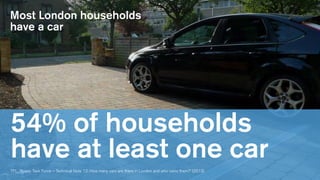
54% of households
have at least one car
TFL, ‘Roads Task Force – Technical Note 12: How many cars are there in London and who owns them?’ (2013)
Most London households
have a car
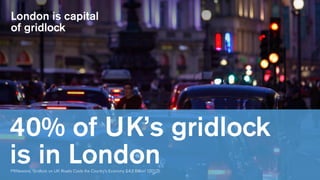
40% of UK’s gridlock
is in London PRNewsire, ‘Gridlock on UK Roads Costs the Country’s Economy £4.3 Billion’ (2012)
London is capital
of gridlock
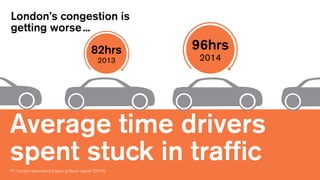
Average time drivers
spent stuck in trafficFT, ‘London becomes Europe’s gridlock capital’ (2015)
London’s congestion is
getting worse ...
96hrs
2014
82hrs
2013
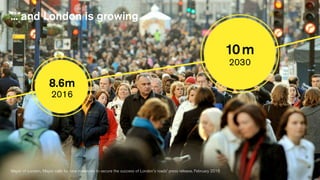
... and London is growing
Mayor of London, ‘Mayor calls for new measures to secure the success of London's roads’ press release, February 2016
8.6m
2016
10 m
2030
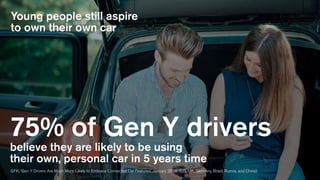
75% of Gen Y drivers
Young people still aspire
to own their own car
believe they are likely to be using
their own, personal car in 5 years time
GFK, ‘Gen Y Drivers Are Much More Likely to Embrace Connected Car Features’, January 2015 (US, UK, Germany, Brazil, Russia, and China)
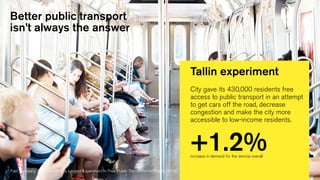
Better public transport
isn’t always the answer
Tallin experiment
City gave its 430,000 residents free
access to public transport in an attempt
to get cars off the road, decrease
congestion and make the city more
accessible to low-income residents.
+1.2%increase in demand for the service overall
Fast Company, ‘Why The World’s Largest Experiment In Free Public Transportation Failed’, 2014
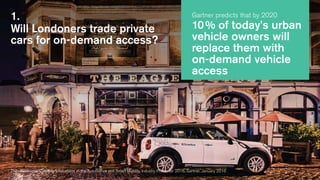
1.
Will Londoners trade private
cars for on-demand access?
Thilo Koslowski, Creating Innovations in the Automotive and Smart Mobility Industry Primer for 2016, Gartner, January 2016
Gartner predicts that by 2020
10 % of today’s urban
vehicle owners will
replace them with
on-demand vehicle
access
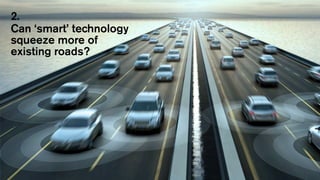
2.
Can ‘smart’ technology
squeeze more of
existing roads?
3.
What are the options for
increasing road capacity?
15 March 2016
Car ownership
alternatives
Survey results
Why do this research?
Decades of pressure on cars
Why do this research?
Decades of pressure on cars
Wide range of alternatives
Why do this research?
Decades of pressure on cars
Wide range of alternatives
But what do consumers think?
3   
Hunches
3   
Hunches
Most urban car
owners intend to
hang onto their
cars
3   
Hunches
Most urban car
owners intend to
hang onto their
cars
Electric vehicles
will make car
clubs more
attractive
3   
Hunches
Cheap and quality
minicabs might
see some ditching
their cars
Most urban car
owners intend to
hang onto their
cars
Electric vehicles
will make car
clubs more
attractive
What we did
Free fuel Free parking
FREE
Driving in
bus lanes
Car clubs
FREE
Mini cab prices
plunging
Who we spoke to
Where people live/work
n = 883
30%
19%
23%
28%
Zone 1
Zone 2
Zone 3-4
Zone 5-8
Car ownership / access status
57% 13% 4% 25%
Private car Someone elses car Car sharing No access
Age
12%
18-24
24%
25-34
25%
35-44
13%
45-54
17%
55-64
7%
65+
Younger people
are more likely to
consider a car club
Question: To what extent might you be interested in an alternative to
owning a private car for example a car for shared use?
% shown = people who answered 4 or 5 out of 5
where 5 = extremely interested
883 respondents, results are statistically significant
22%
18-44 yrs
11%
44+ yrs
People who have
access to a car
are more likely to
consider a car club
Question: To what extent might you be interested in an alternative to
owning a private car for example a car for shared use?
% shown = people who answered 4 or 5 out of 5
where 5 = extremely interested
883 respondents, results are statistically significant
23%
access
11%
own
People who live or
work in zones 1-4
are more likely to
consider a car club
Question: To what extent might you be interested in an alternative to
owning a private car for example a car for shared use?
% shown = people who answered 4 or 5 out of 5
where 5 = extremely interested
883 respondents, results are statistically significant
22%
zones 1-4
9%
zones 5-8
Question 
What % of people would give up their car
in favour of car sharing alternatives?
What % of people
would give up
their car in favour
of car sharing
alternatives?
Question: To what extent might you be interested in an
alternative to owning a private car for example a car for
shared use? 509 respondents
10%
100%
0%
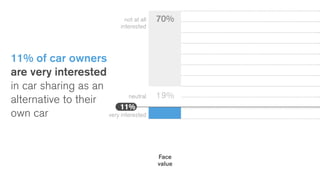
11% of car owners
are very interested
in car sharing as an
alternative to their
own car
19%
70%
11%
Face
value
not at all
interested
neutral
very interested
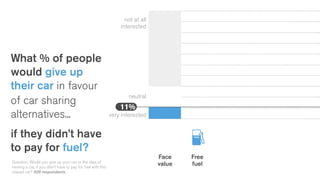
What % of people
would give up
their car in favour
of car sharing
alternatives...
if they didn’t have
to pay for fuel?
Question: Would you give up your car or the idea of
owning a car, if you didn’t have to pay for fuel with this
shared car? 509 respondents
FREE
Free
fuel
Face
value
11%
not at all
interested
neutral
very interested
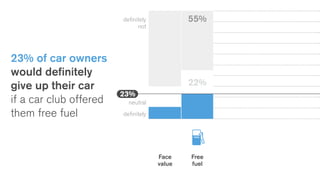
23% of car owners
would definitely
give up their car
if a car club offered
them free fuel
FREE
22%
55%
23%
Free
fuel
Face
value
definitely
not
neutral
definitely
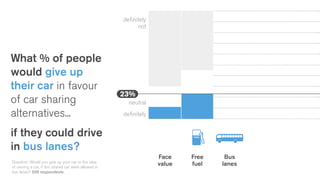
What % of people
would give up
their car in favour
of car sharing
alternatives...
if they could drive
in bus lanes?
Question: Would you give up your car or the idea
of owning a car, if this shared car were allowed in
bus lanes? 509 respondents
FREE
Bus
lanes
Free
fuel
Face
value
23%
definitely
not
neutral
definitely
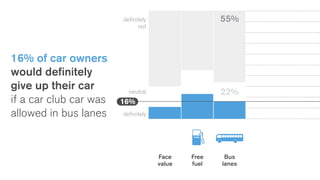
16% of car owners
would definitely
give up their car
if a car club car was
allowed in bus lanes
FREE
22%
55%
16%
Bus
lanes
Free
fuel
Face
value
definitely
not
neutral
definitely
What % of people
would give up
their car in favour
of car sharing
alternatives...
if parking
was free?
Question: Would you give up your car or the idea
of owning a car, if this shared car allowed you to
park for free across London? 509 respondents
FREE
FREE
Free
parking
Bus
lanes
Free
fuel
Face
value
16%
definitely
not
neutral
definitely
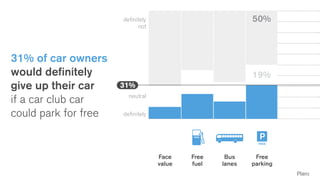
31% of car owners
would definitely
give up their car
if a car club car
could park for free
FREE
FREE
31%
19%
50%
Free
parking
Bus
lanes
Free
fuel
Face
value
definitely
not
neutral
definitely
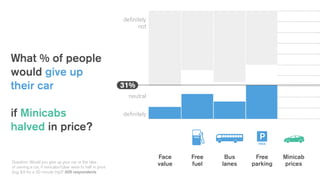
What % of people
would give up
their car
if Minicabs
halved in price?
Question: Would you give up your car or the idea
of owning a car, if minicabs/Uber were to half in price
(e.g. £4 for a 30 minute trip)? 509 respondents
FREE
FREE
Minicab
prices
Free
parking
Bus
lanes
Free
fuel
Face
value
31%
definitely
not
neutral
definitely
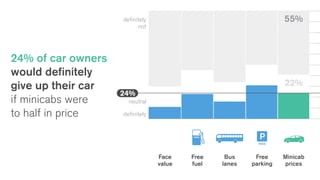
24% of car owners
would definitely
give up their car
if minicabs were
to half in price
FREE
FREE
24%
22%
55%
Minicab
prices
Free
parking
Bus
lanes
Free
fuel
Face
value
definitely
not
neutral
definitely
What % of people
would give up
their car in favour
of alternatives?
Free
fuel
FREE
Face
value
Free
parking
FREE
Bus
lanes
Minicab
prices
22%
23%
55%
17%
19%
24%11%
59%
19%
31%
50%
18%
16%
66%70%definitely
not
neutral
definitely
Car owners Full sample
22%
23%
55%
17%
19%
24%11%
59%
19%
31%
50%
18%
16%
66%70%
26%
31%
43%
22%
25%
30%19%
48%
20%
40%
40%
25%
20%
55%57%
Interestingly,
similar
proportions
reflected
at the full
sample view
509 respondents 883 respondents
definitely not
neutral
definitely
To conclude
Most owners are not open to giving up their cars
Young londoners are more open to alternatives
Suburbanites are least open to giving up their cars
Car clubs with free parking are the most
attractive alternative
1   
2   
3   
4   
3   
Hunches
Cheap and quality
minicabs might
see some ditching
their cars
Most urban car
owners intend to
hang onto their
cars
Electric vehicles
will make car
clubs more
attractive
3   
Hunches
Most urban car
owners intend to
hang onto their
cars
Cheap and quality
minicabs might
see some ditching
their cars
Electric vehicles
will make car
clubs more
attractive
3   
Hunches
Most urban car
owners intend to
hang onto their
cars
Electric vehicles
will make car
clubs more
attractive
Cheap and quality
minicabs might
see some ditching
their cars
3   
Hunches
Cheap and quality
minicabs might
see some ditching
their cars
Most urban car
owners intend to
hang onto their
cars
Electric vehicles
will make car
clubs more
attractive
We join the dots
www.plan.london

Plan forum on mobility: intro and survey

  • 1.
    Forum Uber, car clubsand driverless cars: The end of the road for urban car ownership? #PlanFrm @BloombergNEF @planstrategic Chair: Kevin McCullagh Founder, Plan Panelist: Debbie Nathan Head of Consumer Research, Plan Panelist: Colin McKerracher Head of Advanced Transport, Bloomberg New Energy Finance Panelist: Timandra Harkness Co-presenter of FutureProofing, Radio 4 Panelist: Oliver Le Grice former Chief Designer Advanced Design, Land Rover Speaker: Lars Hesselgren Director Research PLP Architecture
  • 2.
    16:30 Introduction 16:40 Highlights from Plan’surban mobility survey 16:50 Opening remarks from panelists 17:00 Chaired discussion 17:35 Preview of an urban infrastructure concept 17:45 QA 18:30 Drinks
  • 3.
    Title Final presentation 00 XXX2014 Setting the scene Kevin McCullagh
  • 4.
    Cars used tobe an unalloyed good
  • 5.
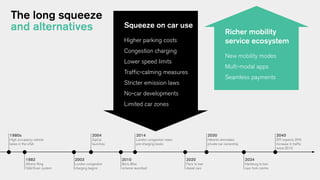
    Richer mobility service ecosystem Newmobility modes Multi-modal apps Seamless payments 2003 London congestion charging begins 2004 ZipCar launches 1980s High occupancy vehicle lanes in the USA 1982 Athens Ring Odd/Even system 2014 London congestion nears pre-charging levels 2020 Paris to ban diesel cars 2010 Boris Bike scheme launched 2034 Hamburg to ban cars from centre 2030 Helsinki eliminates private-car ownership 2040 DfT expects 25% increase in traffic since 2015 Squeeze on car use Higher parking costs Congestion charging Lower speed limits Traffic-calming measures Stricter emission laws No-car developments Limited car zones The long squeeze and alternatives
  • 6.
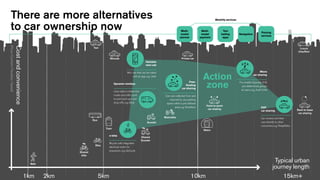
    2km1km 5km 10km15km+ Costandconvenience (Price / Comfort / Flexibility / Speed) Bus Scooter Tram Taxi Minicab Walk Luxury chauffeur Metro Bike Typical urban journey length Private car Dynamic minibus Uses data to determine routes and offer point to point pick-ups and drop-offs, e.g. Bridj Mobility services Hailable mini cab Mini cab that can be hailed with an app, e.g. Uber Action zone Motorbike Multi- modal payment Taxi hailing apps Parking services Multi- modal planner Navigation P2P car sharing Car owners rent their cars directly to other consumers, e.g. RelayRides Free- floating car sharing Cars are collected from and returned to, any parking space within a pre-defined area, e.g. DriveNow Shared Scooter Shared bike Micro car sharing For smaller (typically 3-5) pre-determined groups of users, e.g. Audi Unite Point-to-point car sharing Back-to-base car sharing e-bike Bicycle with integrated electrical motor for propulsion, e.g. GoCycle There are more alternatives to car ownership now
  • 7.
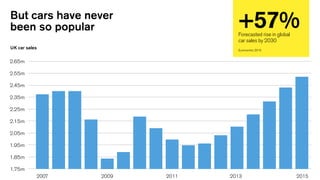
    Title 1 line UKcar sales 1.75m 2007 2009 2011 2013 2015 1.85m 1.95m 2.05m 2.15m 2.25m 2.35m 2.45m 2.55m 2.65m +57%Forecasted rise in global car sales by 2030 Euromonitor, 2015 But cars have never been so popular
  • 8.
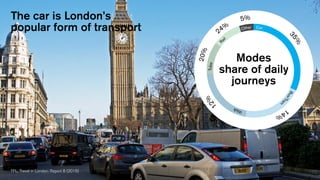
    TFL, Travel inLondon: Report 8 (2015) The car is London’s popular form of transport Car Bus/Tr am Walk Tube R ail Other 35% 14% 12% 20% 24% 5% Modes share of daily journeys
  • 9.
    54% of households haveat least one car TFL, ‘Roads Task Force – Technical Note 12: How many cars are there in London and who owns them?’ (2013) Most London households have a car
  • 10.
    40% of UK’sgridlock is in London PRNewsire, ‘Gridlock on UK Roads Costs the Country’s Economy £4.3 Billion’ (2012) London is capital of gridlock
  • 11.
    Average time drivers spentstuck in trafficFT, ‘London becomes Europe’s gridlock capital’ (2015) London’s congestion is getting worse ... 96hrs 2014 82hrs 2013
  • 12.
    ... and Londonis growing Mayor of London, ‘Mayor calls for new measures to secure the success of London's roads’ press release, February 2016 8.6m 2016 10 m 2030
  • 13.
    75% of Gen Y drivers Youngpeople still aspire to own their own car believe they are likely to be using their own, personal car in 5 years time GFK, ‘Gen Y Drivers Are Much More Likely to Embrace Connected Car Features’, January 2015 (US, UK, Germany, Brazil, Russia, and China)
  • 14.
    Better public transport isn’talways the answer Tallin experiment City gave its 430,000 residents free access to public transport in an attempt to get cars off the road, decrease congestion and make the city more accessible to low-income residents. +1.2%increase in demand for the service overall Fast Company, ‘Why The World’s Largest Experiment In Free Public Transportation Failed’, 2014
  • 15.
    1. Will Londoners tradeprivate cars for on-demand access? Thilo Koslowski, Creating Innovations in the Automotive and Smart Mobility Industry Primer for 2016, Gartner, January 2016 Gartner predicts that by 2020 10 % of today’s urban vehicle owners will replace them with on-demand vehicle access
  • 16.
  • 17.
    3. What are theoptions for increasing road capacity?
  • 18.
    15 March 2016 Carownership alternatives Survey results
  • 19.
    Why do thisresearch? Decades of pressure on cars
  • 20.
    Why do thisresearch? Decades of pressure on cars Wide range of alternatives
  • 21.
    Why do thisresearch? Decades of pressure on cars Wide range of alternatives But what do consumers think?
  • 22.
  • 23.
    3    Hunches Most urbancar owners intend to hang onto their cars
  • 24.
    3    Hunches Most urbancar owners intend to hang onto their cars Electric vehicles will make car clubs more attractive
  • 25.
    3    Hunches Cheap andquality minicabs might see some ditching their cars Most urban car owners intend to hang onto their cars Electric vehicles will make car clubs more attractive
  • 26.
    What we did Freefuel Free parking FREE Driving in bus lanes Car clubs FREE Mini cab prices plunging
  • 27.
    Who we spoketo Where people live/work n = 883 30% 19% 23% 28% Zone 1 Zone 2 Zone 3-4 Zone 5-8 Car ownership / access status 57% 13% 4% 25% Private car Someone elses car Car sharing No access Age 12% 18-24 24% 25-34 25% 35-44 13% 45-54 17% 55-64 7% 65+
  • 28.
    Younger people are morelikely to consider a car club Question: To what extent might you be interested in an alternative to owning a private car for example a car for shared use? % shown = people who answered 4 or 5 out of 5 where 5 = extremely interested 883 respondents, results are statistically significant 22% 18-44 yrs 11% 44+ yrs
  • 29.
    People who have accessto a car are more likely to consider a car club Question: To what extent might you be interested in an alternative to owning a private car for example a car for shared use? % shown = people who answered 4 or 5 out of 5 where 5 = extremely interested 883 respondents, results are statistically significant 23% access 11% own
  • 30.
    People who liveor work in zones 1-4 are more likely to consider a car club Question: To what extent might you be interested in an alternative to owning a private car for example a car for shared use? % shown = people who answered 4 or 5 out of 5 where 5 = extremely interested 883 respondents, results are statistically significant 22% zones 1-4 9% zones 5-8
  • 31.
    Question  What % ofpeople would give up their car in favour of car sharing alternatives?
  • 32.
    What % ofpeople would give up their car in favour of car sharing alternatives? Question: To what extent might you be interested in an alternative to owning a private car for example a car for shared use? 509 respondents 10% 100% 0%
  • 33.
    11% of carowners are very interested in car sharing as an alternative to their own car 19% 70% 11% Face value not at all interested neutral very interested
  • 34.
    What % ofpeople would give up their car in favour of car sharing alternatives... if they didn’t have to pay for fuel? Question: Would you give up your car or the idea of owning a car, if you didn’t have to pay for fuel with this shared car? 509 respondents FREE Free fuel Face value 11% not at all interested neutral very interested
  • 35.
    23% of carowners would definitely give up their car if a car club offered them free fuel FREE 22% 55% 23% Free fuel Face value definitely not neutral definitely
  • 36.
    What % ofpeople would give up their car in favour of car sharing alternatives... if they could drive in bus lanes? Question: Would you give up your car or the idea of owning a car, if this shared car were allowed in bus lanes? 509 respondents FREE Bus lanes Free fuel Face value 23% definitely not neutral definitely
  • 37.
    16% of carowners would definitely give up their car if a car club car was allowed in bus lanes FREE 22% 55% 16% Bus lanes Free fuel Face value definitely not neutral definitely
  • 38.
    What % ofpeople would give up their car in favour of car sharing alternatives... if parking was free? Question: Would you give up your car or the idea of owning a car, if this shared car allowed you to park for free across London? 509 respondents FREE FREE Free parking Bus lanes Free fuel Face value 16% definitely not neutral definitely
  • 39.
    31% of carowners would definitely give up their car if a car club car could park for free FREE FREE 31% 19% 50% Free parking Bus lanes Free fuel Face value definitely not neutral definitely
  • 40.
    What % ofpeople would give up their car if Minicabs halved in price? Question: Would you give up your car or the idea of owning a car, if minicabs/Uber were to half in price (e.g. £4 for a 30 minute trip)? 509 respondents FREE FREE Minicab prices Free parking Bus lanes Free fuel Face value 31% definitely not neutral definitely
  • 41.
    24% of carowners would definitely give up their car if minicabs were to half in price FREE FREE 24% 22% 55% Minicab prices Free parking Bus lanes Free fuel Face value definitely not neutral definitely
  • 42.
    What % ofpeople would give up their car in favour of alternatives? Free fuel FREE Face value Free parking FREE Bus lanes Minicab prices 22% 23% 55% 17% 19% 24%11% 59% 19% 31% 50% 18% 16% 66%70%definitely not neutral definitely
  • 43.
    Car owners Fullsample 22% 23% 55% 17% 19% 24%11% 59% 19% 31% 50% 18% 16% 66%70% 26% 31% 43% 22% 25% 30%19% 48% 20% 40% 40% 25% 20% 55%57% Interestingly, similar proportions reflected at the full sample view 509 respondents 883 respondents definitely not neutral definitely
  • 44.
    To conclude Most ownersare not open to giving up their cars Young londoners are more open to alternatives Suburbanites are least open to giving up their cars Car clubs with free parking are the most attractive alternative 1    2    3    4   
  • 46.
    3    Hunches Cheap andquality minicabs might see some ditching their cars Most urban car owners intend to hang onto their cars Electric vehicles will make car clubs more attractive
  • 47.
    3    Hunches Most urbancar owners intend to hang onto their cars Cheap and quality minicabs might see some ditching their cars Electric vehicles will make car clubs more attractive
  • 48.
    3    Hunches Most urbancar owners intend to hang onto their cars Electric vehicles will make car clubs more attractive Cheap and quality minicabs might see some ditching their cars
  • 49.
    3    Hunches Cheap andquality minicabs might see some ditching their cars Most urban car owners intend to hang onto their cars Electric vehicles will make car clubs more attractive
  • 50.
    We join thedots www.plan.london