ESTIMATED 

TIME OF ARRIVAL
The Future of Mobility | 15 January 2018
MOBILITY IS

EVOLVING.
Like the mobile device manufacturers of the early 2000s, 

car companies of today are being forced to radically rethink 

their core offering, and they’re finding their long incumbency
challenged by new players with decidedly different strengths.
SILICON VALLEY IS 

THE NEW MOTOWN.
Today, automotive manufacturers must compete with 

powerful tech giants and a multitude of nimble mobility 

startups. With emerging disruptors on all sides, traditional 

car companies must adapt or face extinction.
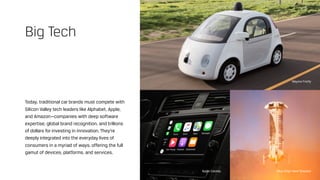
Today, traditional car brands must compete with
Silicon Valley tech leaders like Alphabet, Apple,
and Amazon—companies with deep software
expertise, global brand recognition, and trillions
of dollars for investing in innovation. They’re
deeply integrated into the everyday lives of
consumers in a myriad of ways, offering the full
gamut of devices, platforms, and services.
Big Tech
Waymo Firefly
Blue Origin New ShepardApple Carplay
New inventions will
always be disruptive 

to the old way.”
— Jeff Bezos, Amazon
“
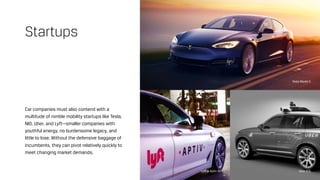
Car companies must also contend with a
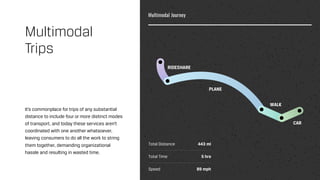
multitude of nimble mobility startups like Tesla,
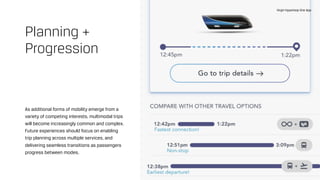
NIO, Uber, and Lyft—smaller companies with
youthful energy, no burdensome legacy, and
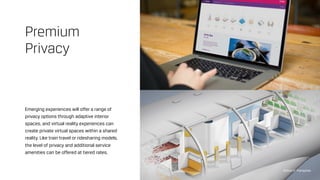
little to lose. Without the defensive baggage of
incumbents, they can pivot relatively quickly to
meet changing market demands.
Startups
Tesla Model S
Uber ATGLyft & Aptiv AV
Change will require a
newcomer to fundamentally
design the vehicle differently.”
— Padmasree Warrior, NIO
“
MANY FACTORS ARE

DRIVING CHANGE.
Disruption is being driven by technological advances, shifting
attitudes around ownership and sustainability, continuing global
urbanization, and perhaps the biggest impetus is public safety.
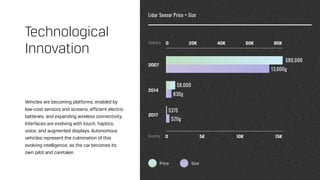
Vehicles are becoming platforms, enabled by
low-cost sensors and screens, efficient electric
batteries, and expanding wireless connectivity.
Interfaces are evolving with touch, haptics,
voice, and augmented displays. Autonomous
vehicles represent the culmination of this
evolving intelligence, as the car becomes its
own pilot and caretaker.
Technological
Innovation
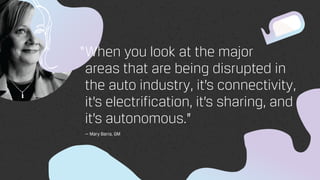
When you look at the major 

areas that are being disrupted in
the auto industry, it’s connectivity,
it’s electrification, it’s sharing, and
it’s autonomous.”
— Mary Barra, GM
“
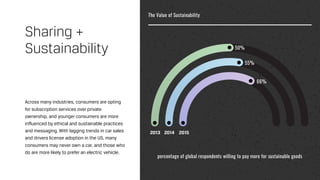
Across many industries, consumers are opting
for subscription services over private
ownership, and younger consumers are more
influenced by ethical and sustainable practices
and messaging. With lagging trends in car sales
and drivers license adoption in the US, many
consumers may never own a car, and those who
do are more likely to prefer an electric vehicle.
Sharing +
Sustainability
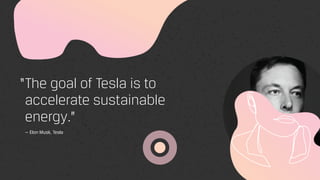
The goal of Tesla is to
accelerate sustainable
energy.”
— Elon Musk, Tesla
“
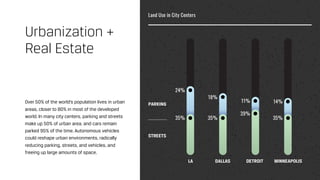
Over 50% of the world’s population lives in urban
areas, closer to 80% in most of the developed
world. In many city centers, parking and streets
make up 50% of urban area, and cars remain
parked 95% of the time. Autonomous vehicles
could reshape urban environments, radically
reducing parking, streets, and vehicles, and
freeing up large amounts of space.
Urbanization +
Real Estate
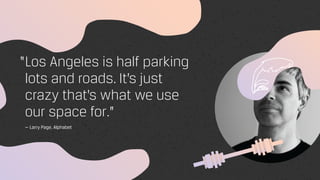
Los Angeles is half parking
lots and roads. It’s just
crazy that’s what we use
our space for.”
— Larry Page, Alphabet
“
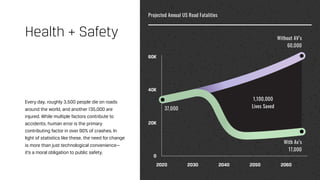
Every day, roughly 3,500 people die on roads
around the world, and another 135,000 are
injured. While multiple factors contribute to
accidents, human error is the primary
contributing factor in over 90% of crashes. In
light of statistics like these, the need for change
is more than just technological convenience—
it’s a moral obligation to public safety.
Health + Safety
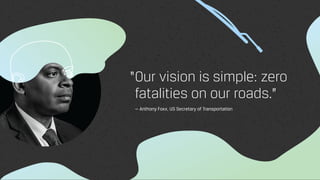
Our vision is simple: zero
fatalities on our roads.”
— Anthony Foxx, US Secretary of Transportation
“
CAR COMPANIES

MUST ADAPT.
Ten years ago, mobile phone manufacturers struggled and mostly
failed to survive the smartphone wave. As automotive OEMs face
a similar sea change, what can they learn from the mobile
disruption of the last decade?
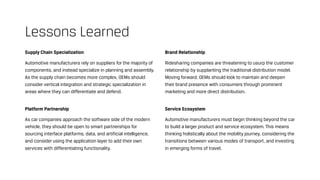
Supply Chain Specialization
Automotive manufacturers rely on suppliers for the majority of
components, and instead specialize in planning and assembly.
As the supply chain becomes more complex, OEMs should
consider vertical integration and strategic specialization in
areas where they can differentiate and defend.
Platform Partnership
As car companies approach the software side of the modern
vehicle, they should be open to smart partnerships for
sourcing interface platforms, data, and artificial intelligence,
and consider using the application layer to add their own
services with differentiating functionality.
Lessons Learned
Brand Relationship
Ridesharing companies are threatening to usurp the customer
relationship by supplanting the traditional distribution model.
Moving forward, OEMs should look to maintain and deepen
their brand presence with consumers through prominent
marketing and more direct distribution.
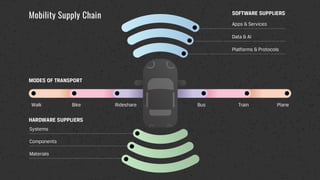
Service Ecosystem
Automotive manufacturers must begin thinking beyond the car
to build a larger product and service ecosystem. This means
thinking holistically about the mobility journey, considering the
transitions between various modes of transport, and investing
in emerging forms of travel.
OUR VISION STARTS

WITH RESEARCH.
We cataloged and synthesized movement patterns to 

extrapolate a bigger picture of current travel behavior, and
complemented it with secondary desk research on market and
technology trends to understand the trajectory of change.
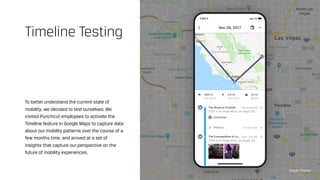
To better understand the current state of
mobility, we decided to test ourselves. We
invited Punchcut employees to activate the
Timeline feature in Google Maps to capture data
about our mobility patterns over the course of a
few months time, and arrived at a set of
insights that capture our perspective on the
future of mobility experiences.
Timeline Testing
Google Timeline
Insight 1
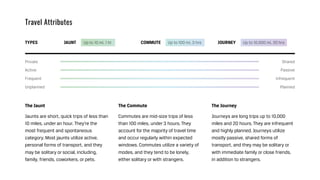
There are three basic types of
travel: the jaunt, the commute,
and the journey.
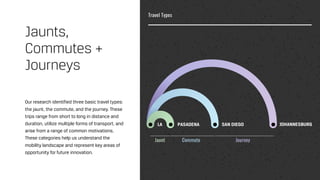
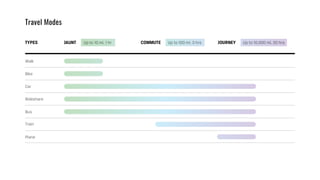
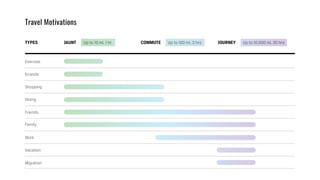
Our research identified three basic travel types:
the jaunt, the commute, and the journey. These
trips range from short to long in distance and
duration, utilize multiple forms of transport, and
arise from a range of common motivations.
These categories help us understand the
mobility landscape and represent key areas of
opportunity for future innovation.
Jaunts,
Commutes +
Journeys
The Jaunt
Jaunts are short, quick trips of less than
10 miles, under an hour. They’re the
most frequent and spontaneous
category. Most jaunts utilize active,
personal forms of transport, and they
may be solitary or social, including,
family, friends, coworkers, or pets.
The Commute
Commutes are mid-size trips of less
than 100 miles, under 3 hours. They
account for the majority of travel time
and occur regularly within expected
windows. Commutes utilize a variety of
modes, and they tend to be lonely,
either solitary or with strangers.
The Journey
Journeys are long trips up to 10,000
miles and 20 hours. They are infrequent
and highly planned. Journeys utilize
mostly passive, shared forms of
transport, and they may be solitary or
with immediate family or close friends,
in addition to strangers.
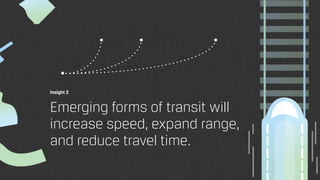
Insight 2
Emerging forms of transit will
increase speed, expand range,
and reduce travel time.
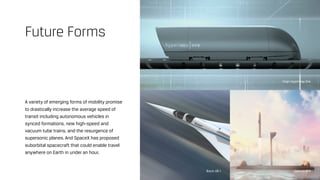
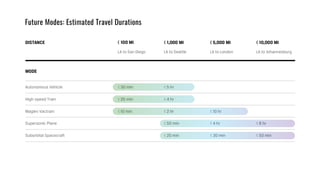
A variety of emerging forms of mobility promise
to drastically increase the average speed of
transit including autonomous vehicles in
synced formations, new high-speed and
vacuum tube trains, and the resurgence of
supersonic planes. And SpaceX has proposed
suborbital spacecraft that could enable travel
anywhere on Earth in under an hour.
Future Forms
Virgin Hyperloop One
SpaceX BFRBoom XB-1
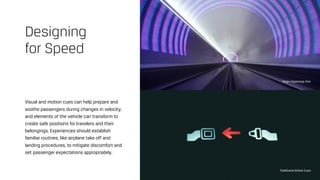
Visual and motion cues can help prepare and
soothe passengers during changes in velocity,
and elements of the vehicle can transform to
create safe positions for travelers and their
belongings. Experiences should establish
familiar routines, like airplane take off and
landing procedures, to mitigate discomfort and
set passenger expectations appropriately.
Designing 

for Speed
Virgin Hyperloop One
Traditional Airline Cues
Insight 3
Most trips involve multiple
modes, and connecting these
modes will be critical.
It’s commonplace for trips of any substantial
distance to include four or more distinct modes
of transport, and today these services aren’t
coordinated with one another whatsoever,
leaving consumers to do all the work to string
them together, demanding organizational
hassle and resulting in wasted time.
Multimodal 

Trips
As additional forms of mobility emerge from a
variety of competing interests, multimodal trips
will become increasingly common and complex.
Future experiences should focus on enabling
trip planning across multiple services, and
delivering seamless transitions as passengers
progress between modes.
Planning +
Progression
Virgin Hyperloop One App
Insight 4
Future vehicles will offer
privacy with adaptive spaces
and virtual experiences.
Emerging experiences will offer a range of
privacy options through adaptive interior
spaces, and virtual reality experiences can
create private virtual spaces within a shared
reality. Like train travel or ridesharing models,
the level of privacy and additional service
amenities can be offered at tiered rates.
Premium
Privacy
Airbus A³ Transpose
Insight 5
As mobility shifts away from
active human piloting, people
will experience more freedom.
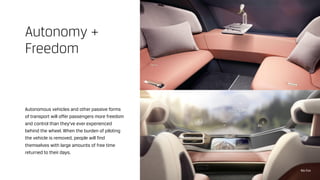
Autonomous vehicles and other passive forms
of transport will offer passengers more freedom
and control than they’ve ever experienced
behind the wheel. When the burden of piloting
the vehicle is removed, people will find
themselves with large amounts of free time
returned to their days.
Autonomy +
Freedom
Nio Eve
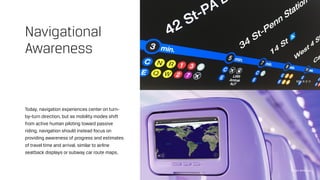
Today, navigation experiences center on turn-
by-turn direction, but as mobility modes shift
from active human piloting toward passive
riding, navigation should instead focus on
providing awareness of progress and estimates
of travel time and arrival, similar to airline
seatback displays or subway car route maps.
Navigational
Awareness
MTA R-2-11
Virgin America
Insight 6
Future forms of mobility will
bring back past pursuits and
enable new possibilities.
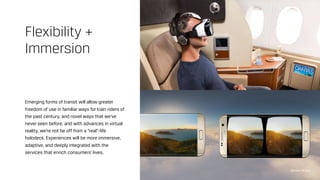
Emerging forms of transit will allow greater
freedom of use in familiar ways for train riders of
the past century, and novel ways that we’ve
never seen before, and with advances in virtual
reality, we’re not far off from a “real”-life
holodeck. Experiences will be more immersive,
adaptive, and deeply integrated with the
services that enrich consumers’ lives.
Flexibility +
Immersion
Qantas VR App
Insight 7
Air travel will be the next big
industry to be disrupted, and
then there’s space.
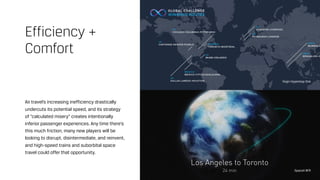
Air travel’s increasing inefficiency drastically
undercuts its potential speed, and its strategy
of “calculated misery” creates intentionally
inferior passenger experiences. Any time there’s
this much friction, many new players will be
looking to disrupt, disintermediate, and reinvent,
and high-speed trains and suborbital space
travel could offer that opportunity.
Efficiency +
Comfort
Virgin Hyperloop One
SpaceX BFR
Space promises another category of travel—

the voyage, a long-distance expedition of
exploration or emigration. Lasting months,
years, even centuries, travelers will live like
nomads, and vehicles will be traveling homes,
communities, and cities. Entire generations
could live and die in space, experiencing only
travel without origin or destination.
Pioneering
Space
SpaceX Interplanetary System
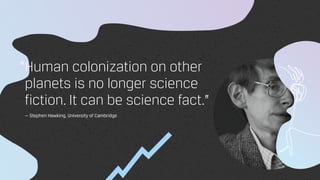
Human colonization on other
planets is no longer science
fiction. It can be science fact.”
— Stephen Hawking, University of Cambridge
“
WE DESIGN

THE FUTURE.
As specialists in UX for next-generation connected experiences,
Punchcut partners with companies to envision new mobility
experiences for consumers. If you have an idea regarding the
future of mobility experiences, odds are we can help.
THANKS.
For more information on Punchcut
and access to other resources,
contact business@punchcut.com.
© 2017 Punchcut. All rights reserved.

Punchcut Future of Mobility Journeys

  • 1.
    ESTIMATED 
 TIME OFARRIVAL The Future of Mobility | 15 January 2018
  • 2.
    MOBILITY IS
 EVOLVING. Like themobile device manufacturers of the early 2000s, 
 car companies of today are being forced to radically rethink 
 their core offering, and they’re finding their long incumbency challenged by new players with decidedly different strengths.
  • 3.
    SILICON VALLEY IS
 THE NEW MOTOWN. Today, automotive manufacturers must compete with 
 powerful tech giants and a multitude of nimble mobility 
 startups. With emerging disruptors on all sides, traditional 
 car companies must adapt or face extinction.
  • 4.
    Today, traditional carbrands must compete with Silicon Valley tech leaders like Alphabet, Apple, and Amazon—companies with deep software expertise, global brand recognition, and trillions of dollars for investing in innovation. They’re deeply integrated into the everyday lives of consumers in a myriad of ways, offering the full gamut of devices, platforms, and services. Big Tech Waymo Firefly Blue Origin New ShepardApple Carplay
  • 5.
    New inventions will alwaysbe disruptive 
 to the old way.” — Jeff Bezos, Amazon “
  • 6.
    Car companies mustalso contend with a multitude of nimble mobility startups like Tesla, NIO, Uber, and Lyft—smaller companies with youthful energy, no burdensome legacy, and little to lose. Without the defensive baggage of incumbents, they can pivot relatively quickly to meet changing market demands. Startups Tesla Model S Uber ATGLyft & Aptiv AV
  • 7.
    Change will requirea newcomer to fundamentally design the vehicle differently.” — Padmasree Warrior, NIO “
  • 8.
    MANY FACTORS ARE
 DRIVINGCHANGE. Disruption is being driven by technological advances, shifting attitudes around ownership and sustainability, continuing global urbanization, and perhaps the biggest impetus is public safety.
  • 9.
    Vehicles are becomingplatforms, enabled by low-cost sensors and screens, efficient electric batteries, and expanding wireless connectivity. Interfaces are evolving with touch, haptics, voice, and augmented displays. Autonomous vehicles represent the culmination of this evolving intelligence, as the car becomes its own pilot and caretaker. Technological Innovation
  • 10.
    When you lookat the major 
 areas that are being disrupted in the auto industry, it’s connectivity, it’s electrification, it’s sharing, and it’s autonomous.” — Mary Barra, GM “
  • 11.
    Across many industries,consumers are opting for subscription services over private ownership, and younger consumers are more influenced by ethical and sustainable practices and messaging. With lagging trends in car sales and drivers license adoption in the US, many consumers may never own a car, and those who do are more likely to prefer an electric vehicle. Sharing + Sustainability
  • 12.
    The goal ofTesla is to accelerate sustainable energy.” — Elon Musk, Tesla “
  • 13.
    Over 50% ofthe world’s population lives in urban areas, closer to 80% in most of the developed world. In many city centers, parking and streets make up 50% of urban area, and cars remain parked 95% of the time. Autonomous vehicles could reshape urban environments, radically reducing parking, streets, and vehicles, and freeing up large amounts of space. Urbanization + Real Estate
  • 14.
    Los Angeles ishalf parking lots and roads. It’s just crazy that’s what we use our space for.” — Larry Page, Alphabet “
  • 15.
    Every day, roughly3,500 people die on roads around the world, and another 135,000 are injured. While multiple factors contribute to accidents, human error is the primary contributing factor in over 90% of crashes. In light of statistics like these, the need for change is more than just technological convenience— it’s a moral obligation to public safety. Health + Safety
  • 16.
    Our vision issimple: zero fatalities on our roads.” — Anthony Foxx, US Secretary of Transportation “
  • 17.
    CAR COMPANIES
 MUST ADAPT. Tenyears ago, mobile phone manufacturers struggled and mostly failed to survive the smartphone wave. As automotive OEMs face a similar sea change, what can they learn from the mobile disruption of the last decade?
  • 18.
    Supply Chain Specialization Automotivemanufacturers rely on suppliers for the majority of components, and instead specialize in planning and assembly. As the supply chain becomes more complex, OEMs should consider vertical integration and strategic specialization in areas where they can differentiate and defend. Platform Partnership As car companies approach the software side of the modern vehicle, they should be open to smart partnerships for sourcing interface platforms, data, and artificial intelligence, and consider using the application layer to add their own services with differentiating functionality. Lessons Learned Brand Relationship Ridesharing companies are threatening to usurp the customer relationship by supplanting the traditional distribution model. Moving forward, OEMs should look to maintain and deepen their brand presence with consumers through prominent marketing and more direct distribution. Service Ecosystem Automotive manufacturers must begin thinking beyond the car to build a larger product and service ecosystem. This means thinking holistically about the mobility journey, considering the transitions between various modes of transport, and investing in emerging forms of travel.
  • 20.
    OUR VISION STARTS
 WITHRESEARCH. We cataloged and synthesized movement patterns to 
 extrapolate a bigger picture of current travel behavior, and complemented it with secondary desk research on market and technology trends to understand the trajectory of change.
  • 21.
    To better understandthe current state of mobility, we decided to test ourselves. We invited Punchcut employees to activate the Timeline feature in Google Maps to capture data about our mobility patterns over the course of a few months time, and arrived at a set of insights that capture our perspective on the future of mobility experiences. Timeline Testing Google Timeline
  • 22.
    Insight 1 There arethree basic types of travel: the jaunt, the commute, and the journey.
  • 23.
    Our research identifiedthree basic travel types: the jaunt, the commute, and the journey. These trips range from short to long in distance and duration, utilize multiple forms of transport, and arise from a range of common motivations. These categories help us understand the mobility landscape and represent key areas of opportunity for future innovation. Jaunts, Commutes + Journeys
  • 24.
    The Jaunt Jaunts areshort, quick trips of less than 10 miles, under an hour. They’re the most frequent and spontaneous category. Most jaunts utilize active, personal forms of transport, and they may be solitary or social, including, family, friends, coworkers, or pets. The Commute Commutes are mid-size trips of less than 100 miles, under 3 hours. They account for the majority of travel time and occur regularly within expected windows. Commutes utilize a variety of modes, and they tend to be lonely, either solitary or with strangers. The Journey Journeys are long trips up to 10,000 miles and 20 hours. They are infrequent and highly planned. Journeys utilize mostly passive, shared forms of transport, and they may be solitary or with immediate family or close friends, in addition to strangers.
  • 27.
    Insight 2 Emerging formsof transit will increase speed, expand range, and reduce travel time.
  • 28.
    A variety ofemerging forms of mobility promise to drastically increase the average speed of transit including autonomous vehicles in synced formations, new high-speed and vacuum tube trains, and the resurgence of supersonic planes. And SpaceX has proposed suborbital spacecraft that could enable travel anywhere on Earth in under an hour. Future Forms Virgin Hyperloop One SpaceX BFRBoom XB-1
  • 30.
    Visual and motioncues can help prepare and soothe passengers during changes in velocity, and elements of the vehicle can transform to create safe positions for travelers and their belongings. Experiences should establish familiar routines, like airplane take off and landing procedures, to mitigate discomfort and set passenger expectations appropriately. Designing 
 for Speed Virgin Hyperloop One Traditional Airline Cues
  • 31.
    Insight 3 Most tripsinvolve multiple modes, and connecting these modes will be critical.
  • 32.
    It’s commonplace fortrips of any substantial distance to include four or more distinct modes of transport, and today these services aren’t coordinated with one another whatsoever, leaving consumers to do all the work to string them together, demanding organizational hassle and resulting in wasted time. Multimodal 
 Trips
  • 33.
    As additional formsof mobility emerge from a variety of competing interests, multimodal trips will become increasingly common and complex. Future experiences should focus on enabling trip planning across multiple services, and delivering seamless transitions as passengers progress between modes. Planning + Progression Virgin Hyperloop One App
  • 34.
    Insight 4 Future vehicleswill offer privacy with adaptive spaces and virtual experiences.
  • 35.
    Emerging experiences willoffer a range of privacy options through adaptive interior spaces, and virtual reality experiences can create private virtual spaces within a shared reality. Like train travel or ridesharing models, the level of privacy and additional service amenities can be offered at tiered rates. Premium Privacy Airbus A³ Transpose
  • 36.
    Insight 5 As mobilityshifts away from active human piloting, people will experience more freedom.
  • 37.
    Autonomous vehicles andother passive forms of transport will offer passengers more freedom and control than they’ve ever experienced behind the wheel. When the burden of piloting the vehicle is removed, people will find themselves with large amounts of free time returned to their days. Autonomy + Freedom Nio Eve
  • 38.
    Today, navigation experiencescenter on turn- by-turn direction, but as mobility modes shift from active human piloting toward passive riding, navigation should instead focus on providing awareness of progress and estimates of travel time and arrival, similar to airline seatback displays or subway car route maps. Navigational Awareness MTA R-2-11 Virgin America
  • 39.
    Insight 6 Future formsof mobility will bring back past pursuits and enable new possibilities.
  • 40.
    Emerging forms oftransit will allow greater freedom of use in familiar ways for train riders of the past century, and novel ways that we’ve never seen before, and with advances in virtual reality, we’re not far off from a “real”-life holodeck. Experiences will be more immersive, adaptive, and deeply integrated with the services that enrich consumers’ lives. Flexibility + Immersion Qantas VR App
  • 41.
    Insight 7 Air travelwill be the next big industry to be disrupted, and then there’s space.
  • 42.
    Air travel’s increasinginefficiency drastically undercuts its potential speed, and its strategy of “calculated misery” creates intentionally inferior passenger experiences. Any time there’s this much friction, many new players will be looking to disrupt, disintermediate, and reinvent, and high-speed trains and suborbital space travel could offer that opportunity. Efficiency + Comfort Virgin Hyperloop One SpaceX BFR
  • 43.
    Space promises anothercategory of travel—
 the voyage, a long-distance expedition of exploration or emigration. Lasting months, years, even centuries, travelers will live like nomads, and vehicles will be traveling homes, communities, and cities. Entire generations could live and die in space, experiencing only travel without origin or destination. Pioneering Space SpaceX Interplanetary System
  • 44.
    Human colonization onother planets is no longer science fiction. It can be science fact.” — Stephen Hawking, University of Cambridge “
  • 45.
    WE DESIGN
 THE FUTURE. Asspecialists in UX for next-generation connected experiences, Punchcut partners with companies to envision new mobility experiences for consumers. If you have an idea regarding the future of mobility experiences, odds are we can help.
  • 46.
    THANKS. For more informationon Punchcut and access to other resources, contact business@punchcut.com. © 2017 Punchcut. All rights reserved.