Plan CommunityWorkMembers of thegroup:Gonzalo CossíoJuan Pablo  JaimesFelipe Mejía Diego Sánchez«Thebiggestproblem in theworldcoludhadbeensolvedwhenitwassmall»Lao tzu
BryophytesMosses are small, soft plants that are typically 1–10 cm (0.4–4 in) tall, though some species are much larger. They commonly grow close together in clumps or mats in damp or shady locations. They do not have flowers or seeds, and their simple leaves cover the thin wiry stems. At certain times mosses produce spore capsules which may appear as beak-like capsules borne aloft on thin stalks.mosses were used as first-aid dressings on soldiers' wounds, as these mosses are highly absorbent and have mild antibacterial properties.
PTERIDOPHYTESthey have xylem and phloem (making them vascular plants). They have stems, leaves, and roots like other vascular plants. Ferns do not have either seeds or flowers (they reproduce via spores). Ferns first appear in the fossil record 360 million years ago in the Carboniferous but many of the current families and species did not appear until roughly 145 million years ago in the late Cretaceous (after flowering plants came to dominate many environments).Ferns are not of major economic importance, but some are grown or gathered for food, as ornamental plants, or for remediating contaminated soils. Some are significant weeds. They also featured in mythology, medicine, and art.
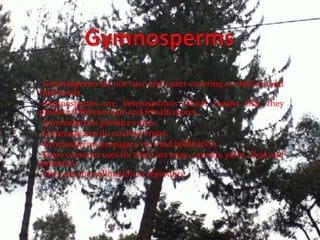
Gymnosperms -Gymnosperms do not have and outer-covering or shell around their seeds.-Gymnosperms are heterosporous which means that they produce different male and female spores.-Gymnosperms produce cones.-Gymnosperms do not bear fruits.-Gymnosperms propagate via wind pollination.-Some common uses for them are soap, varnish, paint, food and perfumes.-They use the pollination to reproduce.
ANGIOSPERMThe flowering plants (angiosperms), also known as Angiospermae or Magnoliophyta, are the most diverse group of land plants. Angiosperms are seed-producing plants like the gymnosperms and can be distinguished from the gymnosperms by a series of synapomorphies (derived characteristics). These characteristics include flowers, endosperm within the seeds, and the production of fruits that contain the seeds.Agriculture is almost entirely dependent on angiosperms, either directly or indirectly through livestock feed. Of all the families plants, the Poaceae, or grass family, is by far the most important, providing the bulk of all feedstocks (rice, corn — maize, wheat, barley, rye, oats, pearl millet, sugar cane, sorghum). The Fabaceae, or legume family, comes in second place. Also of high importance are the Solanaceae, or nightshade family (potatoes, tomatoes, and peppers, among others), the Cucurbitaceae, or gourd family (also including pumpkins and melons), the Brassicaceae, or mustard plant family (including rapeseed and the innumerable varieties of the cabbage species Brassicaoleracea), and the Apiaceae, or parsley family. Many of our fruits come from the Rutaceae, or rue family, and the Rosaceae, or rose family (including apples, pears, cherries, apricots, plums, etc.).
School plants phylogenetic tree BryophytesPTERIDOPHYTES GymnospermsAngiosperm MMosses are small, soft plants that are typically 1–10 cm (0.4–4 in) tall, though some species are much larger.they have xylem and phloem (making them vascular plants). They have stems, leaves, and roots like other vascular plants.Angiosperms are seed-producing plants like the gymnosperms and can be distinguished from the gymnosperms by a series of synapomorphies (derived characteristics).Gymnosperms are heterosporous which means that they produce different male and female spores.

Plan community work mejia

  • 1.
    Plan CommunityWorkMembers ofthegroup:Gonzalo CossíoJuan Pablo JaimesFelipe Mejía Diego Sánchez«Thebiggestproblem in theworldcoludhadbeensolvedwhenitwassmall»Lao tzu
  • 2.
    BryophytesMosses are small,soft plants that are typically 1–10 cm (0.4–4 in) tall, though some species are much larger. They commonly grow close together in clumps or mats in damp or shady locations. They do not have flowers or seeds, and their simple leaves cover the thin wiry stems. At certain times mosses produce spore capsules which may appear as beak-like capsules borne aloft on thin stalks.mosses were used as first-aid dressings on soldiers' wounds, as these mosses are highly absorbent and have mild antibacterial properties.
  • 3.
    PTERIDOPHYTESthey have xylemand phloem (making them vascular plants). They have stems, leaves, and roots like other vascular plants. Ferns do not have either seeds or flowers (they reproduce via spores). Ferns first appear in the fossil record 360 million years ago in the Carboniferous but many of the current families and species did not appear until roughly 145 million years ago in the late Cretaceous (after flowering plants came to dominate many environments).Ferns are not of major economic importance, but some are grown or gathered for food, as ornamental plants, or for remediating contaminated soils. Some are significant weeds. They also featured in mythology, medicine, and art.
  • 4.
    Gymnosperms -Gymnosperms donot have and outer-covering or shell around their seeds.-Gymnosperms are heterosporous which means that they produce different male and female spores.-Gymnosperms produce cones.-Gymnosperms do not bear fruits.-Gymnosperms propagate via wind pollination.-Some common uses for them are soap, varnish, paint, food and perfumes.-They use the pollination to reproduce.
  • 5.
    ANGIOSPERMThe flowering plants(angiosperms), also known as Angiospermae or Magnoliophyta, are the most diverse group of land plants. Angiosperms are seed-producing plants like the gymnosperms and can be distinguished from the gymnosperms by a series of synapomorphies (derived characteristics). These characteristics include flowers, endosperm within the seeds, and the production of fruits that contain the seeds.Agriculture is almost entirely dependent on angiosperms, either directly or indirectly through livestock feed. Of all the families plants, the Poaceae, or grass family, is by far the most important, providing the bulk of all feedstocks (rice, corn — maize, wheat, barley, rye, oats, pearl millet, sugar cane, sorghum). The Fabaceae, or legume family, comes in second place. Also of high importance are the Solanaceae, or nightshade family (potatoes, tomatoes, and peppers, among others), the Cucurbitaceae, or gourd family (also including pumpkins and melons), the Brassicaceae, or mustard plant family (including rapeseed and the innumerable varieties of the cabbage species Brassicaoleracea), and the Apiaceae, or parsley family. Many of our fruits come from the Rutaceae, or rue family, and the Rosaceae, or rose family (including apples, pears, cherries, apricots, plums, etc.).
  • 6.
    School plants phylogenetictree BryophytesPTERIDOPHYTES GymnospermsAngiosperm MMosses are small, soft plants that are typically 1–10 cm (0.4–4 in) tall, though some species are much larger.they have xylem and phloem (making them vascular plants). They have stems, leaves, and roots like other vascular plants.Angiosperms are seed-producing plants like the gymnosperms and can be distinguished from the gymnosperms by a series of synapomorphies (derived characteristics).Gymnosperms are heterosporous which means that they produce different male and female spores.